EP1517571B1 - Verfahren und Überwachungsvorrichtung zur Bestimmung eines Qualitätsmasses eines Netzwerkelements in einem Mobilfunknetz - Google Patents
Verfahren und Überwachungsvorrichtung zur Bestimmung eines Qualitätsmasses eines Netzwerkelements in einem Mobilfunknetz Download PDFInfo
- Publication number
- EP1517571B1 EP1517571B1 EP20030021020 EP03021020A EP1517571B1 EP 1517571 B1 EP1517571 B1 EP 1517571B1 EP 20030021020 EP20030021020 EP 20030021020 EP 03021020 A EP03021020 A EP 03021020A EP 1517571 B1 EP1517571 B1 EP 1517571B1
- Authority
- EP
- European Patent Office
- Prior art keywords
- network element
- parameter
- network
- events
- indicate
- Prior art date
- Legal status (The legal status is an assumption and is not a legal conclusion. Google has not performed a legal analysis and makes no representation as to the accuracy of the status listed.)
- Expired - Lifetime
Links
- 238000000034 method Methods 0.000 title claims description 24
- 238000012806 monitoring device Methods 0.000 title claims description 8
- 230000000694 effects Effects 0.000 claims description 10
- 206010000210 abortion Diseases 0.000 claims description 5
- 231100000176 abortion Toxicity 0.000 claims description 5
- 238000004891 communication Methods 0.000 claims description 4
- 238000004590 computer program Methods 0.000 claims description 4
- 230000008859 change Effects 0.000 claims description 3
- 101000794153 Homo sapiens Tetraspanin-15 Proteins 0.000 description 4
- 102100030163 Tetraspanin-15 Human genes 0.000 description 4
- 238000012544 monitoring process Methods 0.000 description 4
- 230000011664 signaling Effects 0.000 description 4
- 238000004458 analytical method Methods 0.000 description 2
- 238000010295 mobile communication Methods 0.000 description 2
- 230000008569 process Effects 0.000 description 2
- 239000000523 sample Substances 0.000 description 2
- 230000005540 biological transmission Effects 0.000 description 1
- 238000011161 development Methods 0.000 description 1
- 230000018109 developmental process Effects 0.000 description 1
- 230000006872 improvement Effects 0.000 description 1
- 238000007726 management method Methods 0.000 description 1
- 238000005259 measurement Methods 0.000 description 1
- 238000013439 planning Methods 0.000 description 1
- 238000012545 processing Methods 0.000 description 1
- 238000013468 resource allocation Methods 0.000 description 1
- 230000001960 triggered effect Effects 0.000 description 1
Images

Classifications
-
- H—ELECTRICITY
- H04—ELECTRIC COMMUNICATION TECHNIQUE
- H04W—WIRELESS COMMUNICATION NETWORKS
- H04W24/00—Supervisory, monitoring or testing arrangements
- H04W24/02—Arrangements for optimising operational condition
-
- H—ELECTRICITY
- H04—ELECTRIC COMMUNICATION TECHNIQUE
- H04W—WIRELESS COMMUNICATION NETWORKS
- H04W24/00—Supervisory, monitoring or testing arrangements
Definitions
- the present invention refers to a method for determining a measure for the quality of a specific network element in a mobile radio network and a monitoring device designed to carry out such method.
- a person flies together with his mobile phone into another country and after landing switches on his mobile phone at the airport for the first time.
- the person is a so-called in-roamer, i. e. a subscriber member of a network of his country of origin at the moment he is connected into the mobile radio network in the country in which he is currently staying.
- in-roamer i. e. a subscriber member of a network of his country of origin at the moment he is connected into the mobile radio network in the country in which he is currently staying.
- several mobile radio networks of different providers of the country in which the owner of the mobile phone is currently staying compete for this in-roamer.
- the mobile phone chooses for example the provider with the strongest transmit signal, as long as this provider is currently available at this point in time.
- IRMA Intelligent Roaming Monitoring Application
- NET-7 probes monitor all messages exchanged between the two networks, then NET-7 IRMA analyses both ISUP and MAP signalling, correlates these messages, and provides alarms and synthesizes written reports.
- IRMA provides information about the network as a whole rather than about a single network element.
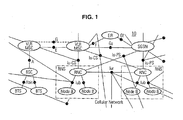
- Fig. 1 shows an overview of an integrated mobile radio network 10, in which different standards are present, i.e. GSM (Global System for Mobile Communications), GPRS (General Packet Radio System) and UMTS (Universal Mobile Telecommunication System) which are linked with each other.
- GSM Global System for Mobile Communications
- GPRS General Packet Radio System
- UMTS Universal Mobile Telecommunication System
- the present invention can not only be used for mobile networks having one of these standards, but also for mobile networks of future standards that meet the specific requirements which will be explained in more detail below.
- the invention shall be explained below by means of an example of a GSM network without limiting the scope of the invention.
- the QoS of a so-called cell is the important factor, i.e.
- Cells with a high rank value are of highest importance for providers. On the one hand, they could indicate cells that have a bad QoS value or refer to cells that, although they may have a good QoS value, are used by many in-roamers.
- the present invention allows localizing the activities performed by in-roamers, detecting the area where there is the highest probability that in-roamer pass to a competitor network due to low QoS. It allows quickly discovering and improving the network portion where the churn rate of in-roamers is high.
- the present invention allows detecting at cell level the portion of the network providing bad service to in-roamers and assists roaming and network planning teams on discovering weak points of their network.
- the present invention can not only be used in connection with in-roamers but can advantageously be used at all possible network elements in order to check their quality.
- the rank value RCV is proportional to the product of the quality parameter CMI and the in-roamer user parameter RUI.
- the network element represents the most outer standardized node of the mobile network.
- These network elements are preferred because they are positioned at the periphery as far as possible and therefore they allow checking the smallest possible components of network elements providing the information needed.
- the method is preferably used at the A-interface to process the A-interface statistic error counters related to a specific cell to implement the method according the invention. That is, the above-mentioned parameters can be detected easily at the A-interface since the initial values on which they are based are present at this interface anyway. Still further outside, the network interfaces (e.g. the A-bis interface in the GSM network) will then become proprietary and will make a simple implementation of the method according to the invention more difficult.
- the service providing parameter has at least one of the following values I1, I2, I3: Number I1 of events that indicate the abortion of a connection after assignment of a communication resource; number I2 of events that indicate the abortion of a connection before the assignment of a communication resource; number I3 of events that indicate an error with the radio resources/terrestrial resources assignment, wherein the values I1 and/or I2 are normalized on a value T1 indicating the number of events that indicate the service activities of subscribers and wherein the value I3 is normalized on a value T3 indicating the number of events that indicate assignment requests.
- the mobility parameter comprises at least the following value I4: Number I4 of events that indicate a handover failure, wherein this value I4 is normalized on a value T4 indicating the number of events that indicate a request of a handover.
- the rank parameters RCV of predeterminable network elements are calculated and analysed statistically, in particular a classification is carried out.
- the monitoring comprising components to carry out the different steps of the method according to the invention.
- the following description will explain an embodiment of the present invention by the example of a mobile radio network according to the GSM standard, in particular by evaluating the information, which is available at the A-interface anyway (see Fig. 1 , on the left). Nevertheless, as may be gathered from a person skilled in the art, the invention may be used with different standards or at different interfaces in a network according to the GSM standard.
- a clear request message refers to the abortion of a connection setup of a mobile phone.
- SCCP Signaling Connection Control Part
- I2 Number of SDDCH Clear Requests: This counter is incremented for each Clear Request message sent from the BSC to the MSC before the assignment of a Traffic Channel. It indicates that the BSC wishes to release the associated dedicated resources with the consequent end of SCCP connection before the start of voice exchange between calling and called party. Typical causes are radio interface message failure, equipment failure, protocol error between BSC and MSC, preemption.
- I3 Number of Assignment Failures: Sent from the BSC to the MSC it indicates a failure in radio resources/terrestrial resources assignment that typically triggers the disconnection of the call and the end of SCCP connection before the start of voice exchange between calling and called party. Typical causes are radio interface message failure, equipment failure, no radio resource available, requested terrestrial resource unavailable, requested speech version unavailable.
- I4 Number of Handover Failures: Sent from the BSC to the MSC it indicates a failure in the resource allocation process on handover and that the handover has been aborted.
- the handover failure can trigger the disconnection of the call and the end of the SCCP connection if reversion to the old channel is not possible.
- Typical causes are radio interface message failure, equipment failure, no radio resource available, requested terrestrial resource unavailable, requested speech version unavailable, radio interface failure-reversion to old channel, invalid message contents.
- a handover indicates the change of a BTS to another BTS due to the movement of the mobile phone.
- T1 Number of paging responses plus number of CM service requests plus number of connections successfully started with handover, i.e. in principle the number of all user activities.
- T4 Number of handover requests and handover required
- k1, k3 and k4 are opportune weight values that are preferably between 1 and 100, for example at 50, and are configurable.
- the quality parameter CMI provides a value that indicates bad cell working independently from the user typology, i.e. independently, whether it is referred to a home-roamer or in-roamer.
- a CMI near zero indicates a good cell, whereas a CMI close to 1 indicates a bad cell.
- the in-roamer user parameter RUI is determined in a next step. This value indicates with daily frequency the in-roamer activity on the cells and is determined for each cell individually. Cells with a low number of activity from in-roamers will have a low RUI, cells with a high number of activity from in-roamers will have a high RUI.
- the in-roamer user parameter RUI will increase with the following activities: Mobile originating call, mobile terminating call, SMS receipt and transmission, periodical update location, attach update location, normal update location (normally disabled since it can produce wrong high RUI values), detach IMSI, connections successfully started with handover.
- RCV CMI * RUI
- a daily report with the highest RCV values will then be generated by the providers.
- the cells are displayed in an order according to their RCV.
- Fig. 2 shows by way of an example a display on a display unit 12 of a monitoring device according to the invention.
- the BSC's Base Station Controller
- the corresponding cells are listed (in practice also several cells could be associated to a BSC).
- a cell name is listed in a third column 18.
- a parameter LAC Lication Area Code
- RUI is listed in a fifth column 22
- the parameter RCV is listed in a sixth column 24, the parameter RCV is listed and in a seventh column 26, the parameter CMI is listed.
- Fig. 2 shows by way of an example a ranking of different cells arranged accordingly to the RCV listed in the sixth column 24.
- the second column 16 states the cell identification number.
- Columns 22 and 26 state the respective parameters RUI and CMI for each cell. It is also possible to order the list according to one of those two parameters. For example, from this statistic it can be taken that the cells with the Cell-ID numbers 197, 86 and 25037 have a particularly bad RCV and improvement measures are necessary in those cases.
Landscapes
- Engineering & Computer Science (AREA)
- Computer Networks & Wireless Communication (AREA)
- Signal Processing (AREA)
- Mobile Radio Communication Systems (AREA)
Claims (8)
- Verfahren zum Bestimmen eines Maßes für die Qualität eines spezifischen Netzelements in einem Mobilfunknetz,
mit den folgenden Schritten
für das spezifische Netzelement:a) Erfassen eines Dienstbereitstellungsparameters, der die Fähigkeit für einzelne Teilnehmer angibt, das Mobilnetz zu nutzen, wobei der Dienstbereitstellungsparameter mindestens einen der folgenden Werte I1, I2, I3 umfasst:- die Anzahl I1 von Ereignissen, die auf den Abbruch einer Verbindung nach der Zuweisung einer Kommunikationsressource hinweisen;- die Anzahl I2 von Ereignissen, die auf den Abbruch einer Verbindung vor der Zuweisung einer Kommunikationsressource hinweisen;- die Anzahl I3 von Ereignissen, die auf einen Fehler bei der Zuweisung von Funkressourcen/terrestrischen Ressourcen hinweisen,wobei die Werte I1 und/oder I2 auf einen Wert T1 normiert werden, der die Anzahl von Ereignissen angibt, die auf die Dienstaktivitäten von Teilnehmern hinweisen, und wobei der Wert I3 auf einen Wert T3 normiert wird, der die Anzahl von Ereignissen angibt, die auf Zuweisungsanforderungen hinweisen; dadurch gekennzeichnet, dass das Verfahren auch die folgenden Schritte umfasst:b) Erfassen eines Mobilitätsparameters, der die Fähigkeit für einzelne Teilnehmer angibt, das Netz während eines Ortswechsels des Anwenders zu nutzen, der von einem Wechsel von einem ersten Netzelement zu einem zweiten Netzelement begleitet ist, wobei das spezifische Netzelement das erste oder das zweite Netzelement ist, und wobei der Mobilitätsparameter mindestens den folgenden Wert I4 umfasst: die Anzahl I4 von Ereignissen, die auf einen Übergabefehler hinweisen, wobei dieser Wert I4 auf einen Wert T4 normiert wird, der die Anzahl von Ereignissen angibt, die auf eine Anforderung einer Übergabe hinweisen;c) Verknüpfen der in Schritt a) und Schritt b) bestimmten Parameter zum Erhalten eines Qualitätsparameters CMI, wobei der Qualitätsparameter CMI folgendermaßen berechnet wird:
wobei k1, k3 und k4 Konstanten sind und mindestens k4 ungleich null ist;d) Erfassen eines Gastteilnehmer-Anwenderparameters RUI, der die Gastteilnehmer-Aktivität auf dem spezifischen Netzelement angibt, wobei Gastteilnehmer Teilnehmermitglieder eines anderen Mobilfunknetzes in dem Moment sind, in dem sie in das spezifische Mobilfunknetz geschaltet werden;
unde) Erfassen eines Rangwerts RCV für das spezifische Netzelement durch Verknüpfen des Qualitätsparameters CMI des spezifischen Netzelements mit dem Gastteilnehmer-Anwenderparameter RUI des spezifischen Netzelements. - Verfahren nach Anspruch 1,
gekennzeichnet durch den folgenden weiteren Schritt:g) Erfassen eines Netzverbindungsparameters, der die Verfügbarkeit des Mobilnetzes angibt, wobei in Schritt d) auch dieser Parameter berücksichtigt wird. - Verfahren nach Anspruch 1 oder 2,
dadurch gekennzeichnet, dass
das Netzelement den äußersten standardisierten Knoten des Mobilnetzes darstellt. - Verfahren nach einem der vorangehenden Ansprüche,
dadurch gekennzeichnet, dass
der Rangparameter RCV zum Produkt des Qualitätsparameters CMI und des Gastteilnehmer-Anwenderparameters RUI proportional ist. - Verfahren nach Anspruch 4,
dadurch gekennzeichnet, dass
in vorbestimmten Zeitintervallen die Rangparameter RCV von vorbestimmbaren Netzelementen berechnet und statistisch analysiert werden, insbesondere eine Klassifizierung ausgeführt wird. - Verfahren nach einem der vorangehenden Ansprüche,
dadurch gekennzeichnet, dass
das Mobilnetz vom GSM-Typ ist und das spezifische Netzelement eine Zelle ist. - Überwachungsvorrichtung, die dazu ausgelegt ist, ein Verfahren nach einem der Ansprüche 1 bis 6 auszuführen.
- Computerprogrammprodukt, in dem ein Verfahren nach einem der Ansprüche 1 bis 6 verwirklicht ist.
Priority Applications (2)
| Application Number | Priority Date | Filing Date | Title |
|---|---|---|---|
| EP20030021020 EP1517571B1 (de) | 2003-09-17 | 2003-09-17 | Verfahren und Überwachungsvorrichtung zur Bestimmung eines Qualitätsmasses eines Netzwerkelements in einem Mobilfunknetz |
| DE60334795T DE60334795D1 (de) | 2003-09-17 | 2003-09-17 | Verfahren und Überwachungsvorrichtung zur Bestimmung eines Qualitätsmasses eines Netzwerkelements in einem Mobilfunknetz |
Applications Claiming Priority (1)
| Application Number | Priority Date | Filing Date | Title |
|---|---|---|---|
| EP20030021020 EP1517571B1 (de) | 2003-09-17 | 2003-09-17 | Verfahren und Überwachungsvorrichtung zur Bestimmung eines Qualitätsmasses eines Netzwerkelements in einem Mobilfunknetz |
Publications (2)
| Publication Number | Publication Date |
|---|---|
| EP1517571A1 EP1517571A1 (de) | 2005-03-23 |
| EP1517571B1 true EP1517571B1 (de) | 2010-11-03 |
Family
ID=34178425
Family Applications (1)
| Application Number | Title | Priority Date | Filing Date |
|---|---|---|---|
| EP20030021020 Expired - Lifetime EP1517571B1 (de) | 2003-09-17 | 2003-09-17 | Verfahren und Überwachungsvorrichtung zur Bestimmung eines Qualitätsmasses eines Netzwerkelements in einem Mobilfunknetz |
Country Status (2)
| Country | Link |
|---|---|
| EP (1) | EP1517571B1 (de) |
| DE (1) | DE60334795D1 (de) |
Families Citing this family (3)
| Publication number | Priority date | Publication date | Assignee | Title |
|---|---|---|---|---|
| EP2057818B1 (de) * | 2006-08-28 | 2019-04-03 | Nokia Technologies Oy | Verfahren, system und endgerät zur herstellung einer multimedia-sitzung |
| FI121619B (fi) * | 2007-08-10 | 2011-01-31 | 7Signal Oy | Monitorointiasema ja menetelmä tietoliikenneverkkojen monitorointiin |
| CN105517024B (zh) | 2012-01-30 | 2019-08-13 | 华为技术有限公司 | 自组织网络协调方法、装置与系统 |
Family Cites Families (1)
| Publication number | Priority date | Publication date | Assignee | Title |
|---|---|---|---|---|
| US6516189B1 (en) * | 1999-03-17 | 2003-02-04 | Telephia, Inc. | System and method for gathering data from wireless communications networks |
-
2003
- 2003-09-17 EP EP20030021020 patent/EP1517571B1/de not_active Expired - Lifetime
- 2003-09-17 DE DE60334795T patent/DE60334795D1/de not_active Expired - Lifetime
Also Published As
| Publication number | Publication date |
|---|---|
| DE60334795D1 (de) | 2010-12-16 |
| EP1517571A1 (de) | 2005-03-23 |
Similar Documents
| Publication | Publication Date | Title |
|---|---|---|
| US20220022080A1 (en) | Radio communication system, radio station, radio terminal, network operation management apparatus, and communication quality confirmation method | |
| EP1142396B1 (de) | Ein drahtloses kommunikation system, das mobilfunktestsoftware agenten unterstützt | |
| JP5896309B2 (ja) | 通信システムにおける報告方法 | |
| CA2663190C (en) | Process for network characteristic data acquisition by regular users for supporting automated planning and optimization processes in cellular mobile radio networks | |
| CN103959845B (zh) | 降低无线网络中的无线电链路失效数据量的方法和装置 | |
| US20020072358A1 (en) | Methods and apparatus for real-time performance monitoring in a wireless communication network | |
| EP2717614B1 (de) | Verfahren und vorrichtung zur effizienten steuerung eines mdt in mehreren plmns | |
| US8612654B2 (en) | Determining configuration parameters of a mobile network | |
| EP3206427B1 (de) | Interaktionsverfahren und -vorrichtung für testfahrtinformationen | |
| US8098586B2 (en) | Determining configuration parameters of a mobile network | |
| WO2012052398A1 (en) | Reporting in communications systems | |
| CN101998490A (zh) | 路测方法、基站及终端 | |
| EP1517571A1 (de) | Verfahren und Überwachungsvorrichtung zur Bestimmung eines Qualitätsmasses eines Netzwerkelements in einem Mobilfunknetz | |
| EP1677557A1 (de) | Verbesserte Fehlerbehandlung der Messkontrollprozedur in einem UMTS Funkzugriffsnetwerk | |
| WO2012045333A1 (en) | Configuration handling in communications systems | |
| GB2556027A (en) | Method and apparatus for Network independent minimization of Drive Test (MDT) measurements | |
| US10743207B2 (en) | Method of operating cellular mobile radio network | |
| WO2025184863A1 (en) | Methods and apparatus for up based ue side data collection with network awareness for wireless communication systems. | |
| EP2448315B1 (de) | Abschätzung der Anzahl von Mobilstationen in einem geographischen Gebiet | |
| Borralho et al. | A novel localization C# framework for RAN optimization using extreme programming methodologies | |
| CN101795464A (zh) | Abis接口信令的处理方法 | |
| US10560863B1 (en) | Method of operating cellular mobile radio network | |
| WO2025039675A1 (zh) | 终端上报飞行路径的方法、装置、存储介质及电子设备 | |
| Samuel et al. | Location-based performance-measuring techniques in UMTS | |
| US20180302812A1 (en) | Inter-Technology Circuit-Switched Fallback (CSFB) Metrics |
Legal Events
| Date | Code | Title | Description |
|---|---|---|---|
| PUAI | Public reference made under article 153(3) epc to a published international application that has entered the european phase |
Free format text: ORIGINAL CODE: 0009012 |
|
| AK | Designated contracting states |
Kind code of ref document: A1 Designated state(s): AT BE BG CH CY CZ DE DK EE ES FI FR GB GR HU IE IT LI LU MC NL PT RO SE SI SK TR |
|
| AX | Request for extension of the european patent |
Extension state: AL LT LV MK |
|
| RAP1 | Party data changed (applicant data changed or rights of an application transferred) |
Owner name: TEKTRONIX INTERNATIONAL SALES GMBH |
|
| 17P | Request for examination filed |
Effective date: 20050830 |
|
| AKX | Designation fees paid |
Designated state(s): DE FR GB IT |
|
| 17Q | First examination report despatched |
Effective date: 20070227 |
|
| GRAP | Despatch of communication of intention to grant a patent |
Free format text: ORIGINAL CODE: EPIDOSNIGR1 |
|
| RIC1 | Information provided on ipc code assigned before grant |
Ipc: H04W 24/00 20090101ALI20100419BHEP Ipc: H04W 24/02 20090101AFI20100419BHEP |
|
| GRAS | Grant fee paid |
Free format text: ORIGINAL CODE: EPIDOSNIGR3 |
|
| GRAA | (expected) grant |
Free format text: ORIGINAL CODE: 0009210 |
|
| AK | Designated contracting states |
Kind code of ref document: B1 Designated state(s): DE FR GB IT |
|
| REG | Reference to a national code |
Ref country code: GB Ref legal event code: FG4D |
|
| REF | Corresponds to: |
Ref document number: 60334795 Country of ref document: DE Date of ref document: 20101216 Kind code of ref document: P |
|
| PLBE | No opposition filed within time limit |
Free format text: ORIGINAL CODE: 0009261 |
|
| STAA | Information on the status of an ep patent application or granted ep patent |
Free format text: STATUS: NO OPPOSITION FILED WITHIN TIME LIMIT |
|
| 26N | No opposition filed |
Effective date: 20110804 |
|
| REG | Reference to a national code |
Ref country code: DE Ref legal event code: R097 Ref document number: 60334795 Country of ref document: DE Effective date: 20110804 |
|
| PGFP | Annual fee paid to national office [announced via postgrant information from national office to epo] |
Ref country code: IT Payment date: 20120927 Year of fee payment: 10 |
|
| PGFP | Annual fee paid to national office [announced via postgrant information from national office to epo] |
Ref country code: DE Payment date: 20130919 Year of fee payment: 11 |
|
| PGFP | Annual fee paid to national office [announced via postgrant information from national office to epo] |
Ref country code: GB Payment date: 20130919 Year of fee payment: 11 Ref country code: FR Payment date: 20130919 Year of fee payment: 11 |
|
| PG25 | Lapsed in a contracting state [announced via postgrant information from national office to epo] |
Ref country code: IT Free format text: LAPSE BECAUSE OF NON-PAYMENT OF DUE FEES Effective date: 20130917 |
|
| REG | Reference to a national code |
Ref country code: DE Ref legal event code: R119 Ref document number: 60334795 Country of ref document: DE |
|
| GBPC | Gb: european patent ceased through non-payment of renewal fee |
Effective date: 20140917 |
|
| REG | Reference to a national code |
Ref country code: FR Ref legal event code: ST Effective date: 20150529 |
|
| PG25 | Lapsed in a contracting state [announced via postgrant information from national office to epo] |
Ref country code: DE Free format text: LAPSE BECAUSE OF NON-PAYMENT OF DUE FEES Effective date: 20150401 Ref country code: GB Free format text: LAPSE BECAUSE OF NON-PAYMENT OF DUE FEES Effective date: 20140917 |
|
| PG25 | Lapsed in a contracting state [announced via postgrant information from national office to epo] |
Ref country code: FR Free format text: LAPSE BECAUSE OF NON-PAYMENT OF DUE FEES Effective date: 20140930 |