EP1517210A2 - Apparatus and method for estimating position and orientation of mobile robot - Google Patents
Apparatus and method for estimating position and orientation of mobile robot Download PDFInfo
- Publication number
- EP1517210A2 EP1517210A2 EP04255550A EP04255550A EP1517210A2 EP 1517210 A2 EP1517210 A2 EP 1517210A2 EP 04255550 A EP04255550 A EP 04255550A EP 04255550 A EP04255550 A EP 04255550A EP 1517210 A2 EP1517210 A2 EP 1517210A2
- Authority
- EP
- European Patent Office
- Prior art keywords
- mark
- image
- mobile robot
- ceiling image
- reflective
- Prior art date
- Legal status (The legal status is an assumption and is not a legal conclusion. Google has not performed a legal analysis and makes no representation as to the accuracy of the status listed.)
- Granted
Links
Images


Classifications
-
- G—PHYSICS
- G06—COMPUTING OR CALCULATING; COUNTING
- G06F—ELECTRIC DIGITAL DATA PROCESSING
- G06F17/00—Digital computing or data processing equipment or methods, specially adapted for specific functions
- G06F17/10—Complex mathematical operations
-
- G—PHYSICS
- G05—CONTROLLING; REGULATING
- G05D—SYSTEMS FOR CONTROLLING OR REGULATING NON-ELECTRIC VARIABLES
- G05D1/00—Control of position, course, altitude or attitude of land, water, air or space vehicles, e.g. using automatic pilots
- G05D1/02—Control of position or course in two dimensions
- G05D1/021—Control of position or course in two dimensions specially adapted to land vehicles
- G05D1/0231—Control of position or course in two dimensions specially adapted to land vehicles using optical position detecting means
- G05D1/0246—Control of position or course in two dimensions specially adapted to land vehicles using optical position detecting means using a video camera in combination with image processing means
- G05D1/0253—Control of position or course in two dimensions specially adapted to land vehicles using optical position detecting means using a video camera in combination with image processing means extracting relative motion information from a plurality of images taken successively, e.g. visual odometry, optical flow
-
- G—PHYSICS
- G05—CONTROLLING; REGULATING
- G05D—SYSTEMS FOR CONTROLLING OR REGULATING NON-ELECTRIC VARIABLES
- G05D1/00—Control of position, course, altitude or attitude of land, water, air or space vehicles, e.g. using automatic pilots
- G05D1/02—Control of position or course in two dimensions
- G05D1/021—Control of position or course in two dimensions specially adapted to land vehicles
- G05D1/0231—Control of position or course in two dimensions specially adapted to land vehicles using optical position detecting means
- G05D1/0234—Control of position or course in two dimensions specially adapted to land vehicles using optical position detecting means using optical markers or beacons
Definitions
- the present invention relates to a mobile robot, and more particularly, to an apparatus and method for estimating the position and orientation of a mobile robot in dark environment or an environment with a severe change of illumination conditions.
- the first method uses reflecting objects and a vision system.
- An example of this method is disclosed in U.S. Pat. No. 5,051,906, wherein an automatic guided vehicle (AGV) travels along a hallway using retro-reflective stripes attached to the ceiling.
- the orientation and position of the AGV is determined when the AGV travels along a long axis of the hallway.
- the second method uses only reflectors. Examples of this method are disclosed in U.S. Pat. No. 5,812,267 and U.S. Pat. No. 5,467,273.
- the third method uses a vision system and specific marks instead of reflectors. Examples of this method are disclosed in U.S. Pat. No.
- U.S. Pat. No. 5,911,767 a mobile robot is localized by setting circles as coded signs and recognizing the coded signs. In particular, the robot's position and orientation are obtained using a ratio of two diameters of two concentric circles related to the coded signs discriminated from the environment.
- U.S. Pat. No. 6,496,754 a location of a robot is detected using a base mark including two marks, and a shape of an obstacle is recognized using a laser beam.
- the fourth method uses a vision system and a light source instead of reflectors. An example of this method is disclosed in U.S. Pat. No. 4,797,557.
- a method of estimating a position and an orientation of a mobile robot comprising: (a) obtaining a ceiling image of a place in which the mobile robot travels; (b) detecting a retro-reflective artificial mark from the ceiling image, the retro-reflective artificial mark comprising a first mark and a second mark, each including a non-reflective portion and an infrared reflective portion; and (c) estimating a position and an orientation of the robot using a position of the artificial mark or encoder information according to whether detection of the artificial mark has succeeded or not.
- the artificial mark includes a first mark and a second mark composed of a non-reflective portion and an infrared reflective portion, respectively.
- an apparatus for estimating a position and an orientation of a mobile robot comprising: a ceiling image grabber obtaining a ceiling image of a place in which the mobile robot travels; a mark detector detecting a retro-reflective artificial mark from the ceiling image; and a position & orientation estimator estimating a position and an orientation of the robot using a position of the artificial mark or encoder information according to whether detection of the artificial mark has succeeded or not.
- the artificial mark includes a first mark and a second mark composed of a non-reflective portion and an infrared reflective portion, respectively.
- the present invention thus provides an apparatus and method for estimating a position and an orientation of a mobile robot in dark environment or an environment with a severe change of illumination conditions.
- a mobile robot comprising: a ceiling image grabber obtaining a ceiling image of a place in which the mobile robot travels; an image lightness comparator determining whether a light of a current environment is dark or bright by calculating an average intensity of the ceiling image and comparing the calculated average intensity with a predetermined reference value; a light controller controlling a light device attached to the mobile robot according to a determination result of the image lightness comparator; a mark detector detecting a retro-reflective artificial mark including a first mark and a second mark respectively composed of a non-reflective portion and an infrared reflective portion from the ceiling image; a position & orientation estimator estimating a position and an orientation of the robot using a position of the artificial mark or encoder information according to whether detection of the artificial mark has succeeded or not; and a motion controller controlling a motion of the mobile robot according to the position and orientation estimated by the position & orientation estimator.
- the present invention also provides a mobile robot employing the above method and apparatus.
- a computer readable medium having recorded thereon a computer readable program for performing the method of estimating a position and an orientation of a mobile robot.
- FIG. 1A is an example of an artificial mark 100 used in an embodiment of the present invention.
- the artificial mark 100 includes a first retro-reflective mark 110 and a second retro-reflective mark 120.
- An outer portion 111 of the first mark 110 and an inner portion 123 of the second mark 120 are non-reflective portions covered with an arbitrary color, for example, a black color, and an inner portion 113 of the first mark 110 and an outer portion 121 of the second mark 120 are infrared reflective portions.
- the artificial mark is located near the center of a ceiling of a place in which a mobile robot travels to perform a predetermined work, but not limited thereto.
- first and second marks 110 and 120 have an 11 cm outside diameter and a 7 cm inside diameter, and a distance between the first mark 110 and the second mark 120 is preferably 70 cm, but not limited thereto.
- the first and second marks 110 and 120 are composed of circles apart from each other at a predetermined distance, but not limited thereto.
- the artificial mark 110 When the artificial mark 110 having the pattern as shown in FIG. 1A is used during the daytime, the artificial mark 110 is composed of the outer portion 111 of the first mark 110 and the inner portion 123 of the second mark 120 as shown in FIG. 1 B. During the nighttime, the artificial mark 110 is composed of the inner portion 113 of the first mark 110 and the outer portion 121 of the second mark 120 as shown in FIG. 1 C.
- FIG. 2 is a block diagram of an apparatus for estimating a position and an orientation of a mobile robot according to an embodiment of the present invention.
- the apparatus includes a ceiling image grabber 210, an image lightness comparator 220, an image processor 230, a mark detector 240, an encoder information capturer 250, a position & orientation estimator 260, a light controller 270, and a travel controller 280.
- the ceiling image grabber 210 may be implemented by a wide-angle lens or a super-wide-angle lens such as a fisheye lens, and obtains a ceiling image of a place in which the mobile robot travels to perform a predetermined work.
- the image lightness comparator 220 calculates an average intensity of the ceiling image by dividing a value of summing intensity of every pixels of the ceiling image by the number of all pixels, compares the calculated average intensity to a predetermined reference value, and determines whether a light of a current environment is dark or bright.
- the reference value is, for example, set to 50 in the case of a 256-gray-scale, and it is determined that the light is bright when the average intensity is more than 50 and the light is dark when the average intensity is less than 50.
- the image processor 230 does not perform if it is determined that the light is bright and reverses the ceiling image if it is determined that the light is dark, as a result of image lightness comparison performed by the image lightness comparator 220.
- FIG. 6A shows a ceiling image including an artificial mark photographed in the daytime
- FIG. 6B shows a reverse ceiling image of a ceiling image including an artificial mark 613 or 615 photographed in the nighttime.
- the image processor 230 performs at least one of distortion compensation processing and pre-processing procedures on a non-processed or reversed image.
- Technology with respect to the distortion compensation processing is described in "Camera Calibration: Three Dimensional Computer Vision” (Oliver Faugeras, MIT Press, 1993). This technology will now be described in detail with reference to FIGS. 7A through 9C.
- FIG. 7A is a ceiling image before a distortion compensation processing procedure is performed
- FIG. 7B is the ceiling image after a distortion compensation processing procedure is performed. If an angle of a camera lens used for the ceiling image grabber 210 is getting wider, distortion of the ceiling image is getting severer. Accordingly, since the ceiling image is differently shown from an actual image, a distortion compensation processing procedure is necessary.
- a method of performing a modeling procedure by extracting an optical center 811 and using two ellipses 813 composed of the first and second marks 110 and 120 based on the optical center 811 as shown in FIG. 8A may be used.
- the distortion compensation processing procedure is performed according to this method, if an error is generated when extracting the optical center 811, a slant image is obtained as shown in FIG.
- the optical center 811 is used to obtain a normal view of the ceiling and means a point through which all lights input to a camera pass and is projected on an image pickup device of the camera. A position of the optical center 811 is not changed even if the camera is rotated.
- a region 911 in which pixels disappear is generated as shown in FIG. 9A.
- the pixels that disappeared can be restored by an interpolation method.
- a value of a pixel located in a nearest position to a pixel that disappeared according to a nearest neighbor method N.N. method
- a value obtained by averaging values of pixels near to a pixel to be interpolated is used as shown in FIG. 9C.
- the image processor 230 performs a pre-processing procedure of the ceiling image for which the distortion compensation processing procedure is performed.
- a reference number 1010 shows the ceiling image before the pre-processing procedure is performed
- a reference number 1030 shows the ceiling image after the pre-processing procedure is performed.
- contrast and/or exposure are adjusted using a predetermined constant ⁇ and a contrast characteristic graph G1.
- the mark detector 240 detects a mark candidate point from the ceiling image distortion-compensation-processed and pre-processed by the image processor 230 and detects a position of the artificial mark 100 by filtering the mark candidate points.
- the encoder information capturer 250 obtains information of a position and an orientation of the mobile robot from an encoder sensor (not shown) attached to a wheel of the mobile robot.
- the position & orientation estimator 260 estimates the position and the orientation of the mobile robot using the position of the artificial mark 100 detected by the mark detector 240 or the information provided by the encoder information capturer 250. That is, when the mark detector 240 has succeeded to positionally detect the artificial mark 100, the position of the artificial mark 100 is used to estimate the position and the orientation of the mobile robot, and when the mark detector 240 has failed to positionally detect the artificial mark 100, the position and orientation of the mobile robot is estimated using the encoder information.
- the light controller 270 If it is determined that outside light is in a dark state as a result of determination of the image lightness comparator 220, the light controller 270 turns on a light device (not shown) attached to the mobile robot or up a lightness of the light device, and if it is determined that outside light is in a bright state as a result of determination of the image lightness comparator 220, the light controller 270 turns off the light device attached to the mobile robot or reduces the lightness of the light device.
- the motion controller 280 controls the mobile robot to travel along a pre-set or planned path using the position and orientation information of the mobile robot obtained by the position & orientation estimator 260.
- FIG. 3 is a flowchart illustrating a method of estimating a position and an orientation of a mobile robot according to an embodiment of the present invention.
- a ceiling image of a place in which a mobile robot travels is obtained using a wide-angle or super wide-angle camera in operation 310.
- a light state of a current environment is determined in operation 320.
- an average intensity of the ceiling image obtained in operation 310 is calculated in operation 321. It is determined whether the light is in a dark state or a bright state by comparing the calculated average intensity to a predetermined reference value in operation 322. That is, it is determined that the light is in the bright state if the average intensity is larger than the reference value, and the light is in the dark state if the average intensity is smaller than the reference value.
- the ceiling image is reversed in operation 323.
- An artificial mark is detected from the ceiling image in operation 330: To do this, it is determined whether a stored region-of-interest exists in operation 331. As a result of the determination, if the region-of-interest does not exist, the region-of-interest is set to an entire region of the ceiling image in operation 332, and the artificial mark is detected from the entire region of the ceiling image in operation 333. If the region-of-interest exists, the artificial mark is detected from the stored region-of-interest in operation 333.
- a position and an orientation of the mobile robot are estimated according to a result of the artificial mark detection in operation 340. To do this, it is determined whether the artificial mark has been detected in operation 341. If the artificial mark has not been detected as a determination result in operation 341, the position and the orientation of the mobile robot are calculated using information provided from an encoder sensor in operation 342. If the artificial mark has been detected as a determination result in operation 341, the position and orientation of the mobile robot are calculated using the artificial mark in operation 343. A method of calculating the position and orientation of the mobile robot using the artificial mark will now be described with reference to FIGS. 11A and 11B.
- d indicates a distance between the first mark 110 and the second mark 120
- ⁇ indicates an angle between a line obtained by expanding a center Lc of the artificial mark 100 toward the x-axis and a line connecting the first mark 110 and the second mark 120, that is, a slope angle of the artificial mark 100 against the x-axis
- Rp indicates a current position of the mobile robot.
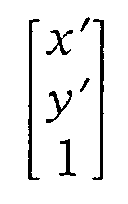
- a position and an orientation of the mobile robot can be estimated by performing shift, rotation, and flip processes with respect to the position of the artificial mark 100. Accordingly, the current position of the mobile robot in FIG. 11 B is given by Equation 1.
- Equation 2 The conversion functions H shift , H rotation , H flip , and H scale of Equation 1 can be represented as shown in Equation 2.
- (t x , t y ) indicates a coordinate point of the center Lc of the artificial mark 100
- ⁇ indicates a slope angle of the artificial mark 100
- s indicates a value obtained by dividing an actual physical distance of the artificial mark 100 by an image distance of the artificial mark 100.
- Traveling of the mobile robot is controlled by using the calculated position and orientation of the mobile robot in operation 344.
- FIG. 4 is a flowchart illustrating operation 333 of FIG. 3.
- a distortion compensation processing procedure as described using FIGS. 7A and 7B, 8A through 8C and 9A through 9C is performed with respect to the obtained ceiling image in operation 411.
- a pre-processing procedure as described in FIG. 10 is performed with respect to the distortion-compensation-processed ceiling image in operation 412.
- an intensity value of each pixel of the pre-processed ceiling image is compared to a predetermined reference value, and binarization is performed by applying "1" to a value of the pixel if the intensity value is larger than the reference value and applying "0" to the value of the pixel if the intensity value is smaller than the reference value.
- Contour matching is performed with respect to the binarized ceiling image in operation 414.
- a contour matching method of detecting a contour of a region separated by an artificial mark and comparing the contour to a contour of a stored artificial mark is described in "Visual Pattern Recognition by Moment Invariants" (M. Hu. IRE Transactions on Information Theory, 8:2, pp. 179-187, 1962).
- Candidate regions are extracted from the ceiling image using geometrical information of the artificial mark 100 in operation 415.
- Reliability values of the candidate regions are calculated by performing template matching with respect to the candidate regions in operation 416.
- a template matching method using normalized correlations is described in "Digital Image Processing” (Rafael C. Gonzalez, Richard E. Woods, pp. 583-586, 1992).
- a reliability value ( ⁇ (s, t)) calculated by the template matching can be represented as shown in Equation 3.
- f indicates an input candidate region
- f indicates an average value of pixels included in the candidate region f(x, y) in a region matched to a current position of the artificial mark 100
- w indicates an image of the artificial mark 100, i.e., a template image
- w indicates an average value of pixels included in the image w(x, y) of the artificial mark 100.
- the largest reliability value among the reliability values of the candidate regions calculated as a template matching result is selected in operation 417.
- the selected reliability value is compared to a predetermined reference value in operation 418. As a comparison result, if the selected reliability value is larger than the reference value, it is determined that detection of the artificial mark 100 succeeds in operation 419, and if the selected reliability value is smaller than the reference value, it is determined that detection of the artificial mark 100 fails in operation 420.
- FIG. 5 is a flowchart illustrating operation 342 of FIG. 3.
- a current position (x, y) and orientation ⁇ of the mobile robot is an input in operation 511.
- the numbers of pulses (N L , N R ) output from encoder sensors (not shown) attached to left and right wheels of the mobile robot are inputs in operation 513.
- a next position and a next orientation of the mobile robot is obtained using the input current position (x, y) and orientation ⁇ of the mobile robot and the numbers of pulses (N L , N R ) output from the encoder sensors in operation 515.
- D n indicates a diameter of the wheel
- C e indicates a resolution of the encoder, i.e., the number of encoder pulses per 1 revolution
- n indicates a gear ratio between a motor to which the encoder is installed and the wheel.
- N L / R,i indicates the number of pulses of encoder sensors attached to the left and right wheels of the mobile robot at a time i.
- b indicates a distance between the left wheel and the right wheel.
- the invention can also be embodied as computer readable codes on a computer readable recording medium.
- the computer readable recording medium is any data storage device that can store data which can be thereafter read by a computer system. Examples of the computer readable recording medium include read-only memory (ROM), random-access memory (RAM), CD-ROMs, magnetic tapes, floppy disks, optical data storage devices, and carrier waves (such as data transmission through the Internet).
- ROM read-only memory
- RAM random-access memory
- CD-ROMs compact discs
- magnetic tapes magnetic tapes
- floppy disks optical data storage devices
- carrier waves such as data transmission through the Internet
- carrier waves such as data transmission through the Internet
- the computer readable recording medium can also be distributed over network coupled computer systems so that the computer readable code is stored and executed in a distributed fashion. Also, functional programs, codes, and code segments for accomplishing the present invention can be easily construed by programmers skilled in the art to which the present invention pertains.
- the position and orientation of a mobile robot can be estimated in a real time using an image processing procedure with less noise in an environment of a dark light or a severe light change.
- the image processing procedure for mark detection can be simplified by installing a few number of artificial marks on a ceiling of a place in which the mobile robot travels and detecting the artificial marks using a pattern recognition method.
Landscapes
- Engineering & Computer Science (AREA)
- Physics & Mathematics (AREA)
- General Physics & Mathematics (AREA)
- Electromagnetism (AREA)
- Aviation & Aerospace Engineering (AREA)
- Radar, Positioning & Navigation (AREA)
- Remote Sensing (AREA)
- Automation & Control Theory (AREA)
- Data Mining & Analysis (AREA)
- Mathematical Physics (AREA)
- Theoretical Computer Science (AREA)
- Multimedia (AREA)
- Computer Vision & Pattern Recognition (AREA)
- Mathematical Analysis (AREA)
- Mathematical Optimization (AREA)
- Computational Mathematics (AREA)
- Pure & Applied Mathematics (AREA)
- Databases & Information Systems (AREA)
- Software Systems (AREA)
- General Engineering & Computer Science (AREA)
- Algebra (AREA)
- Control Of Position, Course, Altitude, Or Attitude Of Moving Bodies (AREA)
- Manipulator (AREA)
- Length Measuring Devices By Optical Means (AREA)
Abstract
Description



Claims (20)
- A method of constructing an artificial mark, comprising:wherein the first and second marks are a retro-reflective artificial mark.forming a first mark including a non-reflective portion and an infrared reflective portion; andforming a second mark including the non-reflective portion and the infrared reflective portion and being apart from the first mark at a predetermined distance,
- The method of claim 1, wherein an outer portion of the first mark and an inner portion of the second mark are non-reflective portions, and an inner portion of the first mark and an outer portion of the second mark are infrared reflective portions.
- A method of estimating a position and an orientation of a mobile robot, the method comprising:obtaining a ceiling image of a place in which the mobile robot travels;detecting a retro-reflective artificial mark from the ceiling image, the retro-reflective artificial mark comprising a first mark and a second mark, each including a non-reflective portion and an infrared reflective portion; andestimating the position and the orientation of the robot using a position of the artificial mark or encoder information according to whether detection of the artificial mark has succeeded or not.
- The method of claim 3, wherein an outer portion of the first mark and an inner portion of the second mark are non-reflective portions, and an inner portion of the first mark and an outer portion of the second mark are infrared reflective portions.
- The method of claim 3 or 4 further comprising:discriminating a current environment from the obtained ceiling image and performing a predetermined image processing procedure according to the discriminated environment.
- The method of claim 5, wherein the discriminating a current environment comprising:calculating an average intensity of the obtained ceiling image;determining whether a light of the current environment is in a dark state or in a bright state by comparing the calculated average intensity to a reference value;performing at least one of distortion compensation processing and pre-processing with respect to the ceiling image if it is determined that the light of the current environment is in a bright state; andreversing the ceiling image and performing the image processing procedure with respect to the reversed ceiling image if it is determined that the light of the current environment is in a dark state.
- The method of any of claims 3 to 6, wherein the detecting a retro-reflective artificial mark comprises:extracting at least one or more candidate regions with respect to the ceiling image using a result of outline matching geometrical information of the artificial mark;performing template matching with respect to the detected candidate regions, selecting the largest reliability value as a template matching result, and comparing the selected reliability value to a predetermined reference value; anddetermining that detection of the artificial mark has succeeded if the selected reliability value is larger than the reference value as a comparison result, and determining that detection of the artificial mark has failed if the selected reliability value is smaller than the reference value as a comparison result.
- The method of claim 7, wherein with regard to the ceiling image used in the extracting at least one or more candidate regions, at least one of distortion-compensation-processing, pre-processing, and binary-processing is sequentially performed in advance.
- The method of any of claims 3 to 8, wherein, if the detected artificial mark is used in the estimating the position and the orientation of the robot, a relative position and orientation of the mobile robot are estimated from the artificial mark by sequentially performing a shift process, a rotation process, and a flip process.
- An apparatus for estimating a position and an orientation of a mobile robot, the apparatus comprising:a ceiling image grabber for obtaining a ceiling image of a place in which the mobile robot travels;a mark detector for detecting a retro-reflective artificial mark from the ceiling image, the retro-reflective artificial mark comprising a first mark and a second mark, each including a non-reflective portion and an infrared reflective portion; anda position & orientation estimator for estimating a the position and the orientation of the robot using a position of the artificial mark or encoder information according to whether detection of the artificial mark has succeeded or not.
- The apparatus of claim 10, wherein an outer portion of the first mark and an inner portion of the second mark are non-reflective portions, and an inner portion of the first mark and an outer portion of the second mark are infrared reflective portions.
- The apparatus of claim 10 or 11, further comprising:an image processor discriminating a current environment from the obtained ceiling image and performing a predetermined image processing procedure according to the discriminated environment.
- The apparatus of claim 12, wherein the image processor compares an average intensity of the obtained ceiling image to a reference value, and if the light of the current environment is in a dark state according to the comparison result, reverses the ceiling image and performs the image processing procedure with respect to the reversed ceiling image
- The apparatus of any of claims 10 to 13, wherein the mark detector extracts at least one or more candidate regions with respect to the ceiling image, selects the largest reliability value as a template matching result with respect to the detected candidate regions, compares the selected reliability value to a predetermined reference value, determines that detection of the artificial mark has succeeded or failed according to a comparison result.
- A mobile robot comprising:a ceiling image grabber obtaining a ceiling image of a place in which the mobile robot travels;an image lightness comparator determining whether a light of a current environment is dark or bright by calculating an average intensity of the ceiling image and comparing the calculated average intensity to a predetermined reference value;a light controller controlling a light device attached to the mobile robot according to a determination result of the image lightness comparator;a mark detector detecting a retro-reflective artificial mark including a first mark and a second mark composed of a non-reflective portion and an infrared reflective portion from the ceiling image;a position & orientation estimator estimating a position and an orientation of the robot using a position of the artificial mark or encoder information according to whether detection of the artificial mark has succeeded; anda motion controller controlling traveling of the mobile robot according to the position and the orientation estimated by the position & orientation estimator.
- The mobile robot of claim 15, wherein the first and second marks are composed of circles apart from each other at a predetermined distance, an outer portion of the first mark and an inner portion of the second mark are non-reflective portions, and an inner portion of the first mark and an outer portion of the second mark are infrared reflective portions.
- The mobile robot of claim 15 or 16, further comprising:an image processor discriminating a current environment from the obtained ceiling image and performing a predetermined image processing procedure according to the discriminated environment.
- The mobile robot of claim 17, wherein the image processor compares an average intensity of the obtained ceiling image to a reference value, and if the light of the current environment is in a dark state according to the comparison result, reverses the ceiling image and performs distortion compensation processing and pre-processing with respect to the reversed ceiling image.
- The mobile robot of any of claims 15 to 18, wherein the mark detector extracts at least one or more candidate regions, selects the largest reliability value as a template matching result with respect to the detected candidate regions, compares the selected reliability value to a predetermined reference value, determines that detection of the artificial mark has succeeded or failed according to a comparison result.
- A computer readable medium having recorded thereon a computer readable program for performing a method of estimating a position and an orientation of a mobile robot, the method comprising:obtaining a ceiling image of a place in which the mobile robot travels;detecting a retro-reflective artificial mark from the ceiling image, the retro-reflective artificial mark comprising a first mark and a second mark, each including a non-reflective portion and an infrared reflective portion; andestimating the position and the orientation of the robot using a position of the artificial mark or encoder information according to whether detection of the artificial mark has succeeded or not.
Applications Claiming Priority (2)
| Application Number | Priority Date | Filing Date | Title |
|---|---|---|---|
| KR2003064242 | 2003-09-16 | ||
| KR1020030064242A KR100552691B1 (en) | 2003-09-16 | 2003-09-16 | Method and apparatus for estimating magnetic position and azimuth of mobile robot |
Publications (3)
| Publication Number | Publication Date |
|---|---|
| EP1517210A2 true EP1517210A2 (en) | 2005-03-23 |
| EP1517210A3 EP1517210A3 (en) | 2006-10-04 |
| EP1517210B1 EP1517210B1 (en) | 2015-04-08 |
Family
ID=34192235
Family Applications (1)
| Application Number | Title | Priority Date | Filing Date |
|---|---|---|---|
| EP04255550.8A Expired - Lifetime EP1517210B1 (en) | 2003-09-16 | 2004-09-14 | Apparatus and method for estimating position and orientation of mobile robot |
Country Status (5)
| Country | Link |
|---|---|
| US (1) | US7765027B2 (en) |
| EP (1) | EP1517210B1 (en) |
| JP (1) | JP4533065B2 (en) |
| KR (1) | KR100552691B1 (en) |
| CN (1) | CN1598610B (en) |
Cited By (7)
| Publication number | Priority date | Publication date | Assignee | Title |
|---|---|---|---|---|
| WO2007052859A1 (en) * | 2005-10-31 | 2007-05-10 | Electronics And Telecommunications Research Institute | System and method for real-time calculating location |
| WO2008013355A1 (en) * | 2006-07-27 | 2008-01-31 | Electronics And Telecommunications Research Institute | System and method for calculating location using a combination of odometry and landmarks |
| EP2136970A4 (en) * | 2007-04-03 | 2011-01-05 | Lg Electronics Inc | MOBILE ROBOT AND METHOD OF OPERATION |
| GB2529846A (en) * | 2014-09-03 | 2016-03-09 | Dyson Technology Ltd | A mobile robot |
| US10144342B2 (en) | 2014-09-03 | 2018-12-04 | Dyson Technology Limited | Mobile robot |
| EP3502822A1 (en) * | 2017-12-21 | 2019-06-26 | LG Electronics Inc. | Moving-robot and control method for the same |
| US12360536B2 (en) | 2021-08-04 | 2025-07-15 | Tata Consultancy Services Limited | Method and system of dynamic localization of a telepresence robot based on live markers |
Families Citing this family (71)
| Publication number | Priority date | Publication date | Assignee | Title |
|---|---|---|---|---|
| KR100569181B1 (en) * | 2004-01-06 | 2006-04-07 | 김진오 | Coordinate Verification System for Indoor Navigation |
| JP4438736B2 (en) * | 2005-11-04 | 2010-03-24 | 村田機械株式会社 | Transport device |
| TW200736870A (en) * | 2005-11-04 | 2007-10-01 | Murata Machinery Ltd | Control device for movable body |
| US7681796B2 (en) * | 2006-01-05 | 2010-03-23 | International Business Machines Corporation | Mobile device tracking |
| JP4448497B2 (en) * | 2006-03-23 | 2010-04-07 | 本田技研工業株式会社 | Self-position detecting device and position detecting system for moving body |
| KR100966875B1 (en) * | 2006-09-26 | 2010-06-29 | 삼성전자주식회사 | Robot positioning using omnidirectional image |
| KR100773271B1 (en) * | 2006-10-25 | 2007-11-05 | 전자부품연구원 | Positioning method of mobile robot using single camera |
| JP4825980B2 (en) * | 2007-03-06 | 2011-11-30 | 国立大学法人岩手大学 | Calibration method for fisheye camera. |
| JP5043133B2 (en) * | 2007-03-13 | 2012-10-10 | リサーチ インスティチュート オブ インダストリアル サイエンス アンド テクノロジー | Land recognition landmark for mobile robot, and position recognition apparatus and method using the same |
| KR100922494B1 (en) * | 2007-07-19 | 2009-10-20 | 삼성전자주식회사 | Posture measuring method of mobile robot and position measuring method and apparatus using the method |
| KR101337534B1 (en) * | 2007-07-24 | 2013-12-06 | 삼성전자주식회사 | Apparatus and method for localization of moving robot |
| KR101461185B1 (en) * | 2007-11-09 | 2014-11-14 | 삼성전자 주식회사 | Apparatus and method for building 3D map using structured light |
| KR20090066776A (en) * | 2007-12-20 | 2009-06-24 | 한국전자통신연구원 | Location Service Framework Apparatus and Method for Robot Location Estimation |
| TWI384407B (en) * | 2008-02-29 | 2013-02-01 | Ind Tech Res Inst | Area recognition system using Braille coding patterns |
| WO2009111047A2 (en) | 2008-03-05 | 2009-09-11 | Ebay Inc. | Method and apparatus for image recognition services |
| US9495386B2 (en) | 2008-03-05 | 2016-11-15 | Ebay Inc. | Identification of items depicted in images |
| KR101007045B1 (en) * | 2008-03-12 | 2011-01-12 | 주식회사 애트랩 | Contact sensor device and method of determining the pointing coordinates of the device |
| KR101503904B1 (en) * | 2008-07-07 | 2015-03-19 | 삼성전자 주식회사 | Mapping device and method of mobile robot |
| KR101037971B1 (en) | 2009-06-22 | 2011-05-30 | (주)로봇에버 | Image-Based Location Recognition Method and System |
| WO2011013862A1 (en) * | 2009-07-28 | 2011-02-03 | 주식회사 유진로봇 | Control method for localization and navigation of mobile robot and mobile robot using same |
| US9164577B2 (en) * | 2009-12-22 | 2015-10-20 | Ebay Inc. | Augmented reality system, method, and apparatus for displaying an item image in a contextual environment |
| US10127606B2 (en) | 2010-10-13 | 2018-11-13 | Ebay Inc. | Augmented reality system and method for visualizing an item |
| KR101906329B1 (en) * | 2010-12-15 | 2018-12-07 | 한국전자통신연구원 | Apparatus and method for indoor localization based on camera |
| US8737685B2 (en) | 2011-04-25 | 2014-05-27 | Honeywell International Inc. | Systems and methods for detecting the movement of an object |
| US8908923B2 (en) * | 2011-05-13 | 2014-12-09 | International Business Machines Corporation | Interior location identification |
| US20150153181A1 (en) * | 2011-07-27 | 2015-06-04 | Google Inc. | System and method for providing indoor navigation services |
| US9449342B2 (en) | 2011-10-27 | 2016-09-20 | Ebay Inc. | System and method for visualization of items in an environment using augmented reality |
| JP5601332B2 (en) * | 2012-02-08 | 2014-10-08 | 村田機械株式会社 | Transport vehicle |
| US10846766B2 (en) | 2012-06-29 | 2020-11-24 | Ebay Inc. | Contextual menus based on image recognition |
| CN103970133A (en) * | 2013-01-31 | 2014-08-06 | 鸿富锦精密工业(武汉)有限公司 | Method and system utilizing image analysis technique to realize object movement |
| US10612939B2 (en) | 2014-01-02 | 2020-04-07 | Microsoft Technology Licensing, Llc | Ground truth estimation for autonomous navigation |
| CN103728589B (en) * | 2014-01-09 | 2016-05-11 | 上海京颐科技股份有限公司 | A kind of indoor orientation method |
| US10708550B2 (en) | 2014-04-08 | 2020-07-07 | Udisense Inc. | Monitoring camera and mount |
| JP6539958B2 (en) | 2014-08-28 | 2019-07-10 | 村田機械株式会社 | Carrier |
| CN105518560B (en) * | 2014-10-31 | 2018-02-02 | 深圳市大疆创新科技有限公司 | A kind of location-based control method, device, removable movement machine and robot |
| CN104950892B (en) * | 2015-06-29 | 2017-10-31 | 厦门狄耐克物联智慧科技有限公司 | The traveling control system and method for a kind of robot |
| USD854074S1 (en) | 2016-05-10 | 2019-07-16 | Udisense Inc. | Wall-assisted floor-mount for a monitoring camera |
| CN106370188A (en) * | 2016-09-21 | 2017-02-01 | 旗瀚科技有限公司 | Robot indoor positioning and navigation method based on 3D camera |
| US10803420B2 (en) | 2016-09-30 | 2020-10-13 | Staples, Inc. | Hybrid modular storage fetching system |
| US10683171B2 (en) | 2016-09-30 | 2020-06-16 | Staples, Inc. | Hybrid modular storage fetching system |
| US10589931B2 (en) | 2016-09-30 | 2020-03-17 | Staples, Inc. | Hybrid modular storage fetching system |
| CN106527434A (en) * | 2016-11-07 | 2017-03-22 | 北京京东尚科信息技术有限公司 | Automatic transfer system and method |
| EP3421936A1 (en) | 2017-06-30 | 2019-01-02 | Panasonic Automotive & Industrial Systems Europe GmbH | Optical marker element for geo location information |
| USD855684S1 (en) | 2017-08-06 | 2019-08-06 | Udisense Inc. | Wall mount for a monitoring camera |
| CN107843251B (en) * | 2017-10-18 | 2020-01-31 | 广东宝乐机器人股份有限公司 | Pose Estimation Methods for Mobile Robots |
| WO2019104108A1 (en) | 2017-11-22 | 2019-05-31 | Udisense Inc. | Respiration monitor |
| CN108181610B (en) * | 2017-12-22 | 2021-11-19 | 鲁东大学 | Indoor robot positioning method and system |
| CN116509280A (en) * | 2018-07-19 | 2023-08-01 | 科沃斯机器人股份有限公司 | Robot control method, robot, and storage medium |
| US11590997B1 (en) | 2018-08-07 | 2023-02-28 | Staples, Inc. | Autonomous shopping cart |
| US11084410B1 (en) | 2018-08-07 | 2021-08-10 | Staples, Inc. | Automated guided vehicle for transporting shelving units |
| US11630447B1 (en) | 2018-08-10 | 2023-04-18 | Staples, Inc. | Automated guided vehicle for transporting objects |
| JP6684531B2 (en) * | 2018-08-23 | 2020-04-22 | 三菱ロジスネクスト株式会社 | Unmanned transport system |
| CN212089442U (en) | 2018-12-03 | 2020-12-08 | 尚科宁家运营有限公司 | Docking station for robot cleaner, beacon and robot cleaner system |
| US11119487B2 (en) | 2018-12-31 | 2021-09-14 | Staples, Inc. | Automated preparation of deliveries in delivery vehicles using automated guided vehicles |
| US11180069B2 (en) | 2018-12-31 | 2021-11-23 | Staples, Inc. | Automated loading of delivery vehicles using automated guided vehicles |
| USD900429S1 (en) | 2019-01-28 | 2020-11-03 | Udisense Inc. | Swaddle band with decorative pattern |
| USD900430S1 (en) | 2019-01-28 | 2020-11-03 | Udisense Inc. | Swaddle blanket |
| USD900431S1 (en) | 2019-01-28 | 2020-11-03 | Udisense Inc. | Swaddle blanket with decorative pattern |
| USD900428S1 (en) | 2019-01-28 | 2020-11-03 | Udisense Inc. | Swaddle band |
| US10399227B1 (en) | 2019-03-29 | 2019-09-03 | Mujin, Inc. | Method and control system for verifying and updating camera calibration for robot control |
| US10906184B2 (en) | 2019-03-29 | 2021-02-02 | Mujin, Inc. | Method and control system for verifying and updating camera calibration for robot control |
| US11124401B1 (en) | 2019-03-31 | 2021-09-21 | Staples, Inc. | Automated loading of delivery vehicles |
| US20220236739A1 (en) * | 2019-06-28 | 2022-07-28 | Advanced Intelligent Systems Inc. | System and method for optical localization |
| CN110530399B (en) * | 2019-09-06 | 2023-03-24 | 苏州寻迹智行机器人技术有限公司 | Wheel spacing correction method for odometer calibration of double-wheel differential mobile robot |
| CN110597266A (en) * | 2019-09-26 | 2019-12-20 | 青岛蚂蚁机器人有限责任公司 | Robot path dynamic planning method based on two-dimensional code |
| CN113110408B (en) * | 2019-12-25 | 2023-09-29 | 北京极智嘉科技股份有限公司 | Robot positioning system and method, robot, and computer-readable storage medium |
| CN112880689A (en) * | 2021-01-29 | 2021-06-01 | 北京百度网讯科技有限公司 | Method and device for leading position, electronic equipment and storage medium |
| CN113075647A (en) * | 2021-02-20 | 2021-07-06 | 上海擎朗智能科技有限公司 | Robot positioning method, device, equipment and medium |
| CN114355933A (en) * | 2021-12-31 | 2022-04-15 | 山东新一代信息产业技术研究院有限公司 | Motion control method for robot docking charging pile |
| KR20240051654A (en) | 2022-10-13 | 2024-04-22 | 장영익 | Pressure relief valve using high pressure gas |
| US20240353842A1 (en) * | 2023-04-19 | 2024-10-24 | Torc Robotics, Inc. | Position determination via encoded indicators in a physical environment |
Family Cites Families (39)
| Publication number | Priority date | Publication date | Assignee | Title |
|---|---|---|---|---|
| US4281342A (en) * | 1978-03-29 | 1981-07-28 | Hitachi, Ltd. | Mark detecting system using image pickup device |
| GB8313339D0 (en) * | 1983-05-14 | 1983-06-22 | Gen Electric Co Plc | Vehicle guidance |
| US4817000A (en) * | 1986-03-10 | 1989-03-28 | Si Handling Systems, Inc. | Automatic guided vehicle system |
| US5208750A (en) * | 1987-06-17 | 1993-05-04 | Nissan Motor Co., Ltd. | Control system for unmanned automotive vehicle |
| US4947094A (en) * | 1987-07-23 | 1990-08-07 | Battelle Memorial Institute | Optical guidance system for industrial vehicles |
| US4846297A (en) * | 1987-09-28 | 1989-07-11 | Tennant Company | Automated guided vehicle |
| US4996468A (en) * | 1987-09-28 | 1991-02-26 | Tennant Company | Automated guided vehicle |
| US4790402A (en) * | 1987-09-28 | 1988-12-13 | Tennant Company | Automated guided vehicle |
| JPH01274214A (en) * | 1988-04-26 | 1989-11-02 | Mazda Motor Corp | Image processor for mobile vehicle |
| ES2099069T3 (en) | 1988-05-09 | 1997-05-16 | Int Paper Co | WATERPROOF CONTAINER FOR LEAK-FREE OXYGEN. |
| US5040116A (en) * | 1988-09-06 | 1991-08-13 | Transitions Research Corporation | Visual navigation and obstacle avoidance structured light system |
| US4933864A (en) * | 1988-10-04 | 1990-06-12 | Transitions Research Corporation | Mobile robot navigation employing ceiling light fixtures |
| US5051906A (en) * | 1989-06-07 | 1991-09-24 | Transitions Research Corporation | Mobile robot navigation employing retroreflective ceiling features |
| US5187662A (en) * | 1990-01-24 | 1993-02-16 | Honda Giken Kogyo Kabushiki Kaisha | Steering control system for moving vehicle |
| JPH0684522B2 (en) | 1990-06-05 | 1994-10-26 | ハリマセラミック株式会社 | Vacuum degassing equipment Snorkel repair method |
| DE4023952A1 (en) * | 1990-07-27 | 1992-02-06 | Bayerische Motoren Werke Ag | Image processing for motor vehicle - using heat-reflecting materials to enable detection of signs and road markings by sensors independent of light and weather conditions |
| JP2521156Y2 (en) * | 1990-08-08 | 1996-12-25 | アニマ株式会社 | Position measurement target |
| EP0479271B1 (en) * | 1990-10-03 | 1998-09-09 | Aisin Seiki Kabushiki Kaisha | Automatic lateral guidance control system |
| US5390118A (en) * | 1990-10-03 | 1995-02-14 | Aisin Seiki Kabushiki Kaisha | Automatic lateral guidance control system |
| JPH064127A (en) | 1992-06-16 | 1994-01-14 | Ishikawajima Harima Heavy Ind Co Ltd | Own-position measuring instrument for indoor moving body |
| US5567919A (en) | 1993-12-22 | 1996-10-22 | Combustion Engineering, Inc. | Gravimetric feeding system for boiler fuel and sorbent |
| US5530330A (en) * | 1994-03-30 | 1996-06-25 | Inco Limited | Automated guidance system for a vehicle |
| US5525883A (en) * | 1994-07-08 | 1996-06-11 | Sara Avitzour | Mobile robot location determination employing error-correcting distributed landmarks |
| JPH08313215A (en) * | 1995-05-23 | 1996-11-29 | Olympus Optical Co Ltd | Two-dimensional distance sensor |
| US5675489A (en) * | 1995-07-06 | 1997-10-07 | Carnegie Mellon University | System and method for estimating lateral position |
| US5875408A (en) * | 1995-07-17 | 1999-02-23 | Imra America, Inc. | Automated vehicle guidance system and method for automatically guiding a vehicle |
| EP0841594A3 (en) * | 1996-11-07 | 1999-08-25 | Nikon Corporation | Mark for position detection, mark detecting method and apparatus, and exposure system |
| US6163745A (en) * | 1997-04-15 | 2000-12-19 | Ainsworth Inc. | Guidance system for automated vehicles, and guidance strip for use therewith |
| US6194486B1 (en) * | 1997-05-28 | 2001-02-27 | Trw Inc. | Enhanced paint for microwave/millimeter wave radiometric detection applications and method of road marker detection |
| JP2000111344A (en) * | 1998-10-08 | 2000-04-18 | Asahi Optical Co Ltd | Photogrammetric target |
| US6629028B2 (en) * | 2000-06-29 | 2003-09-30 | Riken | Method and system of optical guidance of mobile body |
| US6496754B2 (en) | 2000-11-17 | 2002-12-17 | Samsung Kwangju Electronics Co., Ltd. | Mobile robot and course adjusting method thereof |
| RU2220643C2 (en) * | 2001-04-18 | 2004-01-10 | Самсунг Гванджу Электроникс Ко., Лтд. | Automatic cleaning apparatus, automatic cleaning system and method for controlling of system (versions) |
| US6577764B2 (en) * | 2001-08-01 | 2003-06-10 | Teranex, Inc. | Method for measuring and analyzing digital video quality |
| US6807478B2 (en) * | 2001-12-27 | 2004-10-19 | Koninklijke Philips Electronics N.V. | In-building navigation system |
| WO2003062127A1 (en) * | 2002-01-23 | 2003-07-31 | Kabushiki Kaisha Toyota Jidoshokki | Position control device and position control method of stevedoring apparatus in industrial vehicle |
| KR100483548B1 (en) * | 2002-07-26 | 2005-04-15 | 삼성광주전자 주식회사 | Robot cleaner and system and method of controlling thereof |
| US7231063B2 (en) * | 2002-08-09 | 2007-06-12 | Intersense, Inc. | Fiducial detection system |
| US7089099B2 (en) * | 2004-07-30 | 2006-08-08 | Automotive Technologies International, Inc. | Sensor assemblies |
-
2003
- 2003-09-16 KR KR1020030064242A patent/KR100552691B1/en not_active Expired - Fee Related
-
2004
- 2004-09-14 EP EP04255550.8A patent/EP1517210B1/en not_active Expired - Lifetime
- 2004-09-16 CN CN2004100789589A patent/CN1598610B/en not_active Expired - Fee Related
- 2004-09-16 JP JP2004270092A patent/JP4533065B2/en not_active Expired - Fee Related
- 2004-09-16 US US10/941,846 patent/US7765027B2/en not_active Expired - Fee Related
Cited By (12)
| Publication number | Priority date | Publication date | Assignee | Title |
|---|---|---|---|---|
| WO2007052859A1 (en) * | 2005-10-31 | 2007-05-10 | Electronics And Telecommunications Research Institute | System and method for real-time calculating location |
| US8027515B2 (en) | 2005-10-31 | 2011-09-27 | Electronics And Telecommunications Research Institute | System and method for real-time calculating location |
| WO2008013355A1 (en) * | 2006-07-27 | 2008-01-31 | Electronics And Telecommunications Research Institute | System and method for calculating location using a combination of odometry and landmarks |
| EP2136970A4 (en) * | 2007-04-03 | 2011-01-05 | Lg Electronics Inc | MOBILE ROBOT AND METHOD OF OPERATION |
| US8676380B2 (en) | 2007-04-03 | 2014-03-18 | Lg Electronics Inc. | Moving robot and operating method for same |
| GB2529846A (en) * | 2014-09-03 | 2016-03-09 | Dyson Technology Ltd | A mobile robot |
| US10112302B2 (en) | 2014-09-03 | 2018-10-30 | Dyson Technology Limited | Mobile robot |
| US10144342B2 (en) | 2014-09-03 | 2018-12-04 | Dyson Technology Limited | Mobile robot |
| GB2529846B (en) * | 2014-09-03 | 2019-02-20 | Dyson Technology Ltd | Illumination Control of a Vision System for a Mobile Robot |
| EP3502822A1 (en) * | 2017-12-21 | 2019-06-26 | LG Electronics Inc. | Moving-robot and control method for the same |
| US11119501B2 (en) | 2017-12-21 | 2021-09-14 | Lg Etectronics Inc. | Moving robot and control method for the same |
| US12360536B2 (en) | 2021-08-04 | 2025-07-15 | Tata Consultancy Services Limited | Method and system of dynamic localization of a telepresence robot based on live markers |
Also Published As
| Publication number | Publication date |
|---|---|
| JP2005121641A (en) | 2005-05-12 |
| JP4533065B2 (en) | 2010-08-25 |
| CN1598610B (en) | 2010-10-27 |
| EP1517210A3 (en) | 2006-10-04 |
| US7765027B2 (en) | 2010-07-27 |
| CN1598610A (en) | 2005-03-23 |
| EP1517210B1 (en) | 2015-04-08 |
| US20050065655A1 (en) | 2005-03-24 |
| KR20050027858A (en) | 2005-03-21 |
| KR100552691B1 (en) | 2006-02-20 |
Similar Documents
| Publication | Publication Date | Title |
|---|---|---|
| EP1517210A2 (en) | Apparatus and method for estimating position and orientation of mobile robot | |
| JP7077910B2 (en) | Bound line detection device and lane marking method | |
| JP4450532B2 (en) | Relative position measuring device | |
| JP3780848B2 (en) | Vehicle traveling path recognition device | |
| US8699754B2 (en) | Clear path detection through road modeling | |
| US7684590B2 (en) | Method of recognizing and/or tracking objects | |
| KR101618030B1 (en) | Method for Recognizing Position and Controlling Movement of a Mobile Robot, and the Mobile Robot Using the same | |
| US5847755A (en) | Method and apparatus for detecting object movement within an image sequence | |
| KR101143176B1 (en) | Method and Apparatus for Recognizing Parking Slot Marking by Using Bird's Eye View and Parking Assist System Using Same | |
| KR101188588B1 (en) | Monocular Motion Stereo-Based Free Parking Space Detection Apparatus and Method | |
| EP0697641B1 (en) | Lane image processing system for vehicle | |
| CN102596517B (en) | Control method for localization and navigation of mobile robot and mobile robot using same | |
| JP4433887B2 (en) | Vehicle external recognition device | |
| US20040125207A1 (en) | Robust stereo-driven video-based surveillance | |
| KR20200000953A (en) | Around view monitoring system and calibration method for around view cameras | |
| JP5281867B2 (en) | Vehicle traveling speed control device and method | |
| CN112037265A (en) | A storage location tracking method and device | |
| CN115761693B (en) | A parking space landmark detection and vehicle tracking and positioning method based on panoramic images | |
| JP2020077293A (en) | Marking line detection device and marking line detection method | |
| JP3700625B2 (en) | Road white line recognition device | |
| JP4767052B2 (en) | Optical axis deviation detector | |
| JP2020077297A (en) | Position and posture estimation device | |
| JP2003237509A (en) | External recognition device for vehicles | |
| JP3517999B2 (en) | Vehicle recognition device | |
| CN114550119A (en) | Projection-based target detection system in low-illumination environment and application thereof |
Legal Events
| Date | Code | Title | Description |
|---|---|---|---|
| PUAI | Public reference made under article 153(3) epc to a published international application that has entered the european phase |
Free format text: ORIGINAL CODE: 0009012 |
|
| AK | Designated contracting states |
Kind code of ref document: A2 Designated state(s): AT BE BG CH CY CZ DE DK EE ES FI FR GB GR HU IE IT LI LU MC NL PL PT RO SE SI SK TR |
|
| AX | Request for extension of the european patent |
Extension state: AL HR LT LV MK |
|
| RIN1 | Information on inventor provided before grant (corrected) |
Inventor name: HONG, SUNGI Inventor name: BANG, SEOKWON Inventor name: PARK, DONGRYEOL |
|
| PUAL | Search report despatched |
Free format text: ORIGINAL CODE: 0009013 |
|
| AK | Designated contracting states |
Kind code of ref document: A3 Designated state(s): AT BE BG CH CY CZ DE DK EE ES FI FR GB GR HU IE IT LI LU MC NL PL PT RO SE SI SK TR |
|
| AX | Request for extension of the european patent |
Extension state: AL HR LT LV MK |
|
| 17P | Request for examination filed |
Effective date: 20061108 |
|
| 17Q | First examination report despatched |
Effective date: 20061218 |
|
| AKX | Designation fees paid |
Designated state(s): DE FR GB IT SE |
|
| RAP1 | Party data changed (applicant data changed or rights of an application transferred) |
Owner name: SAMSUNG ELECTRONICS CO., LTD. |
|
| GRAP | Despatch of communication of intention to grant a patent |
Free format text: ORIGINAL CODE: EPIDOSNIGR1 |
|
| INTG | Intention to grant announced |
Effective date: 20141024 |
|
| GRAS | Grant fee paid |
Free format text: ORIGINAL CODE: EPIDOSNIGR3 |
|
| GRAA | (expected) grant |
Free format text: ORIGINAL CODE: 0009210 |
|
| AK | Designated contracting states |
Kind code of ref document: B1 Designated state(s): DE FR GB IT SE |
|
| REG | Reference to a national code |
Ref country code: GB Ref legal event code: FG4D |
|
| REG | Reference to a national code |
Ref country code: DE Ref legal event code: R096 Ref document number: 602004046941 Country of ref document: DE Effective date: 20150521 |
|
| REG | Reference to a national code |
Ref country code: DE Ref legal event code: R097 Ref document number: 602004046941 Country of ref document: DE |
|
| PLBE | No opposition filed within time limit |
Free format text: ORIGINAL CODE: 0009261 |
|
| STAA | Information on the status of an ep patent application or granted ep patent |
Free format text: STATUS: NO OPPOSITION FILED WITHIN TIME LIMIT |
|
| 26N | No opposition filed |
Effective date: 20160111 |
|
| PG25 | Lapsed in a contracting state [announced via postgrant information from national office to epo] |
Ref country code: IT Free format text: LAPSE BECAUSE OF FAILURE TO SUBMIT A TRANSLATION OF THE DESCRIPTION OR TO PAY THE FEE WITHIN THE PRESCRIBED TIME-LIMIT Effective date: 20150408 |
|
| REG | Reference to a national code |
Ref country code: FR Ref legal event code: PLFP Year of fee payment: 13 |
|
| PG25 | Lapsed in a contracting state [announced via postgrant information from national office to epo] |
Ref country code: SE Free format text: LAPSE BECAUSE OF FAILURE TO SUBMIT A TRANSLATION OF THE DESCRIPTION OR TO PAY THE FEE WITHIN THE PRESCRIBED TIME-LIMIT Effective date: 20150408 |
|
| REG | Reference to a national code |
Ref country code: FR Ref legal event code: PLFP Year of fee payment: 14 |
|
| REG | Reference to a national code |
Ref country code: FR Ref legal event code: PLFP Year of fee payment: 15 |
|
| PGFP | Annual fee paid to national office [announced via postgrant information from national office to epo] |
Ref country code: GB Payment date: 20200824 Year of fee payment: 17 Ref country code: DE Payment date: 20200820 Year of fee payment: 17 Ref country code: FR Payment date: 20200824 Year of fee payment: 17 |
|
| REG | Reference to a national code |
Ref country code: DE Ref legal event code: R119 Ref document number: 602004046941 Country of ref document: DE |
|
| GBPC | Gb: european patent ceased through non-payment of renewal fee |
Effective date: 20210914 |
|
| PG25 | Lapsed in a contracting state [announced via postgrant information from national office to epo] |
Ref country code: GB Free format text: LAPSE BECAUSE OF NON-PAYMENT OF DUE FEES Effective date: 20210914 Ref country code: FR Free format text: LAPSE BECAUSE OF NON-PAYMENT OF DUE FEES Effective date: 20210930 Ref country code: DE Free format text: LAPSE BECAUSE OF NON-PAYMENT OF DUE FEES Effective date: 20220401 |