EP1516870A1 - Process for producing aromatic compound derivative by reaction of aromatic compound substituted with sulfamoyloxy, sulfinamoyloxy, or carbamoyloxy group, with nucleophilic agent - Google Patents
Process for producing aromatic compound derivative by reaction of aromatic compound substituted with sulfamoyloxy, sulfinamoyloxy, or carbamoyloxy group, with nucleophilic agent Download PDFInfo
- Publication number
- EP1516870A1 EP1516870A1 EP04022481A EP04022481A EP1516870A1 EP 1516870 A1 EP1516870 A1 EP 1516870A1 EP 04022481 A EP04022481 A EP 04022481A EP 04022481 A EP04022481 A EP 04022481A EP 1516870 A1 EP1516870 A1 EP 1516870A1
- Authority
- EP
- European Patent Office
- Prior art keywords
- group
- formula
- compound represented
- substituent
- ring
- Prior art date
- Legal status (The legal status is an assumption and is not a legal conclusion. Google has not performed a legal analysis and makes no representation as to the accuracy of the status listed.)
- Withdrawn
Links
- 238000000034 method Methods 0.000 title claims abstract description 60
- 230000000269 nucleophilic effect Effects 0.000 title claims abstract description 23
- 238000006243 chemical reaction Methods 0.000 title description 36
- -1 sulfamoyloxy, sulfinamoyloxy Chemical group 0.000 title description 31
- 150000001491 aromatic compounds Chemical class 0.000 title description 12
- 150000001875 compounds Chemical class 0.000 claims abstract description 119
- 125000001424 substituent group Chemical group 0.000 claims abstract description 58
- 125000000623 heterocyclic group Chemical group 0.000 claims abstract description 25
- 125000003118 aryl group Chemical group 0.000 claims abstract description 24
- 125000000217 alkyl group Chemical group 0.000 claims abstract description 23
- 229910052717 sulfur Inorganic materials 0.000 claims abstract description 10
- 229910052760 oxygen Inorganic materials 0.000 claims abstract description 8
- 239000003795 chemical substances by application Substances 0.000 claims description 21
- IJGRMHOSHXDMSA-UHFFFAOYSA-N Atomic nitrogen Chemical compound N#N IJGRMHOSHXDMSA-UHFFFAOYSA-N 0.000 claims description 12
- 125000000449 nitro group Chemical group [O-][N+](*)=O 0.000 claims description 11
- 125000005843 halogen group Chemical group 0.000 claims description 10
- 125000001997 phenyl group Chemical group [H]C1=C([H])C([H])=C(*)C([H])=C1[H] 0.000 claims description 8
- 229910052801 chlorine Inorganic materials 0.000 claims description 7
- 229910052757 nitrogen Inorganic materials 0.000 claims description 7
- 125000001309 chloro group Chemical group Cl* 0.000 claims description 5
- 125000004434 sulfur atom Chemical group 0.000 claims description 5
- 239000011541 reaction mixture Substances 0.000 claims description 3
- XEKOWRVHYACXOJ-UHFFFAOYSA-N Ethyl acetate Chemical compound CCOC(C)=O XEKOWRVHYACXOJ-UHFFFAOYSA-N 0.000 description 63
- 239000000243 solution Substances 0.000 description 37
- YXFVVABEGXRONW-UHFFFAOYSA-N Toluene Chemical compound CC1=CC=CC=C1 YXFVVABEGXRONW-UHFFFAOYSA-N 0.000 description 33
- VLKZOEOYAKHREP-UHFFFAOYSA-N n-Hexane Chemical compound CCCCCC VLKZOEOYAKHREP-UHFFFAOYSA-N 0.000 description 32
- 239000002904 solvent Substances 0.000 description 23
- XLYOFNOQVPJJNP-UHFFFAOYSA-N water Substances O XLYOFNOQVPJJNP-UHFFFAOYSA-N 0.000 description 21
- 125000004432 carbon atom Chemical group C* 0.000 description 19
- HEMHJVSKTPXQMS-UHFFFAOYSA-M Sodium hydroxide Chemical compound [OH-].[Na+] HEMHJVSKTPXQMS-UHFFFAOYSA-M 0.000 description 18
- BWHMMNNQKKPAPP-UHFFFAOYSA-L potassium carbonate Chemical compound [K+].[K+].[O-]C([O-])=O BWHMMNNQKKPAPP-UHFFFAOYSA-L 0.000 description 16
- ZMXDDKWLCZADIW-UHFFFAOYSA-N N,N-Dimethylformamide Chemical compound CN(C)C=O ZMXDDKWLCZADIW-UHFFFAOYSA-N 0.000 description 15
- 230000015572 biosynthetic process Effects 0.000 description 15
- 238000003786 synthesis reaction Methods 0.000 description 15
- HEDRZPFGACZZDS-MICDWDOJSA-N Trichloro(2H)methane Chemical compound [2H]C(Cl)(Cl)Cl HEDRZPFGACZZDS-MICDWDOJSA-N 0.000 description 14
- 239000000047 product Substances 0.000 description 13
- ZMANZCXQSJIPKH-UHFFFAOYSA-N Triethylamine Chemical compound CCN(CC)CC ZMANZCXQSJIPKH-UHFFFAOYSA-N 0.000 description 12
- 239000007795 chemical reaction product Substances 0.000 description 12
- VEXZGXHMUGYJMC-UHFFFAOYSA-N Hydrochloric acid Chemical compound Cl VEXZGXHMUGYJMC-UHFFFAOYSA-N 0.000 description 11
- 239000012074 organic phase Substances 0.000 description 11
- HPALAKNZSZLMCH-UHFFFAOYSA-M sodium;chloride;hydrate Chemical class O.[Na+].[Cl-] HPALAKNZSZLMCH-UHFFFAOYSA-M 0.000 description 11
- CSNNHWWHGAXBCP-UHFFFAOYSA-L Magnesium sulfate Chemical compound [Mg+2].[O-][S+2]([O-])([O-])[O-] CSNNHWWHGAXBCP-UHFFFAOYSA-L 0.000 description 10
- 239000007864 aqueous solution Substances 0.000 description 10
- 238000001035 drying Methods 0.000 description 10
- 239000012046 mixed solvent Substances 0.000 description 10
- WEVYAHXRMPXWCK-UHFFFAOYSA-N Acetonitrile Chemical compound CC#N WEVYAHXRMPXWCK-UHFFFAOYSA-N 0.000 description 9
- 150000002989 phenols Chemical class 0.000 description 9
- 150000003839 salts Chemical class 0.000 description 9
- 239000000126 substance Substances 0.000 description 9
- JUJWROOIHBZHMG-UHFFFAOYSA-N Pyridine Chemical compound C1=CC=NC=C1 JUJWROOIHBZHMG-UHFFFAOYSA-N 0.000 description 8
- RWRDLPDLKQPQOW-UHFFFAOYSA-N Pyrrolidine Chemical compound C1CCNC1 RWRDLPDLKQPQOW-UHFFFAOYSA-N 0.000 description 8
- 239000003480 eluent Substances 0.000 description 8
- 229910000027 potassium carbonate Inorganic materials 0.000 description 8
- 238000010898 silica gel chromatography Methods 0.000 description 8
- JRMUNVKIHCOMHV-UHFFFAOYSA-M tetrabutylammonium bromide Chemical compound [Br-].CCCC[N+](CCCC)(CCCC)CCCC JRMUNVKIHCOMHV-UHFFFAOYSA-M 0.000 description 8
- 238000005160 1H NMR spectroscopy Methods 0.000 description 7
- 125000004390 alkyl sulfonyl group Chemical group 0.000 description 7
- 125000003277 amino group Chemical group 0.000 description 7
- 150000001450 anions Chemical class 0.000 description 7
- 125000004391 aryl sulfonyl group Chemical group 0.000 description 7
- UCJMHYXRQZYNNL-UHFFFAOYSA-N 2-Ethyl-1-hexanethiol Chemical compound CCCCC(CC)CS UCJMHYXRQZYNNL-UHFFFAOYSA-N 0.000 description 6
- IHGNADPMUSNTJW-UHFFFAOYSA-N 4-tert-butyl-2-nitrophenol Chemical compound CC(C)(C)C1=CC=C(O)C([N+]([O-])=O)=C1 IHGNADPMUSNTJW-UHFFFAOYSA-N 0.000 description 6
- OKKJLVBELUTLKV-UHFFFAOYSA-N Methanol Chemical compound OC OKKJLVBELUTLKV-UHFFFAOYSA-N 0.000 description 6
- 125000004644 alkyl sulfinyl group Chemical group 0.000 description 6
- 125000004414 alkyl thio group Chemical group 0.000 description 6
- 125000005135 aryl sulfinyl group Chemical group 0.000 description 6
- 125000005110 aryl thio group Chemical group 0.000 description 6
- RAXXELZNTBOGNW-UHFFFAOYSA-N imidazole Natural products C1=CNC=N1 RAXXELZNTBOGNW-UHFFFAOYSA-N 0.000 description 6
- NINIDFKCEFEMDL-UHFFFAOYSA-N Sulfur Chemical group [S] NINIDFKCEFEMDL-UHFFFAOYSA-N 0.000 description 5
- 125000003545 alkoxy group Chemical group 0.000 description 5
- 125000004397 aminosulfonyl group Chemical group NS(=O)(=O)* 0.000 description 5
- 125000004093 cyano group Chemical group *C#N 0.000 description 5
- 125000002887 hydroxy group Chemical group [H]O* 0.000 description 5
- 239000003444 phase transfer catalyst Substances 0.000 description 5
- RMVRSNDYEFQCLF-UHFFFAOYSA-N thiophenol Chemical compound SC1=CC=CC=C1 RMVRSNDYEFQCLF-UHFFFAOYSA-N 0.000 description 5
- QGZKDVFQNNGYKY-UHFFFAOYSA-N Ammonia Chemical compound N QGZKDVFQNNGYKY-UHFFFAOYSA-N 0.000 description 4
- 125000004104 aryloxy group Chemical group 0.000 description 4
- 125000004429 atom Chemical group 0.000 description 4
- 125000006575 electron-withdrawing group Chemical group 0.000 description 4
- 125000001495 ethyl group Chemical group [H]C([H])([H])C([H])([H])* 0.000 description 4
- 239000000463 material Substances 0.000 description 4
- 125000002496 methyl group Chemical group [H]C([H])([H])* 0.000 description 4
- UMJSCPRVCHMLSP-UHFFFAOYSA-N pyridine Natural products COC1=CC=CN=C1 UMJSCPRVCHMLSP-UHFFFAOYSA-N 0.000 description 4
- 229910052709 silver Inorganic materials 0.000 description 4
- 239000004332 silver Substances 0.000 description 4
- 239000011593 sulfur Substances 0.000 description 4
- 230000002194 synthesizing effect Effects 0.000 description 4
- UHOVQNZJYSORNB-UHFFFAOYSA-N Benzene Chemical compound C1=CC=CC=C1 UHOVQNZJYSORNB-UHFFFAOYSA-N 0.000 description 3
- YMWUJEATGCHHMB-UHFFFAOYSA-N Dichloromethane Chemical compound ClCCl YMWUJEATGCHHMB-UHFFFAOYSA-N 0.000 description 3
- YLQBMQCUIZJEEH-UHFFFAOYSA-N Furan Chemical compound C=1C=COC=1 YLQBMQCUIZJEEH-UHFFFAOYSA-N 0.000 description 3
- KFZMGEQAYNKOFK-UHFFFAOYSA-N Isopropanol Chemical compound CC(C)O KFZMGEQAYNKOFK-UHFFFAOYSA-N 0.000 description 3
- LSDPWZHWYPCBBB-UHFFFAOYSA-N Methanethiol Chemical compound SC LSDPWZHWYPCBBB-UHFFFAOYSA-N 0.000 description 3
- KWYUFKZDYYNOTN-UHFFFAOYSA-M Potassium hydroxide Chemical compound [OH-].[K+] KWYUFKZDYYNOTN-UHFFFAOYSA-M 0.000 description 3
- 125000002252 acyl group Chemical group 0.000 description 3
- 125000004442 acylamino group Chemical group 0.000 description 3
- 125000004423 acyloxy group Chemical group 0.000 description 3
- 239000003905 agrochemical Substances 0.000 description 3
- 125000003342 alkenyl group Chemical group 0.000 description 3
- 125000004453 alkoxycarbonyl group Chemical group 0.000 description 3
- 150000001356 alkyl thiols Chemical group 0.000 description 3
- 125000006615 aromatic heterocyclic group Chemical group 0.000 description 3
- 239000003849 aromatic solvent Substances 0.000 description 3
- 125000005161 aryl oxy carbonyl group Chemical group 0.000 description 3
- XSCHRSMBECNVNS-UHFFFAOYSA-N benzopyrazine Natural products N1=CC=NC2=CC=CC=C21 XSCHRSMBECNVNS-UHFFFAOYSA-N 0.000 description 3
- 229910052799 carbon Inorganic materials 0.000 description 3
- 238000001816 cooling Methods 0.000 description 3
- 239000013078 crystal Substances 0.000 description 3
- 125000000753 cycloalkyl group Chemical group 0.000 description 3
- 125000001449 isopropyl group Chemical group [H]C([H])([H])C([H])(*)C([H])([H])[H] 0.000 description 3
- 125000004149 thio group Chemical group *S* 0.000 description 3
- FCEHBMOGCRZNNI-UHFFFAOYSA-N 1-benzothiophene Chemical compound C1=CC=C2SC=CC2=C1 FCEHBMOGCRZNNI-UHFFFAOYSA-N 0.000 description 2
- YYROPELSRYBVMQ-UHFFFAOYSA-N 4-toluenesulfonyl chloride Chemical compound CC1=CC=C(S(Cl)(=O)=O)C=C1 YYROPELSRYBVMQ-UHFFFAOYSA-N 0.000 description 2
- PAYRUJLWNCNPSJ-UHFFFAOYSA-N Aniline Chemical compound NC1=CC=CC=C1 PAYRUJLWNCNPSJ-UHFFFAOYSA-N 0.000 description 2
- 0 CCC1*(C)C(C)[C@](CC)*1 Chemical compound CCC1*(C)C(C)[C@](CC)*1 0.000 description 2
- ZAMOUSCENKQFHK-UHFFFAOYSA-N Chlorine atom Chemical compound [Cl] ZAMOUSCENKQFHK-UHFFFAOYSA-N 0.000 description 2
- ROSDSFDQCJNGOL-UHFFFAOYSA-N Dimethylamine Chemical compound CNC ROSDSFDQCJNGOL-UHFFFAOYSA-N 0.000 description 2
- LFQSCWFLJHTTHZ-UHFFFAOYSA-N Ethanol Chemical compound CCO LFQSCWFLJHTTHZ-UHFFFAOYSA-N 0.000 description 2
- 239000007818 Grignard reagent Substances 0.000 description 2
- SIKJAQJRHWYJAI-UHFFFAOYSA-N Indole Chemical compound C1=CC=C2NC=CC2=C1 SIKJAQJRHWYJAI-UHFFFAOYSA-N 0.000 description 2
- YNAVUWVOSKDBBP-UHFFFAOYSA-N Morpholine Chemical group C1COCCN1 YNAVUWVOSKDBBP-UHFFFAOYSA-N 0.000 description 2
- MZRVEZGGRBJDDB-UHFFFAOYSA-N N-Butyllithium Chemical compound [Li]CCCC MZRVEZGGRBJDDB-UHFFFAOYSA-N 0.000 description 2
- AFBPFSWMIHJQDM-UHFFFAOYSA-N N-methylaniline Chemical compound CNC1=CC=CC=C1 AFBPFSWMIHJQDM-UHFFFAOYSA-N 0.000 description 2
- GLUUGHFHXGJENI-UHFFFAOYSA-N Piperazine Chemical compound C1CNCCN1 GLUUGHFHXGJENI-UHFFFAOYSA-N 0.000 description 2
- NQRYJNQNLNOLGT-UHFFFAOYSA-N Piperidine Chemical compound C1CCNCC1 NQRYJNQNLNOLGT-UHFFFAOYSA-N 0.000 description 2
- KYQCOXFCLRTKLS-UHFFFAOYSA-N Pyrazine Chemical compound C1=CN=CC=N1 KYQCOXFCLRTKLS-UHFFFAOYSA-N 0.000 description 2
- KAESVJOAVNADME-UHFFFAOYSA-N Pyrrole Chemical compound C=1C=CNC=1 KAESVJOAVNADME-UHFFFAOYSA-N 0.000 description 2
- SMWDFEZZVXVKRB-UHFFFAOYSA-N Quinoline Chemical compound N1=CC=CC2=CC=CC=C21 SMWDFEZZVXVKRB-UHFFFAOYSA-N 0.000 description 2
- CDBYLPFSWZWCQE-UHFFFAOYSA-L Sodium Carbonate Chemical compound [Na+].[Na+].[O-]C([O-])=O CDBYLPFSWZWCQE-UHFFFAOYSA-L 0.000 description 2
- UIIMBOGNXHQVGW-UHFFFAOYSA-M Sodium bicarbonate Chemical compound [Na+].OC([O-])=O UIIMBOGNXHQVGW-UHFFFAOYSA-M 0.000 description 2
- WQDUMFSSJAZKTM-UHFFFAOYSA-N Sodium methoxide Chemical compound [Na+].[O-]C WQDUMFSSJAZKTM-UHFFFAOYSA-N 0.000 description 2
- WYURNTSHIVDZCO-UHFFFAOYSA-N Tetrahydrofuran Chemical compound C1CCOC1 WYURNTSHIVDZCO-UHFFFAOYSA-N 0.000 description 2
- YTPLMLYBLZKORZ-UHFFFAOYSA-N Thiophene Chemical compound C=1C=CSC=1 YTPLMLYBLZKORZ-UHFFFAOYSA-N 0.000 description 2
- 125000002723 alicyclic group Chemical group 0.000 description 2
- 125000004466 alkoxycarbonylamino group Chemical group 0.000 description 2
- 125000005194 alkoxycarbonyloxy group Chemical group 0.000 description 2
- 125000004656 alkyl sulfonylamino group Chemical group 0.000 description 2
- 125000000304 alkynyl group Chemical group 0.000 description 2
- 150000001412 amines Chemical class 0.000 description 2
- 125000006598 aminocarbonylamino group Chemical group 0.000 description 2
- 229910021529 ammonia Inorganic materials 0.000 description 2
- 150000003863 ammonium salts Chemical class 0.000 description 2
- 150000001448 anilines Chemical class 0.000 description 2
- 125000005162 aryl oxy carbonyl amino group Chemical group 0.000 description 2
- 125000004657 aryl sulfonyl amino group Chemical group 0.000 description 2
- 150000001504 aryl thiols Chemical class 0.000 description 2
- 125000005200 aryloxy carbonyloxy group Chemical group 0.000 description 2
- IOJUPLGTWVMSFF-UHFFFAOYSA-N benzothiazole Chemical compound C1=CC=C2SC=NC2=C1 IOJUPLGTWVMSFF-UHFFFAOYSA-N 0.000 description 2
- 125000003917 carbamoyl group Chemical group [H]N([H])C(*)=O 0.000 description 2
- 239000000460 chlorine Substances 0.000 description 2
- MVPPADPHJFYWMZ-UHFFFAOYSA-N chlorobenzene Chemical compound ClC1=CC=CC=C1 MVPPADPHJFYWMZ-UHFFFAOYSA-N 0.000 description 2
- 125000000392 cycloalkenyl group Chemical group 0.000 description 2
- HPNMFZURTQLUMO-UHFFFAOYSA-N diethylamine Chemical compound CCNCC HPNMFZURTQLUMO-UHFFFAOYSA-N 0.000 description 2
- LQZZUXJYWNFBMV-UHFFFAOYSA-N dodecan-1-ol Chemical compound CCCCCCCCCCCCO LQZZUXJYWNFBMV-UHFFFAOYSA-N 0.000 description 2
- AWJUIBRHMBBTKR-UHFFFAOYSA-N isoquinoline Chemical compound C1=NC=CC2=CC=CC=C21 AWJUIBRHMBBTKR-UHFFFAOYSA-N 0.000 description 2
- 239000000203 mixture Substances 0.000 description 2
- NDYAAZRKZRTLQC-UHFFFAOYSA-N n,n-diethylsulfamoyl chloride Chemical compound CCN(CC)S(Cl)(=O)=O NDYAAZRKZRTLQC-UHFFFAOYSA-N 0.000 description 2
- 150000002825 nitriles Chemical class 0.000 description 2
- QJGQUHMNIGDVPM-UHFFFAOYSA-N nitrogen group Chemical group [N] QJGQUHMNIGDVPM-UHFFFAOYSA-N 0.000 description 2
- 125000001820 oxy group Chemical group [*:1]O[*:2] 0.000 description 2
- 239000001301 oxygen Substances 0.000 description 2
- 125000005328 phosphinyl group Chemical group [PH2](=O)* 0.000 description 2
- 125000004193 piperazinyl group Chemical group 0.000 description 2
- 125000003386 piperidinyl group Chemical group 0.000 description 2
- SCVFZCLFOSHCOH-UHFFFAOYSA-M potassium acetate Chemical compound [K+].CC([O-])=O SCVFZCLFOSHCOH-UHFFFAOYSA-M 0.000 description 2
- 239000007858 starting material Substances 0.000 description 2
- KZNICNPSHKQLFF-UHFFFAOYSA-N succinimide Chemical compound O=C1CCC(=O)N1 KZNICNPSHKQLFF-UHFFFAOYSA-N 0.000 description 2
- HHVIBTZHLRERCL-UHFFFAOYSA-N sulfonyldimethane Chemical compound CS(C)(=O)=O HHVIBTZHLRERCL-UHFFFAOYSA-N 0.000 description 2
- YBBRCQOCSYXUOC-UHFFFAOYSA-N sulfuryl dichloride Chemical compound ClS(Cl)(=O)=O YBBRCQOCSYXUOC-UHFFFAOYSA-N 0.000 description 2
- 238000001308 synthesis method Methods 0.000 description 2
- VDZOOKBUILJEDG-UHFFFAOYSA-M tetrabutylammonium hydroxide Chemical compound [OH-].CCCC[N+](CCCC)(CCCC)CCCC VDZOOKBUILJEDG-UHFFFAOYSA-M 0.000 description 2
- KYVBNYUBXIEUFW-UHFFFAOYSA-N 1,1,3,3-tetramethylguanidine Chemical compound CN(C)C(=N)N(C)C KYVBNYUBXIEUFW-UHFFFAOYSA-N 0.000 description 1
- JYEUMXHLPRZUAT-UHFFFAOYSA-N 1,2,3-triazine Chemical compound C1=CN=NN=C1 JYEUMXHLPRZUAT-UHFFFAOYSA-N 0.000 description 1
- CSNIZNHTOVFARY-UHFFFAOYSA-N 1,2-benzothiazole Chemical compound C1=CC=C2C=NSC2=C1 CSNIZNHTOVFARY-UHFFFAOYSA-N 0.000 description 1
- KTZQTRPPVKQPFO-UHFFFAOYSA-N 1,2-benzoxazole Chemical compound C1=CC=C2C=NOC2=C1 KTZQTRPPVKQPFO-UHFFFAOYSA-N 0.000 description 1
- LZDKZFUFMNSQCJ-UHFFFAOYSA-N 1,2-diethoxyethane Chemical compound CCOCCOCC LZDKZFUFMNSQCJ-UHFFFAOYSA-N 0.000 description 1
- BCMCBBGGLRIHSE-UHFFFAOYSA-N 1,3-benzoxazole Chemical compound C1=CC=C2OC=NC2=C1 BCMCBBGGLRIHSE-UHFFFAOYSA-N 0.000 description 1
- HYZJCKYKOHLVJF-UHFFFAOYSA-N 1H-benzimidazole Chemical compound C1=CC=C2NC=NC2=C1 HYZJCKYKOHLVJF-UHFFFAOYSA-N 0.000 description 1
- GQHTUMJGOHRCHB-UHFFFAOYSA-N 2,3,4,6,7,8,9,10-octahydropyrimido[1,2-a]azepine Chemical compound C1CCCCN2CCCN=C21 GQHTUMJGOHRCHB-UHFFFAOYSA-N 0.000 description 1
- VZSRBBMJRBPUNF-UHFFFAOYSA-N 2-(2,3-dihydro-1H-inden-2-ylamino)-N-[3-oxo-3-(2,4,6,7-tetrahydrotriazolo[4,5-c]pyridin-5-yl)propyl]pyrimidine-5-carboxamide Chemical compound C1C(CC2=CC=CC=C12)NC1=NC=C(C=N1)C(=O)NCCC(N1CC2=C(CC1)NN=N2)=O VZSRBBMJRBPUNF-UHFFFAOYSA-N 0.000 description 1
- YLZOPXRUQYQQID-UHFFFAOYSA-N 3-(2,4,6,7-tetrahydrotriazolo[4,5-c]pyridin-5-yl)-1-[4-[2-[[3-(trifluoromethoxy)phenyl]methylamino]pyrimidin-5-yl]piperazin-1-yl]propan-1-one Chemical compound N1N=NC=2CN(CCC=21)CCC(=O)N1CCN(CC1)C=1C=NC(=NC=1)NCC1=CC(=CC=C1)OC(F)(F)F YLZOPXRUQYQQID-UHFFFAOYSA-N 0.000 description 1
- 125000004179 3-chlorophenyl group Chemical group [H]C1=C([H])C(*)=C([H])C(Cl)=C1[H] 0.000 description 1
- WXNZTHHGJRFXKQ-UHFFFAOYSA-N 4-chlorophenol Chemical compound OC1=CC=C(Cl)C=C1 WXNZTHHGJRFXKQ-UHFFFAOYSA-N 0.000 description 1
- KYGRYOUHOAXZCT-UHFFFAOYSA-N 4-dodecylbenzenethiol Chemical compound CCCCCCCCCCCCC1=CC=C(S)C=C1 KYGRYOUHOAXZCT-UHFFFAOYSA-N 0.000 description 1
- ZCYVEMRRCGMTRW-UHFFFAOYSA-N 7553-56-2 Chemical group [I] ZCYVEMRRCGMTRW-UHFFFAOYSA-N 0.000 description 1
- CPELXLSAUQHCOX-UHFFFAOYSA-M Bromide Chemical compound [Br-] CPELXLSAUQHCOX-UHFFFAOYSA-M 0.000 description 1
- WKBOTKDWSSQWDR-UHFFFAOYSA-N Bromine atom Chemical compound [Br] WKBOTKDWSSQWDR-UHFFFAOYSA-N 0.000 description 1
- 235000006716 Broussonetia kazinoki Nutrition 0.000 description 1
- 240000006248 Broussonetia kazinoki Species 0.000 description 1
- OKTJSMMVPCPJKN-UHFFFAOYSA-N Carbon Chemical compound [C] OKTJSMMVPCPJKN-UHFFFAOYSA-N 0.000 description 1
- 239000004215 Carbon black (E152) Substances 0.000 description 1
- XDTMQSROBMDMFD-UHFFFAOYSA-N Cyclohexane Chemical compound C1CCCCC1 XDTMQSROBMDMFD-UHFFFAOYSA-N 0.000 description 1
- MYMOFIZGZYHOMD-UHFFFAOYSA-N Dioxygen Chemical compound O=O MYMOFIZGZYHOMD-UHFFFAOYSA-N 0.000 description 1
- PXGOKWXKJXAPGV-UHFFFAOYSA-N Fluorine Chemical compound FF PXGOKWXKJXAPGV-UHFFFAOYSA-N 0.000 description 1
- WRYCSMQKUKOKBP-UHFFFAOYSA-N Imidazolidine Chemical compound C1CNCN1 WRYCSMQKUKOKBP-UHFFFAOYSA-N 0.000 description 1
- FXHOOIRPVKKKFG-UHFFFAOYSA-N N,N-Dimethylacetamide Chemical compound CN(C)C(C)=O FXHOOIRPVKKKFG-UHFFFAOYSA-N 0.000 description 1
- SECXISVLQFMRJM-UHFFFAOYSA-N N-Methylpyrrolidone Chemical compound CN1CCCC1=O SECXISVLQFMRJM-UHFFFAOYSA-N 0.000 description 1
- AFCARXCZXQIEQB-UHFFFAOYSA-N N-[3-oxo-3-(2,4,6,7-tetrahydrotriazolo[4,5-c]pyridin-5-yl)propyl]-2-[[3-(trifluoromethoxy)phenyl]methylamino]pyrimidine-5-carboxamide Chemical compound O=C(CCNC(=O)C=1C=NC(=NC=1)NCC1=CC(=CC=C1)OC(F)(F)F)N1CC2=C(CC1)NN=N2 AFCARXCZXQIEQB-UHFFFAOYSA-N 0.000 description 1
- 238000005481 NMR spectroscopy Methods 0.000 description 1
- ZCQWOFVYLHDMMC-UHFFFAOYSA-N Oxazole Chemical compound C1=COC=N1 ZCQWOFVYLHDMMC-UHFFFAOYSA-N 0.000 description 1
- PCNDJXKNXGMECE-UHFFFAOYSA-N Phenazine Natural products C1=CC=CC2=NC3=CC=CC=C3N=C21 PCNDJXKNXGMECE-UHFFFAOYSA-N 0.000 description 1
- ISWSIDIOOBJBQZ-UHFFFAOYSA-N Phenol Chemical compound OC1=CC=CC=C1 ISWSIDIOOBJBQZ-UHFFFAOYSA-N 0.000 description 1
- KJRCEJOSASVSRA-UHFFFAOYSA-N Propane-2-thiol Natural products CC(C)S KJRCEJOSASVSRA-UHFFFAOYSA-N 0.000 description 1
- WTKZEGDFNFYCGP-UHFFFAOYSA-N Pyrazole Chemical compound C=1C=NNC=1 WTKZEGDFNFYCGP-UHFFFAOYSA-N 0.000 description 1
- CZPWVGJYEJSRLH-UHFFFAOYSA-N Pyrimidine Chemical compound C1=CN=CN=C1 CZPWVGJYEJSRLH-UHFFFAOYSA-N 0.000 description 1
- VMHLLURERBWHNL-UHFFFAOYSA-M Sodium acetate Chemical compound [Na+].CC([O-])=O VMHLLURERBWHNL-UHFFFAOYSA-M 0.000 description 1
- FZWLAAWBMGSTSO-UHFFFAOYSA-N Thiazole Chemical compound C1=CSC=N1 FZWLAAWBMGSTSO-UHFFFAOYSA-N 0.000 description 1
- 150000001242 acetic acid derivatives Chemical class 0.000 description 1
- 239000000654 additive Substances 0.000 description 1
- 239000005456 alcohol based solvent Substances 0.000 description 1
- 150000001298 alcohols Chemical class 0.000 description 1
- 125000003282 alkyl amino group Chemical group 0.000 description 1
- 125000005278 alkyl sulfonyloxy group Chemical group 0.000 description 1
- 150000001408 amides Chemical class 0.000 description 1
- 238000004458 analytical method Methods 0.000 description 1
- 125000002490 anilino group Chemical group [H]N(*)C1=C([H])C([H])=C([H])C([H])=C1[H] 0.000 description 1
- 125000005279 aryl sulfonyloxy group Chemical group 0.000 description 1
- QVGXLLKOCUKJST-UHFFFAOYSA-N atomic oxygen Chemical compound [O] QVGXLLKOCUKJST-UHFFFAOYSA-N 0.000 description 1
- IVRMZWNICZWHMI-UHFFFAOYSA-N azide group Chemical group [N-]=[N+]=[N-] IVRMZWNICZWHMI-UHFFFAOYSA-N 0.000 description 1
- 150000001540 azides Chemical class 0.000 description 1
- RFRXIWQYSOIBDI-UHFFFAOYSA-N benzarone Chemical compound CCC=1OC2=CC=CC=C2C=1C(=O)C1=CC=C(O)C=C1 RFRXIWQYSOIBDI-UHFFFAOYSA-N 0.000 description 1
- KXHPPCXNWTUNSB-UHFFFAOYSA-M benzyl(trimethyl)azanium;chloride Chemical compound [Cl-].C[N+](C)(C)CC1=CC=CC=C1 KXHPPCXNWTUNSB-UHFFFAOYSA-M 0.000 description 1
- 150000001602 bicycloalkyls Chemical group 0.000 description 1
- GDTBXPJZTBHREO-UHFFFAOYSA-N bromine Substances BrBr GDTBXPJZTBHREO-UHFFFAOYSA-N 0.000 description 1
- 229910052794 bromium Inorganic materials 0.000 description 1
- WQAQPCDUOCURKW-UHFFFAOYSA-N butanethiol Chemical compound CCCCS WQAQPCDUOCURKW-UHFFFAOYSA-N 0.000 description 1
- BVKZGUZCCUSVTD-UHFFFAOYSA-N carbonic acid Chemical class OC(O)=O BVKZGUZCCUSVTD-UHFFFAOYSA-N 0.000 description 1
- 150000004649 carbonic acid derivatives Chemical class 0.000 description 1
- 239000007810 chemical reaction solvent Substances 0.000 description 1
- WCZVZNOTHYJIEI-UHFFFAOYSA-N cinnoline Chemical compound N1=NC=CC2=CC=CC=C21 WCZVZNOTHYJIEI-UHFFFAOYSA-N 0.000 description 1
- 230000000052 comparative effect Effects 0.000 description 1
- 150000001913 cyanates Chemical class 0.000 description 1
- 125000004122 cyclic group Chemical group 0.000 description 1
- 125000000113 cyclohexyl group Chemical group [H]C1([H])C([H])([H])C([H])([H])C([H])(*)C([H])([H])C1([H])[H] 0.000 description 1
- 238000011161 development Methods 0.000 description 1
- PFBUKDPBVNJDEW-UHFFFAOYSA-N dichlorocarbene Chemical group Cl[C]Cl PFBUKDPBVNJDEW-UHFFFAOYSA-N 0.000 description 1
- GGSUCNLOZRCGPQ-UHFFFAOYSA-N diethylaniline Chemical compound CCN(CC)C1=CC=CC=C1 GGSUCNLOZRCGPQ-UHFFFAOYSA-N 0.000 description 1
- BEPAFCGSDWSTEL-UHFFFAOYSA-N dimethyl malonate Chemical compound COC(=O)CC(=O)OC BEPAFCGSDWSTEL-UHFFFAOYSA-N 0.000 description 1
- 125000003438 dodecyl group Chemical group [H]C([H])([H])C([H])([H])C([H])([H])C([H])([H])C([H])([H])C([H])([H])C([H])([H])C([H])([H])C([H])([H])C([H])([H])C([H])([H])C([H])([H])* 0.000 description 1
- JRBPAEWTRLWTQC-UHFFFAOYSA-N dodecylamine Chemical compound CCCCCCCCCCCCN JRBPAEWTRLWTQC-UHFFFAOYSA-N 0.000 description 1
- 239000004210 ether based solvent Substances 0.000 description 1
- XYIBRDXRRQCHLP-UHFFFAOYSA-N ethyl acetoacetate Chemical compound CCOC(=O)CC(C)=O XYIBRDXRRQCHLP-UHFFFAOYSA-N 0.000 description 1
- 238000000605 extraction Methods 0.000 description 1
- 229910052731 fluorine Inorganic materials 0.000 description 1
- 239000011737 fluorine Substances 0.000 description 1
- 125000002485 formyl group Chemical group [H]C(*)=O 0.000 description 1
- 150000002357 guanidines Chemical class 0.000 description 1
- 150000004820 halides Chemical class 0.000 description 1
- GNOIPBMMFNIUFM-UHFFFAOYSA-N hexamethylphosphoric triamide Chemical compound CN(C)P(=O)(N(C)C)N(C)C GNOIPBMMFNIUFM-UHFFFAOYSA-N 0.000 description 1
- 229930195733 hydrocarbon Natural products 0.000 description 1
- 150000002430 hydrocarbons Chemical class 0.000 description 1
- 125000004435 hydrogen atom Chemical group [H]* 0.000 description 1
- 230000002209 hydrophobic effect Effects 0.000 description 1
- 150000004679 hydroxides Chemical class 0.000 description 1
- 125000002883 imidazolyl group Chemical group 0.000 description 1
- 150000003949 imides Chemical class 0.000 description 1
- PZOUSPYUWWUPPK-UHFFFAOYSA-N indole Natural products CC1=CC=CC2=C1C=CN2 PZOUSPYUWWUPPK-UHFFFAOYSA-N 0.000 description 1
- RKJUIXBNRJVNHR-UHFFFAOYSA-N indolenine Natural products C1=CC=C2CC=NC2=C1 RKJUIXBNRJVNHR-UHFFFAOYSA-N 0.000 description 1
- 125000003387 indolinyl group Chemical group N1(CCC2=CC=CC=C12)* 0.000 description 1
- 125000001041 indolyl group Chemical group 0.000 description 1
- 238000011835 investigation Methods 0.000 description 1
- ZLTPDFXIESTBQG-UHFFFAOYSA-N isothiazole Chemical compound C=1C=NSC=1 ZLTPDFXIESTBQG-UHFFFAOYSA-N 0.000 description 1
- CTAPFRYPJLPFDF-UHFFFAOYSA-N isoxazole Chemical compound C=1C=NOC=1 CTAPFRYPJLPFDF-UHFFFAOYSA-N 0.000 description 1
- 238000004519 manufacturing process Methods 0.000 description 1
- 229910052751 metal Inorganic materials 0.000 description 1
- 239000002184 metal Substances 0.000 description 1
- 125000000325 methylidene group Chemical group [H]C([H])=* 0.000 description 1
- RSAFAYLZKCYUQW-UHFFFAOYSA-N n,n-di(propan-2-yl)carbamoyl chloride Chemical compound CC(C)N(C(C)C)C(Cl)=O RSAFAYLZKCYUQW-UHFFFAOYSA-N 0.000 description 1
- OFCCYDUUBNUJIB-UHFFFAOYSA-N n,n-diethylcarbamoyl chloride Chemical compound CCN(CC)C(Cl)=O OFCCYDUUBNUJIB-UHFFFAOYSA-N 0.000 description 1
- JFCHSQDLLFJHOA-UHFFFAOYSA-N n,n-dimethylsulfamoyl chloride Chemical compound CN(C)S(Cl)(=O)=O JFCHSQDLLFJHOA-UHFFFAOYSA-N 0.000 description 1
- 125000001624 naphthyl group Chemical group 0.000 description 1
- 238000007344 nucleophilic reaction Methods 0.000 description 1
- KZCOBXFFBQJQHH-UHFFFAOYSA-N octane-1-thiol Chemical compound CCCCCCCCS KZCOBXFFBQJQHH-UHFFFAOYSA-N 0.000 description 1
- 150000002894 organic compounds Chemical class 0.000 description 1
- 239000003960 organic solvent Substances 0.000 description 1
- 125000001037 p-tolyl group Chemical group [H]C1=C([H])C(=C([H])C([H])=C1*)C([H])([H])[H] 0.000 description 1
- 125000005010 perfluoroalkyl group Chemical group 0.000 description 1
- 239000012071 phase Substances 0.000 description 1
- PTMHPRAIXMAOOB-UHFFFAOYSA-L phosphoramidate Chemical compound NP([O-])([O-])=O PTMHPRAIXMAOOB-UHFFFAOYSA-L 0.000 description 1
- LFSXCDWNBUNEEM-UHFFFAOYSA-N phthalazine Chemical compound C1=NN=CC2=CC=CC=C21 LFSXCDWNBUNEEM-UHFFFAOYSA-N 0.000 description 1
- 235000011056 potassium acetate Nutrition 0.000 description 1
- FVSKHRXBFJPNKK-UHFFFAOYSA-N propionitrile Chemical compound CCC#N FVSKHRXBFJPNKK-UHFFFAOYSA-N 0.000 description 1
- 125000001436 propyl group Chemical group [H]C([*])([H])C([H])([H])C([H])([H])[H] 0.000 description 1
- 125000003226 pyrazolyl group Chemical group 0.000 description 1
- PBMFSQRYOILNGV-UHFFFAOYSA-N pyridazine Chemical compound C1=CC=NN=C1 PBMFSQRYOILNGV-UHFFFAOYSA-N 0.000 description 1
- 125000000168 pyrrolyl group Chemical group 0.000 description 1
- JWVCLYRUEFBMGU-UHFFFAOYSA-N quinazoline Chemical compound N1=CN=CC2=CC=CC=C21 JWVCLYRUEFBMGU-UHFFFAOYSA-N 0.000 description 1
- 239000002994 raw material Substances 0.000 description 1
- 239000000376 reactant Substances 0.000 description 1
- 238000012552 review Methods 0.000 description 1
- 238000007086 side reaction Methods 0.000 description 1
- 239000001632 sodium acetate Substances 0.000 description 1
- 235000017281 sodium acetate Nutrition 0.000 description 1
- 229910000030 sodium bicarbonate Inorganic materials 0.000 description 1
- 235000017557 sodium bicarbonate Nutrition 0.000 description 1
- 229910000029 sodium carbonate Inorganic materials 0.000 description 1
- 238000001228 spectrum Methods 0.000 description 1
- 229960002317 succinimide Drugs 0.000 description 1
- LSNNMFCWUKXFEE-UHFFFAOYSA-L sulfite Chemical class [O-]S([O-])=O LSNNMFCWUKXFEE-UHFFFAOYSA-L 0.000 description 1
- 125000000020 sulfo group Chemical group O=S(=O)([*])O[H] 0.000 description 1
- HXJUTPCZVOIRIF-UHFFFAOYSA-N sulfolane Chemical compound O=S1(=O)CCCC1 HXJUTPCZVOIRIF-UHFFFAOYSA-N 0.000 description 1
- 125000005420 sulfonamido group Chemical group S(=O)(=O)(N*)* 0.000 description 1
- 150000003457 sulfones Chemical class 0.000 description 1
- 125000000999 tert-butyl group Chemical group [H]C([H])([H])C(*)(C([H])([H])[H])C([H])([H])[H] 0.000 description 1
- UVVFKNZCYIIHGM-UHFFFAOYSA-L tetrabutylazanium;carbonate Chemical compound [O-]C([O-])=O.CCCC[N+](CCCC)(CCCC)CCCC.CCCC[N+](CCCC)(CCCC)CCCC UVVFKNZCYIIHGM-UHFFFAOYSA-L 0.000 description 1
- UQFSVBXCNGCBBW-UHFFFAOYSA-M tetraethylammonium iodide Chemical compound [I-].CC[N+](CC)(CC)CC UQFSVBXCNGCBBW-UHFFFAOYSA-M 0.000 description 1
- VLLMWSRANPNYQX-UHFFFAOYSA-N thiadiazole Chemical compound C1=CSN=N1.C1=CSN=N1 VLLMWSRANPNYQX-UHFFFAOYSA-N 0.000 description 1
- CBDKQYKMCICBOF-UHFFFAOYSA-N thiazoline Chemical compound C1CN=CS1 CBDKQYKMCICBOF-UHFFFAOYSA-N 0.000 description 1
- 150000003567 thiocyanates Chemical class 0.000 description 1
- 125000005031 thiocyano group Chemical group S(C#N)* 0.000 description 1
- 150000003568 thioethers Chemical class 0.000 description 1
- 125000003396 thiol group Chemical group [H]S* 0.000 description 1
- 150000003573 thiols Chemical class 0.000 description 1
- 229930192474 thiophene Natural products 0.000 description 1
- 150000003852 triazoles Chemical class 0.000 description 1
- WJKHJLXJJJATHN-UHFFFAOYSA-N triflic anhydride Chemical compound FC(F)(F)S(=O)(=O)OS(=O)(=O)C(F)(F)F WJKHJLXJJJATHN-UHFFFAOYSA-N 0.000 description 1
- GRGCWBWNLSTIEN-UHFFFAOYSA-N trifluoromethanesulfonyl chloride Chemical compound FC(F)(F)S(Cl)(=O)=O GRGCWBWNLSTIEN-UHFFFAOYSA-N 0.000 description 1
- 125000002023 trifluoromethyl group Chemical group FC(F)(F)* 0.000 description 1
- 125000001889 triflyl group Chemical group FC(F)(F)S(*)(=O)=O 0.000 description 1
Classifications
-
- C—CHEMISTRY; METALLURGY
- C07—ORGANIC CHEMISTRY
- C07C—ACYCLIC OR CARBOCYCLIC COMPOUNDS
- C07C319/00—Preparation of thiols, sulfides, hydropolysulfides or polysulfides
- C07C319/14—Preparation of thiols, sulfides, hydropolysulfides or polysulfides of sulfides
-
- C—CHEMISTRY; METALLURGY
- C07—ORGANIC CHEMISTRY
- C07C—ACYCLIC OR CARBOCYCLIC COMPOUNDS
- C07C209/00—Preparation of compounds containing amino groups bound to a carbon skeleton
- C07C209/04—Preparation of compounds containing amino groups bound to a carbon skeleton by substitution of functional groups by amino groups
- C07C209/14—Preparation of compounds containing amino groups bound to a carbon skeleton by substitution of functional groups by amino groups by substitution of hydroxy groups or of etherified or esterified hydroxy groups
- C07C209/18—Preparation of compounds containing amino groups bound to a carbon skeleton by substitution of functional groups by amino groups by substitution of hydroxy groups or of etherified or esterified hydroxy groups with formation of amino groups bound to carbon atoms of six-membered aromatic rings or from amines having nitrogen atoms bound to carbon atoms of six-membered aromatic rings
-
- C—CHEMISTRY; METALLURGY
- C07—ORGANIC CHEMISTRY
- C07C—ACYCLIC OR CARBOCYCLIC COMPOUNDS
- C07C269/00—Preparation of derivatives of carbamic acid, i.e. compounds containing any of the groups, the nitrogen atom not being part of nitro or nitroso groups
Definitions
- the present invention relates to a process for synthesizing a derivative of an aromatic compound having a substituent, which is a compound useful as a synthesis intermediate of photographically-useful compounds for use in a silver halide photographic photosensitive material, medical supplies, agricultural chemicals, or others.
- Nucleophilic reaction onto an aromatic ring of an aromatic compound is affected by the kind of group that leaves upon reaction with a nucleophilic agent (hereinafter referred to also as a "leaving group"), and the reaction is promoted by introducing an electron-withdrawing group into the aromatic ring.
- the leaving group include a halogen atom, an aryl- or alkylsulfonyl group, an aryl- or alkyl-sulfinyl group, an aryl- or alkyl-sulfonyloxy group, an aryl- or alkyl-thio group, an alkoxy group, an aryloxy group, an amino group, a nitro group, and an azide group.
- An example of the electron-withdrawing group is a nitro group.
- phenolic compounds as the aromatic compound, are inexpensive and can be easily obtained. Therefore, if the hydroxyl group of the phenolic compounds can be converted to a different substituent, the conversion process would be very useful to synthesize aromatic compound derivatives. Hitherto, the following have been known: a process of converting the hydroxyl group to a p-toluenesulfonyl group, and then causing this group to react with a nucleophilic agent (see, for example, "Journal of the American Chemical Society," 1959, vol. 81, pp. 2104-2109, and "The Journal of Organic Chemistry," 2002, vol. 67, pp.
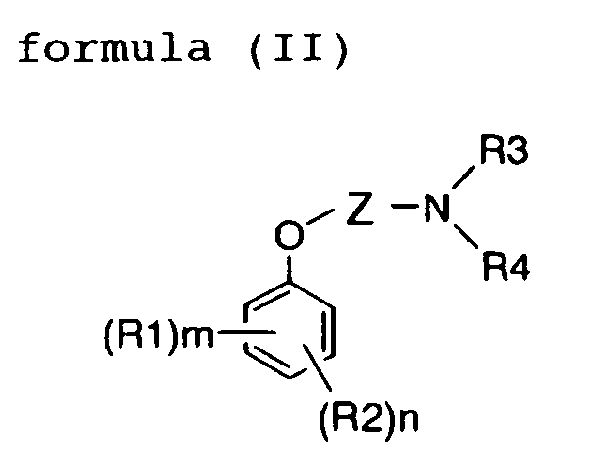
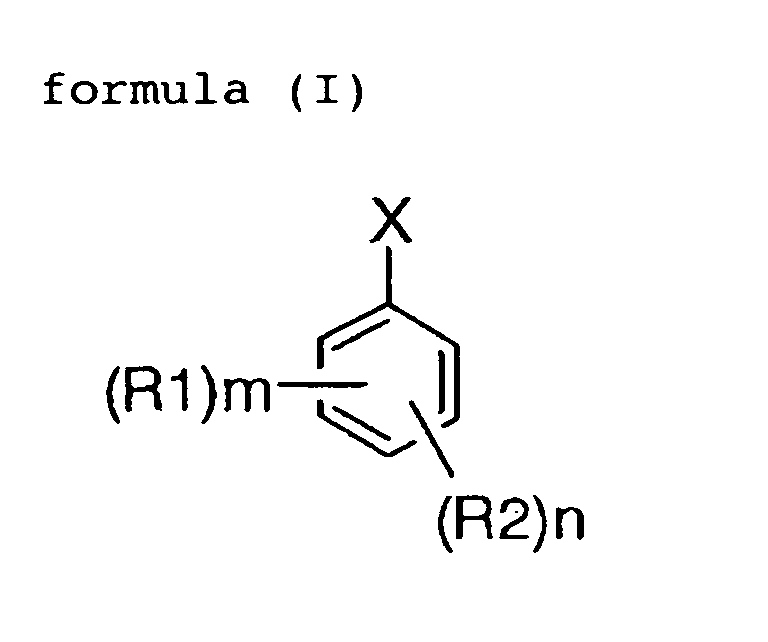
- the present invention is a process for producing a compound represented by the following formula (I), which includes causing a compound represented by the following formula (II) to react with a nucleophilic agent: wherein X represents a substituent; R1 represents an electron-withdrawing substituent having a Hammett ⁇ p constant of more than 0; m represents an integer of 1 to 5 (inclusive); R2 represents a substituent; n represents an integer of 0 to 4 (inclusive); m + n is from 1 to 5; when m is 2 or more, multiple R1s may be the same or different; when n is 2 or more, multiple R2s may be the same or different; R1s, or R2s, or R1 and R2 may bond to each other to form a ring; wherein R1 represents an electron-withdrawing substituent having a Hammett ⁇ p constant of more than 0; m represents an integer of 1 to 5 (inclusive); R2 represents a substituent; n represents an integer of
- the present invention means to include both the first embodiment and the second embodiment, unless otherwise specified.
- formula (II) can be represented by either formula (IIa) or formula (IIb). Therefore, unless otherwise specified, descriptions on the "formula (II)" are applied to both of formulas (IIa) and (IIb).
- the compound represented by formula (IV) can be represented by either formula (IVa) or formula (IVb). Therefore, unless otherwise specified, descriptions on the "formula (IV)" are applied to both of formulas (IVa) and (IVb).
- the first embodiment of the present invention is a process for producing a compound represented by formula (I), by causing a compound represented by formula (IIa) to react with a nucleophilic agent. More specifically, the first embodiment is a process shown as the second step in the following reaction scheme A; and it is preferably a process of synthesizing a compound represented by formula (IIa) by reaction of a phenolic compound represented by formula (III), with a compound represented by formula (IVa), and then producing a compound represented by formula (I) therefrom. This process is preferably composed of first and second steps in the following reaction scheme A.
- the second embodiment of the present invention is a process for producing a compound represented by formula (I), by causing a compound represented by formula (IIb) to react with a nucleophilic agent. More specifically, the second embodiment is a process shown as the second step in the following reaction scheme B; and it is preferably a process of synthesizing a compound represented by formula (IIb) by reaction of a phenolic compound represented by formula (III), with a compound represented by formula (IVb), and then producing a compound represented by formula (I) therefrom. This process is preferably composed of first and second steps in the following reaction scheme B.
- reaction scheme refers to both Schemes A and B.
- the number of carbon atoms when the number of carbon atoms is described for a specific group, the number means the total of the carbon atoms contained in the group and its substituent(s), if the group has any substituent(s).
- X represents a substituent.
- substituents include a halogen atom, an alkyl group (including a cycloalkyl group and a bicycloalkyl group), an alkenyl group (including a cycloalkenyl group and a bicycloalkenyl group), an alkynyl group (including a cycloalkynyl group), an aryl group, a heterocyclic group, a cyano group, an alkoxy group, an aryloxy group, a heterocyclic oxy group, an acyloxy group, a carbamoyloxy group, an alkoxycarbonyloxy group, an aryloxycarbonyloxy group, an amino group (including an alkylamino group, an anilino group, a cyclic amino group), an acylamino group, an aminocarbonylamino group, an alkoxycarbonylamino group, an aryloxycarbonylamino group, a
- the above-mentioned substituent may be further substituted with a substituent, examples of which include the above-mentioned groups.
- X is preferably a group having 30 or less carbon atoms in sum total. Preferred number of carbon atoms in X is: for example, 1 to 30 carbon atoms when X is an alkyl group, an alkoxy group, an acyloxy group, a carbamoyloxy group, an acylamino group, an aminocarbonylamino group, an alkyl sulfonylamino group, an alkylsulfinyl group, an alkylsulfonyl group, or an alkylthio group; 2 to 30 carbon atoms when X is an alkenyl group, an alkynyl group, an alkoxycarbonyloxy group, or an alkoxycarbonylamino group; 3 to 30 carbon atoms when X is a cycloalkyl group or a cycloalkenyl group; 6 to 30 carbon atoms when X is a cycloalkynyl group, a bicycloalkenyl group
- X is preferably a group that bonds to the benzene ring via a nitrogen, sulfur, oxygen, or carbon atom, more preferably a group that bonds to the benzene ring via a nitrogen or sulfur atom, even more preferably a group that bonds to the benzene ring via a sulfur atom, and most preferably an alkylthio or arylthio group.
- Examples of the nucleophilic agent caused to react with the compound represented by formula (II) include X anions, and compounds each having a hydrogen atom or metallic atom bonded to X.
- X is a structure having the same meaning as X in formula (I).
- nucleophilic agent examples include amines (such as ammonia, diethylamine, dodecylamine, and pyrrolidine), anilines (such as aniline, and N-methylaniline), alcohols (such as methanol, ethanol, i-propanol, and n-dodecanol), phenols (such as phenol, and p-chlorophenol), thiols (such as methylmercaptan, i-propylmercaptan, and 2-ethylhexylmercaptan), thiophenols (such as thiophenol, and p-dodecylthiophenol), imides (such as succinimide); active methylene compounds (such as dimethyl malonate, and ethyl acetoacetate), and salts thereof; alkyl- or aryl-Grignard reagents (such as a methyl Grignard reagent, and a phenyl Grignard reagents
- nucleophilic agents preferred are nucleophilic agents wherein the atom that nucleophilically attacks one of the carbons in the benzene ring to bond to the carbon atom is nitrogen, sulfur, oxygen, or carbon. More preferred are nucleophilic agents wherein the attacking atom is nitrogen or sulfur, and even more preferred are nucleophilic agents wherein the attacking atom is sulfur. Of the nucleophilic agents, most preferred are alkyl- or aryl-thiols, or anions or salts thereof.
- the alkylthiols, or anions or salts thereof are preferably those having 1 to 30 carbon atoms, and the arylthiols, or anions or salts thereof are preferably those having 6 to 30 carbon atoms. Examples of these include methylthiol, butylthiol, 2-ethylhexylthiol, octylthiol, phenylthiol, or an anion or salt thereof. Among these, the alkylthiols having 1 to 30 carbon atoms, or anions or salts thereof are more preferably used; and, of these, 2-ethylhexylthiol, or an anion or salt thereof is most preferred.
- R1 represents an electron-withdrawing substituent having a Hammett substituent constant ⁇ p of more than 0.
- the Hammett substituent constant ⁇ p is preferably from 0 to 1.5 (inclusive).
- Hammett substituent constant ⁇ p is described in detail in such books as "Hammett Soku - Kozo to Hannousei -,” written by Naoki Inamoto (Maruzen); “Shinjikken Kagaku-koza 14/Yukikagoubutsu no Gosei to Hanno V,” page 2605 (edited by Nihonkagakukai, Maruzen); “Riron Yukikagaku Kaisetsu,” written by Tadao Nakaya, page 217 (Tokyo Kagakudojin); and “Chemical Review” (Vol. 91), pages 165 to 195 (1991).
- R1 examples include a halogen atom, a formyl group, an acyl group, an alkoxycarbonyl group, an aryloxycarbonyl group, an alkyl- or aryl-sulfonyl group, an alkyl- or aryl-sulfinyl group, a carbamoyl group, a sulfamoyl group, a cyano group, a nitro group, a halogen-substituted alkyl or alkoxy group (such as trifluoromethyl and trifluromethoxy), an acyloxy group, and an acylamide group.
- a halogen atom such as trifluoromethyl and trifluromethoxy
- R1 may have a substituent, examples of which are the same as described above as examples of the substituent of X.
- R1 is preferably an electron-withdrawing substituent having a Hammett ⁇ p constant of more than 0.4.
- the electron-withdrawing group having a Hammett ⁇ p constant of more than 0.4 include an alkyloxycarbonylthio group, an alkoxycarbonyl group, an aryloxycarbonyl group, an alkylsulfinyl group, an arylsulfinyl group, an alkylsulfonyl group, an arylsulfonyl group, an acyl group, a perfluoroalkyl group, perfluoroalkylthio group, a sulfamoyl group, a cyano group, and a nitro group.
- R1 is more preferably an electron-withdrawing substituent having a Hammett ⁇ p constant of more than 0.6.
- Examples of the electron-withdrawing group having a Hammett ⁇ p constant of more than 0.6 include a cyano group, an alkylsulfonyl group, an arylsulfonyl group, and a nitro group.
- R1 is most preferably a nitro group.
- m represents an integer of 1 to 5, preferably an integer of 1 to 3, more preferably an integer of 1 or 2, and most preferably 1.
- R1 is most preferably substituted on the ortho or para position to the position of X.
- R2 represents a substituent. Examples of this substituent are the same as described above as examples of the substituent of X.
- R2 is preferably an alkyl group, an alkenyl group, an aryl group, a heterocyclic group, an alkoxy group, an aryloxy group, an alkylthio group, an arylthio group, a heterocyclic thio group, a halogen atom, an amino group, an acylamino group, a sulfonamido group, an imido group, a cyano group, a nitro group, an acyl group, an alkoxycarbonyl group, an aryloxycarbonyl group, an alkyl- or aryl-sulfonyl group, an alkyl- or aryl-sulfinyl group, a carbamoyl group, and a sulfamoyl group.
- n is an integer of 0 to 4, preferably an integer of 0 to 3, and more preferably an integer of 0 to 2.
- the total of m and n (i.e., m + n) is an integer of 1 to 5.
- plural R1s, plural R2s, or R1 and R2 may bond to each other to form a ring.
- This ring may be aromatic, non-aromatic, alicyclic, or heterocyclic.
- R3 and R4 each independently represent an alkyl group, an aryl group, or a heterocyclic group.
- the alkyl group is preferably a substituted or unsubstituted, straight- or branched-chain alkyl group (including cycloalkyl) having 1 to 30 carbon atoms.
- alkyl group include a methyl group, an ethyl group, a propyl group, an i-propyl group, a t-butyl group, a dodecyl group, a 2-ehtylhexyl group, and a cyclohexyl group.
- the aryl group is preferably a substituted or unsubstituted, single or condensed ring, aryl group having 6 to 30 carbon atoms.
- Examples of the aryl group include a phenyl group, a p-tolyl group, a naphthyl group, a m-chlorophenyl group, and an o-hexadecanoylaminophenyl group.
- the heterocyclic group is preferably a 5- or 6-membered ring, and may be condensed to another ring.
- the heterocyclic group may be an aromatic heterocyclic group or a non-aromatic heterocyclic group.
- Examples of the heterocycle in the heterocyclic group include pyridine, pyrazine, pyrimidine, pyridazine, triazine, quinoline, isoquinoline, quinazoline, cinnoline, phthalazine, quinoxaline, pyrrole, indole, furan, benzofuran, thiophene, benzothiophene, pyrazole, imidazole, benzimidazole, triazole, oxazole, benzoxazole, thiazole, benzothiazole, isothiazole, benzisothiazole, thiadiazole, isoxazole, benzisoxazole, pyrrolidine, piperidine, piperazine,
- R3 and R4 each are preferably an alkyl group, more preferably an alkyl group having 2 or more carbon atoms, even more preferably an ethyl or i-propyl group, and most preferably an i-propyl group.
- R3 and R4 each are preferably an alkyl group, more preferably a methyl or ethyl group, and most preferably a methyl group.
- R3 and R4 may bond to each other to form a ring.
- This ring may be aromatic, non-aromatic, alicyclic, or heterocyclic, and is preferably non-aromatic.
- Examples of the ring formed by R3 and R4 bonded together include a pyrrolidine ring, a piperidine ring, a piperazine ring, a morpholine ring, a pyrrole ring, an imidazole ring, a pyrazole ring, an indole ring, and an indoline ring.
- a pyrrolidine ring, a piperidine ring, a piperazine ring, and a morpholine ring are more preferred.
- p represents 1 or 2, and preferably p is 2.
- Y represents a halogen atom.
- the halogen atom include fluorine, chlorine, bromine, and iodine atoms.
- Y is preferably a chlorine atom.
- the phenolic compound represented by formula (III) can be synthesized by known various synthesis methods.
- the compound represented by formula (IVa) is known, and is commercially available, or can easily be produced by a known method.
- the compound represented by formula (IVb) can be synthesized by known various synthesis methods.
- Y is, for example, a chlorine atom
- JP-A means unexamined published Japanese patent application
- Each of the first step and the second step in the reaction scheme A or B may be performed or both of the steps may be continuously performed without using any solvent or in the state that the reactants are dissolved or dispersed in an appropriate solvent.
- the solvent which can be used in the reaction according to the present invention include water, alcohol-based solvents (such as methanol and isopropanol), chlorine-containing solvents (such as dichloromethylene), aromatic solvents (such as benzene, chlorobenzene, and toluene), amide-based solvents (such as N,N-dimethylformamide, N,N-dimethylacetoamide, and N-methylpyrrolidone), nitrile-based solvents (such as acetonitrile, and propionitrile), ether-based solvents (such as tetrahydrofuran, ethylene glycol diethyl ether), sulfone-based solvents (such as dimethylsulfone, and sulfolane), phosphoric amide-
- solvents may be used alone or in the form of a mixture of two or more thereof. It is particularly preferable that the reaction is performed in a two-phase system wherein water and an organic solvent immiscible with water are used together.
- a solvent different from the solvent used in the first step may be used in the second step.
- the amount of the solvent(s) is usually from 0.1 to 1,000 parts by mass, preferably from 0.5 to 100 parts by mass, and more preferably from 1 to 50 parts by mass per part by mass of the compound represented by formula (III) in the first step and per part by mass of the compound represented by formula (II) in the second step, respectively.
- a base is preferably used in the first or second step, more preferably in both of the first and second steps.
- the base which can be used in the present invention include hydroxide compounds (such as sodium hydroxide, potassium hydroxide, and tetrabutylammonium hydroxide), carbonate compounds (such as sodium carbonate, potassium carbonate, and tetrabutylammonium carbonate), amines (such as ammonia, and triethylamine), anilines (such as diethylaniline), aromatic heterocyclic compounds (such as pyridine, and imidazole), guanidines (such as tetramethylguanidine), bicarbonate compounds (such as sodium bicarbonate), nitrogen-containing heterocyclic compounds (such as 1,8-diazabicyclo[5,4,0]-7-undecene), acetic acid compounds (such as sodium acetate, and potassium acetate), and metal salts of organic compounds (such as sodium methoxide).
- hydroxide compounds such as sodium hydrox
- bases may be used alone or in the form of a mixture of two or more thereof.
- the amount of the base(s) is usually from 0.1 to 100 moles, preferably from 0.5 to 10 moles, and more preferably from 1 to 5 moles per mole of the compound represented by formula (III) in the first step and per mole of the compound represented by formula (II) in the second step, respectively.
- phase-transfer catalyst in the first or second step or in both of the first and second steps.
- phase-transfer catalyst which can be used in the present invention include ammonium salts (such as tetrabutylammonium bromide, benzyltrimethylammonium chloride, and tetraethylammonium iodide), and phosphinium salts (such as tetrabutylphosphinium bromide).
- ammonium salts such as tetrabutylammonium bromide, benzyltrimethylammonium chloride, and tetraethylammonium iodide
- phosphinium salts such as tetrabutylphosphinium bromide
- the amount of the phase-transfer catalyst is preferably from 0.001 to 10 moles, more preferably from 0.01 to 1 mole, even more preferably from 0.05 to 0.5 mole, and particularly preferably from 0.02 to 0.5 mole per mole of the compound represented by formula (I).
- phase-transfer catalyst at least in the second step, and this is particularly preferable when X in formula (I) is an alkylthio or arylthio group.
- reaction solvents are preferably water and an aromatic solvent (such as toluene).
- the ratio of water to an aromatic solvent is preferably in the range of 1:0.1 to 1:20, and more preferably 1:1 to 1:20, in terms of volume ratio.
- the amount of the nucleophilic agent is usually from 0.01 to 100 moles, preferably from 0.1 to 50 moles, more preferably from 0.2 to 20 moles, and even more preferably from 0.5 to 10 moles per mole of the compound represented by formula (II).
- the compound represented by formula (II) prepared in the first step may be used after being isolated. However, it is preferable to use the solution containing the compound represented by formula (II) as it is, without isolating the compound represented by formula (II).
- a nucleophilic agent or a solution thereof may be added to the compound represented by formula (II) or solution thereof prepared in the first step.
- the compound represented by formula (II) or the solution thereof may be added to a nucleophilic agent or a solution thereof.
- the reaction temperature for the present reaction is not particularly limited in each of the first and second steps.
- the reaction can be carried out from -50 to 150 °C, preferably from -10 to 100 °C, and more preferably from 0 to 80 °C.
- the compound represented by formula (I) according to the present invention is useful as a synthesis intermediate of photographically-useful compounds to be used in silver halide photographic light-sensitive materials, or as a synthesis intermediate of medical supplies, agricultural chemicals, or the like.
- the compound represented by formula (I) is preferably used as a synthesis intermediate of a photographically-useful compound to be used in silver halide photographic light-sensitive materials, such as a dye-forming coupler, a dye, and a ballast group in a hydrophobic additives.
- the compound is preferably used to form a dye-forming coupler and a dye.
- the compound represented by formula (I) is preferably applied to yellow dye-forming couplers described in JP-A-2003-173007, JP-A-2004-118082, JP-A-2004-118109, and JP-A-2004-139062; cyan dye-forming couplers described in JP-A-11-282138; and magenta dye-forming couplers described in JP-A-8-122984.
- dye-forming couplers can be obtained by reducing a nitro group in the compound represented by formula (I) to an amino group, and then further reacting the amino group. Synthesis of these compounds can be carried out according to the methods described in the above-mentioned publications.
- yellow dye-forming couplers described in JP-A-2003-173007, JP-A-2004-118082, JP-A-2004-118109, and JP-A-2004-139062 can be synthesized, according to the synthesis of Coupler (2) from Compound (A-4) described in Paragraph 0072 in JP-A-2004-139062.
- the present invention overcomes problems in the prior art, and the present invention can produce an aromatic compound derivative that is inexpensive and widely usable, at high yield, through a simple process.
- the present invention makes it possible to synthesize an aromatic compound derivative, with high selectivity and high yield, easily and inexpensively through a short process, using a compound that can be derived from a phenolic compound.
- the compound was synthesized in accordance with following reaction scheme.
- the compound was synthesized in accordance with following reaction scheme.
- the compound was synthesized in accordance with following reaction scheme.
- the compound was synthesized in accordance with following reaction scheme.
- the compound was synthesized in accordance with following reaction scheme.
- the compound was synthesized via a p-toluenesulfonyl product, as illustrated in the following reaction scheme.
Landscapes
- Chemical & Material Sciences (AREA)
- Organic Chemistry (AREA)
- Organic Low-Molecular-Weight Compounds And Preparation Thereof (AREA)
Abstract

Description
- The present invention relates to a process for synthesizing a derivative of an aromatic compound having a substituent, which is a compound useful as a synthesis intermediate of photographically-useful compounds for use in a silver halide photographic photosensitive material, medical supplies, agricultural chemicals, or others.
- Nucleophilic reaction onto an aromatic ring of an aromatic compound is affected by the kind of group that leaves upon reaction with a nucleophilic agent (hereinafter referred to also as a "leaving group"), and the reaction is promoted by introducing an electron-withdrawing group into the aromatic ring. Examples of the leaving group include a halogen atom, an aryl- or alkylsulfonyl group, an aryl- or alkyl-sulfinyl group, an aryl- or alkyl-sulfonyloxy group, an aryl- or alkyl-thio group, an alkoxy group, an aryloxy group, an amino group, a nitro group, and an azide group. An example of the electron-withdrawing group is a nitro group.
- Further, phenolic compounds, as the aromatic compound, are inexpensive and can be easily obtained. Therefore, if the hydroxyl group of the phenolic compounds can be converted to a different substituent, the conversion process would be very useful to synthesize aromatic compound derivatives. Hitherto, the following have been known: a process of converting the hydroxyl group to a p-toluenesulfonyl group, and then causing this group to react with a nucleophilic agent (see, for example, "Journal of the American Chemical Society," 1959, vol. 81, pp. 2104-2109, and "The Journal of Organic Chemistry," 2002, vol. 67, pp. 1277-1281); and a process of converting the hydroxyl group to a trifluoromethanesulfonyl group, and then causing this group to react with a nucleophilic agent (see, for example, "Synthesis," 1990, pp. 1145-1147, and "Synlett," 1999, vol. 10, pp. 1559-1562). However, the former process has the problem that the nucleophilic agent attacks the sulfur moiety of the p-toluenesulfonyl group, varyingly depending on the substituent of the aromatic compound, so as to cause a side reaction, by which the phenolic compound leaves. The latter process has a problem that trifluoromethanesulfonyl chloride or trifluoromethanesulfonic acid anhydride, which is a starting material in the process, is expensive, and thus the target compound cannot be produced at low costs.
- As such, there has been a need for development of a production process that uses a phenolic compound and a starting material that can be easily obtained at low costs, to synthesize an aromatic compound derivative with high selectivity and high yield through a short process.
- Further, there has been a need for a process for producing an aromatic compound derivative that is inexpensive and widely usable, at high yield through a simple process.
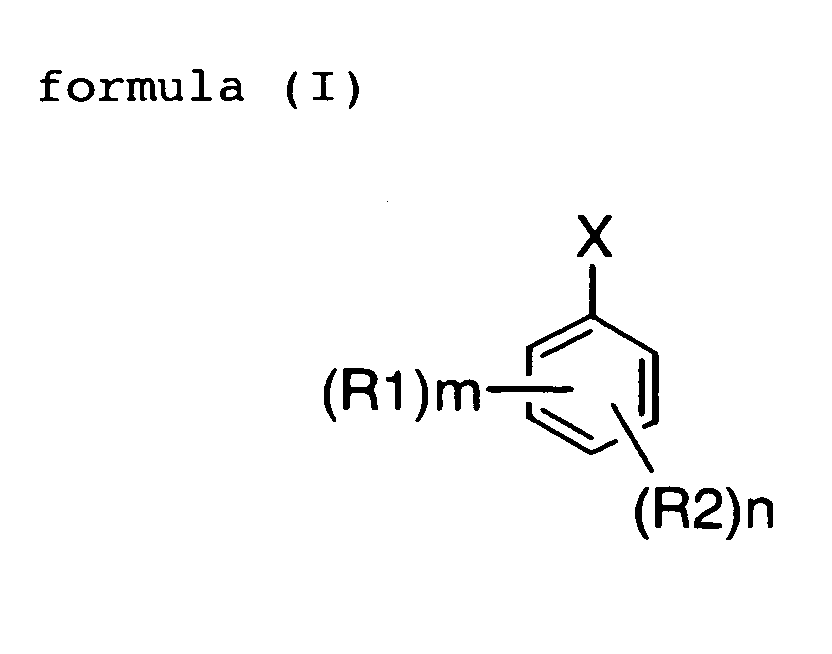
- The present invention is a process for producing a compound represented by the following formula (I), which includes causing a compound represented by the following formula (II) to react with a nucleophilic agent:wherein X represents a substituent; R1 represents an electron-withdrawing substituent having a Hammett σp constant of more than 0; m represents an integer of 1 to 5 (inclusive); R2 represents a substituent; n represents an integer of 0 to 4 (inclusive); m + n is from 1 to 5; when m is 2 or more, multiple R1s may be the same or different; when n is 2 or more, multiple R2s may be the same or different; R1s, or R2s, or R1 and R2 may bond to each other to form a ring;
 wherein R1 represents an electron-withdrawing substituent having a Hammett σp constant of more than 0; m represents an integer of 1 to 5 (inclusive); R2 represents a substituent; n represents an integer of 0 to 4 (inclusive); m + n is from 1 to 5 (inclusive); when m is 2 or more, multiple R1s may be the same or different; when n is 2 or more, multiple R2s may be the same or different; R1s, or R2s, or R1 and R2 may bond to each other to form a ring; R3 and R4 each independently represent an alkyl, aryl, or heterocyclic group; R3 and R4 may bond to each other to form a ring; and Z represents C=O or S(O)p, wherein p is 1 or 2.
- Other and further features and advantages of the invention will appear more fully from the following description.
- The inventors, having made eager investigations, have found out that the above-mentioned objects of the invention can be attained by the following process:
- (1) A process for producing a compound represented by
the following formula (I), which includes causing a
compound represented by the following formula (II) to
react with a nucleophilic agent:
wherein X represents a substituent; R1 represents an electron-withdrawing substituent having a Hammett σp constant of more than 0; m represents an integer of 1 to 5 (inclusive); R2 represents a substituent; n represents an integer of 0 to 4 (inclusive); m + n is from 1 to 5 (inclusive); when m is 2 or more, multiple R1s may be the same or different; when n is 2 or more, multiple R2s may be the same or different; R1s, or R2s, or R1 and R2 may bond to each other to form a ring;
 wherein R1 represents an electron-withdrawing substituent having a Hammett σp constant of more than 0; m represents an integer of 1 to 5 (inclusive); R2 represents a substituent; n represents an integer of 0 to 4 (inclusive); m + n is from 1 to 5 (inclusive); when m is 2 or more, multiple R1s may be the same or different; when n is 2 or more, multiple R2s may be the same or different; R1s, or R2s, or R1 and R2 may bond to each other to form a ring; R3 and R4 each independently represent an alkyl, aryl, or heterocyclic group; R3 and R4 may bond to each other to form a ring; and Z represents C=O or S(O)p, wherein p is 1 or 2.
- (2) The process according to item (1), wherein the
compound represented by formula (II) is a compound
synthesized by causing a compound represented by the
following formula (III) to react with a compound
represented by the following formula (IV):
wherein R1 represents an electron-withdrawing substituent having a Hammett σp constant of more than 0; m represents an integer of 1 to 5 (inclusive); R2 represents a substituent; n represents an integer of 0 to 4 (inclusive); m + n is from 1 to 5 (inclusive); when m is 2 or more, multiple R1s may be the same or different; when n is 2 or more, multiple R2s may be the same or different; and R1s, or R2s, or R1 and R2 may bond to each other to form a ring;
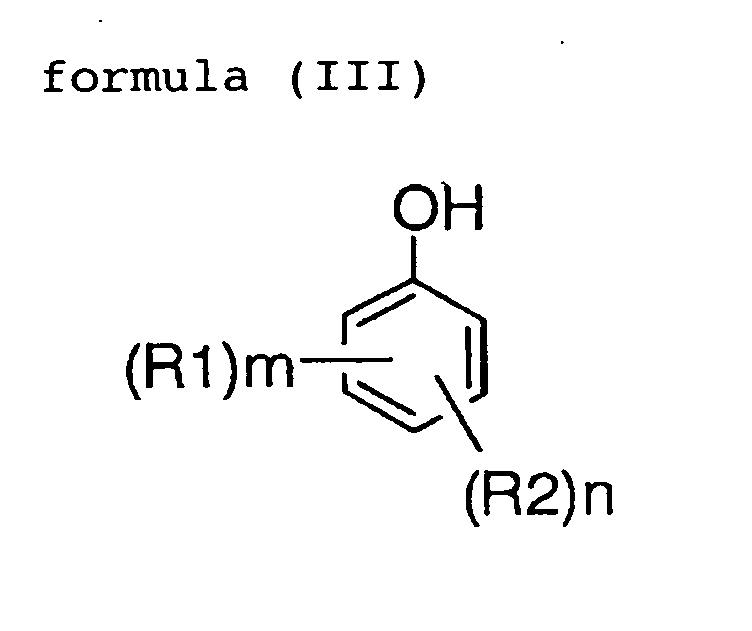 wherein R3 and R4 each independently represent an alkyl, aryl, or heterocyclic group; R3 and R4 may bond to each other to form a ring; Z represents C=O or S(O)p wherein p is 1 or 2; and Y represents a halogen atom.
- (3) A process for producing a compound represented by
the following formula (I), which includes causing a
compound represented by the following formula (IIa) to
react with a nucleophilic agent:
wherein X represents a substituent; R1 represents an electron-withdrawing substituent having a Hammett σp constant of more than 0; m represents an integer of 1 to 5 (inclusive); R2 represents a substituent; n represents an integer of 0 to 4 (inclusive); m + n is from 1 to 5 (inclusive); when m is 2 or more, multiple R1s may be the same or different; when n is 2 or more, multiple R2s may be the same or different; R1s, or R2s, or R1 and R2 may bond to each other to form a ring;
 wherein R1 represents an electron-withdrawing substituent having a Hammett σp constant of more than 0; m represents an integer of 1 to 5 (inclusive); R2 represents a substituent; n represents an integer of 0 to 4 (inclusive); m + n is from 1 to 5 (inclusive); when m is 2 or more, multiple R1s may be the same or different; when n is 2 or more, multiple R2s may be the same or different; R1s, or R2s, or R1 and R2 may bond to each other to form a ring; R3 and R4 each independently represent an alkyl, aryl, or heterocyclic group; and R3 and R4 may bond to each other to form a ring.
- (4) The process according to item (3), wherein the
compound represented by formula (IIa) is a compound
synthesized by causing a compound represented by the
following formula (III) to react with a compound
represented by the following formula (IVa):
wherein R1 represents an electron-withdrawing substituent having a Hammett σp constant of more than 0; m represents an integer of 1 to 5 (inclusive); R2 represents a substituent; n represents an integer of 0 to 4 (inclusive); m + n is from 1 to 5 (inclusive); when m is 2 or more, multiple R1s may be the same or different; when n is 2 or more, multiple R2s may be the same or different; and R1s, or R2s, or R1 and R2 may bond to each other to form a ring;
 wherein R3 and R4 each independently represent an alkyl, aryl, or heterocyclic group; R3 and R4 may bond to each other to form a ring; and Y represents a halogen atom.
- (5) The process according to item (3) or (4), wherein R1 is a nitro group.
- (6) The process according to any one of items (3) to (5), wherein X in formula (I) is a group that bonds to the benzene ring via a nitrogen or sulfur atom.
- (7) The process according to item (4), wherein the compound represented by formula (IIa) and synthesized by causing the compound represented by formula (III) to react with the compound represented by formula (IVa) is used, without being isolated, in the form of a reaction mixture.
- (8) The process according to any one of items (3) to (7), wherein m in formula (I) is 1.
- (9) The process according to any one of items (3) to (8), wherein R3 and R4 in formula (IIa) each are an alkyl group.
- (10) The process according to the item (4), wherein Y in
formula (IVa) is a chlorine atom.
(Herein, the process for producing the compound represented by formula (I) as described in the above items (3) to (10) are collectively referred to as a first embodiment of the present invention.) - (11) A process for producing a compound represented by
the following formula (I), which includes causing a
compound represented by the following formula (IIb) to
react with a nucleophilic agent:
wherein X represents a substituent; R1 represents an electron-withdrawing substituent having a Hammett σp constant of more than 0; m represents an integer of 1 to 5 (inclusive); R2 represents a substituent; n represents an integer of 0 to 4 (inclusive); m + n is from 1 to 5 (inclusive); when m is 2 or more, multiple R1s may be the same or different; when n is 2 or more, multiple R2s may be the same or different; R1s, or R2s, or R1 and R2 may bond to each other to form a ring;
 wherein R1 represents an electron-withdrawing substituent having a Hammett σp constant of more than 0; m represents an integer of 1 to 5 (inclusive); R2 represents a substituent; n represents an integer of 0 to 4 (inclusive); m + n is from 1 to 5 (inclusive); when m is 2 or more, multiple R1s may be the same or different; when n is 2 or more, multiple R2s may be the same or different; R1s, or R2s, or R1 and R2 may bond to each other to form a ring; R3 and R4 each independently represent an alkyl, aryl, or heterocyclic group; and R3 and R4 may bond to each other to form a ring.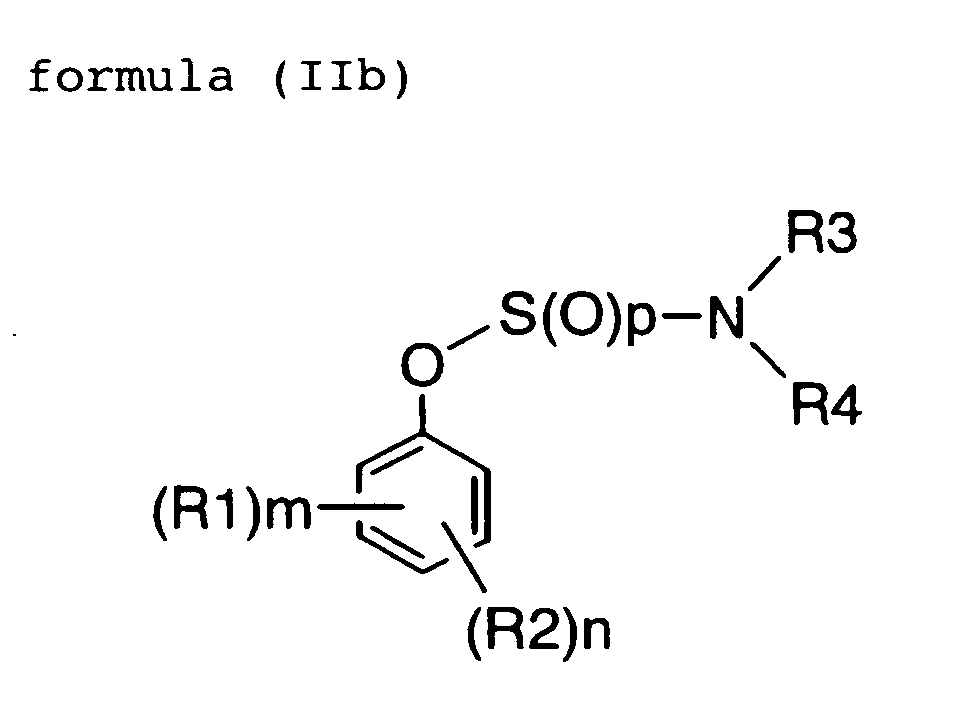
- (12) The process according to item (11), wherein the
compound represented by formula (IIb) is a compound
synthesized by causing a compound represented by the
following formula (III) to react with a compound
represented by the following formula (IVb):
wherein R1 represents an electron-withdrawing substituent having a Hammett σp constant of more than 0; m represents an integer of 1 to 5 (inclusive); R2 represents a substituent; n represents an integer of 0 to 4 (inclusive); m + n is from 1 to 5 (inclusive); when m is 2 or more, multiple R1s may be the same or different; when n is 2 or more, multiple R2s may be the same or different; and R1s, or R2s, or R1 and R2 may bond to each other to form a ring;
 wherein R3 and R4 each independently represent an alkyl, aryl, or heterocyclic group; R3 and R4 may bond to each other to form a ring; p represents an integer of 1 or 2; and Y represents a halogen atom.
- (13) The process according to item (11) or (12), wherein R1 is a nitro group.
- (14) The process according to any one of items (11) to (13), wherein X in formula (I) is a group that bonds to the benzene ring via a nitrogen or sulfur atom.
- (15) The process according to item (12), wherein the compound represented by formula (IIb) and synthesized by causing the compound represented by formula (III) to react with the compound represented by formula (IVb) is used, without being isolated, in the form of a reaction mixture.
- (16) The process according to any one of items (11) to (15), wherein m in formula (I) is 1.
- (17) The process according to any one of items (11) to (16), wherein p in formula (IIb) is 2.
- (18) The process according to any one of items (11) to (17), wherein R3 and R4 in formula (IIb) each are an alkyl group.
- (19) The process according to the item (12), wherein Y in formula (IVb) is a chlorine atom. (Herein, the process for producing the compound represented by formula (I) as described in the above items (11) to (19) are collectively referred to as a second embodiment of the present invention.)
-
- Herein, the present invention means to include both the first embodiment and the second embodiment, unless otherwise specified.
- Hereinafter, the present invention is described in detail.
- In the present invention, the compound represented by formula (II) can be represented by either formula (IIa) or formula (IIb). Therefore, unless otherwise specified, descriptions on the "formula (II)" are applied to both of formulas (IIa) and (IIb).
- Further, in the present invention, the compound represented by formula (IV) can be represented by either formula (IVa) or formula (IVb). Therefore, unless otherwise specified, descriptions on the "formula (IV)" are applied to both of formulas (IVa) and (IVb).
- The first embodiment of the present invention is a process for producing a compound represented by formula (I), by causing a compound represented by formula (IIa) to react with a nucleophilic agent. More specifically, the first embodiment is a process shown as the second step in the following reaction scheme A; and it is preferably a process of synthesizing a compound represented by formula (IIa) by reaction of a phenolic compound represented by formula (III), with a compound represented by formula (IVa), and then producing a compound represented by formula (I) therefrom. This process is preferably composed of first and second steps in the following reaction scheme A.

- The second embodiment of the present invention is a process for producing a compound represented by formula (I), by causing a compound represented by formula (IIb) to react with a nucleophilic agent. More specifically, the second embodiment is a process shown as the second step in the following reaction scheme B; and it is preferably a process of synthesizing a compound represented by formula (IIb) by reaction of a phenolic compound represented by formula (III), with a compound represented by formula (IVb), and then producing a compound represented by formula (I) therefrom. This process is preferably composed of first and second steps in the following reaction scheme B.

- In the present specification, unless otherwise specified, the term "reaction scheme" refers to both Schemes A and B.
- Further, unless otherwise specified, descriptions on the "first step" and the "second step" are applied to both of schemes A and B.
- In the present specification, when the number of carbon atoms is described for a specific group, the number means the total of the carbon atoms contained in the group and its substituent(s), if the group has any substituent(s).
- Next, the compounds represented by formula (I), formula (II), formula (III), or formula (IV), for use in the present invention, are explained in detail.
- In formula (I), X represents a substituent. Examples of the substituent include a halogen atom, an alkyl group (including a cycloalkyl group and a bicycloalkyl group), an alkenyl group (including a cycloalkenyl group and a bicycloalkenyl group), an alkynyl group (including a cycloalkynyl group), an aryl group, a heterocyclic group, a cyano group, an alkoxy group, an aryloxy group, a heterocyclic oxy group, an acyloxy group, a carbamoyloxy group, an alkoxycarbonyloxy group, an aryloxycarbonyloxy group, an amino group (including an alkylamino group, an anilino group, a cyclic amino group), an acylamino group, an aminocarbonylamino group, an alkoxycarbonylamino group, an aryloxycarbonylamino group, a sulfamoylamino group, an alkyl- or aryl-sulfonylamino group, a mercapto group, an alkylthio group, an arylthio group, a heterocyclic thio group, a thiocyano group, an isothiocyano group, a sulfamoyl group, a sulfo group, an alkyl- or aryl-sulfinyl group, an alkyl- or aryl-sulfonyl group, an imido group, a phosphino group, a phosphinyl group, a phosphinyloxy group, a phosphinylamino group. X is preferably a substituent other than a hydroxyl group; since, when X is a hydroxyl group, the target compound represented by formula (I) returns to the compound represented by formula (III), which is the raw material.
- The above-mentioned substituent may be further substituted with a substituent, examples of which include the above-mentioned groups.
- X is preferably a group having 30 or less carbon atoms in sum total. Preferred number of carbon atoms in X is: for example, 1 to 30 carbon atoms when X is an alkyl group, an alkoxy group, an acyloxy group, a carbamoyloxy group, an acylamino group, an aminocarbonylamino group, an alkyl sulfonylamino group, an alkylsulfinyl group, an alkylsulfonyl group, or an alkylthio group; 2 to 30 carbon atoms when X is an alkenyl group, an alkynyl group, an alkoxycarbonyloxy group, or an alkoxycarbonylamino group; 3 to 30 carbon atoms when X is a cycloalkyl group or a cycloalkenyl group; 6 to 30 carbon atoms when X is a cycloalkynyl group, a bicycloalkenyl group, an aryl group, an aryloxy group, an arylsulfonylamino group, an arylthio group, an arylsulfinyl group, or an arylsulfonyl group; 0 to 30 carbon atoms when X is a heterocyclic group, a heterocyclic oxy group, an amino group, a sulfamoylamino group, a heterocyclic thio group, a sulfamoyl group, a phosphino group, a phosphinyl group, a phosphinyloxy group, or a phosphinylamino group; 7 to 30 carbon atoms when X is an aryloxycarbonyloxy group, or an aryloxycarbonylamino group; and 4 to 30 carbon atoms when X is an imido group.
- X is preferably a group that bonds to the benzene ring via a nitrogen, sulfur, oxygen, or carbon atom, more preferably a group that bonds to the benzene ring via a nitrogen or sulfur atom, even more preferably a group that bonds to the benzene ring via a sulfur atom, and most preferably an alkylthio or arylthio group.
- Examples of the nucleophilic agent caused to react with the compound represented by formula (II) include X anions, and compounds each having a hydrogen atom or metallic atom bonded to X. In the above, X is a structure having the same meaning as X in formula (I).
- Examples of the nucleophilic agent include amines (such as ammonia, diethylamine, dodecylamine, and pyrrolidine), anilines (such as aniline, and N-methylaniline), alcohols (such as methanol, ethanol, i-propanol, and n-dodecanol), phenols (such as phenol, and p-chlorophenol), thiols (such as methylmercaptan, i-propylmercaptan, and 2-ethylhexylmercaptan), thiophenols (such as thiophenol, and p-dodecylthiophenol), imides (such as succinimide); active methylene compounds (such as dimethyl malonate, and ethyl acetoacetate), and salts thereof; alkyl- or aryl-Grignard reagents (such as a methyl Grignard reagent, and a phenyl Grignard reagent); alkyl- or aryl-lithium compounds (such as n-butyllithium); cyanides; sulfides; azides; halides; cyanates; thiocyanates; and sulfites.
- Of these nucleophilic agents, preferred are nucleophilic agents wherein the atom that nucleophilically attacks one of the carbons in the benzene ring to bond to the carbon atom is nitrogen, sulfur, oxygen, or carbon. More preferred are nucleophilic agents wherein the attacking atom is nitrogen or sulfur, and even more preferred are nucleophilic agents wherein the attacking atom is sulfur. Of the nucleophilic agents, most preferred are alkyl- or aryl-thiols, or anions or salts thereof.
- The alkylthiols, or anions or salts thereof are preferably those having 1 to 30 carbon atoms, and the arylthiols, or anions or salts thereof are preferably those having 6 to 30 carbon atoms. Examples of these include methylthiol, butylthiol, 2-ethylhexylthiol, octylthiol, phenylthiol, or an anion or salt thereof. Among these, the alkylthiols having 1 to 30 carbon atoms, or anions or salts thereof are more preferably used; and, of these, 2-ethylhexylthiol, or an anion or salt thereof is most preferred.
- In formulae (I), (II), and (III), R1 represents an electron-withdrawing substituent having a Hammett substituent constant σp of more than 0. The Hammett substituent constant σp is preferably from 0 to 1.5 (inclusive).
- Herein, Hammett substituent constant σp is described in detail in such books as "Hammett Soku - Kozo to Hannousei -," written by Naoki Inamoto (Maruzen); "Shinjikken Kagaku-koza 14/Yukikagoubutsu no Gosei to Hanno V," page 2605 (edited by Nihonkagakukai, Maruzen); "Riron Yukikagaku Kaisetsu," written by Tadao Nakaya, page 217 (Tokyo Kagakudojin); and "Chemical Review" (Vol. 91), pages 165 to 195 (1991).
- Examples of R1 include a halogen atom, a formyl group, an acyl group, an alkoxycarbonyl group, an aryloxycarbonyl group, an alkyl- or aryl-sulfonyl group, an alkyl- or aryl-sulfinyl group, a carbamoyl group, a sulfamoyl group, a cyano group, a nitro group, a halogen-substituted alkyl or alkoxy group (such as trifluoromethyl and trifluromethoxy), an acyloxy group, and an acylamide group.
- R1 may have a substituent, examples of which are the same as described above as examples of the substituent of X. R1 is preferably an electron-withdrawing substituent having a Hammett σp constant of more than 0.4. Examples of the electron-withdrawing group having a Hammett σp constant of more than 0.4 include an alkyloxycarbonylthio group, an alkoxycarbonyl group, an aryloxycarbonyl group, an alkylsulfinyl group, an arylsulfinyl group, an alkylsulfonyl group, an arylsulfonyl group, an acyl group, a perfluoroalkyl group, perfluoroalkylthio group, a sulfamoyl group, a cyano group, and a nitro group. R1 is more preferably an electron-withdrawing substituent having a Hammett σp constant of more than 0.6. Examples of the electron-withdrawing group having a Hammett σp constant of more than 0.6 include a cyano group, an alkylsulfonyl group, an arylsulfonyl group, and a nitro group. R1 is most preferably a nitro group.
- In formulae (I), (II), and (III), m represents an integer of 1 to 5, preferably an integer of 1 to 3, more preferably an integer of 1 or 2, and most preferably 1. When m is 1, R1 is most preferably substituted on the ortho or para position to the position of X.
- In formulae (I), (II), and (III), R2 represents a substituent. Examples of this substituent are the same as described above as examples of the substituent of X.
- R2 is preferably an alkyl group, an alkenyl group, an aryl group, a heterocyclic group, an alkoxy group, an aryloxy group, an alkylthio group, an arylthio group, a heterocyclic thio group, a halogen atom, an amino group, an acylamino group, a sulfonamido group, an imido group, a cyano group, a nitro group, an acyl group, an alkoxycarbonyl group, an aryloxycarbonyl group, an alkyl- or aryl-sulfonyl group, an alkyl- or aryl-sulfinyl group, a carbamoyl group, and a sulfamoyl group.
- In formulae (I), (II), and (III), n is an integer of 0 to 4, preferably an integer of 0 to 3, and more preferably an integer of 0 to 2.
- The total of m and n (i.e., m + n) is an integer of 1 to 5.
- In formulae (I), (II), and (III), plural R1s, plural R2s, or R1 and R2 may bond to each other to form a ring. This ring may be aromatic, non-aromatic, alicyclic, or heterocyclic.
- In formula (II) and formula (IV), R3 and R4 each independently represent an alkyl group, an aryl group, or a heterocyclic group.
- The alkyl group is preferably a substituted or unsubstituted, straight- or branched-chain alkyl group (including cycloalkyl) having 1 to 30 carbon atoms. Examples of the alkyl group include a methyl group, an ethyl group, a propyl group, an i-propyl group, a t-butyl group, a dodecyl group, a 2-ehtylhexyl group, and a cyclohexyl group.
- The aryl group is preferably a substituted or unsubstituted, single or condensed ring, aryl group having 6 to 30 carbon atoms. Examples of the aryl group include a phenyl group, a p-tolyl group, a naphthyl group, a m-chlorophenyl group, and an o-hexadecanoylaminophenyl group.
- The heterocyclic group is preferably a 5- or 6-membered ring, and may be condensed to another ring. The heterocyclic group may be an aromatic heterocyclic group or a non-aromatic heterocyclic group. Examples of the heterocycle in the heterocyclic group include pyridine, pyrazine, pyrimidine, pyridazine, triazine, quinoline, isoquinoline, quinazoline, cinnoline, phthalazine, quinoxaline, pyrrole, indole, furan, benzofuran, thiophene, benzothiophene, pyrazole, imidazole, benzimidazole, triazole, oxazole, benzoxazole, thiazole, benzothiazole, isothiazole, benzisothiazole, thiadiazole, isoxazole, benzisoxazole, pyrrolidine, piperidine, piperazine, imidazolidine, and thiazoline.
- In formulae (IIa) and (IVa), R3 and R4 each are preferably an alkyl group, more preferably an alkyl group having 2 or more carbon atoms, even more preferably an ethyl or i-propyl group, and most preferably an i-propyl group.
- In formulae (IIb) and (IVb), R3 and R4 each are preferably an alkyl group, more preferably a methyl or ethyl group, and most preferably a methyl group.
- In formulae (II) and (IV), R3 and R4 may bond to each other to form a ring. This ring may be aromatic, non-aromatic, alicyclic, or heterocyclic, and is preferably non-aromatic. Examples of the ring formed by R3 and R4 bonded together include a pyrrolidine ring, a piperidine ring, a piperazine ring, a morpholine ring, a pyrrole ring, an imidazole ring, a pyrazole ring, an indole ring, and an indoline ring. Among these, a pyrrolidine ring, a piperidine ring, a piperazine ring, and a morpholine ring are more preferred.
- In formulae (II), (IIb), (IV), and (IVb), p represents 1 or 2, and preferably p is 2.
- In formula (IV), Y represents a halogen atom. Examples of the halogen atom include fluorine, chlorine, bromine, and iodine atoms. Y is preferably a chlorine atom.
- Specific examples of the compound represented by formula (I) according to the present invention are shown below, but the present invention is not limited to these specific examples. In the compounds shown below, Me represents a methyl group and Et represents an ethyl group (the same rule is correspondingly applied to the whole of the description).
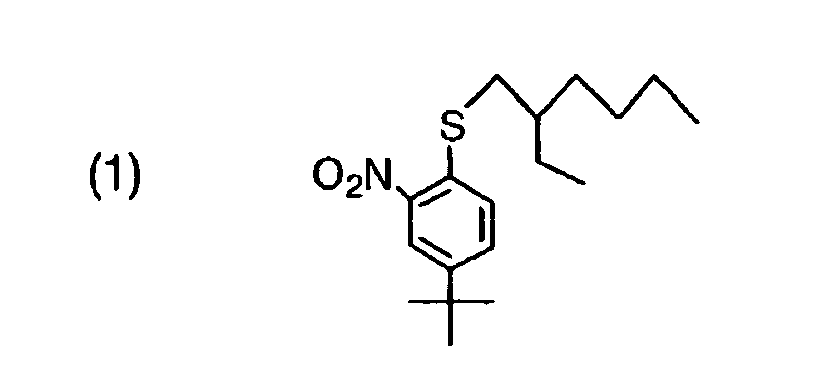
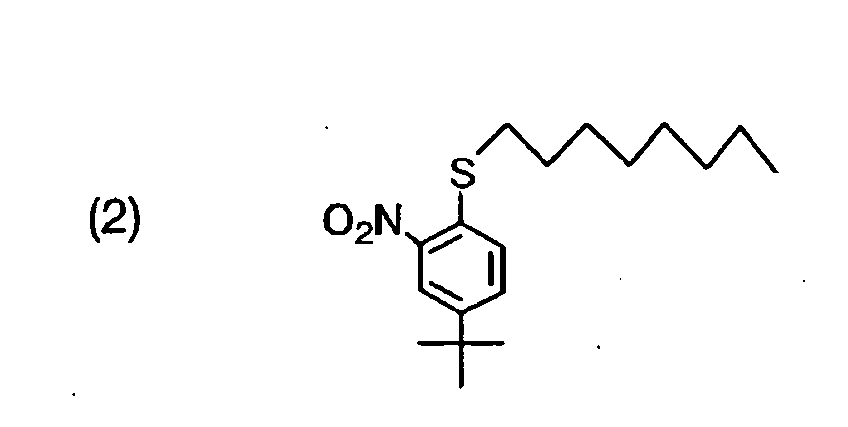


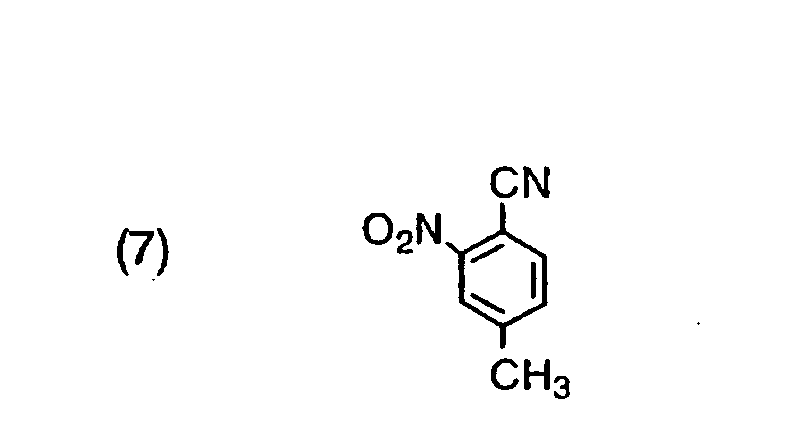


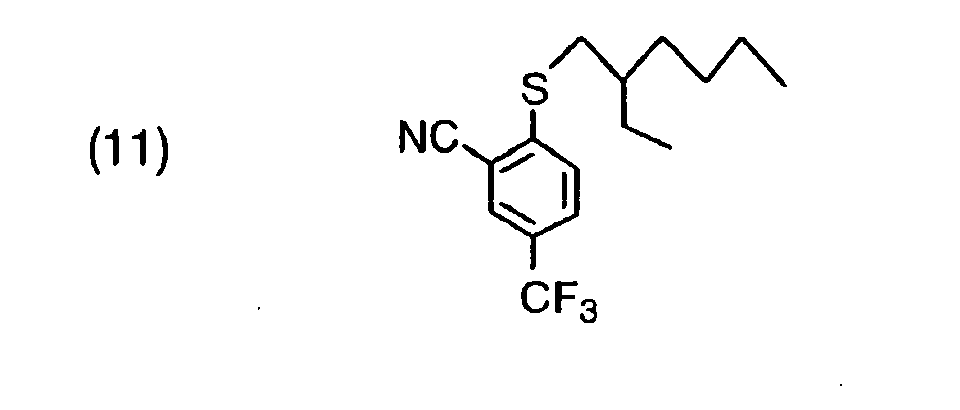
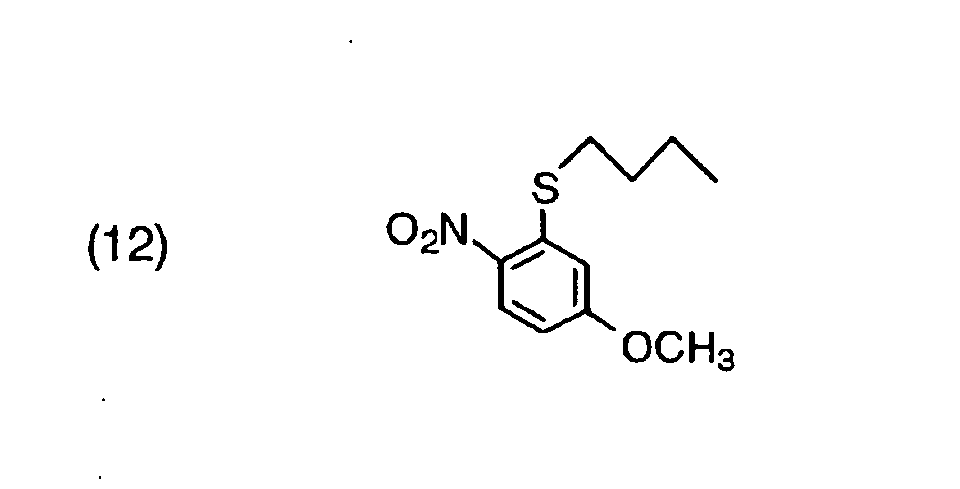
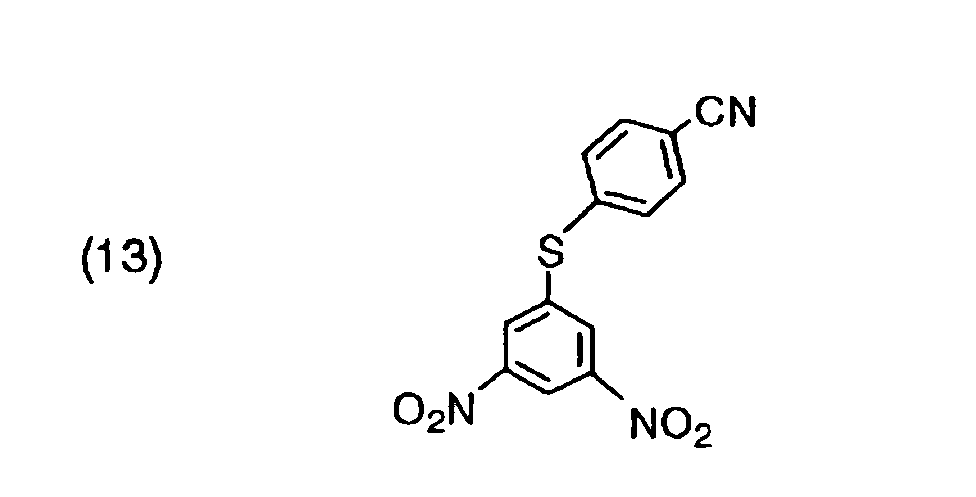
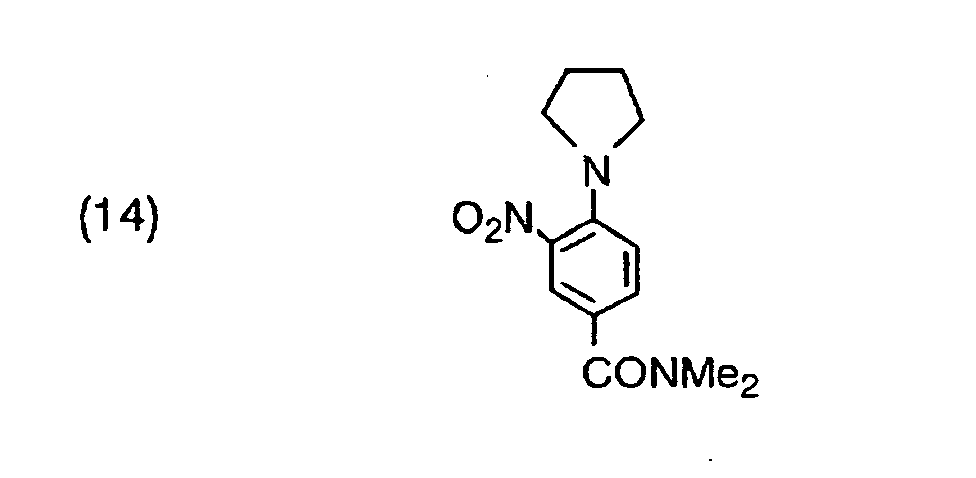

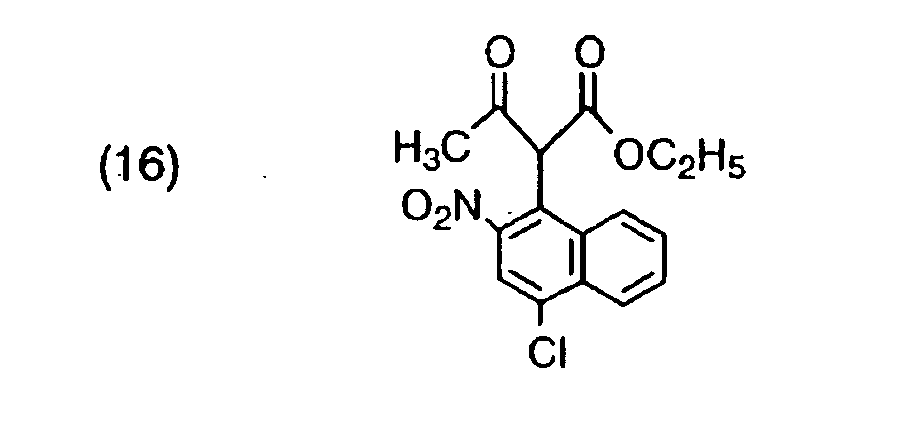
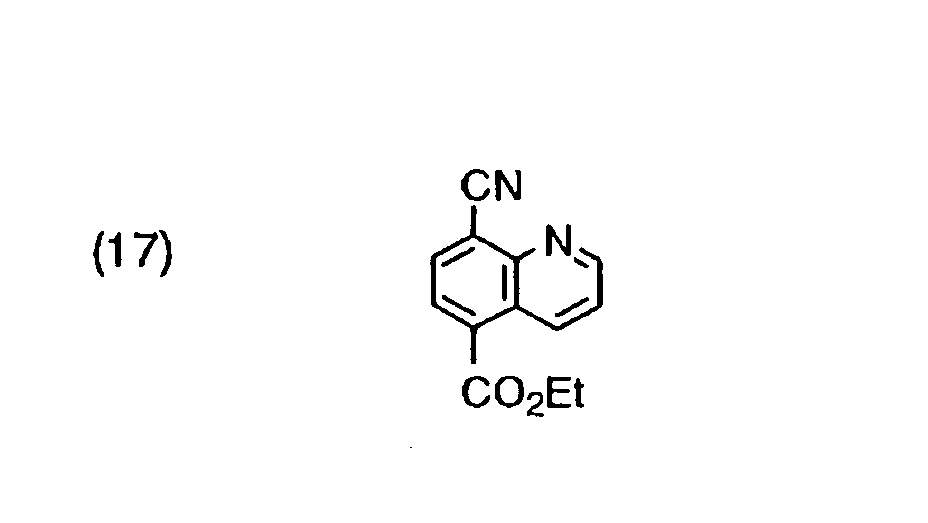
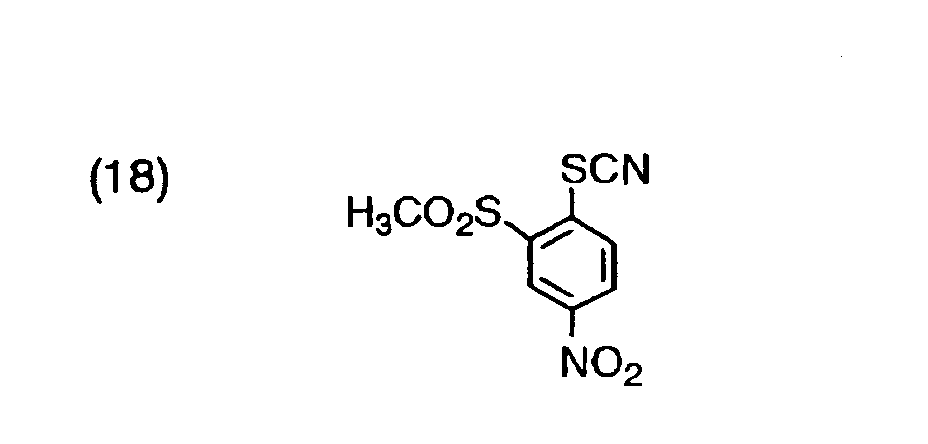
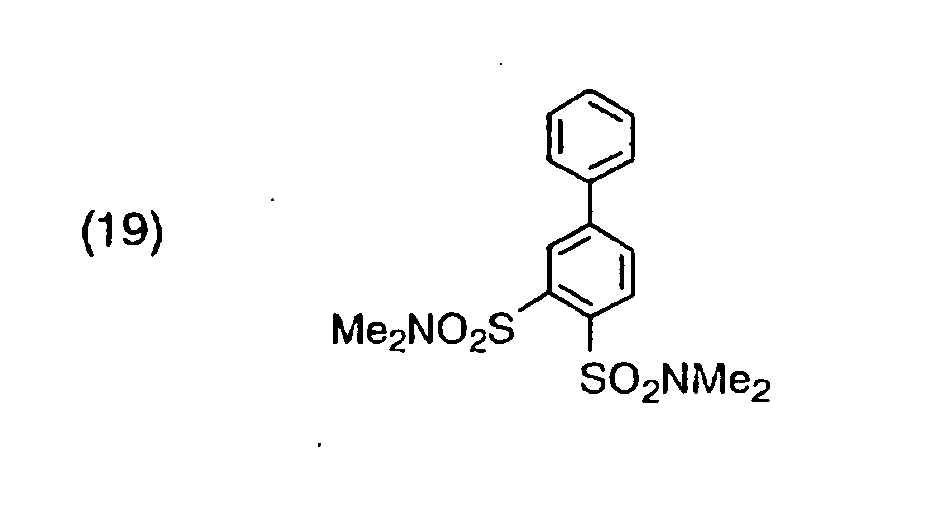

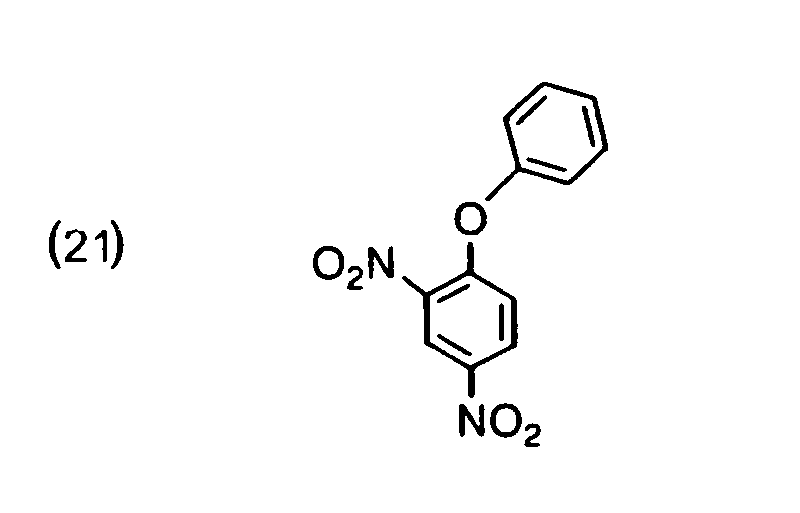
- Specific examples of the compound represented by formula (IIa) according to the present invention are shown below, but the present invention is not limited to these specific examples.
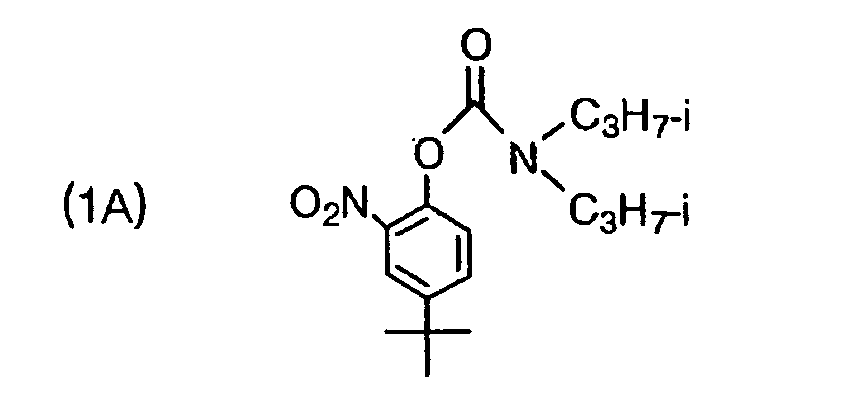
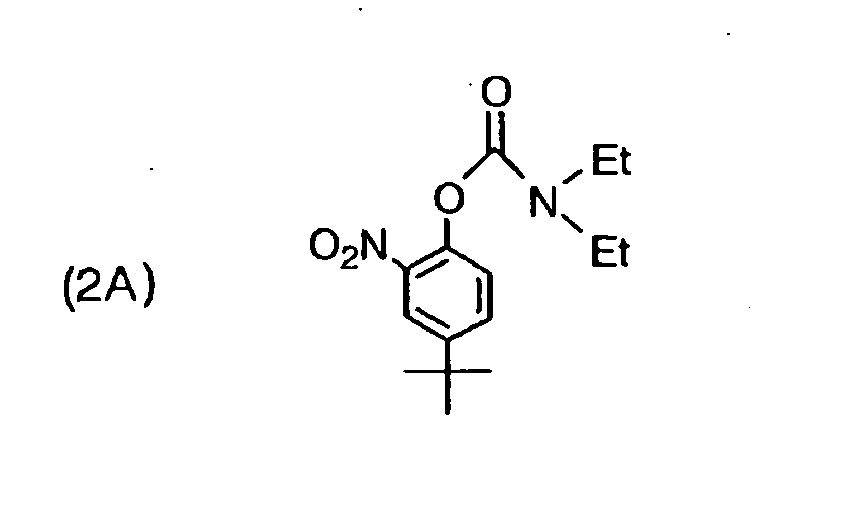

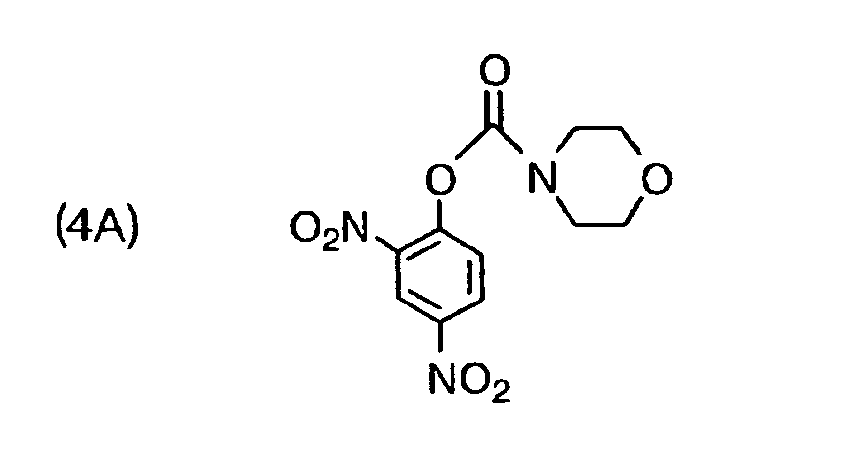
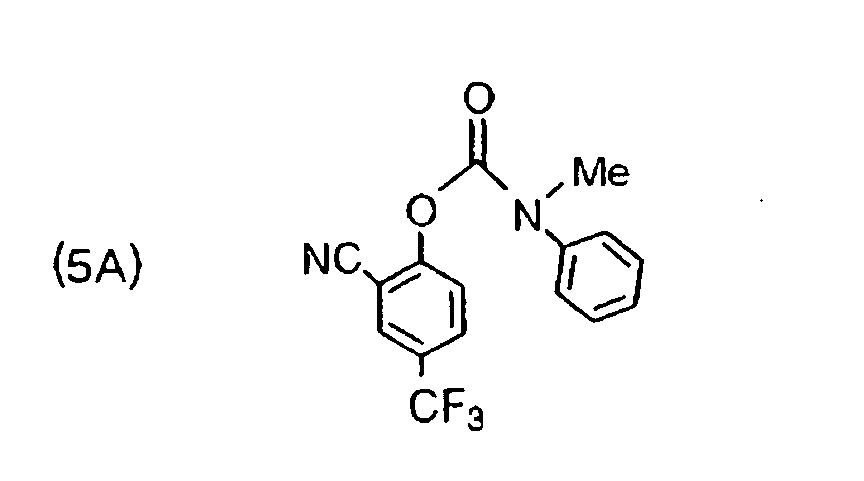


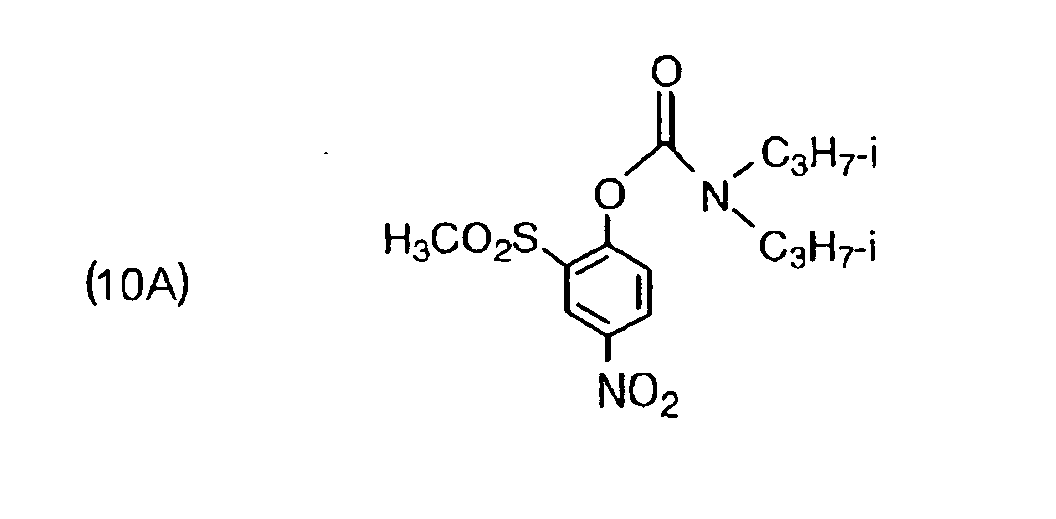
- Specific examples of the compound represented by formula (IIb) according to the present invention are shown below, but the present invention is not limited to these specific examples.


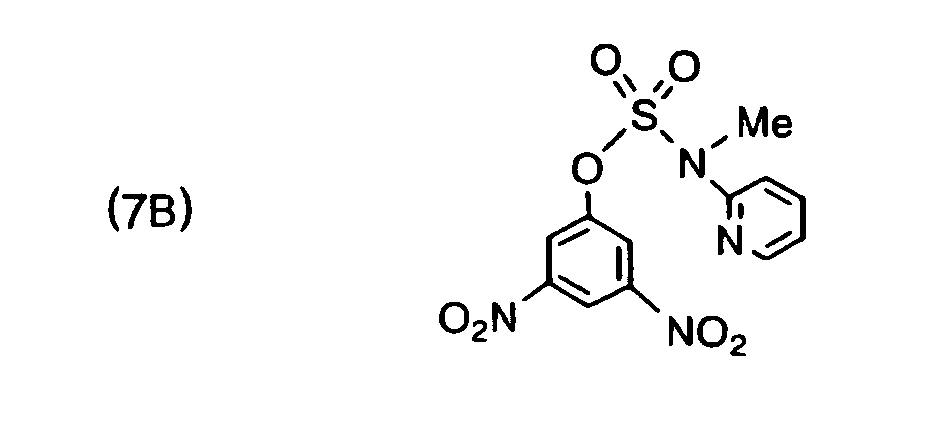


- The phenolic compound represented by formula (III) can be synthesized by known various synthesis methods.
- The compound represented by formula (IVa) is known, and is commercially available, or can easily be produced by a known method.
- The compound represented by formula (IVb) can be synthesized by known various synthesis methods. In the case that Y is, for example, a chlorine atom, a method of synthesizing the compound from sulfuryl chloride and dimethylamine by a method described in JP-A-3-127769 ("JP-A" means unexamined published Japanese patent application) is inexpensive and preferable.
- Each of the first step and the second step in the reaction scheme A or B may be performed or both of the steps may be continuously performed without using any solvent or in the state that the reactants are dissolved or dispersed in an appropriate solvent. Examples of the solvent which can be used in the reaction according to the present invention include water, alcohol-based solvents (such as methanol and isopropanol), chlorine-containing solvents (such as dichloromethylene), aromatic solvents (such as benzene, chlorobenzene, and toluene), amide-based solvents (such as N,N-dimethylformamide, N,N-dimethylacetoamide, and N-methylpyrrolidone), nitrile-based solvents (such as acetonitrile, and propionitrile), ether-based solvents (such as tetrahydrofuran, ethylene glycol diethyl ether), sulfone-based solvents (such as dimethylsulfone, and sulfolane), phosphoric amide-based solvents (such as hexamethylphosphoric triamide), and hydrocarbon-based solvents (such as cyclohexane, and n-hexane).
- These solvents may be used alone or in the form of a mixture of two or more thereof. It is particularly preferable that the reaction is performed in a two-phase system wherein water and an organic solvent immiscible with water are used together. When the first and second steps are performed without interruption, a solvent different from the solvent used in the first step may be used in the second step. The amount of the solvent(s) is usually from 0.1 to 1,000 parts by mass, preferably from 0.5 to 100 parts by mass, and more preferably from 1 to 50 parts by mass per part by mass of the compound represented by formula (III) in the first step and per part by mass of the compound represented by formula (II) in the second step, respectively.
- In the process of the present invention, a base is preferably used in the first or second step, more preferably in both of the first and second steps. Examples of the base which can be used in the present invention include hydroxide compounds (such as sodium hydroxide, potassium hydroxide, and tetrabutylammonium hydroxide), carbonate compounds (such as sodium carbonate, potassium carbonate, and tetrabutylammonium carbonate), amines (such as ammonia, and triethylamine), anilines (such as diethylaniline), aromatic heterocyclic compounds (such as pyridine, and imidazole), guanidines (such as tetramethylguanidine), bicarbonate compounds (such as sodium bicarbonate), nitrogen-containing heterocyclic compounds (such as 1,8-diazabicyclo[5,4,0]-7-undecene), acetic acid compounds (such as sodium acetate, and potassium acetate), and metal salts of organic compounds (such as sodium methoxide).
- These bases may be used alone or in the form of a mixture of two or more thereof. The amount of the base(s) is usually from 0.1 to 100 moles, preferably from 0.5 to 10 moles, and more preferably from 1 to 5 moles per mole of the compound represented by formula (III) in the first step and per mole of the compound represented by formula (II) in the second step, respectively.
- In the process of the present invention, it is also preferable to use a phase-transfer catalyst in the first or second step or in both of the first and second steps. Examples of the phase-transfer catalyst which can be used in the present invention include ammonium salts (such as tetrabutylammonium bromide, benzyltrimethylammonium chloride, and tetraethylammonium iodide), and phosphinium salts (such as tetrabutylphosphinium bromide). The ammonium salts are preferably used.
- The amount of the phase-transfer catalyst is preferably from 0.001 to 10 moles, more preferably from 0.01 to 1 mole, even more preferably from 0.05 to 0.5 mole, and particularly preferably from 0.02 to 0.5 mole per mole of the compound represented by formula (I).
- It is particularly preferable to use the phase-transfer catalyst at least in the second step, and this is particularly preferable when X in formula (I) is an alkylthio or arylthio group. When the phase-transfer catalyst is used, the reaction solvents are preferably water and an aromatic solvent (such as toluene).
- The ratio of water to an aromatic solvent is preferably in the range of 1:0.1 to 1:20, and more preferably 1:1 to 1:20, in terms of volume ratio.
- In the second step, the amount of the nucleophilic agent is usually from 0.01 to 100 moles, preferably from 0.1 to 50 moles, more preferably from 0.2 to 20 moles, and even more preferably from 0.5 to 10 moles per mole of the compound represented by formula (II).
- In the second step, the compound represented by formula (II) prepared in the first step may be used after being isolated. However, it is preferable to use the solution containing the compound represented by formula (II) as it is, without isolating the compound represented by formula (II).
- In the second step, a nucleophilic agent or a solution thereof may be added to the compound represented by formula (II) or solution thereof prepared in the first step. Alternatively, the compound represented by formula (II) or the solution thereof may be added to a nucleophilic agent or a solution thereof.
- The reaction temperature for the present reaction is not particularly limited in each of the first and second steps. The reaction can be carried out from -50 to 150 °C, preferably from -10 to 100 °C, and more preferably from 0 to 80 °C.
- The compound represented by formula (I) according to the present invention is useful as a synthesis intermediate of photographically-useful compounds to be used in silver halide photographic light-sensitive materials, or as a synthesis intermediate of medical supplies, agricultural chemicals, or the like. The compound represented by formula (I) is preferably used as a synthesis intermediate of a photographically-useful compound to be used in silver halide photographic light-sensitive materials, such as a dye-forming coupler, a dye, and a ballast group in a hydrophobic additives. Among these, the compound is preferably used to form a dye-forming coupler and a dye. Specifically, the compound represented by formula (I) is preferably applied to yellow dye-forming couplers described in JP-A-2003-173007, JP-A-2004-118082, JP-A-2004-118109, and JP-A-2004-139062; cyan dye-forming couplers described in JP-A-11-282138; and magenta dye-forming couplers described in JP-A-8-122984. For example, dye-forming couplers can be obtained by reducing a nitro group in the compound represented by formula (I) to an amino group, and then further reacting the amino group. Synthesis of these compounds can be carried out according to the methods described in the above-mentioned publications. Especially, yellow dye-forming couplers described in JP-A-2003-173007, JP-A-2004-118082, JP-A-2004-118109, and JP-A-2004-139062 can be synthesized, according to the synthesis of Coupler (2) from Compound (A-4) described in Paragraph 0072 in JP-A-2004-139062.
- The present invention overcomes problems in the prior art, and the present invention can produce an aromatic compound derivative that is inexpensive and widely usable, at high yield, through a simple process. In particular, the present invention makes it possible to synthesize an aromatic compound derivative, with high selectivity and high yield, easily and inexpensively through a short process, using a compound that can be derived from a phenolic compound.
- According to the present invention, it is possible to synthesize a derivative of an aromatic compound having a substituent, which compound is useful as a synthesis intermediate of photographically-useful compounds for use in a silver halide photographic photosensitive material, or medical supplies, agricultural chemicals, or others.
- Hereinafter, specific examples of the synthesis of the present invention are described. However, the present invention is not limited thereto.
- The compound was synthesized in accordance with following reaction scheme.
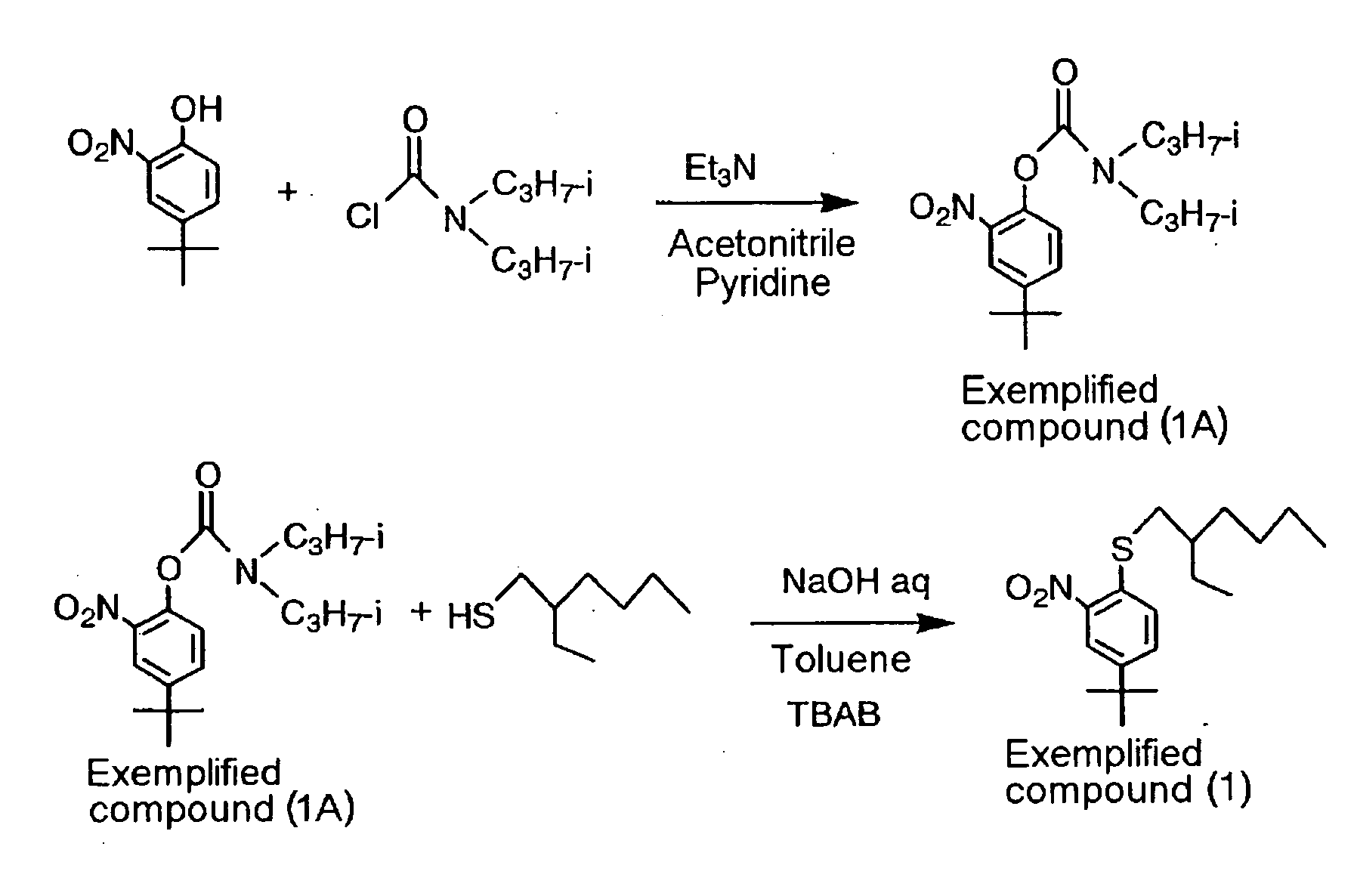
- Into 50 mL of acetonitrile were dissolved 5.80 g (29.7 mmol) of 4-t-butyl-2-nitrophenol and 5.00 g (30.6 mmol) of N,N-diisopropylcarbamoyl chloride, and then, to the resultant solution, were added 4.8 mL of triethylamine and 1.0 mL of pyridine. The resultant solution was stirred at 60 °C for 5 hours. To the reaction solution were added ethyl acetate and water, to extract the reaction product. The organic phase was washed with each of 0.1N potassium carbonate aqueous solution, diluted hydrochloric acid, and saturated brine, followed by drying over anhydrous magnesium sulfate. The result was filtered and then the solvent was distilled off under reduced pressure. The remaining product was purified by silica gel chromatography, using a mixed solvent of ethyl acetate and hexane as an eluent, to yield 8.82 g (27.4 mmol) of Exemplified compound (1A), as a light yellow crystal. Yield: 92.1%. 1H NMR (400MHz, CDCl3) δ1.31-1.34 (12H, m), 1.35 (9H, s), 3.85-3.89 (1H, m), 4.17-4.21 (1H, m), 7.18 (1H, d, J=8.4Hz), 7.62 (1H, dd, J=8.4, 2.4Hz), 8.04 (1H, d, J=2.4Hz).
- Into 10 ml of toluene were dissolved 3.22 g (0.010 mol) of Exemplified compound (1A), 1.76 g (0.012 mol) of 2-ethylhexylmercaptan, and 0.32 g (0.0010 mol) of tetrabutylammonium bromide (TBAB), and then to that was added 6 mL of 2M sodium hydroxide aqueous solution. The resultant solution was stirred at 80 °C for 11 hours. To the reaction solution were added ethyl acetate and water, to extract the reaction product. The organic phase was washed with diluted hydrochloric acid and saturated brine, followed by drying over anhydrous magnesium sulfate. The result was filtered, and then the solvent was distilled off under reduced pressure. The remaining product was purified by silica gel chromatography, using a mixed solvent of ethyl acetate and hexane as an eluent, to yield 2.75 g (0.00850 mol) of Exemplified compound (1), as a yellow oil substance. Yield: 85.0%. 1H NMR (400MHz, CDCl3) δ0.88-1.56 (14H, m), 1.35 (9H, s), 1.65-1.71 (1H, m), 2.89 (2H, d, J=6.3Hz), 7.36 (1H, d, J=8.6Hz), 7.57 (1H, dd, J=8.6, 2.2Hz), 8.18 (1H, d, J=2.2Hz).
- The compound was synthesized in accordance with following reaction scheme.

- Into 50 mL of acetonitrile were dissolved 9.75 g (0.050 mol) of 4-t-butyl-2-nitrophenol and 8.13 g (0.060 mol) of N,N-diethylcarbamoyl chloride, and then, to the resultant solution, were added 8.4 mL of triethylamine and 1.0 mL of pyridine. The resultant solution was stirred at 50 °C for 6 hours. To the reaction solution were added ethyl acetate and water, to extract the reaction product. The organic phase was washed with each of a 0.1N potassium carbonate aqueous solution, diluted hydrochloric acid, and saturated brine, followed by drying over anhydrous magnesium sulfate. The result was filtered and then the solvent was distilled off under reduced pressure. The remaining product was purified by silica gel chromatography, using a mixed solvent of ethyl acetate and hexane as an eluent, to yield 14.3 g (0.043 mol) of Exemplified compound (2A), as a light yellow oil substance. Yield: 86.6%. 1H NMR (400MHz, CDCl3) δ1.22 (3H, t, J=7.2Hz), 1.28 (3H, t, J=7.2Hz), 1.35 (9H, s), 3.38 (2H, q, J=7.2Hz), 3.48 (2H, q, J=7.2Hz), 7.21 (1H, d, J=8.2Hz), 7.62 (1H, dd, J=8.2, 2.4Hz), 8.04 (1H, d, J=2.4Hz).
- Into 6 ml of toluene were dissolved 2.95 g (0.010 mol) of Exemplified compound (2A), 1.72 g (0.012 mol) of 2-ethylhexylmercaptan, and 0.32 g (0.0010 mol) of tetrabutylammonium bromide, and then, to that was added 6 mL of 2M sodium hydroxide aqueous solution. The resultant solution was stirred at 80 °C for 10 hours. To the reaction solution were added ethyl acetate and water, to extract the reaction product. The organic phase was washed with diluted hydrochloric acid and saturated brine, followed by drying over anhydrous magnesium sulfate. The result was filtered, and then the solvent was distilled off under reduced pressure. The remaining product was purified by silica gel chromatography, using a mixed solvent of ethyl acetate and hexane as an eluent, to yield 2.60 g (0.00804 mol) of Exemplified compound (1), as a yellow oil substance. Yield: 80.4%. 1H NMR (400MHz, CDCl3) δ0.88-1.56 (14H, m), 1.35 (9H, s), 1.65-1.71 (1H, m), 2.89 (2H, d, J=6.3Hz), 7.36 (1H, d, J=8.6Hz), 7.57 (1H, dd, J=8.6, 2.2Hz), 8.18 (1H, d, J=2.2Hz).
- The compound was synthesized in accordance with following reaction scheme.

- Into 90 mL of toluene and 18 mL of N,N-dimethylformamide (DMF) were dissolved 29.3 g (0.150 mol) of 4-t-butyl-2-nitrophenol, and 22.6 g (0.157 mol) of N,N-dimethylsulfamoyl chloride, and then, to that was added 24.8 g (0.180 mol) of potassium carbonate. The resultant solution was then stirred at 70 °C for 4 hours. To the reaction solution were added ethyl acetate and water, to extract the reaction product. The organic phase was washed with 0.1N potassium carbonate aqueous solution, diluted hydrochloric acid, and saturated brine, followed by drying over anhydrous magnesium sulfate. The result was filtered, and then the solvent was distilled off under reduced pressure. The remaining product was crystallized from a mixed solvent of ethyl acetate and hexane, to yield 36.3 g (0.120 mol) of Exemplified compound (1B), as a light yellow crystal. Yield: 80.0%.
- Into 15 ml of toluene were dissolved 3.02 g (0.010 mol) of Exemplified compound (1B), 1.75 g (0.012 mol) of 2-ethylhexylmercaptan, and 0.28 g (0.0010 mol) of tetrabutylammonium bromide (TBAB), and then, to that was added 5 mL of 25% sodium hydroxide aqueous solution. The resultant solution was stirred at 60 °C for 1 hour. To the reaction solution were added ethyl acetate and water, to extract the reaction product. The organic phase was washed with diluted hydrochloric acid and saturated brine, followed by drying over anhydrous magnesium sulfate. The result was filtered, and then the solvent was distilled off under reduced pressure. The remaining product was purified by silica gel chromatography, using a mixed solvent of ethyl acetate and hexane as an eluent, to yield 3.05 g (0.00943 mol) of Exemplified compound (1), as a yellow oil substance. Yield: 94.3%. 1H-NMR (400MHz, CDCl3) δ0.88-1.56 (14H, m), 1.35 (9H, s), 1.65-1.71 (1H, m), 2.89 (2H, d), 7.36 (1H, d), 7.57 (1H, dd), 8.18 (1H, d).
- The compound was synthesized in accordance with following reaction scheme.
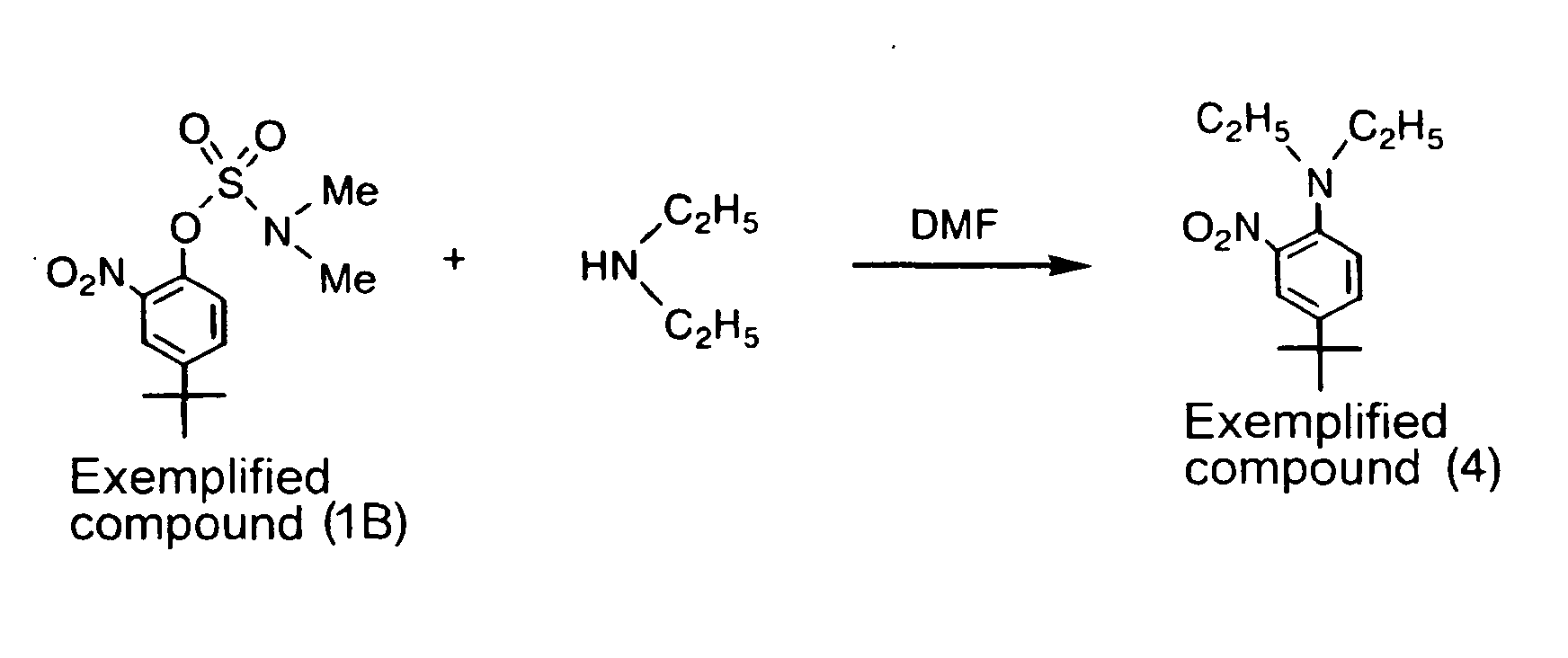
- Into 15 mL of DMF were dissolved 3.02 g (0.010 mol) of Exemplified compound (1B) and 2.19 g (0.030 mol) of diethyamine. The resultant solution was stirred at 80 °C for 8 hours. To the reaction solution were added ethyl acetate and water, to extract the reaction product. The organic phase was washed with diluted hydrochloric acid, and saturated brine, followed by drying over anhydrous magnesium sulfate. The result was filtered and then the solvent was distilled off under reduced pressure. The remaining product was purified by silica gel chromatography, using a mixed solvent of ethyl acetate and hexane as an eluent, to yield 2.26 g (0.0903 mol) of Exemplified compound (4), as an orange yellow oil substance. Yield: 90.3%. 1H-NMR (400MHz, CDCl3) δ1.07 (6H, t), 1.33 (9H, t), 3.12(4H, q), 7.11 (1H, d), 7.44 (1H, dd), 7.62 (1H, d).
- The compound was synthesized in accordance with following reaction scheme.

- To a solution of 16.2 g (0.120 mol) of sulfuryl chloride in 50 mL of toluene, was added dropwise, 17.5 g (0.240 mol) of diethylamine in 25 mL of toluene, over 1 hour, with ice cooling. The solution was stirred for 4 hours, with ice cooling, and then cold water was added to it, to perform extraction. Further, the resultant solution was washed with cold water, twice, to yield a solution of N,N-diethylsulfamoyl chloride in toluene.
- The resultant solution of N,N-diethylsulfamoyl chloride in toluene was added to a solution containing 19.5 g (0.100 mol) of 4-t-butyl-2-nitrophenol and 16.6 g (0.120 mol) of potassium carbonate in 15 ml of N,N-dimethylformamide (DMF). The resultant solution was stirred at 70 °C for 4 hours. Ethyl acetate and water were added to the reaction solution, to extract the reaction product. The organic phase was washed with 0.1N potassium carbonate aqueous solution, diluted hydrochloric acid, and saturated brine, to yield a reaction solution of Exemplified compound (2B).
- To the resultant reaction solution of Exemplified compound (2B) were added 17.5 g (0.120 mol) of 2-ethylhexylmercaptan and 2.78 g (0.010 mol) of tetrabutylammonium bromide, and to that was added 50 mL of 25% sodium hydroxide aqueous solution. The resultant solution was then stirred at 60 °C for 2 hours. To the reaction solution were added ethyl acetate and water, to extract the reaction product. The organic phase was washed with diluted hydrochloric acid and saturated brine, followed by drying over anhydrous magnesium sulfate. The result was filtered and then the solvent was distilled off under reduced pressure. The remaining product was purified by silica gel chromatography, using a mixed solvent of ethyl acetate and hexane as an eluent, to yield 29.2 g (0.0903 mol) of Exemplified compound (1), as a yellow oil substance. Yield: 90.3%. In the present example, nuclear magnetic resonance analysis (1H-NMR, 400 MHz, CDCl3) was performed, in the same manner as in Examples 2-1 and 2-2. As a result, the very same spectrum as in Example 2-1 was obtained as to the number of signals, the positions thereof, and splitting. Accordingly, the above-mentioned yellow oil substance was identified as Exemplified compound (1).
- The compound was synthesized via a p-toluenesulfonyl product, as illustrated in the following reaction scheme.
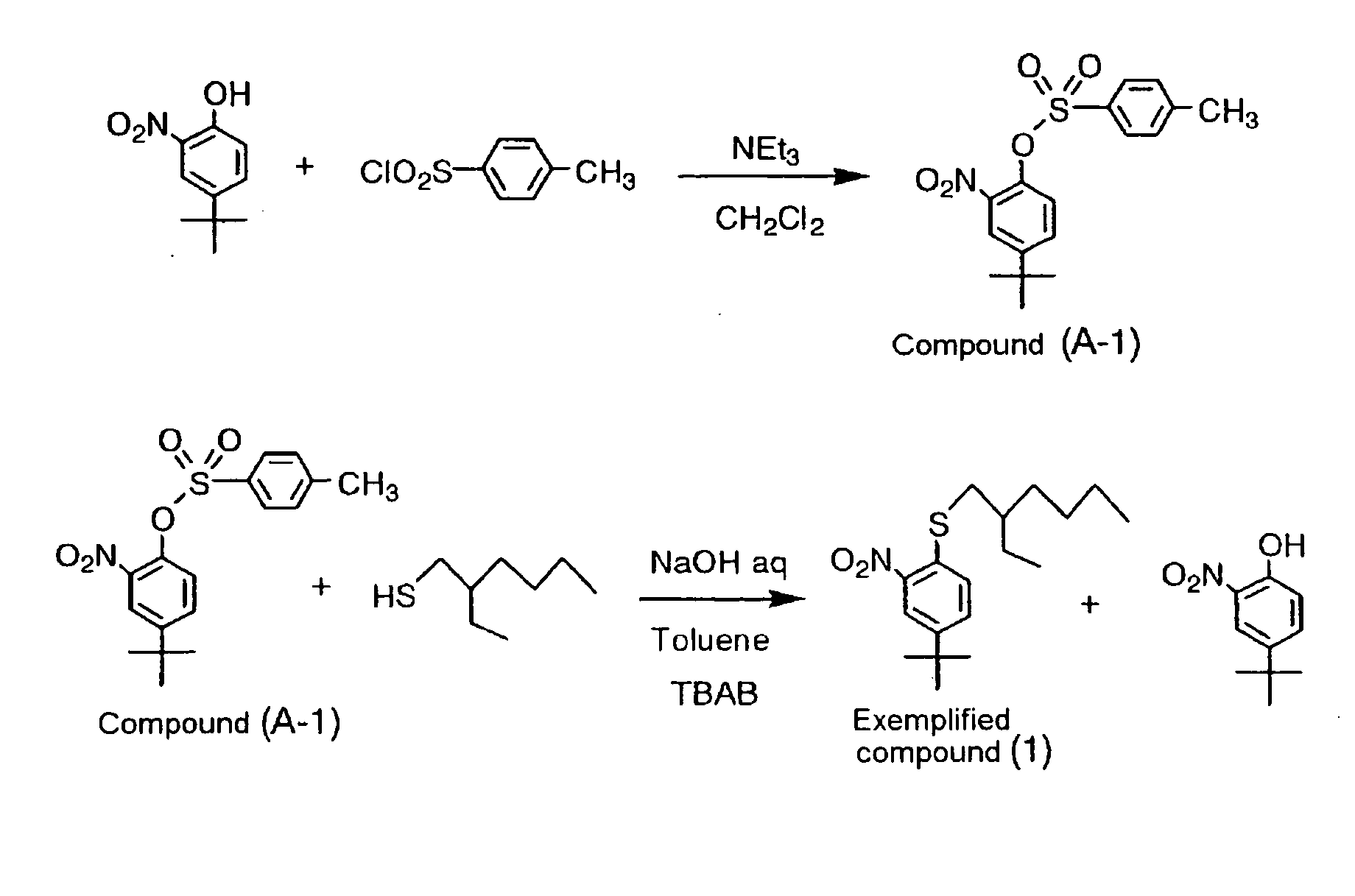
- Into 100 mL of methylene chloride were dissolved 19.5 g (0.100 mol) of 4-t-butyl-2-nitrophenol and 16.7 mL (0.120 mol) of triethylamine, and then to that was added 21.0 g (0.110 mol) of p-toluenesulfonyl chloride, with ice cooling. The resultant solution was then stirred at room temperature for 4 hours. To the reaction solution were added ethyl acetate and water, to extract the reaction product. The organic phase was washed with 0.1N potassium carbonate aqueous solution, diluted hydrochloric acid, and saturated brine, followed by drying over anhydrous magnesium sulfate. The result was filtered, and then the solvent was distilled off under reduced pressure. The remaining product was crystallized from a mixed solvent of ethyl acetate and hexane, to yield 30.9 g (0.0884 mol) of Compound (A-1), as a light yellow crystal. Yield: 88.4%.
- Into 15 ml of toluene were dissolved 3.49 g (0.010 mol) of Compound (A-1), 1.75 g (0.012 mol) of 2-ethylhexylmercaptan, and 0.28 g (0.0010 mol) of tetrabutylammonium bromide, and then to that was added 5 mL of 25% sodium hydroxide aqueous solution. The resultant solution was stirred at 60 °C for 1 hour. To the reaction solution were added ethyl acetate and water, to extract the reaction product. The organic phase was washed with diluted hydrochloric acid and saturated brine, followed by drying over anhydrous magnesium sulfate. The result was filtered, and then the solvent was distilled off under reduced pressure. The remaining product was purified by silica gel chromatography, using a mixed solvent of ethyl acetate and hexane as an eluent, to yield 1.46 g (0.00452 mol) of Exemplified compound (1) (Yield: 45.2%) and 0.94 g (0.00482 mol) of 4-t-butyl-2-nitrophenol. As described above, the selectivity of the reaction product was very low when the product was synthesized via the p-toluenesulfonyl product.
- Having described our invention as related to the present embodiments, it is our intention that the invention not be limited by any of the details of the description, unless otherwise specified, but rather be construed broadly within its spirit and scope as set out in the accompanying claims.
Claims (9)
- A process for producing a compound represented by the following formula (I), which comprises causing a compound represented by the following formula (II) to react with a nucleophilic agent:wherein X represents a substituent; R1 represents an electron-withdrawing substituent having a Hammett σp constant of more than 0; m represents an integer of 1 to 5; R2 represents a substituent; n represents an integer of 0 to 4; m + n is from 1 to 5; when m is 2 or more, multiple R1s may be the same or different; when n is 2 or more, multiple R2s may be the same or different; R1s, or R2s, or R1 and R2 may bond to each other to form a ring;
 wherein R1 represents an electron-withdrawing substituent having a Hammett σp constant of more than 0; m represents an integer of 1 to 5; R2 represents a substituent; n represents an integer of 0 to 4; m + n is from 1 to 5; when m is 2 or more, multiple R1s may be the same or different; when n is 2 or more, multiple R2s may be the same or different; R1s, or R2s, or R1 and R2 may bond to each other to form a ring; R3 and R4 each independently represent an alkyl, aryl, or heterocyclic group; R3 and R4 may bond to each other to form a ring; and Z represents C=O or S(O)p, wherein p is 1 or 2.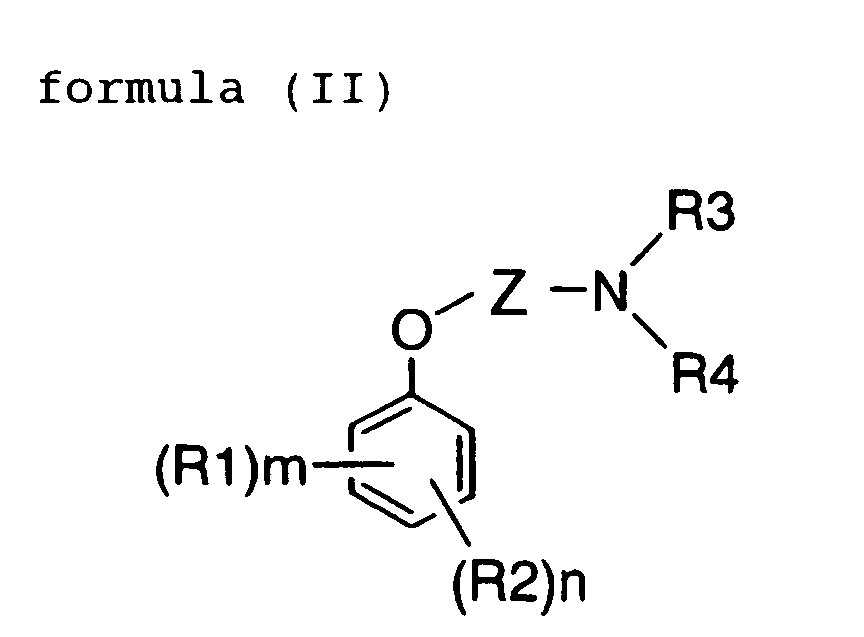
- The process as claimed in claim 1, wherein the compound represented by formula (II) is a compound synthesized by causing a compound represented by the following formula (III) to react with a compound represented by the following formula (IV):wherein R1 represents an electron-withdrawing substituent having a Hammett σp constant of more than 0; m represents an integer of 1 to 5; R2 represents a substituent; n represents an integer of 0 to 4; m + n is from 1 to 5; when m is 2 or more, multiple R1s may be the same or different; when n is 2 or more, multiple R2s may be the same or different; and R1s, or R2s, or R1 and R2 may bond to each other to form a ring;
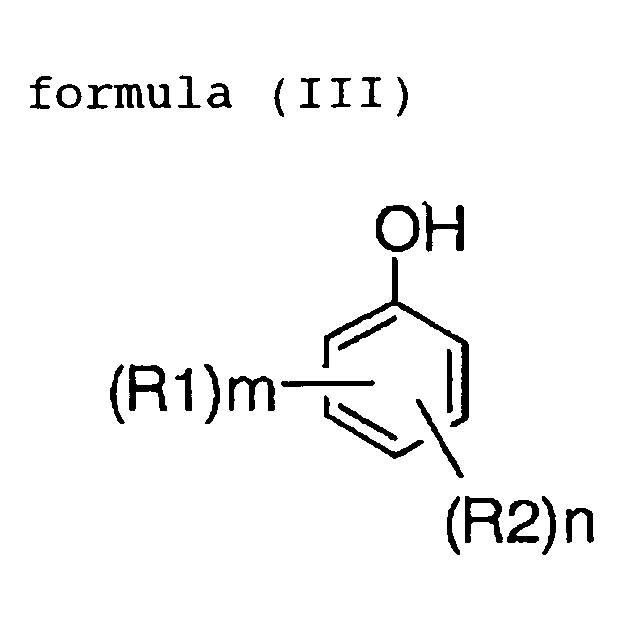 wherein R3 and R4 each independently represent an alkyl, aryl, or heterocyclic group; R3 and R4 may bond to each other to form a ring; Z represents C=O or S(O)p wherein p is 1 or 2; and Y represents a halogen atom.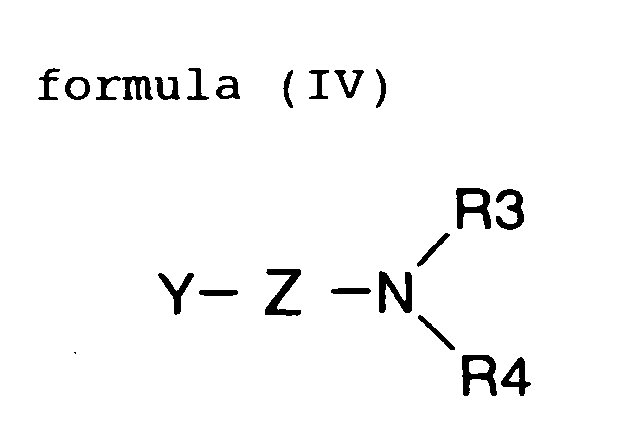
- The process as claimed in claim 1 or 2, wherein R1 is a nitro group.
- The process as claimed in any one of claims 1 to 3, wherein X in formula (I) is a group that bonds to the benzene ring via a nitrogen or sulfur atom.
- The process as claimed in claim 2, wherein the compound represented by formula (II) and synthesized by causing the compound represented by formula (III) to react with the compound represented by formula (IV) is used, without being isolated, in the form of a reaction mixture.
- The process as claimed in any one of claims 1 to 5, wherein m in formula (I) is 1.
- The process as claimed in claim in claims 1 to 6, wherein, in formula (II), Z represents S(O)p and p is 2.
- The process as claimed in any one of claims 1 to 7, wherein R3 and R4 in formula (II) each are an alkyl group.
- The process as claimed in claim 2, wherein Y in formula (IV) is a chlorine atom.
Applications Claiming Priority (4)
| Application Number | Priority Date | Filing Date | Title |
|---|---|---|---|
| JP2003330779A JP4351888B2 (en) | 2003-09-22 | 2003-09-22 | Method for producing aromatic compound derivative by reaction of sulfamoyloxy group or sulfinamoyloxy group substituted aromatic compound with nucleophile |
| JP2003330779 | 2003-09-22 | ||
| JP2003331726A JP2005097156A (en) | 2003-09-24 | 2003-09-24 | Method for preparing aromatic compound derivative by reaction of aromatic compound whose carbamoyloxy group is substituted and nucleophilic agent |
| JP2003331726 | 2003-09-24 |
Publications (1)
| Publication Number | Publication Date |
|---|---|
| EP1516870A1 true EP1516870A1 (en) | 2005-03-23 |
Family
ID=34197233
Family Applications (1)
| Application Number | Title | Priority Date | Filing Date |
|---|---|---|---|
| EP04022481A Withdrawn EP1516870A1 (en) | 2003-09-22 | 2004-09-22 | Process for producing aromatic compound derivative by reaction of aromatic compound substituted with sulfamoyloxy, sulfinamoyloxy, or carbamoyloxy group, with nucleophilic agent |
Country Status (1)
| Country | Link |
|---|---|
| EP (1) | EP1516870A1 (en) |
Cited By (1)
| Publication number | Priority date | Publication date | Assignee | Title |
|---|---|---|---|---|
| US9920002B2 (en) | 2007-10-12 | 2018-03-20 | Basf Se | Methods for producing sulfonic acid diamides |
Citations (1)
| Publication number | Priority date | Publication date | Assignee | Title |
|---|---|---|---|---|
| JPS6256461A (en) * | 1985-09-06 | 1987-03-12 | Mitsui Petrochem Ind Ltd | N,n-dimethylcarbamate derivative |
-
2004
- 2004-09-22 EP EP04022481A patent/EP1516870A1/en not_active Withdrawn
Patent Citations (1)
| Publication number | Priority date | Publication date | Assignee | Title |
|---|---|---|---|---|
| JPS6256461A (en) * | 1985-09-06 | 1987-03-12 | Mitsui Petrochem Ind Ltd | N,n-dimethylcarbamate derivative |
Non-Patent Citations (5)
| Title |
|---|
| DATABASE WPI Section Ch Week 198716, Derwent World Patents Index; Class C03, AN 1987-111724, XP002305792 * |
| KOTSUKI, HIOYOSHIZO ET AL: "High pressure organic chemistry. XI. A new convenient synthesis of aromatic amines from activated phenols", SYNTHESIS , (12), 1145-7 CODEN: SYNTBF; ISSN: 0039-7881, 1990, XP000168615 * |
| VALEGA, T. M.: "Nuclear magnetic resonance study of some N,N-dimethylcarbamates", JOURNAL OF ORGANIC CHEMISTRY , 31(4), 1150-3 CODEN: JOCEAH; ISSN: 0022-3263, 1966, XP002305791 * |
| WILLIAMS, ANDREW ET AL: "Hydrolysis of aryl N-methylaminosulfonates: Evidence consistent with an ElcB mechanism", JOURNAL OF THE CHEMICAL SOCIETY, PERKIN TRANSACTIONS 2: PHYSICAL ORGANIC CHEMISTRY (1972-1999) , (14), 1727-32 CODEN: JCPKBH; ISSN: 0300-9580, 1974, XP008038961 * |
| ZHENG, NAN ET AL: "Palladium-catalyzed synthesis of aryl sulfides from aryl triflates", BOOK OF ABSTRACTS, 217TH ACS NATIONAL MEETING, ANAHEIM, CALIF., MARCH 21-25 , ORGN-253 PUBLISHER: AMERICAN CHEMICAL SOCIETY, WASHINGTON, D. C. CODEN: 67GHA6, 1999, XP002305790 * |
Cited By (1)
| Publication number | Priority date | Publication date | Assignee | Title |
|---|---|---|---|---|
| US9920002B2 (en) | 2007-10-12 | 2018-03-20 | Basf Se | Methods for producing sulfonic acid diamides |
Similar Documents
| Publication | Publication Date | Title |
|---|---|---|
| KR100445930B1 (en) | Process for the preparation of aromatic or heteroaromatic sulfonyl halides | |
| EP3757092A1 (en) | Method for producing 4,5-dicyano-2-(fluoroalkyl)imidazole | |
| EP1516870A1 (en) | Process for producing aromatic compound derivative by reaction of aromatic compound substituted with sulfamoyloxy, sulfinamoyloxy, or carbamoyloxy group, with nucleophilic agent | |
| JP4351888B2 (en) | Method for producing aromatic compound derivative by reaction of sulfamoyloxy group or sulfinamoyloxy group substituted aromatic compound with nucleophile | |
| JP4144978B2 (en) | Synthesis method of 1,2,4-thiadiazole derivatives | |
| JP2005097156A (en) | Method for preparing aromatic compound derivative by reaction of aromatic compound whose carbamoyloxy group is substituted and nucleophilic agent | |
| JP2655359B2 (en) | Synthesis of aromatic amines, aromatic alcohols and aromatic thiols by aromatic nucleophilic substitution reaction | |
| JPH07109260A (en) | Production of 5-amino-2-nitropyridine derivative and 5-diamond-3-hydroxypyridine derivative | |
| US5041605A (en) | Method of synthesizing phenolic cyan-dye-forming photographic couplers | |
| JP2578217B2 (en) | Method for producing amidophenols | |
| US6204390B1 (en) | Synthesizing method for a 3-substituted-3-oxo-2-(2,4-oxazolidinedione-3-yl) propionic acid amide compound | |
| JP2006028126A (en) | Method for producing substituted aromatic compound | |
| JPH0625135B2 (en) | Manufacturing method of magenta coupler | |
| US5055587A (en) | Process for preparing 1H-pyrazolo-[5,1-c]-1,2,4-triazole compounds | |
| JP3716033B2 (en) | Method for halogenating photographic couplers using haloisocyanuric acid | |
| JP2006028127A (en) | Method for producing aromatic amine compound and amination agent for aromatic compound | |
| JPS59121331A (en) | Manufacture of phenol type cyan coupler | |
| JP4194984B2 (en) | Phenylnaphthylimidazole compound | |
| RU2128164C1 (en) | N-carbonitrileanilines and method of preparing thereof | |
| JP6499606B2 (en) | Method for producing sulfur-containing cyclized compound | |
| JPH11279427A (en) | Production of heterocyclic azomethine dye | |
| JPH02268149A (en) | Toluenesolfonate | |
| JPH06107646A (en) | Production of heterocyclic compound | |
| JP2002338547A (en) | Method for producing fluoroalkyl sulfide compound | |
| JP2002255942A (en) | Nitrogen-containing organic compound |
Legal Events
| Date | Code | Title | Description |
|---|---|---|---|
| PUAI | Public reference made under article 153(3) epc to a published international application that has entered the european phase |
Free format text: ORIGINAL CODE: 0009012 |
|
| AK | Designated contracting states |
Kind code of ref document: A1 Designated state(s): AT BE BG CH CY CZ DE DK EE ES FI FR GB GR HU IE IT LI LU MC NL PL PT RO SE SI SK TR |
|
| AX | Request for extension of the european patent |
Extension state: AL HR LT LV MK |
|
| 17P | Request for examination filed |
Effective date: 20050907 |
|
| AKX | Designation fees paid |
Designated state(s): AT BE BG CH CY CZ DE DK EE ES FI FR GB GR HU IE IT LI LU MC NL PL PT RO SE SI SK TR |
|
| RAP1 | Party data changed (applicant data changed or rights of an application transferred) |
Owner name: FUJIFILM CORPORATION |
|
| 17Q | First examination report despatched |
Effective date: 20071015 |
|
| STAA | Information on the status of an ep patent application or granted ep patent |
Free format text: STATUS: THE APPLICATION IS DEEMED TO BE WITHDRAWN |
|
| 18D | Application deemed to be withdrawn |
Effective date: 20101214 |