EP1515984B1 - Peptide derivatives comprising thiazepine group for the treatment of hyperlipidemic conditions - Google Patents
Peptide derivatives comprising thiazepine group for the treatment of hyperlipidemic conditions Download PDFInfo
- Publication number
- EP1515984B1 EP1515984B1 EP03732693A EP03732693A EP1515984B1 EP 1515984 B1 EP1515984 B1 EP 1515984B1 EP 03732693 A EP03732693 A EP 03732693A EP 03732693 A EP03732693 A EP 03732693A EP 1515984 B1 EP1515984 B1 EP 1515984B1
- Authority
- EP
- European Patent Office
- Prior art keywords
- solvate
- formula
- vivo hydrolysable
- pharmaceutically acceptable
- benzothiazepine
- Prior art date
- Legal status (The legal status is an assumption and is not a legal conclusion. Google has not performed a legal analysis and makes no representation as to the accuracy of the status listed.)
- Expired - Lifetime
Links
- 0 *CC(N[C@@](C(NC(*)C(*)=O)=O)c1ccccc1)=O Chemical compound *CC(N[C@@](C(NC(*)C(*)=O)=O)c1ccccc1)=O 0.000 description 4
Classifications
-
- C—CHEMISTRY; METALLURGY
- C07—ORGANIC CHEMISTRY
- C07D—HETEROCYCLIC COMPOUNDS
- C07D281/00—Heterocyclic compounds containing rings of more than six members having one nitrogen atom and one sulfur atom as the only ring hetero atoms
- C07D281/02—Seven-membered rings
- C07D281/04—Seven-membered rings having the hetero atoms in positions 1 and 4
- C07D281/08—Seven-membered rings having the hetero atoms in positions 1 and 4 condensed with carbocyclic rings or ring systems
- C07D281/10—Seven-membered rings having the hetero atoms in positions 1 and 4 condensed with carbocyclic rings or ring systems condensed with one six-membered ring
-
- C—CHEMISTRY; METALLURGY
- C07—ORGANIC CHEMISTRY
- C07K—PEPTIDES
- C07K5/00—Peptides containing up to four amino acids in a fully defined sequence; Derivatives thereof
- C07K5/04—Peptides containing up to four amino acids in a fully defined sequence; Derivatives thereof containing only normal peptide links
- C07K5/06—Dipeptides
- C07K5/06008—Dipeptides with the first amino acid being neutral
- C07K5/06078—Dipeptides with the first amino acid being neutral and aromatic or cycloaliphatic
-
- A—HUMAN NECESSITIES
- A61—MEDICAL OR VETERINARY SCIENCE; HYGIENE
- A61P—SPECIFIC THERAPEUTIC ACTIVITY OF CHEMICAL COMPOUNDS OR MEDICINAL PREPARATIONS
- A61P3/00—Drugs for disorders of the metabolism
- A61P3/06—Antihyperlipidemics
-
- A—HUMAN NECESSITIES
- A61—MEDICAL OR VETERINARY SCIENCE; HYGIENE
- A61P—SPECIFIC THERAPEUTIC ACTIVITY OF CHEMICAL COMPOUNDS OR MEDICINAL PREPARATIONS
- A61P7/00—Drugs for disorders of the blood or the extracellular fluid
- A61P7/02—Antithrombotic agents; Anticoagulants; Platelet aggregation inhibitors
-
- A—HUMAN NECESSITIES
- A61—MEDICAL OR VETERINARY SCIENCE; HYGIENE
- A61P—SPECIFIC THERAPEUTIC ACTIVITY OF CHEMICAL COMPOUNDS OR MEDICINAL PREPARATIONS
- A61P9/00—Drugs for disorders of the cardiovascular system
- A61P9/04—Inotropic agents, i.e. stimulants of cardiac contraction; Drugs for heart failure
-
- A—HUMAN NECESSITIES
- A61—MEDICAL OR VETERINARY SCIENCE; HYGIENE
- A61P—SPECIFIC THERAPEUTIC ACTIVITY OF CHEMICAL COMPOUNDS OR MEDICINAL PREPARATIONS
- A61P9/00—Drugs for disorders of the cardiovascular system
- A61P9/06—Antiarrhythmics
-
- A—HUMAN NECESSITIES
- A61—MEDICAL OR VETERINARY SCIENCE; HYGIENE
- A61P—SPECIFIC THERAPEUTIC ACTIVITY OF CHEMICAL COMPOUNDS OR MEDICINAL PREPARATIONS
- A61P9/00—Drugs for disorders of the cardiovascular system
- A61P9/10—Drugs for disorders of the cardiovascular system for treating ischaemic or atherosclerotic diseases, e.g. antianginal drugs, coronary vasodilators, drugs for myocardial infarction, retinopathy, cerebrovascula insufficiency, renal arteriosclerosis
-
- A—HUMAN NECESSITIES
- A61—MEDICAL OR VETERINARY SCIENCE; HYGIENE
- A61P—SPECIFIC THERAPEUTIC ACTIVITY OF CHEMICAL COMPOUNDS OR MEDICINAL PREPARATIONS
- A61P9/00—Drugs for disorders of the cardiovascular system
- A61P9/14—Vasoprotectives; Antihaemorrhoidals; Drugs for varicose therapy; Capillary stabilisers
-
- A—HUMAN NECESSITIES
- A61—MEDICAL OR VETERINARY SCIENCE; HYGIENE
- A61K—PREPARATIONS FOR MEDICAL, DENTAL OR TOILETRY PURPOSES
- A61K38/00—Medicinal preparations containing peptides
Definitions
- This invention relates to benzothiazepine derivatives, or pharmaceutically acceptable salts, solvates, solvates of such salts and prodrugs thereof.
- These benzothiazepines possess ileal bile acid transport (IBAT) inhibitory activity and accordingly have value in the treatment of disease states associated with hyperlipidaemic conditions and they are useful in methods of treatment of a warm-blooded animal, such as man.
- IBAT ileal bile acid transport
- the invention also relates to processes for the manufacture of said benzothiazepine derivatives, to pharmaceutical compositions containing them and to their use in the manufacture of medicaments to inhibit IBAT in a warm-blooded animal, such as man.
- HMG-CoA reductase inhibitors preferably statins such as simvastatin and fluvastatin
- bile acid binders such as resins.
- statins such as simvastatin and fluvastatin
- bile acid binders are for instance cholestyramine and cholestipol.
- One recently proposed therapy (“ Bile Acids and Lipoprotein Metabolism: a Renaissance for Bile Acids in the Post Statin Era" Angelin B, Eriksson M, Rudling M; Current Opinion on Lipidology, 1999, 10, 269-74 ) involved the treatment with substances with an IBAT inhibitory effect.
- IBAT Inhibitors of IBAT can be used in the treatment of hypercholesterolaemia (see for instance " Interaction of bile acids and cholesterol with nonsystemic agents having hypocholesterolaemic properties", Biochemica et Biophysica Acta, 1210 (1994) 255- 287 ).
- suitable compounds having such inhibitory IBAT activity are also useful in the treatment of hyperlipidaemic conditions.
- a further aspect of this invention relates to the use of the compounds of the invention in the treatment of dyslipidemic conditions and disorders such as hyperlipidaemia, hypertrigliceridemia, hyperbetalipoproteinemia (high LDL), hyperprebetalipoproteinemia (high VLDL), hyperchylomicronemia, hypolipoproteinemia, hypercholesterolemia, hyperlipoproteinemia and hypoalphalipoproteinemia (low HDL).
- dyslipidaemia hypertrigliceridemia
- hyperbetalipoproteinemia high LDL
- hyperprebetalipoproteinemia high VLDL
- hyperchylomicronemia hypolipoproteinemia
- hypercholesterolemia hyperlipoproteinemia
- hypoalphalipoproteinemia low HDL
- these compounds are expected to be useful for the prevention and treatment of different clinical conditions such as atherosclerosis, arteriosclerosis, arrhythmia, hyper-thrombotic conditions, vascular dysfunction, endothelial dysfunction, heart failure, coronary heart diseases, cardiovascular diseases, myocardial infarction, angina pectoris, peripheral vascular diseases, inflammation of cardiovascular tissues such as heart, valves, vasculature, arteries and veins, aneurisms, stenosis, restenosis, vascular plaques, vascular fatty streaks, leukocytes, monocytes and/or macrophage infiltration, intimal thickening, medial thinning, infectious and surgical trauma and vascular thrombosis, stroke and transient ischaemic attacks.
- cardiovascular tissues such as heart, valves, vasculature, arteries and veins, aneurisms, stenosis, restenosis, vascular plaques, vascular fatty streaks, leukocytes, monocytes and/or macrophage infiltration, in
- the present invention is based on the discovery that certain benzothiazepine compounds surprisingly inhibit IBAT. Such properties are expected to be of value in the treatment of disease states associated with hyperlipidaemic conditions.
- alkyl includes both straight and branched chain alkyl groups.
- C 1-4 alkyl and C 1-3 alkyl includes methyl, ethyl and propyl and isopropyl.
- references to individual alkyl groups such as 'propyl' are specific for the straight chained version only and references to individual branched chain alkyl groups such as 'isopropyl' are specific for the branched chain version only.
- a similar convention applies to other radicals.
- halo refers to fluoro, chloro, bromo and iodo.
- a suitable pharmaceutically acceptable salt of a compound of the invention is, for example, an acid-addition salt of a compound of the invention which is sufficiently basic, for example, an acid-addition salt with, for example, an inorganic or organic acid, for example hydrochloric, hydrobromic, sulphuric, phosphoric, trifluoroacetic, citric or maleic acid.
- a suitable pharmaceutically acceptable salt of a compound of the invention which is sufficiently acidic is an alkali metal salt, for example a sodium or potassium salt, an alkaline earth metal salt, for example a calcium or magnesium salt, an ammonium salt or a salt with an organic base which affords a physiologically-acceptable cation, for example a salt with methylamine, dimethylamine, trimethylamine, piperidine, morpholine or tris-(2-hydroxyethyl)amine.
- an alkali metal salt for example a sodium or potassium salt
- an alkaline earth metal salt for example a calcium or magnesium salt
- an ammonium salt or a salt with an organic base which affords a physiologically-acceptable cation
- a salt with methylamine, dimethylamine, trimethylamine, piperidine, morpholine or tris-(2-hydroxyethyl)amine for example a salt with methylamine, dimethylamine, trimethylamine, piperidine, morpholine or tris-(2-hydroxye
- the compounds of the formula (I) may be administered in the form of an in vivo hydrolysable esters and in vivo hydrolysable amides of a compound of the formula (I).
- An in vivo hydrolysable ester of a compound of the formula (I) containing carboxy or hydroxy group is, for example, a pharmaceutically acceptable ester which is hydrolysed in the human or animal body to produce the parent acid or alcohol.
- Suitable pharmaceutically acceptable esters for carboxy include C 1-6 alkoxymethyl esters for example methoxymethyl, C 1-6 alkanoyloxymethyl esters for example pivaloyloxymethyl, phthalidyl esters, C 3-8 cycloalkoxycarbonyloxyC 1-6 alkyl esters for example 1-cyclohexylcarbonyloxyethyl; 1,3-dioxolen-2-onylmethyl esters for example 5-methyl-1,3-dioxolen-2-onylmethyl; and C 1-6 alkoxycarbonyloxyethyl esters for example 1-methoxycarbonyloxyethyl and may be formed at any carboxy group in the compounds of this invention.
- An in vivo hydrolysable ester of a compound of the formula (I) containing a hydroxy group includes inorganic esters such as phosphate esters and ⁇ -acyloxyalkyl ethers and related compounds which as a result of the in vivo hydrolysis of the ester breakdown to give the parent hydroxy group.
- inorganic esters such as phosphate esters and ⁇ -acyloxyalkyl ethers and related compounds which as a result of the in vivo hydrolysis of the ester breakdown to give the parent hydroxy group.
- ⁇ -acyloxyalkyl ethers include acetoxymethoxy and 2,2-dimethylpropionyloxy-methoxy.
- a selection of in vivo hydrolysable ester forming groups for hydroxy include alkanoyl, benzoyl, phenylacetyl and substituted benzoyl and phenylacetyl, alkoxycarbonyl (to give alkyl carbonate esters), dialkylcarbamoyl and N -(dialkylaminoethyl)- N -alkylcarbamoyl (to give carbamates), dialkylaminoacetyl and carboxyacetyl.
- substituents on benzoyl include morpholino and piperazino linked from a ring nitrogen atom via a methylene group to the 3- or 4- position of the benzoyl ring.
- a suitable value for an in vivo hydrolysable amide of a compound of the formula (I) containing a carboxy group is, for example, a N -C 1-6 alkyl or N,N -di-C 1-6 alkyl amide such as N -methyl, N -ethyl, N -propyl, N,N -dimethyl, N -ethyl- N -methyl or N,N -diethyl amide.
- Some compounds of the formula (I) may have chiral centres and/or geometric isomeric centres (E- and Z- isomers), and it is to be understood that the invention encompasses all such optical, diastereoisomers and geometric isomers that possess IBAT inhibitory activity.
- the invention relates to any and all tautomeric forms of the compounds of the formula (I) that possess IBAT inhibitory activity.
- R 1 , R 2 , R 3 , R 4 , R 5 and R 6 are as follows. Such values may be used where appropriate with any of the definitions, claims or embodiments defined hereinbefore or hereinafter.
- R 1 and R 2 are both butyl.
- R 3 is hydrogen or hydroxy.
- R 3 is hydrogen
- R 3 is 4-hydroxy.
- R 4 is selected from C 1-4 alkyl, hydroxymethyl, 1-hydroxyethyl, methoxymethyl, methylthiomethyl, methylsulphinylmethyl, mesylmethyl, 2-methylthioethyl, 2-methylsulphinylethyl and 2-mesylethyl.
- R 4 is selected from methyl and ethyl.
- R 5 is hydroxy
- R 5 is HOC(O)CH(R 6 )NH-.
- R 6 is selected from hydrogen, methyl and hydroxymethyl.
- the chiral centre at (R 5 C(O))C*(R 4 )(H)(NHC(O)) is of the S configuration.
- the chiral centre at (R 5 C(O))C*(R 4 )(H)(NHC(O)) is of the R configuration.
- Suitable compounds of the invention include:
- a further suitable compound of the invention is:
- preferred compounds of the invention are any one of the examples or a pharmaceutically acceptable salt, solvate, solvate of such a salt or an in vivo hydrolysable ester or in vivo hydrolysable amide thereof.
- Preferred aspects of the invention are those which relate to the compound of formula (I) or a pharmaceutically acceptable salt thereof.
- Another aspect of the present invention provides a process for preparing a compound of formula (I) or a pharmaceutically acceptable salt, solvate, solvate of such a salt or an in vivo hydrolysable ester or in vivo hydrolysable amide thereof which process (wherein variable groups are, unless otherwise specified, as defined in formula (I)) comprises of:
- L is a displaceable group, suitable values for L are for example, a halogeno or sulphonyloxy group, for example a chloro, bromo, methanesulphonyloxy or toluene-4-sulphonyloxy group.
- Pg is an acid protecting group, suitable values for Pg are given below as carboxy protecting groups.
- Pg is C 1-4 alkyl.
- Benzothiazepines of formula (II) may be oxidised under standard sulphur oxidation conditions; for example using hydrogen peroxide and trifluoroacetic acid at a temperature in the range of 0°C to reflux, preferably at or near room temperature.
- Process 2 Alcohols of formula (III) may be reacted with compounds of formula (IV) in the presence of a base for example an inorganic base such as sodium carbonate, or an organic base such as Hunigs base, in the presence of a suitable solvent such as MeCN, dichloromethane or tetrahydrofuran at a temperature in the range of 0°C to reflux, preferably at or near reflux.
- a base for example an inorganic base such as sodium carbonate, or an organic base such as Hunigs base
- a suitable solvent such as MeCN, dichloromethane or tetrahydrofuran at a temperature in the range of 0°C to reflux, preferably at or near reflux.
- Compounds of formula (III) may be prepared by oxidising a compound of formula (IIg) using the conditions outlined in Process 1).
- Standard peptide coupling reagents known in the art can be employed as suitable coupling reagents, or for example carbonyldiimidazole and dicyclohexyl-carbodiimide, optionally in the presence of a catalyst such as dimethylaminopyridine or 4-pyrrolidinopyridine, optionally in the presence of a base for example triethylamine, pyridine, or 2,6-di- alkyl -pyridines such as 2,6-lutidine or 2,6-di- tert -butylpyridine.
- Suitable solvents include dimethylacetamide, dichloromethane, benzene, tetrahydrofuran and DMF.
- the coupling reaction may conveniently be performed at a temperature in the range of -40 to 40°C.
- Suitable activated acid derivatives include acid halides, for example acid chlorides, and active esters, for example pentafluorophenyl esters.
- the reaction of these types of compounds with amines is well known in the art, for example they may be reacted in the presence of a base, such as those described above, and in a suitable solvent, such as those described above.
- the reaction may conveniently be performed at a temperature in the range of -40 to 40°C.
- Amines of formula (VI), (VIII) and (IX) are commercially available compounds, or they are known in the literature, or they are prepared by standard processes known in the art.
- Protected acids of formula (X) or (XI) may be prepared by any of the procedures above with the appropriate modifications.
- Process 7 Compounds of formula (XII) may be reacted with methylthiol in the presence of base, for example an inorganic base such as sodium carbonate or an organic base such as Hunigs base, in the presence of a suitable solvent such as DMF or THF at a temperature in the range of 0°C to reflux.
- base for example an inorganic base such as sodium carbonate or an organic base such as Hunigs base, in the presence of a suitable solvent such as DMF or THF at a temperature in the range of 0°C to reflux.
- aromatic substitution reactions include the introduction of a nitro group using concentrated nitric acid, the introduction of an acyl group using, for example, an acyl halide and Lewis acid (such as aluminium trichloride) under Friedel Crafts conditions; the introduction of an alkyl group using an alkyl halide and Lewis acid (such as aluminium trichloride) under Friedel Crafts conditions; and the introduction of a halogeno group.
- modifications include the reduction of a nitro group to an amino group by for example, catalytic hydrogenation with a nickel catalyst or treatment with iron in the presence of hydrochloric acid with heating; oxidation of alkylthio to alkylsulphinyl or alkylsulphonyl.
- a suitable protecting group for an amino or alkylamino group is, for example, an acyl group, for example an alkanoyl group such as acetyl, an alkoxycarbonyl group, for example a methoxycarbonyl, ethoxycarbonyl or t -butoxycarbonyl group, an arylmethoxycarbonyl group, for example benzyloxycarbonyl, or an aroyl group, for example benzoyl.
- the deprotection conditions for the above protecting groups necessarily vary with the choice of protecting group.
- an acyl group such as an alkanoyl or alkoxycarbonyl group or an aroyl group may be removed for example, by hydrolysis with a suitable base such as an alkali metal hydroxide, for example lithium or sodium hydroxide.
- a suitable base such as an alkali metal hydroxide, for example lithium or sodium hydroxide.
- an acyl group such as a t-butoxycarbonyl group may be removed, for example, by treatment with a suitable acid as hydrochloric, sulphuric or phosphoric acid or trifluoroacetic acid and an arylmethoxycarbonyl group such as a benzyloxycarbonyl group may be removed, for example, by hydrogenation over a catalyst such as palladium-on-carbon, or by treatment with a Lewis acid for example boron tris(trifluoroacetate).
- a suitable alternative protecting group for a primary amino group is, for example, a phthaloyl group which may be removed by treatment with an alkylamine, for example dimethylaminopropylamine, or with hydrazine.
- a suitable protecting group for a hydroxy group is, for example, an acyl group, for example an alkanoyl group such as acetyl, an aroyl group, for example benzoyl, or an arylmethyl group, for example benzyl.
- the deprotection conditions for the above protecting groups will necessarily vary with the choice of protecting group.
- an acyl group such as an alkanoyl or an aroyl group may be removed, for example, by hydrolysis with a suitable base such as an alkali metal hydroxide, for example lithium or sodium hydroxide.
- a suitable base such as an alkali metal hydroxide, for example lithium or sodium hydroxide.
- an arylmethyl group such as a benzyl group may be removed, for example, by hydrogenation over a catalyst such as palladium-on-carbon.
- a suitable protecting group for a carboxy group is, for example, an esterifying group, for example a methyl or an ethyl group which may be removed, for example, by hydrolysis with a base such as sodium hydroxide, or for example a t-butyl group which may be removed, for example, by treatment with an acid, for example an organic acid such as trifluoroacetic acid, or for example a benzyl group which may be removed, for example, by hydrogenation over a catalyst such as palladium-on-carbon.
- a base such as sodium hydroxide
- a t-butyl group which may be removed, for example, by treatment with an acid, for example an organic acid such as trifluoroacetic acid, or for example a benzyl group which may be removed, for example, by hydrogenation over a catalyst such as palladium-on-carbon.
- the protecting groups may be removed at any convenient stage in the synthesis using conventional techniques well known in the chemical art.
- the compounds defined in the present invention possess IBAT inhibitory activity. These properties may be assessed, for example, using an in vitro test assay for studying the effect on bile acid uptake in IBAT-transfected cells ( Smith L., Price-Jones M. J., Hugnes K. T. and Jones N. R. A.; J Biomolecular Screening, 3, 227-230 ) or in vivo by studying the effect on radiolabelled bile acid absorption in mice/rats ( Lewis M. C., Brieaddy L. E. and Root C., J., J Lip Res 1995, 36, 1098-1105 ).
- a pharmaceutical composition which comprises a compound of formula (I), or a pharmaceutically acceptable salt, solvate, solvate of such a salt or an in vivo hydrolysable ester or in vivo hydrolysable amide thereof, as defined hereinbefore in association with a pharmaceutically-acceptable diluent or carrier.
- composition may be in a form suitable for oral administration, for example as a tablet or capsule, for parenteral injection (including intravenous, subcutaneous, intramuscular, intravascular or infusion) as a sterile solution, suspension or emulsion, for topical administration as an ointment or cream or for rectal administration as a suppository.
- parenteral injection including intravenous, subcutaneous, intramuscular, intravascular or infusion
- sterile solution emulsion
- topical administration as an ointment or cream or for rectal administration as a suppository.
- compositions may be prepared in a conventional manner using conventional excipients.
- the compound of formula (I), or a pharmaceutically acceptable salt, solvate, solvate of such a salt or an in vivo hydrolysabte ester or in vivo hydrolysable amide thereof, will normally be administered to a warm-blooded animal at a unit dose within the range 5-5000 mg per square meter body area of the animal, i.e. approximately 0.1-100 mg/kg or 0.01-50 mg/kg, and this normally provides a therapeutically-effective dose.
- the compound of formula (I), or a pharmaceutically acceptable salt, solvate, solvate of such a salt or an in vivo hydrolysabte ester or in vivo hydrolysable amide thereof will normally be administered to a warm-blooded animal at a unit dose within the range 0.001- 20 mg /kg or 0.1 - 200 mg /day, particularly 1 -20 mg/day to provide a therapeutically-effective dose.
- a unit dose form such as a tablet or capsule will usually contain, for example 1-250 mg of active ingredient.
- a daily dose in the range of 1-50 mg/kg is employed.
- a daily dose in the rage of 0.02-20 mg/kg is employed.
- the daily dose will necessarily be varied depending upon the host treated, the particular route of administration, and the severity of the illness being treated. Accordingly the optimum dosage may be determined by the practitioner who is treating any particular patient.
- the compounds defined in the present invention or a pharmaceutically acceptable salt, solvate, solvate of such a salt or an in vivo hydrolysabte ester or in vivo hydrolysable amide thereof, are effective IBAT inhibitors, and accordingly have value in the treatment of disease states associated with hyperlipidaemic conditions.
- the size of the dose required for the therapeutic or prophylactic treatment will necessarily be varied depending on the host treated, the route of administration and the severity of the illness being treated.
- a unit dose in the range, for example, 1-100 mg/kg, preferably 1-50 mg/kg is envisaged.
- the IBAT inhibitory activity defined hereinbefore may be applied as a sole therapy or may involve, in addition to a compound of the invention, one or more other substances and/or treatments. Such conjoint treatment may be achieved by way of the simultaneous, sequential or separate administration of the individual components of the treatment.
- a pharmaceutical product comprising a compound of the formula (I), or a pharmaceutically acceptable salt, solvate, solvate of such a salt or an in vivo hydrolysable ester or in vivo hydrolysable amide thereof, as defined hereinbefore and an additional IBAT inhibitory substance as defined hereinbefore and an additional hypolipidaemic agent for the conjoint treatment of hyperlipidaemia.
- the compound of formula (I), or a pharmaceutically acceptable salt, solvate, solvate of such a salt or an in vivo hydrolysable ester or in vivo hydrolysable amide thereof may be administered in association with an HMG Co-A reductase inhibitor, or pharmaceutically acceptable salts, solvates, or solvates of such salts thereof.
- HMG Co-A reductase inhibitors, pharmaceutically acceptable salts, solvates, or solvates of such salts thereof are statins well known in the art.
- statins are fluvastatin, lovastatin, pravastatin, simvastatin, atorvastatin, cerivastatin, bervastatin, dalvastatin, mevastatin and (E)-7-[4-(4-fluorophenyl)-6-isopropyl-2-[methyl(methylsulphonyl)amino]pyrimidin-5-yl](3R,5S)-3,5-dihydroxyhept-6-enoic acid (rosuvastatin), or a pharmaceutically acceptable salt, solvate, or solvate of such a salt thereof.
- a particular statin is atorvastatin, or a pharmaceutically acceptable salt, solvate, or solvate of such a salt thereof.
- a more particular statin is atorvastatin calcium salt.
- a further particular statin is (E)-7-[4-(4-fluorophenyl)-6-isopropyl-2-[methyl(methylsulphonyl)amino]pyrimidin-5-yl](3R,5S)-3,5-dihydroxyhept-6-enoic acid (rosuvastatin), or a pharmaceutically acceptable salt, solvate, or solvate of such a salt thereof.
- a preferable particular statin is rosuvastatin calcium salt.
- the compound of formula (I) or a pharmaceutically acceptable salt, solvate, solvate of such a salt or a prodrug thereof may be administered in association with an HMG Co-A reductase inhibitor, or a pharmaceutically acceptable salt, solvate, solvate of such a salt or an in vivo hydrolysable ester or in vivo hydrolysable amide thereof, and/or a bile acid binder.
- Suitable bile acid binders for such a combination therapy are resins, such as cholestyramine and cholestipol.
- One advantage is that the dose of bile acid binder might be kept lower than the therapeutic dose for treatment of cholesterolaemia in single treatment comprising solely a bile acid binder. By a low dose of bile acid binder any possible side effects caused by poor tolerance of the patient to the therapeutic dose could also be avoided.
- a pharmaceutical composition which comprises a compound of formula (I), or a pharmaceutically acceptable salt, solvate, solvate of such a salt or an in vivo hydrolysable ester or in vivo hydrolysable amide thereof, and an HMG Co-A reductase inhibitor, or a pharmaceutically acceptable salt, solvate, or solvate of such a salt thereof, in association with a pharmaceutically acceptable diluent or carrier.
- a pharmaceutical composition which comprises a compound of formula (I), or a pharmaceutically acceptable salt, solvate, solvate of such a salt or an in vivo hydrolysable ester or in vivo hydrolysable amide thereof, and a bile acid binder, in association with a pharmaceutically acceptable diluent or carrier.
- a pharmaceutical composition which comprises a compound of formula (I), or a pharmaceutically acceptable salt, solvate, solvate of such a salt or an in vivo hydrolysable ester or in vivo hydrolysable amide thereof, and an HMG Co-A reductase inhibitor, or a pharmaceutically acceptable salt, solvate, or solvate of such a salt thereof, and a bile acid binder in association with a pharmaceutically acceptable diluent or carrier.
- kits comprising a compound of formula (I), or a pharmaceutically acceptable salt, solvate, solvate of such a salt or an in vivo hydrolysable ester or in vivo hydrolysable amide thereof, and an HMG Co-A reductase inhibitor, or a pharmaceutically acceptable salt, solvate, or solvate of such a salt thereof.
- kits comprising a compound of formula (I), or a pharmaceutically acceptable salt, solvate, solvate of such a salt or an in vivo hydrolysable ester or in vivo hydrolysable amide thereof, and a bile acid binder.
- kits comprising a compound of formula (I), or a pharmaceutically acceptable salt, solvate, solvate of such a salt or an in vivo hydrolysable ester or in vivo hydrolysable amide thereof, and an HMG Co-A reductase inhibitor, or a pharmaceutically acceptable salt, solvate, or solvate of such a salt thereof and a bile acid binder.
- a compound of the formula (I), or a pharmaceutically acceptable salt, solvate, solvate of such a salt or an in vivo hydrolysable ester or in vivo hydrolysable amide thereof, and a bile acid binder in the manufacture of a medicament for use in the production of an IBAT inhibitory effect in a warm-blooded animal, such as man.
- the compound of formula (I), or a pharmaceutically acceptable salt, solvate, solvate of such a salt or an in vivo hydrolysable ester or in vivo hydrolysable amide thereof may be administered in association with a PPAR alpha and/or gamma agonist, or pharmaceutically acceptable salts, solvates, or solvates of such salts thereof.
- a PPAR alpha and/or gamma agonists, pharmaceutically acceptable salts, solvates, or solvates of such salts thereof are well known in the art.
- a PPAR alpha and/or gamma agonist refers to WY-14643, clofibrate, fenofibrate, bezafibrate, GW 9578, troglitazone, pioglitazone, rosiglitazone, eglitazone, proglitazone, BRL-49634, KRP-297, JTT-501, SB 213068, GW 1929, GW 7845, GW 0207, L-796449, L-165041 and GW 2433.
- a PPAR alpha and/or gamma agonist refers to (S)-2-ethoxy-3-[4-(2- ⁇ 4-methanesulphonyloxyphenyl ⁇ ethoxy)phenyl]propanoic acid and pharmaceutically acceptable salts thereof.
- Additional suitable PPAR alpha and/or gamma agonists are NN622/Ragaglitazar and BMS 298585.
- a pharmaceutical composition which comprises a compound of formula (I), or a pharmaceutically acceptable salt, solvate, solvate of such a salt or an in vivo hydrolysable ester or in vivo hydrolysable amide thereof, and a PPAR alpha and/or gamma agonist, or a pharmaceutically acceptable salt, solvate or solvate of such a salt thereof, in association with a pharmaceutically acceptable diluent or carrier.
- the starting materials for the Examples above are either commercially available or are readily prepared by standard methods from known materials.
- the following reactions are an illustration, but not a limitation, of some of the starting materials used in the above reactions.
Landscapes
- Health & Medical Sciences (AREA)
- Chemical & Material Sciences (AREA)
- Organic Chemistry (AREA)
- Engineering & Computer Science (AREA)
- Bioinformatics & Cheminformatics (AREA)
- General Health & Medical Sciences (AREA)
- Life Sciences & Earth Sciences (AREA)
- Medicinal Chemistry (AREA)
- Chemical Kinetics & Catalysis (AREA)
- Public Health (AREA)
- Nuclear Medicine, Radiotherapy & Molecular Imaging (AREA)
- Pharmacology & Pharmacy (AREA)
- General Chemical & Material Sciences (AREA)
- Animal Behavior & Ethology (AREA)
- Veterinary Medicine (AREA)
- Cardiology (AREA)
- Heart & Thoracic Surgery (AREA)
- Biophysics (AREA)
- Proteomics, Peptides & Aminoacids (AREA)
- Hematology (AREA)
- Biochemistry (AREA)
- Vascular Medicine (AREA)
- Genetics & Genomics (AREA)
- Molecular Biology (AREA)
- Diabetes (AREA)
- Urology & Nephrology (AREA)
- Hospice & Palliative Care (AREA)
- Obesity (AREA)
- Pharmaceuticals Containing Other Organic And Inorganic Compounds (AREA)
- Medicines That Contain Protein Lipid Enzymes And Other Medicines (AREA)
- Peptides Or Proteins (AREA)
- Steroid Compounds (AREA)
- Nitrogen- Or Sulfur-Containing Heterocyclic Ring Compounds With Rings Of Six Or More Members (AREA)
Description
- This invention relates to benzothiazepine derivatives, or pharmaceutically acceptable salts, solvates, solvates of such salts and prodrugs thereof. These benzothiazepines possess ileal bile acid transport (IBAT) inhibitory activity and accordingly have value in the treatment of disease states associated with hyperlipidaemic conditions and they are useful in methods of treatment of a warm-blooded animal, such as man. The invention also relates to processes for the manufacture of said benzothiazepine derivatives, to pharmaceutical compositions containing them and to their use in the manufacture of medicaments to inhibit IBAT in a warm-blooded animal, such as man.
- It is well-known that hyperlipidaemic conditions associated with elevated concentrations of total cholesterol and low-density lipoprotein cholesterol are major risk factors for cardiovascular atherosclerotic disease (for instance "Coronary Heart Disease: Reducing the Risk; a Worldwide View" Assman G., Carmena R. Cullen P. et al; Circulation 1999, 100, 1930-1938 and "Diabetes and Cardiovascular Disease: A Statement for Healthcare Professionals from the American Heart Association" Grundy S, Benjamin I., Burke G., et al; Circulation, 1999, 100, 1134-46). Interfering with the circulation of bile acids within the lumen of the intestinal tracts is found to reduce the level of cholesterol. Previous established therapies to reduce the concentration of cholesterol involve, for instance, treatment with HMG-CoA reductase inhibitors, preferably statins such as simvastatin and fluvastatin, or treatment with bile acid binders, such as resins. Frequently used bile acid binders are for instance cholestyramine and cholestipol. One recently proposed therapy ("Bile Acids and Lipoprotein Metabolism: a Renaissance for Bile Acids in the Post Statin Era" Angelin B, Eriksson M, Rudling M; Current Opinion on Lipidology, 1999, 10, 269-74) involved the treatment with substances with an IBAT inhibitory effect.
- Re-absorption of bile acid from the gastro-intestinal tract is a normal physiological process which mainly takes place in the ileum by the IBAT mechanism. Inhibitors of IBAT can be used in the treatment of hypercholesterolaemia (see for instance "Interaction of bile acids and cholesterol with nonsystemic agents having hypocholesterolaemic properties", Biochemica et Biophysica Acta, 1210 (1994) 255- 287). Thus, suitable compounds having such inhibitory IBAT activity are also useful in the treatment of hyperlipidaemic conditions. Compounds possessing such IBAT inhibitory activity have been described, see for instance compounds described in
WO 93/16055 WO 94/18183 WO 94/18184 WO 96/05188 WO 96/08484 WO 96/16051 WO 97/33882 WO 98/38182 WO 99/35135 WO 98/40375 WO 99/35153 WO 99/64409 WO 99/64410 WO 00/01687 WO 00/47568 WO 00/61568 WO 01/68906 DE 19825804 ,WO 00/38725 WO 00/38726 WO 00/38727 WO 00/38728 WO 00/38729 WO 01/68906 WO 01/66533 WO 02/50051 WO 03/020710 WO 03/022825 WO 03/022830 WO 03/022286 EP 0 864 582 . - A further aspect of this invention relates to the use of the compounds of the invention in the treatment of dyslipidemic conditions and disorders such as hyperlipidaemia, hypertrigliceridemia, hyperbetalipoproteinemia (high LDL), hyperprebetalipoproteinemia (high VLDL), hyperchylomicronemia, hypolipoproteinemia, hypercholesterolemia, hyperlipoproteinemia and hypoalphalipoproteinemia (low HDL). In addition, these compounds are expected to be useful for the prevention and treatment of different clinical conditions such as atherosclerosis, arteriosclerosis, arrhythmia, hyper-thrombotic conditions, vascular dysfunction, endothelial dysfunction, heart failure, coronary heart diseases, cardiovascular diseases, myocardial infarction, angina pectoris, peripheral vascular diseases, inflammation of cardiovascular tissues such as heart, valves, vasculature, arteries and veins, aneurisms, stenosis, restenosis, vascular plaques, vascular fatty streaks, leukocytes, monocytes and/or macrophage infiltration, intimal thickening, medial thinning, infectious and surgical trauma and vascular thrombosis, stroke and transient ischaemic attacks.
- The present invention is based on the discovery that certain benzothiazepine compounds surprisingly inhibit IBAT. Such properties are expected to be of value in the treatment of disease states associated with hyperlipidaemic conditions.
- Accordingly, the present invention provides a compound of formula (I):

- R1 and R2 are both butyl;
- R3 is hydrogen, hydroxy or halo;
- R4 is C1-4alkyl optionally substituted by hydroxy, methoxy and methylS(O)a wherein a is 0-2
- R5 is hydroxy or HOC(O)CH(R6)NH-;
- R6 is selected from hydrogen and C1-3alkyl optionally substituted by hydroxy, methoxy and methylS(O)a wherein a is 0-2;
- In this specification the term "alkyl" includes both straight and branched chain alkyl groups. For example, "C1-4alkyl" and C1-3alkyl includes methyl, ethyl and propyl and isopropyl. However, references to individual alkyl groups such as 'propyl' are specific for the straight chained version only and references to individual branched chain alkyl groups such as 'isopropyl' are specific for the branched chain version only. A similar convention applies to other radicals. The term "halo" refers to fluoro, chloro, bromo and iodo.
- A suitable pharmaceutically acceptable salt of a compound of the invention is, for example, an acid-addition salt of a compound of the invention which is sufficiently basic, for example, an acid-addition salt with, for example, an inorganic or organic acid, for example hydrochloric, hydrobromic, sulphuric, phosphoric, trifluoroacetic, citric or maleic acid. In addition a suitable pharmaceutically acceptable salt of a compound of the invention which is sufficiently acidic is an alkali metal salt, for example a sodium or potassium salt, an alkaline earth metal salt, for example a calcium or magnesium salt, an ammonium salt or a salt with an organic base which affords a physiologically-acceptable cation, for example a salt with methylamine, dimethylamine, trimethylamine, piperidine, morpholine or tris-(2-hydroxyethyl)amine.
- The compounds of the formula (I) may be administered in the form of an in vivo hydrolysable esters and in vivo hydrolysable amides of a compound of the formula (I).
- An in vivo hydrolysable ester of a compound of the formula (I) containing carboxy or hydroxy group is, for example, a pharmaceutically acceptable ester which is hydrolysed in the human or animal body to produce the parent acid or alcohol. Suitable pharmaceutically acceptable esters for carboxy include C1-6alkoxymethyl esters for example methoxymethyl, C1-6alkanoyloxymethyl esters for example pivaloyloxymethyl, phthalidyl esters, C3-8cycloalkoxycarbonyloxyC1-6alkyl esters for example 1-cyclohexylcarbonyloxyethyl; 1,3-dioxolen-2-onylmethyl esters for example 5-methyl-1,3-dioxolen-2-onylmethyl; and C1-6alkoxycarbonyloxyethyl esters for example 1-methoxycarbonyloxyethyl and may be formed at any carboxy group in the compounds of this invention.
- An in vivo hydrolysable ester of a compound of the formula (I) containing a hydroxy group includes inorganic esters such as phosphate esters and α-acyloxyalkyl ethers and related compounds which as a result of the in vivo hydrolysis of the ester breakdown to give the parent hydroxy group. Examples of α-acyloxyalkyl ethers include acetoxymethoxy and 2,2-dimethylpropionyloxy-methoxy. A selection of in vivo hydrolysable ester forming groups for hydroxy include alkanoyl, benzoyl, phenylacetyl and substituted benzoyl and phenylacetyl, alkoxycarbonyl (to give alkyl carbonate esters), dialkylcarbamoyl and N-(dialkylaminoethyl)-N-alkylcarbamoyl (to give carbamates), dialkylaminoacetyl and carboxyacetyl. Examples of substituents on benzoyl include morpholino and piperazino linked from a ring nitrogen atom via a methylene group to the 3- or 4- position of the benzoyl ring.
- A suitable value for an in vivo hydrolysable amide of a compound of the formula (I) containing a carboxy group is, for example, a N-C1-6alkyl or N,N-di-C1-6alkyl amide such as N-methyl, N-ethyl, N-propyl, N,N-dimethyl, N-ethyl-N-methyl or N,N-diethyl amide.
- Some compounds of the formula (I) may have chiral centres and/or geometric isomeric centres (E- and Z- isomers), and it is to be understood that the invention encompasses all such optical, diastereoisomers and geometric isomers that possess IBAT inhibitory activity.
- The invention relates to any and all tautomeric forms of the compounds of the formula (I) that possess IBAT inhibitory activity.
- It is also to be understood that certain compounds of the formula (I) can exist in solvated as well as unsolvated forms such as, for example, hydrated forms. It is to be understood that the invention encompasses all such solvated forms which possess IBAT inhibitory activity.
- Specific values of R1, R2, R3, R4, R5 and R6 are as follows. Such values may be used where appropriate with any of the definitions, claims or embodiments defined hereinbefore or hereinafter.
- R1 and R2 are both butyl.
- R3 is hydrogen or hydroxy.
- R3 is hydrogen.
- R3 is 4-hydroxy.
- R4 is selected from C1-4alkyl, hydroxymethyl, 1-hydroxyethyl, methoxymethyl, methylthiomethyl, methylsulphinylmethyl, mesylmethyl, 2-methylthioethyl, 2-methylsulphinylethyl and 2-mesylethyl.
- R4 is selected from methyl and ethyl.
- R5 is hydroxy.
- R5 is HOC(O)CH(R6)NH-.
- R6 is selected from hydrogen, methyl and hydroxymethyl.
- The chiral centre at (R5C(O))C*(R4)(H)(NHC(O)) is of the S configuration.
- The chiral centre at (R5C(O))C*(R4)(H)(NHC(O)) is of the R configuration.
- In a further aspect of the invention there is provided a compound of formula (I) which is a compound of formula (I'):

- R4 is selected from C1-4alkyl, hydroxymethyl, 1-hydroxyethyl, methoxymethyl, methylthiomethyl, methylsulphinylmethyl, mesylmethyl, 2-methylthioethyl, 2-methylsulphinylethyl and 2-mesylethyl and R3 is hydroxy; or
- R4 is selected from C1-4alkyl, 1-hydroxyethyl, mesylmethyl, 2-methylsulphinylethyl and 2-mesylethyl and R3 is hydrogen;
- Suitable compounds of the invention include:
- 1,1-dioxo-3,3-dibutyl-5-phenyl-7-methylthio-8-(N-{(R)-α-[N'-((S)-1-carboxyethyl) carbamoyl]benzyl }carbamoylmethoxy)-2,3,4,5-tetrahydro-1,5-benzothiazepine;
- 1,1-dioxo-3,3-dibutyl-5-phenyl-7-methylthio-8-(N-{(R)-α-[N'-((S)-1-carboxypropyl) carbamoyl]benzyl}carbamoylmethoxy)-2,3,4,5-tetrahydro-1,5-benzothiazepine;
- 1,1-dioxo-3,3-dibutyl-5-phenyl-7-methylthio-8-(N-{(R)-α-[N'-((S)-1-carboxybutyl) carbamoyl]benzyl}carbamoylmethoxy)-2,3,4,5-tetrahydro-1,5-benzothiazepine;
- 1,1 1-dioxo-3,3-dibutyl-5-phenyl-7-methylthio-8-(N-{(R)-α-[N'-((S)-1-carboxy-2-methylpropyl)carbamoyl]benzyl}carbamoylmethoxy)-2,3,4,5-tetrahydro-1,5-benzothiazepine;
- 1,1-dioxo-3,3-dibutyl-5-phenyl-7-methylthio-8-(N-{(R)-α-[N'-((S)-1-carboxy-2-methylbutyl)carbamoyl]benzyl}carbamoylmethoxy)-2,3,4,5-tetrahydro-1,5-benzothiazepine;
- 1,1-dioxo-3,3-dibutyl-5-phenyl-7-methylthio-8-(N-{(R)-α-[N'-((S)-1-carboxy-3-methylbutyl)carbamoyl]benzyl}carbamoylmethoxy)-2,3,4,5-tetrahydro-1,5-benzothiazepine;
- 1,1-dioxo-3,3-dibutyl-5-phenyl-7-methylthio-8-(N{(R)-α-[N'-((S)-1-carboxy-2-hydroxypropyl)carbamoyl]benzyl}carbamoylmethoxy)-2,3,4,5-tetrahydro-1,5-benzothiazepine;
- 1,1-dioxo-3,3-dibutyl-5-phenyl-7-methylthio-8-(N{(R)-α-[N'-((S)-1-carboxy-2-mesylethyl)carbamoyl]benzylcarbamoylmethoxy)-2,3,4,5-tetrahydro-1,5-benzothiazepine;
- 1,1-dioxo-3,3-dibutyl-5-phenyl-7-methylthio-8-(N-{(R)-α-[N'-((S)-1-carboxy-3-methylsulphonylpropyl)carbamoyl]benzyl}carbamoylmethoxy)-2,3,4,5-tetrahydro-1,5-benzothiazepine;
- 1,1-dioxo-3,3-dibutyl-5-phenyl-7-methylthio-8-(N-{(R)-α-[N'-((S)-1-carboxy-3-mesylpropyl)carbamoyl]benzyl}carbamoylmethoxy)-2,3,4,5-tetrahydro-1,5-benzothiazepine;
- 1,1-dioxo-3,3-dibutyl-5-phenyl-7-methylthio-8-(N-{(R)-α-[N'-((S)-1-carboxyethyl) carbamoyl]-4-hydroxybenzyl}carbamoylmethoxy)-2,3,4,5-tetrahydro-1,5-benzothiazepine;
- 1,1-dioxo-3,3-dibutyl-5-phenyl-7-methylthio-8-(N-{(R)-α-[N'-((S)-1-carboxypropyl) carbamoyl]-4-hydroxybenzyl}carbamoylmethoxy)-2,3,4,5-tetrahydro-1,5-benzothiazepine;
- 1,1-dioxo-3,3-dibutyl-5-phenyl-7-methylthio-8-(N-{(R)-α-[N'-((S)-1-carboxybutyl) carbamoyl]-4-hydroxybenzyl}carbamoylmethoxy)-2,3,4,5-tetrahydro-1,5-benzothiazepine;
- 1,1-dioxo-3,3-dibutyl-5-phenyl-7-methylthio-8-(N-{(R)-α-[N'-((S)-1-carboxy-2-methylpropyl)carbamoyl]-4-hydroxybenzyl}carbamoylmethoxy)-2,3,4,5-tetrahydro-1,5-benzothiazepine;
- 1,1-dioxo-3,3-dibutyl-5-phenyl-7-methylthio-8-(N-{(R)-α-[N'-((S)-1-carboxy-2-methylbutyl)carbamoyl]-4-hydroxybenzyl}carbamoylmethoxy)-2,3,4,5-tetrahydro-1,5-benzothiazepine;
- 1,1-dioxo-3,3-dibutyl-5-phenyl-7-methylthio-8-(N-{(R)-α-[N'-((S)-1-carboxy-3-methylbutyl)carbamoyl]-4-hydroxybenzyl}carbamoylmethoxy)-2,3,4,5-tetrahydro-1,5-benzothiazepine;
- 1,1-dioxo-3,3-dibutyl-5-phenyl-7-methylthio-8-(N-{(R)-α-[N'-((S)-1-carboxy-2-hydroxyethyl)carbamoyl]-4-hydroxybenzyl}carbamoylmethoxy)-2,3,4,5-tetrahydro-1,5-benzothiazepine;
- 1,1-dioxo-3,3-dibutyl-5-phenyl-7-methylthio-8-(N-{(R)-α-[N'-((S)-1-carboxy-2-hydroxypropyl)carbamoyl]-4-hydroxybenzyl}carbamoylmethoxy)-2,3,4,5-tetrahydro-1,5-benzothiazepine;
- 1,1-dioxo-3,3-dibutyl-5-phenyl-7-methylthio-8-(N-{(R)-α-[N'-((S)-1-carboxy-2-methylthioethyl)carbamoyl]-4-hydroxybenzyl}carbamoylmethoxy)-2,3,4,5-tetrahydro-1,5-benzothiazepine;
- 1,1-dioxo-3,3-dibutyl-5-phenyl-7-methylthio-8-(N-{(R)-α-[N'-((S)-1-carboxy-2-methylsulphinylethyl)carbamoyl]-4-hydroxybenzyl}carbamoylmethoxy)-2,3,4,5-tetrahydro-1,5-benzothiazepine;
- 1,1-dioxo-3,3-dibutyl-5-phenyl-7-methylthio-8-(N-{(R)-α-[N'-((S)-1-carboxy-2-mesylethyl)carbamoyl]-4-hydroxybenzyl}carbamoylmethoxy)-2,3,4,5-tetrahydro-1,5-benzothiazepine;
- 1,1-dioxo-3,3-dibutyl-5-phenyl-7-methylthio-8-(N-{(R)-α-[N'-((S)-1-carboxy-2-methoxyethyl)carbamoyl]-4-hydroxybenzyl}carbamoylmethoxy)-2,3,4,5-tetrahydro-1,5-benzothiazepine;
- 1,1-dioxo-3,3-dibutyl-5-phenyl-7-methylthio-8-(N-{(R)-α-[N'-((S)-1-carboxy-3-methylthiopropyl)carbamoyl]-4-hydroxybenzyl}carbamoylmethoxy)-2,3,4,5-tetrahydro-1,5-benzothiazepine;
- 1,1-dioxo-3,3-dibutyl-5-phenyl-7-methylthio-8-(N-{(R)-α-[N'-((S)-1-carboxy-3-mesylpropyl)carbamoyl]-4-hydroxybenzyl}carbamoylmethoxy)-2,3,4,5-tetrahydro-1,5-benzothiazepine;
- A further suitable compound of the invention is:
- 1,1-dioxo-3,3-dibutyl-5-phenyl-7-methylthio-8-(N-{(R)-α-[N'-((S)-1-carboxy-3-methylsulphinylpropyl)carbamoyl]-4-hydroxybenzyl}carbamoylmethoxy)-2,3,4,5-tetrahydro-1,5-benzothiazepine;
- In another aspect of the invention, preferred compounds of the invention are any one of the examples or a pharmaceutically acceptable salt, solvate, solvate of such a salt or an in vivo hydrolysable ester or in vivo hydrolysable amide thereof.
- Preferred aspects of the invention are those which relate to the compound of formula (I) or a pharmaceutically acceptable salt thereof.
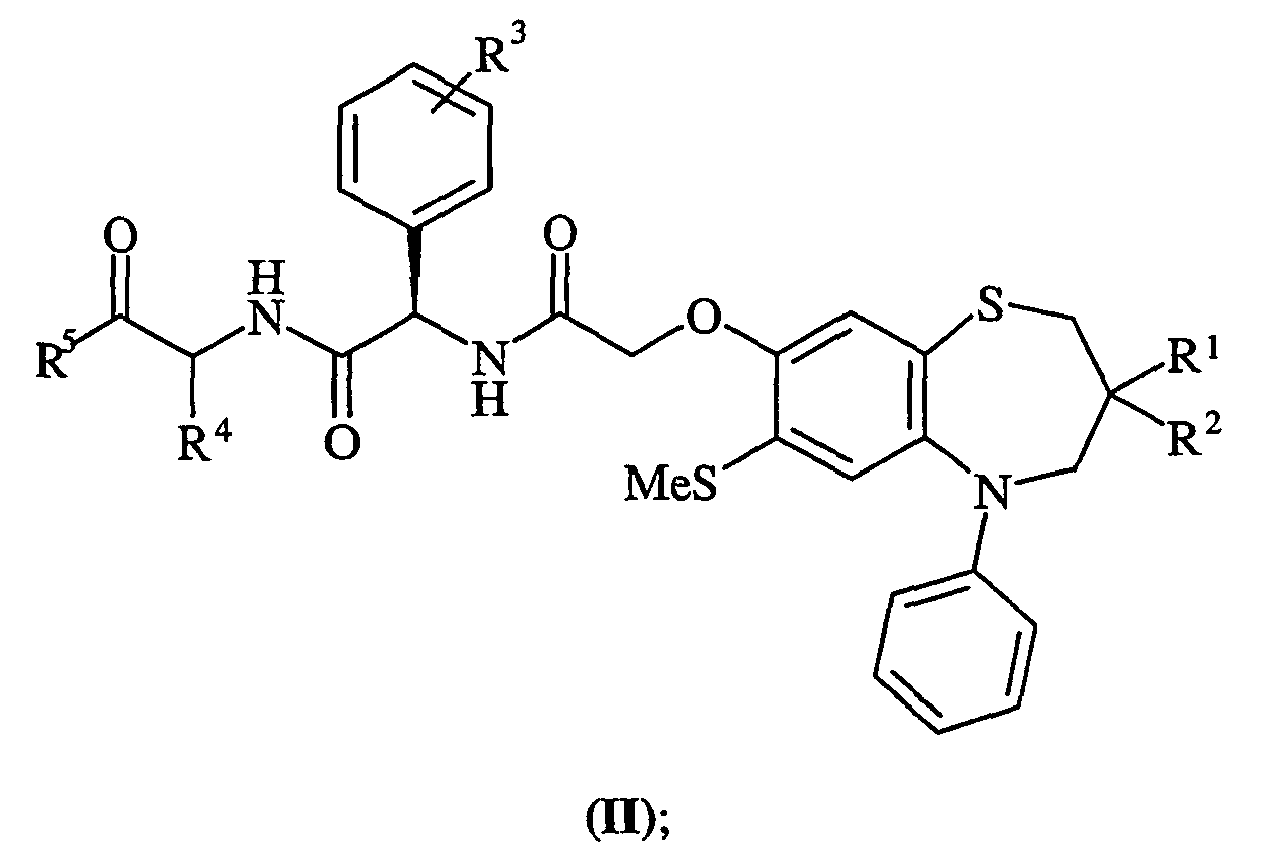
- Another aspect of the present invention provides a process for preparing a compound of formula (I) or a pharmaceutically acceptable salt, solvate, solvate of such a salt or an in vivo hydrolysable ester or in vivo hydrolysable amide thereof which process (wherein variable groups are, unless otherwise specified, as defined in formula (I)) comprises of:
- Process 1): oxidising a benzothiazepine of formula (II):
- Process 2): reacting a compound of formula (III):


- Process 3): reacting an acid of formula (V):


- Process 4): reacting an acid of formula (VII):


- Process 5): for compounds of formula (I) wherein R5 is HOC(O)CH(R6)NH-; reacting a compound of formula (I) wherein R5 is hydroxy with an amine of formula (IX):
HOC(O)CH(R6)NH, (IX) - Process 6): deprotecting a compound of formula (X) or a compound of formula (XI):


- Process 7) reacting a compound of formula (XII):

- i) converting a compound of the formula (I) into another compound of the formula (I);
- ii) removing any protecting groups;
- iii) forming a pharmaceutically acceptable salt, solvate, solvate of such a salt or an in vivo hydrolysable ester or in vivo hydrolysable amide.
- L is a displaceable group, suitable values for L are for example, a halogeno or sulphonyloxy group, for example a chloro, bromo, methanesulphonyloxy or toluene-4-sulphonyloxy group.
- Pg is an acid protecting group, suitable values for Pg are given below as carboxy protecting groups. Preferably Pg is C1-4alkyl.
- Specific reaction conditions for the above reactions are as follows.
Process 1): Benzothiazepines of formula (II) may be oxidised under standard sulphur oxidation conditions; for example using hydrogen peroxide and trifluoroacetic acid at a temperature in the range of 0°C to reflux, preferably at or near room temperature. - Compounds of formula (II) may be prepared according to Scheme I.

- Compounds of formula (IIa) and (IIc) are commercially available compounds, or they are known in the literature, or they are prepared by standard processes known in the art.
Process 2): Alcohols of formula (III) may be reacted with compounds of formula (IV) in the presence of a base for example an inorganic base such as sodium carbonate, or an organic base such as Hunigs base, in the presence of a suitable solvent such as MeCN, dichloromethane or tetrahydrofuran at a temperature in the range of 0°C to reflux, preferably at or near reflux. - Compounds of formula (III) may be prepared by oxidising a compound of formula (IIg) using the conditions outlined in Process 1).
- Compounds of formula (IV) are commercially available compounds, or they are known in the literature, or they are prepared by standard processes known in the art.
Process 3), Process 4 and Process 5): Acids and amines may be coupled together in the presence of a suitable coupling reagent. Standard peptide coupling reagents known in the art can be employed as suitable coupling reagents, or for example carbonyldiimidazole and dicyclohexyl-carbodiimide, optionally in the presence of a catalyst such as dimethylaminopyridine or 4-pyrrolidinopyridine, optionally in the presence of a base for example triethylamine, pyridine, or 2,6-di-alkyl-pyridines such as 2,6-lutidine or 2,6-di-tert-butylpyridine. Suitable solvents include dimethylacetamide, dichloromethane, benzene, tetrahydrofuran and DMF. The coupling reaction may conveniently be performed at a temperature in the range of -40 to 40°C. - Suitable activated acid derivatives include acid halides, for example acid chlorides, and active esters, for example pentafluorophenyl esters. The reaction of these types of compounds with amines is well known in the art, for example they may be reacted in the presence of a base, such as those described above, and in a suitable solvent, such as those described above. The reaction may conveniently be performed at a temperature in the range of -40 to 40°C.
- Compounds of formula (V) or (VII) may be prepared according to Scheme 1 using the appropriate replacement for the compound of formula (IV).
- Amines of formula (VI), (VIII) and (IX) are commercially available compounds, or they are known in the literature, or they are prepared by standard processes known in the art. Process 6): Protected acids of formula (IX) or (XI) may be deprotected under standard conditions such as those described below.
- Protected acids of formula (X) or (XI) may be prepared by any of the procedures above with the appropriate modifications.
Process 7): Compounds of formula (XII) may be reacted with methylthiol in the presence of base, for example an inorganic base such as sodium carbonate or an organic base such as Hunigs base, in the presence of a suitable solvent such as DMF or THF at a temperature in the range of 0°C to reflux. - Compounds of formula (XII) may be prepared by any of the procedures above with the appropriate modifications.
- It will be appreciated that certain of the various ring substituents in the compounds of the present invention may be introduced by standard aromatic substitution reactions or generated by conventional functional group modifications either prior to or immediately following the processes mentioned above, and as such are included in the process aspect of the invention. Such reactions and modifications include, for example, introduction of a substituent by means of an aromatic substitution reaction, reduction of substituents, alkylation of substituents and oxidation of substituents. The reagents and reaction conditions for such procedures are well known in the chemical art. Particular examples of aromatic substitution reactions include the introduction of a nitro group using concentrated nitric acid, the introduction of an acyl group using, for example, an acyl halide and Lewis acid (such as aluminium trichloride) under Friedel Crafts conditions; the introduction of an alkyl group using an alkyl halide and Lewis acid (such as aluminium trichloride) under Friedel Crafts conditions; and the introduction of a halogeno group. Particular examples of modifications include the reduction of a nitro group to an amino group by for example, catalytic hydrogenation with a nickel catalyst or treatment with iron in the presence of hydrochloric acid with heating; oxidation of alkylthio to alkylsulphinyl or alkylsulphonyl.
- It will also be appreciated that in some of the reactions mentioned herein it may be necessary/desirable to protect any sensitive groups in the compounds. The instances where protection is necessary or desirable and suitable methods for protection are known to those skilled in the art. Conventional protecting groups may be used in accordance with standard practice (for illustration see T.W. Green, Protective Groups in Organic Synthesis, John Wiley and Sons, 1991). Thus, if reactants include groups such as amino, carboxy or hydroxy it may be desirable to protect the group in some of the reactions mentioned herein.
- A suitable protecting group for an amino or alkylamino group is, for example, an acyl group, for example an alkanoyl group such as acetyl, an alkoxycarbonyl group, for example a methoxycarbonyl, ethoxycarbonyl or t-butoxycarbonyl group, an arylmethoxycarbonyl group, for example benzyloxycarbonyl, or an aroyl group, for example benzoyl. The deprotection conditions for the above protecting groups necessarily vary with the choice of protecting group. Thus, for example, an acyl group such as an alkanoyl or alkoxycarbonyl group or an aroyl group may be removed for example, by hydrolysis with a suitable base such as an alkali metal hydroxide, for example lithium or sodium hydroxide. Alternatively an acyl group such as a t-butoxycarbonyl group may be removed, for example, by treatment with a suitable acid as hydrochloric, sulphuric or phosphoric acid or trifluoroacetic acid and an arylmethoxycarbonyl group such as a benzyloxycarbonyl group may be removed, for example, by hydrogenation over a catalyst such as palladium-on-carbon, or by treatment with a Lewis acid for example boron tris(trifluoroacetate). A suitable alternative protecting group for a primary amino group is, for example, a phthaloyl group which may be removed by treatment with an alkylamine, for example dimethylaminopropylamine, or with hydrazine.
- A suitable protecting group for a hydroxy group is, for example, an acyl group, for example an alkanoyl group such as acetyl, an aroyl group, for example benzoyl, or an arylmethyl group, for example benzyl. The deprotection conditions for the above protecting groups will necessarily vary with the choice of protecting group. Thus, for example, an acyl group such as an alkanoyl or an aroyl group may be removed, for example, by hydrolysis with a suitable base such as an alkali metal hydroxide, for example lithium or sodium hydroxide. Alternatively an arylmethyl group such as a benzyl group may be removed, for example, by hydrogenation over a catalyst such as palladium-on-carbon.
- A suitable protecting group for a carboxy group is, for example, an esterifying group, for example a methyl or an ethyl group which may be removed, for example, by hydrolysis with a base such as sodium hydroxide, or for example a t-butyl group which may be removed, for example, by treatment with an acid, for example an organic acid such as trifluoroacetic acid, or for example a benzyl group which may be removed, for example, by hydrogenation over a catalyst such as palladium-on-carbon.
- The protecting groups may be removed at any convenient stage in the synthesis using conventional techniques well known in the chemical art.
- As stated hereinbefore the compounds defined in the present invention possess IBAT inhibitory activity. These properties may be assessed, for example, using an in vitro test assay for studying the effect on bile acid uptake in IBAT-transfected cells (Smith L., Price-Jones M. J., Hugnes K. T. and Jones N. R. A.; J Biomolecular Screening, 3, 227-230) or in vivo by studying the effect on radiolabelled bile acid absorption in mice/rats (Lewis M. C., Brieaddy L. E. and Root C., J., J Lip Res 1995, 36, 1098-1105).
- According to a further aspect of the invention there is provided a pharmaceutical composition which comprises a compound of formula (I), or a pharmaceutically acceptable salt, solvate, solvate of such a salt or an in vivo hydrolysable ester or in vivo hydrolysable amide thereof, as defined hereinbefore in association with a pharmaceutically-acceptable diluent or carrier.
- The composition may be in a form suitable for oral administration, for example as a tablet or capsule, for parenteral injection (including intravenous, subcutaneous, intramuscular, intravascular or infusion) as a sterile solution, suspension or emulsion, for topical administration as an ointment or cream or for rectal administration as a suppository.
- In general the above compositions may be prepared in a conventional manner using conventional excipients.
- The compound of formula (I), or a pharmaceutically acceptable salt, solvate, solvate of such a salt or an in vivo hydrolysabte ester or in vivo hydrolysable amide thereof, will normally be administered to a warm-blooded animal at a unit dose within the range 5-5000 mg per square meter body area of the animal, i.e. approximately 0.1-100 mg/kg or 0.01-50 mg/kg, and this normally provides a therapeutically-effective dose. In another aspect of the invention the compound of formula (I), or a pharmaceutically acceptable salt, solvate, solvate of such a salt or an in vivo hydrolysabte ester or in vivo hydrolysable amide thereof, will normally be administered to a warm-blooded animal at a unit dose within the range 0.001- 20 mg /kg or 0.1 - 200 mg /day, particularly 1 -20 mg/day to provide a therapeutically-effective dose. A unit dose form such as a tablet or capsule will usually contain, for example 1-250 mg of active ingredient. Preferably a daily dose in the range of 1-50 mg/kg is employed. In another aspect a daily dose in the rage of 0.02-20 mg/kg is employed. However the daily dose will necessarily be varied depending upon the host treated, the particular route of administration, and the severity of the illness being treated. Accordingly the optimum dosage may be determined by the practitioner who is treating any particular patient.
- According to a further aspect of the present invention there is provided a compound of the formula (I), or a pharmaceutically acceptable salt, solvate, solvate of such a salt or an in vivo hydrolysabte ester or in vivo hydrolysable amide thereof, as defined hereinbefore for use in a method of prophylactic or therapeutic treatment of a warm-blooded animal, such as man.
- We have found that the compounds defined in the present invention, or a pharmaceutically acceptable salt, solvate, solvate of such a salt or an in vivo hydrolysabte ester or in vivo hydrolysable amide thereof, are effective IBAT inhibitors, and accordingly have value in the treatment of disease states associated with hyperlipidaemic conditions.
- Thus according to this aspect of the invention there is provided a compound of the formula (I), or a pharmaceutically acceptable salt, solvate, solvate of such a salt or an in vivo hydrolysabte ester or in vivo hydrolysable amide thereof, as defined hereinbefore for use as a medicament.
- According to another feature of the invention there is provided the use of a compound of the formula (I), or a pharmaceutically acceptable salt, solvate, solvate of such a salt or an in vivo hydrolysabte ester or in vivo hydrolysable amide thereof, as defined hereinbefore in the manufacture of a medicament for use in the production of an IBAT inhibitory effect in a warm-blooded animal, such as man.
- According to another feature of the invention there is provided the use of a compound of the formula (I), or a pharmaceutically acceptable salt, solvate, solvate of such a salt or an in vivo hydrolysable ester or in vivo hydrolysable amide thereof, as defined hereinbefore in the manufacture of a medicament for use in the treatment of hyperlipidaemic conditions in a warm-blooded animal, such as man.
- The size of the dose required for the therapeutic or prophylactic treatment will necessarily be varied depending on the host treated, the route of administration and the severity of the illness being treated. A unit dose in the range, for example, 1-100 mg/kg, preferably 1-50 mg/kg is envisaged.
- The IBAT inhibitory activity defined hereinbefore may be applied as a sole therapy or may involve, in addition to a compound of the invention, one or more other substances and/or treatments. Such conjoint treatment may be achieved by way of the simultaneous, sequential or separate administration of the individual components of the treatment. According to this aspect of the invention there is provided a pharmaceutical product comprising a compound of the formula (I), or a pharmaceutically acceptable salt, solvate, solvate of such a salt or an in vivo hydrolysable ester or in vivo hydrolysable amide thereof, as defined hereinbefore and an additional IBAT inhibitory substance as defined hereinbefore and an additional hypolipidaemic agent for the conjoint treatment of hyperlipidaemia.
- In another aspect of the invention, the compound of formula (I), or a pharmaceutically acceptable salt, solvate, solvate of such a salt or an in vivo hydrolysable ester or in vivo hydrolysable amide thereof, may be administered in association with an HMG Co-A reductase inhibitor, or pharmaceutically acceptable salts, solvates, or solvates of such salts thereof. Suitable HMG Co-A reductase inhibitors, pharmaceutically acceptable salts, solvates, or solvates of such salts thereof are statins well known in the art. Particular statins are fluvastatin, lovastatin, pravastatin, simvastatin, atorvastatin, cerivastatin, bervastatin, dalvastatin, mevastatin and (E)-7-[4-(4-fluorophenyl)-6-isopropyl-2-[methyl(methylsulphonyl)amino]pyrimidin-5-yl](3R,5S)-3,5-dihydroxyhept-6-enoic acid (rosuvastatin), or a pharmaceutically acceptable salt, solvate, or solvate of such a salt thereof. A particular statin is atorvastatin, or a pharmaceutically acceptable salt, solvate, or solvate of such a salt thereof. A more particular statin is atorvastatin calcium salt. A further particular statin is (E)-7-[4-(4-fluorophenyl)-6-isopropyl-2-[methyl(methylsulphonyl)amino]pyrimidin-5-yl](3R,5S)-3,5-dihydroxyhept-6-enoic acid (rosuvastatin), or a pharmaceutically acceptable salt, solvate, or solvate of such a salt thereof. A preferable particular statin is rosuvastatin calcium salt.
- In an additional aspect of the invention, the compound of formula (I), or a pharmaceutically acceptable salt, solvate, solvate of such a salt or a prodrug thereof may be administered in association with an HMG Co-A reductase inhibitor, or a pharmaceutically acceptable salt, solvate, solvate of such a salt or an in vivo hydrolysable ester or in vivo hydrolysable amide thereof, and/or a bile acid binder.
- Suitable bile acid binders for such a combination therapy are resins, such as cholestyramine and cholestipol. One advantage is that the dose of bile acid binder might be kept lower than the therapeutic dose for treatment of cholesterolaemia in single treatment comprising solely a bile acid binder. By a low dose of bile acid binder any possible side effects caused by poor tolerance of the patient to the therapeutic dose could also be avoided.
- According to a further aspect of the invention there is provided a pharmaceutical composition which comprises a compound of formula (I), or a pharmaceutically acceptable salt, solvate, solvate of such a salt or an in vivo hydrolysable ester or in vivo hydrolysable amide thereof, and an HMG Co-A reductase inhibitor, or a pharmaceutically acceptable salt, solvate, or solvate of such a salt thereof, in association with a pharmaceutically acceptable diluent or carrier.
- According to a further aspect of the invention there is provided a pharmaceutical composition which comprises a compound of formula (I), or a pharmaceutically acceptable salt, solvate, solvate of such a salt or an in vivo hydrolysable ester or in vivo hydrolysable amide thereof, and a bile acid binder, in association with a pharmaceutically acceptable diluent or carrier.
- According to a further aspect of the invention there is provided a pharmaceutical composition which comprises a compound of formula (I), or a pharmaceutically acceptable salt, solvate, solvate of such a salt or an in vivo hydrolysable ester or in vivo hydrolysable amide thereof, and an HMG Co-A reductase inhibitor, or a pharmaceutically acceptable salt, solvate, or solvate of such a salt thereof, and a bile acid binder in association with a pharmaceutically acceptable diluent or carrier.
- According to a further aspect of the present invention there is provided a kit comprising a compound of formula (I), or a pharmaceutically acceptable salt, solvate, solvate of such a salt or an in vivo hydrolysable ester or in vivo hydrolysable amide thereof, and an HMG Co-A reductase inhibitor, or a pharmaceutically acceptable salt, solvate, or solvate of such a salt thereof.
- According to a further aspect of the present invention there is provided a kit comprising a compound of formula (I), or a pharmaceutically acceptable salt, solvate, solvate of such a salt or an in vivo hydrolysable ester or in vivo hydrolysable amide thereof, and a bile acid binder.
- According to a further aspect of the present invention there is provided a kit comprising a compound of formula (I), or a pharmaceutically acceptable salt, solvate, solvate of such a salt or an in vivo hydrolysable ester or in vivo hydrolysable amide thereof, and an HMG Co-A reductase inhibitor, or a pharmaceutically acceptable salt, solvate, or solvate of such a salt thereof and a bile acid binder.
- According to another feature of the invention there is provided the use of a compound of the formula (I), or a pharmaceutically acceptable salt, solvate, solvate of such a salt or an in vivo hydrolysable ester or in vivo hydrolysable amide thereof, and an HMG Co-A reductase inhibitor, or a pharmaceutically acceptable salt, solvate, or solvate of such a salt thereof, in the manufacture of a medicament for use in the production of an IBAT inhibitory effect in a warm-blooded animal, such as man.
- According to another feature of the invention there is provided the use of a compound of the formula (I), or a pharmaceutically acceptable salt, solvate, solvate of such a salt or an in vivo hydrolysable ester or in vivo hydrolysable amide thereof, and a bile acid binder, in the manufacture of a medicament for use in the production of an IBAT inhibitory effect in a warm-blooded animal, such as man.
- According to another feature of the invention there is provided the use of a compound of the formula (I), or a pharmaceutically acceptable salt, solvate, solvate of such a salt or an in vivo hydrolysable ester or in vivo hydrolysable amide thereof, and an HMG Co-A reductase inhibitor, or a pharmaceutically acceptable salt, solvate, solvate of such a salt or a prodrug thereof, and a bile acid binder, in the manufacture of a medicament for use in the production of an IBAT inhibitory effect in a warm-blooded animal, such as man.
- In another aspect of the invention, the compound of formula (I), or a pharmaceutically acceptable salt, solvate, solvate of such a salt or an in vivo hydrolysable ester or in vivo hydrolysable amide thereof, may be administered in association with a PPAR alpha and/or gamma agonist, or pharmaceutically acceptable salts, solvates, or solvates of such salts thereof. Suitable PPAR alpha and/or gamma agonists, pharmaceutically acceptable salts, solvates, or solvates of such salts thereof are well known in the art. These include the compounds described in
WO 01/12187 WO 01/12612 WO 99/62870 WO 99/62872 WO 99/62871 WO 98/57941 WO 01/40170 - According to a further aspect of the invention there is provided a pharmaceutical composition which comprises a compound of formula (I), or a pharmaceutically acceptable salt, solvate, solvate of such a salt or an in vivo hydrolysable ester or in vivo hydrolysable amide thereof, and a PPAR alpha and/or gamma agonist, or a pharmaceutically acceptable salt, solvate or solvate of such a salt thereof, in association with a pharmaceutically acceptable diluent or carrier.
- The invention will now be illustrated in the following non limiting examples, in which standard techniques known to the skilled chemist and techniques analogous to those described in these examples may be used where appropriate, and in which, unless otherwise stated:
(i) evaporations were carried out by rotary evaporation in vacuo and work up procedures were carried out after removal of residual solids such as drying agents by filtration;
(ii) all reactions were carried out under an inert atmosphere at ambient temperature, typically in the range 18-25°C, with solvents of HPLC grade under anhydrous conditions, unless otherwise stated;
(iii) column chromatography (by the flash procedure) was performed on Silica gel 40-63 µm (Merck);
(iv) yields are given for illustration only and are not necessarily the maximum attainable;
(v) the structures of the end products of the formula (I) were generally confirmed by nuclear (generally proton) magnetic resonance (NMR) and mass spectral techniques; magnetic resonance chemical shift values were measured in deuterated CDCl3 (unless otherwise stated) on the delta scale (ppm downfield from tetramethylsilane); proton data is quoted unless otherwise stated; spectra were recorded on a Varian Mercury-300 MHz, Varian Unity plus-400 MHz, Varian Unity plus-600 MHz or on Varian Inova-500 MHz spectrometer unless otherwise stated data was recorded at 400 MHz; and peak multiplicities are shown as follows: s, singlet; d, doublet; dd, double doublet; t, triplet; tt, triple triplet; q, quartet; tq, triple quartet; m, multiplet; br, broad; ABq, AB quartet; ABd, AB doublet, ABdd, AB doublet of doublets; dABq, doublet of AB quartets; LCMS were recorded on a Waters ZMD, LC column xTerra MS C8(Waters), detection with a HP 1100 MS-detector diode array equipped; mass spectra (MS) (loop) were recorded on VG Platform II (Fisons Instruments) with a HP-1100 MS-detector diode array equipped; unless otherwise stated the mass ion quoted is (MH+); unless further details are specified in the text, analytical high performance liquid chromatography (HPLC) was performed on Prep LC 2000 (Waters), Cromasil C8, 7 µm, (Akzo Nobel); MeCN and de-ionised water 10 mM ammonium acetate as mobile phases, with suitable composition;
(vii) intermediates were not generally fully characterised and purity was assessed by thin layer chromatography (TLC), HPLC, infra-red (IR), MS or NMR analysis;
(viii) where solutions were dried sodium sulphate was the drying agent;
(ix) the following abbreviations may be used hereinbefore or hereinafter:-DCM dichloromethane; DMF N,N-dimethylformamide; TBTU O-Benzotriazol-1-yl-N,N,N',N'-tetramethyluronium tetrafluoroborate; EtOAc ethyl acetate; MeCN acetonitrile; DIPEA di-isopropylethylamine; and THF tetrahydrofuran. - 1,1-Dioxo-3,3-dibutyl-5-phenyl-7-methylthio-8-[N-((R)-α-carboxy-4-hydroxybenzyl) carbamoylmethoxy]-2,3,4,5-tetrahydro-1,5-benzothiazepine (Example 2
WO02/50051 - To a solution of 1,1-dioxo-3,3-dibutyl-5-phenyl-7-methylthio-8-[N-((R)-α-[N'-[(S)-1-(ethoxycarbonyl)ethyl] carbamoyl}benzyl)carbamoylmethoxy]-2,3,4,5-tetrahydro-1,5-benzothiazepine (Method 4; 0.042 g, 0.057 mmol) in EtOH (6 ml, 95 %) was added a solution of NaOH (0.153 g, 0.250 mmol) in water (0.3 ml) and the mixture was stirred for 1 hour. The reaction was quenched with AcOH (0.04ml), concentrated and partitioned between EtOAc and water. The organic phase was concentrated and the residue was purified by preparative HPLC using a gradient of 40-60% MeCN in 0.1M ammonium acetate buffer as eluent. The desired compound was obtained in 0.024 g (59 %) as a white solid. NMR (CD3OD): 0.70-0.90 (6H, m), 1.00-1.60 (15H, m), 2.10 (3H, s), 3.25 (2H, s), 3.75 (2H, brs), 4.25-4.40 (1H, m), 4.60-4.80 (2H, m), 5.60 (1H, d), 6.70 (1H, s), 6.90-7.50 (11H, m).
- The starting materials for the Examples above are either commercially available or are readily prepared by standard methods from known materials. For example, the following reactions are an illustration, but not a limitation, of some of the starting materials used in the above reactions.
- A solution of NaOH (4.67 g, 116 mmol) in water (10 ml) was added to a solution of 1,1-dioxo-3,3-dibutyl-5-phenyl-7-methylthio-8-ethoxycarbonyl-2,3,4,5-tetrahydro-1,5-benzothiazepine (Method 2; 15.45 g, 28.71 mmol) in EtOH (160 ml). The solution was stirred for 30 min at room temperature. The solvent was removed under reduced pressure and the residue was partitioned between EtOAc and 1.0 M HCl. The aqueous layer was extracted twice more with EtOAc and the combined organic extracts were washed with brine and concentrated to give the title compound (14.28 g, 98 %) as a white powder. NMR (500 MHz, DMSO-d6) 0.65-0.80 (m, 6H), 0.90-1.50 (m, 12H), 2.20 (s, 3H), 3.25 (s, 2H), 3.65 (brs, 2H), 4.80 (s, 2H), 6.70 (s, 1H), 6.80-7.30 (m, 6H), 13.20 (s, 1H).
- To a suspension of 1,1-dioxo-3,3-dibutyl-5-phenyl-7-methylthio-8-hydroxy-2,3,4,5-tetrahydro-1,5-benzothiazepine (Method 3; 12.85 g, 28.71 mmol) in MeCN (150 ml) was added ethyl bromoacetate (3.85 ml, 34.6 mmol), tetrabutylammonium bromide (0.925 g, 2.869 mmol) and sodium carbonate (12.85 g, 121.2 mmol). The mixture was heated under reflux for 5 hours. The solvent was removed under reduced pressure and the residue was partitioned between DCM and 0.5 M HCl. The organic layer was washed with brine, dried (MgSO4) and concentrated. Chromatography using DCM/EtOAc (9:1) as eluent gave the desired product (15.45 g) as a tan oil. NMR 0.70-0.85 (m, 6H), 1.00-1.55 (m, 15H), 2.15 (s, 3H), 3.10 (s, 2H), 3.70 (brs, 2H), 4.25 (q, 2H), 4.70 (s, 2H), 6.65 (s, 1H), 6.90-7.30 (m, 6H).
- To 1,1-dioxo-3,3-dibutyl-5-phenyl-7-bromo-8-methoxy-2,3,4,5-tetrahydro-1,5-benzothiazepine (synthesised by the of
WO9616051 - A solution of 1,1-dioxo-3,3-dibutyl-5-phenyl-7-methylthio-8-[N-((R)-1'-phenyl-1'-carboxymethyl)carbamoylmethoxy]-2,3,4,5-tetrahydro-1,5-benzothiazepine (Method 5; 0.050 g, 0.078 mmol), L-alanine, ethyl ester, hydrochloride (0.012 g,0.078 mmol) and N-methylmorpholine (0.030 ml, 0.272 mmol) in DCM (4 ml) was stirred at ambient temperature for 10 min after which TBTU (0.033 g, 0.103 mmol) was added. After additional 2h the reaction mixture was transferred to a separator funnel and washed with water and brine, dried over MgSO4 and concentrated. The crude product was purified by flash chromatography on silica gel (Hept:EtOAc-1:1), to give 0.048 g (83 %) of the desired product as a white solid. NMR 0.70-0.85 (6H, m), 1.00-1.55 (18H, m), 2.10 (3H, s), 3.15 (2H, s), 3.70 (2H, brs), 4.05-4.25 (2H, m), 4.50-4.70 (2H, m), 5.50-5.65 (1H, m), 6.30-6.45 (1H, m), 6.65 (1H, s), 6.95-7.10 (3H, m), 7.20-7.50 (8H, m), 8.05 (1H, d).
- 1,1-Dioxo-3,3-dibutyl-5-phenyl-7-methylthio-8-[N-((R)-1'-phenyl-1'-methoxycarbonyl methyl)carbamoylmethoxy]-2,3,4,5-tetrahydro-1,5-benzothiazepine (Method 6; 300 mg, 0.46 mmol) was dissolved in methanol (5 ml). NaOH (100 mg in 0.2 ml water) was added to the solution and the mixture was stirred at room temperature for 1 hour. Acetic acid (0.3 ml) was added. The solvent was evaporated under reduced pressure and the residue was extracted with DCM/water. The DCM layer was separated, dried and evaporated under reduced pressure to give the title compound 270 mg (92%). NMR (500 MHz) 0.7-0.8 (m, 6H), 1.0-1.6 (m, 12H), 2.1 (s, 3H) 3.2 (brs, 2H), 3.6-3.8 (m, 2H), 4.6 (s, 2H), 5.6 (d, 1H), 6.6 (s, 1H), 6.9-7.5 (m, 11H), 7.8 (d, 1H).
- 1,1-Dioxo-3,3-dibutyl-5-phenyl-7-methylthio-8-carboxymethoxy-2,3,4,5-tetrahydro-1,5-benzothiazepine (Method 1; 250 mg, 0.49 mmol), (R)-2-phenylglycine methyl ester hydrochloride (120 mg, 0.60 mmol) and DIPEA (300 mg, 2.3 mmol) were dissolved in DCM (10 ml) and the mixture was stirred for 5 min in room temperature. TBTU (210 mg. 0.65 mmol) was added and the mixture was stirred for 30 min at room temperature. The solvent was evaporated under reduced pressure and the residue was placed on a column and the product was eluted with DCM/EtOAc (90:10) to give the title compound 306 mg (95%). NMR (500 MHz) 0.7-0.8 (m, 6H), 1.0-1.6 (m, 12H), 2.1 (s, 3H) 3.2 brs, 2H), 3.6-3.8 (m, 5H), 4.6 (ABq, 2H), 5.6 (d, 1H), 6.6 (s, 1H), 6.9-7.5 (m, 11H), 7.9 (d, 1H).
Claims (18)
- A compound of formula (I):
 R1 and R2 are both butyl;R3 is hydrogen, hydroxy or halo;R4 is C1-4alkyl optionally substituted by hydroxy, methoxy or methylS(O)a wherein a is 0-2;R5 is hydroxy or HOC(O)CH(R6)NH-;.R6 is selected from hydrogen and C1-3alkyl optionally substituted by hydroxy, methoxy or methylS(O)a wherein a is 0-2;or a pharmaceutically acceptable salt, solvate, solvate of such a salt or an in vivo hydrolysable ester or in vivo hydrolysable amide thereof;
with the proviso that when R5 is hydroxy and R4 is methylthiomethyl, methylsulphinylmethyl, 2-methylthioethyl, hydroxymethyl, methoxymethyl; R3 is not hydrogen; and with the proviso that when R5 is HOC(O)CH(R6)NH-, R6 is hydroxymethyl and R4 is hydroxymethyl; R3 is not hydrogen. - A compound of formula (I) according to any one of claims 1 to 3 wherein R3 is hydrogen or hydroxy; or a pharmaceutically acceptable salt, solvate, solvate of such a salt or an in vivo hydrolysable ester or in vivo hydrolysable amide thereof.
- A compound of formula (I) according to any one of claims 1 to 4 wherein R4 is selected from methyl and ethyl; or a pharmaceutically acceptable salt, solvate, solvate of such a salt or an in vivo hydrolysable ester or in vivo hydrolysable amide thereof.
- A compound of formula (I) according to any one of claims 1 to 5 wherein R5 is hydroxy; or a pharmaceutically acceptable salt, solvate, solvate of such a salt or an in vivo hydrolysable ester or in vivo hydrolysable amide thereof.
- A compound of formula (I'):
 R4 is selected from C1-4alkyl, hydroxymethyl, 1-hydroxyethyl, methoxymethyl, methylthiomethyl, methylsulphinylmethyl, mesylmethyl, 2-methylthioethyl, 2-methylsulphinylethyl and 2-mesylethyl and R3 is hydroxy; orR4 is selected from C1-4alkyl, 1-hydroxyethyl, mesylmethyl, 2-methylsulphinylethyl and 2-mesylethyl and R3 is hydrogen;or a pharmaceutically acceptable salt, solvate, solvate of such a salt or an in vivo hydrolysable ester or in vivo hydrolysable amide thereof. '
 - A compound of formula (I) selected from:1,1-dioxo-3,3-dibutyl-5-phenyl-7-methylthio-8-(N-{(R)-α-[N'-((S)-1-carboxyethyl) carbamoyl]benzyl}carbamoylmethoxy)-2,3,4,5-tetrahydro-1,5-benzothiazepine;1,1-dioxo-3,3-dibutyl-5-phenyl-7-methylthio-8-(N-{(R)-α-[N'-((S)-1-carboxypropyl) carbamoyl]benzyl}carbamoylmethoxy)-2,3,4,5-tetrahydro-1,5-benzothiazepine;1,1-dioxo-3,3-dibutyl-5-phenyl-7-methylthio-8-(N-{(R)-α-[N'-((S)-1-carboxybutyl) carbamoyl]benzyl}carbamoylmethoxy)-2,3,4,5-tetrahydro-1,5-benzothiazepine;1,1-dioxo-3,3-dibutyl-5-phenyl-7-methylthio-8-(N-{(R)-α-[N'-((S)-1-carboxy-2-methylpropyl)carbamoyl]benzyl}carbamoylmethoxy)-2,3,4,5-tetrahydro-1,5-benzothiazepine;1,1-dioxo-3,3-dibutyl-5-phenyl-7-methylthio-8-(N-{(R)-α-[N'-((S)-1-carboxy-2-methylbutyl)carbamoyl]benzyl}carbamoylmethoxy)-2,3,4,5-tetrahydro-1,5-benzothiazepine;1,1-dioxo-3,3-dibutyl-5-phenyl-7-methylthio-8-(N-{(R)-α-[N'-((S)-1-carboxy-3-methylbutyl)carbamoyl]benzyl}carbamoylmethoxy)-2,3,4,5-tetrahydro-1,5-benzothiazepine;1,1-dioxo-3,3-dibutyl-5-phenyl-7-methylthio-8-(N-{(R)-α-[N'-((S)-1-carboxy-2-hydroxypropyl)carbamoyl]benzyl}carbamoylmethoxy)-2,3,4,5-tetrahydro-1,5-benzothiazepine;1,1-dioxo-3,3-dibutyl-5-phenyl-7-methylthio-8-(N{(R)-α-[N'-((S)-1-carboxy-2-mesylethyl)carbamoyl]benzyl}carbamoylmethoxy)-2,3,4,5-tetrahydro-1,5-benzothiazepine;1,1-dioxo-3,3-dibutyl-5-phenyl-7-methylthio-8-(N-{(R)-α-[N'-((S)-1-carboxy-3-methylsulphonylpropyl)carbamoyl]benzyl}carbamoylmethoxy)-2,3,4,5-tetrahydro-1,5-benzothiazepine;1,1-dioxo-3,3-dibutyl-5-phenyl-7-methylthio-8-(N-{(R)-α-[N'-((S)-1-carboxyethyl) carbamoyl]-4-hydroxybenzyl}carbamoylmethoxy)-2,3,4,5-tetrahydro-1,5-benzothiazepine;1,1-dioxo-3,3-dibutyl-5-phenyl-7-methylthio-8-(N-{(R)-α-[N'-((S)-1-carboxypropyl) carbamoyl]-4-hydroxybenzyl}carbamoylmethoxy)-2,3,4,5-tetrahydro-1,5-benzothiazepine;1,1-dioxo-3,3-dibutyl-5-phenyl-7-methylthio-8-(N-{(R)-α-[N'-((S)-1-carboxybutyl) carbamoyl]-4-hydroxybenzyl}carbamoylmethoxy)-2,3,4,5-tetrahydro-1,5-benzothiazepine;1,1-dioxo-3,3-dibutyl-5-phenyl-7-methylthio-8-(N-{(R)-α-[N'-((S)-1-carboxy-2-methylpropyl)carbamoyl]-4-hydroxybenzyl}carbamoylmethoxy)-2,3,4,5-tetrahydro-1,5-benzothiazepine;1,1-dioxo-3,3-dibutyl-5-phenyl-7-methylthio-8-(N-{(R)-α-[N'-((S)-1-carboxy-2-methylbutyl)carbamoyl]-4-hydroxybenzyl}carbamoylmethoxy)-2,3,4,5-tetrahydro-1, 5-benzothiazepine;1,1-dioxo-3,3-dibutyl-5-phenyl-7-methylthio-8-(N-{(R)-α-[N'-((S)-1-carboxy-3-methylbutyl)carbamoyl]-4-hydroxybenzyl}carbamoylmethoxy)-2,3,4,5-tetrahydro-1,5-benzothiazepine;1,1-dioxo-3,3-dibutyl-5-phenyl-7-methylthio-8-(N-{(R)-α-[N'-((S)-1-carboxy-2-hydroxyethyl)carbamoyl]-4-hydroxybenzyl}carbamoylmethoxy)-2,3,4,5-tetrahydro-1,5-benzothiazepine;1,1-dioxo-3,3-dibutyl-5-phenyl-7-methylthio-8-(N-{(R)-α-[N'-((S)-1-carboxy-2-hydroxypropyl)carbamoyl]-4-hydroxybenzyl}carbamoylmethoxy)-2,3,4,5-tetrahydro-1,5-benzothiazepine;1,1-dioxo-3,3-dibutyl-5-phenyl-7-methylthio-8-(N-{(R)-α-[N'-((S)-1-carboxy-2-methylthioethyl)carbamoyl]-4-hydroxybenzyl}carbamoylmethoxy)-2,3,4,5-tetrahydro-1,5-benzothiazepine;1,1-dioxo-3,3-dibutyl-5-phenyl-7-methylthio-8-(N{(R)-α-[N'-((S)-1-carboxy-2-methylsulphinylethyl)carbamoyl]-4-hydroxybenzyl}carbamoylmethoxy)-2,3,4,5-tetrahydro-1,5-benzothiazepine;1,1-dioxo-3,3-dibutyl-5-phenyl-7-methylthio-8-(N-{(R)-α-[N'-((S)-1-carboxy-2-mesylethyl)carbamoyl]-4-hydroxybenzyl}carbamoylmethoxy)-2,3,4,5-tetrahydro-1,5-benzothiazepine;1,1-dioxo-3,3-dibutyl-5-phenyl-7-methylthio-8-(N-{(R)-α-[N'-((S)-1-carboxy-2-methoxyethyl)carbamoyl]-4-hydroxybenzyl}carbamoylmethoxy)-2,3,4,5-tetrahydro-1,5-benzothiazepine;1,1-dioxo-3,3-dibutyl-5-phenyl-7-methylthio-8-(N-{(R)-α-[N'-((S)-1-carboxy-3-methylthiopropyl)carbamoyl]-4-hydroxybenzyl}carbamoylmethoxy)-2,3,4,5-tetrahydro-1,5-benzothiazepine;1,1-dioxo-3,3-dibutyl-5-phenyl-7-methylthio-8-(N-{(R)-α-[N'-((S)-1-carboxy-3-methylsulphinylpropyl)carbamoyl]-4-hydroxybenzyl}carbamoylmethoxy)-2,3,4,5-tetrahydro-1,5-benzothiazepine;1,1-dioxo-3,3-dibutyl-5-phenyl-7-methylthio-8-(N-{(R)-α-[N'-((S)-1-carboxy-3-mesylpropyl)carbamoyl]-4-hydroxybenzyl}carbamoylmethoxy)-2,3,4,5-tetrahydro-1,5-benzothiazepine;or a pharmaceutically acceptable salt, solvate, solvate of such a salt or an in vivo hydrolysable ester or in vivo hydrolysable amide thereof.
- A process for preparing a compound of formula (I) or a pharmaceutically acceptable salt, solvate, solvate of such a salt or an in vivo hydrolysable ester or in vivo hydrolysable amide thereof which process (wherein variable groups are, unless otherwise specified, as defined in formula (I)) comprises of:Process 1): oxidising a benzothiazepine of formula (II):
 Process 2): reacting a compound of formula (III):
 Process 3): reacting an acid of formula (V):
 Process 4): reacting an acid of formula (VII):
 Process 5): for compounds of formula (I) wherein R5 is HOC(O)CH(R6)NH-; reacting a compound of formula (I) wherein R5 is hydroxy with an amine of formula (IX):
HOC(O)CH(R6)NH2 (IX)Process 6): deprotecting a compound of formula (X) or a compound of formula (XI):
 Process 7) reacting a compound of formula (XII):and thereafter if necessary or desirable:
 i) converting a compound of the formula (I) into another compound of the formula (I);ii) removing any protecting groups;iii) forming a pharmaceutically acceptable salt, solvate, solvate of such a salt or an in vivo hydrolysable ester or in vivo hydrolysable amide.
 - A compound of the formula (I), or a pharmaceutically acceptable salt, solvate, solvate of such a salt or an in vivo hydrolysable ester or in vivo hydrolysable amide thereof, as claimed in any one of claims 1 to 6 for use as a medicament.
- A compound of formula (I), or a pharmaceutically acceptable salt, solvate, solvate of such a salt or an in vivo hydrolysable ester or in vivo hydrolysable amide thereof, as claimed in any one of claims 1 to 6 for use in a method of prophylactic or therapeutic treatment of a warm-blooded animal, such as man.
- The use of a compound of the formula (I), or a pharmaceutically acceptable salt, solvate, solvate of such a salt or an in vivo hydrolysable ester or in vivo hydrolysable amide thereof, as claimed in any one of claims 1 to 6 in the manufacture of a medicament for use in the production of an IBAT inhibitory effect in a warm-blooded animal, such as man.
- A pharmaceutical composition which comprises a compound of formula (I), or a pharmaceutically acceptable salt, solvate, solvate of such a salt or an in vivo hydrolysable ester or in vivo hydrolysable amide thereof, as claimed in any one of claims 1 to 6, in association with a pharmaceutically-acceptable diluent or carrier.
- A pharmaceutical composition which comprises a compound of formula (I), or a pharmaceutically acceptable salt, solvate, solvate of such a salt or an in vivo hydrolysable ester or in vivo hydrolysable amide thereof, as claimed in any one of claims 1 to 6, and an HMG Co-A reductase inhibitor, or a pharmaceutically acceptable salt, solvate, solvate of such a salt thereof, in association with a pharmaceutically acceptable diluent or carrier.
- A pharmaceutical composition which comprises a compound of formula (I), or a pharmaceutically acceptable salt, solvate, solvate of such a salt or an in vivo hydrolysable ester or in vivo hydrolysable amide thereof, as claimed in any one of claims 1 to 6, and a bile acid binder, in association with a pharmaceutically acceptable diluent or carrier.
- A pharmaceutical composition which comprises a compound of formula (I), or a pharmaceutically acceptable salt, solvate, solvate of such a salt or an in vivo hydrolysable ester or in vivo hydrolysable amide thereof, as claimed in any one of claims 1 to 6, and an HMG Co-A reductase inhibitor, or a pharmaceutically acceptable salt, solvate, solvate of such a salt thereof, and a bile acid binder in association with a pharmaceutically acceptable diluent or carrier.
- A composition according to claim 13 or claim 15 wherein the HMG Co-A reductase inhibitor is atorvastatin, or a pharmaceutically acceptable salt, solvate, solvate of such a salt thereof.
- A composition according to claim 13 or claim 15 wherein the HMG Co-A reductase inhibitor is rosuvastatin, or a pharmaceutically acceptable salt thereof.
- A pharmaceutical composition which comprises a compound of formula (I), or a pharmaceutically acceptable salt, solvate, solvate of such a salt or an in vivo hydrolysable ester or in vivo hydrolysable amide thereof, as claimed in any one of claims 1 to 6 and a PPAR alpha and/or gamma agonist, or a pharmaceutically acceptable salt thereof, in association with a pharmaceutically acceptable diluent or carrier.
- A composition according to claim 17 wherein the PPAR alpha and/or gamma agonist is (S)-2-ethoxy-3-[4-(2-{4-methanesulphonyloxyphenyl}ethoxy)phenyl]propanoic acid or a pharmaceutically acceptable salt thereof.
Applications Claiming Priority (3)
| Application Number | Priority Date | Filing Date | Title |
|---|---|---|---|
| GB0213669 | 2002-06-14 | ||
| GBGB0213669.5A GB0213669D0 (en) | 2002-06-14 | 2002-06-14 | Chemical compounds |
| PCT/GB2003/002499 WO2003106482A1 (en) | 2002-06-14 | 2003-06-10 | Peptides derivatives comprising thiazepine group for the treatment of hyperlipidemic conditions |
Publications (2)
| Publication Number | Publication Date |
|---|---|
| EP1515984A1 EP1515984A1 (en) | 2005-03-23 |
| EP1515984B1 true EP1515984B1 (en) | 2009-03-04 |
Family
ID=9938564
Family Applications (1)
| Application Number | Title | Priority Date | Filing Date |
|---|---|---|---|
| EP03732693A Expired - Lifetime EP1515984B1 (en) | 2002-06-14 | 2003-06-10 | Peptide derivatives comprising thiazepine group for the treatment of hyperlipidemic conditions |
Country Status (25)
| Country | Link |
|---|---|
| US (1) | US7192947B2 (en) |
| EP (1) | EP1515984B1 (en) |
| JP (1) | JP4423191B2 (en) |
| KR (1) | KR20050010514A (en) |
| CN (1) | CN1659182A (en) |
| AR (1) | AR039672A1 (en) |
| AT (1) | ATE424407T1 (en) |
| AU (1) | AU2003240079B2 (en) |
| BR (1) | BR0311628A (en) |
| CA (1) | CA2489463A1 (en) |
| DE (1) | DE60326451D1 (en) |
| ES (1) | ES2321826T3 (en) |
| GB (1) | GB0213669D0 (en) |
| IS (1) | IS7597A (en) |
| MX (1) | MXPA04012603A (en) |
| MY (1) | MY134270A (en) |
| NO (1) | NO20045099L (en) |
| NZ (1) | NZ537122A (en) |
| PL (1) | PL372626A1 (en) |
| RU (1) | RU2315772C2 (en) |
| SA (1) | SA03240217B1 (en) |
| TW (1) | TWI282790B (en) |
| UY (1) | UY27846A1 (en) |
| WO (1) | WO2003106482A1 (en) |
| ZA (1) | ZA200409860B (en) |
Families Citing this family (59)
| Publication number | Priority date | Publication date | Assignee | Title |
|---|---|---|---|---|
| EG26979A (en) | 2000-12-21 | 2015-03-01 | Astrazeneca Ab | Chemical compounds |
| GB0121337D0 (en) | 2001-09-04 | 2001-10-24 | Astrazeneca Ab | Chemical compounds |
| GB0121621D0 (en) | 2001-09-07 | 2001-10-31 | Astrazeneca Ab | Chemical compounds |
| GB0121622D0 (en) | 2001-09-07 | 2001-10-31 | Astrazeneca Ab | Chemical compounds |
| PL216023B1 (en) | 2001-09-08 | 2014-02-28 | Astrazeneca Ab | Benzothiazepine and benzothiadiazepine derivatives with ileal bile acid transport (ibat) inhibitory activity for the treatment hyperlipidaemia |
| SE0104333D0 (en) | 2001-12-19 | 2001-12-19 | Astrazeneca Ab | Therapeutic agents |
| GB0209467D0 (en) | 2002-04-25 | 2002-06-05 | Astrazeneca Ab | Chemical compounds |
| GB0213669D0 (en) | 2002-06-14 | 2002-07-24 | Astrazeneca Ab | Chemical compounds |
| EP1517883B8 (en) * | 2002-06-20 | 2008-05-21 | AstraZeneca AB | Ortho-substituted benzoic acid derivatives for the treatment of insulin resistance |
| GB0304194D0 (en) * | 2003-02-25 | 2003-03-26 | Astrazeneca Ab | Chemical compounds |
| GB0307918D0 (en) | 2003-04-05 | 2003-05-14 | Astrazeneca Ab | Therapeutic use |
| WO2005053667A1 (en) | 2003-12-02 | 2005-06-16 | Schwarz Pharma Ag | Novel use of peptide compounds for treating central neuropathic pain |
| EP1604655A1 (en) | 2004-06-09 | 2005-12-14 | Schwarz Pharma Ag | Novel use of peptide compounds for treating pain in trigeminal neuralgia |
| AR057828A1 (en) * | 2005-09-29 | 2007-12-19 | Astrazeneca Ab | COMPOUNDS DERIVED FROM AZETIDINE, ITS PREPARATION AND PHARMACEUTICAL COMPOSITION |
| US8735356B2 (en) | 2006-06-15 | 2014-05-27 | Ucb Pharma Gmbh | Anticonvulsant combination therapy |
| ES2445049T3 (en) | 2007-03-08 | 2014-02-27 | Albireo Ab | Derivatives of 3-phenylpropionic acid and its use in the treatment of inflammatory bowel disease |
| ES2586931T3 (en) | 2010-11-04 | 2016-10-19 | Albireo Ab | IBAT inhibitors for the treatment of liver diseases |
| EP2637667A4 (en) * | 2010-11-08 | 2014-06-25 | Albireo Ab | Ibat inhibitors for treatment of metabolic disorders and related conditions |
| RU2619215C2 (en) * | 2010-11-08 | 2017-05-12 | Альбирео Аб | Pharmaceutical combination comprising ibat-inhibitor and bile acid binder |
| KR102051031B1 (en) | 2011-10-28 | 2019-12-02 | 루메나 파마수티컬즈, 인코포레이티드 | Bile acid recycling inhibitors for treatment of hypercholemia and cholestatic liver disease |
| BR112014010223B8 (en) | 2011-10-28 | 2021-02-23 | Lumena Pharmaceuticals Llc | use of a composition comprising bile acid recycling inhibitors and pediatric dosage form |
| JO3301B1 (en) | 2013-04-26 | 2018-09-16 | Albireo Ab | Crystal modifications of elobixibat |
| CN106659726A (en) | 2014-06-25 | 2017-05-10 | Ea制药株式会社 | Solid preparation and method for preventing or reducing coloration thereof |
| EP3012252A1 (en) | 2014-10-24 | 2016-04-27 | Ferring BV | Crystal modifications of elobixibat |
| EP3413878B1 (en) | 2016-02-09 | 2021-04-14 | Albireo AB | Oral cholestyramine formulation and use thereof |
| EP3413877B1 (en) | 2016-02-09 | 2021-04-07 | Albireo AB | Oral cholestyramine formulation and use thereof |
| EP3413875B1 (en) | 2016-02-09 | 2020-01-29 | Albireo AB | Cholestyramine pellets and methods for preparation thereof |
| CN110996915B (en) | 2017-08-09 | 2023-10-03 | 阿尔比里奥公司 | Cholestyramine pills, oral cholestyramine preparations and their uses |
| JP2020530448A (en) | 2017-08-09 | 2020-10-22 | アルビレオ・アクチボラグ | Cholestyramine granules, oral cholestyramine preparations, and their use |
| MX2020009332A (en) * | 2018-03-09 | 2020-10-08 | Elobix Ab | PROCESS FOR THE PREPARATION OF ELOBIXIBAT. |
| JP7391048B2 (en) | 2018-06-05 | 2023-12-04 | アルビレオ・アクチボラグ | Benzothia(di)azepine compounds and their use as bile acid modulators |
| US11801226B2 (en) | 2018-06-20 | 2023-10-31 | Albireo Ab | Pharmaceutical formulation of odevixibat |
| MX2020013839A (en) | 2018-06-20 | 2021-03-25 | Albireo Ab | Pharmaceutical formulation of odevixibat. |
| US10722457B2 (en) | 2018-08-09 | 2020-07-28 | Albireo Ab | Oral cholestyramine formulation and use thereof |
| US11549878B2 (en) | 2018-08-09 | 2023-01-10 | Albireo Ab | In vitro method for determining the adsorbing capacity of an insoluble adsorbant |
| US11007142B2 (en) | 2018-08-09 | 2021-05-18 | Albireo Ab | Oral cholestyramine formulation and use thereof |
| RS63899B1 (en) | 2019-02-06 | 2023-02-28 | Albireo Ab | BENZOTHIADIAZEPIN COMPOUNDS AND THEIR USE AS BILE ACID MODULATORS |
| TWI835997B (en) | 2019-02-06 | 2024-03-21 | 瑞典商艾爾比瑞歐公司 | Benzothiazepine compounds and their use as bile acid modulators |
| WO2021049311A1 (en) | 2019-09-09 | 2021-03-18 | エロビクス・アーベー | Method for producing a 1,5-benzothiazepin compound |
| AR120679A1 (en) | 2019-12-04 | 2022-03-09 | Albireo Ab | BENZOTHI(DI)AZEPINE COMPOUNDS AND THEIR USE AS BILE ACID MODULATORS |
| WO2021110886A1 (en) | 2019-12-04 | 2021-06-10 | Albireo Ab | Benzothia(di)azepine compounds and their use as bile acid modulators |
| AR120682A1 (en) | 2019-12-04 | 2022-03-09 | Albireo Ab | BENZOTHIADIAZEPINE COMPOUNDS AND THEIR USE AS BILE ACID MODULATORS |
| US11014898B1 (en) | 2020-12-04 | 2021-05-25 | Albireo Ab | Benzothiazepine compounds and their use as bile acid modulators |
| EP4069359B1 (en) | 2019-12-04 | 2024-01-03 | Albireo AB | Benzothia(di)azepine compounds and their use as bile acid modulators |
| JP7665620B2 (en) | 2019-12-04 | 2025-04-21 | アルビレオ・アクチボラグ | Benzothiadiazepine compounds and their use as bile acid modulators - Patents.com |
| CA3158181A1 (en) | 2019-12-04 | 2021-06-10 | Albireo Ab | Benzothia(di)azepine compounds and their use as bile acid modulators |
| WO2021110887A1 (en) | 2019-12-04 | 2021-06-10 | Albireo Ab | Benzothiazepine compounds and their use as bile acid modulators |
| TWI867107B (en) | 2019-12-04 | 2024-12-21 | 瑞典商艾爾比瑞歐公司 | Benzothia(di)azepine compounds and their use as bile acid modulators |
| BR112022010505A2 (en) | 2019-12-04 | 2022-09-06 | Albireo Ab | BENZOTHYA(DI)AZEPINE COMPOUNDS AND THEIR USE AS BILIARY ACID MODULATION |
| WO2022029101A1 (en) | 2020-08-03 | 2022-02-10 | Albireo Ab | Benzothia(di)azepine compounds and their use as bile acid modulators |
| CA3186857A1 (en) | 2020-08-03 | 2022-02-10 | Per-Goran Gillberg | Benzothia(di)azepine compounds and their use as bile acid modulators |
| AU2021379076A1 (en) | 2020-11-12 | 2023-06-08 | Albireo Ab | Odevixibat for treating progressive familial intrahepatic cholestasis (pfic) |
| AU2021390172A1 (en) | 2020-12-04 | 2023-06-22 | Albireo Ab | Benzothia(di)azepine compounds and their use as bile acid modulators |
| TW202313579A (en) | 2021-06-03 | 2023-04-01 | 瑞典商艾爾比瑞歐公司 | Benzothia(di)azepine compounds and their use as bile acid modulators |
| US20230338392A1 (en) | 2022-04-22 | 2023-10-26 | Albireo Ab | Subcutaneous administration of an asbt inhibitor |
| JP2025521736A (en) | 2022-07-05 | 2025-07-10 | アルビレオ・アクチボラグ | Benzothia(di)azepine compounds and their use as bile acid modulators - Patents.com |
| CN120265290A (en) | 2022-12-09 | 2025-07-04 | 阿尔比里奥公司 | ASBT inhibitors for kidney disease |
| WO2025146508A1 (en) | 2024-01-05 | 2025-07-10 | Albireo Ab | Benzothia(di)azepine compounds and their use as bile acid modulators |
| WO2025146507A1 (en) | 2024-01-05 | 2025-07-10 | Albireo Ab | Benzothia(di)azepine compounds and their use as bile acid modulators |
Citations (1)
| Publication number | Priority date | Publication date | Assignee | Title |
|---|---|---|---|---|
| WO2003022286A1 (en) * | 2001-09-08 | 2003-03-20 | Astrazeneca Ab | Benzothiazepine and benzothiadiazepine derivatives with ileal bile acid transport (ibat) inhibitory activity for the treatment hyperlipidaemia |
Family Cites Families (44)
| Publication number | Priority date | Publication date | Assignee | Title |
|---|---|---|---|---|
| US4900757A (en) | 1988-12-08 | 1990-02-13 | Merrell Dow Pharmaceuticals Inc. | Hypocholesterolemic and antiatherosclerotic uses of bix(3,5-di-tertiary-butyl-4-hydroxyphenylthio)methane |
| JPH05186357A (en) | 1991-12-31 | 1993-07-27 | Shigeo Ochi | Absorption-inhibitory means for digested product of food/ beverage |
| GB9203347D0 (en) | 1992-02-17 | 1992-04-01 | Wellcome Found | Hypolipidaemic compounds |
| IL108633A (en) | 1993-02-15 | 1998-07-15 | Wellcome Found | Hypolipidaemic benzothiazepine derivatives their preparation and pharmaceutical compositions containing them |
| IL108634A0 (en) | 1993-02-15 | 1994-05-30 | Wellcome Found | Hypolipidaemic heterocyclic compounds, their prepatation and pharmaceutical compositions containing them |
| ZA956647B (en) | 1994-08-10 | 1997-02-10 | Wellcome Found | Hypolipidaemic compounds. |
| BR9508916A (en) | 1994-09-13 | 1997-12-30 | Monsanto Co | "New benzothiepines having activity as inhibitors of ileal bile acid transport and absorption of taurocholate" |
| US5994391A (en) | 1994-09-13 | 1999-11-30 | G.D. Searle And Company | Benzothiepines having activity as inhibitors of ileal bile acid transport and taurocholate uptake |
| GB9423172D0 (en) | 1994-11-17 | 1995-01-04 | Wellcom Foundation The Limited | Hypolipidemic benzothiazepines |
| NZ331813A (en) | 1996-03-11 | 2001-03-30 | G | Benzothiepine compounds having activity as inhibitors of ileal bile acid transport and taurocholate uptake |
| GB9704208D0 (en) | 1997-02-28 | 1997-04-16 | Glaxo Group Ltd | Chemical compounds |
| NZ337830A (en) | 1997-03-11 | 2001-07-27 | G | Combination therapy employing ileal bile acid transport inhibiting benzothiepines and HMG Co-A reductase inhibitors |
| DK0864582T3 (en) | 1997-03-14 | 2003-09-29 | Aventis Pharma Gmbh | Hypolidemic 1,4-benzothiazepine-1,1-dioxides |
| AUPO763197A0 (en) | 1997-06-30 | 1997-07-24 | Sigma Pharmaceuticals Pty Ltd | Health supplement |
| KR20010015884A (en) | 1997-12-19 | 2001-02-26 | 윌리암스 로저 에이 | Method of preparing enantiomerically-enriched tetrahydrobenzothiepine oxides |
| GB9800428D0 (en) | 1998-01-10 | 1998-03-04 | Glaxo Group Ltd | Chemical compounds |
| DE19825804C2 (en) | 1998-06-10 | 2000-08-24 | Aventis Pharma Gmbh | 1,4-Benzothiepin-1,1-dioxide derivatives, processes for their preparation and medicaments containing these compounds |
| DE19845403B4 (en) * | 1998-10-02 | 2005-02-10 | Aventis Pharma Deutschland Gmbh | Propanolamine derivatives linked to bile acids, process for their preparation, pharmaceutical compositions containing them and their use |
| EP1342475A1 (en) | 1998-12-23 | 2003-09-10 | G.D. Searle LLC. | Combinations of ileal bile acid transport inhibitors and cholesteryl ester transfer protein inhibitors for cardiovascular indications |
| MXPA01006472A (en) | 1998-12-23 | 2004-03-10 | Searle Llc | Combinations of ileal bile acid transport inhibitors and fibric acid derivatives for cardiovascular indications. |
| CN1342091A (en) | 1998-12-23 | 2002-03-27 | G.D.瑟尔有限公司 | Combinations of cardiovascular indications |
| KR20010102963A (en) | 1998-12-23 | 2001-11-17 | 윌리암스 로저 에이 | Combinations of ileal bile acid transport inhibitors and nicotinic acid derivatives for cardiovascular indications |
| PT1140190E (en) | 1998-12-23 | 2003-02-28 | Searle Llc | COMBINATIONS OF ILEAL TRANSPORTATION INHIBITORS OF BILIARY ACIDS AND BILIARY ACID SEQUESTRANTS AGENTS USED FOR CARDIOVASCULAR PROBLEMS |
| CA2362147A1 (en) | 1999-02-12 | 2000-08-17 | Steve A. Kolodziej | 1,2-benzothiazepines for the treatment of hyperlipidemic diseases |
| DE19916108C1 (en) | 1999-04-09 | 2001-01-11 | Aventis Pharma Gmbh | 1,4-Benzothiazepine-1,1-dioxide derivatives substituted with sugar residues, process for their preparation and their use |
| SE9901387D0 (en) | 1999-04-19 | 1999-04-19 | Astra Ab | New pharmaceutical foromaulations |
| US6287609B1 (en) | 1999-06-09 | 2001-09-11 | Wisconsin Alumni Research Foundation | Unfermented gel fraction from psyllium seed husks |
| EP1259494A4 (en) | 2000-02-18 | 2004-09-15 | Merck & Co Inc | ARYLOXY ACETIC ACIDS FOR DIABETES AND LIPID DISEASES |
| SE0000772D0 (en) * | 2000-03-08 | 2000-03-08 | Astrazeneca Ab | Chemical compounds |
| EP1286984A2 (en) | 2000-03-10 | 2003-03-05 | Pharmacia Corporation | Method for the preparation of tetrahydrobenzothiepines |
| WO2001068096A2 (en) | 2000-03-10 | 2001-09-20 | Pharmacia Corporation | Combination therapy for the prophylaxis and treatment of hyperlipidemic conditions and disorders |
| US20020183307A1 (en) | 2000-07-26 | 2002-12-05 | Tremont Samuel J. | Novel 1,4-benzothiazephine and 1,5-benzothiazepine compounds as inhibitors of apical sodium co-dependent bile acid transport and taurocholate uptake |
| SE0003766D0 (en) | 2000-10-18 | 2000-10-18 | Astrazeneca Ab | Novel formulation |
| EG26979A (en) * | 2000-12-21 | 2015-03-01 | Astrazeneca Ab | Chemical compounds |
| WO2002053548A1 (en) | 2000-12-27 | 2002-07-11 | Banyu Pharmaceutical Co.,Ltd. | Benzothiazepine derivatives |
| GB0121337D0 (en) | 2001-09-04 | 2001-10-24 | Astrazeneca Ab | Chemical compounds |
| GB0121621D0 (en) | 2001-09-07 | 2001-10-31 | Astrazeneca Ab | Chemical compounds |
| GB0121622D0 (en) | 2001-09-07 | 2001-10-31 | Astrazeneca Ab | Chemical compounds |
| GB0201850D0 (en) * | 2002-01-26 | 2002-03-13 | Astrazeneca Ab | Therapeutic treatment |
| GB0209467D0 (en) | 2002-04-25 | 2002-06-05 | Astrazeneca Ab | Chemical compounds |
| GB0213669D0 (en) | 2002-06-14 | 2002-07-24 | Astrazeneca Ab | Chemical compounds |
| GB0216321D0 (en) | 2002-07-13 | 2002-08-21 | Astrazeneca Ab | Therapeutic treatment |
| GB0304194D0 (en) | 2003-02-25 | 2003-03-26 | Astrazeneca Ab | Chemical compounds |
| GB0307918D0 (en) | 2003-04-05 | 2003-05-14 | Astrazeneca Ab | Therapeutic use |
-
2002
- 2002-06-14 GB GBGB0213669.5A patent/GB0213669D0/en not_active Ceased
-
2003
- 2003-06-10 AU AU2003240079A patent/AU2003240079B2/en not_active Ceased
- 2003-06-10 BR BR0311628-0A patent/BR0311628A/en not_active IP Right Cessation
- 2003-06-10 KR KR10-2004-7020341A patent/KR20050010514A/en not_active Ceased
- 2003-06-10 EP EP03732693A patent/EP1515984B1/en not_active Expired - Lifetime
- 2003-06-10 WO PCT/GB2003/002499 patent/WO2003106482A1/en not_active Ceased
- 2003-06-10 ES ES03732693T patent/ES2321826T3/en not_active Expired - Lifetime
- 2003-06-10 AT AT03732693T patent/ATE424407T1/en not_active IP Right Cessation
- 2003-06-10 JP JP2004513313A patent/JP4423191B2/en not_active Expired - Fee Related
- 2003-06-10 CN CN038137372A patent/CN1659182A/en active Pending
- 2003-06-10 DE DE60326451T patent/DE60326451D1/en not_active Expired - Lifetime
- 2003-06-10 MX MXPA04012603A patent/MXPA04012603A/en active IP Right Grant
- 2003-06-10 CA CA002489463A patent/CA2489463A1/en not_active Abandoned
- 2003-06-10 US US10/518,010 patent/US7192947B2/en not_active Expired - Fee Related
- 2003-06-10 NZ NZ537122A patent/NZ537122A/en unknown
- 2003-06-10 RU RU2005100836/04A patent/RU2315772C2/en not_active IP Right Cessation
- 2003-06-10 PL PL03372626A patent/PL372626A1/en not_active Application Discontinuation
- 2003-06-12 TW TW092115986A patent/TWI282790B/en not_active IP Right Cessation
- 2003-06-12 UY UY27846A patent/UY27846A1/en unknown
- 2003-06-12 MY MYPI20032191A patent/MY134270A/en unknown
- 2003-06-13 AR ARP030102120A patent/AR039672A1/en not_active Application Discontinuation
- 2003-07-27 SA SA03240217A patent/SA03240217B1/en unknown
-
2004
- 2004-11-23 NO NO20045099A patent/NO20045099L/en not_active Application Discontinuation
- 2004-12-06 ZA ZA200409860A patent/ZA200409860B/en unknown
- 2004-12-15 IS IS7597A patent/IS7597A/en unknown
Patent Citations (1)
| Publication number | Priority date | Publication date | Assignee | Title |
|---|---|---|---|---|
| WO2003022286A1 (en) * | 2001-09-08 | 2003-03-20 | Astrazeneca Ab | Benzothiazepine and benzothiadiazepine derivatives with ileal bile acid transport (ibat) inhibitory activity for the treatment hyperlipidaemia |
Also Published As
| Publication number | Publication date |
|---|---|
| CA2489463A1 (en) | 2003-12-24 |
| CN1659182A (en) | 2005-08-24 |
| NO20045099L (en) | 2005-01-06 |
| TWI282790B (en) | 2007-06-21 |
| WO2003106482A1 (en) | 2003-12-24 |
| ZA200409860B (en) | 2005-10-19 |
| US7192947B2 (en) | 2007-03-20 |
| MY134270A (en) | 2007-11-30 |
| PL372626A1 (en) | 2005-07-25 |
| NZ537122A (en) | 2006-11-30 |
| AU2003240079A1 (en) | 2003-12-31 |
| AR039672A1 (en) | 2005-03-09 |
| KR20050010514A (en) | 2005-01-27 |
| MXPA04012603A (en) | 2005-03-23 |
| ES2321826T3 (en) | 2009-06-12 |
| BR0311628A (en) | 2005-03-08 |
| ATE424407T1 (en) | 2009-03-15 |
| DE60326451D1 (en) | 2009-04-16 |
| UY27846A1 (en) | 2003-12-31 |
| JP2006506328A (en) | 2006-02-23 |
| EP1515984A1 (en) | 2005-03-23 |
| AU2003240079B2 (en) | 2007-11-15 |
| RU2005100836A (en) | 2005-09-10 |
| US20050222120A1 (en) | 2005-10-06 |
| IS7597A (en) | 2004-12-15 |
| GB0213669D0 (en) | 2002-07-24 |
| SA03240217B1 (en) | 2007-10-29 |
| JP4423191B2 (en) | 2010-03-03 |
| RU2315772C2 (en) | 2008-01-27 |
| TW200400182A (en) | 2004-01-01 |
Similar Documents
| Publication | Publication Date | Title |
|---|---|---|
| ES2321826T3 (en) | PEPTIC DERIVATIVES UNDERSTANDING THE TIAZEPIN GROUP FOR THE TREATMENT OF HYPERLIPIDEMIC DISEASES. | |
| JP3665055B2 (en) | 1,5 benzothiazepine and its use as antihyperlipidemic agent | |
| EP1430040B1 (en) | Benzothiazepine derivatives | |
| RU2305681C2 (en) | Benzothiadiazepine derivatives and method for production thereof (variants) | |
| JP4494780B2 (en) | Benzothiazepine derivatives for the treatment of hyperlipidemia | |
| CN100408567C (en) | Benzothiazoline derivatives, their preparation methods and pharmaceutical compositions containing them | |
| US20030166927A1 (en) | 1,5-Benzothiazepines and their use as hypolipidaemics | |
| AU2001237556A1 (en) | 1,5-benzothiazepines and their use as hypolipidaemics | |
| HK1056732B (en) | 1,5 benzothiazepines and their use as antihyperlipidemics |
Legal Events
| Date | Code | Title | Description |
|---|---|---|---|
| PUAI | Public reference made under article 153(3) epc to a published international application that has entered the european phase |
Free format text: ORIGINAL CODE: 0009012 |
|
| 17P | Request for examination filed |
Effective date: 20050114 |
|
| AK | Designated contracting states |
Kind code of ref document: A1 Designated state(s): AT BE BG CH CY CZ DE DK EE ES FI FR GB GR HU IE IT LI LU MC NL PT RO SE SI SK TR |
|
| AX | Request for extension of the european patent |
Extension state: AL LT LV MK |
|
| 17Q | First examination report despatched |
Effective date: 20050615 |
|
| REG | Reference to a national code |
Ref country code: HK Ref legal event code: DE Ref document number: 1073316 Country of ref document: HK |
|
| 17Q | First examination report despatched |
Effective date: 20050615 |
|
| GRAP | Despatch of communication of intention to grant a patent |
Free format text: ORIGINAL CODE: EPIDOSNIGR1 |
|
| GRAS | Grant fee paid |
Free format text: ORIGINAL CODE: EPIDOSNIGR3 |
|
| GRAA | (expected) grant |
Free format text: ORIGINAL CODE: 0009210 |
|
| RAP1 | Party data changed (applicant data changed or rights of an application transferred) |
Owner name: ALBIREO AB |
|
| AK | Designated contracting states |
Kind code of ref document: B1 Designated state(s): AT BE BG CH CY CZ DE DK EE ES FI FR GB GR HU IE IT LI LU MC NL PT RO SE SI SK TR |
|
| AX | Request for extension of the european patent |
Extension state: AL LT LV MK |
|
| REG | Reference to a national code |
Ref country code: GB Ref legal event code: FG4D |
|
| REG | Reference to a national code |
Ref country code: CH Ref legal event code: EP |
|
| REG | Reference to a national code |
Ref country code: IE Ref legal event code: FG4D |
|
| REF | Corresponds to: |
Ref document number: 60326451 Country of ref document: DE Date of ref document: 20090416 Kind code of ref document: P |
|
| REG | Reference to a national code |
Ref country code: ES Ref legal event code: FG2A Ref document number: 2321826 Country of ref document: ES Kind code of ref document: T3 |
|
| PG25 | Lapsed in a contracting state [announced via postgrant information from national office to epo] |
Ref country code: SI Free format text: LAPSE BECAUSE OF FAILURE TO SUBMIT A TRANSLATION OF THE DESCRIPTION OR TO PAY THE FEE WITHIN THE PRESCRIBED TIME-LIMIT Effective date: 20090304 Ref country code: FI Free format text: LAPSE BECAUSE OF FAILURE TO SUBMIT A TRANSLATION OF THE DESCRIPTION OR TO PAY THE FEE WITHIN THE PRESCRIBED TIME-LIMIT Effective date: 20090304 Ref country code: NL Free format text: LAPSE BECAUSE OF FAILURE TO SUBMIT A TRANSLATION OF THE DESCRIPTION OR TO PAY THE FEE WITHIN THE PRESCRIBED TIME-LIMIT Effective date: 20090304 |
|
| NLV1 | Nl: lapsed or annulled due to failure to fulfill the requirements of art. 29p and 29m of the patents act | ||
| LTIE | Lt: invalidation of european patent or patent extension |
Effective date: 20090304 |
|
| PG25 | Lapsed in a contracting state [announced via postgrant information from national office to epo] |
Ref country code: AT Free format text: LAPSE BECAUSE OF FAILURE TO SUBMIT A TRANSLATION OF THE DESCRIPTION OR TO PAY THE FEE WITHIN THE PRESCRIBED TIME-LIMIT Effective date: 20090304 Ref country code: SE Free format text: LAPSE BECAUSE OF FAILURE TO SUBMIT A TRANSLATION OF THE DESCRIPTION OR TO PAY THE FEE WITHIN THE PRESCRIBED TIME-LIMIT Effective date: 20090604 |
|
| PG25 | Lapsed in a contracting state [announced via postgrant information from national office to epo] |
Ref country code: BE Free format text: LAPSE BECAUSE OF FAILURE TO SUBMIT A TRANSLATION OF THE DESCRIPTION OR TO PAY THE FEE WITHIN THE PRESCRIBED TIME-LIMIT Effective date: 20090304 |
|
| PG25 | Lapsed in a contracting state [announced via postgrant information from national office to epo] |
Ref country code: CZ Free format text: LAPSE BECAUSE OF FAILURE TO SUBMIT A TRANSLATION OF THE DESCRIPTION OR TO PAY THE FEE WITHIN THE PRESCRIBED TIME-LIMIT Effective date: 20090304 Ref country code: PT Free format text: LAPSE BECAUSE OF FAILURE TO SUBMIT A TRANSLATION OF THE DESCRIPTION OR TO PAY THE FEE WITHIN THE PRESCRIBED TIME-LIMIT Effective date: 20090819 Ref country code: EE Free format text: LAPSE BECAUSE OF FAILURE TO SUBMIT A TRANSLATION OF THE DESCRIPTION OR TO PAY THE FEE WITHIN THE PRESCRIBED TIME-LIMIT Effective date: 20090304 |
|
| PG25 | Lapsed in a contracting state [announced via postgrant information from national office to epo] |
Ref country code: SK Free format text: LAPSE BECAUSE OF FAILURE TO SUBMIT A TRANSLATION OF THE DESCRIPTION OR TO PAY THE FEE WITHIN THE PRESCRIBED TIME-LIMIT Effective date: 20090304 Ref country code: RO Free format text: LAPSE BECAUSE OF FAILURE TO SUBMIT A TRANSLATION OF THE DESCRIPTION OR TO PAY THE FEE WITHIN THE PRESCRIBED TIME-LIMIT Effective date: 20090304 |
|
| PLBE | No opposition filed within time limit |
Free format text: ORIGINAL CODE: 0009261 |
|
| STAA | Information on the status of an ep patent application or granted ep patent |
Free format text: STATUS: NO OPPOSITION FILED WITHIN TIME LIMIT |
|
| PG25 | Lapsed in a contracting state [announced via postgrant information from national office to epo] |
Ref country code: MC Free format text: LAPSE BECAUSE OF NON-PAYMENT OF DUE FEES Effective date: 20090630 Ref country code: DK Free format text: LAPSE BECAUSE OF FAILURE TO SUBMIT A TRANSLATION OF THE DESCRIPTION OR TO PAY THE FEE WITHIN THE PRESCRIBED TIME-LIMIT Effective date: 20090304 Ref country code: BG Free format text: LAPSE BECAUSE OF FAILURE TO SUBMIT A TRANSLATION OF THE DESCRIPTION OR TO PAY THE FEE WITHIN THE PRESCRIBED TIME-LIMIT Effective date: 20090604 |
|
| REG | Reference to a national code |
Ref country code: CH Ref legal event code: PL |
|
| 26N | No opposition filed |
Effective date: 20091207 |
|
| REG | Reference to a national code |
Ref country code: IE Ref legal event code: MM4A |
|
| PG25 | Lapsed in a contracting state [announced via postgrant information from national office to epo] |
Ref country code: CH Free format text: LAPSE BECAUSE OF NON-PAYMENT OF DUE FEES Effective date: 20090630 Ref country code: IE Free format text: LAPSE BECAUSE OF NON-PAYMENT OF DUE FEES Effective date: 20090610 Ref country code: LI Free format text: LAPSE BECAUSE OF NON-PAYMENT OF DUE FEES Effective date: 20090630 |
|
| PG25 | Lapsed in a contracting state [announced via postgrant information from national office to epo] |
Ref country code: GR Free format text: LAPSE BECAUSE OF FAILURE TO SUBMIT A TRANSLATION OF THE DESCRIPTION OR TO PAY THE FEE WITHIN THE PRESCRIBED TIME-LIMIT Effective date: 20090605 |
|
| PG25 | Lapsed in a contracting state [announced via postgrant information from national office to epo] |
Ref country code: LU Free format text: LAPSE BECAUSE OF NON-PAYMENT OF DUE FEES Effective date: 20090610 |
|
| PG25 | Lapsed in a contracting state [announced via postgrant information from national office to epo] |
Ref country code: HU Free format text: LAPSE BECAUSE OF FAILURE TO SUBMIT A TRANSLATION OF THE DESCRIPTION OR TO PAY THE FEE WITHIN THE PRESCRIBED TIME-LIMIT Effective date: 20090905 |
|
| PG25 | Lapsed in a contracting state [announced via postgrant information from national office to epo] |
Ref country code: TR Free format text: LAPSE BECAUSE OF FAILURE TO SUBMIT A TRANSLATION OF THE DESCRIPTION OR TO PAY THE FEE WITHIN THE PRESCRIBED TIME-LIMIT Effective date: 20090304 |
|
| PG25 | Lapsed in a contracting state [announced via postgrant information from national office to epo] |
Ref country code: CY Free format text: LAPSE BECAUSE OF FAILURE TO SUBMIT A TRANSLATION OF THE DESCRIPTION OR TO PAY THE FEE WITHIN THE PRESCRIBED TIME-LIMIT Effective date: 20090304 |
|
| REG | Reference to a national code |
Ref country code: HK Ref legal event code: WD Ref document number: 1073316 Country of ref document: HK |
|
| REG | Reference to a national code |
Ref country code: FR Ref legal event code: PLFP Year of fee payment: 14 |
|
| PGFP | Annual fee paid to national office [announced via postgrant information from national office to epo] |
Ref country code: GB Payment date: 20160525 Year of fee payment: 14 Ref country code: ES Payment date: 20160606 Year of fee payment: 14 |
|
| PGFP | Annual fee paid to national office [announced via postgrant information from national office to epo] |
Ref country code: FR Payment date: 20160531 Year of fee payment: 14 Ref country code: IT Payment date: 20160613 Year of fee payment: 14 |
|
| PGFP | Annual fee paid to national office [announced via postgrant information from national office to epo] |
Ref country code: DE Payment date: 20160629 Year of fee payment: 14 |
|
| REG | Reference to a national code |
Ref country code: DE Ref legal event code: R119 Ref document number: 60326451 Country of ref document: DE |
|
| GBPC | Gb: european patent ceased through non-payment of renewal fee |
Effective date: 20170610 |
|
| REG | Reference to a national code |
Ref country code: FR Ref legal event code: ST Effective date: 20180228 |
|
| PG25 | Lapsed in a contracting state [announced via postgrant information from national office to epo] |
Ref country code: GB Free format text: LAPSE BECAUSE OF NON-PAYMENT OF DUE FEES Effective date: 20170610 Ref country code: DE Free format text: LAPSE BECAUSE OF NON-PAYMENT OF DUE FEES Effective date: 20180103 |
|
| PG25 | Lapsed in a contracting state [announced via postgrant information from national office to epo] |
Ref country code: IT Free format text: LAPSE BECAUSE OF NON-PAYMENT OF DUE FEES Effective date: 20170610 Ref country code: FR Free format text: LAPSE BECAUSE OF NON-PAYMENT OF DUE FEES Effective date: 20170630 |
|
| REG | Reference to a national code |
Ref country code: ES Ref legal event code: FD2A Effective date: 20181112 |
|
| PG25 | Lapsed in a contracting state [announced via postgrant information from national office to epo] |
Ref country code: ES Free format text: LAPSE BECAUSE OF NON-PAYMENT OF DUE FEES Effective date: 20170611 |