EP1515499A1 - System und Verfahren für die Leitweglenkung von Netzwerkverkehr - Google Patents
System und Verfahren für die Leitweglenkung von Netzwerkverkehr Download PDFInfo
- Publication number
- EP1515499A1 EP1515499A1 EP04255314A EP04255314A EP1515499A1 EP 1515499 A1 EP1515499 A1 EP 1515499A1 EP 04255314 A EP04255314 A EP 04255314A EP 04255314 A EP04255314 A EP 04255314A EP 1515499 A1 EP1515499 A1 EP 1515499A1
- Authority
- EP
- European Patent Office
- Prior art keywords
- node
- path
- subnet
- identifier
- paths
- Prior art date
- Legal status (The legal status is an assumption and is not a legal conclusion. Google has not performed a legal analysis and makes no representation as to the accuracy of the status listed.)
- Withdrawn
Links
- 238000000034 method Methods 0.000 title claims abstract description 35
- 238000004891 communication Methods 0.000 claims description 14
- 230000004931 aggregating effect Effects 0.000 claims 3
- 238000004590 computer program Methods 0.000 claims 2
- 238000004364 calculation method Methods 0.000 description 3
- 238000005516 engineering process Methods 0.000 description 3
- 230000005540 biological transmission Effects 0.000 description 2
- 238000010586 diagram Methods 0.000 description 2
- RYGMFSIKBFXOCR-UHFFFAOYSA-N Copper Chemical compound [Cu] RYGMFSIKBFXOCR-UHFFFAOYSA-N 0.000 description 1
- 238000013459 approach Methods 0.000 description 1
- 239000000470 constituent Substances 0.000 description 1
- 238000010276 construction Methods 0.000 description 1
- 230000008878 coupling Effects 0.000 description 1
- 238000010168 coupling process Methods 0.000 description 1
- 238000005859 coupling reaction Methods 0.000 description 1
- 238000013500 data storage Methods 0.000 description 1
- 230000000694 effects Effects 0.000 description 1
- 239000000835 fiber Substances 0.000 description 1
- 230000003116 impacting effect Effects 0.000 description 1
- 238000012986 modification Methods 0.000 description 1
- 230000004048 modification Effects 0.000 description 1
- 230000003287 optical effect Effects 0.000 description 1
- 238000012545 processing Methods 0.000 description 1
Images


Classifications
-
- H—ELECTRICITY
- H04—ELECTRIC COMMUNICATION TECHNIQUE
- H04L—TRANSMISSION OF DIGITAL INFORMATION, e.g. TELEGRAPHIC COMMUNICATION
- H04L45/00—Routing or path finding of packets in data switching networks
- H04L45/02—Topology update or discovery
-
- H—ELECTRICITY
- H04—ELECTRIC COMMUNICATION TECHNIQUE
- H04L—TRANSMISSION OF DIGITAL INFORMATION, e.g. TELEGRAPHIC COMMUNICATION
- H04L45/00—Routing or path finding of packets in data switching networks
- H04L45/02—Topology update or discovery
- H04L45/04—Interdomain routing, e.g. hierarchical routing
-
- H—ELECTRICITY
- H04—ELECTRIC COMMUNICATION TECHNIQUE
- H04L—TRANSMISSION OF DIGITAL INFORMATION, e.g. TELEGRAPHIC COMMUNICATION
- H04L45/00—Routing or path finding of packets in data switching networks
- H04L45/22—Alternate routing
-
- H—ELECTRICITY
- H04—ELECTRIC COMMUNICATION TECHNIQUE
- H04L—TRANSMISSION OF DIGITAL INFORMATION, e.g. TELEGRAPHIC COMMUNICATION
- H04L45/00—Routing or path finding of packets in data switching networks
- H04L45/28—Routing or path finding of packets in data switching networks using route fault recovery
-
- H—ELECTRICITY
- H04—ELECTRIC COMMUNICATION TECHNIQUE
- H04L—TRANSMISSION OF DIGITAL INFORMATION, e.g. TELEGRAPHIC COMMUNICATION
- H04L45/00—Routing or path finding of packets in data switching networks
- H04L45/46—Cluster building
Definitions
- the invention relates to the field of computer systems, and more particularly to a system and method for routing network traffic.
- Network nodes that perform routing usually maintain routing tables indicating how to route a communication addressed to a particular node.
- multiple paths to a given destination node may be available.
- the path traveled by a communication to the destination node may depend upon factors such as network congestion, which network links are functional or nonfunctional, the cost of traversing a particular path, and/or other factors.
- existing networks do not make efficient routing decisions based on how many current paths traverse particular network components or links (e.g., switches, wireless links). In particular, existing networks typically do not consider or promote the distribution of paths among different fault zones.
- routing tables are distributed among multiple nodes. Because of this distribution of labor, routing algorithms must be relatively simple so that each node is capable of performing them without impacting network traffic.
- the invention provides a system and method as defined in the appended claims.
- Such a system and method provide a centralized mechanism for evaluating and selecting different network paths, in which the distribution of paths among different fault (weight) zones may be considered.
- a system and methods are provided for configuring routing between nodes in a network or subnet.
- An end node may be associated with multiple identifiers for routing purposes, and therefore multiple paths may exist between two end nodes.
- Network nodes and components e.g., switches
- Each physical enclosure of network entities may comprise a separate fault zone. For each zone through which a path between two nodes passes, a weight is calculated equal to the number of paths between the nodes that traverse that zone.
- Path weights are calculated for each path between the nodes, equal to the sum of the weights of each zone in the path. To improve network fault tolerance, new paths may be designed to avoid fault zones and existing paths with high weights. Instead of fault zones, other criteria may be used to assign weights, such as mean time between failures (MTBF).
- MTBF mean time between failures
- Suitable computer-readable media may include volatile (e.g., RAM) and/or non-volatile (e.g., ROM, disk) memory, carrier waves and transmission media (e.g., copper wire, coaxial cable, fiber optic media).
- Example carrier waves may take the form of electrical, electromagnetic or optical signals conveying digital data streams along a local network, a publicly accessible network such as the Internet or some other communication link.
- the instructions may, for example, be implemented on a general-purpose computer, a special-purpose computer or a network component (e.g., a switch, a network interface device). Certain details of such devices (e.g., processor, memory, data storage, display) may be omitted from the present description for the sake of clarity.
- a system and method are provided for configuring, evaluating or selecting among different network paths to a particular node, in which the distribution of paths based on various criteria may be considered. For example, it may be desirable to promote a distribution of paths among different network fault zones, to improve fault tolerance. Or, it may be desirable to promote a distribution of paths based on the mean time between failure (MTBF) of network entities (e.g., switches, network links).
- MTBF mean time between failure
- the InfiniBand communication architecture is designed to provide high-speed interconnection between end nodes (e.g., channel adapters) and switches.
- end nodes e.g., channel adapters
- switches e.g., switches
- a subnet manager is responsible for detecting changes to the subnet configuration and updating nodes' routing tables.
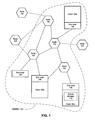
- FIG. 1 is a block diagram of an InfiniBand subnet according to one embodiment of the invention.
- subnet 102 includes nodes 104, which may be switches or other network entities capable of routing communications based on a routing table, routing tree or other schedule.
- Nodes 104 are configured to route communications within subnet 102 as well as the larger network that includes subnet 102.
- Subnet 102 also includes end nodes 106, which may be channel adapters (e.g., target channel adapters and/or host channel adapters). End nodes, such as end nodes 106a - 106c may be coupled to clients such as servers, desktops, portable or other types of computers or processing devices.
- end nodes 106 may be channel adapters (e.g., target channel adapters and/or host channel adapters). End nodes, such as end nodes 106a - 106c may be coupled to clients such as servers, desktops, portable or other types of computers or processing devices.
- subnet manager 110 operates on client 106c.
- the subnet manager may execute on a computer or computing device coupled to a node 104 instead of an end node.
- a secondary subnet manager may be configured to execute on another node of subnet 102 in the event subnet manager 110, or client 106c or the end node coupling client 106c to the subnet, fails.
- Subnet manager 110 is configured to detect changes in the configuration of subnet 102 and to update one or more routing tables for routing communications within the subnet. After updating a routing table, the subnet manager may disseminate it to all nodes in the subnet that are configured to route communications.
- a single node may have multiple local identifiers (LIDs) for routing. Because it may have multiple LIDs, multiple paths can be defined to that node. Multiple paths may be defined to promote load balancing among the paths or constituent network links, to promote fault tolerance, and/or for other purposes. However, for each LID of a node, only one path will be active at a time.
- LIDs local identifiers
- a method for comparing multiple paths to a node having multiple LIDs, and/or for choosing between multiple paths based on one or more selected criteria (e.g., fault tolerance or mean time between failure (MTBF)).
- MTBF mean time between failure
- MTBF may be considered in order to favor network links or components that are less likely to fail.
- multiple fault zones may be defined in a single network or subnet.
- Each zone can contain any subset of the nodes and end nodes in the network or subnet, and fault zones may overlap. However, in one implementation, all nodes and/or end nodes within a single physical enclosure are part of the same fault zone.
- a subnet manager notes the fault zones that are traversed by the current path to that LID. For each fault zone that is traversed by one or more paths to the end node, a weight is defined that is equal to the number of paths to the end node that traverse that fault zone.
- FIG. 2A demonstrates how this weighting process may be applied according to one embodiment of the invention.
- end node 202 has LID S
- end node 204 has two LIDs: X and Y.
- fault zone A receives a zone weight, or path count, of two, and fault zones C and D both receive zone weights of one.
- a path weight can then be defined to characterize the entire path to a LID.
- a path weight is equal to the sums of the zone weights or path counts for each fault zone in the path.
- the subnet manager when a new path becomes available between two end nodes in a subnet, calculates the path weight for the new path, and determines if it would be better to use the new path instead of the current path.
- FIG. 2B depicts the subnet of FIG. 2A with a new path available from LID S to LID Y.
- the subnet manager may update a routing tree or table, and disseminate the routing information to nodes in the subnet.
- the calculation of zone weights may consider all system paths through a fault zone, not just all paths between a specified pair of end nodes.
- the weight assigned to a zone is proportional to the number of system paths that traverse that zone.
- weights may be assigned or calculated on some other basis. For example, weights could be based on the mean time between failure (MBTF) of a set of network entities (e.g., switches, links). In this example, entities that fail relatively frequently will receive worse weights, and hence fewer paths will traverse them. As one result, if such an entity does fail, it will likely have a less drastic effect on network traffic than it would otherwise.
- An entity's weighting may be proportional or inversely proportional to its expected MTBF.
- weights may include link speed, hop count, quality of service (QoS), financial cost, etc. Calculations of weights and paths may use any combination of these and/or other factors.
- QoS quality of service
- FIG. 3 is a flowchart demonstrating a method of calculating fault zone weights and path weights according to one embodiment of the invention.
- a network or subnet is configured with multiple fault zones.
- Each fault zone includes any number of network switching nodes (e.g., switches, routers), end nodes (e.g., channel adapters, network interface adapters), clients (e.g., servers, input/output subsystems, workstations) and/or other devices.
- network switching nodes e.g., switches, routers
- end nodes e.g., channel adapters, network interface adapters
- clients e.g., servers, input/output subsystems, workstations
- other devices e.g., servers, input/output subsystems, workstations
- a subnet manager is installed and configured on a client within the subnet.
- the subnet manager learns the configuration of the subnet, to include nodes and their identifiers, links between nodes, etc.
- the subnet manager identifies one or more paths from one node to an end node.
- the end node may have multiple identifiers (e.g., LIDs, network addresses).
- the subnet manager calculates a zone weight equal to the number of paths to the end node that traverse that zone.
- a path weight is calculated for each path, and is equal to the sums of the zone weights for each fault zone used by the path.
- the zone and/or path weights may be stored by the subnet manager for use in generating a routing table or tree for the subnet.
- operation 312 it is determined whether any more paths in the subnet need to be examined and given weights.
- the subnet manager may examine all paths between each pair of nodes within the subnet or just a subset of all paths. If additional paths need to be examined, the method returns to operation 306.
- the subnet manager assembles and disseminates routing information to appropriate network entities (e.g., switches, routers).
- appropriate network entities e.g., switches, routers.
- the subnet manager selects one path, based on path weights, between a given pair of nodes or node identifiers.
- each network switching element will apply the specified routing for that path until changed by the subnet manager.
- the subnet manager learns of a new path to an end node or one identifier of an end node, for which a different path is currently specified in the subnet routing information.
- the subnet manager calculates zone and path weights for the path, as described above.
- the subnet manager updates the subnet routing information and disseminates updated routing data. The method then ends.
Landscapes
- Engineering & Computer Science (AREA)
- Computer Networks & Wireless Communication (AREA)
- Signal Processing (AREA)
- Data Exchanges In Wide-Area Networks (AREA)
Applications Claiming Priority (2)
| Application Number | Priority Date | Filing Date | Title |
|---|---|---|---|
| US659942 | 2003-09-11 | ||
| US10/659,942 US7480735B2 (en) | 2003-09-11 | 2003-09-11 | System and method for routing network traffic through weighted zones |
Publications (1)
| Publication Number | Publication Date |
|---|---|
| EP1515499A1 true EP1515499A1 (de) | 2005-03-16 |
Family
ID=34136767
Family Applications (1)
| Application Number | Title | Priority Date | Filing Date |
|---|---|---|---|
| EP04255314A Withdrawn EP1515499A1 (de) | 2003-09-11 | 2004-09-02 | System und Verfahren für die Leitweglenkung von Netzwerkverkehr |
Country Status (3)
| Country | Link |
|---|---|
| US (1) | US7480735B2 (de) |
| EP (1) | EP1515499A1 (de) |
| JP (1) | JP2005094768A (de) |
Families Citing this family (14)
| Publication number | Priority date | Publication date | Assignee | Title |
|---|---|---|---|---|
| KR100679013B1 (ko) * | 2004-08-11 | 2007-02-05 | 삼성전자주식회사 | 네트워크 장치 및 이를 이용한 데이터 전송 방법 |
| US7774642B1 (en) * | 2005-02-17 | 2010-08-10 | Oracle America, Inc. | Fault zones for interconnect fabrics |
| US7664038B2 (en) * | 2006-01-31 | 2010-02-16 | At&T Corp. | Method and apparatus for evaluating component costs in a communication network |
| JP5085282B2 (ja) * | 2007-11-06 | 2012-11-28 | 関西電力株式会社 | 無線通信システムならびにそれを用いる情報通信システムおよび給電監視制御システム |
| JP4579995B2 (ja) * | 2008-01-28 | 2010-11-10 | 日本電信電話株式会社 | 経路同定システム |
| FR2960369B1 (fr) * | 2010-05-20 | 2013-03-01 | Bull Sas | Procede d'optimisation de routage dans un cluster comprenant des liens de communication statiques et programme d'ordinateur mettant en oeuvre ce procede |
| US9231888B2 (en) | 2012-05-11 | 2016-01-05 | Oracle International Corporation | System and method for routing traffic between distinct InfiniBand subnets based on source routing |
| US9262155B2 (en) | 2012-06-04 | 2016-02-16 | Oracle International Corporation | System and method for supporting in-band/side-band firmware upgrade of input/output (I/O) devices in a middleware machine environment |
| JP2019503598A (ja) * | 2016-01-27 | 2019-02-07 | オラクル・インターナショナル・コーポレイション | 高性能コンピューティング環境においてスケーラブルなビットマップに基づくP_Keyテーブルをサポートするためのシステムおよび方法 |
| US20200136894A1 (en) * | 2018-10-24 | 2020-04-30 | General Electric Company | System and method for establishing reliable time-sensitive networks |
| US11132249B1 (en) | 2020-07-08 | 2021-09-28 | Bank Of America Corporation | Software code change reversal tool |
| CN114039695A (zh) * | 2021-12-24 | 2022-02-11 | 浙江中控技术股份有限公司 | 冗余网络的时间同步方法、冗余网络系统及设备 |
| WO2024161540A1 (ja) * | 2023-02-01 | 2024-08-08 | 日本電信電話株式会社 | 経路決定装置、経路決定方法及びプログラム |
| CN116938684B (zh) * | 2023-09-19 | 2023-12-26 | 北京锐服信科技有限公司 | 一种网络故障诊断方法与系统 |
Citations (1)
| Publication number | Priority date | Publication date | Assignee | Title |
|---|---|---|---|---|
| EP0892522A1 (de) * | 1997-07-15 | 1999-01-20 | Alcatel | Verfahren und Vorrichtung zur Ansammlung von Parameterinformationen in einem hierarchischen Netz |
Family Cites Families (9)
| Publication number | Priority date | Publication date | Assignee | Title |
|---|---|---|---|---|
| US5031093A (en) * | 1986-12-22 | 1991-07-09 | Nec Corporation | System for establishing route by selecting minimum of time-independent link parameters of incremental values |
| US5404451A (en) * | 1990-02-06 | 1995-04-04 | Nemirovsky; Paul | System for identifying candidate link, determining underutilized link, evaluating addition of candidate link and removing of underutilized link to reduce network cost |
| US5233604A (en) * | 1992-04-28 | 1993-08-03 | International Business Machines Corporation | Methods and apparatus for optimum path selection in packet transmission networks |
| EP0753979A1 (de) * | 1995-07-13 | 1997-01-15 | International Business Machines Corporation | Methode und System für Wegesuche in einem schnellen Paketvermittlungsnetzwerk |
| US6400681B1 (en) * | 1996-06-20 | 2002-06-04 | Cisco Technology, Inc. | Method and system for minimizing the connection set up time in high speed packet switching networks |
| US6260072B1 (en) * | 1997-06-12 | 2001-07-10 | Lucent Technologies Inc | Method and apparatus for adaptive routing in packet networks |
| US6151305A (en) * | 1997-11-14 | 2000-11-21 | Nortel Networks Limited | Method and apparatus for planning an ATM network for an area of concentrated demand for transport bandwidth |
| US7082463B1 (en) * | 2000-06-07 | 2006-07-25 | Cisco Technology, Inc. | Time-based monitoring of service level agreements |
| US6879564B2 (en) * | 2001-02-28 | 2005-04-12 | Microsoft Corp. | Method for designating communication paths in a network |
-
2003
- 2003-09-11 US US10/659,942 patent/US7480735B2/en not_active Expired - Lifetime
-
2004
- 2004-09-02 EP EP04255314A patent/EP1515499A1/de not_active Withdrawn
- 2004-09-13 JP JP2004266128A patent/JP2005094768A/ja not_active Withdrawn
Patent Citations (1)
| Publication number | Priority date | Publication date | Assignee | Title |
|---|---|---|---|---|
| EP0892522A1 (de) * | 1997-07-15 | 1999-01-20 | Alcatel | Verfahren und Vorrichtung zur Ansammlung von Parameterinformationen in einem hierarchischen Netz |
Non-Patent Citations (3)
| Title |
|---|
| BEHRENS J ET AL: "Hierarchical routing using link vectors", INFOCOM '98. SEVENTEENTH ANNUAL JOINT CONFERENCE OF THE IEEE COMPUTER AND COMMUNICATIONS SOCIETIES. PROCEEDINGS. IEEE SAN FRANCISCO, CA, USA 29 MARCH-2 APRIL 1998, NEW YORK, NY, USA,IEEE, US, 29 March 1998 (1998-03-29), pages 702 - 710, XP010270426, ISBN: 0-7803-4383-2 * |
| HERZBERG A: "Connection-based communication in dynamic networks", PROCEEDINGS OF THE ELEVENTH ANNUAL ACM SYMPOSIUM ON PRINCIPLES OF DISTRIBUTED COMPUTING ACM NEW YORK, NY, USA, August 1992 (1992-08-01), pages 13 - 24, XP002306311, ISBN: 0-89791-495-3 * |
| M. SCHWARTZ ET AL: "Routing Techniques used in Computer Communication Networks", XP000559560 * |
Also Published As
| Publication number | Publication date |
|---|---|
| US7480735B2 (en) | 2009-01-20 |
| JP2005094768A (ja) | 2005-04-07 |
| US20060168339A1 (en) | 2006-07-27 |
Similar Documents
| Publication | Publication Date | Title |
|---|---|---|
| US8611232B2 (en) | Method of simple and efficient failure resilient load balancing | |
| US8780899B2 (en) | Method and system for improving traffic distribution across a communication network | |
| US9628387B2 (en) | Network data congestion management probe system | |
| CN110365781B (zh) | 用于对任播数据业务进行负载均衡的方法和系统 | |
| US6324177B1 (en) | Method and apparatus for managing connections based on a client IP address | |
| US8601126B2 (en) | Method and apparatus for providing flow based load balancing | |
| EP1515499A1 (de) | System und Verfahren für die Leitweglenkung von Netzwerkverkehr | |
| US20090094362A1 (en) | Method and system for managing quality of service in a network | |
| CN113315682A (zh) | 生成信息传输性能警告的方法、系统和装置 | |
| US20200084142A1 (en) | Predictive routing in multi-network scenarios | |
| US20240333617A1 (en) | Dynamic multi-cloud network traffic flow monitoring | |
| US8004984B2 (en) | Routing control technique in MPLS | |
| US11005777B2 (en) | Software defined prober | |
| US20150026333A1 (en) | Network system, network management apparatus and application management apparatus | |
| He et al. | Hidden markov model-based load balancing in data center networks | |
| Farrugia et al. | Solving the multicommodity flow problem using an evolutionary routing algorithm in a computer network environment | |
| Houidi et al. | Virtualized network services extension algorithms | |
| KR101968259B1 (ko) | 로컬 네트워크 환경에서 링크 사용량이 최소인 경로를 고려한 포그 서버 배치를 위한 장치 및 방법 | |
| Orzen et al. | Markov chains state transitions for reliable persistent routing | |
| Yuan et al. | Dynamic mapping service function chains in a logical segmented LEO constellation | |
| US12425328B2 (en) | Priority based route programing and advertising | |
| Kandah et al. | SAND: Smart and adaptable networking design using virtual slicing over software-defined network | |
| CN109445934A (zh) | 查询请求的分配方法及系统 | |
| Walkowiak | A unified approach to survivability of connection-oriented networks | |
| Hsu et al. | DiffServ‐based bandwidth‐constrained anycast routing in a mobile IPv6 network |
Legal Events
| Date | Code | Title | Description |
|---|---|---|---|
| PUAI | Public reference made under article 153(3) epc to a published international application that has entered the european phase |
Free format text: ORIGINAL CODE: 0009012 |
|
| AK | Designated contracting states |
Kind code of ref document: A1 Designated state(s): AT BE BG CH CY CZ DE DK EE ES FI FR GB GR HU IE IT LI LU MC NL PL PT RO SE SI SK TR |
|
| AX | Request for extension of the european patent |
Extension state: AL HR LT LV MK |
|
| 17P | Request for examination filed |
Effective date: 20050907 |
|
| AKX | Designation fees paid |
Designated state(s): AT BE BG CH CY CZ DE DK EE ES FI FR GB GR HU IE IT LI LU MC NL PL PT RO SE SI SK TR |
|
| 17Q | First examination report despatched |
Effective date: 20051011 |
|
| STAA | Information on the status of an ep patent application or granted ep patent |
Free format text: STATUS: THE APPLICATION HAS BEEN WITHDRAWN |
|
| 18W | Application withdrawn |
Effective date: 20070501 |