EP1515240A2 - Segmentation des mots chinoises - Google Patents
Segmentation des mots chinoises Download PDFInfo
- Publication number
- EP1515240A2 EP1515240A2 EP04019725A EP04019725A EP1515240A2 EP 1515240 A2 EP1515240 A2 EP 1515240A2 EP 04019725 A EP04019725 A EP 04019725A EP 04019725 A EP04019725 A EP 04019725A EP 1515240 A2 EP1515240 A2 EP 1515240A2
- Authority
- EP
- European Patent Office
- Prior art keywords
- corpus
- morphological
- characters
- tagged
- word
- Prior art date
- Legal status (The legal status is an assumption and is not a legal conclusion. Google has not performed a legal analysis and makes no representation as to the accuracy of the status listed.)
- Withdrawn
Links
Images



Classifications
-
- G—PHYSICS
- G06—COMPUTING OR CALCULATING; COUNTING
- G06F—ELECTRIC DIGITAL DATA PROCESSING
- G06F40/00—Handling natural language data
- G06F40/20—Natural language analysis
- G06F40/268—Morphological analysis
-
- G—PHYSICS
- G06—COMPUTING OR CALCULATING; COUNTING
- G06F—ELECTRIC DIGITAL DATA PROCESSING
- G06F40/00—Handling natural language data
- G06F40/20—Natural language analysis
- G06F40/279—Recognition of textual entities
- G06F40/284—Lexical analysis, e.g. tokenisation or collocates
-
- G—PHYSICS
- G06—COMPUTING OR CALCULATING; COUNTING
- G06F—ELECTRIC DIGITAL DATA PROCESSING
- G06F40/00—Handling natural language data
- G06F40/40—Processing or translation of natural language
- G06F40/53—Processing of non-Latin text
Definitions
- the present invention relates generally to the field of natural language processing. More specifically, the present invention relates to word segmentation.
- Word segmentation refers to the process of identifying the individual words that make up an expression of language, such as text. Word segmentation is useful for checking spelling and grammar, synthesizing speech from text, and performing natural language parsing and understanding, all of which benefit from an identification of individual words.
- the present invention relates to a corpus for use in training a language model.
- the corpus includes a plurality of characters and a plurality of morphological tags associated with a plurality of sequences of characters.
- the plurality of morphological tags indicate a morphological type of an associated sequence of characters and a combination of parts forming a morphological subtype.
- a computer readable medium having instructions for performing word segmentation.
- the instructions include receiving an input of unsegmented text and accessing a language model to determine a segmentation of the text.
- a morphologically derived word is detected in the text and an output indicative of segmented text and an indication of a combination of parts that form the morphologically derived word is provided.
- FIG. 1 illustrates an example of a suitable computing system environment 100 on which the invention may be implemented.
- the computing system environment 100 is only one example of a suitable computing environment and is not intended to suggest any limitation as to the scope of use or functionality of the invention. Neither should the computing environment 100 be interpreted as having any dependency or requirement relating to any one or combination of components illustrated in the exemplary operating environment 100.
- the invention is operational with numerous other general purpose or special purpose computing system environments or configurations.
- Examples of well known computing systems, environments, and/or configurations that may be suitable for use with the invention include, but are not limited to, personal computers, server computers, hand-held or laptop devices, multiprocessor systems, microprocessor-based systems, set top boxes, programmable consumer electronics, network PCs, minicomputers, mainframe computers, distributed computing environments that include any of the above systems or devices, and the like.
- the invention may be described in the general context of computer-executable instructions, such as program modules, being executed by a computer.
- program modules include routines, programs, objects, components, data structures, etc. that perform particular tasks or implement particular abstract data types.
- Those skilled in the art can implement the description and/or figures herein as computer-executable instructions, which can be embodied on any form of computer readable media discussed below.
- the invention may also be practiced in distributed computing environments where tasks are performed by remote processing devices that are linked through a communications network.
- program modules may be located in both local and remote computer storage media including memory storage devices.
- an exemplary system for implementing the invention includes a general purpose computing device in the form of a computer 110.
- Components of computer 110 may include, but are not limited to, a processing unit 120, a system memory 130, and a system bus 121 that couples various system components including the system memory to the processing unit 120.
- the system bus 121 may be any of several types of bus structures including a memory bus or memory controller, a peripheral bus, and a local bus using any of a variety of bus architectures.
- such architectures include Industry Standard Architecture (ISA) bus, Micro Channel Architecture (MCA) bus, Enhanced ISA (EISA) bus, Video Electronics Standards Association (VESA) local bus, and Peripheral Component Interconnect (PCI) bus also known as Mezzanine bus.
- ISA Industry Standard Architecture
- MCA Micro Channel Architecture
- EISA Enhanced ISA
- VESA Video Electronics Standards Association
- PCI Peripheral Component Interconnect
- Computer 110 typically includes a variety of computer readable media.
- Computer readable media can be any available media that can be accessed by computer 110 and includes both volatile and nonvolatile media, removable and non-removable media.
- Computer readable media may comprise computer storage media and communication media.
- Computer storage media includes both volatile and nonvolatile, removable and non-removable media implemented in any method or technology for storage of information such as computer readable instructions, data structures, program modules or other data.
- Computer storage media includes, but is not limited to, RAM, ROM, EEPROM, flash memory or other memory technology, CD-ROM, digital versatile disks (DVD) or other optical disk storage, magnetic cassettes, magnetic tape, magnetic disk storage or other magnetic storage devices, or any other medium which can be used to store the desired information and which can be accessed by computer 110.
- Communication media typically embodies computer readable instructions, data structures, program modules or other data in a modulated data signal such as a carrier wave or other transport mechanism and includes any information delivery media.
- modulated data signal means a signal that has one or more of its characteristics set or changed in such a manner as to encode information in the signal.
- communication media includes wired media such as a wired network or direct-wired connection, and wireless media such as acoustic, RF, infrared and other wireless media. Combinations of any of the above should also be included within the scope of computer readable media.
- the system memory 130 includes computer storage media in the form of volatile and/or nonvolatile memory such as read only memory (ROM) 131 and random access memory (RAM) 132.
- ROM read only memory
- RAM random access memory
- BIOS basic input/output system
- RAM 132 typically contains data and/or program modules that are immediately accessible to and/or presently being operated on by processing unit 120.
- FIG. 1 illustrates operating system 134, application programs 135, other program modules 136, and program data 137.
- the computer 110 may also include other removable/non-removable volatile/nonvolatile computer storage media.
- FIG. 1 illustrates a hard disk drive 141 that reads from or writes to non-removable, nonvolatile magnetic media, a magnetic disk drive 151 that reads from or writes to a removable, nonvolatile magnetic disk 152, and an optical disk drive 155 that reads from or writes to a removable, nonvolatile optical disk 156 such as a CD ROM or other optical media.
- removable/non-removable, volatile/nonvolatile computer storage media that can be used in the exemplary operating environment include, but are not limited to, magnetic tape cassettes, flash memory cards, digital versatile disks, digital video tape, solid state RAM, solid state ROM, and the like.
- the hard disk drive 141 is typically connected to the system bus 121 through a non-removable memory interface such as interface 140, and magnetic disk drive 151 and optical disk drive 155 are typically connected to the system bus 121 by a removable memory interface, such as interface 150.
- hard disk drive 141 is illustrated as storing operating system 144, application programs 145, other program modules 146, and program data 147. Note that these components can either be the same as or different from operating system 134, application programs 135, other program modules 136, and program data 137. Operating system 144, application programs 145, other program modules 146, and program data 147 are given different numbers here to illustrate that, at a minimum, they are different copies.
- a user may enter commands and information into the computer 110 through input devices such as a keyboard 162, a microphone 163, and a pointing device 161, such as a mouse, trackball or touch pad.
- Other input devices may include a joystick, game pad, satellite dish, scanner, or the like.
- a monitor 191 or other type of display device is also connected to the system bus 121 via an interface, such as a video interface 190.
- computers may also include other peripheral output devices such as speakers 197 and printer 196, which may be connected through an output peripheral interface 195.
- the computer 110 may operate in a networked environment using logical connections to one or more remote computers, such as a remote computer 180.
- the remote computer 180 may be a personal computer, a hand-held device, a server, a router, a network PC, a peer device or other common network node, and typically includes many or all of the elements described above relative to the computer 110.
- the logical connections depicted in FIG. 1 include a local area network (LAN) 171 and a wide area network (WAN) 173, but may also include other networks.
- LAN local area network
- WAN wide area network
- Such networking environments are commonplace in offices, enterprise-wide computer networks, intranets and the Internet.
- the computer 110 When used in a LAN networking environment, the computer 110 is connected to the LAN 171 through a network interface or adapter 170. When used in a WAN networking environment, the computer 110 typically includes a modem 172 or other means for establishing communications over the WAN 173, such as the Internet.
- the modem 172 which may be internal or external, may be connected to the system bus 121 via the user-input interface 160, or other appropriate mechanism.
- program modules depicted relative to the computer 110, or portions thereof may be stored in the remote memory storage device.
- FIG. 1 illustrates remote application programs 185 as residing on remote computer 180. It will be appreciated that the network connections shown are exemplary and other means of establishing a communications link between the computers may be used.
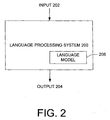
- FIG. 2 generally illustrates a language processing system 200 that receives a language input 202 to provide a language output 204.
- the language processing system 200 can be embodied as a word segmentation system or module that receives as language input 202 unsegmented text.
- the language processing system 200 processes the unsegmented text and provides an output 204 indicative of segmented text and accompanying information related to the segmented text.
- the language processing system 200 can access a language model 206 in order to determine a segmentation for the input text 202.
- Language model 206 can be constructed from an annotated corpus that defines various types of words as well as an indication of the specific type. As appreciated by those skilled in the art, language processing system 200 can be useful in various situations such as spell checking, grammar checking, synthesizing speech from text, speech recognition, information retrieval and performing natural language parsing and understanding to name a few. Additionally, language model 206 may be developed based on the particular application for which language processing system 200 is used.
- system 200 also provides an indication of word type for each of the segmented words.
- Chinese words are defined as one of the following four types: (1) entries in a given lexicon (lexicon words or LWs hereafter), (2) morphologically derived words (MDWs), (3) factoids such as Date, Time, Percentage, Money, etc., and (4) named entities (NEs) such as person names (PNs), location names (LNs), and organization names (ONs).
- PNs person names
- LNs location names
- ONs organization names
- Various subtypes can also be defined. Given the definitions of these types of words, system 200 can provide an output indicative of segmentation and word type. For example, consider the unsegmented sentence in Table 5 below, meaning "Friends Why go to Professor Li Junsheng's home for lunch at twelve thirty.”
- language model 206 detects word types in the input text 202. For lexicon words, word boundaries are detected if the word is contained in the lexicon. For morphologically derived words, morphological patterns are detected, e.g. (which means friend+s) is derived by affixation of the plural affix to the noun (MA_S is a tag that indicates a suffixation pattern), and (which means suddenly) is a reduplication of (happy) (MR_AABB is a tag that indicates an AABB reduplication pattern).
- MA_S is a tag that indicates a suffixation pattern
- MR_AABB reduplication of (happy)
- TIME is a tag that indicates a time expression
- subtypes are detected, e.g. (Li Junsheng) is a person name (PN is a tag that indicates a person name).
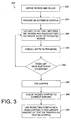
- FIG. 3 illustrates a method 250 for developing an annotated corpus that is to be used for creating language models for word segmentation systems, such as language model 206 of system 200.
- words and rules pertaining to word segmentation are defined. For example, a lexicon for Chinese word segmentation, a rule set for Chinese morphologically derived words, a guideline of Chinese factoids and named entities and/or combinations thereof may be defined for developing the annotated corpus.
- an extensive corpus is provided that includes a large amount of text as well as a large variety of text. The extensive corpus may be chosen from various text sources such as newspapers and magazines.
- a list that matches the words and rules defined in step 252 is extracted from the extensive corpus to create a list of potential words.
- the extracted list can be manually checked if desired to filter out any noise or errors within the list. It is then determined whether the list has sufficient coverage of the defined words and rules at step 260.
- the list may be compared to a balanced, independent test corpus having a wide variety of domains and styles.
- the domains and styles may include text related to culture, economy, literature, military, politics, science and technology, society, sports, computers and law to name a few.
- an application specific corpus may be used having broad coverage of a particular application.
- the corpus is then tagged at step 262. The tagging of the corpus can be performed as discussed below.
- the tagged corpus can be checked and any errors may be corrected.
- the resulting corpus is used as a seed corpus to tag a larger amount of text as a training or testing corpus.
- an annotated corpus is developed that can be evaluated using method 280 in FIG. 4.
- FIG. 4 illustrates a method 280 for creating and evaluating a language model 206 in order to provide improved word segmentation.
- an annotated corpus is developed, the process of which is described above with respect to FIG. 3.
- a training or testing model is created based on the annotated corpus at step 284.
- the model created is evaluated by comparing the model to a predefined test corpus or other models. Given the evaluation performed in step 286, the effectiveness of language model 206 can be determined.
- the output of a word segmentation system using the model can be compared to a standard annotated testing corpus that serves as a standard output of a segmentation system.
- a raw (unannotated) test corpus may be chosen that is independent, balanced and of appropriate size.
- An independent test corpus will have a relatively small overlap with the annotated corpus used to train the language model.
- a balanced corpus contains documents having wide variety of domain, style and time.
- one embodiment of a test corpus includes approximately one million Chinese characters. After developing the test corpus, the corpus is manually annotated to be used as a standard output of a Chinese word segmentation system given the test corpus.
- the test corpus can be annotated using the tagging specification described below or another tagging specification.
- the evaluation may be performed on various subtypes according to equations 1-3 above.
- S PN is the total number of person name tokens in the standard test corpus.
- E PN is the total number of person name tokens in the output of a word segmentation system to be evaluated and M PN is a the number of person name tokens in the output which exactly matched the person names in the standard test set.
- a tagging specification is used to consistently tag the corpora given the definitions of Chinese word types described above. Lexicon words with the lexicon are delimited by brackets without additional tagging. Other types are tagged as provided below.
- FIG. 5 illustrates a diagram of morphological categories for tagging corpora.
- the morphological categories include affixation, reduplication, split, merge and head particle.
- Each morphological category or type includes various subtypes that can be tagged during the tagging process.
- the format in FIG. 5 shows the category, the parts that make the word and the resultant part of speech of the word.
- MP stands for morphological prefix
- MS stands for morphological suffix.
- MR is a reduplication
- ML a split
- MM denotes a merge
- MHP is a morphological head particle.
- the part between the underscore (_) and the (-) is the combination of parts that form the morphologically derived word.
- the characters A, B and C represent Chinese characters.
- Affixation includes subcategories prefix and suffix where a character is added to a string of other characters to morphologically change the word represented by the original character.
- Prefixes includes seven subtypes and suffixes include thirteen subtypes.
- Reduplication occurs where the original word that consists of a pattern of characters is converted into another word consisting of a combination of characters and includes thirty different subtypes. Reduplication also includes a "V", which represents a verb, "O" is an object and "1", "le” and "liaozhi” are particles.
- Split includes a set of expressions that are separate words at the syntactic level but single words at the semantic level.
- a character string ABC may represent the phrase "already ate", where the bi-character word AC represents the word "ate” and is split by the particle character B representing the word "already”.
- Split includes two subtypes. One subtype involves inserting a character or characters between a verb and an object and the other inserts an object between the phrase "qilai”. Merging occurs where one word consisting of two characters and another word consisting of two characters are combined to form a single word and includes three subtypes.
- a head particle occurs when combining a verb character with other characters to form a word and includes two subtypes that combine an adjective and a direction and a verb and a direction.
- Format-1 includes simple tags for various types and subtypes to help facilitate quick and easy tagging by a human. For example, the name entities for person, location and organization are simply tagged as P, L and O, respectively.
- Format-2 represents tagging using the Standardized General Mark-up Language (SGML) according to the Second Multilingual Entity Task Evaluation (MET-2). If desired, a transformation between format-1 and format-2 can be realized through a suitable transformation program.
- SGML Standardized General Mark-up Language
- MET-2 Second Multilingual Entity Task Evaluation
- the strings that are tagged as LOCATION include: oceans, continents, countries, provinces, counties, cities, regions, streets, villages, towns, airports, military bases, roads, railways, bridges, rivers, seas, channels, sounds, bays, straights, sand beach, lakes, parks, mountains, plains, meadows, mines, exhibition centers, etc., fictional or mythical locations, and certain structure, such as the Eiffel Tower and Lincoln Monument.
- Proper names that are to be tagged as Organization include stock exchanges, multinational organizations, businesses, TV or radio stations, political parties, religious groups, orchestras, bands, or musical groups, unions, non-generic governmental entity names such as " congress", or "chamber of deputies,” sports teams and armies ( unless designated only by country names, which are tagged as Location), as well as fictional organizations.
- the TIME type is defined as a temporal unit shorter than a full day, such as "second, minute, or hour”.
- the DATE sub-type is a temporal unit of a full day or longer, such as "day, week, month, quarter, year(s), century, etc.”
- the DURATION sub-type captures durations of time.
- MEASUREX includes: Age, Weight, Length, Temperature, Angle, Area, Capacity, Speed and Rate.
- ADDRESX includes: Email, Phone, Fax, Telex, WWW. [ema exp@email.com.cn] Tel: [pho 86-10-66665555] : [pho 86-10-66665555] FAX: [fax 86-10-66665555] TELEX: [tel 86-10-66665555] [www http:---- www.hotmail.com ]
- tel For numbers of tel or fax, it is to be tagged only there is a designator such as "tel, ".
Landscapes
- Engineering & Computer Science (AREA)
- Theoretical Computer Science (AREA)
- Health & Medical Sciences (AREA)
- Artificial Intelligence (AREA)
- Audiology, Speech & Language Pathology (AREA)
- Computational Linguistics (AREA)
- General Health & Medical Sciences (AREA)
- Physics & Mathematics (AREA)
- General Engineering & Computer Science (AREA)
- General Physics & Mathematics (AREA)
- Machine Translation (AREA)
- Document Processing Apparatus (AREA)
Applications Claiming Priority (2)
| Application Number | Priority Date | Filing Date | Title |
|---|---|---|---|
| US662602 | 2003-09-15 | ||
| US10/662,602 US20050071148A1 (en) | 2003-09-15 | 2003-09-15 | Chinese word segmentation |
Publications (2)
| Publication Number | Publication Date |
|---|---|
| EP1515240A2 true EP1515240A2 (fr) | 2005-03-16 |
| EP1515240A3 EP1515240A3 (fr) | 2007-02-21 |
Family
ID=34136808
Family Applications (1)
| Application Number | Title | Priority Date | Filing Date |
|---|---|---|---|
| EP04019725A Withdrawn EP1515240A3 (fr) | 2003-09-15 | 2004-08-19 | Segmentation des mots chinoises |
Country Status (5)
| Country | Link |
|---|---|
| US (1) | US20050071148A1 (fr) |
| EP (1) | EP1515240A3 (fr) |
| JP (1) | JP2005092883A (fr) |
| KR (1) | KR20050027931A (fr) |
| CN (1) | CN1661592A (fr) |
Cited By (2)
| Publication number | Priority date | Publication date | Assignee | Title |
|---|---|---|---|---|
| CN102043791B (zh) * | 2009-10-10 | 2014-04-30 | 深圳市世纪光速信息技术有限公司 | 分词评价方法及装置 |
| CN104424177A (zh) * | 2013-08-26 | 2015-03-18 | 高德软件有限公司 | 一种抽取核心词的方法及装置 |
Families Citing this family (24)
| Publication number | Priority date | Publication date | Assignee | Title |
|---|---|---|---|---|
| JP4652737B2 (ja) * | 2004-07-14 | 2011-03-16 | インターナショナル・ビジネス・マシーンズ・コーポレーション | 単語境界確率推定装置及び方法、確率的言語モデル構築装置及び方法、仮名漢字変換装置及び方法、並びに、未知語モデルの構築方法、 |
| US20070005345A1 (en) * | 2005-07-01 | 2007-01-04 | Microsoft Corporation | Generating Chinese language couplets |
| JP2007024960A (ja) * | 2005-07-12 | 2007-02-01 | Internatl Business Mach Corp <Ibm> | システム、プログラムおよび制御方法 |
| JP3986531B2 (ja) * | 2005-09-21 | 2007-10-03 | 沖電気工業株式会社 | 形態素解析装置及び形態素解析プログラム |
| US20070078644A1 (en) * | 2005-09-30 | 2007-04-05 | Microsoft Corporation | Detecting segmentation errors in an annotated corpus |
| US8539349B1 (en) | 2006-10-31 | 2013-09-17 | Hewlett-Packard Development Company, L.P. | Methods and systems for splitting a chinese character sequence into word segments |
| US8000955B2 (en) * | 2006-12-20 | 2011-08-16 | Microsoft Corporation | Generating Chinese language banners |
| US20080294982A1 (en) * | 2007-05-21 | 2008-11-27 | Microsoft Corporation | Providing relevant text auto-completions |
| CN101779200B (zh) | 2007-06-14 | 2013-03-20 | 谷歌股份有限公司 | 词典词和短语确定方法和设备 |
| KR101465769B1 (ko) * | 2007-06-14 | 2014-11-27 | 구글 인코포레이티드 | 사전 단어 및 어구 판정 |
| JP5256654B2 (ja) * | 2007-06-29 | 2013-08-07 | 富士通株式会社 | 文章分割プログラム、文章分割装置および文章分割方法 |
| US7962507B2 (en) * | 2007-11-19 | 2011-06-14 | Microsoft Corporation | Web content mining of pair-based data |
| US9411800B2 (en) * | 2008-06-27 | 2016-08-09 | Microsoft Technology Licensing, Llc | Adaptive generation of out-of-dictionary personalized long words |
| US8229965B2 (en) * | 2009-06-30 | 2012-07-24 | Mitsubishi Electric Research Laboratories, Inc. | System and method for maximizing edit distances between particles |
| EP2488963A1 (fr) * | 2009-10-15 | 2012-08-22 | Rogers Communications Inc. | Système et procédé d'identification de locutions |
| CN103631802B (zh) * | 2012-08-24 | 2015-05-20 | 腾讯科技(深圳)有限公司 | 歌曲信息检索方法、装置及相应的服务器 |
| WO2014071330A2 (fr) * | 2012-11-02 | 2014-05-08 | Fido Labs Inc. | Procédé et système de traitement de langage naturel |
| JP5770753B2 (ja) * | 2013-01-15 | 2015-08-26 | グーグル・インコーポレーテッド | Cjk名前検出 |
| US10607604B2 (en) * | 2017-10-27 | 2020-03-31 | International Business Machines Corporation | Method for re-aligning corpus and improving the consistency |
| US10515148B2 (en) * | 2017-12-15 | 2019-12-24 | King Fahd University Of Petroleum And Minerals | Arabic spell checking error model |
| CN109190034B (zh) * | 2018-08-23 | 2019-12-13 | 北京百度网讯科技有限公司 | 用于获取信息的方法及装置 |
| CN109192210B (zh) * | 2018-10-25 | 2023-09-22 | 腾讯科技(深圳)有限公司 | 一种语音识别的方法、唤醒词检测的方法及装置 |
| KR102871441B1 (ko) * | 2019-06-18 | 2025-10-15 | 엘지전자 주식회사 | 음성 정보 기반 언어 모델링 시스템 및 방법 |
| CN117422061B (zh) * | 2023-12-19 | 2024-03-08 | 中南大学 | 一种文本词项多重分割结果合并标注方法及装置 |
Family Cites Families (5)
| Publication number | Priority date | Publication date | Assignee | Title |
|---|---|---|---|---|
| US5806021A (en) * | 1995-10-30 | 1998-09-08 | International Business Machines Corporation | Automatic segmentation of continuous text using statistical approaches |
| US5963893A (en) * | 1996-06-28 | 1999-10-05 | Microsoft Corporation | Identification of words in Japanese text by a computer system |
| US6968308B1 (en) * | 1999-11-17 | 2005-11-22 | Microsoft Corporation | Method for segmenting non-segmented text using syntactic parse |
| US7017114B2 (en) * | 2000-09-20 | 2006-03-21 | International Business Machines Corporation | Automatic correlation method for generating summaries for text documents |
| TWI256562B (en) * | 2002-05-03 | 2006-06-11 | Ind Tech Res Inst | Method for named-entity recognition and verification |
-
2003
- 2003-09-15 US US10/662,602 patent/US20050071148A1/en not_active Abandoned
-
2004
- 2004-08-19 EP EP04019725A patent/EP1515240A3/fr not_active Withdrawn
- 2004-09-14 KR KR1020040073392A patent/KR20050027931A/ko not_active Withdrawn
- 2004-09-15 CN CN2004101023878A patent/CN1661592A/zh active Pending
- 2004-09-15 JP JP2004269036A patent/JP2005092883A/ja active Pending
Cited By (3)
| Publication number | Priority date | Publication date | Assignee | Title |
|---|---|---|---|---|
| CN102043791B (zh) * | 2009-10-10 | 2014-04-30 | 深圳市世纪光速信息技术有限公司 | 分词评价方法及装置 |
| CN104424177A (zh) * | 2013-08-26 | 2015-03-18 | 高德软件有限公司 | 一种抽取核心词的方法及装置 |
| CN104424177B (zh) * | 2013-08-26 | 2017-09-15 | 高德软件有限公司 | 一种抽取核心词的方法及装置 |
Also Published As
| Publication number | Publication date |
|---|---|
| CN1661592A (zh) | 2005-08-31 |
| JP2005092883A (ja) | 2005-04-07 |
| US20050071148A1 (en) | 2005-03-31 |
| EP1515240A3 (fr) | 2007-02-21 |
| KR20050027931A (ko) | 2005-03-21 |
Similar Documents
| Publication | Publication Date | Title |
|---|---|---|
| EP1515240A2 (fr) | Segmentation des mots chinoises | |
| Ruokolainen et al. | A Finnish news corpus for named entity recognition | |
| Shaalan et al. | NERA: Named entity recognition for Arabic | |
| Nothman et al. | Learning multilingual named entity recognition from Wikipedia | |
| Chinchor et al. | Appendix E: MUC-7 named entity task definition (version 3.5) | |
| Maekawa et al. | Balanced corpus of contemporary written Japanese | |
| Michailovsky et al. | Documenting and researching endangered languages: the Pangloss Collection | |
| US6810146B2 (en) | Method and system for segmenting and identifying events in images using spoken annotations | |
| McNeil | Tunisian arabic corpus: Creating a written corpus of an ‘unwritten’language | |
| Bjarnadóttir et al. | DIM: The database of Icelandic morphology | |
| Jibril et al. | Anec: An amharic named entity corpus and transformer based recognizer | |
| Yang et al. | Combination and boundary detection approaches on Chinese indexing | |
| Cheng et al. | [Retracted] Automatic Text Summarization for Public Health WeChat Official Accounts Platform Base on Improved TextRank | |
| Sujatna et al. | Objective or subjective adjectives? A case study on UNESCO Global Geopark tourism texts | |
| de Souza et al. | Development of a brazilian portuguese hotel’s reviews corpus | |
| Zavorin et al. | Corpora for cross-language information retrieval in six less-resourced languages | |
| Setiyadi et al. | Existence of Arabicization methods for naturalising contemporary technical vocabularies into the Arabic language | |
| Marquilhas et al. | Manuscripts and machines: the automatic replacement of spelling variants in a Portuguese historical corpus | |
| Ringland | Structured named entities | |
| Blessing et al. | Crosslingual distant supervision for extracting relations of different complexity | |
| Liu | Automatic identification of locative expressions from informal text | |
| CN101576898A (zh) | 一种适用于网络学术资源永久存档及使用的元数据方案 | |
| Wu et al. | Adaptive named entity recognition based on conditional random fields with automatic updated dynamic gazetteers | |
| Stosic | Serbian nominal groups: System and structure | |
| Lam et al. | Context‐based generic cross‐lingual retrieval of documents and automated summaries |
Legal Events
| Date | Code | Title | Description |
|---|---|---|---|
| PUAI | Public reference made under article 153(3) epc to a published international application that has entered the european phase |
Free format text: ORIGINAL CODE: 0009012 |
|
| AK | Designated contracting states |
Kind code of ref document: A2 Designated state(s): AT BE BG CH CY CZ DE DK EE ES FI FR GB GR HU IE IT LI LU MC NL PL PT RO SE SI SK TR |
|
| AX | Request for extension of the european patent |
Extension state: AL HR LT LV MK |
|
| PUAL | Search report despatched |
Free format text: ORIGINAL CODE: 0009013 |
|
| AK | Designated contracting states |
Kind code of ref document: A3 Designated state(s): AT BE BG CH CY CZ DE DK EE ES FI FR GB GR HU IE IT LI LU MC NL PL PT RO SE SI SK TR |
|
| AX | Request for extension of the european patent |
Extension state: AL HR LT LV MK |
|
| RIC1 | Information provided on ipc code assigned before grant |
Ipc: G06F 17/28 20060101ALI20070112BHEP Ipc: G06F 17/27 20060101AFI20070112BHEP |
|
| 17P | Request for examination filed |
Effective date: 20070723 |
|
| AKX | Designation fees paid |
Designated state(s): AT BE BG CH CY CZ DE DK EE ES FI FR GB GR HU IE IT LI LU MC NL PL PT RO SE SI SK TR |
|
| 17Q | First examination report despatched |
Effective date: 20071109 |
|
| STAA | Information on the status of an ep patent application or granted ep patent |
Free format text: STATUS: THE APPLICATION IS DEEMED TO BE WITHDRAWN |
|
| 18D | Application deemed to be withdrawn |
Effective date: 20080520 |