EP1515226A2 - Modulare Multiplikation - Google Patents
Modulare Multiplikation Download PDFInfo
- Publication number
- EP1515226A2 EP1515226A2 EP04021411A EP04021411A EP1515226A2 EP 1515226 A2 EP1515226 A2 EP 1515226A2 EP 04021411 A EP04021411 A EP 04021411A EP 04021411 A EP04021411 A EP 04021411A EP 1515226 A2 EP1515226 A2 EP 1515226A2
- Authority
- EP
- European Patent Office
- Prior art keywords
- multmoddiv
- value
- operations
- calculated
- values
- Prior art date
- Legal status (The legal status is an assumption and is not a legal conclusion. Google has not performed a legal analysis and makes no representation as to the accuracy of the status listed.)
- Granted
Links
Images
Classifications
-
- G—PHYSICS
- G06—COMPUTING OR CALCULATING; COUNTING
- G06F—ELECTRIC DIGITAL DATA PROCESSING
- G06F7/00—Methods or arrangements for processing data by operating upon the order or content of the data handled
- G06F7/60—Methods or arrangements for performing computations using a digital non-denominational number representation, i.e. number representation without radix; Computing devices using combinations of denominational and non-denominational quantity representations, e.g. using difunction pulse trains, STEELE computers, phase computers
- G06F7/72—Methods or arrangements for performing computations using a digital non-denominational number representation, i.e. number representation without radix; Computing devices using combinations of denominational and non-denominational quantity representations, e.g. using difunction pulse trains, STEELE computers, phase computers using residue arithmetic
- G06F7/722—Modular multiplication
Definitions
- the invention relates generally to the technical field of mechanical Performing arithmetic operations and more specifically the field of modular multiplication of two numbers.
- the Invention for use in cryptographic calculations such as for example, be carried by portable media.
- portable media can be a portable disk, for example a Chip card or a chip module in different designs or a other resource-limited system.
- High-performance portable data carriers usually have a special one Hardware support for arithmetic operations, e.g. as arithmetic or cryptographic coprocessor can be configured.
- hardware support is limited to calculations whose Operands and results in terms of their number of places a predetermined Do not exceed the maximum length.
- modular arithmetic e.g. the modular multiplication considered here - it is not easy, the length limitation given by the hardware support to overcome.
- modular multiplications become in the RSA method described in U.S. Patent 4,405,829 executed.
- a modular power calculation is performed a value to be encrypted or decrypted with respect to a module containing the Product of two large primes is.
- the modular power calculation is usually performed by a series of modular multiplications. Because the security of the RSA method relies on the difficulty of having the Factorize the module without additional information into the two primes, the module should have the largest possible number of digits. Depending on In concrete application, it may be desirable to have a number of digits to use, which is greater than that given by the hardware of the disk Maximum length for the modular arithmetic is.
- the object of the invention is, at least, the problems outlined above partly to avoid and a technique to machine a to propose modular multiplication, which works very efficiently.
- the proposed technique is an already Hardware support available for modular arithmetic with one predetermined number of digits, use a modular multiplication to provide with a higher number of digits.
- Preferred embodiments The technique should be particularly well-suited for use in cryptographic Be suitable method and / or portable data carriers.
- the modular multiplication is supported on multimodDiv operations with a lower number of digits .
- a MultModDiv operation computes the integer quotient and remainder that results from dividing the product of two factors by a divisor.
- MultModDiv operations are already known from the Fischer and Seifert method reviewed above.
- the method according to the invention requires less than six, preferably five, MultModDiv operations for multiplication. This results in comparison to the known method an increase in efficiency by at least the factor 6/5, which represents a considerable advantage in many applications.
- the values A and B to be multiplied modulatively with respect to the modulus N are represented in the form of two subvalues A1, A0 and B1, B0, respectively, which are the integral quotient or the remainder of a division of the value A or B by a splitting value Z correspond.
- the calculation of the partial values A1, A0, B1, B0 from the values A, B to be multiplied can be part of the multiplication method, or the calculation can take place in a preparatory step, or the values A, B can already be used as a result Other calculations in the form of the corresponding partial values A1, A0, B1, B0 are present.
- the partial values A1, A0, B1, B0 are used according to the invention together with the division value Z in three MultModDiv operations, and at least one result of these three MultModDiv operations is utilized in at least one further MultModDiv operation. In preferred embodiments, exactly two of these other MultModDiv operations are performed.
- the supplementary value N0 is calculated in a preparatory method step, while in other embodiments it is fixedly specified or determined only during the actual multiplication.
- the multiplication result A * B in the form of a quotient Q and a remainder R with respect to the division value Z is then calculated as a divisor.
- the choice of the split value Z determines to what extent the number of digits of the multiplication method exceeds the number of digits needed for the MultModDiv operations.
- the gain is particularly great when the absolute value of the difference N - Z * Z has approximately half the number of digits of the modulus N.
- the split value Z may be calculated in a preparatory step as the largest integer value less than or equal to the square root of N.
- the multiplication method can process operands that are about twice as long as the operands of the MultModDiv operations, so that one can speak of "operand length doubling ".
- the MultModDiv operations are supported in preferred embodiments of a hardware that may be configured, for example, as a cryptographic or arithmetic coprocessor.
- the hardware support is particularly efficient if the coprocessor is able to execute the MultModDiv operations immediately.
- the method described herein may also be used advantageously in the context of hardware that supports only modular multiplications, because a low software cost MultModDiv operation can be implemented by a method that essentially requires two modular multiplications.
- the operations provided by the hardware preferably have only a less than the required number of digits - eg about half the number of digits.
- the multiplication method comprises at least one reduction step modulo N, the quotient Q and the rest R in one to transfer the desired value range.
- the multiplication method comprises at least one reduction step modulo N, the quotient Q and the rest R in one to transfer the desired value range.
- the multiplication method can be a complete reduction modulo N or one only partially Reduction will be performed only for subsequent calculations required minimum conditions.
- the method is preferably arranged as a sub-step of a modular Power calculation ("Exponentation") to be executed.
- the power calculation method can use the "quadrature and multiply" principle be configured, in which the exponent through bitwise and an intermediate result for each "1" bit with the one to be raised Basic value multiplied and each bit rate advanced is squared.
- those of the multiplication method values Q and R are preferably provided such that for the next multiplication - this includes a squaring - directly as partial values A1, A0 and / or as partial values B1, B0 to let.
- Become preparatory and follow-up steps of the multiplication process preferably executed only once for each power calculation.
- the computer program product according to the invention has program instructions in order to implement the method according to the invention.
- One such computer program product may be a physical medium For example, a semiconductor memory or a floppy disk or a CD-ROM.
- the computer program product may also be non-physical Medium, for example, a transmitted over a computer network Signal.
- such a computer program product can program instructions included in the manufacture and / or initialization and / or personalization of a portable data carrier become.
- the computer program product and / or the portable data carrier with features that the described above and / or in the dependent method claims corresponded features.
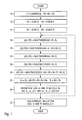
- Fig. 1 as a single drawing figure shows a flowchart of a method for modular multiplication in one embodiment of the invention.
- the method shown schematically in FIG. 1 is intended to be executed by a processor of a portable data carrier, in particular a chip card ( smart card ) or a chip module.
- the method is implemented in the form of program instructions for this processor, which are stored in a ROM or EEPROM of the data carrier.
- the data carrier also has a cryptographic or mathematical coprocessor which supports various modular operations with a predefined maximum number of digits, which may be 1024 bits, for example.
- the aim of the method described in the following is a modular multiplication for integer values A, B with respect to a modulus N, where the values A, B and the modulus N are considerably greater than the maximum length specified by the coprocessor - in the present Embodiment approximately twice the length - have.
- the procedure is used to on the disk using 1024-bit coprocessor operations RSA method - e.g. for coding or decoding or verification or signature generation - with a key length of up to 2048 bits to implement.
- a division value Z is first determined.
- the division value Z is intended to be an integer having the property that the number of binary digits of the absolute value of the difference N - Z * Z is about half the binary digit number of the modulus N.
- This property is achieved in step 10 by calculating the split value Z as the largest integer whose square is less than or equal to the modulus N.
- "sqrt" denotes the square root function
- the square brackets denote the so-called " floor " function, that is, the rounding down to the nearest integer.
- the calculations given in step 10 can be done as soon as the module N is known. In some This can already be the case during initialization or personalization the disk will be the case; Step 10 can then be outside the Disk.
- step 12 the first value A to be multiplied with respect to the division value Split Z into an integer quotient and a remainder, which are referred to as sub-values A1 and A0.
- steps 16-28 the main part of the method described here is carried out.
- a total of five calls are made to a modular operation, here referred to as MultModDiv .
- the MultModDiv operation takes as arguments two factors and a divisor, and it delivers as results the integer quotient and the remainder of a division of the product of the two factors by the divisor.
- the MultModDiv operation is essentially based on two modular multiplications performed by the data carrier's cryptographic coprocessor.
- the split value Z is used as a divisor.
- all the arguments of the MultModDiv operations in steps 16-24 each have only about half the number of digits as the module N.
- the method thus provides approximately a doubling of the number of digits for modular arithmetic provided by the cryptographic co-processor.
- the factors of the first MultModDiv operation performed in step 16 are the sub- values A1 and B1.
- the second MultModDiv operation performed in step 18 has the sums A0 + A1 and B0 + B1 as factors.
- the third MultModDiv operation in step 20 the partial values A0 and B0 are used as factors.
- the results are stored in the variables or memory fields Q1 - Q3 and R1 - R3. Obviously, the operations mentioned in steps 16-20 are independent of each other. In alternative embodiments, steps 16-20 may therefore be performed in a different order or even interleaved.
- Steps 22 and 24 relate to two more MultModDiv operations, which incorporate the results of the first three MultModDiv operations. More specifically, a factor of the first further MultModDiv operation in step 22 is the quotient Q1 determined in the first MultModDiv operation in step 16, and a factor of the second further MultModDiv operation in step 24 results from the sum / difference calculation Q1 - Q2 + Q3 + Q4 - R1.
- the results of steps 22 and 24 are stored in the variables or memory arrays Q4, Q5, R4 and R5.
- the respective other factor in steps 22 and 24 is the supplementary value N0, which was already calculated in step 10 in the present exemplary embodiment, while in alternative embodiments the calculation of the value N0 takes place only later in connection with steps 22 and 24. Since step 24 in the present embodiment requires the quotients Q1-Q4 calculated in the other four MultModDiv operations, this operation must be performed last. On the other hand, the MultModDiv operation of step 22 only requires the result Q1 of step 16, and therefore may be performed earlier than shown in FIG. 1 in alternative embodiments of the method.
- step 26 the total product A * B modulo N to be calculated is calculated as a quotient Q and a remainder R with respect to the division value Z as a divisor.
- the value pair (Q, R) can be replaced by one of the value pairs (Q + 1, RZ), (Q-1, R + Z), (Q + Z, R + N0) and (QZ, R). N0).
- the overall result Q * Z + R modulo N does not change. So that as few as possible comparison and replacement steps are required in the modular reduction, in preferred embodiments, a predetermined sequence of loops and conditional assignments is carried out, which ensures that the intended value range for Q and R is achieved quickly, reliably and without danger of an endless loop.
- R3: SO LONG R ⁇ 0 EXECUTE (Q, R): (Q-1, R + Z)
- R4: SO LONG R ⁇ Z EXECUTE (Q, R): (Q + 1, RZ)
- R5: IF Q ⁇ 0 THEN (Q, R): (Q + Z, R + N0)
- R6: IF R ⁇ Z THEN (Q, R): (Q + 1, RZ)
- R7: IF R ⁇ Z THEN (Q, R): (Q + 1, RZ)
- R8: IF Q> Z + 1 THEN (Q, R): (QZ, R-N0)
- step 28 After the reduction steps of step 28 - or in alternative executions a comparable sequence - the result values Q and R satisfy the Conditions 0 ⁇ Q ⁇ Z + 1 and 0 ⁇ R ⁇ Z. These are the result values for these results Q and R also satisfy the conditions that preceded step 16 for the subtotals A1, A0 and B1, B0 were required.
- This program flow is indicated in Fig. 1 by a dashed arrow.
Landscapes
- Physics & Mathematics (AREA)
- General Physics & Mathematics (AREA)
- Engineering & Computer Science (AREA)
- Computational Mathematics (AREA)
- Mathematical Analysis (AREA)
- Mathematical Optimization (AREA)
- Pure & Applied Mathematics (AREA)
- Theoretical Computer Science (AREA)
- Mathematical Physics (AREA)
- General Engineering & Computer Science (AREA)
- Computing Systems (AREA)
- Complex Calculations (AREA)
- Percussion Or Vibration Massage (AREA)
- Flexible Shafts (AREA)
- Reciprocating, Oscillating Or Vibrating Motors (AREA)
- Stored Programmes (AREA)
Abstract
Description
i:=n; R:=0; Q:=0; Q':=0
SOLANGE i > 0 FÜHRE AUS
| R1: | SOLANGE | Q < 0 | FÜHRE AUS | (Q, R) := (Q+Z, R+N0) |
| R2: | SOLANGE | Q > Z+1 | FÜHRE AUS | (Q, R) := (Q-Z, R-N0) |
| R3: | SOLANGE | R < 0 | FÜHRE AUS | (Q, R) := (Q-1, R+Z) |
| R4: | SOLANGE | R ≥ Z | FÜHRE AUS | (Q, R) := (Q+1, R-Z) |
| R5: | WENN | Q < 0 | DANN | (Q, R) := (Q+Z, R+N0) |
| R6: | WENN | R ≥ Z | DANN | (Q, R) := (Q+1, R-Z) |
| R7: | WENN | R ≥ Z | DANN | (Q, R) := (Q+1, R-Z) |
| R8: | WENN | Q > Z+1 | DANN | (Q, R) := (Q-Z, R-N0) |
| R9: | WENN | R < 0 | DANN | (Q, R) := (Q-1, R+Z) |
| R10: | WENN | R < 0 | DANN | (Q, R) := (Q-1, R+Z) |
| R11: | WENN | Q = Z+1 | DANN | (Q, R) := (Q-1, R+Z) |
| R12: | WENN | R ≥ N0 | DANN | (Q, R) := (Q-Z, R-N0) |
Claims (17)
- Verfahren zum maschinellen Ausführen einer modularen Multiplikation zweier Werte A, B bezüglich eines Moduls N, wobei:der erste zu multiplizierende Wert A für einen Aufteilungswert Z durch zwei Teilwerte A1, A0 mit A = A1*Z + A0 dargestellt wird und der zweite zu multiplizierende Wert B durch zwei Teilwerte B1, B0 mit B = B1*Z + B0 dargestellt wird,die folgenden MultModDiv-Operationen ausgeführt werden, die jeweils den ganzzahligen Quotienten und den Rest einer Division des Produkts zweier Faktoren durch den Aufteilungswert Z ermitteln:eine erste MultModDiv-Operation (16) mit den Teilwerten A1 und B1 als Faktoren,eine zweite MultModDiv-Operation (18) mit einem aus den Teilwerten A0 und A1 berechneten ersten Faktor und einem aus den Teilwerten B0 und B1 berechneten zweiten Faktor,eine dritte MultModDiv-Operation (20) mit den Teilwerten A0 und B0 als Faktoren, undmindestens eine weitere MultModDiv-Operation (22, 24), deren erster Faktor von zumindest einem Ergebnis der ersten, zweiten und/oder dritten MultModDiv-Operation abhängt und deren zweiter Faktor ein Ergänzungswert N0 ist, für den Z*Z = -N0 modulo N gilt, undein Quotient Q und ein Rest R mit Q*Z + R = A*B in Abhängigkeit von zumindest einem Ergebnis der MultModDiv-Operationen berechnet werden.
- Verfahren nach Anspruch 1, dadurch gekennzeichnet, daß für die Multiplikation der Werte A, B insgesamt höchstens fünf und vorzugsweise genau fünf MultModDiv-Operationen ausgeführt werden.
- Verfahren nach Anspruch 1 oder Anspruch 2, dadurch gekennzeichnet, daß die zweite MultModDiv-Operation (18) die Summe A0+A1 als ersten Faktor und die Summe B0+B1 als zweiten Faktor aufweist.
- Verfahren nach einem der Ansprüche 1 bis 3, dadurch gekennzeichnet, daß die folgenden fünf MultModDiv-Operationen ausgeführt werden:(Q1, R1) := MultModDiv(A1, B1, Z),(Q2, R2) := MultModDiv(A0+A1, B0+B1, Z),(Q3, R3) := MultModDiv(A0, B0, Z),(Q4, R4) := MultModDiv(Q1, N0, Z), und(Q5, R5) := MultModDiv(Q1-Q2+Q3+Q4-R1, N0, Z).
- Verfahren nach Anspruch 4, dadurch gekennzeichnet, daß der Quotient Q und der Rest R durch Q := Q3 + Q5 - R1 + R2 - R3 - R4 und R := R3 + R5 berechnet werden.
- Verfahren nach einem der Ansprüche 1 bis 5, dadurch gekennzeichnet, daß der Aufteilungswert Z derart bestimmt wird, daß der Absolutwert der Differenz N - Z*Z eine Stellenanzahl zwischen 25 % und 75 %, vorzugsweise zwischen 40 % und 60 %, der Stellenanzahl von N aufweist.
- Verfahren nach einem der Ansprüche 1 bis 6, dadurch gekennzeichnet, daß der Aufteilungswert Z in einem vorbereitenden Schritt (10) als größter ganzzahliger Wert, der kleiner oder gleich der Quadratwurzel von N ist, berechnet wird.
- Verfahren nach einem der Ansprüche 1 bis 7, dadurch gekennzeichnet, daß in mindestens einem vorbereitenden Schritt (12, 14) die Teilwerte A1, A0 durch eine Division mit Rest des Wertes A durch den Aufteilungswert Z berechnet werden und die Teilwerte B1, B0 durch eine Division mit Rest des Wertes B durch den Aufteilungswert Z berechnet werden.
- Verfahren nach einem der Ansprüche 1 bis 8, dadurch gekennzeichnet, daß mindestens ein Reduktionsschritt modulo N ausgeführt wird (28, 30), um für den Quotienten Q einen Wertebereich 0 ≤ Q ≤ Z+1 und für den Rest R einen Wertebereich 0 ≤ R < Z zu erhalten.
- Verfahren nach einem der Ansprüche 1 bis 9, dadurch gekennzeichnet, daß das Verfahren zur Ausführung durch eine Hardware vorgesehen ist, die MultModDiv-Operationen unterstützt.
- Verfahren nach einem der Ansprüche 1 bis 10, dadurch gekennzeichnet, daß die Hardware MultModDiv-Operationen und/oder modulare Multiplikationen mit einer dem Aufteilungswert Z entsprechenden Stellenanzahl unterstützt, nicht jedoch modulare Multiplikationen mit einer dem Modul N entsprechenden Stellenanzahl.
- Verfahren nach einem der Ansprüche 1 bis 11, dadurch gekennzeichnet, daß das Verfahren dazu vorgesehen ist, in Zusammenhang mit einem RSA-Codierverfahren oder einem RSA-Decodierverfahren oder einem RSA-Verifikationsverfahren oder einem RSA-Signaturverfahren eingesetzt zu werden.
- Verfahren nach einem der Ansprüche 1 bis 12, dadurch gekennzeichnet, daß das Verfahren als Teilschritt in einer modularen Potenzberechnung ausgeführt wird.
- Verfahren nach Anspruch 13, dadurch gekennzeichnet, daß das Multiplikationsverfahren den Quotienten Q und den Rest R derart bereitstellt, daß die Werte Q, R bei einem weiteren Durchlauf des Multiplikationsverfahrens im Rahmen der modularen Potenzberechnung unmittelbar als Teilwerte A1, A0 und/oder als Teilwerte B1, B0 verwendbar sind.
- Computerprogrammprodukt, das Programmbefehle aufweist, um mindestens einen Prozessor zu veranlassen, ein Verfahren mit den Merkmalen eines der Ansprüche 1 bis 14 auszuführen.
- Tragbarer Datenträger, insbesondere Chipkarte oder Chipmodul, der zur Ausführung eines Verfahrens mit den Merkmalen eines der Ansprüche 1 bis 14 eingerichtet ist.
- Tragbarer Datenträger nach Anspruch 16, dadurch gekennzeichnet, daß der Datenträger einen Koprozessor aufweist, der MultModDiv-Operationen unterstützt.
Applications Claiming Priority (2)
| Application Number | Priority Date | Filing Date | Title |
|---|---|---|---|
| DE10341803A DE10341803A1 (de) | 2003-09-10 | 2003-09-10 | Modulare Multiplikation |
| DE10341803 | 2003-09-10 |
Publications (3)
| Publication Number | Publication Date |
|---|---|
| EP1515226A2 true EP1515226A2 (de) | 2005-03-16 |
| EP1515226A3 EP1515226A3 (de) | 2006-05-17 |
| EP1515226B1 EP1515226B1 (de) | 2008-12-24 |
Family
ID=34129736
Family Applications (1)
| Application Number | Title | Priority Date | Filing Date |
|---|---|---|---|
| EP04021411A Expired - Lifetime EP1515226B1 (de) | 2003-09-10 | 2004-09-09 | Modulare Multiplikation |
Country Status (3)
| Country | Link |
|---|---|
| EP (1) | EP1515226B1 (de) |
| AT (1) | ATE418758T1 (de) |
| DE (2) | DE10341803A1 (de) |
Cited By (5)
| Publication number | Priority date | Publication date | Assignee | Title |
|---|---|---|---|---|
| WO2009034800A1 (ja) * | 2007-09-14 | 2009-03-19 | Hitachi, Ltd. | 剰余乗算処理装置 |
| US8176109B2 (en) | 2005-10-28 | 2012-05-08 | Infineon Technologies Ag | Calculating unit for reducing an input number with respect to a modulus |
| US8364737B2 (en) | 2005-10-28 | 2013-01-29 | Infineon Technologies Ag | Device and method for calculating a result of a sum with a calculating unit with limited word length |
| US8364740B2 (en) | 2005-10-28 | 2013-01-29 | Infineon Technologies Ag | Device and method for calculating a result of a modular multiplication with a calculating unit smaller than the operands |
| US8417760B2 (en) | 2005-10-28 | 2013-04-09 | Infineon Technologies Ag | Device and method for calculating a multiplication addition operation and for calculating a result of a modular multiplication |
Citations (1)
| Publication number | Priority date | Publication date | Assignee | Title |
|---|---|---|---|---|
| WO2005022378A1 (fr) | 2003-08-21 | 2005-03-10 | Gemplus | Procede de realisation d'une multiplication modulaire et procede de realisation d'une multiplication euclidienne sur des nombres de 2n bits |
-
2003
- 2003-09-10 DE DE10341803A patent/DE10341803A1/de not_active Withdrawn
-
2004
- 2004-09-09 AT AT04021411T patent/ATE418758T1/de not_active IP Right Cessation
- 2004-09-09 EP EP04021411A patent/EP1515226B1/de not_active Expired - Lifetime
- 2004-09-09 DE DE502004008726T patent/DE502004008726D1/de not_active Expired - Lifetime
Patent Citations (1)
| Publication number | Priority date | Publication date | Assignee | Title |
|---|---|---|---|---|
| WO2005022378A1 (fr) | 2003-08-21 | 2005-03-10 | Gemplus | Procede de realisation d'une multiplication modulaire et procede de realisation d'une multiplication euclidienne sur des nombres de 2n bits |
Non-Patent Citations (3)
| Title |
|---|
| A. KARATSUBA; YU. OFMAN: "Multiplication of multidigit numbers on automata", vol. 7, 1963, SOVIET PHYSICS, pages: 595 - 596 |
| DONALD E. KNUTH: "The Art of Computer Programming", vol. 2, 1997, ADDISON-WESLEY |
| DONALD E. KNUTH: "The Art of Computer Programming", vol. 2, 1997, ADDISON-WESLEY, pages: 294 - 295 |
Cited By (6)
| Publication number | Priority date | Publication date | Assignee | Title |
|---|---|---|---|---|
| US8176109B2 (en) | 2005-10-28 | 2012-05-08 | Infineon Technologies Ag | Calculating unit for reducing an input number with respect to a modulus |
| US8364737B2 (en) | 2005-10-28 | 2013-01-29 | Infineon Technologies Ag | Device and method for calculating a result of a sum with a calculating unit with limited word length |
| US8364740B2 (en) | 2005-10-28 | 2013-01-29 | Infineon Technologies Ag | Device and method for calculating a result of a modular multiplication with a calculating unit smaller than the operands |
| US8417760B2 (en) | 2005-10-28 | 2013-04-09 | Infineon Technologies Ag | Device and method for calculating a multiplication addition operation and for calculating a result of a modular multiplication |
| US8977668B2 (en) | 2005-10-28 | 2015-03-10 | Infineon Technologies Ag | Calculating unit for reducing an input number with respect to a modulus |
| WO2009034800A1 (ja) * | 2007-09-14 | 2009-03-19 | Hitachi, Ltd. | 剰余乗算処理装置 |
Also Published As
| Publication number | Publication date |
|---|---|
| EP1515226A3 (de) | 2006-05-17 |
| ATE418758T1 (de) | 2009-01-15 |
| DE10341803A1 (de) | 2005-04-21 |
| DE502004008726D1 (de) | 2009-02-05 |
| EP1515226B1 (de) | 2008-12-24 |
Similar Documents
| Publication | Publication Date | Title |
|---|---|---|
| DE69828787T2 (de) | Verbessertes verfahren und vorrichtung zum schutz eines verschlüsselungsverfahrens mit öffentlichem schlüssel gegen angriffe mit zeitmessung und fehlereinspeisung | |
| DE69838390T2 (de) | Verbessertes gerät und verfahren für modulare multiplikation und exponentation basierend auf montgomerymultiplikation | |
| EP1360579B1 (de) | Verfahren und vorrichtung zum modularen multiplizieren und rechenwerk zum modularen multiplizieren | |
| Jameson | The prime number theorem | |
| DE69716331T2 (de) | Schaltung für Modulo-Multiplikations- und Exponentiationsarithmetik | |
| Short | The primitive soluble permutation groups of degree less than 256 | |
| EP2771782B1 (de) | Effiziente primzahlprüfung | |
| DE10357661B4 (de) | Modularer Montgomery-Multiplizierer und zugehöriges Multiplikationsverfahren | |
| DE102008051447B4 (de) | Verfahren und Vorrichtung zum Schützen einer RSA-Berechnung an einer Ausgabe mit Hilfe des chinesischen Restsatzes | |
| DE69837036T2 (de) | Verfahren und vorrichtung zur ausführung einer entschlüsselung mittels einer standardisierten modularen potenzierung zum vereiteln eines zeitangriffs | |
| EP1370933B1 (de) | Verfahren und vorrichtung zum modularen multiplizieren | |
| DE60208926T2 (de) | Fliessbandkern in einem montgomery-multiplizierer | |
| DE102006025673B9 (de) | Rechenwerk zum Reduzieren einer Eingabe-Zahl bezüglich eines Moduls | |
| EP1515226B1 (de) | Modulare Multiplikation | |
| EP1499954A2 (de) | Berechnung eines ergebnisses einer modularen multiplikation | |
| EP1428112B1 (de) | Verfahren und vorrichtung zum berechnen eines ergebnisses einer exponentiation | |
| DE102010051853A1 (de) | Verfahren zur Langzahldivision | |
| DE102006025713B4 (de) | Kryptographie-Vorrichtung und Kryptographie-Verfahren zum Berechnen eines Ergebnisses einer modularen Multiplikation | |
| EP1478999B1 (de) | Vorrichtung und verfahren zum umrechnen eines terms | |
| DE102006025677B4 (de) | Vorrichtung und Verfahren zum Berechnen eines Ergebnisses einer Summe mit einem Rechenwerk mit begrenzter Wortlänge | |
| DE10156708B4 (de) | Verfahren und Vorrichtung zum Multiplizieren und Verfahren und Vorrichtung zum Addieren auf einer elliptischen Kurve | |
| DE102008050800B4 (de) | Vorrichtung und Verfahren zum Bestimmen einer modularen multiplikativen Inversen | |
| EP1504337B1 (de) | Berechnung des modularen inversen eines wertes | |
| EP1536320B1 (de) | Montgomery-Multiplikation mit vergrösserter Operandenlänge | |
| DE10219164B4 (de) | Vorrichtung und Verfahren zum Berechnen eines ganzzahligen Quotienten |
Legal Events
| Date | Code | Title | Description |
|---|---|---|---|
| PUAI | Public reference made under article 153(3) epc to a published international application that has entered the european phase |
Free format text: ORIGINAL CODE: 0009012 |
|
| AK | Designated contracting states |
Kind code of ref document: A2 Designated state(s): AT BE BG CH CY CZ DE DK EE ES FI FR GB GR HU IE IT LI LU MC NL PL PT RO SE SI SK TR |
|
| AX | Request for extension of the european patent |
Extension state: AL HR LT LV MK |
|
| PUAL | Search report despatched |
Free format text: ORIGINAL CODE: 0009013 |
|
| AK | Designated contracting states |
Kind code of ref document: A3 Designated state(s): AT BE BG CH CY CZ DE DK EE ES FI FR GB GR HU IE IT LI LU MC NL PL PT RO SE SI SK TR |
|
| AX | Request for extension of the european patent |
Extension state: AL HR LT LV MK |
|
| 17P | Request for examination filed |
Effective date: 20061117 |
|
| AKX | Designation fees paid |
Designated state(s): AT BE BG CH CY CZ DE DK EE ES FI FR GB GR HU IE IT LI LU MC NL PL PT RO SE SI SK TR |
|
| 17Q | First examination report despatched |
Effective date: 20070226 |
|
| GRAP | Despatch of communication of intention to grant a patent |
Free format text: ORIGINAL CODE: EPIDOSNIGR1 |
|
| GRAS | Grant fee paid |
Free format text: ORIGINAL CODE: EPIDOSNIGR3 |
|
| GRAA | (expected) grant |
Free format text: ORIGINAL CODE: 0009210 |
|
| AK | Designated contracting states |
Kind code of ref document: B1 Designated state(s): AT BE BG CH CY CZ DE DK EE ES FI FR GB GR HU IE IT LI LU MC NL PL PT RO SE SI SK TR |
|
| REG | Reference to a national code |
Ref country code: GB Ref legal event code: FG4D Free format text: NOT ENGLISH |
|
| REG | Reference to a national code |
Ref country code: CH Ref legal event code: EP |
|
| REG | Reference to a national code |
Ref country code: IE Ref legal event code: FG4D Free format text: LANGUAGE OF EP DOCUMENT: GERMAN |
|
| REF | Corresponds to: |
Ref document number: 502004008726 Country of ref document: DE Date of ref document: 20090205 Kind code of ref document: P |
|
| PG25 | Lapsed in a contracting state [announced via postgrant information from national office to epo] |
Ref country code: SI Free format text: LAPSE BECAUSE OF FAILURE TO SUBMIT A TRANSLATION OF THE DESCRIPTION OR TO PAY THE FEE WITHIN THE PRESCRIBED TIME-LIMIT Effective date: 20081224 Ref country code: PL Free format text: LAPSE BECAUSE OF FAILURE TO SUBMIT A TRANSLATION OF THE DESCRIPTION OR TO PAY THE FEE WITHIN THE PRESCRIBED TIME-LIMIT Effective date: 20081224 Ref country code: FI Free format text: LAPSE BECAUSE OF FAILURE TO SUBMIT A TRANSLATION OF THE DESCRIPTION OR TO PAY THE FEE WITHIN THE PRESCRIBED TIME-LIMIT Effective date: 20081224 Ref country code: NL Free format text: LAPSE BECAUSE OF FAILURE TO SUBMIT A TRANSLATION OF THE DESCRIPTION OR TO PAY THE FEE WITHIN THE PRESCRIBED TIME-LIMIT Effective date: 20081224 |
|
| NLV1 | Nl: lapsed or annulled due to failure to fulfill the requirements of art. 29p and 29m of the patents act | ||
| REG | Reference to a national code |
Ref country code: IE Ref legal event code: FD4D |
|
| PG25 | Lapsed in a contracting state [announced via postgrant information from national office to epo] |
Ref country code: ES Free format text: LAPSE BECAUSE OF FAILURE TO SUBMIT A TRANSLATION OF THE DESCRIPTION OR TO PAY THE FEE WITHIN THE PRESCRIBED TIME-LIMIT Effective date: 20090404 Ref country code: RO Free format text: LAPSE BECAUSE OF FAILURE TO SUBMIT A TRANSLATION OF THE DESCRIPTION OR TO PAY THE FEE WITHIN THE PRESCRIBED TIME-LIMIT Effective date: 20081224 Ref country code: IE Free format text: LAPSE BECAUSE OF FAILURE TO SUBMIT A TRANSLATION OF THE DESCRIPTION OR TO PAY THE FEE WITHIN THE PRESCRIBED TIME-LIMIT Effective date: 20081224 Ref country code: EE Free format text: LAPSE BECAUSE OF FAILURE TO SUBMIT A TRANSLATION OF THE DESCRIPTION OR TO PAY THE FEE WITHIN THE PRESCRIBED TIME-LIMIT Effective date: 20081224 Ref country code: BG Free format text: LAPSE BECAUSE OF FAILURE TO SUBMIT A TRANSLATION OF THE DESCRIPTION OR TO PAY THE FEE WITHIN THE PRESCRIBED TIME-LIMIT Effective date: 20090324 |
|
| PG25 | Lapsed in a contracting state [announced via postgrant information from national office to epo] |
Ref country code: SE Free format text: LAPSE BECAUSE OF FAILURE TO SUBMIT A TRANSLATION OF THE DESCRIPTION OR TO PAY THE FEE WITHIN THE PRESCRIBED TIME-LIMIT Effective date: 20090324 Ref country code: PT Free format text: LAPSE BECAUSE OF FAILURE TO SUBMIT A TRANSLATION OF THE DESCRIPTION OR TO PAY THE FEE WITHIN THE PRESCRIBED TIME-LIMIT Effective date: 20090525 Ref country code: CZ Free format text: LAPSE BECAUSE OF FAILURE TO SUBMIT A TRANSLATION OF THE DESCRIPTION OR TO PAY THE FEE WITHIN THE PRESCRIBED TIME-LIMIT Effective date: 20081224 |
|
| PG25 | Lapsed in a contracting state [announced via postgrant information from national office to epo] |
Ref country code: SK Free format text: LAPSE BECAUSE OF FAILURE TO SUBMIT A TRANSLATION OF THE DESCRIPTION OR TO PAY THE FEE WITHIN THE PRESCRIBED TIME-LIMIT Effective date: 20081224 |
|
| PG25 | Lapsed in a contracting state [announced via postgrant information from national office to epo] |
Ref country code: DK Free format text: LAPSE BECAUSE OF FAILURE TO SUBMIT A TRANSLATION OF THE DESCRIPTION OR TO PAY THE FEE WITHIN THE PRESCRIBED TIME-LIMIT Effective date: 20081224 |
|
| PLBE | No opposition filed within time limit |
Free format text: ORIGINAL CODE: 0009261 |
|
| STAA | Information on the status of an ep patent application or granted ep patent |
Free format text: STATUS: NO OPPOSITION FILED WITHIN TIME LIMIT |
|
| 26N | No opposition filed |
Effective date: 20090925 |
|
| BERE | Be: lapsed |
Owner name: GIESECKE & DEVRIENT G.M.B.H. Effective date: 20090930 |
|
| PG25 | Lapsed in a contracting state [announced via postgrant information from national office to epo] |
Ref country code: MC Free format text: LAPSE BECAUSE OF NON-PAYMENT OF DUE FEES Effective date: 20090930 |
|
| REG | Reference to a national code |
Ref country code: CH Ref legal event code: PL |
|
| GBPC | Gb: european patent ceased through non-payment of renewal fee |
Effective date: 20090909 |
|
| PG25 | Lapsed in a contracting state [announced via postgrant information from national office to epo] |
Ref country code: BE Free format text: LAPSE BECAUSE OF NON-PAYMENT OF DUE FEES Effective date: 20090930 |
|
| PG25 | Lapsed in a contracting state [announced via postgrant information from national office to epo] |
Ref country code: CH Free format text: LAPSE BECAUSE OF NON-PAYMENT OF DUE FEES Effective date: 20090930 Ref country code: GR Free format text: LAPSE BECAUSE OF FAILURE TO SUBMIT A TRANSLATION OF THE DESCRIPTION OR TO PAY THE FEE WITHIN THE PRESCRIBED TIME-LIMIT Effective date: 20090325 Ref country code: LI Free format text: LAPSE BECAUSE OF NON-PAYMENT OF DUE FEES Effective date: 20090930 |
|
| PG25 | Lapsed in a contracting state [announced via postgrant information from national office to epo] |
Ref country code: AT Free format text: LAPSE BECAUSE OF NON-PAYMENT OF DUE FEES Effective date: 20090909 Ref country code: GB Free format text: LAPSE BECAUSE OF NON-PAYMENT OF DUE FEES Effective date: 20090909 |
|
| PG25 | Lapsed in a contracting state [announced via postgrant information from national office to epo] |
Ref country code: IT Free format text: LAPSE BECAUSE OF FAILURE TO SUBMIT A TRANSLATION OF THE DESCRIPTION OR TO PAY THE FEE WITHIN THE PRESCRIBED TIME-LIMIT Effective date: 20081224 |
|
| PG25 | Lapsed in a contracting state [announced via postgrant information from national office to epo] |
Ref country code: LU Free format text: LAPSE BECAUSE OF NON-PAYMENT OF DUE FEES Effective date: 20090909 |
|
| PG25 | Lapsed in a contracting state [announced via postgrant information from national office to epo] |
Ref country code: HU Free format text: LAPSE BECAUSE OF FAILURE TO SUBMIT A TRANSLATION OF THE DESCRIPTION OR TO PAY THE FEE WITHIN THE PRESCRIBED TIME-LIMIT Effective date: 20090625 |
|
| PG25 | Lapsed in a contracting state [announced via postgrant information from national office to epo] |
Ref country code: TR Free format text: LAPSE BECAUSE OF FAILURE TO SUBMIT A TRANSLATION OF THE DESCRIPTION OR TO PAY THE FEE WITHIN THE PRESCRIBED TIME-LIMIT Effective date: 20081224 |
|
| PG25 | Lapsed in a contracting state [announced via postgrant information from national office to epo] |
Ref country code: CY Free format text: LAPSE BECAUSE OF FAILURE TO SUBMIT A TRANSLATION OF THE DESCRIPTION OR TO PAY THE FEE WITHIN THE PRESCRIBED TIME-LIMIT Effective date: 20081224 |
|
| REG | Reference to a national code |
Ref country code: FR Ref legal event code: PLFP Year of fee payment: 13 |
|
| REG | Reference to a national code |
Ref country code: FR Ref legal event code: PLFP Year of fee payment: 14 |
|
| REG | Reference to a national code |
Ref country code: DE Ref legal event code: R082 Ref document number: 502004008726 Country of ref document: DE Representative=s name: DENDORFER & HERRMANN PATENTANWAELTE PARTNERSCH, DE Ref country code: DE Ref legal event code: R081 Ref document number: 502004008726 Country of ref document: DE Owner name: GIESECKE+DEVRIENT MOBILE SECURITY GMBH, DE Free format text: FORMER OWNER: GIESECKE & DEVRIENT GMBH, 81677 MUENCHEN, DE |
|
| REG | Reference to a national code |
Ref country code: FR Ref legal event code: TP Owner name: GIESECKE+DEVRIENT MOBILE SECURITY GMBH, DE Effective date: 20180619 |
|
| REG | Reference to a national code |
Ref country code: FR Ref legal event code: PLFP Year of fee payment: 15 |
|
| PGFP | Annual fee paid to national office [announced via postgrant information from national office to epo] |
Ref country code: FR Payment date: 20210927 Year of fee payment: 18 |
|
| PGFP | Annual fee paid to national office [announced via postgrant information from national office to epo] |
Ref country code: DE Payment date: 20210930 Year of fee payment: 18 |
|
| REG | Reference to a national code |
Ref country code: DE Ref legal event code: R119 Ref document number: 502004008726 Country of ref document: DE |
|
| PG25 | Lapsed in a contracting state [announced via postgrant information from national office to epo] |
Ref country code: FR Free format text: LAPSE BECAUSE OF NON-PAYMENT OF DUE FEES Effective date: 20220930 Ref country code: DE Free format text: LAPSE BECAUSE OF NON-PAYMENT OF DUE FEES Effective date: 20230401 |