EP1514229B1 - Modele statistique - Google Patents
Modele statistique Download PDFInfo
- Publication number
- EP1514229B1 EP1514229B1 EP01275173.1A EP01275173A EP1514229B1 EP 1514229 B1 EP1514229 B1 EP 1514229B1 EP 01275173 A EP01275173 A EP 01275173A EP 1514229 B1 EP1514229 B1 EP 1514229B1
- Authority
- EP
- European Patent Office
- Prior art keywords
- model
- landmarks
- parameterisation
- shape
- shapes
- Prior art date
- Legal status (The legal status is an assumption and is not a legal conclusion. Google has not performed a legal analysis and makes no representation as to the accuracy of the status listed.)
- Expired - Lifetime
Links
Images







Classifications
-
- G—PHYSICS
- G06—COMPUTING OR CALCULATING; COUNTING
- G06V—IMAGE OR VIDEO RECOGNITION OR UNDERSTANDING
- G06V10/00—Arrangements for image or video recognition or understanding
- G06V10/40—Extraction of image or video features
- G06V10/46—Descriptors for shape, contour or point-related descriptors, e.g. scale invariant feature transform [SIFT] or bags of words [BoW]; Salient regional features
-
- G—PHYSICS
- G06—COMPUTING OR CALCULATING; COUNTING
- G06F—ELECTRIC DIGITAL DATA PROCESSING
- G06F18/00—Pattern recognition
- G06F18/20—Analysing
- G06F18/28—Determining representative reference patterns, e.g. by averaging or distorting; Generating dictionaries
-
- G—PHYSICS
- G06—COMPUTING OR CALCULATING; COUNTING
- G06V—IMAGE OR VIDEO RECOGNITION OR UNDERSTANDING
- G06V10/00—Arrangements for image or video recognition or understanding
- G06V10/70—Arrangements for image or video recognition or understanding using pattern recognition or machine learning
- G06V10/74—Image or video pattern matching; Proximity measures in feature spaces
- G06V10/75—Organisation of the matching processes, e.g. simultaneous or sequential comparisons of image or video features; Coarse-fine approaches, e.g. multi-scale approaches; using context analysis; Selection of dictionaries
- G06V10/76—Organisation of the matching processes, e.g. simultaneous or sequential comparisons of image or video features; Coarse-fine approaches, e.g. multi-scale approaches; using context analysis; Selection of dictionaries based on eigen-space representations, e.g. from pose or different illumination conditions; Shape manifolds
-
- G—PHYSICS
- G06—COMPUTING OR CALCULATING; COUNTING
- G06V—IMAGE OR VIDEO RECOGNITION OR UNDERSTANDING
- G06V10/00—Arrangements for image or video recognition or understanding
- G06V10/70—Arrangements for image or video recognition or understanding using pattern recognition or machine learning
- G06V10/77—Processing image or video features in feature spaces; using data integration or data reduction, e.g. principal component analysis [PCA] or independent component analysis [ICA] or self-organising maps [SOM]; Blind source separation
- G06V10/772—Determining representative reference patterns, e.g. averaging or distorting patterns; Generating dictionaries
-
- G—PHYSICS
- G06—COMPUTING OR CALCULATING; COUNTING
- G06V—IMAGE OR VIDEO RECOGNITION OR UNDERSTANDING
- G06V10/00—Arrangements for image or video recognition or understanding
- G06V10/40—Extraction of image or video features
- G06V10/46—Descriptors for shape, contour or point-related descriptors, e.g. scale invariant feature transform [SIFT] or bags of words [BoW]; Salient regional features
- G06V10/469—Contour-based spatial representations, e.g. vector-coding
- G06V10/471—Contour-based spatial representations, e.g. vector-coding using approximation functions
Definitions
- the present invention relates to a statistical shape model, and to the parameterisation of a set of shapes used for the statistical shape model.
- Statistical models of shape have been used for some time to provide automated interpretation of images [1].
- the basic idea used by the models is to establish, from a training set, a pattern of 'legal' variation in the shapes and spatial relationships of structures in a given class of images (the class of images may be for example face images, or hand images, etc.).
- Statistical analysis is used to give an efficient parameterisation of the pattern of legal variation, providing a compact representation of shape.
- the statistical analysis also provides shape constraints which are used to determine whether the shape of a structure in an analysed image is a plausible example of the object class of interest [2].
- One of the main drawbacks of statistical shape models is the need, during training, to establish dense correspondence between shape boundaries for a reasonably large set of example images. It is important to establish the 'correct' correspondence, i.e. a landmark should represent the same location for each of the images used to generate the model (for example a landmark could be located at the inner corner of the left eye). If 'correct' correspondences are not established, an inefficient model of shape can result, leading to difficulty in defining shape constraints. In other words, the model will not correctly determine whether the shape of a hypothesised structure in an analysed image represents a plausible example of the object class of interest. The problem of establishing correspondence can be viewed as one of finding an appropriate parameterisation of the shape.
- parameterisation refers to the process of defining a one-to-one correspondence between values of one or more parameters and position on the shape so that a given value of the parameter (or parameters) defines a unique location on the shape.
- a single parameter can define position around a closed boundary, whilst two parameters are required to define position on a closed surface (in 3D) of spherical topology.
- a 2-D statistical shape model is built from a training set of example shapes/boundaries.
- Each shape, S i can (without loss of generality) be represented by a set of ( n /2) points sampled along the boundary at equal intervals, as defined by some parameterisation ⁇ i of the boundary path.
- each shape S i can be represented by an n -dimensional shape vector x i , formed by concatenating the coordinates of its sample points, measured in a standard frame of reference.
- New examples of the class of shapes can be generated by choosing values of b within the range found in the training set. This approach can be extended easily to deal with continuous boundary functions [6], but for clarity is limited here to the discrete case.
- the utility of the linear model of shape shown in (1) depends on the appropriateness of the set of boundary parameterisations ⁇ ⁇ i ⁇ that are chosen. An inappropriate choice can result in the need for a large set of modes (and corresponding shape parameters) to approximate the training shapes to a given accuracy and may lead to 'legal' values of b generating 'illegal' shape instances. For example, consider two models generated from a set of 17 hand outlines. Model A uses a set of parameterisations of the outlines that cause 'natural' landmarks such as the tips of the fingers to correspond. Model B uses one such correspondence but then uses a simple path length parameterisation to position the other sample points.
- model A is more compact than model B.
- All the example shapes generated by model A using values of b within the range found in the training set are 'legal' examples of hands, whilst model B generates implausible examples This is illustrated in Figures 1a and 1b .
- the set of parameterisations used for model A were obtained by marking 'natural' landmarks manually on each training example, then using simple path length parameterisation to sample a fixed number of equally spaced points between them. This manual mark-up is a time-consuming and subjective process. In principle, the modelling approach extends naturally to 3-D, but in practice manual landmarking becomes impractical.
- Benayoun et al [9] and Kambhamettu and Goldgof [10] use curvature information to select landmark points. However, there is a risk that corresponding points will not lie on regions that have the same curvature. Also, since these methods only consider pairwise correspondences, they may not find the best global solution.
- Kotcheff and Taylor [6] describe an approach which attempts to define a best model in terms of 'compactness', as measured by the determinant of the model's covariance matrix [6]. They represented the parameterisation of each of a set of training shapes explicitly, and used a genetic algorithm search to optimise the model with respect to the parameterisation. Although this work showed promise, there were several problems. The objective function, although reasonably intuitive, could not be rigorously justified. The method was described for 2-D shapes and could not easily be extended to 3-D. It was sometimes difficult to make the optimisation converge. A further disadvantage is that a required accuracy value had to be selected in order to make the algorithm work correctly. The choice of accuracy value had a direct impact upon the parameterisation chosen. Consequently, different accuracy values were appropriate for different models, and a user was required to select an accuracy value during initiation of the model.
- a method of building a statistical shape model by automatically establishing correspondence between a set of two dimensional shapes or three dimensional shapes comprising:
- the Objective Function may be based upon the key insight that the 'best' model is that which provides coding of the set of shapes as efficiently as possible.
- the inventors have thus devised a new function with a rigorous theoretical basis which allows different parameterisations to be easily compared.
- the parameterisations used to perform step a are selected using an optimisation method based upon previous parameterisations and the quality of the statistical shape models generated using those parameterisations as indicated by the output of the objective function.
- the output of the objective function comprises a value indicative of the amount of information required to code parameters of the model, and a value indicative of the information required to code residuals for the set of shapes.
- 'residual' is intended to mean information that is required in order to represent all of the images of the training set to an arbitrary accuracy, and which is not included in the model itself.
- the output of the objective function further comprises a value indicative of the amount of information required to code mapping between parameters and the shapes.
- the objective function provides a single scalar output.
- the single scalar output comprises a combination of the value indicative of the amount of information required to code parameters of the model, the value indicative of the information required to code residuals for the set of shapes, and the value indicative of the amount of information required to code mapping between parameters and the shapes.
- the mapping comprises a mean vector and a covariance matrix.
- the parameters of the model are parameter vectors, and the average amount of information per parameter vector is determined and multiplied by the number of shapes in the training set, to provide the value indicative of the amount of information required to code parameters of the model
- the residuals are residual vectors, and the average amount of information per residual vector is determined and multiplied by the number of shapes in the training set, to provide the value indicative of the information required to code residuals for the complete set of training shapes.
- the number of residuals in each residual vector is twice the number of parameterisations used to generate the model.
- the number of modes of variation of the model is selected to represent the training set to a given accuracy
- the boundary of each two-dimensional shape of the training set is recursively subdivided by inserting landmarks, the parameterisation of the boundary being represented by the position of each landmark as a fraction of boundary path length between preceding and following landmarks.
- the parameterisation which provides the best optimisation value is determined using a stochastic optimisation method.
- a set of curves is used to determine a parameterisation function for the training set.
- the set of curves is a cumulative density function.
- the cumulative density function comprises a sum of kernel curves.
- the cumulative density function is determined by combining increasing numbers of kernel curves to provide increasing resolution levels, and the parameterisation function which provides the statistical shape model of the best quality is determined using the output of the objective function for each resolution level.
- the kernel curves are Gaussian functions.
- the kernel curves are Cauchy functions.
- the kernel curves are two dimensional curves.
- the kernel curves are three dimensional curves.
- the boundary of each shape of the training set is parameterised by specifying a set of control landmarks used to determine a parameterisation function.
- the parameterisation function is determined for increasing numbers of control landmarks to provide increasing resolution levels, and the parameterisation function which provides the statistical shape model of the best quality is determined using the output of the objective function for each resolution level.
- equally spaced landmarks are provided between the control landmarks.
- the shape and grey-level appearance are both included in the model.
- a method of parameterising a set of three dimensional shapes comprising:
- a method of parameterising a set of three dimensional shapes comprising:
- the transformation comprises for a selected landmark pushing other landmarks away from the selected landmark along the surface of the simple form, or pulling other landmarks towards the selected landmark along the surface of the simple form.
- the transformation is defined by a wrapped kernel.
- the wrapped kernel is a wrapped Cauchy distribution.
- the wrapped kernel is a wrapped Gaussian distribution.
- the simple form is a sphere or a torus.
- the simple form may be any other form, and preferably has a shape which generally corresponds with the general shape of the set of three dimensional shapes.
- the second aspect of the invention or the third aspect of the invention may include preferred features of the first aspect of the invention.
- the illustrated embodiment of the invention is based upon a two dimensional (2-D) statistical shape model.
- a 2-D statistical shape model is built from a training set of example shapes/boundaries.
- Each shape, S i can (without loss of generality) be represented by a set of ( n /2) points sampled along the boundary at equal intervals, as defined by some parameterisation ⁇ i of the boundary path (the term parameterisation refers to the separation of the boundary path into the set of distances along the boundary between the sampled points).
- each shape S i can be represented by an n -dimensional shape vector x i , formed by concatenating the coordinates of its sample points, measured in a standard frame of reference.
- New examples of the class of shapes can be generated by choosing values of b within the range found in the training set. This approach can be extended easily to deal with continuous boundary functions [6], but for clarity this embodiment of the invention is limited to the discrete case.
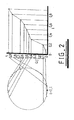
- FIG. 2 An example of how a shape is sampled according to its parameterisation is shown in figure 2 .
- the shape is a circle, and the origin used for the parameterisation is the lowermost point on the circle. It has been decided to use ten landmarks to parameterise the circle (including the origin).
- the landmarks are equally spaced along the horizontal axis of the graph which is labelled t ( t is in effect a measure of the number of landmarks used to parameterise the circle).
- the parameterisation of any given landmark is represented by the clockwise distance around the circle between that landmark and the preceding landmark. These distances are represented by the vertical axis of the graph.
- the utility of the linear model of shape shown in (2) depends on the appropriateness of the set of boundary parameterisations ⁇ ⁇ i ⁇ that are used to construct the statistical shape model from the set of training boundaries ⁇ S i ⁇ .
- the embodiment of the invention defines a criterion for choosing the set of parameterisations ⁇ ⁇ i ⁇ . The aim is to choose ⁇ ⁇ i ⁇ so as to obtain the 'best possible' model. Since it is desired to obtain a compact model with good generalisation properties the 'best' model is defined as that which can account for all of the observations (the training boundaries) in as simple a way as possible. In other words, the inventors have based their parameterisation method upon the statement that the 'best' model is that which describes the whole training set as efficiently as possible.
- a minimum description length criterion is used (i.e. the optimisation method attempts to determine the set of parameterisations which uses the least amount of data to describe the whole training set). This is formalised by stating that it is desired to find ⁇ ⁇ i ⁇ that minimises the information required to code the whole training set to some accuracy ⁇ on each of the elements of ⁇ x i ⁇ . Note that to describe ⁇ x i ⁇ to arbitrary accuracy would require infinite information; 5 is chosen to reflect the measurement errors involved in acquiring the training boundaries.
- a set ⁇ S i ⁇ of s training shapes are to be parameterised using ⁇ ⁇ i ⁇ and sampled to give a set of n -dimensional shape vectors ⁇ x i ⁇ .
- x is the mean of ⁇ x i ⁇
- P has t columns which are the t eigenvectors of the covariance matrix of ⁇ x i ⁇ corresponding to the t largest eigenvalues ⁇ j
- b i is a vector of shape parameters
- r i is a vector of residuals.
- I Total I Model + s ⁇ I b + s ⁇ I r
- I Model is the information required to code the model (the mean vector x and the covariance matrix P)
- I b is the average information required to code each parameter vector b i
- I r the average information required to code each residual vector, r i .
- I Total is a function of the quantisation parameters k m , k j , k b , and k r , which are related to ⁇ , the overall approximation error. Since it is desired ultimately to minimise I Total with respect to ⁇ ⁇ i ⁇ it is first required to find the minimum with respect to the quantisation parameters. This can be found analytically, leading to an expression in terms of s , n, t, ⁇ ⁇ j ⁇ and ⁇ r .
- s is the number of training shapes
- n is double the number of points sampled along the boundary of each shape (each point being represented as a pair of coordinates)
- t is the number of columns of the covariance matrix (i.e.
- the number of modes to use, t is chosen so as to be able to represent the training set to a given accuracy.
- the root mean square difference between points on the training set and the model reconstructions of the set are less than a suitable threshold.
- the threshold is typically chosen to be related to the estimated uncertainty in the original data.
- the motivation behind the generation of the function F is to allow an optimal dense correspondence to be established automatically between a set of training shapes. As set out above, corresponding points are described in terms of parameterisation ⁇ i of the boundary path of the shape. It is desired to find the global optimum of F in (10) with respect to the set of shape parameterisations ⁇ ⁇ i ⁇ .
- the first described method of finding the global optimum of F is to use an explicit representation of ⁇ ⁇ i ⁇ coupled with a stochastic search.
- a representation of ⁇ ⁇ i ⁇ is required that ensures a diffeomorphic mapping between each pair of training shapes.
- this can be achieved by enforcing the ordering of corresponding points around the training shapes.
- 3-D no such ordering exists.
- the invention provides a new method of representation that guarantees diffeomorphic mapping without using an explicit ordering constraint.
- the method is described for 2-D shapes; Appendix B explains how it can be extended to 3-D.
- a piecewise linear parameterisation is defined for each training shape by recursively subdividing boundary intervals by inserting nodes (landmarks).
- the position of each new landmark is coded as fraction of the boundary path length between neighbouring landmarks.
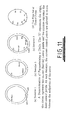
- a hierarchical ordering is enforced where, at each level of the hierarchy, landmarks are positioned between those already present. This is illustrated by the example in Figure 3 which demonstrates the parameterisation of a circle.
- the shape to be parameterised is a circle.
- An origin is marked onto the circle as shown in figure 3a (the origin is the first landmark). Moving in a clockwise direction the circumference around the circle is constrained to have a length of 1.
- a second landmark is positioned at 0.65, measured from the origin, as shown in figure 3b . This is the first level of the hierarchy. Starting from the origin the distance around the circle to the second landmark is constrained to be 1.
- a third landmark is positioned at 0.65, measured from the origin, as shown in figure 3c . Starting from the second landmark the distance around the circle to the origin is constrained to be 1.
- a fourth landmark is positioned at 0.8, measured from the second landmark, as shown in figure 3c . This the second level of the hierarchy. Further landmarks are added in the same manner, as shown in figure 3d , thereby providing the third level in the hierarchy.
- Recursive subdivision can be continued until an arbitrarily exact parameterisation is achieved.
- Correspondence is assumed across the whole training set between equivalent nodes in the subdivision tree (i.e. equivalent levels of hierarchy).
- a set of parameterisations ⁇ ⁇ i ⁇ can be manipulated in order to optimise the objective function F.
- the search space is high-dimensional with many local minima, and consequently it is preferred to use a stochastic optimisation method such as simulated annealing [15] or genetic algorithm search [16]. Both the simulated annealing [15] and genetic algorithm search are well known to those skilled in the art. A genetic algorithm was used to perform the experiments reported below.
- the first test used 17 hand outlines.
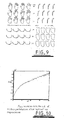
- the qualitative results in figure 4 show the ability to generalise plausibly to examples not in the training set.
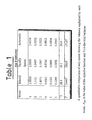
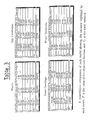
- the results in table 1 show that the automatic method produces a better model than both the equally spaced and manual model.
- the second test used 38 outlines of left ventricles of the heart, segmented from echocardiograms. Again, figure 5 shows good generalisation. The quantitative results are presented in table 2. Once again, the automatic algorithm produces significantly better results than the other two methods.
- the second described method of finding the global optimum of F involves selecting corresponding points by uniformly sampling a continuous parameterisation ⁇ ( m ), of each shape, and then manipulating the set of parameterisations ⁇ ⁇ i ⁇ , in a way that minimises the value of F min .
- the method described in this section is applicable to both open and closed curves; for clarity, the discussion is limited to the closed case.
- a legal reparameterisation function ⁇ ( m ) is a monotonically increasing function of m , with a range (0 ⁇ ⁇ ( m ) ⁇ 1).
- An example of such a function is shown in figure 8 .
- ⁇ x c ⁇ 1 + ⁇ i A i ⁇ ⁇ 2 ⁇ ⁇ exp - 1 2 ⁇ ⁇ i 2 ⁇ x - a i 2
- a i control the height of each kernel
- ⁇ i specifies the width and a i the position of the centre
- c is the normalisation constant.
- the constant term is included to ensure that when all A i 's are zero, ⁇ ( m ) is an arc-length parameterisation.
- c is a normalisation constant
- c - 1 1 + ⁇ i A i 2 erf ⁇ m - a i ⁇ i ⁇ 2 + ⁇ i A i 2 erf a i ⁇ i ⁇ 2
- the parameterisation is manipulated by varying ⁇ A i ⁇ , the heights of the kernels; the widths ⁇ ⁇ i ⁇ and the positions ⁇ a i ⁇ are fixed.
- a set of Gaussian curves is combined together to generate a function whose cumulative value is the parameterisation of the shape (i.e. the set of curves together provide a curve of the type shown in figure 8 ).
- n k kernels are used to represent the parameterisation, the configuration space becomes ( n k s )-dimensional.
- One possibility is to use a stochastic optimisation method as described above, but a more efficient approach would be desirable. This search space is generally too large for a direct optimisation scheme to converge rapidly and reliably. This problem is overcome by using the following multiresolution approach:
- An advantage of this approach is that it avoids becoming trapped in a local minima of F since it starts at very low resolution and gradually steps up to higher resolutions.
- the best alignment of the training set depends on the parameterisation of each shape. This is addressed by performing a Procrustes analysis [6] on the reparameterised shapes before evaluating F min .
- the method was tested on a set of 17 hand outlines, 38 left ventricles of the heart, 24 hip prostheses and 15 cross-sections of the femoral articular cartilage.
- the algorithm was run for four iterations, giving 16 kernels per shape.
- a MATLAB implementation of the algorithm using a standard iterative optimisation algorithm takes between 20 and 120 minutes, depending on the size of training set.
- the results are compared with models built by equally-spacing points along the boundary and hand-built models, produced by identifying a set of 'natural' landmarks on each shape.
- Figure 9 shows qualitative results by displaying the variation captured by the first three modes of each model (the first three elements of b varied by ⁇ 2 ⁇ ). Quantitative results are given in table 2, tabulating the value of F min , the total variance, and variance explained by each mode for each of the models.
- Figure 10 shows a plot of F min against the standard deviation of the noise. The plot shows that as the points are moved further away from their corresponding positions, the value of F min increases - the desired behaviour.
- This method of describing parameterisation can also be applied in 3D.
- the second method of parameterisation uses two dimensional kernels to determine the parameterisation.
- the third method described below, is similar to the second method but uses landmark points rather than Gaussian kernels to represent the parameterisation.
- a piecewise-linear approximation to the parameterisation ⁇ i is used by specifying a set of n c control points, ⁇ p k ⁇ on each shape and equally spacing n / k points along the boundary between each interval.
- the configuration space is therefore (n c n s )-dimensional. This search space is generally too large for a direct optimisation scheme to converge rapidly and reliably. This is overcome by using the following multiresolution approach:
- each control point is initialised as halfway along its allowed range - the equivalent of an arc-length parameterisation. Since an explicit ordering constraint has not been used, the method may be used on shapes in 3D (see [19] for details).
- each shape affects the value of F. It is therefore required to optimise the four parameters that allow a rigid transformation of each shape: translations d x , d y , scaling s and rotation ⁇ .
- the third method was tested on a set of 17 hand outlines, 38 left ventricles of the heart, 24 hip prostheses and 15 outlines of the femoral articular cartilage.
- the .algorithm was run for four iterations, giving 16 control points per shape.
- the results are compared to models built by equally-spacing points along the boundary and hand-built models, produced by identifying a set of 'natural' landmarks on each shape.
- the invention provides an objective function that can be used to evaluate the quality of a statistical shape model.
- the expression used has a theoretical grounding in Information Theory, is independent of quantisation error and unlike other approaches [4, 6], does not involve any arbitrary parameters.
- the function may also be used to calculate the correct number of modes to use for a given model.
- the objective function includes a ⁇ log( ⁇ i ) term which is equivalent to the determinant of the covariance matrix, as used by Kotcheff and Taylor [6], but the more complete treatment here shows that other terms are also important.
- noise of variance ⁇ 2 on the elements of x induces noise of variance ⁇ 2 on x i .
- noise of variance of ⁇ 2 on the elements of b i can be shown to induce an average noise of variance ⁇ 2 /2 on the elements of x i .
- Noise of variance ⁇ 2 on the elements of the j th column of P induces an average noise of variance ⁇ j ⁇ 2 on each element of x i .
- Quantising a value to ⁇ induces noise with a flat distribution in [ - ⁇ / 2, ⁇ / 2 ] and thus a variance of ⁇ 2 /12.
- quantising x , P , and b i causes an additional error that must be corrected by the residual term, r i .
- a parameterised set of exact homeomorphisms on the sphere that is, a set of mappings from the sphere to itself which are continuous, one-to-one, and onto (i.e. no gaps or wrinkles).
- ( ⁇ ⁇ e - ⁇ , ⁇ ⁇ ) is the width-parameter of the Cauchy, with amplitude A ⁇ 0.
- the mapping is also differentiable everywhere.
- This mapping is differentiable everywhere except at the point P and the point diametrically opposite to it.
Landscapes
- Engineering & Computer Science (AREA)
- Theoretical Computer Science (AREA)
- Computer Vision & Pattern Recognition (AREA)
- General Physics & Mathematics (AREA)
- Physics & Mathematics (AREA)
- Multimedia (AREA)
- Evolutionary Computation (AREA)
- Artificial Intelligence (AREA)
- General Health & Medical Sciences (AREA)
- Medical Informatics (AREA)
- Software Systems (AREA)
- Health & Medical Sciences (AREA)
- Databases & Information Systems (AREA)
- Computing Systems (AREA)
- Data Mining & Analysis (AREA)
- Life Sciences & Earth Sciences (AREA)
- Bioinformatics & Cheminformatics (AREA)
- Bioinformatics & Computational Biology (AREA)
- Evolutionary Biology (AREA)
- General Engineering & Computer Science (AREA)
- Processing Or Creating Images (AREA)
- Image Generation (AREA)
- Information Retrieval, Db Structures And Fs Structures Therefor (AREA)
- Image Processing (AREA)
Claims (33)
- Procédé mis en oeuvre par un ordinateur de construction d'un modèle de forme statistique en établissant automatiquement une correspondance entre un ensemble d'apprentissage de formes bidimensionnelles ou de formes tridimensionnelles entrées dans l'ordinateur, le procédé comprenant :a) la détermination d'un paramétrage de chaque forme,b) la construction d'un modèle de forme statistique en utilisant le paramétrage,c) l'utilisation d'une fonction d'objectif pour fournir automatiquement une sortie, dans lequel la sortie de la fonction d'objectif est une mesure de la quantité d'informations nécessaire pour coder l'ensemble de formes en utilisant le modèle de forme statistique ;d) l'exécution des étapes a) à c) de manière répétée pour différents paramétrages et la comparaison de la sortie de la fonction d'objectif pour les modèles de forme statistiques résultants pour sélectionner automatiquement un modèle de forme statistique sur la base de ladite sortie de la fonction d'objectif ;e) la sortie du modèle de forme statistique sélectionné.
- Procédé selon la revendication 1, dans lequel les paramétrages utilisés pour effectuer l'étape a) sont sélectionnés en utilisant un procédé d'optimisation basé sur des paramétrages précédents et sur la qualité des modèles de forme statistiques générés en utilisant les paramétrages tels qu'indiqués par la sortie de la fonction d'objectif.
- Procédé selon la revendication 2, dans lequel la sortie de la fonction d'objectif comprend une valeur indicative de la quantité d'informations nécessaire pour coder les paramètres du modèle, et une valeur indicative des informations nécessaires pour coder les restes pour l'ensemble de formes.
- Procédé selon la revendication 3, dans lequel la sortie de la fonction d'objectif comprend en outre une valeur indicative de la quantité d'informations nécessaire pour coder le mappage entre les paramètres et les formes.
- Procédé selon l'une quelconque des revendications 1 à 4, dans lequel, pour un paramétrage donné, la fonction d'objectif fournit une sortie scalaire unique.
- Procédé selon la revendication 5 lorsqu'elle dépend des revendications 3 et 4, dans lequel la sortie scalaire unique comprend une combinaison de la valeur indicative de la quantité d'informations nécessaire pour coder les paramètres du modèle, de la valeur indicative des informations nécessaires pour coder les restes pour l'ensemble de formes, et de la valeur indicative de la quantité d'informations nécessaire pour coder le mappage entre les paramètres et les formes.
- Procédé selon la revendication 4, dans lequel le mappage comprend un vecteur de moyenne et une matrice de covariance.
- Procédé selon l'une quelconque des revendications 3 à 7, dans lequel les paramètres du modèle sont des vecteurs de paramètres, et la quantité moyenne d'informations par vecteur de paramètre est déterminée et multipliée par le nombre de formes dans l'ensemble d'apprentissage, pour fournir la valeur indicative de la quantité d'informations nécessaire pour coder les paramètres du modèle.
- Procédé selon l'une quelconque des revendications 3 à 8, dans lequel les restes sont des vecteurs de restes, et la quantité moyenne d'informations par vecteur de reste est déterminée et multipliée par le nombre de formes dans l'ensemble d'apprentissage, pour fournir la valeur indicative des informations nécessaires pour coder les restes pour l'ensemble d'apprentissage de formes complet.
- Procédé selon la revendication 9, dans lequel le nombre de restes dans chaque vecteur de reste est égal à deux fois le nombre de paramétrages utilisés pour générer le modèle.
- Procédé selon l'une quelconque des revendications précédentes, dans lequel le nombre de modes de variation du modèle est sélectionné pour représenter l'ensemble d'apprentissage avec une précision donnée.
- Procédé selon l'une quelconque des revendications précédentes, dans lequel la frontière de chaque forme bidimensionnelle de l'ensemble d'apprentissage est subdivisée de manière récursive en insérant des points de repère, le paramétrage de la frontière étant représenté par la position de chaque point de repère en tant que fraction de la longueur de trajet de frontière entre des points de repère précédent et suivant.
- Procédé selon la revendication 12, dans lequel le paramétrage qui fournit la meilleure valeur d'optimisation est déterminé en utilisant un procédé d'optimisation stochastique.
- Procédé selon l'une quelconque des revendications 1 à 11, dans lequel un ensemble de courbes est utilisé pour déterminer une fonction de paramétrage pour l'ensemble d'apprentissage.
- Procédé selon la revendication 14, dans lequel l'ensemble de courbes est une fonction de densité cumulative.
- Procédé selon la revendication 15, dans lequel la fonction de densité cumulative comprend une somme de courbes de noyau.
- Procédé selon la revendication 16, dans lequel la fonction de densité cumulative est déterminée en combinant des nombres croissants de courbes de noyau pour fournir des niveaux de résolution croissants, et la fonction de paramétrage qui fournit le modèle de forme statistique de la meilleure qualité est déterminée en utilisant la sortie de la fonction d'objectif pour chaque niveau de résolution.
- Procédé selon la revendication 16 ou la revendication 17, dans lequel les courbes de noyau sont des fonctions gaussiennes.
- Procédé selon la revendication 16 ou la revendication 17, dans lequel les courbes de noyau sont des fonctions de Cauchy.
- Procédé selon l'une quelconque des revendications 16 à 19, dans lequel les courbes de noyau sont des courbes bidimensionnelles.
- Procédé selon l'une quelconque des revendications 16 à 19, dans lequel les courbes de noyau sont des courbes tridimensionnelles.
- Procédé selon l'une quelconque des revendications 1 à 11, dans lequel la frontière de chaque forme de l'ensemble d'apprentissage est paramétrée en spécifiant un ensemble de points de repère de contrôle utilisé pour déterminer une fonction de paramétrage.
- Procédé selon la revendication 22, dans lequel la fonction de paramétrage est déterminée pour des nombres croissants de points de repère de contrôle pour fournir des niveaux de résolution croissants, et la fonction de paramétrage qui fournit le modèle de forme statistique de la meilleure qualité est déterminée en utilisant la sortie de la fonction d'objectif pour chaque niveau de résolution.
- Procédé selon la revendication 22 ou la revendication 23, dans lequel des points de repère uniformément espacés sont prévus entre les points de repère de contrôle.
- Procédé selon l'une quelconque des revendications précédentes, dans lequel la forme et l'aspect en niveaux de gris sont tous deux inclus dans le modèle.
- Procédé selon la revendication 1, dans lequel le modèle est créé à partir d'un ensemble de formes tridimensionnelles, et dans lequel :la détermination d'un paramétrage de chaque forme et la construction d'un modèle de forme statistique en utilisant les paramétrages comprennent, pour chacun d'une pluralité de niveaux de résolution croissantsle mappage de chaque forme tridimensionnelle vers une forme normale simple d'une topologie appropriée,l'application d'un ensemble de points de repère à la forme simple pour un niveau donné de résolution, chaque point de repère étant contraint pour se trouver à l'intérieur d'un triangle sphérique formé par trois points de repère d'un niveau de résolution inférieur,à la fin de l'application de l'ensemble de points de repère pour le niveau de résolution, la projection de l'ensemble de points de repère sur les formes tridimensionnelles,la construction d'un modèle de forme statistique en utilisant l'ensemble de points de repère du niveau de résolution.
- Procédé selon la revendication 1, dans lequel le modèle est créé à partir d'un ensemble de formes tridimensionnelles et dans lequel ledit paramétrage est un ensemble de points de repère et la détermination d'un paramétrage de chaque forme comprend :le mappage de chaque forme tridimensionnelle vers une forme normale simple d'une topologie appropriée ;l'application d'un ensemble de points de repère à la forme simple ;la modification des emplacements des points de repère en appliquant une transformation ; etla projection de l'ensemble de points de repère sur les formes tridimensionnelles.
- Procédé selon la revendication 27, dans lequel la transformation comprend, pour un point de repère sélectionné, l'éloignement d'autres points de repère du point de repère sélectionné le long de la surface de la forme simple, ou le rapprochement d'autres points de repère du point de repère sélectionné le long de la surface de la forme simple.
- Procédé selon la revendication 28, dans lequel la transformation est définie par un noyau enroulé.
- Procédé selon la revendication 29, dans lequel le noyau enroulé est une distribution de Cauchy enroulée.
- Procédé selon la revendication 29, dans lequel le noyau enroulé est une distribution gaussienne enroulée.
- Procédé selon l'une quelconque des revendications 28 à 31, dans lequel la forme simple est une sphère ou un tore.
- Procédé selon la revendication 1, dans lequel chaque forme de l'ensemble d'apprentissage de formes comprend en outre des données d'aspect et le modèle de forme statistique est un modèle de forme et d'aspect.
Applications Claiming Priority (3)
| Application Number | Priority Date | Filing Date | Title |
|---|---|---|---|
| GB0114271 | 2001-06-12 | ||
| GBGB0114271.0A GB0114271D0 (en) | 2001-06-12 | 2001-06-12 | Parameterisation |
| PCT/GB2001/005408 WO2002103618A1 (fr) | 2001-06-12 | 2001-12-06 | Parametrage |
Publications (2)
| Publication Number | Publication Date |
|---|---|
| EP1514229A2 EP1514229A2 (fr) | 2005-03-16 |
| EP1514229B1 true EP1514229B1 (fr) | 2015-01-21 |
Family
ID=9916408
Family Applications (1)
| Application Number | Title | Priority Date | Filing Date |
|---|---|---|---|
| EP01275173.1A Expired - Lifetime EP1514229B1 (fr) | 2001-06-12 | 2001-12-06 | Modele statistique |
Country Status (4)
| Country | Link |
|---|---|
| US (1) | US7584080B2 (fr) |
| EP (1) | EP1514229B1 (fr) |
| GB (1) | GB0114271D0 (fr) |
| WO (1) | WO2002103618A1 (fr) |
Families Citing this family (49)
| Publication number | Priority date | Publication date | Assignee | Title |
|---|---|---|---|---|
| US7200269B2 (en) * | 2002-02-01 | 2007-04-03 | Siemens Medical Solutions Usa, Inc. | Non-rigid image registration using distance functions |
| CN1313979C (zh) * | 2002-05-03 | 2007-05-02 | 三星电子株式会社 | 产生三维漫画的装置和方法 |
| US8801720B2 (en) | 2002-05-15 | 2014-08-12 | Otismed Corporation | Total joint arthroplasty system |
| US7496214B2 (en) | 2002-09-25 | 2009-02-24 | The Hong Kong Polytechnic University | Method of palm print identification |
| US7466846B2 (en) | 2002-09-25 | 2008-12-16 | The Hong Kong Polytechnic University | Method for analyzing a palm print for the identification of an individual using gabor analysis |
| US7391882B2 (en) * | 2004-01-29 | 2008-06-24 | Siemens Medical Solutions Usa, Inc. | Prior knowledge, level set representations and visual grouping |
| SE528068C2 (sv) * | 2004-08-19 | 2006-08-22 | Jan Erik Solem Med Jsolutions | Igenkänning av 3D föremål |
| US20070161888A1 (en) * | 2005-12-30 | 2007-07-12 | Sherman Jason T | System and method for registering a bone of a patient with a computer assisted orthopaedic surgery system |
| US8862200B2 (en) | 2005-12-30 | 2014-10-14 | DePuy Synthes Products, LLC | Method for determining a position of a magnetic source |
| US20070167741A1 (en) * | 2005-12-30 | 2007-07-19 | Sherman Jason T | Apparatus and method for registering a bone of a patient with a computer assisted orthopaedic surgery system |
| US7525309B2 (en) * | 2005-12-30 | 2009-04-28 | Depuy Products, Inc. | Magnetic sensor array |
| US9808262B2 (en) | 2006-02-15 | 2017-11-07 | Howmedica Osteonics Corporation | Arthroplasty devices and related methods |
| GB0607143D0 (en) | 2006-04-08 | 2006-05-17 | Univ Manchester | Method of locating features of an object |
| US8068648B2 (en) | 2006-12-21 | 2011-11-29 | Depuy Products, Inc. | Method and system for registering a bone of a patient with a computer assisted orthopaedic surgery system |
| US8545509B2 (en) | 2007-12-18 | 2013-10-01 | Otismed Corporation | Arthroplasty system and related methods |
| US8160345B2 (en) | 2008-04-30 | 2012-04-17 | Otismed Corporation | System and method for image segmentation in generating computer models of a joint to undergo arthroplasty |
| US8617171B2 (en) | 2007-12-18 | 2013-12-31 | Otismed Corporation | Preoperatively planning an arthroplasty procedure and generating a corresponding patient specific arthroplasty resection guide |
| US8480679B2 (en) | 2008-04-29 | 2013-07-09 | Otismed Corporation | Generation of a computerized bone model representative of a pre-degenerated state and useable in the design and manufacture of arthroplasty devices |
| GB0803514D0 (en) | 2008-02-27 | 2008-04-02 | Depuy Int Ltd | Customised surgical apparatus |
| US8676001B2 (en) | 2008-05-12 | 2014-03-18 | Google Inc. | Automatic discovery of popular landmarks |
| US8617175B2 (en) | 2008-12-16 | 2013-12-31 | Otismed Corporation | Unicompartmental customized arthroplasty cutting jigs and methods of making the same |
| US8396287B2 (en) | 2009-05-15 | 2013-03-12 | Google Inc. | Landmarks from digital photo collections |
| US20110154234A1 (en) * | 2009-12-18 | 2011-06-23 | Microsoft Corporation | Layout projection using non-linear constraints |
| EP2534613B1 (fr) | 2010-02-10 | 2019-03-27 | Mako Surgical Corp. | Analyse d'image |
| US9530077B2 (en) | 2010-02-10 | 2016-12-27 | Imorphics Limited | Image analysis |
| US9159161B1 (en) | 2010-09-27 | 2015-10-13 | The Boeing Company | Systems and methods for creating a two-dimensional representation of a model |
| US8803877B1 (en) | 2010-10-02 | 2014-08-12 | The Boeing Company | Systems and methods for creating a two-dimensional representation of a model |
| US8539426B2 (en) * | 2011-02-22 | 2013-09-17 | International Business Machines Corporation | Method and system for extracting compact models for circuit simulation |
| US9361701B2 (en) | 2011-04-13 | 2016-06-07 | Hamid Reza TIZHOOSH | Method and system for binary and quasi-binary atlas-based auto-contouring of volume sets in medical images |
| GB201113683D0 (en) | 2011-08-09 | 2011-09-21 | Imorphics Ltd | Image processing method |
| US8867809B2 (en) | 2011-08-18 | 2014-10-21 | Imorphics Limited | Image processing method |
| IN2014MN01458A (fr) * | 2011-12-23 | 2015-04-17 | Materialise Nv | |
| US9402637B2 (en) | 2012-10-11 | 2016-08-02 | Howmedica Osteonics Corporation | Customized arthroplasty cutting guides and surgical methods using the same |
| US20140276872A1 (en) | 2013-03-15 | 2014-09-18 | Otismed Corporation | Customized acetabular cup positioning guide and system and method of generating and employing such a guide |
| EP2996589B1 (fr) | 2013-03-15 | 2022-01-19 | Howmedica Osteonics Corporation | Génération d'un modèle de surface d'accouplement pour un guide de coupe spécifique au patient sur la base d'une segmentation de modèle anatomique |
| US9390502B2 (en) * | 2013-04-22 | 2016-07-12 | Kabushiki Kaisha Toshiba | Positioning anatomical landmarks in volume data sets |
| EP3046514B1 (fr) | 2013-09-18 | 2020-07-22 | Stryker Corporation | Préparation osseuse spécifique d'un patient pour engagement d'éléments de fixation efficace et fiable |
| EP3062746B1 (fr) | 2013-10-28 | 2018-05-16 | Stryker Corporation | Modèle d'implant utilisant des propriétés osseuses hétérogènes et une technique probabiliste pour déterminer les géométries optimales de caractéristiques de fixation |
| US10803534B2 (en) * | 2014-10-31 | 2020-10-13 | Exxonmobil Upstream Research Company | Handling domain discontinuity with the help of grid optimization techniques |
| US9563979B2 (en) * | 2014-11-28 | 2017-02-07 | Toshiba Medical Systems Corporation | Apparatus and method for registering virtual anatomy data |
| US10456262B2 (en) | 2016-08-02 | 2019-10-29 | Howmedica Osteonics Corp. | Patient-specific implant flanges with bone side porous ridges |
| GB2569541B (en) | 2017-12-19 | 2020-08-19 | Mirada Medical Ltd | Method and apparatus for medical imaging |
| JP7520885B2 (ja) | 2019-05-02 | 2024-07-23 | デピュイ・アイルランド・アンリミテッド・カンパニー | 整形外科用インプラント配置システム及び方法 |
| AU2021203588A1 (en) | 2020-06-03 | 2021-12-23 | Howmedica Osteonics Corp. | Intercalary endoprosthesis |
| EP3991695B1 (fr) | 2020-10-28 | 2023-12-20 | Howmedica Osteonics Corp. | Condyle postérieur anthropométrique |
| US20240233294A1 (en) * | 2021-05-08 | 2024-07-11 | Dalian University Of Technology | Topological preserving deformation method for 3d model based on multiple volumetric harmonic field |
| CN115617635B (zh) * | 2022-12-16 | 2023-05-23 | 南京易联阳光信息技术股份有限公司 | 支持跨代码仓库的代码统计方法、系统及设备 |
| US12369981B2 (en) | 2023-02-07 | 2025-07-29 | Depuy Ireland Unlimited Company | Systems and methods for bone model registration with adaptive soft tissue thickness |
| EP4720997A1 (fr) | 2023-06-01 | 2026-04-08 | Stryker Corporation | Segmentation de structures osseuses |
Family Cites Families (5)
| Publication number | Priority date | Publication date | Assignee | Title |
|---|---|---|---|---|
| US5822451A (en) * | 1996-06-05 | 1998-10-13 | Eastman Kodak Company | Method for halftoning a multi-channel digital color image |
| US6633686B1 (en) * | 1998-11-05 | 2003-10-14 | Washington University | Method and apparatus for image registration using large deformation diffeomorphisms on a sphere |
| CA2390695A1 (fr) | 1999-11-09 | 2001-05-17 | The University Of Manchester | Identification de classes d'objets, verification ou synthese d'images d'objets |
| JP4341135B2 (ja) * | 2000-03-10 | 2009-10-07 | コニカミノルタホールディングス株式会社 | 物体認識装置 |
| US6799175B2 (en) * | 2001-04-23 | 2004-09-28 | International Business Machines Corporation | System and method of determining and searching for patterns in a large database |
-
2001
- 2001-06-12 GB GBGB0114271.0A patent/GB0114271D0/en not_active Ceased
- 2001-12-06 WO PCT/GB2001/005408 patent/WO2002103618A1/fr not_active Ceased
- 2001-12-06 EP EP01275173.1A patent/EP1514229B1/fr not_active Expired - Lifetime
- 2001-12-06 US US10/480,445 patent/US7584080B2/en not_active Expired - Fee Related
Also Published As
| Publication number | Publication date |
|---|---|
| EP1514229A2 (fr) | 2005-03-16 |
| GB0114271D0 (en) | 2001-08-01 |
| WO2002103618A8 (fr) | 2004-03-18 |
| US7584080B2 (en) | 2009-09-01 |
| WO2002103618A1 (fr) | 2002-12-27 |
| US20050027492A1 (en) | 2005-02-03 |
Similar Documents
| Publication | Publication Date | Title |
|---|---|---|
| EP1514229B1 (fr) | Modele statistique | |
| Alldieck et al. | imghum: Implicit generative models of 3d human shape and articulated pose | |
| Davies et al. | A minimum description length approach to statistical shape modelling | |
| Brett et al. | A method of automated landmark generation for automated 3D PDM construction | |
| Hill et al. | A framework for automatic landmark identification using a new method of nonrigid correspondence | |
| Kotcheff et al. | Automatic construction of eigenshape models by direct optimization | |
| CN101320484B (zh) | 一种人脸虚图像生成的方法及一种三维人脸识别方法 | |
| CN101561874B (zh) | 一种人脸虚拟图像生成的方法 | |
| Litke et al. | An image processing approach to surface matching. | |
| CN101159015A (zh) | 一种二维人脸图像的识别方法 | |
| Limper et al. | Mesh Saliency Analysis via Local Curvature Entropy. | |
| JP4170096B2 (ja) | 対象の3次元表面上にマップされた3次元メッシュモデルの適合性評価のための画像処理装置 | |
| Mahmoodi et al. | Automated vision system for skeletal age assessment using knowledge based techniques | |
| Hinshaw et al. | Shape-based models for interactive segmentation of medical images | |
| Su | Statistical shape modelling: automatic shape model building | |
| Skocaj et al. | Robust recognition and pose determination of 3-D objects using range images in eigenspace approach | |
| Trinh et al. | A symmetry-based generative model for shape | |
| Brett et al. | A Method of 3D Surface Correspondence for Automated Landmark Generation. | |
| Subburaj et al. | High resolution medical models and geometric reasoning starting from CT/MR images | |
| Estellers et al. | Compression for Smooth Shape Analysis | |
| Farag et al. | Deformable models for random small-size objects: case of lung nodules in CT tomography | |
| Neophytou et al. | A comparative study of surface representations used in statistical human models | |
| Schnabel | Shape description methods for medical images | |
| Shamoushaki et al. | Monocular Reconstruction of Conformal Surfaces through Optimization | |
| JP6661196B2 (ja) | 画像処理装置、方法、及びプログラム |
Legal Events
| Date | Code | Title | Description |
|---|---|---|---|
| PUAI | Public reference made under article 153(3) epc to a published international application that has entered the european phase |
Free format text: ORIGINAL CODE: 0009012 |
|
| 17P | Request for examination filed |
Effective date: 20040112 |
|
| AK | Designated contracting states |
Kind code of ref document: A2 Designated state(s): AT BE CH CY DE DK ES FI FR GB GR IE IT LI LU MC NL PT SE TR |
|
| RAP1 | Party data changed (applicant data changed or rights of an application transferred) |
Owner name: THE UNIVERSITY OF MANCHESTER |
|
| R17D | Deferred search report published (corrected) |
Effective date: 20021227 |
|
| 17Q | First examination report despatched |
Effective date: 20080721 |
|
| RAP1 | Party data changed (applicant data changed or rights of an application transferred) |
Owner name: IMORPHICS LTD |
|
| GRAP | Despatch of communication of intention to grant a patent |
Free format text: ORIGINAL CODE: EPIDOSNIGR1 |
|
| INTG | Intention to grant announced |
Effective date: 20140723 |
|
| GRAS | Grant fee paid |
Free format text: ORIGINAL CODE: EPIDOSNIGR3 |
|
| GRAA | (expected) grant |
Free format text: ORIGINAL CODE: 0009210 |
|
| AK | Designated contracting states |
Kind code of ref document: B1 Designated state(s): AT BE CH CY DE DK ES FI FR GB GR IE IT LI LU MC NL PT SE TR |
|
| REG | Reference to a national code |
Ref country code: GB Ref legal event code: FG4D |
|
| REG | Reference to a national code |
Ref country code: CH Ref legal event code: EP |
|
| REG | Reference to a national code |
Ref country code: IE Ref legal event code: FG4D |
|
| REG | Reference to a national code |
Ref country code: AT Ref legal event code: REF Ref document number: 707758 Country of ref document: AT Kind code of ref document: T Effective date: 20150215 |
|
| REG | Reference to a national code |
Ref country code: DE Ref legal event code: R096 Ref document number: 60149211 Country of ref document: DE Effective date: 20150305 |
|
| REG | Reference to a national code |
Ref country code: NL Ref legal event code: VDEP Effective date: 20150121 |
|
| REG | Reference to a national code |
Ref country code: AT Ref legal event code: MK05 Ref document number: 707758 Country of ref document: AT Kind code of ref document: T Effective date: 20150121 |
|
| PG25 | Lapsed in a contracting state [announced via postgrant information from national office to epo] |
Ref country code: FI Free format text: LAPSE BECAUSE OF FAILURE TO SUBMIT A TRANSLATION OF THE DESCRIPTION OR TO PAY THE FEE WITHIN THE PRESCRIBED TIME-LIMIT Effective date: 20150121 Ref country code: SE Free format text: LAPSE BECAUSE OF FAILURE TO SUBMIT A TRANSLATION OF THE DESCRIPTION OR TO PAY THE FEE WITHIN THE PRESCRIBED TIME-LIMIT Effective date: 20150121 Ref country code: ES Free format text: LAPSE BECAUSE OF FAILURE TO SUBMIT A TRANSLATION OF THE DESCRIPTION OR TO PAY THE FEE WITHIN THE PRESCRIBED TIME-LIMIT Effective date: 20150121 |
|
| PG25 | Lapsed in a contracting state [announced via postgrant information from national office to epo] |
Ref country code: GR Free format text: LAPSE BECAUSE OF FAILURE TO SUBMIT A TRANSLATION OF THE DESCRIPTION OR TO PAY THE FEE WITHIN THE PRESCRIBED TIME-LIMIT Effective date: 20150422 Ref country code: AT Free format text: LAPSE BECAUSE OF FAILURE TO SUBMIT A TRANSLATION OF THE DESCRIPTION OR TO PAY THE FEE WITHIN THE PRESCRIBED TIME-LIMIT Effective date: 20150121 Ref country code: NL Free format text: LAPSE BECAUSE OF FAILURE TO SUBMIT A TRANSLATION OF THE DESCRIPTION OR TO PAY THE FEE WITHIN THE PRESCRIBED TIME-LIMIT Effective date: 20150121 |
|
| REG | Reference to a national code |
Ref country code: DE Ref legal event code: R097 Ref document number: 60149211 Country of ref document: DE |
|
| PG25 | Lapsed in a contracting state [announced via postgrant information from national office to epo] |
Ref country code: DK Free format text: LAPSE BECAUSE OF FAILURE TO SUBMIT A TRANSLATION OF THE DESCRIPTION OR TO PAY THE FEE WITHIN THE PRESCRIBED TIME-LIMIT Effective date: 20150121 |
|
| REG | Reference to a national code |
Ref country code: FR Ref legal event code: PLFP Year of fee payment: 15 |
|
| PLBE | No opposition filed within time limit |
Free format text: ORIGINAL CODE: 0009261 |
|
| STAA | Information on the status of an ep patent application or granted ep patent |
Free format text: STATUS: NO OPPOSITION FILED WITHIN TIME LIMIT |
|
| 26N | No opposition filed |
Effective date: 20151022 |
|
| PG25 | Lapsed in a contracting state [announced via postgrant information from national office to epo] |
Ref country code: IT Free format text: LAPSE BECAUSE OF FAILURE TO SUBMIT A TRANSLATION OF THE DESCRIPTION OR TO PAY THE FEE WITHIN THE PRESCRIBED TIME-LIMIT Effective date: 20150121 |
|
| PG25 | Lapsed in a contracting state [announced via postgrant information from national office to epo] |
Ref country code: BE Free format text: LAPSE BECAUSE OF FAILURE TO SUBMIT A TRANSLATION OF THE DESCRIPTION OR TO PAY THE FEE WITHIN THE PRESCRIBED TIME-LIMIT Effective date: 20150121 |
|
| PG25 | Lapsed in a contracting state [announced via postgrant information from national office to epo] |
Ref country code: LU Free format text: LAPSE BECAUSE OF FAILURE TO SUBMIT A TRANSLATION OF THE DESCRIPTION OR TO PAY THE FEE WITHIN THE PRESCRIBED TIME-LIMIT Effective date: 20151206 Ref country code: MC Free format text: LAPSE BECAUSE OF FAILURE TO SUBMIT A TRANSLATION OF THE DESCRIPTION OR TO PAY THE FEE WITHIN THE PRESCRIBED TIME-LIMIT Effective date: 20150121 |
|
| REG | Reference to a national code |
Ref country code: CH Ref legal event code: PL |
|
| REG | Reference to a national code |
Ref country code: IE Ref legal event code: MM4A |
|
| PG25 | Lapsed in a contracting state [announced via postgrant information from national office to epo] |
Ref country code: LI Free format text: LAPSE BECAUSE OF NON-PAYMENT OF DUE FEES Effective date: 20151231 Ref country code: IE Free format text: LAPSE BECAUSE OF NON-PAYMENT OF DUE FEES Effective date: 20151206 Ref country code: CH Free format text: LAPSE BECAUSE OF NON-PAYMENT OF DUE FEES Effective date: 20151231 |
|
| REG | Reference to a national code |
Ref country code: FR Ref legal event code: PLFP Year of fee payment: 16 |
|
| PG25 | Lapsed in a contracting state [announced via postgrant information from national office to epo] |
Ref country code: CY Free format text: LAPSE BECAUSE OF FAILURE TO SUBMIT A TRANSLATION OF THE DESCRIPTION OR TO PAY THE FEE WITHIN THE PRESCRIBED TIME-LIMIT Effective date: 20150121 |
|
| PG25 | Lapsed in a contracting state [announced via postgrant information from national office to epo] |
Ref country code: TR Free format text: LAPSE BECAUSE OF FAILURE TO SUBMIT A TRANSLATION OF THE DESCRIPTION OR TO PAY THE FEE WITHIN THE PRESCRIBED TIME-LIMIT Effective date: 20150121 |
|
| REG | Reference to a national code |
Ref country code: FR Ref legal event code: PLFP Year of fee payment: 17 |
|
| PG25 | Lapsed in a contracting state [announced via postgrant information from national office to epo] |
Ref country code: PT Free format text: LAPSE BECAUSE OF FAILURE TO SUBMIT A TRANSLATION OF THE DESCRIPTION OR TO PAY THE FEE WITHIN THE PRESCRIBED TIME-LIMIT Effective date: 20150121 |
|
| REG | Reference to a national code |
Ref country code: DE Ref legal event code: R082 Ref document number: 60149211 Country of ref document: DE Representative=s name: MARKS & CLERK (LUXEMBOURG) LLP, LU Ref country code: DE Ref legal event code: R081 Ref document number: 60149211 Country of ref document: DE Owner name: MAKO SURGICAL CORP., FORT LAUDERDALE, US Free format text: FORMER OWNER: IMORPHICS LTD, MANCHESTER, GB |
|
| REG | Reference to a national code |
Ref country code: GB Ref legal event code: 732E Free format text: REGISTERED BETWEEN 20181025 AND 20181102 |
|
| PGFP | Annual fee paid to national office [announced via postgrant information from national office to epo] |
Ref country code: DE Payment date: 20191126 Year of fee payment: 19 |
|
| PGFP | Annual fee paid to national office [announced via postgrant information from national office to epo] |
Ref country code: FR Payment date: 20191114 Year of fee payment: 19 |
|
| PGFP | Annual fee paid to national office [announced via postgrant information from national office to epo] |
Ref country code: GB Payment date: 20191206 Year of fee payment: 19 |
|
| REG | Reference to a national code |
Ref country code: DE Ref legal event code: R119 Ref document number: 60149211 Country of ref document: DE |
|
| GBPC | Gb: european patent ceased through non-payment of renewal fee |
Effective date: 20201206 |
|
| PG25 | Lapsed in a contracting state [announced via postgrant information from national office to epo] |
Ref country code: FR Free format text: LAPSE BECAUSE OF NON-PAYMENT OF DUE FEES Effective date: 20201231 |
|
| PG25 | Lapsed in a contracting state [announced via postgrant information from national office to epo] |
Ref country code: GB Free format text: LAPSE BECAUSE OF NON-PAYMENT OF DUE FEES Effective date: 20201206 Ref country code: DE Free format text: LAPSE BECAUSE OF NON-PAYMENT OF DUE FEES Effective date: 20210701 |