EP1513064A2 - Analyse de flot de données de processus de transaction - Google Patents
Analyse de flot de données de processus de transaction Download PDFInfo
- Publication number
- EP1513064A2 EP1513064A2 EP04016716A EP04016716A EP1513064A2 EP 1513064 A2 EP1513064 A2 EP 1513064A2 EP 04016716 A EP04016716 A EP 04016716A EP 04016716 A EP04016716 A EP 04016716A EP 1513064 A2 EP1513064 A2 EP 1513064A2
- Authority
- EP
- European Patent Office
- Prior art keywords
- point
- data object
- basic block
- computer
- lock
- Prior art date
- Legal status (The legal status is an assumption and is not a legal conclusion. Google has not performed a legal analysis and makes no representation as to the accuracy of the status listed.)
- Granted
Links
Images





Classifications
-
- G—PHYSICS
- G06—COMPUTING OR CALCULATING; COUNTING
- G06F—ELECTRIC DIGITAL DATA PROCESSING
- G06F8/00—Arrangements for software engineering
- G06F8/40—Transformation of program code
-
- G—PHYSICS
- G06—COMPUTING OR CALCULATING; COUNTING
- G06F—ELECTRIC DIGITAL DATA PROCESSING
- G06F8/00—Arrangements for software engineering
- G06F8/40—Transformation of program code
- G06F8/41—Compilation
- G06F8/43—Checking; Contextual analysis
- G06F8/433—Dependency analysis; Data or control flow analysis
Definitions
- the present invention relates generally to computer software compilers. More particularly, the present invention relates to a XLANG/s compilation method that performs static data flow analysis of program code at compile time. Even more particularly, the present invention relates to such a method that automatically determines data object create, lock and destroy points at compile time by way of such static data flow analysis.
- a business may use a web service to interact with other entities via a distributed environment, such as the Internet or World Wide Web.
- a distributed environment such as the Internet or World Wide Web.
- one or more protocols must be in place for carrying messages to and from participants, and specific business applications must also be in place at each participant's end.
- Such interactions are message driven. For example, a buyer sends a purchase order to a seller. The seller then checks its inventory to determine if it can provide the ordered items. If so, the seller sends an acknowledgement back to the buyer with a price. Finally, the buyer accepts or rejects the seller's offer (and/or possibly places another order). As evident in this example, each participant's business application reacts to the receipt of messages.
- Web services use computer programs based on software code to implement message-based business transactions such as those described above.
- Such software code is in turn implemented in a programming language.
- Programming languages typically allow a programmer to declare one or more data objects, such as a variable, that hold the state of the program.
- a data object may be a message that is received as input from some outside source. Such a message may be quite large, and therefore the storage of multiple data objects may consume a great deal of memory resources. Thus, a data object should be deleted, or "destroyed,” once the data object is no longer needed for the proper operation of the software.
- destroy points which are code instructions to destroy one or more data objects, are manually inserted into the software code by a programmer. A programmer will usually select the particular data object to be destroyed and the location within the code where such deletion is to occur. Typically, a programmer will attempt to place the destroy point immediately after the last use of the data object. In such a manner, the data object is retained in memory for as brief a duration as possible.
- program code for message-based transactions may be especially complex, with many operations being processed in parallel, with the possibility that some of the operations may not complete or may invoke a compensation component at runtime. Therefore, selecting a location for a destroy point in such a situation is difficult, as every possible logic path that may be taken during processing must be accounted for.
- a create point is a location within software code where a data object is created. Ideally, a create point should be placed immediately before the data object is first used, again to reduce the consumption of memory resources.
- a lock point is a location within software code where a set of shared objects, such as a variable, is made inaccessible to program components that are not involved with a current transaction. In this way, the value(s) assigned to the data object cannot be changed by an outside component during the transaction, which therefore avoids errors during processing.
- lock points should be placed as close to the use of a data object as possible, to avoid locking the variable unnecessarily.
- an improper placement of a lock point may, in the event of a message error or another type of error, cause the program to have faults or to even stop operating.
- a compiler converts the high-level code used by programmers into a machine-readable language that can be more quickly executed at run time.
- a compiler maps out the different possible logic paths that may be taken by the program to create a flowgraph of such logic paths. The flowgraphs are used for semantic analysis of program correctness and to generate the most efficient code.
- a conventional compiler lacks the functionality to analyze a program, and/or produce flowgraphs, in such a way as to be able to determine the optimal placement of create, lock and/or destroy points.
- a conventional compiler lacks the ability to insert such points into the program so the corresponding data objects will be created, locked and/or created at the appropriate points at run time.
- what is needed is a method for analyzing software, such as XLANG/s, that is capable of implementing message-based transactions in such a way as to be able to determine appropriate points for data object operations. More particularly, what is needed is a method for creating a flowgraph of a program that is capable of supporting analysis of the program's handling of data objects. More particularly, what is needed is a method of compiling computer code that involves generating a flowgraph and performing static data flow analysis on such a flowgraph to determine appropriate create, lock and destroy points for data objects in the program. Even more particularly, what is needed is a compiler that performs such an analysis of a flowgraph associated with such a program and determines whether data object errors will occur at runtime.
- a XLANG/s compilation method uses data flow analysis of a program's flow graph to determine lifetimes of its data objects, such as variables.
- a flowgraph is created according to abstract computer instructions, wherein the flowgraph has a plurality of basic blocks and a data object, and wherein the abstract instructions are translated from a parse tree formed from computer code.
- a depth-first order is assigned to the basic blocks and a dominance relationship between the basic blocks is determined.
- a determination is made as to whether any loops are present within the flowgraph and, if so, the loops are identified.
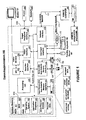
- Fig. 1 is a block diagram showing an exemplary computing environment in which aspects of the invention may be implemented
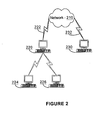
- Fig. 2 is a block diagram showing an exemplary networked computing environment in which aspects of the invention may be implemented
- Fig. 3 is a block diagram showing an exemplary parse in accordance with an embodiment of the present invention.
- Fig. 4 is a flowchart illustrating an exemplary method of compiling XLANG/s code in accordance with one embodiment of the present invention
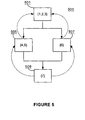
- Fig. 5 is a block diagram showing an exemplary flowgraph abstract instructions in accordance with one embodiment of the present invention.
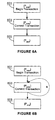
- FIGs. 6A-F are block diagrams showing exemplary flowgraphs of basic blocks in accordance with one embodiment of the present invention.
- Fig. 7 is a block diagram showing an exemplary flowgraph having depth-first numbers assigned to each basic block in accordance with one embodiment of the present invention.
- Fig. 8 is a block diagram showing an exemplary flowgraph having loops assigned in accordance with one embodiment of the present invention.
- Fig. 9 is a flowchart illustrating an exemplary method of computing one or more creation points for a data object in accordance with one embodiment of the present invention.
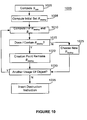
- Fig. 10 is a flowchart illustrating an exemplary method of computing one or more destruction points for a data object in accordance with one embodiment of the present invention.
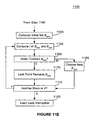
- Figs. 11A-B is a flowchart illustrating an exemplary method of placing lock points for a data object in accordance with one embodiment of the present invention.
- a XLANG/s compilation method parses XLANG/s code into one or more flowgraphs representative of the logical operation of the code.
- the method identifies a data object such as, for example, a variable in the flowgraph and tracks the operations that are performed on such data object.
- the method also places a creation point for such an object at an optimal location within XLANG/s code as late as possible prior to the object's first use.
- the method places a destruction point for such data object as early as possible after such object's last use.
- the method further places a lock point for a shared data object at an optimal location: at a location that avoids deadlocked code, while being as close prior to the first use of such object as possible.
- Fig. 1 illustrates an example of a suitable computing system environment 100 in which the invention may be implemented.
- the computing system environment 100 is only one example of a suitable computing environment and is not intended to suggest any limitation as to the scope of use or functionality of the invention. Neither should the computing environment 100 be interpreted as having any dependency or requirement relating to any one or combination of components illustrated in the exemplary operating environment 100.
- the invention is operational with numerous other general purpose or special purpose computing system environments or configurations.
- Examples of well known computing systems, environments, and/or configurations that may be suitable for use with the invention include, but are not limited to, personal computers, server computers, hand-held or laptop devices, multiprocessor systems, microprocessor-based systems, set top boxes, programmable consumer electronics, network PCs, minicomputers, mainframe computers, distributed computing environments that include any of the above systems or devices, and the like.
- the invention may be described in the general context of computer-executable instructions, such as program modules, being executed by a computer.
- program modules include routines, programs, objects, components, data structures, etc. that perform particular tasks or implement particular abstract data types.
- the invention may also be practiced in distributed computing environments where tasks are performed by remote processing devices that are linked through a communications network or other data transmission medium.
- program modules and other data may be located in both local and remote computer storage media including memory storage devices.
- an exemplary system for implementing the invention includes a general purpose computing device in the form of a computer 110.
- Components of computer 110 may include, but are not limited to, a processing unit 120, a system memory 130, and a system bus 121 that couples various system components including the system memory to the processing unit 120.
- the system bus 121 may be any of several types of bus structures including a memory bus or memory controller, a peripheral bus, and a local bus using any of a variety of bus architectures.
- such architectures include Industry Standard Architecture (ISA) bus, Micro Channel Architecture (MCA) bus, Enhanced ISA (EISA) bus, Video Electronics Standards Association (VESA) local bus, and Peripheral Component Interconnect (PCI) bus (also known as Mezzanine bus).
- ISA Industry Standard Architecture
- MCA Micro Channel Architecture
- EISA Enhanced ISA
- VESA Video Electronics Standards Association
- PCI Peripheral Component Interconnect
- Computer 110 typically includes a variety of computer readable media.
- Computer readable media can be any available media that can be accessed by computer 110 and includes both volatile and non-volatile media, removable and non-removable media.
- Computer readable media may comprise computer storage media and communication media.
- Computer storage media includes both volatile and non-volatile, removable and non-removable media implemented in any method or technology for storage of information such as computer readable instructions, data structures, program modules or other data.
- Computer storage media includes, but is not limited to, RAM, ROM, EEPROM, flash memory or other memory technology, CD-ROM, digital versatile disks (DVD) or other optical disk storage, magnetic cassettes, magnetic tape, magnetic disk storage or other magnetic storage devices, or any other medium which can be used to store the desired information and which can accessed by computer 110.
- Communication media typically embodies computer readable instructions, data structures, program modules or other data in a modulated data signal such as a carrier wave or other transport mechanism and includes any information delivery media.
- modulated data signal means a signal that has one or more of its characteristics set or changed in such a manner as to encode information in the signal.
- communication media includes wired media such as a wired network or direct-wired connection, and wireless media such as acoustic, RF, infrared and other wireless media. Combinations of any of the above should also be included within the scope of computer readable media.
- the system memory 130 includes computer storage media in the form of volatile and/or non-volatile memory such as ROM 131 and RAM 132.
- a basic input/output system 133 (BIOS), containing the basic routines that help to transfer information between elements within computer 110, such as during start-up, is typically stored in ROM 131.
- RAM 132 typically contains data and/or program modules that are immediately accessible to and/or presently being operated on by processing unit 120.
- Fig. 1 illustrates operating system 134, application programs 135, other program modules 136, and program data 137.
- the computer 110 may also include other removable/non-removable, volatile/non-volatile computer storage media.
- Fig. 1 illustrates a hard disk drive 140 that reads from or writes to non-removable, non-volatile magnetic media, a magnetic disk drive 151 that reads from or writes to a removable, non-volatile magnetic disk 152, and an optical disk drive 155 that reads from or writes to a removable, non-volatile optical disk 156, such as a CD-ROM or other optical media.
- removable/non-removable, volatile/non-volatile computer storage media that can be used in the exemplary operating environment include, but are not limited to, magnetic tape cassettes, flash memory cards, digital versatile disks, digital video tape, solid state RAM, solid state ROM, and the like.
- the hard disk drive 141 is typically connected to the system bus 121 through a non-removable memory interface such as interface 140, and magnetic disk drive 151 and optical disk drive 155 are typically connected to the system bus 121 by a removable memory interface, such as interface 150.
- the drives and their associated computer storage media provide storage of computer readable instructions, data structures, program modules and other data for the computer 110.
- hard disk drive 141 is illustrated as storing operating system 144, application programs 145, other program modules 146, and program data 147. Note that these components can either be the same as or different from operating system 134, application programs 135, other program modules 136, and program data 137. Operating system 144, application programs 145, other program modules 146, and program data 147 are given different numbers here to illustrate that, at a minimum, they are different copies.
- a user may enter commands and information into the computer 110 through input devices such as a keyboard 162 and pointing device 161, commonly referred to as a mouse, trackball or touch pad.
- Other input devices may include a microphone, joystick, game pad, satellite dish, scanner, or the like.
- These and other input devices are often connected to the processing unit 120 through a user input interface 160 that is coupled to the system bus, but may be connected by other interface and bus structures, such as a parallel port, game port or a universal serial bus (USB).
- a monitor 191 or other type of display device is also connected to the system bus 121 via an interface, such as a video interface 190.
- computers may also include other peripheral output devices such as speakers 197 and printer 196, which may be connected through an output peripheral interface 190.
- the computer 110 may operate in a networked environment using logical connections to one or more remote computers, such as a remote computer 180.
- the remote computer 180 may be a personal computer, a server, a router, a network PC, a peer device or other common network node, and typically includes many or all of the elements described above relative to the computer 110, although only a memory storage device 181 has been illustrated in Fig. 1.
- the logical connections depicted include a local area network (LAN) 171 and a wide area network (WAN) 173, but may also include other networks.
- LAN local area network
- WAN wide area network
- Such networking environments are commonplace in offices, enterprise-wide computer networks, intranets and the Internet.
- the computer 110 When used in a LAN networking environment, the computer 110 is connected to the LAN 171 through a network interface or adapter 170. When used in a WAN networking environment, the computer 110 typically includes a modem 172 or other means for establishing communications over the WAN 173, such as the Internet.
- the modem 172 which may be internal or external, may be connected to the system bus 121 via the user input interface 160, or other appropriate mechanism.
- program modules depicted relative to the computer 110, or portions thereof may be stored in the remote memory storage device.
- Fig. 1 illustrates remote application programs 185 as residing on memory device 181. It will be appreciated that the network connections shown are exemplary and other means of establishing a communications link between the computers may be used.
- MICROSOFT®'s .NET platform includes servers, building-block services, such as web-based data storage, and downloadable device software.
- the .NET platform provides (1) the ability to make the entire range of computing devices work together and to have user information automatically updated and synchronized on all of them, (2) increased interactive capability for web sites, enabled by greater use of XML rather than HTML, (3) online services that feature customized access and delivery of products and services to the user from a central starting point for the management of various applications, such as e-mail, for example, or software, such as Office .NET, (4) centralized data storage, which will increase efficiency and ease of access to information, as well as synchronization of information among users and devices, (5) the ability to integrate various communications media, such as e-mail, faxes, and telephones, (6) for developers, the ability to create reusable modules, thereby increasing productivity and reducing the number of programming errors, and (7) many other cross-platform integration features as well.
- exemplary embodiments herein are described in connection with software residing on a computing device, one or more portions of the invention may also be implemented via an operating system, API, or a "middle man" object between a coprocessor and requesting object, such that services may be performed by, supported in, or accessed via all of .NET's languages and services, and in other distributed computing frameworks as well.
- Businesses are more frequently interacting via distributed environments, such as the Internet or World Wide Web. For example, a consumer may want to know the prices of rental cars for an upcoming trip. The consumer may request the prices through an intermediate business on the Internet, such as a travel website. The intermediate business, upon receiving the consumer's request, sends price quote requests to a variety of rental car businesses. After responses are received from the rental car businesses, the intermediate business then sends the responses to the consumer. The consumer may then reserve a car and pay for the reservation via the intermediate business.
- the business processes discussed above are implemented using messages.
- the consumer's request to the intermediate business is implemented as an electronic message to the intermediate business that contains the particulars of the proposed car rental, for example: rental dates and times, type of car, additional insurance desired, consumer's name and address, credit card information and/or the like.
- the intermediate business' price quote request is another message, as are the responses from the rental car businesses - both to the intermediate business from the rental car businesses and from the intermediate business to the consumer - and the reservation ultimately sent by the consumer.
- a computer language designed to automate business processes and the messages used to carry out such processes is XLANG/s, which is described in more detail, below.
- XLANG/s A computer language designed to automate business processes and the messages used to carry out such processes.
- XLANG/s A computer language designed to automate business processes and the messages used to carry out such processes.
- such processes should be robust enough to compensate for external errors, such as communications link failures and the like.
- Providing a method of programming and compiling XLANG/s code to accomplish such processes in a robust and error-free manner is an application of an embodiment of the present invention.
- XLANG/s is a language that describes the logical sequencing of business processes, as well as the implementation of the business process by using various technology components or services. XLANG/s is described in more detail than is disclosed herein in a document titled “XLANG/s Language Specification,” Version 0.55, Copyright ⁇ Microsoft 1999-2000, and a document titled “XLANG Web Services For Business Process Design, Satish Thatte, Copyright ⁇ Microsoft Corporation 2001, both of which are hereby incorporated by reference in their entirety.
- the XLANG language is expressed in Extensible Markup Language (XML).
- business processes may be implemented using software code.
- the XLANG/s language is a modem, domain specific, special purpose language used to describe business processes and protocols.
- XLANG/s is also a declarative language, which means that it defines an explicit instruction set that describes and implements steps in a business process, the relationship between those steps, as well as their semantics and interactions.
- XLANG/s code is not just descriptive; it is also designed to be executable. Because of the declarative nature of XLANG/s and its specific semantics, the resulting executable code is deterministic; that is, the behavior of the running business process is well defmed by the semantics of the collection of XLANG/s instructions. Therefore, by examining XLANG/s code one is able to determine the business process that is carried out by such code. The definition of such a business process in executable form is an "orchestration.”
- XLANG/s is compatible with many Internet standards.
- XLANG/s is designed to use XML, XSLT (http://www.w3.org/TR/xslt), XPATH (http://www.w3.org/TR/xpath), XSD (XML Schema Definition) and WSDL (Web Services Description Language) as supported standards and has embedded support for working with .NET based objects and messages.
- WSDL is described in a document titled "Web Services Description Language (WSDL) 1.1," W3C Note January 2001, by Microsoft and IBM Research, Copyright ⁇ 2000 Ariba, International Business Machines Corporation, Microsoft, which is hereby incorporated by reference in its entirety.
- the XLANG/s language is syntactically similar to C#, thus a C# specification may be referenced as an aid to understanding the exact syntax.
- the semantics embodied in XLANG/s are a reflection of those defined in a document entitled "Business Process Execution Language for Web Services," Version 1.1, dated March 31, 2003, published by Microsoft, IBM and BEA for the definition of Business Process semantics, which is also hereby incorporated by reference in its entirety.
- the Business Process Execution Language for Web Services specification is commonly referred to as the "BPEL4WS" specification. As may be appreciated, therefore, the use of XLANG/s is most advantageous when applied to a business process.
- XLANG/s defines a rich set of high-level constructs used to define a business process.
- XLANG/s statements generally fall into one of two categories: simple statements that act on their own, such as receive or send, and complex statements that contain or group simple statements and/or other complex statements.
- XLANG/s also supports low-level data types such as String and Int32 (integer), for example.
- High-level data types are also defined such as, for example, messages, ports (locations to which messages are sent and received), correlations and service links. The data types are used to rigorously define the semantics associated with the business process and are complemented by process control statements such as "while,” and "scope.”
- a XLANG/s service communicates with the outside world by sending and/or receiving messages.
- the message type is the structural definition of such a message.
- Messages are acted upon by operations (e.g., receive, response), and an operation may be either a single asynchronous message or a request-response pair of messages. Operations may be either incoming or outgoing.
- a seller may offer a service/product that begins an interaction by accepting a purchase order (from a potential buyer) via an input message. The seller may then return an acknowledgement to the buyer if the order can be fulfilled. The seller may send additional messages to the buyer (e.g., shipping notices, invoices).
- these input and output operations occur in accordance with a defined sequence, referred to as a service process.
- the seller's service remembers the state of each purchase order interaction separately from other similar interactions. This is particularly advantageous in situations in which the buyer may be conducting many simultaneous purchase processes with the same seller.
- each instance of a service process may perform activities in the background (e.g., update inventory, update account balance) without the stimulus of an input operation.
- a service process may represent an interaction utilizing several operations. As such the interaction has a well-defined beginning and end. This interaction is referred to as an instance of the service.
- An instance can be started in either of two ways.
- a service can be explicitly instantiated using some implementation-specific functionality or a service can be implicitly instantiated with an operation in its behavior that is meant to be an instantiation operation.
- a service instance terminates when the process that defines its behavior terminates.
- Services are instantiated to act in accordance with the history of an extended interaction. Messages sent to such services are delivered not only to the correct destination port, but to the correct instance of the service that defines the port.
- a port is an end point where messages are sent and received by a service.
- the infrastructure hosting the service supports this routing, thus avoiding burdening every service implementation with the need to implement a custom mechanism for instance routing.
- a first computer 220 which is any type of computing device such as, for example, computer 110 as disclosed above in connection with Fig. 1, a special-purpose computer or the like, is operatively connected to a network 210 by way of communications link 222.
- Network 210 may be any type of network for interconnecting a plurality of computing devices, and may be an intranet, the Internet, etc.
- Communications link 222 may comprise any type of communications medium, whether wired, wireless, optical or the like.
- Second computer 230 like first computer 220, may be any type of computing device, and is operatively connected to network 210 by way of communications link 232.
- Communications link 232 may be any type of communications medium.
- communications links 222, 232 are the same type of communications medium, while in another embodiment the medium employed by each communications link 222, 232 is different.
- additional computers 224, 226 may be operatively connected to first computer 220.
- additional computers may be operatively connected to second computer 230 as well (not shown in Fig. 2 for clarity).
- a buyer sends a purchase order to a seller.
- the buyer sends the message from, for example, first computer 220 to the seller's second computer 230 by way of the network 210 and communications links 222, 233.
- the buyer and seller have a stable business relationship and are statically configured to send documents related to the purchasing interaction to the URLs associated with the relevant ports.
- the acknowledgement is routed to the correct service instance at the buyer's end at computer 220 or, optionally, another computer such as additional computers 224, 226.
- One way to implement such a routing is to carry an embedded token (e.g., cookie) in the order message that is copied into the acknowledgement for correlation.
- an embedded token e.g., cookie
- the token may be in the message envelope in a header or in the business document (purchase order) itself.
- the structure and position of the tokens in each message can be expressed declaratively in the service description. This declarative information allows XLANG/s compliant infrastructure to use tokens to provide instance routing automatically.
- a service instance may typically hold one or more conversations with other service instances representing other participants involved in the interaction. Conversations may use a sophisticated transport infrastructure that correlates the messages involved in a conversation and routes them to the correct service instance. In many cases correlated conversations may involve more than two parties or may use lightweight transport infrastructure with correlation tokens embedded directly in the business documents being exchanged.
- XLANG/s addresses correlation scenarios by providing a very general mechanism to specify correlated groups of operations within a service instance.
- a set of correlation tokens can be defined as a set of properties shared by all messages in the correlated group. Such a set of properties is called a correlation set.
- XLANG/s code using variables to store values necessary to carry out such features.
- XLANG/s is compiled by a compiler prior to run time. Details relating to compilations processes should be known to those of skill in the art and are therefore not described in detail herein.
- An embodiment of the present invention is carried out as part of an XLANG/s code compilation process, after some steps of the compilation process have completed. For example, it is assumed herein that a programmer has written a textual description of a business process, wherein the textual description conforms to the grammar and specification of the business process language such as, for example, XLANG/s.
- the textual program is read by a parser, which ensures that the input is well-formed, meaning that there are no textual or syntax errors in the textual representation, and then the parser translates the textual representation into a canonical high-level parse tree representation.
- the high-level parse tree is analyzed to produce a sequence of low-level abstract instructions. These instructions, when executed in the proper sequence, will perform the actions that the business process writer expressed in the textual representation.
- the output of the aforementioned steps of the compilation process is a sequence of low-level abstract instructions.
- the instructions are then used as input for an embodiment of the present invention.
- additional steps or processes may take place prior to initiating an embodiment of the present invention and, likewise, some or all of the above steps may be consolidated. Any such situation is equally compatible with an embodiment of the present invention.
- An example of the previously-discussed process that results in input for an embodiment is discussed below in connection with Fig. 3.
- the example disclosed herein is abbreviated for the sake of clarity, and in most situations includes a larger amount of textual code and, therefore, a larger parse tree and a longer set of resulting instructions.
- a textual description of a business process is provided.
- the description preferably conforms to the grammar and specification of the business process language being utilized such as, for example, XLANG/s. It will be appreciated that the description describes the aspects of the business process that will ultimately be carried out by the program that results from the complete compilation process according to an embodiment of the present invention.
- An exemplary fragment of a textual description of a business process may be as follows:
- the above fragment is merely exemplary, as a textual description of a business process may describe any aspect of such business process that is capable of being carried out by business software.
- This particular fragment describes a business process that involves a request to withdraw funds from an account.
- a message is received on port myPort .
- the message contains an instruction to withdraw an amount from an account, which is labeled myAccount . If the balance after withdrawal is less than zero, then a result message is assigned the value "overdrawn" to indicate that the account had insufficient funds. Otherwise, the result message is assigned the value "okay.” Finally, the result message is sent back to the sender of the original message as a response.
- a parser reads the above disclosed textual representation and builds a parse tree that captures the form and structure contained in the text.
- Fig. 3 an exemplary parse tree 300 based on the above textual description is provided. As may be seen in Fig. 3, the logical structure of the textual description becomes evident from the layout of the parse tree 300. It will be appreciated that the parse tree 300 does not need to be graphically created, and may in fact be an ephemeral and internal product created as part of the overall compilation process disclosed herein.
- the parse tree 300 comprises blocks that represent the logical structure of the textual description.
- Blocks 305-313 represent the logic involved with determining the balance of myAccount after withdrawing msgAmount according to the instructions of the textual description. As may be appreciated, the exact graphical representation used to represent the logical structure of a textual description may adhere to any convention, as an embodiment of the present invention is equally compatible with any such convention.
- Block 315 represents the "if" portion of the if (balance ⁇ 0) statement.
- Block 317 along with blocks 319-323, represents the logic involved with determining whether the balance of myAccount is less than zero, according to the above if (balance ⁇ 0) statement.
- block 341 represents the send(myPort, msgResult) statement, which describes sending a message generated in either blocks 325-331 or blocks 333-339 in accordance with the balance determination of blocks 317-323.
- the parse tree is then translated into a sequence of abstract instructions that, when executed, implement the business process.
- a flowchart illustrating a method of compiling XLANG/s code in accordance with one embodiment of the present invention is shown.
- the method 400 comprises steps 405-440 although, and as will be mentioned shortly, not all steps 405-440 need be present in an embodiment of the present invention.
- a flowgraph is created, using abstract instructions such as, for example, the abstract instructions discussed above in connection with Fig. 3. Details regarding the creation of exemplary flowgraphs is discussed below in connection with Figs. 6A-F.
- the basic blocks of the flowgraph created in step 405 are ordered, and at block 415, dominators of each basic block are found, as will be discussed in detail below in connection with Fig.
- step 420 loops are found as will be discussed in detail below in connection with Fig. 8.
- step 425 data object usage within each basic block is analyzed. As discussed above, a data object may be a variable, symbol or the like.
- one or more creation points are determined according to the method of Fig. 9, to be discussed in detail below.
- one or more destruction points are determined according to the method of Fig. 10, below.
- step 440 one or more lock points are created for each shared data object, according to the method of Figs. 11A-B, to be discussed below.
- a flowgraph is constructed by partitioning the instruction list into basic blocks, and then connecting each basic block to its immediate successor(s) and predecessor(s).
- a basic block is a series of consecutive programming statements, or instructions, in which flow of control enters at the first statement and leaves at the last statement without stopping and without any branching possibilities except at the end of the block. Additional references with respect to basic blocks may be found in Compilers: Principles, Techniques, and Tools, by Aho, Sethi and Ullman, which is herein incorporated by reference in its entirety.
- One exemplary algorithm that is compatible with an embodiment of the present invention is Algorithm 9.1 of Compilers: Principles, Techniques, and Tools, by Aho, Sethi and Ullman.
- an embodiment of the present invention applies, for example, algorithm 9.1 to abstract instructions 1-7, above.
- the basic blocks are ⁇ 1, 2, 3 ⁇ , ⁇ 4, 5 ⁇ , ⁇ 6 ⁇ and ⁇ 7 ⁇ .
- the blocks are connected bi-directionally to their successors and predecessors.
- the successors of a first basic block are simply any blocks whose first instructions can be reached by the last instruction in the first basic block.
- the last instruction in the basic block ⁇ 1, 2, 3 ⁇ is the JumpIfFalse instruction. This instruction is defined to perform a jump to another instruction if the condition is false; otherwise, the next sequential instruction will be processed.
- the successors of ⁇ 1, 2, 3 ⁇ are ⁇ 4, 5 ⁇ and ⁇ 6 ⁇ .
- Predecessors are the opposite of successors.
- the predecessor of ⁇ 4, 5 ⁇ is ⁇ 1, 2, 3 ⁇ .
- Block 501 represents basic block ⁇ 1,2,3 ⁇
- block 505 represents basic block ⁇ 4,5 ⁇
- block 507 represents basic block ⁇ 6 ⁇
- block 509 represents basic block ⁇ 7 ⁇ .
- the solid lines represent the successor relationships between each basic block, and the dashed lines represent the predecessor relationships.
- blocks 505 and 507 are each connected by solid lines to block 509, thereby indicating that basic block ⁇ 7 ⁇ is a successor to basic blocks ⁇ 4,5 ⁇ and ⁇ 6 ⁇ .
- block 509 is connected to blocks 505 and 507 by a dashed line, thereby indicating that basic blocks ⁇ 4,5 ⁇ and ⁇ 6 ⁇ are predecessors to basic block ⁇ 7 ⁇ .
- a transaction in XLANG/s encapsulates a sub-process that exhibits transactional characteristics.
- a process contained within a XLANG/s transaction either completes in its entirety, or fails in its entirety.
- planning for the success or failure of a particular XLANG/s transaction allows a programmer to create a business application that is robust enough to compensate for errors.
- a transaction may be, for example, atomic or long-running.
- An atomic XLANG/s transaction is a software transaction in which no action takes place and no program state is changed unless the transaction successfully completes. It is atomic in the sense that it completes successfully or it does nothing at all, which is to say that it does not "commit.”
- a long-running XLANG/s transaction is, as the name implies, a software transaction that takes place over a period of time that is significant for computing purposes. At any point during the processing of such a transaction, an exception may occur. When an exception occurs in, or is "thrown from,” a long-running transaction, the compiler cannot be certain of which, if any, of the instructions within the transaction have executed successfully.
- each transaction comprises a body process, zero or more exception handler processes and an optional compensation process.
- an atomic transaction does not have an exception handler; however, an atomic transaction may be retry-able.
- An exception handler process is a sub-process that executes whenever any instruction in the transaction body throws an exception of the kind for which the handler is designed, or whenever the transaction aborts.
- a compensation process is a sub-process that might execute, depending on the configuration of the program, after a transaction commits in order to "undo" the work that was performed in the transaction body. As may be appreciated, therefore, in one embodiment transactions can nest, and if an inner transaction commits, but an outer transaction aborts, the outer transaction can invoke the inner transaction's compensation handler.
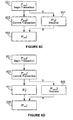
- Figs. 6A-F are several case examples to further illustrate transaction flowgraphs in accordance with an embodiment of the present invention.
- the notation P x is used to denote a sub-process.
- the subscript x is an identifier of the sub-process P.
- all sub-processes consist of a single basic block, although it will be appreciated that an embodiment of the present invention may be implemented to process arbitrarily complex sub-processes.
- the code examples to be used below in connection with Figs. 6A-F are merely exemplary, as code used in connection with an embodiment of the present invention may be of any length or complexity.
- XLANG/s transaction is a long-running transaction with no exception handlers and no compensation.
- a textual description of such a transaction may, for example, consist of the following high-level code:
- this abstract instruction stream consists of numbering and bracketed comments, which are inserted herein for ease of discussion. Thus, such numbering and comments, while consistent with an embodiment of the present invention, are not required.
- the special abstract instruction BeginTransaction has as its successors the transaction body process, P body and, if any were present in the present example, all exception handler processes.
- the special abstract instruction CommitTransaction has as its successors the next sequential instruction and, if one were present in the present example, the transaction's compensation process.
- Block 601 represents the abstract instruction BeginTransaction , as indicated by the P start instruction
- block 603 represents the abstract instruction CommitTransaction , as indicated by the P body instruction
- block 605 represents the end of the transaction, as indicated by P end .
- the arrows indicate the program flow, which is from block 601 through block 603 to block 605. It will be appreciated that in the present simple example it is not necessary for an embodiment of the present invention to split the flowgraph into three blocks 601-605 because the instructions are processed in order without any branching or compensation.
- the present example illustrates how an embodiment may treat an atomic transaction differently than a long-running transaction.
- the textual description below is similar to that of the long-running transaction discussed above in connection with Fig. 6A.
- the CommitTransaction comprises slightly different instructions than that was described above in connection with Fig. 6A. If the transaction commits, the control flow proceeds to the next sequential instruction and if it aborts, the control flow loops back to the start of the transaction. As may be appreciated, therefore, an atomic transaction forms an implicit loop because it can retry on failure.
- Fig. 6B a flowgraph of the above-described transaction is illustrated. As was the case in Fig. 6A, block 601 represents the abstract instruction BeginTransaction , as indicated by the P start instruction, block 603 represents the abstract instruction CommitTransaction , as indicated by the P body instruction and block 605 represents the end of the transaction, as indicated by P end .
- the unlabeled arrows indicate the normal, failure-free program flow, which is from block 601 through block 603 to block 605.
- Arrow A indicates the implicit loop formed by the CommitTransaction instruction as explained above.
- the present example illustrates the handling of an XLANG/s exception handler as implemented in a long-running transaction.
- atomic transactions do not have exception handlers.
- a textual description of such a transaction may, for example, consist of the following high-level code:
- block 601 represents the abstract instruction BeginTransaction , as indicated by the P start instruction
- block 603 represents the abstract instruction CommitTransaction , as indicated by the P body instruction
- block 605 represents the end of the transaction, as indicated by P end .
- block 607 represents the abstract instruction Resume, which is associated with the exception handler, as will be discussed shortly.
- the unlabeled arrows again indicate the normal, failure-free program flow, which is from block 601 through block 603 to block 605.
- the flowgraph presumes that an exception can occur immediately after the transaction body is entered; thus, both the body and the exception handler can logically follow the BeginTransaction abstract instruction.
- the unlabeled, solid arrow following block 601 indicates normal program flow, while dashed arrow A indicates the logical path that is taken in the event of an exception.
- Block 607 contains the special abstract instruction Resume, which is defined to jump to the next statement after the transaction.
- Resume the logic path indicated by dashed arrow B is taken to P end at block 605.
- both the body of block 603 and the exception handler of block 607 flow to the same successor, P end at block 605.
- the present example illustrates the handling of a XLANG/s compensation handler as implemented in a long-running transaction.
- compensation handlers are XLANG/s code modules that attempt to undo, or "compensate" for, a transaction that does not complete successfully due to an error or the like.
- Such a compensation handler may perform any task desired by a programmer such as, for example, performing a function that is the opposite of the failed transaction, performing a function that nullifies the effect of the failed transaction, or the like.
- a textual description of such a transaction may, for example, consist of the following high-level code:
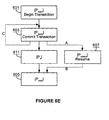
- Block 601 represents the abstract instruction BeginTransaction , as indicated by the P start instruction
- block 603 represents the abstract instruction CommitTransaction
- block 605 represents the end of the transaction, as indicated by P end .
- Block 609 represents the compensation process and the abstract instruction Resume, which was discussed above in connection with Fig. 6C.
- Block 611 represents any additional programming that follows P body , as indicated by P x .
- the unlabeled arrows again indicate the normal, failure-free program flow, which is from block 601 through blocks 603 and 611 to block 605.
- Dashed arrow A represents the logical path taken in the event of a program state for which compensation is desired.
- block 609 represents a compensation handler, as indicated by P comp .
- P comp the placement of block 609 in the flowgraph of Fig. 6D illustrates that the code of the compensation block can be reached after the transaction successfully commits, and remains reachable until the end of the program, as represented by block 605.
- Such availability of block 609 is achieved in the flowgraph of Fig. 6D by making block 609 a possible successor of the CommitTransaction instruction of block 603, by way of dashed arrow A, and by making the end of the program, block 605, the successor of block 609, by way of dashed arrow B.
- the compensation block 609 could flow to an earlier point in the program than block 605, provided that the compensation functionality represented by block 609 is no longer needed at the point to which block 609 flows.
- the flowgraph of an atomic transaction with compensation may be described as a combination of the atomic transaction discussed above in connection with Fig. 6B with the long-running transaction with compensation discussed above in connection with Fig. 6D.
- Fig. 6E such a flowgraph is illustrated.
- the description of blocks 601-611, solid unlabeled arrows and dashed arrows A and B, is consistent with that discussed above in connection with Fig. 6D.
- dashed arrow C is equivalent to dashed arrow A as discussed above in connection with Fig. 6B, which represents the implicit loop that can retry on failure of the CommitTransaction abstract instruction.
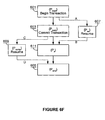
- the flowgraph of a long-running transaction with exception handler and compensation may be described as a combination of the long-running transaction with exception handler discussed above in connection with Fig. 6C with the long-running transaction with compensation discussed above in connection with Fig. 6D.
- Fig. 6F such a flowgraph is illustrated.
- the description of blocks 601-611 and the solid unlabeled arrows are consistent with that discussed above in connection with Fig. 6E.
- dashed arrows A and B are equivalent to dashed arrows A and B as discussed above in connection with Fig.
- dashed arrows C and D are equivalent to dashed arrows A and B as discussed above in connection with Fig. 6D, which represents the control flow in the event the compensation handler of block 609 is invoked, which occurs by way of dashed arrow C, and whereby control flow returns to the end of the program at block 605 by way of dashed arrow D.
- an embodiment of the present invention may then annotate information onto each basic block.
- a depth-first search is undertaken to assign a number indicating a position of a basic block in a depth-first ordering of the flow graph.
- a determination of two dominator sets is made. In such a determination, a set of dominators from above is made, as well as a set of dominators from below.
- a determination of which, if any, blocks participate in one or more loops is also made.
- an embodiment of the present invention may create flowgraphs, such as those discussed above in connection with Figs. 6A-F, for any level of abstract instruction complexity.
- any combination of any number of flowgraphs of Figs. 6A-B may be combined in series and/or in parallel. In such a manner, an embodiment of the present invention is able to process and compile code of any complexity.
- a depth-first search is performed on the flow graph and each block contained within the flowgraph is assigned a corresponding depth-first number.
- any algorithm for finding a depth-first ordering of a flowgraph is equally consistent with an embodiment of the present invention.
- one such algorithm is algorithm 10.14, as described in Compilers: Principles, Techniques, and Tools.
- Flowgraph 700 comprises blocks 705-720, each of which is assigned a depth-first number. Starting at the bottom of flowgraph 700, at block 720, it can be seen that block 720, being at the end of the program represented by flowgraph 700, has been assigned a number of 0. Blocks 710 and 715, being the next two blocks from the end of flowgraph 700 are assigned a number of 1 and 2, respectively.
- blocks 710 and 715 are at an equal distance from the end of flowgraph 700, the assignment of numbers 1 and 2 may be reversed while remaining consistent with an embodiment of the present invention.
- block 705, being the furthest from the end of flowgraph 700 is assigned a number of 3.
- the use of depth-first ordering permits the efficient identification of the basic blocks 705-720 such as, for example, as one or more bit sets.
- the dominance relationships of all blocks 705-720 are determined bi-directionally using, for example, algorithm 10.16, as described in Compilers: Principles, Techniques, and Tools. As noted above, any algorithm for finding dominators of basic blocks is equally consistent with an embodiment of the present invention.
- Determining whether a block pre-dominates another block involves starting at the top - representing the beginning of the control flow - of flowgraph 700 and determining if all logic paths leading to a particular block must have first passed through a previous block.
- the pre-dominators of block 720 are 720 and 705. It will be appreciated that a block dominates itself. It will also be appreciated that blocks 710 and 715 do not pre-dominate block 720 because control flow does not need to pass through either block 710 or 715 prior to reaching block 720. For example, control flow may pass from block 705 to block 710 and then to 720, bypassing block 715. Likewise, control flow may pass from block 705 to block 715 and then to 720, bypassing block 710.
- Determining whether a block post-dominates another block involves starting at the bottom - representing the end of the control flow - of flowgraph 700 and determining whether all paths leading from a particular block must ultimately pass through another block.
- the post-dominators of block 705 are blocks 705 and 720.
- an embodiment of the present invention locates and identifies loops in flowgraph 800 by using, for example, algorithm 10.1, as described in Compilers: Principles, Techniques, and Tools.
- flowgraph 800 is a doubly-nested loop.
- a numbering convention is used to identify each loop such as, for example, that all basic blocks belonging to the same loop are given the same loop identifier.
- the loop identifier may be any type of identifier such as, for example, an integer with the property that inner loops have higher numbers than outer loops.
- blocks 805 and 835 are not part of a loop, and therefore are not given a loop identifier. It can also be seen that the loop formed between blocks 820 and 825 is nested within a loop formed by blocks 810, 815 and 830. Therefore, according to one embodiment of the present invention blocks 820 and 825 are assigned a loop identifier of 2, to signify that blocks 820 and 825 participate in two loops, and blocks 810, 815 and 830 are assigned a loop identifier of 1, to signify that blocks 810, 815 and 830 participate in one loop.
- step 430 is to analyze the usage of each data object.
- data objects may be, for example, variables, data objects and the like.
- the flowgraphs produced by an embodiment of the present invention are used by a XLANG/s compiler to perform several tasks.
- the calculation and insertion of create, destroy and lock points are some of the tasks that may be performed by an embodiment of the present invention, and are now discussed in detail below in connection with Figs. 9-11B.
- a method 900 of computing one or more creation points for a data object is illustrated.
- a set S use of basic blocks that either read from or write to a data object is collected.
- the set S use is equal to the sum of a set of basic blocks that read from a data object, S read , and the set of basic blocks that write to a data object, S write .
- B create the basic block that contains the first lexical use of the data object.
- a compiler computes the intersection I of B create 's pre-dominators and B next 's pre-dominators.
- a determination is made as to whether the set I contains B create . If so, at step 920 the creation point of the data object of interest remains B create . If not, at step 925 a new creation point B create is chosen from the set I, such that the depth-first number of the new creation point is the smallest number that is greater than the depth-first number of the current creation point. As a result, therefore, the creation point of the data object occurs before such data object is used so as to avoid an error that would result if the object was referred to and had no value.
- the creation point is created as close to the first use of the object as possible so as to avoid unnecessarily burdening memory resources.
- the new creation point is in a different loop than the previous creation point, then successively higher- and higher-numbered blocks from the set I are chosen until all inner loops are bypassed.
- step 930 a determination is made as to whether another use of the data object within the set S use is present and, if so, the method 900 returns to step 910 for such next use. Once all uses of the data object are accounted for, the method 900 proceeds to step 935.
- step 935 an instruction that performs the data object's creation and initialization is inserted within the basic block B create , as determined in steps 905-930, prior to any intra-block uses.
- a method 1000 of computing one or more destruction points for a data object is illustrated.
- step 1005 a set S use of basic blocks that either read from or write to a data object is collected.
- the set S use is equal to the sum of a set of basic blocks that read from a data object, S read , and the set of basic blocks that write to a data object, S write .
- an assumption is made that the data object of interest is destroyed at the last lexical use of the data object within the set S use .
- the basic block that contains the last lexical use of the data object is referred to herein as B destroy .
- an initial set B destroy is computed, based on the last lexical use of the data object.
- a compiler computes the intersection I of B destroy 's post-dominators and B prev 's post-dominators.
- a determination is made as to whether the set I contains B destroy . If so, at step 1020 the destruction point of the data object of interest remains B destroy . If not, at step 1025 a new destruction point B destroy is chosen from the set I, such that the depth-first number of the new destruction point is the largest number that is less than the depth-first number of the current destruction point. As a result, therefore, the destruction point of the data object occurs after such data object is last used so as to avoid unnecessarily burdening memory resources. As may be appreciated, if the new destruction point is in a different loop than the previous destruction point, then successively lower- and lower-numbered blocks from the set I are chosen until all inner loops are bypassed.
- step 1030 a determination is made as to whether another use of the data object within the set S use is present and, if so, the method 1000 returns to step 1010 for such next use. Once all uses of the data object are accounted for, the method 1000 proceeds to step 1035.
- step 1035 an instruction that performs the data object's destruction and cleanup is inserted within the basic block B destroy , as determined in steps 1005-1030, after any intra-block uses.
- lock points appears similar to that of creation points, because it is desirable to place the locks as late as possible prior to the first use of a shared data object.
- locks for shared objects cannot be placed individually.
- the following exemplary XLANG/s code provides an example of the complications that arise when computing lock points.
- the above lock placement may be acceptable. However, if the first task proceeds far enough to acquire a's lock, and then is interrupted, a deadlocked program may result. If, for example, after the above interruption, the second task proceeds to acquire b's lock, it will then become blocked because it cannot acquire a's lock. If the first task resumes after the interruption, it will not be able to proceed because it now cannot acquire b's lock. The process is therefore deadlocked.
- An embodiment of the present works around this problem by considering the use-points of all the shared data objects within a synchronized scope, and placing locks for all such objects prior to the first use of any of the objects. Deadlocks are avoided by acquiring locks in a consistent order across all synchronized scopes. As may be appreciated, any lock order may be used if such order is consistent.
- a set V of basic blocks is created.
- a set L of all shared data objects that require locking is collected.
- a set S write of basic blocks that write to the data object is created and, at step 1120 all basic blocks that are not contained within the synchronized scope are removed from S write .
- a set S read of basic blocks that read from the data object is created and, at step 1130, all basic blocks that are not contained within the synchronized scope are removed from S read .
- a determination is made as to the type of lock that is required. For example, if the set S write is empty, indicating that nothing is written to the data object, then the data object only requires a read-lock; otherwise, it requires a write-lock.
- step 1140 the sets S write and S read are added to V .
- step 1145 a determination is made as to whether another data object is within the set L and, if so, the method 1100 returns to step 1115 for the next data object. Otherwise, the method 1100 proceeds to step 1150 on Fig. 11B, below.
- Fig. 11B the remainder of a method 1100 of placing lock points according to an embodiment of the present invention is illustrated.
- B lock the basic block that contains the first lexical use of the shared data object.
- This is, for example, the highest-numbered basic block in the set V . Every lexically subsequent usage of the data object within V, in one embodiment, is each subsequently lower-numbered basic block, B next . Accordingly, at step 1150 an initial set B lock is computed, based on the first lexical use of the data object.
- a compiler computes the intersection I of B lock 's pre-dominators and B next 's pre-dominators.
- a determination is made as to whether the set I contains B lock . If so, at step 1170 the lock point of the data object of interest remains B lock . If not, at step 1165 a new lock point B create is chosen from the set I, such that the depth-first number of the new lock point is the smallest number that is greater than the depth-first number of the current lock point.
- the lock point is created as close to the first use of the object as possible so as to avoid early locking of resources, while at the same time being placed in such a way as to avoid deadlocking the transaction.
- successively higher- and higher-numbered blocks are chosen from the set I until all inner loops are bypassed.
- step 1175 a determination is made as to whether another lexically subsequent block, B next , is present within the set V is present and, if so, the method 1100 returns to step 1155 for such next block. Once all uses of the data object are accounted for, the method 1100 proceeds to step 1180.
- step 1180 an instruction that locks - as either a read or write block, as determined above in connection with Fig. 11A - each shared object is placed in a deterministic order, prior to any intra-block uses.
Landscapes
- Engineering & Computer Science (AREA)
- General Engineering & Computer Science (AREA)
- Theoretical Computer Science (AREA)
- Software Systems (AREA)
- Physics & Mathematics (AREA)
- General Physics & Mathematics (AREA)
- Information Retrieval, Db Structures And Fs Structures Therefor (AREA)
- Devices For Executing Special Programs (AREA)
- Image Generation (AREA)
- Measuring Pulse, Heart Rate, Blood Pressure Or Blood Flow (AREA)
- Investigating Or Analysing Biological Materials (AREA)
- Debugging And Monitoring (AREA)
- Complex Calculations (AREA)
- Stored Programmes (AREA)
Applications Claiming Priority (2)
| Application Number | Priority Date | Filing Date | Title |
|---|---|---|---|
| US10/648,461 US7210135B2 (en) | 2003-08-26 | 2003-08-26 | Data flow analysis of transactional processes |
| US648461 | 2003-08-26 |
Publications (3)
| Publication Number | Publication Date |
|---|---|
| EP1513064A2 true EP1513064A2 (fr) | 2005-03-09 |
| EP1513064A3 EP1513064A3 (fr) | 2007-08-15 |
| EP1513064B1 EP1513064B1 (fr) | 2009-06-03 |
Family
ID=34136617
Family Applications (1)
| Application Number | Title | Priority Date | Filing Date |
|---|---|---|---|
| EP04016716A Expired - Lifetime EP1513064B1 (fr) | 2003-08-26 | 2004-07-15 | Analyse de flot de données de processus de transaction |
Country Status (7)
| Country | Link |
|---|---|
| US (2) | US7210135B2 (fr) |
| EP (1) | EP1513064B1 (fr) |
| JP (1) | JP4728607B2 (fr) |
| KR (1) | KR20050022282A (fr) |
| CN (1) | CN100422933C (fr) |
| AT (1) | ATE433150T1 (fr) |
| DE (1) | DE602004021324D1 (fr) |
Cited By (1)
| Publication number | Priority date | Publication date | Assignee | Title |
|---|---|---|---|---|
| CN100559347C (zh) * | 2007-03-23 | 2009-11-11 | 北京大学 | 一种嵌套循环结构的识别方法 |
Families Citing this family (42)
| Publication number | Priority date | Publication date | Assignee | Title |
|---|---|---|---|---|
| US7877681B2 (en) | 2002-12-05 | 2011-01-25 | Borland Software Corporation | Automatic context management for web applications with client side code execution |
| US7194733B2 (en) * | 2003-06-11 | 2007-03-20 | Microsoft Corporation | Transformation of an asynchronous transactional messaging language into a web services compatible language |
| US7210135B2 (en) * | 2003-08-26 | 2007-04-24 | Microsoft Corporation | Data flow analysis of transactional processes |
| TWI306215B (en) * | 2005-04-29 | 2009-02-11 | Ind Tech Res Inst | Method and corresponding apparatus for compiling high-level languages into specific processor architectures |
| US7779399B2 (en) * | 2005-05-16 | 2010-08-17 | Armorize Technologies, Inc. | System and method for securing web application code and verifying correctness of software |
| US20070039000A1 (en) * | 2005-08-10 | 2007-02-15 | Hewlett-Packard Development Company, L.P. | Lock order determination method and system |
| US8453131B2 (en) * | 2005-12-24 | 2013-05-28 | Intel Corporation | Method and apparatus for ordering code based on critical sections |
| US7599861B2 (en) | 2006-03-02 | 2009-10-06 | Convergys Customer Management Group, Inc. | System and method for closed loop decisionmaking in an automated care system |
| US7809663B1 (en) | 2006-05-22 | 2010-10-05 | Convergys Cmg Utah, Inc. | System and method for supporting the utilization of machine language |
| US8379830B1 (en) | 2006-05-22 | 2013-02-19 | Convergys Customer Management Delaware Llc | System and method for automated customer service with contingent live interaction |
| US8037466B2 (en) | 2006-12-29 | 2011-10-11 | Intel Corporation | Method and apparatus for merging critical sections |
| US20080209405A1 (en) * | 2007-02-28 | 2008-08-28 | Microsoft Corporation | Distributed debugging for a visual programming language |
| US20090064092A1 (en) * | 2007-08-29 | 2009-03-05 | Microsoft Corporation | Visual programming language optimization |
| US8677336B2 (en) * | 2008-01-17 | 2014-03-18 | Microsoft Corporation | Block count based procedure layout and splitting |
| US8966465B2 (en) | 2008-02-12 | 2015-02-24 | Oracle International Corporation | Customization creation and update for multi-layer XML customization |
| US8291399B2 (en) | 2008-03-26 | 2012-10-16 | Avaya Inc. | Off-line program analysis and run-time instrumentation |
| US8484623B2 (en) * | 2008-03-26 | 2013-07-09 | Avaya, Inc. | Efficient program instrumentation |
| US8739145B2 (en) * | 2008-03-26 | 2014-05-27 | Avaya Inc. | Super nested block method to minimize coverage testing overhead |
| US8752007B2 (en) * | 2008-03-26 | 2014-06-10 | Avaya Inc. | Automatic generation of run-time instrumenter |
| US8799319B2 (en) | 2008-09-19 | 2014-08-05 | Oracle International Corporation | System and method for meta-data driven, semi-automated generation of web services based on existing applications |
| US8996658B2 (en) | 2008-09-03 | 2015-03-31 | Oracle International Corporation | System and method for integration of browser-based thin client applications within desktop rich client architecture |
| US9122520B2 (en) | 2008-09-17 | 2015-09-01 | Oracle International Corporation | Generic wait service: pausing a BPEL process |
| TW201032535A (en) | 2008-10-14 | 2010-09-01 | Ibm | A method of handling a message |
| US8244567B2 (en) * | 2008-12-31 | 2012-08-14 | Synnex Corporation | Business goal incentives using gaming rewards |
| US8495103B2 (en) * | 2009-05-29 | 2013-07-23 | Red Hat, Inc. | Method and apparatus for determining how to transform applications into transactional applications |
| US8429606B2 (en) * | 2009-05-29 | 2013-04-23 | Red Hat, Inc. | Transactional object container |
| CN101630268B (zh) * | 2009-08-20 | 2012-07-04 | 中国科学技术大学 | 同步优化的方法及设备 |
| US8429627B2 (en) * | 2009-10-12 | 2013-04-23 | National Instruments Corporation | Asynchronous preemptive edit time semantic analysis of a graphical program |
| US8468512B2 (en) * | 2009-10-30 | 2013-06-18 | International Business Machines Corporation | Abstracting benefit rules from computer code |
| US8849780B2 (en) * | 2009-11-02 | 2014-09-30 | Sap Ag | System and method for automation of consistent lock management |
| US8972994B2 (en) | 2009-12-23 | 2015-03-03 | Intel Corporation | Method and apparatus to bypass object lock by speculative execution of generated bypass code shell based on bypass failure threshold in managed runtime environment |
| US20110246970A1 (en) * | 2010-03-30 | 2011-10-06 | Nec Laboratories America, Inc. | Interval analysis of concurrent trace programs using transaction sequence graphs |
| US8843907B2 (en) * | 2011-08-25 | 2014-09-23 | Myezapp Inc. | Compiler with error handling |
| US8954942B2 (en) * | 2011-09-30 | 2015-02-10 | Oracle International Corporation | Optimizations using a BPEL compiler |
| US8806452B2 (en) | 2011-11-10 | 2014-08-12 | International Business Machines Corporation | Transformation of computer programs and eliminating errors |
| US9971896B2 (en) * | 2011-12-30 | 2018-05-15 | International Business Machines Corporation | Targeted security testing |
| US20130246080A1 (en) * | 2012-03-19 | 2013-09-19 | International Business Machines Corporation | Generating Policy Summaries From Logic Code |
| US8997042B2 (en) * | 2012-10-15 | 2015-03-31 | Pivotal Software, Inc. | Flexible and run-time-modifiable inclusion of functionality in computer code |
| US9195458B2 (en) | 2013-07-31 | 2015-11-24 | International Business Machines Corporation | System and/or method for computing interprocedural dominators |
| US10095490B2 (en) * | 2016-07-28 | 2018-10-09 | International Business Machines Corporation | System, method and apparatus for preventing vulnerable interleavings in web applications at compile time |
| CN111861747A (zh) | 2020-07-08 | 2020-10-30 | 支付宝(杭州)信息技术有限公司 | 交易链路异常处理方法、装置、电子设备 |
| CN113672206B (zh) * | 2021-09-02 | 2024-04-02 | 北京航空航天大学 | 一种x语言混合建模平台及建模方法 |
Family Cites Families (29)
| Publication number | Priority date | Publication date | Assignee | Title |
|---|---|---|---|---|
| JP3311381B2 (ja) * | 1992-03-18 | 2002-08-05 | 富士通株式会社 | コンパイラにおける命令スケジューリング処理方法 |
| CA2643234C (fr) * | 1993-10-29 | 2012-05-15 | Microsoft Corporation | Methode et systeme de generation de programmes informatiques |
| JP3311462B2 (ja) * | 1994-02-23 | 2002-08-05 | 富士通株式会社 | コンパイル処理装置 |
| JP3606387B2 (ja) * | 1994-09-13 | 2005-01-05 | 松下電器産業株式会社 | コンパイル装置 |
| US5659754A (en) * | 1995-03-31 | 1997-08-19 | Sun Microsystems, Inc. | Method and apparatus for an improved optimizing compiler |
| US6035124A (en) * | 1995-12-06 | 2000-03-07 | International Business Machines Corporation | Method of, system for, and computer program product for providing extended global value numbering |
| JPH09330232A (ja) * | 1996-06-07 | 1997-12-22 | Nec Corp | 動的記憶域割り付け方式 |
| US5991540A (en) * | 1997-04-01 | 1999-11-23 | Intel Corporation | Method for identifying partial redundancies in existing processor architectures |
| US6016398A (en) * | 1997-04-01 | 2000-01-18 | Intel Corporation | Method for using static single assignment to color out artificial register dependencies |
| US6026241A (en) * | 1997-06-13 | 2000-02-15 | Silicon Graphics, Inc. | System, method, and computer program product for partial redundancy elimination based on static single assignment form during compilation |
| JPH11238012A (ja) * | 1998-02-20 | 1999-08-31 | Hitachi Ltd | メモリアクセス一括化方法および記憶媒体 |
| SE521433C2 (sv) * | 1998-07-22 | 2003-11-04 | Ericsson Telefon Ab L M | En metod för hantering av risken för en total låsning mellan samtidiga transaktioner i en databas |
| US6260190B1 (en) * | 1998-08-11 | 2001-07-10 | Hewlett-Packard Company | Unified compiler framework for control and data speculation with recovery code |
| US6230198B1 (en) * | 1998-09-10 | 2001-05-08 | International Business Machines Corporation | Server-to-server event logging |
| US6182284B1 (en) * | 1998-09-30 | 2001-01-30 | Hewlett-Packard Company | Method and system for eliminating phi instruction resource interferences and redundant copy instructions from static-single-assignment-form computer code |
| GB9825102D0 (en) * | 1998-11-16 | 1999-01-13 | Insignia Solutions Plc | Computer system |
| US6502238B1 (en) * | 1998-12-31 | 2002-12-31 | Honeywell International Inc. | System for constructing and distributing block-based fragments |
| US6327699B1 (en) * | 1999-04-30 | 2001-12-04 | Microsoft Corporation | Whole program path profiling |
| US7188344B1 (en) * | 1999-12-21 | 2007-03-06 | Unisys Corporation | Architecture for a read/write thread lock |
| US6925638B1 (en) * | 2000-09-21 | 2005-08-02 | International Business Machines Corporation | Mutability analysis in Java |
| GB0025053D0 (en) * | 2000-10-12 | 2000-11-29 | Sgs Thomson Microelectronics | Compiling computer programs including branch instructions |
| GB0025052D0 (en) * | 2000-10-12 | 2000-11-29 | Sgs Thomson Microelectronics | Compiling computer programs including branch instructions |
| US7117488B1 (en) * | 2001-10-31 | 2006-10-03 | The Regents Of The University Of California | Safe computer code formats and methods for generating safe computer code |
| US7089542B2 (en) * | 2002-12-13 | 2006-08-08 | International Business Machines Corporation | Method and apparatus for finding errors in software programs using satisfiability of constraints |
| US7895584B1 (en) * | 2003-03-14 | 2011-02-22 | Xilinx, Inc. | Translation of a program in a dynamically-typed language to a program in a hardware description language |
| US7210135B2 (en) * | 2003-08-26 | 2007-04-24 | Microsoft Corporation | Data flow analysis of transactional processes |
| CA2453714A1 (fr) * | 2003-12-19 | 2005-06-19 | Ibm Canada Limited - Ibm Canada Limitee | Methode, systeme et produit pour identifier et executer des regions de lecture verrouillees et des regions d'ecriture verrouillees dans la programmation de langages offrant une synchronisation sans moyens explicites pour permettre une distinction entre ces regions |
| US7490218B2 (en) * | 2004-01-22 | 2009-02-10 | University Of Washington | Building a wavecache |
| US7574703B2 (en) * | 2004-09-30 | 2009-08-11 | Broadcom Corporation | Method and apparatus for reducing instruction dependencies in extended SSA form instructions |
-
2003
- 2003-08-26 US US10/648,461 patent/US7210135B2/en not_active Expired - Fee Related
-
2004
- 2004-07-15 EP EP04016716A patent/EP1513064B1/fr not_active Expired - Lifetime
- 2004-07-15 JP JP2004209177A patent/JP4728607B2/ja not_active Expired - Fee Related
- 2004-07-15 DE DE602004021324T patent/DE602004021324D1/de not_active Expired - Lifetime
- 2004-07-15 AT AT04016716T patent/ATE433150T1/de not_active IP Right Cessation
- 2004-07-23 CN CNB200410068484XA patent/CN100422933C/zh not_active Expired - Fee Related
- 2004-07-23 KR KR1020040057672A patent/KR20050022282A/ko not_active Withdrawn
-
2007
- 2007-02-16 US US11/675,735 patent/US8196122B2/en not_active Expired - Fee Related
Non-Patent Citations (1)
| Title |
|---|
| A. V. AHO; R. SEHTI; J. D. ULLMAN: "Compilers - Principles, Techniques and Tools", 1986 |
Cited By (1)
| Publication number | Priority date | Publication date | Assignee | Title |
|---|---|---|---|---|
| CN100559347C (zh) * | 2007-03-23 | 2009-11-11 | 北京大学 | 一种嵌套循环结构的识别方法 |
Also Published As
| Publication number | Publication date |
|---|---|
| EP1513064B1 (fr) | 2009-06-03 |
| US20070214452A1 (en) | 2007-09-13 |
| CN100422933C (zh) | 2008-10-01 |
| US20050050527A1 (en) | 2005-03-03 |
| US8196122B2 (en) | 2012-06-05 |
| US7210135B2 (en) | 2007-04-24 |
| DE602004021324D1 (de) | 2009-07-16 |
| JP4728607B2 (ja) | 2011-07-20 |
| KR20050022282A (ko) | 2005-03-07 |
| EP1513064A3 (fr) | 2007-08-15 |
| ATE433150T1 (de) | 2009-06-15 |
| JP2005071331A (ja) | 2005-03-17 |
| CN1591335A (zh) | 2005-03-09 |
Similar Documents
| Publication | Publication Date | Title |
|---|---|---|
| EP1513064B1 (fr) | Analyse de flot de données de processus de transaction | |
| Honda et al. | Scribbling interactions with a formal foundation | |
| US7467371B1 (en) | Binding for business workflow processes | |
| US8606843B2 (en) | Efficient processing of a convoy workflow scenario in a message driven process | |
| US7376663B1 (en) | XML-based representation of mobile process calculi | |
| US7503033B2 (en) | Model for business workflow processes | |
| US7437710B2 (en) | Annotation based development platform for stateful web services | |
| US20020091533A1 (en) | Technique for automated e-business services | |
| US20080235682A1 (en) | Defining and executing processes using declarative programming language constructs | |
| Yoshida et al. | Communicating finite state machines and an extensible toolchain for multiparty session types | |
| WO2004077262A2 (fr) | Systemes et procedes utilisant un langage de definition de flux des travaux | |
| Voinea et al. | Typechecking java protocols with [st] mungo | |
| US7343589B2 (en) | Declarative state space reduction in a transactional messaging language | |
| US7409671B1 (en) | Model for business workflow processes | |
| US8156506B2 (en) | Methods and apparatus for message oriented invocation | |
| Milanovic | Contract-based web service composition | |
| WO2006042314A2 (fr) | Procedes et dispositifs d'appel oriente messages | |
| Zhang et al. | Aspect interference and composition in the motorola aspect-oriented modeling weaver | |
| Meng et al. | A model for web service coordination in long-running transactions | |
| Biörnstad | A workflow approach to stream processing | |
| US20250117270A1 (en) | Methods and systems for computing | |
| Parizek et al. | Checking session-oriented interactions between web services | |
| Barros et al. | Formal Semantics of Coordinative Workflow Specifications | |
| da Costa | Web Services Recovery Mechanisms | |
| Costa | Web services recovery mechanisms |
Legal Events
| Date | Code | Title | Description |
|---|---|---|---|
| PUAI | Public reference made under article 153(3) epc to a published international application that has entered the european phase |
Free format text: ORIGINAL CODE: 0009012 |
|
| AK | Designated contracting states |
Kind code of ref document: A2 Designated state(s): AT BE BG CH CY CZ DE DK EE ES FI FR GB GR HU IE IT LI LU MC NL PL PT RO SE SI SK TR |
|
| AX | Request for extension of the european patent |
Extension state: AL HR LT LV MK |
|
| PUAL | Search report despatched |
Free format text: ORIGINAL CODE: 0009013 |
|
| AK | Designated contracting states |
Kind code of ref document: A3 Designated state(s): AT BE BG CH CY CZ DE DK EE ES FI FR GB GR HU IE IT LI LU MC NL PL PT RO SE SI SK TR |
|
| AX | Request for extension of the european patent |
Extension state: AL HR LT LV MK |
|
| 17P | Request for examination filed |
Effective date: 20080204 |
|
| AKX | Designation fees paid |
Designated state(s): AT BE BG CH CY CZ DE DK EE ES FI FR GB GR HU IE IT LI LU MC NL PL PT RO SE SI SK TR |
|
| 17Q | First examination report despatched |
Effective date: 20080514 |
|
| GRAP | Despatch of communication of intention to grant a patent |
Free format text: ORIGINAL CODE: EPIDOSNIGR1 |
|
| GRAS | Grant fee paid |
Free format text: ORIGINAL CODE: EPIDOSNIGR3 |
|
| GRAA | (expected) grant |
Free format text: ORIGINAL CODE: 0009210 |
|
| AK | Designated contracting states |
Kind code of ref document: B1 Designated state(s): AT BE BG CH CY CZ DE DK EE ES FI FR GB GR HU IE IT LI LU MC NL PL PT RO SE SI SK TR |
|
| REG | Reference to a national code |
Ref country code: GB Ref legal event code: FG4D |
|
| REG | Reference to a national code |
Ref country code: CH Ref legal event code: EP |
|
| REG | Reference to a national code |
Ref country code: IE Ref legal event code: FG4D |
|
| REF | Corresponds to: |
Ref document number: 602004021324 Country of ref document: DE Date of ref document: 20090716 Kind code of ref document: P |
|
| PG25 | Lapsed in a contracting state [announced via postgrant information from national office to epo] |
Ref country code: AT Free format text: LAPSE BECAUSE OF FAILURE TO SUBMIT A TRANSLATION OF THE DESCRIPTION OR TO PAY THE FEE WITHIN THE PRESCRIBED TIME-LIMIT Effective date: 20090603 Ref country code: FI Free format text: LAPSE BECAUSE OF FAILURE TO SUBMIT A TRANSLATION OF THE DESCRIPTION OR TO PAY THE FEE WITHIN THE PRESCRIBED TIME-LIMIT Effective date: 20090603 |
|
| NLV1 | Nl: lapsed or annulled due to failure to fulfill the requirements of art. 29p and 29m of the patents act | ||
| PG25 | Lapsed in a contracting state [announced via postgrant information from national office to epo] |
Ref country code: SI Free format text: LAPSE BECAUSE OF FAILURE TO SUBMIT A TRANSLATION OF THE DESCRIPTION OR TO PAY THE FEE WITHIN THE PRESCRIBED TIME-LIMIT Effective date: 20090603 Ref country code: PL Free format text: LAPSE BECAUSE OF FAILURE TO SUBMIT A TRANSLATION OF THE DESCRIPTION OR TO PAY THE FEE WITHIN THE PRESCRIBED TIME-LIMIT Effective date: 20090603 Ref country code: SE Free format text: LAPSE BECAUSE OF FAILURE TO SUBMIT A TRANSLATION OF THE DESCRIPTION OR TO PAY THE FEE WITHIN THE PRESCRIBED TIME-LIMIT Effective date: 20090903 Ref country code: NL Free format text: LAPSE BECAUSE OF FAILURE TO SUBMIT A TRANSLATION OF THE DESCRIPTION OR TO PAY THE FEE WITHIN THE PRESCRIBED TIME-LIMIT Effective date: 20090603 |
|
| PG25 | Lapsed in a contracting state [announced via postgrant information from national office to epo] |
Ref country code: RO Free format text: LAPSE BECAUSE OF FAILURE TO SUBMIT A TRANSLATION OF THE DESCRIPTION OR TO PAY THE FEE WITHIN THE PRESCRIBED TIME-LIMIT Effective date: 20090603 Ref country code: EE Free format text: LAPSE BECAUSE OF FAILURE TO SUBMIT A TRANSLATION OF THE DESCRIPTION OR TO PAY THE FEE WITHIN THE PRESCRIBED TIME-LIMIT Effective date: 20090603 Ref country code: CZ Free format text: LAPSE BECAUSE OF FAILURE TO SUBMIT A TRANSLATION OF THE DESCRIPTION OR TO PAY THE FEE WITHIN THE PRESCRIBED TIME-LIMIT Effective date: 20090603 Ref country code: ES Free format text: LAPSE BECAUSE OF FAILURE TO SUBMIT A TRANSLATION OF THE DESCRIPTION OR TO PAY THE FEE WITHIN THE PRESCRIBED TIME-LIMIT Effective date: 20090914 |
|
| PG25 | Lapsed in a contracting state [announced via postgrant information from national office to epo] |
Ref country code: SK Free format text: LAPSE BECAUSE OF FAILURE TO SUBMIT A TRANSLATION OF THE DESCRIPTION OR TO PAY THE FEE WITHIN THE PRESCRIBED TIME-LIMIT Effective date: 20090603 Ref country code: MC Free format text: LAPSE BECAUSE OF NON-PAYMENT OF DUE FEES Effective date: 20090731 Ref country code: BE Free format text: LAPSE BECAUSE OF FAILURE TO SUBMIT A TRANSLATION OF THE DESCRIPTION OR TO PAY THE FEE WITHIN THE PRESCRIBED TIME-LIMIT Effective date: 20090603 |
|
| REG | Reference to a national code |
Ref country code: CH Ref legal event code: PL |
|
| PG25 | Lapsed in a contracting state [announced via postgrant information from national office to epo] |
Ref country code: PT Free format text: LAPSE BECAUSE OF FAILURE TO SUBMIT A TRANSLATION OF THE DESCRIPTION OR TO PAY THE FEE WITHIN THE PRESCRIBED TIME-LIMIT Effective date: 20091003 Ref country code: BG Free format text: LAPSE BECAUSE OF FAILURE TO SUBMIT A TRANSLATION OF THE DESCRIPTION OR TO PAY THE FEE WITHIN THE PRESCRIBED TIME-LIMIT Effective date: 20090903 |
|
| PLBE | No opposition filed within time limit |
Free format text: ORIGINAL CODE: 0009261 |
|
| STAA | Information on the status of an ep patent application or granted ep patent |
Free format text: STATUS: NO OPPOSITION FILED WITHIN TIME LIMIT |
|
| PG25 | Lapsed in a contracting state [announced via postgrant information from national office to epo] |
Ref country code: DK Free format text: LAPSE BECAUSE OF FAILURE TO SUBMIT A TRANSLATION OF THE DESCRIPTION OR TO PAY THE FEE WITHIN THE PRESCRIBED TIME-LIMIT Effective date: 20090603 Ref country code: LI Free format text: LAPSE BECAUSE OF NON-PAYMENT OF DUE FEES Effective date: 20090731 Ref country code: CH Free format text: LAPSE BECAUSE OF NON-PAYMENT OF DUE FEES Effective date: 20090731 |
|
| 26N | No opposition filed |
Effective date: 20100304 |
|
| PG25 | Lapsed in a contracting state [announced via postgrant information from national office to epo] |
Ref country code: IE Free format text: LAPSE BECAUSE OF NON-PAYMENT OF DUE FEES Effective date: 20090715 |
|
| PG25 | Lapsed in a contracting state [announced via postgrant information from national office to epo] |
Ref country code: GR Free format text: LAPSE BECAUSE OF FAILURE TO SUBMIT A TRANSLATION OF THE DESCRIPTION OR TO PAY THE FEE WITHIN THE PRESCRIBED TIME-LIMIT Effective date: 20090904 |
|
| PG25 | Lapsed in a contracting state [announced via postgrant information from national office to epo] |
Ref country code: LU Free format text: LAPSE BECAUSE OF NON-PAYMENT OF DUE FEES Effective date: 20090715 |
|
| PG25 | Lapsed in a contracting state [announced via postgrant information from national office to epo] |
Ref country code: HU Free format text: LAPSE BECAUSE OF FAILURE TO SUBMIT A TRANSLATION OF THE DESCRIPTION OR TO PAY THE FEE WITHIN THE PRESCRIBED TIME-LIMIT Effective date: 20091204 |
|
| PG25 | Lapsed in a contracting state [announced via postgrant information from national office to epo] |
Ref country code: TR Free format text: LAPSE BECAUSE OF FAILURE TO SUBMIT A TRANSLATION OF THE DESCRIPTION OR TO PAY THE FEE WITHIN THE PRESCRIBED TIME-LIMIT Effective date: 20090603 |
|
| PG25 | Lapsed in a contracting state [announced via postgrant information from national office to epo] |
Ref country code: CY Free format text: LAPSE BECAUSE OF FAILURE TO SUBMIT A TRANSLATION OF THE DESCRIPTION OR TO PAY THE FEE WITHIN THE PRESCRIBED TIME-LIMIT Effective date: 20090603 |
|
| REG | Reference to a national code |
Ref country code: DE Ref legal event code: R082 Ref document number: 602004021324 Country of ref document: DE Representative=s name: GRUENECKER, KINKELDEY, STOCKMAIR & SCHWANHAEUS, DE |
|
| REG | Reference to a national code |
Ref country code: GB Ref legal event code: 732E Free format text: REGISTERED BETWEEN 20150115 AND 20150121 |
|
| REG | Reference to a national code |
Ref country code: DE Ref legal event code: R082 Ref document number: 602004021324 Country of ref document: DE Representative=s name: GRUENECKER PATENT- UND RECHTSANWAELTE PARTG MB, DE Effective date: 20150126 Ref country code: DE Ref legal event code: R081 Ref document number: 602004021324 Country of ref document: DE Owner name: MICROSOFT TECHNOLOGY LICENSING, LLC, REDMOND, US Free format text: FORMER OWNER: MICROSOFT CORP., REDMOND, WASH., US Effective date: 20150126 |
|
| REG | Reference to a national code |
Ref country code: FR Ref legal event code: TP Owner name: MICROSOFT TECHNOLOGY LICENSING, LLC, US Effective date: 20150724 |
|
| REG | Reference to a national code |
Ref country code: FR Ref legal event code: PLFP Year of fee payment: 13 |
|
| REG | Reference to a national code |
Ref country code: FR Ref legal event code: PLFP Year of fee payment: 14 |
|
| PGFP | Annual fee paid to national office [announced via postgrant information from national office to epo] |
Ref country code: FR Payment date: 20170613 Year of fee payment: 14 |
|
| PGFP | Annual fee paid to national office [announced via postgrant information from national office to epo] |
Ref country code: IT Payment date: 20170720 Year of fee payment: 14 Ref country code: GB Payment date: 20170712 Year of fee payment: 14 |
|
| REG | Reference to a national code |
Ref country code: DE Ref legal event code: R079 Ref document number: 602004021324 Country of ref document: DE Free format text: PREVIOUS MAIN CLASS: G06F0009450000 Ipc: G06F0009440000 |
|
| GBPC | Gb: european patent ceased through non-payment of renewal fee |
Effective date: 20180715 |
|
| PG25 | Lapsed in a contracting state [announced via postgrant information from national office to epo] |
Ref country code: GB Free format text: LAPSE BECAUSE OF NON-PAYMENT OF DUE FEES Effective date: 20180715 Ref country code: FR Free format text: LAPSE BECAUSE OF NON-PAYMENT OF DUE FEES Effective date: 20180731 |
|
| PG25 | Lapsed in a contracting state [announced via postgrant information from national office to epo] |
Ref country code: IT Free format text: LAPSE BECAUSE OF NON-PAYMENT OF DUE FEES Effective date: 20180715 |
|
| PGFP | Annual fee paid to national office [announced via postgrant information from national office to epo] |
Ref country code: DE Payment date: 20190702 Year of fee payment: 16 |
|
| REG | Reference to a national code |
Ref country code: DE Ref legal event code: R119 Ref document number: 602004021324 Country of ref document: DE |
|
| PG25 | Lapsed in a contracting state [announced via postgrant information from national office to epo] |
Ref country code: DE Free format text: LAPSE BECAUSE OF NON-PAYMENT OF DUE FEES Effective date: 20210202 |