EP1512783A1 - Method of knitting knit-wear - Google Patents
Method of knitting knit-wear Download PDFInfo
- Publication number
- EP1512783A1 EP1512783A1 EP03755267A EP03755267A EP1512783A1 EP 1512783 A1 EP1512783 A1 EP 1512783A1 EP 03755267 A EP03755267 A EP 03755267A EP 03755267 A EP03755267 A EP 03755267A EP 1512783 A1 EP1512783 A1 EP 1512783A1
- Authority
- EP
- European Patent Office
- Prior art keywords
- knitted
- breast
- needle bed
- neckline
- knitting
- Prior art date
- Legal status (The legal status is an assumption and is not a legal conclusion. Google has not performed a legal analysis and makes no representation as to the accuracy of the status listed.)
- Granted
Links
- 238000009940 knitting Methods 0.000 title claims abstract description 142
- 238000000034 method Methods 0.000 title claims abstract description 27
- 210000000481 breast Anatomy 0.000 claims abstract description 193
- 238000005266 casting Methods 0.000 claims abstract description 18
- 230000000717 retained effect Effects 0.000 claims description 84
- 239000011295 pitch Substances 0.000 claims description 36
- 210000005010 torso Anatomy 0.000 description 33
- 239000004744 fabric Substances 0.000 description 11
- 238000009963 fulling Methods 0.000 description 5
- 230000015572 biosynthetic process Effects 0.000 description 4
- 238000010586 diagram Methods 0.000 description 4
- 206010048232 Yawning Diseases 0.000 description 2
- 238000009958 sewing Methods 0.000 description 2
Images





Classifications
-
- D—TEXTILES; PAPER
- D04—BRAIDING; LACE-MAKING; KNITTING; TRIMMINGS; NON-WOVEN FABRICS
- D04B—KNITTING
- D04B1/00—Weft knitting processes for the production of fabrics or articles not dependent on the use of particular machines; Fabrics or articles defined by such processes
- D04B1/22—Weft knitting processes for the production of fabrics or articles not dependent on the use of particular machines; Fabrics or articles defined by such processes specially adapted for knitting goods of particular configuration
- D04B1/24—Weft knitting processes for the production of fabrics or articles not dependent on the use of particular machines; Fabrics or articles defined by such processes specially adapted for knitting goods of particular configuration wearing apparel
-
- D—TEXTILES; PAPER
- D04—BRAIDING; LACE-MAKING; KNITTING; TRIMMINGS; NON-WOVEN FABRICS
- D04B—KNITTING
- D04B7/00—Flat-bed knitting machines with independently-movable needles
-
- D—TEXTILES; PAPER
- D04—BRAIDING; LACE-MAKING; KNITTING; TRIMMINGS; NON-WOVEN FABRICS
- D04B—KNITTING
- D04B7/00—Flat-bed knitting machines with independently-movable needles
- D04B7/30—Flat-bed knitting machines with independently-movable needles specially adapted for knitting goods of particular configuration
Definitions
- the present invention relates to a knitting method for knitwear to be formed by joining knitting fabric without sewing, which is seamlessly and cylindrically knitted.
- the present invention relates to a knitting method for forming a broad neckline of knitwear such as a sweater or a cardigan and other knitting methods like that.
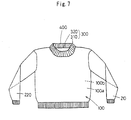
- the inventor of the present invention has proposed a knitting method for non-sewing knitwear, with which a front neckline 310 being broad in a forwardly hanging manner is formed on a breast 100a by using a flat knitting machine.
- the machine has at least a pair of front and back needle beds extending to the right and left direction and facing each other in the front and back direction, with at least one of the front and back needle beds being capable of sideways racking and capable of loop transfer of knitted loops between the front and back needle beds.
- This proposal is basically such that, after a torso 100 (100a, 100b) and both sleeves 210(210a, 21b) and 220(220a, 220b) are cylindrically knitted from the hem to the armpits of knitwear and, when the breast 100a is knitted, the front neckline 310 is formed on the breast 100a by knitting the breast 100a such that the breast 100a is branched off into right and left breasts 110a and 120a so as to sandwich the neckline 300 from the start line of forming the neckline 300 (the dotted line L1 shown in Fig. 8).
- the knitted loops of the front neckline 310 are further increased by using several knitted loops of the final course of each of the right and left breasts 110a and 120a from its end close to the neckline to point L3 shown in Fig. 8 for knitting the neckline.
- the number of wales of the front neckline 310 is increased, as a result, not only a collar 400 which is sequentially knitted has a neckline with a large bore, but also the neckline 300 is spontaneously formed in a forwardly hanging state.
- the sweater is highly fashionable and comfortable to wear since a wearer can easily get his or her head through the collar during wearing and is not tightened by the collar.
- the present invention has been developed in view of the above-described present state, and accordingly it is an object of the present invention to provide a knitting method for knitwear, which can reduce a load on yawn during knitting and form a fashionable and broad neckline in a forwardly hanging manner.
- a knitting method for knitwear in which a torso making up the knitwear is knitted so as to be a seamless and continuous cylinder by using a flat knitting machine having least a pair of front and back needle beds extending to the left and right directions and facing each other in the front and back directions, with at least one of the front and back needle beds being capable of sideways racking, and capable of loop transfer of knitted loops between the front and back needle beds is provided.
- the knitting method is characterized by including the following steps for knitting, when the torso is knitted from the armpits to the shoulder after the torso is knitted from the hem to the armpits and when a breast is knitted by branching off the breast into right and left breasts from its front neckline forming portion so as to form a neckline on the torso.
- the first step includes a first neckline increase step in which increases of the front neckline are processed while the right and left breasts are knitted for the predetermined courses, each with the same number of knitted loops, and the back is knitted for the predetermined courses; and
- Knitting in the second and third steps is performed after one of the breasts is knitted by the second neckline increase step.
- Knitwear to be knitted is preferable a set-in type sweater.
- knitwear is knitted with a so-called double-bed flat knitting machine which extends to the right and left direction and has a pair of front and back needle beds facing each other in the front and back direction, and in which the back needle bed is capable of sideways racking and also the front and back needle beds are capable of transferring knitted loops therebetween.
- the double-bed flat knitting machine is designed to knit it by using every other needles of each of the front and back needle beds.
- the odd-numbered needles of the front needle bed are mainly used for knitting a piece of knitting fabric of the front portion of the knitwear such as a breast or the front potion of a sleeve and the even-numbered needles of the back needle bed are mainly used for knitting the back portion of the knitwear such as the back or the back portion of the sleeve.
- the front and back needle beds are designed such that the needles of the other needle bed opposing those of one needle bed used for knitting are designated as empty needles and these empty needles are used for loop transfer, rib knitting, or the like.
- knitting fabric may be knitted by disposing a transfer jack bed with a number of transfer jacks above one or both of the front and back needle beds.
- the knitwear is knitted with a double-bed flat knitting machine
- the present invention allows the knitwear to be knitted with a quadruple-bed flat knitting machine composed of upper and lower front needle beds, and upper and lower back needle beds.
- the front and back portions of the knitwear are respectively attached to the lower front and back needle beds.
- the upper front and back needle beds are used as empty needles for, for example, loop transfer of the knitting fabric of the front and back portions in order to knit the knitting fabric of the front and back portions, respectively.
- the present embodiments provide knitting methods for knitwear with a torso and sleeves making up the knitwear so as to be seamless and continuous cylinders by using the foregoing two-bed flat knitting machine.
- FIG. 1 illustrates a set-in sweater 1 as knitwear knitted by a knitting method according to the present invention.
- Fig. 2 illustrates a paper pattern (stitch arrangement) of a torso and sleeves making up the sweater 1, in which a back 2b and right- and left-sleeve back portions 13b and 3b of both sleeves appearing at the back of the sweater when it is worn are shown in the upper part of the figure and a breast 2a and right- and left-sleeve front portion 13a and 3a of both sleeves appearing at the front of the sweater when it is worn are shown in the lower part of the figure.
- the back 2b and the left- and right-sleeve back portions 3b and 13b are mainly knitted by odd-numbered needles on a back needle bed BB, and the breast 2a and the left- and right-sleeve front portions 3a and 13a are mainly knitted by even-numbered needles on a front needle bed FB.
- the sweater 1 knitted according to the present embodiment is of a round-necked type and is designed such that the breast 2a and the back 2b are joined together on the shoulder line by bringing the lengths (the numbers of courses) of the breast 2a and the back 2b from the hems to the joining portions with the sleeves at the shoulder into agreement with each other.
- the knitting weave of the torso and the sleeves of the sweater 1 is a plain knitted and plain colored one for the sake of explanation, it may have a constitution pattern such as jacquard or rib.
- points A and a of the breast 2a indicating armpits are joined with the corresponding points P and p of the left- and right-sleeve front portions 3a and 13a
- points H and h of the back 2b are joined with the corresponding points S and s of the left- and right-sleeve back portions 3b and 13b.
- the breast 2a and the left- and right-sleeve front portions 3a and 13a are joined together along armholes 23, and the back 2b and the left- and right-sleeve back portions 3b and 13b are joined together along the same.
- the breast 2a has a different shape from the back 2b and, as shown in Fig. 2, is knitted while being branched off into left and right breasts 21a and 22a from points G and g from which a neckline 4 starts to be formed.
- the knitting of the torsos 2a and 2b and the sleeves 3 and 13 is performed such that, while knitting the left breast 21a, the left-sleeve front portion 3a, the left-sleeve back portion 3b, the back 2b, the right-sleeve back portion 13b, the right sleeve front portion 13a, the right breast 22a in that order or in the reverse order to that, the left-sleeve front portion 3a is joined with the left breast 21a, the left- and right-sleeve back portions 3b and 13b are joined with the back 2b, and the right sleeve front portion 13a is joined with the right breast 22a, all along the armholes 23.
- the breast 2a and the back 2b are joined together at the shoulder portion after the left and right sleeves 3 and 13 are joined together.
- a collar 5 is knitted by rib knitting along a circle formed by line e-y-f-g-G-F-Y-E-K-k-e.
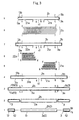
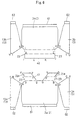
- Figs. 3 to 5 illustrate a knitting step diagram showing detailed knitting at each step when the sweater 1 is knitted from the hem toward the shoulder.
- the breast 2a, the back 2b, the sleeves 3 and 13, and a front neckline 41 of the breast 2a are respectively depicted with a bold line, a thin solid line, a double line, and a dotted line.
- Step 1 shows a state in which, by repeating knitting in which, after feeding knitting yarns from feeding ports (not shown) respectively prepared for knitting the torso and the sleeves to every needles of the front needle bed FB, the feeding ports are inverted so as to feed the knitting yarns to every needles of the back needle bed BB, knitting of rubber knitting portions 61 and 62 to the hem of the cylindrical torso and the cuffs of the cylindrical right and left sleeves starts.
- Step 2 shows a state in which, in conjunction with knitting of a torso 2, knitting of the left and right sleeves 3 and 13 is performed while the magnifying their cylinder bores, and the knitting is finished short of the armpit portions (shown by points A, P, a, p, S, H, s, and h in Fig. 2).
- Step 3 shows a state in which the torso 2 and the left and right sleeves 3 and 13 are integrated into a single cylindrical body at the armpit portions.
- knitting is performed, for example, by feeding the knitting yarns used for knitting the torso through the feeding ports.
- Step 4 shows a state in which every pieces of knitting fabric are retained at the needle beds when the knitting of the breast 2a reaches the positions G and g at which formation of the neckline 4 starts.
- the breast 2a is branched off into the left and right breasts 21a and 22a from these points.
- Step 3 to Step 4 by repeating knitting in which, while knitting the left and right sleeves 3 and 13, for example, with the ratio 3 : 1 of the numbers of course knitting of the torso portion and the sleeve portions of the cylindrical body formed by the torso 2 and the sleeves 3 and 13, knitting yarns are superposed by moving both sleeves 3 and 13 toward the torso 2, the bore diameter of the cylindrical body formed by the torso 2 and the sleeves 3 and 13 is gradually reduced. At the same time, the knitted width of the torso 2 is reduced.
- Step 5 shows a state in which the left breast 21a is knitted from line B-G to line C-F shown in Fig. 2.
- Step 5 by tucking the end of the left breast 21a close to the neckline by every other course, partial knitting which sequentially brings the knitted loops along the periphery of the neckline 4 along line G-F in an inoperative state is performed, and the left-sleeve front portion 3a and the left breast 21a are joined together at the same time.
- Step 5 all knitted loops of the left-sleeve front portion 3a are transferred to the empty needles of the back needle bed BB having the knitted loops of the back 2b retained thereat.
- the left breast 21a is knitted from its side close to the armhole by one course, and the following one course is knitted while tucking the knitted loop of the end of the breast 21a close to the neckline to the needle having the knitted loop of the neckline retained thereat (the needle having knitted loop G retained thereat).
- the left-sleeve front portion 3a and the left breast 21a are joined together while forming the front neckline 41, and, when the knitting is finished up to line F-C, the knitted loops of the left-sleeve front portion 3a retained at the back needle bed BB are returned to the front needle bed FB.
- Step 6 shows a state in which the right breast 22a is knitted from line b-g to line c-f shown in Fig. 2. Also in Step 6, by tucking the end of the right breast 22a close to the neckline by ever other course, partial knitting which sequentially brings the knitted loops along the periphery of the neckline 4 in an inoperative state along line g-f is performed, and also the right sleeve front portion 13a and the right breast 22a are joined together.
- Step 6 all knitted loops of the right sleeve front and back portions 13a and 13b retained at the front needle bed FB are transferred to the empty needles of the back needle bed BB having the knitted loops of the back 2b retained thereat.
- the right breast 22a is knitted from the side of the armhole by one course, and the following one course is knitted while tucking the knitted loop of the end of the breast 22a close to the neckline to the needle having the knitted loop of the neckline retained thereat (the needle having the knitted loop g retained thereat).
- Steps 5 and 6 With the knitting operations in Steps 5 and 6, the start portion of the front neckline 41 is formed along line F-G-g-f, thereby bringing about a state of Step 7.
- Step 8 shows a state in which the back 2b is knitted from line I-i to line Z-z while being joined with the left-and right-sleeve back portions 3b and 13b.
- Step 8 after only the back 2b is knitted by two courses, all knitted loops of the back 2b and the left-sleeve back portion 3b, all retained at the back needle bed BB, are transferred to the empty needles of the front needle bed FB.
- Step 8 subsequently, all knitted loops of the left-sleeve back portion 3b retained at the empty needles of the front needle bed FB are returned to the back needle bed BB, and, after only the back 2b is knitted by two courses, all knitted loops of the back 2b and the right-sleeve back portion 13b, all retained at the back needle bed BB, are transferred to the empty needles of the front needle bed FB.
- a first neckline increase step in a process of a first step according to the present invention is performed so as to knit the front neckline 41 for increasing its knitted width from line F-G-g-f. Specifically, knitting for forming the front neckline 41 is performed from line F-Y to line f-y.
- Step 10 shows a state in which course knitting of the left breast 21a is illustrated, and the left breast 21a is knitted from line C-F to line D-Y. During this course knitting, the left portion of the neckline 4 is also formed.
- Step 10 first of all, the right sleeve front portion 13a, the right breast 22a, the front neckline 41 (line F-G-g-f), and the left-sleeve front portion 3a, all retained at the front needle bed FB, are transferred to the empty needles of the back needle bed BB.
- racking of the back needle bed BB is performed by two pitches to the direction (leftward in Figs. 3 and 4) along which the right breast 22a moves away from the left breast 21a retained at the front needle bed FB.
- the left breast 21a is knitted by one course, and, after the knitted loop of the end of the left-sleeve front portion 3a close to the breast is transferred to that of end of the left breast 21a close to the sleeve and is superposed with it, the left breast 21a is knitted by one course while forming an one-knitted-loop increase at empty needles next to the end of the left breast 21a in the knitted loops of the front neckline 41 retained at the back needle bed BB.
- racking of the back needle bed BB is performed by two pitches to the direction (leftward in Figs. 3 and 4) along which the right breast 22a moves away from the left breast 21a retained at the front needle bed FB.
- the left breast 21a is knitted by one course, and, after the knitted loop of the end of the left-sleeve front portion 3a close to the breast is transferred to that of the end of the left breast 21a close to the sleeve and is superposed with it, the left breast 21a is formed by one course while forming an one-knitted-loop increase at empty needles next to the end of the left breast 21a in the knitted loops of the front neckline 41 retained at the back needle bed BB.
- Step 10 the left breast 21a is knitted for eight courses, each with the same number of knitted loops, and also the left-sleeve front portion 3a is completely joined with the left breast 21a.
- Step 10 After knitting of Step 10, transferring the right sleeve front portion 13a, the right breast 22a, and the front neckline 41 (line Y-F-G-g-f), all retained at the back needle bed BB, to the front needle bed FB brings about a state of Step 11; thus, the front neckline 41 is formed along line F-Y and also the left-sleeve front portion 3a is completely joined with the left breast 21a.
- Step 12 shows a state in which course knitting of the right breast 22a is illustrated, and the right breast 22a is knitted from line c-f to line d-y. During this course knitting, the right side portion of the neckline 4 is also formed.
- Step 12 first of all, the left breast 21a, the front neckline 41 (line Y-F-G-g-f), and the right sleeve front portion 13a, all retained at the front needle bed FB, are transferred to the empty needles of the back needle bed BB.
- the right breast 22a is knitted by one course, and, after the knitted loop of the front-end of the right sleeve front portion 13a close to the torso is transferred to that of the end of the right breast 22a close to the sleeve and is superposed with it, the right breast 22a is knitted by one course while forming an one-knitted-loop increase at empty needles next to the end of the right breast 22a in the knitted loops of the front neckline 41 retained at the back needle bed BB.
- racking of the back needle bed BB is performed by two pitches to the direction (rightward in Figs. 3 and 4) along which the left breast 21a moves away from the right breast 22a retained at the front needle bed FB.
- the right breast 22a is knitted by one course, and, after the knitted loop of the end of the right sleeve front portion 13a close to the breast is transferred to that of the end of the right breast 22a close to the sleeve and is superposed with it, the right breast 22a is formed by one course while forming one-knitted-loop increase at empty needles next to the end of the right breast 22a in the knitted loops of the front neckline 41 retained at the back needle bed BB.
- Step 12 the right breast 22a is knitted for eight courses, each with the same number of knitted loops, and also the right sleeve front portion 13a is completely joined with the right breast 22a.
- Step 12 After the knitting of Step 12, transferring the left breast 21a and the front neckline 41 (line Y-F-G-g-f-y), all retained at the back needle bed BB, to the front needle bed FB brings about a state of Step 13; thus, the front neckline 41 is formed along line f-y and also the right sleeve front portion 13a is completely joined with the right breast 22a.
- Step 14 shows a state in which the back 2b is knitted from line Z-z to line J-j while being joined with the left-and right-sleeve back portions 3b and 13b.
- Step 14 after only the back 2b is knitted by two courses, all knitted loops of the back 2b and the left-sleeve back portion 3b retained at the back needle bed BB are transferred to the empty needles of the front needle bed FB.
- Step 14 subsequently, all knitted loops of the left-sleeve back portion 3b retained at the empty needles of the front needle bed FB are returned to the back needle bed BB, and, after only the back 2b is knitted by two courses, all knitted loops of the back 2b and the right-sleeve back portion 13b retained at the back needle bed BB are transferred to the empty needles of the front needle bed FB.
- Steps 16 to 25 while performing knitting for forming a shoulder line of the torso to the armhole, knitting of the front neckline 41 for increasing its knitted width from line y-f-g-G-F-Y of the same is performed so as to complete formation of the neckline 4.
- Step 16 shows a state in which the partial knitting is applied to the left breast 21a from line D-Y to line D-E of the same in order to form the shoulder line portion of the left breast 21a to the armhole.
- Step 16 first of all, the knitted loops of the right breast 22a and the front neckline 41 (line y-f-g-G-F-Y) retained at the front needle bed FB are transferred to the empty needles of the back needle bed BB.
- racking of the back needle bed BB is performed by two pitches leftward in Fig. 4.
- an one-knitted-loop increase is formed at the needles next to the end of the left breast 21a in the knitted loops of the front neckline 41 retained at the back needle bed BB, and also a passing operation of transferring the knitted loop of the end, close to the armhole, of the left breast 21a retained at the front needle bed FB to the empty needle of the back needle bed BB sequentially from the outside is performed.
- the shoulder line portion to the armhole can be formed by applying partial knitting to the left breast 21a while providing the front neckline 41 with increases.
- Step 16 while knitting a portion of the left breast 21a close to the arm hole by partial knitting so as to knit the left breast 21a for eight courses, the knitted loops of the periphery of the front neckline 41 are sequentially made in an inoperative state along line Y-E, and the number of knitted loops of the front neckline 41 is increased by additional four (wales).
- Step 16 After the knitting operation in Step 16, while performing a passing operation of repeating the operations of transferring the knitted loops of the right breast 22a and the front neckline 41 (line y-f-g-G-F-Y-E) retained at the empty needles of the back needle bed BB to the front needle bed FB, rightward racking of the back needle bed BB, loop transfer of the knitted loop of the right end of the back needle bed BB to the front needle bed FB, and loop transfer of the knitted loop of the left end of the front needle bed FB to the back needle bed BB, the knitted loops, hooked at the needles of the front and back needle beds FB and BB, of the ends of the left breast 21a and the back 2b, respectively, close to the armhole are brought into a state of facing each other as shown in Step 17.
- Step 17 the front neckline 41 is formed along line Y-E as shown in Fig. 2.
- Step 18 shows a state in which the back 2b is knitted from line J-j to line K-k while knitting its both ends by partial knitting.
- the back 2b is knitted, it is knitted by partial knitting by applying a tucking process or the like to the knitted loops of the both ends so as to sequentially bring them in an inoperative state.
- Step 18 With completion of knitting in Step 18, since the ends, close to the armhole, of the left breast 21a hooked at the needles of the front needle bed FB and the back 2b hooked at the needles of the back needle bed BB face each other, the left breast 21a is joined with the back 2b by casting-off as shown in Step 19. The portions joined by casting-off are detached from the needles of the front and back needle beds.
- Step 21 shows a state in which, in order to form a shoulder line portion to the armhole at the right breast 22a from the state of Step 20, partial knitting is applied to the right breast 22a from line d-y to line d-e.
- Step 21 first of all, all knitted loops of the front neckline 41 (line y-f-g-G-F-Y-E) retained at the front needle bed FB are transferred to the empty needles of the back needle bed BB.
- racking of the back needle bed BB is performed by two pitches rightward in Fig. 4.
- a passing operation is performed by forming increases at the empty needles next to the end the right breast 22a in the knitted loops of the front neckline 41 retained at the back needle bed BB while knitting the right breast 22a by two courses by partial knitting, and transferring the knitted loop of end the right breast 22a close to the armhole to the empty needle of the back needle bed BB sequentially from the outside.
- Step 21 while knitting a portion of the right breast 22a close to the arm hole by partial knitting so as to knit the right breast 22a for eight courses, the knitted loops of the periphery of the front neckline 41 are sequentially brought in an inoperative state along line y-e, and the number of knitted loops of the front neckline 41 is increased by additional four (wales).
- Step 21 After the knitting operation in Step 21, while performing a passing operation of repeating the operations of loop transfer of the knitted loops of the front neckline 41 (line e-y-f-g-G-F-Y-E) retained at the empty needles of the back needle bed BB to the front needle bed FB, performing leftward racking of the back needle bed BB, loop transfer of the knitted loop of the left end of the back needle bed BB to the front needle bed FB, and also loop transfer of the knitted loop of the right end of the front needle bed FB to back needle bed BB, the knitted loops, hooked at the needles of the front and back needle beds FB and BB of the ends of the right breast 22a and the back 2b, respectively, close to the armhole are brought into a state of facing each other as shown in Step 22.
- the front neckline 41 is formed along line y-e as shown in Fig. 2.
- Step 23 the right breast 22a is joined with the back 2b by casting-off.
- the portions joined by casting-off are detached from the needles, and only the front neckline 41 and a back neck line 42 in Step 24 are hooked at the needles of the front and back needle beds.
- Step 25 a passing operation of repeating the operation of rightward racking of the back needle bed BB and loop transfer is performed so as to bring the centers of the front neckline 41 of the breast 2a and of the back neckline 42 of the back 2b in coincidence with each other, and thus a state of Step 25 is brought about.
- the knitted width of the front neckline 41 is greater than that of the back neckline 42, whereby a difference in the front and back knitted widths can be generated.
- the knitted width of the front neckline 41 is greater than that of the back neckline 42, after one of the shoulders is joined by casting off, the other shoulder is aligned by passing knitting fabric retained at the front and back needle beds and is joined by casting off, whereby the degree of freedom of the number of increases of the front neckline 41 can be increased without increasing the length of the back neckline 42, as a result, an excellently fashionable design can be achieved.
- the shoulder line portions to the armholes are formed on the shoulder portions of the breast 2a and the back 2b, formation of the shoulder line portions to the armholes allows the knitted loops of the front neckline 41 to be increased by a desired number while the lengths of the armholes 23 are kept constant.
- the knitted widths of the front and back needle beds are aligned when the collar 5 is knitted, whereby the collar portion can be cylindrically knitted without any problem.
- the knitted sweater 1 has an excellently fashionable feature without causing the length of the back neckline 42 longer, with the neckline 4 having a front hanging shape, and in addition, it is comfortable to wear since its wide bore neckline allows a wearer to easily pass his or her head therethrough.
- the shoulder lines to the armholes are formed on the torso as shown in Steps 16 to 25 according to the first embodiment, the shoulder line portions to the armholes may not be knitted as illustrated in a paper pattern drawing shown in Fig. 6 according to a second embodiment (that is, corresponding to that in which the triangular parts of the breast 2a formed by line D-Y-E and line d-y-e, and the trapezoidal part of the back 2b formed by line j-k-K-J are excluded in Fig. 2).
- the set-in sweater according to the second embodiment shown in Fig. 6 has the same shape and is knitted in the same manner as that up to Step 15 in the knitting step diagram shown in Figs. 3 to 5, excluding the triangular portions of the breast 2a formed by line D-Y-E and by line d-y-e and the trapezoidal portion of the back 2b formed by line j-k-K-J according to the first embodiment shown in Fig. 2, its explanation will be omitted.
- a passing operation of cylindrically knitting fabric is performed while repeating racking and loop transfer of the back needle bed BB so as to bring the centers of the front neckline 41 of the breast 2a and the back neckline 42 of the back 2b in coincidence with each other.
- the collar 5 is knitted so as to provide a round neck
- a collar having a desired design such as a stand collar can be knitted.
- a collar having a U-necked neckline or a V-necked neckline can be formed.
- the present invention is applicable to a set-in type sweater having a design in which the joining portion of the breast and the back gets across the shoulder line and enter the back.
- the present invention is not limited to a sweater, and is also applicable to a cardigan, a sleeveless sweater, a vest, and the like.
- the knitted width of the front neckline is greater than that of the back neckline, whereby a difference in the front and back knitted widths can be generated.
- the front neckline when the front neckline is formed, after the breast to be knitted is left at the knitting needles, and the other knitted loops are transferred to the empty needles of the other needle bed, increases are formed at the other needle bed while performing racking when the front neckline is formed, whereby the number of loop transfer of the knitted loops can be reduced as little as possible so as to reduce damage on yarn and knitting for forming increases of the front neckline can be easily carried out.
- the shoulder line portions to the armholes can be formed on the shoulder portions of the breast and the back, formation of the shoulder line portions allows the knitted loops of the front neckline to be increased by a desired number while the lengths of the armholes are kept constant.
Landscapes
- Engineering & Computer Science (AREA)
- Textile Engineering (AREA)
- Knitting Machines (AREA)
- Knitting Of Fabric (AREA)
- Outer Garments And Coats (AREA)
Abstract
Description
- The present invention relates to a knitting method for knitwear to be formed by joining knitting fabric without sewing, which is seamlessly and cylindrically knitted. In particularly, the present invention relates to a knitting method for forming a broad neckline of knitwear such as a sweater or a cardigan and other knitting methods like that.
- As explicitly stated in International Publication No. WO 01/55491 and as shown in Figs. 7 and 8, the inventor of the present invention has proposed a knitting method for non-sewing knitwear, with which a
front neckline 310 being broad in a forwardly hanging manner is formed on abreast 100a by using a flat knitting machine. The machine has at least a pair of front and back needle beds extending to the right and left direction and facing each other in the front and back direction, with at least one of the front and back needle beds being capable of sideways racking and capable of loop transfer of knitted loops between the front and back needle beds. - This proposal is basically such that, after a torso 100 (100a, 100b) and both sleeves 210(210a, 21b) and 220(220a, 220b) are cylindrically knitted from the hem to the armpits of knitwear and, when the
breast 100a is knitted, thefront neckline 310 is formed on thebreast 100a by knitting thebreast 100a such that thebreast 100a is branched off into right andleft breasts neckline 300 from the start line of forming the neckline 300 (the dotted line L1 shown in Fig. 8). - Then, in order to broadly form the neckline, during the process of knitting the right and
left breasts left breast left breast front neckline 310 are formed along theperiphery 300. - Further, the knitted loops of the
front neckline 310 are further increased by using several knitted loops of the final course of each of the right andleft breasts - By forming the
front neckline 310 as described above, the number of wales of thefront neckline 310 is increased, as a result, not only acollar 400 which is sequentially knitted has a neckline with a large bore, but also theneckline 300 is spontaneously formed in a forwardly hanging state. - When a sweater is produced by using the
breast 100a knitted so as to have thebroad neckline 300 as described above, the sweater is highly fashionable and comfortable to wear since a wearer can easily get his or her head through the collar during wearing and is not tightened by the collar. - However, with the above described knitting method, in order to form increases at the neckline, all knitted loops of the right or
left breast left breast - When the transferring actions are performed many times with respect to the same knitted loop as described above, there arises a problem that yawn is likely damaged.
- Also, with the foregoing method for knitting a neckline, although several knitted loops from the side end of the neckline of the final course of each of the right and
left breasts left breasts back neckline 320 of theback 100b is transversely longer. When theback neckline 320 of theback 100b is excessively longer, the entire neckline does not have a forwardly hanging shape but falls in a state of extending transversely, thereby causing a problem of being unattractive and unfashionable. - The present invention has been developed in view of the above-described present state, and accordingly it is an object of the present invention to provide a knitting method for knitwear, which can reduce a load on yawn during knitting and form a fashionable and broad neckline in a forwardly hanging manner.
- In order to achieve the above object, according to the present invention, a knitting method for knitwear in which a torso making up the knitwear is knitted so as to be a seamless and continuous cylinder by using a flat knitting machine having least a pair of front and back needle beds extending to the left and right directions and facing each other in the front and back directions, with at least one of the front and back needle beds being capable of sideways racking, and capable of loop transfer of knitted loops between the front and back needle beds is provided. The knitting method is characterized by including the following steps for knitting, when the torso is knitted from the armpits to the shoulder after the torso is knitted from the hem to the armpits and when a breast is knitted by branching off the breast into right and left breasts from its front neckline forming portion so as to form a neckline on the torso.
- 1) a first step including;
- a process in which all knitted loops excluding those of either the right or left breast are transferred to the needle bed having knitted loops of a back retained thereat; racking of the needle bed is performed in the direction in which one of the breasts of the needle bed having the knitted loops of the back retained thereat moves away from the other breast retained at the other needle bed by the number of pitches in proportion to the number of increases; and, after the breast retained at the other needle bed is knitted for the predetermined courses while increases of the front neckline of the needle bed having the knitted loops of the back retained thereat are formed at its end close to the breast retained at the other needle bed so as to correspond to the number of pitches of racking, the knitted loops transferred to the needle bed having the knitted loops of the back retained thereat are transferred to the original needle bed;
- a process in which all knitted loops excluding those of the breast which is not subjected to knitting for this predetermined courses are transferred to the needle bed having the knitted loops of the back retained thereat; racking of the needle bed is performed in the direction where the breast of the needle bed having the knitted loops of the back retained thereat moves away from the breast retained at the other needle bed by the number of pitches in proportion of the number of increases; and, after the breast retained at the other needle bed is knitted for the predetermined courses while increases of the front neckline of the needle bed having the knitted loops of the back retained thereat are formed at its end close to the breast retained at the other needle bed so as to correspond to the number of pitches of racking, the knitted loops transferred to the needle bed having the knitted loops of the back retained thereat are transferred to the original needle bed; and
- a process in which the back is knitted for the predetermined courses;
- 2) a second step in which, after or halfway through the first step, one of the ends of the back knitted in the first step and the end, close to an armhole, of either the right or left breast knitted in the first step are brought into a state of facing each other by a passing operation of knitted loops, the operation composed of a racking operation of the needle and loop transfer to the front and back needle beds, the back and either the right or left breast are joined together by shoulder casting off; and
- 3) a third step in which, after the first and second steps, the end of the back which is not subjected to shoulder casting off, and the end, close to the armhole, of either the left or right breast which is not subjected to shoulder casting off are brought into a state of facing each other by the passing operation of the knitted loops, the operation composed of a racking operation of the needle bed and loop transfer to the front and back needle beds, and the back and either the left and right breast are joined together by shoulder casting off.
-
- Also, according to the present invention, in the above-described knitting method for knitwear, the first step includes a first neckline increase step in which increases of the front neckline are processed while the right and left breasts are knitted for the predetermined courses, each with the same number of knitted loops, and the back is knitted for the predetermined courses; and
- a second neckline increase step in which, following the knitting of the breast and the back by the first neckline increase step, increases of the front neckline are processed while knitting the right and left breasts for the predetermined courses with their ends close to the armholes being processed by partial knitting, and the back is knitted for the predetermined courses.
-
- Knitting in the second and third steps is performed after one of the breasts is knitted by the second neckline increase step.
- Knitwear to be knitted is preferable a set-in type sweater.
-
- Fig. 1 illustrates a round-necked set-in sweater as a first embodiment of knitwear according to the present invention.
- Fig. 2 illustrates a state in which all parts making up the sweater as the first embodiment are knitted by a flat knitting machine.
- Fig. 3 illustrates
Steps 1 to 9 of the knitting steps of the sweater as the first embodiment. - Fig. 4 illustrates
Steps 10 to 17 of the knitting steps of the sweater as the first embodiment. - Fig. 5 illustrates
Steps 18 to 25 of the knitting steps of the sweater as the first embodiment. - Fig. 6 illustrates a state in which all parts making up a sweater as a second embodiment are knitted by a flat knitting machine.
- Fig. 7 illustrates a known round-necked set-in sweater.
- Fig. 8 illustrates a state in which all parts making up the known round-necked set-in sweater are knitted by a flat knitting machine.
-
- Embodiments of knitting methods for knitwear according to the present invention will be described with reference to the drawings.
- According to the present embodiments, knitwear is knitted with a so-called double-bed flat knitting machine which extends to the right and left direction and has a pair of front and back needle beds facing each other in the front and back direction, and in which the back needle bed is capable of sideways racking and also the front and back needle beds are capable of transferring knitted loops therebetween.
- When knitting cylindrical knitwear, the double-bed flat knitting machine is designed to knit it by using every other needles of each of the front and back needle beds. For example, the odd-numbered needles of the front needle bed are mainly used for knitting a piece of knitting fabric of the front portion of the knitwear such as a breast or the front potion of a sleeve and the even-numbered needles of the back needle bed are mainly used for knitting the back portion of the knitwear such as the back or the back portion of the sleeve. In addition, the front and back needle beds are designed such that the needles of the other needle bed opposing those of one needle bed used for knitting are designated as empty needles and these empty needles are used for loop transfer, rib knitting, or the like.
- With these empty needles, a constitution pattern mixed with face stitches and back stitches of a links, a suspender, a rib or the like is knitted, or knitted loops of the sleeve and the torso are moved in the course direction and jointed together.
- Also, when the double-bed flat knitting machine is used, knitting fabric may be knitted by disposing a transfer jack bed with a number of transfer jacks above one or both of the front and back needle beds.
- Meanwhile, according to the present embodiments, although the knitwear is knitted with a double-bed flat knitting machine, the present invention allows the knitwear to be knitted with a quadruple-bed flat knitting machine composed of upper and lower front needle beds, and upper and lower back needle beds.
- When the quadruple-bed flat knitting machine is used, for example, the front and back portions of the knitwear are respectively attached to the lower front and back needle beds. In addition, the upper front and back needle beds are used as empty needles for, for example, loop transfer of the knitting fabric of the front and back portions in order to knit the knitting fabric of the front and back portions, respectively.
- The present embodiments provide knitting methods for knitwear with a torso and sleeves making up the knitwear so as to be seamless and continuous cylinders by using the foregoing two-bed flat knitting machine.
- A first embodiment of the present invention will be described with reference to Figs. 1 to 5. Fig. 1 illustrates a set-in
sweater 1 as knitwear knitted by a knitting method according to the present invention. Fig. 2 illustrates a paper pattern (stitch arrangement) of a torso and sleeves making up thesweater 1, in which aback 2b and right- and left-sleeve back portions breast 2a and right- and left-sleeve front portion - The
back 2b and the left- and right-sleeve back portions breast 2a and the left- and right-sleevefront portions - The
sweater 1 knitted according to the present embodiment is of a round-necked type and is designed such that thebreast 2a and theback 2b are joined together on the shoulder line by bringing the lengths (the numbers of courses) of thebreast 2a and theback 2b from the hems to the joining portions with the sleeves at the shoulder into agreement with each other. - Although the knitting weave of the torso and the sleeves of the
sweater 1 is a plain knitted and plain colored one for the sake of explanation, it may have a constitution pattern such as jacquard or rib. - As shown in Fig. 2, in the
sweater 1, points A and a of thebreast 2a indicating armpits are joined with the corresponding points P and p of the left- and right-sleevefront portions back 2b are joined with the corresponding points S and s of the left- and right-sleeve back portions - Then, the
breast 2a and the left- and right-sleevefront portions armholes 23, and theback 2b and the left- and right-sleeve back portions - The
breast 2a has a different shape from theback 2b and, as shown in Fig. 2, is knitted while being branched off into left andright breasts neckline 4 starts to be formed. - Further, after the start of forming the
neckline 4, the knitting of thetorsos sleeves left breast 21a, the left-sleeve front portion 3a, the left-sleeve back portion 3b, theback 2b, the right-sleeve back portion 13b, the rightsleeve front portion 13a, theright breast 22a in that order or in the reverse order to that, the left-sleeve front portion 3a is joined with theleft breast 21a, the left- and right-sleeve back portions back 2b, and the rightsleeve front portion 13a is joined with theright breast 22a, all along thearmholes 23. - The
breast 2a and theback 2b are joined together at the shoulder portion after the left andright sleeves - Then, a
collar 5 is knitted by rib knitting along a circle formed by line e-y-f-g-G-F-Y-E-K-k-e. - Meanwhile, in the present embodiment, terms indicating left and right of a torso and sleeves, for example, left and right of the left and
right breasts sweater 1. - Figs. 3 to 5 illustrate a knitting step diagram showing detailed knitting at each step when the
sweater 1 is knitted from the hem toward the shoulder. - In the knitting step diagram, the
breast 2a, theback 2b, thesleeves front neckline 41 of thebreast 2a are respectively depicted with a bold line, a thin solid line, a double line, and a dotted line. -
Step 1 shows a state in which, by repeating knitting in which, after feeding knitting yarns from feeding ports (not shown) respectively prepared for knitting the torso and the sleeves to every needles of the front needle bed FB, the feeding ports are inverted so as to feed the knitting yarns to every needles of the back needle bed BB, knitting ofrubber knitting portions -
Step 2 shows a state in which, in conjunction with knitting of atorso 2, knitting of the left andright sleeves -
Step 3 shows a state in which thetorso 2 and the left andright sleeves -
Step 4 shows a state in which every pieces of knitting fabric are retained at the needle beds when the knitting of thebreast 2a reaches the positions G and g at which formation of theneckline 4 starts. Thebreast 2a is branched off into the left andright breasts - Meanwhile, from
Step 3 toStep 4, by repeating knitting in which, while knitting the left andright sleeves torso 2 and thesleeves sleeves torso 2, the bore diameter of the cylindrical body formed by thetorso 2 and thesleeves torso 2 is reduced. -
Step 5 shows a state in which theleft breast 21a is knitted from line B-G to line C-F shown in Fig. 2. InStep 5, by tucking the end of theleft breast 21a close to the neckline by every other course, partial knitting which sequentially brings the knitted loops along the periphery of theneckline 4 along line G-F in an inoperative state is performed, and the left-sleeve front portion 3a and theleft breast 21a are joined together at the same time. - In
Step 5, all knitted loops of the left-sleeve front portion 3a are transferred to the empty needles of the back needle bed BB having the knitted loops of the back 2b retained thereat. - The
left breast 21a is knitted from its side close to the armhole by one course, and the following one course is knitted while tucking the knitted loop of the end of thebreast 21a close to the neckline to the needle having the knitted loop of the neckline retained thereat (the needle having knitted loop G retained thereat). - Then, racking of the back needle bed BB is performed by two pitches leftward in Fig. 3, and the knitted loop of the end of the left-
sleeve front portion 3a close to the breast is transferred to that of the end of theleft breast 21a close to the sleeve and is superposed with the same. - By repeating a series of these operations for the predetermined courses until reaching line F-C, the left-
sleeve front portion 3a and theleft breast 21a are joined together while forming thefront neckline 41, and, when the knitting is finished up to line F-C, the knitted loops of the left-sleeve front portion 3a retained at the back needle bed BB are returned to the front needle bed FB. -
Step 6 shows a state in which theright breast 22a is knitted from line b-g to line c-f shown in Fig. 2. Also inStep 6, by tucking the end of theright breast 22a close to the neckline by ever other course, partial knitting which sequentially brings the knitted loops along the periphery of theneckline 4 in an inoperative state along line g-f is performed, and also the rightsleeve front portion 13a and theright breast 22a are joined together. - In
Step 6, all knitted loops of the right sleeve front andback portions - The
right breast 22a is knitted from the side of the armhole by one course, and the following one course is knitted while tucking the knitted loop of the end of thebreast 22a close to the neckline to the needle having the knitted loop of the neckline retained thereat (the needle having the knitted loop g retained thereat). - Then, racking of the back needle bed BB is performed by two pitches rightward in Fig. 3, and the knitted loop of the end of the right
sleeve front portion 13a close to the breast is transferred to that of the end of theright breast 22a close to the sleeve and is superposed with the same. - By repeating a series of these operations for the predetermined courses until reaching line f-c, the right
sleeve front portion 13a and theright breast 22a are joined together while forming thefront neckline 41, and, when the knitting operation is finished up to line f-c, all knitted loops of the right sleeve front andback portions - With the knitting operations in
Steps front neckline 41 is formed along line F-G-g-f, thereby bringing about a state ofStep 7. -
Step 8 shows a state in which theback 2b is knitted from line I-i to line Z-z while being joined with the left-and right-sleeve backportions - In
Step 8, after only the back 2b is knitted by two courses, all knitted loops of the back 2b and the left-sleeve backportion 3b, all retained at the back needle bed BB, are transferred to the empty needles of the front needle bed FB. - Then, after racking of the back needle bed BB is performed by two pitches toward the left-sleeve back
portion 3b (rightward in Fig. 3), all knitted loops of the back 2b retained at the front needle bed FB are returned to the back needle bed BB. With this operation, the knitted loops of the ends of the back 2b and the right-sleeve backportion 13b are superposed and joined together. - Subsequently, racking of the back needle bed BB is performed rightward in Fig. 3 by additional two pitches, and the knitted loop of the end, close to the torso, of the left-sleeve back
portion 3b retained at the front needle bed FB is transferred to the back needle bed BB. With this operation, the knitted loops of the ends of the back 2b and the left-sleeve backportion 3b are superposed and joined together. - Then, in a state in which the knitted loops of the left-sleeve back
portion 3b are retained at the front needle bed FB, the same operations as described above, composed of knitting of the back 2b, the racking operation of the back needle bed BB, loop transfer of the knitted loops of the back 2b, and loop transfer of the knitted loop of the end, close to the torso, of the left-sleeve backportion 3b to the back needle bed BB are repeated. By performing a series of these operations for the predetermined courses, the left-sleeve backportion 3b and the back 2b are joined together. - Also, in
Step 8, subsequently, all knitted loops of the left-sleeve backportion 3b retained at the empty needles of the front needle bed FB are returned to the back needle bed BB, and, after only the back 2b is knitted by two courses, all knitted loops of the back 2b and the right-sleeve backportion 13b, all retained at the back needle bed BB, are transferred to the empty needles of the front needle bed FB. - Then, after racking of the back needle bed BB is performed by two pitches toward the right-sleeve back
portion 13b (leftward in Fig. 3), all knitted loops of the back 2b retained at the front needle bed FB are returned to the back needle bed BB. With this operation, the knitted loops of the ends of the back 2b and the left-sleeve backportion 3b are superposed and joined together. - Subsequently, racking of the back needle bed BB is performed leftward in Fig. 3 by additional two pitches, and the knitted loop of the end, close to the torso, of the right-sleeve back
portion 13b retained at the front needle bed FB is transferred to the back needle bed BB. With this operation, the knitted loops of the ends of the back 2b and the right-sleeve backportion 13b are superposed and joined together. - Then, in a state in which the knitted loops of the right-sleeve back
portion 13b are retained at the front needle bed FB, the same operations as described above, composed of knitting of the back 2b, the racking operation of the back needle bed BB, loop transfer of the knitted loops of the back 2b, and the end, close to the torso, of the right-sleeve backportion 13b to the back needle bed BB are repeated. By performing a series of these operations for the predetermined courses, the right-sleeve backportion 13b and the back 2b are joined together. The knitting inStep 8 brings about a state ofStep 9. - In
Steps 10 to 15, a first neckline increase step in a process of a first step according to the present invention is performed so as to knit thefront neckline 41 for increasing its knitted width from line F-G-g-f. Specifically, knitting for forming thefront neckline 41 is performed from line F-Y to line f-y. -
Step 10 shows a state in which course knitting of theleft breast 21a is illustrated, and theleft breast 21a is knitted from line C-F to line D-Y. During this course knitting, the left portion of theneckline 4 is also formed. - In
Step 10, first of all, the rightsleeve front portion 13a, theright breast 22a, the front neckline 41 (line F-G-g-f), and the left-sleeve front portion 3a, all retained at the front needle bed FB, are transferred to the empty needles of the back needle bed BB. - Then, racking of the back needle bed BB is performed by two pitches to the direction (leftward in Figs. 3 and 4) along which the
right breast 22a moves away from theleft breast 21a retained at the front needle bed FB. After the racking, theleft breast 21a is knitted by one course, and, after the knitted loop of the end of the left-sleeve front portion 3a close to the breast is transferred to that of end of theleft breast 21a close to the sleeve and is superposed with it, theleft breast 21a is knitted by one course while forming an one-knitted-loop increase at empty needles next to the end of theleft breast 21a in the knitted loops of thefront neckline 41 retained at the back needle bed BB. - Further, racking of the back needle bed BB is performed by two pitches to the direction (leftward in Figs. 3 and 4) along which the
right breast 22a moves away from theleft breast 21a retained at the front needle bed FB. After the racking, theleft breast 21a is knitted by one course, and, after the knitted loop of the end of the left-sleeve front portion 3a close to the breast is transferred to that of the end of theleft breast 21a close to the sleeve and is superposed with it, theleft breast 21a is formed by one course while forming an one-knitted-loop increase at empty needles next to the end of theleft breast 21a in the knitted loops of thefront neckline 41 retained at the back needle bed BB. - As described above, when the operations of racking the back needle bed BB by the number of pitches in proportion to the number of increases (two pitches for one-knitted-loop increase) and knitting the
left breast 21a for the predetermined courses while forming increases corresponding to the number of pitches of the racking at the end, close to theleft breast 21a, of thefront neckline 41 retained at the back needle bed BB are repeated by the predetermined number of times, the left-sleeve front portion 3a and theleft breast 21a can be joined together while providing thefront neckline 41 with increases. - In
Step 10, theleft breast 21a is knitted for eight courses, each with the same number of knitted loops, and also the left-sleeve front portion 3a is completely joined with theleft breast 21a. - At this moment, an increase is formed at the empty needle of the back needle bed BB, close to the end of the neckline for every knitting course of the
left breast 21a, the knitted loops of the periphery of thefront neckline 41 are sequentially formed in an inoperative state along line F-Y, and the number of knitted loops of thefront neckline 41 is increased by 4 (wales) duringStep 10. - After knitting of
Step 10, transferring the rightsleeve front portion 13a, theright breast 22a, and the front neckline 41 (line Y-F-G-g-f), all retained at the back needle bed BB, to the front needle bed FB brings about a state ofStep 11; thus, thefront neckline 41 is formed along line F-Y and also the left-sleeve front portion 3a is completely joined with theleft breast 21a. - Step 12 shows a state in which course knitting of the
right breast 22a is illustrated, and theright breast 22a is knitted from line c-f to line d-y. During this course knitting, the right side portion of theneckline 4 is also formed. - In Step 12, first of all, the
left breast 21a, the front neckline 41 (line Y-F-G-g-f), and the rightsleeve front portion 13a, all retained at the front needle bed FB, are transferred to the empty needles of the back needle bed BB. - Then, racking of the back needle bed BB is performed by two pitches to the direction (rightward in Figs. 3 and
- 4) along which the
left breast 21a moves away from theright breast 22a retained at the front needle bed FB. After the racking, theright breast 22a is knitted by one course, and, after the knitted loop of the front-end of the rightsleeve front portion 13a close to the torso is transferred to that of the end of theright breast 22a close to the sleeve and is superposed with it, theright breast 22a is knitted by one course while forming an one-knitted-loop increase at empty needles next to the end of theright breast 22a in the knitted loops of thefront neckline 41 retained at the back needle bed BB. - Further, racking of the back needle bed BB is performed by two pitches to the direction (rightward in Figs. 3 and 4) along which the
left breast 21a moves away from theright breast 22a retained at the front needle bed FB. After the racking, theright breast 22a is knitted by one course, and, after the knitted loop of the end of the rightsleeve front portion 13a close to the breast is transferred to that of the end of theright breast 22a close to the sleeve and is superposed with it, theright breast 22a is formed by one course while forming one-knitted-loop increase at empty needles next to the end of theright breast 22a in the knitted loops of thefront neckline 41 retained at the back needle bed BB. - As described above, when the operations of racking the back needle bed BB by the number of pitches in proportion to the number of increases (two pitches for one-knitted-loop increase) and knitting the
right breast 22a for the predetermined courses while forming increases corresponding to the number of pitches of the racking at the end, close to theright breast 22a, of thefront neckline 41 retained at the back needle bed BB are repeated by the predetermined number of times, the rightsleeve front portion 13a and theright breast 22a can be joined together while providing thefront neckline 41 with increases. - In Step 12, the
right breast 22a is knitted for eight courses, each with the same number of knitted loops, and also the rightsleeve front portion 13a is completely joined with theright breast 22a. - At this moment, an increase is formed at the empty needle of the back needle bed BB, close to the end of the neckline for each knitting course of the
right breast 22a, the knitted loops of the periphery of thefront neckline 41 are sequentially formed in an inoperative state along line f-y, and the number of knitted loops of thefront neckline 41 is increased by 4 (wales) during Step 12. - After the knitting of Step 12, transferring the
left breast 21a and the front neckline 41 (line Y-F-G-g-f-y), all retained at the back needle bed BB, to the front needle bed FB brings about a state ofStep 13; thus, thefront neckline 41 is formed along line f-y and also the rightsleeve front portion 13a is completely joined with theright breast 22a. -
Step 14 shows a state in which theback 2b is knitted from line Z-z to line J-j while being joined with the left-and right-sleeve backportions - In
Step 14, after only the back 2b is knitted by two courses, all knitted loops of the back 2b and the left-sleeve backportion 3b retained at the back needle bed BB are transferred to the empty needles of the front needle bed FB. - Then, after racking the back needle bed BB by two pitches toward the left-sleeve back
portion 3b (rightward in Fig. 4), all knitted loops of the back 2b retained at the front needle bed FB are returned to the back needle bed BB. With this operation, the knitted loops of the ends of the back 2b and the right-sleeve backportion 13b are superposed and joined together. - Subsequently, racking of the back needle bed BB is performed rightward in the Fig. 4 by additional two pitches, and the knitted loop of the end, close to the torso, of the left-sleeve back
portion 3b retained at the front needle bed FB is transferred to the back needle bed BB. With this operation, the knitted loops of the ends of the back 2b and the left-sleeve backportion 3b are superposed and joined together. - Then, in a state in which the knitted loops of the left-sleeve back
portion 3b are retained at the front needle bed FB, the same operations as above described ones composed of knitting theback 2b, the racking operation of the back needle bed BB, loop transfer of the knitted loop of the back 2b, and loop transfer of the knitted loop of the end, close to the torso, of the left-sleeve backportion 3b to the back needle bed BB are repeated. By performing a series of these operations for the predetermined number of times, the left-sleeve backportion 3b and the back 2b are joined together. - Also, in
Step 14, subsequently, all knitted loops of the left-sleeve backportion 3b retained at the empty needles of the front needle bed FB are returned to the back needle bed BB, and, after only the back 2b is knitted by two courses, all knitted loops of the back 2b and the right-sleeve backportion 13b retained at the back needle bed BB are transferred to the empty needles of the front needle bed FB. - Then, after racking the back needle bed BB by two pitches toward the right-sleeve back
portion 13b (leftward in Fig. 4), all knitted loops of the back 2b retained at the front needle bed FB are returned to the back needle bed BB. With this operation, the knitted loops of the ends the back 2b and the left-sleeve backportion 3b are superposed and joined together. - Subsequently, racking the back needle bed BB is performed leftward in Fig. 4 by additional two pitches, and the knitted loop of the end, close to the torso, of the right-sleeve back
portion 13b retained at the front needle bed FB is transferred to the back needle bed BB. With this operation, the knitted loops of the ends of the back 2b and the right-sleeve backportion 13b are superposed and joined together. - Then, in a state in which the knitted loops of the right-sleeve back
portion 13b are retained at the front needle bed FB, the same operations as described above, composed of the knitting of the back 2b, the racking operation of the back needle bed BB, loop transfer of the knitted loops of the back 2b, and loop transfer of the knitted loop of the end of, close to the torso, of the right-sleeve backportion 13b to the back needle bed BB are repeated. By repeating a series of these operations for the predetermined number of times, the right-sleeve backportion 13b and the back 2b are completely joined together. - Then, while performing a passing operation of the operations repeating rightward racking of the back needle bed BB, loop transfer of the knitted loop of the right end of the back needle bed BB to the front FB, and also loop transfer of the knitted loop of the left end of the front needle bed FB to the back needle beds FB and BB, the knitted loops, hooked at the needles of the front and back needle beds FB and BB, of the ends of the
left breast 21a and the back 2b, respectively, close to the armhole are brought into a state of facing each other as shown inStep 15. - In
Steps 16 to 25, while performing knitting for forming a shoulder line of the torso to the armhole, knitting of thefront neckline 41 for increasing its knitted width from line y-f-g-G-F-Y of the same is performed so as to complete formation of theneckline 4. -
Step 16 shows a state in which the partial knitting is applied to theleft breast 21a from line D-Y to line D-E of the same in order to form the shoulder line portion of theleft breast 21a to the armhole. - In
Step 16, first of all, the knitted loops of theright breast 22a and the front neckline 41 (line y-f-g-G-F-Y) retained at the front needle bed FB are transferred to the empty needles of the back needle bed BB. - Then, racking of the back needle bed BB is performed by two pitches leftward in Fig. 4. After the racking, while knitting the
left breast 21a by two courses by partial knitting, an one-knitted-loop increase is formed at the needles next to the end of theleft breast 21a in the knitted loops of thefront neckline 41 retained at the back needle bed BB, and also a passing operation of transferring the knitted loop of the end, close to the armhole, of theleft breast 21a retained at the front needle bed FB to the empty needle of the back needle bed BB sequentially from the outside is performed. - As described above, when the operations of racking the back needle bed BB by the number of pitches in proportion to the number of increases (two pitches for one-knitted-loop increase) and knitting the
left breast 21a for performing the predetermined courses while forming increases corresponding to the number of pitches of the racking at the end, close to theleft breast 21a, of thefront neckline 41 retained at the back needle bed BB are repeated by the predetermined number of times, the shoulder line portion to the armhole can be formed by applying partial knitting to theleft breast 21a while providing thefront neckline 41 with increases. - In
Step 16, while knitting a portion of theleft breast 21a close to the arm hole by partial knitting so as to knit theleft breast 21a for eight courses, the knitted loops of the periphery of thefront neckline 41 are sequentially made in an inoperative state along line Y-E, and the number of knitted loops of thefront neckline 41 is increased by additional four (wales). - After the knitting operation in
Step 16, while performing a passing operation of repeating the operations of transferring the knitted loops of theright breast 22a and the front neckline 41 (line y-f-g-G-F-Y-E) retained at the empty needles of the back needle bed BB to the front needle bed FB, rightward racking of the back needle bed BB, loop transfer of the knitted loop of the right end of the back needle bed BB to the front needle bed FB, and loop transfer of the knitted loop of the left end of the front needle bed FB to the back needle bed BB, the knitted loops, hooked at the needles of the front and back needle beds FB and BB, of the ends of theleft breast 21a and the back 2b, respectively, close to the armhole are brought into a state of facing each other as shown inStep 17. - According to
Step 17, thefront neckline 41 is formed along line Y-E as shown in Fig. 2. -
Step 18 shows a state in which theback 2b is knitted from line J-j to line K-k while knitting its both ends by partial knitting. When the back 2b is knitted, it is knitted by partial knitting by applying a tucking process or the like to the knitted loops of the both ends so as to sequentially bring them in an inoperative state. - With completion of knitting in
Step 18, since the ends, close to the armhole, of theleft breast 21a hooked at the needles of the front needle bed FB and the back 2b hooked at the needles of the back needle bed BB face each other, theleft breast 21a is joined with the back 2b by casting-off as shown inStep 19. The portions joined by casting-off are detached from the needles of the front and back needle beds. - Then, in order to transfer all knitted loops of the
right breast 22a to the front needle bed FB, a passing operation of repeating the operation of loop transfer of the knitted loop of the right end of the front needle bed FB to the back needle bed BB, and loop transfer of the knitted loop of the left end of the back needle bed BB to the front needle bed FB while racking the back needle bed BB leftward is performed so as to bring about a state ofStep 20. -
Step 21 shows a state in which, in order to form a shoulder line portion to the armhole at theright breast 22a from the state ofStep 20, partial knitting is applied to theright breast 22a from line d-y to line d-e. - In
Step 21, first of all, all knitted loops of the front neckline 41 (line y-f-g-G-F-Y-E) retained at the front needle bed FB are transferred to the empty needles of the back needle bed BB. - Then, racking of the back needle bed BB is performed by two pitches rightward in Fig. 4. After the racking, a passing operation is performed by forming increases at the empty needles next to the end the
right breast 22a in the knitted loops of thefront neckline 41 retained at the back needle bed BB while knitting theright breast 22a by two courses by partial knitting, and transferring the knitted loop of end theright breast 22a close to the armhole to the empty needle of the back needle bed BB sequentially from the outside. - As described above, when the operations of racking the back needle bed BB by the number of pitches in proportion to the number of increases (two pitches for one-knitted-loop increase) and knitting the
right breast 22a for the predetermined courses while forming increases corresponding to the number of pitches of the racking at the end, close to theright breast 22a, of thefront neckline 41 retained at the back needle bed BB are repeated by the predetermined number of times, theright breast 22a can be narrowed and the shoulder line portion to the armhole can be formed while providing thefront neckline 41 with increases. - In
Step 21, while knitting a portion of theright breast 22a close to the arm hole by partial knitting so as to knit theright breast 22a for eight courses, the knitted loops of the periphery of thefront neckline 41 are sequentially brought in an inoperative state along line y-e, and the number of knitted loops of thefront neckline 41 is increased by additional four (wales). - After the knitting operation in
Step 21, while performing a passing operation of repeating the operations of loop transfer of the knitted loops of the front neckline 41 (line e-y-f-g-G-F-Y-E) retained at the empty needles of the back needle bed BB to the front needle bed FB, performing leftward racking of the back needle bed BB, loop transfer of the knitted loop of the left end of the back needle bed BB to the front needle bed FB, and also loop transfer of the knitted loop of the right end of the front needle bed FB to back needle bed BB, the knitted loops, hooked at the needles of the front and back needle beds FB and BB of the ends of theright breast 22a and the back 2b, respectively, close to the armhole are brought into a state of facing each other as shown inStep 22. - According to
Step 22, thefront neckline 41 is formed along line y-e as shown in Fig. 2. - Then, as shown in
Step 23, theright breast 22a is joined with the back 2b by casting-off. The portions joined by casting-off are detached from the needles, and only thefront neckline 41 and aback neck line 42 inStep 24 are hooked at the needles of the front and back needle beds. - Further, in order to form the
collar 5 along theneckline 4, a passing operation of repeating the operation of rightward racking of the back needle bed BB and loop transfer is performed so as to bring the centers of thefront neckline 41 of thebreast 2a and of theback neckline 42 of the back 2b in coincidence with each other, and thus a state ofStep 25 is brought about. - Even when the knitted width of the
front neckline 41 is increased as described above, and as a result, a large difference in knitted widths between the front andback necklines front neckline 41 of thebreast 2a to the back needle bed BB, the knitted loops at the boundary can maintain a mutually close state without detaching from each other, whereby occurrence of broken thread can be prevented and a cylindrical body can be knitted. - Then, the
collar 5 is knitted in the state ofStep 25, and knitting of thesweater 1 is completed. - As described above, since only the
front neckline 41 of thebreast 2a is provided with increases when thefront neckline 41 is formed, the knitted width of thefront neckline 41 is greater than that of theback neckline 42, whereby a difference in the front and back knitted widths can be generated. - Furthermore, even when the knitted width of the
front neckline 41 is greater than that of theback neckline 42, after one of the shoulders is joined by casting off, the other shoulder is aligned by passing knitting fabric retained at the front and back needle beds and is joined by casting off, whereby the degree of freedom of the number of increases of thefront neckline 41 can be increased without increasing the length of theback neckline 42, as a result, an excellently fashionable design can be achieved. - In particular, according to the present embodiment, since the shoulder line portions to the armholes are formed on the shoulder portions of the
breast 2a and the back 2b, formation of the shoulder line portions to the armholes allows the knitted loops of thefront neckline 41 to be increased by a desired number while the lengths of thearmholes 23 are kept constant. - In addition, by feeding the knitted loops of both sides the
front neckline 41 to the back needle bed BB, the knitted widths of the front and back needle beds are aligned when thecollar 5 is knitted, whereby the collar portion can be cylindrically knitted without any problem. - As described above, according to the present embodiment, the
knitted sweater 1 has an excellently fashionable feature without causing the length of theback neckline 42 longer, with theneckline 4 having a front hanging shape, and in addition, it is comfortable to wear since its wide bore neckline allows a wearer to easily pass his or her head therethrough. - Further, although the shoulder lines to the armholes are formed on the torso as shown in
Steps 16 to 25 according to the first embodiment, the shoulder line portions to the armholes may not be knitted as illustrated in a paper pattern drawing shown in Fig. 6 according to a second embodiment (that is, corresponding to that in which the triangular parts of thebreast 2a formed by line D-Y-E and line d-y-e, and the trapezoidal part of the back 2b formed by line j-k-K-J are excluded in Fig. 2). - Since the set-in sweater according to the second embodiment shown in Fig. 6 has the same shape and is knitted in the same manner as that up to Step 15 in the knitting step diagram shown in Figs. 3 to 5, excluding the triangular portions of the
breast 2a formed by line D-Y-E and by line d-y-e and the trapezoidal portion of the back 2b formed by line j-k-K-J according to the first embodiment shown in Fig. 2, its explanation will be omitted. - In the case of the second embodiment, in the knitting step diagram shown in Figs. 3 to 5, after joining the shoulder line portions of the
left breast 21a and the back 2b with each other by casting off in the state ofStep 15, knitted fabric is passed so that the ends of theright breast 22a and the back 2b face each other, and the remaining shoulder portions are joined together by casting off. - Then, in order to form the
collar 5 to theneckline 4, a passing operation of cylindrically knitting fabric is performed while repeating racking and loop transfer of the back needle bed BB so as to bring the centers of thefront neckline 41 of thebreast 2a and theback neckline 42 of the back 2b in coincidence with each other. - According to the present invention, as described in the foregoing first and second embodiments, after the breast to be knitted is left at the front needle bed FB and other knitted loops are transferred to the empty needles of the back needle bed BB when the
front neckline 41 is formed, increases are formed at the back needle bed BB while racking it, and also the breast is knitted, whereby the number of loop transfer of the knitted loops can be reduced as much as possible. As a result, knitting for forming increases of thefront neckline 41 can be easily carried out while reducing damage on yarn as little as possible. - According to the present embodiments, although the
collar 5 is knitted so as to provide a round neck, a collar having a desired design such as a stand collar can be knitted. Also, a collar having a U-necked neckline or a V-necked neckline can be formed. - Meanwhile, the present invention is applicable to a set-in type sweater having a design in which the joining portion of the breast and the back gets across the shoulder line and enter the back. Also, the present invention is not limited to a sweater, and is also applicable to a cardigan, a sleeveless sweater, a vest, and the like.
- As described above, according to the present invention, by providing increases only to the front neckline of the breast when the front neckline is formed, the knitted width of the front neckline is greater than that of the back neckline, whereby a difference in the front and back knitted widths can be generated.
- Further, when the front neckline is formed, after the breast to be knitted is left at the knitting needles, and the other knitted loops are transferred to the empty needles of the other needle bed, increases are formed at the other needle bed while performing racking when the front neckline is formed, whereby the number of loop transfer of the knitted loops can be reduced as little as possible so as to reduce damage on yarn and knitting for forming increases of the front neckline can be easily carried out.
- Furthermore, even when the knitted width of the front neckline is greater than that of the back neckline, after joint of one of the shoulders is performed by casting off, the other shoulder is aligned by passing knitting fabric retained at the front and back needle beds and its joint is performed by casting off, whereby the degree of freedom of the number of increases of the front neckline can be increased without increasing the length of the back neckline, as a result, an excellently fashionable design can be achieved.
- Also, according to the present invention, since the shoulder line portions to the armholes can be formed on the shoulder portions of the breast and the back, formation of the shoulder line portions allows the knitted loops of the front neckline to be increased by a desired number while the lengths of the armholes are kept constant.
Claims (2)
- A knitting method for knitwear in which a torso making up the knitwear is knitted so as to be a seamless and continuous cylinder by using a flat knitting machine comprising at least a pair of front and back needle beds extending to the left and right directions and facing each other in the front and back directions, with at least one of the front and back needle beds being capable of sideways racking, and capable of loop transfer of knitted loops between the front and back needle beds, the knitting method including the following steps for knitting, when the torso is knitted from the armpits to the shoulder after the torso is knitted from the hem to the armpits and when a breast is knitted by branching off the breast into right and left breasts from its front neckline forming portion so as to form a neckline on the torso:1) a first step including;a process in which all knitted loops excluding those of either the right or left breast are transferred to the needle bed having knitted loops of a back retained thereat; racking of the needle bed is performed in the direction in which one of the breasts of the needle bed having the knitted loops of the back retained thereat moves away from the other breast retained at the other needle bed by the number of pitches in proportion to the number of increases; and, after the breast retained at the other needle bed is knitted for the predetermined courses while increases of the front neckline of the needle bed having the knitted loops of the back retained thereat are formed at its end close to the breast retained at the other needle bed so as to correspond to the number of pitches of racking, the knitted loops transferred to the needle bed having the knitted loops of the back retained thereat are transferred to the original needle bed;a process in which all knitted loops excluding those of the breast which is not subjected to knitting for this predetermined courses are transferred to the needle bed having the knitted loops of the back retained thereat; racking of the needle bed is performed in the direction where the breast of the needle bed having the knitted loops of the back retained thereat moves away from the breast retained at the other needle bed by the number of pitches in proportion of the number of increases; and, after the breast retained at the other needle bed is knitted for the predetermined courses while increases of the front neckline of the needle bed having the knitted loops of the back retained thereat are formed at its end close to the breast retained at the other needle bed so as to correspond to the number of pitches of racking, the knitted loops transferred to the needle bed having the knitted loops of the back retained thereat are transferred to the original needle bed; anda process in which the back is knitted for the predetermined courses;2) a second step in which, after or halfway through the first step, one of the ends of the back knitted in the first step and the end, close to an armhole, of either the right or left breast knitted in the first step are brought into facing each other by a passing operation of knitted loops, the operation comprising a racking operation of the needle and loop transfer to the front and back needle beds, the back and either the right or left breast are joined together by shoulder casting off; and3) a third step in which, after the first and second steps, the end of the back which is not subjected to shoulder casting off, and the end, close to the armhole, of either the left or right breast which is not subjected to shoulder casting off are brought into facing each other by the passing operation of the knitted loops, the operation comprising a racking operation of the needle bed and loop transfer to the front and back needle beds, and the back and either the left and right breast are joined together by shoulder casting off.
- The knitting method for knitwear according to Claim 1,
wherein the first step comprises a first neckline increase step in which increases of the front neckline are processed while the right and left breasts are knitted for the predetermined courses, each with the same number of knitted loops, and the back is knitted for the predetermined courses; anda second neckline increase step in which, following the knitting of the breast and the back by the first neckline increase step, increases of the front neckline are processed while knitting the right and left breasts for the predetermined courses with their ends close to the armholes being processed by partial knitting, and the back is knitted for the predetermined courses,
wherein knitting in the second and third steps is performed after one of the breasts is knitted by the second neckline increase step.
Applications Claiming Priority (3)
| Application Number | Priority Date | Filing Date | Title |
|---|---|---|---|
| JP2002152688 | 2002-05-27 | ||
| JP2002152688 | 2002-05-27 | ||
| PCT/JP2003/006038 WO2003100146A1 (en) | 2002-05-27 | 2003-05-14 | Method of knitting knit-wear |
Publications (3)
| Publication Number | Publication Date |
|---|---|
| EP1512783A1 true EP1512783A1 (en) | 2005-03-09 |
| EP1512783A4 EP1512783A4 (en) | 2010-04-07 |
| EP1512783B1 EP1512783B1 (en) | 2012-04-25 |
Family
ID=29561281
Family Applications (1)
| Application Number | Title | Priority Date | Filing Date |
|---|---|---|---|
| EP03755267A Expired - Lifetime EP1512783B1 (en) | 2002-05-27 | 2003-05-14 | Method of knitting knit-wear |
Country Status (7)
| Country | Link |
|---|---|
| US (1) | US7051555B2 (en) |
| EP (1) | EP1512783B1 (en) |
| JP (1) | JP4002926B2 (en) |
| KR (1) | KR100937021B1 (en) |
| CN (1) | CN100359068C (en) |
| AU (1) | AU2003234921A1 (en) |
| WO (1) | WO2003100146A1 (en) |
Cited By (2)
| Publication number | Priority date | Publication date | Assignee | Title |
|---|---|---|---|---|
| EP2453046A4 (en) * | 2009-07-09 | 2014-06-04 | Shima Seiki Mfg | Knitwear with sleeves and body, and knitting method for same |
| CN103981625A (en) * | 2013-06-25 | 2014-08-13 | 宁波慈星股份有限公司 | Dichroic cable knitting method for flat knitting machine |
Families Citing this family (7)
| Publication number | Priority date | Publication date | Assignee | Title |
|---|---|---|---|---|
| US20080078009A1 (en) * | 2006-10-02 | 2008-04-03 | Longworth Industries, Inc. | Shirt construction |
| JP5538241B2 (en) * | 2009-01-23 | 2014-07-02 | 株式会社島精機製作所 | Method for knitting a tubular knitted fabric having a neckline and a tubular knitted fabric having a neckline |
| CN106723567B (en) * | 2016-12-15 | 2018-08-03 | 东华大学 | Visual pattern based on CAD of Garment pattern technology frightens several technics institution methods |
| CN110565249B (en) * | 2019-09-06 | 2021-04-23 | 惠州学院 | A kind of method of empty needle knitting transfer needle structure pattern |
| CN110592791A (en) * | 2019-09-18 | 2019-12-20 | 斓帛职业培训学校(桐乡)有限公司 | Full-forming top loading hoisting-preventing weaving method |
| CN114635226B (en) * | 2022-03-29 | 2023-04-11 | 嘉兴市蒂维时装有限公司 | Knitting method for increasing depth of full-formed high-collar and knitted fabric |
| CN115058822B (en) * | 2022-07-01 | 2023-05-30 | 福建睿能科技股份有限公司 | Method for determining open-collar needle retracting position, flat knitting machine, equipment and storage medium |
Family Cites Families (12)
| Publication number | Priority date | Publication date | Assignee | Title |
|---|---|---|---|---|
| JPS60194154A (en) * | 1984-03-07 | 1985-10-02 | 株式会社島精機製作所 | Knitting of tublar plain stitch fabric by traverse knitting fabric |
| JPH06100831B2 (en) | 1989-08-17 | 1994-12-12 | 三田工業株式会社 | Electrophotographic photoreceptor |
| DE4228408A1 (en) * | 1992-08-26 | 1994-03-03 | Stoll & Co H | Process for the production of a form-fitting, one-piece flat knitted fabric for a piece of clothing with sleeves |
| JP3075656B2 (en) * | 1993-09-07 | 2000-08-14 | 東京瓦斯株式会社 | Gas meter |
| JP2706760B2 (en) * | 1994-10-07 | 1998-01-28 | 株式会社島精機製作所 | How to organize |
| KR100392480B1 (en) * | 1995-04-10 | 2003-11-28 | 가부시키가이샤 시마세이키 세이사쿠쇼 | A method of binding off using a transverse knife and a method of binding- |
| US5826445A (en) * | 1996-02-09 | 1998-10-27 | Shima Seiki Manufacturing Ltd. | Knitting method on a flat knitting machine and a knit fabric thus produced |
| DE19739136A1 (en) * | 1997-09-06 | 1999-03-11 | Stoll & Co H | Method for connecting two knitted parts on a flat knitting machine |
| TW480299B (en) * | 2000-01-26 | 2002-03-21 | Shima Seiki Mfg | Method of knitting neck portion of knit wear by weft knitting machine and the knit wear |
| US6668593B2 (en) | 2000-02-22 | 2003-12-30 | Shima Seiki Mfg., Ltd. | Knit wear neck part knitting method and knit wear |
| DE60228061D1 (en) | 2001-03-02 | 2008-09-18 | Shima Seiki Mfg | MESHWARE WITH OPENING AND MANUFACTURING PROCESS |
| KR100869994B1 (en) | 2001-05-11 | 2008-11-24 | 가부시키가이샤 시마세이키 세이사쿠쇼 | Knitting method and knitting program using flat knitting machine |
-
2003
- 2003-05-14 KR KR1020047019222A patent/KR100937021B1/en not_active Expired - Fee Related
- 2003-05-14 JP JP2004507582A patent/JP4002926B2/en not_active Expired - Fee Related
- 2003-05-14 AU AU2003234921A patent/AU2003234921A1/en not_active Abandoned
- 2003-05-14 EP EP03755267A patent/EP1512783B1/en not_active Expired - Lifetime
- 2003-05-14 US US10/515,504 patent/US7051555B2/en not_active Expired - Fee Related
- 2003-05-14 CN CNB038120720A patent/CN100359068C/en not_active Expired - Fee Related
- 2003-05-14 WO PCT/JP2003/006038 patent/WO2003100146A1/en not_active Ceased
Non-Patent Citations (2)
| Title |
|---|
| No further relevant documents disclosed * |
| See also references of WO03100146A1 * |
Cited By (3)
| Publication number | Priority date | Publication date | Assignee | Title |
|---|---|---|---|---|
| EP2453046A4 (en) * | 2009-07-09 | 2014-06-04 | Shima Seiki Mfg | Knitwear with sleeves and body, and knitting method for same |
| CN103981625A (en) * | 2013-06-25 | 2014-08-13 | 宁波慈星股份有限公司 | Dichroic cable knitting method for flat knitting machine |
| CN103981625B (en) * | 2013-06-25 | 2015-07-15 | 宁波慈星股份有限公司 | Dichroic cable knitting method for flat knitting machine |
Also Published As
| Publication number | Publication date |
|---|---|
| CN100359068C (en) | 2008-01-02 |
| US7051555B2 (en) | 2006-05-30 |
| EP1512783B1 (en) | 2012-04-25 |
| KR100937021B1 (en) | 2010-01-15 |
| JPWO2003100146A1 (en) | 2005-09-22 |
| AU2003234921A1 (en) | 2003-12-12 |
| US20050183464A1 (en) | 2005-08-25 |
| CN1656268A (en) | 2005-08-17 |
| JP4002926B2 (en) | 2007-11-07 |
| WO2003100146A1 (en) | 2003-12-04 |
| EP1512783A4 (en) | 2010-04-07 |
| KR20050004879A (en) | 2005-01-12 |
Similar Documents
| Publication | Publication Date | Title |
|---|---|---|
| KR100585275B1 (en) | Neckline knitting method of knitwear by flat knitting machine and the knitwear | |
| EP1441054B1 (en) | Method of forming gusset and knitwear comprising gusset formed | |
| JP3863019B2 (en) | Knitwear knitting method using flat knitting machine and knit design device for generating knitting method of heel | |
| JPWO2001055491A1 (en) | Method for knitting necklines of knitwear using a flat knitting machine and the knitwear | |
| JP3949575B2 (en) | Knitwear neck knitting method by flat knitting machine and knitwear | |
| EP1394308B1 (en) | Method of knitting knitwear with knit collar with a flat knitting machine | |
| JPWO2001094672A1 (en) | Method for knitting collars of knitwear using a flat knitting machine and the knitwear | |
| EP2385160B1 (en) | Knitting method of tubular knitted fabric | |
| JP5567565B2 (en) | Knitwear having sleeves and body and knitting method thereof | |
| EP1512783B1 (en) | Method of knitting knit-wear | |
| KR101201238B1 (en) | Knitwear knitted by weft knitting machine and method of knitting the same | |
| US7739886B2 (en) | Knitwear having open part in body tubular part, and method of knitting the same | |
| KR100992063B1 (en) | How to knit and wear knitwear | |
| JP4291264B2 (en) | Method for knitting knitwear having a forehead | |
| KR101081906B1 (en) | Method of knitting garments having line difference, garment having line difference, and knit design device | |
| KR100610750B1 (en) | Neckline knitting method of knitwear by flat knitting machine and the knitwear | |
| CN100469961C (en) | Knitting method for forming gathers around the neck and knitwear with gathers around the neck | |
| JPWO2001064987A1 (en) | Method for knitting necklines of knitwear using a flat knitting machine and the knitwear |
Legal Events
| Date | Code | Title | Description |
|---|---|---|---|
| PUAI | Public reference made under article 153(3) epc to a published international application that has entered the european phase |
Free format text: ORIGINAL CODE: 0009012 |
|
| 17P | Request for examination filed |
Effective date: 20041202 |
|
| AK | Designated contracting states |
Kind code of ref document: A1 Designated state(s): AT BE BG CH CY CZ DE DK EE ES FI FR GB GR HU IE IT LI LU MC NL PT RO SE SI SK TR |
|
| AX | Request for extension of the european patent |
Extension state: AL LT LV MK |
|
| DAX | Request for extension of the european patent (deleted) | ||
| RBV | Designated contracting states (corrected) |
Designated state(s): DE ES FR GB IT |
|
| A4 | Supplementary search report drawn up and despatched |
Effective date: 20100305 |
|
| 17Q | First examination report despatched |
Effective date: 20100716 |
|
| GRAP | Despatch of communication of intention to grant a patent |
Free format text: ORIGINAL CODE: EPIDOSNIGR1 |
|
| GRAS | Grant fee paid |
Free format text: ORIGINAL CODE: EPIDOSNIGR3 |
|
| GRAA | (expected) grant |
Free format text: ORIGINAL CODE: 0009210 |
|
| AK | Designated contracting states |
Kind code of ref document: B1 Designated state(s): DE ES FR GB IT |
|
| REG | Reference to a national code |
Ref country code: GB Ref legal event code: FG4D |
|
| REG | Reference to a national code |
Ref country code: DE Ref legal event code: R096 Ref document number: 60340737 Country of ref document: DE Effective date: 20120621 |
|
| PLBE | No opposition filed within time limit |
Free format text: ORIGINAL CODE: 0009261 |
|
| REG | Reference to a national code |
Ref country code: FR Ref legal event code: ST Effective date: 20130131 |
|
| STAA | Information on the status of an ep patent application or granted ep patent |
Free format text: STATUS: NO OPPOSITION FILED WITHIN TIME LIMIT |
|
| GBPC | Gb: european patent ceased through non-payment of renewal fee |
Effective date: 20120725 |
|
| 26N | No opposition filed |
Effective date: 20130128 |
|
| PG25 | Lapsed in a contracting state [announced via postgrant information from national office to epo] |
Ref country code: GB Free format text: LAPSE BECAUSE OF NON-PAYMENT OF DUE FEES Effective date: 20120725 Ref country code: ES Free format text: LAPSE BECAUSE OF FAILURE TO SUBMIT A TRANSLATION OF THE DESCRIPTION OR TO PAY THE FEE WITHIN THE PRESCRIBED TIME-LIMIT Effective date: 20120805 Ref country code: FR Free format text: LAPSE BECAUSE OF NON-PAYMENT OF DUE FEES Effective date: 20120625 |
|
| REG | Reference to a national code |
Ref country code: DE Ref legal event code: R097 Ref document number: 60340737 Country of ref document: DE Effective date: 20130128 |
|
| PGFP | Annual fee paid to national office [announced via postgrant information from national office to epo] |
Ref country code: DE Payment date: 20160510 Year of fee payment: 14 |
|
| PGFP | Annual fee paid to national office [announced via postgrant information from national office to epo] |
Ref country code: IT Payment date: 20160524 Year of fee payment: 14 |
|
| REG | Reference to a national code |
Ref country code: DE Ref legal event code: R119 Ref document number: 60340737 Country of ref document: DE |
|
| PG25 | Lapsed in a contracting state [announced via postgrant information from national office to epo] |
Ref country code: DE Free format text: LAPSE BECAUSE OF NON-PAYMENT OF DUE FEES Effective date: 20171201 |
|
| PG25 | Lapsed in a contracting state [announced via postgrant information from national office to epo] |
Ref country code: IT Free format text: LAPSE BECAUSE OF NON-PAYMENT OF DUE FEES Effective date: 20170514 |