EP1511291B1 - System und Methode zum Verwenden von digitalen Wasserzeichen in einem kalibrierten Druckverarbeitungsverfahren - Google Patents
System und Methode zum Verwenden von digitalen Wasserzeichen in einem kalibrierten Druckverarbeitungsverfahren Download PDFInfo
- Publication number
- EP1511291B1 EP1511291B1 EP04019742A EP04019742A EP1511291B1 EP 1511291 B1 EP1511291 B1 EP 1511291B1 EP 04019742 A EP04019742 A EP 04019742A EP 04019742 A EP04019742 A EP 04019742A EP 1511291 B1 EP1511291 B1 EP 1511291B1
- Authority
- EP
- European Patent Office
- Prior art keywords
- values
- image
- gcr
- pixels
- component replacement
- Prior art date
- Legal status (The legal status is an assumption and is not a legal conclusion. Google has not performed a legal analysis and makes no representation as to the accuracy of the status listed.)
- Expired - Lifetime
Links
- 238000000034 method Methods 0.000 title claims description 41
- 230000001419 dependent effect Effects 0.000 claims description 4
- 238000004891 communication Methods 0.000 claims description 2
- 239000003086 colorant Substances 0.000 description 15
- 238000005192 partition Methods 0.000 description 6
- 230000009466 transformation Effects 0.000 description 5
- 238000001514 detection method Methods 0.000 description 3
- 238000013507 mapping Methods 0.000 description 3
- 238000012549 training Methods 0.000 description 3
- 101150039048 GCR1 gene Proteins 0.000 description 2
- 101000841411 Homo sapiens Protein ecdysoneless homolog Proteins 0.000 description 2
- 102100029090 Protein ecdysoneless homolog Human genes 0.000 description 2
- 230000003750 conditioning effect Effects 0.000 description 2
- 239000011159 matrix material Substances 0.000 description 2
- 238000005070 sampling Methods 0.000 description 2
- 230000003044 adaptive effect Effects 0.000 description 1
- 238000012512 characterization method Methods 0.000 description 1
- 238000012937 correction Methods 0.000 description 1
- 230000000593 degrading effect Effects 0.000 description 1
- 238000013461 design Methods 0.000 description 1
- 230000002708 enhancing effect Effects 0.000 description 1
- 238000003384 imaging method Methods 0.000 description 1
- 238000005457 optimization Methods 0.000 description 1
- 238000012545 processing Methods 0.000 description 1
- 238000009877 rendering Methods 0.000 description 1
- 230000035945 sensitivity Effects 0.000 description 1
- 238000012360 testing method Methods 0.000 description 1
- 238000000844 transformation Methods 0.000 description 1
- 230000000007 visual effect Effects 0.000 description 1
- XLYOFNOQVPJJNP-UHFFFAOYSA-N water Substances O XLYOFNOQVPJJNP-UHFFFAOYSA-N 0.000 description 1
Images
Classifications
-
- B—PERFORMING OPERATIONS; TRANSPORTING
- B41—PRINTING; LINING MACHINES; TYPEWRITERS; STAMPS
- B41J—TYPEWRITERS; SELECTIVE PRINTING MECHANISMS, i.e. MECHANISMS PRINTING OTHERWISE THAN FROM A FORME; CORRECTION OF TYPOGRAPHICAL ERRORS
- B41J2/00—Typewriters or selective printing mechanisms characterised by the printing or marking process for which they are designed
- B41J2/005—Typewriters or selective printing mechanisms characterised by the printing or marking process for which they are designed characterised by bringing liquid or particles selectively into contact with a printing material
- B41J2/01—Ink jet
- B41J2/205—Ink jet for printing a discrete number of tones
-
- H—ELECTRICITY
- H04—ELECTRIC COMMUNICATION TECHNIQUE
- H04N—PICTORIAL COMMUNICATION, e.g. TELEVISION
- H04N1/00—Scanning, transmission or reproduction of documents or the like, e.g. facsimile transmission; Details thereof
- H04N1/32—Circuits or arrangements for control or supervision between transmitter and receiver or between image input and image output device, e.g. between a still-image camera and its memory or between a still-image camera and a printer device
- H04N1/32101—Display, printing, storage or transmission of additional information, e.g. ID code, date and time or title
- H04N1/32144—Display, printing, storage or transmission of additional information, e.g. ID code, date and time or title embedded in the image data, i.e. enclosed or integrated in the image, e.g. watermark, super-imposed logo or stamp
-
- H—ELECTRICITY
- H04—ELECTRIC COMMUNICATION TECHNIQUE
- H04N—PICTORIAL COMMUNICATION, e.g. TELEVISION
- H04N1/00—Scanning, transmission or reproduction of documents or the like, e.g. facsimile transmission; Details thereof
- H04N1/32—Circuits or arrangements for control or supervision between transmitter and receiver or between image input and image output device, e.g. between a still-image camera and its memory or between a still-image camera and a printer device
- H04N1/32101—Display, printing, storage or transmission of additional information, e.g. ID code, date and time or title
- H04N1/32144—Display, printing, storage or transmission of additional information, e.g. ID code, date and time or title embedded in the image data, i.e. enclosed or integrated in the image, e.g. watermark, super-imposed logo or stamp
- H04N1/32149—Methods relating to embedding, encoding, decoding, detection or retrieval operations
- H04N1/32203—Spatial or amplitude domain methods
- H04N1/32251—Spatial or amplitude domain methods in multilevel data, e.g. greyscale or continuous tone data
-
- H—ELECTRICITY
- H04—ELECTRIC COMMUNICATION TECHNIQUE
- H04N—PICTORIAL COMMUNICATION, e.g. TELEVISION
- H04N1/00—Scanning, transmission or reproduction of documents or the like, e.g. facsimile transmission; Details thereof
- H04N1/32—Circuits or arrangements for control or supervision between transmitter and receiver or between image input and image output device, e.g. between a still-image camera and its memory or between a still-image camera and a printer device
- H04N1/32101—Display, printing, storage or transmission of additional information, e.g. ID code, date and time or title
- H04N1/32144—Display, printing, storage or transmission of additional information, e.g. ID code, date and time or title embedded in the image data, i.e. enclosed or integrated in the image, e.g. watermark, super-imposed logo or stamp
- H04N1/32149—Methods relating to embedding, encoding, decoding, detection or retrieval operations
- H04N1/32267—Methods relating to embedding, encoding, decoding, detection or retrieval operations combined with processing of the image
-
- H—ELECTRICITY
- H04—ELECTRIC COMMUNICATION TECHNIQUE
- H04N—PICTORIAL COMMUNICATION, e.g. TELEVISION
- H04N1/00—Scanning, transmission or reproduction of documents or the like, e.g. facsimile transmission; Details thereof
- H04N1/32—Circuits or arrangements for control or supervision between transmitter and receiver or between image input and image output device, e.g. between a still-image camera and its memory or between a still-image camera and a printer device
- H04N1/32101—Display, printing, storage or transmission of additional information, e.g. ID code, date and time or title
- H04N1/32144—Display, printing, storage or transmission of additional information, e.g. ID code, date and time or title embedded in the image data, i.e. enclosed or integrated in the image, e.g. watermark, super-imposed logo or stamp
- H04N1/32149—Methods relating to embedding, encoding, decoding, detection or retrieval operations
- H04N1/32309—Methods relating to embedding, encoding, decoding, detection or retrieval operations in colour image data
Definitions
- the present invention generally relates to watermarking methods and, more particularly, to those methods for digital watermarking which embed hidden data in a manner designed for the printing process having high information channel capacity while not degrading image texture or resolution
- GCR gray-component replacement
- a simple and common form of the GCR function is defined by a pair of functions: one that relates min(C, M, Y) to the amount of K to be added, and another that relates min(C, M, Y) to the amount of C, M, Y to be removed or replaced by the K.
- the two functions are dependent upon each other in a way that yields the desired color.
- min(C, M, Y) is the amount in which all three colorants are present, and thus is qualitatively thought of as the "gray component" of the color. Functions of this quantity that dictate the amount of K to be added and the amount of CMY to be replaced are thus collectively termed "gray component replacement".
- a given image can be rendered with different GCR functions to yield visually similar or identical color renditions.
- GCR functions are generally chosen to render a given image or object within a page. The choice is based on a number of factors, including achievable print gamut, colorant area coverage limitations, smoothness and texture considerations, sensitivity to registration, colorant cost, etc.
- US 2002/0164052 A1 describes an enhancing bedding of out of phase signals and relates to steganographically hiding images and information.
- an image is hidden within a media signal.
- the media preferably includes a cyan (C) color plane, a magenta (M) color plane, a yellow (Y) color plane and a black (K) color plane.
- the media includes a spot color.
- the image is converted into a black color channel image and is then applied to the media's K channel.
- the black channel image is inverted and the inverted image is applied to the media's CMY (or spot) color planes.
- the C, M and/or Y channels can be investigated to determine whether the image's signal level should be modified.
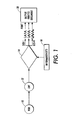
- FIG. 1 A method is disclosed for encoding or digital watermarking (data hiding) for use in the printing process. Attention is respectfully directed to Fig. 1 .
- An input pixel 10 is received in an RGB color space or an other color space, which has been converted to CMY values, at 12. Alternatively, the input pixel is received as a CMY pixel.
- GCR processor 14 Two or more GCR functions are loaded into GCR processor 14 (shown referenced as GCR-1, GCR-2, ..., GCR- N ).
- N -GCR functions information 16 to be transmitted is converted therein into N-ary form.
- the N-ary form is one wherein the information at each pixel can be represented by one of N -levels.
- N 2
- the N -ary form for the information is binary, so that each pixel is represented by one of two levels [0, 1].
- GCR1 ⁇ 100%GCR maximum amount of gray component is replaced with K
- GCR2 ⁇ 0%GCR no K is used to replace the gray component
- the information bits 16 are arrayed in a sequence that produces a spatial orientation and layout when the CMYK values are printed.
- an 8x8 pixel block of CMY data may receive the encoding of the first N-ary number formed from the information bits.
- the second 8x8 block may receive the second N-ary number, and so on.
- Different block configurations may be used, or encoding may follow other space filling paths, such as along a space filling curve.
- the encoding could be adaptive to image content, so that particular image features, such as letters, graphic objects, pictures, etc., provide the spatial support for the encoding process.
- the reference point could be a corner, a specially designed cross or dot pattern, or some agreed upon image feature.
- GCR processor 14 can convert input CMY values to output CMYK values.
- One example of operation processes the incoming data at a location only with the GCR function selected by the information bits (N-ary number) to be encoded at that location.
- Another method processes the incoming CMY data with all GCR functions, and the information bits associated with that location in space select the CMYK data to be used in forming the image.
- the CMYK sets formed thereby are printed to form output image 18.
- the information bits are now embedded onto the output print.
- CMYK sets associated with GCR functions, will look essentially the same under the illuminant for which the calibration was performed.
- the GCR functions should be optimized so that they are easily differentiated from each other in the subsequent decoding process, while at the same time, producing colors that are visually substantially similar under the calibration illuminant.
- Various methods can be used to avoid information loss that could occur by attempting to encode information in these regions. For instance, the information could be encoded redundantly, throughout the image, thereby increasing the likelihood of transmitting the information in the print. Otherwise, low information capacity regions can be recognized by their input CMY values, and those regions can be skipped in the encoding processing, and encoding would resume when the next region was input to GCR processor that had sufficient information capacity.
- the present encoding method is described as spatially varying, as in varying across a pictorial image. It should be understood that the GCR may also vary with objects on a page. For instance different graphical features, letters, vignettes, and the like could each have a different GCR that is optimized to carry information.
- the watermark information can be a tag plane, or auxiliary image plane sometimes referred to as an omega channel or alpha channel, that is used to select the GCR functions in the encoding.
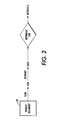
- the printed document 20 is scanned into electronic form.
- the data contained therein are converted to RGB color space by this scanning process.
- the K colorant amounts are then estimated from the RGB data.
- two or more colors match visually even though they were produced with different GCR strategies and thus have different K amounts for the same colored area.
- information in addition to colorimetric values is used.
- the non-overlap properties of rotated halftone screens provide this additional information.
- the K-colorant signal is estimated from a high-resolution scan of the RGB image.
- this K-colorant signal is evaluated conditional to a capacity signal K L which relates the capacity of pixels to possess K-toner to luminance L.
- K L which relates the capacity of pixels to possess K-toner to luminance L.
- the importance of deriving K L is to normalize the value of K H against some reference point.
- Different GCR strategies generate images that may look different except under some illuminant for which the color correction was derived, i.e., illuminant metamerism might occur between the viewing illuminant and the scanner illuminant.
- the GCR (and hence, the embedded bit data) is estimated by analyzing the vector ⁇ K L , K H , L ⁇ , i.e., the value of K H given K L and L.
- the K-colorant signal, K H is evaluated conditional to a low-resolution colorimetric signal from the image, RGB.
- RGB is a low resolution measure of the color of a local area and provides a measure of the capacity of that area to possess K-colorant.
- the GCR (hence, the embedded bit data) is estimated by analyzing the vector ⁇ R, G, B, K H ⁇ , i.e., the value of K H given R, G, B.
- S is a suitable operator to reduce the image from the scanner resolution to the watermark resolution (e.g., a sequence of blurring filters followed by sub-sampling)
- K H resembles that for generating K in a 100% GCR strategy, its present use is limited to high-resolution scanned data where the printer dots are discernible.
- scanner RGB values can be converted to an estimate of CMY by a calibration of the scanner system.
- a 3x3 linear transformation matrix can be used to best relate scanner RGB values to actual known amount of cyan, magenta, and yellow used in the print. It will be appreciated by those skilled in the art that other transformations can be used to relate scanned RGB to printed CMY. This transformation can be used to improve the estimation of K from scan RGB in the actual embedded prints.
- CMY dots do not frequently overlap completely in the highlight and mid-tone regions. Typically, the amount of overlap of CMY dots covers a small area percentage at highlights and mid-tones. If the input image has perfect dots and a scanner that has high enough resolution that it is able to perfectly scan the dots and their overlaps is used, then the scanned RGB values thereof only assume a small number of combinations that depend on the geometry of the dots against the scanner resolution. If each of the RGB values for any given pixel in the scan is low enough then that pixel essentially comprises all black color. A black-colored pixel can then be assumed a K-dot.
- This K-dot assumption is a good approximation because for low RGB there must be either a K-dot or an overlapping of CMY-dots. Because the overlap area of CMY-dots is often small in highlights and mid-tones (due to rotated screens) it is therefore probable that the black-colored pixel is a K-dot. Additional information, for example, ensuring that the pixel has very low chroma, is also useful. Preferably, a combination of luminance and chroma can be used to distinguish between a K dot and an overlap of CMY dots.
- K L , L, GCR i), i.e., the average value of K H for each (K L , L) pair. In the on-line detection phase, find the ⁇ that is the closest to the received K H .
- ⁇ K L , L [ ⁇ 1, K L , L+ ⁇ (2 K L , L)]1 ⁇ 2 such that K H is simply compared to a threshold ⁇ K L , L).
- the array of the thresholds (typically 256x256) is preferably setup beforehand to simplify the computation, i.e., detection can be made with one look-up and one comparison.
- the determination of which pixel is associated with a K dot depends on the average lightness of the region.
- the function ⁇ i, R, G ,B which relates the expected amount of K to the scanned RGB signal, is obtained through a separate calibration process, as follows.
- a set of CMY values is generated, preferably as a 3-dimensional grid in CMY space. These values are processed through each of the N -GCR functions to obtain N sets of CMYK values. If other functions, such as ink-limit, and tone reproduction curves (TRCs), are applied during nominal printing of images, these functions are to also be applied to the CMYK data.
- TRCs tone reproduction curves
- One exemplary method for doing this has been described previously.
- the black estimates are then used to populate a 3-dimensional lookup table (LUT) whose inputs are the scanned RGB values, and whose outputs are the N values of ⁇ corresponding to the N -GCR functions.
- the black estimate K H is derived using the same algorithm employed in the aforementioned calibration procedure.
- the RGB values of the scanned pixels are used to index the 3D LUT, and K H is compared with each of the N number of ⁇ values. The closest ⁇ value determines which of the N -symbols was encoded at the given image location.
- ⁇ ( R, G, B) [ ⁇ 1, R, G, B+ ⁇ (2 R, G, B]1 ⁇ 2.
- the received black estimate K H is then simply compared with ⁇ (R, G, B) to determine which of the two symbols was encoded at the given image location.
- the system is similarly trained using a test target, and for every pixel, a quintuple: [R, G, B, K, Q] is organized where Q is a discrete number telling which GCR was used to print that pixel.
- the RGBK hypercube is mapped into one number Q.
- the training method works by simple majority: The RGBK hypercube is divided into N number of cells. Then for every pixel in the printed-and-scanned image, KH and RGB are determined. The appropriate Q value is associated with the cell. This is repeated for each pixel in every target. After entering the values for every cell, a histogram of Q values is determined. The most popular Q value is entered at that cell location. Then a LUT is constructed with the RGBK values as input and Q as output
- each cell maps the RGBK value to its most likely GCR strategy.
- the process is repeated again to obtain 16x16x16x16 cells, inheriting Q values from the 8x8x8x8 partition stage.
- the 16x16x16x16 partition is probably accurate enough to map RGBK values to a small number of GCR functions.
- the run-time detection algorithm works as follows. In the high resolution image, estimate K H . Reduce K H image to low resolution. Then, reduce RGB scanner data to low resolution. For every pixel in the low resolution image, compute the RGBK H quadruple. Feed that RGBK H into the cell LUT, retrieve Q which is the GCR estimation.
Landscapes
- Engineering & Computer Science (AREA)
- Multimedia (AREA)
- Signal Processing (AREA)
- Editing Of Facsimile Originals (AREA)
- Image Processing (AREA)
- Facsimile Image Signal Circuits (AREA)
- Color Image Communication Systems (AREA)
Claims (8)
- Codierverfahren zum digitalen Wasserzeichenmarkieren von Pixeln eines Ausgabebildes in einem kalibrierten Druckweg, umfassend:(a) Empfangen von Farbwerte aufweisenden Eingabepixeln (10) von einem Eingabebild;(b) für jeden Block von Eingabepixeln (10) erfolgendes Empfangen eines Datenwertes zur Codierung an entsprechenden Pixeln in dem Ausgabebild, wobei der Datenwert durch eine Mehrzahl von Informationsbits dargestellt wird;(c) Auswählen von einer von wenigstens zwei verschiedenen Graukomponentenersetzungsfunktionen, wobei die Auswahl auf dem Datenwert beruht;(d) Erzeugen von CMYK-Werten unter Verwendung der ausgewählten Graukomponentenersetzungsfunktion und der Farbwerte; und(e) Zuweisen der CMYK-Werte an die entsprechenden Pixel in dem Ausgabebild.
- Codierverfahren nach Anspruch 1, wobei die Pixelfarbwerte aus dem Eingabebild in einem RGB-Farbraum befindlich sind und sodann in CMY-Werte umgewandelt werden.
- Codierverfahren nach Anspruch 1, wobei die Anzahl von Graukomponentenersetzungsfunktionen, unter denen ausgewählt werden soll, von der Anzahl möglicher Zustände der Mehrzahl von Informationsbits abhängt.
- Codierverfahren nach Anspruch 3, wobei die Anzahl von Graukomponentenersetzungsfunktionen, unter denen ausgewählt werden soll, gleich der Anzahl von Zuständen der Mehrzahl von Informationsbits ist.
- System zum Codieren eines digitalen Wasserzeichens in Pixeln eines Ausgabebildes in einem kalibrierten Druckweg, umfassend:einen Prozessor (14) in Kommunikation mit einer Speichervorrichtung;Software- und Hardwareressourcen, die ausreichend sind zum Ausführen von:(a) Empfangen von Farbwerte aufweisenden Eingabepixeln (10) von einem Eingabebild;(b) für jeden Block von Eingabepixeln (10) erfolgendes Empfangen eines Datenwertes zur Codierung an entsprechenden Pixeln in dem Ausgabebild, wobei der Datenwert durch eine Mehrzahl von Informationsbits dargestellt wird;(c) Auswählen von einer von wenigstens zwei verschiedenen Graukomponentenersetzungsfunktionen, wobei die Auswahl auf dem Datenwert beruht;(d) Erzeugen von CMYK-Werten unter Verwendung der ausgewählten verschiedenen Graukomponentenersetzungsfunktion und der anderen Farbwerte; und(e) Zuweisen der CMYK-Werte an die entsprechenden Pixel in dem Ausgabebild; undeine Vorrichtung zum Erzeugen des Ausgabebildes.
- System nach Anspruch 5, wobei die Pixelfarbwerte aus dem Eingabebild in einem RGB-Farbraum befindlich sind und sodann in CMY-Werte umgewandelt werden.
- System nach Anspruch 5, wobei die Anzahl von Graukomponentenersetzungsfunktionen, unter denen ausgewählt werden soll, von der Anzahl möglicher Zustände der Mehrzahl von Informationsbits abhängt.
- System nach Anspruch 7, wobei die Anzahl von Graukomponentenersetzungsfunktionen, unter denen ausgewählt werden soll, gleich der Anzahl von Zuständen der Mehrzahl von Informationsbits ist.
Applications Claiming Priority (2)
| Application Number | Priority Date | Filing Date | Title |
|---|---|---|---|
| US644472 | 2003-08-20 | ||
| US10/644,472 US7070252B2 (en) | 2003-08-20 | 2003-08-20 | System and method for digital watermarking in a calibrated printing path |
Publications (3)
| Publication Number | Publication Date |
|---|---|
| EP1511291A2 EP1511291A2 (de) | 2005-03-02 |
| EP1511291A3 EP1511291A3 (de) | 2005-08-24 |
| EP1511291B1 true EP1511291B1 (de) | 2009-07-01 |
Family
ID=34104643
Family Applications (1)
| Application Number | Title | Priority Date | Filing Date |
|---|---|---|---|
| EP04019742A Expired - Lifetime EP1511291B1 (de) | 2003-08-20 | 2004-08-19 | System und Methode zum Verwenden von digitalen Wasserzeichen in einem kalibrierten Druckverarbeitungsverfahren |
Country Status (3)
| Country | Link |
|---|---|
| US (1) | US7070252B2 (de) |
| EP (1) | EP1511291B1 (de) |
| DE (1) | DE602004021756D1 (de) |
Families Citing this family (30)
| Publication number | Priority date | Publication date | Assignee | Title |
|---|---|---|---|---|
| US8277908B2 (en) * | 2006-05-11 | 2012-10-02 | Xerox Corporation | Substrate fluorescence mask for embedding information in printed documents |
| US8283004B2 (en) * | 2006-05-11 | 2012-10-09 | Xerox Corporation | Substrate fluorescence pattern mask for embedding information in printed documents |
| US20080031766A1 (en) * | 2006-06-16 | 2008-02-07 | International Titanium Powder, Llc | Attrited titanium powder |
| US7764403B2 (en) * | 2006-12-06 | 2010-07-27 | Xerox Corporation | Watermarking |
| US8821996B2 (en) * | 2007-05-29 | 2014-09-02 | Xerox Corporation | Substrate fluorescent non-overlapping dot patterns for embedding information in printed documents |
| US8455087B2 (en) * | 2007-06-05 | 2013-06-04 | Xerox Corporation | Infrared encoding of security elements using standard xerographic materials with distraction patterns |
| US7852515B2 (en) * | 2007-06-05 | 2010-12-14 | Xerox Corporation | Infrared encoding for embedding multiple variable data information collocated in printed documents |
| US8460781B2 (en) * | 2007-06-05 | 2013-06-11 | Xerox Corporation | Infrared encoding of security elements using standard xerographic materials |
| US8009329B2 (en) * | 2007-11-09 | 2011-08-30 | Xerox Corporation | Fluorescence-based correlation mark for enhanced security in printed documents |
| US8856500B2 (en) * | 2008-02-06 | 2014-10-07 | Nxp B.V. | Obfuscating program by scattering sequential instructions into memory regions such that jumps occur with steps of both signs in equal frequency |
| US8621187B2 (en) * | 2008-02-11 | 2013-12-31 | Nxp, B.V. | Method of program obfuscation and processing device for executing obfuscated programs |
| US8233197B2 (en) * | 2008-11-20 | 2012-07-31 | Xerox Corporation | Pantograph methods, apparatus and systems based on UCR/GCR |
| US8509474B1 (en) | 2009-12-11 | 2013-08-13 | Digimarc Corporation | Digital watermarking methods, apparatus and systems |
| US9378443B2 (en) | 2009-05-14 | 2016-06-28 | Ascensia Diabetes Care Holding Ag | Calibration coded sensors and apparatus, systems and methods for reading same |
| WO2012064648A1 (en) | 2010-11-12 | 2012-05-18 | Bayer Healthcare Llc | Auto-coded analyte sensors and apparatus, systems, and methods for detecting same |
| US9396509B1 (en) | 2011-10-30 | 2016-07-19 | Digimarc Corporation | Closed form non-iterative watermark embedding |
| US9401001B2 (en) | 2014-01-02 | 2016-07-26 | Digimarc Corporation | Full-color visibility model using CSF which varies spatially with local luminance |
| US11263829B2 (en) | 2012-01-02 | 2022-03-01 | Digimarc Corporation | Using a predicted color for both visibility evaluation and signal robustness evaluation |
| US9380186B2 (en) | 2012-08-24 | 2016-06-28 | Digimarc Corporation | Data hiding for spot colors in product packaging |
| US9449357B1 (en) | 2012-08-24 | 2016-09-20 | Digimarc Corporation | Geometric enumerated watermark embedding for spot colors |
| US11810378B2 (en) | 2012-08-24 | 2023-11-07 | Digimarc Corporation | Data hiding through optimization of color error and modulation error |
| US9565335B2 (en) | 2014-01-02 | 2017-02-07 | Digimarc Corporation | Full color visibility model using CSF which varies spatially with local luminance |
| US9313360B2 (en) * | 2014-07-30 | 2016-04-12 | Hewlett-Packard Development Company, L.P. | Encoding data in an image |
| US9667829B2 (en) | 2014-08-12 | 2017-05-30 | Digimarc Corporation | System and methods for encoding information for printed articles |
| JP6705596B2 (ja) * | 2014-08-12 | 2020-06-03 | ディジマーク コーポレイション | 製品包装中のスポットカラーのためのデータ隠蔽 |
| CN104217392A (zh) * | 2014-09-18 | 2014-12-17 | 上海理工大学 | 抗几何攻击的全息水印算法 |
| US10009503B1 (en) | 2017-05-11 | 2018-06-26 | Xerox Corporation | Overlapped vector patterned two layer correlation marks |
| US10855878B2 (en) | 2018-03-23 | 2020-12-01 | Xerox Corporation | Segmentation hiding layer for vector pattern correlation marks |
| JP7852271B2 (ja) * | 2022-02-10 | 2026-04-28 | 株式会社リコー | 液体吐出装置、液体吐出方法およびプログラム |
| CN115330583A (zh) * | 2022-09-19 | 2022-11-11 | 景德镇陶瓷大学 | 一种基于cmyk图像的水印模型训练方法及装置 |
Family Cites Families (4)
| Publication number | Priority date | Publication date | Assignee | Title |
|---|---|---|---|---|
| US5923774A (en) * | 1996-05-08 | 1999-07-13 | Canon Information Systems, Inc. | Matrix-based gray component replacement for color halftoning |
| US6643030B1 (en) * | 1999-12-15 | 2003-11-04 | Xerox Corporation | Quantization method for color document reproduction in a color printing system |
| US6912295B2 (en) * | 2000-04-19 | 2005-06-28 | Digimarc Corporation | Enhancing embedding of out-of-phase signals |
| US6731409B2 (en) | 2001-01-31 | 2004-05-04 | Xerox Corporation | System and method for generating color digital watermarks using conjugate halftone screens |
-
2003
- 2003-08-20 US US10/644,472 patent/US7070252B2/en not_active Expired - Fee Related
-
2004
- 2004-08-19 DE DE602004021756T patent/DE602004021756D1/de not_active Expired - Lifetime
- 2004-08-19 EP EP04019742A patent/EP1511291B1/de not_active Expired - Lifetime
Also Published As
| Publication number | Publication date |
|---|---|
| US7070252B2 (en) | 2006-07-04 |
| EP1511291A2 (de) | 2005-03-02 |
| EP1511291A3 (de) | 2005-08-24 |
| DE602004021756D1 (de) | 2009-08-13 |
| US20050041051A1 (en) | 2005-02-24 |
Similar Documents
| Publication | Publication Date | Title |
|---|---|---|
| EP1511291B1 (de) | System und Methode zum Verwenden von digitalen Wasserzeichen in einem kalibrierten Druckverarbeitungsverfahren | |
| US5748785A (en) | Inter-separation color image processing using error diffusion | |
| US7295703B2 (en) | Method for scanner characterization for color measurement of printed media having four or more colorants | |
| TWI398816B (zh) | 用於調整影像資料以形成高度壓縮影像平面的系統及方法 | |
| US7072522B2 (en) | Image processing apparatus and method | |
| EP0637886B1 (de) | Verfahren zur Vorbereitung eines Farbbildes | |
| EP1510967B1 (de) | System und Methode zur Einbettung eines digitalen Wasserzeichens in einem kalibrierten Druckpfad | |
| US20120106835A1 (en) | Hybrid vector halftone screening and error diffusion | |
| US6920243B2 (en) | Color smooth error diffusion | |
| US20060256123A1 (en) | Generation of attribute pattern image by patterning attribute information | |
| WO2007026924A1 (en) | Image processing apparatus and method thereof | |
| US8111918B2 (en) | Segmentation for three-layer mixed raster content images | |
| US6157462A (en) | Method and apparatus for error diffusion and undercolor removal/grey component replacement of digital color images | |
| EP1416716A1 (de) | Verfahren für die Mehrtonumsetzung eines digitalen Bildes, das wenigstens eine Gruppe von ähnlichen Farbkanälen hat | |
| KR100747916B1 (ko) | 듀플렉스 칼라 레이저 프린터용 데이터 임베딩 스킴 | |
| US7764403B2 (en) | Watermarking | |
| De Queiroz et al. | Spatially varying gray component replacement to watermark printed images | |
| De Queiroz et al. | Spatially varying gray component replacement for image watermarking | |
| JP3615308B2 (ja) | 画像処理装置および方法 | |
| Bulan et al. | High capacity image barcodes using color separability | |
| Lee et al. | Novel scanner characterization method for color measurement and diagnostics applications | |
| JP2019009734A (ja) | 情報処理装置、情報処理方法およびプログラム | |
| JP2016178401A (ja) | 画像処理装置、画像処理方法およびプログラム | |
| JP2009065559A (ja) | 画像処理装置、画像処理方法及び画像処理プログラムが記憶された記憶媒体 | |
| JP2025187827A (ja) | 画像処理装置、方法、プログラム |
Legal Events
| Date | Code | Title | Description |
|---|---|---|---|
| PUAI | Public reference made under article 153(3) epc to a published international application that has entered the european phase |
Free format text: ORIGINAL CODE: 0009012 |
|
| AK | Designated contracting states |
Kind code of ref document: A2 Designated state(s): AT BE BG CH CY CZ DE DK EE ES FI FR GB GR HU IE IT LI LU MC NL PL PT RO SE SI SK TR |
|
| AX | Request for extension of the european patent |
Extension state: AL HR LT LV MK |
|
| PUAL | Search report despatched |
Free format text: ORIGINAL CODE: 0009013 |
|
| AK | Designated contracting states |
Kind code of ref document: A3 Designated state(s): AT BE BG CH CY CZ DE DK EE ES FI FR GB GR HU IE IT LI LU MC NL PL PT RO SE SI SK TR |
|
| AX | Request for extension of the european patent |
Extension state: AL HR LT LV MK |
|
| 17P | Request for examination filed |
Effective date: 20060224 |
|
| AKX | Designation fees paid |
Designated state(s): DE FR GB |
|
| 17Q | First examination report despatched |
Effective date: 20070726 |
|
| GRAP | Despatch of communication of intention to grant a patent |
Free format text: ORIGINAL CODE: EPIDOSNIGR1 |
|
| RIC1 | Information provided on ipc code assigned before grant |
Ipc: H04N 1/32 20060101AFI20090203BHEP Ipc: G06T 1/00 20060101ALI20090203BHEP |
|
| GRAS | Grant fee paid |
Free format text: ORIGINAL CODE: EPIDOSNIGR3 |
|
| GRAA | (expected) grant |
Free format text: ORIGINAL CODE: 0009210 |
|
| AK | Designated contracting states |
Kind code of ref document: B1 Designated state(s): DE FR GB |
|
| REG | Reference to a national code |
Ref country code: GB Ref legal event code: FG4D |
|
| REF | Corresponds to: |
Ref document number: 602004021756 Country of ref document: DE Date of ref document: 20090813 Kind code of ref document: P |
|
| PLBE | No opposition filed within time limit |
Free format text: ORIGINAL CODE: 0009261 |
|
| STAA | Information on the status of an ep patent application or granted ep patent |
Free format text: STATUS: NO OPPOSITION FILED WITHIN TIME LIMIT |
|
| 26N | No opposition filed |
Effective date: 20100406 |
|
| PGFP | Annual fee paid to national office [announced via postgrant information from national office to epo] |
Ref country code: DE Payment date: 20130722 Year of fee payment: 10 |
|
| PGFP | Annual fee paid to national office [announced via postgrant information from national office to epo] |
Ref country code: FR Payment date: 20130820 Year of fee payment: 10 Ref country code: GB Payment date: 20130725 Year of fee payment: 10 |
|
| REG | Reference to a national code |
Ref country code: DE Ref legal event code: R119 Ref document number: 602004021756 Country of ref document: DE |
|
| GBPC | Gb: european patent ceased through non-payment of renewal fee |
Effective date: 20140819 |
|
| REG | Reference to a national code |
Ref country code: DE Ref legal event code: R119 Ref document number: 602004021756 Country of ref document: DE Effective date: 20150303 |
|
| REG | Reference to a national code |
Ref country code: FR Ref legal event code: ST Effective date: 20150430 |
|
| PG25 | Lapsed in a contracting state [announced via postgrant information from national office to epo] |
Ref country code: GB Free format text: LAPSE BECAUSE OF NON-PAYMENT OF DUE FEES Effective date: 20140819 Ref country code: DE Free format text: LAPSE BECAUSE OF NON-PAYMENT OF DUE FEES Effective date: 20150303 |
|
| PG25 | Lapsed in a contracting state [announced via postgrant information from national office to epo] |
Ref country code: FR Free format text: LAPSE BECAUSE OF NON-PAYMENT OF DUE FEES Effective date: 20140901 |