EP1511285B1 - Improved load balancing in a network of contact centres - Google Patents
Improved load balancing in a network of contact centres Download PDFInfo
- Publication number
- EP1511285B1 EP1511285B1 EP04077250.1A EP04077250A EP1511285B1 EP 1511285 B1 EP1511285 B1 EP 1511285B1 EP 04077250 A EP04077250 A EP 04077250A EP 1511285 B1 EP1511285 B1 EP 1511285B1
- Authority
- EP
- European Patent Office
- Prior art keywords
- contact
- agent
- network
- centre
- centres
- Prior art date
- Legal status (The legal status is an assumption and is not a legal conclusion. Google has not performed a legal analysis and makes no representation as to the accuracy of the status listed.)
- Expired - Lifetime
Links
Images


Classifications
-
- H—ELECTRICITY
- H04—ELECTRIC COMMUNICATION TECHNIQUE
- H04L—TRANSMISSION OF DIGITAL INFORMATION, e.g. TELEGRAPHIC COMMUNICATION
- H04L67/00—Network arrangements or protocols for supporting network services or applications
- H04L67/01—Protocols
- H04L67/10—Protocols in which an application is distributed across nodes in the network
- H04L67/1001—Protocols in which an application is distributed across nodes in the network for accessing one among a plurality of replicated servers
- H04L67/1004—Server selection for load balancing
- H04L67/1008—Server selection for load balancing based on parameters of servers, e.g. available memory or workload
-
- H—ELECTRICITY
- H04—ELECTRIC COMMUNICATION TECHNIQUE
- H04L—TRANSMISSION OF DIGITAL INFORMATION, e.g. TELEGRAPHIC COMMUNICATION
- H04L67/00—Network arrangements or protocols for supporting network services or applications
- H04L67/01—Protocols
- H04L67/10—Protocols in which an application is distributed across nodes in the network
- H04L67/1001—Protocols in which an application is distributed across nodes in the network for accessing one among a plurality of replicated servers
-
- H—ELECTRICITY
- H04—ELECTRIC COMMUNICATION TECHNIQUE
- H04L—TRANSMISSION OF DIGITAL INFORMATION, e.g. TELEGRAPHIC COMMUNICATION
- H04L67/00—Network arrangements or protocols for supporting network services or applications
- H04L67/01—Protocols
- H04L67/10—Protocols in which an application is distributed across nodes in the network
- H04L67/1001—Protocols in which an application is distributed across nodes in the network for accessing one among a plurality of replicated servers
- H04L67/1036—Load balancing of requests to servers for services different from user content provisioning, e.g. load balancing across domain name servers
-
- H—ELECTRICITY
- H04—ELECTRIC COMMUNICATION TECHNIQUE
- H04M—TELEPHONIC COMMUNICATION
- H04M3/00—Automatic or semi-automatic exchanges
- H04M3/42—Systems providing special services or facilities to subscribers
- H04M3/50—Centralised arrangements for answering calls; Centralised arrangements for recording messages for absent or busy subscribers ; Centralised arrangements for recording messages
- H04M3/51—Centralised call answering arrangements requiring operator intervention, e.g. call or contact centers for telemarketing
- H04M3/523—Centralised call answering arrangements requiring operator intervention, e.g. call or contact centers for telemarketing with call distribution or queueing
- H04M3/5237—Interconnection arrangements between ACD systems
-
- H—ELECTRICITY
- H04—ELECTRIC COMMUNICATION TECHNIQUE
- H04M—TELEPHONIC COMMUNICATION
- H04M3/00—Automatic or semi-automatic exchanges
- H04M3/42—Systems providing special services or facilities to subscribers
- H04M3/50—Centralised arrangements for answering calls; Centralised arrangements for recording messages for absent or busy subscribers ; Centralised arrangements for recording messages
- H04M3/51—Centralised call answering arrangements requiring operator intervention, e.g. call or contact centers for telemarketing
- H04M3/523—Centralised call answering arrangements requiring operator intervention, e.g. call or contact centers for telemarketing with call distribution or queueing
- H04M3/5232—Call distribution algorithms
- H04M3/5233—Operator skill based call distribution
-
- H—ELECTRICITY
- H04—ELECTRIC COMMUNICATION TECHNIQUE
- H04M—TELEPHONIC COMMUNICATION
- H04M3/00—Automatic or semi-automatic exchanges
- H04M3/42—Systems providing special services or facilities to subscribers
- H04M3/50—Centralised arrangements for answering calls; Centralised arrangements for recording messages for absent or busy subscribers ; Centralised arrangements for recording messages
- H04M3/51—Centralised call answering arrangements requiring operator intervention, e.g. call or contact centers for telemarketing
- H04M3/523—Centralised call answering arrangements requiring operator intervention, e.g. call or contact centers for telemarketing with call distribution or queueing
- H04M3/5232—Call distribution algorithms
- H04M3/5234—Uniform load distribution
Definitions
- the present invention relates to a method and apparatus for routing contacts between a plurality of contact centres in a communications network.
- Call centers are known in which incoming calls are routed to one of a plurality of agents.
- the call center might provide help desk facilities for a particular group of products and customers who are able to call in and be allocated to an agent who has the necessary skills to deal with his or her query.
- Each agent has one or more skills, for example, a particular agent has knowledge about sales for product X and about technical support for product Y.
- An incoming call is received and information from that call used by the call center, together with information about the agents, in order to route the incoming call to an agent with the appropriate skill.
- an interactive voice response system may be used to find out what type of agent skill is required.
- Associated with each skill is a queue into which incoming calls are placed until an agent with that skill becomes available.
- call center and "contact center” as used herein are not intended to be restricted to situations in which telephone calls are made to the center. Other types of call or contact are also envisaged, such as email, fax, SMS, chat, web access and any other suitable method of contact including conventional telephone calls and voice over internet protocol telephone calls. Similarly, the terms “call” and “contact” as used herein are not intended to be restricted to conventional telephone calls but include contacts made by email, fax, voice over IP and any other suitable medium.
- Network skillsets also known as “workgroups” are often used. Agents with particular knowledge and ability can be members of a network skillset despite being associated with different contact centres in the network. For example, suppose there is a network skillset for agents who speak French. Agents can be allocated to that network skillset despite being located at different call centres, provided they speak French. Incoming contacts that require service by a French speaking agent can then be allocated to any of the agents in the French network skillset. A particular agent can be a member of more than one different network skillset.
- a central controller is used to collect information from all contact centres in a network. That processor then receives all incoming contacts and routes those to the contact centres on the basis of the collected information and an optimisation algorithm or strategy.
- these three patent documents describe seeking to route a contact to the highest skilled and longest available (i.e. longest inactive) agent in a workgroup.
- a problem with this approach is that there is no guarantee that the contact will be successfully routed to the longest inactive agent in the workgroup. If the chosen agent has in the meantime become active with another contact, the pending contact risks being dropped. This leads to customer dissatisfaction and potential loss of business.
- EP-A- 1111890 discloses a system for network skill-based routing in which each call centre sends real-time call centre management information to a network call center controller.
- the controller provides routing tables which are used by call centers to route incoming calls.
- the invention seeks to provide a method and apparatus for routing contacts between a plurality of contact centres in a communications network which overcomes or at least mitigates one or more of the problems noted above.
- the present invention addresses these problems by using a source contact node in a network of contact centres to request nodal longest idle agent information from the other contact centres in the network. Using this information a network longest idle agent is identified and the incoming contact routed to that agent. A reservation system is used in combination with the longest idle agent information in order to prevent dropped contacts and to ensure equal sharing of work between agents in a network skillset.
- Contact centre servers are linked over a separate network, isolated from a network linking the contact centre switches. This enables real-time communications between the contact centre servers to quickly and effectively share the nodal longest idle agent information and/or other contact centre management information, statistics, parameters or "intrinsics".
- a method of routing a contact in a network comprising a plurality of contact centres, said method comprising:-receiving a contact at one of the contact centres, said any one of the contact centres being designated a source contact centre with respect to the received contact; sending a reservation request from the source contact centre to each of the contact centres including itself, said reservation request being for an agent with a specified call centre longest idle agent, average answer delay and/or calls queued count; for the reservation request, receiving at the source contact centre from each of one or more of the contact centres, a value of the specified call centre longest idle agent, average answer delay and/or calls queued count and an associated agent identifier; at said designated source contact center, determining from said value of the specified call centre longest idle agent, average answer delay and/or calls queued count and said associated agent identifier received from said each of one or more of the contact centres a network-wide value of the longest idle agent, average answer delay and/or calls queued count; and routing the received contact from the designated contact
- load balancing can be achieved in a particular manner on the basis of intrinsics or call center statistics of parameters such as longest idle agent, average answer delay, calls queued count, calls answered count, number of idle agents, expected wait time and logged-in agent count.
- the method may comprise: receiving a contact at one of the contact centres, said contact centre being a source contact centre; sending a reservation request from the source contact centre to each of the contact centres, said reservation request being for a nodal longest idle agent; for one or more of the reservation requests, receiving at the source contact centre, a nodal longest idle time and associated agent identifier; routing the received contact to the agent with the longest of all the received nodal longest idle times.
- the method further comprises the step of cancelling unused reservations. This frees up reserved agents for other incoming contacts.
- the contact is received at any one of the contact centres.
- This is advantageous because it is not necessary to configure one of the contact centres (or one particular node) to receive all the incoming contacts. This reduces the amount of processing needed at any one of the contact centres and provides a robust system because for example, contacts can still be successfully routed despite failure at one of the contact centres.
- said contact is associated with a specified network skillset and wherein said reservations requests are also for agents of that specified skillset.
- a contact centre suitable for use in a network of contact centres, said contact centre comprising: an input arranged to receive a contact; an output arranged to send a reservation request to each of the contact centres in the network of contact centres including itself, said reservation request being for an agent with a specified call centre longest idle agent, average answer delay and/or calls queued count; a second input arranged to receive, for said reservation request, a value of the specified call centre longest idle agent, average answer delay and/or calls queued count and an associated agent identifier from each of one or more of the contact centres; and a processor arranged to determine from said value of the specified call centre longest idle agent, average answer delay and/or calls queued count and said associated agent identifier received from each of one or more of the contact centres a network-wide value of the longest idle agent, average answer delay and/or calls queued count and to route the received contact from the contact centre to any agent in any of said one or more of the contact centres having the greatest value for the network-wide value of the
- a contact centre suitable for use in a network of contact centres, said contact centre comprising: an input arranged to receive a contact; an output arranged to send a reservation request to one or more contact centres in the network of contact centres, said reservation request being for a nodal longest idle agent; a second input arranged to receive, for one or more of the reservation requests, a nodal longest idle time and associated agent identifier; a processor arranged to route the contact to the agent with the longest of all the received nodal longest idle times.
- a communications network comprising a plurality of contact centres as described above.
- each of said contact centres comprises a contact centre server and a switch.
- the contact centre servers are advantageously linked to one another by a first part of said communications network and said switches are linked to one another by a second part of said communications network, said first and second parts being substantially isolated from one another.
- each contact centre server is connected to its associated switch using a dedicated embedded local area network connection.
- signalling traffic between a switch and its associated server is insulated from all other types of signalling such as inter-contact centre server signalling or signalling between a contact centre server and an administrator client server.
- the invention also provides for a system for the purposes of digital signal processing which comprises one or more instances of apparatus embodying the present invention, together with other additional apparatus.
- Embodiments of the present invention are described below by way of example only. These examples represent the best ways of putting the invention into practice that are currently known to the Applicant although they are not the only ways in which this could be achieved.
- nodal longest idle agent is used to refer to an agent who is not actively dealing with a contact and, of all the agents associated with the same contact centre server, has been in this idle state for the longest time.
- network longest idle agent is used to refer to an agent who is not actively dealing with a contact and, of all the agents in a network of contact centres, has been in this state for the longest time.
- longest idle time means the time for which the longest idle agent has been idle.
- longest network idle time is the time for which the network longest idle agent has been idle.
- Intrinsic means an item of information about a contact centre such as a statistic or parameter. Examples include nodal longest idle agent, average answer delay, calls queued count, calls answered count, number of idle agents, expected wait time and logged-in agent count.
- Average answer delay is an indication of how quickly a particular agent answers a contact that is routed to him or her.
- Calls queued count is the number of calls or contacts queued for a particular agent.
- Calls answered count is the number of calls or contacts answered within a specified time period, either by a particular agent or by a contact centre as a whole.
- Number of idle agents is the number of agents at a specified contact centre who are inactive at a particular time.
- Expected wait time is an indication of how long it will take for a contact to be routed to an available agent at a particular time. If agents are available to serve a call when it arrives, this parameter is zero.
- Logged-in agent count is the number of agents, either for a particular network skillset or for a particular contact centre, that are logged-in at a particular time.
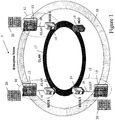
- FIG. 1 is a schematic diagram of a plurality of contact centres 10, 11, 12 in a communications network 5.
- Each contact centre comprises a call centre server 14 and a switch 15. Any suitable type of call centre server can be used.
- the switches 15 are arranged to receive incoming contacts and route these to the associated call centre server 14.
- Each switch 15 is connected to a plurality of agent stations as known in the art and is instructed to route incoming contacts either to those agent stations or to other contact centre servers 14 in the network by the contact centre server.
- Any suitable type of switch can be used.
- the contact centre is a multi-media contact centre means is provided for contacts of different media type to reach the contact centre server as known in the art.
- each contact centre server is connected to its associated switch using a dedicated embedded local area network (ELAN) connection.
- ELAN embedded local area network
- the contact centre servers are linked to one another using a CLAN 17 (customer LAN) which is isolated from the connections between each of the contact centre servers and its associated switch. This substantial isolation or insulation is implemented for capacity reasons equivalent to those explained above with reference to the ELAN connections.
- the switches 15 are linked to one another using trunks 18 supporting any suitable communications protocol.
- the network between the switches is provided to connect voice channels between terminals which reside on different switches.
- the CLAN network between the contact centre servers is used to exchange signalling information on calls (e.g. for the contact centre servers to agree which node will receive a call). Once the source node decides where a call will be routed, a path such as a speech path for example is connected between the source and target switches.
- a Network Control Centre (NCC) server 19 is also provided. This is connected to the CLAN such that it can communicate with each of the contact centre servers 14. However this NCC is not connected to the switches 15. The NCC 19 creates routing tables 20 and propagates these to each of the contact centre servers 14 as known in the art.
- NCC Network Control Centre
- each of the switches 15 is arranged to enable incoming contacts to reach the associated contact centre server 14.
- This is illustrated in Figure 2 which shows a user terminal 25 connected to a public switched telephone network 26 which is in turn connected to one of the switches 15.
- Figure 2 also shows agents 27 connected to the switches 15.
- a method of routing a contact in the communications network of Figure 2 is now described.
- a customer using the terminal 25 places a call to source contact centre A over the PSTN 26. This is illustrated by dotted line 30 in Figure 2 .
- the contact is held at switch 15 of the source contact centre whilst the contact centre server 14 at that source queues the incoming contact to all the other contact centre servers 14 in the network as well as to itself. This is illustrated by arrows 32 in Figure 2 .
- This process requests a reservation for an agent associated with a particular intrinsic value. Any suitable intrinsic value can be used such as the nodal longest idle agent, average answer delay, calls queued count, next-but-one longest idle agent, or similar at each of the contact centres.
- the requests are sent over the CLAN 17 to each contact centre server 14 and from there to each switch 15 using a reserve message over the dedicated ELAN 16. Any suitable reserve message can be used.
- the source contact centre A waits for a response from each of the contact centre servers 14 over the CLAN 17. These responses comprise an identifier for each agent associated with the particular intrinsic value (e.g. nodal longest idle agent) as well as the intrinsic value itself (e.g. nodal longest idle time). Using this information the source contact centre A determines a network-wide value of the intrinsic such as the network longest idle agent time. It then instructs its associated switch 15 to route the incoming contact to the associated agent. For example, the network longest idle agent. If this agent is at a different contact centre then the contact is routed to the relevant switch 15 over the trunks. For example, line 33 in Figure 2 illustrates a contact being transferred from contact centre A to an agent 27 at another contact centre.
- a contact arrives at a source contact centre (see box 40).
- the source contact centre then sends a queuing request to all other contact centres (see box 41), including itself, to request and reserve an agent associated with a particular intrinsic value. Any intrinsic may be used as mentioned above, for example, the nodal longest idle agent.
- the queuing request requires the contact centres to determine the nodal longest idle agent, to send back an identifier for that agent together with the nodal idle agent time, as well as making a reservation for that agent.
- the source contact centre waits for a pre-specified time.
- the source contact centre compares the nodal longest idle times to find the greatest. This is the network longest idle agent time. The source contact centre is then able to instruct its associated switch to route the contact to the network longest idle agent (see box 42).
- the source contact centre server A waits for the first response it receives. This first response will be for the network longest idle agent because no other suitable agents are available. In that case the contact is routed to the agent identified in the first response (see box 43).
- the method is carried out for particular network skillsets.
- the incoming contact requires a specified network skillset, as determined by an interactive voice response (IVR) system or other suitable means.
- IVR interactive voice response
- the source contact centre sends reservation requests to only those contact centres which have members of the required network skillset and the reservation requests and longest idle agent information are all specific to the particular network skillset.
- the source contact centre server places reservations at the other contact centre servers. This ensures that when the contact is eventually routed to the network longest idle agent, that agent is available and the contact is not dropped. This is achieved without the need for a central controller as in the prior art and a simple, robust system results.
- the reservation method in combination with the intrinsic information in a distributed manner it is possible to guarantee a specified distribution of contacts between agents in a network skillset. For example, the amount of work can be shared equally between agents in a network skillset, by ensuring new work is always allocated to the network longest idle agent.
- each contact centre server is arranged to continually monitor for intrinsic values in each skillset. It is then able to provide this information immediately on request from the source contact centre. In this manner the process of routing the contact to a chosen agent is able to operate in real time.
- Communication between the contact centre servers via the CLAN is separate from communication between the switches 15. This facilitates inter contact centre server communication in order that the agent selection is achieved quickly and effectively in real time.
- the intrinsic "longest idle agent” is mentioned. However, it is also possible to use different intrinsics such as average answer delay or calls queued count. Also, it is possible to use an intrinsic such as the "next-but-one longest idle agent" in order to achieve a workable result.
Landscapes
- Engineering & Computer Science (AREA)
- Signal Processing (AREA)
- Computer Networks & Wireless Communication (AREA)
- Computer Hardware Design (AREA)
- General Engineering & Computer Science (AREA)
- Business, Economics & Management (AREA)
- Marketing (AREA)
- Telephonic Communication Services (AREA)
- Data Exchanges In Wide-Area Networks (AREA)
Description
- The present invention relates to a method and apparatus for routing contacts between a plurality of contact centres in a communications network.
- Call centers are known in which incoming calls are routed to one of a plurality of agents. For example, the call center might provide help desk facilities for a particular group of products and customers who are able to call in and be allocated to an agent who has the necessary skills to deal with his or her query. Each agent has one or more skills, for example, a particular agent has knowledge about sales for product X and about technical support for product Y. An incoming call is received and information from that call used by the call center, together with information about the agents, in order to route the incoming call to an agent with the appropriate skill. For example, an interactive voice response system (IVR system) may be used to find out what type of agent skill is required. Associated with each skill is a queue into which incoming calls are placed until an agent with that skill becomes available.
- The terms "call center" and "contact center" as used herein are not intended to be restricted to situations in which telephone calls are made to the center. Other types of call or contact are also envisaged, such as email, fax, SMS, chat, web access and any other suitable method of contact including conventional telephone calls and voice over internet protocol telephone calls. Similarly, the terms "call" and "contact" as used herein are not intended to be restricted to conventional telephone calls but include contacts made by email, fax, voice over IP and any other suitable medium.
- It is known to use a network of contact centres and to route contacts from one of those contact centres to another contact centre in the network. For example, if one contact centre is particularly busy, contacts can be routed to another less busy contact centre. In this type of network of contact centres so called "network skillsets" also known as "workgroups" are often used. Agents with particular knowledge and ability can be members of a network skillset despite being associated with different contact centres in the network. For example, suppose there is a network skillset for agents who speak French. Agents can be allocated to that network skillset despite being located at different call centres, provided they speak French. Incoming contacts that require service by a French speaking agent can then be allocated to any of the agents in the French network skillset. A particular agent can be a member of more than one different network skillset.
- As the volumes of traffic increase to call centers and the number of different agent skills increases the complexity of routing incoming contacts to the appropriate queues increases. In addition, there is a need to balance workload between not only the different contact centres in the network but also between agents in network skillsets.
- Recently such load balancing between agents in a network skillset has become a particular problem. Not only is there a need to ensure efficient use of agent resources in the network skillset but increasingly labour law and union requirements mean that work must be shared between agents in an equitable manner.
- As described in the following three US patent documents
US5,546,452 ;US5,878,130 ;US5,848,143 a central controller is used to collect information from all contact centres in a network. That processor then receives all incoming contacts and routes those to the contact centres on the basis of the collected information and an optimisation algorithm or strategy. For example, these three patent documents describe seeking to route a contact to the highest skilled and longest available (i.e. longest inactive) agent in a workgroup. However, a problem with this approach is that there is no guarantee that the contact will be successfully routed to the longest inactive agent in the workgroup. If the chosen agent has in the meantime become active with another contact, the pending contact risks being dropped. This leads to customer dissatisfaction and potential loss of business. Alternatively, if the chosen agent is no longer inactive, the pending contact is routed to a different agent with the result that the required load balancing is not achieved. Another problem with the approach described in these three patent documents is that a central controller must be provided to which status information from all contact centres is sent. In addition, all incoming contacts need to be routed via the central controller. This is a complex approach which requires additional network equipment, increases traffic requirements in the network and is not robust because failures at the central controller affect the whole process. -
EP-A- 1111890 discloses a system for network skill-based routing in which each call centre sends real-time call centre management information to a network call center controller. The controller provides routing tables which are used by call centers to route incoming calls. - The invention seeks to provide a method and apparatus for routing contacts between a plurality of contact centres in a communications network which overcomes or at least mitigates one or more of the problems noted above.
- Further benefits and advantages of the invention will become apparent from a consideration of the following detailed description given with reference to the accompanying drawings, which specify and show preferred embodiments of the invention.
- As mentioned above, load balancing between agents in a network skillset has become a particular problem. Not only is there a need to ensure efficient use of agent resources in the network skillset but increasingly labour law and union requirements mean that work must be shared between agents in an equitable manner. The present invention addresses these problems by using a source contact node in a network of contact centres to request nodal longest idle agent information from the other contact centres in the network. Using this information a network longest idle agent is identified and the incoming contact routed to that agent. A reservation system is used in combination with the longest idle agent information in order to prevent dropped contacts and to ensure equal sharing of work between agents in a network skillset. Contact centre servers are linked over a separate network, isolated from a network linking the contact centre switches. This enables real-time communications between the contact centre servers to quickly and effectively share the nodal longest idle agent information and/or other contact centre management information, statistics, parameters or "intrinsics".
- According to an aspect of the present invention there is provided a method of routing a contact in a network comprising a plurality of contact centres, said method comprising:-receiving a contact at one of the contact centres, said any one of the contact centres being designated a source contact centre with respect to the received contact; sending a reservation request from the source contact centre to each of the contact centres including itself, said reservation request being for an agent with a specified call centre longest idle agent, average answer delay and/or calls queued count; for the reservation request, receiving at the source contact centre from each of one or more of the contact centres, a value of the specified call centre longest idle agent, average answer delay and/or calls queued count and an associated agent identifier; at said designated source contact center, determining from said value of the specified call centre longest idle agent, average answer delay and/or calls queued count and said associated agent identifier received from said each of one or more of the contact centres a network-wide value of the longest idle agent, average answer delay and/or calls queued count; and routing the received contact from the designated contact centre to an agent in any of said one or more of the contact centres having the greatest value for the network-wide value of the longest idle agent, average answer delay and/or calls queued count for processing the received contact.
- This provides the advantage that load balancing can be achieved in a particular manner on the basis of intrinsics or call center statistics of parameters such as longest idle agent, average answer delay, calls queued count, calls answered count, number of idle agents, expected wait time and logged-in agent count. By using the reservation requests in conjunction with the intrinsic it is possible to ensure that the load balancing method based on the particular intrinsic is implemented correctly.
- According to an embodiment of the invention the method may comprise: receiving a contact at one of the contact centres, said contact centre being a source contact centre; sending a reservation request from the source contact centre to each of the contact centres, said reservation request being for a nodal longest idle agent; for one or more of the reservation requests, receiving at the source contact centre, a nodal longest idle time and associated agent identifier; routing the received contact to the agent with the longest of all the received nodal longest idle times.
- This provides the advantage that true "longest idle agent" routing is achieved and work is allocated equally between agents to meet union or other requirements. By using the reservation requests in conjunction with the longest idle agent information it is possible to ensure true "longest idle agent" routing rather than a "next best" or "pragmatic working" alternative.
- Preferably the method further comprises the step of cancelling unused reservations. This frees up reserved agents for other incoming contacts.
- Preferably the contact is received at any one of the contact centres. This is advantageous because it is not necessary to configure one of the contact centres (or one particular node) to receive all the incoming contacts. This reduces the amount of processing needed at any one of the contact centres and provides a robust system because for example, contacts can still be successfully routed despite failure at one of the contact centres.
- Preferably said contact is associated with a specified network skillset and wherein said reservations requests are also for agents of that specified skillset. This provides the advantage that equal allocation of work can be achieved for agents in a network skillset, despite the fact that those agents are spread throughout the network.
- According to another aspect of the present invention there is provided a contact centre suitable for use in a network of contact centres, said contact centre comprising: an input arranged to receive a contact; an output arranged to send a reservation request to each of the contact centres in the network of contact centres including itself, said reservation request being for an agent with a specified call centre longest idle agent, average answer delay and/or calls queued count; a second input arranged to receive, for said reservation request, a value of the specified call centre longest idle agent, average answer delay and/or calls queued count and an associated agent identifier from each of one or more of the contact centres; and a processor arranged to determine from said value of the specified call centre longest idle agent, average answer delay and/or calls queued count and said associated agent identifier received from each of one or more of the contact centres a network-wide value of the longest idle agent, average answer delay and/or calls queued count and to route the received contact from the contact centre to any agent in any of said one or more of the contact centres having the greatest value for the network-wide value of the longest idle agent, average answer delay and/or calls queued count for processing the received contact.
- In one embodiment there is provided a contact centre suitable for use in a network of contact centres, said contact centre comprising: an input arranged to receive a contact; an output arranged to send a reservation request to one or more contact centres in the network of contact centres, said reservation request being for a nodal longest idle agent; a second input arranged to receive, for one or more of the reservation requests, a nodal longest idle time and associated agent identifier; a processor arranged to route the contact to the agent with the longest of all the received nodal longest idle times.
- According to another aspect of the invention there is provided a communications network comprising a plurality of contact centres as described above. Preferably, each of said contact centres comprises a contact centre server and a switch. The contact centre servers are advantageously linked to one another by a first part of said communications network and said switches are linked to one another by a second part of said communications network, said first and second parts being substantially isolated from one another. This provides the advantage that signalling traffic between the contact centre servers is insulated from all other types of traffic. In this way information about intrinsic values such as longest idle agent information is quickly and simply passed between contact centre servers.
- It is also preferred that each contact centre server is connected to its associated switch using a dedicated embedded local area network connection. In this way signalling traffic between a switch and its associated server is insulated from all other types of signalling such as inter-contact centre server signalling or signalling between a contact centre server and an administrator client server.
- The invention also provides for a system for the purposes of digital signal processing which comprises one or more instances of apparatus embodying the present invention, together with other additional apparatus.
- The preferred features may be combined as appropriate, as would be apparent to a skilled person, and may be combined with any of the aspects of the invention.
- In order to show how the invention may be carried into effect, embodiments of the invention are now described below by way of example only and with reference to the accompanying figures in which:
-
Figure 1 is a schematic diagram of a network of contact centres suitable for use with the present invention; -
Figure 2 shows the network ofFigure 1 and includes arrows indicating a flow of messages through the network; -
Figure 3 is a flow diagram of a method of routing a contact in a network of contact centres such as that ofFigure 1 . - Embodiments of the present invention are described below by way of example only. These examples represent the best ways of putting the invention into practice that are currently known to the Applicant although they are not the only ways in which this could be achieved.
- The term "nodal longest idle agent (LIA)" is used to refer to an agent who is not actively dealing with a contact and, of all the agents associated with the same contact centre server, has been in this idle state for the longest time. The term "network longest idle agent" is used to refer to an agent who is not actively dealing with a contact and, of all the agents in a network of contact centres, has been in this state for the longest time.
- The term "longest idle time" means the time for which the longest idle agent has been idle. For example, longest network idle time is the time for which the network longest idle agent has been idle.
- The term "intrinsic" means an item of information about a contact centre such as a statistic or parameter. Examples include nodal longest idle agent, average answer delay, calls queued count, calls answered count, number of idle agents, expected wait time and logged-in agent count.
- Average answer delay is an indication of how quickly a particular agent answers a contact that is routed to him or her.
- Calls queued count is the number of calls or contacts queued for a particular agent.
- Calls answered count is the number of calls or contacts answered within a specified time period, either by a particular agent or by a contact centre as a whole.
- Number of idle agents is the number of agents at a specified contact centre who are inactive at a particular time.
- Expected wait time is an indication of how long it will take for a contact to be routed to an available agent at a particular time. If agents are available to serve a call when it arrives, this parameter is zero.
- Logged-in agent count is the number of agents, either for a particular network skillset or for a particular contact centre, that are logged-in at a particular time.
-
Figure 1 is a schematic diagram of a plurality of contact centres 10, 11, 12 in acommunications network 5. Each contact centre comprises acall centre server 14 and aswitch 15. Any suitable type of call centre server can be used. Theswitches 15 are arranged to receive incoming contacts and route these to the associatedcall centre server 14. Eachswitch 15 is connected to a plurality of agent stations as known in the art and is instructed to route incoming contacts either to those agent stations or to othercontact centre servers 14 in the network by the contact centre server. Any suitable type of switch can be used. For example, if the contact centre is a multi-media contact centre means is provided for contacts of different media type to reach the contact centre server as known in the art. - In the example illustrated in
Figure 1 each contact centre server is connected to its associated switch using a dedicated embedded local area network (ELAN) connection. This provides the advantage that signalling traffic between the switch and its associated server is insulated from all other types of signalling (e.g. inter-contact centre server signalling (CLAN signalling) or signalling between a contact centre server and admin client servers); thus the engineering limits for ELAN traffic do not have to take these other forms of signalling into account and are defined solely on the basis of incoming call traffic. Communication between the contact centre server and the switch takes place using any suitable protocol as known in the art. - In a preferred embodiment, the contact centre servers are linked to one another using a CLAN 17 (customer LAN) which is isolated from the connections between each of the contact centre servers and its associated switch. This substantial isolation or insulation is implemented for capacity reasons equivalent to those explained above with reference to the ELAN connections. In addition, the
switches 15 are linked to one another usingtrunks 18 supporting any suitable communications protocol. The network between the switches is provided to connect voice channels between terminals which reside on different switches. The CLAN network between the contact centre servers is used to exchange signalling information on calls (e.g. for the contact centre servers to agree which node will receive a call). Once the source node decides where a call will be routed, a path such as a speech path for example is connected between the source and target switches. - A Network Control Centre (NCC)
server 19 is also provided. This is connected to the CLAN such that it can communicate with each of thecontact centre servers 14. However this NCC is not connected to theswitches 15. TheNCC 19 creates routing tables 20 and propagates these to each of thecontact centre servers 14 as known in the art. - As mentioned above, each of the
switches 15 is arranged to enable incoming contacts to reach the associatedcontact centre server 14. This is illustrated inFigure 2 which shows auser terminal 25 connected to a public switchedtelephone network 26 which is in turn connected to one of theswitches 15.Figure 2 also showsagents 27 connected to theswitches 15. - A method of routing a contact in the communications network of
Figure 2 is now described. A customer using the terminal 25 places a call to source contact centre A over thePSTN 26. This is illustrated by dottedline 30 inFigure 2 . The contact is held atswitch 15 of the source contact centre whilst thecontact centre server 14 at that source queues the incoming contact to all the othercontact centre servers 14 in the network as well as to itself. This is illustrated byarrows 32 inFigure 2 . This process requests a reservation for an agent associated with a particular intrinsic value. Any suitable intrinsic value can be used such as the nodal longest idle agent, average answer delay, calls queued count, next-but-one longest idle agent, or similar at each of the contact centres. The requests are sent over theCLAN 17 to eachcontact centre server 14 and from there to eachswitch 15 using a reserve message over thededicated ELAN 16. Any suitable reserve message can be used. - The source contact centre A waits for a response from each of the
contact centre servers 14 over theCLAN 17. These responses comprise an identifier for each agent associated with the particular intrinsic value (e.g. nodal longest idle agent) as well as the intrinsic value itself (e.g. nodal longest idle time). Using this information the source contact centre A determines a network-wide value of the intrinsic such as the network longest idle agent time. It then instructs its associatedswitch 15 to route the incoming contact to the associated agent. For example, the network longest idle agent. If this agent is at a different contact centre then the contact is routed to therelevant switch 15 over the trunks. For example,line 33 inFigure 2 illustrates a contact being transferred from contact centre A to anagent 27 at another contact centre. - This method is now described in more detail with reference to
Figure 3 . A contact arrives at a source contact centre (see box 40). The source contact centre then sends a queuing request to all other contact centres (see box 41), including itself, to request and reserve an agent associated with a particular intrinsic value. Any intrinsic may be used as mentioned above, for example, the nodal longest idle agent. The queuing request requires the contact centres to determine the nodal longest idle agent, to send back an identifier for that agent together with the nodal idle agent time, as well as making a reservation for that agent. The source contact centre waits for a pre-specified time. If, during that time, one or more of the other contact centres have returned nodal longest idle agent information (or other intrinsic information as mentioned above), the source contact centre compares the nodal longest idle times to find the greatest. This is the network longest idle agent time. The source contact centre is then able to instruct its associated switch to route the contact to the network longest idle agent (see box 42). - If no contact centres return nodal longest idle agent information during the pre-specified time, this means that no suitable agents are currently available. In that case, the source contact centre server A waits for the first response it receives. This first response will be for the network longest idle agent because no other suitable agents are available. In that case the contact is routed to the agent identified in the first response (see box 43).
- Preferably the method is carried out for particular network skillsets. In that case, the incoming contact requires a specified network skillset, as determined by an interactive voice response (IVR) system or other suitable means. The source contact centre sends reservation requests to only those contact centres which have members of the required network skillset and the reservation requests and longest idle agent information are all specific to the particular network skillset.
- Advantageously, the source contact centre server places reservations at the other contact centre servers. This ensures that when the contact is eventually routed to the network longest idle agent, that agent is available and the contact is not dropped. This is achieved without the need for a central controller as in the prior art and a simple, robust system results. In addition, by using the reservation method in combination with the intrinsic information in a distributed manner it is possible to guarantee a specified distribution of contacts between agents in a network skillset. For example, the amount of work can be shared equally between agents in a network skillset, by ensuring new work is always allocated to the network longest idle agent.
- Once the incoming contact has been routed to the selected agent the unused reservations at any of the other contact centres are cancelled by the source contact centre server.
- Preferably, each contact centre server is arranged to continually monitor for intrinsic values in each skillset. It is then able to provide this information immediately on request from the source contact centre. In this manner the process of routing the contact to a chosen agent is able to operate in real time. Communication between the contact centre servers via the CLAN is separate from communication between the
switches 15. This facilitates inter contact centre server communication in order that the agent selection is achieved quickly and effectively in real time. - In the embodiments described above the intrinsic "longest idle agent" is mentioned. However, it is also possible to use different intrinsics such as average answer delay or calls queued count. Also, it is possible to use an intrinsic such as the "next-but-one longest idle agent" in order to achieve a workable result.
- Any range or device value given herein may be extended or altered without losing the effect sought, as will be apparent to the skilled person for an understanding of the teachings herein.
Claims (11)
- A method of routing a contact in a network comprising a plurality of contact centres (10, 11, 12), said method comprising:-
receiving a contact at one of the contact centres (10, 11, 12), said any one of the contact centres being designated a source contact centre with respect to the received contact;
sending a reservation request from the source contact centre to each of the contact centres including itself, said reservation request being for an agent with a specified call centre longest idle agent, average answer delay and/or calls queued count;
for the reservation request, receiving at the source contact centre from each of one or more of the contact centres, a value of the specified call centre longest idle agent, average answer delay and/or calls queued count and an associated agent identifier ;
at said designated source contact center, determining from said value of the specified call centre longest idle agent, average answer delay and/or calls queued count and said associated agent identifier received from said each of one or more of the contact centres a network-wide value of the longest idle agent, average answer delay and/or calls queued count; and
routing the received contact from the designated contact centre to an agent in any of said one or more of the contact centres having the greatest value for the network-wide value of the longest idle agent, average answer delay and/or calls queued count for processing the received contact. - A method as claimed in claim 1 which further comprises the step of cancelling unused reservations.
- A method as claimed in any preceding claim wherein said contact is received at any one of the contact centres.
- A method as claimed in any preceding claim wherein said step of receiving at the source contact centre is carried out in a pre-specified time interval.
- A method as claimed in any preceding claim wherein said contact is associated with a specified network skillset and wherein said reservations requests are also for agents of that specified skillset.
- A method as claimed in any preceding claim which further comprises determining at the source contact centre a network longest idle agent.
- A contact centre (10, 11, 12) suitable for use in a network of contact centres (5), said contact centre comprising:an input (15) arranged to receive a contact;an output arranged to send a reservation request to each of the contact centres in the network of contact centres including itself, said reservation request being for an agent with a specified call centre longest idle agent, average answer delay and/or calls queued count;a second input arranged to receive, for said reservation request, a value of the specified call centre longest idle agent, average answer delay and/or calls queued count and an associated agent identifier from each of one or more of the contact centres; anda processor arranged to determine from said value of the specified call centre longest idle agent, average answer delay and/or calls queued count and said associated agent identifier received from each of one or more of the contact centres a network-wide value of the longest idle agent, average answer delay and/or calls queued count and to route the received contact from the contact centre to any agent in any of said one or more of the contact centres having the greatest value for the network-wide value of the longest idle agent, average answer delay and/or calls queued count for processing the received contact.
- A communications network (5) comprising a plurality of contact centres (10, 11, 12) each as claimed in claim 7.
- A communications network (5) as claimed in claim 8 wherein each of said contact centres comprises a contact centre server (14) and a switch (15); said contact centre servers being linked to one another by a first part of said communications network (17) and said switches being linked to one another by a second part of said communications network (18), said first and second parts being substantially isolated from one another.
- A communications network as claimed in claim 9 wherein each contact centre server is connected to its associated switch using a dedicated embedded local area network connection (16).
- A computer program stored on a computer readable medium which when executed on a processor causes the processor to carry out the method of any of claims 1 to 6.
Applications Claiming Priority (2)
| Application Number | Priority Date | Filing Date | Title |
|---|---|---|---|
| US10/650,227 US7505578B2 (en) | 2003-08-28 | 2003-08-28 | Load balancing in a network of contact centres |
| US650227 | 2003-08-28 |
Publications (3)
| Publication Number | Publication Date |
|---|---|
| EP1511285A2 EP1511285A2 (en) | 2005-03-02 |
| EP1511285A3 EP1511285A3 (en) | 2009-12-23 |
| EP1511285B1 true EP1511285B1 (en) | 2017-01-11 |
Family
ID=34104695
Family Applications (1)
| Application Number | Title | Priority Date | Filing Date |
|---|---|---|---|
| EP04077250.1A Expired - Lifetime EP1511285B1 (en) | 2003-08-28 | 2004-08-09 | Improved load balancing in a network of contact centres |
Country Status (3)
| Country | Link |
|---|---|
| US (1) | US7505578B2 (en) |
| EP (1) | EP1511285B1 (en) |
| CA (1) | CA2477889A1 (en) |
Families Citing this family (6)
| Publication number | Priority date | Publication date | Assignee | Title |
|---|---|---|---|---|
| WO2007126029A1 (en) * | 2006-04-27 | 2007-11-08 | Kyocera Corporation | Mobile telephone terminal, server, and group conversation system |
| US20080144803A1 (en) * | 2006-12-15 | 2008-06-19 | Peeyush Jaiswal | Dynamic agent skill balancing |
| US8542816B2 (en) | 2007-11-13 | 2013-09-24 | Amazon Technologies, Inc. | Independent customer service agents |
| US8370480B2 (en) * | 2007-12-27 | 2013-02-05 | Genesys Telecommunications Laboratories, Inc. | Method and system for propagating statistics between federated contact center sites for use in event distribution |
| US9088649B2 (en) | 2009-08-25 | 2015-07-21 | Amazon Technologies, Inc. | Systems and methods for customer contact |
| US8958542B1 (en) | 2010-12-28 | 2015-02-17 | Amazon Technologies, Inc. | Followup of customer service agents |
Family Cites Families (20)
| Publication number | Priority date | Publication date | Assignee | Title |
|---|---|---|---|---|
| US5291552A (en) * | 1991-07-30 | 1994-03-01 | At&T Bell Laboratories | Distribution of calls among automatic call distributors of a single large customer |
| US5299259A (en) * | 1991-09-27 | 1994-03-29 | At&T Bell Laboratories | Distributing calls over serving centers of a large customer |
| US5450482A (en) * | 1992-12-29 | 1995-09-12 | At&T Corp. | Dynamic network automatic call distribution |
| AU677393B2 (en) * | 1993-07-08 | 1997-04-24 | E-Talk Corporation | Method and system for transferring calls and call-related data between a plurality of call centres |
| US5530744A (en) * | 1994-09-20 | 1996-06-25 | At&T Corp. | Method and system for dynamic customized call routing |
| US5546452A (en) * | 1995-03-02 | 1996-08-13 | Geotel Communications Corp. | Communications system using a central controller to control at least one network and agent system |
| DE19535958C2 (en) * | 1995-09-27 | 1998-05-14 | Siemens Ag | Method for determining free agent communication terminals in communication networks with automatic call distribution |
| US5915012A (en) * | 1997-01-14 | 1999-06-22 | Genesys, Telecommunications Laboratories, Inc. | System and method for operating a plurality of call centers |
| US6175564B1 (en) * | 1995-10-25 | 2001-01-16 | Genesys Telecommunications Laboratories, Inc | Apparatus and methods for managing multiple internet protocol capable call centers |
| US5754639A (en) * | 1995-11-03 | 1998-05-19 | Lucent Technologies | Method and apparatus for queuing a call to the best split |
| US5757904A (en) * | 1996-02-05 | 1998-05-26 | Lucent Technologies Inc. | Context-sensitive presentation of information to call-center agents |
| US5923745A (en) * | 1997-02-28 | 1999-07-13 | Teknekron Infoswitch Corporation | Routing calls to call centers |
| US5987117A (en) * | 1997-07-07 | 1999-11-16 | Mitel Corporation | Method of dynamic load sharing between systems with automatic telephone call distributors |
| US6493447B1 (en) * | 1997-11-21 | 2002-12-10 | Mci Communications Corporation | Contact server for call center for syncronizing simultaneous telephone calls and TCP/IP communications |
| US6563788B1 (en) * | 1998-02-17 | 2003-05-13 | Genesys Telecommunications Laboratories, Inc. | Method and apparatus for call distribution and override with priority recognition and fairness timing routines |
| US6526397B2 (en) * | 1998-06-19 | 2003-02-25 | Nortel Networks Limited | Resource management facilitation |
| US6813636B1 (en) * | 1999-03-01 | 2004-11-02 | Aspect Communications Corporation | Method and apparatus for routing a transaction within a network environment |
| US6445788B1 (en) * | 1999-06-17 | 2002-09-03 | Genesys Telecommunications Laboratories, Inc. | Method and apparatus for providing fair access to agents in a communication center |
| CA2323695A1 (en) | 1999-12-23 | 2001-06-23 | Nortel Networks Limited | Automatic (dynamic) network skill-based routing |
| US6377975B1 (en) * | 2000-03-01 | 2002-04-23 | Interactive Intelligence, Inc. | Methods and systems to distribute client software tasks among a number of servers |
-
2003
- 2003-08-28 US US10/650,227 patent/US7505578B2/en not_active Expired - Lifetime
-
2004
- 2004-08-09 EP EP04077250.1A patent/EP1511285B1/en not_active Expired - Lifetime
- 2004-08-12 CA CA002477889A patent/CA2477889A1/en not_active Abandoned
Non-Patent Citations (1)
| Title |
|---|
| None * |
Also Published As
| Publication number | Publication date |
|---|---|
| US7505578B2 (en) | 2009-03-17 |
| CA2477889A1 (en) | 2005-02-28 |
| US20050047585A1 (en) | 2005-03-03 |
| EP1511285A3 (en) | 2009-12-23 |
| EP1511285A2 (en) | 2005-03-02 |
Similar Documents
| Publication | Publication Date | Title |
|---|---|---|
| US6771765B1 (en) | Multimedia queuing in a customer contact or call center | |
| US8416943B2 (en) | System and method for distributing customer contacts | |
| EP1107615B1 (en) | Method and apparatus for assigning agent-led chat sessions | |
| CA2320989C (en) | Method and apparatus for call distribution and override with priority | |
| US7568038B1 (en) | Call centers for providing customer services in a telecommunications network | |
| US7630486B2 (en) | Method and system for handling a queued automatic call distributor call | |
| US7088814B1 (en) | Method and system for automatic call distribution based on network resource availability and agent skills | |
| KR20030060076A (en) | Computer-telephony integration that uses features of an automatic call distribution system | |
| US6778660B2 (en) | Customer interaction system | |
| CA2294222A1 (en) | System and method for enhanced skills based routing | |
| JPH1051549A (en) | Work for home automatic call distribution substituting person network with cooperated control | |
| GB2381156A (en) | System and method for distributing customer contacts | |
| CN101610322A (en) | Multi-platform-based call center and call access method | |
| US7010115B2 (en) | System and method for predictive contacts | |
| EP1511285B1 (en) | Improved load balancing in a network of contact centres | |
| US7657263B1 (en) | Method and system for automatic call distribution based on customized logic relating to agent behavior | |
| KR20050063072A (en) | The system and method for link of call and data between contact center in cti system | |
| EP1380155B1 (en) | Call centres | |
| US7822019B2 (en) | Direction of communications sessions to contact centers | |
| KR20030060077A (en) | Uninterrupted automatic call distribution during failure and recovery of computer-telephony integration | |
| CA2329915C (en) | Automatic call distribution system agent log-on with pseudo-port | |
| AU2002301177B2 (en) | System and method for predictive customer contacts | |
| GB2399256A (en) | Distributed communications routing using co-operating automatic call distributors | |
| WO2001001661A1 (en) | Call distribution system and method for communicating both voice and real time media |
Legal Events
| Date | Code | Title | Description |
|---|---|---|---|
| PUAI | Public reference made under article 153(3) epc to a published international application that has entered the european phase |
Free format text: ORIGINAL CODE: 0009012 |
|
| AK | Designated contracting states |
Kind code of ref document: A2 Designated state(s): AT BE BG CH CY CZ DE DK EE ES FI FR GB GR HU IE IT LI LU MC NL PL PT RO SE SI SK TR |
|
| AX | Request for extension of the european patent |
Extension state: AL HR LT LV MK |
|
| PUAL | Search report despatched |
Free format text: ORIGINAL CODE: 0009013 |
|
| AK | Designated contracting states |
Kind code of ref document: A3 Designated state(s): AT BE BG CH CY CZ DE DK EE ES FI FR GB GR HU IE IT LI LU MC NL PL PT RO SE SI SK TR |
|
| AX | Request for extension of the european patent |
Extension state: AL HR LT LV MK |
|
| 17P | Request for examination filed |
Effective date: 20100623 |
|
| 17Q | First examination report despatched |
Effective date: 20100723 |
|
| AKX | Designation fees paid |
Designated state(s): DE FR GB |
|
| RBV | Designated contracting states (corrected) |
Designated state(s): DE FR GB |
|
| RAP1 | Party data changed (applicant data changed or rights of an application transferred) |
Owner name: AVAYA INC. |
|
| GRAP | Despatch of communication of intention to grant a patent |
Free format text: ORIGINAL CODE: EPIDOSNIGR1 |
|
| INTG | Intention to grant announced |
Effective date: 20160801 |
|
| GRAS | Grant fee paid |
Free format text: ORIGINAL CODE: EPIDOSNIGR3 |
|
| STAA | Information on the status of an ep patent application or granted ep patent |
Free format text: STATUS: GRANT OF PATENT IS INTENDED |
|
| GRAA | (expected) grant |
Free format text: ORIGINAL CODE: 0009210 |
|
| STAA | Information on the status of an ep patent application or granted ep patent |
Free format text: STATUS: THE PATENT HAS BEEN GRANTED |
|
| AK | Designated contracting states |
Kind code of ref document: B1 Designated state(s): DE FR GB |
|
| REG | Reference to a national code |
Ref country code: GB Ref legal event code: FG4D |
|
| REG | Reference to a national code |
Ref country code: DE Ref legal event code: R096 Ref document number: 602004050641 Country of ref document: DE |
|
| REG | Reference to a national code |
Ref country code: DE Ref legal event code: R097 Ref document number: 602004050641 Country of ref document: DE |
|
| PLBE | No opposition filed within time limit |
Free format text: ORIGINAL CODE: 0009261 |
|
| STAA | Information on the status of an ep patent application or granted ep patent |
Free format text: STATUS: NO OPPOSITION FILED WITHIN TIME LIMIT |
|
| 26N | No opposition filed |
Effective date: 20171012 |
|
| REG | Reference to a national code |
Ref country code: FR Ref legal event code: ST Effective date: 20180430 |
|
| PG25 | Lapsed in a contracting state [announced via postgrant information from national office to epo] |
Ref country code: FR Free format text: LAPSE BECAUSE OF NON-PAYMENT OF DUE FEES Effective date: 20170831 |
|
| REG | Reference to a national code |
Ref country code: DE Ref legal event code: R082 Ref document number: 602004050641 Country of ref document: DE Representative=s name: PAGE, WHITE & FARRER GERMANY LLP, DE |
|
| PGFP | Annual fee paid to national office [announced via postgrant information from national office to epo] |
Ref country code: GB Payment date: 20220829 Year of fee payment: 19 Ref country code: DE Payment date: 20220829 Year of fee payment: 19 |
|
| REG | Reference to a national code |
Ref country code: DE Ref legal event code: R119 Ref document number: 602004050641 Country of ref document: DE |
|
| GBPC | Gb: european patent ceased through non-payment of renewal fee |
Effective date: 20230809 |
|
| PG25 | Lapsed in a contracting state [announced via postgrant information from national office to epo] |
Ref country code: GB Free format text: LAPSE BECAUSE OF NON-PAYMENT OF DUE FEES Effective date: 20230809 |
|
| PG25 | Lapsed in a contracting state [announced via postgrant information from national office to epo] |
Ref country code: GB Free format text: LAPSE BECAUSE OF NON-PAYMENT OF DUE FEES Effective date: 20230809 Ref country code: DE Free format text: LAPSE BECAUSE OF NON-PAYMENT OF DUE FEES Effective date: 20240301 |