EP1511280A2 - Mobile terminal and moving picture recording/reproducing system - Google Patents
Mobile terminal and moving picture recording/reproducing system Download PDFInfo
- Publication number
- EP1511280A2 EP1511280A2 EP04020092A EP04020092A EP1511280A2 EP 1511280 A2 EP1511280 A2 EP 1511280A2 EP 04020092 A EP04020092 A EP 04020092A EP 04020092 A EP04020092 A EP 04020092A EP 1511280 A2 EP1511280 A2 EP 1511280A2
- Authority
- EP
- European Patent Office
- Prior art keywords
- moving picture
- mobile terminal
- server
- picture data
- reproducing system
- Prior art date
- Legal status (The legal status is an assumption and is not a legal conclusion. Google has not performed a legal analysis and makes no representation as to the accuracy of the status listed.)
- Withdrawn
Links
Images


Classifications
-
- H—ELECTRICITY
- H04—ELECTRIC COMMUNICATION TECHNIQUE
- H04N—PICTORIAL COMMUNICATION, e.g. TELEVISION
- H04N7/00—Television systems
- H04N7/16—Analogue secrecy systems; Analogue subscription systems
- H04N7/173—Analogue secrecy systems; Analogue subscription systems with two-way working, e.g. subscriber sending a programme selection signal
- H04N7/17309—Transmission or handling of upstream communications
- H04N7/17318—Direct or substantially direct transmission and handling of requests
-
- H—ELECTRICITY
- H04—ELECTRIC COMMUNICATION TECHNIQUE
- H04L—TRANSMISSION OF DIGITAL INFORMATION, e.g. TELEGRAPHIC COMMUNICATION
- H04L65/00—Network arrangements, protocols or services for supporting real-time applications in data packet communication
- H04L65/1066—Session management
- H04L65/1101—Session protocols
-
- H—ELECTRICITY
- H04—ELECTRIC COMMUNICATION TECHNIQUE
- H04L—TRANSMISSION OF DIGITAL INFORMATION, e.g. TELEGRAPHIC COMMUNICATION
- H04L65/00—Network arrangements, protocols or services for supporting real-time applications in data packet communication
- H04L65/60—Network streaming of media packets
- H04L65/61—Network streaming of media packets for supporting one-way streaming services, e.g. Internet radio
- H04L65/612—Network streaming of media packets for supporting one-way streaming services, e.g. Internet radio for unicast
-
- H—ELECTRICITY
- H04—ELECTRIC COMMUNICATION TECHNIQUE
- H04M—TELEPHONIC COMMUNICATION
- H04M1/00—Substation equipment, e.g. for use by subscribers
- H04M1/72—Mobile telephones; Cordless telephones, i.e. devices for establishing wireless links to base stations without route selection
- H04M1/724—User interfaces specially adapted for cordless or mobile telephones
- H04M1/72403—User interfaces specially adapted for cordless or mobile telephones with means for local support of applications that increase the functionality
-
- H—ELECTRICITY
- H04—ELECTRIC COMMUNICATION TECHNIQUE
- H04N—PICTORIAL COMMUNICATION, e.g. TELEVISION
- H04N21/00—Selective content distribution, e.g. interactive television or video on demand [VOD]
- H04N21/20—Servers specifically adapted for the distribution of content, e.g. VOD servers; Operations thereof
- H04N21/27—Server based end-user applications
- H04N21/274—Storing end-user multimedia data in response to end-user request, e.g. network recorder
- H04N21/2747—Remote storage of video programmes received via the downstream path, e.g. from the server
-
- H—ELECTRICITY
- H04—ELECTRIC COMMUNICATION TECHNIQUE
- H04N—PICTORIAL COMMUNICATION, e.g. TELEVISION
- H04N21/00—Selective content distribution, e.g. interactive television or video on demand [VOD]
- H04N21/40—Client devices specifically adapted for the reception of or interaction with content, e.g. set-top-box [STB]; Operations thereof
- H04N21/41—Structure of client; Structure of client peripherals
- H04N21/414—Specialised client platforms, e.g. receiver in car or embedded in a mobile appliance
- H04N21/41407—Specialised client platforms, e.g. receiver in car or embedded in a mobile appliance embedded in a portable device, e.g. video client on a mobile phone, PDA, laptop
-
- H—ELECTRICITY
- H04—ELECTRIC COMMUNICATION TECHNIQUE
- H04N—PICTORIAL COMMUNICATION, e.g. TELEVISION
- H04N21/00—Selective content distribution, e.g. interactive television or video on demand [VOD]
- H04N21/40—Client devices specifically adapted for the reception of or interaction with content, e.g. set-top-box [STB]; Operations thereof
- H04N21/41—Structure of client; Structure of client peripherals
- H04N21/414—Specialised client platforms, e.g. receiver in car or embedded in a mobile appliance
- H04N21/4143—Specialised client platforms, e.g. receiver in car or embedded in a mobile appliance embedded in a Personal Computer [PC]
-
- H—ELECTRICITY
- H04—ELECTRIC COMMUNICATION TECHNIQUE
- H04N—PICTORIAL COMMUNICATION, e.g. TELEVISION
- H04N21/00—Selective content distribution, e.g. interactive television or video on demand [VOD]
- H04N21/40—Client devices specifically adapted for the reception of or interaction with content, e.g. set-top-box [STB]; Operations thereof
- H04N21/41—Structure of client; Structure of client peripherals
- H04N21/422—Input-only peripherals, i.e. input devices connected to specially adapted client devices, e.g. global positioning system [GPS]
- H04N21/4223—Cameras
-
- H—ELECTRICITY
- H04—ELECTRIC COMMUNICATION TECHNIQUE
- H04N—PICTORIAL COMMUNICATION, e.g. TELEVISION
- H04N21/00—Selective content distribution, e.g. interactive television or video on demand [VOD]
- H04N21/40—Client devices specifically adapted for the reception of or interaction with content, e.g. set-top-box [STB]; Operations thereof
- H04N21/43—Processing of content or additional data, e.g. demultiplexing additional data from a digital video stream; Elementary client operations, e.g. monitoring of home network or synchronising decoder's clock; Client middleware
- H04N21/436—Interfacing a local distribution network, e.g. communicating with another STB or one or more peripheral devices inside the home
-
- H—ELECTRICITY
- H04—ELECTRIC COMMUNICATION TECHNIQUE
- H04N—PICTORIAL COMMUNICATION, e.g. TELEVISION
- H04N21/00—Selective content distribution, e.g. interactive television or video on demand [VOD]
- H04N21/40—Client devices specifically adapted for the reception of or interaction with content, e.g. set-top-box [STB]; Operations thereof
- H04N21/47—End-user applications
- H04N21/472—End-user interface for requesting content, additional data or services; End-user interface for interacting with content, e.g. for content reservation or setting reminders, for requesting event notification, for manipulating displayed content
- H04N21/47202—End-user interface for requesting content, additional data or services; End-user interface for interacting with content, e.g. for content reservation or setting reminders, for requesting event notification, for manipulating displayed content for requesting content on demand, e.g. video on demand
-
- H—ELECTRICITY
- H04—ELECTRIC COMMUNICATION TECHNIQUE
- H04N—PICTORIAL COMMUNICATION, e.g. TELEVISION
- H04N21/00—Selective content distribution, e.g. interactive television or video on demand [VOD]
- H04N21/60—Network structure or processes for video distribution between server and client or between remote clients; Control signalling between clients, server and network components; Transmission of management data between server and client, e.g. sending from server to client commands for recording incoming content stream; Communication details between server and client
- H04N21/61—Network physical structure; Signal processing
- H04N21/6106—Network physical structure; Signal processing specially adapted to the downstream path of the transmission network
- H04N21/6131—Network physical structure; Signal processing specially adapted to the downstream path of the transmission network involving transmission via a mobile phone network
-
- H—ELECTRICITY
- H04—ELECTRIC COMMUNICATION TECHNIQUE
- H04N—PICTORIAL COMMUNICATION, e.g. TELEVISION
- H04N21/00—Selective content distribution, e.g. interactive television or video on demand [VOD]
- H04N21/60—Network structure or processes for video distribution between server and client or between remote clients; Control signalling between clients, server and network components; Transmission of management data between server and client, e.g. sending from server to client commands for recording incoming content stream; Communication details between server and client
- H04N21/65—Transmission of management data between client and server
- H04N21/658—Transmission by the client directed to the server
- H04N21/6581—Reference data, e.g. a movie identifier for ordering a movie or a product identifier in a home shopping application
-
- H—ELECTRICITY
- H04—ELECTRIC COMMUNICATION TECHNIQUE
- H04W—WIRELESS COMMUNICATION NETWORKS
- H04W28/00—Network traffic management; Network resource management
- H04W28/02—Traffic management, e.g. flow control or congestion control
- H04W28/06—Optimizing the usage of the radio link, e.g. header compression, information sizing, discarding information
-
- H—ELECTRICITY
- H04—ELECTRIC COMMUNICATION TECHNIQUE
- H04W—WIRELESS COMMUNICATION NETWORKS
- H04W4/00—Services specially adapted for wireless communication networks; Facilities therefor
Definitions
- the present invention relates to a mobile terminal and a moving picture recording/reproducing system and, more particularly, to a system in which a mobile terminal stores moving picture data in a server, and reproduces the storedmoving picture on a display section of the terminal by accessing the server.
- Japanese Unexamined Patent Publication No. 2002-77839 discloses a technology by which a mobile phone controls a recording server through a network to allow the server to record and store a digital broadcast program.
- a user of this type of mobile phone can view a recorded program at desired time by accessing the recording server.
- the recording server needs a large number of television tuners. If the number of television tuners to be installed in the server is small, it may occur that a user cannot record or cannot make a recording reservation for a desired program.
- a mobile terminal exchanging data with a server includes: a display section; converting means for converting moving picture data into a digital signal; signal processing means for compressing and decompressing the digital signal; and a sending/receiving section for sending and receiving the compressed digital signal.
- a moving picture recording/reproducing system using a mobile terminal includes: a mobile terminal which sends and receives moving picture data; and a server which stores moving picture data received from the mobile terminal and which sends the moving picture data to the mobile terminal in response to a request of the mobile terminal.
- the above-described present invention enables the mobile terminal, which cannot incorporate a large-capacity storage device, to record a television program or a moving picture taken by a camera, and to reproduce the program or moving picture at desired time.
- FIG. 1 shows an embodiment of a mobile terminal and a moving picture recording/reproducing system.
- the system includes a base station 100, a gateway 101, a server 102, and a mobile phone 200.
- the mobile phone 200 records a television program
- the mobile' phone 200 receives analog television signals, which are moving picture data, from a television receiver 400 through a connector 300.
- the mobile phone 200 converts the analog television signals into digital signals and sends the digital signals to the server 102 through the base station 100 and the gateway 101.
- the server 102 stores the digitized television signals (i.e. a television program).
- the mobile phone 200 sends a control signal to the server 102 to allow the stored television program to be sent and displayed on a display section 203 of the mobile phone 200.
- the mobile phone 200 includes a wireless section 201, a CPU 202, the display section 203, an internal memory 204, a television signal decoder 205, a timer 206, and a camera section 207.
- the mobile phone 200 receives analog television signals based on NTSC (National Television Standards Committee), PAL (Phase Alternation by Line) or the like, from the television receiver 400 through the connector 300.
- the television signal decoder 205 converts these analog television signals into digital signals.
- the CPU 202 compresses (or decompresses) the converted digital signals, based on the scheme of MPEG4 (Moving Picture Experts Group phase 4).
- the compressed television signals i.e.
- a television program are sent from the wireless section 201 to the base station 100, and then stored in the server 102 after passing the gateway 101.
- a user makes a given input to the mobile terminal 200, thereby sending a reproduction request signal to the server 102.
- the server 102 receives the reproduction request signal, the server 102 sends television signals (i.e. a television program) responding to the request of the user to the mobile phone 200.
- the CPU 202 decompresses the compressed analog television signals sent from the server 102, and displays moving pictures corresponding to the signals on the display section 203.
- the CPU 202 can receive television signals and send the signals to the server 102 at predetermined time by controlling the timer 206.
- the CPU 202 can store a still picture and a short-time moving picture in the internal memory 204.
- the mobile phone 200 has the camera section 207.
- the camera section 207 takes a still picture or a moving picture.
- the CPU 202 can send the taken moving picture to the server 102 in real time and store the picture in the server 102.
- the signal processing in this case is performed in the same manner as the above-described operation.
- a user can view the taken moving picture at desired time by allowing the moving picture to be displayed on the display section 203 of the mobile phone 200.
- the user can download the moving picture to a home computer by accessing the server 102 from the computer.
- the server 102 can require an input of a predetermined ID number. It is possible that the server 102 is configured to allow anyone to access stored television programs. In this case, the server 102 makes the menu of the stored television programs public.
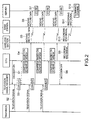
- the CPU 202 turns on the television signal decoder 205 (S1).
- the television signal decoder 205 receives analog television signals (i.e. a television program) from the television receiver 400 through the connector 300 (S2) , and converts the analog television signal into digital moving picture data (S3) .
- the CPU 202 compresses the moving picture data, based on the scheme of MPEG4 (S4), and sends the compressed data to the wireless section 201.
- the wireless section 201 sends the moving picture data and a storage request signal to the base station 100 (S5) .
- the base station 100 sends the moving picture data and the storage request signal to the server'102 (S6) .
- the server 102 stores the received digital moving picture data (S7) .
- Received television programs are sequentially sent to the server 102 and stored therein. A series of these operations is continued until the recording operation is completed.
- the CPU 202 detects a recording end signal
- the CPU.202 turns off the television signal decoder 205 (S8) , and sends the recording end signal to the base station 100 through the wireless section 201 (S9, S10).
- the base station 100 sends a recording end signal to the server 102 (S11) .
- the server 102 then terminates storing the moving picture data (S12).
- Moving picture data taken by the camera section 207 of the mobile phone 200 is directly inputted to the CPU 202.
- the CPU 202 compresses the moving picture data, based on the scheme of MPEG4 and sends the compressed data to the wireless section 201.
- the CPU 202 sends a moving picture reproduction request signal to the base station 100 through the wireless section 201 (S20, S21) .
- the base station 100 sends the moving picture reproduction request signal to the server 102 (S22).
- the server 102 sends stored moving picture data (i.e. a television program or a moving picture taken by the camera section 207) to the mobile phone 200 through the base station 100 (S23, S24).
- the CPU 202 acquires the moving picture data from the wireless section 201 (S25) , and decompresses the data based on the scheme of MPEG4, thus forming moving picture data for reproduction (S26) .
- the display section 203 receives the decompressedmoving picture data fromthe CPU 202 and displays the moving picture data (S27, S28).
- the moving picture data are sequentially sent from the server 102, displayed and reproduced.
- the above-described operations are continued until a closing manipulation is performed or until the moving picture dataareallsent.
- the CPU 202 sends a display stop signal to the display section 203 (S29).
- the CPU 202 sends an end signal to the wireless section 201 (S30).
- the end signal is sent to the server 102 through the base station 100 (S31, S32).
- the server 102 stops sending the moving picture data (S33) .
- the server 102 stores moving picture data taken by the camera section 207, a user can allow the moving picture data to be reproduced on the display section 203 by manipulations similar to those described above.
- a user can erase desired moving picture data stored in the server 102 by sending a given signal to the server 102 from the mobile terminal.
- the server 102 can send moving picture data to the computer through a network.
Landscapes
- Engineering & Computer Science (AREA)
- Multimedia (AREA)
- Signal Processing (AREA)
- Computer Networks & Wireless Communication (AREA)
- Human Computer Interaction (AREA)
- General Engineering & Computer Science (AREA)
- Databases & Information Systems (AREA)
- Business, Economics & Management (AREA)
- General Business, Economics & Management (AREA)
- Television Signal Processing For Recording (AREA)
- Two-Way Televisions, Distribution Of Moving Picture Or The Like (AREA)
Abstract
Description
Claims (17)
- A mobile terminal exchanging data with a server, comprising:a display section;converting means for converting moving picture data into a digital signal;signal processing means for compressing and decompressing the digital signal; anda sending/receiving section for sending and receiving the compressed digital signal.
- The mobile terminal according to claim 1, wherein the moving picture data is a television signal.
- The mobile terminal according to claim 2, wherein the mobile terminal receives the television signal from a television receiver.
- The mobile terminal according to claim 1, further comprising a camera section,
wherein the moving picture data is inputted from the camera section. - The mobile terminal according to claim 1, wherein the signal processing means compresses and decompresses the digital signal, based on the scheme of MPEG4.
- The mobile terminal according to claim 1 wherein the mobile terminal is a mobile phone.
- The mobile terminal according to claim 1, further comprising control means for allowing recording to start at preset time.
- The mobile terminal according to claim 1, wherein the mobile terminal exchanges data with the server through a network.
- A moving picture recording/reproducing system using a mobile terminal, comprising:a mobile terminal that sends and receives moving picture data; anda server that stores moving picture data received from the mobile terminal and sends the moving picture data to the mobile terminal in response to a request of the mobile terminal.
- The moving picture recording/reproducing system according to claim 9, wherein the mobile terminal executes the following operations:(a) converting the moving picture data into a digital signal, compressing the digital signal and sending the compressed signal to the server; and(b) decompressing the compressed moving picture data sent from the server and displaying the moving picture data on a display section.
- The moving picture recording/reproducing system according to claim 9, wherein the moving picture data is a television signal.
- The moving picture recording/reproducing system according to claim 9, wherein the moving picture data is inputted from a camera section provided on the mobile terminal.
- The moving picture recording/reproducing system according to claim 10, wherein the mobile terminal compresses and decompresses the digital signal, based on the scheme of MPEG4.
- The moving picture recording/reproducing system according to claim 9, wherein the mobile terminal is a mobile phone.
- The moving picture recording/reproducing system according to claim 9, wherein the moving picture data stored in the server can be accessed by another predetermined mobile terminal.
- The moving picture recording/reproducing system according to claim 9, wherein the moving picture data stored in the server can be downloaded to a computer.
- The moving picture recording/reproducing system according to claim 9, wherein the moving picture data is exchanged through a network.
Applications Claiming Priority (2)
| Application Number | Priority Date | Filing Date | Title |
|---|---|---|---|
| JP2003303148A JP2005073145A (en) | 2003-08-27 | 2003-08-27 | Television broadcast recording and reproducing system using mobile information terminal |
| JP2003303148 | 2003-08-27 |
Publications (2)
| Publication Number | Publication Date |
|---|---|
| EP1511280A2 true EP1511280A2 (en) | 2005-03-02 |
| EP1511280A3 EP1511280A3 (en) | 2011-02-02 |
Family
ID=34101198
Family Applications (1)
| Application Number | Title | Priority Date | Filing Date |
|---|---|---|---|
| EP04020092A Withdrawn EP1511280A3 (en) | 2003-08-27 | 2004-08-24 | Mobile terminal and moving picture recording/reproducing system |
Country Status (4)
| Country | Link |
|---|---|
| US (1) | US20050076371A1 (en) |
| EP (1) | EP1511280A3 (en) |
| JP (1) | JP2005073145A (en) |
| CN (1) | CN1316825C (en) |
Cited By (1)
| Publication number | Priority date | Publication date | Assignee | Title |
|---|---|---|---|---|
| WO2007000455A1 (en) * | 2005-06-27 | 2007-01-04 | Rok Productions Limited | Channel change on mobile device |
Families Citing this family (25)
| Publication number | Priority date | Publication date | Assignee | Title |
|---|---|---|---|---|
| US8376855B2 (en) | 2004-06-28 | 2013-02-19 | Winview, Inc. | Methods and apparatus for distributed gaming over a mobile device |
| US8870639B2 (en) | 2004-06-28 | 2014-10-28 | Winview, Inc. | Methods and apparatus for distributed gaming over a mobile device |
| US10226698B1 (en) | 2004-07-14 | 2019-03-12 | Winview, Inc. | Game of skill played by remote participants utilizing wireless devices in connection with a common game event |
| CN100366088C (en) * | 2005-05-13 | 2008-01-30 | 北京中星微电子有限公司 | System for mobile terminal receiving multimedia content, method and apparatus thereof |
| US10721543B2 (en) | 2005-06-20 | 2020-07-21 | Winview, Inc. | Method of and system for managing client resources and assets for activities on computing devices |
| US8738694B2 (en) * | 2005-06-20 | 2014-05-27 | Winview, Inc. | Method of and system for managing client resources and assets for activities on computing devices |
| KR100730722B1 (en) * | 2005-07-29 | 2007-06-21 | 삼성전자주식회사 | DM package for receiving digital multimedia broadcasting data, mobile terminal and digital multimedia broadcasting data receiving method |
| EP1911286A4 (en) * | 2005-08-01 | 2009-11-18 | Airplay Network Inc | A live television show utilizing real-time input from a viewing audience |
| US7793317B2 (en) * | 2005-08-19 | 2010-09-07 | At&T Intellectual Property I, L.P. | System and method of managing video streams to a set top box |
| US8149530B1 (en) | 2006-04-12 | 2012-04-03 | Winview, Inc. | Methodology for equalizing systemic latencies in television reception in connection with games of skill played in connection with live television programming |
| US9919210B2 (en) | 2005-10-03 | 2018-03-20 | Winview, Inc. | Synchronized gaming and programming |
| US8705195B2 (en) | 2006-04-12 | 2014-04-22 | Winview, Inc. | Synchronized gaming and programming |
| US9511287B2 (en) | 2005-10-03 | 2016-12-06 | Winview, Inc. | Cellular phone games based upon television archives |
| US9056251B2 (en) | 2006-01-10 | 2015-06-16 | Winview, Inc. | Method of and system for conducting multiple contests of skill with a single performance |
| US10556183B2 (en) | 2006-01-10 | 2020-02-11 | Winview, Inc. | Method of and system for conducting multiple contest of skill with a single performance |
| US8002618B1 (en) | 2006-01-10 | 2011-08-23 | Winview, Inc. | Method of and system for conducting multiple contests of skill with a single performance |
| CN101031047A (en) * | 2006-03-03 | 2007-09-05 | 欧普罗科技股份有限公司 | Network TV recorder |
| US11082746B2 (en) | 2006-04-12 | 2021-08-03 | Winview, Inc. | Synchronized gaming and programming |
| US8813112B1 (en) | 2007-10-23 | 2014-08-19 | Winview, Inc. | Method of and apparatus for utilizing SMS while running an application on a mobile device controlling a viewer's participation with a broadcast |
| US9716918B1 (en) | 2008-11-10 | 2017-07-25 | Winview, Inc. | Interactive advertising system |
| CN101938653A (en) * | 2010-08-17 | 2011-01-05 | 深圳市同洲电子股份有限公司 | Method, device and system for acquiring television picture in real time and transmitting to mobile terminal |
| JP2013168750A (en) | 2012-02-14 | 2013-08-29 | Funai Electric Co Ltd | Television receiver |
| CN105635613B (en) * | 2015-12-16 | 2019-06-04 | 北京奇虎科技有限公司 | Screen recording method and device for mobile device |
| US11551529B2 (en) | 2016-07-20 | 2023-01-10 | Winview, Inc. | Method of generating separate contests of skill or chance from two independent events |
| US11308765B2 (en) | 2018-10-08 | 2022-04-19 | Winview, Inc. | Method and systems for reducing risk in setting odds for single fixed in-play propositions utilizing real time input |
Family Cites Families (21)
| Publication number | Priority date | Publication date | Assignee | Title |
|---|---|---|---|---|
| US5585850A (en) * | 1994-10-31 | 1996-12-17 | Schwaller; John | Adaptive distribution system for transmitting wideband video data over narrowband multichannel wireless communication system |
| JP3372021B2 (en) * | 1997-05-01 | 2003-01-27 | 松下電器産業株式会社 | Map information providing system |
| US6138158A (en) * | 1998-04-30 | 2000-10-24 | Phone.Com, Inc. | Method and system for pushing and pulling data using wideband and narrowband transport systems |
| AU6515400A (en) * | 1999-08-03 | 2001-02-19 | Videoshare, Inc. | Method and system for sharing video over a network |
| EP1189475A1 (en) * | 2000-04-24 | 2002-03-20 | Mitsubishi Denki Kabushiki Kaisha | Cellular phone and remote control system |
| JP2001333414A (en) * | 2000-05-22 | 2001-11-30 | Hitachi Ltd | Program information distribution apparatus and method, and terminal and apparatus related thereto |
| JP2001346173A (en) * | 2000-05-31 | 2001-12-14 | Sony Corp | Image data communication system and method, imaging apparatus and image data processing method |
| JP2002024503A (en) * | 2000-07-10 | 2002-01-25 | Keiichi Okamoto | Duty control system |
| JP2002073541A (en) * | 2000-08-31 | 2002-03-12 | Sony Corp | Content distribution method and content supply system |
| US7460853B2 (en) * | 2000-10-12 | 2008-12-02 | Sony Corporation | Wireless module security system and method |
| KR100440704B1 (en) * | 2000-12-06 | 2004-07-15 | 엔티티 도꼬모 인코퍼레이티드 | Apparatus and method for distributing content |
| US7272299B2 (en) * | 2000-12-08 | 2007-09-18 | Matsushita Electric Industrial Co., Ltd. | Data conversion apparatus, data coding apparatus, and data recording apparatus |
| KR100389847B1 (en) * | 2001-03-02 | 2003-07-02 | 쓰리알 주식회사 | Streaming device for moving picture |
| WO2003007639A1 (en) * | 2001-07-11 | 2003-01-23 | Dormehl, Peter, Gerard (Snr) | System for maintaining data of a mobile station |
| KR20010088980A (en) * | 2001-08-29 | 2001-09-29 | - | Internet Multimedia System for Automobile |
| JP2003085261A (en) * | 2001-09-06 | 2003-03-20 | Victor Co Of Japan Ltd | Information processing system |
| CN1158799C (en) * | 2001-09-29 | 2004-07-21 | 华为技术有限公司 | A method for providing extended storage space for mobile terminal users |
| JP2003179852A (en) * | 2001-12-10 | 2003-06-27 | Matsushita Electric Ind Co Ltd | Video / audio data recording / reproducing method, and disk device using the same |
| JP2003195796A (en) * | 2001-12-27 | 2003-07-09 | Ricoh Co Ltd | Digital image data editing processor |
| JP2003228538A (en) * | 2002-02-06 | 2003-08-15 | Digitalact:Kk | Image delivery system, program for implementing function of the system, and recording medium |
| JP4189627B2 (en) * | 2002-04-24 | 2008-12-03 | 富士フイルム株式会社 | Image server and image display system |
-
2003
- 2003-08-27 JP JP2003303148A patent/JP2005073145A/en active Pending
-
2004
- 2004-08-17 US US10/919,278 patent/US20050076371A1/en not_active Abandoned
- 2004-08-24 EP EP04020092A patent/EP1511280A3/en not_active Withdrawn
- 2004-08-27 CN CNB2004100682948A patent/CN1316825C/en not_active Expired - Fee Related
Non-Patent Citations (1)
| Title |
|---|
| None * |
Cited By (1)
| Publication number | Priority date | Publication date | Assignee | Title |
|---|---|---|---|---|
| WO2007000455A1 (en) * | 2005-06-27 | 2007-01-04 | Rok Productions Limited | Channel change on mobile device |
Also Published As
| Publication number | Publication date |
|---|---|
| JP2005073145A (en) | 2005-03-17 |
| EP1511280A3 (en) | 2011-02-02 |
| CN1592400A (en) | 2005-03-09 |
| CN1316825C (en) | 2007-05-16 |
| US20050076371A1 (en) | 2005-04-07 |
Similar Documents
| Publication | Publication Date | Title |
|---|---|---|
| US20050076371A1 (en) | Mobile terminal and moving picture recording/reproducing system | |
| US10313730B2 (en) | Device and method for outputting data of a wireless terminal to an external device | |
| US20040214541A1 (en) | Apparatus and method for transmitting a television signal received in a mobile communication terminal | |
| US20090245759A1 (en) | Transmission and reception apparatus, receiver, and reproduction method | |
| US20040105532A1 (en) | Broadcast receiving apparatus, control method thereof, portable information terminal, and control method thereof | |
| JP4628030B2 (en) | Multimedia content providing system, viewing device, and car navigation apparatus | |
| JP2007174686A (en) | Image data recording apparatus and image data recording method | |
| US20040218050A1 (en) | Digital video camera with instant broadcasting capability | |
| JP2001298641A (en) | Image processing device and recording medium | |
| KR20050077809A (en) | Method for transmitting moving picture signal in mobile terminal | |
| JP4071695B2 (en) | Information data reproducing apparatus and information data reproducing method | |
| CA2571256A1 (en) | Managing time shift buffers | |
| KR100442060B1 (en) | Method for recording sound and image using a wire and wireless telecommunication network and system therefor | |
| JP2005094073A (en) | Storage device, video recording device, and video recording / reproducing device | |
| KR100735429B1 (en) | Digital multimedia broadcasting playback method and system using personal computer | |
| US20040208490A1 (en) | Image data recording/reproducing apparatus and image data recording/reproducing method | |
| WO2001011872A1 (en) | The method of display calling number of telephone in tv set | |
| KR100964663B1 (en) | Digital Broadcast Receiver with Security System and Driving Method | |
| JP4065526B2 (en) | Imaging apparatus and recording apparatus | |
| JP3082219U (en) | Digital video camera capable of instant broadcasting | |
| JP3933103B2 (en) | Image data recording apparatus and image data recording method | |
| JP2005184372A (en) | Portable videophone and recording method | |
| KR20050076939A (en) | Settopbox capable of receiving and reproducing multimedia which are reproducible in pc | |
| WO2003045062A1 (en) | Video monitoring system | |
| KR0164573B1 (en) | Information screen recorder of information TV |
Legal Events
| Date | Code | Title | Description |
|---|---|---|---|
| PUAI | Public reference made under article 153(3) epc to a published international application that has entered the european phase |
Free format text: ORIGINAL CODE: 0009012 |
|
| AK | Designated contracting states |
Kind code of ref document: A2 Designated state(s): AT BE BG CH CY CZ DE DK EE ES FI FR GB GR HU IE IT LI LU MC NL PL PT RO SE SI SK TR |
|
| AX | Request for extension of the european patent |
Extension state: AL HR LT LV MK |
|
| PUAL | Search report despatched |
Free format text: ORIGINAL CODE: 0009013 |
|
| AK | Designated contracting states |
Kind code of ref document: A3 Designated state(s): AT BE BG CH CY CZ DE DK EE ES FI FR GB GR HU IE IT LI LU MC NL PL PT RO SE SI SK TR |
|
| AX | Request for extension of the european patent |
Extension state: AL HR LT LV MK |
|
| 17P | Request for examination filed |
Effective date: 20110429 |
|
| 17Q | First examination report despatched |
Effective date: 20110729 |
|
| AKX | Designation fees paid |
Designated state(s): DE FR GB IT |
|
| RAP1 | Party data changed (applicant data changed or rights of an application transferred) |
Owner name: LENOVO INNOVATIONS LIMITED (HONG KONG) |
|
| STAA | Information on the status of an ep patent application or granted ep patent |
Free format text: STATUS: EXAMINATION IS IN PROGRESS |
|
| STAA | Information on the status of an ep patent application or granted ep patent |
Free format text: STATUS: THE APPLICATION HAS BEEN WITHDRAWN |
|
| 18W | Application withdrawn |
Effective date: 20190917 |