EP1511279A2 - Mobile communication terminal and method for one-touch message transmission - Google Patents
Mobile communication terminal and method for one-touch message transmission Download PDFInfo
- Publication number
- EP1511279A2 EP1511279A2 EP04020083A EP04020083A EP1511279A2 EP 1511279 A2 EP1511279 A2 EP 1511279A2 EP 04020083 A EP04020083 A EP 04020083A EP 04020083 A EP04020083 A EP 04020083A EP 1511279 A2 EP1511279 A2 EP 1511279A2
- Authority
- EP
- European Patent Office
- Prior art keywords
- message
- touch
- key
- mobile communication
- communication terminal
- Prior art date
- Legal status (The legal status is an assumption and is not a legal conclusion. Google has not performed a legal analysis and makes no representation as to the accuracy of the status listed.)
- Granted
Links
Images






Classifications
-
- H—ELECTRICITY
- H04—ELECTRIC COMMUNICATION TECHNIQUE
- H04M—TELEPHONIC COMMUNICATION
- H04M1/00—Substation equipment, e.g. for use by subscribers
- H04M1/72—Mobile telephones; Cordless telephones, i.e. devices for establishing wireless links to base stations without route selection
- H04M1/724—User interfaces specially adapted for cordless or mobile telephones
- H04M1/72403—User interfaces specially adapted for cordless or mobile telephones with means for local support of applications that increase the functionality
- H04M1/7243—User interfaces specially adapted for cordless or mobile telephones with means for local support of applications that increase the functionality with interactive means for internal management of messages
-
- H—ELECTRICITY
- H04—ELECTRIC COMMUNICATION TECHNIQUE
- H04B—TRANSMISSION
- H04B1/00—Details of transmission systems, not covered by a single one of groups H04B3/00 - H04B13/00; Details of transmission systems not characterised by the medium used for transmission
- H04B1/38—Transceivers, i.e. devices in which transmitter and receiver form a structural unit and in which at least one part is used for functions of transmitting and receiving
- H04B1/40—Circuits
-
- H—ELECTRICITY
- H04—ELECTRIC COMMUNICATION TECHNIQUE
- H04M—TELEPHONIC COMMUNICATION
- H04M11/00—Telephonic communication systems specially adapted for combination with other electrical systems
- H04M11/02—Telephonic communication systems specially adapted for combination with other electrical systems with bell or annunciator systems
- H04M11/022—Paging systems
Definitions
- the present invention relates to a mobile communication terminal, and more particularly to a mobile communication terminal and a method for sending a message using a single key input.
- SMS short message service
- EMS enhanced messaging service
- MMS multimedia messaging service
- a user has to take multiple steps to send a message using any of the above messaging services in a mobile communication terminal. For example, when the user wishes to send a message using a mobile communication terminal, he or she selects a messaging function from a menu or using a short key, input a message to be sent and store the inputted message in a memory of the mobile communication terminal. The user must then input, or retrieve from memory of the mobile communication terminal, the telephone number of the intended recipient of the message and finally press a send/OK key to send the message.
- the user when using a conventional mobile communication terminal, the user must take multiple steps of selecting menus to enter a message input mode in addition to inputting a desired message and pressing keys to send the message. Because of the amount of steps involved, the user may feel inconvenient when trying to urgently send a message, especially in critical circumstances.
- the present invention has been made to solve the above-mentioned problems occurring in the prior art. It is the object of the present invention to provide a mobile communication terminal and a method for easily and rapidly sending a message by a single key input.
- An aspect of the present invention is to provide a mobile communication terminal and a method for easily paging using a single key input.
- Still another aspect of the present invention is to provide a mobile communication terminal and a method for sending a plurality of stored messages in different forms using a single key input.
- a mobile communication terminal comprising: a key input unit including a one-touch message key and outputting a signal for requesting one-touch message transmission when the one-touch message key is pressed; a display unit for displaying menus for one-touch message transmission; a memory for storing a message corresponding to the one-touch message key; and a control unit for sending the stored message corresponding to the one-touch message key when a user inputs a demand for one-touch message transmission.
- a method for sending a message using a mobile communication terminal comprising: a first step of storing at least one message to correspond to the one-touch message key when a user inputs a demand for setting a one-touch message to be sent by a single key input; and a second step of sending the stored message corresponding to the one-touch message key when pressed by the user.
- a mobile communication terminal in a system supporting a paging message service, said terminal comprising: a user interface including a paging button and outputting a signal requesting paging message transmission when a user inputs a recipient's telephone number to be paged and presses the paging button; a display unit for displaying menus for paging message transmission; a radio frequency (RF) unit for performing wireless transmission of the paging message; and a control unit for sending the paging message through the RF unit when the user inputs a demand for the paging message transmission.
- RF radio frequency
- FIG 1 is a block diagram of a mobile communication terminal according to the present invention.
- the mobile communication terminal comprises a control unit 10, a display unit 20, a key input unit 30, a memory 40, a speech processing unit 50 and a radio frequency (RF) unit 60.
- RF radio frequency
- the control unit 10 controls the overall operation of the mobile communication terminal. Particularly, the control unit 10 controls the operation required to send a message by a single key input according to the present invention.
- a message to be sent by a single key input will be referred herein to as a "one-touch message.”
- the one-touch message can be composed of one or more messages having different message forms.
- the one-touch message includes a general paging message.
- the control unit 10 controls the operation required to set the one-touch message. If the user inputs a recipient's telephone number or some recipient's identification using which the recipient's telephone number can be retrieved, and presses a key corresponding to transmission of a preset one-touch message, the control unit 10 will send the one-touch message to the recipient's telephone number. For example, the control unit 10 can set a paging message as the one-touch message. If the user inputs the recipient's telephone number and presses a key corresponding to one-touch message transmission, e.g., a paging button, the control unit 10 will send the preset paging message to the inputted telephone number.
- the key input unit 30 is provided with a plurality of function keys, number keys and symbol keys. According to the first embodiment of the present invention, the key input unit 30 includes a one-touch message key. According to the second embodiment of the present invention, the key input unit 30 includes a plurality of one-touch message keys. When the user presses the one-touch message key, the key input unit 30 outputs a signal corresponding to one-touch message transmission.
- the one-touch message key(s) can be implemented in various ways.
- a one-touch message key can be separately and independently provided on the key input unit 30. More preferably, the one-touch message key can be implemented by pressing a send key for a longer or shorter duration than the key-pressing time for initiating a phone call.
- a particular number key or a symbol key e.g., * or # key, can be used as the one-touch message key.
- the display unit 20 may comprise a Liquid Crystal Display (LCD).
- the display unit 20 outputs various display data generated in the mobile communication terminal. Particularly, the display unit 20 displays menus for setting and sending a one-touch message.
- LCD Liquid Crystal Display
- the memory 40 comprises a Read Only Memory (ROM) and a Random Access Memory (RAM) for storing a plurality of data and programs, including a program for performing message transmission according to the present invention. More preferably, the memory 40 can store a table for classifying messages into two or more message service types.
- ROM Read Only Memory
- RAM Random Access Memory
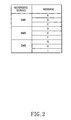
- FIG. 2 shows a table of messages stored in the memory 40.
- the message table classifies messages, which were preset at the time of manufacture of the mobile communication terminal or inputted by the user, into several message service types, such as a short message service (SMS), a multimedia messaging service (MMS), and an enhanced messaging service (EMS).
- SMS short message service
- MMS multimedia messaging service
- EMS enhanced messaging service
- the RF unit 60 transmits and receives speech or control data and performs one-touch message transmission under the control of the control unit 10.
- the speech processing unit 50 converts speech data received by the RF unit into an audible sound under the control of the control unit 10 and outputs the audible sound through a speaker.
- the speech processing unit 50 may also convert speech data received by a microphone and similarly output the audible sound through the speaker.
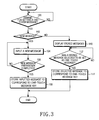
- FIG. 3 is a flow chart showing a process of setting the one-touch message according to the first embodiment of the present invention.
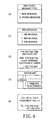
- FIGs. 4 and 5 show examples of messages that may be displayed on the display unit of the mobile communication terminal during the process of setting the one-touch message according to the present invention shown in FIG.3.
- the control unit 10 continuously determines whether the user has inputted a demand for setting a one-touch message at step 100.
- the demand can be inputted via keys of the key input unit 30 (FIG. 1) or other means, such as voice commands. If the demand was inputted, the control unit 10 will proceed with step 102. More specifically, when the user presses a key or selects a menu entry corresponding to the demand for setting the one-touch message, the control unit 10 will display a menu of available types of one-touch messages and will proceed to perform step 102.
- menu entries "1. New Messages" and "2. Stored Messages" can be displayed as the types of the one-touch messages. When "1. New Messages" entry is selected, a menu for setting a new message as the one-touch message will be displayed, while when "2. Stores Messages" is selected, a menu for setting a stored message as the one-touch message will be displayed.
- the control unit 10 determines whether a new message should be set as the one-touch message. For example, the control unit 10 determines that "1. New Messages" entry displayed as the type of the one-touch messages shown in FIG. 4(a) has been selected.
- the control unit 10 will determine that a new message will be set as the one-touch message and will proceed to step 104.
- the user can input the new message using the a user interface, e.g., the key input unit 30 (FIG. 1).
- the control unit 10 will display the message service types, such as "1. SMS message,” “2. MMS message” and "3. EMS message” as shown in FIG. 4(b).
- the control unit 10 displays a corresponding message input mode so that the user can input a new message of the selected type using the user interface.
- the new message inputted at this time can be any message, including an advertising message, a paging message, or the like.
- SMS message entry the control unit 10 will display a text message prepared by the user as shown in FIG. 4(c). The user can input a text message, such as " The meeting time and place are xxx, " through the user interface. If the user selects the displayed "2. MMS message” entry, the control unit 10 will display a new MMS message consisting of a text message and a picture, such as a sketch map, prepared by the user through the user interface as shown in FIG. 4(d). Also, the control unit 10 can display a paging message, such as " Call me at your convenient time to 016-316-9143 or 031-332-0751, " as a new message as shown in FIG. 4(e).
- paging message such as " Call me at your convenient time to 016-316-9143 or 031-332-0751, " as a new message as shown in FIG. 4(e).
- the control unit 10 determines whether there is a demand for completion of the new message input. For example, when the user presses a key corresponding to the completion of the new message input, the control unit 10 recognizes it as a demand to complete the new message input and proceeds to step 108. At step 108, the control unit 10 stores the new message to correspond to the one-touch message key.
- step 100 If in step 100 it was determined that the user selected the "2. Stored Messages" entry from the displayed one-touch message types, the control unit 10 will determine in step 102 that a stored message should be set as the one-touch message and will proceed to step 110 to display stored messages on the display unit 20 (FIG. 1).
- the control unit 10 determines whether any of the messages stored in the memory 40 has been selected to be set as the one-touch message. Specifically, the control unit displays the stored messages as shown in FIG. 5(a) at step 110.
- the control unit 10 can display the stored messages according to the messaging service types, i.e., "1. SMS message,” "2. MMS message” and "3. EMS message.”
- the control unit 10 displays messages (for example, messages A, B and C) classified into SMS type among those messages stored in the memory 40, as shown in FIG. 5(b). The user can select one of the displayed messages A, B and C and set the selected message as the one-touch message using the user interface.
- control unit 10 will display messages D, E and F classified into MMS as shown in FIG. 5(c). The user can select one of the displayed messages D, E and F and set the selected message as the one-touch message using the user interface.
- the control unit 10 will display messages G, H and I classified into EMS as shown in FIG. 5(d). The user can select one of the displayed messages G, H and I and set the selected message as the one-touch message using the user interface.
- the control unit 10 can select at least one of the messages stored according to the messaging service types and set the selected message as the one-touch message through the interface with the user.
- the control unit determines whether one of the stored messages has been selected to be set as the one-touch message. If a message selection is completed, the control unit 10 will proceed with step 114 to store the selected message to correspond to the one-touch message key. For example, if a SMS message "A” and a MMS message “D" are selected as shown in FIG. 5, the two selected messages "A” and "D" will be stored to correspond to the one-touch message key.
- FIG. 6 shows an example of a message stored to correspond to the one-touch message key according to the first embodiment of the present invention.
- the mobile communication terminal comprises a single one-touch message key. At least one message can be stored to correspond to the one-touch message key.
- a mobile communication terminal is configured to have a plurality of one-touch message keys. Different one-touch messages can be stored to correspond to the respective one-touch message keys.
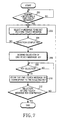
- FIG. 7 is a flow chart showing a process of setting a one-touch message according to the second embodiment of the present invention.
- FIG. 8 shows examples of one-touch messages stored to correspond to each of a plurality of one-touch message keys.
- control unit 10 determines whether there is a demand for setting the one-touch message. If such a demand is inputted by the user, the control unit 10 will proceed with step 202 to select a message to be set as the one-touch message.
- the control unit 10 determines at step 204 whether the message selection has been completed. Upon completion of the message selection, the control unit 10 proceeds with step 206 to request the selection of a one-touch message key. The control unit 10 displays a message requesting the selection of the one-touch message key on the display unit 20 (FIG 1). At step 208, the control unit 10 determines whether the user has selected a key to be set as the one-touch message key. If a particular key is selected by the user, the control unit 10 will proceed to step 210 to store the selected message to correspond to the selected key. The key selected by the user is defined herein as a first one-touch message key.
- the control unit 10 After storing the selected message to correspond to the first one-touch message key, the control unit 10 proceeds to step 212 and determines whether the selection of the one-touch message key has been completed. If there is a key input corresponding to the completion of the selection of the one-touch message key, the control unit 10 will terminate the process of setting the one-touch message. On the other hand, if no key is inputted to complete the selection of the one-touch message key, the control unit 10 will repeat steps 202 through 212 so that additional one-touch messages can be stored to correspond to a plurality of one-touch message keys, such as second and third one-touch message keys.
- FIG. 8 shows examples of one-touch messages stored to correspond to at least one one-touch message key according to the second embodiment of the present invention. Specifically, FIG. 8 shows one-touch messages stored to correspond to three one-touch message keys.
- FIG. 8(a) is an example showing that the SMS message "A" (FIG. 5b), the MMS message “D” (FIG. 5c), and the EMS message “G” (FIG. 5d) are stored as a one-touch message corresponding to the first one-touch message key.
- FIG. 8(b) is an example showing that the SMS message "B" (FIG. 5b) and the EMS message "H” (FIG. 5d) are stored as a one-touch message corresponding to the second one-touch message key.
- FIG. 8(c) is an example showing that the SMS message "C” (FIG. 5b) and the MMS message "D” (FIG. 5c) are stored as a one-touch message corresponding to the third one-touch message key.
- one or more one-touch message keys are preset in the mobile communication terminal.
- the user inputs a key corresponding to one-touch message transmission, one-touch messages stored in the one-touch message key are sent to the recipient.
- FIG. 9 is a flow chart showing a process of sending a one-touch message in a mobile communication terminal according to the present invention. The process of sending a one-touch message according to the user's demand for one-touch message transmission will be explained in detail with reference to FIGs. 1 to 9.
- the control unit 10 will proceed with step 302.
- the control unit 10 read out the one-touch message stored in the pressed one-touch message key.
- the control unit 10 sends the stored one-touch message to the recipient's telephone number.
- the telephone number can be replaced with an Internet destination address such as an e-mail address, the file transfer protocol (FTP) address, and the like and that the stored one-touch message will be delivered to the recipient at that address.
- FTP file transfer protocol
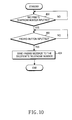
- FIG. 10 is a flow chart showing a process of sending a paging message according to the first embodiment of the present invention when the desired one-touch message is the paging message.
- FIG. 11 shows messages displayed on the display unit of the sender's mobile communication terminal and that of the recipient's mobile communication terminal when a paging message has been transmitted according to the first embodiment of the present invention.
- FIG. 11 A shows an example of a message displayed on the display unit of the sender's mobile communication terminal.
- the control unit 10 checks and displays the inputted telephone number on the display unit 20. If the user presses a paging button at step 402, the control unit 10 will proceed with step 404 to send the paging message to the recipient's telephone number. The control unit 10 will also display a message informing the user regarding transmission of the paging message on the display unit 20.
- FIG. 11B shows an example of a message displayed on the display unit of the recipient's mobile communication terminal.
- the recipient's mobile communication terminal displays the message on its display unit 20 (FIG. 1).
- the mobile communication terminal enables the user to easily and rapidly send a preset message by a single key input. Therefore, the user can rapidly send a message in critical circumstances. Also, the user can easily page a person by pressing a single key after inputting the recipient's telephone number. According to the present invention, it is possible to send a plurality of messages in different forms all together by a single key input, without the need to take multiple steps of selecting menus to send those messages.
Landscapes
- Engineering & Computer Science (AREA)
- Computer Networks & Wireless Communication (AREA)
- Signal Processing (AREA)
- Business, Economics & Management (AREA)
- General Business, Economics & Management (AREA)
- Human Computer Interaction (AREA)
- Mobile Radio Communication Systems (AREA)
- Telephone Function (AREA)
- Telephonic Communication Services (AREA)
Abstract
Description
Claims (24)
- A mobile communication terminal for one-touch message transmission, which comprises:a key input unit including a one-touch message key, the key input unit outputting a signal requesting one-touch message transmission when the one-touch message key is pressed;a display unit for displaying menus for one-touch message transmission;a memory for storing a message corresponding to the one-touch message key; anda control unit for sending the stored message corresponding to the one-touch message key when a user inputs a demand for one-touch message transmission.
- The mobile communication terminal according to claim 1, wherein said one-touch message key is implemented by pressing a send key for a period selected from a longer and shorter time duration than the key-pressing time for initiating a phone call after inputting a telephone number in standby mode.
- The mobile communication terminal according to claim 1 or 2, wherein said one-touch message key is separately and independently provided on the key input unit.
- The mobile communication terminal according to one of claims 1 to 3, wherein said memory stores messages in different areas according to messaging service types.
- The mobile communication terminal according to claim 4, wherein said message service types include an SMS, an MMS, and an EMS.
- The mobile communication terminal according to one of claims 1 to 5, wherein a plurality of messages are stored to correspond to said one-touch message key.
- The mobile communication terminal according to one of claims 1 to 6, wherein a paging message is stored to correspond to said one-touch message key.
- The mobile communication terminal according to claim 7, wherein said one-touch message key is a paging button.
- A mobile communication terminal for one-touch message transmission, which comprises:a key input unit including a plurality of one-touch message keys, the key input unit outputting a signal requesting one-touch message transmission when a user presses one of the one-touch message keys;a display unit for displaying menus for one-touch message transmission;a memory for storing messages corresponding respectively to the plurality of one-touch message keys; anda control unit for sending a message stored to correspond to the pressed one-touch message key when the user inputs a demand for the one-touch message transmission.
- The mobile communication terminal according to claim 9, wherein said memory stores messages in different areas according to messaging service types.
- The mobile communication terminal according to claim 10, wherein said message service types include SMS, MMS and EMS.
- The mobile communication terminal according to one of claims 9 to 11, wherein at least one message is stored to correspond to each of said plurality of one-touch message keys.
- The mobile communication terminal according to one of claims 9 to 12, wherein a paging message is stored to correspond to at least one of the one-touch message keys.
- The mobile communication terminal according to claim 13, wherein one of said one-touch message keys is a paging button.
- A method for sending a message using a mobile communication terminal, comprising:a first step of storing at least one message to correspond to a one-touch message key when a user inputs a demand for setting a one-touch message to be sent by a single key input; anda second step of sending the stored message corresponding to the one-touch message key when pressed by the user.
- The method according to claim 15, wherein said first step comprises:when a user inputs a demand for setting a one-touch message, determining whether a new message or a stored message will be set as a one-touch message;when the user-presses a key for setting a new message as a one-touch message, inputting a new message through interface with the user and storing the inputted new message to correspond to a one-touch message key; andwhen the user presses a key for setting a stored message as a one-touch message, storing at least one of stored messages to correspond to the one-touch message key.
- The method according to claim 15 or 16, wherein said first step stores at least one message to correspond to each of a plurality of one-touch message keys when a user inputs a demand for setting a one-touch message to be sent by a single key.
- The method according to one of claims 15 to 17, wherein said second step sends a message stored to correspond to a one-touch message key pressed by the user after input of a recipient's telephone number in standby mode.
- A mobile communication terminal in a system supporting a paging message service, which comprises:a user interface including a paging button, the user interface outputting a signal requesting paging message transmission when a user inputs a recipient's telephone number to be paged and presses the paging button;a display unit for displaying menus for paging message transmission;an RF unit for performing wireless transmission of the paging message; anda control unit for sending the paging message through the RF unit when the user inputs a demand for the paging message transmission.
- The mobile communication terminal according to claim 19, wherein said paging button is implemented by pressing a send key for a period selected from a longer and shorter time duration than the key-pressing time for initiating a phone call after inputting a telephone number in standby mode.
- The mobile communication terminal according to claim 19 or 20, wherein said paging button is a separate and independent key.
- The mobile communication terminal according to one of claims 19 to 21, further comprising a memory including a message table that stores at least one paging message, wherein said paging message can be added, modified, stored, and deleted.
- The mobile communication terminal according to claim 22, wherein said memory further includes a message table that stores messages according to messaging service types.
- A method for sending a paging message using a mobile communication terminal comprising a paging button, said method comprising the steps of:determining whether a user has inputted a recipient's telephone number and pressed the paging button; andif the recipient's telephone number was inputted and the paging button was pressed, sending a paging message stored to correspond to the paging button to the inputted telephone number.
Applications Claiming Priority (2)
| Application Number | Priority Date | Filing Date | Title |
|---|---|---|---|
| KR1020030060429A KR100593973B1 (en) | 2003-08-29 | 2003-08-29 | Mobile communication terminal and method for one-touch message transmission |
| KR2003060429 | 2003-08-29 |
Publications (3)
| Publication Number | Publication Date |
|---|---|
| EP1511279A2 true EP1511279A2 (en) | 2005-03-02 |
| EP1511279A3 EP1511279A3 (en) | 2005-05-04 |
| EP1511279B1 EP1511279B1 (en) | 2013-10-09 |
Family
ID=34101863
Family Applications (1)
| Application Number | Title | Priority Date | Filing Date |
|---|---|---|---|
| EP04020083.4A Expired - Lifetime EP1511279B1 (en) | 2003-08-29 | 2004-08-24 | Mobile communication terminal and method for one-touch message transmission |
Country Status (4)
| Country | Link |
|---|---|
| US (1) | US7392065B2 (en) |
| EP (1) | EP1511279B1 (en) |
| KR (1) | KR100593973B1 (en) |
| CN (1) | CN100474865C (en) |
Cited By (1)
| Publication number | Priority date | Publication date | Assignee | Title |
|---|---|---|---|---|
| EP1900230A4 (en) * | 2005-07-01 | 2010-12-08 | Samsung Electronics Co Ltd | SYSTEM AND METHOD FOR TRANSMITTING AN URGENT MESSAGE |
Families Citing this family (11)
| Publication number | Priority date | Publication date | Assignee | Title |
|---|---|---|---|---|
| US8985442B1 (en) | 2011-07-18 | 2015-03-24 | Tiger T G Zhou | One-touch payment using haptic control via a messaging and calling multimedia system on mobile device and wearable device, currency token interface, point of sale device, and electronic payment card |
| US7555311B2 (en) * | 2005-09-27 | 2009-06-30 | Nokia Corporation | Mobile communication terminal and method |
| US20070232333A1 (en) * | 2006-03-30 | 2007-10-04 | Sap Ag | Method and system for providing work related information in a mobile environment |
| US7961851B2 (en) * | 2006-07-26 | 2011-06-14 | Cisco Technology, Inc. | Method and system to select messages using voice commands and a telephone user interface |
| US7742774B2 (en) * | 2007-01-11 | 2010-06-22 | Virgin Mobile Usa, L.P. | Location-based text messaging |
| US20140278502A1 (en) * | 2013-03-15 | 2014-09-18 | Bryan Laskin | Clinic management system |
| US20150188861A1 (en) * | 2013-12-26 | 2015-07-02 | Aaren Esplin | Mechanism for facilitating dynamic generation and transmission of canned responses on computing devices |
| CN104168179A (en) * | 2014-07-24 | 2014-11-26 | 小米科技有限责任公司 | Information sending method and device |
| CN105101121B (en) * | 2015-05-29 | 2019-07-23 | 小米科技有限责任公司 | A kind of method and device that information is sent |
| DE102021119046A1 (en) | 2021-07-22 | 2023-01-26 | Mirco Ćurić | communication device |
| US12513531B1 (en) * | 2024-09-12 | 2025-12-30 | Intrinsic Value, Llc | Systems, devices, and methods for determining the presence of a user |
Family Cites Families (12)
| Publication number | Priority date | Publication date | Assignee | Title |
|---|---|---|---|---|
| US5509067A (en) * | 1992-02-26 | 1996-04-16 | Canon Kabushiki Kaisha | Method and apparatus for speed dialing via one-touch and two-touch operation |
| JPH08181762A (en) * | 1994-12-27 | 1996-07-12 | Nec Corp | Abbreviated number registration method and abbreviated number registration installation |
| US5894506A (en) | 1996-09-05 | 1999-04-13 | Skytel Communications, Inc. | Method and apparatus for generating and communicating messages between subscribers to an electronic messaging network |
| DE19652142A1 (en) | 1996-12-14 | 1998-06-18 | Holger Schmidt | Mobile radio station e.g. for transmitting emergency messages |
| US6823182B1 (en) * | 1996-12-27 | 2004-11-23 | Hitachi, Ltd. | Cellular mobile telephone apparatus |
| KR100293996B1 (en) | 1998-08-06 | 2001-07-12 | 윤종용 | Advanced transfering method of short message in digital portable telephone |
| US6614883B2 (en) | 1999-03-31 | 2003-09-02 | Elliot Baum | Emergency call system |
| GB2393886B (en) * | 2001-06-22 | 2005-05-11 | Emblaze Systems Ltd | MMS system and method with protocol conversion suitable for mobile/portable handset display |
| US20030005065A1 (en) | 2001-06-29 | 2003-01-02 | Kuang-Shin Lin | Emulated real E-mail system and method |
| US7221933B2 (en) | 2001-10-22 | 2007-05-22 | Kyocera Wireless Corp. | Messaging system for mobile communication |
| US7684787B2 (en) * | 2002-05-29 | 2010-03-23 | Qualcomm Incorporated | Method and apparatus for routing messages of different message services in a wireless device |
| US20050021803A1 (en) * | 2003-06-09 | 2005-01-27 | Wren Paul I. | Messaging of arbitrary-length video and audio content |
-
2003
- 2003-08-29 KR KR1020030060429A patent/KR100593973B1/en not_active Expired - Fee Related
-
2004
- 2004-07-30 US US10/903,957 patent/US7392065B2/en not_active Expired - Fee Related
- 2004-08-24 EP EP04020083.4A patent/EP1511279B1/en not_active Expired - Lifetime
- 2004-08-27 CN CNB2004100683211A patent/CN100474865C/en not_active Expired - Fee Related
Cited By (2)
| Publication number | Priority date | Publication date | Assignee | Title |
|---|---|---|---|---|
| EP1900230A4 (en) * | 2005-07-01 | 2010-12-08 | Samsung Electronics Co Ltd | SYSTEM AND METHOD FOR TRANSMITTING AN URGENT MESSAGE |
| US8242902B2 (en) | 2005-07-01 | 2012-08-14 | Samsung Electronics Co., Ltd. | Urgent message transmission system and method |
Also Published As
| Publication number | Publication date |
|---|---|
| KR20050022137A (en) | 2005-03-07 |
| US7392065B2 (en) | 2008-06-24 |
| KR100593973B1 (en) | 2006-07-03 |
| US20050049007A1 (en) | 2005-03-03 |
| CN100474865C (en) | 2009-04-01 |
| CN1592328A (en) | 2005-03-09 |
| EP1511279A3 (en) | 2005-05-04 |
| EP1511279B1 (en) | 2013-10-09 |
Similar Documents
| Publication | Publication Date | Title |
|---|---|---|
| KR100926721B1 (en) | Method of obtaining caller information in a mobile terminal and mobile terminal therefore | |
| EP1316194B1 (en) | Handset personalisation | |
| US8116826B2 (en) | Methods, apparatuses and computer program products for automatic adjustment of call and message alert levels for missed/rejected calls/messages | |
| EP1589734A2 (en) | Method for displaying status information on a mobile terminal | |
| US20080161058A1 (en) | Method and Mobile Communication Terminal for Providing Function of Hyperlink Telephone Number Including Short Message Service | |
| US7392065B2 (en) | Mobile communication terminal and method for one-touch message transmission | |
| US8010884B2 (en) | Method of and apparatus for displaying messages on a mobile terminal | |
| EP1501264A2 (en) | Communication terminal apparatus and method for displaying selectable functions during communication | |
| KR20060016426A (en) | Message management method of mobile communication terminal | |
| EP1478163B1 (en) | Broadcast message service method in mobile communication terminal | |
| JP2004289577A (en) | Mobile communication terminal and mobile communication system | |
| JPH11112647A (en) | Mobile phone message receiving system | |
| KR100606766B1 (en) | How to handle short messages | |
| KR20030063062A (en) | Apparatus and method for storing short message | |
| KR100878349B1 (en) | Mobile terminal for displaying text messages with special effects | |
| KR100531945B1 (en) | Method for marking forwarded or replied SMS with icon | |
| JP2003333137A (en) | Information processing apparatus and standby screen control program | |
| KR100761422B1 (en) | Corresponding message sorting display method and apparatus of mobile terminal | |
| KR100469719B1 (en) | Method for inputting and displaying for transmitting a short message in a mobile communication terminal | |
| JP2001103133A (en) | Mobile object communication terminal | |
| KR100966553B1 (en) | How to send a short message using the concluding function | |
| KR20030013630A (en) | Method for receiving a short message service in a mobile phone | |
| KR100606071B1 (en) | How to send message group from mobile terminal | |
| JP2000078654A (en) | Method for transmitting message in mobile communication terminal | |
| KR100857527B1 (en) | How to send a short message with multiple reply numbers in mobile communication terminal |
Legal Events
| Date | Code | Title | Description |
|---|---|---|---|
| PUAI | Public reference made under article 153(3) epc to a published international application that has entered the european phase |
Free format text: ORIGINAL CODE: 0009012 |
|
| 17P | Request for examination filed |
Effective date: 20040824 |
|
| AK | Designated contracting states |
Kind code of ref document: A2 Designated state(s): AT BE BG CH CY CZ DE DK EE ES FI FR GB GR HU IE IT LI LU MC NL PL PT RO SE SI SK TR |
|
| AX | Request for extension of the european patent |
Extension state: AL HR LT LV MK |
|
| PUAL | Search report despatched |
Free format text: ORIGINAL CODE: 0009013 |
|
| RIC1 | Information provided on ipc code assigned before grant |
Ipc: 7H 04M 1/725 A Ipc: 7H 04M 11/02 B |
|
| AK | Designated contracting states |
Kind code of ref document: A3 Designated state(s): AT BE BG CH CY CZ DE DK EE ES FI FR GB GR HU IE IT LI LU MC NL PL PT RO SE SI SK TR |
|
| AX | Request for extension of the european patent |
Extension state: AL HR LT LV MK |
|
| AKX | Designation fees paid |
Designated state(s): DE FR GB |
|
| 17Q | First examination report despatched |
Effective date: 20050721 |
|
| RAP1 | Party data changed (applicant data changed or rights of an application transferred) |
Owner name: SAMSUNG ELECTRONICS CO., LTD. |
|
| GRAP | Despatch of communication of intention to grant a patent |
Free format text: ORIGINAL CODE: EPIDOSNIGR1 |
|
| GRAS | Grant fee paid |
Free format text: ORIGINAL CODE: EPIDOSNIGR3 |
|
| GRAA | (expected) grant |
Free format text: ORIGINAL CODE: 0009210 |
|
| AK | Designated contracting states |
Kind code of ref document: B1 Designated state(s): DE FR GB |
|
| REG | Reference to a national code |
Ref country code: GB Ref legal event code: FG4D |
|
| REG | Reference to a national code |
Ref country code: DE Ref legal event code: R096 Ref document number: 602004043513 Country of ref document: DE Effective date: 20131205 |
|
| REG | Reference to a national code |
Ref country code: DE Ref legal event code: R097 Ref document number: 602004043513 Country of ref document: DE |
|
| PLBE | No opposition filed within time limit |
Free format text: ORIGINAL CODE: 0009261 |
|
| STAA | Information on the status of an ep patent application or granted ep patent |
Free format text: STATUS: NO OPPOSITION FILED WITHIN TIME LIMIT |
|
| 26N | No opposition filed |
Effective date: 20140710 |
|
| REG | Reference to a national code |
Ref country code: DE Ref legal event code: R097 Ref document number: 602004043513 Country of ref document: DE Effective date: 20140710 |
|
| REG | Reference to a national code |
Ref country code: FR Ref legal event code: PLFP Year of fee payment: 13 |
|
| REG | Reference to a national code |
Ref country code: FR Ref legal event code: PLFP Year of fee payment: 14 |
|
| PGFP | Annual fee paid to national office [announced via postgrant information from national office to epo] |
Ref country code: FR Payment date: 20170724 Year of fee payment: 14 Ref country code: DE Payment date: 20170720 Year of fee payment: 14 Ref country code: GB Payment date: 20170720 Year of fee payment: 14 |
|
| REG | Reference to a national code |
Ref country code: DE Ref legal event code: R119 Ref document number: 602004043513 Country of ref document: DE |
|
| GBPC | Gb: european patent ceased through non-payment of renewal fee |
Effective date: 20180824 |
|
| PG25 | Lapsed in a contracting state [announced via postgrant information from national office to epo] |
Ref country code: DE Free format text: LAPSE BECAUSE OF NON-PAYMENT OF DUE FEES Effective date: 20190301 |
|
| PG25 | Lapsed in a contracting state [announced via postgrant information from national office to epo] |
Ref country code: FR Free format text: LAPSE BECAUSE OF NON-PAYMENT OF DUE FEES Effective date: 20180831 |
|
| PG25 | Lapsed in a contracting state [announced via postgrant information from national office to epo] |
Ref country code: GB Free format text: LAPSE BECAUSE OF NON-PAYMENT OF DUE FEES Effective date: 20180824 |