EP1511216B1 - Vorrichtung zur Übertragung von Nachrichten über ein Netzwerk an Nutzerendgeräte - Google Patents
Vorrichtung zur Übertragung von Nachrichten über ein Netzwerk an Nutzerendgeräte Download PDFInfo
- Publication number
- EP1511216B1 EP1511216B1 EP04364056.4A EP04364056A EP1511216B1 EP 1511216 B1 EP1511216 B1 EP 1511216B1 EP 04364056 A EP04364056 A EP 04364056A EP 1511216 B1 EP1511216 B1 EP 1511216B1
- Authority
- EP
- European Patent Office
- Prior art keywords
- user
- messages
- group
- network
- message
- Prior art date
- Legal status (The legal status is an assumption and is not a legal conclusion. Google has not performed a legal analysis and makes no representation as to the accuracy of the status listed.)
- Expired - Lifetime
Links
- 230000005540 biological transmission Effects 0.000 claims description 73
- 238000001914 filtration Methods 0.000 claims description 22
- 238000001514 detection method Methods 0.000 claims description 11
- 238000004519 manufacturing process Methods 0.000 claims description 5
- 238000000034 method Methods 0.000 claims description 4
- 238000004590 computer program Methods 0.000 claims description 3
- 238000007726 management method Methods 0.000 description 7
- 238000012423 maintenance Methods 0.000 description 5
- 238000009792 diffusion process Methods 0.000 description 4
- 230000002452 interceptive effect Effects 0.000 description 4
- 230000004044 response Effects 0.000 description 4
- 241001080024 Telles Species 0.000 description 3
- 238000012550 audit Methods 0.000 description 2
- 238000010586 diagram Methods 0.000 description 2
- 239000001963 growth medium Substances 0.000 description 2
- 239000002609 medium Substances 0.000 description 2
- 230000000007 visual effect Effects 0.000 description 2
- 230000003213 activating effect Effects 0.000 description 1
- 239000000470 constituent Substances 0.000 description 1
- 230000003111 delayed effect Effects 0.000 description 1
- 230000001419 dependent effect Effects 0.000 description 1
- 238000013461 design Methods 0.000 description 1
- 238000009826 distribution Methods 0.000 description 1
- 230000000694 effects Effects 0.000 description 1
- 239000003607 modifier Substances 0.000 description 1
- 238000012545 processing Methods 0.000 description 1
- 230000010076 replication Effects 0.000 description 1
- 230000000717 retained effect Effects 0.000 description 1
- 238000004904 shortening Methods 0.000 description 1
- 238000012549 training Methods 0.000 description 1
- 230000001960 triggered effect Effects 0.000 description 1
Images

Classifications
-
- H—ELECTRICITY
- H04—ELECTRIC COMMUNICATION TECHNIQUE
- H04L—TRANSMISSION OF DIGITAL INFORMATION, e.g. TELEGRAPHIC COMMUNICATION
- H04L12/00—Data switching networks
- H04L12/02—Details
- H04L12/16—Arrangements for providing special services to substations
- H04L12/18—Arrangements for providing special services to substations for broadcast or conference, e.g. multicast
- H04L12/1859—Arrangements for providing special services to substations for broadcast or conference, e.g. multicast adapted to provide push services, e.g. data channels
-
- H—ELECTRICITY
- H04—ELECTRIC COMMUNICATION TECHNIQUE
- H04L—TRANSMISSION OF DIGITAL INFORMATION, e.g. TELEGRAPHIC COMMUNICATION
- H04L51/00—User-to-user messaging in packet-switching networks, transmitted according to store-and-forward or real-time protocols, e.g. e-mail
- H04L51/21—Monitoring or handling of messages
- H04L51/212—Monitoring or handling of messages using filtering or selective blocking
-
- H—ELECTRICITY
- H04—ELECTRIC COMMUNICATION TECHNIQUE
- H04L—TRANSMISSION OF DIGITAL INFORMATION, e.g. TELEGRAPHIC COMMUNICATION
- H04L12/00—Data switching networks
- H04L12/02—Details
- H04L12/16—Arrangements for providing special services to substations
- H04L12/18—Arrangements for providing special services to substations for broadcast or conference, e.g. multicast
- H04L12/185—Arrangements for providing special services to substations for broadcast or conference, e.g. multicast with management of multicast group membership
Definitions
- the invention relates to a device for transmitting messages over a network to a plurality of user stations.
- One field of application of the invention concerns the sending of messages to a local network, for example of the corporate intranet type or, more broadly, to a global network, for example via the Internet.
- the sender of the message specifies in it the user station or receivers of the message and the information he wants them to pass through this message.
- the recipients of the message are actually e-mail addresses, which the sender writes from scratch in the message, because he knows them, or the sender of the message draws from a searchable address book since his transmitter station.
- the transmission device is turned towards the recipients of messages that can choose whether or not their position presents them.
- a user will be able to ignore in advance messages he did not choose, these messages arriving at his post and simply not presented to him, in a manner completely transparent to the user.
- the transmission device uses a proactive behavior of the user by allowing him to choose groups of user stations recipients of messages to which he wishes to belong.
- this choice takes into account the interest and the affinity that the user can bring to such or such subject.
- the home groups of the extension the user can subscribe to certain groups and not others.
- the groups defined above are therefore independent of the users and the address of their post.
- the transmission device ensures that a message on a specific subject associated with a group will be well transmitted to all interested user stations, which have selected this group membership.
- the ease of use of the messaging is increased for both the sender and the receiver of the message, the sender not having to write or select the individual addresses of the users to whom he wants to send his message but having only to specify the group for which this message is intended.
- the transmission device avoids the need to manage mail distribution address lists, since it is not necessary to know which users have selected which group identifier to belong to.
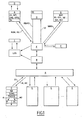
- the transmission device comprises an administration means A for generating messages M to be transmitted.
- Each message M produced by the administration means A comprises, in addition to the IM information itself, intended to be presented to a user, one or more user group identifiers IG which are associated with the messages.
- identifiers IG1, ..., IGi,..., IGn of groups of user stations are provided, which are created by means G of creation, for example associated with the means A of administration.
- the administration means A chooses the group identifier GI associated with this message from the identifiers IG1,..., IGi,..., IGn of groups created by the creation means G.
- Each user station C has a means RM for receiving messages reaching it via the network R.
- each user station C comprises a means S for selecting, among the identifiers IG1,..., IGi, .. ., IGn of user groups of the creation medium G, one or more user group identifiers IG, the user group identifiers IG thus selected then forming one or more groups C belonging to the set C of user.
- each user station C includes an FM filter means of the messages present on its receiving means RM.
- the FM means for filtering the received messages is automatically controlled to ignore, from the point of view of the IM information that is presented on the station C to the user, the messages M whose group identifier IG does not correspond to the one of the groups GA of membership present on its means S of selection.
- the IM information contained in the messages M which are received on the station C and which are associated with an identifier GI of the group corresponding to a group GA belonging to the user station C is presented on this station C to this user, by any appropriate means of presentation.
- this message M received on the RM means of the station C will be transmitted by the filtering means FM to be presented to the user on the station C.
- the means S of the station C may have selected several identifiers of groups such as IGi and IGn, which leads to the first example, or as IG1 and IGn, which leads to the second example.
- the transmission of the message M from the transmission means F to the transmission means B, as well as the sending by the transmitting means B of the message M to the network R are for example recorded in a database LOG associated with them.
- the network R is, for example, a multicast network (in English: "multicast") for sending the messages M of the transmitting means F to the stations C of associated users.
- the use of a multicast network makes it possible to dispense with point-to-point links between the transmitting means B and the user stations C which would multiply the number of links between them by as much.
- the multicast network R makes it possible to define a multicast address to which the transmission means B transmits ("multicast" address), which makes it possible to establish only a single link between the transmission means B and the network. R for sending the message M to the stations C.
- Each message M is duplicated to the nodes of the network R in as many number of times these nodes have branches connected to the stations C, for sending the same message M in each of these branches to the stations C.
- the network R multicast and saves bandwidth.
- the multicast network makes it possible to broadcast a single stream to an unlimited number of recipients C.
- the packets intended for the stations C are sent by the transmission means B to one or more dedicated routers of the network C, whose role is the redirection and replication of packets as needed.
- the multicast network R can be easily implemented on existing networks by activating a corresponding option on the constituent elements of the network R (router and / or others).
- the Multicast Routing Protocol is PIM DM or PIM SM ("Independent Multicast Protocol” or Multicast Independent Multicast Protocols) in DM (dense mode) or SM (low density mode) mode.
- the protocol used by a C station to be part of a group is for example IGMP.
- the messages are broadcast for example in UDP / IP Multicast (UDP: "User Datagramm Protocol" or protocol of user datagrams).
- the selection by means S of a group GA of membership among the identifiers IG of the user group is carried out for example in the following manner.
- the creation means G is associated with a data base BDD, in which the identifiers IG1,..., IG1,..., IGn of groups which have been created on it are recorded.
- the means S for selecting the user station C sends, via the network R, the transmitting means B and the transmitting means F, a query signal SBDD of the database BDD to know which identifiers IG groups that are registered in it, called IG identifiers of available groups.
- the BDD data base then automatically returns to the means of selection of the station C the identifiers IG1, ..., IGi, ..., IGn of groups that it possesses by the means F, B and the network R.
- this selection means S In response to the reception by means S of selection of the identifiers IG1,..., IGi,..., IGn of groups of the base BDD, this selection means S causes the presentation to the user on the means P station C, these identifiers IG1, ..., IGi, ..., IGn of available groups. The user then chooses on the selection means S, through an appropriate interface, the group identifier (s) IG to which he wishes to subscribe among the identifiers of available groups IG1, ..., IGi, ..., IGn, these interfaces being for example a display window on the screen P of the station C. The choice of one or several identifiers IG of groups among those available is then registered on the means S of selection, as group GA of membership of the station C.
- the FM filtering means is then automatically updated with the GA membership groups present on the means S for selecting its station C.
- the user stations C are for example computers connected by any appropriate means to the network R and served in M messages by it.
- the presentation of the messages M on the station C takes for example the form of a display on its screen P and / or the emission of a sound on this station C.
- the choice for the update of groups GA of membership on the station C is for example automatically offered to the user each time he starts his station C, for example by a corresponding window, or when the first start of the transmission device.
- the means A, G, F, B are for example implemented on the same machine such as a mail server or on separate servers or separate modules.
- rights of use of the means of administration to one or more persons are assigned to it in the following manner.
- the administration means A comprises a corresponding SA means for inputting administrator identifiers IA and password words MP.
- Each created group IG identifier is associated on the administration means A with one or more administrator IA identifiers and associated MP passwords, so that the generation of messages M on this administration means A for an IG group determined is permitted on this administration means A only when the administrator identifier IA entered on the SA means and the administrator password MP entered on this means SA correspond to those associated in the administration means A to this group identifier GI, the administrator IA identifiers and associated MP passwords being previously stored in the means A for each group identifier GI, for example in a database of corresponding data. This is done an access control administrators groups to send them messages.
- the entry of the administrator IA identifiers and associated MP passwords on the SA means is performed by an appropriate interface, for example using display windows on a medium A computer screen, as well as the generation of messages M on the means A.
- the selection means S comprise an interface enabling the user to add to the membership groups GA or to delete membership groups GA, group identifiers IG.
- identifiers IGO of mandatory groups may be available, which can not be ignored by the means S and by the station C and of which it has been decided beforehand by a higher authority that post C belonged automatically to some and not to others.
- These IGO identifiers of mandatory groups correspond for example to the physical location or the hierarchical position of the user's station C.
- these mandatory group IGO identifiers are: west wing of building, east wing of building, ground floor of building, first floor of building, second floor of building for physical location, or design office, service after-sales, purchasing department, legal department, for a hierarchical situation.
- one of the mandatory groups may also be "all", that is all C and C2 positions, as will be seen below.
- These IGO identifiers of mandatory groups are automatically present on each user station C according to their membership to them and can not be deleted on the user station C. Consequently, a message M addressed to a group of user stations associated with a mandatory group IGO identifier will necessarily be sent to these stations C via the means A, F, B and the network R, and will be automatically presented to the user. user of these stations C without being able to be ignored.
- These IGO identifiers of mandatory groups are also called administrative groups and are therefore not editable except by a deputy head. These mandatory or administrative groups come from, for example, an address book or an address book of items C.
- This IM information may also be a polling questionnaire information and / or polling or gaming questionnaire information, which calls for a user's response on the C station, which is then returned to the A means, the sending of this type of IM information and response management is then provided by an interactive module I and the LOG base.
- This IM information can also be alert information and / or information relating to the maintenance of the transmission device. This maintenance information signals for example a disturbance that will be caused on the device due to the intervention of technicians on a computer system or other device.
- certain messages M are predefined on the means A of administration and are recorded there, so as not to have to recreate them each time.
- these predefined messages can be sent several times, a sending repetition period and / or a delayed sending period by means A of these messages can be provided.
- the warning messages are predefined.
- the administration means A can define for a message M presented on one or more stations C the automatic return of a presentation acknowledgment signal by this station C.
- the messages M of the first type which are transmitted for presentation by the filtering means FM of a station C are automatically opened or executed by applications installed on the stations C, so that the IM information they contain is automatically presented on the station C to the user.
- the transmission device according to the invention makes it possible to act on the stations C, thus considerably shortening the time of knowledge of the information between the administration means A and the stations C, which is interesting not only for the users of these stations C but also for the administrator of the means A.
- a user subscribed for example to a conference will automatically receive it at its beginning on his user station C if he took the care to subscribe to it beforehand by having selected the group corresponding to this conference, without requiring any further action of the user on his station C.
- this does not exclude that the user can at any time ignore himself on his post C the message M after it has been presented and, in the previous case of the conference, activate a command on the station C which will stop on it the presentation to the user of the conference and put him back into the initial situation.
- the messages may be of a second type instead of the first type indicated above.
- These messages M2 of the second type are produced by a detection means D associated with the administration means A and are transmitted by the means F, B and the network R to the user stations C which are associated with the network R by specifying in FIG. message M2 of the second type the group identifier IG.
- DC message detection means M2 of the second type downstream of the FM message filtering means.
- a message M2 of the second type has passed the FM filtering means of a station C, because the identifier IG of this message M2 is equal to a group GA of this station C, this message M2 is received on the detection means DC, which then automatically returns to the detection means D an acknowledgment signal S2 via the network R, the means B and the means F, and this for example in unicast mode.
- the signal S2 comprises, for example, the group identifier IG of the message M2 that triggered it on the station C.
- the messages M2 of the second type contain no information so as to trigger no presentation of information on the stations C of users who have received them.
- the user of a station C receiving a message M2 of the second type does not notice it and these messages M2 of the second type can be considered as predefined service messages.
- the transmission means F and the transmission means B are master and there is provided a second slave transmission means F connected on the one hand by an intermediate network RI by means of master transmission F and connected on the other hand to a B2 slave transmission means.
- the master transmission means F sends the messages, for example of the first type M and / or the second type M2, both to the master transmission means B for serving the stations C via the network R, and to the transmission means F slave via the IN network.
- the slave transmission means F2 transmits the messages M and / or M2 that it has received from the master transmission means F to the slave transmission means B2 which in turn sends them via a second network R2 to second C2 stations. users served by this second network R2.
- the slave transmission means B2, the second network R2 and the second user stations C2 are analogous to the master transmission means B, to the network R and to the user stations C, but by being associated with the transmission means F2. slave.
- the intermediate network RI is for example a unicast network, while the second network R2 is multicast, for example.
- the intermediate network RI could also be multicast.
- This second embodiment makes it possible to implement the transmission device according to the invention by passing through networks of different types in the case where the intermediate network RI is not of the same type as the network R and is not multicast.
- the elements A, B, C, D, F, G, R are associated with a first geographical site of a company and the stations C are those of users belonging to this company, the network R is a local network. of this company, while elements F2, B2, R2 and C2 are those of a second geographic site remote from this company, connected to the first site by a network RI extended (in English: "Wide Area Network") which borrows for example the Internet.
- this second embodiment makes it possible to serve in messages M and / or M2 C and C2 stations distributed on geographical sites distant from each other.
- more than one slave transmission means F2 may be provided in series with the means F2 shown in FIG. figure 2 and, in association with some of these slave transmission means F2, a transmission means B2, a second network R2 and associated C2 stations. Only one master F means is provided.
- each transmission means F, F2 comprises the following modifiable parameters: a name, the indication of a master or slave transmission means (master for F and slave for the means F2), the indication of the port of transmission where the master transmission means F is connected to the slave transmission means F2, the IP address of the transmission means F, F2, the address where the master transmission means F receives messages from the means A and D and the means F2 slave is connected to the master means F, the indication of the port where the means F and the means F2 transmit messages M, M2 (data) to the means B, respectively B2, the indication of the port where the means F and F2 receive responses from the associated stations C and C2, the multicast IP address to which the means F and F2 transmit the messages (IP range).
- the transmitting means B is for example a multicast server, as is the medium B2.
- the means F, F2 are also used to transmit the information between servers as the updates and information transfers necessary for the service.
- the means F, F2 also receive the service messages from the means B, B2.
- An event management means E may be provided for retrieving service signals from the transmitting means B, such as broadcast error signals, the message log (send time, content), or the like. or trace files, and view records in the LOG database, for further processing.
- the management means G makes it possible to manage the IP ranges of the stations C, C2 served by the means F, F2, by allowing to add, delete or modify them, an IP range that can only be associated with
- the medium G also allows the management of the service, configuration files, shutdowns and server launches.
- the means G emits a signal regularly, for example every 15 minutes to the different servers in order to maintain the state of the service and notify the deputy head by a specific message.
- the management means G also makes it possible to manage the sounds, fonts and any other parameter of the IM information present in the messages M of the first type, by making it possible to create and delete recorded sounds, fonts and values of predefined parameters.
- the group identifier GI is for example present in a header of the message which may further comprise a broadcast reference, identical for each IM information contained in this message.
- the station C may comprise means for controlling the broadcast reference contained in the message M transmitted by the filtering means FM and ignoring an information item IM present in a message M thus transmitted but which would have a broadcast reference identical to that of a message M previously presented on this station C, so as not to present him again this same IM information and do not unnecessarily disturb the user of the associated station C.
- each message is sent several times successively with the same broadcast reference, this number of times being configurable.
- each message is for example broadcast 3 times with an interval of two seconds between each broadcast in order to mitigate any losses of UDP packets on the network R.
- the administration means A may define other criteria for each message M, such as the duration of presentation of the latter on the station C.
- Connection means C, C2 posts with the outside networks R, RI, R2 can also be provided, for example the connection to the Internet.
- K means of security keys can be provided on the stations C and on the means A, D, F and / or B to ensure that the messages M, M2 received by the stations C, C2 are indeed from them and not an external entity.
- both the means K and the connection means are provided, it is possible to interconnect the IP address domains of user stations securely via the Internet network.
Landscapes
- Engineering & Computer Science (AREA)
- Computer Networks & Wireless Communication (AREA)
- Signal Processing (AREA)
- Information Transfer Between Computers (AREA)
- Data Exchanges In Wide-Area Networks (AREA)
Claims (11)
- Vorrichtung zur Übertragung von Nachrichten an eine Vielzahl von Benutzerstationen (C) durch ein erstes Netzwerk, dadurch gekennzeichnet, dass sie aufweist:- mindestens eine Einrichtung (G) zur Erzeugung von Kennungen (IG) von Gruppen von Benutzerstationen und eine Datenbank (BDD), in der die von der Erzeugungseinrichtung (G) erzeugten Gruppenkennungen (IG) gespeichert sind,- mindestens eine Verwaltungseinrichtung (A), die mindestens eine Nachricht (M) eines ersten Typs produzieren kann, die eine Information (IM) und mindestens eine der Nachricht (M) zugeordnete Gruppenkennung (IG) unter den von der Erzeugungseinrichtung (G) erzeugten Gruppenkennungen (IG) enthält,- mindestens eine Sendeeinrichtung (F, B), um die mindestens eine produzierte Nachricht (M) über das erste Netzwerk (R an erste Benutzerstationen (C) zu übermitteln,wobei jede erste Benutzerstation (C) eine automatische Empfangseinrichtung (RM) von Nachrichten (M) vom Netzwerk (R), eine Einrichtung (S) zur Auswahl mindestens einer Zugehörigkeitsgruppe (GA) unter den von der Erzeugungseinrichtung (G) erzeugten Kennungen (IG) von Benutzergruppen durch den Benutzer und eine Einrichtung (FM) zum Filtern der von der Empfangseinrichtung (RM) empfangenen Nachrichten (M) aufweist, um:- dem Benutzer nur die Information (IM) der Nachrichten (M) des ersten Typs unter denjenigen zu präsentieren, die in der Empfangseinrichtung (RM) vorhanden sind und deren Gruppenkennung (IG) gleich einer der in der Auswahleinrichtung (S) vorhandenen Zugehörigkeitsgruppen (GA) ist, und- dem Benutzer nicht die Information (IM) der Nachrichten (M) des ersten Typs zu präsentieren, die in der Empfangseinrichtung (RM) vorhanden sind und die eine zugeordnete Gruppenkennung (IG) haben, die sich von den in der Auswahleinrichtung (S) vorhandenen Zugehörigkeitsgruppen (GA) unterscheidet,wobei Verbindungen zwischen den Benutzerstationen (C) und der Datenbank (BDD) vorgesehen sind, damit jede Auswahleinrichtung (S) in der Lage ist, die Datenbank (BDD) abzufragen und die Gruppenkennungen (IG) zu erhalten, die dort gespeichert sind, um die mindestens eine Zugehörigkeitsgruppe (GA) auszuwählen.
- Übertragungsvorrichtung nach Anspruch 1, dadurch gekennzeichnet, dass das erste Netzwerk (R) ein Multicast-Netzwerk zum Senden der Nachrichten (M) von der Sendeeinrichtung (F, B) zu den Benutzerstationen (C) ist.
- Übertragungsvorrichtung nach einem der vorhergehenden Ansprüche, dadurch gekennzeichnet, dass die Sendeeinrichtung (F, B) Master ist, und dass mindestens eine zweite Slave-Sendeeinrichtung (F2, B2) vorgesehen ist, die in der Lage ist, durch ein zweites Netzwerk (R2) empfangene Nachrichten (M, M2) an zweite Benutzerstationen (C2) zu übermitteln, die von diesem zweiten Netzwerk (R2) bedient werden, wobei jede zweite Benutzerstation (C2) eine Empfangseinrichtung (RM) von Nachrichten (M) vom zweiten Netzwerk (R2), eine Auswahleinrichtung (S) mindestens einer Zugehörigkeitsgruppe (GA) unter den von der Erzeugungseinrichtung (G) erzeugten Kennungen (IG) von Benutzergruppen und eine Einrichtung (FM) zum Filtern der von der Empfangseinrichtung (RM) empfangenen Nachrichten (M), um:- dem Benutzer nur die Information (IM) der Nachrichten (M) des ersten Typs unter denjenigen zu präsentieren, die in der Empfangseinrichtung (RM) vorhanden sind und deren Gruppenkennung (IG) gleich einer der in der Auswahleinrichtung (S) vorhandenen Zugehörigkeitsgruppen (GA) ist, und- dem Benutzer nicht die Information (IM) der Nachrichten (M) des ersten Typs zu präsentieren, die in der Empfangseinrichtung (RM) vorhanden sind und die eine zugeordnete Gruppenkennung (IG) haben, die sich von den in der Auswahleinrichtung (S) vorhandenen Zugehörigkeitsgruppen (GA) unterscheidet,und außerdem ein Zwischennetzwerk (RI) aufweist, das die Master-Sendeeinrichtung (F, B) mit der zweiten Slave-Sendeeinrichtung (F2, B2) verbindet, um ihr die Nachrichten (M, M2) zu übermitteln.
- Übertragungsvorrichtung nach Anspruch 3, dadurch gekennzeichnet, dass die ersten und zweiten Netzwerke (R, R2) je Multicast-Netzwerke zum Senden der Nachrichten (M, M2) der Master- bzw. Slave-Sendeeinrichtungen (B, B2) an die zugeordneten ersten und zweiten Benutzerstationen (C, C2) sind.
- Übertragungsvorrichtung nach Anspruch 3 oder 4, dadurch gekennzeichnet, dass das Zwischennetzwerk (RI) ein Unicast-Netzwerk ist.
- Übertragungsvorrichtung nach einem der vorhergehenden Ansprüche, dadurch gekennzeichnet, dass eine Erfassungseinrichtung (D) vorgesehen ist, die mindestens eine vordefinierte Nachricht (M2) des zweiten Typs produzieren kann, die mindestens eine Gruppenkennung (IG) unter denjenigen aufweist, die von der Erzeugungseinrichtung (G) erzeugt werden, zur Übertragung durch die Sendeeinrichtung (F, B) an die Benutzerstationen (C), wobei Einrichtungen (DC) zur Erfassung der Nachricht (M2) des zweiten Typs in mindestens einer Benutzerstation (C) stromabwärts hinter ihrer Filtereinrichtung (FM) vorgesehen sind, damit die Filtereinrichtung (FM) an die Erfassungseinrichtungen (DC) der Station (C) nur die Nachrichten (M2) des zweiten Typs überträgt, deren Gruppenkennung (IG) gleich einer der in der zugeordneten Auswahleinrichtung (S) vorhandenen Zugehörigkeitsgruppen (GA) ist, wobei der korrekte Empfang der von der Filtereinrichtung (FM) übertragenen Nachricht (M2) des zweiten Typs durch diese Erfassungseinrichtungen (DC) der Station (C) das automatische Rücksenden eines Bestätigungssignals (S2) über das Netzwerk (R) und die Sendeeinrichtung (F, B) an die Erfassungseinrichtung (D) auslöst, die Einrichtungen zur Auswertung der empfangenen Bestätigungssignale (S2) aufweist.
- Übertragungsvorrichtung nach einem der vorhergehenden Ansprüche, dadurch gekennzeichnet, dass die Nachrichten (M) des ersten Typs und die Empfangseinrichtungen (RM) der Benutzerstationen (C) so sind, dass die von diesen empfangenen und durch die Filtereinrichtung (F) übertragenen Nachrichten (M) dort automatisch geöffnet werden, um dem Benutzer die Information (IM) zu präsentieren, die sie enthalten.
- Übertragungsvorrichtung nach einem der vorhergehenden Ansprüche, dadurch gekennzeichnet, dass die Auswahleinrichtungen (S) eine Schnittstelle aufweisen, die es dem Benutzer der zugeordneten Station (C) erlaubt, die Gruppenkennungen (IG) den Zugehörigkeitsgruppen (GA) hinzuzufügen oder sie aus den Zugehörigkeitsgruppen (GA) zu entfernen.
- Verfahren zur Übertragung von Nachrichten durch ein erstes Netzwerk an eine Vielzahl von Benutzerstationen (C), gekennzeichnet durch die folgenden Schritte:- Erzeugen von Kennungen (IG) von Gruppen von Benutzerstationen und Speichern der erzeugten Gruppenkennungen (IG) in einer Datenbank (BDD),- Produzieren mindestens einer Nachricht (M) eines ersten Typs, die eine Information (IM) und mindestens eine der Nachricht (M) zugeordnete Gruppenkennung (IG) unter den erzeugten Gruppenkennungen (IG) enthält,- Senden, durch das erste Netzwerk (R), der mindestens einen produzierten Nachricht (M) an erste Benutzerstationen (C),- automatisches Empfangen von Nachrichten (M) vom Netzwerk (R) in jeder ersten Benutzerstation (C), Auswählen in jeder ersten Benutzerstation (C) mindestens einer Zugehörigkeitsgruppe (GA) unter den erzeugten Kennungen (IG) von Benutzergruppen durch den Benutzer, und automatisches Filtern der empfangenen Nachrichten (M) in jeder ersten Benutzerstation (C), um:- in der ersten Station (C) dem Benutzer nur die Information (IM) der Nachrichten (M) des ersten Typs unter den empfangenen zu präsentieren, deren Gruppenkennung (IG) gleich einer der ausgewählten Zugehörigkeitsgruppen (GA) ist, und- in der Station (C) dem Benutzer nicht die Information (IM) der empfangene Nachrichten (M) des ersten Typs zu präsentieren, die eine zugeordnete Gruppenkennung (IG) hat, die sich von den ausgewählten Zugehörigkeitsgruppen (GA) unterscheidet, wobei Verbindungen zwischen den Benutzerstationen (C) und der Datenbank (BDD) vorgesehen sind, wobei die Auswahl mindestens einer Zugehörigkeitsgruppe (GA) unter den erzeugten Kennungen (IG) von Benutzergruppen in jeder ersten Benutzerstation (C) durch den Benutzer die folgenden Schritte enthält:
Abfrage der Datenbank (BDD), Erhalt der dort gespeicherten Gruppenkennungen (IG) und Auswahl der mindestens einen Zugehörigkeitsgruppe (GA) unter den erhaltenen Gruppenkennungen (IG). - Computerprogramm, das Anweisungen zur Durchführung des Übertragungsverfahrens von Nachrichten nach Anspruch 9 aufweist.
- Benutzerstation (C), die eine automatische Empfangseinrichtung (RM) von Nachrichten (M) vom Netzwerk (R), eine Einrichtung (S) zur Auswahl mindestens einer Zugehörigkeitsgruppe (GA) unter den Kennungen (IG) von Benutzergruppen, die von einer Erzeugungseinrichtung (G) erzeugt werden, durch den Benutzer und eine Einrichtung (FM) zur Filterung der empfangenen Nachrichten (M) durch die Empfangseinrichtung (RM) aufweist, um:- dem Benutzer nur die Information (IM) der Nachrichten (M) des ersten Typs unter denjenigen zu präsentieren, die in der Empfangseinrichtung (RM) vorhanden sind und deren Gruppenkennung (IG) gleich einer der in der Auswahleinrichtung (S) vorhandenen Zugehörigkeitsgruppen (GA) ist, und- dem Benutzer nicht die Information (IM) der Nachrichten (M) des ersten Typs zu präsentieren, die in der Empfangseinrichtung (RM) vorhanden sind und die eine zugeordnete Gruppenkennung (IG) haben, die sich von den in der Auswahleinrichtung (S) vorhandenen Zugehörigkeitsgruppen (GA) unterscheidet,wobei die Auswahleinrichtung eine Datenbank (BDD) abfragen kann, um die dort gespeicherten Gruppenkennungen (IG) zu erhalten, um die mindestens eine Zugehörigkeitsgruppe (GA) auszuwählen.
Applications Claiming Priority (2)
| Application Number | Priority Date | Filing Date | Title |
|---|---|---|---|
| FR0310330 | 2003-08-29 | ||
| FR0310330A FR2859297A1 (fr) | 2003-08-29 | 2003-08-29 | Dispositif de transmission de messages par reseau a des postes d'utilisateurs |
Publications (2)
| Publication Number | Publication Date |
|---|---|
| EP1511216A1 EP1511216A1 (de) | 2005-03-02 |
| EP1511216B1 true EP1511216B1 (de) | 2018-10-03 |
Family
ID=34089882
Family Applications (1)
| Application Number | Title | Priority Date | Filing Date |
|---|---|---|---|
| EP04364056.4A Expired - Lifetime EP1511216B1 (de) | 2003-08-29 | 2004-08-27 | Vorrichtung zur Übertragung von Nachrichten über ein Netzwerk an Nutzerendgeräte |
Country Status (2)
| Country | Link |
|---|---|
| EP (1) | EP1511216B1 (de) |
| FR (1) | FR2859297A1 (de) |
Families Citing this family (3)
| Publication number | Priority date | Publication date | Assignee | Title |
|---|---|---|---|---|
| FR2883687A1 (fr) * | 2005-03-22 | 2006-09-29 | France Telecom | Systeme et procede de communication de messages pour un ensemble de terminaux serveurs |
| RU2487483C2 (ru) * | 2008-03-10 | 2013-07-10 | Роберт Бош Гмбх | Способ и фильтрующее устройство для фильтрации сообщений, поступающих абоненту коммуникационной сети по последовательной шине данных этой сети |
| CN106656753B (zh) * | 2016-12-08 | 2020-02-21 | 北京五八信息技术有限公司 | 一种im历史消息排序的方法、装置及终端 |
Family Cites Families (5)
| Publication number | Priority date | Publication date | Assignee | Title |
|---|---|---|---|---|
| US5553083B1 (en) * | 1995-01-19 | 2000-05-16 | Starburst Comm Corp | Method for quickly and reliably transmitting frames of data over communications links |
| US6400810B1 (en) * | 1999-07-20 | 2002-06-04 | Ameritech Corporation | Method and system for selective notification of E-mail messages |
| US6349340B1 (en) * | 2000-01-13 | 2002-02-19 | Exigent International, Inc. | Data multicast channelization |
| WO2002035782A2 (en) * | 2000-08-18 | 2002-05-02 | Carbon Communications, Llc | Method and device for transmitting streaming multimedia messages |
| US6807578B2 (en) * | 2001-03-14 | 2004-10-19 | International Business Machines Corporation | Nack suppression for multicast protocols in mostly one-way networks |
-
2003
- 2003-08-29 FR FR0310330A patent/FR2859297A1/fr active Pending
-
2004
- 2004-08-27 EP EP04364056.4A patent/EP1511216B1/de not_active Expired - Lifetime
Non-Patent Citations (1)
| Title |
|---|
| None * |
Also Published As
| Publication number | Publication date |
|---|---|
| EP1511216A1 (de) | 2005-03-02 |
| FR2859297A1 (fr) | 2005-03-04 |
Similar Documents
| Publication | Publication Date | Title |
|---|---|---|
| US8429287B2 (en) | Network audio distribution system and method | |
| US9282068B1 (en) | Collaborative streaming of video content | |
| Tyson et al. | How instant messaging works | |
| CA2525000C (en) | Dynamic content change notification | |
| US7620996B2 (en) | Dynamic summary module | |
| US7293060B2 (en) | Electronic disc jockey service | |
| CN102017589B (zh) | 在pstn上的个人数据端口以及具有虚拟房间和对象的在线家庭 | |
| US20080299953A1 (en) | Mobile web system providing interchangable service with a mobile device | |
| US20070174425A1 (en) | Method and apparatus for communicating with a user using video | |
| US20060195882A1 (en) | Methods, systems, and computer program products for providing multi-viewpoint media content services | |
| AU2009204642B2 (en) | Real-time communication and information collaboration system | |
| US9940401B2 (en) | Buddy share | |
| WO2009003735A1 (en) | Instant messaging communication system and method | |
| Ortiz Jr | Instant Messaging: No Longer Just Chat | |
| US20120017254A1 (en) | Video communications system | |
| FR3019424A1 (fr) | Procede de construction d'un message par un terminal | |
| EP1511216A1 (de) | Vorrichtung zur Übertragung von Nachrichten über ein Netzwerk an Nutzerendgeräte | |
| US20030009525A1 (en) | Message exchanging system and monitoring system | |
| FR2851704A1 (fr) | Procede de gestion de presence selective pour service de messagerie instantanee au sein d'un reseau de telecommunication tel que le reseau internet | |
| US12165221B2 (en) | Podroom | |
| CN114911439A (zh) | 信息处理装置以及存储介质 | |
| WO2002035782A2 (en) | Method and device for transmitting streaming multimedia messages | |
| EP1432171B1 (de) | Verfahren und System zur automatischen und simultanen Verteilung elektronischer Dokumente mit verschiedenen Formaten auf dem Internet | |
| Vardhan | A Study on Cyber Crimes with Specific Reference to Clubhouse | |
| CN1666462A (zh) | 监控多个个体的方法和装置 |
Legal Events
| Date | Code | Title | Description |
|---|---|---|---|
| PUAI | Public reference made under article 153(3) epc to a published international application that has entered the european phase |
Free format text: ORIGINAL CODE: 0009012 |
|
| AK | Designated contracting states |
Kind code of ref document: A1 Designated state(s): AT BE BG CH CY CZ DE DK EE ES FI FR GB GR HU IE IT LI LU MC NL PL PT RO SE SI SK TR |
|
| AX | Request for extension of the european patent |
Extension state: AL HR LT LV MK |
|
| 17P | Request for examination filed |
Effective date: 20050805 |
|
| AKX | Designation fees paid |
Designated state(s): AT BE BG CH CY CZ DE DK EE ES FI FR GB GR HU IE IT LI LU MC NL PL PT RO SE SI SK TR |
|
| 17Q | First examination report despatched |
Effective date: 20111220 |
|
| RAP1 | Party data changed (applicant data changed or rights of an application transferred) |
Owner name: ORANGE |
|
| STAA | Information on the status of an ep patent application or granted ep patent |
Free format text: STATUS: EXAMINATION IS IN PROGRESS |
|
| GRAP | Despatch of communication of intention to grant a patent |
Free format text: ORIGINAL CODE: EPIDOSNIGR1 |
|
| STAA | Information on the status of an ep patent application or granted ep patent |
Free format text: STATUS: GRANT OF PATENT IS INTENDED |
|
| INTG | Intention to grant announced |
Effective date: 20180314 |
|
| GRAS | Grant fee paid |
Free format text: ORIGINAL CODE: EPIDOSNIGR3 |
|
| GRAA | (expected) grant |
Free format text: ORIGINAL CODE: 0009210 |
|
| STAA | Information on the status of an ep patent application or granted ep patent |
Free format text: STATUS: THE PATENT HAS BEEN GRANTED |
|
| AK | Designated contracting states |
Kind code of ref document: B1 Designated state(s): AT BE BG CH CY CZ DE DK EE ES FI FR GB GR HU IE IT LI LU MC NL PL PT RO SE SI SK TR |
|
| REG | Reference to a national code |
Ref country code: GB Ref legal event code: FG4D Free format text: NOT ENGLISH |
|
| REG | Reference to a national code |
Ref country code: CH Ref legal event code: EP Ref country code: AT Ref legal event code: REF Ref document number: 1049819 Country of ref document: AT Kind code of ref document: T Effective date: 20181015 |
|
| REG | Reference to a national code |
Ref country code: DE Ref legal event code: R096 Ref document number: 602004053235 Country of ref document: DE |
|
| REG | Reference to a national code |
Ref country code: IE Ref legal event code: FG4D Free format text: LANGUAGE OF EP DOCUMENT: FRENCH |
|
| REG | Reference to a national code |
Ref country code: NL Ref legal event code: MP Effective date: 20181003 |
|
| REG | Reference to a national code |
Ref country code: AT Ref legal event code: MK05 Ref document number: 1049819 Country of ref document: AT Kind code of ref document: T Effective date: 20181003 |
|
| PG25 | Lapsed in a contracting state [announced via postgrant information from national office to epo] |
Ref country code: NL Free format text: LAPSE BECAUSE OF FAILURE TO SUBMIT A TRANSLATION OF THE DESCRIPTION OR TO PAY THE FEE WITHIN THE PRESCRIBED TIME-LIMIT Effective date: 20181003 |
|
| PG25 | Lapsed in a contracting state [announced via postgrant information from national office to epo] |
Ref country code: ES Free format text: LAPSE BECAUSE OF FAILURE TO SUBMIT A TRANSLATION OF THE DESCRIPTION OR TO PAY THE FEE WITHIN THE PRESCRIBED TIME-LIMIT Effective date: 20181003 Ref country code: AT Free format text: LAPSE BECAUSE OF FAILURE TO SUBMIT A TRANSLATION OF THE DESCRIPTION OR TO PAY THE FEE WITHIN THE PRESCRIBED TIME-LIMIT Effective date: 20181003 Ref country code: PL Free format text: LAPSE BECAUSE OF FAILURE TO SUBMIT A TRANSLATION OF THE DESCRIPTION OR TO PAY THE FEE WITHIN THE PRESCRIBED TIME-LIMIT Effective date: 20181003 Ref country code: CZ Free format text: LAPSE BECAUSE OF FAILURE TO SUBMIT A TRANSLATION OF THE DESCRIPTION OR TO PAY THE FEE WITHIN THE PRESCRIBED TIME-LIMIT Effective date: 20181003 Ref country code: FI Free format text: LAPSE BECAUSE OF FAILURE TO SUBMIT A TRANSLATION OF THE DESCRIPTION OR TO PAY THE FEE WITHIN THE PRESCRIBED TIME-LIMIT Effective date: 20181003 Ref country code: BG Free format text: LAPSE BECAUSE OF FAILURE TO SUBMIT A TRANSLATION OF THE DESCRIPTION OR TO PAY THE FEE WITHIN THE PRESCRIBED TIME-LIMIT Effective date: 20190103 |
|
| PG25 | Lapsed in a contracting state [announced via postgrant information from national office to epo] |
Ref country code: GR Free format text: LAPSE BECAUSE OF FAILURE TO SUBMIT A TRANSLATION OF THE DESCRIPTION OR TO PAY THE FEE WITHIN THE PRESCRIBED TIME-LIMIT Effective date: 20190104 Ref country code: SE Free format text: LAPSE BECAUSE OF FAILURE TO SUBMIT A TRANSLATION OF THE DESCRIPTION OR TO PAY THE FEE WITHIN THE PRESCRIBED TIME-LIMIT Effective date: 20181003 Ref country code: PT Free format text: LAPSE BECAUSE OF FAILURE TO SUBMIT A TRANSLATION OF THE DESCRIPTION OR TO PAY THE FEE WITHIN THE PRESCRIBED TIME-LIMIT Effective date: 20190203 |
|
| REG | Reference to a national code |
Ref country code: DE Ref legal event code: R097 Ref document number: 602004053235 Country of ref document: DE |
|
| PG25 | Lapsed in a contracting state [announced via postgrant information from national office to epo] |
Ref country code: DK Free format text: LAPSE BECAUSE OF FAILURE TO SUBMIT A TRANSLATION OF THE DESCRIPTION OR TO PAY THE FEE WITHIN THE PRESCRIBED TIME-LIMIT Effective date: 20181003 Ref country code: IT Free format text: LAPSE BECAUSE OF FAILURE TO SUBMIT A TRANSLATION OF THE DESCRIPTION OR TO PAY THE FEE WITHIN THE PRESCRIBED TIME-LIMIT Effective date: 20181003 |
|
| PLBE | No opposition filed within time limit |
Free format text: ORIGINAL CODE: 0009261 |
|
| STAA | Information on the status of an ep patent application or granted ep patent |
Free format text: STATUS: NO OPPOSITION FILED WITHIN TIME LIMIT |
|
| PG25 | Lapsed in a contracting state [announced via postgrant information from national office to epo] |
Ref country code: RO Free format text: LAPSE BECAUSE OF FAILURE TO SUBMIT A TRANSLATION OF THE DESCRIPTION OR TO PAY THE FEE WITHIN THE PRESCRIBED TIME-LIMIT Effective date: 20181003 Ref country code: EE Free format text: LAPSE BECAUSE OF FAILURE TO SUBMIT A TRANSLATION OF THE DESCRIPTION OR TO PAY THE FEE WITHIN THE PRESCRIBED TIME-LIMIT Effective date: 20181003 Ref country code: SK Free format text: LAPSE BECAUSE OF FAILURE TO SUBMIT A TRANSLATION OF THE DESCRIPTION OR TO PAY THE FEE WITHIN THE PRESCRIBED TIME-LIMIT Effective date: 20181003 |
|
| 26N | No opposition filed |
Effective date: 20190704 |
|
| PG25 | Lapsed in a contracting state [announced via postgrant information from national office to epo] |
Ref country code: SI Free format text: LAPSE BECAUSE OF FAILURE TO SUBMIT A TRANSLATION OF THE DESCRIPTION OR TO PAY THE FEE WITHIN THE PRESCRIBED TIME-LIMIT Effective date: 20181003 |
|
| PG25 | Lapsed in a contracting state [announced via postgrant information from national office to epo] |
Ref country code: TR Free format text: LAPSE BECAUSE OF FAILURE TO SUBMIT A TRANSLATION OF THE DESCRIPTION OR TO PAY THE FEE WITHIN THE PRESCRIBED TIME-LIMIT Effective date: 20181003 |
|
| PG25 | Lapsed in a contracting state [announced via postgrant information from national office to epo] |
Ref country code: MC Free format text: LAPSE BECAUSE OF FAILURE TO SUBMIT A TRANSLATION OF THE DESCRIPTION OR TO PAY THE FEE WITHIN THE PRESCRIBED TIME-LIMIT Effective date: 20181003 Ref country code: LI Free format text: LAPSE BECAUSE OF NON-PAYMENT OF DUE FEES Effective date: 20190831 Ref country code: CH Free format text: LAPSE BECAUSE OF NON-PAYMENT OF DUE FEES Effective date: 20190831 Ref country code: LU Free format text: LAPSE BECAUSE OF NON-PAYMENT OF DUE FEES Effective date: 20190827 |
|
| REG | Reference to a national code |
Ref country code: BE Ref legal event code: MM Effective date: 20190831 |
|
| PG25 | Lapsed in a contracting state [announced via postgrant information from national office to epo] |
Ref country code: IE Free format text: LAPSE BECAUSE OF NON-PAYMENT OF DUE FEES Effective date: 20190827 |
|
| PG25 | Lapsed in a contracting state [announced via postgrant information from national office to epo] |
Ref country code: BE Free format text: LAPSE BECAUSE OF NON-PAYMENT OF DUE FEES Effective date: 20190831 |
|
| PGFP | Annual fee paid to national office [announced via postgrant information from national office to epo] |
Ref country code: GB Payment date: 20200722 Year of fee payment: 17 Ref country code: DE Payment date: 20200721 Year of fee payment: 17 |
|
| PG25 | Lapsed in a contracting state [announced via postgrant information from national office to epo] |
Ref country code: CY Free format text: LAPSE BECAUSE OF FAILURE TO SUBMIT A TRANSLATION OF THE DESCRIPTION OR TO PAY THE FEE WITHIN THE PRESCRIBED TIME-LIMIT Effective date: 20181003 |
|
| PG25 | Lapsed in a contracting state [announced via postgrant information from national office to epo] |
Ref country code: HU Free format text: LAPSE BECAUSE OF FAILURE TO SUBMIT A TRANSLATION OF THE DESCRIPTION OR TO PAY THE FEE WITHIN THE PRESCRIBED TIME-LIMIT; INVALID AB INITIO Effective date: 20040827 |
|
| REG | Reference to a national code |
Ref country code: DE Ref legal event code: R119 Ref document number: 602004053235 Country of ref document: DE |
|
| GBPC | Gb: european patent ceased through non-payment of renewal fee |
Effective date: 20210827 |
|
| PG25 | Lapsed in a contracting state [announced via postgrant information from national office to epo] |
Ref country code: GB Free format text: LAPSE BECAUSE OF NON-PAYMENT OF DUE FEES Effective date: 20210827 Ref country code: DE Free format text: LAPSE BECAUSE OF NON-PAYMENT OF DUE FEES Effective date: 20220301 |
|
| PGFP | Annual fee paid to national office [announced via postgrant information from national office to epo] |
Ref country code: FR Payment date: 20230720 Year of fee payment: 20 |