EP1510217A1 - An anti-rheumatism medicament and method to prepare thereof - Google Patents
An anti-rheumatism medicament and method to prepare thereof Download PDFInfo
- Publication number
- EP1510217A1 EP1510217A1 EP02724085A EP02724085A EP1510217A1 EP 1510217 A1 EP1510217 A1 EP 1510217A1 EP 02724085 A EP02724085 A EP 02724085A EP 02724085 A EP02724085 A EP 02724085A EP 1510217 A1 EP1510217 A1 EP 1510217A1
- Authority
- EP
- European Patent Office
- Prior art keywords
- fengshiping
- herbs
- levl
- hutch
- effect
- Prior art date
- Legal status (The legal status is an assumption and is not a legal conclusion. Google has not performed a legal analysis and makes no representation as to the accuracy of the status listed.)
- Granted
Links
- 239000003814 drug Substances 0.000 title claims abstract description 78
- 238000000034 method Methods 0.000 title claims description 20
- 241001197778 Tripterygium hypoglaucum Species 0.000 claims abstract description 55
- 241001362421 Epimedium brevicornu Species 0.000 claims abstract description 32
- 241000110637 Cuscuta chinensis Species 0.000 claims abstract description 28
- 244000241838 Lycium barbarum Species 0.000 claims abstract description 28
- 235000015459 Lycium barbarum Nutrition 0.000 claims abstract description 28
- 235000008216 herbs Nutrition 0.000 claims description 47
- LFQSCWFLJHTTHZ-UHFFFAOYSA-N Ethanol Chemical compound CCO LFQSCWFLJHTTHZ-UHFFFAOYSA-N 0.000 claims description 44
- 229940079593 drug Drugs 0.000 claims description 39
- 239000012530 fluid Substances 0.000 claims description 28
- XLYOFNOQVPJJNP-UHFFFAOYSA-N water Substances O XLYOFNOQVPJJNP-UHFFFAOYSA-N 0.000 claims description 28
- 239000000843 powder Substances 0.000 claims description 25
- 239000003480 eluent Substances 0.000 claims description 19
- 239000000463 material Substances 0.000 claims description 17
- TZJALUIVHRYQQB-UHFFFAOYSA-N icariine Natural products C1=CC(OC)=CC=C1C1=C(OC2C(C(O)C(O)C(C)O2)O)C(=O)C2=C(O)C=C(OC3C(C(O)C(O)C(CO)O3)O)C(CC=C(C)C)=C2O1 TZJALUIVHRYQQB-UHFFFAOYSA-N 0.000 claims description 15
- 230000002045 lasting effect Effects 0.000 claims description 15
- 238000002347 injection Methods 0.000 claims description 12
- 239000007924 injection Substances 0.000 claims description 12
- 239000003463 adsorbent Substances 0.000 claims description 10
- TZJALUIVHRYQQB-XLRXWWTNSA-N icariin Chemical compound C1=CC(OC)=CC=C1C1=C(O[C@H]2[C@@H]([C@H](O)[C@@H](O)[C@H](C)O2)O)C(=O)C2=C(O)C=C(O[C@H]3[C@@H]([C@@H](O)[C@H](O)[C@@H](CO)O3)O)C(CC=C(C)C)=C2O1 TZJALUIVHRYQQB-XLRXWWTNSA-N 0.000 claims description 10
- 238000007654 immersion Methods 0.000 claims description 10
- 239000002552 dosage form Substances 0.000 claims description 8
- 206010039073 rheumatoid arthritis Diseases 0.000 claims description 8
- 238000006243 chemical reaction Methods 0.000 claims description 7
- 239000000470 constituent Substances 0.000 claims description 7
- 238000010828 elution Methods 0.000 claims description 7
- 239000007788 liquid Substances 0.000 claims description 7
- 238000000605 extraction Methods 0.000 claims description 6
- 150000001875 compounds Chemical class 0.000 claims description 5
- 230000008569 process Effects 0.000 claims description 5
- 239000002994 raw material Substances 0.000 claims description 5
- 244000013539 Cuscuta australis Species 0.000 claims description 4
- 239000000203 mixture Substances 0.000 claims description 4
- GAMYVSCDDLXAQW-AOIWZFSPSA-N Thermopsosid Natural products O(C)c1c(O)ccc(C=2Oc3c(c(O)cc(O[C@H]4[C@H](O)[C@@H](O)[C@H](O)[C@H](CO)O4)c3)C(=O)C=2)c1 GAMYVSCDDLXAQW-AOIWZFSPSA-N 0.000 claims description 3
- 229930013930 alkaloid Natural products 0.000 claims description 3
- 229930003944 flavone Natural products 0.000 claims description 3
- 150000002212 flavone derivatives Chemical class 0.000 claims description 3
- 235000011949 flavones Nutrition 0.000 claims description 3
- 239000011347 resin Substances 0.000 claims description 3
- 229920005989 resin Polymers 0.000 claims description 3
- 150000003648 triterpenes Chemical class 0.000 claims description 3
- VHBFFQKBGNRLFZ-UHFFFAOYSA-N vitamin p Natural products O1C2=CC=CC=C2C(=O)C=C1C1=CC=CC=C1 VHBFFQKBGNRLFZ-UHFFFAOYSA-N 0.000 claims description 3
- 239000008187 granular material Substances 0.000 claims description 2
- 239000008194 pharmaceutical composition Substances 0.000 claims 10
- 238000004519 manufacturing process Methods 0.000 claims 3
- 208000023275 Autoimmune disease Diseases 0.000 claims 1
- 208000011231 Crohn disease Diseases 0.000 claims 1
- 206010018367 Glomerulonephritis chronic Diseases 0.000 claims 1
- 241000236488 Lepra Species 0.000 claims 1
- 206010024229 Leprosy Diseases 0.000 claims 1
- 238000010521 absorption reaction Methods 0.000 claims 1
- 150000004141 diterpene derivatives Chemical class 0.000 claims 1
- 239000007903 gelatin capsule Substances 0.000 claims 1
- 239000007901 soft capsule Substances 0.000 claims 1
- 238000001694 spray drying Methods 0.000 claims 1
- 201000000596 systemic lupus erythematosus Diseases 0.000 claims 1
- 239000003826 tablet Substances 0.000 claims 1
- 230000000694 effects Effects 0.000 abstract description 83
- 238000002360 preparation method Methods 0.000 abstract description 7
- 230000003356 anti-rheumatic effect Effects 0.000 abstract description 5
- 239000003435 antirheumatic agent Substances 0.000 abstract description 5
- 238000007086 side reaction Methods 0.000 abstract 1
- 241000700159 Rattus Species 0.000 description 63
- 241000699666 Mus <mouse, genus> Species 0.000 description 50
- 241000699670 Mus sp. Species 0.000 description 40
- 210000004027 cell Anatomy 0.000 description 32
- 208000009386 Experimental Arthritis Diseases 0.000 description 31
- 230000002401 inhibitory effect Effects 0.000 description 30
- 239000000523 sample Substances 0.000 description 26
- 239000002775 capsule Substances 0.000 description 21
- 239000000243 solution Substances 0.000 description 19
- QTBSBXVTEAMEQO-UHFFFAOYSA-N Acetic acid Chemical compound CC(O)=O QTBSBXVTEAMEQO-UHFFFAOYSA-N 0.000 description 18
- 239000006285 cell suspension Substances 0.000 description 17
- 230000008961 swelling Effects 0.000 description 16
- CMSMOCZEIVJLDB-UHFFFAOYSA-N Cyclophosphamide Chemical compound ClCCN(CCCl)P1(=O)NCCCO1 CMSMOCZEIVJLDB-UHFFFAOYSA-N 0.000 description 15
- 229960004397 cyclophosphamide Drugs 0.000 description 15
- 210000004369 blood Anatomy 0.000 description 14
- 239000008280 blood Substances 0.000 description 14
- 208000027930 type IV hypersensitivity disease Diseases 0.000 description 14
- 206010070834 Sensitisation Diseases 0.000 description 13
- 230000008313 sensitization Effects 0.000 description 13
- 239000012980 RPMI-1640 medium Substances 0.000 description 12
- 210000005069 ears Anatomy 0.000 description 12
- 238000002474 experimental method Methods 0.000 description 12
- 210000002540 macrophage Anatomy 0.000 description 11
- 108010006464 Hemolysin Proteins Proteins 0.000 description 10
- 102000000588 Interleukin-2 Human genes 0.000 description 10
- 108010002350 Interleukin-2 Proteins 0.000 description 10
- 210000000683 abdominal cavity Anatomy 0.000 description 10
- 239000003228 hemolysin Substances 0.000 description 10
- 210000000056 organ Anatomy 0.000 description 10
- 102000004889 Interleukin-6 Human genes 0.000 description 9
- 108090001005 Interleukin-6 Proteins 0.000 description 9
- 102100040247 Tumor necrosis factor Human genes 0.000 description 9
- 238000012258 culturing Methods 0.000 description 9
- 238000005259 measurement Methods 0.000 description 9
- 210000004989 spleen cell Anatomy 0.000 description 9
- 101000611183 Homo sapiens Tumor necrosis factor Proteins 0.000 description 8
- 230000002776 aggregation Effects 0.000 description 8
- 238000004220 aggregation Methods 0.000 description 8
- 239000006210 lotion Substances 0.000 description 8
- 210000000822 natural killer cell Anatomy 0.000 description 8
- 210000001541 thymus gland Anatomy 0.000 description 8
- LOTKRQAVGJMPNV-UHFFFAOYSA-N 1-fluoro-2,4-dinitrobenzene Chemical compound [O-][N+](=O)C1=CC=C(F)C([N+]([O-])=O)=C1 LOTKRQAVGJMPNV-UHFFFAOYSA-N 0.000 description 7
- 102000000589 Interleukin-1 Human genes 0.000 description 7
- 108010002352 Interleukin-1 Proteins 0.000 description 7
- 210000003743 erythrocyte Anatomy 0.000 description 7
- 239000000725 suspension Substances 0.000 description 7
- 229920002472 Starch Polymers 0.000 description 6
- 229960000583 acetic acid Drugs 0.000 description 6
- 235000011054 acetic acid Nutrition 0.000 description 6
- 239000003153 chemical reaction reagent Substances 0.000 description 6
- 239000012531 culture fluid Substances 0.000 description 6
- 230000003203 everyday effect Effects 0.000 description 6
- 230000005764 inhibitory process Effects 0.000 description 6
- 210000000265 leukocyte Anatomy 0.000 description 6
- 210000004698 lymphocyte Anatomy 0.000 description 6
- 238000011160 research Methods 0.000 description 6
- 210000002966 serum Anatomy 0.000 description 6
- 239000008107 starch Substances 0.000 description 6
- 235000019698 starch Nutrition 0.000 description 6
- 229920002134 Carboxymethyl cellulose Polymers 0.000 description 5
- 235000010948 carboxy methyl cellulose Nutrition 0.000 description 5
- 239000000679 carrageenan Substances 0.000 description 5
- 235000010418 carrageenan Nutrition 0.000 description 5
- 229920001525 carrageenan Polymers 0.000 description 5
- 229940113118 carrageenan Drugs 0.000 description 5
- 229940117173 croton oil Drugs 0.000 description 5
- 238000010790 dilution Methods 0.000 description 5
- 239000012895 dilution Substances 0.000 description 5
- 208000037265 diseases, disorders, signs and symptoms Diseases 0.000 description 5
- 239000000284 extract Substances 0.000 description 5
- 210000002683 foot Anatomy 0.000 description 5
- 230000006870 function Effects 0.000 description 5
- 229940021182 non-steroidal anti-inflammatory drug Drugs 0.000 description 5
- 230000004936 stimulating effect Effects 0.000 description 5
- 238000012360 testing method Methods 0.000 description 5
- UHVMMEOXYDMDKI-JKYCWFKZSA-L zinc;1-(5-cyanopyridin-2-yl)-3-[(1s,2s)-2-(6-fluoro-2-hydroxy-3-propanoylphenyl)cyclopropyl]urea;diacetate Chemical compound [Zn+2].CC([O-])=O.CC([O-])=O.CCC(=O)C1=CC=C(F)C([C@H]2[C@H](C2)NC(=O)NC=2N=CC(=CC=2)C#N)=C1O UHVMMEOXYDMDKI-JKYCWFKZSA-L 0.000 description 5
- YBJHBAHKTGYVGT-ZKWXMUAHSA-N (+)-Biotin Chemical compound N1C(=O)N[C@@H]2[C@H](CCCCC(=O)O)SC[C@@H]21 YBJHBAHKTGYVGT-ZKWXMUAHSA-N 0.000 description 4
- CSCPPACGZOOCGX-UHFFFAOYSA-N Acetone Chemical compound CC(C)=O CSCPPACGZOOCGX-UHFFFAOYSA-N 0.000 description 4
- IYCPMVXIUPYNHI-UHFFFAOYSA-N Icariside I Natural products C1=CC(OC)=CC=C1C1=C(O)C(=O)C2=C(O)C=C(OC3C(C(O)C(O)C(CO)O3)O)C(CC=C(C)C)=C2O1 IYCPMVXIUPYNHI-UHFFFAOYSA-N 0.000 description 4
- 206010057249 Phagocytosis Diseases 0.000 description 4
- 239000006146 Roswell Park Memorial Institute medium Substances 0.000 description 4
- 210000001744 T-lymphocyte Anatomy 0.000 description 4
- 230000003187 abdominal effect Effects 0.000 description 4
- 210000004100 adrenal gland Anatomy 0.000 description 4
- 210000000544 articulatio talocruralis Anatomy 0.000 description 4
- 238000004500 asepsis Methods 0.000 description 4
- 210000000845 cartilage Anatomy 0.000 description 4
- 229960003957 dexamethasone Drugs 0.000 description 4
- UREBDLICKHMUKA-CXSFZGCWSA-N dexamethasone Chemical compound C1CC2=CC(=O)C=C[C@]2(C)[C@]2(F)[C@@H]1[C@@H]1C[C@@H](C)[C@@](C(=O)CO)(O)[C@@]1(C)C[C@@H]2O UREBDLICKHMUKA-CXSFZGCWSA-N 0.000 description 4
- 230000008782 phagocytosis Effects 0.000 description 4
- 229960004618 prednisone Drugs 0.000 description 4
- XOFYZVNMUHMLCC-ZPOLXVRWSA-N prednisone Chemical compound O=C1C=C[C@]2(C)[C@H]3C(=O)C[C@](C)([C@@](CC4)(O)C(=O)CO)[C@@H]4[C@@H]3CCC2=C1 XOFYZVNMUHMLCC-ZPOLXVRWSA-N 0.000 description 4
- 210000000952 spleen Anatomy 0.000 description 4
- 210000001258 synovial membrane Anatomy 0.000 description 4
- 230000009466 transformation Effects 0.000 description 4
- FUFLCEKSBBHCMO-UHFFFAOYSA-N 11-dehydrocorticosterone Natural products O=C1CCC2(C)C3C(=O)CC(C)(C(CC4)C(=O)CO)C4C3CCC2=C1 FUFLCEKSBBHCMO-UHFFFAOYSA-N 0.000 description 3
- 208000006820 Arthralgia Diseases 0.000 description 3
- 206010003694 Atrophy Diseases 0.000 description 3
- COXVTLYNGOIATD-HVMBLDELSA-N CC1=C(C=CC(=C1)C1=CC(C)=C(C=C1)\N=N\C1=C(O)C2=C(N)C(=CC(=C2C=C1)S(O)(=O)=O)S(O)(=O)=O)\N=N\C1=CC=C2C(=CC(=C(N)C2=C1O)S(O)(=O)=O)S(O)(=O)=O Chemical compound CC1=C(C=CC(=C1)C1=CC(C)=C(C=C1)\N=N\C1=C(O)C2=C(N)C(=CC(=C2C=C1)S(O)(=O)=O)S(O)(=O)=O)\N=N\C1=CC=C2C(=CC(=C(N)C2=C1O)S(O)(=O)=O)S(O)(=O)=O COXVTLYNGOIATD-HVMBLDELSA-N 0.000 description 3
- 101100399480 Caenorhabditis elegans lmn-1 gene Proteins 0.000 description 3
- MFYSYFVPBJMHGN-ZPOLXVRWSA-N Cortisone Chemical compound O=C1CC[C@]2(C)[C@H]3C(=O)C[C@](C)([C@@](CC4)(O)C(=O)CO)[C@@H]4[C@@H]3CCC2=C1 MFYSYFVPBJMHGN-ZPOLXVRWSA-N 0.000 description 3
- MFYSYFVPBJMHGN-UHFFFAOYSA-N Cortisone Natural products O=C1CCC2(C)C3C(=O)CC(C)(C(CC4)(O)C(=O)CO)C4C3CCC2=C1 MFYSYFVPBJMHGN-UHFFFAOYSA-N 0.000 description 3
- WSFSSNUMVMOOMR-UHFFFAOYSA-N Formaldehyde Chemical compound O=C WSFSSNUMVMOOMR-UHFFFAOYSA-N 0.000 description 3
- 208000002193 Pain Diseases 0.000 description 3
- 230000037444 atrophy Effects 0.000 description 3
- 230000037396 body weight Effects 0.000 description 3
- 230000004856 capillary permeability Effects 0.000 description 3
- 229960004544 cortisone Drugs 0.000 description 3
- 229960003699 evans blue Drugs 0.000 description 3
- 239000011521 glass Substances 0.000 description 3
- 230000004727 humoral immunity Effects 0.000 description 3
- 210000004969 inflammatory cell Anatomy 0.000 description 3
- 230000002757 inflammatory effect Effects 0.000 description 3
- 230000036407 pain Effects 0.000 description 3
- 208000008423 pleurisy Diseases 0.000 description 3
- 230000003405 preventing effect Effects 0.000 description 3
- 230000001225 therapeutic effect Effects 0.000 description 3
- IYCPMVXIUPYNHI-WPKKLUCLSA-N 3,5-dihydroxy-2-(4-methoxyphenyl)-8-(3-methylbut-2-enyl)-7-[(2s,3r,4s,5s,6r)-3,4,5-trihydroxy-6-(hydroxymethyl)oxan-2-yl]oxychromen-4-one Chemical compound C1=CC(OC)=CC=C1C1=C(O)C(=O)C2=C(O)C=C(O[C@H]3[C@@H]([C@@H](O)[C@H](O)[C@@H](CO)O3)O)C(CC=C(C)C)=C2O1 IYCPMVXIUPYNHI-WPKKLUCLSA-N 0.000 description 2
- 108090001008 Avidin Proteins 0.000 description 2
- 108090000790 Enzymes Proteins 0.000 description 2
- 102000004190 Enzymes Human genes 0.000 description 2
- 206010018691 Granuloma Diseases 0.000 description 2
- WZUVPPKBWHMQCE-UHFFFAOYSA-N Haematoxylin Chemical compound C12=CC(O)=C(O)C=C2CC2(O)C1C1=CC=C(O)C(O)=C1OC2 WZUVPPKBWHMQCE-UHFFFAOYSA-N 0.000 description 2
- 206010020751 Hypersensitivity Diseases 0.000 description 2
- TZJALUIVHRYQQB-XFDQAQKOSA-N Icariin Natural products O(C)c1ccc(C2=C(O[C@H]3[C@@H](O)[C@H](O)[C@@H](O)[C@H](C)O3)C(=O)c3c(O)cc(O[C@H]4[C@H](O)[C@@H](O)[C@H](O)[C@@H](CO)O4)c(C/C=C(\C)/C)c3O2)cc1 TZJALUIVHRYQQB-XFDQAQKOSA-N 0.000 description 2
- NGMYNFJANBHLKA-SENBMHEBSA-N Icariside II Natural products O(C)c1ccc(C2=C(O[C@H]3[C@@H](O)[C@H](O)[C@@H](O)[C@H](C)O3)C(=O)c3c(O)cc(O)c(C/C=C(\C)/C)c3O2)cc1 NGMYNFJANBHLKA-SENBMHEBSA-N 0.000 description 2
- 206010061218 Inflammation Diseases 0.000 description 2
- FAPWRFPIFSIZLT-UHFFFAOYSA-M Sodium chloride Chemical compound [Na+].[Cl-] FAPWRFPIFSIZLT-UHFFFAOYSA-M 0.000 description 2
- 208000027418 Wounds and injury Diseases 0.000 description 2
- 239000002671 adjuvant Substances 0.000 description 2
- 230000003698 anagen phase Effects 0.000 description 2
- 210000000702 aorta abdominal Anatomy 0.000 description 2
- 229960002685 biotin Drugs 0.000 description 2
- 235000020958 biotin Nutrition 0.000 description 2
- 239000011616 biotin Substances 0.000 description 2
- 239000013068 control sample Substances 0.000 description 2
- 210000004748 cultured cell Anatomy 0.000 description 2
- 230000006378 damage Effects 0.000 description 2
- 230000003247 decreasing effect Effects 0.000 description 2
- 201000010099 disease Diseases 0.000 description 2
- 239000012153 distilled water Substances 0.000 description 2
- 229930004069 diterpene Natural products 0.000 description 2
- 125000000567 diterpene group Chemical group 0.000 description 2
- 239000012154 double-distilled water Substances 0.000 description 2
- 210000003414 extremity Anatomy 0.000 description 2
- 239000000835 fiber Substances 0.000 description 2
- 230000012010 growth Effects 0.000 description 2
- 238000003306 harvesting Methods 0.000 description 2
- 238000005534 hematocrit Methods 0.000 description 2
- 108010084652 homeobox protein PITX1 Proteins 0.000 description 2
- NGMYNFJANBHLKA-LVKFHIPRSA-N icariside II Chemical compound C1=CC(OC)=CC=C1C1=C(O[C@H]2[C@@H]([C@H](O)[C@@H](O)[C@H](C)O2)O)C(=O)C2=C(O)C=C(O)C(CC=C(C)C)=C2O1 NGMYNFJANBHLKA-LVKFHIPRSA-N 0.000 description 2
- 210000000987 immune system Anatomy 0.000 description 2
- 229940125721 immunosuppressive agent Drugs 0.000 description 2
- 239000003018 immunosuppressive agent Substances 0.000 description 2
- 230000004054 inflammatory process Effects 0.000 description 2
- 208000014674 injury Diseases 0.000 description 2
- 210000004185 liver Anatomy 0.000 description 2
- 238000004020 luminiscence type Methods 0.000 description 2
- 230000007246 mechanism Effects 0.000 description 2
- 210000001872 metatarsal bone Anatomy 0.000 description 2
- 201000008482 osteoarthritis Diseases 0.000 description 2
- 230000000242 pagocytic effect Effects 0.000 description 2
- 230000036285 pathological change Effects 0.000 description 2
- 230000000144 pharmacologic effect Effects 0.000 description 2
- 239000013641 positive control Substances 0.000 description 2
- 230000002265 prevention Effects 0.000 description 2
- 238000001179 sorption measurement Methods 0.000 description 2
- 239000000758 substrate Substances 0.000 description 2
- 239000006228 supernatant Substances 0.000 description 2
- 210000002437 synoviocyte Anatomy 0.000 description 2
- 210000000115 thoracic cavity Anatomy 0.000 description 2
- 229940098465 tincture Drugs 0.000 description 2
- 210000001519 tissue Anatomy 0.000 description 2
- LJRDOKAZOAKLDU-UDXJMMFXSA-N (2s,3s,4r,5r,6r)-5-amino-2-(aminomethyl)-6-[(2r,3s,4r,5s)-5-[(1r,2r,3s,5r,6s)-3,5-diamino-2-[(2s,3r,4r,5s,6r)-3-amino-4,5-dihydroxy-6-(hydroxymethyl)oxan-2-yl]oxy-6-hydroxycyclohexyl]oxy-4-hydroxy-2-(hydroxymethyl)oxolan-3-yl]oxyoxane-3,4-diol;sulfuric ac Chemical compound OS(O)(=O)=O.N[C@@H]1[C@@H](O)[C@H](O)[C@H](CN)O[C@@H]1O[C@H]1[C@@H](O)[C@H](O[C@H]2[C@@H]([C@@H](N)C[C@@H](N)[C@@H]2O)O[C@@H]2[C@@H]([C@@H](O)[C@H](O)[C@@H](CO)O2)N)O[C@@H]1CO LJRDOKAZOAKLDU-UDXJMMFXSA-N 0.000 description 1
- MZOFCQQQCNRIBI-VMXHOPILSA-N (3s)-4-[[(2s)-1-[[(2s)-1-[[(1s)-1-carboxy-2-hydroxyethyl]amino]-4-methyl-1-oxopentan-2-yl]amino]-5-(diaminomethylideneamino)-1-oxopentan-2-yl]amino]-3-[[2-[[(2s)-2,6-diaminohexanoyl]amino]acetyl]amino]-4-oxobutanoic acid Chemical compound OC[C@@H](C(O)=O)NC(=O)[C@H](CC(C)C)NC(=O)[C@H](CCCN=C(N)N)NC(=O)[C@H](CC(O)=O)NC(=O)CNC(=O)[C@@H](N)CCCCN MZOFCQQQCNRIBI-VMXHOPILSA-N 0.000 description 1
- 206010002091 Anaesthesia Diseases 0.000 description 1
- 206010002198 Anaphylactic reaction Diseases 0.000 description 1
- BSYNRYMUTXBXSQ-UHFFFAOYSA-N Aspirin Chemical compound CC(=O)OC1=CC=CC=C1C(O)=O BSYNRYMUTXBXSQ-UHFFFAOYSA-N 0.000 description 1
- 241000416162 Astragalus gummifer Species 0.000 description 1
- 208000031648 Body Weight Changes Diseases 0.000 description 1
- 241000588832 Bordetella pertussis Species 0.000 description 1
- 102000008186 Collagen Human genes 0.000 description 1
- 108010035532 Collagen Proteins 0.000 description 1
- 241001574013 Collogenes Species 0.000 description 1
- 229930105110 Cyclosporin A Natural products 0.000 description 1
- PMATZTZNYRCHOR-CGLBZJNRSA-N Cyclosporin A Chemical compound CC[C@@H]1NC(=O)[C@H]([C@H](O)[C@H](C)C\C=C\C)N(C)C(=O)[C@H](C(C)C)N(C)C(=O)[C@H](CC(C)C)N(C)C(=O)[C@H](CC(C)C)N(C)C(=O)[C@@H](C)NC(=O)[C@H](C)NC(=O)[C@H](CC(C)C)N(C)C(=O)[C@H](C(C)C)NC(=O)[C@H](CC(C)C)N(C)C(=O)CN(C)C1=O PMATZTZNYRCHOR-CGLBZJNRSA-N 0.000 description 1
- 108010036949 Cyclosporine Proteins 0.000 description 1
- 206010011732 Cyst Diseases 0.000 description 1
- 102000004127 Cytokines Human genes 0.000 description 1
- 108090000695 Cytokines Proteins 0.000 description 1
- 208000006313 Delayed Hypersensitivity Diseases 0.000 description 1
- RTZKZFJDLAIYFH-UHFFFAOYSA-N Diethyl ether Chemical compound CCOCC RTZKZFJDLAIYFH-UHFFFAOYSA-N 0.000 description 1
- 208000035859 Drug effect increased Diseases 0.000 description 1
- 241000196324 Embryophyta Species 0.000 description 1
- 241000134884 Ericales Species 0.000 description 1
- 108090000371 Esterases Proteins 0.000 description 1
- 241001412225 Firmiana simplex Species 0.000 description 1
- 241001391115 Gelsemium elegans Species 0.000 description 1
- HTTJABKRGRZYRN-UHFFFAOYSA-N Heparin Chemical compound OC1C(NC(=O)C)C(O)OC(COS(O)(=O)=O)C1OC1C(OS(O)(=O)=O)C(O)C(OC2C(C(OS(O)(=O)=O)C(OC3C(C(O)C(O)C(O3)C(O)=O)OS(O)(=O)=O)C(CO)O2)NS(O)(=O)=O)C(C(O)=O)O1 HTTJABKRGRZYRN-UHFFFAOYSA-N 0.000 description 1
- 102100026018 Interleukin-1 receptor antagonist protein Human genes 0.000 description 1
- 101710144554 Interleukin-1 receptor antagonist protein Proteins 0.000 description 1
- ZCVMWBYGMWKGHF-UHFFFAOYSA-N Ketotifene Chemical compound C1CN(C)CCC1=C1C2=CC=CC=C2CC(=O)C2=C1C=CS2 ZCVMWBYGMWKGHF-UHFFFAOYSA-N 0.000 description 1
- FBOZXECLQNJBKD-ZDUSSCGKSA-N L-methotrexate Chemical compound C=1N=C2N=C(N)N=C(N)C2=NC=1CN(C)C1=CC=C(C(=O)N[C@@H](CCC(O)=O)C(O)=O)C=C1 FBOZXECLQNJBKD-ZDUSSCGKSA-N 0.000 description 1
- 101000648740 Mus musculus Tumor necrosis factor Proteins 0.000 description 1
- 108010052989 Naphthol AS D Esterase Proteins 0.000 description 1
- 108010058846 Ovalbumin Proteins 0.000 description 1
- 241001494479 Pecora Species 0.000 description 1
- 108010039918 Polylysine Proteins 0.000 description 1
- 208000010513 Stupor Diseases 0.000 description 1
- 206010043376 Tetanus Diseases 0.000 description 1
- 229920001615 Tragacanth Polymers 0.000 description 1
- 108060008682 Tumor Necrosis Factor Proteins 0.000 description 1
- 210000001015 abdomen Anatomy 0.000 description 1
- 229960001138 acetylsalicylic acid Drugs 0.000 description 1
- 230000009471 action Effects 0.000 description 1
- 239000003470 adrenal cortex hormone Substances 0.000 description 1
- 230000037005 anaesthesia Effects 0.000 description 1
- 238000001949 anaesthesia Methods 0.000 description 1
- 208000003455 anaphylaxis Diseases 0.000 description 1
- 230000004579 body weight change Effects 0.000 description 1
- 239000001768 carboxy methyl cellulose Substances 0.000 description 1
- 239000008112 carboxymethyl-cellulose Substances 0.000 description 1
- 238000004113 cell culture Methods 0.000 description 1
- 238000005119 centrifugation Methods 0.000 description 1
- 230000008859 change Effects 0.000 description 1
- 239000003795 chemical substances by application Substances 0.000 description 1
- 210000001612 chondrocyte Anatomy 0.000 description 1
- 229960001265 ciclosporin Drugs 0.000 description 1
- 229920001436 collagen Polymers 0.000 description 1
- 125000000853 cresyl group Chemical group C1(=CC=C(C=C1)C)* 0.000 description 1
- 208000031513 cyst Diseases 0.000 description 1
- 238000011161 development Methods 0.000 description 1
- 230000018109 developmental process Effects 0.000 description 1
- 238000003745 diagnosis Methods 0.000 description 1
- ZBZFFMBWUCAHIW-UHFFFAOYSA-L disodium propan-2-one sulfate Chemical compound [Na+].[Na+].CC(C)=O.[O-]S([O-])(=O)=O ZBZFFMBWUCAHIW-UHFFFAOYSA-L 0.000 description 1
- 238000001035 drying Methods 0.000 description 1
- 239000008157 edible vegetable oil Substances 0.000 description 1
- 239000012636 effector Substances 0.000 description 1
- 210000000981 epithelium Anatomy 0.000 description 1
- 230000002349 favourable effect Effects 0.000 description 1
- 239000012467 final product Substances 0.000 description 1
- 238000011010 flushing procedure Methods 0.000 description 1
- 239000007902 hard capsule Substances 0.000 description 1
- 229960002897 heparin Drugs 0.000 description 1
- 229920000669 heparin Polymers 0.000 description 1
- 206010020718 hyperplasia Diseases 0.000 description 1
- 239000005457 ice water Substances 0.000 description 1
- 230000036039 immunity Effects 0.000 description 1
- 230000003053 immunization Effects 0.000 description 1
- 238000002649 immunization Methods 0.000 description 1
- 239000002955 immunomodulating agent Substances 0.000 description 1
- 229940121354 immunomodulator Drugs 0.000 description 1
- 230000002584 immunomodulator Effects 0.000 description 1
- 230000007365 immunoregulation Effects 0.000 description 1
- 230000008595 infiltration Effects 0.000 description 1
- 238000001764 infiltration Methods 0.000 description 1
- 238000001990 intravenous administration Methods 0.000 description 1
- 229960004958 ketotifen Drugs 0.000 description 1
- 210000003141 lower extremity Anatomy 0.000 description 1
- 229960000485 methotrexate Drugs 0.000 description 1
- 239000011812 mixed powder Substances 0.000 description 1
- 229960005195 morphine hydrochloride Drugs 0.000 description 1
- XELXKCKNPPSFNN-BJWPBXOKSA-N morphine hydrochloride trihydrate Chemical compound O.O.O.Cl.O([C@H]1[C@H](C=C[C@H]23)O)C4=C5[C@@]12CCN(C)[C@@H]3CC5=CC=C4O XELXKCKNPPSFNN-BJWPBXOKSA-N 0.000 description 1
- 238000010172 mouse model Methods 0.000 description 1
- 210000003205 muscle Anatomy 0.000 description 1
- 239000003921 oil Substances 0.000 description 1
- 239000002674 ointment Substances 0.000 description 1
- 230000003287 optical effect Effects 0.000 description 1
- 231100000915 pathological change Toxicity 0.000 description 1
- 230000000149 penetrating effect Effects 0.000 description 1
- 229960001639 penicillamine Drugs 0.000 description 1
- 230000003285 pharmacodynamic effect Effects 0.000 description 1
- 210000004180 plasmocyte Anatomy 0.000 description 1
- 229920000656 polylysine Polymers 0.000 description 1
- 238000002203 pretreatment Methods 0.000 description 1
- 238000011084 recovery Methods 0.000 description 1
- 239000012898 sample dilution Substances 0.000 description 1
- 239000011780 sodium chloride Substances 0.000 description 1
- 210000004988 splenocyte Anatomy 0.000 description 1
- 208000024891 symptom Diseases 0.000 description 1
- 238000010257 thawing Methods 0.000 description 1
- 238000002560 therapeutic procedure Methods 0.000 description 1
- 239000003848 thrombocyte activating factor antagonist Substances 0.000 description 1
- 239000000196 tragacanth Substances 0.000 description 1
- 235000010487 tragacanth Nutrition 0.000 description 1
- 229940116362 tragacanth Drugs 0.000 description 1
- 210000003462 vein Anatomy 0.000 description 1
Classifications
-
- A—HUMAN NECESSITIES
- A61—MEDICAL OR VETERINARY SCIENCE; HYGIENE
- A61K—PREPARATIONS FOR MEDICAL, DENTAL OR TOILETRY PURPOSES
- A61K36/00—Medicinal preparations of undetermined constitution containing material from algae, lichens, fungi or plants, or derivatives thereof, e.g. traditional herbal medicines
- A61K36/18—Magnoliophyta (angiosperms)
- A61K36/185—Magnoliopsida (dicotyledons)
- A61K36/37—Celastraceae (Staff-tree or Bittersweet family), e.g. tripterygium or spindletree
-
- A—HUMAN NECESSITIES
- A61—MEDICAL OR VETERINARY SCIENCE; HYGIENE
- A61K—PREPARATIONS FOR MEDICAL, DENTAL OR TOILETRY PURPOSES
- A61K36/00—Medicinal preparations of undetermined constitution containing material from algae, lichens, fungi or plants, or derivatives thereof, e.g. traditional herbal medicines
- A61K36/18—Magnoliophyta (angiosperms)
- A61K36/185—Magnoliopsida (dicotyledons)
- A61K36/29—Berberidaceae (Barberry family), e.g. barberry, cohosh or mayapple
- A61K36/296—Epimedium
-
- A—HUMAN NECESSITIES
- A61—MEDICAL OR VETERINARY SCIENCE; HYGIENE
- A61K—PREPARATIONS FOR MEDICAL, DENTAL OR TOILETRY PURPOSES
- A61K36/00—Medicinal preparations of undetermined constitution containing material from algae, lichens, fungi or plants, or derivatives thereof, e.g. traditional herbal medicines
- A61K36/18—Magnoliophyta (angiosperms)
- A61K36/185—Magnoliopsida (dicotyledons)
- A61K36/43—Cuscutaceae (Dodder family), e.g. Cuscuta epithymum or greater dodder
-
- A—HUMAN NECESSITIES
- A61—MEDICAL OR VETERINARY SCIENCE; HYGIENE
- A61K—PREPARATIONS FOR MEDICAL, DENTAL OR TOILETRY PURPOSES
- A61K36/00—Medicinal preparations of undetermined constitution containing material from algae, lichens, fungi or plants, or derivatives thereof, e.g. traditional herbal medicines
- A61K36/18—Magnoliophyta (angiosperms)
- A61K36/185—Magnoliopsida (dicotyledons)
- A61K36/81—Solanaceae (Potato family), e.g. tobacco, nightshade, tomato, belladonna, capsicum or jimsonweed
- A61K36/815—Lycium (desert-thorn)
-
- A—HUMAN NECESSITIES
- A61—MEDICAL OR VETERINARY SCIENCE; HYGIENE
- A61P—SPECIFIC THERAPEUTIC ACTIVITY OF CHEMICAL COMPOUNDS OR MEDICINAL PREPARATIONS
- A61P17/00—Drugs for dermatological disorders
-
- A—HUMAN NECESSITIES
- A61—MEDICAL OR VETERINARY SCIENCE; HYGIENE
- A61P—SPECIFIC THERAPEUTIC ACTIVITY OF CHEMICAL COMPOUNDS OR MEDICINAL PREPARATIONS
- A61P19/00—Drugs for skeletal disorders
- A61P19/02—Drugs for skeletal disorders for joint disorders, e.g. arthritis, arthrosis
-
- A—HUMAN NECESSITIES
- A61—MEDICAL OR VETERINARY SCIENCE; HYGIENE
- A61P—SPECIFIC THERAPEUTIC ACTIVITY OF CHEMICAL COMPOUNDS OR MEDICINAL PREPARATIONS
- A61P29/00—Non-central analgesic, antipyretic or antiinflammatory agents, e.g. antirheumatic agents; Non-steroidal antiinflammatory drugs [NSAID]
-
- A—HUMAN NECESSITIES
- A61—MEDICAL OR VETERINARY SCIENCE; HYGIENE
- A61P—SPECIFIC THERAPEUTIC ACTIVITY OF CHEMICAL COMPOUNDS OR MEDICINAL PREPARATIONS
- A61P37/00—Drugs for immunological or allergic disorders
- A61P37/02—Immunomodulators
Definitions
- the invention is about a medicine which is used to treat rheumatism and its preparation.
- RA rheumatoid arthritis
- the medicine to treat RA can be divided into 2 kinds: non-steroidal anti-inflammatory drugs (NSAIDs) and immunosuppressive agent.
- NSAIDs includes cyclophthasine, antinfan and adrenal cortex hormone.
- the clinical researchs have proved the effectiveness of NSAIDs.
- the immuneosuppressive agent includes methotrexate, cyclophosphane, penicillamine and et al.
- the immunoregulation has become one of the important theropies in the recent years. But all the medicines which are used to treat rheumatism have serious side-effect.
- the medicine which can treat rheumatism effectively and non-poisonously hasn't invented by now.
- the first direction is NSAIDs and cytokine-antagon, such as recombined soluble TNF ⁇ ntagon, IL-1 inhibitor and PAF inhibitor.
- the second direction is the new immunosuppressive agent and immunomodulator, such as cyclosporin A.
- the third direction is the compound medicines.
- the invention is to supply an antirheumatic, which is highly-effective-lowly-noxious and convenient for administration, and its preparation thereof.
- the invented medicne's technical proposal is realized by using the crude herbs as following:
- the invented medicine is made from the crude herbs above.
- the material to produce the invented medicine can be combined on several ways.
- One of the optimal crude herbs rate of the material is as following: Tripterygium hypoglaucum (Levl.) Hutch. 1-4 weightinweight Epimedium brevicornum Maxim. 1-4 weightinweight Lycium barbarum L. 1-4 weightinweight Cuscuta chinensis Lam. 1-4 weightinweight
- the other optimal crude herbs rate of the material is as following: Tripterygium hypoglaucum (Levl.) Hutch. 2 weightinweight Epimedium brevicornum Maxim. 2 weightinweight Lycium barbarum L. 1 weightinweight Cuscuta chinensis Lam. 1 weightinweight
- the third optimal crude herbs rate of the material is as following: Tripterygium hypoglaucum (Levl.) Hutch. 1-4 weightinweight Epimedium brevicornum Maxim. 1-4 weightinweight
- the fourth optimal crude herbs rate of the material is as following: Tripterygium hypoglaucum (Levl.) Hutch. 2 weightinweight Epimedium brevicornum Maxim. 2 weightinweight
- the fifth optimal crude herbs rate of the material is as following: Tripterygium hypoglaucum (Levl.) Hutch 1-4 weightinweight Epimedium brevicornum Maxim 1-4 weightinweight Lycium barbarum L 1-4 weightinweight
- the sixth optimal crude herbs rate of the material is as following: Tripterygium hypoglaucum (Levl.) Hutch 2 weightinweight Epimedium brevicornum Maxim 2 weightinweight Lycium barbarum L 1 weightinweight
- the seventh optimal crude herbs rate of the material is as following: Tripterygium hypoglaucum (Levl.) Hutch 1-4 weightinweight Epimedium brevicornum Maxim 1-4 weightinweight Cuscuta chinensis Lam 1-4 weightinweight
- the eighth optimal crude herbs rate of the material is as following: Tripterygium hypoglaucum (Levl.) Hutch 2 weightinweight Epimedium brevicornum Maxim 2 weightinweight Cuscuta chinensis Lam 1 weightinweight
- the content of the icariine (C 33 H 40 O 15 ) in the medicine combinations above can not be less than 2.0 mg.
- the optimal crude herbs rate of the material can be the other way as following: Tripterygium hypoglaucum (Levl.) Hutch 1-4 weightinweight Lycium barbarum L 1-4 weightinweight And / or Cuscuta chinensis Lam 1-4 weightinweight
- the optimal crude herbs rate of the material can be another way as following: Tripterygium hypoglaucum (Levl.) Hutch 2 weightinweight Lycium barbarum L 1 weightinweight And / or Cuscuta chinensis Lam 1 weightinweight
- the crude herbs are prepared on the rate and then they can be made into any dosage forms used in the clinic, such as the bolus form, the powder forms, the ointment forms, the tablet forms, the sofe or hard capsule forms, the granule forms, the injection forms and so on.
- any dosage forms used in the clinic such as the bolus form, the powder forms, the ointment forms, the tablet forms, the sofe or hard capsule forms, the granule forms, the injection forms and so on.
- the preparation method of the invented medicine is as following:
- the crude herbs are prepared on the weight rate: Tripterygium hypoglaucum (Levl.) Hutch 1-4 weightinweight Epimedium brevicornum Maxim 1-4 weightinweight Lycium barbarum L 1-4 weightinweight Cuscuta chinensis Lam 1-4 weightinweight
- the Tripterygium hypoglaucum (Levl.) Hutch. and Epimedium brevicornum Maxim are smashed. Then the powders are decocted by water for 2 ⁇ 4 times separately.
- the Lycium barbarum L and Cuscuta chinensis Lam are soaked in the hot water (80 ⁇ 95°C) for 1 ⁇ 3 times separately.
- the decocted fluid and the immersion fluid of the herbs are collected and added to the correspondent macroscopicvoid adsorbent resins column separately. After the adsorption, the columns are washed until the flushing liquor tunns clear. Then the columns are eluted by 60%-80% alcohol. The eluting liquors are collected from its color turning deep till the color turning very weak.
- the mixed eluting liquor is 3 ⁇ 8 times heavy of the correspondent crude herb. All the 4 eluting liquors are recycled and condensed to the specific density 1.10 separately. The condensed liquors are dehydrated by spry drying to get the extract of the crude herbs. The 4 kind of extracts are mixed uniformly to be made into any dosage forms that needed by the clinic.
- the optimal preparation method of the invented medicine is as following:
- the crude herbs are prepared on the weight rate: Tripterygium hypoglaucum (Levl.) Hutch 2 weightinweight Epimedium brevicornum Maxim 2 weightinweight Lycium barbarum L 1 weightinweight Cuscuta chinensis Lam 1 weightinweight
- the Tripterygium hypoglaucum (Levl.) Hutch. Is smashed. Then the powder is added with 13, 10, 10 folds weight of the water to decoct for 3 times. Each time is 1 hour.
- the Epimedium brevicornum Maxim is cut to piece. Then the herb pieces is added with 15, 10, 10 folds weight of the water to decoct for 3 times. Each time is 1 hour.
- the Lycium barbarum L is smashed to crude powder and soaked in the hot water (80 °C, 20 fold weight of the crude herb) for 3 times. Each time is 1 hour.
- the Cuscuta chinensis Lam is smashed to crude powder and soaked in the hot water (80°C, 31 fold weight of the crude herb) for 3 times.Each time is 1 hour.
- the decocted fluid and the immersion fluid of the herbs are filtrated separately and added to the correspondent macroscopicvoid adsorbent resins column JD-1 (WLD).
- WLD macroscopicvoid adsorbent resins column JD-1
- the columns are eluted by 70% alcohol.
- the eluting liquors are collected from its color turning deep till the color turning very weak.
- the alcohol is recycled from the eluting liquor.
- the rest liquor is condensed and dehydrated to get the extract powder.
- the 4 kind of extract powders are mixed uniformly to be made into any dosage forms that needed by the clinic.
- the invented medicine can be prepared on the method as following:
- the crude herbs are prepared on the weight rate recorded before.
- the Tripterygium hypoglaucum (Levl.) Hutch. and Epimedium brevicornum Maxim are cut into pieces.
- the Lycium barbarum L and Cuscuta chinensis Lam are crushed or not.
- the 4 kind of herbs are extracted in the 0 ⁇ 95% alcohol at 10 ⁇ 98°C for 1 ⁇ 4 times separately or together.
- the extracted liquors are mixed or not. Then the extracted liquors are condensed, dehydrated, smashed and mixed uniformly.
- the mixed powder can be made into any dosage form needed in the clinic.
- the invented medicine can be made from the effective constituents of the 4 herbs.
- the effective constituents of Epimedium brevicornum Maxim are icariine, icariside I, icariside II, and Icariin A.
- the effective constituents of Tripterygium hypoglaucum (Levl.) Hutch. Are diterpenes, triterpenes and alkaloids compound.
- the effective constituents of Lycium barbarum L and Cuscuta chinensis Lam are both flavone.
- the crude herb Epimedium brevicornum Maxim can be replaced by one or more kinds of the effective constituents of itself, such as icariine, icariside I , icariside II, and Icariin A.
- the crude herb Tripterygium hypoglaucum (Levl.) Hutch. Can be replaced by one or more kinds of the effective constituents of itself, such as diterpenes, triterpenes and alkaloids compound.
- the Lycium barbarum L and Cuscuta chinensis Lam can be replaced by flavone.
- the invented medicine could inhibit the primary and secondary injury adjuvant arthritis (AA). It could inhibit the delayed hypersensitivity (DTH) in the ear of the mouse caused by the 2,4 dinitrofluorobenzene (DNFB). It could inhibit the antibody produce of the hemolysin and the activity of the IL-1, IL-2, IL-6 and TNF in the macrophage and splenocyte.
- the Fengshiping Capsule could inhibit the lymphocyte transformation induced by the ConA. It could inhibit the CD 4 , CD 8 cells remarkably, especially CD 4 cells, but the rate of CD 4 /CD 8 was not affected very much. There was a remarkable linear relationship between the dosage and the effect.
- 12 ⁇ 18g (crude medicine)/kg was the minimum effective dose.
- the invented medicine could inhibit the activity of the NK cells.
- Fengshiping Capsule did not cause the atrophy of the important immune organs such as thymus and spleen, and did not inhibit the phagocytic activity of the macrophage.
- the invented medicine had a remarkable antiinfalmmatory action. It could inhibit the over penetrating condition of the capillary in the mouse's abdominal cavity caused by the ethanoic acid injected. It could improve the swelling in the ear of the mouse caused by the croton oil. It could inhibit the pleuritis in the mouse and the assembling of the WBC to the CMC cyst in the rat induced by the carrageenan. But the invented medicine could't inhibit the rat's foot swelling induced by the carrageenan and the granuloma caused by the tampon obviously. The Fengshipng Capsule could inhibit the body-twist reaction caused by the ethanoic acid in the mouse remarkably.
- 72 isogenous SD rats of the same batch, half male and half female, 180 ⁇ 220g weight , were divided randomly into 6 groups. Each group has 12 rats. Every 6 rats lived in a cage. The perimeter of the double anklejoints and the feet of the rat were measured accurately and recorded as the normal value. All the rats were drenched by the same volume of the invented medicine on the correspondent concentration or the solution of the Xihuangqi by the gastic injection. 1 hour later, all the rats were injected with 0.1ml Freund's complete adjuvant (FCA) under the skin of the left postpedes. In the next 30 days, all the rats were drenched with the correspondent medicine once a day on the same dosage.
- FCA 0.1ml Freund's complete adjuvant
- the rats were measured of the perimeters of the double anklejoints and the feet once a day.
- the major organs of the rats were weighted.
- the joint index was the sum of the inflammatory scores of the four limbs. According to the degree of inflammatory, each limb was evaluated on the criteria as following: normal (0), red without swelling (1), red and swelling (2), seriously swelling (3), deforming and tetanus (4).
- the joint synovial membranes of the rat posterior limb were hyperplasia in the model group; and the collagen fiber had increased; there was infiltration of lymphocytes and plasma cells in the tissue.
- the obvious granuloma had formed.
- the synovial cells had degenerated and the cytochylema had been tinted red; the caryon had been pycnosis; the epithelium had exfoliated in some part of the synovial membrane.
- the cartilage turned atrophy; the surface of it was rough and some of the chondrocytes had proliferated lightly.
- mice The effect of Fengshiping on the delayed hypersensitivity reaction (DTH) caused by 2,4-DNFB in the ear of the mouse 50 NIH mice, half male and half female, were divided into 5 groups.
- DTH delayed hypersensitivity reaction
- mice were led to hypersensitivity reaction by using the 1% DNFB acetone solution on the dosage of 0.025ml at the right place of the abdomen where the pilus had been cut yet.
- Using the same solution on the same place was to enhance the hypersensitivity reaction on the third day.
- all the mice were smeared with the 1% DNFB edible oil solution at the mice's right ears on the dosage of 0.01 ml each. 24 hours later, all the mice were killed.
- the mouse' s 2 ears were weighted by the torsion balance and the difference of the 2 ears was recorded as the DTH degree caused by the DNFB.
- the experiment was carried out on the different immune and administration processes.
- the immune and administration processes is as following:
- the Fengshiping could inhibit the DTH by a compound mechanism that it could inhibit the cells participant in the early period of the DTH, the effector cells in the advanced period and the cells related to the DTH in the middle period. This mechanism was different from that of the cyclophosphane. On a small dosage, the cyclophosphane didn't affect the DTH, if its administration way was beginning from the 2 days before the sensitization and ending at the sensitization day or 2 days after the sensitization day.
- mice 18-22g weight, half male and half female, were divided into 19 groups. Each mouse was immunized with 5% CRBC solution 0.2 ml. The Fengshiping solutions were drenched at the different times. 7 days after the immunization, all the mice were sampled the blood from the eyes. Then the blood samples were diluted and measured the level of the hemolysin antibody. The results were showed in table 3.1, 3.2 and 3.3.
- the NIH mice 20 ⁇ 2g weight, were injected with 0.05 ml FCA under the vola skin of the right postpedes. 3 weeks late the AA model mouse builded.
- the model mice were divided into 6 groups randomly and drenched with the correspondent medicines for 5 days. At the beginning of the administration, all the mice were sensitized with 0.5ml 10% sheep RBC (SRBC). Five days later, all the mice were killed. Their spleens were taken out and washed by the Hank's liquor to prepare the lymphocyte suspended liquor. The concentration of the cells was adjusted to 2 ⁇ 10 7 / ml. 1 ml lymphocyte suspension, ml 0.2% SRBC and 1 ml 1:30 addiment were added to one test tube.
- SRBC sheep RBC
- the tube was put in the water bath at 37°C for 1 hour.Then the tube was centrifugated at 2000rpm for 5 minutes. The supernatant fluid was separated and tested its sptical density at the 415nm wavelength on the 722 apeotrophotometer. The value was the represent of PFC quantity.
- the levels of PFC and IgM in the AA mouse were higher than that of the normal mouse.
- the Fengshiping could lower the produce of the PFC and IgM in the AA mouse significantly.
- the rats were injected with the egg albumn at 10mg/kg in the muscle. At the same time, all the rats were injected with 2 ⁇ 10 10 (0.2ml)bordetella pertussis in the abdominal cavity for sensitization. 2 weeks later, all the rats were killed to sample the blood. All the blood samples were separated for preparing the serum.
- each rat was cut the fleece in the back and injected with the 2 concentrations of anti-egg-album serum 0.1ml under the skin at the fairless place.
- the serums were diluted on the rates of 1:5(d1) and 1:10(d2) before the experiment. 48 hours later, all the rats were attacked by intravenous injecting the 0.5% evans blue normal saline solution 1 ml which containing 1 mg egg albumin. 20 minutes later, the rats were killed by decapitation. The rats' back skin were dissected and turned over.
- mice 60 ICR mice, 18 ⁇ 22g, half male and half female, were divided into 6 groups at random. Each group was drenched of the correspondent medicines including the different dosages of Fengshiping and the other medicines. The medicines were administrated once a day for 10 days. 24 hours after the last administration, the mice were sampled the macrophage and spleen cells from the abdominal cavity in the aseptic condition. The samples were washed with Hank's liquor for 2 times and non-serum RPIM 1640 liquor for 1 time.
- washed samples were diluted to the suspension with the 5% FCS-RPMI 1640 at the concentration of 2 ⁇ 10 8 / ml. Then the suspensions were added with 10ng/ml LPS or the 10ng/ml ConA and cultured in the 5% CO2 condition for 48 hours at 37°C. Then the cultured suspension were measured the TNF ⁇ and IL-2 levels on the usual methods.
- the batten was coated by mouse TNF- ⁇ monoclonal antibody.
- the batten was added with the cultured supernate on the dose of 50 ⁇ l/hole. Then the batten was put still for 60 minutes at the room temperature. Then the batten was added with biotin antibody mark at 25 °C for 2 hours. Then the enzyme labeled avidin was added into the batten for 30 minutes. After adding the substrate constant for 30 minutes, the batten was added with the stop liquor. The mixed liquor was measured the OD value at the wavelength of the 450nm. The content of the TNF- ⁇ (ng/ml) was calculated on the data of OD value by the method of standard curve.
- the CTLL cells which was on the logarithmic growth phase and whose growth depends on the IL-2, were adjusted to the suspension at the concentration of 1 ⁇ 10 5 /ml with the 5% FCS-RPMI 1640. Then the 96 hole cell culturing batten were added with the CTLL cell suspension on the quantity of 100 ⁇ l/hole. The supemates were added on the quantity of 100 ⁇ l/hole and each sample was added to 3 holes. The samples cultured were compared with the different dilutions of standard rHIL-2 and the control sample (culture fluid) to measure the IL-2. All the samples were cultured in the 5% CO2 for 24 hours at 37°C.
- IL-2 activity Sample OD - Control (Culture Fluid) OD Standard Sample OD - Control (Culture Fluid) OD ⁇ activity of the standard sample (IU/ml)
- TNF ⁇ nd IL-2 X ⁇ S
- mice number TNF pg/ml
- IL-2 IU/ml
- Control - 10 87.80 ⁇ 14.63 26.30 ⁇ 4.22 12 10 62.14 ⁇ 13.13 16.00 ⁇ 2.89
- Fengshiping 24 10 58.60 ⁇ 9.63 18.80 ⁇ 2.86 36 10 54.40 ⁇ 10.88 18.20 ⁇ 2.86
- mice 70 NIH mice, 18-22g weight, half male and half female, were divided into 7 groups at random. All the groups were drenched with the correspondent medicines (fengshiping and the other medicines). The medicines were drenched once a day for 10 days. 24 hours after the last administration, all the mice were killed and sampled the macrophage and spleen cells from the abdominal carvity. The IL-1 and IL-6 in the samples were measured.
- the macrophages in the abdominal carvity were sampled in the asepsis condition. Then the samples were washed by the Hank's liquor for 2 times and nonserum RPMI1640 liquor for 1 time. Then the clear samples were adjusted to the 4 ⁇ 10 6 / ml cell suspension with 5% FCS-RPMI liquor. 1 ml of the suspension was added to the test tube and cultured at 37°C for 1 hour. The unadherent cells were abandoned. Then the cultured liquor was added with 5% FCS-RPMI 1640 and LPS (10ng/ml) to culture. The cells cultured in 5% CO 2 at 37°C for 72 hours. During the course, the cultured cells were freezed and thawed for several times. The final product was saved at 4°C. The C57 mice were sampled the thymus in the asepsis condition. Then the samples were prepared to the 1 ⁇ 10 6 /ml cell suspension with 5% FCS-RPMI1640.
- the spleen cells were sampled in the asepsis condition. Then the samples were washed by the Hank's liquor for 2 times and nonserum RPMI1640 liquor for 1 time. Then the clear samples were adjusted to the 2 ⁇ 10 6 /ml cell suspension with 5% FCS-RPMI liquor. 1 ml of the suspension was added to the round-bottom centrifuge tube. After adding the ConA (10ng/ml), the samples were cultured in the 5% CO 2 at 37°C for 72 hour.
- the MH60 cells which grew depending on the IL-6 and were on the logarithmic growth stage, were adjusted to the 1 ⁇ 10 5 /ml cell suspension with the 5% FC-RPMI1640.
- the 96-hole flat bottom cell culturing batten was added with the MH60 cell suspension on the quantity of 100 ⁇ l/hole and the culturing supernate 25 ⁇ l/ hole. Then the fluid in each hole was adjusted to the 200 ⁇ l with the 5% FCS-RPMI 1640. Each sample was cultured with 3 copies and compared with the different solutions standard rHIL-6 and the pure culturing fluid. The batten was cultured in 5%CO 2 at 37°C for 72 hours. 6 hours before the end of the culture, the samples were centrifuged. Each hole was sucked out the supernate 110 ⁇ l and added the MTT 10 ⁇ l. The samples were kept at 37°C for 3 hours.
- IL-6 activity SampleOD - Culturing Fluid ControlOD Standard SampleOD - Culturing Fluid ControlOD ⁇ Sample Dilution ⁇ Activity Of The Standard (IU/ml)
- IL-6 activity SampleOD - Culturing Fluid ControlOD Standard SampleOD - Culturing Fluid ControlOD ⁇ Sample Dilution ⁇ Activity Of The Standard (IU/ml)
- IL-6 activity SampleOD - Culturing Fluid ControlOD Standard SampleOD - Culturing Fluid ControlOD ⁇ Sample Dilution ⁇ Activity Of The Standard (IU/ml)
- the Fengshiping had an abvious inhibiting effect on the macrophage in producing of IL-1 and spleen cell in producing IL-6. Along with the increase of the dosage, the effect enhanced too.
- the rats in the blank control group were injected the NS 0.5ml under the skin of the right postpede vola.
- Other rats were injected with the FCA 0.5ml at the same place of the control group.
- the rats were drenched the correspondent medicines or the distilled water once a day for 5 days.
- 3 groups were drenched the solution of Fengshiping on the high, middle and low dilution.
- the positive group was drenched with Glucosidorum Tripterygll Totorum.
- the blank control group and the model group were drenched with the distilled water of the same volumn.
- each rat was sampled the blood from the abdominal aorta for 2 ml.
- the plasma of the blood samples were separated and saved at - 70 °C for the measurement.
- the measurement of NO was done on the direction of the NO reagent.
- 0.1ml plasma was added in 0.6ml reagent C and 0.4ml double distilled water. After the mixture shaken up, it was added in 0.1ml reagent D and cultured on the ice for 60 min. Then it was centrifuged at 12000 rpm for 2 min. The supernate was separated.0.6 ml supernate was mixed with 0.4ml double distilled water and 0.1ml reagent A, and then it was cultured in the ice-water for 15 min.
- the NO level was higher in the model group than in the blank control group.
- the Fengshiping had an obvious effect on lowering the NO level in the AA rat.
- the Glucosidorum Tripterygll Totorum had the similar effect but its effect was weaker than that of the Fengshiping.
- mice 80 NIH mice, half male and half female, were divided into 8 groups randomly and drenched with the correspondent medicines once a day for 10 days. 24 hours after the last administration, all the mice were killed to sample the spleen cells aseptically. Then the samples were washed by the Hank's liquor for 2 times and nonserum RPMI1640 liquor for 1 time. Then the clear samples were adjusted to the 2 ⁇ 10 6 /ml cell suspension with 5% FCS-RPMI liquor. The 96-hole flat bottom cell culturing batten was added with the cell suspension on the quantity of 100 ⁇ l/hole. Each sample was cultured with 3 copies. 2 holes were added in 2ng ConA each as the stimulating reagent.
- the other hole was not added in the ConA and kept as the control hole.
- the batten was cultured in 5% CO 2 at 37°C for 72 hours. 14 hours before the end of the culture, each hole was added in 3H-TdR 0.1 ⁇ Ci.
- the cells were harvested by the multihead cell harvesting instrument and measured the cpm value. The average value was adopted as the sample's cpm value. The average value and the stimulating index of the different groups were compared directly.
- the experiment was same to 5.1. 24 hours after the last administration, the spleen cell samples were made into the 2 ⁇ 10 8 /ml cell suspension with 5% FCS-RPIM1640. The quantity of CD 4 , CD 8 , NK cells and the rate CD 4 /CD 8 were measured on the usural method.
- the spleen cell suspension 50 ⁇ l was added on the glass to made the cell smear.
- the glass had been coated by the polylysine.
- the T cell of the mouse was set as the positive control sample.
- the preparation of the EC cell The spleen cells were sampled in the asepsis condition. Then the samples were washed by the Hank's liquor for 2 times and nonserum RPMI1640 liquor for 1 time. Then the clear samples were adjusted to the 2 ⁇ 10 8 /ml cell suspension with 5% FCS-RPMI liquor. This cell suspension was used as the EC.
- the preparation of the TC cell The Yack-1 cells, which were sensitive to the mouse NK cell and on the logarithmic growth phase, were adjusted to the 4 ⁇ 10 4 /ml cell suspension. It was the TC.
- EC and TC 100 ⁇ l each were added in the 96-hole flat bottom cell culturing batten. Each sample was cultured with 3 copies and set 2 control samples: EC and TC.
- EC control EC 100 ⁇ l + 5% FCS RPMI 1640 100 ⁇ l
- TC control TC 100 ⁇ l + 5% FCS RPMI 1640 100 ⁇ l
- the Fengshiping had a remarkable inhibiting effect, but the dosage-effect relationship was not certain.
- the cyclophosphane had shown an obvious inhibiting effect on the NK cell.
- the inhibitiong effect of cyclophosphane was significantly different from that of the Fengshiping on the 3 dosages: 12, 24 and 36g/kg.
- mice 20 ⁇ 2g weight, were injected with 0.05 ml FCA under the skin of the right postpede vola to build the AA model.
- the mice in the control group were injected 0.05ml NS at the same place. 3 weeks later, after the AA model built, all the mice were drenched the correspondent medicines once a day for 5 days. 5 days later, all the mice were sampled the blood to make the blood smear. The smears were dyed by the esterase. Then the smears were observed under the oil immersion lens to calculate the percent of the positive-dyed cells (it represented the content of the T cells in the blood).
- mice were sampled the spleen cells in the condition of anaesthesia and then the cell samples were prepared to the single cell suspension.
- the cell suspension was washed by PBS and then its supernate were abandoned.
- the rest part was added with blood cytolysate 4ml.
- the mixed sample was shaked for 2 ⁇ 3 min to solute the RBC. After the RBCs were destroyed, the sample was centrifuged to separate and abandon the supernate.
- the sample without supernate was washed by the luminescence lotion for 2 times. Then it was centrifuged to separate and abandon the supernate. In the next step, the sample was adjusted to the 1 ⁇ 10 6 /ml cell suspension. Each tube was added with 50 ⁇ l diluted antibody of CD 4 and CD 8 .
- the tubs were cultured at 4 °C for 1 hour. After the culture, the samples were washed with the luminescence lotion for 2 times and added in the fixing fluid 2 ml. After fixing, the samples were filtrated through the 400-mesh screen to the FCA tube. The filtrated samples were analyzed by the flow cytometer (FCM). The result was shown in the table 6.3.
- mice 50 NIH mice, 18 ⁇ 22g weight, half male and half female, were divided into 5 groups and drenched with the correspondent medicine solutions on the same volumn.
- the administration was once a day for 7 days. 1 hour after the last administration, all the mice were injected with 0.2ml 10% chick RBC into the abdominal carvity. 4 hours later, all the mice were killed and sampled the fluid in the abdomincal carvity. The liquor samples were dropped on the glass and counted the number of the macrophage which had phagocytized the CRBC and the number of the CRBC in one macrophage.
- mice 90 NIH mice, 18 ⁇ 22g weight, half male and half female, were divided into 9 groups and drenched with the correspondent medicine solutions of the same volumn. The medicines were drenched once a day for 3 days or just 1 time. 1 hour after the last administration, each mouse were injected with 0.7% HAC - NS solution into the abdominal cavity. At the same time, each mouse was injected with the 0.5% Evans blue - NS solution into the vessel on the dose of 0.1ml/10 g. 30 min later; all the mice were killed by cervical disjoint. The abdominal cavity was opened and washed by the 5ml NS. The NS used was collected and adjusted to 8ml by the pure NS as the sample.
- mice were divided into 5 groups at random and injected with 0.5% Evans blue NS solution into the caudal vein on the dosage of 0.1ml/10g. Then the mice were injected with the 0.03ml 1% carrageenan in the right chest cavity with the special syring niddle. 4 hours and 32 hours after the injection, the correspondent mice were killed and opend the obdominal cavity to expose the diaphragm. 2ml of the lotion were injected to the chest cavity by 2 times with a 1 ml injector. The lotion was collected and saved in a test tube. 20 ⁇ l of the lotion collected was added into the 400 ⁇ l WBC dilution. The WBC in the mixed dilution was counted under the microscope.
- the Fengshiping could inhibit significantly aggregation of leucocyte in the rats' CMC sac, and the inhibition showed apparent dosage-effect relation, which was stronger as administration time lasted. With administration of continuing seven days, wandering of leucocyte could be inhibited significantly at dosage of 18g/kg, at the same time, there was also very strong inhibition with cortisone injection into the sac.
- mice with weight of 18 ⁇ 22g, male and female accounting for half and half were divided into 6 groups, which were drenched with the same volume and different dosage of drug liquid or tragacanth liquid, once a day, lasting 3 days.
- 2% croton oil mixure of 0.02ml was embrocated uniformly on the both sides of left ears of mice, and after 4 hours, the mice were snapped off its cervical vertebra and put to death.
- the left and right ears were cut down, then inflammatory and control ears were weighted by certain means. Difference of weight between left and right ears was the swelling extent of ears, results showing in table 11.
- mice with weight of 18 ⁇ 22g, male and female accounting for half and half were randomly divided into 6 groups, which were drenched different dosages of drug liquid or Xihuangqi solution. 1 hours after administration, 0.7% HAC saline of 0.2ml was injected, sc, and the mice were placed in aquarium and devisved the latent period before the twisting reaction of each mouse and the twisting times in 20 minutes, results showing in table 12:
- Table 12 The effect of Fengshiping on acetic acid-induced twisting reaction of mice ( X ⁇ S ) groups dosage (g/kg) Rats numbers Twisting times Latent time (minute) Control - 10 34.6 ⁇ 14.1 3.13 ⁇ 0.80 Fengshiping 27 10 28.2 ⁇ 5.76 3.82 ⁇ 0.85 Fengshiping 40 10 31.0 ⁇ 18.4 3.86 ⁇ 2.00 Fengshiping 60 10 20.7 ⁇ 12.3* 3.95 ⁇ 1.42 Tripterygium hypoglaucum (Levl.) Hutch. 20 10 25.1 ⁇ 11.9 3.60
- the rats were drenched once a day, lasting 5 days, 1 hours after administration for the last time, and 3ml blood was taken from abdominal aorta of rats and placed into test tube with 1% heparin as decoagulant, in which the whole blood viscosity was measured at shear rate of 230, 115, 46, 23, 11.5, 5.75S -1 with NXE-1 cone and plate viscometer.
- the plasma viscosity was measured with WTP-BII adjustable constant pressure capillary viscosimeter.
- the haematocrit, erythrocyte aggregation index was measured with centrifugation method of packed cell volume.
- the rigidity index was calculated from the above-mentioned data. All the results showed in table 13.
- hemorheology of AA rats were changed significantly.
- the Fengshiping could make the above-mentioned indexes of hemorheology improved significantly.
Landscapes
- Health & Medical Sciences (AREA)
- Natural Medicines & Medicinal Plants (AREA)
- Life Sciences & Earth Sciences (AREA)
- Chemical & Material Sciences (AREA)
- Pharmacology & Pharmacy (AREA)
- Veterinary Medicine (AREA)
- Public Health (AREA)
- Medicinal Chemistry (AREA)
- General Health & Medical Sciences (AREA)
- Animal Behavior & Ethology (AREA)
- Engineering & Computer Science (AREA)
- Mycology (AREA)
- Epidemiology (AREA)
- Botany (AREA)
- Medical Informatics (AREA)
- Microbiology (AREA)
- Biotechnology (AREA)
- Alternative & Traditional Medicine (AREA)
- Nuclear Medicine, Radiotherapy & Molecular Imaging (AREA)
- Chemical Kinetics & Catalysis (AREA)
- Organic Chemistry (AREA)
- General Chemical & Material Sciences (AREA)
- Immunology (AREA)
- Bioinformatics & Cheminformatics (AREA)
- Rheumatology (AREA)
- Pain & Pain Management (AREA)
- Physical Education & Sports Medicine (AREA)
- Orthopedic Medicine & Surgery (AREA)
- Dermatology (AREA)
- Pharmaceuticals Containing Other Organic And Inorganic Compounds (AREA)
- Medicines Containing Plant Substances (AREA)
- Medicinal Preparation (AREA)
- Medicines That Contain Protein Lipid Enzymes And Other Medicines (AREA)
- Medicines Containing Material From Animals Or Micro-Organisms (AREA)
Abstract
Description
- The invention is about a medicine which is used to treat rheumatism and its preparation.
- It is believed that the rheumatoid arthritis (RA) is refractory and about 18,000,000 RA patients have been disabled because of this disease. The medicine reseach for curing RA has continued about a century. Aspirin is the first medicine which is widely used to treat RA. The medicine to treat RA can be divided into 2 kinds: non-steroidal anti-inflammatory drugs (NSAIDs) and immunosuppressive agent. NSAIDs includes cyclophthasine, antinfan and adrenal cortex hormone. The clinical researchs have proved the effectiveness of NSAIDs. The immuneosuppressive agent includes methotrexate, cyclophosphane, penicillamine and et al. The immunoregulation has become one of the important theropies in the recent years. But all the medicines which are used to treat rheumatism have serious side-effect. The medicine which can treat rheumatism effectively and non-poisonously hasn't invented by now.
- There are 3 directions in the research of antirheumatic should be emphasized. The first direction is NSAIDs and cytokine-antagon, such as recombined soluble TNF α ntagon, IL-1 inhibitor and PAF inhibitor. The second direction is the new immunosuppressive agent and immunomodulator, such as cyclosporin A. The third direction is the compound medicines.
- In the TCM, the research on the "arthralgia disease"(equals to the definition of rheumatism in the modern medicine) can be traced back to the Han dynasty more than 1,500 years ago. Three prescriptions: "Ma Xing Shi Gan decoction", "Fangji Hangqi decoction" and "Wutong decoction", which is used to treat "Bi Zheng" were recorded in the medicine classics "Shanghan Lun" wroted by the famous doctor Zhang Zhongjing at that time. Gelsemium elegan s Bentll is a kind of wild plant in Sichuang province and it has been proved effective to treat rheumatism in a clinical research carried at the local area. But the further study found that it had a serious side-effect on the reproduction organs and some other uncontrollable problem.
- The treatment of "arthralgia disease" by the method of TCM has reached a high level by numerous doctors' development in so long a history. By now, there are many effective prescriptions and herbs. There are more than 80 kinds of herbs and 29 kinds of patent medicines recorded in China pharmacopoeia 1995 edition and 2000 edition. But there are still many problems for example: 1 ○ the effect is not good enough in treating the serious arthralgia disease such as rheumatoid arthritis; 2 ○ the dosage forms are not fit for the modem life. 3 ○ some medicine has good effect, but the side-effect is serious too, such as the extract of triperygium wilfordii. So that it is necessary to develop the highly-effective-lowly-noxious and convenient for administration antirheumatic medicine. This medicine should have the similar effect and the lower side effect to the artificial antirheumatic medicine.
- The invention is to supply an antirheumatic, which is highly-effective-lowly-noxious and convenient for administration, and its preparation thereof.
- The invented medicne's technical proposal is realized by using the crude herbs as following:
- Tripterygium hypoglaucum (Levl.) Hutch.
- Epimedium brevicornum Maxim.
- Lycium barbarum L.
- Cuscuta chinensis Lam. (or Cuscuta australis R. Br.)
-
- The invented medicine is made from the crude herbs above.
- The material to produce the invented medicine can be combined on several ways. The tripterygium hypoglaucum (Levl.) Hutch.is the necessary herb, one or two or three of the other three herbs can be added to made the material.
- One of the optimal crude herbs rate of the material is as following:
Tripterygium hypoglaucum (Levl.) Hutch. 1-4 weightinweight Epimedium brevicornum Maxim. 1-4 weightinweight Lycium barbarum L. 1-4 weightinweight Cuscuta chinensis Lam. 1-4 weightinweight - The other optimal crude herbs rate of the material is as following:
Tripterygium hypoglaucum (Levl.) Hutch. 2 weightinweight Epimedium brevicornum Maxim. 2 weightinweight Lycium barbarum L. 1 weightinweight Cuscuta chinensis Lam. 1 weightinweight - The third optimal crude herbs rate of the material is as following:
Tripterygium hypoglaucum (Levl.) Hutch. 1-4 weightinweight Epimedium brevicornum Maxim. 1-4 weightinweight - The fourth optimal crude herbs rate of the material is as following:
Tripterygium hypoglaucum (Levl.) Hutch. 2 weightinweight Epimedium brevicornum Maxim. 2 weightinweight - The fifth optimal crude herbs rate of the material is as following:
Tripterygium hypoglaucum (Levl.) Hutch 1-4 weightinweight Epimedium brevicornum Maxim 1-4 weightinweight Lycium barbarum L 1-4 weightinweight - The sixth optimal crude herbs rate of the material is as following:
Tripterygium hypoglaucum (Levl.) Hutch 2 weightinweight Epimedium brevicornum Maxim 2 weightinweight Lycium barbarum L 1 weightinweight - The seventh optimal crude herbs rate of the material is as following:
Tripterygium hypoglaucum (Levl.) Hutch 1-4 weightinweight Epimedium brevicornum Maxim 1-4 weightinweight Cuscuta chinensis Lam 1-4 weightinweight - The eighth optimal crude herbs rate of the material is as following:
Tripterygium hypoglaucum (Levl.) Hutch 2 weightinweight Epimedium brevicornum Maxim 2 weightinweight Cuscuta chinensis Lam 1 weightinweight - The content of the icariine (C33H40O15) in the medicine combinations above can not be less than 2.0 mg.
- The optimal crude herbs rate of the material can be the other way as following:
Tripterygium hypoglaucum (Levl.) Hutch 1-4 weightinweight Lycium barbarum L 1-4 weightinweight And / or Cuscuta chinensis Lam 1-4 weightinweight - The optimal crude herbs rate of the material can be another way as following:
Tripterygium hypoglaucum (Levl.) Hutch 2 weightinweight Lycium barbarum L 1 weightinweight And / or Cuscuta chinensis Lam 1 weightinweight - The crude herbs are prepared on the rate and then they can be made into any dosage forms used in the clinic, such as the bolus form, the powder forms, the ointment forms, the tablet forms, the sofe or hard capsule forms, the granule forms, the injection forms and so on.
- The preparation method of the invented medicine is as following:
- The crude herbs are prepared on the weight rate:
Tripterygium hypoglaucum (Levl.) Hutch 1-4 weightinweight Epimedium brevicornum Maxim 1-4 weightinweight Lycium barbarum L 1-4 weightinweight Cuscuta chinensis Lam 1-4 weightinweight - The Tripterygium hypoglaucum (Levl.) Hutch. and Epimedium brevicornum Maxim are smashed. Then the powders are decocted by water for 2 ∼ 4 times separately. The Lycium barbarum L and Cuscuta chinensis Lam are soaked in the hot water (80∼95°C) for 1 ∼ 3 times separately.The decocted fluid and the immersion fluid of the herbs are collected and added to the correspondent macroscopicvoid adsorbent resins column separately. After the adsorption, the columns are washed until the flushing liquor tunns clear. Then the columns are eluted by 60%-80% alcohol. The eluting liquors are collected from its color turning deep till the color turning very weak. Then the alcohol in the upper part of the column is pushed out by high pressure water and mixed with the eluting liquor. The mixed eluting liquor is 3 ∼ 8 times heavy of the correspondent crude herb. All the 4 eluting liquors are recycled and condensed to the specific density 1.10 separately. The condensed liquors are dehydrated by spry drying to get the extract of the crude herbs. The 4 kind of extracts are mixed uniformly to be made into any dosage forms that needed by the clinic.
- The optimal preparation method of the invented medicine is as following:
- The crude herbs are prepared on the weight rate:
Tripterygium hypoglaucum (Levl.) Hutch 2 weightinweight Epimedium brevicornum Maxim 2 weightinweight Lycium barbarum L 1 weightinweight Cuscuta chinensis Lam 1 weightinweight - The Tripterygium hypoglaucum (Levl.) Hutch. Is smashed. Then the powder is added with 13, 10, 10 folds weight of the water to decoct for 3 times. Each time is 1 hour. The Epimedium brevicornum Maxim is cut to piece. Then the herb pieces is added with 15, 10, 10 folds weight of the water to decoct for 3 times. Each time is 1 hour. The Lycium barbarum L is smashed to crude powder and soaked in the hot water (80 °C, 20 fold weight of the crude herb) for 3 times. Each time is 1 hour. The Cuscuta chinensis Lam is smashed to crude powder and soaked in the hot water (80°C, 31 fold weight of the crude herb) for 3 times.Each time is 1 hour. The decocted fluid and the immersion fluid of the herbs are filtrated separately and added to the correspondent macroscopicvoid adsorbent resins column JD-1 (WLD). After the adsorption, the columns are eluted by 70% alcohol. The eluting liquors are collected from its color turning deep till the color turning very weak. The alcohol is recycled from the eluting liquor. Then the rest liquor is condensed and dehydrated to get the extract powder. The 4 kind of extract powders are mixed uniformly to be made into any dosage forms that needed by the clinic.
- The invented medicine can be prepared on the method as following:
- The crude herbs are prepared on the weight rate recorded before. The Tripterygium hypoglaucum (Levl.) Hutch. and Epimedium brevicornum Maxim are cut into pieces. The Lycium barbarum L and Cuscuta chinensis Lam are crushed or not. The 4 kind of herbs are extracted in the 0∼95% alcohol at 10∼98°C for 1∼4 times separately or together. The extracted liquors are mixed or not. Then the extracted liquors are condensed, dehydrated, smashed and mixed uniformly. The mixed powder can be made into any dosage form needed in the clinic.
- The invented medicine can be made from the effective constituents of the 4 herbs.
- The effective constituents of Epimedium brevicornum Maxim are icariine, icariside I, icariside II, and Icariin A. The effective constituents of Tripterygium hypoglaucum (Levl.) Hutch. Are diterpenes, triterpenes and alkaloids compound. The effective constituents of Lycium barbarum L and Cuscuta chinensis Lam are both flavone.
- So that the crude herb Epimedium brevicornum Maxim can be replaced by one or more kinds of the effective constituents of itself, such as icariine, icariside I , icariside II, and Icariin A. The crude herb Tripterygium hypoglaucum (Levl.) Hutch. Can be replaced by one or more kinds of the effective constituents of itself, such as diterpenes, triterpenes and alkaloids compound. While the Lycium barbarum L and Cuscuta chinensis Lam can be replaced by flavone.
- It has been proved by the pharmacodynamics research that the invented medicine (Fengshiping Capsule) could inhibit the primary and secondary injury adjuvant arthritis (AA). It could inhibit the delayed hypersensitivity (DTH) in the ear of the mouse caused by the 2,4 dinitrofluorobenzene (DNFB). It could inhibit the antibody produce of the hemolysin and the activity of the IL-1, IL-2, IL-6 and TNF in the macrophage and splenocyte. The Fengshiping Capsule could inhibit the lymphocyte transformation induced by the ConA. It could inhibit the CD4, CD8 cells remarkably, especially CD4 cells, but the rate of CD4/CD8 was not affected very much. There was a remarkable linear relationship between the dosage and the effect. 12∼18g (crude medicine)/kg was the minimum effective dose. The invented medicine could inhibit the activity of the NK cells. In the effective dose, Fengshiping Capsule did not cause the atrophy of the important immune organs such as thymus and spleen, and did not inhibit the phagocytic activity of the macrophage.
- The invented medicine had a remarkable antiinfalmmatory action. It could inhibit the over penetrating condition of the capillary in the mouse's abdominal cavity caused by the ethanoic acid injected. It could improve the swelling in the ear of the mouse caused by the croton oil. It could inhibit the pleuritis in the mouse and the assembling of the WBC to the CMC cyst in the rat induced by the carrageenan. But the invented medicine couldn't inhibit the rat's foot swelling induced by the carrageenan and the granuloma caused by the tampon obviously. The Fengshipng Capsule could inhibit the body-twist reaction caused by the ethanoic acid in the mouse remarkably.
- 72 isogenous SD rats of the same batch, half male and half female, 180 ∼ 220g weight , were divided randomly into 6 groups. Each group has 12 rats. Every 6 rats lived in a cage. The perimeter of the double anklejoints and the feet of the rat were measured accurately and recorded as the normal value. All the rats were drenched by the same volume of the invented medicine on the correspondent concentration or the solution of the Xihuangqi by the gastic injection. 1 hour later, all the rats were injected with 0.1ml Freund's complete adjuvant (FCA) under the skin of the left postpedes. In the next 30 days, all the rats were drenched with the correspondent medicine once a day on the same dosage. And in these days, the rats were measured of the perimeters of the double anklejoints and the feet once a day. In this experiment, the swelling degree (Δ cm)equaled to the difference value of the perimeters measured after the FCA injection and before the FCA injection. (See the result in table 1.1 and 1.2) At the end of the experiment, the major organs of the rats were weighted. (See the table 1.3, 1.4)


1.3 The effect of the Fengshipng on the body weight of the AA rats ( X ± S)Group Dose (g/kg) Body weight change(g) Initiative BW BW at 1 month later BW change Control - 228±34 231±52 3 Fengshiping 7.5 229±34 220±46 -9 Fengshiping 15 223±40 232±34 9 Fengshiping 30 224±37 256±60 32 Tripterygium hypoglaucum (Levl.) Hutch. 5 226±45 230±43 4 prednisone 0.01 264±55 244±31 -21 1.4 The effect of the Fengshiping on the organ weight of the immune system in the AA rats (prevention experiment)( X ±S)Group Dose (g/kg) Organ index [(organ weight/body weight)/100] Liver Spleen Thymus adrenal gland Control - 3.92±0.65 0.34±0.10 0.098±0.040 0.027±0.01 Fengshiping 7.5 3.73±0.29 0.31±0.09 0.078±0.038 0.027±0.008 Fengshiping 15 3.48±0.32 0.38±0.10 0.100±0.034 0.023±0.005 Fengshiping 30 3.38±0.28* 0.44±0.12* 0.100±0.032 0.022±0.007 Tripterygium hypoglaucum (Levl.) Hutch. 5 3.21±0.30** 0.36±0.05 0.052±0.011** 0.026±0.009 prednisone 0.01 3.04±0.20** 0.32±0.08 0.050±0.060** 0.020±0.004* - 50 male SD rats were divided into 5 groups at random. The model building was same to the prevention experiment, but the correspondent medicines were drenched 13 days after the injection of the FCA. The medicines were drenched once a day for 2 weeks. The swelling degree (Δ cm) was the difference of the perimeters between the value of first administration day and the other days. (Se the result in table 1.5, 1.6) The major organs' weight is showed in table 1.7.
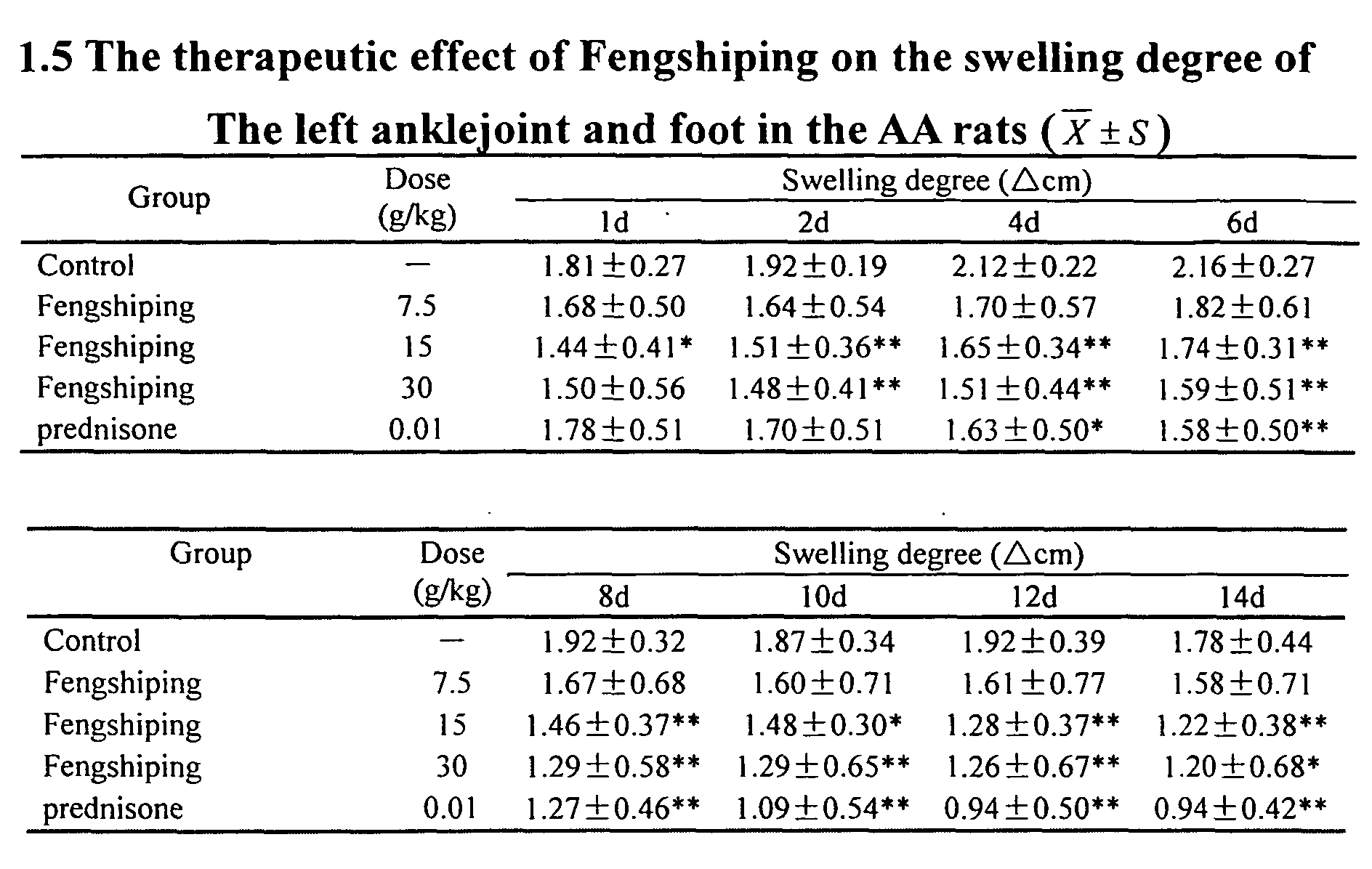

1.7 The effect of the Fengshiping on the organ weight of the immune system in the AA rats ( X ±S)Group Dose (g/kg) Organ index [(organ weight/body weight)/100] Liver Spleen Thymus adrenal gland Control - 0.35±0.23 0.35±0.061 0.073±0.014 0.026±0.0071 Fengshiping 7.5 3.21±0.52 0.33±0.091 0.071±0.026 0.024±0.0085 Fengshiping 15 3.40±0.54 0.36±0.014 0.067±0.022 0.023±0.0048 Fengshiping 30 2.79±0.43 0.32±0.083 0.069±0.029 0.023±0.0072 Tripterygium hypoglaucum (Levl.) Hutch. 5 3.92±0.59 0.35±0.100 0.075±0.034 0.027±0.0060 prednisone 0.01 3.52±0.35 0.28±0.047* 0.05±0.011** 0.02±0.0043* - The data showed in the table 1.1, 1.2, 1.3, 1.5 and 1.6 proved that the Fengshiping could strongly inhibit the primary and secondary injury caused by FCA, whenever the medicine was drenched at the beginning of the FCA injection or 2 weeks after the FCA injection. The experiments proved that the Fengshiping had both the preventing and the therapeutic effect. By comparing the effect of Fengshiping on the swelling degree in the anklejoint and foot, we found that the Fengshiping could inhibit the specific immunoswelling in the anklejoint better than the nonspecific immunoswelling in the foot of rats. This result indicated that the main effect of Fengshiping was inhibiting the immunity inflammatory reaction.
- The data in the table 1.3, 1.4 and 1.7 showed that the AA rats had no obvious BW increase during the period of the experiment. In the group drenched of the Fengshiping on the effective dosage, the rats still had BW increase. In the groups of prednisone and preventing, the BW of rats had decreased, while the thymus and adrenal gland were atrophied. In the group of tripterygium hypoglaucum (Levl.) Hutch, the thymus had thrinked yet. But in the 3 groups drenched with the different dosage of Fengshiping, on atrophy of the thymus and adrenal gland were observed. 1.3 The pathologic change of the AA after the treatment of the invented medicine in rats
- 45 SD rats, 180±20g weight, were divided into 6 groups. After the AA caused by FCA appeared, all the rats were drenched with Fengshiping solution by gastic injection for 5 days once a day. 1 hour after the last administration, the joint index of the rats was measured and calculated. The secondary injuried postpedes' joints on the opposite of the FCA injectiont were taken off and soaked in the formaldehyde. After the tissues were HE tinted, the pathological change of the synovium and cartilage were observed and recorded. The data were showed in table 1.8.
1.8 The effect of Fengshiping on the AA joint index in the rats ( X ±S)Group Dose (g/kg) Rat number Joint index Control - 8 0 AA model - 7 6.2±0.49 Fengshiping 7.5 9 4.86±0.90 Fengshiping 15 7 4.71±0.95 Fengshiping 30 7 4.56±1.13 Glucosidorum Tripterygll Totorum 0.006 7 4.57±0.79 - The joint index was the sum of the inflammatory scores of the four limbs. According to the degree of inflammatory, each limb was evaluated on the criteria as following: normal (0), red without swelling (1), red and swelling (2), seriously swelling (3), deforming and tetanus (4).
- Observed from the microscope, the joint synovial membranes of the rat posterior limb were hyperplasia in the model group; and the collagen fiber had increased; there was infiltration of lymphocytes and plasma cells in the tissue. The obvious granuloma had formed. The synovial cells had degenerated and the cytochylema had been tinted red; the caryon had been pycnosis; the epithelium had exfoliated in some part of the synovial membrane. The cartilage turned atrophy; the surface of it was rough and some of the chondrocytes had proliferated lightly.
- After the treatment of the Fengshiping, the inflammation of the joint synovial membrane was inhibited, more collogen fiber was produced; less synovial cells exfoliated; the cells on the surface of the cartilage had proliferated and the surface had turned smooth. The cartilage was on the recovering condition.
- Experimental example 2: The effect of Fengshiping on the delayed hypersensitivity reaction (DTH) caused by 2,4-DNFB in the ear of the mouse 50 NIH mice, half male and half female, were divided into 5 groups. Each mouse was led to hypersensitivity reaction by using the 1% DNFB acetone solution on the dosage of 0.025ml at the right place of the abdomen where the pilus had been cut yet. Using the same solution on the same place was to enhance the hypersensitivity reaction on the third day. On the fifth day, all the mice were smeared with the 1% DNFB edible oil solution at the mice's right ears on the dosage of 0.01 ml each. 24 hours later, all the mice were killed. The mouse' s 2 ears were weighted by the torsion balance and the difference of the 2 ears was recorded as the DTH degree caused by the DNFB. The experiment was carried out on the different immune and administration processes.
- The immune and administration processes is as following:

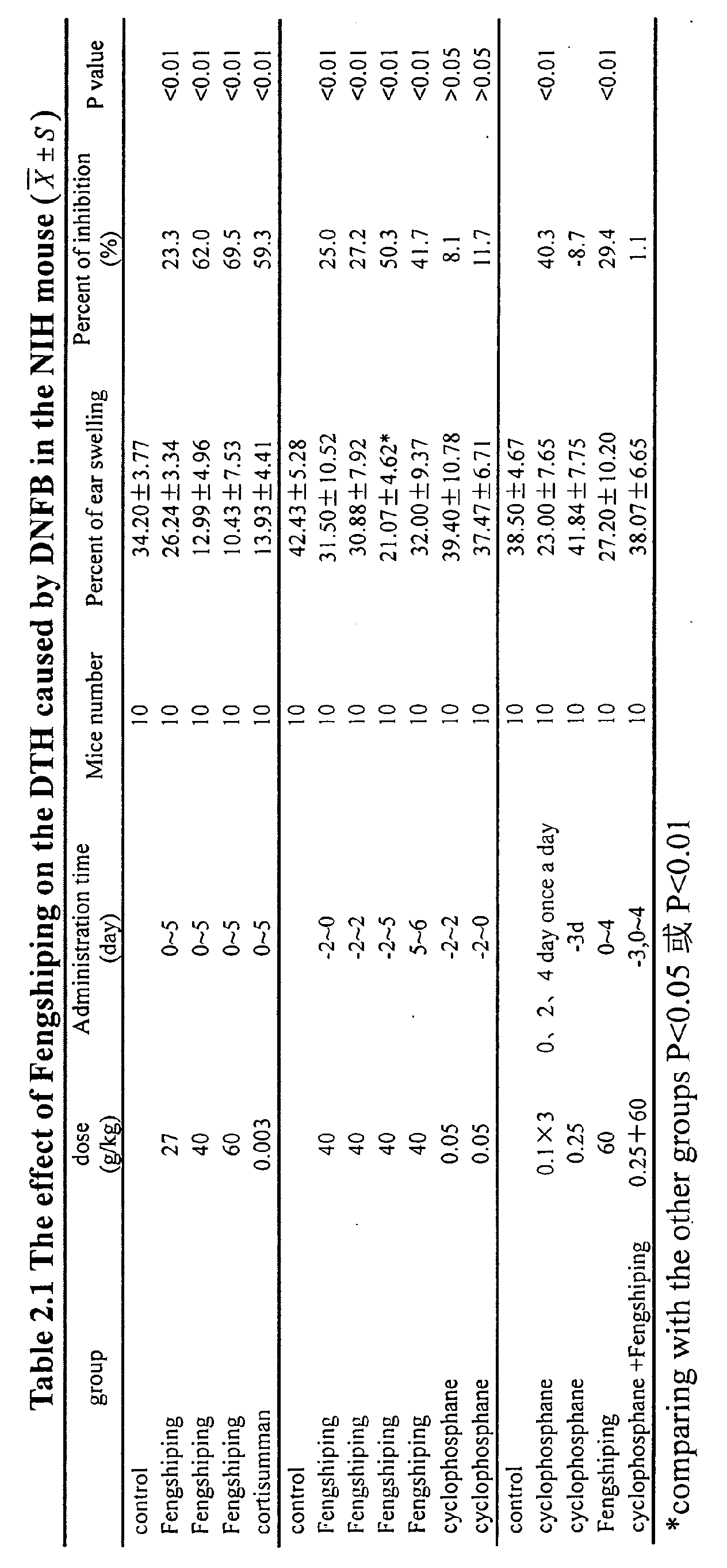
- According to the data showed in table 2.1, it indicated that the Fengshiping had a obvious inhibiting effect on the DTH caused by DNFB. There was a significant relationship between the dosage and the effect. The inhibiting activity increases when the dosage adds. The inhibiting percent could reach 69.5% on the dosage of 60.9g/kg.
- The immune and administration processes and the correspondent results had been showed in middle and bottom parts of the table 2.1. According to the results showed in the table 2.1, all the administration ways could significantly inhibit the DTH of the mouse in spite of the administration beginning from the 2 days before the sensitization and ending at the sensitization, or beginning from the 2 days before the sensitization and ending 2 days after the sensitization, or beginning from the 2 days before the sensitization and ending 5 days after the sensitization, or beginning before the attack and ending after the attack. But the administration way that began 2 days before the sensitization and ended 5 days after the sensitization had the most powerful inhibiting activity. It indicated that the Fengshiping could inhibit the DTH by a compound mechanism that it could inhibit the cells participant in the early period of the DTH, the effector cells in the advanced period and the cells related to the DTH in the middle period. This mechanism was different from that of the cyclophosphane. On a small dosage, the cyclophosphane didn't affect the DTH, if its administration way was beginning from the 2 days before the sensitization and ending at the sensitization day or 2 days after the sensitization day.
- Based on the bottom part of the table 2.1, if a high dosage of cyclophosphane was drenched to the mouse in one time 3 days before the sensitization, the function of the Th cells would turn sthenic because of the powerful inhibition on the Ts cells. The DTH in the mouse would be enhanced. If the cyclophosphane was used with the Fengshiping on this administration way, it could lower the inhibiting activity of Fengshiping. This result indicated that the Fengshiping have a different machnizm to the cyclophosphane in the control of DTH. The Fengshiping maybe had a higher activity in inhibiting the THcells. Experimental example 3: The effect on the humoral immunity
- 190 mice, 18-22g weight, half male and half female, were divided into 19 groups. Each mouse was immunized with 5% CRBC solution 0.2 ml. The Fengshiping solutions were drenched at the different times. 7 days after the immunization, all the mice were sampled the blood from the eyes. Then the blood samples were diluted and measured the level of the hemolysin antibody. The results were showed in table 3.1, 3.2 and 3.3.
The effect of Fengshiping on the produce of the hemolysin antibody in the NIH mouse ( X ±S)group dose (g/kg) Administration time Mouse number Hemolysin value Inhibiting percent (%) P value control 10 169.0±62.0 Fengshiping 18 0~7 10 46.0±15.6 72.8 <0.01 Fengshiping 27 0~7 10 35.4±12.0 79.1 <0.01 Fengshiping 40 0~7 10 28.2±5.9 83.3 <0.01 Fengshiping 60 0~7 10 16.7±3.0 90.1 <0.01 Tripterygium hypoglaucum (Levl.) Hutch. 13.3 0~7 10 121.0± 88.0 28.4 <0.015 cyclophosphane 0.02 0~7 10 35.0±12.0 79.3 <0.01 The effect of Fengshiping on the produce of the hemolysin antibody in the ICR mouse ( X ±S)group dose (g/kg) Administration time Mouse number Hemolysin value Inhibiting percent (%) P value control - - 10 124.70±42.60 Fengshiping 12 0~7 10 75.00±53.10 39.9 <0.05 Fengshiping 18 0~7 10 45.60±22.70 63.4 <0.01 Fengshiping 27 0~7 10 29.10±22.10 76.8 <0.01 Fengshiping 40 0~7 10 28.20±5.30 77.4 <0.01 Tripterygium hypoglaucum (Levl.) Hutch. 6.0 0~7 10 143.50± 67.90 >0.05 cyclophosphane 0.02 0~7 10 27.80±6.60 77.9 <0.01 The effect of Fengshiping on the produce of the hemolysin antibody in the ICR mouse ( X ±S)group dose (g/kg) Administration time Mouse number Hemolysin value Inhibiting percent (%) P value control - - 10 256.0±26.0 Fengshiping 18 -7∼7 10 198.0±50.0 22.7 <0.01 Fengshiping 18 -3∼7 10 156.0±85.0 39.1 <0.01 Fengshiping 18 0∼7 10 98.0±35.0 61.7 <0.01 cyclophosphane 0.02 0∼7 10 25.0±4.0 90.2 <0.01 - According to the data in table 3, it indicated that the Fengshiping had a remarkable inhibiting effect on the produce of the hemolysin antibody in the different mouse species and this effect would increase along with the increase of the dosage. There was a certain relationship between the dosage and the effect. The lowest effective dosage was 12g/kg. Comparing with the same quantity of Tripterygium hypoglaucum (Levl.) Hutch, the Fengshiping had a higher inhibiting activity. Based on the data in table 3.1, the inhibiting activity of Fengshiping was 2.25 times higher than the Tripterygium hypoglaucum (Levl.) Hutch. The inhibiting activity of Tripterygium hypoglaucum (Levl.) Hutch. On the dosage of 13.5g/kg was weaker than that of the Fengshiping which containing 6g/kg Tripterygium hypoglaucum (Levl.) Hutch).
- The NIH mice, 20±2g weight, were injected with 0.05 ml FCA under the vola skin of the right postpedes. 3 weeks late the AA model mouse builded. The model mice were divided into 6 groups randomly and drenched with the correspondent medicines for 5 days. At the beginning of the administration, all the mice were sensitized with 0.5ml 10% sheep RBC (SRBC). Five days later, all the mice were killed. Their spleens were taken out and washed by the Hank's liquor to prepare the lymphocyte suspended liquor. The concentration of the cells was adjusted to 2 × 10⁷ / ml. 1 ml lymphocyte suspension, ml 0.2% SRBC and 1 ml 1:30 addiment were added to one test tube. The tube was put in the water bath at 37°C for 1 hour.Then the tube was centrifugated at 2000rpm for 5 minutes. The supernatant fluid was separated and tested its sptical density at the 415nm wavelength on the 722 apeotrophotometer. The value was the represent of PFC quantity.
- The other share of the blood samples got from the sensitized mice was separated the serum to test the potency of the antibody. The measured data were recorded on the way of Log2 value. (See the data in table 3.4)
The effect of Fengshiping on the humoral immunity in the mouse ( X ±S)group dose (g/kg) Mouse number PFC (OD) IgM(Log2) control - 8 0.819±0.013 6.875±0.641 AA model group - 10 0.940±0.019 7.700±0.599 fengshiping 5 8 0.834±0.012 6.875±0.641 fengshiping 10 8 0.834±0.012 6.750±0.88 fengshiping 20 8 0.830±0.014 6.375±0.518 Glucosidorum Tripterygll Totorum 0.012 10 0.835±0.015 6.950±0.597 - According to the table 3.4, the levels of PFC and IgM in the AA mouse were higher than that of the normal mouse. The Fengshiping could lower the produce of the PFC and IgM in the AA mouse significantly.
- Experimental example 4:The effect of the Fengshiping on the passive cutis anaphylactic reaction (PCA) in the rat
- The rats were injected with the egg albumn at 10mg/kg in the muscle. At the same time, all the rats were injected with 2 × 10¹⁰(0.2ml)bordetella pertussis in the abdominal cavity for sensitization. 2 weeks later, all the rats were killed to sample the blood. All the blood samples were separated for preparing the serum.
- 60 rats, 150∼200g, half male and half female, were divided into 6 groups at random. In the light narcosis condition induced by aether, each rat was cut the fleece in the back and injected with the 2 concentrations of anti-egg-album serum 0.1ml under the skin at the fairless place. The serums were diluted on the rates of 1:5(d1) and 1:10(d2) before the experiment. 48 hours later, all the rats were attacked by intravenous injecting the 0.5% evans blue normal saline solution 1 ml which containing 1 mg egg albumin. 20 minutes later, the rats were killed by decapitation. The rats' back skin were dissected and turned over. According to the darkandlight and area of the blue stains exudated from the vessels, all the rats were evaluated by several people. The skin stained by the evens blue were scissored and soaked in 5ml 0.1% sodium sulfate acetone (7:3) solution for 48 hours. Then it was centrifugated to separate the supernatant liquor. The supernates were measured the optical density at the wavelength 590nm to calculate the degree of the PCA reaction and the inhibiting percent. The results were shown in table 4.
The effect of Fengshiping on the PCA in rat ( X ±S)Group dose (g/kg) value absorbancy d1 d2 d1 d2 Control - 5.60±1.78 2.40±2.46 0.191±0.129 0.096±0.106 Fengshiping 12 7.50±2.51 4.20±2.49 0.402±0.213 0.192±0.175 Fengshiping 24 7.10±2.13 4.10±1.79 0.310±0.177 0.137±0.099 Fengshiping 48 6.00±1.83 1.70±1.95 0.121±0.109 0.024±0.026 Tripterygium hypoglaucum (Levl.) Hutch. 8 6.11±1.27 2.56±1.67 0.223±0.122 0.074±0.045 Ketotifen 0.1 2.78±1.64** 0.67±1.41 0.033±0.024 0.027±0.019* - According to the table 4, it indicated that the Fengshiping had a weak effect on the PCA in the rat. Only on a high dosage, the inhibiting effect of Fengshiping was obviously different from that of the control group.
- 60 ICR mice, 18∼22g, half male and half female, were divided into 6 groups at random. Each group was drenched of the correspondent medicines including the different dosages of Fengshiping and the other medicines. The medicines were administrated once a day for 10 days. 24 hours after the last administration, the mice were sampled the macrophage and spleen cells from the abdominal cavity in the aseptic condition. The samples were washed with Hank's liquor for 2 times and non-serum RPIM 1640 liquor for 1 time. Then the washed samples were diluted to the suspension with the 5% FCS-RPMI 1640 at the concentration of 2 × 10⁸ / ml.Then the suspensions were added with 10ng/ml LPS or the 10ng/ml ConA and cultured in the 5% CO2 condition for 48 hours at 37°C. Then the cultured suspension were measured the TNF α and IL-2 levels on the usual methods.
- The batten was coated by mouse TNF-α monoclonal antibody. The batten was added with the cultured supernate on the dose of 50 µl/hole. Then the batten was put still for 60 minutes at the room temperature. Then the batten was added with biotin antibody mark at 25 °C for 2 hours. Then the enzyme labeled avidin was added into the batten for 30 minutes. After adding the substrate constant for 30 minutes, the batten was added with the stop liquor. The mixed liquor was measured the OD value at the wavelength of the 450nm. The content of the TNF-α(ng/ml) was calculated on the data of OD value by the method of standard curve.
- The CTLL cells which was on the logarithmic growth phase and whose growth depends on the IL-2, were adjusted to the suspension at the concentration of 1 × 10⁵/ml with the 5% FCS-RPMI 1640. Then the 96 hole cell culturing batten were added with the CTLL cell suspension on the quantity of 100 µl/hole. The supemates were added on the quantity of 100 µl/hole and each sample was added to 3 holes. The samples cultured were compared with the different dilutions of standard rHIL-2 and the control sample (culture fluid) to measure the IL-2. All the samples were cultured in the 5% CO2 for 24 hours at 37°C. 6 hours before the end of the culture, all the samples were centrifuged and separated the supernate. Each hole were taken out 110 µl supernate and added with 10 µl MTT. The samples were cultured for 3 hours at 37°C, and then measured the OD at the wavelength 570nm and 630nm. The final OD value of the sample was the difference of OD (570nm) and OD (630nm).
The effect of Fengshiping on the TNF α nd IL-2 ( X ±S)group dose (g/kg) Mouse number TNF (pg/ml) IL-2 (IU/ml) Control - 10 87.80±14.63 26.30±4.22 12 10 62.14±13.13 16.00±2.89 Fengshiping 24 10 58.60±9.63 18.80±2.86 36 10 54.40±10.88 18.20±2.86 Tripterygium hypoglaucum (Levl.) Hutch. 8 10 58.25±10.32 16.00±2.88 cyclophosphane 0.02 10 42.20±9.57 10.10±3.00 - According to the data in Table 5.1, it suggested that the Fengshiping have a obvious inhibiting effect on the TNF α. On the dosage of 12g/kg, the medicine had showed a obvious inhibiting effect. Along with the increase of the dosage, the inhibiting effect increased. But the dosage-effect curve went gently. The Fengshiping had an obvious inhibiting effect on the IL-2, ut no dosage-effect relationship was observed.
- 70 NIH mice, 18-22g weight, half male and half female, were divided into 7 groups at random. All the groups were drenched with the correspondent medicines (fengshiping and the other medicines). The medicines were drenched once a day for 10 days. 24 hours after the last administration, all the mice were killed and sampled the macrophage and spleen cells from the abdominal carvity. The IL-1 and IL-6 in the samples were measured.
- The macrophages in the abdominal carvity were sampled in the asepsis condition. Then the samples were washed by the Hank's liquor for 2 times and nonserum RPMI1640 liquor for 1 time. Then the clear samples were adjusted to the 4 × 10⁶ / ml cell suspension with 5% FCS-RPMI liquor. 1 ml of the suspension was added to the test tube and cultured at 37°C for 1 hour. The unadherent cells were abandoned. Then the cultured liquor was added with 5% FCS-RPMI 1640 and LPS (10ng/ml) to culture. The cells cultured in 5% CO2 at 37°C for 72 hours. During the course, the cultured cells were freezed and thawed for several times. The final product was saved at 4°C. The C57 mice were sampled the thymus in the asepsis condition. Then the samples were prepared to the 1 × 10⁶/ml cell suspension with 5% FCS-RPMI1640.
- 100 µl supernate separated from the frost thawing liquor and 100 µl cell suspension of thymus were added into the 96-hole flat bottom cell-culture batten. Each sample was cultured in 3 holes and compared with the different dilutions standard rHIL-1 and the control sample (culture fluid). Each hole was added with 2ng ConA and then the batten was cultured in the 5% CO2 at 37°C for 72 hours. 14 hours before the end of the culture, each hole was added with 3H-TdR 0.1 µCi. The cultured cells were collected with multihead cell-harvesting apparatus and measured the cpm value.
- The spleen cells were sampled in the asepsis condition. Then the samples were washed by the Hank's liquor for 2 times and nonserum RPMI1640 liquor for 1 time. Then the clear samples were adjusted to the 2 × 10⁶/ml cell suspension with 5% FCS-RPMI liquor. 1 ml of the suspension was added to the round-bottom centrifuge tube. After adding the ConA (10ng/ml), the samples were cultured in the 5% CO2 at 37°C for 72 hour.
- The MH60 cells, which grew depending on the IL-6 and were on the logarithmic growth stage, were adjusted to the 1 × 10⁵/ml cell suspension with the 5% FC-RPMI1640.
- The 96-hole flat bottom cell culturing batten was added with the MH60 cell suspension on the quantity of 100 µl/hole and the culturing supernate 25 µl/ hole. Then the fluid in each hole was adjusted to the 200 µl with the 5% FCS-RPMI 1640. Each sample was cultured with 3 copies and compared with the different solutions standard rHIL-6 and the pure culturing fluid. The batten was cultured in 5%CO2 at 37°C for 72 hours. 6 hours before the end of the culture, the samples were centrifuged. Each hole was sucked out the supernate 110 µl and added the MTT 10 µl. The samples were kept at 37°C for 3 hours. And then they were measured the OD at the wavelength 570nm and 630nm. The final OD value = OD 570nm - OD 630nm.
The effect of Fengshiping on the IL-1, IL-6 ( X ±S)Group Dose (g/kg) Mouse number IL-1 (ng/ml) IL-6 (IU/ml) Control - 10 78.7±7.1 94.6±6.8 7.5 10 59.3±4.9** 64.9±4.8** Fengshiping 15 10 53.3±5.7** 60.5±4.3** 30 10 54.4±4.8** 56.0±4.6** 60 10 47.0±16.6** 56.6±6.1** Tripterygium hypoglaucum (Levl.) Hutch. 5 10 57.6±4.7** 65.7±4.9** cyclophosphane 0.02 9 44.5 ± 7.7 49.6±6.7** - Based on the data in the table 5.2, the Fengshiping had an abvious inhibiting effect on the macrophage in producing of IL-1 and spleen cell in producing IL-6. Along with the increase of the dosage, the effect enhanced too.
- 60 SD rats, 160∼220g weight, half male and half female, were divided into 6 groups. The rats in the blank control group were injected the NS 0.5ml under the skin of the right postpede vola. Other rats were injected with the FCA 0.5ml at the same place of the control group. 18 days later, the AA model was built. Then the rats were drenched the correspondent medicines or the distilled water once a day for 5 days. 3 groups were drenched the solution of Fengshiping on the high, middle and low dilution. The positive group was drenched with Glucosidorum Tripterygll Totorum. The blank control group and the model group were drenched with the distilled water of the same volumn. 1 hour after the last administration, each rat was sampled the blood from the abdominal aorta for 2 ml.The plasma of the blood samples were separated and saved at - 70 °C for the measurement.The measurement of NO was done on the direction of the NO reagent. 0.1ml plasma was added in 0.6ml reagent C and 0.4ml double distilled water. After the mixture shaken up, it was added in 0.1ml reagent D and cultured on the ice for 60 min. Then it was centrifuged at 12000 rpm for 2 min. The supernate was separated.0.6 ml supernate was mixed with 0.4ml double distilled water and 0.1ml reagent A, and then it was cultured in the ice-water for 15 min. Then the mixture was added in reagent B 0.1ml and put at the room termperature for 1 hour. Then the new mixture was measured the OD at the wavelength 545nm. Based on the OD value of the sample, the content of NO was calculated on the standard curve. (See the result in table 5.3)
The effect of Fengshiping on the plasma NO level in the AA rat ( X ±S)Group Dose (g/kg) Rat number Content of NO (µ mol/L) y (y=Lgx) Control - 8 13.55±1.11 1.131±0.032 AAmodel - 9 17.56±4.15 1.235±0.097 Fengshiping 12 7 9.83±2.58ΔΔ 0.985±0.087 Fengshiping 24 7 10.12±1.56ΔΔ 1.001±0.067 Fengshiping 48 7 10.70±1.51ΔΔ 1.026±0.062 Glucosidorum Tripterygll Totorum 0.006 7 15.25±3.48 1.173±0.099 - Based on the data in table 5.3, the NO level was higher in the model group than in the blank control group. The Fengshiping had an obvious effect on lowering the NO level in the AA rat. The Glucosidorum Tripterygll Totorum had the similar effect but its effect was weaker than that of the Fengshiping.
- 80 NIH mice, half male and half female, were divided into 8 groups randomly and drenched with the correspondent medicines once a day for 10 days. 24 hours after the last administration, all the mice were killed to sample the spleen cells aseptically. Then the samples were washed by the Hank's liquor for 2 times and nonserum RPMI1640 liquor for 1 time. Then the clear samples were adjusted to the 2 × 10⁶/ml cell suspension with 5% FCS-RPMI liquor. The 96-hole flat bottom cell culturing batten was added with the cell suspension on the quantity of 100 µl/hole. Each sample was cultured with 3 copies. 2 holes were added in 2ng ConA each as the stimulating reagent. The other hole was not added in the ConA and kept as the control hole. The batten was cultured in 5% CO2 at 37°C for 72 hours. 14 hours before the end of the culture, each hole was added in 3H-TdR 0.1 µCi. The cells were harvested by the multihead cell harvesting instrument and measured the cpm value. The average value was adopted as the sample's cpm value. The average value and the stimulating index of the different groups were compared directly. The stimulating index was calculated as following:
The effect of Fengshiping on the lymphacyto transformation induced by ConA in the mouse ( X ±S)Group Dose (g/kg) Mouse number cpm Stimulating index Control - 10 20433±3579 25.87±3.06 7.5 10 13566±1779 27.29±7.67 Fengshiping 15 10 12708±1692 18.04±3.76 30 10 12809±2575 16.17±4.37 60 10 12090±1706 19.05±3.80 2.5 10 18038±3359 17.11±2.60 Tripterygium hypoglaucum (Levl.) Hutch. 5 10 12081±1039 17.58±4.37 Cyclophosphane 0.02 9 9922±1145 13.66±2.28 - According to the data in table 6.1, it indicated that the Fengshiping had an obvious inhibiting effect on the lymphocyte transformation and there was a dosage-effect relationship.
- The experiment was same to 5.1. 24 hours after the last administration, the spleen cell samples were made into the 2 × 10⁸/ml cell suspension with 5% FCS-RPIM1640. The quantity of CD4, CD8, NK cells and the rate CD4/CD8 were measured on the usural method.
- The spleen cell suspension 50 µl was added on the glass to made the cell smear. The glass had been coated by the polylysine. The T cell of the mouse was set as the positive control sample. The cell smear was enveloped by the serum of the normal mouse after it was fixed by the acetone. Then the enveloped sample was added with the antibody of CD4 and CD8 which were marked by the hominine biotin. It was incubated at 37°C for 2 hours. Then the sample was added with the avidin labeled by enzyme and put still for 10 min. After added with the substrate for 10 min, the mixed sample was washed and dyed with the hematoxylin for 2 min. Then the sample was dyhidrated with the grade-alcohol and enveloped with gelatin-glycetrol. 200 cells in the smear were chosen as the research target under the high power microscope.
- The preparation of the EC cell: The spleen cells were sampled in the asepsis condition. Then the samples were washed by the Hank's liquor for 2 times and nonserum RPMI1640 liquor for 1 time. Then the clear samples were adjusted to the 2 × 10⁸/ml cell suspension with 5% FCS-RPMI liquor. This cell suspension was used as the EC.
- The preparation of the TC cell: The Yack-1 cells, which were sensitive to the mouse NK cell and on the logarithmic growth phase, were adjusted to the 4 × 10⁴/ml cell suspension. It was the TC.
- Measurement: EC and TC, 100 µl each were added in the 96-hole flat bottom cell culturing batten. Each sample was cultured with 3 copies and set 2 control samples: EC and TC. (EC control: EC 100 µl + 5% FCS RPMI 1640 100 µl; TC control: TC 100 µl + 5% FCS RPMI 1640 100 µl). The samples were cultured in 5% CO2 at 37°C for 24 hours. 6 hours before the end of the culturing, the samples were centrifuged and sucked out 110 µl supernate each hole. And then the holes were added in the MTT 10 µl. After put at 37°C for 3 hours , the mixed samples were measured the OD value at the wavelength of 570nm and 630 nm. The OD of each hole=OD570nm - OD630nm.

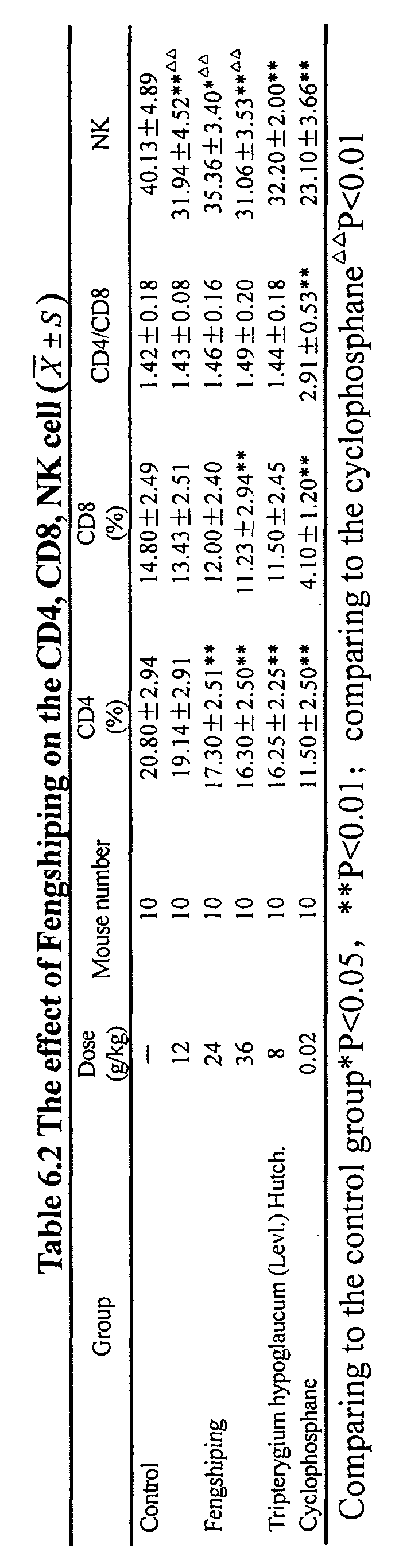
- According to the table 6.2, it ie was a relation between the dzosage and the effect, but the dosage-effect curve was smooth. The effective dosage of Fengshiping on the inhibiting of CD4 was 24g/kg. The minimum effective dosage on inhibiting the CD8 was 36g/kg. As the rate of CD4/CD8, the Fengshiping had no obvious effect. Cyclophosphane had an obvious effect on the inhibiting of the both kind of cells, and the inhibiting effect on the CD8 was very powerful, which could increase the rate of CD4/CD8 magnificently.
- As for NK cell, the Fengshiping had a remarkable inhibiting effect, but the dosage-effect relationship was not certain. As the same while, the cyclophosphane had shown an obvious inhibiting effect on the NK cell. On the dosage of 20mg/kg, the inhibitiong effect of cyclophosphane was significantly different from that of the Fengshiping on the 3 dosages: 12, 24 and 36g/kg.
- NIH mice, 20 ± 2g weight, were injected with 0.05 ml FCA under the skin of the right postpede vola to build the AA model. The mice in the control group were injected 0.05ml NS at the same place. 3 weeks later, after the AA model built, all the mice were drenched the correspondent medicines once a day for 5 days. 5 days later, all the mice were sampled the blood to make the blood smear. The smears were dyed by the esterase. Then the smears were observed under the oil immersion lens to calculate the percent of the positive-dyed cells (it represented the content of the T cells in the blood). The mice were sampled the spleen cells in the condition of anaesthesia and then the cell samples were prepared to the single cell suspension. The cell suspension was washed by PBS and then its supernate were abandoned. The rest part was added with blood cytolysate 4ml. The mixed sample was shaked for 2 ∼ 3 min to solute the RBC. After the RBCs were destroyed, the sample was centrifuged to separate and abandon the supernate. The sample without supernate was washed by the luminescence lotion for 2 times. Then it was centrifuged to separate and abandon the supernate. In the next step, the sample was adjusted to the 1 × 10⁶/ml cell suspension. Each tube was added with 50 µl diluted antibody of CD4 and CD8 . Then the tubs were cultured at 4 °C for 1 hour. After the culture, the samples were washed with the luminescence lotion for 2 times and added in the fixing fluid 2 ml. After fixing, the samples were filtrated through the 400-mesh screen to the FCA tube. The filtrated samples were analyzed by the flow cytometer (FCM). The result was shown in the table 6.3.
The effect of Fengshiping on the T cell in the AA mouse ( X ±S)Group Dose (g/kg) ANAE+ (%) CD4+ (%) CD8 (%) CD4+/CD8+ Control - 50.60±4.25 26.13±1.16 15.56±0.68 1.68±0.03 AAmodel - 49.00±4.22 32.56±2.87 13.59±1.03 2.49±0.16 7.5 49.13±4.03 27.30±1.76 15.98±1.11 1.71±0.04 Fengshiping 15 49.31 ±3.29 27.96±1.67 16.23±1.27 1.73±0.05 30 48.56±3.23 26.75± 1.94 15.58±1.29 1.72±0.04 Glucosidorum Tripterygll Totorum 0.012 48.88±2.89 27.88±1.99 16.33±1.31 1.70±0.03 - According to the data in table 6.3, there was no significant difference in the different groups on the ANAE positive cell. But in AA mouse, the increase of the CD4 was significant, while the decrease of CD8 was significant too. So the rate of CD4/CD8 had a remarkable increase. The result indicated that the Fengshiping could adjust the CD4, CD8 and CD4/CD8 to the normal range.
- 50 NIH mice, 18∼22g weight, half male and half female, were divided into 5 groups and drenched with the correspondent medicine solutions on the same volumn. The administration was once a day for 7 days. 1 hour after the last administration, all the mice were injected with 0.2ml 10% chick RBC into the abdominal carvity. 4 hours later, all the mice were killed and sampled the fluid in the abdomincal carvity. The liquor samples were dropped on the glass and counted the number of the macrophage which had phagocytized the CRBC and the number of the CRBC in one macrophage. (See the result in table 7)
The effect of Fengshiping on the CRBC phagocytosis function of the macrophage in ICR mouse abdominal cavity ( X ±S)group dose (g/kg) Mouse number Percent of phagocytosis (%) phagocytosis index Control - 10 25.75±9.40 1.28±0.20 Fengshiping 27 10 33.20±12.77 1.46±0.36 Fengshiping 40.5 10 35.20±10.16 1.21±0.20 Fengshiping 60.9 10 37.78±20.14 1.53±0.32 dexamethasone 0.005 10 8.33±10.13 1.10±0.18 - According to the table 7, the Fengshiping had no obvious effect on the phagocytosis function of the macrophage in the mouse abdominal cavity.
- 90 NIH mice, 18∼22g weight, half male and half female, were divided into 9 groups and drenched with the correspondent medicine solutions of the same volumn. The medicines were drenched once a day for 3 days or just 1 time. 1 hour after the last administration, each mouse were injected with 0.7% HAC - NS solution into the abdominal cavity. At the same time, each mouse was injected with the 0.5% Evans blue - NS solution into the vessel on the dose of 0.1ml/10 g. 30 min later; all the mice were killed by cervical disjoint. The abdominal cavity was opened and washed by the 5ml NS. The NS used was collected and adjusted to 8ml by the pure NS as the sample. The samples were centrifuged at 3000 rpm to get the supernate. The supernate was measured the OD at the wavelength at 590nm. (See the result in table 8)
The effect of Fengshiping on the hyperfunction of the capillary permeability induced by the acetic acid in the mouse abdominal cavity ( X ±S)Group Dose (g/kg) Administration Mouse number Leakage of the tincture (OD) P value Control - - 10 0.29±0.13 Fengshiping 27 qd×1 10 0.26±0.14 >0.05 Fengshiping 40 qd×1 10 0.25±0.10 >0.05 Fengshiping 60 qd×1 10 0.25±0.09 >0.05 Control - - 10 0.28±0.15 Fengshiping 27 qd×3 10 0.25±0.12 >0.05 Fengshiping 40 qd×3 10 0.18+0.10 <0.05 Fengshiping 60 qd×3 10 0.15±0.13 <0.05 dexamethasone 0.15 qd×3 10 0.11±0.07 <0.01 - According to the data in table 8, it indicated that Fengshiping could obviously inhibit the hyperfunction of the capillary permeability induced by the acetic acid in the mouse abdominal cavity if it was drenched for 3 days continuously. If the medicine was drenched for just 1 time, the inhibiting effect was not obvious.
- The mice were divided into 5 groups at random and injected with 0.5% Evans blue NS solution into the caudal vein on the dosage of 0.1ml/10g. Then the mice were injected with the 0.03ml 1% carrageenan in the right chest cavity with the special syring niddle. 4 hours and 32 hours after the injection, the correspondent mice were killed and opend the obdominal cavity to expose the diaphragm. 2ml of the lotion were injected to the chest cavity by 2 times with a 1 ml injector. The lotion was collected and saved in a test tube. 20 µl of the lotion collected was added into the 400 µl WBC dilution. The WBC in the mixed dilution was counted under the microscope. The rest of the lotion was centrifuged at 3000rpm for 10 min. The supernate of the lotion was measured the OD at the wavelength of 600nm. The OD value of the sample should be corrected with the correspondent OD value of the pure lotion. (See the result in table 9)
The effect of Fengshiping on the inflammatory cell aggregation induced by the carrageenan ( X ±S)Group Dose (g/kg) WBC number (2×10⁵) Tincture exudation (OD) 4h 32h 4h 32h Control - 46.0±6.9 16.0±9.6 0.156±0.066 0.109±0.019 Fengshiping 27 26.8±4.5 14.2±8.0 0.121±0.062 0.116±0.031 Fengshiping 40.5 10.9±4.0 17.3±4.6 0.100±0.048 0.153±0.032 Fengshiping 60 8.0±5.5 6.6±4.7 0.129±0.066 0.092±0.051 dexamethasone 0.05 12.7±10.2 4.4±4.0 0.085±0.045 0.063±0.017 - According to the table 9, it indicated that the Fengshiping had an obvious inhibiting effect on the inflammatory cell aggregation. The effect was powerful at the early stage. The regression equation on the data of the fourth hour was as following: y=44.13 -2.01x, r=-0.9625. The effect on the late stage was weak. At the high dosage of 20g/kg, the medicine could affect the aggregation of the WBC. But it had no obvious effect on the pleuritis exudation.
- Sixty four SD rats, 150-180g weight, half male and half female, were randomly divided into 8 groups, which were drenched with the same volume and different dosage of drug liquid once a day, lasting 3 days. A day before experiment, rats were injected with 20ml 1% CMC solution into the sac at the rat's back caused by 20ml air injection before the experiment. 3.5 hour and 7.5 hour later, 0.1ml liquid in the sac was extracted each time, and was colored in 0.01% brilliant cresyl blue solution. leucocyte was counted in the sac liquor under microscope. The results showed in the table 10.
effect on leucocyte counts of carboxymethyl cellulose sac of rats with Fengshiping ( X ±S)groups dosage (g/kg) rats number WBC count(× 107/L) 3.5 hrs 7.5 hrs control - 8 9.7±4.2 57.7±17.3 Fengshiping 27×1 8 8.5 ±3.5 39.4±16.5 Fengshiping 40× 1 8 8.7±7.3 35.3±23.2 Fengshiping 60×1 8 6.6±3.3 18.1±8.6 Control - 8 10.97±6.7 35.6±11.2 Fengshiping 27×3 8 15.4±9.7 38.6±15.5 Fengshiping 40×3 8 4.8±3.4 18.4±12.2 Fengshiping 60×3 8 3.0±2.8 11.0±9.2* cortisone 0.1×3 8 14.2±8.0 41.7±16.0 Control - 8 10.9±3.0 41.3±6.9 Fengshiping 18×7 8 6.2±3.0* 11.4±6.4* Fengshiping 27×7 8 3.7±1.7 6.4±3.1 Fengshiping 40×7 8 2.5±1.9 5.9±3.9 cortisone 2mg×1 8 1.5±0.7 3.0±1.0 - According to the table 10, the Fengshiping could inhibit significantly aggregation of leucocyte in the rats' CMC sac, and the inhibition showed apparent dosage-effect relation, which was stronger as administration time lasted. With administration of continuing seven days, wandering of leucocyte could be inhibited significantly at dosage of 18g/kg, at the same time, there was also very strong inhibition with cortisone injection into the sac.
- 60 NIH mice with weight of 18∼22g, male and female accounting for half and half, were divided into 6 groups, which were drenched with the same volume and different dosage of drug liquid or tragacanth liquid, once a day, lasting 3 days. 1 hour after the final administration, 2% croton oil mixure of 0.02ml was embrocated uniformly on the both sides of left ears of mice, and after 4 hours, the mice were snapped off its cervical vertebra and put to death. The left and right ears were cut down, then inflammatory and control ears were weighted by certain means. Difference of weight between left and right ears was the swelling extent of ears, results showing in table 11.
effect on croton oil-induced swelling of the ears of mice with Fengshiping ( X ±S)Groups dosage (g/kg) rats number Degree of ears' swelling (mg) inhibition rate (%) P value Control group - 10 44.38±9.40 Fengshiping 27 10 39.05±12.33 12.00 >0.05 Fengshiping 40 10 36.65±5.83 17.64 <0.05 Fengshiping 60 10 34.91±9.71 21.34 <0.05 dexamethasone 0.003 10 14.13±5.75 68.16 <0.01 - It was seen from table 11, that Fengshiping had remarkable inhibition to croton oil-induced swelling of the ears of mice, and had quantity-effect relation, but which curve was gentle and smooth. There was significant inhibition effect at 13.5g/kg of dosage.
- 60 Kuming mice with weight of 18∼22g, male and female accounting for half and half, were randomly divided into 6 groups, which were drenched different dosages of drug liquid or Xihuangqi solution. 1 hours after administration, 0.7% HAC saline of 0.2ml was injected, sc, and the mice were placed in aquarium and oberved the latent period before the twisting reaction of each mouse and the twisting times in 20 minutes, results showing in table 12:
The effect of Fengshiping on acetic acid-induced twisting reaction of mice ( X ±S)groups dosage (g/kg) Rats numbers Twisting times Latent time (minute) Control - 10 34.6±14.1 3.13±0.80 Fengshiping 27 10 28.2±5.76 3.82±0.85 Fengshiping 40 10 31.0±18.4 3.86±2.00 Fengshiping 60 10 20.7±12.3* 3.95±1.42 Tripterygium hypoglaucum (Levl.) Hutch. 20 10 25.1±11.9 3.60±0.93 morphine hydrochloride 10mg/kg 10 0.0±0.0 0.00±0.00 - It was seen from table 12 that large dose of Fengshiping could delay the latent time before the HAC-induced twisting reaction and significantly reduce the twisting times in 20 minutes, which indicated Fengshiping had the effect of abirritation in some degree.
- Each of SD rats, 180 ± 20g weight, were injected intracutaneously with 0.05ml Freund's complete adjuvant on the right back foot metatarsal, and developed into adjuvant arthritis models. Each rats of negtive control group were injected intracutaneously with 0.05ml salin on the right back foot metatarsal. Three weeks after models built, the rats were divided into model group, large, middle, small dosage group, negtive control group and positive control group which was administered with Glucosidorum Tripterygll Totorum. The rats were drenched once a day, lasting 5 days, 1 hours after administration for the last time, and 3ml blood was taken from abdominal aorta of rats and placed into test tube with 1% heparin as decoagulant, in which the whole blood viscosity was measured at shear rate of 230, 115, 46, 23, 11.5, 5.75S-1 with NXE-1 cone and plate viscometer. The plasma viscosity was measured with WTP-BII adjustable constant pressure capillary viscosimeter. The haematocrit, erythrocyte aggregation index was measured with centrifugation method of packed cell volume. The rigidity index was calculated from the above-mentioned data. All the results showed in table 13.
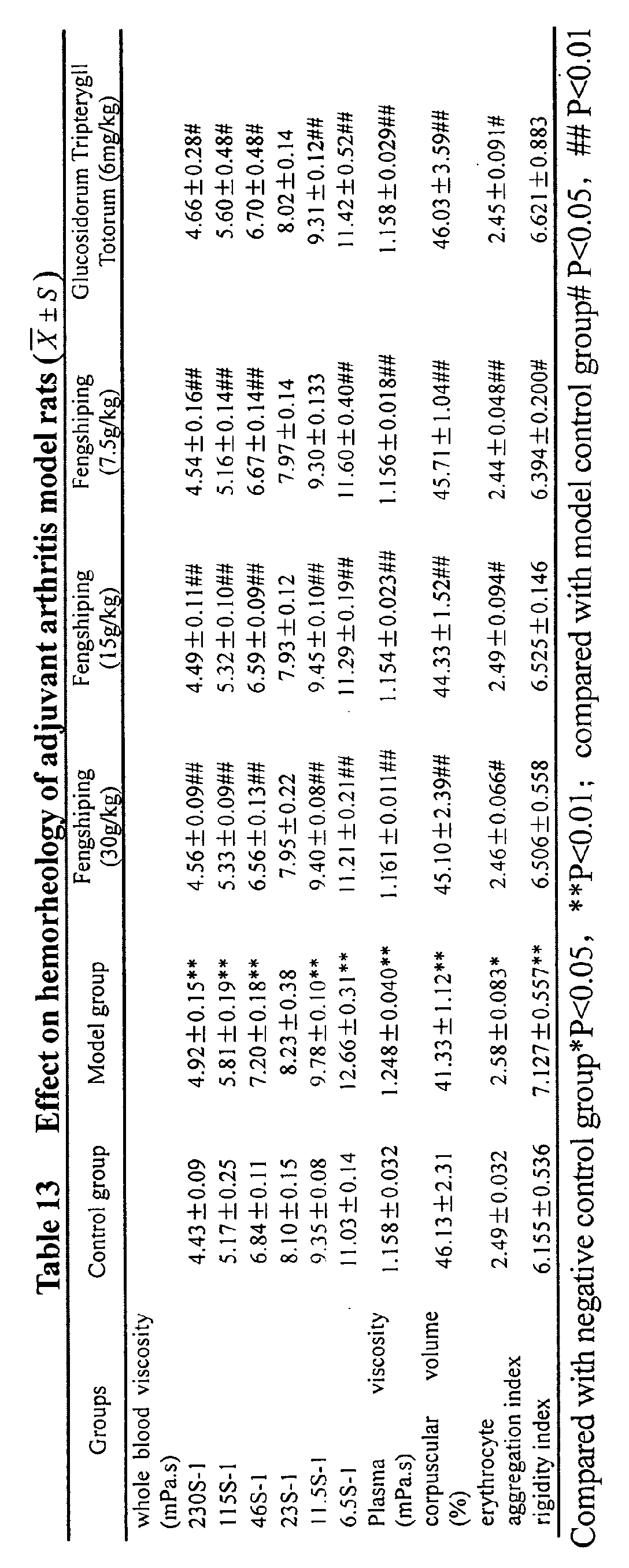
- According to the table 13, hemorheology of AA rats were changed significantly. The whole blood and plasma viscosity increased, haematocrit decreased, aggregation index and rigity index of erythrocyte increased. The Fengshiping could make the above-mentioned indexes of hemorheology improved significantly.
- Pharmacological effects of Fengshiping have been proved by the above-mentioned experiments. Many important pharmacological effects of Fengshiping had favorable dosage-effect relation, which implied the best therapeutic effectiveness might be obtained by adjusting the drug dosage at clinical work.
- The clinical studies on Fengshiping were carried on in China, Japan and Austrilia. Theses studies were operated according to international criterion related disease classification about diagnosis, therapy and curative effect. By using the Fengshiping capsules Sololy, its effective rate was around 94%, and its remarkable effective rate was around 60%. It could improve the symptoms such as morning stiffness, swelling and pain and so on and the related items. The results showed in table 14∼21.
Compared effect of treatment group with control group Groups Cases remission (clinical recovery) Notable effect Effective No effect Notable effect rate (%) Effective rate (%) Treatment group 32 5 14 11 2 59.38 93.74 Control group 30 3 10 12 5 43.33 83.33 Influence of IgG, IgA and IgM ( X ±S)IgG IgA IgM Groups cases pre - post - pre - post - pre - post - Normal 32 12.45±1.48 2.37±1.00 1.58±0.59 Treatment group 32 16.92±3.49 14.17±1.39 3.65±1.03 2.39±1.18 1.89±0.88 1.48±1.01 Control 30 17.03±4.12 15.14±2.21 3.45±1.86 2.32±1.75 2.03±0.95 1.76±1.28 Influence of C3 and C4( X ±S)C3 C4 groups cases pre - post - pre - post - normal group 32 0.62±0.13 0.14±0.15 Treatment group 32 1.88±0.72 1.25±0.66 0.48±0.12 0.26±0.06 Control group 30 2.13±0.64 1.56±0.62 0.40±0.16 0.25±0.07 Influence of ESR and CRP ( X ±S)ESR CRP Groups cases pre- post- pre- post- Normal 32 8.37±5.26 4.12±1.88 Treatment 32 66.58±9.01 30.31±6.53 13.35±6.67 8.86±3.34 control 30 73.33±9.09 35.83±11.61 14.21±6.29 9.04±3.15 Compared with power of gripping pre- and post-treatment ( X ±S)Treatment Group Control Group groups pre- post- pre- post- Gripping power of left hands (mmHg) 39.13±20.24(15) 80.47±34.61(15) 24.00±17.63(21) 55.15±23.27(21) Right hands 35.85±22.46(15) 85.32±36.32(15) 22.80±12.32(21) 58.17±20.59(21) Influence of arthrosis swelling and pain and morning stiffness time ( X ±S)Treatment Group Control Group Items pre - post - pre - post - arthrosis swelling and pain 5.79±0.52 3.14±0.83 5.56±2.15 3.92±0.26 morning stiffness time (minute ) 50.33±6.47 20.24± 3.27 48.75±8.34 27.50± 3.78 Influence of RF changing to negative Groups Cases RF negative Pre - treatment Post - treatment Rate of negative turnaround (%) Treatment group 32 24 11 54.2 Control group 30 18 10 44.4 - Not only had significant effects, but also Fengshiping can make items such as SIL-2R, STNF, SIL-6R in plasma decrease, results showing in the Table 21.
inflence of main indes such as SIL-2R, STNF α nd SIL-6R( X ±S)groups Cases SIL - 2R(u/ml) SINF R1(ng/ml) SIL-6R(ng/ml) pre - post - pre - post - pre - post - Normal 32 299±68 (n=32) 1.56±0.48 (n=24) 72.05±18.26 (n=22) Fengshiping 15 683±189 381±157 2.87±0.66 1.75±0.54 136.18±28.57 90.15±20.12 Control 10 765±203 412±167 2.63±0.72 2.38±0.39 148.21±30.31 99.02±26.70 (n=8) - It was proved that the above-mentioned results on invention could be realized on the ways as following.
-
- Epimedium brevicornum Maxim. 2222g
- Tripterygium hypoglaucum (Levl.) Hutch. 2222g
- Lycium barbarum L. 1111 g
- Cuscuta chinensis Lam. 1111g
- Four herbs hereinbefore, Tripterygium hypoglaucum (Levl.) Hutch. was cut into pieces, extracted for three times after 13, 10, 10-fold added in , each time lasting 1 hour; Epimedium brevicornum Maxim was cut into segments, extracted three times after 15, 10, 10-fold water was added in, each extraction lasting 1 hour; Lycium barbarum L. was crushed to raw material, and immersed in 20-fold water of 80 °C for 1 hour; Cuscuta chinensis Lam. was crushed to raw powder, immersed in 31-fold water of 80°C for 1 hour; decoction fluid or immersion fluid of four herbs were filtrated repectively, poured across macropore polymeric adsorbent column, eluted with 70% ethanol. When the color of effluent became deep significantly, eluent was commenced to collect; when the color of effluent became very weak, elution collection was ended. Eluent of each herb was recycled to get ethanol. Then the fluid without alcohol was concentrated, dried to get the finally extractive drug powder; officinal starch was blended with the four kinds of drug powder to 200g, mixed up uniformly and encapsuled into 1000 capsules. Each capsule which was prepared with the invented method thereof, was composed of 0.2g drugs extractive and contained at least 2.0mg of icariine C33H40O15. The regular dosage is: oral administration, three times every day, three capsules every time.
-
-
- Tripterygium hypoglaucum (Levl.) Hutch.2000g
- Epimedium brevicornum Maxim.2000g
- Two herbs hereinbefore, Tripterygium hypoglaucum (Levl.) Hutch. were cut into pieces, extracted three times after 13, 10, 10-fold added in, each time lasting 1 hour; Epimedium brevicornum Maxim.was cut into segments, extracted three times after 15, 10, 10-fold water was added in, each extraction lasting 1 hour; decoction fluid of herbs were filtrated repectively, poured across macropore polymeric adsorbent column, eluted with 70% ethanol, when the color of effluent became deep significantly, eluent was commenced to collect; when the color of effluent became very weak, elution was over. Eluent of each herbs was recycled to get ethanol, concentrated, dried, finally extractive drug powder was obtained; officinal starch was blended with the extractive drug powder, and mixed up uniformly, loaded to 1000 capsules. Each capsule which was prepared with the inventive method thereof, is composed of 0.2g drugs extractive, contains at least 2.0mg of icariine C33H40O15. regular dosage is: oral administration, three times every day, three capsules every time.
-
-
- Tripterygium hypoglaucum (Levl.) Hutch.2000g
- Epimedium brevicornum Maxim.2000g
- Lycium barbarum L. 1000g
- Tripterygium hypoglaucum (Levl.) Hutch. were cut into pieces, extracted three times after 13, 10, 10-fold added in, each time lasting 1 hour; Epimedium brevicornum Maxim.was cut into segments, extracted three times after 15, 10, 10-fold water was added in, each extraction lasting 1 hour; Lycium barbarum L. was crushed to raw material, and immersed in 20-fold water of 80 °C for 1 hour; decoction fluid or immersion fluid of four herbs were filtrated repectively, poured across macropore polymeric adsorbent column, eluted with 70% ethanol, when the color of effluent became deep significantly, eluent was commenced to collect; when the color of effluent became very weak, elution was over. Eluent of each herbs was recycled to get ethanol, concentrated, dried, finally extractive drug powder was obtained; officinal starch was blended with the extractive drug powder, and mixed up uniformly, loaded to 1000 capsules. Each capsule which was prepared with the inventive method thereof, is composed of 0.2g drugs extractive, contains at least 2.0mg of icariine C33H40O15. Regular dosage is: oral administration, three times every day, three capsules every time.
-
-
- Tripterygium hypoglaucum (Levl.) Hutch.2000g
- Epimedium brevicornum Maxim.2000g
- Cuscuta chinensis Lam. 1000g
- Tripterygium hypoglaucum (Levl.) Hutch. were cut into pieces, extracted three times after 13, 10, 10-fold added in , each time lasting 1 hour; Epimedium brevicornum Maxim.was cut into segments, extracted three times after 15, 10, 10-fold water was added in, each extraction lasting 1 hour; Cuscuta chinensis Lam. was crushed to raw powder, immersed in 31-fold water of 80 °C for 1 hour; decoction fluid or immersion fluid of the herbs were filtrated repectively, poured across macropore polymeric adsorbent column, eluted with 70% ethanol, when the color of effluent became deep significantly, eluent was commenced to collect; when the color of effluent became very weak, elution was over. Eluent of each herbs was recycled to get ethanol, concentrated, dried, finally extractive drug powder was obtained; officinal starch was blended with extractive drug powder, and mixed up uniformly, loaded to 1000 capsules. Each capsule which was prepared with the inventive method thereof, is composed of 0.2g drugs extractive, contains at least 2.0mg of icariine C33H40O15. Regular dosage is: oral administration, three times every day, three capsules every time.
-
-
- Tripterygium hypoglaucum (Levl.)
- Hutch.2000g
- Cuscuta chinensis Lam. 1000g
- Tripterygium hypoglaucum (Levl.) Hutch. Were cut into pieces, extracted three times after 13, 10, 10-fold added in, each time lasting 1 hour; Cuscuta chinensis Lam. was crushed to raw powder, immersed in 31-fold water of 80°C for 1 hour; decoction fluid or immersion fluid of the herbs were filtrated repectively, poured across macropore polymeric adsorbent column, eluted with 70% ethanol, when the color of effluent became deep significantly, eluent was commenced to collect; when the color of effluent became very weak, elution was over. Eluent of each herbs was recycled to get ethanol, concentrated, dried, finally extractive drug powder was obtained; officinal starch was blended with extractive drug powder, and mixed up uniformly, loaded to 1000 capsules. Dose of capsules administered every day, which was prepared with the inventive method thereof, was equivalent to dose of 30g/day of crude drugs.
-
-
- Tripterygium hypoglaucum (Levl.) Hutch.2000g
- Lycium barbarum L. 1000g
- Tripterygium hypoglaucum (Levl.) Hutch. were cut into pieces, extracted three times after 13, 10, 10-fold added in , each time lasting 1 hour; Lycium barbarum L. was crushed to raw material, and immersed in 20-fold water of 80 °C for 1 hour; decoction fluid or immersion fluid of the herbs were filtrated repectively, poured across macropore polymeric adsorbent column, eluted with 70% ethanol,when the color of effluent became deep significantly, eluent was commenced to collect; when the color of effluent became very weak, elution was over. Eluent of each herbs was recycled to get ethanol, concentrated, dried, finally extractive drug powder was obtained; officinal starch was blended with extractive drug powder, and mixed up uniformly, loaded to 1000 capsules. Dose of capsules administered every day, which was prepared with the inventive method thereof, was equivalent to dose of 30g/day of crude drugs.
-
Claims (10)
- A pharmaceutical composition for treating rheumatism, characterized in that, it is made from the following materials:Wherein the materials must be composed of Tripterygium hypoglaucum (Levl.) Hutch and one or two or three other herbs in the rest 3 herbs.Tripterygium hypoglaucum (Levl.) Hutch.Epimedium brevicornum Maxim.Lycium barbarum L.Cuscuta chinensis Lam., Cuscuta australis R. Br.
- The pharmaceutical composition according to claim 1 made from the following materials:Tripterygium hypoglaucum (Levl.) Hutch. 1-4 part by weightEpimedium brevicornum Maxim. 1-4 part by weightLycium barbarum L. 1-4 part by weightCuscuta chinensis Lam., Cuscuta australis R. Br. 1-4 part by weight.
- The pharmaceutical composition according to claim 1 made from the following materials:Tripterygium hypoglaucum (Levl.) Hutch. 2 part by weightEpimedium brevicornum Maxim. 2 part by weightLycium barbarum L. 1 part by weightCuscuta chinensis Lam., Cuscuta australis R. Br. 1 part by weight
- The pharmaceutical composition according to claim 1, characterized in that, it can be made from the correspond effective constituents of the materials above-mentioned as following that Epimedium brevicornum Maxim.can be replaced by any one or more than one among icariine, deuteron-icariine I, deuteron-icariine II and glyc-icariine A; Tripterygium hypoglaucum (Levl.) Hutch can be replaced by diterpenoids, triterpenoids and alkaloids compound thereof, and Lycium barbarum L.and Cuscuta chinensis Lam.can be replaed by flavone contained thereof.
- A method of preparing the pharmaceutical composition according to claim 1, 2 or 3, characterized in that, it includes the processes under-mentioned:The raw herbs are weighed, and Epimedium brevicornum Maxim.and Tripterygium hypoglaucum (Levl.) Hutch.were cut into pieces respectively; including raw material or crushed powder of Lycium barbarum L. and Cuscuta chinensis Lam., four herbs hereinbefore, were extracted with 0-95% ethanol at 10-98°C respectively or combinatively for continuing 1-4 times. Ethanol was recycled respectively or combinatively in extracted fluid, then extraction was concentrated, dried, crushed, mixed uniformly or proportionally, manufactured to dosage form adopted in clinical work;Raw herbs were weighed: Epimedium brevicornum Maxim.and Tripterygium hypoglaucum (Levl.) Hutch.were cut into pieces, boiled out in water for three times respectively, and Lycium barbarum L. or Cuscuta chinensis Lam.were immersed in water of 80°C ∼ 95°C for 1-3 times respectively. Decoction or immersion fluids of three times of each herb were blended respectively, then mixture fluid was respectively poured through corresponding macropore polymeric adsorbent column. After absorption, resin column was washed with water until effluent became clear, then was eluted with 30-99.5% ethanol until color of effluent became deep. Then eluent was collected until color of eluent became from deep to very weak while ethanol liquid was forced out from the column with water. Eluent was mixed with the ethanol liquid. The weight of total eluent was 1-8 fold of the herbs; eluent of each herbs was recycled, concentrated to specific gavity of 1.10 respectively, then extractive of every herbs were obtained by respective or combinative spray drying, which were mixed uniformly and proportionally, manufactured to dosage form adopted in clinical work.
- A method of preparing the pharmaceutical composition according to claim 1, 2 or 3, characterized in that, it can be made into any dose forms adopted in the clinical work such as hard gelatin capsule, soft capsule, tablet, granule and injection.
- A method of preparing the pharmaceutical composition according to claim 1, 2 or 3, characterized in that, it includes the processes under-mentioned:Tripterygium hypoglaucum (Levl.) Hutch. were cut into pieces, extracted three times after 13, 10, 10-fold added in respectively, each time lasting 1 hour; Epimedium brevicornum Maxim.was cut into segments, extracted three times after 15, 10, 10-fold water was added in respectively, each extraction lasting 1 hour; Lycium barbarum L. was crushed to raw material, and immersed in 20-fold water of 80°C-95°C for 1 hour; Cuscuta chinensis Lam. was crushed to raw powder, immersed in 31-fold water of 90°C for 1 hour; decoction fluid or immersion fluid of four herbs were filtrated repectively, poured through WLD or D101 or other type of macropore polymeric adsorbent column, eluted with 70% ethanol, when the color of effluent became deep significantly, eluent was commenced to collect; when the color of effluent became very weak, elution was over. Eluent of each herbs was recycled to get ethanol, concentrated, dried, finally extractive drug powder was obtained; which were mixed uniformly and proportionally, manufactured to dosage form adopted in clinical work.
- The use of the pharmaceutical composition according to claim 1, 2 or 3 in the manufacture of a medicament for treating the rheumatoid and rheumatoid arthritis.
- The use of the pharmaceutical composition according to claim 1, 2 or 3 in the manufacture of a medicament for treating the systemic lupus erythematosus.
- The use of the pharmaceutical composition according to claim 1, 2 or 3 in the manufacture of a medicament for treating the chronic nephritis, crohn's disease and lepra reaction and the other autoimmune disease .
Applications Claiming Priority (1)
| Application Number | Priority Date | Filing Date | Title |
|---|---|---|---|
| PCT/CN2002/000246 WO2003086425A1 (en) | 2002-04-09 | 2002-04-09 | An anti-rheumatism medicament and method to prepare thereof |
Publications (3)
| Publication Number | Publication Date |
|---|---|
| EP1510217A1 true EP1510217A1 (en) | 2005-03-02 |
| EP1510217A4 EP1510217A4 (en) | 2007-08-01 |
| EP1510217B1 EP1510217B1 (en) | 2015-11-11 |
Family
ID=29220566
Family Applications (1)
| Application Number | Title | Priority Date | Filing Date |
|---|---|---|---|
| EP02724085.2A Expired - Lifetime EP1510217B1 (en) | 2002-04-09 | 2002-04-09 | An anti-rheumatism medicament and method for its preparation |
Country Status (8)
| Country | Link |
|---|---|
| US (1) | US20050220906A1 (en) |
| EP (1) | EP1510217B1 (en) |
| JP (1) | JP4413013B2 (en) |
| KR (1) | KR100811873B1 (en) |
| CN (1) | CN100502911C (en) |
| AU (1) | AU2002254842B2 (en) |
| CA (1) | CA2481459C (en) |
| WO (1) | WO2003086425A1 (en) |
Cited By (2)
| Publication number | Priority date | Publication date | Assignee | Title |
|---|---|---|---|---|
| WO2008035918A1 (en) * | 2006-09-19 | 2008-03-27 | Amorepacific Corporation | Method for preparing icariside ii, cosmetic composition containing the same and the use thereof for skin whitening |
| CN102526387A (en) * | 2012-02-27 | 2012-07-04 | 天津中医药大学 | Medicinal composition for treating early-stage diabetic foot and preparation method thereof |
Families Citing this family (12)
| Publication number | Priority date | Publication date | Assignee | Title |
|---|---|---|---|---|
| KR100803577B1 (en) * | 2005-11-30 | 2008-02-15 | (주)아모레퍼시픽 | Cosmetic composition containing a hydrolyzate of icarin |
| US20070259058A1 (en) * | 2006-05-04 | 2007-11-08 | Rulin Xiu | Morinda herbal extracts and compositions thereof |
| KR100821683B1 (en) | 2006-11-01 | 2008-04-15 | 우석대학교 산학협력단 | A composition for the prevention and treatment of diseases related to angiogenesis disorders comprising icaricide Ⅱ (icariside II) |
| CN101843629B (en) * | 2010-06-11 | 2012-03-14 | 首都医科大学宣武医院 | New uses of icariin and epimedium flavonoids containing icariin |
| WO2015024512A1 (en) * | 2013-08-23 | 2015-02-26 | 北京珅奥基医药科技有限公司 | Use of icaritin in preparation of drugs for treatment of diseases related to flt-3 |
| CN108272906A (en) * | 2018-02-08 | 2018-07-13 | 珠海宝石康科技有限公司 | A kind of fire aerolite wine and preparation method thereof |
| CN109187810B (en) * | 2018-10-29 | 2021-06-08 | 广州白云山陈李济药厂有限公司 | Detection method of traditional Chinese medicine composition for treating rheumatoid arthritis |
| CN112138134B (en) * | 2020-10-23 | 2021-10-22 | 国康堂(北京)文化传播有限公司 | A kind of periodic traditional Chinese medicine applicator for treating gynecological diseases and preparation method thereof |
| CN112899217A (en) * | 2021-01-29 | 2021-06-04 | 江西中医药大学 | Medicated liver incubation liquid pharmacologic method and preparation method of medicated liver incubation liquid of ephedra, apricot kernel, gypsum and licorice decoction |
| CN115501242B (en) * | 2022-11-07 | 2023-06-09 | 新乡医学院 | Application of saruiside A in the preparation of medicines for treating inflammatory diseases |
| CN116850221B (en) | 2023-07-20 | 2024-06-11 | 山东省科学院菏泽分院 | A peony stamen dodder complex and its preparation method and application |
| CN118078931B (en) * | 2024-04-22 | 2024-07-12 | 中国人民解放军总医院第六医学中心 | Traditional Chinese medicine fumigating medicine bag for treating gonarthromeningitis and application method thereof |
Family Cites Families (4)
| Publication number | Priority date | Publication date | Assignee | Title |
|---|---|---|---|---|
| CN1088801A (en) * | 1993-01-01 | 1994-07-06 | 中国人民解放军第一军医大学 | Chinese patent medicine Jinguanpian tablets and the method for making thereof of treatment insensitive impediment, particularly RA and AS |
| CN1058879C (en) | 1996-06-26 | 2000-11-29 | 内蒙古阿拉善苁蓉集团有限责任总公司 | Cistanche deserticola wine and its preparing method |
| CN1085085C (en) * | 1997-08-28 | 2002-05-22 | 徐瑞新 | Chinese drug for curing rheumatism and its producing technology |
| CN1207009C (en) * | 2000-10-09 | 2005-06-22 | 四川省中药研究所 | Antirheumatic medicine and its preparing method |
-
2002
- 2002-04-09 CA CA002481459A patent/CA2481459C/en not_active Expired - Lifetime
- 2002-04-09 CN CNB028286421A patent/CN100502911C/en not_active Expired - Lifetime
- 2002-04-09 EP EP02724085.2A patent/EP1510217B1/en not_active Expired - Lifetime
- 2002-04-09 WO PCT/CN2002/000246 patent/WO2003086425A1/en not_active Ceased
- 2002-04-09 US US10/510,617 patent/US20050220906A1/en not_active Abandoned
- 2002-04-09 KR KR1020047016140A patent/KR100811873B1/en not_active Expired - Lifetime
- 2002-04-09 JP JP2003583444A patent/JP4413013B2/en not_active Expired - Lifetime
- 2002-04-09 AU AU2002254842A patent/AU2002254842B2/en not_active Expired
Non-Patent Citations (2)
| Title |
|---|
| No further relevant documents disclosed * |
| See also references of WO03086425A1 * |
Cited By (4)
| Publication number | Priority date | Publication date | Assignee | Title |
|---|---|---|---|---|
| WO2008035918A1 (en) * | 2006-09-19 | 2008-03-27 | Amorepacific Corporation | Method for preparing icariside ii, cosmetic composition containing the same and the use thereof for skin whitening |
| CN101516325B (en) * | 2006-09-19 | 2012-03-21 | 株式会社太平洋 | Method for preparing icariside II, cosmetic composition containing the same and the use thereof for skin whitening |
| CN102526387A (en) * | 2012-02-27 | 2012-07-04 | 天津中医药大学 | Medicinal composition for treating early-stage diabetic foot and preparation method thereof |
| CN102526387B (en) * | 2012-02-27 | 2014-01-15 | 天津中医药大学 | Medicinal composition for treating early-stage diabetic foot and preparation method thereof |
Also Published As
| Publication number | Publication date |
|---|---|
| US20050220906A1 (en) | 2005-10-06 |
| CA2481459A1 (en) | 2003-10-23 |
| AU2002254842B2 (en) | 2008-05-29 |
| AU2002254842A1 (en) | 2003-10-27 |
| CA2481459C (en) | 2009-12-15 |
| EP1510217B1 (en) | 2015-11-11 |
| WO2003086425A1 (en) | 2003-10-23 |
| CN100502911C (en) | 2009-06-24 |
| JP2005530727A (en) | 2005-10-13 |
| KR100811873B1 (en) | 2008-03-10 |
| HK1074792A1 (en) | 2005-11-25 |
| EP1510217A4 (en) | 2007-08-01 |
| CN1622819A (en) | 2005-06-01 |
| JP4413013B2 (en) | 2010-02-10 |
| KR20040101427A (en) | 2004-12-02 |
Similar Documents
| Publication | Publication Date | Title |
|---|---|---|
| AU2002254842B2 (en) | An anti-rheumatism medicament and method to prepare thereof | |
| CN115337356B (en) | A pharmaceutical composition for treating rheumatoid arthritis and a preparation method thereof | |
| KR100415815B1 (en) | Pharmaceutical composition comprising ACHYRANTHIS BIDENTATAE RADIX, SCOLOPENDRA, EUCOMMIAE CORTEX, ACANTHOPANACIS CORTEX and LEDEBOURIELLAE RADIX as main ingredients and pharmaceutical preparations containing them | |
| US8003139B2 (en) | Pharmaceutical composition for treating rheumatism, and method of making same | |
| CN106913610A (en) | Purposes of the radix tetrastigme general flavone in rheumathritis medicine is treated | |
| CN102145128A (en) | Medicinal composition for preventing and treating cardiac and cerebral vascular diseases and preparation method thereof | |
| CN113116976A (en) | Application of traditional Chinese medicine composition in preparation of medicine for preventing or treating digestive internal diseases | |
| CN103405487B (en) | Chinese medicine compound effective part with effect of treating arthritis | |
| KR20020052034A (en) | Phamaceutical composition comprising SEPIAE OS, EUCOMMIAE CORTEX, ACANTHOPANACIS CORTEX, TESTUDINS PLASTRUM, ACHYRANTHIS BIDENTATAE RADIX AND CIBOTIUM BAROMEZ L as main ingredients and pharmaceutical preparations containing them | |
| CN107693571B (en) | Traditional Chinese medicine composition and preparation for preventing or treating hepatic fibrosis and liver cirrhosis and preparation method of preparation | |
| CN109692302A (en) | A kind of preparation process of radix notoginseng medicated wine for oral administration that treating treating rheumatic ostealgia | |
| CN101869603A (en) | Traditional Chinese medicine composition for protecting liver and preventing liver damage and preparation method thereof | |
| CN101396441B (en) | Traditional Chinese medicine composition for treating blood stasis syndrome of multi viscera organs incompetence syndrome | |
| CN110638913A (en) | Yao medicine composition for treating rheumatoid arthritis and preparation method and application thereof | |
| Guan et al. | Study on anti-tumor effect of Solanum lyratum Thunb. extract in S180 tumor-bearing mice | |
| CN109395015B (en) | The use of traditional Chinese medicine composition for rheumatism and pain relief in the preparation of anti-angiogenesis drugs | |
| CN108938656A (en) | Chinese herbaceous peony glycoside composition and its application for treating gastrointestinal dysfunction or intestinal irritable syndrome | |
| CN113018409A (en) | Traditional Chinese medicine composition for soothing liver, strengthening spleen and removing toxicity and application thereof in preparation of medicine for treating three-yin breast cancer | |
| CN101152351A (en) | Traditional Chinese medicine compound preparations for treating chronic hepatitis b and cirrhosis | |
| CN118717909B (en) | A traditional Chinese medicine composition for preventing and treating gastrointestinal dysfunction caused by sepsis and its preparation method | |
| CN103784825A (en) | Chuanhu gout mixture | |
| CN102940621A (en) | Application of methyl ferulic acid in preparation of medicine for preventing and curing hepatic fibrosis | |
| RU2302879C2 (en) | Pharmaceutical composition for treatment of rheumatism, method for its preparing and using | |
| HK1074792B (en) | An anti-rheumatism medicament and method to prepare thereof | |
| CN120131849A (en) | A Chinese medicine compound composition for inhibiting lung cancer metastasis and its application |
Legal Events
| Date | Code | Title | Description |
|---|---|---|---|
| PUAI | Public reference made under article 153(3) epc to a published international application that has entered the european phase |
Free format text: ORIGINAL CODE: 0009012 |
|
| 17P | Request for examination filed |
Effective date: 20041108 |
|
| AK | Designated contracting states |
Kind code of ref document: A1 Designated state(s): AT BE CH CY DE DK ES FI FR GB GR IE IT LI LU MC NL PT SE TR |
|
| AX | Request for extension of the european patent |
Extension state: AL LT LV MK RO SI |
|
| A4 | Supplementary search report drawn up and despatched |
Effective date: 20070627 |
|
| 17Q | First examination report despatched |
Effective date: 20100427 |
|
| REG | Reference to a national code |
Ref country code: DE Ref legal event code: R079 Ref document number: 60247612 Country of ref document: DE Free format text: PREVIOUS MAIN CLASS: A61K0035780000 Ipc: A61P0029000000 |
|
| GRAJ | Information related to disapproval of communication of intention to grant by the applicant or resumption of examination proceedings by the epo deleted |
Free format text: ORIGINAL CODE: EPIDOSDIGR1 |
|
| GRAP | Despatch of communication of intention to grant a patent |
Free format text: ORIGINAL CODE: EPIDOSNIGR1 |
|
| RIC1 | Information provided on ipc code assigned before grant |
Ipc: A61P 29/00 20060101AFI20150112BHEP |
|
| INTG | Intention to grant announced |
Effective date: 20150126 |
|
| GRAS | Grant fee paid |
Free format text: ORIGINAL CODE: EPIDOSNIGR3 |
|
| GRAA | (expected) grant |
Free format text: ORIGINAL CODE: 0009210 |
|
| AK | Designated contracting states |
Kind code of ref document: B1 Designated state(s): AT BE CH CY DE DK ES FI FR GB GR IE IT LI LU MC NL PT SE TR |
|
| REG | Reference to a national code |
Ref country code: GB Ref legal event code: FG4D |
|
| REG | Reference to a national code |
Ref country code: CH Ref legal event code: EP |
|
| REG | Reference to a national code |
Ref country code: IE Ref legal event code: FG4D |
|
| REG | Reference to a national code |
Ref country code: AT Ref legal event code: REF Ref document number: 760154 Country of ref document: AT Kind code of ref document: T Effective date: 20151215 |
|
| REG | Reference to a national code |
Ref country code: DE Ref legal event code: R096 Ref document number: 60247612 Country of ref document: DE |
|
| REG | Reference to a national code |
Ref country code: NL Ref legal event code: MP Effective date: 20160211 |
|
| REG | Reference to a national code |
Ref country code: AT Ref legal event code: MK05 Ref document number: 760154 Country of ref document: AT Kind code of ref document: T Effective date: 20151111 |
|
| PG25 | Lapsed in a contracting state [announced via postgrant information from national office to epo] |
Ref country code: NL Free format text: LAPSE BECAUSE OF FAILURE TO SUBMIT A TRANSLATION OF THE DESCRIPTION OR TO PAY THE FEE WITHIN THE PRESCRIBED TIME-LIMIT Effective date: 20151111 Ref country code: IT Free format text: LAPSE BECAUSE OF FAILURE TO SUBMIT A TRANSLATION OF THE DESCRIPTION OR TO PAY THE FEE WITHIN THE PRESCRIBED TIME-LIMIT Effective date: 20151111 Ref country code: ES Free format text: LAPSE BECAUSE OF FAILURE TO SUBMIT A TRANSLATION OF THE DESCRIPTION OR TO PAY THE FEE WITHIN THE PRESCRIBED TIME-LIMIT Effective date: 20151111 |
|
| PG25 | Lapsed in a contracting state [announced via postgrant information from national office to epo] |
Ref country code: GR Free format text: LAPSE BECAUSE OF FAILURE TO SUBMIT A TRANSLATION OF THE DESCRIPTION OR TO PAY THE FEE WITHIN THE PRESCRIBED TIME-LIMIT Effective date: 20160212 Ref country code: AT Free format text: LAPSE BECAUSE OF FAILURE TO SUBMIT A TRANSLATION OF THE DESCRIPTION OR TO PAY THE FEE WITHIN THE PRESCRIBED TIME-LIMIT Effective date: 20151111 Ref country code: PT Free format text: LAPSE BECAUSE OF FAILURE TO SUBMIT A TRANSLATION OF THE DESCRIPTION OR TO PAY THE FEE WITHIN THE PRESCRIBED TIME-LIMIT Effective date: 20160311 Ref country code: FI Free format text: LAPSE BECAUSE OF FAILURE TO SUBMIT A TRANSLATION OF THE DESCRIPTION OR TO PAY THE FEE WITHIN THE PRESCRIBED TIME-LIMIT Effective date: 20151111 Ref country code: SE Free format text: LAPSE BECAUSE OF FAILURE TO SUBMIT A TRANSLATION OF THE DESCRIPTION OR TO PAY THE FEE WITHIN THE PRESCRIBED TIME-LIMIT Effective date: 20151111 |
|
| REG | Reference to a national code |
Ref country code: DE Ref legal event code: R097 Ref document number: 60247612 Country of ref document: DE |
|
| PG25 | Lapsed in a contracting state [announced via postgrant information from national office to epo] |
Ref country code: DK Free format text: LAPSE BECAUSE OF FAILURE TO SUBMIT A TRANSLATION OF THE DESCRIPTION OR TO PAY THE FEE WITHIN THE PRESCRIBED TIME-LIMIT Effective date: 20151111 Ref country code: BE Free format text: LAPSE BECAUSE OF NON-PAYMENT OF DUE FEES Effective date: 20160430 |
|
| PLBE | No opposition filed within time limit |
Free format text: ORIGINAL CODE: 0009261 |
|
| STAA | Information on the status of an ep patent application or granted ep patent |
Free format text: STATUS: NO OPPOSITION FILED WITHIN TIME LIMIT |
|
| 26N | No opposition filed |
Effective date: 20160812 |
|
| REG | Reference to a national code |
Ref country code: CH Ref legal event code: PL |
|
| GBPC | Gb: european patent ceased through non-payment of renewal fee |
Effective date: 20160409 |
|
| PG25 | Lapsed in a contracting state [announced via postgrant information from national office to epo] |
Ref country code: LU Free format text: LAPSE BECAUSE OF FAILURE TO SUBMIT A TRANSLATION OF THE DESCRIPTION OR TO PAY THE FEE WITHIN THE PRESCRIBED TIME-LIMIT Effective date: 20160409 Ref country code: BE Free format text: LAPSE BECAUSE OF FAILURE TO SUBMIT A TRANSLATION OF THE DESCRIPTION OR TO PAY THE FEE WITHIN THE PRESCRIBED TIME-LIMIT Effective date: 20151111 |
|
| REG | Reference to a national code |
Ref country code: IE Ref legal event code: MM4A |
|
| REG | Reference to a national code |
Ref country code: FR Ref legal event code: ST Effective date: 20161230 |
|
| PG25 | Lapsed in a contracting state [announced via postgrant information from national office to epo] |
Ref country code: GB Free format text: LAPSE BECAUSE OF NON-PAYMENT OF DUE FEES Effective date: 20160409 Ref country code: FR Free format text: LAPSE BECAUSE OF NON-PAYMENT OF DUE FEES Effective date: 20160502 Ref country code: CH Free format text: LAPSE BECAUSE OF NON-PAYMENT OF DUE FEES Effective date: 20160430 Ref country code: LI Free format text: LAPSE BECAUSE OF NON-PAYMENT OF DUE FEES Effective date: 20160430 |
|
| PG25 | Lapsed in a contracting state [announced via postgrant information from national office to epo] |
Ref country code: IE Free format text: LAPSE BECAUSE OF NON-PAYMENT OF DUE FEES Effective date: 20160409 |
|
| PG25 | Lapsed in a contracting state [announced via postgrant information from national office to epo] |
Ref country code: CY Free format text: LAPSE BECAUSE OF FAILURE TO SUBMIT A TRANSLATION OF THE DESCRIPTION OR TO PAY THE FEE WITHIN THE PRESCRIBED TIME-LIMIT Effective date: 20151111 |
|
| PG25 | Lapsed in a contracting state [announced via postgrant information from national office to epo] |
Ref country code: TR Free format text: LAPSE BECAUSE OF FAILURE TO SUBMIT A TRANSLATION OF THE DESCRIPTION OR TO PAY THE FEE WITHIN THE PRESCRIBED TIME-LIMIT Effective date: 20151111 Ref country code: MC Free format text: LAPSE BECAUSE OF FAILURE TO SUBMIT A TRANSLATION OF THE DESCRIPTION OR TO PAY THE FEE WITHIN THE PRESCRIBED TIME-LIMIT Effective date: 20151111 |
|
| PGFP | Annual fee paid to national office [announced via postgrant information from national office to epo] |
Ref country code: DE Payment date: 20210408 Year of fee payment: 20 |
|
| REG | Reference to a national code |
Ref country code: DE Ref legal event code: R071 Ref document number: 60247612 Country of ref document: DE |