EP1510172A2 - Erkennung ektopischer Herzschläge oder Ableitung von nicht-synchronen Teilkomponenten in Elektrokardiogrammsignalen mit überlappenden Komplexen - Google Patents
Erkennung ektopischer Herzschläge oder Ableitung von nicht-synchronen Teilkomponenten in Elektrokardiogrammsignalen mit überlappenden Komplexen Download PDFInfo
- Publication number
- EP1510172A2 EP1510172A2 EP04025405A EP04025405A EP1510172A2 EP 1510172 A2 EP1510172 A2 EP 1510172A2 EP 04025405 A EP04025405 A EP 04025405A EP 04025405 A EP04025405 A EP 04025405A EP 1510172 A2 EP1510172 A2 EP 1510172A2
- Authority
- EP
- European Patent Office
- Prior art keywords
- processor
- synchronous
- signal
- waveform
- derived
- Prior art date
- Legal status (The legal status is an assumption and is not a legal conclusion. Google has not performed a legal analysis and makes no representation as to the accuracy of the status listed.)
- Granted
Links
Images


Classifications
-
- A—HUMAN NECESSITIES
- A61—MEDICAL OR VETERINARY SCIENCE; HYGIENE
- A61B—DIAGNOSIS; SURGERY; IDENTIFICATION
- A61B5/00—Measuring for diagnostic purposes; Identification of persons
- A61B5/24—Detecting, measuring or recording bioelectric or biomagnetic signals of the body or parts thereof
- A61B5/316—Modalities, i.e. specific diagnostic methods
- A61B5/318—Heart-related electrical modalities, e.g. electrocardiography [ECG]
- A61B5/346—Analysis of electrocardiograms
- A61B5/349—Detecting specific parameters of the electrocardiograph cycle
- A61B5/35—Detecting specific parameters of the electrocardiograph cycle by template matching
-
- A—HUMAN NECESSITIES
- A61—MEDICAL OR VETERINARY SCIENCE; HYGIENE
- A61B—DIAGNOSIS; SURGERY; IDENTIFICATION
- A61B5/00—Measuring for diagnostic purposes; Identification of persons
- A61B5/24—Detecting, measuring or recording bioelectric or biomagnetic signals of the body or parts thereof
- A61B5/316—Modalities, i.e. specific diagnostic methods
- A61B5/318—Heart-related electrical modalities, e.g. electrocardiography [ECG]
- A61B5/339—Displays specially adapted therefor
-
- A—HUMAN NECESSITIES
- A61—MEDICAL OR VETERINARY SCIENCE; HYGIENE
- A61B—DIAGNOSIS; SURGERY; IDENTIFICATION
- A61B5/00—Measuring for diagnostic purposes; Identification of persons
- A61B5/24—Detecting, measuring or recording bioelectric or biomagnetic signals of the body or parts thereof
- A61B5/316—Modalities, i.e. specific diagnostic methods
- A61B5/318—Heart-related electrical modalities, e.g. electrocardiography [ECG]
- A61B5/346—Analysis of electrocardiograms
- A61B5/349—Detecting specific parameters of the electrocardiograph cycle
- A61B5/364—Detecting abnormal ECG interval, e.g. extrasystoles, ectopic heartbeats
Definitions
- This invention relates to a systems for processing electrical signals obtained from the heart and, more particularly, to a systems for processing electrocardiac signals having superimposed sub-component complexes to enable tracking of native, paced, and derived beat signals.
- Certain cardiac arrhythmias are triggered or initiated from a site in the heart tissue other than the sinus node. These arrhythmias are generally classified as being "focal” in nature. Treatment of focal arrhythmias generally involves locating the arrhythmogenic site and ablating it.
- One method for regionally locating the focal site is the use of a diagnostic 12 Lead ECG.
- the 12 Lead can be used in conjunction with pacing via a roving intracardiac catheter to pace map the heart.
- the theoretical basis of this method assumes that the paced 12 lead ECG will appear identical to the non-paced ECG if the cycle length (i.e., paced heart rate) and pacing site matches the non-paced heart rate and focal site of origin.
- a second problem is the time consuming nature of the procedure in which, typically, a spontaneous ectopic beat is recorded and printed on paper.
- a roving mapping catheter is positioned at a likely site of ectopy, pacing is initiated, a recording is made, a printout is generated and a visual comparison is made by aligning the printouts from the spontaneous and paced beats over one another. This process is repeated in an iterative manner until the physician determines that a good match between the spontaneous ectopic beat and the paced beat is found.
- a fourth problem involves the superimposition of the P-wave and T-wave components of the ECG.
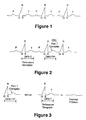
- the electrocardiogram typically includes an initial impulse, termed the P-wave, emanating from the atria, followed by what is termed the QRS complex, emanating from the ventricles, which is followed by a T-wave resulting from repolarization of the ventricles (Fig. 1).
- P-wave an initial impulse
- QRS complex an initial impulse emanating from the ventricles
- T-wave resulting from repolarization of the ventricles
- the P-wave can be a valuable tool used by clinicians to diagnose the condition of the heart.
- clinicians will often monitor an electrocardiogram (ECG) of the heart to aid in the diagnosis of atrial and ventricular arrhythmias.
- ECG electrocardiogram
- This can be done in various ways, such as by monitoring the 12 Lead (surface) ECG in conjunction with observing the bioelectric activity recorded on intracardiac electrodes carried by a transthoracic catheter.
- the atrial heart tissue begins to beat very rapidly as the focal origin moves from the sinus node to an ectopic site.
- this higher heart rate is sustained over three or more beats and is termed a tachycardia.
- the higher rate is intermittent and may be as short as one heart beat.
- the first beat of the atrial arrhythmia is usually initiated by what is termed a Premature Atrial Contraction ("PAC") which can result in the P-wave of a successive heart beat overlapping with the T-wave of the preceding beat (Fig. 2).
- PAC Premature Atrial Contraction
- T-wave subtraction is a useful method in electrophysiology procedures to unmask the ECG P-wave morphology of a PAC by subtracting a QRS_T template from a PAC
- ECG baseline drift caused by respiration or body movement may cause certain variations on the results of T-wave subtraction.
- a further need remains in the art to quantitatively measure the quality of T-wave subtraction results, among other reasons to monitor the respiration variations on T-wave subtraction.
- the instant invention addresses this need as well.
- the present invention provides a medical practitioner with a computerized method for objectively and efficiently performing real time pace mapping and other cardiac analyses, through the processing of incoming electrical signals which represent heart activity to display a derived P-wave without any overlap with a preceding T-wave during a PAC, and to allow the practitioner to objectively compare derived P-waves to determine if they are emanating from the same focus.
- cardiac signal processing of the present invention otherwise masked signals and correlations are identified among heart beats and segments of heart beats through calculations on acquired signals and/or derivations of new signals.
- the practitioner can be guided through visual aids such as bar graphs and overlaid cardiac signals of the quality of signal matches. These signal matches can assist in diagnosing a patient and in the effectiveness of an ongoing treatment, for example, an ablation procedure.
- Sub-component waveforms can be quantitatively compared to one another using correlation analysis. This analysis may be done retrospectively or in real time.
- the present invention provides systems, programmed machines, and methods that permit superior signal processing over prior art electrophysiology signal processors and can achieve this using a standard 12 lead ECG..
- a system for tracking ectopic beats comprises a signal sensing unit, a signal processor, and an output device.
- the signal sensing unit is configured to capture a first ECG signal.
- the signal processor is connected to receive the first ECG signal from the signal sensing unit and is configured to permit a user to mark a begin point and an end point of the first ECG signal for use in defining a waveform segment as a reference template, to acquire data from multiple leads, and to identify a best fit between the reference template and the acquired data using a correlation coefficient calculation.
- the output device presents the identified best fit.
- a system for deriving a p-wave signal from a premature atrial contraction (“PAC") beat comprises a signal sensing unit, a signal processor, and an output device.
- the signal processor is connected so as to receive electrocardiac signals from the signal sensing unit and is configured to process the electrocardiac signals so as to derive the p-wave signal from the PAC beat.
- the output device presents the derived p-wave signal.
- the processor is configured to execute the steps of: (a) selecting a QRS-T segment of a reference ECG signal; (b) permitting a user to mark a begin point and an end point of the selected ECG signal; (c) defining a reference template as being a waveform segment between the marked begin and end points of the selected ECG signal; (d) acquiring the PAC beat at the signal processing unit from multiple leads (preferably with no more than 12 leads); and (e) processing the PAC beat so as to derive the p-wave signal.
- an electrophysiology computer system includes a processor that is configured to derive a p-wave signal hidden within a premature atrial contraction ("PAC") beat.
- the processor executes the steps of: (a) selecting a QRS-T segment of a reference ECG signal; (b) permitting a user to mark a begin point and an end point of the selected segment of the reference ECG signal; (c) defining a reference template as being a waveform segment between the marked begin and end points of the selected segment of the reference ECG signal; (d) acquiring the PAC beat at the signal processing unit from multiple ECG leads; and (e) processing the PAC beat so as to derive the p-wave signal.
- PAC premature atrial contraction
- the processor utilizes a correlation coefficient calculation to effect a subtraction of the reference template from a predetermined segment of the PAC beat.
- the processor is configured to compare derived p-waves from multiple beats to one another, to indicate or infer a common focal origin among several derived p-waves, to predict the most likely site of the origin of a focus using a (preferably 12 lead) library of p-waves of known focal origin, to derive paced p-waves for comparison to spontaneous p-waves, to determine an integral value of the QRS area of a derived p-wave signal, to normalize any integral values over a length of the derived p-wave signal, to process the QRS segment of a beat separately to arrive at further determinations concerning the heart beat data, and to perform combinations of the foregoing.
- an electrophysiology computer system includes a processor that is configured to execute steps substantially in the same manner as the processor that derives a p-wave from a PAC beat, but more generally is configured to derive a non-synchronous subcomponent from a first heartbeat signal having a composite waveform which includes a synchronous subcomponent overlapping the non-synchronous subcomponent.
- the processor executes the steps of selecting a synchronous subcomponent of a second heartbeat signal which corresponds to the synchronous subcomponent of the first heartbeat signal; permitting a user to mark a begin point and an end point of the selected synchronous subcomponent; defining a reference template as being a waveform segment between the marked begin and end points of the selected synchronous subcomponent; acquiring the composite waveform of the first heartbeat signal at the signal processing unit from multiple leads; and processing the composite waveform beat so as to derive the non-synchronous subcomponent.
- a method for tracking ectopic beats through template matching includes the steps of: (a) capturing a first ECG signal in a signal processing unit; (b) permitting a user to mark a begin point and an end point of the captured first ECG signal; (c) defining a reference template as being a waveform segment between the marked begin and end points of the first ECG signal; (d) acquiring data at the signal processing unit; and (e) using a correlation coefficient calculation on the acquired data to identify a best fit between the reference template and the acquired data.
- a method for deriving a p-wave signal from a premature atrial contraction ("PAC") beat which can assist a person in diagnosing a heart.
- This method includes the steps of: (a)selecting a QRS-T segment of a reference ECG signal; (b) permitting a user to mark a begin point and an end point of the selected segment of the reference ECG signal; (c) defining a reference template as being a waveform segment between the marked begin and end points of the selected segment of the reference ECG signal; (d) acquiring the PAC beat at the signal processing unit from multiple leads; and (e) processing the PAC beat so as to derive the p-wave signal.
- PAC premature atrial contraction
- the PAC beat is processed using a correlation coefficient calculation to effect a subtraction of the reference template from a predetermined segment of the PAC beat.
- the foregoing methods can include the additional steps of: comparing derived p-waves from multiple beats to one another; indicating or inferring a common focal origin among several derived p-waves; predicting the most likely site of the origin of a focus using a (preferably 12 lead) library of p-waves of known focal origin; deriving paced p-waves for comparison to spontaneous p-waves; determining an integral value of the QRS area of a derived p-wave signal; normalizing any integral values over a length of the derived p-wave signal; processing QRS segment of a beat separately to arrive at further determinations concerning the heart beat data, and performing combinations of the foregoing steps.
- Further methods according to still further aspects of the invention include the determination of integrals concerning a sectionof the QRS_T segment and the processing of those integrals.
- a QRS segment integral can be used as a measure of the QRS residue, which is an indicator of the alignment or synchronization quality between the template QRS and the PAC QRS
- baseline drift can be monitored as a change of the QRS absolute peak (integral) value percentage between the template and the PAC.
- Yet a further method in accordance with another aspect of the invention proceeds in substantially the same manner as when deriving a p-wave from a PAC beat, but more generally includes the selecting the synchronous subcomponent of the heartbeat signal, permitting a user to mark a begin point and an end point of the selected synchronous subcomponent, defining a reference template as being a waveform segment between the marked begin and end points of the selected synchronous subcomponent, acquiring the composite waveform at the signal processing unit from multiple leads, and processing the composite waveform beat so as to derive the non-synchronous subcomponent.
- a template optimization method which dynamically employs different templates. QRS beats that precede or follow a PAC can be selected manually or by action of a programmed machine in selecting and setting a new template for use in subsequent calculations.
- the method is implemented by suitably configured computer processors.
- Any recorded ECG waveform can be used as a reference to compare to another recorded ECG waveform or to a real time ECG waveform.
- the comparison is performed in a two step process in which first a reference template is selected by the user to describe the beginning and end of an ECG waveform segment to be used as a comparison template. Next the user selects the region of data to be used for comparison--either from pre-recorded data or from the real time data stream.
- a suitably configured computer processor can find the best match against the reference template over the region specified, or in the case of real time analysis, find the best match updated over a defined period of time, for example every second.
- the criteria for "best match" utilizes a correlation coefficient calculation across all twelve leads of the ECG and finds the best alignment.
- a visual display showing the aligned reference beat (template) overlaid on the beat undergoing analysis give the user feedback as to the closeness of the match.
- a correlation coefficient calculated for each ECG lead gives a quantitative indicator of the match.
- a composite average is also calculated and is displayed in a unique color enhanced bar graph indicator which is especially useful when real time template matching is being performed. The composite average can be updated as a moving average over a preselected number of beats.
- Template matching may be used to compare two spontaneous beats or it can be used to pace map, i.e., to compare a paced beat to a spontaneous beat.
- a Region of Interest (ROI) indictor can be manipulated by the user to exclude certain portions of the waveform from analysis. This is useful during pace mapping where pacing artifacts on the surface leads can be excluded from the region of analysis.
- the ROI indicator can also be used to specify a preference for T-wave or P-wave matching as they are oftentimes morphologically very similar.
- a method whereby an ECG having an overlapping P and T wave is processed to remove the T-wave and thereby display the P-wave without any overlap, so that a clinician may observe the P-wave when performing a diagnosis of the heart.
- FIG. 1 which describes a normal ECG over three beats in which distinctive P and T-waves can be identified.
- Figure 2 shows a rhythm in which the P-wave from the third beat (P') arrives early and is obscured by the T-wave from the second beat. This results in what is termed a P on T complex, and is referred to as a QRS-T-P' in the figure.
- the QRS-T segment of a beat that lacks a PAC is selected as a template.
- This template is subtracted from the QRS-T-P' signal in the PAC to be studied yielding the P-wave.
- the QRS-T signal used as the template may be from a single beat or it may be derived from an average of multiple beats.
- the QRS-T signal (or average) used as the template is selected so that the preceding QRS-QRS interval is equal (or nearly equal) to the QRS-QRS interval immediately preceding the QRS-T-P' signal to be studied.
- the beat immediately preceding the PAC can be used for the selected QRS-T template as the cycle length and hemodynamic conditions of this beat are the closest to those of the succeeding beat that contains the PAC and P on T complex. (See Figures 2 and 3.)
- the QRS complex is used as a means to synchronize and align the QRS-T template and the PAC beat for subtraction.
- the alignment is automated by the algorithm for the best match based on the composite correlation coefficient across the 12 Lead ECG.
- the practitioner has the option of shifting the template match left or right on a sample by sample basis with the resulting composite correlation coefficient updated at each new position.
- the practitioner also has the option of choosing the previous or following QRS-T segment as the reference template.
- the software will automatically locate the previous or following beat based on the current reference template and use the corresponding QRS-T segment of that beat as the new reference template in the calculation of derived P-waves.
- P-waves that have been derived using the T-wave subtraction method can be signal processed further to remove unwanted artifacts caused by respiration or noise.
- two or more waveforms X,Y, .. may form a composite waveform that due to timing and amplitude relationships causes the individual waveforms to be obscured or hidden.
- the composite waveform includes includes a synchronous subcomponent overlapping a non-synchronous subcomponent. If a singular, unadulterated sub-component waveform (e.g. X or Y) can be identified, and if it has similar timing characteristics that allow it to be synchronized with the composite waveform (i.e., this identified subcomponent is the synchronous subcompent), then it can be subtracted from the composite waveform to derive the other sub-component waveform(s) (i.e., the non-synchronous subcomponent(s)).
- a singular, unadulterated sub-component waveform e.g. X or Y
- this identified subcomponent is the synchronous subcompent
- Sub-component waveforms can be quantitatively compared to one another using correlation analysis. This analysis may be done retrospectively or in real time.
- One of skill in the art will appreciate that a number of algorithms can be used to compare waveform shape, including, but not limited to bin area methods and integrals; any of these methods can assist in the goals of aligning synchronous components of composite waveforms and/or comparing the derived results.
- a method in accordance with this more general teaching proceeds generally as outlined above. Specifically, this method proceeds in substantially the same manner as when deriving a p-wave from a PAC beat, but more generally includes the selecting the synchronous subcomponent of the heartbeat signal, permitting a user to mark a begin point and an end point of the selected synchronous subcomponent, defining a reference template as being a waveform segment between the marked begin and end points of the selected synchronous subcomponent, acquiring the composite waveform at the signal processing unit from multiple leads, and processing the composite waveform beat so as to derive the non-synchronous subcomponent.
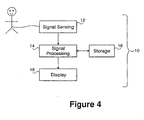
- the system 10 includes a signal sensing unit 12, which may take different forms, such as a standard 12 lead ECG, intracardiac lead, or combination thereof.
- the signal sensing unit is electrically connected to a signal processing device 14, which receives the sensed signals from the unit 12 and processes the signals, as is described in more detail below.
- the signal processing device (“signal processor” or “processor”) 14 is preferably connected to a suitable display 16, which will present the processed signals to a clinician or other interested person. Information can be stored and recalled from a storage device 18.
- the signal processing device 14 and display 16 comprise the EP LabSystem (trademark) of C.R. Bard, Inc., Murray Hill, New Jersey, or the like.
- the EP LabSystem (trademark) supports a variety of data gathering and processing functions that are standard in electrophysiology procedures, and can have its hardware (namely, processor 14) configured to implement the subtraction and derivation methods set forth above, for example, through software (e.g., modules, procedures, functions, or objects) or firmware.
- the processor 14 communicates with a memory or storage 18 which configures the processor to implement the subtraction and derivation methods above (as well as the integral techniques described below).
- the special features of the system of the present invention are implemented, in part, by a processor using program information stored in a memory of the signal processing device 14.
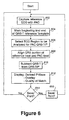
- the processor 14 can access one or more files, as necessary, to implement the required functions, as described in greater detail in connection with FIG. 5 and FIG 6.
- the process begins when a clinician desires to create a reference template, and this occurs by capturing a reference ECG signal, as indicated at step 502.
- the reference ECG signal is captured using a standard 12 lead device and/or one or more intracardiac leads.
- the QRS-T signal components of a beat which does not exhibit P- on T-wave are selected as a template and it is this set of electrocardiac signal components that is captured at step 502.
- Such a beat can be captured in sinus rhythm or during a focal arrhythmia such as a tachycardia.
- the reference template results from signals captured either at the surface, from intracardiac leads that can be placed in a variety of locations within the heart, or a combination of signals from surface and intracardiac leads.
- the QRS-T signal that is used as the template can be captured from a single heartbeat or may be a signal derived from an average of multiple heart beats.
- beginning and end points of the reference template are marked by the clinician using an interface to the signal processing unit 14.
- the marked points define the segment of the ECG waveform to be used as a comparison template.
- the clinician selects whether recorded or real-time data is to be used in the template matching analysis. (This step can be performed at any time prior to the waveform matching analysis at step 508, for example, prior to performing steps 502 and 504.) If recorded data is to be used in the template matching analysis, then a specified region of pre-recorded data is provided to the signal processing unit for comparison to the reference template. On the other hand, if real-time data is to be used in the template matching analysis, a stream of data from ECG leads is provided to the signal processing unit 14 over a defined period of time for comparison to the reference template.
- the signal processor 14 finds a "best match,” in other words, a best alignment between the selected region or time period and the reference template.
- the display 16 is updated to indicate to the clinician (or other persons) the result of the template match.
- the results can be shown qualitatively as superimposed ECG waveform signals, namely, the reference beat (template) overlaid upon the beat under analysis to show the degree of alignment therebetween, or quantitatively as a correlation coefficient calculated for each ECG lead.
- a composite average is also calculated and displayed. This is illustrated in the computer display shown in FIG 8.
- a test is made to determine whether the user had selected real-time processing at step 506. If so, then the flow loops back to step 508 to again perform the template matching analysis and to update the display accordingly. Otherwise, if previously recorded segments are being analyzed, the user is given the option to save the analysis (as tested at step 514), and the correlation analysis is saved, as indicated at step 516. Real-time analyses can also be saved if desired.
- the process begins at step 602 when a clinician captures a PAC and desires to subtract a QRS-T reference template from the PAC.
- the QRS-T reference template is marked by the clinician at step 604 (as described above) and a region encompassing the PAC is selected by the clinician at step 606 for analysis.
- the QRS portion of the reference template is aligned for best fit with the QRS complex immediately preceding the PAC at step 608.
- the processor 14 subtracts the QRS-T reference template from the QRS-T-P' segment of the PAC at step 610.
- the difference is the derived P-wave which is output to the display 16 at step 612.
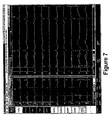
- This is illustrated in the computer display shown in FIG 7, in which the leftmost window displays the selected QRS-T reference template between two vertical lines (one dashed line prior to the 14 second mark at the top (highlighted by an arrow), and a second solid line just after the 14 second mark).
- the rightmost window shows the original PAC waveform with the derived P-wave overlaid on top of the portion of the ECG which occurs in the first 15 seconds.
- the overlaid and derived P-wave appears as a second graph superimposed over the ECG signals.
- Visual aids can be provided to automatically align and overlay waveforms for visual comparison on a computer display or a printout.
- Figure 8 illustrates an exemplary display for template matching (without subtraction) that can be displayed to an operator.
- the leftmost window displays markers which signify the presence and use of the reference template; the reference template beginning at the leftmost vertical line (highlighted by the arrow) and ends at the second vertical line.
- the reference template marks the start and finish of a P-wave; however, any waveform segment can be used if the region of interest has been marked for use as a template.
- the larger display window to the right shows the correlation value for each channel of the 12 Lead ECG as compared to the reference template.
- the bar graph at the far right is inactive in this example because the analysis region is taken from recorded data rather than real-time data gathered during a medical procedure.
- the data can be saved, printed or both, if desired, in response to a user input to do so, as tested at step 614 and implemented at step 616.
- the present invention provides a method for reliably and efficiently recovering a P-wave from a waveform that has overlapping P- and T-waves. Furthermore, the template matching capabilities of the invention provide the added benefit of quickly and objectively comparing ECG waveform components, in their native or derived state. It should also be understood that the correlation, subtraction and derivation methods described herein apply to data that can be acquired from conventional 12 lead surface ECG signals as well as intracardiac signals or combinations of both surface and intracardiac signals.
- Two waveforms can have a high correlation to each other but still be poorly matched in absolute terms due to amplitude variation and drift caused by the effects of respiration. This can be a problem when two waveforms are aligned and then subtracted, one from the other. It is for this reason that immediately adjacent beats are usually desirable as the reference (QRS-T) and PAC (QRS-T-P'). This is not always possible and is not practical when performing real time pace mapping.
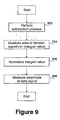
- a subtraction process (as illustrated in Figs. 3 and 6 and described above) is performed to subtract a QRS-T template from a PAC (QRS-T-P') and thereby derive a waveform.
- the method of Fig. 9 proceeds by then providing integral calculations that enable a number of measurements of interest to practitioners, including, but not limited to: measures of QRS residue and the quality of the T-wave subtraction process; measures of the baseline drift, if any; and optimization of the selection of templates to be used in the subtraction process.
- the area of a derived waveform is measured.
- the integral value is divided by the length of the derived waveform to normalize its value.
- the amplitude of the normalized integral value is measured and displayed as a voltage at the ECG channel's input. This voltage value is termed the QRS residue.
- correlation analysis is used to align the QRS segment of a reference ECG template with the QRS segment of a PAC beat.
- a further improvement may use the correlation coefficient in conjunction with the so-called QRS residue of the derived waveform to give an indication of the quality if the match between two beats chosen for subtraction. Together, they provide an indicator of the alignment or synchronization quality between the template QRS and the PAC QRS.
- the derived QRS segment should be flat indicating a high correlation to the template and the QRS residue should be very small indicating a small difference in absolute amplitudes (including drift).
Landscapes
- Health & Medical Sciences (AREA)
- Life Sciences & Earth Sciences (AREA)
- Cardiology (AREA)
- Heart & Thoracic Surgery (AREA)
- Molecular Biology (AREA)
- Pathology (AREA)
- Engineering & Computer Science (AREA)
- Biomedical Technology (AREA)
- Physics & Mathematics (AREA)
- Medical Informatics (AREA)
- Biophysics (AREA)
- Surgery (AREA)
- Animal Behavior & Ethology (AREA)
- General Health & Medical Sciences (AREA)
- Public Health (AREA)
- Veterinary Medicine (AREA)
- Measurement And Recording Of Electrical Phenomena And Electrical Characteristics Of The Living Body (AREA)
Applications Claiming Priority (5)
| Application Number | Priority Date | Filing Date | Title |
|---|---|---|---|
| US24726900P | 2000-11-10 | 2000-11-10 | |
| US247269P | 2000-11-10 | ||
| US29521701P | 2001-06-01 | 2001-06-01 | |
| US295217P | 2001-06-01 | ||
| EP01997039A EP1331876B1 (de) | 2000-11-10 | 2001-11-07 | Ableitung von p-wellen in elektrokardiogrammsignäle mit überlappenden komplexen |
Related Parent Applications (1)
| Application Number | Title | Priority Date | Filing Date |
|---|---|---|---|
| EP01997039A Division EP1331876B1 (de) | 2000-11-10 | 2001-11-07 | Ableitung von p-wellen in elektrokardiogrammsignäle mit überlappenden komplexen |
Publications (3)
| Publication Number | Publication Date |
|---|---|
| EP1510172A2 true EP1510172A2 (de) | 2005-03-02 |
| EP1510172A3 EP1510172A3 (de) | 2005-05-25 |
| EP1510172B1 EP1510172B1 (de) | 2009-07-01 |
Family
ID=34108314
Family Applications (1)
| Application Number | Title | Priority Date | Filing Date |
|---|---|---|---|
| EP04025405A Expired - Lifetime EP1510172B1 (de) | 2000-11-10 | 2001-11-07 | Ableitung von nicht-synchronen Teilkomponenten in Elektrokardiogrammsignalen mit überlappenden Komplexen |
Country Status (1)
| Country | Link |
|---|---|
| EP (1) | EP1510172B1 (de) |
Cited By (3)
| Publication number | Priority date | Publication date | Assignee | Title |
|---|---|---|---|---|
| EP3827749A1 (de) * | 2019-11-28 | 2021-06-02 | Biosense Webster (Israel) Ltd | Mapping der lokalen aktivierungszeit während sinusrhythmus und nicht-sinusrhythmus |
| EP3845128A1 (de) * | 2019-12-23 | 2021-07-07 | Biosense Webster (Israel) Ltd | Behandlung von ektopischen schlägen bei der elektroanatomischen kartierung des herzens |
| CN116471991A (zh) * | 2020-09-28 | 2023-07-21 | 科佐尔乌甘德资本私人有限公司 | 用于产生标准12导联ecg的方法和系统 |
Family Cites Families (6)
| Publication number | Priority date | Publication date | Assignee | Title |
|---|---|---|---|---|
| US5020540A (en) * | 1987-10-09 | 1991-06-04 | Biometrak Corporation | Cardiac biopotential analysis system and method |
| US5713367A (en) * | 1994-01-26 | 1998-02-03 | Cambridge Heart, Inc. | Measuring and assessing cardiac electrical stability |
| US5779645A (en) * | 1996-12-17 | 1998-07-14 | Pacesetter, Inc. | System and method for waveform morphology comparison |
| US5772604A (en) * | 1997-03-14 | 1998-06-30 | Emory University | Method, system and apparatus for determining prognosis in atrial fibrillation |
| US5827195A (en) * | 1997-05-09 | 1998-10-27 | Cambridge Heart, Inc. | Electrocardiogram noise reduction using multi-dimensional filtering |
| US5840038A (en) * | 1997-05-29 | 1998-11-24 | Marquette Medical Systems, Inc. | Method and apparatus for signal averaging and analyzing high resolution P wave signals from an electrocardiogram |
-
2001
- 2001-11-07 EP EP04025405A patent/EP1510172B1/de not_active Expired - Lifetime
Cited By (7)
| Publication number | Priority date | Publication date | Assignee | Title |
|---|---|---|---|---|
| EP3827749A1 (de) * | 2019-11-28 | 2021-06-02 | Biosense Webster (Israel) Ltd | Mapping der lokalen aktivierungszeit während sinusrhythmus und nicht-sinusrhythmus |
| US11147497B2 (en) | 2019-11-28 | 2021-10-19 | Biosense Webster (Israel) Ltd. | Mapping local activation times for sinus and non-sinus cardiac cycles |
| EP3845128A1 (de) * | 2019-12-23 | 2021-07-07 | Biosense Webster (Israel) Ltd | Behandlung von ektopischen schlägen bei der elektroanatomischen kartierung des herzens |
| CN113080997A (zh) * | 2019-12-23 | 2021-07-09 | 伯恩森斯韦伯斯特(以色列)有限责任公司 | 在心脏的电解剖标测中处理异位搏动 |
| US11490850B2 (en) | 2019-12-23 | 2022-11-08 | Biosense Webster (Israel) Ltd. | Handling ectopic beats in electro-anatomical mapping of the heart |
| US11832951B2 (en) | 2019-12-23 | 2023-12-05 | Biosense Webster (Israel) Ltd. | Handling ectopic beats in electro-anatomical mapping of the heart |
| CN116471991A (zh) * | 2020-09-28 | 2023-07-21 | 科佐尔乌甘德资本私人有限公司 | 用于产生标准12导联ecg的方法和系统 |
Also Published As
| Publication number | Publication date |
|---|---|
| EP1510172B1 (de) | 2009-07-01 |
| EP1510172A3 (de) | 2005-05-25 |
Similar Documents
| Publication | Publication Date | Title |
|---|---|---|
| US6968227B2 (en) | Methods for processing electrocardiac signals having superimposed complexes | |
| US6944495B2 (en) | Methods for processing electrocardiac signals having superimposed complexes | |
| US7966062B2 (en) | Multi-color overlay system for processing and displaying electrocardiac signals | |
| US8706201B2 (en) | Apparatus and method for analysis of high frequency QRS complexes | |
| US7142907B2 (en) | Method and apparatus for algorithm fusion of high-resolution electrocardiograms | |
| JP6381444B2 (ja) | リアルタイムecgにおいて心電図のst部レベルを全自動で測定する方法およびシステム | |
| US5840038A (en) | Method and apparatus for signal averaging and analyzing high resolution P wave signals from an electrocardiogram | |
| US6668189B2 (en) | Method and system for measuring T-wave alternans by alignment of alternating median beats to a cubic spline | |
| CN112914586B (zh) | 心内图案匹配 | |
| JP2006025836A (ja) | 重ね焼きされた複合性を有する心電図信号を処理するための方法 | |
| CN113543710A (zh) | 心房颤动解析装置、心房颤动解析方法以及程序 | |
| US7027857B2 (en) | Method and system for improved measurement of T-wave alternans | |
| EP1510172B1 (de) | Ableitung von nicht-synchronen Teilkomponenten in Elektrokardiogrammsignalen mit überlappenden Komplexen | |
| US12594020B2 (en) | Annotation of late potentials comprising local abnormal ventricular activation (LAVA) signals |
Legal Events
| Date | Code | Title | Description |
|---|---|---|---|
| PUAI | Public reference made under article 153(3) epc to a published international application that has entered the european phase |
Free format text: ORIGINAL CODE: 0009012 |
|
| AC | Divisional application: reference to earlier application |
Ref document number: 1331876 Country of ref document: EP Kind code of ref document: P |
|
| AK | Designated contracting states |
Kind code of ref document: A2 Designated state(s): DE ES FR GB IT |
|
| PUAL | Search report despatched |
Free format text: ORIGINAL CODE: 0009013 |
|
| AK | Designated contracting states |
Kind code of ref document: A3 Designated state(s): DE ES FR GB IT |
|
| RIN1 | Information on inventor provided before grant (corrected) |
Inventor name: SHAH, DIPEN Inventor name: YANG, SHAWN Inventor name: WANG, PAUL J. Inventor name: MACADAM, DAVID P. |
|
| 17P | Request for examination filed |
Effective date: 20050727 |
|
| AKX | Designation fees paid |
Designated state(s): DE ES FR GB IT |
|
| 17Q | First examination report despatched |
Effective date: 20060317 |
|
| GRAP | Despatch of communication of intention to grant a patent |
Free format text: ORIGINAL CODE: EPIDOSNIGR1 |
|
| RTI1 | Title (correction) |
Free format text: DERIVING NON-SYNCHRONOUS SUBCOMPONENT IN ELECTROCARDIAC SIGNALS HAVING SUPERIMPOSED COMPLEXES |
|
| GRAS | Grant fee paid |
Free format text: ORIGINAL CODE: EPIDOSNIGR3 |
|
| GRAA | (expected) grant |
Free format text: ORIGINAL CODE: 0009210 |
|
| AC | Divisional application: reference to earlier application |
Ref document number: 1331876 Country of ref document: EP Kind code of ref document: P |
|
| AK | Designated contracting states |
Kind code of ref document: B1 Designated state(s): DE ES FR GB IT |
|
| REG | Reference to a national code |
Ref country code: GB Ref legal event code: FG4D |
|
| REF | Corresponds to: |
Ref document number: 60139162 Country of ref document: DE Date of ref document: 20090813 Kind code of ref document: P |
|
| REG | Reference to a national code |
Ref country code: ES Ref legal event code: FG2A Ref document number: 2327734 Country of ref document: ES Kind code of ref document: T3 |
|
| PLBE | No opposition filed within time limit |
Free format text: ORIGINAL CODE: 0009261 |
|
| STAA | Information on the status of an ep patent application or granted ep patent |
Free format text: STATUS: NO OPPOSITION FILED WITHIN TIME LIMIT |
|
| 26N | No opposition filed |
Effective date: 20100406 |
|
| REG | Reference to a national code |
Ref country code: DE Ref legal event code: R082 Ref document number: 60139162 Country of ref document: DE Representative=s name: HOFFMANN - EITLE, DE |
|
| REG | Reference to a national code |
Ref country code: DE Ref legal event code: R081 Ref document number: 60139162 Country of ref document: DE Owner name: BOSTON SCIENTIFIC SCIMED, INC., MARPLE GROVE, US Free format text: FORMER OWNER: C.R. BARD, INC., MURRAY HILL, N.J., US Effective date: 20140530 Ref country code: DE Ref legal event code: R082 Ref document number: 60139162 Country of ref document: DE Representative=s name: HOFFMANN - EITLE, DE Effective date: 20140530 Ref country code: DE Ref legal event code: R082 Ref document number: 60139162 Country of ref document: DE Representative=s name: HOFFMANN - EITLE PATENT- UND RECHTSANWAELTE PA, DE Effective date: 20140530 Ref country code: DE Ref legal event code: R081 Ref document number: 60139162 Country of ref document: DE Owner name: BOSTON SCIENTIFIC SCIMED, INC., MAPLE GROVE, US Free format text: FORMER OWNER: C.R. BARD, INC., MURRAY HILL, N.J., US Effective date: 20140530 |
|
| REG | Reference to a national code |
Ref country code: FR Ref legal event code: PLFP Year of fee payment: 16 |
|
| PGFP | Annual fee paid to national office [announced via postgrant information from national office to epo] |
Ref country code: FR Payment date: 20161014 Year of fee payment: 16 Ref country code: GB Payment date: 20161102 Year of fee payment: 16 Ref country code: DE Payment date: 20161101 Year of fee payment: 16 |
|
| PGFP | Annual fee paid to national office [announced via postgrant information from national office to epo] |
Ref country code: ES Payment date: 20161011 Year of fee payment: 16 Ref country code: IT Payment date: 20161122 Year of fee payment: 16 |
|
| REG | Reference to a national code |
Ref country code: DE Ref legal event code: R119 Ref document number: 60139162 Country of ref document: DE |
|
| GBPC | Gb: european patent ceased through non-payment of renewal fee |
Effective date: 20171107 |
|
| REG | Reference to a national code |
Ref country code: FR Ref legal event code: ST Effective date: 20180731 |
|
| PG25 | Lapsed in a contracting state [announced via postgrant information from national office to epo] |
Ref country code: DE Free format text: LAPSE BECAUSE OF NON-PAYMENT OF DUE FEES Effective date: 20180602 Ref country code: IT Free format text: LAPSE BECAUSE OF NON-PAYMENT OF DUE FEES Effective date: 20171107 Ref country code: FR Free format text: LAPSE BECAUSE OF NON-PAYMENT OF DUE FEES Effective date: 20171130 |
|
| PG25 | Lapsed in a contracting state [announced via postgrant information from national office to epo] |
Ref country code: GB Free format text: LAPSE BECAUSE OF NON-PAYMENT OF DUE FEES Effective date: 20171107 |
|
| REG | Reference to a national code |
Ref country code: ES Ref legal event code: FD2A Effective date: 20181226 |
|
| PG25 | Lapsed in a contracting state [announced via postgrant information from national office to epo] |
Ref country code: ES Free format text: LAPSE BECAUSE OF NON-PAYMENT OF DUE FEES Effective date: 20171108 |