EP1508569A2 - Process for the preparation of tetrasubstituted imidazole derivatives and novel crystalline structures thereof - Google Patents
Process for the preparation of tetrasubstituted imidazole derivatives and novel crystalline structures thereof Download PDFInfo
- Publication number
- EP1508569A2 EP1508569A2 EP04077597A EP04077597A EP1508569A2 EP 1508569 A2 EP1508569 A2 EP 1508569A2 EP 04077597 A EP04077597 A EP 04077597A EP 04077597 A EP04077597 A EP 04077597A EP 1508569 A2 EP1508569 A2 EP 1508569A2
- Authority
- EP
- European Patent Office
- Prior art keywords
- alkyl
- substituted
- substituents
- phenyl
- formula
- Prior art date
- Legal status (The legal status is an assumption and is not a legal conclusion. Google has not performed a legal analysis and makes no representation as to the accuracy of the status listed.)
- Withdrawn
Links
- 0 *c([n]1*)c(*)nc1Br Chemical compound *c([n]1*)c(*)nc1Br 0.000 description 9
Classifications
-
- C—CHEMISTRY; METALLURGY
- C07—ORGANIC CHEMISTRY
- C07D—HETEROCYCLIC COMPOUNDS
- C07D231/00—Heterocyclic compounds containing 1,2-diazole or hydrogenated 1,2-diazole rings
- C07D231/02—Heterocyclic compounds containing 1,2-diazole or hydrogenated 1,2-diazole rings not condensed with other rings
- C07D231/10—Heterocyclic compounds containing 1,2-diazole or hydrogenated 1,2-diazole rings not condensed with other rings having two or three double bonds between ring members or between ring members and non-ring members
- C07D231/12—Heterocyclic compounds containing 1,2-diazole or hydrogenated 1,2-diazole rings not condensed with other rings having two or three double bonds between ring members or between ring members and non-ring members with only hydrogen atoms, hydrocarbon or substituted hydrocarbon radicals, directly attached to ring carbon atoms
-
- C—CHEMISTRY; METALLURGY
- C07—ORGANIC CHEMISTRY
- C07D—HETEROCYCLIC COMPOUNDS
- C07D213/00—Heterocyclic compounds containing six-membered rings, not condensed with other rings, with one nitrogen atom as the only ring hetero atom and three or more double bonds between ring members or between ring members and non-ring members
- C07D213/02—Heterocyclic compounds containing six-membered rings, not condensed with other rings, with one nitrogen atom as the only ring hetero atom and three or more double bonds between ring members or between ring members and non-ring members having three double bonds between ring members or between ring members and non-ring members
- C07D213/04—Heterocyclic compounds containing six-membered rings, not condensed with other rings, with one nitrogen atom as the only ring hetero atom and three or more double bonds between ring members or between ring members and non-ring members having three double bonds between ring members or between ring members and non-ring members having no bond between the ring nitrogen atom and a non-ring member or having only hydrogen or carbon atoms directly attached to the ring nitrogen atom
- C07D213/24—Heterocyclic compounds containing six-membered rings, not condensed with other rings, with one nitrogen atom as the only ring hetero atom and three or more double bonds between ring members or between ring members and non-ring members having three double bonds between ring members or between ring members and non-ring members having no bond between the ring nitrogen atom and a non-ring member or having only hydrogen or carbon atoms directly attached to the ring nitrogen atom with substituted hydrocarbon radicals attached to ring carbon atoms
- C07D213/44—Radicals substituted by doubly-bound oxygen, sulfur, or nitrogen atoms, or by two such atoms singly-bound to the same carbon atom
- C07D213/46—Oxygen atoms
- C07D213/51—Acetal radicals
-
- C—CHEMISTRY; METALLURGY
- C07—ORGANIC CHEMISTRY
- C07D—HETEROCYCLIC COMPOUNDS
- C07D233/00—Heterocyclic compounds containing 1,3-diazole or hydrogenated 1,3-diazole rings, not condensed with other rings
- C07D233/54—Heterocyclic compounds containing 1,3-diazole or hydrogenated 1,3-diazole rings, not condensed with other rings having two double bonds between ring members or between ring members and non-ring members
- C07D233/56—Heterocyclic compounds containing 1,3-diazole or hydrogenated 1,3-diazole rings, not condensed with other rings having two double bonds between ring members or between ring members and non-ring members with only hydrogen atoms or radicals containing only hydrogen and carbon atoms, attached to ring carbon atoms
-
- C—CHEMISTRY; METALLURGY
- C07—ORGANIC CHEMISTRY
- C07D—HETEROCYCLIC COMPOUNDS
- C07D249/00—Heterocyclic compounds containing five-membered rings having three nitrogen atoms as the only ring hetero atoms
- C07D249/02—Heterocyclic compounds containing five-membered rings having three nitrogen atoms as the only ring hetero atoms not condensed with other rings
- C07D249/08—1,2,4-Triazoles; Hydrogenated 1,2,4-triazoles
-
- C—CHEMISTRY; METALLURGY
- C07—ORGANIC CHEMISTRY
- C07D—HETEROCYCLIC COMPOUNDS
- C07D401/00—Heterocyclic compounds containing two or more hetero rings, having nitrogen atoms as the only ring hetero atoms, at least one ring being a six-membered ring with only one nitrogen atom
- C07D401/02—Heterocyclic compounds containing two or more hetero rings, having nitrogen atoms as the only ring hetero atoms, at least one ring being a six-membered ring with only one nitrogen atom containing two hetero rings
- C07D401/04—Heterocyclic compounds containing two or more hetero rings, having nitrogen atoms as the only ring hetero atoms, at least one ring being a six-membered ring with only one nitrogen atom containing two hetero rings directly linked by a ring-member-to-ring-member bond
Definitions
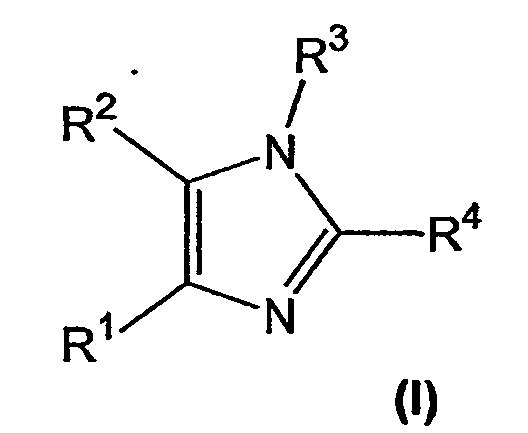
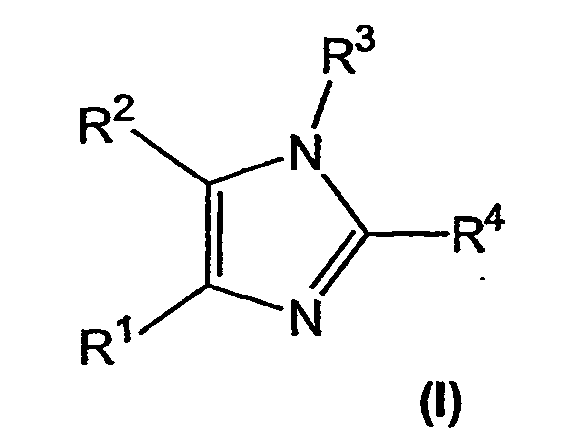
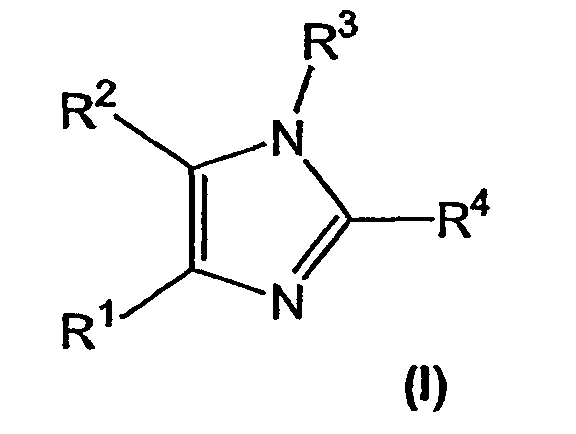
- the present invention relates to a process for preparing tetrasubstituted imidazole derivatives of the general formula (I) wherein R 1 , R 2 , R 3 and R 4 are as defined in the specification below.
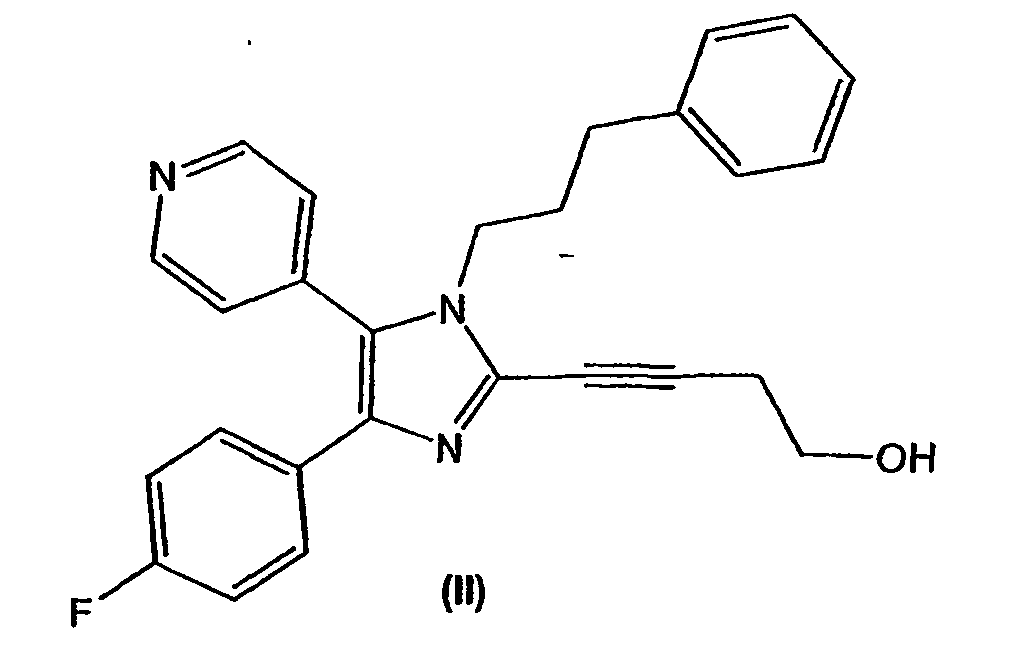
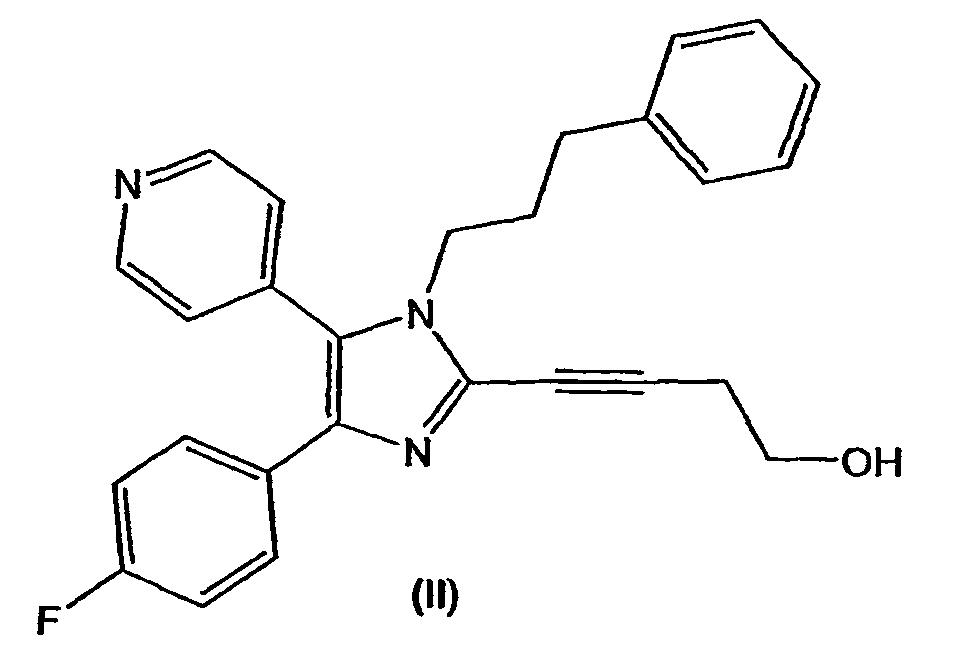
- the present invention further relates to a process for preparing the compound of formula (II) and novel crystalline structures of the compound of formula (II).
- the invention relates to a process for preparing tetrasubstituted imidazole derivatives represented by the formula (I) wherein R 1 , R 2 , R 3 and R 4 are as defined in the specification below.
- the compounds of formula (I) inhibit the in vitro activity of p38 in the nanomolar range.
- the compounds inhibit the in vitro secretion of tumor necrosis factor ⁇ (TNF- ⁇ ) and IL- ⁇ in the nanomolar range.
- Animal models demonstrate the inhibition of LPS induces TNF- ⁇ , as well as the inhibition of rheumatoid arthritis.
- the compounds of formula (I) are useful in the treatment of a variety of cytokine related disorders including rheumatoid arthritis, inflammatory bowel disease, septic shock, osteoporosis, osteoarthritis, neuropathic pain, HIV replication, HIV dementia, viral myocarditis, insulin-dependent diabetes, non-insulin dependent diabetes, periodontal disease, restenosis, alopecia areta, T-cell depletion in HIV infection or AIDS, psoriasis, acute pancreatitis, allograft rejection, allergic inflammation in the lung, atherosclerosis, multiple sclerosis, cachexia, Alzheimer's disease, stroke, Crohn's disease, ischemia, congestive heart failure, pulmonary fibrosis, hepatitis, glioblastoma, Guillain-Barre Syndrome and systemic lupus erythematosus.
- US Patent No. 5,965,583 Issued Oct 12, 1999 US Patent No. 5,965,583 Issued Oct 12, 1999
- the current invention relates to an efficient process for preparing compounds of formula (I).
- the present invention relates to a process for preparing the compound of formula (II).
- the compound of formula (II) is an orally active inhibitor of p38 kinase.
- p38 kinase inhibitors have utility in suppressing the release of TNF- ⁇ from monocytes and would be expected to suppress signal transduction initiated by this proinflammatory mediator.
- p38 kinase inhibitors have utility in the treatment of various inflammatory and autoimmune disorders such as rheumatoid arthritis, sepsis, inflammatory bowel disease, acute respiratory distress syndrome, as well as cachexia and bone resorption (osteoporosis and osteoarthritis).
- the present invention further relates to novel crystalline structures of the compound of formula (II), more specifically Form A and Form B.
- the invention relates to a process for preparing a compound of formula (I) : wherein R 1 is selected from the group consisting of phenyl, substituted phenyl, (where the substituents are selected from C 1 -C 5 alkyl, halogen or trifluoromethyl) and heteroaryl, where the heteroaryl contains 5 to 6 ring atoms; R 2 is selected from the group consisting of phenyl, substituted phenyl, (where the substituents are selected from C 1 -C 5 alkyl, halogen or trifluoromethyl) and heteroaryl, where the heteroaryl contains 5 to 6 ring atoms and is optionally C 1 -C 4 alkyl substituted; R 3 is selected from the group consisting of hydrogen, arylC 1 -C 5 alkyl, substituted arylC 1 -C 5 alkyl, (where the aryl substituents are independently selected from one or more of C 1 -C 5 alkyl, C 1 -C 5 al
- the present invention relates to a process for preparing the compound of formula (II).
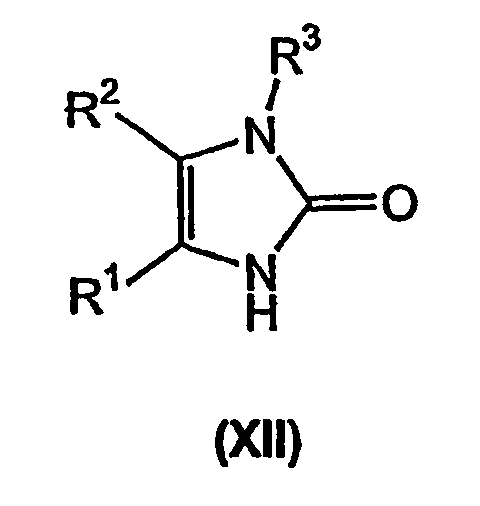
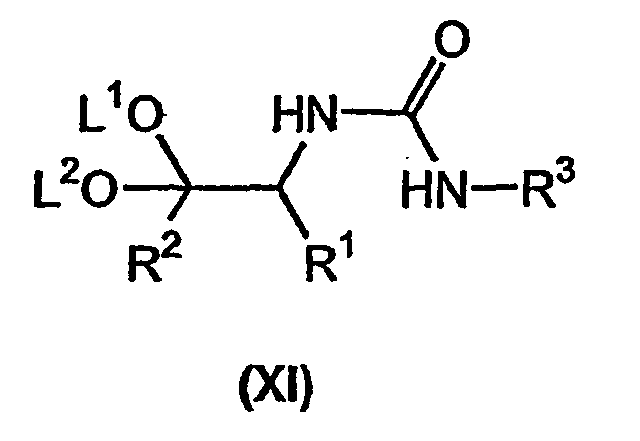
- the present invention is directed to intermediates of formula (XI) and formula (XII), and a process for preparing same.
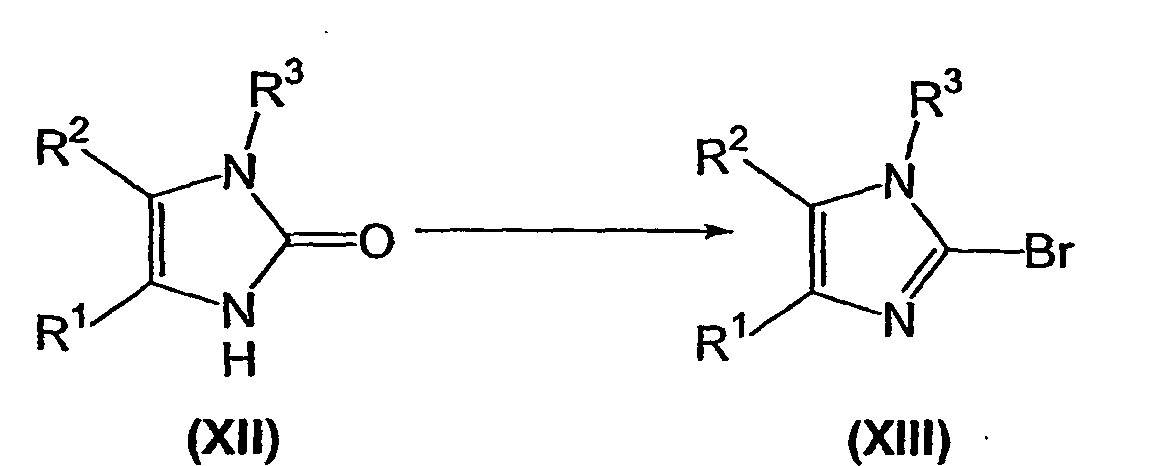
- a process for preparing the intermediate compound of formula (XIII) is directed to intermediates of formula (XI) and formula (XII), and a process for preparing same.
- the present invention is directed to novel crystalline structures of the compound of formula (II), wherein the crystalline forms are herein referred to as Form A and Form B, which may be characterized by their respective X-ray powder diffraction patterns.
- alkyl whether used alone or as part of a substituent group, includes straight, branched and cyclic chain alkyl groups.
- alkyl groups include methyl, ethyl, propyl, isopropyl, butyl, isobutyl, sec-butyl, t-butyl, pentyl, cyclopropyl, cyclobutyl, cyclopentyl, cyclohexyl, and the like.
- alkoxy shall denote a group of the formula -O-(alkyl), for example, methoxy, ethoxy, n-propoxy, sec-butoxy, t-butoxy, n-hexyloxy and the like.
- aryl shall refer to unsubstituted mono and fused aromatic rings such as phenyl, naphthyl, and the like.
- heteroaryl shall denote any five or six membered monocyclic aromatic ring structure containing at least one heteroatom selected from sulfur, oxygen and nitrogen.
- the heteroaryl will contain one sulfur, oxygen or nitrogen atoms and, in addition, may contain up to three additional nitrogen atoms.
- the heteroaryl may contain up to three nitrogen atoms.
- heteroaryls include, but are not limited to, pyridin-2-yl, pyridin-3-yl, pyridin-4-yl, pyrimidi-3-yl, furan-2-yl, furan-3-yl, thiophen-2-yl, thiophen-3-yl, pyridazinyl, triazinyl, thiazolyl, oxazolyl, pyrazolyl, and the like.
- aralkyl shall mean any C 1 -C 5 alkyl group substituted with an aryl group such as phenyl, naphthyl and the like. For example, benzyl, phenylethyl, and the like.
- halogen shall mean chlorine, bromine, fluorine and iodine.
- alkali metal shall refer to a Group I metal cation such as lithium, sodium, potassium and cesium cations.
- any of the processes of the present invention it may be necessary and/or desirable to protect sensitive or reactive groups on any of the molecules concerned. This may be achieved by means of conventional protecting groups, such as those described in Protective Groups in Organic Chemistry , ed. J.F.W. McOmie, Plenum Press, 1973; and T.W. Greene & P.G.M. Wuts, Protective Groups in Organic Synthesis, John Wiley & Sons, 1991.
- the protecting groups may be removed at a convenient subsequent stage using methods known from the art.
- the invention relates to a process for preparing compounds of formula (I) as more fully described in Scheme 1.
- an aldehyde of formula (III) a known compound or compound prepared by known methods, is reacted with an alcohol, diol or trialkoxymethane, preferably trimethoxymethane, preferably in the presence of methanol, in a solvent capable of azeotropic removal of water such as benzene, toluene, xylene, and the like, in the presence of an acid such as sulfuric acid, p-toluenesulfonic acid, and the like, preferably sulfuric acid, at reflux temperature, to produce the corresponding compound of formula (IV).
- an alcohol, diol or trialkoxymethane preferably trimethoxymethane
- trimethoxymethane preferably in the presence of methanol
- an acid such as sulfuric acid, p-toluenesulfonic acid, and the like, preferably sulfuric acid, at reflux temperature
- an aldehyde of formula (V), a known compound or compound prepared by known methods is reacted with an alkali metal salt of bis(trimethylsilyl)amide, preferably lithium bis(trimethylsilyl)amide, in an organic solvent such as tetrahydrofuran (THF), diethyl ether, t-butylmethylether (MTBE), and the like, preferably THF, at a temperature in the range of about -20°C to about room temperature, preferably at a temperature of about 0°C, to produce the corresponding trimethylsilyl (TMS) substituted imine of formula (VI).
- THF tetrahydrofuran
- MTBE t-butylmethylether
- the compound of formula (IV) is reacted with an alkyl lithium such as methyl lithium, ethyl lithium, n-butyl lithium, and the like, preferably n-butyl lithium, at a temperature which prevents decomposition of the lithium intermediate of formula (VII), preferably at a temperature of less than or equal to about -20°C, in an organic solvent such as tetrahydrofuran (THF), diethylether, t-butylmethylether (MTBE), and the like, preferably THF, to produce the corresponding lithium intermediate of formula (VII).
- an organic solvent such as tetrahydrofuran (THF), diethylether, t-butylmethylether (MTBE), and the like, preferably THF
- the lithium intermediate of formula (VII) is reacted with the TMS substituted imine of formula (VI) in the presence of an organic solvent such as tetrahydrofuran (THF), diethylether, t-butylmethylether (MTBE), and the like, preferably THF, preferably allowing warming of the reaction mixture to about room temperature, to produce the corresponding compound of formula (VIII).
- organic solvent such as tetrahydrofuran (THF), diethylether, t-butylmethylether (MTBE), and the like, preferably THF, preferably allowing warming of the reaction mixture to about room temperature, to produce the corresponding compound of formula (VIII).
- a substituted amine of formula (IX) is reacted with N,N'-carbonyldiimidazole, a known compound, in an inert organic solvent, such as tetrahydrofuran (THF), diethylether, t-butylmethylether (MTBE), toluene, dichloromethane (DCM), and the like, preferably THF, preferably at room temperature, to produce the corresponding compound of formula (X).
- THF tetrahydrofuran
- MTBE t-butylmethylether
- DCM dichloromethane
- the compound of formula (VIII) is reacted with the compound of formula (X), in an organic solvent such as toluene, tetrahydrofuran (THF), dimethylformamide (DMF), and the like, preferably toluene, at a temperature in the range of about 50-150°C, preferably for toluene, at about reflux temperature, to produce the corresponding compound of formula (XI).
- organic solvent such as toluene, tetrahydrofuran (THF), dimethylformamide (DMF), and the like, preferably toluene, at a temperature in the range of about 50-150°C, preferably for toluene, at about reflux temperature
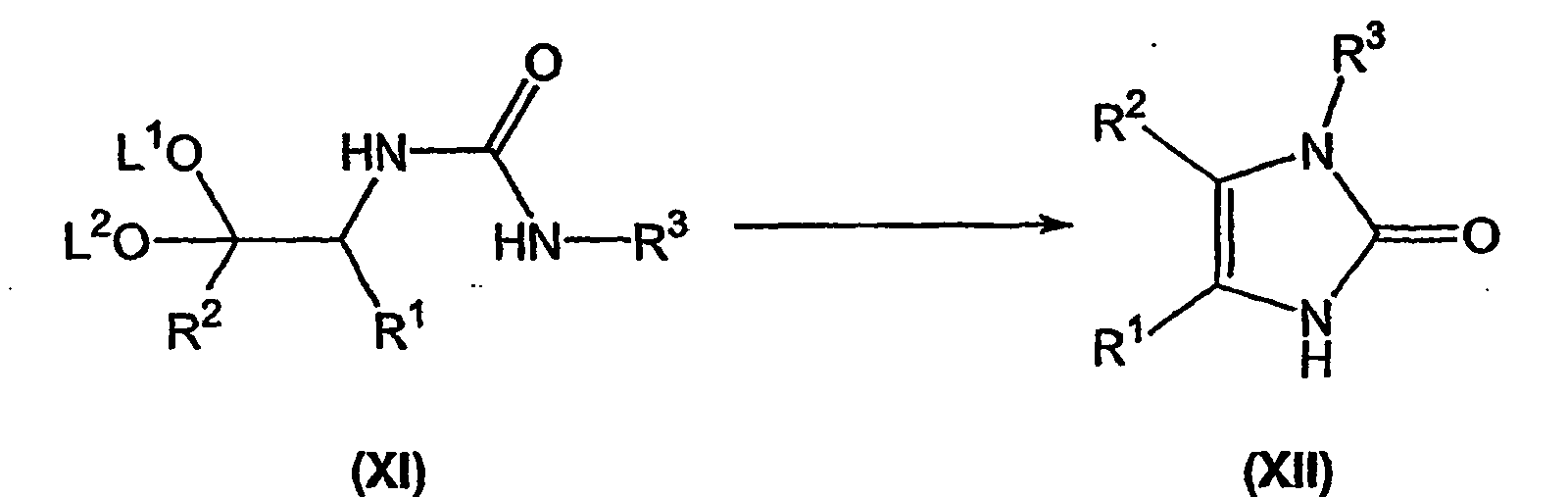
- the compound of formula (XI) is cyclized in an acid such as formic acid, aqueous hydrochloric acid, and the like, preferably aqueous hydrochloric acid, preferably at a temperature in the range of about 80-150°C, most preferably at a temperature in the range of about 95-100°C, to yield the corresponding compound of formula (XII).
- an acid such as formic acid, aqueous hydrochloric acid, and the like, preferably aqueous hydrochloric acid, preferably at a temperature in the range of about 80-150°C, most preferably at a temperature in the range of about 95-100°C, to yield the corresponding compound of formula (XII).
- the compound of formula (XII) is reacted with phosphorus oxybromide (POBr 3 ) or phosphorous pentabromide (PBr 5 ), preferably POBr 3 , in an amount equal to at least about 5 equivalents, in an inert organic solvent whose boiling point is greater than or equal to about 110°C, such as tetramethylenesulfone, xylene, toluene, and the like, preferably tetramethylenesulfone, preferably in an amount equal to about 2 weight equivalents, at a temperature of greater than or equal to about 110°C, preferably at a temperature of about 130°C, to yield the corresponding compound of formula (XIII).
- POBr 3 phosphorus oxybromide
- PBr 5 phosphorous pentabromide
- the compound of formula (XII) is reacted with a mixture of PBr 3 and Br 2 (which produces PBr 5 in situ), wherein the ratio of PBr 3 to Br 2 is in the range of about 1:2 to about 2:1, preferably the ratio of PBr 3 to Br 2 is about 1:1; wherein the amount of the PBr 5 produced by the mixture of PBr 3 and Br 2 is in the range of about 3-3.5 equivalents; in a solvent such as POCl 3 or in an inert organic solvent whose boiling point is greater than or equal to about 110°C, such as tetramethylenesulfone (sulfolane), xylene, toluene, and the like, preferably POCl 3 ; at a temperature in the range of about 10-45°C, preferably at a temperature in the range of about 20-35°C; to yield the corresponding compound of formula (XIII).
- a solvent such as POCl 3 or in an inert organic solvent whose boiling point is greater than or equal to
- the bromine on the compound of formula (XIII) is displaced by reacting with a compound of formula (XIV), a known compound or compound prepared by known methods, in the presence of a Pd(II) catalyst such as diacetoxybis(triphenylphosphine) palladium (Pd(OAc) 2 (Ph 3 P) 2 ,), dichloro bis(triphenylphosphine) palladium (PdCl 2 (Ph 3 P) 2 ), and the like, or in the presence of a catalyst such as palladium acetate (Pd(OAc) 2 ) or palladium chloride (PdCl 2 ), wherein the palladium acetate or palladium chloride catalyst is further in the presence of triphenylphosphine, preferably the catalyst is diacetoxybis(triphenylphosphine) palladium, preferably in the presence of a co-catalyst such as copper(I) iodide (CuI), Fe powder,
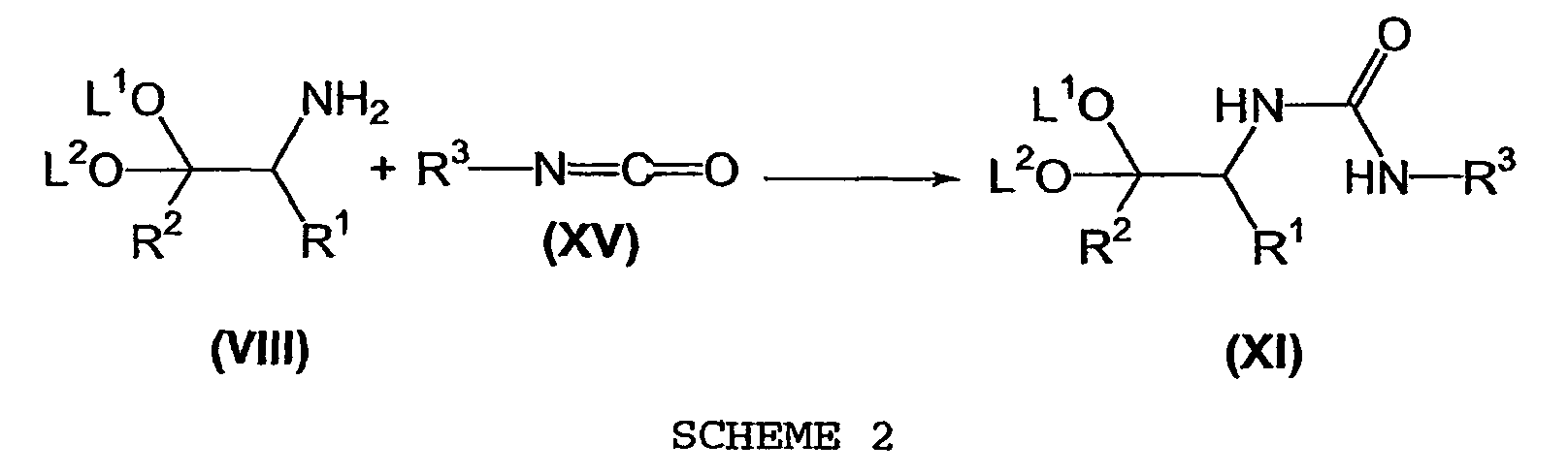
- the compound of formula (XI) may be prepared according to the process outlined in Scheme 2 wherein L 1 , L 2 , R 1 , R 2 and R 3 are as set forth above.
- the compound of formula (VIII) is reacted with a compound of formula (XV), in an inert organic solvent such as tetrahydrofuran (THF), dimethylformamide (DMF), toluene, and the like, preferably THF, preferably at room temperature, to produce the corresponding compound of formula (XI).
- an inert organic solvent such as tetrahydrofuran (THF), dimethylformamide (DMF), toluene, and the like, preferably THF, preferably at room temperature, to produce the corresponding compound of formula (XI).
- the process is used to prepare the compound of formula (II).
- the compound of formula (II) is further purified by known methods such as recrystallization from an organic solvent such as toluene, methanol, acetone, acetonitrile, and the like or from a mixture of organic solvents such as ethyl acetate/hexane, THF/toluene, ethyl acetate/toluene, and the like.
- the present invention is further directed to novel crystalline structures of the compound of formula (II).
- the crystalline forms of the compound of formula (II) may be prepared by recrystallization of the compound of formula (II) from a suitable organic solvent such as acetone, acetonitrile, THF/toluene mixture, and the like.
- Form A Recrystallization of the compound of formula (II) as described above will yield one of two novel crystalline forms, herein referred to as Form A and Form B.
- Form B is obtained by recrystallization from acetone or a mixture of THF:toluene, more preferably a 1:2 mixture of THF:toluene.
- Form A is obtained by recrystallization from acetonitrile.
- novel crystalline forms of the compound of formula (II) may be characterized by their respective x-ray powder diffraction patterns utilizing a Siemens D5000T-T based powder diffractometer using CuK ⁇ radiation and the following system conditions:
- Form A of the compound of formula (II) may be characterized by its X-ray diffraction pattern, which comprises the major peaks as listed in Table 1.
- Form B of the compound of formula (II) may be characterized by its X-ray diffraction pattern, which comprises the major peaks as listed in Table 2.
- the reaction mixture was quenched with 2N aqueous HCl (500 mL) to a pH of about 2.0, and the resulting layers were separated.
- the organic layer was extracted once with 1N aqueous HCl (100 mL).
- the combined aqueous layers were washed with ethyl acetate (2x150 mL) and then basified with addition of 50% aq. NaOH solution, to a pH of about 10.
- the basified mixture was extracted with ethyl acetate (400 mL, 2 x 100 mL).
- the combined ethyl acetate extracts were washed with water (200 mL), brine (200 mL), and dried with Na 2 SO 4 . After concentration in vacuo , the crude product was obtained as a thick brown oil. Yield: 54.70 g (79%)
- N -(3-phenylpropyl)- N' -[(2,2-dimethoxy-2-(4-pyridyl)-1-(4-fluorophenyl)ethyl)]urea (38.0 g, 86.8 mmol) was dissolved in formic acid (100 mL) to form a brown solution. The solution was heated to 95-100°C and stirred under N 2 for 24 h. The solution was then cooled to room temperature, the formic acid was removed under reduced pressure by rotoevaporator and the residue diluted with ethyl acetate (300 mL). The solution was basified with 6N NaOH to a pH of about 10. An off-white solid formed slowly in the organic layer.
- the layers were separated and the aqueous layer was extracted with t-butylmethyl ether (30 x 2 mL). The combined organic layers were washed with water (50 x 2 mL), brine (50 mL), and dried with Na 2 SO 4 . The solvent was removed in vacuo and the residue dissolved in a mixture of ethyl acetate (100 mL) and methanol (5 mL). The solution was treated with 2.88M HBr solution in ethyl acetate (9.3 mL, 26.8 mmol). The resulting yellow suspension was warmed on a steam-bath.
- N-(3-phenylpropyl)-N'-[(2,2-dimethoxy-2-(4-pyridyl)-1-(4-fluorophenyl)ethyl)] urea (224 g, 0.45 mol) was mixed with 4N HCl (800 g) and heated under reflux for 4-5 h (95-100°C). Upon completion, the reaction was cooled to room temperature and adjusted to pH 13 with 8N NaOH solution (480 g), resulting in precipitation of a solid product. The pH of the suspension was controlled to pH ⁇ 13 for 30 min, with addition of sodium hydroxide as needed. The suspension was centrifuged and the aqueous phase removed and discarded.
- the solid was resuspended in 2N NaOH solution (1000 g), centrifuged a second time and then resuspended in water (2 X 1000 g, water phase pH 7).
- the solid product was dried at 45-50°C, under vacuum (for about 4-5 days), to a final water content of ⁇ 2%, to yield the product as a tan solid. Yield: 175 g
- 1,3-Dihydro-1-(3-phenylpropyl)-4-(4-fluorophenyl)-5-(4-pyridyl)-2H-imidazol-2-one (100 g, 0.26 mol) was mixed with POBr 3 (268.7 g, 0.93 mol) and sulfolane (200 g) and the reaction mixture was heated to a temperature of 120-125°C for 1-2 h. Upon completion, the reaction mixture was cooled to 40°C. Cautiously, over about 30 min, 2N NaOH solution (53 g) was added. Additional 2N NaOH solution (53 g) was then added at faster rate.
- reaction mixture was then cooled to 15-20°C and 4N NaOH solution (802 g) was added to adjust the solution to pH 7-8.
- the aqueous phase was extracted with t-butylmethyl ether (3 X 143 g) and the organic phases combined.
- To the combined organic phase was added t-butylmethyl ether (107 g).
- the solution was washed with water (2 X 150g), resulting in the precipitation of a solid, which was collected by filtration.
- the t-butylmethyl ether phase was concentrated to 150g (about 1 ⁇ 2 volume), diluted with ethyl acetate (460 g) and concentrated again to 160g.
- the resulting oil was dissolved in ethyl acetate (460 g), HBr gas (21g, 0.26mol) was introduced and the solution heated to reflux, resulting in a separate yellow oil layer.
- Methanol (80 g) was added to the boiling mixture (65°C), resulting in formation of a solid.
- the solution was stirred and cooled to 20-25°C over about 4h.
- the mixture was stirred overnight and cooled to 5°C.
- Ethyl acetate (160g) was then added to the solution.
- the resulting precipitate was suction filtered and washed with ethyl acetate (10 g) to yield the crude product as a yellow solid.
- the crude product (63 g) was dissolved in ethyl acetate (567 g) and mixed with saturated NaHCO 3 solution (126 g). The mixture was stirred at 18-25°C for about 2h, until no further gas evolution was ascertainable. The aqueous phase was maintained at pH 8-9 with the addition of more saturated NaHCO 3 solution, as needed. The phases were separated and the organic phase was concentrated to about 1/3 volume. The resulting oil was dissolved in ethyl acetate (100g) and concentrated to dryness. The oil was suspended in acetone (95 g) and heated at reflux (56°C ⁇ 2°C) for 1h.
- the reaction mixture was filtered to collect the solid residue.
- the filtered residue was suspended with ethyl acetate (212.17 g) at 40-50°C, filtered and solvent evaporated to dryness.
- the resulting oil was dissolved completely in the first filtrate at 70°C.
- Water (148.608 g) was added to the hot solution and the phases were separated.
- the organic phase was washed twice with water (148.608 g) at 70°C.
- the phases were separated again and the organic phase washed with brine (148.608 g) and extracted with 1N HCl (2 X 146 g).
- the combined HCl phases were re-extracted with ethyl acetate (99.07 g).
- the water phase was separated.
- a reaction vessel was charged with POCl 3 (1500.0g, 9.78 mol). Br 2 (184.9g, 1.157 mol) was then added in one portion at ambient temperature. The reaction mixture was cooled to 10°C and then PBr 3 (313.0g, 1,157 mol) was added over 25 min. under vigorous stirring. The temperature of the reaction mixture increased to 20°C. After addition, stirring was continued for another 1.5h, maintaining the temperature in the range of 10-20°C. The formed PBr 5 precipitated as a yellow solid.
- the reaction mixture was warmed to 25°C and 1,3-dihydro-1-(3-phenylpropyl)-4-(4-fluorophenyl)-5-(4-pyridyl)-imidazol-2-one (150.0g 0,386 mol) was added in one portion. After addition, the reaction mixture was heated to about 30°C and stirring was continued for 24h. The suspension changed to a dark solution. The POCl 3 was distilled off under vacuum at a temperature below 35°C, to yield a viscous oil. This oil was added to a mixture of ethyl acetate (1000g) and aqueous ammonia (25 w%, 1000g) over about 1.25 hours, with cooling.
- the resulting two phases were separated, the aqueous phase was extracted with ethyl acetate (500g) and the combined organic phases were washed with water (200g) at 70°C.
- the organic phase was concentrated to approximately 30% of the original volume.
- To the warmed reaction mixture was then added triethylamine (600g) and an additional amount of the solvent (about 150g) was removed in vacuo, resulting in the crystallization of the desired product.
- the reaction mixture was cooled to 0°C and stirred for 12h.
- the product was filtered off, washed with triethylamine (50g) and dried at 40°C under vacuum, to yield the crude product.
- the mother liquor was concentrated to an oil.
Landscapes
- Chemical & Material Sciences (AREA)
- Organic Chemistry (AREA)
- Pharmaceuticals Containing Other Organic And Inorganic Compounds (AREA)
- Plural Heterocyclic Compounds (AREA)
Abstract

Description

R1 is selected from the group consisting of phenyl, substituted phenyl, (where the substituents are selected from C1-C5alkyl, halogen or trifluoromethyl) and heteroaryl, where the heteroaryl contains 5 to 6 ring atoms;
R2 is selected from the group consisting of phenyl, substituted phenyl, (where the substituents are selected from C1-C5alkyl, halogen or trifluoromethyl) and heteroaryl, where the heteroaryl contains 5 to 6 ring atoms and is optionally C1-C4alkyl substituted;
R3 is selected from the group consisting of hydrogen, arylC1-C5alkyl, substituted arylC1-C5alkyl, (where the aryl substituents are independently selected from one or more of C1-C5alkyl, C1-C5alkoxy, halogen, amino, C1-C5alkylamino or di(C1-C5alkyl)amino), phthalimidoC1-C5alkyl, succinimidoC1-C5alkyl, C1-C5alkylcarbonylC1-C5alkyl, aryloxycarbonylC1-C5alkyl, and heteroarylC1-C5akyl, where the heteroaryl contains 5 to 6 ring atoms;
R4 is

p is an integer from 0 to 9;
X is selected from the group consisting of hydrogen, hydroxy, vinyl, substituted vinyl, (where one or more substituents are selected from fluorine or chlorine), ethynyl, substituted ethynyl (where the substituent is selected from fluorine or chlorine), C1-C5alkyl, substituted C1-C5alkyl (where the alkyl substituents are selected from one or more of C1-C5alkoxy, trihaloalkyl, phthalamido or amino), C3-C7cycloalkyl, C1-C5alkoxy, substituted C1-C5alkoxy (where the alkyl substituents are selected from phthalimido or amino), phthalimidooxy, phenoxy, substituted phenoxy (where the phenyl substituents are selected from C1-C5alkyl, fluorine, chlorine or C1-C5alkoxy), phenyl, substituted phenyl (where the phenyl substituents are selected from C1-C5alkyl, fluorine, chlorine or C1-C5alkoxy), arylC1-C5alkyl, substituted arylC1-C5alkyl (where the aryl substituents are selected from C1-C5alkyl, fluorine, chlorine or C1-C5alkoxy), arylhydroxyC1-C5alkylamino, C1-C5alkylamino, di(C1-C5alkyl)amino, nitrile, oxime, benzyloxyimino, C1-C5alkyloxyamino, phthalimido, succinimido, C1-C5alkylcarbonyloxy, phenylcarbonyloxy, substituted phenylcarbonyloxy (where the phenyl substituents are selected from C1-C5alkyl, fluorine, chlorine or C1-C5alkoxy), phenylC1-C5alkylcarbonyloxy, (where the phenyl substituents are selected from C1-C5alkyl, fluorine, chlorine or C1-C5alkoxy), aminocarbonyloxy, C1-C5alkylaminocarbonyloxy, di(C1-C5alkyl)aminocarbonyloxy, C1-C5alkoxycarbonyloxy, substituted C1-C5alkoxycarbonyloxy (where the alkyl substituents are selected from the group consisting of methyl, ethyl, isopropyl and hexyl), phenoxycarbonyloxy, substituted phenoxycarbonyloxy (where the phenyl substituents are selected from C1-C5alkyl, fluorine, chlorine or C1-C5alkoxy), C1-C5alkylthio, substituted C1-C5alkylthio (where the alkyl substituents are selected from hydroxy and phthalimido), C1-C5alkylsulfonyl, phenylsulfonyl and substituted phenylsulfonyl (where the phenyl substituents are selected from fluorine, chlorine, C1-C5alkoxy or trifluoromethyl);
or pharmaceutically acceptable salts thereof;
comprising


reacting the lithium intermediate of formula (VII) with the trimethylsilyl substituted imine of formula (VI) to produce the corresponding compound of formula (VIII);




- 1mm slit, Gobel mirrors, 0.6mm slit, & vertical soller slits between tube and sample
- LiF monochromator between sample and detector
| FORM A POWDER X-RAY DIFFRACTION PEAKS | ||
| ANGLE 2 | d-Spacing (Å) | Relative Intensity (%) |
| 6.599 | 13.384 | 15.2 |
| 7.817 | 11.300 | 14.4 |
| 11.676 | 7.573 | 33.2 |
| 17.536 | 5.053 | 11.6 |
| 18.428 | 4.811 | 38.3 |
| 19.318 | 4.591 | 19.9 |
| 19.948 | 4.447 | 100.0 |
| 20.852 | 4.256 | 10.1 |
| 21.463 | 4.137 | 43.3 |
| 23.260 | 3.821 | 39.5 |
| 23.883 | 3.723 | 80.6 |
| 24.804 | 3.587 | 57.9 |
| 25.119 | 3.542 | 31.9 |
| 25.579 | 3.480 | 12.3 |
| 26.251 | 3.392 | 21.5 |
| 26.725 | 3.333 | 58.6 |
| 28.229 | 3.159 | 11.4 |
| 30.487 | 2.9296 | 23.0 |
| 31.614 | 2.8278 | 17.6 |
| FORM B POWDER X-RAY DIFFRACTION PEAKS | ||
| ANGLE °2 | d-Spacing (Å) | Relative Intensity (%) |
| 7.206 | 12.257 | 100.0 |
| 8.961 | 9.861 | 14.2 |
| 10.617 | 8.326 | 24.8 |
| 12.438 | 7.110 | 14.0 |
| 15.500 | 5.712 | 33.7 |
| 16.458 | 5.382 | 13.3 |
| 17.360 | 5.104 | 17.2 |
| 17.879 | 4.957 | 37.6 |
| 18.343 | 4.833 | 19.2 |
| 18.665 | 4.750 | 31.8 |
| 19.126 | 4.637 | 16.1 |
| 19.943 | 4.448 | 21.9 |
| 20.491 | 4.331 | 30.8 |
| 21.469 | 4.135 | 52.9 |
| 21.891 | 4.057 | 59.8 |
| 22.371 | 3.971 | 58.7 |
| 22.778 | 3.901 | 12.0 |
| 23.159 | 3.837 | 51.0 |
| 23.870 | 3.725 | 20.8 |
| 24.526 | 3.627 | 15.5 |
| 24.704 | 3.601 | 25.9 |
| 25.113 | 3.543 | 14.7 |
| 26.368 | 3.377 | 11.0 |
| 27.674 | 3.221 | 10.5 |
| 28.088 | 3.174 | 18.3 |
| 28.896 | 3.087 | 21.3 |
| 29.291 | 3.047 | 19.4 |
| 30.201 | 2.9568 | 10.6 |
| 30.501 | 2.9284 | 13.3 |
Yield: 88.91 g (62.4%)
BP 69-71°C at 1mm Hg
Yield: 54.70 g (79%)
Yield: 47.50 g
Yield: 38.00 g (47%)
Yield: 18.11 g (58%)
MP: 198-199.5°C
Yield: 5.01 g (62%),
MP: 214-216°C, (color change at 205°C)
The crude product was purified by recrystallization from a mixture of ethyl acetate/hexane to yield the product as a yellow solid.
Yield: 0.88 g (75%)
MP: 121-122°C
Yield: 175 g
Yield: 34 g (30-32%)
Yield: 20.5 g (70.5%)
Yield: 0.83 g (43%)
m.p. 162.5-165.5°C
The mother liquor was concentrated to an oil. To the oil was then added acetone (25g), resulting in precipitation of the desired product. The precipitate was filtered off, washed with acetone (7g), then with methyl tert-butylether (8g) and dried at 40°C under vacuum to yield a second crop of the crude product.
Both crops of the isolated product were slurried in a mixture of triethylamine (10g) and acetone (100g), under reflux for 30 min, then cooled to 25°C and stirred overnight. The precipitate was filtered off, washed with triethylamine (25g), then with acetone (10g) and dried at 40°C under vacuum to yield the title compound.
HPLC purity: 99%
Claims (16)
- A compound of formula (XI)wherein

R1 is selected from the group consisting of phenyl, substituted phenyl, (where the substituents are selected from C1-C5alkyl, halogen or trifluoromethyl) and heteroaryl, where the heteroaryl contains 5 to 6 ring atoms;
R2 is selected from the group consisting of phenyl, substituted phenyl, (where the substituents are selected from C1-C5alkyl, halogen or trifluoromethyl) and heteroaryl, where the heteroaryl contains 5 to 6 ring atoms and is optionally C1-C4alkyl substituted;
R3 is selected from the group consisting of hydrogen, arylC1-C5alkyl, substituted arylC1-C5alkyl, (where the aryl substituents are independently selected from one or more of C1-C5alkyl, C1-C5alkoxy, halogen, amino, C1-C5alkylamino or di(C1-C5alkyl) amino), phthalimidoC1-C5alkyl, succinimidoC1-C5alkyl, C1-C5alkylcarbonylC1-C5alkyl, aryloxycarbonylC1-C5alkyl, and heteroarylC1-C5akyl, where the heteroaryl contains 5 to 6 ring atoms; and
L1 and L2 are independently selected from the group consisting of C1-C4alkyl and C1-C4aralkyl; or L1 together with L2 is selected from the group consisting of -CH2-CH2- (optionally substituted with one to four C1-C3 alkyl), and -CH2-CH2-CH2- (optionally substituted with one to six C1-C3 alkyl). - A process for preparing a compound of formula (XI)wherein

R1 is selected from the group consisting of phenyl, substituted phenyl, (where the substituents are selected from C1-C5alkyl, halogen or trifluoromethyl) and heteroaryl, where the heteroaryl contains 5 to 6 ring atoms;
R2 is selected from the group consisting of phenyl, substituted phenyl, (where the substituents are selected from C1-C5alkyl, halogen or trifluoromethyl) and heteroaryl, where the heteroaryl contains 5 to 6 ring atoms and is optionally C1-C4alkyl substituted;
R3 is selected from the group consisting of hydrogen, arylC1-C5alkyl, substituted arylC1-C5alkyl, (where the aryl substituents are independently selected from one or more of C1-C5alkyl, C1-C5alkoxy, halogen, amino, C1-C5alkylamino or di(C1-C5alkyl)amino), phthalimidoC1-C5alkyl, succinimidoC1-C5alkyl, C1-C5alkylcarbonylC1-C5alkyl, aryloxycarbonylC1-C5alkyl, and heteroarylC1-C5akyl, where the heteroaryl contains 5 to 6 ring atoms; and
L1 and L2 are independently selected from the group consisting of C1-C4alkyl and C1-C4aralkyl; or L1 together with L2 is selected from the group consisting of -CH2-CH2- (optionally substituted with one to four C1-C3 alkyl), and -CH2-CH2-CH2- (optionally substituted with one to six C1-C3 alkyl)
comprisingreacting a compound of formula (VIII), wherein L1 and L2 are independently selected from the group consisting of C1-C4alkyl and C1-C4aralkyl; or L1 together with L2 is selected from the group consisting of -CH2-CH2- (optionally substituted with one to four C1-C3 alkyl), and -CH2-CH2-CH2- (optionally substituted with one to six C1-C3 alkyl); with a compound of formula (X), to produce the corresponding compound of formula (XI).
- A process for preparing a compound of formula (XII)wherein
R1 is selected from the group consisting of phenyl, substituted phenyl, (where the substituents are selected from C1-C5alkyl, halogen or trifluoromethyl) and heteroaryl, where the heteroaryl contains 5 to 6 ring atoms;
R2 is selected from the group consisting of phenyl, substituted phenyl, (where the substituents are selected from C1-C5alkyl, halogen or trifluoromethyl) and heteroaryl, where the heteroaryl contains 5 to 6 ring atoms and is optionally C1-C4alkyl substituted; and
R3 is selected from the group consisting of hydrogen, arylC1-C5alkyl, substituted arylC1-C5alkyl, (where the aryl substituents are independently selected from one or more of C1-C5alkyl, C1-C5alkoxy, halogen, amino, C1-C5alkylamino or di(C1-C5alkyl)amino), phthalimidoC1-C5alkyl, succinimidoC1-C5alkyl, C1-C5alkylcarbonylC1-C5alkyl, aryloxycarbonylC1-C5alkyl, and heteroarylC1-C5akyl, where the heteroaryl contains 5 to 6 ring atoms
comprisingcyclizing a compound of formula (XI), wherein L1 and L2 are independently selected from the group consisting of C1-C4alkyl and C1-C4aralkyl; or L1 together with L2 is selected from the group consisting of -CH2-CH2- (optionally substituted with one to four C1-C3 alkyl), and -CH2-CH2-CH2- (optionally substituted with one to six C1-C3 alkyl); under acid conditions of pH less than about 7, to produce the corresponding compound of formula (XII).
- A process for preparing a compound of formula (XI)wherein
R1 is selected from the group consisting of phenyl, substituted phenyl, (where the substituents are selected from C1-C5alkyl, halogen or trifluoromethyl) and heteroaryl, where the heteroaryl contains 5 to 6 ring atoms;
R2 is selected from the group consisting of phenyl, substituted phenyl, (where the substituents are selected from C1-C5alkyl, halogen or trifluoromethyl) and heteroaryl, where the heteroaryl contains 5 to 6 ring atoms and is optionally C1-C4alkyl substituted;
R3 is selected from the group consisting of hydrogen, arylC1-C5alkyl, substituted arylC1-C5alkyl, (where the aryl substituents are independently selected from one or more of C1-C5alkyl, C1-C5alkoxy, halogen, amino, C1-C5alkylamino or di(C1-C5alkyl)amino), phthalimidoC1-C5alkyl, succinimidoC1-C5alkyl, C1-C5alkylcarbonylC1-C5alkyl, aryloxycarbonylC1-C5alkyl, and heteroarylC1-C5akyl, where the heteroaryl contains 5 to 6 ring atoms; and
L1 and L2 are independently selected from the group consisting of C1-C4 alkyl and C1-C4 aralkyl; or L1 together with L2 is selected from the group consisting of -CH2-CH2- (optionally substituted with one to four C1-C3 alkyl), and -CH2-CH2-CH2- (optionally substituted with one to six C1-C3 alkyl);
comprisingreacting a compound of formula (VIII) with a compound of formula (XV), to yield the corresponding compound of formula (XI).
- A process for preparing a compound of formula (I)wherein

R1 is selected from the group consisting of phenyl, substituted phenyl, (where the substituents are selected from C1-C5alkyl, halogen or trifluoromethyl) and heteroaryl, where the heteroaryl contains 5 to 6 ring atoms;
R2 is selected from the group consisting of phenyl, substituted phenyl, (where the substituents are selected from C1-C5alkyl, halogen or trifluoromethyl) and heteroaryl, where the heteroaryl contains 5 to 6 ring atoms and is optionally C1-C4alkyl substituted;
R3 is selected from the group consisting of hydrogen, arylC1-C5alkyl, substituted arylC1-C5alkyl, (where the aryl substituents are independently selected from one or more of C1-C5alkyl, C1-C5alkoxy, halogen, amino, C1-C5alkylamino or di(C1-C5alkyl) amino) , phthalimidoC1-C5alkyl, succinimidoC1-C5alkyl, C1-C5alkylcarbonylC1-C5alkyl, aryloxycarbonylC1-C5alkyl, and heteroarylC1-C5akyl, where the heteroaryl contains 5 to 6 ring atoms;
R4 iswhere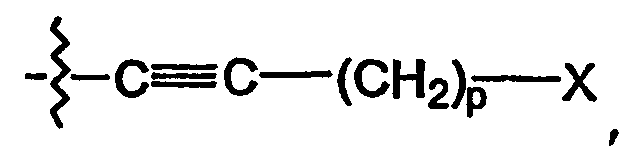
p is an integer from 0 to 9;
X is selected from the group consisting of hydrogen, hydroxy, vinyl, substituted vinyl, (where one or more substituents are selected from fluorine or chlorine), ethynyl, substituted ethynyl (where the substituent is selected from fluorine or chlorine), C1-C5alkyl, substituted C1-C5alkyl (where the alkyl substituents are selected from one or more of C1-C5alkoxy, trihaloalkyl, phthalamido or amino) , C3-C7cycloalkyl, C1-C5alkoxy, substituted C1-C5alkoxy (where the alkyl substituents are selected from phthalimido or amino), phthalimidooxy, phenoxy, substituted phenoxy (where the phenyl substituents are selected from C1-C5alkyl, fluorine, chlorine or C1-C5alkoxy), phenyl, substituted phenyl (where the phenyl substituents are selected from C1-C5alkyl, fluorine, chlorine or C1-C5alkoxy), arylC1-C5alkyl, substituted arylC1-C5alkyl (where the aryl substituents are selected from C1-C5alkyl, fluorine, chlorine or C1-C5alkoxy), arylhydroxyC1-C5alkylamino, C1-C5alkylamino, di(C1-C5alkyl)amino, nitrile, oxime, benzyloxyimino, C1-C5alkyloxyamino, phthalimido, succinimido, C1-C5alkylcarbonyloxy, phenylcarbonyloxy, substituted phenylcarbonyloxy (where the phenyl substituents are selected from C1-C5alkyl, fluorine, chlorine or C1-C5alkoxy), phenylC1-C5alkylcarbonyloxy, (where the phenyl substituents are selected from C1-C5alkyl, fluorine, chlorine or C1-C5alkoxy), aminocarbonyloxy, C1-C5alkylaminocarbonyloxy, di(C1-C5alkyl)aminocarbonyloxy, C1-C5alkoxycarbonyloxy, substituted C1-C5alkoxycarbonyloxy (where the alkyl substituents are selected from the group consisting of methyl, ethyl, isopropyl and hexyl), phenoxycarbonyloxy, substituted phenoxycarbonyloxy (where the phenyl substituents are selected from C1-C5alkyl, fluorine, chlorine or C1-C5alkoxy), C1-C5alkylthio, substituted C1-C5alkylthio (where the alkyl substituents are selected from hydroxy and phthalimido), C1-C5alkylsulfonyl, phenylsulfonyl and substituted phenylsulfonyl (where the phenyl substituents are selected from fluorine, chlorine, C1-C5alkoxy or trifluoromethyl);
or pharmaceutically acceptable salts thereof;
comprisingreacting a compound of formula (VIII), wherein L1 and L2 are independently selected from the group consisting of C1-C4alkyl and C1-C4aralkyl; or L1 together with L2 is selected from the group consisting of -CH2-CH2- (optionally substituted with one to four C1-C3 alkyl), and -CH2-CH2-CH2- (optionally substituted with one to six C1-C3 alkyl); with a compound of formula (X), to produce the corresponding compound of formula (XI);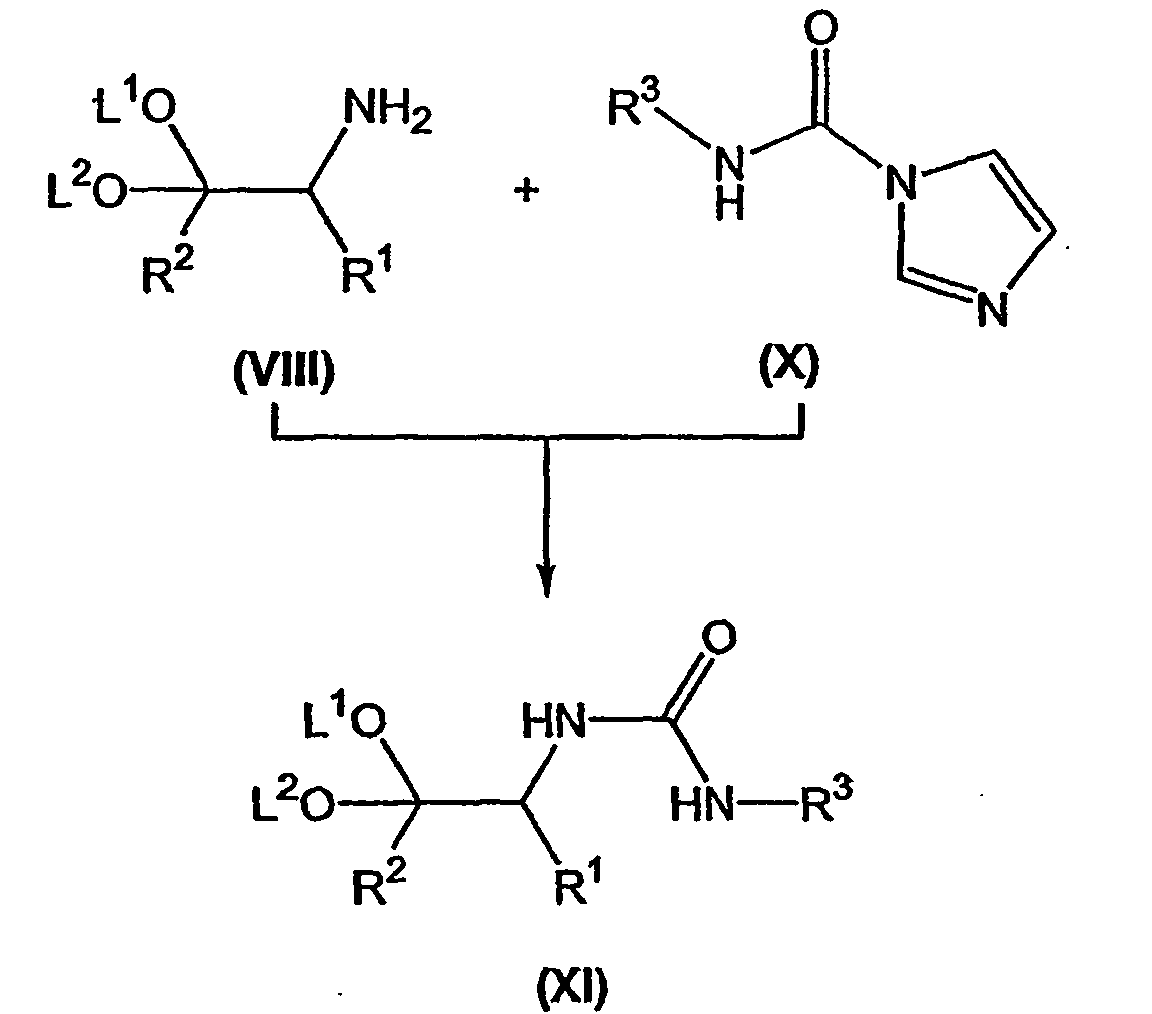 cyclizing the compound of formula (XI), under acid conditions of pH less than about 7, to produce the corresponding compound of formula (XII);
 reacting the compound of formula (XII) with POBr3, PBr5, or a mixture of PBr3 and Br2, to yield the corresponding compound of formula (XIII);
 displacing the bromine on the compound of formula (XIII) by reacting with a compound of formula (XIV), to produce the corresponding compound of formula (I).
- A process for preparing a compound of formula (I)wherein

R1 is selected from the group consisting of phenyl, substituted phenyl, (where the substituents are selected from C1-C5alkyl, halogen or trifluoromethyl) and heteroaryl, where the heteroaryl contains 5 to 6 ring atoms;
R2 is selected from the group consisting of phenyl, substituted phenyl, (where the substituents are selected from C1-C5alkyl, halogen or trifluoromethyl) and heteroaryl, where the heteroaryl contains 5 to 6 ring atoms and is optionally C1-C4alkyl substituted;
R3 is selected from the group consisting of hydrogen, arylC1-C5alkyl, substituted arylC1-C5alkyl, (where the aryl substituents are independently selected from one or more of C1-C5alkyl, C1-C5alkoxy, halogen, amino, C1-C5alkylamino or di(C1-C5alkyl)amino), phthalimidoC1-C5alkyl, succinimidoC1-C5alkyl, C1-C5alkylcarbonylC1-C5alkyl, aryloxycarbonylC1-C5alkyl, and heteroarylC1-C5akyl, where the heteroaryl contains 5 to 6 ring atoms;
R4 iswhere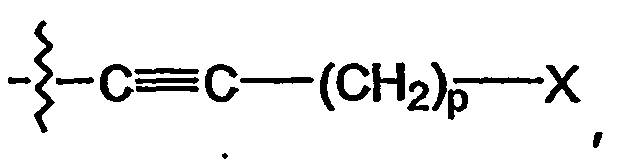
p is an integer from 0 to 9;
X is selected from the group consisting of hydrogen, hydroxy, vinyl, substituted vinyl, (where one or more substituents are selected from fluorine or chlorine), ethynyl, substituted ethynyl (where the substituent is selected from fluorine or chlorine), C1-C5alkyl, substituted C1-C5alkyl (where the alkyl substituents are selected from one or more of C1-C5alkoxy, trihaloalkyl, phthalamido or amino), C3-C7cycloalkyl, C1-C5alkoxy, substituted C1-C5alkoxy (where the alkyl substituents are selected from phthalimido or amino), phthalimidooxy, phenoxy, substituted phenoxy (where the phenyl substituents are selected from C1-C5alkyl, fluorine, chlorine or C3-C5alkoxy), phenyl, substituted phenyl (where the phenyl substituents are selected from C1-C5alkyl, fluorine, chlorine or C1-C5alkoxy), arylC1-C5alkyl, substituted arylC1-C5alkyl (where the aryl substituents are selected from C1-C5alkyl, fluorine, chlorine or C1-C5alkoxy), arylhydroxyC1-C5alkylamino, C1-C5alkylamino, di(C1-C5alkyl)amino, nitrile, oxime, benzyloxyimino, C1-C5alkyloxyamino, phthalimido, succinimido, C1-C5alkylcarbonyloxy, phenylcarbonyloxy, substituted phenylcarbonyloxy (where the phenyl substituents are selected from C1-C5alkyl, fluorine, chlorine or C1-C5alkoxy), phenylC1-C5alkylcarbonyloxy, (where the phenyl substituents are selected from C1-C5alkyl, fluorine, chlorine or C1-C5alkoxy), aminocarbonyloxy, C1-C5alkylaminocarbonyloxy, di(C1-C5alkyl)aminocarbonyloxy, C1-C5alkoxycarbonyloxy, substituted C1-C5alkoxycarbonyloxy (where the alkyl substituents are selected from the group consisting of methyl, ethyl, isopropyl and hexyl), phenoxycarbonyloxy, substituted phenoxycarbonyloxy (where the phenyl substituents are selected from C1-C5alkyl, fluorine, chlorine or C1-C5alkoxy), C1-C5alkylthio, substituted C1-C5alkylthio (where the alkyl substituents are selected from hydroxy and phthalimido), C1-C5alkylsulfonyl, phenylsulfonyl and substituted phenylsulfonyl (where the phenyl substituents are selected from fluorine, chlorine, C1-C5alkoxy or trifluoromethyl);
or pharmaceutically acceptable salts thereof;
comprisingcyclizing a compound of formula (XI), wherein L1 and L2 are independently selected from the group consisting of C1-C4alkyl and C1-C4aralkyl; or L1 together with L2 is selected from the group consisting of -CH2-CH2- (optionally substituted with one to four C1-C3 alkyl) , and -CH2-CH2-CH2- (optionally substituted with one to six C1-C3 alkyl), under acid conditions of pH less than about 7, to produce the corresponding compound of formula (XII); reacting the compound of formula (XII) with POBr3, PBr5, or a mixture of PBr3 and Br2, to yield the corresponding compound of formula (XIII);
 displacing the bromine on the compound of formula (XIII) by reacting with a compound of formula (XIV), to produce the corresponding compound of formula (I).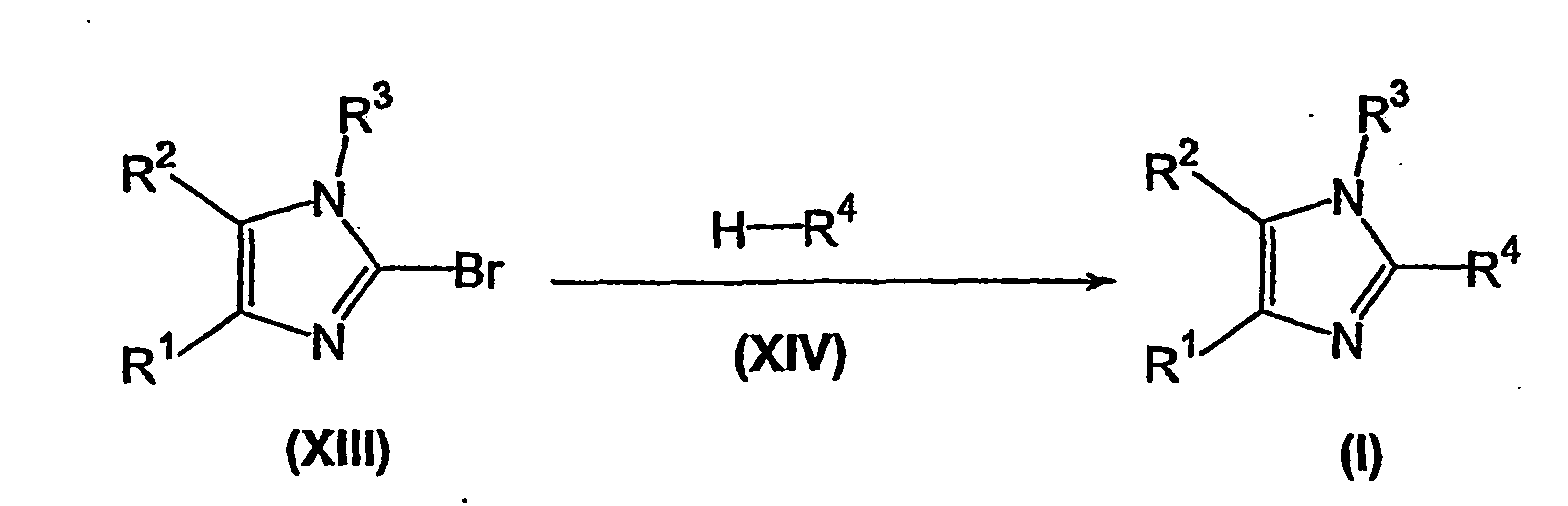
- The process of Claim 5 wherein the compound of formula (XII) is reacted with POBr3 in tetramethylenesulfone.
- The process of claim 5, wherein the compound of formula (XII) is reacted with about a 1:1 mixture of PBr3 and Br2 in POCl3.
- A process for preparing a compound of formula (I)wherein
R1 is selected from the group consisting of phenyl, substituted phenyl, (where the substituents are selected from C1-C5alkyl, halogen or trifluoromethyl) and heteroaryl, where the heteroaryl contains 5 to 6 ring atoms;
R2 is selected from the group consisting of phenyl, substituted phenyl, (where the substituents are selected from C1-C5alkyl, halogen or trifluoromethyl) and heteroaryl, where the heteroaryl contains 5 to 6 ring atoms and is optionally C1-C4alkyl substituted;
R3 is selected from the group consisting of hydrogen, arylC1-C5alkyl, substituted arylC1-C5alkyl, (where the aryl substituents are independently selected from one or more of C1-C5alkyl, C1-C5alkoxy, halogen, amino, C1-C5alkylamino or di(C1-C5alkyl)amino), phthalimidoC1-C5alkyl, succinimidoC1-C5alkyl, C1-C5alkylcarbonylC1-C5alkyl, aryloxycarbonylC1-C5alkyl, and heteroarylC1-C5akyl, where the heteroaryl contains 5 to 6 ring atoms;
R4 iswhere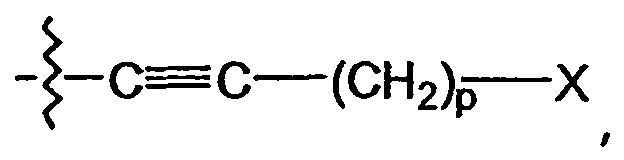
p is an integer from 0 to 9;
X is selected from the group consisting of hydrogen, hydroxy, vinyl, substituted vinyl, (where one or more substituents are selected from fluorine or chlorine), ethynyl, substituted ethynyl (where the substituent is selected from fluorine or chlorine), C1-C5alkyl, substituted C1-C5alkyl (where the alkyl substituents are selected from one or more of C1-C5alkoxy, trihaloalkyl, phthalamido or amino) , C3-C7cycloalkyl, C1-C5alkoxy, substituted C1-C5alkoxy (where the alkyl substituents are selected from phthalimido or amino), phthalimidooxy, phenoxy, substituted phenoxy (where the phenyl substituents are selected from C1-C5alkyl, fluorine, chlorine or C1-C5alkoxy), phenyl, substituted phenyl (where the phenyl substituents are selected from C1-C5alkyl, fluorine, chlorine or C1-C5alkoxy) , arylC1-C5alkyl, substituted arylC1-C5alkyl (where the aryl substituents are selected from C1-C5alkyl, fluorine, chlorine or C1-C5alkoxy), arylhydroxyC1-C5alkylamino, C1-C5alkylamino, di(C1-C5alkyl)amino, nitrile, oxime, benzyloxyimino, C1-C5alkyloxyamino, phthalimido, succinimido, C1-C5alkylcarbonyloxy, phenylcarbonyloxy, substituted phenylcarbonyloxy (where the phenyl substituents are selected from C1-C5alkyl, fluorine, chlorine or C1-C5alkoxy), phenylC1-C5alkylcarbonyloxy, (where the phenyl substituents are selected from C1-C5alkyl, fluorine, chlorine or C1-C5alkoxy), aminocarbonyloxy, C1-C5alkylaminocarbonyloxy, di(C1-C5alkyl)aminocarbonyloxy, C1-C5alkoxycarbonyloxy, substituted C1-C5alkoxycarbonyloxy (where the alkyl substituents are selected from the group consisting of methyl, ethyl, isopropyl and hexyl), phenoxycarbonyloxy, substituted phenoxycarbonyloxy (where the phenyl substituents are selected from C1-C5alkyl, fluorine, chlorine or C1-C5alkoxy), C1-C5alkylthio, substituted C1-C5alkylthio (where the alkyl substituents are selected from hydroxy and phthalimido), C1-C5alkylsulfonyl, phenylsulfonyl and substituted phenylsulfonyl (where the phenyl substituents are selected from fluorine, chlorine, C1-C5alkoxy or trifluoromethyl);
or pharmaceutically acceptable salts thereof;
comprisingreacting the compound of formula (XII) with POBr3, PBr5, or a mixture of PBr3 and Br2, to yield the corresponding compound of formula (XIII); displacing the bromine on the compound of formula (XIII) by reacting with a compound of formula (XIV), to produce the corresponding compound of formula (I).
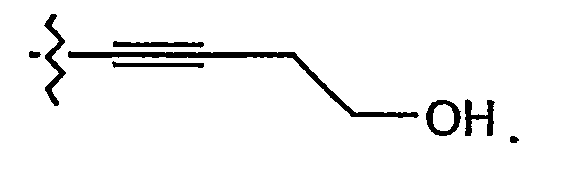
- The process of Claim 5 wherein R1 is 4-fluorophenyl, R2 is 4-pyridyl, R3 is 3-phenylpropyl and R4 is

- The process of Claim 9 wherein R1 is 4-fluorophenyl, R2 is 4-pyridyl, R3 is 3-phenylpropyl and R4 is
- The process of Claim 9 wherein the compound of formula (XII) is reacted with POBr3 in tetramethylenesulfone.
- The process of Claim 9, wherein the compound of formula (XII) is reacted with about a 1:1 mixture of PBr3 and Br2 in POCl3.
- A compound of the formula (XII)wherein
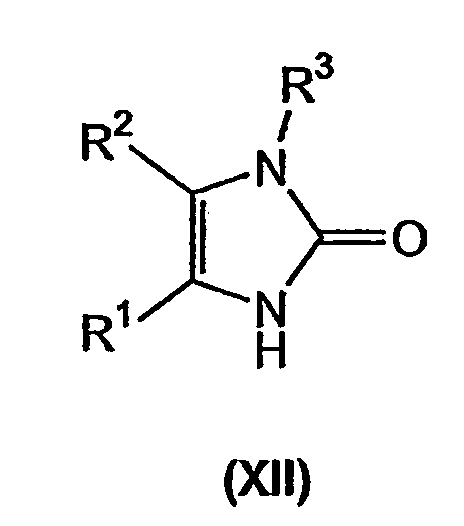
R1 is selected from the group consisting of phenyl, substituted phenyl, (where the substituents are selected from C1-C5alkyl, halogen or trifluoromethyl) and heteroaryl, where the heteroaryl contains 5 to 6 ring atoms;
R2 is selected from the group consisting of phenyl, substituted phenyl, (where the substituents are selected from C1-C5alkyl, halogen or trifluoromethyl) and heteroaryl, where the heteroaryl contains 5 to 6 ring atoms and is optionally C1-C4alkyl substituted; and
R3 is selected from the group consisting of hydrogen, arylC1-C5alkyl, substituted arylC1-C5alkyl, (where the aryl substituents are independently selected from one or more of C1-C5alkyl, C1-C5alkoxy, halogen, amino, C1-C5alkylamino or di(C1-C5alkyl) amino), phthalimidoC1-C5alkyl, succinimidoC1-C5alkyl, C1-C5alkylcarbonylC1-C5alkyl, aryloxycarbonylC1-C5alkyl, and heteroarylC1-C5akyl, where the heteroaryl contains 5 to 6 ring atoms. - A process for preparing a compound of formula (XIII)wherein

R1 is selected from the group consisting of phenyl, substituted phenyl, (where the substituents are selected from C1-C5alkyl, halogen or trifluoromethyl) and heteroaryl, where the heteroaryl contains 5 to 6 ring atoms;
R2 is selected from the group consisting of phenyl, substituted phenyl, (where the substituents are selected from C1-C5alkyl, halogen or trifluoromethyl) and heteroaryl, where the heteroaryl contains 5 to 6 ring atoms and is optionally C1-C4alkyl substituted; and
R3 is selected from the group consisting of hydrogen, arylC1-C5alkyl, substituted arylC1-C5alkyl, (where the aryl substituents are independently selected from one or more of C1-C5alkyl, C1-C5alkoxy, halogen, amino, C1-C5alkylamino or di(C1-C5alkyl)amino), phthalimidoC1-C5alkyl, succinimidoC1-C5alkyl, C1-C5alkylcarbonylC1-C5alkyl, aryloxycarbonylC1-C5alkyl, and heteroarylC1-C5akyl, where the heteroaryl contains 5 to 6 ring atoms
comprisingreacting a compound of formula (XII) with POBr3, PBr5, or a mixture of PBr3 and Br2, to yield the corresponding compound of formula (XIII).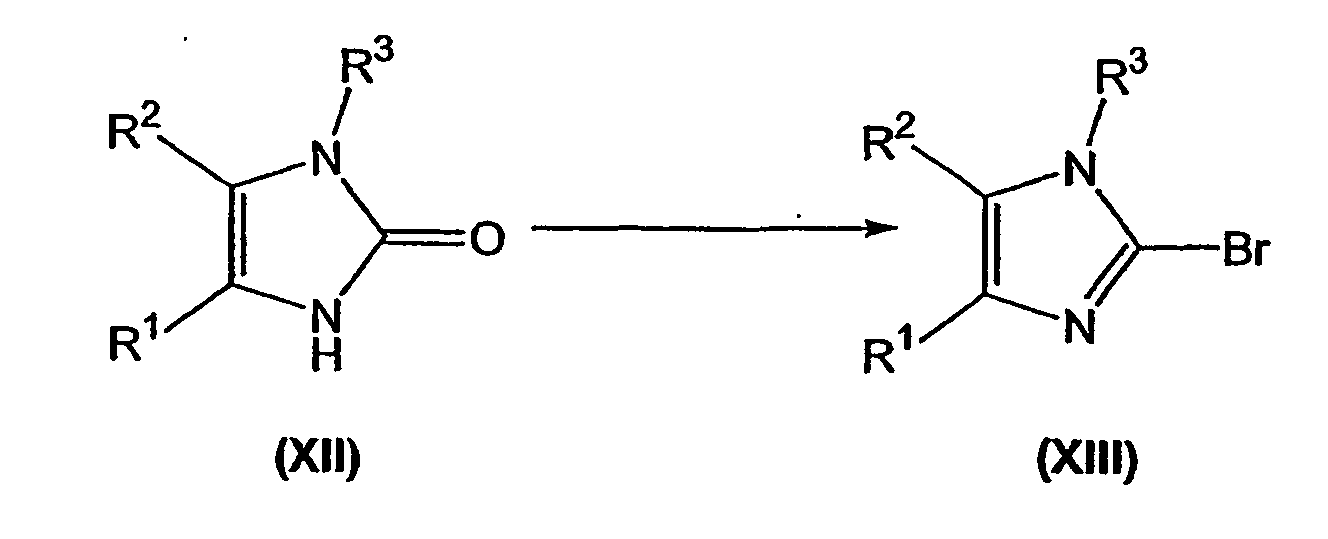
- A crystalline form of the compound of formula (II)comprising the following x-ray powder diffraction peaks:

ANGLE °2 d-Spacing (Å) Relative Intensity (%) 7.206 12.257 100.0 8.961 9.861 14.2 10.617 8.326 24.8 12.438 7.110 14.0 15.500 5.712 33.7 16.458 5.382 13.3 17.360 5.104 17.2 17.879 4.957 37.6 18.343 4.833 19.2 18.665 4.750 31.8 19.126 4.637 16.1 19.943 4.448 21.9 20.491 4.331 30.8 21.469 4.135 52.9 21.891 4.057 59.8 22.371 3.971 58.7 22.778 3.901 12.0 23.159 3.837 51.0 23.870 3.725 20.8 24.526 3.627 15.5 24.704 3.601 25.9 25.113 3.543 14.7 26.368 3.377 11.0 27.674 3.221 10.5 28.088 3.174 18.3 28.896 3.087 21.3 29.291 3.047 19.4 30.201 2.9568 10.6 30.501 2.9284 13.3
Applications Claiming Priority (3)
| Application Number | Priority Date | Filing Date | Title |
|---|---|---|---|
| US27860701P | 2001-03-26 | 2001-03-26 | |
| US278607 | 2001-03-26 | ||
| EP02753758A EP1392678A2 (en) | 2001-03-26 | 2002-02-22 | Process for the preparation of tetrasubstituted imidazole derivatives and novel crystalline structures thereof |
Related Parent Applications (1)
| Application Number | Title | Priority Date | Filing Date |
|---|---|---|---|
| EP02753758A Division EP1392678A2 (en) | 2001-03-26 | 2002-02-22 | Process for the preparation of tetrasubstituted imidazole derivatives and novel crystalline structures thereof |
Publications (2)
| Publication Number | Publication Date |
|---|---|
| EP1508569A2 true EP1508569A2 (en) | 2005-02-23 |
| EP1508569A3 EP1508569A3 (en) | 2005-09-14 |
Family
ID=33566309
Family Applications (2)
| Application Number | Title | Priority Date | Filing Date |
|---|---|---|---|
| EP04077600A Withdrawn EP1506966A3 (en) | 2001-03-26 | 2002-02-22 | Process for the preparation of tetrasubstituted imidazole derivatives and novel crystaline structures thereof |
| EP04077597A Withdrawn EP1508569A3 (en) | 2001-03-26 | 2002-02-22 | Process for the preparation of tetrasubstituted imidazole derivatives and novel crystalline structures thereof |
Family Applications Before (1)
| Application Number | Title | Priority Date | Filing Date |
|---|---|---|---|
| EP04077600A Withdrawn EP1506966A3 (en) | 2001-03-26 | 2002-02-22 | Process for the preparation of tetrasubstituted imidazole derivatives and novel crystaline structures thereof |
Country Status (1)
| Country | Link |
|---|---|
| EP (2) | EP1506966A3 (en) |
Families Citing this family (1)
| Publication number | Priority date | Publication date | Assignee | Title |
|---|---|---|---|---|
| CN102399211A (en) * | 2011-07-29 | 2012-04-04 | 山东永农作物科学有限公司 | Preparation method of 3-bromo-1- (3-chloro-2-pyridyl) -4, 5-dihydro-1H-pyrazole-5-formate |
Family Cites Families (6)
| Publication number | Priority date | Publication date | Assignee | Title |
|---|---|---|---|---|
| DE1010969B (en) * | 1953-07-03 | 1957-06-27 | Hoffmann La Roche | Process for the preparation of new 2-imidazolones |
| DE2950478A1 (en) * | 1979-12-14 | 1981-06-19 | A. Nattermann & Cie GmbH, 5000 Köln | 2-Oxo-4-imidazoline-1-alkanoic acid derivs. - with antithrombotic, anti-arteriosclerotic and antiinflammatory activity, prepd. e.g. by reaction of benzoin cpd. with ureido-alkanoic acid |
| DE3504677A1 (en) * | 1985-02-12 | 1986-08-14 | A. Nattermann & Cie GmbH, 5000 Köln | Novel imidazol-2-yloxyalkanoic acids and their derivatives, processes for their preparation and pharmaceutical preparations containing them |
| ES2149201T3 (en) * | 1992-02-11 | 2000-11-01 | Smithkline Beecham Corp | COA-IT AND PAF INHIBITORS. |
| HUP0002842A3 (en) * | 1997-04-24 | 2002-01-28 | Ortho Mcneil Pharm Inc | Substituted imidazoles, process for producing them, pharmaceutical compositions containing them, their use and their intermediates |
| FR2772377B1 (en) * | 1997-12-12 | 2000-01-07 | Synthelabo | DERIVATIVES OF 1- (1-H-IMIDAZOL-2-YL) PYRROLIDINES AND 1- (1-H-IMIDAZOL-2-YLPIPERIDINES), THEIR PREPARATION AND THEIR THERAPEUTIC APPLICATION |
-
2002
- 2002-02-22 EP EP04077600A patent/EP1506966A3/en not_active Withdrawn
- 2002-02-22 EP EP04077597A patent/EP1508569A3/en not_active Withdrawn
Also Published As
| Publication number | Publication date |
|---|---|
| EP1508569A3 (en) | 2005-09-14 |
| EP1506966A2 (en) | 2005-02-16 |
| EP1506966A3 (en) | 2005-09-14 |
Similar Documents
| Publication | Publication Date | Title |
|---|---|---|
| KR101719891B1 (en) | Method of producing 4-[5-(pyridin-4-yl)-1h-1,2,4-triazole-3-yl]pyridin-2-carbonitrile, and intermediary thereof | |
| US9663490B2 (en) | Process for making reverse transcriptase inhibitors | |
| CN120247782B (en) | Fluopyram compounds and preparation methods thereof | |
| US11161851B2 (en) | Processes to produce acalabrutinib | |
| CN121045113A (en) | An intermediate for the synthesis of dronedarone and its preparation method | |
| KR101493488B1 (en) | Novel pyridine derivatives and method for preparation of intermediate compound for producing sulfonylurea herbicides using the same | |
| KR890000706B1 (en) | Method for preparing 1,6-naphthyridine derivative | |
| US7132544B2 (en) | Process for the preparation of tetrasubstituted imidazole derivatives and novel crystalline structures thereof | |
| IL116384A (en) | Ylidene compounds and their preparation | |
| EP1506966A2 (en) | Process for the preparation of tetrasubstituted imidazole derivatives and novel crystaline structures thereof | |
| AU2020386643A1 (en) | Process for the synthesis of (3-chloro-2-pyridyl)hydrazine | |
| JP2524491B2 (en) | Novel aminocarboxylic acid ester and process for producing the same | |
| HK1071891A (en) | Process for the preparation of tetrasubstituted imidazole derivatives and novel crystalline structures thereof | |
| AU2002306565A1 (en) | Process for the preparation of tetrasubstituted imidazole derivatives and novel crystalline structures thereof | |
| NZ538325A (en) | Process for the preparation of tetrasubstituted imidazole derivatives and novel crystalline structures thereof | |
| EP2094661A2 (en) | Process for the preparation of atazanavir | |
| SK13582001A3 (en) | Process of preparing 3S-3-amino-3-aryl propionic acid and derivatives thereof | |
| CN116143713B (en) | 1,4-Diazacycloheptane series derivatives and preparation methods thereof | |
| HUT74162A (en) | Novel naphthyridine derivatives, process for their production and pharmaceutical compositions containing them in particular their application as antiproliferative | |
| EP2011792A1 (en) | 2-alkenyl-3-aminothiophene derivative and method for producing the same | |
| KR20250090216A (en) | Process for Preparing Relugolix | |
| KR100453379B1 (en) | Method for preparing piperidine derivatives | |
| JP2020158500A (en) | Method for producing 1,3,4-oxa (thia) diazole-2-amine derivative | |
| CN112300122A (en) | Triazole heterocyclic compounds and synthesis method thereof | |
| CZ302270B6 (en) | 1-(6-Methylpyridin-3-yl)-2-[(4-(methylsulfonyl)phenyl]ethanone and process for preparing thereof |
Legal Events
| Date | Code | Title | Description |
|---|---|---|---|
| PUAI | Public reference made under article 153(3) epc to a published international application that has entered the european phase |
Free format text: ORIGINAL CODE: 0009012 |
|
| AC | Divisional application: reference to earlier application |
Ref document number: 1392678 Country of ref document: EP Kind code of ref document: P |
|
| AK | Designated contracting states |
Kind code of ref document: A2 Designated state(s): AT BE CH CY DE DK ES FI FR GB GR IE IT LI LU MC NL PT SE TR |
|
| PUAL | Search report despatched |
Free format text: ORIGINAL CODE: 0009013 |
|
| REG | Reference to a national code |
Ref country code: HK Ref legal event code: DE Ref document number: 1071891 Country of ref document: HK |
|
| AK | Designated contracting states |
Kind code of ref document: A3 Designated state(s): AT BE CH CY DE DK ES FI FR GB GR IE IT LI LU MC NL PT SE TR |
|
| RIN1 | Information on inventor provided before grant (corrected) |
Inventor name: ZHONG, HUA Inventor name: SCHULTZ, THOMAS W. Inventor name: MULLER, STEFAN,SRI CONSULTING Inventor name: ABDEL-MAGID, AHMED Inventor name: ROSSLER, ARMIN,CILAG AG Inventor name: DUBBERKE, SILKE Inventor name: OTTEN, THOMAS Inventor name: KOREY, DANIEL J. Inventor name: WALKER, DONALD G. |
|
| 17P | Request for examination filed |
Effective date: 20060220 |
|
| AKX | Designation fees paid |
Designated state(s): AT BE CH CY DE DK ES FI FR GB GR IE IT LI LU MC NL PT SE TR |
|
| 17Q | First examination report despatched |
Effective date: 20070411 |
|
| STAA | Information on the status of an ep patent application or granted ep patent |
Free format text: STATUS: THE APPLICATION IS DEEMED TO BE WITHDRAWN |
|
| 18D | Application deemed to be withdrawn |
Effective date: 20070822 |
|
| REG | Reference to a national code |
Ref country code: HK Ref legal event code: WD Ref document number: 1071891 Country of ref document: HK |