EP1507260A1 - Information recording and reproducing apparatus, information recording and reproducing method and information recording and reproducing program - Google Patents
Information recording and reproducing apparatus, information recording and reproducing method and information recording and reproducing program Download PDFInfo
- Publication number
- EP1507260A1 EP1507260A1 EP04019225A EP04019225A EP1507260A1 EP 1507260 A1 EP1507260 A1 EP 1507260A1 EP 04019225 A EP04019225 A EP 04019225A EP 04019225 A EP04019225 A EP 04019225A EP 1507260 A1 EP1507260 A1 EP 1507260A1
- Authority
- EP
- European Patent Office
- Prior art keywords
- information
- contents
- path
- recording
- path information
- Prior art date
- Legal status (The legal status is an assumption and is not a legal conclusion. Google has not performed a legal analysis and makes no representation as to the accuracy of the status listed.)
- Withdrawn
Links
- 238000000034 method Methods 0.000 title claims description 98
- 230000005540 biological transmission Effects 0.000 claims abstract description 44
- 230000010365 information processing Effects 0.000 claims description 56
- 238000003672 processing method Methods 0.000 claims description 4
- 230000003287 optical effect Effects 0.000 description 30
- 238000006243 chemical reaction Methods 0.000 description 8
- 238000010586 diagram Methods 0.000 description 7
- 238000012937 correction Methods 0.000 description 4
- 230000002401 inhibitory effect Effects 0.000 description 4
- 230000005764 inhibitory process Effects 0.000 description 3
- 238000004891 communication Methods 0.000 description 2
- 238000007796 conventional method Methods 0.000 description 1
- 230000005236 sound signal Effects 0.000 description 1
Images






Classifications
-
- G—PHYSICS
- G11—INFORMATION STORAGE
- G11B—INFORMATION STORAGE BASED ON RELATIVE MOVEMENT BETWEEN RECORD CARRIER AND TRANSDUCER
- G11B20/00—Signal processing not specific to the method of recording or reproducing; Circuits therefor
- G11B20/00086—Circuits for prevention of unauthorised reproduction or copying, e.g. piracy
- G11B20/00731—Circuits for prevention of unauthorised reproduction or copying, e.g. piracy involving a digital rights management system for enforcing a usage restriction
- G11B20/00746—Circuits for prevention of unauthorised reproduction or copying, e.g. piracy involving a digital rights management system for enforcing a usage restriction wherein the usage restriction can be expressed as a specific number
- G11B20/00753—Circuits for prevention of unauthorised reproduction or copying, e.g. piracy involving a digital rights management system for enforcing a usage restriction wherein the usage restriction can be expressed as a specific number wherein the usage restriction limits the number of copies that can be made, e.g. CGMS, SCMS, or CCI flags
- G11B20/00768—Circuits for prevention of unauthorised reproduction or copying, e.g. piracy involving a digital rights management system for enforcing a usage restriction wherein the usage restriction can be expressed as a specific number wherein the usage restriction limits the number of copies that can be made, e.g. CGMS, SCMS, or CCI flags wherein copy control information is used, e.g. for indicating whether a content may be copied freely, no more, once, or never, by setting CGMS, SCMS, or CCI flags
-
- G—PHYSICS
- G11—INFORMATION STORAGE
- G11B—INFORMATION STORAGE BASED ON RELATIVE MOVEMENT BETWEEN RECORD CARRIER AND TRANSDUCER
- G11B20/00—Signal processing not specific to the method of recording or reproducing; Circuits therefor
- G11B20/00086—Circuits for prevention of unauthorised reproduction or copying, e.g. piracy
-
- G—PHYSICS
- G11—INFORMATION STORAGE
- G11B—INFORMATION STORAGE BASED ON RELATIVE MOVEMENT BETWEEN RECORD CARRIER AND TRANSDUCER
- G11B20/00—Signal processing not specific to the method of recording or reproducing; Circuits therefor
- G11B20/00086—Circuits for prevention of unauthorised reproduction or copying, e.g. piracy
- G11B20/00884—Circuits for prevention of unauthorised reproduction or copying, e.g. piracy involving a watermark, i.e. a barely perceptible transformation of the original data which can nevertheless be recognised by an algorithm
-
- H—ELECTRICITY
- H04—ELECTRIC COMMUNICATION TECHNIQUE
- H04N—PICTORIAL COMMUNICATION, e.g. TELEVISION
- H04N5/00—Details of television systems
- H04N5/76—Television signal recording
- H04N5/91—Television signal processing therefor
- H04N5/913—Television signal processing therefor for scrambling ; for copy protection
-
- H—ELECTRICITY
- H04—ELECTRIC COMMUNICATION TECHNIQUE
- H04N—PICTORIAL COMMUNICATION, e.g. TELEVISION
- H04N5/00—Details of television systems
- H04N5/76—Television signal recording
- H04N5/91—Television signal processing therefor
- H04N5/913—Television signal processing therefor for scrambling ; for copy protection
- H04N2005/91307—Television signal processing therefor for scrambling ; for copy protection by adding a copy protection signal to the video signal
- H04N2005/91328—Television signal processing therefor for scrambling ; for copy protection by adding a copy protection signal to the video signal the copy protection signal being a copy management signal, e.g. a copy generation management signal [CGMS]
-
- H—ELECTRICITY
- H04—ELECTRIC COMMUNICATION TECHNIQUE
- H04N—PICTORIAL COMMUNICATION, e.g. TELEVISION
- H04N5/00—Details of television systems
- H04N5/76—Television signal recording
- H04N5/91—Television signal processing therefor
- H04N5/913—Television signal processing therefor for scrambling ; for copy protection
- H04N2005/91307—Television signal processing therefor for scrambling ; for copy protection by adding a copy protection signal to the video signal
- H04N2005/91335—Television signal processing therefor for scrambling ; for copy protection by adding a copy protection signal to the video signal the copy protection signal being a watermark
-
- H—ELECTRICITY
- H04—ELECTRIC COMMUNICATION TECHNIQUE
- H04N—PICTORIAL COMMUNICATION, e.g. TELEVISION
- H04N5/00—Details of television systems
- H04N5/76—Television signal recording
- H04N5/84—Television signal recording using optical recording
- H04N5/85—Television signal recording using optical recording on discs or drums
-
- H—ELECTRICITY
- H04—ELECTRIC COMMUNICATION TECHNIQUE
- H04N—PICTORIAL COMMUNICATION, e.g. TELEVISION
- H04N9/00—Details of colour television systems
- H04N9/79—Processing of colour television signals in connection with recording
- H04N9/80—Transformation of the television signal for recording, e.g. modulation, frequency changing; Inverse transformation for playback
- H04N9/804—Transformation of the television signal for recording, e.g. modulation, frequency changing; Inverse transformation for playback involving pulse code modulation of the colour picture signal components
- H04N9/8042—Transformation of the television signal for recording, e.g. modulation, frequency changing; Inverse transformation for playback involving pulse code modulation of the colour picture signal components involving data reduction
Definitions
- the present invention relates to an information recording technique for an information recording medium, and specially relates to copy control in recording contents.
- a copy protection system of preventing the illegal copy at the time of recording and transmitting the contents, by adding copy control information to the contents, e.g., by embedding it to a digital signal as an electronic watermark, or by encrypting the contents.
- a reproducing apparatus and a recording apparatus which are in conformity with the copy protection system can discriminate such copy control information, and can recognize permission or inhibition of copying the contents and a number of times of the copying.
- the above-mentioned method is effective when the contents are given and received as the digital signal.
- the illegal copy of the contents by using an illegal apparatus cannot be sufficiently eliminated, after the contents pass through an analog path.
- the present invention has been achieved in order to solve the above problems. It is an obj ect of this invention to provide an information recording and reproducing apparatus, an information recording and reproducing method and an information recording and reproducing program which can effectively inhibit reproducing and recording of contents passing through an illegal apparatus even when the contents are given and received as an analog signal, and can securely protect a copyright of the contents .
- an information processing apparatus which records or reproduces information signal corresponding to contents in accordance with copy control information, including a path information detecting unit which detects path information embedded in the information signal and indicating information of a path through which the information signal passes, and a control unit which controls recording or reproducing of the information signal corresponding to the contents on the basis of the copy control information and path information detected by the path information detecting unit.
- the above-mentioned information processing apparatus may be an information recording and reproducing apparatus which records and reproduces information corresponding to the contents to or from the information recording medium, such as a DVD-R and a DVD-RW.
- the copy control information which prescribes permission and inhibition of copying the contents
- recording and reproducing are controlled.
- the path information indicating a path through which the information signal passes during performing the recording and the reproducing by plural information recording and reproducing apparatuses is utilized.
- the path information is information indicating the information recording and reproducing apparatus which processes the information signal of the contents subjected to the recording and reproducing, a transmission form of the information signal and whether the information signal is transmitted as the analog signal or as the digital signal.
- the information recording and reproducing apparatus determines control manner of the recording and the reproducing of the information signal corresponding to the contents, i.e., the permission or the inhibition of the recording and the reproducing of the information signal, and controls the recording and the reproducing.
- the information processing apparatus may include a path information adding unit which adds new path information to the path information detected by the path information detecting unit when the information signal corresponding to the contents is inputted or outputted. Thereby, it becomes possible to update the path information corresponding to the path through which the information signal passes, and proper recording and reproducing can be performed on the basis of the path information.
- the path information adding unit may add analog signal information which indicates that an attribute of the information signal is an analog signal when the information signal corresponding to the contents is inputted to the information processing apparatus as the analog signal or is outputted from the information processing apparatus as the analog signal, add supplying medium attribute information which indicates an attribute of a medium supplying the information signal to be recorded or reproduced by the information processing apparatus when the information signal corresponding to the contents is inputted to the information processing apparatus as a digital signal, and add recording/transmitting medium attribute information which indicates an attribute of a recording medium or a transmission medium in or to which the information signal to be recorded or reproduced by the information processing apparatus is recorded or transmitted when the information signal corresponding to the contents is outputted from the information processing apparatus as the digital signal.
- the control unit may prescribe not to add the path information to the information signal corresponding to the contents when the copy control information indicates a code of permitting free copy of the contents.
- the control unit can inhibit the recording of the information signal corresponding to the contents when the copy control information indicates a code that the copy control information permits the free copy of the contents and the path information detecting unit detects the path information.
- the control unit may inhibit reproducing of the information signal corresponding to the contents when the supplying medium attribute information or the recording/transmitting medium attribute information is not added at the end of the path information detected by the path information detecting unit. Thereby, it can be prevented that the contents illegally recorded on the information recording medium is reproduced.
- the path information adding unit may add first and second adding path information as the new path information.
- the first adding path information may be path information of a remaining type which is not erased even if an encoding process for recording the information signal and an A/D converting process which converts the information signal corresponding to the contents from the digital signal to the analog signal are repeated by the information processing apparatus
- the second adding path information may be path information of an erased type which is erased by repeating the encoding process and the A/D converting process.
- the control unit may inhibit the recording of the information signal corresponding to the contents when the first and second adding path information which the path information detecting unit detects do not correspond to each other, or one of them is erased. Thereby, when the illegal copy of the contents is performed by the process of passing the analog signal, it can be detected that the illegal copy is performed by erasure of the signal of the erased type in passing the analog signal.
- the second adding path information may be added to a blanking period of the information signal when the information signal corresponding to the contents is outputted as the analog signal.
- the second adding path information may be added to a predetermined lower bit of the information signal corresponding to the contents, and the first adding path information may be added to a bit range including a higher bit than a bit to which the second adding path information is added.
- the second adding path information may be added to a high frequency component of the analog signal when the information signal corresponding to the contents is outputted as the analog signal.
- an information processing apparatus may include a unit which obtains an information signal corresponding to contents, a path information adding unit which adds path information indicating that the information signal passes through the information processing apparatus, and an output unit which outputs the information signal to which the path information is added.
- the path information indicating that the information signal passes through the information processing apparatus is added to the information signal.
- the path information which indicates that the contents passed through the apparatuses is added to the information signal and supplied to the next stage, i.e., the recording apparatus or the reproducing apparatus. Therefore, it becomes possible to appropriately maintain the path of the information signal in the information signal.
- the information processing method which records or reproduces the information signal corresponding to the contents in accordance with the copy control information may be provided by the same manner as the above-mentioned information processing apparatus.
- an information processing program executed in the information processing apparatus to make the information processing apparatus operate as described above may be provided.
- FIG. 1 and FIG. 2 are block diagrams showing system configurations for schematically explaining the present embodiment, and they are diagrams showing examples of transmission paths of contents to be recorded or reproduced.
- the transmission paths of the contents are representative examples which can be assumed. It is noted that mediums for supplying information of the contents are different between FIG. 1 and FIG. 2.
- FIG. 1 shows an example that the information of the contents is supplied from outside by electric waves
- FIG. 2 shows an example that the information of the contents is supplied by a prerecorded disc on which the information of the contents is recorded in advance.
- FIG. 1 will be explained.
- a provider 1 which supplies information contents
- a receiver 2 which receives a signal from the provider 1
- recording apparatuses 3, 5 and 8 according to the present invention recording apparatuses 3, 5 and 8 according to the present invention
- reproducing apparatuses 4, 6 and 7 reproducing apparatuses 4, 6 and 7 according to the present invention
- recording mediums 51 to 53 in which a signal corresponding to the contents can be written are illustrated.
- the recording apparatuses 3 and 8 are in conformity with a copy protection system (CPS) according to the present invention in a predetermined recording system
- the reproducing apparatuses 4 and 6 are in conformity with the copy protection system in a predetermined reproducing system.
- the recording apparatus 5 and the reproducing apparatus 7 are not in conformity with the above copy protection system in the recording system and the reproducing system.
- the receiver 2 is also in conformity with the copy protection system.
- the description will be given of a method of protecting a copyright according to the present invention, which includes the above-mentioned copy protection system.
- the copy protection system has a role of protecting the copyright of the contents. Therefore, the copy control system adopts a method as follows: the copy protection system adds copy control information (CCI) to an information signal corresponding to the contents, and embeds it in the contents by a technique, such as an electronic watermark technique and the like.
- CCI copy control information
- the path information through which the contents pass is also embedded in the contents, in addition to the above-mentioned copy control information.
- the receiver 2 receives the contents from the provider 1 and transmits the contents to the recording apparatus 3 as the analog signal, and then the recording apparatus 3 records the contents on the recording apparatus 51
- the path information embedded in the contents is "0/Ai/Ai/A/A/R".
- A indicates that the contents are inputted or outputted to or from the recording apparatus or the reproducing apparatus as the analog signal.
- the path information can be detected by the recording apparatus or the reproducing apparatus according to the present embodiment.
- the recording apparatus or the reproducing apparatus adds new path information to the detected path information.
- the description will be given of a rule in which the recording apparatus or the reproducing apparatus adds the path information.
- the contents are inputted or outputted to or from the recording apparatus or the reproducing apparatus as the analog signal, the information indicating that the signal of the contents is the analog signal is added.
- the contents are inputted by a digital signal, information indicating the medium of a supplying source of the contents to be recorded or reproduced is added.
- a DVD-R, a DVD-ROM, an IEEE 1394 of a digital transmission path and the like are the examples.
- the information indicating the recording medium or a transmission medium in which the contents to be recorded or reproduced are recorded is added.
- a DVD-R, a DVD-RW, an IEEE 1394 of the digital transmission path and the like are the examples.
- the recording apparatus or the reproducing apparatus does not add the above-mentioned path information.
- the signal given and received in passing the transmission paths A, B, F, G and H is assumed to be the analog signal.
- the transmission paths from the receiver 1 to the recording apparatuses 3 and 5 are the paths A and B
- the transmission paths from the recording mediums 51 and 52 to the reproducing apparatuses 4, 6 and 7 are the paths C, D and E
- the transmission paths from the reproducing apparatuses 4, 6 and 7 to the recording apparatus 8 are the paths F, G and H.
- a function and a role of the path information and a method of protecting the copyright of the contents by utilizing the path information will be described later.
- the recording apparatuses 3 and 8 receive, from outside, the signal corresponding to the contents, andperforms a recording operation to a recording medium which is set thereto. At this moment, the recording apparatuses 3 and 8 detect the above-mentioned copy control information and the path information which are added to the information to be recorded are detected, and further control a predetermined recording operation in the recording system on the basis of a detected result thereof. It is noted that concrete configurations and operations of the recording apparatuses 3 and 8 will be described later.
- the reproducing apparatuses 4 and 6 perform a reproducing operation of the signal corresponding to the contents recorded on the recordingmedium which is set thereto, and output it outside. At this moment, the reproducing apparatuses 4 and 6 detect the above-mentioned copy control information and the path information which are added to the information to be reproduced, and further control a predetermined reproducing operation in the reproducing system on the basis of the detected result. It is noted that concrete configurations and operations of the reproducing apparatuses 4 and 6 will be described later, too.
- an optical disc such as a CD-R, a CD-RW, a DVD-R, a DVD-RW and the like, is applicable.
- FIG. 2 is different from FIG. 1 in a medium supplying the information of the contents.
- a provider 9 which supplies information contents, a prerecorded disc 10 on which the information is recorded, recording apparatuses 12, 14 and 17 according to the present invention, reproducing apparatuses 11, 13, 15 and 16 according to the present invention, and recording mediums 61 to 63 in which the signal corresponding to the contents can be written are illustrated.
- the recording apparatuses 12 and 17 are in conformity with the copy protection system according to the present invention in a predetermined recording system
- the reproducing apparatuses 11, 13 and 15 are in conformity with the copy protection system in a predetermined reproducing system.
- the recording apparatus 14 and the reproducing apparatus 16 are not in conformity with the copy protection system in the above recording system and the above reproducing system.
- the copy protection control is performed on the basis of the above-mentioned copy control information.
- the path information indicating the path of the contents is also embedded in the contents, and thereby protection of the copyright is reinforced.
- the transmission paths from the reproducing apparatus 11 to the recording apparatuses 12 and 14 are the paths I and J, and the transmission paths from the reproducing apparatuses 13, 15 and 16 to the recording apparatus 17 are N, O and P.
- the prerecorded disc 10 in FIG. 2 is a CD-ROM, a DVD-ROM and the like in which the contents, such as the images and the music supplied from the provider 9, are written.
- the recording apparatuses 12 and 17, which are identical to the above-mentioned recording apparatuses 3 and 8, receive the signal corresponding to the contents fromoutside, andperform the recording operation to the recording medium, such as the optical disc set therein. At this moment, the recording apparatuses 12 and 17 detect the above-mentioned copy control information and the path information which are added to the information to be recorded, and control a predetermined recording operation in the recording system on the basis of a detected result thereof. It is noted that concrete configurations and operations of the recording apparatuses 12 and 17 will be explained in detail later. On the other hand, basic configuration and operation of the recording apparatus 14 are identical to those of the recording apparatuses 12 and 17. However, since the recording apparatus 14 is not in conformity with the copy protection system in the recording system as described above, the control of the recording operation on the basis of the copy control information and the path information is not performed.
- the reproducing apparatuses 13 and 15 are identical to the above-mentioned reproducing apparatuses 4 and 6, and perform the reproducing operation of the signal corresponding to the contents, recorded on the recording medium set therein, to output it outside. At this moment, the reproducing apparatuses 13 and 15 detect the above copy control information and the path information which are added to the information to be reproduced, and further control a predetermined reproducing operation in the reproducing system on the basis of the detected result. It is noted that concrete configurations and operations of the reproducing apparatuses 13 and 15 will be explained in detail later. On the other hand, basic configuration and operation of the reproducing apparatus 16 are identical to those of the reproducing apparatuses 13 and 15. However, since the reproducing apparatus 16 is not in conformity with the copy protection system in the reproducing system as described above, the control of the reproducing operation on the basis of the copy control information and the path information is not performed.
- the optical disc such as a CD-R, a CD-RW, a DVD-R, a DVD-RW and the like, is applicable.
- FIG. 3 shows the information recording and reproducing apparatus 400 which is the embodiment of the present invention.
- the information recording and reproducing apparatus 400 has two functions: a function of recording information on the recording medium, and a function of reproducing the recorded information which is recorded on the recording medium.
- the information recording and reproducing apparatus 400 can reproduce a disc for recording and reproducing, such as a DVD-R, a DVD-RW and the like, and can record the information on the disc for recording and reproducing.
- the information recording and reproducing apparatus 400 can also reproduce a disc dedicated to reproducing, such as a DVD-ROM, a DVD video, a DVD audio and the like.
- the information recording and reproducing apparatus 400 includes a disc drive 200 and a back end 300.
- FIG. 4 shows an inside configuration of the disc drive 200.
- the disc drive 200 records the information on the optical disc 100, and reads out the information which is recorded on the optical disc 100.
- the optical disc 100 is one of the above-mentioned disc for recording and reproducing or the above-mentioned disc dedicated to reproducing.
- the disc drive 200 includes a spindle motor 201, an optical pickup 202, an RF amplifier 203 and a servo circuit 204. They mainly configure a driving system of the disc drive 200 and a driving control unit thereof.
- the spindle motor 201 rotates the optical disc 100.
- the optical pickup 202 outputs an RF signal corresponding to a reflected light of a light beam at the time of recording and reading out the information.
- control information such as wobbling, lands, grooves, prepits and the like, is included in the RF signal because the wobbled lands and grooves, the prepits and the like are formed in advance on a recording surface of the optical disc 100.
- the recorded information is incorporated in the RF signal, too.
- the RF amplifier 203 amplifies the RF signal outputted from the optical pickup 202, and outputs the RF signal to a modulating and demodulating unit 205. Further, the RF amplifier 203 generates a wobble frequency signal, a tracking error signal, a focus error signal and the like from the RF signal, and outputs them.
- the servo circuit 204 is a servo control circuit which controls the driving of the optical pickup 202 and the spindle motor 201 on the basis of the tracking error signal, the focus error signal and the other servo control signal. Concretely, the servo circuit 204 controls a positional relation between the optical pickup 202 and the optical disc 100 on the basis of the tracking error signal. The servo circuit 204 controls focusing of the light beam of the optical pickup 202 on the basis of the focus error signal.
- the disc drive 200 includes the modulating and demodulating unit 205, a buffer 206, an interface 207 and a light beam driving unit 208.
- the components mainly demodulates and outputs the recorded information which is read out from the optical disc 100, and receives and modulates the recorded information to be recorded on the optical disc 100.
- the modulating and demodulating unit 205 is a circuit which has two functions: a function of performing error correction of the recording information at the time of reading out the information, and a function of adding an error correction code to the recording information at the time of recording the information and modulating it. Concretely, at the time of reading out the information, the modulating and demodulating unit 205 demodulates the RF signal outputted from the RF amplifier 203, and performs the error correction to it to output it to the buffer 206. In addition, at the time of recording the information, the modulating and demodulating unit 205 adds the error correction code to the recording information outputted from the buffer 206, and modulates it so as to be adapted to the optical identification of the optical disc 100. Afterward, the modulated recording information is outputted to the light beam driving unit 208.
- the buffer 206 is a storing circuit which temporarily stores the recording information.
- the interface 207 is a circuit which performs input and output control or communication control of the recording information between the disc drive 200 and the back end 300. Concretely, at the time of reproducing the information, the interface 207 outputs, to the back end 300, the recording information outputted from the buffer 206 (i.e., the recording information which is read out from the optical disc 100), in response to a request command from the back end 300. In addition, at the time of recording the information, the interface 207 receives the recording information inputted from the back end 300 to the disc drive 200, and outputs it to the buffer 206.
- the disc drive 200 includes a watermark detecting unit 209, a path information detecting unit 210, a CCI inserting unit 211 and a path information adding unit 212.
- the watermark detecting unit 209 detects a watermark embedded in the contents, i . e . , data embedded as an electronic watermark.
- the above-mentioned copy control information can be extracted from the watermark which the watermark detecting unit 209 detects.
- the path information detecting unit 210 detects the above-mentioned path information embedded in the contents.
- the copy control information and the path information detected from the contents are inputted to a CPU 213 or a drive control unit 301 which will be explained later in order to determine whether the copy information and the path information should be reproduced or recorded.
- the path information adding unit 212 can add new path information to the path information which the path information detecting unit 210 detects. For example, in recording the contents on a DVD-R, if the path information detecting unit 210 detects the path information "0/Ai/Ai/A/A", the path information adding unit 212 adds "R" to the path information. Then, the path information "0/Ai/Ai/A/A/R" is embedded in the contents.
- the path information is updated.
- the copy control information and the path information thus updated are inputted to the back end 300 outside at the time of reproducing the information, and are inputted to the modulating and demodulating unit 205 at the time of recording the information.
- the CPU 213 or the drive control unit 301 determines that reproducing or recording is not permitted, the copy control information and the path information are not updated.
- the CPU 213 executes control of a recording operation of the optical pickup 202 and control of outputting the recording information stored in the buffer 206 to the back end 300. Thereby, normal reproducing control and first-reading control of the contents information are executed.
- the back end 300 performs a reproducing process of the recording information which is read out from the optical disc 100 by the disc drive 200. Also, the back end 300 receives the recording information which is supplied from outside in order to be recorded on the optical disc 100, and compresses (encodes) and transmits it to the disc drive 200.
- the back end 300 includes the drive control unit 301, an MPEG decoder 302, a D/A converter 303, an MPEG encoder 304 and an A/D converter 305.
- the drive control unit 301 is a circuit which controls a reading process and a recording process of the disc drive 200.
- the back end 300 and the disc drive 200 perform, in cooperation with each other, an operation of reading out the recording information from the optical disc 100 to reproduce it, and an operation of receiving the information to be recorded from the outside to record it on the optical disc 100.
- the drive control unit 301 realizes the cooperation between the back end 300 and the disc drive 200 by controlling the reading process and the recording process of the disc drive 200. Concretely, the drive control unit 301 outputs, to the disc drive 200, the request command about reproduction, recording and outputting of the recording information from the buffer 206.
- the drive control unit 301 can also perform the input and output control for controlling input or output of the watermark detecting unit 209, the path information detecting unit 210, the CCI inserting unit 211 and the path information adding unit 212, identically to the above-mentioned CPU 213.
- the MPEG decoder 302 demodulates a video signal of a moving picture, which is read out from the optical disc 100 by the disc drive 200 and is supplied via the drive control unit 301, on the basis of an MPEG demodulating system.
- the demodulated information is converted from the digital signal to the analog signal by the D/A converter 303. By such process, the contents information is converted into a state reproducible by a display and the like.
- an audio decoder which is not shown demodulates the audio information, and converts it to an audio signal reproducible by a speaker and the like to output it to the speaker and the like.
- the video signal inputted from outside to be recorded on the optical disc 100 is converted from the analog signal to the digital signal by the A/D converter 305.
- the MPEG encoder 304 receives the video signal converted to the digital signal, and compresses (encodes) it on the basis of an MPEG encoding system.
- the compressed signal is inputted to the disc drive 200 via the drive control unit 301.
- the recording and reproducing control according to the first embodiment has two main characteristics.
- a first characteristic will be explained.
- the contents become a state of "Copy Free" and the illegal copy of the contents is possible.
- a name of the recording medium or the transmission medium itself is necessarily added at the end of the path information embedded in the contents in the recording medium or the transmission medium after performing the recording or the reproducing.
- the name of the recording medium itself in which the contents are recorded is, for example, a DVD-R, a DVD-ROM and an IEEE 1394 of the digital transmission path.
- the path information recorded in the recording medium is not updated, and hence the name of the recording medium is never written at the end of the path information.
- the name of the recordingmedium is not added at the end of the path information embedded in the contents in the recording medium in which the contents are recorded, it is determined that the recording is performed by the apparatus which is not in conformity with the CPS, and the contents are not reproduced. Thereby, the protection of the copyright is achieved.
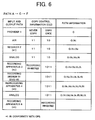
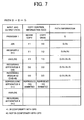
- FIG. 6 to FIG. 11 are tables showing correspondent relations among the transmission paths of the contents, the copy control information and the path information which are embedded in the above-mentioned contents.
- On the left column of the tables input and output paths of the contents are indicated.
- ANALOG is indicated.
- At the center column of the tables it is indicated how the copy control information is changed when the contents pass through the above-mentioned transmission path.
- FIG. 6 is a table showing correspondent relations among the transmission path of the contents when passing through the paths A, C and F in FIG. 1, the copy control information and the path information.
- the concrete path is for transmitting the signal of the contents from the provider 1 to the receiver 2, the recording apparatus 3 which is in conformity with the CPS, the recording medium 51, the reproducing apparatus 4 which is in conformity with the CPS, the recording apparatus 8 which is in conformity with the CPS and the recording medium 53 in sequence.
- FIG. 6 shows an example that the recording medium 51 is a DVD-R.
- FIG. 6 shows an example of inhibiting the illegal copy by only the copy control information embedded in the contents.
- FIG. 7 is a table showing correspondent relations among the transmission path of the contents when passing through the paths B, D and G in FIG. 1, the copy control information and the path information.
- the concrete path is for transmitting the signal of the contents from the provider 1 to the receiver 2, the recording apparatus 5 which is not in conformity with the CPS, the recording medium 52, the reproducing apparatus 6 which is in conformity with the CPS, the recording apparatus 8 which is in conformity with the CPS and the recording medium 53 in sequence.
- FIG. 7 shows an example that the recording medium 52 is a DVD-R.
- FIG. 7 shows an example that the reproducing of the recording medium produced by the illegal copy is inhibited on the basis of the copy control information and the path information.
- the reproducing apparatus 6 determines that no name of the recording medium is at the end of the path information, and hence the reproducing is inhibited as described above.
- FIG. 8 is a table showing correspondent relations among the transmission path of the contents when passing through the paths B, E and H in FIG. 1, the copy control information and the path information.
- the concrete path is for transmitting the signal of the contents from the provider 1 to the receiver 2, the recording apparatus 5 which is not in conformity with the CPS, the recording medium 52, the reproducing apparatus 7 which is not in conformity with the CPS, the recording apparatus 8 which is in conformity with the CPS, and the recording medium 53 in sequence.
- FIG. 8 shows an example that the recording medium 52 is a DVD-R.
- FIG. 8 shows an example that the copy of the contents illegally transmitted is inhibited on the basis of the copy control information and the path information.
- the recording medium 52 thus produced is reproduced by the reproducing apparatus 7 which is not in conformity with the CPS.
- FIG. 2 is different from FIG. 1 in a medium supplying the information of the contents.
- FIG. 2 shows the case that the contents are supplied from the prerecorded disc 10 on which the information of the contents is recorded in advance, such as a DVD-ROM.
- FIG. 9 is a table showing correspondent relations among the transmission path of the contents when passing through the paths I, K and N in FIG. 2, the copy control information and the path information.
- the concrete path is for transmitting the signal of the contents from the prerecorded disc 10 which records the contents suppliedby the provider 9 , to the reproducing apparatus 11 which is in conformity with the CPS, the recording apparatus 12 which is in conformity with the CPS, the recording medium 61, the reproducing apparatus 13 which is in conformity with the CPS, the recording apparatus 17 which is in conformity with the CPS and the recording medium 63 in sequence.
- FIG. 9 shows an example that the recording medium 61 is a DVD-R.
- FIG. 9 shows an example that the illegal copy is inhibited by only the copy control information embedded in the contents.
- FIG. 10 is a table showing correspondent relations among the transmission path of the contents when passing through the paths J, L and O in FIG. 2, the copy control information and the path information.
- the concrete path is for transmitting the signal of the contents from the prerecorded disc 10 which records the contents suppliedby the provider 9 , to the reproducing apparatus 11 which is in conformity with the CPS, the recording apparatus 14 which is not in conformity with the CPS, the recording medium 62, the reproducing apparatus 15 which is in conformity with the CPS, the recording apparatus 17 which is in conformity with the CPS and the recording medium 63 in sequence.
- FIG. 10 shows an example that the recording medium 62 is a DVD-R.
- FIG. 10 shows an example that the reproducing of the recording medium produced by the illegal copy is inhibited on the basis of the copy control information and the path information.
- the path information is not updated and is maintained "0/RO/RO/A" embedded by the reproducing apparatus 11 which is in conformity with the CPS (e.g., "RO" indicates the DVD-ROM).
- the reproducing apparatus 15 determines that no name of the recording medium is at the endof thepath information, and hence the reproducing is inhibited.
- the path information is not updated and is maintained "0/RO/RO/A”.
- FIG. 11 is a table showing correspondent relations among the transmission path of the contents when passing through the paths J, M and P in FIG. 2, the copy control information and the path information.
- the concrete path is for transmitting the signal of the contents from the prerecorded disc 10 which records the contents supplied by the provider 9 , to the reproducing apparatus 11 which is in conformity with the CPS, the recording apparatus 14 which is not in conformity with the CPS, the recording medium 62, the reproducing apparatus 16 which is not in conformity with the CPS, the recording apparatus 17 which is in conformity with the CPS and the recording medium 63 in sequence.
- FIG. 11 shows an example that the recording medium 62 is a DVD-R.
- FIG. 11 shows an example that the copy of the contents illegally transmitted is inhibited on the basis of the copy control information and the path information.
- the recording medium 62 thus produced is reproduced by the reproducing apparatus 16 which is not in conformity with the CPS.
- CCI Copy Free
- step S111 the watermark detecting unit 209 and the path information detecting unit 210 detect the copy control information and the path information which are embedded in the contents recorded on the recording medium and on the prerecorded disc.
- the CPU 213 or the drive control unit 301 determines the copy control information and the path information on the basis of the detected result.
- step S113 the CPU 213 or the drive control unit 301 determines whether the name of the recording medium is written at the end of the path information embedded in the contents or not. For example, it is determined whether "R" indicating the DVD-R or "RO” indicating the DVD-ROM is written at the end of the path information or not.
- the apparatus which is not in conformity with the CPS records the contents to the recording medium, no name of the recording medium is written at the end of the path information because the path information at this time is not embedded in the contents.
- step S113 determines whether the name of the recording medium is written at the end of the path information or not, it is possible to inhibit the reproducing of the contents which passed through the illegal path.
- the process goes out of the routine (the process does not go to steps S114 and S115), and the reproducing operation of the contents is not performed.
- step S113 determines whether the determined result in step S113 is "Yes” or "Yes”.
- step S114 the path information adding unit 212 inserts new path information.
- step S115 the reproducing operation of the contents is performed.
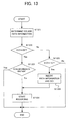
- step S121 the watermark detecting unit 209 and the path information detecting unit 210 detect the copy control information and the path information embedded in the contents, which is supplied from the receiver to the recording apparatus or which is supplied to the recording apparatus by reading out the recording medium.
- the CPU 213 or the drive control unit 301 determines the copy control information and the path information on the basis of the detected result.
- step S123 the process goes out of the routine (the process does not go to step S124), and the recording operation of the contents is not performed.
- step S123 When the determined result in step S123 is "No", the process goes to step S124, and the recording operation of the contents is performed. In the case, the recording is never inhibited because it is determined that the copy control information of the contents is originally Copy Free.
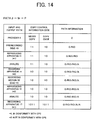
- FIG. 14 is a table showing correspondent relations among the transmission path of the contents when passing through the paths J, M and P in FIG. 2, the copy control information and the path information.
- the concrete path is for transmitting the signal of the contents from the prerecorded disc 10 which records the contents supplied from the provider 9, to the reproducing apparatus 11 which is in conformity with the CPS, the recording apparatus 14 which is not in conformity with the CPS, the recording medium 62, the reproducing apparatus 16 which is not in conformity with the CPS, the recording apparatus 17 which is in conformity with the CPS and the recording medium 63 in sequence.
- FIG. 11 the signal of the contents from the prerecorded disc 10 which records the contents supplied from the provider 9
- the reproducing apparatus 11 which is in conformity with the CPS
- the recording apparatus 14 which is not in conformity with the CPS
- the recording medium 62 the reproducing apparatus 16 which is not in conformity with the CPS
- the recording apparatus 17 which is in conformity with the CPS and the recording medium 63 in sequence.
- the recording and reproducing control method according to the first embodiment cannot detect that the contents passed through the apparatus which is not in conformity with the CPS.
- the second embodiment adopts a method by which the recording and reproducing of the contents obtained by the above illegal copy can be inhibited and the protection of the copyright can be achieved. An explanation thereof will now be given in detail.
- the recording apparatus When recording the contents inputted as the analog signal by the recording apparatus, if the contents are MPEG moving pictures, for example, the contents are necessarily A/D converted and further MPEG-encoded. Thereafter, the processed data is recorded on the recording medium.
- the recording apparatus which is in conformity with the CPS does not perform the process of the A/D conversion and the MPEG encoding of the same contents more than once.
- the contents passed through the illegal path are determined by taking account of that point.
- path information of an erased type which means that the embedded path information is erased by repeating the process of the A/D conversion and the MPEG encoding is adopted.
- path information of a remaining type which is embedded in a manner not to be erased even if the process of the A/D conversion and the MPEG encoding identical to the process utilized in the first embodiment is repeated, is also utilized together with the path information of the erased type.
- the above-mentioned two kinds of path information of the erased type and the remaining type are embedded in the contents.
- a first method is to embed the path information of the erased type not in the contents but in a blanking period of the analog signal at the time of outputting the analog signal from the reproducing apparatus.
- a portion except an effective screen e.g., a scanning line portion
- the path information can be erased with the portion except the effective screen at the time of the MPEG encoding.
- a second method is to embed the path information desired to be erased in lower 2 bits and the path information desired to remain in lower 3 bits, for example, if an original MPEG moving picture is an 8-bit digital video signal.
- the signal embedded as a small level being the lower 2 bits remarkably has high probability of being erased in a process of the A/D conversion and the encoding by an MPEG system, compared with the signal embedded in the lower 3 bits being a level larger than that embedded in the lower 2 bits. Therefore, the path information of the erased type is added to the lower small bits, and the path information of remaining type is added to the larger bits than it. It is noted that an area in which the above-mentioned path information is embedded needs to be within a range which scarcely affects the recording or reproducing of the contents.
- a third method is to add the path information of the erased type to a portion of a high frequency component of the analog signal at the time of outputting the analog signal from the reproducing apparatus.
- a method of cutting off the high frequency component of the signal to encode it is adopted. Therefore, if the path information is embedded in the high frequency component, the information is erased with higher possibility.
- FIG. 15 is a table showing correspondent relations among the transmission path of the contents, the copy control information and the path information which are embedded in the contents.
- On the left column of the table the input and output path of the contents is indicated. Moreover, when the signal of the contents is outputted as the analog signal, "ANALOG" is indicated.
- At the center column of the table it is indicated how the copy control information is changed at the time of passing through the above-mentioned transmission path.
- the copy control information is not updated, and the path information is not written in. Therefore, the case is omitted from the illustration in the table.
- the two kinds of path information embedded in the contents when passing through the above-mentioned transmission path are indicated, wherein the path information of the remaining type is indicated on the left column and the path information of the erased type is indicated on the right column.
- FIG. 15 is a table showing correspondent relations among the transmission path of the contents when passing through the paths J, M and P in FIG. 2, the copy control information and the path information.
- the concrete path is for transmitting the signal of the contents from the prerecorded disc 10 which records the contents supplied from the provider 9, to the reproducing apparatus 11 which is in conformity with the CPS, the recording apparatus 14 which is not in conformity with the CPS, the recording medium 62, the reproducing apparatus 16 which is not in conformity with the CPS, the recording apparatus 17 which is in conformity with the CPS and the recording medium 63 in sequence.
- the path information embedded as the erased type is erased by the A/D conversion and the MPEG encoding.
- the recording medium 62 thus produced is reproduced by the reproducing apparatus 16 which is not in conformity with the CPS.
- the recording apparatus 17 determines that one of the path information is erased, the recording is inhibited.
- the path information embedded as the erased type is also erased by the A/D conversion and the MPEG encoding.
- the recording apparatus 17 determines that one of the path information is erased, and hence the recording is inhibited.
- the description will be given of the recording operation performed by the information recording and reproducing apparatus 400 which is in conformity with the CPS in the second embodiment with reference to FIG. 16. It is noted that the reproducing operation in the second embodiment can be performed in a manner identical to the method of the reproducing operation explained in the first embodiment.
- FIG. 16 is a flow chart showing the recording operation performed by the information recording and reproducing apparatus 400 which is in conformity with the CPS in the second embodiment. As described above, the process is executed by taking account of whether the two kinds of detected path information do not correspond to each other, or one of them is erased.
- step S211 the watermark detecting unit 209 and the path information detecting unit 210 detect the copy control information and the two kinds of path information embedded in the contents, which is supplied to the recording apparatus from the receiver or which is transmitted to the recording apparatus by reading out the recording medium.
- the CPU 213 or the drive control unit 301 determines the copy control information and the path information on the basis of the detected result. When one of the path information is completely erased, only the other path information is detected.
- step S213 When the determined result in step S213 is "No", the process goes out of the routine (the process does not go to steps S214 to S217), and the recording operation of the contents is not performed.
- the CPU 213 or the drive control unit 301 can execute the determination.
- the process goes out of the routine (the process does not go to steps S215 to S217) , and the recording operation of the contents is not performed.
- step S214 When the determined result in step S214 is "No", since the recording of the contents is permitted, the process goes to step S215, and the path information and the copy control information are updated.
- the CPU 213 or the drive control unit 301 can also execute the determination.
- step S217 When the determined result in step S217 is "Yes”, the process goes out of the routine (the process does not go to step S216) , and the recording operation of the contents is not performed. On the other hand, when the determined result in step S217 is "No”, the process goes to step S216, the recording operation of the contents is performed. In the case, since the copy control information of the contents is determined to be originally Copy Free, the recording is not inhibited.
Landscapes
- Engineering & Computer Science (AREA)
- Signal Processing (AREA)
- Computer Security & Cryptography (AREA)
- Multimedia (AREA)
- Signal Processing For Digital Recording And Reproducing (AREA)
- Storage Device Security (AREA)
- Television Systems (AREA)
- Television Signal Processing For Recording (AREA)
Abstract
Description
- The present invention relates to an information recording technique for an information recording medium, and specially relates to copy control in recording contents.
- Recently, a technique of recording various contents transmitted through a communication path, such as images and music, on an information recording medium, such as a DVD-R (DVD-Recordable) and a DVD-RW (DVD-Re-recordable), is spread. The contents are originally subj ected to protection by a copyright. Illegally copying and distributing the information recording medium on which the contents are recorded infringe on the copyright. Therefore, various methods of inhibiting the illegal copy are necessary in order to effectively protect the copyright of the contents.
- In order to prevent the illegal copy of the contents, there is known a copy protection system of preventing the illegal copy at the time of recording and transmitting the contents, by adding copy control information to the contents, e.g., by embedding it to a digital signal as an electronic watermark, or by encrypting the contents. A reproducing apparatus and a recording apparatus which are in conformity with the copy protection system can discriminate such copy control information, and can recognize permission or inhibition of copying the contents and a number of times of the copying.
- There is known a method of protecting the copyright as follows. When an information signal corresponding to the contents is inputted to a predetermined apparatus, attribute information indicating an attribute of the apparatus is added to the inputted information signal. At the time of recording the information signal, the recording is controlled on the basis of the attribute information and the above-mentioned copy control information. Thereby, the illegal copy of the contents can effectively be prevented. This method is disclosed in Japanese Patent Application Laid-open under No.2001-351319.
- The above-mentioned method is effective when the contents are given and received as the digital signal. However, there sometimes occurs a problem that the illegal copy of the contents by using an illegal apparatus cannot be sufficiently eliminated, after the contents pass through an analog path.
- The present invention has been achieved in order to solve the above problems. It is an obj ect of this invention to provide an information recording and reproducing apparatus, an information recording and reproducing method and an information recording and reproducing program which can effectively inhibit reproducing and recording of contents passing through an illegal apparatus even when the contents are given and received as an analog signal, and can securely protect a copyright of the contents .
- According to one aspect of the present invention, there is provided an information processing apparatus which records or reproduces information signal corresponding to contents in accordance with copy control information, including a path information detecting unit which detects path information embedded in the information signal and indicating information of a path through which the information signal passes, and a control unit which controls recording or reproducing of the information signal corresponding to the contents on the basis of the copy control information and path information detected by the path information detecting unit.
- The above-mentioned information processing apparatus may be an information recording and reproducing apparatus which records and reproduces information corresponding to the contents to or from the information recording medium, such as a DVD-R and a DVD-RW. In accordance with the copy control information which prescribes permission and inhibition of copying the contents, recording and reproducing are controlled. In the present invention, the path information indicating a path through which the information signal passes during performing the recording and the reproducing by plural information recording and reproducing apparatuses is utilized. For example, the path information is information indicating the information recording and reproducing apparatus which processes the information signal of the contents subjected to the recording and reproducing, a transmission form of the information signal and whether the information signal is transmitted as the analog signal or as the digital signal. By utilizing the path information in addition to the copy control information, the information recording and reproducing apparatus determines control manner of the recording and the reproducing of the information signal corresponding to the contents, i.e., the permission or the inhibition of the recording and the reproducing of the information signal, and controls the recording and the reproducing.
- The information processing apparatus may include a path information adding unit which adds new path information to the path information detected by the path information detecting unit when the information signal corresponding to the contents is inputted or outputted. Thereby, it becomes possible to update the path information corresponding to the path through which the information signal passes, and proper recording and reproducing can be performed on the basis of the path information.
- In a preferred embodiment, the path information adding unit may add analog signal information which indicates that an attribute of the information signal is an analog signal when the information signal corresponding to the contents is inputted to the information processing apparatus as the analog signal or is outputted from the information processing apparatus as the analog signal, add supplying medium attribute information which indicates an attribute of a medium supplying the information signal to be recorded or reproduced by the information processing apparatus when the information signal corresponding to the contents is inputted to the information processing apparatus as a digital signal, and add recording/transmitting medium attribute information which indicates an attribute of a recording medium or a transmission medium in or to which the information signal to be recorded or reproduced by the information processing apparatus is recorded or transmitted when the information signal corresponding to the contents is outputted from the information processing apparatus as the digital signal. Thereby, it becomes possible that the control of the recording and the reproducing are performed by taking account of a form of the information signal corresponding to the contents.
- As for the recording of the information signal, the control unit may prescribe not to add the path information to the information signal corresponding to the contents when the copy control information indicates a code of permitting free copy of the contents. In addition, the control unit can inhibit the recording of the information signal corresponding to the contents when the copy control information indicates a code that the copy control information permits the free copy of the contents and the path information detecting unit detects the path information. Thereby, even when a code of limiting an illegal copy is changed to a code of permitting the free copy, it can be detected that the illegal copy is performed on the basis of presence and absence of the path information, and the illegal copy can be prevented.
- As for the reproducing of the information signal, the control unit may inhibit reproducing of the information signal corresponding to the contents when the supplying medium attribute information or the recording/transmitting medium attribute information is not added at the end of the path information detected by the path information detecting unit. Thereby, it can be prevented that the contents illegally recorded on the information recording medium is reproduced.
- In a preferred example, the path information adding unit may add first and second adding path information as the new path information. The first adding path information may be path information of a remaining type which is not erased even if an encoding process for recording the information signal and an A/D converting process which converts the information signal corresponding to the contents from the digital signal to the analog signal are repeated by the information processing apparatus, and the second adding path information may be path information of an erased type which is erased by repeating the encoding process and the A/D converting process. The control unit may inhibit the recording of the information signal corresponding to the contents when the first and second adding path information which the path information detecting unit detects do not correspond to each other, or one of them is erased. Thereby, when the illegal copy of the contents is performed by the process of passing the analog signal, it can be detected that the illegal copy is performed by erasure of the signal of the erased type in passing the analog signal.
- In some preferred examples, the second adding path information may be added to a blanking period of the information signal when the information signal corresponding to the contents is outputted as the analog signal. The second adding path information may be added to a predetermined lower bit of the information signal corresponding to the contents, and the first adding path information may be added to a bit range including a higher bit than a bit to which the second adding path information is added. In addition, the second adding path information may be added to a high frequency component of the analog signal when the information signal corresponding to the contents is outputted as the analog signal.
- According to another aspect of the present invention, an information processing apparatus may include a unit which obtains an information signal corresponding to contents, a path information adding unit which adds path information indicating that the information signal passes through the information processing apparatus, and an output unit which outputs the information signal to which the path information is added.
- In the above-mentioned information processing apparatus, when the information signal corresponding to the contents is transmitted via plural information processing apparatuses, the path information indicating that the information signal passes through the information processing apparatus is added to the information signal. For example, in a receiver and a set-top box which receive the contents and output them, the path information which indicates that the contents passed through the apparatuses is added to the information signal and supplied to the next stage, i.e., the recording apparatus or the reproducing apparatus. Therefore, it becomes possible to appropriately maintain the path of the information signal in the information signal.
- Further, according to the identical aspect of the present invention, the information processing method which records or reproduces the information signal corresponding to the contents in accordance with the copy control information may be provided by the same manner as the above-mentioned information processing apparatus. In addition, an information processing program executed in the information processing apparatus to make the information processing apparatus operate as described above may be provided.
- The nature, utility, and further features of this invention will be more clearly apparent from the following detailed description with respect to preferred embodiment of the invention when read in conjunction with the accompanying drawings briefly described below.
-
- FIG. 1 is a diagram showing an example of a transmission path of contents to be recorded or reproduced.
- FIG. 2 is a diagram showing an example of a transmission path of contents to be recorded or reproduced, which is different from the transmission path shown in FIG. 1.
- FIG. 3 is a block diagram of an information recording and reproducing apparatus being an embodiment of the present invention.
- FIG. 4 is a block diagram showing a disc drive of the information recording and reproducing apparatus shown in FIG. 3.
- FIG. 5 is a block diagram showing a back end of the information recording and reproducing apparatus shown in FIG. 3.
- FIG. 6 is a table showing correspondent relations among a transmission path of contents when passing through paths A, C and F shown in FIG. 1, copy control information and path information.
- FIG. 7 is a table showing correspondent relations among a transmission path of contents when passing through paths B, D and G in shown FIG. 1, copy control information and path information.
- FIG. 8 is a table showing correspondent relations among a transmission path of contents when passing through paths B, E and H shown in FIG. 1, copy control information and path information.
- FIG. 9 is a table showing correspondent relations among a transmission path of contents when passing through paths I, K and N shown in FIG. 2, copy control information and path information.
- FIG. 10 is a table showing correspondent relations among a transmission path of contents when passing through paths J, L and O shown in FIG. 2, copy control information and path information.
- FIG. 11 is a table showing correspondent relations among a transmission path of contents when passing through paths J, M and P shown in FIG. 2, copy control information and path information.
- FIG. 12 is a f low chart showing a procedure of a reproducing process according to a first embodiment.
- FIG. 13 is a flow chart showing a procedure of a recording process according to the first embodiment.
- FIG. 14 is a table showing an example of copy control information updated by a process different from a process shown in FIG. 11 by an illegal apparatus, when passing through paths J, M and P shown in FIG. 2.
- FIG. 15 is a table showing correspondent relations among a transmission path of contents when passing through paths J, M and P shown in FIG. 2, copy control information and two kinds of path information.
- FIG. 16 is a flow chart showing a procedure of a recording process according to a second embodiment.
-
- The preferred embodiments of the present invention will now be described below with reference to the attached drawings. In the embodiments below, the description will be given of a case that the present invention is respectively applied to a recording apparatus which performs a recording operation and a reproducing apparatus which performs a reproducing operation to a disc capable of recording an information signal corresponding to various contents.
- First, the description will be schematically given of the embodiment of the present invention with reference to FIG. 1 and FIG. 2. FIG. 1 and FIG. 2 are block diagrams showing system configurations for schematically explaining the present embodiment, and they are diagrams showing examples of transmission paths of contents to be recorded or reproduced. The transmission paths of the contents are representative examples which can be assumed. It is noted that mediums for supplying information of the contents are different between FIG. 1 and FIG. 2. FIG. 1 shows an example that the information of the contents is supplied from outside by electric waves, and FIG. 2 shows an example that the information of the contents is supplied by a prerecorded disc on which the information of the contents is recorded in advance.
- Now, FIG. 1 will be explained. In a system configuration in FIG. 1, a
provider 1 which supplies information contents, areceiver 2 which receives a signal from theprovider 1,recording apparatuses apparatuses recording mediums 51 to 53 in which a signal corresponding to the contents can be written are illustrated. Of those, it is assumed that therecording apparatuses apparatuses 4 and 6 are in conformity with the copy protection system in a predetermined reproducing system. On the other hand, it is assumed that therecording apparatus 5 and the reproducingapparatus 7 are not in conformity with the above copy protection system in the recording system and the reproducing system. It is assumed that thereceiver 2 is also in conformity with the copy protection system. - Here, the description will be given of a method of protecting a copyright according to the present invention, which includes the above-mentioned copy protection system. The copy protection system has a role of protecting the copyright of the contents. Therefore, the copy control system adopts a method as follows: the copy protection system adds copy control information (CCI) to an information signal corresponding to the contents, and embeds it in the contents by a technique, such as an electronic watermark technique and the like. Examples of the copy control information are as follows: a code "Copy Once (CCI=10)" permitting only one-generation copy of the contents, a code "Never Copy (CCI=11)" inhibiting the copy of the contents, a code "Copy Free (CCI=00)" permitting free copy of the contents, a code "No More Copy (CCI=1011)") permitting the copy of the contents of the above-mentioned Copy Once (CCI=10) only once and inhibiting further copy afterward, and the like.
- Further, in the present embodiment, to the signal corresponding to the contents, the path information through which the contents pass is also embedded in the contents, in addition to the above-mentioned copy control information. Thereby, an illegal copy passing an analog path is eliminated, and the protection of the copyright is reinforced. Concretely, for example, assuming that the
receiver 2 receives the contents from theprovider 1 and transmits the contents to therecording apparatus 3 as the analog signal, and then therecording apparatus 3 records the contents on therecording apparatus 51, the path information embedded in the contents is "0/Ai/Ai/A/A/R". "A" indicates that the contents are inputted or outputted to or from the recording apparatus or the reproducing apparatus as the analog signal. For example, in the above-mentioned example, "0" is added by the provider which supplies the contents first, and a first "Ai" indicates Air (the contents are given and received by the electric waves) , and a next "Ai" indicates the receiver. A first "A" indicates that the contents are outputted as the analog signal, and a next "A" indicates that the contents are recorded as the analog signal, while an "R" indicates a DVD-R. - The path information can be detected by the recording apparatus or the reproducing apparatus according to the present embodiment. When the information signal corresponding to the contents is inputted or outputted, the recording apparatus or the reproducing apparatus adds new path information to the detected path information. Concretely, the description will be given of a rule in which the recording apparatus or the reproducing apparatus adds the path information. When the contents are inputted or outputted to or from the recording apparatus or the reproducing apparatus as the analog signal, the information indicating that the signal of the contents is the analog signal is added. When the contents are inputted by a digital signal, information indicating the medium of a supplying source of the contents to be recorded or reproduced is added. A DVD-R, a DVD-ROM, an IEEE 1394 of a digital transmission path and the like are the examples. Moreover, when the contents are outputted as the digital signal, the information indicating the recording medium or a transmission medium in which the contents to be recorded or reproduced are recorded is added. A DVD-R, a DVD-RW, an IEEE 1394 of the digital transmission path and the like are the examples.
- In the present embodiment, if the copy control information is Copy Free (CCI=00) , the recording apparatus or the reproducing apparatus does not add the above-mentioned path information.
- Further, in FIG. 1, the signal given and received in passing the transmission paths A, B, F, G and H is assumed to be the analog signal. The transmission paths from the
receiver 1 to therecording apparatuses recording mediums apparatuses apparatuses recording apparatus 8 are the paths F, G and H. A function and a role of the path information and a method of protecting the copyright of the contents by utilizing the path information will be described later. - Next, a system configuration shown in FIG. 1 will be concretely explained. The
receiver 2 has a function as a set-top box which receives information, such as images and sound transmitted from theprovider 1, and demodulates the analog signal corresponding to the contents to output it outside. It is assumed that the signals, which are set to Never Copy (CCI=11), Copy Once (CCI=10) and Copy Free (CCI=00) as the copy control information, are inputted to thereceiver 2. - The
recording apparatuses recording apparatuses recording apparatuses recording apparatus 5 is identical to those of therecording apparatuses recording apparatus 5 is not in conformity with the copy protection system in the recording system, as described above. - The reproducing
apparatuses 4 and 6 perform a reproducing operation of the signal corresponding to the contents recorded on the recordingmedium which is set thereto, and output it outside. At this moment, the reproducingapparatuses 4 and 6 detect the above-mentioned copy control information and the path information which are added to the information to be reproduced, and further control a predetermined reproducing operation in the reproducing system on the basis of the detected result. It is noted that concrete configurations and operations of the reproducingapparatuses 4 and 6 will be described later, too. On the other hand, though basic configuration and operation of the reproducingapparatus 7 are identical to those of the reproducingapparatuses 4 and 6, the control of the reproducing operation on the basis of the copy control information and path information is not performed because the reproducingapparatus 7 is not in conformity with the copy protection system in the reproducing system, as described above. - As the
recording mediums 51 to 53, for example, an optical disc, such as a CD-R, a CD-RW, a DVD-R, a DVD-RW and the like, is applicable. - Next, FIG. 2 will be explained. FIG. 2 is different from FIG. 1 in a medium supplying the information of the contents. In a system configuration in FIG. 2, a
provider 9 which supplies information contents, aprerecorded disc 10 on which the information is recorded,recording apparatuses apparatuses recording mediums 61 to 63 in which the signal corresponding to the contents can be written are illustrated. It is assumed that therecording apparatuses apparatuses recording apparatus 14 and the reproducingapparatus 16 are not in conformity with the copy protection system in the above recording system and the above reproducing system. The copy protection control is performed on the basis of the above-mentioned copy control information. Further, in the present invention, in addition to the copy control information, the path information indicating the path of the contents is also embedded in the contents, and thereby protection of the copyright is reinforced. - It is assumed that the information of the analog signal is given and received in passing through the transmission paths I, J, N, O, and P shown in FIG. 2. The transmission paths from the reproducing
apparatus 11 to therecording apparatuses apparatuses recording apparatus 17 are N, O and P. - The
prerecorded disc 10 in FIG. 2 is a CD-ROM, a DVD-ROM and the like in which the contents, such as the images and the music supplied from theprovider 9, are written. - The recording apparatuses 12 and 17, which are identical to the above-mentioned
recording apparatuses recording apparatuses recording apparatuses recording apparatus 14 are identical to those of therecording apparatuses recording apparatus 14 is not in conformity with the copy protection system in the recording system as described above, the control of the recording operation on the basis of the copy control information and the path information is not performed. - The reproducing
apparatuses apparatuses 4 and 6, and perform the reproducing operation of the signal corresponding to the contents, recorded on the recording medium set therein, to output it outside. At this moment, the reproducingapparatuses apparatuses apparatus 16 are identical to those of the reproducingapparatuses apparatus 16 is not in conformity with the copy protection system in the reproducing system as described above, the control of the reproducing operation on the basis of the copy control information and the path information is not performed. - As
recording mediums 61 to 63, for example, the optical disc, such as a CD-R, a CD-RW, a DVD-R, a DVD-RW and the like, is applicable. - Next, the information recording and reproducing apparatus according to the present embodiment will be explained with reference to FIG. 3 to FIG. 5.
- First, a configuration of an information recording and reproducing apparatus 400 will be explained. FIG. 3 shows the information recording and reproducing apparatus 400 which is the embodiment of the present invention. The information recording and reproducing apparatus 400 has two functions: a function of recording information on the recording medium, and a function of reproducing the recorded information which is recorded on the recording medium. Concretely, the information recording and reproducing apparatus 400 can reproduce a disc for recording and reproducing, such as a DVD-R, a DVD-RW and the like, and can record the information on the disc for recording and reproducing. In addition, the information recording and reproducing apparatus 400 can also reproduce a disc dedicated to reproducing, such as a DVD-ROM, a DVD video, a DVD audio and the like. The information recording and reproducing apparatus 400 includes a
disc drive 200 and aback end 300. - FIG. 4 shows an inside configuration of the
disc drive 200. Thedisc drive 200 records the information on theoptical disc 100, and reads out the information which is recorded on theoptical disc 100. Theoptical disc 100 is one of the above-mentioned disc for recording and reproducing or the above-mentioned disc dedicated to reproducing. - As shown in FIG. 4, the
disc drive 200 includes aspindle motor 201, anoptical pickup 202, anRF amplifier 203 and aservo circuit 204. They mainly configure a driving system of thedisc drive 200 and a driving control unit thereof. - The
spindle motor 201 rotates theoptical disc 100. - The
optical pickup 202 outputs an RF signal corresponding to a reflected light of a light beam at the time of recording and reading out the information. When theoptical disc 100 adopts a wobbled land/groove system, control information, such as wobbling, lands, grooves, prepits and the like, is included in the RF signal because the wobbled lands and grooves, the prepits and the like are formed in advance on a recording surface of theoptical disc 100. Moreover, when information is already recorded on theoptical disc 100, the recorded information is incorporated in the RF signal, too. - The
RF amplifier 203 amplifies the RF signal outputted from theoptical pickup 202, and outputs the RF signal to a modulating anddemodulating unit 205. Further, theRF amplifier 203 generates a wobble frequency signal, a tracking error signal, a focus error signal and the like from the RF signal, and outputs them. - The
servo circuit 204 is a servo control circuit which controls the driving of theoptical pickup 202 and thespindle motor 201 on the basis of the tracking error signal, the focus error signal and the other servo control signal. Concretely, theservo circuit 204 controls a positional relation between theoptical pickup 202 and theoptical disc 100 on the basis of the tracking error signal. Theservo circuit 204 controls focusing of the light beam of theoptical pickup 202 on the basis of the focus error signal. - Moreover, as shown in FIG. 4, the
disc drive 200 includes the modulating anddemodulating unit 205, abuffer 206, aninterface 207 and a lightbeam driving unit 208. The components mainly demodulates and outputs the recorded information which is read out from theoptical disc 100, and receives and modulates the recorded information to be recorded on theoptical disc 100. - The modulating and
demodulating unit 205 is a circuit which has two functions: a function of performing error correction of the recording information at the time of reading out the information, and a function of adding an error correction code to the recording information at the time of recording the information and modulating it. Concretely, at the time of reading out the information, the modulating anddemodulating unit 205 demodulates the RF signal outputted from theRF amplifier 203, and performs the error correction to it to output it to thebuffer 206. In addition, at the time of recording the information, the modulating anddemodulating unit 205 adds the error correction code to the recording information outputted from thebuffer 206, and modulates it so as to be adapted to the optical identification of theoptical disc 100. Afterward, the modulated recording information is outputted to the lightbeam driving unit 208. - The
buffer 206 is a storing circuit which temporarily stores the recording information. - The
interface 207 is a circuit which performs input and output control or communication control of the recording information between thedisc drive 200 and theback end 300. Concretely, at the time of reproducing the information, theinterface 207 outputs, to theback end 300, the recording information outputted from the buffer 206 (i.e., the recording information which is read out from the optical disc 100), in response to a request command from theback end 300. In addition, at the time of recording the information, theinterface 207 receives the recording information inputted from theback end 300 to thedisc drive 200, and outputs it to thebuffer 206. - Further, as shown in FIG. 4, the
disc drive 200 includes awatermark detecting unit 209, a pathinformation detecting unit 210, aCCI inserting unit 211 and a pathinformation adding unit 212. - The
watermark detecting unit 209 detects a watermark embedded in the contents, i . e . , data embedded as an electronic watermark. In the present embodiment, the above-mentioned copy control information can be extracted from the watermark which thewatermark detecting unit 209 detects. The pathinformation detecting unit 210 detects the above-mentioned path information embedded in the contents. The copy control information and the path information detected from the contents are inputted to aCPU 213 or adrive control unit 301 which will be explained later in order to determine whether the copy information and the path information should be reproduced or recorded. - On the other hand, the
CCI inserting unit 211 inserts the watermark, in which the copy control information is updated on the basis of a detected result by thewatermark detecting unit 209, to the signal of the contents to be recorded on theoptical disc 100. For example, in recording the contents on the recording medium, if the copy control information is Copy Once (CCI=10) , theCCI inserting unit 211 updates the copy control information to No More Copy (CCI=1011). - The path
information adding unit 212 can add new path information to the path information which the pathinformation detecting unit 210 detects. For example, in recording the contents on a DVD-R, if the pathinformation detecting unit 210 detects the path information "0/Ai/Ai/A/A", the pathinformation adding unit 212 adds "R" to the path information. Then, the path information "0/Ai/Ai/A/A/R" is embedded in the contents. - As for updating the copy control information and the path information, when the
CPU 213 or thedrive control unit 301 determines that reproducing or recording is permitted on the basis of the above-mentioned detected information, the path information is updated. When the copy control information is Copy Once (CCI=10) at the time of recording the information, the copy control information is updated to No More Copy (CCI=1011) . The copy control information and the path information thus updated are inputted to theback end 300 outside at the time of reproducing the information, and are inputted to the modulating anddemodulating unit 205 at the time of recording the information. On the other hand, when theCPU 213 or thedrive control unit 301 determines that reproducing or recording is not permitted, the copy control information and the path information are not updated. - The
CPU 213 controls whole thedisc drive 200, and controls and manages the above-mentioned giving and receiving of the information among each component in thedisc drive 200. For example, in the present embodiment, whether reproducing or recording is permitted or not is determined on the basis of the copy control information and the path information which thewatermark detecting unit 209 and the pathinformation detecting unit 210 detect. When it is determined that recording or reproducing is permitted, the path information is updated. When the copy control information is Copy Once (CCI=10) at the time of recording the information, the copy control information is updated. Then, theCPU 213 requests to embed them in the contents. Moreover, according to the request command transmitted from theback end 300 which will be described later, theCPU 213 executes control of a recording operation of theoptical pickup 202 and control of outputting the recording information stored in thebuffer 206 to theback end 300. Thereby, normal reproducing control and first-reading control of the contents information are executed. - Next, the description will be given of an inside configuration of the
back end 300 shown in FIG. 5. Theback end 300 performs a reproducing process of the recording information which is read out from theoptical disc 100 by thedisc drive 200. Also, theback end 300 receives the recording information which is supplied from outside in order to be recorded on theoptical disc 100, and compresses (encodes) and transmits it to thedisc drive 200. - As shown in FIG. 5, the
back end 300 includes thedrive control unit 301, anMPEG decoder 302, a D/A converter 303, anMPEG encoder 304 and an A/D converter 305. - The
drive control unit 301 is a circuit which controls a reading process and a recording process of thedisc drive 200. Theback end 300 and thedisc drive 200 perform, in cooperation with each other, an operation of reading out the recording information from theoptical disc 100 to reproduce it, and an operation of receiving the information to be recorded from the outside to record it on theoptical disc 100. Thedrive control unit 301 realizes the cooperation between theback end 300 and thedisc drive 200 by controlling the reading process and the recording process of thedisc drive 200. Concretely, thedrive control unit 301 outputs, to thedisc drive 200, the request command about reproduction, recording and outputting of the recording information from thebuffer 206. Further, in the present embodiment, thedrive control unit 301 can also perform the input and output control for controlling input or output of thewatermark detecting unit 209, the pathinformation detecting unit 210, theCCI inserting unit 211 and the pathinformation adding unit 212, identically to the above-mentionedCPU 213. - The
MPEG decoder 302 demodulates a video signal of a moving picture, which is read out from theoptical disc 100 by thedisc drive 200 and is supplied via thedrive control unit 301, on the basis of an MPEG demodulating system. The demodulated information is converted from the digital signal to the analog signal by the D/A converter 303. By such process, the contents information is converted into a state reproducible by a display and the like. When the recording information is audio information, an audio decoder which is not shown demodulates the audio information, and converts it to an audio signal reproducible by a speaker and the like to output it to the speaker and the like. - The video signal inputted from outside to be recorded on the
optical disc 100 is converted from the analog signal to the digital signal by the A/D converter 305. TheMPEG encoder 304 receives the video signal converted to the digital signal, and compresses (encodes) it on the basis of an MPEG encoding system. The compressed signal is inputted to thedisc drive 200 via thedrive control unit 301. - Next, the description will be given of recording and reproducing control according to a first embodiment with reference to FIG. 6 to FIG. 13.
- Now, the first embodiment will be schematically explained. The recording and reproducing control according to the first embodiment has two main characteristics. Now, a first characteristic will be explained. Generally, the recording apparatus which is not in conformity with the CPS forcibly changes the copy control information embedded in the contents from CCI=10 to CCI=00 in recording the contents. In the normal contents, the signal of the contents whose copy control information is set to CCI=10 or CCI=11 is encrypted, and the contents are decrypted to be a plaintext when the contents are inputted as analog signal to the recording apparatus which is not in conformity with the CPS. The recording apparatus which is not in conformity with the CPS has to encrypt the contents again in outputting the contents in order to make the copy control information CCI=11 and CCI=10, and hence changes the copy control information to CCI=00 for convenience. As described above, in the conventional method of protecting the copyright, when the recording apparatus which is not in conformity with the CPS is utilized, the contents become a state of "Copy Free" and the illegal copy of the contents is possible.
- In the present embodiment, since not only the copy control informationbut also the path information are added to the contents, the above illegal copy can be prevented. A method of effectively utilizing the path information will be explained. In the present embodiment, as described above, if the copy control information is CCI=00, the path information is not embedded to the contents. Therefore, no path information is written in the contents which are obtained via a proper path. However, when the recording apparatus which is not in conformity with the CPS forcibly changes the copy control information to CCI=00 at the time of recording operation, the path information up to the recording apparatus is embedded in the contents. Therefore, in the first embodiment, in the case of CCI=00, whether the contents are illegal or not is determined by taking account of whether the path information exists or not. Thereby, the protection of the copyright is possible.
- Next, the description will be given of a second characteristic of the recording and reproducing control according to the first embodiment. When the recording apparatus which is in conformity with the CPS records the contents in the recording medium, or when the reproducing apparatus which is in conformity with the CPS reproduces the recording medium in which the contents are recorded, a name of the recording medium or the transmission medium itself is necessarily added at the end of the path information embedded in the contents in the recording medium or the transmission medium after performing the recording or the reproducing. The name of the recording medium itself in which the contents are recorded is, for example, a DVD-R, a DVD-ROM and an IEEE 1394 of the digital transmission path. However, when the recording or the reproducing is performed by the apparatus which is not in conformity with the CPS, the path information recorded in the recording medium is not updated, and hence the name of the recording medium is never written at the end of the path information. In the first embodiment, by taking account of that point, when the name of the recordingmedium is not added at the end of the path information embedded in the contents in the recording medium in which the contents are recorded, it is determined that the recording is performed by the apparatus which is not in conformity with the CPS, and the contents are not reproduced. Thereby, the protection of the copyright is achieved.
- Next, the description will be given of an embodiment to which a recording and reproducing control method of the first embodiment is concretely applied with reference to FIG. 6 to FIG. 11. FIG. 6 to FIG. 11 are tables showing correspondent relations among the transmission paths of the contents, the copy control information and the path information which are embedded in the above-mentioned contents. On the left column of the tables, input and output paths of the contents are indicated. Moreover, when the signal of the contents is outputted as the analog signal, "ANALOG" is indicated. At the center column of the tables, it is indicated how the copy control information is changed when the contents pass through the above-mentioned transmission path. In FIG. 6 to FIG. 11, it is assumed that the copy control information which is originally set to the contents is Never Copy (CCI=11), Copy Once (CCI=10) or Copy Free (CCI=00). In the present invention, when the copy control information which is originally set is Copy Free (CCI=00) , the copy control information is not updated, and the path information is not added. Therefore, those cases are omitted from the illustration in the tables. Further, the path information which is added and embedded by a predetermined apparatus at the time of passing through the above-mentioned transmission path is indicated on the right column of the tables.
- FIG. 6 is a table showing correspondent relations among the transmission path of the contents when passing through the paths A, C and F in FIG. 1, the copy control information and the path information. The concrete path is for transmitting the signal of the contents from the
provider 1 to thereceiver 2, therecording apparatus 3 which is in conformity with the CPS, therecording medium 51, the reproducingapparatus 4 which is in conformity with the CPS, therecording apparatus 8 which is in conformity with the CPS and therecording medium 53 in sequence. FIG. 6 shows an example that therecording medium 51 is a DVD-R. FIG. 6 shows an example of inhibiting the illegal copy by only the copy control information embedded in the contents. - When the copy control information which is originally set to the contents is Never Copy (CCI=11) , the
recording apparatus 3 which is in conformity with the CPS determines that the copy control information is Never Copy (CCI=11) if the signal of the contents is transmitted by the above-mentioned path. Thus, the recording to therecording medium 51 is inhibited. On the other hand, when the copy control information which is originally set to the contents is Copy Once (CCI=10) , therecording apparatus 3 which is in conformity with the CPS records the contents and updates the copy control information to No More Copy (CCI=1011) . When therecording medium 51 thus produced is reproduced by the reproducingapparatus 4 which is in conformity with the CPS and the reproduced contents are recorded by therecording apparatus 8 which is in conformity with the CPS, therecording apparatus 8 determines that the copy control information is No More Copy (CCI=1011) , and therefore the recording to therecording medium 53 is inhibited. - FIG. 7 is a table showing correspondent relations among the transmission path of the contents when passing through the paths B, D and G in FIG. 1, the copy control information and the path information. The concrete path is for transmitting the signal of the contents from the
provider 1 to thereceiver 2, therecording apparatus 5 which is not in conformity with the CPS, therecording medium 52, the reproducing apparatus 6 which is in conformity with the CPS, therecording apparatus 8 which is in conformity with the CPS and therecording medium 53 in sequence. FIG. 7 shows an example that therecording medium 52 is a DVD-R. FIG. 7 shows an example that the reproducing of the recording medium produced by the illegal copy is inhibited on the basis of the copy control information and the path information. - When the copy control information which is originally set to the contents is Never Copy (CCI=11), the
recording apparatus 5 which is not in conformity with the CPS performs the recording regardless of CCI=11 if the signal of the contents is transmitted by the above-mentioned path, and changes the copy control information to Copy Free (CCI=00). At this moment, the path information is not updated and is maintained "0/Ai/Ai/A". When therecording medium 52 thus produced is reproduced by the reproducing apparatus 6 which is in conformity with the CPS, the reproducing apparatus 6 determines that no name of the recording medium is at the end of the path information, and hence the reproducing is inhibited as described above. On the other hand, identically, when the copy control information which is originally set to the contents is CopyOnce (CCI=10) , therecording apparatus 5 which is not in conformity with the CPS performs the recording, and changes the copy control information to Copy Free (CCI=00). At this moment, the path information is not updated and is maintained "0/Ai/Ai/A". When therecording medium 52 thus produced is reproduced by the reproducing apparatus 6 which is in conformity with the CPS, the reproducing apparatus 6 determines that no name of the recording medium is at the end of the path information, and hence the reproducing is inhibited. - FIG. 8 is a table showing correspondent relations among the transmission path of the contents when passing through the paths B, E and H in FIG. 1, the copy control information and the path information. The concrete path is for transmitting the signal of the contents from the
provider 1 to thereceiver 2, therecording apparatus 5 which is not in conformity with the CPS, therecording medium 52, the reproducingapparatus 7 which is not in conformity with the CPS, therecording apparatus 8 which is in conformity with the CPS, and therecording medium 53 in sequence. FIG. 8 shows an example that therecording medium 52 is a DVD-R. FIG. 8 shows an example that the copy of the contents illegally transmitted is inhibited on the basis of the copy control information and the path information. - When the copy control information which is originally set to the contents is Never Copy (CCI=11), the
recording apparatus 5 which is not in conformity with the CPS performs the recording regardless of CCI=11 if the signal of the contents is transmitted by the above-mentioned path, and changes the copy control information to Copy Free (CCI=00) . Therecording medium 52 thus produced is reproduced by the reproducingapparatus 7 which is not in conformity with the CPS. When the contents reproduced by the reproducingapparatus 7 is recorded by therecording apparatus 8 which is in conformity with the CPS, therecording apparatus 8 determines that the path information is written though the copy control information is Copy Free (CCI=00), and hence the recording to therecording medium 53 is inhibited. On the other hand, identically, when the copy control information which is originally set to the contents is Copy Once (CCI=10), therecording apparatus 5 which is not in conformity with the CPS records the contents and changes the copy control information to Copy Free (CCI=00) . When therecordingmedium 52 thus produced is reproduced by the reproducingapparatus 7 which is not in conformity with the CPS to be recorded by therecording apparatus 8 which is in conformity with the CPS, therecording.apparatus 8 determines that the path information is written though the copy control information is Copy Free (CCI=00), and hence the recording in therecording medium 53 is inhibited as described above. - Next, an example in a case that the contents are transmitted by the transmission paths shown in FIG.2 will be described. FIG. 2 is different from FIG. 1 in a medium supplying the information of the contents. FIG. 2 shows the case that the contents are supplied from the
prerecorded disc 10 on which the information of the contents is recorded in advance, such as a DVD-ROM. - FIG. 9 is a table showing correspondent relations among the transmission path of the contents when passing through the paths I, K and N in FIG. 2, the copy control information and the path information. The concrete path is for transmitting the signal of the contents from the
prerecorded disc 10 which records the contents suppliedby theprovider 9 , to the reproducingapparatus 11 which is in conformity with the CPS, therecording apparatus 12 which is in conformity with the CPS, therecording medium 61, the reproducingapparatus 13 which is in conformity with the CPS, therecording apparatus 17 which is in conformity with the CPS and therecording medium 63 in sequence. FIG. 9 shows an example that therecording medium 61 is a DVD-R. FIG. 9 shows an example that the illegal copy is inhibited by only the copy control information embedded in the contents. - When the copy control information which is originally set to the contents is Never Copy (CCI=11) , the
recording apparatus 12 which is in conformity with the CPS determines that the copy control information is Never Copy (CCI=11) if the signal of the contents is transmitted by the above-mentioned path, and hence the recording to therecording medium 61 is inhibited. On the other hand, when the copy control information which is originally set to the contents is Copy Once (CCI=10) , therecording apparatus 12 which is in conformity with the CPS performs the recording of the contents and updates the copy control information to the No More Copy (CCI=1011). When therecording medium 61 thus produced is reproduced by the reproducingapparatus 13 which is in conformity with the CPS, and the reproduced contents are recorded by therecording apparatus 17 which is in conformity with the CPS, therecording apparatus 17 determines that the copy control information is No More Copy (CCI=1011) , and hence the recording to therecording medium 63 is inhibited. - FIG. 10 is a table showing correspondent relations among the transmission path of the contents when passing through the paths J, L and O in FIG. 2, the copy control information and the path information. The concrete path is for transmitting the signal of the contents from the
prerecorded disc 10 which records the contents suppliedby theprovider 9 , to the reproducingapparatus 11 which is in conformity with the CPS, therecording apparatus 14 which is not in conformity with the CPS, therecording medium 62, the reproducingapparatus 15 which is in conformity with the CPS, therecording apparatus 17 which is in conformity with the CPS and therecording medium 63 in sequence. FIG. 10 shows an example that therecording medium 62 is a DVD-R. FIG. 10 shows an example that the reproducing of the recording medium produced by the illegal copy is inhibited on the basis of the copy control information and the path information. - When the copy control information which is originally set to the contents is Never Copy (CCI=11) , the
recording apparatus 14 which is not in conformity with the CPS performs the recording regardless of CCI=11 if the signal of the contents is transmitted by the above-mentioned path, and changes the copy control information to Copy Free (CCI=00). At this moment, the path information is not updated and is maintained "0/RO/RO/A" embedded by the reproducingapparatus 11 which is in conformity with the CPS (e.g., "RO" indicates the DVD-ROM). When therecording medium 62 thus produced is reproducedby the reproducingapparatus 15 which is in conformity with the CPS, the reproducingapparatus 15 determines that no name of the recording medium is at the endof thepath information, and hence the reproducing is inhibited. On the other hand, identically, when the copy control information which is originally set to the contents is Copy Once (CCI=10), therecording apparatus 14 which is not in conformity with the CPS performs the recording and changes the copy control information to Copy Free (CCI=00). At this moment, the path information is not updated and is maintained "0/RO/RO/A". When therecording medium 62 thus produced is reproduced by the reproducingapparatus 15 which is in conformity with the CPS, the reproducingapparatus 15 determines that no name of the recording medium is at the end of the path information, and hence the reproducing is inhibited. - FIG. 11 is a table showing correspondent relations among the transmission path of the contents when passing through the paths J, M and P in FIG. 2, the copy control information and the path information. The concrete path is for transmitting the signal of the contents from the
prerecorded disc 10 which records the contents supplied by theprovider 9 , to the reproducingapparatus 11 which is in conformity with the CPS, therecording apparatus 14 which is not in conformity with the CPS, therecording medium 62, the reproducingapparatus 16 which is not in conformity with the CPS, therecording apparatus 17 which is in conformity with the CPS and therecording medium 63 in sequence. FIG. 11 shows an example that therecording medium 62 is a DVD-R. FIG. 11 shows an example that the copy of the contents illegally transmitted is inhibited on the basis of the copy control information and the path information. - When the copy control information which is originally set to the contents is Never Copy (CCI=11), if the signal of the contents is transmitted by the above-mentioned path, the
recording apparatus 14 which is not in conformity with the CPS performs the recording regardless of CCI=11 and changes the copy control information to Copy Free (CCI=00). Therecording medium 62 thus produced is reproduced by the reproducingapparatus 16 which is not in conformity with the CPS. When the contents reproduced by the reproducingapparatus 16 is recorded by therecording apparatus 17 which is in conformity with the CPS, therecording apparatus 17 determines that the path information is written though the copy control information is Copy Free (CCI=00) , and hence the recording to therecording medium 63 is inhibited, as described above. On the other hand, identically, when the copy control information which is originally set to the contents is Copy Once (CCI=10), therecording apparatus 14 which is not in conformity with the CPS records the contents and changes the copy control information to Copy Free (CCI=00). When therecording medium 62 thus produced is reproduced by the reproducingapparatus 16 which is not in conformity with the CPS to be recorded by therecording apparatus 17 which is in conformity with the CPS, therecording apparatus 17 determines that the path information is written though the copy control information is Copy Free (CCI=00), and hence the recording in therecording medium 63 is inhibited, as described above. - Next, the description will be given of reproducing and recording operations performed by the information recording and reproducing apparatus 400 which is in conformity with the CPS in the first embodiment with reference to FIG. 12 and FIG. 13.
- FIG. 12 is a flow chart showing the reproducing operation performed by the information recording and reproducing apparatus 400 which is in conformity with the CPS in the first embodiment. As described above, a process is performed by taking account of whether the path information is written or not though the copy control information of the contents to be reproduced is Copy Free (CCI=00), and whether the name of the recording medium in which the contents are recorded is written at the end of the path information or not.
- First, in step S111, the
watermark detecting unit 209 and the pathinformation detecting unit 210 detect the copy control information and the path information which are embedded in the contents recorded on the recording medium and on the prerecorded disc. TheCPU 213 or thedrive control unit 301 determines the copy control information and the path information on the basis of the detected result. - Next, in step S112, on the basis of the determined result in step S111, whether the path information is written and the copy control information is Copy Free (CCI=00) or not is determined. Namely, whether the copy control information is originally set to the Copy Free (CCI=00) which permits copying the contents for unlimited times or not is determined. In other words, whether it is the contents forcibly changed to Copy Free (CCI=00) by the apparatus which is not in conformity with the CPS or not is determined. It is noted that the
CPU 213 or thedrive control unit 301 can execute the determination, too. When the determined result in step S112 is "Yes", the process goes to step S115, and the reproducing operation of the contents is executed. - On the other hand, when the determined result in step S112 is "No", the process goes to step S113. In step S113, the
CPU 213 or thedrive control unit 301 determines whether the name of the recording medium is written at the end of the path information embedded in the contents or not. For example, it is determined whether "R" indicating the DVD-R or "RO" indicating the DVD-ROM is written at the end of the path information or not. As described above, when the apparatus which is not in conformity with the CPS records the contents to the recording medium, no name of the recording medium is written at the end of the path information because the path information at this time is not embedded in the contents. Therefore, by determining whether the name of the recording medium is written at the end of the path information or not, it is possible to inhibit the reproducing of the contents which passed through the illegal path. When the determined result in step S113 is "No" , the process goes out of the routine (the process does not go to steps S114 and S115), and the reproducing operation of the contents is not performed. - On the other hand, when the determined result in step S113 is "Yes", the process goes to step S114, and the path
information adding unit 212 inserts new path information. The process goes to step S115, and the reproducing operation of the contents is performed. - Next, the description will be given of the recording operation performed by the information recording and reproducing apparatus which is in conformity with the CPS in the first embodiment with reference to FIG. 13. FIG. 13 is a flow chart showing the recording operation performed by the information recording and reproducing apparatus which is in conformity with the CPS. The process is performed by mainly taking account of whether the path information is written or not though the copy control information of the contents to be reproduced is Copy Free (CCI=00).
- First, in step S121, the
watermark detecting unit 209 and the pathinformation detecting unit 210 detect the copy control information and the path information embedded in the contents, which is supplied from the receiver to the recording apparatus or which is supplied to the recording apparatus by reading out the recording medium. TheCPU 213 or thedrive control unit 301 determines the copy control information and the path information on the basis of the detected result. - Next, in step S122, the
CPU 213 or the drivingcontrol unit 301 determines whether the copy control information is Copy Free (CCI=00) or not on the basis of the determined result in step S121. - When the copy control information is determined to be Copy Free (CCI=00) (step S122; Yes), the process goes to step S123, and whether the path information is written in the contents or not is determined. When passing through the apparatus which is not in conformity with the CPS, the copy control information is forcibly changed from CCI=11 or CCI=10 to CCI=00, as described above, but the path information is maintained as it is. Therefore, when the copy control information is Copy Free (CCI=00) and the path information is written, it means that the contents passed through the apparatus which is not in conformity with the CPS. By performing the determination by taking account of that point, it is possible to inhibit the recording of the contents which passed through the illegal path. It is noted that the
CPU 213 or thedrive control unit 301 can perform the determination, too. When the determined result in step S123 is "Yes" , the process goes out of the routine (the process does not go to step S124), and the recording operation of the contents is not performed. - When the determined result in step S123 is "No", the process goes to step S124, and the recording operation of the contents is performed. In the case, the recording is never inhibited because it is determined that the copy control information of the contents is originally Copy Free.
- On the other hand, when the copy control information is determined not to be Copy Free (CCI=00) in step S122, the process goes to step S125, and further whether the copy control information is Copy Once (CCI=10) or not is determined.
- When the copy control information is determined to be Copy Once (CCI=10) (step S125; Yes), the process goes to step S126 because the recording of the contents is permitted. First, the path information and the copy control information are updated. By the operation of updating, the path
information adding unit 212 newly inserts the path information, and theCCI inserting unit 211 updates Copy Once (CCI=10) to No More Copy (CCI=1011) . Then, the process goes to step S124, and the recording operation of the contents is performed. - On the other hand, when the copy control information is determined not to be Copy Once (CCI=10) (step S125; No) , the process goes out of the routine (the process does not go to step S126) , and the recording operation of the contents is not per formed. The case can be, for example, when the copy control information is Never Copy (CCI=11) and No More Copy (CCI=1011).
- Next, recording and reproducing control in a second embodiment will be explained with reference to FIG. 14 to FIG. 16.
- First, the second embodiment will be schematically explained with reference to FIG. 14. Identically to FIG. 11, FIG. 14 is a table showing correspondent relations among the transmission path of the contents when passing through the paths J, M and P in FIG. 2, the copy control information and the path information. The concrete path is for transmitting the signal of the contents from the
prerecorded disc 10 which records the contents supplied from theprovider 9, to the reproducingapparatus 11 which is in conformity with the CPS, therecording apparatus 14 which is not in conformity with the CPS, therecording medium 62, the reproducingapparatus 16 which is not in conformity with the CPS, therecording apparatus 17 which is in conformity with the CPS and therecording medium 63 in sequence. FIG. 14 shows an example of a processed result by the recording apparatus which is not in conformity with the CPS and which forcibly changes the copy control information of the contents set to Never Copy (CCI=11) or Copy Once (CCI=10) , not to Copy Free (CCI=00) , but to Copy Once (CCI=10). In this case, the recording and reproducing control method shown in the first embodiment can not perfectly prevent the illegal copy. - Concretely, an explanation will be given with reference to the example shown in FIG. 14. When the copy control information which is originally set to the contents is Never Copy (CCI=11) , if the signal of the contents is transmitted by the above-mentioned path, the recording is performed regardless of CCI=11 because the
recording apparatus 14 is not in conformity with the CPS, and the copy control information is changed to Copy Once (CCI=10). Therecording medium 62 thus produced is reproduced by the reproducingapparatus 16 which is not in conformity with the CPS. Since the copy control information of the contents reproduced by the reproducingapparatus 16 is not Copy Free (CCI=00) but Copy Once (CCI=10) , the normal recording operation is performed by therecording apparatus 17 which is in conformity with the CPS. On the other hand, identically, when the copy control information which is originally set to the contents is Copy Once (CCI=10), therecording apparatus 14 which is not in conformity with the CPS performs the recording operation of the contents and changes the copy control information to Copy Once (CCI=10). In the contents obtained by reproducing therecording medium 62 thus produced by the reproducingapparatus 16 which is not in conformity with the CPS, the copy control information is not Copy Free (CCI=00) but Copy Once (CCI=10) , and hence therecording apparatus 17 which is in conformity with the CPS performs the normal recording operation. Like this, in a case of passing through the recording apparatus which is not in conformity with the CPS and which forcibly changes the copy control information of the contents set to Never Copy (CCI=11) or Copy Once (CCI=10) not to Copy Free (CCI=00) , but to Copy Once (CCI=10), the recording and reproducing control method according to the first embodiment cannot detect that the contents passed through the apparatus which is not in conformity with the CPS. - Therefore, the second embodiment adopts a method by which the recording and reproducing of the contents obtained by the above illegal copy can be inhibited and the protection of the copyright can be achieved. An explanation thereof will now be given in detail.
- When recording the contents inputted as the analog signal by the recording apparatus, if the contents are MPEG moving pictures, for example, the contents are necessarily A/D converted and further MPEG-encoded. Thereafter, the processed data is recorded on the recording medium. The recording apparatus which is not in conformity with the CPS can record the contents for many times even though the copy control information is Copy Once (CCI=11) and Never Copy (CCI=10), and hence the process of the A/D conversion and the MPEG encoding is repeated. On the other hand, the recording apparatus which is in conformity with the CPS can record the contents of Copy Once (CCI=10) only once, except for the case that the copy control information is Copy Free (CCI=00) and the path information is not embedded. Namely, unless the copy control information is Copy Free (CCI=00) , the recording apparatus which is in conformity with the CPS does not perform the process of the A/D conversion and the MPEG encoding of the same contents more than once. Thus, in the second embodiment, the contents passed through the illegal path are determined by taking account of that point. Concretely, "path information of an erased type", which means that the embedded path information is erased by repeating the process of the A/D conversion and the MPEG encoding is adopted. Further, "path information of a remaining type " , which is embedded in a manner not to be erased even if the process of the A/D conversion and the MPEG encoding identical to the process utilized in the first embodiment is repeated, is also utilized together with the path information of the erased type. The above-mentioned two kinds of path information of the erased type and the remaining type are embedded in the contents. Thereby, when the two kinds of path information detected by the recording apparatus which is in conformity with the CPS do not correspond to each other, or when one of them is erased, it can be detected that the path informationof the erased type is erasedby the recording operation of the recording apparatus which is not in conformity with the CPS, i.e., that the contents passed through the illegal path.
- Next, the description will be given of a concrete embodiment of a method of adding the path information in a manner that the path information can be erased by repeating the above-mentioned process of the A/D conversion and the MPEG encoding.
- A first method is to embed the path information of the erased type not in the contents but in a blanking period of the analog signal at the time of outputting the analog signal from the reproducing apparatus. Generally, since a portion except an effective screen (e.g., a scanning line portion) is eliminated at the time of the MPEG encoding, if the path information is embedded in the position, the path information can be erased with the portion except the effective screen at the time of the MPEG encoding.
- A second method is to embed the path information desired to be erased in lower 2 bits and the path information desired to remain in lower 3 bits, for example, if an original MPEG moving picture is an 8-bit digital video signal. The signal embedded as a small level being the lower 2 bits remarkably has high probability of being erased in a process of the A/D conversion and the encoding by an MPEG system, compared with the signal embedded in the lower 3 bits being a level larger than that embedded in the lower 2 bits. Therefore, the path information of the erased type is added to the lower small bits, and the path information of remaining type is added to the larger bits than it. It is noted that an area in which the above-mentioned path information is embedded needs to be within a range which scarcely affects the recording or reproducing of the contents.
- A third method is to add the path information of the erased type to a portion of a high frequency component of the analog signal at the time of outputting the analog signal from the reproducing apparatus. Generally, at the time of the MPEG encoding, a method of cutting off the high frequency component of the signal to encode it is adopted. Therefore, if the path information is embedded in the high frequency component, the information is erased with higher possibility.
- In the recording apparatus which is in conformity with the CPS, by re-embedding the path information erased by utilizing one of the above-mentioned three methods every time, it is possible to prevent a problem that the contents transmitted by the proper path cannot be recorded.
- Next, the description will be given of an embodiment to which the recording and reproducing control method of the second embodiment is concretely applied with reference to FIG. 15. FIG. 15 is a table showing correspondent relations among the transmission path of the contents, the copy control information and the path information which are embedded in the contents. On the left column of the table, the input and output path of the contents is indicated. Moreover, when the signal of the contents is outputted as the analog signal, "ANALOG" is indicated. At the center column of the table, it is indicated how the copy control information is changed at the time of passing through the above-mentioned transmission path. In FIG. 15, it is assumed that the copy control information which is originally set to the contents is Never Copy (CCI=11) , Copy Once (CCI=10) and Copy Free (CCI=00). When the copy control information which is originally set is Copy Free (CCI=00), the copy control information is not updated, and the path information is not written in. Therefore, the case is omitted from the illustration in the table. Further, on the right column of the table, the two kinds of path information embedded in the contents when passing through the above-mentioned transmission path are indicated, wherein the path information of the remaining type is indicated on the left column and the path information of the erased type is indicated on the right column.
- Identically to FIG. 14, FIG. 15 is a table showing correspondent relations among the transmission path of the contents when passing through the paths J, M and P in FIG. 2, the copy control information and the path information. The concrete path is for transmitting the signal of the contents from the
prerecorded disc 10 which records the contents supplied from theprovider 9, to the reproducingapparatus 11 which is in conformity with the CPS, therecording apparatus 14 which is not in conformity with the CPS, therecording medium 62, the reproducingapparatus 16 which is not in conformity with the CPS, therecording apparatus 17 which is in conformity with the CPS and therecording medium 63 in sequence. - When the copy control information which is originally set to the contents is Never Copy (CCI=11), if the signal of the contents is transmitted by the above-mentioned path, the
recording apparatus 14 which is not in conformity with the CPS performs the recording regardless of CCI=11, and changes the copy control information to Copy Once (CCI=10). At that time, the path information embedded as the erased type is erased by the A/D conversion and the MPEG encoding. Therecording medium 62 thus produced is reproduced by the reproducingapparatus 16 which is not in conformity with the CPS. As for the contents reproduced by the reproducingapparatus 16, the copy control information is Copy Once (CCI=10). However, since therecording apparatus 17 determines that one of the path information is erased, the recording is inhibited. On the other hand, identically, when the copy control information which is originally set to the contents is Copy Once (CCI=10), therecording apparatus 14 which is not in conformity with the CPS performs the recording operation of the contents and changes the copy control information to Copy Once (CCI=10). At that time, the path information embedded as the erased type is also erased by the A/D conversion and the MPEG encoding. As for the contents obtained by reproducing therecording medium 62 thus produced by the reproducingapparatus 16 which is not in conformity with the CPS, therecording apparatus 17 determines that one of the path information is erased, and hence the recording is inhibited. - Next, the description will be given of the recording operation performed by the information recording and reproducing apparatus 400 which is in conformity with the CPS in the second embodiment with reference to FIG. 16. It is noted that the reproducing operation in the second embodiment can be performed in a manner identical to the method of the reproducing operation explained in the first embodiment.
- FIG. 16 is a flow chart showing the recording operation performed by the information recording and reproducing apparatus 400 which is in conformity with the CPS in the second embodiment. As described above, the process is executed by taking account of whether the two kinds of detected path information do not correspond to each other, or one of them is erased.
- First, in step S211, the
watermark detecting unit 209 and the pathinformation detecting unit 210 detect the copy control information and the two kinds of path information embedded in the contents, which is supplied to the recording apparatus from the receiver or which is transmitted to the recording apparatus by reading out the recording medium. TheCPU 213 or thedrive control unit 301 determines the copy control information and the path information on the basis of the detected result. When one of the path information is completely erased, only the other path information is detected. - Next, in step S212, the
CPU 213 or thedrive control unit 301 determines whether the copy control information is Copy Free (CCI=00) or not on the basis of the determined result in step S211. - When the copy control information is determined not to be Copy Free (CCI=00) (step S212; No) , the process goes to step S213, and whether the copy control information is Copy Once (CCI=10) or not is further determined.
- When the determined result in step S213 is "No", the process goes out of the routine (the process does not go to steps S214 to S217), and the recording operation of the contents is not performed. In the case, the copy control information is CCI=11, CCI=1011 or the like.
- On the other hand, when the copy control information is determined to be Copy Once (CCI=10) (step S213; Yes), the process goes to step S214, and whether the two kinds of detected path information do not correspond to each other or not, or one of them is erased or not is determined. Namely, in the case of passing through the recording apparatus which is not in conformity with the CPS, as described above, the copy control information is forcibly changed from CCI=11 or CCI=10 to CCI=10, however, one of the path information is erased or almost erased. Therefore, by determining whether the two kinds of detected path information do not correspond to each other, or one of them is erased, the recording of the contents passed through the illegal path can be inhibited. It is noted that the
CPU 213 or thedrive control unit 301 can execute the determination. When the determined result in step S214 is "Yes", the process goes out of the routine (the process does not go to steps S215 to S217) , and the recording operation of the contents is not performed. - When the determined result in step S214 is "No", since the recording of the contents is permitted, the process goes to step S215, and the path information and the copy control information are updated. By the updating operation, the path
information adding unit 212 inserts new path information, and theCCI inserting unit 211 updates Copy Once (CCI=10) to No More Copy (CCI=1011). At that time, the path information erased or almost erased may be re-embedded. After those processes are completed, the process goes to step S216, and the recording operation of the contents is performed. - On the other hand, when the copy control information is determined to be Copy Free (CCI=00) in step S212 (step S212; Yes), the process goes to step S217, and whether the path information is written in the contents or not is determined. In the case of passing through the apparatus which is not in conformity with the CPS, as described above, the copy control information is sometimes forcibly changed from CCI=11 or CCI=10 to CCI=00. When the copy control information is originally CCI=00, the path information which is normally not written is written. Thus, when the copy control information is Copy Free (CCI=00) and the path information is written, it means that the contents passed through the apparatus which is not in conformity with the CPS. I f the determination is performed by taking account of that point, the recording of the contents passed through the illegal path can be inhibited. It is noted that the
CPU 213 or thedrive control unit 301 can also execute the determination. - When the determined result in step S217 is "Yes", the process goes out of the routine (the process does not go to step S216) , and the recording operation of the contents is not performed. On the other hand, when the determined result in step S217 is "No", the process goes to step S216, the recording operation of the contents is performed. In the case, since the copy control information of the contents is determined to be originally Copy Free, the recording is not inhibited.
- Though the present embodiment is explained by the example in a case that the copy control information is Copy Once, Never Copy and Copy Free, the copyright of the contents can be protected by the identical method in a system of setting a copy number.
Claims (19)
- An information processing apparatus (400) which records information signal corresponding to contents in accordance with copy control information (CCI), comprising:a path information detecting unit (210) which detects path information embedded in the information signal and indicating information of a path through which the information signal passes; anda control unit (213) which controls recording of the information signal corresponding to the contents on the basis of the copy control information and path information detected by the path information detecting unit.
- An information processing apparatus (400) which reproduces information signal corresponding to contents in accordance with copy control information (CCI), comprising:a path information detecting unit (210) which detects path information embedded in the information signal and indicating information of a path through which the information signal passes; anda control unit (213) which controls reproducing of the information signal corresponding to the contents on the basis of the copy control information and path information detected by the path information detecting unit.
- The information processing apparatus according to claim 1 or 2, further comprising a path information adding unit (212) which adds new path information to the path information detected by the path information detecting unit (210) when the information signal corresponding to the contents is inputted or outputted.
- The information processing apparatus (400) according to claim 3, wherein the path information adding unit (212) adds:analog signal information which indicates that an attribute of the information signal is an analog signal when the information signal corresponding to the contents is inputted to the information processing apparatus as the analog signal or is outputted from the information processing apparatus as the analog signal;supplying medium attribute information which indicates an attribute of a medium supplying the information signal to be recorded or reproduced by the information processing apparatus when the information signal corresponding to the contents is inputted to the information processing apparatus as a digital signal; andrecording/transmitting medium attribute information which indicates an attribute of a recording medium or a transmission medium in or to which the information signal to be recorded or reproduced by the information processing apparatus is recorded or transmitted when the information signal corresponding to the contents is outputted from the information processing apparatus as the digital signal.
- The information processing apparatus (400) according to claim 3, wherein the path information adding unit (212) does not add the path information to the information signal corresponding to the contents when the copy control information (CCI) indicates a code (CCI=00) of permitting free copy of the contents.
- The information processing apparatus (400) according to claim 4, wherein the control unit (213) inhibits reproducing of the information signal corresponding to the contents when the supplying medium attribute information or the recording/transmitting medium attribute information is not added at the end of the path information detected by the path information detecting unit (210).
- The information processing apparatus (400) according to claim 3, wherein the control unit (213) inhibits recording of the information signal corresponding to the contents when the copy control information (CCI) indicates a code (CCI=00) of permitting free copy the contents and the path information detecting unit (210) detects the path information.
- The information processing apparatus (400) according to claim 3,
wherein the path information adding unit (212) adds first and second adding path information as the new path information;
wherein the first adding path information is path information of a remaining type which is not erased even if an encoding process for recording the information signal and an A/D converting process which converts the information signal corresponding to the contents from the digital signal to the analog signal are repeated by the information processing apparatus; and
wherein the second adding path information is path information of an erased type which is erased by repeating the encoding process and the A/D converting process. - The information processing apparatus (400) according to claim 8, wherein the second adding path information is added to a blanking period of the information signal when the information signal corresponding to the contents is outputted as the analog signal.
- The information processing apparatus (400) according to claim 8, wherein the second adding path information is added to a predetermined lower bit of the information signal corresponding to the contents, and wherein the first adding path information is added to a bit range including a higher bit than the bit to which the second adding path information is added.
- The information processing apparatus (400) according to claim 8, wherein the second adding path information is added to a high frequency component of the analog signal when the information signal corresponding to the contents is outputted as the analog signal.
- The information processing apparatus (400) according to claim 8, wherein the control unit (213) inhibits the recording of the information signal corresponding to the contents when the first and second adding path information which the path information detecting unit (210) detects do not correspond to each other, or one of the first and second adding path information is erased.
- An information processing apparatus (400) comprising:a unit (300) which obtains an information signal corresponding to contents;a path information adding unit (212) which adds path information indicating that the information signal passes through the information processing apparatus; andan output unit (300) which outputs the information signal to which the path information is added.
- An information processing method which records an information signal corresponding to contents in accordance with copy control information (CCI), comprising:a path information detecting process which detects path information embedded in the information signal and indicating information of a path through which the information signal passes; anda control process which controls recording of the information signal corresponding to the contents on the basis of the copy control information and the path information detected by the path information detecting process.
- An information processing method which reproduces an information signal corresponding to contents in accordance with copy control information (CCI), comprising:a path information detecting process which detects path information embedded in the information signal and indicating information of a path through which the information signal passes; anda control process which controls reproducing of the information signal corresponding to the contents on the basis of the copy control information and the path information detected by the path information detecting process.
- An information processing method which is executed in an information processing apparatus (400), comprising:a process which obtains an information signal corresponding to contents;a process which adds path information indicating that the information signal passes through the information processing apparatus; anda process which outputs the information signal to which the path information is added.
- An information processing program executed by an information processing apparatus (400) which records an information signal corresponding to contents in accordance with copy control information (CCI), wherein the program controls the information processing apparatus to function as:a path information detecting unit (210) which detects path information embedded in the information signal and indicating information of a path through which the information signal passes; anda control unit (213) which controls recording of the information signal corresponding to the contents on the basis of the copy control information and the path information detected by the path information detecting unit.
- An information processing program executed by an information processing apparatus (400) which reproduces an information signal corresponding to contents in accordance with copy control information (CCI), wherein the program controls the information processing apparatus to function as:a path information detecting unit (210) which detects path information embedded in the information signal and indicating information of a path through which the information signal passes; anda control unit (213) which controls reproducing of the information signal corresponding to the contents on the basis of the copy control information and the path information detected by the path information detecting unit.
- An information processing program executed by an information processing apparatus (400), wherein the program controls the information processing apparatus to function as:a unit (300) which obtains an information signal corresponding to contents;a path information adding unit (212) which adds path information indicating that the information signal passes through the information processing apparatus; andan output unit (300) which outputs the information signal to which the path information is added.
Applications Claiming Priority (2)
| Application Number | Priority Date | Filing Date | Title |
|---|---|---|---|
| JP2003207289 | 2003-08-12 | ||
| JP2003207289A JP2005063483A (en) | 2003-08-12 | 2003-08-12 | Information recording/reproducing device, information recording/reproducing method and information recording/reproducing program |
Publications (1)
| Publication Number | Publication Date |
|---|---|
| EP1507260A1 true EP1507260A1 (en) | 2005-02-16 |
Family
ID=33562584
Family Applications (1)
| Application Number | Title | Priority Date | Filing Date |
|---|---|---|---|
| EP04019225A Withdrawn EP1507260A1 (en) | 2003-08-12 | 2004-08-12 | Information recording and reproducing apparatus, information recording and reproducing method and information recording and reproducing program |
Country Status (4)
| Country | Link |
|---|---|
| US (1) | US7578001B2 (en) |
| EP (1) | EP1507260A1 (en) |
| JP (1) | JP2005063483A (en) |
| CN (1) | CN100452214C (en) |
Families Citing this family (4)
| Publication number | Priority date | Publication date | Assignee | Title |
|---|---|---|---|---|
| KR20050078473A (en) * | 2004-02-02 | 2005-08-05 | 삼성전자주식회사 | Apparatus and method for updating copy control information of input data |
| US7990947B2 (en) * | 2007-06-12 | 2011-08-02 | Robert W. Twitchell, Jr. | Network watermark |
| JP5178120B2 (en) * | 2007-09-28 | 2013-04-10 | 株式会社東芝 | Information processing apparatus and content list display method |
| US8595878B2 (en) * | 2010-08-02 | 2013-12-03 | Nike, Inc. | Method of lasting an article of footwear |
Citations (5)
| Publication number | Priority date | Publication date | Assignee | Title |
|---|---|---|---|---|
| EP0813194A2 (en) * | 1996-06-12 | 1997-12-17 | Sony Corporation | Recording medium having digital copy management data recorded thereon, and recording and/or reproducing apparatus in which reproduction or recording operation is controlled on the basis of the digital copy management data |
| EP0938091A2 (en) * | 1998-02-18 | 1999-08-25 | Sony Corporation | Information recording system |
| EP1014361A2 (en) * | 1998-12-11 | 2000-06-28 | Sony Corporation | Technique for controlling copying of data |
| US6108423A (en) * | 1995-07-21 | 2000-08-22 | Sony Corporation | Signal reproducing/recording/transmitting method and apparatus and signal record medium |
| EP1162618A1 (en) * | 2000-06-06 | 2001-12-12 | Pioneer Corporation | Copyright protection method, reproduction method, reproduction apparatus, recording method and recording apparatus |
Family Cites Families (19)
| Publication number | Priority date | Publication date | Assignee | Title |
|---|---|---|---|---|
| US6424725B1 (en) * | 1996-05-16 | 2002-07-23 | Digimarc Corporation | Determining transformations of media signals with embedded code signals |
| US5574787A (en) * | 1994-07-25 | 1996-11-12 | Ryan; John O. | Apparatus and method for comprehensive copy protection for video platforms and unprotected source material |
| US5644444A (en) * | 1995-03-10 | 1997-07-01 | Iomega Corporation | Read/write protect scheme for a disk cartridge and drive |
| JPH1049986A (en) * | 1996-08-05 | 1998-02-20 | Sony Corp | Recording medium, recording or reproducing apparatus, recording or reproducing method |
| JP3652135B2 (en) | 1997-09-17 | 2005-05-25 | 株式会社日立製作所 | Video signal recording / reproducing method, recording / reproducing apparatus, processing apparatus and recording medium having copy control information |
| JP3945007B2 (en) | 1998-03-31 | 2007-07-18 | ソニー株式会社 | Recording system and recording method |
| US6137952A (en) * | 1998-04-02 | 2000-10-24 | Hewlett-Packard Company | Apparatus and method for degrading the quality of unauthorized copies of color images and video sequences |
| JP4162294B2 (en) * | 1998-07-03 | 2008-10-08 | パイオニア株式会社 | Information reproducing apparatus having copy restriction function |
| JP4087537B2 (en) | 1998-10-08 | 2008-05-21 | 松下電器産業株式会社 | Data processing apparatus and data recording medium |
| JP2000268497A (en) | 1999-03-12 | 2000-09-29 | Matsushita Electric Ind Co Ltd | Digital data recording medium, digital data recording / reproducing apparatus and digital data recording system |
| JP2001245270A (en) * | 2000-02-29 | 2001-09-07 | Sony Corp | Signal transmission device and signal transmission method |
| US7127744B2 (en) * | 2000-03-10 | 2006-10-24 | Digimarc Corporation | Method and apparatus to protect media existing in an insecure format |
| US7447907B2 (en) * | 2000-04-04 | 2008-11-04 | Ecd Systems, Inc. | Method and system for data delivery and reproduction |
| JP2001320363A (en) * | 2000-05-10 | 2001-11-16 | Pioneer Electronic Corp | Copyright protecting method, recording method, recording device, reproducing method and reproducing device |
| JP3918429B2 (en) | 2000-12-15 | 2007-05-23 | 株式会社日立製作所 | Digital signal recording method, digital signal reproducing method, digital signal recording / reproducing method, and digital signal recording / reproducing apparatus |
| JP4934923B2 (en) * | 2001-08-09 | 2012-05-23 | ソニー株式会社 | Information recording apparatus, information reproducing apparatus, information recording method, information reproducing method, and computer program |
| JP3832289B2 (en) | 2001-08-20 | 2006-10-11 | ソニー株式会社 | Information recording apparatus, video signal output apparatus, stream output method, program, recording medium, and data structure |
| JP3965961B2 (en) | 2001-10-16 | 2007-08-29 | 日本ビクター株式会社 | Recording medium, recording method, recording apparatus, reproducing method, and reproducing apparatus |
| JP2004064369A (en) * | 2002-07-29 | 2004-02-26 | Toshiba Corp | Apparatus and method for detecting signal for preventing duplication |
-
2003
- 2003-08-12 JP JP2003207289A patent/JP2005063483A/en active Pending
-
2004
- 2004-08-11 US US10/915,692 patent/US7578001B2/en not_active Expired - Fee Related
- 2004-08-12 CN CNB2004100574500A patent/CN100452214C/en not_active Expired - Fee Related
- 2004-08-12 EP EP04019225A patent/EP1507260A1/en not_active Withdrawn
Patent Citations (5)
| Publication number | Priority date | Publication date | Assignee | Title |
|---|---|---|---|---|
| US6108423A (en) * | 1995-07-21 | 2000-08-22 | Sony Corporation | Signal reproducing/recording/transmitting method and apparatus and signal record medium |
| EP0813194A2 (en) * | 1996-06-12 | 1997-12-17 | Sony Corporation | Recording medium having digital copy management data recorded thereon, and recording and/or reproducing apparatus in which reproduction or recording operation is controlled on the basis of the digital copy management data |
| EP0938091A2 (en) * | 1998-02-18 | 1999-08-25 | Sony Corporation | Information recording system |
| EP1014361A2 (en) * | 1998-12-11 | 2000-06-28 | Sony Corporation | Technique for controlling copying of data |
| EP1162618A1 (en) * | 2000-06-06 | 2001-12-12 | Pioneer Corporation | Copyright protection method, reproduction method, reproduction apparatus, recording method and recording apparatus |
Also Published As
| Publication number | Publication date |
|---|---|
| CN100452214C (en) | 2009-01-14 |
| US7578001B2 (en) | 2009-08-18 |
| CN1607592A (en) | 2005-04-20 |
| JP2005063483A (en) | 2005-03-10 |
| US20050057769A1 (en) | 2005-03-17 |
Similar Documents
| Publication | Publication Date | Title |
|---|---|---|
| EP0969463B1 (en) | Recording and reproducing system, recording apparatus and reproducing apparatus having copy protection function | |
| US6697306B2 (en) | Data recording method, data outputting method, and data recording and/or reproducing method | |
| US6937553B1 (en) | Recorder for recording copy of production on the basis of copy attribute embedded as electronic watermark in the production, reproducing device for reproducing recorded copy, recorded medium, recording method, and reproducing method | |
| US20020041686A1 (en) | Copyright protecting method, recording method, recording apparatus, reproduction method and reproduction apparatus | |
| KR100898132B1 (en) | Recording medium, recording method, recording device, output control method for information signal, playback device for recording medium, signal transmission method and content data | |
| US20050086488A1 (en) | Information signal copy managing method, information signal recording method, information signal output apparatus, and recording medium | |
| EP1067540B1 (en) | Copy protection by adding copy control information | |
| US7280661B2 (en) | Data output method and apparatus, data playback method and apparatus, data recording method and apparatus, and data recording and playback method and apparatus | |
| EP1162617A2 (en) | Information distributing apparatus and method, information recording medium, and information recording apparatus and method | |
| KR100610636B1 (en) | Information recording apparatus and method, information reproducing apparatus and method, information recording program and information reproducing program, recording medium and information recording medium | |
| EP1164588A2 (en) | Information outputting apparatus and method, information recording apparatus and method, information outputting recording system and information recording medium | |
| JP3304069B2 (en) | Information recording method and apparatus | |
| US7587048B2 (en) | Information output/recording apparatus/method for outputting recording information together with copy control information and recording the information therein in a high speed distribution environment | |
| US7578001B2 (en) | Information recording and reproducing apparatus, information recording and reproducing method and information recording and reproducing program | |
| JP2008287867A (en) | Method for protection against copy of digital data stored on medium | |
| JP2001344894A (en) | Data recording medium, data recording method and device, data reproducing method and device | |
| JPH07249262A (en) | Recording / playback device | |
| US20050058041A1 (en) | Optical disc apparatus and hybrid optical disc | |
| JP2002140082A (en) | Data recording apparatus and method, data reproducing apparatus and method, data recording / reproducing apparatus and data recording / reproducing method | |
| US20030179668A1 (en) | Information recording apparatus, information recording method, information recording program and information recording medium | |
| JP2000173177A (en) | Data reproducing device provided with electronic watermark function | |
| HK1026051B (en) | Recording and reproducing system, recording apparatus and reproducing apparatus having copy protection function |
Legal Events
| Date | Code | Title | Description |
|---|---|---|---|
| PUAI | Public reference made under article 153(3) epc to a published international application that has entered the european phase |
Free format text: ORIGINAL CODE: 0009012 |
|
| AK | Designated contracting states |
Kind code of ref document: A1 Designated state(s): AT BE BG CH CY CZ DE DK EE ES FI FR GB GR HU IE IT LI LU MC NL PL PT RO SE SI SK TR |
|
| AX | Request for extension of the european patent |
Extension state: AL HR LT LV MK |
|
| 17P | Request for examination filed |
Effective date: 20050614 |
|
| AKX | Designation fees paid |
Designated state(s): DE FR GB |
|
| RAP1 | Party data changed (applicant data changed or rights of an application transferred) |
Owner name: PIONEER CORPORATION |
|
| GRAP | Despatch of communication of intention to grant a patent |
Free format text: ORIGINAL CODE: EPIDOSNIGR1 |
|
| INTG | Intention to grant announced |
Effective date: 20130828 |
|
| STAA | Information on the status of an ep patent application or granted ep patent |
Free format text: STATUS: THE APPLICATION IS DEEMED TO BE WITHDRAWN |
|
| 18D | Application deemed to be withdrawn |
Effective date: 20140108 |