EP1507141A1 - Surface defect judging method - Google Patents
Surface defect judging method Download PDFInfo
- Publication number
- EP1507141A1 EP1507141A1 EP03752907A EP03752907A EP1507141A1 EP 1507141 A1 EP1507141 A1 EP 1507141A1 EP 03752907 A EP03752907 A EP 03752907A EP 03752907 A EP03752907 A EP 03752907A EP 1507141 A1 EP1507141 A1 EP 1507141A1
- Authority
- EP
- European Patent Office
- Prior art keywords
- defect
- discriminant
- surface defect
- type
- function
- Prior art date
- Legal status (The legal status is an assumption and is not a legal conclusion. Google has not performed a legal analysis and makes no representation as to the accuracy of the status listed.)
- Withdrawn
Links
Images


Classifications
-
- G—PHYSICS
- G06—COMPUTING OR CALCULATING; COUNTING
- G06T—IMAGE DATA PROCESSING OR GENERATION, IN GENERAL
- G06T7/00—Image analysis
- G06T7/0002—Inspection of images, e.g. flaw detection
- G06T7/0004—Industrial image inspection
-
- G—PHYSICS
- G01—MEASURING; TESTING
- G01B—MEASURING LENGTH, THICKNESS OR SIMILAR LINEAR DIMENSIONS; MEASURING ANGLES; MEASURING AREAS; MEASURING IRREGULARITIES OF SURFACES OR CONTOURS
- G01B11/00—Measuring arrangements characterised by the use of optical techniques
- G01B11/30—Measuring arrangements characterised by the use of optical techniques for measuring roughness or irregularity of surfaces
-
- G—PHYSICS
- G01—MEASURING; TESTING
- G01N—INVESTIGATING OR ANALYSING MATERIALS BY DETERMINING THEIR CHEMICAL OR PHYSICAL PROPERTIES
- G01N21/00—Investigating or analysing materials by the use of optical means, i.e. using sub-millimetre waves, infrared, visible or ultraviolet light
- G01N21/84—Systems specially adapted for particular applications
- G01N21/88—Investigating the presence of flaws or contamination
- G01N21/89—Investigating the presence of flaws or contamination in moving material, e.g. running paper or textiles
- G01N21/892—Investigating the presence of flaws or contamination in moving material, e.g. running paper or textiles characterised by the flaw, defect or object feature examined
-
- G—PHYSICS
- G06—COMPUTING OR CALCULATING; COUNTING
- G06F—ELECTRIC DIGITAL DATA PROCESSING
- G06F18/00—Pattern recognition
- G06F18/20—Analysing
- G06F18/21—Design or setup of recognition systems or techniques; Extraction of features in feature space; Blind source separation
- G06F18/213—Feature extraction, e.g. by transforming the feature space; Summarisation; Mappings, e.g. subspace methods
- G06F18/2132—Feature extraction, e.g. by transforming the feature space; Summarisation; Mappings, e.g. subspace methods based on discrimination criteria, e.g. discriminant analysis
-
- G—PHYSICS
- G06—COMPUTING OR CALCULATING; COUNTING
- G06T—IMAGE DATA PROCESSING OR GENERATION, IN GENERAL
- G06T1/00—General purpose image data processing
-
- G—PHYSICS
- G06—COMPUTING OR CALCULATING; COUNTING
- G06T—IMAGE DATA PROCESSING OR GENERATION, IN GENERAL
- G06T7/00—Image analysis
-
- G—PHYSICS
- G06—COMPUTING OR CALCULATING; COUNTING
- G06V—IMAGE OR VIDEO RECOGNITION OR UNDERSTANDING
- G06V10/00—Arrangements for image or video recognition or understanding
- G06V10/70—Arrangements for image or video recognition or understanding using pattern recognition or machine learning
- G06V10/77—Processing image or video features in feature spaces; using data integration or data reduction, e.g. principal component analysis [PCA] or independent component analysis [ICA] or self-organising maps [SOM]; Blind source separation
- G06V10/7715—Feature extraction, e.g. by transforming the feature space, e.g. multi-dimensional scaling [MDS]; Mappings, e.g. subspace methods
-
- G—PHYSICS
- G01—MEASURING; TESTING
- G01N—INVESTIGATING OR ANALYSING MATERIALS BY DETERMINING THEIR CHEMICAL OR PHYSICAL PROPERTIES
- G01N21/00—Investigating or analysing materials by the use of optical means, i.e. using sub-millimetre waves, infrared, visible or ultraviolet light
- G01N21/84—Systems specially adapted for particular applications
- G01N21/88—Investigating the presence of flaws or contamination
- G01N21/8851—Scan or image signal processing specially adapted therefor, e.g. for scan signal adjustment, for detecting different kinds of defects, for compensating for structures, markings, edges
- G01N2021/8854—Grading and classifying of flaws
Definitions
- the present invention relates to a method of discriminating the type or the level of a surface defect in a surface defect test.
- a typical known apparatus for detecting a surface defect of a product (hereinafter, referred to as a "material under test” (MUT)), as shown in Fig. 1, the surface of a moving MUT 10 is illuminated with light emitted by an external light source 20, light reflected from the surface of the MUT 10 is captured by a camera 30 and an image of the surface of the MUT 10 is taken, a feature value of a defect is extracted from the image, and the defect type or the defect level is determined from the extracted feature value.
- a material under test (MUT)
- a surface defect detector feature values associated with sizes such as a length, a width, and/or an area of a surface defect, feature values associated with shapes such as similarity to circle and/or aspect ratio, and feature values associated with image density such as an average image density, a minimum image density, and/or a maximum image density of a surface defect are extracted from the defect image, and the defect type and/or defect level are determined from the extracted feature values using a tree decision method.
- a combination of decision conditions is expressed in the form of a tree, and decision conditions expressed in the decision tree are examined branch by branch as follows. First, a first decision condition is examined. If the first decision condition is satisfied, the defect is determined to be of a first defect type.
- a second decision condition is examined. If the second condition is satisfied, the defect is determined to be of a second defect type. The above process is performed repeatedly until the defect type or the defect level is determined. In decision according to each decision condition, values of one or more preselected features characterizing a particular defect type or defect level are compared with threshold values predetermined for the respective features.
- the accuracy of defect classification for a defect type or a defect level is improved.
- the accuracy of defect classification is defined as the coincidence ratio between the numbers of samples that are equally determined by both the defect detection apparatus and a human inspector.
- the accuracy of defect classification is given by the ratio of the number of samples that are correctly determined to be of the defect type A by the defect detection apparatus to the number of samples that are determined to be of the defect type A by the human inspector.
- the accuracy of defect classification may also be defined by the ratio of the number of samples that are judged, by a human inspector, as being correctly determined by the surface defect detector to the number of samples that are determined to be of the type A by the surface defect detector.
- the accuracy of defect classification can also be defined in a similar manner for defect levels.
- Japanese Unexamined Patent Application Publication No. 4-142412 discloses a technique to easily establish a decision algorithm.
- a decision algorithm is automatically established using a neural network.
- the technique using the neural network needs to learn a huge number of data in an inefficient manner and thus the learning needs a long time.
- the decision algorithm is produced in a black box, it is impossible to modify the decision algorithm hidden in the black box even if decision is not correct for a particular surface defect.
- an object of the present invention is to provide a technique to automatically establish a decision algorithm of determining a defect type and/or a defect level with an improved accuracy of defect classification.
- the present invention provides a surface defect classification method for acquiring information associated with a surface state of a material under test, extracting a feature value of a surface defect from the acquired information, determining whether the surface defect is of a particular defect type, on the basis of the extracted feature value, the method comprising the steps of preparing, as learning data, feature values of surface defects acquired in the past and data indicating the particular surface defect type related to feature values, representing the learning data as points in a feature space, under constraint that a discriminant plane can be defined in a space to which the feature space is mapped by an assumed mapping function such that mapped feature values are perfectly linearly separable with respect to the discriminant plane, solving a quadratic programming problem such that an objective function defined as the distance between the discriminant plane and a point located closest to the discriminant plane is maximized, employing, as a discriminant function, an optimal discriminant plane obtained by solving the above quadratic programming problem, substituting a feature value of a surface defect whose type is unknown into the discriminant function
- the present invention provides a surface defect classification method for acquiring information associated with a surface state of a material under test, extracting a feature value of a surface defect from the acquired information, determining whether the surface defect is of a particular defect type, on the basis of the extracted feature value, the method comprising the steps of preparing, as learning data, feature values of surface defects acquired in the past and data indicating the particular surface defect type related to feature values, representing the learning data as points in a feature space, setting constraint that when the feature space is mapped into a space by an assumed mapping function, a discriminant plane can be defined in the mapped space such that mapped feature values are perfectly linearly separable with respect to the discriminant plane, defining an objective function as the distance between the discriminant plane and a point located closest to the discriminant plane, relaxing the constraint in terms of the perfect linear separability such that there can exist a point that results in incorrect classification, and modifying the objective function by adding a penalty term to the objective function, determining a discriminant plane by solving
- the present invention provides a surface defect classification method based in the first or second aspect, wherein the bias term in the discriminant function is adjusted such that a desired accuracy of defect classification is obtained for a particular important surface defect type that is not allowed to be missed.
- the present invention provides a surface defect classification method for discriminating a defect level using a surface defect classification method according to one of first to third aspects described above.
- the present invention provides a surface defect classification method for discriminating a plurality of defect types and/or a plurality of defect levels in accordance with a decision tree in which a surface defect classification method according to one of the first to fourth aspects is implemented.
- the decision algorithm is automatically produced in a short time, and thus a troublesome task to establish the decision algorithm is minimized. Furthermore, it becomes possible to start up the surface defect detector in a short time.
- the discriminant plane can be intentionally displaced by a skilled person or the like to expand a feature space region of an important surface defect that is not allowed to be missed so that the accuracy of defect classification for defect types of that defect type is increased to a desired level.
- the defect level can be discriminated using the method based on the defect type classification method according to one of the first to third aspect.
- the surface defect classification method according to one of the first to fourth aspect is implemented in the decision tree, thereby making it possible to discriminate a plurality of defect types and/or defect levels.
- Fig. 1 shows an example of the overall structure of a surface defect detector using a camera for acquiring information about the surface state of an MUT.
- An MUT 10 moving in a direction denoted by an arrow L is illuminated with light emitted by an illumination light source 20.
- Light reflected from the MUT 10 is captured by a camera 30 and an image of the MUT 10 is taken.
- the image is then processed by the surface defect feature value extractor 40 to detect a surface defect from a change in image density or the like and extract feature values in terms of a plurality of features.
- the features include the size of surface defect such as a length, a width, and an area, the shape of surface defect such as similarity to circle and an aspect ratio, and the image density such as the average image density of defect, the minimum image density of defect, and the maximum image density of defect.
- an MUT may be illuminated with a laser beam, and information associated with a surface state may be acquired from a change in reflected or scattered light.
- the acquired feature values are normalized by a normalizer 50, for example, in accordance with equation (1) or (2).
- ⁇ is the average feature value of a particular feature, acquired via learning of data
- ⁇ is the standard deviation of the feature values of that feature, acquired via learning of the data.
- x - x min x max - x min where x min is the minimum feature value of a particular feature, acquired via learning of data, and x max is the maximum feature value of the that feature, acquired via learning of the data.
- the normalized feature values are supplied to the surface defect type discriminator 60. From the normalized feature values, the surface defect type discriminator 60 detects the surface defect type. The result indicating the surface defect type is output via a surface defect type output unit 90.
- Fig. 2 shows an example of the surface defect type discriminator 60.
- the surface defect type discriminator 60 determines whether a surface defect of interest is of a surface defect type A.
- the surface defect type discriminator 60 includes a learning data processor 70 and an unknown data discriminator 80. A set of feature values associated with surface defects acquired in the past, and data indicating the corresponding surface defect types is input to the learning data processor 70.
- a quadratic programming problem solver 72 performs the following processing. (1) The learning data are plotted in a feature space. (2) A quadratic programming problem is solved such that an objective function is maximized under given constraint. (3) An optimum discriminant plane is acquired by solving of the quadratic programming problem. (4) The acquired optimum discriminant plane is employed as the discriminant function.
- the constraint imposed herein requires that a discriminant plane can be defined in a space to which the feature space is mapped by an assumed mapping function such that mapped feature values are linearly separable perfectly with respect to the discriminant plane.
- the objective function represents the distance between the discriminant plane and a point closest to the discriminant plane.
- the produced discriminant plane is stored in a discriminant function memory 74.
- the correspondence between the feature values and the surface defect types is predetermined by a skilled person or the like.
- the learning data it is sufficient to simply input data. If there is a change in the material of the MUT or in a production method, new learning data is input and the discriminant function is updated. That is, unlike the conventional technique, data analysis by a skilled person and cut-and-try establishment of the decision algorithm are unnecessary.
- the unknown data discriminator 80 determines whether the surface defect of interest is of the surface defect type A, using the discriminant function stored in the discriminant function memory 74.
- the inner product ⁇ ( x i ) ⁇ ( x j ) in the space ⁇ is equal to the function of the inner product x i ⁇ x j in the feature space.
- mapping the distance relationship in the feature space is preserved, and it is also assumed that, in the mapped space, that is, in the space ⁇ , a set of surface defects A and a set of surface defects A' other than the surface defects A are linearly separable from each other.
- the set of surface defects A and the set of surface defects A' can be discriminated using a sign function sgn (which returns +1 for any positive input and returns -1 for any negative input) as described below.
- y sgn[w ⁇ (x) + h]
- equation (4) divides the space ⁇ into two subspaces bounded by a discriminant plane determined by the normal vector w and the bias h, and assigns 1 to one of the subspaces and -1 to the other subspace.
- a discriminant plane with respect to which the set of surface defects A and the set of surface defects A' are linearly separable perfectly from each other, the normal vector w and the bias h cannot be uniquely determined.
- a discriminant plane having a greatest distance d m to a point closest to that discriminant plane is employed as an optimal discriminant plane. That is, a discriminant plane that causes the value d m given by the following equation (5) to become greatest is employed as the optimum discriminant plane.
- x sv is a point closest to the optimal discriminant plane.
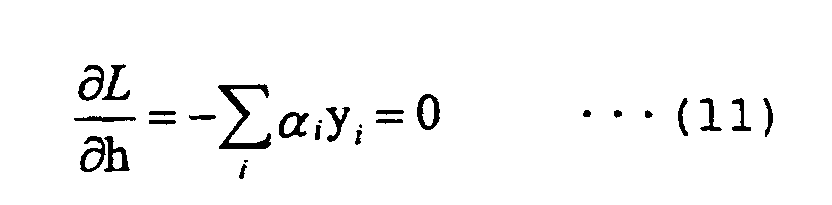
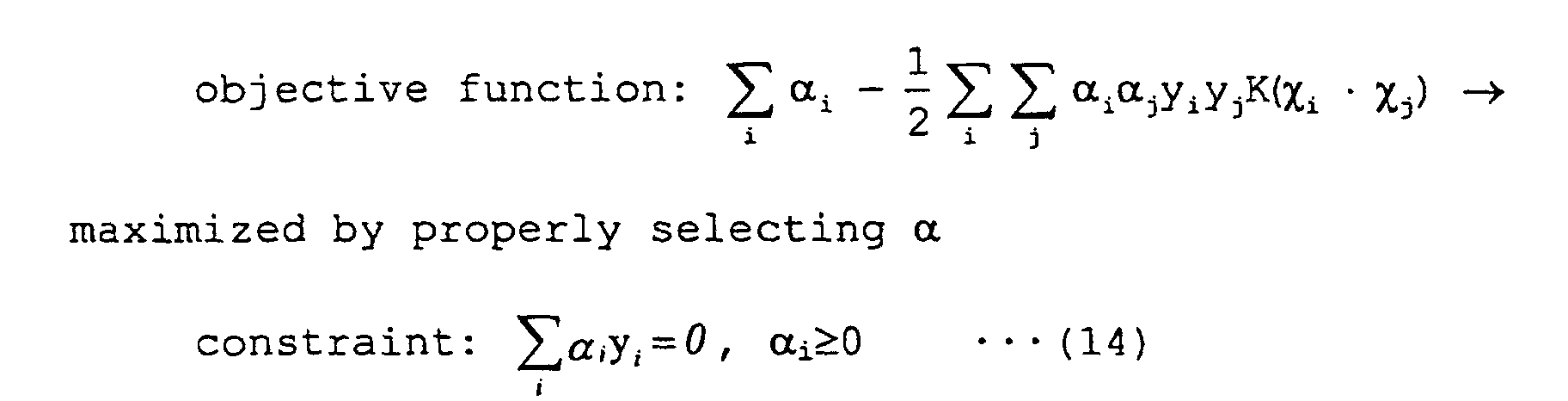
- the quadratic programming problem can be generally solved using a Lagrangian.
- ⁇ i are Lagrangian multipliers ( ⁇ i ⁇ 0).
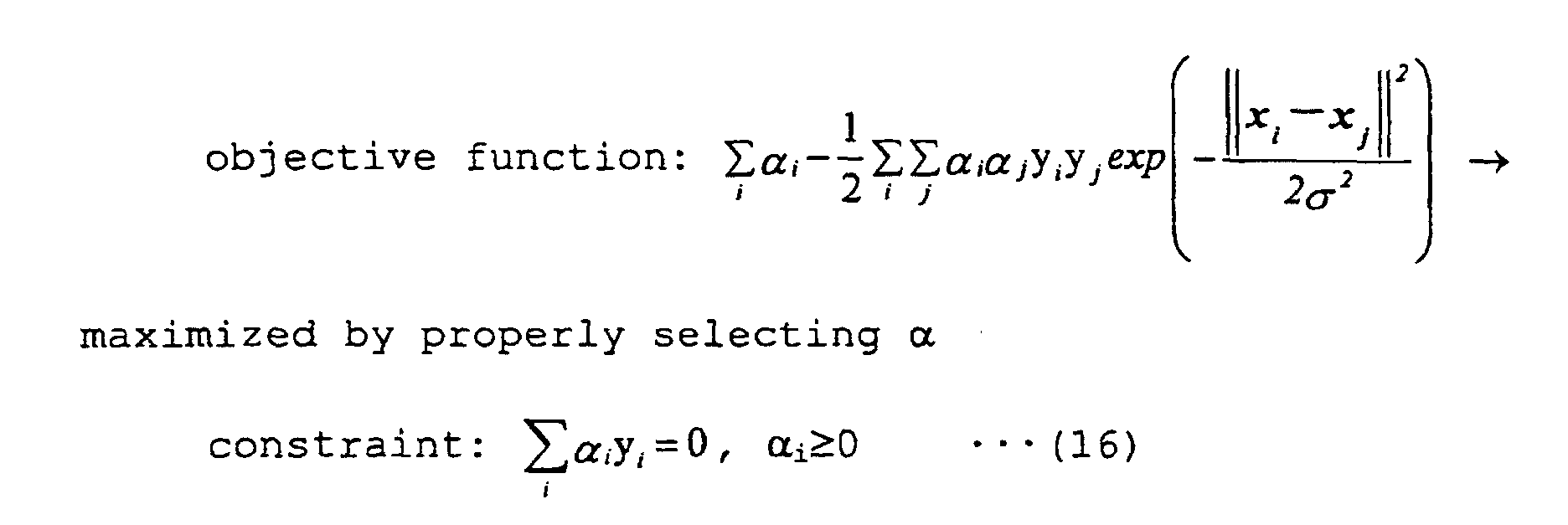
- Equation (16) can be solved, for example, by using a function quadprog available as a function for solving quadratic programming problems in Matlab.
- ⁇ can be determined.
- the discriminant function can be determined.
- the distributions of the sets in the feature space are probabilistic, and data can include wrong data (that is incorrectly selected by a human inspector). Therefore, all learning data are not necessarily correct.
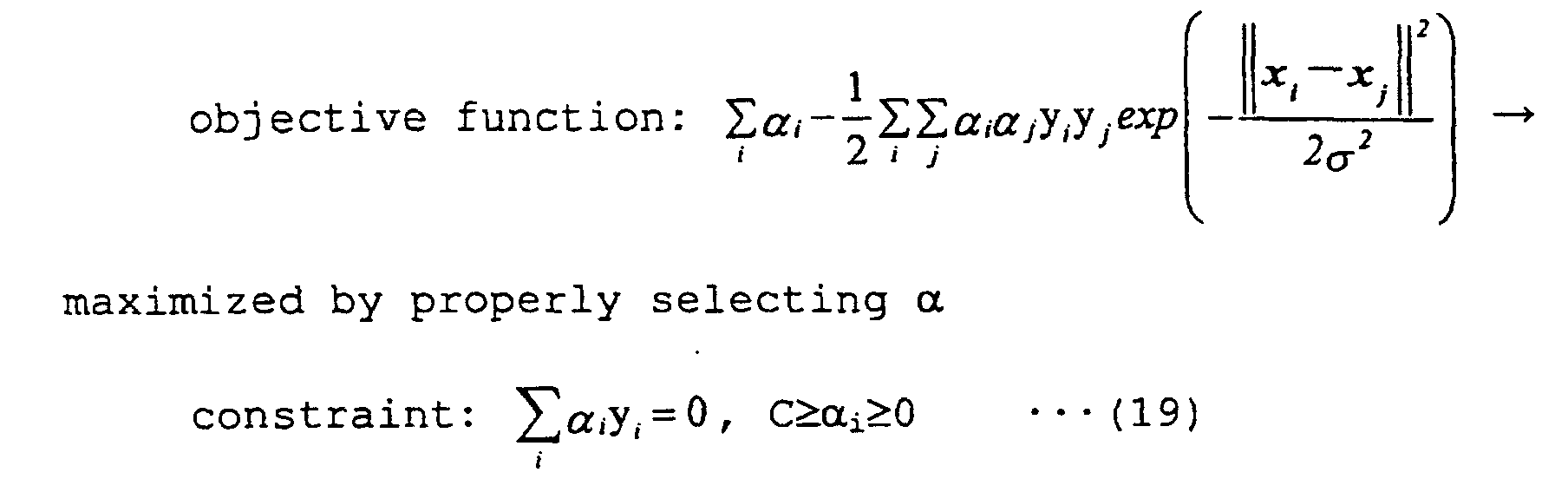
- the constraint in terms of complete linear separability imposed in the first example is relaxed. More specifically, the feature space is allowed to include a point that can cause an incorrect classification, and a penalty term is added to the objective function used in the first example, as described below.
- equation (9) is rewritten as follows.
- equation (18) is converted into the form of a dual problem by introducing a Lagrangian in a similar manner to the first example, and equation (15) is applied, then the following equation is obtained.
- equation (19) can also be solved, for example, by using a function quadprog available as a function for solving quadratic programming problems in Matlab.
- ⁇ can be determined.
- the discriminant function is given in the same form as equation (17).
- ⁇ determined by solving the quadratic programming problem and by giving proper values for ⁇ and h, the discriminant function can be determined.
- parameters are set such that the accuracy of defect classification for the surface defect type A (the probability that a defect determined to be of defect type A by a human inspector is correctly determined to be of defect type A by the surface defect detection apparatus) is substantially equal to the accuracy of defect classification for the surface defect type A' other than the surface defect type A (the probability that a defect determined to be of defect type A' by a human inspector is correctly determined to be of defect type A' by the surface defect detection apparatus).
- a particular type of surface defect can cause a very serious problem, and thus it is necessary to correctly detect such a type of surface defects without missing them. In this case, it is desirable to improve the accuracy of defect classification for that type of defects even if this results in a reduction in accuracy of defect classification for the other types of defects.
- the accuracy of defect classification for a particular type of surface defects that are not allowed to be missed is increased to a desired level.
- the bias h is pre-adjusted such that a desired accuracy of defect classification can be achieved. That is, the discriminant plane is intentionally displaced by a skilled person so as to expand a feature space region of the important surface defect type that is not allowed to be missed, such that the accuracy of defect classification is increased to a desired value.
- classification is performed in terms of surface defect types.
- the surface defect level is discriminated, as described below.
- defect level can be discriminated in a similar manner to one of the first to third examples.
- a surface defect under examination is of a particular defect type or of a particular defect level.
- a plurality of defect types and/or a plurality of defect levels are discriminated as described below.
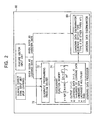
- Fig. 3 shows a surface defect type discriminator 60 for discriminating a plurality of defect types.
- a plurality of decision conditions are defined in the form of a decision tree.
- a decision condition in terms of surface defect type A is examined to determine whether a given surface defect is of the surface defect type A or of the other surface defect types A'. If it is determined that the given surface defect is of the other types A', a decision condition in terms of surface defect type B is examined to determine whether the given surface defect is of the surface defect type B or of the other surface defect types B'. If it is determined that the given surface defect is of the other surface defect types B', a decision condition in terms of surface defect type C is examined. Similarly, following decision conditions are examined one by one. Note that there are as many decision conditions as there are surface defect types to be discriminated.
- each decision condition in the decision tree is defined and examined in a similar manner to the manner in which defects are discriminated by the surface defect type discriminator 60 according to one of the first to fourth examples.
- the present invention makes it possible to increase the accuracy of defect classification in classification of surface scratch/defect types of products.
- the decision algorithm is automatically produced in a short time, and thus a troublesome task to establish the decision algorithm is minimized, and it is possible to start up the surface defect detection apparatus in a short time. Even when data associated with a particular defect type and other data are located close to a discriminant plane, correct decision is possible without overfitting.
- the discriminant plane can be intentionally displaced by a skilled person to expand a feature space region of feature values associated with that surface defect type thereby increasing the accuracy of defect classification for that surface defect type to a desired level. Not only the defect types but also defect levels can be discriminated.
- defect classification is possible for a combination of a plurality of defect types and a plurality of a defect levels.
Landscapes
- Engineering & Computer Science (AREA)
- Theoretical Computer Science (AREA)
- General Physics & Mathematics (AREA)
- Physics & Mathematics (AREA)
- Computer Vision & Pattern Recognition (AREA)
- Health & Medical Sciences (AREA)
- Life Sciences & Earth Sciences (AREA)
- General Health & Medical Sciences (AREA)
- Data Mining & Analysis (AREA)
- Evolutionary Computation (AREA)
- Artificial Intelligence (AREA)
- Textile Engineering (AREA)
- Pathology (AREA)
- Immunology (AREA)
- Biochemistry (AREA)
- Analytical Chemistry (AREA)
- Chemical & Material Sciences (AREA)
- Computing Systems (AREA)
- Multimedia (AREA)
- General Engineering & Computer Science (AREA)
- Quality & Reliability (AREA)
- Bioinformatics & Computational Biology (AREA)
- Bioinformatics & Cheminformatics (AREA)
- Software Systems (AREA)
- Evolutionary Biology (AREA)
- Databases & Information Systems (AREA)
- Medical Informatics (AREA)
- Investigating Materials By The Use Of Optical Means Adapted For Particular Applications (AREA)
- Image Analysis (AREA)
- Image Processing (AREA)
- Length Measuring Devices By Optical Means (AREA)
Abstract
Description
- 10:
- product under test
- 20:
- illumination light source
- 30:
- camera
- 40:
- surface defect feature value extractor
- 50:
- normalizer
- 60:
- surface defect type discriminator
- 70:
- learning data processor
- 72:
- quadratic programming problem solver
- 74:
- discriminant function memory
- 80:
- unknown data discriminator
i, j = 1, 2,..., n (n is the number of learning data)








Claims (5)
- A surface defect classification method for acquiring information associated with a surface state of a material under test, extracting a feature value of a surface defect from the acquired information, determining whether the surface defect is of a particular defect type, on the basis of the extracted feature value, the method comprising the steps of:preparing, as learning data, feature values of surface defects acquired in the past and data indicating the particular surface defect type related to feature values;representing the learning data as points in a feature space;under constraint that a discriminant plane can be defined in a space to which the feature space is mapped by an assumed mapping function such that mapped feature values are perfectly linearly separable with respect to the discriminant plane, solving a quadratic programming problem such that an objective function defined as the distance between the discriminant plane and a point located closest to the discriminant plane is maximized;employing, as a discriminant function, an optimal discriminant plane obtained by solving the above quadratic programming problem; andsubstituting a feature value of a surface defect whose type is unknown into the discriminant function, and determining, from the resultant value of the discriminant function, whether the surface defect whose type is unknown is of said particular surface type.
- A surface defect classification method for acquiring information associated with a surface state of a material under test, extracting a feature value of a surface defect from the acquired information, determining whether the surface defect is of a particular defect type, on the basis of the extracted feature value, the method comprising the steps of:preparing, as learning data, feature values of surface defects acquired in the past and data indicating the particular surface defect type related to feature values;representing the learning data as points in a feature space;setting constraint that when the feature space is mapped into a space by an assumed mapping function, a discriminant plane can be defined in the mapped space such that mapped feature values are linearly separable perfectly with respect to the discriminant plane;defining an objective function as the distance between the discriminant plane and a point located closest to the discriminant plane;relaxing the constraint in terms of the perfect linear separabilty such that there can exist a point that results in incorrect classification, and modifying the objective function by adding a penalty term to the objective function;determining a discriminant plane by solving a quadratic programming problem such that the modified objective function is maximized under the relaxed constraint, and employing the determined discriminant plane as a discriminant function; andsubstituting a feature value of a surface defect whose type is unknown into the discriminant function, and determining, from the resultant value of the discriminant function, whether the surface defect whose type is unknown is of said particular surface type.
- A surface defect classification method according to claim 1 or 2, wherein the bias term in the discriminant function is adjusted such that a desired accuracy of defect classification is obtained for a particular important surface defect type.
- A surface defect classification method for discriminating a defect level using a surface defect classification method according to one of claims 1 to 3.
- A surface defect classification method for discriminating a plurality of defect types and/or a plurality of defect levels in accordance with a decision tree in which a surface defect classification method according to one of claims 1 to 4 is implemented.
Applications Claiming Priority (3)
| Application Number | Priority Date | Filing Date | Title |
|---|---|---|---|
| JP2002146787A JP2003344300A (en) | 2002-05-21 | 2002-05-21 | Surface defect determination method |
| JP2002146787 | 2002-05-21 | ||
| PCT/JP2003/006102 WO2003098201A1 (en) | 2002-05-21 | 2003-05-16 | Surface defect judging method |
Publications (2)
| Publication Number | Publication Date |
|---|---|
| EP1507141A1 true EP1507141A1 (en) | 2005-02-16 |
| EP1507141A4 EP1507141A4 (en) | 2007-01-31 |
Family
ID=29545149
Family Applications (1)
| Application Number | Title | Priority Date | Filing Date |
|---|---|---|---|
| EP03752907A Withdrawn EP1507141A4 (en) | 2002-05-21 | 2003-05-16 | Surface defect judging method |
Country Status (7)
| Country | Link |
|---|---|
| US (1) | US20050175231A1 (en) |
| EP (1) | EP1507141A4 (en) |
| JP (1) | JP2003344300A (en) |
| KR (1) | KR20040111529A (en) |
| CN (1) | CN1656371A (en) |
| TW (1) | TW587154B (en) |
| WO (1) | WO2003098201A1 (en) |
Cited By (3)
| Publication number | Priority date | Publication date | Assignee | Title |
|---|---|---|---|---|
| RU2301998C2 (en) * | 2005-05-18 | 2007-06-27 | Открытое акционерное общество "Магнитогорский металлургический комбинат" | Mode of definition of mechanical properties of a moving steel band and an arrangement for its execution |
| EP3279645A4 (en) * | 2015-03-31 | 2018-09-26 | Nisshin Steel Co., Ltd. | Device for examining surface defect in hot-dipped steel plate, and method for examining surface defect |
| GB2585821A (en) * | 2019-06-17 | 2021-01-27 | Southampton Solent Univ | Non-destructive testing method and apparatus |
Families Citing this family (25)
| Publication number | Priority date | Publication date | Assignee | Title |
|---|---|---|---|---|
| US7107167B2 (en) * | 2003-07-15 | 2006-09-12 | Qualcomm Inc. | Method and apparatus for searching external issues for testing a product |
| EP2006666A4 (en) * | 2006-03-16 | 2010-10-13 | Ngk Insulators Ltd | Method of inspecting outer wall of honeycomb structure body |
| CN101484910B (en) * | 2006-07-06 | 2015-04-08 | 旭硝子株式会社 | Clustering system, and defect kind judging device |
| JP4908995B2 (en) * | 2006-09-27 | 2012-04-04 | 株式会社日立ハイテクノロジーズ | Defect classification method and apparatus, and defect inspection apparatus |
| JP5298552B2 (en) * | 2008-02-04 | 2013-09-25 | 新日鐵住金株式会社 | Discrimination device, discrimination method, and program |
| JP2010014436A (en) * | 2008-07-01 | 2010-01-21 | Micronics Japan Co Ltd | Defect inspection method and defect inspection device |
| JP5260183B2 (en) * | 2008-08-25 | 2013-08-14 | 株式会社日立ハイテクノロジーズ | Defect inspection method and apparatus |
| JP5464986B2 (en) * | 2009-11-27 | 2014-04-09 | 名古屋電機工業株式会社 | Pass / fail judgment device, pass / fail judgment method, and pass / fail judgment program |
| JP5712392B2 (en) * | 2010-03-31 | 2015-05-07 | 株式会社 カロリアジャパン | Device for determining foreign matter contamination in an object |
| US20130208978A1 (en) * | 2010-10-19 | 2013-08-15 | 3M Innovative Properties Company | Continuous charting of non-uniformity severity for detecting variability in web-based materials |
| BR112013020467A2 (en) * | 2011-02-24 | 2016-10-25 | 3M Innovative Properties Co | non-uniformity detection system for mat materials |
| JP5842373B2 (en) * | 2011-04-25 | 2016-01-13 | Jfeスチール株式会社 | Surface defect detection method and surface defect detection apparatus |
| CN103745942B (en) * | 2013-12-31 | 2016-10-05 | 株洲南车时代电气股份有限公司 | Judge the devices and methods therefor of power semiconductor modular substrate camber |
| JP6622581B2 (en) | 2015-12-11 | 2019-12-18 | キヤノン株式会社 | Information presentation method and apparatus |
| KR102415197B1 (en) | 2016-11-30 | 2022-06-29 | 제이에프이 스틸 가부시키가이샤 | Fraction measuring device and fraction measuring system |
| CN109102486B (en) * | 2017-06-21 | 2020-07-14 | 合肥欣奕华智能机器有限公司 | Surface defect detection method and device based on machine learning |
| CN107749058B (en) * | 2017-10-23 | 2021-05-04 | 中南大学 | A machine vision detection method and system for surface defects of boiler pipes |
| CN108008554B (en) * | 2017-11-27 | 2020-09-11 | 武汉精测电子集团股份有限公司 | Point defect area detection method based on diffuse speckle sharpness |
| JP2019111570A (en) * | 2017-12-26 | 2019-07-11 | Jfeスチール株式会社 | Determination method for processing of cold rolled stainless steel plate and processing method |
| CN108362746B (en) * | 2018-02-01 | 2021-07-02 | 中国石油大学(华东) | Defect discrimination method based on lift-off effect of single-pair electrode capacitance imaging detection technology |
| DE102018109816B3 (en) * | 2018-04-24 | 2019-10-24 | Yxlon International Gmbh | A method for obtaining at least one significant feature in a series of components of the same type and method for classifying a component of such a series |
| CN112334765B (en) * | 2018-06-22 | 2024-07-09 | 杰富意钢铁株式会社 | Accumulator life estimation device and accumulator life extension method |
| CN109407630B (en) * | 2018-09-21 | 2020-08-21 | 深圳新视智科技术有限公司 | Parameter calculation method, device, terminal and readable storage medium |
| DE102018133092B3 (en) * | 2018-12-20 | 2020-03-12 | Volume Graphics Gmbh | Computer-implemented method for analyzing measurement data from a measurement of an object |
| CN111079832B (en) * | 2019-12-13 | 2023-04-18 | 辽宁科技大学 | Steel plate surface defect classification method with characteristic noise resistance |
Family Cites Families (4)
| Publication number | Priority date | Publication date | Assignee | Title |
|---|---|---|---|---|
| JPH05280960A (en) * | 1992-03-30 | 1993-10-29 | Fuji Photo Film Co Ltd | Defect inspection equipment |
| US5640492A (en) * | 1994-06-30 | 1997-06-17 | Lucent Technologies Inc. | Soft margin classifier |
| AU1553601A (en) * | 1999-11-29 | 2001-06-12 | Olympus Optical Co., Ltd. | Defect inspecting system |
| JP2001256480A (en) * | 2000-03-09 | 2001-09-21 | Hitachi Ltd | Automatic image classification method and apparatus |
-
2002
- 2002-05-21 JP JP2002146787A patent/JP2003344300A/en active Pending
-
2003
- 2003-05-16 WO PCT/JP2003/006102 patent/WO2003098201A1/en not_active Ceased
- 2003-05-16 KR KR10-2004-7016654A patent/KR20040111529A/en not_active Ceased
- 2003-05-16 CN CNA038114690A patent/CN1656371A/en active Pending
- 2003-05-16 EP EP03752907A patent/EP1507141A4/en not_active Withdrawn
- 2003-05-16 US US10/514,770 patent/US20050175231A1/en not_active Abandoned
- 2003-05-19 TW TW092113458A patent/TW587154B/en not_active IP Right Cessation
Cited By (4)
| Publication number | Priority date | Publication date | Assignee | Title |
|---|---|---|---|---|
| RU2301998C2 (en) * | 2005-05-18 | 2007-06-27 | Открытое акционерное общество "Магнитогорский металлургический комбинат" | Mode of definition of mechanical properties of a moving steel band and an arrangement for its execution |
| EP3279645A4 (en) * | 2015-03-31 | 2018-09-26 | Nisshin Steel Co., Ltd. | Device for examining surface defect in hot-dipped steel plate, and method for examining surface defect |
| GB2585821A (en) * | 2019-06-17 | 2021-01-27 | Southampton Solent Univ | Non-destructive testing method and apparatus |
| GB2585821B (en) * | 2019-06-17 | 2021-10-13 | Southampton Solent Univ | Non-destructive testing method and apparatus |
Also Published As
| Publication number | Publication date |
|---|---|
| KR20040111529A (en) | 2004-12-31 |
| TW587154B (en) | 2004-05-11 |
| EP1507141A4 (en) | 2007-01-31 |
| US20050175231A1 (en) | 2005-08-11 |
| JP2003344300A (en) | 2003-12-03 |
| CN1656371A (en) | 2005-08-17 |
| WO2003098201A1 (en) | 2003-11-27 |
| TW200401878A (en) | 2004-02-01 |
Similar Documents
| Publication | Publication Date | Title |
|---|---|---|
| US20050175231A1 (en) | Surface defect judging method | |
| US5978497A (en) | Apparatus for the identification of free-lying cells | |
| US4199748A (en) | Automated method and apparatus for classification of cells with application to the diagnosis of anemia | |
| Yoshikawa et al. | On a grading system for beef marbling | |
| Riggi et al. | Astronomical source detection in radio continuum maps with deep neural networks | |
| US20130279794A1 (en) | Integration of automatic and manual defect classification | |
| Serranti et al. | Efficient microplastic identification by hyperspectral imaging: A comparative study of spatial resolutions, spectral ranges and classification models to define an optimal analytical protocol | |
| US6549661B1 (en) | Pattern recognition apparatus and pattern recognition method | |
| Treloar et al. | Towards automation of palynology 1: analysis of pollen shape and ornamentation using simple geometric measures, derived from scanning electron microscope images | |
| She et al. | Intelligent animal fiber classification with artificial neural networks | |
| US6337927B1 (en) | Approximated invariant method for pattern detection | |
| Sun et al. | A novel method for multi-feature grading of mango using machine vision | |
| KR20230063147A (en) | Efficient Lightweight CNN and Ensemble Machine Learning Classification of Prostate Tissue Using Multilevel Feature Analysis Method and System | |
| US11599981B2 (en) | Image processing system | |
| US20210383525A1 (en) | Image and data analystics model compatibility regulation methods | |
| KR102013392B1 (en) | Gas detection method using SVM classifier | |
| CN112908484A (en) | System, equipment and storage medium for analyzing diseases by cross-modal fusion | |
| KR102593981B1 (en) | method for processing missing value in network log data and analyzing root cause of communication defect thereby | |
| US20240319061A1 (en) | Particle characterisation method and apparatus | |
| CN117893793A (en) | Target detection classification method, system and storage medium | |
| Kalivas | Data fusion of nonoptimized models: applications to outlier detection, classification, and image library searching | |
| Han et al. | Egg shell inspection using global image analysis | |
| Sudianjaya et al. | Segmentation and Classification of Breast Cancer Histopathological Image Utilizing U-Net and Transfer Learning ResNet50 | |
| Abd-Elaziz et al. | Detecting Outliers with Distributions for Estimating Time Series Models. | |
| CN118673416B (en) | Mine ecological problem identification method and system based on artificial intelligence |
Legal Events
| Date | Code | Title | Description |
|---|---|---|---|
| PUAI | Public reference made under article 153(3) epc to a published international application that has entered the european phase |
Free format text: ORIGINAL CODE: 0009012 |
|
| 17P | Request for examination filed |
Effective date: 20041115 |
|
| AK | Designated contracting states |
Kind code of ref document: A1 Designated state(s): AT BE BG CH CY CZ DE DK EE ES FI FR GB GR HU IE IT LI LU MC NL PT RO SE SI SK TR |
|
| RBV | Designated contracting states (corrected) |
Designated state(s): DE FR |
|
| A4 | Supplementary search report drawn up and despatched |
Effective date: 20070102 |
|
| RIC1 | Information provided on ipc code assigned before grant |
Ipc: G06K 9/62 20060101ALI20061222BHEP Ipc: G06T 7/00 20060101ALI20061222BHEP Ipc: G01N 21/892 20060101AFI20031204BHEP |
|
| STAA | Information on the status of an ep patent application or granted ep patent |
Free format text: STATUS: THE APPLICATION IS DEEMED TO BE WITHDRAWN |
|
| 18D | Application deemed to be withdrawn |
Effective date: 20081202 |