EP1506926A1 - Synthetic resin bottle - Google Patents
Synthetic resin bottle Download PDFInfo
- Publication number
- EP1506926A1 EP1506926A1 EP03715483A EP03715483A EP1506926A1 EP 1506926 A1 EP1506926 A1 EP 1506926A1 EP 03715483 A EP03715483 A EP 03715483A EP 03715483 A EP03715483 A EP 03715483A EP 1506926 A1 EP1506926 A1 EP 1506926A1
- Authority
- EP
- European Patent Office
- Prior art keywords
- bottle
- synthetic resin
- wall
- deformation
- ribs
- Prior art date
- Legal status (The legal status is an assumption and is not a legal conclusion. Google has not performed a legal analysis and makes no representation as to the accuracy of the status listed.)
- Granted
Links
Images


Classifications
-
- B—PERFORMING OPERATIONS; TRANSPORTING
- B65—CONVEYING; PACKING; STORING; HANDLING THIN OR FILAMENTARY MATERIAL
- B65D—CONTAINERS FOR STORAGE OR TRANSPORT OF ARTICLES OR MATERIALS, e.g. BAGS, BARRELS, BOTTLES, BOXES, CANS, CARTONS, CRATES, DRUMS, JARS, TANKS, HOPPERS, FORWARDING CONTAINERS; ACCESSORIES, CLOSURES, OR FITTINGS THEREFOR; PACKAGING ELEMENTS; PACKAGES
- B65D1/00—Rigid or semi-rigid containers having bodies formed in one piece, e.g. by casting metallic material, by moulding plastics, by blowing vitreous material, by throwing ceramic material, by moulding pulped fibrous material or by deep-drawing operations performed on sheet material
- B65D1/02—Bottles or similar containers with necks or like restricted apertures, designed for pouring contents
-
- B—PERFORMING OPERATIONS; TRANSPORTING
- B65—CONVEYING; PACKING; STORING; HANDLING THIN OR FILAMENTARY MATERIAL
- B65D—CONTAINERS FOR STORAGE OR TRANSPORT OF ARTICLES OR MATERIALS, e.g. BAGS, BARRELS, BOTTLES, BOXES, CANS, CARTONS, CRATES, DRUMS, JARS, TANKS, HOPPERS, FORWARDING CONTAINERS; ACCESSORIES, CLOSURES, OR FITTINGS THEREFOR; PACKAGING ELEMENTS; PACKAGES
- B65D1/00—Rigid or semi-rigid containers having bodies formed in one piece, e.g. by casting metallic material, by moulding plastics, by blowing vitreous material, by throwing ceramic material, by moulding pulped fibrous material or by deep-drawing operations performed on sheet material
- B65D1/02—Bottles or similar containers with necks or like restricted apertures, designed for pouring contents
- B65D1/0223—Bottles or similar containers with necks or like restricted apertures, designed for pouring contents characterised by shape
-
- B—PERFORMING OPERATIONS; TRANSPORTING
- B65—CONVEYING; PACKING; STORING; HANDLING THIN OR FILAMENTARY MATERIAL
- B65D—CONTAINERS FOR STORAGE OR TRANSPORT OF ARTICLES OR MATERIALS, e.g. BAGS, BARRELS, BOTTLES, BOXES, CANS, CARTONS, CRATES, DRUMS, JARS, TANKS, HOPPERS, FORWARDING CONTAINERS; ACCESSORIES, CLOSURES, OR FITTINGS THEREFOR; PACKAGING ELEMENTS; PACKAGES
- B65D1/00—Rigid or semi-rigid containers having bodies formed in one piece, e.g. by casting metallic material, by moulding plastics, by blowing vitreous material, by throwing ceramic material, by moulding pulped fibrous material or by deep-drawing operations performed on sheet material
- B65D1/40—Details of walls
- B65D1/42—Reinforcing or strengthening parts or members
- B65D1/44—Corrugations
-
- B—PERFORMING OPERATIONS; TRANSPORTING
- B65—CONVEYING; PACKING; STORING; HANDLING THIN OR FILAMENTARY MATERIAL
- B65D—CONTAINERS FOR STORAGE OR TRANSPORT OF ARTICLES OR MATERIALS, e.g. BAGS, BARRELS, BOTTLES, BOXES, CANS, CARTONS, CRATES, DRUMS, JARS, TANKS, HOPPERS, FORWARDING CONTAINERS; ACCESSORIES, CLOSURES, OR FITTINGS THEREFOR; PACKAGING ELEMENTS; PACKAGES
- B65D2501/00—Containers having bodies formed in one piece
- B65D2501/0009—Bottles or similar containers with necks or like restricted apertures designed for pouring contents
- B65D2501/0018—Ribs
- B65D2501/0036—Hollow circonferential ribs
Definitions
- This invention relates to a biaxially drawn, blow-molded bottle made of a synthetic resin, especially made of a polyethylene terephthalate resin for use in hot filling of the contents.
- the biaxially drawn, blow-molded bottle of a polyethylene terephthalate resin (hereinafter referred to as the PET resin) can be given a thin and uniform wall thickness because of distinguished characteristics of PET. Since such bottles are economical, have high resistance to contents and a high mechanical strength, and have good outer appearance, the bottles are widely used as liquid containers in various fields.
- the PET bottle has a high mechanical strength despite its thin wall.
- the bottle since the body, a major part of the bottle, has a thin wall, the bottle is inconvenient in that a part of the body may falsely become dented and deform under a reduced pressure created inside the bottle and may give a marked damage to the outer appearance of the bottle.
- the bottle As a commercial product, the bottle may be quite poor in appearance.
- the resin for molding the bottle In the applications requiring sterilization of retort-packed foods, e.g., by heating the foods at 121°C for 30 minutes after the bottle has been filled with the contents, the resin for molding the bottle must be resistant to this temperature, and in addition, the bottle should be able to stand up to severe depressurization.
- the deformable panel walls in the above-described conventional art has a problem in that the extent to which negative pressure can be absorbed is not sufficient, considering the extent of dented deformation created under the reduced pressure. This is because the deformable panels have been molded beforehand simply in the shape slightly dented inward so that the dented deformation may occur easily under the reduced pressure created inside the bottle.
- deformable panel walls Another problem of the deformable panel walls is that the body has a decreased buckling strength due to the existence of these deformable panels, which are molded by denting and deforming a part of the walls and which are equally spaced in a row around the circumference of the body.
- the bottle sometimes looks poor in appearance. Since the deformable panel walls that become dented are longer than are wide, the portion of the body surrounded by the deformable panels looks quite lean as compared with other portions of the body, depending on the angle from which the bottle is viewed.
- the bottle becomes permanently deformed. All of those bottles causing a reduced pressure to be created inside are filled with hot liquid contents. Initially when the bottle is filled with the hot contents and sealed, the inside of the bottle is put under a pressurized condition. Therefore, the deformable panel walls are also required to have an ability to absorb a pressure, in addition to the ability to absorb a reduced pressure. Since these deformable panel walls have a shape of simply curved and dented panels, the panels cannot fully absorb the pressure. If a large pressure is applied, the deformable panels are not elastically inflated but are reversibly projected, and remain permanently deformed.
- the technical problem of this invention is to eliminate the need to use the deformable panel walls and to find the body of such a shape that no false deformation, such as dented deformation, takes place in a portion of the body due to the hot filling or the reduced pressure created after the treatment of retort-packed foods.
- the object of this invention is to obtain a bottle that can inhibit the deformation caused by reduced pressure, has a high buckling strength, and is good in outer appearance.
- the means of carrying out the invention of Claim 1 to solve the above-described technical problems comprises that the surface rigidity of the body wall has been set in such a manner that a part of the body wall never becomes dented inward under a reduced inner pressure of at least 350 mmHg (46.7 kPa).
- Claim 1 is intended to make the body wall resist a lateral pressure applied onto the wall surface when such a pressure is created in the hot filling process by a reduced pressure of at least 350 mmHg (46.7 kPa). This can be achieved by raising the surface rigidity of the body wall to a high level, without providing the deformable panel walls in which a portion of the body wall becomes dented and deforms as found in the conventional art.
- bottles that can be obtained eliminate the need for deformable panels, have quite a new appearance, and are of an elaborate design that differs from the designs used in conventional art.
- the synthetic resin bottle of this invention is a biaxially drawn, blow-molded bottle made of especially a PET resin.
- a PET resin polyethylene naphthalate (PEN) or the MXD-6 nylon resin can be blended with the PET resin to improve, for instance, heat-resisting property and gas barrier property, within the range in which the nature of the PET resin is not impaired.
- PEN or MXD-6 can be laminated as an inner layer between the PET resin layers.
- the means of carrying out the invention of Claim 2 exists in the configuration that the body has a cylindrical shape.
- the body wall outwardly forms a convex surface, which gives high surface rigidity to the entire body.
- the means of carrying out the invention of Claim 3 includes the invention of Claim 1, and also comprises that the body is in a regular polygonal shape having at least 8 corners.
- the body shape is not limited to a cylindrical shape, but a regular polygonal shape can also be used, provided that the regular polygon has 8 or more corners.
- the regular polygon has 8 or more corners. The reason is that, with a regular polygon having 7 corners or less, each of the flat panel wall surfaces disposed around the body has laterally such a large width that the panel tends to become dented and deform easily under reduced pressure.
- the means of carrying out the invention of Claim 4 exists in the configuration that, in the invention of Claim 2 or 3, two or more groove-like ribs are disposed circumferentially around the body.
- the uppermost rib is disposed at the upper end of the body near the border with the shoulder that has a roughly truncated conical shape.
- the lowermost rib is disposed at the lower end of the body.
- Distance H between two adjacent ribs is set at a length in the range of 0.2D to 0.6D where D indicates the diameter of the cylindrical body or the length of a diagonal line of the cylindrical body having a regular polygonal shape.
- the uppermost circumferential rib is disposed at the upper end of the body near the border with the shoulder that has a roughly truncated conical shape. Therefore, it is possible to inhibit effectively the dented deformation, which is apt to take place on or near this border.
- the body can be equipped with a number of circumferential ribs, including those disposed at the upper end and the lower end of the body, so that the body wall has an increased level of surface rigidity.
- the circumferential ribs are required to resist the lateral pressure created under reduced pressure.
- the interval between two adjacent ribs can be set advantageously at 0.6D or less though it depends on the thickness of the body wall. At this interval, increased surface rigidity can be achieved for the same thickness as that of the hot-filled bottles provided with conventional deformable panels. At the interval of 0.2D or less, the circumferential ribs are too close to adjacent ribs, resulting in the lack of smooth outer surface. Under this condition, the body of the bottle is found inconvenient to attach a label. If the bottle is covered with shrink film, the body is also inconvenient to clearly show the name of the merchandise or to decorate the bottle.
- the means of carrying out the invention of Claim 5 exists in the configuration that, in the invention of Claim 4, the distance H between two adjacent ribs is set at a length in the range of 0.3D to 0.45D.
- the bottle is allowed to have a thinner wall than the bottle in conventional art.
- the bottle according to Claim 5 can be used at a higher hot-filling temperature or under a severer pressure condition than in conventional art.
- the circumferential ribs can be disposed in a smaller number, which gives the bottle preferable outer appearance.
- the means of carrying out the invention of Claim 6 exists in the configuration that, in the invention of Claim 1, 2, 3, 4, or 5, the wall of the body excluding the neck has a minimum thickness of 300 ⁇ m or more.
- the surface rigidity of the bottle can be raised by giving a large thickness to the bottle, but the wall thickness has a limit of its own because of preform productivity, the increase in material cost, and an increased bottle weight.
- a suitable wall thickness is a minimum of 300 ⁇ m or more, and preferably ranges from 350 to 650 ⁇ m on an average. At a thickness less than 300 ⁇ m, it becomes difficult to secure the surface rigidity that can resist the depressurization.
- Fig. 1 is a front view of an entire synthetic resin bottle in the first embodiment of this invention.
- It is an ordinary 200-ml PET bottle, which has been biaxially drawn and blow-molded.
- the bottle comprises cylindrical body 2, shoulder 4 of a truncated conical shape disposed at the upper end of the body 2, short cylindrical neck 3 disposed on the shoulder 4, and bottom 7 at the lower end of the body 2.
- the bottle 1 has the cylindrical body 2 with a diameter of 54 mm, and has a total bottle height of 140 mm.
- the body 2 has an average thickness of 350 ⁇ m and a minimum thickness of at least 300 ⁇ m.
- the body 2 is provided with a total of four circumferential ribs 5 having a cross-section of almost U-shape.
- the uppermost rib is disposed at the upper end of the body 2 near the border with the shoulder 4.
- the lowermost rib is disposed at the lower end of the body 2 near the border with the bottom 7.
- the distance H between two adjacent ribs 5 is 24 mm (0.44D).
- Fig. 2 shows a bottle of a comparative example having three circumferential ribs 5, the least number of ribs as compared to the first embodiment.
- the distance H is 36 mm (0.67D).
- the bottle of the first embodiment and the bottle of the comparative example were put to a hot-filling test at 87°C. After the bottles 1 were cooled down to room temperature, they were checked for deformation. No dented deformation was observed in the bottle 1 of the first embodiment. On the other hand, the bottle 1 of the comparative example showed notable dented deformation in the wall of the body 2.
- the bottle of the first embodiment was also put to one more test conducted at 95°C. No dented deformation was likewise observed in the bottle 1 of the first embodiment as was in the test conducted at 87°C.
- the above-described bottles 1 of both the first embodiment and the comparative example were measured for depressurization strength.
- the neck 3 of the bottles 1 was sealed, and the bottles 1 were gradually depressurized, using a vacuum pump.
- the extent of depressurization is defined as the depressurization strength (mmHg, kPa) measured at the time when a part of the wall surface of the body 2 becomes sharply dented and deforms.
- the bottle 1 of the first embodiment had a depressurizing strength of 360 mmHg (48.0 kPa), and the bottle 1 of the comparable example had a corresponding strength of 310 mmHg (41.3 kPa).
- the results of the tests with the bottle 1 of the first embodiment indicate that, if there is a distance H of 0.43D between two adjacent circumferential ribs, the bottle 1 of the first embodiment has the surface rigidity enough to be able to cope with the pressure reduction of at least 350 mmHg (46.7 kPa) at an average wall thickness of 350 ⁇ m, which is similar to the wall thickness of conventional bottles now in use. It is also found that the bottle 1 of the first embodiment is fully capable of inhibiting the dented deformation caused by the pressure reduction during the hot-filling process using a temperature even in the range of 85 to 95°C.
- Bottles used for retort-packed foods are thermally treated at 121°C for 30 minutes. Highly heat-resistant PET bottles are used in such an application, and these bottles are molded by the so-called "double blow” method (See patent publication No. 1992-56734).
- the above-described double blow molding method comprises a primary blow-molding step, in which preform having a predetermined shape is biaxially drawn and blow-molded into the primary intermediate product, a step of heating the primary intermediate product to shrink it thermally and to mold it into the secondary intermediate product, and lastly a secondary blow-molding step to mold the secondary intermediate product into a bottle.
- the primary intermediate product is heated and is subjected to thermal shrinkage because this heating step serves to eliminate the residual strain that has been created within the primary intermediate product and to obtain a highly crystallized and quite highly heat-resisting bottle.
- Fig. 3 shows a synthetic resin bottle in the second embodiment of this invention.
- the bottle 1 has been molded under the conditions of a primary mold temperature of 180°C, a heating temperature of 230°C, and a secondary mold temperature of 140°C, so that the bottle 1 can respond to the retort treatment where the bottle and the contents are heat-treated at a temperature of 121°C for 30 minutes.
- the bottle 1 has an average wall thickness of 400 ⁇ m, as compared to 350 ⁇ m in the bottle of the first embodiment, and is provided with five circumferential ribs 5 that are spaced equally, so that the surface rigidity is increased further.
- the circumferential ribs have the distance H of 18 mm (0.33D) between two adjacent ribs 5.
- the bottle 1 of the second embodiment was filled with the contents, and the retort-packed bottle was heat-treated at 121°C for 30 minutes. The bottle 1 was then cooled down to room temperature and was checked for any deformation. No dented deformation was observed.
- This bottle 1 had a depressurizing strength of 525 mmHg (70.0 kPa). Even for the pressure reduction derived from the treatment at such a high temperature, sufficient surface rigidity can be secured within the range of wall thickness that is permissible for the bottle, by setting a suitable distance H between two adjacent circumferential ribs 5.
- this bottle obviously allows the bottle to be applicable also as an ordinary hot-filling bottle that has been biaxially drawn, blow-molded and can be heat-treated at a temperature in the range of 85 to 95°C.
- This shape of the bottle is not limited merely to the use as the retort-treated bottle.
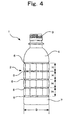
- Fig. 4 shows a synthetic resin bottle in the third embodiment of this invention.
- the bottle has an average wall thickness of 350 ⁇ m, the cylindrical body 2 with the cross-section of a regular dodecagonal shape, a diagonal length of 54 mm, and five circumferential ribs 5 that are spaced equally. There was no dented deformation that was caused by the hot filling at a temperature of 87°C.
- the circumferential ribs 5 are spaced equally in all of the first, second, and third embodiments. However, it is noted that these ribs need not necessarily be spaced equally. If they are not spaced equally, the purpose of this patent application can be achieved at the widest distance H in the range of 0.2D to 0.6D, and more preferably in the range of 0.3D to 0.45D, between two adjacent circumferential ribs 5.
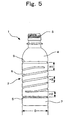
- Fig. 5 shows a synthetic resin bottle in the fourth embodiment of this invention.
- Two circumferential ribs 5 are disposed at the upper end and the lower end, respectively, of the body 2. Between these two ribs, a spiral rib 6 is dug in the wall as a variation of the third circumferential rib 5, but has the same cross-sectional structure as other ribs 5.
- the bottle of the third embodiment gives a new appearance of unique design.
- the circumferential ribs 5 need not necessarily be prepared separately, but the spiral rib 6 in the fourth embodiment may be adopted within the realm of surface rigidity that can be effectively strengthened. At that time, only the distances H1, H2, and H3 shown in Fig. 5 need be taken into consideration. In this embodiment, the widest distance H1 is 27 mm (0.5D).
- the body in the fourth embodiment had a diameter D of 54 mm and an average wall thickness of 350 ⁇ m. There was no dented deformation that was caused by the hot filling at the temperature of 87°C.
- circumferential ribs 5 In order for the circumferential ribs 5 to give the right surface rigidity in all the above-described embodiments, it is preferred that these ribs are 1 mm or more in width and depth.
- the PET bottles with a capacity of 200 ml were used in the tests for each embodiment. It goes without saying, though, that the bottle capacity is not set down specifically as long as the bottles meet the requirements described above.
- the body has a cylindrical shape. This gives the bottle wall a convex shape over all the body surfaces and keeps the entire body at a high surface-rigid state.
- the body is a cylinder of a regular polygonal shape having at least 8 corners.
- a shape makes it possible to avoid a large decrease in the surface rigidity and to obtain a bottle of unique design having a cylindrical body of the regular polygonal shape.
- two or more circumferential ribs are disposed around the body, and the distance H between two adjacent ribs is set in a certain range.
- suitable surface rigidity can be secured by setting the wall thickness at a minimum of 300 ⁇ m or more.
- the suitable surface rigidity can be secured while maintaining the preform productivity and restricting the material cost and the increased bottle weight.
Landscapes
- Engineering & Computer Science (AREA)
- Ceramic Engineering (AREA)
- Mechanical Engineering (AREA)
- Containers Having Bodies Formed In One Piece (AREA)
Abstract
Description
The shape of this bottle obviously allows the bottle to be applicable also as an ordinary hot-filling bottle that has been biaxially drawn, blow-molded and can be heat-treated at a temperature in the range of 85 to 95°C. This shape of the bottle is not limited merely to the use as the retort-treated bottle.
The PET bottles with a capacity of 200 ml were used in the tests for each embodiment. It goes without saying, though, that the bottle capacity is not set down specifically as long as the bottles meet the requirements described above.
Claims (6)
- A biaxially drawn, blow-molded bottle made of a synthetic resin, wherein the surface rigidity of the wall of body (2) has been set in such a manner that a part of the wall of said body (2) cannot become dented inward under a reduced inner pressure of at least 350 mmHg (46.7 kPa).
- The synthetic resin bottle according to Claim 1, wherein the body (2) of said bottle has a cylindrical shape.
- The synthetic resin bottle according to Claim 1, wherein the body (2) of said bottle is in a regular polygonal shape having at least 8 corners.
- The synthetic resin bottle according to Claim 2 or 3, comprising 2 or more groove-like ribs (5) on the circumference of the body (2), wherein the uppermost circumferential rib (5) is disposed at the upper end of the body (2) near the border with shoulder (4) of a roughly truncated conical shape; and the lowermost circumferential rib (5), at the lower end of the body (2), with distance H between two adjacent ribs being set at a length in the range of 0.2D to 0.6D where D indicates the diameter of the cylindrical body or the length of a diagonal line of the cylindrical body having a regular polygonal shape.
- The synthetic resin bottle according to Claim 4, wherein the distance H between two adjacent circumferential ribs (5) is set at a length in the range of 0.3D to 0.45D.
- The synthetic resin bottle according to Claim 1, 2, 3, 4, or 5, wherein the wall of the body (2) excluding neck (3) has a minimum thickness of 300 µm or more.
Applications Claiming Priority (3)
| Application Number | Priority Date | Filing Date | Title |
|---|---|---|---|
| JP2002088301 | 2002-03-27 | ||
| JP2002088301A JP2003285814A (en) | 2002-03-27 | 2002-03-27 | Synthetic resin bottle |
| PCT/JP2003/003802 WO2003080452A1 (en) | 2002-03-27 | 2003-03-27 | Synthetic resin bottle |
Publications (3)
| Publication Number | Publication Date |
|---|---|
| EP1506926A1 true EP1506926A1 (en) | 2005-02-16 |
| EP1506926A4 EP1506926A4 (en) | 2006-05-10 |
| EP1506926B1 EP1506926B1 (en) | 2009-08-26 |
Family
ID=28449435
Family Applications (1)
| Application Number | Title | Priority Date | Filing Date |
|---|---|---|---|
| EP03715483A Expired - Lifetime EP1506926B1 (en) | 2002-03-27 | 2003-03-27 | Synthetic resin bottle |
Country Status (10)
| Country | Link |
|---|---|
| US (1) | US7051890B2 (en) |
| EP (1) | EP1506926B1 (en) |
| JP (1) | JP2003285814A (en) |
| KR (1) | KR100968692B1 (en) |
| CN (1) | CN1285489C (en) |
| AU (1) | AU2003227253B8 (en) |
| CA (1) | CA2475740C (en) |
| DE (1) | DE60328981D1 (en) |
| TW (1) | TWI272216B (en) |
| WO (1) | WO2003080452A1 (en) |
Cited By (2)
| Publication number | Priority date | Publication date | Assignee | Title |
|---|---|---|---|---|
| CN101263065B (en) * | 2005-07-12 | 2010-05-26 | 赛德尔参与公司 | Containers, especially bottles, made of thermoplastic materials |
| EP2627582A4 (en) * | 2010-10-11 | 2015-07-22 | Advanced Tech Materials | HIGHLY RIGID RETRACTABLE COVER, CONTAINER AND / OR COVER FOR REPLACING GLASS BOTTLES, AND ENHANCED FLEXIBLE COATINGS |
Families Citing this family (56)
| Publication number | Priority date | Publication date | Assignee | Title |
|---|---|---|---|---|
| FR2858299B1 (en) * | 2003-08-01 | 2006-02-24 | Delouis Et Fils Moutardes Et C | LOST CONTAINER FOR NON-MISCIBLE PRODUCTS SUCH AS THE INGREDIENTS OF VINAIGRETTE, EQUIPPED WITH MEANS OF MIXING |
| CA2554157A1 (en) * | 2004-02-02 | 2005-08-18 | The Procter & Gamble Company | Container having a helical grip |
| JP2005280755A (en) * | 2004-03-29 | 2005-10-13 | Yoshino Kogyosho Co Ltd | Synthetic resin-made bottle container |
| JP4552498B2 (en) * | 2004-04-30 | 2010-09-29 | 株式会社吉野工業所 | Synthetic resin housing |
| EP1712486B1 (en) * | 2005-04-14 | 2010-01-27 | Medisize Schweiz AG | Bottle or container closure for adding a component to its contents |
| KR101305230B1 (en) * | 2005-06-29 | 2013-09-12 | 가부시키가이샤 요시노 고교쇼 | Container made of polyester resin and method for molding thereof |
| US7352145B2 (en) * | 2005-10-04 | 2008-04-01 | Delphi Technologies, Inc. | Voltage-sensitive oscillator frequency for rotor position detection scheme |
| USD556580S1 (en) * | 2006-02-03 | 2007-12-04 | Otsuka Pharmaceutical Co., Ltd. | Bottle |
| US7673764B2 (en) * | 2006-02-28 | 2010-03-09 | Graham Packaging Company, L.P. | Container with narrow rib |
| US9340314B2 (en) * | 2006-09-27 | 2016-05-17 | Plastipak Packaging, Inc. | Container hoop support |
| USD556581S1 (en) * | 2006-09-27 | 2007-12-04 | Otsuka Pharmaceutical Co., Ltd. | Bottle |
| US20090159603A1 (en) * | 2006-11-15 | 2009-06-25 | David Lilico | In/or relating to bottles |
| MX2009005436A (en) * | 2006-11-23 | 2009-06-02 | Alpla Werke | Plastic bottle and similar containers made of plastic. |
| US7798349B2 (en) * | 2007-02-08 | 2010-09-21 | Ball Corporation | Hot-fillable bottle |
| US7882972B2 (en) * | 2007-03-28 | 2011-02-08 | The Coca-Cola Company | Tip-resistant beverage container |
| KR101494908B1 (en) * | 2007-05-31 | 2015-02-23 | 가부시키가이샤 요시노 고교쇼 | Method of molding synthetic resin bottle body |
| USD571662S1 (en) | 2007-08-15 | 2008-06-24 | Kraft Foods Holdings, Inc. | Container |
| USD572144S1 (en) | 2007-08-15 | 2008-07-01 | Kraft Foods Holdings, Inc. | Container |
| USD611345S1 (en) | 2008-07-07 | 2010-03-09 | Constar International, Inc. | Bottle |
| USD611816S1 (en) | 2008-07-07 | 2010-03-16 | Constar International, Inc. | Bottle |
| CN102105361A (en) | 2008-08-12 | 2011-06-22 | 株式会社吉野工业所 | bottle |
| IT1397716B1 (en) * | 2009-02-05 | 2013-01-24 | Lumson Spa | CONTAINER WITH RELIEF DECORATIONS |
| EP2396616A1 (en) * | 2009-02-10 | 2011-12-21 | Koninklijke Philips Electronics N.V. | Baby feeding bottle |
| EP2669214B1 (en) | 2009-07-09 | 2016-01-20 | Advanced Technology Materials, Inc. | Storage system with a blow molded collapsible liner |
| USD620361S1 (en) | 2009-10-23 | 2010-07-27 | Ball Corporation | Bottle |
| US8727152B2 (en) * | 2009-12-29 | 2014-05-20 | Amcor Limited | Hot-fill container having flat panels |
| USD641244S1 (en) * | 2010-03-24 | 2011-07-12 | Graham Packaging Company, L.P. | Container |
| JP5595498B2 (en) * | 2010-06-28 | 2014-09-24 | 日精エー・エス・ビー機械株式会社 | Manufacturing method of heat-resistant container |
| US8668100B2 (en) * | 2010-06-30 | 2014-03-11 | S.C. Johnson & Son, Inc. | Bottles with top loading resistance |
| TW201242670A (en) | 2010-11-23 | 2012-11-01 | Advanced Tech Materials | Liner-based dispenser |
| US8662329B2 (en) | 2010-12-06 | 2014-03-04 | S.C. Johnson & Son, Inc. | Bottle with top loading resistance with front and back ribs |
| US8851311B2 (en) | 2010-12-06 | 2014-10-07 | S.C. Johnson & Son, Inc. | Bottle with top loading resistance |
| USD660714S1 (en) | 2010-12-06 | 2012-05-29 | S.C. Johnson & Son, Inc. | Bottle |
| JP5584929B2 (en) * | 2010-12-17 | 2014-09-10 | サントリーホールディングス株式会社 | Resin container |
| EP2681124A4 (en) | 2011-03-01 | 2015-05-27 | Advanced Tech Materials | EXTERNAL ENVELOPE AND INTERNAL BLOW MOLDED INTERNAL TRIM AND METHODS OF MANUFACTURING SAME |
| US9150320B2 (en) * | 2011-08-15 | 2015-10-06 | Graham Packaging Company, L.P. | Plastic containers having base configurations with up-stand walls having a plurality of rings, and systems, methods, and base molds thereof |
| JP5926998B2 (en) * | 2012-03-27 | 2016-05-25 | ライオン株式会社 | Thin-walled plastic bottle |
| USD739757S1 (en) * | 2013-01-31 | 2015-09-29 | Liberty Gold Fruit Company Lp | Container for foodstuff |
| US9150331B2 (en) | 2013-02-07 | 2015-10-06 | Owens-Brockway Glass Container Inc. | Bottle with insulative body |
| JP2015231871A (en) * | 2014-06-03 | 2015-12-24 | ザ プロクター アンド ギャンブルカンパニー | Dishwashing detergent bottle |
| USD832706S1 (en) | 2014-06-18 | 2018-11-06 | Soremartec S.A. | Bottle |
| JP6910767B2 (en) * | 2016-08-30 | 2021-07-28 | サントリーホールディングス株式会社 | Thin plastic bottle |
| WO2018149661A1 (en) * | 2017-02-14 | 2018-08-23 | Basf Se | Container with corrugations |
| USD845772S1 (en) | 2017-11-16 | 2019-04-16 | Monster Energy Company | Bottle |
| US20210178449A1 (en) * | 2017-12-28 | 2021-06-17 | Daiwa Can Company | Aerosol can having surface pattern on trunk portion and manufacturing method thereof |
| DE202018104464U1 (en) | 2018-08-02 | 2018-08-13 | Basf Se | Container with protruding into the container volume projection |
| USD910448S1 (en) | 2019-09-24 | 2021-02-16 | Abbott Laboratories | Bottle |
| USD931729S1 (en) | 2020-01-10 | 2021-09-28 | Kraft Foods Group Brands Llc | Bottle |
| USD915203S1 (en) | 2020-10-12 | 2021-04-06 | Come Ready Foods LLC | Bottle |
| USD913098S1 (en) | 2020-10-12 | 2021-03-16 | Come Ready Foods LLC | Bottle |
| USD934034S1 (en) | 2021-02-24 | 2021-10-26 | Come Ready Foods LLC | Cooler |
| USD1035449S1 (en) | 2021-05-10 | 2024-07-16 | Monster Energy Company | Bottle |
| USD1011908S1 (en) * | 2022-01-26 | 2024-01-23 | Pepsico, Inc. | Bottle |
| CA222024S (en) * | 2022-12-09 | 2024-12-19 | David Melrose Design Ltd | Container |
| USD1104765S1 (en) * | 2024-05-29 | 2025-12-09 | Shamrock Foods Company | Bottle |
| USD1126002S1 (en) | 2024-10-08 | 2026-05-12 | Co2Pac Limited | Container |
Family Cites Families (19)
| Publication number | Priority date | Publication date | Assignee | Title |
|---|---|---|---|---|
| US3286902A (en) * | 1964-10-20 | 1966-11-22 | Union Carbide Corp | Rigid container |
| US3225950A (en) * | 1965-03-22 | 1965-12-28 | Grace W R & Co | Plastic bottle |
| JPS6128736Y2 (en) * | 1978-07-10 | 1986-08-26 | ||
| US4497855A (en) * | 1980-02-20 | 1985-02-05 | Monsanto Company | Collapse resistant polyester container for hot fill applications |
| JPS57199511A (en) | 1981-05-30 | 1982-12-07 | Toshiba Corp | Control method for loop of rolling mill |
| US4610366A (en) * | 1985-11-25 | 1986-09-09 | Owens-Illinois, Inc. | Round juice bottle formed from a flexible material |
| US5067622A (en) * | 1989-11-13 | 1991-11-26 | Van Dorn Company | Pet container for hot filled applications |
| JPH0669114U (en) * | 1993-03-04 | 1994-09-27 | 食品産業エコロジカル・パッキング技術研究組合 | Biaxially stretched polyethylene terephthalate bottle |
| US5690244A (en) * | 1995-12-20 | 1997-11-25 | Plastipak Packaging, Inc. | Blow molded container having paneled side wall |
| JP3515848B2 (en) * | 1996-03-07 | 2004-04-05 | ライオン株式会社 | Thin plastic bottles |
| JP3682559B2 (en) * | 1996-04-03 | 2005-08-10 | 株式会社吉野工業所 | Synthetic resin housing |
| JPH10264918A (en) * | 1997-03-26 | 1998-10-06 | Mitsubishi Plastics Ind Ltd | Plastic bottle |
| JP2000229614A (en) * | 1999-02-08 | 2000-08-22 | Lion Corp | Ribbed plastic container |
| US6230912B1 (en) * | 1999-08-12 | 2001-05-15 | Pechinery Emballage Flexible Europe | Plastic container with horizontal annular ribs |
| US20040173565A1 (en) * | 1999-12-01 | 2004-09-09 | Frank Semersky | Pasteurizable wide-mouth container |
| US6595380B2 (en) * | 2000-07-24 | 2003-07-22 | Schmalbach-Lubeca Ag | Container base structure responsive to vacuum related forces |
| US6662964B2 (en) * | 2000-08-28 | 2003-12-16 | Gohsho Company, Ltd. | Synthetic resin liquid container |
| PL367261A1 (en) * | 2001-04-19 | 2005-02-21 | Graham Packaging Company, L.P. | Multi-functional base for a plastic wide-mouth, blow-molded container |
| US20030000911A1 (en) * | 2001-06-27 | 2003-01-02 | Paul Kelley | Hot-fillable multi-sided blow-molded container |
-
2002
- 2002-03-27 JP JP2002088301A patent/JP2003285814A/en active Pending
-
2003
- 2003-03-27 CN CNB038003457A patent/CN1285489C/en not_active Expired - Fee Related
- 2003-03-27 WO PCT/JP2003/003802 patent/WO2003080452A1/en not_active Ceased
- 2003-03-27 DE DE60328981T patent/DE60328981D1/en not_active Expired - Lifetime
- 2003-03-27 CA CA2475740A patent/CA2475740C/en not_active Expired - Lifetime
- 2003-03-27 AU AU2003227253A patent/AU2003227253B8/en not_active Ceased
- 2003-03-27 EP EP03715483A patent/EP1506926B1/en not_active Expired - Lifetime
- 2003-03-27 KR KR1020037016197A patent/KR100968692B1/en not_active Expired - Fee Related
- 2003-03-27 US US10/498,702 patent/US7051890B2/en not_active Expired - Lifetime
- 2003-03-27 TW TW092107211A patent/TWI272216B/en not_active IP Right Cessation
Cited By (2)
| Publication number | Priority date | Publication date | Assignee | Title |
|---|---|---|---|---|
| CN101263065B (en) * | 2005-07-12 | 2010-05-26 | 赛德尔参与公司 | Containers, especially bottles, made of thermoplastic materials |
| EP2627582A4 (en) * | 2010-10-11 | 2015-07-22 | Advanced Tech Materials | HIGHLY RIGID RETRACTABLE COVER, CONTAINER AND / OR COVER FOR REPLACING GLASS BOTTLES, AND ENHANCED FLEXIBLE COATINGS |
Also Published As
| Publication number | Publication date |
|---|---|
| WO2003080452A1 (en) | 2003-10-02 |
| TWI272216B (en) | 2007-02-01 |
| TW200401734A (en) | 2004-02-01 |
| EP1506926B1 (en) | 2009-08-26 |
| KR100968692B1 (en) | 2010-07-06 |
| JP2003285814A (en) | 2003-10-07 |
| AU2003227253B8 (en) | 2009-06-11 |
| US7051890B2 (en) | 2006-05-30 |
| EP1506926A4 (en) | 2006-05-10 |
| US20050029220A1 (en) | 2005-02-10 |
| KR20040090686A (en) | 2004-10-26 |
| DE60328981D1 (en) | 2009-10-08 |
| CA2475740C (en) | 2010-07-27 |
| CA2475740A1 (en) | 2003-10-02 |
| AU2003227253A1 (en) | 2003-10-08 |
| AU2003227253B2 (en) | 2009-01-29 |
| CN1514793A (en) | 2004-07-21 |
| CN1285489C (en) | 2006-11-22 |
Similar Documents
| Publication | Publication Date | Title |
|---|---|---|
| US7051890B2 (en) | Synthetic resin bottle with circumferential ribs for increased surface rigidity | |
| CA2514211C (en) | Plastic container | |
| AU2011297320B2 (en) | Synthetic resin bottle | |
| EP0636089B1 (en) | Hot fill plastic container having a radial reinforcement rib | |
| US6296131B2 (en) | Plastic container with horizontal annular ribs | |
| US8308006B2 (en) | Thin walled hot filled container | |
| US9969520B2 (en) | Vacuum resistant ribs for lightweight base technology containers | |
| US7258244B2 (en) | Hot-fill plastic container and method of manufacture | |
| US8567622B2 (en) | Dome shaped hot-fill container | |
| JP6801272B2 (en) | Synthetic resin container | |
| JP2004502602A (en) | Container with structural ribs | |
| CA2766426A1 (en) | Panelless hot-fill plastic bottle | |
| US6726044B1 (en) | Container having expandable neck | |
| EP3763628B1 (en) | Container | |
| JP4696717B2 (en) | Plastic container | |
| US20260084882A1 (en) | Container with dynamic base | |
| JP4935058B2 (en) | Plastic container | |
| JP6288223B2 (en) | Plastic bottle and filling body | |
| JP2011251711A (en) | Synthetic-resin-made container | |
| JPH08276924A (en) | Square hollow container made of synthetic resin | |
| JP2018199511A (en) | Plastic container | |
| JP6957978B2 (en) | Plastic container | |
| JP4330667B2 (en) | Square plastic bottle | |
| JP2018030629A (en) | Plastic bottle and filling body | |
| JP2016534950A (en) | High temperature filling container |
Legal Events
| Date | Code | Title | Description |
|---|---|---|---|
| PUAI | Public reference made under article 153(3) epc to a published international application that has entered the european phase |
Free format text: ORIGINAL CODE: 0009012 |
|
| 17P | Request for examination filed |
Effective date: 20040628 |
|
| AK | Designated contracting states |
Kind code of ref document: A1 Designated state(s): AT BE BG CH CY CZ DE DK EE ES FI FR GB GR HU IE IT LI LU MC NL PT RO SE SI SK TR |
|
| AX | Request for extension of the european patent |
Extension state: AL LT LV MK |
|
| A4 | Supplementary search report drawn up and despatched |
Effective date: 20060324 |
|
| 17Q | First examination report despatched |
Effective date: 20070129 |
|
| GRAP | Despatch of communication of intention to grant a patent |
Free format text: ORIGINAL CODE: EPIDOSNIGR1 |
|
| GRAS | Grant fee paid |
Free format text: ORIGINAL CODE: EPIDOSNIGR3 |
|
| GRAA | (expected) grant |
Free format text: ORIGINAL CODE: 0009210 |
|
| AK | Designated contracting states |
Kind code of ref document: B1 Designated state(s): DE FR GB |
|
| REG | Reference to a national code |
Ref country code: GB Ref legal event code: FG4D |
|
| REF | Corresponds to: |
Ref document number: 60328981 Country of ref document: DE Date of ref document: 20091008 Kind code of ref document: P |
|
| PLBE | No opposition filed within time limit |
Free format text: ORIGINAL CODE: 0009261 |
|
| STAA | Information on the status of an ep patent application or granted ep patent |
Free format text: STATUS: NO OPPOSITION FILED WITHIN TIME LIMIT |
|
| 26N | No opposition filed |
Effective date: 20100527 |
|
| REG | Reference to a national code |
Ref country code: FR Ref legal event code: PLFP Year of fee payment: 13 |
|
| REG | Reference to a national code |
Ref country code: FR Ref legal event code: PLFP Year of fee payment: 14 |
|
| REG | Reference to a national code |
Ref country code: FR Ref legal event code: PLFP Year of fee payment: 15 |
|
| REG | Reference to a national code |
Ref country code: FR Ref legal event code: PLFP Year of fee payment: 16 |
|
| PGFP | Annual fee paid to national office [announced via postgrant information from national office to epo] |
Ref country code: GB Payment date: 20190327 Year of fee payment: 17 Ref country code: DE Payment date: 20190312 Year of fee payment: 17 |
|
| PGFP | Annual fee paid to national office [announced via postgrant information from national office to epo] |
Ref country code: FR Payment date: 20190213 Year of fee payment: 17 |
|
| REG | Reference to a national code |
Ref country code: DE Ref legal event code: R119 Ref document number: 60328981 Country of ref document: DE |
|
| PG25 | Lapsed in a contracting state [announced via postgrant information from national office to epo] |
Ref country code: DE Free format text: LAPSE BECAUSE OF NON-PAYMENT OF DUE FEES Effective date: 20201001 Ref country code: FR Free format text: LAPSE BECAUSE OF NON-PAYMENT OF DUE FEES Effective date: 20200331 |
|
| GBPC | Gb: european patent ceased through non-payment of renewal fee |
Effective date: 20200327 |
|
| PG25 | Lapsed in a contracting state [announced via postgrant information from national office to epo] |
Ref country code: GB Free format text: LAPSE BECAUSE OF NON-PAYMENT OF DUE FEES Effective date: 20200327 |