EP1505439A2 - Positive photosensitive composition and method of forming resist pattern - Google Patents
Positive photosensitive composition and method of forming resist pattern Download PDFInfo
- Publication number
- EP1505439A2 EP1505439A2 EP04017305A EP04017305A EP1505439A2 EP 1505439 A2 EP1505439 A2 EP 1505439A2 EP 04017305 A EP04017305 A EP 04017305A EP 04017305 A EP04017305 A EP 04017305A EP 1505439 A2 EP1505439 A2 EP 1505439A2
- Authority
- EP
- European Patent Office
- Prior art keywords
- group
- groups
- examples
- carbon atoms
- repeating unit
- Prior art date
- Legal status (The legal status is an assumption and is not a legal conclusion. Google has not performed a legal analysis and makes no representation as to the accuracy of the status listed.)
- Withdrawn
Links
- 239000000203 mixture Substances 0.000 title claims abstract description 51
- 238000000034 method Methods 0.000 title claims description 15
- 125000001153 fluoro group Chemical group F* 0.000 claims abstract description 79
- 229910052731 fluorine Inorganic materials 0.000 claims abstract description 70
- 229920005989 resin Polymers 0.000 claims abstract description 66
- 239000011347 resin Substances 0.000 claims abstract description 66
- 150000001875 compounds Chemical class 0.000 claims abstract description 61
- 239000002253 acid Substances 0.000 claims abstract description 37
- 125000000217 alkyl group Chemical group 0.000 claims description 114
- -1 alicyclic hydrocarbon Chemical group 0.000 claims description 109
- 125000004432 carbon atom Chemical group C* 0.000 claims description 94
- 125000000753 cycloalkyl group Chemical group 0.000 claims description 73
- 125000004435 hydrogen atom Chemical group [H]* 0.000 claims description 36
- 125000002887 hydroxy group Chemical group [H]O* 0.000 claims description 35
- 125000002950 monocyclic group Chemical group 0.000 claims description 22
- 125000003367 polycyclic group Chemical group 0.000 claims description 20
- 125000004453 alkoxycarbonyl group Chemical group 0.000 claims description 15
- 239000011248 coating agent Substances 0.000 claims description 13
- 238000000576 coating method Methods 0.000 claims description 13
- 125000002252 acyl group Chemical group 0.000 claims description 12
- 239000000758 substrate Substances 0.000 claims description 10
- 125000001931 aliphatic group Chemical class 0.000 claims description 8
- 150000002596 lactones Chemical group 0.000 claims description 8
- RWSOTUBLDIXVET-UHFFFAOYSA-N Dihydrogen sulfide Chemical class S RWSOTUBLDIXVET-UHFFFAOYSA-N 0.000 claims description 7
- 239000004215 Carbon black (E152) Substances 0.000 claims description 5
- 229930195733 hydrocarbon Natural products 0.000 claims description 5
- LSNNMFCWUKXFEE-UHFFFAOYSA-M Bisulfite Chemical compound OS([O-])=O LSNNMFCWUKXFEE-UHFFFAOYSA-M 0.000 claims description 2
- 230000001678 irradiating effect Effects 0.000 claims description 2
- 125000003118 aryl group Chemical group 0.000 description 55
- 125000003545 alkoxy group Chemical group 0.000 description 43
- 125000001424 substituent group Chemical group 0.000 description 42
- 125000005843 halogen group Chemical group 0.000 description 30
- 125000003710 aryl alkyl group Chemical group 0.000 description 22
- 239000004094 surface-active agent Substances 0.000 description 21
- 125000002496 methyl group Chemical group [H]C([H])([H])* 0.000 description 18
- 239000000243 solution Substances 0.000 description 18
- 125000002947 alkylene group Chemical group 0.000 description 17
- 239000002904 solvent Substances 0.000 description 17
- 230000035945 sensitivity Effects 0.000 description 16
- 239000000126 substance Substances 0.000 description 16
- 150000001450 anions Chemical class 0.000 description 15
- 125000004093 cyano group Chemical group *C#N 0.000 description 14
- 125000001495 ethyl group Chemical group [H]C([H])([H])C([H])([H])* 0.000 description 14
- 229920000642 polymer Polymers 0.000 description 14
- 125000002723 alicyclic group Chemical group 0.000 description 13
- RTZKZFJDLAIYFH-UHFFFAOYSA-N Diethyl ether Chemical compound CCOCC RTZKZFJDLAIYFH-UHFFFAOYSA-N 0.000 description 12
- YCKRFDGAMUMZLT-UHFFFAOYSA-N Fluorine atom Chemical compound [F] YCKRFDGAMUMZLT-UHFFFAOYSA-N 0.000 description 12
- CERQOIWHTDAKMF-UHFFFAOYSA-M Methacrylate Chemical compound CC(=C)C([O-])=O CERQOIWHTDAKMF-UHFFFAOYSA-M 0.000 description 12
- CATSNJVOTSVZJV-UHFFFAOYSA-N heptan-2-one Chemical compound CCCCCC(C)=O CATSNJVOTSVZJV-UHFFFAOYSA-N 0.000 description 12
- 229920001296 polysiloxane Polymers 0.000 description 12
- 125000003342 alkenyl group Chemical group 0.000 description 11
- 125000004450 alkenylene group Chemical group 0.000 description 11
- 125000000732 arylene group Chemical group 0.000 description 11
- 239000011737 fluorine Substances 0.000 description 11
- 125000001436 propyl group Chemical group [H]C([*])([H])C([H])([H])C([H])([H])[H] 0.000 description 11
- YEJRWHAVMIAJKC-UHFFFAOYSA-N 4-Butyrolactone Chemical compound O=C1CCCO1 YEJRWHAVMIAJKC-UHFFFAOYSA-N 0.000 description 10
- NIXOWILDQLNWCW-UHFFFAOYSA-M Acrylate Chemical compound [O-]C(=O)C=C NIXOWILDQLNWCW-UHFFFAOYSA-M 0.000 description 10
- ORILYTVJVMAKLC-UHFFFAOYSA-N adamantane Chemical group C1C(C2)CC3CC1CC2C3 ORILYTVJVMAKLC-UHFFFAOYSA-N 0.000 description 10
- 125000002993 cycloalkylene group Chemical group 0.000 description 10
- JHIVVAPYMSGYDF-UHFFFAOYSA-N cyclohexanone Chemical compound O=C1CCCCC1 JHIVVAPYMSGYDF-UHFFFAOYSA-N 0.000 description 10
- 125000000113 cyclohexyl group Chemical group [H]C1([H])C([H])([H])C([H])([H])C([H])(*)C([H])([H])C1([H])[H] 0.000 description 10
- 230000000269 nucleophilic effect Effects 0.000 description 10
- WGTYBPLFGIVFAS-UHFFFAOYSA-M tetramethylammonium hydroxide Chemical compound [OH-].C[N+](C)(C)C WGTYBPLFGIVFAS-UHFFFAOYSA-M 0.000 description 10
- 229920001577 copolymer Polymers 0.000 description 9
- 125000002915 carbonyl group Chemical group [*:2]C([*:1])=O 0.000 description 8
- LZCLXQDLBQLTDK-UHFFFAOYSA-N ethyl 2-hydroxypropanoate Chemical compound CCOC(=O)C(C)O LZCLXQDLBQLTDK-UHFFFAOYSA-N 0.000 description 8
- 239000004615 ingredient Substances 0.000 description 8
- ZAMOUSCENKQFHK-UHFFFAOYSA-N Chlorine atom Chemical compound [Cl] ZAMOUSCENKQFHK-UHFFFAOYSA-N 0.000 description 7
- 239000000460 chlorine Substances 0.000 description 7
- 229910052801 chlorine Inorganic materials 0.000 description 7
- 125000001511 cyclopentyl group Chemical group [H]C1([H])C([H])([H])C([H])([H])C([H])(*)C1([H])[H] 0.000 description 7
- 125000001449 isopropyl group Chemical group [H]C([H])([H])C([H])(*)C([H])([H])[H] 0.000 description 7
- 239000000178 monomer Substances 0.000 description 7
- 125000004108 n-butyl group Chemical group [H]C([H])([H])C([H])([H])C([H])([H])C([H])([H])* 0.000 description 7
- 125000002868 norbornyl group Chemical group C12(CCC(CC1)C2)* 0.000 description 7
- 125000001997 phenyl group Chemical group [H]C1=C([H])C([H])=C(*)C([H])=C1[H] 0.000 description 7
- 125000002914 sec-butyl group Chemical group [H]C([H])([H])C([H])([H])C([H])(*)C([H])([H])[H] 0.000 description 7
- 239000007787 solid Substances 0.000 description 7
- XLYOFNOQVPJJNP-UHFFFAOYSA-N water Chemical group O XLYOFNOQVPJJNP-UHFFFAOYSA-N 0.000 description 7
- WKBOTKDWSSQWDR-UHFFFAOYSA-N Bromine atom Chemical compound [Br] WKBOTKDWSSQWDR-UHFFFAOYSA-N 0.000 description 6
- XEKOWRVHYACXOJ-UHFFFAOYSA-N Ethyl acetate Chemical compound CCOC(C)=O XEKOWRVHYACXOJ-UHFFFAOYSA-N 0.000 description 6
- 125000004414 alkyl thio group Chemical group 0.000 description 6
- 150000007514 bases Chemical class 0.000 description 6
- GDTBXPJZTBHREO-UHFFFAOYSA-N bromine Substances BrBr GDTBXPJZTBHREO-UHFFFAOYSA-N 0.000 description 6
- 229910052794 bromium Inorganic materials 0.000 description 6
- 125000006162 fluoroaliphatic group Chemical group 0.000 description 6
- 125000001147 pentyl group Chemical group C(CCCC)* 0.000 description 6
- LLHKCFNBLRBOGN-UHFFFAOYSA-N propylene glycol methyl ether acetate Chemical compound COCC(C)OC(C)=O LLHKCFNBLRBOGN-UHFFFAOYSA-N 0.000 description 6
- 229910052710 silicon Chemical group 0.000 description 6
- 239000010703 silicon Chemical group 0.000 description 6
- ARXJGSRGQADJSQ-UHFFFAOYSA-N 1-methoxypropan-2-ol Chemical compound COCC(C)O ARXJGSRGQADJSQ-UHFFFAOYSA-N 0.000 description 5
- ZCYVEMRRCGMTRW-UHFFFAOYSA-N 7553-56-2 Chemical group [I] ZCYVEMRRCGMTRW-UHFFFAOYSA-N 0.000 description 5
- XUIMIQQOPSSXEZ-UHFFFAOYSA-N Silicon Chemical compound [Si] XUIMIQQOPSSXEZ-UHFFFAOYSA-N 0.000 description 5
- 238000010521 absorption reaction Methods 0.000 description 5
- 125000005073 adamantyl group Chemical group C12(CC3CC(CC(C1)C3)C2)* 0.000 description 5
- 125000005079 alkoxycarbonylmethyl group Chemical group 0.000 description 5
- 125000000304 alkynyl group Chemical group 0.000 description 5
- 239000007864 aqueous solution Substances 0.000 description 5
- 125000004122 cyclic group Chemical group 0.000 description 5
- 125000000582 cycloheptyl group Chemical group [H]C1([H])C([H])([H])C([H])([H])C([H])([H])C([H])(*)C([H])([H])C1([H])[H] 0.000 description 5
- 125000001559 cyclopropyl group Chemical group [H]C1([H])C([H])([H])C1([H])* 0.000 description 5
- UHKJHMOIRYZSTH-UHFFFAOYSA-N ethyl 2-ethoxypropanoate Chemical compound CCOC(C)C(=O)OCC UHKJHMOIRYZSTH-UHFFFAOYSA-N 0.000 description 5
- 125000000959 isobutyl group Chemical group [H]C([H])([H])C([H])(C([H])([H])[H])C([H])([H])* 0.000 description 5
- 238000004519 manufacturing process Methods 0.000 description 5
- 125000001624 naphthyl group Chemical group 0.000 description 5
- UMRZSTCPUPJPOJ-KNVOCYPGSA-N norbornane Chemical group C1C[C@H]2CC[C@@H]1C2 UMRZSTCPUPJPOJ-KNVOCYPGSA-N 0.000 description 5
- 125000000962 organic group Chemical group 0.000 description 5
- IAZDPXIOMUYVGZ-UHFFFAOYSA-N Dimethylsulphoxide Chemical compound CS(C)=O IAZDPXIOMUYVGZ-UHFFFAOYSA-N 0.000 description 4
- JOYRKODLDBILNP-UHFFFAOYSA-N Ethyl urethane Chemical compound CCOC(N)=O JOYRKODLDBILNP-UHFFFAOYSA-N 0.000 description 4
- 230000003321 amplification Effects 0.000 description 4
- 125000004106 butoxy group Chemical group [*]OC([H])([H])C([H])([H])C(C([H])([H])[H])([H])[H] 0.000 description 4
- 125000000484 butyl group Chemical group [H]C([*])([H])C([H])([H])C([H])([H])C([H])([H])[H] 0.000 description 4
- 125000003178 carboxy group Chemical group [H]OC(*)=O 0.000 description 4
- 125000000640 cyclooctyl group Chemical group [H]C1([H])C([H])([H])C([H])([H])C([H])([H])C([H])(*)C([H])([H])C([H])([H])C1([H])[H] 0.000 description 4
- BGTOWKSIORTVQH-UHFFFAOYSA-N cyclopentanone Chemical compound O=C1CCCC1 BGTOWKSIORTVQH-UHFFFAOYSA-N 0.000 description 4
- 229940116333 ethyl lactate Drugs 0.000 description 4
- 238000011156 evaluation Methods 0.000 description 4
- 238000007654 immersion Methods 0.000 description 4
- 230000010354 integration Effects 0.000 description 4
- XTAZYLNFDRKIHJ-UHFFFAOYSA-N n,n-dioctyloctan-1-amine Chemical compound CCCCCCCCN(CCCCCCCC)CCCCCCCC XTAZYLNFDRKIHJ-UHFFFAOYSA-N 0.000 description 4
- 238000003199 nucleic acid amplification method Methods 0.000 description 4
- 239000003960 organic solvent Substances 0.000 description 4
- 125000004430 oxygen atom Chemical group O* 0.000 description 4
- 238000002360 preparation method Methods 0.000 description 4
- 239000004065 semiconductor Substances 0.000 description 4
- 229910052717 sulfur Inorganic materials 0.000 description 4
- 125000000999 tert-butyl group Chemical group [H]C([H])([H])C(*)(C([H])([H])[H])C([H])([H])[H] 0.000 description 4
- VDZOOKBUILJEDG-UHFFFAOYSA-M tetrabutylammonium hydroxide Chemical compound [OH-].CCCC[N+](CCCC)(CCCC)CCCC VDZOOKBUILJEDG-UHFFFAOYSA-M 0.000 description 4
- DTGKSKDOIYIVQL-WEDXCCLWSA-N (+)-borneol Chemical group C1C[C@@]2(C)[C@@H](O)C[C@@H]1C2(C)C DTGKSKDOIYIVQL-WEDXCCLWSA-N 0.000 description 3
- RNIPJYFZGXJSDD-UHFFFAOYSA-N 2,4,5-triphenyl-1h-imidazole Chemical compound C1=CC=CC=C1C1=NC(C=2C=CC=CC=2)=C(C=2C=CC=CC=2)N1 RNIPJYFZGXJSDD-UHFFFAOYSA-N 0.000 description 3
- WKBALTUBRZPIPZ-UHFFFAOYSA-N 2,6-di(propan-2-yl)aniline Chemical compound CC(C)C1=CC=CC(C(C)C)=C1N WKBALTUBRZPIPZ-UHFFFAOYSA-N 0.000 description 3
- ZWEHNKRNPOVVGH-UHFFFAOYSA-N 2-Butanone Chemical compound CCC(C)=O ZWEHNKRNPOVVGH-UHFFFAOYSA-N 0.000 description 3
- OJPDDQSCZGTACX-UHFFFAOYSA-N 2-[n-(2-hydroxyethyl)anilino]ethanol Chemical compound OCCN(CCO)C1=CC=CC=C1 OJPDDQSCZGTACX-UHFFFAOYSA-N 0.000 description 3
- 125000000094 2-phenylethyl group Chemical group [H]C1=C([H])C([H])=C(C([H])=C1[H])C([H])([H])C([H])([H])* 0.000 description 3
- LYCAIKOWRPUZTN-UHFFFAOYSA-N Ethylene glycol Chemical compound OCCO LYCAIKOWRPUZTN-UHFFFAOYSA-N 0.000 description 3
- YLQBMQCUIZJEEH-UHFFFAOYSA-N Furan Chemical group C=1C=COC=1 YLQBMQCUIZJEEH-UHFFFAOYSA-N 0.000 description 3
- KFZMGEQAYNKOFK-UHFFFAOYSA-N Isopropanol Chemical compound CC(C)O KFZMGEQAYNKOFK-UHFFFAOYSA-N 0.000 description 3
- ZMXDDKWLCZADIW-UHFFFAOYSA-N N,N-Dimethylformamide Chemical compound CN(C)C=O ZMXDDKWLCZADIW-UHFFFAOYSA-N 0.000 description 3
- KWYUFKZDYYNOTN-UHFFFAOYSA-M Potassium hydroxide Chemical compound [OH-].[K+] KWYUFKZDYYNOTN-UHFFFAOYSA-M 0.000 description 3
- DNIAPMSPPWPWGF-UHFFFAOYSA-N Propylene glycol Chemical compound CC(O)CO DNIAPMSPPWPWGF-UHFFFAOYSA-N 0.000 description 3
- HEMHJVSKTPXQMS-UHFFFAOYSA-M Sodium hydroxide Chemical compound [OH-].[Na+] HEMHJVSKTPXQMS-UHFFFAOYSA-M 0.000 description 3
- YXFVVABEGXRONW-UHFFFAOYSA-N Toluene Chemical compound CC1=CC=CC=C1 YXFVVABEGXRONW-UHFFFAOYSA-N 0.000 description 3
- ZMANZCXQSJIPKH-UHFFFAOYSA-N Triethylamine Chemical compound CCN(CC)CC ZMANZCXQSJIPKH-UHFFFAOYSA-N 0.000 description 3
- 125000002777 acetyl group Chemical group [H]C([H])([H])C(*)=O 0.000 description 3
- 125000004423 acyloxy group Chemical group 0.000 description 3
- 239000003513 alkali Substances 0.000 description 3
- 150000001408 amides Chemical class 0.000 description 3
- 150000001448 anilines Chemical class 0.000 description 3
- 125000001797 benzyl group Chemical group [H]C1=C([H])C([H])=C(C([H])=C1[H])C([H])([H])* 0.000 description 3
- 125000001951 carbamoylamino group Chemical group C(N)(=O)N* 0.000 description 3
- 229910052799 carbon Inorganic materials 0.000 description 3
- 150000007942 carboxylates Chemical group 0.000 description 3
- 230000000052 comparative effect Effects 0.000 description 3
- 230000018109 developmental process Effects 0.000 description 3
- 230000003467 diminishing effect Effects 0.000 description 3
- 125000004185 ester group Chemical group 0.000 description 3
- 150000002148 esters Chemical class 0.000 description 3
- 238000010438 heat treatment Methods 0.000 description 3
- 125000004051 hexyl group Chemical group [H]C([H])([H])C([H])([H])C([H])([H])C([H])([H])C([H])([H])C([H])([H])* 0.000 description 3
- 125000002768 hydroxyalkyl group Chemical group 0.000 description 3
- RAXXELZNTBOGNW-UHFFFAOYSA-N imidazole Natural products C1=CNC=N1 RAXXELZNTBOGNW-UHFFFAOYSA-N 0.000 description 3
- 229910052740 iodine Chemical group 0.000 description 3
- 239000011630 iodine Chemical group 0.000 description 3
- LGRLWUINFJPLSH-UHFFFAOYSA-N methanide Chemical compound [CH3-] LGRLWUINFJPLSH-UHFFFAOYSA-N 0.000 description 3
- 239000012046 mixed solvent Substances 0.000 description 3
- 125000004923 naphthylmethyl group Chemical group C1(=CC=CC2=CC=CC=C12)C* 0.000 description 3
- 125000001971 neopentyl group Chemical group [H]C([*])([H])C(C([H])([H])[H])(C([H])([H])[H])C([H])([H])[H] 0.000 description 3
- 125000000449 nitro group Chemical group [O-][N+](*)=O 0.000 description 3
- 125000002347 octyl group Chemical group [H]C([*])([H])C([H])([H])C([H])([H])C([H])([H])C([H])([H])C([H])([H])C([H])([H])C([H])([H])[H] 0.000 description 3
- 125000005702 oxyalkylene group Chemical group 0.000 description 3
- 125000004817 pentamethylene group Chemical group [H]C([H])([*:2])C([H])([H])C([H])([H])C([H])([H])C([H])([H])[*:1] 0.000 description 3
- 125000004434 sulfur atom Chemical group 0.000 description 3
- NQRYJNQNLNOLGT-UHFFFAOYSA-N tetrahydropyridine hydrochloride Natural products C1CCNCC1 NQRYJNQNLNOLGT-UHFFFAOYSA-N 0.000 description 3
- 125000000383 tetramethylene group Chemical group [H]C([H])([*:1])C([H])([H])C([H])([H])C([H])([H])[*:2] 0.000 description 3
- 125000003944 tolyl group Chemical group 0.000 description 3
- KWKAKUADMBZCLK-UHFFFAOYSA-N 1-octene Chemical group CCCCCCC=C KWKAKUADMBZCLK-UHFFFAOYSA-N 0.000 description 2
- GQHTUMJGOHRCHB-UHFFFAOYSA-N 2,3,4,6,7,8,9,10-octahydropyrimido[1,2-a]azepine Chemical compound C1CCCCN2CCCN=C21 GQHTUMJGOHRCHB-UHFFFAOYSA-N 0.000 description 2
- XGLVDUUYFKXKPL-UHFFFAOYSA-N 2-(2-methoxyethoxy)-n,n-bis[2-(2-methoxyethoxy)ethyl]ethanamine Chemical compound COCCOCCN(CCOCCOC)CCOCCOC XGLVDUUYFKXKPL-UHFFFAOYSA-N 0.000 description 2
- HZAXFHJVJLSVMW-UHFFFAOYSA-N 2-Aminoethan-1-ol Chemical compound NCCO HZAXFHJVJLSVMW-UHFFFAOYSA-N 0.000 description 2
- XNWFRZJHXBZDAG-UHFFFAOYSA-N 2-METHOXYETHANOL Chemical compound COCCO XNWFRZJHXBZDAG-UHFFFAOYSA-N 0.000 description 2
- ZNQVEEAIQZEUHB-UHFFFAOYSA-N 2-ethoxyethanol Chemical compound CCOCCO ZNQVEEAIQZEUHB-UHFFFAOYSA-N 0.000 description 2
- XLLIQLLCWZCATF-UHFFFAOYSA-N 2-methoxyethyl acetate Chemical compound COCCOC(C)=O XLLIQLLCWZCATF-UHFFFAOYSA-N 0.000 description 2
- XLLXMBCBJGATSP-UHFFFAOYSA-N 2-phenylethenol Chemical group OC=CC1=CC=CC=C1 XLLXMBCBJGATSP-UHFFFAOYSA-N 0.000 description 2
- 125000003903 2-propenyl group Chemical group [H]C([*])([H])C([H])=C([H])[H] 0.000 description 2
- 101100261173 Arabidopsis thaliana TPS7 gene Proteins 0.000 description 2
- DKPFZGUDAPQIHT-UHFFFAOYSA-N Butyl acetate Natural products CCCCOC(C)=O DKPFZGUDAPQIHT-UHFFFAOYSA-N 0.000 description 2
- SNRUBQQJIBEYMU-UHFFFAOYSA-N Dodecane Natural products CCCCCCCCCCCC SNRUBQQJIBEYMU-UHFFFAOYSA-N 0.000 description 2
- QUSNBJAOOMFDIB-UHFFFAOYSA-N Ethylamine Chemical compound CCN QUSNBJAOOMFDIB-UHFFFAOYSA-N 0.000 description 2
- JLTDJTHDQAWBAV-UHFFFAOYSA-N N,N-dimethylaniline Chemical compound CN(C)C1=CC=CC=C1 JLTDJTHDQAWBAV-UHFFFAOYSA-N 0.000 description 2
- SECXISVLQFMRJM-UHFFFAOYSA-N N-Methylpyrrolidone Chemical compound CN1CCCC1=O SECXISVLQFMRJM-UHFFFAOYSA-N 0.000 description 2
- 239000004698 Polyethylene Substances 0.000 description 2
- KAESVJOAVNADME-UHFFFAOYSA-N Pyrrole Chemical compound C=1C=CNC=1 KAESVJOAVNADME-UHFFFAOYSA-N 0.000 description 2
- VYPSYNLAJGMNEJ-UHFFFAOYSA-N Silicium dioxide Chemical compound O=[Si]=O VYPSYNLAJGMNEJ-UHFFFAOYSA-N 0.000 description 2
- CDBYLPFSWZWCQE-UHFFFAOYSA-L Sodium Carbonate Chemical compound [Na+].[Na+].[O-]C([O-])=O CDBYLPFSWZWCQE-UHFFFAOYSA-L 0.000 description 2
- 239000004115 Sodium Silicate Substances 0.000 description 2
- WYURNTSHIVDZCO-UHFFFAOYSA-N Tetrahydrofuran Chemical compound C1CCOC1 WYURNTSHIVDZCO-UHFFFAOYSA-N 0.000 description 2
- GSEJCLTVZPLZKY-UHFFFAOYSA-N Triethanolamine Chemical compound OCCN(CCO)CCO GSEJCLTVZPLZKY-UHFFFAOYSA-N 0.000 description 2
- 239000007983 Tris buffer Substances 0.000 description 2
- GLQOALGKMKUSBF-UHFFFAOYSA-N [amino(diphenyl)silyl]benzene Chemical compound C=1C=CC=CC=1[Si](C=1C=CC=CC=1)(N)C1=CC=CC=C1 GLQOALGKMKUSBF-UHFFFAOYSA-N 0.000 description 2
- DHKHKXVYLBGOIT-UHFFFAOYSA-N acetaldehyde Diethyl Acetal Natural products CCOC(C)OCC DHKHKXVYLBGOIT-UHFFFAOYSA-N 0.000 description 2
- 150000003973 alkyl amines Chemical class 0.000 description 2
- 125000001204 arachidyl group Chemical group [H]C([*])([H])C([H])([H])C([H])([H])C([H])([H])C([H])([H])C([H])([H])C([H])([H])C([H])([H])C([H])([H])C([H])([H])C([H])([H])C([H])([H])C([H])([H])C([H])([H])C([H])([H])C([H])([H])C([H])([H])C([H])([H])C([H])([H])C([H])([H])[H] 0.000 description 2
- 125000003236 benzoyl group Chemical group [H]C1=C([H])C([H])=C(C([H])=C1[H])C(*)=O 0.000 description 2
- 125000005569 butenylene group Chemical group 0.000 description 2
- OEYIOHPDSNJKLS-UHFFFAOYSA-N choline Chemical compound C[N+](C)(C)CCO OEYIOHPDSNJKLS-UHFFFAOYSA-N 0.000 description 2
- 229960001231 choline Drugs 0.000 description 2
- 125000004956 cyclohexylene group Chemical group 0.000 description 2
- MAWOHFOSAIXURX-UHFFFAOYSA-N cyclopentylcyclopentane Chemical group C1CCCC1C1CCCC1 MAWOHFOSAIXURX-UHFFFAOYSA-N 0.000 description 2
- 125000004979 cyclopentylene group Chemical group 0.000 description 2
- 125000002704 decyl group Chemical group [H]C([H])([H])C([H])([H])C([H])([H])C([H])([H])C([H])([H])C([H])([H])C([H])([H])C([H])([H])C([H])([H])C([H])([H])* 0.000 description 2
- 230000007547 defect Effects 0.000 description 2
- JQVDAXLFBXTEQA-UHFFFAOYSA-N dibutylamine Chemical compound CCCCNCCCC JQVDAXLFBXTEQA-UHFFFAOYSA-N 0.000 description 2
- 238000009826 distribution Methods 0.000 description 2
- 125000003438 dodecyl group Chemical group [H]C([H])([H])C([H])([H])C([H])([H])C([H])([H])C([H])([H])C([H])([H])C([H])([H])C([H])([H])C([H])([H])C([H])([H])C([H])([H])C([H])([H])* 0.000 description 2
- 125000005678 ethenylene group Chemical group [H]C([*:1])=C([H])[*:2] 0.000 description 2
- 125000001033 ether group Chemical group 0.000 description 2
- YOMFVLRTMZWACQ-UHFFFAOYSA-N ethyltrimethylammonium Chemical compound CC[N+](C)(C)C YOMFVLRTMZWACQ-UHFFFAOYSA-N 0.000 description 2
- 230000014509 gene expression Effects 0.000 description 2
- 125000003187 heptyl group Chemical group [H]C([*])([H])C([H])([H])C([H])([H])C([H])([H])C([H])([H])C([H])([H])C([H])([H])[H] 0.000 description 2
- 125000005842 heteroatom Chemical group 0.000 description 2
- FFUAGWLWBBFQJT-UHFFFAOYSA-N hexamethyldisilazane Chemical compound C[Si](C)(C)N[Si](C)(C)C FFUAGWLWBBFQJT-UHFFFAOYSA-N 0.000 description 2
- FUZZWVXGSFPDMH-UHFFFAOYSA-N hexanoic acid Chemical compound CCCCCC(O)=O FUZZWVXGSFPDMH-UHFFFAOYSA-N 0.000 description 2
- 125000002883 imidazolyl group Chemical group 0.000 description 2
- 125000002960 margaryl group Chemical group [H]C([*])([H])C([H])([H])C([H])([H])C([H])([H])C([H])([H])C([H])([H])C([H])([H])C([H])([H])C([H])([H])C([H])([H])C([H])([H])C([H])([H])C([H])([H])C([H])([H])C([H])([H])C([H])([H])C([H])([H])[H] 0.000 description 2
- 238000005259 measurement Methods 0.000 description 2
- 125000001421 myristyl group Chemical group [H]C([*])([H])C([H])([H])C([H])([H])C([H])([H])C([H])([H])C([H])([H])C([H])([H])C([H])([H])C([H])([H])C([H])([H])C([H])([H])C([H])([H])C([H])([H])C([H])([H])[H] 0.000 description 2
- 125000004123 n-propyl group Chemical group [H]C([H])([H])C([H])([H])C([H])([H])* 0.000 description 2
- 125000004957 naphthylene group Chemical group 0.000 description 2
- 125000004998 naphthylethyl group Chemical group C1(=CC=CC2=CC=CC=C12)CC* 0.000 description 2
- 125000001196 nonadecyl group Chemical group [H]C([*])([H])C([H])([H])C([H])([H])C([H])([H])C([H])([H])C([H])([H])C([H])([H])C([H])([H])C([H])([H])C([H])([H])C([H])([H])C([H])([H])C([H])([H])C([H])([H])C([H])([H])C([H])([H])C([H])([H])C([H])([H])C([H])([H])[H] 0.000 description 2
- 125000001400 nonyl group Chemical group [H]C([*])([H])C([H])([H])C([H])([H])C([H])([H])C([H])([H])C([H])([H])C([H])([H])C([H])([H])C([H])([H])[H] 0.000 description 2
- 229920003986 novolac Polymers 0.000 description 2
- 238000007344 nucleophilic reaction Methods 0.000 description 2
- 125000006353 oxyethylene group Chemical group 0.000 description 2
- 125000000913 palmityl group Chemical group [H]C([*])([H])C([H])([H])C([H])([H])C([H])([H])C([H])([H])C([H])([H])C([H])([H])C([H])([H])C([H])([H])C([H])([H])C([H])([H])C([H])([H])C([H])([H])C([H])([H])C([H])([H])C([H])([H])[H] 0.000 description 2
- 239000002245 particle Substances 0.000 description 2
- 125000002958 pentadecyl group Chemical group [H]C([*])([H])C([H])([H])C([H])([H])C([H])([H])C([H])([H])C([H])([H])C([H])([H])C([H])([H])C([H])([H])C([H])([H])C([H])([H])C([H])([H])C([H])([H])C([H])([H])C([H])([H])[H] 0.000 description 2
- 125000004115 pentoxy group Chemical group [*]OC([H])([H])C([H])([H])C([H])([H])C(C([H])([H])[H])([H])[H] 0.000 description 2
- 125000003356 phenylsulfanyl group Chemical group [*]SC1=C([H])C([H])=C([H])C([H])=C1[H] 0.000 description 2
- 229920000573 polyethylene Polymers 0.000 description 2
- 125000001325 propanoyl group Chemical group O=C([*])C([H])([H])C([H])([H])[H] 0.000 description 2
- 125000006410 propenylene group Chemical group 0.000 description 2
- WGYKZJWCGVVSQN-UHFFFAOYSA-N propylamine Chemical compound CCCN WGYKZJWCGVVSQN-UHFFFAOYSA-N 0.000 description 2
- 150000003242 quaternary ammonium salts Chemical class 0.000 description 2
- 230000007261 regionalization Effects 0.000 description 2
- 230000001105 regulatory effect Effects 0.000 description 2
- NTHWMYGWWRZVTN-UHFFFAOYSA-N sodium silicate Chemical compound [Na+].[Na+].[O-][Si]([O-])=O NTHWMYGWWRZVTN-UHFFFAOYSA-N 0.000 description 2
- 229910052911 sodium silicate Inorganic materials 0.000 description 2
- 125000004079 stearyl group Chemical group [H]C([*])([H])C([H])([H])C([H])([H])C([H])([H])C([H])([H])C([H])([H])C([H])([H])C([H])([H])C([H])([H])C([H])([H])C([H])([H])C([H])([H])C([H])([H])C([H])([H])C([H])([H])C([H])([H])C([H])([H])C([H])([H])[H] 0.000 description 2
- 238000003860 storage Methods 0.000 description 2
- 125000000101 thioether group Chemical group 0.000 description 2
- 125000005270 trialkylamine group Chemical group 0.000 description 2
- IMFACGCPASFAPR-UHFFFAOYSA-N tributylamine Chemical compound CCCCN(CCCC)CCCC IMFACGCPASFAPR-UHFFFAOYSA-N 0.000 description 2
- 125000002889 tridecyl group Chemical group [H]C([*])([H])C([H])([H])C([H])([H])C([H])([H])C([H])([H])C([H])([H])C([H])([H])C([H])([H])C([H])([H])C([H])([H])C([H])([H])C([H])([H])C([H])([H])[H] 0.000 description 2
- 125000002948 undecyl group Chemical group [H]C([*])([H])C([H])([H])C([H])([H])C([H])([H])C([H])([H])C([H])([H])C([H])([H])C([H])([H])C([H])([H])C([H])([H])C([H])([H])[H] 0.000 description 2
- 125000000391 vinyl group Chemical group [H]C([*])=C([H])[H] 0.000 description 2
- 229920002554 vinyl polymer Polymers 0.000 description 2
- YSWBUABBMRVQAC-UHFFFAOYSA-N (2-nitrophenyl)methanesulfonic acid Chemical class OS(=O)(=O)CC1=CC=CC=C1[N+]([O-])=O YSWBUABBMRVQAC-UHFFFAOYSA-N 0.000 description 1
- WSLDOOZREJYCGB-UHFFFAOYSA-N 1,2-Dichloroethane Chemical compound ClCCCl WSLDOOZREJYCGB-UHFFFAOYSA-N 0.000 description 1
- 125000006091 1,3-dioxolane group Chemical group 0.000 description 1
- ABADUMLIAZCWJD-UHFFFAOYSA-N 1,3-dioxole Chemical group C1OC=CO1 ABADUMLIAZCWJD-UHFFFAOYSA-N 0.000 description 1
- SGUVLZREKBPKCE-UHFFFAOYSA-N 1,5-diazabicyclo[4.3.0]-non-5-ene Chemical compound C1CCN=C2CCCN21 SGUVLZREKBPKCE-UHFFFAOYSA-N 0.000 description 1
- JOLQKTGDSGKSKJ-UHFFFAOYSA-N 1-ethoxypropan-2-ol Chemical compound CCOCC(C)O JOLQKTGDSGKSKJ-UHFFFAOYSA-N 0.000 description 1
- DIYFBIOUBFTQJU-UHFFFAOYSA-N 1-phenyl-2-sulfanylethanone Chemical group SCC(=O)C1=CC=CC=C1 DIYFBIOUBFTQJU-UHFFFAOYSA-N 0.000 description 1
- YQTCQNIPQMJNTI-UHFFFAOYSA-N 2,2-dimethylpropan-1-one Chemical group CC(C)(C)[C]=O YQTCQNIPQMJNTI-UHFFFAOYSA-N 0.000 description 1
- KZTWONRVIPPDKH-UHFFFAOYSA-N 2-(piperidin-1-yl)ethanol Chemical compound OCCN1CCCCC1 KZTWONRVIPPDKH-UHFFFAOYSA-N 0.000 description 1
- SVONRAPFKPVNKG-UHFFFAOYSA-N 2-ethoxyethyl acetate Chemical compound CCOCCOC(C)=O SVONRAPFKPVNKG-UHFFFAOYSA-N 0.000 description 1
- LFSAPCRASZRSKS-UHFFFAOYSA-N 2-methylcyclohexan-1-one Chemical compound CC1CCCCC1=O LFSAPCRASZRSKS-UHFFFAOYSA-N 0.000 description 1
- 201000002569 3-methylglutaconic aciduria type 5 Diseases 0.000 description 1
- LPEKGGXMPWTOCB-UHFFFAOYSA-N 8beta-(2,3-epoxy-2-methylbutyryloxy)-14-acetoxytithifolin Natural products COC(=O)C(C)O LPEKGGXMPWTOCB-UHFFFAOYSA-N 0.000 description 1
- 229910015900 BF3 Inorganic materials 0.000 description 1
- VCBRBUKGTWLJOB-UHFFFAOYSA-N Chloranocryl Chemical compound CC(=C)C(=O)NC1=CC=C(Cl)C(Cl)=C1 VCBRBUKGTWLJOB-UHFFFAOYSA-N 0.000 description 1
- MYMOFIZGZYHOMD-UHFFFAOYSA-N Dioxygen Chemical compound O=O MYMOFIZGZYHOMD-UHFFFAOYSA-N 0.000 description 1
- LFQSCWFLJHTTHZ-UHFFFAOYSA-N Ethanol Chemical compound CCO LFQSCWFLJHTTHZ-UHFFFAOYSA-N 0.000 description 1
- XXRCUYVCPSWGCC-UHFFFAOYSA-N Ethyl pyruvate Chemical compound CCOC(=O)C(C)=O XXRCUYVCPSWGCC-UHFFFAOYSA-N 0.000 description 1
- OAKJQQAXSVQMHS-UHFFFAOYSA-N Hydrazine Chemical compound NN OAKJQQAXSVQMHS-UHFFFAOYSA-N 0.000 description 1
- FXHOOIRPVKKKFG-UHFFFAOYSA-N N,N-Dimethylacetamide Chemical compound CN(C)C(C)=O FXHOOIRPVKKKFG-UHFFFAOYSA-N 0.000 description 1
- UEEJHVSXFDXPFK-UHFFFAOYSA-N N-dimethylaminoethanol Chemical compound CN(C)CCO UEEJHVSXFDXPFK-UHFFFAOYSA-N 0.000 description 1
- CHJJGSNFBQVOTG-UHFFFAOYSA-N N-methyl-guanidine Natural products CNC(N)=N CHJJGSNFBQVOTG-UHFFFAOYSA-N 0.000 description 1
- JUJWROOIHBZHMG-UHFFFAOYSA-N Pyridine Chemical class C1=CC=NC=C1 JUJWROOIHBZHMG-UHFFFAOYSA-N 0.000 description 1
- NINIDFKCEFEMDL-UHFFFAOYSA-N Sulfur Chemical compound [S] NINIDFKCEFEMDL-UHFFFAOYSA-N 0.000 description 1
- JKZWZMPRTYKSJF-UHFFFAOYSA-N [OH-].CC(=O)CC1=CC=C[SH+]1 Chemical compound [OH-].CC(=O)CC1=CC=C[SH+]1 JKZWZMPRTYKSJF-UHFFFAOYSA-N 0.000 description 1
- 150000001242 acetic acid derivatives Chemical class 0.000 description 1
- 150000001252 acrylic acid derivatives Chemical class 0.000 description 1
- JIMXXGFJRDUSRO-UHFFFAOYSA-N adamantane-1-carboxylic acid Chemical class C1C(C2)CC3CC2CC1(C(=O)O)C3 JIMXXGFJRDUSRO-UHFFFAOYSA-N 0.000 description 1
- 125000004390 alkyl sulfonyl group Chemical group 0.000 description 1
- 125000005336 allyloxy group Chemical group 0.000 description 1
- HSFWRNGVRCDJHI-UHFFFAOYSA-N alpha-acetylene Natural products C#C HSFWRNGVRCDJHI-UHFFFAOYSA-N 0.000 description 1
- 125000003368 amide group Chemical group 0.000 description 1
- 150000001412 amines Chemical class 0.000 description 1
- 125000004103 aminoalkyl group Chemical group 0.000 description 1
- 125000005124 aminocycloalkyl group Chemical group 0.000 description 1
- ZRALSGWEFCBTJO-UHFFFAOYSA-N anhydrous guanidine Natural products NC(N)=N ZRALSGWEFCBTJO-UHFFFAOYSA-N 0.000 description 1
- 125000002490 anilino group Chemical class [H]N(*)C1=C([H])C([H])=C([H])C([H])=C1[H] 0.000 description 1
- 125000005428 anthryl group Chemical group [H]C1=C([H])C([H])=C2C([H])=C3C(*)=C([H])C([H])=C([H])C3=C([H])C2=C1[H] 0.000 description 1
- GUNJVIDCYZYFGV-UHFFFAOYSA-K antimony trifluoride Chemical compound F[Sb](F)F GUNJVIDCYZYFGV-UHFFFAOYSA-K 0.000 description 1
- 125000005410 aryl sulfonium group Chemical group 0.000 description 1
- 125000004429 atom Chemical group 0.000 description 1
- 125000001231 benzoyloxy group Chemical group C(C1=CC=CC=C1)(=O)O* 0.000 description 1
- 125000002619 bicyclic group Chemical group 0.000 description 1
- 230000015572 biosynthetic process Effects 0.000 description 1
- VIIRNWDYAQXNGQ-UHFFFAOYSA-M bis(2-tert-butylphenyl)iodanium;hydroxide Chemical compound [OH-].CC(C)(C)C1=CC=CC=C1[I+]C1=CC=CC=C1C(C)(C)C VIIRNWDYAQXNGQ-UHFFFAOYSA-M 0.000 description 1
- 229920001400 block copolymer Polymers 0.000 description 1
- WTEOIRVLGSZEPR-UHFFFAOYSA-N boron trifluoride Chemical compound FB(F)F WTEOIRVLGSZEPR-UHFFFAOYSA-N 0.000 description 1
- 125000004369 butenyl group Chemical group C(=CCC)* 0.000 description 1
- 125000000480 butynyl group Chemical group [*]C#CC([H])([H])C([H])([H])[H] 0.000 description 1
- 125000004063 butyryl group Chemical group O=C([*])C([H])([H])C([H])([H])C([H])([H])[H] 0.000 description 1
- 238000012663 cationic photopolymerization Methods 0.000 description 1
- 150000001768 cations Chemical class 0.000 description 1
- UOCJDOLVGGIYIQ-PBFPGSCMSA-N cefatrizine Chemical group S([C@@H]1[C@@H](C(N1C=1C(O)=O)=O)NC(=O)[C@H](N)C=2C=CC(O)=CC=2)CC=1CSC=1C=NNN=1 UOCJDOLVGGIYIQ-PBFPGSCMSA-N 0.000 description 1
- 125000001309 chloro group Chemical group Cl* 0.000 description 1
- 238000007334 copolymerization reaction Methods 0.000 description 1
- 125000001995 cyclobutyl group Chemical group [H]C1([H])C([H])([H])C([H])(*)C1([H])[H] 0.000 description 1
- 125000000596 cyclohexenyl group Chemical group C1(=CCCCC1)* 0.000 description 1
- 125000002933 cyclohexyloxy group Chemical group C1(CCCCC1)O* 0.000 description 1
- 125000001887 cyclopentyloxy group Chemical group C1(CCCC1)O* 0.000 description 1
- 229960002887 deanol Drugs 0.000 description 1
- 125000004855 decalinyl group Chemical group C1(CCCC2CCCCC12)* 0.000 description 1
- 238000000354 decomposition reaction Methods 0.000 description 1
- 239000012954 diazonium Substances 0.000 description 1
- 150000001989 diazonium salts Chemical class 0.000 description 1
- QVQGTNFYPJQJNM-UHFFFAOYSA-N dicyclohexylmethanamine Chemical compound C1CCCCC1C(N)C1CCCCC1 QVQGTNFYPJQJNM-UHFFFAOYSA-N 0.000 description 1
- ZBCBWPMODOFKDW-UHFFFAOYSA-N diethanolamine Chemical compound OCCNCCO ZBCBWPMODOFKDW-UHFFFAOYSA-N 0.000 description 1
- HPNMFZURTQLUMO-UHFFFAOYSA-N diethylamine Chemical compound CCNCC HPNMFZURTQLUMO-UHFFFAOYSA-N 0.000 description 1
- GLUUGHFHXGJENI-UHFFFAOYSA-N diethylenediamine Natural products C1CNCCN1 GLUUGHFHXGJENI-UHFFFAOYSA-N 0.000 description 1
- VVRKSAMWBNJDTH-UHFFFAOYSA-N difluorophosphane Chemical compound FPF VVRKSAMWBNJDTH-UHFFFAOYSA-N 0.000 description 1
- SWSQBOPZIKWTGO-UHFFFAOYSA-N dimethylaminoamidine Natural products CN(C)C(N)=N SWSQBOPZIKWTGO-UHFFFAOYSA-N 0.000 description 1
- 239000012972 dimethylethanolamine Substances 0.000 description 1
- 230000003292 diminished effect Effects 0.000 description 1
- 239000006185 dispersion Substances 0.000 description 1
- ODQWQRRAPPTVAG-GZTJUZNOSA-N doxepin Chemical compound C1OC2=CC=CC=C2C(=C/CCN(C)C)/C2=CC=CC=C21 ODQWQRRAPPTVAG-GZTJUZNOSA-N 0.000 description 1
- 238000001312 dry etching Methods 0.000 description 1
- 238000001035 drying Methods 0.000 description 1
- 239000000975 dye Substances 0.000 description 1
- 230000000694 effects Effects 0.000 description 1
- 238000010894 electron beam technology Methods 0.000 description 1
- 230000002708 enhancing effect Effects 0.000 description 1
- 125000003754 ethoxycarbonyl group Chemical group C(=O)(OCC)* 0.000 description 1
- 229940093499 ethyl acetate Drugs 0.000 description 1
- CTXKDHZPBPQKTD-UHFFFAOYSA-N ethyl n-(carbamoylamino)carbamate Chemical compound CCOC(=O)NNC(N)=O CTXKDHZPBPQKTD-UHFFFAOYSA-N 0.000 description 1
- 229940117360 ethyl pyruvate Drugs 0.000 description 1
- 125000002534 ethynyl group Chemical group [H]C#C* 0.000 description 1
- 239000012530 fluid Substances 0.000 description 1
- 125000003709 fluoroalkyl group Chemical group 0.000 description 1
- 125000002485 formyl group Chemical group [H]C(*)=O 0.000 description 1
- 239000011521 glass Substances 0.000 description 1
- 150000002357 guanidines Chemical class 0.000 description 1
- 239000001257 hydrogen Substances 0.000 description 1
- 229910052739 hydrogen Inorganic materials 0.000 description 1
- XMBWDFGMSWQBCA-UHFFFAOYSA-N hydrogen iodide Chemical class I XMBWDFGMSWQBCA-UHFFFAOYSA-N 0.000 description 1
- XLYOFNOQVPJJNP-UHFFFAOYSA-M hydroxide Chemical compound [OH-] XLYOFNOQVPJJNP-UHFFFAOYSA-M 0.000 description 1
- 125000005350 hydroxycycloalkyl group Chemical group 0.000 description 1
- 238000005286 illumination Methods 0.000 description 1
- 125000005928 isopropyloxycarbonyl group Chemical group [H]C([H])([H])C([H])(OC(*)=O)C([H])([H])[H] 0.000 description 1
- 239000007788 liquid Substances 0.000 description 1
- 230000007774 longterm Effects 0.000 description 1
- 239000000463 material Substances 0.000 description 1
- QSHDDOUJBYECFT-UHFFFAOYSA-N mercury Chemical compound [Hg] QSHDDOUJBYECFT-UHFFFAOYSA-N 0.000 description 1
- 229910052753 mercury Inorganic materials 0.000 description 1
- 150000002734 metacrylic acid derivatives Chemical class 0.000 description 1
- 125000001160 methoxycarbonyl group Chemical group [H]C([H])([H])OC(*)=O 0.000 description 1
- BDJSOPWXYLFTNW-UHFFFAOYSA-N methyl 3-methoxypropanoate Chemical compound COCCC(=O)OC BDJSOPWXYLFTNW-UHFFFAOYSA-N 0.000 description 1
- 229940057867 methyl lactate Drugs 0.000 description 1
- CWKLZLBVOJRSOM-UHFFFAOYSA-N methyl pyruvate Chemical compound COC(=O)C(C)=O CWKLZLBVOJRSOM-UHFFFAOYSA-N 0.000 description 1
- 238000001393 microlithography Methods 0.000 description 1
- 238000002156 mixing Methods 0.000 description 1
- JESXATFQYMPTNL-UHFFFAOYSA-N mono-hydroxyphenyl-ethylene Natural products OC1=CC=CC=C1C=C JESXATFQYMPTNL-UHFFFAOYSA-N 0.000 description 1
- MKQLBNJQQZRQJU-UHFFFAOYSA-N morpholin-4-amine Chemical class NN1CCOCC1 MKQLBNJQQZRQJU-UHFFFAOYSA-N 0.000 description 1
- FZPXKEPZZOEPGX-UHFFFAOYSA-N n,n-dibutylaniline Chemical compound CCCCN(CCCC)C1=CC=CC=C1 FZPXKEPZZOEPGX-UHFFFAOYSA-N 0.000 description 1
- OOHAUGDGCWURIT-UHFFFAOYSA-N n,n-dipentylpentan-1-amine Chemical compound CCCCCN(CCCCC)CCCCC OOHAUGDGCWURIT-UHFFFAOYSA-N 0.000 description 1
- MMFBQHXDINNBMW-UHFFFAOYSA-N n,n-dipropylaniline Chemical compound CCCN(CCC)C1=CC=CC=C1 MMFBQHXDINNBMW-UHFFFAOYSA-N 0.000 description 1
- VLKZOEOYAKHREP-UHFFFAOYSA-N n-Hexane Chemical group CCCCCC VLKZOEOYAKHREP-UHFFFAOYSA-N 0.000 description 1
- GNVRJGIVDSQCOP-UHFFFAOYSA-N n-ethyl-n-methylethanamine Chemical compound CCN(C)CC GNVRJGIVDSQCOP-UHFFFAOYSA-N 0.000 description 1
- 229910052757 nitrogen Inorganic materials 0.000 description 1
- 125000004433 nitrogen atom Chemical group N* 0.000 description 1
- KPADFPAILITQBG-UHFFFAOYSA-N non-4-ene Chemical compound CCCCC=CCCC KPADFPAILITQBG-UHFFFAOYSA-N 0.000 description 1
- 125000005485 noradamantyl group Chemical group 0.000 description 1
- 125000002801 octanoyl group Chemical group C(CCCCCCC)(=O)* 0.000 description 1
- 238000006384 oligomerization reaction Methods 0.000 description 1
- 230000003287 optical effect Effects 0.000 description 1
- 229910052760 oxygen Inorganic materials 0.000 description 1
- 239000001301 oxygen Substances 0.000 description 1
- YFSUTJLHUFNCNZ-UHFFFAOYSA-N perfluorooctane-1-sulfonic acid Chemical compound OS(=O)(=O)C(F)(F)C(F)(F)C(F)(F)C(F)(F)C(F)(F)C(F)(F)C(F)(F)C(F)(F)F YFSUTJLHUFNCNZ-UHFFFAOYSA-N 0.000 description 1
- UINNBXWPHZJNPF-UHFFFAOYSA-N phenacylsulfanium;hydroxide Chemical compound [OH-].[SH2+]CC(=O)C1=CC=CC=C1 UINNBXWPHZJNPF-UHFFFAOYSA-N 0.000 description 1
- 150000004714 phosphonium salts Chemical class 0.000 description 1
- 150000004885 piperazines Chemical class 0.000 description 1
- 150000003053 piperidines Chemical class 0.000 description 1
- 238000006116 polymerization reaction Methods 0.000 description 1
- 229920001343 polytetrafluoroethylene Polymers 0.000 description 1
- 239000004810 polytetrafluoroethylene Substances 0.000 description 1
- ILPVOWZUBFRIAX-UHFFFAOYSA-N propyl 2-oxopropanoate Chemical compound CCCOC(=O)C(C)=O ILPVOWZUBFRIAX-UHFFFAOYSA-N 0.000 description 1
- RUOJZAUFBMNUDX-UHFFFAOYSA-N propylene carbonate Chemical compound CC1COC(=O)O1 RUOJZAUFBMNUDX-UHFFFAOYSA-N 0.000 description 1
- 125000004742 propyloxycarbonyl group Chemical group 0.000 description 1
- 125000002568 propynyl group Chemical group [*]C#CC([H])([H])[H] 0.000 description 1
- 125000004309 pyranyl group Chemical group O1C(C=CC=C1)* 0.000 description 1
- 150000003217 pyrazoles Chemical class 0.000 description 1
- 150000003219 pyrazolines Chemical class 0.000 description 1
- SBMSLRMNBSMKQC-UHFFFAOYSA-N pyrrolidin-1-amine Chemical class NN1CCCC1 SBMSLRMNBSMKQC-UHFFFAOYSA-N 0.000 description 1
- 230000005855 radiation Effects 0.000 description 1
- 150000003254 radicals Chemical class 0.000 description 1
- 229940081974 saccharin Drugs 0.000 description 1
- 235000019204 saccharin Nutrition 0.000 description 1
- 239000000901 saccharin and its Na,K and Ca salt Substances 0.000 description 1
- 150000003335 secondary amines Chemical class 0.000 description 1
- 239000000377 silicon dioxide Substances 0.000 description 1
- 235000012239 silicon dioxide Nutrition 0.000 description 1
- 229910000029 sodium carbonate Inorganic materials 0.000 description 1
- 235000019795 sodium metasilicate Nutrition 0.000 description 1
- 125000000547 substituted alkyl group Chemical group 0.000 description 1
- LPSWFOCTMJQJIS-UHFFFAOYSA-N sulfanium;hydroxide Chemical class [OH-].[SH3+] LPSWFOCTMJQJIS-UHFFFAOYSA-N 0.000 description 1
- 125000005420 sulfonamido group Chemical group S(=O)(=O)(N*)* 0.000 description 1
- 239000011593 sulfur Substances 0.000 description 1
- 150000003512 tertiary amines Chemical class 0.000 description 1
- 229940073455 tetraethylammonium hydroxide Drugs 0.000 description 1
- LRGJRHZIDJQFCL-UHFFFAOYSA-M tetraethylazanium;hydroxide Chemical compound [OH-].CC[N+](CC)(CC)CC LRGJRHZIDJQFCL-UHFFFAOYSA-M 0.000 description 1
- 125000001412 tetrahydropyranyl group Chemical group 0.000 description 1
- 238000002834 transmittance Methods 0.000 description 1
- 125000005409 triarylsulfonium group Chemical group 0.000 description 1
- PCFIPYFVXDCWBW-UHFFFAOYSA-N tricyclo[3.3.1.03,7]nonane Chemical group C1C(C2)C3CC2CC1C3 PCFIPYFVXDCWBW-UHFFFAOYSA-N 0.000 description 1
- IMNIMPAHZVJRPE-UHFFFAOYSA-N triethylenediamine Chemical compound C1CN2CCN1CC2 IMNIMPAHZVJRPE-UHFFFAOYSA-N 0.000 description 1
- 125000002023 trifluoromethyl group Chemical group FC(F)(F)* 0.000 description 1
- XZZGCKRBJSPNEF-UHFFFAOYSA-M triphenylsulfanium;acetate Chemical compound CC([O-])=O.C1=CC=CC=C1[S+](C=1C=CC=CC=1)C1=CC=CC=C1 XZZGCKRBJSPNEF-UHFFFAOYSA-M 0.000 description 1
- KOFQUBYAUWJFIT-UHFFFAOYSA-M triphenylsulfanium;hydroxide Chemical compound [OH-].C1=CC=CC=C1[S+](C=1C=CC=CC=1)C1=CC=CC=C1 KOFQUBYAUWJFIT-UHFFFAOYSA-M 0.000 description 1
- MKZVNKSVBFCDLB-UHFFFAOYSA-M tris(2-tert-butylphenyl)sulfanium;hydroxide Chemical compound [OH-].CC(C)(C)C1=CC=CC=C1[S+](C=1C(=CC=CC=1)C(C)(C)C)C1=CC=CC=C1C(C)(C)C MKZVNKSVBFCDLB-UHFFFAOYSA-M 0.000 description 1
- XSQUKJJJFZCRTK-UHFFFAOYSA-N urea group Chemical group NC(=O)N XSQUKJJJFZCRTK-UHFFFAOYSA-N 0.000 description 1
Images

Classifications
-
- G—PHYSICS
- G03—PHOTOGRAPHY; CINEMATOGRAPHY; ANALOGOUS TECHNIQUES USING WAVES OTHER THAN OPTICAL WAVES; ELECTROGRAPHY; HOLOGRAPHY
- G03F—PHOTOMECHANICAL PRODUCTION OF TEXTURED OR PATTERNED SURFACES, e.g. FOR PRINTING, FOR PROCESSING OF SEMICONDUCTOR DEVICES; MATERIALS THEREFOR; ORIGINALS THEREFOR; APPARATUS SPECIALLY ADAPTED THEREFOR
- G03F7/00—Photomechanical, e.g. photolithographic, production of textured or patterned surfaces, e.g. printing surfaces; Materials therefor, e.g. comprising photoresists; Apparatus specially adapted therefor
- G03F7/004—Photosensitive materials
- G03F7/039—Macromolecular compounds which are photodegradable, e.g. positive electron resists
- G03F7/0392—Macromolecular compounds which are photodegradable, e.g. positive electron resists the macromolecular compound being present in a chemically amplified positive photoresist composition
-
- G—PHYSICS
- G03—PHOTOGRAPHY; CINEMATOGRAPHY; ANALOGOUS TECHNIQUES USING WAVES OTHER THAN OPTICAL WAVES; ELECTROGRAPHY; HOLOGRAPHY
- G03F—PHOTOMECHANICAL PRODUCTION OF TEXTURED OR PATTERNED SURFACES, e.g. FOR PRINTING, FOR PROCESSING OF SEMICONDUCTOR DEVICES; MATERIALS THEREFOR; ORIGINALS THEREFOR; APPARATUS SPECIALLY ADAPTED THEREFOR
- G03F7/00—Photomechanical, e.g. photolithographic, production of textured or patterned surfaces, e.g. printing surfaces; Materials therefor, e.g. comprising photoresists; Apparatus specially adapted therefor
- G03F7/004—Photosensitive materials
- G03F7/0046—Photosensitive materials with perfluoro compounds, e.g. for dry lithography
-
- G—PHYSICS
- G03—PHOTOGRAPHY; CINEMATOGRAPHY; ANALOGOUS TECHNIQUES USING WAVES OTHER THAN OPTICAL WAVES; ELECTROGRAPHY; HOLOGRAPHY
- G03F—PHOTOMECHANICAL PRODUCTION OF TEXTURED OR PATTERNED SURFACES, e.g. FOR PRINTING, FOR PROCESSING OF SEMICONDUCTOR DEVICES; MATERIALS THEREFOR; ORIGINALS THEREFOR; APPARATUS SPECIALLY ADAPTED THEREFOR
- G03F7/00—Photomechanical, e.g. photolithographic, production of textured or patterned surfaces, e.g. printing surfaces; Materials therefor, e.g. comprising photoresists; Apparatus specially adapted therefor
- G03F7/004—Photosensitive materials
- G03F7/039—Macromolecular compounds which are photodegradable, e.g. positive electron resists
- G03F7/0392—Macromolecular compounds which are photodegradable, e.g. positive electron resists the macromolecular compound being present in a chemically amplified positive photoresist composition
- G03F7/0395—Macromolecular compounds which are photodegradable, e.g. positive electron resists the macromolecular compound being present in a chemically amplified positive photoresist composition the macromolecular compound having a backbone with alicyclic moieties
-
- G—PHYSICS
- G03—PHOTOGRAPHY; CINEMATOGRAPHY; ANALOGOUS TECHNIQUES USING WAVES OTHER THAN OPTICAL WAVES; ELECTROGRAPHY; HOLOGRAPHY
- G03F—PHOTOMECHANICAL PRODUCTION OF TEXTURED OR PATTERNED SURFACES, e.g. FOR PRINTING, FOR PROCESSING OF SEMICONDUCTOR DEVICES; MATERIALS THEREFOR; ORIGINALS THEREFOR; APPARATUS SPECIALLY ADAPTED THEREFOR
- G03F7/00—Photomechanical, e.g. photolithographic, production of textured or patterned surfaces, e.g. printing surfaces; Materials therefor, e.g. comprising photoresists; Apparatus specially adapted therefor
- G03F7/004—Photosensitive materials
- G03F7/039—Macromolecular compounds which are photodegradable, e.g. positive electron resists
- G03F7/0392—Macromolecular compounds which are photodegradable, e.g. positive electron resists the macromolecular compound being present in a chemically amplified positive photoresist composition
- G03F7/0397—Macromolecular compounds which are photodegradable, e.g. positive electron resists the macromolecular compound being present in a chemically amplified positive photoresist composition the macromolecular compound having an alicyclic moiety in a side chain
-
- G—PHYSICS
- G03—PHOTOGRAPHY; CINEMATOGRAPHY; ANALOGOUS TECHNIQUES USING WAVES OTHER THAN OPTICAL WAVES; ELECTROGRAPHY; HOLOGRAPHY
- G03F—PHOTOMECHANICAL PRODUCTION OF TEXTURED OR PATTERNED SURFACES, e.g. FOR PRINTING, FOR PROCESSING OF SEMICONDUCTOR DEVICES; MATERIALS THEREFOR; ORIGINALS THEREFOR; APPARATUS SPECIALLY ADAPTED THEREFOR
- G03F7/00—Photomechanical, e.g. photolithographic, production of textured or patterned surfaces, e.g. printing surfaces; Materials therefor, e.g. comprising photoresists; Apparatus specially adapted therefor
- G03F7/20—Exposure; Apparatus therefor
- G03F7/2041—Exposure; Apparatus therefor in the presence of a fluid, e.g. immersion; using fluid cooling means
-
- Y—GENERAL TAGGING OF NEW TECHNOLOGICAL DEVELOPMENTS; GENERAL TAGGING OF CROSS-SECTIONAL TECHNOLOGIES SPANNING OVER SEVERAL SECTIONS OF THE IPC; TECHNICAL SUBJECTS COVERED BY FORMER USPC CROSS-REFERENCE ART COLLECTIONS [XRACs] AND DIGESTS
- Y10—TECHNICAL SUBJECTS COVERED BY FORMER USPC
- Y10S—TECHNICAL SUBJECTS COVERED BY FORMER USPC CROSS-REFERENCE ART COLLECTIONS [XRACs] AND DIGESTS
- Y10S430/00—Radiation imagery chemistry: process, composition, or product thereof
- Y10S430/1053—Imaging affecting physical property or radiation sensitive material, or producing nonplanar or printing surface - process, composition, or product: radiation sensitive composition or product or process of making binder containing
- Y10S430/1055—Radiation sensitive composition or product or process of making
- Y10S430/106—Binder containing
-
- Y—GENERAL TAGGING OF NEW TECHNOLOGICAL DEVELOPMENTS; GENERAL TAGGING OF CROSS-SECTIONAL TECHNOLOGIES SPANNING OVER SEVERAL SECTIONS OF THE IPC; TECHNICAL SUBJECTS COVERED BY FORMER USPC CROSS-REFERENCE ART COLLECTIONS [XRACs] AND DIGESTS
- Y10—TECHNICAL SUBJECTS COVERED BY FORMER USPC
- Y10S—TECHNICAL SUBJECTS COVERED BY FORMER USPC CROSS-REFERENCE ART COLLECTIONS [XRACs] AND DIGESTS
- Y10S430/00—Radiation imagery chemistry: process, composition, or product thereof
- Y10S430/1053—Imaging affecting physical property or radiation sensitive material, or producing nonplanar or printing surface - process, composition, or product: radiation sensitive composition or product or process of making binder containing
- Y10S430/1055—Radiation sensitive composition or product or process of making
- Y10S430/106—Binder containing
- Y10S430/108—Polyolefin or halogen containing
-
- Y—GENERAL TAGGING OF NEW TECHNOLOGICAL DEVELOPMENTS; GENERAL TAGGING OF CROSS-SECTIONAL TECHNOLOGIES SPANNING OVER SEVERAL SECTIONS OF THE IPC; TECHNICAL SUBJECTS COVERED BY FORMER USPC CROSS-REFERENCE ART COLLECTIONS [XRACs] AND DIGESTS
- Y10—TECHNICAL SUBJECTS COVERED BY FORMER USPC
- Y10S—TECHNICAL SUBJECTS COVERED BY FORMER USPC CROSS-REFERENCE ART COLLECTIONS [XRACs] AND DIGESTS
- Y10S430/00—Radiation imagery chemistry: process, composition, or product thereof
- Y10S430/1053—Imaging affecting physical property or radiation sensitive material, or producing nonplanar or printing surface - process, composition, or product: radiation sensitive composition or product or process of making binder containing
- Y10S430/1055—Radiation sensitive composition or product or process of making
- Y10S430/106—Binder containing
- Y10S430/111—Polymer of unsaturated acid or ester
-
- Y—GENERAL TAGGING OF NEW TECHNOLOGICAL DEVELOPMENTS; GENERAL TAGGING OF CROSS-SECTIONAL TECHNOLOGIES SPANNING OVER SEVERAL SECTIONS OF THE IPC; TECHNICAL SUBJECTS COVERED BY FORMER USPC CROSS-REFERENCE ART COLLECTIONS [XRACs] AND DIGESTS
- Y10—TECHNICAL SUBJECTS COVERED BY FORMER USPC
- Y10S—TECHNICAL SUBJECTS COVERED BY FORMER USPC CROSS-REFERENCE ART COLLECTIONS [XRACs] AND DIGESTS
- Y10S430/00—Radiation imagery chemistry: process, composition, or product thereof
- Y10S430/1053—Imaging affecting physical property or radiation sensitive material, or producing nonplanar or printing surface - process, composition, or product: radiation sensitive composition or product or process of making binder containing
- Y10S430/1055—Radiation sensitive composition or product or process of making
- Y10S430/114—Initiator containing
- Y10S430/122—Sulfur compound containing
-
- Y—GENERAL TAGGING OF NEW TECHNOLOGICAL DEVELOPMENTS; GENERAL TAGGING OF CROSS-SECTIONAL TECHNOLOGIES SPANNING OVER SEVERAL SECTIONS OF THE IPC; TECHNICAL SUBJECTS COVERED BY FORMER USPC CROSS-REFERENCE ART COLLECTIONS [XRACs] AND DIGESTS
- Y10—TECHNICAL SUBJECTS COVERED BY FORMER USPC
- Y10S—TECHNICAL SUBJECTS COVERED BY FORMER USPC CROSS-REFERENCE ART COLLECTIONS [XRACs] AND DIGESTS
- Y10S430/00—Radiation imagery chemistry: process, composition, or product thereof
- Y10S430/1053—Imaging affecting physical property or radiation sensitive material, or producing nonplanar or printing surface - process, composition, or product: radiation sensitive composition or product or process of making binder containing
- Y10S430/1055—Radiation sensitive composition or product or process of making
- Y10S430/114—Initiator containing
- Y10S430/122—Sulfur compound containing
- Y10S430/123—Sulfur in heterocyclic ring
Definitions
- the present invention relates to a positive photosensitive composition suitable for use in microlithography processes such as the production of ULSIs or high-capacity microchips and in other photofabrication processes. More particularly, theinvention relatesto a positivephotosensitive composition capable of forming a high-resolution pattern with a vacuum ultraviolet light having a wavelength of 193 nm or shorter.
- the degree of integration in integrated circuits is increasing more and more, and it has become necessary to form an ultrafine pattern having a line width of a quarter micrometer or smaller in the production of semiconductor substrates for ULSIs or the like.
- One of the known techniques for enhancing the fineness of such patterns is to use an exposure light having a shorter wavelength in resist pattern formation.
- the i-line (365 nm) from a high-pressure mercury lamp has hitherto been used as an exposure light.
- Many compositions comprising a novolak resin and a naphthoquinonediazide compound as a photosensitive substance have been developed as positive resists for use with the exposure light, and have given sufficient results in forming patterns having line widths down to about 0.3 ⁇ m.
- KrF excimer laser light (248 nm) has been used as an exposure light in place of the i-line.
- ArF excimer laser light (193 nm), which is an exposure light having an even shorter wavelength, and use of F 2 excimer laser light (157 nm) for forming a pattern having a line width of 0.1 ⁇ m or smaller are recently being investigated for the purpose of producing semiconductor elements having an integration degree of 1 gigabit or higher.
- the related-art resists comprising a novolak resin and a naphthoquinonediazide compound have had the following problem. Since these resists show considerable absorption in a far ultraviolet region including 248 nm, the light is less apt to sufficiently reach the resist bottom. As a result, the resists have low sensitivity and give tapered patterns only.
- This resist is a composition which comprises a combination of: a resin, as the main component, which has a poly (hydroxystyrene) backbone showing reduced absorption in a 248 nm region and is protected by acid-dissociable groups; and a compound which generates an acid upon irradiation with far ultraviolet light (photo-acid generator).
- the chemical amplification type resist changes in solubility in a developing solution based on a decomposition reaction catalyzed by the acid generated in exposed areas, and can hence show high sensitivity and give high-resolution patterns.
- anacid-decomposableresin whichhas, incorporated in the polymer main chain or side chains thereof, alicyclic structures showing no absorption at 193 nm is used in place of the acid-decomposable resin comprising poly (hydroxystyrene) as the backbone.
- the related-art resists containing a fluororesin have been desired to be further improved in sensitivity, line edge roughness diminution, and profile.
- an object of the invention is to provide a positive photosensitivecomposition which has high sensitivity when far ultraviolet light having a wavelength of 250 nm or shorter, in particular, ArF excimer laser light or F 2 excimer laser light, is used as an exposure light and which is excellent in line edge roughness diminution and profile.
- the invention has the following constitutions, with which that object of the invention is accomplished.
- alkyl group implies not only an alkyl group having no substituents (unsubstituted alkyl group) but also an alkyl group having one or more substituents (substituted alkyl group).
- the positive photosensitive composition of the invention comprises (A) 5 to 20 parts by weight of the total amount of at least one compound that generates an acid upon irradiation with an actinic ray; and (B) 100 parts by weight of the total amount of at least one fluorine atom-containing resin having a group that increases a solubility of the resin in an alkaline developer by the action of an acid (a group that dissociate by the action of an acid to enhance solubility in an alkaline developer).
- the compound which generates an acid upon irradiation with an actinic ray (photo-acid generator) to be used in the invention can be one suitably selected from photoinitiators for cationic photopolymerization, photoinitiators for radical photopolymerization, photodecolorants or optical color changers for dyes, known compounds used in microresist formation or the like which generate an acid upon irradiation with an actinic ray, e.g., a radiation, or far ultraviolet light having a wavelength of preferably 250 nm or shorter, more preferably 220 nm or shorter, such as KrF, ArF, or F 2 excimer laser light, X-rays, or electron beams, and mixtures of two or more thereof.
- photoinitiators for cationic photopolymerization e.g., a radiation, or far ultraviolet light having a wavelength of preferably 250 nm or shorter, more preferably 220 nm or shorter, such as KrF, ArF, or F
- Examples thereof include diazonium salts, phosphonium salts, sulfonium salts, iodonium salts, imidesulfonates, oximesulfonates, diazodisulfones, disulfones, and o-nitrobenzyl sulfonates.
- Preferred examples of the compound which generates an acid upon irradiation with an actinic ray include compounds represented by the following general formulae (ZI), (ZII), and (ZIII).
- R 201 , R 202 , and R 203 each independently represent an organic group.
- X - represents a non-nucleophilic anion
- the organic groups represented by R 201 , R 202 , and R 203 each have generally 1 to 30, preferably 1 to 20 carbon atoms.
- R 201 to R 203 may be bonded to each other to form a ring structure, which may contain an oxygen atom, sulfur atom, ester bond, amide bond, or carbonyl group therein.
- Examples of the group formed by the bonding of two of R 201 to R 203 include alkylene groups (e.g., butylene and pentylene).
- organic groups represented by R 201 , R 202 , and R 203 include the corresponding groups in the compounds (Z1-1), (Z1-2), and (Z1-3) which will be described later.
- a compound having two or more structures represented by general formula (ZI) may also be used.
- use may be made of a compound having a structure in which at least one of the R 201 to R 203 of a compound represented by general formula (ZI) is bonded to at least one of the R 201 to R 203 of another compound represented by general formula (ZI).
- ingredient (ZI) include the compounds (Z1-1) , (Z1-2), and (Z1-3) which will be explained below.
- Compound (Z1-1) is an arylsulfonium compound represented by general formula (ZI) wherein at least one of R 201 to R 203 is an aryl group, i.e., a compound including an arylsulfonium as a cation.
- the arylsulfonium compound may be one in which all of R 201 to R 203 are aryl groups, or may be one in which part of R 201 to R 203 is an aryl group and the remainder is an alkyl or cycloalkyl group.
- arylsulfonium compound examples include triarylsulfonium compounds, diarylalkyl- or diarylcycloalkylsulfonium compounds, and aryldialkyl- or aryldicycloalkylsulfonium compounds.
- the aryl group of the arylsulfonium compound preferably is phenyl or naphthyl, and more preferably is phenyl. In the case where the arylsulfonium compound has two or more aryl groups, these aryl groups may be the same or different.
- the alkyl group which is optionally possessed by the arylsulfonium compound preferably is a linear or branched alkyl group having 1 to 15 carbon atoms. Examples thereof include methyl, ethyl, propyl, n-butyl, sec-butyl, and t-butyl.
- the cycloalkyl group which is optionally possessed by the arylsulfonium compound preferably is a cycloalkyl group having 3 to 15 carbon atoms. Examples thereof include cyclopropyl, cyclobutyl, and cyclohexyl.
- the aryl, alkyl, and cycloalkyl groups represented by R 201 to R 203 may have substituents selected from alkyl groups (e.g., ones having 1 to 15 carbon atoms), cycloalkyl groups (e.g., ones having 3 to 15 carbon atoms), aryl groups (e.g., ones having 6 to 14 carbon atoms), alkoxy groups (e.g., ones having 1 to 15 carbon atoms), halogen atoms, hydroxyl, and phenylthio.
- Preferred examples of the substituents are alkyl groups having 1 to 12 carbon atoms, cycloalkyl groups having 3 to 12 carbon atoms, and alkoxy groups having 1 to 12 carbon atoms.
- alkyl groups having 1 to 4 carbon atoms and alkoxy groups having 1 to 4 carbon atoms are preferred.
- substituents may be bonded to any one of R 201 to R 203 or to each of R 201 to R 203 .
- R 201 to R 203 are aryl groups, it is preferred that a substituent be bonded to the p-position in each aryl group.
- non-nucleophilic anion represented by X - examples include a sulfonic acid anion, carboxylic acid anion, sulfonylimide anion, bis(alkylsulfonyl)imide anion, and tris(alkylsulfonyl)methyl anion.
- a non-nucleophilic anion is an anion the ability of which to cause a nucleophilic reaction is exceedingly low and which canbe inhibited from being decomposed by an intramolecular nucleophilic reaction with the lapse of time. This anion improves the long-term stability of resists.
- sulfonic acid anion examples include aliphatic sulfonic acid anions, aromatic sulfonic acid anions, and a camphorsulfonic acid anion.
- carboxylic acid anion examples include aliphatic carboxylic acid anions, aromatic carboxylic acid anions, and aralkylcarboxylic acid anions.
- Examples of the aliphatic hydrocarbon groups in the aliphatic sulfonic acid anions include alkyl groups preferably having 1 to 30 carbon atoms, such as methyl, ethyl, propyl, isopropyl, n-butyl, isobutyl, sec-butyl, pentyl, neopentyl, hexyl, heptyl, octyl, nonyl, decyl, undecyl, dodecyl, tridecyl, tetradecyl, pentadecyl, hexadecyl, heptadecyl, octadecyl, nonadecyl, and eicosyl, and cycloalkyl groups preferably having 3 to 30 carbon atoms, such as cyclopropyl, cyclopentyl, cyclohexyl, adamantyl, norbornyl, and borny
- aromatic groups in the aromatic sulfonic acid anions include aryl groups preferably having 6 to 14 carbon atoms, such as phenyl, tolyl, and naphthyl.
- alkyl, cycloalkyl, and aryl groups in the aliphatic sulfonic acid anions and aromatic sulfonic acid anions may have substituents.
- substituents examples include halogen atoms, alkyl groups, alkoxy groups, and alkylthio groups.
- halogen atoms examples include chlorine, bromine, fluorine, and iodine atoms.
- alkyl groups examples include alkyl groups preferably having 1 to 15 carbon atoms, such as methyl, ethyl, propyl, isopropyl, n-butyl, isobutyl, sec-butyl, pentyl, neopentyl, hexyl, heptyl, octyl, nonyl, decyl, undecyl, dodecyl, tridecyl, tetradecyl, pentadecyl, hexadecyl, heptadecyl, octadecyl, nonadecyl, and eicosyl.
- alkyl groups preferably having 1 to 15 carbon atoms, such as methyl, ethyl, propyl, isopropyl, n-butyl, isobutyl, sec-butyl, pentyl, neopentyl, hexyl,
- alkoxy groups examples include alkoxy groups preferably having 1 to 5 carbon atoms, such as methoxy, ethoxy, propoxy, and butoxy.
- alkylthio groups examples include alkylthio groups preferablyhaving 1 to 15 carbon atoms, such as methylthio, ethylthio, propylthio, isopropylthio, n-butylthio, isobutylthio, sec-butylthio, pentylthio, neopentylthio, hexylthio, heptylthio, octylthio, nonylthio, decylthio, undecylthio, dodecylthio, tridecylthio, tetradecylthio, pentadecyltio, hexadecylthio, heptadecylthio, octadecylthio, nonadecylthio, and eicosylthio.
- the alkyl, alkoxy, and alkylthio groups may be further substituted
- Examples of the aliphatic hydrocarbon groups in the aliphatic carboxylic acid anions include the same aliphatic hydrocarbon groups as in the aliphatic sulfonic acid anions.
- aromatic groups in the aromatic carboxylic acid anions include the same aromatic groups as in the aromatic sulfonic acid anions.
- aralkyl groups in the aralkylcarboxylic acid anions include aralkyl groups preferably having 6 to 12 carbon atoms, such as benzyl, phenethyl, naphthylmethyl, naphthylethyl, and naphthylbutyl.
- the alkyl, cycloalkyl, aryl, and aralkyl groups in the aliphatic carboxylic acid anions, aromatic carboxylic acid anions, and aralkyl carboxylic acid anions may have substituents .
- substituents include the same halogen atoms, alkyl groups, alkoxy groups, and alkylthio groups as in the aliphatic sulfonic acid anions and aromatic sulfonic acid anions.
- Examples of the sulfonylimide anion include a saccharin anion.
- the alkyl groups in the bis(alkylsulfonyl)imide anion andtris (alkylsulfonyl)methyl anion preferably are alkyl groups having 1 to 5 carbon atoms. Examples thereof include methyl, ethyl, propyl, isopropyl, n-butyl, isobutyl, sec-butyl, pentyl, and neopentyl. These alkyl groups may have substituents. Examples of the substituents include halogen atoms, alkyl groups substituted with one or more halogen atoms, alkoxy groups, and alkylthio groups. Preferred are alkyl groups substituted with one or more fluorine atoms.
- non-nucleophilic anion examples include phosphorus fluoride, boron fluoride, and antimony fluoride.
- the non-nucleophilic anion represented by X - preferably is an aliphatic sulfonic acid anion substituted with one or more fluorine atoms, an aromatic sulfonic acid anion substituted with one or more fluorine atoms or fluorinated groups, a bis(alkylsulfonyl)imide anion in which the alkyl groups are substituted with one or more fluorine atoms, or a tris(alkylsulfonyl)methyl anion in which the alkyl groups are substituted with one or more fluorine atoms.
- the non-nucleophilic anion represented by X - more preferably is a fluorine-substituted aliphatic sulfonic acid anion having 4 to 8 carbon atoms, and especially preferably is a non a fluorobutane sulfonic acid anion or perfluorooctane sulfonic acid anion.
- Compound (Z1-2) is a compound represented by formula (ZI) wherein R 201 to R 203 each independently represent an organic group containing no aromatic ring.
- the term aromatic ring herein implies any of aromatic rings including ones containing one or more heteroatoms.
- the organic groups containing no aromatic ring which are represented by R 201 to R 203 each have generally 1 to 30, preferably 1 to 20 carbon atoms.
- R 201 to R 203 each independently are an aliphatic hydrocarbon group.
- R 201 to R 203 each more preferably are a linear, branched, or cyclic 2-oxoalkyl group or an alkoxycarbonylmethyl group, and most preferably are a linear or branched 2-oxoalkyl group.
- the aliphatic hydrocarbon groups represented by R 201 to R 203 may be any of linear or branched alkyl groups and cycloalkyl groups. Preferred examples thereof include linear or branched alkyl groups having 1 to 10 carbon atoms (e.g., methyl, ethyl, propyl, butyl, and pentyl) and cycloalkyl groups having 3 to 10 carbon atoms (e.g., cyclopentyl, cyclohexyl, and norbornyl). More preferred aliphatic hydrocarbon groups are 2-oxoalkyl groups and alkoxycarbonylmethyl groups.
- alkoxy groups in the alkoxycarbonylmethyl groups include alkoxy groups preferably having 1 to 5 carbon atoms (methoxy, ethoxy, propoxy, butoxy, and pentoxy).
- R 201 to R 203 may be further substituted with substituents selected from halogen atoms, alkoxy groups (e.g., ones having 1 to 5 carbon atoms), hydroxyl, cyano, and nitro.
- substituents selected from halogen atoms, alkoxy groups (e.g., ones having 1 to 5 carbon atoms), hydroxyl, cyano, and nitro.
- R 201 to R 203 may be bonded to each other to form a ring structure, which may contain an oxygen atom, sulfur atom, ester bond, amide bond, or carbonyl group therein.
- Examples of the group formed by the bonding of two of R 201 to R 203 include alkylene groups (e.g., butylene and pentylene).
- Compound (Z1-3) is a compound represented by the following general formula (Z1-3). Namely, it is a compound having a phenacylsulfonium salt structure.
- R 1c to R 5c each independently represent a hydrogen atom, alkyl group, cycloalkyl group, alkoxy group, or halogen atom.
- R 6c to R 7c each represent a hydrogen atom, alkyl group, or cycloalkyl group.
- R x and R y each independently represent an alkyl group, cycloalkyl group, allyl, or vinyl.
- R 1c to R 5c may be bonded to each other to form a ring structure, and R x and R y may be bonded to each other to form a ring structure.
- These ring structures may contain an oxygen atom, sulfur atom, ester bond, or amide bond.
- Zc - represents a non-nucleophilic anion, which is the same as the non-nucleophilic anion X - in general formula (ZI).
- the alkyl groups represented by R 1c to R 7c may be either linear or branched. Examples thereof include linear or branched alkyl groups having 1 to 20 carbon atoms. Preferred examples thereof include linear or branched alkyl groups having 1 to 12 carbon atoms (e. g. , methyl, ethyl, linear or branched propyl, linear or branched butyl, and linear or branched pentyl).
- Examples of the cycloalkyl groups represented by R 1c to R 7c include cycloalkyl groups having 3 to 20 carbon atoms. Preferred examples thereof include cycloalkyl groups having 3 to 8 carbon atoms (e.g., cyclopentyl and cyclohexyl).
- the alkoxy groups represented by R 1c to R 5c may be either linear or branched or cyclic. Examples thereof include alkoxy groups having 1 to 10 carbon atoms. Preferred examples thereof include linear or branched alkoxy groups having 1 to 5 carbon atoms (e.g., methoxy, ethoxy, linearorbranchedpropoxy, linear or branched butoxy, and linear or branched pentoxy) and cyclic alkoxy groups having 3 to 8 carbon atoms (e.g., cyclopentyloxy and cyclohexyloxy).
- R 1c to R 5c be a linear or branched alkyl group, cycloalkyl group, or linear, branched, or cyclic alkoxy group. It is more preferred that the total number of carbon atoms in R 1c to R 5c be from 2 to 15. This compound has further improved solubility in solvents and is inhibited from generating particles during storage.
- Examples of the alkyl groups and cycloalkyl groups represented by R x and R y include the same groups as those enumerated above as examples of the alkyl groups and cycloalkyl groups represented by R 1c to R 5c .
- Preferred are 2-oxoalkyl groups and alkoxycarbonylmethyl groups.
- alkoxy groups in the alkoxycarbonylmethyl groups include the same groups as those enumerated above as examples of the alkoxy groups represented by R 1c to R 5c .
- Examples of the group formed by the bonding of R x and R y include butylene and pentylene.
- R x and R y each preferably are an alkyl group having 4 or more carbon atoms or a cycloalkyl group, and more preferably are an alkyl group having 6 or more, especially preferably 8 or more carbon atoms or a cycloalkyl group.
- R 204 to R 207 each independently represent an aryl group, alkyl group, or cycloalkyl group.
- the aryl groups represented by R 204 to R 207 preferably are phenyl or naphthyl, and more preferably are phenyl.
- the alkyl groups represented by R 204 to R 207 may be either linear or branched. Preferred examples thereof include linear or branched alkyl groups having 1 to 10 carbon atoms (e.g., methyl, ethyl, propyl, butyl, and pentyl).
- cycloalkyl groups represented by R 204 to R 207 include cycloalkyl groups having 3 to 10 carbon atoms (e.g., cyclopentyl, cyclohexyl, and norbornyl).
- the aryl, alkyl, and cycloalkyl groups represented by R 204 to R 207 may have substituents.
- substituents which may be possessed by the aryl, alkyl, and cycloalkyl groups represented by R 204 to R 207 include alkyl groups (e.g., ones having 1 to 15 carbon atoms), cycloalkyl groups (e.g., ones having 3 to 15 carbon atoms), aryl groups (e.g., ones having 6 to 15 carbon atoms), alkoxy groups (e.g., ones having 1 to 15 carbon atoms), halogen atoms, hydroxyl, and phenylthio.
- X - represents a non-nucleophilic anion, which is the same as the non-nucleophilic anion X - in general formula (ZI) .
- Ar 3 and Ar 4 each independently represent an aryl group.
- R 206 represents an alkyl group, cycloalkyl group, or aryl group.
- Symbol A represents an alkylene group, alkenylene group, or arylene group.
- R represents an alkyl group, cycloalkyl group, or aryl group.
- R 207 represents an electron-attracting group, and preferably represents a cyano or fluoroalkyl group.
- R 208 represents an alkyl group, cycloalkyl group, or aryl group.
- the compounds which generate an acid upon irradiation with an actinic ray are the sulfonium salts represented by general formula (ZI). Especially preferred are the sulfonium salts having one or more carbonyl groups. Most preferred are the compounds (Z1-2) having a 2-oxoalkyl group as any of R 201 to R 203 or the compounds represented by general formula (Z1-3). Use of such a compound having a carbonyl group improves, in particular, sensitivity.
- the positive photosensitive composition of the invention contains a fluorine atom-containing resin having a group that increases a solubility of the resin in an alkaline developer by the action of an acid (a fluorine atom-containing resin having a groups which dissociate by the action of an acid to enhance solubility in an alkaline developer) (hereinafter referred to also as "fluorine atom-containing resin").
- the fluorine atom-containing resin is a resin which has at least one fluorine atom bonded to the main chain and/or side chains thereof.
- Examples thereof include resins having repeating units represented by any of the following general formulae (I) to (X).
- the fluorine atom-containing resin preferably is a resin having at least one fluorine atom bonded to the main chainthereof.
- aresinhavingatleastonerepeating unit represented by any of the following general formulae (I) to (III) and further having at least one repeating unit represented by any of the following general formulae (IV) to (X) is preferred.
- the fluorine atom-containing resin has a repeating unit having from 1 to 3 groups represented by formula (A-1) : wherein R 1a represents a hydrogen atom, an alkyl group, a cycloalkyl group, an acyl group, an alkoxycarbonyl group, or a group which dissociates by the action of an acid.
- R 1a represents a hydrogen atom
- repeating unit having from 1 to 3 groups represented by formula (A-1) are those represented by formulae (IV) to (VII):
- R 0 and R 1 may be the same or different and each represent a hydrogen atom, fluorine atom, alkyl group, cycloalkyl group, or aryl group.
- R 2 to R 4 may be the same or different and each represent an alkyl group, cycloalkyl group, or aryl group.
- R 0 and R 1 , R 0 and R 2 , or R 3 and R 4 may be bonded to each other to form a ring.
- R 1a represents a hydrogen atom, an alkyl group, a cycloalkyl group, an acyl group, an alkoxycarbonyl group, or a group which dissociates by the action of an acid.
- R 6 , R 7 , and R 8 may be the same or different and each represent a hydrogen atom, halogen atom, alkyl group, or alkoxy group.
- R 9 and R 10 each represent a hydrogen atom, halogen atom, cyano, or alkyl group.
- R 11 and R 12 may be the same or different and each represent a hydrogen atom, hydroxyl, halogen atom, cyano, alkoxy group, acyl group, alkyl group, cycloalkyl group, alkenyl group, aralkyl group, or aryl group.
- R 13 and R 14 may be the same or different and each represent a hydrogen atom, halogen atom, cyano, or alkyl group.
- R 15 represents a hydrogen atom, hydroxyalkyl group, alkyl group having one or more fluorine atoms, cycloalkyl group having one or more fluorine atoms, alkenyl group having one or more fluorine atoms, aralkyl group having one or more fluorine atoms, aryl group having one or more fluorine atoms, -C(R 36 ) (R 37 ) (R 38 ), -C(R 36 ) (R 37 ) (OR 39 ), or a group represented by the following general formula (XI).
- R 36 , R 37 , R 38 , and R 39 may be the same or different and each represent an alkyl group, cycloalkyl group, alkenyl group, aralkyl group, or aryl group. Two of R 36 , R 37 , and R 38 or two of R 36 , R 37 , and R 39 may be bonded to each other to form a ring.
- R 40 represents an alkyl group, cycloalkyl group, alkenyl group, alkynyl group, aralkyl group, or aryl group.
- Z represents an atomic group which constitutes a mono- or polycyclic alicyclic group in cooperation with the carbon atom.
- R 16 , R 17 , and R 18 may be the same or different and each represent a hydrogen atom, halogen atom, cyano, alkyl group, alkoxy group, or -CO-O-R 15 .
- R 19 , R 20 , and R 21 may be the same or different and each represent a hydrogen atom, fluorine atom, alkyl group having one or more fluorine atoms, cycloalkyl group having one or more fluorine atoms, alkenyl group having one or more fluorine atoms, aralkyl group having one or more fluorine atoms, aryl group having one or more fluorine atoms, alkoxy group having one or more fluorine atoms, or hydroxyalkyl group.
- a 1 and A 2 each represent a single bond, alkylene group, alkenylene group, cycloalkylene group, arylene group, bivalent alicyclic group, or bivalent connecting group formedby combining two or more of these, or represent -O-CO-R 22 -, -CO-O-R 23 -, or -CO-N (R 24 ) -R 25 -.
- R 22 , R 23 , and R 25 each represent a single bond or a bivalent alkylene, alkenylene, cycloalkylene, or arylene group which may have an ether, ester, amide, urethane, or ureido group.
- R 24 represents a hydrogen atom, alkyl group, cycloalkyl group, aralkyl group, or aryl group.
- n 0 or 1
- x, y, and z each represent an integer of 0 to 4
- m represents 1 or 2.
- examples of the alkyl groups include alkyl groups having 1 to 8 carbon atoms. Preferred examples thereof include methyl, ethyl, propyl, n-butyl, sec-butyl, t-butyl, hexyl, 2-ethylhexyl, and octyl.
- the cycloalkyl groups may be monocyclic or polycyclic.
- the monocyclic groups may be ones having 3 to 8 carbon atoms, and preferred examples thereof include cyclopropyl, cyclopentyl, cyclohexyl, cycloheptyl, andcyclooctyl.
- Thepolycyclicgroups may be ones having 6 to 20 carbon atoms, and preferred examples thereof include adamantyl, norbornyl, isobornyl, camphanyl, dicyclopentyl, ⁇ -pinenyl, tricyclodecanyl, tetracyclododecyl, and androstanyl.
- one or more of the carbon atoms may have been replaced by a heteroatom, e.g., an oxygen atom.
- aryl groups examples include aryl groups having 6 to 15 carbon atoms .
- Preferred examples thereof include phenyl, tolyl, dimethylphenyl, 2,4,6-trimethylphenyl, naphthyl, anthryl, and 9,10-dimethoxyanthryl.
- aralkyl groups examples include aralkyl groups having 7 to 12 carbon atoms. Preferred examples thereof include benzyl, phenethyl, and naphthylmethyl.
- alkenyl groups examples include alkenyl groups having 2 to 8 carbon atoms. Preferred examples thereof include vinyl, allyl, butenyl, and cyclohexenyl.
- alkoxy groups examples include alkoxy groups having 1 to 8 carbon atoms. Preferred examples thereof include methoxy, ethoxy, n-propoxy, isopropoxy, butoxy, pentoxy, allyloxy, and octoxy.
- acyl groups include acyl groups having 1 to 10 carbon atoms. Preferred examples thereof include formyl, acetyl, propanoyl, butanoyl, pivaloyl, octanoyl, and benzoyl.
- alkynyl groups include alkynyl groups having 2 to 5 carbon atoms, such as ethynyl, propynyl, and butynyl.
- alkoxycarbonyl groups examples include isopropoxycarbonyl, t-butoxycarbonyl, t-amyloxycarbonyl, and 1-methyl-1-cyclohexyloxycarbonyl. Preferred examples thereof include secondary alkoxycarbonyl groups. More preferred examples thereof include tertiary alkoxycarbonyl groups.
- halogen atoms examples include fluorine, chlorine, bromine, and iodine atoms.
- alkylene groups include ones having 1 to 8 carbon atoms, such as methylene, ethylene, propylene, butylene, hexylene, and octylene, which may have one or more substituents.
- alkenylene groups include ones having 2 to 6 carbon atoms, such as ethenylene, propenylene, and butenylene, which may have one or more substituents.
- cycloalkylene groups include ones having 5 to 8 carbon atoms, such as cyclopentylene and cyclohexylene, which may have one or more substituents.
- arylene groups include ones having 6 to 15 carbon atoms, such as phenylene, tolylene, and naphthylene, which may have one or more substituents.
- the bivalent alicyclic groups may have any polycyclic structure selected from bicyclic, tricyclic, and tetracyclic structures and the like.
- the number of carbon atoms in each bivalent alicyclic group is preferably from 6 to 30, more preferably from 7 to 25.
- Preferred examples of the bivalent alicyclic groups include an adamantane residue (a residue formed by removing two hydrogen atoms from adamantane; the same applies hereinafter), noradamantane residue, decalin residue, tricyclodecane residue, tetracyclododecane residue, and norbornane residue. More preferred examples of the bivalent alicyclic groups include an adamantane residue and a norbornane residue.
- the ring formed by the bonding of R 0 and R 1 , R 0 and R 2 , or R 3 and R 4 is, for example, a 5- to 7-membered ring.
- examples thereof include a fluorine-substituted pentane ring, hexane ring, furan ring, dioxole ring, and 1,3-dioxolane ring.
- the ring formed by the bonding of two of R 36 to R 38 or two of R 36 to R 37 and R 39 is, for example, a 3- to 8-membered ring.
- Preferred examples thereof include a cyclopropane ring, cyclopentane ring, cyclohexane ring, furan ring, and pyran ring.
- Z represents an atomic group constituting a mono- or polycyclic alicyclic group.
- the alicyclic group formed are as follows.
- the monocyclic group may be one having 3 to 8 carbon atoms, and preferred examples thereof include cyclopropyl, cyclopentyl, cyclohexyl, cycloheptyl, and cyclooctyl.
- the polycyclic group may be one having 6 to 20 carbon atoms, and preferred examples thereof include adamantyl, norbornyl, isobornyl, camphanyl, dicyclopentyl, ⁇ -pinenyl, tricyclodecanyl, tetracyclododecyl, and androstanyl.
- alkyl, cycloalkyl, aryl, aralkyl, alkenyl, alkoxy, acyl, alkynyl, alkoxycarbonyl, alkylene, alkenylene, cycloalkylene, arylene, and other groups described above may have no substituent or may have substituents.
- substituents which may be possessed by the alkyl, cycloalkyl, aryl, aralkyl, alkenyl, alkoxy, acyl, alkynyl, alkoxycarbonyl, alkylene, alkenylene, cycloalkylene, arylene, and other groups include alkyl groups, cycloalkyl groups, aryl groups, groups having active hydrogen, such as amino, amide, ureido, urethane, hydroxyl, and carboxyl groups, halogen atoms (fluorine, chlorine, bromine, and iodine atoms), alkoxygroups (e.g., methoxy, ethoxy, propoxy, and butoxy), thioether groups, acyl groups (e.g., acetyl, propanoyl, and benzoyl ) , acyloxy groups (e.g., acetoxy, propanoyloxy, and benzoyloxy), alky
- alkyl groups examples include those shown above.
- the alkyl groups may be further substituted with one or more fluorine atoms or cycloalkyl groups.
- Examples of the groups which are contained in the fluorine atom-containing resin and dissociate by the action of an acid to enhance solubility in an alkaline developer include -O-C(R 36 ) (R 37 ) (R 38 ) , -O-C (R 01 ) (R 02 ) (OR 39 ), -O-C( R 36 ) (R 37 ) (OR 39 ), -O-COO-C(R 36 ) (R 37 ) (R 38 ), -O-C(R 01 ) (R 02 ) COO-C(R 36 ) (R 37 ) (R 38 ), -COO-C(R 36 ) (R 37 ) (R 38 ), and -COO-C(R 36 ) (R 37 ) (OR 39 ).
- R 36 to R 39 have the same meanings as the R 36 to R 39 in R 15 in general formulae (VIII) and (IX).
- R 01 and R 02 each represent a hydrogen atom or an alkyl, cycloalkyl, alkenyl, aralkyl, or aryl group which may have one or more of the substituents shown above.
- Preferred examples thereof include ether or ester groups of a tertiary alkyl group such as t-butyl, t-amyl, 1-alkyl-1-cyclohexyl, 2-alkyl-2-adamantyl, 2-adamantyl-2-propyl, or 2-(4-methylcyclohexyl)-2-propyl; acetal or acetal ester groups of 1-alkoxy-1-ethoxy, tetrahydropyranyl, or the like; t-alkyl carbonate groups; and t-alkylcarbonylmethoxy groups.
- a tertiary alkyl group such as t-butyl, t-amyl, 1-alkyl-1-cyclohexyl, 2-alkyl-2-adamantyl, 2-adamantyl-2-propyl, or 2-(4-methylcyclohexyl)-2-propyl
- the groups which dissociate by the action of an acid to enhance solubility in an alkaline developer can be formed, for example, as -OR 1a groups in repeating units represented by any of general formulae (IV) to (VII) or as -COOR 15 groups in repeating units represented by any of general formulae (VIII) to (IX).
- repeating structural units represented by general formulae (I) to (X) are shown below, but the repeating units in the invention should not be construed as being limited to these examples.
- the fluorine atom-containing resin preferably further has repeating units represented by the following general formula (XII).
- R a1 to R a3 each independently represent a hydrogen atom, halogen atom, cyano, or alkyl group.
- R a4 represents a hydrogen atom, halogen atom, hydroxyl, cyano, alkyl group, aryl group, alkoxy group, or aralkyl group.
- Symbol n represents an integer of 1 to 5. When n is 2 or larger, the two or more R a4 's may be the same or different.
- (Z) represents an alicyclic hydrocarbon group.
- Q represents hydroxyl or an acid-dissociable group.
- L 1 and L 2 each independently represent a single bond or a bivalent connecting group.
- examples of the halogen atoms represented by R a1 to R a3 and R a4 include fluorine, chlorine, bromine, and iodine atoms.
- the alkyl groups represented by R a1 to R a3 and R a4 and the alkyl group in the alkoxy group represented by R a4 preferably are alkyl groups having 1 to 5 carbon atoms. Examples thereof include methyl, ethyl, and propyl.
- the aryl group represented by R a4 preferably is an aryl group having 6 to 10 carbon atoms. Examples thereof include phenyl, tolyl, and naphthyl.
- the aralkyl group represented by R a4 preferably is an aralkyl group having 7 to 12 carbon atoms. Examples thereof include benzyl, phenethyl, naphthylmethyl, and naphthylethyl.
- the alkyl, alkoxy, aryl, aralkyl, and other groups represented by R a1 to R a3 and R a4 may have no substituent or may have substituents.
- substituents which may be possessed by the alkyl, alkoxy, aryl, aralkyl, and other groups represented by R a1 to R a3 and R a4 include halogen atoms, e.g., chlorine, hydroxyl, alkoxy groups (preferably having 1 to 3 carbon atoms) , and cyano.
- R a4 preferably is a hydrogen atom, fluorine atom, trifluoromethyl, hydroxyl, cyano, methyl, or ethyl.
- Examples of the alicyclic hydrocarbon group represented by (Z) include ones generally having 7 to 30 carbon atoms, preferably having 7 to 20 carbon atoms, more preferably having 7 to 15 carbon atoms.
- the alicyclic hydrocarbon group may be monocyclic or polycyclic. Specific examples thereof include a cycloheptane residue, cyclooctane residue, norbornane residue, adamantane residue, tricyclodecane residue, and tetracyclododecane residue. Preferred examples thereof include a norbornane residue, adamantane residue, tricyclodecane residue, and tetracyclododecane residue.
- Examples of the acid-dissociable group represented by Q include the acid-dissociable groups enumerated above.
- Examples of the bivalent connecting groups represented by L 1 and L 2 include alkylene groups, cycloalkylene groups, alkenylene groups, arylene groups, -O-R 22a -, -O-CO-R 22b -, -CO-O-R 22c -, and -CO-N(R 22d ) -R 22e -, which each may have one or more substituents.
- R 22a , R 22b , R 22c , and R 22e each represent a single bond or a bivalent alkylene, cycloalkylene, alkenylene, or arylene group which may have an ether, ester, amide, urethane, or ureido group.
- R 22d represents a hydrogen atom or an alkyl, cycloalkyl, aralkyl, or aryl group which may have one or more substituents.
- alkylene group examples include linear and branched alkylene groups. Specific examples thereof include ones having 1 to 8 carbon atoms, such as methylene, ethylene, propylene, butylene, hexylene, and octylene.
- cycloalkylene group examples include monocyclic residues such as cyclopentylene and cyclohexylene and polycyclic residues such as a norbornane framework and adamantane framework (each having 5 to 12 carbon atoms).
- alkenylene group examples include ones having 2 to 6 carbon atoms, such as ethenylene, propenylene, and butenylene, which may have one or more substituents.
- arylene group examples include ones having 6 to 15 carbon atoms, such as phenylene, tolylene, and naphthylene, which may have one or more substituents.
- substituents which may be possessed by the bivalent connecting groups represented by L 1 and L 2 include halogen atoms such as fluorine and chlorine atoms and cyano. Fluorine atoms are preferred.
- repeating structural units represented by general formula (XII) are shown below, but the repeating units in the invention should not be construed as being limited to these examples.
- the fluorine atom-containing resin may further have at least one repeating unit represented by the following general formulae (XIII) to (XV).
- R 41 represents an alkyl group, cycloalkyl group, aralkyl group, or aryl group.
- R 42 represents a hydrogen atom, halogen atom, cyano, or alkyl group.
- a 5 represents a single bond, a bivalent alkylene, alkenylene, cycloalkylene, or arylene group, or a group represented by -O-CO-R 22 -, -CO-O-R 23 -, or -CO-N(R 24 )-R 25 -.
- R 22 , R 23 , and R 25 may be the same or different, and each represent a single bond or a bivalent alkylene, alkenylene, cycloalkylene, or arylene group which may have an ether, ester, amide, urethane, or ureido group.
- R 24 represents a hydrogen atom or an alkyl, cycloalkyl, aralkyl, or aryl group which may have one or more substituents.
- repeating structural units represented by general formula (XIII) to (XV) are shown below, but the repeating units in the invention should not be construed as being limited to these examples.
- the resin When the fluorine atom-containing resin is used for exposure to ArF excimer laser, then the resin preferably has a fluorine atom-containing repeating unit and a repeating unit with no fluorine atom.
- repeating unit with no fluorine atom examples include those of the following (a) to (c):
- the monocyclic or polycyclic, alicyclic hydrocarbon structure-having, acid-dissociating repeating unit is an acid-dissociating repeating unit having an alicyclic hydrocarbon structure represented by any of the following general formulae (pI) to (pVI):
- R 11 represents a methyl group, an ethyl group, an n-propyl group, an isopropyl group, an n-butyl group, an isobutyl group, or a sec-butyl group;
- Z represents an atomic group necessary for forming a cycloalkyl group along with the carbon atom in the formula;
- R 12 to R 16 each independently represents a linear or branched alkyl group having from 1 to 4 carbon atoms, or a cycloalkyl group, provided that at least one of R 12 to R 14 or any of R 15 or R 16 is a cycloalkyl group;
- R 17 to R 21 each independently represents a hydrogen atom, a linear or branched alkyl group having from 1 to 4 carbon atoms, or a cycloalkyl group, provided that at least one of R 17 to R 21 is a cycloalkyl group, and any of R 19 or R 21 is a linear or branched alkyl group
- the alkyl group for R 12 to R 25 is a linear or branched alkyl group having from 1 to 4 carbon atoms. It includes, for example, methyl, ethyl, n-propyl, isopropyl, n-butyl, isobutyl, sec-butyl, and t-butyl.
- the alkyl group may be substituted, and the substituent for it includes an alkoxy group having from 1 to 4 carbon atoms, a halogen atom (fluorine, chlorine, bromine, iodine), an acyl group, an acyloxy group, a cyano group, a hydroxyl group, a carboxyl group, an alkoxycarbonyl group, and a nitro group.
- a halogen atom fluorine, chlorine, bromine, iodine
- the cycloalkyl group for R 11 to R 25 , and the cycloalkyl group which Z forms together with the carbon atom in the formulae may be monocyclic or polycyclic. Concretely, it includes monocyclo, bicyclo, tricyclo and tetracyclo structures having 5 or more carbon atoms. The number of the carbon atoms constituting the group is preferably from 6 to 30, more preferably from 7 to 25.
- the cycloalkyl group may be substituted.
- cycloalkyl group Preferred examples of the cycloalkyl group are adamantyl, noradamantyl, decalyl, tricyclodecanyl, tetracyclododecanyl, norbornyl, cedrolyl, cyclohexyl, cycloheptyl, cyclooctyl, cyclodecanyl, and cyclododecanyl. More preferred are adamantyl, decalyl, norbornyl, cedrolyl, cyclohexyl, cycloheptyl, cyclooctyl, cyclodecanyl, and cyclododecanyl.
- the substituent for the cycloalkyl group includes an alkyl group, a halogen atom, a hydroxyl group, an alkoxy group, a carboxyl group, and an alkoxycarbonyl group.
- the alkyl group is preferably a lower alkyl group such as methyl, ethyl, propyl, isopropyl, and butyl. More preferably, it is selected from methyl, ethyl, propyl, and isopropyl.
- the alkoxy group may have from 1 to 4 carbon atoms, includingmethoxy, ethoxy, propoxy, and butoxy.
- the substituent for the alkyl, alkoxy and alkoxycarbonyl groups that may be optionally substituted includes a hydroxyl group, a halogen atom, and an alkoxy group.
- the acid-dissociable repeating unit having the alicyclic hydrocarbon structure represented any of formulae (pI) to (pVI) is preferably one represented by the following general formula (pA):
- R represents a hydrogen atom, a halogen atom, or a linear or branched alkyl group having from 1 to 4 carbon atoms; multiple Rs may be the same or different;
- A represents a single bond, an alkylene group, an ether group, a thioether group, a carbonyl group, an ester group, an amido group, a sulfonamido group, an urethane group, or an urea group, or a combination of two or more of them;
- Ra represents a group of formulae (pI) to (pVI).
- the acid-dissociable repeating unit having the monocyclic or polycyclic alicyclic hydrocarbon structure is most preferably a repeating unit of 2-alkyl-2-adamantyl (meth) acrylate or dialkyl (1-adamantyl) methyl (meth) acrylate.
- Rx represents H or CH 3 .
- the lactone structure-having repeating unit is, for example, a unit having a lactone structure represented by any of the following general formula (Lc) or the following general formulae (V-1) to (V-5):
- Ra 1 , Rb 1 , Rc 1 , Rd 1 and Re 1 each independently represents a hydrogen atom or an alkyl group.
- m and n each independently represents an integer of from 0 to 3; and m + n is from 2 to 6.
- R 1b to R 5b each independently represents a hydrogen atom, an alkyl group, a cycloalkyl group, an alkoxy group, an alkoxycarbonyl group, an alkylsulfonylimino group, or an alkenyl group. Two of R 1b to R 5b may bond to each other to form a ring.
- the alkyl group for Ra 1 to Re 1 in formula (Lc), and the alkyl group and the alkyl moiety of the alkoxy group, the alkoxycarbonyl group and the alkylsulfonylimino group for R 1b to R 5b in formulae (V-1) to (V-5) may be a linear or branched alkyl group, and may be substituted.
- Preferred examples of the substituent for the group are a hydroxyl group, a halogen atom, a carboxyl group, an alkoxy group, an acyl group, a cyano group, an acyloxy group, and a cycloalkyl group.
- the repeating unit having the lactone structure-having group of any of formula (Lc) or formulae (V-1) to (V-5) is, for example, a unit represented by the following general formula (AI):
- R b0 represents a hydrogen atom, a halogen atom, or an alkyl group having from 1 to 4 carbon atoms.
- the alkyl group for R b0 may be substituted.
- substituents for the alkyl group for R b0 referred to are those mentioned hereinabove for the preferred examples of the substituent for the optionally-substituted alkyl group for R 1b in formulae (V-1) to (V-5).
- the halogen atom for R b0 may includes fluorine, chlorine, bromine and iodine.
- R b0 is preferably a hydrogen atom.
- a b represents a single bond, or a divalent group of an ether group, an ester group, a carbonyl group, an alkylene group, or their combination.
- V represents a group of formula (Lc) or formulae (V-1) to (V-5).
- lactone structure-having repeating unit Specific examples of the lactone structure-having repeating unit are mentioned below, to which, however, the invention should not be limited.
- Rx represents H or CH 3 .
- Rx represents H or CH 3 .
- Rx represents H or CH 3 .
- the monocyclic or polycyclic, alicyclic hydrocarbon structure and hydroxyl group-having group is, for example, adamantane skeleton-having group represented by the following general formula (VII):
- R 2c to R 4c each independently represents a hydrogen atom or a hydroxyl group, provided that at least one of R 2c to R 4c is a hydroxyl group.
- the groups of formula (VII) are preferably dihydroxy or monohydroxy groups, more preferably monohydroxy groups.
- Repeating unit having the group of formula (VII) is, for example, one of the following general formula (AII):
- R 1c represents a hydrogen atom or a methyl group.
- R 2c to R 4c each independently represents a hydrogen atom or a hydroxyl group, provided that at least one of R 2c to R 4c is a hydroxyl group. Preferably, two of R 2c to R 4c are hydroxyl groups.
- the fluorine atom-containing resin that has fluorine an atom-containing repeating unit and has a repeating unit with no fluorine atom may be copolymerized with any other comonomer in addition to the above-mentioned repeating units.
- the total content of repeating units represented by general formulae (I) to (X) is generally from 2 to 80% by mole, preferably from 5 to 70% by mole, more preferably from 10 to 60% by mole, based on the whole polymer composition.
- the content of the repeating units represented by general formulae (I) to (III) is generally from 10 to 70% by mole, preferably from 20 to 60% by mole, more preferably from 30 to 50% by mole, based on the whole polymer composition.
- the content of the repeating units represented by general formulae (IV) to (X) is generally from 10 to 65% by mole, preferably from 15 to 60% by mole, more preferably from 20 to 40% by mole, based on the whole polymer composition.
- the content of repeating units represented by general formula (XII) in the fluorine atom-containing resin is generally from 20 to 80% by mole, preferably from 30 to 70% by mole.
- the content of repeating units represented by general formulae (XIII) to (XV) in the fluorine atom-containing resin is generally from 0 to 70% by mole, preferably from 10 to 60% by mole, more preferably from 20 to 50% by mole.
- the content of the repeating units having the group of formula (A-1) in the resin may be generally from 5 to 70 mol%, but preferably from 10 to 50 mol%.
- the content of the fluorine atom-containing repeating units in the resin may be generally from 5 to 70 mol%, preferably from 10 to 50 mol%, more preferably from 10 to 30 mol% of the total polymer composition.
- the content of the repeating units with no fluorine atom in the resin may be generally from 5 to 70 mol%, preferably from 10 to 50 mol%, more preferably from 10 to 30 mol% of the total polymer composition.
- the content of repeating units having a group which dissociates by the action of an acid to enhance solubility in an alkaline developer is generally from 5 to 70% by mole, preferably from 10 to 65% by mole, more preferably from 15 to 50% by mole, based on the whole polymer composition.
- repeating structural units examples of which were shown above each may be used alone, i.e., as the only one kind of repeating units, or may be used as a mixture of two or more thereof.
- the molecular weight of the fluorine atom-containing resin to be used is in the range of preferably from 1,000 to 200,000, more preferably from 3,000 to 20,000, in terms of weight-average molecular weight.
- the molecular-weight distribution thereof is in the range of generally from 1 to 10, preferably from 1 to 3, more preferably from 1 to 2. The narrower the molecular-weight distribution, the better the resolution, resist shape, resist pattern side-wall smoothness, and roughness diminution.
- the content of components having a molecular weight of 1,000 or lower in the fluorine atom-containing resin is preferably reduced to 15% by weight or lower, preferably 10% by weight or lower, more preferably 8% by weight or lower.
- the diminution of low-molecular components can be accomplished by a fractional treatment in which a resin obtained by a polymerization reaction is dissolved in a good solvent and a poor solvent is added to the solution to precipitate high-molecular components.
- the amount of the fluorine atom-containing resin to be added is in the range of generally from 50 to 100% by weight, preferably from 60 to 98% by weight, more preferably from 65 to 95% byweight, based on all solid components of the composition.
- the compound which generates an acid upon irradiation with an actinic ray is incorporated in an amount of from 5 to 20 parts by weight per 100 parts by weight of the fluorine atom-containing resin.
- the amount of the compound per 100 parts by weight of the fluorine atom-containing resin is more preferably from 5 to 16 parts by weight, even more preferably from 6 to 15 parts by weight, most preferably from 7 to 12 parts by weight.
- the positive photosensitive composition of the invention preferably further contains (C) any one of or two or more of fluorochemical and/or silicone surfactants (fluorochemical surfactants, silicone surfactants, and surfactants containing both fluorine atoms and silicon atoms).
- the positive photosensitive composition of the invention contains the surfactant (C) , it can show satisfactory sensitivity and resolution when irradiated with an exposure light having a wavelength of 250 nm or shorter, especially 220 nm or shorter, and give a resist pattern having satisfactory adhesion and reduced in development defects.
- Examples of those surfactants (C) include the surfactants described in JP-A-62-36663, JP-A-61-226746, JP-A-61-226745, JP-A-62-170950, JP-A-63-34540, JP-A-7-230165, JP-A-8-62834, JP-A-9-54432, JP-A-9-5988, JP-A-2002-277862, and U.S. Patents 5,405,720, 5,360,692, 5,529,881, 5,296,330, 5,436,098, 5,576,143, 5,294,511, and 5,824,451. It is also possible to use the following commercial surfactants as they are.
- Examples of usable commercial surfactants include fluorochemical or silicone surfactants such as F-Top EF301 and FE303 (manufactured by New Akita Chemical Company), Fluorad FC430 and 431 (manufactured by Sumitomo 3M Ltd.), Megafac F171, F173, F176, F189, and R08 (manufactured by Dainippon Ink & Chemicals, Inc.), Surflon S-382 and SC101, 102, 103, 104, 105, and 106 (manufactured by Asahi Glass Co., Ltd.), and Troysol S-366 (manufactured by Troy Chemical Co., Ltd.). Polysiloxane polymer KP-341 (manufactured by Shin-Etsu Chemical Co., Ltd.) can also be used as a silicone surfactant.
- a surfactant comprising a polymer having a fluoroaliphatic group and derived from a fluoroaliphatic compound produced by the telomerization method (also called telomer method) or oligomerization method (also called oligomer method).
- the fluoroaliphatic compound can be synthesized by the method described in JP-A-2002-90991.
- the polymer having a fluoroaliphatic group preferably is a copolymer of a monomer having a fluoroaliphatic group with a poly(oxyalkylene) acrylate and/or a poly(oxyalkylene) methacrylate.
- This copolymer may be one in which the monomer units are randomly distributed or be a block copolymer.
- Examples of the poly(oxyalkylene) group include poly(oxyethylene), poly(oxypropylene), and poly (oxybutylene) .
- the poly (oxyalkylene) group may be a unit having, in the same chain, alkylenes having different chain lengths, such as a poly (blocks of oxyethylene, oxypropylene, and oxyethylene) or poly(blocks of oxyethylene and oxypropylene) group.
- the copolymer of a monomer having a fluoroaliphatic group with a poly (oxyalkylene) acrylate (or methacrylate) is not limited to binary copolymers, and may be a copolymer of three or more monomers which is obtained by copolymerization in which two or more different monomers each having a fluoroaliphatic group, two or more different poly(oxyalkylene) acrylates (or methacrylates), etc. are simultaneously copolymerized.
- Examples of commercial surfactants include Megafac F178, F-470, F-473, F-475, F-476, and F-472 (manufactured by Dainippon Ink & Chemicals, Inc.).
- Examples of the polymer having a fluoroaliphatic group further include a copolymer of an acrylate (or methacrylate) having a C 6 F 13 group with a poly(oxyalkylene) acrylate (or methacrylate), a copolymer of an acrylate (or methacrylate) having a C 6 F 13 group with poly(oxyethylene) acrylate (or methacrylate) and poly(oxypropylene) acrylate (or methacrylate), a copolymer of an acrylate (or methacrylate) having a C 8 F 17 group with a poly (oxyalkylene) acrylate (or methacrylate) , and a copolymer of an acrylate (or methacrylate) having a C 8 F 17
- the amount of the surfactant (C) to be used is preferably from 0.0001 to 2% by weight, more preferably from 0.001 to 1% by weight, based on the total amount of the positive photosensitive composition (excluding the solvent).
- the positive photosensitive composition of the invention preferably contains a basic composition (D) for the purpose of diminishing performance changes with the lapse of time from exposure to heating.
- Preferred examples thereof include structures represented by the following formulae (A) to (E).
- R 250 , R 251 , and R 252 each independently are a hydrogen atom, an alkyl group having 1 to 20 carbon atoms, a cycloalkyl group having 3 to 20 carbon atoms, or an aryl group having 6 to 20 carbon atoms, provided that R 250 and R 251 may be bonded to each other to forma ring.
- the alkyl, cycloalkyl, and aryl groups may be unsubstituted or may have one or more substituents.
- the alkyl or cycloalkyl group having one or more substituents preferably is an aminoalkyl group having 1 to 20 carbon atoms, aminocycloalkyl group having 3 to 20 carbon atoms, hydroxyalkyl group having 1 to 20 carbon atoms, or hydroxycycloalkyl group having 3 to 20 carbon atoms.
- alkyl groups each may contain an oxygen, sulfur, or nitrogen atom in the alkyl chain.
- R 253 , R 254 , R 255 , and R 256 each independently represent an alkyl group having 1 to 6 carbon atoms.
- Preferred compounds include substituted or unsubstituted guanidine, substituted or unsubstituted aminopyrrolidine, substituted or unsubstituted pyrazole, substituted or unsubstituted pyrazoline, substituted or unsubstituted piperazine, substituted or unsubstituted aminomorpholine, substituted or unsubstituted aminoalkylmorpholines, and substituted or unsubstituted piperidine.
- More preferred compounds include compounds having an imidazole structure, diazabicyclo structure, oniumhydroxide structure, onium carboxylate structure, trialkylamine structure, aniline structure, or pyridine structure, alkylamine derivatives having a hydroxyl group and/or ether bond, and aniline derivatives having a hydroxyl group and/or ether bond.
- Examples of the compounds having an imidazole structure include imidazole, 2, 4, 5-triphenylimidazole, andbenzimidazole.
- Examples of the compounds having a diazabicyclo structure include 1,4-diazabicyclo[2.2.2]octane, 1,5-diazabicyclo[9.3.0]non-5-ene, and 1,8-diazabicyclo[5.4.0]undec-7-ene.
- Examples of the compounds having an onium hydroxide structure include triarylsulfonium hydroxides, phenacylsulfonium hydroxide, and sulfonium hydroxides having a 2-oxoalkyl group, and specific examples thereof include triphenylsulfonium hydroxide, tris(t-butylphenyl)sulfonium hydroxide, bis(t-butylphenyl)iodonium hydroxide, phenacylthiophenium hydroxide, and 2-oxopropylthiophenium hydroxide.
- the compounds having an onium carboxylate structure are those compounds having an onium hydroxide structure in which the anion part has been replaced by a carboxylate, and examples thereof include acetates, adamantane-1-carboxylates, and perfluoroalkylcarboxylates.
- Examples of the compounds having a trialkylamine structure include tri(n-butyl)amine and tri (n-octyl) amine.
- the aniline compounds include 2,6-diisopropylaniline and N,N-dimethylaniline.
- Examples of the alkylamine derivatives having a hydroxyl group and/or ether bond include ethanolamine, diethanolamine, triethanolamine, and tris(methoxyethoxyethyl)amine.
- Examples of the aniline derivatives having a hydroxyl group and/or ether bond include N,N-bis(hydroxyethyl)aniline.
- the amount of the basic compounds to be used is generally from 0.001 to 10% by weight, preferably from 0.01 to 5% by weight, based on the solid components of the positive photosensitive composition. From the standpoint of sufficiently obtaining the effect of the addition, the amount of the compounds is preferably 0.001% by weight or larger. From the standpoints of sensitivity and the developability of unexposed areas, the amount of the compounds is preferably 10% by weight or smaller.
- the positive photosensitive composition of the invention to be used is prepared by dissolving the ingredients described above in a given organic solvent.
- Examples of usable organic solvents include ethylene dichloride, cyclohexanone, cyclopentanone, 2-heptanone, ⁇ -butyrolactone, methyl ethyl ketone, ethylene glycol monomethyl ether, ethylene glycol monoethyl ether, 2-methoxyethyl acetate, ethylene glycol monoethyl ether acetate, propylene glycol monomethyl ether, propylene glycol monomethyl ether acetate, toluene, ethyl acetate, methyl lactate, ethyl lactate, methyl methoxypropionate, ethyl ethoxypropionate, methyl pyruvate, ethyl pyruvate, propyl pyruvate, N,N-dimethylformamide, dimethyl sulfoxide, N-methylpyrrolidone, and tetrahydrofuran.
- organic solvents may be used alone or as a mixture of two or more thereof. It is, however, preferred to use a mixed solvent prepared by mixing at least one solvent containing one or more hydroxyl groups in the structure with at least one solvent containing no hydroxyl group. Use of this mixed solvent is effective in diminishing particle generation during resist fluid storage.
- solvent containing one or more hydroxyl groups examples include ethylene glycol, ethylene glycol monomethyl ether, ethylene glycol monoethyl ether, propylene glycol, propylene glycol monomethyl ether, propylene glycol monoethyl ether, and ethyl lactate. Especially preferred of these are propylene glycol monomethyl ether and ethyl lactate.
- Examples of the solvent containing no hydroxyl group include propylene glycol monomethyl ether acetate, ethyl ethoxypropionate, 2-heptanone, ⁇ -butyrolactone, cyclohexanone, butyl acetate, N-methylpyrrolidone, N,N-dimethylacetamide, and dimethyl sulfoxide.
- Most preferred are propylene glycol monomethyl ether acetate, ethyl ethoxypropionate, and 2-heptanone.
- the proportion (by weight) of the solvent containing one or more hydroxyl groups to the solvent containing no hydroxyl group is generally from 1/99 to 99/1, preferably from 10/90 to 90/10, more preferably from 20/80 to 60/40.
- a mixed solvent in which the content of the solvent containing no hydroxyl group is 50% by weight or higher is especially preferred from the standpoint of evenness of application.
- the step of resist pattern formation on a substrate can be conducted in the following manner.
- the positive photosensitive composition of the invention is applied to a substrate (e.g., a silicon substrate coated with silicon dioxide or a transparent substrate such as a glass substrate or ITO substrate).
- the resultant coating is irradiated with an actinic ray using a drawing apparatus and then subjected to heating, development, rinsing, anddrying.
- a satisfactory resist pattern can be formed.
- the thickness of the resist film to be formed by applying the positive photosensitive composition of the invention on a substrate and drying the coating is preferably from 50 to 200 nm.
- the resist film regulated so as to have a thickness of from 50 to 200 nm can have improved dry-etching resistance and pattern profile and have a heightened transmittance.
- the thickness of a resist film can be regulated by changing the solid concentration in the composition, i.e., the concentration of the ingredients other than the solvent.
- the solid concentration in the composition is preferably from 5 to 18% by weight, more preferably from 7 to 15% by weight, especially preferably from 9 to 14% by weight.
- an alkaline developer for the positive photosensitive composition of the invention can be used an aqueous solution of an alkali such as an inorganic alkali, e.g., sodium hydroxide, potassium hydroxide, sodium carbonate, sodium silicate, sodium metasilicate, orammoniawater, aprimaryamine, e.g., ethylamine or n-propylamine, a secondary amine, e.g., diethylamine or di-n-butylamine, a tertiary amine, e.g., triethylamine or methyldiethylamine, an alcoholamine, e.g., dimethylethanolamine or triethanolamine, a quaternary ammonium salt, e.g., tetramethylammonium hydroxide, tetraethylammonium hydroxide, or choline, or a cyclic amine, e.g., pyrrole or piperidine.
- a developing solution prepared by adding an appropriate amount of an alcohol, e.g., isopropyl alcohol, or a surfactant, e.g., a nonionic one, to an aqueous solution of any of those alkalis.
- an alcohol e.g., isopropyl alcohol
- a surfactant e.g., a nonionic one
- alkaline developers are aqueous solutions of quaternary ammonium salts. More preferred is an aqueous solution of tetramethyl ammonium hydroxide or choline.
- the alkali concentration of the alkaline developer is generally from 0.1 to 20% by weight.
- the pH of the alkaline developer is generally from 10.0 to 15.0.
- Each positive resist solution was applied with a spin coater to a silicon wafer treated with hexamethyldisilazane.
- the coating was dried by heating at 120°C for 90 seconds with a vacuum contact type hot plate to obtain a resist film having a thickness of 100 nm.
- the resist film obtained was pattern-wise exposed with an illuminator having a wavelength of 157 nm. Immediately after the exposure, the resist film was heated on a hot plate at 120°C for 90 seconds. This resist film was developed with a 2.38% by weight aqueous solution of tetramethylammonium hydroxide for 60 seconds and then rinsed with pure water. The pattern obtained was evaluated by the following methods.
- Brewer Science's ARC29A was uniformly applied with a spin coater to a silicon wafer to a thickness of 78 nm, and dried under heat at 205°C for 60 seconds to form an antireflection layer thereon.
- each positive resist solution was, immediately after its preparation, applied with a spin coater to the silicon wafer, and dried at 115°C for 90 seconds (PB) to form a 170-nm resist film.
- the resist film was exposed through a mask applied thereto, and immediately after the exposure, this was heated on a hot plate at 120°C for 90 seconds (PEB). Further, this was developed with an aqueous 2.38 mas.% tetramethylammonium hydroxide solution at 23°C for 60 seconds, rinsed with pure water for 30 seconds, and dried to obtain a resist pattern.
- the minimum energy required for reproducing an 80-nm line-and-space 1/1 mask pattern indicates the sensitivity of the sample tested.
- the line edge roughness of the samples tested was determined with a length-measuring scanning electronic microscope (SEM). Concretely, in the 80-nm line-and-space 1/1 mask pattern of each sample, the machine-direction edges in an area of 5 ⁇ m were examined with a length-measuring SEM (S-8840, manufactured by Hitachi, Ltd.) to measure the distance from the standard line where each edge was to be present. This measurement was made on 50 points. A standard deviation was determined and 3 ⁇ was calculated. The smaller the value thereof, the better the performance.
- SEM length-measuring scanning electronic microscope
- the cross-sectional profile of the 80-nm line-and-space 1/1 mask pattern was analyzed with a scanning electronic microscope.
- Example 21 to 30 The ingredients of Examples 21 to 30 were dissolved in a solvent to prepare a solution having a solid concentration of 6 % by mass. This solution was filtered through a 0.1- ⁇ m polyethylene filter to prepare a positive resist solution. Thus prepared, the positive resist solution was evaluated according to the method mentioned below.
- An organic antireflection chemical ARC29A (from Nissan Chemical) was applied to a silicon wafer, and baked at 205°C for 60 seconds to form thereon a 78-nm antireflection film.
- the positive resist composition was applied onto it, and baked at 115°C for 60 seconds to form thereon a 150-nm resist film.
- the wafer was subjected to two-beam interference exposure (in wet) as shown in Fig. 1. Concretely, in the two-beam interference exposure (in wet) , a laser 1, a diaphragm 2, a shutter 3, three reflective mirrors 4,5,6, and collector lens 7 were used, and the wafer 10 was exposed via a prism 8 and the immersion liquid 9 (pure water).
- the laser 1 has a wavelength of 193 nm, and the prism 8 forms a 65 nm, line-and-space pattern.
- the wafer was heated at 115°C for 90 seconds, then developed with an aqueous tetramethylammonium hydroxide solution (2.38 mass%) for 60 seconds, rinsed with pure water, and spin-dried.
- the resist pattern was analyzed with a scanning electronic microscope (Hitachi's S-9260), and its resolution was on a level of 65-nm line-and-space resolution.
- a positive photosensitive composition having high sensitivity and satisfactory in line edge roughness diminution and profile can be provided.
Landscapes
- Physics & Mathematics (AREA)
- Spectroscopy & Molecular Physics (AREA)
- General Physics & Mathematics (AREA)
- Materials For Photolithography (AREA)
Abstract
Description


Ar3 and Ar4 each independently represent an aryl group.





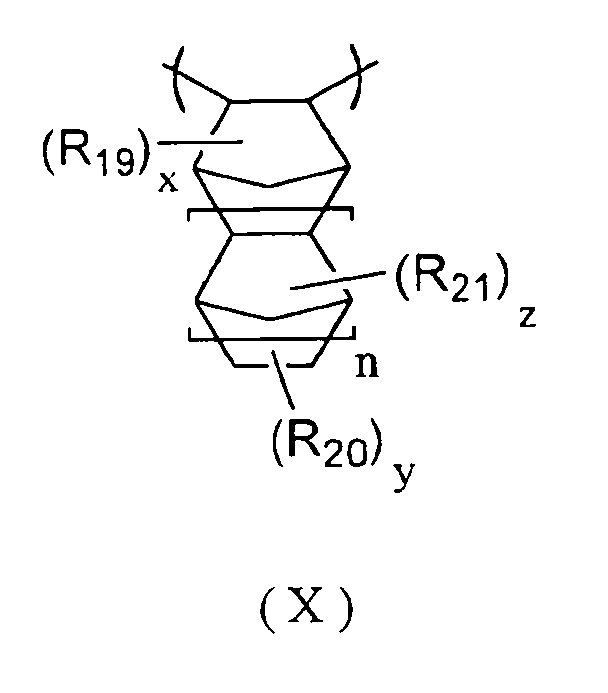
R0 and R1 may be the same or different and each represent a hydrogen atom, fluorine atom, alkyl group, cycloalkyl group, or aryl group.
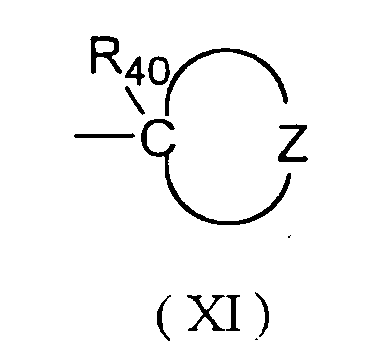
examples of the alkyl groups include alkyl groups having 1 to 8 carbon atoms. Preferred examples thereof include methyl, ethyl, propyl, n-butyl, sec-butyl, t-butyl, hexyl, 2-ethylhexyl, and octyl.


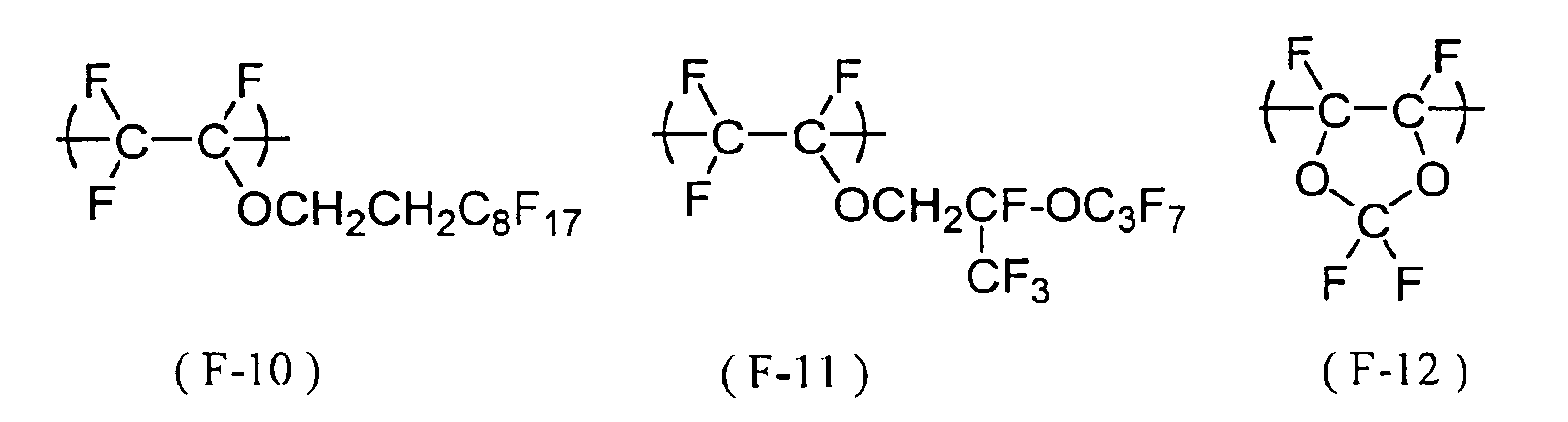


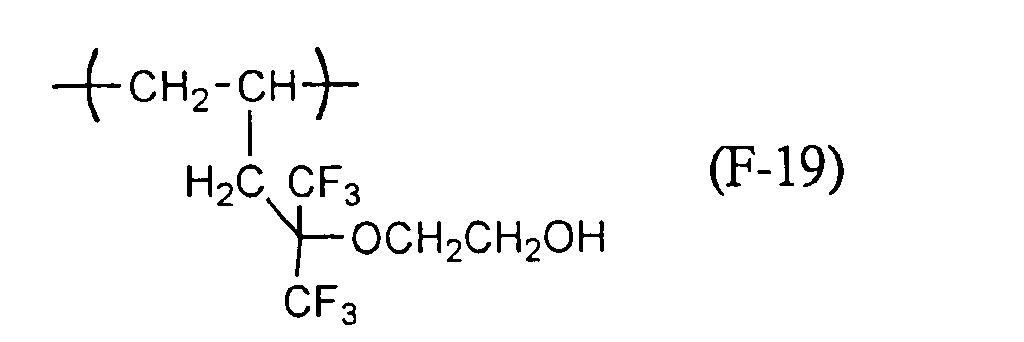


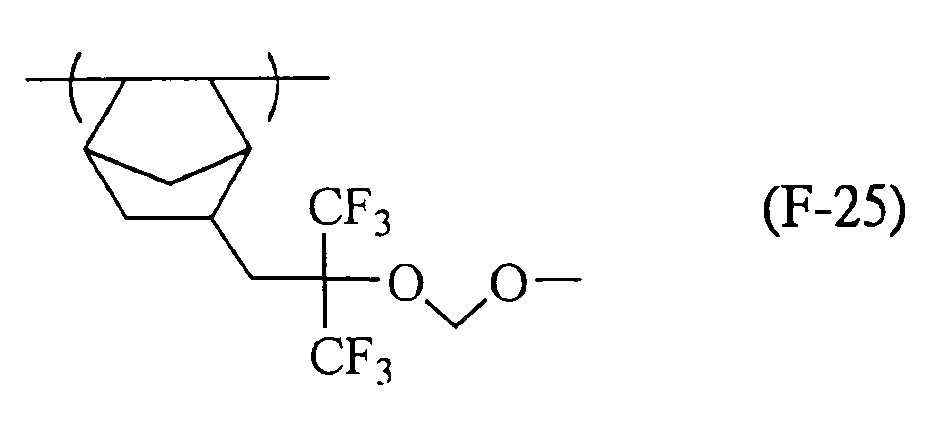


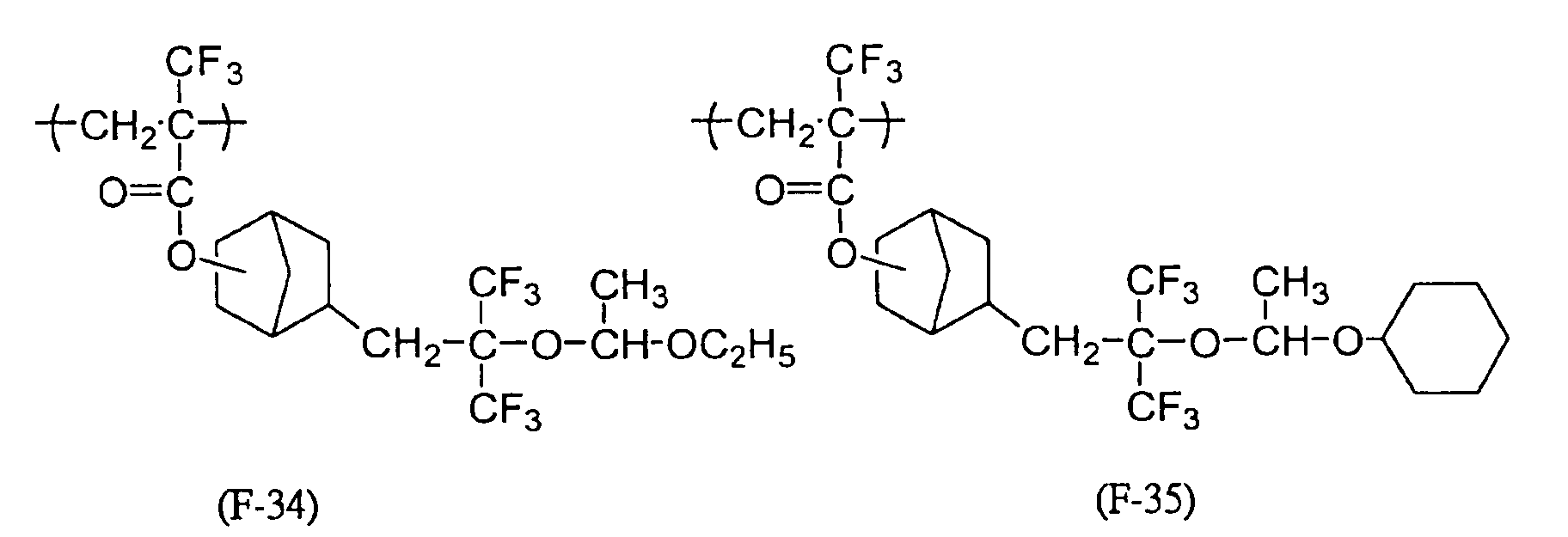


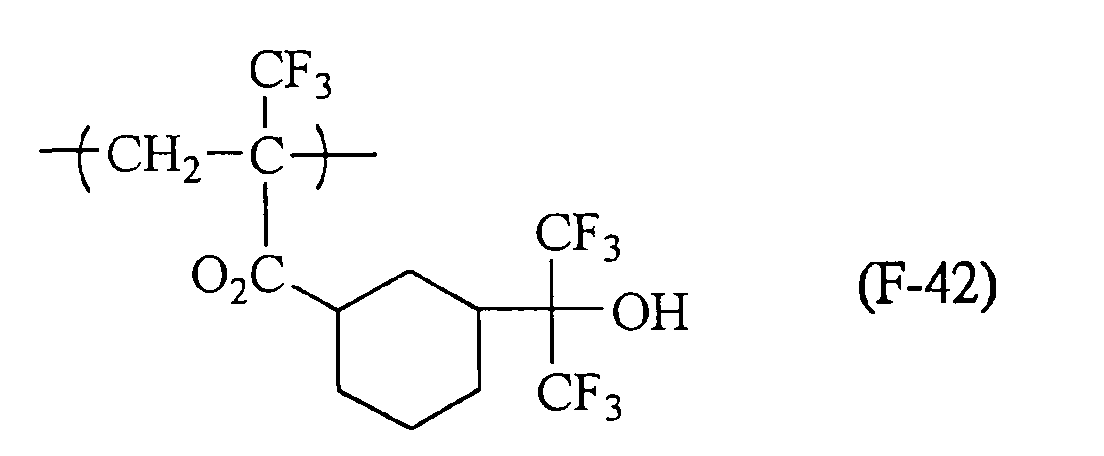


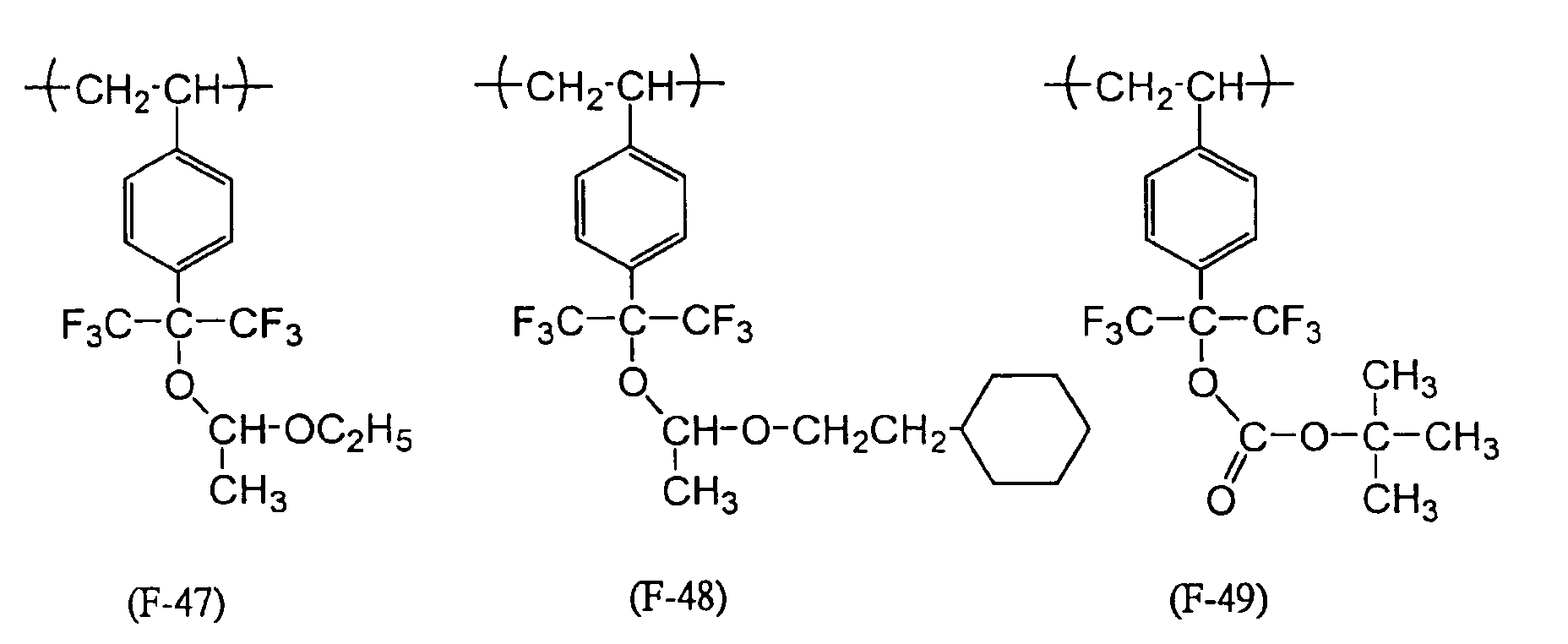
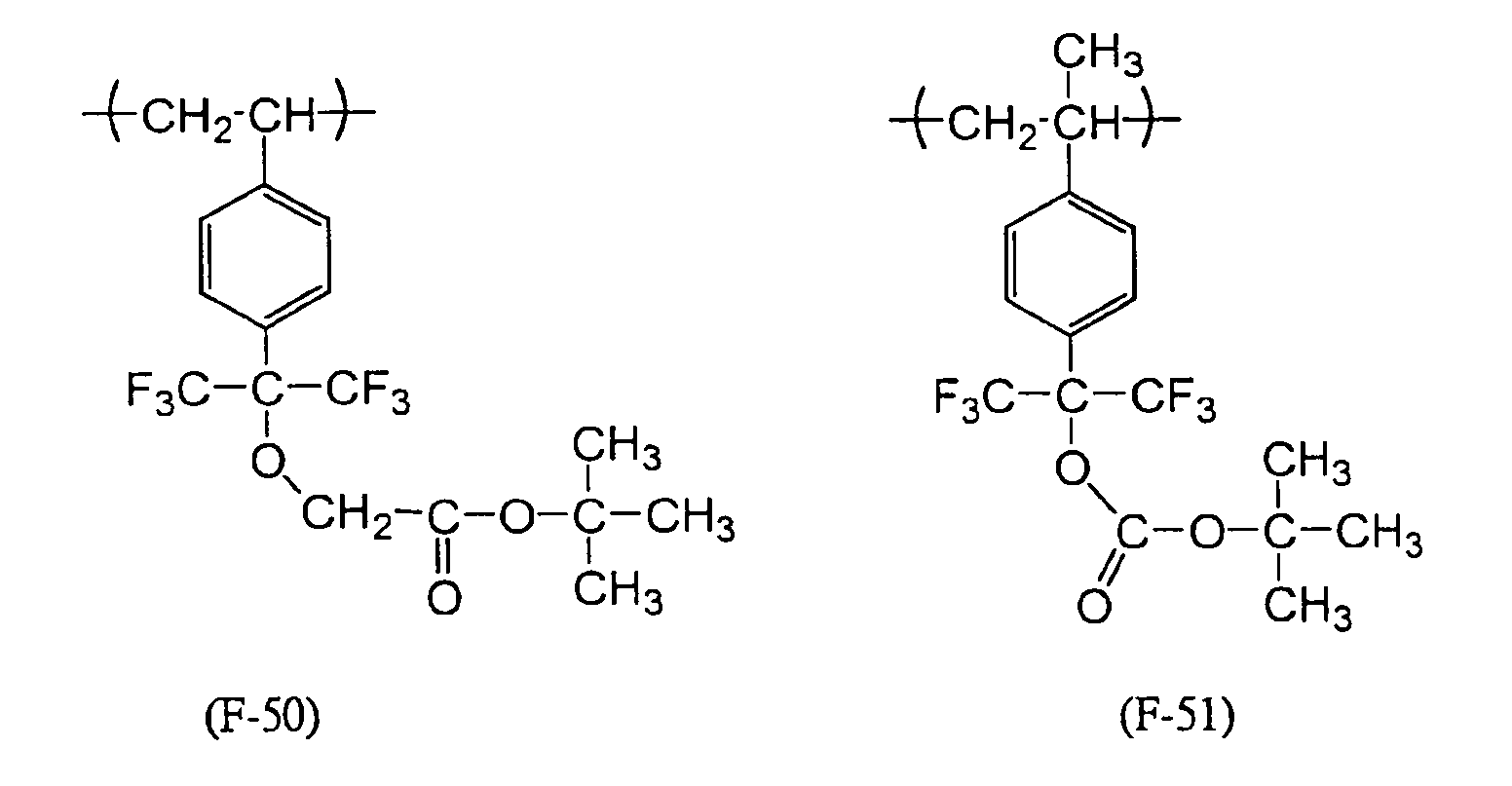


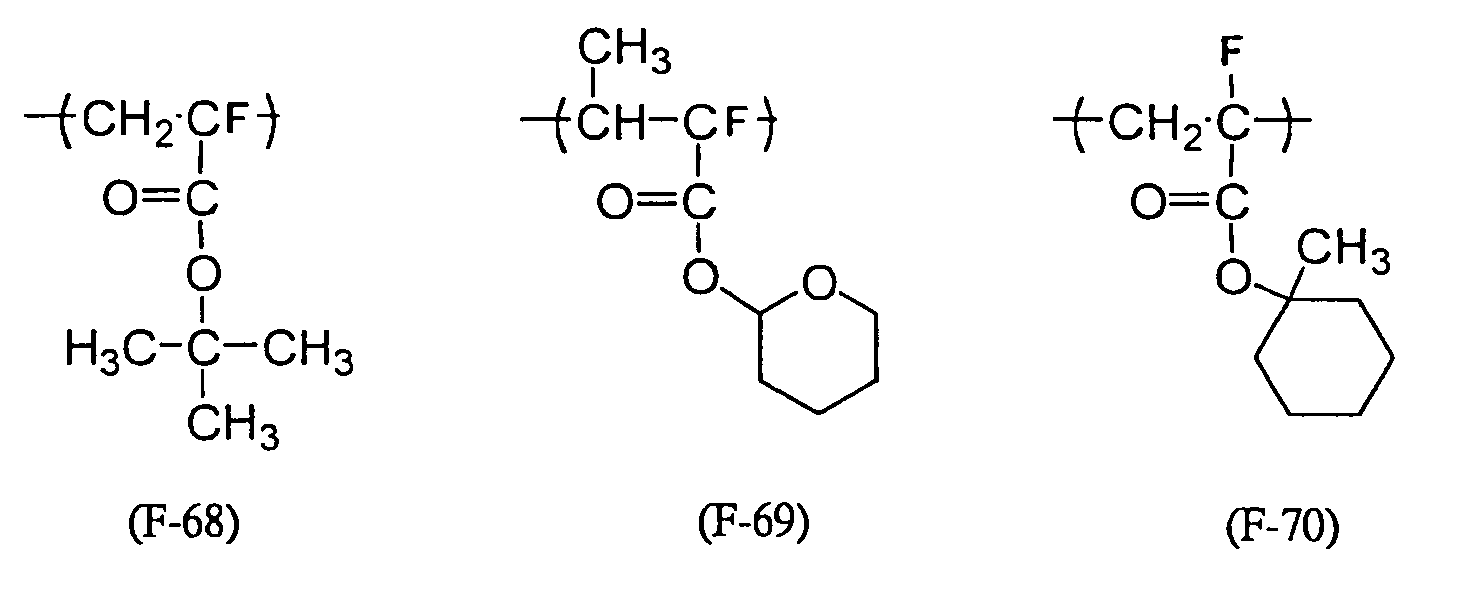

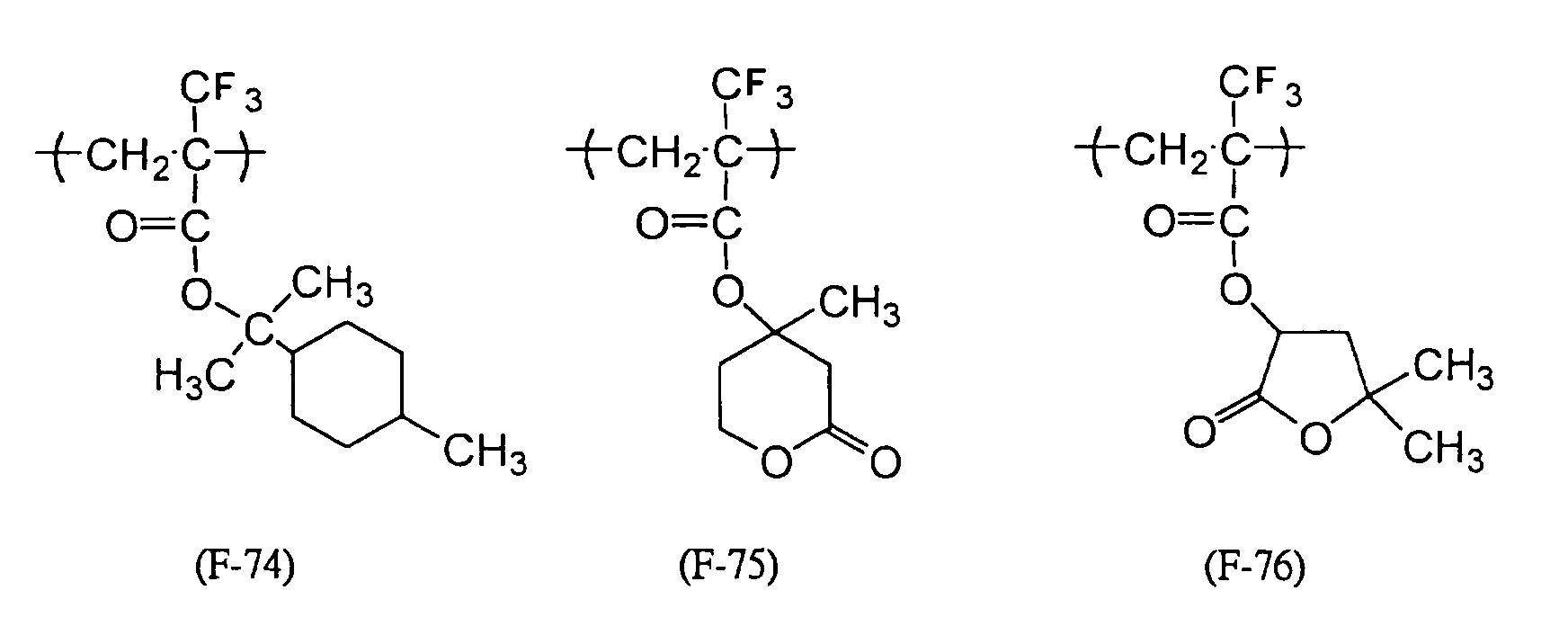
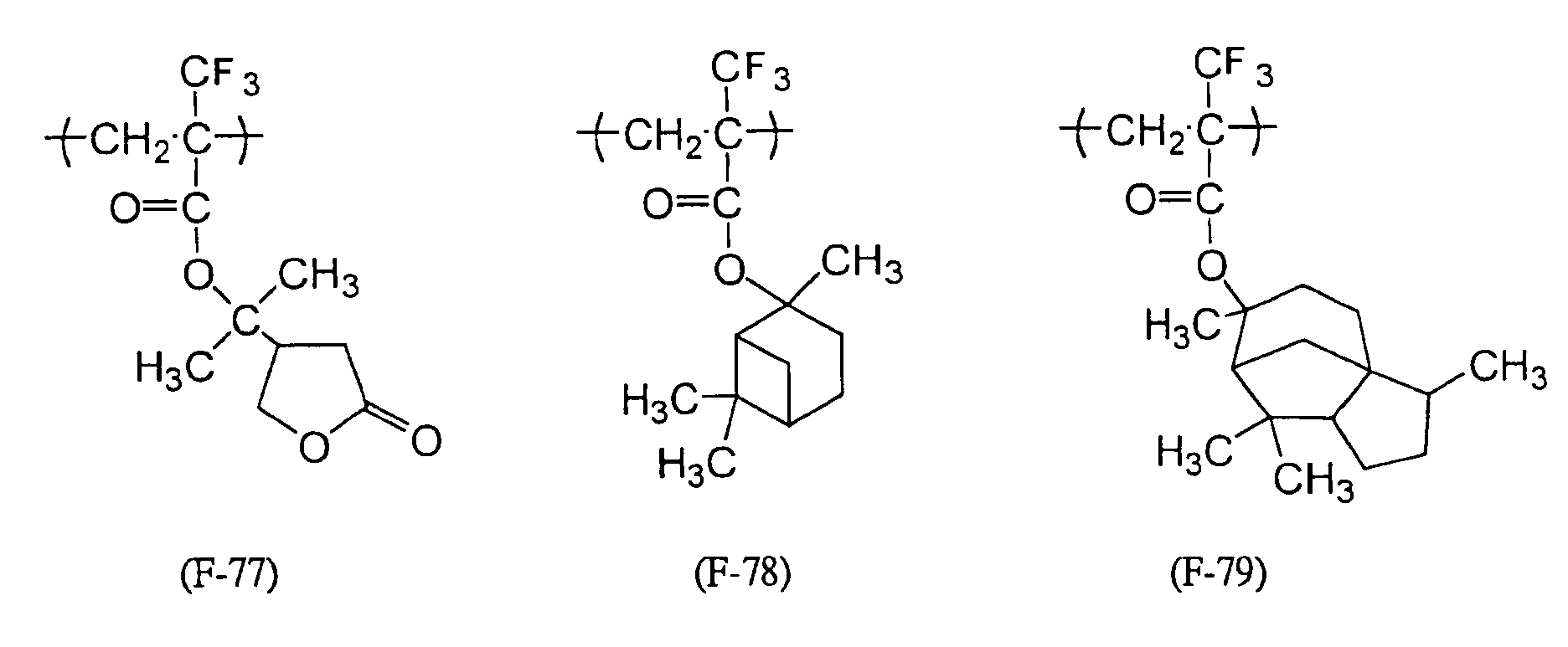

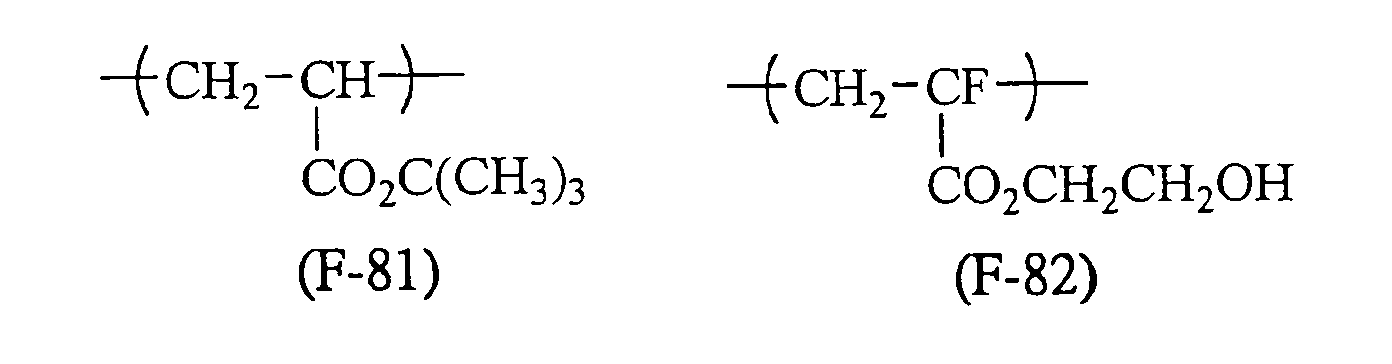


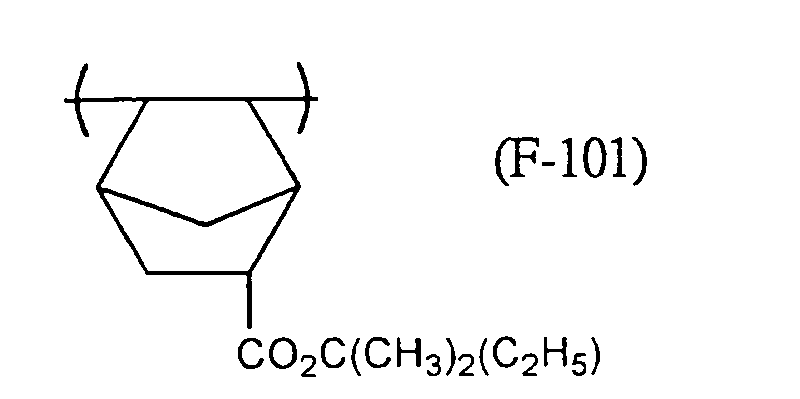


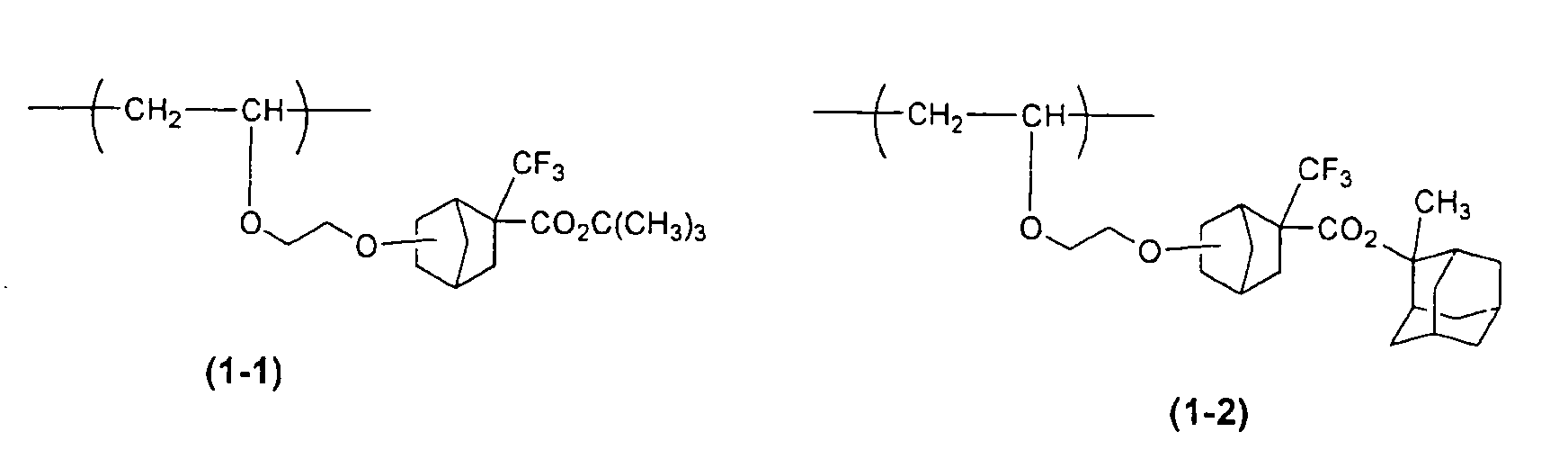
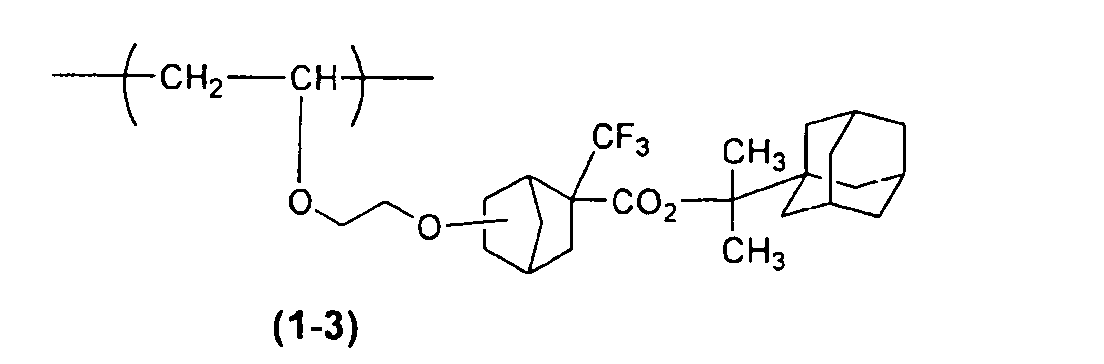


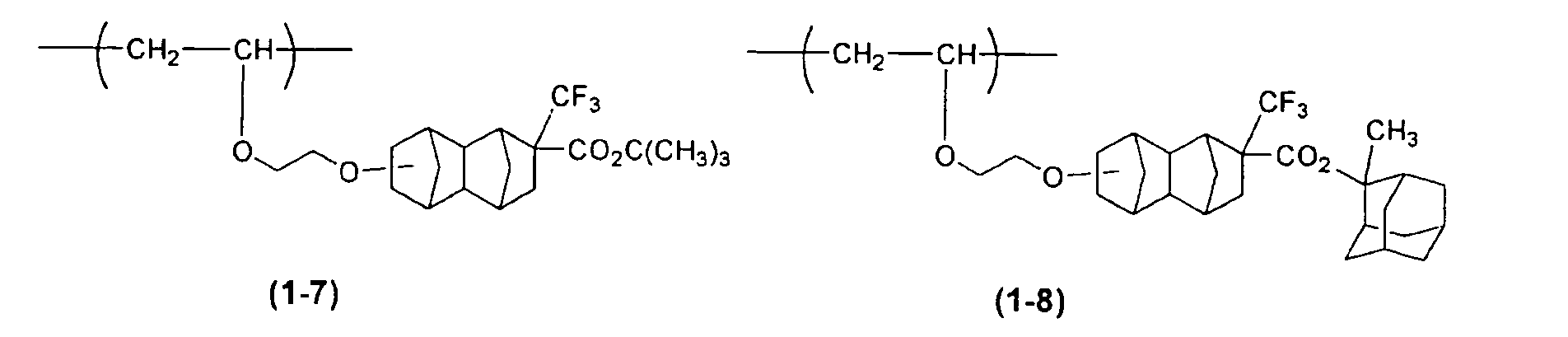


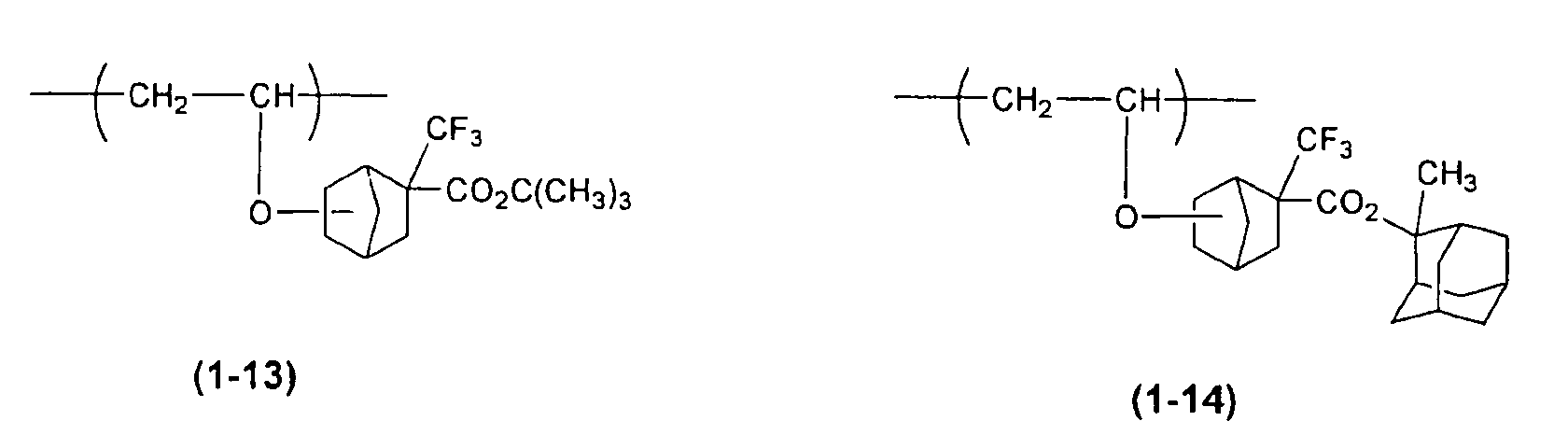
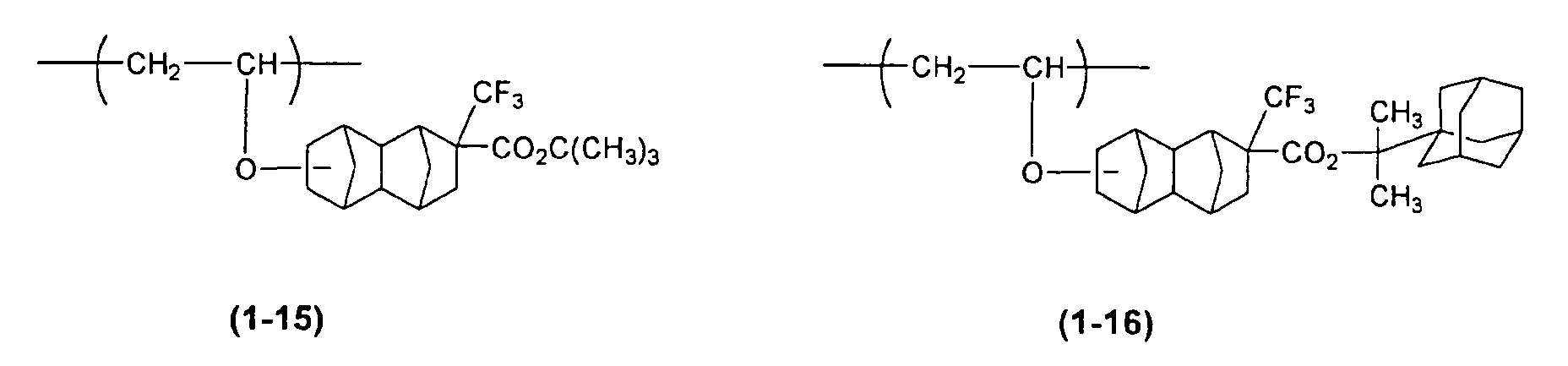


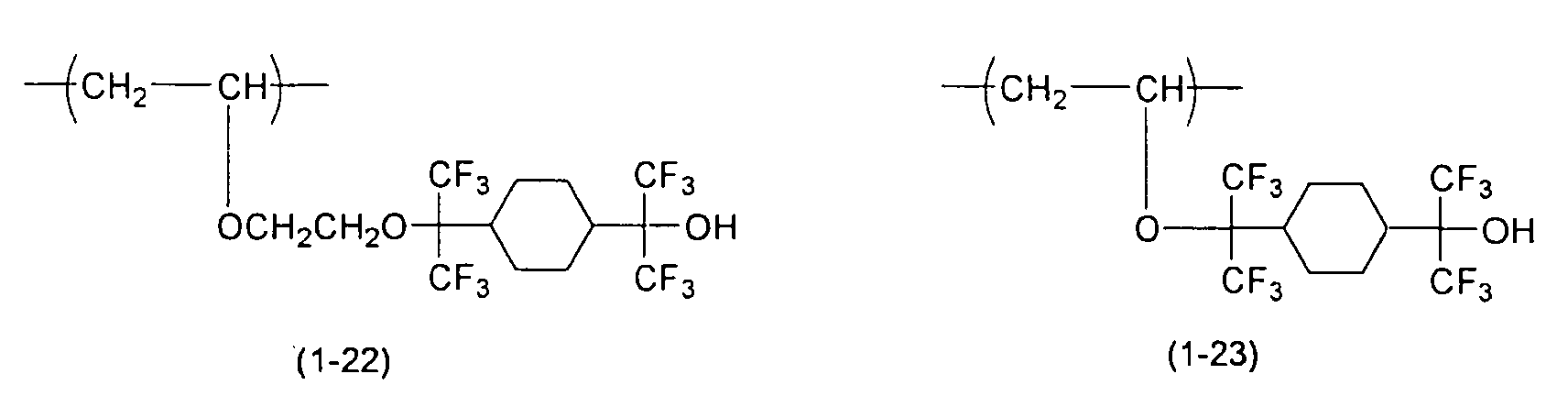

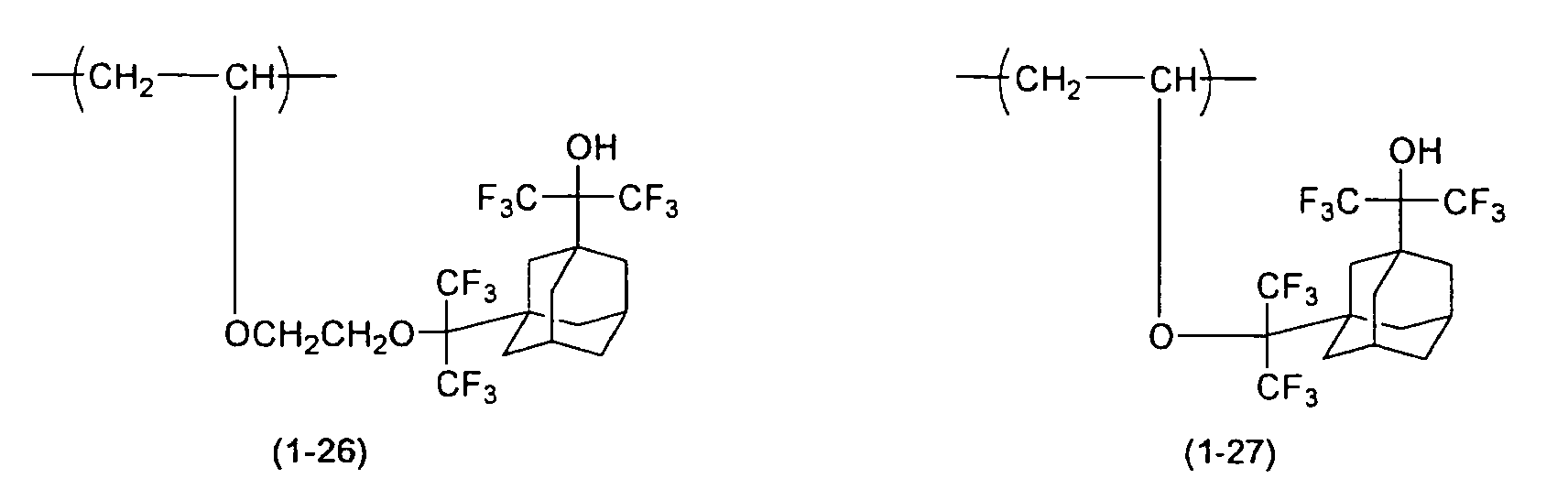


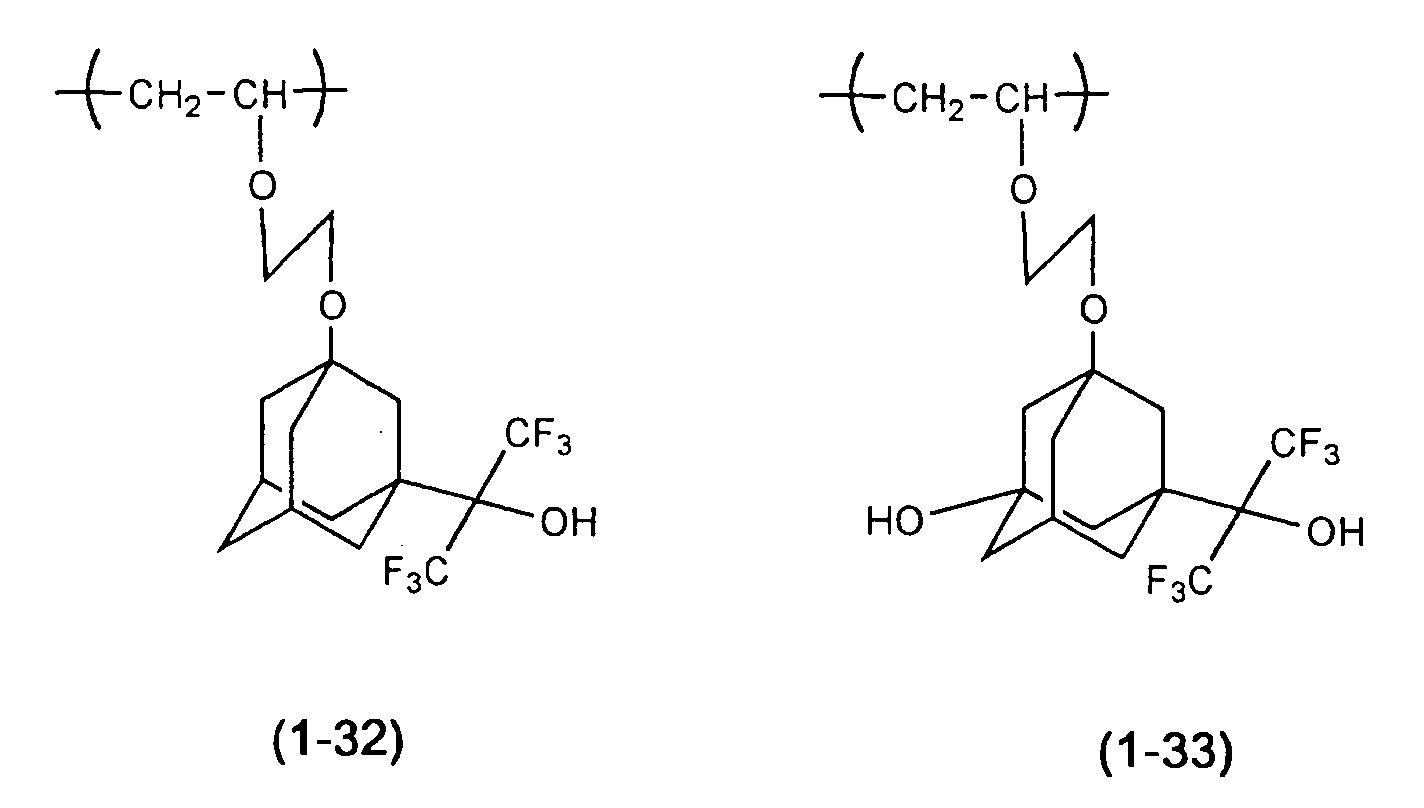


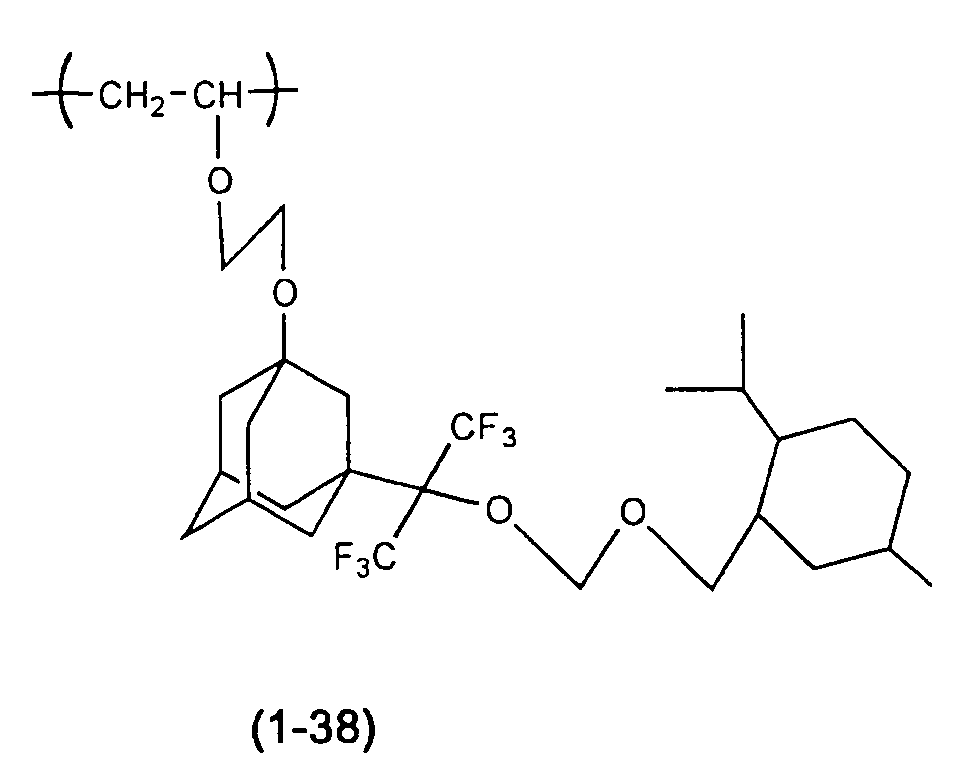
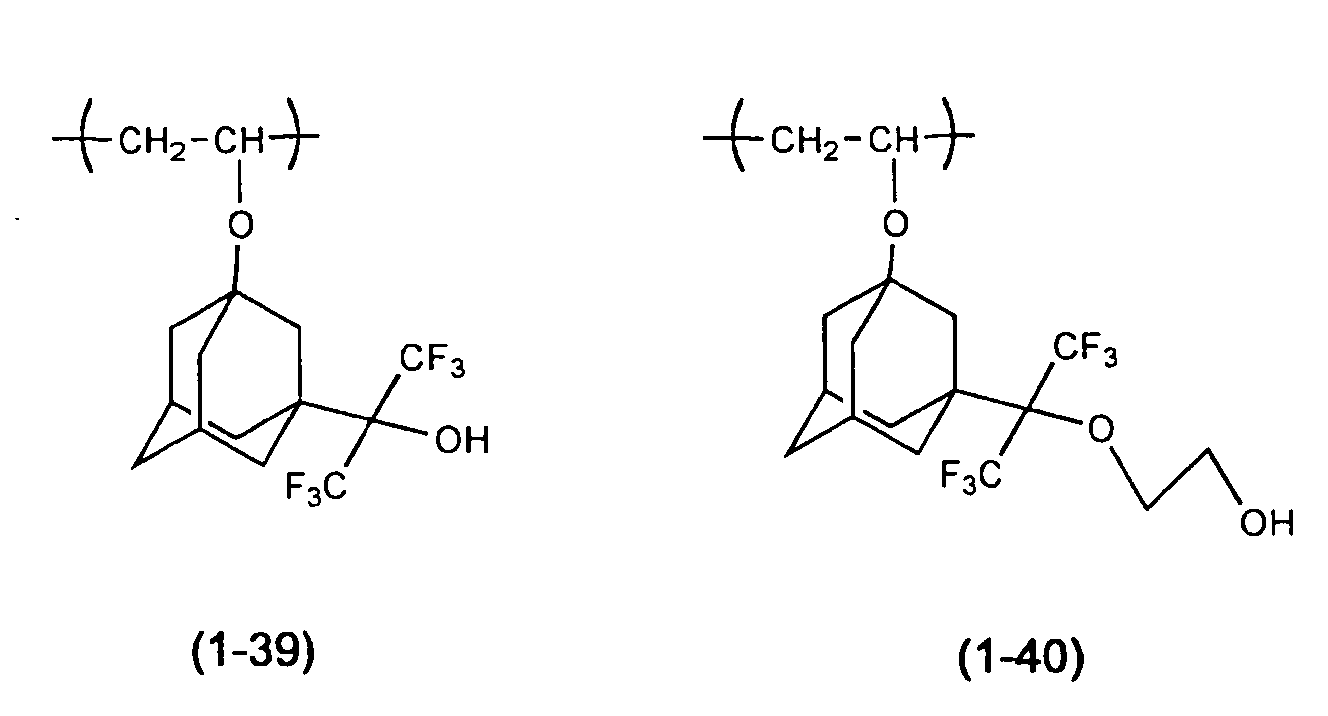


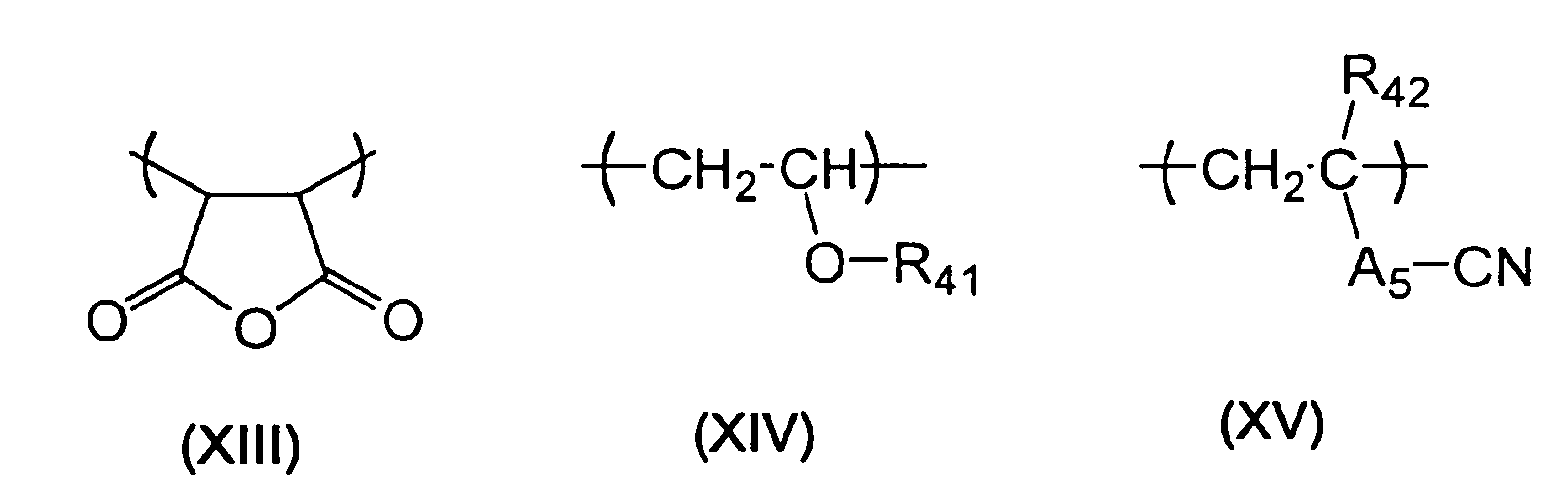


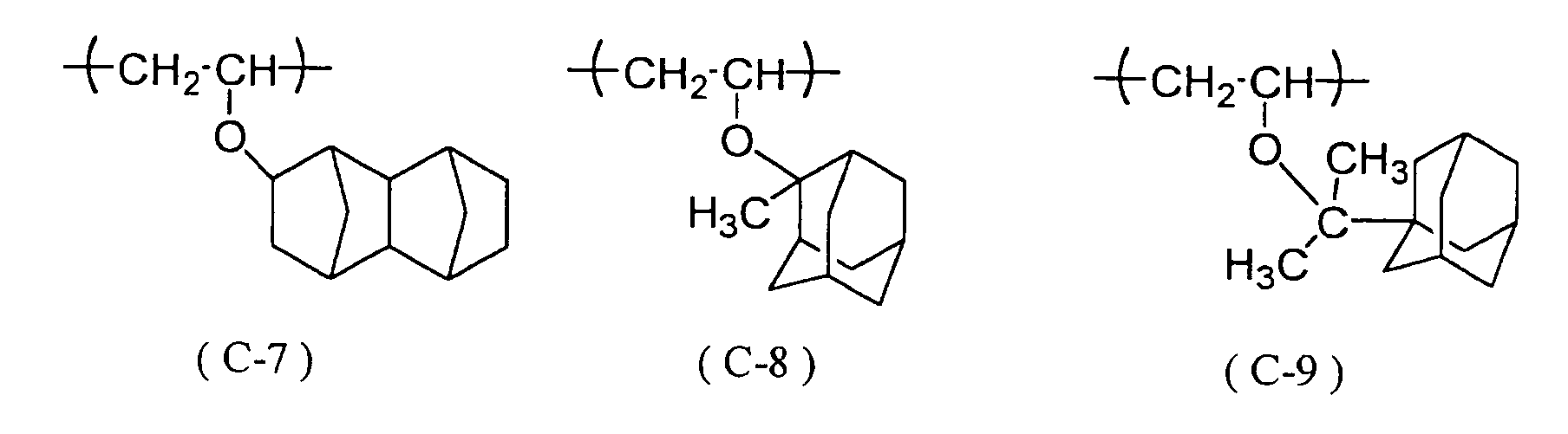

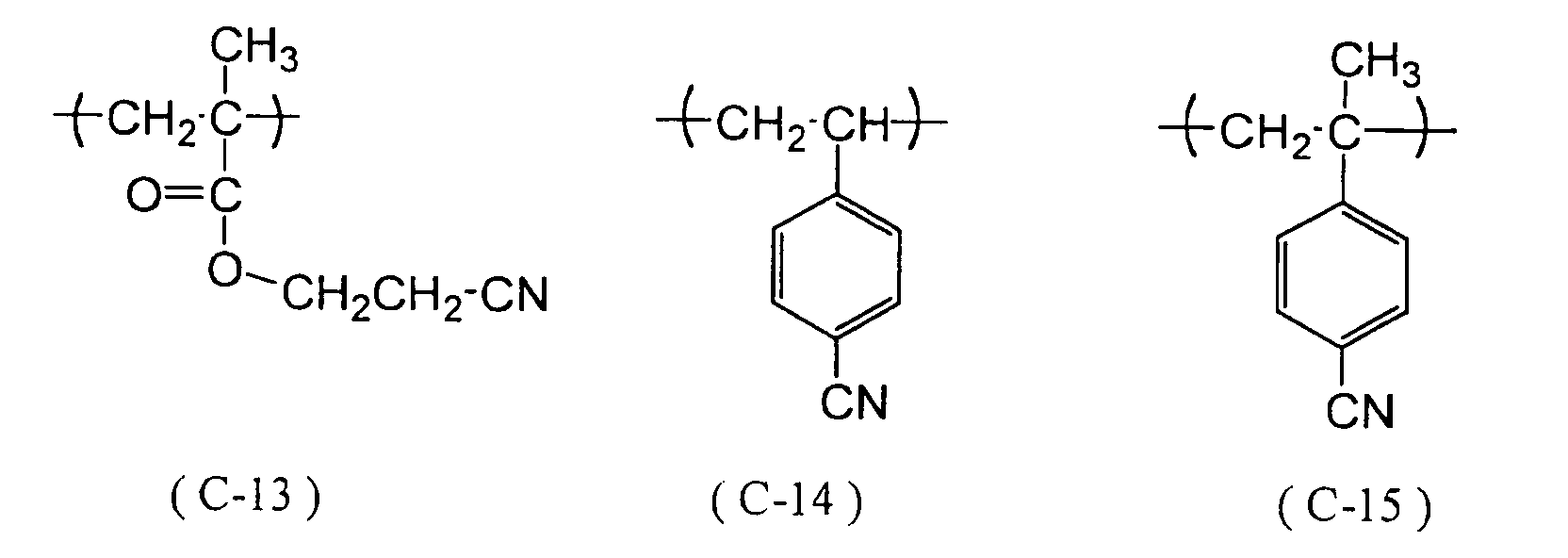

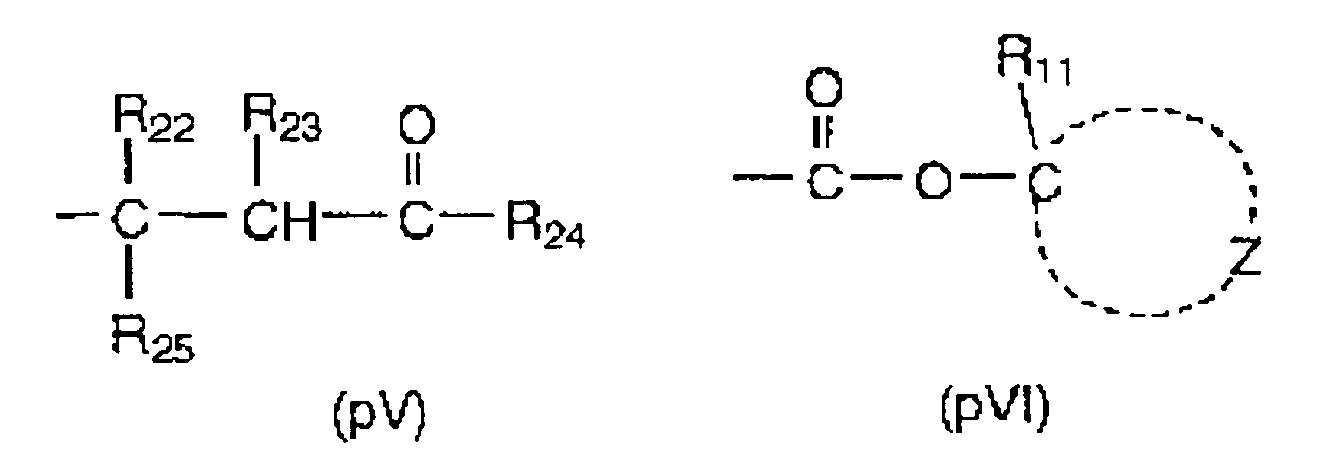
R11 represents a methyl group, an ethyl group, an n-propyl group, an isopropyl group, an n-butyl group, an isobutyl group, or a sec-butyl group; Z represents an atomic group necessary for forming a cycloalkyl group along with the carbon atom in the formula;
R12 to R16 each independently represents a linear or branched alkyl group having from 1 to 4 carbon atoms, or a cycloalkyl group, provided that at least one of R12 to R14 or any of R15 or R16 is a cycloalkyl group;
R17 to R21 each independently represents a hydrogen atom, a linear or branched alkyl group having from 1 to 4 carbon atoms, or a cycloalkyl group, provided that at least one of R17 to R21 is a cycloalkyl group, and any of R19 or R21 is a linear or branched alkyl group having from 1 to 4 carbon atoms, or a cycloalkyl group;
R22 to R25 each independently represents a hydrogen atom, a linear or branched alkyl group having from 1 to 4 carbon atoms, or a cycloalkyl group, provided that at least one of R22 to R25 is a cycloalkyl group, and R23 and R24 may bond to each other to form a ring.

A represents a single bond, an alkylene group, an ether group, a thioether group, a carbonyl group, an ester group, an amido group, a sulfonamido group, an urethane group, or an urea group, or a combination of two or more of them;
Ra represents a group of formulae (pI) to (pVI).


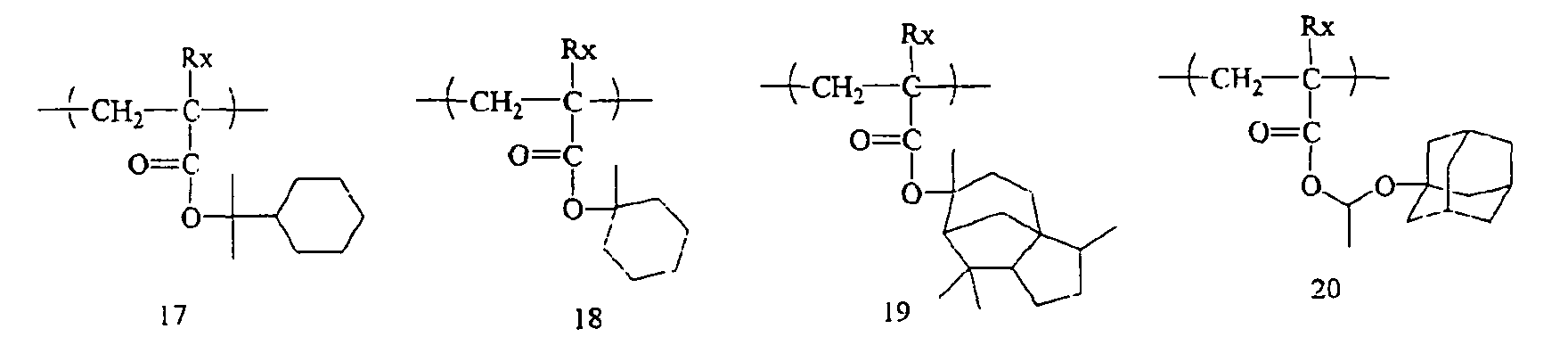


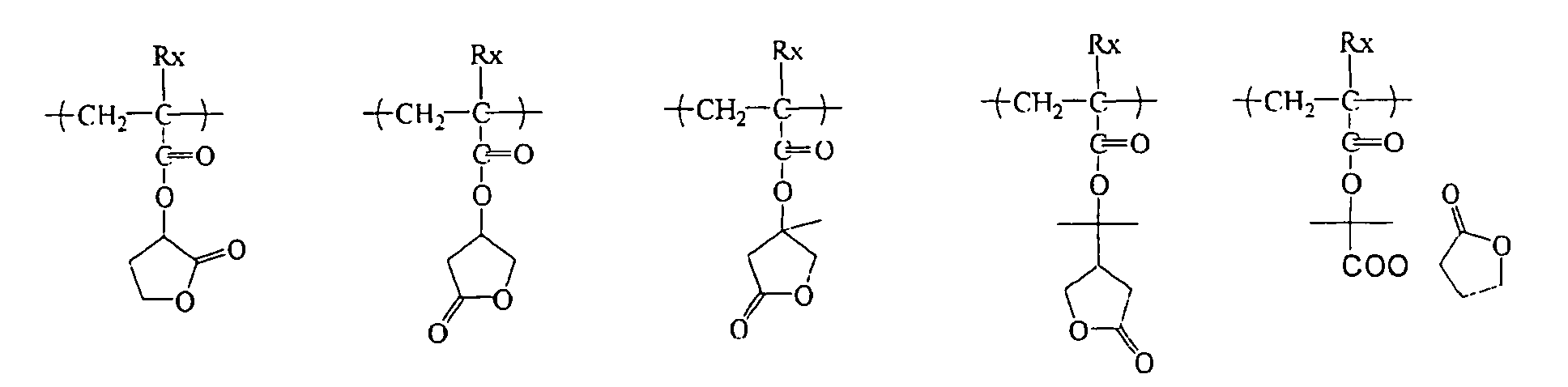
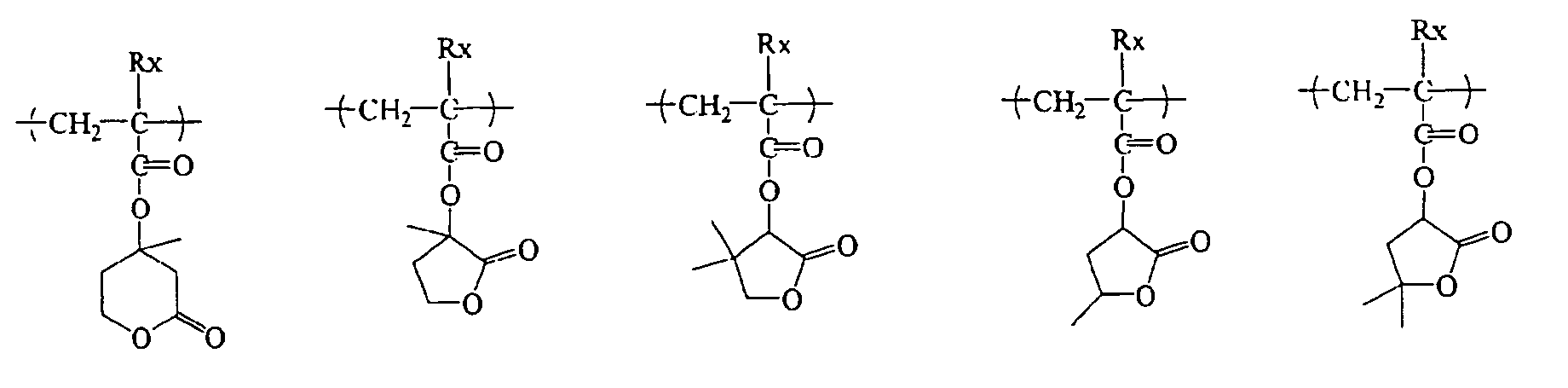
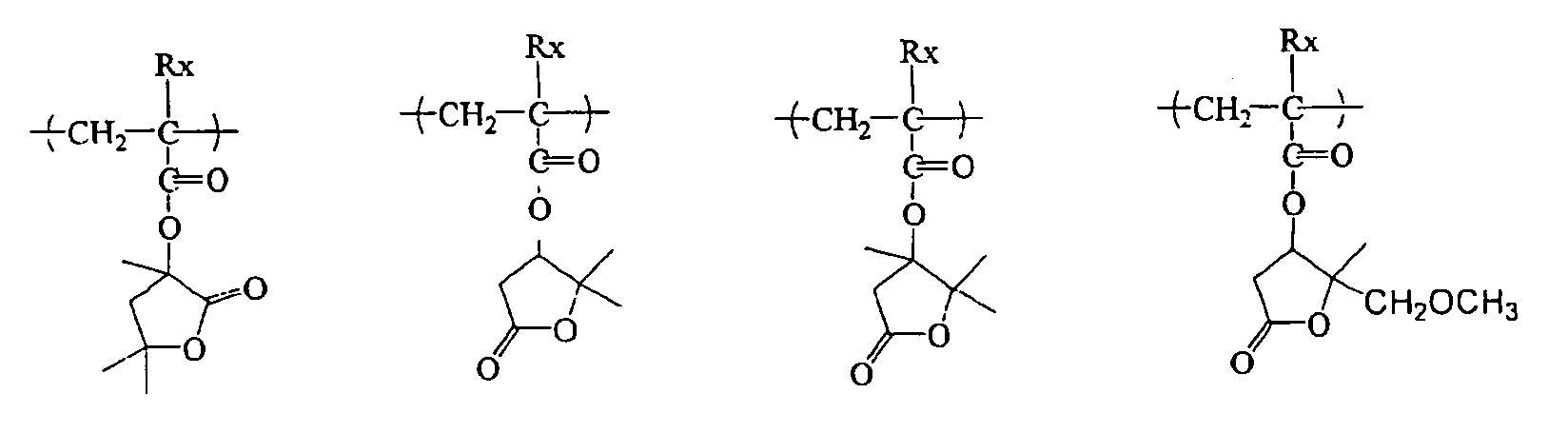
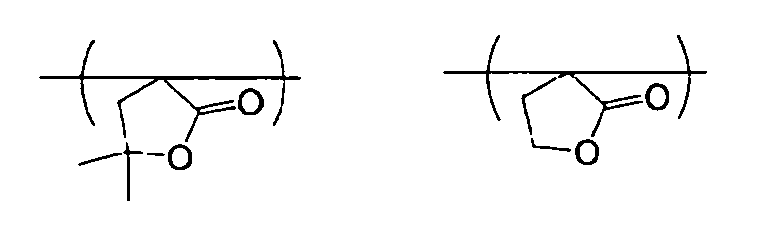


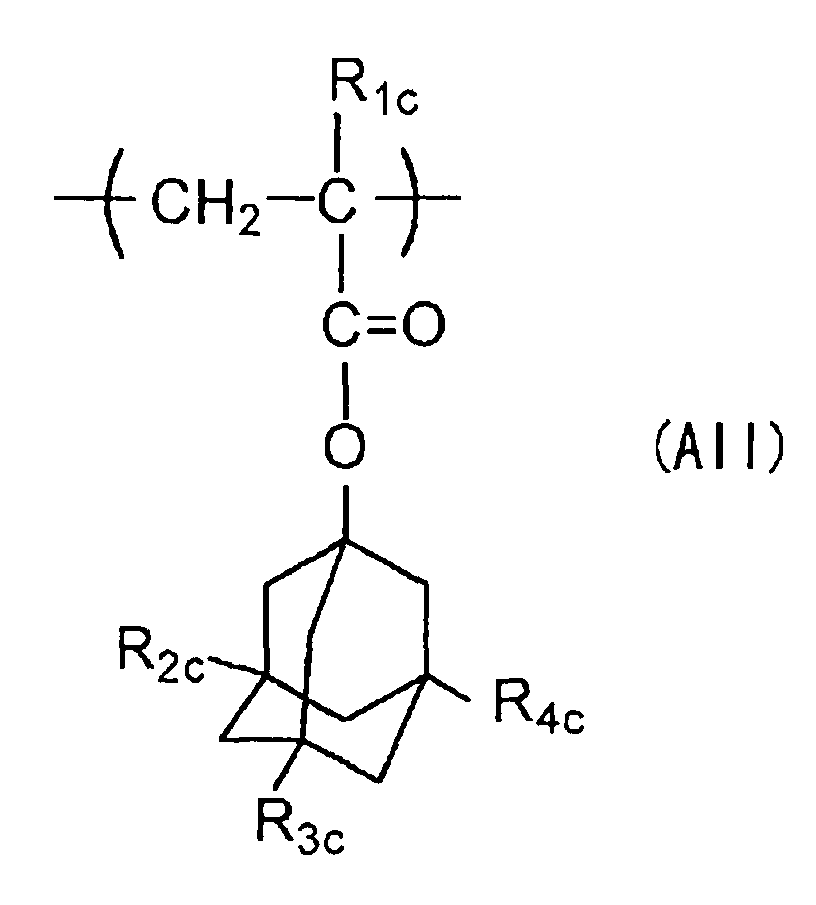


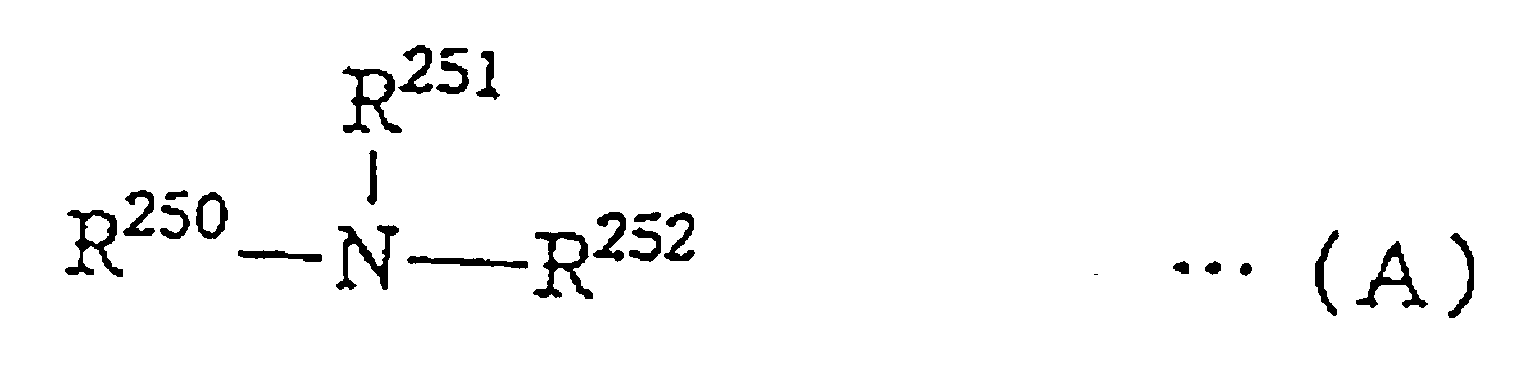




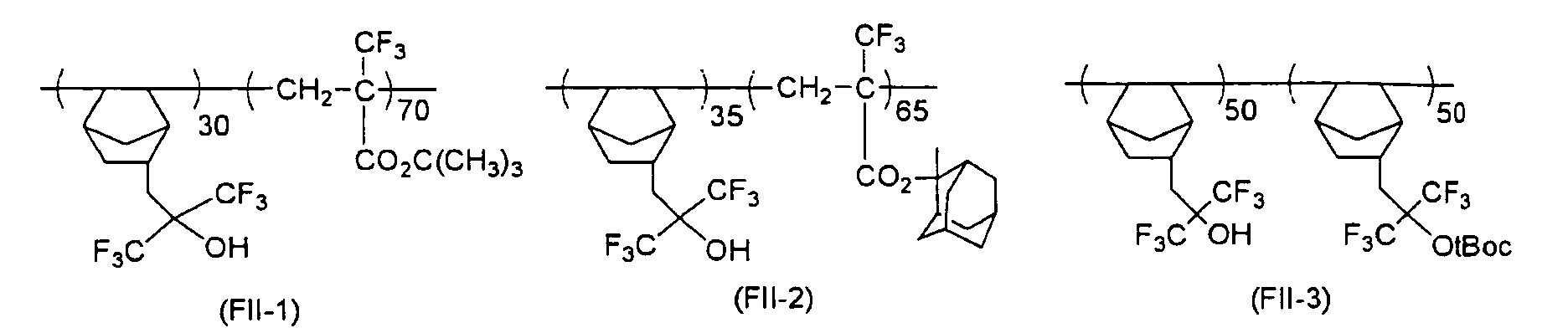

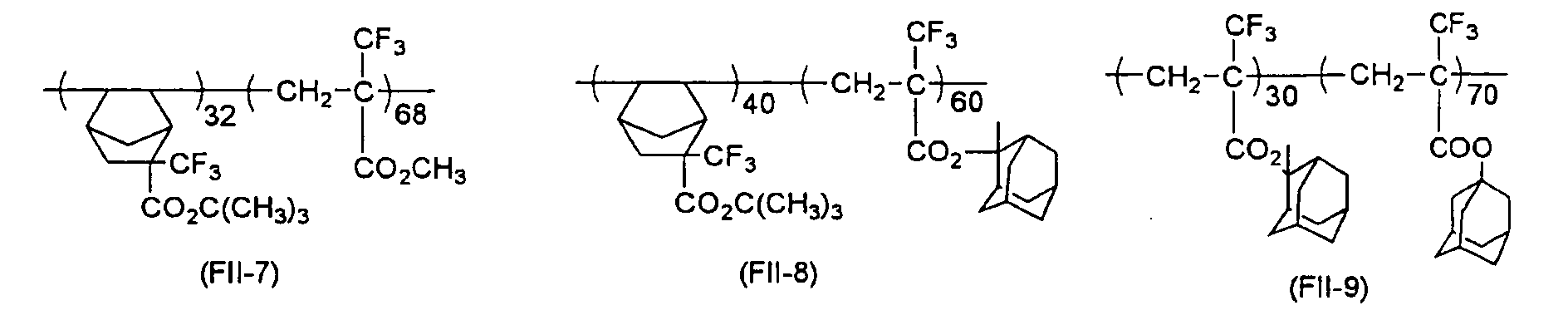


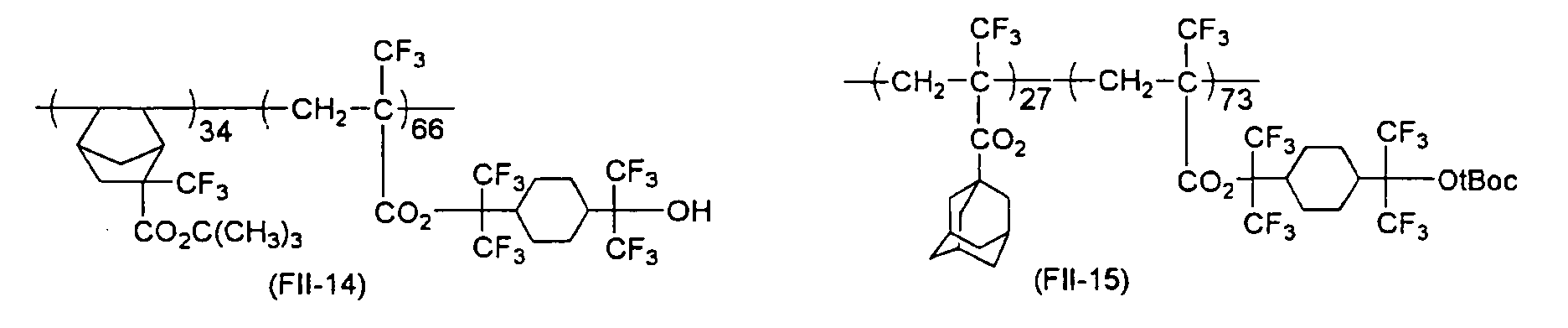


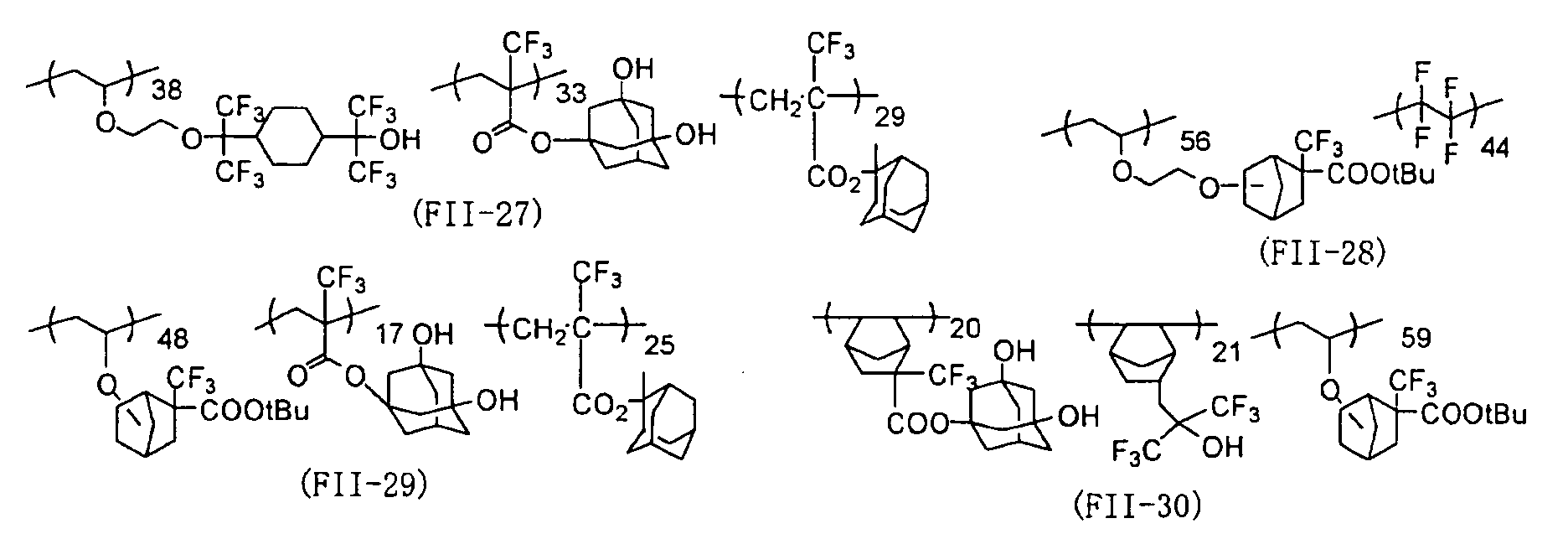


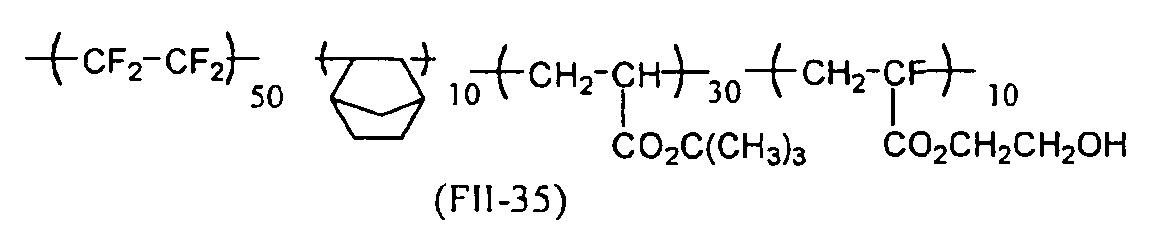


| Resin | Weight-average molecular weight Mw | Dispersity ratio | Content of oligomers having molecular weight of 1,000 or lower |
| (FII-1) | 15200 | 1.45 | 5 |
| (FII-2) | 24000 | 1.75 | 8 |
| (FII-3) | 18200 | 1.85 | 7 |
| (FII-4) | 16500 | 1.46 | 6 |
| (FII-5) | 9500 | 1.58 | 8 |
| (FII-6) | 19500 | 2.02 | 8 |
| (FII-7) | 6500 | 1.85 | 7 |
| (FII-8) | 28400 | 1.68 | 9 |
| (FII-9) | 28600 | 1.44 | 5 |
| (FII-10) | 12800 | 1.65 | 8 |
| (FII-11) | 16800 | 1.68 | 9 |
| (FII-12) | 28400 | 1.58 | 6 |
| (FII-13) | 19800 | 1.69 | 8 |
| (FII-14) | 8700 | 1.95 | 8 |
| (FII-15) | 15200 | 1.46 | 7 |
| (FII-16) | 19500 | 1.65 | 4 |
| (FII-17) | 16900 | 1.42 | 8 |
| (FII-18) | 15900 | 1.85 | 9 |
| (FII-19) | 15000 | 1.55 | 4 |
| (FII-20) | 12500 | 1.88 | 8 |
| (FII-21) | 25000 | 1.68 | 9 |
| (FII-22) | 16000 | 1.54 | 7 |
| (FII-23) | 14600 | 1.95 | 5 |
| (FII-24) | 17500 | 1.48 | 5 |
| (FII-25) | 16500 | 1.52 | 6 |
| (FII-26) | 14600 | 1.63 | 5 |
| Resin | Weight-average molecular weight Mw | Dispersity ratio |
| (FII-27) | 8300 | 1.55 |
| (FII-28) | 8300 | 1.62 |
| (FII-29) | 8000 | 1.52 |
| (FII-30) | 9200 | 1.71 |
| (FII-31) | 10200 | 1.47 |
| (FII-32) | 7900 | 1.35 |
| (FII-33) | 6800 | 1.60 |
| (FII-34) | 7400 | 1.59 |
| (FII-35) | 8300 | 1.70 |
| (FII-36) | 4800 | 1.55 |
| (FII-37) | 4700 | 1.51 |
| (FII-38) | 6400 | 1.69 |
| (FII-39) | 9600 | 1.70 |
| (FII-40) | 4600 | 1.68 |
| Ingredient A (g) | Ingredient B (g) | Basic compound (g) | Surfactant (0.03 g) | Solvent (weight ratio) | Sensitivity (mJ/cm2) | Line edge roughness (nm) | Profile | |
| Ex. 1 | z38 (0.5) | FII-1 (10) | DIA (0.05) | W-1 | A1 (100) | 5.2 | 8.6 | rectangular |
| Ex. 2 | z6 (0.3) z21 (0.3) | FII-2 (10) | TPI (0.04) | W-1 | A1/B2 (70/30) | 2.8 | 9.0 | rectangular |
| Ex. 3 | z15 (0.1) z40 (0.4) | FII-8 (5) FII-33 (5) | TOA (0.04) | W-2 | A1/A3 (95/5) | 6.5 | 7.8 | rectangular |
| Ex. 4 | z38 (0.4) z52 (0.4) | FII-11 (5) FII-34 (5) | HEP (0.06) | W-2 | A1/B3 (70/30) | 3.2 | 7.3 | rectangular |
| Ex. 5 | z54 (0.7) | FII-12 (3) FII-35 (7) | DBN (0.05) | W-3 | A1/B2 (60/40) | 3.0 | 8.0 | rectangular |
| Ex. 6 | z44 (0.6) | FII-13 (10) | DIA (0.04) PEA (0.04) | W-1 | A1/B1 (55/45) | 3.8 | 8.7 | rectangular |
| Ex. 7 | z14 (0.2) z51 (0.5) | FII-14 (7) FII-39 (3) | TPA (0.04) | W-2 | A1/B2 (60/40) | 2.9 | 8.2 | rectangular |
| Ex. 8 | z46 (0.5) z34 (0.5) | FII-16 (10) | TPSA (0.1) | W-4 | A1/B2 (65/35) | 2.1 | 9.2 | rectangular |
| Ex. 9 | z13 (0.6) Z27 (0.6) | FII-18 (5) FII-1 (5) | TBAH (0.03) | W-1 | A1/B2 (70/30) | 4.8 | 9.1 | rectangular |
| Ex. 10 | Z1 (0.2) Z37 (0.4) | FII-20 (5) FII-5 (5) | TMEA (0.05) | W-4 | A1/B1 (55/45) | 3.7 | 8.8 | rectangular |
| Ex. 11 | Z49 (0.8) | FII-27 (8) FII-32 (2) | HAP (0.05) | W-1 | A1 (100) | 2.6 | 8.9 | rectangular |
| Ex. 12 | Z18 (0.5) Z31 (0.5) | FII-28 (3) FII-27 (7) | DBN (0.04) | W-2 | A2/B4 (45/55) | 7.5 | 7.9 | rectangular |
| Ex. 13 | Z38 (0.4) Z41 (0.8) | FII-29 (5) FII-3 (5) | DIA (0.01) PEA (0.01) | W-1 | A1/B2 (70/30) | 2.2 | 9.0 | rectangular |
| Ex. 14 | Z5 (0.6) Z38 (0.6) | FII-30 (8) FII-31 (2) | PEA (0.05) | W-1 | A1/B1 (60/40) | 7.7 | 8.6 | rectangular |
| Ex. 15 | Z6 (0.7) Z21 (0.7) | FII-38 (10) | TPI (0.04) | W-1 | A1/B2 (70/30) | 2.4 | 7.0 | rectangular |
| Ex. 16 | Z15 (0.3) Z40 (0.4) | FII-40 (8) FII-1 (2) | TOA (0.04) | W-2 | A1/A3 (95/5) | 7.8 | 7.6 | rectangular |
| Ex. 17 | Z38 (0.4) Z52 (0.4) | FII-19 (3) FII-28 (7) | HEP (0.06) | W-2 | A1/B3 (80/20) | 2.8 | 8.0 | rectangular |
| Ex. 18 | Z54 (0.7) | FII-11 (5) FII-3 (5) | DBN (0.03) | W-3 | A1/B2 (70/30) | 3.0 | 8.7 | rectangular |
| Ex. 19 | Z44 (0.8) | FII-32 (5) FII-30 (5) | DIA (0.04) PEA (0.04) | W-1 | A1/B1 (60/40) | 3.1 | 9.1 | rectangular |
| Ex. 20 | Z14 (0.3) Z51 (0.4) | FII-5 (5) FII-28 (5) | TPA (0.04) | W-2 | A1/B2 (60/40) | 3.7 | 7.4 | rectangular |
| Comp. Ex. 1 | Z38 (0.4) | FII-1 (10) | DIA (0.05) | W-1 | A1 (100) | 8.5 | 13.4 | rectangular |
| Comp. Ex. 2 | Z38 (2.2) | FII-1 (10) | DIA (0.05) | W-1 | A1 (100) | 2.1 | 11.2 | tapered, film thickness loss |


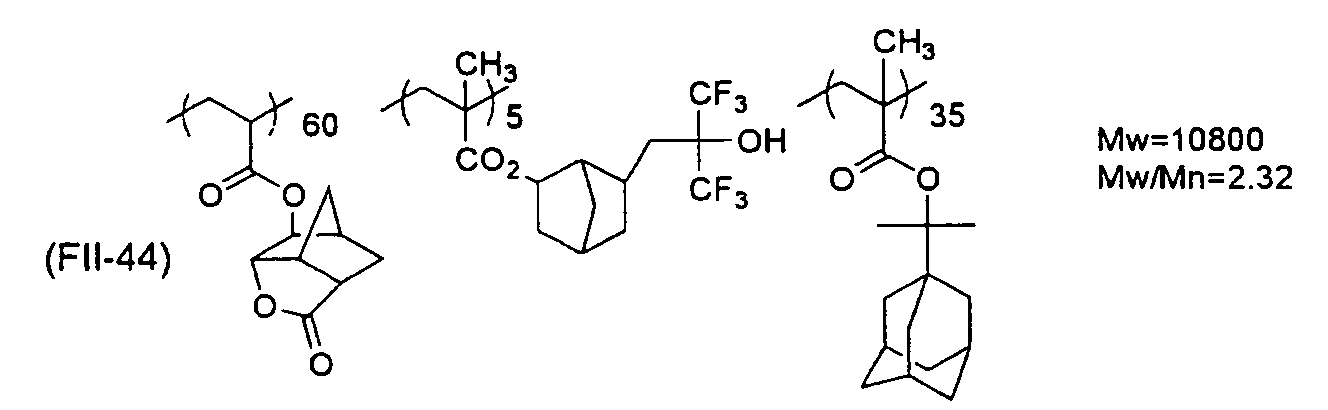


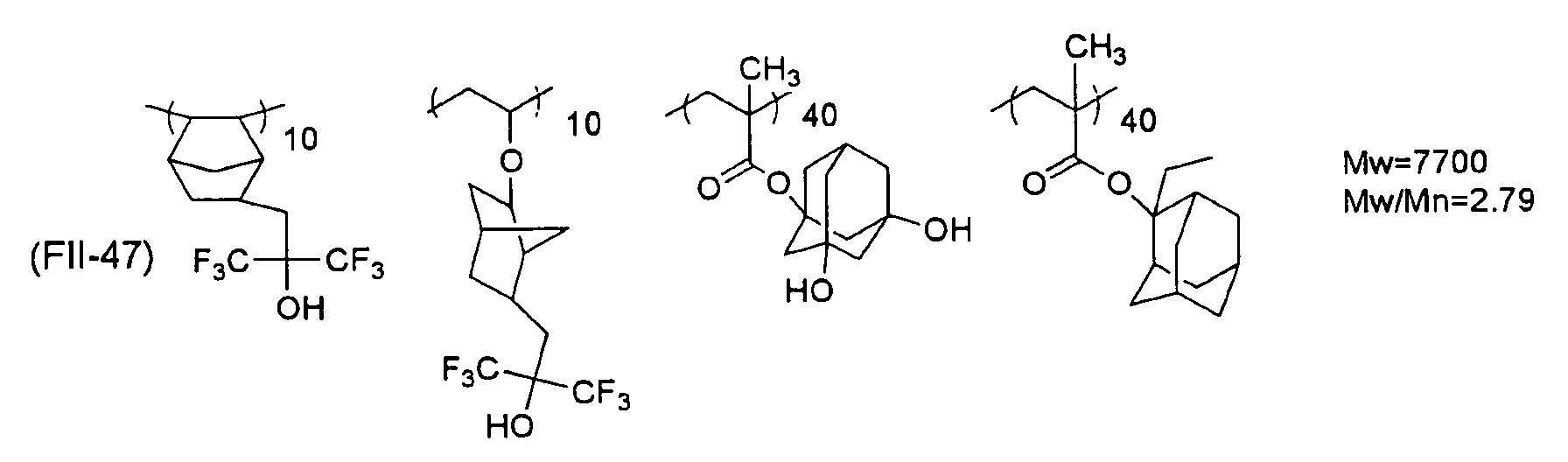

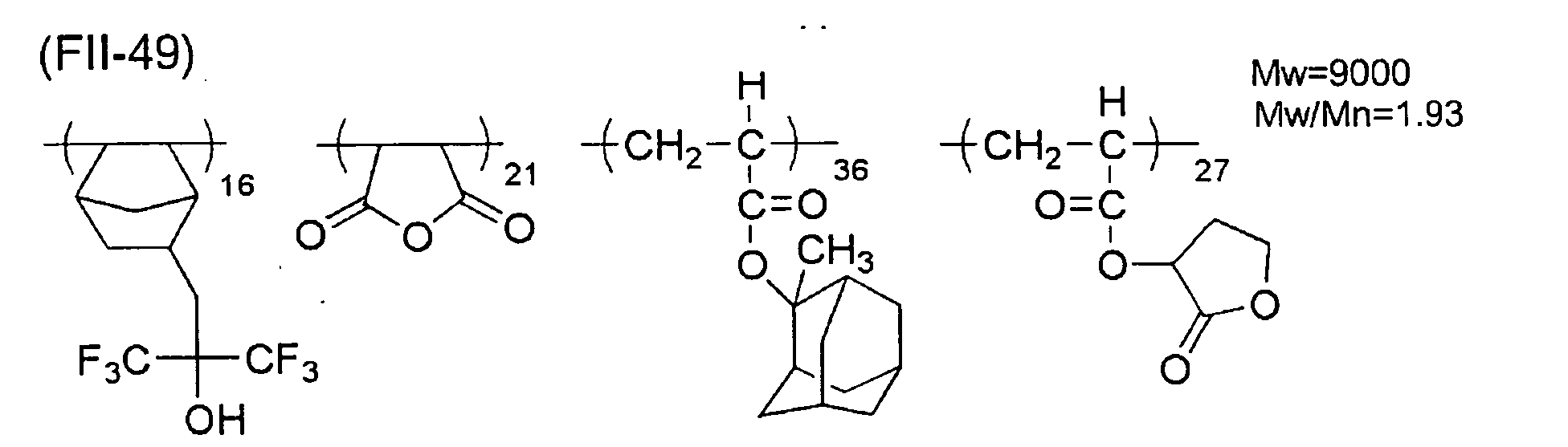

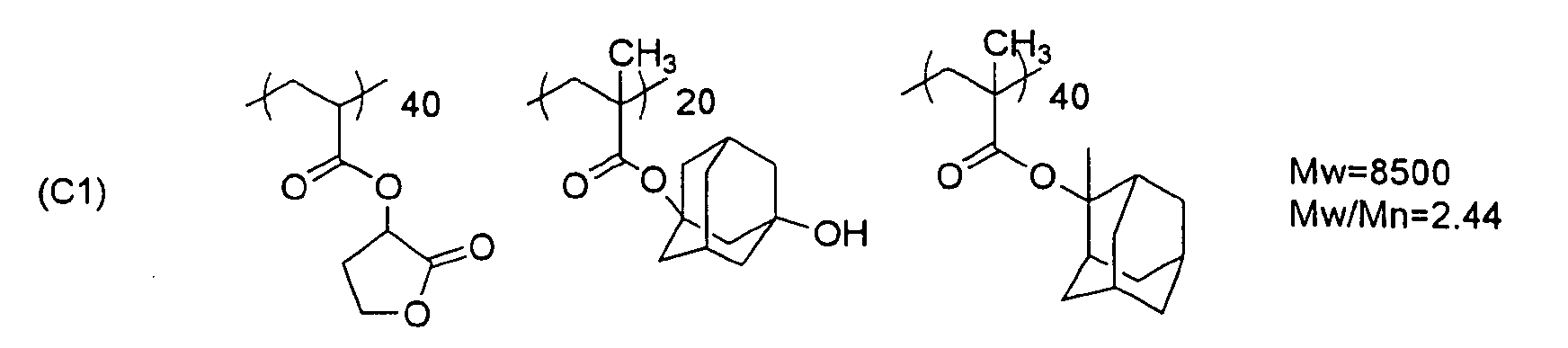
Claims (8)
- A positive photosensitive composition comprising:(A) 5 to 20 parts by weight of the total amount of at least one compound that generates an acid upon irradiation with an actinic ray; and(B) 100 parts by weight of the total amount of at least one fluorine atom-containing resin having a group that increases a solubility of the resin in an alkaline developer by the action of an acid.
- The positive photosensitive composition according to claim 1, wherein the resin (B) has a main chain to which at least one fluorine atom is bonded.
- The positive photosensitive composition according to claim 1, wherein the resin (B) has a repeating unit having from 1 to 3 groups represented by formula (A-1):wherein R1a represents a hydrogen atom, an alkyl group, a cycloalkyl group, an acyl group, an alkoxycarbonyl group, or a group which dissociates by the action of an acid.

- The positive photosensitive composition according to claim 1, wherein the resin (B) has a fluorine atom-containing repeating unit and a repeating unit with no fluorine atom.
- The positive photosensitive composition according to claim 4, wherein the repeating unit with no fluorine atom is at least one repeating unit selected from (a) to (c):(a) monocyclic or polycyclic, alicyclic hydrocarbon structure-having, acid-dissociating repeating unit;(b) lactone structure-having repeating unit;(c) monocyclic or polycyclic, alicyclic hydrocarbon structure and hydroxyl group-having repeating unit.
- The positive photosensitive composition according to claim 1, wherein the compound (A) is a sulfonium salt.
- The positive photosensitive composition according to claim 1, wherein the compound (A) is a sulfonium salt of a fluorine-substituted aliphatic sulfonic acid having 4 to 8 carbon atoms.
- A method of forming a resist pattern comprising:coating the positive photosensitive composition according to claim 1 on a substrate, to form a resultant coating;irradiating the resultant coating with an actinic ray, to form an irradiated coating; anddeveloping the irradiated coating.
Applications Claiming Priority (2)
| Application Number | Priority Date | Filing Date | Title |
|---|---|---|---|
| JP2003278995 | 2003-07-24 | ||
| JP2003278995 | 2003-07-24 |
Publications (2)
| Publication Number | Publication Date |
|---|---|
| EP1505439A2 true EP1505439A2 (en) | 2005-02-09 |
| EP1505439A3 EP1505439A3 (en) | 2005-04-20 |
Family
ID=33549971
Family Applications (1)
| Application Number | Title | Priority Date | Filing Date |
|---|---|---|---|
| EP04017305A Withdrawn EP1505439A3 (en) | 2003-07-24 | 2004-07-22 | Positive photosensitive composition and method of forming resist pattern |
Country Status (2)
| Country | Link |
|---|---|
| US (2) | US7867697B2 (en) |
| EP (1) | EP1505439A3 (en) |
Cited By (11)
| Publication number | Priority date | Publication date | Assignee | Title |
|---|---|---|---|---|
| WO2005059652A3 (en) * | 2003-12-11 | 2006-03-23 | Az Electronic Materials Usa | Photoresist composition for deep uv and process thereof |
| EP1621927A3 (en) * | 2004-07-07 | 2006-04-05 | Fuji Photo Film Co., Ltd. | Positive type resist composition for use in liquid immersion exposure and a method of forming the pattern using the same |
| EP1757980A1 (en) * | 2005-08-17 | 2007-02-28 | JSR Corporation | Radiation sensitive resin composition |
| EP1580598A3 (en) * | 2004-03-18 | 2008-01-09 | FUJIFILM Corporation | Positive resist composition for immersion exposure and pattern-forming method using the same |
| EP1914596A3 (en) * | 2003-07-23 | 2008-06-25 | DSM IP Assets B.V. | Process for the production of a chip by using immersion lithography |
| EP1736827A4 (en) * | 2004-03-05 | 2009-02-25 | Tokyo Ohka Kogyo Co Ltd | Positive resist composition for immersion exposure and method for forming resist pattern |
| EP2031007A3 (en) * | 2005-02-22 | 2009-09-30 | Promerus LLC | Norbornene-type polymers, compositions thereof and lithographic processes using such compositions |
| US7799883B2 (en) | 2005-02-22 | 2010-09-21 | Promerus Llc | Norbornene-type polymers, compositions thereof and lithographic process using such compositions |
| US7968268B2 (en) | 2005-05-01 | 2011-06-28 | Rohm And Haas Electronic Materials Llc | Compositions and processes for immersion lithography |
| TWI414568B (en) * | 2005-02-23 | 2013-11-11 | Tokyo Ohka Kogyo Co Ltd | Norbornene-type polymers, compositions thereof and lithographic processes using such compositions |
| EP2420891B1 (en) * | 2006-10-30 | 2021-06-23 | Rohm and Haas Electronic Materials LLC | Process for immersion lithography |
Families Citing this family (23)
| Publication number | Priority date | Publication date | Assignee | Title |
|---|---|---|---|---|
| JP4365236B2 (en) * | 2004-02-20 | 2009-11-18 | 富士フイルム株式会社 | Resist composition for immersion exposure and pattern forming method using the same |
| US8566732B2 (en) * | 2004-06-25 | 2013-10-22 | Apple Inc. | Synchronization of widgets and dashboards |
| JP4448767B2 (en) * | 2004-10-08 | 2010-04-14 | 富士フイルム株式会社 | Positive resist composition and pattern forming method using the same |
| US7534548B2 (en) * | 2005-06-02 | 2009-05-19 | Hynix Semiconductor Inc. | Polymer for immersion lithography and photoresist composition |
| EP1795960B1 (en) | 2005-12-09 | 2019-06-05 | Fujifilm Corporation | Positive resist composition, pattern forming method using the positive resist composition, use of the positive resit composition |
| JP4717640B2 (en) * | 2005-12-12 | 2011-07-06 | 東京応化工業株式会社 | Resist composition for immersion exposure and method for forming resist pattern |
| JP4937587B2 (en) * | 2006-01-17 | 2012-05-23 | 東京応化工業株式会社 | Positive resist composition for immersion exposure and method for forming resist pattern |
| JP5186255B2 (en) * | 2007-03-20 | 2013-04-17 | 富士フイルム株式会社 | Resin surface hydrophobizing resin, method for producing the same, and positive resist composition containing the resin |
| KR20100028101A (en) * | 2007-07-13 | 2010-03-11 | 후지필름 가부시키가이샤 | Positive-working resist composition and method for pattern formation using the positive-working resist composition |
| KR101004984B1 (en) * | 2007-08-03 | 2011-01-04 | 도오꾜오까고오교 가부시끼가이샤 | Fluorine-containing compound, resist composition for immersion exposure and method of forming resist pattern |
| US7604920B2 (en) * | 2007-08-07 | 2009-10-20 | Tokyo Ohka Kogyo Co., Ltd. | Positive resist composition, method of forming resist pattern, polymeric compound, and compound |
| US20090098490A1 (en) * | 2007-10-16 | 2009-04-16 | Victor Pham | Radiation-Sensitive, Wet Developable Bottom Antireflective Coating Compositions and Their Applications in Semiconductor Manufacturing |
| US8257902B2 (en) | 2007-11-05 | 2012-09-04 | Deyan Wang | Compositons and processes for immersion lithography |
| JP5303142B2 (en) * | 2007-11-30 | 2013-10-02 | 東京応化工業株式会社 | Fluorine-containing compound, fluorine-containing polymer compound, resist composition for immersion exposure, and method for forming resist pattern |
| JP5398248B2 (en) * | 2008-02-06 | 2014-01-29 | 東京応化工業株式会社 | Resist composition for immersion exposure and resist pattern forming method using the same |
| JP5401126B2 (en) | 2008-06-11 | 2014-01-29 | 東京応化工業株式会社 | Resist composition for immersion exposure and resist pattern forming method using the same |
| JP5172494B2 (en) | 2008-06-23 | 2013-03-27 | 東京応化工業株式会社 | Resist composition for immersion exposure, resist pattern formation method, fluorine-containing polymer compound |
| JP5401086B2 (en) | 2008-10-07 | 2014-01-29 | 東京応化工業株式会社 | Resist composition for immersion exposure, resist pattern forming method, and fluorine-containing resin |
| JP5568258B2 (en) * | 2009-07-03 | 2014-08-06 | 東京応化工業株式会社 | Positive resist composition, resist pattern forming method using the same, and fluorine-containing polymer compound |
| JP5470053B2 (en) * | 2010-01-05 | 2014-04-16 | 東京応化工業株式会社 | Positive resist composition and resist pattern forming method |
| JP5750272B2 (en) | 2010-02-18 | 2015-07-15 | 東京応化工業株式会社 | Resist pattern forming method |
| JP5978139B2 (en) * | 2013-01-22 | 2016-08-24 | 東京応化工業株式会社 | Resist pattern forming method |
| CN111138407A (en) * | 2019-12-28 | 2020-05-12 | 上海博栋化学科技有限公司 | Sulfonium sulfonate photo-acid generator synthesized from trumpet-shaped tea alcohol and synthesis method thereof |
Family Cites Families (34)
| Publication number | Priority date | Publication date | Assignee | Title |
|---|---|---|---|---|
| US4978710A (en) | 1987-12-09 | 1990-12-18 | Dow Corning Corporation | Method of producing silicone emulsion |
| JP3116751B2 (en) * | 1993-12-03 | 2000-12-11 | ジェイエスアール株式会社 | Radiation-sensitive resin composition |
| US6593058B1 (en) | 1998-09-23 | 2003-07-15 | E. I. Du Pont De Nemours And Company | Photoresists, polymers and processes for microlithography |
| JP3305293B2 (en) | 1999-03-09 | 2002-07-22 | 松下電器産業株式会社 | Pattern formation method |
| KR100704423B1 (en) * | 1999-03-31 | 2007-04-06 | 스미또모 가가꾸 가부시키가이샤 | Chemically amplified positive resist |
| US6730451B2 (en) * | 1999-12-15 | 2004-05-04 | Shin-Etsu Chemical Co., Ltd. | Polymers, chemical amplification resist compositions and patterning process |
| US6835524B2 (en) | 2000-02-16 | 2004-12-28 | Shin-Etsu Chemical Co., Ltd. | Polymers, chemical amplification resist compositions and patterning process |
| KR20010088333A (en) * | 2000-02-16 | 2001-09-26 | 카나가와 치히로 | Novel Polymers, Resist Compositions and Patterning Process |
| JP2001296662A (en) | 2000-04-13 | 2001-10-26 | Asahi Glass Co Ltd | Resist composition |
| JP2001350265A (en) | 2000-06-09 | 2001-12-21 | Asahi Glass Co Ltd | Resist composition |
| JP4838437B2 (en) | 2000-06-16 | 2011-12-14 | Jsr株式会社 | Radiation sensitive resin composition |
| TW588221B (en) * | 2000-09-07 | 2004-05-21 | Shinetsu Chemical Co | Polymers, resist compositions and patterning process |
| US20020058198A1 (en) * | 2000-09-08 | 2002-05-16 | Shipley Company, L.L.C. | Fluorinated phenolic polymers and photoresist compositions comprising same |
| JP2002091001A (en) | 2000-09-14 | 2002-03-27 | Tokyo Ohka Kogyo Co Ltd | Resist composition and base resin for resist used in the same |
| JP2002090997A (en) | 2000-09-18 | 2002-03-27 | Asahi Glass Co Ltd | Resist composition |
| WO2002073316A1 (en) * | 2001-03-09 | 2002-09-19 | Semiconductor Leading Edge Technologies, Inc. | Fine pattern forming method |
| US20030082477A1 (en) * | 2001-03-22 | 2003-05-01 | Shipley Company, L.L.C | Photoresist composition |
| KR100416595B1 (en) * | 2001-05-02 | 2004-02-05 | 삼성전자주식회사 | Polymer containing fluorine and chemically amplified resist composition comprising the same |
| US20040234899A1 (en) * | 2001-07-12 | 2004-11-25 | Minoru Toriumi | Method of forming fine pattern |
| JP4217441B2 (en) | 2001-08-21 | 2009-02-04 | 富士フイルム株式会社 | Sensitive compositions and compounds |
| TW589514B (en) * | 2001-09-13 | 2004-06-01 | Matsushita Electric Industrial Co Ltd | Pattern formation material and pattern formation method |
| JP4025074B2 (en) | 2001-09-19 | 2007-12-19 | 富士フイルム株式会社 | Positive resist composition |
| JP4232632B2 (en) * | 2001-10-03 | 2009-03-04 | ダイキン工業株式会社 | Novel fluorine-containing polymer, resist composition using the same, and novel fluorine-containing monomer |
| EP1319981B1 (en) | 2001-12-13 | 2012-10-24 | FUJIFILM Corporation | Positive resist composition |
| EP1324133A1 (en) * | 2001-12-31 | 2003-07-02 | Shipley Co. L.L.C. | Photoresist compositions for short wavelength imaging |
| DE10200357A1 (en) * | 2002-01-08 | 2003-07-17 | Automotive Lighting Reutlingen | Headlight unit for vehicle has light source and output set at an angle to each other and can be adjusted |
| US20040009429A1 (en) * | 2002-01-10 | 2004-01-15 | Fuji Photo Film Co., Ltd. | Positive-working photosensitive composition |
| US7510822B2 (en) * | 2002-04-10 | 2009-03-31 | Fujifilm Corporation | Stimulation sensitive composition and compound |
| US6806026B2 (en) * | 2002-05-31 | 2004-10-19 | International Business Machines Corporation | Photoresist composition |
| TWI284779B (en) * | 2002-06-07 | 2007-08-01 | Fujifilm Corp | Photosensitive resin composition |
| ATE460436T1 (en) * | 2002-08-09 | 2010-03-15 | Du Pont | FLUORINATED POLYMERS HAVING POLYCYCLIC GROUPS WITH ANNATED 4-MEMBED HETEROCYCLIC RINGS SUITABLE FOR USE AS PHOTORESISTS AND MICROLITHOGRAPY METHODS |
| CN100371826C (en) * | 2002-08-26 | 2008-02-27 | 住友化学工业株式会社 | Sulfonate and Photoresist Compositions |
| JP4253486B2 (en) * | 2002-09-25 | 2009-04-15 | 富士フイルム株式会社 | Positive or negative resist composition, acid generator and pattern forming method |
| JP4115309B2 (en) * | 2003-03-24 | 2008-07-09 | 富士フイルム株式会社 | Positive resist composition |
-
2004
- 2004-07-22 US US10/895,824 patent/US7867697B2/en not_active Expired - Lifetime
- 2004-07-22 EP EP04017305A patent/EP1505439A3/en not_active Withdrawn
-
2010
- 2010-06-21 US US12/819,490 patent/US8252508B2/en not_active Expired - Lifetime
Cited By (28)
| Publication number | Priority date | Publication date | Assignee | Title |
|---|---|---|---|---|
| EP1914596A3 (en) * | 2003-07-23 | 2008-06-25 | DSM IP Assets B.V. | Process for the production of a chip by using immersion lithography |
| WO2005059652A3 (en) * | 2003-12-11 | 2006-03-23 | Az Electronic Materials Usa | Photoresist composition for deep uv and process thereof |
| US7189491B2 (en) | 2003-12-11 | 2007-03-13 | Az Electronic Materials Usa Corp. | Photoresist composition for deep UV and process thereof |
| EP1736827A4 (en) * | 2004-03-05 | 2009-02-25 | Tokyo Ohka Kogyo Co Ltd | Positive resist composition for immersion exposure and method for forming resist pattern |
| US7906268B2 (en) | 2004-03-18 | 2011-03-15 | Fujifilm Corporation | Positive resist composition for immersion exposure and pattern-forming method using the same |
| US9023576B2 (en) | 2004-03-18 | 2015-05-05 | Fujifilm Corporation | Positive resist composition for immersion exposure and pattern-forming method using the same |
| EP1580598A3 (en) * | 2004-03-18 | 2008-01-09 | FUJIFILM Corporation | Positive resist composition for immersion exposure and pattern-forming method using the same |
| US9465292B2 (en) | 2004-07-07 | 2016-10-11 | Fujifilm Corporation | Positive type resist composition for use in liquid immersion exposure and a method of forming the pattern using the same |
| US8828643B2 (en) | 2004-07-07 | 2014-09-09 | Fujifilm Corporation | Positive type resist composition for use in liquid immersion exposure and a method of forming the pattern using the same |
| US9798235B2 (en) | 2004-07-07 | 2017-10-24 | Fujifilm Corporation | Positive type resist composition for use in liquid immersion exposure and a method of forming the pattern using the same |
| US9703196B2 (en) | 2004-07-07 | 2017-07-11 | Fujifilm Corporation | Positive type resist composition for use in liquid immersion exposure and a method of forming the pattern using the same |
| US7531287B2 (en) | 2004-07-07 | 2009-05-12 | Fujifilm Corporation | Positive type resist composition for use in liquid immersion exposure and a method of forming the pattern using the same |
| EP1621927A3 (en) * | 2004-07-07 | 2006-04-05 | Fuji Photo Film Co., Ltd. | Positive type resist composition for use in liquid immersion exposure and a method of forming the pattern using the same |
| US8039197B2 (en) | 2004-07-07 | 2011-10-18 | Fujifilm Corporation | Positive type resist composition for use in liquid immersion exposure and a method of forming the pattern using the same |
| US9316912B2 (en) | 2004-07-07 | 2016-04-19 | Fujifilm Corporation | Positive type resist composition for use in liquid immersion exposure and a method of forming the pattern using the same |
| US8426109B2 (en) | 2004-07-07 | 2013-04-23 | Fujifilm Corporation | Positive type resist composition for use in liquid immersion exposure and a method of forming the pattern using the same |
| EP2031007A3 (en) * | 2005-02-22 | 2009-09-30 | Promerus LLC | Norbornene-type polymers, compositions thereof and lithographic processes using such compositions |
| US8329838B2 (en) | 2005-02-22 | 2012-12-11 | Promerus Llc | Norbornene-type polymers, compositions thereof and lithographic processes using such compositions |
| US7799883B2 (en) | 2005-02-22 | 2010-09-21 | Promerus Llc | Norbornene-type polymers, compositions thereof and lithographic process using such compositions |
| EP1853972A4 (en) * | 2005-02-22 | 2009-12-02 | Promerus Llc | Norbornene-type polymers, compositions thereof and lithographic processes using such compositions |
| TWI414568B (en) * | 2005-02-23 | 2013-11-11 | Tokyo Ohka Kogyo Co Ltd | Norbornene-type polymers, compositions thereof and lithographic processes using such compositions |
| US8715902B2 (en) | 2005-05-01 | 2014-05-06 | Rohm And Haas Electronic Materials Llc | Compositions and processes for immersion lithography |
| US7968268B2 (en) | 2005-05-01 | 2011-06-28 | Rohm And Haas Electronic Materials Llc | Compositions and processes for immersion lithography |
| US9563128B2 (en) | 2005-05-01 | 2017-02-07 | Rohm And Haas Electronic Materials Llc | Compositions and processes for immersion lithography |
| US9696622B2 (en) | 2005-05-01 | 2017-07-04 | Rohm And Haas Electronic Materials Llc | Compositions and processes for immersion lithography |
| EP1720072B1 (en) * | 2005-05-01 | 2019-06-05 | Rohm and Haas Electronic Materials, L.L.C. | Compositons and processes for immersion lithography |
| EP1757980A1 (en) * | 2005-08-17 | 2007-02-28 | JSR Corporation | Radiation sensitive resin composition |
| EP2420891B1 (en) * | 2006-10-30 | 2021-06-23 | Rohm and Haas Electronic Materials LLC | Process for immersion lithography |
Also Published As
| Publication number | Publication date |
|---|---|
| EP1505439A3 (en) | 2005-04-20 |
| US20100261117A1 (en) | 2010-10-14 |
| US8252508B2 (en) | 2012-08-28 |
| US20050019690A1 (en) | 2005-01-27 |
| US7867697B2 (en) | 2011-01-11 |
Similar Documents
| Publication | Publication Date | Title |
|---|---|---|
| US8252508B2 (en) | Positive photosensitive composition and method of forming resist pattern | |
| US7790351B2 (en) | Positive resist composition and pattern making method using the same | |
| EP1701214B1 (en) | Positive photosensitive composition and pattern-forming method using the same | |
| EP1406122B1 (en) | Photosensitive composition and acid generator | |
| JP4530751B2 (en) | Positive photosensitive composition and pattern forming method using the same | |
| JP4871549B2 (en) | Positive resist composition and pattern forming method using the same | |
| EP1517179A1 (en) | Photosensitive composition and pattern forming method using the same | |
| KR20130049796A (en) | Pattern forming method using photosensitive composition | |
| KR20070033934A (en) | Positive resist composition for immersion exposure and pattern formation method using the same | |
| US7351515B2 (en) | Positive resist composition and pattern-forming method using the same | |
| EP1795962B1 (en) | Positive resist composition and pattern for forming method using the same | |
| EP1975714A1 (en) | Positive resist composition and pattern forming method | |
| EP1835343B1 (en) | Positive resist composition and pattern formation method using the positive resist composition | |
| US7192685B2 (en) | Positive resist composition and method of forming resist pattern using the same. | |
| KR100933911B1 (en) | Positive resist composition | |
| US7749678B2 (en) | Photosensitive composition and pattern forming method using the same | |
| EP1662317A2 (en) | Resist composition and method of pattern formation with the same | |
| EP1628159B1 (en) | Chemical amplification resist composition and pattern-forming method using the same | |
| EP1764649B1 (en) | Positive resist composition and pattern forming method using the same | |
| US20040185373A1 (en) | Photosensitive composition | |
| US20070031757A1 (en) | Positive photosensitive composition and method of pattern formation with the same | |
| US7442490B2 (en) | Positive resist composition and pattern formation method using the positive resist composition | |
| EP1767993B1 (en) | Positive photosensitive composition and pattern forming method using the same |
Legal Events
| Date | Code | Title | Description |
|---|---|---|---|
| PUAI | Public reference made under article 153(3) epc to a published international application that has entered the european phase |
Free format text: ORIGINAL CODE: 0009012 |
|
| AK | Designated contracting states |
Kind code of ref document: A2 Designated state(s): AT BE BG CH CY CZ DE DK EE ES FI FR GB GR HU IE IT LI LU MC NL PL PT RO SE SI SK TR |
|
| AX | Request for extension of the european patent |
Extension state: AL HR LT LV MK |
|
| PUAL | Search report despatched |
Free format text: ORIGINAL CODE: 0009013 |
|
| AK | Designated contracting states |
Kind code of ref document: A3 Designated state(s): AT BE BG CH CY CZ DE DK EE ES FI FR GB GR HU IE IT LI LU MC NL PL PT RO SE SI SK TR |
|
| AX | Request for extension of the european patent |
Extension state: AL HR LT LV MK |
|
| 17P | Request for examination filed |
Effective date: 20050714 |
|
| AKX | Designation fees paid |
Designated state(s): AT BE BG CH CY CZ DE DK EE ES FI FR GB GR HU IE IT LI LU MC NL PL PT RO SE SI SK TR |
|
| RAP1 | Party data changed (applicant data changed or rights of an application transferred) |
Owner name: FUJIFILM CORPORATION |
|
| 17Q | First examination report despatched |
Effective date: 20150331 |
|
| STAA | Information on the status of an ep patent application or granted ep patent |
Free format text: STATUS: THE APPLICATION IS DEEMED TO BE WITHDRAWN |
|
| 18D | Application deemed to be withdrawn |
Effective date: 20150811 |