EP1505327A1 - Hose construction containing thermoplastic quaternary fluoropolymers - Google Patents
Hose construction containing thermoplastic quaternary fluoropolymers Download PDFInfo
- Publication number
- EP1505327A1 EP1505327A1 EP04103511A EP04103511A EP1505327A1 EP 1505327 A1 EP1505327 A1 EP 1505327A1 EP 04103511 A EP04103511 A EP 04103511A EP 04103511 A EP04103511 A EP 04103511A EP 1505327 A1 EP1505327 A1 EP 1505327A1
- Authority
- EP
- European Patent Office
- Prior art keywords
- hose
- layer
- tetrafluoroethylene
- vinylidene fluoride
- thermoplastic
- Prior art date
- Legal status (The legal status is an assumption and is not a legal conclusion. Google has not performed a legal analysis and makes no representation as to the accuracy of the status listed.)
- Withdrawn
Links
- 229920001169 thermoplastic Polymers 0.000 title claims abstract description 32
- 239000004416 thermosoftening plastic Substances 0.000 title claims abstract description 30
- 238000010276 construction Methods 0.000 title abstract description 3
- 229920002313 fluoropolymer Polymers 0.000 title 1
- 239000004811 fluoropolymer Substances 0.000 title 1
- 230000004888 barrier function Effects 0.000 claims abstract description 47
- 229920002449 FKM Polymers 0.000 claims abstract description 39
- BFKJFAAPBSQJPD-UHFFFAOYSA-N tetrafluoroethene Chemical group FC(F)=C(F)F BFKJFAAPBSQJPD-UHFFFAOYSA-N 0.000 claims abstract description 26
- BQCIDUSAKPWEOX-UHFFFAOYSA-N 1,1-Difluoroethene Chemical compound FC(F)=C BQCIDUSAKPWEOX-UHFFFAOYSA-N 0.000 claims abstract description 22
- 229920001971 elastomer Polymers 0.000 claims abstract description 20
- 229920001973 fluoroelastomer Polymers 0.000 claims abstract description 16
- HCDGVLDPFQMKDK-UHFFFAOYSA-N hexafluoropropylene Chemical group FC(F)=C(F)C(F)(F)F HCDGVLDPFQMKDK-UHFFFAOYSA-N 0.000 claims abstract description 15
- 229920001897 terpolymer Polymers 0.000 claims abstract description 15
- 239000005060 rubber Substances 0.000 claims abstract description 14
- 239000000853 adhesive Substances 0.000 claims abstract description 10
- 230000001070 adhesive effect Effects 0.000 claims abstract description 10
- RRZIJNVZMJUGTK-UHFFFAOYSA-N 1,1,2-trifluoro-2-(1,2,2-trifluoroethenoxy)ethene Chemical compound FC(F)=C(F)OC(F)=C(F)F RRZIJNVZMJUGTK-UHFFFAOYSA-N 0.000 claims abstract description 9
- 239000000178 monomer Substances 0.000 claims abstract description 8
- 229920001774 Perfluoroether Polymers 0.000 claims abstract description 6
- 125000004432 carbon atom Chemical group C* 0.000 claims abstract description 6
- 125000005010 perfluoroalkyl group Chemical group 0.000 claims abstract description 6
- 239000000203 mixture Substances 0.000 claims description 17
- 230000002787 reinforcement Effects 0.000 claims description 9
- 239000000806 elastomer Substances 0.000 claims description 6
- BRLQWZUYTZBJKN-UHFFFAOYSA-N Epichlorohydrin Chemical compound ClCC1CO1 BRLQWZUYTZBJKN-UHFFFAOYSA-N 0.000 claims description 3
- KHXKESCWFMPTFT-UHFFFAOYSA-N 1,1,1,2,2,3,3-heptafluoro-3-(1,2,2-trifluoroethenoxy)propane Chemical compound FC(F)=C(F)OC(F)(F)C(F)(F)C(F)(F)F KHXKESCWFMPTFT-UHFFFAOYSA-N 0.000 claims description 2
- 239000004709 Chlorinated polyethylene Substances 0.000 claims description 2
- 229920002943 EPDM rubber Polymers 0.000 claims description 2
- 229920000459 Nitrile rubber Polymers 0.000 claims description 2
- YACLQRRMGMJLJV-UHFFFAOYSA-N chloroprene Chemical compound ClC(=C)C=C YACLQRRMGMJLJV-UHFFFAOYSA-N 0.000 claims description 2
- 229920006229 ethylene acrylic elastomer Polymers 0.000 claims description 2
- 229920002681 hypalon Polymers 0.000 claims description 2
- 239000000463 material Substances 0.000 claims 3
- 239000010410 layer Substances 0.000 description 92
- 229920000642 polymer Polymers 0.000 description 7
- 239000012790 adhesive layer Substances 0.000 description 6
- -1 PbHP03 Chemical compound 0.000 description 4
- 150000001875 compounds Chemical class 0.000 description 4
- 239000013536 elastomeric material Substances 0.000 description 4
- 239000000446 fuel Substances 0.000 description 4
- 239000006057 Non-nutritive feed additive Substances 0.000 description 3
- 239000000370 acceptor Substances 0.000 description 3
- 239000002253 acid Substances 0.000 description 3
- 238000001125 extrusion Methods 0.000 description 3
- 239000000945 filler Substances 0.000 description 3
- 238000000034 method Methods 0.000 description 3
- 150000002978 peroxides Chemical class 0.000 description 3
- VTYYLEPIZMXCLO-UHFFFAOYSA-L Calcium carbonate Chemical compound [Ca+2].[O-]C([O-])=O VTYYLEPIZMXCLO-UHFFFAOYSA-L 0.000 description 2
- XEEYBQQBJWHFJM-UHFFFAOYSA-N Iron Chemical compound [Fe] XEEYBQQBJWHFJM-UHFFFAOYSA-N 0.000 description 2
- 239000004677 Nylon Substances 0.000 description 2
- 229920000297 Rayon Polymers 0.000 description 2
- VYPSYNLAJGMNEJ-UHFFFAOYSA-N Silicium dioxide Chemical compound O=[Si]=O VYPSYNLAJGMNEJ-UHFFFAOYSA-N 0.000 description 2
- XLOMVQKBTHCTTD-UHFFFAOYSA-N Zinc monoxide Chemical compound [Zn]=O XLOMVQKBTHCTTD-UHFFFAOYSA-N 0.000 description 2
- 239000004760 aramid Substances 0.000 description 2
- 229920003235 aromatic polyamide Polymers 0.000 description 2
- TZCXTZWJZNENPQ-UHFFFAOYSA-L barium sulfate Chemical compound [Ba+2].[O-]S([O-])(=O)=O TZCXTZWJZNENPQ-UHFFFAOYSA-L 0.000 description 2
- 230000008901 benefit Effects 0.000 description 2
- 239000002131 composite material Substances 0.000 description 2
- 238000013329 compounding Methods 0.000 description 2
- 230000008878 coupling Effects 0.000 description 2
- 238000010168 coupling process Methods 0.000 description 2
- 238000005859 coupling reaction Methods 0.000 description 2
- 150000004985 diamines Chemical class 0.000 description 2
- 238000002156 mixing Methods 0.000 description 2
- 229920001778 nylon Polymers 0.000 description 2
- 229920000728 polyester Polymers 0.000 description 2
- 239000002964 rayon Substances 0.000 description 2
- 235000014692 zinc oxide Nutrition 0.000 description 2
- ATPFMBHTMKBVLS-VZEWWGGESA-N (z)-3-phenyl-n-[6-[[(e)-3-phenylprop-2-enylidene]amino]hexyl]prop-2-en-1-imine Chemical compound C=1C=CC=CC=1/C=C/C=NCCCCCCN=C\C=C/C1=CC=CC=C1 ATPFMBHTMKBVLS-VZEWWGGESA-N 0.000 description 1
- KOMNUTZXSVSERR-UHFFFAOYSA-N 1,3,5-tris(prop-2-enyl)-1,3,5-triazinane-2,4,6-trione Chemical compound C=CCN1C(=O)N(CC=C)C(=O)N(CC=C)C1=O KOMNUTZXSVSERR-UHFFFAOYSA-N 0.000 description 1
- XSQHUYDRSDBCHN-UHFFFAOYSA-N 2,3-dimethyl-2-propan-2-ylbutanenitrile Chemical compound CC(C)C(C)(C#N)C(C)C XSQHUYDRSDBCHN-UHFFFAOYSA-N 0.000 description 1
- DMWVYCCGCQPJEA-UHFFFAOYSA-N 2,5-bis(tert-butylperoxy)-2,5-dimethylhexane Chemical group CC(C)(C)OOC(C)(C)CCC(C)(C)OOC(C)(C)C DMWVYCCGCQPJEA-UHFFFAOYSA-N 0.000 description 1
- UNASXPMCKUFPLT-UHFFFAOYSA-N 2-[1,2,2,3,3,3-hexafluoro-1-(2-hydroxyphenyl)propyl]phenol Chemical group OC1=CC=CC=C1C(F)(C(F)(F)C(F)(F)F)C1=CC=CC=C1O UNASXPMCKUFPLT-UHFFFAOYSA-N 0.000 description 1
- IGFAOCUGYURMCW-UHFFFAOYSA-N 2-cinnamylidene-6-phenyl-3-propylhexa-3,5-diene-1,1-diamine Chemical compound C=1C=CC=CC=1C=CC=C(C(N)N)C(CCC)=CC=CC1=CC=CC=C1 IGFAOCUGYURMCW-UHFFFAOYSA-N 0.000 description 1
- 229930185605 Bisphenol Natural products 0.000 description 1
- PYGXAGIECVVIOZ-UHFFFAOYSA-N Dibutyl decanedioate Chemical compound CCCCOC(=O)CCCCCCCCC(=O)OCCCC PYGXAGIECVVIOZ-UHFFFAOYSA-N 0.000 description 1
- PXGOKWXKJXAPGV-UHFFFAOYSA-N Fluorine Chemical compound FF PXGOKWXKJXAPGV-UHFFFAOYSA-N 0.000 description 1
- 239000004831 Hot glue Substances 0.000 description 1
- 239000004698 Polyethylene Substances 0.000 description 1
- 239000005083 Zinc sulfide Substances 0.000 description 1
- 239000000654 additive Substances 0.000 description 1
- 229910001038 basic metal oxide Inorganic materials 0.000 description 1
- USFRYJRPHFMVBZ-UHFFFAOYSA-M benzyl(triphenyl)phosphanium;chloride Chemical compound [Cl-].C=1C=CC=CC=1[P+](C=1C=CC=CC=1)(C=1C=CC=CC=1)CC1=CC=CC=C1 USFRYJRPHFMVBZ-UHFFFAOYSA-M 0.000 description 1
- IISBACLAFKSPIT-UHFFFAOYSA-N bisphenol A Chemical compound C=1C=C(O)C=CC=1C(C)(C)C1=CC=C(O)C=C1 IISBACLAFKSPIT-UHFFFAOYSA-N 0.000 description 1
- 229910000019 calcium carbonate Inorganic materials 0.000 description 1
- AXCZMVOFGPJBDE-UHFFFAOYSA-L calcium dihydroxide Chemical compound [OH-].[OH-].[Ca+2] AXCZMVOFGPJBDE-UHFFFAOYSA-L 0.000 description 1
- 239000000920 calcium hydroxide Substances 0.000 description 1
- 229910001861 calcium hydroxide Inorganic materials 0.000 description 1
- BRPQOXSCLDDYGP-UHFFFAOYSA-N calcium oxide Chemical compound [O-2].[Ca+2] BRPQOXSCLDDYGP-UHFFFAOYSA-N 0.000 description 1
- 239000000292 calcium oxide Substances 0.000 description 1
- ODINCKMPIJJUCX-UHFFFAOYSA-N calcium oxide Inorganic materials [Ca]=O ODINCKMPIJJUCX-UHFFFAOYSA-N 0.000 description 1
- 229910052918 calcium silicate Inorganic materials 0.000 description 1
- 235000012241 calcium silicate Nutrition 0.000 description 1
- OYACROKNLOSFPA-UHFFFAOYSA-N calcium;dioxido(oxo)silane Chemical compound [Ca+2].[O-][Si]([O-])=O OYACROKNLOSFPA-UHFFFAOYSA-N 0.000 description 1
- 239000006229 carbon black Substances 0.000 description 1
- 239000004203 carnauba wax Substances 0.000 description 1
- 235000013869 carnauba wax Nutrition 0.000 description 1
- 238000005336 cracking Methods 0.000 description 1
- 239000003431 cross linking reagent Substances 0.000 description 1
- 230000001419 dependent effect Effects 0.000 description 1
- 239000012530 fluid Substances 0.000 description 1
- 239000011737 fluorine Substances 0.000 description 1
- 229910052731 fluorine Inorganic materials 0.000 description 1
- 229920006168 hydrated nitrile rubber Polymers 0.000 description 1
- 239000004615 ingredient Substances 0.000 description 1
- 229910052742 iron Inorganic materials 0.000 description 1
- 235000013980 iron oxide Nutrition 0.000 description 1
- HTUMBQDCCIXGCV-UHFFFAOYSA-N lead oxide Chemical compound [O-2].[Pb+2] HTUMBQDCCIXGCV-UHFFFAOYSA-N 0.000 description 1
- YEXPOXQUZXUXJW-UHFFFAOYSA-N lead(II) oxide Inorganic materials [Pb]=O YEXPOXQUZXUXJW-UHFFFAOYSA-N 0.000 description 1
- 239000000314 lubricant Substances 0.000 description 1
- VTHJTEIRLNZDEV-UHFFFAOYSA-L magnesium dihydroxide Chemical compound [OH-].[OH-].[Mg+2] VTHJTEIRLNZDEV-UHFFFAOYSA-L 0.000 description 1
- 239000000347 magnesium hydroxide Substances 0.000 description 1
- 229910001862 magnesium hydroxide Inorganic materials 0.000 description 1
- 238000002844 melting Methods 0.000 description 1
- 230000008018 melting Effects 0.000 description 1
- 230000007935 neutral effect Effects 0.000 description 1
- 239000006259 organic additive Substances 0.000 description 1
- 230000035699 permeability Effects 0.000 description 1
- 229920003023 plastic Polymers 0.000 description 1
- 239000004033 plastic Substances 0.000 description 1
- 239000004014 plasticizer Substances 0.000 description 1
- 229920000573 polyethylene Polymers 0.000 description 1
- 230000000379 polymerizing effect Effects 0.000 description 1
- 230000008569 process Effects 0.000 description 1
- 238000010074 rubber mixing Methods 0.000 description 1
- 239000000377 silicon dioxide Substances 0.000 description 1
- APSBXTVYXVQYAB-UHFFFAOYSA-M sodium docusate Chemical group [Na+].CCCCC(CC)COC(=O)CC(S([O-])(=O)=O)C(=O)OCC(CC)CCCC APSBXTVYXVQYAB-UHFFFAOYSA-M 0.000 description 1
- 238000010561 standard procedure Methods 0.000 description 1
- 239000000758 substrate Substances 0.000 description 1
- 229920001187 thermosetting polymer Polymers 0.000 description 1
- 229920003249 vinylidene fluoride hexafluoropropylene elastomer Polymers 0.000 description 1
- 239000001993 wax Substances 0.000 description 1
- 239000011787 zinc oxide Substances 0.000 description 1
- 229910052984 zinc sulfide Inorganic materials 0.000 description 1
- RNWHGQJWIACOKP-UHFFFAOYSA-N zinc;oxygen(2-) Chemical class [O-2].[Zn+2] RNWHGQJWIACOKP-UHFFFAOYSA-N 0.000 description 1
- DRDVZXDWVBGGMH-UHFFFAOYSA-N zinc;sulfide Chemical compound [S-2].[Zn+2] DRDVZXDWVBGGMH-UHFFFAOYSA-N 0.000 description 1
Images

Classifications
-
- B—PERFORMING OPERATIONS; TRANSPORTING
- B32—LAYERED PRODUCTS
- B32B—LAYERED PRODUCTS, i.e. PRODUCTS BUILT-UP OF STRATA OF FLAT OR NON-FLAT, e.g. CELLULAR OR HONEYCOMB, FORM
- B32B1/00—Layered products having a non-planar shape
- B32B1/08—Tubular products
-
- F—MECHANICAL ENGINEERING; LIGHTING; HEATING; WEAPONS; BLASTING
- F16—ENGINEERING ELEMENTS AND UNITS; GENERAL MEASURES FOR PRODUCING AND MAINTAINING EFFECTIVE FUNCTIONING OF MACHINES OR INSTALLATIONS; THERMAL INSULATION IN GENERAL
- F16L—PIPES; JOINTS OR FITTINGS FOR PIPES; SUPPORTS FOR PIPES, CABLES OR PROTECTIVE TUBING; MEANS FOR THERMAL INSULATION IN GENERAL
- F16L11/00—Hoses, i.e. flexible pipes
- F16L11/04—Hoses, i.e. flexible pipes made of rubber or flexible plastics
-
- B—PERFORMING OPERATIONS; TRANSPORTING
- B32—LAYERED PRODUCTS
- B32B—LAYERED PRODUCTS, i.e. PRODUCTS BUILT-UP OF STRATA OF FLAT OR NON-FLAT, e.g. CELLULAR OR HONEYCOMB, FORM
- B32B25/00—Layered products comprising a layer of natural or synthetic rubber
- B32B25/04—Layered products comprising a layer of natural or synthetic rubber comprising rubber as the main or only constituent of a layer, which is next to another layer of the same or of a different material
- B32B25/08—Layered products comprising a layer of natural or synthetic rubber comprising rubber as the main or only constituent of a layer, which is next to another layer of the same or of a different material of synthetic resin
-
- B—PERFORMING OPERATIONS; TRANSPORTING
- B32—LAYERED PRODUCTS
- B32B—LAYERED PRODUCTS, i.e. PRODUCTS BUILT-UP OF STRATA OF FLAT OR NON-FLAT, e.g. CELLULAR OR HONEYCOMB, FORM
- B32B25/00—Layered products comprising a layer of natural or synthetic rubber
- B32B25/14—Layered products comprising a layer of natural or synthetic rubber comprising synthetic rubber copolymers
-
- B—PERFORMING OPERATIONS; TRANSPORTING
- B32—LAYERED PRODUCTS
- B32B—LAYERED PRODUCTS, i.e. PRODUCTS BUILT-UP OF STRATA OF FLAT OR NON-FLAT, e.g. CELLULAR OR HONEYCOMB, FORM
- B32B7/00—Layered products characterised by the relation between layers; Layered products characterised by the relative orientation of features between layers, or by the relative values of a measurable parameter between layers, i.e. products comprising layers having different physical, chemical or physicochemical properties; Layered products characterised by the interconnection of layers
- B32B7/04—Interconnection of layers
- B32B7/12—Interconnection of layers using interposed adhesives or interposed materials with bonding properties
-
- F—MECHANICAL ENGINEERING; LIGHTING; HEATING; WEAPONS; BLASTING
- F16—ENGINEERING ELEMENTS AND UNITS; GENERAL MEASURES FOR PRODUCING AND MAINTAINING EFFECTIVE FUNCTIONING OF MACHINES OR INSTALLATIONS; THERMAL INSULATION IN GENERAL
- F16L—PIPES; JOINTS OR FITTINGS FOR PIPES; SUPPORTS FOR PIPES, CABLES OR PROTECTIVE TUBING; MEANS FOR THERMAL INSULATION IN GENERAL
- F16L11/00—Hoses, i.e. flexible pipes
- F16L11/04—Hoses, i.e. flexible pipes made of rubber or flexible plastics
- F16L11/045—Hoses, i.e. flexible pipes made of rubber or flexible plastics with four or more layers without reinforcement
-
- F—MECHANICAL ENGINEERING; LIGHTING; HEATING; WEAPONS; BLASTING
- F16—ENGINEERING ELEMENTS AND UNITS; GENERAL MEASURES FOR PRODUCING AND MAINTAINING EFFECTIVE FUNCTIONING OF MACHINES OR INSTALLATIONS; THERMAL INSULATION IN GENERAL
- F16L—PIPES; JOINTS OR FITTINGS FOR PIPES; SUPPORTS FOR PIPES, CABLES OR PROTECTIVE TUBING; MEANS FOR THERMAL INSULATION IN GENERAL
- F16L11/00—Hoses, i.e. flexible pipes
- F16L11/04—Hoses, i.e. flexible pipes made of rubber or flexible plastics
- F16L2011/047—Hoses, i.e. flexible pipes made of rubber or flexible plastics with a diffusion barrier layer
-
- Y—GENERAL TAGGING OF NEW TECHNOLOGICAL DEVELOPMENTS; GENERAL TAGGING OF CROSS-SECTIONAL TECHNOLOGIES SPANNING OVER SEVERAL SECTIONS OF THE IPC; TECHNICAL SUBJECTS COVERED BY FORMER USPC CROSS-REFERENCE ART COLLECTIONS [XRACs] AND DIGESTS
- Y10—TECHNICAL SUBJECTS COVERED BY FORMER USPC
- Y10S—TECHNICAL SUBJECTS COVERED BY FORMER USPC CROSS-REFERENCE ART COLLECTIONS [XRACs] AND DIGESTS
- Y10S138/00—Pipes and tubular conduits
- Y10S138/01—Adhesive
-
- Y—GENERAL TAGGING OF NEW TECHNOLOGICAL DEVELOPMENTS; GENERAL TAGGING OF CROSS-SECTIONAL TECHNOLOGIES SPANNING OVER SEVERAL SECTIONS OF THE IPC; TECHNICAL SUBJECTS COVERED BY FORMER USPC CROSS-REFERENCE ART COLLECTIONS [XRACs] AND DIGESTS
- Y10—TECHNICAL SUBJECTS COVERED BY FORMER USPC
- Y10S—TECHNICAL SUBJECTS COVERED BY FORMER USPC CROSS-REFERENCE ART COLLECTIONS [XRACs] AND DIGESTS
- Y10S138/00—Pipes and tubular conduits
- Y10S138/03—Polytetrafluoroethylene, i.e. PTFE
-
- Y—GENERAL TAGGING OF NEW TECHNOLOGICAL DEVELOPMENTS; GENERAL TAGGING OF CROSS-SECTIONAL TECHNOLOGIES SPANNING OVER SEVERAL SECTIONS OF THE IPC; TECHNICAL SUBJECTS COVERED BY FORMER USPC CROSS-REFERENCE ART COLLECTIONS [XRACs] AND DIGESTS
- Y10—TECHNICAL SUBJECTS COVERED BY FORMER USPC
- Y10T—TECHNICAL SUBJECTS COVERED BY FORMER US CLASSIFICATION
- Y10T428/00—Stock material or miscellaneous articles
- Y10T428/13—Hollow or container type article [e.g., tube, vase, etc.]
- Y10T428/1352—Polymer or resin containing [i.e., natural or synthetic]
- Y10T428/1355—Elemental metal containing [e.g., substrate, foil, film, coating, etc.]
- Y10T428/1359—Three or more layers [continuous layer]
-
- Y—GENERAL TAGGING OF NEW TECHNOLOGICAL DEVELOPMENTS; GENERAL TAGGING OF CROSS-SECTIONAL TECHNOLOGIES SPANNING OVER SEVERAL SECTIONS OF THE IPC; TECHNICAL SUBJECTS COVERED BY FORMER USPC CROSS-REFERENCE ART COLLECTIONS [XRACs] AND DIGESTS
- Y10—TECHNICAL SUBJECTS COVERED BY FORMER USPC
- Y10T—TECHNICAL SUBJECTS COVERED BY FORMER US CLASSIFICATION
- Y10T428/00—Stock material or miscellaneous articles
- Y10T428/13—Hollow or container type article [e.g., tube, vase, etc.]
- Y10T428/1352—Polymer or resin containing [i.e., natural or synthetic]
- Y10T428/1362—Textile, fabric, cloth, or pile containing [e.g., web, net, woven, knitted, mesh, nonwoven, matted, etc.]
- Y10T428/1366—Textile, fabric, cloth, or pile is sandwiched between two distinct layers of material unlike the textile, fabric, cloth, or pile layer
-
- Y—GENERAL TAGGING OF NEW TECHNOLOGICAL DEVELOPMENTS; GENERAL TAGGING OF CROSS-SECTIONAL TECHNOLOGIES SPANNING OVER SEVERAL SECTIONS OF THE IPC; TECHNICAL SUBJECTS COVERED BY FORMER USPC CROSS-REFERENCE ART COLLECTIONS [XRACs] AND DIGESTS
- Y10—TECHNICAL SUBJECTS COVERED BY FORMER USPC
- Y10T—TECHNICAL SUBJECTS COVERED BY FORMER US CLASSIFICATION
- Y10T428/00—Stock material or miscellaneous articles
- Y10T428/13—Hollow or container type article [e.g., tube, vase, etc.]
- Y10T428/1352—Polymer or resin containing [i.e., natural or synthetic]
- Y10T428/1379—Contains vapor or gas barrier, polymer derived from vinyl chloride or vinylidene chloride, or polymer containing a vinyl alcohol unit
- Y10T428/1383—Vapor or gas barrier, polymer derived from vinyl chloride or vinylidene chloride, or polymer containing a vinyl alcohol unit is sandwiched between layers [continuous layer]
-
- Y—GENERAL TAGGING OF NEW TECHNOLOGICAL DEVELOPMENTS; GENERAL TAGGING OF CROSS-SECTIONAL TECHNOLOGIES SPANNING OVER SEVERAL SECTIONS OF THE IPC; TECHNICAL SUBJECTS COVERED BY FORMER USPC CROSS-REFERENCE ART COLLECTIONS [XRACs] AND DIGESTS
- Y10—TECHNICAL SUBJECTS COVERED BY FORMER USPC
- Y10T—TECHNICAL SUBJECTS COVERED BY FORMER US CLASSIFICATION
- Y10T428/00—Stock material or miscellaneous articles
- Y10T428/13—Hollow or container type article [e.g., tube, vase, etc.]
- Y10T428/1352—Polymer or resin containing [i.e., natural or synthetic]
- Y10T428/139—Open-ended, self-supporting conduit, cylinder, or tube-type article
- Y10T428/1393—Multilayer [continuous layer]
-
- Y—GENERAL TAGGING OF NEW TECHNOLOGICAL DEVELOPMENTS; GENERAL TAGGING OF CROSS-SECTIONAL TECHNOLOGIES SPANNING OVER SEVERAL SECTIONS OF THE IPC; TECHNICAL SUBJECTS COVERED BY FORMER USPC CROSS-REFERENCE ART COLLECTIONS [XRACs] AND DIGESTS
- Y10—TECHNICAL SUBJECTS COVERED BY FORMER USPC
- Y10T—TECHNICAL SUBJECTS COVERED BY FORMER US CLASSIFICATION
- Y10T428/00—Stock material or miscellaneous articles
- Y10T428/24—Structurally defined web or sheet [e.g., overall dimension, etc.]
- Y10T428/24942—Structurally defined web or sheet [e.g., overall dimension, etc.] including components having same physical characteristic in differing degree
- Y10T428/2495—Thickness [relative or absolute]
- Y10T428/24967—Absolute thicknesses specified
Definitions
- a major proportion of fuel hose presently employed in automobile applications is a multi-layered structure.
- the innermost tubular layer of the hose is formed of an elastomeric material intended to keep the fluid in the hose.
- Located between the innermost layer and the outer elastomeric cover is a barrier layer.
- the barrier layer is the innermost tubular layer (known as a veneer hose), with the elastomeric material being located outside of such barrier layer.
- Many barrier layers have been used; however, many such compounds used in the barrier do not adhere to the conventional elastomeric material used in the innermost tubular layer.
- the invention relates to a hose according to claim 1.
- the dependent claims cover preferred embodiments of the invention.
- FKM fluorcarbon
- An embodiment where the inner core 1 is a barrier layer and the layer 3 is of an FKM composition that is adhered thereto via an adhesive layer 2 will be described later.
- the FKM fluoroelastomers which can be used according to the invention have been available for some time.
- the FLUOREL brand of fluoroelastomers introduced by the 3M Company of Minnesota in the early 1960's, are suitable for use in this invention.
- these fluoroelastomers are tetrafluoroethylene (TFE)/hexafluoropropylene(HFP)/vinylidene fluoride(VF 2 ) terpolymer compositions, which are melt processable, providing a useful combination of performance and processing advantages without the need for organic additives.
- thermosetting compounds which exhibit a 100% stretch without deformation.
- fluoroelastomers contain about 65-71% fluorine by weight. They also show excellent flexibility/elongation features with low flexural modulus, good flex fatigue life, and avoidance of stress cracking. They evince versatile bondability (hot melt adhesive) and a broad temperature service range.
- fluoroelastomers can have a relatively wide range of monomer ratios. These fluoroelastomers are generally described in US-A- 2,833,752 and US-A- 5,208,305.
- the TFE component can be present in the range of 0 to 70 parts by weight
- the HFP component can have a range of 20 to 50 parts by weight
- the VF 2 component can have a range of 20 to 80, based on 100 parts by weight of FKM.
- the preferred fluoroelastomer is a fluoroelastomer sold by 3M Company under the designation FE5830Q. This polymer has about 33% VF 2 , 24% TFE and 43% HFP, by weight.
- Suitable FKM polymers are obtained, for example, by polymerizing a mixture of monomers consisting of 40 mol percent of TFE, 30 mol percent of HFP and 30 mol percent of VF 2 , with the monomer mixture also containing up to 5 parts by weight of a bisphenol cross-linking agent per 100 parts by weight, of the three monomers and 1-20 parts of a basic metal oxide.
- This FKM composition is suited to a well-known extrusion process for forming the FKM layer.
- the FKM polymer is compounded with various additives as are known in the art, such as acid acceptors, fillers, processing aids, and curatives.
- additives such as acid acceptors, fillers, processing aids, and curatives.
- General reference for the compounding of FKM may be made to the technical publication "Compounding Fluoroelastomers", available from Dyneon.
- Acid acceptors useful in the FKM composition include one or more of calcium hydroxide, magnesium hydroxide, litharge, PbHP03, calcium oxide, and zinc oxide, and the like. Acid acceptors may be used in a concentration of 6 to 20 phr.
- Fillers useful in the FKM composition include one or more of carbon black, silica, various iron and zinc oxides, zinc sulfide, calcium carbonate, barium sulfate, and calcium metasilicate. Fillers may be used in a concentration of up to 80 phr.
- Processing aids useful in the FKM composition include one or more waxes, plasticizers, or lubricants, including dibutyl sebacate, dioctyl pthalate, carnauba wax, and polyethylene. Processing aids may be used in a concentration of up to 3 phr.
- Curatives may include various cure systems for FKM as are known in the art, including peroxide/coagent, diamine, and dihydroxy type curatives.
- diamine curatives include Diak No. 3, dicinnamylidene hexane diamine, and Diak No. 1, hexamethylene diamine carbamate.
- a peroxide/coagent system is 2,5-dimethyl-2,5 Di(t-butyl peroxy) hexane as the peroxide and triallylisocyanurate as the coagent.
- a dihydroxy type curative is hexafluoropropylidene diphenol accelerated with triphenylbenzylphosphonium chloride. Curatives may be used in a concentration of 1 to 4 phr.
- the mixing of the FKM rubber composition can be accomplished by methods known to those having skill in the rubber mixing art.
- the ingredients may be mixed in one stage but are typically mixed in at least two stages, namely at least one non-productive stage followed by a productive mix stage.
- the final curatives, including curatives are typically mixed in the final stage which is conventionally called the "productive" mix stage in which the mixing typically occurs at a temperature, or ultimate temperature, lower than the mix temperature(s) than the preceding non-productive mix stage(s).
- Curing of the FKM rubber composition is generally carried out at conventional temperatures ranging from 160°C to 190°C.
- the curing is conducted at temperatures ranging from 170°C to 180°C. Curing may be done using any of the methods as are known in the art, such as with a steam autoclave, heated press, or the like.
- the inner core 1 may be of the above-described FKM with the barrier layer 3 adhered thereto via the adhesive layer 2.
- the barrier layer may be the inner core with a FKM rubber layer adhered thereto via the adhesive layer.
- the FKM layer may be formed by extrusion methods known to those skilled in the art.
- the thickness of this layer, whether the inner core 1 or layer 3, is important as excessively thin wall thicknesses or excessively thick wall thicknesses present flexibility or kinking problems or coupling compatibility problems of the final hose composite.
- the inside diameter of the inner core 1, whether made from the FKM or barrier layer should range from 3 mm to 100 mm.
- the inside diameter of the inner core will range from 4 mm to 75 mm.
- the wall thicknesses of the inner core 1 should range from 0.1 mm to 8.0 mm, with a range of from 0.5 mm to 4.0 mm being preferred.
- the wall thicknesses of the inner core 1 should range from 0.02 to 0.76 mm.
- One advantage of the present invention is that the layer of FKM may be adhered to the barrier layer used in the present invention via the adhesive layer 2. Accordingly, the superior permeation resistance of the barrier layer 3 may be utilized without sacrifice of adhesion between the FKM layer and the barrier layer.
- the barrier layer 1 or 3 used in the present invention is preferably derived from a thermoplastic quadpolymer as will be described more fully later herein.
- the thickness of this barrier layer 3 is important, as excessively thin wall thicknesses or excessively thick wall thicknesses present flexibility or kinking problems or desired barrier properties. Generally speaking, the thickness of the barrier layer 3 should range from 0.1 mm to 1 mm. Alternatively, the thickness of the barrier layer 3 can range from 0.15 mm to 0.5 mm.
- thermoplastic quadpolymers are disclosed in US-A- 6,489,420.
- thermoplastic quadpolymer contains interpolymerized units derived from TFE, VDF, HFP and the perfluorovinyl ether wherein the value of "a" is 0, 1 or 2.
- thermoplastic quadpolymer which may be used to form the barrier layer 3 of the hose of the present invention are commercially available from the Dyneon Company under the commercial designation THV X 815 G.
- an adhesive amount 2 of a thermoplastic terpolymer derived from tetrafluoroethylene, hexafluoropropylene and vinylidene fluoride Disposed between the FKM layer and the barrier layer of thermoplastic quadpolymer is an adhesive amount 2 of a thermoplastic terpolymer derived from tetrafluoroethylene, hexafluoropropylene and vinylidene fluoride.
- adhesive amount it is meant that the amount of thermoplastic terpolymer derived from tetrafluoroethylene, hexafluoropropylene and vinylidene fluoride disposed between the FKM layer and the barrier layer is sufficient to adhere the innermost layer to the barrier layer.
- an adhesive amount is an amount of the thermoplastic terpolymer disposed between the FKM layer and the barrier layer that does not significantly contribute to the fuel permeability resistance of the hose.
- an adhesive amount of the thermoplastic terpolymer is, for example, a thin layer of the thermoplastic terpolymer that is too thin to function as a barrier layer but sufficient to act as an adhesive between the FKM layer and the thermoplastic quadpolymer barrier layer.
- an adhesive amount of the thermoplastic terpolymer derived from tetrafluoroethylene, hexafluoropropylene and vinylidene fluoride is diposed as a thin layer 2 with a thickness of between 0.01 mm and 0.1 mm. Alternatively, the thickness may be between 0.02 mm and 0.08 mm. The adhesive amount may be co-extruded with the thermoplastic quadpolymer barrier layer over the FKM innermost layer.
- Suitable thermoplastic terpolymer of tetrafluoroethylene, hexafluoropropylene and vinylidene fluoride may include 30-75 weight percent tetrafluoroethylene, 5-40 weight percent hexafluoropropylene and 5-55 weight percent vinylidene fluoride, with 100 weight percent of the monomer weight of the terpolymer made up from the combination of tetrafluoroethylene, hexafluoropropylene and vinylidene fluoride.
- the thermoplastic terpolymers have a melting point range of 75°C to 275°C.
- thermoplastic terpolymers of tetrafluoroethylene, vinylidene fluoride, and hexafluoropropylene are available from Dyneon LLC and Dyneon GmbH as THV-200, 300, 400, 500, and 600 series.
- the hose 20 also comprises an outer cover 5.
- This outer cover 5 may be made from an elastomeric material or reinforcement. Examples of reinforcement include spiralled yarn, knitted yarn and braided yarn. Yarns of polyester, nylon, rayon and aramid may be used. When an elastomeric cover is desired, the cover 5 may be extruded over the underlying layer 3, or, as discussed below, various other optional layers.
- the elastomers which may be used to form the cover 5 for the hose 20 of the present invention include those known to those skilled in the art such as chlorosulfonated polyethylene, chlorinated polyethylene, acrylonitrile-butadiene rubber/PVC blends, epichlorohydrin, EPDM, chloroprene, EVA, ethylene acrylic elastomer AEM, and EVM.
- the thickness of the elastomeric cover 5 is obviously depends upon the desired properties of the hose 20 and the elastomer that is used. Generally speaking, the thickness of the elastomeric cover 5 will range from 0.1 mm to 10 mm, with a range of from 0.5 mm to being 2.5 mm being preferred.
- the hose 20 of the present invention may also have further optional features.
- a hose 30, as shown in Figure 2 is produced having the inner FKM core 10, adhesive layer 11 and barrier layer 12, dispersed on the outside of the barrier layer 12 may be a first layer 14 of another polymer.
- Such polymer may be of the same composition as the inner core 10.
- the polymer which is used in this first layer 14, which interfaces the barrier layer 12 may be epichlorohydrin.
- the thickness of this first layer 14 which interfaces the barrier layer 12 may range depending upon the polymer selected. Generally speaking, the thickness of this first layer 14 will range of from 0.25 mm to 1.5 mm with a range of from 0.50 mm to 1.0 mm being preferred.
- reinforcement 16 which may be added on top of the first layer 14 which interfaces with the barrier layer 12.
- Such reinforcement 16 is known to those skilled in the art and may consist of spiraled, knitted or braided yarn. Such reinforcements are typically derived from polyester, nylon, rayon or aramid cords.
- the reinforcement 16 is preferably spirally wound about the first layer under sufficient tension to improve the strength of the hose structure.
- the reinforcement layer 16 is preferably spirally wrapped at angles such that the flexing of the hose 30 will not result in collapse or kinking. An angle such as from 0 to 89.9° with respect to the centerline of the hose may be used. Most preferably, a neutral angle of 54° 73' or below is used for the spiral wraps.
- the inner core 10 functions as a barrier layer comprised of the above-described terpolymer
- the next layer 12 is made of the hydrogenated acrylonitrile-butadiene rubber
- the next layer 14 is omitted, with reinforcement 16 being directly against the rubber layer 12 followed by an outer cover 18.
- the elastomeric cover 18 is the outside layer.
- the FKM layer may be formed by extrusion methods known to those skilled in the art.
- the thickness of this layer whether being the innermost layer 1 or next layer 3 is important as excessively thin wall thicknesses or excessively thick wall thicknesses present flexibility or kinking problems or coupling compatibility problems of the final hose composite.
- the inside diameter of the innermost layer 1 whether made from the FKM or barrier layer should range from 3 mm to 100 mm. Preferably, the inside diameter of the innermost layer will range from 4 mm to 75 mm.
- the wall thicknesses of the innermost layer 1 should range from 0.1 mm to 8 mm. Alternatively, the wall thickness of the innermost layer 1 will range from 0.5 mm to 4 mm.
- the wall thicknesses of the innermost layer 1 should range from 0.1 to 1 mm.
- a 1 inch inside diameter fuel hose was fabricated having the following construction according to Figure 1:
- the hose was cured following standard techniques and tested for adhesion between the FKM/THV500/THV815 layers.
- the adhesion test showed stock tear of the FKM layer, indicating good adhesion between the FKM/THV500 layers and between the THV500/THV815 layers.
Landscapes
- Engineering & Computer Science (AREA)
- General Engineering & Computer Science (AREA)
- Mechanical Engineering (AREA)
- Laminated Bodies (AREA)
- Rigid Pipes And Flexible Pipes (AREA)
Abstract
Description
- A major proportion of fuel hose presently employed in automobile applications is a multi-layered structure. The innermost tubular layer of the hose is formed of an elastomeric material intended to keep the fluid in the hose. Located between the innermost layer and the outer elastomeric cover is a barrier layer. In other fuel hoses, the barrier layer is the innermost tubular layer (known as a veneer hose), with the elastomeric material being located outside of such barrier layer. Many barrier layers have been used; however, many such compounds used in the barrier do not adhere to the conventional elastomeric material used in the innermost tubular layer. As a result of this problem, those skilled in the art conventionally use a layer between the innermost layer and the barrier layer which is both compatible to the elastomer used in the innermost layer and the barrier layer. In particular, the adhesion between highly impermeable thermoplastic polymer barrier layers and elastomeric innermost layers has been problematic. It is desirable, therefore, to have a hose having excellent adhesion between a highly impermeable thermoplastic polymer barrier layer and an elastomeric inner.
- The invention relates to a hose according to claim 1. The dependent claims cover preferred embodiments of the invention.
-
- Figure 1 is a perspective view of a hose according to the invention.
- Figure 2 is a perspective view of a hose according to the invention.
-
- When a
hose 20, for example, as shown in Figure 1 is produced, the inner core 1 or tubular layer of the present invention may be formed by a FKM rubber (FKM = fluorcarbon), with abarrier layer 3 adhered thereto via anadhesive layer 2. An embodiment where the inner core 1 is a barrier layer and thelayer 3 is of an FKM composition that is adhered thereto via anadhesive layer 2 will be described later. - The FKM fluoroelastomers which can be used according to the invention have been available for some time. For example, the FLUOREL brand of fluoroelastomers, introduced by the 3M Company of Minnesota in the early 1960's, are suitable for use in this invention. Preferably, these fluoroelastomers are tetrafluoroethylene (TFE)/hexafluoropropylene(HFP)/vinylidene fluoride(VF2) terpolymer compositions, which are melt processable, providing a useful combination of performance and processing advantages without the need for organic additives. They are characterized by low processing temperature range (100°C to 175°C), co-processability with temperature-sensitive substrates, like non-fluorinated plastics, and elastomers, like ECO. They also are essentially amorphous and have the characteristics of elastomers, i.e., they are thermosetting compounds which exhibit a 100% stretch without deformation. Typically, the fluoroelastomers contain about 65-71% fluorine by weight. They also show excellent flexibility/elongation features with low flexural modulus, good flex fatigue life, and avoidance of stress cracking. They evince versatile bondability (hot melt adhesive) and a broad temperature service range.
- These fluoroelastomers can have a relatively wide range of monomer ratios. These fluoroelastomers are generally described in US-A- 2,833,752 and US-A- 5,208,305. Generally, the TFE component can be present in the range of 0 to 70 parts by weight, the HFP component can have a range of 20 to 50 parts by weight and the VF2 component can have a range of 20 to 80, based on 100 parts by weight of FKM. The preferred fluoroelastomer is a fluoroelastomer sold by 3M Company under the designation FE5830Q. This polymer has about 33% VF2, 24% TFE and 43% HFP, by weight.
- Suitable FKM polymers are obtained, for example, by polymerizing a mixture of monomers consisting of 40 mol percent of TFE, 30 mol percent of HFP and 30 mol percent of VF2, with the monomer mixture also containing up to 5 parts by weight of a bisphenol cross-linking agent per 100 parts by weight, of the three monomers and 1-20 parts of a basic metal oxide. This FKM composition is suited to a well-known extrusion process for forming the FKM layer.
- The FKM polymer is compounded with various additives as are known in the art, such as acid acceptors, fillers, processing aids, and curatives. General reference for the compounding of FKM may be made to the technical publication "Compounding Fluoroelastomers", available from Dyneon.
- Acid acceptors useful in the FKM composition include one or more of calcium hydroxide, magnesium hydroxide, litharge, PbHP03, calcium oxide, and zinc oxide, and the like. Acid acceptors may be used in a concentration of 6 to 20 phr.
- Fillers useful in the FKM composition include one or more of carbon black, silica, various iron and zinc oxides, zinc sulfide, calcium carbonate, barium sulfate, and calcium metasilicate. Fillers may be used in a concentration of up to 80 phr.
- Processing aids useful in the FKM composition include one or more waxes, plasticizers, or lubricants, including dibutyl sebacate, dioctyl pthalate, carnauba wax, and polyethylene. Processing aids may be used in a concentration of up to 3 phr.
- Curatives may include various cure systems for FKM as are known in the art, including peroxide/coagent, diamine, and dihydroxy type curatives. Examples of diamine curatives include Diak No. 3, dicinnamylidene hexane diamine, and Diak No. 1, hexamethylene diamine carbamate. One example of a peroxide/coagent system is 2,5-dimethyl-2,5 Di(t-butyl peroxy) hexane as the peroxide and triallylisocyanurate as the coagent. One example of a dihydroxy type curative is hexafluoropropylidene diphenol accelerated with triphenylbenzylphosphonium chloride. Curatives may be used in a concentration of 1 to 4 phr.
- The mixing of the FKM rubber composition can be accomplished by methods known to those having skill in the rubber mixing art. For example, the ingredients may be mixed in one stage but are typically mixed in at least two stages, namely at least one non-productive stage followed by a productive mix stage. The final curatives, including curatives, are typically mixed in the final stage which is conventionally called the "productive" mix stage in which the mixing typically occurs at a temperature, or ultimate temperature, lower than the mix temperature(s) than the preceding non-productive mix stage(s).
- Curing of the FKM rubber composition is generally carried out at conventional temperatures ranging from 160°C to 190°C. Preferably, the curing is conducted at temperatures ranging from 170°C to 180°C. Curing may be done using any of the methods as are known in the art, such as with a steam autoclave, heated press, or the like.
- Referring to Figure 1, the inner core 1 may be of the above-described FKM with the
barrier layer 3 adhered thereto via theadhesive layer 2. - In accordance with another embodiment, the barrier layer may be the inner core with a FKM rubber layer adhered thereto via the adhesive layer.
- The FKM layer may be formed by extrusion methods known to those skilled in the art. The thickness of this layer, whether the inner core 1 or
layer 3, is important as excessively thin wall thicknesses or excessively thick wall thicknesses present flexibility or kinking problems or coupling compatibility problems of the final hose composite. It is believed that the inside diameter of the inner core 1, whether made from the FKM or barrier layer, should range from 3 mm to 100 mm. Preferably, the inside diameter of the inner core will range from 4 mm to 75 mm. When the inner core is made from the FKM, the wall thicknesses of the inner core 1 should range from 0.1 mm to 8.0 mm, with a range of from 0.5 mm to 4.0 mm being preferred. When the inner core is made from the barrier layer compound, the wall thicknesses of the inner core 1 should range from 0.02 to 0.76 mm. - One advantage of the present invention is that the layer of FKM may be adhered to the barrier layer used in the present invention via the
adhesive layer 2. Accordingly, the superior permeation resistance of thebarrier layer 3 may be utilized without sacrifice of adhesion between the FKM layer and the barrier layer. - The
barrier layer 1 or 3 used in the present invention is preferably derived from a thermoplastic quadpolymer as will be described more fully later herein. The thickness of thisbarrier layer 3 is important, as excessively thin wall thicknesses or excessively thick wall thicknesses present flexibility or kinking problems or desired barrier properties. Generally speaking, the thickness of thebarrier layer 3 should range from 0.1 mm to 1 mm. Alternatively, the thickness of thebarrier layer 3 can range from 0.15 mm to 0.5 mm. - Suitable thermoplastic quadpolymers are disclosed in US-A- 6,489,420. As disclosed therein, suitable thermooplastic quadpolymers are derived from i) tetrafluoroethylene, (ii) vinylidene fluoride, (iii) at least one ethylenically unsaturated monomer of the formula CF2=CFRf where Rf is a perfluoroalkyl or a perfluoroalkoxy of 1 to 8 carbon atoms, and (iv) a perfluorovinyl ether of the formula CF2=CF-(OCF2 CF(Rf))a OR'f where Rf is as described in (iii), R'f is a perfluoroaliphatic, preferably a perfluoroalkyl or a perfluoroalkoxy, of 1 to 8, preferably 1 to 3, carbon atoms, and a has a value of 0 to 3. In one embodiment, suitable thermoplastic quadpolymers comprise (i) 40 to 80 weight percent (alternatively 45 to 76 weight percent) tetrafluoroethylene, (ii) 10 to 30 weight percent (alternatively 12 to 25 weight percent) vinylidene fluoride, (iii) 5 to 40 weight percent (alternatively from 10 to 30 weight percent) of a comonomer of the formula CF2=CFRf, and (iv) 0.1 to 15 weight percent (alternatively 1 to 10 weight percent) of the perfluorovinyl ether of the formula CF2=CF-(OCF2CF(Rf))a OR'f.
- In an alternative embodiment, the thermoplastic quadpolymer contains interpolymerized units derived from TFE, VDF, HFP and the perfluorovinyl ether wherein the value of "a" is 0, 1 or 2.
- In an alternative embodiment, the thermoplastic quadpolymer contains interpolymerized units derived from TFE, VDF, HFP and the perfluorovinyl ether is of the formulas PPVE1 or PPVE2:
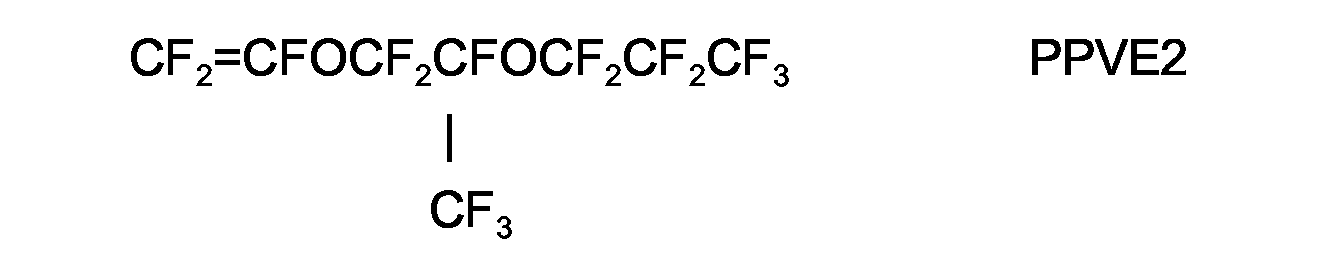
- In one embodiment, the thermoplastic quadpolymer which may be used to form the
barrier layer 3 of the hose of the present invention are commercially available from the Dyneon Company under the commercial designation THV X 815 G. - Disposed between the FKM layer and the barrier layer of thermoplastic quadpolymer is an
adhesive amount 2 of a thermoplastic terpolymer derived from tetrafluoroethylene, hexafluoropropylene and vinylidene fluoride. By "adhesive amount", it is meant that the amount of thermoplastic terpolymer derived from tetrafluoroethylene, hexafluoropropylene and vinylidene fluoride disposed between the FKM layer and the barrier layer is sufficient to adhere the innermost layer to the barrier layer. Generally, an adhesive amount is an amount of the thermoplastic terpolymer disposed between the FKM layer and the barrier layer that does not significantly contribute to the fuel permeability resistance of the hose. More specifically, an adhesive amount of the thermoplastic terpolymer is, for example, a thin layer of the thermoplastic terpolymer that is too thin to function as a barrier layer but sufficient to act as an adhesive between the FKM layer and the thermoplastic quadpolymer barrier layer. - In one embodiment, an adhesive amount of the thermoplastic terpolymer derived from tetrafluoroethylene, hexafluoropropylene and vinylidene fluoride is diposed as a
thin layer 2 with a thickness of between 0.01 mm and 0.1 mm. Alternatively, the thickness may be between 0.02 mm and 0.08 mm. The adhesive amount may be co-extruded with the thermoplastic quadpolymer barrier layer over the FKM innermost layer. - Suitable thermoplastic terpolymer of tetrafluoroethylene, hexafluoropropylene and vinylidene fluoride may include 30-75 weight percent tetrafluoroethylene, 5-40 weight percent hexafluoropropylene and 5-55 weight percent vinylidene fluoride, with 100 weight percent of the monomer weight of the terpolymer made up from the combination of tetrafluoroethylene, hexafluoropropylene and vinylidene fluoride. Preferably, the thermoplastic terpolymers have a melting point range of 75°C to 275°C. In one embodiment, suitable thermoplastic terpolymers of tetrafluoroethylene, vinylidene fluoride, and hexafluoropropylene are available from Dyneon LLC and Dyneon GmbH as THV-200, 300, 400, 500, and 600 series.
- In a preferred embodiment of the invention, the
hose 20 also comprises anouter cover 5. Thisouter cover 5 may be made from an elastomeric material or reinforcement. Examples of reinforcement include spiralled yarn, knitted yarn and braided yarn. Yarns of polyester, nylon, rayon and aramid may be used. When an elastomeric cover is desired, thecover 5 may be extruded over theunderlying layer 3, or, as discussed below, various other optional layers. The elastomers which may be used to form thecover 5 for thehose 20 of the present invention include those known to those skilled in the art such as chlorosulfonated polyethylene, chlorinated polyethylene, acrylonitrile-butadiene rubber/PVC blends, epichlorohydrin, EPDM, chloroprene, EVA, ethylene acrylic elastomer AEM, and EVM. The thickness of theelastomeric cover 5 is obviously depends upon the desired properties of thehose 20 and the elastomer that is used. Generally speaking, the thickness of theelastomeric cover 5 will range from 0.1 mm to 10 mm, with a range of from 0.5 mm to being 2.5 mm being preferred. - The
hose 20 of the present invention may also have further optional features. For example, when ahose 30, as shown in Figure 2, is produced having theinner FKM core 10,adhesive layer 11 andbarrier layer 12, dispersed on the outside of thebarrier layer 12 may be afirst layer 14 of another polymer. Such polymer may be of the same composition as theinner core 10. In another embodiment, the polymer which is used in thisfirst layer 14, which interfaces thebarrier layer 12, may be epichlorohydrin. The thickness of thisfirst layer 14 which interfaces thebarrier layer 12 may range depending upon the polymer selected. Generally speaking, the thickness of thisfirst layer 14 will range of from 0.25 mm to 1.5 mm with a range of from 0.50 mm to 1.0 mm being preferred. - Another optional feature of the present invention is
reinforcement 16 which may be added on top of thefirst layer 14 which interfaces with thebarrier layer 12.Such reinforcement 16 is known to those skilled in the art and may consist of spiraled, knitted or braided yarn. Such reinforcements are typically derived from polyester, nylon, rayon or aramid cords. Thereinforcement 16 is preferably spirally wound about the first layer under sufficient tension to improve the strength of the hose structure. Thereinforcement layer 16 is preferably spirally wrapped at angles such that the flexing of thehose 30 will not result in collapse or kinking. An angle such as from 0 to 89.9° with respect to the centerline of the hose may be used. Most preferably, a neutral angle of 54° 73' or below is used for the spiral wraps. - In accordance with one embodiment, the
inner core 10 functions as a barrier layer comprised of the above-described terpolymer, thenext layer 12 is made of the hydrogenated acrylonitrile-butadiene rubber, thenext layer 14 is omitted, withreinforcement 16 being directly against therubber layer 12 followed by anouter cover 18. - As mentioned above, the
elastomeric cover 18 is the outside layer. - The FKM layer may be formed by extrusion methods known to those skilled in the art. The thickness of this layer whether being the innermost layer 1 or
next layer 3 is important as excessively thin wall thicknesses or excessively thick wall thicknesses present flexibility or kinking problems or coupling compatibility problems of the final hose composite. It is believed that the inside diameter of the innermost layer 1 whether made from the FKM or barrier layer should range from 3 mm to 100 mm. Preferably, the inside diameter of the innermost layer will range from 4 mm to 75 mm. When the innermost layer is made from the FKM, the wall thicknesses of the innermost layer 1 should range from 0.1 mm to 8 mm. Alternatively, the wall thickness of the innermost layer 1 will range from 0.5 mm to 4 mm. When the innermost layer is made from the barrier layer compound, the wall thicknesses of the innermost layer 1 should range from 0.1 to 1 mm. - The following example is provided to illustrate the instant invention and are not intended to limit the same.
- A 1 inch inside diameter fuel hose was fabricated having the following construction according to Figure 1:
- innermost layer 1 of an FKM compound, having a wall thickness of about 25 mils (0.63 mm);
-
adhesive amount 2 of THV 500, having a thickness of about 2 mils;barrier layer 3 of THV-815 having a thickness of about 8 mils; andelastomeric cover 5. -
- The hose was cured following standard techniques and tested for adhesion between the FKM/THV500/THV815 layers. The adhesion test showed stock tear of the FKM layer, indicating good adhesion between the FKM/THV500 layers and between the THV500/THV815 layers.
Claims (10)
- A hose (20, 30) comprising a rubber layer comprising a fluoroelastomer, and a barrier layer comprising a thermoplastic quadpolymer, wherein the barrier layer is adhered to the rubber layer with an adhesive amount of a thermoplastic terpolymer of tetrafluoroethylene, hexafluoropropylene and vinylidene fluoride.
- The hose (20, 30) of claim 1, wherein the rubber layer comprises a FKM fluoroelastomer and/or wherein the thermoplastic quadpolymer derived from (i) tetrafluoroethylene, (ii) vinylidene fluoride, (iii) at least one ethylenically unsaturated monomer of the formula CF2=CFRf where Rf is a perfluoroalkyl or a perfluoroalkoxy of 1 to 8 carbon atoms, and (iv) a perfluorovinyl ether of the formula CF2=CF-(OCF2 CF(Rf))a OR'f, where Rf is as described in (iii), R'f is a perfluoroaliphatic, preferably a perfluoroalkyl or a perfluoroalkoxy, of 1 to 8, preferably 1 to 3, carbon atoms, and a has a value of 0 to 3.
- The hose of claim 2, wherein the thermoplastic quadpolymer contains interpolymerized units derived from tetrafluoroethylene, hexafluoropropylene and vinylidene fluoride, and a perfluorovinyl ether having an "a" value of 0, 1 or 2.
- The hose of claim 1 or 2, wherein the thermoplastic quadpolymer contains interpolymerized units derived from tetrafluoroethylene, hexafluoropropylene, vinylidene fluoride and a perfluorovinyl ether of the formula PPVE1 or PPVE2:

- The hose of a least one of the previous claims, wherein said thermoplastic quadpolymer comprises from 40 to 80 weight percent tetrafluoroethylene; from 10 to 30 weight percent vinylidene fluoride, from 5 to 40 weight percent of a comonomer of the formula CF2=CFRf; and from 0.1 to 15 weight percent of the perfluorovinyl ether of the formula CF2=CF-(OCF2 CF(Rf))a OR'f.
- The hose of at least one of the previous claims, wherein said FKM fluoroelastomer comprises 0 to 70 parts by weight tetrafluoroethylene, 20 to 50 parts by weight hexafluoropropylene and 20 to 80 parts by weight vinylidene fluoride, based on 100 parts by weight of FKM.
- The hose of at least one of the previous claims, wherein said thermoplastic terpolymer of tetrafluoroethylene, hexafluoropropylene and vinylidene fluoride comprises 30 to 75 weight percent tetrafluoroethylene, 5 to 40 weight percent hexafluoropropylene and 5 to 55 weight percent vinylidene fluoride.
- The hose of at least one of the previous claims, wherein said hose (20, 30) further comprises an outer cover (5, 18) made of a material selected from the group consisting of (a) elastomeric materials and (b) reinforcement material.
- The hose of claim 8, wherein said elastomer that comprises said outer cover (5, 18) is selected from the group consisting of chlorosulfonated polyethylene, chlorinated polyethylene, acrylonitrile-butadiene rubber/PVC blends, epichlorohydrin, EPDM, chloroprene, EVA, ethylene acrylic elastomer and EVM.
- The hose of at least one of the previous claims, wherein the fluoroelastomer rubber layer is the innermost layer of the hose (20, 30), or wherein the barrier layer is the innermost layer of the hose (20, 30).
Applications Claiming Priority (2)
| Application Number | Priority Date | Filing Date | Title |
|---|---|---|---|
| US10/630,326 US6921565B2 (en) | 2003-07-30 | 2003-07-30 | Hose construction containing thermoplastic quadpolymers |
| US630326 | 2003-07-30 |
Publications (1)
| Publication Number | Publication Date |
|---|---|
| EP1505327A1 true EP1505327A1 (en) | 2005-02-09 |
Family
ID=33552873
Family Applications (1)
| Application Number | Title | Priority Date | Filing Date |
|---|---|---|---|
| EP04103511A Withdrawn EP1505327A1 (en) | 2003-07-30 | 2004-07-22 | Hose construction containing thermoplastic quaternary fluoropolymers |
Country Status (5)
| Country | Link |
|---|---|
| US (1) | US6921565B2 (en) |
| EP (1) | EP1505327A1 (en) |
| JP (1) | JP2005047282A (en) |
| KR (1) | KR20050014726A (en) |
| BR (1) | BRPI0402989A (en) |
Cited By (3)
| Publication number | Priority date | Publication date | Assignee | Title |
|---|---|---|---|---|
| WO2006120811A1 (en) | 2005-05-13 | 2006-11-16 | Aoi Co., Ltd. | Control tube |
| EP1894963A1 (en) * | 2006-08-30 | 2008-03-05 | The Goodyear Tire & Rubber Company | Adhesion promoter for bonding fluoropolymer layers in a multi-layered article |
| CN103804827A (en) * | 2012-11-07 | 2014-05-21 | 东莞市长安东阳光铝业研发有限公司 | Formula of inner glue for automotive fuel oil rubber pipe |
Families Citing this family (8)
| Publication number | Priority date | Publication date | Assignee | Title |
|---|---|---|---|---|
| US7270870B2 (en) * | 2004-06-04 | 2007-09-18 | Saint Gobain Performance Plastics Corporation | Multi-layer polymer film |
| US20050268961A1 (en) * | 2004-06-04 | 2005-12-08 | Saint-Gobain Performance Plastics Coporation | Photovoltaic device and method for manufacturing same |
| US20080053551A1 (en) * | 2006-08-30 | 2008-03-06 | Dayco Products,Llc | Multilayer hose construction |
| US7614428B2 (en) * | 2006-12-27 | 2009-11-10 | Veyance Technologies, Inc. | Power steering hose design for performance in high pressure and low to high volumeric expansion environments |
| WO2012068530A2 (en) | 2010-11-19 | 2012-05-24 | Saint-Gobain Performance Plastics Corporation | Adhesive film for bushings |
| GB201303619D0 (en) * | 2013-02-28 | 2013-04-17 | Valpar Ind Ltd | Improved beverage dispensing tubing |
| WO2020227057A1 (en) * | 2019-05-03 | 2020-11-12 | Specialty Rpt, Inc | Jacketed polymeric pipe with integrated weight |
| US20210146669A1 (en) * | 2019-11-15 | 2021-05-20 | Saint-Gobain Performance Plastics Corporation | Multilayer tube and method for making same |
Citations (7)
| Publication number | Priority date | Publication date | Assignee | Title |
|---|---|---|---|---|
| US2833752A (en) | 1954-06-14 | 1958-05-06 | Minnesota Mining & Mfg | Cross-linking of fluorinated elastomers |
| JPS5670009A (en) * | 1979-11-09 | 1981-06-11 | Asahi Glass Co Ltd | Fluoroelastomer and its vulcanized composition |
| US5208305A (en) | 1992-04-17 | 1993-05-04 | Minnesota Mining And Manufacturing Company | Fluorine-containing polymers and preparation and use thereof |
| WO1995013186A1 (en) * | 1993-11-12 | 1995-05-18 | E.I. Du Pont De Nemours And Company | Fluoropolymer laminates |
| WO2002000777A2 (en) * | 2000-06-27 | 2002-01-03 | Dyneon Llc | Compositions comprising fluoroelastomer and thermoplastic fluorocopolymer |
| US6489420B1 (en) * | 2000-06-27 | 2002-12-03 | Dyneon Llc | Fluoropolymers with improved characteristics |
| US20030113464A1 (en) * | 2001-08-08 | 2003-06-19 | Tatsuo Fukushi | Process for preparing a multi-layer article having a fluoroplastic layer and an elastomer layer |
Family Cites Families (12)
| Publication number | Priority date | Publication date | Assignee | Title |
|---|---|---|---|---|
| DE3337519A1 (en) * | 1982-10-15 | 1984-05-10 | Japan Synthetic Rubber Co., Ltd., Tokyo | RUBBER LAMINATE |
| JPH05177771A (en) * | 1991-12-26 | 1993-07-20 | Asahi Glass Co Ltd | Fuel hose |
| US5320888A (en) * | 1993-11-12 | 1994-06-14 | E. I. Du Pont De Nemours And Company | Fluoroelastomer laminates |
| US5430603A (en) * | 1994-02-25 | 1995-07-04 | Titeflex Corporation | Externally non-conductive hose assembly |
| GB2301417B (en) * | 1994-03-04 | 1997-12-03 | Aeroquip Corp | A tube suitable for use with fuel systems for motor vehicles |
| US5941286A (en) * | 1994-06-30 | 1999-08-24 | Cadillac Rubber & Plastics, Inc. | Composite fuel and vapor barrier tube and process for making same |
| US5679425A (en) * | 1994-11-23 | 1997-10-21 | Plumley Companies, Inc. | Hose for fuel handling systems |
| US5639528A (en) * | 1995-04-24 | 1997-06-17 | The Goodyear Tire & Rubber Company | Hose construction containing fluoroplastic terpolymers |
| US6261657B1 (en) * | 1999-04-26 | 2001-07-17 | The Goodyear Tire & Rubber Company | Hose construction containing fluoroplastic terpolymers |
| JP2001179798A (en) * | 1999-12-27 | 2001-07-03 | Tokai Rubber Ind Ltd | Corrugated tube for fuel and method of manufacturing the same |
| US6686012B1 (en) | 2000-08-23 | 2004-02-03 | 3M Innovative Properties Company | Multi-layer articles including a fluoroplastic layer |
| AU2001225857A1 (en) | 2000-08-23 | 2002-03-04 | Dyneon Llc | Process for preparing a multi-layer article having a fluoroplastic layer and an elastomer layer |
-
2003
- 2003-07-30 US US10/630,326 patent/US6921565B2/en not_active Expired - Fee Related
-
2004
- 2004-07-22 BR BR0402989-5A patent/BRPI0402989A/en not_active IP Right Cessation
- 2004-07-22 EP EP04103511A patent/EP1505327A1/en not_active Withdrawn
- 2004-07-29 KR KR1020040059857A patent/KR20050014726A/en not_active Withdrawn
- 2004-07-30 JP JP2004223556A patent/JP2005047282A/en not_active Ceased
Patent Citations (7)
| Publication number | Priority date | Publication date | Assignee | Title |
|---|---|---|---|---|
| US2833752A (en) | 1954-06-14 | 1958-05-06 | Minnesota Mining & Mfg | Cross-linking of fluorinated elastomers |
| JPS5670009A (en) * | 1979-11-09 | 1981-06-11 | Asahi Glass Co Ltd | Fluoroelastomer and its vulcanized composition |
| US5208305A (en) | 1992-04-17 | 1993-05-04 | Minnesota Mining And Manufacturing Company | Fluorine-containing polymers and preparation and use thereof |
| WO1995013186A1 (en) * | 1993-11-12 | 1995-05-18 | E.I. Du Pont De Nemours And Company | Fluoropolymer laminates |
| WO2002000777A2 (en) * | 2000-06-27 | 2002-01-03 | Dyneon Llc | Compositions comprising fluoroelastomer and thermoplastic fluorocopolymer |
| US6489420B1 (en) * | 2000-06-27 | 2002-12-03 | Dyneon Llc | Fluoropolymers with improved characteristics |
| US20030113464A1 (en) * | 2001-08-08 | 2003-06-19 | Tatsuo Fukushi | Process for preparing a multi-layer article having a fluoroplastic layer and an elastomer layer |
Non-Patent Citations (1)
| Title |
|---|
| DATABASE WPI Section Ch Week 198131, Derwent World Patents Index; Class A14, AN 1981-55763D, XP002304829 * |
Cited By (6)
| Publication number | Priority date | Publication date | Assignee | Title |
|---|---|---|---|---|
| WO2006120811A1 (en) | 2005-05-13 | 2006-11-16 | Aoi Co., Ltd. | Control tube |
| EP1889711A4 (en) * | 2005-05-13 | 2011-08-03 | Aoi Co Ltd | Control tube |
| EP1894963A1 (en) * | 2006-08-30 | 2008-03-05 | The Goodyear Tire & Rubber Company | Adhesion promoter for bonding fluoropolymer layers in a multi-layered article |
| US7598302B2 (en) | 2006-08-30 | 2009-10-06 | Veyance Technologies, Inc | Adhesion promoter for bonding fluoropolymer layers in a multi-layered article |
| CN103804827A (en) * | 2012-11-07 | 2014-05-21 | 东莞市长安东阳光铝业研发有限公司 | Formula of inner glue for automotive fuel oil rubber pipe |
| CN103804827B (en) * | 2012-11-07 | 2017-06-16 | 东莞东阳光科研发有限公司 | A kind of rubber tube of automobile fuel oil hose lining formula |
Also Published As
| Publication number | Publication date |
|---|---|
| US20050025923A1 (en) | 2005-02-03 |
| US6921565B2 (en) | 2005-07-26 |
| BRPI0402989A (en) | 2005-05-31 |
| JP2005047282A (en) | 2005-02-24 |
| KR20050014726A (en) | 2005-02-07 |
Similar Documents
| Publication | Publication Date | Title |
|---|---|---|
| US5427831A (en) | Fluoropolymer laminates | |
| US6849314B2 (en) | Fluoropolymer blends and multilayer articles | |
| US5320888A (en) | Fluoroelastomer laminates | |
| JP4768270B2 (en) | Fuel management system including a fluoroelastomer layer having a hydrotalcite compound | |
| JP3324118B2 (en) | Thermoplastic resin composition and laminate thereof | |
| EP1124677A1 (en) | Blends of fluoroelastomer interpolymers with thermo fluoroplastic interpolymers and the use of such blends in hoses | |
| CN1454222A (en) | Novel fluoropolymers with improved characteristics | |
| US6921565B2 (en) | Hose construction containing thermoplastic quadpolymers | |
| JPWO1995011940A1 (en) | Thermoplastic resin composition and laminate thereof | |
| US7029736B2 (en) | Hose construction containing thermoplastic fluoropolymer | |
| US7192646B2 (en) | Hose construction containing fluoroelastomer composition and fluoroplastic barrier | |
| CA2519541C (en) | Hose construction containing nbr elastomer composition and fluoroplastic barrier | |
| JP4063046B2 (en) | Fuel hose and manufacturing method thereof | |
| JP2973860B2 (en) | Thermoplastic resin laminate |
Legal Events
| Date | Code | Title | Description |
|---|---|---|---|
| PUAI | Public reference made under article 153(3) epc to a published international application that has entered the european phase |
Free format text: ORIGINAL CODE: 0009012 |
|
| AK | Designated contracting states |
Kind code of ref document: A1 Designated state(s): AT BE BG CH CY CZ DE DK EE ES FI FR GB GR HU IE IT LI LU MC NL PL PT RO SE SI SK TR |
|
| AX | Request for extension of the european patent |
Extension state: AL HR LT LV MK |
|
| 17P | Request for examination filed |
Effective date: 20050809 |
|
| AKX | Designation fees paid |
Designated state(s): DE FR GB |
|
| 17Q | First examination report despatched |
Effective date: 20070226 |
|
| STAA | Information on the status of an ep patent application or granted ep patent |
Free format text: STATUS: THE APPLICATION IS DEEMED TO BE WITHDRAWN |
|
| 18D | Application deemed to be withdrawn |
Effective date: 20080821 |