EP1504743A1 - Insoluble powder, powder for restoring barrier function of skin, powder for preventing/mitigating skin chapping, and preparation containing the same for external use on skin - Google Patents
Insoluble powder, powder for restoring barrier function of skin, powder for preventing/mitigating skin chapping, and preparation containing the same for external use on skin Download PDFInfo
- Publication number
- EP1504743A1 EP1504743A1 EP03745443A EP03745443A EP1504743A1 EP 1504743 A1 EP1504743 A1 EP 1504743A1 EP 03745443 A EP03745443 A EP 03745443A EP 03745443 A EP03745443 A EP 03745443A EP 1504743 A1 EP1504743 A1 EP 1504743A1
- Authority
- EP
- European Patent Office
- Prior art keywords
- powder
- skin
- ion
- insoluble
- barium sulfate
- Prior art date
- Legal status (The legal status is an assumption and is not a legal conclusion. Google has not performed a legal analysis and makes no representation as to the accuracy of the status listed.)
- Granted
Links
Images









Classifications
-
- A—HUMAN NECESSITIES
- A61—MEDICAL OR VETERINARY SCIENCE; HYGIENE
- A61Q—SPECIFIC USE OF COSMETICS OR SIMILAR TOILETRY PREPARATIONS
- A61Q1/00—Make-up preparations; Body powders; Preparations for removing make-up
- A61Q1/12—Face or body powders for grooming, adorning or absorbing
-
- A—HUMAN NECESSITIES
- A61—MEDICAL OR VETERINARY SCIENCE; HYGIENE
- A61K—PREPARATIONS FOR MEDICAL, DENTAL OR TOILETRY PURPOSES
- A61K8/00—Cosmetics or similar toiletry preparations
- A61K8/18—Cosmetics or similar toiletry preparations characterised by the composition
- A61K8/19—Cosmetics or similar toiletry preparations characterised by the composition containing inorganic ingredients
-
- A—HUMAN NECESSITIES
- A61—MEDICAL OR VETERINARY SCIENCE; HYGIENE
- A61K—PREPARATIONS FOR MEDICAL, DENTAL OR TOILETRY PURPOSES
- A61K8/00—Cosmetics or similar toiletry preparations
- A61K8/02—Cosmetics or similar toiletry preparations characterised by special physical form
- A61K8/0216—Solid or semisolid forms
- A61K8/022—Powders; Compacted Powders
-
- A—HUMAN NECESSITIES
- A61—MEDICAL OR VETERINARY SCIENCE; HYGIENE
- A61K—PREPARATIONS FOR MEDICAL, DENTAL OR TOILETRY PURPOSES
- A61K8/00—Cosmetics or similar toiletry preparations
- A61K8/18—Cosmetics or similar toiletry preparations characterised by the composition
- A61K8/19—Cosmetics or similar toiletry preparations characterised by the composition containing inorganic ingredients
- A61K8/23—Sulfur; Selenium; Tellurium; Compounds thereof
-
- A—HUMAN NECESSITIES
- A61—MEDICAL OR VETERINARY SCIENCE; HYGIENE
- A61K—PREPARATIONS FOR MEDICAL, DENTAL OR TOILETRY PURPOSES
- A61K8/00—Cosmetics or similar toiletry preparations
- A61K8/18—Cosmetics or similar toiletry preparations characterised by the composition
- A61K8/19—Cosmetics or similar toiletry preparations characterised by the composition containing inorganic ingredients
- A61K8/27—Zinc; Compounds thereof
-
- A—HUMAN NECESSITIES
- A61—MEDICAL OR VETERINARY SCIENCE; HYGIENE
- A61Q—SPECIFIC USE OF COSMETICS OR SIMILAR TOILETRY PREPARATIONS
- A61Q17/00—Barrier preparations; Preparations brought into direct contact with the skin for affording protection against external influences, e.g. sunlight, X-rays or other harmful rays, corrosive materials, bacteria or insect stings
-
- A—HUMAN NECESSITIES
- A61—MEDICAL OR VETERINARY SCIENCE; HYGIENE
- A61Q—SPECIFIC USE OF COSMETICS OR SIMILAR TOILETRY PREPARATIONS
- A61Q19/00—Preparations for care of the skin
-
- A—HUMAN NECESSITIES
- A61—MEDICAL OR VETERINARY SCIENCE; HYGIENE
- A61Q—SPECIFIC USE OF COSMETICS OR SIMILAR TOILETRY PREPARATIONS
- A61Q19/00—Preparations for care of the skin
- A61Q19/08—Anti-ageing preparations
-
- A—HUMAN NECESSITIES
- A61—MEDICAL OR VETERINARY SCIENCE; HYGIENE
- A61K—PREPARATIONS FOR MEDICAL, DENTAL OR TOILETRY PURPOSES
- A61K2800/00—Properties of cosmetic compositions or active ingredients thereof or formulation aids used therein and process related aspects
- A61K2800/40—Chemical, physico-chemical or functional or structural properties of particular ingredients
- A61K2800/41—Particular ingredients further characterized by their size
- A61K2800/412—Microsized, i.e. having sizes between 0.1 and 100 microns
-
- A—HUMAN NECESSITIES
- A61—MEDICAL OR VETERINARY SCIENCE; HYGIENE
- A61K—PREPARATIONS FOR MEDICAL, DENTAL OR TOILETRY PURPOSES
- A61K2800/00—Properties of cosmetic compositions or active ingredients thereof or formulation aids used therein and process related aspects
- A61K2800/40—Chemical, physico-chemical or functional or structural properties of particular ingredients
- A61K2800/60—Particulates further characterized by their structure or composition
- A61K2800/65—Characterized by the composition of the particulate/core
- A61K2800/651—The particulate/core comprising inorganic material
-
- A—HUMAN NECESSITIES
- A61—MEDICAL OR VETERINARY SCIENCE; HYGIENE
- A61Q—SPECIFIC USE OF COSMETICS OR SIMILAR TOILETRY PREPARATIONS
- A61Q1/00—Make-up preparations; Body powders; Preparations for removing make-up
- A61Q1/02—Preparations containing skin colorants, e.g. pigments
-
- A—HUMAN NECESSITIES
- A61—MEDICAL OR VETERINARY SCIENCE; HYGIENE
- A61Q—SPECIFIC USE OF COSMETICS OR SIMILAR TOILETRY PREPARATIONS
- A61Q1/00—Make-up preparations; Body powders; Preparations for removing make-up
- A61Q1/02—Preparations containing skin colorants, e.g. pigments
- A61Q1/04—Preparations containing skin colorants, e.g. pigments for lips
- A61Q1/06—Lipsticks
-
- A—HUMAN NECESSITIES
- A61—MEDICAL OR VETERINARY SCIENCE; HYGIENE
- A61Q—SPECIFIC USE OF COSMETICS OR SIMILAR TOILETRY PREPARATIONS
- A61Q1/00—Make-up preparations; Body powders; Preparations for removing make-up
- A61Q1/02—Preparations containing skin colorants, e.g. pigments
- A61Q1/10—Preparations containing skin colorants, e.g. pigments for eyes, e.g. eyeliner, mascara
Definitions
- This invention relates to an insoluble powder, in particular, skin barrier function recovering effect and skin roughening preventing and improving effect of the same powder.
- the skin is anatomically divided to epidermis, derma, and subcutaneous tissue.
- said epidermis is composed of basal layer, spinosum layer, granular layer and horny layer.
- the horny layer of the epidermis is very thin and the thickness is below 20 ⁇ m. Accordingly drying and skin roughness are easy to be caused by the external stimulation such as ultraviolet rays, drying, air pollution, and microorganism, and internal factors such as sebum excretion, sweat gland functions, epidermis metabolism, and aging. Hitherto it was carried out that amino acids, polysaccharides, lipids, natural polymeric compounds and so on having high moisturizing effect and water retention effect are blended to skin external composition.
- the present invention was done in view of the previous problems, and an object thereof is to provide an insoluble powder having excellent skin barrier function recovering effect and skin roughening preventing and improving effect, and a skin external composition containing the same.
- a first subject of the present invention is an insoluble powder characterized in that a zeta- potential is a negative value.
- the zeta- potential refers to a part involved in electrophoresis phenomenon among a contact potential difference generated when a liquid is contacted with a solid, and is suitably used for assessing the surface charge state of a subject.
- a method of measuring the zeta-potential in the present invention is as follows:
- barium sulfate is a main ingredient in the insoluble powder.
- an average primary particle diameter is 3 to 100 ⁇ m, and an aspect ratio is 3 to 250 in the insoluble powder.
- the aspect ratio expresses (average primary particle diameter)/(average thickness).
- the insoluble powder is a metal-doped barium sulfate powder obtained by reacting a barium ion with a sulfate ion in the presence of a metal ion.
- a mole ratio of the barium ion, the sulfate ion, and the metal ion is 1:0.5 to 2:0.001 to 10 in the insoluble powder.
- the metal ion is one or more selected from the group consisting of a lithium ion, a sodium ion and a zinc ion in the insoluble powder.
- a second subject of the present invention is a skin barrier function recovering powder, or a skin roughening preventing and improving powder, which comprises the aforementioned powder.
- a third subject of the present invention is a skin external composition characterized in that a content of the aforementioned powder is 1 to 40% by weight.
- the insoluble powder of the present invention can be used as a skin barrier function recovering agent, and a skin roughening preventing and improving agent.
- a calcium ion is localized in a corneum and a dermis, but due to a skin barrier destruction, suitable localization of a calcium ion in a skin is disintegrated, and diffusion of an ion is generated.
- the insoluble powder of the present invention is characterized in that a zeta-potential is negative.
- a first working mode of the insoluble powder of the present invention is an insoluble powder having an average primary particle diameter of 3 to 100 ⁇ m and an aspect ratio of 3 to 250.
- an average primary particle diameter is 3 ⁇ m or larger, and an aspect ratio is 3 or larger, since movement of electrons in a particle is difficult to occur, the electric double layer is stabilized and excellent skin barrier recovering effect is obtained.
- an average primary particle diameter exceeds 100 ⁇ m, or an aspect ratio exceeds 250, usability is deteriorated in some cases when blended in a skin external preparation, being not preferable.
- a kind of the insoluble powder used in a first working mode is not particularly limited as far as the aforementioned conditions are satisfied, but examples include barium sulfate.
- a barium sulfate powder of the present invention can be prepared by the conventional method such as a method of mixing a barium compound solution containing a barium ion and a sulfate compound solution containing a sulfate ion.
- a reaction temperature is preferably 50 to 100°C, most preferably 70 to 100°C.
- Any barium compound is used as far as it produces a barium ion in a solvent such as water and alcohol, being not particularly limited.
- a solvent such as water and alcohol
- barium hydroxide, barium chloride, barium sulfide, barium nitrate, barium acetate and so on are listed. Above all barium chloride and barium hydroxide are desirable, because dispose of the by-product is easy.
- Any sulfuric compound is used as far as it produces a sulfuric ion in a solvent such as water and alcohol, being not particularly limited.
- sulfuric acid, sodium sulfate, sodium hydrogensulfate, ammonium sulfate, potassium sulfate, lithium sulfate and so on are listed. Above all sulfuric acid, sodium sulfate, and ammonium sulfate are desirable.
- the barium compound and the sulfate compound are used in the state where they are dissolved in a solvent such as water and alcohol.
- concentrations of the barium compound and the sulfate compound are preferably 0.001 to 0.1 mol/L. When the concentration is lower than 0.001 mol/L, efficacy is deteriorated in an industrial process and, when the concentration is higher than 0.1 mol/L, supersaturation occurs, and a number of fine particles are produced, that causes aggregation.
- a mole ratio of a barium ion and a sulfate ion is 1:0.5 to 2.
- a mole ratio of a sulfate ion is smaller than 0.5, or exceeds 2 relative to a barium ion, efficacy is deteriorated in an industrial process.
- a second working mode of the insoluble powder of the present invention is a powder of barium sulfate doped with a metal.
- Barium sulfate doped with a metal has higher skin barrier function recovering effect as compared with non-doped barium sulfate.
- a powder of barium sulfate doped with a metal can be prepared by reacting a barium ion with a sulfate ion in the presence of a metal ion.
- the powder can be prepared by a process of mixing (A) a barium compound solution containing a barium ion and (B) a metal salt compound solution containing a metal ion and, thereafter, adding the mixture to (C) a sulfate compound solution containing a sulfate ion, or a method of adding (A) a barium compound solution containing barium ion and (C) a sulfate compound solution containing sulfate ion to (B) a metal salt compound solution containing a metal ion.
- a reaction temperature is preferably 50 to 100°C, most preferably 70 to 100°C.
- the barium compound, the sulfate compound, the barium solution, and the sulfate solution those described in the first embodiment are suitably used.
- Examples of a preferable metal ion for doping in the present invention include zinc ion, sodium ion and lithium ion. These can be used alone, or by combining two or more of them. Each metal ion is given as a solution of a metal salt compound in water or alcohol.
- lithium salts lithium hydroxide, lithium chloride, lithium nitrate, lithium carbonate, lithium acetate, and so on are used.
- sodium hydroxide sodium chloride, sodium nitrate, sodium carbonate, sodium acetate, and so on are used.
- zinc salts zinc hydroxide, zinc chloride, zinc nitrate, zinc carbonate, zinc acetate, and so on are used.
- a mole ratio of barium ion, sulfate ion and metal ion is 1:0.5 to 2:0.001 to 10.
- a mole ratio of metal ion is smaller than 0.001 relative to barium ion, the effect of the present invention is not sufficiently exerted and, when the ratio exceeds 10, a produced powder of barium sulfate causes aggregation.
- a mole ratio of a sulfate ion is smaller than 0.5, or exceeds 2 relative to barium ion, efficacy is deteriorated in an industrial process.
- the insoluble powder of the present invention can be used as a skin barrier function recovering powder, or a skin roughening preventing and improving powder.
- the insoluble powder of the present invention When the insoluble powder of the present invention is blended in a skin external preparation, it is preferable that the insoluble powder is contained at 1 to 40% by weight, particularly 8 to 40% by weight relative to a total amount of a skin external preparation. When the amount is smaller than 1% by weight, the effect of the present invention is not sufficiently exerted and, when the amount exceeds 40% by weight, formulation into a preparation becomes difficult.
- the skin external preparation may contain, anionic surfactant such as fatty acid soap, alkyl sulfate ester salt, polyoxyethylene alkylether sulfate salt, acyl-N-methyltaurine salt, alkylether phosphate ester salt, N-acyl amino acid salt, organic acid monoglyceride and so on; cationic surfactant such as alkyltrimethylammonium chloride, dialkyldimethylammonium chloride, benzalkonium chloride, alkylpyridinium chloride and so on; ampholytic surfactant such as alkylamidodimethylaminoacetic acid betaine, 2-alkyl-N-carboxy-N-hydroxyimidazolinium betaine, lecithin, enzymatic hydrolysis lecithin and so on; noni
- anionic surfactant such as fatty acid soap, alkyl sulfate ester salt, polyoxyethylene alkylether sulfate salt, acyl-N-methyl
- whitening agent such as arbutin, ascorbic acid and its derivatives
- anti-aging agent such as retinol and its derivatives
- alpha-hydroxy acids such as lactic acid, and glycolic acid
- hair growing agents vitamins; antiinflammatory agents; germicides; various salts and so on
- vitamins antiinflammatory agents; germicides; various salts and so on
- a method of measuring the zeta- potential in the present invention is as follows:
- barium sulfate is substantially insoluble in water, and that the shape is necessary to be plate-like, it is necessary that a powder of the present invention is insoluble in an aqueous system.
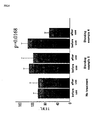
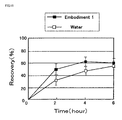
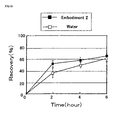
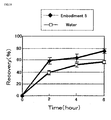
- the whole back of a hairless mouse was subjected to skin barrier destruction treatment with acetone 40mg of each powder was suspended in 200 to 400 ⁇ L of ion-exchanged water to prepare a suspension.
- the suspension was added dropwise to a 2 ⁇ 4cm square of a filter paper placed on a plastic wrap to wet it. This was applied to a back of a hairless mouse that had been subjected to the aforementioned skin barrier destruction treatment so that the added dropwise surface was contacted with the back, and was peeled off after 10 minutes (Fig. 2).
- a skin on a back of a hairless mouse was taken after 2 hours, and calcium ion was visualized to confirm ion distribution.
- a method of visualizing calcium ion is a method of contacting a frozen tissue piece with a water-soluble gel or a plastic containing calcium green 1TM which can color and detect calcium ion under the constant condition to color a calcium green 1TM and the details are described in JP-A No. 2001-324502.
- the zeta- potential of the insoluble powder of the present invention is a negative value.
- the insoluble powder of the present invention has a plate-like shape. Then, in order to define "plate-like", further, the following experiment was performed to investigate a suitable particle diameter and aspect ratio.
- An aspect ratio expresses (average primary particle diameter)/(average thickness).
- an average primary particle diameter exceeds 100 ⁇ m, or an aspect ratio exceeds 250, usability is deteriorated in some cases when blended in a skin external preparation.
- the plate-like insoluble powders of the present invention have an average primary particle diameter of 3 to 100 ⁇ m, and an aspect ratio of 3 to 250.
- Blending example 1 2 3 Insoluble powder of Example 7 12 8 0 Metal soap treated talc (TALK ACS-515TM) 18.52 14.52 10.52 Silicone treated mica (SNP-WEY-(S)TM) 15 15 15 Silicone treated sericite (SNH-300STTM) 22 22 22 Silicone treated synthesis mica (SNH-ST(EF)TM) 4 4 4 Silicone treated titanium oxide (SNH-R-KB-1TM) 6 6 6 Spherical PMMA powder (MICROSFER M-330TM) 6 6 6 6 Spherical PMMA covering mica (COMPOSITE M-PTM) 7 7 7 Silicone treated fine particle titanium oxide (TITANIUM OXIDE MT-020TM) 4 4 4 Silicone treated iron oxide+Silicone treated talc(SNP-R-1(N)TM) 1.34 1.34 1.34 Silicone treated iron oxide +Silicone treated talc (SNP-Y-75(N)TM) 3.32 3.32 3.32 Silicone treated iron oxide +
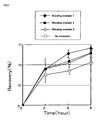
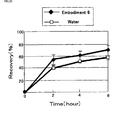
- Blending example 2 containing 8% by weight of the insoluble powder of the present invention or Blending example 1 containing 12% by weight of the powder
- a recovery rate of TEWL was higher as compared with non-treated mouse.
- a recovery rate was higher.
- a recovery rate was deteriorated as compared with a non-treated mouse. Therefore, it was confirmed that a skin external preparation containing the insoluble powder of the present invention has skin barrier function recovering effect, and it is suggested that a preferable content of the insoluble powder in a skin external preparation is 1 to 30% by weight, in particular 8 to 30% by weight.
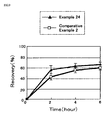
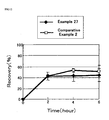
- TEWL transdermal evaporating water level
- Blending example 4 5 (1)Metal soap treated talc residue residue (2)Silicone treated talc 1.5 1.5 (3)Silicone treated mica 8 8 (4)Silicone treated sericite 30 30 (5)Silicone treated synthesis mica 4 4 (6)Insoluble powder of Example 7 15 0 (7)Silicone treated titanium oxide 8 8 (8)Silicone treated iron oxide 2.7 2.7 (9)Spherical alkyl polyacrylate resin powder 6 6 (10)Spherical alkyl polyacrylate resin fine powder coating mica 7 7 (11)Dimethylpolysiloxane 5 5 (12)Glycerol triisooctanoate 3 3 (13)2-Ethylhexyl para-methoxycinnamate 3 3 (14)Sorbitan sesquiisostearate 1 1 (15)Antiseptics proper quantity proper quantity (16)Antioxidant proper quantity proper quantity (17)Perfume proper quantity proper quantity
- Blending example 5 in which the insoluble powder of the present invention is not blended was coated, improvement in TEWL value is not observed, while when Blending example 4 in which 15% by weight of the insoluble powder of the present invention is blended was coated, a TEWL value was dramatically decreased from about 120 to about 60, and it was seen that skin barrier function was improved.
- the insoluble powder of the present invention has skin barrier function recovering effect also in a human.
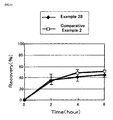
- the thickness of a skin of a hairless mouse receiving no damage was measured (Control example 2).
- the reaction solution was cooled to room temperature, the resulting solid product was precipitated, filtered and washed with water to remove a salt, followed by drying at 120°C for 12 hours. Then, the solid product was subjected to grinding treatment (grinding treatment was carried out for 5 minutes using a small size-grinding machine) to obtain a white powder.
- Barium sulfate Average primary particle diameter 3-15 ⁇ m, Aspect ratio 3-30, Zeta-potential -3.31
- the reaction solution was cooled to room temperature, the resulting solid product was precipitated, filtered and washed with water to remove a salt, followed by drying at 120°C for 12 hours. Then, the solid product was subjected to grinding treatment (grinding treatment was carried out for 5 minutes using a small size-grinding machine) to obtain a white powder.
- the reaction solution was cooled to room temperature, the resulting solid product was precipitated, filtered and washed with water to remove a salt, followed by drying at 120°C for 12 hours. Then, the solid product was subjected to grinding treatment (grinding treatment was carried out for 5 minutes using a small size-grinding machine) to obtain a white powder.
- Lithium doped barium sulfate Average primary particle diameter 5-20 ⁇ m, Aspect ratio 5-100, Zeta-potential -2.34
- the reaction solution was cooled to room temperature, the resulting solid product was precipitated, filtered and washed with water to remove a salt, followed by drying at 120°C for 12 hours. Then, the solid product was subjected to grinding treatment (grinding treatment was carried out for 5 minutes using a small size-grinding machine) to obtain a white powder.
- the reaction solution was cooled to room temperature, the resulting solid product was precipitated, filtered and washed with water to remove a salt, followed by drying at 120°C for 12 hours. Then, the solid product was subjected to grinding treatment (grinding treatment was carried out for 5 minutes using a small size-grinding machine) to obtain a white powder.
- Solid powdery foundation (prescription) Wt % (1) Silicone treated sericite 15 (2) Silicone treated mica 20 (3) Silicone treated synthesis mica 10 (4) Silicone treated talc remainder (5) Network type silicone resin covering organo polysiloxane elastomer spherical powder 3 (6) Methyl siloxane network polymer spherical powder 4 (7) Barium sulfate (Average primary particle size: 10 ⁇ m, aspect ratio: 10, zeta-potential:-0.3mV) 10 (8) Zinc myristate 2 (9) Powdery hydrocarbon wax 3 (10) Silicone treated titanium oxide 10 (11) Silicone treated iron oxide 4 (12) Silicone treated zinc oxide 5 (13) Squalane 3 (14) Dimethylpolysiloxane 4 (15) Paramethoxy cinnamate 2-ethylhexyl 3 (16) Polyoxyethylene polyalkyl modified silicone 1 (17) Sorbitan sesqui isostearate 1 (18) Antiseptics proper quantity (19) Anti oxidant proper quantity (20) Perf
- Respective ingredients of 1 to 12 were mixed and ground, respective ingredients of 13 to 20 were added to mix thereto with stirring and mix them, this was further ground, and was molded in a container to obtain a solid powdery foundation.
- Baby powder (prescription) wt % (1) Talc remainder (2) Synthesis mica 12 (3) Magnesium stearate 4 (4) Zinc white 3 (5) Barium sulfate (Average primary particle size: 20 m, aspect ratio: 40, zeta-potential:-3.7mV) 20 (6) Perfume proper quantity
- Respective ingredients 1 to 5 were stirred to mix, 6 was sprayed thereto, and this was mixed and subjected to grinding treatment to obtain a baby powder.
- Respective ingredients of 1 to 11 were stirred to mix, uniformly mixed 12 to 16 were added thereto to mix and grind them, and this was molded into an intermediate dish to obtain a white powder.
- O/W type emulsion cosmetic (prescription) Wt % (1) Purified water remainder (2) Propylene glycol 4 (3) Glycerol 2 (4) Sodium methaphosphate proper quantity (5) Bentonite 2 (6) Potassium hydroxide 0.4 (7) Palmitic acid 1.2 (8) Isostearic acid 1 (9) Titanium oxide 10 (10) Iron oxide proper quantity (11) Spherical silica powder 5 (12) Barium sulfate (Average primary particle size: 20 m, aspect ratio: 7, zeta-potential:-0.3mV) 8 (13) Talc 4 (14) Mica 2 (15) Mica titanium 1 (16) Glycerin monostearate 1 (17) Polyoxyethylene sorbitan monostearate 0.5 (18) Cetyl alcohol 0.4 (19) Batyl alcohol 0.5 (20) Liquid paraffin 5 (21) Dimethylpolysiloxane 5 (22) Paramethoxy cinnamate acid 2-ethylhexyl 3 (23) Vaseline 1 (24) Antiseptics proper
- W/O type emulsion cosmetic (prescription) Wt % (1) Spherical polyurethane powder 3 (2) Silicone treated mica titanium 2 (3) Barium sulfate (Average primary particle size: 30 m, aspect ratio: 15, zeta-potential:-1.7mV) 4 (4) Silicone treated titanium oxide 10 (5) Silicone treated iron oxide 4 (6) Silicone treated talc 2 (7) Silicone treated baking mica 3 (8) Purified water remainder (9) Dipropylene glycol 8 (10) Decamethyl cyclopenta siloxane 25 (11) Dodevamethyl cyclohexa siloxane 15 (12) Dimethylpolysiloxane 3 (13) Silicone resin 2 (14) Polyether modified silicone 1.5 (15) Alkyl polyether modified silicone 0.5 (16) Isostearic acid 1 (17) Antioxidant proper quantity (18) Antiseptics proper quantity
- Respective ingredients 10 to 18 were uniformly mixed, mixed and ground respective ingredients 1 to 7 were added thereto to disperse them. Then, uniformly mixed and melted 8 to 9 were added to emulsify them, which was charged into a container to obtain a water in oil type emulsion cosmetic.
- Respective ingredients 1 to 8 were mixed and ground, mixed respective ingredients of 9 to 13 were added thereto to stir and mix them, and this was molded into an intermediate dish to obtain an eyes shadow.
- Powdery foundation (prescription) Wt % Sericite 8 Synthesis mica 5 Talc to 100 Silica covering zinc oxide 5 Zinc-dope barium sulfate 22 Spherical nylon powder 5 Spherical silicone elastic powder 15 Titanium oxide 12 Ferric oxide 0.8 Yellow iron oxide 2 Black iron oxide 0.1 Dimethylpolysiloxane 3 Liquid paraffin 5 Vaseline 5 Sorbitan sesqui isostearate 1 Paraben proper quantity Anti-Oxidant proper quantity Perfume proper quantity
- Powdery foundation (prescription) Wt % Mica 23 Baking sericite 15 Lecithin treated zinc-dope barium sulfate 10 Zinc-dope talc to 100 Spherical silicone powder 5 Spherical silicone elastic powder 10 Titanium oxide 12 Ferric oxide 0.8 Yellow iron oxide 2 Black iron oxide 0.1 Dimethylpolysiloxane 4 Liquid paraffin 6 Vaseline 5 Sorbitan sesqui isostearate 1 Paraben proper quantity Oxidation inhibitor proper quantity Perfume proper quantity
- Powdery foundation (prescription) wt % Silicone treated sericite 18 Silicone treated synthesis mica 12 Silicone treated talc to100 Silicone treated lithium-dope barium sulfate 10 Spherical polymethyl methacrylate resin powder 5 Spherical silicone elastic powder 2 Spherical polyurethane elastic powder 3 Aluminum stearate treated fine particle titanium oxide 6 Silica covering zinc oxide 4 Silicone treated titanium oxide 10 Silicone treated ferric oxide 1.2 Silicone treated yellow iron oxide 2.5 Silicone treated black iron oxide 0.9 Paraben proper quantity Dimethylpolysiloxane 4 Methyl phenyl polysiloxane 3 Octhyl methoxy Cinnamate 3 Polyether silicone 2 Anti-oxidant proper quantity Perfume proper quantity
- the aforementioned powder all ingredients were mixed with a Henschel mixer, a total mixture of oily phase ingredients warmed to 80°C was added using a spraying nozzle, and this was stirred to mix for 10 minutes. Thereafter, the material was allowed to stand to cool to 40°C, taken out, and ground with a grinding machine twice to prepare a powdery foundation.
- Powdery foundation wt % Fluorine modified silicone treated synthesis mica to 100 Fluorine modified silicone treated talc 13 Fluorine modified silicone treated sodium-dope barium sulfate 15 Spherical nylon powder 7 Spherical silicone elastic powder 2 Spherical polyurethane elastic powder 1 Fluorine modified silicone treated fine particle titanium oxide 10 Silicone treated titanium oxide 9 Silicone treated ferric oxide 1.4 Silicone treated yellow iron oxide 2.8 Silicone treated black iron oxide 1.0 Silica covering zinc oxide 5 Paraben proper quantity Dimethylpolysiloxane 4 methyl phenyl polysiloxane 1 Octhyl methoxy Cinnamate 3 Polyether silicone 2 Vaseline 1 Anti-oxidant proper quantity Perfume proper quantity
- the aforementioned powder all ingredients were mixed with a Henschel mixer, a total mixture of oily phase ingredients warmed to 80°C was added using a spraying nozzle, and this was stirred to mix for 10 minutes. Thereafter, the material was allowed to stand to cool to 40°C, taken out, and ground with a grinding machine two times to prepare a powdery foundation.
- Zinc-dope barium sulfate 35 Porous plate-like silica 5 Metal soap treated talc to 100 Boron nitride 7 Silica covering zinc oxide 3 Ferric oxide 0.3 Yellow iron oxide 1.2 Spherical silicone powder 5 Vaseline 1 Squalane 2 Ester oil 1 Dimethylpolysiloxane 1 Paraben proper quantity Anti-oxidant proper quantity Perfume proper quantity
- the aforementioned powder all ingredients were mixed with a Henschel mixer, a total mixture of oily phase ingredients warmed to 80°C was added using a spraying nozzle, and this was stirred to mix for 5 minutes. Thereafter, the material was allowed to stand to cool to 40°C, taken out, and ground with a grinding machine two times to prepare a face powder.
- Loose powder (powdery white powder) (prescription) Wt % Talc to 100 Synthesis mica 10 Zinc-dope barium sulfate 25 Spherical porous silica powder 5 Spherical alumina powder 5 Zinc white 3 Silica covering zinc oxide 5 Squalane 3 Paraben proper quantity Perfume proper quantity
- the aforementioned powder all ingredients were mixed with a Henschel mixer, a total mixture of oily phase ingredients warmed to 80°C was added using a spraying nozzle, and this was stirred to mix for 5 minutes. Thereafter, the material was allowed to stand to cool to 40°C, taken out, and ground with a grinding machine two times to prepare a loose powder.
- a powder was dispersed in water phase ingredients, and separately warmed oily phase ingredients were added to emulsify them at 85°C. At completion of emulsification, the material was cooled to room temperature, and charged into a container to obtain a cream foundation.
- O/W type emulsified makeup foundation (prescription) Wt % Glycerol 20 Pentane 1,2-diol 3 1,3-butylene glycol 1 Liquid paraffin 7.5 Isostearic acid 0.5 Medicine 0.3 Di 2-ethylhexyl phthalate 0.3 Spherical silica 4 Zinc-dope barium sulfate 5 Stabilizer proper quantity Perfume proper quantity Ion exchanged water to 100
- a powder was dispersed in water phase ingredients, and separately warmed oily phase ingredients were added to emulsify them at 85°C. At completion of emulsification, the material was cooled to room temperature, and charged into a container to obtain a cream foundation.
- W/O type emulsified liquid foundation (prescription) Wt % Silicone treated zinc-dope barium sulfate 15 Silicone treated titanium oxide 8 Silicone treated ferric oxide 1.2 Silicone treated yellow iron oxide 2.6 Silicone treated black iron oxide 0.6 Spherical silicone elastic powder 2 Spherical polymethyl methacrylate powder 5 Octyl silane treated fine particle titanium oxide 6 Cyclomethylsilicone to 100 Dimethylpolysiloxane 4 Squalane 3 Polyether modified silicone 2 Sorbitan sesqui isostearate 1 Dispersant proper quantity Dipropylene glycol 2 Ion exchange water 20 Paraben proper quantity Anti-oxidant proper quantity Perfume proper quantity
- W/O type emulsified liquid foundation (prescription) Wt % Fluorine modified silicone treated mica 5 Fluorine modified silicone treated sericite 7 Fluorine modified silicone treated titanium oxide 12 Fluorine modified silicone treated iron oxide 4 Fluorine modified silicone treated zinc-dope barium sulfate 6 Octylsilane treated fine particle titanium oxide 4 Spherical polymethyl methacrylate powder 5 Spherical silicone elastic powder 5 Silica covering zinc oxide 4 Cyclomethylsilicone to 100 Dimethylpolysiloxane 4 Squalane 3 Polyether modified silicone 1 Fluorine modified polyether modified silicone 3 Dispersion auxiliary proper quantity Dipropylene glycol 2 Ion exchanged water 20 Paraben proper quantity Antioxidant proper quantity Perfume proper quantity
- a mixture of an oily phase and powdery ingredients was warmed to 85°C to melt and disperse it, and this was degassed, and charged into an intermediate dish to prepare an oily eyes shadow.
- a mixture of an oily phase and powdery ingredients was warmed to 85°C to melt and disperse it, and this was degassed, and charged into an mold to prepare an lip stick.
- the skin barrier function recovering powder with excellent skin roughenig preventing and improving effect and skin external composition can be obtained.
Landscapes
- Health & Medical Sciences (AREA)
- Life Sciences & Earth Sciences (AREA)
- Veterinary Medicine (AREA)
- Animal Behavior & Ethology (AREA)
- General Health & Medical Sciences (AREA)
- Public Health (AREA)
- Birds (AREA)
- Epidemiology (AREA)
- Dermatology (AREA)
- Chemical & Material Sciences (AREA)
- Inorganic Chemistry (AREA)
- Gerontology & Geriatric Medicine (AREA)
- Cosmetics (AREA)
- Pharmaceuticals Containing Other Organic And Inorganic Compounds (AREA)
Abstract
Description

| Example | Insoluble powder | Shape | zeta-potential (mV) | |
| 1 | Barium sulfate | plate-like state | -3.69 | ○ |
| 2 | Lithium doped barium sulfate | plate-like state | -2.34 | ○ |
| 3 | Barium sulfate | undefined state | 1.11 | |
| 4 | Iron doped barium sulfate | fir-like state | 0.59 | × |
| 5 | Aluminum doped barium sulfate | plate-like state | 3.08 | Δ |
| Example | Insoluble powder | zeta-potential (mV) | | Recovery effect | |
| 6 | Barium sulfate | -2.31 | plate-like | ○ | |
| 7 | Barium sulfate | -3.31 | plate-like | ○ | |
| 8 | Barium sulfate | -3.69 | plate-like | ○ | |
| 9 | Lithium doped barium sulfate | -2.34 | plate-like | ○ | |
| 10 | Sodium doped barium sulfate | -1.71 | plate-like | ○ | |
| 11 | Magnesium doped barium sulfate | 0.41 | plate-like | × | |
| 12 | Aluminum doped barium sulfate | 3.08 | plate-like | Δ |
| Example | Insoluble powder | Average primary particle diameter (µm) | aspect | Recovery effect | |
| 13 | Barium sulfate | 0.05 | ― | × | |
| 14 | Barium sulfate | 0.1 | ― | × | |
| 15 | Barium sulfate | 0.8 | ― | | |
| 16 | Barium sulfate | 2.0 | ― | | |
| 17 | | 3 to 10 | 3 to 20 | ○ | |
| 18 | | 3 to 15 | 3 to 30 | ○ | |
| 19 | | 3 to 20 | 3 to 40 | ○ | |
| 20 | Lithium doped | 5 to 20 | 5 to 100 | ○ | |
| 21 | Sodium doped barium sulfate | 30 to 50 | 30 to 250 | ○ |
| Blending example | |||
| 1 | 2 | 3 | |
| Insoluble powder of Example 7 | 12 | 8 | 0 |
| Metal soap treated talc (TALK ACS-515™) | 18.52 | 14.52 | 10.52 |
| Silicone treated mica (SNP-WEY-(S)™) | 15 | 15 | 15 |
| Silicone treated sericite (SNH-300ST™) | 22 | 22 | 22 |
| Silicone treated synthesis mica (SNH-ST(EF)™) | 4 | 4 | 4 |
| Silicone treated titanium oxide (SNH-R-KB-1™) | 6 | 6 | 6 |
| Spherical PMMA powder (MICROSFER M-330™) | 6 | 6 | 6 |
| Spherical PMMA covering mica (COMPOSITE M-P™) | 7 | 7 | 7 |
| Silicone treated fine particle titanium oxide (TITANIUM OXIDE MT-020™) | 4 | 4 | 4 |
| Silicone treated iron oxide+Silicone treated talc(SNP-R-1(N)™) | 1.34 | 1.34 | 1.34 |
| Silicone treated iron oxide +Silicone treated talc (SNP-Y-75(N)™) | 3.32 | 3.32 | 3.32 |
| Silicone treated iron oxide + Silicone treated talc (SNP-BL-1(N)™) | 0.4 | 0.4 | 0.4 |
| Ethyl paraben | 0.4 | 0.4 | 0.4 |
| Dimethylsilicone(SILICONE KF-96A-6™) | 5 | 5 | 5 |
| Glycerol trioctanoate (RA-G-308™) | 3 | 3 | 3 |
| Octyl methoxy cinnamate | 3 | 3 | 3 |
| Sorbitan sesquiisostearate (ESTEMOL 182™) | 1 | 1 | 1 |
| Vitamin E (E-mix D™) | 0.02 | 0.02 | 0.02 |
| 100 | 100 | 100 |
| Blending example | ||
| 4 | 5 | |
| (1)Metal soap treated talc | residue | residue |
| (2)Silicone treated talc | 1.5 | 1.5 |
| (3)Silicone treated mica | 8 | 8 |
| (4)Silicone treated sericite | 30 | 30 |
| (5)Silicone treated | 4 | 4 |
| (6)Insoluble powder of Example 7 | 15 | 0 |
| (7)Silicone treated titanium oxide | 8 | 8 |
| (8)Silicone treated iron oxide | 2.7 | 2.7 |
| (9)Spherical alkyl | 6 | 6 |
| (10)Spherical alkyl polyacrylate resin fine powder coating mica | 7 | 7 |
| (11) | 5 | 5 |
| (12) | 3 | 3 |
| (13)2- | 3 | 3 |
| (14) | 1 | 1 |
| (15)Antiseptics | proper quantity | proper quantity |
| (16)Antioxidant | proper quantity | proper quantity |
| (17)Perfume | proper quantity | proper quantity |
| Kinds of insoluble powders | Doping element · Content by % | ||
| Example 22 | Zn doped barium sulfate | Zinc | 0.170% |
| Example 23 | Na doped barium sulfate | Sodium | 0.013% |
| Example 24 | Li doped barium sulfate | Lithium | <0.001% |
| Example 25 | Ca doped barium sulfate | Calcium | 0.074% |
| Example 26 | Al doped barium sulfate | Aluminum | 0.004% |
| Example 27 | Mg doped barium sulfate | Magnesium | 0.003% |
| Example 28 | Fe doped barium sulfate | Iron | 0.200 |
| Comparative | |||
| 2 | Barium sulfate | ― | ― |
| Barium sulfate | |
| Average |
3 to 10µm |
| |
3 to 20 |
| Zeta- potential | -2.31 |
| Barium sulfate | |
| Average primary particle diameter | 3-15µm, |
| Aspect ratio | 3-30, |
| Zeta-potential | -3.31 |
| Barium sulfate | |
| Average primary particle diameter | 3-20µm, |
| Aspect ratio | 3-40, |
| Zeta-potential | -3.69 |
| Lithium doped barium sulfate | |
| Average primary particle diameter | 5-20µm, |
| Aspect ratio | 5-100, |
| Zeta-potential | -2.34 |
| Sodium doped barium sulfate | |
| Average primary particle diameter | 30-50µm, |
| Aspect ratio | 30-250, |
| Zeta-potential | -1.71 |
| Solid powdery foundation | |
| (prescription) | Wt % |
| (1) Silicone treated sericite | 15 |
| (2) Silicone treated mica | 20 |
| (3) Silicone treated synthesis mica | 10 |
| (4) Silicone treated talc | remainder |
| (5) Network type silicone resin covering organo polysiloxane elastomer | |
| spherical powder | 3 |
| (6) Methyl siloxane network polymer spherical powder | 4 |
| (7) Barium sulfate (Average primary particle size: 10µm, aspect ratio: 10, zeta-potential:-0.3mV) |
10 |
| (8) Zinc myristate | 2 |
| (9) Powdery hydrocarbon wax | 3 |
| (10) Silicone treated titanium oxide | 10 |
| (11) Silicone treated iron oxide | 4 |
| (12) Silicone treated zinc oxide | 5 |
| (13) Squalane | 3 |
| (14) Dimethylpolysiloxane | 4 |
| (15) Paramethoxy cinnamate 2-ethylhexyl | 3 |
| (16) Polyoxyethylene polyalkyl modified silicone | 1 |
| (17) Sorbitan sesqui isostearate | 1 |
| (18) Antiseptics | proper quantity |
| (19) Anti oxidant | proper quantity |
| (20) Perfume | proper quantity |
| Baby powder | |
| (prescription) | wt % |
| (1) Talc | remainder |
| (2) Synthesis mica | 12 |
| (3) Magnesium stearate | 4 |
| (4) Zinc white | 3 |
| (5) Barium sulfate (Average primary particle size: 20 m, aspect ratio: 40, zeta-potential:-3.7mV) |
20 |
| (6) Perfume | proper quantity |
| White powder | |
| (prescription) | wt % |
| (1) Talc | remainder |
| (2) Mica | 12 |
| (3) Sericite | 8 |
| (4) Spherical methyl siloxane network polymer powder | 3 |
| (5) Boron nitride | 4 |
| (6) Barium sulfate (Average primary particle size: 20 m, aspect ratio: 40, zeta-potential:-3.7mV) |
40 |
| (7) Iron oxide | 2 |
| (8) Ultramarineblue covering mica titanium | 1 |
| (9) N-acylated lysine | 2 |
| (10) Zinc myristate | 3 |
| (11) Powdery synthesis polyethylene wax | 1 |
| (12) Gycerin triisooctanoate | 3 |
| (13) Liquid paraffin | 2 |
| (14) Sorbitan sesqui isostearate | 0.5 |
| (15) Antiseptics | proper quantity |
| (16) Perfume | proper quantity |
| O/W type emulsion cosmetic | |
| (prescription) | Wt % |
| (1) Purified water | remainder |
| (2) Propylene glycol | 4 |
| (3) Glycerol | 2 |
| (4) Sodium methaphosphate | proper quantity |
| (5) Bentonite | 2 |
| (6) Potassium hydroxide | 0.4 |
| (7) Palmitic acid | 1.2 |
| (8) Isostearic acid | 1 |
| (9) Titanium oxide | 10 |
| (10) Iron oxide | proper quantity |
| (11) Spherical silica powder | 5 |
| (12) Barium sulfate (Average primary particle size: 20 m, aspect ratio: 7, zeta-potential:-0.3mV) | 8 |
| (13) Talc | 4 |
| (14) Mica | 2 |
| (15) Mica titanium | 1 |
| (16) Glycerin monostearate | 1 |
| (17) Polyoxyethylene sorbitan monostearate | 0.5 |
| (18) Cetyl alcohol | 0.4 |
| (19) Batyl alcohol | 0.5 |
| (20) Liquid paraffin | 5 |
| (21) Dimethylpolysiloxane | 5 |
| (22) Paramethoxy cinnamate acid 2-ethylhexyl | 3 |
| (23) Vaseline | 1 |
| (24) Antiseptics | proper quantity |
| (25) Perfume | proper quantity |
| W/O type emulsion cosmetic | |
| (prescription) | Wt % |
| (1) Spherical polyurethane powder | 3 |
| (2) Silicone treated mica titanium | 2 |
| (3) Barium sulfate (Average primary particle size: 30 m, aspect ratio: 15, zeta-potential:-1.7mV) |
4 |
| (4) Silicone treated titanium oxide | 10 |
| (5) Silicone treated iron oxide | 4 |
| (6) Silicone treated talc | 2 |
| (7) Silicone treated baking mica | 3 |
| (8) Purified water | remainder |
| (9) Dipropylene glycol | 8 |
| (10) Decamethyl cyclopenta siloxane | 25 |
| (11) Dodevamethyl cyclohexa siloxane | 15 |
| (12) Dimethylpolysiloxane | 3 |
| (13) Silicone resin | 2 |
| (14) Polyether modified silicone | 1.5 |
| (15) Alkyl polyether modified silicone | 0.5 |
| (16) Isostearic acid | 1 |
| (17) Antioxidant | proper quantity |
| (18) Antiseptics | proper quantity |
| Eyes shadow | |
| (prescription) | Wt % |
| (1) Talc | remainder |
| (2) Sericite | 7 |
| (3) Mica | 15 |
| (4) Spherical polymethyl methacrylate powder | 3 |
| (5) Spherical styrene resin covering synthesis mica | 2 |
| (6) Iron oxide covering mica titanium | 4 |
| (7) Iron oxide | 1.5 |
| (8) Barium sulfate (Average primary particle size: 20 m, aspect ratio: 15, zeta-potential:-2.4mV) | 10 |
| (9) Squalane | 2 |
| (10) Dimethylpolysiloxane | 2 |
| (11) Sorbitan monooleate | 0.5 |
| (12) Antiseptics | proper quantity |
| (13) Perfume | proper quantity |
| Oily stick | |
| (prescription) | Wt % |
| (1) Carnauba wax | 1 |
| (2) Candelilla wax | 2 |
| (3) Ceresin | 10 |
| (4) Squalane | remainder |
| (5) Glycerin triisooctanoate | 9 |
| (6) Glycerin diisostearate | 13 |
| (7) Dimethylpolysiloxane | 5 |
| (Viscosity: 90,000mPa·s at 25C° ) | |
| (8) Dimethylpolysiloxane (Viscosity: 1,000mPa·s at 25C° ) |
5 |
| (9) Silicone resin | 8 |
| (10) Hydroxy propyl-beta-cyclodextrin | 1 |
| (11) Macademian nut oil fatty acid cholesteryl | 3.5 |
| (12) Synthesis sodium silicate magnesium | 0.5 |
| (13) Hydrophobic silica | 0.5 |
| (14) Purified water | 2 |
| (15) Spherical silicone resin powder coating mica | 3 |
| (16) Spherical nylon powder | 4 |
| (17) Barium sulfate (Average primary particle size: 40 m, aspect ratio: 10, zeta-potential:-1.7mV) |
10 |
| (18) Coloring material | proper quantity |
| (19) Antiseptics | proper quantity |
| (20) Perfume | proper quantity |
| Powdery foundation | |
| (prescription) | Wt % |
| Sericite | 8 |
| |
5 |
| Talc | to 100 |
| Silica covering |
5 |
| Zinc- |
22 |
| |
5 |
| Spherical silicone |
15 |
| |
12 |
| Ferric oxide | 0.8 |
| |
2 |
| Black iron oxide | 0.1 |
| Dimethylpolysiloxane | 3 |
| |
5 |
| |
5 |
| Sorbitan sesqui isostearate | 1 |
| Paraben | proper quantity |
| Anti-Oxidant | proper quantity |
| Perfume | proper quantity |
| Powdery foundation | |
| (prescription) | |
| Mica | |
| 23 | |
| |
15 |
| Lecithin treated zinc- |
10 |
| Zinc-dope talc | to 100 |
| |
5 |
| Spherical silicone |
10 |
| |
12 |
| Ferric oxide | 0.8 |
| |
2 |
| Black iron oxide | 0.1 |
| Dimethylpolysiloxane | 4 |
| |
6 |
| |
5 |
| Sorbitan sesqui isostearate | 1 |
| Paraben | proper quantity |
| Oxidation inhibitor | proper quantity |
| Perfume | proper quantity |
| Powdery foundation | |
| (prescription) | wt % |
| Silicone treated |
18 |
| Silicone treated |
12 |
| Silicone treated talc | to100 |
| Silicone treated lithium- |
10 |
| Spherical polymethyl methacrylate |
5 |
| Spherical silicone |
2 |
| Spherical polyurethane |
3 |
| Aluminum stearate treated fine |
6 |
| Silica covering |
4 |
| Silicone treated |
10 |
| Silicone treated ferric oxide | 1.2 |
| Silicone treated yellow iron oxide | 2.5 |
| Silicone treated black iron oxide | 0.9 |
| Paraben | |
| Dimethylpolysiloxane | |
| 4 | |
| |
3 |
| |
3 |
| |
2 |
| Anti-oxidant | proper quantity |
| Perfume | proper quantity |
| Powdery foundation | |
| (prescription) | wt % |
| Fluorine modified silicone treated synthesis mica | to 100 |
| Fluorine modified silicone treated |
13 |
| Fluorine modified silicone treated sodium- |
15 |
| Spherical nylon powder | 7 |
| Spherical silicone |
2 |
| Spherical polyurethane |
1 |
| Fluorine modified silicone treated fine |
10 |
| Silicone treated titanium oxide | 9 |
| Silicone treated ferric oxide | 1.4 |
| Silicone treated yellow iron oxide | 2.8 |
| Silicone treated black iron oxide | 1.0 |
| Silica covering |
5 |
| Paraben | |
| Dimethylpolysiloxane | |
| 4 | |
| |
1 |
| |
3 |
| |
2 |
| |
1 |
| Anti-oxidant | proper quantity |
| Perfume | proper quantity |
| Face powder (White powder) | |
| (prescription) | wt % |
| Zinc-dope barium sulfate | 35 |
| Porous plate- |
5 |
| Metal soap treated talc | to 100 |
| Boron nitride | 7 |
| Silica covering |
3 |
| Ferric oxide | 0.3 |
| Yellow iron oxide | 1.2 |
| |
5 |
| |
1 |
| |
2 |
| |
1 |
| |
1 |
| Paraben | proper quantity |
| Anti-oxidant | proper quantity |
| Perfume | proper quantity |
| Loose powder (powdery white powder) | |
| (prescription) | Wt % |
| Talc | to 100 |
| |
10 |
| Zinc- |
25 |
| Spherical |
5 |
| |
5 |
| Zinc white | 3 |
| Silica covering |
5 |
| |
3 |
| Paraben | proper quantity |
| Perfume | proper quantity |
| O/W type emulsified cream foundation | |
| (prescription) | Wt % |
| Sericite | 7 |
| Silicic acid anhydride covering zinc oxide | 8 |
| Zinc- |
20 |
| Ferric oxide | 0.3 |
| Yellow iron oxide | 1.2 |
| Black iron oxide | 0.6 |
| |
6 |
| |
10 |
| |
10 |
| |
2 |
| |
2 |
| Sorbitan POE (40) monostearate | 2 |
| |
5 |
| Triethanolamine | 0.8 |
| pH modifier | proper quantity |
| Antiseptics | proper quantity |
| Ion exchanged water | to100 |
| O/W type emulsified makeup foundation | |
| (prescription) | |
| Glycerol | |
| 20 | |
| |
3 |
| 1,3- |
1 |
| Liquid paraffin | 7.5 |
| Isostearic acid | 0.5 |
| Medicine | 0.3 |
| Di 2-ethylhexyl phthalate | 0.3 |
| |
4 |
| Zinc- |
5 |
| Stabilizer | proper quantity |
| Perfume | proper quantity |
| Ion exchanged water | to 100 |
| W/O type emulsified liquid foundation | |
| (prescription) | Wt % |
| Silicone treated zinc- |
15 |
| Silicone treated titanium oxide | 8 |
| Silicone treated ferric oxide | 1.2 |
| Silicone treated yellow iron oxide | 2.6 |
| Silicone treated black iron oxide | 0.6 |
| Spherical silicone |
2 |
| Spherical polymethyl methacrylate |
5 |
| Octyl silane treated fine |
6 |
| Cyclomethylsilicone | to 100 |
| |
4 |
| |
3 |
| Polyether modified |
2 |
| Sorbitan sesqui isostearate | 1 |
| Dispersant | proper |
| Dipropylene glycol | |
| 2 | |
| |
20 |
| Paraben | proper quantity |
| Anti-oxidant | proper quantity |
| Perfume | proper quantity |
| W/O type emulsified liquid foundation | |
| (prescription) | Wt % |
| Fluorine modified silicone treated |
5 |
| Fluorine modified silicone treated sericite | 7 |
| Fluorine modified silicone treated |
12 |
| Fluorine modified silicone treated |
4 |
| Fluorine modified silicone treated zinc- |
6 |
| Octylsilane treated fine |
4 |
| Spherical polymethyl methacrylate |
5 |
| Spherical silicone |
5 |
| Silica covering |
4 |
| Cyclomethylsilicone | to 100 |
| |
4 |
| |
3 |
| Polyether modified |
1 |
| Fluorine modified polyether modified |
3 |
| Dispersion auxiliary | proper |
| Dipropylene glycol | |
| 2 | |
| Ion exchanged |
20 |
| Paraben | proper quantity |
| Antioxidant | proper quantity |
| Perfume | proper quantity |
| Oily eyes shadow | |
| (prescription) | |
| Dimethylsilicone | |
| 10 | |
| |
10 |
| Liquid paraffin | to 100 |
| |
10 |
| Sorbitan sesqi isostearate | 1 |
| Polyethylene wax | 8 |
| |
3 |
| Mica | 7 |
| Spherical cellulose powder (about 6 m) | 5 |
| Zinc- |
25 |
| Anti-oxidant | proper quantity |
| Perfume | proper quantity |
| Lipstick | |
| (prescription) | Wt % |
| |
5 |
| |
10 |
| |
3 |
| |
20 |
| |
20 |
| |
12 |
| Ester oil | to100 |
| Titanium oxide | 4.5 |
| Red 201 | 0.5 |
| Red 202 | 1.1 |
| Red 223 | 0.3 |
| Spherical polyethylene powder (about 5 m) | 2 |
| Zinc- |
5 |
| Red |
5 |
| Antioxidant | proper quantity |
| Perfume | proper quantity |
Claims (11)
- An insoluble powder characterized in that the zeta-potential is negative value.
- The insoluble powder according to Claim 1, wherein a main ingredient is metal doped barium sulfate.
- The insoluble powder according to Claim 1 or 2, wherein an average primary particle diameter is 3 to 100µm and an aspect ratio is 3 to 250.
- The insoluble powder according to any of Claims 1 to 3, wherein said powder is a metal dope barium sulfate powder obtained by reacting a barium ion and a sulfate ion in the presence of a metal ion.
- The insoluble powder according to Claim 4, wherein a mole ratio of the barium ion, the sulfate ion and the metal ion is 1:0.5 to 2:0.001 to 10.
- The insoluble powder according to Claim 4 or 5, wherein said the metal ion is one or more selected from the group consisting of a lithium ion, a sodium ion and a zinc ion.
- A skin barrier function recovering powder comprising of the powder according to Claim 1 to 6.
- A skin roughening preventing and improving powder comprising of the powder according to Claim 1 to 6.
- A skin external composition characterized in that a content of the powder according to any of Claims 1 to 8 is 1 to 40 % by weight.
- An use of the powder according to any of Claims 1 to 6 as a skin barrier function recovering agent.
- An use of the powder according to any of Claims 1 to 6 as a skin roughening preventing and improving agent.
Applications Claiming Priority (5)
| Application Number | Priority Date | Filing Date | Title |
|---|---|---|---|
| JP2002091530A JP3660639B2 (en) | 2002-03-28 | 2002-03-28 | Topical skin preparation |
| JP2002091530 | 2002-03-28 | ||
| JP2002344179 | 2002-11-27 | ||
| JP2002344179A JP3660660B2 (en) | 2002-11-27 | 2002-11-27 | Insoluble powder, powder for restoring skin barrier function, powder for preventing and improving rough skin, and external preparation for skin containing the same |
| PCT/JP2003/003945 WO2003082228A1 (en) | 2002-03-28 | 2003-03-28 | Insoluble powder, powder for restoring barrier function of skin, powder for preventing/mitigating skin chapping, and preparation containing the same for external use on skin |
Publications (3)
| Publication Number | Publication Date |
|---|---|
| EP1504743A1 true EP1504743A1 (en) | 2005-02-09 |
| EP1504743A4 EP1504743A4 (en) | 2009-09-09 |
| EP1504743B1 EP1504743B1 (en) | 2013-05-08 |
Family
ID=28677555
Family Applications (1)
| Application Number | Title | Priority Date | Filing Date |
|---|---|---|---|
| EP03745443.6A Expired - Lifetime EP1504743B1 (en) | 2002-03-28 | 2003-03-28 | Insoluble powder, powder for restoring barrier function of skin, powder for preventing/mitigating skin chapping, and preparation containing the same for external use on skin |
Country Status (6)
| Country | Link |
|---|---|
| US (1) | US7785636B2 (en) |
| EP (1) | EP1504743B1 (en) |
| KR (1) | KR100974395B1 (en) |
| CN (1) | CN100490773C (en) |
| TW (1) | TWI306764B (en) |
| WO (1) | WO2003082228A1 (en) |
Families Citing this family (3)
| Publication number | Priority date | Publication date | Assignee | Title |
|---|---|---|---|---|
| BRPI0613412A2 (en) * | 2005-07-18 | 2011-01-11 | Sachtleben Chemie Gmbh | preparation containing barium sulphate |
| JP4642905B2 (en) * | 2009-01-22 | 2011-03-02 | 株式会社資生堂 | Emulsified cosmetics |
| KR102211958B1 (en) * | 2020-02-10 | 2021-02-04 | 코스맥스 주식회사 | Manufacturing method of powder composition dispersed by particulate process and a powder composition manufactured thereby |
Family Cites Families (15)
| Publication number | Priority date | Publication date | Assignee | Title |
|---|---|---|---|---|
| US5262148A (en) * | 1990-03-07 | 1993-11-16 | Kao Corporation | Process for preparing barium sulfate |
| JP2981791B2 (en) * | 1991-09-06 | 1999-11-22 | 花王株式会社 | Production method of barium sulfate |
| JP3144892B2 (en) * | 1992-06-23 | 2001-03-12 | 株式会社ヤクルト本社 | UV blocking powder |
| JP3067585B2 (en) | 1994-06-13 | 2000-07-17 | 堺化学工業株式会社 | Plate-like barium sulfate and its manufacturing method |
| DE4435301A1 (en) * | 1994-10-01 | 1996-04-04 | Merck Patent Gmbh | Brightly coloured, conductive pigments |
| JP3849177B2 (en) * | 1996-04-25 | 2006-11-22 | 堺化学工業株式会社 | Ultraviolet absorbing composition and method for producing the same |
| JP3385857B2 (en) | 1996-05-27 | 2003-03-10 | ライオン株式会社 | Skin protective agent |
| JPH11130652A (en) * | 1997-10-24 | 1999-05-18 | Lion Corp | Skin cosmetics |
| EP0943324A3 (en) | 1998-03-17 | 2002-01-02 | Shiseido Company, Ltd. | External skin treatment composition |
| DE19923084A1 (en) * | 1999-05-20 | 2000-11-23 | Henkel Kgaa | Chromium-free corrosion protection agent for coating metallic substrates contains hexafluoro anions, phosphoric acid, metal compound, film-forming organic polymer or copolymer and organophosphonic acid |
| JP2001302942A (en) * | 2000-02-14 | 2001-10-31 | Miyoshi Kasei Kk | New composite powder and cosmetics containing it |
| JP2002012491A (en) * | 2000-06-28 | 2002-01-15 | National Institute Of Advanced Industrial & Technology | Pyrotechnic composition and method for producing the same |
| JP4454171B2 (en) | 2001-03-08 | 2010-04-21 | 株式会社資生堂 | Barium sulfate powder and cosmetics containing the same |
| JP2002356415A (en) | 2001-05-30 | 2002-12-13 | Ainobekkusu Kk | Ionic buffer band forming cosmetics |
| JP2003012491A (en) | 2001-07-02 | 2003-01-15 | Shiseido Co Ltd | Powder skin external preparation |
-
2003
- 2003-03-28 US US10/509,539 patent/US7785636B2/en not_active Expired - Lifetime
- 2003-03-28 KR KR1020047012809A patent/KR100974395B1/en not_active Expired - Lifetime
- 2003-03-28 EP EP03745443.6A patent/EP1504743B1/en not_active Expired - Lifetime
- 2003-03-28 TW TW092107075A patent/TWI306764B/en not_active IP Right Cessation
- 2003-03-28 CN CNB038068648A patent/CN100490773C/en not_active Expired - Lifetime
- 2003-03-28 WO PCT/JP2003/003945 patent/WO2003082228A1/en not_active Ceased
Also Published As
| Publication number | Publication date |
|---|---|
| WO2003082228A1 (en) | 2003-10-09 |
| KR20040102359A (en) | 2004-12-04 |
| TW200306861A (en) | 2003-12-01 |
| CN100490773C (en) | 2009-05-27 |
| US7785636B2 (en) | 2010-08-31 |
| KR100974395B1 (en) | 2010-08-05 |
| US20050175645A1 (en) | 2005-08-11 |
| TWI306764B (en) | 2009-03-01 |
| EP1504743A4 (en) | 2009-09-09 |
| CN1642513A (en) | 2005-07-20 |
| EP1504743B1 (en) | 2013-05-08 |
Similar Documents
| Publication | Publication Date | Title |
|---|---|---|
| EP1832272B1 (en) | Modified powder and cosmetic composition using same | |
| JP5155658B2 (en) | Surface-treated powder and cosmetics containing the same | |
| EP2868701B1 (en) | Aqueous dispersion comprising silicone elastomer particles, a silicone elastomer particle and a cosmetic | |
| KR100844036B1 (en) | Cosmetics | |
| EP2910237B1 (en) | Surface-treated spherical calcium carbonate particles for cosmetic and method for manufacturing same | |
| JP2001131528A (en) | Hydrous powder composition and method for producing the same and cosmetic containing the same | |
| JP4250551B2 (en) | Cosmetics | |
| EP4086226A1 (en) | Method for producing silica particles and their use in cosmetic compositions | |
| KR101066690B1 (en) | Oily skin external preparations | |
| EP1407752B1 (en) | Composite powders and skin preparations for external use containing the same | |
| JPH08268839A (en) | Zinc oxide-coated extender pigment and cosmetics containing the same | |
| JPH04308520A (en) | W/o-type make-up cosmetic | |
| EP1974717A1 (en) | Dispersion of fine titanium oxide particles and cosmetic preparation containing the same | |
| US7785636B2 (en) | Insoluble powder, powder for restoring barrier function of skin, powder for preventing/mitigating skin chapping, and preparation containing the same for external use on skin | |
| JPH09143029A (en) | Cosmetic | |
| EP4454634A1 (en) | Aqueous dispersion and cosmetic preparation | |
| JP3660639B2 (en) | Topical skin preparation | |
| JP3660660B2 (en) | Insoluble powder, powder for restoring skin barrier function, powder for preventing and improving rough skin, and external preparation for skin containing the same | |
| JPH11236308A (en) | Solid-like water-in-oil type cosmetic | |
| JP2003267853A (en) | Bleaching cosmetic | |
| JPH11236326A (en) | Cosmetic | |
| JP2003055148A (en) | Cosmetic | |
| HK1087036B (en) | Oily skin preparation for external use | |
| CZ2000312A3 (en) | Decorative cosmetic oil-in-water emulsion |
Legal Events
| Date | Code | Title | Description |
|---|---|---|---|
| PUAI | Public reference made under article 153(3) epc to a published international application that has entered the european phase |
Free format text: ORIGINAL CODE: 0009012 |
|
| 17P | Request for examination filed |
Effective date: 20041018 |
|
| AK | Designated contracting states |
Kind code of ref document: A1 Designated state(s): AT BE BG CH CY CZ DE DK EE ES FI FR GB GR HU IE IT LI LU MC NL PT RO SE SI SK TR |
|
| RIN1 | Information on inventor provided before grant (corrected) |
Inventor name: FUJIWARA, SHIGEYOSHI,C/O SHISEIDO RESEARCH CENTER Inventor name: MIYAMOTO, TSUYOSHI, Inventor name: OGAWA, KATSUKI,C/O SHISEIDO RESEARCH CENTER Inventor name: TAKATA, SADAKI,C/O SHISEIDO RESEARCH CENTER Inventor name: DENDA, MITSUHIRO,C/O SHISEIDO RESEARCH CENTER |
|
| A4 | Supplementary search report drawn up and despatched |
Effective date: 20090807 |
|
| 17Q | First examination report despatched |
Effective date: 20101013 |
|
| REG | Reference to a national code |
Ref country code: DE Ref legal event code: R079 Ref document number: 60343998 Country of ref document: DE Free format text: PREVIOUS MAIN CLASS: A61K0007000000 Ipc: A61K0008020000 |
|
| GRAP | Despatch of communication of intention to grant a patent |
Free format text: ORIGINAL CODE: EPIDOSNIGR1 |
|
| RIC1 | Information provided on ipc code assigned before grant |
Ipc: A61K 8/19 20060101ALI20121030BHEP Ipc: A61K 8/23 20060101ALI20121030BHEP Ipc: A61Q 17/00 20060101ALI20121030BHEP Ipc: A61Q 19/00 20060101ALI20121030BHEP Ipc: A61K 8/27 20060101ALI20121030BHEP Ipc: A61K 8/02 20060101AFI20121030BHEP Ipc: A61Q 19/08 20060101ALI20121030BHEP |
|
| RIN1 | Information on inventor provided before grant (corrected) |
Inventor name: TAKATA, SADAKI, C/O SHISEIDO RESEARCH CENTER (SHIN Inventor name: OGAWA, KATSUKI, C/O SHISEIDO RESEARCH CENTER (SHIN Inventor name: DENDA, MITSUHIRO, C/O SHISEIDO RESEARCH CENTER (KA Inventor name: MIYAMOTO, TSUYOSHI, Inventor name: FUJIWARA, SHIGEYOSHI, C/O SHISEIDO RESEARCH CENTER |
|
| GRAS | Grant fee paid |
Free format text: ORIGINAL CODE: EPIDOSNIGR3 |
|
| RAP1 | Party data changed (applicant data changed or rights of an application transferred) |
Owner name: SHISEIDO COMPANY, LTD. |
|
| GRAA | (expected) grant |
Free format text: ORIGINAL CODE: 0009210 |
|
| AK | Designated contracting states |
Kind code of ref document: B1 Designated state(s): DE FR GB IT |
|
| REG | Reference to a national code |
Ref country code: GB Ref legal event code: FG4D |
|
| REG | Reference to a national code |
Ref country code: DE Ref legal event code: R096 Ref document number: 60343998 Country of ref document: DE Effective date: 20130704 |
|
| PLBE | No opposition filed within time limit |
Free format text: ORIGINAL CODE: 0009261 |
|
| STAA | Information on the status of an ep patent application or granted ep patent |
Free format text: STATUS: NO OPPOSITION FILED WITHIN TIME LIMIT |
|
| 26N | No opposition filed |
Effective date: 20140211 |
|
| REG | Reference to a national code |
Ref country code: DE Ref legal event code: R097 Ref document number: 60343998 Country of ref document: DE Effective date: 20140211 |
|
| REG | Reference to a national code |
Ref country code: FR Ref legal event code: PLFP Year of fee payment: 14 |
|
| REG | Reference to a national code |
Ref country code: FR Ref legal event code: PLFP Year of fee payment: 15 |
|
| REG | Reference to a national code |
Ref country code: FR Ref legal event code: PLFP Year of fee payment: 16 |
|
| PGFP | Annual fee paid to national office [announced via postgrant information from national office to epo] |
Ref country code: CH Payment date: 20190221 Year of fee payment: 19 Ref country code: GB Payment date: 20190320 Year of fee payment: 17 |
|
| PGFP | Annual fee paid to national office [announced via postgrant information from national office to epo] |
Ref country code: DE Payment date: 20200320 Year of fee payment: 18 |
|
| GBPC | Gb: european patent ceased through non-payment of renewal fee |
Effective date: 20200328 |
|
| PG25 | Lapsed in a contracting state [announced via postgrant information from national office to epo] |
Ref country code: GB Free format text: LAPSE BECAUSE OF NON-PAYMENT OF DUE FEES Effective date: 20200328 |
|
| REG | Reference to a national code |
Ref country code: DE Ref legal event code: R119 Ref document number: 60343998 Country of ref document: DE |
|
| PG25 | Lapsed in a contracting state [announced via postgrant information from national office to epo] |
Ref country code: IT Free format text: LAPSE BECAUSE OF NON-PAYMENT OF DUE FEES Effective date: 20200328 |
|
| PG25 | Lapsed in a contracting state [announced via postgrant information from national office to epo] |
Ref country code: DE Free format text: LAPSE BECAUSE OF NON-PAYMENT OF DUE FEES Effective date: 20211001 |
|
| PGFP | Annual fee paid to national office [announced via postgrant information from national office to epo] |
Ref country code: FR Payment date: 20220221 Year of fee payment: 20 |