EP1504284B1 - Ultrasound imaging system with a high lateral resolution - Google Patents
Ultrasound imaging system with a high lateral resolution Download PDFInfo
- Publication number
- EP1504284B1 EP1504284B1 EP03712594A EP03712594A EP1504284B1 EP 1504284 B1 EP1504284 B1 EP 1504284B1 EP 03712594 A EP03712594 A EP 03712594A EP 03712594 A EP03712594 A EP 03712594A EP 1504284 B1 EP1504284 B1 EP 1504284B1
- Authority
- EP
- European Patent Office
- Prior art keywords
- delays
- signals
- echographic
- zones
- exclusion zone
- Prior art date
- Legal status (The legal status is an assumption and is not a legal conclusion. Google has not performed a legal analysis and makes no representation as to the accuracy of the status listed.)
- Expired - Lifetime
Links
- 238000012285 ultrasound imaging Methods 0.000 title claims abstract description 9
- 230000001934 delay Effects 0.000 claims abstract description 68
- 230000007717 exclusion Effects 0.000 claims abstract description 60
- 238000002604 ultrasonography Methods 0.000 claims abstract description 22
- 238000010276 construction Methods 0.000 claims abstract description 21
- 238000004364 calculation method Methods 0.000 claims abstract description 14
- 230000004075 alteration Effects 0.000 claims abstract description 12
- 230000005540 biological transmission Effects 0.000 claims abstract description 8
- 238000000034 method Methods 0.000 claims description 39
- 238000004458 analytical method Methods 0.000 claims description 13
- 230000005284 excitation Effects 0.000 claims description 12
- 230000004044 response Effects 0.000 claims description 5
- 238000003384 imaging method Methods 0.000 claims description 4
- 238000004590 computer program Methods 0.000 claims 1
- 230000001427 coherent effect Effects 0.000 abstract description 40
- 238000012937 correction Methods 0.000 abstract description 19
- 230000006870 function Effects 0.000 description 17
- 238000010586 diagram Methods 0.000 description 11
- 230000000875 corresponding effect Effects 0.000 description 8
- 230000015572 biosynthetic process Effects 0.000 description 6
- 238000001514 detection method Methods 0.000 description 5
- 239000000523 sample Substances 0.000 description 5
- 230000000694 effects Effects 0.000 description 4
- 238000012360 testing method Methods 0.000 description 4
- 238000002372 labelling Methods 0.000 description 3
- 230000008569 process Effects 0.000 description 3
- 238000012545 processing Methods 0.000 description 3
- 230000006978 adaptation Effects 0.000 description 2
- 230000003044 adaptive effect Effects 0.000 description 2
- 230000008901 benefit Effects 0.000 description 2
- 238000007796 conventional method Methods 0.000 description 2
- 238000002592 echocardiography Methods 0.000 description 2
- 230000003993 interaction Effects 0.000 description 2
- 230000004048 modification Effects 0.000 description 2
- 238000012986 modification Methods 0.000 description 2
- 208000004434 Calcinosis Diseases 0.000 description 1
- 238000013329 compounding Methods 0.000 description 1
- 150000001875 compounds Chemical class 0.000 description 1
- 230000002596 correlated effect Effects 0.000 description 1
- 238000002059 diagnostic imaging Methods 0.000 description 1
- 230000004069 differentiation Effects 0.000 description 1
- 238000009792 diffusion process Methods 0.000 description 1
- 230000006872 improvement Effects 0.000 description 1
- 230000004807 localization Effects 0.000 description 1
Images


Classifications
-
- G—PHYSICS
- G01—MEASURING; TESTING
- G01S—RADIO DIRECTION-FINDING; RADIO NAVIGATION; DETERMINING DISTANCE OR VELOCITY BY USE OF RADIO WAVES; LOCATING OR PRESENCE-DETECTING BY USE OF THE REFLECTION OR RERADIATION OF RADIO WAVES; ANALOGOUS ARRANGEMENTS USING OTHER WAVES
- G01S7/00—Details of systems according to groups G01S13/00, G01S15/00, G01S17/00
- G01S7/52—Details of systems according to groups G01S13/00, G01S15/00, G01S17/00 of systems according to group G01S15/00
- G01S7/52017—Details of systems according to groups G01S13/00, G01S15/00, G01S17/00 of systems according to group G01S15/00 particularly adapted to short-range imaging
- G01S7/52046—Techniques for image enhancement involving transmitter or receiver
- G01S7/52049—Techniques for image enhancement involving transmitter or receiver using correction of medium-induced phase aberration
-
- G—PHYSICS
- G01—MEASURING; TESTING
- G01S—RADIO DIRECTION-FINDING; RADIO NAVIGATION; DETERMINING DISTANCE OR VELOCITY BY USE OF RADIO WAVES; LOCATING OR PRESENCE-DETECTING BY USE OF THE REFLECTION OR RERADIATION OF RADIO WAVES; ANALOGOUS ARRANGEMENTS USING OTHER WAVES
- G01S15/00—Systems using the reflection or reradiation of acoustic waves, e.g. sonar systems
- G01S15/88—Sonar systems specially adapted for specific applications
- G01S15/89—Sonar systems specially adapted for specific applications for mapping or imaging
- G01S15/8906—Short-range imaging systems; Acoustic microscope systems using pulse-echo techniques
- G01S15/8977—Short-range imaging systems; Acoustic microscope systems using pulse-echo techniques using special techniques for image reconstruction, e.g. FFT, geometrical transformations, spatial deconvolution, time deconvolution
-
- G—PHYSICS
- G01—MEASURING; TESTING
- G01S—RADIO DIRECTION-FINDING; RADIO NAVIGATION; DETERMINING DISTANCE OR VELOCITY BY USE OF RADIO WAVES; LOCATING OR PRESENCE-DETECTING BY USE OF THE REFLECTION OR RERADIATION OF RADIO WAVES; ANALOGOUS ARRANGEMENTS USING OTHER WAVES
- G01S15/00—Systems using the reflection or reradiation of acoustic waves, e.g. sonar systems
- G01S15/88—Sonar systems specially adapted for specific applications
- G01S15/89—Sonar systems specially adapted for specific applications for mapping or imaging
- G01S15/8906—Short-range imaging systems; Acoustic microscope systems using pulse-echo techniques
- G01S15/8995—Combining images from different aspect angles, e.g. spatial compounding
Definitions
- the invention relates to an ultrasound imaging system for forming an echographic image of a medium, which system conventionally includes a set of transducer elements which operate in a transmission mode and in a reception mode for ultrasound waves.
- the inhomogeneities of the speed of sound in the biological media cause phase aberrations which degrade the quality of the images.
- Various techniques enabling the correction of such aberrations are known to a person skilled in the art.
- One of these techniques consists in aligning, by way of intercorrelation, the signals received by the various transducers before summing these signals so as to form the echographic signal.
- One of the drawbacks of this technique resides in the fact that it leads to a loss of lateral resolution, notably at the level of small coherent reflectors.
- a system utilizing this technique is known, for example, from the document " Phase aberration correction using signals from point reflectors and diffuse scatterers: Basic Principles", IEEE Transactions on Electronics, Ferroelectrics and Frequency Control, Vol. 35(6), pp. 758-767, 1988 .
- the system disclosed in the cited document utilizes a technique for the correction of phase aberrations by intercorrelation of the signals received on each of the transducers.
- this system is sensitive to small point reflectors, which are present in the emission beam but not on the axis thereof.
- the signals diffused by a point reflector situated outside the axis of the beam are recorded by the transducer elements with a global linear tilt which is preserved after a correction of the time of arrival on said elements by way of geometrical delays. Because of the tilt of the signals, the sum of the signals received on the elements will not result in a large amplitude response of the medium. The response of the medium at the depth considered, therefore, will not be biased by the presence of this reflector. On the other hand, when the correlation is used, the signals emanating from the off-axis reflector being re-aligned, the contribution of this reflector to the echographic signal will be very large.
- the object of the invention is achieved by means of a system in conformity with the introductory paragraph, which is characterized in that it comprises:
- the system in accordance with the invention avoids an estimation of delays by correlation in the zones in which a coherent reflector is detected. It thus enables a fine analysis of small point reflectors present in the medium.
- An ultrasound imaging system which is adaptive as a function of the nature of the imaged medium, is thus provided in accordance with the invention.
- the second estimation means for estimating reception delays for the exclusion zone perform an interpolation of delays within said exclusion zone on the basis of delays estimated by the first estimation means in the zones outside said exclusion zone.
- the calculation of delays within the exclusion zone is realized specifically by means of a linear interpolation, in the direction perpendicular to the transducer array, of delays estimated in the zones outside said exclusion zone.
- the invention enables the introduction of means for improving the phase aberration corrections at the level of small coherent reflectors into any ultrasound apparatus.
- the invention can be advantageously used in the field of medical imaging and more specifically in the field of ultrasound imaging of the mammae for which the detection of small point reflectors (microcalcifications) is very important.
- the invention also advantageously concerns the imaging by image superposition or spatial compound imaging; such imaging consists of the excitation of a medium in different directions and of combining the various images so as to obtain a more complete and less noisy image.
- the point reflectors are very poorly defined by this technique, because the summing of the wide peaks obtained after correlation removes all details from the combined image.
- the invention enables a final image of point reflectors to be obtained with a better spatial resolution.
- Fig. 1 shows a diagram illustrating the reception of ultrasound signals in conformity with the invention.
- a medium MID which is excited by ultrasound waves returns signals SIG.
- SIG signals
- This first part of the invention utilizes, for example, the technique disclosed in the previous French patent application No. 01 06747 published as WO 02/095 444 in the name of applicant in order to provide, on the basis of signals received on each of the transducer elements, a binary image of the medium which signals the presence of coherent reflectors.
- the signals are received in a conventional manner on a given number N of elements present in an array REC of elements.
- the same array REC serves also for transmission.
- a finite number of elements of the array REC is used in the transmission mode, said elements being excited so as to focus the wave into a beam aligned along a line.
- the line along which the medium is excited may extend perpendicularly to the array of elements EL as shown in Fig. 1 or it may enclose an arbitrary angle relative to the same array of elements EL.
- the excitation at different angles will be used, for example, for forming images by means of the so-called compounding technique, said excitation then taking place successively in several different directions for the same zone, the images obtained subsequently being combined.
- the system and the method proposed in accordance with the invention determine a so-called exclusion zone when a point reflector is detected by analysis of the set of signals received.
- the advantage of the method in accordance with the invention is the calculation of reception delays of ultrasound waves in a first manner for the zones outside said exclusion zone and in a second manner for the exclusion zone.
- the delays within the exclusion zone are calculated by utilizing the delays calculated within zones situated outside said exclusion zone.
- the method in accordance with the invention enables the formation of an image on the basis of delays calculated in conformity with conventional methods, which are known from the state of the art.
- the diffusion of the ultrasound wave by a coherent reflector produces a reflected signal SIG, which is received by the array of elements EL.
- the reflected signal arrives at each element of the array REC of elements at different instants.
- the signal defines in time a set of signals received S[i], that is, S[1] to S[N] in this case, meaning as many signals as there are elements activated in the receiving mode.
- a reflection at the depth DEP equal to Z produces a signal S[i] on the element i, i being included in the interval [1,N].
- N elements EL are activated for the reception.
- the conventional analysis resulting in the formation of an image on the basis of this set of signals, consists in the focusing, in the receiving mode, of the set of signals received each time when the beam is displaced on the array of elements, after which an image is constructed on the basis of echographic amplitudes reconstructed for each position of the beam.
- This operation comprises two steps: a time shift of signals received at different instants, which phenomenon is notably due to the difference in position of the elements relative to the reflector in the reception mode (geometrical correction), and summing of the shifted signals on the various elements in order to reconstruct the echographic signal.
- Fig. 2 illustrates the problem to be solved by the invention.
- the Figs. 2a and 2b diagrammatically show the beam BEA along which the medium MID is excited.
- the coherent reflector COH is centered relative to the beam.
- a corrected signal SGA is obtained which is identical for all elements for the same depth.
- the summing of the signals for all receiving elements thus produces a large value for the echographic signal.
- the position of the beam BEA is such that the coherent reflector COH is situated off-center with respect to the beam BEA.
- the set of signals SGB will not be in phase.
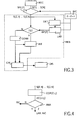
- Fig. 3 shows a functional diagram of a method in accordance with the invention.
- the aim of this method is to form an echographic image on the basis of echographic ultrasound signals S[i] received from a medium excited by means of ultrasound waves.
- the description is given for a specific version of the invention.
- the invention utilizes a ID (one-dimensional) network of transducers, but the method can also be carried out while using 1.5D, 1.75D, 2D ... transducer networks.
- the method in accordance with the invention includes a reception step REC for receiving echographic ultrasound waves S[i] on an array of reception elements.
- the waves S[i] received on the array of elements define a set of received signals S[1] ... S[N].
- the instants of arrival of the received signals are corrected by way of geometrical delays. This correction is carried out in a customary manner in the receiving mode on an array of elements and hence will not be described in detail herein.
- the method in accordance with the invention processes the data in conformity with their arrival in time; this corresponds at each instant to a depth Z. In Fig. 3 this progression in depth is symbolized by a selection step SEL for selecting the depth Z in order to simplify the explanation of the idea of the invention.
- the signals thus corresponding to a given depth Z are denoted as S[Z,1] ... S[Z,N].
- the signals S[i] are received during a given period of time and only a part of these signals S[Z,i] corresponds to the echo reflected by a zone situated at the mean depth Z.
- These signals are subsequently used in a step for the construction of echographic signals REB and are notably presented, during said step for the construction of echographic signals REB, at the start of a determination step DET for determining the so-called exclusion zone in which a point reflector is detected by analysis of the set of signals S[i] received.
- An exclusion zone is determined when a coherent reflector is detected. The determination of an exclusion zone is thus based on a detection of a coherent reflector.
- a coherent reflector is detected
- the method corresponds, as we have seen, to that described above and correlation of the signals S[i] is performed on each line.
- the determination step DET for determining exclusion zones is carried out by means of a method as described in the French patent application No. 01 06747 published as WO 02/055 444 . This step thus utilizes, for example, a method as described with reference to Fig. 4 .
- Fig. 4 shows a functional diagram of an example of a version of the step DET for determining exclusion zones.
- This example proposes the use of the signals S[Z,1] to S[Z,N] as they arrive, for the depth Z, on the elements for the detection of the presence, if any, of a coherent reflector.
- This example proposes the intercorrelation of the signals S[Z,i].
- This example advantageously utilizes the signals S[1] to S[N] after they have been shifted in time by geometrical correction, that is, after the first step of the above focusing and reception operation.
- the geometrical correction theoretically enables the signals received to be put in phase, the wave edge being horizontal when the coherent reflector is centered in the beam.
- the signals returned by a coherent reflector result in a correlation maximum, which is generally large between neighboring echographic signals. Said maximum is then observed even for signals emanating from reception elements which are situated far apart.
- the maximum correlation values for signals corresponding to noisy data decrease linearly as a function of the distance of the receiving elements and ultimately are canceled. This is the Van Cittert Zernicke theorem.
- the example of the method of determining an exclusion zone proposes an analysis of said correlation maxima in order to detect a coherent reflector within a medium giving rise to noisy data.
- the signals S[Z,1] to S[Z,N] are thus correlated two by two within a step COR[Z,i,j], where i and j describe the interval [1,N].
- Said step COR[Z,i,j] provides the correlation between the signals originating from the elements i and j for the depth Z.
- the values of the correlation maxima DC[Z,i,j] are obtained for each of the correlations COR[Z,i,j] formed between the signals received on the elements i and j.
- Said correlation maxima are subsequently analyzed in a step ANA so as to detect the presence of a coherent reflector on the line.
- the analysis step ANA can utilize, for example, a comparison of the correlation maximum with a threshold value.
- the correlation maximum calculated for two elements i and j exceeds this value, the presence of a coherent reflector is confirmed by the correlation step.
- This threshold value is determined while taking into account the Van Cittert Zemicke theorem and hence the distance of the elements i and j.
- This incrementation may be more or less large so as to probe the medium in a more or less refined manner.
- the analysis is subsequently carried out at the next depth and the method can thus be applied to all depths of a medium: an analysis of the entire line of the medium is thus obtained.
- the labeling step LAB thus enables differentiation between the zones in which a coherent reflector is detected and those in which no coherent reflector at all is detected. For example, it is thus possible to form a binary image of the medium (or of the line of the medium which is excited) with, for example, a 0 at locations where no coherent reflector at all has been detected and a 1 where one or more coherent reflectors have been detected.
- any other method of marking a coherent reflector within a medium can be used as well.
- a single calculation of the correlation between the signals on two remote transducer elements from among a given number of elements (for example, 10) may be used.
- the correlation maximum is then compared, in the same way as above, with a threshold value.
- Any other technique for marking a point reflector can in this case be used: analysis of the image intensity, selection of zones by the user ...
- the invention carries out two distinct steps for the calculation of reception delays of ultrasound waves.
- a first step CORR calculates delays for the zones outside said exclusion zone
- a second step INT calculates the delays for the exclusion zone.
- the delays obtained are used in a step CAL for the calculation of the echographic image and a final image by means of conventional techniques for the formation of echographic images.
- a display step DIS is carried out.
- a test step TST enables selection of one of the delay calculation steps for a depth Z. This step TST tests whether or not the selected depth Z bears a label BP[Z] of an exclusion zone or region which includes a coherent reflector COH.
- the delays are estimated by a first step CORR. If the zone belongs to an exclusion zone (case Y), this means that, referring to Fig. 5 and more specifically to Fig. 6a which is an enlargement of Fig. 5 , that the depth Z observed is included in the interval (Z1; Z2] which defines the exclusion zone on the analyzed beam.
- the delays are then calculated by means of a second delay estimation step INT. In this case, for the depths other than that included in the interval [Z1; Z2], the delays have been estimated by way of the first delay estimation step CORR.
- the second delay estimation step INT for estimating delays within the exclusion zone utilizes the delays calculated within zones which are situated outside said exclusion zone.
- the delays within the exclusion zone are interpolations of the delays as a function of the depth. This interpolation is preferably linear in the preferred version. Such a linear interpolation is then carried out along the dotted lines in Fig. 6a . This example is given for an excitation perpendicular to the array of elements, but any other angle is also feasible for the excitation of the medium.
- the first delay estimation step for the zones outside the exclusion zones advantageously utilizes the correlation of signals received on the various transducer elements.
- This first step enables, as has been seen before, correction of the phase aberrations, which are due to the inhomogeneities of the speed of sound in the medium.
- At least the delays estimated by correlation for the two points situated at the front of the exclusion zone IDE serve as references for the calculation of the delays by interpolation on the dotted line within the exclusion zone IDE. Delays calculated in the vicinity of these points may also be used for the interpolation.
- Fig. 6b shows the part of a chart of delays corresponding to the position of the beam indicated in Fig. 6a .
- the delays are interpolated linearly on the basis of delays calculated by correlation on the two straight lines separating the zone IDE from the zone DEL in which the delays are estimated by correlation. These two lines correspond to the depths Z1 and Z2 in conformity with the foregoing explanation. Generally speaking, the interpolation is carried out as a function of the depth Z as will be explained hereinafter.
- the delays D[Z1] and D[Z2] estimated by the first step at the points situated on the excitation line at the depths Z1 and Z2 are then used in accordance with the invention so as to realize a linear interpolation of the delays Di[Z,Z ⁇ [Z1,Z2]] within the exclusion zone, that is, between the depths Z1 and Z2.
- Di Z Z ⁇ 2. ⁇ D Z ⁇ 1 - Z ⁇ 1. ⁇ D Z ⁇ 2 Z ⁇ 2 - Z ⁇ 1 + Z ⁇ D Z ⁇ 2 - D Z ⁇ 1 Z ⁇ 2 - Z ⁇ 1 .
- interpolation may also be used if the configurations of the system makes that necessary (for example, if the delays are not linear in the configuration: angular excitation ).
- the interpolation may also be realized either in real time, that is, for each ultrasound "excitation", or once an image of the medium has been formed which includes the exclusion zones in which the delays are subsequently interpolated.
- the invention thus consists of the adaptation of the correction of delays applied to the waves reflected by the medium and hence of the adaptation of the formation of the beam in the reception mode as a function of the analysis of the medium. It is also to be noted that, for example, in conformity with a further version of the method first a binary image with two (or more) dimensions is determined for the entire medium. In this binary image there is determined an exclusion zone EXA in which the coherent reflector COH is situated. Subsequently, this binary image is used to form the final image with the echographic data. As opposed to the version described previously, in this case the exclusion zone as shown in the Figs. 5 and 6a is known in its entirety in the binary image.
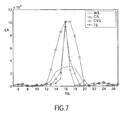
- FIG. 7 shows the result of the invention and the advantages thereof.
- a diagram in Fig. 7 contains the amplitude of the echoes obtained at the level of a point reflector as a function of the number of transducer elements and hence of the position of the emission beam on the array of elements.
- the curves of Fig. 7 correspond to a reflection from a point reflector.
- the curve TS corresponds to the echographic response of the diffuser, the true speed of sound in the medium being known. In the real medium, this real speed of sound, however, is not homogeneous and phase aberrations are introduced in the medium; this leads to a curve WS which is the result obtained with delays corrected exclusively by geometrical correction, that is, for an assumed speed of sound. This curve does not enable suitable localization of the coherent reflector.
- the use of the correlation for the formation of the image produces the curve CS. It is to be noted that the correlation enables the amplitude to be found for the peak obtained with the true speed of sound. However, the lateral resolution is mediocre with respect to the curve corresponding to the true speed of sound TS.
- the curve CVS represents the amplitude of the echo obtained for this same coherent reflector when the invention is used. Clearly shown is the substantial improvement of the lateral resolution with respect to the curve CS where the correlation is used for all depths and for all positions of the beam. Actually, when the beam is centered on the element 16, corresponding to the position of the beam in which it is centered on the coherent reflector, the delays do not suffer from the use of the correlation and are always correct. Therefore, the peak obtained is exact.
- the problem imposed by the widening of the peak actually exists only for the positions of the beam which neighbor that for which the beam is centered on the reflector.
- the values of delays in the vicinity of the point reflector are calculated on the basis of values of delays for points situated in a zone in which, thanks to the formation of the exclusion zone, no coherent reflector whatsoever has been detected.
- These delays, corresponding to zones situated far from the reflector, are not subject to the effect of the presence of the point reflector in the beam. Therefore, the curve CVS has a well-defined peak near that corresponding to the true speed of sound.
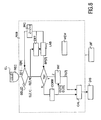
- Fig. 8 shows diagrammatically a system in which a method in accordance with the invention is carried out.
- This system includes a probe for the reception of echographic signals REC, which probe includes receiving elements EL.
- Said probe REC is connected, by way of conventional means, to means REB for the construction of echographic images.
- Said construction means REB can be complemented by data processing means customarily used in ultrasound imaging.
- Such conventional means are simply juxtaposed with the means for the construction of echographic signals, that is, generally without interactions with the means for the construction of echographic signals or with interactions which do not affect the principle of the invention as explained in the following description of the means REB for the construction of echographic signals.
- Such conventional means are not described herein.
- these conventional means advantageously include means for shifting, by way of a geometrical correction, the signals S[1] to S[N] received by the elements EL of the probe REC.
- this step is carried out in every ultrasound apparatus in order to enable the subsequent reconstruction of the echo of the medium.
- the construction means REB for echographic signals process the data as a function of the depth Z (or, in an equivalent manner, as a function of the receiving instant).
- this data processing as a function of the value Z is performed by the selection means SEL which enable selection of the portions of signals which correspond to given zones of the medium which have a mean depth Z.
- the signals are thus characterized by the depth wherefrom they originate: S[Z,1]... S[Z,N].
- the means for the construction of echographic signals include determination means DET for determining an exclusion zone in which at least one point coherent reflector is detected.
- Said determination means DET operate, for example, in conformity with the method described with reference to Fig. 4 and generally utilize software means for data processing. Notably an incrementation step for the depth INC enables determination of the exclusion zones through the entire depth of the medium excited by the ultrasound beam.
- the determination means DET are complemented in practice by zone labeling means LAB which assign a label BP[Z] to the zone of depth Z on the excitation line which corresponds to the echoes received.
- Said zone labeling means enable test means TST to test the nature of the depth Z on the excitation line being processed.
- the delays are estimated by first delay estimation means CORR which utilize, for example, the correlation of signals received by the adjacent elements. These means operate according to techniques which are known from the state of the art. If the label BP[Z] is such that the zone is classified as an exclusion zone, the delays are estimated by second delay estimation means INT which utilize, for example, an interpolation of delays on the basis of those estimated by the first estimation means CORR in the zones outside the exclusion zones. Finally, means CAL for calculating echographic signals utilize the delays calculated by the two estimation means so as to obtain the echographic signals and form an image which is subsequently displayed on conventional display means DIS. The calculations include notably the summing of the signals obtained on the transducer elements for a given position of the emission beam. Such summing is carried out by conventional means, which are known to a person skilled in the art.
- the means CAL for calculating echographic signals may operate in conformity with principles, which are known from the state of the art. In accordance with the invention, only the estimation of delays changes, their use being the same as in the known state of the art.
- the estimation means and the calculation means advantageously operate in relation with a memory MEM which stores the intermediate results and enables the data received to be preserved for the various depths and for the various positions of the excitation line of the medium.
- a user interface UIF is advantageously connected to the means REB for the construction of echographic signals in order to control these means and their parameterizing; for example, the modification of the threshold value in the determination means DET may be offered to the user as well as a modification of the incrementation value of the depth, said values determining the precision of the detection.
- the invention can provide an enhanced detection of coherent reflectors within a homogeneous medium for which noisy signals (speckle) are obtained; in such signals it is generally difficult to detect coherent reflectors by means of known means. Moreover, in accordance with the invention a very high lateral resolution is obtained for these point reflectors.
Landscapes
- Engineering & Computer Science (AREA)
- Computer Networks & Wireless Communication (AREA)
- Physics & Mathematics (AREA)
- General Physics & Mathematics (AREA)
- Radar, Positioning & Navigation (AREA)
- Remote Sensing (AREA)
- Ultra Sonic Daignosis Equipment (AREA)
- Measurement Of Velocity Or Position Using Acoustic Or Ultrasonic Waves (AREA)
- Investigating Or Analyzing Materials By The Use Of Ultrasonic Waves (AREA)
Applications Claiming Priority (3)
| Application Number | Priority Date | Filing Date | Title |
|---|---|---|---|
| FR0205439 | 2002-04-30 | ||
| FR0205439A FR2839157A1 (fr) | 2002-04-30 | 2002-04-30 | Systeme d'imagerie ultrasonore a haute resolution laterale |
| PCT/IB2003/001587 WO2003093862A1 (en) | 2002-04-30 | 2003-04-22 | Ultrasound imaging system with a high lateral resolution |
Publications (2)
| Publication Number | Publication Date |
|---|---|
| EP1504284A1 EP1504284A1 (en) | 2005-02-09 |
| EP1504284B1 true EP1504284B1 (en) | 2009-09-16 |
Family
ID=28800074
Family Applications (1)
| Application Number | Title | Priority Date | Filing Date |
|---|---|---|---|
| EP03712594A Expired - Lifetime EP1504284B1 (en) | 2002-04-30 | 2003-04-22 | Ultrasound imaging system with a high lateral resolution |
Country Status (8)
| Country | Link |
|---|---|
| US (1) | US7361144B2 (https=) |
| EP (1) | EP1504284B1 (https=) |
| JP (1) | JP2005523791A (https=) |
| AT (1) | ATE443271T1 (https=) |
| AU (1) | AU2003216683A1 (https=) |
| DE (1) | DE60329288D1 (https=) |
| FR (1) | FR2839157A1 (https=) |
| WO (1) | WO2003093862A1 (https=) |
Families Citing this family (16)
| Publication number | Priority date | Publication date | Assignee | Title |
|---|---|---|---|---|
| EP2163202A4 (en) * | 2007-06-04 | 2013-10-30 | Panasonic Corp | ULTRASONIC DIAGNOSTICS AND ULTRASONIC SOUND FOR ULTRASONIC DIAGNOSTICS |
| US8945117B2 (en) | 2009-02-11 | 2015-02-03 | Boston Scientific Scimed, Inc. | Insulated ablation catheter devices and methods of use |
| WO2011008444A1 (en) | 2009-06-30 | 2011-01-20 | Boston Scientific Scimed, Inc. | Map and ablate open irrigated hybrid catheter |
| US9089340B2 (en) | 2010-12-30 | 2015-07-28 | Boston Scientific Scimed, Inc. | Ultrasound guided tissue ablation |
| US9241687B2 (en) | 2011-06-01 | 2016-01-26 | Boston Scientific Scimed Inc. | Ablation probe with ultrasonic imaging capabilities |
| EP2755587B1 (en) | 2011-09-14 | 2018-11-21 | Boston Scientific Scimed, Inc. | Ablation device with multiple ablation modes |
| AU2012308464B2 (en) | 2011-09-14 | 2016-10-20 | Boston Scientific Scimed, Inc. | Ablation device with ionically conductive balloon |
| FR2982671A1 (fr) * | 2011-11-15 | 2013-05-17 | Commissariat Energie Atomique | Procede de determination d'une surface d'un objet par sondage echographique, programme d'ordinateur correspondant et dispositif de sondage a ultrasons |
| WO2013102072A1 (en) | 2011-12-28 | 2013-07-04 | Boston Scientific Scimed, Inc. | Ablation probe with ultrasonic imaging capability |
| CA2860636A1 (en) | 2012-01-10 | 2013-07-18 | Boston Scientific Scimed, Inc. | Electrophysiology system |
| US8945015B2 (en) | 2012-01-31 | 2015-02-03 | Koninklijke Philips N.V. | Ablation probe with fluid-based acoustic coupling for ultrasonic tissue imaging and treatment |
| WO2013155138A1 (en) | 2012-04-13 | 2013-10-17 | Eaton Corporation | Limited-slip driveline apparatus |
| USD735758S1 (en) | 2014-10-13 | 2015-08-04 | Eaton Corporation | Composite differential plenum |
| WO2016061002A1 (en) | 2014-10-13 | 2016-04-21 | Boston Scientific Scimed Inc. | Tissue diagnosis and treatment using mini-electrodes |
| EP4316361A3 (en) | 2014-10-24 | 2024-05-01 | Boston Scientific Scimed Inc. | Medical devices with a flexible electrode assembly coupled to an ablation tip |
| US9743854B2 (en) | 2014-12-18 | 2017-08-29 | Boston Scientific Scimed, Inc. | Real-time morphology analysis for lesion assessment |
Family Cites Families (3)
| Publication number | Priority date | Publication date | Assignee | Title |
|---|---|---|---|---|
| IL98279A (en) * | 1990-06-01 | 1994-11-11 | Philips Nv | Method and instrument for examining a body by recording supersonic resonance |
| EP0477571B1 (en) * | 1990-08-29 | 2001-03-21 | Kabushiki Kaisha Toshiba | Ultrasonic diagnostic apparatus capable of acquiring high quality image by correcting phase distortion contained in ultrasonic pulses |
| US6120450A (en) * | 1995-01-23 | 2000-09-19 | Commonwealth Scientific And Industrial Research Organisation | Phase and/or amplitude aberration correction for imaging |
-
2002
- 2002-04-30 FR FR0205439A patent/FR2839157A1/fr not_active Withdrawn
-
2003
- 2003-04-22 DE DE60329288T patent/DE60329288D1/de not_active Expired - Fee Related
- 2003-04-22 EP EP03712594A patent/EP1504284B1/en not_active Expired - Lifetime
- 2003-04-22 JP JP2004502027A patent/JP2005523791A/ja active Pending
- 2003-04-22 AT AT03712594T patent/ATE443271T1/de not_active IP Right Cessation
- 2003-04-22 AU AU2003216683A patent/AU2003216683A1/en not_active Abandoned
- 2003-04-22 WO PCT/IB2003/001587 patent/WO2003093862A1/en not_active Ceased
- 2003-04-22 US US10/512,492 patent/US7361144B2/en not_active Expired - Fee Related
Also Published As
| Publication number | Publication date |
|---|---|
| US20060058668A1 (en) | 2006-03-16 |
| EP1504284A1 (en) | 2005-02-09 |
| JP2005523791A (ja) | 2005-08-11 |
| DE60329288D1 (de) | 2009-10-29 |
| WO2003093862A1 (en) | 2003-11-13 |
| ATE443271T1 (de) | 2009-10-15 |
| AU2003216683A1 (en) | 2003-11-17 |
| FR2839157A1 (fr) | 2003-10-31 |
| US7361144B2 (en) | 2008-04-22 |
Similar Documents
| Publication | Publication Date | Title |
|---|---|---|
| EP1504284B1 (en) | Ultrasound imaging system with a high lateral resolution | |
| US9198636B2 (en) | Continuous transmit focusing method and apparatus for ultrasound imaging system | |
| US6231511B1 (en) | Ultrasonic signal focusing method and apparatus for ultrasonic imaging system | |
| EP1060413B1 (en) | Doppler angle unfolding in ultrasound color flow and doppler | |
| JPH10506800A (ja) | 超音波画像における調節可能な周波数走査方法および装置 | |
| CN107789008B (zh) | 一种基于通道数据的自适应超声波束合成方法和系统 | |
| US10765405B2 (en) | Ultrasound imaging pickup apparatus | |
| CN110974296B (zh) | 一种获取剪切波弹性图像的方法、装置及超声成像系统 | |
| EP2021825A2 (en) | Image data processing systems | |
| US9465101B2 (en) | Aberration correction with broad transmit beams in medical ultrasound | |
| EP3596493B1 (en) | Methods and systems for filtering ultrasound image clutter | |
| CN102361597A (zh) | 位移估计方法、位移估计装置 | |
| CN108338808B (zh) | 使用相干的剪切速度成像 | |
| KR20180120613A (ko) | 전단파 이미징을 위한 가변 초점 | |
| CN110269643A (zh) | 在基于声学辐射力的超声成像中的自适应杂波滤波 | |
| US20110245676A1 (en) | Method and apparatus for ultrasound signal acquisition and processing | |
| US6740034B2 (en) | Three-dimensional ultrasound imaging system for performing receive-focusing at voxels corresponding to display pixels | |
| US7128712B2 (en) | Adaptive ultrasound imaging system | |
| US20040133104A1 (en) | Detection of a coherent reflector in noisy ultrasound data | |
| CN113925528B (zh) | 多普勒成像方法和超声设备 | |
| EP1581118A1 (en) | Detection of small-size defects in medical ultrasonic imaging | |
| JP2672123B2 (ja) | 超音波顕微鏡 |
Legal Events
| Date | Code | Title | Description |
|---|---|---|---|
| PUAI | Public reference made under article 153(3) epc to a published international application that has entered the european phase |
Free format text: ORIGINAL CODE: 0009012 |
|
| 17P | Request for examination filed |
Effective date: 20041130 |
|
| AK | Designated contracting states |
Kind code of ref document: A1 Designated state(s): AT BE BG CH CY CZ DE DK EE ES FI FR GB GR HU IE IT LI LU MC NL PT RO SE SI SK TR |
|
| AX | Request for extension of the european patent |
Extension state: AL LT LV MK |
|
| GRAP | Despatch of communication of intention to grant a patent |
Free format text: ORIGINAL CODE: EPIDOSNIGR1 |
|
| GRAS | Grant fee paid |
Free format text: ORIGINAL CODE: EPIDOSNIGR3 |
|
| GRAA | (expected) grant |
Free format text: ORIGINAL CODE: 0009210 |
|
| AK | Designated contracting states |
Kind code of ref document: B1 Designated state(s): AT BE BG CH CY CZ DE DK EE ES FI FR GB GR HU IE IT LI LU MC NL PT RO SE SI SK TR |
|
| REG | Reference to a national code |
Ref country code: GB Ref legal event code: FG4D |
|
| REG | Reference to a national code |
Ref country code: CH Ref legal event code: EP |
|
| REG | Reference to a national code |
Ref country code: IE Ref legal event code: FG4D |
|
| REF | Corresponds to: |
Ref document number: 60329288 Country of ref document: DE Date of ref document: 20091029 Kind code of ref document: P |
|
| PG25 | Lapsed in a contracting state [announced via postgrant information from national office to epo] |
Ref country code: FI Free format text: LAPSE BECAUSE OF FAILURE TO SUBMIT A TRANSLATION OF THE DESCRIPTION OR TO PAY THE FEE WITHIN THE PRESCRIBED TIME-LIMIT Effective date: 20090916 Ref country code: SE Free format text: LAPSE BECAUSE OF FAILURE TO SUBMIT A TRANSLATION OF THE DESCRIPTION OR TO PAY THE FEE WITHIN THE PRESCRIBED TIME-LIMIT Effective date: 20090916 |
|
| PG25 | Lapsed in a contracting state [announced via postgrant information from national office to epo] |
Ref country code: SI Free format text: LAPSE BECAUSE OF FAILURE TO SUBMIT A TRANSLATION OF THE DESCRIPTION OR TO PAY THE FEE WITHIN THE PRESCRIBED TIME-LIMIT Effective date: 20090916 Ref country code: NL Free format text: LAPSE BECAUSE OF FAILURE TO SUBMIT A TRANSLATION OF THE DESCRIPTION OR TO PAY THE FEE WITHIN THE PRESCRIBED TIME-LIMIT Effective date: 20090916 |
|
| NLV1 | Nl: lapsed or annulled due to failure to fulfill the requirements of art. 29p and 29m of the patents act | ||
| PG25 | Lapsed in a contracting state [announced via postgrant information from national office to epo] |
Ref country code: CY Free format text: LAPSE BECAUSE OF FAILURE TO SUBMIT A TRANSLATION OF THE DESCRIPTION OR TO PAY THE FEE WITHIN THE PRESCRIBED TIME-LIMIT Effective date: 20090916 |
|
| PG25 | Lapsed in a contracting state [announced via postgrant information from national office to epo] |
Ref country code: EE Free format text: LAPSE BECAUSE OF FAILURE TO SUBMIT A TRANSLATION OF THE DESCRIPTION OR TO PAY THE FEE WITHIN THE PRESCRIBED TIME-LIMIT Effective date: 20090916 Ref country code: CZ Free format text: LAPSE BECAUSE OF FAILURE TO SUBMIT A TRANSLATION OF THE DESCRIPTION OR TO PAY THE FEE WITHIN THE PRESCRIBED TIME-LIMIT Effective date: 20090916 Ref country code: RO Free format text: LAPSE BECAUSE OF FAILURE TO SUBMIT A TRANSLATION OF THE DESCRIPTION OR TO PAY THE FEE WITHIN THE PRESCRIBED TIME-LIMIT Effective date: 20090916 Ref country code: ES Free format text: LAPSE BECAUSE OF FAILURE TO SUBMIT A TRANSLATION OF THE DESCRIPTION OR TO PAY THE FEE WITHIN THE PRESCRIBED TIME-LIMIT Effective date: 20091227 Ref country code: PT Free format text: LAPSE BECAUSE OF FAILURE TO SUBMIT A TRANSLATION OF THE DESCRIPTION OR TO PAY THE FEE WITHIN THE PRESCRIBED TIME-LIMIT Effective date: 20100118 |
|
| PG25 | Lapsed in a contracting state [announced via postgrant information from national office to epo] |
Ref country code: SK Free format text: LAPSE BECAUSE OF FAILURE TO SUBMIT A TRANSLATION OF THE DESCRIPTION OR TO PAY THE FEE WITHIN THE PRESCRIBED TIME-LIMIT Effective date: 20090916 |
|
| PG25 | Lapsed in a contracting state [announced via postgrant information from national office to epo] |
Ref country code: BE Free format text: LAPSE BECAUSE OF FAILURE TO SUBMIT A TRANSLATION OF THE DESCRIPTION OR TO PAY THE FEE WITHIN THE PRESCRIBED TIME-LIMIT Effective date: 20090916 Ref country code: AT Free format text: LAPSE BECAUSE OF FAILURE TO SUBMIT A TRANSLATION OF THE DESCRIPTION OR TO PAY THE FEE WITHIN THE PRESCRIBED TIME-LIMIT Effective date: 20090916 |
|
| PLBE | No opposition filed within time limit |
Free format text: ORIGINAL CODE: 0009261 |
|
| STAA | Information on the status of an ep patent application or granted ep patent |
Free format text: STATUS: NO OPPOSITION FILED WITHIN TIME LIMIT |
|
| PG25 | Lapsed in a contracting state [announced via postgrant information from national office to epo] |
Ref country code: DK Free format text: LAPSE BECAUSE OF FAILURE TO SUBMIT A TRANSLATION OF THE DESCRIPTION OR TO PAY THE FEE WITHIN THE PRESCRIBED TIME-LIMIT Effective date: 20090916 |
|
| 26N | No opposition filed |
Effective date: 20100617 |
|
| PG25 | Lapsed in a contracting state [announced via postgrant information from national office to epo] |
Ref country code: GR Free format text: LAPSE BECAUSE OF FAILURE TO SUBMIT A TRANSLATION OF THE DESCRIPTION OR TO PAY THE FEE WITHIN THE PRESCRIBED TIME-LIMIT Effective date: 20091217 |
|
| PG25 | Lapsed in a contracting state [announced via postgrant information from national office to epo] |
Ref country code: MC Free format text: LAPSE BECAUSE OF NON-PAYMENT OF DUE FEES Effective date: 20100430 |
|
| REG | Reference to a national code |
Ref country code: CH Ref legal event code: PL |
|
| GBPC | Gb: european patent ceased through non-payment of renewal fee |
Effective date: 20100422 |
|
| REG | Reference to a national code |
Ref country code: FR Ref legal event code: ST Effective date: 20101230 |
|
| PG25 | Lapsed in a contracting state [announced via postgrant information from national office to epo] |
Ref country code: IE Free format text: LAPSE BECAUSE OF NON-PAYMENT OF DUE FEES Effective date: 20100422 |
|
| PG25 | Lapsed in a contracting state [announced via postgrant information from national office to epo] |
Ref country code: LI Free format text: LAPSE BECAUSE OF NON-PAYMENT OF DUE FEES Effective date: 20100430 Ref country code: CH Free format text: LAPSE BECAUSE OF NON-PAYMENT OF DUE FEES Effective date: 20100430 Ref country code: DE Free format text: LAPSE BECAUSE OF NON-PAYMENT OF DUE FEES Effective date: 20101103 |
|
| PG25 | Lapsed in a contracting state [announced via postgrant information from national office to epo] |
Ref country code: IT Free format text: LAPSE BECAUSE OF FAILURE TO SUBMIT A TRANSLATION OF THE DESCRIPTION OR TO PAY THE FEE WITHIN THE PRESCRIBED TIME-LIMIT Effective date: 20090916 Ref country code: GB Free format text: LAPSE BECAUSE OF NON-PAYMENT OF DUE FEES Effective date: 20100422 |
|
| PG25 | Lapsed in a contracting state [announced via postgrant information from national office to epo] |
Ref country code: FR Free format text: LAPSE BECAUSE OF NON-PAYMENT OF DUE FEES Effective date: 20100430 |
|
| PG25 | Lapsed in a contracting state [announced via postgrant information from national office to epo] |
Ref country code: HU Free format text: LAPSE BECAUSE OF FAILURE TO SUBMIT A TRANSLATION OF THE DESCRIPTION OR TO PAY THE FEE WITHIN THE PRESCRIBED TIME-LIMIT Effective date: 20100317 Ref country code: BG Free format text: LAPSE BECAUSE OF FAILURE TO SUBMIT A TRANSLATION OF THE DESCRIPTION OR TO PAY THE FEE WITHIN THE PRESCRIBED TIME-LIMIT Effective date: 20090916 Ref country code: LU Free format text: LAPSE BECAUSE OF NON-PAYMENT OF DUE FEES Effective date: 20100422 |
|
| PG25 | Lapsed in a contracting state [announced via postgrant information from national office to epo] |
Ref country code: TR Free format text: LAPSE BECAUSE OF FAILURE TO SUBMIT A TRANSLATION OF THE DESCRIPTION OR TO PAY THE FEE WITHIN THE PRESCRIBED TIME-LIMIT Effective date: 20090916 |