EP1503566A1 - Mobile terminal having recording function - Google Patents
Mobile terminal having recording function Download PDFInfo
- Publication number
- EP1503566A1 EP1503566A1 EP04017874A EP04017874A EP1503566A1 EP 1503566 A1 EP1503566 A1 EP 1503566A1 EP 04017874 A EP04017874 A EP 04017874A EP 04017874 A EP04017874 A EP 04017874A EP 1503566 A1 EP1503566 A1 EP 1503566A1
- Authority
- EP
- European Patent Office
- Prior art keywords
- incoming call
- recording
- mobile terminal
- arrival
- control unit
- Prior art date
- Legal status (The legal status is an assumption and is not a legal conclusion. Google has not performed a legal analysis and makes no representation as to the accuracy of the status listed.)
- Withdrawn
Links
Images
Classifications
-
- H—ELECTRICITY
- H04—ELECTRIC COMMUNICATION TECHNIQUE
- H04M—TELEPHONIC COMMUNICATION
- H04M1/00—Substation equipment, e.g. for use by subscribers
- H04M1/64—Automatic arrangements for answering calls; Automatic arrangements for recording messages for absent subscribers; Arrangements for recording conversations
- H04M1/65—Recording arrangements for recording a message from the calling party
- H04M1/656—Recording arrangements for recording a message from the calling party for recording conversations
-
- H—ELECTRICITY
- H04—ELECTRIC COMMUNICATION TECHNIQUE
- H04M—TELEPHONIC COMMUNICATION
- H04M1/00—Substation equipment, e.g. for use by subscribers
- H04M1/72—Mobile telephones; Cordless telephones, i.e. devices for establishing wireless links to base stations without route selection
- H04M1/724—User interfaces specially adapted for cordless or mobile telephones
Definitions
- the present invention relates to a mobile terminal, more specifically, to a mobile terminal having a recording function.
- a memory card is small in size and is therefore applicable as a voice recording medium for a cellular telephone.
- Many voice recordable cellular telephones have been already proposed.
- Japanese Unexamined Patent Publication No.2002-057756 disclosesa cellular telephone which stops transmission and reception of radio waves while recording.
- a vibrating operation and a sound generating operation for informing of arrival of an incoming call do not interfere with the recording.
- a user cannot detect arrival of an urgent incoming call while the recording. Therefore, the user has to wait for another incoming call after completion of the recording.
- a mobile terminal includes a display unit, a control unit, and incoming call informing means.
- the incoming call informing means includes at least any one of a vibration generation unit and a sound generation unit.
- the control unit informs of the arrival of the incoming call by an incoming call display on the display unit without activating the vibration generation unit and the sound generation unit.
- the mobile terminal may include light emitting means.
- the control unit can inform of the arrival of the incoming call by at least any one operation of light emission of the light emitting means and the incoming call display on the display unit.
- a user of this mobile terminal can detect arrival of an incoming call in the course of recording without affecting the recording.
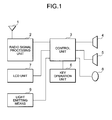
- a cellular telephone as a concrete example of the mobile terminal includes an antenna 1, a radio signal processing unit 2, a control unit 3, a key operation unit 6, and a liquid crystal display (LCD) unit 7.
- the cellular telephone further includes a microphone 4, a speaker 5, and a vibrator 8.
- the speaker 5 and the vibrator 8 inform of arrival of an incoming call.
- the control unit 3 incorporates a semiconductor memory.
- the cellular telephone may include a detachable semiconductor memory. In a standby mode of the cellular telephone, the control unit 3 starts recording voices inputted from the microphone 4 when a voice recording key in the key operation unit 6 is pressed down.
- Voices and other information to be recorded may be also inputted from a dedicated terminal.
- the control unit 3 When detecting arrival of an incoming call in the course of the voice recording, the control unit 3 inhibits an incoming call informing operation by the speaker 5 or the vibrator 8. Simultaneously, the control unit 3 causes the LCD unit 7 to perform an incoming call display.
- This display may include a message informing of the arrival of the incoming call, and information for specifying a caller (such as a telephone number, a full name, a name and an abbreviated name).
- the cellular telephone may include light emitting means 9 (e.g. LED). In this case, the control unit 3 can inform of the arrival of the incoming call by causing the light emitting means 9 to emit light.
- the control unit 3 can execute the display on the LCD unit 7 and the light emission of the light emitting means 9 at the same time.
- the recording continues when a user does not start a talk operation for the arrival of the incoming call (i. e. an answering operation for the arrival of the incoming call).
- the user can press down a recording pause key provided in the key operation unit 6 to stop the recording. When the user presses down this key again, the recording starts again.
- the user can set the control unit 3 to stop the recording automatically when the user responds to the incoming call.
- the control unit 3 can include a function to send a given voice message back to the caller when the incoming call arrives in the course of the recording operation.
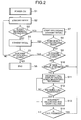
- FIG. 2 shows an operation example of the above-described cellular telephone.
- the telephone is set to a standby mode (S2) .
- the control unit 3 monitors whether or not the voice recording key in the key operation unit 6 is pressed down (S3).
- the voice recording key is not pressed down (NO in S3)
- the standby mode is maintained (S4).
- a power key is not pressed down (NO in S5)
- the telephone waits for an operation of the voice recording key in the standby mode.
- the power key is pressed down (YES in S5)
- the telephone terminates all the operations (S6).
- the control unit 3 detects that the voice recording key is pressed down (YES in S3), the cellular telephone starts recording while maintaining the standby mode (S7). Thereafter, the control unit 3 monitors whether or not a recording stop key is pressed down (S8). When the recording stop key is pressed down (YES in S8), the control unit 3 stops the recording and causes the cellular telephone to be in the normal standby mode (S4). When the recording stop key is not pressed down (NO in S8) , the recording operation continues. The control unit 3 monitors whether the power key is pressed down (S9), and terminates all the operations of the telephone when the power key is pressed down (S6). When the power key is not pressed down (NO in S9) , the recording operation continues.
- the control unit 3 stops sound generation and activation of the vibrator for informing of the arrival of the incoming call, and causes the LCD unit 7 to perform the incoming call display while maintaining the recording operation (S11).
- the recording continues when the user does not execute an operation to answer the incoming call (NO in S12) .
- the recording is interrupted and a talk starts (S13).
- the cellular telephone is set to the standby mode (S7), which enables the recording operation.
- the control unit 3 can inform of the arrival of the incoming call by causing the light emitting means to emit light in stead of or together with the display on the LCD unit 7.
- the cellular telephone according to the present invention can detect arrival of an incoming call even in the course of recording, and the arrival of the incoming call does not affect the recording. Moreover, a user can confirm a caller and interrupt the recording to answer the incoming call when needed.
Landscapes
- Engineering & Computer Science (AREA)
- Signal Processing (AREA)
- Human Computer Interaction (AREA)
- Computer Networks & Wireless Communication (AREA)
- Telephone Function (AREA)
- Mobile Radio Communication Systems (AREA)
Abstract
Description
- The present invention relates to a mobile terminal, more specifically, to a mobile terminal having a recording function.
- The techniques of recording voices and images by use of memory cards incorporating semiconductor memories are widespread in recent years. A memory card is small in size and is therefore applicable as a voice recording medium for a cellular telephone. Many voice recordable cellular telephones have been already proposed. For example, Japanese Unexamined Patent Publication No.2002-057756disclosesa cellular telephone which stops transmission and reception of radio waves while recording. In this cellular telephone, a vibrating operation and a sound generating operation for informing of arrival of an incoming call do not interfere with the recording. However, a user cannot detect arrival of an urgent incoming call while the recording. Therefore, the user has to wait for another incoming call after completion of the recording.
- A mobile terminal according to the present invention includes a display unit, a control unit, and incoming call informing means. The incoming call informing means includes at least any one of a vibration generation unit and a sound generation unit. Moreover, upon arrival of an incoming call in the course of a recording operation, the control unit informs of the arrival of the incoming call by an incoming call display on the display unit without activating the vibration generation unit and the sound generation unit. The mobile terminal may include light emitting means. The control unit can inform of the arrival of the incoming call by at least any one operation of light emission of the light emitting means and the incoming call display on the display unit.
- A user of this mobile terminal can detect arrival of an incoming call in the course of recording without affecting the recording.
- The above and other objects, features and advantages of the present invention will become apparent from the following detailed description when taken with the accompanying drawings in which:
- FIG. 1 is a block diagram of a mobile terminal according to an embodiment of the present invention; and
- FIG. 2 is a flowchart showing an operation example of the mobile terminal.
-
- A preferred embodiment of a mobile terminal according to the present invention will be described below. Referring to FIG. 1, a cellular telephone as a concrete example of the mobile terminal includes an
antenna 1, a radiosignal processing unit 2, acontrol unit 3, akey operation unit 6, and a liquid crystal display (LCD)unit 7. The cellular telephone further includes a microphone 4, aspeaker 5, and avibrator 8. Thespeaker 5 and thevibrator 8 inform of arrival of an incoming call. In this example, thecontrol unit 3 incorporates a semiconductor memory. In another example, the cellular telephone may include a detachable semiconductor memory. In a standby mode of the cellular telephone, thecontrol unit 3 starts recording voices inputted from the microphone 4 when a voice recording key in thekey operation unit 6 is pressed down. Voices and other information to be recorded may be also inputted from a dedicated terminal. When detecting arrival of an incoming call in the course of the voice recording, thecontrol unit 3 inhibits an incoming call informing operation by thespeaker 5 or thevibrator 8. Simultaneously, thecontrol unit 3 causes theLCD unit 7 to perform an incoming call display. This display may include a message informing of the arrival of the incoming call, and information for specifying a caller (such as a telephone number, a full name, a name and an abbreviated name). The cellular telephone may include light emitting means 9 (e.g. LED). In this case, thecontrol unit 3 can inform of the arrival of the incoming call by causing the light emitting means 9 to emit light. Thecontrol unit 3 can execute the display on theLCD unit 7 and the light emission of the light emitting means 9 at the same time. - The recording continues when a user does not start a talk operation for the arrival of the incoming call (i. e. an answering operation for the arrival of the incoming call). The user can press down a recording pause key provided in the
key operation unit 6 to stop the recording. When the user presses down this key again, the recording starts again. Moreover, the user can set thecontrol unit 3 to stop the recording automatically when the user responds to the incoming call. Thecontrol unit 3 can include a function to send a given voice message back to the caller when the incoming call arrives in the course of the recording operation. - FIG. 2 shows an operation example of the above-described cellular telephone. When the cellular telephone is turned on (S1), the telephone is set to a standby mode (S2) . The
control unit 3 monitors whether or not the voice recording key in thekey operation unit 6 is pressed down (S3). When the voice recording key is not pressed down (NO in S3) , the standby mode is maintained (S4). When a power key is not pressed down (NO in S5), the telephone waits for an operation of the voice recording key in the standby mode. When the power key is pressed down (YES in S5), the telephone terminates all the operations (S6). - On the contrary, when the
control unit 3 detects that the voice recording key is pressed down (YES in S3), the cellular telephone starts recording while maintaining the standby mode (S7). Thereafter, thecontrol unit 3 monitors whether or not a recording stop key is pressed down (S8). When the recording stop key is pressed down (YES in S8), thecontrol unit 3 stops the recording and causes the cellular telephone to be in the normal standby mode (S4). When the recording stop key is not pressed down (NO in S8) , the recording operation continues. Thecontrol unit 3 monitors whether the power key is pressed down (S9), and terminates all the operations of the telephone when the power key is pressed down (S6). When the power key is not pressed down (NO in S9) , the recording operation continues. When an incoming call arrives at this time (YES in S10) , thecontrol unit 3 stops sound generation and activation of the vibrator for informing of the arrival of the incoming call, and causes theLCD unit 7 to perform the incoming call display while maintaining the recording operation (S11). Despite the arrival of the incoming call, the recording continues when the user does not execute an operation to answer the incoming call (NO in S12) . When the user answers the incoming call (YES in S12 ) , the recording is interrupted and a talk starts (S13). When the call is finished (YES in S14), the cellular telephone is set to the standby mode (S7), which enables the recording operation. It is possible to execute the recording operation unless the recording stop key is pressed down (S8) or the power key is pressed down (S9) . When the cellular telephone includes the light emitting means, thecontrol unit 3 can inform of the arrival of the incoming call by causing the light emitting means to emit light in stead of or together with the display on theLCD unit 7. - The cellular telephone according to the present invention can detect arrival of an incoming call even in the course of recording, and the arrival of the incoming call does not affect the recording. Moreover, a user can confirm a caller and interrupt the recording to answer the incoming call when needed.
- While the present invention has been described in connection with a certain preferred embodiment, it is to be understood that the subject matter encompassed by the present invention is not limited to this specific embodiment. On the contrary, it is intended to include all alternatives, modifications, and equivalents as can be included within the spirit and scope of the following claims.
Claims (7)
- A mobile terminal having a recording function, the mobile terminal comprising:wherein the incoming call informingmeans includes at least any one of a vibration generation unit and a sound generation unit, anda display unit;a control unit; andincoming call informing means,
the control unit informs of arrival of an incoming call upon the arrival of the incoming call in the course of a recording operation by an incoming call display on the display unit without activatingthe vibration generation unit and the sound generation unit. - Themobile terminal according to claim 1, further comprising:wherein the control unit informs of the arrival of the incoming call upon the arrival of the incoming call in the course of the recording operation by at least any one operation of light emission of the light emitting means and the incoming call display on the display unit without activating the vibration generation unit and the sound generation unit.light emitting means,
- The mobile terminal according to claim 1,
wherein the control unit temporarily stops the recording operation when answering the incoming call in the course of the recording operation. - The mobile terminal according to claim 3,
wherein the control unit starts the recording operation after finishing a call. - Themobile terminal according to claim 1, further comprising:a key unit for temporarily stopping the recording operation.
- The mobile terminal according to claim 1,
wherein the display on the display unit includes information concerning a caller. - The mobile terminal according to claim 1, further comprising:means for sending a given voice message back to a caller of the incoming call when the incoming call arrives in the course of the recording operation.
Applications Claiming Priority (2)
| Application Number | Priority Date | Filing Date | Title |
|---|---|---|---|
| JP2003281827A JP2005051538A (en) | 2003-07-29 | 2003-07-29 | Mobile terminal device |
| JP2003281827 | 2003-07-29 |
Publications (1)
| Publication Number | Publication Date |
|---|---|
| EP1503566A1 true EP1503566A1 (en) | 2005-02-02 |
Family
ID=33535666
Family Applications (1)
| Application Number | Title | Priority Date | Filing Date |
|---|---|---|---|
| EP04017874A Withdrawn EP1503566A1 (en) | 2003-07-29 | 2004-07-28 | Mobile terminal having recording function |
Country Status (4)
| Country | Link |
|---|---|
| US (1) | US7499725B2 (en) |
| EP (1) | EP1503566A1 (en) |
| JP (1) | JP2005051538A (en) |
| CN (1) | CN1578355A (en) |
Cited By (1)
| Publication number | Priority date | Publication date | Assignee | Title |
|---|---|---|---|---|
| EP1650937A1 (en) * | 2004-10-19 | 2006-04-26 | Nokia Corporation | Notifying a user |
Families Citing this family (6)
| Publication number | Priority date | Publication date | Assignee | Title |
|---|---|---|---|---|
| JP2006295541A (en) * | 2005-04-11 | 2006-10-26 | Matsushita Electric Ind Co Ltd | COMMUNICATION TERMINAL DEVICE AND RECORDING / RECORDING METHOD THEREOF |
| JP4747042B2 (en) * | 2006-06-30 | 2011-08-10 | Necインフロンティア株式会社 | Method for message delivery by telephone voice recording function and its communication terminal |
| TWI477140B (en) * | 2008-07-11 | 2015-03-11 | Chi Mei Comm Systems Inc | System and method for responding to incoming telegrams with different recorded voices |
| US8140115B1 (en) * | 2008-07-18 | 2012-03-20 | Dp Technologies, Inc. | Application interface |
| US20100304722A1 (en) * | 2009-05-29 | 2010-12-02 | Ryuichiro Tanaka | Image-projectable mobile information device and notification method thereof |
| WO2012066978A1 (en) * | 2010-11-19 | 2012-05-24 | シャープ株式会社 | Portable terminal device |
Citations (5)
| Publication number | Priority date | Publication date | Assignee | Title |
|---|---|---|---|---|
| WO1999039490A1 (en) * | 1998-02-03 | 1999-08-05 | Ericsson Inc. | Apparatus and method for handling incoming calls received by a portable intelligent communications device during a meeting |
| EP0954150A2 (en) * | 1998-05-01 | 1999-11-03 | Canon Kabushiki Kaisha | Image communication apparatus and storage medium |
| JP2000092360A (en) * | 1998-09-16 | 2000-03-31 | Canon Inc | Multifunctional communication device and method of controlling communication device |
| US20010041590A1 (en) * | 1999-06-09 | 2001-11-15 | Shimon Silberfenig | Combination cellular telephone, sound storage device, and email communication device |
| WO2001091424A1 (en) * | 2000-05-23 | 2001-11-29 | Yamaha Corporation | Received call processing method for mobile telephone having game device function |
Family Cites Families (11)
| Publication number | Priority date | Publication date | Assignee | Title |
|---|---|---|---|---|
| US6728341B1 (en) * | 1997-06-24 | 2004-04-27 | Royal Thoughts, Llc | Monitoring and communication system for stationary and mobile persons |
| US6343121B1 (en) * | 1998-06-29 | 2002-01-29 | At&T Corp | Selective call waiting service |
| JP4614246B2 (en) | 1998-11-19 | 2011-01-19 | 株式会社ニコン | Camera with communication function |
| JP2002057756A (en) | 2000-08-11 | 2002-02-22 | Sony Corp | Mobile phone |
| JP2002185601A (en) | 2000-12-13 | 2002-06-28 | Aiwa Co Ltd | Communication terminal equipment and base station device |
| JP2002232957A (en) * | 2001-02-06 | 2002-08-16 | Nec Corp | Mobile phone speech method and device |
| US7024228B2 (en) | 2001-04-12 | 2006-04-04 | Nokia Corporation | Movement and attitude controlled mobile station control |
| JP2003125047A (en) * | 2001-10-11 | 2003-04-25 | Nec Corp | Mobile terminal device |
| JP2003198716A (en) | 2001-12-26 | 2003-07-11 | Hitachi Kokusai Electric Inc | Mobile phone |
| US7035385B2 (en) * | 2002-03-29 | 2006-04-25 | Bellsouth Intellectual Property Corporation | Method and system for screening calls during voicemail messaging |
| US6975709B2 (en) * | 2003-07-08 | 2005-12-13 | Telcordia Technologies, Inc. | Triggered playback of recorded messages to incoming telephone calls to a cellular phone |
-
2003
- 2003-07-29 JP JP2003281827A patent/JP2005051538A/en active Pending
-
2004
- 2004-07-28 CN CNA2004100710952A patent/CN1578355A/en active Pending
- 2004-07-28 EP EP04017874A patent/EP1503566A1/en not_active Withdrawn
- 2004-07-29 US US10/901,626 patent/US7499725B2/en not_active Expired - Fee Related
Patent Citations (5)
| Publication number | Priority date | Publication date | Assignee | Title |
|---|---|---|---|---|
| WO1999039490A1 (en) * | 1998-02-03 | 1999-08-05 | Ericsson Inc. | Apparatus and method for handling incoming calls received by a portable intelligent communications device during a meeting |
| EP0954150A2 (en) * | 1998-05-01 | 1999-11-03 | Canon Kabushiki Kaisha | Image communication apparatus and storage medium |
| JP2000092360A (en) * | 1998-09-16 | 2000-03-31 | Canon Inc | Multifunctional communication device and method of controlling communication device |
| US20010041590A1 (en) * | 1999-06-09 | 2001-11-15 | Shimon Silberfenig | Combination cellular telephone, sound storage device, and email communication device |
| WO2001091424A1 (en) * | 2000-05-23 | 2001-11-29 | Yamaha Corporation | Received call processing method for mobile telephone having game device function |
Cited By (3)
| Publication number | Priority date | Publication date | Assignee | Title |
|---|---|---|---|---|
| EP1650937A1 (en) * | 2004-10-19 | 2006-04-26 | Nokia Corporation | Notifying a user |
| WO2006043174A3 (en) * | 2004-10-19 | 2006-08-03 | Nokia Corp | Notifying a user |
| EP1926297A3 (en) * | 2004-10-19 | 2008-08-20 | Nokia Corporation | Notifying a user |
Also Published As
| Publication number | Publication date |
|---|---|
| US7499725B2 (en) | 2009-03-03 |
| CN1578355A (en) | 2005-02-09 |
| US20050026653A1 (en) | 2005-02-03 |
| JP2005051538A (en) | 2005-02-24 |
Similar Documents
| Publication | Publication Date | Title |
|---|---|---|
| KR0135777B1 (en) | Selecting calling phone | |
| US7499725B2 (en) | Mobile terminal having recording function | |
| KR100557619B1 (en) | How to Receive the Other Party's Reception on Your Mobile Phone | |
| JP3827521B2 (en) | Information portable terminal device | |
| JP2002209011A (en) | Mobile terminal | |
| JP4025334B2 (en) | Mobile radio terminal device | |
| CN101212743B (en) | Device and method for preventing missed calls on mobile telephone | |
| JP2003125066A (en) | Cellular phone, control method thereof, and program | |
| GB2340338A (en) | A telephone arranged to generate a waiting message | |
| JPH1098771A (en) | Mobile phone system | |
| KR20010048639A (en) | Method for waitng an incomming call in wireless communication set | |
| KR20030031714A (en) | Apparatus and method for informing call connection in communication terminal | |
| JPH10285294A (en) | Mobile phone | |
| KR100238530B1 (en) | How to perform call request feature on your mobile phone | |
| JP2000341760A (en) | Mobile telephone set with automatic redialing function | |
| JP2002142253A (en) | Mobile communication terminal | |
| JP3148598B2 (en) | Mobile radio telephone calling device | |
| JP3689808B2 (en) | Mobile phone device notification substitute device | |
| JP3037317B1 (en) | Recording method for mobile phones | |
| KR20040028173A (en) | Method for time-selectable automatic response | |
| JP2005039589A (en) | Destination status confirmation method, confirmation method and program | |
| JPH06334731A (en) | Communication terminal equipment | |
| JP2005217873A (en) | Communication terminal device | |
| JP2004096431A (en) | Mobile communication terminal and incoming call response method therefor | |
| JPH0998205A (en) | Calling device for portable radio telephone set |
Legal Events
| Date | Code | Title | Description |
|---|---|---|---|
| PUAI | Public reference made under article 153(3) epc to a published international application that has entered the european phase |
Free format text: ORIGINAL CODE: 0009012 |
|
| 17P | Request for examination filed |
Effective date: 20041111 |
|
| AK | Designated contracting states |
Kind code of ref document: A1 Designated state(s): AT BE BG CH CY CZ DE DK EE ES FI FR GB GR HU IE IT LI LU MC NL PL PT RO SE SI SK TR |
|
| AX | Request for extension of the european patent |
Extension state: AL HR LT LV MK |
|
| AKX | Designation fees paid |
Designated state(s): DE FR GB IT |
|
| 17Q | First examination report despatched |
Effective date: 20091117 |
|
| STAA | Information on the status of an ep patent application or granted ep patent |
Free format text: STATUS: THE APPLICATION IS DEEMED TO BE WITHDRAWN |
|
| 18D | Application deemed to be withdrawn |
Effective date: 20100330 |