EP1503288A2 - Fehlererkennungszelle für integrierte Prozessoren - Google Patents
Fehlererkennungszelle für integrierte Prozessoren Download PDFInfo
- Publication number
- EP1503288A2 EP1503288A2 EP04300438A EP04300438A EP1503288A2 EP 1503288 A2 EP1503288 A2 EP 1503288A2 EP 04300438 A EP04300438 A EP 04300438A EP 04300438 A EP04300438 A EP 04300438A EP 1503288 A2 EP1503288 A2 EP 1503288A2
- Authority
- EP
- European Patent Office
- Prior art keywords
- invariant
- cell
- processor
- value
- data
- Prior art date
- Legal status (The legal status is an assumption and is not a legal conclusion. Google has not performed a legal analysis and makes no representation as to the accuracy of the status listed.)
- Granted
Links
Images
Classifications
-
- G—PHYSICS
- G06—COMPUTING OR CALCULATING; COUNTING
- G06F—ELECTRIC DIGITAL DATA PROCESSING
- G06F11/00—Error detection; Error correction; Monitoring
- G06F11/07—Responding to the occurrence of a fault, e.g. fault tolerance
- G06F11/0703—Error or fault processing not based on redundancy, i.e. by taking additional measures to deal with the error or fault not making use of redundancy in operation, in hardware, or in data representation
- G06F11/0751—Error or fault detection not based on redundancy
-
- G—PHYSICS
- G06—COMPUTING OR CALCULATING; COUNTING
- G06F—ELECTRIC DIGITAL DATA PROCESSING
- G06F11/00—Error detection; Error correction; Monitoring
- G06F11/07—Responding to the occurrence of a fault, e.g. fault tolerance
- G06F11/0703—Error or fault processing not based on redundancy, i.e. by taking additional measures to deal with the error or fault not making use of redundancy in operation, in hardware, or in data representation
- G06F11/0706—Error or fault processing not based on redundancy, i.e. by taking additional measures to deal with the error or fault not making use of redundancy in operation, in hardware, or in data representation the processing taking place on a specific hardware platform or in a specific software environment
- G06F11/0721—Error or fault processing not based on redundancy, i.e. by taking additional measures to deal with the error or fault not making use of redundancy in operation, in hardware, or in data representation the processing taking place on a specific hardware platform or in a specific software environment within a central processing unit [CPU]
-
- G—PHYSICS
- G06—COMPUTING OR CALCULATING; COUNTING
- G06F—ELECTRIC DIGITAL DATA PROCESSING
- G06F21/00—Security arrangements for protecting computers, components thereof, programs or data against unauthorised activity
- G06F21/50—Monitoring users, programs or devices to maintain the integrity of platforms, e.g. of processors, firmware or operating systems
- G06F21/52—Monitoring users, programs or devices to maintain the integrity of platforms, e.g. of processors, firmware or operating systems during program execution, e.g. stack integrity ; Preventing unwanted data erasure; Buffer overflow
-
- G—PHYSICS
- G06—COMPUTING OR CALCULATING; COUNTING
- G06F—ELECTRIC DIGITAL DATA PROCESSING
- G06F21/00—Security arrangements for protecting computers, components thereof, programs or data against unauthorised activity
- G06F21/70—Protecting specific internal or peripheral components, in which the protection of a component leads to protection of the entire computer
- G06F21/71—Protecting specific internal or peripheral components, in which the protection of a component leads to protection of the entire computer to assure secure computing or processing of information
Definitions
- the present invention relates to the field of processors embedded running a program or any manipulation data to provide a result.
- the invention relates more particularly to the detection an error (voluntary or accidental) in the execution from the program.
- errors or mistakes may come from the arrival of a temporary current spike on the power supply of the processor for a short time (known by its name Anglo-Saxon "glitch”), a variation of the supply voltage of the processor or an attempt to trap the program by any other means.
- the detection of a possible fault injection in execution of a program by an integrated processor serves, for example, example, to detect a possible change in the sequencing of the series of instructions of the program.
- a modification can participate in an attack to discover secret data manipulated by an algorithm of the program.
- some connections are critical. If the program is baffled by forcing him to run one or several instructions, this may lead to a violation of the authentication procedure.
- a first classic example of a detection system mistakes consists in carrying out a control of the execution of the program by calculating an execution signature and verifying this signature with respect to a pre-registered signature.
- a disadvantage of such a technique is that it is not applicable only on pre-established data, so on some of the code itself and can not take into account the processed data.
- Another disadvantage is that the check can only be carried out posteriori, at the end of the execution of the program.
- a second known technique is to execute a program more than once (redundancy), and to validate a result that if these executions lead each time to the same result.
- a disadvantage of such a technique is that it requires significant hardware and / or software resources which are further function of the complexity of the program that one wish to monitor. In addition, permanent errors (forcing permanent of a certain state) are not detected.
- the aim of the invention is to propose a new solution for detect the occurrence of a possible error in a treatment automatic by an integrated processor that overcomes the disadvantages known solutions.
- the invention aims in particular to propose a solution which only requires software and hardware resources limited.
- the invention aims to propose a solution whose resources are required in relation to those required by the executed (monitored) software are negligible.
- the invention also aims to propose a solution which independent of the program executed by the processor and which so be compatible with any changes in this program.
- the invention also aims to propose a solution so-called dynamic that does not require waiting for the end of execution of the program to detect the appearance of a possible error.
- the disturbance acts through the power supply of the cell and the processor.
- the cell comprises means for verifying the invariant in comparing said stored value in the non-memory element volatile at a current value calculated periodically.
- the cell comprises two first registers intended to contain two preloaded data whose sum is equal to said value stored in the non-volatile memory element, and a third register intended to contain the result of the sum of the two first calculated periodically to be compared to the value stored in the nonvolatile memory element, so check the invariant.
- the data is preloaded in the first and second registers each time a program starts running monitor.
- the invention also provides an integrated processor, having one or more detection cells.
- a feature of the present invention is to integrate, with a processor in which one wishes to detect the arrival of a disturbance likely to affect the functioning of this processor, a holding cell of an invariant likely to be affected by the same type of disturbances.
- the invariant holding cell performs digital processing, which makes it sensitive to the same types of disturbances that are likely to affect the run of a program executed by the processor.
- an invariant is a property that stays true throughout the execution of a any program by the integrated circuit, provided that the processing circuits are not disturbed, for example by a variation of the processor power supply.
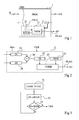
- Figure 1 represents, very schematically and in the form of blocks, an integrated processor 1 equipped with a disturbance detection cell 2 according to the present invention.
- the processor 1 is represented very schematically and, conventionally, receives data and commands on multiple entries E, provides data and commands on multiple outputs S and is powered (ALIM).
- the integrated processor has at least one cell 2 for maintaining an invariant.
- the cell 2 comprises a block 21 of invariant maintenance that it compares with a given NVM stored in a non-volatile memory 22 to provide a or several bits indicating by their states of a loss or not of the invariant.
- FLAG single-bit flag
- the cell 2 can receive preloaded PREC data from from outside the cell. This preloading remains however according to the invention limited at the beginning of the execution of the program that we want to monitor.
- cell 2 has a fully autonomous operation compared to the rest of the integrated processor from which it receives only the power supply and, the where appropriate, a clock signal CLK. So cell 2 is never subjected to input or output data processed by the processor except for any preloading.
- cell 2 uses resources of the same nature as those exploited by the processor, in order to be sensitive to same types of disturbances.
- cell 2 digital processing circuits for example, registers, operators, etc.
- Figure 2 represents, very schematically and in block form, a preferred embodiment of a perturbation detection cell 2 according to the present invention.
- This cell 2 comprises three registers 23, 24, and 25, an adder 26, a comparator 27 and an element 22 of non-volatile memory.
- Element 22 is indifferently an element ROM memory, data hard-wired during the manufacture of the circuit or any other equivalent system. The important thing is that the NVM data element 22 contains not likely to be modified in particular by the appearance of a disturbance that is supposed to detect the cell 2, so that the element 22 is particularly insensitive to disturbances of the power supply of the integrated processor.
- FIG. 3 illustrates, in simplified flowchart form, the operation of the cell of Figure 2.
- the registers 23 and 24 are intended to be pre-loaded, for example when turning on the processor 1 or at the beginning of the execution of a program to be monitored, by data D1 and D2 whose sum D3 is in principle identical to the NVM value.
- the result of this comparison provides, for example, a flag bit (FLAG) to the state 0 or 1 indicator of the detection of an error possible.
- the invention is not intended to prevent the appearance of an error but simply to detect it.
- the treatment to be performed when an error appears depends on the application and may correspond to any treatment of classic error.
- the invariant is the equality between the data D3 and the data NVM.
- the choice of the periodicity of verification of the invariant depends on the application. The shorter the period, the more the detection cell will react quickly to the arrival of a disturbance preventing it from maintaining the invariant.
- An advantage of the present invention is that it allows to detect the occurrence of a disturbance likely to modify the execution of a program in real time, that is to say without waiting for the completion of this program.
- Another advantage of the invention is that its implementation is particularly simple and not very greedy resources, especially in relation to the execution of a calculation redundant.
- a bubble sort of a data table stored in a register or in RAM associated with the processor that we compare periodically to a set of identical tables stored in a non-volatile memory.
- the sorting of the table is disturbed, which allows a detection.
- the invariant here is the fact that the data table in RAM is sorted to rank n (and corresponds to a tables of non-volatile memory) at the nth iteration of the algorithm.
- the cell of detection includes a network of registries disseminated within the circuits that are refreshed with each stroke of the clock and which one checks the invariant character against a datum of reference stored in a nonvolatile element.
- the present invention is capable of various variations and modifications that will appear to man art.
- the practical implementation of the invention from the functional indications given above is within the reach of the skilled person.
- verification of the invariant was described using a material comparator, it should be noted that the invention may also be implemented with a software comparison, the important being that the cell maintains an invariant element using the same technology as the processor with which is integrated the cell, so as to be sensitive to the same type of disturbance. In this case, care should be taken to place the detection indicator in the error state before checking the invariant.
Landscapes
- Engineering & Computer Science (AREA)
- Theoretical Computer Science (AREA)
- Physics & Mathematics (AREA)
- Computer Security & Cryptography (AREA)
- General Engineering & Computer Science (AREA)
- General Physics & Mathematics (AREA)
- Computer Hardware Design (AREA)
- Software Systems (AREA)
- Quality & Reliability (AREA)
- Mathematical Physics (AREA)
- Hardware Redundancy (AREA)
- Investigating Or Analysing Biological Materials (AREA)
Applications Claiming Priority (2)
| Application Number | Priority Date | Filing Date | Title |
|---|---|---|---|
| FR0350312 | 2003-07-09 | ||
| FR0350312 | 2003-07-09 |
Publications (3)
| Publication Number | Publication Date |
|---|---|
| EP1503288A2 true EP1503288A2 (de) | 2005-02-02 |
| EP1503288A3 EP1503288A3 (de) | 2005-02-09 |
| EP1503288B1 EP1503288B1 (de) | 2006-03-29 |
Family
ID=33523094
Family Applications (1)
| Application Number | Title | Priority Date | Filing Date |
|---|---|---|---|
| EP04300438A Expired - Lifetime EP1503288B1 (de) | 2003-07-09 | 2004-07-09 | Fehlererkennungszelle für integrierte Prozessoren |
Country Status (3)
| Country | Link |
|---|---|
| US (1) | US7363547B2 (de) |
| EP (1) | EP1503288B1 (de) |
| DE (1) | DE602004000562T2 (de) |
Families Citing this family (1)
| Publication number | Priority date | Publication date | Assignee | Title |
|---|---|---|---|---|
| US9697074B2 (en) | 2014-12-11 | 2017-07-04 | Internatioanl Business Machines Corporation | Non-local error detection in processor systems |
Family Cites Families (12)
| Publication number | Priority date | Publication date | Assignee | Title |
|---|---|---|---|---|
| US4233682A (en) | 1978-06-15 | 1980-11-11 | Sperry Corporation | Fault detection and isolation system |
| US4727544A (en) * | 1986-06-05 | 1988-02-23 | Bally Manufacturing Corporation | Memory integrity checking system for a gaming device |
| DE3740078C1 (de) | 1987-11-26 | 1988-12-08 | Kloeckner Moeller Elektrizit | Schaltungsanordnung zur sicherheitswirksamen Zustandsbestimmung einer Ausgangsspeichestufe |
| US5493649A (en) * | 1994-06-21 | 1996-02-20 | Microsoft Corporation | Detecting corruption in a computer program at execution time using a checksum |
| FI102221B1 (fi) * | 1995-10-30 | 1998-10-30 | Nokia Telecommunications Oy | Tietokoneen muistiongelmien paljastaminen |
| EP0924600B1 (de) * | 1997-12-15 | 2003-03-26 | Koninklijke Philips Electronics N.V. | Elektronische Vorrichtung mit einem Speicherschutzgerät und Verfahren zum Datenschuts in einem Speicher |
| US6330668B1 (en) | 1998-08-14 | 2001-12-11 | Dallas Semiconductor Corporation | Integrated circuit having hardware circuitry to prevent electrical or thermal stressing of the silicon circuitry |
| FR2787900B1 (fr) * | 1998-12-28 | 2001-02-09 | Bull Cp8 | Circuit integre intelligent |
| DE19918620A1 (de) * | 1999-04-23 | 2000-10-26 | Giesecke & Devrient Gmbh | Sicherung eines Rechnerkerns gegen äußere Manipulationen |
| EP1281124A4 (de) * | 2000-04-11 | 2004-07-14 | Richard M Mathis | Verfahren und vorrichtung zum schützen und verifizieren von computerspeicher |
| GB2384593B (en) * | 2000-08-21 | 2004-12-01 | Int Game Tech | A method of operating a gaming system and gaming device |
| KR100440451B1 (ko) * | 2002-05-31 | 2004-07-14 | 삼성전자주식회사 | 전압 글리치 검출 회로, 그것을 구비하는 집적회로장치,그리고 전압 글리치 어택으로부터 집적회로장치를보호하는 장치 및 방법 |
-
2004
- 2004-07-08 US US10/886,992 patent/US7363547B2/en not_active Expired - Lifetime
- 2004-07-09 DE DE602004000562T patent/DE602004000562T2/de not_active Expired - Lifetime
- 2004-07-09 EP EP04300438A patent/EP1503288B1/de not_active Expired - Lifetime
Also Published As
| Publication number | Publication date |
|---|---|
| EP1503288A3 (de) | 2005-02-09 |
| EP1503288B1 (de) | 2006-03-29 |
| DE602004000562T2 (de) | 2007-01-11 |
| DE602004000562D1 (de) | 2006-05-18 |
| US20050022071A1 (en) | 2005-01-27 |
| US7363547B2 (en) | 2008-04-22 |
Similar Documents
| Publication | Publication Date | Title |
|---|---|---|
| FR2760548A1 (fr) | Procede de planification de requetes d'un satellite par recuit simule contraint | |
| CA2480896C (fr) | Procede de securisation d'une entite electronique a acces crypte | |
| WO2003038620A2 (fr) | Procede de memorisation de donnees avec correction d'erreur | |
| EP1983436B1 (de) | Kontrolle der Integrität eines prozessorexternen Speichers | |
| EP2049967A2 (de) | Kernprozessor mit gesteuerter frequenz und verfahren zum herauffahren des kernprozessors auf programmierte weise | |
| FR3038188A1 (fr) | Systeme de verification de l’integrite d’une communication entre deux circuits | |
| EP1503288B1 (de) | Fehlererkennungszelle für integrierte Prozessoren | |
| FR2884329A1 (fr) | Protection de donnees d'une memoire associee a un microprocesseur | |
| FR2781918A1 (fr) | Memoire rom a correction par redondance | |
| EP1365317A1 (de) | Test eines Algorithmus ausgeführt durch einen integrierten Schaltkreis | |
| WO2003015282A2 (fr) | Ensemble de circuits electroniques comportant des moyens de decontamination de parties contaminees par des erreurs | |
| FR2788353A1 (fr) | Microprocesseur avec circuits de protection pour securiser l'acces a ses registres | |
| FR2810438A1 (fr) | Circuit de detection d'usure | |
| WO2019016464A1 (fr) | Procédé de détermination de l'intégrité de données de navigation d'une unité de contrôle d'un véhicule automobile | |
| FR2700056A1 (fr) | Procédé de programmation en champ uniforme d'une mémoire électriquement programmable et mémoire mettant en Óoeuvre le procédé. | |
| WO2009106757A1 (fr) | Methode de transfert securise de donnees | |
| EP1904928A2 (de) | Permanent-datenhardware-integrität | |
| FR2688902A1 (fr) | Unite d'automate ou d'automatisme programmable. | |
| FR2657181A1 (fr) | Procede et dispositif pour associer a la reception d'impulsions de reinitialisation par un microprocesseur l'acces a des sous-programmes differents. | |
| EP3792771B1 (de) | Programmtest | |
| EP1818846A1 (de) | Verifizierung der Integrität von Programmen oder der Sequenzierung einer Zustandsmaschine | |
| EP0733977A1 (de) | Rechnersystem mit hierarchischen Speichern | |
| FR3147020A1 (fr) | Vérification d'une donnée | |
| FR2812099A1 (fr) | Procede et dispositif d'autoregulation, dans un systeme informatique, de la consommation de ressources informatiques par un logiciel | |
| FR2884330A1 (fr) | Protection de donnees contenues dans un circuit integre |
Legal Events
| Date | Code | Title | Description |
|---|---|---|---|
| PUAI | Public reference made under article 153(3) epc to a published international application that has entered the european phase |
Free format text: ORIGINAL CODE: 0009012 |
|
| PUAL | Search report despatched |
Free format text: ORIGINAL CODE: 0009013 |
|
| AK | Designated contracting states |
Kind code of ref document: A2 Designated state(s): AT BE BG CH CY CZ DE DK EE ES FI FR GB GR HU IE IT LI LU MC NL PL PT RO SE SI SK TR |
|
| AX | Request for extension of the european patent |
Extension state: AL HR LT LV MK |
|
| AK | Designated contracting states |
Kind code of ref document: A3 Designated state(s): AT BE BG CH CY CZ DE DK EE ES FI FR GB GR HU IE IT LI LU MC NL PL PT RO SE SI SK TR |
|
| AX | Request for extension of the european patent |
Extension state: AL HR LT LV MK |
|
| RIC1 | Information provided on ipc code assigned before grant |
Ipc: 7G 06F 11/00 A Ipc: 7G 06F 11/07 B Ipc: 7G 06F 1/00 B |
|
| GRAP | Despatch of communication of intention to grant a patent |
Free format text: ORIGINAL CODE: EPIDOSNIGR1 |
|
| 17P | Request for examination filed |
Effective date: 20050808 |
|
| AKX | Designation fees paid |
Designated state(s): DE FR GB IT |
|
| GRAS | Grant fee paid |
Free format text: ORIGINAL CODE: EPIDOSNIGR3 |
|
| GRAA | (expected) grant |
Free format text: ORIGINAL CODE: 0009210 |
|
| AK | Designated contracting states |
Kind code of ref document: B1 Designated state(s): DE FR GB IT |
|
| REG | Reference to a national code |
Ref country code: GB Ref legal event code: FG4D Free format text: NOT ENGLISH |
|
| REF | Corresponds to: |
Ref document number: 602004000562 Country of ref document: DE Date of ref document: 20060518 Kind code of ref document: P |
|
| GBT | Gb: translation of ep patent filed (gb section 77(6)(a)/1977) |
Effective date: 20060712 |
|
| PLBE | No opposition filed within time limit |
Free format text: ORIGINAL CODE: 0009261 |
|
| STAA | Information on the status of an ep patent application or granted ep patent |
Free format text: STATUS: NO OPPOSITION FILED WITHIN TIME LIMIT |
|
| 26N | No opposition filed |
Effective date: 20070102 |
|
| PGFP | Annual fee paid to national office [announced via postgrant information from national office to epo] |
Ref country code: IT Payment date: 20110618 Year of fee payment: 8 |
|
| PGFP | Annual fee paid to national office [announced via postgrant information from national office to epo] |
Ref country code: GB Payment date: 20110701 Year of fee payment: 8 |
|
| GBPC | Gb: european patent ceased through non-payment of renewal fee |
Effective date: 20120709 |
|
| PG25 | Lapsed in a contracting state [announced via postgrant information from national office to epo] |
Ref country code: GB Free format text: LAPSE BECAUSE OF NON-PAYMENT OF DUE FEES Effective date: 20120709 |
|
| PG25 | Lapsed in a contracting state [announced via postgrant information from national office to epo] |
Ref country code: IT Free format text: LAPSE BECAUSE OF NON-PAYMENT OF DUE FEES Effective date: 20120709 |
|
| PGFP | Annual fee paid to national office [announced via postgrant information from national office to epo] |
Ref country code: DE Payment date: 20130621 Year of fee payment: 10 |
|
| PGFP | Annual fee paid to national office [announced via postgrant information from national office to epo] |
Ref country code: FR Payment date: 20130722 Year of fee payment: 10 |
|
| REG | Reference to a national code |
Ref country code: DE Ref legal event code: R119 Ref document number: 602004000562 Country of ref document: DE |
|
| REG | Reference to a national code |
Ref country code: FR Ref legal event code: ST Effective date: 20150331 |
|
| PG25 | Lapsed in a contracting state [announced via postgrant information from national office to epo] |
Ref country code: DE Free format text: LAPSE BECAUSE OF NON-PAYMENT OF DUE FEES Effective date: 20150203 |
|
| REG | Reference to a national code |
Ref country code: DE Ref legal event code: R119 Ref document number: 602004000562 Country of ref document: DE Effective date: 20150203 |
|
| PG25 | Lapsed in a contracting state [announced via postgrant information from national office to epo] |
Ref country code: FR Free format text: LAPSE BECAUSE OF NON-PAYMENT OF DUE FEES Effective date: 20140731 |