EP1502925A1 - Production process for vinyl chloride polymer - Google Patents
Production process for vinyl chloride polymer Download PDFInfo
- Publication number
- EP1502925A1 EP1502925A1 EP04010073A EP04010073A EP1502925A1 EP 1502925 A1 EP1502925 A1 EP 1502925A1 EP 04010073 A EP04010073 A EP 04010073A EP 04010073 A EP04010073 A EP 04010073A EP 1502925 A1 EP1502925 A1 EP 1502925A1
- Authority
- EP
- European Patent Office
- Prior art keywords
- polymerization
- liquid level
- polymerization vessel
- vinyl chloride
- reflux condenser
- Prior art date
- Legal status (The legal status is an assumption and is not a legal conclusion. Google has not performed a legal analysis and makes no representation as to the accuracy of the status listed.)
- Granted
Links
Images


Classifications
-
- C—CHEMISTRY; METALLURGY
- C08—ORGANIC MACROMOLECULAR COMPOUNDS; THEIR PREPARATION OR CHEMICAL WORKING-UP; COMPOSITIONS BASED THEREON
- C08F—MACROMOLECULAR COMPOUNDS OBTAINED BY REACTIONS ONLY INVOLVING CARBON-TO-CARBON UNSATURATED BONDS
- C08F14/00—Homopolymers and copolymers of compounds having one or more unsaturated aliphatic radicals, each having only one carbon-to-carbon double bond, and at least one being terminated by a halogen
- C08F14/02—Monomers containing chlorine
- C08F14/04—Monomers containing two carbon atoms
- C08F14/06—Vinyl chloride
Definitions
- the present invention relates to a production process for a vinyl chloride polymer in which by using an electric wave liquid level gauge for continuously detecting and measuring the liquid level of the polymerization vessel contents, not only during the polymerization step, but also during the raw material addition step and/or the polymer dispersion extraction and washing steps, the state inside the polymerization vessel can be accurately ascertained at all times.
- the present invention also relates to a production process for a vinyl chloride polymer in which by also detecting and measuring the liquid level of the polymerization vessel contents during the raw material addition step and/or the polymer dispersion extraction and washing steps, the productivity can be improved with good retention of the product quality.
- the present invention also relates to a production process for a vinyl chloride polymer in which the liquid level of the polymerization vessel contents is observed using the electric wave liquid level gauge, and foaming caused by operation of the reflux condenser is suppressed by addition of an antifoaming agent.
- Vinyl chloride polymers are normally produced by batch polymerization. Accordingly, one method of improving the productivity is to shorten the time required for an entire single batch, and particularly the time required for the polymerization reaction step, thereby increasing the number of batches that can be completed within a predetermined unit of time. Furthermore, improvements in productivity can also be achieved by increasing the scale of the polymerization vessel.
- a reflux condenser is typically used, in addition to a cooling jacket (and where necessary a cooling baffle and/or a cooling coil), to enable the polymerization reaction heat to be removed as efficiently as possible. Removal of heat using a reflux condenser is more economic than heat removal using a cooling jacket, a cooling baffle or a cooling coil, meaning there is a tendency to try and increase the proportion of heat removed by the reflux condenser relative to the total heat removal quantity.
- Heat removal by the reflux condenser occurs by condensation of the vaporized monomer.
- the pressure of the gas phase within the polymerization vessel decreases, causing an unavoidable foaming phenomenon at the surface of the liquid phase.
- the quantity of heat removed by the reflux condenser is increased beyond a certain level, then the generation of scale on the internal walls of the polymerization vessel at the gas-liquid interface becomes increasingly likely, and polymer particles may erupt up inside the reflux condenser with the foam and adhere to the surface of the reflux condenser.
- scale generated in this manner can then become mixed with the product during the next polymerization batch, causing an increase in fish eyes. Resolving these problems continues to be the focus of ongoing investigations.
- the quantity of foaming is suppressed by using a foam sensor installed within the gas phase portion of the polymerization vessel to detect when the foam at the surface of the liquid phase has reached a predetermined level, and then adding an antifoaming agent at that point (see patent reference 1).
- the electrostatic volume type sensor used as the foam sensor is a contact type sensor, meaning the measurement accuracy of the sensor deteriorates if polymer particles become adhered to the sensor section.
- a multitude of different materials are now being produced as vinyl chloride polymers, and in this process, the optimum level of foaming at which to add the antifoaming agent differs for each material.
- the position of the sensor is fixed, meaning only a specific level of foam can be measured. Accordingly, the above process is only capable of detecting the optimum level of foam for one group of polymers.
- non-contact type liquid level gauges are usually installed with the tip of the sensor protruding into the polymerization vessel from a position on the side wall in the upper region of the polymerization vessel.
- the maximum quantity of heat that can be removed by the reflux condenser must be restricted, thus enabling the height of the foam layer generated during the polymerization reaction to be suppressed. As a result, the maximum heat removal capability of the reflux condenser cannot be utilized.
- an indentation can be formed in the side wall of the upper region of the polymerization vessel, and the sensor tip then housed inside this indentation, but this causes the sensor to also pick up microwave reflections off the side walls of the indentation. These reflected microwaves from the side walls cause errors in the measurement of the liquid level, increasing the danger of a marked deterioration in the accuracy of the liquid level measurements.
- Batch production of a vinyl chloride polymer is conducted by repeating a batch process comprising essentially the steps of filling the polymerization vessel with an aqueous medium and adding the raw materials such as monomers and the like, conducting the polymerization reaction, extracting the polymer-containing dispersion following completion of the polymerization reaction, and washing the inside surfaces of the polymerization vessel.
- Managing and controlling the time required for the steps performed prior to and following the polymerization reaction is also an important factor in improving the overall productivity.
- the quantity of the monomer such as the vinyl chloride monomer added is measured by a flow meter installed within the feed line, and is controlled so as to ensure a predetermined constant quantity.
- this flow meter measures only monomer such as the vinyl chloride monomer supplied in a liquid state, and consequently a cavitation phenomenon inside the pump used for feeding and supplying the monomer can cause trouble. Namely, if a portion of the monomer gasifies, then that quantity is not counted by the flow meter, meaning an excessive quantity of the monomer may end up being introduced into the polymerization vessel.
- many feed pumps are being used at levels exceeding their specifications in order to shorten the time required to add the monomer, and this has resulted in a higher frequency of the above type of trouble.
- the start time for this washing step is determined by measuring the load on the stirring device inside the polymerization vessel. As the liquid level of the reaction mixture inside the polymerization vessel falls the load on the stirring device also falls, and when this load falls below a certain value, operation of the stirring device is halted and the aforementioned washing step is started.
- An object of the present invention is to provide a production process for a vinyl chloride polymer in which a liquid level gauge is used for accurately determining the liquid level of the contents inside a polymerization vessel, not only during the polymerization step, but also during steps outside the actual polymerization step such as the steps for adding the raw materials such as the monomer, recovering any unreacted monomer, extracting the polymer slurry, and washing the inside of the polymerization vessel.
- Another object of the present invention is to provide a production process for a vinyl chloride polymer in which by accurately detecting and measuring the liquid level not only during the polymerization reaction step, but also during the production steps prior to and following the polymerization, the productivity can be improved markedly by shortening the times required for each step in the vinyl chloride polymer production.
- Yet another object of the present invention is to provide a production process for a vinyl chloride polymer in which the maximum heat removal capability of the reflux condenser can be utilized by suppressing foaming through the addition of an antifoaming agent to the polymerization vessel contents when the liquid level has risen to a certain level as a result of foaming.
- the maximum heat removal capability of the reflux condenser can be utilized by suppressing foaming through the addition of an antifoaming agent to the polymerization vessel contents when the liquid level has risen to a certain level as a result of foaming.
- the present invention provides a production process for a vinyl chloride polymer in which either vinyl chloride, or a mixture of vinyl chloride and another copolymerizable monomer, is polymerized in an aqueous medium inside a polymerization vessel equipped with a reflux condenser to generate the vinyl chloride polymer, wherein the liquid level of the polymerization vessel contents is detected using an electric wave liquid level gauge, which is disposed on the polymerization vessel and radiates microwaves with a frequency of 4 to 20 GHz.
- the present invention provides a production process for a vinyl chloride polymer wherein the aforementioned liquid level gauge is used for detecting and measuring the liquid level of the polymerization vessel contents during the polymerization reaction step, and also during the raw material addition step performed prior to commencement of the polymerization reaction, and/or the polymer dispersion extraction and washing steps performed following completion of the polymerization reaction.
- the present invention provides a production process for a vinyl chloride polymer wherein at least for the period during which heat removal is conducted using the reflux condenser, the liquid level of the liquid contents inside the polymerization vessel is monitored using the electric wave liquid level gauge, and if the polymerization conversion rate is within a range from 30 to 60% and the liquid level has risen above a predetermined height, an antifoaming agent is added to the liquid contents.
- liquid level refers to either the surface of the liquid contents inside the polymerization vessel, or in those cases where a foam layer is formed on top of the liquid contents, to the surface of the foam layer.
- a polymerization vessel used in the examples of the process of the present invention comprises a reflux condenser as a cooling device. Furthermore, the vessel also comprises an electric wave liquid level gauge as a device for monitoring the liquid level.
- the polymerization vessel typically also comprises a jacket for heating and cooling, and although not essential, preferably also comprises a baffle or a coil or the like with cooling capabilities.
- the polymerization vessel may also comprise an external heat exchange device in which the mixed slurry inside the polymerization vessel is extracted with a pump, passed through a heat exchanger disposed outside the polymerization vessel, and is then returned to the polymerization vessel.
- There are no particular restrictions on the shape of the polymerization vessel although a polymerization vessel with a straight circular cylindrical body section is preferred.
- FIG. 1 One example of a polymerization reaction apparatus used in a process of the present invention is shown in FIG. 1.
- a polymerization vessel 1 is enclosed inside a heating and cooling jacket (not shown in the figure), and a coolant such as cooling water is circulated though this heating and cooling jacket via a line not shown in the figure.
- a cooling baffle 11 and/or a cooling coil may also be provided inside the polymerization vessel 1.
- a reflux condenser 5 is provided at the top of the polymerization vessel 1, and a coolant such as cooling water is also circulated through this reflux condenser 5 via a line not shown in the figure.
- the reflux condenser 5 condenses, liquefies, and refluxes monomer vapor generated inside the polymerization vessel 1.
- An aqueous medium supply line 6 for ion exchange water or the like, a polymerization initiator supply line 7, a monomer supply line 8, a recovery line 9 for recovering unreacted monomer following completion of the polymerization reaction, and a line 17 for adding an antifoaming agent to the polymerization vessel contents are each connected to the polymerization vessel 1. Furthermore, a stirrer 3 equipped with a paddle blade for stirring the contents (not shown in the figure) inside the polymerization vessel 1 is rotated by a drive motor 4 fitted to the polymerization vessel 1. In the example shown in the figure, a liquid level gauge 10 is disposed in the upper section of the polymerization vessel 1.
- the material for the internal surface of the polymerization vessel, the baffle, the paddle blade, and the shaft and the like used in this polymerization apparatus of the present invention is preferably a stainless steel such as a high chromium content, high purity, ferrite stainless steel, two-phase stainless steel or austenite stainless steel.
- an electric wave liquid level gauge is used due to the advantages it offers in terms of enabling continuous monitoring of the liquid level inside the polymerization vessel, being a non-contact type gauge, and being unrestricted by the pressure inside the polymerization vessel.
- Non-contact type liquid level gauges are usually installed with the tip of the sensor protruding into the polymerization vessel from a position on the upper inside surface of the polymerization vessel in order to improve the measurement accuracy of the gauge, but this can lead to scale adhesion to the tip of the sensor. Furthermore, in order to ensure that foam does not adhere to the tip of the sensor, the maximum quantity of heat that can be removed by the reflux condenser must be restricted to enable the height of the foam layer generated during the polymerization reaction step to be suppressed. However as a result, the maximum heat removal capability of the reflux condenser cannot be utilized.
- the sensor tip is preferably fitted with a horn antenna in order to ensure reliable reception of the microwaves that are reflected off the liquid surface off the polymerization vessel contents, which represent the measurement target.
- a horn antenna as possible is installed, although the size of the antenna varies depending on the installation conditions.
- the horn antenna and the main body of the sensor are preferably linked together with a waveguide, and by appropriately adjusting the length of this waveguide, the hom antenna can be precisely positioned in the most favorable location.
- the installation angle of the waveguide can be inclined relative to the liquid surface, with no particular restrictions on this angle of inclination, provided the opening at the tip of the horn antenna is positioned parallel with the liquid surface.
- the opening at the tip of the horn antenna which detects the microwaves need only protrude a very small amount into the polymerization vessel, and the antenna does not suffer from problems such as deterioration in the measurement accuracy, restrictions on the height of the foam layer during the polymerization reaction, restrictions on the heat removal capabilities of the reflux condenser, or adhesion of scale to the sensor, and can be used for extended periods with minimal maintenance.
- the microwaves are emitted and received at the bottom of the sensor.
- FIG. 2 A schematic illustration of one example of the electric wave liquid level gauge described above is shown in FIG. 2.
- the electric wave liquid level gauge 12 is equipped with a microwave transceiver 13, a waveguide 14 and a horn antenna 15.
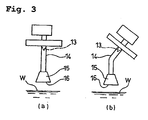
- Applied examples of the shape of the electric wave liquid level gauge are shown in FIG. 3.
- Provided the opening 16 at the tip of the horn antenna is positioned parallel with the liquid surface W, as is the case in both examples shown in FIG. 3 (a) and (b), there are no particular restrictions on the installation angle of the waveguide.
- the waveguide may be straight as shown in FIG. 3(a), or bent as shown in FIG. 3(b).
- the electric wave liquid level gauge may be installed in any position on the polymerization vessel. Accordingly, the gauge can be positioned in the most appropriate position for the particular polymerization conditions being employed.
- the electric wave liquid level gauge used in the process of the present invention must radiate microwaves with a frequency within a range from 4 to 20 GHz, and preferably from 5 to 10 GHz.
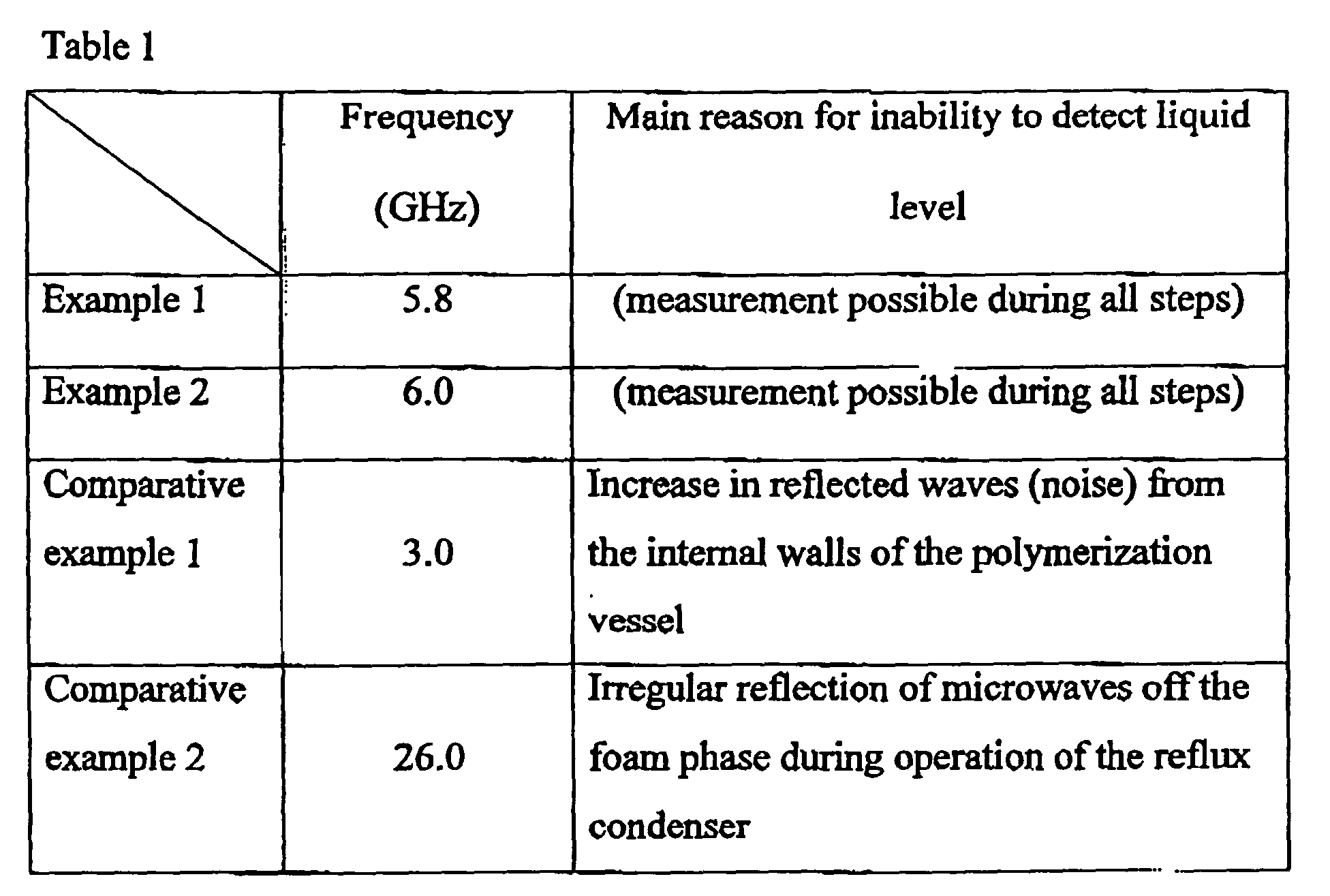
- Microwaves exceeding 20 GHz but less than 30 GHz can be used with comparatively gentle liquid level variations such as those cause by stirring, but when attempting to detect the liquid level during the type of vigorous foaming that can occur during the polymerization reaction step, the reflected waves are generated as irregular reflections, making it difficult to detect the liquid level.
- microwaves of a frequency exceeding 30 GHz are used, then detection of the liquid level during either liquid surface fluctuations caused by stirring or vigorous foaming is virtually impossible.
- microwaves of a frequency less than 4 GHz are used, then the accuracy of the measurements decreases, making accurate detection and measurement of the liquid level impossible.
- Another feature of the present invention is the monitoring of the liquid level of the liquid contents inside a polymerization vessel using an electric wave liquid level gauge which is fitted to the polymerization vessel and radiates microwaves with a frequency of 4 to 20 GHz.
- the process control computer is able to activate an overfill prevention operation before the quantity of raw material exceeds the desired level, thus enabling an improvement from the safety perspective.
- defects in the addition step can be identified precisely, enabling further improvements in quality control.
- the start time for washing the inside of the polymerization vessel following completion of the polymerization reaction has conventionally been determined solely on the basis of the load on the stirrer during extraction of the polymer dispersion, but by determining in advance the optimum liquid level at which to begin the washing process, and then determining the actual quantity of liquid within the polymerization vessel using the liquid level gauge, washing can be commenced at the most appropriate time, meaning unnecessary downtime can be avoided.
- the washing is typically commenced prior to the complete removal of the polymer slurry from the polymerization vessel, and the water used in the cleaning process is then transferred to the blowdown tank together with the product polymer slurry.
- the use of the electric wave liquid level gauge enables both the most appropriate time for addition of an antifoaming agent and the most appropriate addition quantity to be determined on the basis of the liquid level fluctuations caused by variations in the quantity of heat removed by the reflux condenser. Accordingly, the heat removal capability of the reflux condenser can be utilized at maximum efficiency.
- the period for which the liquid level is monitored using the electric wave liquid level gauge must include at least the period during which heat removal is conducted using the reflux condenser.
- the monitoring of the liquid level may be started prior to commencement of heat removal using the reflux condenser, and may be continued after completion of heat removal using the reflux condenser.
- the monomer raw material used in the present invention is either vinyl chloride or a monomer mixture comprising vinyl chloride as the primary constituent.
- a monomer mixture comprising vinyl chloride as the primary constituent comprises at least 50% by weight of vinyl chloride, as well as another monomer which is copolymerizable with the vinyl chloride.
- examples of other monomers which are copolymerizable with vinyl chloride include vinyl esters such as vinyl acetate and vinyl propionate; acrylate esters such as methyl acrylate and ethyl acrylate; methacrylate esters; olefins such as ethylene and propylene; as well as other monomers such as maleic anhydride, acrylonitrile, styrene and vinylidene chloride. These monomers may be used singularly, or in combinations of two or more monomers.
- a feature of the present invention is the removal of heat generated by the polymerization using an aforementioned reflux condenser.
- a suspension polymerization of vinyl chloride monomer or a monomer mixture thereof typically an aqueous medium, a dispersant (a suspension agent), a polymerization initiator, and where necessary a variety of other additives, are combined in a polymerization vessel, and hot water is then circulated through the jacket until the temperature inside the polymerization vessel reaches a predetermined polymerization reaction temperature, thus initiating the polymerization reaction. Subsequently, the polymerization reaction is allowed to proceed at a predetermined reaction temperature by using cooling devices such as the reflux condenser to remove the polymerization reaction heat.
- the quantity of heat removed by the reflux condenser is increased gradually from the commencement of reflux condenser heat removal until a predetermined heat removal quantity is reached.
- the polymerization reaction is normally conducted at a temperature of 20 to 80°C, and preferably at 35 to 75°C, and even more preferably at 45 to 70°C.
- the temperature of the reaction mixture in the polymerization vessel is raised to a predetermined polymerization reaction temperature, and heat removal using the reflux condenser is only commenced once the temperature of the reaction mixture has reached that predetermined polymerization reaction temperature.
- Heat removal using the reflux condenser may be commenced either as soon as the temperature of the reaction mixture reaches the predetermined polymerization reaction temperature, or after a certain period of time has elapsed after reaching the predetermined polymerization reaction temperature.
- Heat removal using the reflux condenser is preferably started once the polymerization conversion rate has reached 10 to 15%. Furthermore, although heat removal using the reflux condenser may be continued until completion of the polymerization, it may also be stopped prior to completion of the reaction.
- Hcat removal using the reflux condenser is preferably stopped at a polymerization conversion rate of 60 to 80%.
- heat removal using the reflux condenser is preferably conducted during the polymerization, for the polymerization conversion rate period between 10 and 80%, and even more preferably for the polymerization conversion rate period between 15 and 70%.
- polymerization initiator used in a process of the present invention, and the types of initiators used in conventional vinyl chloride polymer production are suitable.
- specific examples of these polymerization initiators include peroxycarbonate compounds such as diisopropyl peroxydicarbonate, di-2-ethylhexyl peroxydicarbonate and diethoxyethyl peroxydicarbonate; peroxy ester compounds such as t-butyl peroxypivalate, t-hexyl peroxypivalate, t-butyl peroxyneodecanoate and ⁇ -cumyl peroxyneodecanoate; peroxides such as acetylcyclohexylsulfonyl peroxide, 2,4,4-trimethylpentyl-2-peroxyphenoxy acetate and 3,5,5-trimethylhexanoyl peroxide; azo compounds such as azobis-2,4-dimethylvaleronitrile and azobis(4
- the quantity added of the polymerization initiator is typically within a range from 0.01 to 1 part by mass, and preferably from 0.03 to 0.2 parts by mass, per 100 parts by mass of the monomer or monomer mixture.
- the polymerization initiator can be added using conventional methods.
- the completion of the polymerization is the point at which the polymerization reaction is halted by addition to the polymerization reaction mixture of a sufficient quantity of a polymerization inhibitor (a material with polymerization inhibiting properties) to halt the polymerization reaction. After this addition, the recovery of any unreacted monomer is usually commenced.
- a polymerization inhibitor a material with polymerization inhibiting properties
- the polymerization inhibitor used in a process of the present invention can utilize those inhibitors typically used in vinyl chloride polymer production.
- suitable polymerization inhibitors include phenol based compounds such as 2-t-butylphenol, 2-aminophenol, 2,4-dimethyl-6-tert-butylphenol, 2,6-diisopropyl-p-cresol, n-octadecyl-3-(3,5-di-t-butyl-4-hydroxyphenyl)propionate, 3,5-di-t-butyl-4-hydroxytoluene, triethylene glycol-bis[3-(3-t-butyl-5-methyl-4-hydroxyphenyl)propionate], t-butylhydroxyanisole, t-hutylhydroquinone, 4,4'-butylidenebis(3-methyl-6-t-butylphenol), 2,2'-methylene-bis(4-methyl-6-t-butylphenol), 2,2'-methylene-bis(4-
- polymerization inhibitors may be used singularly, or in combinations of two or more different compounds.
- the quantity added of the polymerization inhibitor is typically within a range from 0.001 to 0.3 parts by mass, and preferably from 0.003 to 0.1 parts by mass, and even more preferably from 0.005 to 0.05 parts by mass, per 100 parts by mass of the monomer or monomer mixture.
- This polymerization inhibitor can be added using conventional methods.
- an antifoaming agent is addcd to the liquid contents in the polymerization vessel to cause defoaming in those situations where the polymerization conversion rate is within a range from 30 to 60% and the level of the liquid contents has risen above a predetermined height.
- the measured value for the liquid level obtained using the electric wave liquid level gauge described above is compared with a preset height, and if the measured liquid level exceeds the preset height then a quantity of the antifoaming agent is added. These operations can be performed manually, although they may also be automated using a computer or the like.
- the liquid level is preferably suppressed to a height lower than the bottom of the condenser, in order to prevent carry over into the condenser, and the preset liquid level should be set within this range.
- Addition of the antifoaming agent is commenced on the basis of a signal indicating that the liquid level has exceeded the preset height described above. Following commencement of this addition, either a predetermined quantity of the antifoaming agent may be added over a predetermined time period, or alternatively the addition may be continued until the liquid level detected by the electric wave liquid level gauge has once again fallen below the preset height, at which point the addition is stopped. Addition is preferably initiated every time the liquid level exceeds the preset height. These operations can be easily automated by suitable programming. Addition of the antifoaming agent is typically conducted when the polymerization conversion rate is within a range from 30 to 60%, and preferably from 40 to 50%.
- Copolymer polyethers represent one preferred example of antifoaming agents that can be used in the present invention. Specifically, copolymer polyethers with a weight average molecular weight of 1,500,000 to 2,000,000, and preferably from 1,700,000 to 2,000,000, and an ethylene oxide to propylene oxide molar ratio within a range from 78/22 to 82/18 can be used.
- the above molecular weight is less than 1,500,000, then the action of the copolymer polyether in reducing the surface tension of, and thereby destroying, foam that has generated in the polymerization system weakens. As a result, the antifoaming effect becomes inadequate, which requires an increase in the quantity added of the antifoaming agent. This in turn results in a deterioration in the quality of the product polymer. Furthermore, if the molecular weight exceeds 2,000,000, then the viscosity of the polymer slurry tends to increase, causing a reduction in the antifoaming effect.
- the quantity added of the copolymer polyether described above is typically within a range from 0.001 to 0.008 parts by mass, and preferably from 0.003 to 0.008 parts by mass, per 100 parts by mass of the monomer or monomer mixture. If the quantity used of the copolymer polyether relative to the total quantity of monomer is less than 0.001 parts by mass, then the desired antifoaming effect cannot be generated. Furthermore, if the quantity exceeds 0.008 parts by mass, the viscosity of the polymer slurry increases, causing a reduction in the antifoaming effect.
- the copolymer polyether is preferably added to the polymerization reaction system as an aqueous solution.
- concentration of that aqueous solution is typically within a range from 0.1 to 10% by weight, and preferably from 0.5 to 3% by weight.
- the antifoaming agent for example the copolymer polyether aqueous solution described above, is preferably added when the polymerization conversion rate is within a range from 30 to 60% and the level of the liquid contents inside the polymerization vessel has risen above the preset height described above.
- the antifoaming agent is added to the polymerization reaction system when the polymerization conversion rate is within a range from 40 to 50% and the above liquid level has risen above the preset height. Prior to the polymerization conversion rate reaching 30%, the formation of polymer particles is still unsatisfactory, and if the antifoaming agent is added at this point then it may have a deleterious effect on the particle size distribution.
- Addition of the antifoaming agent can be conducted either intermittently or continuously. If the addition is conducted intermittently, then the gap between additions may be either regular or irregular. The decision as to whether to add the antifoaming agent intermittently or continuously can be made on the basis of the persistence of the antifoaming effect.
- the copolymer polyethers described above not only have minimal effect on the final product quality, but display superior persistence to other antifoaming agents, and consequently intermittent addition is possible.
- dispersant used when polymerizing vinyl chloride or the like in an aqueous medium in accordance with a process of the present invention, and the types of dispersants used in conventional vinyl chloride polymer production are suitable.
- specific examples of these types of dispersants include water soluble cellulose ethers such as methyl cellulose, hydroxyethyl cellulose, hydroxypropyl cellulose and hydroxypropylmethyl cellulose; water soluble polymers such as water soluble partially saponified polyvinyl alcohols, polyacrylates, polymethacrylates and gelatin; oil soluble emulsifiers such as sorbitan monolaurate, sorbitan trioleate, glycerin tristearate, and block copolymers of ethylene oxide and propylene oxide; and water soluble emulsifiers such as polyoxyethylene sorbitan monolaurate, polyoxyethylene glycerin oleate and sodium laurate.
- These dispersants may be used singularly, or in combinations of two or
- antioxidants used in the present invention there are no particular restrictions on the antioxidants used in the present invention, and the types of antioxidants typically used in conventional vinyl chloride polymer production are suitable. Specific examples of these antioxidants include phenol compounds such as 2,2-di(4'-hydroxyphenyl)propane, hydroquinone, p-methoxyphenol, t-butylhydroxyanisole, n-octadecyl-3-(3,5-di-t-butyl-4-hydroxyphenyl)propionate, t-butylhydroquinone, 2,5-di-t-butylhydroquinone, 4,4'-butylidene-bis(3-methyl-6-t-butylphenol), 3,5-di-t-butyl-4-hydroxytoluene, 2,2'-methylene-bis(4-ethyl-6-t-butylphenol), triethylene glycol-bis[3-(3-t-butyl-5-methyl-4-hydroxyphenyl)propionat
- antioxidants can be used singularly, or in combinations of two or more compounds.
- 3,5-di-t-butyl-4-hydroxytoluene 3,5-di-t-butyl-4-hydroxytoluene, triethylene glycol-bis[3-(3-t-butyl-5-methyl-4-hydroxyphenyl)propionate], t-butylhydroxyanisole, t-butylhydroquinone, 2,6-di-t-butyl-4-sec-butylphenol and n-octadecyl-3-(3,5-di-t-butyl-4-hydroxyphenyl)propionate are preferred.
- suitable examples include self-condensation products of polyhydric phenols and polyhydric naphthols; condensation products of 1-naphthol and formaldehyde; condensation products of a phenol compound and an aldehyde compound; mixed solutions of a quinone-amine compound and an organic silica sol; sulfide compounds of naphthols; mixtures and/or reaction products of an electron donating dye and an arylsulfonic acid; phenothiazine derivatives; quinone compounds and/or reduction products thereof; reaction products of a ketone resin and a phenolic compound; dyes, pigments, aromatic compounds containing at least 5 conjugated ⁇ bonds, and heterocyclic compounds containing at least 5 conjugated ⁇ bonds; polyaromatic amines; salts of a cationic compound and an anionic compound; reaction products of a polyvinyl alcohol and aminobenzoic acid; and initial condensation products
- scale adhesion prevention agent in most modem vinyl chloride polymer production processes is conducted using steam as the application medium, and if this type of steam application is employed, then of the above scale adhesion prevention agents, self-condensation products of polyhydric phenols and polyhydric naphthols; condensation products of 1-naphthol and formaldehyde, and sulfide compounds of naphthols are preferred.
- antioxidants may be added to the polymerization system prior to commencement of the polymerization, during the polymerization, or following completion of the polymerization, for purposes such as controlling the polymerization reaction or preventing deterioration of the product polymer.
- the polymerization vessel 1 was a vessel with a straight circular cylindrical body section.
- the diameter of the waveguide was 40 mm, and the diameter of the opening at the tip of the horn antenna was 241 mm.
- the horizontal plane that marks the top edge of the straight circular cylindrical body section of the polymerization vessel 1 is labeled as the "TL line”.
- a horizontal plane that sits 0.5 m higher than the TL line is labeled as the "B line”
- the position of the bottommost point of the polymerization vessel is labeled the "A line”.
- the height at the line A was deemed to be 0%, and the height from the line A to the line B was set as 100%.
- the electric wave liquid level gauge 10 was installed so that the surface of the opening at the tip of the horn antenna coincided with the horizontal plan labeled as the B line.
- the polymerization vessel for conducting the vinyl chloride suspension polymerization was a polymerization vessel 1 with an internal capacity of 130 m 3 , which had been coated in advance with a scale adhesion prevention agent to form a scale adhesion prevention film on the internal surface, and was fitted with a reflux condenser 5.
- This polymerization vessel 1 was charged with 54,900 kg of ion exchange water, 13.8 kg of partially saponified polyvinyl alcohol, and 9.2 kg of hydroxypropylmethyl cellulose.
- an electric wave liquid level gauge 10 which radiated microwaves with a frequency of 5.8 GHz, confirmation was made that the liquid level at this point was consistent with the liquid quantity calculated in consideration of the difference in specific gravity depending on temperature.
- the inside of the polymerization vessel was evacuated with a vacuum pump until the internal pressure reached 7.98 kPa (gauge pressure), and 47,700 kg of vinyl chloride monomer was then added.
- the electric wave liquid level gauge 10 was once again used to confirm that the liquid level was consistent with the total liquid quantity calculated from the flow rates displayed on the flow rate meters.
- 25.3 kg of di-2-ethylhexyl peroxydicarbonate was forced into the polymerization vessel as a polymerization initiator.
- the stirring force per unit weight (t) of the contents in the polymerization vessel was 1.3 x 10 3 W (130 kg ⁇ m/s). Furthermore, the stirring rotational speed from the point at which stirring was started through until the extraction of the slurry described below was maintained at 86 rpm. Next, hot water was circulated through the heating and cooling jacket to raise the temperature of the liquid phase inside the polymerization vessel to 53°C, and once this temperature was reached, the polymerization reaction was allowed to proceed with the temperature maintained at 53°C.
- the polymerization vessel reached 588 kPa (gauge pressure)
- the polymerization was stopped, the unreacted monomer was recovered, the product polymer slurry was extracted from the polymerization vessel, and the polymerization vessel was washed.
- the liquid level of the polymerization vessel contents was able to be measured during both the polymerization step and the steps outside the polymerization step (such as recovering the unreacted monomer and washing the vessel).
- the polymerization vessel 1 of internal capacity 130 m 3 with an attached reflux condenser was used. Furthermore, an electric wave liquid level gauge which radiated microwaves with a frequency of 5.8 GHz was used as the electric wave liquid level gauge 10.
- a condensation product of 1-naphthol and aldehyde (a scale adhesion prevention agent) was applied to the internal surfaces of the polymerization vessel and the inside of the reflux condenser, thus forming a scale adhesion prevention film.
- the polymerization vessel was then charged with 54,900 kg of ion exchange water, 13.8 kg of partially saponified polyvinyl alcohol, and 9.2 kg of hydroxypropylmethyl cellulose.
- the stirring force per unit weight (t) of the contents in the polymerization vessel was 1.3 x 10 3 W (130 kg ⁇ m/s). Furthermore, the stirring rotational speed from the point at which stirring was started through until the extraction of the slurry described below was maintained at 86 rpm.
- the state of scale adhesion to the inside of the polymerization vessel and the state of the horn antenna were inspected. Furthermore, the polymer was dewatered, dried and evaluated for quality. The various evaluation methods used are described below.
- the state of scale adhesion to the inside of the polymerization vessel was inspected, and evaluated according to the following criteria.
- the bulk specific gravity of the product polymer was measured in accordance with JIS K-6721.
- the particle size distribution of the product polymer was measured in accordance with the particle size distribution measurement method of JIS Z-8801, and the weight % values of the sample which passed through a #60, #100 and #200 sieve respectively were determined.
- 100 parts by weight of the product polymer, 50 parts by weight of DOP, 0.1 parts by weight of barium stearate, 0.1 parts by weight of cadmium stearate, 0.8 parts by weight of cetanol, 2.0 parts by weight of a tin based stabilizer, 0.5 parts by weight of titanium dioxide, and 0.1 parts by weight of carbon black were kneaded together for 5 minutes at 140°C using a six inch roller, and a sheet of thickness 0.3 mm was formed from the mixture. The number of white transparent spots per 100 cm 2 of the sheet was counted and recorded as the fish eye quantity.
- the example 4 the comparative example 3 and the comparative example 4, the height of the liquid level at the commencement of washing, the washing time, and the time required from the commencement of slurry extraction until the completion of the washing process are shown in Table 2.
- the results of the aforementioned evaluations of the bulk specific gravity, the #60 pass %, the #100 pass % and the #200 pass % for the polymer, the number of fish eyes, and the level of scale adhesion are shown in Table 3.
- the results from the same evaluations, together with the degree of excess or degree of deficiency in the quantity of the vinyl chloride monomer are also shown in Table 3.
- the polymerization vessel 1 of internal capacity 130 m 3 with an attached reflux condenser was used.
- a scale adhesion prevention film was formed in advance on the internal walls of the polymerization vessel 1 by application of a scale adhesion prevention agent.
- An electric wave liquid level gauge which was equipped with a horn antenna and radiated microwaves with a frequency of 5.8 GHz, was used as the electric wave liquid level gauge 10.
- This electric wave liquid level gauge 10 was connected to a computer (not shown in the figures) and the detection signals from the electric wave liquid level gauge were input into this computer.
- the computer was programmed to add an antifoaming agent via the antifoaming agent addition line 17 when the received signal met certain conditions described below.
- the polymerization conversion rate at any specific point during a polymerization conducted in any of the examples or comparative examples was determined by actually conducting the polymerization under the specified conditions, adding an antioxidant to the polymerization time at a specific time to halt the polymerization, measuring the quantity of polymer produced at that point, and then using this measured quantity to calculate the polymerization conversion rate at that point.
- a plurality of polymerization reactions are conducted under the same conditions, with the time until the polymerization is halted extended by 0.5 hours in each successive reaction, and the polymerization conversion rate is measured in each case. This method was used to establish, in advance, the relationship between reaction time and polymerization conversion rate for each of the specific reaction conditions, and certain times and polymerization conversion rates could then be specified on the basis of these relationships.
- the computer described above was programmed to automatically add the antifoaming agent to the reaction mixture when the electric wave liquid level gauge 10 detected that the liquid level had reached a height equivalent to a point 0.3 m vertically below the line B described above.
- Monitoring of the liquid level by the electric wave liquid level gauge 10 was conducted throughout all of the process steps, from prior to the addition of the polymerization mixture, and through the steps for adding the reactants, conducting the polymerization, extracting the polymer slurry following completion of the polymerization, washing the polymerization vessel, and any subsequent steps, and the results of this monitoring were displayed continuously on a display or the like.
- the polymerization vessel 1 was charged with 54,900 kg of ion exchange water, 13.8 kg of partially saponified polyvinyl alcohol, and 9.2 kg of hydroxypropylmethyl cellulose. Subsequently, the inside of the polymerization vessel was evacuated with a vacuum pump until the internal pressure reached 7.98 kPa (gauge pressure), and 47,700 kg of vinyl chloride monomer was then added. With the mixture undergoing constant stirring, 25.3 kg of di-2-ethylhexyl peroxydicarbonate was then forced into the polymerization vessel as a polymerization initiator. Subsequently, hot water was circulated through the heating and cooling jacket to raise the temperature of the liquid phase inside the polymerization vessel to 53°C.
- the polymerization reaction was then allowed to proceed with the temperature maintained at this temperature. Heat removal using the reflux condenser was commenced when the polymerization conversion rate reached 15%, and the quantity of heat removed by the reflux condenser was increased until it reached 8370 MJ/hr at the point where the polymerization conversion rate had reached 40%. This heat removal quantity was then maintained while the reaction proceeded.
- an antifoaming agent comprising 120 kg of a 2% aqueous solution of a copolymer polyether, with a weight average molecular weight of 1,500,00 and comprising a 80/20 molar ratio of ethylene oxide and propylene oxide, was added continuously to the reaction mixture over a two minute period. At this point, the polymerization conversion rate had reached 50%.
- the polymerization was stopped by the addition of 5.0 g of triethylene glycol-bis[3-(3-t-butyl-5-methyl-4-hydroxyphenyl)propionate] as a polymerization inhibitor, and the unreacted monomer was recovered.
- the product polymer slurry was then extracted from the polymerization vessel, and the polymerization vessel was washed. Heat removal using the reflux condenser was stopped when the polymerization conversion rate had reached 80%.
- the stirring force per unit weight (t) of the contents in the polymerization vessel was 1.3 x 10 3 W (130 kg ⁇ m/s). Furthermore, the stirring rotational speed from the point at which stirring was started through until the extraction of the slurry was maintained at 86 rpm. The proportion of heat removed by the reflux condenser relative to the total heat removal quantity per unit of time reached its maximum value of 55% at a polymerization conversion rate of 75%.
- the liquid level of the polymerization vessel contents can be detected and measured not only during the polymerization reaction step, but also during all the other steps outside of the polymerization reaction, and consequently the state inside the polymerization vessel can be accurately ascertained at all times.
- the quantity of heat removed by the reflux condenser during the polymerization reaction step can be increased, and the process time, including the time required for the raw material addition step and/or the washing step performed at the completion of the polymerization reaction, can be shortened.
- both overfilling and underfilling during the monomer addition step can be essentially prevented from occurring, the generation of scale can be suppressed, stability in the quality of the product can be maintained, and the productivity can be improved.
- the heat removal capability of the reflux condenser can be utilized to maximum effect.
- the proportion of heat removed by the reflux condenser relative to the total heat removal quantity required is within a range from 15 to 25% in those cases where an antifoaming agent is not added, in those cases where an antifoaming agent is added in accordance with the present invention, that proportion can be increased to 30% or more (30 to 60%).
- the quantity of heat removed by the reflux condenser can be increased enormously. Because the process of the present invention enables the quantity of heat removed by the reflux condenser to be increased in the latter stages of the polymerization reaction when the reaction heat reaches its peak, the polymerization time can be shortened, energy can be conserved, and productivity can be improved.
- foaming during the polymerization reaction can be suppressed by addition of an antifoamnig agent, and consequently eruptions of foam and polymer particles up inside the reflux condenser, resulting in surface adhesion and the generation of scale, can be effectively prevented.
- the electric wave liquid level gauge used in the present invention is separated from the liquid level, adhesion of foam or scale to the sensor section of the gauge can be effectively suppressed. As a result, measurement accuracy can be maintained during monitoring of the liquid level, and the electric wave liquid level gauge can be used for extended periods with minimal maintenance.
- the sensor of the electric wave liquid level gauge can be positioned in the most suitable location inside the polymerization vessel.
Landscapes
- Chemical & Material Sciences (AREA)
- Health & Medical Sciences (AREA)
- Chemical Kinetics & Catalysis (AREA)
- Medicinal Chemistry (AREA)
- Polymers & Plastics (AREA)
- Organic Chemistry (AREA)
- Polymerisation Methods In General (AREA)
Abstract
Description


Claims (8)
- A production process for a vinyl chloride polymer in which either vinyl chloride, or a mixture of vinyl chloride and another copolymerizable monomer, is polymerized in an aqueous medium inside a polymerization vessel equipped with a reflux condenser to generate a vinyl chloride polymer, wherein a liquid level of contents inside said polymerization vessel is detected using an electric wave liquid level gauge, which is disposed on said polymerization vessel and radiates microwaves of 4 to 20 GHz.
- The production process according to claim 1, wherein said liquid level of said contents inside said polymerization vessel is detected during all steps, including steps prior to said polymerization, said polymerization step, and steps following said polymerization.
- The production process according to claim 1, wherein said electric wave liquid level gauge comprises a sensor and a horn antenna that is mounted to a tip of said sensor.
- The production process according to claim 1, wherein said electric wave liquid level gauge is used for detecting and measuring said liquid level of said contents inside said polymerization vessel during a polymerization reaction step, and also during a raw material addition step performed prior to commencement of said polymerization reaction, and/or polymer dispersion extraction and washing steps performed following completion of said polymerization reaction.
- The production process according to claim 1, wherein at least for a period during which heat removal is conducted using said reflux condenser, said liquid level of said contents inside said polymerization vessel is monitored using said electric wave liquid level gauge, and
when a polymerization conversion rate is within a range from 30 to 60% and said liquid level has risen above a predetermined height, an antifoaming agent is added to said contents. - The production process according to claim 5, wherein said antifoaming agent is an aqueous solution of a copolymer polyether with a weight average molecular weight within a range from 1,500,000 to 2,000,000, and an ethylene oxide to propylene oxide molar ratio within a range from 78/22 to 82/18.
- The production process according to claim 6, wherein a quantity of said antifoaming agent added is within a range from 0.001 to 0.008 parts by mass in terms of said copolymer polyether per 100 parts by mass of said monomer or monomer mixture.
- The production process according to claim 5, wherein addition of said antifoaming agent is conducted either intermittently or continuously.
Applications Claiming Priority (6)
| Application Number | Priority Date | Filing Date | Title |
|---|---|---|---|
| JP2003205370A JP4095505B2 (en) | 2003-08-01 | 2003-08-01 | Method for producing vinyl chloride polymer |
| JP2003205370 | 2003-08-01 | ||
| JP2003205369A JP2005053941A (en) | 2003-08-01 | 2003-08-01 | Method for producing vinyl chloride polymer |
| JP2003205369 | 2003-08-01 | ||
| JP2004061562 | 2004-03-05 | ||
| JP2004061562 | 2004-03-05 |
Publications (2)
| Publication Number | Publication Date |
|---|---|
| EP1502925A1 true EP1502925A1 (en) | 2005-02-02 |
| EP1502925B1 EP1502925B1 (en) | 2008-01-09 |
Family
ID=33545101
Family Applications (1)
| Application Number | Title | Priority Date | Filing Date |
|---|---|---|---|
| EP04010073A Expired - Lifetime EP1502925B1 (en) | 2003-08-01 | 2004-04-28 | Production process for vinyl chloride polymer |
Country Status (3)
| Country | Link |
|---|---|
| US (1) | US6977288B2 (en) |
| EP (1) | EP1502925B1 (en) |
| PT (1) | PT1502925E (en) |
Cited By (3)
| Publication number | Priority date | Publication date | Assignee | Title |
|---|---|---|---|---|
| EP1698642A4 (en) * | 2003-12-26 | 2007-09-19 | Shinetsu Chemical Co | Process for producing vinyl chloride polymer |
| CN104761666A (en) * | 2015-04-07 | 2015-07-08 | 肖金亭 | Microwave radiation melt method chlorination production method of chlorinated polyvinyl chloride (CPVC) resin |
| CN108368199A (en) * | 2016-09-02 | 2018-08-03 | 株式会社Lg化学 | Production method of vinyl chloride-based polymer and production device of vinyl chloride-based polymer |
Families Citing this family (6)
| Publication number | Priority date | Publication date | Assignee | Title |
|---|---|---|---|---|
| US6988404B2 (en) * | 2003-12-11 | 2006-01-24 | Ohmart/Vega Corporation | Apparatus for use in measuring fluid levels |
| US20090031827A1 (en) * | 2007-08-05 | 2009-02-05 | University Of Kuwait | Smart sample Extraction Device and Method |
| US8863595B2 (en) | 2007-08-05 | 2014-10-21 | Kuwait University | Sample extraction device |
| CN107987194A (en) * | 2016-10-26 | 2018-05-04 | 上海天坛助剂有限公司 | A kind of environmental protection polyvinyl chloride paste resin production thinner and preparation method thereof |
| JP7291550B2 (en) * | 2019-06-19 | 2023-06-15 | 信越化学工業株式会社 | Method for producing vinyl chloride polymer |
| JP2023542977A (en) * | 2020-09-24 | 2023-10-12 | アクセルビーム フォトニクス,エルエルシー | Energy and material flow combiners to enhance the transfer of processing loads from one state to another |
Family Cites Families (1)
| Publication number | Priority date | Publication date | Assignee | Title |
|---|---|---|---|---|
| JPH0725909A (en) * | 1993-07-14 | 1995-01-27 | Kanegafuchi Chem Ind Co Ltd | Method for producing vinyl chloride polymer |
-
2004
- 2004-04-28 PT PT04010073T patent/PT1502925E/en unknown
- 2004-04-28 EP EP04010073A patent/EP1502925B1/en not_active Expired - Lifetime
- 2004-04-30 US US10/834,978 patent/US6977288B2/en not_active Expired - Lifetime
Non-Patent Citations (1)
| Title |
|---|
| PATENT ABSTRACTS OF JAPAN vol. 1995, no. 04 31 May 1995 (1995-05-31) * |
Cited By (7)
| Publication number | Priority date | Publication date | Assignee | Title |
|---|---|---|---|---|
| EP1698642A4 (en) * | 2003-12-26 | 2007-09-19 | Shinetsu Chemical Co | Process for producing vinyl chloride polymer |
| CN104761666A (en) * | 2015-04-07 | 2015-07-08 | 肖金亭 | Microwave radiation melt method chlorination production method of chlorinated polyvinyl chloride (CPVC) resin |
| CN104761666B (en) * | 2015-04-07 | 2017-06-30 | 肖金亭 | A kind of microwave melt method chlorination production method of chliorinated polyvinyl chloride CPVC resins |
| CN108368199A (en) * | 2016-09-02 | 2018-08-03 | 株式会社Lg化学 | Production method of vinyl chloride-based polymer and production device of vinyl chloride-based polymer |
| EP3357940A4 (en) * | 2016-09-02 | 2018-12-19 | LG Chem, Ltd. | Method for preparing vinyl chloride-based polymer, and device for preparing vinyl chloride-based polymer |
| US10577441B2 (en) | 2016-09-02 | 2020-03-03 | Lg Chem, Ltd. | Method of preparing vinyl chloride-based polymer and apparatus for preparing vinyl chloride-based polymer |
| CN108368199B (en) * | 2016-09-02 | 2020-06-09 | 株式会社Lg化学 | Method for producing vinyl chloride-based polymer and apparatus for producing vinyl chloride-based polymer |
Also Published As
| Publication number | Publication date |
|---|---|
| US6977288B2 (en) | 2005-12-20 |
| EP1502925B1 (en) | 2008-01-09 |
| US20050027088A1 (en) | 2005-02-03 |
| PT1502925E (en) | 2008-04-15 |
Similar Documents
| Publication | Publication Date | Title |
|---|---|---|
| EP1502925B1 (en) | Production process for vinyl chloride polymer | |
| JPS6411642B2 (en) | ||
| KR20150100906A (en) | Dispersion stabilizer for suspension polymerization and vinyl resin production method | |
| EP1300421A1 (en) | Dispersion stabilizer for suspension polymerization of vinyl compound | |
| EP0702033B1 (en) | Process of producing vinyl chloride type polymer | |
| US5717044A (en) | Suspending agent for suspension polymerization of vinyl compound | |
| TW201815836A (en) | Modified vinyl alcohol polymer, and diffusion stabilizer for suspension polymerization | |
| JP2005281659A (en) | Method for producing vinyl chloride polymer | |
| KR0152132B1 (en) | Polymerization Method of Vinyl Chloride | |
| EP1698642B1 (en) | Process for producing vinyl chloride polymer | |
| JP4095505B2 (en) | Method for producing vinyl chloride polymer | |
| EP1445265B1 (en) | Process for producing vinyl chloride-based polymer | |
| JP2005053941A (en) | Method for producing vinyl chloride polymer | |
| JP2002226505A (en) | Method for producing vinyl chloride polymer | |
| EP1394186B1 (en) | Initiator blends for producing a vinyl chloride-based polymer by suspension polymerization | |
| US6639027B2 (en) | Production process for vinyl-based polymer | |
| EP0701863B1 (en) | Polymerization apparatus and a method for producing polymer using the same | |
| JPH08134107A (en) | Method for producing vinyl chloride polymer | |
| JP7291551B2 (en) | Method for producing vinyl chloride polymer | |
| US6825288B2 (en) | Method of producing of vinyl chloride-based polymer | |
| JP3691747B2 (en) | Polymerization apparatus and method for producing vinyl chloride polymer using the same | |
| JP7291550B2 (en) | Method for producing vinyl chloride polymer | |
| JP2007260646A (en) | Reactor and method for producing polymer by using the same | |
| JPH04311708A (en) | Suspension polymerization of vinyl chloride monomer | |
| JP2001247603A (en) | Method for producing vinyl chloride polymer |
Legal Events
| Date | Code | Title | Description |
|---|---|---|---|
| PUAI | Public reference made under article 153(3) epc to a published international application that has entered the european phase |
Free format text: ORIGINAL CODE: 0009012 |
|
| AK | Designated contracting states |
Kind code of ref document: A1 Designated state(s): AT BE BG CH CY CZ DE DK EE ES FI FR GB GR HU IE IT LI LU MC NL PL PT RO SE SI SK TR |
|
| AX | Request for extension of the european patent |
Extension state: AL HR LT LV MK |
|
| 17P | Request for examination filed |
Effective date: 20050802 |
|
| AKX | Designation fees paid |
Designated state(s): NL PT |
|
| REG | Reference to a national code |
Ref country code: DE Ref legal event code: 8566 |
|
| GRAP | Despatch of communication of intention to grant a patent |
Free format text: ORIGINAL CODE: EPIDOSNIGR1 |
|
| GRAS | Grant fee paid |
Free format text: ORIGINAL CODE: EPIDOSNIGR3 |
|
| GRAA | (expected) grant |
Free format text: ORIGINAL CODE: 0009210 |
|
| AK | Designated contracting states |
Kind code of ref document: B1 Designated state(s): NL PT |
|
| REG | Reference to a national code |
Ref country code: PT Ref legal event code: SC4A Free format text: AVAILABILITY OF NATIONAL TRANSLATION Effective date: 20080404 |
|
| PLBE | No opposition filed within time limit |
Free format text: ORIGINAL CODE: 0009261 |
|
| STAA | Information on the status of an ep patent application or granted ep patent |
Free format text: STATUS: NO OPPOSITION FILED WITHIN TIME LIMIT |
|
| 26N | No opposition filed |
Effective date: 20081010 |
|
| PGFP | Annual fee paid to national office [announced via postgrant information from national office to epo] |
Ref country code: PT Payment date: 20100330 Year of fee payment: 7 |
|
| PGFP | Annual fee paid to national office [announced via postgrant information from national office to epo] |
Ref country code: NL Payment date: 20100416 Year of fee payment: 7 |
|
| REG | Reference to a national code |
Ref country code: PT Ref legal event code: MM4A Free format text: LAPSE DUE TO NON-PAYMENT OF FEES Effective date: 20111028 |
|
| REG | Reference to a national code |
Ref country code: NL Ref legal event code: V1 Effective date: 20111101 |
|
| PG25 | Lapsed in a contracting state [announced via postgrant information from national office to epo] |
Ref country code: PT Free format text: LAPSE BECAUSE OF NON-PAYMENT OF DUE FEES Effective date: 20111028 Ref country code: NL Free format text: LAPSE BECAUSE OF NON-PAYMENT OF DUE FEES Effective date: 20111101 |