EP1502836A1 - Impact absorbing steering column device - Google Patents
Impact absorbing steering column device Download PDFInfo
- Publication number
- EP1502836A1 EP1502836A1 EP03721045A EP03721045A EP1502836A1 EP 1502836 A1 EP1502836 A1 EP 1502836A1 EP 03721045 A EP03721045 A EP 03721045A EP 03721045 A EP03721045 A EP 03721045A EP 1502836 A1 EP1502836 A1 EP 1502836A1
- Authority
- EP
- European Patent Office
- Prior art keywords
- bracket
- car
- column
- steering column
- spacer
- Prior art date
- Legal status (The legal status is an assumption and is not a legal conclusion. Google has not performed a legal analysis and makes no representation as to the accuracy of the status listed.)
- Granted
Links
Images



Classifications
-
- B—PERFORMING OPERATIONS; TRANSPORTING
- B62—LAND VEHICLES FOR TRAVELLING OTHERWISE THAN ON RAILS
- B62D—MOTOR VEHICLES; TRAILERS
- B62D1/00—Steering controls, i.e. means for initiating a change of direction of the vehicle
- B62D1/02—Steering controls, i.e. means for initiating a change of direction of the vehicle vehicle-mounted
- B62D1/16—Steering columns
- B62D1/18—Steering columns yieldable or adjustable, e.g. tiltable
- B62D1/19—Steering columns yieldable or adjustable, e.g. tiltable incorporating energy-absorbing arrangements, e.g. by being yieldable or collapsible
- B62D1/195—Yieldable supports for the steering column
-
- B—PERFORMING OPERATIONS; TRANSPORTING
- B60—VEHICLES IN GENERAL
- B60R—VEHICLES, VEHICLE FITTINGS, OR VEHICLE PARTS, NOT OTHERWISE PROVIDED FOR
- B60R21/00—Arrangements or fittings on vehicles for protecting or preventing injuries to occupants or pedestrians in case of accidents or other traffic risks
- B60R21/02—Occupant safety arrangements or fittings, e.g. crash pads
- B60R21/04—Padded linings for the vehicle interior ; Energy absorbing structures associated with padded or non-padded linings
- B60R21/05—Padded linings for the vehicle interior ; Energy absorbing structures associated with padded or non-padded linings associated with the steering wheel, steering hand lever or steering column
Definitions
- the present invention relates to a shock absorbing steering column apparatus which can prevent deterioration of the rigidity of a lower bracket while making a disconnecting load of a steering column to be comparatively small in the lower bracket, so as to smoothly disconnect the steering column from the lower bracket, thereby securely guiding the steering column to the front of a car without dropping the steering column downward.
- a shock absorbing steering column apparatus when a driver has a secondary collision and the shock energy of this collision works from the rear part to the front part of the car, the steering column is disconnected from the car body to move to the front part of the car while being collapsed, and absorbs the shock energy meanwhile.
- the steering column is supported and secured to the car body at two positions, that is, at an upper bracket on the rear part of the car and a lower bracket at the front part of the car.
- the upper bracket of the steering column in the rear part of the car is provided with the shock absorbing mechanism described above, in addition to a tilt lock mechanism, and the like.
- the lower bracket in the front part of the car is provided with a supporting pin serving as the center of tilting so as to move the steering column in an inclined manner at the time of a tilt operation.
- a structure is employed as smoothly disconnecting the steering column from the lower bracket when the steering column is collapsed to move to the front part of the car at the secondary collision described above, so that the steering column can be securely guided to the front part of the car without falling downward.
- a column-side lower bracket which is secured to a steering column is formed with an axially elongated hole and a partition member which is cut up from the inner periphery of this axially elongated hole.
- the column-side lower bracket is brought into contact with a body-side lower bracket which is secured to the car body, and a supporting pin is passed through these both lower brackets.
- the supporting pin is passed through the partition member on the front side of the car inside the axially elongated hole of the column-side lower bracket.
- the column-side lower bracket can be inclined together with the steering column around the supporting pin serving as the center of the tilting.
- the body-side lower bracket and the supporting pin remain stationary.
- the column-side lower bracket intends to move to the front part of the car together with the steering column.
- the partition member is broken by the supporting pin, whereby the steering column can be smoothly disconnected from the lower bracket.
- the column-side lower bracket is, while the axially elongated hole thereof is engaged with the supporting pin, moved to the front part of the car together with the steering column.
- the support pin is engaged with the axially elongated hole, it is possible to guide the steering column to the front part of car without fail without dropping the steering column downward.
- the partition member which is broken in the secondary collision has been cut up from the inner periphery of the axially elongated hole of the column-side lower bracket and is formed with the column-side lower bracket as a unitary structure, so that an elaborate processing thereon is infeasible.
- the present invention has been contrived taking the circumstance as described above into consideration, and an object thereof is to provide a shock absorbing steering apparatus which can make a disconnecting load of a steering column to be comparatively small in the lower bracket and, at the same time, can smoothly move a column bracket without a catch when it is collapsed, so as to smoothly separate the steering column from the lower bracket, thereby securely guiding the steering column to the front part of a car without dropping the steering column downward.
- a shock absorbing steering column apparatus which is arranged such that a steering column is secured and supported by a body-side bracket, a column-side bracket secured to the steering column, and a supporting pin passed through both of these brackets so that the column-side bracket is disconnected at the time of collision to absorb the shock.
- This shock absorbing steering column apparatus is characterized in that, while a spacer is interposed between the both brackets and is latched by either one of the both brackets, a pin insertion hole through which the supporting pin is passed is formed on the spacer, so as to form a shock time breaking portion to be broken by the shock in the surroundings thereof.
- the spacer is interposed between the column-side bracket and the body-side bracket, and the column-side bracket can be moved in an inclined manner together with the steering column around the supporting pin which serves as the tilting center when a tilt operation is performed.
- the body-side bracket and the supporting pin remain stationary, meanwhile the column-side bracket and the main body of the spacer intend to move to the front part of the car together with the steering column.
- the shock time breaking portion of the spacer is broken by the supporting pin, whereby the steering column can be smoothly disconnected from the body-side bracket.
- the column-side bracket is moved to the front part of the car, together with the steering column.
- the spacer can be easily designed and processed since it is formed separately from the column-side bracket or the body-side bracket and can take a desired shape and structure.
- the body-side bracket is comprised of a body-side upper bracket in the rear part of the car and a body-side lower bracket in the front part of the car
- the column-side bracket may comprise a column-side upper bracket in the rear part of the car and a column-side lower bracket in the front part of the car which are respectively corresponding to the body-side upper bracket in the rear part of the car and the body-side lower bracket in the front part of the car
- the spacer may be interposed between the body-side lower bracket and the column-side lower bracket, and the main body of the spacer may be latched on either the column-side lower bracket or the body-side lower bracket.
- the shock time breaking portion is preferably a narrow breaking portion formed on the rear side of the car, of a pin insertion hole.
- the narrow breaking portion is extended to the forwarder part of the car, than the center of the insertion hole.
- the spacer may be formed of synthetic resin.
- shock absorbing steering column apparatus according to an embodiment of the present invention will be described below with reference to drawings.
- Fig. 1A is a side view of a shock absorbing steering column apparatus according to an embodiment of the present invention.
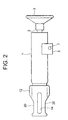
- Fig. 2 is a side view of the shock absorbing steering column apparatus in a state that a body-side upper bracket and a body-side lower bracket are disconnected therefrom.
- Fig. 3A is a side view of a column-side lower bracket
- Fig. 3B is a side view of a spacer
- Fig. 3C is a side view of the body-side lower bracket.
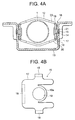
- Fig. 4A is a cross-sectional view taken along the line A-A in Fig. 1A
- Fig. 4B is an enlarged side view of the spacer.
- Fig. 5 is a diagram showing a load of the spacer.
- a steering shaft 2 is rotatably supported on the steering column 1, and a steering wheel 3 is attached to the upper end of the steering shaft 2.
- the structure of the present embodiment is substantially laterally symmetrical when the steering shaft 2 is seen from the direction of the steering wheel 3. As a result, only one side in the drawing will be illustrated and described, except a part thereof.
- the steering column 1 is supported and secured to the car body at two points, that is, an upper bracket in the rear part of the car and a lower bracket in the front part thereof.
- the upper bracket in the rear part of the car is comprised of a body-side upper bracket 4 (tilt bracket) secured to the car body and a column-side upper bracket 5 (distance bracket in Fig. 2) secured to the steering column 1, and the both upper brackets 4 and 5 are brought into pressure contact with each other.
- the body-side upper bracket 4 is formed with a tilt adjustment elongated hole 6, while the column-side upper bracket 5 is formed with a circular hole 7 (Fig. 2).
- a tilt fastening bolt 8 is passed through the tilt adjustment elongated hole 6 and the circular hole 7.
- An adjustment nut (not shown) and a tilt operation lever 9 are attached to one end of the tilt fastening bolt 8. These members constitute a tilt lock mechanism.
- a flange 4a of the body-side upper bracket 4 which is extended perpendicularly to the sheet surface in Fig. 1A is formed with a notch 4b which is open toward the rear side of the car.
- a coating plate 10 for adjusting a frictional force is formed to sandwich the notch 4b in a substantially U shape.
- the upper bracket 4, the coating plate 10 and a shock absorbing plate 11 for absorbing a shock energy at a secondary collision are secured to a body-side strength member 102, which is indicated by slanting lines in the drawing, by the use of a bolt 101 passing through the notch 4b and a through hole 10.
- the shock absorbing plate 11 is secured to the body-side strength member 102 by the use of the bolt 101 at the base end portion 11a thereof, is extended to the front of the car inside a stand-out portion 4b of the body-side upper bracket 4 in a substantially U form and, after being bent at an arcuate portion 11b, is extended toward the rear part of the car inside the stand-out portion 4b.
- the coating plate 10 is disconnected due to the shock energy directed toward the front part of the car, and the body-side upper bracket 4 is moved to the front part of the car together with the steering column 1.
- the shock absorbing plate 11 remains on the car body side since the base end portion 11a thereof is secured to the car body with the bolt, the arcuate portion 11b and the like are plastically deformed (drawn) inside the stand-out portion 4b in the substantially U shape of the body-side upper bracket 4 which is moved to the front part of the car. It is possible to absorb the shock energy at the secondary collision due to this plastic deformation (drawing) of the shock absorbing plate 11.
- These members constitute a shock absorbing mechanism.
- the lower bracket in the front part of the car is comprised of the column-side lower bracket 12 which is secured to the steering column 1, and the body-side lower bracket 13 which is brought into contact with the column-side lower bracket 12 through a spacer 16 and is secured to the body-side strength member 102.
- An axially elongated hole 14 which is extended in the axial direction is formed on the column-side lower bracket 12, while a hole 15 is formed on the body-side lower bracket 13.
- a spacer 16 formed of a synthetic resin is interposed between the column-side lower bracket 12 and the body-side lower bracket 13.
- the main body 17 of the spacer 16 is provided with three claw portions 18. Meanwhile, a pin insertion hole 19 is formed in the rear part of the car, thereby constituting a ring-shaped portion having a small width in the rear part of the car body.
- the three claw portions 18 of the spacer 16 are latched on cut-away portions 20 formed on the column-side lower bracket 12.
- the axially elongated hole 14 of the column-side lower bracket 12, the pin insertion hole 19 of the spacer 16 and the hole 15 of the body-side lower bracket 13 are passed through by a supporting pin 21 and are secured by fastening.
- a narrow shock time breaking portion 19a which is to be broken due to the shock generated when a predetermined breaking load is applied thereon by the supporting pin 21 at the secondary collision.
- This narrow shock time breaking portion 19a is extended up to a forwarder part of the car body, than the center of the pin insertion hole 19.
- This narrow shock time breaking portion is not required to be broken both at the upper part and the lower part of the pin insertion hole 19. It is enough if either one of the upper and the lower part or a space between the both parts would be broken.
- the characteristics of the load of this spacer 16 at the time of breaking are as shown in Fig. 5.
- the column-side lower bracket 12 can be moved in a inclined manner together with the steering column 1 at a tilt operation around the supporting pin 21 as the center of the tilting.
- the column-side lower bracket 12 is, while the axially elongated hole 14 thereof is engaged with the supporting pin 21, moved to the front part of the car together with the steering column 1. Since the structure is such that the supporting pin 21 is engaged with the axially elongated hole 14 as described above, the steering column 1 is not dropped downward and can be securely guided to the front part of the car.
- the breaking load of the ring-shaped shock time breaking portion 19a of the spacer 16 (that is, the disconnecting load of the steering column) can be comparatively small.
- the spacer is interposed between the body-side lower bracket and the column-side lower bracket.
- the spacer is latched on the column-side lower bracket.
- the spacer may be latched on the body-side lower bracket.
- the elongated hole is provided on the body-side bracket and the shock time breaking portion is on the spacer on the front side of the car.
- the shock time breaking portion 19a may be notched to be easily broken.
- the spacer is interposed between the column-side bracket and the body-side bracket, and the main body of the spacer is latched on either one of these brackets.
- the supporting pin is passed through the spacer and the breaking portion which is to be broken when receiving a shock is formed thereat.
- the column-side bracket can be inclined together with the steering column around the supporting pin which serves as the center of tiling.
- the body-side bracket and the supporting pin remain stationary, meanwhile the column-side bracket and the main body of the spacer intend to move to the front part of the car together with the steering column.
- the shock time breaking portion of the spacer is broken by the supporting pin, whereby the steering column can be smoothly disconnected from the body-side bracket.
Landscapes
- Engineering & Computer Science (AREA)
- Chemical & Material Sciences (AREA)
- Combustion & Propulsion (AREA)
- Transportation (AREA)
- Mechanical Engineering (AREA)
- Steering Controls (AREA)
Abstract
Description
Claims (6)
- A shock absorbing steering column apparatus arranged such that a steering column is secured and supported by a body-side bracket, a column-side bracket secured to the steering column, and a supporting pin passed through both of these brackets so that the column-side bracket is disconnected at the time of collision to absorb the shock, characterized in that, while a spacer is interposed between the both brackets to be latched by either one of the both brackets, a pin insertion hole through which the supporting pin is passed is formed on said spacer, and a portion to be broken by the shock is formed in the surroundings thereof.
- A shock absorbing steering apparatus according to Claim 1, wherein said body-side bracket comprises a body-side upper bracket in the rear part of the car and a body-side lower bracket in the front part of the car, said column-side bracket comprises a column-side upper bracket in the rear part of the car and a column-side lower bracket in the front part of the car which are respectively corresponding to said body-side upper bracket in the rear part of the car and said body-side lower bracket in the front part of the car, said spacer is interposed between said body-side lower bracket and said column-side lower bracket, and the main body of said spacer is latched on either said column-side lower bracket or said body-side lower bracket.
- A shock absorbing steering column apparatus according to Claim 1 or 2, wherein said shock time breaking portion comprises a narrow breaking portion formed on the rear side of the car, of a pin insertion hole.
- A shock absorbing steering column apparatus according to Claim 1 or 2, wherein said narrow breaking portion is extended to the forwarder part of the car, than the center of said insertion hole.
- A shock absorbing steering column apparatus according to Claim 1 or 2, wherein said spacer is formed of synthetic resin.
- A shock absorbing steering column apparatus according to Claim 1 or 2, wherein a plastic deformation member for absorbing a shock energy upon a secondary collision is provided between said body-side bracket and the car body.
Applications Claiming Priority (3)
| Application Number | Priority Date | Filing Date | Title |
|---|---|---|---|
| JP2002132964A JP4126955B2 (en) | 2002-05-08 | 2002-05-08 | Shock absorbing steering column device |
| JP2002132964 | 2002-05-08 | ||
| PCT/JP2003/005685 WO2003095287A1 (en) | 2002-05-08 | 2003-05-07 | Impact absorbing steering column device |
Publications (3)
| Publication Number | Publication Date |
|---|---|
| EP1502836A1 true EP1502836A1 (en) | 2005-02-02 |
| EP1502836A4 EP1502836A4 (en) | 2006-05-03 |
| EP1502836B1 EP1502836B1 (en) | 2007-03-28 |
Family
ID=29416655
Family Applications (1)
| Application Number | Title | Priority Date | Filing Date |
|---|---|---|---|
| EP03721045A Expired - Lifetime EP1502836B1 (en) | 2002-05-08 | 2003-05-07 | Impact absorbing steering column device |
Country Status (7)
| Country | Link |
|---|---|
| US (1) | US7350816B2 (en) |
| EP (1) | EP1502836B1 (en) |
| JP (1) | JP4126955B2 (en) |
| CN (1) | CN100387473C (en) |
| AU (1) | AU2003235862A1 (en) |
| DE (1) | DE60312842T2 (en) |
| WO (1) | WO2003095287A1 (en) |
Families Citing this family (19)
| Publication number | Priority date | Publication date | Assignee | Title |
|---|---|---|---|---|
| JP2006111090A (en) * | 2004-10-13 | 2006-04-27 | Jtekt Corp | Shock absorbing steering device |
| SE528001C2 (en) * | 2004-12-22 | 2006-08-01 | Fuji Autotech Ab | Steering wheel mechanism for motor vehicles |
| US20070068311A1 (en) * | 2005-09-08 | 2007-03-29 | Nsk Ltd. | Steering apparatus |
| US20090031844A1 (en) * | 2007-02-28 | 2009-02-05 | Nsk Ltd. | Tilt-type steering apparatus |
| US20080238070A1 (en) * | 2007-03-29 | 2008-10-02 | Bodtker Joen C | Shear capsule for steering column assembly |
| JP4888283B2 (en) * | 2007-08-31 | 2012-02-29 | 日産自動車株式会社 | Steering lock device mounting structure |
| EP2565103B1 (en) * | 2010-06-16 | 2015-04-01 | NSK Ltd. | Steering column support device |
| JP2012001080A (en) * | 2010-06-16 | 2012-01-05 | Hiruta Kogyo Co Ltd | Steering column mounting bracket |
| EP2628655B1 (en) * | 2010-10-15 | 2015-08-26 | NSK Ltd. | Automobile steering device |
| US8899622B2 (en) | 2012-03-09 | 2014-12-02 | Nsk Americas, Inc. | Internally collapsible steering column assembly |
| KR101359802B1 (en) * | 2012-04-09 | 2014-02-24 | 주식회사 만도 | Mounting Bracket of Steering Column |
| JP6021107B2 (en) * | 2013-01-30 | 2016-11-02 | 株式会社ジェイテクト | Steering column device |
| JP6103536B2 (en) * | 2013-07-18 | 2017-03-29 | 株式会社ジェイテクト | Steering device |
| JP6473741B2 (en) | 2013-10-04 | 2019-02-20 | エヌエスケイ アメリカズ インコーポレイテッド | Collapsible steering column assembly |
| JP5856204B2 (en) * | 2014-02-19 | 2016-02-09 | 株式会社山田製作所 | Steering device |
| DE102015219086B3 (en) * | 2015-10-02 | 2017-03-16 | Thyssenkrupp Ag | Energy absorption element for a steering column of a motor vehicle and steering column for a motor vehicle |
| US9669862B1 (en) * | 2016-02-18 | 2017-06-06 | Steering Solutions Ip Holding Corporation | Steering column having an energy absorption assembly |
| WO2018064088A1 (en) | 2016-09-27 | 2018-04-05 | Nsk Americas, Inc. | Energy absorbing device for internally collapsing steering column assembly |
| JP7688525B2 (en) * | 2021-06-10 | 2025-06-04 | 株式会社山田製作所 | Steering device |
Family Cites Families (15)
| Publication number | Priority date | Publication date | Assignee | Title |
|---|---|---|---|---|
| JPS595474A (en) | 1982-07-01 | 1984-01-12 | Matsushita Electric Ind Co Ltd | Tape counter driving device |
| JPS595474U (en) * | 1982-07-05 | 1984-01-13 | 三菱自動車工業株式会社 | Steering column tilt support mechanism |
| JPS59147673A (en) | 1983-02-09 | 1984-08-24 | Kojima Press Co Ltd | Painting method of plate material |
| JPS59147673U (en) * | 1983-03-25 | 1984-10-02 | 三菱自動車工業株式会社 | steering device |
| JPS59180963A (en) | 1983-03-30 | 1984-10-15 | Shin Kobe Electric Mach Co Ltd | Instant use lead storage battery and manufacture thereof |
| JPS59180963U (en) * | 1983-05-23 | 1984-12-03 | 日産自動車株式会社 | Shock absorbing steering column mounting device |
| JPS61125963A (en) * | 1984-11-22 | 1986-06-13 | Nippon Seiko Kk | Tilt steering column device |
| JP3218130B2 (en) | 1993-08-05 | 2001-10-15 | 光洋精工株式会社 | Shock absorbing steering device |
| JPH07329796A (en) | 1994-06-06 | 1995-12-19 | Nippon Seiko Kk | Energy absorbing plate for shock absorbing steering device |
| JP3388158B2 (en) * | 1997-10-29 | 2003-03-17 | 日野自動車株式会社 | Steering support structure |
| US5979860A (en) * | 1998-04-16 | 1999-11-09 | Chrysler Corporation | Steering column support apparatus with shearable ribs |
| WO1999061299A1 (en) * | 1998-05-22 | 1999-12-02 | Krupp Presta Ag | Steering column crash system |
| US6419269B1 (en) * | 1999-09-20 | 2002-07-16 | Delphi Technologies | Locking system for adjustable position steering column |
| JP3468742B2 (en) * | 2000-08-18 | 2003-11-17 | 株式会社山田製作所 | Rotation support structure of tilt steering |
| US6659504B2 (en) * | 2001-05-18 | 2003-12-09 | Delphi Technologies, Inc. | Steering column for a vehicle |
-
2002
- 2002-05-08 JP JP2002132964A patent/JP4126955B2/en not_active Expired - Fee Related
-
2003
- 2003-05-07 DE DE60312842T patent/DE60312842T2/en not_active Expired - Lifetime
- 2003-05-07 US US10/506,989 patent/US7350816B2/en not_active Expired - Lifetime
- 2003-05-07 EP EP03721045A patent/EP1502836B1/en not_active Expired - Lifetime
- 2003-05-07 CN CNB038073099A patent/CN100387473C/en not_active Expired - Fee Related
- 2003-05-07 AU AU2003235862A patent/AU2003235862A1/en not_active Abandoned
- 2003-05-07 WO PCT/JP2003/005685 patent/WO2003095287A1/en not_active Ceased
Also Published As
| Publication number | Publication date |
|---|---|
| DE60312842D1 (en) | 2007-05-10 |
| AU2003235862A1 (en) | 2003-11-11 |
| CN1642802A (en) | 2005-07-20 |
| JP2003320939A (en) | 2003-11-11 |
| US20050104355A1 (en) | 2005-05-19 |
| WO2003095287A1 (en) | 2003-11-20 |
| EP1502836B1 (en) | 2007-03-28 |
| DE60312842T2 (en) | 2007-12-13 |
| US7350816B2 (en) | 2008-04-01 |
| EP1502836A4 (en) | 2006-05-03 |
| CN100387473C (en) | 2008-05-14 |
| JP4126955B2 (en) | 2008-07-30 |
Similar Documents
| Publication | Publication Date | Title |
|---|---|---|
| EP1502836B1 (en) | Impact absorbing steering column device | |
| CN108357560B (en) | Steering column | |
| US7311333B2 (en) | Vehicle shock absorption type steering column device | |
| EP1894811B1 (en) | Adjustable steering apparatus | |
| US11999406B2 (en) | Steering column for vehicle | |
| US9919725B2 (en) | Steering column | |
| EP1518775B1 (en) | Shock absorbing steering column device for vehicle | |
| US7798526B2 (en) | Steering column assembly | |
| JP2000127991A (en) | Shock absorbing steering device and automobile | |
| US6443491B1 (en) | Device for rockably supporting a steering column for a tilt-type steering apparatus | |
| US5230533A (en) | Shock absorbing steering apparatus | |
| JP3389767B2 (en) | Shock absorbing steering column device | |
| JP4207799B2 (en) | Shock absorbing steering column device | |
| JP3244591B2 (en) | Tilt steering system | |
| JP2004090908A (en) | Shock absorbing steering column device for vehicles | |
| JP2978788B2 (en) | Automotive steering column | |
| KR102350529B1 (en) | Apparatus for suction impact of steering column | |
| US6820899B2 (en) | Collapsible steering column assembly for a vehicle | |
| JP2599596Y2 (en) | Shock absorbing steering system with tilt mechanism | |
| JP4000459B2 (en) | Shock absorbing steering column device | |
| JP2000038141A (en) | Steering device | |
| JP2002308117A (en) | Shock absorbing type steering device | |
| JP2000108709A (en) | Support structure for vehicle speed change operation device | |
| JPH0360687B2 (en) | ||
| JP2002002322A (en) | Shock absorbing mechanism of column shift device |
Legal Events
| Date | Code | Title | Description |
|---|---|---|---|
| PUAI | Public reference made under article 153(3) epc to a published international application that has entered the european phase |
Free format text: ORIGINAL CODE: 0009012 |
|
| 17P | Request for examination filed |
Effective date: 20040903 |
|
| AK | Designated contracting states |
Kind code of ref document: A1 Designated state(s): AT BE BG CH CY CZ DE DK EE ES FI FR GB GR HU IE IT LI LU MC NL PT RO SE SI SK TR |
|
| AX | Request for extension of the european patent |
Extension state: AL LT LV MK |
|
| DAX | Request for extension of the european patent (deleted) | ||
| RBV | Designated contracting states (corrected) |
Designated state(s): DE FR GB |
|
| A4 | Supplementary search report drawn up and despatched |
Effective date: 20060317 |
|
| GRAP | Despatch of communication of intention to grant a patent |
Free format text: ORIGINAL CODE: EPIDOSNIGR1 |
|
| GRAS | Grant fee paid |
Free format text: ORIGINAL CODE: EPIDOSNIGR3 |
|
| GRAA | (expected) grant |
Free format text: ORIGINAL CODE: 0009210 |
|
| RAP1 | Party data changed (applicant data changed or rights of an application transferred) |
Owner name: NSK LTD. |
|
| AK | Designated contracting states |
Kind code of ref document: B1 Designated state(s): DE FR GB |
|
| REG | Reference to a national code |
Ref country code: GB Ref legal event code: FG4D |
|
| REF | Corresponds to: |
Ref document number: 60312842 Country of ref document: DE Date of ref document: 20070510 Kind code of ref document: P |
|
| ET | Fr: translation filed | ||
| PLBE | No opposition filed within time limit |
Free format text: ORIGINAL CODE: 0009261 |
|
| STAA | Information on the status of an ep patent application or granted ep patent |
Free format text: STATUS: NO OPPOSITION FILED WITHIN TIME LIMIT |
|
| 26N | No opposition filed |
Effective date: 20080102 |
|
| PGFP | Annual fee paid to national office [announced via postgrant information from national office to epo] |
Ref country code: GB Payment date: 20080507 Year of fee payment: 6 |
|
| GBPC | Gb: european patent ceased through non-payment of renewal fee |
Effective date: 20090507 |
|
| REG | Reference to a national code |
Ref country code: FR Ref legal event code: ST Effective date: 20100129 |
|
| PG25 | Lapsed in a contracting state [announced via postgrant information from national office to epo] |
Ref country code: FR Free format text: LAPSE BECAUSE OF NON-PAYMENT OF DUE FEES Effective date: 20090602 |
|
| PGFP | Annual fee paid to national office [announced via postgrant information from national office to epo] |
Ref country code: FR Payment date: 20080514 Year of fee payment: 6 |
|
| PG25 | Lapsed in a contracting state [announced via postgrant information from national office to epo] |
Ref country code: GB Free format text: LAPSE BECAUSE OF NON-PAYMENT OF DUE FEES Effective date: 20090507 |
|
| PGFP | Annual fee paid to national office [announced via postgrant information from national office to epo] |
Ref country code: DE Payment date: 20200422 Year of fee payment: 18 |
|
| REG | Reference to a national code |
Ref country code: DE Ref legal event code: R119 Ref document number: 60312842 Country of ref document: DE |
|
| PG25 | Lapsed in a contracting state [announced via postgrant information from national office to epo] |
Ref country code: DE Free format text: LAPSE BECAUSE OF NON-PAYMENT OF DUE FEES Effective date: 20211201 |