EP1502621A2 - Safety catheter - Google Patents
Safety catheter Download PDFInfo
- Publication number
- EP1502621A2 EP1502621A2 EP04077779A EP04077779A EP1502621A2 EP 1502621 A2 EP1502621 A2 EP 1502621A2 EP 04077779 A EP04077779 A EP 04077779A EP 04077779 A EP04077779 A EP 04077779A EP 1502621 A2 EP1502621 A2 EP 1502621A2
- Authority
- EP
- European Patent Office
- Prior art keywords
- needle
- needle tip
- tip protector
- catheter
- arms
- Prior art date
- Legal status (The legal status is an assumption and is not a legal conclusion. Google has not performed a legal analysis and makes no representation as to the accuracy of the status listed.)
- Withdrawn
Links
Images




Classifications
-
- A—HUMAN NECESSITIES
- A61—MEDICAL OR VETERINARY SCIENCE; HYGIENE
- A61M—DEVICES FOR INTRODUCING MEDIA INTO, OR ONTO, THE BODY; DEVICES FOR TRANSDUCING BODY MEDIA OR FOR TAKING MEDIA FROM THE BODY; DEVICES FOR PRODUCING OR ENDING SLEEP OR STUPOR
- A61M25/00—Catheters; Hollow probes
- A61M25/01—Introducing, guiding, advancing, emplacing or holding catheters
- A61M25/06—Body-piercing guide needles or the like
- A61M25/0612—Devices for protecting the needle; Devices to help insertion of the needle, e.g. wings or holders
- A61M25/0618—Devices for protecting the needle; Devices to help insertion of the needle, e.g. wings or holders having means for protecting only the distal tip of the needle, e.g. a needle guard
-
- A—HUMAN NECESSITIES
- A61—MEDICAL OR VETERINARY SCIENCE; HYGIENE
- A61M—DEVICES FOR INTRODUCING MEDIA INTO, OR ONTO, THE BODY; DEVICES FOR TRANSDUCING BODY MEDIA OR FOR TAKING MEDIA FROM THE BODY; DEVICES FOR PRODUCING OR ENDING SLEEP OR STUPOR
- A61M5/00—Devices for bringing media into the body in a subcutaneous, intra-vascular or intramuscular way; Accessories therefor, e.g. filling or cleaning devices, arm-rests
- A61M5/178—Syringes
- A61M5/31—Details
- A61M5/32—Needles; Details of needles pertaining to their connection with syringe or hub; Accessories for bringing the needle into, or holding the needle on, the body; Devices for protection of needles
- A61M5/3205—Apparatus for removing or disposing of used needles or syringes, e.g. containers; Means for protection against accidental injuries from used needles
- A61M5/321—Means for protection against accidental injuries by used needles
- A61M5/3243—Means for protection against accidental injuries by used needles being axially-extensible, e.g. protective sleeves coaxially slidable on the syringe barrel
- A61M5/3245—Constructional features thereof, e.g. to improve manipulation or functioning
- A61M2005/3247—Means to impede repositioning of protection sleeve from needle covering to needle uncovering position
- A61M2005/325—Means obstructing the needle passage at distal end of a needle protection sleeve
-
- A—HUMAN NECESSITIES
- A61—MEDICAL OR VETERINARY SCIENCE; HYGIENE
- A61M—DEVICES FOR INTRODUCING MEDIA INTO, OR ONTO, THE BODY; DEVICES FOR TRANSDUCING BODY MEDIA OR FOR TAKING MEDIA FROM THE BODY; DEVICES FOR PRODUCING OR ENDING SLEEP OR STUPOR
- A61M5/00—Devices for bringing media into the body in a subcutaneous, intra-vascular or intramuscular way; Accessories therefor, e.g. filling or cleaning devices, arm-rests
- A61M5/178—Syringes
- A61M5/31—Details
- A61M5/32—Needles; Details of needles pertaining to their connection with syringe or hub; Accessories for bringing the needle into, or holding the needle on, the body; Devices for protection of needles
- A61M5/3205—Apparatus for removing or disposing of used needles or syringes, e.g. containers; Means for protection against accidental injuries from used needles
- A61M5/321—Means for protection against accidental injuries by used needles
- A61M5/3243—Means for protection against accidental injuries by used needles being axially-extensible, e.g. protective sleeves coaxially slidable on the syringe barrel
- A61M5/3273—Means for protection against accidental injuries by used needles being axially-extensible, e.g. protective sleeves coaxially slidable on the syringe barrel freely sliding on needle shaft without connection to syringe or needle
Definitions
- the present invention relates, in general, to intravenous (IV) catheters and, more particularly, to a safety IV catheter with a needle tip protector that will automatically cover the needle tip upon needle withdrawal.
- IV intravenous
- I.V. catheters are used primarily to administer fluids directly into a patient's vascular system.
- the catheter is inserted into a patient's vein by a clinician using a handheld placement device that includes a needle with a sharp distal end.
- the needle is positioned in the interior hollow portion of the catheter with its sharp distal tip extended slightly beyond the distal edge of the catheter.
- the proximal end of the needle is connected to a needle hub which is held by the clinician during the insertion procedure.
- the clinician inserts the needle and catheter together into the patient's vein.
- the catheter is forwarded into the vein of the patient by the clinician pushing the catheter with their finger.
- the clinician then withdraws just the needle by grasping the hub attached to the proximal end of the needle while at the same time applying pressure to the patient's skin at the insertion site, thus holding the catheter fixed in place.
- the clinician then typically tapes the proximal end of the now inserted catheter to the patient's skin and connects the proximal end of the catheter, containing a Luer connector catheter hub, to the source of the fluid to be administered into the patient's vein.
- a safety catheter which includes an element which covers the needle tip upon removal of the needle from the catheter.
- the safety element includes a split flange at its proximal end which is expanded by the needle as the needle is inserted into an undersized hole at the center of this flange. The safety element is thus held secure within the catheter hub by inserting the needle through the undersized hole which forces the outside perimeter of the split flange against the inside wall of the catheter hub.
- a safety IV catheter including a resilient needle guard which protects the needle tip upon removal of the needle from the catheter hub.
- the needle guard includes an arm that includes an opening through which a needle passes causing radial movement of the arm. This radial movement forces the arm into a groove or behind a rib located on the inside of the catheter hub, capturing the needle guard in the catheter hub.
- a potential issue with this design develops when the needle guard is not properly seated into the catheter hub. If the distal end of the needle guard arm is not in alignment with the groove in the catheter hub, excessive forces are placed on the needle causing a high drag force as the clinician removes the needle. And, since the needle guard arm is not properly seated in the groove, it may prematurely release from the catheter hub upon the removal of the needle leaving the needle tip exposed.
- a catheter and introducer needle assembly including a needle having a diameter, proximal end, attached to a needle hub, a distal end, and a enlarged area disposed therebetween.
- the assembly further includes a tubular catheter having proximal and distal ends, the introducer needle being coaxially received within the catheter, and a hollow catheter hub having a distal end attached to the proximal end of the catheter and in fluid communication with the catheter.
- the catheter hub includes an interior having a raised annular rib disposed thereon.
- the assembly also includes a needle tip protector having a proximal end and a distal end disposed within the catheter hub.
- the proximal end including at least one unrestrained radially extending lip disposed distal to the annular rib so as to retain the protector within the hub, wherein the distal end of the protector does not abut against the hub interior.
- the protector having a proximal opening at the proximal end having an unrestrained size greater than the size of the needle diameter and smaller than the enlarged area such that when the needle is removed from the catheter the protector remains attached to the needle.
- proximal refers to a location on the catheter and needle assembly with needle tip protector closest to the clinician using the device and thus furthest from the patient on which the device is used.
- distal refers to a location farthest from the clinician and closest to the patient.
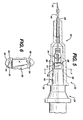
- IV catheter assembly 20 comprises catheter assembly 22 and needle assembly 24. Needle assembly 24 further includes needle tip protector 26.
- Catheter assembly 22 includes catheter 28 which is a tubular structure having a proximal end 31 and distal end 29. Proximal end 31 of catheter 28 is fixedly attached to catheter hub 30.
- catheter 28 is a tubular structure having a proximal end 31 and distal end 29. Proximal end 31 of catheter 28 is fixedly attached to catheter hub 30.
- catheter hub 30 is well known in the medical art and one of many suitable materials, most of which are flexible thermoplastics, may be selected for use in catheter 28. Such materials may include, for example, polyurethane or fluorinated ethylene propylene.
- Catheter hub 30 is a generally tubular structure having an internal cavity in fluid communication with the internal lumen of catheter 28.
- Catheter hub 30 may be made from a suitable, rigid medical grade thermoplastic such as, for example, polypropylene or polycarbonate.
- catheter hub 30 is shown translucent, though in actual use it may be translucent or opaque.
- Luer fitting 32 is integrally attached at the proximal end of catheter hub 30.
- Luer fitting 32 provides for secure, leakproof attachment of tubing, syringes, or any of many other medical devices used to infuse or withdraw fluids through the catheter assembly.
- rib 34 is a raised annular ring integral to and extending from internal sidewall 36 of catheter hub 30. Rib 34 is located approximately mid way between the proximal end and distal end of sidewall 36. Rib 34 plays an important role in securing needle tip protector 26 in catheter hub 30, as will be described in more detail later.
- needle assembly 24 comprises needle 38, which is a tubular structure with a proximal end 39 and distal end 41, needle hub 40, and needle tip protector 26. Needle tip protector 26 is assembled slidably on needle 38. Needle 38 is preferably made of stainless steel. Proximal end 39 of needle 38 is fixedly attached to needle hub 40. A bevel 42 is located at the most distal end of needle 38 creating a sharp piercing tip. Needle crimp 44 is located at the distal end of needle 38 proximal to bevel 42 and is larger in diameter than the nominal diameter of needle 38.
- Needle crimp 44 is created by "coining" an area on the outside diameter of needle 38 resulting in two opposed bumps located approximately 180 degrees across the center axis of needle 38.
- Coining is a process well known in the metal forming art and involves using a hardened tool to strike a softer object to deform or displace a portion of the softer object.
- a portion of the exterior surface of the softer metal needle 38 is displaced by a harder metal tool so as to raise bumps on the exterior surface of needle 38.
- the resulting crimp 44 is larger in dimension than the nominal diameter of needle 38.
- Crimp 44 is larger in dimension than the diameter of second flange hole 72 in needle tip protector 26 and is important in preventing the complete removal of needle tip protector 26 from needle 38, as will be described in more detail later.
- the dimension across crimp 44 is .0001- .004 inches larger than second flange hole 72, dependant upon needle "gauge" size.
- Needle hub 40 is generally a tubular structure having an internal cavity in fluid communication with the lumen in needle 38. It is preferably made of a translucent or transparent generally rigid thermoplastic material such as, for example, polycarbonate. At the most proximal end of the internal cavity in needle hub 40 is fixedly attached porous plug 46. A flashback chamber 48 is created in the cavity distal to porous plug 46. Porous plug 46 contains a plurality of microscopic openings which are large enough to permit the passage of air and other gasses but small enough to prevent the passage of blood. Flashback chamber 48 fills with blood upon successful entry of the needle tip into the targeted vein, providing the clinician visual conformation of the correct placement of the needle.
- needle tip protector 26 has a proximal end 49 and distal end 50 and is preferably a unitary structure formed from a single piece of thin, resilient material, preferably stainless steel.
- First flange 66 and second flange 68 are generally square and are integrally connected at right angles to first outer wall 74 and second outer wall 76, respectively.
- First outer wall 74 is connected at a right angle to first tab flange 78.
- First tab flange 78 and second tab flange 80 are each formed at angles slightly greater than 90 degrees to second outer wall 76 so that the resulting dimension c is slightly larger than inside diameter d (see Figures 6 - 7) across rib 34 in catheter hub 30.
- angles a and b are each approximately 94.25 degrees.
- dimension c is approximately .001 - .009 inches larger than dimension d.
- First flange hole 70 is located in the center of first flange 66 and is over-sized to slidably receive needle 38.
- Second flange hole 72 and skirt 82 are located in the center of second flange 68.
- Skirt 82 is integral to second flange hole 72 and is formed by extruding material from second flange hole 72 in a direction distal to second flange 68. This permits for a very close but slidable fit over the nominal diameter of needle 38. Skirt 82 also functions to help maintain alignment of needle 38 to the center axis of needle tip protector 26.
- flange hole 72 would be appropriately sized to the particular needle "gauge" size to which it is designed to receive.
- First tab 86 and second tab 88 are connected at right angles to first tab flange 78 and second tab flange 80, respectively, and protrude outward away from the center axis of needle tip protector 26.
- First tab edge 90, located on the outer portion of first tab 86, and second tab edge 92, located on the outer portion of second tab 88, are each arcuate to approximately match the curve of sidewall 36 in catheter hub 30.
- first beam 96 extends distally from first outer wall 74 and is angled toward and extends past the center axis of needle tip protector 26.
- first beam 96 extends distally from first outer wall 74 and is angled toward and extends past the center axis of needle tip protector 26.
- Second beam 100 extends distally from second outer wall 76 and is angled toward and extends past the center axis of needle tip protector 26.
- stop flange 102 which extends across and normal to the center axis of needle tip protector 26.
- stop flange 102 opposite its connection to second beam 100 is integrally formed curved second lip 104.
- needle tip protector 26 is assembled to needle 38 as follows;
- needle assembly 24, including needle tip protector 26, is assembled into catheter assembly 22 as follows;
- Needle tip protector 26 is thus held distal to rib 34 inside the cavity in catheter hub 30 by the flexural forces of first tab 86 and second tab 88 since dimension c on needle tip protector 26 is larger than dimension d across rib 34 inside catheter hub 30. (see figure 6).
- first tab 86 and second tab 88 As needle tip protector 26 is finally seated distal to rib 34 causes flexure in second outer wall 76 and first tab flange 78 resulting in the approximate alignment of first flange hole 70 and second flange hole 72.
- the IV catheter assembly 20 of the present invention functions as follows;
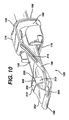
- needle tip protector 126 is preferably a unitary structure formed from a single piece of thin, resilient material such as, for example, stainless steel, similar to needle tip protector 26.
- Needle tip protector 126 includes first flange 166 and second flange 168.
- First flange 166 and second flange 168 are generally arcuate and are integrally connected to first outer wall 174 and second outer wall 176, respectively.
- Extending distally from first outer wall 174 of needle tip protector 126 is first beam 196.
- First beam 196 which has an arcuate outer edge, is angled toward and extends past the center axis of needle tip protector 126.
- First beam 196 further includes first rib 314 coined therein to add stiffness.
- first beam 196 At the distal end of first beam 196 is integrally formed curved first lip 198 which extends across and through the center axis of needle tip protector 126. Extending distally from second outer wall 176 of needle tip protector 126 is second beam 200. Second beam 200, which has an arcuate outer edge, is angled toward and extends past the center axis of needle tip protector 126. Second beam 200 further includes second rib 316 (not visible) coined therein to add stiffness. The distal end of second beam 200 is connected to the proximal end of wing base 306. Wing base 306 extends across and parallel to the center axis of needle tip protector 126. Wing base 306 further comprises first wing side 308 and second wing side 310.
- Wing 312 Integrally attached to first wing side 308 of wing base 306 at approximately a 90° angle is wing 312.
- Wing 312 which extends parallel to the center axis of needle tip protector 126, prevents any further radial movement of needle 138 by retaining it within needle tip protector 126.
- Stop flange 302 extends across needle 138 and is angled toward the center axis of needle tip protector 126.
- Second lip 304 is curved toward proximal end 149 of needle tip protector 126 to prevent any further distal movement of needle 138.
Landscapes
- Health & Medical Sciences (AREA)
- Life Sciences & Earth Sciences (AREA)
- Biophysics (AREA)
- Pulmonology (AREA)
- Engineering & Computer Science (AREA)
- Anesthesiology (AREA)
- Biomedical Technology (AREA)
- Heart & Thoracic Surgery (AREA)
- Hematology (AREA)
- Animal Behavior & Ethology (AREA)
- General Health & Medical Sciences (AREA)
- Public Health (AREA)
- Veterinary Medicine (AREA)
- Media Introduction/Drainage Providing Device (AREA)
- Infusion, Injection, And Reservoir Apparatuses (AREA)
Abstract
Description
Claims (22)
- A needle tip protector (126) for shielding a needle tip (42), said needle tip protector (126) having a proximal end (49), a distal end (50) and a needle receiving space extending therebetween, a proximal opening (70 or 72) at said proximal end (49) sized to receive a shaft of a needle (138) therethrough and into said needle receiving space, first and second arms (196, 200) extending from said proximal end (49) to said distal end (50), with said first arm (200) crossing said second arm (196) on respective first and second sides of said needle receiving space, each of said first and second arms (196, 200) terminating in a distal end portion (198; 302 or 304) configured to pass said needle shaft (138) therebetween in a first position of said first and second arms (196, 200), at least one of said distal end portions (198; 302 or 304) blocking a tip of said needle (138) in a second position of said first and second arms (196, 200), characterized by a first wing (312) supported on said first arm (200) proximal said distal end portion (302) thereof so as to extend adjacent one of the first and second sides of said needle receiving space.
- The needle tip protector (126) of claim 1 further comprising a second wing (312) supported on said second arm (196) proximal said distal end portion (198) thereof so as to extend adjacent the other of the first and second sides of said needle receiving space.
- The needle tip protector (126) of claim 2 wherein said second wing (312) is disposed on the first side of said needle receiving space.
- The needle tip protector of claim 3 wherein said first wing (312) is disposed on the second side of said needle receiving space.
- The needle tip protector of any one of the preceding claims, wherein the needle tip protector includes a first flange (166) and a second flange (168), the flanges being integrally connected to a first outer wall (174) and a second outer wall (176), respectively.
- The needle tip protector of any one of the preceding claims, wherein the distal end of a second wing (200) is connected to the proximal end of a wing base (306), and the wing base (306) extends across and parallel to the centre axis of the needle tip protector (126), the wing base (306) comprising a first wing side (308) and a second wing side (310).
- The needle tip protector of claim 6, wherein the wing (312) is attached to the first wing side (308) of the wing base (306) at approximately a 90° angle.
- The needle tip protector of any one of the preceding claims, wherein the wing (312) extends parallel to the centre axis of needle tip protector (126).
- The needle tip protector (126) of any one of the preceding claims, further comprising a skirt (82) extending in a distal direction from said opening (72) coaxial with said needle receiving space.
- A needle tip protector (126) for shielding a needle tip (42), said needle tip protector (126) having a proximal end (49), a distal end (50) and a needle receiving space extending therebetween, a proximal opening (70 or 72) at said proximal end (49) sized to receive a shaft of a needle (138) therethrough and into said needle receiving space, first and second arms (196, 200) extending from said proximal end (49) to said distal end (50), with said first arm (200) crossing said second arm (196) on respective first and second sides of said needle receiving space, each of said first and second arms (196, 200) terminating in a distal end portion (198; 302 or 304) configured to pass said needle shaft (138) therebetween in a first position of said first and second arms (196, 200), at least one of said distal end portions (198; 302 or 304) blocking a tip of said needle in a second position of said first and second arms (196, 200), characterized by skirt (82) extending in a distal direction from said opening (72) coaxial with said needle receiving space.
- The catheter and introducer needle assembly of claim 10, wherein the proximal end comprises a first flange (66) and a second flange (68) which are integrally connected at right angles to a first outer wall (74) and a second outer wall (76), respectively, first outer wall (74) is connected at a right angle to first tab flange (78) and the opening extends through both flanges (66, 68), wherein the second flange (68) is arranged distal and over the first flange (66) and the skirt (82) is integral to and extends distal from the second flange (68).
- The needle tip protector (126) of any preceding claim, wherein said first and second arms (196, 200) each has an intermediate narrow portion such that said needle shaft (138) can pass between said crossing first and second arms (196, 200).
- The needle tip protector (126) of any preceding claim, wherein said first and second arms (196, 200) are of resilient material such that said needle shaft (138) applies an outward radial force on said distal end portions (198; 302 or 304) to hold said arms (196, 200) in the first position until said needle tip (42) passes from between said distal end portions (198; 302 or 304) of said first and second arms (196, 200).
- The needle tip protector (126) of any preceding claim, wherein said distal end portions (198; 302 or 304) of said first and second arms (196, 200) overlap one another.
- The needle tip protector (126) of any preceding claim, wherein said distal end portions (198; 302 or 304) each includes a curved lip (198, 304).
- The needle tip protector (126) of claim 15, said curved lips (198, 304) engaging said needle shaft (138) in the first position of said first and second arms (196, 200).
- The needle tip protector (126) of claim 16, wherein at least one of said curved lips (198, 304) confronts said needle tip (42) in the second position of said first and second arms (196, 200).
- The needle tip protector (126) of any preceding claim, wherein said needle tip protector (126) is positioned on said needle shaft (138) within a catheter hub (30), said needle (138) being disposed within a catheter (28) extending from said catheter hub (30) with said first and second arms (196, 200) in the first position and said tip (42) of said needle (138) extending beyond said catheter (28), said first and second arms (196, 200) being in the second position after withdrawal of said needle (138) from said catheter (28) and said needle tip (42) passes from between said distal end portions (198; 302 or 304) of said first and second arms (196, 200) so as to be disposed in said needle tip protector (126).
- The needle tip protector (126) of claim 18, wherein an enlarged area (44) of said needle shaft (138) engages said opening (72) in said proximal end (49) when said needle (138) is withdrawn from said catheter (28) and said needle tip (42) passes from between said distal end portions (198; 302 or 304) of said first and second arms (196, 200) so as to be disposed in said needle tip protector (126).
- The needle tip protector (126) of any preceding claim wherein said proximal end (49) of said needle tip protector (126) includes a first proximal end wall (168) and an overlapping second proximal end wall (166).
- The needle tip protector (126) of claim 20, each end wall (166, 168) having said opening (70, 72) extending therethrough, said first arm (200) extending from said first end wall (168) and said second arm (200) extending from said second end wall (166).
- The needle tip protector (126) of any preceding claim being an integral metal piece.
Applications Claiming Priority (3)
| Application Number | Priority Date | Filing Date | Title |
|---|---|---|---|
| US09/965,427 US6652486B2 (en) | 2001-09-27 | 2001-09-27 | Safety catheter |
| US965427 | 2001-09-27 | ||
| EP02256710A EP1297859B1 (en) | 2001-09-27 | 2002-09-26 | Safety catheter |
Related Parent Applications (1)
| Application Number | Title | Priority Date | Filing Date |
|---|---|---|---|
| EP02256710A Division EP1297859B1 (en) | 2001-09-27 | 2002-09-26 | Safety catheter |
Publications (2)
| Publication Number | Publication Date |
|---|---|
| EP1502621A2 true EP1502621A2 (en) | 2005-02-02 |
| EP1502621A3 EP1502621A3 (en) | 2006-03-22 |
Family
ID=25509948
Family Applications (2)
| Application Number | Title | Priority Date | Filing Date |
|---|---|---|---|
| EP04077779A Withdrawn EP1502621A3 (en) | 2001-09-27 | 2002-09-26 | Safety catheter |
| EP02256710A Expired - Lifetime EP1297859B1 (en) | 2001-09-27 | 2002-09-26 | Safety catheter |
Family Applications After (1)
| Application Number | Title | Priority Date | Filing Date |
|---|---|---|---|
| EP02256710A Expired - Lifetime EP1297859B1 (en) | 2001-09-27 | 2002-09-26 | Safety catheter |
Country Status (6)
| Country | Link |
|---|---|
| US (1) | US6652486B2 (en) |
| EP (2) | EP1502621A3 (en) |
| JP (2) | JP4294929B2 (en) |
| CA (1) | CA2405331C (en) |
| DE (2) | DE60232941D1 (en) |
| ES (1) | ES2328794T3 (en) |
Cited By (1)
| Publication number | Priority date | Publication date | Assignee | Title |
|---|---|---|---|---|
| EP3058976B1 (en) | 2010-08-05 | 2019-07-03 | B. Braun Melsungen AG | Needle safety assembly |
Families Citing this family (172)
| Publication number | Priority date | Publication date | Assignee | Title |
|---|---|---|---|---|
| US8382721B2 (en) | 1997-08-20 | 2013-02-26 | B. Braun Melsungen Ag | Spring clip safety IV catheter |
| US8211070B2 (en) * | 1997-08-20 | 2012-07-03 | B. Braun Melsungen Ag | Spring clip safety IV catheter |
| DE20103363U1 (en) | 2001-02-26 | 2001-05-17 | Braun Melsungen Ag | Protection device for an injection needle |
| US7125397B2 (en) * | 1997-08-20 | 2006-10-24 | B. Braun Melsungen Ag | Protective device for an injection needle |
| US6749588B1 (en) | 1998-04-09 | 2004-06-15 | Becton Dickinson And Company | Catheter and introducer needle assembly with needle shield |
| US8177762B2 (en) | 1998-12-07 | 2012-05-15 | C. R. Bard, Inc. | Septum including at least one identifiable feature, access ports including same, and related methods |
| US6595955B2 (en) * | 2001-03-15 | 2003-07-22 | Specialized Health Products, Inc. | Safety shield for medical needles |
| US6984213B2 (en) * | 2001-03-15 | 2006-01-10 | Specialized Health Products, Inc. | Biopsy needle device |
| US6796962B2 (en) * | 2001-03-15 | 2004-09-28 | Specialized Health Products, Inc. | Safety shield for medical needles |
| US7004927B2 (en) | 2001-03-15 | 2006-02-28 | Specialized Health Products, Inc. | Safety shield for medical needles |
| US7413562B2 (en) | 2001-03-15 | 2008-08-19 | Specialized Health Products, Inc. | Safety shield for medical needles |
| US6902546B2 (en) * | 2001-03-15 | 2005-06-07 | Specialized Health Products, Inc. | Safety shield for medical needles |
| US7179244B2 (en) | 2001-03-15 | 2007-02-20 | Specialized Health Products, Inc. | Resettable safety shield for medical needles |
| DE20106697U1 (en) * | 2001-04-18 | 2001-10-31 | B. Braun Melsungen Ag, 34212 Melsungen | Catheter introducer |
| DE20210394U1 (en) * | 2002-07-04 | 2002-09-12 | B. Braun Melsungen Ag, 34212 Melsungen | catheter introducer |
| US7458954B2 (en) | 2002-11-07 | 2008-12-02 | Specialized Health Products, Inc. | Safety shield for medical needles |
| US7291130B2 (en) * | 2003-04-08 | 2007-11-06 | Smiths Medical Asd, Inc. | Safety needle and catheter assembly |
| MXPA05010820A (en) * | 2003-04-08 | 2006-03-30 | Medex Inc | Safety needle and catheter assembly. |
| WO2005034763A1 (en) | 2003-09-11 | 2005-04-21 | Nmt Medical, Inc. | Devices, systems, and methods for suturing tissue |
| US7988664B2 (en) | 2004-11-01 | 2011-08-02 | Tyco Healthcare Group Lp | Locking clip with trigger bushing |
| US7226434B2 (en) | 2003-10-31 | 2007-06-05 | Tyco Healthcare Group Lp | Safety shield |
| DE20316804U1 (en) * | 2003-10-31 | 2005-03-10 | B. Braun Melsungen Ag | catheter device |
| WO2005046487A1 (en) | 2003-11-06 | 2005-05-26 | Nmt Medical, Inc. | Transseptal puncture apparatus |
| US8292910B2 (en) | 2003-11-06 | 2012-10-23 | Pressure Products Medical Supplies, Inc. | Transseptal puncture apparatus |
| NZ546609A (en) | 2003-11-25 | 2011-02-25 | Specialized Health Prod Inc | Resettable safety shield for medical needles |
| CA2553940A1 (en) | 2004-01-30 | 2005-08-18 | Nmt Medical, Inc. | Devices, systems, and methods for closure of cardiac openings |
| US7207975B2 (en) * | 2004-02-12 | 2007-04-24 | Miller Stuart H | Needle stick protection device |
| US7662134B2 (en) * | 2004-02-12 | 2010-02-16 | Miller Stuart H | Needle stick protection device |
| KR20060130653A (en) * | 2004-02-13 | 2006-12-19 | 스미스 메디칼 에이에스디, 인크. | Needle tip protector |
| US7513888B2 (en) * | 2004-02-17 | 2009-04-07 | Smiths Medical Asd, Inc. | Needle guards |
| US7112191B2 (en) * | 2004-06-15 | 2006-09-26 | Neha Daga | Needle safety device for an intravenous catheter apparatus and method of use |
| US7850650B2 (en) | 2005-07-11 | 2010-12-14 | Covidien Ag | Needle safety shield with reset |
| US7828773B2 (en) | 2005-07-11 | 2010-11-09 | Covidien Ag | Safety reset key and needle assembly |
| US7905857B2 (en) | 2005-07-11 | 2011-03-15 | Covidien Ag | Needle assembly including obturator with safety reset |
| US8029482B2 (en) | 2005-03-04 | 2011-10-04 | C. R. Bard, Inc. | Systems and methods for radiographically identifying an access port |
| WO2006096686A1 (en) | 2005-03-04 | 2006-09-14 | C.R. Bard, Inc. | Access port identification systems and methods |
| US9474888B2 (en) | 2005-03-04 | 2016-10-25 | C. R. Bard, Inc. | Implantable access port including a sandwiched radiopaque insert |
| US7947022B2 (en) | 2005-03-04 | 2011-05-24 | C. R. Bard, Inc. | Access port identification systems and methods |
| EP2324880B1 (en) | 2005-04-27 | 2014-12-24 | C.R. Bard, Inc. | Infusion apparatuses provided with septum |
| US10307581B2 (en) | 2005-04-27 | 2019-06-04 | C. R. Bard, Inc. | Reinforced septum for an implantable medical device |
| US8147455B2 (en) * | 2005-04-27 | 2012-04-03 | C. R. Bard, Inc. | Infusion apparatuses and methods of use |
| US20060276747A1 (en) | 2005-06-06 | 2006-12-07 | Sherwood Services Ag | Needle assembly with removable depth stop |
| DE602006005674D1 (en) | 2005-07-06 | 2009-04-23 | Vascular Pathways Inc | DEVICE FOR INTRAVENOUS CATHETER INTRODUCTION AND USE METHOD |
| US7731692B2 (en) | 2005-07-11 | 2010-06-08 | Covidien Ag | Device for shielding a sharp tip of a cannula and method of using the same |
| US8403886B2 (en) * | 2005-08-08 | 2013-03-26 | Smiths Medical Asd, Inc. | Needle guard clip with lip |
| US8251950B2 (en) | 2005-08-08 | 2012-08-28 | Smiths Medical Asd, Inc. | Needle guard clip with heel |
| US7597681B2 (en) * | 2005-08-08 | 2009-10-06 | Smiths Medical Asd, Inc. | Needle guard mechanism with shroud |
| US8162881B2 (en) * | 2005-08-08 | 2012-04-24 | Smiths Medical Asd, Inc. | Needle guard mechanism with angled strut wall |
| US20070038187A1 (en) | 2005-08-08 | 2007-02-15 | Albert Sean J | Needle guard mechanism with anti-rotation feature |
| US7632243B2 (en) * | 2005-08-08 | 2009-12-15 | Smiths Medical Asd, Inc. | Duckbill catheter release mechanism |
| US7670317B2 (en) * | 2005-10-25 | 2010-03-02 | Becton, Dickinson And Company | One piece low drag septum |
| US7654735B2 (en) | 2005-11-03 | 2010-02-02 | Covidien Ag | Electronic thermometer |
| US7798994B2 (en) * | 2005-11-15 | 2010-09-21 | Becton, Dickinson And Company | Needle shield to septum interconnect |
| US7736337B2 (en) * | 2006-02-16 | 2010-06-15 | Smiths Medical, Asd, Inc. | Sealing catheter hub attachment |
| US20070196414A1 (en) * | 2006-02-23 | 2007-08-23 | Ola Hammarsten | Device to prevent blood leakage using intravenous catheters |
| AU2007242198B2 (en) * | 2006-03-29 | 2012-02-16 | Terumo Kabushiki Kaisha | Protector |
| US20080097330A1 (en) * | 2006-07-18 | 2008-04-24 | Smiths Medical Asd, Inc. | Catheter insertion device with fluid leakage control |
| US8308691B2 (en) | 2006-11-03 | 2012-11-13 | B. Braun Melsungen Ag | Catheter assembly and components thereof |
| US8382718B2 (en) * | 2006-07-31 | 2013-02-26 | B. Braun Melsungen Ag | Needle assembly and components thereof |
| US8257313B2 (en) | 2006-08-11 | 2012-09-04 | Becton, Dickinson And Company | Integrated septum and needle tip shield for a catheter assembly |
| JP4994775B2 (en) | 2006-10-12 | 2012-08-08 | 日本コヴィディエン株式会社 | Needle point protector |
| US8021324B2 (en) | 2007-07-19 | 2011-09-20 | Medical Components, Inc. | Venous access port assembly with X-ray discernable indicia |
| US9642986B2 (en) | 2006-11-08 | 2017-05-09 | C. R. Bard, Inc. | Resource information key for an insertable medical device |
| US9265912B2 (en) | 2006-11-08 | 2016-02-23 | C. R. Bard, Inc. | Indicia informative of characteristics of insertable medical devices |
| US9056188B2 (en) * | 2006-11-22 | 2015-06-16 | Becton, Dickinson And Company | Needle shielding flag structures |
| US9220871B2 (en) * | 2006-11-22 | 2015-12-29 | Becton, Dickinson And Company | Needle shielding pawl structures |
| JP5139518B2 (en) | 2007-05-07 | 2013-02-06 | バスキュラー・パスウェイズ・インコーポレイテッド | Venous catheter insertion device |
| ES3051388T3 (en) | 2007-06-20 | 2025-12-29 | Medical Components Inc | Implantable access port with molded and/or radiopaque indicia |
| WO2009012395A1 (en) | 2007-07-19 | 2009-01-22 | Innovative Medical Devices, Llc | Venous access port assembly with x-ray discernable indicia |
| US7713243B2 (en) * | 2007-09-25 | 2010-05-11 | Becton, Dickinson And Company | Tip shield for needle stick prevention |
| WO2009042874A1 (en) | 2007-09-27 | 2009-04-02 | Tyco Healthcare Group Lp | I.v. catheter assembly and needle safety device |
| US8357104B2 (en) | 2007-11-01 | 2013-01-22 | Coviden Lp | Active stylet safety shield |
| US9579496B2 (en) | 2007-11-07 | 2017-02-28 | C. R. Bard, Inc. | Radiopaque and septum-based indicators for a multi-lumen implantable port |
| CN101909681B (en) * | 2007-11-21 | 2013-01-30 | 贝克顿·迪金森公司 | Needle safety device |
| US8298180B2 (en) | 2007-11-21 | 2012-10-30 | Becton, Dickinson And Company | Safety needle guard |
| ATE482738T1 (en) | 2007-12-20 | 2010-10-15 | Tyco Healthcare | CAP ASSEMBLY WITH SPRING-LOADED CUFF |
| US7828774B2 (en) * | 2008-05-12 | 2010-11-09 | Harding Weston F | Sleeved clip safety |
| US8038647B2 (en) * | 2008-05-21 | 2011-10-18 | Becton, Dickinson And Company | Needle safety deflection device |
| US8398597B2 (en) * | 2008-06-17 | 2013-03-19 | Becton, Dickinson And Company | Needle shield and interlock |
| US20100016829A1 (en) * | 2008-07-15 | 2010-01-21 | Krumme John F | Apparatus and methods for retaining a needle on a medical injector |
| US7785296B2 (en) * | 2008-07-17 | 2010-08-31 | Smiths Medical Asd, Inc. | Needle tip spring protector |
| JP5321957B2 (en) * | 2008-10-03 | 2013-10-23 | ニプロ株式会社 | Indwelling needle assembly |
| US8900199B2 (en) * | 2008-10-03 | 2014-12-02 | Nipro Corporation | Needle tip protector and indwelling needle assembly |
| JP5136855B2 (en) * | 2008-10-03 | 2013-02-06 | ニプロ株式会社 | Needle tip protector and indwelling needle assembly |
| JP5322023B2 (en) * | 2008-10-03 | 2013-10-23 | ニプロ株式会社 | Needle tip protector and indwelling needle assembly |
| EP2346553B1 (en) | 2008-10-31 | 2022-01-19 | C.R. Bard, Inc. | Systems and methods for identifying an access port |
| US11890443B2 (en) | 2008-11-13 | 2024-02-06 | C. R. Bard, Inc. | Implantable medical devices including septum-based indicators |
| US8932271B2 (en) | 2008-11-13 | 2015-01-13 | C. R. Bard, Inc. | Implantable medical devices including septum-based indicators |
| US8439877B2 (en) * | 2009-03-02 | 2013-05-14 | Becton, Dickinson And Company | Bi-directionally engageable cannula crimp feature |
| US9399120B2 (en) | 2009-03-02 | 2016-07-26 | Becton, Dickinson And Company | Bi-directional cannula feature capture mechanism |
| US8496623B2 (en) * | 2009-03-02 | 2013-07-30 | Becton, Dickinson And Company | Bi-directional cannula feature capture mechanism |
| US8936575B2 (en) * | 2009-03-19 | 2015-01-20 | Becton, Dickinson And Company | Cannula-tip shielding mechanism |
| DE102009020061A1 (en) | 2009-05-06 | 2010-11-11 | B. Braun Melsungen Ag | Needle protection device for a medical hollow needle |
| US20100305519A1 (en) * | 2009-06-02 | 2010-12-02 | Becton, Dickinson And Company | Cannula having an overlapping cannula feature and notch feature |
| US8715244B2 (en) | 2009-07-07 | 2014-05-06 | C. R. Bard, Inc. | Extensible internal bolster for a medical device |
| US8474300B2 (en) * | 2009-07-20 | 2013-07-02 | Becton, Dickinson And Company | Methods to provide a feature on a needle |
| US8382751B2 (en) | 2009-09-10 | 2013-02-26 | Covidien Lp | System and method for power supply noise reduction |
| CN105288836B (en) | 2009-11-17 | 2018-09-25 | C·R·巴德股份有限公司 | Cladding molding including anchoring device and identification division enters port |
| UA110794C2 (en) | 2010-05-05 | 2016-02-25 | Полі Медікьюе Лімітед | Protective device for medical needles instruments and node iv catheter comprising said needle protective device |
| US9950139B2 (en) | 2010-05-14 | 2018-04-24 | C. R. Bard, Inc. | Catheter placement device including guidewire and catheter control elements |
| US11925779B2 (en) | 2010-05-14 | 2024-03-12 | C. R. Bard, Inc. | Catheter insertion device including top-mounted advancement components |
| US9872971B2 (en) | 2010-05-14 | 2018-01-23 | C. R. Bard, Inc. | Guidewire extension system for a catheter placement device |
| US8932258B2 (en) | 2010-05-14 | 2015-01-13 | C. R. Bard, Inc. | Catheter placement device and method |
| US10384039B2 (en) | 2010-05-14 | 2019-08-20 | C. R. Bard, Inc. | Catheter insertion device including top-mounted advancement components |
| US8257322B2 (en) | 2010-06-02 | 2012-09-04 | Smiths Medical Asd, Inc. | Tip protector for a safety catheter |
| USD682416S1 (en) | 2010-12-30 | 2013-05-14 | C. R. Bard, Inc. | Implantable access port |
| USD676955S1 (en) | 2010-12-30 | 2013-02-26 | C. R. Bard, Inc. | Implantable access port |
| US8690833B2 (en) | 2011-01-31 | 2014-04-08 | Vascular Pathways, Inc. | Intravenous catheter and insertion device with reduced blood spatter |
| EP3563898B1 (en) | 2011-02-25 | 2020-11-11 | C.R. Bard, Inc. | Medical component insertion device including a retractable needle |
| US8764711B2 (en) | 2011-02-28 | 2014-07-01 | Injectimed, Inc. | Needle guard |
| AU2015200294B2 (en) * | 2011-02-28 | 2017-02-09 | Injectimed, Inc. | Needle guard |
| US9238104B2 (en) | 2011-02-28 | 2016-01-19 | Injectimed, Inc. | Needle guard |
| USD655406S1 (en) * | 2011-03-07 | 2012-03-06 | Becton, Dickinson And Company | Vented flushable catheter assembly |
| US8486024B2 (en) | 2011-04-27 | 2013-07-16 | Covidien Lp | Safety IV catheter assemblies |
| USD903101S1 (en) | 2011-05-13 | 2020-11-24 | C. R. Bard, Inc. | Catheter |
| WO2013014639A1 (en) * | 2011-07-26 | 2013-01-31 | Poly Medicure Limited | Needle tip protector assembly for safety iv catheter assembly |
| WO2013048975A1 (en) | 2011-09-26 | 2013-04-04 | Covidien Lp | Safety catheter |
| WO2013048768A1 (en) | 2011-09-26 | 2013-04-04 | Covidien Lp | Safety iv catheter and needle assembly |
| US8834422B2 (en) | 2011-10-14 | 2014-09-16 | Covidien Lp | Vascular access assembly and safety device |
| EP4233970B1 (en) * | 2011-11-08 | 2025-09-03 | Poly Medicure Limited | Intravenous catheter apparatus |
| US9821145B2 (en) | 2012-03-23 | 2017-11-21 | Pressure Products Medical Supplies Inc. | Transseptal puncture apparatus and method for using the same |
| KR101289445B1 (en) | 2012-04-05 | 2013-07-24 | 이영석 | Injection kit with catheter absorbable into the body |
| SE537262C2 (en) * | 2012-06-15 | 2015-03-17 | Vigmed Ab | A closed IV catheter system comprising a needle guard device |
| BR112015004357A8 (en) * | 2012-08-27 | 2019-08-13 | Injectimed Inc | safety needle device |
| WO2014107133A1 (en) * | 2013-01-03 | 2014-07-10 | Vigmed Ab | Spring clip needle guard |
| CN105102054B (en) | 2013-01-30 | 2018-04-20 | 血管通路股份有限公司 | Systems and methods for venipuncture and catheter placement |
| US11224724B2 (en) | 2013-03-12 | 2022-01-18 | Teleflex Medical Incorporated | Catheter insertion device |
| US10357635B2 (en) | 2013-03-12 | 2019-07-23 | Teleflex Medical Incorporated | Catheter insertion device |
| US9717886B2 (en) | 2013-03-12 | 2017-08-01 | Teleflex Medical Incorporated | Safety clip for a needle |
| US10500376B2 (en) | 2013-06-07 | 2019-12-10 | Becton, Dickinson And Company | IV catheter having external needle shield and internal blood control septum |
| GB2508570C2 (en) | 2013-08-21 | 2025-07-30 | Braun Melsungen Ag | Catheter assembly |
| US9555221B2 (en) | 2014-04-10 | 2017-01-31 | Smiths Medical Asd, Inc. | Constant force hold tip protector for a safety catheter |
| US10729890B2 (en) | 2014-04-18 | 2020-08-04 | Becton, Dickinson And Company | Multi-use blood control safety catheter assembly |
| WO2016037127A1 (en) | 2014-09-05 | 2016-03-10 | C.R. Bard, Inc. | Catheter insertion device including retractable needle |
| US11511052B2 (en) | 2014-11-10 | 2022-11-29 | Becton, Dickinson And Company | Safety IV catheter with V-clip interlock and needle tip capture |
| MY182202A (en) * | 2015-04-17 | 2021-01-18 | Becton Dickinson Co | Needle capture safety interlock for catheter |
| USD903100S1 (en) | 2015-05-01 | 2020-11-24 | C. R. Bard, Inc. | Catheter placement device |
| WO2016187037A1 (en) | 2015-05-15 | 2016-11-24 | C.R.Bard, Inc. | Catheter placement device including an extensible needle safety component |
| CN105617482B (en) * | 2015-09-28 | 2019-10-25 | 广东龙心医疗器械有限公司 | Disposable anti-needle pierces remaining needle |
| US10549072B2 (en) | 2015-10-28 | 2020-02-04 | Becton, Dickinson And Company | Integrated catheter with independent fluid paths |
| US10245416B2 (en) | 2015-10-28 | 2019-04-02 | Becton, Dickinson And Company | Intravenous catheter device with integrated extension tube |
| US10525237B2 (en) | 2015-10-28 | 2020-01-07 | Becton, Dickinson And Company | Ergonomic IV systems and methods |
| US10357636B2 (en) | 2015-10-28 | 2019-07-23 | Becton, Dickinson And Company | IV access device having an angled paddle grip |
| US10814106B2 (en) | 2015-10-28 | 2020-10-27 | Becton, Dickinson And Company | Soft push tabs for catheter adapter |
| US10744305B2 (en) | 2015-10-28 | 2020-08-18 | Becton, Dickinson And Company | Ergonomic IV systems and methods |
| US10639455B2 (en) | 2015-10-28 | 2020-05-05 | Becton, Dickinson And Company | Closed IV access device with paddle grip needle hub and flash chamber |
| EP3417902B1 (en) | 2016-02-18 | 2024-05-01 | Terumo Kabushiki Kaisha | Catheter assembly |
| USD806862S1 (en) * | 2016-06-06 | 2018-01-02 | Medsource International Llc | Safety I.V. catheter |
| CN109715093B (en) | 2016-09-12 | 2020-11-06 | C·R·巴德股份有限公司 | Blood Control for Catheterization Devices |
| USD819802S1 (en) | 2016-10-05 | 2018-06-05 | Becton, Dickinson And Company | Catheter adapter |
| USD835262S1 (en) | 2016-10-05 | 2018-12-04 | Becton, Dickinson And Company | Intravenous catheter assembly |
| US10238852B2 (en) | 2016-10-05 | 2019-03-26 | Becton, Dickinson And Company | Septum housing |
| USD837368S1 (en) | 2016-10-05 | 2019-01-01 | Becton, Dickinson And Company | Catheter adapter grip |
| USD844781S1 (en) | 2016-10-05 | 2019-04-02 | Becton, Dickinson And Company | Needle hub |
| US10980522B2 (en) | 2016-10-18 | 2021-04-20 | Piper Access, Llc | Intraosseous access devices, systems, and methods |
| USD858755S1 (en) * | 2017-01-25 | 2019-09-03 | Becton, Dickinson And Company | Catheter assembly and needle cover |
| USD859651S1 (en) * | 2017-01-25 | 2019-09-10 | Becton, Dickinson And Company | Catheter hub |
| USD865956S1 (en) | 2017-01-25 | 2019-11-05 | Becton, Dickinson And Company | Catheter assembly |
| US11400260B2 (en) | 2017-03-01 | 2022-08-02 | C. R. Bard, Inc. | Catheter insertion device |
| CA3053800C (en) * | 2017-03-06 | 2020-05-05 | Smiths Medical Asd, Inc. | Blood containment for iv catheter |
| EP3568083B1 (en) | 2017-03-07 | 2021-04-28 | Piper Access, LLC. | Safety shields for elongated instruments and related systems |
| JP7169984B2 (en) | 2017-03-10 | 2022-11-11 | パイパー・アクセス、エルエルシー | Fastening device, fastening system, and fastening method |
| AU2018251786B2 (en) | 2017-04-13 | 2020-08-27 | Teleflex Medical Llc | Catheter insertion device |
| US10828467B2 (en) * | 2017-11-30 | 2020-11-10 | Becton, Dickinson And Company | Catheter assembly |
| ES2953372T3 (en) | 2018-02-20 | 2023-11-10 | Piper Access Llc | Drilling devices and related methods |
| CN115671504A (en) | 2018-03-07 | 2023-02-03 | 巴德阿克塞斯系统股份有限公司 | Guidewire advancement and blood flashback system for medical device insertion systems |
| USD921884S1 (en) | 2018-07-27 | 2021-06-08 | Bard Access Systems, Inc. | Catheter insertion device |
| WO2020068771A1 (en) * | 2018-09-25 | 2020-04-02 | Smiths Medical Asd, Inc. | Cannula bump |
| JP7312260B2 (en) | 2019-04-23 | 2023-07-20 | スミス メディカル エーエスディー インコーポレーテッド | Catheter insertion device with improved push tab and tip protector assembly |
| CN213312819U (en) | 2019-08-19 | 2021-06-01 | 贝克顿·迪金森公司 | Midline catheter placement device |
| WO2021054980A1 (en) | 2019-09-20 | 2021-03-25 | Bard Peripheral Vascular, Inc. | Intravenous catheter-placement device |
| US20250099688A1 (en) * | 2021-11-22 | 2025-03-27 | Nipro Corporation | Needle tip protector |
Family Cites Families (37)
| Publication number | Priority date | Publication date | Assignee | Title |
|---|---|---|---|---|
| US4790828A (en) | 1987-08-07 | 1988-12-13 | Dombrowski Mitchell P | Self-capping needle assembly |
| US5009642A (en) | 1987-09-28 | 1991-04-23 | Bio-Plexus, Inc. | Self-blunting needle assembly for use with a catheter, and catheter assembly using the same |
| US4828547A (en) | 1987-09-28 | 1989-05-09 | Bio-Plexus, Inc. | Self-blunting needle assembly and device including the same |
| USRE34416E (en) | 1988-07-11 | 1993-10-19 | Critikon, Inc. | I.V. catheter with self-locating needle guard |
| US4952207A (en) | 1988-07-11 | 1990-08-28 | Critikon, Inc. | I.V. catheter with self-locating needle guard |
| US4929241A (en) | 1988-08-05 | 1990-05-29 | Kulli John C | Medical needle puncture guard |
| US4978344A (en) | 1988-08-11 | 1990-12-18 | Dombrowski Mitchell P | Needle and catheter assembly |
| US4964854A (en) | 1989-01-23 | 1990-10-23 | Luther Medical Products, Inc. | Intravascular catheter assembly incorporating needle tip shielding cap |
| US5458658A (en) | 1989-02-01 | 1995-10-17 | Sero-Guard Corporation | Positive locking needle-mounted needle guard for needle supported catheters |
| AU649218B2 (en) * | 1989-02-01 | 1994-05-19 | Sero-Guard Corporation | Disposable automatic hypodermic needle guard |
| US5000740A (en) | 1989-04-10 | 1991-03-19 | Critikon, Inc. | Catheter with needle guard |
| US5135504A (en) | 1989-07-17 | 1992-08-04 | Mclees Donald J | Needle tip guard |
| US5049136A (en) * | 1990-01-10 | 1991-09-17 | Johnson Gerald W | Hypodermic needle with protective sheath |
| US5053017A (en) | 1990-02-28 | 1991-10-01 | Chamuel Steven R | Hypodermic needle safety clip |
| US5558651A (en) | 1990-04-20 | 1996-09-24 | Becton Dickinson And Company | Apparatus and method for a needle tip cover |
| US5085648A (en) | 1990-09-13 | 1992-02-04 | Becton Dickinson And Company | Dual diameter needle with a smooth transition |
| US5183468A (en) | 1991-04-02 | 1993-02-02 | Mclees Donald J | Snap ring needle guard |
| US5273540A (en) | 1991-04-26 | 1993-12-28 | Luther Medical Products | Nonreusable needle and catheter assembly |
| US5215528C1 (en) | 1992-02-07 | 2001-09-11 | Becton Dickinson Co | Catheter introducer assembly including needle tip shield |
| US5215525A (en) | 1992-09-29 | 1993-06-01 | Sturman Warren M | Safety casing for intravenous catheter needle |
| US5300045A (en) | 1993-04-14 | 1994-04-05 | Plassche Jr Walter M | Interventional needle having an automatically capping stylet |
| US5697907A (en) | 1993-07-20 | 1997-12-16 | Graphic Controls Corporation | Safety catheter |
| US5419766A (en) | 1993-09-28 | 1995-05-30 | Critikon, Inc. | Catheter with stick protection |
| US5334158A (en) | 1993-12-20 | 1994-08-02 | Mclees Donald J | Automatic needle tip guard for standard hypodermic needles |
| US6203527B1 (en) | 1994-03-29 | 2001-03-20 | Filiberto P. Zadini | Bi-directional clamping guard for needle stick protection |
| US5882337A (en) * | 1995-06-07 | 1999-03-16 | Johnson & Johnson Medical, Inc. | Tip protection device |
| IL118551A (en) * | 1995-06-07 | 2004-05-12 | Johnson & Johnson Medical | Protective needle cover containment |
| US6117108A (en) * | 1997-08-20 | 2000-09-12 | Braun Melsungen Ag | Spring clip safety IV catheter |
| US6004294A (en) | 1998-04-09 | 1999-12-21 | Becton, Dickinson And Company | Catheter and introducer needle assembly with needle shield |
| US6379333B1 (en) * | 1998-04-09 | 2002-04-30 | Becton, Dickinson And Company | Catheter and introducer needle assembly with needle shield |
| US6221047B1 (en) * | 1998-07-31 | 2001-04-24 | Albany Medical College | Safety intravenous catheter assembly and method for use with a needle |
| US6280419B1 (en) * | 1999-08-09 | 2001-08-28 | Arrow International, Inc. | Hypodermic needle guard |
| US6224569B1 (en) | 1999-09-24 | 2001-05-01 | Becton, Dickinson And Company | Compact needle point shield |
| US6210373B1 (en) | 1999-12-30 | 2001-04-03 | Ethicon, Inc. | Needle safety cover |
| US6322537B1 (en) * | 1999-12-30 | 2001-11-27 | Ethicon, Inc. | Safety intravenous catheter |
| US6585704B2 (en) * | 2001-01-29 | 2003-07-01 | B. Braun Medical, Inc. | Method of retaining a tip protector on a needle with a curved tip |
| US6595955B2 (en) * | 2001-03-15 | 2003-07-22 | Specialized Health Products, Inc. | Safety shield for medical needles |
-
2001
- 2001-09-27 US US09/965,427 patent/US6652486B2/en not_active Expired - Lifetime
-
2002
- 2002-09-26 JP JP2002281457A patent/JP4294929B2/en not_active Expired - Fee Related
- 2002-09-26 DE DE60232941T patent/DE60232941D1/en not_active Expired - Lifetime
- 2002-09-26 ES ES02256710T patent/ES2328794T3/en not_active Expired - Lifetime
- 2002-09-26 EP EP04077779A patent/EP1502621A3/en not_active Withdrawn
- 2002-09-26 EP EP02256710A patent/EP1297859B1/en not_active Expired - Lifetime
- 2002-09-26 CA CA002405331A patent/CA2405331C/en not_active Expired - Fee Related
- 2002-09-26 DE DE20221065U patent/DE20221065U1/en not_active Expired - Lifetime
-
2008
- 2008-12-16 JP JP2008320201A patent/JP2009056336A/en active Pending
Cited By (3)
| Publication number | Priority date | Publication date | Assignee | Title |
|---|---|---|---|---|
| EP3058976B1 (en) | 2010-08-05 | 2019-07-03 | B. Braun Melsungen AG | Needle safety assembly |
| US10661058B2 (en) | 2010-08-05 | 2020-05-26 | B. Braun Melsungen Ag | Needle safety device and assembly |
| EP2600925B1 (en) | 2010-08-05 | 2021-05-19 | B. Braun Melsungen AG | Needle safety device and assembly |
Also Published As
| Publication number | Publication date |
|---|---|
| EP1297859B1 (en) | 2009-07-15 |
| EP1502621A3 (en) | 2006-03-22 |
| ES2328794T3 (en) | 2009-11-18 |
| DE20221065U1 (en) | 2004-12-02 |
| US20030060771A1 (en) | 2003-03-27 |
| JP2003180833A (en) | 2003-07-02 |
| US6652486B2 (en) | 2003-11-25 |
| JP4294929B2 (en) | 2009-07-15 |
| EP1297859A3 (en) | 2004-02-11 |
| DE60232941D1 (en) | 2009-08-27 |
| CA2405331A1 (en) | 2003-03-27 |
| JP2009056336A (en) | 2009-03-19 |
| CA2405331C (en) | 2008-05-06 |
| EP1297859A2 (en) | 2003-04-02 |
Similar Documents
| Publication | Publication Date | Title |
|---|---|---|
| CA2405331C (en) | Safety catheter | |
| US7291130B2 (en) | Safety needle and catheter assembly | |
| US6663592B2 (en) | Catheter introducer assembly having safety shielded needle | |
| US6623461B1 (en) | Forward shielding safety device | |
| EP1702643B1 (en) | Spring clip as needle tip protection for a safety IV catheter | |
| EP1731192B1 (en) | Catheter and introducer needle assembly with needle shield | |
| US7654988B2 (en) | Needle capture mechanisms | |
| EP1610854B1 (en) | Safety needle and catheter assembly | |
| AU2006203663B2 (en) | Catheter and introducer needle assembly with safety device | |
| WO2006079766A1 (en) | Method of manufacturing hypodermic needle and safety assembly incorporating such needle |
Legal Events
| Date | Code | Title | Description |
|---|---|---|---|
| PUAI | Public reference made under article 153(3) epc to a published international application that has entered the european phase |
Free format text: ORIGINAL CODE: 0009012 |
|
| AC | Divisional application: reference to earlier application |
Ref document number: 1297859 Country of ref document: EP Kind code of ref document: P |
|
| AK | Designated contracting states |
Kind code of ref document: A2 Designated state(s): DE ES FR GB IT NL |
|
| PUAL | Search report despatched |
Free format text: ORIGINAL CODE: 0009013 |
|
| AK | Designated contracting states |
Kind code of ref document: A3 Designated state(s): DE ES FR GB IT NL |
|
| 17P | Request for examination filed |
Effective date: 20060303 |
|
| AKX | Designation fees paid |
Designated state(s): DE ES FR GB IT NL |
|
| RAP1 | Party data changed (applicant data changed or rights of an application transferred) |
Owner name: SMITHS MEDICAL ASD, INC. |
|
| 17Q | First examination report despatched |
Effective date: 20131001 |
|
| STAA | Information on the status of an ep patent application or granted ep patent |
Free format text: STATUS: THE APPLICATION IS DEEMED TO BE WITHDRAWN |
|
| 18D | Application deemed to be withdrawn |
Effective date: 20140212 |