EP1501033A2 - Interactive environment - Google Patents
Interactive environment Download PDFInfo
- Publication number
- EP1501033A2 EP1501033A2 EP04102674A EP04102674A EP1501033A2 EP 1501033 A2 EP1501033 A2 EP 1501033A2 EP 04102674 A EP04102674 A EP 04102674A EP 04102674 A EP04102674 A EP 04102674A EP 1501033 A2 EP1501033 A2 EP 1501033A2
- Authority
- EP
- European Patent Office
- Prior art keywords
- environment
- customers
- customer
- interactive
- interactive environment
- Prior art date
- Legal status (The legal status is an assumption and is not a legal conclusion. Google has not performed a legal analysis and makes no representation as to the accuracy of the status listed.)
- Withdrawn
Links
- 230000002452 interceptive effect Effects 0.000 title claims abstract description 43
- 230000005540 biological transmission Effects 0.000 claims abstract description 11
- 239000000463 material Substances 0.000 claims description 20
- 230000003993 interaction Effects 0.000 claims description 12
- 238000004891 communication Methods 0.000 claims description 5
- 230000000694 effects Effects 0.000 claims description 5
- 230000008859 change Effects 0.000 abstract description 6
- 230000035807 sensation Effects 0.000 abstract description 2
- 230000000007 visual effect Effects 0.000 abstract description 2
- 230000001413 cellular effect Effects 0.000 description 5
- 235000019640 taste Nutrition 0.000 description 4
- 238000004458 analytical method Methods 0.000 description 3
- 238000010586 diagram Methods 0.000 description 3
- 238000005516 engineering process Methods 0.000 description 3
- 230000006870 function Effects 0.000 description 3
- 230000006978 adaptation Effects 0.000 description 2
- 238000011161 development Methods 0.000 description 2
- 230000018109 developmental process Effects 0.000 description 2
- 238000010422 painting Methods 0.000 description 2
- 206010011971 Decreased interest Diseases 0.000 description 1
- 238000013461 design Methods 0.000 description 1
- 229910001385 heavy metal Inorganic materials 0.000 description 1
- 238000000034 method Methods 0.000 description 1
- 238000010295 mobile communication Methods 0.000 description 1
- 230000008569 process Effects 0.000 description 1
- 238000012545 processing Methods 0.000 description 1
- 238000009418 renovation Methods 0.000 description 1
- 230000004044 response Effects 0.000 description 1
- 239000011435 rock Substances 0.000 description 1
- 235000019615 sensations Nutrition 0.000 description 1
Images
Classifications
-
- H—ELECTRICITY
- H04—ELECTRIC COMMUNICATION TECHNIQUE
- H04L—TRANSMISSION OF DIGITAL INFORMATION, e.g. TELEGRAPHIC COMMUNICATION
- H04L67/00—Network arrangements or protocols for supporting network services or applications
- H04L67/2866—Architectures; Arrangements
- H04L67/30—Profiles
-
- H—ELECTRICITY
- H04—ELECTRIC COMMUNICATION TECHNIQUE
- H04L—TRANSMISSION OF DIGITAL INFORMATION, e.g. TELEGRAPHIC COMMUNICATION
- H04L67/00—Network arrangements or protocols for supporting network services or applications
- H04L67/01—Protocols
- H04L67/12—Protocols specially adapted for proprietary or special-purpose networking environments, e.g. medical networks, sensor networks, networks in vehicles or remote metering networks
-
- H—ELECTRICITY
- H04—ELECTRIC COMMUNICATION TECHNIQUE
- H04L—TRANSMISSION OF DIGITAL INFORMATION, e.g. TELEGRAPHIC COMMUNICATION
- H04L69/00—Network arrangements, protocols or services independent of the application payload and not provided for in the other groups of this subclass
- H04L69/30—Definitions, standards or architectural aspects of layered protocol stacks
- H04L69/32—Architecture of open systems interconnection [OSI] 7-layer type protocol stacks, e.g. the interfaces between the data link level and the physical level
- H04L69/322—Intralayer communication protocols among peer entities or protocol data unit [PDU] definitions
- H04L69/329—Intralayer communication protocols among peer entities or protocol data unit [PDU] definitions in the application layer [OSI layer 7]
-
- H—ELECTRICITY
- H04—ELECTRIC COMMUNICATION TECHNIQUE
- H04L—TRANSMISSION OF DIGITAL INFORMATION, e.g. TELEGRAPHIC COMMUNICATION
- H04L67/00—Network arrangements or protocols for supporting network services or applications
- H04L67/01—Protocols
- H04L67/131—Protocols for games, networked simulations or virtual reality
-
- H—ELECTRICITY
- H04—ELECTRIC COMMUNICATION TECHNIQUE
- H04L—TRANSMISSION OF DIGITAL INFORMATION, e.g. TELEGRAPHIC COMMUNICATION
- H04L67/00—Network arrangements or protocols for supporting network services or applications
- H04L67/2866—Architectures; Arrangements
- H04L67/30—Profiles
- H04L67/306—User profiles
-
- H—ELECTRICITY
- H04—ELECTRIC COMMUNICATION TECHNIQUE
- H04L—TRANSMISSION OF DIGITAL INFORMATION, e.g. TELEGRAPHIC COMMUNICATION
- H04L67/00—Network arrangements or protocols for supporting network services or applications
- H04L67/50—Network services
- H04L67/535—Tracking the activity of the user
-
- H—ELECTRICITY
- H04—ELECTRIC COMMUNICATION TECHNIQUE
- H04W—WIRELESS COMMUNICATION NETWORKS
- H04W8/00—Network data management
- H04W8/18—Processing of user or subscriber data, e.g. subscribed services, user preferences or user profiles; Transfer of user or subscriber data
Definitions
- the present invention relates to an interactive environment.
- the basic idea of the present invention is to provide a physical environment in continual interactive change with respect to in-house customers.
- Customers entering the environment determine an automatic change in the characteristics of the environment, in terms of visual and audio features, and psycho-physical sensations in general.
- Changes can be made to lighting, colour schemes, and the content of in-house multimedia audio and video transmissions: atmosphere, topics, celebrities, personal message displays and announcements.
- the interactive environment automatically identifies in-house customers, and accordingly adapts its physical characteristics automatically to their profiles, preferences, personal characteristics, and personal data.
- the mix of characteristics and preferences of large numbers of in-house customers determines the setup and look of the environment as a whole.
- GSM mobile telephones GSM mobile telephones
- GPRS telephones GPRS telephones
- UMTS systems UMTS systems
- WEB cable and wireless WEB, WAP networks
- RFID radio-frequency identification
- customers are identified by the environment's computer system by mobile GSM communication or RFID systems, but in future identification may be based on the same principle, but using more advanced mobile communication systems, such as GPRS and UMTS.
- the interactive environment runs a database in which each logged customer is assigned a personal data and preference record, which is gradually updated by the customer and the environment computer system.
- the database comprises four main records:
- the personal data record may be divided, for example, into the following fields: username/nickname, password, name and surname, status (M/F/single, married, etc.), date and place of birth, address (street, number, town), telephone numbers (home, cellular), e-mail address, profession.
- the interest and preference record is top-down organized, i.e. from general to specific, and may be divided, for example, into the following subrecords: hobbies, music, cinema, reading, sport, fashion, current affairs, fitness, travel, etc.; and each subrecord may in turn be divided, for example, into the following fields:
- the number of database fields varies alongside changes in customers' tastes and habits.
- the interactive environment transmits a sequence of multimedia material over various broadcasting channels, selecting it automatically from a database of edited multimedia material.
- the multimedia material database is organized into three main records:
- Each multimedia document is then classified according to the topics it contains.
- Multimedia documents entered into the database may, for example, be: a filmed recording of a sporting event; a fashion show video; Internet American TV news coverage of a rock group concert; a video of the last CD of a musician, etc.
- the interactive environment can thus transmit multimedia documents dealing with the customer's favourite topics.
- the interactive environment builds a given number of multimedia document sequences, on the basis of the preference mix of current in-house customers, by means of a dedicated software module or so-called Multimedia Mixer, which real-time adapts the multimedia document sequences according to the customers entering and leaving the environment, which is thus in continual interactive change with respect to in-house customers.
- a dedicated software module or so-called Multimedia Mixer which real-time adapts the multimedia document sequences according to the customers entering and leaving the environment, which is thus in continual interactive change with respect to in-house customers.
- the Multimedia Mixer controls a series of digital audio/video output devices (video screens, speakers, lights, etc.) over a wireless or fibre-optic local digital network to real-time modify and adapt the characteristics of each of its interactive areas to the customers in the Multimedia Mixer.
- the Multimedia Mixer screens the customer's nickname and the personal multimedia material selected by the customer by way of personal identification; and, as explained in detail later on, the customer's membership standing and score within the environment : a sort of anonymous multimedia identity card characterizing each customer.
- the interactive environment gradually acquires customers' characteristics, profiles, and preferences on the basis of the way in which customers interact with the various elements of the environment.
- the degree and extent to which customers interact with the various elements of the environment determine the extent to which the system is capable of identifying them.
- Interaction is intended to mean activity both within the environment and outside by Internet and cellular telephone.
- interaction with the environment is intended to mean:
- Alternative membership level criteria may be, for example: the order in which customers arrive; expenditure per unit of time (day, month, year, etc.); the type of products or services purchased; the length of time spent within the environment; the type of activity performed within the environment; the degree of participation in in-house events; the number of contacts made with other customers; the number of new customers introduced; and the degree of personal contribution.
- the interactive environment is also a network which goes beyond physical boundaries, and which links members, even when physically remote from the actual environment, over communications channels, such as: GSM mobile telephones, GPRS telephones, UMTS systems, cable and wireless WEB, WAP networks, and any other means of transmitting and receiving digital data.
- communications channels such as: GSM mobile telephones, GPRS telephones, UMTS systems, cable and wireless WEB, WAP networks, and any other means of transmitting and receiving digital data.
- LAN local network
- the interactive environment is also able to predict and cater to customers' information requirements concerning their favourite topics, not only when customers are actually within the environment, but also, and above all, when they are elsewhere but connected to the environment over the Internet.
- the system in fact is able to handle the purchasing requirements of known customers, both in-house and connected externally over the Internet, and, once the purchase is specified, to assist customers in evaluating and selecting goods or services, and to connect or direct them to given retail outlets.
- the interactive environment is able to provide customers, both in-house and connected externally over the network, with information about the commercial products of interest.
- Custom Promotion database which is organized in four main records:
- Each product is classified according to its characteristics, and products for given customers are selected by a dedicated product-customer matching software module.
- the interactive environment is dynamic with respect to customer development: by means of the same data acquisition, identification, and automatic environment adaptation system, the environment is able to track changes in customers' profiles, preferences, and tastes, thus growing and changing with them.
- the interactive environment is also dynamic with respect to developments in technology: customer identification and real-time environment adaptation are performed using the latest recognition and communication technology as it becomes available.
- the interactive environment is also able to characterize and identify customers by gathering information relative to tastes, habits, and preferences, simply on the basis of the way in which customers interact and behave within the environment.
- the system is dynamic by varying and enriching the above database structures as time goes by, so that the environment also varies according to changes in Multimedia Mixer and Custom Promotion input data.
- the customer database evolves by means of various types of data processing:
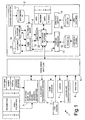
- Figure 1 shows an operating block diagram of the interactive environment according to the invention.
- the interactive environment substantially comprises:
- server 2 comprises software implementing the various functions described above, and in particular implementing the following software modules:
- the software of server 2 may conveniently also implement a so-called Area Info Service software module 14 for supplying customers with local information, and enabling institution and business partners to come into contact with young people to analyse their behaviour and preferences, implement social policies, learn the younger-generation's standpoint on various issues, supply information concerning current activities within the area, etc.
- Area Info Service software module 14 for supplying customers with local information, and enabling institution and business partners to come into contact with young people to analyse their behaviour and preferences, implement social policies, learn the younger-generation's standpoint on various issues, supply information concerning current activities within the area, etc.
- Server 2 stores all the databases mentioned previously, and in particular :
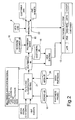
- FIG. 2 shows an operating block diagram of the Multimedia Mixer.
- multimedia material videos; music; films; documents; Internet, radio, and television material; live events
- multimedia material both material supplied by customers and institution and business partners, and material acquired by the environment over conventional channels, including live in-house events - is classified by an editing staff 21, who analyse the material and edit database 17, and is then loaded into multimedia database 17.
- Multimedia Mixer 10 therefore draws from both multimedia database 17 and in-house customer database 16, to compile sequences reflecting the preferences of in-house customers on the basis of their profiles and membership levels.
- the sequences compiled by Multimedia Mixer 10 are then transmitted to a direction 22 who, also on the basis of images from web cameras 8 installed throughout the environment, transmits the multimedia material by means of multimode platform 13.
- Figure 2 also shows a web editing module, which defines an html Internet interface (portal) by which the content of the multimedia and customer databases are transmitted to outside customers.
- the problems facing conventional entertainment businesses - gradual loss of interest by customers, and the fact that such businesses normally only attract customers who identify with the environment - are fully solved by the interactive environment according to the invention, which is an entertainment environment in continual interactive change with respect to in-house customers, by automatically identifying in-house customers, and automatically adapting its physical characteristics on the basis of customers' profiles and preferences.
- the membership level criteria may be other than as described.
Landscapes
- Engineering & Computer Science (AREA)
- Computer Networks & Wireless Communication (AREA)
- Signal Processing (AREA)
- Health & Medical Sciences (AREA)
- Computing Systems (AREA)
- General Health & Medical Sciences (AREA)
- Medical Informatics (AREA)
- Computer Security & Cryptography (AREA)
- Two-Way Televisions, Distribution Of Moving Picture Or The Like (AREA)
- Information Transfer Between Computers (AREA)
Abstract
Description
- customers entering the environment log on at a terminal at the entrance to the environment;
- customers entering the environment log onto the environment's computer system by SMS message over a cellular telephone; and the system sends back an SMS confirm-pass message once the customer is identified;
- customers already logged in the environment are issued a radio-frequency identification tag by which they are automatically identified at the entrance to the environment.
- personal data
- interests and preferences
- personal multimedia material (audio and/or video documents, texts, photographs, etc.)
- chronological interaction history, score, rank, etc.
- general preference field: fashion
- specific preference field: fashion.items = shoes
- specific preference field: fashion.items.type = shoes.gucci
- specific preference field: fashion.events = Paris winter 2004
- specific preference field: fashion.person = Versace
- specific preference field: fashion.location = Milan
- general preference field: sport
- specific preference field: sport.type = football
- specific preference field: sport.type.team = football.juventus
- specific preference field: sport.type.person = football.delpiero
- general preference field: music
- specific preference field: music.type = heavy metal
- specific preference field: music.type.person = AC-DC
- specific preference field: music.type.events = Live in London 1990
- general preference field: current affairs
- specific preference field: current affairs.topic #1 = city news
- specific preference field:
current
affairs.topic # 2 = gossip news - general preference field: hobby = history of art
- specific preference field: hobby.location = L'Ouvre Paris
- specific preference field: hobby.specific = painting
- specific preference field: hobby.person = Vittorio Sgarbi
- specific preference field: hobby.events = contemporary painting exhibition Tokyo 2001
- data identifying each multimedia document: author's name, code, duration, document data (name, file type and size, entry data, editing reference, description of content, etc.);
- interests and preferences covered by each multimedia document; and
- chronological transmission history of the multimedia document.
- frequenting the environment and making use of the entertainment and restaurant facilities provided;
- using the in-house local network to browse the Internet, chat, make purchases, play on-line, transmit messages, and define one's personal preference profile;
- using the in-house web portal to browse the Internet, chat, make purchases, play on-line, transmit messages, define one's personal preference profile, and remote monitor the environment, e.g. from home;
- communicating with other customers and transmitting/receiving information to/from the environment by cellular telephone.
- the greater the interaction between the customer and the environment, the higher the customer's score is, the more accurately the customer's profile is defined, and the greater the accuracy with which the Multimedia Mixer selects and transmits the customer's favourite multimedia documents;
- the greater the interaction between the customer and the environment, the higher the customer's score and standing, i.e. membership level, is with respect to other customers in the Multimedia Mixer.
- product identification data: name, code, price, etc.;
- multimedia product presentation (audio, pictures, video, demo);
- interests and preferences covered by the product (product profile);
- chronological promotion history of the product or service.
- by analysing the preferences of customers logged in the database, popular topics can be dealt with in more detail, or unpopular topics eliminated, so as to orient in-house multimedia transmission around specifically targeted topics;
- each interaction by customers is logged in the database, thus enabling analysis of customer behaviour, custom frequency and times, product selection, and response to given promotion campaigns.
- a main computer (server) 2 controlling the whole environment and performing all the functions described above;
- personal computer (client)
stations 3 with a video screen, keyboard, mouse, headsets, microphone, and web cameras, where customers can perform all the activities described above (chat, SMS messages, Internet browsing, games, Smart Shelf product purchases, etc.); - a log-on and identification device 4 of the type described above, preferably located at the entrance to the environment to identify in-coming customers;
- audio/video transmission devices 5 for in-house transmission of multimedia material (music, films, texts, photographs, nicknames, in-coming customer membership levels and scores, custom map, etc.);
- a game console 6:
- a
lighting system 7; -
web cameras 8 installed throughout the environment to film customers and in-house live events; and - a wide-band Wi-Fi (Wireless Fidelity: radio-frequency wireless connection) local network (LAN) 9 over which all the above devices are connected to and controlled by the server.
- a
Multimedia Mixer 10 for preparing and real-time adapting multimedia material transmission sequences according to the customers entering and leaving the environment or the various areas of it; - a
Custom Promotion module 11 for assisting and guiding customers, both in-house and connected externally over the Internet, in evaluating, selecting, and purchasing products and/or services; - a
Game Controller 12 for real-time updating customers' scores and membership levels on the basis of customer-environment interaction; - a
Multimode Platform 13 communicating with the above software modules to enable customers to interact with the various applications in various ways, either one at a time or simultaneously, i.e. to access contents and applications using different types of input and obtaining different types of output (WEB, SMS/MMS, UMTS, digital TV).
- a
database 15 of all the environment's customers, which is used byGame Controller 12 andCustom Promotion module 11; - a
database 16 of in-house customers, which is used byGame Controller 12 andMultimedia Mixer 10; - a
database 17 of available multimedia material, which is used byMultimedia Mixer 10; - a
database 18 of promoted products and/or services, which is used byCustom Promotion module 11; and - a
database 20 of area partners, which is used by AreaInfo Service module 14.
Claims (13)
- An interactive environment (1), characterized by comprising:audio/video transmission means (5) for transmitting multimedia material in the environment (1);customer identification means (4) for identifying customers within the environment (1);customer profile memorizing means (15, 16) for memorizing, for each customer, a customer profile comprising identification data, preferences, and a membership level; andcontrol means (2) connected to said customer identification means (4), to said customer profile memorizing means (15), and to said audio/video transmission means (5) to automatically vary the multimedia material transmitted in the environment (1) on the basis of the preferences and membership level of customers present in the environment.
- An interactive environment as claimed in Claim 1, wherein said customer profile also comprises data relative to personal multimedia material supplied by the customer; and a chronological history of the customer's interactions with the environment.
- An interactive environment as claimed in Claim 1 or 2 and comprising a lighting system (7), wherein said control means (2) are also connected to said lighting system (7) to automatically control the lighting system of the environment on the basis of the preferences and membership level of customers present in the environment.
- An interactive environment as claimed in any one of the foregoing Claims, and also comprising updating means (2) for updating said customer profiles on the basis of the way in which customers interact with the environment.
- An interactive environment as claimed in any one of the foregoing Claims, and also comprising multimedia material memorizing means (17).
- An interactive environment as claimed in Claim 5, and also comprising sequence compiling means (10) for determining the transmission sequence of multimedia material in the environment on the basis of the preferences and membership level of customers present in the environment.
- An interactive environment as claimed in Claim 6, wherein said sequence compiling means (10) also adapt the transmission sequence of multimedia material in the environment on the basis of customers entering and leaving the environment.
- An interactive environment as claimed in any one of the foregoing Claims, and also comprising a number of personal computer stations (3) by which customers can perform a number of entertainment activities and interact with one another.
- An interactive environment as claimed in Claim 8, and also comprising a local connection network (9) connecting said personal computer stations (3) to one another and to said control means (2).
- An interactive environment as claimed in any one of the foregoing Claims, and also comprising a multimode platform (13) permitting access by customers to environment contents and applications using different types of input and obtaining different types of output.
- An interactive environment as claimed in any one of the foregoing Claims, wherein said customer identification means (4) comprise a data loading terminal preferably located at the entrance to the environment.
- An interactive environment as claimed in any one of Claims 1 to 11, wherein said customer identification means (4) communicate with customers' portable communication terminals.
- An interactive environment as claimed in any one of the foregoing Claims, and also comprising purchasing help means (11) for assisting customers in evaluating, selecting, and purchasing products.
Applications Claiming Priority (2)
| Application Number | Priority Date | Filing Date | Title |
|---|---|---|---|
| IT000445A ITTO20030445A1 (en) | 2003-06-13 | 2003-06-13 | INTERACTIVE ROOM. |
| ITTO20030445 | 2003-06-13 |
Publications (2)
| Publication Number | Publication Date |
|---|---|
| EP1501033A2 true EP1501033A2 (en) | 2005-01-26 |
| EP1501033A3 EP1501033A3 (en) | 2005-05-18 |
Family
ID=33485531
Family Applications (1)
| Application Number | Title | Priority Date | Filing Date |
|---|---|---|---|
| EP04102674A Withdrawn EP1501033A3 (en) | 2003-06-13 | 2004-06-14 | Interactive environment |
Country Status (2)
| Country | Link |
|---|---|
| EP (1) | EP1501033A3 (en) |
| IT (1) | ITTO20030445A1 (en) |
Cited By (3)
| Publication number | Priority date | Publication date | Assignee | Title |
|---|---|---|---|---|
| WO2010040541A1 (en) * | 2008-10-09 | 2010-04-15 | Flughafen München GmbH | Interactive system for consultation and individual guidance |
| EP2485220A1 (en) * | 2011-02-02 | 2012-08-08 | Jan Wendt | Reproduction of audio and/or video data in an environment containing at least one till |
| KR101414957B1 (en) * | 2009-05-08 | 2014-07-16 | 노키아 코포레이션 | Method and apparatus of providing personalized virtual environment |
Family Cites Families (5)
| Publication number | Priority date | Publication date | Assignee | Title |
|---|---|---|---|---|
| WO2000058804A2 (en) * | 1999-03-31 | 2000-10-05 | U-Clic Limited | Medium independent electronic commerce system and method |
| US6349797B1 (en) * | 1999-12-21 | 2002-02-26 | Captivate Network, Inc. | Information distribution system for use in an elevator |
| WO2001060071A2 (en) * | 2000-02-14 | 2001-08-16 | The Kiss Principle Inc | Interactive multimedia user interface using affinity based categorization |
| US6484148B1 (en) * | 2000-02-19 | 2002-11-19 | John E. Boyd | Electronic advertising device and method of using the same |
| US20020156677A1 (en) * | 2001-04-18 | 2002-10-24 | Peters Marcia L. | Method and system for providing targeted advertising in public places and carriers |
-
2003
- 2003-06-13 IT IT000445A patent/ITTO20030445A1/en unknown
-
2004
- 2004-06-14 EP EP04102674A patent/EP1501033A3/en not_active Withdrawn
Cited By (5)
| Publication number | Priority date | Publication date | Assignee | Title |
|---|---|---|---|---|
| WO2010040541A1 (en) * | 2008-10-09 | 2010-04-15 | Flughafen München GmbH | Interactive system for consultation and individual guidance |
| KR101414957B1 (en) * | 2009-05-08 | 2014-07-16 | 노키아 코포레이션 | Method and apparatus of providing personalized virtual environment |
| EP2485220A1 (en) * | 2011-02-02 | 2012-08-08 | Jan Wendt | Reproduction of audio and/or video data in an environment containing at least one till |
| WO2012104114A1 (en) * | 2011-02-02 | 2012-08-09 | Jan Wendt | Reproduction of audio and/or video data in surroundings containing at least one register |
| US8839289B2 (en) | 2011-02-02 | 2014-09-16 | Jan Wendt | Method and apparatus for reproducing audio and/or video data for use in at least one checkout environment |
Also Published As
| Publication number | Publication date |
|---|---|
| ITTO20030445A1 (en) | 2004-12-14 |
| EP1501033A3 (en) | 2005-05-18 |
Similar Documents
| Publication | Publication Date | Title |
|---|---|---|
| US20050086605A1 (en) | Method and apparatus for online advertising | |
| US20040210634A1 (en) | Method enabling a plurality of computer users to communicate via a set of interconnected terminals | |
| US20210037599A1 (en) | System and method for using a mobile device as an input device for surveys at a live event | |
| US10075555B2 (en) | System and method for delivering content to users on a network | |
| US20020178441A1 (en) | Audience rating survey system | |
| US9131337B1 (en) | Wireless communication system and method for sending a notification of proximity of a first wireless communications device to a second wireless communication device | |
| EP3893181A1 (en) | Method and system for matching location-based content | |
| EP1047005B1 (en) | Method et system for distributing information | |
| US9032039B2 (en) | Method, apparatus and system for management of information content for enhanced accessibility over wireless communication networks | |
| US7797005B2 (en) | Methods, systems and apparatus for interactive audience participation at a live entertainment event | |
| US20170006440A1 (en) | Method and system for location-based game play | |
| CA3125630C (en) | Methods and systems for analyzing user preferences to dynamically identify remotely located media for local access | |
| US10176486B2 (en) | System and method for using a mobile device as an input device for surveys at a live event | |
| US20090157496A1 (en) | Personal broadcast engine and network | |
| US20110225510A1 (en) | System and method for social networking | |
| EP0902383A2 (en) | Communication network | |
| US12324060B2 (en) | System and method for using a mobile device as an input device for surveys at a live event | |
| JP2017506095A (en) | Method and system for algorithmically selected trivia game content | |
| JP2009518888A (en) | Personalized programming and advertising for television over IP | |
| US20040019532A1 (en) | System and method for using a unique identifier to integrate an offline experience with an online experience | |
| US20100268599A1 (en) | Method and system for proactively and remotely triggering applications for marketing campaigns on mobile devices | |
| CN120543236A (en) | Elevator advertising push method and system | |
| US7542923B2 (en) | System and method for generating a unique identifier that can be used to integrate an offline experience with an online experience | |
| CN1422411A (en) | An interactive system for conducting business and method for the interactive distribution of information relating to products and services | |
| CN112395323A (en) | Interaction method based on user experience data |
Legal Events
| Date | Code | Title | Description |
|---|---|---|---|
| PUAI | Public reference made under article 153(3) epc to a published international application that has entered the european phase |
Free format text: ORIGINAL CODE: 0009012 |
|
| AK | Designated contracting states |
Kind code of ref document: A2 Designated state(s): AT BE BG CH CY CZ DE DK EE ES FI FR GB GR HU IE IT LI LU MC NL PL PT RO SE SI SK TR |
|
| AX | Request for extension of the european patent |
Extension state: AL HR LT LV MK |
|
| PUAL | Search report despatched |
Free format text: ORIGINAL CODE: 0009013 |
|
| AK | Designated contracting states |
Kind code of ref document: A3 Designated state(s): AT BE BG CH CY CZ DE DK EE ES FI FR GB GR HU IE IT LI LU MC NL PL PT RO SE SI SK TR |
|
| AX | Request for extension of the european patent |
Extension state: AL HR LT LV MK |
|
| AKX | Designation fees paid | ||
| REG | Reference to a national code |
Ref country code: DE Ref legal event code: 8566 |
|
| STAA | Information on the status of an ep patent application or granted ep patent |
Free format text: STATUS: THE APPLICATION IS DEEMED TO BE WITHDRAWN |
|
| 18D | Application deemed to be withdrawn |
Effective date: 20050727 |