EP1501010A2 - Beschreibungssprache für eine erweiterbare Compiler- und Werkzeug-Infrastruktur - Google Patents
Beschreibungssprache für eine erweiterbare Compiler- und Werkzeug-Infrastruktur Download PDFInfo
- Publication number
- EP1501010A2 EP1501010A2 EP04103108A EP04103108A EP1501010A2 EP 1501010 A2 EP1501010 A2 EP 1501010A2 EP 04103108 A EP04103108 A EP 04103108A EP 04103108 A EP04103108 A EP 04103108A EP 1501010 A2 EP1501010 A2 EP 1501010A2
- Authority
- EP
- European Patent Office
- Prior art keywords
- software
- version
- core
- classes
- extensions
- Prior art date
- Legal status (The legal status is an assumption and is not a legal conclusion. Google has not performed a legal analysis and makes no representation as to the accuracy of the status listed.)
- Ceased
Links
Images





Classifications
-
- G—PHYSICS
- G06—COMPUTING OR CALCULATING; COUNTING
- G06F—ELECTRIC DIGITAL DATA PROCESSING
- G06F8/00—Arrangements for software engineering
- G06F8/40—Transformation of program code
-
- G—PHYSICS
- G06—COMPUTING OR CALCULATING; COUNTING
- G06F—ELECTRIC DIGITAL DATA PROCESSING
- G06F8/00—Arrangements for software engineering
- G06F8/70—Software maintenance or management
-
- G—PHYSICS
- G06—COMPUTING OR CALCULATING; COUNTING
- G06F—ELECTRIC DIGITAL DATA PROCESSING
- G06F9/00—Arrangements for program control, e.g. control units
- G06F9/06—Arrangements for program control, e.g. control units using stored programs, i.e. using an internal store of processing equipment to receive or retain programs
- G06F9/44—Arrangements for executing specific programs
- G06F9/448—Execution paradigms, e.g. implementations of programming paradigms
- G06F9/4488—Object-oriented
Definitions
- the technical field relates to extensible software systems. More particularly, it relates to use of extensible classes.
- compiler programs were written to compile software written in a particular source code language and were targeted to a particular type of processor architecture (e.g., IA-64, X86, AMD, ARM etc.).
- processor architecture e.g., IA-64, X86, AMD, ARM etc.
- translator programs have been introduced that convert programs written in multiple source code languages to a single intermediate language representation (e.g., CIL (C++ Intermediate Language) and MSIL (Microsoft® Intermediate Language for .NET)).
- CIL C++ Intermediate Language
- MSIL Microsoft® Intermediate Language for .NET
- One suitable method for reducing the complexities of building compilers and other software development tools (e.g., analysis tools, optimizers) for multiple software development scenarios such as multiple languages and multiple targets is to develop an extensible core infrastructure or framework to which software extensions can be added to build specially configured compilers and other software development tools.
- JIT just-in-time
- his or her task may be made easier by generating the JIT compiler by reusing the code of a core compiler framework and adding extensions with code specific to the JIT compiler type scenario.
- JIT just-in-time
- an extensible compiler and tools framework that can be configured in multiple different ways to reflect multiple different software scenarios depending on languages, target architectures, and compiler types to be built (e.g., JIT, Pre-JIT, Native Optimizing Compiler etc.).
- One such complexity is related to defining data structures (e.g., object classes in a object-oriented language) of the core framework in a extensible manner such that extension fields dependent on multiple different software scenarios can be added to extend the data structures of the core framework.
- Traditional techniques of adding extension fields to a class definition can be used, but only at a hefty price paid for by reduced performance and increased code complexity, which can result in increased development and maintenance costs.
- class extensions dependent on various software development scenarios may be provided and added to extend core classes.
- Various class extensions may be combined to develop specially configured classes.
- classes of a core software program may be defined as either statically or dynamically extensible. If core classes are declared to be statically extensible, a header file combining the core class definitions and their corresponding class extensions may be generated and compiled together to generate an extended class. Such an extended class may be used to extend the core software program in a configuration dependent manner.
- header files comprising the core class declarations and separate files comprising extension declarations may be generated.
- the header files corresponding to the core classes and those corresponding to class extensions are then separately compiled to generate computer-executable files with links to each other such that the class extensions are added to extend the core classes at runtime.
- extension points may be provided within core class declarations to specifically indicate the point within the core class declarations where class extensions should be injected.
- An object description language with the appropriate syntax for defining extensible classes and class extensions is also described herein.
- pre-processor program capable of receiving input in an object description language and generating output in a source code representation to produce an extended version of the software program.
- the pre-processor is capable of generating output in any language that can eventually be compiled to a form executable by a computer.
- any of the technologies can be used in conjunction with other software development tools (e.g., debuggers, optimizers, disassemblers, simulators and software analysis tools).
- FIG. 1 illustrates an exemplary core software framework that may be extended to build custom compilers and other software development tools of multiple different configurations to reflect multiple software development scenarios.
- the core 110 provides an extensible architecture that can be used as a building block to build customized software development tools 111-114.
- the core 110 software can be extended by adding software extensions related to one or more software development scenarios.
- a JIT (Just-In-Time) compiler 111 targeting an IA-64 processor 121 may be built by providing software extensions to the core 110.
- the fact that the compiler is a JIT compiler 111 and that is being targeted for a particular processor architecture (IA-64 processor at 121) may determine the form and content of the software extensions to the core 110.
- software extensions related to the JIT compiler scenario and the IA-64 target scenario may be used to specify a configuration for building a customized software development tool.
- Other scenario factors such as the source languages 101-104 and the features of the tool that may be turned on or turned off based on particular software development scenarios may also add complexity to the task of building custom software development tools by extending a standard core framework such as the one in FIG. 1.
- a software development scenario for a particular software development tool may include various processor architectures (e.g., IA-64, X86, AMD, ARM etc.) to which the tool will be targeted.
- software development scenarios may be related to a type of compilation being performed (e.g., JIT, Pre-JIT, Native Optimizing Compiler).
- Software development scenarios may also be related to other types functionality performed by the software development tool such as type of analysis, optimization, simulation, debugging, code generation etc.
- Yet another software development scenario may be related to a particular programming language (e.g., Java, C++, C# etc.) for which the software development tool may be specially configured.
- software development scenarios may also relate to whether the tool is to be used with a managed execution environment (e.g., Microsoft CLR's environment provided by the Microsoft .NET Framework) or not.
- a managed execution environment e.g., Microsoft CLR's environment provided by the Microsoft .NET Framework
- the above examples provide a limited set of software development scenarios or factors that may affect the choice of extensions needed to properly extend a core framework 110.
- other scenarios can also influence the choice of software extensions needed to configure a custom software development tool.
- a collection of such scenarios may be referred to as a configuration.
- a particular configuration of a custom software development tool may be influenced by a single scenario.
- objects can be used to store data and access functionality for the data.
- Objects are defined by providing class definitions which may then be used to instantiate an object belonging to that class.
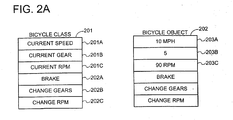
- FIG. 2A illustrates a class definition 201 for an exemplary type "bicycle" having variable or data members (e.g., or fields) 201A-C and methods 202A-C.
- a specific instance of a class 201 is an object 202.
- the data members may describe the state of an object, whereas the methods are used to ascribe behaviors to the object.
- the variables 201A-C are given specific values 202A-C when an object 202 of class 201 is instantiated.
- Data members and methods are sometimes collectively referred to as "class members.”
- class definitions for an extensible core framework such as 110 may be provided to describe the data structures needed to implement the core 110.
- the core classes may be changed or extended depending on such software development scenarios.
- One manner of extending a core software framework according to chosen software development scenarios is to extend the software classes.
- Software classes can be extended by changing the definitions of the object classes.
- Exemplary class extensions can include one or more class extension members (e.g., data members or methods).
- class extension members e.g., data members or methods.
- the class definition is modified to include the specified class extension members.
- core classes may be extended by having additional class members defined and incorporated into their core class definitions. These additional class members may be referred to as class extension members that extend the core classes. Collectively, such class extension members can be called a "class extension.”
- class extensions can vary greatly in a number of different ways. For example, certain class members required for some class extensions may not be required for others. Also, methods, functions and interfaces within a certain class extension may not be present at all in others, or, if they are present, may be defined differently. Such class extension members may relate to a software development scenario. For instance, the extra fields or class members to be added to a core class of a compiler framework to build a JIT compiler 111 may be far fewer than the number of fields or class members that may be required for a class extension related to a Native Optimizing Compiler 113.
- class extensions can be specified to develop an extended version of a core software framework.
- Appropriate software e.g., a preprocessor or compiler
- class extensions for a particular software development scenario can be grouped into a software development scenario class extension set having one or more class extensions appropriate for the scenario.
- the software development scenario class extension set can be invoked to extend the appropriate classes when developing a software development tool.
- the classes can be extended during development or at run time.
- various software classes are used to implement the core 110. If a developer specifies the software development scenarios of JIT compilation and IA-64 target architecture, the class extensions related to a JIT compiler and the class extensions related to an IA-64 target architecture are incorporated into core class definitions to extend the classes of a core framework 110 to be used in generating an extended version of core framework.
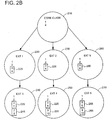
- FIG. 2B is a block diagram illustrating the relationship between core class definitions and their class extensions.
- the core node 210 may be related to a definition of a core class and is shown as having class members 1 and 2.
- the extended class definition at 220 may be necessary for implementing particular software development scenarios, and it may add additional class members 3 and 4 through an extension 225.
- Extended class definition 230 is the same as 220 and may be generated by adding the same additional class members 3 and 4 at extension 225 to the core class definition 210.
- the extended class definition 260 is different and may be generated by adding additional class members 5 and 6 at extension 265.
- extended class definitions 240 and 250 may be extended by adding extensions 245, and 255 to the class definitions 220 and 230, respectively.
- the extended class definitions 270 may be generated by adding extension 255 to the extended class definition 260.
- class extensions are illustrated as having more than one class extension member.
- a class extension may have one or more class extension members, or it may replace one or more existing class members of the core class definition.
- a class extension may be in the form of a definition of a function of a method member found in the core class definition.
- extensions of class definitions for a core software development tool framework can be represented as shown in FIG. 2B with additional class extensions depending a compilation scenario (JIT, Pre-JIT, Native Optimizing Compiler etc.), language scenario (C#, Visual Basic etc.), target scenario (IA-64, X86, AMD, ARM etc.) and other variables that may influence a particular configuration of an extended version of the exemplary extensible software development tool framework of FIG. 1.
- JIT compilation scenario
- Pre-JIT Native Optimizing Compiler etc.
- language scenario C#, Visual Basic etc.
- target scenario IA-64, X86, AMD, ARM etc.
- FIG. 2B depicts some simplified extension cases whereby the extended class definitions 220, 230, 240 and 250 inherit from previously defined classes in an orderly fashion without any single extension being used to extend multiple parent classes.
- this may not be the case when representing the extended class for a particular configuration of a software development tool that at various levels in class hierarchy may need to be extended in multiple different ways.
- extension 255 may be used to extend the class definition 230 as well as the class definition 260.
- the same extension may be used to extend diverse parent classes.
- the relationship between the core class definitions and the definitions of the extended core classes can be programmed as a chain of inheritances between base classes and their sub-classes.
- such an approach tends to result in class bloat and can soon become burdensome to a programmer.
- the programmer has the task of not only manually developing the extension sub-classes but he or she also has the added task of destroying unused objects to manage the use of limited memory resources.
- Yet another manual approach to extending a base class definition may be the use of IF-DEF statements or other methods for implementing conditional compilation.
- the programmer may provide a base class definition and manually add IF-DEF statements or other conditional compilation statements including definition of extensions in their body to conditionally add the extensions to the base.
- This approach does have the advantage of extending classes only when needed, and thus, may be a better approach than generating a new sub-class for each extension, which can result in unwanted overhead.
- this approach is also manual in nature and requires a programmer to include IF-DEF statements in numerous locations for each possible configuration, causing the code to be littered with a multitude of such IF-DEF statements.
- FIG. 3A depicts an overall process for extending a core class definition for building a compiler or a tool by extending a core framework.
- FIG. 3B describes an overall process for building a compiler or a software development tool by using software scenario dependent extensions for extending a core framework.
- a simplified object definition language ODL
- ODL object definition language
- the configuration for a particular software development tool based on software development scenarios including its compiler type scenario, and the particular target scenario that it is being built for may be determined.
- the object description language may be used to define the extensions at 330 to represent the additional or different class extension members needed to extend the core class.
- the extension may be associated with a core class to appropriately extend the core class' definition.
- the syntax for the object description language should provide for defining core classes as being extensible or not and further to associate a particular set of class extension members as extensions of a selected core class.
- An appropriate syntax for such a description language is described with examples further below.
- a pre-processor translation program may be used to translate the data or the object description language to source code of a programming language. After such pre-processing, at 350, the extended class definition may be processed further and used to implement a compiler or other software development tools of a particular configuration by extending a core framework.
- each extension can simply extend the core or the base class as necessary without having to maintain any complex inheritance relationships.
- the programmers providing a particular extension of a core class need not be aware of the other extensions of the core class. This not only simplifies the task of defining the extensions, but also, the users of the extended core class need only be aware of core class names to use the extended core class. Thus, the programmers can be freed from the task of remembering complex hierarchical relationships among class definitions when using extended class definitions.
- One approach for extending a core framework program may be to obtain access to the source code files of the core program and to statically extend the core classes as needed by using the object description language to define the extensions, which may then be processed to generate the source code related to the extended classes.
- the extended classes may be generated by manually adding the extensions directly to the source code in a source code programming language.
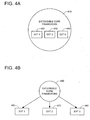
- FIG. 4A illustrates this approach whereby the extensions 420, 430 and 440 are added to the core framework file 410 in order to extend it and then the extensions 420, 430 and 440 are compiled as part of the now extended core framework file 410.
- this approach may not be suitable for all purposes because the programmers providing the definition of the extensions such as 420, 430 and 440 will need to have access to the source code of the core framework 410. This may not be desirable in circumstances where the providers of the core framework 410 wish to keep the core framework source code secret or unchanged.
- the second approach depicted in FIG. 4B may be used, whereby the core compiler and tools framework 450 is compiled as a separate file from the extensions 460, 470, and 480.
- the extensions 460, 470 and 480 and the core framework 450 may be adapted to have links to each other such that at runtime the extensions are linked to the core framework to appropriately extend the core framework.
- the links may be implemented as a simple linked list that specifies which extensions are to be used to extend particular core classes. This may also be achieved by using simple naming conventions that appropriately relate the extensions to the core classes as and when needed.
- this second approach may require additional overhead processing related to aspect of linking at runtime and thus, may be a slower implementation.
- this second approach does provide the flexibility of allowing the extending of a core class by developers not having access to the source code of the core framework.
- FIG. 5 illustrates a method for statically extending classes related to a core framework program prior to compile time as shown with reference to FIG. 4A above.
- the core classes and their extensions may be defined using an object description language.
- the definitions of the core classes and the class extensions need not be generated simultaneously or together. However, adding the class extensions would require some access to the source code of the core program.
- the definitions of the core classes and their extensions would together be processed by an ODL pre-processor which can translate an object description language representation to a source code representation.
- the result of the pre-processing by the ODL processor would be a header file and possibly some other code expressing the definitions of the core classes and their extensions in a source code language such C++.
- the header file with the extended class definitions comprising the core class members and the class extension members would then be compiled along with the rest of the code related to the now extended core framework to generate custom configured compilers and other software development tools.
- FIG. 6 illustrates an exemplary system for implementing the process of FIG. 5.
- multiple definitions of extensions 610 to core class definitions 620 can be stored as object description language files.
- An ODL pre-processor 630 may be provided which is capable of receiving the files 610 and 620 corresponding to the core class definitions and class extension definitions respectively.
- the pre-processor should also be capable of translating the files 610 and 620 from their object description language form to a source code representation 640.
- the source code representation can be in any language that can be eventually compiled to a form executable by a computer processor.
- the source code 640 generated by the pre-processor 630 may include header files where class definitions are typically stored.
- a source code compiler 650 appropriate for the language of the source code 640 emitted by the pre-processor 630 may be provided for compiling the source code representation 640 to create customized extended versions of core software programs such as compliers and other software development tools.
- FIG. 7 illustrates a method for extending a core class definition of a extensible core framework software program by linking the extension to the appropriate core classes at runtime.
- the core class definitions and the extensions may be expressed separately using an object description language.
- the description language may be suitable for expressing that a core class definition is dynamically extensible.
- such a language may be suitable for expressing the associations between particular core class definitions and their extensions. Syntax for one such suitable language is described in further detail below.
- an ODL pre-processor may be used at 710 to translate the definitions in the object description language representation to a source code representation at 720.
- FIG. 6 unlike the static process (FIG. 6), in the dynamic process of FIG.
- the core class definitions are not processed by the ODL pre-processor together with the definition of their extensions. Instead, source code header files corresponding to core class definitions and source code header files corresponding to class extension definitions are generated separately. These may be generated by different ODL pre-processors but it is not necessary to do so. Furthermore, at 730, the header files containing core class definitions and the header files containing the class extension definitions are compiled separately to create separate files that are executable by a computer. However, at 740, during runtime, the class extension definitions may be linked to the appropriate core class definitions to extend the core classes as defined.
- FIG. 8 illustrates an exemplary system for implementing the process of FIG. 7.
- the class extension definitions are provided in an object description language and stored in files 810. It is not necessary that each class extension be stored as a separate file as shown.
- the core class definitions are also provided in an object description language and stored in files 820.
- an ODL pre-processor 825 is provided for processing the core class definitions by translating the core class definitions from an object description language representation to a source code language representation to be stored as header file 835.
- yet another ODL pre-processor 830 may be provided for processing the class extension files 810 to generate source code header files 840 comprising class extensions.
- a source code compiler 845 may be provided for compiling the class extension header files 840 to generate a computer executable file 860 containing the class extension definitions.
- a source compiler 850 may be provided for compiling the header files 835 containing the core class definitions to generate computer executable files 855 containing the core class definitions. Then at runtime, as the executable files corresponding to the core classes 855 and the executable files corresponding to class extensions are executed, the links 870 provided within the core and the extension classes can cause the core classes to be extended appropriately.
- a simple object description language can be used to provide class definitions that are dependent on the desired configuration of an extensible core framework program.
- the particular configuration of a core framework can place disparate demands on the class definitions based on software development scenarios such as the type of compiler (e.g., JIT, Pre-JIT, Native Optimizing etc.), type of target (e.g., IA-64, X86, ARM etc.) and other scenario factors.
- type of compiler e.g., JIT, Pre-JIT, Native Optimizing etc.
- type of target e.g., IA-64, X86, ARM etc.
- FIG. 9A depicts a standard class declaration using the object description language.
- the declaration 900 comprises a header 911 and a body 912.
- the header may be used to declare the visibility of the class (e.g., public, private, etc.), the class name, etc.
- the header also comprises an attribute definition enclosed within square brackets as the following example:
- This declaration may be used to define the attributes of a class such as, whether it is a managed class (e.g., in a .NET scenario) or not and also, the extensibility attribute of the class. For example, defining whether it is a managed class may be done by declaring the [gc] attribute to indicate that the garbage collection for the objects of this class is automatically done (e.g., by the .NET framework).
- class extensibility attribute one approach is to assume that all classes are statically extensible as described above. Thus, no special attribute may be required to specifically declare that a class is statically extensible. However, as shown in FIG. 10A, a class that is to be extended at runtime (i.e. dynamically) may be declared with a specific attribute as such as [extensible].
- the class SYM is a statically extensible class with core class members 914 and 915 in its body.
- the class 900 may be a core class and the class members TYPE 914 and NAME 915 may be class members that are common to all configuration dependent extended classes that rely on the core class.
- class extensions for generating an extended version of the core class definition for particular configuration of a core framework may be provided.
- FIG. 9B shows two such class extension definitions 920 in an object description language.
- the extension 925 shows class members 926 related to a JIT compilation scenario for building a JIT compiler from a core framework.
- the JIT compilation scenario may need specific class members 926 such as interfaces, methods, and variables that are specific to the JIT compiler configuration but not necessarily so for other configurations.
- an extension 925 may be provided which, when processed by an ODL pre-processor, extends the core class definition of FIG. 9A.
- the keyword "extend" at 927 indicates that this is a static extension for the core class SYM.
- the attribute specification [JIT] 928 indicates that the extension is only to be applied when extending the core framework to implement a JIT compiler.
- the extension 930 may be provided for adding class members 931 specific to building a tool for targeting an IA-64 processor.
- the two extensions 925 and 930 are independent of each other and may be provided by different parties and the extensions need not rely on each other in any way as may be the case with extending core class definition using traditional class-subclass dependencies. Moreover, the programmers do not need to keep track of complex dependency relationships.
- the actual conditional implementation of the exemplary JIT compiler related extension 925 and the exemplary IA-64 target related extension 930 may be implemented when an ODL pre-processor generates a source code representation of the extended class definition as shown in FIG. 9C.
- the extended class 940 is shown not only having the original class members related to the core class definitions but it is now has the added class members 926 and 931.
- the extended class as shown is a class definition for a configuration of a JIT compiler for targeting an IA-64 processor.
- multiple different extensions based on multiple different software development scenarios can be conditionally added on to statically extend a core class.
- the extended core class 940 when compiled using an appropriate source code compiler will help generate a customized version of the core framework.
- static extensions requires compiling the core framework and the extension together for generating one single file executable by a computer. This means those that are providing the extensions also need to have access to the source code of the core framework for recompiling it along with the extensions. To avoid this situation, which may not be desirable for a number of different reasons, extended class definitions may be generated at runtime.
- FIG. 10A depicts one example of a class declaration using the object description language (ODL) to dynamically extend a core class definition based on a particular configuration of an extended version of a core framework.
- the core class definition for a class INSTR 1010 has a header with an attribute "extensible" at 1011 for indicating that this is a dynamically extensible class declaration.
- the body of the class declaration 1012 has class members that are common to the framework. However, the attribute [extensible] at 1011 when processed by an ODL pre-processor generates and injects an extension object to the source code that can serve as a place holder for adding further class members to be provided later at runtime by an appropriately linked extension.
- FIG. 10B illustrates one such extension 1020 associated with a particular target scenario.
- extension 1020 adds the HINTBITS 1021 and PREDICATES 1022 class extension members particular to implementing a software development tool for a IA-64 target processor.
- the attribute [IA-64] 1023 is used to indicate that this particular extension is only applicable to a customized configuration of a core compiler and tools framework targeted for an IA-64 processor.
- the keyword 1024 "extends" is added to indicate that the extension 1020 is a dynamic extension of the class INSTR at 1025.
- the core class definitions 1010 and the class extension definitions 1020 are processed to create separate source code representations of the core class definitions and their extensions. Also, these separate source code representations are later compiled separately to generate separate files executable by a computer.
- class extension members needed to extend a core class definition are not simply added to the source code header files with the extended class definitions. Instead, as shown in FIG. 10C, other code 1031 may be added to GET and SET class extensions that the dynamically extensible class definition expects to be added to the core class definition 1010 at runtime.
- the dynamic extensions may have the added overhead of having to execute some additional procedures 1031 in order to appropriately extend a class definition at runtime.
- the dynamic extensibility reduces the speed of a process but on the other hand provides for additional flexibility for providing extensions because in this approach the core and the extensions may be compiled separately. This allows for third parties to provide extensions to core class definitions without needing access to the source code of the core framework.
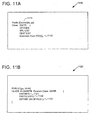
- FIG. 11A illustrates yet another example of a dynamically extensible core class definition 1110.
- the keyword "extensible” 1111 indicates that this class INSTR is extensible and the body of the class also provides the class members for the class prior to adding any extensions.
- One of the class member methods 1112 has a keyword “extension point” which indicates that one of the class extensions is to be incorporated at the indicated extension point 1112 by specifically defining the method or interface FOO().
- FIG. 11B depicts a suitable dynamic extension 1120 for the extending the extensible class shown in FIG. 11A by providing not only the HINTBITS 1121 and PREDICATES 1122 class extension members needed for a configuration targeting an IA-64 processor but also the definition of the FOO () method 1123 indicated by the extension point 1112.
- the "extension point" key word provides for a finer grain of control for indicating the specific points of the core class definitions where extensions may be injected into. Furthermore, this can be done in a simple manner by the use of object definition language which automatically generates the appropriate pointers to the appropriate extensions. Similarly, extension points may also be represented in a statically extensible core class definition.
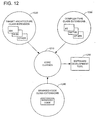
- FIG. 12 illustrates an exemplary implementation of constructing software development tools according to multiple software development scenarios.
- a core class 1210 may be extended by adding class extensions related to various software development scenarios.
- the class extensions may be related to software development scenario of particular target architectures 1220 (e.g. X86, IA-64 etc.), and other extensions may be related to compilation scenarios 1230 (e.g., JIT, Native etc.). Similary, other software development scenarios may affect the choice of extensions.
- these various configurations of extensions can be added to extend a core class 1210 to build a software development tool 1250 using an extensible core framework.
- any of the technologies can use other software development tools (e.g., debuggers, optimizers, simulators and software analysis tools).
- the principles of generating extensions have been primarily described herein with reference to extending core classes, but the same principles are equally applicable to extend any extensions or sub-classes of a core class.
- the ODL processor is referred to above as being capable of receiving object description language and generating source code languages. The output of the ODL pre-processor however, need not be restricted just source code languages. It may also provide as output, intermediate representations or intermediate languages such as Microsoft.NET's CIL, or in any form executable by a processor.
Landscapes
- Engineering & Computer Science (AREA)
- Software Systems (AREA)
- Theoretical Computer Science (AREA)
- General Engineering & Computer Science (AREA)
- Physics & Mathematics (AREA)
- General Physics & Mathematics (AREA)
- Stored Programmes (AREA)
- Devices For Executing Special Programs (AREA)
Applications Claiming Priority (2)
| Application Number | Priority Date | Filing Date | Title |
|---|---|---|---|
| US626251 | 2003-07-23 | ||
| US10/626,251 US7305666B2 (en) | 2003-07-23 | 2003-07-23 | Description language for an extensible compiler and tools infrastructure |
Publications (2)
| Publication Number | Publication Date |
|---|---|
| EP1501010A2 true EP1501010A2 (de) | 2005-01-26 |
| EP1501010A3 EP1501010A3 (de) | 2007-09-12 |
Family
ID=33490900
Family Applications (1)
| Application Number | Title | Priority Date | Filing Date |
|---|---|---|---|
| EP04103108A Ceased EP1501010A3 (de) | 2003-07-23 | 2004-07-01 | Beschreibungssprache für eine erweiterbare Compiler- und Werkzeug-Infrastruktur |
Country Status (5)
| Country | Link |
|---|---|
| US (1) | US7305666B2 (de) |
| EP (1) | EP1501010A3 (de) |
| JP (1) | JP4716681B2 (de) |
| KR (1) | KR101137126B1 (de) |
| CN (1) | CN100478874C (de) |
Cited By (1)
| Publication number | Priority date | Publication date | Assignee | Title |
|---|---|---|---|---|
| US10268455B2 (en) | 2016-05-20 | 2019-04-23 | Microsoft Technology Licensing, Llc | Augmenting an original class with an augmenting class |
Families Citing this family (43)
| Publication number | Priority date | Publication date | Assignee | Title |
|---|---|---|---|---|
| US6986128B2 (en) * | 2000-01-07 | 2006-01-10 | Sony Computer Entertainment Inc. | Multiple stage program recompiler and method |
| US7290243B1 (en) | 2001-02-28 | 2007-10-30 | Apple Inc. | Method and apparatus for application building using build styles |
| US7143407B2 (en) * | 2001-07-26 | 2006-11-28 | Kyocera Wireless Corp. | System and method for executing wireless communications device dynamic instruction sets |
| US7086041B2 (en) * | 2003-06-27 | 2006-08-01 | Microsoft Corporation | Extensible type system for representing and checking consistency of program components during the process of compilation |
| US7810080B2 (en) * | 2003-09-15 | 2010-10-05 | Thomas Plum | Automated safe secure techniques for eliminating undefined behavior in computer software |
| US7856624B2 (en) * | 2003-09-15 | 2010-12-21 | Thomas Plum | Automated safe secure techniques for eliminating undefined behavior in computer software |
| US7818729B1 (en) * | 2003-09-15 | 2010-10-19 | Thomas Plum | Automated safe secure techniques for eliminating undefined behavior in computer software |
| US7512938B2 (en) * | 2005-03-18 | 2009-03-31 | Microsoft Corporation | Typed intermediate representation for object-oriented languages |
| US7757224B2 (en) * | 2006-02-02 | 2010-07-13 | Microsoft Corporation | Software support for dynamically extensible processors |
| US7844978B2 (en) * | 2006-06-02 | 2010-11-30 | International Business Machines Corporation | Artifact management for an extensible runtime environment |
| US8161465B2 (en) * | 2006-07-27 | 2012-04-17 | Oracle International Corporation | Method and apparatus for performing conditional compilation |
| US7743076B2 (en) * | 2007-01-26 | 2010-06-22 | Microsoft Corporation | Extensible action sequences coordinating independently created components |
| US8255890B2 (en) * | 2007-02-14 | 2012-08-28 | The Mathworks, Inc. | Media for performing parallel processing of distributed arrays |
| US8255889B2 (en) * | 2007-02-14 | 2012-08-28 | The Mathworks, Inc. | Method of using parallel processing constructs and dynamically allocating program portions |
| US8010954B2 (en) * | 2007-02-14 | 2011-08-30 | The Mathworks, Inc. | Parallel programming interface to dynamically allocate program portions |
| US8239846B2 (en) * | 2007-02-14 | 2012-08-07 | The Mathworks, Inc. | Device for performing parallel processing of distributed arrays |
| US8239845B2 (en) * | 2007-02-14 | 2012-08-07 | The Mathworks, Inc. | Media for using parallel processing constructs |
| US8239844B2 (en) * | 2007-02-14 | 2012-08-07 | The Mathworks, Inc. | Method of using parallel processing constructs and dynamically allocating program portions |
| US8250550B2 (en) * | 2007-02-14 | 2012-08-21 | The Mathworks, Inc. | Parallel processing of distributed arrays and optimum data distribution |
| US8762976B2 (en) * | 2007-03-09 | 2014-06-24 | Microsoft Corporation | Static extensibility models with dynamic languages and scripts |
| US8181167B2 (en) * | 2008-01-09 | 2012-05-15 | Kan Zhao | Method and system for presenting and analyzing software source code through intermediate representation |
| US20090183185A1 (en) * | 2008-01-16 | 2009-07-16 | Microsoft Corporation | Declarative and Extensible Process Definition |
| KR101418969B1 (ko) * | 2008-02-27 | 2014-08-13 | 삼성전자주식회사 | 프로세서 및 컴파일 방법 |
| US9158519B2 (en) * | 2008-05-21 | 2015-10-13 | Optumsoft, Inc. | Dynamic collection attribute-based computer programming language methods |
| US20100088686A1 (en) * | 2008-10-06 | 2010-04-08 | Microsoft Corporation | Programming language with extensible syntax |
| US8392895B2 (en) * | 2009-01-13 | 2013-03-05 | Mediatek Inc. | Firmware extension method and firmware builder |
| CA2675680C (en) * | 2009-08-27 | 2013-05-14 | Ibm Canada Limited - Ibm Canada Limitee | Generating object code that uses calculated contents for a variable determined from a predicate |
| CA2691851A1 (en) * | 2010-02-04 | 2011-08-04 | Ibm Canada Limited - Ibm Canada Limitee | Control flow analysis using deductive reaching definitions |
| US8572591B2 (en) * | 2010-06-15 | 2013-10-29 | Microsoft Corporation | Dynamic adaptive programming |
| US8997070B2 (en) * | 2011-12-15 | 2015-03-31 | Sap Se | Extension mechanism for scripting language compiler |
| US8954939B2 (en) * | 2012-12-31 | 2015-02-10 | Microsoft Corporation | Extending a development environment |
| US9250937B1 (en) * | 2013-11-06 | 2016-02-02 | The Regents Of The University Of California | Code randomization for just-in-time compilers |
| US9477447B1 (en) * | 2015-05-15 | 2016-10-25 | Sap Se | Semantic representations of software extensions |
| US9542173B2 (en) * | 2015-05-15 | 2017-01-10 | Sap Se | Dependency handling for software extensions |
| US10120661B2 (en) * | 2015-07-16 | 2018-11-06 | Sugarcrm Inc. | Multi-flavored software execution from a singular code base |
| CN106484489A (zh) * | 2015-09-01 | 2017-03-08 | 阿里巴巴集团控股有限公司 | 一种扩展编程语言特性的方法及装置 |
| CN106909353B (zh) * | 2015-12-22 | 2019-12-13 | 阿里巴巴集团控股有限公司 | 应用程序的运行方法和装置 |
| US10140105B2 (en) * | 2016-03-10 | 2018-11-27 | Wowza Media Systems, LLC | Converting source code |
| GB2573775A (en) * | 2018-05-16 | 2019-11-20 | Sage Uk Ltd | Application Deployment |
| US11366658B1 (en) * | 2021-01-19 | 2022-06-21 | Sap Se | Seamless lifecycle stability for extensible software features |
| CN114296693B (zh) * | 2021-12-15 | 2025-07-08 | 北京经纬恒润科技股份有限公司 | 一种多核异构处理器的模型开发方法及装置 |
| US11995421B2 (en) | 2022-04-11 | 2024-05-28 | Microsoft Technology Licensing, Llc | Register allocation heuristics order |
| US12379976B2 (en) | 2022-10-05 | 2025-08-05 | Insight Direct Usa, Inc. | Runtime dependency configuration utility |
Family Cites Families (79)
| Publication number | Priority date | Publication date | Assignee | Title |
|---|---|---|---|---|
| US4197978A (en) | 1978-06-29 | 1980-04-15 | The Boeing Company | Method of making an integral structural member |
| US4734854A (en) | 1985-10-08 | 1988-03-29 | American Telephone And Telegraph Company | System for generating software source code components |
| CA1248238A (en) | 1985-10-17 | 1989-01-03 | Francis D. Lawlor | Compiler including retargetable data generation |
| JPS6488834A (en) * | 1987-09-30 | 1989-04-03 | Nec Corp | Program addition correcting system |
| US5339419A (en) | 1990-06-25 | 1994-08-16 | Hewlett-Packard Company | ANDF compiler using the HPcode-plus compiler intermediate language |
| US5659753A (en) | 1991-02-27 | 1997-08-19 | Digital Equipment Corporation | Interface for symbol table construction in a multilanguage optimizing compiler |
| US5598560A (en) | 1991-03-07 | 1997-01-28 | Digital Equipment Corporation | Tracking condition codes in translation code for different machine architectures |
| JPH04361328A (ja) * | 1991-06-10 | 1992-12-14 | Fujitsu Ltd | 処理モード切り替え方式 |
| US5488727A (en) | 1991-09-30 | 1996-01-30 | International Business Machines Corporation | Methods to support multimethod function overloading with compile-time type checking |
| JPH0683605A (ja) * | 1992-09-07 | 1994-03-25 | Fujitsu Ltd | 改変したプログラムを実行するデータ処理方式 |
| CA2102089C (en) | 1993-10-29 | 1999-05-25 | David M. Gillies | Recompilation of computer programs for enhanced optimization |
| US5761511A (en) | 1994-01-28 | 1998-06-02 | Sun Microsystems, Inc. | Method and apparatus for a type-safe framework for dynamically extensible objects |
| US5628016A (en) | 1994-06-15 | 1997-05-06 | Borland International, Inc. | Systems and methods and implementing exception handling using exception registration records stored in stack memory |
| US5742828A (en) | 1994-08-03 | 1998-04-21 | Microsoft Corporation | Compiler and method for evaluation of foreign syntax expressions in source code |
| US5778227A (en) | 1995-08-01 | 1998-07-07 | Intergraph Corporation | System for adding attributes to an object at run time in an object oriented computer environment |
| US5754858A (en) | 1996-05-01 | 1998-05-19 | Microsoft Corporation | Customizable application project generation process and system |
| US6421667B1 (en) | 1996-06-11 | 2002-07-16 | Edgar F. Codd | Delta model processing logic representation and execution system |
| US6463581B1 (en) | 1996-10-03 | 2002-10-08 | International Business Machines Corporation | Method for determining reachable methods in object-oriented applications that use class libraries |
| US5778233A (en) | 1996-10-11 | 1998-07-07 | International Business Machines Corporation | Method and apparatus for enabling global compiler optimizations in the presence of exception handlers within a computer program |
| US6247169B1 (en) | 1996-11-04 | 2001-06-12 | Sun Microsystems, Inc. | Structured exception-handling methods, apparatus, and computer program products |
| US5943499A (en) | 1996-11-27 | 1999-08-24 | Hewlett-Packard Company | System and method for solving general global data flow predicated code problems |
| US5937195A (en) | 1996-11-27 | 1999-08-10 | Hewlett-Packard Co | Global control flow treatment of predicated code |
| US5857105A (en) | 1997-02-05 | 1999-01-05 | Hewlett-Packard Company | Compiler for reducing number of indirect calls in an executable code |
| US6212672B1 (en) * | 1997-03-07 | 2001-04-03 | Dynamics Research Corporation | Software development system with an executable working model in an interpretable intermediate modeling language |
| US5918235A (en) | 1997-04-04 | 1999-06-29 | Hewlett-Packard Company | Object surrogate with active computation and probablistic counter |
| US6149318A (en) | 1997-04-15 | 2000-11-21 | Samuel C. Kendall | Link-time and run-time error detection, and program instrumentation |
| US6009273A (en) | 1997-05-29 | 1999-12-28 | Hewlett-Packard Company | Method for conversion of a variable argument routine to a fixed argument routine |
| US5999739A (en) | 1997-05-29 | 1999-12-07 | Hewlett-Packard Company | Method and apparatus for elimination of redundant branch instructions from a program |
| US6070011A (en) | 1997-10-21 | 2000-05-30 | Hewlett-Packard Co. | Compiler for performing a loop fusion, dependent upon loop peeling and/or loop reversal |
| US5966702A (en) | 1997-10-31 | 1999-10-12 | Sun Microsystems, Inc. | Method and apparatus for pre-processing and packaging class files |
| US6148302A (en) | 1998-02-26 | 2000-11-14 | Sun Microsystems, Inc. | Method, apparatus, system and computer program product for initializing a data structure at its first active use |
| US6202204B1 (en) | 1998-03-11 | 2001-03-13 | Intel Corporation | Comprehensive redundant load elimination for architectures supporting control and data speculation |
| US6330717B1 (en) * | 1998-03-27 | 2001-12-11 | Sony Corporation Of Japan | Process and system for developing an application program for a distributed adaptive run-time platform |
| US6249910B1 (en) | 1998-05-04 | 2001-06-19 | Hewlett-Packard Company | Apparatus and method for incrementally update static single assignment form for cloned variable name definitions |
| US6578090B1 (en) | 1998-06-08 | 2003-06-10 | Ricoh Company, Ltd. | System and method for interfacing two modules supporting various applications |
| JP3320358B2 (ja) * | 1998-06-18 | 2002-09-03 | インターナショナル・ビジネス・マシーンズ・コーポレーション | コンパイル方法、例外処理方法、及びコンピュータ |
| US6289446B1 (en) | 1998-09-29 | 2001-09-11 | Axis Ab | Exception handling utilizing call instruction with context information |
| US6182284B1 (en) | 1998-09-30 | 2001-01-30 | Hewlett-Packard Company | Method and system for eliminating phi instruction resource interferences and redundant copy instructions from static-single-assignment-form computer code |
| US6292938B1 (en) | 1998-12-02 | 2001-09-18 | International Business Machines Corporation | Retargeting optimized code by matching tree patterns in directed acyclic graphs |
| US6253304B1 (en) | 1999-01-04 | 2001-06-26 | Advanced Micro Devices, Inc. | Collation of interrupt control devices |
| US6412109B1 (en) | 1999-01-29 | 2002-06-25 | Sun Microsystems, Inc. | Method for optimizing java bytecodes in the presence of try-catch blocks |
| US6353924B1 (en) | 1999-02-08 | 2002-03-05 | Incert Software Corporation | Method for back tracing program execution |
| US6363522B1 (en) | 1999-04-23 | 2002-03-26 | Sun Microsystems, Inc. | Method and apparatus for handling exceptions as normal control flow |
| US6526570B1 (en) | 1999-04-23 | 2003-02-25 | Sun Microsystems, Inc. | File portability techniques |
| US6286134B1 (en) | 1999-04-23 | 2001-09-04 | Sun Microsystems, Inc. | Instruction selection in a multi-platform environment |
| US6374368B1 (en) | 1999-05-21 | 2002-04-16 | Microsoft Corporation | Weakest precondition analysis |
| US20020166115A1 (en) | 1999-06-10 | 2002-11-07 | A.V.S. Sastry | System and method for computer program compilation using scalar register promotion and static single assignment representation |
| US6481008B1 (en) | 1999-06-30 | 2002-11-12 | Microsoft Corporation | Instrumentation and optimization tools for heterogeneous programs |
| US6460178B1 (en) | 1999-06-30 | 2002-10-01 | Microsoft Corporation | Shared library optimization for heterogeneous programs |
| US6662356B1 (en) | 1999-06-30 | 2003-12-09 | Microsoft Corporation | Application program interface for transforming heterogeneous programs |
| US6629312B1 (en) | 1999-08-20 | 2003-09-30 | Hewlett-Packard Development Company, L.P. | Programmatic synthesis of a machine description for retargeting a compiler |
| US6560774B1 (en) | 1999-09-01 | 2003-05-06 | Microsoft Corporation | Verifier to check intermediate language |
| US6625808B1 (en) | 1999-12-10 | 2003-09-23 | Microsoft Corporation | Method and apparatus for facilitating memory management in a program comprised of heterogeneous components |
| US6598220B1 (en) | 1999-12-17 | 2003-07-22 | Dell Products L.P. | System and method for allowing registerable runtime modification of object behaviors |
| US6804814B1 (en) | 1999-12-29 | 2004-10-12 | Veritas Operating Corporation | Method for simulating back program execution from a traceback sequence |
| US6745383B1 (en) | 1999-12-29 | 2004-06-01 | Veritas Operating Corporation | Early warning mechanism for enhancing enterprise availability |
| US6748584B1 (en) | 1999-12-29 | 2004-06-08 | Veritas Operating Corporation | Method for determining the degree to which changed code has been exercised |
| US6981249B1 (en) | 2000-05-02 | 2005-12-27 | Microsoft Corporation | Methods for enhancing type reconstruction |
| US6678805B1 (en) | 2000-05-25 | 2004-01-13 | Microsoft Corporation | Structure organization for improved cache performance |
| US6625804B1 (en) | 2000-07-06 | 2003-09-23 | Microsoft Corporation | Unified event programming model |
| CA2321018A1 (en) | 2000-09-27 | 2002-03-27 | Ibm Canada Limited-Ibm Canada Limitee | Optimizing compilation by forward store movement |
| US6854110B2 (en) | 2000-12-21 | 2005-02-08 | Microsoft Corporation | System and method for obtaining scratch registers in computer executable binaries |
| US6925639B2 (en) | 2001-02-23 | 2005-08-02 | Microsoft Corporation | Method and system for register allocation |
| US7117488B1 (en) | 2001-10-31 | 2006-10-03 | The Regents Of The University Of California | Safe computer code formats and methods for generating safe computer code |
| US6834383B2 (en) | 2001-11-26 | 2004-12-21 | Microsoft Corporation | Method for binary-level branch reversal on computer architectures supporting predicated execution |
| US7426719B2 (en) | 2001-11-29 | 2008-09-16 | Microsoft Corporation | Method and system for rewriting unwind data in the presence of exceptions |
| JP3870112B2 (ja) | 2002-03-13 | 2007-01-17 | インターナショナル・ビジネス・マシーンズ・コーポレーション | コンパイル方法、コンパイル装置、及びコンパイル用プログラム |
| US7228540B2 (en) | 2002-05-14 | 2007-06-05 | Microsoft Corporation | Preparation for software on demand system |
| US7213245B2 (en) | 2002-05-14 | 2007-05-01 | Microsoft Corporation | Software on demand system |
| US7185328B2 (en) | 2002-05-30 | 2007-02-27 | Microsoft Corporation | System and method for improving a working set |
| US7055132B2 (en) | 2002-06-28 | 2006-05-30 | Microsoft Corporation | System and method for associating properties with objects |
| US7367022B2 (en) | 2002-09-05 | 2008-04-29 | Intel Corporation | Methods and apparatus for optimizing the operating speed and size of a computer program |
| US7240346B2 (en) | 2002-11-13 | 2007-07-03 | Microsoft Corporation | Method and system for accessing drawing resources |
| US7370321B2 (en) | 2002-11-14 | 2008-05-06 | Microsoft Corporation | Systems and methods to read, optimize, and verify byte codes for a multiplatform jit |
| US7203941B2 (en) | 2002-11-14 | 2007-04-10 | Microsoft Corporation | Associating a native resource with an application |
| US7546607B2 (en) | 2002-11-19 | 2009-06-09 | Microsoft Corporation | Native code exposing virtual machine managed object |
| US7281248B2 (en) | 2002-11-19 | 2007-10-09 | Microsoft Corporation | Virtualized and realized user interface controls |
| US7472400B2 (en) | 2003-02-28 | 2008-12-30 | Bea Systems, Inc. | Method for dynamically generating a wrapper class |
| US7120898B2 (en) * | 2003-06-26 | 2006-10-10 | Microsoft Corporation | Intermediate representation for multiple exception handling models |
-
2003
- 2003-07-23 US US10/626,251 patent/US7305666B2/en not_active Expired - Fee Related
-
2004
- 2004-06-30 JP JP2004194759A patent/JP4716681B2/ja not_active Expired - Lifetime
- 2004-07-01 EP EP04103108A patent/EP1501010A3/de not_active Ceased
- 2004-07-09 KR KR1020040053552A patent/KR101137126B1/ko not_active Expired - Fee Related
- 2004-07-23 CN CNB2004100589703A patent/CN100478874C/zh not_active Expired - Fee Related
Non-Patent Citations (2)
| Title |
|---|
| AZAD BOLOUR: "Notes on the Eclipse Plug-In Architecture", 3 June 2003 (2003-06-03), XP002400728, Retrieved from the Internet <URL:http://www.eclipse.org/articles/Article-Plug-in-architecture/plugin_architecture.html> * |
| JAMES GOSLING; BILL JOY; GUY STEELE: "The Java? Language Specification", August 1996, ADDISON-WESLEY, ISBN: 0-201-63451-1 * |
Cited By (1)
| Publication number | Priority date | Publication date | Assignee | Title |
|---|---|---|---|---|
| US10268455B2 (en) | 2016-05-20 | 2019-04-23 | Microsoft Technology Licensing, Llc | Augmenting an original class with an augmenting class |
Also Published As
| Publication number | Publication date |
|---|---|
| KR20050011685A (ko) | 2005-01-29 |
| CN1577265A (zh) | 2005-02-09 |
| US7305666B2 (en) | 2007-12-04 |
| US20050022161A1 (en) | 2005-01-27 |
| KR101137126B1 (ko) | 2012-04-19 |
| CN100478874C (zh) | 2009-04-15 |
| EP1501010A3 (de) | 2007-09-12 |
| JP2005044347A (ja) | 2005-02-17 |
| JP4716681B2 (ja) | 2011-07-06 |
Similar Documents
| Publication | Publication Date | Title |
|---|---|---|
| US7305666B2 (en) | Description language for an extensible compiler and tools infrastructure | |
| US7707566B2 (en) | Software development infrastructure | |
| US7380242B2 (en) | Compiler and software product for compiling intermediate language bytecodes into Java bytecodes | |
| Ancona et al. | Jam-a smooth extension of java with mixins | |
| EP1074911A2 (de) | Aspektorientierte Programmierung | |
| EP2523108A1 (de) | Verarbeitungsverfahren | |
| EP1639461A2 (de) | System des erweiterbaren typs zur repräsentation und prüfung der einheitlichkeit von programmkomponenten während des prozesses der kompeilierung | |
| Pawlak et al. | Spoon: Program analysis and transformation in java | |
| Spinczyk et al. | Advances in AOP with AspectC++. | |
| Tilevich et al. | Binary refactoring: Improving code behind the scenes | |
| Poletto et al. | tcc: A templatebased compiler for ‘c | |
| Shevchenko | Project Paper: Embedding Generic Monadic Transformer into Scala: Can We Merge Monadic Programming into Mainstream? | |
| Dümmel et al. | MuLE: A Multiparadigm Language for Education. The Object-Oriented Part of the Language | |
| Forgáč et al. | Static and dynamic approaches to weaving | |
| Wu et al. | Shadow programming: Reasoning about programs using lexical join point information | |
| Bettini | A Java package for class and mixin mobility in a distributed setting | |
| Savidis | Translating declarative control elements to imperative using'l-value redefinition graphs' | |
| dos Santos | Metaobject Protocols for Julia | |
| Singer | The Command Dispatcher | |
| Plumbridge et al. | Translating Java for resource constrained embedded systems | |
| Lukeš | API for C# code generation | |
| Banerji et al. | Design, Distribution, and Management of Object Oriented Software. | |
| Fujita et al. | Advances in AOP with AspectC++ | |
| Hedström | RubySharp: a morphic GUI in Ruby | |
| Sestoft | Real Machine Code |
Legal Events
| Date | Code | Title | Description |
|---|---|---|---|
| PUAI | Public reference made under article 153(3) epc to a published international application that has entered the european phase |
Free format text: ORIGINAL CODE: 0009012 |
|
| AK | Designated contracting states |
Kind code of ref document: A2 Designated state(s): AT BE BG CH CY CZ DE DK EE ES FI FR GB GR HU IE IT LI LU MC NL PL PT RO SE SI SK TR |
|
| AX | Request for extension of the european patent |
Extension state: AL HR LT LV MK |
|
| RIN1 | Information on inventor provided before grant (corrected) |
Inventor name: GROVER, VINOD K. Inventor name: AYERS, ANDREW EDWARD Inventor name: MITCHELL, CHARLES L. Inventor name: TARDITI, DAVID READ JR. Inventor name: BURGER, JULIAN |
|
| PUAL | Search report despatched |
Free format text: ORIGINAL CODE: 0009013 |
|
| AK | Designated contracting states |
Kind code of ref document: A3 Designated state(s): AT BE BG CH CY CZ DE DK EE ES FI FR GB GR HU IE IT LI LU MC NL PL PT RO SE SI SK TR |
|
| AX | Request for extension of the european patent |
Extension state: AL HR LT LV MK |
|
| 17P | Request for examination filed |
Effective date: 20070927 |
|
| 17Q | First examination report despatched |
Effective date: 20071105 |
|
| AKX | Designation fees paid |
Designated state(s): AT BE BG CH CY CZ DE DK EE ES FI FR GB GR HU IE IT LI LU MC NL PL PT RO SE SI SK TR |
|
| STAA | Information on the status of an ep patent application or granted ep patent |
Free format text: STATUS: THE APPLICATION HAS BEEN REFUSED |
|
| 18R | Application refused |
Effective date: 20100916 |