EP1500643A1 - Benzamide derivatives - Google Patents

Benzamide derivatives Download PDF

Info

Publication number
EP1500643A1
EP1500643A1 EP03715598A EP03715598A EP1500643A1 EP 1500643 A1 EP1500643 A1 EP 1500643A1 EP 03715598 A EP03715598 A EP 03715598A EP 03715598 A EP03715598 A EP 03715598A EP 1500643 A1 EP1500643 A1 EP 1500643A1
Authority
EP
European Patent Office
Prior art keywords
group
substituted
saturated
unsubstituted
amino
Prior art date
Legal status (The legal status is an assumption and is not a legal conclusion. Google has not performed a legal analysis and makes no representation as to the accuracy of the status listed.)
Withdrawn
Application number
EP03715598A
Other languages
German (de)
French (fr)
Other versions
EP1500643A4 (en
Inventor
Naonori Imazaki
Masafumi Kitano
Tatsuya Fujibayashi
Shigehiro Asano
Current Assignee (The listed assignees may be inaccurate. Google has not performed a legal analysis and makes no representation or warranty as to the accuracy of the list.)
Sumitomo Pharma Co Ltd
Original Assignee
Sumitomo Pharmaceuticals Co Ltd
Priority date (The priority date is an assumption and is not a legal conclusion. Google has not performed a legal analysis and makes no representation as to the accuracy of the date listed.)
Filing date
Publication date
Application filed by Sumitomo Pharmaceuticals Co Ltd filed Critical Sumitomo Pharmaceuticals Co Ltd
Publication of EP1500643A1 publication Critical patent/EP1500643A1/en
Publication of EP1500643A4 publication Critical patent/EP1500643A4/en
Withdrawn legal-status Critical Current

Links

Classifications

    • CCHEMISTRY; METALLURGY
    • C07ORGANIC CHEMISTRY
    • C07CACYCLIC OR CARBOCYCLIC COMPOUNDS
    • C07C317/00Sulfones; Sulfoxides
    • C07C317/44Sulfones; Sulfoxides having sulfone or sulfoxide groups and carboxyl groups bound to the same carbon skeleton
    • AHUMAN NECESSITIES
    • A61MEDICAL OR VETERINARY SCIENCE; HYGIENE
    • A61KPREPARATIONS FOR MEDICAL, DENTAL OR TOILETRY PURPOSES
    • A61K31/00Medicinal preparations containing organic active ingredients
    • A61K31/16Amides, e.g. hydroxamic acids
    • A61K31/165Amides, e.g. hydroxamic acids having aromatic rings, e.g. colchicine, atenolol, progabide
    • AHUMAN NECESSITIES
    • A61MEDICAL OR VETERINARY SCIENCE; HYGIENE
    • A61KPREPARATIONS FOR MEDICAL, DENTAL OR TOILETRY PURPOSES
    • A61K31/00Medicinal preparations containing organic active ingredients
    • A61K31/33Heterocyclic compounds
    • A61K31/335Heterocyclic compounds having oxygen as the only ring hetero atom, e.g. fungichromin
    • A61K31/35Heterocyclic compounds having oxygen as the only ring hetero atom, e.g. fungichromin having six-membered rings with one oxygen as the only ring hetero atom
    • A61K31/351Heterocyclic compounds having oxygen as the only ring hetero atom, e.g. fungichromin having six-membered rings with one oxygen as the only ring hetero atom not condensed with another ring
    • AHUMAN NECESSITIES
    • A61MEDICAL OR VETERINARY SCIENCE; HYGIENE
    • A61KPREPARATIONS FOR MEDICAL, DENTAL OR TOILETRY PURPOSES
    • A61K31/00Medicinal preparations containing organic active ingredients
    • A61K31/33Heterocyclic compounds
    • A61K31/38Heterocyclic compounds having sulfur as a ring hetero atom
    • A61K31/382Heterocyclic compounds having sulfur as a ring hetero atom having six-membered rings, e.g. thioxanthenes
    • AHUMAN NECESSITIES
    • A61MEDICAL OR VETERINARY SCIENCE; HYGIENE
    • A61KPREPARATIONS FOR MEDICAL, DENTAL OR TOILETRY PURPOSES
    • A61K31/00Medicinal preparations containing organic active ingredients
    • A61K31/33Heterocyclic compounds
    • A61K31/395Heterocyclic compounds having nitrogen as a ring hetero atom, e.g. guanethidine or rifamycins
    • A61K31/40Heterocyclic compounds having nitrogen as a ring hetero atom, e.g. guanethidine or rifamycins having five-membered rings with one nitrogen as the only ring hetero atom, e.g. sulpiride, succinimide, tolmetin, buflomedil
    • AHUMAN NECESSITIES
    • A61MEDICAL OR VETERINARY SCIENCE; HYGIENE
    • A61KPREPARATIONS FOR MEDICAL, DENTAL OR TOILETRY PURPOSES
    • A61K31/00Medicinal preparations containing organic active ingredients
    • A61K31/33Heterocyclic compounds
    • A61K31/395Heterocyclic compounds having nitrogen as a ring hetero atom, e.g. guanethidine or rifamycins
    • A61K31/435Heterocyclic compounds having nitrogen as a ring hetero atom, e.g. guanethidine or rifamycins having six-membered rings with one nitrogen as the only ring hetero atom
    • A61K31/44Non condensed pyridines; Hydrogenated derivatives thereof
    • AHUMAN NECESSITIES
    • A61MEDICAL OR VETERINARY SCIENCE; HYGIENE
    • A61KPREPARATIONS FOR MEDICAL, DENTAL OR TOILETRY PURPOSES
    • A61K31/00Medicinal preparations containing organic active ingredients
    • A61K31/33Heterocyclic compounds
    • A61K31/395Heterocyclic compounds having nitrogen as a ring hetero atom, e.g. guanethidine or rifamycins
    • A61K31/55Heterocyclic compounds having nitrogen as a ring hetero atom, e.g. guanethidine or rifamycins having seven-membered rings, e.g. azelastine, pentylenetetrazole
    • AHUMAN NECESSITIES
    • A61MEDICAL OR VETERINARY SCIENCE; HYGIENE
    • A61PSPECIFIC THERAPEUTIC ACTIVITY OF CHEMICAL COMPOUNDS OR MEDICINAL PREPARATIONS
    • A61P1/00Drugs for disorders of the alimentary tract or the digestive system
    • A61P1/16Drugs for disorders of the alimentary tract or the digestive system for liver or gallbladder disorders, e.g. hepatoprotective agents, cholagogues, litholytics
    • AHUMAN NECESSITIES
    • A61MEDICAL OR VETERINARY SCIENCE; HYGIENE
    • A61PSPECIFIC THERAPEUTIC ACTIVITY OF CHEMICAL COMPOUNDS OR MEDICINAL PREPARATIONS
    • A61P11/00Drugs for disorders of the respiratory system
    • AHUMAN NECESSITIES
    • A61MEDICAL OR VETERINARY SCIENCE; HYGIENE
    • A61PSPECIFIC THERAPEUTIC ACTIVITY OF CHEMICAL COMPOUNDS OR MEDICINAL PREPARATIONS
    • A61P11/00Drugs for disorders of the respiratory system
    • A61P11/06Antiasthmatics
    • AHUMAN NECESSITIES
    • A61MEDICAL OR VETERINARY SCIENCE; HYGIENE
    • A61PSPECIFIC THERAPEUTIC ACTIVITY OF CHEMICAL COMPOUNDS OR MEDICINAL PREPARATIONS
    • A61P13/00Drugs for disorders of the urinary system
    • A61P13/08Drugs for disorders of the urinary system of the prostate
    • AHUMAN NECESSITIES
    • A61MEDICAL OR VETERINARY SCIENCE; HYGIENE
    • A61PSPECIFIC THERAPEUTIC ACTIVITY OF CHEMICAL COMPOUNDS OR MEDICINAL PREPARATIONS
    • A61P13/00Drugs for disorders of the urinary system
    • A61P13/12Drugs for disorders of the urinary system of the kidneys
    • AHUMAN NECESSITIES
    • A61MEDICAL OR VETERINARY SCIENCE; HYGIENE
    • A61PSPECIFIC THERAPEUTIC ACTIVITY OF CHEMICAL COMPOUNDS OR MEDICINAL PREPARATIONS
    • A61P15/00Drugs for genital or sexual disorders; Contraceptives
    • A61P15/06Antiabortive agents; Labour repressants
    • AHUMAN NECESSITIES
    • A61MEDICAL OR VETERINARY SCIENCE; HYGIENE
    • A61PSPECIFIC THERAPEUTIC ACTIVITY OF CHEMICAL COMPOUNDS OR MEDICINAL PREPARATIONS
    • A61P15/00Drugs for genital or sexual disorders; Contraceptives
    • A61P15/10Drugs for genital or sexual disorders; Contraceptives for impotence
    • AHUMAN NECESSITIES
    • A61MEDICAL OR VETERINARY SCIENCE; HYGIENE
    • A61PSPECIFIC THERAPEUTIC ACTIVITY OF CHEMICAL COMPOUNDS OR MEDICINAL PREPARATIONS
    • A61P19/00Drugs for skeletal disorders
    • A61P19/08Drugs for skeletal disorders for bone diseases, e.g. rachitism, Paget's disease
    • AHUMAN NECESSITIES
    • A61MEDICAL OR VETERINARY SCIENCE; HYGIENE
    • A61PSPECIFIC THERAPEUTIC ACTIVITY OF CHEMICAL COMPOUNDS OR MEDICINAL PREPARATIONS
    • A61P25/00Drugs for disorders of the nervous system
    • A61P25/28Drugs for disorders of the nervous system for treating neurodegenerative disorders of the central nervous system, e.g. nootropic agents, cognition enhancers, drugs for treating Alzheimer's disease or other forms of dementia
    • AHUMAN NECESSITIES
    • A61MEDICAL OR VETERINARY SCIENCE; HYGIENE
    • A61PSPECIFIC THERAPEUTIC ACTIVITY OF CHEMICAL COMPOUNDS OR MEDICINAL PREPARATIONS
    • A61P27/00Drugs for disorders of the senses
    • A61P27/02Ophthalmic agents
    • AHUMAN NECESSITIES
    • A61MEDICAL OR VETERINARY SCIENCE; HYGIENE
    • A61PSPECIFIC THERAPEUTIC ACTIVITY OF CHEMICAL COMPOUNDS OR MEDICINAL PREPARATIONS
    • A61P27/00Drugs for disorders of the senses
    • A61P27/02Ophthalmic agents
    • A61P27/06Antiglaucoma agents or miotics
    • AHUMAN NECESSITIES
    • A61MEDICAL OR VETERINARY SCIENCE; HYGIENE
    • A61PSPECIFIC THERAPEUTIC ACTIVITY OF CHEMICAL COMPOUNDS OR MEDICINAL PREPARATIONS
    • A61P29/00Non-central analgesic, antipyretic or antiinflammatory agents, e.g. antirheumatic agents; Non-steroidal antiinflammatory drugs [NSAID]
    • AHUMAN NECESSITIES
    • A61MEDICAL OR VETERINARY SCIENCE; HYGIENE
    • A61PSPECIFIC THERAPEUTIC ACTIVITY OF CHEMICAL COMPOUNDS OR MEDICINAL PREPARATIONS
    • A61P3/00Drugs for disorders of the metabolism
    • A61P3/08Drugs for disorders of the metabolism for glucose homeostasis
    • A61P3/10Drugs for disorders of the metabolism for glucose homeostasis for hyperglycaemia, e.g. antidiabetics
    • AHUMAN NECESSITIES
    • A61MEDICAL OR VETERINARY SCIENCE; HYGIENE
    • A61PSPECIFIC THERAPEUTIC ACTIVITY OF CHEMICAL COMPOUNDS OR MEDICINAL PREPARATIONS
    • A61P31/00Antiinfectives, i.e. antibiotics, antiseptics, chemotherapeutics
    • A61P31/04Antibacterial agents
    • AHUMAN NECESSITIES
    • A61MEDICAL OR VETERINARY SCIENCE; HYGIENE
    • A61PSPECIFIC THERAPEUTIC ACTIVITY OF CHEMICAL COMPOUNDS OR MEDICINAL PREPARATIONS
    • A61P31/00Antiinfectives, i.e. antibiotics, antiseptics, chemotherapeutics
    • A61P31/12Antivirals
    • A61P31/14Antivirals for RNA viruses
    • A61P31/18Antivirals for RNA viruses for HIV
    • AHUMAN NECESSITIES
    • A61MEDICAL OR VETERINARY SCIENCE; HYGIENE
    • A61PSPECIFIC THERAPEUTIC ACTIVITY OF CHEMICAL COMPOUNDS OR MEDICINAL PREPARATIONS
    • A61P35/00Antineoplastic agents
    • AHUMAN NECESSITIES
    • A61MEDICAL OR VETERINARY SCIENCE; HYGIENE
    • A61PSPECIFIC THERAPEUTIC ACTIVITY OF CHEMICAL COMPOUNDS OR MEDICINAL PREPARATIONS
    • A61P37/00Drugs for immunological or allergic disorders
    • A61P37/02Immunomodulators
    • AHUMAN NECESSITIES
    • A61MEDICAL OR VETERINARY SCIENCE; HYGIENE
    • A61PSPECIFIC THERAPEUTIC ACTIVITY OF CHEMICAL COMPOUNDS OR MEDICINAL PREPARATIONS
    • A61P37/00Drugs for immunological or allergic disorders
    • A61P37/02Immunomodulators
    • A61P37/06Immunosuppressants, e.g. drugs for graft rejection
    • AHUMAN NECESSITIES
    • A61MEDICAL OR VETERINARY SCIENCE; HYGIENE
    • A61PSPECIFIC THERAPEUTIC ACTIVITY OF CHEMICAL COMPOUNDS OR MEDICINAL PREPARATIONS
    • A61P43/00Drugs for specific purposes, not provided for in groups A61P1/00-A61P41/00
    • AHUMAN NECESSITIES
    • A61MEDICAL OR VETERINARY SCIENCE; HYGIENE
    • A61PSPECIFIC THERAPEUTIC ACTIVITY OF CHEMICAL COMPOUNDS OR MEDICINAL PREPARATIONS
    • A61P9/00Drugs for disorders of the cardiovascular system
    • AHUMAN NECESSITIES
    • A61MEDICAL OR VETERINARY SCIENCE; HYGIENE
    • A61PSPECIFIC THERAPEUTIC ACTIVITY OF CHEMICAL COMPOUNDS OR MEDICINAL PREPARATIONS
    • A61P9/00Drugs for disorders of the cardiovascular system
    • A61P9/04Inotropic agents, i.e. stimulants of cardiac contraction; Drugs for heart failure
    • AHUMAN NECESSITIES
    • A61MEDICAL OR VETERINARY SCIENCE; HYGIENE
    • A61PSPECIFIC THERAPEUTIC ACTIVITY OF CHEMICAL COMPOUNDS OR MEDICINAL PREPARATIONS
    • A61P9/00Drugs for disorders of the cardiovascular system
    • A61P9/10Drugs for disorders of the cardiovascular system for treating ischaemic or atherosclerotic diseases, e.g. antianginal drugs, coronary vasodilators, drugs for myocardial infarction, retinopathy, cerebrovascula insufficiency, renal arteriosclerosis
    • AHUMAN NECESSITIES
    • A61MEDICAL OR VETERINARY SCIENCE; HYGIENE
    • A61PSPECIFIC THERAPEUTIC ACTIVITY OF CHEMICAL COMPOUNDS OR MEDICINAL PREPARATIONS
    • A61P9/00Drugs for disorders of the cardiovascular system
    • A61P9/12Antihypertensives
    • CCHEMISTRY; METALLURGY
    • C07ORGANIC CHEMISTRY
    • C07CACYCLIC OR CARBOCYCLIC COMPOUNDS
    • C07C235/00Carboxylic acid amides, the carbon skeleton of the acid part being further substituted by oxygen atoms
    • C07C235/42Carboxylic acid amides, the carbon skeleton of the acid part being further substituted by oxygen atoms having carbon atoms of carboxamide groups bound to carbon atoms of six-membered aromatic rings and singly-bound oxygen atoms bound to the same carbon skeleton
    • C07C235/44Carboxylic acid amides, the carbon skeleton of the acid part being further substituted by oxygen atoms having carbon atoms of carboxamide groups bound to carbon atoms of six-membered aromatic rings and singly-bound oxygen atoms bound to the same carbon skeleton with carbon atoms of carboxamide groups and singly-bound oxygen atoms bound to carbon atoms of the same non-condensed six-membered aromatic ring
    • C07C235/46Carboxylic acid amides, the carbon skeleton of the acid part being further substituted by oxygen atoms having carbon atoms of carboxamide groups bound to carbon atoms of six-membered aromatic rings and singly-bound oxygen atoms bound to the same carbon skeleton with carbon atoms of carboxamide groups and singly-bound oxygen atoms bound to carbon atoms of the same non-condensed six-membered aromatic ring having the nitrogen atoms of the carboxamide groups bound to hydrogen atoms or to acyclic carbon atoms
    • CCHEMISTRY; METALLURGY
    • C07ORGANIC CHEMISTRY
    • C07CACYCLIC OR CARBOCYCLIC COMPOUNDS
    • C07C235/00Carboxylic acid amides, the carbon skeleton of the acid part being further substituted by oxygen atoms
    • C07C235/42Carboxylic acid amides, the carbon skeleton of the acid part being further substituted by oxygen atoms having carbon atoms of carboxamide groups bound to carbon atoms of six-membered aromatic rings and singly-bound oxygen atoms bound to the same carbon skeleton
    • C07C235/44Carboxylic acid amides, the carbon skeleton of the acid part being further substituted by oxygen atoms having carbon atoms of carboxamide groups bound to carbon atoms of six-membered aromatic rings and singly-bound oxygen atoms bound to the same carbon skeleton with carbon atoms of carboxamide groups and singly-bound oxygen atoms bound to carbon atoms of the same non-condensed six-membered aromatic ring
    • C07C235/58Carboxylic acid amides, the carbon skeleton of the acid part being further substituted by oxygen atoms having carbon atoms of carboxamide groups bound to carbon atoms of six-membered aromatic rings and singly-bound oxygen atoms bound to the same carbon skeleton with carbon atoms of carboxamide groups and singly-bound oxygen atoms bound to carbon atoms of the same non-condensed six-membered aromatic ring with carbon atoms of carboxamide groups and singly-bound oxygen atoms, bound in ortho-position to carbon atoms of the same non-condensed six-membered aromatic ring
    • C07C235/60Carboxylic acid amides, the carbon skeleton of the acid part being further substituted by oxygen atoms having carbon atoms of carboxamide groups bound to carbon atoms of six-membered aromatic rings and singly-bound oxygen atoms bound to the same carbon skeleton with carbon atoms of carboxamide groups and singly-bound oxygen atoms bound to carbon atoms of the same non-condensed six-membered aromatic ring with carbon atoms of carboxamide groups and singly-bound oxygen atoms, bound in ortho-position to carbon atoms of the same non-condensed six-membered aromatic ring having the nitrogen atoms of the carboxamide groups bound to hydrogen atoms or to acyclic carbon atoms
    • CCHEMISTRY; METALLURGY
    • C07ORGANIC CHEMISTRY
    • C07CACYCLIC OR CARBOCYCLIC COMPOUNDS
    • C07C237/00Carboxylic acid amides, the carbon skeleton of the acid part being further substituted by amino groups
    • C07C237/28Carboxylic acid amides, the carbon skeleton of the acid part being further substituted by amino groups having the carbon atom of at least one of the carboxamide groups bound to a carbon atom of a non-condensed six-membered aromatic ring of the carbon skeleton
    • C07C237/30Carboxylic acid amides, the carbon skeleton of the acid part being further substituted by amino groups having the carbon atom of at least one of the carboxamide groups bound to a carbon atom of a non-condensed six-membered aromatic ring of the carbon skeleton having the nitrogen atom of the carboxamide group bound to hydrogen atoms or to acyclic carbon atoms
    • CCHEMISTRY; METALLURGY
    • C07ORGANIC CHEMISTRY
    • C07CACYCLIC OR CARBOCYCLIC COMPOUNDS
    • C07C237/00Carboxylic acid amides, the carbon skeleton of the acid part being further substituted by amino groups
    • C07C237/28Carboxylic acid amides, the carbon skeleton of the acid part being further substituted by amino groups having the carbon atom of at least one of the carboxamide groups bound to a carbon atom of a non-condensed six-membered aromatic ring of the carbon skeleton
    • C07C237/42Carboxylic acid amides, the carbon skeleton of the acid part being further substituted by amino groups having the carbon atom of at least one of the carboxamide groups bound to a carbon atom of a non-condensed six-membered aromatic ring of the carbon skeleton having nitrogen atoms of amino groups bound to the carbon skeleton of the acid part, further acylated
    • CCHEMISTRY; METALLURGY
    • C07ORGANIC CHEMISTRY
    • C07DHETEROCYCLIC COMPOUNDS
    • C07D207/00Heterocyclic compounds containing five-membered rings not condensed with other rings, with one nitrogen atom as the only ring hetero atom
    • C07D207/02Heterocyclic compounds containing five-membered rings not condensed with other rings, with one nitrogen atom as the only ring hetero atom with only hydrogen or carbon atoms directly attached to the ring nitrogen atom
    • C07D207/04Heterocyclic compounds containing five-membered rings not condensed with other rings, with one nitrogen atom as the only ring hetero atom with only hydrogen or carbon atoms directly attached to the ring nitrogen atom having no double bonds between ring members or between ring members and non-ring members
    • C07D207/10Heterocyclic compounds containing five-membered rings not condensed with other rings, with one nitrogen atom as the only ring hetero atom with only hydrogen or carbon atoms directly attached to the ring nitrogen atom having no double bonds between ring members or between ring members and non-ring members with hetero atoms or with carbon atoms having three bonds to hetero atoms with at the most one bond to halogen, e.g. ester or nitrile radicals, directly attached to ring carbon atoms
    • C07D207/14Nitrogen atoms not forming part of a nitro radical
    • CCHEMISTRY; METALLURGY
    • C07ORGANIC CHEMISTRY
    • C07DHETEROCYCLIC COMPOUNDS
    • C07D211/00Heterocyclic compounds containing hydrogenated pyridine rings, not condensed with other rings
    • C07D211/04Heterocyclic compounds containing hydrogenated pyridine rings, not condensed with other rings with only hydrogen or carbon atoms directly attached to the ring nitrogen atom
    • C07D211/06Heterocyclic compounds containing hydrogenated pyridine rings, not condensed with other rings with only hydrogen or carbon atoms directly attached to the ring nitrogen atom having no double bonds between ring members or between ring members and non-ring members
    • C07D211/08Heterocyclic compounds containing hydrogenated pyridine rings, not condensed with other rings with only hydrogen or carbon atoms directly attached to the ring nitrogen atom having no double bonds between ring members or between ring members and non-ring members with hydrocarbon or substituted hydrocarbon radicals directly attached to ring carbon atoms
    • C07D211/18Heterocyclic compounds containing hydrogenated pyridine rings, not condensed with other rings with only hydrogen or carbon atoms directly attached to the ring nitrogen atom having no double bonds between ring members or between ring members and non-ring members with hydrocarbon or substituted hydrocarbon radicals directly attached to ring carbon atoms with substituted hydrocarbon radicals attached to ring carbon atoms
    • C07D211/26Heterocyclic compounds containing hydrogenated pyridine rings, not condensed with other rings with only hydrogen or carbon atoms directly attached to the ring nitrogen atom having no double bonds between ring members or between ring members and non-ring members with hydrocarbon or substituted hydrocarbon radicals directly attached to ring carbon atoms with substituted hydrocarbon radicals attached to ring carbon atoms with hydrocarbon radicals, substituted by nitrogen atoms
    • CCHEMISTRY; METALLURGY
    • C07ORGANIC CHEMISTRY
    • C07DHETEROCYCLIC COMPOUNDS
    • C07D211/00Heterocyclic compounds containing hydrogenated pyridine rings, not condensed with other rings
    • C07D211/04Heterocyclic compounds containing hydrogenated pyridine rings, not condensed with other rings with only hydrogen or carbon atoms directly attached to the ring nitrogen atom
    • C07D211/06Heterocyclic compounds containing hydrogenated pyridine rings, not condensed with other rings with only hydrogen or carbon atoms directly attached to the ring nitrogen atom having no double bonds between ring members or between ring members and non-ring members
    • C07D211/08Heterocyclic compounds containing hydrogenated pyridine rings, not condensed with other rings with only hydrogen or carbon atoms directly attached to the ring nitrogen atom having no double bonds between ring members or between ring members and non-ring members with hydrocarbon or substituted hydrocarbon radicals directly attached to ring carbon atoms
    • C07D211/18Heterocyclic compounds containing hydrogenated pyridine rings, not condensed with other rings with only hydrogen or carbon atoms directly attached to the ring nitrogen atom having no double bonds between ring members or between ring members and non-ring members with hydrocarbon or substituted hydrocarbon radicals directly attached to ring carbon atoms with substituted hydrocarbon radicals attached to ring carbon atoms
    • C07D211/34Heterocyclic compounds containing hydrogenated pyridine rings, not condensed with other rings with only hydrogen or carbon atoms directly attached to the ring nitrogen atom having no double bonds between ring members or between ring members and non-ring members with hydrocarbon or substituted hydrocarbon radicals directly attached to ring carbon atoms with substituted hydrocarbon radicals attached to ring carbon atoms with hydrocarbon radicals, substituted by carbon atoms having three bonds to hetero atoms with at the most one bond to halogen, e.g. ester or nitrile radicals
    • CCHEMISTRY; METALLURGY
    • C07ORGANIC CHEMISTRY
    • C07DHETEROCYCLIC COMPOUNDS
    • C07D211/00Heterocyclic compounds containing hydrogenated pyridine rings, not condensed with other rings
    • C07D211/04Heterocyclic compounds containing hydrogenated pyridine rings, not condensed with other rings with only hydrogen or carbon atoms directly attached to the ring nitrogen atom
    • C07D211/06Heterocyclic compounds containing hydrogenated pyridine rings, not condensed with other rings with only hydrogen or carbon atoms directly attached to the ring nitrogen atom having no double bonds between ring members or between ring members and non-ring members
    • C07D211/36Heterocyclic compounds containing hydrogenated pyridine rings, not condensed with other rings with only hydrogen or carbon atoms directly attached to the ring nitrogen atom having no double bonds between ring members or between ring members and non-ring members with hetero atoms or with carbon atoms having three bonds to hetero atoms with at the most one bond to halogen, e.g. ester or nitrile radicals, directly attached to ring carbon atoms
    • C07D211/40Oxygen atoms
    • C07D211/44Oxygen atoms attached in position 4
    • C07D211/46Oxygen atoms attached in position 4 having a hydrogen atom as the second substituent in position 4
    • CCHEMISTRY; METALLURGY
    • C07ORGANIC CHEMISTRY
    • C07DHETEROCYCLIC COMPOUNDS
    • C07D211/00Heterocyclic compounds containing hydrogenated pyridine rings, not condensed with other rings
    • C07D211/04Heterocyclic compounds containing hydrogenated pyridine rings, not condensed with other rings with only hydrogen or carbon atoms directly attached to the ring nitrogen atom
    • C07D211/06Heterocyclic compounds containing hydrogenated pyridine rings, not condensed with other rings with only hydrogen or carbon atoms directly attached to the ring nitrogen atom having no double bonds between ring members or between ring members and non-ring members
    • C07D211/36Heterocyclic compounds containing hydrogenated pyridine rings, not condensed with other rings with only hydrogen or carbon atoms directly attached to the ring nitrogen atom having no double bonds between ring members or between ring members and non-ring members with hetero atoms or with carbon atoms having three bonds to hetero atoms with at the most one bond to halogen, e.g. ester or nitrile radicals, directly attached to ring carbon atoms
    • C07D211/56Nitrogen atoms
    • CCHEMISTRY; METALLURGY
    • C07ORGANIC CHEMISTRY
    • C07DHETEROCYCLIC COMPOUNDS
    • C07D211/00Heterocyclic compounds containing hydrogenated pyridine rings, not condensed with other rings
    • C07D211/04Heterocyclic compounds containing hydrogenated pyridine rings, not condensed with other rings with only hydrogen or carbon atoms directly attached to the ring nitrogen atom
    • C07D211/06Heterocyclic compounds containing hydrogenated pyridine rings, not condensed with other rings with only hydrogen or carbon atoms directly attached to the ring nitrogen atom having no double bonds between ring members or between ring members and non-ring members
    • C07D211/36Heterocyclic compounds containing hydrogenated pyridine rings, not condensed with other rings with only hydrogen or carbon atoms directly attached to the ring nitrogen atom having no double bonds between ring members or between ring members and non-ring members with hetero atoms or with carbon atoms having three bonds to hetero atoms with at the most one bond to halogen, e.g. ester or nitrile radicals, directly attached to ring carbon atoms
    • C07D211/56Nitrogen atoms
    • C07D211/58Nitrogen atoms attached in position 4
    • CCHEMISTRY; METALLURGY
    • C07ORGANIC CHEMISTRY
    • C07DHETEROCYCLIC COMPOUNDS
    • C07D211/00Heterocyclic compounds containing hydrogenated pyridine rings, not condensed with other rings
    • C07D211/04Heterocyclic compounds containing hydrogenated pyridine rings, not condensed with other rings with only hydrogen or carbon atoms directly attached to the ring nitrogen atom
    • C07D211/06Heterocyclic compounds containing hydrogenated pyridine rings, not condensed with other rings with only hydrogen or carbon atoms directly attached to the ring nitrogen atom having no double bonds between ring members or between ring members and non-ring members
    • C07D211/36Heterocyclic compounds containing hydrogenated pyridine rings, not condensed with other rings with only hydrogen or carbon atoms directly attached to the ring nitrogen atom having no double bonds between ring members or between ring members and non-ring members with hetero atoms or with carbon atoms having three bonds to hetero atoms with at the most one bond to halogen, e.g. ester or nitrile radicals, directly attached to ring carbon atoms
    • C07D211/60Carbon atoms having three bonds to hetero atoms with at the most one bond to halogen, e.g. ester or nitrile radicals
    • CCHEMISTRY; METALLURGY
    • C07ORGANIC CHEMISTRY
    • C07DHETEROCYCLIC COMPOUNDS
    • C07D211/00Heterocyclic compounds containing hydrogenated pyridine rings, not condensed with other rings
    • C07D211/04Heterocyclic compounds containing hydrogenated pyridine rings, not condensed with other rings with only hydrogen or carbon atoms directly attached to the ring nitrogen atom
    • C07D211/06Heterocyclic compounds containing hydrogenated pyridine rings, not condensed with other rings with only hydrogen or carbon atoms directly attached to the ring nitrogen atom having no double bonds between ring members or between ring members and non-ring members
    • C07D211/36Heterocyclic compounds containing hydrogenated pyridine rings, not condensed with other rings with only hydrogen or carbon atoms directly attached to the ring nitrogen atom having no double bonds between ring members or between ring members and non-ring members with hetero atoms or with carbon atoms having three bonds to hetero atoms with at the most one bond to halogen, e.g. ester or nitrile radicals, directly attached to ring carbon atoms
    • C07D211/60Carbon atoms having three bonds to hetero atoms with at the most one bond to halogen, e.g. ester or nitrile radicals
    • C07D211/62Carbon atoms having three bonds to hetero atoms with at the most one bond to halogen, e.g. ester or nitrile radicals attached in position 4
    • CCHEMISTRY; METALLURGY
    • C07ORGANIC CHEMISTRY
    • C07DHETEROCYCLIC COMPOUNDS
    • C07D211/00Heterocyclic compounds containing hydrogenated pyridine rings, not condensed with other rings
    • C07D211/04Heterocyclic compounds containing hydrogenated pyridine rings, not condensed with other rings with only hydrogen or carbon atoms directly attached to the ring nitrogen atom
    • C07D211/68Heterocyclic compounds containing hydrogenated pyridine rings, not condensed with other rings with only hydrogen or carbon atoms directly attached to the ring nitrogen atom having one double bond between ring members or between a ring member and a non-ring member
    • C07D211/70Heterocyclic compounds containing hydrogenated pyridine rings, not condensed with other rings with only hydrogen or carbon atoms directly attached to the ring nitrogen atom having one double bond between ring members or between a ring member and a non-ring member with only hydrogen atoms, hydrocarbon or substituted hydrocarbon radicals, directly attached to ring carbon atoms
    • CCHEMISTRY; METALLURGY
    • C07ORGANIC CHEMISTRY
    • C07DHETEROCYCLIC COMPOUNDS
    • C07D211/00Heterocyclic compounds containing hydrogenated pyridine rings, not condensed with other rings
    • C07D211/92Heterocyclic compounds containing hydrogenated pyridine rings, not condensed with other rings with a hetero atom directly attached to the ring nitrogen atom
    • C07D211/96Sulfur atom
    • CCHEMISTRY; METALLURGY
    • C07ORGANIC CHEMISTRY
    • C07DHETEROCYCLIC COMPOUNDS
    • C07D213/00Heterocyclic compounds containing six-membered rings, not condensed with other rings, with one nitrogen atom as the only ring hetero atom and three or more double bonds between ring members or between ring members and non-ring members
    • C07D213/02Heterocyclic compounds containing six-membered rings, not condensed with other rings, with one nitrogen atom as the only ring hetero atom and three or more double bonds between ring members or between ring members and non-ring members having three double bonds between ring members or between ring members and non-ring members
    • C07D213/04Heterocyclic compounds containing six-membered rings, not condensed with other rings, with one nitrogen atom as the only ring hetero atom and three or more double bonds between ring members or between ring members and non-ring members having three double bonds between ring members or between ring members and non-ring members having no bond between the ring nitrogen atom and a non-ring member or having only hydrogen or carbon atoms directly attached to the ring nitrogen atom
    • C07D213/24Heterocyclic compounds containing six-membered rings, not condensed with other rings, with one nitrogen atom as the only ring hetero atom and three or more double bonds between ring members or between ring members and non-ring members having three double bonds between ring members or between ring members and non-ring members having no bond between the ring nitrogen atom and a non-ring member or having only hydrogen or carbon atoms directly attached to the ring nitrogen atom with substituted hydrocarbon radicals attached to ring carbon atoms
    • C07D213/36Radicals substituted by singly-bound nitrogen atoms
    • C07D213/38Radicals substituted by singly-bound nitrogen atoms having only hydrogen or hydrocarbon radicals attached to the substituent nitrogen atom
    • CCHEMISTRY; METALLURGY
    • C07ORGANIC CHEMISTRY
    • C07DHETEROCYCLIC COMPOUNDS
    • C07D213/00Heterocyclic compounds containing six-membered rings, not condensed with other rings, with one nitrogen atom as the only ring hetero atom and three or more double bonds between ring members or between ring members and non-ring members
    • C07D213/02Heterocyclic compounds containing six-membered rings, not condensed with other rings, with one nitrogen atom as the only ring hetero atom and three or more double bonds between ring members or between ring members and non-ring members having three double bonds between ring members or between ring members and non-ring members
    • C07D213/04Heterocyclic compounds containing six-membered rings, not condensed with other rings, with one nitrogen atom as the only ring hetero atom and three or more double bonds between ring members or between ring members and non-ring members having three double bonds between ring members or between ring members and non-ring members having no bond between the ring nitrogen atom and a non-ring member or having only hydrogen or carbon atoms directly attached to the ring nitrogen atom
    • C07D213/60Heterocyclic compounds containing six-membered rings, not condensed with other rings, with one nitrogen atom as the only ring hetero atom and three or more double bonds between ring members or between ring members and non-ring members having three double bonds between ring members or between ring members and non-ring members having no bond between the ring nitrogen atom and a non-ring member or having only hydrogen or carbon atoms directly attached to the ring nitrogen atom with hetero atoms or with carbon atoms having three bonds to hetero atoms with at the most one bond to halogen, e.g. ester or nitrile radicals, directly attached to ring carbon atoms
    • C07D213/72Nitrogen atoms
    • C07D213/74Amino or imino radicals substituted by hydrocarbon or substituted hydrocarbon radicals
    • CCHEMISTRY; METALLURGY
    • C07ORGANIC CHEMISTRY
    • C07DHETEROCYCLIC COMPOUNDS
    • C07D223/00Heterocyclic compounds containing seven-membered rings having one nitrogen atom as the only ring hetero atom
    • C07D223/02Heterocyclic compounds containing seven-membered rings having one nitrogen atom as the only ring hetero atom not condensed with other rings
    • C07D223/06Heterocyclic compounds containing seven-membered rings having one nitrogen atom as the only ring hetero atom not condensed with other rings with hetero atoms or with carbon atoms having three bonds to hetero atoms with at the most one bond to halogen, e.g. ester or nitrile radicals, directly attached to ring carbon atoms
    • C07D223/12Nitrogen atoms not forming part of a nitro radical
    • CCHEMISTRY; METALLURGY
    • C07ORGANIC CHEMISTRY
    • C07DHETEROCYCLIC COMPOUNDS
    • C07D295/00Heterocyclic compounds containing polymethylene-imine rings with at least five ring members, 3-azabicyclo [3.2.2] nonane, piperazine, morpholine or thiomorpholine rings, having only hydrogen atoms directly attached to the ring carbon atoms
    • C07D295/04Heterocyclic compounds containing polymethylene-imine rings with at least five ring members, 3-azabicyclo [3.2.2] nonane, piperazine, morpholine or thiomorpholine rings, having only hydrogen atoms directly attached to the ring carbon atoms with substituted hydrocarbon radicals attached to ring nitrogen atoms
    • C07D295/12Heterocyclic compounds containing polymethylene-imine rings with at least five ring members, 3-azabicyclo [3.2.2] nonane, piperazine, morpholine or thiomorpholine rings, having only hydrogen atoms directly attached to the ring carbon atoms with substituted hydrocarbon radicals attached to ring nitrogen atoms substituted by singly or doubly bound nitrogen atoms
    • C07D295/125Heterocyclic compounds containing polymethylene-imine rings with at least five ring members, 3-azabicyclo [3.2.2] nonane, piperazine, morpholine or thiomorpholine rings, having only hydrogen atoms directly attached to the ring carbon atoms with substituted hydrocarbon radicals attached to ring nitrogen atoms substituted by singly or doubly bound nitrogen atoms with the ring nitrogen atoms and the substituent nitrogen atoms attached to the same carbon chain, which is not interrupted by carbocyclic rings
    • C07D295/13Heterocyclic compounds containing polymethylene-imine rings with at least five ring members, 3-azabicyclo [3.2.2] nonane, piperazine, morpholine or thiomorpholine rings, having only hydrogen atoms directly attached to the ring carbon atoms with substituted hydrocarbon radicals attached to ring nitrogen atoms substituted by singly or doubly bound nitrogen atoms with the ring nitrogen atoms and the substituent nitrogen atoms attached to the same carbon chain, which is not interrupted by carbocyclic rings to an acyclic saturated chain
    • CCHEMISTRY; METALLURGY
    • C07ORGANIC CHEMISTRY
    • C07DHETEROCYCLIC COMPOUNDS
    • C07D295/00Heterocyclic compounds containing polymethylene-imine rings with at least five ring members, 3-azabicyclo [3.2.2] nonane, piperazine, morpholine or thiomorpholine rings, having only hydrogen atoms directly attached to the ring carbon atoms
    • C07D295/04Heterocyclic compounds containing polymethylene-imine rings with at least five ring members, 3-azabicyclo [3.2.2] nonane, piperazine, morpholine or thiomorpholine rings, having only hydrogen atoms directly attached to the ring carbon atoms with substituted hydrocarbon radicals attached to ring nitrogen atoms
    • C07D295/12Heterocyclic compounds containing polymethylene-imine rings with at least five ring members, 3-azabicyclo [3.2.2] nonane, piperazine, morpholine or thiomorpholine rings, having only hydrogen atoms directly attached to the ring carbon atoms with substituted hydrocarbon radicals attached to ring nitrogen atoms substituted by singly or doubly bound nitrogen atoms
    • C07D295/135Heterocyclic compounds containing polymethylene-imine rings with at least five ring members, 3-azabicyclo [3.2.2] nonane, piperazine, morpholine or thiomorpholine rings, having only hydrogen atoms directly attached to the ring carbon atoms with substituted hydrocarbon radicals attached to ring nitrogen atoms substituted by singly or doubly bound nitrogen atoms with the ring nitrogen atoms and the substituent nitrogen atoms separated by carbocyclic rings or by carbon chains interrupted by carbocyclic rings
    • CCHEMISTRY; METALLURGY
    • C07ORGANIC CHEMISTRY
    • C07DHETEROCYCLIC COMPOUNDS
    • C07D295/00Heterocyclic compounds containing polymethylene-imine rings with at least five ring members, 3-azabicyclo [3.2.2] nonane, piperazine, morpholine or thiomorpholine rings, having only hydrogen atoms directly attached to the ring carbon atoms
    • C07D295/04Heterocyclic compounds containing polymethylene-imine rings with at least five ring members, 3-azabicyclo [3.2.2] nonane, piperazine, morpholine or thiomorpholine rings, having only hydrogen atoms directly attached to the ring carbon atoms with substituted hydrocarbon radicals attached to ring nitrogen atoms
    • C07D295/14Heterocyclic compounds containing polymethylene-imine rings with at least five ring members, 3-azabicyclo [3.2.2] nonane, piperazine, morpholine or thiomorpholine rings, having only hydrogen atoms directly attached to the ring carbon atoms with substituted hydrocarbon radicals attached to ring nitrogen atoms substituted by carbon atoms having three bonds to hetero atoms with at the most one bond to halogen, e.g. ester or nitrile radicals
    • C07D295/155Heterocyclic compounds containing polymethylene-imine rings with at least five ring members, 3-azabicyclo [3.2.2] nonane, piperazine, morpholine or thiomorpholine rings, having only hydrogen atoms directly attached to the ring carbon atoms with substituted hydrocarbon radicals attached to ring nitrogen atoms substituted by carbon atoms having three bonds to hetero atoms with at the most one bond to halogen, e.g. ester or nitrile radicals with the ring nitrogen atoms and the carbon atoms with three bonds to hetero atoms separated by carbocyclic rings or by carbon chains interrupted by carbocyclic rings
    • CCHEMISTRY; METALLURGY
    • C07ORGANIC CHEMISTRY
    • C07DHETEROCYCLIC COMPOUNDS
    • C07D309/00Heterocyclic compounds containing six-membered rings having one oxygen atom as the only ring hetero atom, not condensed with other rings
    • C07D309/02Heterocyclic compounds containing six-membered rings having one oxygen atom as the only ring hetero atom, not condensed with other rings having no double bonds between ring members or between ring members and non-ring members
    • C07D309/08Heterocyclic compounds containing six-membered rings having one oxygen atom as the only ring hetero atom, not condensed with other rings having no double bonds between ring members or between ring members and non-ring members with hetero atoms or with carbon atoms having three bonds to hetero atoms with at the most one bond to halogen, e.g. ester or nitrile radicals, directly attached to ring carbon atoms
    • C07D309/14Nitrogen atoms not forming part of a nitro radical
    • CCHEMISTRY; METALLURGY
    • C07ORGANIC CHEMISTRY
    • C07DHETEROCYCLIC COMPOUNDS
    • C07D335/00Heterocyclic compounds containing six-membered rings having one sulfur atom as the only ring hetero atom
    • C07D335/02Heterocyclic compounds containing six-membered rings having one sulfur atom as the only ring hetero atom not condensed with other rings
    • CCHEMISTRY; METALLURGY
    • C07ORGANIC CHEMISTRY
    • C07DHETEROCYCLIC COMPOUNDS
    • C07D451/00Heterocyclic compounds containing 8-azabicyclo [3.2.1] octane, 9-azabicyclo [3.3.1] nonane, or 3-oxa-9-azatricyclo [3.3.1.0<2,4>] nonane ring systems, e.g. tropane or granatane alkaloids, scopolamine; Cyclic acetals thereof
    • C07D451/02Heterocyclic compounds containing 8-azabicyclo [3.2.1] octane, 9-azabicyclo [3.3.1] nonane, or 3-oxa-9-azatricyclo [3.3.1.0<2,4>] nonane ring systems, e.g. tropane or granatane alkaloids, scopolamine; Cyclic acetals thereof containing not further condensed 8-azabicyclo [3.2.1] octane or 3-oxa-9-azatricyclo [3.3.1.0<2,4>] nonane ring systems, e.g. tropane; Cyclic acetals thereof
    • C07D451/04Heterocyclic compounds containing 8-azabicyclo [3.2.1] octane, 9-azabicyclo [3.3.1] nonane, or 3-oxa-9-azatricyclo [3.3.1.0<2,4>] nonane ring systems, e.g. tropane or granatane alkaloids, scopolamine; Cyclic acetals thereof containing not further condensed 8-azabicyclo [3.2.1] octane or 3-oxa-9-azatricyclo [3.3.1.0<2,4>] nonane ring systems, e.g. tropane; Cyclic acetals thereof with hetero atoms directly attached in position 3 of the 8-azabicyclo [3.2.1] octane or in position 7 of the 3-oxa-9-azatricyclo [3.3.1.0<2,4>] nonane ring system
    • CCHEMISTRY; METALLURGY
    • C07ORGANIC CHEMISTRY
    • C07DHETEROCYCLIC COMPOUNDS
    • C07D453/00Heterocyclic compounds containing quinuclidine or iso-quinuclidine ring systems, e.g. quinine alkaloids
    • C07D453/02Heterocyclic compounds containing quinuclidine or iso-quinuclidine ring systems, e.g. quinine alkaloids containing not further condensed quinuclidine ring systems
    • CCHEMISTRY; METALLURGY
    • C07ORGANIC CHEMISTRY
    • C07CACYCLIC OR CARBOCYCLIC COMPOUNDS
    • C07C2601/00Systems containing only non-condensed rings
    • C07C2601/06Systems containing only non-condensed rings with a five-membered ring
    • C07C2601/08Systems containing only non-condensed rings with a five-membered ring the ring being saturated
    • CCHEMISTRY; METALLURGY
    • C07ORGANIC CHEMISTRY
    • C07CACYCLIC OR CARBOCYCLIC COMPOUNDS
    • C07C2601/00Systems containing only non-condensed rings
    • C07C2601/12Systems containing only non-condensed rings with a six-membered ring
    • C07C2601/14The ring being saturated

Definitions

  • the present invention relates to a Rho kinase inhibitor (ROCK-II inhibitor, ROC ⁇ inhibitor) containing a novel substituted benzamide derivative, a prodrug thereof or a pharmaceutically acceptable salt of said derivative or prodrug.
  • ROCK-II inhibitor Rho kinase inhibitor
  • Rho kinase participates in vasoconstriction (Nature, 389, 990-994, 1997, Circ. Res., 87, 195-2000, 2000), platelet aggregation (FEBS Lett., 466, 70-74, 2000, Blood, 94, 1665-1672, 1999), bronchial smooth muscle contraction (Am. J. Resp. Cell Mol. Biol. 20, 1190-1200, 1999), vascular smooth muscle proliferation•emigration (Circ. Res., 84, 1186-1193, 1999, Atherosclerosis, 155, 321-327, 2001), endothelial proliferation•emigration (Biochem. Biophys. Res.
  • a compound having inhibitory effect on Rho kinase is useful as a therapeutic agent for diseases which are such that morbidity due to them is expected to be improved by inhibition of Rho kinase and secondary effects such as inhibition of the Na + /H + exchange transport system caused by the Rho kinase inhibition, for example, hypertension, peripheral circulatory disorder, angina pectoris, cerebral vasospasm, premature birth and asthma which are improved by smooth muscle relaxing effect, and diseases (chronic arterial obstruction and cerebrovascular accident) caused by hyperaggregability of platelet; diseases such as arteriosclerosis, fibroid lung, fibroid liver, liver failure, fibroid kidney, renal glomerulosclerosis, kidney failure, organ hypertrophy, prostatic hypertrophy, complications of diabetes, blood vessel restenosis, and cancer, which diseases are improved by inhibitory effect on cell over-proliferation•emigration•fibrosing (e.g.
  • fibroblast proliferation smooth muscle cell proliferation, mesangium cell proliferation and hemoendothelial cell proliferation); cardiac hypertrophy; heart failure; ischemic diseases; inflammation; autoimmune diseases; AIDS; osteopathy such as osteoporosis; brain functional disorder; infection of digestive tracts with bacteria; sepsis; adult respiratory distress syndrome; retinopathy; glaucoma; and erectile dysfunction.
  • a problem to be solved by the present invention is to provide a compound that has inhibitory activity against Rho kinase and is useful as a therapeutic agent for the diseases described above.
  • the present inventors earnestly investigated in order to solve the above problem, and consequently found that a compound represented by general formula (1), a prodrug thereof or a pharmaceutically acceptable salt of said compound or prodrug (they are hereinafter abbreviated as the compounds of the present invention if necessary) has an excellent inhibitory effect on Rho kinase. That is, the present invention relates to the following items [1] to [22].
  • saturated or unsaturated monocyclic hydrocarbon ring group means a group formed by the conversion of one of the hydrogen atoms of a corresponding saturated or unsaturated monocyclic hydrocarbon ring, saturated or unsaturated polycyclic hydrocarbon ring, saturated or unsaturated monocyclic heterocyclic ring, or saturated or unsaturated polycyclic heterocyclic ring, respectively, examples of which are given below, to a bond.
  • saturated or unsaturated monocyclic hydrocarbon ring there are exemplified 3- to 8-membered hydrocarbon rings such as cyclopropane, cyclobutane, cyclopentane, cyclohexane, cycloheptane, cyclooctane, cyclopentene, cyclohexene, cycloheptene, cyclooctene, benzene, etc.
  • polycyclic hydrocarbon rings of 16 or less carbon atoms, such as indene, naphthalene, azulene, fluorene, phenalene, phenanthrene, anthracene, acephenanthrylene, 1,2-dihydronaphthalene, 6,7-dihydro-5H-benzocycloheptene, benzocyclooctene, 1,2,3,4-tetrahydronaphthalene, decahydronaphthalene, octahydro-1H-indene, etc.; and polycyclic hydrocarbon rings of 12 or less carbon atoms having a crosslinkage, such as adamantane, bicyclo[2,2,2]octane, bicyclo[3,3,3]undecane, bicyclo[2,2,2]oct-2-ene, bicyclo[3,3,3]undec-2-ene,
  • the saturated or unsaturated monocyclic heterocyclic ring includes, for example, 3- to 8-membered unsaturated monocyclic heterocyclic rings containing 1 to 4 nitrogen atoms, 3- to 8-membered saturated monocyclic heterocyclic rings containing 1 to 4 nitrogen atoms, 3- to 8-membered unsaturated monocyclic heterocyclic rings containing an oxygen atom, 3- to 8-membered unsaturated monocyclic heterocyclic rings containing one or two sulfur atoms, 3- to 8-membered unsaturated monocyclic heterocyclic rings containing 1 to 3 nitrogen atoms and one or two oxygen atoms, 3- to 8-membered saturated monocyclic heterocyclic rings containing 1 to 3 nitrogen atoms and one or two oxygen atoms, 3- to 8-membered unsaturated monocyclic heterocyclic rings containing 1 to 3 nitrogen atoms and one or two oxygen atoms, 3- to 8-membered unsaturated monocyclic heterocyclic rings containing 1 to 3 nitrogen atoms and one or
  • the 3- to 8-membered unsaturated monocyclic heterocyclic rings containing 1 to 4 nitrogen atoms include, for example, pyrrole, pyrroline, pyridine, dihydropyridine, imidazole, pyrazole, imidazoline, pyrazine, pyrimidine, pyridazine, pyrazole, triazole and tetrazole, etc.
  • the 3- to 8-membered saturated monocyclic heterocyclic rings containing 1 to 4 nitrogen atoms include, for example, pyrrolidine, piperidine, imidazolidine, pyrazolidine, and piperazine, etc.
  • the 3- to 8-membered unsaturated monocyclic heterocyclic rings containing an oxygen atom include, for example, furan and pyran, etc.
  • the 3- to 8-membered unsaturated monocyclic heterocyclic rings containing one or two sulfur atoms include, for example, thiophene, dihydrodithiin and dihydrodithion, etc.
  • the 3- to 8-membered unsaturated monocyclic heterocyclic rings containing 1 to 3 nitrogen atoms and one or two oxygen atoms include, for example, oxazole, oxadiazole and isoxazole, etc.
  • the 3- to 8-membered saturated monocyclic heterocyclic rings containing 1 to 3 nitrogen atoms and one or two oxygen atoms include, for example, morpholine and oxazolidine, etc.
  • the 3- to 8-membered unsaturated monocyclic heterocyclic rings containing 1 to 3 nitrogen atoms and one or two sulfur atoms include, for example, thiazole, isothiazole and thiadiazole, etc.
  • the 3- to 8-membered saturated monocyclic heterocyclic rings containing 1 to 3 nitrogen atoms and one or two sulfur atoms include, for example, thiazolidine, etc.
  • the 3- to 8-membered unsaturated monocyclic heterocyclic rings containing an oxygen atom and one or two sulfur atoms include, for example, dihydrooxathiin, etc.
  • the saturated or unsaturated polycyclic heterocyclic ring includes, for example, saturated or unsaturated fused heterocyclic rings containing 1 to 4 nitrogen atoms, unsaturated fused heterocyclic rings containing 1 to 3 nitrogen atoms and one or two oxygen atoms, unsaturated fused heterocyclic rings containing 1 to 3 nitrogen atoms and one or two sulfur atoms, unsaturated fused heterocyclic rings containing one or two oxygen atoms, unsaturated fused heterocyclic rings containing an oxygen atom and one or two sulfur atoms, and unsaturated fused heterocyclic rings containing one or two sulfur atoms.
  • the saturated or unsaturated fused heterocyclic rings containing 1 to 4 nitrogen atoms include, for example, indole, isoindole, indoline, quinoline, isoquinoline, quinolizine, indazole, phthalazine, naphthyridine, quinoxaline, quinazoline, cinnoline, carbazole, purine, pteridine, phenazine, carboline, phenanthridine, acridine, indoline, isoindoline, 1,2-dihydroisoquinoline, benzimidazole, imidazopyridine, benzotriazole, tetrahydroimidazopyridine, benz[b]azepine, benz[cd]indole, cyclohepta[cd]indole, pyrrolo[3,2,1-ij]quinoline, cyclohexa[b]pyridine, cyclohepta[b]pyr
  • the unsaturated fused heterocyclic rings containing 1 to 3 nitrogen atoms and one or two oxygen atoms include, for. example, benzoxazole, benzoxadiazole, phenoxazine, pyrrolo[1,2,3-de][1,4]benzoxazine, pyrrolo[2,1-c][1,4]benzoxazine and pyrrolo[3,2,1-kl)benz[e]-[4,1]oxazocine, etc.
  • Preferable examples thereof are benzoxazole, pyrrolo[1,2,3-de][1,4]benzoxazine, pyrrolo[2,1-c][1,4]benzoxazine and pyrrolo[3,2,1-kl]benz[e][4,1]oxazocine.
  • the unsaturated fused heterocyclic rings containing 1 to 3 nitrogen atoms and one or two sulfur atoms include, for example, benzothiazole, benzothiadiazole, 1,4-benzothiazine and phenothiazine, etc. Preferable examples thereof are benzothiazole and 1,4-benzothiazine.
  • the unsaturated fused heterocyclic rings containing one or two oxygen atoms include, for example, benzofuran, dihydrobenzofuran, chromene, isobenzofuran, xanthene, isochroman, chroman and benz[b]oxepine, etc. Preferable examples thereof are benzofuran and benz[b]oxepine.
  • the unsaturated fused heterocyclic rings containing an oxygen atom and one or two sulfur atoms include, for example, 1,4-benzoxathiin and phenoxathiin, etc.
  • the unsaturated fused heterocyclic rings containing one or two sulfur atoms include, for example, benzothiophene, benzothiin, benzothiopyran, thiochroman and thianthrene, etc. Preferable examples thereof are benzothiophene, benzothiopyran and thiochroman.
  • each of the saturated or unsaturated monocyclic hydrocarbon ring, saturated or unsaturated polycyclic hydrocarbon ring, saturated or unsaturated monocyclic heterocyclic ring, saturated or unsaturated polycyclic heterocyclic ring, phenyl group, naphthyl group, heterocyclic group, aroyl group, saturated heterocyclic ring-carbonyl group and heteroaromatic acyl group may be present in a number of one or more and may be the same or different.
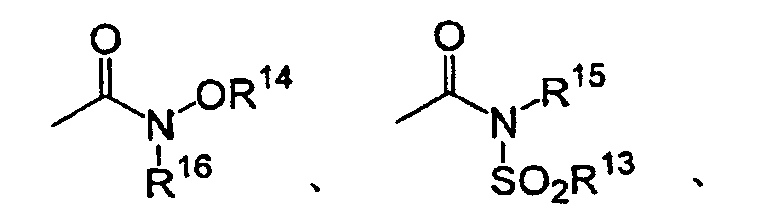
  • the substituent(s) includes, for example, hydrogen atom, substituted or unsubstituted alkyl groups, substituted or unsubstituted alkenyl groups, substituted or unsubstituted alkynyl groups, substituted or unsubstituted cycloalkyl groups, substituted or unsubstituted cycloalkenyl groups, aralkyl groups, phenyl group, naphthyl group, heterocyclic groups, acyl groups (said aralkyl groups, phenyl group, naphthyl group, heterocyclic groups and acyl groups may be substituted by one or more substituents which may be the same or different and are selected from alkyl groups, alkoxy groups, alkylenedioxy groups and halogen atoms), substituted or unsubstituted alkoxycarbonyl groups, carboxyl group, halogen atoms, nitro group and groups represented by the formulas: -CN, -OR 14 ,
  • R 13 and R 13a are independently a hydroxyl group, an alkyl group, a cycloalkyl group, a phenyl group, a naphthyl group or a saturated or unsaturated heterocyclic group.
  • R 15 , R 16 , R 17 and R 18 are independently a hydrogen atom, an alkyl group, an aralkyl group, an alkenyl group, an alkynyl group, a cycloalkyl group, a cycloalkenyl group, a phenyl group, a naphthyl group, a saturated or unsaturated heterocyclic group or an acyl group.
  • R 15 and R 16 , or R 17 and R 18 when taken together with the nitrogen atom to which they are bonded, represent a saturated 3- to 8-membered cyclic amino group which may contain other heteroatom(s) in the ring (said cyclic amino group may be substituted by one or more substituted or unsubstituted alkyl groups, -S(O) n R 13 groups, -N(R 14 )R 14a groups, hydroxyl groups or -OR 14b groups).
  • R 14 , R 14a and R 14b are independently a hydrogen atom, an alkyl group, a cycloalkyl group, a cycloalkenyl group, a phenyl group, a naphthyl group or a saturated or unsaturated heterocyclic group.
  • the substituent(s) of each of the cycloalkyl group, cycloalkenyl group and cycloalkanecarbonyl group may be present in a number of, for example, 1 to 4 and may be the same or different.
  • the heterocyclic group includes saturated or unsaturated heterocyclic groups.
  • the saturated or unsaturated heterocyclic groups include saturated or unsaturated monocyclic heterocyclic groups and saturated or unsaturated polycyclic heterocyclic groups.
  • the alkyl group includes, for example, linear or branched alkyl groups of 8 or less carbon atoms, such as methyl, ethyl, propyl, 2-propyl, butyl, 2-butyl, 2-methylpropyl, 1,1-dimethylethyl, pentyl, hexyl, heptyl, octyl, etc.
  • the cycloalkane ring includes, for example, 3- to 8-membered cycloalkane rings such as cyclopropane, cyclobutane, cyclopentane, cyclohexane, cycloheptane, cyclooctane, etc.
  • the cycloalkyl group includes, for example, 3- to 8-membered cycloalkyl groups such as cyclopropyl, cyclobutyl, cyclopentyl, cyclohexyl, cycloheptyl, etc.
  • the cycloalkenyl group includes, for example, 3- to 8-membered cycloalkenyl groups having a double bond, such as 1-cyclopentenyl, 2-cyclopentenyl, 3-cyclopentenyl, 1-cyclohexenyl, 2-cyclohexenyl, 3-cyclohexenyl, etc.
  • the alkenyl group includes, for example, alkenyl groups of 6 or less carbon atoms, such as vinyl, allyl, propenyl, 2-propenyl, butenyl, pentenyl, hexenyl, etc.
  • the alkynyl group includes, for example, alkynyl groups of 6 or less carbon atoms, such as ethynyl, propargyl, butynyl, pentynyl, etc.
  • the halogen atom includes, for example, iodine, fluorine, chlorine and bromine atoms.
  • the acyl group includes, for example, formyl group; alkanoyl groups of 2 to 6 carbon atoms, such as acetyl, propanoyl, etc.; cycloalkanecarbonyl groups of 4 to 7 carbon atoms, such as cyclopropanecarbonyl, cyclobutanecarbonyl, cyclopentanecarbonyl, cyclohexanecarbonyl, etc.; cycloalkenecarbonyl groups of 3 to 6 carbon atoms, such as cyclopentenecarbonyl, cyclohexenecarbonyl, etc.; aroyl groups of 6 to 10 carbon atoms, such as benzoyl, toluoyl, naphthoyl, etc.; saturated heterocyclic ring-carbonyl groups having a 5- or 6-membered saturated heterocyclic ring containing one or two heteroatoms selected from nitrogen atom, oxygen atom and sulfur atom, such as 2-piperidinecarbonyl, 3-morph
  • the substituent(s) of the substituted alkyl group may be present in a number of one or more and may be the same or different.
  • R 33 , R 35 and R 36 the same groups as those described above as R 13 , R 15 and R 16 are exemplified respectively.
  • Such a substituted alkyl group includes, for example, alkyl groups of 1 to 5 carbon atoms substituted by a cycloalkyl group of 3 to 6 carbon atoms, polyhaloalkyl groups of 1 to 5 carbon atoms, hydroxyalkyl groups of 1 to 6 carbon atoms, alkoxyalkyl groups of 2 to 6 carbon atoms, cyanoalkyl groups of 2 to 6 carbon atoms, carboxyalkyl groups of 2 to 6 carbon atoms, alkoxycarbonylalkyl groups of 3 to 8 carbon atoms, alkanoylalkyl groups of 3 to 8 carbon atoms, aroylalkyl groups of 16 or less carbon atoms, substituted or unsubstituted phenyl- or naphthyl-C1 ⁇ C5 alkyl groups, carbamoyl-C1 ⁇ C3 alkyl groups which may be substituted by one or two C1 ⁇ C3 alkyl groups on the nitrogen atom, amino-C1 ⁇
  • substituted alkyl group are polyhaloalkyl groups of 1 to 3 carbon atoms, such as trifluoromethyl, trifluoroethyl, trichloromethyl, etc.; hydroxyalkyl groups of 1 to 6 carbon atoms, such as hydroxymethyl, hydroxyethyl, 1-hydroxyethyl, etc.; aminoalkyl groups of 1 to 5 carbon atoms, such as aminomethyl, aminoethyl, 1-aminoethyl, etc.; alkoxyalkyl groups of 1 to 6 carbon atoms, such as methoxyethyl, ethoxyethyl, methoxypropyl, etc.; carboxyalkyl groups of 2 to 6 carbon atoms, such as carboxyethyl, carboxypropyl, etc.; alkoxycarbonylalkyl groups of 3 to 7 carbon atoms, such as methoxycarbonylmethyl, ethoxycarbonylmethyl, methoxycarbonylethyl
  • substituent(s) of the substituted alkenyl group, substituted alkynyl group or substituted alkanoyl group there are exemplified the same groups as those described above as the substituent(s) of the substituted alkyl group.
  • the substituent(s) of each of these substituted groups may also be present in a number of one or more and may be the same or different.
  • alkyl groups substituted by a phenyl group or a polycyclic hydrocarbon ring group are exemplified.
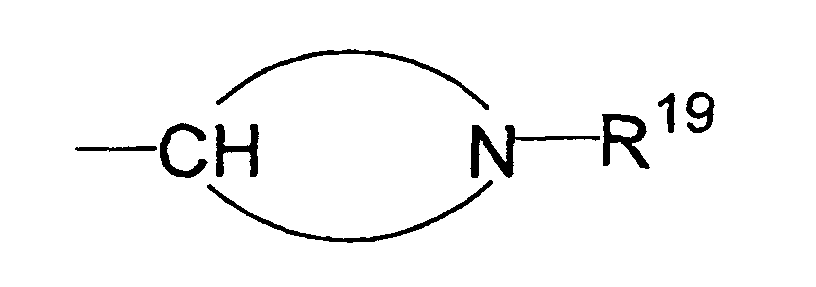
  • heteroatom(s) of the saturated 3- to 8-membered cyclic amino group which may contain other heteroatom(s) in the ring and which R 10 and R 11 ; R 15 and R 16 ; R 17 and R 18 ; or R 35 and R 36 form when taken together with the nitrogen atom to which they are bonded
  • oxygen atom nitrogen atom and sulfur atom
  • Specific examples of such cyclic amino group are 3- to 8-membered cyclic groups containing 1 to 3 nitrogen atoms and 3- to 8-membered cyclic groups containing a nitrogen atom and an oxygen atom. More specific examples thereof are 1-pyrrolidinyl, 1-piperidino, 1-piperazinyl, morpholino and 1-(4-methyl)piperazinyl.
  • alkylsulfonyl groups of 8 or less carbon atoms, such as methylsulfonyl group, ethylsulfonyl group, propylsulfonyl group, isopropylsulfonyl group, etc.
  • -S(O) m R 12 there are exemplified the above-exemplified groups and corresponding alkylsulfinyl and alkylthio groups, and sulfo group.
  • the substituent(s) of the lower alkylene group, alkenylene group or alkynylene group may be present in a number of one or more and may be the same or different.
  • the substituent(s) includes alkyl groups, aralkyl groups and the same groups as those described as the substituent(s) of the substituted alkyl group.
  • the lower alkylene group includes, for example, linear or branched alkylene groups of 10 or less carbon atoms, such as methylene, ethylene, trimethylene, tetramethylene, pentamethylene, hexamethylene, 2-methyltrimethylene, etc.
  • prodrug there are exemplified those which are easily hydrolyzed in a living body to regenerate the compound of formula (1).
  • the compound of formula (1) has a carboxyl group
  • examples of the prodrug are compounds obtained by converting the carboxyl group to an alkoxycarbonyl group, an alkylthiocarbonyl group or an alkylaminocarbonyl group.
  • examples of the prodrug are compounds obtained by converting the amino group to an alkanoylamino group by substitution by the alkanoyl group, compounds obtained by converting the amino group to an alkoxycarbonylamino group by substitution by the alkoxycarbonyl group, and compounds obtained by converting the amino group to an acyloxymethylamino group or hydroxylamine.
  • examples of the prodrug are compounds obtained by converting the hydroxyl group to an acyloxy group by substitution by the above-exemplified acyl group, and compounds obtained by converting the hydroxyl group to a phosphoric ester or an acyloxymethyloxy group.
  • examples of the prodrug are compounds obtained by converting the sulfo group to a sulfonic ester by substitution by an alkyl group.
  • examples of the prodrug are compounds obtained by converting the phosphono group to a phosphonic monoester or a phosphonic diester by substitution by one or two alkyl groups.
  • alkyl portion of the group used for such conversion to the prodrug examples are the above-exemplified alkyl groups.
  • the alkyl groups as the alkyl portion may be substituted by, for example, an alkoxy group of 1 to 6 carbon atoms.
  • Preferable examples of the alkyl portion are as follows.
  • the compound represented by formula (1) or the prodrug thereof may be converted to a pharmaceutically acceptable salt.
  • a salt there are exemplified salts with mineral acids such as hydrochloric acid, hydrobromic acid, sulfuric acid, phosphoric acid, etc.; salts with organic carboxylic acids such as formic acid, acetic acid, fumaric acid, maleic acid, oxalic acid, citric acid, malic acid, tartaric acid, aspartic acid, glutamic acid, etc.; salts with sulfonic acids such as methanesulfonic acid, benzenesulfonic acid, p-toluenesulfonic acid, hydroxybenzenesulfonic acid, dihydroxybenzenesulfonic acid, etc.; and alkali metal salts such as sodium salt, potassium salt, etc.; alkaline earth metal salts such as calcium salt, magnesium salt, etc.; ammonium salt; and triethylamine salt, pyridine salt, pic
  • Each of the compounds represented by formula (1), the prodrugs thereof and the pharmaceutically acceptable salts of the compounds or prodrugs may be in the form of an anhydride, hydrate or solvate.
  • the compounds of the present invention may be orally or parenterally administered. That is, the compounds may be orally administered in a usual dosage form such as powder, granules, tablets, capsules, syrup, suspension or the like, or the compound may be parenterally administered, for example, by injection of a solution, emulsion or suspension prepared from the compound.
  • the compounds may be administered rectally in the form of a suppository.
  • the compounds of the present invention may be formulated into the above-exemplified suitable dosage form by blending the compound with conventional acceptable adjuvants such as a carrier, excipient, binder, stabilizer, diluent, etc.
  • the injection may contain acceptable additives such as a buffer, solubilizer, tonicity agent, etc.
  • acceptable additives such as a buffer, solubilizer, tonicity agent, etc.
  • the dose and the number of administrations are varied depending on, for example, a disease to be cured, the condition of the disease, age, body weight and administration route, the compound may be administered to an adult in a dose of usually 0.1 to 2,000 mg, preferably 1 to 200 mg per day in one portion or several portions (for example, 2 to 4 portions).
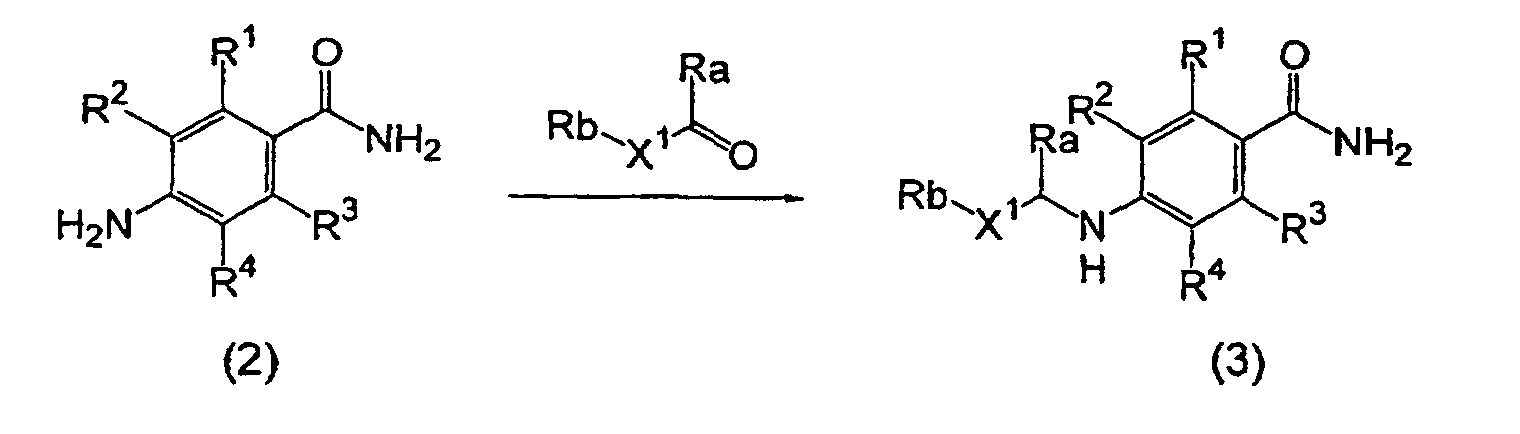
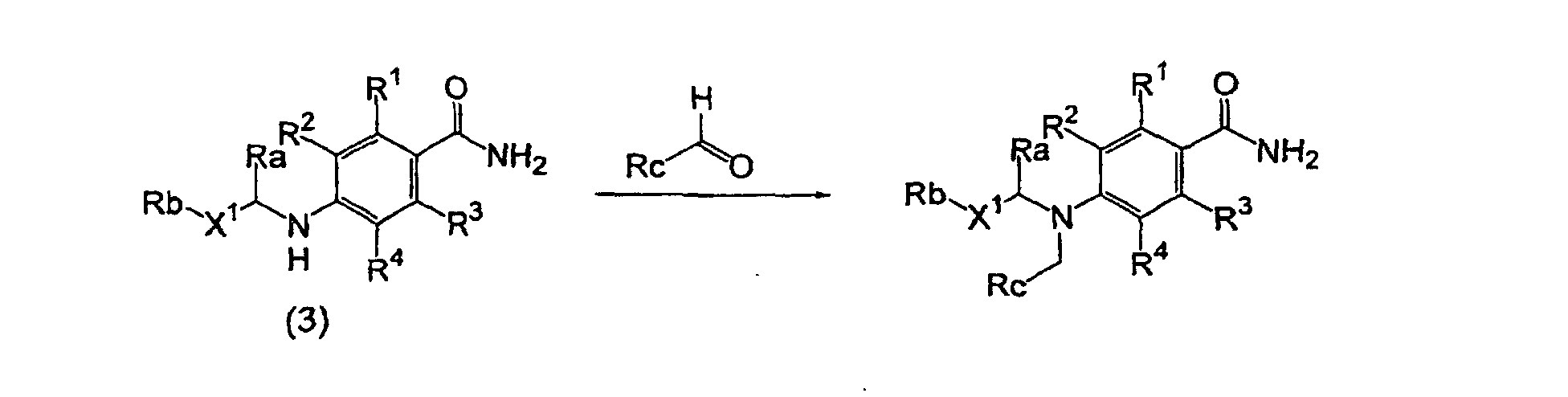
  • the compound represented by formula (1) may be synthesized from a well-known compound by a combination of well-known synthesis processes.
  • the compound may be synthesized, for example, by any of the processes described in the working examples described hereinafter or any of the following processes.
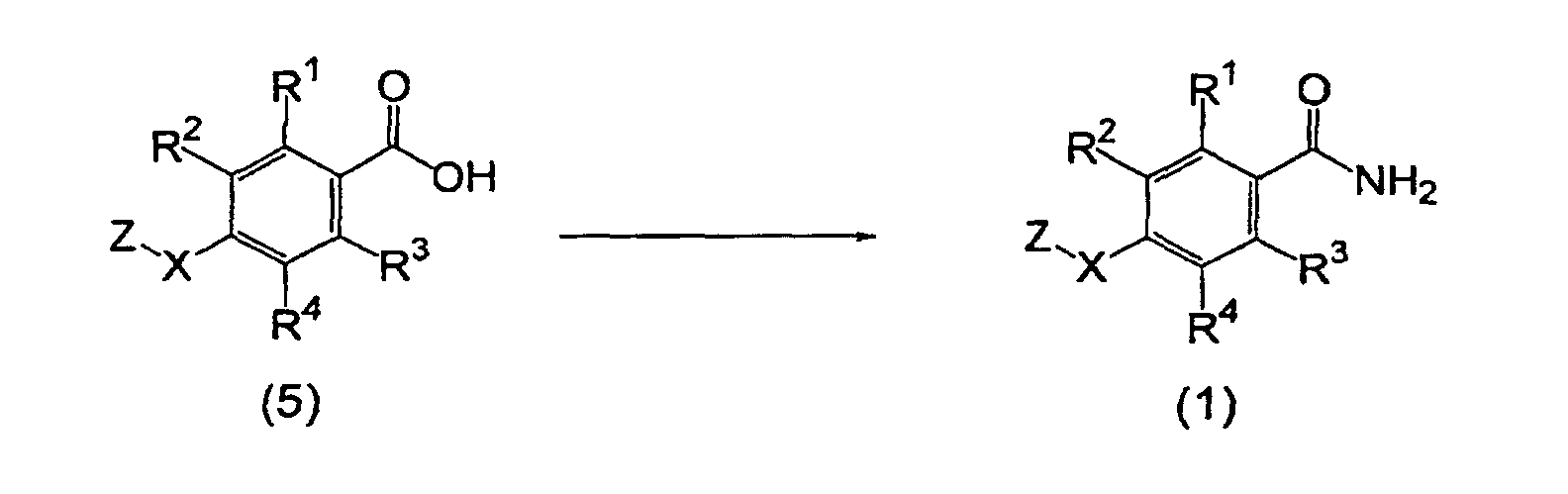
  • the compound represented by formula (1) may be synthesized, for example, by reacting a compound represented by formula (5) with an amine such as ammonium chloride in an inert solvent in the presence of a condensing agent at room temperature or with heating.
  • condensing agents such as dicyclohexylcarbodiimide (DCC), diisopropylcarbodiimide (DIPC), 1-ethyl-3-(3-dimethylaminopropyl)-carbodiimide (WSC), benzotriazol-1-yl-tris(dimethylamino)phosphonium•hexafluorophosphate (BOP), diphenylphosphonyldiamide (DPPA), N,N-carbonyldiimidazole (Angew. Chem. Int. Ed. Engl., Vol. 1, 351(1962)), etc..
  • DCC dicyclohexylcarbodiimide
  • DIPC diisopropylcarbodiimide
  • DIPC 1-ethyl-3-(3-dimethylaminopropyl)-carbodiimide
  • BOP benzotriazol-1-yl-tris(dimethylamino)phosphonium•hexa
  • additives such as N-hydroxysuccinimide (HOSu), 1-hydroxybenzotriazole (HOBt), 3-hydroxy-4-oxo-3,4-dihydro-1,2,3-benzotriazine (HOOBt), etc.
  • aromatic hydrocarbon solvents such as benzene, toluene, xylene, etc.
  • ether solvents such as tetrahydrofuran, 1,4-dioxane, etc.
  • halogenated hydrocarbon solvents such as dichloromethane, chloroform, 1,2-dichloroethane, etc.
  • amide solvents such as dimethylformamide, dimethylacetamide, etc.; and mixed solvents thereof.
  • the compound represented by formula (1) may be synthesized also by, for example, reacting a corresponding benzonitrile compound (which refers to the same compound as the compound of formula (1) except that the amide group is replaced by a cyano group) as a starting compound in a sulfuric acid solvent with heating (for example, the process described in J. Med. Chem., Vol. 34, 281(1991)), or reacting the benzonitrile compound in an ethanol solvent with heating in the presence of potassium hydroxide (for example, the process described in J. Heterocycl. Chem., Vol. 27, 605(1990)).
  • a protective group for the hydroxyl group methoxymethyl group, tetrahydropyranyl group and the like are exemplified.
  • a protective group for the amino group tert-butoxycarbonyl group and the like are exemplified.
  • the protective group for the hydroxyl group may be removed by reaction in a solvent such as aqueous methanol, aqueous ethanol or aqueous tetrahydrofuran in the presence of an acid such as hydrochloric acid, sulfuric acid or acetic acid.
  • the protective group for the amino group may be removed by reaction in a solvent such as aqueous tetrahydrofuran, methylene chloride, chloroform or aqueous methanol in the presence of an acid such as hydrochloric acid or trifluoroacetic acid.
  • a solvent such as aqueous tetrahydrofuran, methylene chloride, chloroform or aqueous methanol in the presence of an acid such as hydrochloric acid or trifluoroacetic acid.
  • tert-butyl esters As a protective form for protecting the carboxyl group, there are exemplified tert-butyl esters, orthoesters, acid amides and the like. Such a protective group is removed as follows.
  • the tert-butyl ester the removal is carried out, for example, by reaction in an aqueous solvent in the presence of hydrochloric acid.
  • the orthoester the removal is carried out by treatment with an acid and then an alkali such as sodium hydroxide in a solvent such as aqueous methanol, aqueous tetrahydrofuran or aqueous 1,2-dimethoxyethane.
  • the acid amide the removal is carried out by reaction in a solvent such as water, aqueous methanol or aqueous tetrahydrofuran in the presence of an acid such as hydrochloric acid or sulfuric acid.
  • the compound represented by formula (1) includes those having an optical center of asymmetry. Therefore, the compound having an optical center of asymmetry may be obtained as a racemic modification, or it may be obtained as an optically active substance when an optically active starting material is used. If necessary, the racemic modification obtained may be physically or chemically resolved into optical antipodes by a well-known method. Preferably, diastereomers are formed from the racemic modification by a reaction using a reagent for optical resolution. The diastereomers different in form may be resolved by a well-known method such as fractional crystallization.
  • the title compound was synthesized by carrying out reaction according to the method described in Example 1, except for using p-acetylbenzoic acid in place of 2-nitrobenzoic acid.
  • Ammonium formate (400 mg) and 10%-palladium/carbon (80 mg) were added to a suspension of the N-[4-(aminocarbonyl)phenyl]-1-benzylpiperidine-4-carboxamide obtained in Example 7 (400 mg, 1.19 mmol) in ethanol (20 ml), and the resulting mixture was refluxed for 5 hours. Then, ammonium formate (400 mg), 10% Pd-C (80 mg) and 1N-hydrochloric acid (several drops) were added thereto, and the resulting mixture was refluxed for 1.5 hours.
  • the title compound was synthesized by carrying out reaction according to the method described in Example 7 (a), except for using ethyl 3-piperidinecarboxylate as a starting material.
  • the title compound was synthesized by carrying out reaction according to the method described in Example 7 (b), except for using ethyl 1-benzyl-3-piperidinecarboxylate as a starting material.
  • Trifluoroacetic acid (3.4 ml) was added to a suspension of tert-butyl 4-[ ⁇ [4-(aminocarbonyl)phenyl]-amino ⁇ carbonyl]cyclohexylcarbamate (290 mg, 0.802 mmol) in methylene chloride (5 ml) at room temperature and stirred overnight. After completion of the reaction, the solvent was distilled off under-reduced pressure and the resulting residue was dissolved in water, and the resulting solution was neutralized with a saturated aqueous sodium hydrogencarbonate solution.
  • the title compound was synthesized by carrying out reaction according to the method described in Example 15 (a), except for using trans-4-(aminomethyl)cyclohexanecarboxylic acid as a starting material.
  • the title compound was synthesized by carrying out reaction according to the method described in Example 15 (b), except for using trans-4- ⁇ [(tert-butoxycarbonyl)amino]methyl ⁇ cyclohexanecarboxylic acid as a starting material.
  • the title compound was synthesized by carrying out reaction according to the method described in Example 10, except for using 1-benzyl-3-piperidone hydrochloride monohydrate in place of 1-benzyl-4-piperidone.
  • the title compound was synthesized by carrying out reaction according to the method described in Example 10, except for using 1-benzyl-3-pyrrolidone in place of 1-benzyl-4-piperidone.
  • the aqueous layer was neutralized with 1N-hydrochloric acid and then extracted with ethyl acetate.
  • the organic layer was washed with a saturated aqueous sodium chloride solution and dried over magnesium sulfate.
  • the solvent was distilled off under reduced pressure and the resulting residue was purified by a silica gel column chromatography (eluent: chloroform/ethyl acetate) to obtain tert-butyl 4-hydroxycyclohexylcarbamate (11.3 g) (14.0 g in total, 93%).
  • Trifluoroacetic acid (2.2 ml) was added to a suspension of tert-butyl 4- ⁇ [4-(aminocarbonyl)phenyl]-amino ⁇ cyclohexylcarbamate (167 mg, 0.501 mmol) in methylene chloride (4 ml), and the resulting mixture was stirred overnight at room temperature. After completion of the reaction, the reaction mixture was concentrated to obtain 4-[(4-aminocyclohexyl)amino]-benzamide trifluoroacetate (230 mg, 100%).
  • the title compound was synthesized by carrying out reaction according to the method described in Example 10, except for using tetrahydro-4H-pyran-4-one in place of 1-benzyl-4-piperidone.
  • Benzaldehyde (0.076 ml, 0.748 mmol) and sodium triacetoxyborohydride (169 mg, 0.750 mmol) were added to a solution of the 4-(piperidin-4-yloxy)benzamide trifluoroacetate obtained in Example 24 (125 mg, 0.375 mmol) in 1,2-dichloroethane (7 ml), and the resulting mixture was stirred overnight at room temperature. Then, the reaction mixture was poured into a 1N-aqueous sodium hydroxide solution and extracted with ethyl acetate. The organic layer was washed with a saturated aqueous sodium chloride solution and dried over magnesium sulfate.
  • a 4N-aqueous sodium hydroxide solution (2.5 ml) was added to a solution of methyl 2-methoxy-4-[(1-benzylpiperidin-4-yl)amino]benzoate (885 mg, 2.50 mmol) in a tetrahydrofuran (4 ml)/methanol (4 ml) mixture, and the resulting mixture was stirred at room temperature for 6 hours.
  • a 4N-aqueous sodium hydroxide solution (1 ml) was added thereto and the resulting mixture was stirred overnight at room temperature.
  • a 4N-aqueous sodium hydroxide solution (2 ml) was added thereto and the resulting mixture was stirred overnight again at room temperature.
  • reaction mixture was poured into a saturated aqueous sodium hydrogencarbonate solution and extracted with ethyl acetate.
  • organic layer was washed with a saturated aqueous sodium chloride solution and dried over magnesium sulfate.
  • the title compound was synthesized by carrying out reaction according to the method described in Example 10, except for using 4-amino-3-methoxybenzoic acid in place of p-aminobenzamide.
  • the title compound was synthesized by carrying out reaction according to the method described in Example 28 (c), except for using 4-[(1-benzylpiperidin-4-yl)amino]-3-methylbenzoic acid as a starting material.
  • Acetic acid (2.0 ml, 34.9 mmol) and N-ethoxycarbonyl-4-tropinone (2.11 g, 10.5 mmol) were added to a solution of p-aminobenzamide (953 mg, 7.00 mmol) in methanol (42 ml) at room temperature, followed by adding thereto sodium cyanoborohydride (2.20 g, 35.0 mmol) in an ice-water bath, and the resulting mixture was stirred overnight at room temperature. Thereafter, the solvent was distilled off and the resulting residue was diluted with ethyl acetate, washed with a saturated aqueous sodium chloride solution and then dried over magnesium sulfate.
  • the title compound was synthesized by carrying out reaction according to the method described in Example 36 (a), except for using 4-(piperidin-4-ylmethyl)benzoic acid monohydrochloride as a starting material.
  • the title compound was synthesized by carrying out reaction according to the method described in Example 36 (b), except for using benzyl 4-[(1-benzylpiperidin-4-yl)methyl]benzoate as a starting material.
  • Acetic acid 1.5 ml, 26.2 mmol
  • t-butyl 4-oxo-1-piperidinecarboxylate (1.52 g, 7.48 mmol) were added to a solution of 4-amino-2-chlorobenzoic acid (858 mg, 5.00 mmol) in methanol (30 ml) at room temperature, followed by adding thereto sodium cyanoborohydride (1.57 g, 25.0 mmol) in an ice-water bath, and the resulting mixture was stirred overnight at room temperature.
  • reaction mixture was poured into a saturated aqueous sodium hydrogencarbonate solution and extracted with ethyl acetate. The organic layer was washed with a saturated aqueous sodium chloride solution, dried over magnesium sulfate, and then filtered.
  • Ammonium chloride (1.07 g, 20.0 mmol), 1-ethyl-3-(3-dimethylaminopropyl)carbodiimide hydrochloride (2.88 g, 15.0 mmol), 1-hydroxybenzotriazole monohydrate (2.03 g, 15.0 mmol) and diisopropylethylamine (7.0 ml, 40.2 mmol) were added to a solution of 4-amino-2-chlorobenzoic acid (858 mg, 5.00 mmol) in N,N-dimethylformamide (50 ml), and the resulting mixture was stirred overnight at room temperature.
  • Trifluoroacetic acid (9.5 ml) was added to a solution of tert-butyl 4- ⁇ [4-(aminocarbonyl)-2-chlorophenyl]amino ⁇ piperidine-1-carboxylate (850 mg, 2.40 mmol) in methylene chloride (15 ml), and the resulting mixture was stirred overnight at room temperature. After completion of the reaction, the reaction mixture was concentrated and a 1N-aqueous sodium hydroxide solution was added thereto, followed by extraction with ethyl acetate and chloroform.
  • Benzaldehyde (0.052 ml, 0.512 mmol), sodium triacetoxyborohydride (222 mg, 0.985 mmol) and acetic acid (0.045 ml, 0.786 mmol) were added to a solution of the 3-chloro-4-(piperidin-4-ylamino)benzamide obtained in Example 45 (100 mg, 0.394 mmol) in 1,2-dichloroethane (4 ml), and the resulting mixture was stirred overnight at room temperature. After completion of the reaction, the reaction mixture was poured into a 1N-aqueous sodium hydroxide solution and extracted with ethyl acetate. The organic layer was dried over magnesium sulfate and filtered.
  • a 1M-boron tribromide/methylene chloride solution (10.6 ml, 10.6 mmol) was added dropwise to a solution of the 4-[(1-benzylpiperidin-4-yl)amino]-2-methoxybenzamide obtained in Example 28 (1.20 g, 3.54 mmol) in methylene chloride (36 ml), and the resulting mixture was stirred overnight at room temperature.
  • a 1M-boron tribromide/methylene chloride solution (4.3 ml, 4.3 mmol) was further added thereto, and the resulting mixture was stirred overnight at room temperature. After completion of the reaction, water was added dropwise to the reaction mixture in an ice-water bath, and the resulting mixture was stirred at room temperature for a while.
  • Example 49 The title compound was synthesized by carrying out reaction according to the method described in Example 49, except for using the 4-[(1-benzylpiperidin-4-yl)amino]-3-methoxybenzamide obtained in Example 30 (b), as a starting material.
  • the title compound was synthesized by carrying out reaction according to the method described in Example 45 (c), except for using tert-butyl 4- ⁇ [4-(aminocarbonyl)-2-(trifluoromethyl)phenyl]amino ⁇ -piperidine-1-carboxylate as a starting material.
  • N-bromosuccinimide (3.78 g, 21.2 mmol) in N,N-dimethylformamide (11 ml) was added dropwise to a solution of 3-trifluoromethoxyaniline (3.84 g, 21.2 mmol) in N,N-dimethylformamide (11 ml) at room temperature over a period of 40 minutes. After completion of the dropwise addition, the resulting mixture was stirred overnight. After completion of the reaction, the reaction mixture was poured into water and extracted with ethyl acetate, and the organic layer was dried over magnesium sulfate and filtered.
  • the title compound was synthesized by carrying out reaction according to the method described in Example 44 (a), except for using 2-bromo-4-nitrobenzoic acid as a starting material.
  • the title compound was synthesized by carrying out reaction according to the method described in Example 45 (a), except for using 4-amino-2-bromobenzamide in place of p-aminobenzamide.
  • the title compound was synthesized by carrying out reaction according to the method described in Example 45 (c), except for using tert-butyl 4- ⁇ [4-(aminocarbonyl)-3-bromophenyl]amino ⁇ piperidine-1-carboxylate as a starting material.
  • the title compound was synthesized by carrying out reaction according to the method described in Example 44 (a), except for using 2-fluoro-4-nitrobenzoic acid as a starting material.
  • Tin chloride (7.89 g, 35.0 mmol) was added to a solution of 2-fluoro-4-nitrobenzamide (1.84 g, 9.99mmol) in ethanol (60 ml), and the resulting mixture was stirred for 4 hours under refluxing conditions. After completion of the reaction, the solvent was distilled off and the resulting residue was diluted with ethyl acetate, followed by adding thereto a saturated aqueous sodium hydrogencarbonate solution. The resulting suspension was filtered by the use of Celite and the filtrate was extracted with ethyl acetate. The organic layer was washed with a saturated aqueous sodium chloride solution, dried over magnesium sulfate and then filtered.
  • the title compound was synthesized by carrying out reaction according to the method described in Example 45 (a), except for using 4-amino-2-fluorobenzamide in place of p-aminobenzamide.
  • the title compound was synthesized by carrying out reaction according to the method described in Example 11, except for using the 4-[(1-benzylpiperidin-4-yl)amino]-2-fluorobenzamide obtained in Example 66, as a starting material.
  • the title compound was synthesized by carrying out reaction according to the method described in Example 44 (a), except for using 3-fluoro-4-nitrobenzoic acid as a starting material.
  • the title compound was synthesized by carrying out reaction according to the method described in Example 65 (b), except for using 3-fluoro-4-nitrobenzamide as a starting material.
  • the title compound was synthesized by carrying out reaction according to the method described in Example 45 (a), except for using 4-amino-3-fluorobenzamide in place of p-aminobenzamide.
  • the title compound was synthesized by carrying out reaction according to the method described in Example 59 (a), except for using 3-methylmercaptoaniline as a starting material.
  • the title compound was synthesized by carrying out reaction according to the method described in Example 59 (b), except for using 4-bromo-3-(methylthio)aniline as a starting material.
  • the title compound was synthesized by carrying out reaction according to the method described in Example 59 (c), except for using tert-butyl 4-bromo-3-(methylthio)phenylcarbamate as a starting material.
  • the title compound was synthesized by carrying out reaction according to the method described in Example 59 (d), except for using 4-amino-2-(methylthio)benzonitrile as a starting material.
  • the title compound was synthesized by carrying out reaction according to the method described in Example 45 (a), except for using 4-amino-2-(methylthio)benzamide in place of p-aminobenzamide.
  • the title compound was synthesized by carrying out reaction according to the method described in Example 45 (c), except for using tert-butyl 4- ⁇ [4-(aminocarbonyl)-3-(methylthio)phenyl]amino ⁇ piperidine-1-carboxylate as a starting material.
  • the title compound was synthesized by carrying out reaction according to the method described in Example 59 (a), except for using m-phenetidine as a starting material.
  • the title compound was synthesized by carrying out reaction according to the method described in Example 59 (b), except for using 4-bromo-3-ethoxyaniline as a starting material.
  • the title compound was synthesized by carrying out reaction according to the method described in Example 59 (c), except for using tert-butyl 4-bromo-3-ethoxyphenylcarbamate as a starting material.
  • the title compound was synthesized by carrying out reaction according to the method described in Example 59 (d), except for using 4-amino-2-ethoxybenzonitrile as a starting material.
  • the title compound was synthesized by carrying out reaction according to the method described in Example 65 (b), except for using 2-methoxy-4-nitrobenzonitrile as a starting material.
  • the title compound was synthesized by carrying out reaction according to the method described in Example 59 (d), except for using 4-amino-2-methoxybenzonitrile as a starting material.
  • the title compound was synthesized by carrying out reaction according to the method described in Example 45 (a), except for using 4-amino-2-methoxybenzamide in place of p-aminobenzamide.
  • the title compound was synthesized by carrying out reaction according to the method described in Example 11, except for using the 4-[(1-benzylpiperidin-4-yl)amino]-5-chloro-2-methoxybenzamide obtained in Example 76, as a starting material.
  • Example 45 (c) The title compound was synthesized by carrying out reaction according to the method described in Example 45 (c), except for using the tert-butyl 4- ⁇ [4-(aminocarbonyl)-2-chloro-3-methoxyphenyl]amino ⁇ -piperidine-1-carboxylate obtained in Example 74 (d), as a starting material.
  • Example 45 The title compound was synthesized by carrying out reaction according to the method described in Example 45 (b), except for using the 4-[(1-methylpiperidin-4-yl)amino]benzamide obtained in Example 80, as a starting material.
  • the title compound was synthesized by carrying out reaction according to the method described in Example 11, except for using the 3-chloro-4-[(1-methylpiperidin-4-yl)amino]benzamide obtained in Example 81, as a starting material.
  • Example 63 The title compound was synthesized by carrying out reaction according to the method described in Example 63 (a), except for using the 4-[(1-methylpiperidin-4-yl)amino]benzamide obtained in Example 80, as a starting material.
  • Example 65 (b) The 4-amino-2-fluorobenzamide obtained in Example 65 (b) (308 mg, 2.00 mmol), sodium triacetoxyborohydride (1.13 g, 5.01 mmol) and acetic acid (0.23 ml, 4.02 mmol) were added to a solution of 1-methyl-4-piperidone (0.49 ml, 3.98 mmol) in 1,2-dichloroethane (14 ml), and the resulting mixture was stirred overnight at room temperature. After completion of the reaction, the reaction mixture was poured into a 1N-aqueous sodium hydroxide solution under ice-cooling and extracted with ethyl acetate.
  • Benzaldehyde (6.73 ml, 66.2 mmol) and acetic acid (3.77 ml, 66.2 mmol) were added to a solution of methyl 4-amino-2-methoxybenzoate (12 g, 66.2 mmol) in methanol (650 ml), and the resulting mixture was stirred at room temperature for 30 minutes. Then, acetic acid (7.56 ml, 132 mmol) and sodium cyanoborohydride (4.9 g, 79.4 mmol) were added thereto at 0°C and stirred at room temperature for 38 hours. The reaction mixture was concentrated, poured into a 1N-aqueous sodium hydroxide solution and then extracted with ethyl acetate.
  • Example 74 (b) or Example 86 (a) To a solution of the 4-amino-2-methoxybenzamide obtained in Example 74 (b) or Example 86 (a) (150 mg, 0.902 mmol) in dichloroethane were added 1-methyl-4-piperidone (0.22 ml, 1.80 mmol), acetic acid (0.103 ml, 1.80 mmol) and sodium triacetoxyborohydride (477 mg, 2.26 mmol), and the resulting mixture was stirred at room temperature for fourteen and a half hours. The reaction mixture was poured into a 1N-aqueous sodium hydroxide solution and extracted with ethyl acetate. The organic layer was dried over anhydrous magnesium sulfate and filtered.
  • 1-methyl-4-piperidone (0.22 ml, 1.80 mmol
  • acetic acid (0.103 ml, 1.80 mmol
  • sodium triacetoxyborohydride 477 mg, 2.26 mmol
  • the title compound was synthesized by carrying out reaction according to the method described in Example 11, except for using the 5-chloro-2-methoxy-4-[(1-methylpiperidin-4-yl)amino]benzamide obtained in Example 87, as a starting material.
  • the title compound was synthesized by carrying out reaction according to the method described in Example 14, except for using the 4-[(1-benzylpiperidin-4-yl)(methyl)amino]-2-methoxybenzamide obtained in Example 89, as a starting material.
  • the title compound was synthesized by carrying out reaction according to the method described in Example 89, except for using the tert-butyl 4- ⁇ [4-(aminocarbonyl)-2-chlorophenyl]amino ⁇ piperidine-1-carboxylate obtained in Example 45 (b), as a starting material.
  • Example 86 (150 mg, 0.902 mmol) in methanol (7.5 ml) were added 1-benzoyl-4-piperidone (183 mg, 0.902 mmol) and acetic acid (0.052 ml, 0.90 mmol), and the resulting mixture was stirred at room temperature for 30 minutes. Then, acetic acid (0.103 ml, 1.80 mmol) and sodium cyanoborohydride (130 mg, 2.06 mmol) were added thereto, followed by stirring at room temperature for 31 hours.
  • the title compound was synthesized by carrying out reaction according to the method described in Example 86 (b), except for using 1-(methylsulfonyl)-piperidin-4-one in place of 1-methyl-4-piperidone.
  • Triethylamine (1.45 ml, 10.5 mmol) was added to a solution of 1,4-dioxa-8-azaspiro[4.5]-decane (1g, 6.98 mmol) in dichloromethane (5 ml), followed by adding thereto a solution of benzenesulonyl chloride (0.935 ml, 7.33 mmol) in dichloromethane (5 ml) at 0°C, and the resulting mixture was stirred at 0°C for 1 hour. The reaction mixture was poured into a saturated aqueous sodium hydrogencarbonate solution and then extracted with ethyl acetate.
  • the title compound was synthesized by carrying out reaction according to the method described in Example 86 (b), except for using 1-(phenylsulfonyl)piperidin-4-one in place of 1-methyl-4-piperidone.
  • Example 14 The title compound was synthesized by carrying out reaction according to the method described in Example 14, except for using the 4-[(1-benzylpiperidin-3-yl)amino]-2-methoxybenzamide obtained in Example 98, as a starting material.
  • IR (neat) 3448, 3301, 2935, 1608, 1577, 15 62, 1423, 1334, 1211, 1103cm -1 .
  • N-methyl-N-nitrosourethane (1.39 ml, 10.8 mmol) was added dropwise to a solution of 1-benzyl-4-piperidone (2.0 g, 10.6 mmol) in methanol (4 ml) at -15°C over a period of 30 minutes while maintaining the temperature at -5°C or lower.
  • barium oxide (65 mg, 0.423 mmol) was added thereto in small portions. The resulting mixture was stirred overnight at -15°C and then filtered, and the filtrate was distilled under reduced pressure to remove the solvent and diethyl ether was added to the residue.
  • Triethylamine (35 ml) and a sulfur trioxidepyridine complex (20 g, 130 mmol) were added to a solution of tert-butyl 4-hydroxyazepane-1-carboxylate (3.5 g, 16.3 mmol) in dimethyl sulfoxide (90 ml), and the resulting mixture was stirred at room temperature for three and a half hours.
  • the reaction mixture was poured into water and extracted with ethyl acetate. The organic layer was washed with a saturated aqueous sodium chloride solution, dried over anhydrous magnesium sulfate and then filtered.
  • Example 45 (c) The title compound was synthesized by carrying out reaction according to the method described in Example 45 (c), except for using the tert-butyl 4- ⁇ [4-(aminocarbonyl)-3-methoxyphenyl]amino ⁇ azepane-1-carboxylate obtained in Example 100, as a starting material.
  • Example 46 The title compound was synthesized by carrying out reaction according to the method described in Example 46, except for using the 4-(azepan-4-ylamino)-2-methoxybenzamide obtained in Example 101, as a starting material.
  • IR (neat) 3455, 3309, 2931, 1 646, 1577, 15 58, 1338, 1211, 1103cm -1 .
  • the title compound was synthesized by carrying out reaction according to the method described in Example 14, except for using the 4-[(8-benzyl-8-azabicyclo[3.2.1]oct-3-yl)amino]-2-methoxybenzamide obtained in Example 103, as a starting material.
  • IR (neat) 3448, 3313, 3131, 2939, 1643, 15 85, 1342, 1211, 1099, 817cm -1 .
  • Triethylamine (2.06 ml, 14.8 mmol) and then diphenylphosphoryl azide (2.92 ml, 13.6 mmol) were added to a solution of cis-4-[(tert-butoxycarbonyl)-amino]cyclohexanecarboxylic acid (3.0 g, 12.3 mmol) in toluene (90 ml), and the resulting mixture was stirred at 80°C for one and a half hours.
  • Benzyl alcohol (1.53 ml, 13.6 mmol) was added to the reaction mixture and the resulting mixture was heated under reflux for 19 hours.
  • Example 105 (a) The title compound was synthesized by carrying out reaction according to the method described in Example 105 (a), except for using cis-tert-butyl 4-aminocyclohexylcarbamate as a starting material in place of trans-tert-butyl 4-aminocyclohexylcarbamate.
  • dimethylformamide 0.5 ml was added to sodium hydride (78.6 mg, 1.96 mmol), followed by adding dropwise thereto a solution of tert-butyl 4-cyano-3-methyl-3-methoxyphenylcarbamate (470 mg, 1.8 mmol) in dimethylformamide (1.5 ml).
  • the resulting mixture was stirred at room temperature for 1 hour, followed by adding thereto a solution of N-(2-chloroethyl)-N-methylbenzylamine (347 mg, 1.89 mmol) in dimethylformamide (0.5 ml) and sodium iodide (about 20 mg), and the resulting mixture was stirred at 60°C for 6 hours.
  • the title compound was synthesized by carrying out reaction according to the method described in Example 105 (b), except for using tert-butyl 2-[benzyl(methyl)amino]ethyl(4-cyano-3-methoxyphenyl)carbamate as a starting material.
  • the title compound was synthesized by carrying out reaction according to the method described in Example 108 (b), except for using N-(3-chloropropyl)-N-methylbenzylamine in place of N-(2-chloroethyl)-N-methylbenzylamine.
  • the title compound was synthesized by carrying out reaction according to the method described in Example 105 (b), except for using tert-butyl 3-[benzyl(methyl)amino]propyl(4-cyano-3-methoxyphenyl)-carbamate as a starting material.
  • the title compound was synthesized by carrying out reaction according to the method described in Example 108 (b), except for using N-(2-chloroethyl)-dibenzylamine in place of N-(2-chloroethyl)-N-methylbenzylamine.
  • the title compound was synthesized by carrying out reaction according to the method described in Example 105 (b), except for using tert-butyl 4-cyano-3-methoxyphenyl[2-(dibenzylamino)ethyl]carbamate as a starting material.
  • Example 105 (a) The title compound was synthesized by carrying out reaction according to the method described in Example 105 (a), except for using aniline in place of trans-tert-butyl 4-aminocyclohexylcarbamate.
  • the title compound was synthesized by carrying out reaction according to the method described in Example 105 (b), except for using 4-anilino-2-methoxybenzonitrile as a starting material.
  • Example 105 (a) The title compound was synthesized by carrying out reaction according to the method described in Example 105 (a), except for using 4-aminopyridine in place of trans-tert-butyl 4-aminocyclohexylcarbamate.
  • Example 74 (d) The title compound was synthesized by carrying out reaction according to the method described in Example 74 (d), except for using the trans-tert-butyl 4-[(4-cyano-3-methoxyphenyl)amino]cyclohexylcarbamate obtained in Example 105 (a), as a starting material.
  • Example 106 (d) The title compound was synthesized by carrying out reaction according to the method described in Example 74 (d), except for using the cis-tert-butyl 4-[(4-cyano-3-methoxyphenyl)amino]cyclohexylcarbamate obtained in Example 106 (d), as a starting material.
  • Propionaldehyde (0.064 ml, 0.893 mmol) was added to a solution of 4-[(trans-4-aminocyclohexyl)amino]-5-chloro-2-methoxybenzonitrile (250 mg, 0.893 mmol) in methanol (10 ml) and stirred for 15 minutes. Then, acetic acid (0.153 ml, 2.67 mmol) and sodium cyanoborohydride (67 mg, 1.07 mmol) were added thereto and the resulting mixture was stirred at room temperature for 3 hours. The reaction mixture was poured into a saturated aqueous sodium hydrogencarbonate solution and extracted with ethyl acetate.
  • the title compound was synthesized by carrying out reaction according to the method described in Example 115 (b), except for using acetone in place of propionaldehyde.
  • the title compound was synthesized by carrying out reaction according to the method described in Example 41 (b), except for using 5-chloro-4- ⁇ [trans-4-(dimehylamino)cyclohexyl]amino ⁇ -2-methoxybenzonitrile as a starting material.
  • the title compound was synthesized by carrying out reaction according to the method described in Example 115 (b), except for using cyclopentanone in place of propionaldehyde.
  • the title compound was synthesized by carrying out reaction according to the method described in Example 41 (b), except for using 5-chloro-4- ⁇ [trans-4-(cyclopentylamino)cyclohexyl]amino ⁇ -2-methoxybenzonitrile as a starting material.
  • Example 115 To a solution of the 4-[(trans-4-aminocyclohexyl)amino]-5-chloro-2-methoxybenzonitrile obtained in Example 115 (a) (250 mg, 0.893 mmol) in dimethylformamide (5 ml) were added 1,4-dibromobutane (0.106 ml, 0.893 mmol) and potassium carbonate (246 mg, 1.786 mmol), and the resulting mixture was stirred with heating at 60°C for 5 hours. A 1N-aqueous sodium hydroxide solution was added to the reaction mixture, followed by extraction with ethyl acetate, and the extract solution was dried over anhydrous sodium sulfate and filtered.
  • Benzaldehyde (2.0 ml, 19.7 mmol) was added to a solution of trans-N-methylcyclohexane-1,4-diamine (2.48 g, 19.3 mmol) in toluene (25 ml) at room temperature, and the resulting mixture was stirred for 5 hours under refluxing conditions while using a Dean-Stark trap. After the mixture was cooled to room temperature, di-tert-butyl dicarbonate (4.45 ml, 19.4 mmol) was added thereto and the resulting mixture was stirred overnight. Then, a 1N-aqueous potassium hydrogensulfate solution (20 ml) was added thereto, followed by stirring at room temperature for 7 hours.
  • reaction mixture was extracted twice with diethyl ether, and the aqueous layer was made basic with a 1N-aqueous sodium hydroxide solution and then extracted twice with chloroform.
  • Sodium chloride was added to the aqueous layer, followed by extraction with chloroform.
  • the combined chloroform layer was dried over magnesium sulfate and filtered, and the filtrate was concentrated to obtain trans-tert-butyl 4-aminocyclohexyl-(methyl)carbamate (3.89 g, 88%).
  • Example 105 (a) The title compound was synthesized by carrying out reaction according to the method described in Example 105 (a), except for using trans-tert-butyl 4-aminocyclohexyl(methyl)carbamate in place of trans-tert-butyl 4-aminocyclohexylcarbamate.
  • the title compound was synthesized by carrying out reaction according to the method described in Example 107, except for using the 4-[(trans-4-aminocyclohexyl)amino]-5-chloro-2-methoxybenzamide obtained in Example 113, as a starting material in place of 4-[(4-aminocyclohexyl)amino]-2-methoxybenzamide.
  • the title compound was synthesized by carrying out reaction according to the method described in Example 45 (a), except for using tert-butyl 4-oxoazepane-1-carboxylate as a starting material.
  • the title compound was synthesized by carrying out reaction according to the method described in Example 45 (b), except for using tert-butyl 4- ⁇ [4-(aminocarbonyl)phenyl]amino ⁇ azepane-1-carboxylate as a starting material.
  • Example 46 The title compound was synthesized by carrying out reaction according to the method described in Example 46, except for using the 4-(azepan-4-ylamino)-3-chlorobenzamide obtained in Example 122, as a starting material.
  • the title compound was synthesized by carrying out reaction according to the method described in Example 45 (a), except for using tert-butyl 3-oxopiperidine-1-carboxylate as a starting material.
  • the title compound was synthesized by carrying out reaction according to the method described in Example 45 (b), except for using tert-butyl 3- ⁇ [4-(aminocarbonyl)phenyl]amino ⁇ piperidine-1-carboxylate as a starting material.
  • the title compound was synthesized by carrying out reaction according to the method described in Example 45 (c), except for using tert-butyl 3- ⁇ [4-(aminocarbonyl)-2-chlorophenyl]amino ⁇ piperidine-1-carboxylate as a starting material.
  • the title compound was synthesized by carrying out reaction according to the method described in Example 105 (a), except for using tert-butyl trans-4-aminocyclohexylcarbamate and p-bromobenzonitrile as starting materials.
  • the title compound was synthesized by carrying out reaction according to the method described in Example 45 (b), except for using tert-butyl trans-4-[(4-cyanophenyl)amino]cyclohexylcarbamate as a starting material.
  • Example 126 to Example 130 were synthesized by carrying out reaction according to the method described in Example 10, except for using 4-amino-2-methoxybenzamide and an aldehyde and a ketone which correspond to each of the compounds as a starting material.
  • Example 45 The title compound was synthesized by carrying out reaction according to the method described in Example 45 (b), except for using the 2-methoxy-4-(tetrahydro-2H-pyran-4-ylamino)benzamide obtained in Example 130, as a starting material.
  • the title compound was synthesized by carrying out reaction according to the method described in Example 105 (a), except for using tert-butyl 4-aminocyclohexylcarbamate and 3-bromopyridine as starting materials.
  • the title compound was synthesized by carrying out reaction according to the method described in Example 85 (b), except for using methyl 2-methoxy-4-(pyridin-3-ylamino)benzoate as a starting material.
  • the title compound was synthesized by carrying out reaction according to the method described in Example 105 (a), except for using tert-butyl 4-aminocyclohexylcarbamate and 2-bromopyridine as starting materials.
  • the title compound was synthesized by carrying out reaction according to the method described in Example 85 (b), except for using methyl 2-methoxy-4-(pyridin-2-ylamino)benzoate as a starting material.
  • the title compound was synthesized by carrying out reaction according to the method described in Example 105 (a), except for using tert-butyl trans-4-(aminomethyl)cyclohexylcarbamate as a starting material.
  • Benzyl chloroformate (16.3 ml, 114.48 mmol) was added to a suspension of trans-4-(aminomethyl)-cyclohexanecarboxylic acid (15 g, 95.4 mmol) in dioxane (30 ml), followed by adding dropwise thereto a 2N aqueous sodium hydroxide solution (228.9 ml, 228.9 mmol) at 0°C, and the resulting mixture was stirred at room temperature for 18 hours. The reaction mixture was neutralized with 1N hydrochloric acid and then extracted with ethyl acetate. The organic layer was washed with a saturated aqueous sodium chloride solution, dried over anhydrous sodium sulfate and then filtered.
  • Triethylamine (6.31 ml, 45.3 mmol) and diphenylphosphoryl azide (11.4 g, 41.52 mmol) were added to a solution of trans-4-( ⁇ [(benzyloxy)carbonyl]-amino ⁇ methyl)cyclohexanecarboxylic acid (11 g, 37.75 mmol) in tert-butanol (110 ml), and the resulting mixture was heated under reflux for eight and a half hours. The reaction mixture was concentrated and the white solid precipitated was removed by filtration, and ethyl acetate and water were added to the filtrate to extract.
  • the title compound was synthesized by carrying out reaction according to the method described in Example 105 (a), except for using benzyl (trans-4-aminocyclohexyl)methylcarbamate as a starting material.
  • the reaction mixture was cooled, followed by adding thereto water, a saturated aqueous ammonium chloride solution and ethyl acetate.
  • the aqueous layer was extracted twice with ethyl acetate and the extract solution was dried over anhydrous magnesium sulfate.
  • the residue was purified by a silica gel chromatography to obtain tert-butyl 4-cyanophenyl(2-pyrrolidin-1-ylethyl)carbamate (259 mg).
  • the title compound was synthesized by carrying out reaction according to the method described in Example 41 (b), except for using tert-butyl 4-cyanophenyl(2-pyrrolidin-1-ylethyl)carbamate as a starting material.
  • the title compound was synthesized by carrying out reaction according to the method described in Example 41 (b), except for using cis-4-[(2-aminocyclohexyl)amino]benzonitrile as a starting material.
  • Triethylamine (5.7 mL, 40.8 mmol) and then methanesulfonyl chloride (2.4 mL, 30.6 mmol) were added to a solution of cis-2-(3-hydroxycyclohexyl)-1H-isoindole-1,3(2H)-dione (5 g, 20.4 mmol) in tetrahydrofuran at 0°C, and the resulting mixture was stirred at the same temperature for 2 hours. After water and ethyl acetate were added to the reaction mixture, the aqueous layer was extracted with ethyl acetate and then the mixed organic layer was dried over anhydrous magnesium sulfate.
  • reaction solution was cooled, followed by adding thereto ethyl acetate, water and a saturated aqueous ammonium chloride solution.
  • aqueous layer was extracted with ethyl acetate and the organic layer was dried over anhydrous magnesium sulfate.
  • the residue was purified by a silica gel chromatography to obtain trans-tert-butyl 3-[(4-cyanophenyl)amino]cyclohexylcarbamate (354 mg, 41%).
  • the title compound was synthesized by carrying out reaction according to the method described in Example 45 (b), except for using trans-tert-butyl 3-[(4-cyanophenyl)amino]cyclohexylcarbamate as a starting material.
  • the title compound was synthesized by carrying out reaction according to the method described in Example 105 (a), except for using 4-bromo-2-fluorobenzonitrile and tert-butyl trans-4-aminocyclohexylcarbamate as starting materials.
  • the title compound was synthesized by carrying out reaction according to the method described in Example 59 (d), except for using tert-butyl trans-4-[(4-cyano-3-fluorophenyl)amino]cyclohexylcarbamate as a starting material.
  • Example 45 (b) The title compound was synthesized by carrying out reaction according to the method described in Example 45 (b), except for using the tert-butyl trans-4-[(4-cyano-3-fluorophenyl)amino]cyclohexylcarbamate obtained in Example 140 (a), as a starting material.
  • Phthalic anhydride (2.7 g, 18.1 mmol) was added to a solution of 5-methoxy-2-methyl-4-nitrophenylamine (3.0 g, 16.5 mmol) in acetic acid (30 mL), and the resulting mixture was stirred at 110°C for 3 hours. The mixture was allowed to cool and then was distilled under reduced pressure to remove the solvent. The resulting residue was dissolved in acetic anhydride (30 mL) and the resulting solution was stirred at 100°C for 5 hours.
  • the title compound was synthesized by carrying out reaction according to the method described in Example 3 (a), except for using 2-(5-methoxy-2-methyl-4-nitrophenyl)-1H-isoindole-1,3(2H)-dione as a starting material.
  • the prepared diazonium salt solution was added dropwise to an aqueous solution (5 mL) of potassium cyanide (325 mg, 5.0 mmol) and copper (I) cyanide (360 mg, 4.0 mmol) at room temperature and stirred at 50°C for 2 hours.
  • a saturated aqueous sodium chloride solution and a saturated aqueous sodium hydrogencarbonate solution were added to the reaction solution, followed by extraction with ethyl acetate (twice), and the organic layer was washed with a saturated aqueous sodium chloride solution.
  • Tetrahydrofuran (5 mL) and a 35% aqueous hydrazine solution (155 ⁇ L, 1.7 mmol) were added to a solution of 4-(1,3-dioxo-1,3-dihydro-2H-isoindol-2-yl)-2-methoxy-5-methylbenzonitrile (100 mg, 0.34 mmol) in ethanol (10 mL), and the resulting mixture was stirred at room temperature for 5 hours and then at 50°C for 1 hour.
  • a saturated aqueous sodium chloride solution and a saturated aqueous sodium hydrogencarbonate solution were added to the reaction mixture, followed by extraction with ethyl acetate (three times), and the organic layer was washed with a saturated aqueous sodium chloride solution.
  • the washed organic layer was dried over magnesium sulfate and distilled under reduced pressure to remove the solvent, and the resulting residue was purified by a silica gel chromatography and then washed with diethyl ether to obtain 4-amino-2-methoxy-5-methylbenzonitrile (40 mg, 73%) as pale-brown powder.
  • a 48% aqueous HBr solution (140 ⁇ L, 1.2 mmol) and water (1 mL) were added to 4-amino-2-methoxy-5-methylbenzonitrile (40 mg, 0.25 mmol), followed by adding dropwise thereto an aqueous solution (0.5 mL) of sodium nitrite (20 mg, 0.30 mmol) under ice-cooling, and the resulting mixture was stirred for 10 minutes to prepare a diazonium salt solution.
  • Copper (I) bromide (177 mg, 1.2 mmol) was dissolved in a 48% aqueous HBr solution (5 mL), and the prepared diazonium salt solution was added dropwise thereto at room temperature and stirred at 50°C for 1 hour.
  • a saturated aqueous sodium chloride solution was added to the reaction mixture, followed by extraction with ethyl acetate (twice), and the organic layer was washed with a saturated aqueous sodium chloride solution and a saturated aqueous sodium hydrogencarbonate solution.
  • the washed organic layer was dried over magnesium sulfate and distilled under reduced pressure to remove the solvent, and the resulting residue was washed with 50% diethyl ether-hexane to obtain 4-bromo-2-methoxy-5-methylbenzonitrile (35 mg, 63%) as white powder.
  • the title compound was synthesized by carrying out reaction according to the method described in Example 105 (a), except for using 4-bromo-2-methoxy-5-methylbenzonitrile as a starting material.
  • the title compound was synthesized by carrying out reaction according to the method described in Example 41 (b), except for using 4-[(1-benzyl-piperidin-4-yl)amino]-2-methoxy-5-methylbenzonitrile as a starting material.
  • the title compound was synthesized by carrying out reaction according to the method described in Example 14, except for using the 4-[(1-benzylpiperidin-4-yl)amino]-2-methoxy-5-methylbenzamide obtained in Example 141, as a starting material.
  • a 48% aqueous HBF 4 solution (1.6 mL, 12.4 mmol) and water (5 mL) were added to 4-amino-5-chloro-2-methoxybenzoic acid (1.0 g, 5.0 mmol), followed by adding dropwise thereto an aqueous solution (3 mL) of sodium nitrite (345 mg, 5.5 mmol) under ice-cooling, and the resulting mixture was stirred for 20 minutes.
  • the white precipitate formed was collected by filtration to isolate a diazonium salt (wet weight: 1.3 g).
  • the diazonium salt was suspended in acetic acid (50 mL) and the resulting suspension was stirred at 100°C for 1 hour.

Landscapes

  • Chemical & Material Sciences (AREA)
  • Organic Chemistry (AREA)
  • Health & Medical Sciences (AREA)
  • Life Sciences & Earth Sciences (AREA)
  • General Health & Medical Sciences (AREA)
  • Public Health (AREA)
  • Medicinal Chemistry (AREA)
  • Veterinary Medicine (AREA)
  • Animal Behavior & Ethology (AREA)
  • Pharmacology & Pharmacy (AREA)
  • Bioinformatics & Cheminformatics (AREA)
  • Chemical Kinetics & Catalysis (AREA)
  • Engineering & Computer Science (AREA)
  • General Chemical & Material Sciences (AREA)
  • Nuclear Medicine, Radiotherapy & Molecular Imaging (AREA)
  • Epidemiology (AREA)
  • Immunology (AREA)
  • Cardiology (AREA)
  • Heart & Thoracic Surgery (AREA)
  • Pulmonology (AREA)
  • Urology & Nephrology (AREA)
  • Endocrinology (AREA)
  • Diabetes (AREA)
  • Ophthalmology & Optometry (AREA)
  • Oncology (AREA)
  • Virology (AREA)
  • Neurology (AREA)
  • Neurosurgery (AREA)
  • Physical Education & Sports Medicine (AREA)
  • Communicable Diseases (AREA)
  • Reproductive Health (AREA)
  • Hospice & Palliative Care (AREA)
  • Gynecology & Obstetrics (AREA)
  • Rheumatology (AREA)
  • Biomedical Technology (AREA)
  • Hematology (AREA)
  • Pregnancy & Childbirth (AREA)
  • AIDS & HIV (AREA)
  • Pain & Pain Management (AREA)
  • Obesity (AREA)

Abstract

A compound represented by formula (1):
Figure 80000001
wherein X is a single bond or a substituted or unsubstituted lower alkylene group; Z is a saturated or unsaturated monocyclic hydrocarbon ring group or the like; and each of R1, R2, R3 and R4, which may be the same or different, is a hydrogen atom, a halogen atom, a nitro group, a cyano group, a carboxyl group, a substituted or unsubstituted alkyl group, or the like, a prodrug of said compound, or a pharmaceutically acceptable salt of said compound or prodrug has inhibitory effect on Rho kinase and hence is useful for treating diseases which are such that morbidity due to them is expected to be improved by inhibition of Rho kinase and secondary effects such as inhibition of the Na+/H+ exchange transport system caused by the Rho kinase inhibition, for example, hypertension.

Description

TECHNICAL FIELD
The present invention relates to a Rho kinase inhibitor (ROCK-II inhibitor, ROCα inhibitor) containing a novel substituted benzamide derivative, a prodrug thereof or a pharmaceutically acceptable salt of said derivative or prodrug.
It is known that Rho kinase participates in vasoconstriction (Nature, 389, 990-994, 1997, Circ. Res., 87, 195-2000, 2000), platelet aggregation (FEBS Lett., 466, 70-74, 2000, Blood, 94, 1665-1672, 1999), bronchial smooth muscle contraction (Am. J. Resp. Cell Mol. Biol. 20, 1190-1200, 1999), vascular smooth muscle proliferation•emigration (Circ. Res., 84, 1186-1193, 1999, Atherosclerosis, 155, 321-327, 2001), endothelial proliferation•emigration (Biochem. Biophys. Res. Commun., 269, 633-640, 2000), stress fiber formation (Science. 275, 1308-1311, 1997, J. Cell Biol. 150, 797-806, 2000), cardiac hypertrophy (Hypertension. 35, 313-318, 2000), Na/H exchange transport system activation (EMBO J., 17, 4712-4722, 1998), adducin activation (J. Biol. Chem., 273, 5542-5548, 1998), ocular hypertension (Invest. Ophthalmol. Visual Sci., 42, 137-44, 2001), erectile dysfunction (Nature Medicine., 7, 119-22, 2001), premature birth, retinopathy, inflammation, immune diseases, AIDS, fertilization and implantation of fertilized ovum, osteoporosis, brain functional disorder, infection of digestive tracts with bacteria (International Publication WO98/06433), and the like.
Therefore, a compound having inhibitory effect on Rho kinase is useful as a therapeutic agent for diseases which are such that morbidity due to them is expected to be improved by inhibition of Rho kinase and secondary effects such as inhibition of the Na+/H+ exchange transport system caused by the Rho kinase inhibition, for example, hypertension, peripheral circulatory disorder, angina pectoris, cerebral vasospasm, premature birth and asthma which are improved by smooth muscle relaxing effect, and diseases (chronic arterial obstruction and cerebrovascular accident) caused by hyperaggregability of platelet; diseases such as arteriosclerosis, fibroid lung, fibroid liver, liver failure, fibroid kidney, renal glomerulosclerosis, kidney failure, organ hypertrophy, prostatic hypertrophy, complications of diabetes, blood vessel restenosis, and cancer, which diseases are improved by inhibitory effect on cell over-proliferation•emigration•fibrosing (e.g. fibroblast proliferation, smooth muscle cell proliferation, mesangium cell proliferation and hemoendothelial cell proliferation); cardiac hypertrophy; heart failure; ischemic diseases; inflammation; autoimmune diseases; AIDS; osteopathy such as osteoporosis; brain functional disorder; infection of digestive tracts with bacteria; sepsis; adult respiratory distress syndrome; retinopathy; glaucoma; and erectile dysfunction.
BACKGROUND ART
As compounds having inhibitory activity against Rho kinase, there are exemplified the compounds disclosed in International Patent Laid-Open Nos. WO98/06433, WO99/64011 and WO00/57914. These compounds are different in structure from the compounds of the present invention.
DISCLOSURE OF THE INVENTION
A problem to be solved by the present invention is to provide a compound that has inhibitory activity against Rho kinase and is useful as a therapeutic agent for the diseases described above.
The present inventors earnestly investigated in order to solve the above problem, and consequently found that a compound represented by general formula (1), a prodrug thereof or a pharmaceutically acceptable salt of said compound or prodrug (they are hereinafter abbreviated as the compounds of the present invention if necessary) has an excellent inhibitory effect on Rho kinase. That is, the present invention relates to the following items [1] to [22].
  • [1] A compound represented by formula (1):
    Figure 00040001
    wherein X is a single bond or a substituted or unsubstituted lower alkylene group (the -CH2- group(s) of said lower alkylene group may be substituted by one or more groups which may be the same or different and are selected from groups represented by the formulas: -O-, -S(O)n-, -N(R5)-, -N(R6)C(=O)-, -C(=O)N(R6)-, -N(R6)S(O)2-, -S(O)2N(R6)- and -C(=O)-, benzene ring and cycloalkane rings (the -CH2- group(s) in said cycloalkane ring may be substituted by one or more groups which may be the same or different and are selected from groups represented by the formulas: -O-, -S-, -N(R7)- and -C(=O)-), and a combination(s) of any adjacent two carbon atoms of said lower alkylene group may form one or more double or triple bonds which may be the same or different);
       Z is a saturated or unsaturated monocyclic hydrocarbon ring group, a saturated or unsaturated polycyclic hydrocarbon ring group, a saturated or unsaturated monocyclic heterocyclic group, or a saturated or unsaturated polycyclic heterocyclic group (these groups may be unsubstituted or may have a substituent(s));
       each of R1, R2, R3 and R4, which may be the same or different, is a saturated or unsaturated monocyclic hydrocarbon ring group, a saturated or unsaturated polycyclic hydrocarbon ring group, a saturated or unsaturated monocyclic heterocyclic group, a saturated or unsaturated polycyclic heterocyclic group (these groups may be unsubstituted or may have a substituent(s)), a hydrogen atom, a halogen atom, a nitro group, a cyano group, a carboxyl group, a substituted or unsubstituted alkyl group, a substituted or unsubstituted alkenyl group, a substituted or unsubstituted alkynyl group, a substituted or unsubstituted alkoxycarbonyl group, a substituted or unsubstituted acyl group, or a group represented by the formula: -OR9, -N(R10)R11-, -C(=O)N(R10)R11, -S(O)2N(R10)R11 or -S(O)mR12;
       n and m are independently 0, 1 or 2;
       R5 (or R5s) and R7 (or R7s), which may be the same or different, and are a saturated or unsaturated monocyclic hydrocarbon ring group, a saturated or unsaturated polycyclic hydrocarbon ring group, a saturated or unsaturated monocyclic heterocyclic group, a saturated or unsaturated polycyclic heterocyclic group (these groups may be unsubstituted or may have a substituent(s)), a hydrogen atom, a substituted or unsubstituted alkyl group, a substituted or unsubstituted acyl group, a substituted or unsubstituted alkoxycarbonyl group, or a group represented by the formula: -C(=O)N(R10)R11, -S(O)2N(R10)R11 or -S(O)mR12, independently, when it exists more than one;
       R6 (or R6s) and R9 (or R9s), which may be the same or different, and are a saturated or unsaturated monocyclic hydrocarbon ring group, a saturated or unsaturated polycyclic hydrocarbon ring group, a saturated or unsaturated monocyclic heterocyclic group, a saturated or unsaturated polycyclic heterocyclic group (these groups may be unsubstituted or may have a substituent(s)), a hydrogen atom, a substituted or unsubstituted alkyl group, a substituted or unsubstituted acyl group, or a substituted or unsubstituted alkoxycarbonyl group, independently, when it exists more than one;
       R10 (or R10s) and R11 (or R11s), which may be the same or different, and are a saturated or unsaturated monocyclic hydrocarbon ring group, a saturated or unsaturated polycyclic hydrocarbon ring group, a saturated or unsaturated monocyclic heterocyclic group, a saturated or unsaturated polycyclic heterocyclic group (these groups may be unsubstituted or may have a substituent(s)), a hydrogen atom, a substituted or unsubstituted alkyl group, a substituted or unsubstituted acyl group, or a substituted or unsubstituted alkoxycarbonyl group, independently, when it exists more than one, or R10 and R11, when taken together with the nitrogen atom to which they are bonded, represent a saturated 3- to 8-membered cyclic amino group which may contain other heteroatom(s) in the ring (said cyclic amino group may be substituted by one or more substituted or unsubstituted alkyl groups, -S(O)mR12 groups or -OR9 groups) ; and
       R12 is a saturated or unsaturated monocyclic hydrocarbon ring group, a saturated or unsaturated polycyclic hydrocarbon ring group, a saturated or unsaturated monocyclic heterocyclic group, a saturated or unsaturated polycyclic heterocyclic group (these groups may be unsubstituted or may have a substituent(s)), a hydrogen atom, or a substituted or unsubstituted alkyl group;
       said compound not including the following compounds:
  • (i) compounds in which X is a group represented by the formula: -O- or -S-, and Z is pyrrolidin-3-yl having a substituent at the 4-position, piperidin-3-yl having a substituent at the 4-position, piperidin-4-yl having a substituent at the 3-position, homopiperidin-3-yl having a substituent at the 4-position, homopiperidin-4-yl having a substituent at the 5-position, or homopiperidin-4-yl having a substituent at the 3-position, said substituent of each of them being an oxo group, a hydroxyl group, a substituted or unsubstituted alkoxy group, a substituted or unsubstituted alkenyloxy group, a substituted or unsubstituted alkynyloxy group, a substituted or unsubstituted aralkyloxy group, an alkenyloxy group substituted by a substituted or unsubstituted aryl group, an alkynyloxy group substituted by a substituted or unsubstituted aryl group, a substituted or unsubstituted aryloxy group, a substituted or unsubstituted acyloxy group, a benzyloxycarbonyloxy group, or an alkylcarbamoyloxy group, and
  • (ii) compounds in which X is a group represented by the formula: -O-, and Z is a group represented by the formula:
    Figure 00080001
  • wherein R0 is a hydrogen atom, a substituted or unsubstituted carbamoyl group, or a substituted or unsubstituted thiocarbamoyl group,
    a prodrug of said compound, or a pharmaceutically acceptable salt of said compound or prodrug.
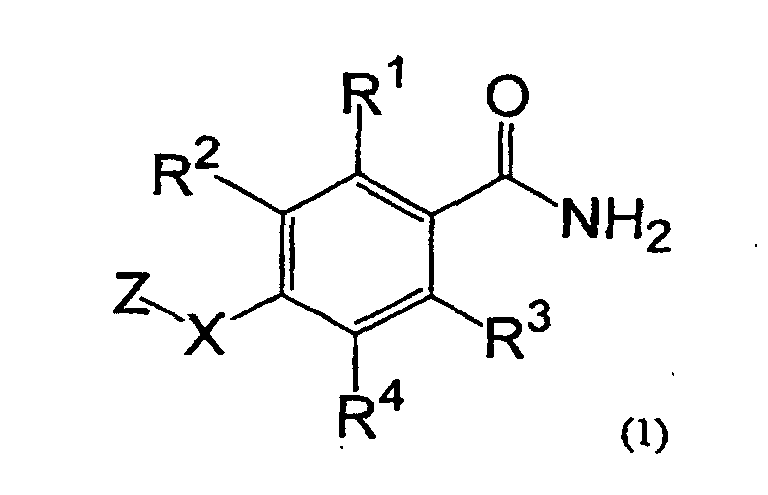
  • [2] A compound, a prodrug thereof or a pharmaceutically acceptable salt of the compound or prodrug according to the above item [1], wherein X is a group represented by the formula: -N(R5)-, -C(=O)N(R6)-, -CH2N(R5)-, -CH2- or -O-.
  • [3] A compound, a prodrug thereof or a pharmaceutically acceptable salt of the compound or prodrug according to the above item [1], wherein X is a group represented by the formula: -N(R5)-.
  • [4] A compound, a prodrug thereof or a pharmaceutically acceptable salt of the compound or prodrug according to the above item [1], wherein X is a group represented by the formula: -O-.
  • [5] A compound, a prodrug thereof or a pharmaceutically acceptable salt of the compound or prodrug according to the above item [1], [2], [3] or [4], wherein at least one of R1 and R3 is a saturated or unsaturated monocyclic hydrocarbon ring group, a saturated or unsaturated polycyclic hydrocarbon ring group, a saturated or unsaturated monocyclic heterocyclic group, a saturated or unsaturated polycyclic heterocyclic group (these groups may be unsubstituted or may have a substituent(s)), a halogen atom, a nitro group, a cyano group, a carboxyl group, a substituted or unsubstituted alkyl group, a substituted or unsubstituted alkenyl group, a substituted or unsubstituted alkynyl group, a substituted or unsubstituted alkoxycarbonyl group, a substituted or unsubstituted acyl group, or a group represented by the formula: -OR9, -N(R10)R11, -C(=O)N(R10)R11, -S(O)2N(R10)R11 or -S(O)mR12.
  • [6] A compound, a prodrug thereof or a pharmaceutically acceptable salt of the compound or prodrug according to the above item [1], [2], [3] or [4], wherein at least one of R2 and R4 is a saturated or unsaturated monocyclic hydrocarbon ring group, a saturated or unsaturated polycyclic hydrocarbon ring group, a saturated or unsaturated monocyclic heterocyclic group, a saturated or unsaturated polycyclic heterocyclic group (these groups may be unsubstituted or may have a substituent(s)), a halogen atom, a nitro group, a cyano group, a carboxyl group, a substituted or unsubstituted alkyl group, a substituted or unsubstituted alkenyl group, a substituted or unsubstituted alkynyl group, a substituted or unsubstituted alkoxycarbonyl group, a substituted or unsubstituted acyl group, or a group represented by the formula: -OR9, -N(R10)R11, -C(=O)N(R10)R11, -S(O)2N(R10)R11 or -S(O)mR12.
  • [7] A compound, a prodrug thereof or a pharmaceutically acceptable salt of the compound or prodrug according to the above item [1], [2], [3] or [4], wherein each of R1 and R4, which may be the same or different, or each of R3 and R2, which may be the same or different, is a saturated or unsaturated monocyclic hydrocarbon ring group, a saturated or unsaturated polycyclic hydrocarbon ring group, a saturated or unsaturated monocyclic heterocyclic group, a saturated or unsaturated polycyclic heterocyclic group (these groups may be unsubstituted or may have a substituent(s)), a halogen atom, a nitro group, a cyano group, a carboxyl group, a substituted or unsubstituted alkyl group, a substituted or unsubstituted alkenyl group, a substituted or unsubstituted alkynyl group, a substituted or unsubstituted alkoxycarbonyl group, a substituted or unsubstituted acyl group, or a group represented by the formula: -OR9, -N(R10)R11, -C(=O)N(R10)R11, -S(O)2N(R10)R11 or -S(O)mR12.
  • [8] A compound, a prodrug thereof or a pharmaceutically acceptable salt of the compound or prodrug according to the above item [1], [2], [3], [4], [5] or [7], wherein at least one of R1 and R3 is a group represented by the formula: -OR9 or a halogen atom.
  • [9] A compound, a prodrug thereof or a pharmaceutically acceptable salt of the compound or prodrug according to the above item [1], [2], [3], [4], [5] or [7], wherein at least one of R1 and R3 is a methoxy group.
  • [10] A compound, a prodrug thereof or a pharmaceutically acceptable salt of the compound or prodrug according to the above item [1], [2], [3], [4], [5] or [7], wherein at least one of R1 and R3 is a fluorine atom.
  • [11] A compound, a prodrug thereof or a pharmaceutically acceptable salt of the compound or prodrug according to the above item [1], [2], [3], [4], [6] or [7], wherein at least one of R2 and R4 is a halogen atom.
  • [12] A compound, a prodrug thereof or a pharmaceutically acceptable salt of the compound or prodrug according to the above item [1], [2], [3], [4], [6] or [7], wherein at least one of R2 and R4 is a chlorine atom.
  • [13] A compound, a prodrug thereof or a pharmaceutically acceptable salt of the compound or prodrug according to the above item [1], [2], [3], [4] or [7], wherein R1 is a group represented by the formula: -OR9 or a halogen atom and R4 is a halogen atom; or R3 is a group represented by the formula: -OR9 or a halogen atom and R2 is a halogen atom.
  • [14] A compound, a prodrug thereof or a pharmaceutically acceptable salt of the compound or prodrug according to the above item [1], [2], [3], [4] or [7], wherein R1 is a methoxy group and R4 is a chlorine atom; or R3 is a methoxy group and R2 is a chlorine atom.
  • [15] A compound, a prodrug thereof or a pharmaceutically acceptable salt of the compound or prodrug according to the above item [1], [2], [3], [4] or [7], wherein R1 is a fluorine atom and R4 is a chlorine atom; or R3 is a fluorine atom and R2 is a chlorine atom.
  • [16] A compound, a prodrug thereof or a pharmaceutically acceptable salt of the compound or prodrug according to any one of the above items [1] to [15], wherein Z is a substituted or unsubstituted saturated monocyclic heterocyclic group or a substituted saturated monocyclic hydrocarbon ring group, and the substituent(s) of the saturated monocyclic hydrocarbon ring group is a group represented by the formula: -N(RZ1)RZ2 wherein RZ1 (or RZ1s) and RZ2 (or RZ2s), which may be the same or different, and are a hydrogen atom, a substituted or unsubstituted alkyl group or a substituted or unsubstituted aralkyl group, independently, when it exists more than one.
  • [17] A compound, a prodrug thereof or a pharmaceutically acceptable salt of the compound or prodrug according to the above item [1], said compound being 4-[trans-(4-aminocyclohexyl)amino]-2-fluorobenzamide, 4-[trans-(4-aminocyclohexyl)amino]-5-chloro-2-fluorobenzamide, 5-chloro-4-{[trans-4-(isopropylamino)cyclohexyl]amino}-2-methoxybenzamide, 4-[trans-(4-aminocyclohexyl)amino]-2,5-difluorobenzamide or 5-chloro-2-fluoro-4-(piperidin-4-ylamino)benzamide.
  • [18] A medicament comprising a compound, a prodrug thereof or a pharmaceutically acceptable salt of the compound or prodrug according to any one of the above items [1] to [17].
  • [19] A Rho kinase inhibitor comprising a compound, a prodrug thereof or a pharmaceutically acceptable salt of the compound or prodrug according to any one of the above items [1] to [17].
  • [20] A pharmaceutical composition for the treatment of hypertension, peripheral circulatory disorder, angina pectoris, cerebral vasospasm, premature birth, asthma, cerebrovascular accident, arteriosclerosis, fibroid lung, fibroid liver, fibroid kidney, renal glomerulosclerosis, kidney failure, prostatic hypertrophy, complications of diabetes, blood vessel restenosis, cancer, cardiac hypertrophy, heart failure, ischemic diseases, inflammation, autoimmune diseases, AIDS, osteopathy, brain functional disorder, infection of digestive tracts with bacteria, sepsis, adult respiratory distress syndrome, retinopathy, glaucoma, or erectile dysfunction, which comprises a compound represented by formula (1):
    Figure 00140001
    wherein X is a single bond or a substituted or unsubstituted lower alkylene group (the -CH2- group(s) of said lower alkylene group may be substituted by one or more groups which may be the same or different and are selected from groups represented by the formulas: -O-, -S(O)n-, -N(R5)-, -N(R6)C(=O)-, -C(=O)N(R6)-, -N(R6)S(O)2-, -S(O)2N(R6)- and -C(=O)-, benzene ring and cycloalkane rings (the -CH2- group(s) in said cycloalkane ring may be substituted by one or more groups which may be the same or different and are selected from groups represented by the formulas: -O-, -S-, -N(R7)- and -C(=O)-), and a combination (s) of any adjacent two carbon atoms of said lower alkylene group may form one or more double or triple bonds which may be the same or different);
       Z is a saturated or unsaturated monocyclic hydrocarbon ring group, a saturated or unsaturated polycyclic hydrocarbon ring group, a saturated or unsaturated monocyclic heterocyclic group, or a saturated or unsaturated polycyclic heterocyclic group (these groups may be unsubstituted or may have a substituent(s));
       each of R1, R2, R3 and R4, which may be the same or different, is a saturated or unsaturated monocyclic hydrocarbon ring group, a saturated or unsaturated polycyclic hydrocarbon ring group, a saturated or unsaturated monocyclic heterocyclic group, a saturated or unsaturated polycyclic heterocyclic group (these groups may be unsubstituted or may have a substituent(s)), a hydrogen atom, a halogen atom, a nitro group, a cyano group, a carboxyl group, a substituted or unsubstituted alkyl group, a substituted or unsubstituted alkenyl group, a substituted or unsubstituted alkynyl group, a substituted or unsubstituted alkoxycarbonyl group, a substituted or unsubstituted acyl group, or a group represented by the formula: -OR9, -N(R10)R11, -C(=O)N(R10)R11, -S(O)2N(R10)R11 or -S(O)mR12;
       n and m are independently 0, 1 or 2;
       R5 (or R5s) and R7 (or R7s), which may be the same or different, and are a saturated or unsaturated monocyclic hydrocarbon ring group, a saturated or unsaturated polycyclic hydrocarbon ring group, a saturated or unsaturated monocyclic heterocyclic group, a saturated or unsaturated polycyclic heterocyclic group (these groups may be unsubstituted or may have a substituent(s)), a hydrogen atom, a substituted or unsubstituted alkyl group, a substituted or unsubstituted acyl group, a substituted or unsubstituted alkoxycarbonyl group, or a group represented by the formula: -C(=O)N(R10)R11, -S(O)2N(R10)R11 or -S(O)mR12, independently, when it exists more than one;
       R6 (or R6s) and R9 (or R9s), which may be the same or different, and are a saturated or unsaturated monocyclic hydrocarbon ring group, a saturated or unsaturated polycyclic hydrocarbon ring group, a saturated or unsaturated monocyclic heterocyclic group, a saturated or unsaturated polycyclic heterocyclic group (these groups may be unsubstituted or may have a substituent(s)), a hydrogen atom, a substituted or unsubstituted alkyl group, a substituted or unsubstituted acyl group, or a substituted or unsubstituted alkoxycarbonyl group, independently, when it exists more than one;
       R10 (or R10s) and R11 (or R11s), which may be the same or different, and are a saturated or unsaturated monocyclic hydrocarbon ring group, a saturated or unsaturated polycyclic hydrocarbon ring group, a saturated or unsaturated monocyclic heterocyclic group, a saturated or unsaturated polycyclic heterocyclic group (these groups may be unsubstituted or may have a substituent(s)), a hydrogen atom, a substituted or unsubstituted alkyl group, a substituted or unsubstituted acyl group, or a substituted or unsubstituted alkoxycarbonyl group, independently, when it exists more than one, or R10 and R11, when taken together with the nitrogen atom to which they are bonded, represent a saturated 3- to 8-membered cyclic amino group which may contain other heteroatom(s) in the ring (said cyclic amino group may be substituted by one or more substituted or unsubstituted alkyl groups, -S(O)mR12 groups or -OR9 groups); and
       R12 is a saturated or unsaturated monocyclic hydrocarbon ring group, a saturated or unsaturated polycyclic hydrocarbon ring group, a saturated or unsaturated monocyclic heterocyclic group, a saturated or unsaturated polycyclic heterocyclic group (these groups may be unsubstituted or may have a substituent(s)), a hydrogen atom, or a substituted or unsubstituted alkyl group;
       said compound not including the following compounds:
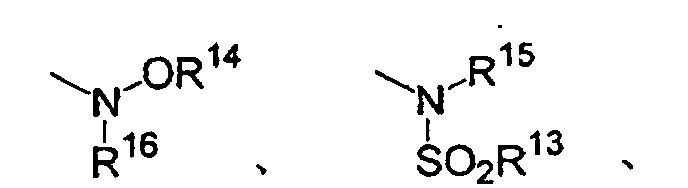
  • compounds in which X is a group represented by the formula: -O-, and Z is pyrrolidin-3-yl having a substituent at the 4-position, said substituent being a hydroxyl group, an alkoxy group, a benzyloxycarbonyloxy group or an alkylcarbamoyloxy group, a prodrug of said compound, or a pharmaceutically acceptable salt of said compound or prodrug.
  • [21] A method for treating hypertension, peripheral circulatory disorder, angina pectoris, cerebral vasospasm, premature birth, asthma, cerebrovascular accident, arteriosclerosis, fibroid lung, fibroid liver, fibroid kidney, renal glomerulosclerosis, kidney failure, prostatic hypertrophy, complications of diabetes, blood vessel restenosis, cancer, cardiac hypertrophy, heart failure, ischemic diseases, inflammation, autoimmune diseases, AIDS, osteopathy, brain functional disorder, infection of digestive tracts with bacteria, sepsis, adult respiratory distress syndrome, retinopathy, glaucoma, or erectile dysfunction, which comprises administering an effective amount of a compound, a prodrug thereof or a pharmaceutically acceptable salt of the compound or prodrug according to the above item [20] to a patient who needs the treatment.
  • [22] Use of a compound, a prodrug thereof or a pharmaceutically acceptable salt of the compound or prodrug according to the above item [20] in the manufacture of a medicament for the treatment of hypertension, peripheral circulatory disorder, angina pectoris, cerebral vasospasm, premature birth, asthma, cerebrovascular accident, arteriosclerosis, fibroid lung, fibroid liver, fibroid kidney, renal glomerulosclerosis, kidney failure, prostatic hypertrophy, complications of diabetes, blood vessel restenosis, cancer, cardiac hypertrophy, heart failure, ischemic diseases, inflammation, autoimmune diseases, AIDS, osteopathy, brain functional disorder, infection of digestive tracts with bacteria, sepsis, adult respiratory distress syndrome, retinopathy, glaucoma, or erectile dysfunction.
  • BEST MODE FOR CARRYING OUT THE INVENTION
    The various groups in the present invention are explained below. The following explanation applies also to cases where any of the groups is a portion of another group, unless otherwise specified.
    Each of the terms "saturated or unsaturated monocyclic hydrocarbon ring group", "saturated or unsaturated polycyclic hydrocarbon ring group", "saturated or unsaturated monocyclic heterocyclic group" and "saturated or unsaturated polycyclic heterocyclic group" means a group formed by the conversion of one of the hydrogen atoms of a corresponding saturated or unsaturated monocyclic hydrocarbon ring, saturated or unsaturated polycyclic hydrocarbon ring, saturated or unsaturated monocyclic heterocyclic ring, or saturated or unsaturated polycyclic heterocyclic ring, respectively, examples of which are given below, to a bond.
    As the saturated or unsaturated monocyclic hydrocarbon ring, there are exemplified 3- to 8-membered hydrocarbon rings such as cyclopropane, cyclobutane, cyclopentane, cyclohexane, cycloheptane, cyclooctane, cyclopentene, cyclohexene, cycloheptene, cyclooctene, benzene, etc.
    As the saturated or unsaturated polycyclic hydrocarbon ring, there are exemplified polycyclic hydrocarbon rings of 16 or less carbon atoms, such as indene, naphthalene, azulene, fluorene, phenalene, phenanthrene, anthracene, acephenanthrylene, 1,2-dihydronaphthalene, 6,7-dihydro-5H-benzocycloheptene, benzocyclooctene, 1,2,3,4-tetrahydronaphthalene, decahydronaphthalene, octahydro-1H-indene, etc.; and polycyclic hydrocarbon rings of 12 or less carbon atoms having a crosslinkage, such as adamantane, bicyclo[2,2,2]octane, bicyclo[3,3,3]undecane, bicyclo[2,2,2]oct-2-ene, bicyclo[3,3,3]undec-2-ene, etc.
    The saturated or unsaturated monocyclic heterocyclic ring includes, for example, 3- to 8-membered unsaturated monocyclic heterocyclic rings containing 1 to 4 nitrogen atoms, 3- to 8-membered saturated monocyclic heterocyclic rings containing 1 to 4 nitrogen atoms, 3- to 8-membered unsaturated monocyclic heterocyclic rings containing an oxygen atom, 3- to 8-membered unsaturated monocyclic heterocyclic rings containing one or two sulfur atoms, 3- to 8-membered unsaturated monocyclic heterocyclic rings containing 1 to 3 nitrogen atoms and one or two oxygen atoms, 3- to 8-membered saturated monocyclic heterocyclic rings containing 1 to 3 nitrogen atoms and one or two oxygen atoms, 3- to 8-membered unsaturated monocyclic heterocyclic rings containing 1 to 3 nitrogen atoms and one or two sulfur atoms, 3- to 8-membered saturated monocyclic heterocyclic rings containing 1 to 3 nitrogen atoms and one or two sulfur atoms, and 3- to 8-membered unsaturated monocyclic heterocyclic rings containing an oxygen atom and one or two sulfur atoms.
    The 3- to 8-membered unsaturated monocyclic heterocyclic rings containing 1 to 4 nitrogen atoms include, for example, pyrrole, pyrroline, pyridine, dihydropyridine, imidazole, pyrazole, imidazoline, pyrazine, pyrimidine, pyridazine, pyrazole, triazole and tetrazole, etc.
    The 3- to 8-membered saturated monocyclic heterocyclic rings containing 1 to 4 nitrogen atoms include, for example, pyrrolidine, piperidine, imidazolidine, pyrazolidine, and piperazine, etc.
    The 3- to 8-membered unsaturated monocyclic heterocyclic rings containing an oxygen atom include, for example, furan and pyran, etc.
    The 3- to 8-membered unsaturated monocyclic heterocyclic rings containing one or two sulfur atoms include, for example, thiophene, dihydrodithiin and dihydrodithion, etc.
    The 3- to 8-membered unsaturated monocyclic heterocyclic rings containing 1 to 3 nitrogen atoms and one or two oxygen atoms include, for example, oxazole, oxadiazole and isoxazole, etc.
    The 3- to 8-membered saturated monocyclic heterocyclic rings containing 1 to 3 nitrogen atoms and one or two oxygen atoms include, for example, morpholine and oxazolidine, etc.
    The 3- to 8-membered unsaturated monocyclic heterocyclic rings containing 1 to 3 nitrogen atoms and one or two sulfur atoms include, for example, thiazole, isothiazole and thiadiazole, etc.
    The 3- to 8-membered saturated monocyclic heterocyclic rings containing 1 to 3 nitrogen atoms and one or two sulfur atoms include, for example, thiazolidine, etc.
    The 3- to 8-membered unsaturated monocyclic heterocyclic rings containing an oxygen atom and one or two sulfur atoms include, for example, dihydrooxathiin, etc.
    The saturated or unsaturated polycyclic heterocyclic ring includes, for example, saturated or unsaturated fused heterocyclic rings containing 1 to 4 nitrogen atoms, unsaturated fused heterocyclic rings containing 1 to 3 nitrogen atoms and one or two oxygen atoms, unsaturated fused heterocyclic rings containing 1 to 3 nitrogen atoms and one or two sulfur atoms, unsaturated fused heterocyclic rings containing one or two oxygen atoms, unsaturated fused heterocyclic rings containing an oxygen atom and one or two sulfur atoms, and unsaturated fused heterocyclic rings containing one or two sulfur atoms.
    The saturated or unsaturated fused heterocyclic rings containing 1 to 4 nitrogen atoms include, for example, indole, isoindole, indoline, quinoline, isoquinoline, quinolizine, indazole, phthalazine, naphthyridine, quinoxaline, quinazoline, cinnoline, carbazole, purine, pteridine, phenazine, carboline, phenanthridine, acridine, indoline, isoindoline, 1,2-dihydroisoquinoline, benzimidazole, imidazopyridine, benzotriazole, tetrahydroimidazopyridine, benz[b]azepine, benz[cd]indole, cyclohepta[cd]indole, pyrrolo[3,2,1-ij]quinoline, cyclohexa[b]pyridine, cyclohepta[b]pyridine, pyrrolo[1,2,3-de]quinoxaline, pyrrolo[3,2,1-hi]indole, pyrrolo[3,2,1-jk][1]benzazepine, pyrrolo[3,2,1-kl][1]benzoazocine, pyrrolo[3,2,1-kl]benzo-[e][1,4]diazocine, 1,2,3,4-tetrahydroquinoline, 1,2,3,4-tetrahydroisoquinoline, decahydroquinoline, decahydroisoquinoline, octahydroindole, quinuclidine, 1-azabicyclo[2,2,1]heptane and 1-azabicyclo[3,2,1]octane, etc.
    The unsaturated fused heterocyclic rings containing 1 to 3 nitrogen atoms and one or two oxygen atoms include, for. example, benzoxazole, benzoxadiazole, phenoxazine, pyrrolo[1,2,3-de][1,4]benzoxazine, pyrrolo[2,1-c][1,4]benzoxazine and pyrrolo[3,2,1-kl)benz[e]-[4,1]oxazocine, etc. Preferable examples thereof are benzoxazole, pyrrolo[1,2,3-de][1,4]benzoxazine, pyrrolo[2,1-c][1,4]benzoxazine and pyrrolo[3,2,1-kl]benz[e][4,1]oxazocine.
    The unsaturated fused heterocyclic rings containing 1 to 3 nitrogen atoms and one or two sulfur atoms include, for example, benzothiazole, benzothiadiazole, 1,4-benzothiazine and phenothiazine, etc. Preferable examples thereof are benzothiazole and 1,4-benzothiazine.
    The unsaturated fused heterocyclic rings containing one or two oxygen atoms include, for example, benzofuran, dihydrobenzofuran, chromene, isobenzofuran, xanthene, isochroman, chroman and benz[b]oxepine, etc. Preferable examples thereof are benzofuran and benz[b]oxepine.
    The unsaturated fused heterocyclic rings containing an oxygen atom and one or two sulfur atoms include, for example, 1,4-benzoxathiin and phenoxathiin, etc.
    The unsaturated fused heterocyclic rings containing one or two sulfur atoms include, for example, benzothiophene, benzothiin, benzothiopyran, thiochroman and thianthrene, etc. Preferable examples thereof are benzothiophene, benzothiopyran and thiochroman.
    The substituent(s) of each of the saturated or unsaturated monocyclic hydrocarbon ring, saturated or unsaturated polycyclic hydrocarbon ring, saturated or unsaturated monocyclic heterocyclic ring, saturated or unsaturated polycyclic heterocyclic ring, phenyl group, naphthyl group, heterocyclic group, aroyl group, saturated heterocyclic ring-carbonyl group and heteroaromatic acyl group may be present in a number of one or more and may be the same or different. The substituent(s) includes, for example, hydrogen atom, substituted or unsubstituted alkyl groups, substituted or unsubstituted alkenyl groups, substituted or unsubstituted alkynyl groups, substituted or unsubstituted cycloalkyl groups, substituted or unsubstituted cycloalkenyl groups, aralkyl groups, phenyl group, naphthyl group, heterocyclic groups, acyl groups (said aralkyl groups, phenyl group, naphthyl group, heterocyclic groups and acyl groups may be substituted by one or more substituents which may be the same or different and are selected from alkyl groups, alkoxy groups, alkylenedioxy groups and halogen atoms), substituted or unsubstituted alkoxycarbonyl groups, carboxyl group, halogen atoms, nitro group and groups represented by the formulas: -CN, -OR14, -N(R15)R16, -C(=O)N(R15)R16, -S(O)2N(R15)R16, -S(O)nR13,
    Figure 00260001
    Figure 00260002
    Figure 00260003
    Figure 00260004
    Figure 00260005
    Figure 00260006
    Figure 00260007
    Figure 00260008
    Figure 00260009
    Figure 00260010
    Figure 00270001
    Figure 00270002
    Figure 00270003
    Figure 00270004
    Figure 00270005
    Figure 00270006
    wherein A is an oxygen atom, -S(O)r- or -N(R21)-; r is an integer of 0, 1 or 2; R19 and R21 are independently a hydrogen atom, an alkyl group, an alkenyl group, an alkynyl group, a cycloalkyl group, a phenyl group, a naphthyl group, a saturated or unsaturated heterocyclic group or an acyl group; and the ring is a 3- to 8-membered saturated heterocyclic ring composed of a nitrogen atom and carbon atoms.
    R13 and R13a are independently a hydroxyl group, an alkyl group, a cycloalkyl group, a phenyl group, a naphthyl group or a saturated or unsaturated heterocyclic group.
    R15, R16, R17 and R18 are independently a hydrogen atom, an alkyl group, an aralkyl group, an alkenyl group, an alkynyl group, a cycloalkyl group, a cycloalkenyl group, a phenyl group, a naphthyl group, a saturated or unsaturated heterocyclic group or an acyl group. Alternatively, R15 and R16, or R17 and R18, when taken together with the nitrogen atom to which they are bonded, represent a saturated 3- to 8-membered cyclic amino group which may contain other heteroatom(s) in the ring (said cyclic amino group may be substituted by one or more substituted or unsubstituted alkyl groups, -S(O)nR13 groups, -N(R14)R14a groups, hydroxyl groups or -OR14b groups).
    R14, R14a and R14b are independently a hydrogen atom, an alkyl group, a cycloalkyl group, a cycloalkenyl group, a phenyl group, a naphthyl group or a saturated or unsaturated heterocyclic group.
    The substituent(s) of each of the cycloalkyl group, cycloalkenyl group and cycloalkanecarbonyl group may be present in a number of, for example, 1 to 4 and may be the same or different. The substituent(s) includes, for example, alkyl groups, substituted alkyl groups, hydroxyl group and groups represented by the formulas: -OR14, -S(O)nR13, -N(R15)R16, -C(=O)N(R15)R16, -S(O)2N(R15)R16 and -S(O)nR13.
    The heterocyclic group includes saturated or unsaturated heterocyclic groups. The saturated or unsaturated heterocyclic groups include saturated or unsaturated monocyclic heterocyclic groups and saturated or unsaturated polycyclic heterocyclic groups.
    The alkyl group includes, for example, linear or branched alkyl groups of 8 or less carbon atoms, such as methyl, ethyl, propyl, 2-propyl, butyl, 2-butyl, 2-methylpropyl, 1,1-dimethylethyl, pentyl, hexyl, heptyl, octyl, etc.
    The cycloalkane ring includes, for example, 3- to 8-membered cycloalkane rings such as cyclopropane, cyclobutane, cyclopentane, cyclohexane, cycloheptane, cyclooctane, etc.
    The cycloalkyl group includes, for example, 3- to 8-membered cycloalkyl groups such as cyclopropyl, cyclobutyl, cyclopentyl, cyclohexyl, cycloheptyl, etc.
    The cycloalkenyl group includes, for example, 3- to 8-membered cycloalkenyl groups having a double bond, such as 1-cyclopentenyl, 2-cyclopentenyl, 3-cyclopentenyl, 1-cyclohexenyl, 2-cyclohexenyl, 3-cyclohexenyl, etc.
    The alkenyl group includes, for example, alkenyl groups of 6 or less carbon atoms, such as vinyl, allyl, propenyl, 2-propenyl, butenyl, pentenyl, hexenyl, etc.
    The alkynyl group includes, for example, alkynyl groups of 6 or less carbon atoms, such as ethynyl, propargyl, butynyl, pentynyl, etc.
    The halogen atom includes, for example, iodine, fluorine, chlorine and bromine atoms.
    The acyl group includes, for example, formyl group; alkanoyl groups of 2 to 6 carbon atoms, such as acetyl, propanoyl, etc.; cycloalkanecarbonyl groups of 4 to 7 carbon atoms, such as cyclopropanecarbonyl, cyclobutanecarbonyl, cyclopentanecarbonyl, cyclohexanecarbonyl, etc.; cycloalkenecarbonyl groups of 3 to 6 carbon atoms, such as cyclopentenecarbonyl, cyclohexenecarbonyl, etc.; aroyl groups of 6 to 10 carbon atoms, such as benzoyl, toluoyl, naphthoyl, etc.; saturated heterocyclic ring-carbonyl groups having a 5- or 6-membered saturated heterocyclic ring containing one or two heteroatoms selected from nitrogen atom, oxygen atom and sulfur atom, such as 2-piperidinecarbonyl, 3-morpholine-carbonyl, etc.; and heteroaromatic acyl groups having a 5- or 6-membered heteroaromatic ring containing one or two heteroatoms selected from nitrogen atom, oxygen atom and sulfur atom, such as furoyl, thenoyl, nicotinoyl, isonicotinoyl, etc.
    The substituent(s) of the substituted alkyl group may be present in a number of one or more and may be the same or different. The substituent(s) includes halogen atoms, hydroxyl group, alkoxy groups, alkoxycarbonyl groups, cycloalkyl groups, cyano group, carboxyl group, acyl groups, phenyl group, naphthyl group, saturated or unsaturated heterocyclic groups, oxo group, thioxo group and groups represented by the formulas: -C(=O)N(R35)R36, -S(O)2R33, -S(O)2N(R35)R36 and -N(R35)R36, and the formula:
    Figure 00310001
    wherein R19 is as defined above, and the ring represents a 3- to 8-membered saturated heterocyclic group composed of a nitrogen atom and carbon atoms.
    As R33, R35 and R36, the same groups as those described above as R13, R15 and R16 are exemplified respectively.
    Such a substituted alkyl group includes, for example, alkyl groups of 1 to 5 carbon atoms substituted by a cycloalkyl group of 3 to 6 carbon atoms, polyhaloalkyl groups of 1 to 5 carbon atoms, hydroxyalkyl groups of 1 to 6 carbon atoms, alkoxyalkyl groups of 2 to 6 carbon atoms, cyanoalkyl groups of 2 to 6 carbon atoms, carboxyalkyl groups of 2 to 6 carbon atoms, alkoxycarbonylalkyl groups of 3 to 8 carbon atoms, alkanoylalkyl groups of 3 to 8 carbon atoms, aroylalkyl groups of 16 or less carbon atoms, substituted or unsubstituted phenyl- or naphthyl-C1∼C5 alkyl groups, carbamoyl-C1∼C3 alkyl groups which may be substituted by one or two C1∼C3 alkyl groups on the nitrogen atom, amino-C1∼C5 alkyl groups which may be substituted by one or two C1∼C3 alkyl or C7∼C11 aralkyl groups on the nitrogen atom, and saturated 3- to 8-membered cyclic amino-C1∼C3 alkyl groups, etc.
    Typical examples of the substituted alkyl group are polyhaloalkyl groups of 1 to 3 carbon atoms, such as trifluoromethyl, trifluoroethyl, trichloromethyl, etc.; hydroxyalkyl groups of 1 to 6 carbon atoms, such as hydroxymethyl, hydroxyethyl, 1-hydroxyethyl, etc.; aminoalkyl groups of 1 to 5 carbon atoms, such as aminomethyl, aminoethyl, 1-aminoethyl, etc.; alkoxyalkyl groups of 1 to 6 carbon atoms, such as methoxyethyl, ethoxyethyl, methoxypropyl, etc.; carboxyalkyl groups of 2 to 6 carbon atoms, such as carboxyethyl, carboxypropyl, etc.; alkoxycarbonylalkyl groups of 3 to 7 carbon atoms, such as methoxycarbonylmethyl, ethoxycarbonylmethyl, methoxycarbonylethyl, etc.; phenyl- or naphthyl-C1∼C5 alkyl groups (which may have a substituent such as a C1∼C3 alkyl group, halogen atom, nitro group, amino group, hydroxyl group, C1∼C3 alkoxy group or the like in the phenyl or naphthyl portion) such as benzyl, phenylethyl, phenylpropyl, phenylbutyl, 1- or 2-naphthylmethyl, etc.; carbamoyl-C1∼C3 alkyl groups which may be substituted by one or two C1∼C3 alkyl groups on the nitrogen atom, such as carbamoylmethyl, carbamoylethyl, dimethylcarbamoylmethyl, etc.; amino-C1∼C5 alkyl groups which may be substituted by one or two C1∼C3 alkyl or C7∼C11 aralkyl groups on the nitrogen atom, such as aminoethyl, aminopropyl, dimethylaminoethyl, dimethylaminopropyl, diethylaminoethyl, N-methyl-N-benzylaminoethyl, etc.; and saturated 3- to 8-membered cyclic amino-C1∼C3 alkyl groups such as 1-pyrrolidinylethyl, piperidinoethyl, etc.
    As the substituent(s) of the substituted alkenyl group, substituted alkynyl group or substituted alkanoyl group, there are exemplified the same groups as those described above as the substituent(s) of the substituted alkyl group. The substituent(s) of each of these substituted groups may also be present in a number of one or more and may be the same or different.
    As the aralkyl group, alkyl groups substituted by a phenyl group or a polycyclic hydrocarbon ring group are exemplified.
    As the heteroatom(s) of the saturated 3- to 8-membered cyclic amino group which may contain other heteroatom(s) in the ring and which R10 and R11; R15 and R16; R17 and R18; or R35 and R36 form when taken together with the nitrogen atom to which they are bonded, there are exemplified oxygen atom, nitrogen atom and sulfur atom. Specific examples of such cyclic amino group are 3- to 8-membered cyclic groups containing 1 to 3 nitrogen atoms and 3- to 8-membered cyclic groups containing a nitrogen atom and an oxygen atom. More specific examples thereof are 1-pyrrolidinyl, 1-piperidino, 1-piperazinyl, morpholino and 1-(4-methyl)piperazinyl.
    As the group represented by the formula: -S(O)2R12, -S(O)2R13 or -S(O)2R13a, there are exemplified alkylsulfonyl groups of 8 or less carbon atoms, such as methylsulfonyl group, ethylsulfonyl group, propylsulfonyl group, isopropylsulfonyl group, etc. As the group represented by the formula: -S(O)mR12, there are exemplified the above-exemplified groups and corresponding alkylsulfinyl and alkylthio groups, and sulfo group.
    The substituent(s) of the lower alkylene group, alkenylene group or alkynylene group may be present in a number of one or more and may be the same or different. The substituent(s) includes alkyl groups, aralkyl groups and the same groups as those described as the substituent(s) of the substituted alkyl group.
    The lower alkylene group includes, for example, linear or branched alkylene groups of 10 or less carbon atoms, such as methylene, ethylene, trimethylene, tetramethylene, pentamethylene, hexamethylene, 2-methyltrimethylene, etc.
    As the alkoxycarbonyl group, there are exemplified groups formed by bonding the oxygen atom side of a group represented by the formula: -C(=O)O- to the binding site of an alkyl group.
    As the group represented by the formula:
    Figure 00350001
    there are exemplified groups represented by
    Figure 00350002
    Figure 00350003
    Figure 00350004
    Figure 00350005
    As the "prodrug", there are exemplified those which are easily hydrolyzed in a living body to regenerate the compound of formula (1). For example, when the compound of formula (1) has a carboxyl group, examples of the prodrug are compounds obtained by converting the carboxyl group to an alkoxycarbonyl group, an alkylthiocarbonyl group or an alkylaminocarbonyl group.
    For example, when the compound of formula (1) has an amino group, examples of the prodrug are compounds obtained by converting the amino group to an alkanoylamino group by substitution by the alkanoyl group, compounds obtained by converting the amino group to an alkoxycarbonylamino group by substitution by the alkoxycarbonyl group, and compounds obtained by converting the amino group to an acyloxymethylamino group or hydroxylamine.
    For example, when the compound of formula (1) has a hydroxyl group, examples of the prodrug are compounds obtained by converting the hydroxyl group to an acyloxy group by substitution by the above-exemplified acyl group, and compounds obtained by converting the hydroxyl group to a phosphoric ester or an acyloxymethyloxy group.
    For example, when the compound of formula (1) has a sulfo group, examples of the prodrug are compounds obtained by converting the sulfo group to a sulfonic ester by substitution by an alkyl group.
    For example, when the compound of formula (1) has a phosphono group, examples of the prodrug are compounds obtained by converting the phosphono group to a phosphonic monoester or a phosphonic diester by substitution by one or two alkyl groups.
    Examples of the alkyl portion of the group used for such conversion to the prodrug are the above-exemplified alkyl groups. The alkyl groups as the alkyl portion may be substituted by, for example, an alkoxy group of 1 to 6 carbon atoms. Preferable examples of the alkyl portion are as follows.
  • (a) For example, in the case of the compounds obtained by converting the carboxyl group to an alkoxycarbonyl group, the alkoxycarbonyl group includes lower (number of carbon atoms: for example, 1 to 6) alkoxycarbonyl groups such as methoxycarbonyl, ethoxycarbonyl, etc.; and lower (number of carbon atoms: for example, 1 to 6) alkoxycarbonyl groups substituted by an alkoxy group, such as methoxymethoxycarbonyl, ethoxymethoxycarbonyl, 2-methoxyethoxycarbonyl, 2-methoxyethoxymethoxycarbonyl, pivaloyloxymethoxycarbonyl, etc.
  • (b) For example, in the case of the compounds obtained by converting the sulfo group to an alkoxysulfonyl group, the alkoxysulfonyl group includes lower (number of carbon atoms: for example, 1 to 6) alkoxysulfonyl groups such as methoxysulfonyl, ethoxysulfonyl, etc.; and lower (number of carbon atoms: for example, 1 to 6) alkoxysulfonyl groups substituted by an alkoxy group, such as methoxymethoxysulfonyl, ethoxymethoxysulfonyl, 2-methoxyethoxysulfonyl, 2-methoxyethoxymethoxysulfonyl, pivaloyloxymethoxysulfonyl, etc.
  • (c) For example, in the case of the compounds obtained by converting the phosphono group to an alkoxyphosphoryl group, the alkoxyphosphoryl group includes lower (number of carbon atoms: for example, 1 to 6) (mono- or di-)alkoxyphosphoryl groups such as methoxy(hydroxy)phosphoryl, ethoxy(hydroxy)phosphoryl, dimethoxyphosphoryl, diethoxyphosphoryl, etc.; lower (number of carbon atoms: for example, 1 to 6) (mono- or di-)alkoxyphosphoryl groups substituted by an alkoxy group(s), such as methoxymethoxy(hydroxy)phosphoryl, ethoxymethoxy(hydroxy)phosphoryl, 2-methoxyethoxy(hydroxy)phosphoryl, 2-methoxyethoxymethoxy(hydroxy)phosphoryl, pivaloyloxymethoxy(hydroxy)phosphoryl, bis(methoxymethoxy)phosphoryl, bis(ethoxymethoxy)phosphoryl, bis(2-methoxyethoxy)phosphoryl, bis(pivaloyloxymethoxy)phosphoryl, etc.
  • If necessary, the compound represented by formula (1) or the prodrug thereof may be converted to a pharmaceutically acceptable salt. As such a salt, there are exemplified salts with mineral acids such as hydrochloric acid, hydrobromic acid, sulfuric acid, phosphoric acid, etc.; salts with organic carboxylic acids such as formic acid, acetic acid, fumaric acid, maleic acid, oxalic acid, citric acid, malic acid, tartaric acid, aspartic acid, glutamic acid, etc.; salts with sulfonic acids such as methanesulfonic acid, benzenesulfonic acid, p-toluenesulfonic acid, hydroxybenzenesulfonic acid, dihydroxybenzenesulfonic acid, etc.; and
       alkali metal salts such as sodium salt, potassium salt, etc.; alkaline earth metal salts such as calcium salt, magnesium salt, etc.; ammonium salt; and triethylamine salt, pyridine salt, picoline salt, ethanolamine salt, dicyclohexylamine salt, and salt with N,N'-dibenzylethylenediamine, etc.
    Each of the compounds represented by formula (1), the prodrugs thereof and the pharmaceutically acceptable salts of the compounds or prodrugs may be in the form of an anhydride, hydrate or solvate.
    When used as a pharmaceutical composition, the compounds of the present invention may be orally or parenterally administered. That is, the compounds may be orally administered in a usual dosage form such as powder, granules, tablets, capsules, syrup, suspension or the like, or the compound may be parenterally administered, for example, by injection of a solution, emulsion or suspension prepared from the compound. The compounds may be administered rectally in the form of a suppository. The compounds of the present invention may be formulated into the above-exemplified suitable dosage form by blending the compound with conventional acceptable adjuvants such as a carrier, excipient, binder, stabilizer, diluent, etc. When the compound is used in the form of an injection, the injection may contain acceptable additives such as a buffer, solubilizer, tonicity agent, etc. Although the dose and the number of administrations are varied depending on, for example, a disease to be cured, the condition of the disease, age, body weight and administration route, the compound may be administered to an adult in a dose of usually 0.1 to 2,000 mg, preferably 1 to 200 mg per day in one portion or several portions (for example, 2 to 4 portions).
    The compound represented by formula (1) may be synthesized from a well-known compound by a combination of well-known synthesis processes. The compound may be synthesized, for example, by any of the processes described in the working examples described hereinafter or any of the following processes.
  • (A) A compound of formula (1) in which X is a group represented by the formula: -X1-C(=O)NH- (wherein X1 represents a portion other than the portion shown as a specific group like the formula: -C(=O)NH- in this case in the aforesaid group X, and Z is as defined above) may be synthesized, for example, as follows.
    Figure 00400001
    wherein Z, R1, R2, R3, R4 and X1 are as defined above. The compound of formula (1) in which X is a group represented by the formula: -X1-C(=O)NH- may be produced, for example, by reacting a compound represented by formula (2) with a compound represented by the formula: ZCOOH in an inert solvent in the presence of a condensing agent at room temperature or with heating, or by reacting a compound represented by formula (2) with, for example, a corresponding acid halide or acid anhydride in an inert solvent in the presence of a base at room temperature or with heating.As the condensing agent, there are used condensing agents such as dicyclohexylcarbodiimide (DCC), diisopropylcarbodiimide (DIPC), 1-ethyl-3-(3-dimethylaminopropyl)-carbodiimide (WSC), benzotriazol-1-yl-tris(dimethylamino)phosphonium·hexafluorophosphate (BOP), diphenylphosphonyldiamide (DPPA), N,N-carbonyldiimidazole (Angew. Chem. Int. Ed. Engl., Vol. 1, 351(1962)), etc. If necessary, there may be added additives such as N-hydroxysuccinimide (HOSu), 1-hydroxybenzotriazole (HOBt), 3-hydroxy-4-oxo-3,4-dihydro-1,2,3-benzotriazine (HOOBt), etc. As the solvent, there are exemplified aromatic hydrocarbon solvents such as benzene, toluene, xylene, etc.; ether solvents such as tetrahydrofuran, 1,4-dioxane, etc.; halogenated hydrocarbon solvents such as dichloromethane, chloroform, 1,2-dichloroethane, etc.; amide solvents such as dimethylformamide, dimethylacetamide, etc.; basic solvents such as pyridine, etc.; and mixed solvents thereof. As the base, there are exemplified inorganic bases such as sodium hydroxide, potassium hydroxide, sodium carbonate, potassium carbonate, sodium hydrogencarbonate, etc.; and organic bases such as triethylamine, pyridine, etc. As the acid halide, acid chlorides and acid bromides are exemplified.
  • (B) A compound of formula (1) in which the group represented by the formula: Z-X- is a group represented by the formula: Rb-X1-CH(Ra)NH- (wherein Ra is a hydrogen atom or a substituted or unsubstituted alkyl group, Rb is a saturated or unsaturated monocyclic hydrocarbon ring group, a saturated or unsaturated polycyclic hydrocarbon ring group, a saturated or unsaturated monocyclic heterocyclic group, or a saturated or unsaturated polycyclic heterocyclic group (these groups may be unsubstituted or may have a substituent(s)), and X1 is as defined above; or X1 is a single bond, and Ra and Rb are taken together with the nitrogen atom to which they are bonded, to represent a saturated or unsaturated monocyclic hydrocarbon ring group, a saturated or unsaturated polycyclic hydrocarbon ring group, a saturated or unsaturated monocyclic heterocyclic group, or a saturated or unsaturated polycyclic heterocyclic group (these groups may be unsubstituted or may have a substituent(s))) may be synthesized, for example, as follows.
    Figure 00420001
    wherein Ra, Rb, X1, R1, R2, R3 and R4 are as defined above. A compound represented by formula (3), i.e., the compound of formula (1) in which X is a group represented by the formula: Rb-X1-CH(Ra)NH- may be produced, for example, by subjecting a compound represented by formula (2) to reductive amination reaction with a compound represented by the formula: Ra-X1-C(=O)Rb in an inert solvent in the presence of a reducing agent at room temperature or with heating.As the reducing agent, there may be used reducing agents including composite hydrogen compounds such as sodium triacetoxyborohydride, lithium aluminum hydride, sodium borohydride, sodium cyanoborohydride, etc.; and diborane. There may also be employed reduction with sodium, sodium amalgam or zinc-acid, and electrical reduction using lead or platinum as a cathode. As the solvent, there are exemplified alcohol solvents such as methanol, ethanol, etc.; ether solvents such as tetrahydrofuran, 1,4-dioxane, etc.; halogenated hydrocarbon solvents such as dichloromethane, chloroform, 1,2-dichloroethane, etc.; and mixed solvents thereof.
  • (C) A compound of formula (1) in which X is a group represented by the formula: -X1-O- (wherein -X1 is as defined above) may be synthesized, for example, as follows.
    Figure 00440001
    wherein Z, X1, R1, R2, R3 and R4 are as defined above. The compound of formula (1) in which X is a group represented by the formula: -X1-O- may be produced, for example, by reacting a compound represented by formula (4) with a compound represented by the formula: Z-X1-OH in an inert solvent in the presence of, for example, triphenyl-phosphine and diethyl azodicarboxylate at room temperature or with heating. Like diethyl azodicarboxylate, there may also be used, for example, dialkyl azodicarboxylates such as diisopropyl azodicarboxylate, etc., and diaralkyl azodicarboxylates such as dibenzyl azodicarboxylate, etc.
  • (D) A compound of formula (1) in which the group represented by the formula: Z-X- is a group represented by the formula: Rb-X1-CH(Ra) N (CH2Rc)-(wherein Ra, Rb and X1 are as defined above, and Rc is a hydrogen atom, a substituted or unsubstituted alkyl group, a saturated or unsaturated monocyclic hydrocarbon ring group, a saturated or unsaturated polycyclic hydrocarbon ring group, a saturated or unsaturated monocyclic heterocyclic group, or a saturated or unsaturated polycyclic heterocyclic group (these groups may be unsubstituted or may have a substituent(s))) may be produced, for example, as follows.
    Figure 00450001
    wherein Ra, Rb, Rc, X1, R1, R2, R3 and R4 are as defined above. The compound of formula (1) in which the group represented by the formula: Z-X- is a group represented by the formula: Rb-X1-CH(Ra)N(CH2Rc)- may be produced, for example, by subjecting a compound represented by formula (3) to reductive amination reaction with a compound represented by the formula: RcC(=O)H in an inert solvent in the presence of a reducing agent at room temperature or with heating.
  • As the reducing agent, there may be used reducing agents including composite hydrogen compounds such as sodium triacetoxyborohydride, lithium aluminum hydride, sodium borohydride, sodium cyanoborohydride, etc.; and diborane. There may also be employed reduction with sodium, sodium amalgam or zinc-acid, and electrical reduction using lead or platinum as a cathode. As the solvent, there are exemplified alcohol solvents such as methanol, ethanol, etc.; ether solvents such as tetrahydrofuran, 1,4-dioxane, etc.; halogenated hydrocarbon solvents such as dichloromethane, chloroform, 1,2-dichloroethane, etc.; and mixed solvents thereof.
  • (E) A compound represented by formula (1) may be synthesized also in, for example, the following manner.
    Figure 00460001
    wherein R1, R2, R3, R4, X and Z are as defined above.
  • The compound represented by formula (1) may be synthesized, for example, by reacting a compound represented by formula (5) with an amine such as ammonium chloride in an inert solvent in the presence of a condensing agent at room temperature or with heating.
    As the condensing agent, there are used condensing agents such as dicyclohexylcarbodiimide (DCC), diisopropylcarbodiimide (DIPC), 1-ethyl-3-(3-dimethylaminopropyl)-carbodiimide (WSC), benzotriazol-1-yl-tris(dimethylamino)phosphonium•hexafluorophosphate (BOP), diphenylphosphonyldiamide (DPPA), N,N-carbonyldiimidazole (Angew. Chem. Int. Ed. Engl., Vol. 1, 351(1962)), etc.. If necessary, there may be added additives such as N-hydroxysuccinimide (HOSu), 1-hydroxybenzotriazole (HOBt), 3-hydroxy-4-oxo-3,4-dihydro-1,2,3-benzotriazine (HOOBt), etc. As the solvent, there are exemplified aromatic hydrocarbon solvents such as benzene, toluene, xylene, etc.; ether solvents such as tetrahydrofuran, 1,4-dioxane, etc.; halogenated hydrocarbon solvents such as dichloromethane, chloroform, 1,2-dichloroethane, etc.; amide solvents such as dimethylformamide, dimethylacetamide, etc.; and mixed solvents thereof.
    The compound represented by formula (1) may be synthesized also by, for example, reacting a corresponding benzonitrile compound (which refers to the same compound as the compound of formula (1) except that the amide group is replaced by a cyano group) as a starting compound in a sulfuric acid solvent with heating (for example, the process described in J. Med. Chem., Vol. 34, 281(1991)), or reacting the benzonitrile compound in an ethanol solvent with heating in the presence of potassium hydroxide (for example, the process described in J. Heterocycl. Chem., Vol. 27, 605(1990)).
    In each of the above production processes, when the starting compound in the reaction has a reactive group such as hydroxyl group, amino group or carboxylic acid group, such a group at a site other than a site at which the reaction of the group is desirable is previously protected with a suitable protective group if necessary, and the protective group is removed after carrying out each reaction or several reactions, whereby a desired compound may be obtained. As the protective group for protecting the hydroxyl group, amino group, carboxyl group or the like, an ordinary protective group used in the field of organic synthetic chemistry may be used. The introduction and removal of such a protective group may be carried out according to a conventional method (for example, the method described in T.W. Greene and P.G.M. Wuts, Protective Groups in Organic Synthesis, Second Edition, John Wiley & Sons, Inc. (1991)).
    For example, as a protective group for the hydroxyl group, methoxymethyl group, tetrahydropyranyl group and the like are exemplified. As a protective group for the amino group, tert-butoxycarbonyl group and the like are exemplified. The protective group for the hydroxyl group may be removed by reaction in a solvent such as aqueous methanol, aqueous ethanol or aqueous tetrahydrofuran in the presence of an acid such as hydrochloric acid, sulfuric acid or acetic acid. The protective group for the amino group may be removed by reaction in a solvent such as aqueous tetrahydrofuran, methylene chloride, chloroform or aqueous methanol in the presence of an acid such as hydrochloric acid or trifluoroacetic acid.
    As a protective form for protecting the carboxyl group, there are exemplified tert-butyl esters, orthoesters, acid amides and the like. Such a protective group is removed as follows. In the case of the tert-butyl ester, the removal is carried out, for example, by reaction in an aqueous solvent in the presence of hydrochloric acid. In the case of the orthoester, the removal is carried out by treatment with an acid and then an alkali such as sodium hydroxide in a solvent such as aqueous methanol, aqueous tetrahydrofuran or aqueous 1,2-dimethoxyethane. In the case of the acid amide, the removal is carried out by reaction in a solvent such as water, aqueous methanol or aqueous tetrahydrofuran in the presence of an acid such as hydrochloric acid or sulfuric acid.
    The compound represented by formula (1) includes those having an optical center of asymmetry. Therefore, the compound having an optical center of asymmetry may be obtained as a racemic modification, or it may be obtained as an optically active substance when an optically active starting material is used. If necessary, the racemic modification obtained may be physically or chemically resolved into optical antipodes by a well-known method. Preferably, diastereomers are formed from the racemic modification by a reaction using a reagent for optical resolution. The diastereomers different in form may be resolved by a well-known method such as fractional crystallization.
    The present invention is more concretely illustrated below with working examples and test examples, which should not be construed as limiting the scope of the invention. The nomenclature of compounds shown in the working examples and test examples mentioned below is not always based on IUPAC.
    Example 1 Synthesis of N-[4-(aminocarbonyl)phenyl]-3-nitrobenzamide
    Thionyl chloride (1 ml) was added to a solution of 2-nitrobenzoic acid (245 mg, 1.46 mmol) in toluene (2 ml) at 0°C, and the resulting mixture was stirred at room temperature for 1 hour, at 50°C for 2 hours and then at 80°C for 2 hours. The solvent was distilled off under reduced pressure and a suspension of the resulting acid chloride in tetrahydrofuran (2 ml) was added dropwise to a suspension of p-aminobenzamide 1/4 hydrate (169 mg, 1.20 mmol) and triethylamine (0.33 ml, 2.4 mmol) in tetrahydrofuran (2 ml) at 0°C and stirred at room temperature for 1 hour. Then, water was added to the reaction mixture and the solid precipitated was filtered, and the precipitate on a filter was washed with methanol and then dried to obtain N-[4-(aminocarbonyl)phenyl]-3-nitrobenzamide (0.340 g, 99%).
    MS : m/z = 286 (M + 1).
    Example 2 Synthesis of N-[4-(aminocarbonyl)phenyl]-3-(dimethylamino)benzamide
    The title compound was synthesized by carrying out reaction according to the method described in Example 1, except for using 3-dimethylaminobenzoic acid in place of 2-nitrobenzoic acid.
    1H-NMR (DMSO-d6) δ ; 2.96 (6H, s), 6.92 (1H, br), 7.15-7.30 (3H, m), 8.32 (1H, dd, J=8.2, 8.2Hz), 7.80-7.92 (5H, m) , 10.31 (1H, s) .
    Example 3 Synthesis of 3-amino-N-[4-(aminocarbonyl)-phenyl]benzamide hydrochloride (a) Synthesis of 3-amino-N-[4-(aminocarbonyl)phenyl]-benzamide
    To a suspension of the N-[4-(aminocarbonyl)-phenyl]-3-nitrobenzamide obtained in Example 1 (325 mg, 1.14 mmol) in ethanol (5 ml) was added 10%-palladium/carbon (30 mg), and the resulting mixture was stirred for 4 hours under a hydrogen atmosphere at room temperature under atmospheric pressure to carry out catalytic reduction. The reaction mixture was dissolved in a tetrahydrofuran/methanol (2/1) mixture, followed by filtration using Celite. The solvent was distilled off under reduced pressure and the resulting residue was purified by a silica gel column chromatography (eluent: tetrahydrofuran/methanol/triethylamine = 100/10/1) to obtain 3-amino-N-[4-(aminocarbonyl)phenyl]benzamide (411 mg).
    1H-NMR (DMSO-d6) δ ; 5.35 (2H, br) , 6.75-6. 78 (1H, m) , 7.05-7.11 (2H, m) , 7.16 (1H, t, J =7.8Hz), 7.25 (1H, br) , 7.79-7.94 (5H, m), 10.28 (1H, br).
    (b) Synthesis of 3-amino-N-[4-(aminocarbonyl)phenyl]-benzamide hydrochloride
    To a solution of 3-amino-N-[4-(aminocarbonyl)phenyl]benzamide (411 mg) in a tetrahydrofuran (20 ml)/methanol (10 ml) mixture was added 4N-hydrochloric acid/1,4-dioxane (1 ml) at room temperature, and stirred, and the solid precipitated was collected by filtration and dried to obtain 3-amino-N-[4-(aminocarbonyl)phenyl]benzamide hydrochloride (294 mg, 89%).
    1H-NMR (DMSO-d6) δ ; 7.28 (1H, br) , 7.42 (1H, dd, J=1.2, 7.9Hz), 7.56 (1H, t, J=7.9Hz), 7. 72-7.75 (1H, m) , 7.83 (1H, d, J=7.9Hz), 7.8 5 (2H, d, J=8.8Hz), 7.89 (2H, d, J=8.8Hz), 7. 91 (1H, br), 10.58 (1H, br).
    Example 4 Synthesis of 4-[(3-nitrobenzyl)amino]-benzamide
    To a solution of p-aminobenzamide 1/4 hydrate (489 mg, 3.47 mmol) in 1,2-dichloroethane (15 ml) were added 3-nitrobenzaldehyde (500 mg, 3.31 mmol), acetic acid (199 µl, 3.47 mmol) and sodium triacetoxyborohydride (1.12 g, 5.29 mmol), and stirred for 14 hours. Then, the reaction mixture was poured into a saturated aqueous sodium hydrogencarbonate solution and extracted with ethyl acetate. The organic layer was dried over magnesium sulfate and distilled under reduced pressure to remove the solvent, and the resulting residue was purified by a silica gel column chromatography (eluent: chloroform/methanol = 50/1) to obtain 4-[(3-nitrobenzyl)amino]benzamide (168 mg, 19%).
    Melting point: 178-180°C.
    Example 5 Synthesis of N-[4-(aminocarbonyl)phenyl]-3-(methylsulfonyl)benzamide
    Thionyl chloride (729 µl, 8.03 mmol) was added to a solution of 3-methylsulfonylbenzoic acid (500 mg, 2.50 mmol) in toluene (5 ml) at room temperature and stirred at 80°C for 1 hour. Then, N,N-dimethylformamide (3 drops) was added thereto and the resulting mixture was stirred at 80°C for 1 hour. The solvent was distilled off under reduced pressure and the acid chloride thus obtained was added to a suspension of p-aminobenzamide 1/4 hydrate (351 mg, 2.50 mmol) and triethylamine (418 µl, 3.00 mmol) in methylene chloride (20 ml) at room temperature and stirred overnight. Then, the reaction mixture was poured into water and the precipitate obtained was collected by filtration and washed with ethyl acetate to obtain N-[4-(aminocarbonyl)phenyl]-3-(methylsulfonyl)benzamide (592 mg, 74%).
    1H-NMR (DMSO-d6) δ ; 3.29 (3H, s) , 7.29 (1H, br s), 7.83 (1H, dd, J=7.9, 7.9Hz), 7.86 (2 H, d, J=7.5Hz), 7.88 (1H, d, J=7.5Hz) , 7.91 (1H, br s) , 8.16 (1H, d, J=7.9Hz) , 8.28 (1H, d, J=7.9Hz), 8.47 (1H, s), 10.71 (1H, s).
    Example 6 Synthesis of 4-acetyl-N-[4-(aminocarbonyl)-phenyl]benzamide
    The title compound was synthesized by carrying out reaction according to the method described in Example 1, except for using p-acetylbenzoic acid in place of 2-nitrobenzoic acid.
    Melting point: 283-284°C (decomp.).
    Example 7 Synthesis of N-[4-(aminocarbonyl)phenyl]-1-benzylpiperidine-4-carboxamide (a) Synthesis of ethyl 1-benzyl-4-piperidinecarboxylate
    Benzyl chloride (13.2 ml, 115 mmol) and potassium carbonate (19.8 g, 143 mmol) were added to a solution of ethyl 4-piperidinecarboxylate (15.0 g, 95.4 mmol) in N,N-dimethylformamide (50 ml) at room temperature and stirred at 120°C for 1.5 hours. Then, the reaction suspension was filtered and the solvent of the filtrate was distilled off under reduced pressure, and the resulting residue was purified by a silica gel column chromatography (eluent: hexane/ethyl acetate = 4/1) to obtain ethyl 1-benzyl-4-piperidinecarboxylate (17.7 g, 75%).
    (b) Synthesis of 1-benzyl-4-piperidinecarboxylic acid
    A 4N-aqueous sodium hydroxide solution (35 ml) was added to a solution of ethyl 1-benzyl-4-piperidinecarboxylate (16.1 g, 65.1 mmol) in a tetrahydrofuran (70 ml)/1,4-dioxane (70 ml) mixture at room temperature and stirred overnight. Then, the pH was adjusted to 7 with 2N-hydrochloric acid and the solvent was distilled off under reduced pressure. The resulting residue was suspended in ethanol and the suspension was filtered. The filtrate was concentrated under reduced pressure to obtain 1-benzyl-4-piperidinecarboxylic acid (13.6 g, 95%).
    (c) Synthesis of N-[4-(aminocarbonyl)phenyl]-1-benzylpiperidine-4-carboxamide
    Thionyl chloride (7.3 ml, 100 mmol) was added to a solution of 1-benzyl-4-piperidinecarboxylic acid (2.19 g, 9.99 mmol) in toluene (17 ml) at room temperature, and the resulting mixture was stirred at room temperature for 20 minutes and then at 80°C for 3 hours. The solvent was distilled off under reduced pressure and a solution of the resulting acid chloride in methylene chloride (13 ml) was added dropwise to a suspension of p-aminobenzamide 1/4 hydrate (1.17 g, 8.32 mmol) and triethylamine (2.3 ml, 16.5 mmol) in methylene chloride (13 ml) at 0°C and stirred overnight at room temperature. Then, the reaction suspension was filtered and water was added to the solid thus obtained, and the pH was adjusted to 8 with a 1N-aqueous sodium hydroxide solution. The resulting suspension was filtered and the precipitate was dried to obtain N-[4-(aminocarbonyl)phenyl]-1-benzylpiperidine-4-carboxamide (1.05 g, 31%).
    1H-NMR (DMSO-d6) δ : 1.62-1.72 (4H, m), 1.9 0-1. 97 (2H, m), 2.33 (1H, m) , 2.83-2.87 (2H, m), 3.45 (2H, s), 7.22-7.32 (6H, m) , 7.63-7. 65 (2H, m) , 7.75-7.81 (3H, m), 10.07 (1H, s).
    Example 8 Synthesis of N-[4-(aminocarbonyl)phenyl]-piperidine-4-carboxamide
    Ammonium formate (400 mg) and 10%-palladium/carbon (80 mg) were added to a suspension of the N-[4-(aminocarbonyl)phenyl]-1-benzylpiperidine-4-carboxamide obtained in Example 7 (400 mg, 1.19 mmol) in ethanol (20 ml), and the resulting mixture was refluxed for 5 hours. Then, ammonium formate (400 mg), 10% Pd-C (80 mg) and 1N-hydrochloric acid (several drops) were added thereto, and the resulting mixture was refluxed for 1.5 hours. The reaction mixture was filtered by the use of Celite and the filtrate was concentrated to obtain N-[4-(aminocarbonyl)-phenyl]piperidine-4-carboxamide (214 mg, 73%).
    1H-NMR (DMSO-d6) δ ; 1.43-1.54 (2H, m), 1.6 4-1.68 (2H, m), 2.02 (1H, m) , 2.37-2.50 (2H, m), 2.93-2.98 (2H, m), 7.20 (1H, br s), 7.6 3-7.66 (2H, m), 7.74-7.81 (3H, m), 10.05 (1 H, s).
    Example 9 Synthesis of N-[4-(aminocarbonyl)phenyl]-piperidine-4-carboxamide hydrochloride
    The title compound was synthesized by carrying out reaction according to the method described in Example 3 (b), except for using the N-[4-(aminocarbonyl)phenyl]piperidine-4-carboxamide obtained in Example 8, as a starting material.
    1H-NMR (DMSO-d6) δ ; 1.75-1.98 (4H, m), 2.6 3-2.71 (1H, m) , 2.85-2.96 (2H, m), 3.30-3. 33 (2H, m) , 7.23 (1H, br s), 7.66 (2H, d, J=8. 1Hz), 7.82 (2H, d, J=8.1Hz), 7.85 (1H, br s), 8.57 (1H, br s), 8.88 (1H, br s), 10.35 (1H, s).
    Example 10 Synthesis of 4-[(1-benzylpiperidin-4-yl)amino]benzamide
    To a solution of 1-benzyl-4-piperidone (1.89 g, 9.99 mmol) in 1,2-dichloroethane (40 ml) were added p-aminobenzamide (1.28 g, 9.10 mmol), sodium triacetoxyborohydride (3.28 g, 14.5 mmol) and acetic acid (0.6 ml, 10.5 mmol) at room temperature, and stirred overnight. After completion of the reaction, a 1N-aqueous sodium hydroxide solution was added thereto and the resulting mixture was washed and then extracted with ethyl acetate. The organic layer was washed with a saturated aqueous sodium chloride solution and dried over magnesium sulfate. The solvent was distilled off under reduced pressure and the resulting residue was suspended in ethyl acetate (26 ml). The suspension was filtered and the solid thus obtained was purified by a silica gel column chromatography (eluent: ethyl acetate/methanol = 100/1) to obtain 4-[(1-benzylpiperidin-4-yl)amino]benzamide (0.84 g, 27%).
    Melting point: 192-193°C.
    Example 11 Synthesis of 4-[(1-benzylpiperidin-4-yl)amino]benzamide hydrochloride
    To a solution of the 4-[(1-benzylpiperidin-4-yl)amino]benzamide obtained in Example 10 (309 mg, 0.999 mmol) in tetrahydrofuran (12.5 ml) was added a 1N-hydrochloric acid/ether solution (2.5 ml, 2.50 mmol) at room temperature, and stirred for 30 minutes. The resulting suspension was filtered and the resulting precipitate was recrystallized from a methanol (6 ml)/water (7 drops) mixed solvent to obtain 4-[(1-benzylpiperidin-4-yl)amino]benzamide hydrochloride (117 mg, 30%).
    1H-NMR (DMSO-d6) δ ; 1.77-1.91 (2H, m), 2.0 5-2.09 (2H, m) , 2.94-3.75 (5H, m) , 4.25-4. 29 (2H, s) , 6.58-6.67 (1H, m), 7.44-7.46 (3 H, m), 7.62-7.67 (4H, m), 10.98 (1H, m).
    Example 12 Synthesis of 4-(piperidin-4-ylamino)benzamide hydrochloride
    Ammonium formate (400 mg) and 10%-palladium/carbon (80 mg) were added to a solution of the 4-[(1-benzylpiperidin-4-yl)amino]benzamide obtained in Example 10 (400 mg, 1.19 mmol) in ethanol (15 ml) at room temperature, and the resulting mixture was refluxed for 9 hours. After completion of the reaction, the reaction mixture was filtered by the use of Celite and the filtrate was concentrated. To a solution of the resulting residue in ethanol (6 ml) was added a 1N-hydrochloric acid/ether solution (3 ml, 3.00 mmol) at room temperature, and stirred for 30 minutes. The resulting suspension was filtered and the resulting precipitate was recrystallized from a methanol (5 ml)/water (0.5 ml) mixed solvent to obtain 4-(piperidin-4-ylamino)benzamide hydrochloride (143 mg, 37%).
    Melting point: 292-294°C (decomp.).
    Example 13 Synthesis of N-[4-(aminocarbonyl)phenyl]-1-benzylpiperidine-3-carboxamide (a) Synthesis of ethyl 1-benzyl-3-piperidinecarboxylate
    The title compound was synthesized by carrying out reaction according to the method described in Example 7 (a), except for using ethyl 3-piperidinecarboxylate as a starting material.
    (b) Synthesis of 1-benzyl-3-piperidinecarboxylic acid
    The title compound was synthesized by carrying out reaction according to the method described in Example 7 (b), except for using ethyl 1-benzyl-3-piperidinecarboxylate as a starting material.
    (c) Synthesis of N-[4-(aminocarbonyl)phenyl]-1-benzylpiperidine-3-carboxamide
    To a solution of 1-benzyl-3-piperidinecarboxylic acid (1.37 g, 6.23 mmol) in N,N-dimethylformamide (28 ml) were added p-aminobenzamide (0.92 g, 6.54 mmol), triethylamine (1.3 ml, 9.33 mmol), 1-ethyl-3-(3-dimethylaminopropyl)carbodiimide hydrochloride (1.79 g, 9.34 mmol) and 1-hydroxybenzotriazole monohydrate (0.93 mg, 6.88 mmol) at room temperature, and stirred overnight. Then, the reaction mixture was poured into a saturated aqueous sodium hydrogencarbonate solution and extracted with chloroform. The organic layer was washed with a saturated aqueous sodium chloride solution and then dried over magnesium sulfate. The solvent was distilled off under reduced pressure and the resulting residue was purified by a silica gel column chromatography (eluent: chloroform/methanol = 95/5) to obtain N-[4-(aminocarbonyl)phenyl]-1-benzylpiperidine-3-carboxamide (551 mg, 26%).
    Melting point: 211-212°C.
    Example 14 Synthesis of N-[4-(aminocarbonyl)phenyl]-piperidine-3-carboxamide
    Ammonium formate (400 mg) and 10%-palladium/carbon (80 mg) were added to a solution of the N-[4-(aminocarbonyl)phenyl]-1-benzylpiperidine-3-carboxamide obtained in Example 13 (400 mg, 1.19 mmol) in ethanol (15 ml), and the resulting mixture was refluxed for 4 hours. After completion of the reaction, the reaction mixture was filtered by the use of Celite and the filtrate was concentrated to obtain N-[4-(aminocarbonyl)phenyl]piperidine-3-carboxamide (282 mg, 96%).
    1H-NMR (DMSO-d6) δ ; 1.33-1.37 (2H, m), 1.5 0-1.61 (2H, m), 1.84 (1H, m), 2.39-2.43 (1H, m) , 2.55-2.62 (1H, m), 2.81-2.85 (2H, m), 2. 98-3.02 (2H, m), 7.20 (1H, br s), 7.63 (2H, d, J=8.6Hz), 7.79 (3H, m), 10.14 (1H, s).
    Example 15
    Synthesis of 4-{[(4-aminocyclohexyl)-carbonyl]amino}benzamide
    (a) Synthesis of 4-[(tert-butoxycarbonyl)amino]-cyclohexanecarboxylic acid
    A solution of sodium hydroxide (1.25 g, 31.3 mmol) in water (23 ml) and di-tert-butyl dicarbonate (6.82 g, 31.2 mmol) were added to a suspension of 4-aminocyclohexanecarboxylic acid (4.30 g, 30.0 mmol) in tert-butanol (53 ml) at room temperature and stirred overnight. After completion of the reaction, water (90 ml) was poured into the reaction mixture, followed by extraction with hexane. The aqueous layer was neutralized with 2N-hydrochloric acid under ice-cooling and extracted with ethyl acetate. The organic layer was washed with a saturated aqueous sodium chloride solution, dried over magnesium sulfate, and then distilled under reduced pressure to remove the solvent, whereby 4-[(tert-butoxycarbonyl)amino]cyclohexanecarboxylic acid (6.58 g, 90%) was obtained.
    (b) Synthesis of tert-butyl 4-[{[4-(aminocarbonyl)-phenyl]amino}carbonyl]cyclohexylcarbamate
    To a solution of 4-[(tert-butoxycarbonyl)-amino]cyclohexanecarboxylic acid (1.46 g, 6.23 mmol) in N,N-dimethylformamide (28 ml) were added p-aminobenzamide (0.92 g, 6.54 mmol), triethylamine (1.3 ml, 9.33 mmol), 1-ethyl-3-(3-dimethylaminopropyl)-carbodiimide hydrochloride (1.79 g, 9.34 mmol) and 1-hydroxybenzotriazole monohydrate (0.93 mg, 6.88 mmol) at room temperature, and stirred overnight. After a saturated aqueous sodium hydrogencarbonate solution was added to the reaction mixture, the resulting mixture was filtered. The resulting solid was suspended in water and the suspension was filtered, and the solid thus obtained was dried to obtain tert-butyl 4-[{[4-(aminocarbonyl)phenyl]amino}carbonyl]-cyclohexylcarbamate (1.11 g, 49%, a cis/trans mixture).
    (c) Synthesis of 4-{[(4-aminocyclohexyl)carbonyl]-amino}benzamide
    Trifluoroacetic acid (3.4 ml) was added to a suspension of tert-butyl 4-[{[4-(aminocarbonyl)phenyl]-amino}carbonyl]cyclohexylcarbamate (290 mg, 0.802 mmol) in methylene chloride (5 ml) at room temperature and stirred overnight. After completion of the reaction, the solvent was distilled off under-reduced pressure and the resulting residue was dissolved in water, and the resulting solution was neutralized with a saturated aqueous sodium hydrogencarbonate solution. A precipitate obtained by concentrating the neutralized solution was collected by filtration and dried to obtain 4-{[(4-aminocyclohexyl)carbonyl]amino}benzamide (29 mg, yield: 14%).
    1H-NMR (DMSO-d6) δ ; 1.01-2.36(m) , 6.54(1 H, m), 7.20 (1H, m) , 7.63-7.95(2H, m), 7.79 (1H, d, J=8.6Hz) , 9.95-10.03 (1H, m).
    Example 16 Synthesis of trans-4-[{[4-(aminomethyl)-cyclohexyl]carbonyl}amino]benzamide (a) Synthesis of trans-4-{[(tert-butoxycarbonyl)-amino]methyl}cyclohexanecarboxylic acid
    The title compound was synthesized by carrying out reaction according to the method described in Example 15 (a), except for using trans-4-(aminomethyl)cyclohexanecarboxylic acid as a starting material.
    (b) Synthesis of trans-tert-butyl (4-[{[4-(aminocarbonyl)phenyl]amino}carbonyl]cyclohexyl)-methylcarbamate
    The title compound was synthesized by carrying out reaction according to the method described in Example 15 (b), except for using trans-4-{[(tert-butoxycarbonyl)amino]methyl}cyclohexanecarboxylic acid as a starting material.
    (c) Synthesis of trans-4-[{[4-(aminomethyl)-cyclohexyl]carbonyl}amino]benzamide
    The title compound was synthesized by carrying out reaction according to the method described in Example 15 (c), except for using trans-tert-butyl (4-[{[4-(aminocarbonyl)phenyl]amino}carbonyl]-cyclohexyl)methylcarbamate as a starting material.
    1H-NMR (DMSO-d6) δ ; 0.82-0.95(2H, m) , 1.2 0-1.42 (3H, m) , 1.74-1.85 (4H, m) , 2.16-2. 40 (2H, m), 2.77-2.81(1H, m), 7.19(1H, m), 7. 64 (1H, d, J=8.8Hz) , 7.79(1H, d, J=8.8H z) , 7.80 (1H, m), 10.01(1H, s).
    Example 17
    Synthesis of 4-[(piperidin-4-ylmethyl)amino]-benzamide
    (a) Synthesis of 1-benzylpiperidine-4-carbaldehyde
    To a solution of diisopropylamine (14.8 ml, 106 mmol) in tetrahydrofuran (20 ml) was added dropwise 1.59M-n-butyllithium (7.9 ml, 12.7 mmol) at -78°C over a period of 10 minutes, and stirred for 30 minutes. Then, 2M-trimethylsilyldiazomethane (6.34 ml, 12.7 mmol) was added dropwise thereto at -78°C over a period of 5 minutes and stirred for 30 minutes. Thereafter, a solution of 1-benzyl-4-piperidone (2.0 g, 10.6 mmol) in tetrahydrofuran (20 ml) was added dropwise thereto at -78°C over a period of 30 minutes, and the resulting mixture was stirred at -78°C for 1 hour, warmed up to room temperature, stirred for 30 minutes and then refluxed for 2 hours. After completion of the reaction, the reaction mixture was poured onto ice and extracted with ethyl acetate. The organic layer was dried over magnesium sulfate and distilled under reduced pressure to remove the solvent, and to a solution of the resulting residue in ethyl acetate (200 ml) was added silica gel (10 g) at room temperature, and stirred overnight. Then, the solvent was distilled off and the resulting residue was purified by a silica gel column chromatography (eluent: chloroform/methanol = 50/1) to obtain 1-benzylpiperidine-4-carbaldehyde (1.19 g, 55%).
    (b) Synthesis of 4-{[(1-benzylpiperidin-4-yl)methyl]-amino}benzamide
    The title compound was synthesized by carrying out reaction according to the method described in Example 10, except for using 1-benzylpiperidine-4-carbaldehyde in place of 1-benzyl-4-piperidone.
    1H-NMR (DMSO-d6) δ ; 1.16-1.2 4 (2H, m) , 1.5 2 (1H, m), 1.67-1.72 (2H, m), 1.83-1.91(2H, m), 2.77-2.81(2H, m), 2.90-2.94(2H, m), 3. 42 (2H, s), 6.17 (1H, m), 6.51(2H, d, J=8.6H z), 6.80 (1H, m), 7.22-7.32(5H, m), 7.48(1 H, m) , 7.60(2H, d, J=8.6Hz).
    (c) Synthesis of 4-[(piperidin-4-ylmethyl)amino]-benzamide
    The title compound was synthesized by carrying out reaction according to the method described in Example 14, except for using 4-{[(1-benzylpiperidin-4-yl)methyl]amino}benzamide as a starting material.
    1H-NMR (DMSO-d6) δ ; 0.96-1.08 (2H, m), 1.5 8-1.66 (3H, m), 2.35-2.42 (2H, m), 2.87-2. 91(4H, m), 6.17(1H, m), 6.51 (2H, d, J=8.6H 2), 6.80 (1H, m), 7.49(1H, m), 7.60 (2H, d, J =8.6Hz).
    Example 18 Synthesis of 4-[(1-benzylpiperidin-3-yl)amino]benzamide
    The title compound was synthesized by carrying out reaction according to the method described in Example 10, except for using 1-benzyl-3-piperidone hydrochloride monohydrate in place of 1-benzyl-4-piperidone.
    Melting point: 158-160°C.
    Example 19 Synthesis of 4-(piperidin-3-ylamino)benzamide
    The title compound was synthesized by carrying out reaction according to the method described in Example 14, except for using the 4-[(1-benzylpiperidin-3-yl)amino]benzamide obtained in Example 18, as a starting material.
    1H-NMR (DMSO-d6) δ ; 1.30-1.42 (2H, m), 1.5 8 (1H, m), 1.89 (1H, m) , 2.09 (1H, m), 2.21-2. 28 (1H, m) , 2.39-2.45(1H, m) , 2.75-2.79 (1 H, m) , 3.00-3.04 (1H, m), 3.41 (1H, m), 5.94 (1H, d, J=8.6Hz), 6.53 (2H, d, J=8.6Hz), 6. 80(1H, m), 7.49(1H, m), 7.60 (2H, d, J=8.6H z).
    Example 20 Synthesis of 4-[(1-benzylpyrrolidin-3-yl)amino]benzamide
    The title compound was synthesized by carrying out reaction according to the method described in Example 10, except for using 1-benzyl-3-pyrrolidone in place of 1-benzyl-4-piperidone.
    Melting point: 160-162°C.
    Example 21 Synthesis of 4-(pyrrolidin-3-ylamino)-benzamide
    The title compound was synthesized by carrying out reaction according to the method described in Example 14, except for using the 4-[(1-benzylpyrrolidin-3-yl)amino]benzamide obtained in Example 20, as a starting material.
    1H-NMR (DMSO-d6) δ;1.50-1.56 (2H, m), 1.9 2-2.03 (1H, m), 2.54-2.60 (1H, m), 2.69-2. 89 (2H, m) , 2.96-3.01 (1H, m) , 3.78 (1H, m), 6.16 (1H, d, J=6.8Hz), 6.51 (2H, d, J=8.8H z), 6.83 (1H, m), 7.52 (1H, m), 7.61 (2H, d, J =8.8Hz).
    Example 22 Synthesis of 4-[(4-aminocyclohexyl)amino]-benzamide trifluoroacetate (a) Synthesis of tert-butyl 4-hydroxycyclohexylcarbamate
    An aqueous solution (52.5 ml) of sodium hydroxide (2.91 g, 72.8 mmol) was added to a suspension of trans-4-aminocyclohexanol (8.06 g, 70.0 mmol) in t-butanol (122.5 ml) at room temperature, followed by adding thereto di-t-butyl dicarbonate (15.9 g, 72.9 mmol), and the resulting mixture was stirred overnight at room temperature. Water was added to the reaction mixture, followed by extraction with n-hexane. The organic layer obtained as a suspension was filtered and the precipitate was dried to obtain tert-butyl 4-hydroxycyclohexylcarbamate (2.70 g) as a white solid. On the other hand, the aqueous layer was neutralized with 1N-hydrochloric acid and then extracted with ethyl acetate. The organic layer was washed with a saturated aqueous sodium chloride solution and dried over magnesium sulfate. The solvent was distilled off under reduced pressure and the resulting residue was purified by a silica gel column chromatography (eluent: chloroform/ethyl acetate) to obtain tert-butyl 4-hydroxycyclohexylcarbamate (11.3 g) (14.0 g in total, 93%).
    1H-NMR (DMSO-d6) δ;1.06-1.20 (4H, m), 1.3 5 (9H, s), 1.69-1.76 (4H, m) , 3.12-3.31 (2H, m), 4.48 (1H, s), 6.64 (1H, d, J=7.5Hz).
    (b) Synthesis of tert-butyl 4-oxocyclohexylcarbamate
    A solution of dimethyl sulfoxide (2.0 ml, 28.2 mmol) in methylene chloride (6 ml) was added dropwise to a solution of oxalyl chloride (1.7 ml, 19.5 mmol) in methylene chloride (30 ml) at -60°C over a period of 10 minutes and stirred at -60°C for another 10 minutes. Then, a solution of tert-butyl 4-hydroxycyclohexylcarbamate (2.56 g, 11.9 mmol) in methylene chloride (140 ml) was added dropwise thereto over a period of 35 minutes, and the resulting mixture was stirred at -60°C for 40 minutes. After triethylamine (8.4 ml, 60.3 mmol) was added thereto at -60°C, the resulting mixture got warmed to room temperature spontaneously. Water was added to the reaction mixture, followed by extraction with chloroform. The organic layer was washed with a saturated aqueous ammonium chloride solution and a saturated aqueous sodium chloride solution and then dried over magnesium sulfate. The solvent was distilled off under reduced pressure and the resulting residue was purified by a silica gel column chromatography (eluent: chloroform/ethyl acetate) to obtain tert-butyl 4-oxocyclohexylcarbamate (2.23 g, 88%).
    1H-NMR (DMSO-d6) δ ; 1.06-1.20(4H, m), 1.3 5 (9H, s), 1.69-1.76 (4H, m) , 3.12-3.31 (2H, m), 4.48 (1H, s), 6.64 (1H, d, J=7.5Hz).
    (c) Synthesis of tert-butyl 4-([4-(aminocarbonyl)-phenyl]amino}cyclohexylcarbamate
    The title compound was synthesized by carrying out reaction according to the method described in Example 10, except for using tert-butyl 4-oxocyclohexylcarbamate in place of 1-benzyl-4-piperidone.
    1H-NMR (DMSO-d6) δ ; 1.14-1.29 (1H, m), 1.3 7 (s, 9H, Boc), 1.57-1.60 (1H, m) , 1.76 (1H, m), 1.92-1.98 (1H, m), 3.18 (1H, m), 3.36 (1 H, m) , 5.89-5.86 (1H, m) , 6.50-6.54 (2H, d, J=8.8Hz), 6.76-6.79(1H, m), 7.50 (1H, m), 7.59-7.60(2H, d, J=8.8Hz).
    (d) Synthesis of 4-[(4-aminocyclohexyl)amino]benzamide trifluoroacetate
    Trifluoroacetic acid (2.2 ml) was added to a suspension of tert-butyl 4-{[4-(aminocarbonyl)phenyl]-amino}cyclohexylcarbamate (167 mg, 0.501 mmol) in methylene chloride (4 ml), and the resulting mixture was stirred overnight at room temperature. After completion of the reaction, the reaction mixture was concentrated to obtain 4-[(4-aminocyclohexyl)amino]-benzamide trifluoroacetate (230 mg, 100%).
    1H-NMR (DMSO-d6) δ : 1.15-1.45 (2H, m), 1.6 3-1.71 (3H, m), (1H, m), 3.21 - 3.30 (1H, m) , 6.54-6.57 (2H, d, J = 8.7Hz), 6.84 (1H, m), 7. 50 (1H, m), 7.61-7.62 (2H, d, J=8.6Hz).
    Example 23 Synthesis of 4-(tetrahydro-2H-pyran-4-ylamino)benzamide
    The title compound was synthesized by carrying out reaction according to the method described in Example 10, except for using tetrahydro-4H-pyran-4-one in place of 1-benzyl-4-piperidone.
    Melting point: 208-210°C.
    Example 24 Synthesis of 4-(piperidin-4-yloxy)benzamide trifluoroacetate (a) Synthesis of tert-butyl 4-[4-(aminocarbonyl)-phenoxy]piperidine-1-carboxylate
    To a solution of p-hydroxybenzamide (343 mg, 2.50 mmol) in tetrahydrofuran (10 ml) were added tert-butyl 4-hydroxy-1-piperidinecarboxylate (503 mg, 2.50 mmol) and triphenylphosphine (656 mg, 2.50 mmol), followed by adding thereto ethyl azodicarboxylate (1.15 ml, 2.50 mmol) under ice-cooling, and the resulting mixture was stirred overnight at room temperature. Then, the reaction mixture was concentrated and the crude product thus obtained was purified by a silica gel column chromatography (chloroform/methanol = 99/1) to obtain tert-butyl 4-[4-(aminocarbonyl)phenoxy]-piperidine-1-carboxylate (169 mg, 21%).
    1H-NMR (DMSO-d6) δ ; 1.39(s, 9H), 1.45-1.6 0(1H, m), 1.89-1.92 (1H, m), 3.13-3.20(2H, m), 3.62 - 3.69 (2H, m) , 4.61-4.66 (1H, m), 6. 99 (2H, d, J=8.8Hz), 7.15(1H, m), 7.80 (1H, m), 7.81 (2H, d, J=8.8Hz).
    (b) Synthesis of 4-(piperidin-4-yloxy)benzamide trifluoroacetate
    The title compound was synthesized by carrying out reaction according to the method described in Example 22 (d), except for using tert-butyl 4-[4-(aminocarbonyl)phenoxy]piperidine-1-carboxylate as a starting material.
    1H-NMR (DMSO-d6) δ ; 1.74-1.84 (2H, m) , 2.0 7-2.11 (2H, m), 3.05-3.24 (4H, m), 4.65-4. 75 (1H, m), 7.03 (2H, d, J=8.8Hz), 7.19 (1H, m), 7.83 (3H, m) , 8.55 (1H, m).
    Example 25 Synthesis of 4-[(1-benzylpiperidin-4-yl)oxy]benzamide
    Benzaldehyde (0.076 ml, 0.748 mmol) and sodium triacetoxyborohydride (169 mg, 0.750 mmol) were added to a solution of the 4-(piperidin-4-yloxy)benzamide trifluoroacetate obtained in Example 24 (125 mg, 0.375 mmol) in 1,2-dichloroethane (7 ml), and the resulting mixture was stirred overnight at room temperature. Then, the reaction mixture was poured into a 1N-aqueous sodium hydroxide solution and extracted with ethyl acetate. The organic layer was washed with a saturated aqueous sodium chloride solution and dried over magnesium sulfate. The solvent was distilled off under reduced pressure and the resulting residue was purified by a silica gel column chromatography (eluent: ethyl acetate/methanol = 100/1) to obtain 4-[(1-benzylpiperidin-4-yl)oxy]benzamide (44 mg, 38%).
    Melting point: 166-168°C.
    Example 26 Synthesis of 4-[(1-benzylpiperidin-4-yl)(methyl)amino]benzamide
    Acetic acid (0.29 ml, 5.07 mmol), paraformaldehyde (0.67 g, 8.00 mmol) and sodium cyanoborohydride (314 mg, 5.00 mmol) were added to a solution of the 4-[(1-benzylpiperidin-4-yl)amino]-benzamide obtained in Example 10 (309 mg, 0.999 mmol) in methanol (6 ml) under ice-cooling, and the resulting mixture was stirred overnight at room temperature. After completion of the reaction, the solvent was distilled off and the resulting residue was diluted with ethyl acetate, and the organic layer was washed with a saturated aqueous sodium chloride solution. The organic layer was dried over magnesium sulfate and distilled under reduced pressure to remove the solvent, and the resulting residue was purified by a silica gel column chromatography (eluent: chloroform/methanol = 97/3) to obtain 4-[(1-benzylpiperidin-4-yl)(methyl)-amino]benzamide (240 mg, 74%).
    Melting point: 181-183°C.
    Example 27 Synthesis of 4-[methyl(piperidin-4-yl)amino]benzamide
    The title compound was synthesized by carrying out reaction according to the method described in Example 14, except for using the 4-[(1-benzylpiperidin-4-yl)(methyl)amino]benzamide obtained in Example 26, as a starting material.
    1H-NMR (DMSO-d6) δ;1.54-1.66 (4H, m), 2.5 7-2. 66 (2H, m) , 2.76 (3H, s) , 2.99-3.03 (2H, m), 3.75-3.82 (1H, m), 6.74 (2H, d, J=9.2H z), 6.89 (1H, br s), 7.60 (1H, br s), 7.70 (2H, d, J=9.0Hz).
    Example 28 Synthesis of 4-[(1-benzylpiperidin-4-yl)amino]-2-methoxybenzamide (a) Synthesis of methyl 2-methoxy-4-[(1-benzylpiperidin-4-yl)amino]benzoate
    The title compound was synthesized by carrying out reaction according to the method described in Example 10, except for using methyl 4-amino-2-methoxybenzoate in place of p-aminobenzamide.
    1H-NMR (DMSO-d6) δ ; 1.34-1.44(2H, m), 1.8 5-1.88 (2H, m), 2.04-2.11 (2H, m), 2.74-2. 78 (2H, m), 3.28-3.32 (1H, m), 3.45 (2H, s), 3.64 (3H, s), 3.71 (3H, s), 6.16(1H, d, J=8. 6Hz), 6.16(1H, s), 6.34 (1H, d, J=7.7Hz), 7. 21-7.34 (5H, m), 7.52 (1H, d, J=8.4Hz) .
    (b) Synthesis of 4-[(1-benzylpiperidin-4-yl)amino]-2-methoxybenzoic acid
    A 4N-aqueous sodium hydroxide solution (2.5 ml) was added to a solution of methyl 2-methoxy-4-[(1-benzylpiperidin-4-yl)amino]benzoate (885 mg, 2.50 mmol) in a tetrahydrofuran (4 ml)/methanol (4 ml) mixture, and the resulting mixture was stirred at room temperature for 6 hours. A 4N-aqueous sodium hydroxide solution (1 ml) was added thereto and the resulting mixture was stirred overnight at room temperature. Furthermore, a 4N-aqueous sodium hydroxide solution (2 ml) was added thereto and the resulting mixture was stirred overnight again at room temperature. After completion of the reaction, the reaction mixture was neutralized with 1N-hydrochloric acid under ice-cooling and then concentrated. The residue was suspended in a chloroform/methanol mixture and the suspension was filtered. The filtrate was concentrated and the crude product thus obtained was purified by a silica gel column chromatography (eluent: chloroform/methanol = 99/1) to obtain 4-[(1-benzylpiperidin-4-yl)amino]-2-methoxybenzoic acid (695 mg, 82%).
    1H-NMR (DMSO-d6) δ ; 1.33-1.44 (2H, m), 1.8 5-1.89 (2H, m), 2.05-2.12 (2H, m), 2.74-2. 78 (2H, m), 3.32 (1H, m), 3.46 (2H, s), 3.73 (3H, s), 6.16 (1H, d, J=8.0Hz), 6.17 (1H, s), 6.30 (1H, d, J=7.7Hz), 7.22-7.34 (5H, m), 7. 53 (1H, d, J=8.5Hz).
    (c) Synthesis of 4-[(1-benzylpiperidin-4-yl)amino]-2-methoxybenzamide
    To a solution of 4-[(1-benzylpiperidin-4-yl)amino]-2-methoxybenzoic acid (221 mg, 0.649 mmol) in N,N-dimethylformamide (6 ml) were added 1-ethyl-3-(3-dimethylaminopropyl)carbodiimide hydrochloride (187 mg, 0.975 mmol), 1-hydroxybenzotriazole monohydrate (132 mg, 0.977 mmol), diisopropylethylamine (0.45 ml, 2.58 mmol) and ammonium chloride (70 mg, 1.31 mmol), and the resulting mixture was stirred overnight at room temperature. Then, the reaction mixture was poured into a saturated aqueous sodium hydrogencarbonate solution and extracted with ethyl acetate. The organic layer was washed with a saturated aqueous sodium chloride solution and dried over magnesium sulfate. The solvent was distilled off under reduced pressure and the resulting residue was purified by a silica gel column chromatography (eluent: chloroform/methanol = 200/1) and preparative TLC (developed with: chloroform/methanol = 90/10) to obtain 4-[(1-benzylpiperidin-4-yl)amino]-2-methoxybenzamide (56 mg, 25%).
    Melting point: 155-157°C.
    Example 29 Synthesis of 2-methoxy-4-(piperidin-4-ylamino)benzamide
    The title compound was synthesized by carrying out reaction according to the method described in Example 14, except for using the 4-[(1-benzylpiperidin-4-yl)amino]-2-methoxybenzamide obtained in Example 28, as a starting material.
    1H-NMR (DMSO-d6) δ ; 1.34-1.37 (2H, m), 1.8 8-1.92 (3H, m) , 2.68-2.75 (2H, m) , 2.74-2. 78 (2H, m) , 3.34 (1H, m) , 3.82 (3H, s), 6.21-6.23 (3H, m), 7.03 (1H, br s) , 7.31 (1H, br s), 7.66 (1H, d, J=9.2Hz).
    Example 30 Synthesis of 3-methoxy-4-(piperidin-4-ylamino)benzamide (a) Synthesis of 4-[(1-benzylpiperidin-4-yl)amino]-3-methoxybenzoic acid
    The title compound was synthesized by carrying out reaction according to the method described in Example 10, except for using 4-amino-3-methoxybenzoic acid in place of p-aminobenzamide.
    1H-NMR (DMSO-d6) δ ; 1.33-1.44 (2H, m), 1.8 5-1.89 (2H, m), 2.05-2.12(2H, m), 2.74-2. 78 (2H, m) , 3.32 (1H, m), 3.46 (2H, s), 3.73 (3H, s), 6.16 (1H, d, J=8.0Hz), 6.17(1H, s), 6.30 (1H, d, J=7.7Hz), 7.22-7.34 (5H, m), 7. 53 (1H, d, J=8.5Hz).
    (b) Synthesis of 4-[(1-benzylpiperidin-4-yl)amino]-3-methoxybenzamide
    The title compound was synthesized by carrying out reaction according to the method described in Example 28 (c), except for using 4-[(1-benzylpiperidin-4-yl)amino]-3-methoxybenzoic acid as a starting material.
    1H-NMR (DMSO-d6) δ ; 1.43-1.53(2H, m), 1.8 4-1.88(2H, m), 2.05-2.12 (2H, m), 2.74-2. 78 (2H, m), 3.31(1H, m), 3.46 (2H, s), 3.80 (3H, s), 5.20 (1H, d, J=8.3Hz), 6.59 (1H, d, J=8.4Hz) , 7.21-7.34 (6H, m), 7.43 (1H, dd, J=1.8, 8.4Hz).
    (c) Synthesis of 3-methoxy-4-(piperidin-4-ylamino)-benzamide
    The title compound was synthesized by carrying out reaction according to the method described in Example 14, except for using 4-[(1-benzylpiperidin-4-yl)amino]-3-methoxybenzamide as a starting material.
    1H-NMR (DMSO-d6) δ ; 1.23-1.35 (2H, m), 1.8 2-1.86 (3H, m), 2.50-2.59 (2H, m), 2.91-2. 95 (2H, m), 3.34 (1H, m), 3.80 (3H, s), 4.89 (1H, d, J=8.3Hz), 6.55 (1H, d, J=8.4Hz), 6. 90 (1H, br s), 7.31 (1H, d, J=1.8Hz) , 7.38 (1H, dd, J=1.7, 8.1Hz), 7.62 (1H, br s).
    Example 31 Synthesis of 4-[(1-benzylpiperidin-4-yl)amino]-3-methylbenzamide (a) Synthesis of methyl 3-methyl-4-[(1-benzylpiperidin-4-yl)amino]benzoate
    The title compound was synthesized by carrying out reaction according to the method described in Example 10, except for using methyl 4-amino-3-methylbenzoate in place of p-aminobenzamide.
    1H-NMR (DMSO-d6) δ ; 1.50-1.60 (2H, m), 1.8 5-1.88 (2H, m) , 2.03-2.09 (2H, m) , 2.09 (3H, s) , 2.78-2.82 (2H, m), 3.35 (1H, m), 3.47(2 H, s) , 3.72 (3H, s) , 5.16 (1H, d, J=7.9Hz), 6. 61 (1H, d, J=8.8Hz), 7.21-7.34 (5H, m), 7.5 5 (1H, d, J=1.5Hz), 7.52 (1H, dd, J=1.8, 8.6 Hz) .
    (b) Synthesis of 4-[(1-benzylpiperidin-4-yl)amino]-3-methylbenzoic acid
    The title compound was synthesized by carrying out reaction according to the method described in Example 28 (b), except for using methyl 3-methyl-4-[(1-benzylpiperidin-4-yl)amino]benzoate as a starting material.
    1H-NMR (DMSO-d6) δ ; 1.52-1.59 (2H, m), 1.8 5-1.89 (2H, m), 2.04-2.11 (2H, m), 2.08 (3H, s), 2.78-2.81 (2H, m), 3.32 (1H, m), 3.47 (2 H, s), 5.07 (1H, d, J=8. 3Hz), 6.58 (1H, d, J= 8. 8Hz), 7.21-7.34 (5H, m), 7.53 (1H, d), 7. 59 (1H, dd).
    (c) Synthesis of 4-[(1-benzylpiperidin-4-yl)amino]-3-methylbenzamide
    The title compound was synthesized by carrying out reaction according to the method described in Example 28 (c), except for using 4-[(1-benzylpiperidin-4-yl)amino]-3-methylbenzoic acid as a starting material.
    Melting point: 156-158°C.
    Example 32 Synthesis of 3-methyl-4-(piperidin-4-ylamino)benzamide
    The title compound was synthesized by carrying out reaction according to the method described in Example 14, except for using the 4-[(1-benzylpiperidin-4-yl)amino]-3-methylbenzamide obtained in Example 31, as a starting material.
    1H-NMR (DMSO-d6) δ ; 1.44-1.55 (2H, m), 1.9 1-1.95(2H, m), 2.09 (3H, s), 2.72-2.79 (2H, m) , 3.09-3.13(2H, m), 3.46 (1H, m), 4.97 (1 H, d, J=7.5Hz), 6.58 (1H, d, J=8.4Hz), 6.84 (1H, br s), 7.53-7.57(3H, m).
    Example 33 Synthesis of 4-[(1-benzylazepan-4-yl)amino]benzamide (a) Synthesis of 1-benzyl-4-azepanone
    To a solution of 1-benzyl-4-piperidone (2.0 g, 10.6 mmol) in methanol (4 ml) was added dropwise N-methyl-N-nitrosourethane (1.39 ml, 10.8 mmol) over a period of 30 minutes so that the temperature might be maintained at -5°C or lower. During the dropwise addition, barium oxide (65 mg, 0.423 mmol) was added thereto in small portions. The resulting mixture was stirred overnight at -15°C and then filtered, and the resulting filtrate was distilled under reduced pressure to remove the solvent, followed by adding diethyl ether to the residue. After the insoluble material was filtered off, a saturated aqueous sodium hydrogencarbonate solution was added to the filtrate, followed by extraction with diethyl ether. The organic layer was dried over anhydrous magnesium sulfate and distilled under reduced pressure to remove the solvent, and the resulting residue was purified by a silica gel column chromatography (eluent: hexane/ethyl acetate = 2/1) to obtain 1-benzyl-4-azepanone (662 mg, 31%).
    1H-NMR (CDCl3) δ;1.84 (2H, m) , 2.54 (2H, m), 2.60 (2H, m), 2.73 (4H, s), 3.65 (2H, s), 7.25 (5H, m) .
    (b) Synthesis of 4-[(1-benzylazepan-4-yl)amino]-benzamide
    The title compound was synthesized by carrying out reaction according to the method described in Example 10, except for using 1-benzyl-4-azepanone in place of 1-benzyl-4-piperidone.
    1H-NMR (DMSO-d6) δ ; 1.58-1.91(6H, m), 2.5 4-2.57(4H, m), 3.58-3.63 (1H, m), 3.63 (2H, s), 6.04 (1H, d, J=8.4H z), 6.47(2H, d, J=8. 6Hz), 6.81 (1H, br s), 7.22-7.32 (5H, m), 7. 49(1H, br s), 7.60(2H, d, J=8.4Hz).
    Example 34 Synthesis of 4-(azepan-4-ylamino)benzamide
    The title compound was synthesized by carrying out reaction according to the method described in Example 14, except for using the 4-[(1-benzylazepan-4-yl)amino]benzamide obtained in Example 33, as a starting material.
    1H-NMR (DMSO-d6) δ;1.39-1.90 (6H, m), 2.6 4-2.81 (3H, m), 3.50-3.52 (1H, m), 6.03 (1H, d, J=7.7Hz) , 6.47 (2H, d, J=8.6Hz) , 6.81 (1 H, br s), 7.45 (1H, m), 7.60 (2H, d, J=8.6H z).
    Example 35 Synthesis of ethyl 3-{[4-(aminocarbonyl)-phenyl]amino}-8-azabicyclo[3.2.1]octane-8-carboxylate
    Acetic acid (2.0 ml, 34.9 mmol) and N-ethoxycarbonyl-4-tropinone (2.11 g, 10.5 mmol) were added to a solution of p-aminobenzamide (953 mg, 7.00 mmol) in methanol (42 ml) at room temperature, followed by adding thereto sodium cyanoborohydride (2.20 g, 35.0 mmol) in an ice-water bath, and the resulting mixture was stirred overnight at room temperature. Thereafter, the solvent was distilled off and the resulting residue was diluted with ethyl acetate, washed with a saturated aqueous sodium chloride solution and then dried over magnesium sulfate. The solvent was distilled off under reduced pressure and the resulting residue was purified by a silica gel column chromatography (chloroform/methanol) to obtain ethyl 3-{[4-(aminocarbonyl)phenyl]amino}-8-azabicyclo[3.2.1]octane-8-carboxylate (419 mg, 19%).
    1H-NMR (DMSO-d6) δ : 1.18(3H, t, J=7.0Hz), 1.70-1.87 (4H, m) , 2.06-2.08 (4H, m), 3.58 -3.59 (1H, m) , 4.04 (2H, q, J=7.0Hz), 4.08-4.10(2H, m). 6.14(1H, d, J=3.8Hz) , 6.52 (2 H, d, J-8.8Hz), 6.84 (1H, br s), 7.53 (1H, m), 7.63 (2H, d, J=8.4Hz).
    Example 36 Synthesis of 4-[(1-benzylpiperidin-4-yl)carbonyl]benzamide (a) Synthesis of benzyl 4-[(1-benzylpiperidin-4-yl)carbonyl]benzoate
    Benzyl chloride (1.0 ml, 8.69 mmol) and potassium carbonate (1.21 g, 8.75 mmol) were added to a suspension of 4-(4-hydroxycarbonylbenzoyl)piperidine monohydrochloride (472 mg, 1.75 mmol) in N,N-dimethylformamide (9 ml), and the resulting mixture was stirred at 80°C for 17 hours. After completion of the reaction, the reaction suspension was filtered and the filtrate was concentrated, and the resulting residue was diluted with ethyl acetate. The dilution was washed with water, dried over magnesium sulfate and then filtered. The filtrate was concentrated and the crude product thus obtained was purified by a silica gel column chromatography (eluent: chloroform/ethyl acetate = 9/1) to obtain benzyl 4-[(1-benzylpiperidin-4-yl)carbonyl]benzoate (351 mg, 49%).
    (b) Synthesis of 4-[(1-benzylpiperidin-4-yl)carbonyl]-benzoic acid
    A 4N-aqueous sodium hydroxide solution (2.1 ml) was added to a solution of benzyl 4-[(1-benzylpiperidin-4-yl)carbonyl]benzoate (351 mg, 0.849 mmol) in ethanol (10 ml), and the resulting mixture was stirred for 2.5 hours under refluxing conditions. After completion of the reaction, the reaction mixture was cooled, neutralized (pH 7) with 1N-hydrochloric acid, and then concentrated. The residue was suspended in methanol and the suspension was filtered. The filtrate was concentrated and the crude product thus obtained was purified by preparative TLC (developed with: chloroform/methanol = 1/1) to obtain 4-[(1-benzylpiperidin-4-yl)carbonyl]benzoic acid (262 mg, 95%).
    (c) Synthesis of 4-[(1-benzylpiperidin-4-yl)carbonyl]-benzamide
    The title compound was synthesized by carrying out reaction according to the method described in Example 28 (c), except for using 4-[(1-benzylpiperidin-4-yl)carbonyl]benzoic acid as a starting material.
    1H-NMR (DMSO-d6) δ ; 1.50-1,62(2H, m), 1.7 3-1.76 (2H, m) , 2.07-2.14 (2H, m), 2.81-2. 88 (2H, m) , 3.33-3.48 (1H, m), 3.48 (2H, s), 7.21-7.34 (5H, m) , 7.55 (1H, br s), 7.94-8. 02 (4H, m), 8.13(1H, m).
    Example 37 Synthesis of 4-(piperidin-4-ylcarbonyl)-benzamide
    Ammonium formate (60.0 mg) and 10%-palladium/carbon (15 mg) were added to a solution of the 4-[(1-benzylpiperidin-4-yl)carbonyl]benzamide obtained in Example 36 (60.0 mg, 0.186 mmol) in ethanol (14 ml), and the resulting mixture was stirred for 4 hours under refluxing conditions. After completion of the reaction, the reaction mixture was filtered by the use of Celite and the filtrate was concentrated. The crude product thus obtained was purified by preparative TLC (chloroform/methanol/aqueous ammonia = 100/100/2 (once) & 100/100/5 (once)) to obtain 4-(piperidin-4-ylcarbonyl)benzamide (6.0 mg, 14%) and 4-[hydroxy-(piperidin-4-yl)methyl]benzamide (14.8 mg, 34%), each as a white solid.
    1H-NMR (DMSO-d6) δ ; 1.29-1.45 (2H, m), 1.5 7-1.68 (2H, m) , 2.60-2.64 (2H, m), 2.92-2. 96 (2H, m), 3.45-3.53(1H, m), 4.10-4.14(1 H, m), 7.54 (1H, br s), 7.95-8.02 (4H, m), 8. 13 (1H, br s).
    Example 38 Synthesis of 4-[hydroxy(piperidin-4-yl)methyl]benzamide
    The title compound was synthesized by the same process as in Example 37.
    1H-NMR (DMSO-d6) δ;1.00-1.22 (2H, m), 1.4 8-1.66 (2H, m) , 2.24-2.35 (2H, m), 2.7 2-2. 90 (2H, m), 4.27 (1H, d, J=6.4Hz) , 5.19 (1H, br s), 7.28 (1H, br s) , 7. 31 (2H, d, J=8. 3H z), 7.79 (2H, d, J=8.3Hz) , 7.89 (1H, br s).
    Example 39 Synthesis of 4-[(1-benzylpiperidin-4-yl)methyl]benzamide (a) Synthesis of 4-(piperidin-4-ylmethyl)benzoic acid monohydrochloride
    To a solution of 4-(4-hydroxycarbonylbenzoyl)piperidine monohydrochloride (809 mg, 3.00 mmol) in a mixture of water (5.5 ml) and concentrated hydrochloric acid (0.5 ml) was added 10%-palladium/carbon (10 mg), and the resulting mixture was stirred at 70°C under a hydrogen atmosphere for 7 hours (until two equivalents of hydrogen was absorbed). After completion of the reaction, the reaction mixture was filtered by the use of Celite and the filtrate was concentrated. The solid precipitated during the concentration was collected by filtration and dried to obtain 4-(piperidin-4-ylmethyl)benzoic acid monohydrochloride (472 mg, 62%).
    (b) Synthesis of benzyl 4-[(1-benzylpiperidin-4-yl)methyl]benzoate
    The title compound was synthesized by carrying out reaction according to the method described in Example 36 (a), except for using 4-(piperidin-4-ylmethyl)benzoic acid monohydrochloride as a starting material.
    (c) Synthesis of 4-[(1-benzylpiperidin-4-yl)methyl]-benzoic acid
    The title compound was synthesized by carrying out reaction according to the method described in Example 36 (b), except for using benzyl 4-[(1-benzylpiperidin-4-yl)methyl]benzoate as a starting material.
    (d) Synthesis of 4-[(1-benzylpiperidin-4-yl)methyl]-benzamide
    The title compound was synthesized by carrying out reaction according to the method described in Example 28 (c), except for using 4-[(1-benzylpiperidin-4-yl)methyl]benzoic acid as a starting material.
    1H-NMR (DMSO-d6) δ;1.12-1.23 (2H, m), 1.4 7-1. 51 (3H, m), 1.79-1.86 (2H, m), 2.52-2. 54 (2H, m), 2.72-2.76 (2H, m), 3.43 (2H, s), 7.19-7.31 (8H, m), 7.76 (2H, d, J=8.3Hz), 7. 88 (1H, br s).
    Example 40 Synthesis of 4-(piperidin-4-ylmehyl)benzamide
    The title compound was synthesized by carrying out reaction according to the method described in Example 14, except for using the 4-[(1-benzylpiperidin-4-yl)methyl]benzamide obtained in Example 39, as a starting material.
    1H-NMR (DMSO-d6) δ ; 0.94-1.07 (2H, m), 1.4 2-1.56 (3H, m), 1.98 (1H, br), 2.26-2.38 (2 H, m) , 2.50 (2H, m), 2.83-2.86 (2H, m), 7.20 (2H, d, J=8.3 Hz) , 7.26 (1H, br s), 7.76(2H, d, J=8.3Hz), 7.88 (1H, br s).
    Example 41 Synthesis of 4-piperazin-1-ylbenzamide (a) Synthesis of 4-(4-benzylpiperazin-1-yl)benzonitrile
    To a solution of 4-fluorobenzonitrile (2.50 g, 20.4 mmol) in N,N-dimethylformamide (25 ml) were added 1-benzylpiperazine (4.3 ml, 24.2 mmol) and potassium carbonate (5.65 g, 40.9 mmol), and the resulting mixture was stirred at 120°C for 18 hours. After completion of the reaction, potassium carbonate was filtered off and the filtrate was poured into water and extracted with ethyl acetate. The organic layer was dried over magnesium sulfate and filtered. The filtrate was concentrated and the crude product thus obtained was purified by a silica gel column chromatography (hexane/ethyl acetate) to obtain 4-(4-benzylpiperazin-1-yl)benzonitrile (4.92 g, 87%).
    (b) Synthesis of 4-(4-benzylpiperazin-1-yl)benzamide
    A solution of 4-(4-benzylpiperazin-1-yl)benzonitrile (832 mg, 3.00 mmol) in concentrated sulfuric acid (6 ml) was stirred at 80°C for 1 hour. After completion of the reaction, the reaction solution was poured into ice water and made basic with a 4N-aqueous sodium hydroxide solution. The resulting suspension was filtered to obtain the desired compound as the precipitate on a filter. The desired compound was extracted also from the filtrate with ethyl acetate. Thus, 4-(4-benzylpiperazin-1-yl)benzamide (823 mg, 93%) was obtained as a white solid.
    (c) Synthesis of 4-piperazin-1-ylbenzamide
    The title compound was synthesized by carrying out reaction according to the method described in Example 14, except for using 4-(4-benzylpiperazin-1-yl)benzamide as a starting material.
    1H-NMR (DMSO-d6) δ ; 2.78-2.81(4H, m), 3.1 1-3.14 (4H, m), 6.89 (2H, d, J=9.0Hz), 6.99 (1H, br s), 7.68 (1H, br s), 7.72 (2H, d, J= 9.0Hz).
    Example 42 Synthesis of tert-butyl 4-{[4-(aminocarbonyl)-3-chlorophenyl]amino}piperidine-1-carboxylate (a) Synthesis of 4-{[1-(tert-butoxycarbonyl)piperidin-4-yl]amino}-2-chlorobenzoic acid
    Acetic acid (1.5 ml, 26.2 mmol) and t-butyl 4-oxo-1-piperidinecarboxylate (1.52 g, 7.48 mmol) were added to a solution of 4-amino-2-chlorobenzoic acid (858 mg, 5.00 mmol) in methanol (30 ml) at room temperature, followed by adding thereto sodium cyanoborohydride (1.57 g, 25.0 mmol) in an ice-water bath, and the resulting mixture was stirred overnight at room temperature. After completion of the reaction, the solvent was distilled off and the resulting residue was diluted with ethyl acetate, and the dilution was washed with a saturated aqueous sodium chloride solution, dried over magnesium sulfate, and then filtered. The filtrate was concentrated and the crude product thus obtained was purified by a silica gel column chromatography (eluent: chloroform/methanol = 97/3) to obtain 4-{[1-(tert-butoxycarbonyl)piperidin-4-yl]amino}-2-chlorobenzoic acid (1.70 g) containing a small amount of impurities.
    (b) Synthesis of tert-butyl 4-{[4-(aminocarbonyl)-3-chlorophenyl]amino}piperidine-1-carboxylate
    To a solution of 4-{[1-(tert-butoxycarbonyl)-piperidin-4-yl]amino}-2-chlorobenzoic acid containing a small amount of impurities (1.70 g) in N,N-dimethylformamide (45 ml) were added 1-ethyl-3-(3-dimethylaminopropyl)carbodiimide hydrochloride (1.41 g, 7.36 mmol), 1-hydroxybenzotriazole monohydrate (997 mg, 7.38 mmol), diisopropylethylamine (3.45 ml, 19.8 mmol) and ammonium chloride (526 mg, 9.83 mmol), and the resulting mixture was stirred overnight at room temperature. After completion of the reaction, the reaction mixture was poured into a saturated aqueous sodium hydrogencarbonate solution and extracted with ethyl acetate. The organic layer was washed with a saturated aqueous sodium chloride solution, dried over magnesium sulfate, and then filtered. The filtrate was concentrated and the crude product thus obtained was purified by a silica gel column chromatography (eluent: chloroform/ethyl acetate = 5/1) and preparative TLC (developed with: chloroform/ethyl acetate = 5/1) to obtain tert-butyl 4-{[4-(aminocarbonyl)-3-chlorophenyl]amino}piperidine-1-carboxylate (598 mg, total yield from the two steps: 23%).
    1H-NMR (DMSO-d6) δ;1.18-1.24 (2H, m), 1.3 9 (9H, s), 1.82-1.85 (2H, m), 2.90 (2H, m), 3. 41 - 3.45 (1H, m), 3.82-3.87 (2H, m), 6.13 (1 H, d, J=7.9Hz) , 6.19 (1H, dd, J=2.2, 8.4Hz), 6. 59 (1H, d, J=2.0Hz), 7. 20 (1H, br s) , 7. 2 6 (1H, d, J=8.4Hz, 7.4 3 (1H, m).
    Example 43 Synthesis of 2-chloro-4-(piperidin-4-ylamino)benzamide trifluoroacetate
    The title compound was synthesized by carrying out reaction according to the method described in Example 22 (d), except for using the tert-butyl 4-{[4-(aminocarbonyl)-3-chlorophenyl]amino}piperidine-1-carboxylate obtained in Example 42, as a starting material.
    1H-NMR (DMSO-d6) δ;1.44-1.55 (2H, m), 1.9 5-2.03 (2H, m), 2.94-3.04 (2H, m), 3.27-3. 35 (2H, m), 3.51-3.60 (1H, m), 6.54 (1H, dd, J=2.2,8.4Hz), 6.62 (1H, d, J=2.0Hz), 7.18 (1H, m), 7.27 (1H, d , J=8.4Hz), 7.45 (1H, m).
    Example 44
    Synthesis of 4-[(1-benzylpiperidin-4-yl)amino]-2-chlorobenzamide
    (a) Synthesis of 4-amino-2-chlorobenzamide
    Ammonium chloride (1.07 g, 20.0 mmol), 1-ethyl-3-(3-dimethylaminopropyl)carbodiimide hydrochloride (2.88 g, 15.0 mmol), 1-hydroxybenzotriazole monohydrate (2.03 g, 15.0 mmol) and diisopropylethylamine (7.0 ml, 40.2 mmol) were added to a solution of 4-amino-2-chlorobenzoic acid (858 mg, 5.00 mmol) in N,N-dimethylformamide (50 ml), and the resulting mixture was stirred overnight at room temperature. After completion of the reaction, the reaction mixture was poured into a saturated aqueous sodium hydrogencarbonate solution and the precipitate formed was filtered off. Sodium chloride was added to the filtrate, followed by extraction with ethyl acetate and chloroform. The organic layer was dried over magnesium sulfate and then filtered. The filtrate was concentrated and the crude product thus obtained was purified by a silica gel column chromatography (eluent: chloroform/methanol = 50/1) to obtain 4-amino-2-chlorobenzamide (673 mg, 79%).
    (b) Synthesis of 4-[(1-benzylpiperidin-4-yl)amino]-2-chlorobenzamide
    The title compound was synthesized by carrying out reaction according to the method described in Example 10, except for using 4-amino-2-chlorobenzamide in place of p-aminobenzamide.
    1H-NMR (DMSO-d6) δ;1.30-1.41 (2H, m) , 1.8 3-1.86 (2H, m), 2.04-2.11 (2H, m), 2.73-2. 77 (2H, m) , 3.24-3.30 (1H, m), 3.46 (2H, s) , 6.11 (1H, d, J=7. 9Hz), 6.49 (1H, dd, J=2. 2, 8.7 Hz) , 6.56 (1H, d, J=2.2Hz), 7.18 (1H, br s), 7.21-7.34 (6H, m), 7.42 (1H, br s).
    Example 45 Synthesis of 3-chloro-4-(piperidin-4-ylamino)benzamide (a) Synthesis of tert-butyl 4-{[4-(aminocarbonyl)-phenyl]amino}piperidine-1-carboxylate
    A solution of t-butyl 4-oxo-1-piperidinecarboxylate (8.12 g, 39.9 mmol) in 1,2-dichloroethane (3 ml), sodium triacetoxyborohydride (11.3 g, 50.1 mmol) and acetic acid (2.3 ml, 40.29 mmol) were added to a solution of p-aminobenzamide (2.72 g, 20.0 mmol) in 1,2-dichloroethane (80 ml), and the resulting mixture was stirred overnight at room temperature. After completion of the reaction, the reaction mixture was poured into a 1N-aqueous sodium hydroxide solution and extracted with ethyl acetate. The organic layer was washed with a saturated aqueous sodium chloride solution, dried over magnesium sulfate and then filtered. The filtrate was concentrated and the crude product thus obtained was purified by a silica gel column chromatography (eluents: chloroform/methanol = 95/5 and chloroform/ethyl acetate = 3/2) to obtain tert-butyl 4-{[4-(aminocarbonyl)phenyl]amino}piperidine-1-carboxylate (5.73 g, 90%).
    (b) Synthesis of tert-butyl 4-{[4-(aminocarbonyl)-2-chlorophenyl]amino}piperidine-1-carboxylate
    To a solution of tert-butyl 4-{[4-(aminocarbonyl)phenyl]amino}piperidine-1-carboxylate (958 mg, 3.00 mmol) in 2-propanol (25 ml) was added N-chlorosuccinimide (401 mg, 3.00 mmol), and the resulting mixture was stirred at room temperature overnight and then at 60°C for 4 hours. After completion of the reaction, the solvent was distilled off and the residue was diluted with ethyl acetate, and the dilution was washed with water, dried over magnesium sulfate and then filtered. The filtrate was concentrated and the crude product thus obtained was purified by a silica gel column chromatography (eluent: hexane/ethyl acetate = 1/2) to obtain tert-butyl 4-{[4-(aminocarbonyl)-2-chlorophenyl]amino}piperidine-1-carboxylate (790 mg, 75%).
    (c) Synthesis of 3-chloro-4-(piperidin-4-ylamino)-benzamide
    Trifluoroacetic acid (9.5 ml) was added to a solution of tert-butyl 4-{[4-(aminocarbonyl)-2-chlorophenyl]amino}piperidine-1-carboxylate (850 mg, 2.40 mmol) in methylene chloride (15 ml), and the resulting mixture was stirred overnight at room temperature. After completion of the reaction, the reaction mixture was concentrated and a 1N-aqueous sodium hydroxide solution was added thereto, followed by extraction with ethyl acetate and chloroform. The organic layer was dried over magnesium sulfate and filtered, and the filtrate was concentrated to obtain 3-chloro-4-(piperidin-4-ylamino)benzamide (383 mg, 63%).
    1H-NMR (DMSO-d6) δ;1.30-1.42 (2H, m), 1.8 0-1.84 (2H, m), 2.02 (1H, br), 2.54-2.57 (2 H, m), 2.90-2.94 (2H, m), 3. 41-3.44 (1H, m), 5.22 (1H, d, J=8.1Hz), 6.78 (1H, d, J=8.8H z), 7.06 (1H, br s), 7.66 (1H, dd, J=2.0, 8. 6Hz) , 7.72 (1H, br s), 7.80 (1H, d, J=2.0H z).
    Example 46 Synthesis of 4-[(1-benzylpiperidin-4-yl)amino]-3-chlorobenzamide
    Benzaldehyde (0.052 ml, 0.512 mmol), sodium triacetoxyborohydride (222 mg, 0.985 mmol) and acetic acid (0.045 ml, 0.786 mmol) were added to a solution of the 3-chloro-4-(piperidin-4-ylamino)benzamide obtained in Example 45 (100 mg, 0.394 mmol) in 1,2-dichloroethane (4 ml), and the resulting mixture was stirred overnight at room temperature. After completion of the reaction, the reaction mixture was poured into a 1N-aqueous sodium hydroxide solution and extracted with ethyl acetate. The organic layer was dried over magnesium sulfate and filtered. The filtrate was concentrated and the crude product thus obtained was purified by preparative TLC (eluent: chloroform/methanol = 9/1) to obtain 4-[(1-benzylpiperidin-4-yl)amino]-3-chlorobenzamide (96 mg, 71%) as a white solid.
    1H-NMR (DMSO-d6) δ ; 1.50-1.60 (2H, m), 1.8 4-1.87 (2H, m) , 2.06-2.13(2H, m), 2.75-2. 79 (2H, m), 3.41 (1H, m), 3.47(2H, s), 5.26 (1H, d, J=8.3Hz) , 6.78 (1H, d, J=8.8Hz), 7. 05 (1H, br s), 7.21-7.34 (5H, m), 7.66 (1H, dd, J=2.0, 8.6Hz), 7.71 (1H, br s), 7.79 (1 11, d, J=2.0Hz).
    Example 47 Synthesis of 4-[(1-benzylpiperidin-4-yl)amino]-2-methylbenzamide (a) Synthesis of 2-methyl-4-nitrobenzonitrile
    Copper cyanide (3.76 g, 42.0 mmol) was added to a suspension of 2-bromo-5-nitrotoluene (7.56 g, 35.0 mmol) in N,N-dimethylformamide (8 ml), and the resulting mixture was stirred at 145°C for 5 hours. After completion of the reaction, the reaction mixture was poured into a solution of iron (III) chloride hexahydrate (9.0 g) in 1N-hydrochloric acid (67 ml), and the resulting mixture was stirred at 60°C for 20 minutes and then extracted with ethyl acetate. The extract solution was washed with water, dried over magnesium sulfate and then filtered. The filtrate was concentrated and the crude product thus obtained was purified by a silica gel column chromatography (eluent: hexane/chloroform = 5/5) to obtain 2-methyl-4-nitrobenzonitrile (4.92 g, 87%).
    (b) Synthesis of 4-amino-2-methylbenzonitrile
    Tin chloride dihydrate (18.5 g, 82.0 mmol) was added to a solution of 2-methyl-4-nitrobenzonitrile (3.80 g, 23.4 mmol) in ethanol (140 ml), and the resulting mixture was stirred for 3 hours under refluxing conditions. After completion of the reaction, the solvent was distilled off and the resulting residue was diluted with ethyl acetate and washed with a saturated aqueous sodium hydrogencarbonate solution. After the precipitate obtained during the washing was filtered by the use of Celite, the filtrate was extracted with ethyl acetate and the extract solution was dried over magnesium sulfate and filtered. The filtrate was concentrated to obtain 4-amino-2-methylbenzonitrile (2.89 g, 94%).
    (c) Synthesis of 4-amino-2-methylbenzamide
    A solution of 4-amino-2-methylbenzonitrile (793 mg, 6.00 mmol) in concentrated sulfuric acid (12 ml) was stirred at 80°C for 1 hour. After completion of the reaction, the reaction solution was poured into ice water and made basic with a 4N-aqueous sodium hydroxide solution, and the resulting suspension was filtered to obtain the desired compound as the precipitate on a filter. The desired compound was extracted also from the filtrate with ethyl acetate. Thus, 4-amino-2-methylbenzamide (882 mg, 98%) was obtained as a white solid.
    (d) Synthesis of 4-[(1-benzylpiperidin-4-yl)amino]-2-methylbenzamide
    The title compound was synthesized by carrying out reaction according to the method described in Example 10, except for using 4-amino-2-methylbenzamide in place of p-aminobenzamide.
    1H-NMR (DMSO-d6) δ;1.30-1.40 (2H, m), 1.8 3-1.87 (2H, m), 2.03-2.10 (2H, m), 2.29 (3H, s), 2.74-2.78 (2H, m), 3.21-3.23 (1H, m), 3. 45 (2H, s) , 5.71 (1H, d, J=8.1Hz), 6.33-6.3 5 (2H, m), 6.81 (1H, br s) , 7.20-7.34 (7H, m) .
    Example 48 Synthesis of 2-methyl-4-(piperidin-4-ylamino)benzamide
    The title compound was synthesized by carrying out reaction according to the method described in Example 14, except for using the 4-[(1-benzylpiperidin-4-yl)amino]-2-methylbenzamide obtained in Example 47, as a starting material.
    1H-NMR (DMSO-d6) δ;1.13-1.26 (2H, m), 1.8 0-1.83 (2H, m), 2.30 (3H, s) , 2.52-2.56 (2H, m), 2.90-2.94 (2 H, m), 5.71 (1H, d, J=8.1H z), 6.33-6.35 (2H, m), 6.80 (1H, br s), 7.2 0-7.23 (3H, m).
    Example 49 Synthesis of 4-[(1-benzylpiperidin-4-yl)amino]-2-hydroxybenzamide
    A 1M-boron tribromide/methylene chloride solution (10.6 ml, 10.6 mmol) was added dropwise to a solution of the 4-[(1-benzylpiperidin-4-yl)amino]-2-methoxybenzamide obtained in Example 28 (1.20 g, 3.54 mmol) in methylene chloride (36 ml), and the resulting mixture was stirred overnight at room temperature. A 1M-boron tribromide/methylene chloride solution (4.3 ml, 4.3 mmol) was further added thereto, and the resulting mixture was stirred overnight at room temperature. After completion of the reaction, water was added dropwise to the reaction mixture in an ice-water bath, and the resulting mixture was stirred at room temperature for a while. The mixture was extracted with chloroform and the insoluble material formed during the extraction and the residue obtained by concentrating the aqueous layer were purified by a silica gel column chromatography (eluents: chloroform/methanol/aqueous ammonia = 90/10/0.1 and ethyl acetate/methanol = 100/1.5) and preparative TLC (developed with: chloroform/methanol/aqueous ammonia = 90/10/0.1) to obtain 4-[(1-benzylpiperidin-4-yl)amino]-2-hydroxybenzamide (438 mg, yield: 38%). 1H-NMR (DMSO-d6) δ ; 1.35-1.38 (2H, m) , 1.8 2-1.86 (2H, m) , 2.02-2.10(2H, m) , 2.73-2. 77(2H, m), 3.22 (1H, m) , 3.45(2H, br s), 5. 88 (1H, d, J=2.0Hz), 6.05 (1H, dd, J=2.2,8. 8Hz) , 6.15 (1H, d, J=7.7Hz) , 7.22-7.31(6H, m) , 7.47(1H, d, J=8.8Hz) , 7.82 (1H, br s), 13.31 (1H, s).
    Example 50 Synthesis of 2-hydroxy-4-(piperidin-4-ylamino)benzamide
    The title compound was synthesized by carrying out reaction according to the method described in Example 14, except for using the 4-[(1-benzylpiperidin-4-yl)amino]-2-hydroxybenzamide obtained in Example 49, as a starting material.
    1H-NMR (DMSO-d6) δ ; 1.17-1.25 (2H, m) , 1.7 8-1.81(2H, m), 2.54(2H, m), 2.88-2.92 (2H, m), 3.22-3.24(1H, m) , 4.35(1H, m) , 5.87 (1 H, d, J=1.8Hz), 6.02-6.05 (1H, m) , 6.12 (1H, d, J=7.0Hz), 7.25 (1H, br s), 7.46 (1H, d, J =8.8Hz) , 7.87 (1H, br s).
    Example 51 Synthesis of 4-[(1-benzylpiperidin-4-yl)amino]-3-hydroxybenzamide
    The title compound was synthesized by carrying out reaction according to the method described in Example 49, except for using the 4-[(1-benzylpiperidin-4-yl)amino]-3-methoxybenzamide obtained in Example 30 (b), as a starting material.
    1H-NMR (DMSO-d6) δ ; 1.43-1.46 (2H, m) , 1.8 7-1.90 (2H, m) , 2.14 (2H, m) , 2.76-2.79 (2 H, m), 3.28 (1H, m) , 3.50 (2H, br s) , 4.73(1H, d, J=8.3Hz), 6.48(1H, d, J=8.3Hz), 6.79 (1 H, br s) , 7.18-7.35(7H, m) , 7.49 (1H, br s), 9. 43 (1H, s).
    Example 52 Synthesis of 3-hydroxy-4-(piperidin-4-ylamino)benzamide
    The title compound was synthesized by carrying out reaction according to the method described in Example 14, except for using the 4-[(1-benzylpiperidin-4-yl)amino]-3-hydroxybenzamide obtained in Example 51, as a starting material.
    1H-NMR (DMSO-d6) δ;1.18-1.28 (2H, m), 1.8 3-1.86 (2H, m) , 2.50-2.56 (2H, m) , 2.89-2. 93 (2H, m) , 3.32 (1H, m) , 4.75 (1H, d, J=8.3 H z) , 6.44 (1H, d, J=8.3Hz), 6.74 (1H, br s) , 7.15-7.18 (2H, m) , 7.43 (1H, br s).
    Example 53 Synthesis of 4-[(1-benzylpiperidin-4-yl)amino]-2-propoxybenzamide
    To a solution of the 4-[(1-benzylpiperidin-4-yl)amino]-2-hydroxybenzamide obtained in Example 49 (55 mg, 0.169 mmol) in N,N-dimethylformamide (4 ml) were added 1-bromopropane (16 µl, 10.6 mmol) and potassium carbonate (25 mg, 0.181 mmol), and the resulting mixture was stirred at 70°C for 5 hours. After completion of the reaction, the reaction mixture was poured into water and extracted with ethyl acetate, and the organic layer was dried over magnesium sulfate and filtered. The filtrate was concentrated and the crude product thus obtained was purified by preparative TLC (eluent: chloroform/methanol = 90/10) to obtain 4-[(1-benzylpiperidin-4-yl)amino]-2-propoxybenzamide (48 mg, 78%).
    1H-NMR (DMSO-d6) δ ; 0.98 (3H, t, J=7.3Hz) , 1. 33-1.43 (2H, m) , 1.72-1.81(2 H, m) , 1.84 -1.88 (2H, m) , 2.05-2.12 (2H, m) , 2.74-2.7 8 (2H, m) , 3.27 (1H, m) , 3.46 (2H, s) , 3.99 (3 H, t, J=7.3Hz) , 6.11(1H, d, J=7.9Hz) , 6.18 -6.21 (2H, m) , 7.07 (1H, br s), 7.22-7.34 (6H, m) , 7.65 (1H, d, J=9.2Hz) .
    Example 54 Synthesis of 4-(piperidin-4-ylamino)-2-propoxybenzamide
    Ammonium formate (45.0 mg ) and 10%-palladium/carbon (14 mg) were added to a solution of the 4-[(1-benzylpiperidin-4-yl)amino]-2-propoxybenzamide obtained in Example 53 (45.0 mg, 0.122 mmol) in ethanol (5 ml), and the resulting mixture was stirred for 4 hours under refluxing conditions. After completion of the reaction, the reaction mixture was filtered by the use of Celite and the filtrate was concentrated. The crude product thus obtained was purified by preparative TLC (developed with: chloroform/methanol/aqueous ammonia = 90/10/0.1) to obtain 4-(piperidin-4-ylamino)-2-propoxybenzamide (19.0 mg, 56%).
    1H-NMR (DMSO-d6) δ;0.98 (3H, t, J=7.3Hz) , 1.14-1.25 (2H, m) , 1.72-1.84 (4H, m) , 2.00 (1H, br s) , 2.50-2.55 (2H, m), 2.89-2.93 (2H, m) , 3.99 (2H, t, J=6.4Hz) , 6.10 (1H, d, J=8.1Hz), 6.18-6.20 (2H, m), 7.07 (1H, br s) , 7.28 (1H, br s) , 7.65 (1H, d, J=9.2Hz).
    Example 55 Synthesis of 4-[(1-benzylpiperidin-4-yl)amino]-2-isopropoxybenzamide
    Isopropyl iodide (0.031 ml, 0.311 mmol) and cesium carbonate (101 mg, 0.310 mmol) were added to a solution of the 4-[(1-benzylpiperidin-4-yl)amino]-2-hydroxybenzamide obtained in Example 49 (96.0 mg, 0.295 mmol) in N,N-dimethylformamide (5 ml), and the resulting mixture was stirred at 70□ for 18 hours. The reaction mixture was poured into water and extracted with a mixture of ethyl acetate and toluene (approximately 1: 1), and the organic layer was dried over magnesium sulfate and filtered. The filtrate was concentrated and the crude product thus obtained was purified by preparative TLC (developed with: chloroform/methanol = 90/10) to obtain 4-[(1-benzylpiperidin-4-yl)amino]-2-isopropoxybenzamide (71.2 mg, 66%).
    1H-NMR (DMSO-d6) δ ; 1.31 (6H, d, J=6.1Hz), 1.30-1.39 (2H, m) , 1.85-1.89(2H, m) , 2.05 -2.12 (2H, m) , 2.74-2.78 (2H, m) , 3.28 (1H, br s), 3.46 (2H, s) , 4.62-4.69 (1H, m) , 6.0 8 (1H, d, J=8.1Hz), 6.18-6.21(2H, m) , 7.04 (1H, br s) , 7.23-7.32 (6H, m), 7.66 (1H, d, J=8.6Hz).
    Example 56 Synthesis of 2-isopropoxy-4-(piperidin-4-ylamino)benzamide
    The title compound was synthesized by carrying out reaction according to the method described in Example 54, except for using the 4-[(1-benzylpiperidin-4-yl)amino]-2-isopropoxybenzamide obtained in Example 55, as a starting material.
    1H-NMR (DMSO-d6) δ ; 1.32 (6H, d, J=6.1Hz), 1.32-1.37 (2H, m), 1.86-1.90 (2H, m) , 2.64 -2.71(2H, m) , 3.01-3.05 (2H, m) , 3.39-3.4 6 (1H, br s) , 4.62-4.70 (1H, m) , 6.16 (1H, d, J=7.5Hz), 6.18-6.23 (2H, m) , 7.06(1H, br s), 7.34(1H, br s) , 7.67(1H, d, J=8.4Hz).
    Example 57 Synthesis of 4-(piperidin-4-ylamino)-3-(trifluoromethyl)benzamide (a) Synthesis of tert-butyl 4-{[4-(aminocarbonyl)-2-(trifluoromethyl)phenyl]amino}piperidine-1-carboxylate
    To a solution of the tert-butyl 4-{[4-(aminocarbonyl)phenyl]amino}piperidine-1-carboxylate obtained in Example 45 (a) (208 mg, 0.651 mmol) in N,N-dimethylformamide (2 ml) were added 4-dimethylaminopyridine (80 mg, 0.655 mmol) and S-(trifluoromethyl)-3,7-dinitrodibenzothiophenium trifluoromethanesulfonate (321 mg, 0.652 mmol), and the resulting mixture was stirred overnight at room temperature. The reaction mixture was poured into water and extracted with ethyl acetate, and the organic layer was dried over magnesium sulfate and filtered. The filtrate was concentrated and the crude product thus obtained was purified by a silica gel column chromatography (eluent: chloroform/methanol = 95/5) and preparative TLC (developed with: ethyl acetate/methanol = 100/1.5) to obtain tert-butyl 4-{[4-(aminocarbonyl)-2-(trifluoromethyl)phenyl]amino}piperidine-1-carboxylate (31.6 mg, 13%).
    (b) Synthesis of 4-(piperidin-4-ylamino)-3-(trifluoromethyl)benzamide
    The title compound was synthesized by carrying out reaction according to the method described in Example 45 (c), except for using tert-butyl 4-{[4-(aminocarbonyl)-2-(trifluoromethyl)phenyl]amino}-piperidine-1-carboxylate as a starting material.
    1H-NMR (DMSO-d6) δ ; 1.44-1.54 (2H, m), 1.8 5-1.92 (2H, m), 2.68-2.76(2H, m) , 2.66 (3H, s) , 3.03-3.08(2H, m), 3.62 (1H, m) , 5.13 (1 H, d, J=7.9Hz), 6.96 (1H, d, J=8.8Hz) , 7.15 (1H, br s) , 7.86 (1H, br s), 7.92(1H, dd, J =1.8, 9.0Hz), 7.98 (1H, d, J=1.8Hz).
    Example 58 Synthesis of 4-[(1-benzylpiperidin-4-yl)amino]-3-(trifluoromethyl)benzamide
    The title compound was synthesized by carrying out reaction according to the method described in Example 46, except for using the 4-(piperidin-4-ylamino)-3-(trifluoromethyl)benzamide obtained in Example 57, as a starting material.
    1H-NMR (DMSO-d6) δ ; 1.51-1.61(2H, m), 1. 8 5-1.88 (2H, m), 2.09-2.16 (2H, m) , 2.72-2. 75 (2H, m) , 3.47(1H, m) , 3.47 (2H, s ) , 5.03 (1H, d, J=7.5Hz) , 6.93 (1H, d, J=8.8Hz) , 7. 14 (1H, br s), 7.21-7.34 (5H, m) , 7.84 (1H, br s), 7.91(1H, dd, J=2.0, 8.8Hz) , 7.97 (1 H, d, J=2.0Hz).
    Example 59 Synthesis of 4-[(1-benzylpiperidin-4-yl)amino]-2-(trifluoromethoxy)benzamide (a) Synthesis of 4-bromo-3-(trifluoromethoxy)aniline
    A solution of N-bromosuccinimide (3.78 g, 21.2 mmol) in N,N-dimethylformamide (11 ml) was added dropwise to a solution of 3-trifluoromethoxyaniline (3.84 g, 21.2 mmol) in N,N-dimethylformamide (11 ml) at room temperature over a period of 40 minutes. After completion of the dropwise addition, the resulting mixture was stirred overnight. After completion of the reaction, the reaction mixture was poured into water and extracted with ethyl acetate, and the organic layer was dried over magnesium sulfate and filtered. The filtrate was concentrated and the crude product thus obtained was purified by a silica gel column chromatography (hexane/chloroform = 6/4) to obtain 4-bromo-3-(trifluoromethoxy)aniline (4.96 g, 91%).
    (b) Synthesis of tert-butyl 4-bromo-3-(trifluoromethoxy)phenylcarbamate
    A solution of sodium hydroxide (199 mg, 4.98 mmol) in water (1.5 ml) and a solution of di-tert-butyl dicarbonate (1.09 g, 4.99 mmol) in t-butanol (1 ml) were added to a solution of 4-bromo-3-(trifluoromethoxy)aniline (510 mg, 1.99 mmol) in t-butanol (2.5 ml) at room temperature, and the resulting mixture was stirred for 4 days. After completion of the reaction, the reaction mixture obtained as a suspension was filtered by the use of a small volume of water and the filtrate was concentrated to about one-half its original volume. The resulting residue was washed with water and extracted with ethyl acetate. The organic layer was washed with a saturated aqueous sodium chloride solution, dried over magnesium sulfate and then filtered. The filtrate was concentrated and the crude product thus obtained was purified by a silica gel column chromatography (eluent: hexane/ethyl acetate = 95/5) to obtain tert-butyl 4-bromo-3-(trifluoromethoxy)phenylcarbamate (666 mg, 94%).
    (c) Synthesis of 4-amino-2-(trifluoromethoxy)-benzonitrile
    Copper cyanide (966 mg, 10.8 mmol) was added to a solution of tert-butyl 4-bromo-3-(trifluoromethoxy)phenylcarbamate (1.30 g, 3.60 mmol) in N,N-dimethylformamide (14 ml) at room temperature, and the resulting mixture was stirred for 4.5 hours under refluxing conditions. Then, copper cyanide (322 mg, 3.60 mmol) was added thereto, and the resulting mixture was stirred for 4 hours under refluxing conditions. Furthermore, copper cyanide (483 mg, 5.39 mmol) was added thereto, and the resulting mixture was stirred for 1 hour under refluxing conditions. After completion of the reaction, a solution of iron (III) chloride hexahydrate (4.24 g) in 1N-hydrochloric acid (32 ml) was added to the reaction mixture and the resulting mixture was stirred at 60°C for 20 minutes and then extracted with ethyl acetate. The organic layer was washed with water, dried over magnesium sulfate and then filtered. The filtrate was concentrated and the crude product thus obtained was purified by a silica gel column chromatography (eluent: hexane/ethyl acetate = 7/3) to obtain 4-amino-2-(trifluoromethoxy)benzonitrile (214 mg, 29%).
    (d) Synthesis of 4-amino-2-(trifluoromethoxy)benzamide
    A solution of 4-amino-2-(trifluoromethoxy)benzonitrile (200 mg, 0.989 mmol) in concentrated sulfuric acid (4 ml) was stirred at 80°C for 2.5 hours. After completion of the reaction, the reaction solution was poured onto ice and a 10N-aqueous sodium hydroxide solution was added thereto under ice-cooling, and the resulting mixture was stirred at room temperature for a while. The resulting suspension was filtered by the use of water to obtain 4-amino-2-(trifluoromethoxy)benzamide (165 mg) containing a small amount of impurities. Then, the filtrate was extracted with ethyl acetate and the organic layer was dehydrated over magnesium sulfate and filtered. The filtrate was concentrated, and the crude product thus obtained and the above-mentioned 4-amino-2-(trifluoromethoxy)-benzamide (165 mg) containing a small amount of impurities were together purified by a silica gel column chromatography (eluent: chloroform/ethyl acetate = 3/1) to obtain 4-amino-2-(trifluoromethoxy)benzamide (150 mg, 69%).
    (e) Synthesis of 4-[(1-benzylpiperidin-4-yl)amino]-2-(trifluoromethoxy)benzamide
    The title compound was synthesized by carrying out reaction according to the method described in Example 10, except for using 4-amino-2-(trifluoromethoxy)benzamide in place of p-aminobenzamide.
    1H-NMR (DMSO-d6) δ ; 1.32-1.42 (2H, m) , 1.8 4-1.87(2H, m), 2.04-2.11 (2H, m), 2.73-2. 77 (2H, m) , 3.2 (1H, m) , 3.46 (2H, s) , 6.37 (1 H, d, J=7.5Hz), 6.47 (1H, br s) , 6.54 (1H, d d, J=2.0, 8.8Hz), 7.16(1H, br s) , 7.22-7. 34 (6H, m) , 7.41(1H, d, J=8.6Hz).
    Example 60 Synthesis of 4-(piperidin-4-ylamino)-2-(trifluoromethoxy)benzamide
    To a solution of the 4-amino-2-(trifluoromethoxy)benzamide obtained in Example 59 (d) (440 mg, 2.00 mmol) in 1,2-dichloroethane (13 ml) were added t-butyl 4-oxo-1-piperidinecarboxylate (813 mg, 4.00 mmol), sodium triacetoxyborohydride (1.13 g, 5.01 mmol) and acetic acid (0.23 ml, 4.02 mmol), and the resulting mixture was stirred overnight at room temperature. After completion of the reaction, the reaction mixture was poured into a 1N-aqueous sodium hydroxide solution under ice-cooling and extracted with ethyl acetate. The organic layer was washed with a saturated aqueous sodium chloride solution, dried over magnesium sulfate and then filtered. The filtrate was concentrated and the crude product thus obtained was purified by a silica gel column chromatography (eluents: chloroform/methanol = 98/2 and chloroform/ethyl acetate = 5/1) to obtain a mixture containing a small amount of impurities (698 mg).
    Subsequently, trifluoroacetic acid (4.8 ml) was added to a solution of the mixture containing a small amount of impurities (484 mg) in methylene chloride (8 ml), and the resulting mixture was stirred overnight at room temperature. After completion of the reaction, the reaction mixture was concentrated and the resulting residue was diluted with ethyl acetate and washed with a 1N-aqueous sodium hydroxide solution. The organic layer was dried over magnesium sulfate and filtered, and the filtrate was concentrated.
    To a solution of the resulting residue (241 mg) in ethanol (3 ml) was added dropwise a 1N-hydrochloric acid/diethyl ether solution (2 ml, 2 mmol), and the resulting mixture was stirred at room temperature for 5 hours. The suspension thus obtained was filtered by the use of ethanol and the precipitate was dried to obtain 4-(piperidin-4-ylamino)-2-(trifluoromethoxy)benzamide (212 mg, 28%).
    1H-NMR (DMSO-d6) δ ; 1.53-1.63 (2H, m), 1. 9 9-2.03 (2H, m) , 2.97-2.99 (2H, m) , 3.24-3. 29 (2H, m), 3.59(1H, m) , 6.53(1H, m), 6.61 (1H, dd, J=2.2, 8.6Hz) , 7.21(1H, br s) , 7. 29(1H, br s) , 7.44 (1H, d, J=8.6Hz), 8.89 (2H, br s).
    Example 61 Synthesis of 2-bromo-4-(piperidin-4-ylamino)-benzamide (a) Synthesis of 2-bromo-4-nitrobenzoic acid
    Water (40 ml) was added to a solution of 2-bromo-4-nitrotoluene (4.41 g, 20.0 mmol) in pyridine (20 ml), and the resulting mixture was heated at 70°C. Potassium permanganate (19.0 g, 120 mmol) was added thereto over a period of 40 minutes and the resulting mixture was refluxed for 8 hours. After completion of the reaction, the suspension thus obtained was filtered. The filtrate was acidified with 6N-hydrochloric acid under ice-cooling. The resulting suspension was filtered to obtain 2-bromo-4-nitrobenzoic acid (1.63 g). Hydrochloric acid was added to the filtrate, followed by extraction with ethyl acetate and chloroform. The organic layer was dried over magnesium sulfate and filtered. The filtrate was concentrated to obtain 2-bromo-4-nitrobenzoic acid (1.61 g, total amount 3.24 g, 66%).
    (b) Synthesis of 2-bromo-4-nitrobenzamide
    The title compound was synthesized by carrying out reaction according to the method described in Example 44 (a), except for using 2-bromo-4-nitrobenzoic acid as a starting material.
    (c) Synthesis of 4-amino-2-bromobenzamide
    The title compound was synthesized by carrying out reaction according to the method described in Example 47 (b), except for using 2-bromo-4-nitrobenzamide as a starting material.
    (d) Synthesis of tert-butyl 4-{[4-(aminocarbonyl)-3-bromophenyl]amino}piperidine-1-carboxylate
    The title compound was synthesized by carrying out reaction according to the method described in Example 45 (a), except for using 4-amino-2-bromobenzamide in place of p-aminobenzamide.
    (e) Synthesis of 2-bromo-4-(piperidin-4-ylamino)benzamide
    The title compound was synthesized by carrying out reaction according to the method described in Example 45 (c), except for using tert-butyl 4-{[4-(aminocarbonyl)-3-bromophenyl]amino}piperidine-1-carboxylate as a starting material.
    Example 62 Synthesis of 4-[(1-benzylpiperidin-4-yl)amino]-2-bromobenzamide
    The title compound was synthesized by carrying out reaction according to the method described in Example 10, except for using the 4-amino-2-bromobenzamide obtained in Example 61 (c), in place of p-aminobenzamide.
    1H-NMR (DMSO-d6) δ ; 1.30-1.40 (2H, m) , 1.8 2-1.86 (2H, m) , 2.04-2.11 (2H, m) , 2.73-2. 77 (2H, m), 3. 24-3.28 (1H, m) , 3.46 (2H, s), 6.05 (1H, d, J=7.9Hz), 6.53 (dd, J=2. 2,8.6 Hz) , 6.75 (d, J=2.2Hz), 7.14 (1H, br s), 7. 17-7.34 (6H, m) , 7.49-7.54 (2H, m) , 7.43 (1 H, br s).
    Example 63 Synthesis of 3-bromo-4-(piperidin-4-ylamino)benzamide (a) Synthesis of tert-butyl 4-{[4-(aminocarbonyl)-2-bromophenyl]amino}piperidine-1-carboxylate
    To a solution of the tert-butyl 4-{[4-(aminocarbonyl)phenyl]amino}piperidine-1-carboxylate obtained in Example 45 (a) (500 mg, 1.57 mmol) in 2-propanol (10 ml) was added N-bromosuccinimide (279 mg, 21.2 mmol) at room temperature over a period of 15 minutes (in four equal portions and at interval of five minutes). After completion of the addition, the resulting mixture was stirred for 2 hours. After completion of the reaction, the reaction mixture was concentrated and the resulting residue was washed with water and extracted with ethyl acetate. The organic layer was dried over magnesium sulfate and filtered. The filtrate was concentrated and the crude product thus obtained was purified by a silica gel column chromatography (eluent: chloroform/ethyl acetate = 7/3) to obtain tert-butyl 4-{[4-(aminocarbonyl)-2-bromophenyl]amino}piperidine-1-carboxylate (593 mg, 95%).
    (b) Synthesis of 3-bromo-4-(piperidin-4-ylamino)benzamide
    The title compound was synthesized by carrying out reaction according to the method described in Example 45 (c), except for using tert-butyl 4-{[4-(aminocarbonyl)-2-bromophenyl]amino}piperidine-1-carboxylate as a starting material.
    1H-NMR (DMSO-d6) δ;1.27-1.40 (2H, m) , 1.8 2-1.85 (2H, m), 2.49-2.58 (2H, m) , 2.89-2. 9 4 (2H, m), 3.44-3.46 (1H, m), 4.95 (1H, d, J =7.9Hz) , 6.76 (1H, d, J=8.6Hz), 7.05 (1H, b r s), 7.70 (1H, d, J=9.9Hz) , 7.71 (1H, br s), 7.96 (1H, d, J=1.5Hz).
    Example 64 Synthesis of 4-[(1-benzylpiperidin-4-yl)amino]-3-bromobenzamide
    The title compound was synthesized by carrying out reaction according to the method described in Example 46, except for using the 3-bromo-4-(piperidin-4-ylamino)benzamide obtained in Example 63, as a starting material.
    1H-NMR (DMSO-d6) δ ; 1.48-1.59(2H, m) , 1.8 5-1.89 (2H, m) , 2.07-2.15(2H, m) , 2.73-2. 77(2H, m) , 3.41(1H, m) , 3.47 (2H, s), 5.01 (1H, d, J=8.1Hz), 6.76 (1H, d, J=8.8Hz) , 7. 06 (1H, br s) , 7.23-7.34 (5H, m) , 7.70 (1H, d, J=8.8Hz), 7.71(1H, br s), 7.96 (1H, d, J =2.0Hz).
    Example 65 Synthesis of 2-fluoro-4-(piperidin-4-ylamino)benzamide (a) Synthesis of 2-fluoro-4-nitrobenzamide
    The title compound was synthesized by carrying out reaction according to the method described in Example 44 (a), except for using 2-fluoro-4-nitrobenzoic acid as a starting material.
    (b) Synthesis of 4-amino-2-fluorobenzamide
    Tin chloride (7.89 g, 35.0 mmol) was added to a solution of 2-fluoro-4-nitrobenzamide (1.84 g, 9.99mmol) in ethanol (60 ml), and the resulting mixture was stirred for 4 hours under refluxing conditions. After completion of the reaction, the solvent was distilled off and the resulting residue was diluted with ethyl acetate, followed by adding thereto a saturated aqueous sodium hydrogencarbonate solution. The resulting suspension was filtered by the use of Celite and the filtrate was extracted with ethyl acetate. The organic layer was washed with a saturated aqueous sodium chloride solution, dried over magnesium sulfate and then filtered. The filtrate was concentrated and the crude product thus obtained was purified by a silica gel column chromatography (eluent: chloroform/methanol = 100/1) to obtain 4-amino-2-fluorobenzamide (1.06 g, 69%).
    (c) Synthesis of tert-butyl 4-{[4-(aminocarbonyl)-3-fluorophenyl]amino}piperidine-1-carboxylate
    The title compound was synthesized by carrying out reaction according to the method described in Example 45 (a), except for using 4-amino-2-fluorobenzamide in place of p-aminobenzamide.
    (d) Synthesis of 2-fluoro-4-(piperidin-4-ylamino)benzamide
    The title compound was synthesized by carrying out reaction according to the method described in Example 45 (c), except for using tert-butyl 4-{[4-(aminocarbonyl)-3-fluorophenyl]amino}piperidine-1-carboxylate as a starting material.
    1H-NMR (DMSO-d6) δ ; 1.29-1.40 (2H, m), 1.8 5-1.92 (2H, m) , 2.69-2.77 (2H, m), 3.06-3. 11 (2H, m) , 3.3 (1H, m) , 6.33(1H, dd, J=2.0, 15.0Hz), 6.43 (1H, dd, J=2.4, 8.8Hz) , 6.46 (1H, d, J=8.1Hz), 7.00(1H, br s ) , 7.18(1H, br s), 7.51 (1H, t, J=8.8Hz).
    Example 66 Synthesis of 4-[(1-benzylpiperidin-4-yl)amino]-2-fluorobenzamide
    The title compound was synthesized by carrying out reaction according to the method described in Example 10, except for using the 4-amino-2-fluorobenzamide obtained in Example 65 (b), in place of p-aminobenzamide.
    1H-NMR (DMSO-d6) δ;1.32-1.42 (2H, m) , 1.8 4-1.87 (2H, m), 2.04-2.11 (2H, m) , 2.73-2. 78 (2H, m) , 3.28-3.36 (1H, m), 3.46 (2H, s) , 6.30 (1H, dd, J=2.0,15.2Hz), 6.38 (1H, d, J =7.9Hz), 6.38(1H, dd, J=2.0, 8.8 Hz), 6.97 (1H, br s) , 7.15 (1H, br s), 7.21-7.34 (5H, m), 7.49 (1H, t, J=8.8Hz).
    Example 67
    Synthesis of 4-[(1-benzylpiperidin-4-yl)amino]-2-fluorobenzamide hydrochloride
    The title compound was synthesized by carrying out reaction according to the method described in Example 11, except for using the 4-[(1-benzylpiperidin-4-yl)amino]-2-fluorobenzamide obtained in Example 66, as a starting material.
    Example 68 Synthesis of 3-fluoro-4-(piperidin-4-ylamino)benzamide (a) Synthesis of 3-fluoro-4-nitrobenzoic acid
    Sodium dichromate (6.50 g, 21.8 mmol) was added to a suspension of 3-fluoro-4-nitrotoluene (2.50 g, 16.0 mmol) in water (19 ml) under ice-cooling, and concentrated sulfuric acid (14.7 ml) was added dropwise thereto at 6°C over a period of 2 hours. After completion of the dropwise addition, an ice-water bath was removed and the mixture obtained was allowed to stand for 20 minutes until its temperature became room temperature. Thereafter, the mixture was heated and then stirred at 90°C for 2 hours. After completion of the reaction, water (50 ml) was poured into the reaction mixture under ice-cooling, and the resulting mixture was stirred at room temperature for a while. This mixture was extracted twice with ethyl acetate and then the organic layer was washed three times with a 2N-aqueous sodium hydroxide solution. The aqueous layer was acidified with 6N-hydrochloric acid and extracted with ethyl acetate. The organic layer was washed with a saturated aqueous sodium chloride solution, dried over magnesium sulfate and then filtered. The filtrate was concentrated and the crude product thus obtained was purified by a silica gel column chromatography (eluent: chloroform/methanol = 8/2) to obtain 3-fluoro-4-nitrobenzoic acid (2.00 g, 68%).
    (b) Synthesis of 3-fluoro-4-nitrobenzamide
    The title compound was synthesized by carrying out reaction according to the method described in Example 44 (a), except for using 3-fluoro-4-nitrobenzoic acid as a starting material.
    (c) Synthesis of 4-amino-3-fluorobenzamide
    The title compound was synthesized by carrying out reaction according to the method described in Example 65 (b), except for using 3-fluoro-4-nitrobenzamide as a starting material.
    (d) Synthesis of tert-butyl 4-{[4-(aminocarbonyl)-2-fluorophenyl)amino}piperidine-1-carboxylate
    The title compound was synthesized by carrying out reaction according to the method described in Example 45 (a), except for using 4-amino-3-fluorobenzamide in place of p-aminobenzamide.
    (e) Synthesis of 3-fluoro-4-(piperidin-4-ylamino)benzamide
    The title compound was synthesized by carrying out reaction according to the method described in Example 45 (c), except for using tert-butyl 4-{[4-(aminocarbonyl)-2-fluorophenyl]amino}piperidine-1-carboxylate as a starting material.
    1H-NMR (DMSO-d6) δ ; 1.39-1.50 (2H, m) , 1.8 5-1.98 (2H, m), 2.67-2.74 (2H, m) , 3.06-3. 10 (2H, m), 5.78-5.80(1H, m) , 6.74-6.80(1 H, m) , 7.04 (1H, br s), 7.50-7.55 (2H, m), 7. 66 (1H, br s).
    Example 69 Synthesis of 4-[(1-benzylpiperidin-4-yl)amino]-3-fluorobenzamide
    The title compound was synthesized by carrying out reaction according to the method described in Example 10, except for using the 4-amino-3-fluorobenzamide obtained in Example 68 (c), in place of p-aminobenzamide.
    1H-NMR (DMSO-d6) δ ; 1.45-1.55 (2H, m) . 1.8 2-1.85 (2H, m), 2.02-2.09(2H, m), 2.77-2. 81 (2H, m), 3.3 (1H, m) , 3.46 (2H, s), 5.65-5. 67 (1H, m) , 6.71-6.77 (1H, m) , 7.02 (1H, br s), 7.21-7.34(6H, m) , 7.49-7.54(2H, m) , 7. 65 (1H, br s).
    Example 70
    Synthesis of 2-(methylthio)-4-(piperidin-4-ylamino)benzamide
    (a) Synthesis of 4-bromo-3-(methylthio)aniline
    The title compound was synthesized by carrying out reaction according to the method described in Example 59 (a), except for using 3-methylmercaptoaniline as a starting material.
    (b) Synthesis of tert-butyl 4-bromo-3-(methylthio)-phenylcarbamate
    The title compound was synthesized by carrying out reaction according to the method described in Example 59 (b), except for using 4-bromo-3-(methylthio)aniline as a starting material.
    (c) Synthesis of 4-amino-2-(methylthio)benzonitrile
    The title compound was synthesized by carrying out reaction according to the method described in Example 59 (c), except for using tert-butyl 4-bromo-3-(methylthio)phenylcarbamate as a starting material.
    (d) Synthesis of 4-amino-2-(methylthio)benzamide
    The title compound was synthesized by carrying out reaction according to the method described in Example 59 (d), except for using 4-amino-2-(methylthio)benzonitrile as a starting material.
    (e) Synthesis of tert-butyl 4-{[4-(aminocarbonyl)-3-(methylthio)phenyl]amino}piperidine-1-carboxylate
    The title compound was synthesized by carrying out reaction according to the method described in Example 45 (a), except for using 4-amino-2-(methylthio)benzamide in place of p-aminobenzamide.
    (f) Synthesis of 2-(methylthio)-4-(piperidin-4-ylamino)benzamide
    The title compound was synthesized by carrying out reaction according to the method described in Example 45 (c), except for using tert-butyl 4-{[4-(aminocarbonyl)-3-(methylthio)phenyl]amino}piperidine-1-carboxylate as a starting material.
    1H-NMR (DMSO-d6) δ;1.26-1.36 (2H, m) , 1.8 7-1.90 (2H, m), 2.25 (3H, s), 2.65-2.72 (2H, m), 3.02-3.06 (2H, m) , 3.3 (1H, m) , 6.06 (1H, d, J=8.3Hz) , 6.29 (1H, dd, J=2.2,8.6Hz) , 6. 43 (1H, d, J=2.0Hz), 6. 8 (1H, br s) , 7.3 (1H, br s) , 7.38 (1H, d, J=8.4Hz).
    Example 71 Synthesis of 4-[(1-benzylpiperidin-4-yl)amino]-2-(methylthio)benzamide
    The title compound was synthesized by carrying out reaction according to the method described in Example 10, except for using the 4-amino-2-(methylthio)benzamide obtained in Example 70 (d), in place of p-aminobenzamide.
    1H-NMR (DMSO-d6) δ ; 1.32-1.42 (2H, m) , 1.8 5-1.89 (2H, m), 2.04-2.11(2H, m), 2.24 (3H, s) , 2.74-2.78 (2H, m) , 3. 28-3.36 (1H, m) , 3. 46 (2H, s) , 6.00 (1H, d, J=7.9Hz), 6.27 (1H, dd, J=2.0, 8.6Hz) , 6.41 (1H, d, J=1.8Hz) , 6. 7 (1H, br s) , 7.21-7.38 (7H, m).
    Example 72 Synthesis of 4-[(1-benzylpiperidin-4-yl)amino]-2-ethoxybenzamide (a) Synthesis of 4-bromo-3-ethoxyaniline
    The title compound was synthesized by carrying out reaction according to the method described in Example 59 (a), except for using m-phenetidine as a starting material.
    (b) Synthesis of tert-butyl 4-bromo-3-ethoxyphenylcarbamate
    The title compound was synthesized by carrying out reaction according to the method described in Example 59 (b), except for using 4-bromo-3-ethoxyaniline as a starting material.
    (c) Synthesis of 4-amino-2-ethoxybenzonitrile
    The title compound was synthesized by carrying out reaction according to the method described in Example 59 (c), except for using tert-butyl 4-bromo-3-ethoxyphenylcarbamate as a starting material.
    (d) Synthesis of 4-amino-2-ethoxybenzamide
    The title compound was synthesized by carrying out reaction according to the method described in Example 59 (d), except for using 4-amino-2-ethoxybenzonitrile as a starting material.
    (e) Synthesis of 4-[(1-benzylpiperidin-4-yl)amino]-2-ethoxybenzamide
    The title compound was synthesized by carrying out reaction according to the method described in Example 10, except for using 4-amino-2-ethoxybenzamide in place of p-aminobenzamide.
    1H-NMR (DMSO-d6) δ ; 1.37 (3H, t, J=7.0Hz), 1.35-1.43 (2H, m), 1.85-1.88 (2H, m) , 2.04 -2.11(2H, m) , 2.73-2.77(2H, m) , 3.3 (1H, m) , 3.46 (2H, s) , 4.08 (2H, q, J=7.0Hz), 6.1 1 (d, J=7.9Hz, 1H), 6.18-6.21(2 H, m) , 7.06 (1H, br s) , 7.21-7.34 (6H, m) , 7.65 (1H, d, J=9.0Hz).
    Example 73 Synthesis of 2-ethoxy-4-(piperidin-4-ylamino)benzamide
    The title compound was synthesized by carrying out reaction according to the method described in Example 14, except for using the 4-[(1-benzylpiperidin-4-yl)amino]-2-ethoxybenzamide obtained in Example 72, as a starting material.
    1H-NMR (DMSO-d6) δ ; 1.25-1.40(2H, m) , 1. 3 8 (3H, t, J=7.0Hz), 1.86-1.90 (2H, m), 2.62 - 2.69 (2H, m) , 3.00-3.04 (2H, m) , 4.08 (2H, q, J=7.0Hz), 6.16-6.23 (3H, m) , 7.07 (1H, b r s), 7.30 (1H, br s) , 7.66 (1H, d, J=8.8H z) .
    Example 74 Synthesis of 5-chloro-2-methoxy-4-(piperidin-4-ylamino)benzamide (a) Synthesis of 4-amino-2-methoxybenzonitrile
    The title compound was synthesized by carrying out reaction according to the method described in Example 65 (b), except for using 2-methoxy-4-nitrobenzonitrile as a starting material.
    (b) Synthesis of 4-amino-2-methoxybenzamide
    The title compound was synthesized by carrying out reaction according to the method described in Example 59 (d), except for using 4-amino-2-methoxybenzonitrile as a starting material.
    (c) Synthesis of tert-butyl 4-{[4-(aminocarbonyl)-3-methoxyphenyl]amino}piperidine-1-carboxylate
    The title compound was synthesized by carrying out reaction according to the method described in Example 45 (a), except for using 4-amino-2-methoxybenzamide in place of p-aminobenzamide.
    (d) Synthesis of tert-butyl 4-{[4-(aminocarbonyl)-2-chloro-5-methoxyphenyl]amino}piperidine-1-carboxylate and tert-butyl 4-{[4-(aminocarbonyl)-2-chloro-3-methoxyphenyl]amino}piperidine-1-carboxylate
    To a solution of tert-butyl 4-{[4-(aminocarbonyl)-3-methoxyphenyl]amino}piperidine-1-carboxylate (350 mg, 1.00 mmol) in 2-propanol (8 ml) was added N-bromosuccinimide (134 mg, 1.00 mmol) at room temperature, and stirred at 60°C for 1 hour. After completion of the reaction, the reaction mixture was concentrated and the resulting residue was washed with water and extracted with ethyl acetate. The organic layer was dried over magnesium sulfate and filtered. The filtrate was concentrated and the crude product thus obtained was purified by a silica gel column chromatography (eluent: hexane/ethyl acetate = 1/1) and preparative TLC (developed with: hexane/ethyl acetate = 1/1; two runs of developing operation) to obtain tert-butyl 4-{[4-(aminocarbonyl)-2-chloro-5-methoxyphenyl]amino}piperidine-1-carboxylate (267 mg, 70%) and tert-butyl 4-{[4-(aminocarbonyl)-2-chloro-3-methoxyphenyl]amino}piperidine-1-carboxylate (51 mg, 13%).
    (e) Synthesis of 5-chloro-2-methoxy-4-(piperidin-4-ylamino)benzamide
    The title compound was synthesized by carrying out reaction according to the method described in Example 45 (c), except for using tert-butyl 4-{[4-(aminocarbonyl)-2-chloro-5-methoxyphenyl]amino}-piperidine-1-carboxylate as a starting material.
    1H-NMR (DMSO-d6) δ ; 1.45-1.57(2H, m) , 1.9 1-1.94 (2H, m) , 2.71-2.78 (2H, m) , 3.07-3. 11(2H, m) , 3.61(1H, m) , 3.89(3H, s), 5.41 (1H, d, J=8.1Hz), 6.36 (1H, s) , 7.27 (1H, br s), 7.40(1H, br s), 7.74(1H, s).
    Example 75 Synthesis of 5-chloro-2-methoxy-4-(piperidin-4-ylamino)benzamide dihydrochloride
    A 1N-hydrochloric acid/ether solution (3.1 ml, 3.1 mmol) was added to a solution of the 5-chloro-2-methoxy-4-(piperidin-4-ylamino)benzamide obtained in Example 74 (350 mg, 1.23 mmol) in a mixture of ethanol (3 ml) and methanol (4 ml) at room temperature and stirred for 30 minutes. The resulting suspension was filtered and the precipitate obtained was dried to obtain 5-chloro-2-methoxy-4-(piperidin-4-ylamino)benzamide dihydrochloride (202 mg, 46%).
    Example 76 Synthesis of 4-[(1-benzylpiperidin-4-yl)amino]-5-chloro-2-methoxybenzamide
    The title compound was synthesized by carrying out reaction according to the method described in Example 46, except for using the 5-chloro-2-methoxy-4-(piperidin-4-ylamino)benzamide obtained in Example 74, as a starting material.
    1H-NMR (DMSO-d6) δ ; 1.55-1.62 (2H, m), 1. 8 7-1.90 (2H, m) , 2.09-2.16(2H, m) , 2.75-2. 79 (2H, m) , 3.48(1H, m), 3.48(2H, s), 3.88 (3H, s) , 5.29 (1H, d, J=8.1Hz), 6.31 (1H, s), 7.21-7.38(6H, m) , 7.38 (1H, br s), 7.72(1 H, s).
    Example 77 Synthesis of 4-[(1-benzylpiperidin-4-yl)amino]-5-chloro-2-methoxybenzamide dihydrochloride
    The title compound was synthesized by carrying out reaction according to the method described in Example 11, except for using the 4-[(1-benzylpiperidin-4-yl)amino]-5-chloro-2-methoxybenzamide obtained in Example 76, as a starting material.
    Example 78 Synthesis of 3-chloro-2-methoxy-4-(piperidin-4-ylamino)benzamide
    The title compound was synthesized by carrying out reaction according to the method described in Example 45 (c), except for using the tert-butyl 4-{[4-(aminocarbonyl)-2-chloro-3-methoxyphenyl]amino}-piperidine-1-carboxylate obtained in Example 74 (d), as a starting material.
    1H-NMR (DMSO-d6) δ ; 1.40-1.51(2H, m) , 1.8 5-1.89 (2H, m), 2.63-2.70 (2H, m) , 3.01 -3. 05 (2H, m) , 3.47-3.50(1H, m) , 3.76 (3H, s) , 5.40(1H, d, J=8.3Hz) , 6.65 (1H, d, J=9.2H z) , 7.31(1H, br s) , 7.41(1H, br s), 7.59 (1H, d, J=8.8Hz).
    Example 79 Synthesis of 4-[(1-benzylpiperidin-4-yl)amino]-3-chloro-2-methoxybenzamide
    The title compound was synthesized by carrying out reaction according to the method described in Example 46, except for using the 3-chloro-2-methoxy-4-(piperidin-4-ylamino)benzamide obtained in Example 78, as a starting material.
    1H-NMR (DMSO-d6) δ;1.50-1.61 (2H, m) , 1.8 3-1.86 (2H, m) , 2.05-2.12 (2H, m) , 2.75-2. 79 (2H, m) , 3.36 (1H, m) , 3.46 (2H, s) , 3.76 (3H, s) , 5.33 (1H, d, J=8.1Hz), 6.63 (1H, d, J=9.0Hz), 7.21-7.34 (6H, m), 7.40 (1H, br s) , 7.58 (1H, d, J=8.8Hz).
    Example 80 Synthesis of 4-[(1-methylpiperidin-4-yl)amino]benzamide
    The title compound was synthesized by carrying out reaction according to the method described in Example 10, except for using 1-methyl-4-piperidone in place of 1-benzyl-4-piperidone.
    1H-NMR (DMSO-d6) δ;1.31-1.44 (2H, m), 1.8 3-1.87 (2H, m) , 1.95-2.02 (2H, m) , 2.15 (3H, s), 2.69-2.72 (2H, m) , 3.16-3.25 (1H, m) , 5. 99 (1H, d, J=7.9Hz) , 6.52 (2H, d, J=8.8Hz) , 6.81 (1H, br s), 7.50 (1H, br s), 7.60 (2H, d, J=8.8Hz).
    Example 81 Synthesis of 3-chloro-4-[(1-methylpiperidin-4-yl)amino]benzamide
    The title compound was synthesized by carrying out reaction according to the method described in Example 45 (b), except for using the 4-[(1-methylpiperidin-4-yl)amino]benzamide obtained in Example 80, as a starting material.
    1H-NMR (DMSO-d6) δ;1.49-1.61 (2H, m) , 1.8 2-1.85 (2H, m) , 1.97-2.04 (2H, m) , 2.15 (3H, s) , 2.69-2.73 (2H, m) , 3.32-3.45 (1H, m) , 5. 26 (1H, d, J=8.3Hz) , 6.77 (1H, d, J=8.8Hz), 7.06 (1H, br s), 7.67 (1H, d, J=1.8, 8.8Hz), 7.71 (1H, br s), 7.80 (1H, d, J=1.8Hz).
    Example 82 Synthesis of 3-chloro-4-[(1-methylpiperidin-4-yl)amino]benzamide dihydrochloride
    The title compound was synthesized by carrying out reaction according to the method described in Example 11, except for using the 3-chloro-4-[(1-methylpiperidin-4-yl)amino]benzamide obtained in Example 81, as a starting material.
    Example 83 Synthesis of 3-bromo-4-[(1-methylpiperidin-4-yl)amino]benzamide
    The title compound was synthesized by carrying out reaction according to the method described in Example 63 (a), except for using the 4-[(1-methylpiperidin-4-yl)amino]benzamide obtained in Example 80, as a starting material.
    1H-NMR (DMSO-d6) δ ; 1.48-1.60 (2H, m) , 1.8 4-1.89 (2H, m), 2.04-2.11 (2H, m) , 2.18(3H, s), 2.69-2.73(2H, m) , 3.40 (1H, m) , 5.01(1 H, d, J=7.9Hz) , 6.76 (1H, d, J=8. 8Hz) , 7.05 (1H, br s) , 7.71(1H, dd, J=2.0, 8.6Hz) , 7. 73 (1H, br s) , 7. 97 (1H, d, J=2.0Hz).
    Example 84 Synthesis of 2-fluoro-4-[(1-methylpiperidin-4-yl)amino]benzamide
    The 4-amino-2-fluorobenzamide obtained in Example 65 (b) (308 mg, 2.00 mmol), sodium triacetoxyborohydride (1.13 g, 5.01 mmol) and acetic acid (0.23 ml, 4.02 mmol) were added to a solution of 1-methyl-4-piperidone (0.49 ml, 3.98 mmol) in 1,2-dichloroethane (14 ml), and the resulting mixture was stirred overnight at room temperature. After completion of the reaction, the reaction mixture was poured into a 1N-aqueous sodium hydroxide solution under ice-cooling and extracted with ethyl acetate. The organic layer was washed with a saturated aqueous sodium chloride solution, dried over magnesium sulfate and then filtered. The filtrate was concentrated and the crude product thus obtained was purified by a silica gel column chromatography (eluent: chloroform/methanol/aqueous ammonia = 90/10/1) to obtain 2-fluoro-4-[(1-methylpiperidin-4-yl)amino]benzamide (287 mg, 57%).
    1H-NMR (DMSO-d6) δ;1.31-1.43 (2H, m) , 1.8 2-1.86 (2H, m), 1.92-2.03 (2H, m), 2.15 (3H, s) , 2.68-2.72 (2H, m) , 3.3 (1H, m), 6.30 (1H, dd, J=2.0,15.2Hz), 6.37 (1H, d, J=8.1Hz), 6.41 (1H, dd, J=2.2,8.1Hz), 6.99 (1H, br s) , 7.17 (1H, br s) , 7. 50 (1H, t, J=8.8Hz).
    Example 85 Synthesis of 4-(benzylamino)-2-methoxybenzamide (a) Synthesis of methyl 4-(benzylamino)-2-methoxybenzoate
    Benzaldehyde (6.73 ml, 66.2 mmol) and acetic acid (3.77 ml, 66.2 mmol) were added to a solution of methyl 4-amino-2-methoxybenzoate (12 g, 66.2 mmol) in methanol (650 ml), and the resulting mixture was stirred at room temperature for 30 minutes. Then, acetic acid (7.56 ml, 132 mmol) and sodium cyanoborohydride (4.9 g, 79.4 mmol) were added thereto at 0°C and stirred at room temperature for 38 hours. The reaction mixture was concentrated, poured into a 1N-aqueous sodium hydroxide solution and then extracted with ethyl acetate. The organic layer was washed with a saturated aqueous sodium chloride solution, dried over anhydrous sodium sulfate and then filtered. The filtrate was concentrated under reduced pressure and the resulting residue was purified by a silica gel column chromatography (eluent: hexane/ethyl acetate = 2/1) to obtain methyl 4-(benzylamino)-2-methoxybenzoate (16.4 g, 91%).
    (b) Synthesis of 4-(benzylamino)-2-methoxybenzamide
    Formamide (11.6 ml, 294 mmol) and 28% sodium methoxide/methanol (56.7 g, 294 mmol) were added to a solution of methyl 4-(benzylamino)-2-methoxybenzoate (16 g, 58.9 mmol) in dimethylformamide (300 ml), and the resulting mixture was stirred with heating at 70°C for one and a half hours. The reaction mixture was neutralized with a 4N-hydrochloric acid solution and distilled under reduced pressure to remove the solvent. The residue was extracted with ethyl acetate and the extract solution was washed with a saturated aqueous sodium chloride solution, and the organic layer was dried over magnesium sulfate and filtered. The filtrate was concentrated under reduced pressure and the solid precipitated was washed by repulping with ether-hexane and a small volume of methanol to obtain 4-(benzylamino)-2-methoxybenzamide (11.4 g). On the other hand, the solid precipitated during the extraction was separately collected by filtration and washed by repulping with water, a diethyl ether-hexane mixture and methanol to obtain 4-(benzylamino)-2-methoxybenzamide (1.29 g, total amount 12.7 g, 84%).
    Melting point: 175-176°C.
    Example 86 Synthesis of 2-methoxy-4-[(1-methylpiperidin-4-yl)amino]benzamide (a) Synthesis of 4-amino-2-methoxybenzamide
    Ammonium formate (4.5 g) and 10% palladium/carbon (450 mg) were added to a solution of the 4-(benzylamino)-2-methoxybenzamide obtained in Example 85 (4.5 g, 17.5 mmol) in ethanol (450 ml), and the resulting mixture was heated under reflux for 3 hours. The reaction mixture was filtered and the filtrate was concentrated under reduced pressure to obtain 4-amino-2-methoxybenzamide as a crude product. The same reaction as above was carried out once more for batch production. The combined crude product was washed with ethanol-hexane by repulping to obtain 4-amino-2-methoxybenzamide (5.67 g, 97%).
    (b) Synthesis of 2-methoxy-4-[(1-methylpiperidin-4-yl)amino]benzamide
    To a solution of the 4-amino-2-methoxybenzamide obtained in Example 74 (b) or Example 86 (a) (150 mg, 0.902 mmol) in dichloroethane were added 1-methyl-4-piperidone (0.22 ml, 1.80 mmol), acetic acid (0.103 ml, 1.80 mmol) and sodium triacetoxyborohydride (477 mg, 2.26 mmol), and the resulting mixture was stirred at room temperature for fourteen and a half hours. The reaction mixture was poured into a 1N-aqueous sodium hydroxide solution and extracted with ethyl acetate. The organic layer was dried over anhydrous magnesium sulfate and filtered. The filtrate was concentrated to obtain 2-methoxy-4-[(1-methylpiperidin-4-yl)amino]benzamide as a crude product. On the other hand, the solid precipitated during the extraction was collected by filtration to obtain 2-methoxy-4-[(1-methylpiperidin-4-yl)amino]benzamide (87 mg, 37%).
    IR (neat) : 3482, 3448, 3266, 3151, 2939, 16 39, 1589, 1577, 1361, 1211, 1103, 1095cm-1.
    Example 87
    Synthesis of 5-chloro-2-methoxy-4-[(1-methylpiperidin-4-yl)amino]benzamide
    The title compound was synthesized by carrying out reaction according to the method described in Example 45 (b), except for using the 2-methoxy-4-[(1-methylpiperidin-4-yl)amino]benzamide obtained in Example 86, as a starting material.
    1H-NMR (DMSO-d6) δ ; 1.51-1.63 (2H, m) , 1.8 4-1.88 (2H, m) , 2.01-2.08 (2H, m) , 2.16 (3H, s), 2.69-2.73 (2H, m) , 3.44-3.46 (1H, m) , 3. 89 (3H, s) , 5.30 (1H, d, J=8.3Hz), 6.31 (1H, s), 7.28(1H, br s), 7.39(1H, br s), 7.73 (1H, s).
    Example 88
    Synthesis of 5-chloro-2-methoxy-4-[(1-methylpiperidin-4-yl)amino]benzamide dihydrochloride
    The title compound was synthesized by carrying out reaction according to the method described in Example 11, except for using the 5-chloro-2-methoxy-4-[(1-methylpiperidin-4-yl)amino]benzamide obtained in Example 87, as a starting material.
    Example 89 Synthesis of 4-[(1-benzylpiperidin-4-yl)(methyl)amino]-2-methoxybenzamide
    The 4-[(1-benzylpiperidin-4-yl)amino]-2-methoxybenzamide obtained in Example 28 (340 mg, 1.00 mmol), sodium cyanoborohydride (315 mg, 5.01 mmol) and acetic acid (0.29 ml, 5.07 mmol) were added to a solution of paraformaldehyde (670 mg, 8.00 mmol) in methanol (6 ml), and the resulting mixture was stirred overnight at room temperature. After completion of the reaction, the solvent was distilled off and to the resulting residue was added a saturated aqueous sodium hydrogencarbonate solution, followed by extraction with ethyl acetate. The organic layer was washed with a saturated aqueous sodium chloride solution, dried over magnesium sulfate and then filtered. The filtrate was concentrated and the crude product thus obtained was purified by a silica gel column chromatography (eluent: chloroform/methanol = 99/1) and preparative TLC (developed with: chloroform/methanol/aqueous ammonia = 90/10/1) to obtain 4-[(1-benzylpiperidin-4-yl)(methyl)amino]-2-methoxybenzamide (170 mg, 49%).
    1H-NMR (DMSO-d6) δ;1.57-1.60 (2H, m) , 1.6 9-1.80 (2H, m) , 2.07-2.14 (2H, m) , 2.80 (3H, s) , 2.85-2.89 (2H, m), 3.48 (2H, s) , 3.67-3. 75 (1H, m) , 3.88 (3H, s) , 6.26 (1H, d, J=2. 0H z), 6.43 (1H, dd, J=2. 0, 8.8Hz) , 7.10 (1H, b r s) , 7.23-7.36 (5H, m) , 7.72 (2H, d, J=8.8 Hz) .
    Example 90 Synthesis of 2-methoxy-4-[methyl(piperidin-4-yl)amino]benzamide
    The title compound was synthesized by carrying out reaction according to the method described in Example 14, except for using the 4-[(1-benzylpiperidin-4-yl)(methyl)amino]-2-methoxybenzamide obtained in Example 89, as a starting material.
    1H-NMR (DMSO-d6) δ ; 1.62-1.80 (4H, m), 2.7 7-2.84 (2H, m), 2.79 (3H, s) , 3.13-3.17 (2H, m) , 3.85-3.96 (1H, m) , 3.89 (3H, s) , 6.30 (1 H, d, J=2.2Hz) , 6.47 (1H, dd, J=2.4, 9.0Hz), 7.12 (1H, br s), 7.37 (1H, br s), 7.73 (1H, d, J=8.8Hz).
    Example 91 Synthesis of 2-methoxy-4-[methyl(1-methylpiperidin-4-yl)amino]benzamide
    The title compound was synthesized by carrying out reaction according to the method described in Example 89, except for using the 2-methoxy-4-[methyl(piperidin-4-yl)amino]benzamide obtained in Example 89, as a starting material.
    1H-NMR (DMSO-d6) δ;1.54-1.58 (2H, m), 1.6 9-1.80 (2H, m) , 2.00-2.07 (2H, m) , 2.17 (3H, s), 2.79 (3H, s), 2.79-2.84 (2H, m), 3.62-3. 70 (1H, m) , 3.89 (3H, s) , 6.26 (1H, d, J=2.2H z), 6.42 (1H, dd, J=2.4,9.0Hz), 7.09 (1H, b r s), 7.36 (1H, br s), 7.72 (1H, d, J=9.0H z) .
    Example 92 Synthesis of 3-chloro-4-[methyl(piperidin-4-yl)amino]benzamide (a) Synthesis of tert-butyl 4-[[4-(aminocarbonyl)-2-chlorophenyl](methyl)amino]piperidine-1-carboxylate
    The title compound was synthesized by carrying out reaction according to the method described in Example 89, except for using the tert-butyl 4-{[4-(aminocarbonyl)-2-chlorophenyl]amino}piperidine-1-carboxylate obtained in Example 45 (b), as a starting material.
    (b) Synthesis of 3-chloro-4-[methyl(piperidin-4-yl)amino]benzamide
    The title compound was synthesized by carrying out reaction according to the method described in Example 45 (c), except for using tert-butyl 4-[[4-(aminocarbonyl)-2-chlorophenyl](methyl)amino]-piperidine-1-carboxylate as a starting material.
    1H-NMR (DMSO-d6) δ ; 1.54-1.59 (4H, m) , 2.1 8 (1H, br s) , 2.33-2.42 (2H, m), 2.66(3H, s) , 2.93-2.97(2H, m) , 3.21-3.26 (1H, m) , 7. 16 (1H, d, J=8.6Hz) , 7.28 (1H, br s), 7.74 (1H, dd, J=2.0, 8.6Hz), 7.87 (1H, d, J=2.0H z) , 7.89 (1H, br s).
    Example 93 Synthesis of 2-methoxy-4-[(1-propylpiperidin-4-yl)amino]benzamide
    The title compound was synthesized by carrying out reaction according to the method described in Example 86 (b), except for using 1-propyl-4-piperidone in place of 1-methyl-4-piperidone.
    IR (neat) :3509, 3448, 3259, 3147, 2954, 16 50, 1577, 1369, 1207, 1103, 1087cm-1.
    Example 94 Synthesis of 4-[(1-acetylpiperidin-4-yl)amino]-2-methoxybenzamide
    The title compound was synthesized by carrying out reaction according to the method described in Example 86 (b), except for using N-acetyl-4-piperidone in place of 1-methyl-4-piperidone.
    IR (neat) :3452, 3317, 3155, 2946, 1650, 15 85, 1573, 1423, 1334, 1207cm-1.
    Example 95 Synthesis of 4-[(1-benzoylpiperidin-4-yl)amino]-2-methoxybenzamide
    To a solution of the 4-amino-2-methoxybenzamide obtained in Example 74 (b) or Example 86 (a) (150 mg, 0.902 mmol) in methanol (7.5 ml) were added 1-benzoyl-4-piperidone (183 mg, 0.902 mmol) and acetic acid (0.052 ml, 0.90 mmol), and the resulting mixture was stirred at room temperature for 30 minutes. Then, acetic acid (0.103 ml, 1.80 mmol) and sodium cyanoborohydride (130 mg, 2.06 mmol) were added thereto, followed by stirring at room temperature for 31 hours. During this stirring, 1-benzoyl-4-piperidone (183 mg, 0.902 mmol), sodium cyanoborohydride (208 mg, 3.30 mmol) and acetic acid (0.154 ml, 2.70 mmol) were further added thereto. The reaction mixture was poured into a 1N-aqueous sodium hydroxide solution and extracted with ethyl acetate. The organic layer was dried over anhydrous magnesium sulfate and filtered. The filtrate was concentrated under reduced pressure and the resulting residue was purified by a silica gel column chromatography (eluent: ethyl acetate/methanol = 100/1 to 50/1) to obtain 4-[(1-benzoylpiperidin-4-yl)amino]-2-methoxybenzamide (97 mg, 30%).
    IR (neat) : 3455, 3309, 2939, 1604, 1573, 14 23, 1338, 1211cm-1.
    Example 96 Synthesis of 2-methoxy-4-{[1-(methylsulfonyl)piperidin-4-yl]amino}benzamide
    The title compound was synthesized by carrying out reaction according to the method described in Example 86 (b), except for using 1-(methylsulfonyl)-piperidin-4-one in place of 1-methyl-4-piperidone.
    Melting point: 210-212°C.
    Example 97 Synthesis of 2-methoxy-4-{[1-(phenylsulfonyl)piperidin-4-yl]amino}benzamide (a) Synthesis of 8-(phenylsulfonyl)-1,4-dioxa-8-azaspiro[4.5]decane
    Triethylamine (1.45 ml, 10.5 mmol) was added to a solution of 1,4-dioxa-8-azaspiro[4.5]-decane (1g, 6.98 mmol) in dichloromethane (5 ml), followed by adding thereto a solution of benzenesulonyl chloride (0.935 ml, 7.33 mmol) in dichloromethane (5 ml) at 0°C, and the resulting mixture was stirred at 0°C for 1 hour. The reaction mixture was poured into a saturated aqueous sodium hydrogencarbonate solution and then extracted with ethyl acetate. The organic layer was washed with a saturated aqueous sodium chloride solution, dried over anhydrous sodium sulfate and then filtered. The filtrate was concentrated under reduced pressure to obtain 8-(phenylsulfonyl)-1,4-dioxa-8-azaspiro[4.5]decane (1.97 g, quantitative yield).
    (b) Synthesis of 1-(phenylsulfonyl)piperidin-4-one
    Concentrated hydrochloric acid (43 ml) was added to a solution of 8-(phenylsulfonyl)-1,4-dioxa-8-azaspiro-[4.5]decane (1.9 g, 6.70 mmol) in a water (15 ml)-acetic acid (15 ml) mixture, and the resulting mixture was stirred at room temperature for 4 hours. The reaction mixture was adjusted to pH 11 with an aqueous sodium hydroxide solution and then the solid precipitated was filtered. The precipitate on a filter was purified by a silica gel column chromatography (eluent: hexane/ethyl acetate = 3/1 to 2.5/1) to obtain 1-(phenylsulfonyl)piperidin-4-one (1.14 g, 71%).
    (c) Synthesis of 2-methoxy-4-{[1-(phenylsulfonyl)-piperidin-4-yl]amino}benzamide
    The title compound was synthesized by carrying out reaction according to the method described in Example 86 (b), except for using 1-(phenylsulfonyl)piperidin-4-one in place of 1-methyl-4-piperidone.
    Melting point: 166-168°C.
    Example 98
    Synthesis of 4-[(1-benzylpiperidin-3-yl)amino]-2-methoxybenzamide
    The title compound was synthesized by carrying out reaction according to the method described in Example 86 (b), except for using 1-benzyl-3-piperidone hydrochloride hydrate in place of 1-methyl-4-piperidone.
    1H-NMR (DMSO-d6) δ ; 1.16-1.24 (1H, m), 1.5 2-1.88 (4H, m) , 2.00-2.06 (1H, s), 2.65-2. 69 (1H, m), 2.84-2.89 (1H, m), 3.37-3.58 (3 H, m) , 3.74 (3H, s) , 6.06-6.17(3H, m) , 7.01 (1H, brs), 7.21-7.31(6H, m), 7.61(1H, d, J =8.6Hz).
    Example 99 Synthesis of 2-methoxy-4-(piperidin-3-ylamino)benzamide
    The title compound was synthesized by carrying out reaction according to the method described in Example 14, except for using the 4-[(1-benzylpiperidin-3-yl)amino]-2-methoxybenzamide obtained in Example 98, as a starting material.
    IR (neat) : 3448, 3301, 2935, 1608, 1577, 15 62, 1423, 1334, 1211, 1103cm-1.
    Example 100
    Synthesis of tert-butyl 4-{[4-(aminocarbonyl)-3-methoxyphenyl]amino}azepane-1-carboxylate
    (a) Synthesis of 1-benzyl-4-azepanone
    N-methyl-N-nitrosourethane (1.39 ml, 10.8 mmol) was added dropwise to a solution of 1-benzyl-4-piperidone (2.0 g, 10.6 mmol) in methanol (4 ml) at -15°C over a period of 30 minutes while maintaining the temperature at -5°C or lower. During the addition, barium oxide (65 mg, 0.423 mmol) was added thereto in small portions. The resulting mixture was stirred overnight at -15°C and then filtered, and the filtrate was distilled under reduced pressure to remove the solvent and diethyl ether was added to the residue. The insoluble material was filtered off and a saturated aqueous sodium hydrogencarbonate solution was added to the filtrate, followed by extraction with diethyl ether. The organic layer was dried over anhydrous magnesium sulfate and distilled under reduced pressure to remove the solvent, and the resulting residue was purified by a silica gel column chromatography (eluent: hexane/ethyl acetate = 2/1) to obtain 1-benzyl-4-azepanone (662 mg, 31%).
    (b) Synthesis of 1-benzyl-4-azepanol
    A solution of 1-benzyl-4-azepanone (610 mg, 3.00 mmol) in diethyl ether (8 ml) was added to a suspension of lithium aluminum hydride (57 mg, 1.50 mmol) in diethyl ether (5 ml) at 0°C and stirred for 1 hour. Water (0.057 ml), a 2N-aqueous sodium hydroxide solution (0.114 ml) and water (0.171 ml) were added to the reaction mixture, and the resulting mixture was dried over anhydrous magnesium sulfate and distilled under reduced pressure to remove the solvent. The resulting residue was purified by a silica gel column chromatography (eluents: hexane/ethyl acetate = 1/1 and chloroform/methanol = 30/1) to obtain 1-benzyl-4-azepanol (516 mg, 84%).
    (c) Synthesis of tert-butyl 4-hydroxyazepane-1-carboxylate
    Ammonium formate (900 mg) and 10% palladium/carbon (200 mg) were added to a solution of 1-benzyl-4-azepanol (450 mg, 2.19 mmol) in ethanol (10 ml), and the resulting mixture was refluxed for 1 hour. The reaction mixture was filtered by the use of Celite and the filtrate was concentrated. To a solution of the resulting residue in dichloromethane (10 ml) was added di-tert-butyl dicarbonate (0.504 ml, 2.19 mmol) at room temperature, and stirred for 19 hours. A saturated aqueous sodium hydrogencarbonate solution and then water were added to the reaction mixture, followed by extraction with chloroform. The organic layer was dried over anhydrous magnesium sulfate and distilled under reduced pressure to remove the solvent, and the resulting residue was purified by a silica gel column chromatography (eluent: hexane/ethyl acetate = 2/1) to obtain tert-butyl 4-hydroxyazepane-1-carboxylate (333 mg, 70%).
    (d) Synthesis of tert-butyl 4-oxoazepane-1-carboxylate
    Triethylamine (35 ml) and a sulfur trioxidepyridine complex (20 g, 130 mmol) were added to a solution of tert-butyl 4-hydroxyazepane-1-carboxylate (3.5 g, 16.3 mmol) in dimethyl sulfoxide (90 ml), and the resulting mixture was stirred at room temperature for three and a half hours. The reaction mixture was poured into water and extracted with ethyl acetate. The organic layer was washed with a saturated aqueous sodium chloride solution, dried over anhydrous magnesium sulfate and then filtered. The filtrate was concentrated under reduced pressure and the resulting residue was purified by a silica gel column chromatography (eluent: hexane/ethyl acetate = 4/1) to obtain tert-butyl 4-oxoazepane-1-carboxylate (2.80 g, 81%).
    (e) Synthesis of tert-butyl 4-{[4-(aminocarbonyl)-3-methoxyphenyl]amino}azepane-1-carboxylate
    The title compound was synthesized by carrying out reaction according to the method described in Example 86 (b), except for using tert-butyl 4-oxoazepane-1-carboxylate in place of 1-methyl-4-piperidone.
    IR (neat) : 3463, 3313, 2931, 1635, 1608, 15 81, 1415, 1160cm-1.
    Example 101 Synthesis of 4-(azepan-4-ylamino)-2-methoxybenzamide
    The title compound was synthesized by carrying out reaction according to the method described in Example 45 (c), except for using the tert-butyl 4-{[4-(aminocarbonyl)-3-methoxyphenyl]amino}azepane-1-carboxylate obtained in Example 100, as a starting material.
    1H-NMR (DMSO-d6) δ ; 1.33-1.67 (12H, m), 1. 76-1.87 (2H, m) , 1.93-2.02 (1H, m) , 3.17-3. 49 (5H, m) , 3.81 (3H, s), 6.14-6.22 (3H, m) , 7.03 (1H, d, J=2.3Hz) , 7.31(1H, d, J=2.3H z) , 7.66 (1H, d, J=9.0Hz).
    Example 102 Synthesis of 4-[(1-benzylazepan-4-yl)amino]-2-methoxybenzamide
    The title compound was synthesized by carrying out reaction according to the method described in Example 46, except for using the 4-(azepan-4-ylamino)-2-methoxybenzamide obtained in Example 101, as a starting material.
    IR (neat) : 3455, 3309, 2931, 1 646, 1577, 15 58, 1338, 1211, 1103cm-1.
    Example 103 Synthesis of 4-[(8-benzyl-8-azabicyclo[3.2.1]oct-3-yl)amino]-2-methoxybenzamide
    The title compound was synthesized by carrying out reaction according to the method described in Example 86 (b), except for using 8-benzyl-8-azabicyclo[3.2.1]octan-3-one in place of 1-methyl-4-piperidone.
    Melting point: 138-140°C.
    Example 104 Synthesis of 4-(8-azabicyclo[3.2.1]oct-3-ylamino)-2-methoxybenzamide
    The title compound was synthesized by carrying out reaction according to the method described in Example 14, except for using the 4-[(8-benzyl-8-azabicyclo[3.2.1]oct-3-yl)amino]-2-methoxybenzamide obtained in Example 103, as a starting material.
    IR (neat) : 3448, 3313, 3131, 2939, 1643, 15 85, 1342, 1211, 1099, 817cm-1.
    Example 105 Synthesis of 4-[(trans-4-aminocyclohexyl)-amino]-2-methoxybenzamide (a) Synthesis of trans-tert-butyl 4-[(4-cyano-3-methoxyphenyl)amino]cyclohexylcarbamate
    A solution of 4-bromo-2-methoxybenzonitrile (500 mg, 2.35 mmol), trans-tert-butyl 4-aminocyclohexylcarbamate (556 mg, 2.59 mmol), sodium tert-butoxide (349 mg, 3.63 mmol), tris(dibenzylideneacetone)dipalladium(0) (21.5 mg, 0.0235 mmol) and 2,2'-bis(diphenylphosphino)-1,1'-binaphthyl (44.0 mg, 0.0707 mmol) in toluene (5 ml) was stirred at 80°C for three and a half hours. The reaction solution was concentrated under reduced pressure and the resulting residue was purified by a silica gel column chromatography (eluent: hexane/ethyl acetate = 3/1 to 2/1) and then washed by repulping to obtain trans-tert-butyl 4-[(4-cyano-3-methoxyphenyl)amino]cyclohexylcarbamate (560 mg, 69%).
    (b) Synthesis of 4-[(trans-4-aminocyclohexyl)amino]-2-methoxybenzamide
    Concentrated sulfuric acid (4 ml) was added to trans-tert-butyl 4-[(4-cyano-3-methoxyphenyl)amino]-cyclohexylcarbamate (250 mg, 0.723 mmol), and the resulting mixture was stirred at 80°C for one and a half hours. The reaction mixture was poured onto ice, adjusted to pH 11 with a 10N-aqueous sodium hydroxide solution, and then extracted with ethyl acetate. The organic layer was dried over anhydrous magnesium sulfate and filtered. The filtrate was concentrated under reduced pressure and the resulting residue was purified by a silica gel column chromatography (eluent: chloroform/methanol/aqueous ammonia = 100/10/1) to obtain 4-[(trans-4-aminocyclohexyl)amino]-2-methoxybenzamide (85 mg, 45%).
    IR (neat) : 3455, 3301, 2927, 1635, 1581, 15 62, 1423, 1338, 1211, 1103cm-1.
    Example 106 Synthesis of 4-[(cis-4-aminocyclohexyl)-amino]-2-methoxybenzamide (a) Synthesis of cis-4-[(tert-butoxycarbonyl)amino]-cyclohexanecarboxylic acid
    An aqueous solution (30 ml) of sodium hydroxide (2.23 g, 55.8 mmol) and 1,4-dioxane (30 ml) were added to cis-4-aminocyclohexanecarboxylic acid (2 g, 13.9 mmol), followed by adding thereto di-tert-butyl dicarbonate (6.09 mmol, 27.9 mmol) at 0°C, and the resulting mixture was stirred at room temperature for fourteen and a half hours. The reaction mixture was poured into water and extracted with diethyl ether. The aqueous layer was adjusted to pH 4 with 5% potassium hydrogensulfate and then extracted with ethyl acetate. The ethyl acetate layer was washed with a saturated aqueous sodium chloride solution, dried over magnesium sulfate and then filtered. The filtrate was concentrated under reduced pressure to obtain cis-4-[(tert-butoxycarbonyl)amino]cyclohexanecarboxylic acid (3.17 g, 93%).
    (b) Synthesis of benzyl tert-butyl trans-cyclohexane-1,4-diylbiscarbamate
    Triethylamine (2.06 ml, 14.8 mmol) and then diphenylphosphoryl azide (2.92 ml, 13.6 mmol) were added to a solution of cis-4-[(tert-butoxycarbonyl)-amino]cyclohexanecarboxylic acid (3.0 g, 12.3 mmol) in toluene (90 ml), and the resulting mixture was stirred at 80°C for one and a half hours. Benzyl alcohol (1.53 ml, 13.6 mmol) was added to the reaction mixture and the resulting mixture was heated under reflux for 19 hours. The reaction mixture was poured into water and extracted with ethyl acetate, and the combined organic layer was washed with a saturated aqueous sodium chloride solution, dried over anhydrous magnesium sulfate and then filtered. The filtrate was concentrated under reduced pressure and the resulting residue was purified by a silica gel column chromatography (eluents: chloroform/ethyl acetate = 40/1 and hexane/ethyl acetate = 4/1) to obtain benzyl tert-butyl trans-cyclohexane-1,4-diylbiscarbamate (2.6 g, 61%).
    (c) Synthesis of cis-tert-butyl 4-aminocyclohexylcarbamate
    To a solution of benzyl tert-butyl transcyclohexane-1,4-diylbiscarbamate (2.6 g, 7.46 mmol) in ethanol (10 ml) was added 10% palladium/carbon (260 mg), and the resulting mixture was stirred at room temperature for 8 hours under a hydrogen atmosphere. The reaction mixture was filtered and the filtrate was concentrated to obtain cis-tert-butyl 4-aminocyclohexylcarbamate (1.6 g, quantitative yield).
    (d) Synthesis of cis-tert-butyl 4-[(4-cyano-3-methoxyphenyl)amino]cyclohexylcarbamate
    The title compound was synthesized by carrying out reaction according to the method described in Example 105 (a), except for using cis-tert-butyl 4-aminocyclohexylcarbamate as a starting material in place of trans-tert-butyl 4-aminocyclohexylcarbamate.
    (e) Synthesis of 4-[(cis-4-aminocyclohexyl)amino]-2-methoxybenzamide
    The title compound was synthesized by carrying out reaction according to the method described in Example 105 (b), except for using cis-tert-butyl 4-[(4-cyano-3-methoxyphenyl)amino]cyclohexylcarbamate as a starting material.
    IR (neat) :3440, 3313, 3174, 2923, 1650, 15 65, 1419, 1338, 1211cm-1
    Example 107 Synthesis of 4-{[trans-4-(benzylamino)cyclohexyl]amino}-2-methoxybenzamide
    Benzaldehyde (0.077 ml, 0.759 mmol) and acetic acid (0.13 ml, 2.28 mmol) were added to a solution of the 4-[(trans-4-aminocyclohexyl)amino]-2-methoxybenzamide obtained in Example 105 (200 mg, 0.759 mmol) in methanol (10 ml) and stirred for 30 minutes. Then, sodium cyanoborohydride (57 mg, 0.910 mmol) was added thereto and the resulting mixture was stirred at room temperature for 17 hours. The reaction mixture was poured into a 1N-aqueous sodium hydroxide solution and then extracted with ethyl acetate. The organic layer was extracted with 0.25N-hydrochloric acid and the aqueous layer was adjusted to pH 11 with a 1N-aqueous sodium hydroxide solution. The solid precipitated was collected by filtration and washed with diethyl ether by repulping to obtain 4-{[trans-4-(benzylamino)cyclohexyl]amino}-2-methoxybenzamide (110 mg, 41%).
    IR (neat) : 3444, 3317, 3166, 2927, 1650, 15 81, 1569, 1423, 1342, 1207cm-1
    Example 108 Synthesis of 4-({2-[benzyl(methyl)amino]-ethyl}amino)-2-methoxybenzamide (a) Synthesis of tert-butyl 4-cyano-3-methyl-3-methoxyphenylcarbamate
    A solution of sodium hydroxide (0.566 g, 14.2 mmol) in water (6 ml) was added to a solution of the 4-amino-2-methoxybenzonitrile obtained in Example 74 (2 g, 13.5 mmol) in a mixture of t-butanol (10 ml) and tetrahydrofuran (3 ml), followed by adding dropwise thereto a solution of di-tert-butyl dicarbonate (3.09 g, 14.2 mmol) in t-butanol (2 ml), and the resulting mixture was stirred at room temperature for 4 days. During the stirring, di-tert-butyl dicarbonate (11.9 g, 54.5 mmol) and sodium hydroxide (2.18 g, 54.5 mmol) were added thereto. The reaction mixture was poured into ice water and extracted with ethyl acetate. The organic layer was washed with a saturated aqueous sodium chloride solution, dried over anhydrous magnesium sulfate and then filtered. The filtrate was concentrated under reduced pressure and the resulting residue was purified by a silica gel column chromatography (eluent: hexane/ethyl acetate = 3/1 to 2/1) to obtain tert-butyl 4-cyano-3-methyl-3-methoxyphenylcarbamate (1.87 g, 56%).
    (b) Synthesis of tert-butyl 2-[benzyl(methyl)-amino]ethyl(4-cyano-3-methoxyphenyl)carbamate
    Under ice-cooling, dimethylformamide (0.5 ml) was added to sodium hydride (78.6 mg, 1.96 mmol), followed by adding dropwise thereto a solution of tert-butyl 4-cyano-3-methyl-3-methoxyphenylcarbamate (470 mg, 1.8 mmol) in dimethylformamide (1.5 ml). The resulting mixture was stirred at room temperature for 1 hour, followed by adding thereto a solution of N-(2-chloroethyl)-N-methylbenzylamine (347 mg, 1.89 mmol) in dimethylformamide (0.5 ml) and sodium iodide (about 20 mg), and the resulting mixture was stirred at 60°C for 6 hours. The reaction mixture was poured into ice water and extracted with ethyl acetate. The organic layer was washed with a saturated aqueous sodium chloride solution, dried over magnesium sulfate and then filtered. The filtrate was concentrated under reduced pressure and the resulting residue was purified by a silica gel column chromatography (eluent: hexane/ethyl acetate = 2/1) to obtain tert-butyl 2-[benzyl(methyl)-amino]ethyl(4-cyano-3-methoxyphenyl)carbamate (720 mg, 96%).
    (c) Synthesis of 4-({2-[benzyl(methyl)amino]-ethyl}amino)-2-methoxybenzamide
    The title compound was synthesized by carrying out reaction according to the method described in Example 105 (b), except for using tert-butyl 2-[benzyl(methyl)amino]ethyl(4-cyano-3-methoxyphenyl)carbamate as a starting material.
    Melting point: 153-155°C.
    Example 109 Synthesis of 4-({3-[benzyl(methyl)amino]-propyl}amino)-2-methoxybenzamide (a) Synthesis of tert-butyl 3-[benzyl(methyl)amino]-propyl(4-cyano-3-methoxyphenyl)carbamate
    The title compound was synthesized by carrying out reaction according to the method described in Example 108 (b), except for using N-(3-chloropropyl)-N-methylbenzylamine in place of N-(2-chloroethyl)-N-methylbenzylamine.
    (b) Synthesis of 4-({3-[benzyl(methyl)amino]-propyl}amino)-2-methoxybenzamide
    The title compound was synthesized by carrying out reaction according to the method described in Example 105 (b), except for using tert-butyl 3-[benzyl(methyl)amino]propyl(4-cyano-3-methoxyphenyl)-carbamate as a starting material.
    Melting point: 116-118°C.
    Example 110 Synthesis of 4-{[2-(dibenzylamino)ethyl]-amino}-2-methoxybenzamide (a) Synthesis of tert-butyl 4-cyano-3-methoxyphenyl[2-(dibenzylamino)ethyl]carbamate
    The title compound was synthesized by carrying out reaction according to the method described in Example 108 (b), except for using N-(2-chloroethyl)-dibenzylamine in place of N-(2-chloroethyl)-N-methylbenzylamine.
    (b) Synthesis of 4-{[2-(dibenzylamino)ethyl]amino}-2-methoxybenzamide
    The title compound was synthesized by carrying out reaction according to the method described in Example 105 (b), except for using tert-butyl 4-cyano-3-methoxyphenyl[2-(dibenzylamino)ethyl]carbamate as a starting material.
    Melting point: 136-138°C.
    Example 111 Synthesis of 4-anilino-2-methoxybenzamide (a) Synthesis of 4-anilino-2-methoxybenzonitrile
    The title compound was synthesized by carrying out reaction according to the method described in Example 105 (a), except for using aniline in place of trans-tert-butyl 4-aminocyclohexylcarbamate.
    (b) Synthesis of 4-anilino-2-methoxybenzamide
    The title compound was synthesized by carrying out reaction according to the method described in Example 105 (b), except for using 4-anilino-2-methoxybenzonitrile as a starting material.
    Melting point: 192-194°C.
    Example 112 Synthesis of 2-methoxy-4-(pyridin-4-ylamino)benzamide (a) Synthesis of 2-methoxy-4-(pyridin-4-ylamino)benzonitrile
    The title compound was synthesized by carrying out reaction according to the method described in Example 105 (a), except for using 4-aminopyridine in place of trans-tert-butyl 4-aminocyclohexylcarbamate.
    (b) Synthesis of 2-methoxy-4-(pyridin-4-ylamino)benzamide
    The title compound was synthesized by carrying out reaction according to the method described in Example 105 (b), except for using 2-methoxy-4-(pyridin-4-ylamino)benzonitrile as a starting material.
    IR (neat) : 3440, 3255, 3166, 1650, 1577, 13 34, 995cm-1
    Example 113 Synthesis of 4-[(trans-4-aminocyclohexyl)amino]-5-chloro-2-methoxybenzamide (a) Synthesis of trans-tert-butyl 4-[(2-chloro-4-cyano-5-methoxyphenyl)amino]cyclohexylcarbamate
    The title compound was synthesized by carrying out reaction according to the method described in Example 74 (d), except for using the trans-tert-butyl 4-[(4-cyano-3-methoxyphenyl)amino]cyclohexylcarbamate obtained in Example 105 (a), as a starting material.
    (b) Synthesis of 4-[(trans-4-aminocyclohexyl)amino]-5-chloro-2-methoxybenzamide
    The title compound was synthesized by carrying out reaction according to the method described in Example 105 (b), except for using trans-tert-butyl 4-[(2-chloro-4-cyano-5-methoxyphenyl)amino]cyclohexylcarbamate as a starting material.
    Melting point: 200-202°C.
    Example 114 Synthesis of 4-[(cis-4-aminocyclohexyl)-amino]-5-chloro-2-methoxybenzamide (a) Synthesis of cis-tert-butyl 4-[(2-chloro-4-cyano-5-methoxyphenyl)amino]cyclohexylcarbamate
    The title compound was synthesized by carrying out reaction according to the method described in Example 74 (d), except for using the cis-tert-butyl 4-[(4-cyano-3-methoxyphenyl)amino]cyclohexylcarbamate obtained in Example 106 (d), as a starting material.
    (b) Synthesis of 4-[(cis-4-aminocyclohexyl)amino]-5-chloro-2-methoxybenzamide
    The title compound was synthesized by carrying out reaction according to the method described in Example 105 (b), except for using cis-tert-butyl 4-[(2-chloro-4-cyano-5-methoxyphenyl)amino]cyclohexylcarbamate as a starting material.
    IR (neat) : 3455, 3413, 3166, 2927, 1650, 15 81, 1423, 1353, 1211, 1110cm-1
    Example 115 Synthesis of 5-chloro-2-methoxy-4-{[trans-4-(propylamino)cyclohexyl]amino}benzamide (a) Synthesis of 4-[(trans-4-aminocyclohexyl)amino]-5-chloro-2-methoxybenzonitrile
    To a solution of the trans-tert-butyl 4-[(2-chloro-4-cyano-5-methoxyphenyl)amino]cyclohexylcarbamate obtained in Example 113 (2.0 g, 5.26 mmol) in methylene chloride (20 ml) was added 4N-hydrochloric acid/dioxane (20 ml), and the resulting mixture was stirred at room temperature for fifteen and a half hours. The solid precipitated was filtered and the precipitate on a filter was dissolved in water, and the resulting solution was adjusted to pH 10 to 11 with a 1N-aqueous sodium hydroxide solution and extracted with ethyl acetate. The organic layer was washed with a saturated aqueous sodium chloride solution, dried over anhydrous sodium sulfate and then filtered. The filtrate was concentrated under reduced pressure to obtain 4-[(trans-4-aminocyclohexyl)amino]-5-chloro-2-methoxybenzonitrile (1.45 g, 99%).
    (b) Synthesis of 5-chloro-2-methoxy-4-{[trans-4-(propylamino)cyclohexyl]amino}benzonitrile
    Propionaldehyde (0.064 ml, 0.893 mmol) was added to a solution of 4-[(trans-4-aminocyclohexyl)amino]-5-chloro-2-methoxybenzonitrile (250 mg, 0.893 mmol) in methanol (10 ml) and stirred for 15 minutes. Then, acetic acid (0.153 ml, 2.67 mmol) and sodium cyanoborohydride (67 mg, 1.07 mmol) were added thereto and the resulting mixture was stirred at room temperature for 3 hours. The reaction mixture was poured into a saturated aqueous sodium hydrogencarbonate solution and extracted with ethyl acetate. The organic layer was washed with a saturated aqueous sodium chloride solution, dried over anhydrous sodium sulfate and then filtered. The filtrate was concentrated under reduced pressure and the resulting residue was purified by a silica gel column chromatography (eluent: chloroform/methanol = 15/1 ∼ chloroform/methanol/aqueous ammonia = 100/10/1) to obtain 5-chloro-2-methoxy-4-{[trans-4-(propylamino)cyclohexyl]amino}benzonitrile (124 mg, 43%).
    (c) Synthesis of 5-chloro-2-methoxy-4-{[trans-4-(propylamino)cyclohexyl]amino}benzamide
    The title compound was synthesized by carrying out reaction according to the method described in Example 41 (b), except for using 5-chloro-2-methoxy-4-{[trans-4-(propylamino)cyclohexyl]amino}benzonitrile as a starting material.
    IR (neat) 3455, 3409, 3313, 3147, 2931, 16 54, 1589, 1423, 1361, 1207, 1114, 809cm-1
    Example 116 Synthesis of 5-chloro-4-{[trans-4-(isopropylamino)cyclohexyl]amino}-2-methoxybenzamide (a) Synthesis of 5-chloro-4-{[trans-4-(isopropylamino)cyclohexyl]amino}-2-methoxybenzonitrile
    The title compound was synthesized by carrying out reaction according to the method described in Example 115 (b), except for using acetone in place of propionaldehyde.
    (b) Synthesis of 5-chloro-4-{[trans-4-(isopropylamino)cyclohexyl]amino}-2-methoxybenzamide
    The title compound was synthesized by carrying out reaction according to the method described in Example 41 (b), except for using 5-chloro-4-{[trans-4-(isopropylamino)cyclohexyl]amino}-2-methoxybenzonitrile as a starting material.
    IR (neat) :3455, 3409, 3301, 3158, 2969, 16 50, 1592, 1423, 1365, 1211, 1110, 809cm-1
    Example 117 Synthesis of 5-chloro-4-{[trans-4-(dimehylamino)cyclohexyl]amino}-2-methoxybenzamide (a) Synthesis of 5-chloro-4-{[trans-4-(dimehylamino)-cyclohexyl]amino}-2-methoxybenzonitrile
    A formaldehyde solution (36%, 148 mg, 1.78 mmol), acetic acid (0.255 ml, 4.47 mmol) and sodium cyanoborohydride (123 mg, 1.96 mmol) were added to a solution of the 4-[(trans-4-aminocyclohexyl)amino]-5-chloro-2-methoxybenzonitrile obtained in Example 115 (a) (250 mg, 0.893 mmol) in methanol (10 ml), and the resulting mixture was stirred at room temperature for six and a half hours. The reaction mixture was poured into a saturated aqueous sodium hydrogencarbonate solution and then extracted with ethyl acetate. The organic layer was washed with a saturated aqueous sodium chloride solution, dried over anhydrous sodium sulfate and then filtered. The filtrate was concentrated under reduced pressure and the resulting residue was purified by a silica gel column chromatography (eluent: chloroform/methanol = 10/1) to obtain 5-chloro-4-{[trans-4-(dimehylamino)cyclohexyl]-amino}-2-methoxybenzonitrile (229 mg, 83%).
    (b) Synthesis of 5-chloro-4-{[trans-4-(dimehylamino)cyclohexyl]amino}-2-methoxybenzamide
    The title compound was synthesized by carrying out reaction according to the method described in Example 41 (b), except for using 5-chloro-4-{[trans-4-(dimehylamino)cyclohexyl]amino}-2-methoxybenzonitrile as a starting material.
    Melting point: 202-203°C.
    Example 118 Synthesis of 5-chloro-4-{[trans-4-(cyclopentylamino)cyclohexyl]amino}-2-methoxybenzamide (a) Synthesis of 5-chloro-4-{[trans-4-(cyclopentylamino)cyclohexyl]amino}-2-methoxybenzonitrile
    The title compound was synthesized by carrying out reaction according to the method described in Example 115 (b), except for using cyclopentanone in place of propionaldehyde.
    (b) Synthesis of 5-chloro-4-{[trans-4-(cyclopentylamino)cyclohexyl]amino}-2-methoxybenzamide
    The title compound was synthesized by carrying out reaction according to the method described in Example 41 (b), except for using 5-chloro-4-{[trans-4-(cyclopentylamino)cyclohexyl]amino}-2-methoxybenzonitrile as a starting material.
    Melting point: 169-171°C.
    Example 119 Synthesis of 5-chloro-2-methoxy-4-[(trans-4-pyrrolidin-1-ylcyclohexyl)amino]benzamide (a) Synthesis of 5-chloro-2-methoxy-4-[(trans-4-pyrrolidin-1-ylcyclohexyl)amino]benzonitrile
    To a solution of the 4-[(trans-4-aminocyclohexyl)amino]-5-chloro-2-methoxybenzonitrile obtained in Example 115 (a) (250 mg, 0.893 mmol) in dimethylformamide (5 ml) were added 1,4-dibromobutane (0.106 ml, 0.893 mmol) and potassium carbonate (246 mg, 1.786 mmol), and the resulting mixture was stirred with heating at 60°C for 5 hours. A 1N-aqueous sodium hydroxide solution was added to the reaction mixture, followed by extraction with ethyl acetate, and the extract solution was dried over anhydrous sodium sulfate and filtered. The filtrate was concentrated under reduced pressure and the resulting residue was purified by a silica gel column chromatography (eluent: chloroform/methanol = 10/1) to obtain 5-chloro-2-methoxy-4-[(trans-4-pyrrolidin-1-ylcyclohexyl)-amino]benzonitrile (188 mg) as a crude product.
    (b) Synthesis of 5-chloro-2-methoxy-4-[(trans-4-pyrrolidin-1-ylcyclohexyl)amino]benzamide
    The title compound was synthesized by carrying out reaction according to the method described in Example 41 (b), except for using 5-chloro-2-methoxy-4-[(trans-4-pyrrolidin-1-ylcyclohexyl)amino]-benzonitrile as a starting material.
    IR (neat) : 3459, 3417, 3143, 2942, 1654, 15 85, 1427, 1361, 1214, 1114, 806cm-1
    Example 120 Synthesis of 5-chloro-2-methoxy-4-{[trans-4-(methylamino)cyclohexyl]amino}benzamide (a) Synthesis of trans-N-methylcyclohexane-1,4-diamine
    A solution of trans-tert-butyl 4-aminocyclohexylcarbamate (4.50 g, 21.0 mmol) in tetrahydrofuran (30 ml) was added to a suspension of lithium aluminum hydride (3.98 g, 105 mmol) in tetrahydrofuran (135 ml) at 11 to 13°C in a water bath over a period of 10 minutes. The resulting mixture was stirred at room temperature for 30 minutes and then the reaction was carried out with heating for 6 hours under refluxing conditions. After completion of the reaction, water (4 ml), a 1N-aqueous sodium hydroxide solution (4 ml) and water (12 ml) were carefully dropped into the reaction mixture in that order under ice-cooling, and the resulting mixture was stirred at room temperature for 15 minutes. This mixture in the form of a suspension was filtered by using tetrahydrofuran (60 ml), t-butyl methyl ether (60 ml), methylene chloride (60 ml), t-butyl methyl ether (60 ml) and tetrahydrofuran (60 ml) in that order. The filtrate was concentrated to obtain trans-N-methylcyclohexane-1,4-diamine (2.46 g, 91%).
    (b) Synthesis of trans-tert-butyl 4-aminocyclohexyl(methyl)carbamate
    Benzaldehyde (2.0 ml, 19.7 mmol) was added to a solution of trans-N-methylcyclohexane-1,4-diamine (2.48 g, 19.3 mmol) in toluene (25 ml) at room temperature, and the resulting mixture was stirred for 5 hours under refluxing conditions while using a Dean-Stark trap. After the mixture was cooled to room temperature, di-tert-butyl dicarbonate (4.45 ml, 19.4 mmol) was added thereto and the resulting mixture was stirred overnight. Then, a 1N-aqueous potassium hydrogensulfate solution (20 ml) was added thereto, followed by stirring at room temperature for 7 hours. After completion of the reaction, the reaction mixture was extracted twice with diethyl ether, and the aqueous layer was made basic with a 1N-aqueous sodium hydroxide solution and then extracted twice with chloroform. Sodium chloride was added to the aqueous layer, followed by extraction with chloroform. The combined chloroform layer was dried over magnesium sulfate and filtered, and the filtrate was concentrated to obtain trans-tert-butyl 4-aminocyclohexyl-(methyl)carbamate (3.89 g, 88%).
    (c) Synthesis of trans-tert-butyl 4-[(4-cyano-3-methoxyphenyl)amino]cyclohexyl(methyl)carbamate
    The title compound was synthesized by carrying out reaction according to the method described in Example 105 (a), except for using trans-tert-butyl 4-aminocyclohexyl(methyl)carbamate in place of trans-tert-butyl 4-aminocyclohexylcarbamate.
    (d) Synthesis of trans-tert-butyl 4-[(2-chloro-4-cyano-5-methoxyphenyl)amino]cyclohexyl(methyl)-carbamate
    The title compound was synthesized by carrying out reaction according to the method described in Example 74 (d), except for using trans-tert-butyl 4-[(4-cyano-3-methoxyphenyl)amino]cyclohexyl(methyl)-carbamate as a starting material.
    (e) Synthesis of 5-chloro-2-methoxy-4-{[trans-4-(methylamino)cyclohexyl]amino}benzamide
    The title compound was synthesized by carrying out reaction according to the method described in Example 105 (b), except for using trans-tert-butyl 4-[(2-chloro-4-cyano-5-methoxyphenyl)amino]cyclohexyl(methyl)carbamate as a starting material.
    Melting point: 184-186°C.
    Example 121 Synthesis of 4-{[trans-4-(benzylamino)-cyclohexyl]amino}-5-chloro-2-methoxybenzamide
    The title compound was synthesized by carrying out reaction according to the method described in Example 107, except for using the 4-[(trans-4-aminocyclohexyl)amino]-5-chloro-2-methoxybenzamide obtained in Example 113, as a starting material in place of 4-[(4-aminocyclohexyl)amino]-2-methoxybenzamide.
    Melting point: 204-206°C.
    Example 122 Synthesis of 4-(azepan-4-ylamino)-3-chlorobenzamide (a) Synthesis of tert-butyl 4-{[4-(aminocarbonyl)-phenyl]amino}azepane-1-carboxylate
    The title compound was synthesized by carrying out reaction according to the method described in Example 45 (a), except for using tert-butyl 4-oxoazepane-1-carboxylate as a starting material.
    (b) Synthesis of tert-butyl 4-{[4-(aminocarbonyl)-2-chlorophenyl]amino}azepane-1-carboxylate
    The title compound was synthesized by carrying out reaction according to the method described in Example 45 (b), except for using tert-butyl 4-{[4-(aminocarbonyl)phenyl]amino}azepane-1-carboxylate as a starting material.
    (c) Synthesis of 4-(azepan-4-ylamino)-3-chlorobenzamide
    The title compound was synthesized by carrying out reaction according to the method described in Example 45 (c), except for using tert-butyl 4-{[4-(aminocarbonyl)-2-chlorophenyl]amino}azepane-1-carboxylate as a starting material.
    1H-NMR (DMSO-d6) δ;1.45-1.61 (2H, m) , 1.6 6-1.83 (3H, m), 1.83-1.92 (1H, m) , 2.66-2. 93 (4H, m), 3.72-3.85 (1H, m) , 5.54 (1H, d, J =8.6Hz), 6.70 (1H, d, J=8.6Hz) , 7.04 (1H, s) , 7.68 (2H, d, J=10.2Hz) , 7.80 (1H, s).
    Example 123 Synthesis of 4-[(1-benzylazepan-4-yl)amino]-3-chlorobenzamide
    The title compound was synthesized by carrying out reaction according to the method described in Example 46, except for using the 4-(azepan-4-ylamino)-3-chlorobenzamide obtained in Example 122, as a starting material.
    Melting point: 174-175°C.
    Example 124 Synthesis of 4-[(1-benzylpiperidin-3-yl)amino]-3-chlorobenzamide (a) Synthesis of tert-butyl 3-{[4-(aminocarbonyl)-phenyl]amino}piperidine-1-carboxylate
    The title compound was synthesized by carrying out reaction according to the method described in Example 45 (a), except for using tert-butyl 3-oxopiperidine-1-carboxylate as a starting material.
    (b) Synthesis of tert-butyl 3-{[4-(aminocarbonyl)-2-chlorophenyl]amino}piperidine-1-carboxylate
    The title compound was synthesized by carrying out reaction according to the method described in Example 45 (b), except for using tert-butyl 3-{[4-(aminocarbonyl)phenyl]amino}piperidine-1-carboxylate as a starting material.
    (c) Synthesis of 3-chloro-4-(piperidin-3-ylamino)benzamide
    The title compound was synthesized by carrying out reaction according to the method described in Example 45 (c), except for using tert-butyl 3-{[4-(aminocarbonyl)-2-chlorophenyl]amino}piperidine-1-carboxylate as a starting material.
    (d) Synthesis of 4-[(1-benzylpiperidin-3-yl)amino]-3-chlorobenzamide
    The title compound was synthesized by carrying out reaction according to the method described in Example 46, except for using 3-chloro-4-(piperidin-3-ylamino)benzamide as a starting material.
    1H-NMR (DMSO-d6) δ;1.42-1.68 (4H, m) , 2. 2 9-2.60 (4H, m) , 3.42-3.57 (2H, m) , 3.70 (1H, s) , 5.48 (1H, d, J=8.8Hz), 6.71 (1H, d, J=8. 9Hz) , 7.05 (1H, s) , 7.18-7.35 (5H, m) , 7.63 -7.76 (2H, m) , 7.81 (1H, s).
    Example 125 Synthesis of trans-4-[(4-aminocyclohexyl)-amino]-3-chlorobenzamide (a) Synthesis of tert-butyl trans-4-[(4-cyanophenyl)-amino]cyclohexylcarbamate
    The title compound was synthesized by carrying out reaction according to the method described in Example 105 (a), except for using tert-butyl trans-4-aminocyclohexylcarbamate and p-bromobenzonitrile as starting materials.
    (b) Synthesis of tert-butyl trans-4-[(2-chloro-4-cyanophenyl)amino]cyclohexylcarbamate
    The title compound was synthesized by carrying out reaction according to the method described in Example 45 (b), except for using tert-butyl trans-4-[(4-cyanophenyl)amino]cyclohexylcarbamate as a starting material.
    (c) Synthesis of trans-4-[(4-aminocyclohexyl)amino]-3-chlorobenzamide
    The title compound was synthesized by carrying out reaction according to the method described in Example 59 (d), except for using tert-butyl trans-4-[(2-chloro-4-cyanophenyl)amino]cyclohexylcarbamate as a starting material.
    IR: 3329, 3178, 1601, 1392, 1145, 1037 cm-1.
    The following compounds of Example 126 to Example 130 were synthesized by carrying out reaction according to the method described in Example 10, except for using 4-amino-2-methoxybenzamide and an aldehyde and a ketone which correspond to each of the compounds as a starting material.
    Example 126 4-(Cyclohexylamino)-2-methoxybenzamide
    Melting point: 156-159°C.
    Example 127 2-Methoxy-4-(tetrahydro-2H-thiopyran-4-ylamino)benzamide
    IR: 3309, 3167, 1643, 1581, 1342, 1103, 806 cm-1.
    Example 128 2-Methoxy-4-[(pyridin-4-ylmethyl)amino]-benzamide
    Melting point: 180-183°C.
    Example 129 2-Methoxy-4-[(pyridin-2-ylmethyl)amino]-benzamide
    IR: 3398, 3167, 1647, 1581, 1326, 1029 cm-1.
    Example 130 2-Methoxy-4-(tetrahydro-2H-pyran-4-ylamino)benzamide
    IR: 1585, 1334, 1215, 1084, 806 cm-1.
    Example 131 Synthesis of 5-chcloro-2-methoxy 4-(tetrahydro-2H-pyran-4-ylamino)benzamide
    The title compound was synthesized by carrying out reaction according to the method described in Example 45 (b), except for using the 2-methoxy-4-(tetrahydro-2H-pyran-4-ylamino)benzamide obtained in Example 130, as a starting material.
    Melting point: 218-220°C.
    Example 132 Synthesis of 2-methoxy-4-(pyridin-3-ylamino)benzamide (a) Synthesis of methyl 2-methoxy-4-(pyridin-3-ylamino)benzoate
    The title compound was synthesized by carrying out reaction according to the method described in Example 105 (a), except for using tert-butyl 4-aminocyclohexylcarbamate and 3-bromopyridine as starting materials.
    (b) Synthesis of 2-methoxy-4-(pyridin-3-ylamino)benzamide
    The title compound was synthesized by carrying out reaction according to the method described in Example 85 (b), except for using methyl 2-methoxy-4-(pyridin-3-ylamino)benzoate as a starting material.
    Melting point: 164-166°C.
    Example 133 Synthesis of 2-methoxy-4-(pyridin-2-ylamino)benzamide (a) Synthesis of methyl 2-methoxy-4-(pyridin-2-ylamino)benzoate
    The title compound was synthesized by carrying out reaction according to the method described in Example 105 (a), except for using tert-butyl 4-aminocyclohexylcarbamate and 2-bromopyridine as starting materials.
    (b) Synthesis of 2-methoxy-4-(pyridin-2-ylamino)benzamide
    The title compound was synthesized by carrying out reaction according to the method described in Example 85 (b), except for using methyl 2-methoxy-4-(pyridin-2-ylamino)benzoate as a starting material.
    Melting point: 226-227°C.
    Example 134 Synthesis of 4-{[(trans-4-aminocyclohexyl)methyl]amino}-2-methoxybenzamide (a) Synthesis of tert-butyl trans-4-{[(4-cyano-3-methoxyphenyl)amino]methyl}cyclohexylcarbamate
    The title compound was synthesized by carrying out reaction according to the method described in Example 105 (a), except for using tert-butyl trans-4-(aminomethyl)cyclohexylcarbamate as a starting material.
    (b) Synthesis of 4-{[(trans-4-aminocyclohexyl)methyl]-amino}-2-methoxybenzamide
    The title compound was synthesized by carrying out reaction according to the method described in Example 59 (d), except for using tert-butyl trans-4-{[(4-cyano-3-methoxyphenyl)amino]methyl}cyclohexylcarbamate as a starting material.
    IR: 1651, 1589, 1377, 1265, 1030, 810 cm-1.
    Example 135 Synthesis of 4-{[trans-4-(aminomethyl)cyclohexyl]amino}-2-methoxybenzamide (a) Synthesis of trans-4-({[(benzyloxy)carbonyl] amino}methyl)cyclohexanecarboxylic acid
    Benzyl chloroformate (16.3 ml, 114.48 mmol) was added to a suspension of trans-4-(aminomethyl)-cyclohexanecarboxylic acid (15 g, 95.4 mmol) in dioxane (30 ml), followed by adding dropwise thereto a 2N aqueous sodium hydroxide solution (228.9 ml, 228.9 mmol) at 0°C, and the resulting mixture was stirred at room temperature for 18 hours. The reaction mixture was neutralized with 1N hydrochloric acid and then extracted with ethyl acetate. The organic layer was washed with a saturated aqueous sodium chloride solution, dried over anhydrous sodium sulfate and then filtered. The filtrate was concentrated and the resulting residue was purified by a silica gel column chromatography (hexane : ethyl acetate = 2 : 1 to 1 : 1) to obtain trans-4-({[(benzyloxy)carbonyl]amino}-methyl)cyclohexanecarboxylic acid (11.99 g, 41.15 mmol, 43%).
    (b) Synthesis of benzyl {trans-4-[(tert-butoxycarbonyl)amino]cyclohexyl}methylcarbamate
    Triethylamine (6.31 ml, 45.3 mmol) and diphenylphosphoryl azide (11.4 g, 41.52 mmol) were added to a solution of trans-4-({[(benzyloxy)carbonyl]-amino}methyl)cyclohexanecarboxylic acid (11 g, 37.75 mmol) in tert-butanol (110 ml), and the resulting mixture was heated under reflux for eight and a half hours. The reaction mixture was concentrated and the white solid precipitated was removed by filtration, and ethyl acetate and water were added to the filtrate to extract. The organic layer was concentrated and the resulting residue was purified by a silica gel column chromatography (hexane : ethyl acetate = 4 : 1 to 3 : 1) and recrystallized from ethyl acetate to obtain benzyl {trans-4-[(tert-butoxycarbonyl)amino]-cyclohexyl}methylcarbamate (2.35 g, 6.58 mmol, 17%).
    (c) Synthesis of benzyl (trans-4-aminocyclohexyl)-methylcarbamate hydrochloride
    To a solution of benzyl {4-[(tert-butoxycarbonyl)amino]cyclohexyl}methylcarbamate (2.5 g, 6.89 mmol) in tetrahydrofuran (25 ml) was added 4N hydrochloric acid-dioxane (25 ml), and the resulting mixture was stirred at room temperature for 20 hours. The solid precipitated was filtered to obtain benzyl (4-aminocyclohexyl)methylcarbamate hydrochloride (1.83 g, 6.15 mmol, 89%).
    (d) Synthesis of benzyl {trans-4-[(4-cyano-3-methoxyphenyl)amino]cyclohexyl}methylcarbamate
    The title compound was synthesized by carrying out reaction according to the method described in Example 105 (a), except for using benzyl (trans-4-aminocyclohexyl)methylcarbamate as a starting material.
    (e) Synthesis of 4-{[trans-4-(aminomethyl)cyclohexyl]-amino}-2-methoxybenzamide
    The title compound was synthesized by carrying out reaction according to the method described in Example 59 (d), except for using benzyl {4-[(4-cyano-3-methoxyphenyl)amino]cyclohexyl}methylcarbamate as a starting material.
    IR: 3305, 1562, 1338, 1211, 1026 cm-1.
    Example 136 Synthesis of 3-chloro-4-[(2-pyrrolidin-1-ylethyl)amino]benzamide (a) Synthesis of tert-butyl 4-cyanophenylcarbamate
    Di-tert-butyl carbonate (11.1 g, 50.8 mmol) was added to a solution of 4-cyanoaniline (5 g, 42.3 mmol) in dichloromethane (200 mL), followed by adding thereto dimethylaminopyridine (1.0 g, 8.5 mmol) at 0°C, and the resulting mixture was allowed to stand at room temperature for 3 days. The solvent was distilled off under reduced pressure and the resulting residue was purified by a silica gel chromatography to obtain tert-butyl 4-cyanophenylcarbamate (5.79 g, 63%).
    (b) Synthesis of tert-butyl 4-cyanophenyl(2-pyrrolidin-1-ylethyl)carbamate
    Sodium hydride (121 mg, 3.02 mmol) was added to a solution (10 mL) of tert-butyl 4-cyanophenylcarbamate (300 mg, 1.37 mmol) in N,N-dimethylformamide at 0°C, and the resulting mixture was stirred at room temperature for 1 hour. To the reaction mixture was added 2-chloroethylpyrrole hydrochloride (234 mg, 1.37 mmol), and stirred for 3 hours, and the resulting mixture was heated to 60°C and stirred with heating for 4 hours. Then, sodium hydride (121 mg) and 2-chloroethylpyrrole hydrochloride (234 mg) were further added thereto, followed by stirring at 60°C for 2 hours. The reaction mixture was cooled, followed by adding thereto water, a saturated aqueous ammonium chloride solution and ethyl acetate. The aqueous layer was extracted twice with ethyl acetate and the extract solution was dried over anhydrous magnesium sulfate. The residue was purified by a silica gel chromatography to obtain tert-butyl 4-cyanophenyl(2-pyrrolidin-1-ylethyl)carbamate (259 mg).
    (c) Synthesis of 4-[(2-pyrrolidin-1-ylethyl)amino]benzamide
    The title compound was synthesized by carrying out reaction according to the method described in Example 41 (b), except for using tert-butyl 4-cyanophenyl(2-pyrrolidin-1-ylethyl)carbamate as a starting material.
    (d) Synthesis of 3-chloro-4-[(2-pyrrolidin-1-ylethyl)amino]benzamide
    The title compound was synthesized by carrying out reaction according to the method described in Example 45 (b), except for using 4-[(2-pyrrolidin-1-ylethyl)amino]benzamide as a starting material.
    1H-NMR (DMSO-d6) δ ; 1.68 (4H, b r) , 2. 65 (2H, m) , 3.25 (2H, m) , 5.73(1H, t) , 6.71(1H, d, J =8.6Hz), 7.07 (1H, br), 7.69 (2H, brt, J=8. 8Hz) , 7.80 (1H, d, J=1.8Hz).
    Example 137 Synthesis of cis-4-[(2-aminocyclohexyl)-amino]-3-chlorobenzamide (a) Synthesis of cis-4-[(2-aminocyclohexyl)-amino]benzonitrile
    A solution of 4-bromobenzonitrile (1 g, 5.56 mmol), tris(dibenzylideneacetone)dipalladium(0) (50.9 mg, 0.06 mmol), (+)-2,2'-bis(diphenylphosphino)-1,1'-binaphthyl (104 mg, 0.17 mmol), cis-1,2-diaminocyclohexane (1.9 g, 16.7 mmol) and sodium tert-butoxide (747 mg, 7.78 mmol) in toluene was stirred at 90°C for 4 hours. The reaction mixture was cooled, followed by adding thereto ethyl acetate, water and a saturated aqueous ammonium chloride solution. The aqueous layer was extracted with ethyl acetate and the extract solution was dried over anhydrous magnesium sulfate. The residue was purified by a silica gel chromatography to obtain cis-4-[(2-aminocyclohexyl)amino]benzonitrile (702 mg, 59%).
    (b) Synthesis of cis-4-[(2-aminocyclohexyl)-amino]benzamide
    The title compound was synthesized by carrying out reaction according to the method described in Example 41 (b), except for using cis-4-[(2-aminocyclohexyl)amino]benzonitrile as a starting material.
    (c) Synthesis of cis-4-[(2-aminocyclohexyl)amino]-3-chlorobenzamide
    The title compound was synthesized by carrying out reaction according to the method described in Example 45 (b), except for using cis-4-[(2-aminocyclohexyl)amino]benzamide as a starting material.
    1H-NMR (DMSO-d6) δ ; 1.31∼1.41(3H, m) , 1. 5 2∼1.62 (5H, m), 2.98 (1H, brd) , 5.65 (1H, d, J=7.9Hz) , 6.74 (1H, d, J=8.8Hz), 7.04 (1H, br), 7.66 (1H, dd, J=2.0, 8.6Hz) , 7.70 (1H, br), 7.80 (1H, d, J=2.0Hz).
    Example 138 Synthesis of trans-4-[(2-aminocyclohexyl)-amino]-3-chlorobenzamide monohydrochloride
    Reaction was carried out according to the method described in Example 137, except for using trans-1,2-diaminocyclohexane in place of cis-1,2-diaminocyclohexane, to obtain a compound, and the title compound was synthesized by converting the obtained compound to its hydrochloride according to the method described in Example 11.
    1H-NMR (DMSO-d6) δ;1.19∼1.51 (4H, m) , 1.6 4∼1.73 (2H, m) , 1.87∼1.90 (1H, m) , 2.06∼2. 09 (1H, m) , 3.27 (1H, br) , 5.62 (1H, d, J=9.9 Hz), 6.92 (1H, d, J=8.8Hz) , 7.11 (1H, br) , 7. 70 (1H, dd, J=1.8, 8.6Hz), 7.82 (1H, d, J=2. 0Hz), 8.00 (br, 2H).
    Example 139 Synthesis of trans-4-{(3-aminocyclohexyl)-amino}-3-chlorobenzamide (a) Synthesis of trans-2-(3-aminocyclohexyl)-1H-isoindole-1,3(2H)-dione
    Triethylamine (5.7 mL, 40.8 mmol) and then methanesulfonyl chloride (2.4 mL, 30.6 mmol) were added to a solution of cis-2-(3-hydroxycyclohexyl)-1H-isoindole-1,3(2H)-dione (5 g, 20.4 mmol) in tetrahydrofuran at 0°C, and the resulting mixture was stirred at the same temperature for 2 hours. After water and ethyl acetate were added to the reaction mixture, the aqueous layer was extracted with ethyl acetate and then the mixed organic layer was dried over anhydrous magnesium sulfate.
    Sodium azide (4.0 g, 61.2 mmol) was added to a solution of the concentration residue in N-methylpyrrolidinone, and the resulting mixture was stirred at 90°C for 2 hours. After the reaction mixture was cooled, water and diethyl ether were added thereto and the aqueous layer was extracted with diethyl ether, and the combined organic layer was dried over anhydrous magnesium sulfate.
    Palladium/carbon (2.5 g) was added to a solution of the concentration residue in methanol, and the resulting mixture was stirred for 4 hours under a hydrogen atmosphere. The reaction mixture was filtered by the use of Celite and the filtrate was concentrated to obtain trans-2-(3-aminocyclohexyl)-1H-isoindole-1,3(2H)-dione.
    (b) Synthesis of trans-tert-butyl 3-aminocyclohexylcarbamate
    Di-tert-butyl carbonate (8.9 g, 40.8 mmol) was added to a solution of trans-2-(3-aminocyclohexyl)-1H-isoindole-1,3(2H)-dione in dichloromethane and stirred overnight, and the reaction mixture was concentrated. A white solid obtained by purifying the concentrate by a silica gel chromatography was dissolved in a 40% methylamine-methanol solution (100 mL) and the resulting solution was stirred at 70°C for 2 hours. The reaction solution was concentrated, followed by adding thereto ethyl acetate, and the white solid precipitated was filtered off and the filtrate was concentrated. The residue was purified by a silica gel chromatography to obtain trans-tert-butyl 3-aminocyclohexylcarbamate (2.0 g, 48% through 5 steps from cis-2-(3-hydroxycyclohexyl)-1H-isoindole-1,3(2H)-dione).
    (c) Synthesis of trans-tert-butyl 3-[(4-cyanophenyl)amino]cyclohexylcarbamate
    A solution of 4-bromobenzonitrile (500 mg, 2.78 mmol), tris(dibenzylideneacetone)dipalladium(0) (25.4 mg, 0.03 mmol), (+)-2,2'-bis(diphenylphosphino)-1,1'-binaphthyl (51.9 mg, 0.08 mmol), trans-tert-butyl 3-aminocyclohexylcarbamate (655 mg, 3.06 mmol) and sodium tert-butoxide (374 mg, 3.89 mmol) in toluene was stirred at 90°C for 4 hours. The reaction solution was cooled, followed by adding thereto ethyl acetate, water and a saturated aqueous ammonium chloride solution. The aqueous layer was extracted with ethyl acetate and the organic layer was dried over anhydrous magnesium sulfate. The residue was purified by a silica gel chromatography to obtain trans-tert-butyl 3-[(4-cyanophenyl)amino]cyclohexylcarbamate (354 mg, 41%).
    (d) Synthesis of trans-tert-butyl 3-[(2-chloro-4-cyanophenyl)amino]cyclohexylcarbamate
    The title compound was synthesized by carrying out reaction according to the method described in Example 45 (b), except for using trans-tert-butyl 3-[(4-cyanophenyl)amino]cyclohexylcarbamate as a starting material.
    (e) Synthesis of trans-4-{(3-aminocyclohexyl)amino}-3-chlorobenzamide
    The title compound was synthesized by carrying out reaction according to the method described in Example 41 (b), except for using trans-tert-butyl 3-[(2-chloro-4-cyanophenyl)amino]cyclohexylcarbamate as a starting material.
    1H-NMR (DMSO-d6) δ ; 1.32∼1.72 (10H, m) , 3. 04 (1H, m) , 3.84 (1H, m) , 5.05 (1H, d), 6.77 (1H, d) , 7.07(1H, br), 7.68 (1H, dd), 7.72 (1H, br) , 7.80 (1H, d).
    Example 140 Synthesis of 4-[trans-(4-aminocyclohexyl)-amino]-2-fluorobenzamide (a) Synthesis of tert-butyl trans-4-[(4-cyano-3-fluorophenyl)amino]cyclohexylcarbamate
    The title compound was synthesized by carrying out reaction according to the method described in Example 105 (a), except for using 4-bromo-2-fluorobenzonitrile and tert-butyl trans-4-aminocyclohexylcarbamate as starting materials.
    (b) Synthesis of 4-[trans-(4-aminocyclohexyl)amino]-2-fluorobenzamide
    The title compound was synthesized by carrying out reaction according to the method described in Example 59 (d), except for using tert-butyl trans-4-[(4-cyano-3-fluorophenyl)amino]cyclohexylcarbamate as a starting material.
    Melting point: 166-167°C.
    Example 141 Synthesis of 4-[trans-(4-aminocyclohexyl)-amino]-5-chloro-2-fluorobenzamide (a) Synthesis of tert-butyl trans-4-[(2-chloro-4-cyano-5-fluorophenyl)amino]cyclohexylcarbamate
    The title compound was synthesized by carrying out reaction according to the method described in Example 45 (b), except for using the tert-butyl trans-4-[(4-cyano-3-fluorophenyl)amino]cyclohexylcarbamate obtained in Example 140 (a), as a starting material.
    (b) Synthesis of 4-[trans-(4-aminocyclohexyl)amino]-5-chloro-2-fluorobenzamide
    The title compound was synthesized by carrying out reaction according to the method described in Example 59 (d), except for using tert-butyl trans-4-[(2-chloro-4-cyano-5-fluorophenyl)amino]cyclohexylcarbamate as a starting material.
    Melting point: 160-162°C.
    Example 142 Synthesis of 4-[(1-benzylpiperidin-4-yl)amino]-2-methoxy-5-methylbenzamide (a) Synthesis of 2-(5-methoxy-2-methyl-4-nitrophenyl)-1H-isoindole-1,3(2H)-dione
    Phthalic anhydride (2.7 g, 18.1 mmol) was added to a solution of 5-methoxy-2-methyl-4-nitrophenylamine (3.0 g, 16.5 mmol) in acetic acid (30 mL), and the resulting mixture was stirred at 110°C for 3 hours. The mixture was allowed to cool and then was distilled under reduced pressure to remove the solvent. The resulting residue was dissolved in acetic anhydride (30 mL) and the resulting solution was stirred at 100°C for 5 hours. This solution was allowed to cool and then was distilled under reduced pressure to remove the acetic anhydride, and the resulting residue was washed with diethyl ether to obtain 2-(5-methoxy-2-methyl-4-nitrophenyl)-1H-isoindole-1,3(2H)-dione (4.2 g, 82%) as pale-brown powder.
    (b) Synthesis of 2-(4-amino-5-methoxy-2-methylphenyl)-1H-isoindole-1,3(2H)-dione
    The title compound was synthesized by carrying out reaction according to the method described in Example 3 (a), except for using 2-(5-methoxy-2-methyl-4-nitrophenyl)-1H-isoindole-1,3(2H)-dione as a starting material.
    (c) Synthesis of 4-(1,3-dioxo-1,3-dihydro-2H-isoindol-2-yl)-2-methoxy-5-methylbenzonitrile
    Concentrated hydrochloric acid (0.4 mL) and water (5 mL) were added to 2-(4-amino-5-methoxy-2-methylphenyl)-1H-isoindole-1,3(2H)-dione (280 mg, 1.0 mmol), followed by adding dropwise thereto an aqueous solution (2 mL) of sodium nitrite (1.2 mmol, 83 mg) under ice-cooling, and the resulting mixture was stirred for 10 minutes to prepare a diazonium salt solution. The prepared diazonium salt solution was added dropwise to an aqueous solution (5 mL) of potassium cyanide (325 mg, 5.0 mmol) and copper (I) cyanide (360 mg, 4.0 mmol) at room temperature and stirred at 50°C for 2 hours. A saturated aqueous sodium chloride solution and a saturated aqueous sodium hydrogencarbonate solution were added to the reaction solution, followed by extraction with ethyl acetate (twice), and the organic layer was washed with a saturated aqueous sodium chloride solution. The washed organic layer was dried over magnesium sulfate and distilled under reduced pressure to remove the solvent, and the resulting residue was purified by a silica gel chromatography (hexane : ethyl acetate = 2 : 1) to obtain 4-(1,3-dioxo-1,3-dihydro-2H-isoindol-2-yl)-2-methoxy-5-methylbenzonitrile (112 mg, 38%) as pale-brown powder.
    (d) Synthesis of 4-amino-2-methoxy-5-methylbenzonitrile
    Tetrahydrofuran (5 mL) and a 35% aqueous hydrazine solution (155 µL, 1.7 mmol) were added to a solution of 4-(1,3-dioxo-1,3-dihydro-2H-isoindol-2-yl)-2-methoxy-5-methylbenzonitrile (100 mg, 0.34 mmol) in ethanol (10 mL), and the resulting mixture was stirred at room temperature for 5 hours and then at 50°C for 1 hour. A saturated aqueous sodium chloride solution and a saturated aqueous sodium hydrogencarbonate solution were added to the reaction mixture, followed by extraction with ethyl acetate (three times), and the organic layer was washed with a saturated aqueous sodium chloride solution. The washed organic layer was dried over magnesium sulfate and distilled under reduced pressure to remove the solvent, and the resulting residue was purified by a silica gel chromatography and then washed with diethyl ether to obtain 4-amino-2-methoxy-5-methylbenzonitrile (40 mg, 73%) as pale-brown powder.
    (e) Synthesis of 4-bromo-2-methoxy-5-methylbenzonitrile
    A 48% aqueous HBr solution (140 µL, 1.2 mmol) and water (1 mL) were added to 4-amino-2-methoxy-5-methylbenzonitrile (40 mg, 0.25 mmol), followed by adding dropwise thereto an aqueous solution (0.5 mL) of sodium nitrite (20 mg, 0.30 mmol) under ice-cooling, and the resulting mixture was stirred for 10 minutes to prepare a diazonium salt solution. Copper (I) bromide (177 mg, 1.2 mmol) was dissolved in a 48% aqueous HBr solution (5 mL), and the prepared diazonium salt solution was added dropwise thereto at room temperature and stirred at 50°C for 1 hour. A saturated aqueous sodium chloride solution was added to the reaction mixture, followed by extraction with ethyl acetate (twice), and the organic layer was washed with a saturated aqueous sodium chloride solution and a saturated aqueous sodium hydrogencarbonate solution. The washed organic layer was dried over magnesium sulfate and distilled under reduced pressure to remove the solvent, and the resulting residue was washed with 50% diethyl ether-hexane to obtain 4-bromo-2-methoxy-5-methylbenzonitrile (35 mg, 63%) as white powder.
    (f) Synthesis of 4-[(1-benzylpiperidin-4-yl)amino]-2-methoxy-5-methylbenzonitrile
    The title compound was synthesized by carrying out reaction according to the method described in Example 105 (a), except for using 4-bromo-2-methoxy-5-methylbenzonitrile as a starting material.
    (g) Synthesis of 4-[(1-benzylpiperidin-4-yl)amino]-2-methoxy-5-methylbenzamide
    The title compound was synthesized by carrying out reaction according to the method described in Example 41 (b), except for using 4-[(1-benzyl-piperidin-4-yl)amino]-2-methoxy-5-methylbenzonitrile as a starting material.
    Melting point: 153-156°C.
    1H-NMR (CDCl3) δ;1.50-1.70 (2H, m) , 2.00 -2.14 (5H, m) , 2.22 (2H, m) , 2.78-2.95 (2H, m) , 3.40 (1H, m) , 3.55 (2H, s), 3.82 (1H, d, J =7. 5Hz), 3.92 (3H, s) , 5.53 (1H, br s) , 6.1 1 (1H, s), 7.25-7.40 (5H, m), 7.57 (1 H, br s) , 7.87 (1H, s).
    Example 143 Synthesis of 2-methoxy-5-methyl-4-(piperidin-4-ylamino)benzamide
    The title compound was synthesized by carrying out reaction according to the method described in Example 14, except for using the 4-[(1-benzylpiperidin-4-yl)amino]-2-methoxy-5-methylbenzamide obtained in Example 141, as a starting material.
    Melting point: 194-196°C.
    1H-NMR (DMSO-d6) δ;1.35 (2H, m) , 1.76-1. 90 (2H, m), 2.50-2.70 (2H, m), 2.85-3.00 (2 H, m) , 2.30-3.50 (1H, m) , 3.84 (3H, s), 4.91 (1H, d, J=7.9Hz), 6.16 (1H, s) , 7.02 (1H, b r s) , 7.33 (1H, br s), 7.52 (1H, s).
    Example 144 Synthesis of 5-chloro-2-methoxy-4-(piperidin-4-yloxy)benzamide (a) Synthesis of methyl 5-chloro-4-hydroxy-2-methoxybenzoate
    A 48% aqueous HBF4 solution (1.6 mL, 12.4 mmol) and water (5 mL) were added to 4-amino-5-chloro-2-methoxybenzoic acid (1.0 g, 5.0 mmol), followed by adding dropwise thereto an aqueous solution (3 mL) of sodium nitrite (345 mg, 5.5 mmol) under ice-cooling, and the resulting mixture was stirred for 20 minutes. The white precipitate formed was collected by filtration to isolate a diazonium salt (wet weight: 1.3 g). The diazonium salt was suspended in acetic acid (50 mL) and the resulting suspension was stirred at 100°C for 1 hour. After the reaction mixture was allowed to stand at room temperature for 24 hours, a saturated aqueous sodium chloride solution was added thereto, followed by extraction with ethyl acetate (three times), and the organic layer was washed with a saturated aqueous sodium chloride solution. The washed organic layer was dried over magnesium sulfate and distilled under reduced pressure to remove the solvent. The resulting residue was dissolved in methanol (20 mL), followed by adding dropwise thereto thionyl chloride (1 mL) under ice-cooling, and the resulting mixture was warmed up to room temperature and then stirred overnight. The reaction mixture was concentrated under reduced pressure and the residue was purified by a silica gel chromatography. The crystals thus obtained were washed with 50% diethyl ether-hexane to obtain methyl 5-chloro-4-hydroxy-2-methoxybenzoate (518 mg, 48%) as dark-brown powder.
    (b) Synthesis of 5-chloro-2-methoxy-4-(piperidin-4-yloxy)benzamide
    Toluene (20 mL), 1-tert-butoxycarbonyl-4-hydroxypiperidine (409 mg, 2.03 mmol) and cyanomethylenetri-n-butylphosphorane (490 mg, 2.03 mmol) were added to methyl 5-chloro-4-hydroxy-2-methoxybenzoate (220 mg, 1.01 mmol), and the resulting mixture was stirred at 100°C for 4 hours. After the reaction mixture was allowed to cool, a saturated aqueous sodium chloride solution was poured thereinto, followed by extraction with ethyl acetate (twice), and the organic layer was washed with a saturated aqueous sodium chloride solution. The washed organic layer was dried over magnesium sulfate and distilled under reduced pressure to remove the solvent, and the resulting residue was purified by a silica gel chromatography to obtain tert-butyl 4-[2-chloro-5-methoxy-4-(methoxycarbonyl)phenoxy]piperidine-1-carboxylate (510 mg) as a pale-brown oil. Trifluoroacetic acid (10 mL) was added to a solution of the oil in dichloromethane (15 mL) at room temperature and stirred for 1 hour. Then, the solvent of the reaction mixture was distilled off under reduced pressure to obtain crude methyl 5-chloro-2-methoxy-4-(piperidin-4-yloxy)benzoate trifluoroacetate as a reddish-brown oil. This oil was dissolved in N,N-dimethylformamide (10 mL), followed by adding thereto formamide (200 µL, 5.0 mmol) and a 25% sodium methoxide-methanol solution (950 µL, 6.0 mmol), and the resulting mixture was stirred at 80°C for 3 hours. Then, ammonium formate (20 g) was added to the reaction mixture and the resulting mixture was stirred with heating at 170 to 180°C for 6 hours. The solvent was distilled off under reduced pressure and the resulting residue was purified by a silica gel chromatography (chloroform : methanol = 99 : 1) to obtain 5-chloro-4-[(1-formylpiperidin-4-yl)oxy]-2-methoxybenzamide (112 mg) as a colorless oil. Thionyl chloride (130 µL, 1.76 mmol) was added dropwise to a solution of the colorless oil (110 mg, 0.35 mmol) in methanol (10 mL) under ice-cooling, and the resulting mixture was heated to 60°C and then stirred for 2 hours. The solvent of the reaction mixture was distilled off under reduced pressure and the resulting residue was purified by a silica gel chromatography (chloroform : methanol : 28% aqueous ammonia = 90 : 10 : 0.5) to obtain 5-chloro-2-methoxy-4-(piperidin-4-yloxy)benzamide (26 mg, 26%) as white powder.
    1H-NMR (DMSO-d6) δ ; 1.45-1.65(2H, m), 1. 78-2.00 (2H, m), 2.55-2.68 (2H, m), 2 90-3. 00(2H, m), 3.92 (3H, s), 4.74 (1H, m), 6.85 (1H, s), 7.45-7.60 (2H, brm), 7.82 (1H, s).
    Example 145 Synthesis of 5-chloro-2-fluoro-4-(piperidin-4-ylamino)benzamide (a) Synthesis of tert-butyl 4-{[4-(aminocarbonyl)-2-chloro-5-fluorophenyl]amino}piperidine-1-carboxylate and tert-butyl 4-{[4-(aminocarbonyl)-2-chloro-3-fluorophenyl]amino}piperidine-1-carboxylate
    The tert-butyl 4-{[4-(aminocarbonyl)-3-fluorophenyl]amino}piperidine-1-carboxylate (290 mg, 0.86 mmol) obtained in Example 65 (c) and N-chlorosuccinimide (115 mg, 0.86 mmol) were added to isopropanol (20 mL), and the resulting mixture was stirred at 60°C for 1 hour. After cooling, the solution of the reaction mixture was distilled off under reduced pressure and the residue was separated and purified by preparative TLC. Then, the crude crystals thus obtained were washed with diethyl ether to obtain tert-butyl 4-{[4-(aminocarbonyl)-2-chloro-5-fluorophenyl]amino}piperidine-1-carboxylate (102 mg, 32%) and tert-butyl 4-{[4-(aminocarbonyl)-2-chloro-3-fluorophenyl]amino}piperidine-1-carboxylate (55 mg, 17%) as white crystalline powder.
    (b) Synthesis of 5-chloro-2-fluoro-4-(piperidin-4-ylamino)benzamide
    The title compound was synthesized by carrying out reaction according to the method described in Example 45 (c), except for using tert-butyl 4-{[4-(aminocarbonyl)-2-chloro-5-fluorophenyl]amino}-piperidine-1-carboxylate as a starting material.
    1H-NMR (DMSO-d6) δ;1.30-1.45 (2H, m) , 1. 72-1.85 (2H, m) , 2.50-2.60 (2H, m) , 2.85-2. 95 (2H, m) , 3.30-3.50 (1H, m) , 5.55 (1H, d, J =7. 9Hz), 6.63 (1H, d, J=14.2Hz) , 7.22 (1H, br s), 7.37 (1H, br s), 7.61 (1H, d, J=7.9Hz).
    Example 146 Synthesis of 3-chloro-2-fluoro-4-(piperidin-4-ylamino)benzamide
    The title compound was synthesized by carrying out reaction according to the method described in Example 45 (c), except for using the tert-butyl 4-{[4-(aminocarbonyl)-2-chloro-3-fluorophenyl]-amino}piperidine-1-carboxylate obtained in Example 145 (a), as a starting material.
    1H-NMR (DMSO-d6) δ ; 1.32-1.50 (2H, m) , 1. 74-1.88 (2H, m) , 2.50-2.62 (2H, m) , 2.90-3. 00(2H, m), 3.35-3.55 (1H, m) , 5.58 (1H, d, J =8.2H z) , 6.66 (1H, d, J=8.6Hz) , 7.25-7.40 (2H, br m), 7.51(1H, t, J=8.8Hz).
    Example 147 Synthesis of 4-[(1-benzylpiperidin-4-yl)amino]-2,6-difluorobenzamide (a) Synthesis of 4-[(1-benzylpiperidin-4-yl)amino]-2,6-difluorobenzonitrile
    Potassium carbonate (2.63 g, 19.1 mmol) was added to a solution of 2,4,6-trifluorobenzonitrile (1.0 g, 6.37 mmol) in N,N-dimethylformamide (5 mL), followed by quickly dropping thereinto 4-amino-1-benzylpiperidine (1.33 mL, 6.37 mmol) with stirring at room temperature, and the resulting mixture was stirred for another 1 hour. A saturated aqueous sodium chloride solution and a saturated aqueous sodium hydrogencarbonate solution were added to the reaction mixture, followed by extraction with ethyl acetate (twice), and the organic layer was washed with a saturated aqueous sodium chloride solution. The washed organic layer was dried over magnesium sulfate and distilled under reduced pressure to remove the solvent, and the resulting residue was purified by a silica gel chromatography (20 ∼ 50% ethyl acetate-hexane) to obtain 4-[(1-benzylpiperidin-4-yl)amino]-2,6-difluorobenzonitrile (505 mg, 24%) (colorless needles).
    (b) Synthesis of 4-[(1-benzylpiperidin-4-yl)amino]-2,6-difluorobenzamide
    The title compound was synthesized by carrying out reaction according to the method described in Example 41 (b), except for using 4-[(1-benzylpiperidin-4-yl)amino]-2,6-difluorobenzonitrile as a starting material.
    Melting point: 201-203°C.
    1H-NMR (DMSO-d6) δ;1.25-1.45 (2H, m) , 1.7 5-1.95 (2H, m) , 2.00-2.15 (2H, m) , 2.68-2. 80 (2H, m) , 3.16-3.30 (1H, m) , 3.45 (2H, s) , 6.20 (2H, d, J=11.7Hz), 6.38 (1H, d, J=7.9H z) , 7.20-7. 35 (5H, m) , 7.40 (1H, br s), 7.60 (1H, s).
    Example 148 Synthesis of 2,6-difluoro-4-(piperidin-4-ylamino)benzamide
    The title compound was synthesized by carrying out reaction according to the method described in Example 14, except for using the 4-[(1-benzylpiperidin-4-yl)amino]-2,6-difluorobenzamide obtained in Example 147 (b), as a starting material.
    Melting point: 166-168°C.
    1H-NMR (DMSO-d6) δ;1.10-1.30 (2H, m) , 1. 7 0-1.90 (2H, m) , 2.51-2.60 (2H, m) , 2.85-3. 00 (2H, m), 3.16 - 3.40 (1H, m) , 6.20 (2H, d, J =11.7Hz) , 6.38 (1H, d, J=8.0Hz), 7.40 (1H, b r s) , 7. 59 (1H, s).
    Example 149 Synthesis of 2-fluoro-4-{[trans-4-(isopropylamino)cyclohexyl]amino}benzamide
    Acetone (0.052 ml, 0.716 mmol), acetic acid (0.122 ml, 2.14 mmol) and sodium cyanoborohydride (54 mg, 0.859 mmol) were added to a solution of the 4-[trans-(4-aminocyclohexyl)amino]-2-fluorobenzamide obtained in Example 140 (180 mg, 0.716 mmol) in methanol (8 ml), and the resulting mixture was stirred at room temperature for 20 hours. During the stirring, acetone (0.052 ml, 0.716 mmol) and sodium cyanoborohydride (45 mg, 0.716 mmol) were added thereto. The reaction mixture was poured into a saturated aqueous sodium hydrogencarbonate solution and extracted with ethyl acetate. After the organic layer was extracted with 0.25N-hydrochloric acid, the aqueous layer was adjusted to pH 11 with a 1N-aqueous sodium hydroxide solution and extracted with ethyl acetate. The organic layer was dried over anhydrous sodium sulfate and filtered, and the filtrate was concentrated under reduced pressure. The resulting residue was purified by a silica gel column chromatography (eluent: chloroform/methanol/aqueous ammonia = 100/10/1) to obtain 2-fluoro-4-{[trans-4-(isopropylamino)-cyclohexyl]amino}benzamide (160 mg, 76%).
    Melting point: 174-176°C.
    Example 150 Synthesis of 2-fluoro-4-[(4-nitrophenyl)-amino]benzamide (a) Synthesis of 2-fluoro-4-[(4-nitrophenyl)-amino]benzonitrile
    The title compound was synthesized by carrying out reaction according to the method described in Example 105 (a), except for using 4-bromo-2-fluorobenzonitrile as a starting material in place of 4-bromo-2-methoxybenzonitrile and using 4-nitroaniline in place of trans-tert-butyl 4-aminocyclohexylcarbamate.
    (b) Synthesis of 2-fluoro-4-[(4-nitrophenyl)-amino]benzamide
    A mixture of 2-fluoro-4-[(4-nitrophenyl)-amino]benzonitrile (298 mg, 1.16 mmol), 1N-aqueous sodium hydroxide solution (3.5 mL) and ethanol (20 mL) was stirred at 90°C for 8.5 hours. The solvent was distilled off and a 1N-aqueous sodium hydroxide solution (30 mL) was added to the residue, followed by three runs of extraction with ethyl acetate (30 mL). The organic layer was dried over magnesium sulfate and distilled to remove the solvent, and the solid residue was purified by a silica gel column chromatography (eluent: hexane/ethyl acetate = 3 : 2 to 1 : 2) to obtain 45.8 mg (a brown solid, 0.166 mmol, 14%) of 2-fluoro-4-[(4-nitrophenyl)amino]benzamide.
    IR (neat) : 1585, 1304, 1265, 1111, 829 cm-1.
    Example 151 Synthesis of 2-fluoro-4-[trans-(4-hydroxycyclohexyl)amino]benzamide (a) Synthesis of 2-fluoro-4-[trans-(4-hydroxycyclohexyl)amino]benzonitrile
    A mixture of 2,4-difluorobenzonitrile (417 mg, 3.00 mmol), trans-4-aminocyclohexanol (380 mg, 3.30 mmol) and pyridine (8 mL) was stirred at 50°C for 5 hours. The solvent was distilled off and water (30 mL) was added to the residue, followed by three runs of extraction with ethyl acetate (30 mL). The organic layer was dried over magnesium sulfate and distilled to remove the solvent, and the solid residue was purified by a silica gel column chromatography (eluent: hexane/ethyl acetate = 2 : 1 to 1 : 2) to obtain 84.3 mg (a brown solid, 0.360 mmol, 12%) of 2-fluoro-4-[trans-(4-hydroxycyclohexyl)amino]benzonitrile.
    (b) Synthesis of 2-fluoro-4-[trans-(4-hydroxycyclohexyl)amino]benzamide
    A 30%-aqueous hydrogen peroxide solution (0.30 mL) and then water (0.50 mL) were added dropwise to a mixture of 2-fluoro-4-[trans-(4-hydroxycyclohexyl)amino]benzonitrile (105 mg, 0.448 mmol), lithium hydroxide (32.2 mg, 1.34 mmol) and methanol (2.5 mL) at room temperature and stirred at room temperature for 4 hours. The reaction was stopped by the addition of a 10%-aqueous sodium thiosulfate solution, and the solvent was distilled off. A 1N-aqueous sodium hydroxide solution (20 mL) was added to the residue, followed by two runs of extraction with ethyl acetate (20 mL). The organic layer was dried over magnesium sulfate and distilled to remove the solvent, and the solid residue was purified by a silica gel column chromatography (eluent: chloroform/methanol = 30 : 1) to obtain 77.8 mg (a white solid, 0.308 mmol, 62%) of 2-fluoro-4-[trans-(4-hydroxycyclohexyl)amino]benzamide. IR (neat) : 3321, 1601, 1361, 1098, 829, 771 cm-1.
    Example 152 Synthesis of 4-(1-azabicyclo[2.2.2]oct-3-ylamino)-2-fluorobenzamide
    The title compound was synthesized by carrying out reaction according to the method described in Example 10, except for using the 4-amino-2-fluorobenzamide obtained in Example 65 (b), as a starting material in place of p-aminobenzamide and using quinuclidin-3-one in place of 1-benzyl-4-piperidone.
    IR (neat) : 3166, 1604, 1381, 1095, 818 cm-1.
    Example 153 Synthesis of 4-[(cis-4-aminocyclohexyl)-amino]-2-fluorobenzamide (a) Synthesis of cis-tert-butyl 4-[(4-cyano-3-fluorophenyl)amino]cyclohexylcarbamate
    The title compound was synthesized by carrying out reaction according to the method described in Example 105 (a), except for using 4-bromo-2-fluorobenzonitrile as a starting material in place of 4-bromo-2-methoxybenzonitrile and using cis-tert-butyl 4-aminocyclohexylcarbamate in place of trans-tert-butyl 4-aminocyclohexylcarbamate.
    (b) Synthesis of 4-[(cis-4-aminocyclohexyl)amino]-2-fluorobenzamide
    The title compound was synthesized by carrying out reaction according to the method described in Example 59 (d), except for using cis-tert-butyl 4-[(4-cyano-3-fluorophenyl)amino]cyclohexylcarbamate as a starting material.
    IR (neat) : 2931, 1620, 1377, 1091, 825 cm-1.
    Example 154 Synthesis of 4-[(cis-4-aminocyclohexyl)-amino]-5-chloro-2-fluorobenzamide (a) Synthesis of cis-tert-butyl 4-[(2-chloro-4-cyano-5-fluorophenyl)amino]cyclohexylcarbamate
    The title compound was synthesized by carrying out reaction according to the method described in Example 45 (b), except for using the cis-tert-butyl 4-[(4-cyano-3-fluorophenyl)amino]cyclohexylcarbamate obtained in Example 153 (a), as a starting material.
    (b) Synthesis of 4-[(cis-4-aminocyclohexyl)amino]-5-chloro-2-fluorobenzamide
    The title compound was synthesized by carrying out reaction according to the method described in Example 59 (d), except for using cis-tert-butyl 4-[(2-chloro-4-cyano-5-fluorophenyl)amino]cyclohexylcarbamate as a starting material.
    IR (neat) : 2916, 1612, 1369, 1111, 922 cm-1.
    Example 155 Synthesis of 3-chloro-4-(pyrrolidin-3-ylamino)benzamide (a) Synthesis of tert-butyl 3-hydroxypyrrolidine-1-carboxylate
    A solution of di-tert-butyl carbonate (13.8 g, 63.1 mmol) in dichloromethane was added to a solution of 3-pyrrolidinol (5 g, 57.4 mmol) in dichloromethane (50 mL), and the resulting mixture was allowed to stand overnight. After the solvent was distilled off under reduced pressure, the residue was purified by a silica gel chromatography to obtain tert-butyl 3-hydroxypyrrolidine-1-carboxylate (9.23 g, 86%).
    (b) Synthesis of tert-butyl 3-aminopyrrolidine-1-carboxylate
    Triethylamine (0.75 mL, 5.34 mmol) and methanesulfonyl chloride (0.31 mL, 4.00 mmol) were added to a solution of tert-butyl 3-hydroxypyrrolidine-1-carboxylate (500 mg, 2.67 mmol) in tetrahydrofuran (20 mL) at 0°C and stirred at the same temperature for 1.5 hours. Water and ethyl acetate were added to the reaction mixture, followed by extraction with ethyl acetate, and the extract solution was dried over anhydrous magnesium sulfate. The concentration residue was dissolved in N-methylpyrrolidinone (20 mL), followed by adding thereto sodium azide (520.8 mg, 8.01 mmol) at 0°C, and the resulting mixture was stirred with heating at 80°C for 3 hours. After the reaction mixture was cooled to 0°C, water and diethyl ether were added thereto, followed by two runs of extraction with diethyl ether, and the extract solution was dried over anhydrous magnesium sulfate. The solvent was distilled off under reduced pressure to obtain an azide.
    To a solution of this azide in methanol (50 mL) was added palladium-carbon (250 mg) under a nitrogen atmosphere, and the resulting mixture was stirred for 3 hours under a hydrogen atmosphere. The reaction mixture was filtered by the use of Celite and the filtrate was distilled under reduced pressure to remove the solvent. The residue was purified by a silica gel chromatography to obtain tert-butyl 3-aminopyrrolidine-1-carboxylate (365.6 mg, 73%).
    (c) Synthesis of tert-butyl 3-[(4-cyanophenyl)amino]-pyrrolidine-1-carboxylate
    A solution of tert-butyl 3-aminopyrrolidine-1-carboxylate (360 mg, 2.01 mmol) in toluene (5 mL) was added to a mixture of 4-bromobenzonitrile (330 mg, 1.83 mmol), tris(dibenzylideneacetone)dipalladium (16.8 mg, 0.03 mmol), (+)-2,2'-bis(diphenylphosphino)-1,1'-binaphthyl (34.2 mg, 0.08 mmol) and sodium tert-butoxide (246.6 mg, 2.57 mmol), and the resulting mixture was stirred at 80°C for 4 hours. The reaction mixture was distilled under reduced pressure to remove the solvent, and the residue was washed with 2-propanol by repulping to obtain tert-butyl 3-[(4-cyanophenyl)amino]pyrrolidine-1-carboxylate (274.4 mg, 52%).
    (d) Synthesis of tert-butyl 3-[(2-chloro-4-cyanophenyl)amino]pyrrolidine-1-carboxylate
    The title compound was synthesized by carrying out reaction according to the method described in Example 45 (b), except for using tert-butyl 3-[(4-cyanophenyl)amino]pyrrolidine-1-carboxylate as a starting material.
    (e) Synthesis of 3-chloro-4-(pyrrolidin-3-ylamino)benzamide
    The title compound was synthesized by carrying out reaction according to the method described in Example 41 (b), except for using tert-butyl 3-[(2-chloro-4-cyanophenyl)amino]pyrrolidine-1-carboxylate as a starting material.
    1H-NMR (DMSO-d6) δ ; 1.58(1H, m) , 2.05 (1H, m) , 2.71 (2H, m) , 2.90 (1H, m) , 2.97(2H, m) , 3.92 (1H, m) , 5.45 (1H, d, J=6.78Hz ) , 6.74 (1H, d, J=8.80Hz), 7.08 (1H, br) , 7.68(1H, dd, J=2.01, 8.06Hz) , 7.73(1H, br) , 7.79(1 H, d, J=2.01Hz).
    Example 156 Synthesis of 4-(azepan-3-ylamino)-3-chlorobenzamide (a) Synthesis of tert-butyl 3-aminoazepane-1-carboxylate
    The title compound was synthesized by carrying out reaction according to the method described in Example 155 (b), except for using tert-butyl 3-hydroxyazepane-1-carboxylate as a starting material.
    (b) Synthesis of tert-butyl 3-[(4-cyanophenyl)amino]-azepane-1-carboxylate
    The title compound was synthesized by carrying out reaction according to the method described in Example 155 (c), except for using tert-butyl 3-aminoazepane-1-carboxylate as a starting material.
    (c) Synthesis of tert-butyl 3-[(2-chloro-4-cyanophenyl)amino]azepane-1-carboxylate
    The title compound was synthesized by carrying out reaction according to the method described in Example 45 (b), except for using tert-butyl 3-[(4-cyanophenyl)amino]azepane-1-carboxylate as a starting material.
    (d) Synthesis of 4-(azepan-3-ylamino)-3-chlorobenzamide
    The title compound was synthesized by carrying out reaction according to the method described in Example 41 (b), except for using tert-butyl 3-[(2-chloro-4-cyanophenyl)amino]azepane-1-carboxylate as a starting material.
    1H-NMR (DMSO-d6) δ ; 1.52 (1H, m) , 1.64-1.8 7 (5H, m) , 2.88-3.05 (4H, m) , 3.89(1H, br), 5.67 (1H, d, J=8.80Hz) , 6.81 (1H, d, J=8.62 Hz) , 7.10 (1H, br) , 7.70 (1H, d, J=8.62Hz) , 7.76 (1H, br) , 7.82 (1H, d, J=1.29Hz).
    Example 157 Synthesis of 3-chloro-5-fluoro-4-(piperidin-4-ylamino)benzamide (a) Synthesis of tert-butyl 4-{[4-(aminocarbonyl)-2-chloro-6-fluorophenyl]amino}piperidine-1-carboxylate
    The title compound was synthesized by carrying out reaction according to the method described in Example 45 (b), except for using the tert-butyl 4-{[4-(aminocarbonyl)-2-fluorophenyl]amino}piperidine-1-carboxylate obtained in Example 68 (d), as a starting material.
    (b) Synthesis of 3-chloro-5-fluoro-4-(piperidin-4-ylamino)benzamide
    Hydrochloric acid-dioxane (25 mL) was added to tert-butyl 4-{[4-(aminocarbonyl)-2-chloro-6-fluorophenyl]amino}piperidine-1-carboxylate and stirred overnight. The precipitate was collected by filtration and then purified by a silica gel chromatography to obtain 3-chloro-5-fluoro-4-(piperidin-4-ylamino)benzamide (505.5 mg, 34% from 4-amino-3-fluorobenzamide).
    1H-NMR (DMSO-d6) δ ; 1.36 (2H, m) , 1.80 (2H, m), 2.94(2H, m), 3.59 (1H, m) , 4.77 (1H, dd, J=1.84, 8.99 H z), 7.33 (1H, br) , 7.58 (1H, d d, J=2.02, 14.02Hz) , 7.72 (d, 1H, J=2.02H z), 7.88 (1H, br).
    Example 158 Synthesis of 4-[(trans-4-aminocyclohexyl)amino]-5-fluoro-2-methoxybenzamide (a) Synthesis of tert-butyl (trans-4-[(4-cyano-2,5-difluorophenyl)amino]cyclohexyl)carbamate
    Potassium carbonate (2.63 g, 19.1 mmol) was added to a solution of 2,4,5-trifluorobenzonitrile (1.0 g, 6.37 mmol) in dimethylformamide (20 mL), and a solution of trans-tert-butyl 4-aminocyclohexylcarbamate (1.50 g, 7.0 mmol) in dimethylformamide (10 mL) was quickly dropped thereinto with stirring under ice-cooling. The resulting mixture was warmed up to room temperature and then stirred for another 3 hours. A saturated aqueous sodium chloride solution and a saturated aqueous sodium hydrogencarbonate solution were added to the reaction solution, followed by extraction with ethyl acetate (twice), and the organic layer was washed with a saturated aqueous sodium chloride solution. The washed organic layer was dried over magnesium sulfate and distilled under reduced pressure to remove the solvent, and the resulting residue was washed with diethyl ether-hexane to obtain tert-butyl (trans-4-[(4-cyano-2,5-difluorophenyl)amino]cyclohexyl)carbamate (1.1 g, 50%) as white powder.
    (b) Synthesis of 4-[(trans-4-aminocyclohexyl)amino]-5-fluoro-2-methoxybenzonitrile
    Trifluoroacetic acid (5 mL) was added to a solution of tert-butyl (trans-4-[(4-cyano-2,5-difluorophenyl)amino]cyclohexyl)carbamate (351 mg, 1.0 mmol) in dichloromethane (5 mL) under ice-cooling, and the resulting mixture was warmed up to room temperature and then stirred for 2 hours. The reaction mixture was concentrated under reduced pressure, followed by adding thereto tetrahydrofuran (5 mL) and a solution of sodium methoxide in methanol (574 µL, 10 mmol), and the resulting mixture was heated under reflux for 12 hours. A saturated aqueous sodium chloride solution was added to the reaction mixture, followed by extraction with ethyl acetate (twice), and the organic layer was washed with a saturated aqueous sodium chloride solution. The washed organic layer was dried over magnesium sulfate and distilled under reduced pressure to remove the solvent, and the resulting residue was purified by a silica gel chromatography to obtain 4-[(trans-4-aminocyclohexyl)amino]-5-fluoro-2-methoxybenzonitrile (187 mg, 71%) as a colorless oil.
    (c) Synthesis of 4-[(trans-4-aminocyclohexyl)amino]-5-fluoro-2-methoxybenzamide
    The title compound was synthesized by carrying out reaction according to the method described in Example 41 (b), except for using 4-[(trans-4-aminocyclohexyl)amino]-5-fluoro-2-methoxybenzonitrile as a starting material.
    1H-NMR (DMSO-d6) δ;1.10-1.40 (4H, m) , 1.7 0-2.00 (6H, m) , 2.53 (1H, m) , 3.33 (1H, m) , 3. 86 (3H, s) , 5.72 (1H, m) , 6.30 (1H, d, J=7.3H z) , 7.24 (1H, br s), 7.35-7.50 (2H, m).
    Example 159 Synthesis of 4-[(trans-4-aminocyclohexyl)-oxy]-5-chloro-2-methoxybenzamide (a) Synthesis of 4-([4-(1,3-dioxo-1,3-dihydro-2H-isoindol-2-yl)cyclohexyl]oxy)-2-fluorobenzonitrile
    To a solution of 2-fluoro-4-hydroxybenzonitrile (4.0 g, 29 mmol) in tetrahydrofuran (150 mL) were added cis-2-(4-hydroxycyclohexyl)-lH-isoindole-1,3(2H)-dione (7.2 g, 29 mmol) and triphenylphosphine (9.2 g, 35 mmol), followed by adding dropwise thereto diisopropyl azodicarboxylate (8.3 mL, 35 mmol) under ice-cooling, and the resulting mixture was warmed up to room temperature and then stirred overnight. A saturated aqueous sodium chloride solution and a saturated aqueous sodium hydrogencarbonate solution were added to the reaction mixture, followed by extraction with ethyl acetate (twice), and the organic layer was washed with a saturated aqueous sodium chloride solution. The washed organic layer was dried over magnesium sulfate and distilled under reduced pressure to remove the solvent, and the resulting residue was purified by a silica gel chromatography and then washed with diethyl ether to obtain 4-([4-(1,3-dioxo-1,3-dihydro-2H-isoindol-2-yl)cyclohexyl]oxy)-2-fluorobenzonitrile (3.4 g, 32%) as white powder.
    (b) Synthesis of tert-butyl 4-(4-cyano-3-fluorophenoxy)cyclohexylcarbamate
    A solution of methylamine in ethanol (80 mL) was added to a solution of 4-([4-(1,3-dioxo-1,3-dihydro-2H-isoindol-2-yl)cyclohexyl]oxy)-2-fluorobenzonitrile (3.3 g, 9.1 mmol) in tetrahydrofuran (20 mL), and the resulting mixture was stirred at room temperature for 1 hour and then at 60°C for 2 hours. After cooling, the solvent of the reaction mixture was distilled off under reduced pressure and the residue was dissolved in tetrahydrofuran (100 mL). Then, di-tert-butyl dicarbonate (2.2 g, 10 mmol) was added thereto with stirring under ice-cooling. The resulting mixture was warmed up to room temperature and stirred for 1 hour. Thereafter, the reaction solution was concentrated under reduced pressure and the resulting residue was purified by a silica gel chromatography (eluent: 3 ∼ 12% ethyl acetate-hexane). The resulting residue was washed with diethyl ether-hexane to obtain tert-butyl 4-(4-cyano-3-fluorophenoxy)cyclohexylcarbamate (2.1 g, 68%) as colorless needles.
    (c) Synthesis of tert-butyl 4-(4-cyano-3-methoxyphenoxy)cyclohexylcarbamate
    A 28%-sodium methoxide-methanol solution (1.3 mL, 22.4 mmol) was added to a solution of tert-butyl 4-(4-cyano-3-fluorophenoxy)cyclohexylcarbamate (1.5 g, 4.5 mmol) in dimethylformamide (60 mL) under ice-cooling and stirred for 3 hours. The reaction mixture was poured into a cold aqueous ammonium chloride solution and extracted twice with ethyl acetate, and the organic layer was washed with a saturated aqueous sodium chloride solution. The washed organic layer was dried over magnesium sulfate and distilled under reduced pressure to remove the solvent, and the resulting residue was washed with diethyl ether-hexane to obtain tert-butyl 4-(4-cyano-3-methoxyphenoxy)-cyclohexylcarbamate (1.3 g, 84%) as colorless needles.
    (d) Synthesis of 4-[(trans-4-aminocyclohexyl)oxy]-5-chloro-2-methoxybenzonitrile
    N-chlorosuccinimide (1.93 g, 14.4 mmol) was added to a solution of tert-butyl 4-(4-cyano-3-methoxyphenoxy)cyclohexylcarbamate (1.0 g, 2.9 mmol) in 2-propanol (50 mL) at room temperature and stirred at 50°C for 40 minutes. The reaction mixture was allowed to cool to room temperature, followed by adding thereto N-chlorosuccinimide (580 mg, 4.4 mmol), and the resulting mixture was stirred with heating at 50°C for another 1 hour. The reaction mixture was allowed to cool and then concentrated to dryness under reduced pressure, and the residue was purified by a silica gel chromatography (eluent: chloroform : methanol : aqueous ammonia = 100 : 10 : 1). The resulting residue was washed with chloroform- hexane to obtain 4-[(trans-4-aminocyclohexyl)oxy]-5-chloro-2-methoxybenzonitrile (635 mg, 78%) as colorless needles.
    (e) Synthesis of 4-[(trans-4-aminocyclohexyl)oxy]-5-chloro-2-methoxybenzamide
    Lithium hydroxide (51 mg, 2.1 mmol), a 30% aqueous hydrogen peroxide solution (404 mg, 3.5 mmol) and water (2 mL) were added to a solution of 4-[(trans-4-aminocyclohexyl)oxy]-5-chloro-2-methoxybenzonitrile (200 mg, 0.71 mmol) in methanol (8 mL), and the resulting mixture was stirred at 50°C for 3 hours. The reaction mixture was poured into a saturated aqueous sodium chloride solution and aqueous ammonia was added thereto, followed by extraction with ethyl acetate (twice). The organic layer was washed with a saturated aqueous sodium chloride solution and a 5% aqueous sodium thiosulfate solution, dried over magnesium sulfate and then distilled under reduced pressure to remove the solvent, and the resulting residue was washed with methanol-diethyl ether to obtain 4-[(trans-4-aminocyclohexyl)oxy]-5-chloro-2-methoxybenzamide (88 mg, 41%) as white powder.
    1H-NMR (DMSO-d6) δ ; 1.10-1.30 (2H, m) , 1.3 5-1.55 (2H, m) , 1.70-1.85 (2H, m) , 1.95-2. 10(2H, m) , 2.66 (1H, m) , 3.92 (3H,s ) , 4.55 (1H, m), 6.83 (1H, s), 7.52 (1H, brm) , 7.81 (1H, s).
    Example 160 Synthesis of 4-[(trans-4-aminocyclohexyl)-oxy]-2-fluorobenzamide (a) Synthesis of tert-butyl (trans-4-[4-(aminocarbonyl)-3-fluorophenoxy]cyclohexyl)carbamate
    Lithium hydroxide (45 mg, 1.9 mmol), a 30% aqueous hydrogen peroxide solution (356 mg, 3.1 mmol) and water (2 mL) were added to a solution of the tert-butyl 4-(4-cyano-3-fluorophenoxy)cyclohexylcarbamate obtained in Example 159 (b) (210 mg, 0.63 mmol) in methanol (5 mL), and the resulting mixture was stirred at room temperature for 8 hours. A saturated aqueous sodium chloride solution was poured into the reaction mixture, followed by extraction with ethyl acetate (twice). The organic layer was washed with a saturated aqueous sodium chloride solution and a 5% aqueous sodium thiosulfate solution, dried over magnesium sulfate and then distilled under reduced pressure to remove the solvent, and the resulting residue was washed with diethyl ether-hexane to obtain tert-butyl (trans-4-[4-(aminocarbonyl)-3-fluorophenoxy]-cyclohexyl)carbamate (201 mg, 91%) as white powder.
    (b) Synthesis of 4-[(trans-4-aminocyclohexyl)oxy]-2-fluorobenzamide
    Trifluoroacetic acid (8 mL) was added to a solution of tert-butyl (trans-4-[4-(aminocarbonyl)-3-fluorophenoxy]cyclohexyl)carbamate (195 mg, 0.55 mmol) in dichloromethane (8 mL), and the resulting mixture was stirred at room temperature for 1 hour. The reaction mixture was concentrated under reduced pressure and the resulting residue was purified by a silica gel chromatography (eluent: chloroform : methanol : aqueous ammonia = 200 : 20 : 1) to obtain 4-[(trans-4-aminocyclohexyl)oxy]-2-fluorobenzamide (101 mg, 72%) as white powder.
    1H-NMR (DMSO-d6) δ;1.10-1.45 (4H, m) , 1. 5 5 (2H, br s) , 1.70-1.80 (2H, m) , 1.90-2.05 (2H, m) , 2.60 (1H, m) , 4.35 (1H, m) , 6.70-6. 95 (2H, m) , 7.41 (1H, br s) , 7.47 (1H, br s), 7.62 (1H, t, J=8. 6Hz).
    Example 161 Synthesis of 4-[(trans-4-aminocyclohexyl)oxy]-5-chloro-2-fluorobenzamide (a) Synthesis of 4-[(trans-4-aminocyclohexyl)oxy]-5-chloro-2-fluorobenzonitrile
    Sulfuryl chloride (288 µL, 3.6 mmol) was added to a solution of the tert-butyl 4-(4-cyano-3-fluorophenoxy)cyclohexylcarbamate obtained in Example 159 (b) (240 mg, 0.72 mmol) in acetic acid (3 mL), and the resulting mixture was stirred at 50°C for 10 hours. The reaction mixture was concentrated under reduced pressure and into the resulting residue was poured a 10% aqueous sodium carbonate solution, followed by extraction with ethyl acetate (three times). The organic layer was washed with a saturated aqueous sodium chloride solution, dried over magnesium sulfate and then distilled under reduced pressure to remove the solvent, and the resulting residue was purified by a silica gel chromatography. The crystals thus obtained were washed with diethyl ether to obtain 4-[(trans-4-aminocyclohexyl)oxy]-5-chloro-2-fluorobenzonitrile (114 mg, 59%) as white powder.
    (b) Synthesis of 4-[(trans-4-aminocyclohexyl)oxy]-5-chloro-2-fluorobenzamide
    The title compound was synthesized by carrying out reaction according to the method described in Example 159 (e), except for using 4-[(trans-4-aminocyclohexyl)oxy]-5-chloro-2-fluorobenzonitrile as a starting material.
    1H-NMR (DMSO-d6) δ ; 1.10-1.50(4H, m) , 1.5 0-1.90 (4H, m) , 1.90-2.20 (2H, m) , 2.65 (1H, m) , 4.48 (1H, m) , 7.26 (1H, d, J=12.8Hz), 7. 50-7.65(2H, brm) , 7.69(1H, d, J=7.7Hz).
    Example 162 Synthesis of 4-[trans-(4-aminocyclohexyl)-amino]-2,5-difluorobenzamide
    The title compound was synthesized by carrying out reaction according to the method described in Example 59 (d), except for using the tert-butyl trans-4-[(4-cyano-2,5-difluorophenyl)amino]cyclohexylcarbamate obtained in Example 158 (a), as a starting material.
    Melting point: 209-210°C.
    Example 163 Synthesis of 4-[trans-(4-aminocyclohexyl)-amino]-5-bromo-2-fluorobenzamide (a) Synthesis of tert-butyl trans-4-[(2-bromo-4-cyano-5-fluorophenyl)amino]cyclohexylcarbamate
    The title compound was synthesized by carrying out reaction according to the method described in Example 63 (a), except for using the tert-butyl trans-4-[(4-cyano-3-fluorophenyl)amino]cyclohexylcarbamate obtained in Example 140 (a), as a starting material.
    (b) Synthesis of 4-[trans-(4-aminocyclohexyl)amino]-5-bromo-2-fluorobenzamide
    The title compound was synthesized by carrying out reaction according to the method described in Example 59 (d), except for using tert-butyl trans-4-[(2-bromo-4-cyano-5-fluorophenyl)amino]cyclohexylcarbamate as a starting material.
    Melting point: 171-173°C.
    Example 164 Synthesis of 4-[(1-benzylpiperidin-4-yl)amino]-2,5-difluorobenzamide (a) Synthesis of 4-[(1-benzylpiperidin-4-yl)amino]-2,5-difluorobenzonitrile
    Potassium carbonate (2.64 g, 19.1 mmol) was added to a solution of 2,4,5-trifluorobenzonitrile (1.00 g, 6.4 mmol) in N,N-dimethylformamide (30 ml), and the resulting mixture was ice-cooled, followed by adding thereto 4-amino-1-benzylpiperidine (1.36 ml, 6.7 mmol). The resulting mixture was slowly warmed up to room temperature and stirred overnight. The reaction solution was added to a saturated aqueous sodium hydrogencarbonate solution and extracted three times with toluene/ethyl acetate = 1/1, and the combined organic layer was washed once with a saturated aqueous sodium chloride solution and dried over anhydrous magnesium sulfate. The solvent was distilled off and the solid precipitated was suspended in hexane/diethyl ether to be washed. The washed solid was collected by filtration and dried under reduced pressure to obtain 4-[(1-benzylpiperidin-4-yl)amino]-2,5-difluorobenzonitrile (1.749 g, 83%).
    (b) Synthesis of 4-[(1-benzylpiperidin-4-yl)amino]-2,5-difluorobenzamide
    The title compound was synthesized by carrying out reaction according to the method described in Example 59 (d), except for using 4-[(1-benzylpiperidin-4-yl)amino]-2,5-difluorobenzonitrile as a starting material.
    Melting point: 195-197°C.
    Example 165 Synthesis of 2,5-difluoro-4-(piperidin-4-ylamino)benzamide
    The title compound was synthesized by carrying out reaction according to the method described in Example 14, except for using the 4-[(1-benzylpiperidin-4-yl)amino]-2,5-difluorobenzamide obtained in Example 164, as a starting material.
    Melting point: 187.5-189.5°C.
    Example 166 Synthesis of 2-fluoro-4-(1,2,3,6-tetrahydropyridin-4-ylmethyl)benzamide (a) Synthesis of diethyl (4-cyano-3-fluorobenzyl)phosphonate
    Triethyl phosphite (1 ml) was added to 4-cyano-2-fluorobenzyl bromide (100 mg, 0.467 mmol), a compound known in literature, at room temperature under a nitrogen atmosphere, and the resulting mixture was adjusted to 120°C. After 1 hour, the reaction solution was concentrated under reduced pressure and the resulting residue was purified by a silica gel column chromatography (eluents: hexane/ethyl acetate and chloroform/ethyl acetate) to obtain diethyl (4-cyano-3-fluorobenzyl)phosphonate (120.6 mg, 95%).
    (b) Synthesis of tert-butyl 4-(4-cyano-3-fluorobenzylidene)piperidine-1-carboxylate
    To a solution of diethyl (4-cyano-3-fluorobenzyl)phosphonate (50 mg, 0.184 mmol) in tetrahydrofuran (1 ml) was added 60%-sodium hydride (8.1 mg, 0.202 mmol) at 0°C under a nitrogen atmosphere. After 5 minutes, tert-butyl 4-oxo-1-piperidinecarboxylate (40 mg, 0.202 mmol) was added thereto. After 30 minutes, the reaction mixture was warmed up to room temperature. After another 2.5 hours, the reaction solution was poured into water and extracted with ethyl acetate. The organic layer was dried over anhydrous magnesium sulfate and concentrated under reduced pressure, and the resulting residue was purified by a silica gel column chromatography (eluent: hexane/ethyl acetate) to obtain tert-butyl 4-(4-cyano-3-fluorobenzylidene)piperidine-1-carboxylate (52.7 mg, 90%).
    (c) Synthesis of 2-fluoro-4-(1,2,3,6-tetrahydropyridin-4-ylmethyl)benzamide
    Concentrated sulfuric acid (1 ml) was added to tert-butyl 4-(4-cyano-3-fluorobenzylidene)-piperidine-1-carboxylate (47 mg, 0.149 mmol) at room temperature under a nitrogen atmosphere, and the resulting mixture was adjusted to 60°C. After 1 hour, the reaction solution was poured onto ice, adjusted to pH 12 with a 10N-aqueous sodium hydroxide solution and then extracted with ethyl acetate. The organic layer was dried over anhydrous magnesium sulfate and concentrated under reduced pressure, and the resulting residue was purified by a silica gel column chromatography (eluents: chloroform/methanol and chloroform/methanol (1%-aqueous ammonia)) to obtain 2-fluoro-4-(1,2,3,6-tetrahydropyridin-4-ylmethyl)-benzamide (2.7 mg, 7.8%).
    1H-NMR (CDCl3) δ;1.92 (2H, m) , 2.93 (2H, t, J=5.7Hz) , 3.32 (2H, m), 3.36 (2H, m) , 5.51 (1H, m) , 5.82 (1H, br s. ), 6.67 (1H, br s. ), 6. 99 (1H, d, J = 12.8Hz) , 7.11 (1H, d, J=8.2Hz) , 8.04 (1H, dd, J=8.1, 8.1Hz).
    Example 167 Synthesis of 5-chloro-2-fluoro-4-({4-trans-[(3,3,3-trifluoropropyl)amino]cyclohexyl}-amino)benzamide
    Diisopropylethylamine (238 µl, 1.37 mmol), 3,3,3-trifluoropropylamide (48 µl, 0.453 mmol) and potassium iodide (15 mg, 0.0904 mmol) were added to a solution of the 4-[trans-(4-aminocyclohexyl)amino]-5-chloro-2-fluorobenzamide obtained in Example 141 (130 mg, 0.455 mmol) in dimethylformamide (3 ml), and the resulting mixture was stirred at room temperature for 13 hours. The solvent was distilled off under reduced pressure, followed by five runs of azeotropy operation with toluene. Then, chloroform-methanol was added to the residue and the solid was removed, followed by concentration. The concentrate was dissolved in methanol and purified by a preparative thin-layer silica gel chromatography (0.5 mm x 20 cm x 20 cm; 4 plates; developed with: chloroform/methanol/aqueous ammonia = 20 : 1 : 0.1) to obtain 5-chloro-2-fluoro-4-({4-trans-[(3,3,3-trifluoropropyl)amino]cyclohexyl)amino)benzamide (23 mg, 13%) as a white solid.
    Melting point: 161-161°C.
    Example 168 Synthesis of 5-chloro-2-fluoro-4-({4-trans-[(2,2,2-trifluoroethyl)amino]cyclohexyl}amino)benzamide
    Diisopropylethylamine (37 µl, 0.212 mmol) and 2,2,2-trifluoroethyl trifluoromethanesulfonate (10 µl, 0.0694 mmol) were added to a solution of the 4-[trans-(4-aminocyclohexyl)amino]-5-chloro-2-fluorobenzamide obtained in Example 141 (20 mg, 0.070 mmol) in dimethylformamide (1 ml), and the resulting mixture was stirred at room temperature for 20 hours. The solvent was distilled off under reduced pressure, followed by five runs of azeotropy operation with toluene. Then, the residue was dissolved in methanol and purified by a preparative thin-layer silica gel chromatography (0.5 mm x 20 cm x 20 cm; 2 plates; developed with: chloroform/methanol/aqueous ammonia = 20 : 1 : 0.1) to obtain 5-chloro-2-fluoro-4-({4-trans-[(2,2,2-trifluoroethyl)amino]cyclohexyl}amino)benzamide (15 mg, 58%) as a white solid.
    Melting point: 157-158°C.
    Example 169
    Synthesis of 5-chloro-2-fluoro-4-{[1-(3,3,3-trifluoropropyl)piperidin-4-yl]amino}benzamide
    The title compound was synthesized by carrying out reaction according to the method described in Example 167, except for using the 5-chloro-2-fluoro-4-(piperidin-4-ylamino)benzamide obtained in Example 145, as a starting material.
    Melting point: 130-132°C (decomp.).
    Example 170 Synthesis of 5-chloro-2-fluoro-4-{[1-(2,2,2-trifluoroethyl)piperidin-4-yl]amino}benzamide
    The title compound was synthesized by carrying out reaction according to the method described in Example 168, except for using the 5-chloro-2-fluoro-4-(piperidin-4-ylamino)benzamide obtained in Example 145, as a starting material.
    Melting point: 172-173°C.
    Test Example 1 Assay of the inhibition of phosphorylation by Rho kinase
    A bovine brain extract fraction was prepared as follows. That is, a piece of gray matter was minced from bovine brain and suspended in a buffer solution for immunoprecipitation (10 mM tris(hydroxymethyl)aminomethane (Tris) (pH 7.5), 1% Triton X-100, 0.5% NP-40, 150 mM NaCl, 20 mM sodium fluoride, 1 mM ethylenediaminetetraacetic acid (EDTA), 1mM ethylene glycol bis(β-aminoethyl ether)-N,N,N',N'-tetraacetic acid (EGTA) and 0.2 mM phenylmethylsulfonyl fluoride (PMSF)) in two volumes of the gray matter. The tissue was homogenized by the use of a Potter type homogenizer made of polytetrafluoroethylene. After the homogenate was centrifuged at 20,000 g for 15 minutes, the supernatant was collected and then subjected to ultracentrifugation at 100,000 g for 60 minutes. The resulting supernatant was used as a bovine brain extract fraction.
    An anti-Rho kinase antibody immobilized plate was prepared as follows. That is, a secondary antibody (anti-goat IgG (Fc) antibody) was diluted 300-fold with phosphate-buffered saline (PBS) (1 µl antibody/300 µl PBS), and 100 µl of the resulting dilution was added to each well of a 96-well ELISA plate. After coating at room temperature for 2 hours, the supernatant was removed. Thereafter, 100 µl of PBS was added and then the supernatant was removed (this washing operation was carried out twice). After the washing, 100 µl of a blocking buffer solution (0.05% Tween 20 and 0.25% bovine serum albumin (fatty acid free)/PBS) was added, followed by blocking at room temperature for 1 hour. After the blocking, each well was washed twice with 100 µl of the blocking buffer solution, and 100 µl of a primary antibody (anti-ROKII (Rho kinase) peptide antibody) diluted 200-fold (0.5 µl (0.1 µg)/100 µl) with PBS was added, followed by coating at room temperature for 2 hours. After the coating, each well was washed once with 100 µl of the blocking buffer solution. In addition, 100 µl of the blocking buffer solution was added to obtain an. anti-Rho kinase antibody immobilized plate.
    Using the aforesaid plate, Rho kinase was selectively immobilized from the bovine brain extract fraction, and phosphorylation by Rho kinase was assayed. To each well of the antibody-immobilized plate was added 100 µl of a bovine brain extract solution prepared so as to have a concentration of 1.5 mg/ml, and the reactions were incubated at 4°C for 1 hour to immobilize Rho kinase on the plate. After completion of the reaction, the supernatant was removed and each well was washed three times with 100 µl of the buffer solution for immunoprecipitation. In addition, each well was washed three times with 100 µl of buffer solution A (50 mM Tris (pH 7.5), 10 mM MgCl2 and 150 mM NaCl). To each well of the plate freed from the supernatant was added 40 µl of the aforesaid buffer solution for reaction (50 mM Tris-HCl (pH 7.5), 2 mM EDTA and 10 mM MgCl2). Further, adenosine 5'-triphosphate (ATP) buffer (0.1 µM ATP (containing 6 nM [ν-32P]ATP) and 10 µg histone (HF2A)) containing each compound was prepared, and 10 µl of this solution was added to each well of the plate to initiate the reaction. The reactions were carried out at room temperature for 4 hours. The reaction was terminated by the addition of a phosphoric acid solution of a final concentration of 75 mM and 50 µM ATP. After completion of the reaction, 50 µl of the reaction solutions were spotted onto a phosphocellulose filter for Beta Plate 1205 (Wallac) only. After completion of the spot, the filter was washed with 150 ml of a 75 mM phosphoric acid solution for 10 minutes. This washing operation was repeated three times. After completion of the washing, the filter was dried and then wrapped in a cellophane bag, and 10 ml of a liquid scintillation cocktail was added. The amount of energy (β-ray radioactivity count) trapped in the filter was measured with Beta Plate 1205.
    A count measured for a sample containing no Rho kinase was taken as a background count (= activity 0%), and a count (the phosphorylating-activity of Rho kinase) measured for a sample containing no compound was taken as activity of 100%. A compound concentration at which the phosphorylation reaction was inhibited by 50% was taken as an IC50 value for Rho kinase.
    IC50 values for Rho kinase obtained by this test were as follows; the compound of Example 10: 0.62 µg/ml, the compound of Example 113: 0.0065 µg/ml, the compound of Example 141: 0.0082 µg/ml, the compound of Example 158: 0.0080 µg/ml, the compound of Example 159: 0.0073 µg/ml, the compound of Example 162: 0.0071 µg/ml, and the compound of Example 163: 0.0082 µg/ml.
    INDUSTRIAL APPLICABILITY
    The compounds of the present invention have inhibitory effect on Rho kinase and hence are useful as a therapeutic agent for diseases which are such that morbidity due to them is expected to be improved by inhibition of Rho kinase and secondary effects such as inhibition of the Na+/H+ exchange transport system caused by the Rho kinase inhibition, for example, hypertension, peripheral circulatory disorder, angina pectoris, cerebral vasospasm, premature birth and asthma which are improved by smooth muscle relaxing effect, and diseases (chronic arterial obstruction and cerebrovascular accident) caused by hyperaggregability of platelet; diseases such as arteriosclerosis, fibroid lung, fibroid liver, liver failure, fibroid kidney, renal glomerulosclerosis, kidney failure, organ hypertrophy, prostatic hypertrophy, complications of diabetes, blood vessel restenosis, and cancer, which diseases are improved by inhibitory effect on cell over-proliferation·emigration·fibrosing (e.g. fibroblast proliferation, smooth muscle cell proliferation mesangium cell proliferation and hemoendothelial cell proliferation); cardiac hypertrophy; heart failure; ischemic diseases; inflammation; autoimmune diseases; AIDS; osteopathy such as osteoporosis; brain functional disorder; infection of digestive tracts with bacteria; sepsis; adult respiratory distress syndrome; retinopathy; glaucoma; and erectile dysfunction.

    Claims (22)

    1. A compound represented by formula (1):
      Figure 02340001
      wherein X is a single bond or a substituted or unsubstituted lower alkylene group (the -CH2- group(s) of said lower alkylene group may be substituted by one or more groups which may be the same or different and are selected from groups represented by the formulas: -O-, -S(O)n-, -N(R5)-, -N(R6)C(=O)-, -C(=O)N(R6)-, -N(R6)S(O)2-, -S(O)2N(R6)- and -C(=O)-, benzene ring and cycloalkane rings (the -CH2- group(s) in said cycloalkane ring may be substituted by one or more groups which may be the same or different and are selected from groups represented by the formulas: -O-, -S-, -N(R7)- and -C(=O)-), and a combination (s) of any adjacent two carbon atoms of said lower alkylene group may form one or more double or triple bonds which may be the same or different);
         Z is a saturated or unsaturated monocyclic hydrocarbon ring group, a saturated or unsaturated polycyclic hydrocarbon ring group, a saturated or unsaturated monocyclic heterocyclic group, or a saturated or unsaturated polycyclic heterocyclic group (these groups may be unsubstituted or may have a substituent(s));
         each of R1, R2, R3 and R4, which may be the same or different, is a saturated or unsaturated monocyclic hydrocarbon ring group, a saturated or unsaturated polycyclic hydrocarbon ring group, a saturated or unsaturated monocyclic heterocyclic group, a saturated or unsaturated polycyclic heterocyclic group (these groups may be unsubstituted or may have a substituent(s)), a hydrogen atom, a halogen atom, a nitro group, a cyano group, a carboxyl group, a substituted or unsubstituted alkyl group, a substituted or unsubstituted alkenyl group, a substituted or unsubstituted alkynyl group, a substituted or unsubstituted alkoxycarbonyl group, a substituted or unsubstituted acyl group, or a group represented by the formula: -OR9, -N(R10)R11, -C(=O)N(R10)R11, -S(O)2N(R10)R11 or -S(O)mR12;
         n and m are independently 0, 1 or 2;
         R5 (or R5s) and R7 (or R7s), which may be the same or different, and are a saturated or unsaturated monocyclic hydrocarbon ring group, a saturated or unsaturated polycyclic hydrocarbon ring group, a saturated or unsaturated monocyclic heterocyclic group, a saturated or unsaturated polycyclic heterocyclic group (these groups may be unsubstituted or may have a substituent(s)), a hydrogen atom, a substituted or unsubstituted alkyl group, a substituted or unsubstituted acyl group, a substituted or unsubstituted alkoxycarbonyl group, or a group represented by the formula: -C (=O)N(R10)R11, -S(O)2N(R10)R11 or -S(O)mR12, independently, when it exists more than one;
         R6 (or R6s) and R9 (or R9s), which may be the same or different, and are a saturated or unsaturated monocyclic hydrocarbon ring group, a saturated or unsaturated polycyclic hydrocarbon ring group, a saturated or unsaturated monocyclic heterocyclic group, a saturated or unsaturated polycyclic heterocyclic group (these groups may be unsubstituted or may have a substituent(s)), a hydrogen atom, a substituted or unsubstituted alkyl group, a substituted or unsubstituted acyl group, or a substituted or unsubstituted alkoxycarbonyl group, independently, when it exists more than one;
         R10 (or R10s) and R11 (or R11s), which may be the same or different, and are a saturated or unsaturated monocyclic hydrocarbon ring group, a saturated or unsaturated polycyclic hydrocarbon ring group, a saturated or unsaturated monocyclic heterocyclic group, a saturated or unsaturated polycyclic heterocyclic group (these groups may be unsubstituted or may have a substituent(s)), a hydrogen atom, a substituted or unsubstituted alkyl group, a substituted or unsubstituted acyl group, or a substituted or unsubstituted alkoxycarbonyl group, independently, when it exists more than one, or R10 and R11, when taken together with the nitrogen atom to which they are bonded, represent a saturated 3- to 8-membered cyclic amino group which may contain other heteroatom(s) in the ring (said cyclic amino group may be substituted by one or more substituted or unsubstituted alkyl groups, -S(O)mR12 groups or -OR9 groups) ; and
         R12 is a saturated or unsaturated monocyclic hydrocarbon ring group, a saturated or unsaturated polycyclic hydrocarbon ring group, a saturated or unsaturated monocyclic heterocyclic group, a saturated or unsaturated polycyclic heterocyclic group (these groups may be unsubstituted or may have a substituent(s)), a hydrogen atom, or a substituted or unsubstituted alkyl group;
         said compound not including the following compounds:
      (i) compounds in which X is a group represented by the formula: -O- or -S-, and Z is pyrrolidin-3-yl having a substituent at the 4-position, piperidin-3-yl having a substituent at the 4-position, piperidin-4-yl having a substituent at the 3-position, homopiperidin-3-yl having a substituent at the 4-position, homopiperidin-4-yl having a substituent at the 5-position, or homopiperidin-4-yl having a substituent at the 3-position, said substituent of each of them being an oxo group, a hydroxyl group, a substituted or unsubstituted alkoxy group, a substituted or unsubstituted alkenyloxy group, a substituted or unsubstituted alkynyloxy group, a substituted or unsubstituted aralkyloxy group, an alkenyloxy group substituted by a substituted or unsubstituted aryl group, an alkynyloxy group substituted by a substituted or unsubstituted aryl group, a substituted or unsubstituted aryloxy group, a substituted or unsubstituted acyloxy group, a benzyloxycarbonyloxy group, or an alkylcarbamoyloxy group, and
      (ii) compounds in which X is a group represented by the formula: -O-, and Z is a group represented by the formula:
      Figure 02380001
      wherein R0 is a hydrogen atom, a substituted or unsubstituted carbamoyl group, or a substituted or unsubstituted thiocarbamoyl group,
      a prodrug of said compound, or a pharmaceutically acceptable salt of said compound or prodrug.
    2. A compound, a prodrug thereof or a pharmaceutically acceptable salt of the compound or prodrug according to claim 1, wherein X is a group represented by the formula: -N(R5)-, -C(=O)N(R6)-, -CH2N(R5)-, -CH2- or -O-.
    3. A compound, a prodrug thereof or a pharmaceutically acceptable salt of the compound or prodrug according to claim 1, wherein X is a group represented by the formula: -N(R5)-.
    4. A compound, a prodrug thereof or a pharmaceutically acceptable salt of the compound or prodrug according to claim 1, wherein X is a group represented by the formula: -O-.
    5. A compound, a prodrug thereof or a pharmaceutically acceptable salt of the compound or prodrug according to claim 1, 2, 3 or 4, wherein at least one of R1 and R3 is a saturated or unsaturated monocyclic hydrocarbon ring group, a saturated or unsaturated polycyclic hydrocarbon ring group, a saturated or unsaturated monocyclic heterocyclic group, a saturated or unsaturated polycyclic heterocyclic group (these groups may be unsubstituted or may have a substituent(s)), a halogen atom, a nitro group, a cyano group, a carboxyl group, a substituted or unsubstituted alkyl group, a substituted or unsubstituted alkenyl group, a substituted or unsubstituted alkynyl group, a substituted or unsubstituted alkoxycarbonyl group, a substituted or unsubstituted acyl group, or a group represented by the formula: -OR9, -N(R10)R11, -C(=O)N(R10)R11, -S(O)2N(R10)R11 or -S(O)mR12.
    6. A compound, a prodrug thereof or a pharmaceutically acceptable salt of the compound or prodrug according to claim 1, 2, 3 or 4, wherein at least one of R2 and R4 is a saturated or unsaturated monocyclic hydrocarbon ring group, a saturated or unsaturated polycyclic hydrocarbon ring group, a saturated or unsaturated monocyclic heterocyclic group, a saturated or unsaturated polycyclic heterocyclic group (these groups may be unsubstituted or may have a substituent(s)), a halogen atom, a nitro group, a cyano group, a carboxyl group, a substituted or unsubstituted alkyl group, a substituted or unsubstituted alkenyl group, a substituted or unsubstituted alkynyl group, a substituted or unsubstituted alkoxycarbonyl group, a substituted or unsubstituted acyl group, or a group represented by the formula: -OR9, -N(R10)R11, -C(=O)N(R10)R11, -S(O)2N(R10)R11 or -S(O)mR12.
    7. A compound, a prodrug thereof or a pharmaceutically acceptable salt of the compound or prodrug according to claim 1, 2, 3 or 4, wherein each of R1 and R4, which may be the same or different, or each of R3 and R2, which may be the same or different, is a saturated or unsaturated monocyclic hydrocarbon ring group, a saturated or unsaturated polycyclic hydrocarbon ring group, a saturated or unsaturated monocyclic heterocyclic group, a saturated or unsaturated polycyclic heterocyclic group (these groups may be unsubstituted or may have a substituent(s)), a halogen atom, a nitro group, a cyano group, a carboxyl group, a substituted or unsubstituted alkyl group, a substituted or unsubstituted alkenyl group, a substituted or unsubstituted alkynyl group, a substituted or unsubstituted alkoxycarbonyl group, a substituted or unsubstituted acyl group, or a group represented by the formula: -OR9, -N(R10)R11, -C(=O)N(R10)R11, -S(O)2N(R10)R11 or -S(O)mR12.
    8. A compound, a prodrug thereof or a pharmaceutically acceptable salt of the compound or prodrug according to claim 1, 2, 3, 4, 5 or 7, wherein at least one of R1 and R3 is a group represented by the formula: -OR9 or a halogen atom.
    9. A compound, a prodrug thereof or a pharmaceutically acceptable salt of the compound or prodrug according to claim 1, 2, 3, 4, 5 or 7, wherein at least one of R1 and R3 is a methoxy group.
    10. A compound, a prodrug thereof or a pharmaceutically acceptable salt of the compound or prodrug according to claim 1, 2, 3, 4, 5 or 7, wherein at least one of R1 and R3 is a fluorine atom.
    11. A compound, a prodrug thereof or a pharmaceutically acceptable salt of the compound or prodrug according to claim 1, 2, 3, 4, 6 or 7, wherein at least one of R2 and R4 is a halogen atom.
    12. A compound, a prodrug thereof or a pharmaceutically acceptable salt of the compound or prodrug according to claim 1, 2, 3, 4, 6 or 7, wherein at least one of R2 and R4 is a chlorine atom.
    13. A compound, a prodrug thereof or a pharmaceutically acceptable salt of the compound or prodrug according to claim 1, 2, 3, 4 or 7, wherein R1 is a group represented by the formula: -OR9 or a halogen atom and R4 is a halogen atom; or R3 is a group represented by the formula: -OR9 or a halogen atom and R2 is a halogen atom.
    14. A compound, a prodrug thereof or a pharmaceutically acceptable salt of the compound or prodrug according to claim 1, 2, 3, 4 or 7, wherein R1 is a methoxy group and R4 is a chlorine atom; or R3 is a methoxy group and R2 is a chlorine atom.
    15. A compound, a prodrug thereof or a pharmaceutically acceptable salt of the compound or prodrug according to claim 1, 2, 3, 4 or 7, wherein R1 is a fluorine atom and R4 is a chlorine atom; or R3 is a fluorine atom and R2 is a chlorine atom.
    16. A compound, a prodrug thereof or a pharmaceutically acceptable salt of the compound or prodrug according to any one of claims 1 to 15, wherein Z is a substituted or unsubstituted saturated monocyclic heterocyclic group or a substituted saturated monocyclic hydrocarbon ring group, and the substituent(s) of the saturated monocyclic hydrocarbon ring group is a group represented by the formula: -N(RZ1)RZ2 wherein RZ1 (or RZ1s) and RZ2 (or RZ2s), which may be the same or different, and are a hydrogen atom, a substituted or unsubstituted alkyl group or a substituted or unsubstituted aralkyl group, independently, when it exists more than one.
    17. A compound, a prodrug thereof or a pharmaceutically acceptable salt of the compound or prodrug according to claim 1, said compound being 4-[trans-(4-aminocyclohexyl)amino]-2-fluorobenzamide, 4-[trans-(4-aminocyclohexyl)- amino]-5-chloro-2-fluorobenzamide, 5-chloro-4-{[trans-4-(isopropylamino)cyclohexyl]amino}-2-methoxybenzamide, 4-[trans-(4-aminocyclohexyl)amino]-2,5-difluorobenzamide or 5-chloro-2-fluoro-4-(piperidin-4-ylamino)benzamide.
    18. A medicament comprising a compound, a prodrug thereof or a pharmaceutically acceptable salt of the compound or prodrug according to any one of claims 1 to 17.
    19. A Rho kinase inhibitor comprising a compound, a prodrug thereof or a pharmaceutically acceptable salt of the compound or prodrug according to any one of claims 1 to 17.
    20. A pharmaceutical composition for the treatment of hypertension, peripheral circulatory disorder, angina pectoris, cerebral vasospasm, premature birth, asthma, cerebrovascular accident, arteriosclerosis, fibroid lung, fibroid liver, fibroid kidney, renal glomerulosclerosis, kidney failure, prostatic hypertrophy, complications of diabetes, blood vessel restenosis, cancer, cardiac hypertrophy, heart failure, ischemic diseases, inflammation, autoimmune diseases, AIDS, osteopathy, brain functional disorder, infection of digestive tracts with bacteria, sepsis, adult respiratory distress syndrome, retinopathy, glaucoma, or erectile dysfunction, which comprises a compound represented by formula (1):
      Figure 02440001
      wherein X is a single bond or a substituted or unsubstituted lower alkylene group (the -CH2- group(s) of said lower alkylene group may be substituted by one or more groups which may be the same or different and are selected from groups represented by the formulas: -O-, -S(O)n-, -N(R5)-, -N(R6)C(=O)-, -C(=O)N(R6)-, -N(R6)S(O)2-, -S(O)2N(R6)- and -C(=O)-, benzene ring and cycloalkane rings (the -CH2- group(s) in said cycloalkane ring may be substituted by one or more groups which may be the same or different and are selected from groups represented by the formulas: -O-, -S-, -N(R7)- and -C(=O)-), and a combination(s) of any adjacent two carbon atoms of said lower alkylene group may form one or more double or triple bonds which may be the same or different);
         Z is a saturated or unsaturated monocyclic hydrocarbon ring group, a saturated or unsaturated polycyclic hydrocarbon ring group, a saturated or unsaturated monocyclic heterocyclic group, or a saturated or unsaturated polycyclic heterocyclic group (these groups may be unsubstituted or may have a substituent(s));
         each of R1, R2, R3 and R4, which may be the same or different, is a saturated or unsaturated monocyclic hydrocarbon ring group, a saturated or unsaturated polycyclic hydrocarbon ring group, a saturated or unsaturated monocyclic heterocyclic group, a saturated or unsaturated polycyclic heterocyclic group (these groups may be unsubstituted or may have a substituent(s)), a hydrogen atom, a halogen atom, a nitro group, a cyano group, a carboxyl group, a substituted or unsubstituted alkyl group, a substituted or unsubstituted alkenyl group, a substituted or unsubstituted alkynyl group, a substituted or unsubstituted alkoxycarbonyl group, a substituted or unsubstituted acyl group, or a group represented by the formula: -OR9, -N(R10)R11, -C(=O)N(R10)R11, -S(O)2N(R10)R11 or -S(O)mR12;
         n and m are independently 0, 1 or 2;
         R5 (or R5s) and R7 (or R7s), which may be the same or different, and are a saturated or unsaturated monocyclic hydrocarbon ring group, a saturated or unsaturated polycyclic hydrocarbon ring group, a saturated or unsaturated monocyclic heterocyclic group, a saturated or unsaturated polycyclic heterocyclic group (these groups may be unsubstituted or may have a substituent(s)), a hydrogen atom, a substituted or unsubstituted alkyl group, a substituted or unsubstituted acyl group, a substituted or unsubstituted alkoxycarbonyl group, or a group represented by the formula: -C(=O)N(R10)R11, -S(O)2N(R10)R11 or -S(O)mR12, independently, when it exists more than one;
         R6 (or R6s) and R9 (or R9s), which may be the same or different, and are a saturated or unsaturated monocyclic hydrocarbon ring group, a saturated or unsaturated polycyclic hydrocarbon ring group, a saturated or unsaturated monocyclic heterocyclic group, a saturated or unsaturated polycyclic heterocyclic group (these groups may be unsubstituted or may have a substituent(s)), a hydrogen atom, a substituted or unsubstituted alkyl group, a substituted or unsubstituted acyl group, or a substituted or unsubstituted alkoxycarbonyl group, independently, when it exists more than one;
         R10 (or R10s) and R11 (or R11s), which may be the same or different, and are a saturated or unsaturated monocyclic hydrocarbon ring group, a saturated or unsaturated polycyclic hydrocarbon ring group, a saturated or unsaturated monocyclic heterocyclic group, a saturated or unsaturated polycyclic heterocyclic group (these groups may be unsubstituted or may have a substituent(s)), a hydrogen atom, a substituted or unsubstituted alkyl group, a substituted or unsubstituted acyl group, or a substituted or unsubstituted alkoxycarbonyl group, independently, when it exists more than one, or R10 and R11, when taken together with the nitrogen atom to which they are bonded, represent a saturated 3- to 8-membered cyclic amino group which may contain other heteroatom(s) in the ring (said cyclic amino group may be substituted by one or more substituted or unsubstituted alkyl groups, -S(O)mR12 groups or -OR9 groups); and
         R12 is a saturated or unsaturated monocyclic hydrocarbon ring group, a saturated or unsaturated polycyclic hydrocarbon ring group, a saturated or unsaturated monocyclic heterocyclic group, a saturated or unsaturated polycyclic heterocyclic group (these groups may be unsubstituted or may have a substituent(s)), a hydrogen atom, or a substituted or unsubstituted alkyl group;
         said compound not including the following compounds:
      compounds in which X is a group represented by the formula: -O-, and Z is pyrrolidin-3-yl having a substituent at the 4-position, said substituent being a hydroxyl group, an alkoxy group, a benzyloxycarbonyloxy group or an alkylcarbamoyloxy group,
      a prodrug of said compound, or a pharmaceutically acceptable salt of said compound or prodrug.
    21. A method for treating hypertension, peripheral circulatory disorder, angina pectoris, cerebral vasospasm, premature birth, asthma, cerebrovascular accident, arteriosclerosis, fibroid lung, fibroid liver, fibroid kidney, renal glomerulosclerosis, kidney failure, prostatic hypertrophy, complications of diabetes, blood vessel restenosis, cancer, cardiac hypertrophy, heart failure, ischemic diseases, inflammation, autoimmune diseases, AIDS, osteopathy, brain functional disorder, infection of digestive tracts with bacteria, sepsis, adult respiratory distress syndrome, retinopathy, glaucoma, or erectile dysfunction, which comprises administering an effective amount of a compound, a prodrug thereof or a pharmaceutically acceptable salt of the compound or prodrug according to claim 20 to a patient who needs the treatment.
    22. Use of a compound, a prodrug thereof or a pharmaceutically acceptable salt of the compound or prodrug according to claim 20 in the manufacture of a medicament for the treatment of hypertension, peripheral circulatory disorder, angina pectoris, cerebral vasospasm, premature birth, asthma, cerebrovascular accident, arteriosclerosis, fibroid lung, fibroid liver, fibroid kidney, renal glomerulosclerosis, kidney failure, prostatic hypertrophy, complications of diabetes, blood vessel restenosis, cancer, cardiac hypertrophy, heart failure, ischemic diseases, inflammation, autoimmune diseases, AIDS, osteopathy, brain functional disorder, infection of digestive tracts with bacteria, sepsis, adult respiratory distress syndrome, retinopathy, glaucoma, or erectile dysfunction.
    EP03715598A 2002-04-03 2003-03-28 BENZAMIDE DERIVATIVES Withdrawn EP1500643A4 (en)

    Applications Claiming Priority (3)

    Application Number Priority Date Filing Date Title
    JP2002101081 2002-04-03
    JP2002101081 2002-04-03
    PCT/JP2003/003978 WO2003082808A1 (en) 2002-04-03 2003-03-28 Benzamide derivatives

    Publications (2)

    Publication Number Publication Date
    EP1500643A1 true EP1500643A1 (en) 2005-01-26
    EP1500643A4 EP1500643A4 (en) 2007-03-28

    Family

    ID=28672093

    Family Applications (1)

    Application Number Title Priority Date Filing Date
    EP03715598A Withdrawn EP1500643A4 (en) 2002-04-03 2003-03-28 BENZAMIDE DERIVATIVES

    Country Status (6)

    Country Link
    US (1) US20050182040A1 (en)
    EP (1) EP1500643A4 (en)
    JP (1) JPWO2003082808A1 (en)
    AU (1) AU2003220935A1 (en)
    TW (1) TW200403210A (en)
    WO (1) WO2003082808A1 (en)

    Cited By (10)

    * Cited by examiner, † Cited by third party
    Publication number Priority date Publication date Assignee Title
    EP1723100A4 (en) * 2004-02-19 2007-04-04 Univ Yale PEPTIDOMIMETIC TEREPHTHALAMIDE COMPOUNDS AND RELATED METHODS
    WO2007107758A1 (en) * 2006-03-23 2007-09-27 Prolysis Ltd Antibacterial agents
    WO2009037485A1 (en) * 2007-09-20 2009-03-26 Prolysis Ltd Antibacterial agents
    WO2010032875A3 (en) * 2008-09-18 2010-06-10 Astellas Pharma Inc. Heterocyclic carboxamide compounds
    EP2059498A4 (en) * 2006-09-05 2011-01-12 Bipar Sciences Inc Treatment of cancer
    US7994222B2 (en) 2006-09-05 2011-08-09 Bipar Sciences, Inc. Monitoring of the inhibition of fatty acid synthesis by iodo-nitrobenzamide compounds
    US8211919B2 (en) 2005-09-02 2012-07-03 Astellas Pharma Inc. Amide derivatives as rock inhibitors
    US8377985B2 (en) 2005-07-18 2013-02-19 Bipar Sciences, Inc. Treatment of cancer
    WO2015140081A1 (en) 2014-03-18 2015-09-24 Algiax Pharmaceuticals Gmbh 2-cyano-3-cyclopropyl-3-hydroxy-n-aryl-thioacrylamide derivatives
    WO2017174879A1 (en) 2016-04-06 2017-10-12 University Of Oulu Compounds for use in the treatment of cancer

    Families Citing this family (41)

    * Cited by examiner, † Cited by third party
    Publication number Priority date Publication date Assignee Title
    AU2003284237A1 (en) * 2002-10-16 2004-05-04 Transport Systems, Inc. Monorail sortation system
    ATE552236T1 (en) 2003-01-14 2012-04-15 Cytokinetics Inc COMPOUNDS, COMPOSITIONS AND METHODS FOR TREATING HEART FAILURE
    DE10357510A1 (en) * 2003-12-09 2005-07-07 Bayer Healthcare Ag Heteroaryl-substituted benzenes
    MY141255A (en) * 2003-12-11 2010-03-31 Memory Pharm Corp Phosphodiesterase 4 inhibitors, including n-substituted diarylamine analogs
    BRPI0417156A (en) 2003-12-12 2007-03-06 Lilly Co Eli compound, pharmaceutical composition, and, methods to block mu receptor, cap, delta or combination (heterodimer) of them in mammals, to treat and / or prevent diseases related to obesity and obesity, to suppress appetite in a patient, to effect loss of weight in an obese patient
    WO2005059000A1 (en) * 2003-12-18 2005-06-30 Kaneka Corporation Curable composition
    DE102004017438A1 (en) * 2004-04-08 2005-11-03 Bayer Healthcare Ag Hetaryloxy-substituted phenylaminopyrimidines
    ES2522579T3 (en) 2004-06-17 2014-11-17 Cytokinetics, Inc. Compounds, compositions and methods
    JP2008505910A (en) * 2004-07-08 2008-02-28 ベーリンガー インゲルハイム ファーマシューティカルズ インコーポレイテッド Pyrimidine derivatives useful as inhibitors of PKC-theta
    US7176222B2 (en) 2004-07-27 2007-02-13 Cytokinetics, Inc. Syntheses of ureas
    WO2006088088A1 (en) * 2005-02-16 2006-08-24 Astellas Pharma Inc. Pain remedy containing rock inhibitor
    US7538223B2 (en) 2005-08-04 2009-05-26 Cytokinetics, Inc. Compounds, compositions and methods
    US7825120B2 (en) 2005-12-15 2010-11-02 Cytokinetics, Inc. Certain substituted ((piperazin-1-ylmethyl)benzyl)ureas
    ES2419007T3 (en) 2005-12-15 2013-08-19 Cytokinetics, Inc. Certain chemical entities, compositions and procedures
    WO2007078815A2 (en) 2005-12-16 2007-07-12 Cytokinetics, Inc. Certain chemical entities, compositions, and methods
    WO2007078839A2 (en) 2005-12-19 2007-07-12 Cytokinetics, Inc. Compounds, compositions and methods
    US8012955B2 (en) * 2006-12-28 2011-09-06 Rigel Pharmaceuticals, Inc. N-substituted-heterocycloalkyloxybenzamide compounds and methods of use
    GB0813403D0 (en) * 2008-07-22 2008-08-27 Lectus Therapeutics Ltd Potassium ion channel modulators & uses thereof
    CA2777720C (en) 2009-10-16 2020-10-06 The Scripps Research Institute Induction of pluripotent cells
    EP2638149B1 (en) 2010-11-12 2019-05-15 Georgetown University Immortalization of epithelial cells and methods of use
    EP2655601A4 (en) 2010-12-22 2014-09-10 Fate Therapeutics Inc CELL CULTURE PLATFORM FOR ISOLATED CELL SORTING AND ENHANCED IPSC REPROGRAMMING
    EP2628482A1 (en) 2012-02-17 2013-08-21 Academisch Medisch Centrum Rho kinase inhiitors for use in the treatment of neuroblastoma
    TW201534586A (en) * 2013-06-11 2015-09-16 Orion Corp Novel CYP17 inhibitors/antiandrogens
    US9629851B2 (en) 2013-09-20 2017-04-25 Stitching Het Nederlands Kanker Institut—Antoni Van Leeuwenhoek Ziekenhuis ROCK in combination with MAPK pathway
    CA2941004A1 (en) 2014-03-04 2015-09-11 Peter Flynn Improved reprogramming methods and cell culture platforms
    CN107075469A (en) 2014-06-27 2017-08-18 加利福尼亚大学董事会 Mammal limbal stem cell, its production method and its purposes of culture
    US10100285B2 (en) 2015-04-03 2018-10-16 Propagenix Inc. Ex vivo proliferation of epithelial cells
    WO2016161192A1 (en) 2015-04-03 2016-10-06 Propagenix Inc. Ex vivo proliferation of epithelial cells
    WO2017044454A1 (en) 2015-09-11 2017-03-16 Propagenix Inc. Ex vivo proliferation of epithelial cells
    EP4088719A1 (en) 2015-10-13 2022-11-16 Institut National de la Santé et de la Recherche Médicale (INSERM) Methods and pharmaceutical compositions for the treatment of retinal capillary non-perfusion
    US12048761B2 (en) 2015-10-13 2024-07-30 Inserm (Institut National De La Santé Et De La Recherche Medicale) Methods and pharmaceutical compositions for the treatment of retinal capillary non-perfusion
    CN117737124A (en) 2015-10-16 2024-03-22 菲特治疗公司 Platform for inducing and maintaining ground state pluripotency
    US11739326B2 (en) 2017-11-14 2023-08-29 Massachusetts Eye And Ear Infirmary RUNX1 inhibition for treatment of proliferative vitreoretinopathy and conditions associated with epithelial to mesenchymal transition
    WO2020041065A1 (en) 2018-08-20 2020-02-27 Propagenix Inc. Epithelial cell spheroids
    CA3110661A1 (en) 2018-08-29 2020-03-05 University Of Massachusetts Inhibition of protein kinases to treat friedreich ataxia
    UY38427A (en) 2018-10-26 2020-05-29 Novartis Ag METHODS AND COMPOSITIONS FOR EYE CELL THERAPY
    WO2020193802A1 (en) 2019-03-28 2020-10-01 Fundación De La Comunidad Valenciana Centro De Investigación Príncipe Felipe Polymeric conjugates and uses thereof
    JP2023522784A (en) 2020-04-27 2023-05-31 ノバルティス アーゲー Methods and compositions for ocular cell therapy
    CN118159645A (en) 2021-10-18 2024-06-07 埃维亚生命科学有限公司 Composition and method of using the same to treat liver fibrosis
    EP4419120A2 (en) 2021-10-22 2024-08-28 Evia Life Sciences Inc. Methods for making extracellular vesicles, and compositions and methods of use thereof
    WO2025224050A1 (en) 2024-04-22 2025-10-30 Institut National de la Santé et de la Recherche Médicale Methods of treatment of patients suffering from hypomelanosis of ito

    Family Cites Families (9)

    * Cited by examiner, † Cited by third party
    Publication number Priority date Publication date Assignee Title
    US3478030A (en) * 1966-06-27 1969-11-11 Abbott Lab Benzamide substituted anilino aminopyrimidines
    DE2845947A1 (en) * 1978-10-21 1980-04-30 Hoechst Ag AZO COMPOUNDS, METHOD FOR THEIR PRODUCTION AND THEIR USE
    JPS5721320A (en) * 1980-07-11 1982-02-04 Chugai Pharmaceut Co Ltd Blood sugar level depressing agent
    KR19990067010A (en) * 1995-10-23 1999-08-16 오스테오스크린, 인코포레이티드 Compositions for the treatment of bone deficiency and methods of treating the same
    US6008208A (en) * 1995-10-23 1999-12-28 Osteoscreen, Inc. Compositions and methods for treating bone deficit conditions
    BR9711154A (en) * 1996-08-12 1999-08-17 Yoshitomi Pharmaceutical Pharmaceutical agent containing rho kinase inhibitor
    ATE325790T1 (en) * 1999-10-05 2006-06-15 Takeda Pharmaceutical UREA COMPOUNDS, A PROCESS FOR THEIR PRODUCTION AND THEIR USE
    WO2001068607A1 (en) * 2000-03-16 2001-09-20 Mitsubishi Pharma Corporation Amide compounds and use thereof
    CA2473545A1 (en) * 2002-01-23 2003-07-31 Warner-Lambert Company Llc N-(4-substituted phenyl)-anthranilic acid hydroxamate esters

    Cited By (20)

    * Cited by examiner, † Cited by third party
    Publication number Priority date Publication date Assignee Title
    EP1723100A4 (en) * 2004-02-19 2007-04-04 Univ Yale PEPTIDOMIMETIC TEREPHTHALAMIDE COMPOUNDS AND RELATED METHODS
    US8377985B2 (en) 2005-07-18 2013-02-19 Bipar Sciences, Inc. Treatment of cancer
    US8211919B2 (en) 2005-09-02 2012-07-03 Astellas Pharma Inc. Amide derivatives as rock inhibitors
    EA015198B1 (en) * 2006-03-23 2011-06-30 Биота Юроп Лимитед ANTIBACTERIAL AGENTS
    CN102008459B (en) * 2006-03-23 2013-05-29 生物区科学管理控股有限公司 Antibacterial agents
    US8865736B2 (en) 2006-03-23 2014-10-21 Biota Scientific Pty Ltd Antibacterial agents
    WO2007107758A1 (en) * 2006-03-23 2007-09-27 Prolysis Ltd Antibacterial agents
    US8088791B2 (en) 2006-03-23 2012-01-03 Biots Scientific Management Pty Ltd Antibacterial agents
    US8143447B2 (en) 2006-09-05 2012-03-27 Bipar Sciences, Inc. Treatment of cancer
    US7994222B2 (en) 2006-09-05 2011-08-09 Bipar Sciences, Inc. Monitoring of the inhibition of fatty acid synthesis by iodo-nitrobenzamide compounds
    EP2059498A4 (en) * 2006-09-05 2011-01-12 Bipar Sciences Inc Treatment of cancer
    WO2009037485A1 (en) * 2007-09-20 2009-03-26 Prolysis Ltd Antibacterial agents
    US8492414B2 (en) 2007-09-20 2013-07-23 Biota Scientific Management Pty Ltd Antibacterial agents
    CN102159547A (en) * 2008-09-18 2011-08-17 安斯泰来制药株式会社 Heterocyclic carboxamide compounds
    WO2010032875A3 (en) * 2008-09-18 2010-06-10 Astellas Pharma Inc. Heterocyclic carboxamide compounds
    WO2015140081A1 (en) 2014-03-18 2015-09-24 Algiax Pharmaceuticals Gmbh 2-cyano-3-cyclopropyl-3-hydroxy-n-aryl-thioacrylamide derivatives
    CN106458878B (en) * 2014-03-18 2018-08-31 艾格埃克斯制药有限公司 2- cyano -3- cyclopropyl -3- hydroxy-ns-thio the acrylamide derivative of aryl -
    US10472324B2 (en) 2014-03-18 2019-11-12 Algiax Pharmaceuticals Gmbh 2-cyano-3-cyclopropyl-3-hydroxy-N-aryl-thioacrylamide derivatives
    WO2017174879A1 (en) 2016-04-06 2017-10-12 University Of Oulu Compounds for use in the treatment of cancer
    US11096909B2 (en) 2016-04-06 2021-08-24 University Of Oulu Compounds for use in the treatment of cancer

    Also Published As

    Publication number Publication date
    AU2003220935A1 (en) 2003-10-13
    WO2003082808A1 (en) 2003-10-09
    EP1500643A4 (en) 2007-03-28
    TW200403210A (en) 2004-03-01
    US20050182040A1 (en) 2005-08-18
    JPWO2003082808A1 (en) 2005-08-04

    Similar Documents

    Publication Publication Date Title
    US20050182040A1 (en) Benzamide derivatives
    CN104822267B (en) The inhibitor and its application method that hepatitis b virus covalence closed cyclic DNA is formed
    JP4853965B2 (en) Adamantane derivatives and azabicyclooctane derivatives and azabicyclononane derivatives and methods for their preparation and their use as DPP-IV inhibitors
    US20070208003A1 (en) Compounds and methods for treating dyslipidemia
    EP1357116A1 (en) 2-acylaminothiazole derivative or its salt
    CN104837828B (en) It is used as the phenylethyl pyridine derivate of PDE4 inhibitor
    CN115003655A (en) Cycloalkyl Urea Derivatives
    WO2007101270A1 (en) MODULATORS OF 11-β HYDROXYL STEROID DEHYDROGENASE TYPE 1, PHARMACEUTICAL COMPOSITIONS THEREOF, AND METHODS OF USING THE SAME
    TW202003466A (en) ANTAGONISTS OF HUMAN INTEGRIN α4β7
    EP2491028B1 (en) Indazole and pyrazolopyridine compounds as ccr1 receptor antagonists
    KR20070050076A (en) Amido Compounds and Uses thereof as Pharmaceuticals
    US20040009988A1 (en) Bioisosteric bensamide derivatives and their use as apob-100 secretion inhibitors
    JP7174963B2 (en) Heterocyclic compounds for the treatment of diseases
    JP2010513456A (en) Inhibitors of serine palmitoyltransferase
    AU3675900A (en) Nitrogen-containing heterocyclic compounds and benamide compounds and drugs containing the same
    CZ2003297A3 (en) Pharmaceutical preparation
    EP1532124B1 (en) Use of nitrile derivatives as medicament.
    SK159299A3 (en) Quinoline-4-carboxamide derivatives as nk-2 and nk-3 receptor antagonists
    EA020090B1 (en) Process for the preparation and recrystallization of crystalline hemitartrate of benzoimidazol-2-yl pyrimidine derivative
    SK4082000A3 (en) COMPOUND CONTAINING DIBENZOCYCLOHEPTENE NUCLEUS, PROCESS FOR THEì (54) PRODUCTION THEREOF, PHARMACEUTICAL COMPOSITION CONTA
    JP2016540793A (en) Piperidine compounds with multimodal activity against pain
    CA3194694A1 (en) Acetamido-phenyltetrazole derivatives and methods of using the same
    TW201904946A (en) Benzodiazepine derivative
    WO2024026368A1 (en) Substituted pyridine derivatives as sarm1 inhibitors
    JP2004520346A (en) Arylpiperidine derivatives as inducers of LDL receptor expression

    Legal Events

    Date Code Title Description
    PUAI Public reference made under article 153(3) epc to a published international application that has entered the european phase

    Free format text: ORIGINAL CODE: 0009012

    17P Request for examination filed

    Effective date: 20041029

    AK Designated contracting states

    Kind code of ref document: A1

    Designated state(s): AT BE BG CH CY CZ DE DK EE ES FI FR GB GR HU IE IT LI LU MC NL PT RO SE SI SK TR

    AX Request for extension of the european patent

    Extension state: AL LT LV MK

    RAP1 Party data changed (applicant data changed or rights of an application transferred)

    Owner name: DAINIPPON SUMITOMO PHARMA CO., LTD.

    RIC1 Information provided on ipc code assigned before grant

    Ipc: C07D 207/14 20060101ALI20070213BHEP

    Ipc: C07C 235/46 20060101AFI20031015BHEP

    A4 Supplementary search report drawn up and despatched

    Effective date: 20070222

    17Q First examination report despatched

    Effective date: 20071218

    STAA Information on the status of an ep patent application or granted ep patent

    Free format text: STATUS: THE APPLICATION IS DEEMED TO BE WITHDRAWN

    18D Application deemed to be withdrawn

    Effective date: 20101001