EP1499624B1 - Electroluminescent materials - Google Patents
Electroluminescent materials Download PDFInfo
- Publication number
- EP1499624B1 EP1499624B1 EP03714623.0A EP03714623A EP1499624B1 EP 1499624 B1 EP1499624 B1 EP 1499624B1 EP 03714623 A EP03714623 A EP 03714623A EP 1499624 B1 EP1499624 B1 EP 1499624B1
- Authority
- EP
- European Patent Office
- Prior art keywords
- groups
- formula
- ligand
- platinum
- host material
- Prior art date
- Legal status (The legal status is an assumption and is not a legal conclusion. Google has not performed a legal analysis and makes no representation as to the accuracy of the status listed.)
- Expired - Lifetime
Links
Images


Classifications
-
- C—CHEMISTRY; METALLURGY
- C09—DYES; PAINTS; POLISHES; NATURAL RESINS; ADHESIVES; COMPOSITIONS NOT OTHERWISE PROVIDED FOR; APPLICATIONS OF MATERIALS NOT OTHERWISE PROVIDED FOR
- C09K—MATERIALS FOR MISCELLANEOUS APPLICATIONS, NOT PROVIDED FOR ELSEWHERE
- C09K11/00—Luminescent materials, e.g. electroluminescent or chemiluminescent
- C09K11/06—Luminescent materials, e.g. electroluminescent or chemiluminescent containing organic luminescent materials
-
- C—CHEMISTRY; METALLURGY
- C07—ORGANIC CHEMISTRY
- C07D—HETEROCYCLIC COMPOUNDS
- C07D213/00—Heterocyclic compounds containing six-membered rings, not condensed with other rings, with one nitrogen atom as the only ring hetero atom and three or more double bonds between ring members or between ring members and non-ring members
- C07D213/02—Heterocyclic compounds containing six-membered rings, not condensed with other rings, with one nitrogen atom as the only ring hetero atom and three or more double bonds between ring members or between ring members and non-ring members having three double bonds between ring members or between ring members and non-ring members
- C07D213/04—Heterocyclic compounds containing six-membered rings, not condensed with other rings, with one nitrogen atom as the only ring hetero atom and three or more double bonds between ring members or between ring members and non-ring members having three double bonds between ring members or between ring members and non-ring members having no bond between the ring nitrogen atom and a non-ring member or having only hydrogen or carbon atoms directly attached to the ring nitrogen atom
- C07D213/24—Heterocyclic compounds containing six-membered rings, not condensed with other rings, with one nitrogen atom as the only ring hetero atom and three or more double bonds between ring members or between ring members and non-ring members having three double bonds between ring members or between ring members and non-ring members having no bond between the ring nitrogen atom and a non-ring member or having only hydrogen or carbon atoms directly attached to the ring nitrogen atom with substituted hydrocarbon radicals attached to ring carbon atoms
- C07D213/36—Radicals substituted by singly-bound nitrogen atoms
- C07D213/38—Radicals substituted by singly-bound nitrogen atoms having only hydrogen or hydrocarbon radicals attached to the substituent nitrogen atom
-
- C—CHEMISTRY; METALLURGY
- C07—ORGANIC CHEMISTRY
- C07D—HETEROCYCLIC COMPOUNDS
- C07D213/00—Heterocyclic compounds containing six-membered rings, not condensed with other rings, with one nitrogen atom as the only ring hetero atom and three or more double bonds between ring members or between ring members and non-ring members
- C07D213/02—Heterocyclic compounds containing six-membered rings, not condensed with other rings, with one nitrogen atom as the only ring hetero atom and three or more double bonds between ring members or between ring members and non-ring members having three double bonds between ring members or between ring members and non-ring members
- C07D213/04—Heterocyclic compounds containing six-membered rings, not condensed with other rings, with one nitrogen atom as the only ring hetero atom and three or more double bonds between ring members or between ring members and non-ring members having three double bonds between ring members or between ring members and non-ring members having no bond between the ring nitrogen atom and a non-ring member or having only hydrogen or carbon atoms directly attached to the ring nitrogen atom
- C07D213/24—Heterocyclic compounds containing six-membered rings, not condensed with other rings, with one nitrogen atom as the only ring hetero atom and three or more double bonds between ring members or between ring members and non-ring members having three double bonds between ring members or between ring members and non-ring members having no bond between the ring nitrogen atom and a non-ring member or having only hydrogen or carbon atoms directly attached to the ring nitrogen atom with substituted hydrocarbon radicals attached to ring carbon atoms
- C07D213/28—Radicals substituted by singly-bound oxygen or sulphur atoms
- C07D213/30—Oxygen atoms
-
- C—CHEMISTRY; METALLURGY
- C07—ORGANIC CHEMISTRY
- C07D—HETEROCYCLIC COMPOUNDS
- C07D471/00—Heterocyclic compounds containing nitrogen atoms as the only ring hetero atoms in the condensed system, at least one ring being a six-membered ring with one nitrogen atom, not provided for by groups C07D451/00 - C07D463/00
- C07D471/02—Heterocyclic compounds containing nitrogen atoms as the only ring hetero atoms in the condensed system, at least one ring being a six-membered ring with one nitrogen atom, not provided for by groups C07D451/00 - C07D463/00 in which the condensed system contains two hetero rings
- C07D471/04—Ortho-condensed systems
-
- H—ELECTRICITY
- H10—SEMICONDUCTOR DEVICES; ELECTRIC SOLID-STATE DEVICES NOT OTHERWISE PROVIDED FOR
- H10K—ORGANIC ELECTRIC SOLID-STATE DEVICES
- H10K85/00—Organic materials used in the body or electrodes of devices covered by this subclass
- H10K85/30—Coordination compounds
- H10K85/341—Transition metal complexes, e.g. Ru(II)polypyridine complexes
- H10K85/346—Transition metal complexes, e.g. Ru(II)polypyridine complexes comprising platinum
-
- C—CHEMISTRY; METALLURGY
- C09—DYES; PAINTS; POLISHES; NATURAL RESINS; ADHESIVES; COMPOSITIONS NOT OTHERWISE PROVIDED FOR; APPLICATIONS OF MATERIALS NOT OTHERWISE PROVIDED FOR
- C09K—MATERIALS FOR MISCELLANEOUS APPLICATIONS, NOT PROVIDED FOR ELSEWHERE
- C09K2211/00—Chemical nature of organic luminescent or tenebrescent compounds
- C09K2211/10—Non-macromolecular compounds
- C09K2211/1003—Carbocyclic compounds
- C09K2211/1007—Non-condensed systems
-
- C—CHEMISTRY; METALLURGY
- C09—DYES; PAINTS; POLISHES; NATURAL RESINS; ADHESIVES; COMPOSITIONS NOT OTHERWISE PROVIDED FOR; APPLICATIONS OF MATERIALS NOT OTHERWISE PROVIDED FOR
- C09K—MATERIALS FOR MISCELLANEOUS APPLICATIONS, NOT PROVIDED FOR ELSEWHERE
- C09K2211/00—Chemical nature of organic luminescent or tenebrescent compounds
- C09K2211/10—Non-macromolecular compounds
- C09K2211/1003—Carbocyclic compounds
- C09K2211/1011—Condensed systems
-
- C—CHEMISTRY; METALLURGY
- C09—DYES; PAINTS; POLISHES; NATURAL RESINS; ADHESIVES; COMPOSITIONS NOT OTHERWISE PROVIDED FOR; APPLICATIONS OF MATERIALS NOT OTHERWISE PROVIDED FOR
- C09K—MATERIALS FOR MISCELLANEOUS APPLICATIONS, NOT PROVIDED FOR ELSEWHERE
- C09K2211/00—Chemical nature of organic luminescent or tenebrescent compounds
- C09K2211/10—Non-macromolecular compounds
- C09K2211/1003—Carbocyclic compounds
- C09K2211/1014—Carbocyclic compounds bridged by heteroatoms, e.g. N, P, Si or B
-
- C—CHEMISTRY; METALLURGY
- C09—DYES; PAINTS; POLISHES; NATURAL RESINS; ADHESIVES; COMPOSITIONS NOT OTHERWISE PROVIDED FOR; APPLICATIONS OF MATERIALS NOT OTHERWISE PROVIDED FOR
- C09K—MATERIALS FOR MISCELLANEOUS APPLICATIONS, NOT PROVIDED FOR ELSEWHERE
- C09K2211/00—Chemical nature of organic luminescent or tenebrescent compounds
- C09K2211/10—Non-macromolecular compounds
- C09K2211/1018—Heterocyclic compounds
- C09K2211/1025—Heterocyclic compounds characterised by ligands
- C09K2211/1029—Heterocyclic compounds characterised by ligands containing one nitrogen atom as the heteroatom
-
- C—CHEMISTRY; METALLURGY
- C09—DYES; PAINTS; POLISHES; NATURAL RESINS; ADHESIVES; COMPOSITIONS NOT OTHERWISE PROVIDED FOR; APPLICATIONS OF MATERIALS NOT OTHERWISE PROVIDED FOR
- C09K—MATERIALS FOR MISCELLANEOUS APPLICATIONS, NOT PROVIDED FOR ELSEWHERE
- C09K2211/00—Chemical nature of organic luminescent or tenebrescent compounds
- C09K2211/10—Non-macromolecular compounds
- C09K2211/1018—Heterocyclic compounds
- C09K2211/1025—Heterocyclic compounds characterised by ligands
- C09K2211/1044—Heterocyclic compounds characterised by ligands containing two nitrogen atoms as heteroatoms
-
- C—CHEMISTRY; METALLURGY
- C09—DYES; PAINTS; POLISHES; NATURAL RESINS; ADHESIVES; COMPOSITIONS NOT OTHERWISE PROVIDED FOR; APPLICATIONS OF MATERIALS NOT OTHERWISE PROVIDED FOR
- C09K—MATERIALS FOR MISCELLANEOUS APPLICATIONS, NOT PROVIDED FOR ELSEWHERE
- C09K2211/00—Chemical nature of organic luminescent or tenebrescent compounds
- C09K2211/18—Metal complexes
- C09K2211/185—Metal complexes of the platinum group, i.e. Os, Ir, Pt, Ru, Rh or Pd
-
- H—ELECTRICITY
- H10—SEMICONDUCTOR DEVICES; ELECTRIC SOLID-STATE DEVICES NOT OTHERWISE PROVIDED FOR
- H10K—ORGANIC ELECTRIC SOLID-STATE DEVICES
- H10K50/00—Organic light-emitting devices
- H10K50/10—OLEDs or polymer light-emitting diodes [PLED]
- H10K50/11—OLEDs or polymer light-emitting diodes [PLED] characterised by the electroluminescent [EL] layers
-
- Y—GENERAL TAGGING OF NEW TECHNOLOGICAL DEVELOPMENTS; GENERAL TAGGING OF CROSS-SECTIONAL TECHNOLOGIES SPANNING OVER SEVERAL SECTIONS OF THE IPC; TECHNICAL SUBJECTS COVERED BY FORMER USPC CROSS-REFERENCE ART COLLECTIONS [XRACs] AND DIGESTS
- Y10—TECHNICAL SUBJECTS COVERED BY FORMER USPC
- Y10S—TECHNICAL SUBJECTS COVERED BY FORMER USPC CROSS-REFERENCE ART COLLECTIONS [XRACs] AND DIGESTS
- Y10S428/00—Stock material or miscellaneous articles
- Y10S428/917—Electroluminescent
Definitions
- the present invention relates to light-emitting materials, which can be deposited as a thin layer by vacuum deposition, and which can be used as effective dopants in organic light-emitting devices (OLEDs).
- OLEDs organic light-emitting devices
- LED light-emitting diode
- OLEDs organic light-emitting devices
- gallium arsenide-based LEDs in the market are commonly available with efficiencies in some spectral regions exceeding conventional filtered fluorescent lamps.
- inorganic semi-conductor materials are not compatible for large-area assembled displays.
- some phosphorescent materials have intrinsic disadvantages, such as saturation of emission sites due to excessively long lifetimes as well as triplet-triplet annihilation and concentration quenching arising from strong intermolecular interactions at high doping levels ( Phys. Rev. B. 60, 14422, (1999 )).
- quadridentate azomethine-zinc complexes have been used as blue light emitters in organic light-emitting devices, which exhibit maximum luminance of approximately 1000 cd/m 2 only ( Jpn. J. Appl. Phys., 32, L511 (1993 ); US Patent 5,432,014 ).
- Azomethine-aluminum/gallium complexes have been employed in OLEDs as emissive materials.
- the current density of the device containing azomethine-gallium complex is 1 mA/cm 2 at 10 V and the electroluminescence is greenish blue ( US Patent 6,316,130 ).
- An object of the present invention is to provide thermally stable, moisture-resistant metal-chelated materials that can be deposited as a thin layer of known thickness by a vapor deposition process.
- the present invention concerns the design of high luminous dopants, which can be used at low concentration levels in light-emitting devices.
- Light-emitting materials derived from quadridentate ONNO-type ligands, and a Group 10 metal (including platinum) were prepared as illustrated by formula I and II : wherein M represents Group 10 metal (including platinum) and R 1 -R 14 are each independently selected from the group consisting of hydrogen; halogen; alkyl; substituted alkyl; aryl; substituted aryl, with substitutents selected from the group consisting of halogen, lower alkyl and recognized donor and acceptor groups.
- Embodiments of the present invention includes, but is not limited to, OLEDs comprising heterostructures for producing electroluminescence which contain anode (ITO glass substance), hole transport layer (NPB ( ⁇ -naphthylphenylbiphenyl amine)), matrix emissive layer [host material (beryllium bis(2-(2'-hydroxyphenyl)pyridine) (Bepp 2 )) with different concentration of dopants as illustrated by formula I and II herein], charge transport layer (lithium fluoride) and cathode (aluminum metal).
- OLEDs comprising heterostructures for producing electroluminescence which contain anode (ITO glass substance), hole transport layer (NPB ( ⁇ -naphthylphenylbiphenyl amine)), matrix emissive layer [host material (beryllium bis(2-(2'-hydroxyphenyl)pyridine) (Bepp 2 )) with different concentration of dopants as illustrated by formula I and II herein], charge transport
- the present invention provides new materials for applications as emissive dopants in electroluminescent devices.
- the invention includes the synthetic methods for these novel complexes plus their use as light-emitting materials.
- the devices of the present invention can be applied to field of display, light-emitter, display board for sign lamp, or light source for liquid crystal display.
- new emissive molecules as represented by Formula I are disclosed in claim 6, and new emissive molecules as represented by Formula II are disclosed in claim 7.
- a method for the preparation of a new light-emitting material having a structure represented by Formula I is disclosed in claim 8, and a method for the preparation of a new light-emitting material having a structure represented by Formula II is disclosed in claim 9.
- the inventions are generally related to syntheses, spectral characterization, phosphorescence, light-emitting properties of the new light-emitting materials, and their applications in OLEDs.
- the examples are set forth to aid in an understanding of the inventions but are not intended to, and should not be interpreted to, limit in any way the invention as set forth in the claims which follow thereafter.
- the examples given illustrate the synthetic methods of ligands 1a and 2a , and the platinum complexes 1b and 2b .
- the quadridentate ONNO-type ligands 1a and 2a were prepared by modification of a literature procedure ( J. Chem. Soc., Perkin Trans. 2, 863, (1998 )).
- Another example of the preparation of ONNO-type ligands has been reported ( US Patent 6,177,419 ).
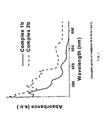
- UV/vis absorption data of 1b and 2b in CH 2 Cl 2 Complexes ⁇ max / nm ( ⁇ /10 4 ⁇ dm 3 mol -1 cm -1 ) 1b 255 (3.80), 315 (1.75), 400 (0.82), 480 (0.25), 505 (0.22) 2b 291 (3.92), 315 (3.40), 325 (3.23), 352 (2.58), 375 (2.47), 420 (0.52), 488 (0.67), 504 (0.72)
- the photoluminescence (PL) of the platinum complexes 1b and 2b in solution and as thin film are summarized in Table 2.
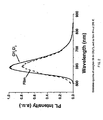
- Table 2 the 298 K structureless emission of complex 1b are observed at 595 and 599 nm in CH 2 Cl 2 and as thin film respectively.
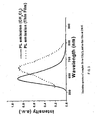
- the PL properties of complex 2b in solution and as thin film are shown in Figure 3 .
- the emission maximum of 2b in thin film is shifted by 1704 cm -1 compared to that in solution.
- complexes 1b and 2b exhibit lifetimes of 1.9 and 5.3 ⁇ s in CH 2 Cl 2 and luminescent quantum yields of 0.1 and 0.6 (with Ru(bpy) 3 Cl 2 as reference standard) respectively.
- Table 2 the 298 K structureless emission of complex 1b are observed at 595 and 599 nm in CH 2 Cl 2 and as thin film respectively.
- the PL properties of complex 2b in solution and as thin film are shown in Figure 3 .
- the emission maximum of 2b in thin film is shifted by 1704 cm
- the TGA thermograms of complexes 1b and 2b are shown in Figure 4 . Both the complexes demonstrate high thermal stabilities in nitrogen and air at heating rate of 15 °C/min. Complex 2b is stable up to 536 °C in nitrogen and 379 °C in air. The on-set temperatures of 1b are at 438 °C in nitrogen and 382 °C in air. These observations reveal that these light-emitting materials can be sublimed and stable at vacuum deposition conditions in preparation of OLEDs.
- FIG. 5 An electroluminescent device according to this invention is schematically illustrated in Figure 5 .
- the fabrication of device A (0.3 wt% of 1b ) follows:
- the device A was assembled as follows: indium tin oxide (ITO) electrode with sheet resistance of 20 ⁇ /square on glass substrate, a hole transport material NPB ( ⁇ -naphthylphenylbiphenyl amine) with thickness of 500 ⁇ , an emitting layer made of mixture of 0.3 wt.% complex 1b and blue luminescent material Bepp 2 (beryllium bis(2-(2'-hydroxyphenyl)pyridine) with 400 ⁇ thickness, an enhanced charge transport layer LiF with thickness of 15 ⁇ , and aluminum layer with 2000 ⁇ thickness.
- the metal and organic layers were laminated in sequence under 5 ⁇ 10 -6 mbar without breaking vacuum between different vacuum deposition processes. The layers were deposited at rates of 2 or 5 ⁇ per second.
- the emissive area of the device as defined by overlapping area of cathode and anode was 3 ⁇ 3 mm 2 .
- the ITO coated glass slides were cleaned with organic solvents (acetone-isopropanol-methanol), deionized water, followed by ultra-violet-ozone cleaner.
- EL spectra and current density-voltage-luminance characteristics of the devices were measured with a spectrophotometer and a computer-controlled direct-current power supply respectively at room temperature.
- the device external efficiencies increase when the doping concentration levels of complex 1b were adjusted from 2 to 0.3 wt%.
- the specific examples are further illustrated as follows:
- the performances of device A with 0.3 wt% doping level of complex 1b are shown in Figures 6a and 6b .
- Two intense EL emissions at 453 and 540 nm are observed when the device was driven under forward bias.
- the current density-voltage-luminance characteristics curves of device A are also shown.
- the turn-on voltage is approximately 6-7 V.
- the maximum efficiency of the device was 4.1 cd/A at luminance of 2849 cd/m 2 .
- the maximum luminance of 9325 cd/m 2 was obtained at driving voltage of 10 V.
- the performances of device B with 1.0 wt% doping level of complex 1b are shown in Figures 7a and 7b .
- the device exhibits an intense EL emission peak at 546 nm and a weak emission at 457 nm.
- the onset voltage of device B was approximately at 6-7 V.
- the efficiency and maximum luminance were 1.9 cd/A at luminance of 1927 cd/m 2 and 6563 cd/m 2 at driving voltage of 9.5 V respectively.
- Device C with 2.0 wt% doping level of complex 1b exhibits an intense EL emission peak at 548 nm with an extremely weak emission at around 450 nm ( Figure 8 ); EL efficiency of 1.5 cd/A was detected. Luminance of 6450 cd/m 2 was observed at driving voltage of 12 V.
- doping level of greater than 5 % is reported to achieve dopant emission in organic or polymeric light-emitting devices.
- the OLEDs show virtually complete emission of complex 1b when the doping level is around 2% and the efficiencies of devices increase from 1.5 to 4.1 cd/A when the doping levels of complex are decreased from 2.0 to 0.3 wt%.
Landscapes
- Chemical & Material Sciences (AREA)
- Organic Chemistry (AREA)
- Engineering & Computer Science (AREA)
- Materials Engineering (AREA)
- Crystallography & Structural Chemistry (AREA)
- Inorganic Chemistry (AREA)
- Electroluminescent Light Sources (AREA)
- Pyridine Compounds (AREA)
- Nitrogen Condensed Heterocyclic Rings (AREA)
Description
- The present invention relates to light-emitting materials, which can be deposited as a thin layer by vacuum deposition, and which can be used as effective dopants in organic light-emitting devices (OLEDs).
- The progress of light-emitting diode (LED) over the past two decades has primarily focused on inorganic types because early development in organic light-emitting devices (OLEDs) resulted in poor fabrication and packaging, and short lifetimes. Today, gallium arsenide-based LEDs in the market are commonly available with efficiencies in some spectral regions exceeding conventional filtered fluorescent lamps. However, in the development of light-emitting materials for display technology, inorganic semi-conductor materials are not compatible for large-area assembled displays.
- Pope et al. at New York University demonstrated organic electroluminescence in the 1960s based on anthracene materials (J. Chem. Phys. 38, 2042, (1963)). Much progress have been made since the discovery of the tris(8-hydroxyquinolato)aluminum (Alq3) based thin film device by C. W. Tang et al. at Kodak (Appl. Phys. Lett. 51, 913, (1987)). These contributed largely to the continuous discovery of new and improved electroluminescent materials. From small fluorescent molecules to conjugated polymers, many OLEDs have been shown to exhibit sufficient brightness, remarkable efficiencies, good operating lifetimes and desirable ranges of color emission.
- Organic light-emitting devices containing metal complexes are of particular interest because of their unusual chemical and electronic properties. Some compounds bearing heavy metals exhibit potential advantages for OLEDs owing to their high internal quantum efficiencies. Conventionally, fluorescent materials are employed as dopants in emissive hosts. Singlet excitons (maximum theoretical internal quantum efficiency = 25 %) are formed after recombination of hole and electron to emit electroluminescence via dipole-dipole interaction through Förster mechanism (
US Patent 6,310,360 ). Whereas, for heavy metal complexes, strong spin-orbit coupling can lead to singlet-triplet state mixing, which can result in high-efficiency electrophosphorescence in OLEDs (theoretical internal quantum efficiency up to 100 %) (Nature, 395, 151, (1998); Synthetic Metals, 93, 245, (1998); Appl. Phys Lett. 77, 904, (2000)). - However, some phosphorescent materials have intrinsic disadvantages, such as saturation of emission sites due to excessively long lifetimes as well as triplet-triplet annihilation and concentration quenching arising from strong intermolecular interactions at high doping levels (Phys. Rev. B. 60, 14422, (1999)).
- For example, quadridentate azomethine-zinc complexes have been used as blue light emitters in organic light-emitting devices, which exhibit maximum luminance of approximately 1000 cd/m2 only (Jpn. J. Appl. Phys., 32, L511 (1993);
US Patent 5,432,014 ). - Azomethine-aluminum/gallium complexes have been employed in OLEDs as emissive materials. The current density of the device containing azomethine-gallium complex is 1 mA/cm2 at 10 V and the electroluminescence is greenish blue (
US Patent 6,316,130 ). - The Article by P.Capdevielle et al. "Electroactive polymers exchanging transition metal ions; synthesis of new monomers and polymers based on 6,6'-bis(2-hydroxyethyl)bipyridine complexes", New J. Chem. 1994, 18, 519 - 524, discloses Nickel or Copper complexes of a 6,6'-bis(2-hydroxyethyl)bipyridine ligand (LH2) and the preparation of film layers from polymers of said complexes without any host material. Said document remains silent with respect to the use of these polymeric layers in any kind of light-emitting device for producing electroluminescence.
- It is therefore desirable to develop emissive dopant materials that can permit efficient energy transfer between the host and dopant in OLEDs, while causing little or no self-quenching even at sufficiently high doping concentrations.
- Examples of objects of the present invention in embodiments thereof include:
- The main objective of this invention is to prepare organic light-emitting devices (OLEDs) doped with new light-emitting materials. The devices exhibit low turn-on voltages and high luminance and efficiencies
- Said objective is achieved, according to the invention by the organic light-emitting device of
Claim 1. - Preferred embodiment of the light-emitting device according to the invention are disclosed in
dependent claims 2 to 5. - An object of the present invention is to provide thermally stable, moisture-resistant metal-chelated materials that can be deposited as a thin layer of known thickness by a vapor deposition process.
- Further, the present invention concerns the design of high luminous dopants, which can be used at low concentration levels in light-emitting devices.
- Light-emitting materials derived from quadridentate ONNO-type ligands, and a
Group 10 metal (including platinum) were prepared as illustrated by formula I and II:
Group 10 metal (including platinum) and R1-R14 are each independently selected from the group consisting of hydrogen; halogen; alkyl; substituted alkyl; aryl; substituted aryl, with substitutents selected from the group consisting of halogen, lower alkyl and recognized donor and acceptor groups. - Embodiments of the present invention includes, but is not limited to, OLEDs comprising heterostructures for producing electroluminescence which contain anode (ITO glass substance), hole transport layer (NPB (α-naphthylphenylbiphenyl amine)), matrix emissive layer [host material (beryllium bis(2-(2'-hydroxyphenyl)pyridine) (Bepp2)) with different concentration of dopants as illustrated by formula I and II herein], charge transport layer (lithium fluoride) and cathode (aluminum metal).
- The preferred embodiment as an effective dopant in the OLEDs herein is:

- The present invention provides new materials for applications as emissive dopants in electroluminescent devices. The invention includes the synthetic methods for these novel complexes plus their use as light-emitting materials. The devices of the present invention can be applied to field of display, light-emitter, display board for sign lamp, or light source for liquid crystal display.
- Thus, new emissive molecules as represented by Formula I are disclosed in
claim 6, and new emissive molecules as represented by Formula II are disclosed in claim 7. - A method for the preparation of a new light-emitting material having a structure represented by Formula I is disclosed in
claim 8, and a method for the preparation of a new light-emitting material having a structure represented by Formula II is disclosed in claim 9. -
- Figure 1.
- Absorption spectra of
complexes 1b & 2b in CH2Cl2 - Figure 2.
- Emission spectra of
complex 1b in CH2Cl2 and as thin film at 298 K - Figure 3.
- Emission spectra of
complex 2b in CH2Cl2 and as thin film at 298 K - Figure 4.
- TGA thermograms of
complexes - Figure 5.
- Schematic diagram of OLED in present invention
- Figure 6a.
- Electroluminescent spectrum of Device
A containing complex 1b (doping level 0.3 wt%) - Figure 6b.
- Current density-voltage-luminance curve of Device
A containing complex 1b (doping level 0.3 wt%) - Figure 7a.
- Electroluminescent spectrum of Device
B containing complex 1b (doping level 1.0 wt%) - Figure 7b.
- Current density-voltage-luminance curve of Device
B containing complex 1b (doping level 1.0 wt%) - Figure 8.
- Electroluminescent spectrum of Device
C containing complex 1b (doping level 2.0 wt%) - The inventions are generally related to syntheses, spectral characterization, phosphorescence, light-emitting properties of the new light-emitting materials, and their applications in OLEDs. The examples are set forth to aid in an understanding of the inventions but are not intended to, and should not be interpreted to, limit in any way the invention as set forth in the claims which follow thereafter.
- The examples given illustrate the synthetic methods of ligands 1a and 2a, and the
platinum complexes US Patent 6,177,419 ). -

- A mixture of 6,6'-bis(2-methoxyphenyl)-4,4'-bis(tert-butyl)-2,2'-bipyridine (1 g) in hydrobromic acid (47 %, 20 mL) was refluxed for 12 hours. This was cooled to room temperature and was neutralized with an aqueous saturated Na2CO3 solution at room temperature. The organic product was extracted with chloroform and the extracts were washed with deionized water (50 mL × 2), dried over anhydrous Na2SO4, and a solid residue was obtained by removal of solvent. Crystalline product of 1a was obtained by recrystallization from a methanol/dichloromethane solution. EI-MS (m/z): 452 [M]+. 1H NMR (CDCl3, δ, ppm): 14.45 (2H, s, OH), 8.16 (2H, d, J = 1.4 Hz, ArH), 7.97 (2H, d, J = 1.3 Hz, ArH), 7.90 (2H, dd, J = 8.0 Hz, J = 1.4 Hz, ArH), 7.34 (2H, td, J = 8.4 Hz, J = 1.5 Hz, ArH), 7.07 (2H, dd, J = 8.2 Hz, J = 1.6 Hz, ArH), 6.96 (2H, td, J = 8.1 Hz, J = 1.2 Hz, ArH), 1.47 (18H, s, t Bu). 13C NMR (CDCl3, δ, ppm): 163.3, 159.7, 157.5, 152.2, 131.5, 126.5, 119.2, 118.9, 118.4, 116.4, 35.6, 30.6.
-

- The synthetic method of
metal complex 1b is described. A mixture of NaOMe (0.014 g, 0.25 mmol) and the ligand 1a (0.113 g, 0.25 mmol) in methanol (20 mL) was stirred for 2 hours. An acetonitrile solution (20 mL) of Pt(CH3CN)2Cl2 (0.25 mmol) was added to the methanolic suspension, which was refluxed for 24 hours. The resulting suspension was filtered and concentrated to about 5 mL. Upon addition of diethyl ether, a brown-yellow solid was obtained. The crude product was recrystallized by diffusion of diethyl ether into a dichloromethane solution to afford yellow crystals. FAB-MS (m/z): 645 [M]+, 1292 (2M+ + 2), 1938 (3M+ + 3). 1H NMR (CDCl3, δ, ppm): 8.32 (d, 2H, J = 1.41 Hz ArH), 8.01 (d, 2H, J = 7.25 Hz, ArH), 7.85 (d, 2H, J = 1.68 Hz, ArH), 7.48 (dd, 2H, J = 7.38 Hz, J = 1.13 Hz, ArH), 7.38 (td, 2H, J = 5.35, 1.61 Hz, ArH), 6.79 (td, 2H, J = 5.40, 1.35 Hz, ArH), 1.54 (s, 18H, t Bu). 13C NMR (CDCl3, δ, ppm): 162.745, 159.105, 155.291, 149.851, 131.269, 128.005, 124.060, 120.465, 120.402, 116.302, 116.148, 30.402, 29.715. FTIR(KBr, cm-1): 3086 w, 2953 m, 1612 w, 1528 s, 1351 s, 1034 m, 885 w, 723 m -

- In a 100 mL round-bottom flask equipped with a reflux condenser, 2,9-bis(2-methoxyphenyl)-4,7-diphenyl-1,10-phenanthroline (finely ground, 2 g, 3.7 mmol) and pyridinium hydrochloride (4.23 g, 37 mmol) were mixed. The mixture was heated under nitrogen flow to 210 °C for 36 hours. After cooling, water (30 mL) was added and the aqueous solution was extracted with chloroform (3 × 30 mL). Combined organic extracts were washed with saturated sodium bicarbonate solution (5 × 30 mL) and water (3 × 30 mL), dried over anhydrous magnesium sulfate and evaporated to give a bright yellow solid. Chromatography over silica gel using n-hexane: dichloromethane (1:2) as eluent afforded 0.99 g of a yellow solid. FAB-MS (m/z): 517 [M+H]+. 1H NMR (300 MHz, CDCl3, δ, ppm): 14.69 (2H, s, OH), 8.52 (2H, s, ArH), 8.41 (2H, dd, J = 8.0, 1.3 Hz, ArH), 7.90 (2H, s, ArH), 7.71 (4H, d, J = 7.4 Hz), 7.64 (6H, m, ArH), 7.43 (2H, td, J = 7.7, 1.5 Hz, ArH), 7.10 (2H, dd, J = 7.4 Hz, 1.3 Hz, ArH), 7.04 (2H, td, J = 7.5, 1.3 Hz, ArH). 13C NMR (600 MHz, CDCl3): δ = 160.5, 157.7, 150.3, 142.8, 137.8, 132.2, 129.6, 128.9, 128.8, 127.1,125.7, 123.7, 120.6, 119.4, 119.2, 118.9.
-

- K2PtCl4 (0.08 g, 0.19 mmol) and 2a (0.1 g, 0.19 mmol) were refluxed in glacial acetic acid (10 mL) for 2 days. After cooling, the resulting suspension was collected by filtration, washed with acetic acid and water successively and then dried under vacuum to afford a brown solid. The crude product was purified by chromatography on a silica gel column with dichloromethane as eluent. The product was recrystallized by slow evaporation of a dichloromethane solution to afford red crystals. FAB-MS: m/z = 710 [M+H]+. 1H NMR (270 MHz, DMSO-d6) 8.81 (2H, s, ArH), 8.56 (2H, d, J = 8.9 Hz, ArH), 8.01 (2H, s, ArH), 7.86 (4H, m , ArH), 7.71 (6H, dd, J = 4.9, 2.0 Hz, ArH), 7.44 (2H, t, J = 7.4 Hz, ArH), 7.24 (2H, d, J = 8.2 Hz, ArH), 6.80 (2H, t, J = 7.6 Hz, ArH).
- The spectral characteristics of the
platinum complexes Figure 1 ). In addition, a broad absorption band can be found at ca. 480 nm (2800 dm3mol-1cm-1). For complex 2b (Figure 1 ), several vibronic transitions at 291-375 nm (ε = 39200 to 24700 dm3mol-1cm-1) and a broad band at 504 nm (ε = 7200 dm3mol-1cm-1) are observed in CH2Cl2.Table 1. UV/vis absorption data of 1b and 2b in CH2Cl2 Complexes λmax / nm (ε /104 × dm3mol-1cm-1) 1b 255 (3.80), 315 (1.75), 400 (0.82), 480 (0.25), 505 (0.22) 2b 291 (3.92), 315 (3.40), 325 (3.23), 352 (2.58), 375 (2.47), 420 (0.52), 488 (0.67), 504 (0.72) - The photoluminescence (PL) of the
platinum complexes Figure 2 , the 298 K structureless emission of complex 1b are observed at 595 and 599 nm in CH2Cl2 and as thin film respectively. The PL properties of complex 2b in solution and as thin film are shown inFigure 3 . The emission maximum of 2b in thin film is shifted by 1704 cm-1 compared to that in solution. Meanwhile,complexes Table 2. PL properties of complexes Complexes (Measuring medium / Temperature) Emission (Maximum / nm) Lifetime (µs) Quantum yield 1b (CH2Cl2 / 298 K) 595 1.9 0.1 1b (Thin Film / 298 K) 599 / / 2b (CH2C/2 / 298 K) 586 5.3 0.6 2b (Thin Film / 298 K) 651 / / concentration = 1 × 10⁻⁵mol dm-3 - The TGA thermograms of
complexes Figure 4 . Both the complexes demonstrate high thermal stabilities in nitrogen and air at heating rate of 15 °C/min. Complex 2b is stable up to 536 °C in nitrogen and 379 °C in air. The on-set temperatures of 1b are at 438 °C in nitrogen and 382 °C in air. These observations reveal that these light-emitting materials can be sublimed and stable at vacuum deposition conditions in preparation of OLEDs. - An electroluminescent device according to this invention is schematically illustrated in
Figure 5 . As examples of the present invention, OLEDs with configurations of ITO / NPB (α-naphthylphenylbiphenyl amine) (500 Å) / [0.3 wt% (device A), 1 wt% (device B), or 2 wt% (device C) of complex 1b]:Bepp2 (400 Å) / LiF (15 Å) / A1 (2000 Å) were prepared. The fabrication of device A (0.3 wt% of 1b) follows: - The device A was assembled as follows: indium tin oxide (ITO) electrode with sheet resistance of 20Ω/square on glass substrate, a hole transport material NPB (α-naphthylphenylbiphenyl amine) with thickness of 500 Å, an emitting layer made of mixture of 0.3
wt.% complex 1b and blue luminescent material Bepp2 (beryllium bis(2-(2'-hydroxyphenyl)pyridine) with 400 Å thickness, an enhanced charge transport layer LiF with thickness of 15 Å, and aluminum layer with 2000 Å thickness. The metal and organic layers were laminated in sequence under 5 × 10⁻⁶ mbar without breaking vacuum between different vacuum deposition processes. The layers were deposited at rates of 2 or 5 Å per second. The emissive area of the device as defined by overlapping area of cathode and anode was 3 × 3 mm2. The ITO coated glass slides were cleaned with organic solvents (acetone-isopropanol-methanol), deionized water, followed by ultra-violet-ozone cleaner. EL spectra and current density-voltage-luminance characteristics of the devices were measured with a spectrophotometer and a computer-controlled direct-current power supply respectively at room temperature. - For these examples, the device external efficiencies increase when the doping concentration levels of complex 1b were adjusted from 2 to 0.3 wt%. The specific examples are further illustrated as follows:
- The performances of device A with 0.3 wt% doping level of complex 1b are shown in
Figures 6a and 6b . Two intense EL emissions at 453 and 540 nm are observed when the device was driven under forward bias. The current density-voltage-luminance characteristics curves of device A are also shown. The turn-on voltage is approximately 6-7 V. The maximum efficiency of the device was 4.1 cd/A at luminance of 2849 cd/m2. The maximum luminance of 9325 cd/m2 was obtained at driving voltage of 10 V. The EL color of device A is yellow (CIE coordinates: x = 0.33, y = 0.47). - The performances of device B with 1.0 wt% doping level of complex 1b are shown in
Figures 7a and 7b . The device exhibits an intense EL emission peak at 546 nm and a weak emission at 457 nm. The onset voltage of device B was approximately at 6-7 V. The efficiency and maximum luminance were 1.9 cd/A at luminance of 1927 cd/m2 and 6563 cd/m2 at driving voltage of 9.5 V respectively. The EL color of device B is yellow (CIE coordinates: x = 0.39, y = 0.54). - Device C with 2.0 wt% doping level of complex 1b exhibits an intense EL emission peak at 548 nm with an extremely weak emission at around 450 nm (
Figure 8 ); EL efficiency of 1.5 cd/A was detected. Luminance of 6450 cd/m2 was observed at driving voltage of 12 V. - The EL color of device C is yellow (CIE coordinates: x = 0.42, y = 0.56).
- Typically, doping level of greater than 5 % is reported to achieve dopant emission in organic or polymeric light-emitting devices. In this invention, the OLEDs show virtually complete emission of complex 1b when the doping level is around 2% and the efficiencies of devices increase from 1.5 to 4.1 cd/A when the doping levels of complex are decreased from 2.0 to 0.3 wt%.
Claims (9)
- An organic light-emitting device containing a heterostructure for producing electroluminescence, an emissive layer, comprising at least a host material and an emissive molecule, present as a dopant in said host material, wherein the said emissive molecule has a chemical structure represented by Formula I and II:

- The organic light-emitting device of claim 1, wherein said emissive molecule is present as a dopant in said host material in low concentration, including 0.3 to 2.0 weight % based on weight of host material.
- The organic light-emitting device of claim 1 that produces electroluminescence of yellow color.
- The organic light-emitting device of claim 1, wherein said the host material is beryllium bis(2-(2'- hydroxyphenyl)pyridine (Bepp2).
- The organic light-emitting device of claim 1, wherein the said host material and said emissive molecule can be deposited as a thin layer by method of sublimation or vacuum deposition or vapor deposition or spin-coating or other methods.
- The emissive molecule as represented by Formula I in accordance with claim 1, wherein the R1-R5, R7-R8 and R10-R14 groups are hydrogen atoms, R6 and R9 groups are tert-butyl groups, and M is platinum, namely:

- The emissive molecule as represented by Formula II in accordance with claim 1, wherein the R1-R5, R7-R8 and R10-R14 groups are hydrogen atoms, R6 and R9 groups are phenyl groups, and M is platinum, namely:

- A method for the preparation of a light emitting material having a structure represented by Formula (I), claim 1, wherein the R1-R5, R7-R8 and R10-R14 groups are hydrogen atoms, R6 and R9 groups are tert-butyl groups, and M is platinum, namely:
 - demethylation of 6,6'-bis(2-methoxyphenyl)-4,4'-bis(tert-butyl)-2,2'-bipyridine by hydrobromic acid to prepare a ligand of Formula 1a:
 - coordination of the ligand of Formula 1a by reacting the ligand with Pt (CH3CN)2Cl2; whereby the material of Formula (I) is obtained.
 - A method for the preparation of a light emitting material having a structure represented by Formula (II), claim 1, wherein the R1-R5, R7-R8 and R10-R14 groups are hydrogen atoms, R6 and R9 groups are phenyl groups, and M is platinum, namely:
 - demethylation of 2,9-bis(2-methoxyphenyl)-4,7-diphenyl-1,10-phenanthroline by pyridinium hydrochloride to prepare a ligand of Formula 2a:
 - coordination of the ligand of Formula 2a by reacting the ligand with K2Ptcl4 ; whereby the material of Formula (II) is obtained.
Applications Claiming Priority (3)
| Application Number | Priority Date | Filing Date | Title |
|---|---|---|---|
| US137272 | 2002-05-01 | ||
| US10/137,272 US6653654B1 (en) | 2002-05-01 | 2002-05-01 | Electroluminescent materials |
| PCT/CN2003/000221 WO2003093283A1 (en) | 2002-05-01 | 2003-03-27 | Electroluminescent materials |
Publications (3)
| Publication Number | Publication Date |
|---|---|
| EP1499624A1 EP1499624A1 (en) | 2005-01-26 |
| EP1499624A4 EP1499624A4 (en) | 2006-05-03 |
| EP1499624B1 true EP1499624B1 (en) | 2016-01-06 |
Family
ID=29269063
Family Applications (1)
| Application Number | Title | Priority Date | Filing Date |
|---|---|---|---|
| EP03714623.0A Expired - Lifetime EP1499624B1 (en) | 2002-05-01 | 2003-03-27 | Electroluminescent materials |
Country Status (8)
| Country | Link |
|---|---|
| US (1) | US6653654B1 (en) |
| EP (1) | EP1499624B1 (en) |
| JP (2) | JP4981252B2 (en) |
| KR (1) | KR100991874B1 (en) |
| CN (1) | CN100509827C (en) |
| AU (1) | AU2003218866A1 (en) |
| TW (1) | TWI267544B (en) |
| WO (1) | WO2003093283A1 (en) |
Families Citing this family (150)
| Publication number | Priority date | Publication date | Assignee | Title |
|---|---|---|---|---|
| JP2004275542A (en) * | 2003-03-17 | 2004-10-07 | Olympus Corp | Capsule endoscope |
| JP2004335122A (en) * | 2003-04-30 | 2004-11-25 | Takasago Internatl Corp | Light emitting element |
| JP2004331508A (en) * | 2003-04-30 | 2004-11-25 | Takasago Internatl Corp | Platinum complex |
| EP1620525B1 (en) | 2003-05-09 | 2011-09-28 | FUJIFILM Corporation | Organic electroluminescent device and platinum compound |
| WO2004108857A1 (en) * | 2003-06-02 | 2004-12-16 | Fuji Photo Film Co., Ltd. | Organic electroluminescent devices and metal complex compounds |
| US7029766B2 (en) * | 2003-12-05 | 2006-04-18 | Eastman Kodak Company | Organic element for electroluminescent devices |
| DE10358665A1 (en) * | 2003-12-12 | 2005-07-07 | Basf Ag | Use of platinum (II) complexes as luminescent materials in organic light-emitting diodes (OLEDs) |
| KR100600862B1 (en) * | 2004-01-30 | 2006-07-14 | 김선권 | Record media containing methods for systematically collecting and retrieving access routes to information resources on the Internet, and computer programs that can implement the methods |
| US20050170206A1 (en) * | 2004-02-03 | 2005-08-04 | Bin Ma | OLEDs utilizing multidentate ligand systems |
| US7332232B2 (en) * | 2004-02-03 | 2008-02-19 | Universal Display Corporation | OLEDs utilizing multidentate ligand systems |
| US7486815B2 (en) * | 2004-02-20 | 2009-02-03 | Microsoft Corporation | Method and apparatus for scene learning and three-dimensional tracking using stereo video cameras |
| JP4749744B2 (en) * | 2004-03-31 | 2011-08-17 | 富士フイルム株式会社 | Organic electroluminescence device |
| US7361415B2 (en) * | 2004-04-16 | 2008-04-22 | The University Of Hong Kong | System and method for producing light with organic light-emitting devices |
| US20050244672A1 (en) * | 2004-04-30 | 2005-11-03 | Chi-Ming Che | Organic light-emitting devices |
| US7247375B2 (en) * | 2004-04-30 | 2007-07-24 | Kimberly-Clark Worldwide, Inc. | Polymeric matrices for the encapsulation of phosphorescent molecules for analytical applications |
| WO2005112520A1 (en) * | 2004-05-18 | 2005-11-24 | Nippon Hoso Kyokai | Light-emitting device |
| US7238301B2 (en) * | 2004-06-29 | 2007-07-03 | Kimberly-Clark Worldwide, Inc. | Cross-linked encapsulated phosphorescent molecules |
| DE102004034517A1 (en) | 2004-07-16 | 2006-02-16 | Covion Organic Semiconductors Gmbh | metal complexes |
| JP4813032B2 (en) * | 2004-09-21 | 2011-11-09 | 富士フイルム株式会社 | Organic electroluminescence device |
| JP4500735B2 (en) * | 2004-09-22 | 2010-07-14 | 富士フイルム株式会社 | Organic electroluminescence device |
| JP4531509B2 (en) * | 2004-09-27 | 2010-08-25 | 富士フイルム株式会社 | Light emitting element |
| JP4762527B2 (en) | 2004-11-10 | 2011-08-31 | 富士フイルム株式会社 | Organic electroluminescence device |
| JP4903416B2 (en) * | 2004-11-10 | 2012-03-28 | 富士フイルム株式会社 | Organic electroluminescence device |
| JP2006140218A (en) * | 2004-11-10 | 2006-06-01 | Fuji Photo Film Co Ltd | Organic electroluminescent elemnt |
| JP4969086B2 (en) * | 2004-11-17 | 2012-07-04 | 富士フイルム株式会社 | Organic electroluminescence device |
| US20060105202A1 (en) * | 2004-11-17 | 2006-05-18 | Fuji Photo Film Co., Ltd. | Organic electroluminescent device |
| JP4773109B2 (en) * | 2005-02-28 | 2011-09-14 | 高砂香料工業株式会社 | Platinum complex and light emitting device |
| US7771845B2 (en) * | 2005-03-14 | 2010-08-10 | Fujifilm Corporation | Organic electroluminescent device |
| JP4727262B2 (en) * | 2005-03-16 | 2011-07-20 | 富士フイルム株式会社 | Organic electroluminescence device |
| JP2006303394A (en) * | 2005-04-25 | 2006-11-02 | Fuji Photo Film Co Ltd | Organic electroluminescence device |
| JP4934346B2 (en) * | 2005-04-25 | 2012-05-16 | 富士フイルム株式会社 | Organic electroluminescence device |
| TWI391027B (en) * | 2005-04-25 | 2013-03-21 | Fujifilm Corp | Organic electroluminescent device |
| US7498437B2 (en) * | 2005-04-27 | 2009-03-03 | Au Optronics Corporation | Phosphorescent light-emitting device with doped iridium-complex |
| JP2007110067A (en) * | 2005-09-14 | 2007-04-26 | Fujifilm Corp | Composition for organic electroluminescent device, method for producing organic electroluminescent device, and organic electroluminescent device |
| US8956738B2 (en) | 2005-10-26 | 2015-02-17 | Global Oled Technology Llc | Organic element for low voltage electroluminescent devices |
| EP1803789A1 (en) | 2005-12-28 | 2007-07-04 | Novaled AG | Use of metal complexes as emitters in organic light emitting devices and such a device |
| WO2007115540A1 (en) | 2006-03-30 | 2007-10-18 | Novaled Ag | Use of bora-tetraazapentalenes |
| KR101299098B1 (en) * | 2006-04-14 | 2013-08-28 | 주식회사 동진쎄미켐 | Preparing method for organic thin layer of organic light emitting devices using electrochemical deposition |
| EP1860709B1 (en) | 2006-05-24 | 2012-08-08 | Novaled AG | Use of square planar transition metal complexes as dopants |
| DE102006030860A1 (en) * | 2006-07-04 | 2008-01-10 | Universität Regensburg | Oligomers of isonitrile metal complexes as triplet emitters for OLED applications |
| DE102006035018B4 (en) | 2006-07-28 | 2009-07-23 | Novaled Ag | Oxazole triplet emitter for OLED applications |
| JP2008037848A (en) * | 2006-08-10 | 2008-02-21 | Takasago Internatl Corp | Platinum complex and light emitting device |
| DE102006048202A1 (en) * | 2006-10-11 | 2008-04-17 | Universität Regensburg | Lanthanoid emitter for OLED applications |
| DE102006051975B4 (en) | 2006-11-03 | 2012-04-19 | Merck Patent Gmbh | Photophysical OLED efficiency increase |
| DE102007002420A1 (en) * | 2007-01-17 | 2008-07-24 | Universität Regensburg | Polymeric anions / cations |
| DE102007017656A1 (en) | 2007-04-12 | 2008-10-16 | Henkel Ag & Co. Kgaa | Biheteroaryl metal complexes as bleaching catalysts |
| US9023490B2 (en) | 2007-06-15 | 2015-05-05 | Versitech Limited | Extended pi-conjugated platinum (II) complexes |
| JP2009076865A (en) * | 2007-08-29 | 2009-04-09 | Fujifilm Corp | Organic electroluminescence device |
| KR101548382B1 (en) | 2007-09-14 | 2015-08-28 | 유디씨 아일랜드 리미티드 | Organic electroluminescence device |
| US20090105488A1 (en) * | 2007-10-22 | 2009-04-23 | Chien-Hong Cheng | Triptycene derivatives and their application |
| JP5243972B2 (en) | 2008-02-28 | 2013-07-24 | ユー・ディー・シー アイルランド リミテッド | Organic electroluminescence device |
| JP4531836B2 (en) * | 2008-04-22 | 2010-08-25 | 富士フイルム株式会社 | Organic electroluminescent device, novel platinum complex compound and novel compound that can be a ligand |
| JP4531842B2 (en) * | 2008-04-24 | 2010-08-25 | 富士フイルム株式会社 | Organic electroluminescence device |
| DE102008048336A1 (en) * | 2008-09-22 | 2010-03-25 | Merck Patent Gmbh | Mononuclear neutral copper (I) complexes and their use for the production of optoelectronic devices |
| US8119037B2 (en) | 2008-10-16 | 2012-02-21 | Novaled Ag | Square planar transition metal complexes and organic semiconductive materials using them as well as electronic or optoelectric components |
| DE102008053121A1 (en) | 2008-10-24 | 2010-04-29 | Merck Patent Gmbh | Double complex salts as emitters in OLED devices |
| DE102009013041A1 (en) * | 2009-03-13 | 2010-09-16 | Merck Patent Gmbh | Materials for organic electroluminescent devices |
| DE102009030475A1 (en) | 2009-06-24 | 2011-01-05 | Hartmut Prof. Dr. Yersin | Copper complexes for optoelectronic applications |
| KR101113139B1 (en) * | 2009-09-08 | 2012-02-15 | 이강옥 | Sludge dewatering device |
| EP2365556B1 (en) | 2010-03-08 | 2014-07-23 | Semiconductor Energy Laboratory Co., Ltd. | Light-emitting element, light-emitting device, electronic device, and lighting device |
| US8877353B2 (en) | 2010-07-21 | 2014-11-04 | Versitech Limited | Platinum (II) tetradentate ONCN complexes for organic light-emitting diode applications |
| JP5981736B2 (en) * | 2011-04-12 | 2016-08-31 | ユー・ディー・シー アイルランド リミテッド | ORGANIC ELECTROLUMINESCENT ELEMENT, AND LIGHT EMITTING DEVICE, DISPLAY DEVICE AND LIGHTING DEVICE USING THE ORGANIC ELECTROLUMINESCENT ELEMENT |
| US8957217B2 (en) | 2011-05-31 | 2015-02-17 | The University Of Hong Kong | Phosphorescent material, their preparations and applications |
| US9139699B2 (en) * | 2012-10-04 | 2015-09-22 | Dow Corning Corporation | Metal containing condensation reaction catalysts, methods for preparing the catalysts, and compositions containing the catalysts |
| EP2594571A1 (en) | 2011-11-16 | 2013-05-22 | Cynora GmbH | Copper complexes for optoelectronic applications |
| US8772485B2 (en) * | 2011-12-09 | 2014-07-08 | The University Of Hong Kong | Palladium complexes for organic light-emitting diodes |
| US10038153B2 (en) * | 2014-04-03 | 2018-07-31 | Versitech Limited | Platinum (II) emitters for OLED applications |
| CN105273712B (en) * | 2014-07-11 | 2017-07-25 | 广东阿格蕾雅光电材料有限公司 | Luminescent materials for light-emitting diodes |
| EP3204463B1 (en) | 2014-10-08 | 2019-04-17 | cynora GmbH | Metal complexes with tridentate ligands for optoelectronic applications |
| US10144867B2 (en) | 2015-02-13 | 2018-12-04 | Universal Display Corporation | Organic electroluminescent materials and devices |
| US9929361B2 (en) | 2015-02-16 | 2018-03-27 | Universal Display Corporation | Organic electroluminescent materials and devices |
| US11056657B2 (en) | 2015-02-27 | 2021-07-06 | University Display Corporation | Organic electroluminescent materials and devices |
| US9859510B2 (en) | 2015-05-15 | 2018-01-02 | Universal Display Corporation | Organic electroluminescent materials and devices |
| US10418568B2 (en) | 2015-06-01 | 2019-09-17 | Universal Display Corporation | Organic electroluminescent materials and devices |
| US11127905B2 (en) | 2015-07-29 | 2021-09-21 | Universal Display Corporation | Organic electroluminescent materials and devices |
| US10361381B2 (en) | 2015-09-03 | 2019-07-23 | Universal Display Corporation | Organic electroluminescent materials and devices |
| US20170229663A1 (en) | 2016-02-09 | 2017-08-10 | Universal Display Corporation | Organic electroluminescent materials and devices |
| US10236456B2 (en) | 2016-04-11 | 2019-03-19 | Universal Display Corporation | Organic electroluminescent materials and devices |
| US10862054B2 (en) | 2016-06-20 | 2020-12-08 | Universal Display Corporation | Organic electroluminescent materials and devices |
| US10672997B2 (en) * | 2016-06-20 | 2020-06-02 | Universal Display Corporation | Organic electroluminescent materials and devices |
| US11482683B2 (en) | 2016-06-20 | 2022-10-25 | Universal Display Corporation | Organic electroluminescent materials and devices |
| US10608186B2 (en) | 2016-09-14 | 2020-03-31 | Universal Display Corporation | Organic electroluminescent materials and devices |
| US10680187B2 (en) | 2016-09-23 | 2020-06-09 | Universal Display Corporation | Organic electroluminescent materials and devices |
| US11196010B2 (en) | 2016-10-03 | 2021-12-07 | Universal Display Corporation | Organic electroluminescent materials and devices |
| US11011709B2 (en) | 2016-10-07 | 2021-05-18 | Universal Display Corporation | Organic electroluminescent materials and devices |
| US12317745B2 (en) | 2016-11-09 | 2025-05-27 | Universal Display Corporation | Organic electroluminescent materials and devices |
| US10680188B2 (en) | 2016-11-11 | 2020-06-09 | Universal Display Corporation | Organic electroluminescent materials and devices |
| CN106749411B (en) * | 2016-12-08 | 2019-01-08 | 浙江工业大学 | A kind of o-phenanthroline tetradentate ligands and the preparation method and application thereof |
| US11780865B2 (en) | 2017-01-09 | 2023-10-10 | Universal Display Corporation | Organic electroluminescent materials and devices |
| US10844085B2 (en) | 2017-03-29 | 2020-11-24 | Universal Display Corporation | Organic electroluminescent materials and devices |
| US10944060B2 (en) | 2017-05-11 | 2021-03-09 | Universal Display Corporation | Organic electroluminescent materials and devices |
| US12098157B2 (en) | 2017-06-23 | 2024-09-24 | Universal Display Corporation | Organic electroluminescent materials and devices |
| US11228010B2 (en) | 2017-07-26 | 2022-01-18 | Universal Display Corporation | Organic electroluminescent materials and devices |
| US11744142B2 (en) | 2017-08-10 | 2023-08-29 | Universal Display Corporation | Organic electroluminescent materials and devices |
| CN109748936B (en) * | 2017-11-02 | 2021-05-11 | 广东阿格蕾雅光电材料有限公司 | An organometallic complex luminescent material |
| US12180230B2 (en) | 2017-11-28 | 2024-12-31 | University Of Southern California | Carbene compounds and organic electroluminescent devices |
| EP3492480B1 (en) | 2017-11-29 | 2021-10-20 | Universal Display Corporation | Organic electroluminescent materials and devices |
| US11937503B2 (en) | 2017-11-30 | 2024-03-19 | Universal Display Corporation | Organic electroluminescent materials and devices |
| US11542289B2 (en) | 2018-01-26 | 2023-01-03 | Universal Display Corporation | Organic electroluminescent materials and devices |
| US11165028B2 (en) | 2018-03-12 | 2021-11-02 | Universal Display Corporation | Organic electroluminescent materials and devices |
| US12453279B2 (en) | 2018-08-22 | 2025-10-21 | Universal Display Corporation | Organic electroluminescent materials and devices |
| US11737349B2 (en) | 2018-12-12 | 2023-08-22 | Universal Display Corporation | Organic electroluminescent materials and devices |
| CN111320613B (en) * | 2018-12-17 | 2023-05-12 | 广东阿格蕾雅光电材料有限公司 | Platinum (II) tetradentate ONNO complex luminescent material, preparation method and application thereof in organic light-emitting diode |
| US11780829B2 (en) | 2019-01-30 | 2023-10-10 | The University Of Southern California | Organic electroluminescent materials and devices |
| US12477890B2 (en) | 2019-02-01 | 2025-11-18 | Universal Display Corporation | Organic electroluminescent materials and devices |
| JP2020158491A (en) | 2019-03-26 | 2020-10-01 | ユニバーサル ディスプレイ コーポレイション | Organic electroluminescence materials and devices |
| US12281128B2 (en) | 2019-07-30 | 2025-04-22 | Universal Display Corporation | Organic electroluminescent materials and devices |
| US12139501B2 (en) | 2019-08-16 | 2024-11-12 | Universal Display Corporation | Organic electroluminescent materials and devices |
| US20210135130A1 (en) | 2019-11-04 | 2021-05-06 | Universal Display Corporation | Organic electroluminescent materials and devices |
| US12538698B2 (en) | 2020-01-06 | 2026-01-27 | Universal Display Corporation | Organic electroluminescent materials and devices |
| US12426495B2 (en) | 2020-01-28 | 2025-09-23 | Universal Display Corporation | Organic electroluminescent materials and devices |
| EP3937268B1 (en) | 2020-07-10 | 2025-05-07 | Universal Display Corporation | Plasmonic oleds and vertical dipole emitters |
| US12187748B2 (en) | 2020-11-02 | 2025-01-07 | Universal Display Corporation | Organic electroluminescent materials and devices |
| US20220158096A1 (en) | 2020-11-16 | 2022-05-19 | Universal Display Corporation | Organic electroluminescent materials and devices |
| US20220165967A1 (en) | 2020-11-24 | 2022-05-26 | Universal Display Corporation | Organic electroluminescent materials and devices |
| US12325717B2 (en) | 2020-11-24 | 2025-06-10 | Universal Display Corporation | Organic electroluminescent materials and devices |
| US12575316B2 (en) | 2021-02-03 | 2026-03-10 | Universal Display Corporation | Organic electroluminescent materials and devices |
| EP4060758A3 (en) | 2021-02-26 | 2023-03-29 | Universal Display Corporation | Organic electroluminescent materials and devices |
| EP4059915B1 (en) | 2021-02-26 | 2025-12-24 | Universal Display Corporation | Organic electroluminescent materials and devices |
| US12624055B2 (en) | 2021-03-01 | 2026-05-12 | Universal Display Corporation | Organic electroluminescent materials and devices |
| US12606582B2 (en) | 2021-03-05 | 2026-04-21 | Universal Display Corporation | Organic electroluminescent materials and devices |
| US12428599B2 (en) | 2021-03-09 | 2025-09-30 | Universal Display Corporation | Organic electroluminescent materials and devices |
| US20220298190A1 (en) | 2021-03-12 | 2022-09-22 | Universal Display Corporation | Organic electroluminescent materials and devices |
| US12421262B2 (en) | 2021-03-15 | 2025-09-23 | Universal Display Corporation | Organic electroluminescent materials and devices |
| US20220340607A1 (en) | 2021-04-05 | 2022-10-27 | Universal Display Corporation | Organic electroluminescent materials and devices |
| US12480042B2 (en) | 2021-04-09 | 2025-11-25 | Universal Display Corporation | Organic electroluminescent materials and devices |
| EP4075531A1 (en) | 2021-04-13 | 2022-10-19 | Universal Display Corporation | Plasmonic oleds and vertical dipole emitters |
| US20220352478A1 (en) | 2021-04-14 | 2022-11-03 | Universal Display Corporation | Organic eletroluminescent materials and devices |
| US20230006149A1 (en) | 2021-04-23 | 2023-01-05 | Universal Display Corporation | Organic electroluminescent materials and devices |
| US20220407020A1 (en) | 2021-04-23 | 2022-12-22 | Universal Display Corporation | Organic electroluminescent materials and devices |
| US20230133787A1 (en) | 2021-06-08 | 2023-05-04 | University Of Southern California | Molecular Alignment of Homoleptic Iridium Phosphors |
| US12550611B2 (en) | 2021-08-03 | 2026-02-10 | Universal Display Corporation | Organic electroluminescent materials and devices |
| EP4151699A1 (en) | 2021-09-17 | 2023-03-22 | Universal Display Corporation | Organic electroluminescent materials and devices |
| US12473318B2 (en) | 2021-10-08 | 2025-11-18 | Universal Display Corporation | Organic electroluminescent materials and devices |
| US12509628B2 (en) | 2021-12-16 | 2025-12-30 | Universal Display Corporation | Organic electroluminescent materials and devices |
| EP4231804A3 (en) | 2022-02-16 | 2023-09-20 | Universal Display Corporation | Organic electroluminescent materials and devices |
| US20230292592A1 (en) | 2022-03-09 | 2023-09-14 | Universal Display Corporation | Organic electroluminescent materials and devices |
| US20230337516A1 (en) | 2022-04-18 | 2023-10-19 | Universal Display Corporation | Organic electroluminescent materials and devices |
| US20230389421A1 (en) | 2022-05-24 | 2023-11-30 | Universal Display Corporation | Organic electroluminescent materials and devices |
| EP4293001A1 (en) | 2022-06-08 | 2023-12-20 | Universal Display Corporation | Organic electroluminescent materials and devices |
| US20240016051A1 (en) | 2022-06-28 | 2024-01-11 | Universal Display Corporation | Organic electroluminescent materials and devices |
| US20240107880A1 (en) | 2022-08-17 | 2024-03-28 | Universal Display Corporation | Organic electroluminescent materials and devices |
| US20240188419A1 (en) | 2022-10-27 | 2024-06-06 | Universal Display Corporation | Organic electroluminescent materials and devices |
| US20240196730A1 (en) | 2022-10-27 | 2024-06-13 | Universal Display Corporation | Organic electroluminescent materials and devices |
| US20240188316A1 (en) | 2022-10-27 | 2024-06-06 | Universal Display Corporation | Organic electroluminescent materials and devices |
| US20240180025A1 (en) | 2022-10-27 | 2024-05-30 | Universal Display Corporation | Organic electroluminescent materials and devices |
| US20240188319A1 (en) | 2022-10-27 | 2024-06-06 | Universal Display Corporation | Organic electroluminescent materials and devices |
| US20240247017A1 (en) | 2022-12-14 | 2024-07-25 | Universal Display Corporation | Organic electroluminescent materials and devices |
| US20250204238A1 (en) | 2023-12-15 | 2025-06-19 | Universal Display Corporation | Organic electroluminscent materials and devices |
| US20250204239A1 (en) | 2023-12-15 | 2025-06-19 | Universal Display Corporation | Organic electroluminescent materials and devices |
Family Cites Families (9)
| Publication number | Priority date | Publication date | Assignee | Title |
|---|---|---|---|---|
| JP2891783B2 (en) * | 1991-02-06 | 1999-05-17 | パイオニア株式会社 | Organic electroluminescence device |
| JP3490727B2 (en) * | 1991-11-28 | 2004-01-26 | 三洋電機株式会社 | Electroluminescent device |
| JP3615374B2 (en) * | 1997-11-17 | 2005-02-02 | 三洋電機株式会社 | Organic electroluminescence device |
| US6316130B1 (en) | 1998-07-04 | 2001-11-13 | Bayer Aktiengesellschaft | Electroluminescent assemblies using azomethine-metal complexes |
| GB9817845D0 (en) | 1998-08-17 | 1998-10-14 | Glaxo Group Ltd | Chemical compounds |
| DE19846766A1 (en) * | 1998-10-10 | 2000-04-20 | Aventis Res & Tech Gmbh & Co | A conjugated fluorene-based polymer useful as an organic semiconductor, electroluminescence material, and for display elements |
| JP2001003043A (en) * | 1999-06-16 | 2001-01-09 | Mitsumi Electric Co Ltd | Organic electroluminescent body and electroluminescent device using the same |
| US6310360B1 (en) | 1999-07-21 | 2001-10-30 | The Trustees Of Princeton University | Intersystem crossing agents for efficient utilization of excitons in organic light emitting devices |
| JP4154145B2 (en) * | 2000-12-01 | 2008-09-24 | キヤノン株式会社 | Metal coordination compound, light emitting device and display device |
-
2002
- 2002-05-01 US US10/137,272 patent/US6653654B1/en not_active Expired - Lifetime
-
2003
- 2003-03-20 TW TW092106163A patent/TWI267544B/en not_active IP Right Cessation
- 2003-03-27 KR KR1020047017529A patent/KR100991874B1/en not_active Expired - Lifetime
- 2003-03-27 CN CNB038099225A patent/CN100509827C/en not_active Expired - Lifetime
- 2003-03-27 JP JP2004501422A patent/JP4981252B2/en not_active Expired - Lifetime
- 2003-03-27 EP EP03714623.0A patent/EP1499624B1/en not_active Expired - Lifetime
- 2003-03-27 AU AU2003218866A patent/AU2003218866A1/en not_active Abandoned
- 2003-03-27 WO PCT/CN2003/000221 patent/WO2003093283A1/en not_active Ceased
-
2009
- 2009-08-07 JP JP2009185012A patent/JP2010050451A/en active Pending
Also Published As
| Publication number | Publication date |
|---|---|
| JP2010050451A (en) | 2010-03-04 |
| CN100509827C (en) | 2009-07-08 |
| US20030205707A1 (en) | 2003-11-06 |
| TWI267544B (en) | 2006-12-01 |
| AU2003218866A1 (en) | 2003-11-17 |
| KR100991874B1 (en) | 2010-11-04 |
| US6653654B1 (en) | 2003-11-25 |
| JP4981252B2 (en) | 2012-07-18 |
| EP1499624A4 (en) | 2006-05-03 |
| WO2003093283A1 (en) | 2003-11-13 |
| TW200427814A (en) | 2004-12-16 |
| CN1649886A (en) | 2005-08-03 |
| JP2005524727A (en) | 2005-08-18 |
| EP1499624A1 (en) | 2005-01-26 |
| KR20050007357A (en) | 2005-01-17 |
Similar Documents
| Publication | Publication Date | Title |
|---|---|---|
| US6653654B1 (en) | Electroluminescent materials | |
| CN100469204C (en) | organic electroluminescent element | |
| JP4773346B2 (en) | Mixtures of organic light emitting semiconductors and matrix materials, their use and electronic components comprising said materials. | |
| JP4891087B2 (en) | Organic electroluminescence device | |
| US20070148495A1 (en) | Organic light-emitting devices | |
| EP2075310B1 (en) | Organic electroluminescent device material and organic electroluminescent device | |
| JP2011201878A (en) | Mixture of matrix material and organic semiconductor capable of emission, use thereof, and electronic component containing the mixture | |
| JP4865551B2 (en) | Organic electroluminescence device | |
| KR20220065850A (en) | Metal complexes and their applications | |
| CN1820061B (en) | Mixtures of organic emissive semiconductors and matrix materials, their use and electronic components comprising said materials | |
| JP4338651B2 (en) | Phenylpyridine-iridium metal complex compound for organic electroluminescence device, production method thereof, and organic electroluminescence device using the same | |
| CN116156980A (en) | Organic electroluminescent device and application thereof | |
| CN101209988A (en) | Phenanthrene derivative and organic light-emitting diode containing phenanthrene derivative | |
| CN111423330B (en) | Aromatic amine derivative based on spirofluorene and application thereof | |
| CN112062765A (en) | A kind of organic photoluminescent compound and preparation method thereof | |
| CN116082404B (en) | Platinum complex luminescent materials and their applications | |
| KR100747089B1 (en) | Green light emitting organic compound and organic light emitting diode comprising same | |
| KR100700440B1 (en) | Blue light emitting organic compound and organic light emitting diode comprising the same | |
| CN117560982A (en) | An organic electroluminescent device and its application |
Legal Events
| Date | Code | Title | Description |
|---|---|---|---|
| PUAI | Public reference made under article 153(3) epc to a published international application that has entered the european phase |
Free format text: ORIGINAL CODE: 0009012 |
|
| 17P | Request for examination filed |
Effective date: 20041021 |
|
| AK | Designated contracting states |
Kind code of ref document: A1 Designated state(s): AT BE BG CH CY CZ DE DK EE ES FI FR GB GR HU IE IT LI LU MC NL PT RO SE SI SK TR |
|
| AX | Request for extension of the european patent |
Extension state: AL LT LV MK |
|
| A4 | Supplementary search report drawn up and despatched |
Effective date: 20060321 |
|
| RIC1 | Information provided on ipc code assigned before grant |
Ipc: C07D 471/04 20060101AFI20060315BHEP Ipc: H01L 51/30 20060101ALI20060315BHEP Ipc: C07D 213/38 20060101ALI20060315BHEP |
|
| 17Q | First examination report despatched |
Effective date: 20071001 |
|
| GRAP | Despatch of communication of intention to grant a patent |
Free format text: ORIGINAL CODE: EPIDOSNIGR1 |
|
| INTG | Intention to grant announced |
Effective date: 20150212 |
|
| GRAJ | Information related to disapproval of communication of intention to grant by the applicant or resumption of examination proceedings by the epo deleted |
Free format text: ORIGINAL CODE: EPIDOSDIGR1 |
|
| GRAP | Despatch of communication of intention to grant a patent |
Free format text: ORIGINAL CODE: EPIDOSNIGR1 |
|
| GRAJ | Information related to disapproval of communication of intention to grant by the applicant or resumption of examination proceedings by the epo deleted |
Free format text: ORIGINAL CODE: EPIDOSDIGR1 |
|
| GRAP | Despatch of communication of intention to grant a patent |
Free format text: ORIGINAL CODE: EPIDOSNIGR1 |
|
| INTG | Intention to grant announced |
Effective date: 20150624 |
|
| INTG | Intention to grant announced |
Effective date: 20150709 |
|
| INTG | Intention to grant announced |
Effective date: 20150716 |
|
| GRAS | Grant fee paid |
Free format text: ORIGINAL CODE: EPIDOSNIGR3 |
|
| GRAA | (expected) grant |
Free format text: ORIGINAL CODE: 0009210 |
|
| AK | Designated contracting states |
Kind code of ref document: B1 Designated state(s): DE FR GB |
|
| REG | Reference to a national code |
Ref country code: GB Ref legal event code: FG4D |
|
| REG | Reference to a national code |
Ref country code: DE Ref legal event code: R096 Ref document number: 60348413 Country of ref document: DE |
|
| REG | Reference to a national code |
Ref country code: DE Ref legal event code: R097 Ref document number: 60348413 Country of ref document: DE |
|
| PLBE | No opposition filed within time limit |
Free format text: ORIGINAL CODE: 0009261 |
|
| STAA | Information on the status of an ep patent application or granted ep patent |
Free format text: STATUS: NO OPPOSITION FILED WITHIN TIME LIMIT |
|
| 26N | No opposition filed |
Effective date: 20161007 |
|
| GBPC | Gb: european patent ceased through non-payment of renewal fee |
Effective date: 20160406 |
|
| REG | Reference to a national code |
Ref country code: FR Ref legal event code: ST Effective date: 20161130 |
|
| PG25 | Lapsed in a contracting state [announced via postgrant information from national office to epo] |
Ref country code: GB Free format text: LAPSE BECAUSE OF NON-PAYMENT OF DUE FEES Effective date: 20160406 Ref country code: FR Free format text: LAPSE BECAUSE OF NON-PAYMENT OF DUE FEES Effective date: 20160331 |
|
| PGFP | Annual fee paid to national office [announced via postgrant information from national office to epo] |
Ref country code: DE Payment date: 20220203 Year of fee payment: 20 |
|
| REG | Reference to a national code |
Ref country code: DE Ref legal event code: R071 Ref document number: 60348413 Country of ref document: DE |