EP1498245A1 - Spheroidally shaped fibre reinforced thermoplastic pellets - Google Patents
Spheroidally shaped fibre reinforced thermoplastic pellets Download PDFInfo
- Publication number
- EP1498245A1 EP1498245A1 EP03016053A EP03016053A EP1498245A1 EP 1498245 A1 EP1498245 A1 EP 1498245A1 EP 03016053 A EP03016053 A EP 03016053A EP 03016053 A EP03016053 A EP 03016053A EP 1498245 A1 EP1498245 A1 EP 1498245A1
- Authority
- EP
- European Patent Office
- Prior art keywords
- fibres
- fibre
- thermoplastic resin
- pellets
- longer
- Prior art date
- Legal status (The legal status is an assumption and is not a legal conclusion. Google has not performed a legal analysis and makes no representation as to the accuracy of the status listed.)
- Ceased
Links
- 239000008188 pellet Substances 0.000 title claims abstract description 50
- 239000000835 fiber Substances 0.000 title claims abstract description 44
- 229920001169 thermoplastic Polymers 0.000 title description 4
- 239000004416 thermosoftening plastic Substances 0.000 title description 4
- 230000003014 reinforcing effect Effects 0.000 claims abstract description 22
- 229920005992 thermoplastic resin Polymers 0.000 claims abstract description 15
- 238000000034 method Methods 0.000 claims abstract description 10
- 238000004519 manufacturing process Methods 0.000 claims abstract description 6
- XLYOFNOQVPJJNP-UHFFFAOYSA-N water Substances O XLYOFNOQVPJJNP-UHFFFAOYSA-N 0.000 claims description 8
- 238000004898 kneading Methods 0.000 claims description 6
- 239000000155 melt Substances 0.000 claims description 6
- 239000000203 mixture Substances 0.000 claims description 6
- 238000002844 melting Methods 0.000 claims description 4
- 230000008018 melting Effects 0.000 claims description 4
- 238000005520 cutting process Methods 0.000 claims description 3
- 239000011521 glass Substances 0.000 description 6
- 239000003365 glass fiber Substances 0.000 description 6
- 239000004743 Polypropylene Substances 0.000 description 5
- -1 polyethylenes Polymers 0.000 description 4
- 244000060234 Gmelina philippensis Species 0.000 description 3
- 239000000654 additive Substances 0.000 description 3
- 239000004952 Polyamide Substances 0.000 description 2
- 239000004698 Polyethylene Substances 0.000 description 2
- 238000001816 cooling Methods 0.000 description 2
- 229920001577 copolymer Polymers 0.000 description 2
- 238000009826 distribution Methods 0.000 description 2
- 239000000945 filler Substances 0.000 description 2
- 239000008187 granular material Substances 0.000 description 2
- 239000011159 matrix material Substances 0.000 description 2
- 229920002647 polyamide Polymers 0.000 description 2
- 229920000573 polyethylene Polymers 0.000 description 2
- 229920001155 polypropylene Polymers 0.000 description 2
- 239000000843 powder Substances 0.000 description 2
- 244000198134 Agave sisalana Species 0.000 description 1
- 241000531908 Aramides Species 0.000 description 1
- IJGRMHOSHXDMSA-UHFFFAOYSA-N Atomic nitrogen Chemical compound N#N IJGRMHOSHXDMSA-UHFFFAOYSA-N 0.000 description 1
- 244000025254 Cannabis sativa Species 0.000 description 1
- 235000012766 Cannabis sativa ssp. sativa var. sativa Nutrition 0.000 description 1
- 235000012765 Cannabis sativa ssp. sativa var. spontanea Nutrition 0.000 description 1
- OKTJSMMVPCPJKN-UHFFFAOYSA-N Carbon Chemical compound [C] OKTJSMMVPCPJKN-UHFFFAOYSA-N 0.000 description 1
- 240000000491 Corchorus aestuans Species 0.000 description 1
- 235000011777 Corchorus aestuans Nutrition 0.000 description 1
- 235000010862 Corchorus capsularis Nutrition 0.000 description 1
- 229920000742 Cotton Polymers 0.000 description 1
- 240000006240 Linum usitatissimum Species 0.000 description 1
- 235000004431 Linum usitatissimum Nutrition 0.000 description 1
- 229920000914 Metallic fiber Polymers 0.000 description 1
- 229920002292 Nylon 6 Polymers 0.000 description 1
- 229920002302 Nylon 6,6 Polymers 0.000 description 1
- 230000000996 additive effect Effects 0.000 description 1
- 229920003235 aromatic polyamide Polymers 0.000 description 1
- 235000009120 camo Nutrition 0.000 description 1
- 229910052799 carbon Inorganic materials 0.000 description 1
- 235000005607 chanvre indien Nutrition 0.000 description 1
- 239000003795 chemical substances by application Substances 0.000 description 1
- 239000013065 commercial product Substances 0.000 description 1
- 238000013329 compounding Methods 0.000 description 1
- 238000007596 consolidation process Methods 0.000 description 1
- 230000008878 coupling Effects 0.000 description 1
- 238000010168 coupling process Methods 0.000 description 1
- 238000005859 coupling reaction Methods 0.000 description 1
- 229910001873 dinitrogen Inorganic materials 0.000 description 1
- 239000012467 final product Substances 0.000 description 1
- 238000010438 heat treatment Methods 0.000 description 1
- 239000011487 hemp Substances 0.000 description 1
- 229920001519 homopolymer Polymers 0.000 description 1
- 239000004615 ingredient Substances 0.000 description 1
- 238000001746 injection moulding Methods 0.000 description 1
- 229910052500 inorganic mineral Inorganic materials 0.000 description 1
- 239000000463 material Substances 0.000 description 1
- 239000011707 mineral Substances 0.000 description 1
- 238000000465 moulding Methods 0.000 description 1
- 239000000049 pigment Substances 0.000 description 1
- 229920000728 polyester Polymers 0.000 description 1
- 229920006149 polyester-amide block copolymer Polymers 0.000 description 1
- 229920000570 polyether Polymers 0.000 description 1
- 229920000098 polyolefin Polymers 0.000 description 1
- 239000003381 stabilizer Substances 0.000 description 1
- 229920002994 synthetic fiber Polymers 0.000 description 1
- 239000004753 textile Substances 0.000 description 1
- 230000032258 transport Effects 0.000 description 1
Images
Classifications
-
- B—PERFORMING OPERATIONS; TRANSPORTING
- B29—WORKING OF PLASTICS; WORKING OF SUBSTANCES IN A PLASTIC STATE IN GENERAL
- B29B—PREPARATION OR PRETREATMENT OF THE MATERIAL TO BE SHAPED; MAKING GRANULES OR PREFORMS; RECOVERY OF PLASTICS OR OTHER CONSTITUENTS OF WASTE MATERIAL CONTAINING PLASTICS
- B29B7/00—Mixing; Kneading
- B29B7/80—Component parts, details or accessories; Auxiliary operations
- B29B7/88—Adding charges, i.e. additives
- B29B7/90—Fillers or reinforcements, e.g. fibres
-
- B—PERFORMING OPERATIONS; TRANSPORTING
- B29—WORKING OF PLASTICS; WORKING OF SUBSTANCES IN A PLASTIC STATE IN GENERAL
- B29B—PREPARATION OR PRETREATMENT OF THE MATERIAL TO BE SHAPED; MAKING GRANULES OR PREFORMS; RECOVERY OF PLASTICS OR OTHER CONSTITUENTS OF WASTE MATERIAL CONTAINING PLASTICS
- B29B9/00—Making granules
- B29B9/12—Making granules characterised by structure or composition
-
- B—PERFORMING OPERATIONS; TRANSPORTING
- B29—WORKING OF PLASTICS; WORKING OF SUBSTANCES IN A PLASTIC STATE IN GENERAL
- B29B—PREPARATION OR PRETREATMENT OF THE MATERIAL TO BE SHAPED; MAKING GRANULES OR PREFORMS; RECOVERY OF PLASTICS OR OTHER CONSTITUENTS OF WASTE MATERIAL CONTAINING PLASTICS
- B29B9/00—Making granules
- B29B9/12—Making granules characterised by structure or composition
- B29B9/14—Making granules characterised by structure or composition fibre-reinforced
Definitions
- the present invention relates to a process for the production of thermoplastic resin pellets having spheroidal shape and containing long reinforcing fibres, the spheroidally shaped pellets and their use.
- thermoplasts are well known in the art. They usually contain short fibres and can be made and processed like thermoplasts containing fillers. In a simple version thermoplast and short fibre are mixed cold and then processed in an extruder. According to an improved version the thermoplast is molten alone in the first part of the extruder and the short fibre is added via a side feeder to the molten thermoplast.
- the advantage of short fibre thermoplast is that there are no limitations regarding processability, they can be processed for example by strand pelletising, die face pelletising or water ring pelletising. But due to the intensive kneading which was believed to be necessary to completely impregnate the fibre , the fibres are thereby cut to a great extent.
- Long fibre pellets can be obtained by pultrusion, wherein textile glass rovings are impregnated with the melt of the thermoplast, drawn through a die to form strands, which are cut into cylindrically shaped pieces after cooling.
- the fibres in the cylindrically shaped pellets have the length of the pellet and are oriented in the longitudinal direction.
- WO 00/58064 describes a fibre granulate made from continuous fibres, wherein reinforcing staple fibres are helically arranged in a thermoplastic matrix, the reinforcing staple fibres being located in a sheathed zone along with a melted matrix and in a core zone of unmolten thermoplastic staple fibre.
- the granulate is produced by feeding a staple fibre mixture through a preheating zone, drawing it through a heating nozzle to form a strand, which after twisting and consolidation by cooling is cut into continuous strand pellets, which are cylindrically shaped and contain helically oriented reinforcing fibres longer than the pellets.
- JP-A-06-254847 first a mixture of long and short reinforcing fibres with a thermoplastic resin powder of a size of not more than 1 mm is heated and molten by high temperature nitrogen gas, then charged into a ram type extruder and extruded from a die to form strands, which are cut into cylindrically pellets, which contain long and short fibres.
- pellets according to WO 00/58064 and JP-A-06-254847 contain fibres longer than the pellet length, the processes of producing them are extremely difficult, and the pellets still have the disadvantageous cylindrical shape.
- the object of the invention are therefore pellets, which can be produced in a simple way, which contain fibres longer the longest dimension of the pellets or which have, in the case staple fibres of a certain length are applied, a high amount of the staple fibre in or near to the original length of the staple fibre and which do not have cylindrical shape.
- the present invention therefore relates in a first embodiment to a process for the production of thermoplastic resin pellets having spheroidal shape and containing long reinforcing fibres characterised by the following steps in downstream order:
- thermoplast in the form of coarse powder or pellets is fed to an extruder and molten in a first section.
- the thermoplast can be polyolefins such as polyethylenes, polypropylenes and their copolymers, polyamides such as nylon 6, nylon 66, polyethers or polyesters.
- the preferred thermoplasts are polyethylenes and polypropylenes which can contain additives such as stabilizers, fillers, pigments, coupling and other agents.
- the reinforcing fibres can be mineral fibres, synthetic fibres or natural fibres. Examples of such fibres are glass fibres, metallic fibres, aramide fibres, carbon fibres, cotton fibres, modified cellulosic fibres, hemp, jute, sisal or flax.
- the fibres can also be higher melting thermoplastic fibres such as polyester or polyamide fibres.
- the preferred reinforcing fibres are glass fibres.
- the reinforcing fibres can be added in the form of endless fibres, preferably in the form of glass rovings.
- the rovings can be direct rovings or assembled rovings.
- the titer of the roving can be for example from 800 to 5000 tex, preferably from 1200 to 3600 tex.
- the amount of reinforcing fibre can vary from a fibre content of between 10 to 70 %, preferably from between 20 - 40 %.
- the reinforcing fibres can also be added as chopped fibre, having a length of 3 - 15 mm, therefore the length of the fibre in the resulting spheroidally pellet can be longer than the maximum pellet length.
- the length of the chopped fibre is between 3,5 and 12 mm.
- fibre lengths from 4 to 5 mm, but the fibre length of 12 mm is also preferred.
- the mixture of the reinforcing fibres and the thermoplast is then conveyed substantially without kneading to a short mixing section. This is done by using elements which nearly exclusively convey and hardly shear.
- the following short mixing section comprises one or more low shear mixing elements. Preferably there are one or two mixing elements. In the low shear mixing section there is practically no kneading.
- the section contains for example one or two or more hedgehog elements.
- the hedgehog elements can be adjoined or separated by one or more short conveying elements.
- the diameter of the holes of the adjacent die plate depends inter alia on the viscosity of the melt, the fibre content and fibre length.
- the diameter is higher than usual and can vary in the range of 2,8 to 8 mm, preferably from 3,7 to 7 mm, especially from 4 to 5 mm.
- pellets of spheroidal shape are cut for example by rotating blades and solidified by the process water, which flows across the die face in a cutting chamber.
- Warm water having a temperature of e.g. 50 - 60 °C transports the pellets to a dryer, wherein water is separated and the dry spheroidally pellets are discharged.
- Spheroidally shaped pellets according to the invention are e.g. obtained by die face pelletising or water ring pelletising.
- the resulting spheroidally pellets contain fibres longer than the longest dimension of the pellets. Usually at least 5 % by weight of the fibres, preferably at least 10 % by weight are longer than the longest dimension of the pellets. It is preferred that 20 % or 30 % by weight of the fibres or more are longer than the longest dimension of the pellets.
- the amount of fibres which are not so much reduced in its original length is remarkably high. According to the present invention it can easily be reached that 40 % by weight of the fibres still have the 0,4 fold, the 0,5 fold or the 0,6 fold of the original length of the fibre, the longest fibre being at least 3 mm or even 4 mm long. It has been found that the longest fibre detected in the pellet has the length which is very close to the nominal length of the originally used fibre. If, for example, a nominal fibre length of 4,5 mm was used, the longest detected fibre in the pellet had a length of 4,329 mm. Depending on the processing conditions and the used ingredients, it can also be achieved that 40 % by weight of the fibres have the 0,8 or 0,85 fold of the original length.
- Another advantage of the present invention is that at least 20 % by weight of the fibres can have the 0,6 fold, the 0,7 fold or the 0,8 fold of the length of the longest fibre. At least 50 % by weight of the fibres have the 0,4 fold or the 0,5 fold of the original length of the longest fibre.
- the spheroidally shaped pellets contain a large part of long fibres, have high fluidity and are produced in a compounding step of high productivity. They are useful for the production of articles of high impact strength and high stiffness, such as automotive parts, especially structural parts like dashboards, seat structures etc.
- a corotating twin screw extruder, Werner & Pfleiderer ZSK58 having a screw speed of 300 rpm and a temperature profile of 250/260/270/270/280/280/280/280/280/280/280/ °C was fed with 160 kg/h PP of a mixture of 78 % by weight of a PP homopolymer having an MFR (230 °C/2,16 kg) of 17,5 and 16 % by weight of a PP copolymer having an MFR (230 °C/2,16 kg) of 0,3 and 6 % by weight of additives.
- the spheroidally shaped pellets had a maximum length of 8 mm and a glass content of 36,2 % (by weight). 10 % by weight of the glass fibres were longer than 8,7 mm.
- the extruder of example 1 having the same screw configuration having a temperature profile of 180/200/210/220/220/230/230/220/220/220/235/280 °C was fed with 275 kg/h of the same PP-material and additive as in example 1, but with 155 kg/h of chopped fibres, having a nominal staple length of 4,5 mm and a filament diameter of 13 ⁇ m.
- the obtained spheroidally shaped pellets had a maximum length of 8 mm and a glass content of 36,1 % by weight
- the longest fibre was 4,329 mm long, 20 % by weight of the glass fibres were longer than 4,047 mm 40 % by weight of the glass fibres were longer than 3,735 mm. 50 % by weight of the glass fibres were longer than 2,670 mm
- the fibre lengths were found by burning off just the thermoplastic resin of a pellet in a 625 °C furnace, photographing the result by a microscope, measuring the lengths of 100 randomly selected fibres from the photograph.
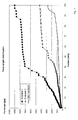
- Fig. 1 shows the fibre length distribution of spheroidally shaped pellets made by using glass endless fibres (Example 1) and by using chopped fibres of a nominal staple length of 4,5 mm. (Example 2).
- Example 1 shows the fibre length distribution of the commercial product GB311 U-8299 (Borealis) made by using chopped fibres of a nominal staple length of 4,5 mm.
Landscapes
- Engineering & Computer Science (AREA)
- Mechanical Engineering (AREA)
- Processing And Handling Of Plastics And Other Materials For Molding In General (AREA)
Abstract
Description
- The present invention relates to a process for the production of thermoplastic resin pellets having spheroidal shape and containing long reinforcing fibres, the spheroidally shaped pellets and their use.
- Fibre reinforced thermoplasts are well known in the art. They usually contain short fibres and can be made and processed like thermoplasts containing fillers. In a simple version thermoplast and short fibre are mixed cold and then processed in an extruder. According to an improved version the thermoplast is molten alone in the first part of the extruder and the short fibre is added via a side feeder to the molten thermoplast. The advantage of short fibre thermoplast is that there are no limitations regarding processability, they can be processed for example by strand pelletising, die face pelletising or water ring pelletising. But due to the intensive kneading which was believed to be necessary to completely impregnate the fibre , the fibres are thereby cut to a great extent.
- Long fibre pellets can be obtained by pultrusion, wherein textile glass rovings are impregnated with the melt of the thermoplast, drawn through a die to form strands, which are cut into cylindrically shaped pieces after cooling. The fibres in the cylindrically shaped pellets have the length of the pellet and are oriented in the longitudinal direction.
- Such longish pellets are disadvantageous for further processing, since such rods tend to bridging in the feedhopper, and a stable supply of the pellets in the molding machine at the time of injection molding becomes difficult. This can cause trouble during processing which result in a lower output rate.
- WO 00/58064 describes a fibre granulate made from continuous fibres, wherein reinforcing staple fibres are helically arranged in a thermoplastic matrix, the reinforcing staple fibres being located in a sheathed zone along with a melted matrix and in a core zone of unmolten thermoplastic staple fibre. The granulate is produced by feeding a staple fibre mixture through a preheating zone, drawing it through a heating nozzle to form a strand, which after twisting and consolidation by cooling is cut into continuous strand pellets, which are cylindrically shaped and contain helically oriented reinforcing fibres longer than the pellets. According to another complicated and two step process in JP-A-06-254847 first a mixture of long and short reinforcing fibres with a thermoplastic resin powder of a size of not more than 1 mm is heated and molten by high temperature nitrogen gas, then charged into a ram type extruder and extruded from a die to form strands, which are cut into cylindrically pellets, which contain long and short fibres.
- Although the pellets according to WO 00/58064 and JP-A-06-254847 contain fibres longer than the pellet length, the processes of producing them are extremely difficult, and the pellets still have the disadvantageous cylindrical shape.
- The object of the invention are therefore pellets, which can be produced in a simple way, which contain fibres longer the longest dimension of the pellets or which have, in the case staple fibres of a certain length are applied, a high amount of the staple fibre in or near to the original length of the staple fibre and which do not have cylindrical shape.
- The present invention therefore relates in a first embodiment to a process for the production of thermoplastic resin pellets having spheroidal shape and containing long reinforcing fibres characterised by the following steps in downstream order:
- a) melting a thermoplastic resin in a first section of an extruder
- b) adding reinforcing fibres to the melt
- c) conveying the mixture substantially without kneading to a short mixing section
- d) passing the short mixing section, a short pressure build up section and the adjacent die plate
- e) cutting the obtained moiety hot by die face pelletising or water ring pelletising.
-
- In carrying out the invention a thermoplast in the form of coarse powder or pellets is fed to an extruder and molten in a first section. The thermoplast can be polyolefins such as polyethylenes, polypropylenes and their copolymers, polyamides such as nylon 6, nylon 66, polyethers or polyesters. The preferred thermoplasts are polyethylenes and polypropylenes which can contain additives such as stabilizers, fillers, pigments, coupling and other agents.
- Then reinforcing fibres are fed via a sidefeeder to the melt or drawn in directly as endless fibre. The reinforcing fibres can be mineral fibres, synthetic fibres or natural fibres. Examples of such fibres are glass fibres, metallic fibres, aramide fibres, carbon fibres, cotton fibres, modified cellulosic fibres, hemp, jute, sisal or flax. The fibres can also be higher melting thermoplastic fibres such as polyester or polyamide fibres. The preferred reinforcing fibres are glass fibres.
- The reinforcing fibres can be added in the form of endless fibres, preferably in the form of glass rovings. The rovings can be direct rovings or assembled rovings. The titer of the roving can be for example from 800 to 5000 tex, preferably from 1200 to 3600 tex.
- Depending on the desired properties of the final product, the amount of reinforcing fibre can vary from a fibre content of between 10 to 70 %, preferably from between 20 - 40 %.
- The reinforcing fibres can also be added as chopped fibre, having a length of 3 - 15 mm, therefore the length of the fibre in the resulting spheroidally pellet can be longer than the maximum pellet length. Preferably the length of the chopped fibre is between 3,5 and 12 mm. Especially preferred are fibre lengths from 4 to 5 mm, but the fibre length of 12 mm is also preferred.
- The mixture of the reinforcing fibres and the thermoplast is then conveyed substantially without kneading to a short mixing section. This is done by using elements which nearly exclusively convey and hardly shear.
- The following short mixing section comprises one or more low shear mixing elements. Preferably there are one or two mixing elements. In the low shear mixing section there is practically no kneading. The section contains for example one or two or more hedgehog elements. The hedgehog elements can be adjoined or separated by one or more short conveying elements.
- In order to press the moiety through the following die plate, it is necessary to build up some pressure, which is done in the following pressure build up zone, which should act as gentle as possible.
- The diameter of the holes of the adjacent die plate depends inter alia on the viscosity of the melt, the fibre content and fibre length. The diameter is higher than usual and can vary in the range of 2,8 to 8 mm, preferably from 3,7 to 7 mm, especially from 4 to 5 mm.
- Immediately after passing the die plate, pellets of spheroidal shape are cut for example by rotating blades and solidified by the process water, which flows across the die face in a cutting chamber. Warm water having a temperature of e.g. 50 - 60 °C transports the pellets to a dryer, wherein water is separated and the dry spheroidally pellets are discharged.
- Spheroidally shaped pellets according to the invention are e.g. obtained by die face pelletising or water ring pelletising.
- If endless fibres or chopped fibres which are longer than the longest dimension of the resulting pellets are used, the resulting spheroidally pellets contain fibres longer than the longest dimension of the pellets. Usually at least 5 % by weight of the fibres, preferably at least 10 % by weight are longer than the longest dimension of the pellets. It is preferred that 20 % or 30 % by weight of the fibres or more are longer than the longest dimension of the pellets.
- If chopped fibres are used, the amount of fibres which are not so much reduced in its original length is remarkably high. According to the present invention it can easily be reached that 40 % by weight of the fibres still have the 0,4 fold, the 0,5 fold or the 0,6 fold of the original length of the fibre, the longest fibre being at least 3 mm or even 4 mm long. It has been found that the longest fibre detected in the pellet has the length which is very close to the nominal length of the originally used fibre.
If, for example, a nominal fibre length of 4,5 mm was used, the longest detected fibre in the pellet had a length of 4,329 mm.
Depending on the processing conditions and the used ingredients, it can also be achieved that 40 % by weight of the fibres have the 0,8 or 0,85 fold of the original length. - Another advantage of the present invention is that at least 20 % by weight of the fibres can have the 0,6 fold, the 0,7 fold or the 0,8 fold of the length of the longest fibre.
At least 50 % by weight of the fibres have the 0,4 fold or the 0,5 fold of the original length of the longest fibre. - The spheroidally shaped pellets contain a large part of long fibres, have high fluidity and are produced in a compounding step of high productivity.
They are useful for the production of articles of high impact strength and high stiffness, such as automotive parts, especially structural parts like dashboards, seat structures etc. - A corotating twin screw extruder, Werner & Pfleiderer ZSK58 having a screw speed of 300 rpm and a temperature profile of 250/260/270/270/280/280/280/280/280/280/ °C was fed with 160 kg/h PP of a mixture of 78 % by weight of a PP homopolymer having an MFR (230 °C/2,16 kg) of 17,5 and 16 % by weight of a PP copolymer having an MFR (230 °C/2,16 kg) of 0,3 and 6 % by weight of additives.
At the end of themelting section 90,5 kg/h of glass endless fibre in the form of 25 rovings, each having 1200 tex and a fibre diameter of 17 µm were fed directly to the melt.
The fibre containing melt was transported substantially without kneading to a short mixing section having two hedgehog elements followed by a short pressure build up zone and extruded through a die plate having 16 holes of a diameter of 4,5 mm and pelletised under water to form pellets of spheroidal shape. - The spheroidally shaped pellets had a maximum length of 8 mm and a glass content of 36,2 % (by weight).
10 % by weight of the glass fibres were longer than 8,7 mm. - The extruder of example 1 having the same screw configuration having a temperature profile of 180/200/210/220/220/230/230/220/220/220/235/280 °C was fed with 275 kg/h of the same PP-material and additive as in example 1, but with 155 kg/h of chopped fibres, having a nominal staple length of 4,5 mm and a filament diameter of 13 µm.
The obtained spheroidally shaped pellets had a maximum length of 8 mm and a glass content of 36,1 % by weight
The longest fibre was 4,329 mm long,
20 % by weight of the glass fibres were longer than 4,047 mm
40 % by weight of the glass fibres were longer than 3,735 mm.
50 % by weight of the glass fibres were longer than 2,670 mm - The fibre lengths were found by burning off just the thermoplastic resin of a pellet in a 625 °C furnace, photographing the result by a microscope, measuring the lengths of 100 randomly selected fibres from the photograph.
- Fig. 1 shows the fibre length distribution of spheroidally shaped pellets made by using glass endless fibres (Example 1) and by using chopped fibres of a nominal staple length of 4,5 mm. (Example 2).
For comparison the fibre length distribution of the commercial product GB311 U-8299 (Borealis) made by using chopped fibres of a nominal staple length of 4,5 mm, was also quantified.
Claims (11)
- A process for the production of thermoplastic resin pellets having spheroidal shape and containing long reinforcing fibres characterised by the following steps in downstream order:a) melting a thermoplastic resin in a first section of an extruderb) adding reinforcing fibres to the meltc) conveying the mixture substantially without kneading to a short mixing sectiond) passing the short mixing section, a short pressure build up section and the adjacent die platee) cutting the obtained moiety hot by die face pelletising or water ring pelletising.
- The process as claimed in claim 1, characterised in that the short mixing section comprises one or more short low shear mixing elements.
- The process as claimed in claim 1, characterised in that the reinforcing fibre is fed as endless fibre.
- The process as claimed in claim 1, characterised in that the reinforcing fibre is fed as staple fibre.
- Thermoplastic resin pellets having spheroidal shape and containing long reinforcing fibres, characterised in that the pellets contain fibres longer than the longest dimension of the pellets.
- Thermoplastic resin pellets according to claim 5, characterised in that at least 5 % by weight of the fibres are longer than the longest dimension of the pellets.
- Thermoplastic resin pellets having spheroidal shape and containing long reinforcing fibres, characterised in that at least 40 % by weight of the fibres are longer than the 0,4 fold of the longest fibre, which is at least 3 mm long.
- Thermoplastic resin pellets having spheroidal shape and containing long reinforcing fibres, characterised in that at least 40 % by weight of the fibres are longer than the 0,4 fold of the longest fibre, which is at least 4 mm long
- Thermoplastic resin pellets according to claim 7, characterised in that at least 20 % by weight of the fibres are longer than the 0,6 fold of the longest fibres, which is at least 3 mm long.
- Thermoplastic resin pellets according to claim 7, characterised in that at least 20 % by weight of the fibres are longer than the 0,6 fold of the longest fibres, which is at least 4 mm long.
- Use of thermoplastic resin pellets according to one of claims 5 - 10 for the production of automotive parts, especially structural parts like dashboards or seat structures.
Priority Applications (1)
| Application Number | Priority Date | Filing Date | Title |
|---|---|---|---|
| EP03016053A EP1498245A1 (en) | 2003-07-15 | 2003-07-15 | Spheroidally shaped fibre reinforced thermoplastic pellets |
Applications Claiming Priority (1)
| Application Number | Priority Date | Filing Date | Title |
|---|---|---|---|
| EP03016053A EP1498245A1 (en) | 2003-07-15 | 2003-07-15 | Spheroidally shaped fibre reinforced thermoplastic pellets |
Publications (1)
| Publication Number | Publication Date |
|---|---|
| EP1498245A1 true EP1498245A1 (en) | 2005-01-19 |
Family
ID=33462120
Family Applications (1)
| Application Number | Title | Priority Date | Filing Date |
|---|---|---|---|
| EP03016053A Ceased EP1498245A1 (en) | 2003-07-15 | 2003-07-15 | Spheroidally shaped fibre reinforced thermoplastic pellets |
Country Status (1)
| Country | Link |
|---|---|
| EP (1) | EP1498245A1 (en) |
Cited By (3)
| Publication number | Priority date | Publication date | Assignee | Title |
|---|---|---|---|---|
| DE102006038948A1 (en) * | 2006-08-18 | 2008-02-21 | Blach Verwaltungs Gmbh & Co. Kg | Long-fiber rod-shaped pellets |
| WO2012052476A1 (en) * | 2010-10-20 | 2012-04-26 | Cordenka Gmbh | Granulate and process for the production thereof |
| WO2013072562A1 (en) * | 2011-11-15 | 2013-05-23 | Upm-Kymmene Corporation | A composite product, a method for manufacturing a composite product and its use and a final product |
Citations (9)
| Publication number | Priority date | Publication date | Assignee | Title |
|---|---|---|---|---|
| US3453356A (en) * | 1964-02-24 | 1969-07-01 | Dow Chemical Co | Mixing of filamentary reinforcing material with thermoplastic resins |
| DE3011692A1 (en) * | 1980-03-26 | 1981-10-01 | Lonza-Werke Gmbh, 7858 Weil | Expanded particles esp. polystyrene - bonded lightly to prevent segregation by mixing with short fibres and pref. dispersion adhesive |
| US4616989A (en) * | 1977-02-17 | 1986-10-14 | Dynamit Nobel Aktiengesellschaft | Apparatus for the incorporation of glass fibers into thermoplastic synthetic resins |
| JPS62113515A (en) * | 1985-11-13 | 1987-05-25 | Plast Kogaku Kenkyusho:Kk | Manufacturing device for pellet of composite material |
| JPS62113514A (en) * | 1985-11-13 | 1987-05-25 | Plast Kogaku Kenkyusho:Kk | Manufacturing device for composite material |
| US4937028A (en) * | 1988-05-09 | 1990-06-26 | Societe Atochem | Process for producing thermoplastic resins reinforced with long fibers |
| US5597235A (en) * | 1993-01-29 | 1997-01-28 | The Gates Corporation | Twin screw extruder for processing elastomeric compositions |
| FR2777221A1 (en) * | 1998-04-08 | 1999-10-15 | Ecia Equip Composants Ind Auto | INSTALLATION FOR MANUFACTURING STRUCTURAL PARTS MADE OF FIBER REINFORCED THERMOPLASTIC MATERIAL, PARTICULARLY FOR A MOTOR VEHICLE |
| DE20020480U1 (en) * | 2000-11-28 | 2001-06-13 | Bayer, Rene, 07407 Rudolstadt | Spherical fiber granulate made of natural or synthetic fibers and thermoplastic matrix |
-
2003
- 2003-07-15 EP EP03016053A patent/EP1498245A1/en not_active Ceased
Patent Citations (9)
| Publication number | Priority date | Publication date | Assignee | Title |
|---|---|---|---|---|
| US3453356A (en) * | 1964-02-24 | 1969-07-01 | Dow Chemical Co | Mixing of filamentary reinforcing material with thermoplastic resins |
| US4616989A (en) * | 1977-02-17 | 1986-10-14 | Dynamit Nobel Aktiengesellschaft | Apparatus for the incorporation of glass fibers into thermoplastic synthetic resins |
| DE3011692A1 (en) * | 1980-03-26 | 1981-10-01 | Lonza-Werke Gmbh, 7858 Weil | Expanded particles esp. polystyrene - bonded lightly to prevent segregation by mixing with short fibres and pref. dispersion adhesive |
| JPS62113515A (en) * | 1985-11-13 | 1987-05-25 | Plast Kogaku Kenkyusho:Kk | Manufacturing device for pellet of composite material |
| JPS62113514A (en) * | 1985-11-13 | 1987-05-25 | Plast Kogaku Kenkyusho:Kk | Manufacturing device for composite material |
| US4937028A (en) * | 1988-05-09 | 1990-06-26 | Societe Atochem | Process for producing thermoplastic resins reinforced with long fibers |
| US5597235A (en) * | 1993-01-29 | 1997-01-28 | The Gates Corporation | Twin screw extruder for processing elastomeric compositions |
| FR2777221A1 (en) * | 1998-04-08 | 1999-10-15 | Ecia Equip Composants Ind Auto | INSTALLATION FOR MANUFACTURING STRUCTURAL PARTS MADE OF FIBER REINFORCED THERMOPLASTIC MATERIAL, PARTICULARLY FOR A MOTOR VEHICLE |
| DE20020480U1 (en) * | 2000-11-28 | 2001-06-13 | Bayer, Rene, 07407 Rudolstadt | Spherical fiber granulate made of natural or synthetic fibers and thermoplastic matrix |
Non-Patent Citations (1)
| Title |
|---|
| PATENT ABSTRACTS OF JAPAN vol. 011, no. 330 (M - 636) 28 October 1987 (1987-10-28) * |
Cited By (3)
| Publication number | Priority date | Publication date | Assignee | Title |
|---|---|---|---|---|
| DE102006038948A1 (en) * | 2006-08-18 | 2008-02-21 | Blach Verwaltungs Gmbh & Co. Kg | Long-fiber rod-shaped pellets |
| WO2012052476A1 (en) * | 2010-10-20 | 2012-04-26 | Cordenka Gmbh | Granulate and process for the production thereof |
| WO2013072562A1 (en) * | 2011-11-15 | 2013-05-23 | Upm-Kymmene Corporation | A composite product, a method for manufacturing a composite product and its use and a final product |
Similar Documents
| Publication | Publication Date | Title |
|---|---|---|
| Englund | A technology review of wood-plastic composites | |
| CN110997761B (en) | Fiber-reinforced molding compound, and methods of forming and using the same | |
| KR101957554B1 (en) | Twin screw extruder for use in manufacturing fiber-reinforced resin composition and process for manufacturing fiber-reinforced resin composition | |
| JP2000117810A (en) | Method for producing filled, modified and fiber reinforced thermoplastics and a twin screw type extruder for performing the method | |
| WO2004080698A1 (en) | Method of making long fiber-reinforced thermoplastic composites utilizing hybrid or commingled yarn | |
| EP1741541A2 (en) | Methods and systems for making long fiber reinforced products and resultant products | |
| US6548167B1 (en) | Continuous-strand pellets and method and device for preparing continuous-strand pellets | |
| JP2019069527A (en) | Kneading method and plasticizing apparatus for fiber reinforced thermoplastic resin | |
| CZ284942B6 (en) | Process for producing articles of fiber-reinforced thermoplasts | |
| CN101693391B (en) | Natural fiber granulating process for preparing composite materials | |
| JP7125604B2 (en) | Reinforced resin molding manufacturing apparatus and manufacturing method | |
| JP6173996B2 (en) | Twin screw extruder used for the production of fiber reinforced resin composition | |
| CN112831109B (en) | Moldable high performance thermoplastic composite material with single fiber length distribution | |
| JP2023546261A (en) | Method and single screw extrusion system for long fiber thermoplastic material processing | |
| JPH0313305A (en) | Mixture of thermoplastic resin pellet and molded object using it | |
| CN111020782A (en) | Carbon fiber chopped fiber bundle | |
| JP2952977B2 (en) | Molding method of fiber reinforced resin | |
| CN108727689A (en) | A kind of production system and preparation method of long glass fiber-reinforced polypropylene materials | |
| CN116063781B (en) | Heat-conducting thermoplastic composite material and preparation method and application thereof | |
| JP3824402B2 (en) | Method for producing glass fiber reinforced polypropylene molded body | |
| CN121043360B (en) | A thermoplastic resin-based composite material reinforced with aramid long fibers and its preparation method | |
| JPH07251427A (en) | Molding method for molded products containing fibers |
Legal Events
| Date | Code | Title | Description |
|---|---|---|---|
| PUAI | Public reference made under article 153(3) epc to a published international application that has entered the european phase |
Free format text: ORIGINAL CODE: 0009012 |
|
| AK | Designated contracting states |
Kind code of ref document: A1 Designated state(s): AT BE BG CH CY CZ DE DK EE ES FI FR GB GR HU IE IT LI LU MC NL PT RO SE SI SK TR |
|
| AX | Request for extension of the european patent |
Extension state: AL LT LV MK |
|
| 17P | Request for examination filed |
Effective date: 20050428 |
|
| AKX | Designation fees paid |
Designated state(s): AT BE BG CH CY CZ DE DK EE ES FI FR GB GR HU IE IT LI LU MC NL PT RO SE SI SK TR |
|
| 17Q | First examination report despatched |
Effective date: 20080922 |
|
| STAA | Information on the status of an ep patent application or granted ep patent |
Free format text: STATUS: THE APPLICATION HAS BEEN REFUSED |
|
| 18R | Application refused |
Effective date: 20170403 |