EP1496480A1 - Device delivering a service using an associated portable memory, and relaying means for allowing activation of an application of the portable memory of the first device by a second device - Google Patents
Device delivering a service using an associated portable memory, and relaying means for allowing activation of an application of the portable memory of the first device by a second device Download PDFInfo
- Publication number
- EP1496480A1 EP1496480A1 EP03291725A EP03291725A EP1496480A1 EP 1496480 A1 EP1496480 A1 EP 1496480A1 EP 03291725 A EP03291725 A EP 03291725A EP 03291725 A EP03291725 A EP 03291725A EP 1496480 A1 EP1496480 A1 EP 1496480A1
- Authority
- EP
- European Patent Office
- Prior art keywords
- usb
- application
- portable object
- card
- handset
- Prior art date
- Legal status (The legal status is an assumption and is not a legal conclusion. Google has not performed a legal analysis and makes no representation as to the accuracy of the status listed.)
- Withdrawn
Links
Images


Classifications
-
- G—PHYSICS
- G07—CHECKING-DEVICES
- G07F—COIN-FREED OR LIKE APPARATUS
- G07F7/00—Mechanisms actuated by objects other than coins to free or to actuate vending, hiring, coin or paper currency dispensing or refunding apparatus
- G07F7/08—Mechanisms actuated by objects other than coins to free or to actuate vending, hiring, coin or paper currency dispensing or refunding apparatus by coded identity card or credit card or other personal identification means
- G07F7/10—Mechanisms actuated by objects other than coins to free or to actuate vending, hiring, coin or paper currency dispensing or refunding apparatus by coded identity card or credit card or other personal identification means together with a coded signal, e.g. in the form of personal identification information, like personal identification number [PIN] or biometric data
- G07F7/1008—Active credit-cards provided with means to personalise their use, e.g. with PIN-introduction/comparison system
-
- G—PHYSICS
- G06—COMPUTING OR CALCULATING; COUNTING
- G06Q—INFORMATION AND COMMUNICATION TECHNOLOGY [ICT] SPECIALLY ADAPTED FOR ADMINISTRATIVE, COMMERCIAL, FINANCIAL, MANAGERIAL OR SUPERVISORY PURPOSES; SYSTEMS OR METHODS SPECIALLY ADAPTED FOR ADMINISTRATIVE, COMMERCIAL, FINANCIAL, MANAGERIAL OR SUPERVISORY PURPOSES, NOT OTHERWISE PROVIDED FOR
- G06Q20/00—Payment architectures, schemes or protocols
- G06Q20/30—Payment architectures, schemes or protocols characterised by the use of specific devices or networks
- G06Q20/34—Payment architectures, schemes or protocols characterised by the use of specific devices or networks using cards, e.g. integrated circuit [IC] cards or magnetic cards
- G06Q20/341—Active cards, i.e. cards including their own processing means, e.g. including an IC or chip
-
- G—PHYSICS
- G07—CHECKING-DEVICES
- G07F—COIN-FREED OR LIKE APPARATUS
- G07F17/00—Coin-freed apparatus for hiring articles; Coin-freed facilities or services
- G07F17/16—Coin-freed apparatus for hiring articles; Coin-freed facilities or services for devices exhibiting advertisements, announcements, pictures or the like
-
- G—PHYSICS
- G07—CHECKING-DEVICES
- G07F—COIN-FREED OR LIKE APPARATUS
- G07F7/00—Mechanisms actuated by objects other than coins to free or to actuate vending, hiring, coin or paper currency dispensing or refunding apparatus
- G07F7/08—Mechanisms actuated by objects other than coins to free or to actuate vending, hiring, coin or paper currency dispensing or refunding apparatus by coded identity card or credit card or other personal identification means
- G07F7/0873—Details of the card reader
- G07F7/088—Details of the card reader the card reader being part of the point of sale [POS] terminal or electronic cash register [ECR] itself
- G07F7/0886—Details of the card reader the card reader being part of the point of sale [POS] terminal or electronic cash register [ECR] itself the card reader being portable for interacting with a POS or ECR in realizing a payment transaction
-
- H—ELECTRICITY
- H04—ELECTRIC COMMUNICATION TECHNIQUE
- H04M—TELEPHONIC COMMUNICATION
- H04M1/00—Substation equipment, e.g. for use by subscribers
- H04M1/72—Mobile telephones; Cordless telephones, i.e. devices for establishing wireless links to base stations without route selection
- H04M1/724—User interfaces specially adapted for cordless or mobile telephones
- H04M1/72403—User interfaces specially adapted for cordless or mobile telephones with means for local support of applications that increase the functionality
- H04M1/72409—User interfaces specially adapted for cordless or mobile telephones with means for local support of applications that increase the functionality by interfacing with external accessories
-
- H—ELECTRICITY
- H04—ELECTRIC COMMUNICATION TECHNIQUE
- H04M—TELEPHONIC COMMUNICATION
- H04M1/00—Substation equipment, e.g. for use by subscribers
- H04M1/72—Mobile telephones; Cordless telephones, i.e. devices for establishing wireless links to base stations without route selection
- H04M1/724—User interfaces specially adapted for cordless or mobile telephones
- H04M1/72403—User interfaces specially adapted for cordless or mobile telephones with means for local support of applications that increase the functionality
- H04M1/72409—User interfaces specially adapted for cordless or mobile telephones with means for local support of applications that increase the functionality by interfacing with external accessories
- H04M1/72412—User interfaces specially adapted for cordless or mobile telephones with means for local support of applications that increase the functionality by interfacing with external accessories using two-way short-range wireless interfaces
-
- H—ELECTRICITY
- H04—ELECTRIC COMMUNICATION TECHNIQUE
- H04M—TELEPHONIC COMMUNICATION
- H04M1/00—Substation equipment, e.g. for use by subscribers
- H04M1/72—Mobile telephones; Cordless telephones, i.e. devices for establishing wireless links to base stations without route selection
- H04M1/724—User interfaces specially adapted for cordless or mobile telephones
- H04M1/72403—User interfaces specially adapted for cordless or mobile telephones with means for local support of applications that increase the functionality
- H04M1/72445—User interfaces specially adapted for cordless or mobile telephones with means for local support of applications that increase the functionality for supporting Internet browser applications
-
- H—ELECTRICITY
- H04—ELECTRIC COMMUNICATION TECHNIQUE
- H04M—TELEPHONIC COMMUNICATION
- H04M2250/00—Details of telephonic subscriber devices
- H04M2250/14—Details of telephonic subscriber devices including a card reading device
Definitions
- the invention relates to a first device for delivering a service using an application lodged in a portable object, comprising a portable object reader for receiving said portable object, the portable object incorporating at least one application and the first device including resources for activating said application.
- the general problem to be solved is to allow, beside usual activation of an application of the portable object by the resident resources of the first device, activation of an application of the portable object by a second device, independently of said resident resources.
- This feature offers several advantages, in particular :
- portable object includes any object able to lodge an application, such as a memory card or a microcontroller card (smart card).
- USB technology is defined by a standard described in the "Universal Serial Bus specification”. Details can be found in this document accessible on Internet site www.usb.org.
- the USB physical interconnect is a tiered start made of three types of devices :
- FIG. 1 describes the USB topology.
- Objects named “Func” are the USB functions (printer, scanner%):
- a compound device is a unique physical device that combines one or more functions with a HUB in a single package. There might be a single chip, or a more complicated electronic device combining several electronic components.
- a real device i.e. a scanner, a printer
- a virtual device that is the device driver allowing the computer application to access to the real device functions.
- a compound device In case of a compound device, it is associated with a least 2 virtual devices (1 for the HUB and 1 per function).
- the goal of the present invention in this context is to allow the user to browse the smart card content from its PC, without having to remove the card from the handset.
- the invention is limited to the WEB server. It also applies to all the data and applications embedded in the smart card. Furthermore, the invention is applicable, not only to smart cards, but also to any combination where a removable device is coupled to another device that may be in relation with a 3 rd device itself compatible with the removable device mentioned here above.
- the invention concerns a first device for delivering a service using an application lodged in a portable object, comprising a portable object reader for receiving said portable object, the portable object incorporating at least one application and the first device including resources for activating said application, characterized in that it includes relay means arranged for performing a communication between said portable object reader and a second device external to said first device and connected thereto so that the second device activates at least one application of the portable object independently of said resources.
- the invention described herein may be used to have access to any application provided by a mobile communication handset embedding a smart card (e.g. GSM, WCDMA%) but not exclusively.
- a smart card e.g. GSM, WCDMA
- a browser in the PC queries a WEB server present in a USB SIM card through a USB HUB present in the cellular handset.
- the invention is applicable to any portable device subject to behave as an intermediate between another portable device it embeds - such as a smart card - and another equipment that has access to the embedded device exactly as if the connection was realized without any intermediate.
- the invention comprises the following features :
- This example consists on securely browsing banking accounts from a cellular handset at any time (i.e. even if the network is not available), and being also able browsing the same data from a PC browser with a better user interface (taking advantages of the PC display, keyboard, mouse and more).
- the cellular handset shall be immediately connected to the Internet when, being compatible with GPRS or UMTS standards, it recognizes the network. It shall have an IP address that may change at each startup (a fixed IP address is not mandatory). Of course, depending on the network status, the IP link may sometimes be broken.
- a standard WEB browser is available on the cellular handset. It may be alternatively connected to a server over the wireless connection, or to the server in the SIM (see ⁇ 4.2.2). From the browser standpoint there are no differences. Every server involved has an IP address.
- the handset and the card are connected using a USB.
- the SIM, UMTS, GRPS or any other applications are viewed as USB devices.
- the handset is directly connected to an external USB host such as a PC. It becomes a USB HUB (see figure 3).
- the cellular handset is a USB HUB that is connected to a host.
- the handset cannot access the GSM, GPRS and/or some other USB devices as it is just behaving as a USB HUB (this is for the example, but technical solutions can be implemented to allow the handset continuing having access to the application that may not interest the USB root to which it is connected).
- the SIM card embeds at least the following:
- the handset has access to the card through a USB. It detects a USB HUB followed by several USB devices.
- the card embeds a USB HUB and a WEB server.
- the WEB server virtual device i.e. device driver
- IP Internet Protocol
- the card becomes an Internet node. Any equipment able to have access to this USB, and having the correct device driver, can have access to the card WEB server like any other WEB server, thus using an IP address.
- IP frames are encapsulated in USB protocol, and the device drivers, both on the handset and on the card, provide the interface masking the real data transport mean.
- the USB host When the USB host detects that the card embeds a USB device that is a WEB server, it performs the required operation to allocate it an IP address.
- the (distant) WEB server is a standard server embedding means to exchange files with the SIM card WEB server.
- the bank server and the card server should share some cryptographic keys in order to exchange files and / or queries securely (in order to protect the user banking information).
- the protocol used here is not important as long as the security level is strong enough. There are many standard solutions existing to solve this concern. One of them is using the PKI (Public key Infrastructure) architecture.
- Figure 4 shows the architecture of the example, using the components described in paragraph 4.2.
- the link between the handset and the PC does not need to be a USB one.
- the encapsulation process allows using any type of link such as BlueTooth, IP or any other compatible link.
- the relaying function in the cellular handset will be, in each particular case, adapted to the type of link chosen.
Landscapes
- Engineering & Computer Science (AREA)
- General Physics & Mathematics (AREA)
- Physics & Mathematics (AREA)
- Business, Economics & Management (AREA)
- Computer Networks & Wireless Communication (AREA)
- Microelectronics & Electronic Packaging (AREA)
- Signal Processing (AREA)
- Human Computer Interaction (AREA)
- Accounting & Taxation (AREA)
- Strategic Management (AREA)
- General Business, Economics & Management (AREA)
- Theoretical Computer Science (AREA)
- Telephonic Communication Services (AREA)
- Stored Programmes (AREA)
- Information Transfer Between Computers (AREA)
Abstract
The invention concerns a first device for delivering a service using an application
lodged in a portable object, comprising a portable object reader for receiving
said portable object, the portable object incorporating at least one application
and the first device including resources for activating said application,
characterized in that it includes relay means arranged for performing a
communication between said portable object reader and a second device
external to said first device and connected thereto so that the second device
activates at least one application of the portable object independently of said
resources.
Description
- The invention relates to a first device for delivering a service using an application lodged in a portable object, comprising a portable object reader for receiving said portable object, the portable object incorporating at least one application and the first device including resources for activating said application. The general problem to be solved is to allow, beside usual activation of an application of the portable object by the resident resources of the first device, activation of an application of the portable object by a second device, independently of said resident resources.
- This feature offers several advantages, in particular :
- in case the resources of the first device are regarded as too limited for certain management operations of the application (for example, the keyboard and display are small), activation by the second device may offer extended resources ;
- for executing certain operations of the application, it may be desired or even required that only said second device will manage said operations. For example, it may be decided that some secure operations such as a funds transfer with the portable object will be only possible if executed by said second device.
- The wording "portable object" includes any object able to lodge an application, such as a memory card or a microcontroller card (smart card).
- The present invention will be explained based on the following drawings :
- Figure 1 illustrates the known USB bus topology ;
- Figure 2 illustrates a smart card based WEB server application ;
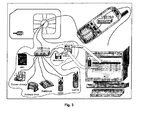
- Figure 3 illustrates the invention, the first device being constituted by a HUB cellular handset;
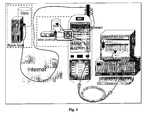
- Figure 4 illustrates the invention applied to a secure off-line banking accounts browsing architecture.
-
- Since a preferred embodiment of the invention uses the USB technology, a short reminder of the latter is now made.
- The USB technology is defined by a standard described in the "Universal Serial Bus specification". Details can be found in this document accessible on Internet site www.usb.org. The USB physical interconnect is a tiered start made of three types of devices :
- 1. The USB root that is hold by a host device such as a PC (Personal Computer).
- 2. The USB HUB (interconnect). There is at least one HUB in a USB that is the root HUB. There may be up to five levels of HUB on the same bus.
- 3. The USB functions that are always connected to a HUB. It may be a scanner, a printer, a joystick...
-
- Figure 1 describes the USB topology. Objects named "Func" are the USB functions (printer, scanner...):
- A compound device is a unique physical device that combines one or more functions with a HUB in a single package. There might be a single chip, or a more complicated electronic device combining several electronic components.
- In the USB standard, a real device (i.e. a scanner, a printer...) is always coupled with a virtual device that is the device driver allowing the computer application to access to the real device functions.
- In case of a compound device, it is associated with a least 2 virtual devices (1 for the HUB and 1 per function).
- In figure 2, secure areas are surrounded with a dashed rectangle. This ensures the user data are held in secure places.
- It works as follows :
- Regularly, and preferably when the network is underused, the smart card and the bank server synchronize the user data. The bank transfers both the data to display in an XML file and the pages format in an HTML file. Locally, the smart card WEB server is able to prepare the HTML pages including the data in order to answer to the handset browser queries with a ready to use HTML page.
- When the user wants to browse its account, it can require the handset browser to query the smart card WEB server instead of accessing to the bank server.
- The application presented chapter 2.4 is interesting, but the user interface is limited by the handset keyboard and display.
- The goal of the present invention in this context is to allow the user to browse the smart card content from its PC, without having to remove the card from the handset.
- One should not think the invention is limited to the WEB server. It also applies to all the data and applications embedded in the smart card. Furthermore, the invention is applicable, not only to smart cards, but also to any combination where a removable device is coupled to another device that may be in relation with a 3rd device itself compatible with the removable device mentioned here above.
- For achieving this goal, the invention concerns a first device for delivering a service using an application lodged in a portable object, comprising a portable object reader for receiving said portable object, the portable object incorporating at least one application and the first device including resources for activating said application, characterized in that it includes relay means arranged for performing a communication between said portable object reader and a second device external to said first device and connected thereto so that the second device activates at least one application of the portable object independently of said resources.
- The invention described herein may be used to have access to any application provided by a mobile communication handset embedding a smart card (e.g. GSM, WCDMA...) but not exclusively.
- In figure 3, a browser in the PC queries a WEB server present in a USB SIM card through a USB HUB present in the cellular handset.
- Beyond the cellular handset, the invention is applicable to any portable device subject to behave as an intermediate between another portable device it embeds - such as a smart card - and another equipment that has access to the embedded device exactly as if the connection was realized without any intermediate.
-
- 1. Implementing a relaying function on a device A in which the smart card is
inserted.
This function may be realized using different means, depending on the communication capabilities of the communicating object. For instance, one could use the Internet Protocol, the USB or mixing both on the device A. In figure 3, the relaying function is constituted by the USB HUB in the cellular handset. - 2. This relaying function is used to establish a link between the smart card
and a device B (here, a PC). In the example of figure 3, the expected
advantage is using some improved display and entry peripheral
comparing with the ones existing on the device A. According to the USB
technology, the smart card includes at least one USB device. Here, it
includes several devices, so that it also includes a corresponding USB
HUB for giving access to any USB device. Any application of the card,
shown on figure 3, may be reached by device B through USB HUB of the
cellular handset and USB HUB of the card.
Whatever the technology concerned, device B has access to the card through the relaying function and a card reader usually provided in the cellular handset. Typically but not exclusively, signals emanating from device B are managed by the relaying function, bypassing the known resources of the cellular handset (at least mobile communication application, keyboard and display). Then, the relaying function sends corresponding signals to the card, through the card reader. The same path is used for signals emanating from the card and destined to device B, that is through the card reader then through the relaying function. - 3. The link between the smart card and the device B is established in a such a way that the device B may have no idea that the smart card is in reality inserted in a device A that may natively be conceived as a peripheral for the device B.
- 4. The type of link or protocol used between the smart card and the device A, the device A and the device B, or the smart card and the device B has no importance, assuming there is no technical impossibility (e.g. speed concerns). The protocols and/or the physical means used can be different.
- 5. Defining a link including the device A, the device B and the smart card is the minimum, but several other devices might be inserted in any place of the link.
-
-
- 1. Having access to the smart card from the device B makes the user more comfortable to manage the data in the card (whatever the data are).
- 2. If the device B is equipped with an Internet connection (for example), the applications embedded in the smart card could take advantage of this connection to upload and /or download data.
- 3. Simplifying the access to the card in such a way may help to use the secure area that is the card.
-
- This example consists on securely browsing banking accounts from a cellular handset at any time (i.e. even if the network is not available), and being also able browsing the same data from a PC browser with a better user interface (taking advantages of the PC display, keyboard, mouse and more).
- It uses the following :
- An advanced cellular handset connected to the Internet, compatible with USB smart cards, and embedding the relaying function by including a USB HUB.
- A USB SIM card embedding a WEB server (might be programmed in Java for example).
- A bank WEB server to exchange data with WEB server in the SIM, or to browse user accounts using a standard WEB browser (e.g. Internet Explorer or Netscape-registered trademarks).
- A PC embedding a USB host (and root HUB) as shown in
Tier 1 of figure 1, a USB plug, etc. - The cellular handset shall be immediately connected to the Internet when, being compatible with GPRS or UMTS standards, it recognizes the network. It shall have an IP address that may change at each startup (a fixed IP address is not mandatory). Of course, depending on the network status, the IP link may sometimes be broken.
- A standard WEB browser is available on the cellular handset. It may be alternatively connected to a server over the wireless connection, or to the server in the SIM (see §4.2.2). From the browser standpoint there are no differences. Every server involved has an IP address.
- The handset and the card are connected using a USB. The SIM, UMTS, GRPS or any other applications are viewed as USB devices.
- The handset is directly connected to an external USB host such as a PC. It becomes a USB HUB (see figure 3).
- From the SIM standpoint, the cellular handset is a USB HUB that is connected to a host.
- The handset cannot access the GSM, GPRS and/or some other USB devices as it is just behaving as a USB HUB (this is for the example, but technical solutions can be implemented to allow the handset continuing having access to the application that may not interest the USB root to which it is connected).
- In this example, the SIM card embeds at least the following:
- The SIM standards requirements to allow the handset to have access to the cellular network (i.e. the GSM, the GPRS and/or equivalent applications).
- A WEB server able replying to incoming queries and to exchange files with a distant server (using FTP or HTTP protocol for instance).
- An XML parser.
- Cryptographic means to manage keys, encrypt, decrypt, sign...
- Preferably, a JavaCard virtual machine.
- All complementary software and drivers to make all elements listed here above to interact.
- The handset has access to the card through a USB. It detects a USB HUB followed by several USB devices.
- The card embeds a USB HUB and a WEB server. The WEB server virtual device (i.e. device driver) implemented on the handset makes it accessible using IP (Internet Protocol). The card becomes an Internet node. Any equipment able to have access to this USB, and having the correct device driver, can have access to the card WEB server like any other WEB server, thus using an IP address.
- The IP frames are encapsulated in USB protocol, and the device drivers, both on the handset and on the card, provide the interface masking the real data transport mean.
- When the USB host detects that the card embeds a USB device that is a WEB server, it performs the required operation to allocate it an IP address.
- The (distant) WEB server is a standard server embedding means to exchange files with the SIM card WEB server.
- The bank server and the card server should share some cryptographic keys in order to exchange files and / or queries securely (in order to protect the user banking information). The protocol used here is not important as long as the security level is strong enough. There are many standard solutions existing to solve this concern. One of them is using the PKI (Public key Infrastructure) architecture.
- Figure 4 shows the architecture of the example, using the components described in paragraph 4.2.
- The handset behavior is the one of a device embedding a USB HUB device.
- The handset is connected to a USB host. This host shows the USB HUB in the handset, followed by the one in the smart card, followed by the devices in the smart card, particularly the WEB server.
- The host has the required virtual devices (i.e. the device driver) at its
disposal. It is these virtual devices that encapsulate the IP frame to
make it compatible with the USB.
The WEB server device in the smart card is consequently accessible from the host (i.e. the PC) like any other IP node. - When the user wants to browse its banking information, it uses the browser of its PC (e.g. Netscape or Internet Explorer). He can have access to its banking information either by accessing the Internet, or by browsing its data locally by querying the WEB browser in the smart card.
- When the PC (USB host) is connected to the Internet, the smart card WEB server can take advantage of this situation to synchronize its databases with the bank ones.
- The link between the handset and the PC does not need to be a USB one. The encapsulation process allows using any type of link such as BlueTooth, IP or any other compatible link. The relaying function in the cellular handset will be, in each particular case, adapted to the type of link chosen.
- The entire example described here above is based on the USB protocol. Of course, many other protocols can also match the requirement. One could imagine a smart card and a handset natively embedding the IP. Then, the switching operation from the USB root to the USB HUB function is not anymore required as the smart card and the handset both become an Internet node. When connected to a PC, all the three participants are able to have access to each other with no other restrictions than the one defined by the IP specifications.
Claims (1)
- A first device for delivering a service using an application lodged in a portable object, comprising a portable object reader for receiving said portable object, the portable object incorporating at least one application and the first device including resources for activating said application, characterized in that it includes relay means arranged for performing a communication between said portable object reader and a second device external to said first device and connected thereto so that the second device activates at least one application of the portable object independently of said resources.
Priority Applications (6)
| Application Number | Priority Date | Filing Date | Title |
|---|---|---|---|
| EP03291725A EP1496480A1 (en) | 2003-07-11 | 2003-07-11 | Device delivering a service using an associated portable memory, and relaying means for allowing activation of an application of the portable memory of the first device by a second device |
| CNA200480017083XA CN1809846A (en) | 2003-07-11 | 2004-07-12 | Means for providing services using the associated portable storage, and relay means for allowing the second device to activate the application in the portable storage of the first device |
| JP2006518400A JP4864703B2 (en) | 2003-07-11 | 2004-07-12 | Device for supplying service using related portable memory, and relay means for enabling activation of portable memory application of first device by second device |
| PCT/IB2004/002255 WO2005006265A1 (en) | 2003-07-11 | 2004-07-12 | Device delivering a service using an associated portable memory, and relaying means for allowing activation of an application of the portable memory of the first device by a second device |
| US10/564,321 US7242962B2 (en) | 2003-07-11 | 2004-07-12 | Device delivering a service using an associated portable memory, and relaying means for allowing activation of an application of the portable memory of the first device by a second device |
| EP04743917A EP1646989A1 (en) | 2003-07-11 | 2004-07-12 | Device delivering a service using an associated portable memory, and relaying means for allowing activation of an application of the portable memory of the first device by a second device |
Applications Claiming Priority (1)
| Application Number | Priority Date | Filing Date | Title |
|---|---|---|---|
| EP03291725A EP1496480A1 (en) | 2003-07-11 | 2003-07-11 | Device delivering a service using an associated portable memory, and relaying means for allowing activation of an application of the portable memory of the first device by a second device |
Publications (1)
| Publication Number | Publication Date |
|---|---|
| EP1496480A1 true EP1496480A1 (en) | 2005-01-12 |
Family
ID=33442884
Family Applications (2)
| Application Number | Title | Priority Date | Filing Date |
|---|---|---|---|
| EP03291725A Withdrawn EP1496480A1 (en) | 2003-07-11 | 2003-07-11 | Device delivering a service using an associated portable memory, and relaying means for allowing activation of an application of the portable memory of the first device by a second device |
| EP04743917A Ceased EP1646989A1 (en) | 2003-07-11 | 2004-07-12 | Device delivering a service using an associated portable memory, and relaying means for allowing activation of an application of the portable memory of the first device by a second device |
Family Applications After (1)
| Application Number | Title | Priority Date | Filing Date |
|---|---|---|---|
| EP04743917A Ceased EP1646989A1 (en) | 2003-07-11 | 2004-07-12 | Device delivering a service using an associated portable memory, and relaying means for allowing activation of an application of the portable memory of the first device by a second device |
Country Status (5)
| Country | Link |
|---|---|
| US (1) | US7242962B2 (en) |
| EP (2) | EP1496480A1 (en) |
| JP (1) | JP4864703B2 (en) |
| CN (1) | CN1809846A (en) |
| WO (1) | WO2005006265A1 (en) |
Cited By (8)
| Publication number | Priority date | Publication date | Assignee | Title |
|---|---|---|---|---|
| WO2005064889A1 (en) * | 2003-12-23 | 2005-07-14 | Axalto Sa | Smart-card comprising a virtual local network |
| DE102005024122A1 (en) * | 2005-05-25 | 2006-11-30 | Infineon Technologies Ag | Radio-communication arrangement, has data processing device determining whether data is addressed to circuit card, and web-server-program receiving data from circuit card and transmitting to network according to Internet-protocol |
| EP1737194A1 (en) * | 2005-06-20 | 2006-12-27 | Giesecke & Devrient GmbH | Portable data carrier |
| EP1798943A1 (en) * | 2005-12-13 | 2007-06-20 | Axalto SA | SIM messaging client |
| WO2008028544A1 (en) * | 2006-09-05 | 2008-03-13 | Giesecke & Devrient Gmbh | Portable data storage medium for communication with a telecommunication terminal |
| EP1962204A1 (en) * | 2007-02-21 | 2008-08-27 | Axalto SA | A personal token having enhanced abilities for delivering HTML data |
| WO2009065553A3 (en) * | 2007-11-21 | 2009-11-19 | Giesecke & Devrient Gmbh | Portable data carrier comprising a web server |
| EP2461544A1 (en) * | 2010-12-03 | 2012-06-06 | Gemalto SA | Method for allowing a host machine to access a service |
Families Citing this family (3)
| Publication number | Priority date | Publication date | Assignee | Title |
|---|---|---|---|---|
| US20080222604A1 (en) * | 2005-03-07 | 2008-09-11 | Network Engines, Inc. | Methods and apparatus for life-cycle management |
| PL4024777T3 (en) | 2008-01-23 | 2025-09-01 | Novacloud Licensing Llc | Selection among edge nodes in a fixed access communications network |
| KR101166797B1 (en) * | 2009-09-22 | 2012-07-26 | 에스케이플래닛 주식회사 | System and method for browsing based on smart card, and smart card applied to the same |
Citations (2)
| Publication number | Priority date | Publication date | Assignee | Title |
|---|---|---|---|---|
| US20020173344A1 (en) * | 2001-03-16 | 2002-11-21 | Cupps Bryan T. | Novel personal electronics device |
| GB2377776A (en) * | 2001-07-18 | 2003-01-22 | Wizard Mobile Solutions Ltd | A combination of a portable data storage device and a wireless backup device having an out of range alert |
Family Cites Families (7)
| Publication number | Priority date | Publication date | Assignee | Title |
|---|---|---|---|---|
| FI105637B (en) * | 1997-07-02 | 2000-09-15 | Sonera Oyj | Procedure for administering applications stored on a subscriber identity module |
| EP1018287B1 (en) * | 1997-09-22 | 2002-01-30 | Siemens Aktiengesellschaft | Communication system |
| JP2001155075A (en) * | 1999-11-30 | 2001-06-08 | Toppan Forms Co Ltd | IC card, card utilization system using the same, and card delivery system |
| JP2001337978A (en) * | 2000-05-26 | 2001-12-07 | Takashi Mine | Digital information input system |
| JP2002351623A (en) * | 2001-05-23 | 2002-12-06 | Fujitsu Ltd | Mobile phone |
| JP2003008736A (en) * | 2001-06-22 | 2003-01-10 | Pioneer Electronic Corp | Portable information terminal |
| HUP0401621A2 (en) * | 2001-07-25 | 2004-11-29 | Telclic Ltd | Method for launching an application with a mobile station |
-
2003
- 2003-07-11 EP EP03291725A patent/EP1496480A1/en not_active Withdrawn
-
2004
- 2004-07-12 CN CNA200480017083XA patent/CN1809846A/en active Pending
- 2004-07-12 US US10/564,321 patent/US7242962B2/en not_active Expired - Lifetime
- 2004-07-12 JP JP2006518400A patent/JP4864703B2/en not_active Expired - Fee Related
- 2004-07-12 WO PCT/IB2004/002255 patent/WO2005006265A1/en not_active Ceased
- 2004-07-12 EP EP04743917A patent/EP1646989A1/en not_active Ceased
Patent Citations (2)
| Publication number | Priority date | Publication date | Assignee | Title |
|---|---|---|---|---|
| US20020173344A1 (en) * | 2001-03-16 | 2002-11-21 | Cupps Bryan T. | Novel personal electronics device |
| GB2377776A (en) * | 2001-07-18 | 2003-01-22 | Wizard Mobile Solutions Ltd | A combination of a portable data storage device and a wireless backup device having an out of range alert |
Non-Patent Citations (2)
| Title |
|---|
| "Howto VNC oder wie kann man die Inhalte des Zaurus-Bildschirms einem grösseren Publikum präsentieren ?", SHARP ELECTRONICS EUROPE GMBH, 15 January 2003 (2003-01-15), XP002263999, Retrieved from the Internet <URL:http://www.zaurus.de/SharpServiceArea/Infoware/FAQs/Info_20030115150712/download> [retrieved on 20031203] * |
| "NFS", THE LINUX TUTORIAL, - 12 April 2003 (2003-04-12), XP002264026, Retrieved from the Internet <URL:http://www.linux-tutorial.info/cgi-bin/display.pl?141&0&224&0&3> [retrieved on 20031205] * |
Cited By (14)
| Publication number | Priority date | Publication date | Assignee | Title |
|---|---|---|---|---|
| WO2005064889A1 (en) * | 2003-12-23 | 2005-07-14 | Axalto Sa | Smart-card comprising a virtual local network |
| DE102005024122A1 (en) * | 2005-05-25 | 2006-11-30 | Infineon Technologies Ag | Radio-communication arrangement, has data processing device determining whether data is addressed to circuit card, and web-server-program receiving data from circuit card and transmitting to network according to Internet-protocol |
| EP1737194A1 (en) * | 2005-06-20 | 2006-12-27 | Giesecke & Devrient GmbH | Portable data carrier |
| US8260353B2 (en) | 2005-12-13 | 2012-09-04 | Gemalto Sa | SIM messaging client |
| EP1798943A1 (en) * | 2005-12-13 | 2007-06-20 | Axalto SA | SIM messaging client |
| WO2007069067A1 (en) * | 2005-12-13 | 2007-06-21 | Axalto S.A. | Sim messaging client. |
| WO2008028544A1 (en) * | 2006-09-05 | 2008-03-13 | Giesecke & Devrient Gmbh | Portable data storage medium for communication with a telecommunication terminal |
| EP1962204A1 (en) * | 2007-02-21 | 2008-08-27 | Axalto SA | A personal token having enhanced abilities for delivering HTML data |
| WO2008102221A1 (en) * | 2007-02-21 | 2008-08-28 | Gemalto S.A. | A personal token having enhanced abilities for delivering html data |
| US8381235B2 (en) | 2007-02-21 | 2013-02-19 | Gemalto Sa | Personal token having enhanced abilities for delivering HTML data |
| WO2009065553A3 (en) * | 2007-11-21 | 2009-11-19 | Giesecke & Devrient Gmbh | Portable data carrier comprising a web server |
| US8595318B2 (en) | 2007-11-21 | 2013-11-26 | Giesecke & Devrient Gmbh | Portable data carrier comprising a web server |
| EP2461544A1 (en) * | 2010-12-03 | 2012-06-06 | Gemalto SA | Method for allowing a host machine to access a service |
| WO2012072427A1 (en) * | 2010-12-03 | 2012-06-07 | Gemalto Sa | Method for allowing a host machine to access a service |
Also Published As
| Publication number | Publication date |
|---|---|
| EP1646989A1 (en) | 2006-04-19 |
| CN1809846A (en) | 2006-07-26 |
| US7242962B2 (en) | 2007-07-10 |
| JP2007528047A (en) | 2007-10-04 |
| US20060136550A1 (en) | 2006-06-22 |
| WO2005006265A1 (en) | 2005-01-20 |
| JP4864703B2 (en) | 2012-02-01 |
Similar Documents
| Publication | Publication Date | Title |
|---|---|---|
| CN101091189B (en) | Combined IC card and wireless transceiver module for mobile communication equipment | |
| US7340276B2 (en) | System for downloading program to general-purpose subscriber identification module | |
| KR100723006B1 (en) | A method for registering a user on an internet type network server directory and locating a user on the network and a smart card therefor | |
| US8676260B2 (en) | Method of managing information by a large capacity UICC | |
| KR101360199B1 (en) | Method for efficient use of interface between smart card and device, associated smart card and device | |
| EP2566288B1 (en) | Wireless internet access module, communication method for host and wireless internet access module | |
| US7242962B2 (en) | Device delivering a service using an associated portable memory, and relaying means for allowing activation of an application of the portable memory of the first device by a second device | |
| WO2007067958A2 (en) | Virtual business card and method for sharing contact information electronically | |
| EP2809054A1 (en) | Mobile electronic device with transceiver for wireless data exchange | |
| JP2013065340A (en) | Resource sharing protected by security between applications in independent execution environments in retrievable token such as smart card | |
| ES2219533T3 (en) | REPRESENTATION OF APPLICATIONS IN A TELECOMMUNICATIONS SYSTEM. | |
| EP1621955A1 (en) | Method and device for providing access to encrypted content | |
| CN101860440B (en) | Wireless Internet access module, method for synchronizing data by using it, and data card | |
| CN101120364A (en) | Smart card and method of operating a smart card | |
| JP2003030596A (en) | Storage device with logical channel management function | |
| CN101957921A (en) | Display method, device and system of radio frequency identification application information | |
| US20010024066A1 (en) | Handheld device, smart card interface device (IFD) and data transmission method | |
| CN100505734C (en) | A Method for Realizing External Device Mapping of Network Computer | |
| Husemann | Standards in the smart card world | |
| EP1626349A1 (en) | User interface for smart card applications | |
| JP6397200B2 (en) | Management server, data processing method, and program | |
| JP2005521928A (en) | Layered SIM card and security function | |
| CN1414765A (en) | New type user identification module using USB interface | |
| KR20080082000A (en) | Methods and devices for data access in combined sim and mass storage cards | |
| EP1480174A1 (en) | A method for making a reliable time available on a smart card provided with a timer |
Legal Events
| Date | Code | Title | Description |
|---|---|---|---|
| PUAI | Public reference made under article 153(3) epc to a published international application that has entered the european phase |
Free format text: ORIGINAL CODE: 0009012 |
|
| AK | Designated contracting states |
Kind code of ref document: A1 Designated state(s): AT BE BG CH CY CZ DE DK EE ES FI FR GB GR HU IE IT LI LU MC NL PT RO SE SI SK TR |
|
| AX | Request for extension of the european patent |
Extension state: AL LT LV MK |
|
| AKX | Designation fees paid | ||
| REG | Reference to a national code |
Ref country code: DE Ref legal event code: 8566 |
|
| STAA | Information on the status of an ep patent application or granted ep patent |
Free format text: STATUS: THE APPLICATION IS DEEMED TO BE WITHDRAWN |
|
| 18D | Application deemed to be withdrawn |
Effective date: 20050713 |