EP1496104A1 - Liquid activator composition - Google Patents
Liquid activator composition Download PDFInfo
- Publication number
- EP1496104A1 EP1496104A1 EP03077146A EP03077146A EP1496104A1 EP 1496104 A1 EP1496104 A1 EP 1496104A1 EP 03077146 A EP03077146 A EP 03077146A EP 03077146 A EP03077146 A EP 03077146A EP 1496104 A1 EP1496104 A1 EP 1496104A1
- Authority
- EP
- European Patent Office
- Prior art keywords
- bleach
- liquid composition
- activator
- composition according
- linear
- Prior art date
- Legal status (The legal status is an assumption and is not a legal conclusion. Google has not performed a legal analysis and makes no representation as to the accuracy of the status listed.)
- Granted
Links
Classifications
-
- C—CHEMISTRY; METALLURGY
- C11—ANIMAL OR VEGETABLE OILS, FATS, FATTY SUBSTANCES OR WAXES; FATTY ACIDS THEREFROM; DETERGENTS; CANDLES
- C11D—DETERGENT COMPOSITIONS; USE OF SINGLE SUBSTANCES AS DETERGENTS; SOAP OR SOAP-MAKING; RESIN SOAPS; RECOVERY OF GLYCEROL
- C11D3/00—Other compounding ingredients of detergent compositions covered in group C11D1/00
- C11D3/39—Organic or inorganic per-compounds
- C11D3/3902—Organic or inorganic per-compounds combined with specific additives
- C11D3/3905—Bleach activators or bleach catalysts
- C11D3/3907—Organic compounds
- C11D3/391—Oxygen-containing compounds
-
- C—CHEMISTRY; METALLURGY
- C11—ANIMAL OR VEGETABLE OILS, FATS, FATTY SUBSTANCES OR WAXES; FATTY ACIDS THEREFROM; DETERGENTS; CANDLES
- C11D—DETERGENT COMPOSITIONS; USE OF SINGLE SUBSTANCES AS DETERGENTS; SOAP OR SOAP-MAKING; RESIN SOAPS; RECOVERY OF GLYCEROL
- C11D3/00—Other compounding ingredients of detergent compositions covered in group C11D1/00
- C11D3/39—Organic or inorganic per-compounds
- C11D3/3902—Organic or inorganic per-compounds combined with specific additives
- C11D3/3905—Bleach activators or bleach catalysts
- C11D3/3907—Organic compounds
- C11D3/3917—Nitrogen-containing compounds
Definitions
- the present invention relates to liquid activator compositions and in particular to liquid activator compositions for use with peroxygen bleach-containing compositions.
- Bleach-containing compositions for treating fabrics are well known in the art. Indeed, peroxygen bleach-containing compositions have been extensively described in the art, especially in laundry applications as laundry additives and/or laundry pretreaters.
- peroxygen bleach-containing compositions in laundry applications to boost the removal of dried on (encrusted) stains/soils and "problem" stains, such as grease, coffee, tea, grass, mud/clay-containing soils, which are otherwise particularly difficult to remove.
- peroxygen bleaches are considered as being safer to fabrics compared to other bleaches, such as hypohalite bleaches.
- Bleaching compositions comprising a peroxygen bleach have the inconvenience of showing a somewhat limited bleach performance compared to other bleaches, like hypohalite bleaches.
- bleach activators in combination with peroxygen bleach-containing compositions. Indeed, several different bleach activators are discussed in the art such as nonanoyloxybenzenesulphonate (NOBS), n-nonanoylsuccinimid (NOSI), N-acyl caprolactams, tetracetyl ethylene diamine (TAED), acetyl triethyl citrate (ATC) or short chain tri-glycerides, such as triacetin.
- NOBS nonanoyloxybenzenesulphonate
- NOSI n-nonanoylsuccinimid
- TAED tetracetyl ethylene diamine
- ATC acetyl triethyl citrate
- short chain tri-glycerides such as triacetin.
- a drawback associated with the use of bleach activators in combination with peroxygen bleach-containing compositions is that depending on the hydrophobicity or hydrophilicity of the bleach activator the bleach performance on hydrophilic or hydrophobic bleachable stains is limited.
- a hydrophobic bleach activator shows good bleach activation performance on hydrophobic bleachable stains, such as burned fats (like butter), tomato-sauce, cosmetics (like lipstick), but limited bleach activation performance on hydrophilic bleachable stains, such as coffee.
- a hydrophilic bleach activator shows good bleach activation performance on hydrophilic bleachable stains, but limited bleach activation performance on hydrophobic bleachable stains.
- hydrophobic bleach activators such as NOBS
- NOBS hydrophobic bleach activators
- liquid composition comprising a long chain glycerol-based, hydrophobic bleach activator and a hydrophilic bleach activator.
- the long chain glycerol-based, hydrophobic bleach activator are easy to formulate in the liquid compositions of the present invention due to the fact that they are liquid compounds.
- a further advantage of the long chain glycerol-based, hydrophobic bleach activators herein is the fact that they are readily commercially available and relatively inexpensive raw materials.
- EP-A-0 563 460 describes liquid aqueous compositions comprising a short chain (C1-4) di- or tri-glycerides.
- EP-A-0 253 487 describes activated oxidant systems comprising an enzyme, C1-12 di- or tri-glycerides as a substrate and a source of active oxygen.
- WO 94/03423 describes compositions suitable for bleaching surfactants with a composition comprising triacetin.
- JP-A-62001794 and JP-A-62252500 describe compositions comprising a bleach activator such as triacetin.
- EP-A-1 125 497 describes disinfectants comprising a peracid and glycerol di- or tri-acetate.
- the present invention encompasses a liquid composition comprising a long chain glycerol-based, hydrophobic bleach activator and a hydrophilic bleach activator.
- the bleaching composition according to the present invention is formulated as a liquid composition.
- liquid it is meant to include conventional liquids, gels and pastes.
- the liquid composition herein is combined with and/or applied to, preferably sprayed onto, a solid, preferably powder, composition. Therefore, the present invention further encompasses a solid, preferably powder or compressed powder (such as a tablet), composition wherein the liquid composition herein is combined with and/or applied to, preferably sprayed onto, to said solid composition, preferably said powder or compressed powder composition.
- said liquid composition herein can be added to a solid composition, preferably a powder or compressed powder composition, by means of forming capsules containing the liquid composition herein.
- compositions herein are formulated as aqueous compositions.
- Preferred liquid aqueous compositions comprise water, more preferably comprise water in an amount of from 60% to 98%, even more preferably of from 80% to 97% and most preferably 85% to 97% by weight of the total composition.
- the pH of the liquid aqueous compositions herein may be in the range of from pH 0 to pH 14. Preferred pH ranges may vary depending on the ingredients present in the composition as well as it use. Preferred pH ranges are discussed herein under the section titled "Product form”.
- the liquid compositions herein are substantially free of water, preferably free of water, and are thus formulated as non-aqueous compositions.
- substantially free of water it is meant that no water as such is added to the liquid composition.
- said liquid composition may comprise traces of water added into the composition through the raw-materials used to produce the liquid composition.
- the level of water added into the composition through the raw-materials used to produce the liquid composition is preferably below 10%, more preferably below 5%, even more preferably below 3% by weight of the total composition.
- compositions herein may further comprise an acid or a base to adjust the pH as appropriate.
- Preferred acids herein are organic or inorganic acids or mixtures thereof.
- Preferred organic acids are acetic acid, citric acid or a mixture thereof.
- Preferred inorganic acids are sulfuric acid, phosphoric acid or a mixture thereof.
- Typical levels of such acids when present, are of from 0.01% to 3.0%, preferably from 0.05% to 2.0% and more preferably from 0.1% to 1.0% by weight of the total composition.
- bases to be used herein can be organic or inorganic bases.
- Suitable bases for use herein are the caustic alkalis, such as sodium hydroxide, potassium hydroxide and/or lithium hydroxide, and/or the alkali metal oxides such, as sodium and/or potassium oxide or mixtures thereof.
- Suitable bases include ammonia, ammonium carbonate and hydrogen carbonate.
- Typical levels of such bases when present, are of from 0.01% to 1.0%, preferably from 0.05% to 0.8% and more preferably from 0.1% to 0.5% by weight of the total composition.
- liquid compositions according to the present invention comprise a long chain glycerol-based, hydrophobic bleach activator.
- hydrophobic bleach activator any bleach activator that upon perhydrolysis forms a peracid which is non-hydrophilic, preferably hydrophobic, according to the classification of peracids - into hydrophilic, hydrophobic and hydrotropic ones - reported in Kirk-Ohtmer Encyclopedia of chemical technology 4 th edition, vol. 4, pages 284-285.
- the generated peracid or mixture thereof generated by the long chain glycerol-based, hydrophobic bleach activator herein have an HLB of at utmost 7.5, more preferably of from 2 to 7.5, even more preferably of from 3 to 7.5 and most preferably of from 4 to 7.
- HLB values are according to Davis, for example, as described in "Surfactants and Polymers in aqueous solution ", 2nd edition, Holmberg K. et. al., Wiley, page 460.
- Suitable generated peracid or mixture thereof generated by the long chain glycerol-based, hydrophobic bleach activator are selected from the group consisting of : peroctanoic acid (HLB value of 5.78), peresanoic acid (HLB value of 6.73), and perdecanoic acid (HLB value of 4.83) and mixtures thereof.
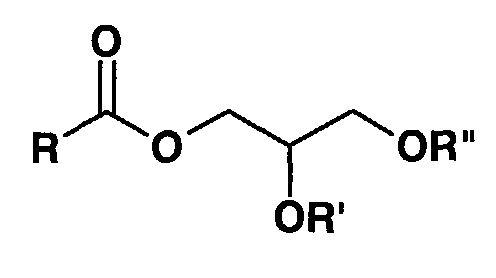
- a suitable long chain glycerol-based, hydrophobic bleach activator is according to the formula: wherein R is a linear or branched, saturated or unsaturated alkyl chain with a number of carbon atoms between 5 and 20, or a linear or branched, saturated or unsaturated alkyl aryl chain with a number of carbon atoms between 9 and 20 and wherein R' and R" are independently -H or -COR"', with R"' being a linear or branched, saturated or unsaturated alkyl chain with a number of carbon atoms between 5 and 20, or a linear or branched, saturated or unsaturated alkyl aryl chain with a number of carbon atoms between 9 and 20.
- R is a linear, saturated alkyl chain having 8 carbon atoms and R' and R" are -COR"', with R"' being a linear, saturated alkyl chain having 8 carbon atoms.
- the long chain glycerol-based, hydrophobic bleach activator herein is selected from the group consisting of: triesanoin; mono- di- or trioctanoin; mono- di- or tridecanoin; and mono- di- or trilaurin and mixtures thereof. More preferably the long chain glycerol-based, hydrophobic bleach activator herein is selected from the group consisting of: triesanoin; trioctanoin; tridecanoin; and trilaurin and mixtures thereof. Most preferably the long chain glycerol-based, hydrophobic bleach activator herein is trioctanoin.
- Suitable long chain glycerol-based, hydrophobic bleach activators are commercially available under several trade names and in several grades.
- Mono alkanoyl glycerol derivatives such as monolauryl glycerol are available from Stepan under the trade name Kessco® or from Uniquema under the trade name of Estol®.
- Trialkanoyl glycerols such as trioctanoin are available from Uniquema under the trade name of Estol®, from Huls under the trade name of Myglyol®, or from Sigma Aldrich as Tricaprylin, trilauryl glycerol is sold by Huls under the trade name Dynasan® or by Sigma Aldrich as trilaurin.
- the liquid compositions according to the present invention may comprise at least 0.1% by weight of the total composition of said long chain glycerol-based, hydrophobic bleach activator.
- the composition herein may comprise from 0.1% to 20%, preferably from 0.5% to 15%, more preferably from 0.5% to 10%, even more preferably from 0.5% to 7.5%, and most preferably from 1% to 6% by weight of the total composition of said long chain glycerol-based, hydrophobic bleach activator.
- liquid compositions according to the present invention comprise a hydrophilic bleach activator.
- hydrophilic bleach activator any bleach activator that upon perhydrolysis forms a peracid which is defined “hydrophilic”, according to the classification of peracids - into hydrophilic, hydrophobic and hydrotropic ones - reported in the Kirk-Ohtmer Encyclopedia quoted above.
- hydrophilic bleach activator Any hydrophilic bleach activator known to those skilled in the art can be used herein.
- the generated peracid or mixture thereof generated by the hydrophilic bleach activator herein have an HLB of more than 7.5, more preferably of from 7.6 to 15, even more preferably of from 8 to 15 and most preferably of from 8.5 to 12.
- HLB values are according to Davis, for example, as described in "Surfactants and Polymers in aqueous solution” (see above).
- Suitable generated peracid or mixture thereof generated by the long chain glycerol-based, hydrophobic bleach activator are selected from the group consisting of : Peracetic acid (HLB value of 8.63), perepropanoic acid (HLB value of 8.15), and perepropanoic acid (HLB value of 7.68) and mixtures thereof.
- Suitable hydrophilic bleach activator is selected from the group consisting of: short chain glycerol-based activator, tetracetyl ethylene diamine (TAED), acetyl triethyl citrate (ATC) and mixtures thereof.
- a suitable short chain glycerol-based activator is according to the formula: wherein R is a linear or branched, saturated or unsaturated alkyl chain with a number of carbon atoms up to 4, or a linear or branched, saturated or unsaturated alkyl aryl chain with a number of carbon atoms up to 6 and wherein R' and R" are independently -H or -COR"', with R"' being a linear or branched, saturated or unsaturated alkyl chain with a number of carbon atoms up to 4, or a linear or branched, saturated or unsaturated alkyl aryl chain with a number of carbon atoms up to 6.
- R is methyl group and R' and R" are -COR"', with R"' being a methyl group.
- the short chain glycerol-based activator herein is selected from the group consisting of: mono-, di- or triacetin, mono-, di- or tripropanoin, mono-, di- or tributanoin and mixtures thereof. More preferably the short chain glycerol-based activator herein is selected from the group consisting of : triacetin, tripropanoin, and tributanoin and mixtures thereof. Even more preferably the short chain glycerol-based activator herein is triacetin.
- Suitable short chain glycerol-based activator are commercially such as triacetin is commercially available from Sigma Aldrich under the trade name Triacetin, or from Eastman as triacetin.
- ATC is commercially available under the tradename Acetyl Triethyl Citrate from Sigma-Aldrich and TAED is commercially available under the tradename Mikon ATI® from Warwick.
- hydrophilic bleach activator herein is a solid compound, the solid hydrophilic bleach activator can be suspended in the liquid compositions according to the present invention.
- hydrophilic bleach activator herein is a liquid compound that is not mixable with the liquid compositions according to the present invention, the hydrophilic bleach activator may be emulsified or dispersed in the liquid compositions according to the present invention. If said hydrophilic bleach activator herein is mixable with the liquid compositions according to the present invention, the hydrophilic bleach activator may added to the liquid composition according to the present invention as is.
- the liquid compositions according to the present invention may comprise at least 0.1% by weight of the total composition of said hydrophilic bleach activator.
- the composition herein may comprise from 0.1% to 20%, preferably from 0.1% to 15%, more preferably from 0.5% to 15%, even more preferably from 0.5% to 10%, and most preferably from 1% to 10% by weight of the total composition of said hydrophilic bleach activator.
- liquid compositions according to the present invention are suitable for use in conjunction with or as part of a peroxygen bleach-containing composition in a process of bleaching and/or cleaning fabrics.
- the liquid compositions herein are used as a stand-alone activator composition for use with a composition comprising a peroxygen bleach.
- the composition comprising a peroxygen bleach may be a conventional peroxygen bleach-containing laundry detergent, such as Tide with Bleach®, Ariel®, and the like.
- the conventional peroxygen bleach-containing laundry detergent may be in any given form such as a powder, liquid, gel, tablet or liquid single dose pouch.
- the composition comprising a peroxygen bleach may be a laundry bleach additive comprising a peroxygen bleach, such as ACE Gentle Bleach®, ACE color powder®, Clorox 2®, and the like.
- liquid compositions herein may comprise one or more optional ingredients as outlined herein below.
- the liquid compositions herein are free of a peroxygen bleach.
- liquid compositions herein may be in the form of a liquid or gel, aqueous or non-aqueous composition contained in a bottle or a, preferably non-aqueous, composition contained in water-soluble pouch.
- the pH of the aqueous compositions herein preferably is at least, with increasing preference in the order given, 5, 5.5, 6, 6.5 or 6.9.
- the pH of the liquid bleaching compositions herein preferably is no more than, with increasing preference in the order given, 9, 8.5, 8, 7.5, 7 or 7.1.
- the liquid compositions herein additionally comprise a peroxygen bleach.
- the liquid compositions herein are activated bleaching compositions suitable for use as a laundry bleach additive.
- the long chain glycerol-based, hydrophobic bleach activator and the hydrophilic bleach activator present in the liquid composition additionally comprising a peroxygen bleach are preferably separated from said peroxygen bleach.
- the liquid compositions herein are activated bleaching compositions suitable for use as a laundry bleach additive.
- Suitable means to separate the long chain glycerol-based, hydrophobic bleach activator and the hydrophilic bleach activator from the peroxygen bleach in the liquid composition are selected from the group consisting of : formation of a an emulsion or microemulsion, wherein the long chain glycerol-based, hydrophobic bleach activator and the hydrophilic bleach are in a separate phase as compared to the peroxygen bleach; encapsulation of the long chain glycerol-based, hydrophobic bleach activator and the hydrophilic bleach together in one encapsulate or in two separate encapsulates; encapsulation of the peroxygen bleach; encapsulation of the bleach activators and the peroxygen bleach in different encapsulates; solid-liquid phase separation in a non
- liquid compositions herein additionally comprising a peroxygen bleach may be in the form of a liquid or gel, aqueous or non-aqueous composition contained in a bottle or a, preferably non-aqueous, composition contained in water-soluble pouch.
- the pH of the aqueous compositions herein preferably is at least, with increasing preference in the order given, 0.1, 0.5, 1, 1.5, 2, 2.5, 3, 3.5, or 4.
- the pH of the liquid bleaching compositions herein, as is measured at 25°C preferably is no more than, with increasing preference in the order given, 9, 8.5, 8, 7.5, 7, 6.5, 6, 5.5 or 5.
- the liquid compositions herein form part of a product or kit that additionally comprises a second composition comprising a peroxygen bleach.
- This specific embodiment can be referred to as a dual or multiple compartment execution, wherein the liquid composition is present in a first compartment of a product and the composition comprising a peroxygen bleach is present in a second compartment.
- the composition comprising a peroxygen bleach, which is present in a second compartment may be in a liquid, solid or gel form.
- Suitable multiple compartment executions are selected from the group consisting of: multiple compartment bottles, preferably dual compartment bottles comprising the liquid composition according to the present invention in one compartment and a composition comprising a peroxygen bleach in another compartment; multiple compartment water-soluble pouches comprising the liquid composition according to the present invention in one compartment and a composition comprising a peroxygen bleach in another compartment or; multiphase tablets containing a gel capsule comprising the liquid composition according to the present invention and a compressed powder containing a peroxygen bleach;
- a suitable dual compartment bottle for use herein is for example described in EP-A-744 462.
- the pH of the aqueous compositions herein preferably is at least, with increasing preference in the order given, 5, 5.5, 6, 6.5 or 6.9.
- the pH of the liquid bleaching compositions herein, as is measured at 25°C preferably is no more than, with increasing preference in the order given, 9, 8.5, 8, 7.5, 7 or 7.1.
- liquid compositions according to the present invention as well as additional compositions, if any, forming part of the same product or kit may comprise a series of optional ingredients.
- One highly preferred optional ingredient herein is a peroxygen bleach.
- Suitable peroxygen bleaches to be used herein are selected from the group consisting of: hydrogen peroxide; water soluble sources of hydrogen peroxide; organic or inorganic peracids; hydroperoxides; diacyl peroxides; and mixtures thereof.
- a hydrogen peroxide source refers to any compound that produces perhydroxyl ions on contact with water.
- Suitable water-soluble sources of hydrogen peroxide for use herein include percarbonates, perborates and persilicates and mixtures thereof.
- Suitable diacyl peroxides for use herein include aliphatic, aromatic and aliphatic-aromatic diacyl peroxides, and mixtures thereof.
- Suitable aliphatic diacyl peroxides for use herein are dilauroyl peroxide, didecanoyl peroxide, dimyristoyl peroxide, or mixtures thereof.
- a suitable aromatic diacyl peroxide for use herein is for example benzoyl peroxide.
- a suitable aliphatic-aromatic diacyl peroxide for use herein is for example lauroyl benzoyl peroxide.
- Suitable organic or inorganic peracids for use herein include : persulphates such as monopersulfate; peroxyacids such as diperoxydodecandioic acid (DPDA); magnesium perphthalic acid; perlauric acid; phthaloyl amidoperoxy caproic acid (PAP); perbenzoic and alkylperbenzoic acids; and mixtures thereof.
- persulphates such as monopersulfate
- peroxyacids such as diperoxydodecandioic acid (DPDA); magnesium perphthalic acid; perlauric acid; phthaloyl amidoperoxy caproic acid (PAP); perbenzoic and alkylperbenzoic acids; and mixtures thereof.
- DPDA diperoxydodecandioic acid
- PAP phthaloyl amidoperoxy caproic acid
- perbenzoic and alkylperbenzoic acids and mixtures thereof.
- Suitable hydroperoxides for use herein are tert-butyl hydroperoxide, cumyl hydroperoxide, 2,4,4-trimethylpentyl-2-hydroperoxide, di-isopropylbenzene-monohydroperoxide, tert-amyl hydroperoxide and 2,5-dimethyl-hexane-2,5-dihydroperoxide and mixtures thereof.
- Such hydroperoxides have the advantage of being particularly safe to fabrics and color while delivering excellent bleaching performance when used in any laundry application.
- a preferred peroxygen bleach herein is selected from the group consisting of : hydrogen peroxide; water-soluble sources of hydrogen peroxide; organic or inorganic peracids; hydroperoxides; and diacyl peroxides; and mixtures thereof.
- a more preferred peroxygen bleach herein is selected from the group consisting of hydrogen peroxide, water-soluble sources of hydrogen peroxide and diacyl peroxides and mixtures thereof.
- An even more preferred peroxygen bleach herein is selected from the group consisting of hydrogen peroxide, water soluble sources of hydrogen peroxide, aliphatic diacyl peroxides, aromatic diacyl peroxides and aliphatic-aromatic diacyl peroxides and mixtures thereof.
- the most preferred peroxygen bleach herein is hydrogen peroxide, water-soluble sources of hydrogen peroxide or mixtures thereof.
- compositions according to the present invention comprise at least 1% of available H 2 O 2 by weight of the total composition.
- the composition herein may comprise from 1% to 30%, preferably from 2% to 25%, more preferably from 2% to 20%, even more preferably from 2.5% to 20%, and most preferably from 2.5% to 18% of available H 2 O 2 by weight of the total composition.
- An optional ingredient for use herein is a lipophilic bleach booster or a mixture thereof.
- Bleach boosters provide increased bleaching effectiveness in lower temperature applications.
- the bleach boosters act in conjunction with conventional peroxygen bleaching sources to provide increased bleaching effectiveness. This is normally accomplished through in situ formation of an active oxygen transfer agent such as a dioxirane, an oxaziridine, or an oxaziridinium. Alternatively, preformed dioxiranes, oxaziridines and oxaziridiniums may be used.
- a bleach booster is of lipophilic nature and which is preferably soluble in an oily phase.
- suitable lipophilic bleach booster for use in accordance with the present invention are cationic imines, zwitterionic imines, anionic imines and/or polyionic imines having a net charge of from about +3 to about -3, and mixtures thereof.
- imine lipophilic bleach booster of the present invention include those of the general structure: where R 1 - R 4 may be a hydrogen or an unsubstituted or substituted radical selected from the group consisting of phenyl, aryl, heterocyclic ring, alkyl and cycloalkyl radicals.
- lipophilic bleach booster examples include zwitterionic bleach boosters, which are described in U.S. Patent Nos. 5,576,282 and 5,718,614.
- Other lipophilic bleach booster include cationic bleach boosters described in U.S. Patent Nos. 5,360,569, 5,442,066, 5,478,357, 5,370,826, 5,482,515, 5,550,256, and WO 95/13351, WO 95/13352, and WO 95/13353.
- Preferred lipophilic bleach booster herein are selected from the group consisting of : 3-(3,4-Dihydroisoquinolinium)propane sulfonate (DIPS), 4-(3,4-Dihydroisoquinolinium)butane sulfonate, 4-[(2-ethylhexyloxymethyl]-1,3,2-dioxathiolane-2,2-dione, Sulfuric acid mono-[2-(3,4-dihydro-isoquinolin-2-yl)-1-(2-ethyl-hexyloxymethyl)-ethyl] ester, Sulfuric acid mono-[2-(3,4-dihydro-isoquinolin-2-yl)-1-(octyloxymethyl)-ethyl] ester, Sulfuric acid mono-[2-(3,4-dihydro-isoquinolin-2-yl)-1-(decyloxymethyl)-ethyl] ester,
- An even more preferred lipophilic bleach booster herein is selected from the group consisting of : 3-(3,4-Dihydroisoquinolinium)propane sulfonate (DIPS), Sulfuric acid mono-[2-(3,4-dihydro-isoquinolin-2-yl)-1-(2-ethylhexyloxymethyl)-ethyl] ester, and Sulfuric acid mono-[1-(3,4-dihydro-isoquinolin-2-yl)-decan-2-yl] ester, and mixtures thereof.
- DIPS 3-(3,4-Dihydroisoquinolinium)propane sulfonate
- Sulfuric acid mono-[2-(3,4-dihydro-isoquinolin-2-yl)-1-(2-ethylhexyloxymethyl)-ethyl] ester Sulfuric acid mono-[1-(3,4-dihydro-isoquinolin-2-
- the most preferred lipophilic bleach booster herein is Sulfuric acid mono-[2-(3,4-dihydro-isoquinolin-2-yl)-1-(2-ethyl-hexyloxymethyl)-ethyl] ester.
- compositions herein may comprise from 0.001% to 2%, preferably from 0.01% to 1. %,more preferably from 0.02% to 0.5% and most preferably from 0.02% to 0.2% by weight of the total composition of a lipophilic bleach booster
- the long chain glycerol-based, hydrophobic bleach activator herein in addition to their performance as a bleach activator may also act as solvent and/or carrier for lipophilic bleach booster. Indeed, it has been found that the action of such a lipophilic bleach booster is facilitated. Without being bound by theory, it has been observed that the long chain glycerol-based, hydrophobic bleach activator herein transports and/or facilitates the access of lipophilic bleach booster to hydrophobic entities such as hydrophobic, bleachable stains or hydrophobic parts of the fabric and thereby improves the performance of the lipophilic bleach boosters.
- An optional ingredient for use herein is a surfactant.
- compositions herein may comprise from 0.01% to 30%, preferably from 0.1% to 25 % and more preferably from 0.5% to 20% by weight of the total composition of a surfactant.
- Suitable nonionic surfactants include alkoxylated nonionic surfactants.
- Preferred alkoxylated nonionic surfactants herein are ethoxylated nonionic surfactants according to the formula RO-(C 2 H 4 O) n H, wherein R is a C 6 to C 22 alkyl chain or a C 6 to C 28 alkyl benzene chain, and wherein n is from 0 to 20, preferably from 1 to 15 and, more preferably from 2 to 15 and most preferably from 2 to 12.
- the preferred R chains for use herein are the C 8 to C 22 alkyl chains.
- Propoxylated nonionic surfactants and ethoxy/propoxylated ones may also be used herein instead of the ethoxylated nonionic surfactants as defined herein above or together with said surfactants.
- Suitable substantially linear ethoxylated nonionic surfactants for use herein are available in the Marlipal® surfactant series commercially available from Condea.
- Suitable alkoxylated nonionic surfactants for use herein are available in the Dobanol® surfactants series commercially available from SHELL, the Lutensol® surfactants series commercially available from BASF and the Tergitol® surfactants series commercially available from UNION CARBIDE.
- nonionic surfactants to be used herein include polyhydroxy fatty acid amide surfactants, available under the trade name HOE® from Hoechst.
- Suitable zwitterionic betaine surfactants for use herein contain both a cationic hydrophilic group, i.e., a quaternary ammonium group, and anionic hydrophilic group on the same molecule at a relatively wide range of pH's.
- the typical anionic hydrophilic groups are carboxylates and sulphonates, although other groups like sulfates, phosphonates, and the like can be used.
- Suitable anionic surfactants to be used in the compositions herein include water-soluble salts or acids of the formula ROSO 3 M wherein R preferably is a C 10 -C 24 hydrocarbyl, preferably an alkyl or hydroxyalkyl having a C 10 -C 20 alkyl component, more preferably a C 12 -C 18 alkyl or hydroxyalkyl, and M is H or a cation, e.g., an alkali metal cation (e.g., sodium, potassium, lithium), or ammonium or substituted ammonium (e.g., methyl-, dimethyl-, and trimethyl ammonium cations and quaternary ammonium cations, such as tetramethyl-ammonium and dimethyl piperdinium cations and quaternary ammonium cations derived from alkylamines such as ethylamine, diethylamine, triethylamine, and mixtures thereof, and the like).
- R
- Suitable anionic surfactants for use herein are water-soluble salts or acids of the formula RO(A) m SO 3 M wherein R is an unsubstituted C 10 -C 24 alkyl or hydroxyalkyl group having a C 10 -C 24 alkyl component, preferably a C 12 -C 20 alkyl or hydroxyalkyl, more preferably C 12 -C 18 alkyl or hydroxyalkyl, A is an ethoxy or propoxy unit, m is greater than zero, typically between 0.5 and 6, more preferably between 0.5 and 3, and M is H or a cation which can be, e.g.
- a metal cation e.g., sodium, potassium, lithium, calcium, magnesium, etc.
- ammonium or substituted-ammonium cation e.g., sodium, potassium, lithium, calcium, magnesium, etc.
- Alkyl ethoxylated sulfates as well as alkyl propoxylated sulfates are contemplated herein.
- Suitable anionic surfactants for use herein are sulphonated anionic surfactants.
- Suitable sulphonated anionic surfactants for use herein include alkyl sulphonates, alkyl aryl sulphonates, naphthalene sulphonates, alkyl alkoxylated sulphonates, C 6 -C 20 alkyl alkoxylated linear or branched diphenyl oxide disulphonates, or mixtures thereof.
- Suitable alkyl or alkyl aryl sulphonates for use herein include water-soluble salts or acids of the formula RSO 3 M wherein R is a C 6 -C 20 linear or branched, saturated or unsaturated alkyl group, preferably a C 8 -C 18 alkyl group and more preferably a C 14 -C 17 alkyl group, or wherein R is an aryl, preferably a benzyl, substituted by a C 6 -C 20 linear or branched saturated or unsaturated alkyl group, preferably a C 8 -C 18 alkyl group and more preferably a C 10 -C 16 alkyl group, and M is H or a cation, e.g., an alkali metal cation (e.g., Na, K, Li), or ammonium or substituted ammonium (e.g., methyl-, dimethyl-, and trimethyl ammonium cations and quaternary ammonium cations, such
- Particularly suitable alkyl sulphonates include C 14 -C 17 paraffin sulphonate like Hostapur ® SAS commercially available from Hoechst.
- An example of commercially available alkyl aryl sulphonate is Lauryl aryl sulphonate from Su.Ma.
- Particularly preferred alkyl aryl sulphonates are alkyl benzene sulphonates commercially available under trade name Nansa® available from Albright&Wilson.
- Suitable alkoxylated sulphonate surfactants for use herein are according to the formula R(A) m SO 3 M wherein R is an unsubstituted C 6 -C 20 alkyl, hydroxyalkyl or alkyl aryl group, having a linear or branched C 6 -C 20 alkyl component, preferably a C 12 -C 20 alkyl or hydroxyalkyl, more preferably C 12 -C 18 alkyl or hydroxyalkyl, A is an ethoxy or propoxy or butoxy unit, m is greater than zero, typically between 0.5 and 6, more preferably between 0.5 and 3, and M is H or a cation which can be, for example, a metal cation (e.g., sodium, potassium, lithium, calcium, magnesium, etc.), ammonium or substituted-ammonium cation.
- R is an unsubstituted C 6 -C 20 alkyl, hydroxyalkyl or alkyl aryl group, having
- Alkyl ethoxylated sulphonates, alkyl butoxylated sulphonates as well as alkyl propoxylated sulphonates are contemplated herein.
- Particularly suitable alkoxylated sulphonates include alkyl aryl polyether sulphonate like Triton X-200® commercially available from Union Carbide.
- anionic surfactants suitable herein include sulfosuccinate surfactants, alkyl carboxylate surfactants, sulfosuccinamate surfactants and sulfosuccinamide surfactants.
- Suitable amphoteric surfactants to be used herein include amine oxides having the following formula R 1 R 2 R 3 NO wherein each of R 1 , R 2 and R 3 is independently a saturated substituted or unsubstituted, linear or branched hydrocarbon chains of from 1 to 30 carbon atoms.
- Suitable amine oxides for use herein are for instance natural blend C 8 -C 10 amine oxides as well as C 12 -C 16 amine oxides commercially available from Hoechst.
- An optional ingredient for use herein is a dye maintenance agent.
- Suitable dye maintenance agents are described as cyclic amine based polymers, oligomers or copolymers in WO 99/14301 and dye maintenance polymers or oligomers in WO 00/56849.
- compositions herein may comprise from 0.001% to 30%, preferably from 0.01 % to 15% and more preferably from 0.05% to 5% by weight of the total composition of a dye maintenance agent.
- An optional ingredient for use herein is an anti-resoiling polymer.
- Suitable anti-resoiling polymers include soil suspending polyamine polymers.
- Particularly suitable polyamine polymers for use herein are alkoxylated polyamines.
- Such materials can conveniently be represented as molecules of the empirical structures with repeating units : and wherein R is a hydrocarbyl group, usually of 2-6 carbon atoms; R 1 may be a C 1 -C 20 hydrocarbon; the alkoxy groups are ethoxy, propoxy, and the like, and y is from 2 to 30, most preferably from 7 to 20; n is an integer of at least 2, preferably from 2 to 40, most preferably from 2 to 5; and X- is an anion such as halide or methylsulfate, resulting from the quaternization reaction.
- ethoxylated polyethylene amines i.e., the polymerized reaction product of ethylene oxide with ethyleneimine, having the general formula : wherein y is from 2 to 50, preferably from 5 to 30, and n is from 1 to 40, preferably from 2 to 40.
- polyamines for use herein are the so-called ethoxylated polyethylene quaternized amines having the general formula : wherein y is from 2 to 50, preferably from 5 to 30, and n is from 1 to 40, preferably from 2 to 40 and R1 and R2 are independently a C 1 -C 20 hydrocarbon.
- EHDQ 24-Ethoxylated Hexamethylene Diamine Quaternized methyl chloride
- An optional ingredient for use herein is an alkoxylated benzoic acid or a salt thereof.
- the alkoxylated benzoic acid or the salt thereof has the general formula : wherein : the substituents of the benzene ring X and Y are independently selected from -H, or -OR'; R' is independently selected from C 1 to C 20 linear or branched alkyl chains.
- said alkoxylated benzoic acid or the salt thereof is a trimethoxy benzoic acid or a salt thereof (TMBA), wherein in the above general formula : the substituents of the benzene ring Y and X are -OR'; R' is -CH 3 and; M is hydrogen, a cation or a cationic moiety.
- TMBA trimethoxy benzoic acid or a salt thereof
- Suitable alkoxylated benzoic acids or salts thereof are commercially available from Aldrich and Merck.
- the composition according to the present invention may comprise from 0.001% to 5%, preferably from 0.005% to 2.5% and more preferably from 0.01% to 1.0% by weight of the total composition of said alkoxylated benzoic acid or a salt thereof.
- Suitable chelating agents may be any of those known to those skilled in the art, such as the ones selected from the group comprising phosphonate chelating agents, amino carboxylate chelating agents, other carboxylate chelating agents, polyfunctionally-substituted aromatic chelating agents, ethylenediamine N,N'-disuccinic acids, or mixtures thereof.
- Suitable phosphonate chelating agents to be used herein may include alkali metal ethane 1-hydroxy diphosphonates (HEDP), alkylene poly (alkylene phosphonate), as well as amino phosphonate compounds, including amino aminotri(methylene phosphonic acid) (ATMP), nitrilo trimethylene phosphonates (NTP), ethylene diamine tetra methylene phosphonates, and diethylene triamine penta methylene phosphonates (DTPMP).
- the phosphonate compounds may be present either in their acid form or as salts of different cations on some or all of their acid functionalities.
- Preferred phosphonate chelating agents are commercially available from Monsanto under the trade name DEQUEST®.
- Polyfunctionally-substituted aromatic chelating agents may also be useful in the compositions herein. See U.S. patent 3,812,044, issued May 21, 1974, to Connor et al.
- Preferred compounds of this type in acid form are dihydroxydisulfobenzenes such as 1,2-dihydroxy -3,5-disulfobenzene.
- a preferred biodegradable chelating agent for use herein is ethylene diamine N,N'- disuccinic acid, or alkali metal, or alkaline earth, ammonium or substitutes ammonium salts thereof or mixtures thereof.
- Ethylenediamine N,N'- disuccinic acids, especially the (S,S) isomer, have been extensively described in US patent 4, 704, 233, November 3, 1987, to Hartman and Perkins.
- Ethylenediamine N,N'- disuccinic acid is commercially available as ssEDDS® from Palmer Research Laboratories.
- Suitable amino carboxylates to be used herein include ethylene diamine tetra acetates, diethylene triamine pentaacetates, diethylene triamine pentaacetate (DTPA),N-hydroxyethylethylenediamine triacetates, nitrilotri-acetates, ethylenediamine tetrapropionates, triethylenetetraaminehexa-acetates, ethanol-diglycines, propylene diamine tetracetic acid (PDTA) and methyl glycine di-acetic acid (MGDA), both in their acid form, or in their alkali metal, ammonium, and substituted ammonium salt forms.
- PDTA propylene diamine tetracetic acid
- MGDA methyl glycine di-acetic acid
- Particularly suitable amino carboxylates to be used herein are diethylene triamine penta acetic acid, propylene diamine tetracetic acid (PDTA) which is, for instance, commercially available as Trilon FS® from BASF and methyl glycine di-acetic acid (MGDA).
- PDTA propylene diamine tetracetic acid
- MGDA methyl glycine di-acetic acid
- carboxylate chelating agents to be used herein include salicylic acid, aspartic acid, glutamic acid, glycine, malonic acid or mixtures thereof.
- R 1 , R 2 , R 3 , and R 4 are independently selected from the group consisting of -H, alkyl, alkoxy, aryl, aryloxy, -Cl, -Br, -NO 2 , -C(O)R', and -SO 2 R"; wherein R' is selected from the group consisting of -H, -OH, alkyl, alkoxy, aryl, and aryloxy; R" is selected from the group consisting of alkyl, alkoxy, aryl, and aryloxy; and R 5 , R 6 , R 7 , and R 8 are independently selected from the group consisting of -H and alkyl.
- Particularly preferred chelating agents to be used herein are amino aminotri(methylene phosphonic acid), di-ethylene-triamino-pentaacetic acid, diethylene triamine penta methylene phosphonate, 1-hydroxy ethane diphosphonate, ethylenediamine N, N'-disuccinic acid, and mixtures thereof.
- compositions according to the present invention may comprise up to 5%, preferably from 0.01% to 1.5% by weight and more preferably from 0.01% to 0.5% by weight of the total composition of a chelating agent.
- compositions herein may further comprise a variety of optional ingredients such as thickeners, builders, stabilisers, soil suspenders, sulphonated hydrotropes, foam reducing systems or agents, catalysts, dye transfer agents, brighteners, perfumes, solvents, pigments and dyes.
- optional ingredients such as thickeners, builders, stabilisers, soil suspenders, sulphonated hydrotropes, foam reducing systems or agents, catalysts, dye transfer agents, brighteners, perfumes, solvents, pigments and dyes.
- the liquid composition of the present invention is used by contacting fabrics with said composition in neat form or in diluted form.
- compositions according to the present invention are typically used in diluted form in a laundry operation.
- in diluted form it is meant herein that the compositions according to the present invention may be diluted with a solvent by the user, preferably with water. Such dilution may occur for instance in soaking applications as well as by other means such as in a washing machine.
- Said compositions may be used at a dilution level of up to 1500:1 (solvent: composition), preferably from 5:1 to 1000:1 and more preferably from 10:1 to 700:1 (solvent: composition).
- liquid compositions are applied directly onto the fabrics to be treated without undergoing any dilution, i.e., the liquid compositions herein are applied onto the fabrics as described herein.
- Fabrics to be treated herein include, but are not limited to, clothes, curtains, drapes, bed linens, bath linens, tablecloths, sleeping bags and/or tents.
- treating a fabric it is meant herein cleaning said fabric.
- a liquid composition according to the present invention is contacted with the fabrics to be treated.
- pretreatment mode where a liquid composition, as defined herein, is applied neat onto said fabrics before the fabrics are washed
- a liquid composition, as defined herein is first diluted in an aqueous bath and the fabrics are immersed and soaked in the bath, before they are washed, or in a "through-the-wash mode", where a liquid composition, as defined herein, is added in addition to a wash liquor formed by dissolution or dispersion of a conventional laundry detergent, preferably in a washing machine.
- said fabrics are to be washed, i.e., treated with a conventional laundry detergent, preferably comprising at least one surface active agent
- the washing of said fabrics with a conventional laundry detergent may be conducted before the step of contacting said fabrics with the composition herein and/or during the step of contacting fabrics are contacted with the composition herein and/or after the step where said fabrics are contacted with the composition herein.
- the washing step according to the present invention is performed in a washing machine.
- the conventional detergent composition may be delivered into the washing machine either by charging the dispenser drawer of the washing machine with the detergent or by directly charging the drum of the washing machine with the detergent.
- washing detergent it is meant herein, a laundry detergent composition, preferably a powder, liquid or tablet composition, currently available on the market.
- said conventional laundry detergent comprises at least one surface active agent.
- Suitable laundry detergent compositions are for example DASH futur®, DASH essential®, DASH liquid®, ARIEL tablets® and other products sold under the trade names ARIEL® or TIDE®.
- compositions used in a process according to the present invention are not necessarily used to limit or otherwise define the scope of the present invention.
- the compositions are made by combining the listed ingredients in the listed proportions (weight % unless otherwise specified).
- Example compositions I-V are so-called activator compositions to be used in conjunction with a separate peroxygen bleach-containing composition or in a multiple compartment product.
- Example compositions VI-IX are activated bleaching compositions wherein the bleach activators herein are separated from the peroxygen bleach. The separation is by means of forming an oil-in-water or water-in-oil emulsion wherein the hydrogen peroxide is in the water phase of the emulsion.
- Examples X-XIII describe solid bleaching compositions wherein the wherein the liquid composition comprising a long chain glycerol-based, hydrophobic bleach activator and a hydrophilic bleach activator according to the present invention is applied to, preferably sprayed onto, a solid composition.
- Example compositions XIV-XVIII are packed in a dual compartment bottle, such as shown in EP-A-744 462, thereby the activators are physically separated from the hydrogen peroxide.
- Marlipal® 24.7 is a linear C 12 -C 14 EO7 nonionic surfactant commercially available from Condea.
- Dobanol® 45-7 is a C 14 -C 15 EO7 nonionic surfactant
- Dobanol® 91-8 is a C 9 -C 11 EO8 nonionic surfactant
- Neodol 23.3® is a C 12 -C 13 EO3 nonionic surfactant
- Neodol 45.7® is a C 14 -C 15 EO7 nonionic surfactant, all are commercially available from SHELL.
- Acusol 425® is a modified polycarboxylate co-builder commercially available from Rohm & Haas.
- Na LAS is a Sodium Linear Alky Benzene Sulphonate.
- TAED is tetracetyl ethylene diamine.
- Lutensit KHD-96® is 24-Ethoxylated Hexamethylene Diamine Quaternized methyl chloride commercially available from BASF.
- Lipophilic Bleach Booster* is Sulfuric acid mono-[2-(3,4-dihydro-isoquinolin-2-yl)-1-(2-ethylhexyloxymethyl)-ethyl] ester.
- Sokalan CP5® is an acrylic acid/maleic acid copolymer commercially available from BASF.
Landscapes
- Chemical & Material Sciences (AREA)
- Inorganic Chemistry (AREA)
- Life Sciences & Earth Sciences (AREA)
- Engineering & Computer Science (AREA)
- Chemical Kinetics & Catalysis (AREA)
- Oil, Petroleum & Natural Gas (AREA)
- Wood Science & Technology (AREA)
- Organic Chemistry (AREA)
- Detergent Compositions (AREA)
Abstract
Description
- The present invention relates to liquid activator compositions and in particular to liquid activator compositions for use with peroxygen bleach-containing compositions.
- Bleach-containing compositions for treating fabrics are well known in the art. Indeed, peroxygen bleach-containing compositions have been extensively described in the art, especially in laundry applications as laundry additives and/or laundry pretreaters.
- Indeed, it is known to use such peroxygen bleach-containing compositions in laundry applications to boost the removal of dried on (encrusted) stains/soils and "problem" stains, such as grease, coffee, tea, grass, mud/clay-containing soils, which are otherwise particularly difficult to remove. In addition, peroxygen bleaches are considered as being safer to fabrics compared to other bleaches, such as hypohalite bleaches.
- Bleaching compositions comprising a peroxygen bleach have the inconvenience of showing a somewhat limited bleach performance compared to other bleaches, like hypohalite bleaches. Hence, it is known in the art to use bleach activators in combination with peroxygen bleach-containing compositions. Indeed, several different bleach activators are discussed in the art such as nonanoyloxybenzenesulphonate (NOBS), n-nonanoylsuccinimid (NOSI), N-acyl caprolactams, tetracetyl ethylene diamine (TAED), acetyl triethyl citrate (ATC) or short chain tri-glycerides, such as triacetin.
- However, a drawback associated with the use of bleach activators in combination with peroxygen bleach-containing compositions is that depending on the hydrophobicity or hydrophilicity of the bleach activator the bleach performance on hydrophilic or hydrophobic bleachable stains is limited. Indeed, a hydrophobic bleach activator shows good bleach activation performance on hydrophobic bleachable stains, such as burned fats (like butter), tomato-sauce, cosmetics (like lipstick), but limited bleach activation performance on hydrophilic bleachable stains, such as coffee. In addition, a hydrophilic bleach activator shows good bleach activation performance on hydrophilic bleachable stains, but limited bleach activation performance on hydrophobic bleachable stains.
- In order to overcome this drawback, it has been found that the use of a combination of a hydrophilic and a hydrophobic bleach activator in combination with a peroxygen bleach-containing composition provides excellent bleach activation performance both on hydrophilic and hydrophobic stains.
- However, a problem with the currently used hydrophobic bleach activators, such as NOBS, is the fact that they are solids that need to be suspended in liquid compositions and are thus difficult to formulate. Furthermore, such hydrophobic bleach activators can be expensive raw material. In addition, some of the currently used hydrophobic bleach activators, such as NOBS, are known sensitizers and can cause problems in laundry machines.
- It is therefore an objective of the present invention to provide a liquid activator composition that provides good bleach activation performance on both hydrophilic and hydrophobic stains, without showing some of the negative aspects connected to the use of the frequently used hydrophobic bleach activators.
- It has now been found that this objective can be met by the liquid composition comprising a long chain glycerol-based, hydrophobic bleach activator and a hydrophilic bleach activator.
- Advantageously, the long chain glycerol-based, hydrophobic bleach activator are easy to formulate in the liquid compositions of the present invention due to the fact that they are liquid compounds.
- A further advantage of the long chain glycerol-based, hydrophobic bleach activators herein is the fact that they are readily commercially available and relatively inexpensive raw materials.
- EP-A-0 563 460 describes liquid aqueous compositions comprising a short chain (C1-4) di- or tri-glycerides.
- EP-A-0 253 487 describes activated oxidant systems comprising an enzyme, C1-12 di- or tri-glycerides as a substrate and a source of active oxygen.
- WO 94/03423 describes compositions suitable for bleaching surfactants with a composition comprising triacetin.
- JP-A-62001794 and JP-A-62252500 describe compositions comprising a bleach activator such as triacetin.
- EP-A-1 125 497 describes disinfectants comprising a peracid and glycerol di- or tri-acetate.
- The present invention encompasses a liquid composition comprising a long chain glycerol-based, hydrophobic bleach activator and a hydrophilic bleach activator.
- The bleaching composition according to the present invention is formulated as a liquid composition. By "liquid" it is meant to include conventional liquids, gels and pastes.
- In an alternative embodiment according to the present invention, the liquid composition herein is combined with and/or applied to, preferably sprayed onto, a solid, preferably powder, composition. Therefore, the present invention further encompasses a solid, preferably powder or compressed powder (such as a tablet), composition wherein the liquid composition herein is combined with and/or applied to, preferably sprayed onto, to said solid composition, preferably said powder or compressed powder composition. Alternatively, said liquid composition herein can be added to a solid composition, preferably a powder or compressed powder composition, by means of forming capsules containing the liquid composition herein.
- In a preferred embodiment herein, the compositions herein are formulated as aqueous compositions. Preferred liquid aqueous compositions comprise water, more preferably comprise water in an amount of from 60% to 98%, even more preferably of from 80% to 97% and most preferably 85% to 97% by weight of the total composition.
- The pH of the liquid aqueous compositions herein may be in the range of from pH 0 to pH 14. Preferred pH ranges may vary depending on the ingredients present in the composition as well as it use. Preferred pH ranges are discussed herein under the section titled "Product form".
- In another preferred embodiment, the liquid compositions herein are substantially free of water, preferably free of water, and are thus formulated as non-aqueous compositions. By "substantially free of water" it is meant that no water as such is added to the liquid composition. However, said liquid composition may comprise traces of water added into the composition through the raw-materials used to produce the liquid composition. The level of water added into the composition through the raw-materials used to produce the liquid composition is preferably below 10%, more preferably below 5%, even more preferably below 3% by weight of the total composition.
- The compositions herein may further comprise an acid or a base to adjust the pH as appropriate.
- Preferred acids herein are organic or inorganic acids or mixtures thereof. Preferred organic acids are acetic acid, citric acid or a mixture thereof. Preferred inorganic acids are sulfuric acid, phosphoric acid or a mixture thereof.
- Typical levels of such acids, when present, are of from 0.01% to 3.0%, preferably from 0.05% to 2.0% and more preferably from 0.1% to 1.0% by weight of the total composition.
- The bases to be used herein can be organic or inorganic bases. Suitable bases for use herein are the caustic alkalis, such as sodium hydroxide, potassium hydroxide and/or lithium hydroxide, and/or the alkali metal oxides such, as sodium and/or potassium oxide or mixtures thereof.
- Other suitable bases include ammonia, ammonium carbonate and hydrogen carbonate.
- Typical levels of such bases, when present, are of from 0.01% to 1.0%, preferably from 0.05% to 0.8% and more preferably from 0.1% to 0.5% by weight of the total composition.
- As a first essential ingredient the liquid compositions according to the present invention comprise a long chain glycerol-based, hydrophobic bleach activator.
- By "hydrophobic bleach activator" it is meant herein any bleach activator that upon perhydrolysis forms a peracid which is non-hydrophilic, preferably hydrophobic, according to the classification of peracids - into hydrophilic, hydrophobic and hydrotropic ones - reported in Kirk-Ohtmer Encyclopedia of chemical technology 4th edition, vol. 4, pages 284-285.
- Preferably the generated peracid or mixture thereof generated by the long chain glycerol-based, hydrophobic bleach activator herein have an HLB of at utmost 7.5, more preferably of from 2 to 7.5, even more preferably of from 3 to 7.5 and most preferably of from 4 to 7. A suitable way of calculating HLB values is according to Davis, for example, as described in "Surfactants and Polymers in aqueous solution ", 2nd edition, Holmberg K. et. al., Wiley, page 460. Suitable generated peracid or mixture thereof generated by the long chain glycerol-based, hydrophobic bleach activator are selected from the group consisting of : peroctanoic acid (HLB value of 5.78), peresanoic acid (HLB value of 6.73), and perdecanoic acid (HLB value of 4.83) and mixtures thereof.
- A suitable long chain glycerol-based, hydrophobic bleach activator is according to the formula:wherein R is a linear or branched, saturated or unsaturated alkyl chain with a number of carbon atoms between 5 and 20, or a linear or branched, saturated or unsaturated alkyl aryl chain with a number of carbon atoms between 9 and 20 and wherein R' and R" are independently -H or -COR"', with R"' being a linear or branched, saturated or unsaturated alkyl chain with a number of carbon atoms between 5 and 20, or a linear or branched, saturated or unsaturated alkyl aryl chain with a number of carbon atoms between 9 and 20.

- Preferably R is a linear, saturated alkyl chain having 8 carbon atoms and R' and R" are -COR"', with R"' being a linear, saturated alkyl chain having 8 carbon atoms.
- Preferably the long chain glycerol-based, hydrophobic bleach activator herein is selected from the group consisting of: triesanoin; mono- di- or trioctanoin; mono- di- or tridecanoin; and mono- di- or trilaurin and mixtures thereof. More preferably the long chain glycerol-based, hydrophobic bleach activator herein is selected from the group consisting of: triesanoin; trioctanoin; tridecanoin; and trilaurin and mixtures thereof. Most preferably the long chain glycerol-based, hydrophobic bleach activator herein is trioctanoin.
- Suitable long chain glycerol-based, hydrophobic bleach activators are commercially available under several trade names and in several grades. Mono alkanoyl glycerol derivatives such as monolauryl glycerol are available from Stepan under the trade name Kessco® or from Uniquema under the trade name of Estol®. Trialkanoyl glycerols such as trioctanoin are available from Uniquema under the trade name of Estol®, from Huls under the trade name of Myglyol®, or from Sigma Aldrich as Tricaprylin, trilauryl glycerol is sold by Huls under the trade name Dynasan® or by Sigma Aldrich as trilaurin.
- The liquid compositions according to the present invention may comprise at least 0.1% by weight of the total composition of said long chain glycerol-based, hydrophobic bleach activator. Preferably, the composition herein may comprise from 0.1% to 20%, preferably from 0.5% to 15%, more preferably from 0.5% to 10%, even more preferably from 0.5% to 7.5%, and most preferably from 1% to 6% by weight of the total composition of said long chain glycerol-based, hydrophobic bleach activator.
- As a second essential ingredient the liquid compositions according to the present invention comprise a hydrophilic bleach activator.
- By "hydrophilic bleach activator" it is meant herein any bleach activator that upon perhydrolysis forms a peracid which is defined "hydrophilic", according to the classification of peracids - into hydrophilic, hydrophobic and hydrotropic ones - reported in the Kirk-Ohtmer Encyclopedia quoted above.
- Any hydrophilic bleach activator known to those skilled in the art can be used herein.
- Preferably the generated peracid or mixture thereof generated by the hydrophilic bleach activator herein have an HLB of more than 7.5, more preferably of from 7.6 to 15, even more preferably of from 8 to 15 and most preferably of from 8.5 to 12. A suitable way of calculating HLB values is according to Davis, for example, as described in "Surfactants and Polymers in aqueous solution" (see above). Suitable generated peracid or mixture thereof generated by the long chain glycerol-based, hydrophobic bleach activator are selected from the group consisting of : Peracetic acid (HLB value of 8.63), perepropanoic acid (HLB value of 8.15), and perepropanoic acid (HLB value of 7.68) and mixtures thereof.
- Suitable hydrophilic bleach activator is selected from the group consisting of: short chain glycerol-based activator, tetracetyl ethylene diamine (TAED), acetyl triethyl citrate (ATC) and mixtures thereof.
- A suitable short chain glycerol-based activator is according to the formula:wherein R is a linear or branched, saturated or unsaturated alkyl chain with a number of carbon atoms up to 4, or a linear or branched, saturated or unsaturated alkyl aryl chain with a number of carbon atoms up to 6 and wherein R' and R" are independently -H or -COR"', with R"' being a linear or branched, saturated or unsaturated alkyl chain with a number of carbon atoms up to 4, or a linear or branched, saturated or unsaturated alkyl aryl chain with a number of carbon atoms up to 6.
- Preferably R is methyl group and R' and R" are -COR"', with R"' being a methyl group.
- Preferably the short chain glycerol-based activator herein is selected from the group consisting of: mono-, di- or triacetin, mono-, di- or tripropanoin, mono-, di- or tributanoin and mixtures thereof. More preferably the short chain glycerol-based activator herein is selected from the group consisting of : triacetin, tripropanoin, and tributanoin and mixtures thereof. Even more preferably the short chain glycerol-based activator herein is triacetin.
- Suitable short chain glycerol-based activator are commercially such as triacetin is commercially available from Sigma Aldrich under the trade name Triacetin, or from Eastman as triacetin. ATC is commercially available under the tradename Acetyl Triethyl Citrate from Sigma-Aldrich and TAED is commercially available under the tradename Mikon ATI® from Warwick.
- Provided the hydrophilic bleach activator herein is a solid compound, the solid hydrophilic bleach activator can be suspended in the liquid compositions according to the present invention. Provided hydrophilic bleach activator herein is a liquid compound that is not mixable with the liquid compositions according to the present invention, the hydrophilic bleach activator may be emulsified or dispersed in the liquid compositions according to the present invention. If said hydrophilic bleach activator herein is mixable with the liquid compositions according to the present invention, the hydrophilic bleach activator may added to the liquid composition according to the present invention as is.
- The liquid compositions according to the present invention may comprise at least 0.1% by weight of the total composition of said hydrophilic bleach activator. Preferably, the composition herein may comprise from 0.1% to 20%, preferably from 0.1% to 15%, more preferably from 0.5% to 15%, even more preferably from 0.5% to 10%, and most preferably from 1% to 10% by weight of the total composition of said hydrophilic bleach activator.
- It has now been found that the combination in a liquid activator composition of a long chain glycerol-based, hydrophobic bleach activator with a hydrophilic bleach activator provide excellent bleach activation performance both on hydrophilic and hydrophobic stains when used in conjunction with a peroxygen bleach-containing composition. Furthermore, it has been found that the above combination is able to provide significant fabric dinginess cleaning benefits. Without being bound by theory, we speculate that this is due to the combined bleaching action of the hydrophilic and hydrophobic peracid delivered through the wash by the two bleach activators, on the variety of the chemicals that compose the dinginess on a fabric.
- The liquid compositions according to the present invention are suitable for use in conjunction with or as part of a peroxygen bleach-containing composition in a process of bleaching and/or cleaning fabrics.
- In a preferred embodiment of the present invention, the liquid compositions herein are used as a stand-alone activator composition for use with a composition comprising a peroxygen bleach. The composition comprising a peroxygen bleach may be a conventional peroxygen bleach-containing laundry detergent, such as Tide with Bleach®, Ariel®, and the like. The conventional peroxygen bleach-containing laundry detergent may be in any given form such as a powder, liquid, gel, tablet or liquid single dose pouch. Alternatively, the composition comprising a peroxygen bleach may be a laundry bleach additive comprising a peroxygen bleach, such as ACE Gentle Bleach®, ACE color powder®, Clorox 2®, and the like.
- In this preferred embodiment, the liquid compositions herein may comprise one or more optional ingredients as outlined herein below. In a preferred embodiment, the liquid compositions herein are free of a peroxygen bleach.
- In this preferred embodiment the liquid compositions herein may be in the form of a liquid or gel, aqueous or non-aqueous composition contained in a bottle or a, preferably non-aqueous, composition contained in water-soluble pouch.
- In this preferred embodiment the pH of the aqueous compositions herein, as is measured at 25° C, preferably is at least, with increasing preference in the order given, 5, 5.5, 6, 6.5 or 6.9.
- Independently, the pH of the liquid bleaching compositions herein, as is measured at 25°C, preferably is no more than, with increasing preference in the order given, 9, 8.5, 8, 7.5, 7 or 7.1.
- In another preferred embodiment the present invention, the liquid compositions herein additionally comprise a peroxygen bleach. In this preferred embodiment, the liquid compositions herein are activated bleaching compositions suitable for use as a laundry bleach additive.
- In this preferred embodiment the long chain glycerol-based, hydrophobic bleach activator and the hydrophilic bleach activator present in the liquid composition additionally comprising a peroxygen bleach, are preferably separated from said peroxygen bleach. In this preferred embodiment, the liquid compositions herein are activated bleaching compositions suitable for use as a laundry bleach additive.
- By "separation" it is meant herein, that upon storage the bleach activators do not come in immediate contact with the peroxygen bleach. Indeed, it has been found that such a separation prevents the premature activation of the peroxygen bleach by the bleach activators. Suitable means to separate the long chain glycerol-based, hydrophobic bleach activator and the hydrophilic bleach activator from the peroxygen bleach in the liquid composition are selected from the group consisting of : formation of a an emulsion or microemulsion, wherein the long chain glycerol-based, hydrophobic bleach activator and the hydrophilic bleach are in a separate phase as compared to the peroxygen bleach; encapsulation of the long chain glycerol-based, hydrophobic bleach activator and the hydrophilic bleach together in one encapsulate or in two separate encapsulates; encapsulation of the peroxygen bleach; encapsulation of the bleach activators and the peroxygen bleach in different encapsulates; solid-liquid phase separation in a non aqueous matrix, wherein the long chain glycerol-based, hydrophobic bleach activator is in the liquid oily form while the peroxygen bleach and the hydrophilic bleach activator are in the solid form suspended in the oily liquid hydrophobic bleach; solid-liquid phase separation in a non aqueous matrix, wherein the long chain glycerol-based, hydrophobic bleach activator and the hydrophilic bleach activator (such as triacetin) are in the liquid oily form while the peroxygen bleach is in the solid form suspended in the oily liquid hydrophobic bleach; multiphase (i.e., solid and liquid phase) mono-compartment water-soluble pouches wherein the peroxygen bleach and the hydrophilic bleach activator are in a solid phase that is suspended in an oily liquid phase comprising the long chain glycerol-based, hydrophobic bleach activator or; multiphase (i.e., solid and liquid phase) mono-compartment water-soluble pouches wherein the peroxygen bleach is in a solid phase that is suspended in an oily liquid phase comprising the long chain glycerol-based, hydrophobic bleach activator and the hydrophilic bleach activator.
- A suitable process to form encapsulates for use herein is for example described in EP-A-874 896.
- In this preferred embodiment the liquid compositions herein additionally comprising a peroxygen bleach may be in the form of a liquid or gel, aqueous or non-aqueous composition contained in a bottle or a, preferably non-aqueous, composition contained in water-soluble pouch.
- In this preferred embodiment the pH of the aqueous compositions herein, as is measured at 25° C, preferably is at least, with increasing preference in the order given, 0.1, 0.5, 1, 1.5, 2, 2.5, 3, 3.5, or 4. Independently, the pH of the liquid bleaching compositions herein, as is measured at 25°C, preferably is no more than, with increasing preference in the order given, 9, 8.5, 8, 7.5, 7, 6.5, 6, 5.5 or 5.
- In yet another preferred embodiment the present invention, the liquid compositions herein form part of a product or kit that additionally comprises a second composition comprising a peroxygen bleach. This specific embodiment can be referred to as a dual or multiple compartment execution, wherein the liquid composition is present in a first compartment of a product and the composition comprising a peroxygen bleach is present in a second compartment. The composition comprising a peroxygen bleach, which is present in a second compartment, may be in a liquid, solid or gel form.
- Suitable multiple compartment executions are selected from the group consisting of: multiple compartment bottles, preferably dual compartment bottles comprising the liquid composition according to the present invention in one compartment and a composition comprising a peroxygen bleach in another compartment; multiple compartment water-soluble pouches comprising the liquid composition according to the present invention in one compartment and a composition comprising a peroxygen bleach in another compartment or; multiphase tablets containing a gel capsule comprising the liquid composition according to the present invention and a compressed powder containing a peroxygen bleach;
- A suitable dual compartment bottle for use herein is for example described in EP-A-744 462.
- In this preferred embodiment the pH of the aqueous compositions herein, as is measured at 25° C, preferably is at least, with increasing preference in the order given, 5, 5.5, 6, 6.5 or 6.9. Independently, the pH of the liquid bleaching compositions herein, as is measured at 25°C, preferably is no more than, with increasing preference in the order given, 9, 8.5, 8, 7.5, 7 or 7.1.
- As mentioned herein above, the liquid compositions according to the present invention as well as additional compositions, if any, forming part of the same product or kit may comprise a series of optional ingredients.
- One highly preferred optional ingredient herein is a peroxygen bleach.
- Suitable peroxygen bleaches to be used herein are selected from the group consisting of: hydrogen peroxide; water soluble sources of hydrogen peroxide; organic or inorganic peracids; hydroperoxides; diacyl peroxides; and mixtures thereof.
- As used herein a hydrogen peroxide source refers to any compound that produces perhydroxyl ions on contact with water. Suitable water-soluble sources of hydrogen peroxide for use herein include percarbonates, perborates and persilicates and mixtures thereof.
- Suitable diacyl peroxides for use herein include aliphatic, aromatic and aliphatic-aromatic diacyl peroxides, and mixtures thereof.
- Suitable aliphatic diacyl peroxides for use herein are dilauroyl peroxide, didecanoyl peroxide, dimyristoyl peroxide, or mixtures thereof. A suitable aromatic diacyl peroxide for use herein is for example benzoyl peroxide. A suitable aliphatic-aromatic diacyl peroxide for use herein is for example lauroyl benzoyl peroxide.
- Suitable organic or inorganic peracids for use herein include : persulphates such as monopersulfate; peroxyacids such as diperoxydodecandioic acid (DPDA); magnesium perphthalic acid; perlauric acid; phthaloyl amidoperoxy caproic acid (PAP); perbenzoic and alkylperbenzoic acids; and mixtures thereof.
- Suitable hydroperoxides for use herein are tert-butyl hydroperoxide, cumyl hydroperoxide, 2,4,4-trimethylpentyl-2-hydroperoxide, di-isopropylbenzene-monohydroperoxide, tert-amyl hydroperoxide and 2,5-dimethyl-hexane-2,5-dihydroperoxide and mixtures thereof. Such hydroperoxides have the advantage of being particularly safe to fabrics and color while delivering excellent bleaching performance when used in any laundry application.
- A preferred peroxygen bleach herein is selected from the group consisting of : hydrogen peroxide; water-soluble sources of hydrogen peroxide; organic or inorganic peracids; hydroperoxides; and diacyl peroxides; and mixtures thereof. A more preferred peroxygen bleach herein is selected from the group consisting of hydrogen peroxide, water-soluble sources of hydrogen peroxide and diacyl peroxides and mixtures thereof. An even more preferred peroxygen bleach herein is selected from the group consisting of hydrogen peroxide, water soluble sources of hydrogen peroxide, aliphatic diacyl peroxides, aromatic diacyl peroxides and aliphatic-aromatic diacyl peroxides and mixtures thereof. The most preferred peroxygen bleach herein is hydrogen peroxide, water-soluble sources of hydrogen peroxide or mixtures thereof.
- The compositions according to the present invention comprise at least 1% of available H2O2 by weight of the total composition. Preferably, the composition herein may comprise from 1% to 30%, preferably from 2% to 25%, more preferably from 2% to 20%, even more preferably from 2.5% to 20%, and most preferably from 2.5% to 18% of available H2O2 by weight of the total composition.
- An optional ingredient for use herein is a lipophilic bleach booster or a mixture thereof.
- Bleach boosters provide increased bleaching effectiveness in lower temperature applications. The bleach boosters act in conjunction with conventional peroxygen bleaching sources to provide increased bleaching effectiveness. This is normally accomplished through in situ formation of an active oxygen transfer agent such as a dioxirane, an oxaziridine, or an oxaziridinium. Alternatively, preformed dioxiranes, oxaziridines and oxaziridiniums may be used.
- By an "lipophilic" bleach booster it is meant herein a bleach booster is of lipophilic nature and which is preferably soluble in an oily phase.
- Among suitable lipophilic bleach booster for use in accordance with the present invention are cationic imines, zwitterionic imines, anionic imines and/or polyionic imines having a net charge of from about +3 to about -3, and mixtures thereof. These imine lipophilic bleach booster of the present invention include those of the general structure:where R1 - R4 may be a hydrogen or an unsubstituted or substituted radical selected from the group consisting of phenyl, aryl, heterocyclic ring, alkyl and cycloalkyl radicals.

- Among preferred lipophilic bleach booster are zwitterionic bleach boosters, which are described in U.S. Patent Nos. 5,576,282 and 5,718,614. Other lipophilic bleach booster include cationic bleach boosters described in U.S. Patent Nos. 5,360,569, 5,442,066, 5,478,357, 5,370,826, 5,482,515, 5,550,256, and WO 95/13351, WO 95/13352, and WO 95/13353.
- Preferred lipophilic bleach booster herein are selected from the group consisting of : 3-(3,4-Dihydroisoquinolinium)propane sulfonate (DIPS), 4-(3,4-Dihydroisoquinolinium)butane sulfonate, 4-[(2-ethylhexyloxymethyl]-1,3,2-dioxathiolane-2,2-dione, Sulfuric acid mono-[2-(3,4-dihydro-isoquinolin-2-yl)-1-(2-ethyl-hexyloxymethyl)-ethyl] ester, Sulfuric acid mono-[2-(3,4-dihydro-isoquinolin-2-yl)-1-(octyloxymethyl)-ethyl] ester, Sulfuric acid mono-[2-(3,4-dihydro-isoquinolin-2-yl)-1-(decyloxymethyl)-ethyl] ester, Sulfuric acid mono-[2-(3,4-dihydroisoquinolin-2-yl)-1-(9-deceneoxymethyl)-ethyl] ester, Sulfuric acid mono-[2-(3,4-dihydroisoquinolin-2-yl)-1-(2,2,3,3,4,4,4-heptafluorobutyloxymethyl)-ethyl] ester, 3-{3-[1,1-bis(methylethyl)-2-methyl-1-silapropoxy]propoxy}-2-(2-3,4-dihydroisouinolylmethyl)-propanesulfonic acid, Sulfuric acid mono-{2-(3,4-dihydro-isoquinolin-2-yl)-1-[2-(2-hexyloxyethoxy)-ethoxymethyl]-ethyl} ester, and Sulfuric acid mono-[1-(3,4-dihydro-isoquinolin-2-yl)-decan-2-yl] ester (O-DIES), and mixtures thereof. An even more preferred lipophilic bleach booster herein is selected from the group consisting of : 3-(3,4-Dihydroisoquinolinium)propane sulfonate (DIPS), Sulfuric acid mono-[2-(3,4-dihydro-isoquinolin-2-yl)-1-(2-ethylhexyloxymethyl)-ethyl] ester, and Sulfuric acid mono-[1-(3,4-dihydro-isoquinolin-2-yl)-decan-2-yl] ester, and mixtures thereof. The most preferred lipophilic bleach booster herein is Sulfuric acid mono-[2-(3,4-dihydro-isoquinolin-2-yl)-1-(2-ethyl-hexyloxymethyl)-ethyl] ester.
- Typically, the compositions herein may comprise from 0.001% to 2%, preferably from 0.01% to 1. %,more preferably from 0.02% to 0.5% and most preferably from 0.02% to 0.2% by weight of the total composition of a lipophilic bleach booster
- It has surprisingly been found that the long chain glycerol-based, hydrophobic bleach activator herein in addition to their performance as a bleach activator may also act as solvent and/or carrier for lipophilic bleach booster. Indeed, it has been found that the action of such a lipophilic bleach booster is facilitated. Without being bound by theory, it has been observed that the long chain glycerol-based, hydrophobic bleach activator herein transports and/or facilitates the access of lipophilic bleach booster to hydrophobic entities such as hydrophobic, bleachable stains or hydrophobic parts of the fabric and thereby improves the performance of the lipophilic bleach boosters.
- An optional ingredient for use herein is a surfactant.
- Typically, the compositions herein may comprise from 0.01% to 30%, preferably from 0.1% to 25 % and more preferably from 0.5% to 20% by weight of the total composition of a surfactant.
- Suitable nonionic surfactants include alkoxylated nonionic surfactants. Preferred alkoxylated nonionic surfactants herein are ethoxylated nonionic surfactants according to the formula RO-(C2H4O)nH, wherein R is a C6 to C22 alkyl chain or a C6 to C28 alkyl benzene chain, and wherein n is from 0 to 20, preferably from 1 to 15 and, more preferably from 2 to 15 and most preferably from 2 to 12. The preferred R chains for use herein are the C8 to C22 alkyl chains.
- Propoxylated nonionic surfactants and ethoxy/propoxylated ones may also be used herein instead of the ethoxylated nonionic surfactants as defined herein above or together with said surfactants.
- Suitable substantially linear ethoxylated nonionic surfactants for use herein are available in the Marlipal® surfactant series commercially available from Condea. Suitable alkoxylated nonionic surfactants for use herein are available in the Dobanol® surfactants series commercially available from SHELL, the Lutensol® surfactants series commercially available from BASF and the Tergitol® surfactants series commercially available from UNION CARBIDE.
- Other suitable nonionic surfactants to be used herein include polyhydroxy fatty acid amide surfactants, available under the trade name HOE® from Hoechst.
- Suitable zwitterionic betaine surfactants for use herein contain both a cationic hydrophilic group, i.e., a quaternary ammonium group, and anionic hydrophilic group on the same molecule at a relatively wide range of pH's. The typical anionic hydrophilic groups are carboxylates and sulphonates, although other groups like sulfates, phosphonates, and the like can be used. Some common examples of betaine/sulphobetaine are described in U.S. Pat. Nos. 2,082,275, 2,702,279 and 2,255,082.
- Suitable anionic surfactants to be used in the compositions herein include water-soluble salts or acids of the formula ROSO3M wherein R preferably is a C10-C24 hydrocarbyl, preferably an alkyl or hydroxyalkyl having a C10-C20 alkyl component, more preferably a C12-C18 alkyl or hydroxyalkyl, and M is H or a cation, e.g., an alkali metal cation (e.g., sodium, potassium, lithium), or ammonium or substituted ammonium (e.g., methyl-, dimethyl-, and trimethyl ammonium cations and quaternary ammonium cations, such as tetramethyl-ammonium and dimethyl piperdinium cations and quaternary ammonium cations derived from alkylamines such as ethylamine, diethylamine, triethylamine, and mixtures thereof, and the like).
- Other suitable anionic surfactants for use herein are water-soluble salts or acids of the formula RO(A)mSO3M wherein R is an unsubstituted C10-C24 alkyl or hydroxyalkyl group having a C10-C24 alkyl component, preferably a C12-C20 alkyl or hydroxyalkyl, more preferably C12-C18 alkyl or hydroxyalkyl, A is an ethoxy or propoxy unit, m is greater than zero, typically between 0.5 and 6, more preferably between 0.5 and 3, and M is H or a cation which can be, e.g. , a metal cation (e.g., sodium, potassium, lithium, calcium, magnesium, etc.), ammonium or substituted-ammonium cation. Alkyl ethoxylated sulfates as well as alkyl propoxylated sulfates are contemplated herein.
- Other suitable anionic surfactants for use herein are sulphonated anionic surfactants Suitable sulphonated anionic surfactants for use herein include alkyl sulphonates, alkyl aryl sulphonates, naphthalene sulphonates, alkyl alkoxylated sulphonates, C6-C20 alkyl alkoxylated linear or branched diphenyl oxide disulphonates, or mixtures thereof.
- Suitable alkyl or alkyl aryl sulphonates for use herein include water-soluble salts or acids of the formula RSO3M wherein R is a C6-C20 linear or branched, saturated or unsaturated alkyl group, preferably a C8-C18 alkyl group and more preferably a C14-C17 alkyl group, or wherein R is an aryl, preferably a benzyl, substituted by a C6-C20 linear or branched saturated or unsaturated alkyl group, preferably a C8-C18 alkyl group and more preferably a C10-C16 alkyl group, and M is H or a cation, e.g., an alkali metal cation (e.g., Na, K, Li), or ammonium or substituted ammonium (e.g., methyl-, dimethyl-, and trimethyl ammonium cations and quaternary ammonium cations, such as tetramethyl-ammonium and dimethyl piperdinium cations and quaternary ammonium cations derived from alkylamines such as ethylamine, diethylamine, triethylamine, and mixtures thereof, and the like).
- Particularly suitable alkyl sulphonates include C14-C17 paraffin sulphonate like Hostapur ® SAS commercially available from Hoechst. An example of commercially available alkyl aryl sulphonate is Lauryl aryl sulphonate from Su.Ma. Particularly preferred alkyl aryl sulphonates are alkyl benzene sulphonates commercially available under trade name Nansa® available from Albright&Wilson.
- Suitable alkoxylated sulphonate surfactants for use herein are according to the formula R(A)mSO3M wherein R is an unsubstituted C6-C20 alkyl, hydroxyalkyl or alkyl aryl group, having a linear or branched C6-C20 alkyl component, preferably a C12-C20 alkyl or hydroxyalkyl, more preferably C12-C18 alkyl or hydroxyalkyl, A is an ethoxy or propoxy or butoxy unit, m is greater than zero, typically between 0.5 and 6, more preferably between 0.5 and 3, and M is H or a cation which can be, for example, a metal cation (e.g., sodium, potassium, lithium, calcium, magnesium, etc.), ammonium or substituted-ammonium cation. Alkyl ethoxylated sulphonates, alkyl butoxylated sulphonates as well as alkyl propoxylated sulphonates are contemplated herein. Particularly suitable alkoxylated sulphonates include alkyl aryl polyether sulphonate like Triton X-200® commercially available from Union Carbide.
- Other anionic surfactants suitable herein include sulfosuccinate surfactants, alkyl carboxylate surfactants, sulfosuccinamate surfactants and sulfosuccinamide surfactants.
- Suitable amphoteric surfactants to be used herein include amine oxides having the following formula R1R2R3NO wherein each of R1, R2 and R3 is independently a saturated substituted or unsubstituted, linear or branched hydrocarbon chains of from 1 to 30 carbon atoms. Suitable amine oxides for use herein are for instance natural blend C8-C10 amine oxides as well as C12-C16 amine oxides commercially available from Hoechst.
- An optional ingredient for use herein is a dye maintenance agent.
- Any dye maintenance agent known to those skilled in the art are suitable for use herein.
- Suitable dye maintenance agents are described as cyclic amine based polymers, oligomers or copolymers in WO 99/14301 and dye maintenance polymers or oligomers in WO 00/56849.
- Typically, the compositions herein may comprise from 0.001% to 30%, preferably from 0.01 % to 15% and more preferably from 0.05% to 5% by weight of the total composition of a dye maintenance agent.
- An optional ingredient for use herein is an anti-resoiling polymer.
- Suitable anti-resoiling polymers include soil suspending polyamine polymers. Particularly suitable polyamine polymers for use herein are alkoxylated polyamines. Such materials can conveniently be represented as molecules of the empirical structures with repeating units :
 and
and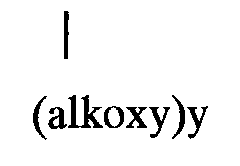 wherein R is a hydrocarbyl group, usually of 2-6 carbon atoms; R1 may be a C1-C20 hydrocarbon; the alkoxy groups are ethoxy, propoxy, and the like, and y is from 2 to 30, most preferably from 7 to 20; n is an integer of at least 2, preferably from 2 to 40, most preferably from 2 to 5; and X- is an anion such as halide or methylsulfate, resulting from the quaternization reaction.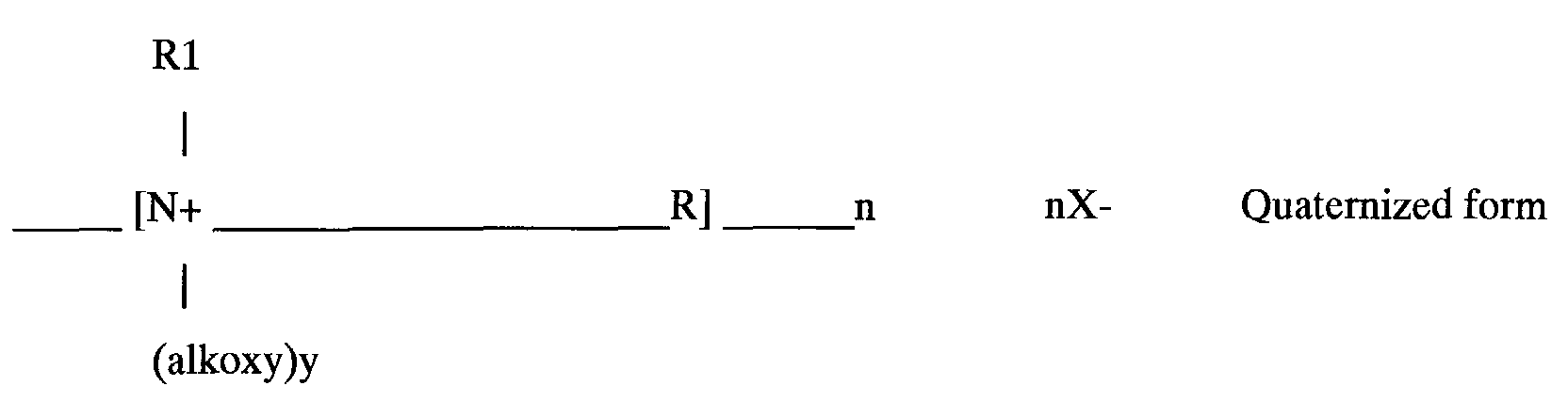
- Highly preferred polyamines for use herein are the so-called ethoxylated polyethylene amines, i.e., the polymerized reaction product of ethylene oxide with ethyleneimine, having the general formula :wherein y is from 2 to 50, preferably from 5 to 30, and n is from 1 to 40, preferably from 2 to 40. Particularly preferred for use herein is an ethoxylated polyethylene amine, in particular an ethoxylated polyethylene amine wherein n=2 and y=20, and an ethoxylated polyethylene amine wherein n=40 and y=7.

- Suitable ethoxylated polyethylene amines are commercially available from Nippon Shokubai CO., LTD under the product names ESP-0620A® (ethoxylated polyethylene amine wherein n=2 and y=20) or from BASF under the product names ES-8165 and from BASF under the product name LUTENSIT K - 187/50@ (ethoxylated polyethylene amine wherein n=40 and y=7).
- Furthermore, highly preferred polyamines for use herein are the so-called ethoxylated polyethylene quaternized amines having the general formula :wherein y is from 2 to 50, preferably from 5 to 30, and n is from 1 to 40, preferably from 2 to 40 and R1 and R2 are independently a C1-C20 hydrocarbon. Particularly preferred for use herein is an ethoxylated polyethylene amine, in particular an ethoxylated polyethylene amine wherein n=2 and y=20, and an ethoxylated polyethylene amine wherein n=40 and y=7.

- Particularly preferred herein is 24-Ethoxylated Hexamethylene Diamine Quaternized methyl chloride (EHDQ), commercially available from BASF under the trade name Lutensit K-HD 96®.
- An optional ingredient for use herein is an alkoxylated benzoic acid or a salt thereof.
- Generally, the alkoxylated benzoic acid or the salt thereof has the general formula :wherein : the substituents of the benzene ring X and Y are independently selected from -H, or -OR'; R' is independently selected from C1 to C20 linear or branched alkyl chains.
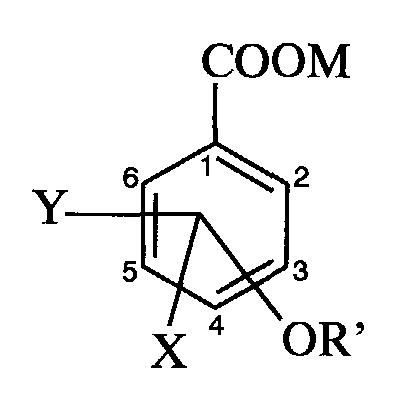
- In a highly preferred embodiment of the present invention, said alkoxylated benzoic acid or the salt thereof is a trimethoxy benzoic acid or a salt thereof (TMBA), wherein in the above general formula : the substituents of the benzene ring Y and X are -OR'; R' is -CH3 and; M is hydrogen, a cation or a cationic moiety.
- Suitable alkoxylated benzoic acids or salts thereof are commercially available from Aldrich and Merck.
- Typically, the composition according to the present invention may comprise from 0.001% to 5%, preferably from 0.005% to 2.5% and more preferably from 0.01% to 1.0% by weight of the total composition of said alkoxylated benzoic acid or a salt thereof.
- An optional ingredient for use herein is a chelating agent. Suitable chelating agents may be any of those known to those skilled in the art, such as the ones selected from the group comprising phosphonate chelating agents, amino carboxylate chelating agents, other carboxylate chelating agents, polyfunctionally-substituted aromatic chelating agents, ethylenediamine N,N'-disuccinic acids, or mixtures thereof.
- Suitable phosphonate chelating agents to be used herein may include alkali metal ethane 1-hydroxy diphosphonates (HEDP), alkylene poly (alkylene phosphonate), as well as amino phosphonate compounds, including amino aminotri(methylene phosphonic acid) (ATMP), nitrilo trimethylene phosphonates (NTP), ethylene diamine tetra methylene phosphonates, and diethylene triamine penta methylene phosphonates (DTPMP). The phosphonate compounds may be present either in their acid form or as salts of different cations on some or all of their acid functionalities. Preferred phosphonate chelating agents are commercially available from Monsanto under the trade name DEQUEST®.
- Polyfunctionally-substituted aromatic chelating agents may also be useful in the compositions herein. See U.S. patent 3,812,044, issued May 21, 1974, to Connor et al. Preferred compounds of this type in acid form are dihydroxydisulfobenzenes such as 1,2-dihydroxy -3,5-disulfobenzene.
- A preferred biodegradable chelating agent for use herein is ethylene diamine N,N'- disuccinic acid, or alkali metal, or alkaline earth, ammonium or substitutes ammonium salts thereof or mixtures thereof. Ethylenediamine N,N'- disuccinic acids, especially the (S,S) isomer, have been extensively described in US patent 4, 704, 233, November 3, 1987, to Hartman and Perkins. Ethylenediamine N,N'- disuccinic acid is commercially available as ssEDDS® from Palmer Research Laboratories.
- Suitable amino carboxylates to be used herein include ethylene diamine tetra acetates, diethylene triamine pentaacetates, diethylene triamine pentaacetate (DTPA),N-hydroxyethylethylenediamine triacetates, nitrilotri-acetates, ethylenediamine tetrapropionates, triethylenetetraaminehexa-acetates, ethanol-diglycines, propylene diamine tetracetic acid (PDTA) and methyl glycine di-acetic acid (MGDA), both in their acid form, or in their alkali metal, ammonium, and substituted ammonium salt forms. Particularly suitable amino carboxylates to be used herein are diethylene triamine penta acetic acid, propylene diamine tetracetic acid (PDTA) which is, for instance, commercially available as Trilon FS® from BASF and methyl glycine di-acetic acid (MGDA).
- Further carboxylate chelating agents to be used herein include salicylic acid, aspartic acid, glutamic acid, glycine, malonic acid or mixtures thereof.
- Another chelating agent for use herein is of the formula:wherein R1, R2, R3, and R4 are independently selected from the group consisting of -H, alkyl, alkoxy, aryl, aryloxy, -Cl, -Br, -NO2, -C(O)R', and -SO2R"; wherein R' is selected from the group consisting of -H, -OH, alkyl, alkoxy, aryl, and aryloxy; R" is selected from the group consisting of alkyl, alkoxy, aryl, and aryloxy; and R5, R6, R7, and R8 are independently selected from the group consisting of -H and alkyl.

- Particularly preferred chelating agents to be used herein are amino aminotri(methylene phosphonic acid), di-ethylene-triamino-pentaacetic acid, diethylene triamine penta methylene phosphonate, 1-hydroxy ethane diphosphonate, ethylenediamine N, N'-disuccinic acid, and mixtures thereof.
- Typically, the compositions according to the present invention may comprise up to 5%, preferably from 0.01% to 1.5% by weight and more preferably from 0.01% to 0.5% by weight of the total composition of a chelating agent.
- The compositions herein may further comprise a variety of optional ingredients such as thickeners, builders, stabilisers, soil suspenders, sulphonated hydrotropes, foam reducing systems or agents, catalysts, dye transfer agents, brighteners, perfumes, solvents, pigments and dyes.
- The liquid composition of the present invention is used by contacting fabrics with said composition in neat form or in diluted form.
- The compositions according to the present invention are typically used in diluted form in a laundry operation. By "in diluted form" it is meant herein that the compositions according to the present invention may be diluted with a solvent by the user, preferably with water. Such dilution may occur for instance in soaking applications as well as by other means such as in a washing machine. Said compositions may be used at a dilution level of up to 1500:1 (solvent: composition), preferably from 5:1 to 1000:1 and more preferably from 10:1 to 700:1 (solvent: composition).
- By "in neat form", it is to be understood that the liquid compositions are applied directly onto the fabrics to be treated without undergoing any dilution, i.e., the liquid compositions herein are applied onto the fabrics as described herein.
- Fabrics to be treated herein include, but are not limited to, clothes, curtains, drapes, bed linens, bath linens, tablecloths, sleeping bags and/or tents.
- By "treating a fabric", it is meant herein cleaning said fabric.
- Depending on the product form as described herein above in the section "Product form" it may be necessary to combine the liquid compositions herein with a peroxygen bleach-containing composition prior and/or during the process of treating fabrics as described herein. Furthermore, for practical reasons it may occur that certain product forms are less suitable for certain treatment modes as described herein below. Indeed, water-soluble pouches, multiple compartment products containing non-liquid peroxygen-bleach-containing compositions may be less suitable for use in the below detailed pretreatment mode.
- In the process of treating (e.g., cleaning and/or bleaching) a fabric, a liquid composition according to the present invention is contacted with the fabrics to be treated.
- This can be done either in a so-called "pretreatment mode", where a liquid composition, as defined herein, is applied neat onto said fabrics before the fabrics are washed or in a "soaking mode" where a liquid composition, as defined herein, is first diluted in an aqueous bath and the fabrics are immersed and soaked in the bath, before they are washed, or in a "through-the-wash mode", where a liquid composition, as defined herein, is added in addition to a wash liquor formed by dissolution or dispersion of a conventional laundry detergent, preferably in a washing machine.
- In the process herein, said fabrics are to be washed, i.e., treated with a conventional laundry detergent, preferably comprising at least one surface active agent, the washing of said fabrics with a conventional laundry detergent may be conducted before the step of contacting said fabrics with the composition herein and/or during the step of contacting fabrics are contacted with the composition herein and/or after the step where said fabrics are contacted with the composition herein.
- In a preferred embodiment, the washing step according to the present invention is performed in a washing machine. The conventional detergent composition may be delivered into the washing machine either by charging the dispenser drawer of the washing machine with the detergent or by directly charging the drum of the washing machine with the detergent.
- By "conventional laundry detergent" it is meant herein, a laundry detergent composition, preferably a powder, liquid or tablet composition, currently available on the market. Preferably, said conventional laundry detergent comprises at least one surface active agent. Suitable laundry detergent compositions are for example DASH futur®, DASH essential®, DASH liquid®, ARIEL tablets® and other products sold under the trade names ARIEL® or TIDE®.
- The following Examples are meant to exemplify compositions used in a process according to the present invention but are not necessarily used to limit or otherwise define the scope of the present invention. The compositions are made by combining the listed ingredients in the listed proportions (weight % unless otherwise specified).
Examples I II III IV V Marlipa124.7® 5.0 3.0 3.0 4.0 5.0 C12 Alkyl sulphate 0.0 2.9 0.0 0.0 0.0 Neodol 91.8® 0.0 1.0 0.0 1.0 0.0 Neodol 45.7® 0.0 0.0 1.5 0.0 0.0 Sokalan CP5® 3.5 3.5 3.0 3.5 3.5 Xanthan Gum 0.0 0.5 0.4 0.5 0.5 Acusol 425® 1.0 1.5 1.0 1.0 1.0 Triacetin 6.0 5.0 5.5 6.0 0.0 TAED 0.0 0.0 0.0 0.0 5.0 Trioctanoin 4.0 3.0 3.5 4.0 4.0 Lipophilic Bleach Booster* 0.1 0.0 0.1 0.1 0.1 Water and minors ------------------up to 100%-------------------- All examples have a pH of 7 - Example compositions I-V are so-called activator compositions to be used in conjunction with a separate peroxygen bleach-containing composition or in a multiple compartment product.
Examples VI VII VIII IX Hydrogen peroxide 7.0 7.0 7.5 6.5 Marlipal 24.7® 9.0 5.0 6.0 7.0 Neodol 91.8® 0.0 2.0 3.0 1.0 Neodol 45.7® 0.0 2.0 0.0 1.0 Sokalan CP5® 3.5 3.0 3.0 3.5 Lutensit KHD-96® 6.0 5.0 6.0 6.0 Xanthan Gum 0.0 0.5 0.5 0.5 Acusol 425® 1.0 1.5 1.0 1.0 Triacetin 6.0 0.0 0.0 6.0 TAED 0.0 5.0 5.0 0.0 Trioctanoin 4.0 4.0 4.0 4.0 Lipophilic Bleach Booster* 0.1 0.1 0.1 0.0 Water and minors -----up to 100%-------------- All examples have a pH of below 9 - Example compositions VI-IX are activated bleaching compositions wherein the bleach activators herein are separated from the peroxygen bleach. The separation is by means of forming an oil-in-water or water-in-oil emulsion wherein the hydrogen peroxide is in the water phase of the emulsion.
Examples X XI XII XIII Sodium Percarbonate 30 25 35 35 NaLAS 1.7 1.7 1.7 1.7 Sodium Sulfate 14.7 14.7 14.7 14.7 Sokalan CP5® 2.9 2.9 2.9 2.9 Lutensit KHD-96® 5.0 6.0 5.0 6.0 Zeolite 15.2 15.2 15.2 15.2 TAED 6.3 5.0 6.0 5.0 Trioctanoin 4.0 4.5 4.0 4.0 Lipophilic Bleach Booster* 0.1 0.1 0.0 0.1 Sodium Carbonate and minors -----up to 100%----- - Examples X-XIII describe solid bleaching compositions wherein the wherein the liquid composition comprising a long chain glycerol-based, hydrophobic bleach activator and a hydrophilic bleach activator according to the present invention is applied to, preferably sprayed onto, a solid composition.
Examples XIV XV XVI XVII Compartment 1 Triacetin 6.0 6.5 6.0 6.0 Trioctanoin 4.0 4.5 4.0 4.0 Marlipal 24.7® 5.0 5.0 0.0 2.0 Neodol 91.8® 0.0 0.0 3.0 2.0 Neodol 45.7® 0.0 0.0 2.0 1.0 C12 Alkyl sulphate 2.9 2.9 0.0 2.0 Sokalan CP5® 3.5 3.5 3.5 3.5 Acusol 425® 1.0 1.0 1.0 1.0 Xanthan Gum 0.5 0.5 0.5 0.5 Lipophilic Bleach Booster* 0.1 0.2 0.1 0.1 Water and minors -----up to 100%----- Compositions in Compartment 1 have a pH of 7 -
Hydrogen peroxide 8.0 7.9 7.9 8.0 Marlipal 24.7® 9.0 9.0 7.0 7.0 Lutensit KHD-96® 6.0 5.0 5.0 6.0 Water and minors -------------up to 100%----- Compositions in Compartment 2 have a pH of 4 - Example compositions XIV-XVIII are packed in a dual compartment bottle, such as shown in EP-A-744 462, thereby the activators are physically separated from the hydrogen peroxide.
- Marlipal® 24.7 is a linear C12-C14 EO7 nonionic surfactant commercially available from Condea.
Dobanol® 45-7 is a C14-C15 EO7 nonionic surfactant, Dobanol® 91-8 is a C9-C11 EO8 nonionic surfactant, Neodol 23.3® is a C12-C13 EO3 nonionic surfactant and Neodol 45.7® is a C14-C15 EO7 nonionic surfactant, all are commercially available from SHELL.
Acusol 425® is a modified polycarboxylate co-builder commercially available from Rohm & Haas.
Na LAS is a Sodium Linear Alky Benzene Sulphonate.
TAED is tetracetyl ethylene diamine.
Lutensit KHD-96® is 24-Ethoxylated Hexamethylene Diamine Quaternized methyl chloride commercially available from BASF.
Lipophilic Bleach Booster* is Sulfuric acid mono-[2-(3,4-dihydro-isoquinolin-2-yl)-1-(2-ethylhexyloxymethyl)-ethyl] ester.
Sokalan CP5® is an acrylic acid/maleic acid copolymer commercially available from BASF.
Claims (15)
- A liquid composition comprising a long chain glycerol-based, hydrophobic bleach activator and a hydrophilic bleach activator.
- A liquid composition according to claim 1, wherein the generated peracid or mixture thereof, generated by said long chain glycerol-based, hydrophobic bleach activator herein has an HLB of at utmost 7.5, more preferably of from 2 to 7.5, even more preferably of from 3 to 7.5 and most preferably of from 4 to 7.
- A liquid composition according to any of the preceding claims, wherein said long chain glycerol-based, hydrophobic bleach activator is according to the formula:wherein R is a linear or branched, saturated or unsaturated alkyl chain with a number of carbon atoms between 5 and 20, or a linear or branched, saturated or unsaturated alkyl aryl chain with a number of carbon atoms between 9 and 20 and wherein R' and R" are independently -H or -COR"', with R"' being a linear or branched, saturated or unsaturated alkyl chain with a number of carbon atoms between 5 and 20, or a linear or branched, saturated or unsaturated alkyl aryl chain with a number of carbon atoms between 9 and 20.

- A liquid composition according to any of the preceding claims, wherein said long chain glycerol-based, hydrophobic bleach activator herein is selected from the group consisting of: triesanoin; mono- di- or trioctanoin; mono- di- or tridecanoin; and mono-di- or trilaurin and mixtures thereof.
- A liquid composition according to any of the preceding claims, wherein the generated peracid or mixture thereof, generated by said hydrophilic bleach activator herein have an HLB of more than 7.5, more preferably of from 7.6 to 15, even more preferably of from 8 to 15 and most preferably of from 8.5 to 12.
- A liquid composition according to any of the preceding claims, wherein said hydrophilic bleach activator is selected from the group consisting of: short chain glycerol-based activator, tetracetyl ethylene diamine (TAED), acetyl triethyl citrate (ATC) and mixtures thereof.
- A liquid composition according to any of the preceding claims, wherein said hydrophilic bleach activator is a short chain glycerol-based activator preferably according to the formula:wherein R is a linear or branched, saturated or unsaturated alkyl chain with a number of carbon atoms up to 4, or a linear or branched, saturated or unsaturated alkyl aryl chain with a number of carbon atoms up to 6 and wherein R' and R" are independently -H or -COR"', with R"' being a linear or branched, saturated or unsaturated alkyl chain with a number of carbon atoms up to 4, or a linear or branched, saturated or unsaturated alkyl aryl chain with a number of carbon atoms up to 6.

- A liquid composition according to claim 7, wherein short chain glycerol-based activator herein is selected from the group consisting of: mono-, di- or triacetin, mono-, di- or tripropanoin, mono-, di- or tributanoin and mixtures thereof.
- A liquid composition according to any of the preceding claims, wherein said liquid composition additionally comprises a lipophilic bleach booster or a mixture thereof.
- A liquid composition according to claim 9, wherein said lipophilic bleach booster is selected from the group consisting of : cationic imines, zwitterionic imines, anionic imines and polyionic imines, all having a net charge of from +3 to -3, and mixtures thereof.
- A liquid composition according to claim 9, wherein said lipophilic bleach booster is selected from the group consisting of : 3-(3,4-Dihydroisoquinolinium)propane sulfonate (DIPS), Sulfuric acid mono-[2-(3,4-dihydro-isoquinolin-2-yl)-1-(2-ethylhexyloxymethyl)-ethyl] ester, and Sulfuric acid mono-[1-(3,4-dihydro-isoquinolin-2-yl)-decan-2-yl] ester, and mixtures thereof.
- A liquid composition according to any of the preceding claims, wherein said liquid composition is used as a stand-alone activator composition for use with a composition comprising a peroxygen bleach.
- A liquid composition according to any of claims 1 to 11, wherein said liquid composition additionally comprises a peroxygen bleach.
- A liquid composition according to any of claims 1 to 11, wherein said liquid composition forms part of a product or kit that additionally comprises a second composition comprising a peroxygen bleach.
- A solid composition wherein a liquid composition according to any of claims 1 to 11 is combined with and/or applied to, preferably sprayed onto, a solid, preferably powder, composition.
Priority Applications (6)
| Application Number | Priority Date | Filing Date | Title |
|---|---|---|---|
| ES03077146T ES2306838T3 (en) | 2003-07-08 | 2003-07-08 | LIQUID ACTIVATING COMPOSITION. |
| DE60320778T DE60320778D1 (en) | 2003-07-08 | 2003-07-08 | Liquid bleach activator composition |
| EP03077146A EP1496104B1 (en) | 2003-07-08 | 2003-07-08 | Liquid activator composition |
| AT03077146T ATE394464T1 (en) | 2003-07-08 | 2003-07-08 | LIQUID BLEACH ACTIVATOR COMPOSITION |
| PCT/US2004/022161 WO2005005590A1 (en) | 2003-07-08 | 2004-07-08 | Liquid activator composition |
| US10/887,037 US20050008526A1 (en) | 2003-07-08 | 2004-07-08 | Liquid activator composition |
Applications Claiming Priority (1)
| Application Number | Priority Date | Filing Date | Title |
|---|---|---|---|
| EP03077146A EP1496104B1 (en) | 2003-07-08 | 2003-07-08 | Liquid activator composition |
Publications (2)
| Publication Number | Publication Date |
|---|---|
| EP1496104A1 true EP1496104A1 (en) | 2005-01-12 |
| EP1496104B1 EP1496104B1 (en) | 2008-05-07 |
Family
ID=33442807
Family Applications (1)
| Application Number | Title | Priority Date | Filing Date |
|---|---|---|---|
| EP03077146A Expired - Lifetime EP1496104B1 (en) | 2003-07-08 | 2003-07-08 | Liquid activator composition |
Country Status (6)
| Country | Link |
|---|---|
| US (1) | US20050008526A1 (en) |
| EP (1) | EP1496104B1 (en) |
| AT (1) | ATE394464T1 (en) |
| DE (1) | DE60320778D1 (en) |
| ES (1) | ES2306838T3 (en) |
| WO (1) | WO2005005590A1 (en) |
Cited By (1)
| Publication number | Priority date | Publication date | Assignee | Title |
|---|---|---|---|---|
| WO2011127102A1 (en) * | 2010-04-06 | 2011-10-13 | The Procter & Gamble Company | Optimized release of bleaching systems in laundry detergents |
Families Citing this family (71)
| Publication number | Priority date | Publication date | Assignee | Title |
|---|---|---|---|---|
| US7550420B2 (en) * | 2005-04-29 | 2009-06-23 | E. I. Dupont De Nemours And Company | Enzymatic production of peracids using perhydrolytic enzymes |
| US7612030B2 (en) * | 2005-04-29 | 2009-11-03 | E. I. Du Pont De Nemours And Company | Enzymatic production of peracids using perhydrolytic enzymes |
| KR101137327B1 (en) * | 2005-05-06 | 2012-04-19 | 엘지전자 주식회사 | Method of transmitting control information for uplink channel scheduling and method of scheduling uplink channel |
| US7723083B2 (en) * | 2005-12-13 | 2010-05-25 | E.I. Du Pont De Nemours And Company | Production of peracids using an enzyme having perhydrolysis activity |
| US8518675B2 (en) | 2005-12-13 | 2013-08-27 | E. I. Du Pont De Nemours And Company | Production of peracids using an enzyme having perhydrolysis activity |
| US7964378B2 (en) * | 2005-12-13 | 2011-06-21 | E.I. Du Pont De Nemours And Company | Production of peracids using an enzyme having perhydrolysis activity |
| US8288136B2 (en) | 2005-12-13 | 2012-10-16 | E. I. Du Pont De Nemours And Company | Production of peracids using an enzyme having perhydrolysis activity |
| US7951566B2 (en) * | 2005-12-13 | 2011-05-31 | E.I. Du Pont De Nemours And Company | Production of peracids using an enzyme having perhydrolysis activity |
| US9668476B2 (en) * | 2006-02-23 | 2017-06-06 | Lanxess Corporation | Removable antimicrobial coating compositions and methods of use |
| US7473658B2 (en) * | 2006-11-13 | 2009-01-06 | E. I. Du Pont Nemours And Company | Partially fluorinated amino acid derivatives as gelling and surface active agents |
| JP5504268B2 (en) | 2008-08-13 | 2014-05-28 | イー・アイ・デュポン・ドウ・ヌムール・アンド・カンパニー | Control of enzymatic peracid production |
| WO2010039958A1 (en) | 2008-10-03 | 2010-04-08 | E.I. Dupont De Nemours And Company | Improved perhydrolases for enzymatic peracid generation |
| US20110177146A1 (en) | 2009-07-27 | 2011-07-21 | E. I. Du Pont De Nemours And Company | Removable antimicrobial coating compositions containing cationic rheology agent and methods of use |
| AU2010281409B2 (en) | 2009-07-27 | 2014-08-14 | The Chemours Company Fc, Llc | Enzymatic in situ preparation of peracid-based removable antimicrobial coating compositions and methods of use |
| US20110182959A1 (en) | 2009-07-27 | 2011-07-28 | E.I. Du Pont De Nemours And Company. | Removable antimicrobial coating compositions containing acid-activated rheology agent and methods of use |
| US20110177145A1 (en) | 2009-07-27 | 2011-07-21 | E.I. Du Pont De Nemours And Company | In situ preparation of peracid-based removable antimicrobial coating compositions and methods of use |
| US20110177148A1 (en) * | 2009-07-27 | 2011-07-21 | E. I. Du Pont De Nemours And Company | Enzymatic in situ preparation of peracid-based removable antimicrobial coating compositions and methods of use |
| US8222012B2 (en) | 2009-10-01 | 2012-07-17 | E. I. Du Pont De Nemours And Company | Perhydrolase for enzymatic peracid production |
| US7932072B1 (en) | 2009-12-07 | 2011-04-26 | E. I. Du Pont De Nemours And Company | Perhydrolase providing improved peracid stability |
| US7960528B1 (en) | 2009-12-07 | 2011-06-14 | E. I. Du Pont De Nemours And Company | Perhydrolase providing improved peracid stability |
| US7927854B1 (en) | 2009-12-07 | 2011-04-19 | E. I. Du Pont De Nemours And Company | Perhydrolase providing improved peracid stability |
| US7923233B1 (en) | 2009-12-07 | 2011-04-12 | E. I. Du Pont De Nemours And Company | Perhydrolase providing improved peracid stability |
| US7910347B1 (en) | 2009-12-07 | 2011-03-22 | E. I. Du Pont De Nemours And Company | Perhydrolase providing improved peracid stability |
| WO2011119714A1 (en) | 2010-03-26 | 2011-09-29 | E.I. Dupont De Nemours And Company | Perhydrolase providing improved specific activity |
| EP2553092B1 (en) | 2010-03-26 | 2014-04-23 | E.I. Du Pont De Nemours And Company | Process for the purification of proteins |
| WO2011119708A1 (en) | 2010-03-26 | 2011-09-29 | E.I. Dupont De Nemours And Company | Perhydrolase providing improved specific activity |
| WO2011119706A1 (en) | 2010-03-26 | 2011-09-29 | E.I. Dupont De Nemours And Company | Perhydrolase providing improved specific activity |
| WO2011119710A1 (en) | 2010-03-26 | 2011-09-29 | E.I. Dupont De Nemours And Company | Perhydrolase providing improved specific activity |
| WO2011119712A1 (en) | 2010-03-26 | 2011-09-29 | E.I. Dupont De Nemours And Company | Perhydrolase providing improved specific activity |
| BR112013015459B8 (en) | 2010-12-20 | 2018-06-12 | Du Pont | peracid generation method, oral care product and composition |
| WO2012087966A2 (en) | 2010-12-20 | 2012-06-28 | E. I. Du Pont De Nemours And Company | Targeted perhydrolases |
| WO2012087788A1 (en) | 2010-12-21 | 2012-06-28 | E.I. Dupont De Nemours And Company | Perhydrolase variant providing improved specific activity |
| US8389259B2 (en) | 2010-12-21 | 2013-03-05 | E.I. Du Pont De Nemours And Company | Perhydrolase variant providing improved specific activity |
| WO2012087790A1 (en) | 2010-12-21 | 2012-06-28 | E.I. Dupont De Nemours And Company | Perhydrolase variant providing improved specific activity |
| US8394616B2 (en) | 2010-12-21 | 2013-03-12 | E.I. Du Pont De Nemours And Company | Perhydrolase variant providing improved specific activity |
| WO2012087785A1 (en) | 2010-12-21 | 2012-06-28 | E.I. Dupont De Nemours And Company | Perhydrolase variant providing improved specific activity |
| US8389256B2 (en) | 2010-12-21 | 2013-03-05 | E.I. Du Pont De Nemours And Company | Perhydrolase variant providing improved specific activity |
| WO2012087792A1 (en) | 2010-12-21 | 2012-06-28 | E.I. Dupont De Nemours And Company | Perhydrolase variant providing improved specific activity |
| WO2012087786A1 (en) | 2010-12-21 | 2012-06-28 | E.I. Dupont De Nemours And Company | Perhydrolase variant providing improved specific activity |
| ES3053941T3 (en) | 2010-12-29 | 2026-01-28 | Ecolab Usa Inc | Generation of peroxycarboxylic acids at alkaline ph, and their use as textile bleaching and antimicrobial agents |
| WO2012090124A2 (en) * | 2010-12-29 | 2012-07-05 | Ecolab Usa Inc. | IN SITU GENERATION OF PEROXYCARBOXYLIC ACIDS AT ALKALINE pH, AND METHODS OF USE THEREOF |
| WO2012090125A2 (en) | 2010-12-29 | 2012-07-05 | Ecolab Usa Inc. | Sugar ester peracid on-site generator and formulator |
| US8956843B2 (en) | 2011-10-25 | 2015-02-17 | E. I. Du Pont De Nemours And Company | Perhydrolase variant providing improved specific activity |
| WO2013062885A1 (en) | 2011-10-25 | 2013-05-02 | E.I. Dupont De Nemours And Company | Perhydrolase variant providing improved specific activity |
| US8962294B2 (en) | 2011-10-25 | 2015-02-24 | E. I. Du Pont De Nemours And Company | Perhydrolase variant providing improved specific activity |
| US8546119B2 (en) | 2011-10-25 | 2013-10-01 | E. I. Du Pont De Nemours And Company | Perhydrolase variant providing improved specific activity |
| US8735125B2 (en) | 2011-10-25 | 2014-05-27 | E. I. Du Pont De Nemours And Company | Perhydrolase variant providing improved specific activity |
| US8546120B2 (en) | 2011-10-25 | 2013-10-01 | E. I. Du Pont De Nemours And Company | Perhydrolase variant providing improved specific activity |
| US8557556B2 (en) | 2011-10-25 | 2013-10-15 | E. I. Du Pont De Nemours And Company | Perhydrolase variant providing improved specific activity |
| US8486679B2 (en) | 2011-10-25 | 2013-07-16 | E. I. Du Pont De Nemours And Company | Perhydrolase variant providing improved specific activity |
| US8809030B2 (en) | 2011-10-25 | 2014-08-19 | E. I. Du Pont De Nemours And Company | Perhydrolase variant providing improved specific activity |
| HK1203401A1 (en) * | 2011-12-19 | 2015-10-30 | Colgate-Palmolive Company | System providing enzyme-catalyzed reaction |
| WO2013096045A1 (en) | 2011-12-19 | 2013-06-27 | E. I. Du Pont De Nemours And Company | Perhydrolase variants providing improved specific activity in the presence of surfactant |
| RU2607481C2 (en) | 2011-12-19 | 2017-01-10 | Колгейт-Палмолив Компани | System providing reaction catalyzed with perhydrolase |
| US9321664B2 (en) | 2011-12-20 | 2016-04-26 | Ecolab Usa Inc. | Stable percarboxylic acid compositions and uses thereof |
| MX2014011654A (en) | 2012-03-30 | 2014-10-24 | Du Pont | Enzymes useful for peracid production. |
| EP2831250B1 (en) | 2012-03-30 | 2021-11-24 | DuPont US Holding, LLC | Enzymes useful for peracid production |
| BR112014024216B1 (en) | 2012-03-30 | 2022-04-05 | E.I. Du Pont De Nemours And Company | Process for the production of a peroxycarboxylic acid, composition and system for generating and supplying peracid |
| JP6335874B2 (en) | 2012-03-30 | 2018-05-30 | イー・アイ・デュポン・ドウ・ヌムール・アンド・カンパニーE.I.Du Pont De Nemours And Company | Enzymes useful for peracid production |
| US8841098B2 (en) | 2012-03-30 | 2014-09-23 | E.I. Du Pont De Nemours And Company | Enzymes useful for peracid production |
| CN106396037B (en) | 2012-03-30 | 2019-10-15 | 艺康美国股份有限公司 | Peracetic acid/hydrogen peroxide and peroxide reducing agent are used to handle drilling fluid, fracturing fluid, recirculation water and the purposes for discharging water |
| US10165774B2 (en) | 2013-03-05 | 2019-01-01 | Ecolab Usa Inc. | Defoamer useful in a peracid composition with anionic surfactants |
| US8822719B1 (en) | 2013-03-05 | 2014-09-02 | Ecolab Usa Inc. | Peroxycarboxylic acid compositions suitable for inline optical or conductivity monitoring |
| US20140256811A1 (en) | 2013-03-05 | 2014-09-11 | Ecolab Usa Inc. | Efficient stabilizer in controlling self accelerated decomposition temperature of peroxycarboxylic acid compositions with mineral acids |
| CN117304086A (en) | 2014-12-18 | 2023-12-29 | 艺康美国股份有限公司 | Production of peroxyformic acid by polyol formates |
| US11040902B2 (en) | 2014-12-18 | 2021-06-22 | Ecolab Usa Inc. | Use of percarboxylic acids for scale prevention in treatment systems |
| WO2016100700A1 (en) | 2014-12-18 | 2016-06-23 | Ecolab Usa Inc. | Methods for forming peroxyformic acid and uses thereof |
| WO2019241635A1 (en) | 2018-06-15 | 2019-12-19 | Ecolab Usa Inc. | On site generated performic acid compositions for teat treatment |
| AU2019325568B2 (en) | 2018-08-22 | 2022-03-10 | Ecolab Usa Inc. | Hydrogen peroxide and peracid stabilization with molecules based on a pyridine carboxylic acid at C-3, -4 or -5 |
| US11185893B2 (en) | 2019-05-31 | 2021-11-30 | Ecolab Usa Inc. | Peracid compositions with conductivity monitoring capability |
| WO2021026410A1 (en) | 2019-08-07 | 2021-02-11 | Ecolab Usa Inc. | Polymeric and solid-supported chelators for stabilization of peracid-containing compositions |
Citations (3)
| Publication number | Priority date | Publication date | Assignee | Title |
|---|---|---|---|---|
| EP0563460A1 (en) * | 1992-04-03 | 1993-10-06 | The Procter & Gamble Company | Acidic activated bleaching composition |
| WO1994029509A1 (en) * | 1993-06-09 | 1994-12-22 | The Procter & Gamble Company | Process for the bleaching of fabrics |
| EP0751210A1 (en) * | 1995-06-27 | 1997-01-02 | The Procter & Gamble Company | Bleaching compositions |
Family Cites Families (14)
| Publication number | Priority date | Publication date | Assignee | Title |
|---|---|---|---|---|
| US2702279A (en) * | 1955-02-15 | Detergent compositions having | ||
| US2082275A (en) * | 1934-04-26 | 1937-06-01 | Gen Aniline Works Inc | Substituted betaines |
| US2255082A (en) * | 1938-01-17 | 1941-09-09 | Gen Aniline & Film Corp | Capillary active compounds and process of preparing them |
| US3812044A (en) * | 1970-12-28 | 1974-05-21 | Procter & Gamble | Detergent composition containing a polyfunctionally-substituted aromatic acid sequestering agent |
| GB8310081D0 (en) * | 1983-04-14 | 1983-05-18 | Interox Chemicals Ltd | Peroxygen compounds |
| US4704233A (en) * | 1986-11-10 | 1987-11-03 | The Procter & Gamble Company | Detergent compositions containing ethylenediamine-N,N'-disuccinic acid |
| US5431843A (en) * | 1991-09-04 | 1995-07-11 | The Clorox Company | Cleaning through perhydrolysis conducted in dense fluid medium |
| US5360569A (en) * | 1993-11-12 | 1994-11-01 | Lever Brothers Company, Division Of Conopco, Inc. | Activation of bleach precursors with catalytic imine quaternary salts |
| US5370826A (en) * | 1993-11-12 | 1994-12-06 | Lever Brothers Company, Division Of Conopco, Inc. | Quaternay oxaziridinium salts as bleaching compounds |
| EP0728182B1 (en) * | 1993-11-12 | 1997-09-03 | Unilever N.V. | Imine salts as bleach catalysts |
| US5360568A (en) * | 1993-11-12 | 1994-11-01 | Lever Brothers Company, Division Of Conopco, Inc. | Imine quaternary salts as bleach catalysts |
| US5718614A (en) * | 1995-08-28 | 1998-02-17 | Electro-Matic Products Company | Control apparatus for grinder |
| US5576282A (en) * | 1995-09-11 | 1996-11-19 | The Procter & Gamble Company | Color-safe bleach boosters, compositions and laundry methods employing same |
| MXPA04002579A (en) * | 2001-09-21 | 2004-06-18 | Procter & Gamble | Article of manufacture. |
-
2003
- 2003-07-08 ES ES03077146T patent/ES2306838T3/en not_active Expired - Lifetime
- 2003-07-08 EP EP03077146A patent/EP1496104B1/en not_active Expired - Lifetime
- 2003-07-08 AT AT03077146T patent/ATE394464T1/en not_active IP Right Cessation
- 2003-07-08 DE DE60320778T patent/DE60320778D1/en not_active Expired - Lifetime
-
2004
- 2004-07-08 WO PCT/US2004/022161 patent/WO2005005590A1/en not_active Ceased
- 2004-07-08 US US10/887,037 patent/US20050008526A1/en not_active Abandoned
Patent Citations (3)
| Publication number | Priority date | Publication date | Assignee | Title |
|---|---|---|---|---|
| EP0563460A1 (en) * | 1992-04-03 | 1993-10-06 | The Procter & Gamble Company | Acidic activated bleaching composition |
| WO1994029509A1 (en) * | 1993-06-09 | 1994-12-22 | The Procter & Gamble Company | Process for the bleaching of fabrics |
| EP0751210A1 (en) * | 1995-06-27 | 1997-01-02 | The Procter & Gamble Company | Bleaching compositions |
Cited By (2)
| Publication number | Priority date | Publication date | Assignee | Title |
|---|---|---|---|---|
| WO2011127102A1 (en) * | 2010-04-06 | 2011-10-13 | The Procter & Gamble Company | Optimized release of bleaching systems in laundry detergents |
| RU2569297C2 (en) * | 2010-04-06 | 2015-11-20 | Дзе Проктер Энд Гэмбл Компани | Detergents for washing with optimised release of bleaching systems |
Also Published As
| Publication number | Publication date |
|---|---|
| EP1496104B1 (en) | 2008-05-07 |
| ATE394464T1 (en) | 2008-05-15 |
| US20050008526A1 (en) | 2005-01-13 |
| ES2306838T3 (en) | 2008-11-16 |
| WO2005005590A1 (en) | 2005-01-20 |
| DE60320778D1 (en) | 2008-06-19 |
Similar Documents
| Publication | Publication Date | Title |
|---|---|---|
| EP1496104B1 (en) | Liquid activator composition | |
| US5106528A (en) | Bleach activation and bleaching compositions | |
| EP1010749A2 (en) | Activated liquid bleaching compositions | |
| JPH09316063A (en) | Ammonium nitrile compound and its use as bleaching activator | |
| EP0665876B1 (en) | Granular detergents with protease enzyme and bleach | |
| JP5863767B2 (en) | Optimized release of bleaching systems in laundry detergents | |
| JPH09511774A (en) | Bleaching composition containing a metal-containing bleaching catalyst and an antioxidant | |
| JP2001503460A (en) | Liquid aqueous bleaching composition and pretreatment method | |
| WO1994021605A1 (en) | Peroxyacids | |
| CZ403697A3 (en) | Anhydrous, solid particles containing liquid detergents with alkyl benzenesulfonate surface active agents | |
| JP2000502747A (en) | Washing pretreatment method and bleaching composition | |
| WO2012071153A1 (en) | Improved bleaching of food stains | |
| JPH10130692A (en) | Sulfonylimine derivative as bleaching catalyst | |
| US6120557A (en) | Use of aminonitrile N-oxides as bleach activators | |
| CA1207955A (en) | Bleaching compositions | |
| AU635381B2 (en) | Bleaching process and bleach compositions | |
| EP1001014B1 (en) | Bleaching compositions | |
| JP2000502763A (en) | Laundry bleaching method and composition | |
| KR19990028547A (en) | Peroxygen Bleach-Containing Pretreatment Composition with Polyamine Stabilizers to Improve Fabric / Color Safety | |
| WO1998011191A1 (en) | Peroxygen bleaching compositions comprising peroxygen bleach and atmp, suitable for use as a pretreater for fabrics | |
| WO2000027973A1 (en) | Processes of soaking fabrics | |
| KR20000036091A (en) | Laundry pretreatment process and bleaching compositions | |
| JPH1046194A (en) | Cyanopyridinium compound as bleaching activator | |
| CZ156399A3 (en) | Liquid aqueous preparation suitable for preliminary washing fabrics and process of bleaching contaminated fabrics | |
| WO2000012666A1 (en) | The use of an aliphatic-aromatic diacyl peroxide in a bleaching composition |
Legal Events
| Date | Code | Title | Description |
|---|---|---|---|
| PUAI | Public reference made under article 153(3) epc to a published international application that has entered the european phase |
Free format text: ORIGINAL CODE: 0009012 |
|
| AK | Designated contracting states |
Kind code of ref document: A1 Designated state(s): AT BE BG CH CY CZ DE DK EE ES FI FR GB GR HU IE IT LI LU MC NL PT RO SE SI SK TR |
|
| AX | Request for extension of the european patent |
Extension state: AL LT LV MK |
|
| 17P | Request for examination filed |
Effective date: 20050704 |
|
| AKX | Designation fees paid |
Designated state(s): AT BE BG CH CY CZ DE DK EE ES FI FR GB GR HU IE IT LI LU MC NL PT RO SE SI SK TR |
|
| GRAP | Despatch of communication of intention to grant a patent |
Free format text: ORIGINAL CODE: EPIDOSNIGR1 |
|
| GRAS | Grant fee paid |
Free format text: ORIGINAL CODE: EPIDOSNIGR3 |
|
| GRAA | (expected) grant |
Free format text: ORIGINAL CODE: 0009210 |
|
| AK | Designated contracting states |
Kind code of ref document: B1 Designated state(s): AT BE BG CH CY CZ DE DK EE ES FI FR GB GR HU IE IT LI LU MC NL PT RO SE SI SK TR |
|
| REG | Reference to a national code |
Ref country code: GB Ref legal event code: FG4D |
|
| REG | Reference to a national code |
Ref country code: CH Ref legal event code: EP |
|
| REG | Reference to a national code |
Ref country code: IE Ref legal event code: FG4D Free format text: LANGUAGE OF EP DOCUMENT: FRENCH |
|
| REF | Corresponds to: |
Ref document number: 60320778 Country of ref document: DE Date of ref document: 20080619 Kind code of ref document: P |
|
| PG25 | Lapsed in a contracting state [announced via postgrant information from national office to epo] |
Ref country code: SI Free format text: LAPSE BECAUSE OF FAILURE TO SUBMIT A TRANSLATION OF THE DESCRIPTION OR TO PAY THE FEE WITHIN THE PRESCRIBED TIME-LIMIT Effective date: 20080507 |
|
| PG25 | Lapsed in a contracting state [announced via postgrant information from national office to epo] |
Ref country code: NL Free format text: LAPSE BECAUSE OF FAILURE TO SUBMIT A TRANSLATION OF THE DESCRIPTION OR TO PAY THE FEE WITHIN THE PRESCRIBED TIME-LIMIT Effective date: 20080507 Ref country code: FI Free format text: LAPSE BECAUSE OF FAILURE TO SUBMIT A TRANSLATION OF THE DESCRIPTION OR TO PAY THE FEE WITHIN THE PRESCRIBED TIME-LIMIT Effective date: 20080507 |
|
| NLV1 | Nl: lapsed or annulled due to failure to fulfill the requirements of art. 29p and 29m of the patents act | ||
| REG | Reference to a national code |
Ref country code: ES Ref legal event code: FG2A Ref document number: 2306838 Country of ref document: ES Kind code of ref document: T3 |
|
| PG25 | Lapsed in a contracting state [announced via postgrant information from national office to epo] |
Ref country code: AT Free format text: LAPSE BECAUSE OF FAILURE TO SUBMIT A TRANSLATION OF THE DESCRIPTION OR TO PAY THE FEE WITHIN THE PRESCRIBED TIME-LIMIT Effective date: 20080507 |
|
| PG25 | Lapsed in a contracting state [announced via postgrant information from national office to epo] |
Ref country code: PT Free format text: LAPSE BECAUSE OF FAILURE TO SUBMIT A TRANSLATION OF THE DESCRIPTION OR TO PAY THE FEE WITHIN THE PRESCRIBED TIME-LIMIT Effective date: 20081007 Ref country code: DK Free format text: LAPSE BECAUSE OF FAILURE TO SUBMIT A TRANSLATION OF THE DESCRIPTION OR TO PAY THE FEE WITHIN THE PRESCRIBED TIME-LIMIT Effective date: 20080507 Ref country code: CZ Free format text: LAPSE BECAUSE OF FAILURE TO SUBMIT A TRANSLATION OF THE DESCRIPTION OR TO PAY THE FEE WITHIN THE PRESCRIBED TIME-LIMIT Effective date: 20080507 Ref country code: SE Free format text: LAPSE BECAUSE OF FAILURE TO SUBMIT A TRANSLATION OF THE DESCRIPTION OR TO PAY THE FEE WITHIN THE PRESCRIBED TIME-LIMIT Effective date: 20080807 |
|
| PG25 | Lapsed in a contracting state [announced via postgrant information from national office to epo] |
Ref country code: RO Free format text: LAPSE BECAUSE OF FAILURE TO SUBMIT A TRANSLATION OF THE DESCRIPTION OR TO PAY THE FEE WITHIN THE PRESCRIBED TIME-LIMIT Effective date: 20080507 Ref country code: BE Free format text: LAPSE BECAUSE OF FAILURE TO SUBMIT A TRANSLATION OF THE DESCRIPTION OR TO PAY THE FEE WITHIN THE PRESCRIBED TIME-LIMIT Effective date: 20080507 Ref country code: SK Free format text: LAPSE BECAUSE OF FAILURE TO SUBMIT A TRANSLATION OF THE DESCRIPTION OR TO PAY THE FEE WITHIN THE PRESCRIBED TIME-LIMIT Effective date: 20080507 |
|
| REG | Reference to a national code |
Ref country code: CH Ref legal event code: PL |
|
| PLBE | No opposition filed within time limit |
Free format text: ORIGINAL CODE: 0009261 |
|
| STAA | Information on the status of an ep patent application or granted ep patent |
Free format text: STATUS: NO OPPOSITION FILED WITHIN TIME LIMIT |
|
| PG25 | Lapsed in a contracting state [announced via postgrant information from national office to epo] |
Ref country code: MC Free format text: LAPSE BECAUSE OF NON-PAYMENT OF DUE FEES Effective date: 20080731 |
|
| 26N | No opposition filed |
Effective date: 20090210 |
|
| PG25 | Lapsed in a contracting state [announced via postgrant information from national office to epo] |
Ref country code: BG Free format text: LAPSE BECAUSE OF FAILURE TO SUBMIT A TRANSLATION OF THE DESCRIPTION OR TO PAY THE FEE WITHIN THE PRESCRIBED TIME-LIMIT Effective date: 20080807 Ref country code: EE Free format text: LAPSE BECAUSE OF FAILURE TO SUBMIT A TRANSLATION OF THE DESCRIPTION OR TO PAY THE FEE WITHIN THE PRESCRIBED TIME-LIMIT Effective date: 20080507 |
|
| PG25 | Lapsed in a contracting state [announced via postgrant information from national office to epo] |
Ref country code: CH Free format text: LAPSE BECAUSE OF NON-PAYMENT OF DUE FEES Effective date: 20080731 Ref country code: LI Free format text: LAPSE BECAUSE OF NON-PAYMENT OF DUE FEES Effective date: 20080731 |
|
| PG25 | Lapsed in a contracting state [announced via postgrant information from national office to epo] |
Ref country code: IE Free format text: LAPSE BECAUSE OF NON-PAYMENT OF DUE FEES Effective date: 20080708 |
|
| PG25 | Lapsed in a contracting state [announced via postgrant information from national office to epo] |
Ref country code: CY Free format text: LAPSE BECAUSE OF FAILURE TO SUBMIT A TRANSLATION OF THE DESCRIPTION OR TO PAY THE FEE WITHIN THE PRESCRIBED TIME-LIMIT Effective date: 20080507 Ref country code: LU Free format text: LAPSE BECAUSE OF NON-PAYMENT OF DUE FEES Effective date: 20080708 Ref country code: HU Free format text: LAPSE BECAUSE OF FAILURE TO SUBMIT A TRANSLATION OF THE DESCRIPTION OR TO PAY THE FEE WITHIN THE PRESCRIBED TIME-LIMIT Effective date: 20081108 |
|
| PG25 | Lapsed in a contracting state [announced via postgrant information from national office to epo] |
Ref country code: GR Free format text: LAPSE BECAUSE OF FAILURE TO SUBMIT A TRANSLATION OF THE DESCRIPTION OR TO PAY THE FEE WITHIN THE PRESCRIBED TIME-LIMIT Effective date: 20080808 |
|
| PGFP | Annual fee paid to national office [announced via postgrant information from national office to epo] |
Ref country code: ES Payment date: 20120719 Year of fee payment: 10 Ref country code: FR Payment date: 20120712 Year of fee payment: 10 |
|
| REG | Reference to a national code |
Ref country code: FR Ref legal event code: ST Effective date: 20140331 |
|
| PG25 | Lapsed in a contracting state [announced via postgrant information from national office to epo] |
Ref country code: FR Free format text: LAPSE BECAUSE OF NON-PAYMENT OF DUE FEES Effective date: 20130731 |
|
| REG | Reference to a national code |
Ref country code: ES Ref legal event code: FD2A Effective date: 20150709 |
|
| PG25 | Lapsed in a contracting state [announced via postgrant information from national office to epo] |
Ref country code: ES Free format text: LAPSE BECAUSE OF NON-PAYMENT OF DUE FEES Effective date: 20130709 |
|
| PGFP | Annual fee paid to national office [announced via postgrant information from national office to epo] |
Ref country code: TR Payment date: 20170622 Year of fee payment: 15 |
|
| PGFP | Annual fee paid to national office [announced via postgrant information from national office to epo] |
Ref country code: GB Payment date: 20170705 Year of fee payment: 15 Ref country code: DE Payment date: 20170705 Year of fee payment: 15 Ref country code: IT Payment date: 20170720 Year of fee payment: 15 |
|
| REG | Reference to a national code |
Ref country code: DE Ref legal event code: R119 Ref document number: 60320778 Country of ref document: DE |
|
| GBPC | Gb: european patent ceased through non-payment of renewal fee |
Effective date: 20180708 |
|
| PG25 | Lapsed in a contracting state [announced via postgrant information from national office to epo] |
Ref country code: GB Free format text: LAPSE BECAUSE OF NON-PAYMENT OF DUE FEES Effective date: 20180708 Ref country code: DE Free format text: LAPSE BECAUSE OF NON-PAYMENT OF DUE FEES Effective date: 20190201 |
|
| PG25 | Lapsed in a contracting state [announced via postgrant information from national office to epo] |
Ref country code: IT Free format text: LAPSE BECAUSE OF NON-PAYMENT OF DUE FEES Effective date: 20180708 |
|
| PG25 | Lapsed in a contracting state [announced via postgrant information from national office to epo] |
Ref country code: TR Free format text: LAPSE BECAUSE OF NON-PAYMENT OF DUE FEES Effective date: 20180708 |