EP1495752A1 - Composition tinctoriale liquide exempte d'acide gras et comprenant du 2-méthyl 1,3-propanediol, procédé de teinture et dispositif - Google Patents
Composition tinctoriale liquide exempte d'acide gras et comprenant du 2-méthyl 1,3-propanediol, procédé de teinture et dispositif Download PDFInfo
- Publication number
- EP1495752A1 EP1495752A1 EP04291746A EP04291746A EP1495752A1 EP 1495752 A1 EP1495752 A1 EP 1495752A1 EP 04291746 A EP04291746 A EP 04291746A EP 04291746 A EP04291746 A EP 04291746A EP 1495752 A1 EP1495752 A1 EP 1495752A1
- Authority
- EP
- European Patent Office
- Prior art keywords
- composition
- composition according
- methyl
- weight
- dye
- Prior art date
- Legal status (The legal status is an assumption and is not a legal conclusion. Google has not performed a legal analysis and makes no representation as to the accuracy of the status listed.)
- Granted
Links
Classifications
-
- A—HUMAN NECESSITIES
- A61—MEDICAL OR VETERINARY SCIENCE; HYGIENE
- A61K—PREPARATIONS FOR MEDICAL, DENTAL OR TOILETRY PURPOSES
- A61K8/00—Cosmetics or similar toiletry preparations
- A61K8/18—Cosmetics or similar toiletry preparations characterised by the composition
- A61K8/30—Cosmetics or similar toiletry preparations characterised by the composition containing organic compounds
- A61K8/33—Cosmetics or similar toiletry preparations characterised by the composition containing organic compounds containing oxygen
- A61K8/39—Derivatives containing from 2 to 10 oxyalkylene groups
-
- A—HUMAN NECESSITIES
- A61—MEDICAL OR VETERINARY SCIENCE; HYGIENE
- A61K—PREPARATIONS FOR MEDICAL, DENTAL OR TOILETRY PURPOSES
- A61K8/00—Cosmetics or similar toiletry preparations
- A61K8/18—Cosmetics or similar toiletry preparations characterised by the composition
- A61K8/30—Cosmetics or similar toiletry preparations characterised by the composition containing organic compounds
- A61K8/33—Cosmetics or similar toiletry preparations characterised by the composition containing organic compounds containing oxygen
- A61K8/34—Alcohols
-
- A—HUMAN NECESSITIES
- A61—MEDICAL OR VETERINARY SCIENCE; HYGIENE
- A61K—PREPARATIONS FOR MEDICAL, DENTAL OR TOILETRY PURPOSES
- A61K8/00—Cosmetics or similar toiletry preparations
- A61K8/18—Cosmetics or similar toiletry preparations characterised by the composition
- A61K8/30—Cosmetics or similar toiletry preparations characterised by the composition containing organic compounds
- A61K8/33—Cosmetics or similar toiletry preparations characterised by the composition containing organic compounds containing oxygen
- A61K8/34—Alcohols
- A61K8/345—Alcohols containing more than one hydroxy group
-
- A—HUMAN NECESSITIES
- A61—MEDICAL OR VETERINARY SCIENCE; HYGIENE
- A61Q—SPECIFIC USE OF COSMETICS OR SIMILAR TOILETRY PREPARATIONS
- A61Q5/00—Preparations for care of the hair
- A61Q5/10—Preparations for permanently dyeing the hair
Definitions
- a cream when it is mixed with an oxidizing composition, it must be able to be sufficiently fluid to allow a homogeneous mixture of the constituent elements of these two compositions and an easy application on the hair, without however losing too much viscosity, to avoid as far as possible that the composition does not flow out of the area to be colored.
- a support in liquid form must be able, once mixed with the composition oxidizing, result in a composition whose viscosity is higher to allow a application under appropriate conditions.
- the liquid carriers comprise a solvent chosen, for example, from alcohols and their ethers. If such supports make it possible to obtain dyeing compositions which, when mixed with oxidizing compositions, give good results, it is nevertheless desired to improve their performance even further. It has also been found that the presence of fatty acid soaps may result in inconvenience cosmetic or limit the pH range of use of the composition. Finally, in some cases, the dyeing compositions may have, at low temperature, a cloudy appearance, due to insufficient homogeneity of the composition. The consequence of this fact is that more or less long term, depending on the storage conditions, a phase shift of the dye composition is observed.
- the present invention therefore aims to propose dye compositions under liquid form for which we do not observe all these disadvantages and which allow to achieve color results always satisfactory or improved.
- Another subject of the invention consists of a process for dyeing keratinous fibers of applying the above-mentioned dye composition to said fibers and a oxidizing composition comprising at least one oxidizing agent, the oxidizing composition being mixed at the time of use with the dye composition or applied sequentially without intermediate rinsing.
- the dye composition according to the invention is storage stable in that its viscosity does not change significantly and that there is no phase shift in the weather.
- the content of 2-methyl-1,3-propanediol preferably represents from 0.5 to 20% by weight per relative to the weight of the dyeing composition. According to a particular embodiment of According to the invention, the content of 2-methyl-1,3-propanediol represents from 5 to 20% by weight per relative to the weight of the dye composition, and even more preferably from 10 to 18% by weight of the dyeing composition.
- couplers that may be present in the dyeing composition according to the invention, they are chosen more specifically from the couplers generally used in the field of dyeing human keratin fibers.
- couplers generally used in the field of dyeing human keratin fibers.
- pyrazolones indazoles, benzimidazoles, benzothiazoles, benzoxazoles, 1,3-benzodioxoles, quinolines and their addition salts with an acid or an alkaline agent.
- couplers are more particularly chosen from 2,4-diamino-1- ( ⁇ -hydroxyethyloxy) -benzene, 2-methyl-5-amino-phenol, 5-N- ( ⁇ -hydroxyethyl) amino-2-methyl-phenol, 3-amino-phenol, 2-chloro-3-amino-6-methylphenol, 1,3-dihydroxybenzene, 1,3-dihydroxy-2-methylbenzene, 4-chloro-1,3-dihydroxybenzene, 2-amino-4- ( ⁇ -hydroxyethylamino) -1-methoxybenzene, 1,3-diaminobenzene, 1,3-bis (2,4-diaminophenoxy) propane, sesamol, 1-amino-2-methoxy-4,5-methylenedioxybenzene, ⁇ -naphthol, 6-hydroxy-indole, 4-hydroxy-indole, 4-hydroxy-N-methyl indole, 6-hydroxy-indoline, 2,6-dihydroxy
- the dye composition according to the invention may further comprise at least one direct dye.
- This may be chosen from ionic compounds, preferably cationic, or nonionic compounds.
- ionic compounds preferably cationic, or nonionic compounds.
- dyes there may be mentioned in particular nitrobenzene dyes, azo dyes, anthraquinone, naphthoquinone or benzoquinone dyes, indigo dyes, or dyes derived from triarylmethane, alone or in mixtures.
- R-CONHCH 2 CH 2 N (R ') (R ") (CH 2 COO-) in which: R denotes an alkyl radical of an R-COOH acid present in the hydrolysed coconut oil, a heptyl radical, nonyl or undecyl, R 'denotes a ⁇ -hydroxyethyl group and R "a carboxymethyl group; and R "'- CONHCH 2 CH 2 -N (B) (C) wherein: B represents -CH 2 CH 2 OX', C represents - (CH 2 ) z -Y ', with z 1 or 2, X denotes the group -CH 2 CH 2 -COOH or a hydrogen atom, Y 'denotes -COOH or the radical -CH 2 -CHOH-SO 3 H, R "' denotes an alkyl radical of an acid R"' -COOH present in coconut oil or in hydrolyzed linseed oil, an alkyl radical more particularly C
- composition may also comprise one or more reducing agents or antioxidants selected, for example, from sodium sulphite, thioglycolic acid, thiolactic acid, sodium bisulphite, dehydroascorbic acid, hydroquinone, 2-methyl-hydroquinone, tert-butyl hydroquinone and homogentisic acid, or mixtures thereof.
- reducing agents or antioxidants selected, for example, from sodium sulphite, thioglycolic acid, thiolactic acid, sodium bisulphite, dehydroascorbic acid, hydroquinone, 2-methyl-hydroquinone, tert-butyl hydroquinone and homogentisic acid, or mixtures thereof.
- the pH of the ready-to-use composition varies more particularly between 4 and 11 and is adjusted, if necessary, by means of an acidifying or basifying agent.
- the ready-to-use composition is more particularly in the form of a composition of higher viscosity than that of the dyeing composition.
- the ready-to-use composition advantageously has the appearance of a gel.
- composition is prepared (The amounts are given in% of active material): oxyethylenated lauryl alcohol (3 EO) 6 oxyethylenated lauryl alcohol (2 EO) 4 oxyethylenated decyl alcohol (5 EO) 9 alkyl monoethanolamide (C13 / C15 70/30 50% linear) carboxylic ether (2 EO) 12 diethylaminopropyl lauryl amino succinamate, sodium salt in aqueous solution 2.5 96 degree denatured ethyl alcohol 4 Deodorized 2-methyl 1,3-propanediol 13 propylene glycol 5 1-methyl-2-hydroxy-4-amino-benzene 2.5 1,3-dihydroxybenzene (resorcinol) 0.01 1-hydroxy-4-amino-benzene 0.86 1,4-diamino-benzene 0.95 3-methyl-1-phenyl-5-pyrazolone 0.15 1-methyl-2-hydroxy-4-beta-hydroxyethylamino-benzen
- composition is prepared (The amounts are given in% of active material): polyglycerolated oleic alcohol (4 PG) 3.9 oxyethylenated decyl alcohol (3 EO) 8.1 oxyethylenated decyl alcohol (5 EO) 7.2 alkyl monoethanolamide (C13 / C15 70/30 50% linear) carboxylic ether (2 EO) 10 diethylaminopropyl lauryl amino succinamate, sodium salt in aqueous solution 2.5 Deodorized 2-methyl 1,3-propanediol 12 propylene glycol 10 1-methyl-2-hydroxy-4-amino-benzene 1.2 1,3-dihydroxybenzene (resorcinol) 0.094 1-hydroxy-4-amino-benzene 0.24 1,4-diamino-benzene 0.3 3-methyl-1-phenyl-5-pyrazolone 0.15 1-methyl-2-hydroxy-4-beta-hydroxyethylamino-benzene 0.18 6-hydroxyindo
Landscapes
- Health & Medical Sciences (AREA)
- Life Sciences & Earth Sciences (AREA)
- Animal Behavior & Ethology (AREA)
- General Health & Medical Sciences (AREA)
- Public Health (AREA)
- Veterinary Medicine (AREA)
- Emergency Medicine (AREA)
- Birds (AREA)
- Epidemiology (AREA)
- Cosmetics (AREA)
- Coloring (AREA)
- Organic Low-Molecular-Weight Compounds And Preparation Thereof (AREA)
Abstract
Description
Les supports liquides présentent en effet l'avantage d'être plus simples à conditionner, plus faciles d'utilisation, notamment l'opération de mélange avec une composition oxydante est facilitée.
De plus, de tels supports constituent une alternative intéressante à des supports de type crème qui peuvent poser, dans certains cas, des problèmes de stabilisation de la viscosité lors du stockage.
Si de tels supports permettent d'obtenir des compositions tinctoriales, qui une fois mélangées à des compositions oxydantes, donnent de bons résultats, il est toutefois souhaité d'en améliorer encore les performances.
Il a par ailleurs été constaté que la présence de savons d'acides gras pouvait avoir comme conséquence d'entraíner des désagréments cosmétiques ou encore de limiter la gamme de pH d'utilisation de la composition.
Enfin, dans certains cas, les compositions tinctoriales peuvent avoir, à basse température, un aspect trouble, dû à une homogénéité insuffisante de la composition. La conséquence de ce fait est qu'à plus ou moins long terme, selon les conditions de stockage, un déphasage de la composition tinctoriale est observé.
Enfin, les colorations obtenues avec la mise en oeuvre de telles compositions sont intenses, chromatiques, peu sélectives, et les propriétés cosmétiques des fibres résultantes ne sont pas dégradées de manière substantielle.
Plus particulièrement, au sens de l'invention, par composition sous forme liquide on désigne une composition qui, à une température de 25°C, sous 1 atmosphère, présente une viscosité d'au plus 150 cPs, mesurée avec un rhéomètre RhéoStress 1, sous un taux de cisaillement de 200 s-1.
Par acide gras, on entend les acides carboxyliques comprenant un radical hydrocarboné, saturé ou non, linéaire ou ramifié, comprenant 8 à 30 atomes de carbone, éventuellement porteur d'un ou plusieurs radicaux hydroxyles.
Par sel d'acide gras, on entend plus particulièrement les sels de métaux alcalins ou alcalino-terreux, des acides précités, comme les sels de sodium, de potassium, de magnésium.
Ainsi, les bases d'oxydation sont choisies parmi les orthophénylènediamines, les paraphénylènediamines, les bases doubles, les orthoaminophénols, les paraaminophénols, les bases hétérocycliques, ainsi que leurs sels d'addition avec un acide ou un agent alcalin, seuls ou en mélanges.
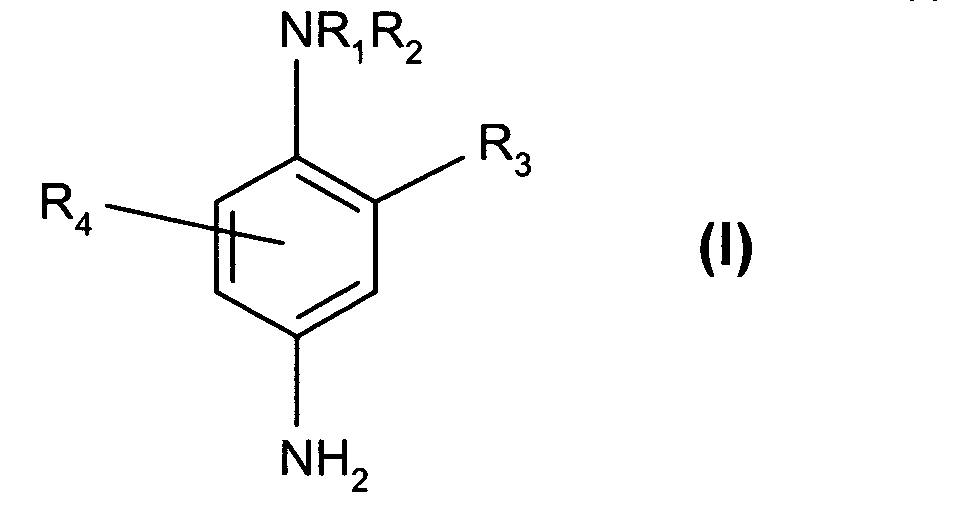
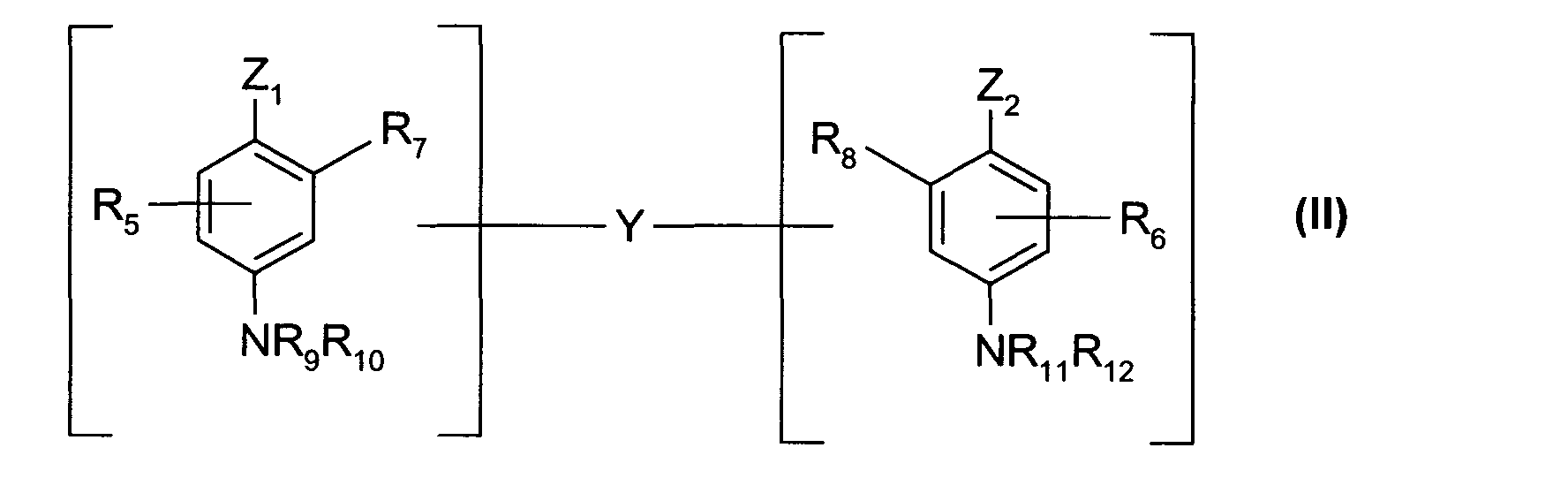
- Z1 et Z2, identiques ou différents, représentent un radical hydroxyle ou -NH2 pouvant être substitué par un radical alkyle en C1-C4 ou par un bras de liaison Y ;
- le bras de liaison Y représente une chaíne alkylène comportant de 1 à 14 atomes de carbone, linéaire ou ramifiée pouvant être interrompue ou terminée par un ou plusieurs groupements azotés et/ou par un ou plusieurs hétéroatomes tels que des atomes d'oxygène, de soufre ou d'azote, et éventuellement substituée par un ou plusieurs radicaux hydroxyle ou alcoxy en C1-C6 ;
- R5 et R6 représentent un atome d'hydrogène ou d'halogène, un radical alkyle en C1-C4, monohydroxyalkyle en C1-C4, polyhydroxyalkyle en C2-C4, aminoalkyle en C1-C4 ou un bras de liaison Y ;
- R7, R8, R9, R10, R11 et R12, identiques ou différents, représentent un atome d'hydrogène, un bras de liaison Y ou un radical alkyle en C1-C4 ;
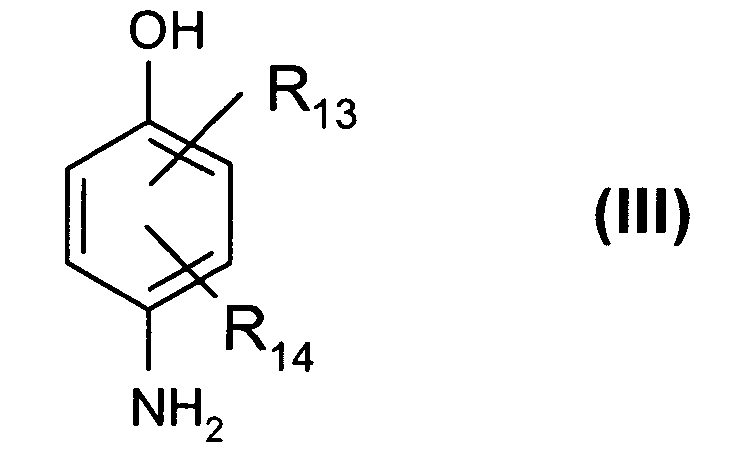
A titre d'exemples, on peut citer notamment les métaaminophénols, les métaphénylènediamines, les métadiphénols, les naphtols et les coupleurs hétérocycliques tels que par exemple les dérivés indoliques, les dérivés indoliniques, le sésamol et ses dérivés, les dérivés pyridiniques, les dérivés pyrazolotriazoles, les pyrazolones, les indazoles, les benzimidazoles, les benzothiazoles, les benzoxazoles, les 1,3-benzodioxoles, les quinolines et leurs sels d'addition avec un acide ou un agent alcalin.

A titre d'exemples de tels colorants, on peut notamment citer les colorants benzéniques nitrés, les colorants azoïques, les colorants anthraquinoniques, naphtoquinoniques ou benzoquinoniques, les colorants indigoïdes, ou les colorants dérivés du triarylméthane, seuls ou en mélanges.
A titre d'exemples, on peut citer sans intention de s'y limiter, les alcools gras polyalcoxylés ou polyglycérolés, les alpha-diols, les alkylphénols en C8-C18 polyalcoxylés, le nombre de groupements oxyde d'alkylène (oxyde d'éthylène et/ou oxyde de propylène) étant notamment compris entre 2 et 50, le nombre de groupements glycérol étant avantageusement compris enter 1 et 20.
On peut également citer les copolymères d'oxyde d'éthylène et de propylène, les condensats d'oxyde d'éthylène et de propylène sur des alcools gras ; les amides gras polyalcoxylés, ayant plus particulièrement de 2 à 30 moles d'oxyde d'alkylène, de préférence d'oxyde d'éthylène ; les amides gras polyglycérolés, comportant en moyenne 1 à 5 groupements glycérol et en particulier 1,5 à 4 ; les esters d'acides gras du sorbitan oxyéthylénés, ayant de 2 à 30 moles d'oxyde d'éthylène ; les esters d'acides gras du sucrose, les esters d'acides gras du polyéthylèneglycol, les alkylpolyglycosides, les dérivés de N-alkyl glucamine, les oxydes d'amines tels que les oxydes d'alkyl (C10-C14) amines ou les oxydes de N-acylaminopropylmorpholine.
Il est à noter que les composés gras précités comprennent habituellement un radical hydrocarboné en C7-C30, de préférence en C7-C18, linéaire ou ramifié, saturé ou non.
A titre d'exemple on peut citer le cocoamphodiacetate commercialisé sous la dénomination commerciale Miranol® C2M concentré par la société Rhodia Chimie.
Ainsi, parmi les agents acidifiants, on peut citer, sans intention de s'y limiter, les acides minéraux ou organiques comme l'acide chlorhydrique, l'acide orthophosphorique, l'acide sulfurique, les acides carboxyliques comme l'acide acétique, l'acide tartrique, l'acide citrique, l'acide lactique, les acides sulfoniques.
En ce qui concerne les agents alcalinisants on peut citer, à titre d'exemples, l'ammoniaque, les carbonates alcalins, les alcanolamines telles que les mono-, di- et triéthanolamines ainsi que leurs dérivés, les hydroxydes de sodium ou de potassium et les composés de formule (A) détaillée auparavant.
Le peroxyde d'hydrogène est de préférence mis en oeuvre.
Cet agent oxydant est avantageusement constitué par une solution de peroxyde d'hydrogène dont le titre peut varier, plus particulièrement, d'environ 1 à 40 volumes, et encore plus préférentiellement d'environ 5 à 40 volumes.
Enfin, la composition prête à l'emploi a de manière avantageuse l'aspect d'un gel.
| alcool laurylique oxyéthyléné (3 OE) | 6 |
| alcool laurylique oxyéthyléné (2 OE) | 4 |
| alcool decylique oxyéthyléné (5 OE) | 9 |
| monoéthanolamide d'acide alkyl (C13/C15 70/30 50 % linéaire) éther carboxylique (2 OE) | 12 |
| lauryl amino succinamate de diéthylaminopropyle, sel de sodium en solution aqueuse | 2,5 |
| alcool éthylique 96 degrés dénaturé | 4 |
| 2-méthyl 1,3-propanediol désodorisé | 13 |
| propylène glycol | 5 |
| 1-méthyl-2-hydroxy-4-amino-benzène | 2,5 |
| 1,3-dihydroxybenzène (résorcinol) | 0,01 |
| 1-hydroxy-4-amino-benzène | 0,86 |
| 1,4-diamino-benzène | 0,95 |
| 3-méthyl-1-phényl-5-pyrazolone | 0,15 |
| 1-méthyl-2-hydroxy-4-béta-hydroxyéthylamino-benzène | 0,47 |
| polycondensat diéthyl diméthyl éthylènediamine / dibromo 1,3-propylène en solution aqueuse a 50 % | 2,5 |
| monoéthanolamine pure | 3,5 |
| réducteur, antioxydant | qs |
| séquestrant | qs |
| Parfum | 0,5 |
| eau désionisée | qs 100 |
Après un temps de pause de 20 minutes, la mèche est shampooinée, rincée puis séchée.
La mèche obtenue est colorée en rouge.
| alcool oléique polyglycérolé (4 PG) | 3,9 |
| alcool décylique oxyéthyléné (3 OE) | 8,1 |
| alcool décylique oxyéthyléné (5 OE) | 7,2 |
| monoéthanolamide d'acide alkyl (C13/C15 70/30 50 % linéaire) éther carboxylique (2 OE) | 10 |
| lauryl amino succinamate de diéthylaminopropyle, sel de sodium en solution aqueuse | 2,5 |
| 2-méthyl 1,3-propanediol désodorisé | 12 |
| propylène glycol | 10 |
| 1-méthyl-2-hydroxy-4-amino-benzène | 1,2 |
| 1,3-dihydroxybenzène (résorcinol) | 0,094 |
| 1-hydroxy-4-amino-benzène | 0,24 |
| 1,4-diamino-benzène | 0,3 |
| 3-méthyl-1-phényl-5-pyrazolone | 0,15 |
| 1-méthyl-2-hydroxy-4-béta-hydroxyéthylamino-benzène | 0,18 |
| 6-hydroxyindole | 0,05 |
| polycondensat diéthyl diméthyl éthylènediamine / dibromo 1,3-propylène en solution aqueuse a 50 % | 1,5 |
| monoéthanolamine pure | 3,4 |
| réducteur, antioxydant | qs |
| séquestrant | qs |
| parfum | 0,5 |
| eau désionisée | qs 100 |
Claims (26)
- Composition tinctoriale sous forme liquide, exempte d'acide gras ou de sels d'acide gras, comprenant au moins un colorant d'oxydation et du 2-méthyl 1,3-propanediol.
- Composition selon la revendication précédente, caractérisée en ce que la teneur en 2-méthyl 1,3-propanediol représente 0,5 à 20 % en poids de la composition tinctoriale.
- Composition selon la revendication précédente, caractérisée en ce que la teneur en 2-méthyl 1,3-propanediol représente 5 à 20 % en poids de la composition tinctoriale.
- Composition selon la revendication précédente, caractérisée en ce que la teneur en 2-méthyl 1,3-propanediol représente 10 à 18 % en poids de la composition tinctoriale.
- Composition selon l'une quelconque des revendications précédentes, caractérisée en ce que la viscosité de la composition est d'au plus 150 cPs.
- Composition selon l'une quelconque des revendications précédentes, caractérisée en ce qu'elle comprend au moins un polyol présentant au moins deux radicaux hydroxyle, différent du 2-méthyl 1,3-propanediol et/ou un monoéther ou polyéther d'un polyol, le polyol et le mono- ou polyéther comprenant un radical hydrocarboné, saturé ou non, linéaire ou ramifié comprenant 3 à 50 atomes de carbone, avantageusement de 3 à 10 atomes de carbone, éventuellement interrompu par un ou plusieurs atomes d'oxygène.
- Composition selon la revendication précédente, caractérisé en ce que le polyol est choisi parmi le pinacol, le glycérol, le 1,2,3-butanetriol, le 3-méthyl-1,3,5-pentanetriol, le 1,2,4-butanetriol, le propylèneglycol, le dipropylèneglycol, le 1,5-pentanediol, le 3-méthyl-1,5-pentanediol, le néopentylglycol, l'isoprène glycol et l'hexylèneglycol, ou leurs mélanges.
- Composition selon la revendication précédente, caractérisée en ce que le polyol est choisi parmi le glycérol, le propylèneglycol, le dipropylèneglycol, l'hexylèneglycol, ou leurs mélanges.
- Composition selon l'une quelconque des revendications 6 à 8, caractérisée en ce que la proportion de polyol est telle que le rapport pondéral 2-méthyl 1,3-propanediol / polyol autre que le 2-méthyl 1,3-propanediol et/ou mono- ou poly-éther de polyol est supérieur à 1, de préférence inférieur ou égal à 10.
- Composition selon l'une quelconque des revendications précédentes, caractérisée en ce qu'elle comprend au moins un monoalcool à chaíne courte.
- Composition selon la revendication précédente, caractérisée en ce que la teneur en monoalcool à chaíne courte est comprise entre 0,1 et 20 % en poids par rapport au poids de la composition tinctoriale.
- Composition selon l'une quelconque des revendications précédentes, caractérisée en ce que le colorant d'oxydation est choisi parmi les bases d'oxydation et/ou les coupleurs.
- Composition selon la revendication précédente, caractérisée en ce que la base d'oxydation est choisie parmi les ortho-phénylènediamines, les para-phénylènediamines, les bases doubles, les ortho-aminophénols, les para-aminophénols, les bases hétérocycliques, ainsi que leurs sels d'addition avec un acide ou un agent alcalin, seuls ou en mélanges.
- Composition selon la revendication précédente, caractérisée en ce que la teneur en bases d'oxydation est comprise entre 0,0005 et 12% en poids par rapport au poids de la composition tinctoriale.
- Composition selon la revendication 12, caractérisée en ce que les coupleurs sont choisis parmi les méta-aminophénols, les méta-phénylènediamines, les métadiphénols, les naphtols, les coupleurs hétérocycliques, leurs sels d'addition avec un acide ou un agent alcalin.
- Composition selon la revendication précédente, caractérisée en ce que la teneur en coupleurs est comprise entre 0,0001 et 10 % en poids par rapport au poids de la composition tinctoriale.
- Composition selon l'une quelconque des revendications précédentes, caractérisée en ce qu'elle comprend au moins un colorant direct.
- Composition selon la revendication précédente, caractérisée en ce que le colorant direct est choisi parmi les colorants benzéniques nitrés, les colorants azoïques, les colorants anthraquinoniques, naphtoquinoniques ou benzoquinoniques, les colorants indigoïdes, ou les colorants dérivés du triarylméthane, seuls ou en mélanges.
- Composition selon l'une des revendications 15 ou 16, caractérisée en ce que la teneur en colorant direct représente de 0,0005 à 12 % en poids, par rapport au poids de la composition tinctoriale.
- Composition selon l'une quelconque des revendications précédentes, caractérisée en ce qu'elle comprend au moins un tensioactif non ionique, cationique, amphotère ou zwittérionique.
- Composition selon la revendication précédente, caractérisée en ce que la teneur en tensioactif est comprise entre 0,01 et 40% en poids, par rapport au poids de la composition tinctoriale.
- Composition selon l'une quelconque des revendications précédentes, caractérisée en ce que la composition comprend de l'eau.
- Composition prête à l'emploi, caractérisée en ce qu'elle comprend la composition selon l'une quelconque des revendications précédentes, et au moins un agent oxydant.
- Composition prête à l'emploi selon la revendication précédente, caractérisée en ce que l'agent oxydant est choisi parmi le peroxyde d'hydrogène, le peroxyde d'urée, les bromates ou ferricyanures de métaux alcalins, les persels tels que les perborates et les persulfates, les enzymes telles que les peroxydases et les oxydo-réductases à deux ou à quatre électrons, seuls ou en mélanges.
- Procédé de teinture de fibres kératiniques humaines, caractérisé en ce que l'on applique sur lesdites fibres une composition tinctoriale selon l'une quelconque des revendications 1 à 22, et une composition oxydante comprenant au moins un agent oxydant ; la composition oxydante étant mélangée au moment de l'emploi à la composition tinctoriale ou appliquée séquentiellement sans rinçage intermédiaire.
- Dispositif à plusieurs compartiments pour la teinture de fibres kératiniques humaines, comportant au moins un premier compartiment contenant une composition tinctoriale selon l'une quelconque des revendications 1 à 22, et un deuxième compartiment contenant une composition oxydante comprenant au moins un agent oxydant.
Applications Claiming Priority (2)
| Application Number | Priority Date | Filing Date | Title |
|---|---|---|---|
| FR0308545 | 2003-07-11 | ||
| FR0308545A FR2857259B1 (fr) | 2003-07-11 | 2003-07-11 | Composition tinctoriale liquide exempte d'acide gras et comprenant du 2-methyl 1,3-propanediol, procede de teinture et dispositif |
Publications (2)
| Publication Number | Publication Date |
|---|---|
| EP1495752A1 true EP1495752A1 (fr) | 2005-01-12 |
| EP1495752B1 EP1495752B1 (fr) | 2011-03-16 |
Family
ID=33443274
Family Applications (1)
| Application Number | Title | Priority Date | Filing Date |
|---|---|---|---|
| EP04291746A Expired - Lifetime EP1495752B1 (fr) | 2003-07-11 | 2004-07-08 | Composition tinctoriale liquide exempte d'acide gras et comprenant du 2-méthyl 1,3-propanediol, procédé de teinture et dispositif |
Country Status (4)
| Country | Link |
|---|---|
| EP (1) | EP1495752B1 (fr) |
| AT (1) | ATE501706T1 (fr) |
| DE (1) | DE602004031800D1 (fr) |
| FR (1) | FR2857259B1 (fr) |
Cited By (1)
| Publication number | Priority date | Publication date | Assignee | Title |
|---|---|---|---|---|
| FR2920091A1 (fr) * | 2007-08-24 | 2009-02-27 | Oreal | Composition tinctoriale comprenant une base d'oxydation aminopyrazolopyridine, un coupleur et un polyol particulier. |
Citations (3)
| Publication number | Priority date | Publication date | Assignee | Title |
|---|---|---|---|---|
| EP0962220A2 (fr) * | 1998-05-28 | 1999-12-08 | L'oreal | Composition de teinture pour fibres kérantiniques avec un colorant direct cationique et un polyol ou ether de polyol |
| EP1179336A1 (fr) * | 2000-08-11 | 2002-02-13 | L'oreal | Composition pour la teinture d'oxydation des fibres kératiniques comprenant un polymère amphiphile cationique, un alcool gras oxyalkyléné ou glycérolé et un solvant hydroxylé |
| EP1279395A1 (fr) * | 2001-07-27 | 2003-01-29 | L'oreal S.A. | Composition pour la teinture d'oxydation des fibres kératiniques comprenant un alcool gras mono-ou poly-glycerole et un polyol particulier |
-
2003
- 2003-07-11 FR FR0308545A patent/FR2857259B1/fr not_active Expired - Fee Related
-
2004
- 2004-07-08 DE DE602004031800T patent/DE602004031800D1/de not_active Expired - Lifetime
- 2004-07-08 AT AT04291746T patent/ATE501706T1/de not_active IP Right Cessation
- 2004-07-08 EP EP04291746A patent/EP1495752B1/fr not_active Expired - Lifetime
Patent Citations (3)
| Publication number | Priority date | Publication date | Assignee | Title |
|---|---|---|---|---|
| EP0962220A2 (fr) * | 1998-05-28 | 1999-12-08 | L'oreal | Composition de teinture pour fibres kérantiniques avec un colorant direct cationique et un polyol ou ether de polyol |
| EP1179336A1 (fr) * | 2000-08-11 | 2002-02-13 | L'oreal | Composition pour la teinture d'oxydation des fibres kératiniques comprenant un polymère amphiphile cationique, un alcool gras oxyalkyléné ou glycérolé et un solvant hydroxylé |
| EP1279395A1 (fr) * | 2001-07-27 | 2003-01-29 | L'oreal S.A. | Composition pour la teinture d'oxydation des fibres kératiniques comprenant un alcool gras mono-ou poly-glycerole et un polyol particulier |
Cited By (1)
| Publication number | Priority date | Publication date | Assignee | Title |
|---|---|---|---|---|
| FR2920091A1 (fr) * | 2007-08-24 | 2009-02-27 | Oreal | Composition tinctoriale comprenant une base d'oxydation aminopyrazolopyridine, un coupleur et un polyol particulier. |
Also Published As
| Publication number | Publication date |
|---|---|
| FR2857259B1 (fr) | 2007-08-24 |
| FR2857259A1 (fr) | 2005-01-14 |
| ATE501706T1 (de) | 2011-04-15 |
| EP1495752B1 (fr) | 2011-03-16 |
| DE602004031800D1 (de) | 2011-04-28 |
Similar Documents
| Publication | Publication Date | Title |
|---|---|---|
| EP1374842B2 (fr) | Composition pour la teinture d'oxydation des fibres kératiniques humaines | |
| EP2198853B1 (fr) | Composition de teinture d'oxydation des fibres kératiniques comprenant un corps gras et la n,n bis (beta-hydroxyéthyl)-paraphénylène diamine | |
| EP1762222B2 (fr) | Procédé de coloration des fibres kératiniques comprenant une étape de traitement du cuir chevelu a partir d'un ester de sorbitan particulier | |
| EP2198839B1 (fr) | Composition de teinture d'oxydation des fibres kératiniques comprenant un corps gras et un dérivé 4,5-diaminopyrazole | |
| EP2198923B1 (fr) | Composition oxydante pour le traitement des fibres kératiniques comprenant une huile, un alcool gras et un alcool gras oxyalkylène | |
| EP2198840B1 (fr) | Composition de teinture d'oxydation des fibres kératiniques comprenant un corps gras et un dérivé de diaminopyrazolone | |
| EP1345580B9 (fr) | Composition pour la teinture d'oxydation des fibres keratiniques comprenant un diamino pyrazole et un compose carbonyle | |
| EP2198845B1 (fr) | Composition de teinture d'oxydation des fibres keratiniques comprenant un para-aminophenol et du dipropyleneglycol | |
| EP2062615A2 (fr) | Composition comprenant un dérivé de cellulose modifie, un ester d'acide gras et des colorants d'oxydation, procédé de teinture d'oxydation et utilisation. | |
| FR2968206A1 (fr) | Composition de coloration d'oxydation, un polycondensat d'oxyde d'ethylene et d'oxyde de propylene et un alcool gras insature | |
| WO2002051372A2 (fr) | Composition pour la teinture d'oxydation des fibres keratiniques comprenant un amino pyrazole et un compose cellulosique | |
| FR2926983A1 (fr) | Composition tinctoriale comprenant de la 3-amino 2-methylamino 6-methoxypyridine, un autre colorant d'oxydation et un polyol particulier, procede et utilisation | |
| EP1762223B1 (fr) | Composition de coloration des fibres kératiniques comprenant au moins une base d'oxydation et un ester de sorbitan polyoxyéthylène particulier | |
| EP2065074B1 (fr) | Composition de teinture d'oxydation des fibres kératiniques comprenant une cellulose à substituant(s) hydrophobe(s), un colorant d'oxydation et un polymère cationique | |
| FR2968208A1 (fr) | Composition de coloration d'oxydation, un polycondensat d'oxyde d'ethylene et d'oxyde de propylene et un polyolparticulier | |
| EP1495752B1 (fr) | Composition tinctoriale liquide exempte d'acide gras et comprenant du 2-méthyl 1,3-propanediol, procédé de teinture et dispositif | |
| EP2092961B1 (fr) | Utilisation de polymères cationiques particuliers comme agents anti-oxydants ou anti-radicalaires | |
| EP2065073B1 (fr) | Composition de teinture d'oxydation des fibres kératiniques comprenant une cellulose à substituants hydrophobes, un colorant d'oxydation et un alcool gras à chaine longue | |
| FR2968205A1 (fr) | Composition de coloration d'oxydation, un polycondensat d'oxyde d'ethylene et d'oxyde de propylene et un amide d'acide gras oxyethylene | |
| EP1433475B1 (fr) | Composition colorante contenant une phase mésomorphe et son procédé de préparation, composition prête à l'emploi pour la teinture des matières kératiniques | |
| US7150765B2 (en) | Fatty acid-free liquid dye composition comprising at least one oxidation base and 2-methyl-1, 3-propanediol, dyeing process, and device | |
| FR2968207A1 (fr) | Composition de coloration d'oxydation, un polycondensat d'oxyde d'ethylene et d'oxyde de propylene et un tensioactif non ionique glycerole non oxyalkylene | |
| FR2838337A1 (fr) | Composition pour la teinture d'oxydation des fibres keratiniques humaines | |
| FR2933296A1 (fr) | Composition de teinture d'oxydation des fibres keratiniques comprenant une cellulose associative | |
| FR2967902A1 (fr) | Procede de decapage mettant en œuvre une composition comprenant un derive d'acide sulfinique et une composition comprenant un acide organique de pka inferieur ou egal a 4 |
Legal Events
| Date | Code | Title | Description |
|---|---|---|---|
| PUAI | Public reference made under article 153(3) epc to a published international application that has entered the european phase |
Free format text: ORIGINAL CODE: 0009012 |
|
| AK | Designated contracting states |
Kind code of ref document: A1 Designated state(s): AT BE BG CH CY CZ DE DK EE ES FI FR GB GR HU IE IT LI LU MC NL PL PT RO SE SI SK TR |
|
| AX | Request for extension of the european patent |
Extension state: AL HR LT LV MK |
|
| 17P | Request for examination filed |
Effective date: 20050712 |
|
| AKX | Designation fees paid |
Designated state(s): AT BE BG CH CY CZ DE DK EE ES FI FR GB GR HU IE IT LI LU MC NL PL PT RO SE SI SK TR |
|
| 17Q | First examination report despatched |
Effective date: 20060913 |
|
| GRAP | Despatch of communication of intention to grant a patent |
Free format text: ORIGINAL CODE: EPIDOSNIGR1 |
|
| RIC1 | Information provided on ipc code assigned before grant |
Ipc: A61Q 5/10 20060101ALI20100226BHEP Ipc: A61K 8/39 20060101ALI20100226BHEP Ipc: A61K 8/34 20060101AFI20100226BHEP |
|
| GRAS | Grant fee paid |
Free format text: ORIGINAL CODE: EPIDOSNIGR3 |
|
| GRAA | (expected) grant |
Free format text: ORIGINAL CODE: 0009210 |
|
| AK | Designated contracting states |
Kind code of ref document: B1 Designated state(s): AT BE BG CH CY CZ DE DK EE ES FI FR GB GR HU IE IT LI LU MC NL PL PT RO SE SI SK TR |
|
| REG | Reference to a national code |
Ref country code: GB Ref legal event code: FG4D Free format text: NOT ENGLISH |
|
| REG | Reference to a national code |
Ref country code: CH Ref legal event code: EP |
|
| REG | Reference to a national code |
Ref country code: IE Ref legal event code: FG4D |
|
| REF | Corresponds to: |
Ref document number: 602004031800 Country of ref document: DE Date of ref document: 20110428 Kind code of ref document: P |
|
| REG | Reference to a national code |
Ref country code: DE Ref legal event code: R096 Ref document number: 602004031800 Country of ref document: DE Effective date: 20110428 |
|
| REG | Reference to a national code |
Ref country code: NL Ref legal event code: VDEP Effective date: 20110316 |
|
| PG25 | Lapsed in a contracting state [announced via postgrant information from national office to epo] |
Ref country code: SE Free format text: LAPSE BECAUSE OF FAILURE TO SUBMIT A TRANSLATION OF THE DESCRIPTION OR TO PAY THE FEE WITHIN THE PRESCRIBED TIME-LIMIT Effective date: 20110316 Ref country code: ES Free format text: LAPSE BECAUSE OF FAILURE TO SUBMIT A TRANSLATION OF THE DESCRIPTION OR TO PAY THE FEE WITHIN THE PRESCRIBED TIME-LIMIT Effective date: 20110627 Ref country code: GR Free format text: LAPSE BECAUSE OF FAILURE TO SUBMIT A TRANSLATION OF THE DESCRIPTION OR TO PAY THE FEE WITHIN THE PRESCRIBED TIME-LIMIT Effective date: 20110617 |
|
| PG25 | Lapsed in a contracting state [announced via postgrant information from national office to epo] |
Ref country code: CY Free format text: LAPSE BECAUSE OF FAILURE TO SUBMIT A TRANSLATION OF THE DESCRIPTION OR TO PAY THE FEE WITHIN THE PRESCRIBED TIME-LIMIT Effective date: 20110316 Ref country code: AT Free format text: LAPSE BECAUSE OF FAILURE TO SUBMIT A TRANSLATION OF THE DESCRIPTION OR TO PAY THE FEE WITHIN THE PRESCRIBED TIME-LIMIT Effective date: 20110316 Ref country code: SI Free format text: LAPSE BECAUSE OF FAILURE TO SUBMIT A TRANSLATION OF THE DESCRIPTION OR TO PAY THE FEE WITHIN THE PRESCRIBED TIME-LIMIT Effective date: 20110316 Ref country code: BG Free format text: LAPSE BECAUSE OF FAILURE TO SUBMIT A TRANSLATION OF THE DESCRIPTION OR TO PAY THE FEE WITHIN THE PRESCRIBED TIME-LIMIT Effective date: 20110616 Ref country code: FI Free format text: LAPSE BECAUSE OF FAILURE TO SUBMIT A TRANSLATION OF THE DESCRIPTION OR TO PAY THE FEE WITHIN THE PRESCRIBED TIME-LIMIT Effective date: 20110316 |
|
| REG | Reference to a national code |
Ref country code: IE Ref legal event code: FD4D |
|
| PG25 | Lapsed in a contracting state [announced via postgrant information from national office to epo] |
Ref country code: IE Free format text: LAPSE BECAUSE OF FAILURE TO SUBMIT A TRANSLATION OF THE DESCRIPTION OR TO PAY THE FEE WITHIN THE PRESCRIBED TIME-LIMIT Effective date: 20110316 Ref country code: PT Free format text: LAPSE BECAUSE OF FAILURE TO SUBMIT A TRANSLATION OF THE DESCRIPTION OR TO PAY THE FEE WITHIN THE PRESCRIBED TIME-LIMIT Effective date: 20110718 Ref country code: EE Free format text: LAPSE BECAUSE OF FAILURE TO SUBMIT A TRANSLATION OF THE DESCRIPTION OR TO PAY THE FEE WITHIN THE PRESCRIBED TIME-LIMIT Effective date: 20110316 |
|
| PG25 | Lapsed in a contracting state [announced via postgrant information from national office to epo] |
Ref country code: CZ Free format text: LAPSE BECAUSE OF FAILURE TO SUBMIT A TRANSLATION OF THE DESCRIPTION OR TO PAY THE FEE WITHIN THE PRESCRIBED TIME-LIMIT Effective date: 20110316 Ref country code: RO Free format text: LAPSE BECAUSE OF FAILURE TO SUBMIT A TRANSLATION OF THE DESCRIPTION OR TO PAY THE FEE WITHIN THE PRESCRIBED TIME-LIMIT Effective date: 20110316 Ref country code: SK Free format text: LAPSE BECAUSE OF FAILURE TO SUBMIT A TRANSLATION OF THE DESCRIPTION OR TO PAY THE FEE WITHIN THE PRESCRIBED TIME-LIMIT Effective date: 20110316 |
|
| PG25 | Lapsed in a contracting state [announced via postgrant information from national office to epo] |
Ref country code: NL Free format text: LAPSE BECAUSE OF FAILURE TO SUBMIT A TRANSLATION OF THE DESCRIPTION OR TO PAY THE FEE WITHIN THE PRESCRIBED TIME-LIMIT Effective date: 20110316 |
|
| PLBE | No opposition filed within time limit |
Free format text: ORIGINAL CODE: 0009261 |
|
| STAA | Information on the status of an ep patent application or granted ep patent |
Free format text: STATUS: NO OPPOSITION FILED WITHIN TIME LIMIT |
|
| BERE | Be: lapsed |
Owner name: L'OREAL Effective date: 20110731 |
|
| 26N | No opposition filed |
Effective date: 20111219 |
|
| PG25 | Lapsed in a contracting state [announced via postgrant information from national office to epo] |
Ref country code: PL Free format text: LAPSE BECAUSE OF FAILURE TO SUBMIT A TRANSLATION OF THE DESCRIPTION OR TO PAY THE FEE WITHIN THE PRESCRIBED TIME-LIMIT Effective date: 20110316 Ref country code: MC Free format text: LAPSE BECAUSE OF NON-PAYMENT OF DUE FEES Effective date: 20110731 Ref country code: DK Free format text: LAPSE BECAUSE OF FAILURE TO SUBMIT A TRANSLATION OF THE DESCRIPTION OR TO PAY THE FEE WITHIN THE PRESCRIBED TIME-LIMIT Effective date: 20110316 |
|
| REG | Reference to a national code |
Ref country code: CH Ref legal event code: PL |
|
| GBPC | Gb: european patent ceased through non-payment of renewal fee |
Effective date: 20110708 |
|
| REG | Reference to a national code |
Ref country code: DE Ref legal event code: R097 Ref document number: 602004031800 Country of ref document: DE Effective date: 20111219 |
|
| REG | Reference to a national code |
Ref country code: FR Ref legal event code: ST Effective date: 20120330 |
|
| PG25 | Lapsed in a contracting state [announced via postgrant information from national office to epo] |
Ref country code: FR Free format text: LAPSE BECAUSE OF NON-PAYMENT OF DUE FEES Effective date: 20110801 Ref country code: DE Free format text: LAPSE BECAUSE OF NON-PAYMENT OF DUE FEES Effective date: 20120201 Ref country code: CH Free format text: LAPSE BECAUSE OF NON-PAYMENT OF DUE FEES Effective date: 20110731 Ref country code: LI Free format text: LAPSE BECAUSE OF NON-PAYMENT OF DUE FEES Effective date: 20110731 Ref country code: BE Free format text: LAPSE BECAUSE OF NON-PAYMENT OF DUE FEES Effective date: 20110731 |
|
| REG | Reference to a national code |
Ref country code: DE Ref legal event code: R119 Ref document number: 602004031800 Country of ref document: DE Effective date: 20120201 |
|
| PG25 | Lapsed in a contracting state [announced via postgrant information from national office to epo] |
Ref country code: IT Free format text: LAPSE BECAUSE OF FAILURE TO SUBMIT A TRANSLATION OF THE DESCRIPTION OR TO PAY THE FEE WITHIN THE PRESCRIBED TIME-LIMIT Effective date: 20110316 |
|
| PG25 | Lapsed in a contracting state [announced via postgrant information from national office to epo] |
Ref country code: GB Free format text: LAPSE BECAUSE OF NON-PAYMENT OF DUE FEES Effective date: 20110708 |
|
| PG25 | Lapsed in a contracting state [announced via postgrant information from national office to epo] |
Ref country code: LU Free format text: LAPSE BECAUSE OF NON-PAYMENT OF DUE FEES Effective date: 20110708 |
|
| PG25 | Lapsed in a contracting state [announced via postgrant information from national office to epo] |
Ref country code: TR Free format text: LAPSE BECAUSE OF FAILURE TO SUBMIT A TRANSLATION OF THE DESCRIPTION OR TO PAY THE FEE WITHIN THE PRESCRIBED TIME-LIMIT Effective date: 20110316 |
|
| PG25 | Lapsed in a contracting state [announced via postgrant information from national office to epo] |
Ref country code: HU Free format text: LAPSE BECAUSE OF FAILURE TO SUBMIT A TRANSLATION OF THE DESCRIPTION OR TO PAY THE FEE WITHIN THE PRESCRIBED TIME-LIMIT Effective date: 20110316 |