EP1494244A1 - Material for nuclear fusion furnace excellent in high temperature characteristics comprising beryllium intermetallic compound - Google Patents
Material for nuclear fusion furnace excellent in high temperature characteristics comprising beryllium intermetallic compound Download PDFInfo
- Publication number
- EP1494244A1 EP1494244A1 EP03745972A EP03745972A EP1494244A1 EP 1494244 A1 EP1494244 A1 EP 1494244A1 EP 03745972 A EP03745972 A EP 03745972A EP 03745972 A EP03745972 A EP 03745972A EP 1494244 A1 EP1494244 A1 EP 1494244A1
- Authority
- EP
- European Patent Office
- Prior art keywords
- small
- nuclear fusion
- beryllium
- fusion reactor
- alloy
- Prior art date
- Legal status (The legal status is an assumption and is not a legal conclusion. Google has not performed a legal analysis and makes no representation as to the accuracy of the status listed.)
- Granted
Links
Images
Classifications
-
- C—CHEMISTRY; METALLURGY
- C22—METALLURGY; FERROUS OR NON-FERROUS ALLOYS; TREATMENT OF ALLOYS OR NON-FERROUS METALS
- C22C—ALLOYS
- C22C30/00—Alloys containing less than 50% by weight of each constituent
-
- C—CHEMISTRY; METALLURGY
- C22—METALLURGY; FERROUS OR NON-FERROUS ALLOYS; TREATMENT OF ALLOYS OR NON-FERROUS METALS
- C22C—ALLOYS
- C22C25/00—Alloys based on beryllium
-
- G—PHYSICS
- G21—NUCLEAR PHYSICS; NUCLEAR ENGINEERING
- G21B—FUSION REACTORS
- G21B1/00—Thermonuclear fusion reactors
- G21B1/11—Details
- G21B1/13—First wall; Blanket; Divertor
-
- B—PERFORMING OPERATIONS; TRANSPORTING
- B22—CASTING; POWDER METALLURGY
- B22F—WORKING METALLIC POWDER; MANUFACTURE OF ARTICLES FROM METALLIC POWDER; MAKING METALLIC POWDER; APPARATUS OR DEVICES SPECIALLY ADAPTED FOR METALLIC POWDER
- B22F2998/00—Supplementary information concerning processes or compositions relating to powder metallurgy
-
- Y—GENERAL TAGGING OF NEW TECHNOLOGICAL DEVELOPMENTS; GENERAL TAGGING OF CROSS-SECTIONAL TECHNOLOGIES SPANNING OVER SEVERAL SECTIONS OF THE IPC; TECHNICAL SUBJECTS COVERED BY FORMER USPC CROSS-REFERENCE ART COLLECTIONS [XRACs] AND DIGESTS
- Y02—TECHNOLOGIES OR APPLICATIONS FOR MITIGATION OR ADAPTATION AGAINST CLIMATE CHANGE
- Y02E—REDUCTION OF GREENHOUSE GAS [GHG] EMISSIONS, RELATED TO ENERGY GENERATION, TRANSMISSION OR DISTRIBUTION
- Y02E30/00—Energy generation of nuclear origin
- Y02E30/10—Nuclear fusion reactors
Definitions
- the present invention relates to a material including a beryllium intermetallic compound applied to nuclear fusion reactors and more specifically relates to a material including a beryllium intermetallic compound applied to blankets and plasma facing members of nuclear fusion reactors, which are exposed to neutrons and heat generated by plasma in the nuclear fusion reactors.
- a Tokamak nuclear fusion reactor generates ring-like plasma so as to produce nuclear fusion reaction therein by means of electromagnetic coils arranged like a circumference.
- the ring-like plasma radiates neutrons and radiant heat and hence blankets and plasma facing members are disposed so as to enclose the plasma.
- the blanket is essentially composed of neutron multiplier members for further breeding neutrons from the radiated neutrons, tritium multiplier members for breeding tritiums from the multiplied neutrons and cooling water circulation system for cooling these members so as to extract heat.
- the plasma facing members are disposed within the blankets so as to protect the blankets from the plasma.
- the blankets and the plasma facingmembers it is necessary to apply materials of reduced susceptibility of swelling, which is defined as volumetric expansion results from bubbles generated in the materials caused by exposure to radiation. Furthermore, the materials are required not to absorb a large amount of tritiums so as to effectively collect the tritiums.
- the material applied to the neutron multiplier members is required to have a large reaction cross section with respect to the neutrons.
- Beryllium formed in small pebbles has been conventionally employed.
- Tungsten, beryllium and carbon or carbon composite material has been hitherto under examination for application.
- Beryllium has relatively excellent properties with respect to any of the aforementioned applications. Beryllium would not cause any trouble in a case where the temperature is below about 400 degree C and the exposure to the neutrons is below about 3000 appmHe, but might give rise to risks of hydrogen generation and consequent hydrogen explosion led from an oxidation reaction by a high-temperature water vapor in a case where the temperature in use is beyond about 600 degree C and any accident such as breaking of cooling tubes is happened. Moreover, beryllium has a problem of reactivity with a stainless steel ISO-19N of which the blanket is made. Furthermore, there is a possibility that large swelling of beryllium leads to breaking of a vessel and such accidents. On the other hand, as the plasma facing material, beryllium is more susceptible of sputtering erosion than tungsten, carbon and carbon composite materials. Therefore any material capable of use in higher temperature and less susceptible of sputtering erosion is expected.
- the present invention is accomplished in view of the above problem and intended for providing a material for nuclear fusion reactors being capable of use in higher temperature and less susceptible of sputtering erosion.
- the present inventors paid their attention to intermetallic compounds of beryllium with Ti, V, Zr, Nb, Ta, Mo, W or Y as also having the excellent properties of beryllium and additionally having a high-temperature property and being less susceptible of sputtering erosion.
- Such beryllium intermetallic compounds are generally brittle and hence uneasy to be machined and handled.
- the present inventors invented that brittleness of the beryllium intermetallic compounds can be overcome by means of dispersing the compounds in another metal or making composites with another intermetallic compounds and then reached to the present invention of the material practically applied to the nuclear fusion reactors.
- a material for a nuclear fusion reactor is an alloy including at least one beryllium intermetallic compound phase.
- the beryllium intermetallic compound phase preferably consists of a compound of Be with one or more elements selected from the group of Ti, V, Zr, Nb, Ta, Mo, W and Y. More preferably, a matrix phase thereof consists of one or more metals selected from the group of Be, Zr, Ti and V. Still preferably, a volumetric ratio of the beryllium intermetallic compound phase is 50 to 99 %.
- the material for the nuclear fusion reactor is preferably applied to a neutron multiplier material.
- a material for a nuclear fusion reactor consists one essentially of one or more substances selected from the group of Be 12 M or Be 13 M and Be 17 M 2 ; or two or more substances selected from the group of Be 12 M or Be 13 M, Be 17 M 2 , Be and M, wherein M is a metal element selected from the group of Ti, V, Mo, W, Zr, Nb and Ta, and an average content x of M is in a range of 2.0 ⁇ x ⁇ 15.0 (at%), or preferably 7.7 ⁇ x ⁇ 10.5 (at%).
- the material for the nuclear fusion reactor consisting of beryllium intermetallic compounds is preferably applied to a nuclear multiplier material, and further applied to a plasma facing material as well.
- the material for the nuclear fusion reactor of any of the above aspects is produced by casting or sintering and a crystal particle size is no more than 50 ⁇ m.
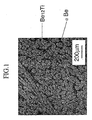
- Fig. 1 shows a micro-metallograph of a neutron multiplier material according to a first embodiment of the present invention.
- a neutron multiplier material according to the present invention includes metallic phases interposed between the beryllium intermetallic compound phases so that the metallic phases adhere the beryllium intermetallic compound phases and accordingly whole body of the neutron multiplier material gets higher ductility, which leads to advantages of machinability and easiness of handling.
- compounds of beryllium with Ti, V, Zr, Nb, Ta, Mo, W orY, listedbelowasexamples, arespecificallypreferablyadapted.
- Be 12 Ti (1550 degree C), Be 17 Ti 2 (1650 degree C), Be 12 V (1700 degree C), Be 13 Zr (1800 degree C), Be 17 Zr 12 (1600 degree C), Be 12 Nb (1700 degree C), Be 17 Nb 2 (1800 degree C), Be 12 Ta (1850 degree C), Be 17 Ta 2 (1970 degree C), Be 12 Mo (1700 degree C), Be 12 W (1750 degree C), Be 22 W (1600 degree C), Be 13 Y (1920 degree C), where the values put in parentheses respectively indicate melting points thereof.
- any of the aforementioned beryllium intermetallic compounds has a high melting point and high oxidation resistance so as to indicate excellent heat-resistance.
- any metal selected from the group of Be, Zr, Ti and V is preferable. Because these metals effectively go around and fill gaps among the beryllium intemetallic compounds and hence efficiently increase ductility of the multiplier material including the beryllium intermetallic compounds as a whole.
- Be and Zr are further preferably applied to the metallic phase as having a neutron multiplying function as well.
- a ratio of the beryllium intermetallic phase in such a neutron multiplying material is favorably set about 50 through 99 % in volumetric ratio.
- the mixing ratio does not reach 50 vol%, reactivity with vapor and such and swelling are remarkably increased and, provided that the mixing ratio exceeds 99 vol%, the effect of increasing ductility by the metallic phase is decreased so that reduction of the machinability and the easiness of handling is unavoidable.
- Size of pebbles of the neutron multiplier material according to the present invention is preferably set about 0.1 through 3.0 mm in average particle diameter. Out-of-sphericity thereof is preferably set no more than 0.5 times the particle diameter.
- Size of the beryllium intermetallic compound phases included in the neutron multiplier material is preferably set no more than about 100 ⁇ m in circle-equivalent diameter.
- concentration of Fe included in the neutron multiplier material is preferably set no more than about 0.4 mass% and concentration of mixed oxides is preferably set no more than about 5.0 mass%.
- the present invention does not require particular limits to the production method, however, a rotating electrode method and a powder metallurgy method, both of which are previously publicly known, are preferably applied.
- preparing consumable electrode is necessary.
- To prepare the consumable electrode providing metals, weights of which correspond to a ratio satisfying a weight ratio of the respective constituents of the desired intemetallic compound, melting the metals together, casting the mixture and machining the cast into a predetermined electrode shape are accomplished.
- intermetallic compound powder prepared to be a desired compositional ratio and metal powder having a weight so as to be a predetermined ratio of metal phase included in the neutron multiplier material filling the mixed powder in spherical metal molds or such, forming green compacts in spherical shapes by means of cold pressing or such and sintered to be pebbles in a vacuum atmosphere are accomplished.
- Fig. 1 shows a micro-metallograph of a neutron multiplier material obtained from the aforementioned rotating electrode method.
- the neutron multiplier material is an example which includes Be 12 Ti (95 % in volumetric ratio) as a beryllium intermetallic compound phase and Be as a metallic phase.
- Neutron multiplier materials respectively including beryllium intermetallic compounds and metals, compositions of which are described in Table 1, are produced by means of the rotating electrode method or the powder metallurgy method. Particle sizes of the obtained neutron multiplier materials are 0.7 to 1.3 mm.
- a neutron multiplying effect is evaluated as a relative ratio to the neutron multiplying effect of the conventional metallic beryllium pebbles as 10, considering the neutron reaction cross section, the neutron absorption cross section and the neutron capture cross section of each of the constituent elements.
- An amount of swelling is measured in a condition that neutrons are irradiated to the test piece so as to generate 4000ppm of He therein at 700 degree C and the anti-swelling property is evaluated on a degree of swelling as three levels of SMALL (the swelling amount is not more than 0.5 vol%), MIDDLE (more than 0.5 vol% and not more than 3.0 vol%) and LARGE (more than 3.0 vol%), where the swelling amount is measured by volumetric change rate ( ⁇ V/V times 100 (%)).
- a compression test is accomplished with a test piece of approximate 1 mm ⁇ pebble in diameter in a condition of compression speed:0.2mm/min and ductility is evaluated on shapes after the test.
- SMALL reaction layer: no more than 50 ⁇ m
- MIDDLE reaction layer: more than 50 ⁇ m and no more than 200 ⁇ m
- LARGE reaction layer: more than 200 ⁇ m
- a reactivity test with the water vapor at 800 degree C is accomplished and the reactivity is evaluated on a degree of reaction with the water vapor as three levels of SMALL (rarely oxidized), MIDDLE (oxidized) and LARGE (destructed by oxidation).
- SMALL rarely oxidized
- MIDDLE oxidized
- LARGE destructed by oxidation
- Tritium inventory is evaluated on an amount of tritium of the test piece accomplished of the swelling test, measured by the temperature-programmed desorption method. Specifically, the tritium inventory is evaluated on a degree of the tritium inventory as three levels of SMALL (extremely small amount), MIDDLE (some amount) and LARGE (large amount).
- SMALL extreme small amount
- MIDDLE some amount
- LARGE large amount
- any of the examples of the present invention is excellent in the ductility and the anti-swelling property and has a proper neutron multiplying effect, a small tritium inventory and small reactivity with the structural members and the vapor.
- the comparative example of No. 38 is excellent in the neutron multiplying effect and the ductility, because it consists of 100 vol% of metallic beryllium, but is large in the swelling and the tritium inventory and further large in the reactivity with the structural members and the vapor.
- substances obtained from mixing and casting a combination of beryllium and titanium so that Be 12 Ti and Be 17 Ti 2 coexist and are intermixed therein are ascertained to be remarkably improved in ductility as compared with simple substances of Be 12 Ti and Be 17 Ti 2 .
- a mixing ratio of Be 12 Ti and Be 17 Ti 2 is not particularly limited, however, it is ascertained that the particularly preferable mixing ratios in a range of 10.5 to 2.0, or x in a range of 8.8 to 9.9 at% as described in a ratio x of Ti to Be, give especially excellent results.
- Size of pebbles of the neutron multiplier material according to the present invention is preferably set about 0.1 through 3.0 mm in average particle diameter. Moreover, out-of-sphericity thereof is preferably set no more than 0.5 times the particle diameter.
- concentration of Fe included in the neutron multiplier material is preferably set no more than about 0.4 mass% and concentration of mixed oxides is preferably set no more than about 5.0 mass%.
- the present invention does not require particular limits to the production method, however, a rotating electrode method and a powder metallurgy method, both of which are previously publicly known, are preferably applied.
- preparing consumable electrode is necessary.
- To prepare the consumable electrode providing metals, weights of which correspond to a ratio satisfying a weight ratio of the respective constituents of the desired intemetallic compound, melting the metals together, casting the mixture and machining the cast into a predetermined electrode shape are accomplished.
- intermetallic compound powder prepared to be a desired compositional ratio and metal powder having a weight so as to be a predetermined ratio of metal phase included in the neutron multiplier material filling the mixed powder in spherical metal molds or such, forming green compacts in spherical shapes by means of cold pressing or such and sintered to be pebbles in a vacuum atmosphere are accomplished.
- Neutron multiplier materials respectively including beryllium intermetallic compounds and metals, compositions of which are described in Table 3, are produced by means of the rotating electrode method or the powder metallurgy method. Particle sizes of the obtained neutron multiplier materials are 0.7 to 1.3 mm.
- a compression test is accomplished with a test piece of approximate 1 mm ⁇ pebble in diameter in a condition of compression speed:0.2 mm/min and ductility is evaluated on a shape after the test.
- a reactivity test with stainless steel in a He atmosphere of 6N for 800 to 1000 h is accomplished and the reactivity is evaluated on a degree of reaction with the structural members as three levels of SMALL (reaction layer: no more than 50 ⁇ m), MIDDLE (reaction layer: more than 50 ⁇ m and no more than 200 ⁇ m) and LARGE (reaction layer: more than 200 ⁇ m).
- SMALL reaction layer: no more than 50 ⁇ m
- MIDDLE reaction layer: more than 50 ⁇ m and no more than 200 ⁇ m
- LARGE reaction layer: more than 200 ⁇ m
- a reactivity test with the water vapor at 800 degree C is accomplished and the reactivity is evaluated on a degree of reaction with the water vapor as three levels of SMALL (rarely oxidized), MIDDLE (oxidized) and LARGE (destructed by oxidation).
- SMALL rarely oxidized
- MIDDLE oxidized
- LARGE destructed by oxidation
- Tritium inventory is evaluated on an amount of tritium of the test piece accomplished of the swelling test, measured by the temperature-programmed desorption method. Specifically, the tritium inventory is evaluated on degrees of the tritium inventory as three degrees of SMALL (extremely small amount), MIDDLE (some amount) and LARGE (large amount).
- any of the examples of the present invention is excellent in the ductility and the anti-swelling property and has a high neutron multiplying effect, a small tritium inventory and small reactivity with the structural members and the vapor.
- the comparative example of No. 31 is poor in the ductility because this example consists of a simple substance of Be 12 Ti.
- the comparative example of No. 32 includes a metal phase as binder between beryllium intermetallic compound phases so that the ductility and the anti-swelling property are excellent, the tritium inventory is small and reactivity with the structural members and the vapor is small, however, the high neutron multiplying effect thereof is not satisfactory.
- the comparative example of No. 33 is excellent in the neutron multiplying effect and the ductility, because it consists of 100 vol% of metallic beryllium, but is large in the swelling and the tritium inventory and further large in the reactivity with the structural members and the vapor.
- any of the materials according to the present invention has a particularly excellent property as a material facing to plasma.
- substances obtained from mixing and casting a combination of beryllium and titanium so that Be 12 M and Be 17 M 2 coexist and are intermixed therein are ascertained to be remarkably improved in ductility as compared with simple substances of Be 12 M and Be 17 M 2 .
- Amixing ratio of Be 12 M and Be 17 M 2 is not particularly limited, however, it is ascertained that the particularly preferable mixing ratios in a range of 10.5 to 2.0, or x in a range of 8.8 to 9.9 at% as described in a ratio x of M to Be, give especially excellent results.
- Beryllium powder or beryllium intermetallic compound powder is prepared so as to be a desired composition and the prepared powder is filled in a mold.
- Stainless steel is ordinarily applied to such a mold and accomplished with canning by means of electron-beam welding.
- HIP is accomplished at 1200 to 1500 degree C and 100 to 200 MPa for approximate 1 to 5 hours by means of a HIP (hot isostatic pressing) machine.
- the plasma facing materials respectively having compositions as shown in Table 5 are produced by means of the HIP method.
- a particle size of the provided powder is 0.6 ⁇ m and the HIP condition is that the temperature is 1300 degree C and the pressure is 150 MPa. Crystal particle sizes of the obtained plasma facing materials are in a range of 5 to 20 ⁇ m.
- a melting point is employed for evaluation of a physical sputtering property. Furthermore, a chemical sputtering property is on degrees of reactivity with hydrogen (at 600 degree C) as three levels of ⁇ (hardly react), ⁇ (slightly react) and ⁇ (considerably react).
- An amount of tritium absorbed in the material after being kept in a tritium atmosphere for 3 hours is measured by the temperature-programmed desorption method and the tritium absorbency is evaluated on the measured value as three levels of LARGE, MIDDLE and SMALL.
- any of the examples of the present invention has a small radiation loss, a small sputtering erosion and a small tritium absorbent.
- the comparative example of No. 29 is defective of brittleness at a room temperature though satisfactory in the other properties because this example consists of a simple substance of Be 12 Ti.
- the comparative example of No. 30 is excellent in the radiation loss, because it consists of 100 % of metallic beryllium, but is poor in the sputtering property and the tritium absorbent.
- the phrase "consisting essentially of --" is defined and used as a meaning of including -- as essential ingredients but excluding additional unspecified ingredients that would affect the basic and novel characteristics of the product. However, the phrase does not exclude a possibility that the product includes any other ingredients that would not affect the basic and novel characteristic of the product.
- the present invention provides neutron multiplier materials for nuclear fusion reactors, which are excellent in high-temperature properties and machinability so as to be high productivity, and further easy to handle.
- the present invention further provides plasma facing materials for nuclear fusion reactors, which lead to small sputtering erosion and small radiation loss in a case of being contaminated in the plasma and absorb a small amount of tritium.
Landscapes
- Chemical & Material Sciences (AREA)
- Engineering & Computer Science (AREA)
- Materials Engineering (AREA)
- Mechanical Engineering (AREA)
- Metallurgy (AREA)
- Organic Chemistry (AREA)
- Physics & Mathematics (AREA)
- Plasma & Fusion (AREA)
- General Engineering & Computer Science (AREA)
- High Energy & Nuclear Physics (AREA)
- Manufacture And Refinement Of Metals (AREA)
- Powder Metallurgy (AREA)
Abstract
Description
- atmospheric gas pressure: 500 to 12000 Torr
- arc current: 100 to 1000 A
- rotation speed of the consumable electrode: 4 to 1000 m/s
| No | Intermetallic compound | (vol%) | Metallic phase | (vol%) | Production method | Melting point (°C) |
| 1 | Be12Ti | 100 | - | - | rotating electrode | 1550 |
| 2 | ↑ | 95 | Be | 5 | ↑ | 1530 |
| 3 | ↑ | 93 | Be | 7 | ↑ | 1500 |
| 4 | ↑ | 90 | Be | 10 | powder metallurgy | 1450 |
| 5 | ↑ | 85 | Be | 15 | ↑ | 1400 |
| 6 | ↑ | 55 | Be | 45 | ↑ | 1350 |
| 7 | Be17Ti2 | 90 | Be | 10 | ↑ | 1550 |
| 8 | Be12V | 100 | - | - | ↑ | 1700 |
| 9 | ↑ | 95 | Be | 5 | rotating electrode | 1670 |
| 10 | ↑ | 93 | Be | 7 | ↑ | 1650 |
| 11 | ↑ | 90 | Be | 10 | powder metallurgy | 1600 |
| 12 | ↑ | 85 | Be | 15 | ↑ | 1550 |
| 13 | Be13Zr | 93 | Be | 7 | rotating electrode | 1720 |
| 14 | ↑ | 90 | Be | 10 | powder metallurgy | 1700 |
| 15 | Be17Zr2 | 90 | Be | 10 | ↑ | 1500 |
| 16 | Be12Nb | 90 | Be | 10 | ↑ | 1600 |
| 17 | Be17Nb2 | 90 | Be | 10 | ↑ | 1700 |
| 18 | Be12Ta | 93 | Be | 7 | rotating electrode | 1770 |
| 19 | ↑ | 90 | Be | 10 | powder metallurgy | 1750 |
| 20 | Be17Ta2 | 90 | Be | 10 | ↑ | 1900 |
| 21 | Be12Mo | 95 | Be | 5 | rotating electrode | 1650 |
| 22 | ↑ | 90 | Be | 10 | powder metallurgy | 1600 |
| 23 | Be12W | 95 | Be | 5 | rotating electrode | 1700 |
| 24 | ↑ | 90 | Be | 10 | powder metallurgy | 1650 |
| 25 | Be22W | 90 | Be | 10 | ↑ | 1500 |
| 26 | Be13Y | 90 | Be | 10 | ↑ | 1800 |
| 27 | Be12Ti | 90 | Zr | 10 | ↑ | 1550 |
| 28 | ↑ | 90 | Ti | 10 | ↑ | 1550 |
| 29 | ↑ | 60 | Ti | 40 | ↑ | 1550 |
| 30 | ↑ | 90 | V | 10 | ↑ | 1550 |
| 31 | Be12V | 90 | Zr | 10 | ↑ | 1550 |
| 32 | ↑ | 70 | Zr | 30 | ↑ | 1550 |
| 33 | ↑ | 90 | Ti | 10 | ↑ | 1550 |
| 34 | ↑ | 90 | V | 10 | ↑ | 1550 |
| 35 | Be12Mo | 90 | Zr | 10 | ↑ | 1550 |
| 36 | ↑ | 90 | Ti | 10 | ↑ | 1550 |
| 37 | ↑ | 90 | V | 10 | ↑ | 1550 |
| 38 | - | - | Be | 100 | rotating electrode | 1280 |
| No. | Neutron multiplying effect | Anti-sw elling property | Ductili ty* | Reactivity with the structural members | Reactivity with the vapor | Tritium inventory | Thermal conductivity (W/m K) | remarks |
| 1 | 0.90 | SMALL | × | SMALL | SMALL | SMALL | 40 | comparative example |
| 2 | 0.92 | SMALL | ○ | SMALL | SMALL | SMALL | 55 | present invention |
| 3 | 0.92 | SMALL | ○ | SMALL | SMALL | SMALL | 55 | ↑ |
| 4 | 0.93 | MIDDLE | Δ | MIDDLE | MIDDLE | MIDDLE | 65 | ↑ |
| 5 | 0.94 | MIDDLE | Δ | MIDDLE | MIDDLE | MIDDLE | 70 | ↑ |
| 6 | 0.95 | MIDDLE | ○ | LARGE | LARGE | LARGE | 90 | ↑ |
| 7 | 0.85 | MIDDLE | Δ | MIDDLE | MIDDLE | MIDDLE | 70 | ↑ |
| 8 | 0.92 | SMALL | × | SMALL | SMALL | SMALL | 40 | comparative example |
| 9 | 0.93 | MIDDLE | ○ | MIDDLE | MIDDLE | MIDDLE | 45 | present invention |
| 10 | 0.94 | MIDDLE | ○ | MIDDLE | MIDDLE | MIDDLE | 45 | ↑ |
| 11 | 0.94 | MIDDLE | Δ | MIDDLE | MIDDLE | MIDDLE | 55 | ↑ |
| 12 | 0.94 | MIDDLE | Δ | MIDDLE | MIDDLE | MIDDLE | 65 | ↑ |
| 13 | 0.85 | MIDDLE | Δ | MIDDLE | MIDDLE | MIDDLE | 70 | ↑ |
| 14 | 0.88 | MIDDLE | Δ | MIDDLE | MIDDLE | MIDDLE | 70 | ↑ |
| 15 | 0.80 | MIDDLE | Δ | MIDDLE | MIDDLE | MIDDLE | 70 | ↑ |
| 16 | 0.75 | MIDDLE | Δ | MIDDLE | MIDDLE | MIDDLE | 50 | ↑ |
| 17 | 0.70 | MIDDLE | Δ | MIDDLE | MIDDLE | MIDDLE | 65 | ↑ |
| 18 | 0.80 | MIDDLE | Δ | MIDDLE | MIDDLE | MIDDLE | 65 | ↑ |
| 19 | 0.82 | MIDDLE | Δ | MIDDLE | MIDDLE | MIDDLE | 65 | ↑ |
| 20 | 0.78 | MIDDLE | Δ | MIDDLE | MIDDLE | MIDDLE | 65 | ↑ |
| 21 | 0.85 | SMALL | ○ | SMALL | SMALL | SMALL | 50 | ↑ |
| 22 | 0.80 | MIDDLE | Δ | MIDDLE | MIDDLE | MIDDLE | 70 | ↑ |
| 23 | 0.75 | SMALL | ○ | SMALL | SMALL | SMALL | 50 | ↑ |
| 24 | 0.70 | MIDDLE | Δ | MIDDLE | MIDDLE | MIDDLE | 70 | ↑ |
| 25 | 0.75 | MIDDLE | Δ | MIDDLE | MIDDLE | MIDDLE | 70 | ↑ |
| 26 | 0.90 | MIDDLE | Δ | MIDDLE | MIDDLE | MIDDLE | 70 | ↑ |
| 27 | 0.78 | SMALL | Δ | SMALL | SMALL | SMALL | 70 | ↑ |
| 28 | 0.88 | SMALL | Δ | SMALL | SMALL | SMALL | 70 | ↑ |
| 29 | 0.65 | SMALL | ○ | MIDDLE | SMALL | SMALL | 100 | ↑ |
| 30 | 0.88 | SMALL | Δ | SMALL | SMALL | SMALL | 70 | ↑ |
| 31 | 0.78 | SMALL | Δ | SMALL | SMALL | SMALL | 70 | ↑ |
| 32 | 0.50 | SMALL | ○ | MIDDLE | SMALL | SMALL | 90 | ↑ |
| 33 | 0.80 | SMALL | Δ | SMALL | SMALL | SMALL | 70 | ↑ |
| 34 | 0.80 | SMALL | Δ | SMALL | SMALL | SMALL | 70 | ↑ |
| 35 | 0.80 | SMALL | Δ | SMALL | SMALL | SMALL | 70 | ↑ |
| 36 | 0.80 | SMALL | Δ | SMALL | SMALL | SMALL | 70 | ↑ |
| 37 | 0.80 | SMALL | Δ | SMALL | SMALL | SMALL | 70 | ↑ |
| 38 | 1.00 | LARGE | o ○ | LARGE | LARGE | LARGE | 170 | conventional |
- atmospheric gas pressure: 500 to 12000 Torr
- arc current: 100 to 1000 A
- rotation speed of the consumable electrode: 4 to 1000 m/s
| No | Combination of intermetallic compounds | Composition ratio (at%) | Production method | Crystal grain size (µm) |
| 1 | Be12Ti and Be17Ti2 | 8 | rotational electrode | 30 |
| 2 | ↑ | 8 | HIP | 20 |
| 3 | ↑ | 9 | rotational electrode | 10 |
| 4 | ↑ | 9 | HIP | 20 |
| 5 | ↑ | 10 | rotational electrode | 20 |
| 6 | ↑ | 10 | HIP | 30 |
| 7 | Be12V and Be17V2 | 8 | rotational electrode | 35 |
| 8 | ↑ | 9 | rotational electrode | 25 |
| 9 | ↑ | 9 | HIP | 35 |
| 10 | ↑ | 10 | rotational electrode | 25 |
| 11 | Be12Mo and Be17Mo2 | 8 | rotational electrode | 30 |
| 12 | ↑ | 9 | rotational electrode | 20 |
| 13 | ↑ | 9 | HIP | 25 |
| 14 | ↑ | 10 | rotational electrode | 25 |
| 15 | Be12W and Be17W2 | 8 | rotational electrode | 35 |
| 16 | ↑ | 9 | rotational electrode | 25 |
| 17 | ↑ | 9 | HIP | 35 |
| 18 | ↑ | 10 | rotational electrode | 25 |
| 19 | Be13Zr and Be17Zr2 | 8 | rotational electrode | 35 |
| 20 | ↑ | 9 | rotational electrode | 20 |
| 21 | ↑ | 9 | HIP | 25 |
| 22 | ↑ | 10 | rotational electrode | 40 |
| 23 | Be12Nb and Be17Nb2 | 8 | rotational electrode | 30 |
| 24 | ↑ | 9 | rotational electrode | 20 |
| 25 | ↑ | 9 | HIP | 25 |
| 26 | ↑ | 10 | rotational electrode | 25 |
| 27 | Be12Ta and Be17Ta2 | 8 | rotational electrode | 35 |
| 28 | ↑ | 9 | rotational electrode | 25 |
| 29 | ↑ | 9 | HIP | 25 |
| 30 | ↑ | 10 | rotational electrode | 35 |
| 31 | Simple substance of Be12Ti | 7.7 | rotational electrode | 35 |
| 32 | Be12Ti and Be | 5 | rotational electrode | 50 |
| 33 | Simple substance of Be | - | rotational electrode | 100 |
| No. | Neutron multiplying effect | Anti-sw elling property | Ductility | Reactivity with the structural members | Reactivity with the vapor | Tritium inventory | Thermal conduct ivity (W/m K) | remarks |
| 1 | 0.89 | SMALL | ○ | SMALL | SMALL | SMALL | 40 | present invention |
| 2 | 0.89 | ↑ | ○ | ↑ | ↑ | ↑ | 40 | ↑ |
| 3 | 0:87 | ↑ | o ○ | ↑ | ↑ | ↑ | 40 | ↑ |
| 4 | 0.87 | ↑ | ○ | ↑ | ↑ | ↑ | 40 | ↑ |
| 5 | 0.85 | ↑ | ○ | ↑ | ↑ | ↑ | 40 | ↑ |
| 6 | 0.85 | ↑ | ○ | ↑ | ↑ | ↑ | 40 | ↑ |
| 7 | 0.89 | ↑ | ○ | ↑ | ↑ | ↑ | 40 | ↑ |
| 8 | 0.87 | ↑ | o ○ | ↑ | ↑ | ↑ | 40 | ↑ |
| 9 | 0.87 | ↑ | ○ | ↑ | ↑ | ↑ | 40 | ↑ |
| 10 | 0.85 | ↑ | ○ | ↑ | ↑ | ↑ | 40 | ↑ |
| 11 | 0.89 | ↑ | ○ | ↑ | ↑ | ↑ | 50 | ↑ |
| 12 | 0.87 | ↑ | o ○ | ↑ | ↑ | ↑ | 50 | ↑ |
| 13 | 0.87 | ↑ | ○ | ↑ | ↑ | ↑ | 50 | ↑ |
| 14 | 0.85 | ↑ | ○ | ↑ | ↑ | ↑ | 50 | ↑ |
| 15 | 0.89 | ↑ | ○ | ↑ | ↑ | ↑ | 70 | ↑ |
| 16 | 0.87 | ↑ | o ○ | ↑ | ↑ | ↑ | 70 | ↑ |
| 17 | 0.87 | ↑ | ○ | ↑ | ↑ | ↑ | 70 | ↑ |
| 18 | 0.85 | ↑ | ○ | ↑ | ↑ | ↑ | 70 | ↑ |
| 19 | 0.89 | ↑ | ○ | ↑ | ↑ | ↑ | 70 | ↑ |
| 20 | 0.87 | ↑ | o ○ | ↑ | ↑ | ↑ | 70 | ↑ |
| 21 | 0.87 | ↑ | ○ | ↑ | ↑ | ↑ | 70 | ↑ |
| 22 | 0.85 | ↑ | ○ | ↑ | ↑ | ↑ | 70 | ↑ |
| 23 | 0.89 | ↑ | ○ | ↑ | ↑ | ↑ | 50 | ↑ |
| 24 | 0.87 | ↑ | o ○ | ↑ | ↑ | ↑ | 50 | ↑ |
| 25 | 0.87 | ↑ | ○ | ↑ | ↑ | ↑ | 50 | ↑ |
| 26 | 0.85 | ↑ | ○ | ↑ | ↑ | ↑ | 50 | ↑ |
| 27 | 0.89 | ↑ | ○ | ↑ | ↑ | ↑ | 60 | ↑ |
| 28 | 0.87 | ↑ | o ○ | ↑ | ↑ | ↑ | 60 | ↑ |
| 29 | 0.87 | ↑ | ○ | ↑ | ↑ | ↑ | 60 | ↑ |
| 30 | 0.85 | ↑ | ○ | ↑ | ↑ | ↑ | 60 | ↑ |
| 31 | 0.90 | SMALL | × | SMALL | SMALL | SMALL | 40 | comparative example |
| 32 | 0.92 | ↑ | ○ | MIDDLE | MIDDLE | MIDDLE | 55 | ↑ |
| 33 | 1.00 | LARGE | o ○ | LARGE | LARGE | LARGE | 170 | conventional |
| No | Element of M | Composition ratio (at%) | Combination of intermetallic compounds | Crystal grain size (µm) |
| 1 | Ti | 6.5 | Be and Be12Ti | 15 |
| 2 | ↑ | 9.0 | Be12Ti and Be17Ti2 | 10 |
| 3 | ↑ | 10.0 | ↑ | 8 |
| 4 | ↑ | 12.0 | Be17Ti2 and Be3Ti | 12 |
| 5 | V | 6.0 | Be and Be12V | 17 |
| 6 | ↑ | 9.0 | Be12V and Be17V2 | 13 |
| 7 | ↑ | 10.0 | ↑ | 11 |
| 8 | ↑ | 12.0 | Be17V2 and Be3V | 10 |
| 9 | Mo | 5.5 | Be and Be12Mo | 14 |
| 10 | ↑ | 9.0 | Be12Mo and Be17Mo2 | 12 |
| 11 | ↑ | 10.0 | ↑ | 10 |
| 12 | ↑ | 12.0 | Be17Mo2 and Be3Mo | 11 |
| 13 | W | 6.5 | Be and Be12W | 20 |
| 14 | ↑ | 9.0 | Be12W and Be17W2 | 18 |
| 15 | ↑ | 10.0 | ↑ | 16 |
| 16 | ↑ | 12.0 | Be17W2 and Be3W | 5 |
| 17 | Zr | 7.0 | Be and Be13Zr | 18 |
| 18 | 9.0 | Be13Zr and Be17Zr2 | 17 | |
| 19 | 10.0 | ↑ | 15 | |
| 20 | 12.0 | Be17Zr2 and Be3Zr | 13 | |
| 21 | Nb | 6.5 | Be and Be12Nb | 13 |
| 22 | 9.0 | Be12Nb and Be17Nb2 | 12 | |
| 23 | 10.0 | ↑ | 9 | |
| 24 | 12.0 | Be17Nb2 and Be3Nb | 10 | |
| 25 | Ta | 6.0 | Be and Be12Ta | 12 |
| 26 | 9.0 | Be12Ta and Be17Ta2 | 11 | |
| 27 | 10.0 | ↑ | 9 | |
| 28 | 12.0 | Be17Ta2 and Be3Ta | 10 | |
| 29 | Ti | 7.7 | Simple substance of Be12Ti | 15 |
| 30 | none | 0 | Simple substance of Be | 5 |
| No | Radiation loss | Sputtering property | Tritium absorbent | remarks | |
| physical | chemical | ||||
| 1 | 2.2 | 1500 | ○ | SMALL | Present invention |
| 2 | 2.5 | 1520 | ↑ | ↑ | ↑ |
| 3 | 2.6 | 1550 | ↑ | ↑ | ↑ |
| 4 | 2.8 | 1500 | ↑ | ↑ | ↑ |
| 5 | 3.6 | 1670 | ↑ | ↑ | ↑ |
| 6 | 3.9 | 1700 | ↑ | ↑ | ↑ |
| 7 | 4.1 | 1750 | ↑ | ↑ | ↑ |
| 8 | 4.3 | 1650 | ↑ | ↑ | ↑ |
| 9 | 2.9 | 1630 | ↑ | ↑ | ↑ |
| 10 | 3.1 | 1650 | ↑ | ↑ | ↑ |
| 11 | 3.2 | 1680 | ↑ | ↑ | ↑ |
| 12 | 3.4 | 1600 | ↑ | ↑ | ↑ |
| 13 | 4.2 | 1680 | ↑ | ↑ | ↑ |
| 14 | 4.4 | 1700 | ↑ | ↑ | ↑ |
| 15 | 4.5 | 1720 | ↑ | ↑ | ↑ |
| 16 | 4.7 | 1650 | ↑ | ↑ | ↑ |
| 17 | 2.7 | 1680 | ↑ | ↑ | ↑ |
| 18 | 2.8 | 1700 | ↑ | ↑ | ↑ |
| 19 | 2.9 | 1710 | ↑ | ↑ | ↑ |
| 20 | 3.1 | 1650 | ↑ | ↑ | ↑ |
| 21 | 2.9 | 1580 | ↑ | ↑ | ↑ |
| 22 | 3.0 | 1600 | ↑ | ↑ | ↑ |
| 23 | 3.1 | 1630 | ↑ | ↑ | ↑ |
| 24 | 3.3 | 1520 | ↑ | ↑ | ↑ |
| 25 | 4.0 | 1750 | ↑ | ↑ | ↑ |
| 26 | 4.2 | 1760 | ↑ | ↑ | ↑ |
| 27 | 4.3 | 1780 | ↑ | ↑ | ↑ |
| 28 | 4.4 | 1700 | ↑ | ↑ | ↑ |
| 29 | 2.3 | 1550 | ○ | SMALL | Comparative exmaple |
| 30 | 1.9 | 1280 | × | LARGE | ↑ |
Claims (11)
- A material for a nuclear fusion reactor, the material consisting essentially of an alloy including at least one beryllium intermatellic compound phase.
- The material for the nuclear fusion reactor of claim 1, wherein:the beryllium intermetallic compound phase consists essentially of a compound of Be with one or more elements selected from the group of Ti, V, Zr, Nb, Ta, Mo, W and Y.
- The material for the nuclear fusion reactor of claim 1, wherein:a base phase of the alloy consists essentially of one or more metals selected from the group of Be, Zr, Ti and V.
- The material for the nuclear fusion reactor of claim 1, wherein:a volumetric ratio of the beryllium intermetallic compound phase is 50 to 99 %.
- The material for the nuclear fusion reactor of claim 1, wherein:the alloy is produced by casting; anda crystal grain size of the alloy is no more than 50 µm.
- A material for a nuclear fusion reactor, the material consisting essentially of:wherein M is a metal element selected from the group of Ti, V, Mo, W, Zr, Nb and Ta, andone or more substances selected from the group of Be12M or Be13M and Be17M2; or two or more substances selected from the group of Be12M or Be13M, Be17M2, Be and M,
an average content x of M is in a range of 2.0 ≤ x ≤ 15.0 (at%). - A material for a nuclear fusion reactor, the material consisting essentially of:
an average content x of M is in a range of 7.7 < x < 10.5 (at%). - The material for the nuclear fusion reactor of claim 6,
wherein:the alloy is produced by casting; anda crystal grain size of the alloy is no more than 50 µm. - The material for the nuclear fusion reactor of claim 6,
wherein:the alloy is produced by powder metallurgy; anda crystal grain size of the alloy is no more than 50 µm. - A neutron multiplier material for a nuclear fusion reactor comprising the material for the nuclear fusion reactor of any one of claims 1 through 9.
- A plasma facing material for a nuclear fusion reactor comprising the material for the nuclear fusion reactor of any one of claims 6 through 9.
Applications Claiming Priority (7)
| Application Number | Priority Date | Filing Date | Title |
|---|---|---|---|
| JP2002105742 | 2002-04-08 | ||
| JP2002105742A JP3882110B2 (en) | 2002-04-08 | 2002-04-08 | Neutron multiplier for fusion reactor |
| JP2002253284 | 2002-08-30 | ||
| JP2002253285 | 2002-08-30 | ||
| JP2002253285A JP3864182B2 (en) | 2002-08-30 | 2002-08-30 | Beryllium intermetallics for fusion reactor plasma facing materials |
| JP2002253284A JP3882114B2 (en) | 2002-08-30 | 2002-08-30 | Neutron multiplier for fusion reactor |
| PCT/JP2003/004462 WO2003085678A1 (en) | 2002-04-08 | 2003-04-08 | Material for nuclear fusion furnace excellent in high temperature characteristics comprising beryllium intermetallic compound |
Publications (3)
| Publication Number | Publication Date |
|---|---|
| EP1494244A1 true EP1494244A1 (en) | 2005-01-05 |
| EP1494244A4 EP1494244A4 (en) | 2007-12-12 |
| EP1494244B1 EP1494244B1 (en) | 2015-01-07 |
Family
ID=28794784
Family Applications (1)
| Application Number | Title | Priority Date | Filing Date |
|---|---|---|---|
| EP03745972.4A Expired - Lifetime EP1494244B1 (en) | 2002-04-08 | 2003-04-08 | Material for nuclear fusion reactor excellent in high temperature characteristics comprising beryllium intermetallic compound |
Country Status (2)
| Country | Link |
|---|---|
| EP (1) | EP1494244B1 (en) |
| WO (1) | WO2003085678A1 (en) |
Cited By (1)
| Publication number | Priority date | Publication date | Assignee | Title |
|---|---|---|---|---|
| US12254994B1 (en) | 2024-03-08 | 2025-03-18 | Ut-Battelle, Llc | Fusion reactor having nested pebble bed blanket |
Families Citing this family (2)
| Publication number | Priority date | Publication date | Assignee | Title |
|---|---|---|---|---|
| CN101023193A (en) * | 2004-07-29 | 2007-08-22 | 日本碍子株式会社 | Lightweight high resistant material for power generation gas turbine |
| CN116024474B (en) * | 2022-12-21 | 2024-10-18 | 北京科技大学 | A beryllium-titanium alloy and its application in neutron breeder |
Family Cites Families (5)
| Publication number | Priority date | Publication date | Assignee | Title |
|---|---|---|---|---|
| US2991238A (en) * | 1958-06-19 | 1961-07-04 | James A Phillips | Pinched plasma reactor |
| DE2547835A1 (en) * | 1974-10-30 | 1976-05-13 | Allied Chem | AMORPHIC ALLOYS BASED ON TITANIUM BERYLLIUM |
| JPS60255948A (en) * | 1984-06-01 | 1985-12-17 | Hitachi Ltd | Ni base alloy member for nuclear reactor and its manufacture |
| JPH0987782A (en) * | 1995-09-27 | 1997-03-31 | Hitachi Ltd | Neutron resistant alloys and their applications |
| JPH09133787A (en) * | 1995-11-13 | 1997-05-20 | Japan Atom Energy Res Inst | Fast breeder reactor components or fusion reactor blanket structure |
-
2003
- 2003-04-08 EP EP03745972.4A patent/EP1494244B1/en not_active Expired - Lifetime
- 2003-04-08 WO PCT/JP2003/004462 patent/WO2003085678A1/en not_active Ceased
Cited By (1)
| Publication number | Priority date | Publication date | Assignee | Title |
|---|---|---|---|---|
| US12254994B1 (en) | 2024-03-08 | 2025-03-18 | Ut-Battelle, Llc | Fusion reactor having nested pebble bed blanket |
Also Published As
| Publication number | Publication date |
|---|---|
| WO2003085678A1 (en) | 2003-10-16 |
| EP1494244A4 (en) | 2007-12-12 |
| EP1494244B1 (en) | 2015-01-07 |
Similar Documents
| Publication | Publication Date | Title |
|---|---|---|
| US5700962A (en) | Metal matrix compositions for neutron shielding applications | |
| US5965829A (en) | Radiation absorbing refractory composition | |
| EP1632955A1 (en) | Aluminum based neutron absorber and method for production thereof | |
| EP3401413B1 (en) | An iron tungsten borocarbide body for nuclear shielding applications | |
| CN109402477B (en) | Aluminum-based composite material for shielding high-dose gamma rays and thermal neutrons and preparation method thereof | |
| KR100414958B1 (en) | Aluminum composite material having neutron-absorbing ability | |
| CN112725679B (en) | Light high-entropy alloy material with high specific strength and preparation method thereof | |
| CN109852850A (en) | A kind of preparation method of structure-function integrated neutron absorption material | |
| US7560069B2 (en) | Material including beryllium intermetallic compound and having excellent high-temperature property applied to nuclear fusion reactor | |
| CN117758096B (en) | Radiation shielding high-entropy alloy, preparation method and application thereof, and radiation shielding product | |
| CN117965987A (en) | A high temperature resistant yttrium silicon alloy material for nuclear shielding, preparation method and application thereof | |
| CN117721409A (en) | A method for preparing a high-temperature wear-resistant silicide protective layer on the surface of refractory high-entropy alloys | |
| US4865645A (en) | Nuclear radiation metallic absorber | |
| EP1494244B1 (en) | Material for nuclear fusion reactor excellent in high temperature characteristics comprising beryllium intermetallic compound | |
| RU2679020C2 (en) | Neutron-absorbing aluminium matrix composite material, containing gadolini, and method of its obtaining | |
| JPH0827388B2 (en) | Heat resistant radiation shielding material | |
| CN111438355B (en) | Chromium-aluminum-silicon target material and preparation method thereof | |
| CN105506428A (en) | Novel helium ion sputtering-resistant vanadium alloy and preparation method thereof | |
| EP2910656A1 (en) | Boron-containing aluminum material, and method for producing same | |
| JP6515357B2 (en) | Titanium material for hot rolling | |
| JP3697559B2 (en) | Tungsten-based alloy material for radiation shielding | |
| Litwa et al. | A novel Fe–Cr–Nb matrix composite containing the TiB2 neutron absorber synthesized by mechanical alloying and final hot isostatic pressing (HIP) in the Ti-tubing | |
| JP3882114B2 (en) | Neutron multiplier for fusion reactor | |
| JP3128620B2 (en) | Neutron absorbing alloy | |
| CN118497584B (en) | A structural and functional integrated shielding high-entropy alloy and its preparation method |
Legal Events
| Date | Code | Title | Description |
|---|---|---|---|
| PUAI | Public reference made under article 153(3) epc to a published international application that has entered the european phase |
Free format text: ORIGINAL CODE: 0009012 |
|
| 17P | Request for examination filed |
Effective date: 20041006 |
|
| AK | Designated contracting states |
Kind code of ref document: A1 Designated state(s): DE FR |
|
| A4 | Supplementary search report drawn up and despatched |
Effective date: 20071108 |
|
| 17Q | First examination report despatched |
Effective date: 20130426 |
|
| REG | Reference to a national code |
Ref country code: DE Ref legal event code: R079 Ref document number: 60347200 Country of ref document: DE Free format text: PREVIOUS MAIN CLASS: G21B0001000000 Ipc: G21B0001130000 |
|
| GRAP | Despatch of communication of intention to grant a patent |
Free format text: ORIGINAL CODE: EPIDOSNIGR1 |
|
| RIC1 | Information provided on ipc code assigned before grant |
Ipc: C22C 30/00 20060101ALI20140619BHEP Ipc: C22C 25/00 20060101ALI20140619BHEP Ipc: G21B 1/13 20060101AFI20140619BHEP |
|
| INTG | Intention to grant announced |
Effective date: 20140718 |
|
| GRAS | Grant fee paid |
Free format text: ORIGINAL CODE: EPIDOSNIGR3 |
|
| GRAA | (expected) grant |
Free format text: ORIGINAL CODE: 0009210 |
|
| RAP1 | Party data changed (applicant data changed or rights of an application transferred) |
Owner name: NGK INSULATORS, LTD. Owner name: JAPAN ATOMIC ENERGY AGENCY |
|
| AK | Designated contracting states |
Kind code of ref document: B1 Designated state(s): DE FR |
|
| REG | Reference to a national code |
Ref country code: DE Ref legal event code: R096 Ref document number: 60347200 Country of ref document: DE Effective date: 20150219 |
|
| RAP2 | Party data changed (patent owner data changed or rights of a patent transferred) |
Owner name: JAPAN ATOMIC ENERGY AGENCY Owner name: NGK INSULATORS, LTD. |
|
| REG | Reference to a national code |
Ref country code: DE Ref legal event code: R097 Ref document number: 60347200 Country of ref document: DE |
|
| PLBE | No opposition filed within time limit |
Free format text: ORIGINAL CODE: 0009261 |
|
| STAA | Information on the status of an ep patent application or granted ep patent |
Free format text: STATUS: NO OPPOSITION FILED WITHIN TIME LIMIT |
|
| 26N | No opposition filed |
Effective date: 20151008 |
|
| REG | Reference to a national code |
Ref country code: FR Ref legal event code: PLFP Year of fee payment: 14 |
|
| REG | Reference to a national code |
Ref country code: FR Ref legal event code: PLFP Year of fee payment: 15 |
|
| REG | Reference to a national code |
Ref country code: FR Ref legal event code: PLFP Year of fee payment: 16 |
|
| PGFP | Annual fee paid to national office [announced via postgrant information from national office to epo] |
Ref country code: FR Payment date: 20220308 Year of fee payment: 20 |
|
| PGFP | Annual fee paid to national office [announced via postgrant information from national office to epo] |
Ref country code: DE Payment date: 20220302 Year of fee payment: 20 |
|
| REG | Reference to a national code |
Ref country code: DE Ref legal event code: R071 Ref document number: 60347200 Country of ref document: DE |