EP1493828A1 - High tensile steel excellent in high temperature strength and method for production thereof - Google Patents

High tensile steel excellent in high temperature strength and method for production thereof Download PDF

Info

Publication number
EP1493828A1
EP1493828A1 EP03715623A EP03715623A EP1493828A1 EP 1493828 A1 EP1493828 A1 EP 1493828A1 EP 03715623 A EP03715623 A EP 03715623A EP 03715623 A EP03715623 A EP 03715623A EP 1493828 A1 EP1493828 A1 EP 1493828A1
Authority
EP
European Patent Office
Prior art keywords
steel
temperature
strength
high temperature
bainite
Prior art date
Legal status (The legal status is an assumption and is not a legal conclusion. Google has not performed a legal analysis and makes no representation as to the accuracy of the status listed.)
Withdrawn
Application number
EP03715623A
Other languages
German (de)
French (fr)
Other versions
EP1493828A4 (en
Inventor
Yasushi C/O NIPPON STEEL CORPORATION MIZUTANI
Ryuji C/O NIPPON STEEL CORPORATION UEMORI
Tatsuya C/O Nippon Steel Corporation Kumagai
Tadayoshi C/O NIPPON STEEL CORPORATION OKADA
Yoshiyuki C/O NIPPON STEEL CORPORATION WATANABE
Yoshio C/O NIPPON STEEL CORPORATION TERADA
Current Assignee (The listed assignees may be inaccurate. Google has not performed a legal analysis and makes no representation or warranty as to the accuracy of the list.)
Nippon Steel Corp
Original Assignee
Nippon Steel Corp
Priority date (The priority date is an assumption and is not a legal conclusion. Google has not performed a legal analysis and makes no representation as to the accuracy of the date listed.)
Filing date
Publication date
Priority claimed from JP2003086307A external-priority patent/JP4348102B2/en
Priority claimed from JP2003086308A external-priority patent/JP4348103B2/en
Application filed by Nippon Steel Corp filed Critical Nippon Steel Corp
Publication of EP1493828A1 publication Critical patent/EP1493828A1/en
Publication of EP1493828A4 publication Critical patent/EP1493828A4/en
Withdrawn legal-status Critical Current

Links

Classifications

    • CCHEMISTRY; METALLURGY
    • C21METALLURGY OF IRON
    • C21DMODIFYING THE PHYSICAL STRUCTURE OF FERROUS METALS; GENERAL DEVICES FOR HEAT TREATMENT OF FERROUS OR NON-FERROUS METALS OR ALLOYS; MAKING METAL MALLEABLE, e.g. BY DECARBURISATION OR TEMPERING
    • C21D9/00Heat treatment, e.g. annealing, hardening, quenching or tempering, adapted for particular articles; Furnaces therefor
    • C21D9/46Heat treatment, e.g. annealing, hardening, quenching or tempering, adapted for particular articles; Furnaces therefor for sheet metals
    • CCHEMISTRY; METALLURGY
    • C21METALLURGY OF IRON
    • C21DMODIFYING THE PHYSICAL STRUCTURE OF FERROUS METALS; GENERAL DEVICES FOR HEAT TREATMENT OF FERROUS OR NON-FERROUS METALS OR ALLOYS; MAKING METAL MALLEABLE, e.g. BY DECARBURISATION OR TEMPERING
    • C21D8/00Modifying the physical properties of ferrous metals or ferrous alloys by deformation combined with, or followed by, heat treatment
    • C21D8/02Modifying the physical properties of ferrous metals or ferrous alloys by deformation combined with, or followed by, heat treatment during manufacturing of plates or strips
    • C21D8/0247Modifying the physical properties of ferrous metals or ferrous alloys by deformation combined with, or followed by, heat treatment during manufacturing of plates or strips characterised by the heat treatment
    • C21D8/0263Modifying the physical properties of ferrous metals or ferrous alloys by deformation combined with, or followed by, heat treatment during manufacturing of plates or strips characterised by the heat treatment following hot rolling
    • CCHEMISTRY; METALLURGY
    • C22METALLURGY; FERROUS OR NON-FERROUS ALLOYS; TREATMENT OF ALLOYS OR NON-FERROUS METALS
    • C22CALLOYS
    • C22C38/00Ferrous alloys, e.g. steel alloys
    • C22C38/004Very low carbon steels, i.e. having a carbon content of less than 0,01%
    • CCHEMISTRY; METALLURGY
    • C22METALLURGY; FERROUS OR NON-FERROUS ALLOYS; TREATMENT OF ALLOYS OR NON-FERROUS METALS
    • C22CALLOYS
    • C22C38/00Ferrous alloys, e.g. steel alloys
    • C22C38/02Ferrous alloys, e.g. steel alloys containing silicon
    • CCHEMISTRY; METALLURGY
    • C22METALLURGY; FERROUS OR NON-FERROUS ALLOYS; TREATMENT OF ALLOYS OR NON-FERROUS METALS
    • C22CALLOYS
    • C22C38/00Ferrous alloys, e.g. steel alloys
    • C22C38/04Ferrous alloys, e.g. steel alloys containing manganese
    • CCHEMISTRY; METALLURGY
    • C22METALLURGY; FERROUS OR NON-FERROUS ALLOYS; TREATMENT OF ALLOYS OR NON-FERROUS METALS
    • C22CALLOYS
    • C22C38/00Ferrous alloys, e.g. steel alloys
    • C22C38/12Ferrous alloys, e.g. steel alloys containing tungsten, tantalum, molybdenum, vanadium, or niobium
    • CCHEMISTRY; METALLURGY
    • C22METALLURGY; FERROUS OR NON-FERROUS ALLOYS; TREATMENT OF ALLOYS OR NON-FERROUS METALS
    • C22CALLOYS
    • C22C38/00Ferrous alloys, e.g. steel alloys
    • C22C38/14Ferrous alloys, e.g. steel alloys containing titanium or zirconium
    • CCHEMISTRY; METALLURGY
    • C21METALLURGY OF IRON
    • C21DMODIFYING THE PHYSICAL STRUCTURE OF FERROUS METALS; GENERAL DEVICES FOR HEAT TREATMENT OF FERROUS OR NON-FERROUS METALS OR ALLOYS; MAKING METAL MALLEABLE, e.g. BY DECARBURISATION OR TEMPERING
    • C21D2211/00Microstructure comprising significant phases
    • C21D2211/002Bainite
    • CCHEMISTRY; METALLURGY
    • C21METALLURGY OF IRON
    • C21DMODIFYING THE PHYSICAL STRUCTURE OF FERROUS METALS; GENERAL DEVICES FOR HEAT TREATMENT OF FERROUS OR NON-FERROUS METALS OR ALLOYS; MAKING METAL MALLEABLE, e.g. BY DECARBURISATION OR TEMPERING
    • C21D2211/00Microstructure comprising significant phases
    • C21D2211/005Ferrite

Definitions

  • the present invention relates to a method for producing a high-tensile-strength low alloy carbon steel (in the form of a steel sheet, a steel pipe, a section steel or a wire rod), for a building structure, the high-tensile-strength steel showing an excellent high temperature strength during a relatively short span of about one hour in the temperature range from 600°C to 800°C and being used for a general structure in the field of building construction, civil engineering, an offshore structure, shipbuilding, a reservoir tank or the like.
  • the reason for the above regulation is that the proof stress of the above-mentioned steel at about 350°C becomes about two-thirds of that at room temperature and thus it falls short of the required strength.
  • a fire-resistant coating is applied thereto so that the temperature of the steel may not reach 350°C during a fire. Therefore, the cost for the fire-resistant coating goes up in comparison with the cost of the steel and a large increase in the construction cost is inevitable.
  • Japanese Unexamined Patent Publication Nos. H2-77523 and H10-68044 disclose that a steels usable at a temperature of not lower than 600°C is generally called "a fire-resistant steel.”
  • a fire-resistant steel As an example of the relevant invention, Japanese Unexamined Patent Publication No. H2-77523 proposes a fire-resistant steel having such a high temperature strength that the yield strength thereof at 600°C is not less than two-thirds (about 70%) of that at room temperature.
  • the generally adopted criterion is that a yield strength at 600°C is not less than two-thirds of that at room temperature.
  • Japanese Unexamined Patent Publication No. H2-77523 discloses a steel, to which considerable amounts of Mo and Nb are added, that can secure a proof stress at 600°C of not less than 70% of the proof stress at room temperature, but it does not describe a proof stress at 700°C or 800°C.
  • a building structure to which a steel not coated with fire-resistant coating is applicable is limited to an architecture having an open space such as a multi-level car parking tower or an atrium and therefore the application of the steel not coated with a fire-resistant coating is substantially limited.
  • Japanese Unexamined patent Publication No. H10-68044 discloses a technology that secures a proof stress at 700°C being not less than 56% of the proof stress at room temperature by making the microstructure of a steel, to which considerable amounts of Mo and Nb are added, composed of a bainite structure, but it does not describe a proof stress at 800°C.
  • the present inventors have recently disclosed a fire-resistant steel withstanding 850°C in Japanese Unexamined Patent Publication No. 2002-105585.
  • the invented steel secures effective precipitates even at a high temperature and obtains fire resistance at 850°C by adding comparatively large amounts of alloying elements such as Al, Ti, etc.
  • alloying elements such as Al, Ti, etc.
  • it is not suitable for the steel to be applied to a welded structure.
  • the guaranteed fire-resistant temperature has been 600°C to 700°C at the highest and therefore the development of a steel that can be used at a temperature of 700°C or 800°C without the application of fire-resistant coating and thus allows a fire-resistant coating process to be eliminated, has long been sought for.
  • the object of the present invention is to provide: a high-tensile-strength steel that is excellent in high temperature strength in the temperature range from 600°C to 800°C and in weldability and is used in the field of building construction, civil engineering or the like; and a production method that makes it possible to stably supply the steel in an industrial scale.
  • the gist of the present invention is as follows:
  • the present inventors have proposed steels excellent in high temperature strength at 600°C and 700°C and the steels excellent in high temperature strength at 600°C have already been used in various fields including building construction.
  • a steel In a fire resistance design, a steel is well accepted as long as the steel maintains high strength for the duration of a fire. That is, it is not necessary to consider such long lasting strength as required of a conventional heat-resistant steel and a steel is well accepted as long as the yield strength of the steel is maintained for a relatively short time at a high temperature.
  • a steel can be sufficiently used as a fire-resistant steel withstanding 800°C as long as the yield strength of the steel is secured for a short retention time of about 30 minutes at a high temperature of 800°C.
  • the performance of a conventional fire-resistant steel has been regulated so that a yield strength at a high temperature is not less than two-thirds of that at room temperature.
  • the range of the strength of a steel in the actual design of a steel construction is about 0.2 to 0.4 time the lower limit of the yield strength at room temperature, it is necessary for the steel to satisfy the expression p ⁇ - 0.0029 x T + 2.48 when the steel temperature T (°C) is within the range from 600°C to 800°C, wherein p is a stress drop ratio (a yield stress at a high temperature/a yield stress at room temperature) that is obtained by converting a yield stress normalized by using a yield stress at room temperature.
  • a microstructure may be made composed of a single structure of bainite.
  • a low C content has the effects of enhancing the thermodynamic stability of bainite or a composite structure composed of ferrite and bainite at a high temperature and also raising the temperature (Ac 1 ) at which a structure reversely transforms into austenite.
  • Ac 1 the temperature at which a structure reversely transforms into austenite.
  • the present inventors investigated the control of a microstructure and the enhancement of high temperature strength, as a result, found that an appropriate the amount B addition was effective for the stabilization of production, and established the present invention.
  • a steel in this category is generally required to have such weldability as required of a conventional steel for a welded structure since the steel may be used for a welded structure, and therefore it has been a very difficult challenge to achieve such a steel excellent in strength at a high temperature of 700°C to 800°C.
  • the present inventors carried out intensive studies to solve the problem, and found that, in order to obtain a high temperature strength in the temperature range from 700°C to 800°C, it was effective to enhance precipitation hardening of a steel by the combined addition of alloying elements such as Mo, Nb, v, Ti, etc., in order to increase dislocation density by making a microstructure composed of bainite, and further to delay the recovery of the dislocation by dissolved Mo, Nb and V and somewhat by dissolved Ti.
  • alloying elements such as Mo, Nb, v, Ti, etc.
  • the present inventors further found that, in order to simultaneously secure all of a strength at 700°C to 800°C, a strength at room temperature, and a desired a stress drop ratio p from room temperature to a high temperature, it was important to make a microstructure comprising a composite structure composed of ferrite and bainite or a single structure composed of bainite and, at the same time, to obtain the thermal stability of the matrix structure at a high temperature and the adequate effects of conformable precipitation hardening and dislocation recovery delay by controlling the amounts of alloying elements addition in appropriate amounts. Furthermore, in order to secure a low yield ratio, it is necessary to make a microstructure comprising an adequate composite structure composed of ferrite and bainite.
  • the yield strength of a steel begins to drop sharply from a temperature close to 450°C. This is because, as a temperature rises, thermal activation energy drops and resistance to dislocation slip movement, which has been effective at a low temperature, becomes ineffective.
  • Cr carbide, Mo carbide and the like which are utilized for strengthening a steel in a temperature of around lower than 700°C, function as effective resistance to dislocation slip movement up to a high temperature of about 600°C, but they dissolve again at a high temperature of 800°C or so and therefore can scarcely maintain the strengthening effect.
  • the present inventors investigated single or composite structures of various precipitates having higher stability at a high temperature. As a result, it was found that precipitates formed by combining Mo with Nb, Ti and V had high stability at a high temperature and also a high strengthening effect at 700°C to 800°C. That is, precipitates formed by combining Mo with Nb, Ti and V precipitate finely during reheating, for example during temperature rise at a fire, by: adding appropriate amounts of Mo, Nb, Ti and V; keeping a heating temperature high at hot rolling; thus making those elements dissolve sufficiently; also introducing proper structure after hot rolling having a high dislocation density; and, by so doing, securing precipitation sites where precipitates can occur.
  • composition of a composite carbonitride precipitates that are important for the securing a high temperature strength can easily be identified by analysis with, for example, an electron microscope or an EDX.
  • the amount of a thermodynamically stable precipitates that are formed equilibriously and the amounts of alloying elements that dissolve in a BCC phase can easily be calculated from the amounts of the alloying elements addition by using a commercially available software for a thermodynamic computation database or the like.
  • the concept of the present invention is to enhance strengthening at a high temperature by utilizing precipitates and dissolved elements and, thus, the amounts of addition alloying elements, such as Cr, Mn and Mo, that have so far been added abundantly to a conventional steel for high temperature use can rather be restrained at a low level. Therefore, it is possible to design alloy addition so as not to deteriorate weldability.
  • a microstructure is made comprising composite structure composed of ferrite and bainite and the bainite fraction is controlled in the range from 20 to 95%. The reason is that an excessive ferrite fraction in a microstructure makes it difficult to secure strength both at room temperature and at a high temperature by increasing the amounts of alloying elements addition.
  • % means a percent in terms of mass.
  • C is an element that affects the properties of a steel most conspicuously and is essential for the formation of composite precipitates (carbides) with Mo, Nb, Ti and V. Therefore, a C amount of at least 0.005% is necessary. If a C amount is less than the amount, the strength of a steel is insufficient. However, when C is added in excess of 0.08%, the Ac 1 transformation temperature lowers, and therefore strength at 800°C is hardly obtained and toughness also deteriorates. For those reasons, a C amount is limited in the range from 0.005 to 0.08%.
  • a C amount is preferable to limit a C amount to less than 0.04% in order to keep the matrix composed of ferrite and bainite thermodynamically stable during high temperature heating corresponding to a fire, to maintain the coherency of the matrix with carbonitride precipitates compositely containing Mo, Nb, V and Ti, and thus secure the strengthening effect.
  • Si is an element contained in a steel as a deoxidizing agent and is effective in enhancing the strength of a steel at room temperature as it has a function of strengthening a steel by acting as substitutional solution hardening.
  • Si does not have the effect of enhancing strength particularly at a high temperature exceeding 600°C. If Si is added abundantly, weldability and HAZ toughness deteriorate, and therefore the upper limit of an Si amount is limited to 0.5%.
  • a steel can be deoxidized only by Ti and/or Al, and therefore it is preferable that an si amount is as low as possible from the viewpoint of HAZ toughness and hardenability. Therefore, Si may not necessarily be added.
  • Mn is an element indispensable for securing strength and toughness. Mn is a substitutional solution hardening element and therefore it is effective for the enhancement of strength at room temperature. However, Mn does slight contribution to increase high temperature strength exceeding 600°C. For that reason, in a steel containing a comparatively large amount of Mo, such as a steel according to the present invention, an Mn amount is limited to not more than 1.6% from the viewpoint of the improvement of weldability, namely the lowering of a PCM value. To control the upper limit of a Mn amount to a low level is advantageous also from the viewpoint of the control of the segregation at the center of a continuously cast slab.
  • the addition of Mn must be restrained and it is desirable to set the upper limit at 0.9%.
  • the lower limit of an Mn amount is not particularly regulated, but it is desirable to add Mn by not less than 0.1% from the viewpoint of the securing of the strength and toughness of a steel.
  • a cooling rate must be not lower than 0.3 K/sec. in the temperature range from 800°C to 650°C after the completion of hot rolling. That is, a comparatively thin steel sheet less than about 25 mm in thickness must be produced through an air cooling process or an accelerated cooling (water cooling) process, and a comparatively thick steel sheet more than about 25 mm in thickness must be produced through an accelerated cooling (water cooling) process.
  • P is an impurity in a steel according to the present invention and the reduction of a P amount tends to reduce intergranular fracture at a HAZ. Therefore, it is preferable that a P amount is as small as possible.
  • a P amount is high, the low temperature toughness of a steel and a weld deteriorate. For that reason, the upper limit of a P amount is set at 0.02%.
  • S is an impurity in a steel according to the present invention and therefore it is preferable that an S amount is as small as possible from the viewpoint of the low temperature toughness of a base steel.
  • an S amount is high, the low temperature toughness of a base steel and a weld deteriorate. For that reason, the upper limit of an S amount is set at 0.01%.
  • Mo is a basic element that constitutes composite precipitates which enhance high temperature strength and thus is an essential element in a steel according to the present invention. It is necessary to add Mo by not less than 0.1% in order to obtain composite precipitates formed by combining Mo with Nb and Ti or composite precipitates formed by combining Mo with Nb, Ti and V at a high density and thus enhance high temperature strength. On the other hand, when Mo is added in excess of 1.5%, the uniformity of the properties of a steel is hardly controlled, the toughness of a weld heat-affected zone deteriorates, and also the economical efficiency is lost. For those reasons, an addition amount of Mo is limited in the range from 0.1 to 1.5%, preferably from 0.2 to 1.1%.
  • Nb is an element that contributes important roles in securing strength at a high temperature of 700°C or 800°C in a steel according to the present invention to which a comparatively large amount of Mo is added.
  • Nb is an element that is useful for raising the recrystallization temperature of austenite and exhibiting the effect of controlled rolling during hot rolling to the maximum.
  • Nb contributes to the grain size refinement of austenite in a heated steel at reheating prior to hot rolling, normalizing or quenching.
  • Nb has the effect of enhancing strength by precipitation hardening, and also contributes to the enhancement of high temperature strength by the combined addition with Mo.
  • the amount of Nb addition is less than 0.03%, the effect of precipitation hardening is insufficient in the temperature range from 700°C to 800°C, and therefore it is preferable to add Nb by not less than 0.1%.
  • an Nb amount exceeds 0.2%, the toughness of a steel may deteriorate, and therefore the upper limit of an Nb amount is set at 0.3%. Consequently, a Nb amount is limited in the range from 0.03 to 0.3%.
  • Ti like Nb, is also effective for the enhancement of high temperature strength.
  • Ti forms precipitates mainly composed of Ti 2 O 3 by combining with O, the precipitates act as nuclei for forming intragranular transformed ferrite, and that improves toughness at a weld.
  • Ti forms TiN in the slab by combining with N, restrains the coarsening of ⁇ grains during reheating, and thus is effective for the microstructure refinement after hot rolling, and further that fine TiN remaining in a steel sheet refines microstructure of a heat-affected zone at welding.
  • a Ti amount of at least 0.005% is necessary in order to secure those effects.
  • a Ti amount is preferably not more than 0.02%; the upper limit thereof is 0.025%.
  • B is very important in controlling strength through the control of the fraction of bainite formed. That is, B is effective in improving hardenability by segregating at the grain boundaries of austenite and restraining ferrite formation, and forming bainite stably even when a cooling rate is comparatively low as in air cooling.
  • a B amount of at least 0.0005% is necessary in order to secure the above effects.
  • the upper limit of a B amount is set at 0.003%.
  • Al is an element generally contained in a steel as a deoxidizing agent. However, only Si or Ti can play the role of deoxidization sufficiently and thus the lower limit of an Al amount is not specified in the present invention (including the case of an Al amount is zero). On the other hand, if an Al amount is excessive, not only the cleanliness of a steel deteriorates but also the toughness of a weld metal deteriorates. Therefore, the upper limit of an Al amount is set at 0.06%.
  • N is an element that is contained in a steel as an unavoidable impurity and the lower limit of an N amount is not particularly specified.
  • the increase of an N amount is extremely detrimental to toughness at a HAZ and weldability. Therefore, the upper limit thereof is set at 0.006% in a steel according to the present invention.
  • Ni enhances the strength and toughness of a steel while weldability and toughness at a HAZ are not badly affected. In order to secure those effects, Ni must be added by at least not less than 0.05%. On the other hand, if Ni is added excessively, not only economical efficiency is harmed but also weldability is adversely affected, and therefore the upper limit of an Ni amount is set at 1.0%.
  • Cu exhibits almost the same effects and roles as Ni.
  • An excessive addition of Cu causes the deterioration of weldability and the generation of Cu-induced cracks during hot rolling which makes the production difficult, and therefore the upper limit of a Cu amount is set at 1.0%.
  • the lower limit of a Cu amount should be the least amount in which a substantial effect is obtained and thus is set at 0.05%.
  • Cr enhances both the strength and the toughness of a steel.
  • an addition amount of Cr is excessive, the toughness and weldability of both a base steel and a weld are deteriorated, and therefore a Cr amount is limited in the range from 0.05 to 1.0%.
  • the aforementioned Cu, Ni and Cr are effective in not only the strength and toughness of a steel but also the weather resistance thereof. For those purposes, it is preferable to add the elements within the range where weldability is not hindered.
  • V has almost the same function of composite precipitation as Nb has, but the effect thereof is smaller than that of Nb. Further, V influences hardenability and also contributes to the enhancement of high temperature strength. The same effect as Nb is hardly obtained with a V addition amount of less than 0.01%. On the other hand, if the amount of V addition is excessive, the toughness of a steel deteriorates sometimes. Therefore, the lower and upper limits of a V amount in a steel according to the present invention are set at 0.01% and 0.1%, respectively.
  • Ca and REM combine with S, which is an impurity, and have the functions of enhancing toughness and restraining cracks induced by dispersed hydrogen at a weld. However, if their amounts are excessive, coarse inclusions are formed and they exert harmful influence. Therefore, the adequate content of Ca or REM is 0.0005 to 0.004%.
  • Mg has the functions of restraining the growth of austenite grains and fractionizing them at a heat-affected zone, and enhances toughness at a weld. In order to secure those effects, a Mg addition of not less than 0.0001% is necessary. On the other hand, if the Mg addition increases, the degree of the effects to the increase of the addition amount decreases and economical efficiency is harmed. Therefore, the upper limit of an Mg amount is set at 0.006%.
  • PCM is an index that represents weldability and, as a PCM value decreases, weldability improves. In a steel according to the present invention, an excellent weldability can be secured as long as a PCM value is not more than 0.20%.
  • the diameter of prior austenite grains in a finally transformed structure is limited to not larger than 150 ⁇ m in terms of an average circle-equivalent diameter at the position in the depth of one-fourth of the sheet thickness on a cross section in the direction of the final hot rolling of a steel sheet.
  • the reason is that a prior austenite grain diameter significantly influences toughness together with a microstructure and it is very important and essential to control the prior austenite grain diameter to as small as possible, particularly in order to enhance the toughness of such a Mo-added steel according to the present invention.
  • an average circle-equivalent diameter can be obtained by: using a notched impact test piece with that is cut out from a position the center of which is in the depth of one-fourth of the sheet thickness in a direction perpendicular to the final hot rolling direction of a steel sheet, for example a JIS Z2202 No. 4 test piece (with 2 mm V-notch); defining a unit of fractured faces caused by the brittle fracture of the test piece at a sufficiently low temperature as an effective grain diameter that can be regarded as a prior austenite grain diameter; and measuring the average circle-equivalent diameter of the units.
  • the value must be not larger than 150 ⁇ m.
  • a reheating temperature is high when a slab or an ingot is rolled in order to sufficiently dissolve Mo, Nb, Ti and v.
  • the reheating temperature is limited in the range from 1,100°C to 1,250°C from the viewpoint of the securement of the toughness of a steel.
  • the reheated slab or ingot is subjected to hot rolling while an cumulative reduction ratio of not less than 30% relative to the finish-rolled sheet thickness is secured in a temperature range of not higher than 1,100°C, and then the hot rolling is completed at a temperature not lower than 850°C.
  • reduction in a low temperature range is excessive, ferrite transformation is accelerated, a ferrite fraction becomes excessive, thus strength is hardly secured, further Nb, Ti and V precipitate as carbides during the hot rolling, and thus necessary amounts of dissolved Mo, Nb, Ti and V are not obtained.
  • the lower limit of a hot rolling finishing temperature is 850°C.
  • the upper limit of a hot rolling finishing temperature is set at 1,100°C.
  • the resultant steel sheet is cooled at an average cooling rate of not less than 0.3 K/sec., which is measured on the surface of the steel sheet, in the temperature range from not lower than 800°C to not higher than 650°C in terms of the temperature of the steel sheet surface.
  • the object is to obtain a microstructure, after hot rolling, that abundantly contains deformation bands and dislocations acting as the sites of precipitation, and then, by freezing those with water cooling, to obtain composite precipitates at a high density, the composite precipitates being formed by combining Mo with Nb, Ti and V and, during reheating, being kept fine and coherent to the matrix.
  • a steel sheet may be subjected to tempering treatment in a temperature of not higher than 500°C for not longer than 30 minutes after water cooling.
  • a steel according to the present invention can sufficiently enjoy the advantages even when it is used in the form of such a steel as a heavy steel plate, a steel pipe, a steel sheet, a section steel or the like.
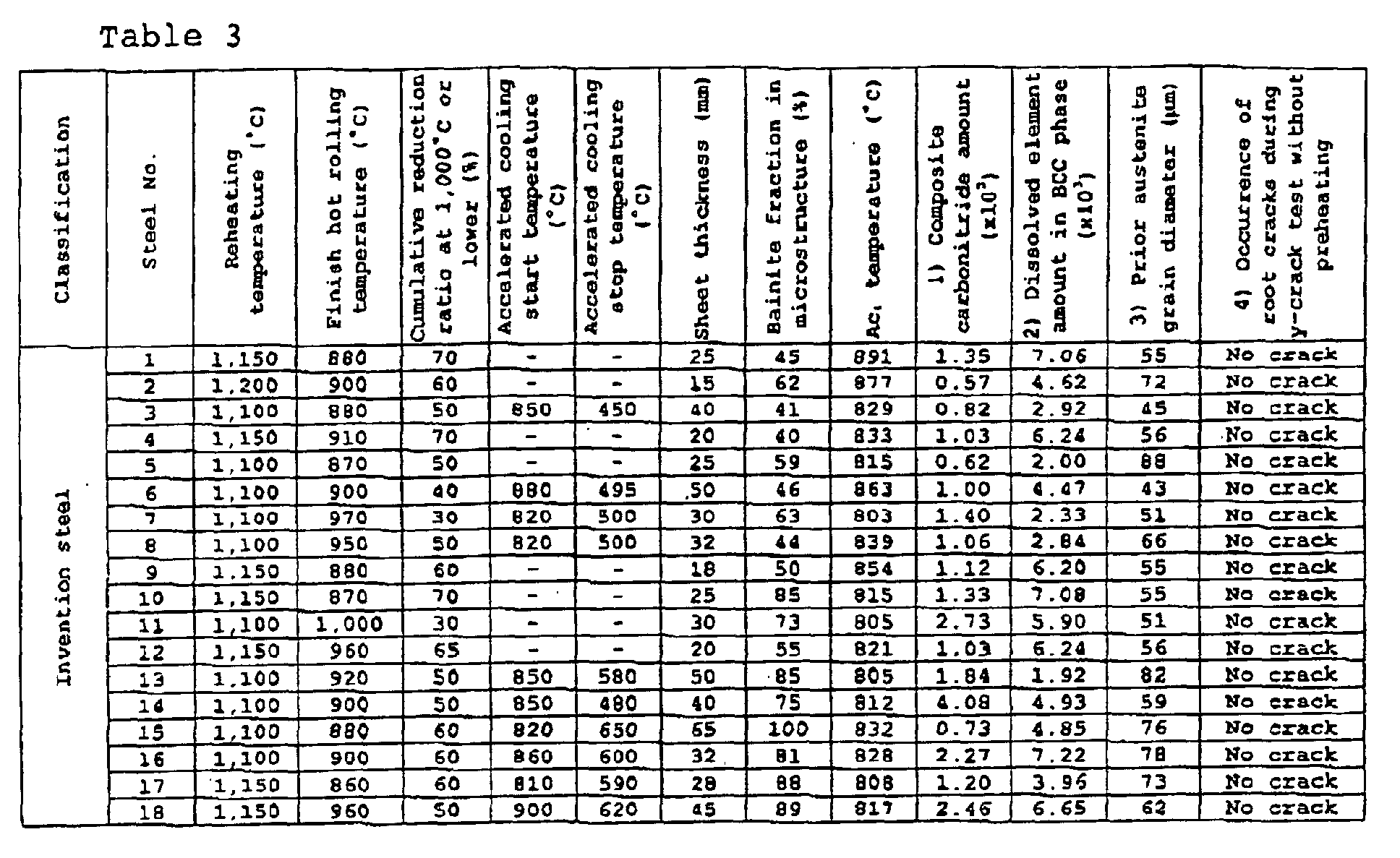
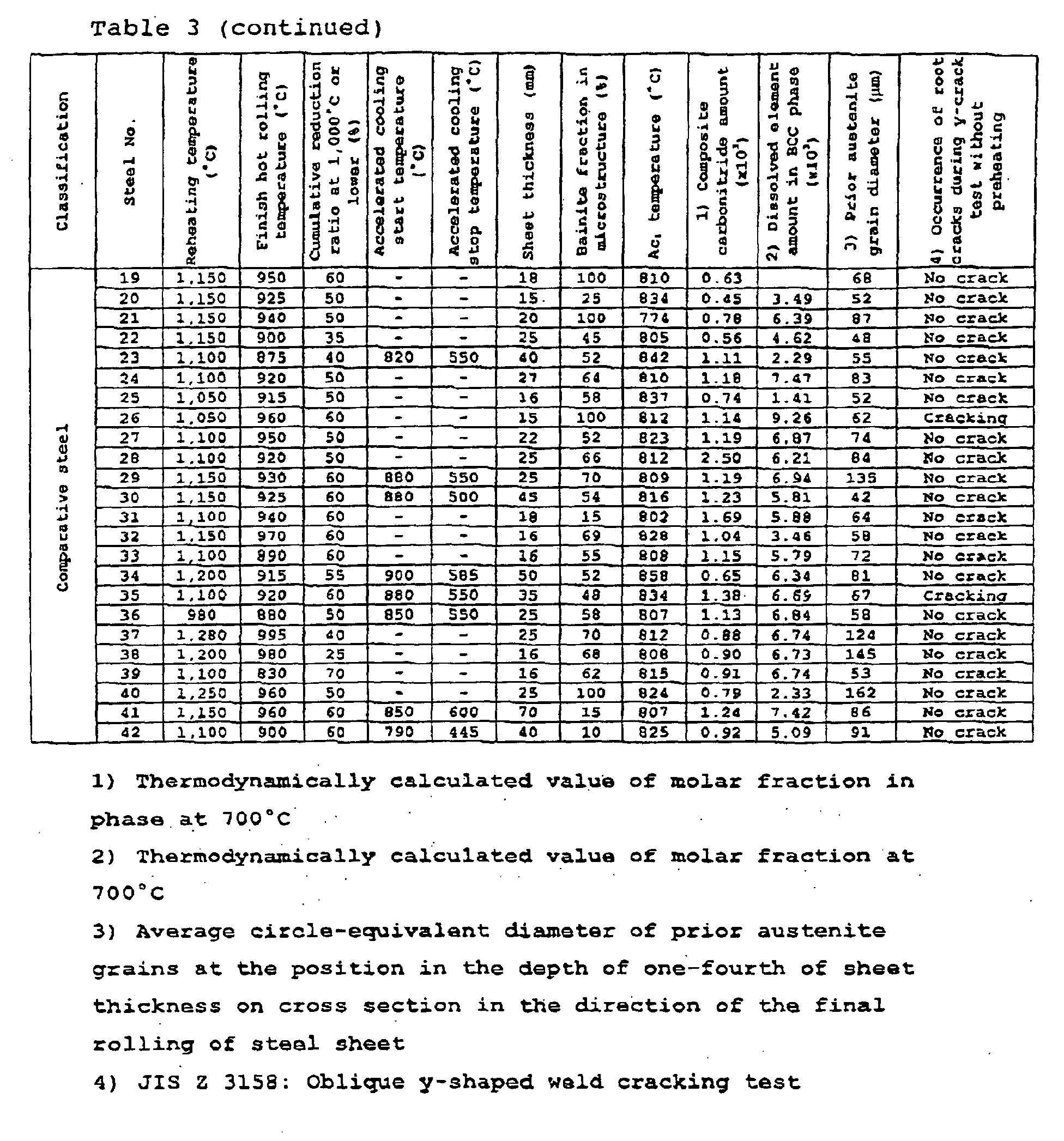
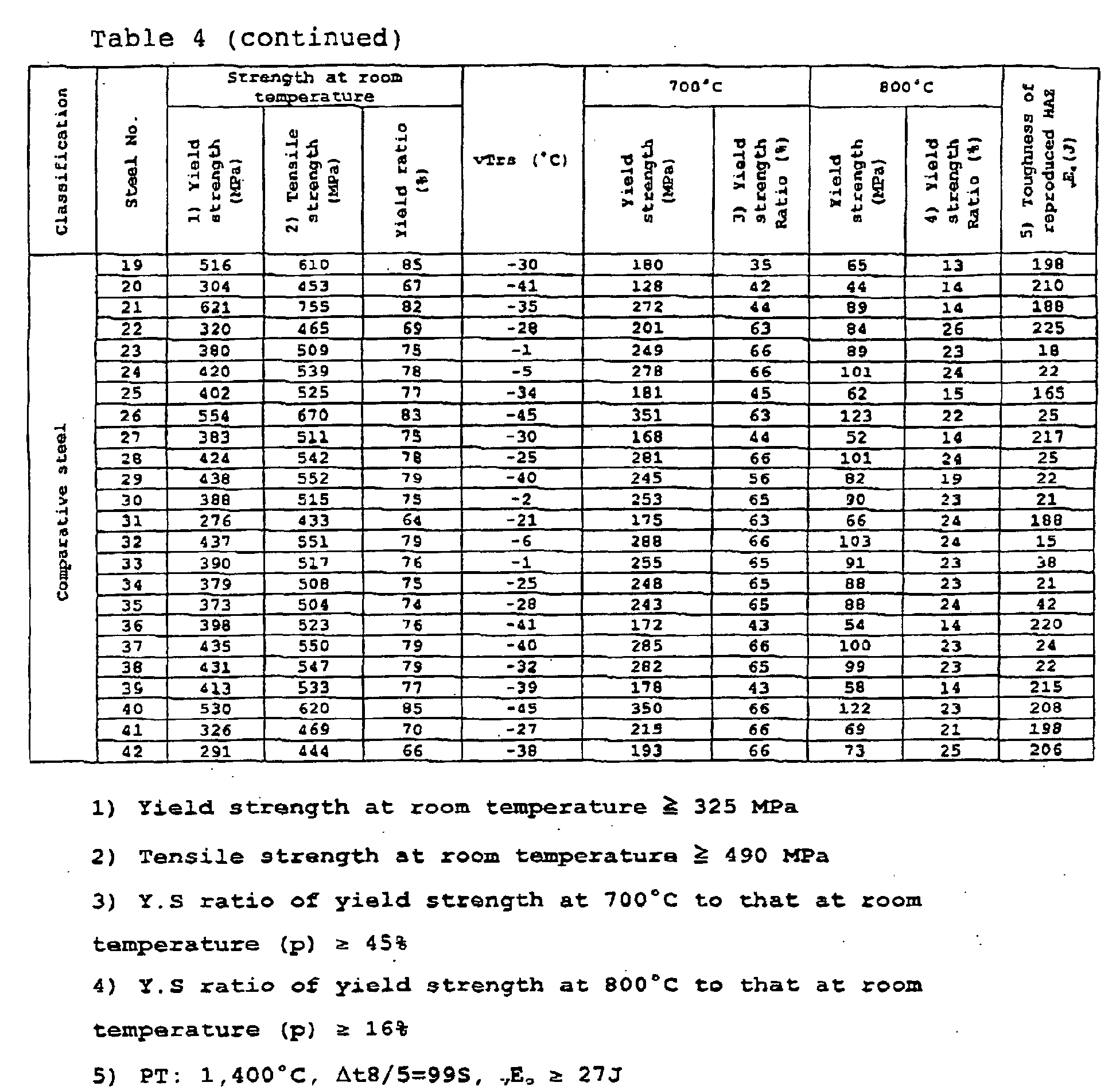
  • Steel sheets (15 to 50 mm in thickness) having various steel components were produced through the processes of a converter, continuous casting and plate rolling, and the strength, toughness, yield strength at 700°C and 800°C, occurrence of root cracks during the y-crack test without preheating (at room temperature) and the like of the resultant steel sheets were investigated.
  • steels Nos. 1 to 9 all the microstructures comprising the composite structures composed of ferrite and bainite and the average circle-equivalent diameters of prior austenite grains were not larger than 120 ⁇ m. Thus obtained yield strength ratios were excellent; 64% and 23% at 700°C and 800°C, respectively.
  • each of the microstructures comprising a single structure composed of bainite or a composite structure composed of ferrite and bainite and the average circle-equivalent diameters of prior austenite grains were not larger than 120 ⁇ m.
  • yield strength ratios were excellent; 61% and 25% at 700°C and 800°C, respectively.
  • the C amount was insufficient
  • the yield strength was insufficient as a steel of 490 MPa class
  • the amount of the composite carbonitrides formed in the high temperature of not lower than 600°C was less than 5 x 10 -4
  • the ratio (p) of the yield strength at the high temperature to that at room temperature was less than the value defined by the expression -0.0029 x T + 2.48.
  • the Mn amount exceeds 1.6%, therefore the Ac 1 temperature was lower than 800°C, and the ratio (p) of the yield strength at the high temperature to that at room temperature is less than the value defined by the expression -0.0029 x T + 2.48 in the temperature range of not lower than 700°C.
  • the Mn amount was less than 0.1%, therefore the effect of solution hardening was insufficient at room temperature, and thus the yield strength and the tensile strength at room temperature were lower than the relevant lower limits of the standard values of a 490 MPa class steel.
  • the S amount exceeds 0.01%, and therefore both the ductile-brittle transition temperature of the base steel and the absorbed energy of the reproduced HAZ at 0°C deteriorated, similarly to the comparative steel No. 23.
  • the reheating temperature was lower than 1,100°C, and therefore the added alloying elements did not dissolve in austenite during the reheating, a sufficient precipitation hardening effect was not obtained, and the ratio (p) of the yield strength at the high temperature to that at room temperature was less than the value defined by the expression -0.0029 x T + 2.48, though both the yield strength and the tensile strength at room temperature were good.
  • the reheating temperature was as high as 1,250°C, and therefore the austenite grains after the completion of the hot rolling were coarse; larger than 120 ⁇ m, and the toughness of the base steel was low.
  • the sheet thickness was thicker than 25 mm, and therefore it was attempted to secure a cooling rate of not less than 0.3 K/sec. by applying accelerated cooling.
  • the temperature at the start of water cooling was lower than 700°C
  • the cooling rate during the time period from the completion of the hot rolling to the start of the cooling (at 690°C) is less than 0.3 K/sec.
  • the transformation of ferrite proceeds before the start of the water cooling.
  • the bainite fraction was less than 20% and the tensile strength at room temperature was lower than 490 MPa.
  • a steel that has a specific chemical components and is produced by a method according to the present invention has a microstructure comprising a composite structure composed of ferrite and bainite or a single structure composed of bainite; is a high-tensile-strength steel having a strength of not lower than 490 MPa at room temperature; has the feature of satisfying the expression p ⁇ -0.0029 x T + 2.48 when the steel material temperature T (°C) is in the temperature range from 600°C to 800°C, wherein p is the ratio of a stress at a high temperature to that at room temperature (a yield stress at a high temperature/ a yield stress at room temperature); thus has the properties required of a fire-resistant steel for building construction; and is an entirely novel steel with qualities beyond those of all previous steels.

Landscapes

  • Chemical & Material Sciences (AREA)
  • Engineering & Computer Science (AREA)
  • Materials Engineering (AREA)
  • Mechanical Engineering (AREA)
  • Metallurgy (AREA)
  • Organic Chemistry (AREA)
  • Physics & Mathematics (AREA)
  • Thermal Sciences (AREA)
  • Crystallography & Structural Chemistry (AREA)
  • Heat Treatment Of Steel (AREA)

Abstract

The present invention relates to a high-tensile-strength low alloy carbon steel (in the form of a steel sheet, a steel pipe, a section steel or a wire rod), for a building structure, said high-tensile-strength steel being excellent in high temperature strength during a relatively short span of about one hour in the temperature from 600°C to 800°C and being used in the field of building construction, civil engineering, an offshore structure, shipbuilding, a reservoir tank or the like; and, more specifically, is a high-tensile-strength steel excellent in high temperature strength, characterized by containing, in mass, C at not less than 0.005% to less than 0.08%, Si at not more than 0.5%, Mn at 0.1 to 1.6%, P at not more than 0.02%, S at not more than 0.01%, Mo at 0.1 to 1.5%, Nb at 0.03 to 0.3%, Ti at not more than 0.025%, B at 0.0005 to 0.003%, Al at not more than 0.06%, and N at not more than 0.006%, with the balance consisting of Fe and unavoidable impurities and satisfying the expression p ≧ -0.0029 x T + 2.48 when the steel temperature T (°C) is within the range from 600°C to 800°C, wherein p is a stress drop ratio (a yield stress at a high temperature/ a yield stress at room temperature) that is obtained by converting a yield stress normalized by using a yield stress at room temperature.

Description

Technical Field
The present invention relates to a method for producing a high-tensile-strength low alloy carbon steel (in the form of a steel sheet, a steel pipe, a section steel or a wire rod), for a building structure, the high-tensile-strength steel showing an excellent high temperature strength during a relatively short span of about one hour in the temperature range from 600°C to 800°C and being used for a general structure in the field of building construction, civil engineering, an offshore structure, shipbuilding, a reservoir tank or the like.
Background Art
In the field of building construction, civil engineering or the like, for example, steel standardized by JIS, etc. are widely used as steel for various structures. Here, the allowable temperature of an ordinary steel for a building structure is 550°C because the strength thereof begins to lower at a temperature of about 350°C.
For that reason, in order to secure safety from a fire in the case where an above-mentioned steel material is used in architecture such as a building, an office, a dwelling, a multi-level car parking tower or the like, the application of sufficient fire-resistant coating to the steel is required and the laws related to architectures stipulate that the temperature of the steel material should not rise to 350°C or higher during a fire.
The reason for the above regulation is that the proof stress of the above-mentioned steel at about 350°C becomes about two-thirds of that at room temperature and thus it falls short of the required strength. When steel is used in a building structure, a fire-resistant coating is applied thereto so that the temperature of the steel may not reach 350°C during a fire. Therefore, the cost for the fire-resistant coating goes up in comparison with the cost of the steel and a large increase in the construction cost is inevitable.
Solving the above problems, Japanese Unexamined Patent Publication Nos. H2-77523 and H10-68044, for example, disclose that a steels usable at a temperature of not lower than 600°C is generally called "a fire-resistant steel." As an example of the relevant invention, Japanese Unexamined Patent Publication No. H2-77523 proposes a fire-resistant steel having such a high temperature strength that the yield strength thereof at 600°C is not less than two-thirds (about 70%) of that at room temperature. Further, in other examples of the invention related to a fire-resistant steel withstanding a temperature of 600°C, the generally adopted criterion is that a yield strength at 600°C is not less than two-thirds of that at room temperature.
However, in case of a fire-resistant steel withstanding a temperature of 700°C or 800°C, no general rules are specified at present with regard to the specification of a high temperature strength (the ratio of a yield strength at a high temperature to that at room temperature). For example, Japanese Unexamined Patent Publication No. H2-77523 discloses a steel, to which considerable amounts of Mo and Nb are added, that can secure a proof stress at 600°C of not less than 70% of the proof stress at room temperature, but it does not describe a proof stress at 700°C or 800°C.
Furthermore, where the proof stress of a steel at 600°C is only about 70% of that at room temperature, considering a temperature rise during a fire, though it is possible to reduce the amount of fire-resistant coating, a building structure to which a steel not coated with fire-resistant coating is applicable is limited to an architecture having an open space such as a multi-level car parking tower or an atrium and therefore the application of the steel not coated with a fire-resistant coating is substantially limited.
Japanese Unexamined patent Publication No. H10-68044 discloses a technology that secures a proof stress at 700°C being not less than 56% of the proof stress at room temperature by making the microstructure of a steel, to which considerable amounts of Mo and Nb are added, composed of a bainite structure, but it does not describe a proof stress at 800°C.
Consequently, though a steel securing a high temperature strength at about 600°C has already been used in the market and a steel securing a certain strength at 700°C has been invented in the above examples, it has been difficult to stably produce a practically usable steel that is capable of securing a high temperature strength at a temperature of 700°C or 800°C.
Meanwhile, the present inventors have recently disclosed a fire-resistant steel withstanding 850°C in Japanese Unexamined Patent Publication No. 2002-105585. The invented steel secures effective precipitates even at a high temperature and obtains fire resistance at 850°C by adding comparatively large amounts of alloying elements such as Al, Ti, etc. However, it is not suitable for the steel to be applied to a welded structure.
As it has been explained above, when an ordinary steel is applied to architecture, as the high temperature strength is low. The ordinary steel has not been used without a fire-resistant coating or with a thin fire-resistant coating, and therefore it has had to be coated with an expensive fire-resistant coating.
In addition, even in a fire-resistant steel, the guaranteed fire-resistant temperature has been 600°C to 700°C at the highest and therefore the development of a steel that can be used at a temperature of 700°C or 800°C without the application of fire-resistant coating and thus allows a fire-resistant coating process to be eliminated, has long been sought for.
Disclosure of the Invention
The object of the present invention is to provide: a high-tensile-strength steel that is excellent in high temperature strength in the temperature range from 600°C to 800°C and in weldability and is used in the field of building construction, civil engineering or the like; and a production method that makes it possible to stably supply the steel in an industrial scale. The gist of the present invention is as follows:
  • (1) A high-tensile-strength steel excellent in high temperature strength, characterized by containing, in mass, C at not less than 0.005% to less than 0.08%, Si at not more than 0.5%, Mn at 0.1 to 1.6%, P at not more than 0.02%, S at not more than 0.01%, Mo at 0.1 to 1.5%, Nb at 0.03 to 0.3%, Ti at not more than 0.025%, B at 0.0005 to 0.003%, Al at not more than 0.06%, and N at not more than 0.006%, with the balance consisting of Fe and unavoidable impurities.
  • (2) A high-tensile-strength steel excellent in high temperature strength according to the item (1), characterized by said steel satisfying the expression p ≧ -0.0029 x T + 2.48 when the steel temperature T (°C) is within the range from 600°C to 800°C, wherein p is a stress drop ratio (a yield stress at a high temperature/a yield stress at room temperature) that is obtained by converting a yield stress normalized by using a yield stress at room temperature.
  • (3) A high-tensile-strength steel excellent in high temperature strength according to the item (1), characterized in that: said steel comprising a single structure composed of bainite or a composite structure composed of ferrite and bainite at room temperature; the temperature (Ac1) at which said structure reversely transforms into austenite during high temperature heating corresponding to a fire is higher than 800°C; and said steel satisfies the expression p ≧ -0.0029 x T + 2.48 when the steel temperature T (°C) is within the range from 600°C to 800°C, wherein p is a stress drop ratio (a yield stress at a high temperature/ a yield stress at room temperature) that is obtained by converting a yield stress normalized by using a yield stress at room temperature.
  • (4) A high-tensile-strength steel excellent in high temperature strength according to the item (1), characterized in that, in the high temperature range from 600°C to 800°C: said steel has such a strength as to satisfy the expression p ≧ -0.0029 x T + 2.48 when the steel temperature T (°C) is within the range from 600°C to 800°C, wherein p is a stress drop ratio (a yield stress at a high temperature/ a yield stress at room temperature) that is obtained by converting a yield stress normalized by using a yield stress at room temperature; said steel has a structure wherein the temperature (Ac1) at which a single structure composed of bainite or a composite structure composed of ferrite and bainite at room temperature reversely transforms into austenite during high temperature heating corresponding to a fire is higher than 800°C; one ore more of carbonitrides precipitated phases thermodynamically stable in said single structure composed of bainite or in said composite structure composed of ferrite and bainite is not less than 5 x 10⁻⁴ in terms of a molar fraction; and the total amount of Mo, Nb and Ti that dissolve in the ferrite structure is not less than 1 x 10⁻³ in terms of a molar concentration.
  • (5) A high-tensile-strength steel excellent in high temperature strength according to the item (1), characterized in that, in the high temperature range from 600°C to 800°C: said steel has such a strength as to satisfy the expression p ≧ -0.0029 x T + 2.48 when the steel temperature T (°C) is within the range from 600°C to 800°C, wherein p is a stress drop ratio (a yield stress at a high temperature/ a yield stress at room temperature) that is obtained by converting a yield stress normalized by using a yield stress at room temperature; said steel has a structure wherein the temperature (Ac1) at which a single structure composed of bainite or a composite structure composed of ferrite and bainite at room temperature reversely transforms into austenite during high temperature heating corresponding to a fire is higher than 800°C; the average circle equivalent diameter of prior austenite grains in said steel is not more than 120 µm; one or more of carbonitrides precipitated phases thermodynamically stable in said single structure composed of bainite or in said composite structure composed of ferrite and bainite is not less than 5 x 10⁻⁴ in terms of a molar fraction; and the total amount of Mo, Nb and Ti that dissolve in the ferrite structure is not less than 1 x 10⁻³ in terms of a molar concentration.
  • (6) A high-tensile-strength steel excellent in high temperature strength according to any one of the items (1) to (5), characterized in that the weld cracking susceptibility index PCM of said steel defined by the following expression is not more than 0.20%; PCM = C + Si/30 + Mn/20 + Cu/20 + Ni/60 + Cr/20 + Mo/15 + V/10 + 5 x B.
  • (7) A high-tensile-strength steel excellent in high temperature strength according to any one of the items (1) to (6), wherein the steel further containing, in mass, one or more of Ni at 0.05 to 1.0%, Cu at 0.05 to 1.0%, Cr at 0.05 to 1.0%, and V at 0.01 to 0.1%.
  • (8) A high-tensile-strength steel excellent in high temperature strength according to any one of the items (1) to (7), wherein the steel further containing, in mass: one or more of Ni at 0.05 to 1.0%, Cu at 0.05 to 1.0%, Cr at 0.05 to 1.0%, and V at 0.01 to 0.1%; and additionally one or more of Ca at 0.0005 to 0.004%, REM at 0.0005 to 0.004%, and Mg at 0.0001 to 0.006%.
  • (9) A high-tensile-strength steel excellent in high temperature strength according to the item (7) or (8), characterized in that, in the high temperature range from 600°C to 800°C: said steel has such a strength as to satisfy the expression p ≧ -0.0029 x T + 2.48 when the steel temperature T (°C) is within the range from 600°C to 800°C, wherein p is a stress drop ratio (a yield stress at a high temperature/ a yield stress at room temperature) that is obtained by converting a yield stress normalized by using a yield stress at room temperature; said steel has a structure wherein the temperature (Ac1) at which a single structure composed of bainite or a composite structure composed of ferrite and bainite at room temperature reversely transforms into austenite during high temperature heating corresponding to a fire is higher than 800°C; the average circle equivalent diameter of prior austenite grains in said steel is not more than 120 µm; one or more of carbonitrides precipitated phases thermodynamically stable in said single structure composed of bainite or in said composite structure composed of ferrite and bainite is not less than 5 x 10⁻⁴ in terms of a molar fraction; and the total amount of Mo, Nb and Ti that dissolve in the ferrite structure is not less than 1 x 10⁻³ in terms of a molar concentration.
  • (10) A method for producing a high-tensile-strength steel excellent in high temperature strength, characterized by comprising the steps of: reheating a casting or a slab having a steel composition according to any one of the items (1) to (9) in the temperature range from 1,100°C to 1,250°C; hot rolling it in the temperature range of not lower than 850°C while controlling the cumulative reduction ratio in the temperature range of not higher than 1,100°C to not less than 30%; finishing the hot rolling, cooling the hot-rolled steel sheet at a cooling rate of not lower than 0.3 K/sec. from the temperature range of not lower than 800°C to the temperature range of not higher than 650°C; and thus making the microstructure of the steel comprising a single structure composed of bainite or a composite structure composed of ferrite and bainite.
  • (11) A high-tensile-strength steel excellent in high temperature strength, characterized by: comprising, in mass, C at not less than 0.005% to less than 0.08%, Si at not more than 0.5%, Mn at 0.1 to 1.6%, P at not more than 0.02%, S at not more than 0.01%, Mo at 0.1 to 1.5%, Nb at 0.03 to 0.3%, Ti at not more than 0.025%, B at 0.0005 to 0.003%, Al at not more than 0.06%, and N at not more than 0.006%, with the balance consisting of Fe and unavoidable impurities; having a structure wherein the temperature (Ac1) at which a composite structure composed of ferrite and bainite, the composite structure having a bainite fraction being in the range from 20 to 95% at room temperature, reversely transforms into austenite during high temperature heating corresponding to a fire is higher than 800°C; and having a low yield ratio.
  • (12) A high-tensile-strength steel excellent in high temperature strength according to the item (11), wherein the steel further containing, in mass, one or more of Ni at 0.05 to 1.0%, Cu at 0.05 to 1.0%, Cr at 0.05 to 1.0%, and V at 0.01 to 0.1%.
  • (13) A high-tensile-strength steel excellent in high temperature strength according to the item (11) or (12), wherein the steel further containing, in mass: one or more of Ni at 0.05 to 1.0%, Cu at 0.05 to 1.0%, Cr at 0.05 to 1.0%, and V at 0.01 to 0.1%; and additionally one or more of Ca at 0.0005 to 0.004%, REM at 0.0005 to 0.004%, and Mg at 0.0001 to 0.006%.
  • (14) A method for producing a high-tensile-strength steel excellent in high temperature strength, characterized by comprising the steps of: reheating an ingot or a slab having a steel composition according to any one of the items (11) to (13) in the temperature range from 1,100°C to 1,250°C; hot rolling it in the temperature of not lower than 850°C while controlling the cumulative reduction ratio in the temperature of not higher than 1,100°C to not less than 30%; finishing the hot rolling, cooling the hot-rolled steel sheet at a cooling rate of not lower than 0.3 K/sec. from the temperature of not lower than 800°C to the temperature of not higher than 650°C; thus making the microstructure of the steel comprising a single structure composed of bainite or a composite structure composed of ferrite and bainite; forming a structure wherein the temperature (Ac1) at which a microcomposite structure composed of ferrite and bainite, the composite structure having a bainite fraction being in the range from 20 to 95% at room temperature, reversely transforms into austenite during high temperature heating corresponding to a fire is higher than 800°C; and securing a low yield ratio.
  • Best Mode for Carrying out the Invention
    The present inventors have proposed steels excellent in high temperature strength at 600°C and 700°C and the steels excellent in high temperature strength at 600°C have already been used in various fields including building construction. However, there is a very strong demand in the market for a steel withstanding a still higher temperature. At the same time, there also is a strong demand for a steel excellent in high temperature strength to have a still higher strength.
    In a fire resistance design, a steel is well accepted as long as the steel maintains high strength for the duration of a fire. That is, it is not necessary to consider such long lasting strength as required of a conventional heat-resistant steel and a steel is well accepted as long as the yield strength of the steel is maintained for a relatively short time at a high temperature. For example, a steel can be sufficiently used as a fire-resistant steel withstanding 800°C as long as the yield strength of the steel is secured for a short retention time of about 30 minutes at a high temperature of 800°C.
    The performance of a conventional fire-resistant steel has been regulated so that a yield strength at a high temperature is not less than two-thirds of that at room temperature. However, considering the fact that the range of the strength of a steel in the actual design of a steel construction is about 0.2 to 0.4 time the lower limit of the yield strength at room temperature, it is necessary for the steel to satisfy the expression p ≧ - 0.0029 x T + 2.48 when the steel temperature T (°C) is within the range from 600°C to 800°C, wherein p is a stress drop ratio (a yield stress at a high temperature/a yield stress at room temperature) that is obtained by converting a yield stress normalized by using a yield stress at room temperature.
    In order to further enhance high temperature strength, it is effective to promote the precipitation of carbonitrides that are stable at a high temperature and make a microstructure consist of bainite by the combined addition of Mo and Nb. In order to enhance strength at room temperature and emphasize the properties as a high-tensile-strength steel, a microstructure may be made composed of a single structure of bainite.
    However, since a strength at room temperature increases as the fraction of hard bainite increases, when the upper limit of a yield ratio (YR) is regulated, it is desirable to make the microstructure of a steel comprising a single structure composed of bainite or a composite structure composed of ferrite and bainite that has an adequate bainite fraction, in accordance with the required properties including a strength at room temperature.
    In order to produce a proper microstructure and obtain a strength in the prescribed range at room temperature, it is effective to lower a C content. A low C content has the effects of enhancing the thermodynamic stability of bainite or a composite structure composed of ferrite and bainite at a high temperature and also raising the temperature (Ac1) at which a structure reversely transforms into austenite. However, in this case, it has been clarified that the microstructure and the steel properties are apt to be influenced by rolling conditions and subsequent cooling conditions and a stable production is hardly obtained.
    To address the problems, the present inventors investigated the control of a microstructure and the enhancement of high temperature strength, as a result, found that an appropriate the amount B addition was effective for the stabilization of production, and established the present invention.
    A steel in this category is generally required to have such weldability as required of a conventional steel for a welded structure since the steel may be used for a welded structure, and therefore it has been a very difficult challenge to achieve such a steel excellent in strength at a high temperature of 700°C to 800°C.
    The present inventors carried out intensive studies to solve the problem, and found that, in order to obtain a high temperature strength in the temperature range from 700°C to 800°C, it was effective to enhance precipitation hardening of a steel by the combined addition of alloying elements such as Mo, Nb, v, Ti, etc., in order to increase dislocation density by making a microstructure composed of bainite, and further to delay the recovery of the dislocation by dissolved Mo, Nb and V and somewhat by dissolved Ti.
    The present inventors further found that, in order to simultaneously secure all of a strength at 700°C to 800°C, a strength at room temperature, and a desired a stress drop ratio p from room temperature to a high temperature, it was important to make a microstructure comprising a composite structure composed of ferrite and bainite or a single structure composed of bainite and, at the same time, to obtain the thermal stability of the matrix structure at a high temperature and the adequate effects of conformable precipitation hardening and dislocation recovery delay by controlling the amounts of alloying elements addition in appropriate amounts. Furthermore, in order to secure a low yield ratio, it is necessary to make a microstructure comprising an adequate composite structure composed of ferrite and bainite.
    In general, the yield strength of a steel begins to drop sharply from a temperature close to 450°C. This is because, as a temperature rises, thermal activation energy drops and resistance to dislocation slip movement, which has been effective at a low temperature, becomes ineffective.
    Generally speaking, Cr carbide, Mo carbide and the like, which are utilized for strengthening a steel in a temperature of around lower than 700°C, function as effective resistance to dislocation slip movement up to a high temperature of about 600°C, but they dissolve again at a high temperature of 800°C or so and therefore can scarcely maintain the strengthening effect.
    The present inventors investigated single or composite structures of various precipitates having higher stability at a high temperature. As a result, it was found that precipitates formed by combining Mo with Nb, Ti and V had high stability at a high temperature and also a high strengthening effect at 700°C to 800°C. That is, precipitates formed by combining Mo with Nb, Ti and V precipitate finely during reheating, for example during temperature rise at a fire, by: adding appropriate amounts of Mo, Nb, Ti and V; keeping a heating temperature high at hot rolling; thus making those elements dissolve sufficiently; also introducing proper structure after hot rolling having a high dislocation density; and, by so doing, securing precipitation sites where precipitates can occur.
    Even such composite precipitates grow and coarsen while a steel is retained at 700°C to 800°C and the strengthening effect decreases before long. However, when such composite precipitates exist densely and finely dispersed manner, a desired level of yield strength can sufficiently be obtained at 700°C to 800°C as long as the retention time is about 30 minutes.
    In addition, Mo, Nb, V and Ti dissolved in a BCC phase are effective for the delay of dislocation recovery and have the effect of raising the temperature at which a sharp drop of yield strength commences. The present inventors obtained the following discovery as a result of variously studying in detail the effect of those high temperature strengthening factors on yield stress at 700°C to 800°C. That is, in order that a steel satisfies the expression p ≧ -0.0029 x T + 2.48 when the steel temperature T (°C) is within the range from 700°C to 800°C, namely the stress drop ratio is not less than 45% at 700°C and not less than 16% at 800°C, wherein p is a yield stress drop ratio from room temperature to a high temperature (a yield stress at a high temperature/ a yield stress at room temperature), it is necessary that, in the temperature range, carbonitrides compositely containing Mo, Nb, V and Ti are not less than 5 x 10⁻⁴ in terms of a molar fraction and the total amount of Mo, Nb, V and Ti that dissolve in a BCC phase is not less than 1 x 10⁻³ in terms of a molar concentration.
    The composition of a composite carbonitride precipitates that are important for the securing a high temperature strength can easily be identified by analysis with, for example, an electron microscope or an EDX. The amount of a thermodynamically stable precipitates that are formed equilibriously and the amounts of alloying elements that dissolve in a BCC phase can easily be calculated from the amounts of the alloying elements addition by using a commercially available software for a thermodynamic computation database or the like.
    However, even when precipitates themselves are stable, if a base steel transforms due to a temperature rise, the coherency between the precipitates and the matrix is lost, they become incoherent, and thus the strengthening function of the precipitates deteriorates sharply. That is, in order to make use of the strengthening effect of composite precipitates that are stable even at a high temperature, it is essential for a steel that the base steel structure of the matrix does not transform even at 800°C which is a designed temperature.
    For that reason, concretely, it is necessary to control the Ac1 transformation temperature of a steel to not lower than 800°C by adjusting alloying elements, for example by lowering the amount of Mn addition that has a function of forming austenite.
    Further, the concept of the present invention is to enhance strengthening at a high temperature by utilizing precipitates and dissolved elements and, thus, the amounts of addition alloying elements, such as Cr, Mn and Mo, that have so far been added abundantly to a conventional steel for high temperature use can rather be restrained at a low level. Therefore, it is possible to design alloy addition so as not to deteriorate weldability.
    Note that, as a steel comprising a single structure composed of bainite has a high strength, the condition of a low yield ratio that is required of a steel for building construction cannot necessarily be satisfied. In order to cope with that, when a low yield ratio is required of a steel according to the present invention, a microstructure is made comprising composite structure composed of ferrite and bainite and the bainite fraction is controlled in the range from 20 to 95%. The reason is that an excessive ferrite fraction in a microstructure makes it difficult to secure strength both at room temperature and at a high temperature by increasing the amounts of alloying elements addition.
    The reasons for regulating the components in the present invention are explained hereunder. Here, % means a percent in terms of mass.
    C is an element that affects the properties of a steel most conspicuously and is essential for the formation of composite precipitates (carbides) with Mo, Nb, Ti and V. Therefore, a C amount of at least 0.005% is necessary. If a C amount is less than the amount, the strength of a steel is insufficient. However, when C is added in excess of 0.08%, the Ac1 transformation temperature lowers, and therefore strength at 800°C is hardly obtained and toughness also deteriorates. For those reasons, a C amount is limited in the range from 0.005 to 0.08%. Further, it is preferable to limit a C amount to less than 0.04% in order to keep the matrix composed of ferrite and bainite thermodynamically stable during high temperature heating corresponding to a fire, to maintain the coherency of the matrix with carbonitride precipitates compositely containing Mo, Nb, V and Ti, and thus secure the strengthening effect.
    Si is an element contained in a steel as a deoxidizing agent and is effective in enhancing the strength of a steel at room temperature as it has a function of strengthening a steel by acting as substitutional solution hardening. However, Si does not have the effect of enhancing strength particularly at a high temperature exceeding 600°C. If Si is added abundantly, weldability and HAZ toughness deteriorate, and therefore the upper limit of an Si amount is limited to 0.5%. A steel can be deoxidized only by Ti and/or Al, and therefore it is preferable that an si amount is as low as possible from the viewpoint of HAZ toughness and hardenability. Therefore, Si may not necessarily be added.
    Mn is an element indispensable for securing strength and toughness. Mn is a substitutional solution hardening element and therefore it is effective for the enhancement of strength at room temperature. However, Mn does slight contribution to increase high temperature strength exceeding 600°C. For that reason, in a steel containing a comparatively large amount of Mo, such as a steel according to the present invention, an Mn amount is limited to not more than 1.6% from the viewpoint of the improvement of weldability, namely the lowering of a PCM value. To control the upper limit of a Mn amount to a low level is advantageous also from the viewpoint of the control of the segregation at the center of a continuously cast slab. Further, in order to control the Ac1 transformation temperature to not lower than 800°C, the addition of Mn must be restrained and it is desirable to set the upper limit at 0.9%. The lower limit of an Mn amount is not particularly regulated, but it is desirable to add Mn by not less than 0.1% from the viewpoint of the securing of the strength and toughness of a steel.
    In order to obtain an appropriate fraction of a bainite structure, a cooling rate must be not lower than 0.3 K/sec. in the temperature range from 800°C to 650°C after the completion of hot rolling. That is, a comparatively thin steel sheet less than about 25 mm in thickness must be produced through an air cooling process or an accelerated cooling (water cooling) process, and a comparatively thick steel sheet more than about 25 mm in thickness must be produced through an accelerated cooling (water cooling) process.
    P is an impurity in a steel according to the present invention and the reduction of a P amount tends to reduce intergranular fracture at a HAZ. Therefore, it is preferable that a P amount is as small as possible. When a P amount is high, the low temperature toughness of a steel and a weld deteriorate. For that reason, the upper limit of a P amount is set at 0.02%.
    S, like P, is an impurity in a steel according to the present invention and therefore it is preferable that an S amount is as small as possible from the viewpoint of the low temperature toughness of a base steel. when an S amount is high, the low temperature toughness of a base steel and a weld deteriorate. For that reason, the upper limit of an S amount is set at 0.01%.
    Mo is a basic element that constitutes composite precipitates which enhance high temperature strength and thus is an essential element in a steel according to the present invention. It is necessary to add Mo by not less than 0.1% in order to obtain composite precipitates formed by combining Mo with Nb and Ti or composite precipitates formed by combining Mo with Nb, Ti and V at a high density and thus enhance high temperature strength. On the other hand, when Mo is added in excess of 1.5%, the uniformity of the properties of a steel is hardly controlled, the toughness of a weld heat-affected zone deteriorates, and also the economical efficiency is lost. For those reasons, an addition amount of Mo is limited in the range from 0.1 to 1.5%, preferably from 0.2 to 1.1%.
    Nb is an element that contributes important roles in securing strength at a high temperature of 700°C or 800°C in a steel according to the present invention to which a comparatively large amount of Mo is added. Firstly, in general, Nb is an element that is useful for raising the recrystallization temperature of austenite and exhibiting the effect of controlled rolling during hot rolling to the maximum. Secondly, Nb contributes to the grain size refinement of austenite in a heated steel at reheating prior to hot rolling, normalizing or quenching.
    In addition, Nb has the effect of enhancing strength by precipitation hardening, and also contributes to the enhancement of high temperature strength by the combined addition with Mo. When the amount of Nb addition is less than 0.03%, the effect of precipitation hardening is insufficient in the temperature range from 700°C to 800°C, and therefore it is preferable to add Nb by not less than 0.1%. On the other hand, when an Nb amount exceeds 0.2%, the toughness of a steel may deteriorate, and therefore the upper limit of an Nb amount is set at 0.3%. Consequently, a Nb amount is limited in the range from 0.03 to 0.3%.
    Ti, like Nb, is also effective for the enhancement of high temperature strength. When severe toughness is required of a steel and a weld in particular, it is desirable to add Ti. The reason is that, when an Al amount is small (not more than 0.003%, for example), Ti forms precipitates mainly composed of Ti2O3 by combining with O, the precipitates act as nuclei for forming intragranular transformed ferrite, and that improves toughness at a weld. Another reason is that Ti forms TiN in the slab by combining with N, restrains the coarsening of γ grains during reheating, and thus is effective for the microstructure refinement after hot rolling, and further that fine TiN remaining in a steel sheet refines microstructure of a heat-affected zone at welding. A Ti amount of at least 0.005% is necessary in order to secure those effects. However, when a Ti amount is excessive, Ti forms TiC and then deteriorates low temperature toughness and weldability. For that reason, a Ti amount is preferably not more than 0.02%; the upper limit thereof is 0.025%.
    B is very important in controlling strength through the control of the fraction of bainite formed. That is, B is effective in improving hardenability by segregating at the grain boundaries of austenite and restraining ferrite formation, and forming bainite stably even when a cooling rate is comparatively low as in air cooling. A B amount of at least 0.0005% is necessary in order to secure the above effects. However, if an addition amount of B is excessive, not only the effect of improving hardenability is saturated but also B precipitates that cause the embrittlement of prior austenite grain boundaries and are detrimental to toughness may form. Therefore, the upper limit of a B amount is set at 0.003%.
    Al is an element generally contained in a steel as a deoxidizing agent. However, only Si or Ti can play the role of deoxidization sufficiently and thus the lower limit of an Al amount is not specified in the present invention (including the case of an Al amount is zero). On the other hand, if an Al amount is excessive, not only the cleanliness of a steel deteriorates but also the toughness of a weld metal deteriorates. Therefore, the upper limit of an Al amount is set at 0.06%.
    N is an element that is contained in a steel as an unavoidable impurity and the lower limit of an N amount is not particularly specified. However, the increase of an N amount is extremely detrimental to toughness at a HAZ and weldability. Therefore, the upper limit thereof is set at 0.006% in a steel according to the present invention.
    Next, the reasons for specifying the addition and the ranges of the addition amounts of Ni, Cu, Cr, V, Ca, REM and Mg, which may be contained in a steel as occasional demands, are explained hereunder. The main object of further adding those elements in addition to the basic components is to improve properties such as strength, toughness and the like with the excellent features of a steel according to the present invention not harmed. Accordingly, the addition amounts thereof should be restricted spontaneously.
    Ni enhances the strength and toughness of a steel while weldability and toughness at a HAZ are not badly affected. In order to secure those effects, Ni must be added by at least not less than 0.05%. On the other hand, if Ni is added excessively, not only economical efficiency is harmed but also weldability is adversely affected, and therefore the upper limit of an Ni amount is set at 1.0%.
    Cu exhibits almost the same effects and roles as Ni. An excessive addition of Cu causes the deterioration of weldability and the generation of Cu-induced cracks during hot rolling which makes the production difficult, and therefore the upper limit of a Cu amount is set at 1.0%. The lower limit of a Cu amount should be the least amount in which a substantial effect is obtained and thus is set at 0.05%.
    Cr enhances both the strength and the toughness of a steel. However, if an addition amount of Cr is excessive, the toughness and weldability of both a base steel and a weld are deteriorated, and therefore a Cr amount is limited in the range from 0.05 to 1.0%.
    The aforementioned Cu, Ni and Cr are effective in not only the strength and toughness of a steel but also the weather resistance thereof. For those purposes, it is preferable to add the elements within the range where weldability is not hindered.
    V has almost the same function of composite precipitation as Nb has, but the effect thereof is smaller than that of Nb. Further, V influences hardenability and also contributes to the enhancement of high temperature strength. The same effect as Nb is hardly obtained with a V addition amount of less than 0.01%. On the other hand, if the amount of V addition is excessive, the toughness of a steel deteriorates sometimes. Therefore, the lower and upper limits of a V amount in a steel according to the present invention are set at 0.01% and 0.1%, respectively.
    Ca and REM combine with S, which is an impurity, and have the functions of enhancing toughness and restraining cracks induced by dispersed hydrogen at a weld. However, if their amounts are excessive, coarse inclusions are formed and they exert harmful influence. Therefore, the adequate content of Ca or REM is 0.0005 to 0.004%.
    Mg has the functions of restraining the growth of austenite grains and fractionizing them at a heat-affected zone, and enhances toughness at a weld. In order to secure those effects, a Mg addition of not less than 0.0001% is necessary. On the other hand, if the Mg addition increases, the degree of the effects to the increase of the addition amount decreases and economical efficiency is harmed. Therefore, the upper limit of an Mg amount is set at 0.006%.
    Now, it is also an effective means for improving the properties of a steel according to the present invention to secure high temperature strength by adding an appropriate amount of W in the same effect as the addition of Mo, Nb and V. A W amount of at least 0.01% is necessary in order to obtain the effect. However, if a W amount exceeds 1%, the effect is saturated and, therefore, the upper limit thereof is set at 1% from the economical efficiency viewpoint.
    Further, in order to secure a low cracking susceptibility at room temperature and make welding without preheating viable, a PCM value is limited to not more than 0.20%. PCM is an index that represents weldability and, as a PCM value decreases, weldability improves. In a steel according to the present invention, an excellent weldability can be secured as long as a PCM value is not more than 0.20%. Here, the weld cracking susceptibility index PCM is defined by the following expression; PCM = C + Si/30 + Mn/20 + Cu/20 + Ni/60 + Cr/20 + Mo/15 + V/10 + 5 x B.
    In addition, the diameter of prior austenite grains in a finally transformed structure is limited to not larger than 150 µm in terms of an average circle-equivalent diameter at the position in the depth of one-fourth of the sheet thickness on a cross section in the direction of the final hot rolling of a steel sheet. The reason is that a prior austenite grain diameter significantly influences toughness together with a microstructure and it is very important and essential to control the prior austenite grain diameter to as small as possible, particularly in order to enhance the toughness of such a Mo-added steel according to the present invention. The reason for limiting a prior austenite grain diameter as stated above, which has been clarified on the basis of the results of the experiments that have been carried out by the present inventors with production conditions variously changed, is that toughness comparable with that of a steel having a lower Mo amount than a steel according to the present invention can be secured as long as the prior austenite grain diameter is not larger than 120 µm in terms of an average circle-equivalent diameter. Here, there are not a few cases where prior austenite grains are hard to identify. In those cases, an average circle-equivalent diameter can be obtained by: using a notched impact test piece with that is cut out from a position the center of which is in the depth of one-fourth of the sheet thickness in a direction perpendicular to the final hot rolling direction of a steel sheet, for example a JIS Z2202 No. 4 test piece (with 2 mm V-notch); defining a unit of fractured faces caused by the brittle fracture of the test piece at a sufficiently low temperature as an effective grain diameter that can be regarded as a prior austenite grain diameter; and measuring the average circle-equivalent diameter of the units. In those cases too, the value must be not larger than 150 µm.
    With regard to a method for producing a high-tensile-strength steel excellent in high temperature strength according to the present invention, it is preferable that a reheating temperature is high when a slab or an ingot is rolled in order to sufficiently dissolve Mo, Nb, Ti and v. However, the reheating temperature is limited in the range from 1,100°C to 1,250°C from the viewpoint of the securement of the toughness of a steel.
    Thereafter, the reheated slab or ingot is subjected to hot rolling while an cumulative reduction ratio of not less than 30% relative to the finish-rolled sheet thickness is secured in a temperature range of not higher than 1,100°C, and then the hot rolling is completed at a temperature not lower than 850°C. If reduction in a low temperature range is excessive, ferrite transformation is accelerated, a ferrite fraction becomes excessive, thus strength is hardly secured, further Nb, Ti and V precipitate as carbides during the hot rolling, and thus necessary amounts of dissolved Mo, Nb, Ti and V are not obtained. For those reasons, the lower limit of a hot rolling finishing temperature is 850°C. On the other hand, if hot rolling is completed at a temperature exceeding 1,100°C, toughness is insufficient, and therefore the upper limit of a hot rolling finishing temperature is set at 1,100°C.
    After the completion of the hot rolling, the resultant steel sheet is cooled at an average cooling rate of not less than 0.3 K/sec., which is measured on the surface of the steel sheet, in the temperature range from not lower than 800°C to not higher than 650°C in terms of the temperature of the steel sheet surface. The object is to obtain a microstructure, after hot rolling, that abundantly contains deformation bands and dislocations acting as the sites of precipitation, and then, by freezing those with water cooling, to obtain composite precipitates at a high density, the composite precipitates being formed by combining Mo with Nb, Ti and V and, during reheating, being kept fine and coherent to the matrix.
    Note that, even though a steel according to the present invention is reheated after it is produced to a temperature not higher than the Ac1 transformation temperature with the aim of dehydrogenation or the like, the features of the steel according to the present invention are not harmed at all.
    A steel sheet may be subjected to tempering treatment in a temperature of not higher than 500°C for not longer than 30 minutes after water cooling.
    Further, a steel according to the present invention can sufficiently enjoy the advantages even when it is used in the form of such a steel as a heavy steel plate, a steel pipe, a steel sheet, a section steel or the like.
    Embodiment
    Steel sheets (15 to 50 mm in thickness) having various steel components were produced through the processes of a converter, continuous casting and plate rolling, and the strength, toughness, yield strength at 700°C and 800°C, occurrence of root cracks during the y-crack test without preheating (at room temperature) and the like of the resultant steel sheets were investigated.
    The steel components of the invention steels together with the comparative steels are shown in Tables 1 and 2, the production conditions and the microstructures of the steel sheets in Table 3, and the results of investigating the various properties in Table 4.
    In cases of the invention steels Nos. 1 to 9, all the microstructures comprising the composite structures composed of ferrite and bainite and the average circle-equivalent diameters of prior austenite grains were not larger than 120 µm. Thus obtained yield strength ratios were excellent; 64% and 23% at 700°C and 800°C, respectively.
    In cases of the invention steels Nos. 10 to 18, each of the microstructures comprising a single structure composed of bainite or a composite structure composed of ferrite and bainite and the average circle-equivalent diameters of prior austenite grains were not larger than 120 µm. Thus obtained yield strength ratios were excellent; 61% and 25% at 700°C and 800°C, respectively.
    In case of the comparative steel No. 19, the C amount was excessive and the temperature Ac1 at which the structure begun to reversely transform into austenite was not higher than 800°C. Therefore, though the high strength was obtained at room temperature, the ratio (p) of the yield strength at the high temperature to that at room temperature was less than the value defined by the expression -0.0029 x T + 2.48.
    In case of the comparative steel No. 20, the C amount was insufficient, the yield strength was insufficient as a steel of 490 MPa class, the amount of the composite carbonitrides formed in the high temperature of not lower than 600°C was less than 5 x 10⁻⁴, and also the ratio (p) of the yield strength at the high temperature to that at room temperature was less than the value defined by the expression -0.0029 x T + 2.48.
    In case of the comparative steel No. 21, the Mn amount exceeds 1.6%, therefore the Ac1 temperature was lower than 800°C, and the ratio (p) of the yield strength at the high temperature to that at room temperature is less than the value defined by the expression -0.0029 x T + 2.48 in the temperature range of not lower than 700°C.
    In case of the comparative steel No. 22, the Mn amount was less than 0.1%, therefore the effect of solution hardening was insufficient at room temperature, and thus the yield strength and the tensile strength at room temperature were lower than the relevant lower limits of the standard values of a 490 MPa class steel.
    In case of the comparative steel No. 23, the P amount exceeds 0.02%, and therefore both the ductile-brittle transition temperature of the base steel and the absorbed energy of the reproduced HAZ at 0°C deteriorate.
    In case of the comparative steel No. 24, the S amount exceeds 0.01%, and therefore both the ductile-brittle transition temperature of the base steel and the absorbed energy of the reproduced HAZ at 0°C deteriorated, similarly to the comparative steel No. 23.
    In case of the comparative steel No. 25, the amount of Mo dissolved in both the carbonitrides precipitated phases and the BCC phase was insufficient due to the insufficient amount of Mo addition, and therefore the resultant ratio of yield strength at a high temperature of 800°C to that at room temperature was as low as 15% though the strength at room temperature was good.
    In case of the comparative steel No. 26, the Mo amount is excessive and, therefore, the unevenness of the base steel properties increases and the root cracks occurred in the y-crack test without preheating in spite of the fact that the weld cracking susceptibility index PCM was 0.18%. In addition, the absorbed energy of the reproduced HAZ was low.
    In case of the comparative steel No. 27, the Nb amount was insufficient, the effect of precipitation hardening is not obtained sufficiently at 700°C and 800°C, and therefore the ratio (p) of the yield strength at the high temperature to that at room temperature was less than the value defined by the expression -0.0029 x T + 2.48.
    In case of the comparative steel No. 28, the Nb amount was excessive, and therefore the absorbed energy of the reproduced HAZ was low though the high temperature strength is enhanced.
    In case of the comparative steel No. 29, the y grains were coarse, and therefore the absorbed energy of the reproduced HAZ was low.
    In case of the comparative steel No. 30, the Ti amount was excessive, and therefore both the ductileness-brittleness transition temperature of the steel and the absorbed energy of the reproduced HAZ deteriorated.
    In case of the comparative steel No. 31, the addition amount of B was insufficient, a sufficient hardenability cannot be obtained, the bainite fraction of the microstructure was too small, and therefore the yield strength at room temperature was lower than the lower limit of the standard value of a 490 MPa class steel.
    In case of the comparative steel No. 32, the addition amount of B was excessive, and therefore the ductile-brittle transition temperature of the base steel was close to 0°C and the absorbed energy of the reproduced HAZ is low.
    In case of the comparative steel No. 33, the Al amount exceeded 0.06% and, therefore, the ductile-brittle transition temperature of the base steel was close to 0°C and the toughness of the reproduced HAZ was low.
    In case of the comparative steel No. 34, the N amount exceeded 0.006%, and therefore the toughness of the reproduced HAZ was low.
    In case of the comparative steel No. 35, the PCM value exceeded 0.20% and the root cracks occurred in the y-crack test without preheating. In addition, the absorbed energy of the reproduced HAZ was low.
    In case of the comparative steel No. 36, the reheating temperature was lower than 1,100°C, and therefore the added alloying elements did not dissolve in austenite during the reheating, a sufficient precipitation hardening effect was not obtained, and the ratio (p) of the yield strength at the high temperature to that at room temperature was less than the value defined by the expression -0.0029 x T + 2.48, though both the yield strength and the tensile strength at room temperature were good.
    In case of the comparative steel No. 37, the reheating temperature exceeded 1,250°C, and therefore austenite grains became coarsen during the reheating and the absorbed energy of the reproduced HAZ was low.
    In case of the comparative steel No. 38, the cumulative reduction ratio at not higher than 1,100°C was less than 30%, and therefore the prior austenite grains were coarse and the toughness of the reproduced HAZ was low.
    In case of the comparative steel No. 39, the hot rolling was applied in a temperature of lower than 850°C, and therefore the precipitation of Nb, Ti and V was accelerated, a sufficient precipitation hardening was not obtained, and the ratio (p) of the yield strength at the high temperature to that at room temperature was less than the value defined by the expression -0.0029 x T + 2.48, though the strength at room temperature fulfills the standard of a 490 MPa class steel.
    In case of the comparative steel No. 40, the reheating temperature was as high as 1,250°C, and therefore the austenite grains after the completion of the hot rolling were coarse; larger than 120 µm, and the toughness of the base steel was low.
    In case of the comparative steel No. 41, though it was attempted to raise the strength at room temperature by applying the water cooling after the hot rolling, the cooling rate in the vicinity of the γ-α transformation temperature was insufficient at the portion in the depth of one-fourth of the sheet thickness because of the large sheet thickness. Therefore, the ferrite fraction was excessive (the ferrite fraction exceeding 80% and the bainite fraction being less than 20%), the solid solution strengthening effect at room temperature was insufficient, and thus the tensile strength at room temperature was lower than the lower limit of the standard value of a 490 MPa class steel for building construction.
    In case of the comparative steel No. 42, the sheet thickness was thicker than 25 mm, and therefore it was attempted to secure a cooling rate of not less than 0.3 K/sec. by applying accelerated cooling. However, the temperature at the start of water cooling was lower than 700°C, the cooling rate during the time period from the completion of the hot rolling to the start of the cooling (at 690°C) is less than 0.3 K/sec., and the transformation of ferrite proceeds before the start of the water cooling. As a result, the bainite fraction was less than 20% and the tensile strength at room temperature was lower than 490 MPa.
    Figure 00300001
    Figure 00310001
    Figure 00320001
    Figure 00330001
    Figure 00340001
    Figure 00350001
    Industrial Applicability
    A steel that has a specific chemical components and is produced by a method according to the present invention: has a microstructure comprising a composite structure composed of ferrite and bainite or a single structure composed of bainite; is a high-tensile-strength steel having a strength of not lower than 490 MPa at room temperature; has the feature of satisfying the expression p ≧ -0.0029 x T + 2.48 when the steel material temperature T (°C) is in the temperature range from 600°C to 800°C, wherein p is the ratio of a stress at a high temperature to that at room temperature (a yield stress at a high temperature/ a yield stress at room temperature); thus has the properties required of a fire-resistant steel for building construction; and is an entirely novel steel with qualities beyond those of all previous steels.
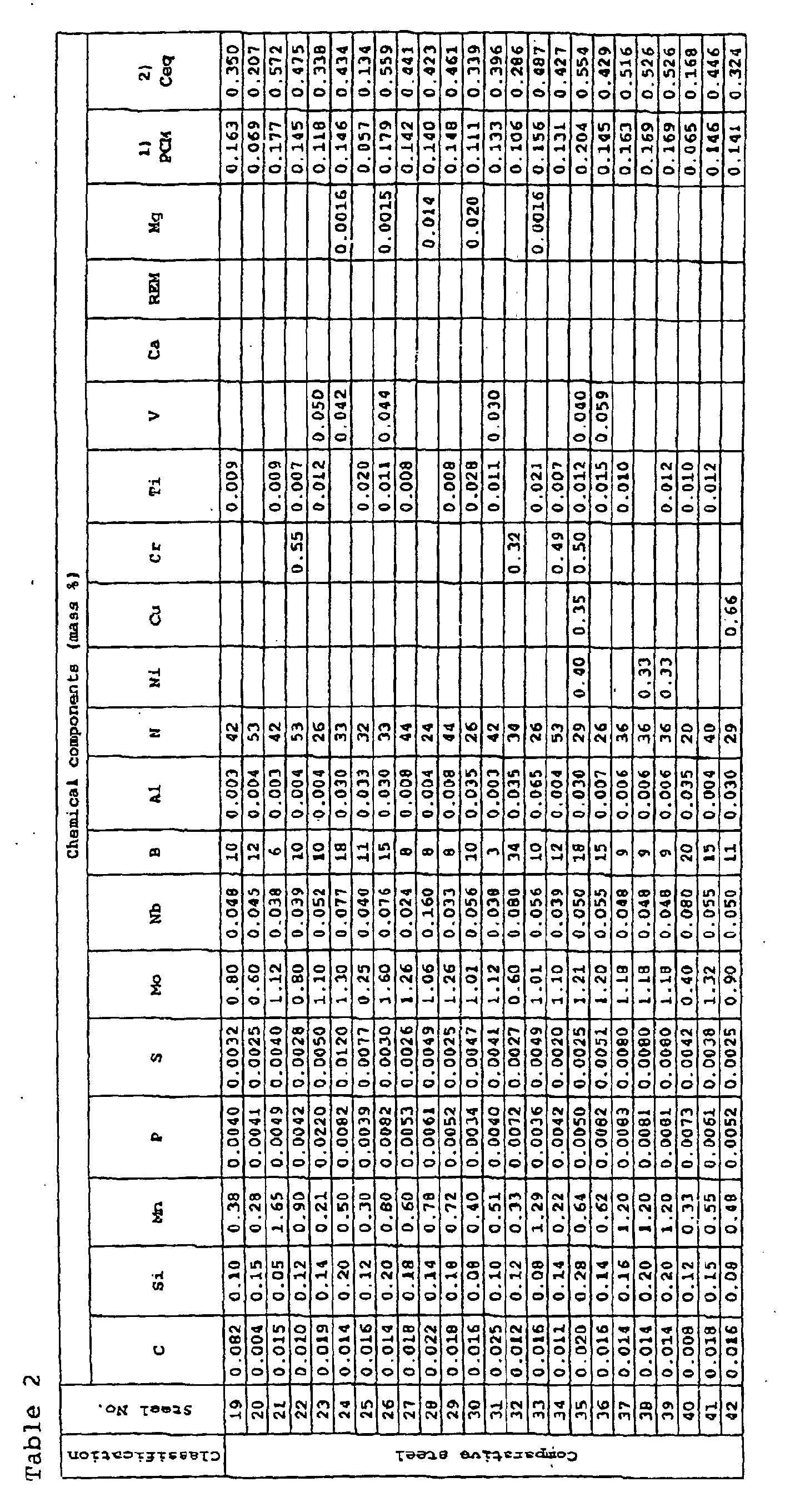
    Claims (14)

    1. A high-tensile-strength steel excellent in high temperature strength, characterized by containing, in mass, C at not less than 0.005% to less than 0.08%, Si at not more than 0.5%, Mn at 0.1 to 1.6%, P at not more than 0.02%, S at not more than 0.01%, Mo at 0.1 to 1.5%, Nb at 0.03 to 0.3%, Ti at not more than 0.025%, B at 0.0005 to 0.003%, Al at not more than 0.06%, and N at not more than 0.006%, with the balance consisting of Fe and unavoidable impurities.
    2. A high-tensile-strength steel excellent in high temperature strength according to claim 1, characterized by said steel satisfying the expression p ≧ -0.0029 x T + 2.48 when the steel temperature T (°C) is within the range from 600°C to 800°C, wherein p is a stress drop ratio (a yield stress at a high temperature/ a yield stress at room temperature) that is obtained by a yield stress normalized by using a yield stress at room temperature.
    3. A high-tensile-strength steel excellent in high temperature strength according to claim 1, characterized in that: said steel comprising a single structure composed of bainite or a composite structure composed of ferrite and bainite at room temperature; the temperature (Ac1) at which said structure reversely transforms into austenite during high temperature heating corresponding to a fire higher than 800°C; and said steel satisfies the expression p ≧ -0.0029 x T + 2.48 when the steel temperature T (°C) is within the range from 600°C to 800°C, wherein p is a stress drop ratio (a yield stress at a high temperature/ a yield stress at room temperature) that is obtained by converting a yield stress normalized by using a yield stress at room temperature.
    4. A high-tensile-strength steel excellent in high temperature strength according to claim 1, characterized in that, in the high temperature range from 600°C to 800°C: said steel has such a strength as to satisfy the expression p ≧ -0.0029 x T + 2.48 when the steel temperature T (°C) is within the range from 600°C to 800°C, wherein p is a stress drop ratio (a yield stress at a high temperature/ a yield stress at room temperature) that is obtained by converting a yield stress normalized by using a yield stress at room temperature; said steel has a structure wherein the temperature (Ac1) at which a single structure composed of bainite or a composite structure composed of ferrite and bainite at room temperature reversely transforms into austenite during high temperature heating corresponding to a fire is higher than 800°C; one or more of carbonitrides precipitated phases thermodynamically stable in said single structure composed of bainite or in said composite structure composed of ferrite and bainite is not less than 5 x 10⁻⁴ in terms of a molar fraction; and the total amount of Mo, Nb and Ti that dissolve in the ferrite structure is not less than 1 x 10⁻³ in terms of a molar concentration.
    5. A high-tensile-strength steel excellent in high temperature strength according to claim 1, characterized in that, in the high temperature range from 600°C to 800°C: said steel has such a strength as to satisfy the expression p ≧ -0.0029 x T + 2.48 when the steel temperature T (°C) is within the range from 600°C to 800°C, wherein p is a stress drop ratio (a yield stress at a high temperature/ a yield stress at room temperature) that is obtained by converting a yield stress normalized by using a yield stress at room temperature; said steel has a structure wherein the temperature (Ac1) at which a single structure composed of bainite or a composite structure composed of ferrite and bainite at room temperature reversely transforms into austenite during high temperature heating corresponding to a fire higher than 800°C; the average circle equivalent diameter of prior austenite grains in said steel is not more than 120 µm; one or more of carbonitrides precipitated phases thermodynamically stable in said single structure composed of bainite or in said composite structure composed of ferrite and bainite is not less than 5 x 10⁻⁴ in terms of a molar fraction; and the total amount of Mo, Nb and Ti that dissolve in the ferrite structure is not less than 1 x 10⁻³ in terms of a molar concentration.
    6. A high-tensile-strength steel excellent in high temperature strength according to any one of claims 1 to 5, characterized in that the weld cracking susceptibility index PCM of said steel defined by the following expression is not more than 0.20%; PCM = C + Si/30 + Mn/20 + Cu/20 + Ni/60 + Cr/20 + Mo/15 + V/10 + 5 x B.
    7. A high-tensile-strength steel excellent in high temperature strength according to any one of claims 1 to 6, wherein the steel further containing, in mass, one or more of Ni at 0.05 to 1.0%, Cu at 0.05 to 1.0%, Cr at 0.05 to 1.0%, and V at 0.01 to 0.1%.
    8. A high-tensile-strength steel excellent in high temperature strength according to any one of claims 1 to 7, wherein the steel further containing, in mass: one or more of Ni at 0.05 to 1.0%, Cu at 0.05 to 1.0%, Cr at 0.05 to 1.0%, and V at 0.01 to 0.1%; and additionally one or more of Ca at 0.0005 to 0.004%, REM at 0.0005 to 0.004%, and Mg at 0.0001 to 0.006%.
    9. A high-tensile-strength steel excellent in high temperature strength according to claim 7 or 8, characterized in that, in the high temperature range from 600°C to 800°C: said steel has such a strength as to satisfy the expression p ≧ -0.0029 x T + 2.48 when the steel temperature T (°C) is within the range from 600°C to 800°C, wherein p is a stress drop ratio (a yield stress at a high temperature/ a yield stress at room temperature) that is obtained by converting a yield stress normalized by using a yield stress at room temperature; said steel has a structure wherein the temperature (Ac1) at which a single structure composed of bainite or a composite structure composed of ferrite and bainite at room temperature reversely transforms into austenite during high temperature heating corresponding to a fire higher than 800°C; the average circle equivalent diameter of prior austenite grains in said steel is not more than 120 µm; one or more of carbonitrides precipitated phases thermodynamically stable in said single structure composed of bainite or in said composite structure composed of ferrite and bainite is not less than 5 x 10⁻⁴ in terms of a molar fraction; and the total amount of Mo, Nb and Ti that dissolve in the ferrite structure is not less than 1 x 10⁻³ in terms of a molar concentration.
    10. A method for producing a high-tensile-strength steel excellent in high temperature strength, characterized by comprising the steps of: reheating a casting or a slab having a steel composition according to any one of claims 1 to 9 in the temperature range from 1,100°C to 1,250°C; hot rolling it in the temperature range of not lower than 850°C while controlling the cumulative reduction ratio in the temperature range of not higher than 1,100°C to not less than 30%; finishing the hot rolling, cooling the hot-rolled steel sheet at a cooling rate of not lower than 0.3 K/sec. from the temperature of not lower than 800°C to the temperature of not higher than 650°C; and thus making the microstructure of the steel comprising a single structure composed of bainite or a composite structure composed of ferrite and bainite.
    11. A high-tensile-strength steel excellent in high temperature strength, characterized by the steel comprising, in mass, C at not less than 0.005% to less than 0.08%, Si at not more than 0.5%, Mn at 0.1 to 1.6%, P at not more than 0.02%, S at not more than 0.01%, Mo at 0.1 to 1.5%, Nb at 0.03 to 0.3%, Ti at not more than 0.025%, B at 0.0005 to 0.003%, Al at not more than 0.06%, and N at not more than 0.006%, with the balance consisting of Fe and unavoidable impurities; having a structure wherein the temperature (Ac1) at which a composite structure composed of ferrite and bainite, the composite structure having a bainite fraction being in the range from 20 to 95% at room temperature, reversely transforms into austenite during high temperature heating corresponding to a fire is higher than 800°C; and having a low yield ratio.
    12. A high-tensile-strength steel excellent in high temperature strength according to claim 11, wherein the steel further containing, in mass, one or more of Ni at 0.05 to 1.0%, Cu at 0.05 to 1.0%, Cr at 0.05 to 1.0%, and V at 0.01 to 0.1%.
    13. A high-tensile-strength steel excellent in high temperature strength according to claim 11 or 12, wherein the steel further containing, in mass: one or more of Ni at 0.05 to 1.0%, Cu at 0.05 to 1.0%, Cr at 0.05 to 1.0%, and V at 0.01 to 0.1%; and additionally one or more of Ca at 0.0005 to 0.004%, REM at 0.0005 to 0.004%, and Mg of 0.0001 to 0.006%.
    14. A method for producing a high-tensile-strength steel excellent in high temperature strength, characterized by comprising the steps of: reheating a casting or a slab having a steel composition according to any one of claims 11 to 13 in the temperature range from 1,100°C to 1,250°C; hot rolling it in the temperature of not lower than 850°C while controlling the cumulative reduction ratio in the temperature of not higher than 1,100°C to not less than 30%; finishing the hot rolling, cooling the resultant hot-rolled steel sheet at a cooling rate of not lower than 0.3 K/sec. from the temperature of not lower than 800°C to the temperature of not higher than 650°C; thus making the microstructure of the steel comprising a single structure composed of bainite or a composite structure composed of ferrite and bainite; forming a microstructure wherein the temperature (Ac1) at which a composite structure composed of ferrite and bainite, the composite structure having a bainite fraction being in the range from 20 to 95% at room temperature, reversely transforms into austenite during high temperature heating corresponding to a fire is higher than 800°C; and securing a low yield ratio.
    EP03715623A 2002-03-29 2003-03-28 HIGH RESISTANCE STEEL HAVING EXCELLENT HIGH TEMPERATURE RESISTANCE AND PROCESS FOR PRODUCING THE SAME Withdrawn EP1493828A4 (en)

    Applications Claiming Priority (13)

    Application Number Priority Date Filing Date Title
    JP2002095162 2002-03-29
    JP2002094834 2002-03-29
    JP2002094834 2002-03-29
    JP2002095162 2002-03-29
    JP2002144203 2002-05-20
    JP2002144203 2002-05-20
    JP2002313067 2002-10-28
    JP2002313067 2002-10-28
    JP2003086307A JP4348102B2 (en) 2002-05-20 2003-03-26 490 MPa class high strength steel excellent in high temperature strength and manufacturing method thereof
    JP2003086307 2003-03-26
    JP2003086308 2003-03-26
    JP2003086308A JP4348103B2 (en) 2002-10-28 2003-03-26 590 MPa class high strength steel excellent in high temperature strength and method for producing the same
    PCT/JP2003/004040 WO2003087414A1 (en) 2002-03-29 2003-03-28 High tensile steel excellent in high temperature strength and method for production thereof

    Publications (2)

    Publication Number Publication Date
    EP1493828A1 true EP1493828A1 (en) 2005-01-05
    EP1493828A4 EP1493828A4 (en) 2011-01-05

    Family

    ID=29255710

    Family Applications (1)

    Application Number Title Priority Date Filing Date
    EP03715623A Withdrawn EP1493828A4 (en) 2002-03-29 2003-03-28 HIGH RESISTANCE STEEL HAVING EXCELLENT HIGH TEMPERATURE RESISTANCE AND PROCESS FOR PRODUCING THE SAME

    Country Status (5)

    Country Link
    EP (1) EP1493828A4 (en)
    KR (1) KR100630402B1 (en)
    CN (1) CN1643167A (en)
    TW (1) TWI235769B (en)
    WO (1) WO2003087414A1 (en)

    Cited By (2)

    * Cited by examiner, † Cited by third party
    Publication number Priority date Publication date Assignee Title
    WO2006011617A1 (en) * 2004-07-28 2006-02-02 Nippon Steel Corporation Shaped steel excellent in fire resistance and producing method therefor
    EP1978121A4 (en) * 2005-11-09 2012-06-13 Nippon Steel Corp HIGH-RESISTANCE STEEL SHEET WITH ELASTICITY LIMIT UP TO 450 MPa AND TENSILE STRENGTH UP TO OR ABOVE 570 MPa HAVING LOW ACOUSTIC ANISOTROPY AND HIGH SOLDERABILITY AND PROCESS FOR PRODUCING THE SAME

    Families Citing this family (15)

    * Cited by examiner, † Cited by third party
    Publication number Priority date Publication date Assignee Title
    EP1662012B1 (en) * 2004-11-24 2010-05-12 ARVEDI, Giovanni Strip of hot rolled micro-alloyed steel for obtaining finished pieces by cold pressing and shearing
    CN100584983C (en) * 2006-09-27 2010-01-27 宝山钢铁股份有限公司 Cold-rolled high-strength dual-phase strip steel and its manufacturing process
    KR101139605B1 (en) * 2007-04-06 2012-04-27 신닛뽄세이테쯔 카부시키카이샤 Steel material having excellent high temperature properties and excellent toughness, and method for production thereof
    JP5396758B2 (en) * 2007-07-27 2014-01-22 Jfeスチール株式会社 Hot-rolled section steel for ship ballast tank and manufacturing method thereof
    JP5320919B2 (en) * 2007-09-25 2013-10-23 Jfeスチール株式会社 Hot rolled shape steel for crude oil tank and method for producing the same
    KR101018131B1 (en) 2007-11-22 2011-02-25 주식회사 포스코 High-strength resistive-constructive steel with excellent low temperature toughness and its manufacturing method
    CN101285153B (en) * 2008-05-09 2010-06-09 攀钢集团成都钢铁有限责任公司 A kind of refractory steel, refractory seamless steel pipe and production method thereof
    CN102400049B (en) * 2010-09-07 2014-03-12 鞍钢股份有限公司 490-grade fire-resistant steel plate for building structure and manufacturing method thereof
    JP5594438B2 (en) * 2011-11-08 2014-09-24 Jfeスチール株式会社 High tensile hot rolled galvanized steel sheet and method for producing the same
    JP5821929B2 (en) * 2013-10-29 2015-11-24 Jfeスチール株式会社 High-strength hot-rolled steel sheet with excellent material stability and weldability and method for producing the same
    CN103741079A (en) * 2014-01-09 2014-04-23 鞍钢股份有限公司 Ultrahigh-strength steel plate for ocean engineering and production method thereof
    CN110846594B (en) * 2019-11-28 2021-02-09 钢铁研究总院 Copper-containing ultra-low carbon bainite steel and preparation method thereof
    CN112553526B (en) * 2020-11-20 2022-04-22 林州凤宝管业有限公司 960 MPa-level ultrahigh-strength structural steel, steel pipe and manufacturing method and application thereof
    CN112941405B (en) * 2021-01-26 2022-04-19 南京钢铁股份有限公司 High-toughness heat-resistant flat-bulb steel for ships and preparation method thereof
    JP7535490B2 (en) * 2021-11-09 2024-08-16 株式会社神戸製鋼所 Steel plate and its manufacturing method

    Family Cites Families (7)

    * Cited by examiner, † Cited by third party
    Publication number Priority date Publication date Assignee Title
    JPH05339674A (en) * 1992-06-08 1993-12-21 Kobe Steel Ltd Low carbon 0.5% mo steel sheet excellent in weld crack resistance
    JP3397271B2 (en) * 1995-04-14 2003-04-14 新日本製鐵株式会社 Rolled section steel for refractory and method for producing the same
    JPH09209077A (en) * 1996-01-30 1997-08-12 Nippon Steel Corp High temperature refractory steel and its manufacturing method
    JP3684031B2 (en) * 1996-06-18 2005-08-17 新日本製鐵株式会社 Building steel with excellent fire resistance and method for producing the same
    JPH10259448A (en) * 1997-03-21 1998-09-29 Kobe Steel Ltd High strength steel sheet excellent in static absorbed energy and impact resistance and its production
    JP2002012939A (en) * 2000-04-27 2002-01-15 Nippon Steel Corp High tensile steel excellent in high temperature strength and method for producing the same
    JP4309561B2 (en) * 2000-06-20 2009-08-05 新日本製鐵株式会社 High-tensile steel plate with excellent high-temperature strength and method for producing the same

    Cited By (3)

    * Cited by examiner, † Cited by third party
    Publication number Priority date Publication date Assignee Title
    WO2006011617A1 (en) * 2004-07-28 2006-02-02 Nippon Steel Corporation Shaped steel excellent in fire resistance and producing method therefor
    EP1978121A4 (en) * 2005-11-09 2012-06-13 Nippon Steel Corp HIGH-RESISTANCE STEEL SHEET WITH ELASTICITY LIMIT UP TO 450 MPa AND TENSILE STRENGTH UP TO OR ABOVE 570 MPa HAVING LOW ACOUSTIC ANISOTROPY AND HIGH SOLDERABILITY AND PROCESS FOR PRODUCING THE SAME
    US8246768B2 (en) 2005-11-09 2012-08-21 Nippon Steel Corporation High-tensile steel plate of low acoustic anisotropy and high weldability having yield stress of 450 MPa or greater and tensile strength of 570 MPa or greater, and process for producing the same

    Also Published As

    Publication number Publication date
    KR20040089746A (en) 2004-10-21
    KR100630402B1 (en) 2006-10-02
    CN1643167A (en) 2005-07-20
    EP1493828A4 (en) 2011-01-05
    TW200305650A (en) 2003-11-01
    TWI235769B (en) 2005-07-11
    WO2003087414A1 (en) 2003-10-23

    Similar Documents

    Publication Publication Date Title
    CN113444977B (en) High strength and high formability steel sheet and method of manufacture
    AU2005200300C1 (en) High strength steel sheet and method for manufacturing same
    JP5283504B2 (en) Method for producing high-strength steel sheet having excellent ductility and steel sheet produced thereby
    US6315946B1 (en) Ultra low carbon bainitic weathering steel
    WO2010137317A1 (en) High-strength steel sheet, hot-dipped steel sheet, and alloy hot-dipped steel sheet that have excellent fatigue, elongation, and collision characteristics, and manufacturing method for said steel sheets
    JP7136335B2 (en) High-strength steel plate and its manufacturing method
    EP1493828A1 (en) High tensile steel excellent in high temperature strength and method for production thereof
    KR20190075589A (en) High-strength steel sheet having high yield ratio and method for manufacturing thereof
    US20060065335A1 (en) High tensile steel excellent in high temperature strength and method for production thereof
    CN112689684A (en) Cold rolled and coated steel sheet and method for manufacturing the same
    JP4264177B2 (en) Method for producing a steel material having a coarse ferrite layer on the surface layer
    JP2005281842A (en) Manufacturing method of low yield ratio steel for low temperature with excellent weld toughness
    JPH04325657A (en) High strength hot rolled steel sheet excellent in stretch-flanging property and its manufacture
    JP6516845B2 (en) Composite structure steel sheet excellent in formability and method for manufacturing the same
    JP2003247043A (en) High-strength hot-dip galvanized cold-rolled steel sheet excellent in strength-ductility balance and method for producing the same
    CN111699273B (en) High-strength steel sheet, high-strength galvanized steel sheet, and methods for producing same
    JPH11106861A (en) High-strength hot-rolled steel sheet excellent in shape and workability and method for producing the same
    RU2711696C1 (en) Method of producing cold-rolled steel strip from high-strength manganese steel with trip-properties
    JP4264296B2 (en) Low yield ratio 570 MPa class high strength steel with excellent weld toughness and slitting characteristics and method for producing the same
    JP4348102B2 (en) 490 MPa class high strength steel excellent in high temperature strength and manufacturing method thereof
    JP4031730B2 (en) Structural 490 MPa class high-strength refractory steel excellent in weldability and gas-cutting property and method for producing the same
    JP2001192773A (en) Steel for line pipe
    JP4028815B2 (en) 780 MPa class high strength steel excellent in high temperature strength and manufacturing method thereof
    JP4639464B2 (en) High-tensile hot-rolled steel sheet with excellent workability and method for producing the same
    JP4348103B2 (en) 590 MPa class high strength steel excellent in high temperature strength and method for producing the same

    Legal Events

    Date Code Title Description
    PUAI Public reference made under article 153(3) epc to a published international application that has entered the european phase

    Free format text: ORIGINAL CODE: 0009012

    17P Request for examination filed

    Effective date: 20041029

    AK Designated contracting states

    Kind code of ref document: A1

    Designated state(s): AT BE BG CH CY CZ DE DK EE ES FI FR GB GR HU IE IT LI LU MC NL PT RO SE SI SK TR

    A4 Supplementary search report drawn up and despatched

    Effective date: 20101203

    RIC1 Information provided on ipc code assigned before grant

    Ipc: C21C 3/00 20060101AFI20031029BHEP

    Ipc: C22C 38/00 20060101ALI20101129BHEP

    17Q First examination report despatched

    Effective date: 20110525

    STAA Information on the status of an ep patent application or granted ep patent

    Free format text: STATUS: THE APPLICATION IS DEEMED TO BE WITHDRAWN

    18D Application deemed to be withdrawn

    Effective date: 20110615