EP1493722A1 - Silicon carbide based porous material and method for production thereof - Google Patents
Silicon carbide based porous material and method for production thereof Download PDFInfo
- Publication number
- EP1493722A1 EP1493722A1 EP03715654A EP03715654A EP1493722A1 EP 1493722 A1 EP1493722 A1 EP 1493722A1 EP 03715654 A EP03715654 A EP 03715654A EP 03715654 A EP03715654 A EP 03715654A EP 1493722 A1 EP1493722 A1 EP 1493722A1
- Authority
- EP
- European Patent Office
- Prior art keywords
- silicon carbide
- alkaline earth
- earth metal
- porous material
- based porous
- Prior art date
- Legal status (The legal status is an assumption and is not a legal conclusion. Google has not performed a legal analysis and makes no representation as to the accuracy of the status listed.)
- Granted
Links
Images

Classifications
-
- C—CHEMISTRY; METALLURGY
- C04—CEMENTS; CONCRETE; ARTIFICIAL STONE; CERAMICS; REFRACTORIES
- C04B—LIME, MAGNESIA; SLAG; CEMENTS; COMPOSITIONS THEREOF, e.g. MORTARS, CONCRETE OR LIKE BUILDING MATERIALS; ARTIFICIAL STONE; CERAMICS; REFRACTORIES; TREATMENT OF NATURAL STONE
- C04B35/00—Shaped ceramic products characterised by their composition; Ceramics compositions; Processing powders of inorganic compounds preparatory to the manufacturing of ceramic products
- C04B35/515—Shaped ceramic products characterised by their composition; Ceramics compositions; Processing powders of inorganic compounds preparatory to the manufacturing of ceramic products based on non-oxide ceramics
- C04B35/56—Shaped ceramic products characterised by their composition; Ceramics compositions; Processing powders of inorganic compounds preparatory to the manufacturing of ceramic products based on non-oxide ceramics based on carbides or oxycarbides
- C04B35/565—Shaped ceramic products characterised by their composition; Ceramics compositions; Processing powders of inorganic compounds preparatory to the manufacturing of ceramic products based on non-oxide ceramics based on carbides or oxycarbides based on silicon carbide
-
- B—PERFORMING OPERATIONS; TRANSPORTING
- B01—PHYSICAL OR CHEMICAL PROCESSES OR APPARATUS IN GENERAL
- B01D—SEPARATION
- B01D39/00—Filtering material for liquid or gaseous fluids
- B01D39/14—Other self-supporting filtering material ; Other filtering material
- B01D39/20—Other self-supporting filtering material ; Other filtering material of inorganic material, e.g. asbestos paper, metallic filtering material of non-woven wires
- B01D39/2068—Other inorganic materials, e.g. ceramics
- B01D39/2072—Other inorganic materials, e.g. ceramics the material being particulate or granular
- B01D39/2075—Other inorganic materials, e.g. ceramics the material being particulate or granular sintered or bonded by inorganic agents
-
- B—PERFORMING OPERATIONS; TRANSPORTING
- B01—PHYSICAL OR CHEMICAL PROCESSES OR APPARATUS IN GENERAL
- B01D—SEPARATION
- B01D53/00—Separation of gases or vapours; Recovering vapours of volatile solvents from gases; Chemical or biological purification of waste gases, e.g. engine exhaust gases, smoke, fumes, flue gases, aerosols
- B01D53/34—Chemical or biological purification of waste gases
- B01D53/92—Chemical or biological purification of waste gases of engine exhaust gases
- B01D53/94—Chemical or biological purification of waste gases of engine exhaust gases by catalytic processes
-
- B—PERFORMING OPERATIONS; TRANSPORTING
- B01—PHYSICAL OR CHEMICAL PROCESSES OR APPARATUS IN GENERAL
- B01J—CHEMICAL OR PHYSICAL PROCESSES, e.g. CATALYSIS OR COLLOID CHEMISTRY; THEIR RELEVANT APPARATUS
- B01J35/00—Catalysts, in general, characterised by their form or physical properties
- B01J35/50—Catalysts, in general, characterised by their form or physical properties characterised by their shape or configuration
- B01J35/56—Foraminous structures having flow-through passages or channels, e.g. grids or three-dimensional [3D] monoliths
- B01J35/57—Honeycombs
-
- C—CHEMISTRY; METALLURGY
- C04—CEMENTS; CONCRETE; ARTIFICIAL STONE; CERAMICS; REFRACTORIES
- C04B—LIME, MAGNESIA; SLAG; CEMENTS; COMPOSITIONS THEREOF, e.g. MORTARS, CONCRETE OR LIKE BUILDING MATERIALS; ARTIFICIAL STONE; CERAMICS; REFRACTORIES; TREATMENT OF NATURAL STONE
- C04B35/00—Shaped ceramic products characterised by their composition; Ceramics compositions; Processing powders of inorganic compounds preparatory to the manufacturing of ceramic products
- C04B35/622—Forming processes; Processing powders of inorganic compounds preparatory to the manufacturing of ceramic products
- C04B35/626—Preparing or treating the powders individually or as batches ; preparing or treating macroscopic reinforcing agents for ceramic products, e.g. fibres; mechanical aspects section B
- C04B35/62605—Treating the starting powders individually or as mixtures
- C04B35/62625—Wet mixtures
- C04B35/6263—Wet mixtures characterised by their solids loadings, i.e. the percentage of solids
-
- C—CHEMISTRY; METALLURGY
- C04—CEMENTS; CONCRETE; ARTIFICIAL STONE; CERAMICS; REFRACTORIES
- C04B—LIME, MAGNESIA; SLAG; CEMENTS; COMPOSITIONS THEREOF, e.g. MORTARS, CONCRETE OR LIKE BUILDING MATERIALS; ARTIFICIAL STONE; CERAMICS; REFRACTORIES; TREATMENT OF NATURAL STONE
- C04B38/00—Porous mortars, concrete, artificial stone or ceramic ware; Preparation thereof
- C04B38/02—Porous mortars, concrete, artificial stone or ceramic ware; Preparation thereof by adding chemical blowing agents
-
- C—CHEMISTRY; METALLURGY
- C04—CEMENTS; CONCRETE; ARTIFICIAL STONE; CERAMICS; REFRACTORIES
- C04B—LIME, MAGNESIA; SLAG; CEMENTS; COMPOSITIONS THEREOF, e.g. MORTARS, CONCRETE OR LIKE BUILDING MATERIALS; ARTIFICIAL STONE; CERAMICS; REFRACTORIES; TREATMENT OF NATURAL STONE
- C04B38/00—Porous mortars, concrete, artificial stone or ceramic ware; Preparation thereof
- C04B38/06—Porous mortars, concrete, artificial stone or ceramic ware; Preparation thereof by burning-out added substances by burning natural expanding materials or by sublimating or melting out added substances
- C04B38/061—Porous mortars, concrete, artificial stone or ceramic ware; Preparation thereof by burning-out added substances by burning natural expanding materials or by sublimating or melting out added substances by melting out
-
- F—MECHANICAL ENGINEERING; LIGHTING; HEATING; WEAPONS; BLASTING
- F01—MACHINES OR ENGINES IN GENERAL; ENGINE PLANTS IN GENERAL; STEAM ENGINES
- F01N—GAS-FLOW SILENCERS OR EXHAUST APPARATUS FOR MACHINES OR ENGINES IN GENERAL; GAS-FLOW SILENCERS OR EXHAUST APPARATUS FOR INTERNAL-COMBUSTION ENGINES
- F01N3/00—Exhaust or silencing apparatus having means for purifying, rendering innocuous, or otherwise treating exhaust
- F01N3/02—Exhaust or silencing apparatus having means for purifying, rendering innocuous, or otherwise treating exhaust for cooling, or for removing solid constituents of, exhaust
- F01N3/021—Exhaust or silencing apparatus having means for purifying, rendering innocuous, or otherwise treating exhaust for cooling, or for removing solid constituents of, exhaust by means of filters
- F01N3/022—Exhaust or silencing apparatus having means for purifying, rendering innocuous, or otherwise treating exhaust for cooling, or for removing solid constituents of, exhaust by means of filters characterised by specially adapted filtering structure, e.g. honeycomb, mesh or fibrous
- F01N3/0222—Exhaust or silencing apparatus having means for purifying, rendering innocuous, or otherwise treating exhaust for cooling, or for removing solid constituents of, exhaust by means of filters characterised by specially adapted filtering structure, e.g. honeycomb, mesh or fibrous the structure being monolithic, e.g. honeycombs
-
- F—MECHANICAL ENGINEERING; LIGHTING; HEATING; WEAPONS; BLASTING
- F01—MACHINES OR ENGINES IN GENERAL; ENGINE PLANTS IN GENERAL; STEAM ENGINES
- F01N—GAS-FLOW SILENCERS OR EXHAUST APPARATUS FOR MACHINES OR ENGINES IN GENERAL; GAS-FLOW SILENCERS OR EXHAUST APPARATUS FOR INTERNAL-COMBUSTION ENGINES
- F01N3/00—Exhaust or silencing apparatus having means for purifying, rendering innocuous, or otherwise treating exhaust
- F01N3/08—Exhaust or silencing apparatus having means for purifying, rendering innocuous, or otherwise treating exhaust for rendering innocuous
- F01N3/10—Exhaust or silencing apparatus having means for purifying, rendering innocuous, or otherwise treating exhaust for rendering innocuous by thermal or catalytic conversion of noxious components of exhaust
- F01N3/24—Exhaust or silencing apparatus having means for purifying, rendering innocuous, or otherwise treating exhaust for rendering innocuous by thermal or catalytic conversion of noxious components of exhaust characterised by constructional aspects of converting apparatus
- F01N3/28—Construction of catalytic reactors
- F01N3/2803—Construction of catalytic reactors characterised by structure, by material or by manufacturing of catalyst support
-
- C—CHEMISTRY; METALLURGY
- C04—CEMENTS; CONCRETE; ARTIFICIAL STONE; CERAMICS; REFRACTORIES
- C04B—LIME, MAGNESIA; SLAG; CEMENTS; COMPOSITIONS THEREOF, e.g. MORTARS, CONCRETE OR LIKE BUILDING MATERIALS; ARTIFICIAL STONE; CERAMICS; REFRACTORIES; TREATMENT OF NATURAL STONE
- C04B2111/00—Mortars, concrete or artificial stone or mixtures to prepare them, characterised by specific function, property or use
- C04B2111/00474—Uses not provided for elsewhere in C04B2111/00
- C04B2111/00793—Uses not provided for elsewhere in C04B2111/00 as filters or diaphragms
-
- C—CHEMISTRY; METALLURGY
- C04—CEMENTS; CONCRETE; ARTIFICIAL STONE; CERAMICS; REFRACTORIES
- C04B—LIME, MAGNESIA; SLAG; CEMENTS; COMPOSITIONS THEREOF, e.g. MORTARS, CONCRETE OR LIKE BUILDING MATERIALS; ARTIFICIAL STONE; CERAMICS; REFRACTORIES; TREATMENT OF NATURAL STONE
- C04B2111/00—Mortars, concrete or artificial stone or mixtures to prepare them, characterised by specific function, property or use
- C04B2111/20—Resistance against chemical, physical or biological attack
- C04B2111/2084—Thermal shock resistance
-
- C—CHEMISTRY; METALLURGY
- C04—CEMENTS; CONCRETE; ARTIFICIAL STONE; CERAMICS; REFRACTORIES
- C04B—LIME, MAGNESIA; SLAG; CEMENTS; COMPOSITIONS THEREOF, e.g. MORTARS, CONCRETE OR LIKE BUILDING MATERIALS; ARTIFICIAL STONE; CERAMICS; REFRACTORIES; TREATMENT OF NATURAL STONE
- C04B2235/00—Aspects relating to ceramic starting mixtures or sintered ceramic products
- C04B2235/02—Composition of constituents of the starting material or of secondary phases of the final product
- C04B2235/30—Constituents and secondary phases not being of a fibrous nature
- C04B2235/32—Metal oxides, mixed metal oxides, or oxide-forming salts thereof, e.g. carbonates, nitrates, (oxy)hydroxides, chlorides
- C04B2235/3205—Alkaline earth oxides or oxide forming salts thereof, e.g. beryllium oxide
- C04B2235/3206—Magnesium oxides or oxide-forming salts thereof
-
- C—CHEMISTRY; METALLURGY
- C04—CEMENTS; CONCRETE; ARTIFICIAL STONE; CERAMICS; REFRACTORIES
- C04B—LIME, MAGNESIA; SLAG; CEMENTS; COMPOSITIONS THEREOF, e.g. MORTARS, CONCRETE OR LIKE BUILDING MATERIALS; ARTIFICIAL STONE; CERAMICS; REFRACTORIES; TREATMENT OF NATURAL STONE
- C04B2235/00—Aspects relating to ceramic starting mixtures or sintered ceramic products
- C04B2235/02—Composition of constituents of the starting material or of secondary phases of the final product
- C04B2235/30—Constituents and secondary phases not being of a fibrous nature
- C04B2235/32—Metal oxides, mixed metal oxides, or oxide-forming salts thereof, e.g. carbonates, nitrates, (oxy)hydroxides, chlorides
- C04B2235/3205—Alkaline earth oxides or oxide forming salts thereof, e.g. beryllium oxide
- C04B2235/3213—Strontium oxides or oxide-forming salts thereof
-
- C—CHEMISTRY; METALLURGY
- C04—CEMENTS; CONCRETE; ARTIFICIAL STONE; CERAMICS; REFRACTORIES
- C04B—LIME, MAGNESIA; SLAG; CEMENTS; COMPOSITIONS THEREOF, e.g. MORTARS, CONCRETE OR LIKE BUILDING MATERIALS; ARTIFICIAL STONE; CERAMICS; REFRACTORIES; TREATMENT OF NATURAL STONE
- C04B2235/00—Aspects relating to ceramic starting mixtures or sintered ceramic products
- C04B2235/02—Composition of constituents of the starting material or of secondary phases of the final product
- C04B2235/30—Constituents and secondary phases not being of a fibrous nature
- C04B2235/32—Metal oxides, mixed metal oxides, or oxide-forming salts thereof, e.g. carbonates, nitrates, (oxy)hydroxides, chlorides
- C04B2235/3217—Aluminum oxide or oxide forming salts thereof, e.g. bauxite, alpha-alumina
-
- C—CHEMISTRY; METALLURGY
- C04—CEMENTS; CONCRETE; ARTIFICIAL STONE; CERAMICS; REFRACTORIES
- C04B—LIME, MAGNESIA; SLAG; CEMENTS; COMPOSITIONS THEREOF, e.g. MORTARS, CONCRETE OR LIKE BUILDING MATERIALS; ARTIFICIAL STONE; CERAMICS; REFRACTORIES; TREATMENT OF NATURAL STONE
- C04B2235/00—Aspects relating to ceramic starting mixtures or sintered ceramic products
- C04B2235/02—Composition of constituents of the starting material or of secondary phases of the final product
- C04B2235/30—Constituents and secondary phases not being of a fibrous nature
- C04B2235/34—Non-metal oxides, non-metal mixed oxides, or salts thereof that form the non-metal oxides upon heating, e.g. carbonates, nitrates, (oxy)hydroxides, chlorides
- C04B2235/3418—Silicon oxide, silicic acids or oxide forming salts thereof, e.g. silica sol, fused silica, silica fume, cristobalite, quartz or flint
-
- C—CHEMISTRY; METALLURGY
- C04—CEMENTS; CONCRETE; ARTIFICIAL STONE; CERAMICS; REFRACTORIES
- C04B—LIME, MAGNESIA; SLAG; CEMENTS; COMPOSITIONS THEREOF, e.g. MORTARS, CONCRETE OR LIKE BUILDING MATERIALS; ARTIFICIAL STONE; CERAMICS; REFRACTORIES; TREATMENT OF NATURAL STONE
- C04B2235/00—Aspects relating to ceramic starting mixtures or sintered ceramic products
- C04B2235/02—Composition of constituents of the starting material or of secondary phases of the final product
- C04B2235/30—Constituents and secondary phases not being of a fibrous nature
- C04B2235/34—Non-metal oxides, non-metal mixed oxides, or salts thereof that form the non-metal oxides upon heating, e.g. carbonates, nitrates, (oxy)hydroxides, chlorides
- C04B2235/3427—Silicates other than clay, e.g. water glass
- C04B2235/3436—Alkaline earth metal silicates, e.g. barium silicate
-
- C—CHEMISTRY; METALLURGY
- C04—CEMENTS; CONCRETE; ARTIFICIAL STONE; CERAMICS; REFRACTORIES
- C04B—LIME, MAGNESIA; SLAG; CEMENTS; COMPOSITIONS THEREOF, e.g. MORTARS, CONCRETE OR LIKE BUILDING MATERIALS; ARTIFICIAL STONE; CERAMICS; REFRACTORIES; TREATMENT OF NATURAL STONE
- C04B2235/00—Aspects relating to ceramic starting mixtures or sintered ceramic products
- C04B2235/02—Composition of constituents of the starting material or of secondary phases of the final product
- C04B2235/30—Constituents and secondary phases not being of a fibrous nature
- C04B2235/34—Non-metal oxides, non-metal mixed oxides, or salts thereof that form the non-metal oxides upon heating, e.g. carbonates, nitrates, (oxy)hydroxides, chlorides
- C04B2235/3427—Silicates other than clay, e.g. water glass
- C04B2235/3463—Alumino-silicates other than clay, e.g. mullite
-
- C—CHEMISTRY; METALLURGY
- C04—CEMENTS; CONCRETE; ARTIFICIAL STONE; CERAMICS; REFRACTORIES
- C04B—LIME, MAGNESIA; SLAG; CEMENTS; COMPOSITIONS THEREOF, e.g. MORTARS, CONCRETE OR LIKE BUILDING MATERIALS; ARTIFICIAL STONE; CERAMICS; REFRACTORIES; TREATMENT OF NATURAL STONE
- C04B2235/00—Aspects relating to ceramic starting mixtures or sintered ceramic products
- C04B2235/02—Composition of constituents of the starting material or of secondary phases of the final product
- C04B2235/30—Constituents and secondary phases not being of a fibrous nature
- C04B2235/34—Non-metal oxides, non-metal mixed oxides, or salts thereof that form the non-metal oxides upon heating, e.g. carbonates, nitrates, (oxy)hydroxides, chlorides
- C04B2235/3427—Silicates other than clay, e.g. water glass
- C04B2235/3463—Alumino-silicates other than clay, e.g. mullite
- C04B2235/3481—Alkaline earth metal alumino-silicates other than clay, e.g. cordierite, beryl, micas such as margarite, plagioclase feldspars such as anorthite, zeolites such as chabazite
-
- C—CHEMISTRY; METALLURGY
- C04—CEMENTS; CONCRETE; ARTIFICIAL STONE; CERAMICS; REFRACTORIES
- C04B—LIME, MAGNESIA; SLAG; CEMENTS; COMPOSITIONS THEREOF, e.g. MORTARS, CONCRETE OR LIKE BUILDING MATERIALS; ARTIFICIAL STONE; CERAMICS; REFRACTORIES; TREATMENT OF NATURAL STONE
- C04B2235/00—Aspects relating to ceramic starting mixtures or sintered ceramic products
- C04B2235/02—Composition of constituents of the starting material or of secondary phases of the final product
- C04B2235/30—Constituents and secondary phases not being of a fibrous nature
- C04B2235/38—Non-oxide ceramic constituents or additives
- C04B2235/3817—Carbides
- C04B2235/3826—Silicon carbides
-
- C—CHEMISTRY; METALLURGY
- C04—CEMENTS; CONCRETE; ARTIFICIAL STONE; CERAMICS; REFRACTORIES
- C04B—LIME, MAGNESIA; SLAG; CEMENTS; COMPOSITIONS THEREOF, e.g. MORTARS, CONCRETE OR LIKE BUILDING MATERIALS; ARTIFICIAL STONE; CERAMICS; REFRACTORIES; TREATMENT OF NATURAL STONE
- C04B2235/00—Aspects relating to ceramic starting mixtures or sintered ceramic products
- C04B2235/02—Composition of constituents of the starting material or of secondary phases of the final product
- C04B2235/30—Constituents and secondary phases not being of a fibrous nature
- C04B2235/42—Non metallic elements added as constituents or additives, e.g. sulfur, phosphor, selenium or tellurium
- C04B2235/428—Silicon
-
- C—CHEMISTRY; METALLURGY
- C04—CEMENTS; CONCRETE; ARTIFICIAL STONE; CERAMICS; REFRACTORIES
- C04B—LIME, MAGNESIA; SLAG; CEMENTS; COMPOSITIONS THEREOF, e.g. MORTARS, CONCRETE OR LIKE BUILDING MATERIALS; ARTIFICIAL STONE; CERAMICS; REFRACTORIES; TREATMENT OF NATURAL STONE
- C04B2235/00—Aspects relating to ceramic starting mixtures or sintered ceramic products
- C04B2235/60—Aspects relating to the preparation, properties or mechanical treatment of green bodies or pre-forms
- C04B2235/602—Making the green bodies or pre-forms by moulding
- C04B2235/6021—Extrusion moulding
-
- C—CHEMISTRY; METALLURGY
- C04—CEMENTS; CONCRETE; ARTIFICIAL STONE; CERAMICS; REFRACTORIES
- C04B—LIME, MAGNESIA; SLAG; CEMENTS; COMPOSITIONS THEREOF, e.g. MORTARS, CONCRETE OR LIKE BUILDING MATERIALS; ARTIFICIAL STONE; CERAMICS; REFRACTORIES; TREATMENT OF NATURAL STONE
- C04B2235/00—Aspects relating to ceramic starting mixtures or sintered ceramic products
- C04B2235/65—Aspects relating to heat treatments of ceramic bodies such as green ceramics or pre-sintered ceramics, e.g. burning, sintering or melting processes
- C04B2235/66—Specific sintering techniques, e.g. centrifugal sintering
- C04B2235/668—Pressureless sintering
-
- C—CHEMISTRY; METALLURGY
- C04—CEMENTS; CONCRETE; ARTIFICIAL STONE; CERAMICS; REFRACTORIES
- C04B—LIME, MAGNESIA; SLAG; CEMENTS; COMPOSITIONS THEREOF, e.g. MORTARS, CONCRETE OR LIKE BUILDING MATERIALS; ARTIFICIAL STONE; CERAMICS; REFRACTORIES; TREATMENT OF NATURAL STONE
- C04B2235/00—Aspects relating to ceramic starting mixtures or sintered ceramic products
- C04B2235/70—Aspects relating to sintered or melt-casted ceramic products
- C04B2235/74—Physical characteristics
- C04B2235/77—Density
-
- C—CHEMISTRY; METALLURGY
- C04—CEMENTS; CONCRETE; ARTIFICIAL STONE; CERAMICS; REFRACTORIES
- C04B—LIME, MAGNESIA; SLAG; CEMENTS; COMPOSITIONS THEREOF, e.g. MORTARS, CONCRETE OR LIKE BUILDING MATERIALS; ARTIFICIAL STONE; CERAMICS; REFRACTORIES; TREATMENT OF NATURAL STONE
- C04B2235/00—Aspects relating to ceramic starting mixtures or sintered ceramic products
- C04B2235/70—Aspects relating to sintered or melt-casted ceramic products
- C04B2235/80—Phases present in the sintered or melt-cast ceramic products other than the main phase
-
- C—CHEMISTRY; METALLURGY
- C04—CEMENTS; CONCRETE; ARTIFICIAL STONE; CERAMICS; REFRACTORIES
- C04B—LIME, MAGNESIA; SLAG; CEMENTS; COMPOSITIONS THEREOF, e.g. MORTARS, CONCRETE OR LIKE BUILDING MATERIALS; ARTIFICIAL STONE; CERAMICS; REFRACTORIES; TREATMENT OF NATURAL STONE
- C04B2235/00—Aspects relating to ceramic starting mixtures or sintered ceramic products
- C04B2235/70—Aspects relating to sintered or melt-casted ceramic products
- C04B2235/96—Properties of ceramic products, e.g. mechanical properties such as strength, toughness, wear resistance
-
- C—CHEMISTRY; METALLURGY
- C04—CEMENTS; CONCRETE; ARTIFICIAL STONE; CERAMICS; REFRACTORIES
- C04B—LIME, MAGNESIA; SLAG; CEMENTS; COMPOSITIONS THEREOF, e.g. MORTARS, CONCRETE OR LIKE BUILDING MATERIALS; ARTIFICIAL STONE; CERAMICS; REFRACTORIES; TREATMENT OF NATURAL STONE
- C04B2235/00—Aspects relating to ceramic starting mixtures or sintered ceramic products
- C04B2235/70—Aspects relating to sintered or melt-casted ceramic products
- C04B2235/96—Properties of ceramic products, e.g. mechanical properties such as strength, toughness, wear resistance
- C04B2235/9669—Resistance against chemicals, e.g. against molten glass or molten salts
- C04B2235/9684—Oxidation resistance
-
- F—MECHANICAL ENGINEERING; LIGHTING; HEATING; WEAPONS; BLASTING
- F01—MACHINES OR ENGINES IN GENERAL; ENGINE PLANTS IN GENERAL; STEAM ENGINES
- F01N—GAS-FLOW SILENCERS OR EXHAUST APPARATUS FOR MACHINES OR ENGINES IN GENERAL; GAS-FLOW SILENCERS OR EXHAUST APPARATUS FOR INTERNAL-COMBUSTION ENGINES
- F01N2330/00—Structure of catalyst support or particle filter
-
- Y—GENERAL TAGGING OF NEW TECHNOLOGICAL DEVELOPMENTS; GENERAL TAGGING OF CROSS-SECTIONAL TECHNOLOGIES SPANNING OVER SEVERAL SECTIONS OF THE IPC; TECHNICAL SUBJECTS COVERED BY FORMER USPC CROSS-REFERENCE ART COLLECTIONS [XRACs] AND DIGESTS
- Y02—TECHNOLOGIES OR APPLICATIONS FOR MITIGATION OR ADAPTATION AGAINST CLIMATE CHANGE
- Y02T—CLIMATE CHANGE MITIGATION TECHNOLOGIES RELATED TO TRANSPORTATION
- Y02T10/00—Road transport of goods or passengers
- Y02T10/10—Internal combustion engine [ICE] based vehicles
- Y02T10/12—Improving ICE efficiencies
-
- Y—GENERAL TAGGING OF NEW TECHNOLOGICAL DEVELOPMENTS; GENERAL TAGGING OF CROSS-SECTIONAL TECHNOLOGIES SPANNING OVER SEVERAL SECTIONS OF THE IPC; TECHNICAL SUBJECTS COVERED BY FORMER USPC CROSS-REFERENCE ART COLLECTIONS [XRACs] AND DIGESTS
- Y10—TECHNICAL SUBJECTS COVERED BY FORMER USPC
- Y10T—TECHNICAL SUBJECTS COVERED BY FORMER US CLASSIFICATION
- Y10T428/00—Stock material or miscellaneous articles
- Y10T428/24—Structurally defined web or sheet [e.g., overall dimension, etc.]
- Y10T428/24149—Honeycomb-like
-
- Y—GENERAL TAGGING OF NEW TECHNOLOGICAL DEVELOPMENTS; GENERAL TAGGING OF CROSS-SECTIONAL TECHNOLOGIES SPANNING OVER SEVERAL SECTIONS OF THE IPC; TECHNICAL SUBJECTS COVERED BY FORMER USPC CROSS-REFERENCE ART COLLECTIONS [XRACs] AND DIGESTS
- Y10—TECHNICAL SUBJECTS COVERED BY FORMER USPC
- Y10T—TECHNICAL SUBJECTS COVERED BY FORMER US CLASSIFICATION
- Y10T428/00—Stock material or miscellaneous articles
- Y10T428/249921—Web or sheet containing structurally defined element or component
- Y10T428/249953—Composite having voids in a component [e.g., porous, cellular, etc.]
-
- Y—GENERAL TAGGING OF NEW TECHNOLOGICAL DEVELOPMENTS; GENERAL TAGGING OF CROSS-SECTIONAL TECHNOLOGIES SPANNING OVER SEVERAL SECTIONS OF THE IPC; TECHNICAL SUBJECTS COVERED BY FORMER USPC CROSS-REFERENCE ART COLLECTIONS [XRACs] AND DIGESTS
- Y10—TECHNICAL SUBJECTS COVERED BY FORMER USPC
- Y10T—TECHNICAL SUBJECTS COVERED BY FORMER US CLASSIFICATION
- Y10T428/00—Stock material or miscellaneous articles
- Y10T428/249921—Web or sheet containing structurally defined element or component
- Y10T428/249953—Composite having voids in a component [e.g., porous, cellular, etc.]
- Y10T428/249967—Inorganic matrix in void-containing component
- Y10T428/249969—Of silicon-containing material [e.g., glass, etc.]
-
- Y—GENERAL TAGGING OF NEW TECHNOLOGICAL DEVELOPMENTS; GENERAL TAGGING OF CROSS-SECTIONAL TECHNOLOGIES SPANNING OVER SEVERAL SECTIONS OF THE IPC; TECHNICAL SUBJECTS COVERED BY FORMER USPC CROSS-REFERENCE ART COLLECTIONS [XRACs] AND DIGESTS
- Y10—TECHNICAL SUBJECTS COVERED BY FORMER USPC
- Y10T—TECHNICAL SUBJECTS COVERED BY FORMER US CLASSIFICATION
- Y10T428/00—Stock material or miscellaneous articles
- Y10T428/249921—Web or sheet containing structurally defined element or component
- Y10T428/249953—Composite having voids in a component [e.g., porous, cellular, etc.]
- Y10T428/249982—With component specified as adhesive or bonding agent
- Y10T428/249985—Composition of adhesive or bonding component specified
-
- Y—GENERAL TAGGING OF NEW TECHNOLOGICAL DEVELOPMENTS; GENERAL TAGGING OF CROSS-SECTIONAL TECHNOLOGIES SPANNING OVER SEVERAL SECTIONS OF THE IPC; TECHNICAL SUBJECTS COVERED BY FORMER USPC CROSS-REFERENCE ART COLLECTIONS [XRACs] AND DIGESTS
- Y10—TECHNICAL SUBJECTS COVERED BY FORMER USPC
- Y10T—TECHNICAL SUBJECTS COVERED BY FORMER US CLASSIFICATION
- Y10T428/00—Stock material or miscellaneous articles
- Y10T428/249921—Web or sheet containing structurally defined element or component
- Y10T428/249953—Composite having voids in a component [e.g., porous, cellular, etc.]
- Y10T428/249986—Void-containing component contains also a solid fiber or solid particle
Definitions
- DPF a DPF for catalyst regeneration
- a DPF for catalyst regeneration
- a DPF for catalyst regeneration which comprises a conventional DPF and an oxidation catalyst carried thereon and which can oxidize and burn the particulates deposited on the catalyst to continuously regenerate the catalyst.
- the silicon carbide component in the sintering (necking) by the recrystallization reaction of the silicon carbide powder per se, the silicon carbide component vaporizes from the surface of the silicon carbide particles and condensates at the contact areas (necks) between the silicon carbide particles, whereby the necks grow and a bonded state results.
- the vaporization of silicon carbide requires a very high sintering temperature, which has invited a high cost; moreover, a material of high thermal expansion coefficient need be sintered at a high temperature, which has resulted in a low sintering yield.
- the oxide phase contains SiO 2 , Al 2 O 3 and an alkaline earth metal and the content of the alkaline earth metal relative to the oxide phase total is 9 to 50% by mass in terms of the content of a monoxide of the alkaline earth metal.
- honeycomb structure characterized by being constituted by any of the above-mentioned silicon carbide-based porous materials.
- a method for producing a silicon carbide-based porous material characterized in that it comprises adding, to a mixed raw material containing silicon carbide particles and metallic silicon, inorganic microballoons containing Si and Al and a compound containing an alkaline earth metal, forming the resulting mixture into a formed material of intended shape, and calcinating and firing the formed material to melt the inorganic microballoons to obtain a porous material of porous structure wherein an oxide phase containing Si, Al and an alkaline earth metal is on surfaces of and/or at circumferences of the silicon carbide particles and/or the metallic silicon.
- the inorganic microballoons are added in an amount of 5 to 30 parts by mass per 100 parts by mass of the total of the silicon carbide particles and the metallic silicon.
- the content of the alkaline earth metal relative to the oxide phase total is less than 9% by mass in terms of the content of a monoxide of the alkaline earth metal, a higher firing temperature is needed and, therefore, such a content is not preferred.
- the content is more than 50% by mass, the oxide phase has a too low a eutectic point, the fired material shrinks, and the porosity thereof decreases; therefore, such a content is not preferred.
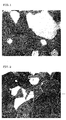
- the content of the alkaline earth metal relative to the oxide phase total refers to a value obtained by conducting EDS to an oxide phase (containing an alkaline earth metal) present in the polished surface of a silicon carbide-based porous material and measuring the resulting characteristic X-ray of the alkaline earth metal, or a value obtained by determining the C, O, Si, Al and alkaline earth metal (Mg, Ca, Sr or Ba) of a silicon carbide-based porous material using an elemental analysis apparatus (e.g. Simultaneous X-ray Spectrometer System ) and then subtracting therefrom the portions belonging to the silicon carbide particles and the metallic silicon to obtain the remainder as the content inside the oxide phase.
- an elemental analysis apparatus e.g. Simultaneous X-ray Spectrometer System
- a porosity of more than 80% or an average pore diameter of more than 50 ⁇ m is not preferred because it results in a very low strength and gives a DPF, a DPF for catalyst regeneration, or the like, of insufficient durability.
- the silicon carbide-based porous material of the present invention is more preferred to have a porosity of 50 to 75% and an average pore diameter of 20 to 50 ⁇ m and is particularly preferred to have a porosity of 55 to 70% and an average pore diameter of 25 to 50 ⁇ m.
- the average pore diameter is expressed as 10 x ⁇ m and the distribution of the pore diameters is expressed on volume basis, the total volume of pores (particular pores) whose diameters are in a range of 10 x ⁇ 0.25 ⁇ m, is 80% or more of the volume of total pores.
- a total volume of particular pores, of 80% or less of the volume of total pores is not preferred because the number of pores having diameters much smaller or much larger than the average pore diameter is large, small pores are unable to exhibit effective reduction in pressure loss, and large pores causes leakage of fluid and effective trapping of particulates, etc. is not made.
- the silicon carbide-based porous material of the present invention In producing the silicon carbide-based porous material of the present invention, first, there is prepared a mixed raw material containing silicon carbide particles and metallic silicon.
- the silicon carbide particles and the metallic silicon contain, in some cases, a very small amount of impurities such as Fe, Al, Ca and the like; however, they may be used per se or after purification by chemical treatment such as reagent washing.
- To the prepared mixed raw material are added inorganic microballoons containing Si and Al and a compound containing an alkaline earth metal. Then, a forming aid such as organic binder or the like is added as necessary, followed by mixing and kneading to obtain a clay for forming.
- the inorganic microballoons function as a pore former when added to the mixed raw material.
- the inorganic microballoons have a low specific gravity and an appropriate strength; therefore, they hardly crumble during mixing and kneading and are easy to handle.
- the pore former used may be totally the inorganic microballoons, or the inorganic microballoons may be used in combination with an organic pore former.
- the clay obtained is formed into a formed material of intended shape such as honeycomb shape or the like; the formed material is calcinated to remove the organic binder contained therein (degreasing) and then fired; thereby, a silicon carbide-based porous material can be obtained.
- a compound containing an alkaline earth metal is added simultaneously to the mixed raw material.
- the compound containing an alkaline earth metal refers to such a compound that the alkaline earth metal contained therein is at least one kind selected from the group consisting of Mg, Ca, Sr and Ba, and specifically is a compound such as strontium carbonate (SrCO 3 ), calcium acetate (Ca(CH 3 COO) 2 ) or the like, which, in calcination or firing, is oxidized or decomposed to become at least one kind of alkaline earth metal monoxide selected from the group consisting of MgO, CaO, SrO and BaO.
- SrCO 3 strontium carbonate
- Ca(CH 3 COO) 2 calcium acetate
- the total content of the Si source and Al source contained in the inorganic microballoons added, relative to the inorganic microballoons residual portion which is the inorganic microballoons total portion minus the alkaline earth metal (expressed as a monoxide thereof) contained beforehand in the total portion is 90% by mass or more when the Si source is expressed as SiO 2 and the Al source is expressed as Al 2 O 3 and that the content of the Al source contained in the inorganic microballoons, relative to the inorganic microballoons residual portion which is the inorganic microballoons total portion minus the alkaline earth metal (expressed as a monoxide thereof) contained beforehand in the total portion, is 20 to 55% by mass when the Al source is expressed as Al 2 O 3 , because such inorganic microballoons have a lower eutectic point and can melt at lower temperatures.
- Preferred examples of such inorganic microballoons include fly ash balloons (coal ash)
- the content of the Al source contained in the inorganic microballoons is less than 20% by mass when the Al source is expressed as Al 2 O 3 , the SiO 2 in the inorganic microballoons is excessive and the inorganic microballoons are not melted; therefore, such an Al source content is not preferred.
- An Al source content of more than 55% by mass is not preferred, either, because the SiO 2 is short and the inorganic microballoons are not melted.
- the content of the Al source is preferably 25 to 50% by mass, particularly preferably 30 to 45% by mass in order to form an oxide phase which is effective for improvements in thermal shock resistance, oxidation resistance and strength.
- an oxide phase (feldspar) effective for improvement of thermal shock resistance, oxidation resistance and strength such as cordierite, anorthite, Sr feldspar (SrAl 2 Si 2 O 8 ) or celsian (BaAl 2 Si 2 O 8 )
- the compound containing an alkaline earth metal is added, per 100 parts by mass of the inorganic microballoons added, by 10 to 25 parts by mass in terms of the amount of MgO when the alkaline earth metal contained in the compound containing an alkaline earth metal is Mg, by 14 to 35 parts by mass in terms of the amount of CaO when the alkaline earth metal is Ca, by 26 to 64 parts by mass in terms of the amount of SrO when the alkaline earth metal is Sr, and by 38 to 95 parts by mass in terms of the amount of BaO when the alkaline earth metal is Ba.
- the addition amount of the compound containing an alkaline earth metal is less than 10 parts by mass in terms of the amount of a monoxide of the alkaline earth metal, the inorganic microballoons are difficult to melt; when the addition amount is more than 100 parts by mass, excessive inorganic microballoons remain as such, the fired material shrinks, and no sufficient pore forming effect is obtained; therefore, such amounts are not preferred.
- inorganic microballoons which are not blown off (not removed) when fired, the risk of formation of large pores is kept very low even if there arises agglomeration of pore former (this becomes a problem with an organic pore former, etc.); consequently, the risk of fluid leakage is very low and the particulates, etc. contained in a particle-containing fluid can be trapd efficiently. Further, since the molten oxide phase fills minute pores, the necking between silicon carbide particles is complemented, achieving an increased strength.
- the compound containing an alkaline earth metal there is preferably used a monoxide, carbonate or the like of an alkaline earth metal from the standpoints of efficient formation of oxide phase, availability, handleability, etc.
- calcination is conducted preferably at a temperature lower than the temperature at which the metallic silicon melts.
- calcination may be conducted at a given temperature of about 150 to 700°C, or in a given temperature range at a small temperature elevation rate of 50°C/hr or less.
- the given temperature may be one temperature level or a plurality of temperature levels depending upon the kind and amount of the organic binder used; and when a plurality of temperature levels are adopted, the time lengths of the individual temperature levels may be the same or different.
- a SiC raw material powder having an average particle diameter of 47 ⁇ m and a Si powder having an average particle diameter of 5 ⁇ m were compounded so as to give a composition of 80:20 in mass ratio.
- fly ash balloons having mass parts shown in Table 1
- an alkaline earth metal monoxide(s) having mass parts shown in Table 1
- a silicon carbide-based porous material of honeycomb structure of Example 6 was produced by the same operation as in Examples 1 to 5 and 7 to 10 except that a starch having an average particle diameter of 50 ⁇ m was added as an organic pore former. Further, the oxide phase of the porous material was identified by X-ray diffraction. The results are shown in Table 1.
- Mass increase (%) [(mass after test) - (mass before test)]/ (mass before test) x 100
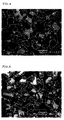
- the addition amount of the oxide With respect to the addition amount of the oxide, it was found that, when the addition amount is too small (Example 9), there is no melting of fly ash balloons, resulting in a small average pore diameter and, when the addition amount is too large (Example 10), an excessive portion of the oxide remains, the fired material obtained shrinks, and no sufficient pore forming effect is obtained. Further, by controlling, at an appropriate level, the addition amount of the oxide relative to the addition amount of the fly ash balloons, it was found that anorthite, cordierite or Sr feldspar (SrAl 2 Si 2 O 8 ) is formed as an oxide phase and a higher oxidation resistance and a higher strength are obtained (comparison of Examples 1 to 3 with Examples 4 and 5).
Landscapes
- Chemical & Material Sciences (AREA)
- Engineering & Computer Science (AREA)
- Ceramic Engineering (AREA)
- Chemical Kinetics & Catalysis (AREA)
- Materials Engineering (AREA)
- Organic Chemistry (AREA)
- Structural Engineering (AREA)
- Manufacturing & Machinery (AREA)
- Inorganic Chemistry (AREA)
- Combustion & Propulsion (AREA)
- Health & Medical Sciences (AREA)
- Mechanical Engineering (AREA)
- General Engineering & Computer Science (AREA)
- General Chemical & Material Sciences (AREA)
- Oil, Petroleum & Natural Gas (AREA)
- Environmental & Geological Engineering (AREA)
- Analytical Chemistry (AREA)
- Toxicology (AREA)
- Biomedical Technology (AREA)
- Life Sciences & Earth Sciences (AREA)
- Geology (AREA)
- Filtering Materials (AREA)
- Ceramic Products (AREA)
- Porous Artificial Stone Or Porous Ceramic Products (AREA)
- Catalysts (AREA)
Abstract
Description

Claims (17)
- A silicon carbide-based porous material characterized by comprising silicon carbide particles as an aggregate, metallic silicon and an oxide phase containing Si, Al and an alkaline earth metal.
- A silicon carbide-based porous material according to Claim 1, wherein the oxide phase is on surfaces of and/or at circumferences of the silicon carbide particles and/or the metallic silicon.
- A silicon carbide-based porous material according to Claim 1 or 2, wherein the oxide phase contains SiO2, Al2O3 and an alkaline earth metal and the content of the alkaline earth metal relative to the oxide phase total is 9 to 50% by mass in terms of the content of a monoxide of the alkaline earth metal.
- A silicon carbide-based porous material according to any of Claims 1 to 3, wherein the alkaline earth metal is at least one kind selected from the group consisting of Mg, Ca, Sr and Ba.
- A silicon carbide-based porous material according to any of Claims 1 to 4, which has a porosity of 50 to 80% and an average pore diameter of 10 to 50 µm.
- A silicon carbide-based porous material according to Claim 5, wherein, when the average pore diameter is expressed as 10x µm and the distribution of the pore diameters is expressed on volume basis, the total volume of pores (particular pores) whose diameters are in a range of 10x±0.25 µm, is 80% or more of the volume of total pores.
- A silicon carbide-based porous material according to any of Claims 1 to 6, wherein the oxide phase covers at least part of the surfaces of the silicon carbide particles and/or the metallic silicon.
- A silicon carbide-based porous material according to any of Claims 1 to 7, wherein at least part of the oxide phase is constituted by at least one kind selected from the group consisting of cordierite, anorthite, Sr feldspar (SrAl2Si2O8) and celsian (BaAl2Si2O8).
- A honeycomb structure characterized by being constituted by a silicon carbide-based porous material according to any of Claims 1 to 8.
- A method for producing a silicon carbide-based porous material, characterized in that it comprises adding, to a mixed raw material containing silicon carbide particles and metallic silicon, inorganic microballoons containing Si and Al and a compound containing an alkaline earth metal, forming the resulting mixture into a formed material of intended shape, and calcinating and firing the formed material to melt the inorganic microballoons to obtain a porous material of porous structure wherein an oxide phase containing Si, Al and an alkaline earth metal is on surfaces of and/or at circumferences of the silicon carbide particles and/or the metallic silicon.
- A method for producing a silicon carbide-based porous material according to Claim 10, wherein the alkaline earth metal contained in the compound containing an alkaline earth metal is at least one kind selected form the group consisting of Mg, Ca, Sr and Ba.
- A method for producing a silicon carbide-based porous material according to Claim 10 or 11, wherein the compound containing an alkaline earth metal is a compound which, when subjected to oxidation or decomposition, becomes at least one kind of alkaline earth metal monoxide selected from the group consisting of MgO, CaO, SrO and BaO.
- A method for producing a silicon carbide-based porous material according to any of Claims 10 to 12, wherein the inorganic microballoons are added in an amount of 5 to 30 parts by mass per 100 parts by mass of the total of the silicon carbide particles and the metallic silicon.
- A method for producing a silicon carbide-based porous material according to any of Claims 10 to 13, wherein the compound containing an alkaline earth metal is added, per 100 parts by mass of the inorganic microballoons added, by 10 to 100 parts by mass in terms of the amount of a monoxide of the alkaline earth metal including the alkaline earth metal contained beforehand in the microballoons.
- A method for producing a silicon carbide-based porous material according to any of Claims 10 to 14, wherein the compound containing an alkaline earth metal is added, per 100 parts by mass of the inorganic microballoons added, by 10 to 25 parts by mass in terms of the amount of MgO when the alkaline earth metal contained in the compound containing an alkaline earth metal is Mg, by 14 to 35 parts by mass in terms of the amount of CaO when the alkaline earth metal is Ca, by 26 to 64 parts by mass in terms of the amount of SrO when the alkaline earth metal is Sr, or by 38 to 95 parts by mass in terms of the amount of BaO when the alkaline earth metal is Ba.
- A method for producing a silicon carbide-based porous material according to any of Claims 10 to 15, wherein the total content of the Si source and Al source contained in the inorganic microballoons, relative to the inorganic microballoons residual portion which is the inorganic microballoons total portion minus the alkaline earth metal (expressed as a monoxide thereof) contained beforehand in the total portion, is 90% by mass or more when the Si source is expressed as SiO2 and the Al source is expressed as Al2O3, and the content of the Al source contained in the inorganic microballoons, relative to the inorganic microballoons residual portion which is the inorganic microballoons total portion minus the alkaline earth metal (expressed as a monoxide thereof) contained beforehand in the total portion, is 20 to 55% by mass when the Al source is expressed as Al2O3.
- A method for producing a silicon carbide-based porous material according to any of Claims 10 to 16, wherein the intended shape of the formed material is a honeycomb shape.
Applications Claiming Priority (3)
| Application Number | Priority Date | Filing Date | Title |
|---|---|---|---|
| JP2002097260 | 2002-03-29 | ||
| JP2002097260 | 2002-03-29 | ||
| PCT/JP2003/004086 WO2003082770A1 (en) | 2002-03-29 | 2003-03-31 | Silicon carbide based porous material and method for production thereof |
Publications (3)
| Publication Number | Publication Date |
|---|---|
| EP1493722A1 true EP1493722A1 (en) | 2005-01-05 |
| EP1493722A4 EP1493722A4 (en) | 2006-02-22 |
| EP1493722B1 EP1493722B1 (en) | 2008-05-14 |
Family
ID=28671863
Family Applications (1)
| Application Number | Title | Priority Date | Filing Date |
|---|---|---|---|
| EP20030715654 Expired - Lifetime EP1493722B1 (en) | 2002-03-29 | 2003-03-31 | Silicon carbide based porous material and method for production thereof |
Country Status (8)
| Country | Link |
|---|---|
| US (2) | US7452591B2 (en) |
| EP (1) | EP1493722B1 (en) |
| JP (1) | JP4398260B2 (en) |
| KR (1) | KR100629195B1 (en) |
| AU (1) | AU2003221017A1 (en) |
| DE (1) | DE60320966D1 (en) |
| PL (1) | PL207023B1 (en) |
| WO (1) | WO2003082770A1 (en) |
Cited By (7)
| Publication number | Priority date | Publication date | Assignee | Title |
|---|---|---|---|---|
| FR2889080A1 (en) * | 2005-07-28 | 2007-02-02 | Saint Gobain Ct Recherches | SUPPORT AND CATALYTIC FILTER BASED ON SILICON CARBIDE AND A SPECIFIC HIGH SURFACE AREA |
| EP2085369A1 (en) * | 2007-12-26 | 2009-08-05 | Ngk Insulator, Ltd. | Porous fired body and manufacturing method thereof |
| FR2931366A1 (en) * | 2008-05-22 | 2009-11-27 | Saint Gobain Ct Recherches | SIC-VITROCERAMIC COMPOSITE FILTER |
| EP2006261A4 (en) * | 2006-02-22 | 2010-03-17 | Ngk Insulators Ltd | POROUS OBJECT BASED ON SILICON CARBIDE AND PROCESS FOR PRODUCING SUCH OBJECT |
| EP1920838A4 (en) * | 2005-08-31 | 2012-01-25 | Ngk Insulators Ltd | BEE NEST STRUCTURE AND CATALYTIC SUBSTANCE OF A BEE NID |
| CN101642651B (en) * | 2009-08-25 | 2012-04-25 | 山东理工大学 | Preparation method of fly ash filter element for clean coal power generation |
| EP1493724B1 (en) * | 2002-03-29 | 2017-08-09 | NGK Insulators, Ltd. | Porous material and method for production thereof |
Families Citing this family (45)
| Publication number | Priority date | Publication date | Assignee | Title |
|---|---|---|---|---|
| AU2003284416A1 (en) * | 2002-11-20 | 2004-06-15 | Ngk Insulators, Ltd. | Silicon carbide porous body, process for producing the same and honeycomb structure |
| JP4394343B2 (en) * | 2002-12-11 | 2010-01-06 | 日本碍子株式会社 | SILICON CARBIDE POROUS BODY, MANUFACTURING METHOD THEREOF, AND HONEYCOMB STRUCTURE |
| US7488366B2 (en) * | 2003-07-25 | 2009-02-10 | Ngk Insulators, Ltd. | Ceramic porous body and method for evaluating its permeability |
| US7387829B2 (en) * | 2004-01-13 | 2008-06-17 | Ibiden Co., Ltd. | Honeycomb structure, porous body, pore forming material for the porous body, and methods for manufacturing the pore forming material, the porous body and the honeycomb structure |
| FR2889184B1 (en) * | 2005-07-29 | 2007-10-19 | Saint Gobain Ct Recherches | PROCESS FOR THE PREPARATION OF A POROUS STRUCTURE USING POROGENIC SILICA AGENTS |
| JP5518327B2 (en) | 2006-02-22 | 2014-06-11 | 日本碍子株式会社 | Silicon carbide based porous material and method for producing the same |
| WO2008011167A2 (en) * | 2006-07-21 | 2008-01-24 | Dow Global Technologies Inc. | Imroved diesel particulate filter |
| CN101641306A (en) * | 2007-03-22 | 2010-02-03 | Posco公司 | Silicon carbide-based porous body and preparation method thereof |
| FR2921848B1 (en) * | 2007-10-08 | 2011-03-18 | Saint Gobain Ct Recherches | TEXTURED PURIFICATION STRUCTURE INCORPORATING AN ELECTROCHEMICAL CATALYSIS SYSTEM |
| JP5478259B2 (en) * | 2007-11-30 | 2014-04-23 | 日本碍子株式会社 | Silicon carbide based porous material |
| FR2935376B1 (en) * | 2008-09-01 | 2011-06-10 | Commissariat Energie Atomique | METHOD OF REFRACTORALLY MEDIUM ASSEMBLY OF SIC - BASED MATERIAL PARTS BY NON - REACTIVE BRAZING IN OXIDIZING ATMOSPHERE, BRAZING COMPOSITIONS, AND JOINT AND ASSEMBLY OBTAINED BY THIS METHOD. |
| JP5193805B2 (en) * | 2008-10-30 | 2013-05-08 | 日本碍子株式会社 | Silicon carbide based porous material and method for producing the same |
| US8187353B2 (en) * | 2009-01-21 | 2012-05-29 | Corning Incorporated | Filtration structures for improved particulate filter performance |
| KR101133650B1 (en) * | 2009-11-04 | 2012-04-10 | 한국에너지기술연구원 | Preparing method hot gas filters using sr-containing ceramic compostitions for mullite-bonded silicon carbide |
| EP2519473A4 (en) | 2009-12-31 | 2016-12-07 | Halliburton Energy Services Inc | Ceramic particles with controlled pore and/or microsphere placement and/or size and method of making same |
| WO2011094106A1 (en) | 2010-01-29 | 2011-08-04 | Oxane Materials, Inc. | Self-toughened high-strengh proppant and methods of making same |
| KR101118607B1 (en) * | 2010-08-19 | 2012-02-27 | 한국에너지기술연구원 | Silicon carbide ceramic composition for high temperature dust collecting filter containing strontium carbonate and manufacturing method thereof |
| WO2012128149A1 (en) | 2011-03-18 | 2012-09-27 | 日本碍子株式会社 | Silicon carbide-based porous object, honeycomb structure, and catalyst support of electric heating type |
| WO2013147321A1 (en) * | 2012-03-28 | 2013-10-03 | 日本碍子株式会社 | Silicon carbide porous material, honeycomb structure and electric heating-type catalyst carrier |
| WO2013186922A1 (en) | 2012-06-15 | 2013-12-19 | イビデン株式会社 | Honeycomb filter |
| WO2013186923A1 (en) | 2012-06-15 | 2013-12-19 | イビデン株式会社 | Honeycomb filter |
| WO2014054159A1 (en) | 2012-10-04 | 2014-04-10 | イビデン株式会社 | Honeycomb filter |
| JP6059954B2 (en) * | 2012-10-30 | 2017-01-11 | 日本碍子株式会社 | Honeycomb filter |
| JP6239304B2 (en) | 2013-07-31 | 2017-11-29 | イビデン株式会社 | Honeycomb filter |
| JP6239307B2 (en) | 2013-07-31 | 2017-11-29 | イビデン株式会社 | Honeycomb filter |
| JP6239306B2 (en) * | 2013-07-31 | 2017-11-29 | イビデン株式会社 | Honeycomb filter |
| JP6239305B2 (en) | 2013-07-31 | 2017-11-29 | イビデン株式会社 | Honeycomb filter |
| JP6239303B2 (en) | 2013-07-31 | 2017-11-29 | イビデン株式会社 | Honeycomb filter |
| JP6483468B2 (en) * | 2014-03-18 | 2019-03-13 | 日本碍子株式会社 | Honeycomb structure |
| JP6502133B2 (en) * | 2014-03-28 | 2019-04-17 | 日本碍子株式会社 | Porous body, honeycomb filter, method of manufacturing porous body, and method of manufacturing honeycomb filter |
| JP6728859B2 (en) * | 2016-03-25 | 2020-07-22 | 日立金属株式会社 | Ceramic substrate and manufacturing method thereof |
| JP6991020B2 (en) * | 2016-10-24 | 2022-01-12 | 日本碍子株式会社 | Porous materials, honeycomb structures, and methods for manufacturing porous materials |
| US11365665B2 (en) * | 2016-10-24 | 2022-06-21 | Ngk Insulators, Ltd. | Porous material, honeycomb structure, and method of producing porous material |
| JP6788515B2 (en) * | 2017-02-02 | 2020-11-25 | 日本碍子株式会社 | Sealed honeycomb structure |
| KR101974932B1 (en) | 2017-05-29 | 2019-05-03 | 한국과학기술연구원 | A compostion for preparing a liquid phase sintered silicon carbide porous body, the liquid phase sintered silicon carbide porous body using the composition having high strength and resistivity and a method for manufacturing thereof |
| JP6606213B2 (en) * | 2018-03-28 | 2019-11-13 | 俊夫 小室 | Health promoting composition that generates photons and ions |
| JP6906468B2 (en) * | 2018-03-30 | 2021-07-21 | 日本碍子株式会社 | Ceramic porous body and its manufacturing method, and dust collection filter |
| CN108484174B (en) * | 2018-07-03 | 2021-03-16 | 贵州大学 | A process for co-producing porous silicon carbide ceramics by using phosphogypsum and red mud for acid production |
| KR102124783B1 (en) | 2018-10-30 | 2020-06-22 | 한국과학기술연구원 | Liquid phase sintered silicon carbide porous body having dual pore structure and method for producing same |
| KR102229815B1 (en) | 2019-02-26 | 2021-03-22 | 한국화학연구원 | Manufacturing method of porous silica |
| CN112479714A (en) * | 2020-12-03 | 2021-03-12 | 重庆奥福精细陶瓷有限公司 | Preparation method of strontium feldspar combined silicon carbide diesel particle filter |
| CA3129000A1 (en) * | 2021-08-26 | 2023-02-26 | De.Mission Inc. | Catalytic refractory heating appliance |
| US12459811B2 (en) * | 2022-05-17 | 2025-11-04 | Saudi Arabian Oil Company | Process and system for generating a hydrogen product from hydrogen sulfide with microwave energy |
| JP7763378B1 (en) | 2025-03-31 | 2025-10-31 | 日本碍子株式会社 | Segmental joints |
| JP7829094B1 (en) * | 2025-08-28 | 2026-03-12 | 日本碍子株式会社 | Method for producing a porous silicon carbide body and a porous silicon carbide body |
Family Cites Families (32)
| Publication number | Priority date | Publication date | Assignee | Title |
|---|---|---|---|---|
| US3888691A (en) * | 1972-10-06 | 1975-06-10 | Lockheed Aircraft Corp | Porous ceramic |
| JPS60255671A (en) | 1984-05-29 | 1985-12-17 | イビデン株式会社 | High strength porous silicon carbide sintered body and manufacture |
| JPH0768066B2 (en) * | 1987-12-25 | 1995-07-26 | イビデン株式会社 | Heat resistant composite and method for producing the same |
| JPH0813706B2 (en) * | 1991-07-02 | 1996-02-14 | 工業技術院長 | Silicon carbide / metal silicon composite and method for producing the same |
| JPH05306614A (en) * | 1992-04-28 | 1993-11-19 | Matsushita Electric Ind Co Ltd | Exhaust gas filter and manufacturing method thereof |
| JPH06116059A (en) * | 1992-10-02 | 1994-04-26 | Matsushita Electric Works Ltd | Manufacturing method of ceramic honeycomb |
| CA2111141A1 (en) | 1992-12-11 | 1994-06-12 | Kazuo Sunahara | Process for producing crystalline microballoons |
| JPH06263464A (en) * | 1992-12-11 | 1994-09-20 | Asahi Glass Co Ltd | Method for producing glass micro hollow body and glass micro hollow body |
| JPH0796165A (en) * | 1992-12-11 | 1995-04-11 | Asahi Glass Co Ltd | Method for producing crystalline micro hollow body and crystalline micro hollow body |
| JP3548914B2 (en) | 1992-12-16 | 2004-08-04 | イビデン株式会社 | Method for producing catalyst carrier |
| US5326512A (en) | 1992-12-16 | 1994-07-05 | Alliedsignal Inc. | Porous ceramic filter and preparation thereof |
| JPH11253722A (en) * | 1998-03-11 | 1999-09-21 | Ngk Insulators Ltd | Ceramic filter |
| US6180559B1 (en) * | 1999-03-02 | 2001-01-30 | Eastman Chemical Company | Supported catalysts and catalyst support materials and process for the manufacture of 1,2-epoxybutane |
| JP2001014673A (en) * | 1999-04-26 | 2001-01-19 | Fuji Photo Film Co Ltd | Magnetic transfer method and magnetic transfer device |
| FR2796638B1 (en) * | 1999-07-21 | 2001-09-14 | Ceramiques Tech Et Ind S A | HONEYCOMB MONOLITH STRUCTURE IN POROUS CERAMIC MATERIAL, AND USE AS A PARTICLE FILTER |
| JP2001146473A (en) | 1999-11-12 | 2001-05-29 | Bridgestone Corp | Method for producing silicon carbide porous body |
| JP4455708B2 (en) * | 2000-01-17 | 2010-04-21 | 日本碍子株式会社 | Honeycomb structure and manufacturing method thereof |
| JP2001206785A (en) * | 2000-01-25 | 2001-07-31 | Asahi Glass Co Ltd | Method for producing silicon carbide porous body |
| JP4136319B2 (en) * | 2000-04-14 | 2008-08-20 | 日本碍子株式会社 | Honeycomb structure and manufacturing method thereof |
| JP4511065B2 (en) | 2000-06-05 | 2010-07-28 | 日本碍子株式会社 | Honeycomb structure, honeycomb filter, and manufacturing method thereof |
| JP2002050279A (en) | 2000-08-01 | 2002-02-15 | Ricoh Co Ltd | Electron source substrate manufacturing device, electron source substrate, image display device, and device using the image display device |
| JP4426083B2 (en) * | 2000-11-17 | 2010-03-03 | 日本碍子株式会社 | Silicon carbide based porous material and method for producing the same |
| JP4094830B2 (en) * | 2000-11-24 | 2008-06-04 | 日本碍子株式会社 | Porous honeycomb filter and manufacturing method thereof |
| US6444162B1 (en) * | 2000-11-27 | 2002-09-03 | The United States Of America As Represented By The United States Department Of Energy | Open-cell glass crystalline porous material |
| JP4464568B2 (en) * | 2001-02-02 | 2010-05-19 | 日本碍子株式会社 | Honeycomb structure and manufacturing method thereof |
| WO2002070433A1 (en) * | 2001-03-02 | 2002-09-12 | Ngk Insulators,Ltd. | Honeycomb structure |
| JP4307781B2 (en) * | 2001-03-30 | 2009-08-05 | 日本碍子株式会社 | Silicon carbide based porous material and method for producing the same |
| JP4094824B2 (en) * | 2001-04-04 | 2008-06-04 | 日本碍子株式会社 | Honeycomb ceramic filter |
| JP2002326881A (en) * | 2001-04-27 | 2002-11-12 | Hitachi Metals Ltd | Manufacturing method of porous ceramics |
| JP2002356384A (en) * | 2001-06-01 | 2002-12-13 | Asahi Glass Co Ltd | Silicon carbide porous body and method for producing the same |
| AU2003284416A1 (en) * | 2002-11-20 | 2004-06-15 | Ngk Insulators, Ltd. | Silicon carbide porous body, process for producing the same and honeycomb structure |
| JP4394343B2 (en) * | 2002-12-11 | 2010-01-06 | 日本碍子株式会社 | SILICON CARBIDE POROUS BODY, MANUFACTURING METHOD THEREOF, AND HONEYCOMB STRUCTURE |
-
2003
- 2003-03-31 DE DE60320966T patent/DE60320966D1/en not_active Expired - Lifetime
- 2003-03-31 AU AU2003221017A patent/AU2003221017A1/en not_active Abandoned
- 2003-03-31 JP JP2003580243A patent/JP4398260B2/en not_active Expired - Lifetime
- 2003-03-31 US US10/508,656 patent/US7452591B2/en not_active Expired - Lifetime
- 2003-03-31 EP EP20030715654 patent/EP1493722B1/en not_active Expired - Lifetime
- 2003-03-31 KR KR1020047015204A patent/KR100629195B1/en not_active Expired - Fee Related
- 2003-03-31 PL PL374323A patent/PL207023B1/en unknown
- 2003-03-31 WO PCT/JP2003/004086 patent/WO2003082770A1/en not_active Ceased
-
2008
- 2008-09-15 US US12/210,434 patent/US8173054B2/en not_active Expired - Lifetime
Cited By (11)
| Publication number | Priority date | Publication date | Assignee | Title |
|---|---|---|---|---|
| EP1493724B1 (en) * | 2002-03-29 | 2017-08-09 | NGK Insulators, Ltd. | Porous material and method for production thereof |
| FR2889080A1 (en) * | 2005-07-28 | 2007-02-02 | Saint Gobain Ct Recherches | SUPPORT AND CATALYTIC FILTER BASED ON SILICON CARBIDE AND A SPECIFIC HIGH SURFACE AREA |
| WO2007012776A3 (en) * | 2005-07-28 | 2007-05-10 | Saint Gobain Ct Recherches | High specific surface silicon carbide catalytic filter and support |
| US7985274B2 (en) | 2005-07-28 | 2011-07-26 | Saint-Gobain Centre De Recherches Et D'etudes Europeen | High specific surface silicon carbide catalytic filter and support |
| EP1920838A4 (en) * | 2005-08-31 | 2012-01-25 | Ngk Insulators Ltd | BEE NEST STRUCTURE AND CATALYTIC SUBSTANCE OF A BEE NID |
| EP2006261A4 (en) * | 2006-02-22 | 2010-03-17 | Ngk Insulators Ltd | POROUS OBJECT BASED ON SILICON CARBIDE AND PROCESS FOR PRODUCING SUCH OBJECT |
| EP2085369A1 (en) * | 2007-12-26 | 2009-08-05 | Ngk Insulator, Ltd. | Porous fired body and manufacturing method thereof |
| US8101269B2 (en) | 2007-12-26 | 2012-01-24 | Ngk Insulators, Ltd. | Porous fired body and manufacturing method thereof |
| FR2931366A1 (en) * | 2008-05-22 | 2009-11-27 | Saint Gobain Ct Recherches | SIC-VITROCERAMIC COMPOSITE FILTER |
| WO2009153476A1 (en) * | 2008-05-22 | 2009-12-23 | Saint-Gobain Centre De Recherches Et D'etudes Europeen | Sic/glass-ceramic composite filter |
| CN101642651B (en) * | 2009-08-25 | 2012-04-25 | 山东理工大学 | Preparation method of fly ash filter element for clean coal power generation |
Also Published As
| Publication number | Publication date |
|---|---|
| US8173054B2 (en) | 2012-05-08 |
| US7452591B2 (en) | 2008-11-18 |
| JPWO2003082770A1 (en) | 2005-08-04 |
| KR20040104958A (en) | 2004-12-13 |
| KR100629195B1 (en) | 2006-09-28 |
| JP4398260B2 (en) | 2010-01-13 |
| US20090020902A1 (en) | 2009-01-22 |
| AU2003221017A1 (en) | 2003-10-13 |
| US20050158534A1 (en) | 2005-07-21 |
| EP1493722A4 (en) | 2006-02-22 |
| WO2003082770A1 (en) | 2003-10-09 |
| PL207023B1 (en) | 2010-10-29 |
| PL374323A1 (en) | 2005-10-17 |
| EP1493722B1 (en) | 2008-05-14 |
| DE60320966D1 (en) | 2008-06-26 |
Similar Documents
| Publication | Publication Date | Title |
|---|---|---|
| US7452591B2 (en) | Silicon carbide based porous material and method for production thereof | |
| EP1493724B1 (en) | Porous material and method for production thereof | |
| US6815038B2 (en) | Honeycomb structure | |
| CA2362763C (en) | Honeycomb structure and process for production thereof | |
| EP1600432B1 (en) | Silicon carbide based porous material and method for preparation thereof, and honeycomb structure | |
| US20040033893A1 (en) | Silicon carbide based porous article and method for preparation thereof | |
| WO2003051488A1 (en) | Composite cordierite filters | |
| JP2004360654A (en) | Ceramic honeycomb filter | |
| US7781053B2 (en) | Porous object based on silicon carbide and process for producing the same | |
| US7824765B2 (en) | Porous object based on silicon carbide and process for producing the same | |
| JP2022128501A (en) | Ceramics madreporite and manufacturing method thereof, and filter for dust collection | |
| ZA200209674B (en) | Silicon Carbide based porous article and method for preparation thereof. |
Legal Events
| Date | Code | Title | Description |
|---|---|---|---|
| PUAI | Public reference made under article 153(3) epc to a published international application that has entered the european phase |
Free format text: ORIGINAL CODE: 0009012 |
|
| 17P | Request for examination filed |
Effective date: 20041015 |
|
| AK | Designated contracting states |
Kind code of ref document: A1 Designated state(s): AT BE BG CH CY CZ DE DK EE ES FI FR GB GR HU IE IT LI LU MC NL PT RO SE SI SK TR |
|
| AX | Request for extension of the european patent |
Extension state: AL LT LV MK |
|
| A4 | Supplementary search report drawn up and despatched |
Effective date: 20060111 |
|
| RIC1 | Information provided on ipc code assigned before grant |
Ipc: B01J 35/04 20060101ALI20060104BHEP Ipc: C04B 35/565 20060101AFI20031016BHEP Ipc: F01N 3/022 20060101ALI20060104BHEP Ipc: C04B 38/08 20060101ALI20060104BHEP Ipc: B01D 53/94 20060101ALI20060104BHEP Ipc: B01D 39/20 20060101ALI20060104BHEP |
|
| GRAP | Despatch of communication of intention to grant a patent |
Free format text: ORIGINAL CODE: EPIDOSNIGR1 |
|
| GRAS | Grant fee paid |
Free format text: ORIGINAL CODE: EPIDOSNIGR3 |
|
| GRAA | (expected) grant |
Free format text: ORIGINAL CODE: 0009210 |
|
| AK | Designated contracting states |
Kind code of ref document: B1 Designated state(s): DE FR |
|
| REF | Corresponds to: |
Ref document number: 60320966 Country of ref document: DE Date of ref document: 20080626 Kind code of ref document: P |
|
| PLBE | No opposition filed within time limit |
Free format text: ORIGINAL CODE: 0009261 |
|
| STAA | Information on the status of an ep patent application or granted ep patent |
Free format text: STATUS: NO OPPOSITION FILED WITHIN TIME LIMIT |
|
| 26N | No opposition filed |
Effective date: 20090217 |
|
| REG | Reference to a national code |
Ref country code: FR Ref legal event code: PLFP Year of fee payment: 14 |
|
| REG | Reference to a national code |
Ref country code: FR Ref legal event code: PLFP Year of fee payment: 15 |
|
| PGFP | Annual fee paid to national office [announced via postgrant information from national office to epo] |
Ref country code: FR Payment date: 20170213 Year of fee payment: 15 |
|
| PG25 | Lapsed in a contracting state [announced via postgrant information from national office to epo] |
Ref country code: FR Free format text: LAPSE BECAUSE OF NON-PAYMENT OF DUE FEES Effective date: 20180331 |
|
| PGFP | Annual fee paid to national office [announced via postgrant information from national office to epo] |
Ref country code: DE Payment date: 20220203 Year of fee payment: 20 |
|
| REG | Reference to a national code |
Ref country code: DE Ref legal event code: R071 Ref document number: 60320966 Country of ref document: DE |