EP1493455A2 - Crosslinked polymeric composite for orthopaedic implants - Google Patents
Crosslinked polymeric composite for orthopaedic implants Download PDFInfo
- Publication number
- EP1493455A2 EP1493455A2 EP04253363A EP04253363A EP1493455A2 EP 1493455 A2 EP1493455 A2 EP 1493455A2 EP 04253363 A EP04253363 A EP 04253363A EP 04253363 A EP04253363 A EP 04253363A EP 1493455 A2 EP1493455 A2 EP 1493455A2
- Authority
- EP
- European Patent Office
- Prior art keywords
- component
- polymeric
- backing
- polymeric material
- backing component
- Prior art date
- Legal status (The legal status is an assumption and is not a legal conclusion. Google has not performed a legal analysis and makes no representation as to the accuracy of the status listed.)
- Withdrawn
Links
Images

Classifications
-
- A—HUMAN NECESSITIES
- A61—MEDICAL OR VETERINARY SCIENCE; HYGIENE
- A61L—METHODS OR APPARATUS FOR STERILISING MATERIALS OR OBJECTS IN GENERAL; DISINFECTION, STERILISATION OR DEODORISATION OF AIR; CHEMICAL ASPECTS OF BANDAGES, DRESSINGS, ABSORBENT PADS OR SURGICAL ARTICLES; MATERIALS FOR BANDAGES, DRESSINGS, ABSORBENT PADS OR SURGICAL ARTICLES
- A61L27/00—Materials for grafts or prostheses or for coating grafts or prostheses
- A61L27/50—Materials characterised by their function or physical properties, e.g. injectable or lubricating compositions, shape-memory materials, surface modified materials
- A61L27/56—Porous materials, e.g. foams or sponges
-
- A—HUMAN NECESSITIES
- A61—MEDICAL OR VETERINARY SCIENCE; HYGIENE
- A61L—METHODS OR APPARATUS FOR STERILISING MATERIALS OR OBJECTS IN GENERAL; DISINFECTION, STERILISATION OR DEODORISATION OF AIR; CHEMICAL ASPECTS OF BANDAGES, DRESSINGS, ABSORBENT PADS OR SURGICAL ARTICLES; MATERIALS FOR BANDAGES, DRESSINGS, ABSORBENT PADS OR SURGICAL ARTICLES
- A61L27/00—Materials for grafts or prostheses or for coating grafts or prostheses
- A61L27/14—Macromolecular materials
- A61L27/16—Macromolecular materials obtained by reactions only involving carbon-to-carbon unsaturated bonds
-
- C—CHEMISTRY; METALLURGY
- C08—ORGANIC MACROMOLECULAR COMPOUNDS; THEIR PREPARATION OR CHEMICAL WORKING-UP; COMPOSITIONS BASED THEREON
- C08L—COMPOSITIONS OF MACROMOLECULAR COMPOUNDS
- C08L23/00—Compositions of homopolymers or copolymers of unsaturated aliphatic hydrocarbons having only one carbon-to-carbon double bond; Compositions of derivatives of such polymers
- C08L23/02—Compositions of homopolymers or copolymers of unsaturated aliphatic hydrocarbons having only one carbon-to-carbon double bond; Compositions of derivatives of such polymers not modified by chemical after-treatment
- C08L23/04—Homopolymers or copolymers of ethene
- C08L23/06—Polyethene
-
- C—CHEMISTRY; METALLURGY
- C08—ORGANIC MACROMOLECULAR COMPOUNDS; THEIR PREPARATION OR CHEMICAL WORKING-UP; COMPOSITIONS BASED THEREON
- C08L—COMPOSITIONS OF MACROMOLECULAR COMPOUNDS
- C08L2312/00—Crosslinking
Definitions
- the present disclosure generally relates to orthopaedic devices for implantation in the body of an animal and associated methods for making the same.
- the present disclosure particularly relates to orthopaedic devices for implantation in the body of an animal that include a crosslinked polymeric/metallic or ceramic composite and associated methods for making the same.
- orthopaedic devices that include modular composite arrangements have evolved.
- these modular composite arrangements can include (i) a modular bearing component made of a polymeric material secured or locked to (ii) a modular backing component made of a metallic material.
- the modular bearing component made of a polymeric material enhances the wear performance of the orthopaedic device while the modular backing component made of a metallic material provides a more uniform stress transfer to the anchoring bone and allows the in growth of bone into the backing component to enhance fixation.
- these modular composite arrangements include a modular locking mechanism for securing the polymeric bearing component to the metallic backing component.
- these locking mechanisms can include the use of a pin or a snap fit locking arrangement to secure polymeric bearing component to the metallic backing component.
- some of the locking mechanisms utilized in these modular composite arrangements allow undesirable relative movement between the polymeric bearing component and the metallic backing component of the orthopaedic device. For example, both micro and macro relative motion at the interface of the polymeric bearing component and the metallic backing component can occur. Accordingly, a modular composite arrangement that has appropriate wear and stress distribution characteristics, in addition to enhanced fixation characteristics between the polymeric bearing component and the backing component is desirable.
- An implantable orthopaedic device and a method of preparing an implantable orthopaedic device, such as knee, hip, shoulder, and elbow prostheses, in accordance with the present disclosure comprises one or more of the features or combinations thereof:
- An implantable orthopaedic device includes a composite arrangement, such as a modular composite arrangement, having a polymeric component secured to a backing component.
- the backing component can be made from a rigid porous material that has a greater modulus of elasticity than the bearing component.
- the backing component can be made from any suitable biocompatible rigid material that can be fabricated with a textured portion, with a porosity layer, a porous coating, or fabricated such that the backing component is completely porous.
- the backing component can have an open porous structure where the pores of the backing component can form a three dimensional network of continuously substantially connected channels.
- the pores of the backing component can form a three dimensional network of continuously substantially connected channels that define a bulk volume porosity within a range of from about 25% to about 75%.
- the pores of the backing component can form a three dimensional network of continuously substantially connected channels that define a bulk volume porosity within a range of from about 30% to about 65%, or about 40% to about 50%.
- the pores of the backing component can have a closed porous structure where the pores are not substantially interconnected.
- Materials the backing component can be fabricated from include, for example, porous metal, ceramic, polymeric materials, or a combination of these materials. Examples of metals the backing component can be fabricated from include, but are not limited to, titanium alloys and CoCr alloys. Examples of ceramic materials the backing component can be fabricated from include, but are not limited to, alumina, zirconia, or blends of these ceramic materials. In addition, the backing component can be fabricated from various combinations of the aforementioned materials. For example, backing component can include combinations of metal, ceramic, or polymer materials.
- the polymeric bearing component can, for example, be a polymeric bearing component.
- the bearing component can be made from a polymeric material having enhanced bearing surface properties as compared to the material of the backing component.
- bearing component can be made from any medical grade polymeric material which may be implanted into the body of an animal (e.g. the body of a human patient) and be capable of having its viscosity reduced sufficiently with the application of thermal energy such that it will deformation flow into, for example, the pores of the backing component.
- the polymeric material can be compression moulded into the pores of the backing component.
- a specific example of such a polymeric material is medical grade polyethylene such as a polyethylene homopolymer, high density polyethylene, high molecular weight polyethylene, high density high molecular weight polyethylene, or any other type of polyethylene utilized in the construction of a prosthetic implant.
- medical grade polyethylene such as a polyethylene homopolymer, high density polyethylene, high molecular weight polyethylene, high density high molecular weight polyethylene, or any other type of polyethylene utilized in the construction of a prosthetic implant.
- UHMWPE ultrahigh molecular weight polyethylene
- the polymeric material from which the bearing component is made can be consolidated into a polymeric work piece prior to being secured to the backing component.
- the polymeric work piece can be subjected to a crosslinking process.
- exposing the consolidated polymeric work piece to radiation such as gamma radiation, electron beam, or X-rays will cause the crosslinking of polymeric material.
- radiation such as gamma radiation, electron beam, or X-rays
- Such exposure may be in the exemplary range of about 0.5 Mrads to about 150 Mrads, illustratively from about 3 to about 50 Mrads, and illustratively from about 3 to about 15 Mrads.
- the polymeric material can be subjected to chemical method of crosslinking, such as one that utilizes peroxides.
- a specific example of a crosslinked polymeric material that can be utilized in the construction of a device to be implanted in the body of an animal, such as the bearing component described herein, is crosslinked UHMWPE, such as highly
- the polymeric material such as UHMWPE
- it may be subjected to a post-irradiation free radical quenching process.
- the free radical containing polymeric work piece can be placed into a vacuum oven under reduced pressure.
- the temperature of the vacuum oven can then be raised to above the melting point of the polymeric material (e.g. greater than 135°C) until it is completely melted, for example about 24 hours.
- the polymeric material subjected to a post-irradiation free radical quenching process will be substantially free of free radicals.
- the polymeric bearing component can be attached to the backing component.
- the polymeric bearing component can be attached to the backing component.
- the bearing component can be heated to supply the thermal energy necessary to sufficiently reduce the viscosity of the polymeric material such that it becomes impregnated into the pores of the backing component with the application of pressure (e.g. with a compression moulding apparatus).
- One way of accomplishing this is to elevate the temperature of the backing component to a level at which sufficient thermal energy is transferred to the polymeric bearing component so as to locally reduce the viscosity of the polymeric material.
- the lowering of the viscosity of the polymeric material reduces the mechanical properties of the material such that with the application of sufficient force the polymeric material interdigitates with the pores of the backing component.
- the interdigitated polymeric material within the pores of the rigid backing component results in a mechanical bond of sufficient strength to hold the polymeric bearing component secure to the rigid backing component. Accordingly, a backing component having any degree of porosity is contemplated as long as the strength of the interface formed by the interdigitated polymeric material within the pores of the rigid backing component results in a mechanical bond of sufficient strength such that the modular composite arrangement can be implanted in the body of an animal, such as a human being.
- the present invention provides a method of securing a consolidated, crosslinked polymeric bearing component to a rigid, porous, backing component.
- a consolidated, crosslinked, polymeric bearing component produced by moulding or machining is attached to a porous backing component by forcing the polymeric material of the consolidated bearing component into the pores of the porous backing component.
- the polymeric bearing component can be heated to supply the thermal energy necessary to sufficiently reduce the viscosity of the polymeric material such that it becomes impregnated into the pores of the backing component with the application of pressure.
- the reduction of the viscosity of the polymeric material allows the material to deformation flow.
- the polymeric material deformation flows into the cavities and interstices of the backing component.
- the viscosity of the material Upon returning to ambient temperature, the viscosity of the material reverts back to the original value.
- the resistance to deformation flow returns to, or very near, the original resistance level.
- the interdigitated polymeric material within the pores of the rigid backing component results in a mechanical bond of sufficient strength to hold the polymeric bearing component secure to the rigid backing component.
- the mechanical strength of the bond between the polymeric bearing component and the porous metallic or ceramic backing component at ambient or body temperature is such that both micro and macro relative motion at the interface between these two components is substantially inhibited.
- the crosslinked polymeric/porous backing composite of the present invention can be utilized in an orthopaedic device for implantation in the body of an animal.
- the crosslinked polymeric/ porous backing composite of the present invention can be utilized in implantable orthopaedic devices, such as knee, hip, shoulder, and elbow prostheses, where the porous backing component is secured to an anchoring bone by any appropriate method, and the polymeric bearing component has a surface upon which a natural bone structure or a prosthetic component articulates.
- FIG. 1 shows a glenoid prosthesis 1 which includes a polymeric bearing component 2 secured to a rigid, porous, backing component 3.
- the backing component 3 is a rigid material having greater modulus of elasticity than the bearing component 2 for improved stress transfer to the adjacent bone.
- the backing component 3 can have a textured portion, can have a porous layer, or can be completely porous to provide sites to anchor the polymeric bearing component 2.
- the backing component 3 can be made from any suitable biocompatible rigid material that can be fabricated with a textured portion, with a porosity layer, or fabricated such that the backing component 3 is completely porous.
- the backing component 3 can be fabricated from materials such as, for example, porous metal, ceramic, polymeric materials, or a combination of these materials.
- metals backing component 3 can be fabricated from include, but are not limited to, titanium alloys and CoCr alloys.
- ceramic materials backing component 3 can be fabricated from include, but are not limited to, alumina, zirconia, or blends of these ceramic materials.
- backing component 3 can be fabricated from various combinations of the aforementioned materials.
- backing component 3 can include combinations of metal, ceramic, or polymer materials which have a greater stiffness as compared to the bearing material.
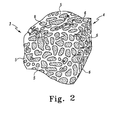
- FIG. 2 is an enlarged cross sectional view of a portion of the backing component 3.
- backing component 3 is fabricated from an open-celled lattice material 4 (e.g. a metallic material).
- the material 4 includes open spaces or pores 5 interconnected by ligaments 6.
- the pores 5 of the material 4 can, for example, form a three dimensional network of continuously connected channels that define a bulk volume porosity as previously described.
- Such a network provides permeability and a high surface area which are desirable conditions for the growth of new bone.
- the use of a material having a volume with pores is complementary to the microstructure of natural cancellous bone, and thus will enable that portion of the prosthesis device which is in contact with the natural cancellous bone to incorporate new bone into the prosthesis.
- polymeric bearing component 2 this component is made from a polymeric material typically having enhanced bearing surface properties as compared to the material of the backing component 3.
- Polymeric bearing component 2 as used herein includes any work piece of polymeric material that has a bearing surface defined thereon or can have a bearing surface defined thereon with further processing.
- the term "polymeric” as used herein is intended to include both homopolymers, copolymers, and oriented materials.
- bearing component 2 can be made from any medical grade polymeric material which may be implanted into the body of an animal (e.g. the body of a human patient) and be capable of having its viscosity reduced sufficiently with the application of thermal energy such that it will deformation flow into, for example, the pores of the backing component 3.
- polyethylene includes polyethylene, such as a polyethylene homopolymer, high density polyethylene, high molecular weight polyethylene, high density high molecular weight polyethylene, or any other type of polyethylene utilized in the construction of a prosthetic implant.
- polyethylene such as a polyethylene homopolymer, high density polyethylene, high molecular weight polyethylene, high density high molecular weight polyethylene, or any other type of polyethylene utilized in the construction of a prosthetic implant.
- UHMWPE ultrahigh molecular weight polyethylene
- the polymeric material bearing component 2 is made from can initially be in an unconsolidated form, such as a powder. What is meant herein by the term “powder” is resin particles sometimes referred to as "flakes". Prior to securing the bearing component 2 to the backing component 3, the flakes of polymeric material are consolidated into a polymeric work piece using any one of a number of well known consolidation techniques. After consolidation, the work piece is subjected to a crosslinking process. Crosslinking the polymeric material after consolidation results in a polymeric bearing component having enhanced mechanical properties as compared to a polymeric bearing component made from polymeric flakes which are crosslinked prior to consolidation.
- crosslinking While there is no intent to be limited by any particular mechanism, it is believed by persons skilled in the art that irradiation of a polymeric material, such as UHMWPE, initially causes the bonds in the polyethylene chain to be broken by the high energy radiation to form free radicals. Cleavage can occur between carbon and hydrogen atoms in the chain to form a large polyethylene free radical of essentially undiminished molecular weight and a hydrogen free radical. At the other extreme, cleavage can occur between adjacent carbon atoms near the centre of the chain resulting in a broken chain with two shorter polyethylene free radicals.
- a polymeric material such as UHMWPE
- One way of crosslinking the consolidated polymeric work piece is to expose it to radiation, such as gamma radiation. Such exposure may be in the exemplary range of about 0.5 Mrads to about 150 Mrads.
- radiation such as gamma radiation.
- a crosslinked UHMWPE work piece can be obtained by first consolidating non-crosslinked UHMWPE flakes into a work piece, and then irradiating the non-crosslinked UHMWPE work piece with gamma radiation.
- one manner by which polymeric materials are crosslinked is by gamma irradiation, although other manners such as electron beam or X-ray radiation may also be used.
- the polymeric material may be irradiated with gamma radiation at a dose from about 0.5 Mrads to about 150 Mrads, illustratively from about 3 to about 50 Mrads, and illustratively from about 3 to about 15 Mrads using methods known in the art.
- the irradiation process may be optionally performed under vacuum or in an inert or substantially oxygen-free atmosphere.
- a polymeric material such as UHMWPE
- UHMWPE can be subjected to a post-irradiation free radical quenching process.
- the free radical containing work piece is placed into a vacuum oven which was subsequently brought under vacuum.
- the temperature of the vacuum oven is then raised to above the melting point of the polymeric material for about 24 hours and then brought to room temperature.
- free radical quenching processes include those processes which subject a polymeric material to heat and reduced pressure to quench free radicals.
- the polymeric material subjected to a post-irradiation free radical quenching process will be substantially free of free radicals.
- substantially free of free radicals is that the polymeric material has a de minimis amount of free radicals therein.
- the work piece After crosslinking and quenching the work piece is shaped or formed into a size and mass suitable for attaching to the backing component 3.
- the work piece can be machined or otherwise formed into a bearing component which has a complementary perimeter profile to the backing component.
- the bearing component can be machined or otherwise formed to enhance the characteristics of the bearing surface defined thereon. While the above discussion describes a sequence of consolidation, crosslinking, quenching, and shaping it should be appreciated that other sequential orders are contemplated. For example, it is contemplated that a consolidated work piece can be shaped and then crosslinked and quenched.
- the polymeric bearing component 2 is heated to supply the thermal energy necessary to sufficiently reduce the viscosity of the polymeric material such that it becomes impregnated into the pores of the backing component with the application of pressure.
- One way of accomplishing this is to elevate the temperature of the backing component 3 to a level at which sufficient thermal energy is transferred to the polymeric component 2 so as to locally reduce the viscosity of the polymeric material.
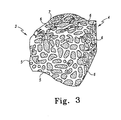
- the lowering of the viscosity of the polymeric material reduces the mechanical properties of the material such that with the application of sufficient force the polymeric material interdigitates with the pores of the backing component 3 as schematically shown in FIG. 3.
- FIG. 3 FIG.
- FIG. 3 illustrates a mass of polymeric material 7 advanced into the pores 5 of the material 4 of the backing component 3. While FIG. 3 only shows a portion of the pores 5 being filled with polymeric material, it should be appreciated that the method of heating the polymeric material 7 to reduce its viscosity and then applying pressure to force the polymeric material 7 into the pores 5 of the backing component 3 can result in substantially all of the pores 5 of the backing component 3 being filled with the polymeric material 7. Furthermore, while FIG. 3 shows an open porous structure, it should be understood that a mass of polymeric material can also interdigitate with the pores of a backing component that has a closed porous structure so as to result in a mechanical bond of sufficient strength to hold the polymeric bearing component secure to the rigid backing component.
- the heating of the polymeric component 2 can be controlled so that only a narrow zone of the polymeric material adjacent to, and making contact with, the surface of the backing component 3 is lowered in viscosity.
- the low thermal conductivity of the polymeric material and the limited amount of thermal energy imparted to the backing component 3 restricts the amount of material for which the viscosity will be lowered.
- the outside surface material of the bearing component which articulates against a mating orthopaedic device or a bone structure is totally unaffected by the bonding process, as very little thermal energy is transmitted to that surface.
- Thermal energy input should also be controlled to avoid heating the polymeric material to excessive temperatures, since the exposure of a polymeric material to such temperatures can cause the breaking of the molecular chain and the reduction of the molecular weight of the material. In the case of UHMWPE, as the molecular weight decreases the resistance to wear also decreases.
Landscapes
- Health & Medical Sciences (AREA)
- Chemical & Material Sciences (AREA)
- Life Sciences & Earth Sciences (AREA)
- Animal Behavior & Ethology (AREA)
- Medicinal Chemistry (AREA)
- Oral & Maxillofacial Surgery (AREA)
- Transplantation (AREA)
- Epidemiology (AREA)
- Veterinary Medicine (AREA)
- Dermatology (AREA)
- General Health & Medical Sciences (AREA)
- Public Health (AREA)
- Chemical Kinetics & Catalysis (AREA)
- Dispersion Chemistry (AREA)
- Prostheses (AREA)
- Materials For Medical Uses (AREA)
Abstract
Description
- Bars of UHMWPE are identified with a job number and bar number.
- The bars are placed into bags, and placed into a fixture inside of a bagging chamber at room temperature. The atmosphere in the bagging chamber is removed so that the pressure therein is less than 1 atmosphere. Each bag with a bar of UHMWPE therein is subsequently sealed with a heat sealer. Each bag with the UHMWPE bar contained therein is then removed from the bagging chamber after returning the chamber to atmospheric pressure. Each bag is inspected for integrity, and packaged into a labelled box.
- The boxes are shipped to a facility for irradiation.
- Dosimeters for the recording of the level of radiation are placed on the outside of the boxes and the bars are irradiated.
- After irradiation the bars are debagged and placed inside of a vacuum oven to begin a free radical quenching process.
- The bars are heated and soaked at the elevated temperature for a time period under a pressure less than 1 atmosphere.
- The bars are then cooled and soaked at a lower temperature for a time period under a pressure less than 1 atmosphere. The bars are then cooled prior to removal from the chamber and placed on cooling racks. An outer oxidized layer of each bar is also removed after soaking. All temperature ramping operations are conducted in Argon after a backfilling operation.
- Machine a consolidated, crosslinked, quenched, UHMWPE work piece into an appropriate bearing component having a desired perimeter shape.
- Position a porous metallic backing component having a perimeter profile that is complementary to the perimeter profile of the above described UHMWPE bearing component at the base of a mould cavity of a compression moulding apparatus.
- Position the UHMWPE bearing component atop the metallic backing component and mould using appropriate cycle parameters for temperature (e.g. about 135°C to about 260°C), pressure (e.g. about 1000 psi to about 70,000 psi), and time so as to ensure sufficient interface shear strength between the UHMWPE bearing component and the metallic backing component. Note that in light of the discussion set forth herein, the cycle parameters utilized to obtain a backing component/bearing component composite having a desired interface shear strength will be determined for each particular application. Note that either a one-soak moulding cycle (melt soak only) or a two-soak moulding cycle (melt soak and recrystallisation soak) can be utilized.
- Sterilize the metallic backing component/UHMWPE polymeric bearing component composite using a non irradiation method to avoid introducing free radicals into the UHMWPE polymeric bearing component (e.g. gas plasma).
Claims (10)
- A method of preparing an implantable orthopaedic device that includes (i) a consolidated bearing component made from a crosslinked polymeric material and (ii) a porous backing component attached to the bearing component, wherein the backing component has a greater modulus of elasticity than the bearing component, the method comprising advancing a mass of the polymeric material of the consolidated bearing component into the pores of the backing component to cause the backing component to be mechanically attached to the bearing component.
- The method of claim 1, which includes subjecting the consolidated bearing component to a free radical quenching process.
- The method of claim 1, which includes heating the bearing component to supply thermal energy necessary to reduce the viscosity of the polymeric material prior to advancing the mass of the polymeric material of the consolidated bearing component into the pores of the backing component.
- The method of claim 1, in which the crosslinked polymeric material of the bearing component includes crosslinked UHMWPE.
- The method of claim 1, in which the backing component has an open porous structure.
- The method of claim 1, in which the pores of the backing component define a bulk volume porosity from about 25% to about 75%.
- The method of claim 1, in which the backing component is made from a metallic material.
- The method of claim 1, which includes subjecting the consolidated bearing component to a sterilization process.
- A method of preparing an implantable orthopaedic device, the method comprising:consolidating flakes of polymeric material into a polymeric work piece;subjecting the polymeric work piece to a process to cause crosslinking of the polymeric material of the polymeric work piece; andadvancing a mass of the polymeric material of the polymeric work piece into pores of a backing component to cause the backing component to be mechanically attached to the polymeric work piece.
- A method of preparing an implantable orthopaedic device that includes (i) a polymeric component made from a polymeric material and (ii) a backing component attached to the polymeric component, wherein the backing component has (A) pores defined therein and (B) a greater modulus of elasticity than the polymeric component, the method comprising:consolidating flakes of a polymeric material into the polymeric component;subjecting the polymeric component to a process to cause crosslinking of the polymeric material of the polymeric component;subjecting the polymeric component to a process to cause quenching of substantially all free radicals present in the polymeric component; andadvancing a mass of the polymeric material of the polymeric component into pores of the backing component to cause the backing component to be attached to the polymeric component.
Applications Claiming Priority (2)
| Application Number | Priority Date | Filing Date | Title |
|---|---|---|---|
| US10/610,161 US20040262809A1 (en) | 2003-06-30 | 2003-06-30 | Crosslinked polymeric composite for orthopaedic implants |
| US610161 | 2003-06-30 |
Publications (2)
| Publication Number | Publication Date |
|---|---|
| EP1493455A2 true EP1493455A2 (en) | 2005-01-05 |
| EP1493455A3 EP1493455A3 (en) | 2010-04-28 |
Family
ID=33435384
Family Applications (1)
| Application Number | Title | Priority Date | Filing Date |
|---|---|---|---|
| EP04253363A Withdrawn EP1493455A3 (en) | 2003-06-30 | 2004-06-04 | Crosslinked polymeric composite for orthopaedic implants |
Country Status (3)
| Country | Link |
|---|---|
| US (2) | US20040262809A1 (en) |
| EP (1) | EP1493455A3 (en) |
| AU (1) | AU2004202259B2 (en) |
Cited By (8)
| Publication number | Priority date | Publication date | Assignee | Title |
|---|---|---|---|---|
| EP2210623A1 (en) * | 2005-12-06 | 2010-07-28 | Howmedica Osteonics Corp. | Implant with laser-produced porous surface |
| US8142886B2 (en) | 2007-07-24 | 2012-03-27 | Howmedica Osteonics Corp. | Porous laser sintered articles |
| US8147861B2 (en) | 2006-08-15 | 2012-04-03 | Howmedica Osteonics Corp. | Antimicrobial implant |
| US8268099B2 (en) | 2002-11-08 | 2012-09-18 | Howmedica Osteonics Corp. | Laser-produced porous surface |
| US9135374B2 (en) | 2012-04-06 | 2015-09-15 | Howmedica Osteonics Corp. | Surface modified unit cell lattice structures for optimized secure freeform fabrication |
| US9180010B2 (en) | 2012-04-06 | 2015-11-10 | Howmedica Osteonics Corp. | Surface modified unit cell lattice structures for optimized secure freeform fabrication |
| US9456901B2 (en) | 2004-12-30 | 2016-10-04 | Howmedica Osteonics Corp. | Laser-produced porous structure |
| US11298747B2 (en) | 2017-05-18 | 2022-04-12 | Howmedica Osteonics Corp. | High fatigue strength porous structure |
Families Citing this family (13)
| Publication number | Priority date | Publication date | Assignee | Title |
|---|---|---|---|---|
| US20050065307A1 (en) * | 2003-09-19 | 2005-03-24 | Depuy Products, Inc. | Medical implant or medical implant part comprising porous UHMWPE and process for producing the same |
| US7205051B2 (en) * | 2003-09-30 | 2007-04-17 | Depuy Products, Inc. | Medical implant or medical implant part |
| US7335697B2 (en) * | 2004-12-23 | 2008-02-26 | Depuy Products, Inc. | Polymer composition comprising cross-linked polyethylene and methods for making the same |
| US8343230B2 (en) * | 2005-09-22 | 2013-01-01 | Depuy Products, Inc. | Orthopaedic bearing material |
| US20070077268A1 (en) * | 2005-09-30 | 2007-04-05 | Depuy Products, Inc. | Hydrophobic carrier modified implants for beneficial agent delivery |
| US7812098B2 (en) * | 2006-03-31 | 2010-10-12 | Depuy Products, Inc. | Bearing material of medical implant having reduced wear rate and method for reducing wear rate |
| ES2350708T3 (en) * | 2006-08-25 | 2011-01-26 | Depuy Products, Inc. | MEDICAL IMPLANT SUPPORT MATERIAL. |
| US8365637B2 (en) * | 2007-10-23 | 2013-02-05 | Caterpillar Inc. | Drop box for powertrain |
| US9364896B2 (en) | 2012-02-07 | 2016-06-14 | Medical Modeling Inc. | Fabrication of hybrid solid-porous medical implantable devices with electron beam melting technology |
| CA3075578C (en) * | 2013-04-26 | 2022-07-26 | New York Society For The Ruptured And Crippled Maintaining The Hospital For Special Surgery | A multi-component non-biodegradable implant, a method of making and a method of implantation |
| US9498922B2 (en) * | 2014-06-26 | 2016-11-22 | Vertera, Inc. | Apparatus and process for producing porous devices |
| US9504550B2 (en) | 2014-06-26 | 2016-11-29 | Vertera, Inc. | Porous devices and processes for producing same |
| EP3412252B1 (en) * | 2017-06-09 | 2020-02-12 | Howmedica Osteonics Corp. | Polymer interlock support structure |
Family Cites Families (99)
| Publication number | Priority date | Publication date | Assignee | Title |
|---|---|---|---|---|
| US2948666A (en) * | 1956-11-21 | 1960-08-09 | Gen Electric | Irradiation process |
| US3297641A (en) * | 1964-01-17 | 1967-01-10 | Grace W R & Co | Process for cross-linking polyethylene |
| DE1241994B (en) * | 1964-01-31 | 1967-06-08 | Glanzstoff Ag | Process for the saturation of double bonds in polyolefins |
| BE794718Q (en) * | 1968-12-20 | 1973-05-16 | Dow Corning Ltd | OLEFINS CROSS-LINKING PROCESS |
| JPS4810618B1 (en) * | 1969-03-10 | 1973-04-05 | ||
| US3758273A (en) * | 1970-04-03 | 1973-09-11 | Gillette Co | Processes for sterilizing polypropylene objects |
| US3787900A (en) * | 1971-06-09 | 1974-01-29 | Univ Iowa State Res Found | Artificial bone or tooth prosthesis material |
| US3944536A (en) * | 1973-06-18 | 1976-03-16 | E. I. Du Pont De Nemours & Company | Exceptionally rigid and tough ultrahigh molecular weight linear polyethylene |
| US3997512A (en) * | 1973-11-21 | 1976-12-14 | American Cyanamid Company | High molecular weight polyester resin, the method of making the same |
| US4055862A (en) * | 1976-01-23 | 1977-11-01 | Zimmer Usa, Inc. | Human body implant of graphitic carbon fiber reinforced ultra-high molecular weight polyethylene |
| US4181983A (en) * | 1977-08-29 | 1980-01-08 | Kulkarni R K | Assimilable hydrophilic prosthesis |
| US4195366A (en) * | 1977-12-23 | 1980-04-01 | Sterling Drug Inc. | Whitlockite ceramic |
| DE2807132C2 (en) * | 1978-02-20 | 1983-11-03 | Battelle-Institut E.V., 6000 Frankfurt | Implantable pharmaceutical depot |
| US4138382A (en) * | 1978-05-01 | 1979-02-06 | Dow Corning Corporation | Hydrophilic, water-swellable, crosslinked, copolymer gel and prosthesis employing same |
| US4281420A (en) * | 1979-02-15 | 1981-08-04 | Raab S | Bone connective prostheses adapted to maximize strength and durability of prostheses-bone cement interface; and methods of forming same |
| DE2905878A1 (en) * | 1979-02-16 | 1980-08-28 | Merck Patent Gmbh | IMPLANTATION MATERIALS AND METHOD FOR THEIR PRODUCTION |
| JPS5645814A (en) * | 1979-09-25 | 1981-04-25 | Kureha Chem Ind Co Ltd | Hydroxyapatite, its ceramic material and its manufacture |
| US4366618A (en) * | 1980-07-02 | 1983-01-04 | Lakes Lee J | Apparatus for winding armatures of electric machines |
| DE3131812C2 (en) * | 1981-08-12 | 1983-06-16 | Hewing GmbH & Co, 4434 Ochtrup | Process for the production of moldings from polyolefin molding compositions crosslinked by irradiation with electron beams |
| JPS5829841A (en) * | 1981-08-14 | 1983-02-22 | Asahi Chem Ind Co Ltd | Improve polyethylene composition |
| US4483333A (en) * | 1982-06-01 | 1984-11-20 | Wrf/Aquaplast Corporation | Orthopedic cast |
| US4586995A (en) * | 1982-09-17 | 1986-05-06 | Phillips Petroleum Company | Polymer and irradiation treatment method |
| US4816517A (en) * | 1982-09-29 | 1989-03-28 | Vulkor, Incorporated | Crosslinked polymer interdispersions containing polyolefin and method of making |
| US4452973A (en) * | 1982-11-12 | 1984-06-05 | American Cyanamid Company | Poly(glycolic acid)/poly(oxyethylene) triblock copolymers and method of manufacturing the same |
| US4481353A (en) * | 1983-10-07 | 1984-11-06 | The Children's Medical Center Corporation | Bioresorbable polyesters and polyester composites |
| US4518552A (en) * | 1983-11-09 | 1985-05-21 | Mitsuboshi Belting Ltd. | Method of producing accurately sized material of ultra high molecular weight polyethylene |
| GB8332952D0 (en) * | 1983-12-09 | 1984-01-18 | Ward I M | Polymer irradiation |
| GB8333032D0 (en) * | 1983-12-10 | 1984-01-18 | Bp Chem Int Ltd | Orientated polyolefins |
| US4563489A (en) * | 1984-02-10 | 1986-01-07 | University Of California | Biodegradable organic polymer delivery system for bone morphogenetic protein |
| US4578384A (en) * | 1984-02-15 | 1986-03-25 | The United States Of America As Represented By The Secretary Of The Army | Polylactic-polyglycolic acids combined with an acidic phospholipid-lysozyme complex for healing osseous tissue |
| US4539374A (en) * | 1984-03-21 | 1985-09-03 | E. I. Du Pont De Nemours And Company | Polyolefin with improved processing properties |
| US4637931A (en) * | 1984-10-09 | 1987-01-20 | The United States Of America As Represented By The Secretary Of The Army | Polyactic-polyglycolic acid copolymer combined with decalcified freeze-dried bone for use as a bone repair material |
| US4944974A (en) * | 1984-10-24 | 1990-07-31 | Zachariades Anagnostis E | Composite structures of ultra-high-molecular-weight polymers, such as ultra-high-molecular-weight polyethylene products, and method of producing such structures |
| US5160472A (en) * | 1984-10-24 | 1992-11-03 | Zachariades Anagnostis E | Method of producing composite structures of ultra-high-molecular-weight polymers, such as ultra-high-molecular-weight polyethylene products |
| US4655769A (en) * | 1984-10-24 | 1987-04-07 | Zachariades Anagnostis E | Ultra-high-molecular-weight polyethylene products including vascular prosthesis devices and methods relating thereto and employing pseudo-gel states |
| CH665770A5 (en) * | 1985-01-25 | 1988-06-15 | Sulzer Ag | PLASTIC BONE IMPLANT. |
| JPS61204372A (en) * | 1985-03-06 | 1986-09-10 | Univ Osaka | Method for making material amorphous by use of implantation of heterogeneous atom into solid by electron beam |
| FR2578780B1 (en) * | 1985-03-12 | 1987-08-14 | Commissariat Energie Atomique | HIGH MOLECULAR WEIGHT POLYOLEFIN PART, PARTICULARLY FOR JOINT PROSTHESIS, AND ITS MANUFACTURING METHOD BY CLOSED MATRIX FORGING |
| US4876049A (en) * | 1985-11-21 | 1989-10-24 | Nippon Petrochemicals Co., Ltd. | Method for preparing molded articles of ultra-high molecular weight polyethylene |
| CA1279167C (en) * | 1985-11-30 | 1991-01-22 | Mitsui Chemicals, Incorporated | Molecularly oriented, silane-crosslinked ultra-high- molecular-weight polyethylene molded article and process for preparation thereof |
| US4743493A (en) * | 1986-10-06 | 1988-05-10 | Spire Corporation | Ion implantation of plastics |
| FI80605C (en) * | 1986-11-03 | 1990-07-10 | Biocon Oy | BENKIRURGISK BIOKOMPOSITMATERIAL. |
| US4888369A (en) * | 1987-01-21 | 1989-12-19 | Himont Incorporated | Polypropylene composition resistant to high energy radiation, and radiation sterilized articles therefrom |
| US5085861A (en) * | 1987-03-12 | 1992-02-04 | The Beth Israel Hospital Association | Bioerodable implant composition comprising crosslinked biodegradable polyesters |
| US4843112A (en) * | 1987-03-12 | 1989-06-27 | The Beth Israel Hospital Association | Bioerodable implant composition |
| US5053312A (en) * | 1987-12-11 | 1991-10-01 | Fuji Photo Film Co., Ltd. | Image-receiving material and image-forming method employing the same |
| US4880610A (en) * | 1988-04-20 | 1989-11-14 | Norian Corporation | In situ calcium phosphate minerals--method and composition |
| FR2631832B1 (en) * | 1988-05-24 | 1994-05-27 | Unirec | METHOD FOR REDUCING THE COEFFICIENT OF FRICTION AND WEAR BETWEEN A METAL PIECE AND A PIECE BASED ON AN ORGANIC POLYMER OR COPOLYMER AND ITS APPLICATION TO JOINT PROSTHESES |
| US5014494A (en) * | 1988-09-27 | 1991-05-14 | Sherwood Medical Company | Method of sterilizing medical articles |
| US5264214A (en) * | 1988-11-21 | 1993-11-23 | Collagen Corporation | Composition for bone repair |
| US5478906A (en) * | 1988-12-02 | 1995-12-26 | E. I. Du Pont De Nemours And Company | Ultrahigh molecular weight linear polyethylene and articles thereof |
| CA2021814C (en) * | 1989-07-25 | 2002-04-02 | James A. Davidson | Zirconium alloy-based prosthesis with zirconium oxide or zirconium nitride coating |
| US5024670A (en) * | 1989-10-02 | 1991-06-18 | Depuy, Division Of Boehringer Mannheim Corporation | Polymeric bearing component |
| US5037928A (en) * | 1989-10-24 | 1991-08-06 | E. I. Du Pont De Nemours And Company | Process of manufacturing ultrahigh molecular weight linear polyethylene shaped articles |
| US5492697A (en) * | 1990-03-05 | 1996-02-20 | Board Of Regents, Univ. Of Texas System | Biodegradable implant for fracture nonunions |
| US5153039A (en) * | 1990-03-20 | 1992-10-06 | Paxon Polymer Company, L.P. | High density polyethylene article with oxygen barrier properties |
| US5200439A (en) * | 1990-04-13 | 1993-04-06 | Mitsui Toatsu Chemicals, Inc. | Method for increasing intrinsic viscosity of syndiotactic polypropylene |
| US5130376A (en) * | 1990-04-23 | 1992-07-14 | Hercules Incorporated | UHMWPE/styrenic molding compositions with improved flow properties and impact strength |
| US5236563A (en) * | 1990-06-18 | 1993-08-17 | Advanced Surface Technology Inc. | Surface-modified bioabsorbables |
| US5133757A (en) * | 1990-07-31 | 1992-07-28 | Spire Corporation | Ion implantation of plastic orthopaedic implants |
| US5210130A (en) * | 1990-08-07 | 1993-05-11 | E. I. Du Pont De Nemours And Company | Homogeneous, high modulus ultrahigh molecular weight polyethylene composites and processes for the preparation thereof |
| US5702448A (en) * | 1990-09-17 | 1997-12-30 | Buechel; Frederick F. | Prosthesis with biologically inert wear resistant surface |
| DE4030564A1 (en) * | 1990-09-27 | 1992-04-02 | Hoechst Ag | GRAFT POLYMER BASED ON ULTRA HIGH MOLECULAR POLYETHYLENE |
| US5192323A (en) * | 1990-11-05 | 1993-03-09 | Zimmer, Inc. | Method of surface hardening orthopedic implant devices |
| US5137688A (en) * | 1990-11-29 | 1992-08-11 | General Electric Company | Irradiated articles molded from polycarbonate-polyamide blends |
| US5149368A (en) * | 1991-01-10 | 1992-09-22 | Liu Sung Tsuen | Resorbable bioactive calcium phosphate cement |
| JP3007903B2 (en) * | 1991-03-29 | 2000-02-14 | 京セラ株式会社 | Artificial disc |
| US5508319A (en) * | 1991-06-21 | 1996-04-16 | Montell North America Inc. | High melt strength, ethylene polymer, process for making it, and use thereof |
| US5439949A (en) * | 1991-08-21 | 1995-08-08 | Rexene Corporation | Propylene compositions with improved resistance to thermoforming sag |
| US5466530A (en) * | 1993-01-21 | 1995-11-14 | England; Garry L. | Biocompatible components fabricated from a substantially consolidated stock of material |
| US5443519A (en) * | 1993-04-22 | 1995-08-22 | Implex Corporation | Prosthetic ellipsoidal acetabular cup |
| US5414049A (en) * | 1993-06-01 | 1995-05-09 | Howmedica Inc. | Non-oxidizing polymeric medical implant |
| US5549700A (en) * | 1993-09-07 | 1996-08-27 | Ortho Development Corporation | Segmented prosthetic articulation |
| US5385887A (en) * | 1993-09-10 | 1995-01-31 | Genetics Institute, Inc. | Formulations for delivery of osteogenic proteins |
| US5407623A (en) * | 1994-01-06 | 1995-04-18 | Polteco, Inc. | Process for obtaining ultra-high modulus line products with enhanced mechanical properties |
| US5593719A (en) * | 1994-03-29 | 1997-01-14 | Southwest Research Institute | Treatments to reduce frictional wear between components made of ultra-high molecular weight polyethylene and metal alloys |
| ES2138699T3 (en) * | 1994-04-11 | 2000-01-16 | Bristol Myers Squibb Co | IMPLANT OF POLYMERIC COMPOSITE MATERIAL AND MANUFACTURING PROCEDURE. |
| US5947893A (en) * | 1994-04-27 | 1999-09-07 | Board Of Regents, The University Of Texas System | Method of making a porous prothesis with biodegradable coatings |
| US5515590A (en) * | 1994-07-19 | 1996-05-14 | University Of Kentucky Research Foundation | Method for reducing the generation of wear particulates from an implant |
| US5709020A (en) * | 1994-07-19 | 1998-01-20 | University Of Kentucky Research Foundation | Method for reducing the generation of wear particulates from an implant |
| USRE44762E1 (en) * | 1994-09-21 | 2014-02-11 | Bmg Incorporated | Ultra high molecular weight polyethylene molded article for artificial joints and method of preparing the same |
| US5507804A (en) * | 1994-11-16 | 1996-04-16 | Alcon Laboratories, Inc. | Cross-linked polyethylene oxide coatings to improve the biocompatibility of implantable medical devices |
| US5609638A (en) * | 1994-11-29 | 1997-03-11 | Zimmer, Inc. | Reinforced polyethylene for articular surfaces |
| DE69536061D1 (en) * | 1994-11-30 | 2010-05-12 | Biomet 3I Llc | Preparation of an implant surface |
| US5607518A (en) * | 1995-02-22 | 1997-03-04 | Ciba Geigy Corporation | Methods of deblocking, extracting and cleaning polymeric articles with supercritical fluids |
| US5577368A (en) * | 1995-04-03 | 1996-11-26 | Johnson & Johnson Professional, Inc. | Method for improving wear resistance of polymeric bioimplantable components |
| US6027742A (en) * | 1995-05-19 | 2000-02-22 | Etex Corporation | Bioresorbable ceramic composites |
| US5674293A (en) * | 1996-01-19 | 1997-10-07 | Implant Sciences Corp. | Coated orthopaedic implant components |
| TR199801405T2 (en) * | 1996-01-22 | 1998-10-21 | The Dow Chemical Company | Polyolefin elastomer blends with improved properties. |
| US5639280A (en) * | 1996-02-02 | 1997-06-17 | Zimmer, Inc. | Constraining ring for a hip cup |
| US5879400A (en) * | 1996-02-13 | 1999-03-09 | Massachusetts Institute Of Technology | Melt-irradiated ultra high molecular weight polyethylene prosthetic devices |
| US8865788B2 (en) * | 1996-02-13 | 2014-10-21 | The General Hospital Corporation | Radiation and melt treated ultra high molecular weight polyethylene prosthetic devices |
| US5753182A (en) * | 1996-02-14 | 1998-05-19 | Biomet, Inc. | Method for reducing the number of free radicals present in ultrahigh molecular weight polyethylene orthopedic components |
| US6087553A (en) * | 1996-02-26 | 2000-07-11 | Implex Corporation | Implantable metallic open-celled lattice/polyethylene composite material and devices |
| US6017975A (en) * | 1996-10-02 | 2000-01-25 | Saum; Kenneth Ashley | Process for medical implant of cross-linked ultrahigh molecular weight polyethylene having improved balance of wear properties and oxidation resistance |
| US5879407A (en) * | 1997-07-17 | 1999-03-09 | Waggener; Herbert A. | Wear resistant ball and socket joint |
| US6143232A (en) * | 1999-07-29 | 2000-11-07 | Bristol-Meyers Squibb Company | Method of manufacturing an articulating bearing surface for an orthopaedic implant |
| US6620198B2 (en) * | 1999-10-07 | 2003-09-16 | Exactech, Inc. | Composite bearing inserts for total knee joints |
| US7938861B2 (en) * | 2003-04-15 | 2011-05-10 | Depuy Products, Inc. | Implantable orthopaedic device and method for making the same |
-
2003
- 2003-06-30 US US10/610,161 patent/US20040262809A1/en not_active Abandoned
-
2004
- 2004-05-25 AU AU2004202259A patent/AU2004202259B2/en not_active Ceased
- 2004-06-04 EP EP04253363A patent/EP1493455A3/en not_active Withdrawn
-
2008
- 2008-03-20 US US12/052,404 patent/US20080178998A1/en not_active Abandoned
Cited By (25)
| Publication number | Priority date | Publication date | Assignee | Title |
|---|---|---|---|---|
| US11510783B2 (en) | 2002-11-08 | 2022-11-29 | Howmedica Osteonics Corp. | Laser-produced porous surface |
| US8992703B2 (en) | 2002-11-08 | 2015-03-31 | Howmedica Osteonics Corp. | Laser-produced porous surface |
| US11186077B2 (en) | 2002-11-08 | 2021-11-30 | Howmedica Osteonics Corp. | Laser-produced porous surface |
| US8268099B2 (en) | 2002-11-08 | 2012-09-18 | Howmedica Osteonics Corp. | Laser-produced porous surface |
| US8268100B2 (en) | 2002-11-08 | 2012-09-18 | Howmedica Osteonics Corp. | Laser-produced porous surface |
| US11155073B2 (en) | 2002-11-08 | 2021-10-26 | Howmedica Osteonics Corp. | Laser-produced porous surface |
| US10525688B2 (en) | 2002-11-08 | 2020-01-07 | Howmedica Osteonics Corp. | Laser-produced porous surface |
| US11660195B2 (en) | 2004-12-30 | 2023-05-30 | Howmedica Osteonics Corp. | Laser-produced porous structure |
| US9456901B2 (en) | 2004-12-30 | 2016-10-04 | Howmedica Osteonics Corp. | Laser-produced porous structure |
| EP2210623A1 (en) * | 2005-12-06 | 2010-07-28 | Howmedica Osteonics Corp. | Implant with laser-produced porous surface |
| US12011355B2 (en) | 2005-12-06 | 2024-06-18 | Howmedica Osteonics Corp. | Laser-produced porous surface |
| US10398559B2 (en) | 2005-12-06 | 2019-09-03 | Howmedica Osteonics Corp. | Laser-produced porous surface |
| US11918474B2 (en) | 2005-12-06 | 2024-03-05 | The University Of Liverpool | Laser-produced porous surface |
| US10716673B2 (en) | 2005-12-06 | 2020-07-21 | Howmedica Osteonics Corp. | Laser-produced porous surface |
| US8728387B2 (en) | 2005-12-06 | 2014-05-20 | Howmedica Osteonics Corp. | Laser-produced porous surface |
| US8556981B2 (en) | 2005-12-06 | 2013-10-15 | Howmedica Osteonics Corp. | Laser-produced porous surface |
| US8147861B2 (en) | 2006-08-15 | 2012-04-03 | Howmedica Osteonics Corp. | Antimicrobial implant |
| US8142886B2 (en) | 2007-07-24 | 2012-03-27 | Howmedica Osteonics Corp. | Porous laser sintered articles |
| US11759323B2 (en) | 2012-04-06 | 2023-09-19 | Howmedica Osteonics Corp. | Surface modified unit cell lattice structures for optimized secure freeform fabrication |
| US10614176B2 (en) | 2012-04-06 | 2020-04-07 | Howmedica Osteonics Corp. | Surface modified unit cell lattice structures for optimized secure freeform fabrication |
| US9135374B2 (en) | 2012-04-06 | 2015-09-15 | Howmedica Osteonics Corp. | Surface modified unit cell lattice structures for optimized secure freeform fabrication |
| US9180010B2 (en) | 2012-04-06 | 2015-11-10 | Howmedica Osteonics Corp. | Surface modified unit cell lattice structures for optimized secure freeform fabrication |
| US12102538B2 (en) | 2012-04-06 | 2024-10-01 | Howmedica Osteonics Corp. | Surface modified unit cell lattice structures for optimized secure freeform fabrication |
| US11298747B2 (en) | 2017-05-18 | 2022-04-12 | Howmedica Osteonics Corp. | High fatigue strength porous structure |
| US11684478B2 (en) | 2017-05-18 | 2023-06-27 | Howmedica Osteonics Corp. | High fatigue strength porous structure |
Also Published As
| Publication number | Publication date |
|---|---|
| US20080178998A1 (en) | 2008-07-31 |
| AU2004202259A1 (en) | 2005-01-13 |
| US20040262809A1 (en) | 2004-12-30 |
| AU2004202259B2 (en) | 2009-08-20 |
| EP1493455A3 (en) | 2010-04-28 |
Similar Documents
| Publication | Publication Date | Title |
|---|---|---|
| US20080178998A1 (en) | Crosslinked polymeric composite for orthopaedic implants | |
| US7785508B2 (en) | Method for producing medical implant or medical implant part | |
| US6692679B1 (en) | Cross-linked molded plastic bearings | |
| EP1072276B1 (en) | Low temperature pressure stabilisation of implant component | |
| CA2313928C (en) | Method of manufacturing an articulating bearing surface for an orthopaedic implant | |
| RU2211008C2 (en) | Prosthetic devices out of polyethylene of ultra-high molecular weight treated with irradiation and fusion | |
| AU784393B2 (en) | Oriented, cross-linked UHMWPE molding for orthopaedic applications | |
| JP4184872B2 (en) | Continuously cross-linked polyethylene | |
| US6503439B1 (en) | Process for forming shaped articles of ultra high molecular weight polyethylene suitable for use as a prosthetic device or a component thereof | |
| EP0963824B1 (en) | Method for forming cross-linked molded plastic bearings | |
| WO2004000159A2 (en) | Metal back or mesh crosslinking | |
| AU742611B2 (en) | Gamma irradiated heat treated implant for mechanical strength | |
| EP1072274A1 (en) | Two step gamma irradiation of polymeric bioimplant | |
| EP1413414B1 (en) | Method for forming cross-linked molded plastic bearings | |
| EP2921186B1 (en) | Annealing method for cross-linked polyethylene | |
| JP2003117931A (en) | Oriented and bridged uhmwpe molded form for orthopedics |
Legal Events
| Date | Code | Title | Description |
|---|---|---|---|
| PUAI | Public reference made under article 153(3) epc to a published international application that has entered the european phase |
Free format text: ORIGINAL CODE: 0009012 |
|
| AK | Designated contracting states |
Kind code of ref document: A2 Designated state(s): AT BE BG CH CY CZ DE DK EE ES FI FR GB GR HU IE IT LI LU MC NL PL PT RO SE SI SK TR |
|
| AX | Request for extension of the european patent |
Extension state: AL HR LT LV MK |
|
| PUAL | Search report despatched |
Free format text: ORIGINAL CODE: 0009013 |
|
| AK | Designated contracting states |
Kind code of ref document: A3 Designated state(s): AT BE BG CH CY CZ DE DK EE ES FI FR GB GR HU IE IT LI LU MC NL PL PT RO SE SI SK TR |
|
| AX | Request for extension of the european patent |
Extension state: AL HR LT LV MK |
|
| RIC1 | Information provided on ipc code assigned before grant |
Ipc: A61L 27/56 20060101ALI20100324BHEP Ipc: A61L 27/16 20060101AFI20041029BHEP |
|
| 17P | Request for examination filed |
Effective date: 20100928 |
|
| AKX | Designation fees paid |
Designated state(s): AT BE BG CH CY CZ DE DK EE ES FI FR GB GR HU IE IT LI LU MC NL PL PT RO SE SI SK TR |
|
| 17Q | First examination report despatched |
Effective date: 20110131 |
|
| STAA | Information on the status of an ep patent application or granted ep patent |
Free format text: STATUS: THE APPLICATION IS DEEMED TO BE WITHDRAWN |
|
| 18D | Application deemed to be withdrawn |
Effective date: 20111011 |