EP1493100B1 - Dynamic generation of schema information for data description languages - Google Patents
Dynamic generation of schema information for data description languages Download PDFInfo
- Publication number
- EP1493100B1 EP1493100B1 EP03744725.7A EP03744725A EP1493100B1 EP 1493100 B1 EP1493100 B1 EP 1493100B1 EP 03744725 A EP03744725 A EP 03744725A EP 1493100 B1 EP1493100 B1 EP 1493100B1
- Authority
- EP
- European Patent Office
- Prior art keywords
- schema
- template
- constraint
- elements
- instances
- Prior art date
- Legal status (The legal status is an assumption and is not a legal conclusion. Google has not performed a legal analysis and makes no representation as to the accuracy of the status listed.)
- Expired - Lifetime
Links
Images


Classifications
-
- G—PHYSICS
- G06—COMPUTING OR CALCULATING; COUNTING
- G06F—ELECTRIC DIGITAL DATA PROCESSING
- G06F40/00—Handling natural language data
- G06F40/10—Text processing
- G06F40/166—Editing, e.g. inserting or deleting
- G06F40/186—Templates
-
- G—PHYSICS
- G06—COMPUTING OR CALCULATING; COUNTING
- G06F—ELECTRIC DIGITAL DATA PROCESSING
- G06F40/00—Handling natural language data
- G06F40/10—Text processing
- G06F40/12—Use of codes for handling textual entities
- G06F40/14—Tree-structured documents
- G06F40/143—Markup, e.g. Standard Generalized Markup Language [SGML] or Document Type Definition [DTD]
Definitions
- the invention relates to computing devices and, more particularly, to data description languages, such as the extensible markup language (XML), that are often used by computing devices when communicating data
- data description languages such as the extensible markup language (XML)
- XML extensible markup language
- SGML Standard Generalized Markup Language
- An XML document includes a root element and, possibly, a number of child elements. Each element consists of an opening tag and a closing tag. The elements of a document must be nested in the closing tag for the child. In this manner, an XML document follows a tree structure in which the elements have parent-child relationships. For example, the following pseudocode illustrates the format of a conventional XML document:
- An XML schema is used to define and describe a class of XML documents. More specifically, an XML schema uses schema components to define the meaning, usage and relationships of the elements that may be used within a class of XML documents, as well as permissible content, attributes, and values for the elements.
- the World Wide Web Consortium (W3C) XML Schema Definition Language for example, is an XML language for describing and constraining the content of XML documents.
- schema definition languages include Document Content Description for XML (DCD), Schema for Object-Oriented (SOX), Document Definition Markup Language (DDML), also referred to as XSchema, Regular Language description for XML Core (RELAX), Tree Regular Expressions for XML (TREX), Schematron (SCH), and Examplotron (EG).
- DCD Document Content Description for XML
- SOX Schema for Object-Oriented
- DDML Document Definition Markup Language
- RELAX Regular Language description for XML Core
- TREX Tree Regular Expressions for XML
- SCH Schematron
- EG Examplotron
- schema languages can lead to very complex schemas having a specific definition for each permissible element.
- schema languages tend to require definition of specific elements within the schema in order to define constraints on the elements. This approach tends to cause the compliant XML documents to lose normalization. In other words, this approach can result in XML documents in which the names and attributes for the elements are significantly different.
- XML Schema Part 0 Primer edited by Fallside, D.C. and bearing a date of 2 May 2001 , a copy of which was retrieved from http://www.w3.org/TR/2001/REC-xmlschema-0-20010502/ on 29 September 2015, is a non-normative document intended to provide an easily readable description of the XML Schema facilities, and is oriented towards quickly understanding how to create schemas using the XML Schema language.
- XML Schema Part 1 Structures
- XML Schema Part 2 Datatypes provide the complete normative description of the XML Schema language. This primer describes the language features through numerous examples which are complemented by extensive references to the normative texts.
- the invention is directed to techniques for dynamically generating schema information for data description languages, such as the extensible markup language (XML). More specifically, the techniques dynamically generate schema information by application of one or more constraint templates to a base schema. One or more definition templates may also be applied to extend the base schema as necessary to further define the valid types of elements. In this manner, complex schema information can be generated including requirements that constrain the use and relationships of the elements without requiring modification to the base schema.
- XML extensible markup language
- a method comprises receiving a schema defining a class of elements that conform to a data description language, and receiving a constraint template that defines requirements for instances of the elements. The method further comprises validating a document in accordance with the schema and the constraint template.
- a system comprises a schema defining a class of elements that conform to a data description language, and a constraint template that defines requirements for instances of the elements.
- the system further comprises a validation engine to validate a document in accordance with the schema and the constraint template.
- a system comprises a schema defining a class of elements that conform to a data description language, a definition template that defines a sub-class for the elements, and a constraint template that defines requirements for instances of the sub-class.
- the system further comprises a schema generator to generate a virtual schema based on the schema, the definition template, and the constraint template, and a validation engine to validate a document in accordance with the virtual schema.
- a computer-readable medium comprises instructions to cause a processor to receive a schema defining a class of elements that conform to a data description language, and receive a constraint template that defines requirements for instances of the elements.
- the medium further comprises instructions to dynamically generate schema information based on the schema and the constraint template.
- a system comprises a schema defining a class of elements that conform to a data description language, and a hierarchy of constraint templates having at least one parent constraint template and at least one child constraint template, wherein the constraint templates defines requirements for instances of the elements, and the requirements of the child constraint template limit the requirements of the parent constraint template.
- the techniques described herein may offer one or more advantages.
- the constraint templates and the definition templates conform to the data description language, e.g., XML, and can easily be created and modified. Accordingly, a user can define constraints for the elements of the schema without needing to modify the schema itself.
- a constraint template schema and a definition template schema can be used to control the structure and content of the templates. The templates created by the user can, therefore, be validated against their respective schemas to identify any errors within the templates. In this manner, the techniques reduce the chances of error in that users need not continually create or modify a schema in order to support new classes of XML documents.
- the XML documents that comply with the base schema are normalized in the sense that the names and attributes of the elements are substantially similar. Accordingly, constraints can be introduced for fine-grain validation of XML documents without requiring a complex schema in which the documents lose their normalization.
- FIG 1 is a block diagram illustrating an example system 2 in which a schema generator 4 dynamically generates schema information, referred to as virtual schema 6.
- schema generator 4 generates virtual schema 6 in accordance with base schema 8, definition templates 10, and constraint templates 12.
- Base schema 8 conforms to a schema definition language, and defines a class of elements that conform to a data description language, such as the extensible markup language (XML). In this manner, base schema 8 may remain static and need not be modified to support new XML documents.
- XML extensible markup language
- user 14 may create definition templates 10, constraint templates 12, or both. More specifically, the user may create one or more definition templates 10 that define sub-classes for the elements defined by base schema 8. In this manner, user 14 can extend the element definitions of base schema 8 without modifying base schema 8.
- Constraint templates 12 may define requirements for instances of the elements.
- Constraint templates 12 may define requirements for instances of elements belonging to the classes defined by base schema 8, instances of elements belonging to the sub-classes defined by definition templates 10, or both.
- constraint templates 12 may define a required cardinality for the instances of the elements, a required minimum or maximum number of the instances, a range for a required number of the instances of the elements, a required attribute for the instances, a required parameter value for the instances of the elements, specific required instances of the elements, and the like.
- Schema generator 4 generates the schema information of virtual schema 6 by first generating a data structure representing the classes of elements defined by base schema 8. Schema generator 4 then applies definition templates 10 to base schema 8 to extend the schema information to include the sub-classes of elements defined within definition templates 10. Finally, schema generator 4 applies constraint templates 12 to update the schema information to include the restrictions defined by constraint templates 12.
- Definition templates 10 and constraint templates 12 conform to the data description language to which the elements of base schema 8 comply, e.g., XML. Accordingly, user 14 can easily create and modify definition templates 10 and constraint templates 12, and need only modify base schema 8 in order to support new classes of XML documents 19.
- Schema generator 4 validates definition templates 10 and constraint templates 12 created by user 14 against definition template 16 and constraint template schema 18, respectively. In this manner, definition template schema 16 and constraint template schema 18 can be used to validate the structure and content of the templates 10, 12. In this manner, the techniques can reduce the chances of error by user 14.
- Documents 19 represent electronic documents, files, scripts, communication streams, software objects, and the like, that contain metadata conforming to the data description language. More specifically, the metadata includes instances of elements belonging to the classes of elements defined by schema 8, or the sub-classes of elements defined by definition templates 10.
- Example languages include the Extensible Markup Language (XML), Extensible Style Language (XSL), Extensible Linking Language (XLL), Standardized Multimedia Authoring Language (SMIL), as well as variations of the Standard Generalized Markup Language (SGML).
- Validation engine 17 validates documents 19 in accordance with virtual schema 6 generated by schema generator 4. In particular, validation engine 17 verifies that the instances of the elements within documents 19 comply with the classes of elements defined by base schema 6, the sub-classes defined by definition templates 10, and the constraints for the instances defined by constraint templates 12.
- documents 19 comply with the base schema and, therefore, are normalized in the sense that the names and attributes of the elements are substantially similar. Accordingly, base schema 8 can be extended, and constraints can be introduced for fine-grain validation of documents 19, without requiring a complex schema in which the documents would otherwise lose normalization.
- the following pseudocode illustrates an exemplary base schema, definition template and constraint template that may be used for capturing information related to reusable software assets.
- the following exemplary base schema defines a parent class of elements named ASSET, and two child classes of elements named KEYWORD and RELATION.
- the following exemplary constraint template provides requirements for the use of, and constraints for, the instances of the elements.
- the following pseudocode illustrates an exemplary document that describes a reusable software asset, and which complies with the exemplary base schema, definition template, and constraint template listed above.
- FIG 2 is a block diagram illustrating a hierarchy 20 of constraint templates 22A - 221 (herein constraint templates 22).
- Constraint templates 22 are arranged accordingly to parent / child relationships in which the child constraint templates include requirements that further limit the requirements defined by the parent constraint templates.
- constraint template 22B is a child of constraint template 22A, and further limits the requirements defined by constraint template 22A.
- constraint template 22D further limits the requirements defined by constraint template 22B.
- schema generator 4 can use any node of hierarchy 20, i.e., any of constraint templates 22. If constraint template 22F is used, for example, schema generator 4 applies the ancestor constraint templates 22A, 22B, 22D, and 22F to fully constrain the use of instances of element classes and sub-classes defined by base schema 8 and definition template 10.
- schema generator 4 validates the constraint templates 22 against constraint template schema 16.
- schema generator 4 validates that each child constraint template applied does not conflict with any ancestor constraint template. For example, if a parent constraint template defines a minimum number of instances for an element, a child constraint template cannot define a lower minimum.
- FIG. 3 is a flowchart illustrating in further detail the techniques for dynamically generating schema information.
- schema generator 4 receives a base schema 8 defining a class of elements that conform to a data description language (30).
- schema generator 4 may receive any number of definition templates that define sub-classes for the elements (32).
- schema generator 4 validates the definition templates using definition template schema 16 (36).
- schema generator 4 determines that any of the definition templates are not valid in view of definition template schema 16 (no branch of 36). If schema generator 4 determines that any of the definition templates are not valid in view of definition template schema 16 (no branch of 36), schema generator 4 displays an error message to user 14 (50).
- schema generator 4 receives any number of constraint templates 12 that define requirements for instances of the elements (38). As described above, the constraint templates 12 may be associated in hierarchical form. Upon receiving the constraint templates 12, schema generator 4 validates each constraint template using constraint template schema 18 (40). If schema generator 4 determines that any of the constraint templates 12 are invalid in view of constraint template schema 18 (no branch of 36), schema generator 4 displays an error message to user 14 (50).
- schema generator 4 Upon validating both definition template 10 and constraint template 12, schema generator 4 generates schema information, i.e., virtual schema 6 (44). In particular, schema generator 4 generates the schema information of virtual schema 6 by first generating a data structure representing the classes of elements defined by base schema 8. Schema generator 4 then applies definition templates 10 to base schema 8 to extend the schema information to include the sub-classes of elements defined within definition template 10. Finally, schema generator 4 applies the constraint templates 12 to update the schema information to include the restrictions defined by constraint templates 12. As described above, schema generator 4 may apply a hierarchy of constraint templates starting at a root constraint template and proceeding to a selected one of the constraint templates of the hierarchy.
- schema generator 4 generates virtual schema 6 as a data structure that defines permissible values and attributes for validating the instances of the classes and sub-classes. For every permissible element, the data structure generates a record that defines a name of the element, a list of valid values, a cardinality for the element, and a list of permissible attributes. The data structure further generates a record for each attribute that lists valid values for the attributes. Schema generator 4 may generate the data structure as a tree, hash table, linked list, and the like, or any combination thereof.
- Validation engine 17 validates document 19 in accordance with virtual schema 6 (48). In other words, validation engine 17 verifies that the instances of the elements comply with the classes and sub-classes defined by base schema 8 and definition template 10, respectively, and the requirements defined by constraint templates 13. Similarly, if definition templates 10 are not provided, validation engine validates document 19 in accordance with virtual schema 6 generated from base schema 8 and constraint templates 12. If validation engine 17 determines that document 19 is invalid, validation engine 17 may display an error message to user 14 (50).
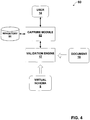
- FIG. 4 is a block diagram illustrating a system 60 in which validation engine 17 uses virtual schema 6 to identify any of the required instances of the elements that are missing from document 19. Upon detecting missing instances, validation engine 4 invokes capture module 62 to capture data from the user 14 or repository 64. In this manner, validation engine 17 and capture module 62 may use the base schema 8, definition templates 10, and constraint templates 12 to drive a process for capturing and normalizing data, such as reusable software assets as illustrated in the examples above.
- the captured reusable software assets may comprise a set of related artifacts that have been created for the purpose of applying that asset repeatedly in subsequent development environments.
- artifacts include source code or binary code for the software asset.
- Other examples include documentation such as a requirements specification, design document, and the like.
- Additional examples of artifacts include independently deployable software components, such as Enterprise JavaBeans (EJB) and the Component Object Model (COM), schemas that conform to a data description language, modeling information (models) that provides formal representations of various software components, artifacts related to the deployment of the asset, such as particular instances of the software components.
- EJB Enterprise JavaBeans
- COM Component Object Model
Landscapes
- Engineering & Computer Science (AREA)
- Theoretical Computer Science (AREA)
- Health & Medical Sciences (AREA)
- Artificial Intelligence (AREA)
- Audiology, Speech & Language Pathology (AREA)
- Computational Linguistics (AREA)
- General Health & Medical Sciences (AREA)
- Physics & Mathematics (AREA)
- General Engineering & Computer Science (AREA)
- General Physics & Mathematics (AREA)
- Document Processing Apparatus (AREA)
- Information Retrieval, Db Structures And Fs Structures Therefor (AREA)
Applications Claiming Priority (3)
| Application Number | Priority Date | Filing Date | Title |
|---|---|---|---|
| US102189 | 2002-03-19 | ||
| US10/102,189 US7200805B2 (en) | 2002-03-19 | 2002-03-19 | Dynamic generation of schema information for data description languages |
| PCT/US2003/006903 WO2003081457A1 (en) | 2002-03-19 | 2003-03-05 | Dynamic generation of schema information for data description languages |
Publications (3)
| Publication Number | Publication Date |
|---|---|
| EP1493100A1 EP1493100A1 (en) | 2005-01-05 |
| EP1493100A4 EP1493100A4 (en) | 2009-07-01 |
| EP1493100B1 true EP1493100B1 (en) | 2019-07-03 |
Family
ID=28452343
Family Applications (1)
| Application Number | Title | Priority Date | Filing Date |
|---|---|---|---|
| EP03744725.7A Expired - Lifetime EP1493100B1 (en) | 2002-03-19 | 2003-03-05 | Dynamic generation of schema information for data description languages |
Country Status (6)
| Country | Link |
|---|---|
| US (1) | US7200805B2 (https=) |
| EP (1) | EP1493100B1 (https=) |
| JP (1) | JP2005521159A (https=) |
| AU (1) | AU2003225697B2 (https=) |
| CA (1) | CA2479310C (https=) |
| WO (1) | WO2003081457A1 (https=) |
Families Citing this family (38)
| Publication number | Priority date | Publication date | Assignee | Title |
|---|---|---|---|---|
| US7103652B1 (en) * | 2000-12-23 | 2006-09-05 | Emc Corporation | Ambiguity-purging and template-conflict-resolution in computer network events-notification |
| US7305455B2 (en) * | 2002-03-21 | 2007-12-04 | International Business Machines Corporation | Interfacing objects and markup language messages |
| US7315980B2 (en) * | 2002-03-21 | 2008-01-01 | International Business Machines Corporation | Method and apparatus for generating electronic document definitions |
| US7036073B2 (en) * | 2002-06-27 | 2006-04-25 | Microsoft Corporation | System and method for supporting non-native XML in native XML of a word-processor document |
| US7308458B2 (en) | 2003-06-11 | 2007-12-11 | Wtviii, Inc. | System for normalizing and archiving schemas |
| US7401075B2 (en) | 2003-06-11 | 2008-07-15 | Wtviii, Inc. | System for viewing and indexing mark up language messages, forms and documents |
| US7720969B2 (en) * | 2003-07-23 | 2010-05-18 | Canon Kabushiki Kaisha | Description document for a service offered by a server in a communication network and method of validating a multimedia document |
| US7657832B1 (en) * | 2003-09-18 | 2010-02-02 | Adobe Systems Incorporated | Correcting validation errors in structured documents |
| US9286275B2 (en) * | 2004-08-23 | 2016-03-15 | Oracle America, Inc. | System and method for automatically generating XML schema for validating XML input documents |
| US7698569B2 (en) * | 2004-11-19 | 2010-04-13 | Bea Systems, Inc. | Data object identification, tracking, filtering and monitoring using data object fingerprints |
| US7818668B2 (en) * | 2005-04-19 | 2010-10-19 | Microsoft Corporation | Determining fields for presentable files |
| US7603438B2 (en) * | 2005-10-13 | 2009-10-13 | Kabushiki Kaisha Toshiba | System and method for assisted entry of database schema data |
| US8037408B2 (en) * | 2005-12-22 | 2011-10-11 | Sap Ag | Systems and methods of validating templates |
| US8156148B2 (en) | 2006-02-24 | 2012-04-10 | Microsoft Corporation | Scalable algorithm for sharing EDI schemas |
| US7984373B2 (en) * | 2006-02-24 | 2011-07-19 | Microsoft Corporation | EDI instance based transaction set definition |
| US7685208B2 (en) * | 2006-02-24 | 2010-03-23 | Microsoft Corporation | XML payload specification for modeling EDI schemas |
| US9495356B2 (en) * | 2006-03-30 | 2016-11-15 | International Business Machines Corporation | Automated interactive visual mapping utility and method for validation and storage of XML data |
| US7882429B2 (en) * | 2006-06-05 | 2011-02-01 | International Business Machines Corporation | High-level virtual machine for fast XML parsing and validation |
| US7991799B2 (en) * | 2006-06-05 | 2011-08-02 | International Business Machines Corporation | Schema specific parser generation |
| US8244694B2 (en) * | 2006-09-12 | 2012-08-14 | International Business Machines Corporation | Dynamic schema assembly to accommodate application-specific metadata |
| US7802222B2 (en) * | 2006-09-25 | 2010-09-21 | Cadence Design Systems, Inc. | Generalized constraint collection management method |
| US7886223B2 (en) * | 2006-11-17 | 2011-02-08 | International Business Machines Corporation | Generating a statistical tree for encoding/decoding an XML document |
| US20090044101A1 (en) * | 2007-08-07 | 2009-02-12 | Wtviii, Inc. | Automated system and method for creating minimal markup language schemas for a framework of markup language schemas |
| US8046771B2 (en) | 2007-09-12 | 2011-10-25 | International Business Machines Corporation | Generating and using constraints associated with software related products |
| US9361400B2 (en) * | 2007-10-12 | 2016-06-07 | Asml Netherlands B.V. | Method of improved hierarchical XML databases |
| US20100131837A1 (en) * | 2008-11-25 | 2010-05-27 | Yahoo! Inc. | Validation framework |
| US8255427B2 (en) | 2009-08-18 | 2012-08-28 | Raytheon Company | Generating modified schemas |
| US8452808B2 (en) * | 2010-03-02 | 2013-05-28 | Microsoft Corporation | Automatic generation of virtual database schemas |
| US9244706B2 (en) * | 2010-05-27 | 2016-01-26 | Microsoft Technology Licensing, Llc | Command line shell command generation based on schema |
| US8631396B2 (en) * | 2010-06-03 | 2014-01-14 | International Business Machines Corporation | Schema specification to improve product consumability on installation, configuration, and/or un-installation activity |
| US9224010B2 (en) * | 2011-09-01 | 2015-12-29 | International Business Machines Corporation | Secure document creation from potentially unsecure source templates |
| US20140281928A1 (en) * | 2013-03-12 | 2014-09-18 | Sap Portals Israel Ltd. | Content-driven layout |
| US11044145B2 (en) | 2016-12-13 | 2021-06-22 | International Business Machines Corporation | Configuring and naming of cloud provisioning entities |
| US11153273B2 (en) | 2016-12-13 | 2021-10-19 | International Business Machines Corporation | Generating and managing names of instances |
| US10547506B2 (en) | 2016-12-13 | 2020-01-28 | International Business Machines Corporation | Determining identities for executing cloud processing and approvers of the executing |
| US10623252B2 (en) * | 2016-12-13 | 2020-04-14 | International Business Machines Corporation | Performing actions that have been defined for provisioned instances |
| WO2019021226A1 (en) * | 2017-07-25 | 2019-01-31 | Perry + Currier Inc. | AUTOMATED DYNAMIC DOCUMENT GENERATOR |
| US12411814B2 (en) * | 2020-12-03 | 2025-09-09 | International Business Machines Corporation | Metadata based mapping assist |
Family Cites Families (22)
| Publication number | Priority date | Publication date | Assignee | Title |
|---|---|---|---|---|
| US5361355A (en) | 1991-02-08 | 1994-11-01 | Fujitsu Limited | Software asset systemizer |
| US5446575A (en) | 1991-06-28 | 1995-08-29 | Digital Equipment Corp. | System for constructing and loading a table data structure based on an associated configuration data |
| US5980096A (en) | 1995-01-17 | 1999-11-09 | Intertech Ventures, Ltd. | Computer-based system, methods and graphical interface for information storage, modeling and stimulation of complex systems |
| WO1997007472A1 (en) | 1995-08-18 | 1997-02-27 | International Business Machines Corporation | Method and apparatus for a process and project management computer system |
| US6366930B1 (en) | 1996-04-12 | 2002-04-02 | Computer Associates Think, Inc. | Intelligent data inventory & asset management systems method and apparatus |
| GB2324890B (en) | 1997-05-03 | 2002-05-08 | Ibm | Data processing method and apparatus |
| US6092075A (en) | 1997-08-14 | 2000-07-18 | International Business Machines Corporation | Framework for business applications using cached aggregate and specification key |
| US6134706A (en) | 1997-08-14 | 2000-10-17 | International Business Machines Corporation | Software business objects in a multi-level organizational structure |
| US6055543A (en) | 1997-11-21 | 2000-04-25 | Verano | File wrapper containing cataloging information for content searching across multiple platforms |
| US6349237B1 (en) | 1997-12-23 | 2002-02-19 | The Regents Of The University Of Michigan | Reconfigurable manufacturing system having a production capacity method for designing same and method for changing its production capacity |
| US6078904A (en) | 1998-03-16 | 2000-06-20 | Saddle Peak Systems | Risk direct asset allocation and risk resolved CAPM for optimally allocating investment assets in an investment portfolio |
| US6154738A (en) | 1998-03-27 | 2000-11-28 | Call; Charles Gainor | Methods and apparatus for disseminating product information via the internet using universal product codes |
| US6311144B1 (en) * | 1998-05-13 | 2001-10-30 | Nabil A. Abu El Ata | Method and apparatus for designing and analyzing information systems using multi-layer mathematical models |
| US6067548A (en) | 1998-07-16 | 2000-05-23 | E Guanxi, Inc. | Dynamic organization model and management computing system and method therefor |
| US6202205B1 (en) | 1998-07-21 | 2001-03-13 | Hewlett-Packard Company | System and method for profile-based, on-the-fly optimization of library code |
| US6289501B1 (en) | 1999-03-31 | 2001-09-11 | Unisys Corp. | Method for generating simple document type definitions |
| US6446256B1 (en) | 1999-06-30 | 2002-09-03 | Microsoft Corporation | Extension of parsable structures |
| US6678882B1 (en) | 1999-06-30 | 2004-01-13 | Qwest Communications International Inc. | Collaborative model for software systems with synchronization submodel with merge feature, automatic conflict resolution and isolation of potential changes for reuse |
| WO2002073860A2 (en) | 2001-03-08 | 2002-09-19 | Adler Richard M | System for analyzing strategic business decisions |
| US6853373B2 (en) * | 2001-04-25 | 2005-02-08 | Raindrop Geomagic, Inc. | Methods, apparatus and computer program products for modeling three-dimensional colored objects |
| US20010029604A1 (en) | 2001-04-27 | 2001-10-11 | Jacob Dreyband | Descriptive data construct mapping method and apparatus |
| US7089543B2 (en) | 2001-07-13 | 2006-08-08 | Sony Corporation | Use of formal logic specification in construction of semantic descriptions |
-
2002
- 2002-03-19 US US10/102,189 patent/US7200805B2/en not_active Expired - Lifetime
-
2003
- 2003-03-05 EP EP03744725.7A patent/EP1493100B1/en not_active Expired - Lifetime
- 2003-03-05 CA CA2479310A patent/CA2479310C/en not_active Expired - Fee Related
- 2003-03-05 WO PCT/US2003/006903 patent/WO2003081457A1/en not_active Ceased
- 2003-03-05 JP JP2003579111A patent/JP2005521159A/ja active Pending
- 2003-03-05 AU AU2003225697A patent/AU2003225697B2/en not_active Ceased
Non-Patent Citations (1)
| Title |
|---|
| ANONYMOUS: "XML Schema Part 0: Primer", W3C, 2 May 2001 (2001-05-02), pages 1 - 57, XP055216829, Retrieved from the Internet <URL:http://www.w3.org/TR/2001/REC-xmlschema-0-20010502/> [retrieved on 20150929] * |
Also Published As
| Publication number | Publication date |
|---|---|
| EP1493100A4 (en) | 2009-07-01 |
| US7200805B2 (en) | 2007-04-03 |
| JP2005521159A (ja) | 2005-07-14 |
| CA2479310C (en) | 2010-04-27 |
| CA2479310A1 (en) | 2003-10-02 |
| EP1493100A1 (en) | 2005-01-05 |
| WO2003081457A1 (en) | 2003-10-02 |
| AU2003225697A1 (en) | 2003-10-08 |
| US20040205573A1 (en) | 2004-10-14 |
| AU2003225697B2 (en) | 2009-04-23 |
Similar Documents
| Publication | Publication Date | Title |
|---|---|---|
| EP1493100B1 (en) | Dynamic generation of schema information for data description languages | |
| Maruyama | XML and Java: developing Web applications | |
| US7155705B1 (en) | Techniques for binding an application with a data exchange format based on tags in comments | |
| US6487566B1 (en) | Transforming documents using pattern matching and a replacement language | |
| US8112738B2 (en) | Apparatus and method of customizable model import and export to and from XML schema formats | |
| Wood et al. | Document Object Model (DOM) level 3 core specification | |
| US20030135825A1 (en) | Dynamically generated mark-up based graphical user interfaced with an extensible application framework with links to enterprise resources | |
| US20030115548A1 (en) | Generating class library to represent messages described in a structured language schema | |
| US20040015832A1 (en) | Method and apparatus for generating source code | |
| Khare et al. | xADL: enabling architecture-centric tool integration with XML | |
| US7130862B2 (en) | Methods, systems and computer program prodcuts for validation of XML instance documents using Java classloaders | |
| US7774386B2 (en) | Applying abstraction to object markup definitions | |
| US10460020B2 (en) | Generating schema-specific DITA specializations during generic schema transformations | |
| David | JavaML 2.0: Enriching the markup language for Java source code | |
| Leung | Professional XML Development with Apache Tools: Xerces, Xalan, FOP, Cocoon, Axis, Xindice | |
| Steel et al. | Generating human-usable textual notations for information models | |
| Henning Böttger et al. | Contracts for cooperation between Web service programmers and HTML designers | |
| Arciniegas | C++ XML | |
| US7562295B1 (en) | Representing spelling and grammatical error state in an XML document | |
| Hu | Visual modeling of XML constraints based on a new Extensible Constraint Markup Language | |
| Ennser et al. | The XML Files: Using XML and XSL with IBM WebSphere3. 0 | |
| Friesen | Java XML | |
| Synodinos et al. | WOnDA: An extensible multi-platform hypermedia design model | |
| Cruellas et al. | The NEPTUNE Technology to Verify and to Document Software Components | |
| Mohan et al. | Conceptual Modeling for XML: A Myth or a Reality |
Legal Events
| Date | Code | Title | Description |
|---|---|---|---|
| PUAI | Public reference made under article 153(3) epc to a published international application that has entered the european phase |
Free format text: ORIGINAL CODE: 0009012 |
|
| 17P | Request for examination filed |
Effective date: 20040916 |
|
| AK | Designated contracting states |
Kind code of ref document: A1 Designated state(s): AT BE BG CH CY CZ DE DK EE ES FI FR GB GR HU IE IT LI LU MC NL PT RO SE SI SK TR |
|
| AX | Request for extension of the european patent |
Extension state: AL LT LV MK |
|
| A4 | Supplementary search report drawn up and despatched |
Effective date: 20090603 |
|
| 17Q | First examination report despatched |
Effective date: 20100205 |
|
| GRAP | Despatch of communication of intention to grant a patent |
Free format text: ORIGINAL CODE: EPIDOSNIGR1 |
|
| STAA | Information on the status of an ep patent application or granted ep patent |
Free format text: STATUS: GRANT OF PATENT IS INTENDED |
|
| INTG | Intention to grant announced |
Effective date: 20190117 |
|
| GRAS | Grant fee paid |
Free format text: ORIGINAL CODE: EPIDOSNIGR3 |
|
| GRAA | (expected) grant |
Free format text: ORIGINAL CODE: 0009210 |
|
| STAA | Information on the status of an ep patent application or granted ep patent |
Free format text: STATUS: THE PATENT HAS BEEN GRANTED |
|
| REG | Reference to a national code |
Ref country code: DE Ref legal event code: R081 Ref document number: 60352127 Country of ref document: DE Owner name: AKANA, INC., LOS ANGELES, US Free format text: FORMER OWNER: LOGICLIBRARY, INC., ROCHESTER, MN, US |
|
| AK | Designated contracting states |
Kind code of ref document: B1 Designated state(s): DE FR GB |
|
| REG | Reference to a national code |
Ref country code: GB Ref legal event code: FG4D |
|
| REG | Reference to a national code |
Ref country code: DE Ref legal event code: R096 Ref document number: 60352127 Country of ref document: DE |
|
| RAP2 | Party data changed (patent owner data changed or rights of a patent transferred) |
Owner name: AKANA, INC. |
|
| REG | Reference to a national code |
Ref country code: DE Ref legal event code: R082 Ref document number: 60352127 Country of ref document: DE Representative=s name: D YOUNG & CO LLP, DE Ref country code: DE Ref legal event code: R081 Ref document number: 60352127 Country of ref document: DE Owner name: AKANA, INC., LOS ANGELES, US Free format text: FORMER OWNER: LOGICLIBRARY, INC., ROCHESTER, MN, US |
|
| REG | Reference to a national code |
Ref country code: DE Ref legal event code: R079 Ref document number: 60352127 Country of ref document: DE Free format text: PREVIOUS MAIN CLASS: G06F0017210000 Ipc: G06F0040100000 |
|
| PGFP | Annual fee paid to national office [announced via postgrant information from national office to epo] |
Ref country code: GB Payment date: 20200327 Year of fee payment: 18 Ref country code: DE Payment date: 20200327 Year of fee payment: 18 |
|
| REG | Reference to a national code |
Ref country code: DE Ref legal event code: R097 Ref document number: 60352127 Country of ref document: DE |
|
| PGFP | Annual fee paid to national office [announced via postgrant information from national office to epo] |
Ref country code: FR Payment date: 20200325 Year of fee payment: 18 |
|
| PLBE | No opposition filed within time limit |
Free format text: ORIGINAL CODE: 0009261 |
|
| STAA | Information on the status of an ep patent application or granted ep patent |
Free format text: STATUS: NO OPPOSITION FILED WITHIN TIME LIMIT |
|
| 26N | No opposition filed |
Effective date: 20200603 |
|
| REG | Reference to a national code |
Ref country code: DE Ref legal event code: R119 Ref document number: 60352127 Country of ref document: DE |
|
| GBPC | Gb: european patent ceased through non-payment of renewal fee |
Effective date: 20210305 |
|
| PG25 | Lapsed in a contracting state [announced via postgrant information from national office to epo] |
Ref country code: GB Free format text: LAPSE BECAUSE OF NON-PAYMENT OF DUE FEES Effective date: 20210305 Ref country code: FR Free format text: LAPSE BECAUSE OF NON-PAYMENT OF DUE FEES Effective date: 20210331 Ref country code: DE Free format text: LAPSE BECAUSE OF NON-PAYMENT OF DUE FEES Effective date: 20211001 |