EP1492534B1 - Carbamic acid compounds comprising a piperazine linkage as hdac inhibitors - Google Patents
Carbamic acid compounds comprising a piperazine linkage as hdac inhibitors Download PDFInfo
- Publication number
- EP1492534B1 EP1492534B1 EP03722719A EP03722719A EP1492534B1 EP 1492534 B1 EP1492534 B1 EP 1492534B1 EP 03722719 A EP03722719 A EP 03722719A EP 03722719 A EP03722719 A EP 03722719A EP 1492534 B1 EP1492534 B1 EP 1492534B1
- Authority
- EP
- European Patent Office
- Prior art keywords
- independently
- alkylene
- compound according
- group
- optionally substituted
- Prior art date
- Legal status (The legal status is an assumption and is not a legal conclusion. Google has not performed a legal analysis and makes no representation as to the accuracy of the status listed.)
- Expired - Lifetime
Links
- 0 C*CC(CN(CC1)C([C@@](CC2CCCC2)CC2=O)=*2O)N1c(cc1Cl)ccc1Cl Chemical compound C*CC(CN(CC1)C([C@@](CC2CCCC2)CC2=O)=*2O)N1c(cc1Cl)ccc1Cl 0.000 description 5
- CHKOEDAUEIROFT-UHFFFAOYSA-N ONC(CCCCCCC(N(CC1)CCN1c1ccccc1Cl)=O)=O Chemical compound ONC(CCCCCCC(N(CC1)CCN1c1ccccc1Cl)=O)=O CHKOEDAUEIROFT-UHFFFAOYSA-N 0.000 description 2
- VSNSUELYGUHJNB-CETIGSGPSA-N C/C(/Cl)=C(\C=C/C=C)/N(CC1)CCN1C(CCCCCC(NO)=O)=O Chemical compound C/C(/Cl)=C(\C=C/C=C)/N(CC1)CCN1C(CCCCCC(NO)=O)=O VSNSUELYGUHJNB-CETIGSGPSA-N 0.000 description 1
- GLUUGHFHXGJENI-UHFFFAOYSA-N C1NCCNC1 Chemical compound C1NCCNC1 GLUUGHFHXGJENI-UHFFFAOYSA-N 0.000 description 1
- KLAZDUIONOEVFN-BJMVGYQFSA-N C=C(c(cc1)ccc1N(CC1)CCN1S(c1cccc(/C=C/C(NO)=O)c1)(=O)=O)Cl Chemical compound C=C(c(cc1)ccc1N(CC1)CCN1S(c1cccc(/C=C/C(NO)=O)c1)(=O)=O)Cl KLAZDUIONOEVFN-BJMVGYQFSA-N 0.000 description 1
- CURXQXOFTXYTEL-OXGNLVOHSA-N CC(C)C/C=C(\C)/C=C/CN(CC1)C=CN1C(CCC/C=C/C[NH+](NO)[O-])=O Chemical compound CC(C)C/C=C(\C)/C=C/CN(CC1)C=CN1C(CCC/C=C/C[NH+](NO)[O-])=O CURXQXOFTXYTEL-OXGNLVOHSA-N 0.000 description 1
- WUHQQDGLTJWLGB-UHFFFAOYSA-N CC(C1)C(CCN(CC2)CCN2S(c2cc(CCC(NO)=O)ccc2)(=O)=O)=CC=C1N(C)C Chemical compound CC(C1)C(CCN(CC2)CCN2S(c2cc(CCC(NO)=O)ccc2)(=O)=O)=CC=C1N(C)C WUHQQDGLTJWLGB-UHFFFAOYSA-N 0.000 description 1
- UPIWQKZYNWDFBS-BJMVGYQFSA-N COc(cc1)ccc1N(CC1)CCN1S(c1cccc(/C=C/C(NO)=O)c1)(=O)=O Chemical compound COc(cc1)ccc1N(CC1)CCN1S(c1cccc(/C=C/C(NO)=O)c1)(=O)=O UPIWQKZYNWDFBS-BJMVGYQFSA-N 0.000 description 1
- DUBPEJVIWMGDFC-DHZHZOJOSA-N COc(cccc1)c1N(CC1)CCN1S(c1ccc(/C=C/C(NO)=O)cc1)(=O)=O Chemical compound COc(cccc1)c1N(CC1)CCN1S(c1ccc(/C=C/C(NO)=O)cc1)(=O)=O DUBPEJVIWMGDFC-DHZHZOJOSA-N 0.000 description 1
- HMVHXQKUDLGYJO-UHFFFAOYSA-N COc1cc(N(CC2)CCN2C(CCCCCCC(NO)=O)=O)ccc1 Chemical compound COc1cc(N(CC2)CCN2C(CCCCCCC(NO)=O)=O)ccc1 HMVHXQKUDLGYJO-UHFFFAOYSA-N 0.000 description 1
- XPPBOEVEIMHEIX-UHFFFAOYSA-N Cc(cc1)ccc1N(CC1)CCN1C(CCCCCC(NO)=O)=O Chemical compound Cc(cc1)ccc1N(CC1)CCN1C(CCCCCC(NO)=O)=O XPPBOEVEIMHEIX-UHFFFAOYSA-N 0.000 description 1
- SUGNMFVOJCTDLK-JXMROGBWSA-N Cc1cc(N(CC2)CCN2S(c2ccc(/C=C/C(NO)=O)cc2)(=O)=O)ccc1 Chemical compound Cc1cc(N(CC2)CCN2S(c2ccc(/C=C/C(NO)=O)cc2)(=O)=O)ccc1 SUGNMFVOJCTDLK-JXMROGBWSA-N 0.000 description 1
- SNMCGLLJFKECDB-LZWSPWQCSA-N ONC(/C=C/c(cc1)ccc1S(N(CC1)CCN1C(c(cc1)ccc1F)c(cc1)ccc1F)(=O)=O)=O Chemical compound ONC(/C=C/c(cc1)ccc1S(N(CC1)CCN1C(c(cc1)ccc1F)c(cc1)ccc1F)(=O)=O)=O SNMCGLLJFKECDB-LZWSPWQCSA-N 0.000 description 1
- FWTJICHBXGBLHF-DTQAZKPQSA-N ONC(/C=C/c(cc1)ccc1S(N(CC1)CCN1C(c1ccccc1)c1ccccc1)(=O)=O)=O Chemical compound ONC(/C=C/c(cc1)ccc1S(N(CC1)CCN1C(c1ccccc1)c1ccccc1)(=O)=O)=O FWTJICHBXGBLHF-DTQAZKPQSA-N 0.000 description 1
- JISVTBKJTHDBHA-JXMROGBWSA-N ONC(/C=C/c(cc1)ccc1S(N(CC1)CCN1c(cccc1)c1F)(=O)=O)=O Chemical compound ONC(/C=C/c(cc1)ccc1S(N(CC1)CCN1c(cccc1)c1F)(=O)=O)=O JISVTBKJTHDBHA-JXMROGBWSA-N 0.000 description 1
- CWSOCWAMOUJLOD-BQYQJAHWSA-N ONC(/C=C/c1cc(S(N(CC2)CCN2c2cc(Cl)ccc2)(=O)=O)ccc1)=O Chemical compound ONC(/C=C/c1cc(S(N(CC2)CCN2c2cc(Cl)ccc2)(=O)=O)ccc1)=O CWSOCWAMOUJLOD-BQYQJAHWSA-N 0.000 description 1
- RZOHJJYMTRTQIW-YIXHJXPBSA-N ONC(/C=C/c1cccc(S(N(CC2)CCN2C(c(cc2)ccc2F)c(cc2)ccc2F)(=O)=O)c1)=O Chemical compound ONC(/C=C/c1cccc(S(N(CC2)CCN2C(c(cc2)ccc2F)c(cc2)ccc2F)(=O)=O)c1)=O RZOHJJYMTRTQIW-YIXHJXPBSA-N 0.000 description 1
- ATHKHCYLAVTBPK-RUDMXATFSA-N ONC(/C=C/c1cccc(S(N(CC2)CCN2c(cc2)ccc2Cl)(=O)=O)c1)=O Chemical compound ONC(/C=C/c1cccc(S(N(CC2)CCN2c(cc2)ccc2Cl)(=O)=O)c1)=O ATHKHCYLAVTBPK-RUDMXATFSA-N 0.000 description 1
- PDBOVVKJYVWGQA-CMDGGOBGSA-N ONC(/C=C/c1cccc(S(N(CC2)CCN2c(cccc2)c2F)(=O)=O)c1)=O Chemical compound ONC(/C=C/c1cccc(S(N(CC2)CCN2c(cccc2)c2F)(=O)=O)c1)=O PDBOVVKJYVWGQA-CMDGGOBGSA-N 0.000 description 1
- CBKGZQAVXZQSHA-MDZDMXLPSA-N ONC(/C=C/c1cccc(S(N(CC2)CCN2c2ccccc2)(=O)=O)c1)=O Chemical compound ONC(/C=C/c1cccc(S(N(CC2)CCN2c2ccccc2)(=O)=O)c1)=O CBKGZQAVXZQSHA-MDZDMXLPSA-N 0.000 description 1
- RRVIUFXAEJJDNQ-FNORWQNLSA-N ONC(/C=C/c1cccc(S(N2CCN(Cc(cc3)cc4c3OCO4)CC2)(=O)=O)c1)=O Chemical compound ONC(/C=C/c1cccc(S(N2CCN(Cc(cc3)cc4c3OCO4)CC2)(=O)=O)c1)=O RRVIUFXAEJJDNQ-FNORWQNLSA-N 0.000 description 1
- GFKZSJGNPVEKLM-UHFFFAOYSA-N ONC(CCCCCC(N(CC1)CCN1C(c1c[nH]c2c1cccc2)=O)=O)=O Chemical compound ONC(CCCCCC(N(CC1)CCN1C(c1c[nH]c2c1cccc2)=O)=O)=O GFKZSJGNPVEKLM-UHFFFAOYSA-N 0.000 description 1
- ZQGVMGUPRXIDFH-UHFFFAOYSA-N ONC(CCCCCC(N(CC1)CCN1C(c1ccccc1)c1ccccc1)=O)=O Chemical compound ONC(CCCCCC(N(CC1)CCN1C(c1ccccc1)c1ccccc1)=O)=O ZQGVMGUPRXIDFH-UHFFFAOYSA-N 0.000 description 1
- AECLQSZYMRKGRC-UHFFFAOYSA-N ONC(CCCCCC(N(CC1)CCN1c(cc1)cc(Cl)c1Cl)=O)=O Chemical compound ONC(CCCCCC(N(CC1)CCN1c(cc1)cc(Cl)c1Cl)=O)=O AECLQSZYMRKGRC-UHFFFAOYSA-N 0.000 description 1
- BDLMNNJPRBOXKL-UHFFFAOYSA-N ONC(CCCCCC(N(CC1)CCN1c(cc1)ccc1Cl)=O)=O Chemical compound ONC(CCCCCC(N(CC1)CCN1c(cc1)ccc1Cl)=O)=O BDLMNNJPRBOXKL-UHFFFAOYSA-N 0.000 description 1
- IIFFHXGYQAHSFR-UHFFFAOYSA-N ONC(CCCCCC(N(CC1)CCN1c1ccccc1)=O)=[O-] Chemical compound ONC(CCCCCC(N(CC1)CCN1c1ccccc1)=O)=[O-] IIFFHXGYQAHSFR-UHFFFAOYSA-N 0.000 description 1
- FLWNRZKDFJVJKA-UHFFFAOYSA-N ONC(CCCCCC(N(CC1)CCN1c1ccccc1Cl)=O)=O Chemical compound ONC(CCCCCC(N(CC1)CCN1c1ccccc1Cl)=O)=O FLWNRZKDFJVJKA-UHFFFAOYSA-N 0.000 description 1
- DPZXZNVREIJZGK-UHFFFAOYSA-N ONC(CCCCCC(N1CCN(CC2=CNC3C=CC=CC23)CC1)=O)=O Chemical compound ONC(CCCCCC(N1CCN(CC2=CNC3C=CC=CC23)CC1)=O)=O DPZXZNVREIJZGK-UHFFFAOYSA-N 0.000 description 1
- IFQGKXGYDZJACN-UHFFFAOYSA-N ONC(CCCCCC(N1CCN(CCCc2c[nH]c3c2cccc3)CC1)=O)=O Chemical compound ONC(CCCCCC(N1CCN(CCCc2c[nH]c3c2cccc3)CC1)=O)=O IFQGKXGYDZJACN-UHFFFAOYSA-N 0.000 description 1
- JJQPJNTYEUHVSA-UHFFFAOYSA-N ONC(CCCCCCC(N(CC1)CCN1C(c1ccccc1)c1ccccc1)=O)=O Chemical compound ONC(CCCCCCC(N(CC1)CCN1C(c1ccccc1)c1ccccc1)=O)=O JJQPJNTYEUHVSA-UHFFFAOYSA-N 0.000 description 1
- RJPROOIZYLSLFQ-UHFFFAOYSA-N ONC(CCCCCCC(N(CC1)CCN1c1cc(Cl)ccc1)=O)=O Chemical compound ONC(CCCCCCC(N(CC1)CCN1c1cc(Cl)ccc1)=O)=O RJPROOIZYLSLFQ-UHFFFAOYSA-N 0.000 description 1
- HKTHHZHPFRVBOC-UHFFFAOYSA-N ONC(CCCCCCC(N(CC1)CCN1c1cccc(F)c1)=O)=O Chemical compound ONC(CCCCCCC(N(CC1)CCN1c1cccc(F)c1)=O)=O HKTHHZHPFRVBOC-UHFFFAOYSA-N 0.000 description 1
- DBOAADHIKCNHJC-UHFFFAOYSA-N ONC(CCCCCCC(N(CC1)CCN1c1ccccc1)=O)=O Chemical compound ONC(CCCCCCC(N(CC1)CCN1c1ccccc1)=O)=O DBOAADHIKCNHJC-UHFFFAOYSA-N 0.000 description 1
- JXBCWFSGCXROMG-MRXNPFEDSA-N ONC(C[C@@H](CC1CCCC1)C(N(CC1)CCN1c(cc1)ccc1F)=O)=O Chemical compound ONC(C[C@@H](CC1CCCC1)C(N(CC1)CCN1c(cc1)ccc1F)=O)=O JXBCWFSGCXROMG-MRXNPFEDSA-N 0.000 description 1
- WNNXJDUTKMYCFZ-UHFFFAOYSA-O O[NH2+]C(CCCCCCC(N(CC1)CCN1C(c(cc1)ccc1F)c(cc1)ccc1F)=O)=O Chemical compound O[NH2+]C(CCCCCCC(N(CC1)CCN1C(c(cc1)ccc1F)c(cc1)ccc1F)=O)=O WNNXJDUTKMYCFZ-UHFFFAOYSA-O 0.000 description 1
- NTZRDZQLNFIOGK-XCVCLJGOSA-N [O-][N+](c(cc1)ccc1N(CC1)CCN1S(c1ccc(/C=C/C(NO)=O)cc1)(=O)=O)=O Chemical compound [O-][N+](c(cc1)ccc1N(CC1)CCN1S(c1ccc(/C=C/C(NO)=O)cc1)(=O)=O)=O NTZRDZQLNFIOGK-XCVCLJGOSA-N 0.000 description 1
Classifications
-
- C—CHEMISTRY; METALLURGY
- C07—ORGANIC CHEMISTRY
- C07D—HETEROCYCLIC COMPOUNDS
- C07D213/00—Heterocyclic compounds containing six-membered rings, not condensed with other rings, with one nitrogen atom as the only ring hetero atom and three or more double bonds between ring members or between ring members and non-ring members
- C07D213/02—Heterocyclic compounds containing six-membered rings, not condensed with other rings, with one nitrogen atom as the only ring hetero atom and three or more double bonds between ring members or between ring members and non-ring members having three double bonds between ring members or between ring members and non-ring members
- C07D213/04—Heterocyclic compounds containing six-membered rings, not condensed with other rings, with one nitrogen atom as the only ring hetero atom and three or more double bonds between ring members or between ring members and non-ring members having three double bonds between ring members or between ring members and non-ring members having no bond between the ring nitrogen atom and a non-ring member or having only hydrogen or carbon atoms directly attached to the ring nitrogen atom
- C07D213/60—Heterocyclic compounds containing six-membered rings, not condensed with other rings, with one nitrogen atom as the only ring hetero atom and three or more double bonds between ring members or between ring members and non-ring members having three double bonds between ring members or between ring members and non-ring members having no bond between the ring nitrogen atom and a non-ring member or having only hydrogen or carbon atoms directly attached to the ring nitrogen atom with hetero atoms or with carbon atoms having three bonds to hetero atoms with at the most one bond to halogen, e.g. ester or nitrile radicals, directly attached to ring carbon atoms
- C07D213/72—Nitrogen atoms
- C07D213/74—Amino or imino radicals substituted by hydrocarbon or substituted hydrocarbon radicals
-
- A—HUMAN NECESSITIES
- A61—MEDICAL OR VETERINARY SCIENCE; HYGIENE
- A61P—SPECIFIC THERAPEUTIC ACTIVITY OF CHEMICAL COMPOUNDS OR MEDICINAL PREPARATIONS
- A61P17/00—Drugs for dermatological disorders
- A61P17/06—Antipsoriatics
-
- A—HUMAN NECESSITIES
- A61—MEDICAL OR VETERINARY SCIENCE; HYGIENE
- A61P—SPECIFIC THERAPEUTIC ACTIVITY OF CHEMICAL COMPOUNDS OR MEDICINAL PREPARATIONS
- A61P25/00—Drugs for disorders of the nervous system
- A61P25/14—Drugs for disorders of the nervous system for treating abnormal movements, e.g. chorea, dyskinesia
- A61P25/16—Anti-Parkinson drugs
-
- A—HUMAN NECESSITIES
- A61—MEDICAL OR VETERINARY SCIENCE; HYGIENE
- A61P—SPECIFIC THERAPEUTIC ACTIVITY OF CHEMICAL COMPOUNDS OR MEDICINAL PREPARATIONS
- A61P25/00—Drugs for disorders of the nervous system
- A61P25/28—Drugs for disorders of the nervous system for treating neurodegenerative disorders of the central nervous system, e.g. nootropic agents, cognition enhancers, drugs for treating Alzheimer's disease or other forms of dementia
-
- A—HUMAN NECESSITIES
- A61—MEDICAL OR VETERINARY SCIENCE; HYGIENE
- A61P—SPECIFIC THERAPEUTIC ACTIVITY OF CHEMICAL COMPOUNDS OR MEDICINAL PREPARATIONS
- A61P35/00—Antineoplastic agents
-
- A—HUMAN NECESSITIES
- A61—MEDICAL OR VETERINARY SCIENCE; HYGIENE
- A61P—SPECIFIC THERAPEUTIC ACTIVITY OF CHEMICAL COMPOUNDS OR MEDICINAL PREPARATIONS
- A61P43/00—Drugs for specific purposes, not provided for in groups A61P1/00-A61P41/00
-
- C—CHEMISTRY; METALLURGY
- C07—ORGANIC CHEMISTRY
- C07D—HETEROCYCLIC COMPOUNDS
- C07D239/00—Heterocyclic compounds containing 1,3-diazine or hydrogenated 1,3-diazine rings
- C07D239/02—Heterocyclic compounds containing 1,3-diazine or hydrogenated 1,3-diazine rings not condensed with other rings
- C07D239/24—Heterocyclic compounds containing 1,3-diazine or hydrogenated 1,3-diazine rings not condensed with other rings having three or more double bonds between ring members or between ring members and non-ring members
- C07D239/28—Heterocyclic compounds containing 1,3-diazine or hydrogenated 1,3-diazine rings not condensed with other rings having three or more double bonds between ring members or between ring members and non-ring members with hetero atoms or with carbon atoms having three bonds to hetero atoms with at the most one bond to halogen, directly attached to ring carbon atoms
- C07D239/32—One oxygen, sulfur or nitrogen atom
- C07D239/42—One nitrogen atom
-
- C—CHEMISTRY; METALLURGY
- C07—ORGANIC CHEMISTRY
- C07D—HETEROCYCLIC COMPOUNDS
- C07D295/00—Heterocyclic compounds containing polymethylene-imine rings with at least five ring members, 3-azabicyclo [3.2.2] nonane, piperazine, morpholine or thiomorpholine rings, having only hydrogen atoms directly attached to the ring carbon atoms
- C07D295/16—Heterocyclic compounds containing polymethylene-imine rings with at least five ring members, 3-azabicyclo [3.2.2] nonane, piperazine, morpholine or thiomorpholine rings, having only hydrogen atoms directly attached to the ring carbon atoms acylated on ring nitrogen atoms
- C07D295/18—Heterocyclic compounds containing polymethylene-imine rings with at least five ring members, 3-azabicyclo [3.2.2] nonane, piperazine, morpholine or thiomorpholine rings, having only hydrogen atoms directly attached to the ring carbon atoms acylated on ring nitrogen atoms by radicals derived from carboxylic acids, or sulfur or nitrogen analogues thereof
- C07D295/182—Radicals derived from carboxylic acids
- C07D295/185—Radicals derived from carboxylic acids from aliphatic carboxylic acids
-
- C—CHEMISTRY; METALLURGY
- C07—ORGANIC CHEMISTRY
- C07D—HETEROCYCLIC COMPOUNDS
- C07D295/00—Heterocyclic compounds containing polymethylene-imine rings with at least five ring members, 3-azabicyclo [3.2.2] nonane, piperazine, morpholine or thiomorpholine rings, having only hydrogen atoms directly attached to the ring carbon atoms
- C07D295/16—Heterocyclic compounds containing polymethylene-imine rings with at least five ring members, 3-azabicyclo [3.2.2] nonane, piperazine, morpholine or thiomorpholine rings, having only hydrogen atoms directly attached to the ring carbon atoms acylated on ring nitrogen atoms
- C07D295/18—Heterocyclic compounds containing polymethylene-imine rings with at least five ring members, 3-azabicyclo [3.2.2] nonane, piperazine, morpholine or thiomorpholine rings, having only hydrogen atoms directly attached to the ring carbon atoms acylated on ring nitrogen atoms by radicals derived from carboxylic acids, or sulfur or nitrogen analogues thereof
- C07D295/182—Radicals derived from carboxylic acids
- C07D295/192—Radicals derived from carboxylic acids from aromatic carboxylic acids
-
- C—CHEMISTRY; METALLURGY
- C07—ORGANIC CHEMISTRY
- C07D—HETEROCYCLIC COMPOUNDS
- C07D295/00—Heterocyclic compounds containing polymethylene-imine rings with at least five ring members, 3-azabicyclo [3.2.2] nonane, piperazine, morpholine or thiomorpholine rings, having only hydrogen atoms directly attached to the ring carbon atoms
- C07D295/22—Heterocyclic compounds containing polymethylene-imine rings with at least five ring members, 3-azabicyclo [3.2.2] nonane, piperazine, morpholine or thiomorpholine rings, having only hydrogen atoms directly attached to the ring carbon atoms with hetero atoms directly attached to ring nitrogen atoms
- C07D295/26—Sulfur atoms
-
- C—CHEMISTRY; METALLURGY
- C07—ORGANIC CHEMISTRY
- C07D—HETEROCYCLIC COMPOUNDS
- C07D317/00—Heterocyclic compounds containing five-membered rings having two oxygen atoms as the only ring hetero atoms
- C07D317/08—Heterocyclic compounds containing five-membered rings having two oxygen atoms as the only ring hetero atoms having the hetero atoms in positions 1 and 3
- C07D317/44—Heterocyclic compounds containing five-membered rings having two oxygen atoms as the only ring hetero atoms having the hetero atoms in positions 1 and 3 ortho- or peri-condensed with carbocyclic rings or ring systems
- C07D317/46—Heterocyclic compounds containing five-membered rings having two oxygen atoms as the only ring hetero atoms having the hetero atoms in positions 1 and 3 ortho- or peri-condensed with carbocyclic rings or ring systems condensed with one six-membered ring
- C07D317/48—Methylenedioxybenzenes or hydrogenated methylenedioxybenzenes, unsubstituted on the hetero ring
- C07D317/50—Methylenedioxybenzenes or hydrogenated methylenedioxybenzenes, unsubstituted on the hetero ring with only hydrogen atoms, hydrocarbon or substituted hydrocarbon radicals, directly attached to atoms of the carbocyclic ring
- C07D317/58—Radicals substituted by nitrogen atoms
-
- C—CHEMISTRY; METALLURGY
- C07—ORGANIC CHEMISTRY
- C07D—HETEROCYCLIC COMPOUNDS
- C07D333/00—Heterocyclic compounds containing five-membered rings having one sulfur atom as the only ring hetero atom
- C07D333/50—Heterocyclic compounds containing five-membered rings having one sulfur atom as the only ring hetero atom condensed with carbocyclic rings or ring systems
- C07D333/52—Benzo[b]thiophenes; Hydrogenated benzo[b]thiophenes
- C07D333/54—Benzo[b]thiophenes; Hydrogenated benzo[b]thiophenes with only hydrogen atoms, hydrocarbon or substituted hydrocarbon radicals, directly attached to carbon atoms of the hetero ring
- C07D333/60—Radicals substituted by carbon atoms having three bonds to hetero atoms with at the most one bond to halogen, e.g. ester or nitrile radicals
Definitions
- This invention pertains generally to the field of biologically active compounds, and more specifically to certain carbamic acid compounds which inhibit HDAC (histone deacetylase) activity.
- the present invention also pertains to pharmaceutical compositions comprising such compounds, and the use of such compounds and compositions, both in vitro and in vivo , to inhibit HDAC, and in the treatment of conditions mediated by HDAC, cancer, proliferative conditions, psoriasis, etc.
- Ranges are often expressed herein as from “about” one particular value, and/or to “about” another particular value. When such a range is expressed, another embodiment includes from the one particular value and/or to the other particular value. Similarly, when values are expressed as approximations, by the use of the antecedent "about,” it will be understood that the particular value forms another embodiment.
- Histones are small, positively charged proteins which are rich in basic amino acids (positively charged at physiological pH), which contact the phosphate groups (negatively charged at physiological pH) of DNA.
- Histones There are five main classes of histones, H1, H2A, H2B, H3, and H4.
- the amino acid sequences of histones H2A, H2B, H3, and H4 show remarkable conservation between species, whereas H1 varies somewhat, and in some cases is replaced by another histone, e.g., H5.
- H2A, H2B, H3, and H4 together form a disk-shaped octomeric protein core, around which DNA (about 140 base pairs) is wound to form a nucleosome.
- Individual nucleosomes are connected by short stretches of linker DNA associated with another histone molecule (e.g., H1, or in certain cases, H5) to form a structure resembling a beaded string, which is itself arranged in a helical stack, known as a solenoid.
- histones are synthesised during the S phase of the cell cycle, and newly synthesised histones quickly enter the nucleus to become associated with DNA. Within minutes of its synthesis, new DNA becomes associated with histones in nucleosomal structures.
- a small fraction of histones, more specifically, the amino side chains thereof, are enzymatically modified by post-translational addition of methyl, acetyl, or phosphate groups, neutralising the positive charge of the side chain, or converting it to a negative charge.
- lysine and arginine groups may be methylated
- lysine groups may be acetylated
- serine groups may be phosphorylated.
- Methylation, acetylation, and phosphorylation of amino termini of histones which extend from the nucleosomal core affects chromatin structure and gene expression. (See, for example, Spencer and Davie, 1999).
- Acetylation and deacetylation of histones is associated with transcriptional events leading to cell proliferation and/or differentiation. Regulation of the function of transcription factors is also mediated through acetylation. Recent reviews of histone deacetylation include Kouzarides, 1999 and Pazin et al., 1997.
- acetylases e.g., histone acetyltransferase, HAT
- deacetylases e.g., histone deacetylase, HDAC
- histone acetylation correlates with transcriptional activation
- histone deacetylation is associated with gene repression.
- HDACs histone deacetylases
- the first deacetylase, HDAC1 was identified in 1996 (see, for example, Tauton et al., 1996).
- HDAC2 and HDAC3 two other nuclear mammalian deacetylases were found, HDAC2 and HDAC3 (see, for example, Yang et al., 1996, 1997, and Emiliani et al., 1998). See also, Grozinger et al., 1999; Kao et al., 2000; and Van den Wyngaert et al., 2000.
- HDACs 1, 2, 3 and 8 are in class I
- HDACs 4, 5, 6, 7, 9, 10 and 11 are in class II.
- histone deacetylases there are a number of histone deacetylases in yeast, including the following:
- HDACs function as part of large multiprotein complexes, which are tethered to the promoter and repress transcription.
- Well characterised transcriptional repressors such as Mad (Laherty et al., 1997), pRb (Brehm et al., 1998), nuclear receptors (Wong et al., 1998) and YY1 (Yang et al., 1997) associate with HDAC complexes to exert their repressor function.
- Trichostatin A (Yoshida et al., 1990a) causes cell cycle arrest at both G1 and G2 phases (Yoshida and Beppu, 1988), reverts the transformed phenotype of different cell lines, and induces differentiation of Friend leukaemia cells and others (Yoshida et al., 1990b).
- TSA and SAHA have been reported to inhibit cell growth, induce terminal differentiation, and prevent the formation of tumours in mice (Finnin et al., 1999).
- TSA Cell cycle arrest by TSA correlates with an increased expression of gelsolin (Hoshikawa et al., 1994), an actin regulatory protein that is down regulated in malignant breast cancer (Mielnicki et al., 1999). Similar effects on cell cycle and differentiation have been observed with a number of deacetylase inhibitors (Kim et al., 1999).
- Trichostatin A has also been reported to be useful in the treatment of fibrosis, e.g., liver fibrosis and liver cirrhosis. See, e.g., Geerts et al., 1998.
- TSA trichostatin A
- SAHA suberoylanilide hydroxamic acid
- phenylbutyrate has been reported to act, at least in part, by inhibiting histone deacetylase (see, e.g., Yoshida et al., 1990; Richon et al., 1998; Kijima et al., 1993).
- diallyl sulfide and related molecules see, e.g., Lea et al., 1999
- oxamflatin see, e.g., Kim et al., 1999; Sonoda et al., 1996)
- MS-27-275 a synthetic benzamide derivative
- butyrate derivatives see, e.g., Lea and Tulsyan, 1995
- FR901228 see, e.g., Nokajima et al., 1998)
- depudecin see, e.g., Kwon et al., 1998)
- m-carboxycinnamic acid bishydroxamide see, e.g., Richon et al., 1998) have been reported to inhibit histone deacet
- HDACs histone deacetylases
- APL acute promyelocytic leukemias
- t(15;17) a translocation of chromosomes 15 and 17 results in the expression of a fusion protein containing the N-terminal portion of PML gene product linked to most of RAR ⁇ (retinoic acid receptor).
- RAR ⁇ retinoic acid receptor
- the wild type RAR ⁇ represses target genes by tethering HDAC repressor complexes to the promoter DNA.
- retinoic acid binds RAR ⁇ and displaces the repressor complex, allowing expression of genes implicated in myeloid differentiation.
- the RAR ⁇ fusion proteins occurring in APL patients are no longer responsive to physiological levels of RA and they interfere with the expression of the RA-inducible genes that promote myeloid differentiation. This results in a clonal expansion of promyelocytic cells and development of leukaemia.
- HDACs may be important therapeutic targets in other types of cancer.
- Cell lines derived from many different cancers prostate, colorectal, breast, neuronal, hepatic are induced to differentiate by HDAC inhibitors (Yoshida and Horinouchi, 1999).
- HDAC inhibitors have been studied in animal models of cancer. They reduce tumour growth and prolong the lifespan of mice bearing different types of transplanted tumours, including melanoma, leukaemia, colon, lung and gastric carcinomas, etc. (Ueda et al., 1994; Kim et al., 1999).
- Psoriasis is a common chronic disfiguring skin disease which is characterised by well-demarcated, red, hardened scaly plaques: these may be limited or widespread.
- the prevalence rate of psoriasis is approximately 2%, i.e., 12.5 million sufferers in the triad countries (US/Europe/Japan). While the disease is rarely fatal, it clearly has serious detrimental effects upon the quality of life of the patient: this is further compounded by the lack of effective therapies. Present treatments are either ineffective, cosmetically unacceptable, or possess undesired side effects. There is therefore a large unmet clinical need for effective and safe drugs for this condition.
- Psoriasis is a disease of complex etiology. Whilst there is clearly a genetic component, with a number of gene loci being involved, there are also undefined environmental triggers. Whatever the ultimate cause of psoriasis, at the cellular level, it is characterised by local T-cell mediated inflammation, by keratinocyte hyperproliferation, and by localised angiogenesis. These are all processes in which histone deacetylases have been implicated (see, e.g., Saunders et al., 1999; Bemhard et al., 1999; Takahashi et al., 1996; Kim et al , 2001). Therefore HDAC inhibitors may be of use in therapy for psoriasis.
- Candidate drugs may be screened, for example, using proliferation assays with T-cells and/or keratinocytes.
- one aim of the present invention is the provision of compounds which are potent inhibitors of histone deacetylases (HDACs).
- HDACs histone deacetylases
- Such molecules desirably have one or more of the following properties and/or effects:
- hydroxamic acids comprising a piperazine moiety with carbonyl groups adjacent to each nitrogen atom of the piperazine moiety are known.
- One aspect of the invention pertains to active carbamic acid compounds, as described herein.
- Another aspect of the invention pertains to active compounds, as described herein, which inhibit HDAC activity.
- Another aspect of the invention pertains to active compounds, as described herein, which treat conditions which are known to be mediated by HDAC, or which are known to be treated by HDAC inhibitors (such as, e.g., trichostatin A).
- HDAC inhibitors such as, e.g., trichostatin A
- Another aspect of the invention pertains to active compounds, as described herein, which (a) regulate (e.g., inhibit) cell proliferation; (b) inhibit cell cycle progression; (c) promote apoptosis; or (d) a combination of one or more of these.
- Another aspect of the invention pertains to active compounds, as described herein, which are anti-HDAC agents, and which treat a condition mediated by HDAC.
- Another aspect of the invention pertains to active compounds, as described herein, which are anticancer agents, and which treat cancer.
- Another aspect of the invention pertains to active compounds, as described herein, which are antiproliferative agents, and which treat a proliferative condition.
- Another aspect of the invention pertains to active compounds, as described herein, which are antipsoriasis agents, and which treat psoriasis.
- compositions comprising a compound, as described herein, and a carrier.
- compositions comprising a compound, as described herein, and a pharmaceutically acceptable carrier.
- Another aspect of the present invention pertains to methods of inhibiting HDAC in a cell, comprising contacting said cell with an effective amount of an active compound, as described herein, in vitro .
- HDAC inhibitors such as, e.g., trichostatin A
- administering comprising administering to a subject in need of treatment a therapeutically-effective amount of an active compound, as described herein.
- Also described herein are methods of treating a proliferative condition comprising administering to a subject in need of treatment a therapeutically-effective amount of an active compound, as described herein.
- Also described herein are methods of treating psoriasis comprising administering to a subject in need of treatment a therapeutically-effective amount of an active compound, as described herein.
- Another aspect of the present invention pertains to an active compound, as described herein, for use in a method of treatment of the human or animal body by therapy.
- Another aspect of the present invention pertains to use of an active compound, as described herein, for the manufacture of a medicament for use in the treatment of a condition mediated by HDAC, a condition known to be treated by HDAC inhibitors (such as, e.g., trichostatin A), cancer, a proliferative condition, psoriasis, or other condition as described herein.
- HDAC inhibitors such as, e.g., trichostatin A
- cancer e.g., trichostatin A
- psoriasis e.g., psoriasis
- kits comprising (a) the active compound, preferably provided as a pharmaceutical composition and in a suitable container and/or with suitable packaging; and (b) instructions for use, for example, written instructions on how to administer the active compound.
- Another aspect of the present invention pertains to compounds obtainable by a method of synthesis as described herein, or a method comprising a method of synthesis as described herein.
- Another aspect of the present invention pertains to compounds obtained by a method of synthesis as described herein, or a method comprising a method of synthesis as described herein.
- Another aspect of the present invention pertains to novel intermediates, as described herein, which are suitable for use in the methods of synthesis described herein.
- Another aspect of the present invention pertains to the use of such novel intermediates, as described herein, in the methods of synthesis described herein.
- the present invention pertains to carbamic acid compounds of the formula: wherein:
- the piperazin-1,4-diyl group is optionally substituted, i.e., unsubstituted or substituted.
- the piperazin-1,4-diyl group is unsubstituted (i.e., unsubstituted at the 2-, 3-, 5-, and 6-positions).
- the piperazin-1,4-diyl group is substituted (i.e., substituted at one or more the 2-, 3-, 5-, and 6-positions.
- the piperazin-1,4-diyl group is substituted (i.e., substituted at one or more the 2-, 3-, 5-, and 6-positions with C 1-4 alkyl, for example, -Me or -Et.
- the piperazin-1,4-diyl group is:
- the piperazin-1,4-diyl group may be in any conformation, including, but not limited to, chair-, boat-, or twist-forms.
- the candidate Cy group which is furthest from from the N-1 atom of the piperazin-1,4-diyl group is identified as Cy (and referred to as "the relevant Cy group").
- distance e.g., further, furthest
- distance is measured as the number of chain atoms in the shortest continuous chain linking the groups (i.e., the N-1 atom and Cy).
- the one (including any substituents) with the largest molecular weight is the relevant one.
- the group -Q 1 -J 1 - has a backbone length, as determined by the number of chain atoms in the shortest continuous chain of atoms linking the relevant cyclyl group, Cy, and the N-1 atom of the piperazin-1,4-diyl group.
- -Q 1 -J 1 - has a backbone length of 2.
- Cy is independently: C 3-20 carbocyclyl, C 3-20 heterocyclyl, or C 5-20 aryl; and is optionally substituted.
- Cy is independently C 3-20 carbocyclyl; and is optionally substituted.
- Cy is independently monocyclic C 3-7 carbocyclyl, and is optionally substituted.
- Cy is independently monocyclic C 5-6 carbocyclyl, and is optionally substituted.
- Cy is independently C 3-20 carbocyclyl derived from one of the following: cyclopropane, cyclobutane, cyclopentane, cyclohexane, cyclopentene, cyclohexene, norbornane, adamantane, cyclopentanone, and cyclohexanone; and is optionally substituted.
- Cy is independently C 3-20 heterocyclyl; and is optionally substituted.
- Cy is independently monocyclic C 3-7 heterocyclyl, and is optionally substituted.
- Cy is independently monocyclic C 5-6 heterocyclyl, and is optionally substituted.
- Cy is independently C 3-20 heterocyclyl derived from one of the following: piperidine, azepine, tetrahydropyran, morpholine, azetidine, piperazine, imidazoline, piperazinedione, and oxazolinone; and is optionally substituted.
- Cy is independently C 5-20 aryl; and is optionally substituted.
- Cy is independently C 5-20 carboaryl or C 5-20 heteroaryl; and is optionally substituted.
- Cy is independently C 5-20 heteroaryl; and is optionally substituted. In one embodiment, Cy is monocyclic C 5-20 heteroaryl; and is optionally substituted. In one embodiment, Cy is monocyclic C 5-6 heteroaryl; and is optionally substituted.
- Cy is independently C 5-20 carboaryl; and is optionally substituted. In one embodiment, Cy is monocyclic C 5-20 carboaryl; and is optionally substituted. In one embodiment, Cy is monocyclic C 5-6 carboaryl; and is optionally substituted. In one embodiment, Cy is phenyl; and is optionally substituted.
- Cy is independently C 5-20 aryl derived from one of the following: benzene, pyridine, furan, indole, pyrrole, imidazole, pyrimidine, pyrazine, pyridizine, naphthalene, quinoline, indole, benzimidazole, benzothiofuran, fluorene, acridine, and carbazole; and is optionally substituted.
- substituents on Cy include, but are not limited to, those described under the heading "Substituents" below.
- the optional substituents on Cy are as defined under the heading "The Cyclyl Group, Cy: Optionally Substituted Phenyl: Substituents.”
- Cy is independently an optionally substituted phenyl group.
- Cy is independently an optionally substituted phenyl group of the formula: wherein n is independently an integer from 0 to 5, and each R A is independently a substituent as defined herein.
- Cy is an optionally substituted phenyl group
- Q 1 is a covalent bond or a cyclyl leader group
- J 1 is a covalent bond
- the compounds have the following formula:
- Cy is an optionally substituted phenyl group
- Q 1 is a cyclyl leader group
- J 1 is a covalent bond
- the compounds have the following formula:
- Cy is an optionally substituted phenyl group
- Q 1 is a covalent bond
- J 1 is a covalent bond
- the compounds have the following formula:
- n is an integer from 0 to 5. In one embodiment, n is an integer from 0 to 4. In one embodiment, n is an integer from 0 to 3. In one embodiment, n is an integer from 0 to 2. In one embodiment, n is 0 or 1.
- n is an integer from 1 to 5. In one embodiment, n is an integer from 1 to 4. In one embodiment, n is an integer from 1 to 3. In one embodiment, n is 1 or 2. In one embodiment, n is 5. In one embodiment, n is 4. In one embodiment, n is 3. In one embodiment, n is 2. In one embodiment, n is 1. In one embodiment, n is 0.
- R A may be arranged in any combination. For example, if n is 1, R A may be in the 2'-, 3'-, 4'-, 5'-, or 6'-position. Similarly, if n is 2, the two R A groups may be in, for example, the 2',3'-, 2',4'-, 2',5'-, 2',6'-, 3',4'-, or 3',5'-positions. If n is 3, the three R A groups may be in, for example, the 2',3',4'-, 2',3',5'-, 2',3',6'-, or 3',4',5'-positions.
- n 0.
- n is 1, and the R A group is in the 4'-position.
- n is 2, and one R A group is in the 4'-position, and the other R A group is in the 2'-position.
- n is 2, and one R A group is in the 4'-position, and the other R A group is in the 3'-position.
- substituents on Cy include, but are not limited to, those described under the heading "Substituents" below.
- each of the substituents on Cy is independently selected from:
- each of the substituents on Cy is independently selected from:
- each of the substituents on Cy is independently selected from:
- each of the substituents on Cy is independently selected from:
- each of the substituents on Cy is independently selected from:
- Cy examples include, but are not limited to, the following: fluoro, chloro, bromo, iodo, methyl, ethyl, isopropyl, t-butyl, cyano, trifluoromethyl, hydroxy, methoxy, ethoxy, isopropoxy, trifluoromethoxy, phenoxy, methylthio, trifluoromethylthio, hydroxymethyl, amino, dimethylamino, diethylamino, morpholino, amido (unsubstituted, i.e., -CONH 2 ), acetamido, acetyl, nitro, sulfonamido (unsubstituted, i.e., -SO 2 NH 2 ), and phenyl.
- Q 1 is independently:
- Q 1 is independently:
- Q 1 is independently:
- Q 1 is independently:
- Q 1 is independently:
- Q 1 is independently:
- Q 1 is independently:
- each alkylene group is independently:
- the above alkylene groups have a maximum number of carbon atoms of 4, e.g., C 1-4 alkylene, C 2-4 alkylene.
- the above alkylene groups have a maximum number of carbon atoms of 3, e.g., C 1-3 alkylene, C 2-3 alkylene.
- the group -J 1 -Q 1 - has a backbone length, as determined by the number of chain atoms in the shortest continuous chain of atoms linking the relevant Cy group and the N-1 atom of the piperazin-1,4-diyl group.
- the group -J 1 -Q 1 - has a backbone of:
- the group -J 1 -Q 1 - has a backbone of at least 2 atoms. In this way, groups such as methylene (-CH 2 -) and substituted methylene (-CR 2 - and -CHR-) are excluded.
- the group -J 1 -Q 1 - has a backbone of at least 3 atoms. In one embodiment, the group -J 1 -Q 1 - has a backbone of at least 4 atoms. In one embodiment, the group -J 1 -Q 1 - has a backbone of at least 5 atoms.
- the group -J 1 -Q 1 - has a backbone of:
- the group -J 1 -Q 1 - has a backbone of:
- the group -J 1 -Q 1 - has a backbone of:
- the group -J 1 -Q 1 - has a backbone of 1 atom. In one embodiment, the group -J 1 -Q 1 - has a backbone of 2 atoms. In one embodiment, the group -J 1 -Q 1 - has a backbone of 3 atoms. In one embodiment, the group -J 1 -Q 1 - has a backbone of 4 atoms. In one embodiment, the group -J 1 -Q 1 - has a backbone of 5 atoms.
- Q 1 if other than a covalent bond, is unsubstituted. In one embodiment, Q 1 , if other than a covalent bond, is optionally substituted. In one embodiment, Q 1 if other than a covalent bond, is substituted.
- substituents on Q 1 include, but are not limited to, those described under the heading "Substituents" below.
- substituents on Q 1 are as defined under the heading "The Cyclyl Group, Cy: Optionally Substituted Phenyl: Substituents.”
- substituents on Q 1 are independently: halo, hydroxy, ether (e.g., C 1-7 alkoxy), C 5-20 aryl, acyl, amino, amido, acylamido, or oxo.
- substituents on Q 1 are independently -OH or -Ph.
- substituents on Q 1 are independently -Ph.
- Q 1 is unsubstituted methylene, and is -CH 2 -; in one embodiment, Q 1 phenyl (-Ph) substituted methylene, and is -CH(Ph)-.
- Q 1 is independently selected from the following:
- Q 1 is selected from:
- Q 1 is selected from:
- Q 1 is independently selected from:
- Q 1 is independently selected from:
- Q 1 is independently selected from:
- Q 1 is independently selected from the following: -(CH 2 ) a -X-(CH 2 ) b - wherein X is -O- or -S- and a and b are each independently 1, 2, 3, 4, 5, 6, or 7; and a+b is at least 1.
- Q 1 is independently selected from the following:
- Q 1 is independently selected from the following:
- the group -Q 1 -J 1 - has a formula selected from:
- the group Cy-Q 1 - has a formula selected from:
- * indicates that the group (e.g., Ph, pyrid-3-yl, cyclohexyl) is optionally substituted with one or more of: -F, -Cl, -Br, -I, -OH, -OMe, -OEt, -OPr, -Ph, -NH 2 , and -CONH 2 .
- group e.g., Ph, pyrid-3-yl, cyclohexyl
- * indicates that the group (e.g., Ph, pyrid-3-yl, cyclohexyl) is optionally substituted with one or more of: -F, -Cl, -Br, -I, -OH, -OMe, -OEt, -OPr, -Ph, -NH 2 , and -CONH 2 .
- the acid leader group, Q 2 is independently:
- the acid leader group, Q 2 is independently:
- the acid leader group, Q 2 is independently:
- alkylene groups necessarily have a backbone of at least 1 atom. Some examples are shown below.
- All arylene, arylene-alkylene, alkylene-arylene, and alkylene-arylene-alkylene groups necessarily have a backbone of at least 2 atoms. Some examples are shown below.
- Q 2 has a backbone of at least 4 atoms. In one embodiment, Q 2 has a backbone of at least 5 atoms. In one embodiment, Q 2 has a backbone of at least 6 atoms.
- Q 2 has a backbone of:
- Q 2 has a backbone of:
- Q 2 has a backbone of from 5 to 6 atoms.
- Q 2 has a backbone of 4 atoms. In one embodiment, Q 2 has a backbone of 5 atoms. In one embodiment, Q 2 has a backbone of 6 atoms. In one embodiment, Q 2 has a backbone of 7 atoms. In one embodiment, Q 2 has a backbone of 8 atoms.
- the backbone of "atoms” is a backbone of "carbon atoms.”
- Q 2 is unsubstituted. In one embodiment, Q 2 is optionally substituted. In one embodiment, Q 2 is substituted.
- groups e.g., substituents
- bulky groups e.g., substituents
- HDAC HDAC
- Q 2 is, additionally, unsubstituted at the ⁇ -position.
- Q 2 is, additionally, unsubstituted at the ⁇ -position and unsubstituted at the ⁇ -position.
- Q 2 may have a non-linear alkylene group (for example, a branched alkylene) adjacent to the carbamic acid group.
- a non-linear alkylene group for example, a branched alkylene
- Q 2 is a branched saturated C 6 -alkylene, having a methyl group at the ⁇ -position, is shown below. Although there is a group (i.e., a methyl group) at the ⁇ -position, such compounds are unsubstituted at the ⁇ -position, because the ⁇ -methyl group itself is considered to be part of the unsubstituted Q 2 .
- Q 2 is a branched saturated C 6 -alkylene, having an amino group at the ⁇ -position and a methyl group at the ⁇ -position, is shown below; such compounds are ⁇ -substituted, ⁇ -unsubstituted.
- Q 2 is a group as defined herein (e.g., C 4-8 alkylene, C 5-20 arylene-C 1-7 alkylene, C 1-7 alkylene-C 5-20 arylene-C 1-7 alkylene) having an alkylene group adjacent to the carbamic acid group
- Q 2 is, additionally, unsubstituted at the ⁇ -position.
- Q 2 is a group as defined herein (e.g., C 4-8 alkylene, C 5-20 arylene-C 1-7 alkylene, C 1-7 alkylene-C 5-20 arylene-C 1-7 alkylene) having an alkylene group adjacent to the carbamic acid group, that adjacent alkylene group has a -CH 2 - group adjacent to the carbamic acid group (that is, at the ⁇ -position).
- Q 2 is a group as defined herein (e.g., C 4-8 alkylene, C 5-20 arylene-C 1-7 alkylene, C 1-7 alkylene-C 5-20 arylene-C 1-7 alkylene) having an alkylene group adjacent to the carbamic acid group, that adjacent alkylene group has a -CH 2 - group adjacent to the carbamic acid group (that is, at the ⁇ -position).
- Q 2 is a group as defined herein (e.g., C 4-8 alkylene, C 5-20 arylene-C 1-7 alkylene, C 1-7 alkylene-C 5-20 arylene-C 1-7 alkylene) having an alkylene group adjacent to the carbamic acid group
- Q 2 is, additionally, unsubstituted at the ⁇ -position and unsubstituted at the ⁇ -position.
- group as defined herein e.g., C 4-8 alkylene, C 5-20 arylene-C 1-7 alkylene, C 1-7 alkylene-C 5-20 arylene-C 1-7 alkylene
- group as defined herein e.g., C 4-8 alkylene, C 5-20 arylene-C 1-7 alkylene, C 1-7 alkylene-C 5-20 arylene-C 1-7 alkylene
- Q 2 is a group as defined herein (e.g., C 4-8 alkylene, C 5-20 arylene-C 1-7 alkylene, C 1-7 alkylene-C 5-20 arylene-C 1-7 alkylene) having an alkylene group adjacent to the carbamic acid group, that adjacent alkylene group has a -CH 2 CH 2 - group adjacent to the carbamic acid group (that is, at the ⁇ , ⁇ -position).
- substituents on Q 2 include, but are not limited to, those described under the heading "Substituents" below.
- the optional substituents on Q 2 are as defined under the heading "The Cyclyl Group, Cy: Optionally Substituted Phenyl: Substituents.”
- the acid leader group, Q 2 is C 4-8 alkylene, and is optionally substituted, and has a backbone length of at least 4 atoms.
- Q 2 is independently a saturated C 4-8 alkylene group.
- Q 2 is independently a partially unsaturated C 4-8 alkylene group.
- Q 2 is independently an aliphatic C 4-8 alkylene group
- Q 2 is independently a linear C 4-8 alkylene group.
- Q 2 is independently a branched C 4-8 alkylene group.
- Q 2 is independently an alicyclic C 4-8 alkylene group.
- Q 2 is independently a saturated aliphatic C 4-8 alkylene group.
- Q 2 is independently a saturated linear C 4-8 alkylene group.
- Q 2 is independently a saturated branched C 4-8 alkylene group.
- Q 2 is independently a saturated alicyclic C 4-8 alkylene group.
- Q 2 is independently a partially unsaturated aliphatic C 4-8 alkylene group.
- Q 2 is independently a partially unsaturated linear C 4-8 alkylene group.
- Q 2 is independently a partially unsaturated branched C 4-8 alkylene group.
- Q 2 is independently a partially unsaturated alicyclic C 4-8 alkylene group.
- Q 2 is independently selected from:
- Q 2 is independently selected from:
- Q 2 is independently selected from:
- Q 2 is independently selected from:
- the acid leader group, Q 2 is independently:
- Q 2 is C 5-20 arylene; and is optionally substituted. In one embodiment, Q 2 is C 5-6 arylene; and is optionally substituted. In one embodiment, Q 2 is phenylene; and is optionally substituted.
- Q 2 additionally has a backbone length as described above under the heading "The Acid Leader Group, Q 2 : Backbone Length.”
- the acid leader group, Q 2 is independently:
- the acid leader group, Q 2 is independently:
- the acid leader group, Q 2 is independently:
- the acid leader group, Q 2 is independently:
- Q 2 is independently:
- Q 2 is independently:
- Q 2 is C 1-7 alkylene-C 5-20 arylene; and is optionally substituted. In one embodiment, Q 2 is C 1-7 alkylene-C 5-6 arylene; and is optionally substituted. In one embodiment, Q 2 is independently C 1-7 alkylene-phenylene; and is optionally substituted.
- Q 2 is C 5-20 arylene-C 1-7 alkylene; and is optionally substituted. In one embodiment, Q 2 is C 5-6 arylene-C 1-7 alkylene; and is optionally substituted. In one embodiment, Q 2 is independently phenylene-C 1-7 alkylene; and is optionally substituted.
- Q 2 is C 1-7 alkylene-C 5-20 arylene-C 1-7 alkylene; and is optionally substituted. In one embodiment, Q 2 is C 1-7 alkylene-C 5-6 arylene-C 1-7 alkylene; and is optionally substituted. In one embodiment, Q 2 is independently C 1-7 alkylene-phenylene-C 1-7 alkylene; and is optionally substituted.
- each of R Q21 and R Q22 is independently C 1-7 alkylene.
- each alkylene group is independently:
- Q 2 additionally has a backbone length as described above under the heading "The Acid Leader Group, Q 2 : Backbone Length.”
- each of R Q21 and R Q22 is independently as defined for Q 1 under the heading "The Cyclyl Leader Group, Q 1 : Alkylene: Certain Embodiments.”
- R Q21 is independently selected from:
- R Q21 is independently selected from:
- R Q21 is independently selected from:
- R Q21 is independently selected from:
- R Q22 is independently selected from:
- R Q22 is independently selected from:
- Q 2 is independently:
- Q 2 is independently:
- Q 2 is independently:
- Q 2 is independently:
- the phenylene linkage may be ortho (i.e., 1,2-), meta (i.e., 1,3-), or para (i.e., 1,4-), and the phenylene group is optionally substituted with from 1 to 4 substituents, R B :
- the phenylene linkage is meta or para. In one embodiment, the phenylene linkage is meta. In one embodiment, the phenylene linkage is para.
- m is an integer from 0 to 4. In one embodiment, m is an integer from 0 to 3. In one embodiment, m is an integer from 0 to 2. In one embodiment, m is 0 or 1. In one embodiment, m is an integer from 1 to 4. In one embodiment, m is an integer from 1 to 3.
- m is 1 or 2. In one embodiment, m is 4. In one embodiment, m is 3. In one embodiment, m is 2. In one embodiment, m is 1. In one embodiment, m is 0.
- the phenylene group is unsubstituted. In one embodiment, the phenylene group is optionally substituted. In one embodiment, the phenylene group is substituted.
- R B examples include, but are not limited to, those described under the heading "Substituents" below.
- the substituents , R B are as defined under the heading "The Cyclyl Group, Cy: Optionally Substituted Phenyl: Substituents.”
- R B examples include, but are not limited to, the following: fluoro, chloro, methyl, ethyl, isopropyl, t-butyl, trifluoromethyl, hydroxy, methoxy, ethoxy, isopropoxy, methylthio, amino, dimethylamino, diethylamino, morpholino, acetamido, nitro, and phenyl.
- the compounds have the following formula, in which Q 2 is para-arylene:
- the compounds have the following formula, in which Q 2 is alkylene-meta/para-arylene:
- the compounds have the following formula, in which Q 2 is arylene-meta/para-alkylene:
- the compounds have the following formula, in which Q 2 is alkylene-arylene-meta/para-alkylene:
- Q 2 has the following formula (referred to herein as "para-phenylene”):
- Q 2 has the following formula (referred to herein as "methylene-meta/para-phenylene”):
- Q 2 has the following formula (referred to herein as "methylene-meta-phenylene”):
- Q 2 has the following formula (referred to herein as "unsubstituted methylene-meta-phenylene”):
- Q 2 has the following formula (referred to herein as "ethylene-meta/para-phenylene”):
- Q 2 has the following formula (referred to herein as "ethylene-meta-phenylene”):
- Q 2 has the following formula (referred to herein as "unsubstituted ethylene-meta-phenylene”):
- Q 2 has the following formula (referred to herein as "phenylene-meta/para-methylene”):
- Q 2 has the following formula (referred to herein as "phenylene-meta-methylene”):
- Q 2 has the following formula (referred to herein as "unsubstituted phenylene-meta-methylene”):
- Q 2 has the following formula (referred to herein as "methylene-phenylene-meta/para-methylene”):
- Q 2 has the following formula (referred to herein as "methylene-phenylene-meta-methylene”):
- Q 2 has the following formula (referred to herein as "unsubstituted methylene-phenylene-meta-methylene”):
- Q 2 has the following formula (referred to herein as "ethylene-phenylene-meta/para-methylene”):
- Q 2 has the following formula (referred to herein as "ethylene-phenylene-meta-methylene”):
- Q 2 has the following formula (referred to herein as "unsubstituted ethylene-phenylene-meta-methylene”):
- Q 2 has the following formula (referred to herein as "phenylene-meta/para-trans-ethenylene”):
- Q 2 has the following formula (referred to herein as "unsubstituted phenylene-meta/para-trans-ethenylene”):
- Q 2 has the following formula (referred to herein as "phenylene-meta-trans-ethenylene"):
- Q 2 has the following formula (referred to herein as "unsubstituted phenylene-meta-trans-ethenylene”):
- Q 2 has the following formula (referred to herein as "phenylene-meta/para-ethylene”):
- Q 2 has the following formula (referred to herein as "phenylene-meta-ethylene”):
- Q 2 has the following formula (referred to herein as "unsubstituted phenylene-meta-ethylene”):
- Q 2 has the following formula (referred to herein as "methylene-phenylene-meta/para-trans-ethenylene”):
- Q 2 has the following formula (referred to herein as "unsubstituted methylene-phenylene-meta/para-trans-ethenylene”):
- Q 2 has the following formula (referred to herein as "methylene-phenylene-meta-trans-ethenylene”):
- Q 2 has the following formula (referred to herein as "unsubstituted methylene-phenylene-meta-trans-ethenylene”):
- Q 2 has the following formula (referred to herein as "methylene-phenylene-meta/para-ethylene”):
- Q 2 has the following formula (referred to herein as "methylene-phenylene-meta-ethylene”):
- Q 2 has the following formula (referred to herein as "unsubstituted methylene-phenylene-meta-ethylene”):
- Q 2 has the following formula (referred to herein as "ethylene-phenylene-meta/para-trans-ethenylene”):
- Q 2 has the following formula (referred to herein as "ethylene-phenylene-meta-trans-ethenylene”):
- Q 2 has the following formula (referred to herein as "unsubstituted ethylene-phenylene-meta-trans-ethenylene”):
- Q 2 has the following formula (referred to herein as "ethylene-phenylene-meta/para-ethylene”):
- Q 2 has the following formula (referred to herein as "ethylene-phenylene-meta-ethylene”):
- Q 2 has the following formula (referred to herein as "unsubstituted ethylene-phenylene-meta-ethylene”):
- Q 2 additionally has a backbone length as described above under the heading "The Acid Leader Group, Q 2 : Backbone Length.”
- PX117402 (Ex 140) 2. PX117403 (Ex 141) 3. PX117404 (Ex 142) 4. PX117764 (Ex 143) 5. PX117768 (Ex 144) 6. PX118490 (Ex 40) 7. PX118491 (Ex 41) 8. PX118791 (Ex 145) 9. PX118792 (Ex 146) 10. PX118793 (Ex 147) 11. PX118794 (Ex 148) 12. PX118807 (Ex 45) 13. PX118810 (Ex 42) 14. PX118811 (Ex 43) 15. PX118812 (Ex 44) 16. PX118830 (Ex 149) 17. PX118831 (Ex 150) 18.
- PX118832 (Ex 151) 19. PX118844 (Ex 163) 20. PX118845 (Ex 164) 21. PX118846 (Ex 152) 22. PX118847 (Ex 153) 23. PX118848 (Ex 165) 24. PX118849 (Ex 154) 25. PX118850 (Ex 166) 26. PX118859 (Ex 174) 27. PX118860 (Ex 175) 28. PX118870 (Ex 52) 29. PX118871 (Ex 53) 30. PX118872 (Ex 54) 31. PX118873 (Ex 55) 32. PX118874 (Ex 56) 33. PX118875 (Ex 57) 34. PX118876 (Ex 58) 35.
- PX118908 (Ex 183) 53. PX118909 (Ex 184) 54. PX118910 (Ex 79) 55. PX118911 (Ex 80) 56. PX118913 (Ex 63) 57. PX118914 (Ex 64) 58. PX118918 (Ex 73) 59. PX118927 (Ex 155) 60. PX118928 (Ex 167) 61. PX118929 (Ex 168) 62. PX118930 (Ex 156) 63. PX118931 (Ex 157) 64. PX118932 (Ex 158) 65. PX118933 (Ex 46) 66. PX118934 (Ex 48) 67. PX118935 (Ex 49) 68.
- carbo refers to compounds and/or groups which have only carbon and hydrogen atoms (but see “carbocyclic” below).
- hetero refers to compounds and/or groups which have at least one heteroatom, for example, multivalent heteroatoms (which are also suitable as ring heteroatoms) such as boron, silicon, nitrogen, phosphorus, oxygen, sulfur, and selenium (more commonly nitrogen, oxygen, and sulfur) and monovalent heteroatoms, such as fluorine, chlorine, bromine, and iodine.
- multivalent heteroatoms which are also suitable as ring heteroatoms
- oxygen, sulfur and selenium (more commonly nitrogen, oxygen, and sulfur)
- monovalent heteroatoms such as fluorine, chlorine, bromine, and iodine.
- saturated refers to compounds and/or groups which do not have any carbon-carbon double bonds or carbon-carbon triple bonds.
- unsaturated as used herein, pertains to compounds and/or groups which have at least one carbon-carbon double bond or carbon-carbon triple bond.
- aliphatic refers to compounds and/or groups which are linear or branched, but not cyclic (also known as “acyclic” or “open-chain” groups).
- ring refers to a closed ring of from 3 to 10 covalently linked atoms, more preferably 3 to 8 covalently linked atoms, yet more preferably 5 to 6 covalently linked atoms.
- a ring may be an alicyclic ring or an aromatic ring,
- alicyclic ring as used herein, pertains to a ring which is not an aromatic ring.
- carrier ring refers to a ring wherein all of the ring atoms are carbon atoms.
- Carboaromatic ring as used herein, pertains to an aromatic ring wherein all of the ring atoms are carbon atoms.
- heterocyclic ring refers to a ring wherein at least one of the ring atoms is a multivalent ring heteroatom, for example, nitrogen, phosphorus, silicon, oxygen, or sulfur, though more commonly nitrogen, oxygen, or sulfur.
- the heterocyclic ring has from 1 to 4 heteroatoms.
- cyclic compound pertains to a compound which has at least one ring.
- cyclyl as used herein, pertains to a monovalent moiety obtained by removing a hydrogen atom from a ring atom of a cyclic compound.
- a cyclic compound may be fused (e.g., as in naphthalene), bridged (e.g., as in norbornane), spiro (e.g., as in spiro[3.3]heptane), or a combination thereof.
- Cyclic compounds with one ring may be referred to as "monocyclic” or “mononuclear,” whereas cyclic compounds with two or more rings may be referred to as "polycyclic” or “polynuclear.”
- carbocyclic compound as used herein, pertains to a cyclic compound which has only carbocyclic ring(s).
- heterocyclic compound refers to a cyclic compound which has at least one heterocyclic ring.
- aromatic compound as used herein, pertains to a cyclic compound which has at least one aromatic ring.
- carboaromatic compound as used herein, pertains to a cyclic compound which has only carboaromatic ring(s).
- heteromatic compound refers to a cyclic compound which has at least one heteroaromatic ring.
- monovalent monodentate substituents pertains to substituents which have one point of covalent attachment, via a single bond. Examples of such substituents include halo, hydroxy, and alkyl.
- multivalent monodentate substituents pertains to substituents which have one point of covalent attachment, but through a double bond or triple bond. Examples of such substituents include oxo, imino, alkylidene, and alklidyne.
- substituted refers to a parent group which bears one or more substituents.
- substituted is used herein in the conventional sense and refers to a chemical moiety which is covalently attached to, appended to, or if appropriate, fused to, a parent group.
- substituents are well known, and methods for their formation and introduction into a variety of parent groups are also well known.
- Alkyl refers to a monovalent moiety obtained by removing a hydrogen atom from a carbon atom of a hydrocarbon compound having from 1 to 20 carbon atoms (unless otherwise specified), which may be aliphatic or alicyclic, and which may be saturated, partially unsaturated, or fully unsaturated.
- alkyl includes the sub-classes alkenyl, alkynyl, cycloalkyl, etc., discussed below.
- C 1-4 alkyl refers to an alkyl group having from 1 to 4 carbon atoms.
- groups of alkyl groups include C 1-4 alkyl ("lower alkyl”), C 1-7 alkyl, and C 1-20 alkyl.
- Examples of (unsubstituted) saturated alkyl groups include, but are not limited to, methyl (C 1 ), ethyl (C 2 ), propyl (C 3 ), butyl (C 4 ), pentyl (C 5 ), hexyl (C 6 ), heptyl (C 7 ), octyl (C 8 ), nonyl (C 9 ), decyl (C 10 ), undecyl (C 11 ), dodecyl (C 12 ), tridecyl (C 13 ), tetradecyl (C 14 ), pentadecyl (C 15 ), and eicodecyl (C 20 ).
- Examples of (unsubstituted) saturated linear alkyl groups include, but are not limited to, methyl (C 1 ), ethyl (C 2 ), n-propyl (C 3 ), n-butyl (C 4 ), n-pentyl (amyl) (C 5 ), n-hexyl (C 6 ), and n-heptyl (C 7 ).
- Examples of (unsubstituted) saturated branched alkyl groups include iso-propyl (C 3 ), iso-butyl (C 4 ), sec-butyl (C 4 ), tert-butyl (C 4 ), iso-pentyl (C 5 ), and neo-pentyl (C 5 ).
- Cycloalkyl refers to an alkyl group which is also a cyclyl group; that is, a monovalent moiety obtained by removing a hydrogen atom from an alicyclic ring atom of a cyclic hydrocarbon (carbocyclic) compound, which moiety has from 3 to 20 ring atoms (unless otherwise specified). Preferably, each ring has from 3 to 7 ring atoms.
- Examples of (unsubstituted) saturated cylcoalkyl groups include, but are not limited to, those derived from: cyclopropane (C 3 ), cyclobutane (C 4 ), cyclopentane (C 5 ), cyclohexane (C 6 ), cycloheptane (C 7 ), norbomane (C 7 ), norpinane (C 7 ), norcarane (C 7 ), adamantane (C 10 ), and decalin (decahydronaphthalene) (C 10 ).
- Examples of (substituted) saturated cycloalkyl groups include, but are not limited to, methylcyclopropyl, dimethylcyclopropyl, methylcyclobutyl, dimethylcyclobutyl, methylcyclopentyl, dimethylcyclopentyl, methylcyclohexyl, and dimethylcyclohexyl, menthane, thujane, carane, pinane, bornane, norcarane, and camphene.
- Examples of (substituted) unsaturated cyclic alkenyl groups include, but are not limited to, methylcyclopropenyl, dimethylcyclopropenyl, methylcyclobutenyl, dimethylcyclobutenyl, methylcyclopentenyl, dimethylcyclopentenyl, methylcyclohexenyl, and dimethylcyclohexenyl.
- Examples of (substituted) cycloalkyl groups, with one or more other rings fused to the parent cycloalkyl group include, but are not limited to, those derived from: indene (C 9 ), indan (e.g., 2,3-dihydro-1H-indene) (C 9 ), tetraline (1,2,3,4-tetrahydronaphthalene (C 10 ), acenaphthene (C 12 ), fluorene (C 13 ), phenalene (C 13 ), acephenanthrene (C 15 ), aceanthrene (C 16 ).
- indene C 9
- indan e.g., 2,3-dihydro-1H-indene
- tetraline (1,2,3,4-tetrahydronaphthalene C 10
- acenaphthene C 12
- fluorene C 13
- phenalene C 13
- acephenanthrene C 15
- Alkenyl refers to an alkyl group having one or more carbon-carbon double bonds. Examples of groups of alkenyl groups include C 2-4 alkenyl, C 2-7 alkenyl, C 2-20 alkenyl.
- Examples of (unsubstituted) unsaturated cyclic alkenyl groups include, but are not limited to, cyclopropenyl (C 3 ), cyclobutenyl (C 4 ), cyclopentenyl (C 5 ), and cyclohexenyl (C 6 ).
- Alkynyl refers to an alkyl group having one or more carbon-carbon triple bonds. Examples of groups of alkynyl groups include C 2-4 alkynyl, C 2-7 alkynyl, C 2-20 alkynyl.
- Alkylidene refers to a divalent monodentate moiety obtained by removing two hydrogen atoms from a carbon atom of a hydrocarbon compound having from 1 to 20 carbon atoms (unless otherwise specified), which may be aliphatic or alicyclic, or a combination thereof, and which may be saturated, partially unsaturated, or fully unsaturated.
- groups of alkylidene groups include C 1-4 alkylidene, C 1-7 alkylidene, C 1-20 alkylidene.
- Alkylidyne refers to a trivalent monodentate moiety obtained by removing three hydrogen atoms from a carbon atom of a hydrocarbon compound having from 1 to 20 carbon atoms (unless otherwise specified), which may be aliphatic or alicyclic, or a combination thereof, and which may be saturated, partially unsaturated, or fully unsaturated.
- groups of alkylidyne groups include C 1-4 alkylidyne, C 1-7 alkylidyne, C 1-20 alkylidyne.
- alkylidyne groups include, but are not limited to, methylidyne ( ⁇ CH) and ethylidyne ( ⁇ C-CH 3 ).
- Carbocyclyl refers to a monovalent moiety obtained by removing a hydrogen atom from a ring atom of a carbocyclic compound, which moiety has from 3 to 20 ring atoms (unless otherwise specified). Preferably, each ring has from 3 to 7 ring atoms.
- the prefixes denote the number of ring atoms, or range of number of ring atoms.
- C 5-6 carbocyclyl as used herein, pertains to a carbocyclyl group having 5 or 6 ring atoms.
- groups of carbocyclyl groups include C 3-20 carbocyclyl, C 3-10 carbocyclyl, C 5-10 carbocyclyl, C 3-7 carbocyclyl, and C 5-7 carbocyclyl.
- carbocyclic groups include, but are not limited to, those described above as cycloalkyl groups; and those described below as carboaryl groups.
- Heterocyclyl refers to a monovalent moiety obtained by removing a hydrogen atom from a ring atom of a heterocyclic compound, which moiety has from 3 to 20 ring atoms (unless otherwise specified), of which from 1 to 10 are ring heteroatoms.
- each ring has from 3 to 7 ring atoms, of which from 1 to 4 are ring heteroatoms.
- the prefixes denote the number of ring atoms, or range of number of ring atoms, whether carbon atoms or heteroatoms.
- C 5-6 heterocyclyl as used herein, pertains to a heterocyclyl group having 5 or 6 ring atoms. Examples of groups of heterocyclyl groups include C 3-20 heterocyclyl, C 3-7 heterocyclyl, C 5-7 heterocyclyl, and C 5-6 heterocyclyl.
- non-aromatic monocyclic heterocyclyl groups include, but are not limited to, those derived from:
- substituted (non-aromatic) monocyclic heterocyclyl groups include saccharides, in cyclic form, for example, furanoses (C 5 ), such as arabinofuranose, lyxofuranose, ribofuranose, and xylofuranse, and pyranoses (C 6 ), such as allopyranose, altropyranose, glucopyranose, mannopyranose, gulopyranose, idopyranose, galactopyranose, and talopyranose.
- furanoses C 5
- arabinofuranose such as arabinofuranose, lyxofuranose, ribofuranose, and xylofuranse
- pyranoses C 6
- allopyranose altropyranose
- glucopyranose glucopyranose
- mannopyranose gulopyranose
- idopyranose galactopyranose
- heterocyclyl groups which are also heteroaryl groups are described below with aryl groups.
- Aryl refers to a monovalent moiety obtained by removing a hydrogen atom from an aromatic ring atom of an aromatic compound, which moiety has from 3 to 20 ring atoms (unless otherwise specified). Preferably, each ring has from 5 to 7 ring atoms.
- the prefixes denote the number of ring atoms, or range of number of ring atoms, whether carbon atoms or heteroatoms.
- C 5-6 aryl as used herein, pertains to an aryl group having 5 or 6 ring atoms. Examples of groups of aryl groups include C 3-20 aryl, C 3-12 aryl, C 5-12 aryl, C 5-7 aryl, and C 5-6 aryl.
- the ring atoms may be all carbon atoms, as in "carboaryl groups” (e.g., C 5-20 carboaryl).
- carboaryl groups include, but are not limited to, those derived from benzene (i.e., phenyl) (C 6 ), naphthalene (C 10 ), azulene (C 10 ), anthracene (C 14 ), phenanthrene (C 14 ), naphthacene (C 18 ), and pyrene (C 16 ).
- benzene i.e., phenyl
- C 10 naphthalene
- azulene C 10
- anthracene C 14
- phenanthrene C 14
- naphthacene C 18
- pyrene C 16
- aryl groups which comprise fused rings include, but are not limited to, groups derived from indene (C 9 ), isoindene (C 9 ), and fluorene (C 13 ).
- the ring atoms may include one or more heteroatoms, as in "heteroaryl groups” (e.g., C 5-20 heteroaryl).
- monocyclic heteroaryl groups include, but are not limited to, those derived from:
- heterocyclic groups (some of which are also heteroaryl groups) which comprise fused rings, include, but are not limited to:
- Heterocyclic groups which have a nitrogen ring atom in the form of an -NH- group may be N-substituted, that is, as -NR-.
- pyrrole may be N-methyl substituted, to give N-methypyrrole.
- N-substituents include, but are not limited to C 1-7 alkyl, C 3-20 heterocyclyl, C 5-20 aryl, and acyl groups.
- quinoline may be substituted to give quinoline N-oxide; pyridine to give pyridine N-oxide; benzofurazan to give benzofurazan N-oxide (also known as benzofuroxan).
- Monocyclic examples of such groups include, but are not limited to, those derived from:
- Polycyclic examples of such groups include, but are not limited to, those derived from:
- alkyl, alkylidene, alkylidyne, heterocyclyl, and aryl groups may themselves optionally be substituted with one or more groups selected from themselves and the additional substituents listed below.
- Hydrogen -H. Note that if the substituent at a particular position is hydrogen, it may be convenient to refer to the compound as being "unsubstituted" at that position.
- Halo -F, -Cl, -Br, and -I.
- Ether -OR, wherein R is an ether substituent, for example, a C 1-7 alkyl group (also referred to as a C 1-7 alkoxy group, discussed below), a C 3-20 heterocyclyl group (also referred to as a C 3-20 heterocyclyloxy group); or a C 5-20 aryl group (also referred to as a C 5-20 aryloxy group), preferably a C 1-7 alkyl group.
- R is an ether substituent, for example, a C 1-7 alkyl group (also referred to as a C 1-7 alkoxy group, discussed below), a C 3-20 heterocyclyl group (also referred to as a C 3-20 heterocyclyloxy group); or a C 5-20 aryl group (also referred to as a C 5-20 aryloxy group), preferably a C 1-7 alkyl group.
- C 1-7 alkoxy -OR, wherein R is a C 1-7 alkyl group.
- Examples of C 1-7 alkoxy groups include, but are not limited to, -OMe (methoxy), -OEt (ethoxy), -O(nPr) (n-propoxy), -O(iPr) (isopropoxy), -O(nBu) (n-butoxy), -O(sBu) (sec-butoxy), -O(iBu) (isobutoxy), and -O(tBu) (tert-butoxy).
- Acetal -CH(OR 1 )(OR 2 ), wherein R 1 and R 2 are independently acetal substituents, for example, a C 1-7 alkyl group, a C 3-20 heterocyclyl group, or a C 5-20 aryl group, preferably a C 1-7 alkyl group, or, in the case of a "cyclic" acetal group, R 1 and R 2 , taken together with the two oxygen atoms to which they are attached, and the carbon atoms to which they are attached, form a heterocyclic ring having from 4 to 8 ring atoms.
- acetal groups include, but are not limited to, -CH(OMe) 2 , -CH(OEt) 2 , and -CH(OMe)(OEt).
- Hemiacetal -CH(OH)(OR 1 ), wherein R 1 is a hemiacetal substituent, for example, a C 1-7 alkyl group, a C 3-20 heterocyclyl group, or a C 5-20 aryl group, preferably a C 1-7 alkyl group.
- R 1 is a hemiacetal substituent, for example, a C 1-7 alkyl group, a C 3-20 heterocyclyl group, or a C 5-20 aryl group, preferably a C 1-7 alkyl group.
- hemiacetal groups include, but are not limited to, -CH(OH)(OMe) and -CH(OH)(OEt).
- Ketal -CR(OR 1 )(OR 2 ), where R 1 and R 2 are as defined for acetals, and R is a ketal substituent other than hydrogen, for example, a C 1-7 alkyl group, a C 3-20 heterocyclyl group, or a C 5-20 aryl group, preferably a C 1-7 alkyl group.
- Examples ketal groups include, but are not limited to, -C(Me)(OMe) 2 , -C(Me)(OEt) 2 , -C(Me)(OMe)(OEt), -C(Et)(OMe) 2 , -C(Et)(OEt) 2 , and -C(Et)(OMe)(OEt).
- R 1 is as defined for hemiacetals, and R is a hemiketal substituent other than hydrogen, for example, a C 1-7 alkyl group, a C 3-20 heterocyclyl group, or a C 5-20 aryl group, preferably a C 1-7 alkyl group.
- hemiacetal groups include, but are not limited to, -C(Me)(OH)(OMe), -C(Et)(OH)(OMe), -C(Me)(OH)(OEt), and -C(Et)(OH)(OEt).
- Oxo (keto, -one): O.
- Imino (imine): NR, wherein R is an imino substituent, for example, hydrogen, C 1-7 alkyl group, a C 3-20 heterocyclyl group, or a C 5-20 aryl group, preferably hydrogen or a C 1-7 alkyl group.
- R is an acyl substituent, for example, a C 1-7 alkyl group (also referred to as C 1-7 alkylacyl or C 1-7 alkanoyl), a C 3-20 heterocyclyl group (also referred to as C 3-20 heterocyclylacyl), or a C 5-20 aryl group (also referred to as C 5-20 arylacyl), preferably a C 1-7 alkyl group.
- Carboxy (carboxylic acid): -C( O)OH.
- Acyloxy (reverse ester): -OC( O)R, wherein R is an acyloxy substituent, for example, a C 1-7 alkyl group, a C 3-20 heterocyclyl group, or a C 5-20 aryl group, preferably a C 1-7 alkyl group.
- R is an acyloxy substituent, for example, a C 1-7 alkyl group, a C 3-20 heterocyclyl group, or a C 5-20 aryl group, preferably a C 1-7 alkyl group.
- Oxycarboyloxy: -OC( O)OR, wherein R is an ester substituent, for example, a C 1-7 alkyl group, a C 3-20 heterocyclyl group, or a C 5-20 aryl group, preferably a C 1-7 alkyl group.
- Amido (carbamoyl, carbamyl, aminocarbonyl, carboxamide): -C( O)NR 1 R 2 , wherein R 1 and R 2 are independently amino substituents, as defined for amino groups.
- R 1 is an amide substituent, for example, hydrogen, a C 1-7 alkyl group, a C 3-20 heterocyclyl group, or a C 5-20 aryl group, preferably hydrogen or a C 1-7 alkyl group
- R 1 is an amide substituent, for example, hydrogen, a C 1-7 alkyl group, a C 3-20 heterocyclyl group, or a C 5-20 aryl group,
- R 1 and R 2 may together form a cyclic structure, as in, for example, succinimidyl, maleimidyl, and phthalimidyl:
- Thioamido (thiocarbamyl): -C( S)NR 1 R 2 , wherein R 1 and R 2 are independently amino substituents, as defined for amino groups.
- R 2 and R 3 are independently amino substituents, as defined for amino groups, and R1 is a ureido substituent, for example, hydrogen, a C 1-7 alkyl group, a C 3-20 heterocyclyl group, or a C 5-20 aryl group, preferably hydrogen or a C 1-7 alkyl group.
- ureido groups include, but are not limited to, -NHCONH 2 , -NHCONHMe, -NHCONHEt, -NHCONMe 2 , -NHCONEt 2 , -NMeCONH 2 , -NMeCONHMe, -NMeCONHEt, -NMeCONMe 2 , and -NMeCONEt 2.
- Tetrazolyl a five membered aromatic ring having four nitrogen atoms and one carbon atom
- R 1 and R 2 are independently amino substituents, for example, hydrogen, a C 1-7 alkyl group (also referred to as C 1-7 alkylamino or di-C 1-7 alkylamino), a C 3-20 heterocyclyl group, or a C 5-20 aryl group, preferably H or a C 1-7 alkyl group, or, in the case of a "cyclic" amino group, R 1 and R 2 , taken together with the nitrogen atom to which they are attached, form a heterocyclic ring having from 4 to 8 ring atoms.
- R 1 and R 2 are independently amino substituents, for example, hydrogen, a C 1-7 alkyl group (also referred to as C 1-7 alkylamino or di-C 1-7 alkylamino), a C 3-20 heterocyclyl group, or a C 5-20 aryl group, preferably H or a C 1-7 alkyl group, or, in the case of a "cyclic" amino group, R 1 and R 2 ,
- Amino groups may be primary (-NH 2 ), secondary (-NHR 1 ), or tertiary (-NHR 1 R 2 ), and in cationic form, may be quaternary (- + NR 1 R 2 R 3 ).
- Examples of amino groups include, but are not limited to, -NH 2 , -NHCH 3 , -NHC(CH 3 ) 2 , -N(CH 3 ) 2 , -N(CH 2 CH 3 ) 2 , and -NHPh.
- Examples of cyclic amino groups include, but are not limited to, aziridino, azetidino, pyrrolidino, piperidino, piperazino, morpholino, and thiomorpholino.
- Imino: NR, wherein R is an imino substituent, for example, for example, hydrogen, a C 1-7 alkyl group, a C 3-20 heterocyclyl group, or a C 5-20 aryl group, preferably H or a C 1-7 alkyl group.
- C 1-7 alkylthio groups include, but are not limited to, -SCH 3 and -SCH 2 CH 3 .
- Disulfide -SS-R, wherein R is a disulfide substituent, for example, a C 1-7 alkyl group, a C 3-20 heterocyclyl group, or a C 5-20 aryl group, preferably a C 1-7 alkyl group (also referred to herein as C 1-7 alkyl disulfide).
- R is a disulfide substituent, for example, a C 1-7 alkyl group, a C 3-20 heterocyclyl group, or a C 5-20 aryl group, preferably a C 1-7 alkyl group (also referred to herein as C 1-7 alkyl disulfide).
- C 1-7 alkyl disulfide groups include, but are not limited to, -SSCH 3 and -SSCH 2 CH 3 .
- Sulfine (sulfinyl, sulfoxide): -S( O)R, wherein R is a sulfine substituent, for example, a C 1-7 alkyl group, a C 3-20 heterocyclyl group, or a C 5-20 aryl group, preferably a C 1-7 alkyl group.
- R is a sulfine substituent, for example, a C 1-7 alkyl group, a C 3-20 heterocyclyl group, or a C 5-20 aryl group, preferably a C 1-7 alkyl group.
- R is a sulfinate substituent, for example, a C 1-7 alkyl group, a C 3-20 heterocyclyl group, or a C 5-20 aryl group, preferably a C 1-7 alkyl group.
- R is a sulfonate substituent, for example, a C 1-7 alkyl group, a C 3-20 heterocyclyl group, or a C 5-20 aryl group, preferably a C 1-7 alkyl group.
- R is a sulfinyloxy substituent, for example, a C 1-7 alkyl group, a C 3-20 heterocyclyl group, or a C 5-20 aryl group, preferably a C 1-7 alkyl group.
- R is a sulfonyloxy substituent, for example, a C 1-7 alkyl group, a C 3-20 heterocyclyl group, or a C 5-20 aryl group, preferably a C 1-7 alkyl group.
- R is a sulfate substituent, for example, a C 1-7 alkyl group, a C 3-20 heterocyclyl group, or a C 5-20 aryl group, preferably a C 1-7 alkyl group.
- R 1 and R 2 are independently amino substituents, as defined for amino groups.
- R 1 and R 2 are independently amino substituents, as defined for amino groups.
- R 1 is an amino substituent, as defined for amino groups.
- R 1 is an amino substituent, as defined for amino groups
- R is a sulfonamino substituent, for example, a C 1-7 alkyl group, a C 3-20 heterocyclyl group, or a C 5-20 aryl group, preferably a C 1-7 alkyl group.
- R 1 is an amino substituent, as defined for amino groups
- R is a sulfinamino substituent, for example, a C 1-7 alkyl group, a C 3-20 heterocyclyl group, or a C 5-20 aryl group, preferably a C 1-7 alkyl group.
- substituents may themselves be substituted.
- a C 1-7 alkyl group may be substituted with, for example, hydroxy (also referred to as a C 1-7 hydroxyalkyl group), C 1-7 alkoxy (also referred to as a C 1-7 alkoxyalkyl group), amino (also referred to as a C 1-7 aminoalkyl group), halo (also referred to as a C 1-7 haloalkyl group), carboxy (also referred to as a C 1-7 carboxyalkyl group), and C 5-20 aryl (also referred to as a C 5-20 aryl-C 1-7 alkyl group).
- a C 5-20 aryl group may be substituted with, for example, hydroxy (also referred to as a C 5-20 hydroxyaryl group), halo (also referred to as a C 5-20 haloaryl group), amino (also referred to as a C 5-20 aminoaryl group, e.g., as in aniline), C 1-7 alkyl (also referred to as a C 1-7 alkyl-C 5-20 aryl group, e.g., as in toluene), and C 1-7 alkoxy (also referred to as a C 1-7 alkoxy-C 5-20 aryl group, e.g., as in anisole).
- hydroxy also referred to as a C 5-20 hydroxyaryl group
- halo also referred to as a C 5-20 haloaryl group
- amino also referred to as a C 5-20 aminoaryl group, e.g., as in aniline
- C 1-7 alkyl also referred to as a C
- C 1-7 haloalkyl group refers to a C 1-7 alkyl group in which at least one hydrogen atom (e.g., 1, 2, 3) has been replaced with a halogen atom (e.g., F, Cl, Br, I). If more than one hydrogen atom has been replaced with a halogen atom, the halogen atoms may independently be the same or different.
- a hydrogen atom e.g., 1, 2, 3
- a halogen atom e.g., F, Cl, Br, I
- Every hydrogen atom may be replaced with a halogen atom, in which case the group may conveniently be referred to as a C 1-7 perhaloalkyl group.”
- C 1-7 haloalkyl groups include, but are not limited to, -CF 3 , -CHF 2 , -CH 2 F, -CCl 3 , -CBr 3 , -CH 2 CH 2 F, -CH 2 CHF 2 , and -CH 2 CF 3 .
- C 1-7 haloalkoxy -OR, wherein R is a C 1-7 haloalkyl group.
- Examples of C 1-7 haloalkoxy groups include, but are not limited to, -OCF 3 , -OCHF 2 , -OCH 2 F, -OCCl 3 , -OCBr 3 , -OCH 2 CH 2 F, -OCH 2 CHF 2 , and -OCH 2 CF 3 .
- C 1-7 hydroxyalkyl refers to a C 1-7 alkyl group in which at least one hydrogen atom has been replaced with a hydroxy group.
- Examples of C 1-7 hydroxyalkyl groups include, but are not limited to, -CH 2 OH,-CH 2 CH 2 OH, and -CH(OH)CH 2 OH.
- C 1-7 carboxyalkyl The term "C 1-7 carboxyalkyl group,” as used herein, pertains to a C 1-7 alkyl group in which at least one hydrogen atom has been replaced with a carboxy group. Examples of C 1-7 carboxyalkyl groups include, but are not limited to, -CH 2 COOH and -CH 2 CH 2 COOH.
- C 1-7 aminoalkyl refers to a C 1-7 alkyl group in which at least one hydrogen atom has been replaced with an amino group.
- Examples of C 1-7 aminoalkyl groups include, but are not limited to, -CH 2 NH 2 ,-CH 2 CH 2 NH 2 , and -CH 2 CH 2 N(CH 3 ) 2 .
- C 1-7 aminoalkylamino pertains to an amino group, -NR 1 R 2 , in which one of the substituents, R 1 or R 2 , is itself a C 1-7 aminoalkyl group (-C 1-7 alkyl-NR 1 R 2 ).
- the C 1-7 aminoalkylamino may be represented, for example, by the formula -NR 1 -C 1-7 alkyl-NR 1 R 2 .
- amino-C 1-7 alkylamino groups include, but are not limited to, groups of the formula -NR 1 (CH 2 ) n NR 1 R 2 , where n is 1 to 6, for example, -NHCH 2 NH 2 , -NH(CH 2 ) 2 NH 2 , -NH(CH 2 ) 3 NH 2 , -NH(CH 2 ) 4 NH 2 , -NH(CH 2 ) 5 NH 2 , -NH(CH 2 ) 6 NH 2 , -NHCH 2 NH(Me), -NH(CH 2 ) 2 NH(Me), -NH(CH 2 ) 3 NH(Me), -NH(CH 2 ) 4 NH(Me), -NH(CH 2 ) 5 NH(Me), -NH(CH 2 ) 6 NH(Me), -NHCH 2 NH(Et), -NH(CH 2 ) 2 NH(Et), -NH(CH 2 ) 3 NH
- C 1-7 alkyl-C 5-20 aryl describes certain C 5-20 aryl groups which have been substituted with a C 1-7 alkyl group. Examples of such groups include, but are not limited to, tolyl (from toluene), xylyl (from xylene), mesityl (from mesitylene), and cumenyl (or cumyl, from cumene), and duryl (from durene).
- C 1-7 alkyl-C 5-20 aryloxy describes certain C 5-20 aryloxy groups which have been substituted with a C 1-7 alkyl group. Examples of such groups include, but are not limited to, tolyloxy, xylyloxy, mesityloxy, cumenyloxy, and duryloxy.
- C 5-20 aryl-C 1-7 alkoxy describes certain C 1-7 alkoxy groups which have been substituted with a C 5-20 aryl group. Examples of such groups include, but are not limited to, benzyloxy, benzhydryloxy, trityloxy, phenethoxy, styryloxy, and cimmamyloxy.
- C 5-20 haloaryl describes certain C 5-20 aryl groups which have been substituted with one or more halo groups. Examples of such groups include, but are not limited to, halophenyl (e.g., fluorophenyl, chlorophenyl, bromophenyl, or iodophenyl, whether ortho-, meta-, or para-substituted), dihalophenyl, trihalophenyl, tetrahalophenyl, and pentahalophenyl.
- halophenyl e.g., fluorophenyl, chlorophenyl, bromophenyl, or iodophenyl, whether ortho-, meta-, or para-substituted
- dihalophenyl e.g., fluorophenyl, chlorophenyl, bromophenyl, or iodophenyl, whether ortho-, meta-, or para-substituted
- a bidentate substituent is covalently bound to a single atom.
- a bidentate substituent is covalently bound to two different atoms, and so serves as a linking group therebetween.
- a bidentate substituent is covalently bound to two different atoms, which themselves are not otherwise covalently linked (directly, or via intermediate groups).
- a bidentate substituent is covalently bound to two different atoms, which themselves are already covalently linked (directly, or via intermediate groups); in such cases, a cyclic structure results.
- the bidentate group is covalently bound to vicinal atoms, that is, adjacent atoms, in the parent group.
- the bidentage group together with the atom(s) to which it is attached (and any intervening atoms, if present) form an additional cyclic structure.
- the bidentate substituent may give rise to a cyclic or polycyclic (e.g., fused, bridged, spiro) structure, which may be aromatic.
- bidentate groups include, but are not limited to, C 1-7 alkylene groups, C 3-20 heterocyclylene groups, and C 5-20 arylene groups, and substituted forms thereof.
- Alkylene refers to a bidentate moiety obtained by removing two hydrogen atoms, either both from the same carbon atom, or one from each of two different carbon atoms, of a hydrocarbon compound having from 1 to 20 carbon atoms (unless otherwise specified), which may be aliphatic or alicyclic, and which may be saturated, partially unsaturated, or fully unsaturated.
- alkylene includes the sub-classes alkenylene, alkynylene, cycloalkylene, etc., discussed below.
- C 1-4 alkylene refers to an alkylene group having from 1 to 4 carbon atoms.
- groups of alkylene groups include C 1-4 alkylene (“lower alkylene”), C 1-7 alkylene, and C 1-20 alkylene.
- linear saturated C 1-7 alkylene groups include, but are not limited to, -(CH 2 ) n - where n is an integer from 1 to 7, for example, -CH 2 - (ethylene), -CH 2 CH 2 - (ethylene), -CH 2 CH 2 CH 2 - (propylene), and -CH 2 CH 2 CH 2 CH 2 - (butylene).
- Examples of branched saturated C 1-7 alkylene groups include, but are not limited to, -CH(CH 3 )-, -CH(CH 3 )CH 2 -, -CH(CH 3 )CH 2 CH 2 -, -CH(CH 3 )CH 2 CH 2 CH 2 -, -CH 2 CH(CH 3 )CH 2 -, -CH 2 CH(CH 3 )CH 2 -, -CH 2 CH(CH 3 )CH 2 CH 2 -, -CH(CH 2 CH 3 )-, -CH(CH 2 CH 3 )CH 2 -, and -CH 2 CH(CH 2 CH 3 )CH 2 -.
- alicyclic saturated C 1-7 alkylene groups include, but are not limited to, cyclopentylene (e.g., cyclopent-1,3-ylene), and cyclohexylene (e.g., cyclohex-1,4-ylene).
- alicyclic partially unsaturated C 1-7 alkylene groups include, but are not limited to, cyclopentenylene (e.g., 4-cyclopenten-1,3-ylene), cyclohexenylene (e.g., 2-cyclohexen-1,4-ylene; 3-cyclohexen-1,2-ylene; 2,5-cyclohexadien-1,4-ylene).
- cyclopentenylene e.g., 4-cyclopenten-1,3-ylene
- cyclohexenylene e.g., 2-cyclohexen-1,4-ylene; 3-cyclohexen-1,2-ylene; 2,5-cyclohexadien-1,4-ylene.
- Arylene refers to a bidentate moiety obtained by removing two hydrogen atoms, one from each of two different aromatic ring atoms of an aromatic compound, which moiety has from 3 to 20 ring atoms (unless otherwise specified). Preferably, each ring has from 5 to 7 ring atoms.
- the prefixes denote the number of ring atoms, or range of number of ring atoms, whether carbon atoms or heteroatoms.
- C 5-6 arylene as used herein, pertains to an arylene group having 5 or 6 ring atoms. Examples of groups of arylene groups include C 3-20 arylene, C 3-12 arylene, C 5-12 arylene, C 5-7 arylene, and C 5-6 arylene.
- the ring atoms may be all carbon atoms, as in "carboarylene groups” (e.g., C 5-20 carboarylene).
- the ring atoms may include one or more heteroatoms, as in "heteroarylene groups” (e.g., C 5-20 heteroarylene).
- C 5-20 arylene groups which do not have ring heteroatoms include, but are not limited to, those derived from the compounds discussed above in regard to carboaryl groups.
- C 5-20 heteroarylene groups include, but are not limited to, those derived from the compounds discussed above in regard to heteroaryl groups.
- a reference to carboxylic acid (-COOH) also includes the anionic (carboxylate) form (-COO - ), a salt or solvate thereof, as well as conventional protected forms.
- a reference to an amino group includes the protonated form (-N + HR 1 R 2 ), a salt or solvate of the amino group, for example, a hydrochloride salt, as well as conventional protected forms of an amino group.
- a reference to a hydroxyl group also includes the anionic form (-O - ), a salt or solvate thereof, as well as conventional protected forms.
- Certain compounds may exist in one or more particular geometric, optical, enantiomeric, diasteriomeric, epimeric, atropic, stereoisomeric, tautomeric, conformational, or anomeric forms, including but not limited to, cis- and trans-forms; E- and Z-forms; c-, t-, and r-forms; endo- and exo-forms; R-, S-, and meso-forms; D- and L-forms; d- and I-forms; (+) and (-) forms; keto-, enol-, and enolate-forms; syn- and anti-forms; synclinal- and anticlinal-forms; ⁇ - and ⁇ -forms; axial and equatorial forms; boat-, chair-, twist-, envelope-, and halfchair-forms; and combinations thereof, hereinafter collectively referred to as "isomers” (or "isomeric forms").
- isomers are structural (or constitutional) isomers (i.e., isomers which differ in the connections between atoms rather than merely by the position of atoms in space).
- a reference to a methoxy group, -OCH 3 is not to be construed as a reference to its structural isomer, a hydroxymethyl group, -CH 2 OH.
- a reference to ortho-chlorophenyl is not to be construed as a reference to its structural isomer, meta-chlorophenyl.
- a reference to a class of structures may well include structurally isomeric forms falling within that class (e.g., C 1-7 alkyl includes n-propyl and iso-propyl; butyl includes n-, iso-, sec-, and tert-butyl; methoxyphenyl includes ortho-, meta-, and para-methoxyphenyl).
- C 1-7 alkyl includes n-propyl and iso-propyl
- butyl includes n-, iso-, sec-, and tert-butyl
- methoxyphenyl includes ortho-, meta-, and para-methoxyphenyl
- keto/enol (illustrated below), imine/enamine, amide/imino alcohol, amidine/amidine, nitroso/oxime, thioketone/enethiol, N-nitroso/hyroxyazo, and nitro/aci-nitro.
- H may be in any isotopic form, including 1 H, 2 H (D), and 3 H (T); C may be in any isotopic form, including 12 C, 13 C, and 14 C; O may be in any isotopic form, including 16 O and 18 O; and the like.
- a reference to a particular compound includes all such isomeric forms, including (wholly or partially) racemic and other mixtures thereof.
- Methods for the preparation (e.g., asymmetric synthesis) and separation (e.g., fractional crystallisation and chromatographic means) of such isomeric forms are either known in the art or are readily obtained by adapting the methods taught herein, or known methods, in a known manner.
- a reference to a particular compound also includes ionic, salt, solvate, and protected forms of thereof, for example, as discussed below.
- a corresponding salt of the active compound for example, a pharmaceutically-acceptable salt.
- a pharmaceutically-acceptable salt examples of pharmaceutically acceptable salts are discussed in Berge et al., 1977, "Pharmaceutically Acceptable Salts," J. Pharm. Sci., Vol. 66, pp. 1-19 .
- a salt may be formed with a suitable cation.
- suitable inorganic cations include, but are not limited to, alkali metal ions such as Na + and K + , alkaline earth cations such as Ca 2+ and Mg 2+ , and other cations such as Al +3 .
- Suitable organic cations include, but are not limited to, ammonium ion (i.e., NH 4 + ) and substituted ammonium ions (e.g., NH 3 R + , NH 2 R 2 + , NHR 3 + , NR 4 + ).
- suitable substituted ammonium ions are those derived from: ethylamine, diethylamine, dicyclohexylamine, triethylamine, butylamine, ethylenediamine, ethanolamine, diethanolamine, piperazine, benzylamine, phenylbenzylamine, choline, meglumine, and tromethamine, as well as amino acids, such as lysine and arginine.
- An example of a common quaternary ammonium ion is N(CH 3 ) 4 + .
- a salt may be formed with a suitable anion.
- suitable inorganic anions include, but are not limited to, those derived from the following inorganic acids: hydrochloric, hydrobromic, hydroiodic, sulfuric, sulfurous, nitric, nitrous, phosphoric, and phosphorous.
- Suitable organic anions include, but are not limited to, those derived from the following organic acids: 2-acetyoxybenzoic, acetic, ascorbic, aspartic, benzoic, camphorsulfonic, cinnamic, citric, edetic, ethanedisulfonic, ethanesulfonic, fumaric, glucheptonic, gluconic, glutamic, glycolic, hydroxymaleic, hydroxynaphthalene carboxylic, isethionic, lactic, lactobionic, lauric, maleic, malic, methanesulfonic, mucic, oleic, oxalic, palmitic, pamoic, pantothenic, phenylacetic, phenylsulfonic, propionic, pyruvic, salicylic, stearic, succinic, sulfanilic, tartaric, toluenesulfonic, and valeric.
- solvate is used herein in the conventional sense to refer to a complex of solute (e.g., active compound, salt of active compound) and solvent. If the solvent is water, the solvate may be conveniently referred to as a hydrate, for example, a mono-hydrate, a di-hydrate, a tri-hydrate, etc.
- chemically protected form is used herein in the conventional chemical sense and pertains to a compound in which one or more reactive functional groups are protected from undesirable chemical reactions under specified conditions (e.g., pH, temperature, radiation, solvent, and the like).
- specified conditions e.g., pH, temperature, radiation, solvent, and the like.
- well known chemical methods are employed to reversibly render unreactive a functional group, which otherwise would be reactive, under specified conditions.
- one or more reactive functional groups are in the form of a protected or protecting group (also known as a masked or masking group or a blocked or blocking group).
- the aldehyde or ketone group is readily regenerated by hydrolysis using a large excess of water in the presence of acid.
- an amine group may be protected, for example, as an amide (-NRCO-R) or a urethane (-NRCO-OR), for example, as: a methyl amide (-NHCO-CH 3 ); a benzyloxy amide (-NHCO-OCH 2 C 6 H 5 , -NH-Cbz); as a t-butoxy amide (-NHCO-OC(CH 3 ) 3 , -NH-Boc); a 2-biphenyl-2-propoxy amide (-NHCO-OC(CH 3 ) 2 C 6 H 4 C 6 H 5 , -NH-Bpoc), as a 9-fluorenylmethoxy amide (-NH-Fmoc), as a 6-nitroveratryloxy amide (-NH-Nvoc), as a 2-trimethylsilylethyloxy amide (-NH-Teoc), as a 2,2,2-trichloroethyloxy amide (-NH-Troc),
- a carboxylic acid group may be protected as an ester for example, as: an C 1-7 alkyl ester (e.g., a methyl ester; a t-butyl ester); a C 1-7 haloalkyl ester (e.g., a C 1-7 trihaloalkyl ester); a triC 1-7 alkylsilyl-C 1-7 alkyl ester; or a C 5-20 aryl-C 1-7 alkyl ester (e.g., a benzyl ester; a nitrobenzyl ester); or as an amide, for example, as a methyl amide.
- an C 1-7 alkyl ester e.g., a methyl ester; a t-butyl ester
- a C 1-7 haloalkyl ester e.g., a C 1-7 trihaloalkyl ester
- prodrug refers to a compound which, when metabolised (e.g., in vivo), yields the desired active compound.
- the prodrug is inactive, or less active than the active compound, but may provide advantageous handling, administration, or metabolic properties.
- prodrugs are activated enzymatically to yield the active compound, or a compound which, upon further chemical reaction, yields the active compound (for example, as in ADEPT, GDEPT, LIDEPT, etc.).
- the prodrug may be a sugar derivative or other glycoside conjugate, or may be an amino acid ester derivative.
- the compounds of the present invention may be prepared, for example, by the methods described herein, or by adapting these or other well known methods in well known ways.
- a suitable chloro sulfonate (also having a protected carboxylic acid group, e.g., ester) is prepared, for example, from an aldehyde, by reaction with, e.g., H 2 SO 4 and SO 3 , followed by reaction wtih, e.g., a suitable phosphate, e.g., (MeO) 2 P(O)R, followed by reaction with, e.g., SO 2 Cl 2 .
- reaction wtih e.g., a suitable phosphate, e.g., (MeO) 2 P(O)R
- SO 2 Cl 2 e.g., SO 2 Cl 2
- the protected carboxylic acid group (e.g., ester) is then converted to a hydroxamic acid, for example, by deprotection with NaOH, followed by reaction with (COCl) 2 , followed by reaction with NH 2 OH.
- a hydroxamic acid for example, by deprotection with NaOH, followed by reaction with (COCl) 2 , followed by reaction with NH 2 OH.
- An example of such a method is illustrated in the following scheme (see also Methods B, C, and D below).
- a suitable phenylacrylic acid is reacted with, e.g., chlorosulfonic acid (HSO 3 Cl) to form the corresponding para-chlorosulfonylphenyl acrylic acid, which is then reacted with piperazine to form the corresponding piperazino sulfonamide.
- chlorosulfonic acid HSO 3 Cl
- piperazine piperazino sulfonamide
- the carboxylic acid group (e.g., ester) is then converted to a chloroacyl group, for example, by reaction with (COCl) 2 , and is then converted to a hydroxamic acid by reaction with, for example, NH 2 OH.
- a chloroacyl group for example, by reaction with (COCl) 2
- a hydroxamic acid by reaction with, for example, NH 2 OH.
- suitable piperazine compounds are prepared by reaction of piperazine with a suitable carboxylic acid (R-COOH), for example, in the presence of hydroxybenzotriazole, to give the corresponding amide.
- R-COOH carboxylic acid
- An example of such a method is illustrated in the following scheme (see also Method E below).
- a suitably protected (e.g., t-butoxycarbonyl protected) piperazine is reacted with, for example, a haloacyl compound (e.g,. chloroacylbenzene, PhCOCl) or a suitable carboxylic acid (R-COOH), to give the corresponding amide, followed by deprotection (e.g., with HCl/MeOH and NaOH).
- a haloacyl compound e.g,. chloroacylbenzene, PhCOCl
- R-COOH suitable carboxylic acid
- the piperazine amide is hydrogenated, for example, by reaction with LiAlH 4 /THF, to give the corresponding N-substituted piperazine.
- An example of such a method is illustrated in the following scheme (see also Method H below).
- N-substituted piperazine compounds are commercially available, and/or can be readily prepared using well known methods. Examples of such compounds include the following:
- a suitable carboxylic acid also having a protected carboxylic acid group
- a suitable piperazine for example, in the presence of carbonyldiimidazole (CDI).
- CDI carbonyldiimidazole
- the protected carboxylic acid group (e.g., ester) is then converted to a hydroxamic acid, for example, by reaction with NH 2 OH and NaOMe in methanol.
- a hydroxamic acid for example, by reaction with NH 2 OH and NaOMe in methanol.
- An example of such a method is illustrated in the following scheme (see also Methods Q and R, below).
- a suitable carboxylic acid (also having a protected carboxylic acid group) is reacted with (COCl) 2 and H 2 NOBn, to give the corresponding benzyloxyamide.
- the protected carboxylic acid group is then deprotected, for example, by reaction with NaOH, and then reacted with a suitable piperazine to give the corresponding piperazine amide.
- the benzyloxyamide is then converted to a carbamic acid, for example, by reaction with H 2 over Pd(C).
- An example of such a method is illustrated in the following scheme (see also Methods M, N, P, and S, below).
- the present invention provides active compounds, specifically, active carbamic acids, as described herein.
- active specifically includes both compounds with intrinsic activity (drugs) as well as prodrugs of such compounds, which prodrugs may themselves exhibit little or no intrinsic activity.
- the present invention also provides active compounds which inhibit HDAC activity.
- Also described herein are methods of inhibiting HDAC in a cell comprising contacting said cell with an effective amount of an active compound.
- Such a method may be practised in vitro or in vivo.
- the method is performed in vitro.
- the method is performed in vivo.
- the active compound is provided in the form of a pharmaceutically acceptable composition.
- inhibiting HDAC includes: inhibiting HDAC activity; inhibiting the formation of HDAC complexes; and inhibiting the activity of HDAC complexes.
- the present invention also provides active compounds which (a) regulate (e.g., inhibit) cell proliferation; (b) inhibit cell cycle progression; (c) promote apoptosis; or (d) a combination of one or more of these.
- a candidate compound regulate e.g., inhibit
- assays which may conveniently be used to assess the activity offered by a particular compound are described in the examples below.
- a sample of cells e.g., from a tumour
- an active compound brought into contact with said cells, and the effect of the compound on those cells observed.
- effect the morphological status of the cells (e.g., alive or dead, etc.) may be determined.
- the active compound is found to exert an influence on the cells, this may be used as a prognostic or diagnostic marker of the efficacy of the compound in methods of treating a patient carrying cells of the same cellular type.
- the invention further provides active compounds for use in a method of treatment of the human or animal body by therapy, for example, in the treatment of a condition mediated by HDAC, a condition known to be treated by HDAC inhibitors (such as, e.g., trichostatin A), cancer, a proliferative condition, or other condition as described herein.
- a condition mediated by HDAC a condition known to be treated by HDAC inhibitors (such as, e.g., trichostatin A), cancer, a proliferative condition, or other condition as described herein.
- the invention further provides the use of an active compound for the manufacture of a medicament, for example, for the treatment of a condition mediated by HDAC, a condition known to be treated by HDAC inhibitors (such as, e.g., trichostatin A), cancer, a proliferative condition, or other condition as described herein.
- a condition mediated by HDAC a condition known to be treated by HDAC inhibitors (such as, e.g., trichostatin A), cancer, a proliferative condition, or other condition as described herein.
- treatment pertains generally to treatment and therapy, whether of a human or an animal (e.g., in veterinary applications), in which some desired therapeutic effect is achieved, for example, the inhibition of the progress of the condition, and includes a reduction in the rate of progress, a halt in the rate of progress, amelioration of the condition, and cure of the condition.
- Treatment as a prophylactic measure i.e., prophylaxis is also included.
- terapéuticaally-effective amount pertains to that amount of an active compound, or a material, composition or dosage form comprising an active compound, which is effective for producing some desired therapeutic effect, commensurate with a reasonable benefit/risk ratio.
- treatment includes combination treatments and therapies, in which two or more treatments or therapies are combined, for example, sequentially or simultaneously.
- treatments and therapies include, but are not limited to, chemotherapy (the administration of active agents, including, e.g., drugs, antibodies (e.g., as in immunotherapy), prodrugs (e.g., as in photodynamic therapy, GDEPT, ADEPT, etc.); surgery; radiation therapy; and gene therapy.
- Active compounds may also be used, as described above, in combination therapies, that is, in conjunction with other agents, for example, cytotoxic agents.
- the present invention also provides active compounds which are anti-HDAC agents, and which treat a condition mediated by HDAC.
- a condition mediated by HDAC refers to a condition in which HDAC and/or the action of HDAC is important or necessary, e.g., for the onset, progress, expression, etc. of that condition, or a condition which is known to be treated by HDAC inhibitors (such as, e.g., trichostatin A).
- the present invention also provides active compounds which are anticancer agents, and treat cancer.
- anticancer agent refers to a compound which treats a cancer (i.e., a compound which is useful in the treatment of a cancer).
- the anti-cancer effect may arise through one or more mechanisms, including but not limited to, the regulation of cell proliferation, the inhibition of cell cycle progression, the inhibition of angiogenesis (the formation of new blood vessels), the inhibition of metastasis (the spread of a tumour from its origin), the inhibition of invasion (the spread of tumour cells into neighbouring normal structures), or the promotion of apoptosis (programmed cell death). Exampes of cancers are discussed below.
- the present invention also provides active compounds which are antiproliferative agents.
- antiproliferative agent as used herein, pertain to a compound which treats a proliferative condition (i.e., a compound which is useful in the treatment of a proliferative condition).
- Also described herein are methods of treating a proliferative condition comprising administering to a subject in need of treatment a therapeutically-effective amount of an active compound, as described herein, preferably in the form of a pharmaceutical composition.
- cell proliferation refers to an unwanted or uncontrolled cellular proliferation of excessive or abnormal cells which is undesired, such as, neoplastic or hyperplastic growth, whether in vitro or in vivo.
- proliferative conditions include, but are not limited to, benign, pre-malignant, and malignant cellular proliferation, including but not limited to, neoplasms and tumours (e.g., histocytoma, glioma, astrocyoma, osteoma), cancers (e.g., lung cancer, small cell lung cancer, gastrointestinal cancer, bowel cancer, colon cancer, breast carinoma, ovarian carcinoma, prostate cancer, testicular cancer, liver cancer, kidney cancer, bladder cancer, pancreas cancer, brain cancer, sarcoma, osteosarcoma, Kaposi's sarcoma, melanoma), leukemias, psoriasis, bone diseases, fibroproliferative disorders (e.g., of connective tissues), and atherosclerosis.
- neoplasms and tumours e.g., histocytoma, glioma, astrocyoma, osteoma
- cancers e.g.,
- Any type of cell may be treated, including but not limited to, lung, gastrointestinal (including, e.g., bowel, colon), breast (mammary), ovarian, prostate, liver (hepatic), kidney (renal), bladder, pancreas, brain, and skin.
- gastrointestinal including, e.g., bowel, colon
- breast mammary
- ovarian prostate
- liver hepatic
- kidney renal
- bladder pancreas
- brain and skin.
- Active compounds may also be used as cell culture additives to inhibit HDAC, for example, in order to regulate (e.g., inhibit) cell proliferation in vitro.
- Active compounds may also be used as part of an in vitro assay, for example, in order to determine whether a candidate host is likely to benefit from treatment with the compound in question.
- Active compounds may also be used as a standard, for example, in an assay, in order to identify other active compounds, other HDAC inhibitors, other anticancer agents, other antiproliferative agents, etc.
- the compounds of the present invention may also be used in methods of improving protein production by cultured cells (see, e.g., Furukawa et al., 1998).
- the active compound or pharmaceutical composition comprising the active compound may be administered to a subject by any convenient route of administration, whether systemically/ peripherally or topically (i.e., at the site of desired action).
- Routes of administration include, but are not limited to, oral (e.g, by ingestion); buccal; sublingual; transdermal (including, e.g., by a patch, plaster, etc.); transmucosal (including, e.g., by a patch, plaster, etc.); intranasal (e.g., by nasal spray); ocular (e.g., by eyedrops); pulmonary (e.g., by inhalation or insufflation therapy using, e.g., via an aerosol, e.g., through the mouth or nose); rectal (e.g., by suppository or enema); vaginal (e.g., by pessary); parenteral, for example, by injection, including subcutaneous, intradermal, intramuscular, intravenous, intraarterial, intracardiac, intrathecal, intraspinal, intracapsular, subcapsular, intraorbital, intraperitoneal, intratracheal, subcuticular,
- the subject may be a prokaryote (e.g., bacteria) or a eukaryote (e.g., protoctista, fungi, plants, animals).
- a prokaryote e.g., bacteria
- a eukaryote e.g., protoctista, fungi, plants, animals.
- the subject may be a protoctista, an alga, or a protozoan.
- the subject may be a plant, an angiosperm, a dicotyledon, a monocotyledon, a gymnosperm, a conifer, a ginkgo, a cycad, a fern, a horsetail, a clubmoss, a liverwort, or a moss.
- the subject may be an animal.
- the subject may be a chordate, an invertebrate, an echinoderm (e.g., starfish, sea urchins, brittlestars), an arthropod, an annelid (segmented worms) (e.g., earthworms, lugworms, leeches), a mollusk (cephalopods (e.g., squids, octopi), pelecypods (e.g., oysters, mussels, clams), gastropods (e.g., snails, slugs)), a nematode (round worms), a platyhelminthes (flatworms) (e.g., planarians, flukes, tapeworms), a cnidaria (e.g., jelly fish, sea anemones, corals), or a porifera (e.g., sponges).
- a nematode round worms
- the subject may be an arthropod, an insect (e.g., beetles, butterflies, moths), a chilopoda (centipedes), a diplopoda (millipedes), a crustacean (e.g., shrimps, crabs, lobsters), or an arachnid (e.g., spiders, scorpions, mites).
- an insect e.g., beetles, butterflies, moths
- a chilopoda centipedes
- a diplopoda millipedes
- crustacean e.g., shrimps, crabs, lobsters
- an arachnid e.g., spiders, scorpions, mites
- the subject may be a chordate, a vertebrate, a mammal, a bird, a reptile (e.g., snakes, lizards, crocodiles), an amphibian (e.g., frogs, toads), a bony fish (e.g., salmon, plaice, eel, lungfish), a cartilaginous fish (e.g., sharks, rays), or a jawless fish (e.g., lampreys, hagfish).
- a reptile e.g., snakes, lizards, crocodiles
- an amphibian e.g., frogs, toads
- a bony fish e.g., salmon, plaice, eel, lungfish
- cartilaginous fish e.g., sharks, rays
- jawless fish e.g., lampreys, hagfish
- the subject may be a mammal, a placental mammal, a marsupial (e.g., kangaroo, wombat), a monotreme (e.g., duckbilled platypus), a rodent (e.g., a guinea pig, a hamster, a rat, a mouse), murine (e.g., a mouse), a lagomorph (e.g., a rabbit), avian (e.g., a bird), canine (e.g., a dog), feline (e.g., a cat), equine (e.g., a horse), porcine (e.g., a pig), ovine (e.g., a sheep), bovine (e.g., a cow), a primate, simian (e.g., a monkey or ape), a monkey (e.g., marmoset, baboon), an ape
- the subject may be any of its forms of development, for example, a spore, a seed, an egg, a larva, a pupa, or a foetus.
- the active compound While it is possible for the active compound to be used (e.g., administered) alone, it is often preferable to present it as a formulation.
- one aspect of the present invention pertains to a composition
- a composition comprising a compound, as described herein, and a carrier.
- the composition is a pharmaceutical composition (e.g., formulation, preparation, medicament) comprising a compound, as described herein, and a pharmaceutically acceptable carrier.
- a pharmaceutical composition e.g., formulation, preparation, medicament
- the composition is a pharmaceutical composition comprising at least one compound, as described herein, together with one or more other pharmaceutically acceptable ingredients well known to those skilled in the art, including, but not limited to, pharmaceutically acceptable carriers, diluents, excipients, adjuvants, fillers, buffers, preservatives, anti-oxidants, lubricants, stabilisers, solubilisers, surfactants (e.g., wetting agents), masking agents, colouring agents, flavouring agents, and sweetening agents.
- pharmaceutically acceptable carriers diluents, excipients, adjuvants, fillers, buffers, preservatives, anti-oxidants, lubricants, stabilisers, solubilisers, surfactants (e.g., wetting agents), masking agents, colouring agents, flavouring agents, and sweetening agents.
- the composition further comprises other active agents, for example, other therapeutic or prophylactic agents.
- Suitable carriers, diluents, excipients, etc. can be found in standard pharmaceutical texts. See, for example, Handbook fo Pharmaceutical Additives, 2nd Edition (eds. M. Ash and I. Ash), 2001 (Synapse Information Resources, Inc., Endicott, New York, USA ), Remington's Pharmaceutical Sciences, 18th edition, Mack Publishing Company, Easton, Pa., 1990 ; and Handbook of Pharmaceutical Excipients, 2nd edition, 1994 .
- Another aspect of the present invention pertains to methods of making a pharmaceutical composition
- a pharmaceutical composition comprising admixing at least one active compound, as defined above, together with one or more other pharmaceutically acceptable ingredients well known to those skilled in the art, e.g., carriers, diluents, excipients, etc. If formulated as discrete units (e.g., tablets, etc.), each unit contains a predetermined amount (dosage) of the active compound.
- pharmaceutically acceptable refers to compounds, ingredients, materials, compositions, dosage forms, etc., which are, within the scope of sound medical judgment, suitable for use in contact with the tissues of the subject in question (e.g., human) without excessive toxicity, irritation, allergic response, or other problem or complication, commensurate with a reasonable benefit/risk ratio.
- Each carrier, diluent, excipient, etc. must also be “acceptable” in the sense of being compatible with the other ingredients of the formulation.
- the formulations may be prepared by any methods well known in the art of pharmacy. Such methods include the step of bringing into association the active compound with a carrier which constitutes one or more accessory ingredients. In general, the formulations are prepared by uniformly and intimately bringing into association the active compound with carriers (e.g., liquid carriers, finely divided solid carrier, etc.), and then shaping the product, if necessary.
- carriers e.g., liquid carriers, finely divided solid carrier, etc.
- the formulation may be prepared to provide for rapid or slow release; immediate, delayed, timed, or sustained release; or a combination thereof.
- Formulations may suitably be in the form of liquids, solutions (e.g., aqueous, non-aqueous), suspensions (e.g., aqueous, non-aqueous), emulsions (e.g., oil-in-water, water-in-oil), elixirs, syrups, electuaries, mouthwashes, drops, tablets (including, e.g., coated tablets), granules, powders, losenges, pastilles, capsules (including, e.g., hard and soft gelatin capsules), cachets, pills, ampoules, boluses, suppositories, pessaries, tinctures, gels, pastes, ointments, creams, lotions, oils, foams, sprays, mists, or aerosols.
- solutions e.g., aqueous, non-aqueous
- suspensions e.g., aqueous, non-aqueous
- Formulations may suitably be provided as a patch, adhesive plaster, bandage, dressing, or the like which is impregnated with one or more active compounds and optionally one or more other pharmaceutically acceptable ingredients, including, for example, penetration, permeation, and absorption enhancers. Formulations may also suitably be provided in a the form of a depot or reservoir.
- the active compound may be dissolved in, suspended in, or admixed with one or more other pharmaceutically acceptable ingredients.
- the active compound may be presented in a liposome or other microparticulate which is designed to target the active compound, for example, to blood components or one or more organs.
- Formulations suitable for oral administration include liquids, solutions (e.g., aqueous, non-aqueous), suspensions (e.g., aqueous, non-aqueous), emulsions (e.g., oil-in-water, water-in-oil), elixirs, syrups, electuaries, tablets, granules, powders, capsules, cachets, pills, ampoules, boluses.
- Formulations suitable for buccal administration include mouthwashes, losenges, pastilles, as well as patches, adhesive plasters, depots, and reservoirs.
- Losenges typically comprise the active compound in a flavored basis, usually sucrose and acacia or tragacanth.
- Pastilles typically comprise the active compound in an inert matrix, such as gelatin and glycerin, or sucrose and acacia.
- Mouthwashes typically comprise the active compound in a suitable liquid carrier.
- Formulations suitable for sublingual administration include tablets, losenges, pastilles, capsules, and pills.
- Formulations suitable for oral transmucosal administration include liquids, solutions (e.g., aqueous, non-aqueous), suspensions (e.g., aqueous, non-aqueous), emulsions (e.g., oil-in-water, water-in-oil), mouthwashes, losenges, pastilles, as well as patches, adhesive plasters, depots, and reservoirs.
- solutions e.g., aqueous, non-aqueous
- suspensions e.g., aqueous, non-aqueous
- emulsions e.g., oil-in-water, water-in-oil
- mouthwashes e.g., losenges, pastilles, as well as patches, adhesive plasters, depots, and reservoirs.
- Formulations suitable for non-oral transmucosal administration include liquids, solutions (e.g., aqueous, non-aqueous), suspensions (e.g., aqueous, non-aqueous), emulsions (e.g., oil-in-water, water-in-oil), suppositories, pessaries, gels, pastes, ointments, creams, lotions, oils, as well as patches, adhesive plasters, depots, and reservoirs.
- solutions e.g., aqueous, non-aqueous
- suspensions e.g., aqueous, non-aqueous
- emulsions e.g., oil-in-water, water-in-oil
- suppositories e.g., pessaries, gels, pastes, ointments, creams, lotions, oils, as well as patches, adhesive plasters, depots, and reservoirs.
- Formulations suitable for transdermal administration include gels, pastes, ointments, creams, lotions, and oils, as well as patches, adhesive plasters, bandages, dressings, depots, and reservoirs.
- Tablets may be made by conventional means, e.g., compression or molding, optionally with one or more accessory ingredients.
- Compressed tablets may be prepared by compressing in a suitable machine the active compound in a free-flowing form such as a powder or granules, optionally mixed with one or more binders (e.g., povidone, gelatin, acacia, sorbitol, tragacanth, hydroxypropylmethyl cellulose); fillers or diluents (e.g., lactose, microcrystalline cellulose, calcium hydrogen phosphate); lubricants (e.g., magnesium stearate, talc, silica); disintegrants (e.g., sodium starch glycolate, cross-linked povidone, cross-linked sodium carboxymethyl cellulose); surface-active or dispersing or wetting agents (e.g., sodium lauryl sulfate); preservatives (e.g., methyl p-hydroxybenzoate, propyl
- Molded tablets may be made by molding in a suitable machine a mixture of the powdered compound moistened with an inert liquid diluent.
- the tablets may optionally be coated or scored and may be formulated so as to provide slow or controlled release of the active compound therein using, for example, hydroxypropylmethyl cellulose in varying proportions to provide the desired release profile.
- Tablets may optionally be provided with a coating, for example, to affect release, for example an enteric coating, to provide release in parts of the gut other than the stomach.
- Ointments are typically prepared from the active compound and a paraffinic or a water-miscible ointment base.
- Creams are typically prepared from the active compound and an oil-in-water cream base.
- the aqueous phase of the cream base may include, for example, at least about 30% w/w of a polyhydric alcohol, i.e., an alcohol having two or more hydroxyl groups such as propylene glycol, butane-1,3-diol, mannitol, sorbitol, glycerol and polyethylene glycol and mixtures thereof.
- the topical formulations may desirably include a compound which enhances absorption or penetration of the active compound through the skin or other affected areas. Examples of such dermal penetration enhancers include dimethylsulfoxide and related analogues.
- Emulsions are typically prepared from the active compound and an oily phase, which may optionally comprise merely an emulsifier (otherwise known as an emulgent), or it may comprises a mixture of at least one emulsifier with a fat or an oil or with both a fat and an oil.
- an emulsifier also known as an emulgent
- a hydrophilic emulsifier is included together with a lipophilic emulsifier which acts as a stabiliser. It is also preferred to include both an oil and a fat.
- the emulsifier(s) with or without stabiliser(s) make up the so-called emulsifying wax
- the wax together with the oil and/or fat make up the so-called emulsifying ointment base which forms the oily dispersed phase of the cream formulations.
- Suitable emulgents and emulsion stabilisers include Tween 60, Span 80, cetostearyl alcohol, myristyl alcohol, glyceryl monostearate and sodium lauryl sulphate.
- the choice of suitable oils or fats for the formulation is based on achieving the desired cosmetic properties, since the solubility of the active compound in most oils likely to be used in pharmaceutical emulsion formulations may be very low.
- the cream should preferably be a non-greasy, non-staining and washable product with suitable consistency to avoid leakage from tubes or other containers.
- Straight or branched chain, mono- or dibasic alkyl esters such as di-isoadipate, isocetyl stearate, propylene glycol diester of coconut fatty acids, isopropyl myristate, decyl oleate, isopropyl palmitate, butyl stearate, 2-ethylhexyl palmitate or a blend of branched chain esters known as Crodamol CAP may be used, the last three being preferred esters. These may be used alone or in combination depending on the properties required. Alternatively, high melting point lipids such as white soft paraffin and/or liquid paraffin or other mineral oils can be used.
- Formulations suitable for intranasal administration, where the carrier is a liquid include, for example, nasal spray, nasal drops, or by aerosol administration by nebuliser, include aqueous or oily solutions of the active compound.
- Formulations suitable for intranasal administration, where the carrier is a solid include, for example, those presented as a coarse powder having a particle size, for example, in the range of about 20 to about 500 microns which is administered in the manner in which snuff is taken, i.e., by rapid inhalation through the nasal passage from a container of the powder held close up to the nose.
- Formulations suitable for pulmonary administration include those presented as an aerosol spray from a pressurised pack, with the use of a suitable propellant, such as dichlorodifluoromethane, trichlorofluoromethane, dichoro-tetrafluoroethane, carbon dioxide, or other suitable gases.
- a suitable propellant such as dichlorodifluoromethane, trichlorofluoromethane, dichoro-tetrafluoroethane, carbon dioxide, or other suitable gases.
- Formulations suitable for ocular administration include eye drops wherein the active compound is dissolved or suspended in a suitable carrier, especially an aqueous solvent for the active compound.
- Formulations suitable for rectal administration may be presented as a suppository with a suitable base comprising, for example, natural or hardened oils, waxes, fats, semi-liquid or liquid polyols, for example, cocoa butter or a salicylate; or as a solution or suspension for treatment by enema.
- a suitable base comprising, for example, natural or hardened oils, waxes, fats, semi-liquid or liquid polyols, for example, cocoa butter or a salicylate; or as a solution or suspension for treatment by enema.
- Formulations suitable for vaginal administration may be presented as pessaries, tampons, creams, gels, pastes, foams or spray formulations containing in addition to the active compound, such carriers as are known in the art to be appropriate.
- Formulations suitable for parenteral administration include aqueous or non-aqueous, isotonic, pyrogen-free, sterile liquids (e.g., solutions, suspensions), in which the active compound is dissolved, suspended, or otherwise provided (e.g., in a liposome or other microparticulate).
- Such liquids may additional contain other pharmaceutically acceptable ingredients, such as anti-oxidants, buffers, preservatives, stabilisers, bacteriostats, suspending agents, thickening agents, and solutes which render the formulation isotonic with the blood (or other relevant bodily fluid) of the intended recipient.
- excipients include, for example, water, alcohols, polyols, glycerol, vegetable oils, and the like.
- suitable isotonic carriers for use in such formulations include Sodium Chloride Injection, Ringer's Solution, or Lactated Ringer's Injection.
- concentration of the active compound in the liquid is from about 1 ng/ml to about 10 ⁇ g/ml, for example from about 10 ⁇ g/ml to about 1 ⁇ g/ml.
- the formulations may be presented in unit-dose or multi-dose sealed containers, for example, ampoules and vials, and may be stored in a freeze-dried (lyophilised) condition requiring only the addition of the sterile liquid carrier, for example water for injections, immediately prior to use.
- sterile liquid carrier for example water for injections, immediately prior to use.
- Extemporaneous injection solutions and suspensions may be prepared from sterile powders, granules, and tablets.
- appropriate dosages of the active compounds, and compositions comprising the active compounds can vary from patient to patient. Determining the optimal dosage will generally involve the balancing of the level of therapeutic benefit against any risk or deleterious side effects.
- the selected dosage level will depend on a variety of factors including, but not limited to, the activity of the particular compound, the route of administration, the time of administration, the rate of excretion of the compound, the duration of the treatment, other drugs, compounds, and/or materials used in combination, the severity of the condition, and the species, sex, age, weight, condition, general health, and prior medical history of the patient.
- the amount of compound and route of administration will ultimately be at the discretion of the physician, veterinarian, or clinician, although generally the dosage will be selected to achieve local concentrations at the site of action which achieve the desired effect without causing substantial harmful or deleterious side-effects.
- Administration can be effected in one dose, continuously or intermittently (e.g., in divided doses at appropriate intervals) throughout the course of treatment. Methods of determining the most effective means and dosage of administration are well known to those of skill in the art and will vary with the formulation used for therapy, the purpose of the therapy, the target cell(s) being treated, and the subject being treated. Single or multiple administrations can be carried out with the dose level and pattern being selected by the treating physician, veterinarian, or clinician.
- a suitable dose of the active compound is in the range of about 0.1 to about 250 mg per kilogram body weight of the subject per day.
- the active compound is a salt, an ester, an amide, a prodrug, or the like
- the amount administered is calculated on the basis of the parent compound and so the actual weight to be used is increased proportionately.
- kits comprising (a) the active ingredient, preferably provided in a suitable container and/or with suitable packaging; and (b) instructions for use, for example, written instructions on how to administer the active compound, etc.
- the written instructions may also include a list of indications for which the active ingredient is a suitable treatment.
- HMDSO HMDSO
- the HCl extracts were basified with 2 M NaOH to pH 9, extracted with ethyl acetate, and the organic extract was washed with brine, dried (Na 2 SO 4 ), and evaporated under reduced pressure.
- the crude product was used without further purification, or was purified on silica gel (20 g) with methanol-NH 4 OH (ca. 95:5 to 90:10) as eluent.
Landscapes
- Organic Chemistry (AREA)
- Chemical & Material Sciences (AREA)
- Health & Medical Sciences (AREA)
- Bioinformatics & Cheminformatics (AREA)
- Engineering & Computer Science (AREA)
- Pharmacology & Pharmacy (AREA)
- Nuclear Medicine, Radiotherapy & Molecular Imaging (AREA)
- Medicinal Chemistry (AREA)
- Life Sciences & Earth Sciences (AREA)
- Animal Behavior & Ethology (AREA)
- General Health & Medical Sciences (AREA)
- Public Health (AREA)
- Veterinary Medicine (AREA)
- General Chemical & Material Sciences (AREA)
- Chemical Kinetics & Catalysis (AREA)
- Biomedical Technology (AREA)
- Neurology (AREA)
- Neurosurgery (AREA)
- Psychology (AREA)
- Hospice & Palliative Care (AREA)
- Psychiatry (AREA)
- Dermatology (AREA)
- Pharmaceuticals Containing Other Organic And Inorganic Compounds (AREA)
- Plural Heterocyclic Compounds (AREA)
- Heterocyclic Compounds That Contain Two Or More Ring Oxygen Atoms (AREA)
- Pyridine Compounds (AREA)
- Indole Compounds (AREA)
- Heterocyclic Carbon Compounds Containing A Hetero Ring Having Nitrogen And Oxygen As The Only Ring Hetero Atoms (AREA)
- Hydrogenated Pyridines (AREA)
- Low-Molecular Organic Synthesis Reactions Using Catalysts (AREA)
Abstract
Description
- This invention pertains generally to the field of biologically active compounds, and more specifically to certain carbamic acid compounds which inhibit HDAC (histone deacetylase) activity. The present invention also pertains to pharmaceutical compositions comprising such compounds, and the use of such compounds and compositions, both in vitro and in vivo, to inhibit HDAC, and in the treatment of conditions mediated by HDAC, cancer, proliferative conditions, psoriasis, etc.
- Throughout this specification, including any claims which follow, unless the context requires otherwise, the word "comprise," and variations such as "comprises" and "comprising," will be understood to imply the inclusion of a stated integer or step or group of integers or steps, but not the exclusion of any other integer or step or group of integers or steps.
- It must be noted that, as used in the specification and any appended claims, the singular forms "a," "an," and "the" include plural referents unless the context clearly dictates otherwise. Thus, for example, reference to "a pharmaceutical carrier" includes mixtures of two or more such carriers, and the like.
- Ranges are often expressed herein as from "about" one particular value, and/or to "about" another particular value. When such a range is expressed, another embodiment includes from the one particular value and/or to the other particular value. Similarly, when values are expressed as approximations, by the use of the antecedent "about," it will be understood that the particular value forms another embodiment.
- DNA in eukaryotic cells is tightly complexed with proteins (histones) to form chromatin. Histones are small, positively charged proteins which are rich in basic amino acids (positively charged at physiological pH), which contact the phosphate groups (negatively charged at physiological pH) of DNA. There are five main classes of histones, H1, H2A, H2B, H3, and H4. The amino acid sequences of histones H2A, H2B, H3, and H4 show remarkable conservation between species, whereas H1 varies somewhat, and in some cases is replaced by another histone, e.g., H5. Four pairs of each of H2A, H2B, H3, and H4 together form a disk-shaped octomeric protein core, around which DNA (about 140 base pairs) is wound to form a nucleosome. Individual nucleosomes are connected by short stretches of linker DNA associated with another histone molecule (e.g., H1, or in certain cases, H5) to form a structure resembling a beaded string, which is itself arranged in a helical stack, known as a solenoid.
- The majority of histones are synthesised during the S phase of the cell cycle, and newly synthesised histones quickly enter the nucleus to become associated with DNA. Within minutes of its synthesis, new DNA becomes associated with histones in nucleosomal structures.
- A small fraction of histones, more specifically, the amino side chains thereof, are enzymatically modified by post-translational addition of methyl, acetyl, or phosphate groups, neutralising the positive charge of the side chain, or converting it to a negative charge. For example, lysine and arginine groups may be methylated, lysine groups may be acetylated, and serine groups may be phosphorylated. For lysine, the -(CH2)4-NH2 sidechain may be acetylated, for example by an acetyltransferase enzyme, to give the amide -(CH2)4-NHC(=O)CH3. Methylation, acetylation, and phosphorylation of amino termini of histones which extend from the nucleosomal core affects chromatin structure and gene expression. (See, for example, Spencer and Davie, 1999).
- Acetylation and deacetylation of histones is associated with transcriptional events leading to cell proliferation and/or differentiation. Regulation of the function of transcription factors is also mediated through acetylation. Recent reviews of histone deacetylation include Kouzarides, 1999 and Pazin et al., 1997.
- The correlation between the acetylation status of histones and the transcription of genes has been known for over 30 years (see, for example, Howe et al., 1999). Certain enzymes, specifically acetylases (e.g., histone acetyltransferase, HAT) and deacetylases (e.g., histone deacetylase, HDAC), which regulate the acetylation state of histones have been identified in many organisms and have been implicated in the regulation of numerous genes, confirming the link between acetylation and transcription. See, for example, Davie, 1998. In general, histone acetylation correlates with transcriptional activation, whereas histone deacetylation is associated with gene repression.
- A growing number of histone deacetylases (HDACs) have been identified (see, for example, Ng and Bird, 2000). The first deacetylase, HDAC1, was identified in 1996 (see, for example, Tauton et al., 1996). Subsequently, two other nuclear mammalian deacetylases were found, HDAC2 and HDAC3 (see, for example, Yang et al., 1996, 1997, and Emiliani et al., 1998). See also, Grozinger et al., 1999; Kao et al., 2000; and Van den Wyngaert et al., 2000.
- Eleven (11) human HDACs have been cloned so far:
- HDAC1 (Genbank Accession No. NP_004955)
- HDAC2 (Genbank Accession No. NP_001518)
- HDAC3 (Genbank Accession No. 015379)
- HDAC4 (Genbank Accession No. AAD29046)
- HDAC5 (Genbank Accession No. NP_005465)
- HDAC6 (Genbank Accession No. NP_006035)
- HDAC7 (Genbank Accession No. AAF63491)
- HDAC8 (Genbank Accession No. AAF73428)
- HDAC9 (Genbank Accession No. AAK66821)
- HDAC10 (Genbank Accession No. AAK84023)
- HDAC11 (Genbank Accession No. NM_024827
- These eleven human HDACs fall in two distinct classes: HDACs 1, 2, 3 and 8 are in class I, and HDACs 4, 5, 6, 7, 9, 10 and 11 are in class II.
- There are a number of histone deacetylases in yeast, including the following:
- RPD3 (Genbank Accession No. NP_014069)
- HDA1 (Genbank Accession No. P53973)
- HOS1 (Genbank Accession No. Q12214)
- HOS2 (Genbank Accession No. P53096)
- HOS3 (Genbank Accession No. Q02959)
- There are also numerous plant deacetylases, for example, HD2, in Zea mays (Genbank Accession No. AF254073_1).
- HDACs function as part of large multiprotein complexes, which are tethered to the promoter and repress transcription. Well characterised transcriptional repressors such as Mad (Laherty et al., 1997), pRb (Brehm et al., 1998), nuclear receptors (Wong et al., 1998) and YY1 (Yang et al., 1997) associate with HDAC complexes to exert their repressor function.
- The study of inhibitors of histone deacetylases indicates that these enzymes play an important role in cell proliferation and differentiation. The inhibitor Trichostatin A (TSA) (Yoshida et al., 1990a) causes cell cycle arrest at both G1 and G2 phases (Yoshida and Beppu, 1988), reverts the transformed phenotype of different cell lines, and induces differentiation of Friend leukaemia cells and others (Yoshida et al., 1990b). TSA (and SAHA) have been reported to inhibit cell growth, induce terminal differentiation, and prevent the formation of tumours in mice (Finnin et al., 1999).


- Cell cycle arrest by TSA correlates with an increased expression of gelsolin (Hoshikawa et al., 1994), an actin regulatory protein that is down regulated in malignant breast cancer (Mielnicki et al., 1999). Similar effects on cell cycle and differentiation have been observed with a number of deacetylase inhibitors (Kim et al., 1999).
- Trichostatin A has also been reported to be useful in the treatment of fibrosis, e.g., liver fibrosis and liver cirrhosis. See, e.g., Geerts et al., 1998.
- Recently, certain compounds that induce differentiation have been reported to inhibit histone deacetylases. Several experimental antitumour compounds, such as trichostatin A (TSA), trapoxin, suberoylanilide hydroxamic acid (SAHA), and phenylbutyrate have been reported to act, at least in part, by inhibiting histone deacetylase (see, e.g., Yoshida et al., 1990; Richon et al., 1998; Kijima et al., 1993). Additionally, diallyl sulfide and related molecules (see, e.g., Lea et al., 1999), oxamflatin (see, e.g., Kim et al., 1999; Sonoda et al., 1996), MS-27-275, a synthetic benzamide derivative (see, e.g., Saito et al., 1999; Suzuki et al., 1999; note that MS-27-275 was later re-named as MS-275), butyrate derivatives (see, e.g., Lea and Tulsyan, 1995),
FR901228 - The clear involvement of HDACs in the control of cell proliferation and differentiation suggests that aberrant HDAC activity may play a role in cancer. The most direct demonstration that deacetylases contribute to cancer development comes from the analysis of different acute promyelocytic leukemias (APL). In most APL patients, a translocation of chromosomes 15 and 17 (t(15;17)) results in the expression of a fusion protein containing the N-terminal portion of PML gene product linked to most of RARα (retinoic acid receptor). In some cases, a different translocation (t(11;17)) causes the fusion between the zinc finger protein PLZF and RARα. In the absence of ligand, the wild type RARα represses target genes by tethering HDAC repressor complexes to the promoter DNA. During normal hematopoiesis, retinoic acid (RA) binds RARα and displaces the repressor complex, allowing expression of genes implicated in myeloid differentiation. The RARα fusion proteins occurring in APL patients are no longer responsive to physiological levels of RA and they interfere with the expression of the RA-inducible genes that promote myeloid differentiation. This results in a clonal expansion of promyelocytic cells and development of leukaemia. In vitro experiments have shown that TSA is capable of restoring RA-responsiveness to the fusion RARα proteins and of allowing myeloid differentiation. These results establish a link between HDACs and oncogenesis and suggest that HDACs are potential targets for pharmaceutical intervention in APL patients. (See, for example, Kitamura et al., 2000; David et al., 1998; Lin et al., 1998).
- Furthermore, different lines of evidence suggest that HDACs may be important therapeutic targets in other types of cancer. Cell lines derived from many different cancers (prostate, colorectal, breast, neuronal, hepatic) are induced to differentiate by HDAC inhibitors (Yoshida and Horinouchi, 1999). A number of HDAC inhibitors have been studied in animal models of cancer. They reduce tumour growth and prolong the lifespan of mice bearing different types of transplanted tumours, including melanoma, leukaemia, colon, lung and gastric carcinomas, etc. (Ueda et al., 1994; Kim et al., 1999).
- Psoriasis is a common chronic disfiguring skin disease which is characterised by well-demarcated, red, hardened scaly plaques: these may be limited or widespread. The prevalence rate of psoriasis is approximately 2%, i.e., 12.5 million sufferers in the triad countries (US/Europe/Japan). While the disease is rarely fatal, it clearly has serious detrimental effects upon the quality of life of the patient: this is further compounded by the lack of effective therapies. Present treatments are either ineffective, cosmetically unacceptable, or possess undesired side effects. There is therefore a large unmet clinical need for effective and safe drugs for this condition.
- Psoriasis is a disease of complex etiology. Whilst there is clearly a genetic component, with a number of gene loci being involved, there are also undefined environmental triggers. Whatever the ultimate cause of psoriasis, at the cellular level, it is characterised by local T-cell mediated inflammation, by keratinocyte hyperproliferation, and by localised angiogenesis. These are all processes in which histone deacetylases have been implicated (see, e.g., Saunders et al., 1999; Bemhard et al., 1999; Takahashi et al., 1996; Kim et al , 2001). Therefore HDAC inhibitors may be of use in therapy for psoriasis. Candidate drugs may be screened, for example, using proliferation assays with T-cells and/or keratinocytes.
- Thus, one aim of the present invention is the provision of compounds which are potent inhibitors of histone deacetylases (HDACs). There is a pressing need for such compounds, particularly for use as antiproliferatives, for example, anti-cancer agents, agents for the treatment of psoriasis, etc.
- Such molecules desirably have one or more of the following properties and/or effects:
- (a) easily gain access to and act upon tumour cells;
- (b) down-regulate HDAC activity;
- (c) inhibit the formation of HDAC complexes;
- (d) inhibit the interactions of HDAC complexes;
- (e) inhibit tumour cell proliferation;
- (e) promote tumour cell apoptosis;
- (f) inhibit tumour growth; and,
- (g) complement the activity of traditional chemotherapeutic agents.
- A number of carbamic acid compounds have been described.
- Certain classes of carbamic acid compounds which inhibit HDAC are described in Watkins et al., 2002a, 2002b, and 2002c.
- Alpegiani et al., 1999, describe compounds of the following type (Q2 has backbone=2; is alkylene; is α-substituted) which are proposed to be useful in the treatment of diseases involving matrix metalloproteases (MMPs) and/or tumor necrosis factor α (TNF-α).

- Alpegiani et al., 1999, also describes the following compound (Q2 has backbone=2; is alkylene; is α-substituted):

- Billedeau et al., 2000, describe compounds of the following type (wherein R1 is, e.g., phenyl) (Q2 has backbone=3; is alkylene; is α-substituted), which apparently inhibit procollagen C-proteinase, and are proposed for use in the treatment of fibrotic diseases.

- Broadhurst et al., 1993, describe the following compound (Q2 has backbone=2; is alkylene; is α-substituted), which apparently inhibits collagenase.

- Broadhurst et al., 1995, describe the following compound (Q2 has backbone=2; is alkylene; is α-substituted), which apparently inhibits collagenase, and is proposed for use in the treatment of cancer, arteriosclerosis and inflammation.

- Hou et al., 2001, describe the following compound (Q2 has backbone=2; is alkylene; is α-substituted), which apparently inhibits the proteinase gelatinase-A.

- Owen et al., 2001, describe the following compound (Q2 has backbone=2; is alkylene), which apparently inhibits certain MMPs, and is proposed for use in the treatment of inflammation.

- Pratt et al., 2001, describe the following compounds (Q2 has backbone=2; is alkylene), which apparently have anti-bacterial activity.
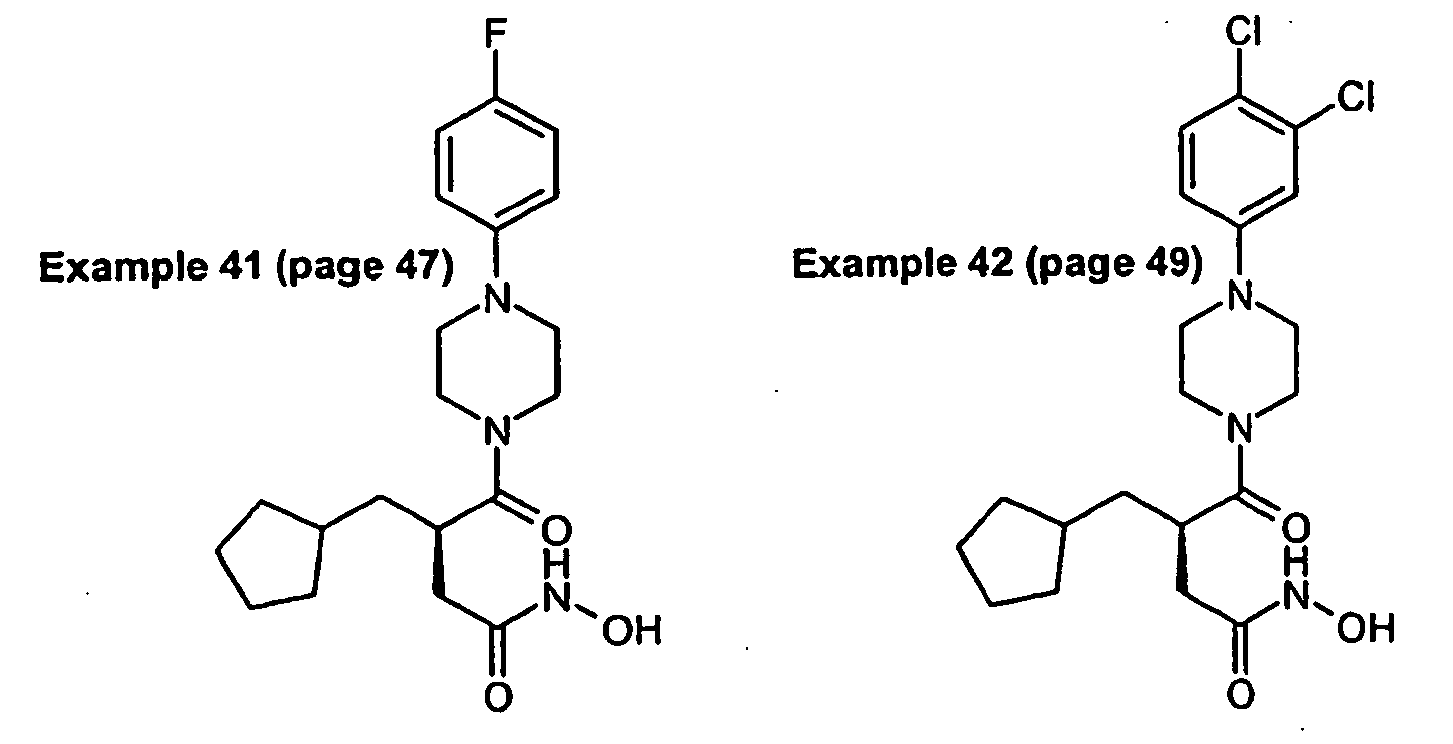
- A number of hydroxamic acids comprising a piperazine moiety with carbonyl groups adjacent to each nitrogen atom of the piperazine moiety are known.
- Chong et al., 2002 describe the following compound (Q2 has backbone=2; is alkylene) as an inhibitor of peptide deformylase for use as an antibiotic.

- Billedeau et al., 2000 describe the following two compounds (Q2 has backbone=3; is alkylene; is α-substituted) as inhibitors of procollagen C-proteinase for use in the treatment of fibrosis, sclerosis, arthritis and acute respiratory distress syndrome.


- Barlaam et al., 2000, describe compounds of the following type (wherein R3 may be, e.g., phenyl) (Q2 has backbone=2; is alkylene; is optionally β-substituted), which apparently inhibit MMP-13.

- Two examples of such compounds (Q2 has backbone=2; is alkylene) include the following.


- Barlaam et al., 2001, describe compounds of the following type (Q2 has backbone=2; is alkylene) which apparently inhibit MMP-13 and collagenase 3.

- Barta et al., 2000, describe the following compound (Q2 has backbone=2; is phenylene), which apparently inhibits MMP-2 and MMP-13.

- Baxter et al., 1999, (Darwin Discovery, UK) describe the following compound (Q2 has backbone=2; is alkylene), which apparently inhibits certain MMPs.

- Baxter et al., 2000, (Darwin Discovery, UK) describe compounds of the following type (Q2 has backbone=2; is alkylene), which apparently inhibitor certain MMPs.
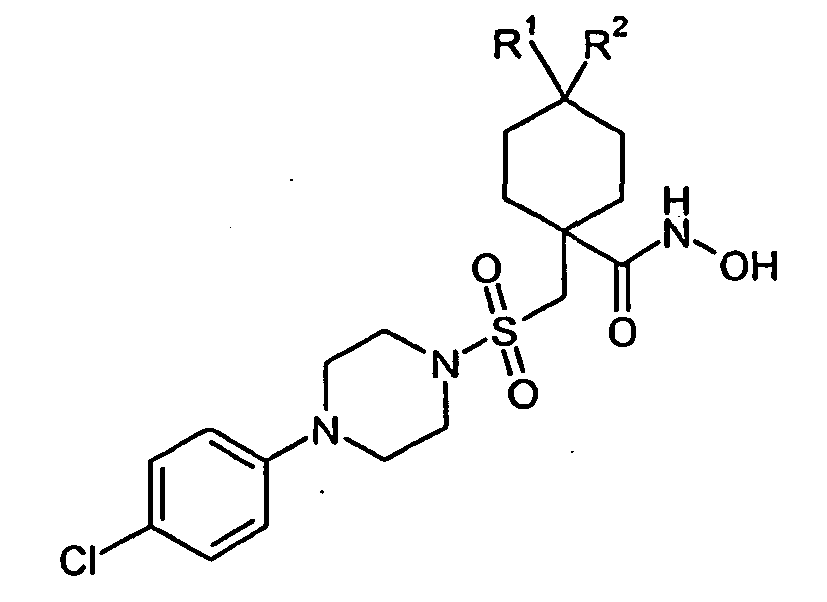
- Bedell et al., 2000, and Bedell et al., 2001, describe compounds of the following type (Q2 has backbone=2; is phenylene), which apparently inhibit certain MMPs.

- De Crescenzo et al., 2000, describe compounds of the following type (Q2 has backbone=2; is alkylene), which apparently inhibit certain MMPs.
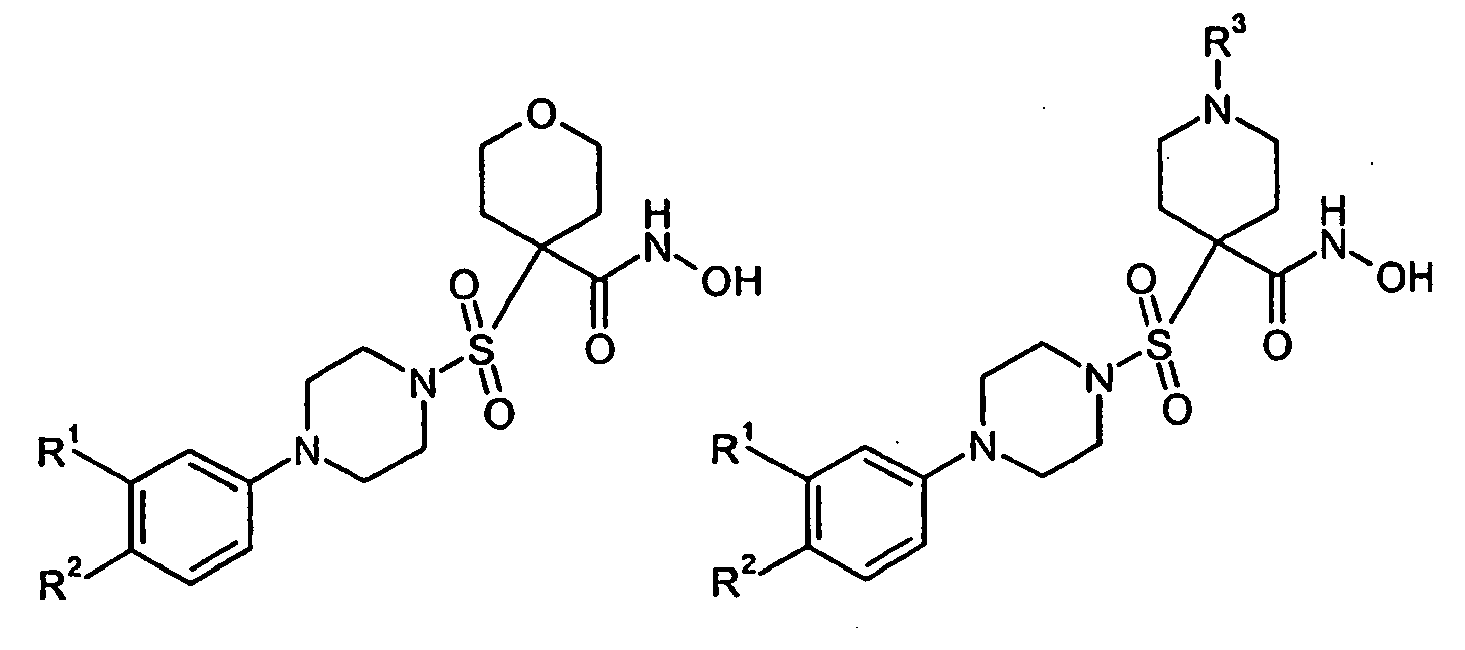
- Hannah et al., 2001, (Darwin Discovery, UK) describe compounds of the following type (Q2 has backbone=2; is alkylene; is optionally α-substituted), which apparently inhibit certain MMPs.

- Martin et al., 2000, describes the following compound (Q2 has backbone=2; is alkylene), which apparently inhibits certain MMPs.

- Owen et al., 2000, (Darwin Discovery, UK) describe compounds of the following type (Q2 has backbone=2; is phenylene), which are apparently inhibit certain MMPs.

- Owen et al., 2000, (Darwin Discovery, UK) also describes the following compound (Q2 has backbone=3; is phenylene):

- One aspect of the invention pertains to active carbamic acid compounds, as described herein.
- Another aspect of the invention pertains to active compounds, as described herein, which inhibit HDAC activity.
- Another aspect of the invention pertains to active compounds, as described herein, which treat conditions which are known to be mediated by HDAC, or which are known to be treated by HDAC inhibitors (such as, e.g., trichostatin A).
- Another aspect of the invention pertains to active compounds, as described herein, which (a) regulate (e.g., inhibit) cell proliferation; (b) inhibit cell cycle progression; (c) promote apoptosis; or (d) a combination of one or more of these.
- Another aspect of the invention pertains to active compounds, as described herein, which are anti-HDAC agents, and which treat a condition mediated by HDAC.
- Another aspect of the invention pertains to active compounds, as described herein, which are anticancer agents, and which treat cancer.
- Another aspect of the invention pertains to active compounds, as described herein, which are antiproliferative agents, and which treat a proliferative condition.
- Another aspect of the invention pertains to active compounds, as described herein, which are antipsoriasis agents, and which treat psoriasis.
- Another aspect of the present invention pertains to a composition comprising a compound, as described herein, and a carrier.
- Another aspect of the present invention pertains to a composition comprising a compound, as described herein, and a pharmaceutically acceptable carrier.
- Another aspect of the present invention pertains to methods of inhibiting HDAC in a cell, comprising contacting said cell with an effective amount of an active compound, as described herein, in vitro.
- Also described herein are methods of (a) regulating (e.g., inhibiting) cell proliferation; (b) inhibiting cell cycle progression; (c) promoting apoptosis; or (d) a combination of one or more of these, comprising contacting a cell with an effective amount of an active compound, as described herein, whether in vitro or in vivo.
- Also described herein are methods of treating a condition which is known to be mediated by HDAC, or which is known to be treated by HDAC inhibitors (such as, e.g., trichostatin A), comprising administering to a subject in need of treatment a therapeutically-effective amount of an active compound, as described herein.
- Also described herein are methods of treating cancer, comprising administering to a subject in need of treatment a therapeutically-effective amount of an active compound, as described herein.
- Also described herein are methods of treating a proliferative condition comprising administering to a subject in need of treatment a therapeutically-effective amount of an active compound, as described herein.
- Also described herein are methods of treating psoriasis comprising administering to a subject in need of treatment a therapeutically-effective amount of an active compound, as described herein.
- Another aspect of the present invention pertains to an active compound, as described herein, for use in a method of treatment of the human or animal body by therapy.
- Another aspect of the present invention pertains to use of an active compound, as described herein, for the manufacture of a medicament for use in the treatment of a condition mediated by HDAC, a condition known to be treated by HDAC inhibitors (such as, e.g., trichostatin A), cancer, a proliferative condition, psoriasis, or other condition as described herein.
- Another aspect of the present invention pertains to a kit comprising (a) the active compound, preferably provided as a pharmaceutical composition and in a suitable container and/or with suitable packaging; and (b) instructions for use, for example, written instructions on how to administer the active compound.
- Another aspect of the present invention pertains to compounds obtainable by a method of synthesis as described herein, or a method comprising a method of synthesis as described herein.
- Another aspect of the present invention pertains to compounds obtained by a method of synthesis as described herein, or a method comprising a method of synthesis as described herein.
- Another aspect of the present invention pertains to novel intermediates, as described herein, which are suitable for use in the methods of synthesis described herein.
- Another aspect of the present invention pertains to the use of such novel intermediates, as described herein, in the methods of synthesis described herein.
- As will be appreciated by one of skill in the art, features and preferred embodiments of one aspect of the invention will also pertain to other aspects of the invention.
- In one aspect, the present invention pertains to carbamic acid compounds of the formula:

- Cy is independently a cyclyl group;
- Q1 is independently a covalent bond or cyclyl leader group;
- the piperazin-1,4-diyl group is optionally substituted;
- J1 is independently a covalent bond or -C(=O)- ;
- J2 is independently -C(=O)- or -S(=O)2- ;
- Q2 is independently an acid leader group;
- Cy is independently:
- C3-20carbocyclyl,
- C3-20heterocyclyl, or
- C5-20aryl;
- and is optionally substituted;
- Q1 is independently:
- a covalent bond;
- C1-7alkylene; or
- C1-7alkylene-X-C1-7alkylene, -X-C1-7alkylene, or C1-7alkylene-X-,
- wherein X is -O- or -S-;
- and is optionally substituted;
- Q2 is independently:
- C4-8alkylene;
- and is optionally substituted;
- and has a backbone length of at least 4 atoms;
- Q2 is independently:
- C5-20arylene;
- C5-20arylene-C1-7alkylene;
- C1-7alkylene-C5-20arylene; or,
- C1-7alkylene-C5-20arylene-C1-7alkylene;
- and is optionally substituted;
- and has a backbone length of at least 4 atoms;
- In preferred embodiments, the carbamic acid group, -C(=O)NHOH, is unmodified (e.g., is not an ester).
- Note that each of the groups -J1-Q1-Cy and -J2-Q2-C(=O)NHOH is a monovalent and monodentate species; and that is it not intended that these groups be linked, other than via the N-1 and N-4 atoms, respectively, of the piperazin-1,4-diyl group.
- The piperazin-1,4-diyl group is optionally substituted, i.e., unsubstituted or substituted.
- In one embodiment, the piperazin-1,4-diyl group is unsubstituted (i.e., unsubstituted at the 2-, 3-, 5-, and 6-positions).
- In one embodiment, the piperazin-1,4-diyl group is substituted (i.e., substituted at one or more the 2-, 3-, 5-, and 6-positions.
- For example, in one embodiment, the piperazin-1,4-diyl group is substituted (i.e., substituted at one or more the 2-, 3-, 5-, and 6-positions with C1-4alkyl, for example, -Me or -Et.
- For example, in one embodiment, the piperazin-1,4-diyl group is:
- unsubstituted piperazin-1,4-diyl or 2-methyl-piperazin-1,4-diyl.
- The piperazin-1,4-diyl group may be in any conformation, including, but not limited to, chair-, boat-, or twist-forms.
- In one embodiment, J1 is independently a covalent bond.
In one embodiment, J1 is independently -C(=O)-. - In one embodiment, J2 is independently -C(=O)-.
In one embodiment, J2 is independently -S(=O)2-. - In one embodiment:
- J1 is a covalent bond and J2 is -C(=O)-; or:
- J1 is -C(=O)- and J2 is -C(=O)-; or:
- J1 is a covalent bond and J2 is -S(=O)2-.
- In one embodiment:
- J1 is a covalent bond and J2 is -C(=O)-; or:
- J1 is -C(=O)- and J2 is -C(=O)-.
- In one embodiment, J1 is a covalent bond and J2 is -C(=O)- (and the compounds may be referred to as "piperazino-amides"):

- In one embodiment, J1 is -C(=O)- and J2 is -C(=O)- (and the compounds may be referred to as "piperazino-bisamides"):

- In one embodiment, J1 is a covalent bond and J2 is -S(=O)2- (and the compounds may be referred to as "piperazino-sulfonamides"):

- In one embodiment, J1 is -C(=O)- and J2 is -S(=O)2- (and the compounds may be referred to as "piperazino-amide-sulfonamides"):

- For the avoidance of doubt, it is intended that, if there is a -C(=O)- group immediately adjacent to the N-1 atom of the piperazin-1-4-diyl group, then that -C(=O)- group must be assigned as J1 (that is, J1 is -(C=O)-) and not as part of Q1 (e.g., as part of an oxo-substituted Q1 group). For example, if the Cy-Q1-J1- group is Ph-CH2-C(=O)-, then Cy is Ph-, Q1 is -CH2-, and J1 is -C(=O)-.
- If, within the group -J1-Q1-Cy, there is a plurality of candidate groups satisfying the definition of Cy (referred to as candidate Cy groups), then the candidate Cy group which is furthest from from the N-1 atom of the piperazin-1,4-diyl group is identified as Cy (and referred to as "the relevant Cy group").
- In this context, distance (e.g., further, furthest) is measured as the number of chain atoms in the shortest continuous chain linking the groups (i.e., the N-1 atom and Cy).
- If there is a plurality of furthest candidate Cy groups, then the one (including any substituents) with the largest molecular weight is the relevant one.
- If there is a plurality of furthest heaviest candidate Cy groups, then the one (excluding any substituents) with the most annular heteroatoms is the relevant one.
- If there is a plurality of furthest heaviest candidate Cy groups with the most annular heteroatoms, then the one with an IUPAC name which alphabetically precedes the other(s), is the relevant one.
- Some illustrative examples are shown below.

- If the group, Q1, is a cyclyl leader group (i.e., not a covalent bond) and/or J1 is -C(=O)-, the group -Q1-J1- has a backbone length, as determined by the number of chain atoms in the shortest continuous chain of atoms linking the relevant cyclyl group, Cy, and the N-1 atom of the piperazin-1,4-diyl group. In the following example, -Q1-J1- has a backbone length of 2.

- Cy is independently: C3-20carbocyclyl, C3-20heterocyclyl, or C5-20aryl; and is optionally substituted.
- In one embodiment, Cy is independently C3-20carbocyclyl; and is optionally substituted.
- In one embodiment, Cy is independently monocyclic C3-7carbocyclyl, and is optionally substituted.
- In one embodiment, Cy is independently monocyclic C5-6carbocyclyl, and is optionally substituted.
- In one embodiment, Cy is independently C3-20carbocyclyl derived from one of the following: cyclopropane, cyclobutane, cyclopentane, cyclohexane, cyclopentene, cyclohexene, norbornane, adamantane, cyclopentanone, and cyclohexanone; and is optionally substituted.
- In one embodiment, Cy is independently C3-20heterocyclyl; and is optionally substituted.
- In one embodiment, Cy is independently monocyclic C3-7heterocyclyl, and is optionally substituted.
- In one embodiment, Cy is independently monocyclic C5-6heterocyclyl, and is optionally substituted.
- In one embodiment, Cy is independently C3-20heterocyclyl derived from one of the following: piperidine, azepine, tetrahydropyran, morpholine, azetidine, piperazine, imidazoline, piperazinedione, and oxazolinone; and is optionally substituted.
- In one embodiment, Cy is independently C5-20aryl; and is optionally substituted.
- In one embodiment, Cy is independently C5-20carboaryl or C5-20heteroaryl; and is optionally substituted.
- In one embodiment, Cy is independently C5-20heteroaryl; and is optionally substituted. In one embodiment, Cy is monocyclic C5-20heteroaryl; and is optionally substituted. In one embodiment, Cy is monocyclic C5-6heteroaryl; and is optionally substituted.
- In one embodiment, Cy is independently C5-20carboaryl; and is optionally substituted. In one embodiment, Cy is monocyclic C5-20carboaryl; and is optionally substituted. In one embodiment, Cy is monocyclic C5-6carboaryl; and is optionally substituted. In one embodiment, Cy is phenyl; and is optionally substituted.
- In one embodiment, Cy is independently C5-20aryl derived from one of the following: benzene, pyridine, furan, indole, pyrrole, imidazole, pyrimidine, pyrazine, pyridizine, naphthalene, quinoline, indole, benzimidazole, benzothiofuran, fluorene, acridine, and carbazole; and is optionally substituted.
- Examples of substituents on Cy include, but are not limited to, those described under the heading "Substituents" below.
- In one embodiment, the optional substituents on Cy are as defined under the heading "The Cyclyl Group, Cy: Optionally Substituted Phenyl: Substituents."
- In one embodiment, Cy is independently an optionally substituted phenyl group.
- In one embodiment, Cy is independently an optionally substituted phenyl group of the formula:

- In one embodiment, Cy is an optionally substituted phenyl group, Q1 is a covalent bond or a cyclyl leader group, J1 is a covalent bond, and the compounds have the following formula:

- In one embodiment, Cy is an optionally substituted phenyl group, Q1 is a cyclyl leader group, J1 is a covalent bond, and the compounds have the following formula:

- In one embodiment, Cy is an optionally substituted phenyl group, Q1 is a covalent bond, J1 is a covalent bond, and the compounds have the following formula:

- In one embodiment, n is an integer from 0 to 5.
In one embodiment, n is an integer from 0 to 4.
In one embodiment, n is an integer from 0 to 3.
In one embodiment, n is an integer from 0 to 2.
In one embodiment, n is 0 or 1. - In one embodiment, n is an integer from 1 to 5.
In one embodiment, n is an integer from 1 to 4.
In one embodiment, n is an integer from 1 to 3.
In one embodiment, n is 1 or 2.
In one embodiment, n is 5.
In one embodiment, n is 4.
In one embodiment, n is 3.
In one embodiment, n is 2.
In one embodiment, n is 1.
In one embodiment, n is 0. - If the phenyl group has less than the full complement of ring substituents, RA, they may be arranged in any combination. For example, if n is 1, RA may be in the 2'-, 3'-, 4'-, 5'-, or 6'-position. Similarly, if n is 2, the two RA groups may be in, for example, the 2',3'-, 2',4'-, 2',5'-, 2',6'-, 3',4'-, or 3',5'-positions. If n is 3, the three RA groups may be in, for example, the 2',3',4'-, 2',3',5'-, 2',3',6'-, or 3',4',5'-positions.
- In one embodiment, n is 0.
- In one embodiment, n is 1, and the RA group is in the 4'-position.
- In one embodiment, n is 2, and one RA group is in the 4'-position, and the other RA group is in the 2'-position.
- In one embodiment, n is 2, and one RA group is in the 4'-position, and the other RA group is in the 3'-position.
- Examples of substituents on Cy (e.g., RA), include, but are not limited to, those described under the heading "Substituents" below.
- Further examples of substituents on Cy (e.g., RA), include, but are not limited to, those described below.
- In one embodiment, each of the substituents on Cy (e.g., each RA), is independently selected from:
- (1) ester;
- (2) amido;
- (3) acyl;
- (4) halo;
- (5) hydroxy;
- (6) ether;
- (7) C1-7alkyl, including substituted C1-7alkyl;
- (8) C5-20aryl, including substituted C5-20aryl;
- (9) sulfonyl;
- (10) sulfonamido;
- (11) amino;
- (12) morpholino;
- (13) nitro;
- (14) cyano.
- In one embodiment, each of the substituents on Cy (e.g., each RA), is independently selected from:
- (1) -C(=O)OR1, wherein R1 is independently C1-7alkyl as defined in (7);
- (2) -C(=O)NR2R3, wherein each of R2 and R3 is independently -H or C1-7alkyl as defined in (7);
- (3) -C(=O)R4, wherein R4 is independently C1-7alkyl as defined in (7) or C5-20aryl as defined in (8);
- (4) -F, -Cl, -Br, -I;
- (5) -OH;
- (6) -OR5, wherein R5 is independently C1-7alkyl as defined in (7) or C5-20aryl as defined in (8);
- (7) C1-7alkyl, including substituted C1-7alkyl, e.g.,
halo-C1-7alkyl;
amino-C1-7alkyl (e.g., -(CH2)w-amino);
carboxy-C1-7alkyl (e.g., -(CH2)w-COOH);
hydroxy-C1-7alkyl (e.g., -(CH2)w-OH);
C1-7alkoxy-C1-7alkyl (e.g., -(CH2)w-O-C1-7alkyl);
C5-20aryl-C1-7alkyl;
wherein w is 1, 2, 3, or 4; - (8) C5-20aryl, including substituted C5-20aryl;
- (9) -SO2R7, wherein R7 is independently C1-7alkyl as defined in (7) or C5-20aryl as defined in (8);
- (10) -SO2NR8R9, wherein each of R8 and R9 is independently -H or C1-7alkyl as defined in (7);
- (11) -NR10R11, wherein each of R10 and R11 is indenpendently -H or C1-7 alkyl as defined in (7);
- (12) morpholino;
- (13) nitro;
- (14) cyano.
- In one embodiment, each of the substituents on Cy (e.g., each RA), is independently selected from:
- (1) -C(=O)OMe, -C(=O)OEt, -C(=O)O(Pr), -C(=O)O(iPr), -C(=O)O(nBu), -C(=O)O(sBu), -C(=O)O(iBu), -C(=O)O(tBu), -C(=O)O(nPe);
-C(=O)OCH2CH2OH, -C(=O)OCH2CH2OMe, -C(=O)OCH2CH2OEt; - (2) -(C=O)NH2, -(C=O)NMe2, -(C=O)NEt2, -(C=O)N(iPr)2, -(C=O)N(CH2CH2OH)2;
- (3) -(C=O)Me, -(C=O)Et, -(C=O)-cHex, -(C=O)Ph;
- (4) -F, -Cl, -Br, -I;
- (5) -OH;
- (6) -OMe, -OEt, -O(iPr), -O(tBu), -OPh;
-OCF3, -OCH2CF3;
-OCH2CH2OH, -OCH2CH2OMe, -OCH2CH2OEt;
-OCH2CH2NH2, -OCH2CH2NMe2, -OCH2CH2N(iPr)2;
-OPh, -OPh-Me, -OPh-OH, -OPh-OMe, O-Ph-F, -OPh-Cl, -OPh-Br, -OPh-I; - (7) -Me, -Et, -nPr, -iPr, -nBu, -iBu, -sBu, -tBu, -nPe;
-CF3, -CH2CF3;
-CH2CH2OH, -CH2CH2OMe, -CH2CH2OEt;
-CH2CH2NH2, -CH2CH2NMe2, -CH2CH2N(iPr)2;
-CH2-Ph; - (8) -Ph, -Ph-Me, -Ph-OH, -Ph-OMe, -Ph-F, -Ph-Cl, -Ph-Br, -Ph-I;
- (9) -SO2Me, -SO2Et, -SO2Ph;
- (10) -SO2NH2, -SO2NMe2, -SO2NEt2;
- (11)-NMe2, -NEt2;
- (12) morpholino;
- (13) -NO2;
- (14) -CN.
- In one embodiment, each of the substituents on Cy (e.g., each RA), is independently selected from:
- -C(=O)OMe, -C(=O)O(Pr), -C(=O)NHMe, -C(=O)Et, C(=O)Ph,
- -OCH2CH2OH, -OMe, -OPh,
- -nPr, iPr, -CF3, -CH2CH2OH, -CH2CH2NMe2,
- -Ph, -Ph-F, -Ph-Cl,
- -SO2Me -SO2Me2, -NMe2,
- -F, -Cl, -Me, -Et, -OMe, -OEt, -CH2-Ph, -O-CH2-Ph.
- In one embodiment, each of the substituents on Cy (e.g., each RA), is independently selected from:
- -F, -Cl, -Me, -Et, -OMe, -OEt, -Ph, -OPh, -CH2-Ph, -O-CH2-Ph.
- Examples of some preferred substituents on Cy (e.g., RA), include, but are not limited to, the following: fluoro, chloro, bromo, iodo, methyl, ethyl, isopropyl, t-butyl, cyano, trifluoromethyl, hydroxy, methoxy, ethoxy, isopropoxy, trifluoromethoxy, phenoxy, methylthio, trifluoromethylthio, hydroxymethyl, amino, dimethylamino, diethylamino, morpholino, amido (unsubstituted, i.e., -CONH2), acetamido, acetyl, nitro, sulfonamido (unsubstituted, i.e., -SO2NH2), and phenyl.
- In one embodiment, Q1 is independently:
- a covalent bond; or
- a cyclyl leader group;
- and is optionally substituted.
- In one embodiment, Q1 is independently:
- a covalent bond.
- In one embodiment, Q1 is independently:
- a cyclyl leader group;
- and is optionally substituted.
- In one embodiment, Q1 is independently:
- a covalent bond;
- C1-7alkylene; or
- C1-7alkylene-X-C1-7alkylene, -X-C1-7alkylene, or C1-7alkylene-X-;
- wherein X is -O- or -S-;
- and is optionally substituted.
- In one embodiment, Q1 is independently:
- a covalent bond; or
- a C1-7alkylene group;
- and is optionally substituted.
- In one embodiment, Q1 is independently:
- a C1-7alkylene group;
- and is optionally substituted.
- In one embodiment, Q1 is independently:
- C1-7alkylene-X-C1-7alkylene, -X-C1-7alkylene, or C1-7alkylene-X-;
- wherein X is -O- or -S-;
- and is optionally substituted.
- In one embodiment, in the above alkylene groups, each alkylene group is independently:
- (a) a saturated C1-7alkylene group; or:
- (b) a partially unsaturated C2-7alkylene group; or:
- (c) an aliphatic C1-7alkylene group; or:
- (d) a linear C1-7alkylene group; or:
- (e) a branched C2-7alkylene group; or:
- (f) a saturated aliphatic C1-7alkylene group; or:
- (g) a saturated linear C1-7alkylene group; or:
- (h) a saturated branched C2-7alkylene group; or:
- (i) a partially unsaturated aliphatic C2-7alkylene group; or:
- (j) a partially unsaturated linear C2-7alkylene group; or:
- (k) a partially unsaturated branched C2-7alkylene group;
- In one embodiment, the above alkylene groups have a maximum number of carbon atoms of 4, e.g., C1-4alkylene, C2-4alkylene.
- In one embodiment, the above alkylene groups have a maximum number of carbon atoms of 3, e.g., C1-3alkylene, C2-3alkylene.
- In one embodiment, Q1 is selected so that the N-1 atom of the piperazin-1,4-diyl group is not connected to a carbon atom which is connected to another carbon atom via a non-aromatic carbon-carbon double bond (i.e., C=C). That is, the N-1 atom of the piperazin-1,4-diyl group is not adjacent to a non-aromatic carbon-carbon double bond (i.e., C=C). In this way, groups such as -CH=CH- and -CH2-CH=CH- are excluded from Q1, but groups such as -CH=CH-CH2- are not. Additional embodiments include other embodiments described herein (e.g., those described above) further limited by this restriction upon Q1.
- In one embodiment:
- Q1 is independently a covalent bond;
- J1 is independently a covalent bond;
- J2 is independently -C(=O)-.
- In one embodiment:
- Q1 is independently a covalent bond;
- J1 is independently -C(=O)-;
- J2 is independently -C(=O)-.
- In one embodiment:
- Q1 is independently a covalent bond;
- J1 is independently a covalent bond;
- J2 is independently -S(=O)2-.
- In one embodiment:
- Q1 is independently a covalent bond;
- J1 is independently -C(=O)-;
- J2 is independently -S(=O)2-.
- The group -J1-Q1- has a backbone length, as determined by the number of chain atoms in the shortest continuous chain of atoms linking the relevant Cy group and the N-1 atom of the piperazin-1,4-diyl group.
- In one embodiment, the group -J1-Q1- has a backbone of:
- from 1 to 7 atoms;
- from 1 to 6 atoms;
- from 1 to 5 atoms;
- from 1 to 4 atoms; or,
- from 1 to 3 atoms.
- In one embodiment, the group -J1-Q1- has a backbone of at least 2 atoms. In this way, groups such as methylene (-CH2-) and substituted methylene (-CR2- and -CHR-) are excluded.
- In one embodiment, the group -J1-Q1- has a backbone of at least 3 atoms.
In one embodiment, the group -J1-Q1- has a backbone of at least 4 atoms.
In one embodiment, the group -J1-Q1- has a backbone of at least 5 atoms. - In one embodiment, the group -J1-Q1- has a backbone of:
- from 2 to 7 atoms;
- from 2 to 6 atoms; or,
- from 2 to 5 atoms.
- In one embodiment, the group -J1-Q1- has a backbone of:
- from 3 to 7 atoms;
- from 3 to 6 atoms; or,
- from 3 to 5 atoms.
- In one embodiment, the group -J1-Q1- has a backbone of:
- from 4 to 7 atoms;
- from 4 to 6 atoms; or,
- from 4 to 5 atoms.
- In one embodiment, the group -J1-Q1- has a backbone of 1 atom.
In one embodiment, the group -J1-Q1- has a backbone of 2 atoms.
In one embodiment, the group -J1-Q1- has a backbone of 3 atoms.
In one embodiment, the group -J1-Q1- has a backbone of 4 atoms.
In one embodiment, the group -J1-Q1- has a backbone of 5 atoms. - Note that, for embodiments which are characterised by, or further characterised by, a backbone length limitation, corresponding changes in the description of that embodiment may be implicit. For example, for an embodiment wherein (a) Q1 is a partially unsaturated C2-7alkylene group and (b) Q1 has a backbone of 4 carbon atoms, the term "C2-7alkylene" group is necessarily, and implicitly, interpreted as "C4-7alkylene."
- In one embodiment, Q1, if other than a covalent bond, is unsubstituted.
In one embodiment, Q1, if other than a covalent bond, is optionally substituted.
In one embodiment, Q1 if other than a covalent bond, is substituted. - Examples of substituents on Q1 include, but are not limited to, those described under the heading "Substituents" below.
- In one embodiment, substituents on Q1, if present, are as defined under the heading "The Cyclyl Group, Cy: Optionally Substituted Phenyl: Substituents."
- In one embodiment, substituents on Q1, if present, are independently: halo, hydroxy, ether (e.g., C1-7alkoxy), C5-20aryl, acyl, amino, amido, acylamido, or oxo.
- In one embodiment, substituents on Q1, if present, are independently: -F, -Cl, -Br, -I, -OH, -OMe, -OEt, -OPr, -Ph, -NH2, -CONH2, or =O.
- In one embodiment, substituents on Q1, if present, are independently -OH or -Ph.
- In one embodiment, substituents on Q1, if present, are independently -Ph.
- For example, in one embodiment, Q1 is unsubstituted methylene, and is -CH2-; in one embodiment, Q1 phenyl (-Ph) substituted methylene, and is -CH(Ph)-.
- For example, in one embodiment, Q1 is unsubstituted ethylene, and is -CH2-CH2-; in one embodiment, Q1 is oxo (=O) substituted ethylene, and is -C(=O)-CH2-; in one embodiment, Q1 is hydroxy (-OH) substituted ethylene, and is -CH(OH)-CH2-; in one embodiment, Q1 is phenyl (-Ph) substituted ethylene, and is -CH2CH(Ph)-.
- Again, for the avoidance of doubt, it is intended that, if there is a -C(=O)- group immediately adjacent to the N-1 atom of the piperazin-1-4-diyl group, then that -C(=O)-group must be assigned as J1 (that is, J1 is -(C=O)-) and not as part of Q1 (e.g., as part of an oxo-substituted Q1 group). For example, if the Cy-Q1-J1- group is Ph-CH2-C(=O)-, then Cy is Ph-, Q1 is -CH2-, and J1 is -C(=O)-.
- Note that, for embodiments excluding, e.g., a covalent bond, certain backbone lengths, absence of adjacent carbon-carbon double bonds, etc., it is to be understood that the corresponding species listed below are similarly excluded from the respective embodiments discussed below.
- In one embodiment, Q1 is independently selected from the following:
- a covalent bond;
- -GH2-, -(CH2)2-, -(CH2)3-, -(CH2)4-, -(CH2)5-, -(CH2)6-, -(CH2)7-;
- -CH(CH3)-;
-CH(CH3)CH2-, -CH2CH(CH3)-;
-CH(CH3)CH2CH2-, -CH2CH(CH3)CH2-, -CH2CH2CH(CH3)-;
-CH(CH3)CH2CH2CH2-, -CH2CH(CH3)CH2CH2-, -CH2CH2CH(CH3)CH2-, -CH2CH2CH2CH(CH3)-;
-CH(CH3)CH2CH2CH2CH2-, -CH2CH(CH3)CH2CH2CH2-, -CH2CH2CH(CH3)CH2CH2-, -CH2CH2CH2CH(CH3)CH2-, -CH2CH2CH2CH2CH(CH3)-, -CH(CH3)CH2CH2CH2CH(CH3)-; - -CH(CH2CH3)-;
-CH(CH2CH3)CH2-, -CH2CH(CH2CH3)-;
-CH(CH2CH3)CH2CH2-, -CH2CH(CH2CH3)CH2-, -CH2CH2CH(CH2CH3)-;
-CH(CH2CH3)CH2CH2CH2-, -CH2CH(CH2CH3)CH2CH2-, -CH2CH2CH(CH2CH3)CH2-, -CH2CH2CH2CH(CH2CH3)-;
-CH(CH2CH3)CH2CH2CH2CH2-, -CH2CH(CH2CH3)CH2CH2CH2-, -CH2CH2CH(CH2CH3)CH2CH2-, -CH2CH2CH2CH(CH2CH3)CH2-, -CH2CH2CH2CH2CH(CH2CH3)-; - -CH=CH-;
-CH=CHCH2-, -CH2CH=CH-;
-CH=CHCH2CH2-, -CH2CH=CHCH2-, -CH2CH2CH=CH-;
-CH=CHCH2CH2CH2-, -CH2CH=CHCH2CH2-, -CH2CH2CH=CHCH2-, -CH2CH2CH2CH=CH-;
-CH=CHCH2CH2CH2CH2-, -CH2CH=CHCH2CH2CH2-, -CH2CH2CH=CHCH2CH2-, -CH2CH2CH2CH=CHCH2-, -CH2CH2CH2CH2CH=CH-; - -C(CH3)=CH-, -CH=C(CH3)-;
-C(CH3)=CHCH2-, -CH=C(CH3)CH2-, -CH=CHCH(CH3)-;
-CH(CH3)CH=CH-, -CH2C(CH3)=CH-, -CH2CH=C(CH3)-; - -CH=CHCH=CH-;
-CH=CHCH=CHCH2-, -CH2CH=CHCH=CH-, -CH=CHCH2CH=CH-;
-CH=CHCH=CHCH2CH2-, -CH=CHCH2CH=CHCH2-, -CH=CHCH2CH2CH=CH-, -CH2CH=CHCH=CHCH2-, -CH2CH=CHCH2CH=CH-, -CH2CH2CH=CHCH=CH-; - -C(CH3)=CHCH=CH-, -CH=C(CH3)CH=CH-, -CH=CHC(CH3)=CH-, -CH=CHCH=C(CH3)-;
- -C≡C-;
-C≡CCH2-, -CH2C≡C-; -C≡CCH(CH3)-, -CH(CH3)C≡C-;
-C≡CCH2CH2-, -CH2C≡CCH2-, -CH2CH2C≡C-;
-C≡CCH(CH3)CH2-, -C≡CCH2CH(CH3)-;
-CH(CH3)C≡CCH2-, -CH2C≡CCH(CH3)-;
-CH(CH3)CH2C≡C-, -CH2CH(CH3)C≡C-;
-C≡CCH=CH-, -CH=CHC≡C-, -C≡CC≡C-;
-C≡CCH2CH2CH2-, -CH2CH2CH2C≡C-;
-C≡CCH2CH2CH2CH2-, -CH2CH2CH2CH2C≡C-;
-C≡CCH=CHCH=CH-, -CH=CHC≡C-CH=CH-, -CH=CHCH=CHC≡C-; - -C(CH3)=CHC≡C-, -CH=C(CH3)C≡C-, -C≡CC(CH3)=CH-, -C≡CCH=C(CH3)-.
- In one embodiment, Q1 is selected from:
- a covalent bond;
-CH2-, -(CH2)2-, -(CH2)3-, -(CH2)4-, -(CH2)5-, -(CH2)6-;
-CH(CH3)CH2CH2CH2CH2-, -CH2CH(CH3)CH2CH2CH2-, -CH2CH2CH2CH(CH3)CH2-, -CH2CH2CH2CH2CH(CH3)-;
-CH=CH-;
-CH=CHCH2-, -CH=C(Me)CH2-;
-CH=CH-CH=CH-;
-CH=CH-CH=CHCH2-, -CH=CHCH2CH2CH2-, -CH2CH2CH2CH=CH-;
-CH=CHCH2CH2CH2CH2-, -CH2CH2CH2CH2CH=CH-;
-C(CH3)=CHCH=CH-, -CH=C(CH3)CH=CH-, -CH=CHC(CH3)=CH-, -CH=CHCH=C(CH3)-; - In one embodiment, Q1 is selected from:
- a covalent bond;
-CH2-. -(CH2)2-, -(CH2)3-, -(CH2)4-, -(CH2)5-,
-CH=CH-;
-CH=CHCH2-, -CH=C(Me)CH2-;
-CH=CH-CH=CH-;
-C(CH3)=CHCH=CH-, -CH=C(CH3)CH=CH-, -CH=CHC(CH3)=CH-, -CH=CHCH=C(CH3)-;
-CH=CHCH2CH2CH2-, -CH2CH2CH2CH=CH-. - In one embodiment, Q1 is independently selected from:
- a covalent bond;
-CH2-, -(CH2)2-, -(CH2)3-, -(CH2)4-, -(CH2)5-;
-CH=CHCH2-;
-CH=C(Me)CH2-; and,
-CH=CH-CH=CHCH2-. - In one embodiment, Q1 is independently selected from:
- a covalent bond;
-CH2-;
-CH2CH2-;
-CH2CH2CH2-;
-CH=CHCH2-;
-CH=C(Me)CH2-; and,
-CH=CH-CH=CHCH2-. - In one embodiment, Q1 is independently selected from:
- a covalent bond;
-CH2-;
-CH(*Ph)-;
-CH2CH2-;
-CH(*Ph)CH2-;
-CH2CH(*Ph)-;
-CH2CH2CH2-;
-CH=CHCH2-;
-CH=C(Me)CH2-; and,
-CH=CH-CH=CHCH2-; - Note that, for embodiments excluding, e.g., a covalent bond, certain backbone lengths, absence of adjacent carbon-carbon double bonds, etc., it is to be understood that the corresponding species listed below are similarly excluded from the respective embodiments discussed below.
- In one embodiment, Q1 is independently selected from the following:
-(CH2)a-X-(CH2)b-
wherein X is -O- or -S- and
a and b are each independently 1, 2, 3, 4, 5, 6, or 7;
and a+b is at least 1. - In one embodiment, Q1 is independently selected from the following:
- -O-(CH2)a-
- -S-(CH2)a-
- -(CH2)a-O-
- -(CH2)a-S-
- -(CH2)a-O-(CH2)b-
- -(CH2)a-S-(CH2)b-
- wherein a and b are each independently 1, 2, 3, 4, 5, 6, or 7.
- In one embodiment, Q1 is independently selected from the following:
- -O-CH2-; -O-CH2CH2-; -O-CH2CH2CH2-;
- -S-CH2-; -S-CH2CH2-; -S-CH2CH2CH2-;
- -CH2-O-; -CH2CH2-O-; -CH2CH2CH2-O-;
- -CH2-S-; -CH2CH2-S-; -CH2CH2CH2-S-;
- -CH2-O-CH2-; -CH2-O-CH2CH2-; -CH2CH2-O-CH2-; and
- -CH2CH2-O-CH2CH2-.
- In one embodiment, the group -Q1-J1- has a formula selected from:
- -CH2-;
- -CH(*Ph)-;
- -CH2CH2-;
- -CH2CH(*Ph)-;
- -CH(*Ph)CH2-;
- -CH2CH2CH2-;
- -C(=O)-;
- -CH2-C(=O)-;
- -CH(*Ph)-C(=O)-;
- -CH2CH2-C(=O)-;
- -OCH2-;
- -O-CH2CH2-;
- -cho-;
- -CH2CH2-O-; and,
- -O-CH2-C(=O)-.
- In one embodiment, the group Cy-Q1- has a formula selected from:
- *Ph-;
- *Ph-CH2-;
- (*Ph)2CH-;
- *Ph-CH2CH2-;
- (*Ph)2-CH2CH2-;
- *Ph-CH2CH(*Ph)-;
- *Ph-CH2CH2CH2-;
- *Ph-CH=CHCH2-;
- *Ph-CH=C(Me)CH2-;
- *Ph-CH=CHCH=CHCH2-;
- (*pyrid-3-yl)-CH=CHCH2-; and,
- (*cyclohexyl)-CH2CH2-;
- In one embodiment, * indicates that the group (e.g., Ph, pyrid-3-yl, cyclohexyl) is optionally substituted with one or more of: -F, -Cl, -Br, -I, -OH, -OMe, -OEt, -OPr, -Ph, -NH2, and -CONH2.
- The acid leader group, Q2, is independently:
- C4-8alkylene;
- and is optionally substituted;
- and has a backbone length of at least 4 atoms;
- C5-20arylene;
- C5-20arylene-C1-7alkylene;
- C1-7alkylene-C5-20arylene; or,
- C1-7alkylene-C5-20arylene-C1-7alkylene;
- and is optionally substituted;
- and has a backbone length of at least 4 atoms.
- In one embodiment, the acid leader group, Q2, is independently:
- C4-8alkylene;
- and is optionally substituted;
- and has a backbone length of at least 4 atoms.
- In one embodiment, the acid leader group, Q2, is independently:
- C5-20arylene;
- C5-20arylene-C1-7alkylene;
- C1-7alkylene-C5-20arylene;
- C1-7alkylene-C5-20arylene-C1-7alkylene; or,
- and is optionally substituted;
- and has a backbone length of at least 4 atoms.
- The acid leader group, Q2, has a backbone length, as determined by the number of chain atoms in the shortest continuous chain of atoms linking the N-4 atom of the piperazin-1,4-diyl group and the carbamic acid group, -C(=O)NHOH.
- All alkylene groups necessarily have a backbone of at least 1 atom. Some examples are shown below.

- All arylene, arylene-alkylene, alkylene-arylene, and alkylene-arylene-alkylene groups necessarily have a backbone of at least 2 atoms. Some examples are shown below.
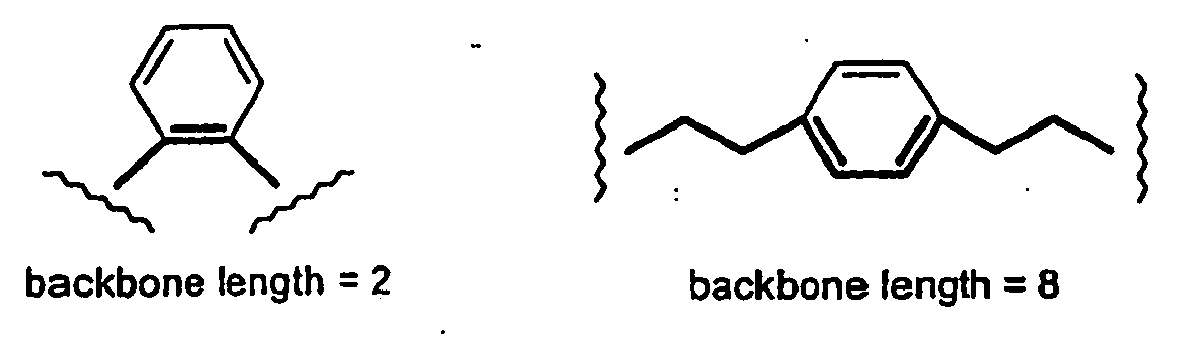
- Without wishing to be bound to any particular theory, it is believed that Q2 groups with shorter backbone lengths prevent or reduce the interaction of the carbamic acid group (-C(=O)NHOH) with HDAC (or its complexes), and thereby reduce the compound's activity as an HDAC inhibitor.
- In one embodiment, Q2 has a backbone of at least 4 atoms.
In one embodiment, Q2 has a backbone of at least 5 atoms.
In one embodiment, Q2 has a backbone of at least 6 atoms. - In one embodiment, Q2 has a backbone of:
- from 4 to 8 atoms;
- from 4 to 7 atoms;
- from 4 to 6 atoms; or,
- from 4 to 5 atoms.
- In one embodiment, Q2 has a backbone of:
- from 5 to 8 atoms; or
- from 5 to 7 atoms; or
- from 5 to 6 atoms.
- In one embodiment, Q2 has a backbone of from 5 to 6 atoms.
- In one embodiment, Q2 has a backbone of 4 atoms.
In one embodiment, Q2 has a backbone of 5 atoms.
In one embodiment, Q2 has a backbone of 6 atoms.
In one embodiment, Q2 has a backbone of 7 atoms.
In one embodiment, Q2 has a backbone of 8 atoms. - In one embodiment, the backbone of "atoms" is a backbone of "carbon atoms."
- Note that, for embodiments which are characterised by, or further characterised by, a backbone length limitation, corresponding changes in the description of that embodiment may be implicit. For example, for an embodiment wherein (a) Q2 is a partially unsaturated C2-8alkylene group and (b) Q2 has a backbone of 4 carbon atoms, the term "C2-8alkylene" group is necessarily, and implicitly, interpreted as "C4-8alkylene."
- In one embodiment, Q2 is unsubstituted.
In one embodiment, Q2 is optionally substituted.
In one embodiment, Q2 is substituted. - The backbone atoms of the acid leader group, Q2, which link J and the carbamic acid group (-C(=O)NHOH), are denoted α, β, γ, δ, etc., starting with the backbone atom adjacent to the carbamic acid group. Some examples are illustrated below.


- Without wishing to be bound to any particular theory, it is believed that groups (e.g., substituents), particularly bulky groups (e.g., substituents), at the α-position, or at either or both of the α- and β -positions, prevent or reduce the interaction of the carbamic acid group (-C(=O)NHOH) with HDAC (or its complexes), and thereby reduce the compound's activity as an HDAC inhibitor.
- In one embodiment, Q2 is, additionally, unsubstituted at the α-position.
- In one embodiment, Q2 is, additionally, unsubstituted at the α-position and unsubstituted at the β-position.
- Note that, in some embodiments, Q2 may have a non-linear alkylene group (for example, a branched alkylene) adjacent to the carbamic acid group. An example, wherein Q2 is a branched saturated C6-alkylene, having a methyl group at the α-position, is shown below. Although there is a group (i.e., a methyl group) at the α-position, such compounds are unsubstituted at the α-position, because the α-methyl group itself is considered to be part of the unsubstituted Q2. Another example, wherein Q2 is a branched saturated C6-alkylene, having an amino group at the α-position and a methyl group at the β-position, is shown below; such compounds are α-substituted, β-unsubstituted.

- In one embodiment, in which Q2 is a group as defined herein (e.g., C4-8alkylene, C5-20arylene-C1-7alkylene, C1-7alkylene-C5-20arylene-C1-7alkylene) having an alkylene group adjacent to the carbamic acid group, Q2 is, additionally, unsubstituted at the α-position.
- In one embodiment, in which Q2 is a group as defined herein (e.g., C4-8alkylene, C5-20arylene-C1-7alkylene, C1-7alkylene-C5-20arylene-C1-7alkylene) having an alkylene group adjacent to the carbamic acid group, that adjacent alkylene group has a -CH2- or =CH- group adjacent to the carbamic acid group (that is, at the α-position).
- In one embodiment, in which Q2 is a group as defined herein (e.g., C4-8alkylene, C5-20arylene-C1-7alkylene, C1-7alkylene-C5-20arylene-C1-7alkylene) having an alkylene group adjacent to the carbamic acid group, that adjacent alkylene group has a -CH2- group adjacent to the carbamic acid group (that is, at the α-position).
- In one embodiment, in which Q2 is a group as defined herein (e.g., C4-8alkylene, C5-20arylene-C1-7alkylene, C1-7alkylene-C5-20arylene-C1-7alkylene) having an alkylene group adjacent to the carbamic acid group, that adjacent alkylene group has a =CH- group adjacent to the carbamic acid group (that is, at the α-position).
- In one embodiment, in which Q2 is a group as defined herein (e.g., C4-8alkylene, C5-20arylene-C1-7alkylene, C1-7alkylene-C5-20arylene-C1-7alkylene) having an alkylene group adjacent to the carbamic acid group, Q2 is, additionally, unsubstituted at the α-position and unsubstituted at the β -position.
- In one embodiment, in which Q2 is a group as defined herein (e.g., C4-8alkylene, C5-20arylene-C1-7alkylene, C1-7alkylene-C5-20arylene-C1-7alkylene) having an alkylene group adjacent to the carbamic acid group, that adjacent alkylene group has a -CH2CH2-, -CH=CH-, or -C≡C- group adjacent to the carbamic acid group (that is, at the α,β-position).
- In one embodiment, in which Q2 is a group as defined herein (e.g., C4-8alkylene, C5-20arylene-C1-7alkylene, C1-7alkylene-C5-20arylene-C1-7alkylene) having an alkylene group adjacent to the carbamic acid group, that adjacent alkylene group has a -CH2CH2- or -CH=CH- group adjacent to the carbamic acid group (that is, at the α,β-position).
- In one embodiment, in which Q2 is a group as defined herein (e.g., C4-8alkylene, C5-20arylene-C1-7alkylene, C1-7alkylene-C5-20arylene-C1-7alkylene) having an alkylene group adjacent to the carbamic acid group, that adjacent alkylene group has a -CH2CH2- group adjacent to the carbamic acid group (that is, at the α,β-position).
- In one embodiment, in which Q2 is a group as defined herein (e.g., C4-8alkylene, C5-20arylene-C1-7alkylene, C1-7alkylene-C5-20arylene-C1-7alkylene) having an alkylene group adjacent to the carbamic acid group, that adjacent alkylene group has a -CH=CH- group adjacent to the carbamic acid group (that is, at the α,β-position).
- Examples of substituents on Q2 include, but are not limited to, those described under the heading "Substituents" below.
- In one embodiment, the optional substituents on Q2 are as defined under the heading "The Cyclyl Group, Cy: Optionally Substituted Phenyl: Substituents."
- In one embodiment, the acid leader group, Q2, is C4-8alkylene, and is optionally substituted, and has a backbone length of at least 4 atoms.
- In one embodiment, Q2 is independently a saturated C4-8alkylene group.
- In one embodiment, Q2 is independently a partially unsaturated C4-8alkylene group.
- In one embodiment, Q2 is independently an aliphatic C4-8alkylene group
- In one embodiment, Q2 is independently a linear C4-8alkylene group.
- In one embodiment, Q2 is independently a branched C4-8alkylene group.
- In one embodiment, Q2 is independently an alicyclic C4-8alkylene group.
- In one embodiment, Q2 is independently a saturated aliphatic C4-8alkylene group.
- In one embodiment, Q2 is independently a saturated linear C4-8alkylene group.
- In one embodiment, Q2 is independently a saturated branched C4-8alkylene group.
- In one embodiment, Q2 is independently a saturated alicyclic C4-8alkylene group.
- In one embodiment, Q2 is independently a partially unsaturated aliphatic C4-8alkylene group.
- In one embodiment, Q2 is independently a partially unsaturated linear C4-8alkylene group.
- In one embodiment, Q2 is independently a partially unsaturated branched C4-8alkylene group.
- In one embodiment, Q2 is independently a partially unsaturated alicyclic C4-8alkylene group.
- Note that, for embodiments excluding, e.g., certain backbone lengths, absence of adjacent carbon-carbon double bonds, etc., it is to be understood that the corresponding species listed below are similarly excluded from the respective embodiments discussed below.
- In one embodiment, Q2 is independently selected from:
- -(CH2)4-, -(CH2)5-, -(CH2)6-, -(CH2)7-, -(CH2)8-;
- -CH(CH3)CH2CH2CH2-, -CH2CH(CH3)CH2CH2-, -CH2CH2CH(CH3)CH2-, -CH2CH2CH2CH(CH3)-;
-CH(CH3)CH2CH2CH2CH2-, -CH2CH(CH3)CH2CH2CH2-, -CH2CH2CH(CH3)CH2CH2-, -CH2CH2CH2CH(CH3)CH2-, -CH2CH2CH2CH2CH(CH3)-, -CH(CH3)CH2CH2CH2CH(CH3)-; - -CH(CH2CH3)CH2CH2CH2-, -CH2CH(CH2CH3)CH2CH2-, -CH2CH2CH(CH2CH3)CH2-, -CH2CH2CH2CH(CH2CH3)-;
-CH(CH2CH3)CH2CH2CH2CH2-, -CH2CH(CH2CH3)CH2CH2CH2-, -CH2CH2CH(CH2CH3)CH2CH2-, -CH2CH2CH2CH(CH2CH3)CH2-, -CH2CH2CH2CH2CH(CH2CH3)-; - -CH=CHCH2CH2-, -CH2CH=CHCH2-, -CH2CH2CH=CH-;
-CH=CHCH2CH2CH2-, -CH2CH=CHCH2CH2-, -CH2CH2CH=CHCH2-, -CH2CH2CH2CH=CH-; - -CH=CHCH2CH2CH2CH2-, -CH2CH=CHCH2CH2CH2-, -CH2CH2CH=CHCH2CH2-, -CH2CH2CH2CH=CHCH2-, -CH2CH2CH2CH2CH=CH-;
- -CH=CHCH=CH-;
-CH=CHCH=CHCH2-, -CH2CH=CHCH=CH-, -CH=CHCH2CH=CH-;
-CH=CHCH=CHCH2CH2-, -CH=CHCH2CH=CHCH2-, -CH=CHCH2CH2CH=CH-, -CH2CH=CHCH=CHCH2-, -CH2CH=CHCH2CH=CH-, -CH2CH2CH=CHCH=CH-; - -C(CH3)=CHCH=CH-, -CH=C(CH3)CH=CH-, -CH=CHC(CH3)=CH-, -CH=CHCH=C(CH3)-;
- -C≡CCH2CH2-; -CH2C≡CCH2-, -CH2CH2C≡C-;
-C≡CCH(CH3)CH2-, -C≡CCH2CH(CH3)-;
-CH(CH3)C≡CCH2-, -CH2C≡CCH(CH3)-;
-CH(CH3)CH2C≡C-, -CH2CH(CH3)C≡C-;
-C≡CCH=CH-, -CH=CHC≡C-, -C≡CC≡C-;
-C≡CCH2CH2CH2-, -CH2CH2CH2C≡C-;
-C≡CCH2CH2CH2CH2-, -CH2CH2CH2CH2C≡C-;
-C≡CCH=CHCH=CH-, -CH=CHC≡C-CH=CH-, -CH=CHCH=CHC≡C-; - -C(CH3)=CHC≡C-, -CH=C(CH3)C≡C-, -C≡CC(CH3)=CH-, -C≡CCH=C(CH3)-;
- cyclopentylene cyclopentenylene;
cyclohexylene, cyclohexenylene, cyclohexadienylene;


- In one preferred embodiment, Q2 is independently selected from:
- -(CH2)5-;
- -(CH2)6-;
- -(CH2)7-;
- -(CH2)8-;
- -CH(CH3)CH2CH2CH2CH2-;
- -CH2CH2CH2CH2CH(CH3)-;
- -CH2CH2CH(CH3)CH2CH2-;
- -CH(CH3)CH2CH2CH2CH(CH3)-;
- -CH2CH2CH2CH=CH-;
- -CH2CH2CH2CH2CH=CH-;


- In one preferred embodiment, Q2 is independently selected from:
- -(CH2)5-;
- -(CH2)6-;
- -(CH2)7-;
- -(CH2)8-;
- -CH(CH3)CH2CH2CH2CH2-;
- -CH2CH2CH2CH2CH(CH3)-;
- -CH2CH2CH2CH=CH-; and,
- -CH2CH2CH2CH2CH=CH-.
- In one preferred embodiment, Q2 is independently selected from:
- (CH2)5-, -(CH2)6-, -(CH2)7-, and -(CH2)8-.
- In one embodiment, the acid leader group, Q2, is independently:
- C5-20arylene (denoted -Ar-),
- and is optionally substituted,
- and has a backbone length of at least 4 atoms.
- In one embodiment, Q2 is C5-20arylene; and is optionally substituted.
In one embodiment, Q2 is C5-6arylene; and is optionally substituted.
In one embodiment, Q2 is phenylene; and is optionally substituted. - In one embodiment, Q2 additionally has a backbone length as described above under the heading "The Acid Leader Group, Q2: Backbone Length."
- In one preferred embodiment, the acid leader group, Q2, is independently:
- C5-20arylene-C1-7alkylene;
- C1-7alkylene-C5-20arylene; or,
- C1-7alkylene-C5-20arylene-C1-7alkylene;
- and is optionally substituted;
- and has a backbone length of at least 4 atoms.
- In one preferred embodiment, the acid leader group, Q2, is independently:
- C5-20arylene-C1-7alkylene;
- and is optionally substituted;
- and has a backbone length of at least 4 atoms.
- In one preferred embodiment, the acid leader group, Q2, is independently:
- C1-7alkylene-C5-20arylene; or,
- and is optionally substituted;
- and has a backbone length of at least 4 atoms.
- In one preferred embodiment, the acid leader group, Q2, is independently:
- C1-7alkylene-C5-20arylene-C1-7alkylene;
- and is optionally substituted;
- and has a backbone length of at least 4 atoms.
- In one preferred embodiment, Q2 is independently:
- C5-6arylene-C1-7alkylene;
- C1-7alkylene-C5-6arylene; or,
- C1-7alkylene-C5-6arylene-C1-7alkylene;
- and is optionally substituted;
- and has a backbone length of at least 4 atoms.
- In one preferred embodiment, Q2 is independently:
- phenylene-C1-7alkylene;
- C1-7alkylene-phenylene; or,
- C1-7alkylene-phenylene-C1-7alkylene;
- and is optionally substituted;
- and has a backbone length of at least 4 atoms.
- In one embodiment, Q2 is C1-7alkylene-C5-20arylene; and is optionally substituted. In one embodiment, Q2 is C1-7alkylene-C5-6arylene; and is optionally substituted. In one embodiment, Q2 is independently C1-7alkylene-phenylene; and is optionally substituted.
- In one embodiment, Q2 is C5-20arylene-C1-7alkylene; and is optionally substituted. In one embodiment, Q2 is C5-6arylene-C1-7alkylene; and is optionally substituted. In one embodiment, Q2 is independently phenylene-C1-7alkylene; and is optionally substituted.
- In one embodiment, Q2 is C1-7alkylene-C5-20arylene-C1-7alkylene; and is optionally substituted.
In one embodiment, Q2 is C1-7alkylene-C5-6arylene-C1-7alkylene; and is optionally substituted.
In one embodiment, Q2 is independently C1-7alkylene-phenylene-C1-7alkylene; and is optionally substituted. - In the above arylene-alkylene (denoted -Ar-RQ22-), alkylene-arylene (denoted -RQ21-Ar-), and alkylene-arylene-alkylene (denoted -RQ21-Ar-RQ22) groups, each of RQ21 and RQ22 is independently C1-7alkylene.
- In one embodiment, in the above arylene-alkylene, alkylene-arylene, and alkylene-arylene-alkylene groups, each alkylene group is independently:
- (a) a saturated C1-7alkylene group; or:
- (b) a partially unsaturated C2-7alkylene group; or:
- (c) an aliphatic C1-7alkylene group; or:
- (d) a linear C1-7alkylene group; or:
- (e) a branched C2-7alkylene group; or:
- (f) a saturated aliphatic C1-7alkylene group; or:
- (g) a saturated linear C1-7alkylene group; or:
- (h) a saturated branched C2-7alkylene group; or:
- (i) a partially unsaturated aliphatic C2-7alkylene group; or:
- (j) a partially unsaturated linear C2-7alkylene group; or:
- (k) a partially unsaturated branched C2-7alkylene group;
- In one embodiment, Q2 additionally has a backbone length as described above under the heading "The Acid Leader Group, Q2: Backbone Length."
- Note that, for embodiments excluding, e.g., certain backbone lengths, absence of adjacent carbon-carbon double bonds, etc., it is to be understood that the corresponding species listed below are similarly excluded from the respective embodiments discussed below.
- In one embodiment, each of RQ21 and RQ22 is independently as defined for Q1 under the heading "The Cyclyl Leader Group, Q1: Alkylene: Certain Embodiments."
- In one embodiment, RQ21 is independently selected from:
- -CH2-, -(CH2)2-, -(CH2)3-, -(CH2)4-, -(CH2)5-, -(CH2)6-,
- -CH2-CH=CH-; and,
- -CH2-CH=CH-CH=CH-.
- In one embodiment, RQ21 is independently selected from:
- -CH2-, -CH2CH2-, and -CH2-CH=CH-.
- In one embodiment, RQ21 is independently selected from:
- -CH2- and , -CH2CH2-.
- In one embodiment, RQ21 is independently -CH2-.
In one embodiment, RQ21 is independently -CH2CH2-.
In one embodiment, RQ21 is independently -CH2-CH=CH-.
In one embodiment, RQ21 is independently cis -CH2-CH=CH-.
In one embodiment, RQ21 is independently trans -CH2-CH=CH-. - In one embodiment, RQ21 is independently selected from:
- "CH2-, -(CH2)2-, -(CH2)3-, -(CH2)4-, -(CH2)5-, -(CH2)6-;
- -CH=CH-;
- -CH2-CH=CH-;
- -CH=CH-CH=CH-; and,
- -CH2-CH=CH-CH=CH-.
- In one embodiment, RQ22 is independently selected from:
- -CH2-, -CH2CH2-, -CH=CH-, and -CH2-CH=CH-.
- In one embodiment, RQ22 is independently selected from:
- -CH2-, -CH2CH2-, and -CH=CH-.
- In one embodiment, Q2 is independently:
- phenylene;
- and is optionally substituted;
- and has a backbone length of at least 4 atoms.
- In one embodiment, Q2 is independently:
- methylene-phenylene;
- ethylene-phenylene;
- and is optionally substituted;
- and has a backbone length of at least 4 atoms.
- In one embodiment, Q2 is independently:
- phenylene-methylene;
- phenylene-ethylene; or,
- phenylene-ethenylene (also known as phenylene-vinylene);
- and is optionally substituted;
- and has a backbone length of at least 4 atoms.
- In one embodiment, Q2 is independently:
- methylene-phenylene-methylene;
- methylene-phenylene-ethylene;
- methylene-phenylene-ethenylene;
- ethylene-phenylene-methylene;
- ethylene-phenylene-ethylene;
- ethylene-phenylene-ethenylene;
- and is optionally substituted;
- and has a backbone length of at least 4 atoms.
- In the above phenylene, phenylene-alkylene, alkylene-phenylene, and alkylene-phenylene-alkylene groups, the phenylene linkage may be ortho (i.e., 1,2-), meta (i.e., 1,3-), or para (i.e., 1,4-), and the phenylene group is optionally substituted with from 1 to 4 substituents, RB:

- In one embodiment, the phenylene linkage is meta or para.
In one embodiment, the phenylene linkage is meta.
In one embodiment, the phenylene linkage is para. - In one embodiment, m is an integer from 0 to 4.
In one embodiment, m is an integer from 0 to 3.
In one embodiment, m is an integer from 0 to 2.
In one embodiment, m is 0 or 1.
In one embodiment, m is an integer from 1 to 4.
In one embodiment, m is an integer from 1 to 3. - In one embodiment, m is 1 or 2.
In one embodiment, m is 4.
In one embodiment, m is 3.
In one embodiment, m is 2.
In one embodiment, m is 1.
In one embodiment, m is 0. - In one embodiment, the phenylene group is unsubstituted.
In one embodiment, the phenylene group is optionally substituted.
In one embodiment, the phenylene group is substituted. - Examples of substituents, RB, include, but are not limited to, those described under the heading "Substituents" below.
- In one embodiment, the substituents , RB, are as defined under the heading "The Cyclyl Group, Cy: Optionally Substituted Phenyl: Substituents."
- Examples of preferred substituents, RB, include, but are not limited to, the following: fluoro, chloro, methyl, ethyl, isopropyl, t-butyl, trifluoromethyl, hydroxy, methoxy, ethoxy, isopropoxy, methylthio, amino, dimethylamino, diethylamino, morpholino, acetamido, nitro, and phenyl.
- In one embodiment, the compounds have the following formula, in which Q2 is para-arylene:

- In one embodiment, the compounds have the following formula, in which Q2 is alkylene-meta/para-arylene:

- In one embodiment, the compounds have the following formula, in which Q2 is arylene-meta/para-alkylene:

- In one embodiment, the compounds have the following formula, in which Q2 is alkylene-arylene-meta/para-alkylene:

- In one embodiment, Q2 has the following formula (referred to herein as "para-phenylene"):

- In one embodiment, Q2 has the following formula (referred to herein as "methylene-meta/para-phenylene"):

- In one embodiment, Q2 has the following formula (referred to herein as "methylene-meta-phenylene"):

- In one embodiment, Q2 has the following formula (referred to herein as "unsubstituted methylene-meta-phenylene"):

- In one embodiment, Q2 has the following formula (referred to herein as "ethylene-meta/para-phenylene"):

- In one embodiment, Q2 has the following formula (referred to herein as "ethylene-meta-phenylene"):

- In one embodiment, Q2 has the following formula (referred to herein as "unsubstituted ethylene-meta-phenylene"):

- In one embodiment, Q2 has the following formula (referred to herein as "phenylene-meta/para-methylene"):

- In one embodiment, Q2 has the following formula (referred to herein as "phenylene-meta-methylene"):

- In one embodiment, Q2 has the following formula (referred to herein as "unsubstituted phenylene-meta-methylene"):

- In one embodiment, Q2 has the following formula (referred to herein as "methylene-phenylene-meta/para-methylene"):

- In one embodiment, Q2 has the following formula (referred to herein as "methylene-phenylene-meta-methylene"):
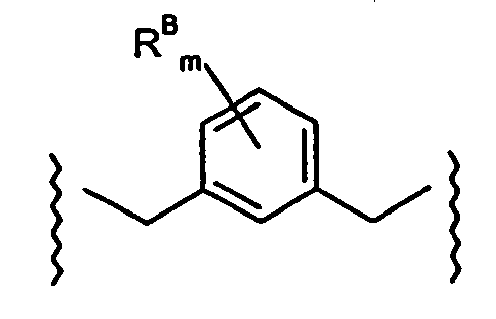
- In one embodiment, Q2 has the following formula (referred to herein as "unsubstituted methylene-phenylene-meta-methylene"):

- In one embodiment, Q2 has the following formula (referred to herein as "ethylene-phenylene-meta/para-methylene"):

- In one embodiment, Q2 has the following formula (referred to herein as "ethylene-phenylene-meta-methylene"):

- In one embodiment, Q2 has the following formula (referred to herein as "unsubstituted ethylene-phenylene-meta-methylene"):

- In one embodiment, Q2 has the following formula (referred to herein as "phenylene-meta/para-trans-ethenylene"):

- In one embodiment, Q2 has the following formula (referred to herein as "unsubstituted phenylene-meta/para-trans-ethenylene"):

- In one embodiment, Q2 has the following formula (referred to herein as "phenylene-meta-trans-ethenylene"):

- In one embodiment, Q2 has the following formula (referred to herein as "unsubstituted phenylene-meta-trans-ethenylene"):

- In one embodiment, Q2 has the following formula (referred to herein as "phenylene-meta/para-ethylene"):

- In one embodiment, Q2 has the following formula (referred to herein as "phenylene-meta-ethylene"):

- In one embodiment, Q2 has the following formula (referred to herein as "unsubstituted phenylene-meta-ethylene"):

- In one embodiment, Q2 has the following formula (referred to herein as "methylene-phenylene-meta/para-trans-ethenylene"):

- In one embodiment, Q2 has the following formula (referred to herein as "unsubstituted methylene-phenylene-meta/para-trans-ethenylene"):

- In one embodiment, Q2 has the following formula (referred to herein as "methylene-phenylene-meta-trans-ethenylene"):

- In one embodiment, Q2 has the following formula (referred to herein as "unsubstituted methylene-phenylene-meta-trans-ethenylene"):

- In one embodiment, Q2 has the following formula (referred to herein as "methylene-phenylene-meta/para-ethylene"):
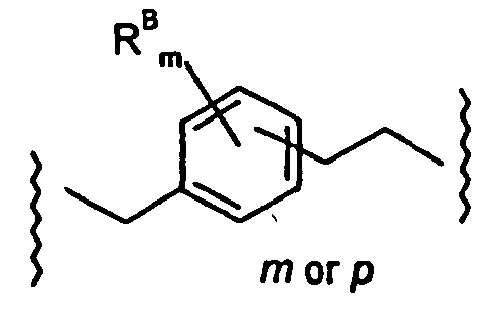
- In one embodiment, Q2 has the following formula (referred to herein as "methylene-phenylene-meta-ethylene"):

- In one embodiment, Q2 has the following formula (referred to herein as "unsubstituted methylene-phenylene-meta-ethylene"):

- In one embodiment, Q2 has the following formula (referred to herein as "ethylene-phenylene-meta/para-trans-ethenylene"):

- In one embodiment, Q2 has the following formula (referred to herein as "ethylene-phenylene-meta-trans-ethenylene"):

- In one embodiment, Q2 has the following formula (referred to herein as "unsubstituted ethylene-phenylene-meta-trans-ethenylene"):

- In one embodiment, Q2 has the following formula (referred to herein as "ethylene-phenylene-meta/para-ethylene"):

- In one embodiment, Q2 has the following formula (referred to herein as "ethylene-phenylene-meta-ethylene"):

- In one embodiment, Q2 has the following formula (referred to herein as "unsubstituted ethylene-phenylene-meta-ethylene"):

- In one embodiment, Q2 additionally has a backbone length as described above under the heading "The Acid Leader Group, Q2: Backbone Length."
- Some individual embodiments of the present invention include the following compounds.
1. 
PX117402 (Ex 140) 2. 
PX117403 (Ex 141) 3. 
PX117404 (Ex 142) 4. 
PX117764 (Ex 143) 5. 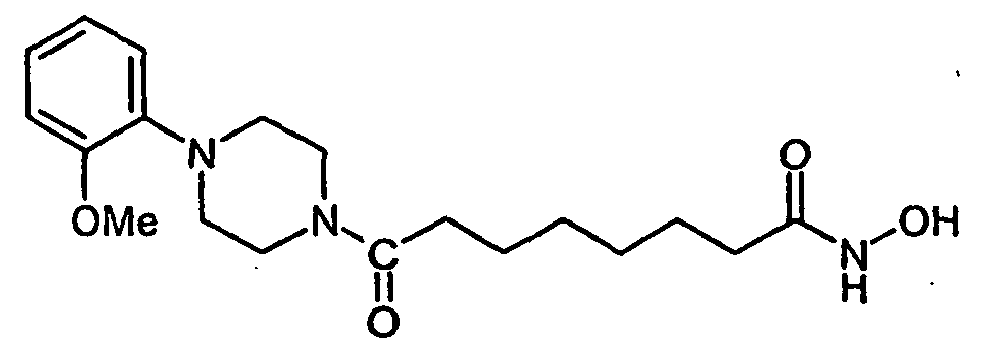
PX117768 (Ex 144) 6. 
PX118490 (Ex 40) 7. 
PX118491 (Ex 41) 8. 
PX118791 (Ex 145) 9. 
PX118792 (Ex 146) 10. 
PX118793 (Ex 147) 11. 
PX118794 (Ex 148) 12. 
PX118807 (Ex 45) 13. 
PX118810 (Ex 42) 14. 
PX118811 (Ex 43) 15. 
PX118812 (Ex 44) 16. 
PX118830 (Ex 149) 17. 
PX118831 (Ex 150) 18. 
PX118832 (Ex 151) 19. 
PX118844 (Ex 163) 20. 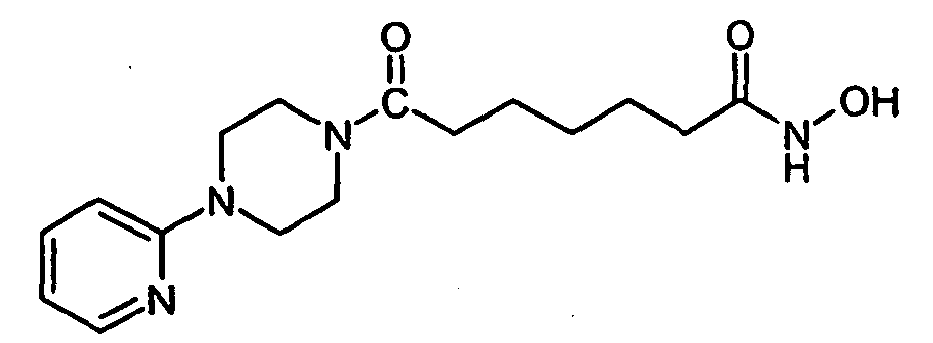
PX118845 (Ex 164) 21. 
PX118846 (Ex 152) 22. 
PX118847 (Ex 153) 23. 
PX118848 (Ex 165) 24. 
PX118849 (Ex 154) 25. 
PX118850 (Ex 166) 26. 
PX118859 (Ex 174) 27. 
PX118860 (Ex 175) 28. 
PX118870 (Ex 52) 29. 
PX118871 (Ex 53) 30. 
PX118872 (Ex 54) 31. 
PX118873 (Ex 55) 32. 
PX118874 (Ex 56) 33. 
PX118875 (Ex 57) 34. 
PX118876 (Ex 58) 35. 
PX118877 (Ex 59) 36. 
PX118878 (Ex 60) 37. 
PX118882 (Ex 72) 38. 
PX118891 (Ex 74) 39. 
PX118892 (Ex 75) 40. 
PX118893 (Ex 61) 41. 
PX118894 (Ex 62) 42. 
PX118898 (Ex 176) 43. 
PX118899 (Ex 177) 44. 
PX118900 (Ex 178) 45. 
PX118901 (Ex 179) 46. 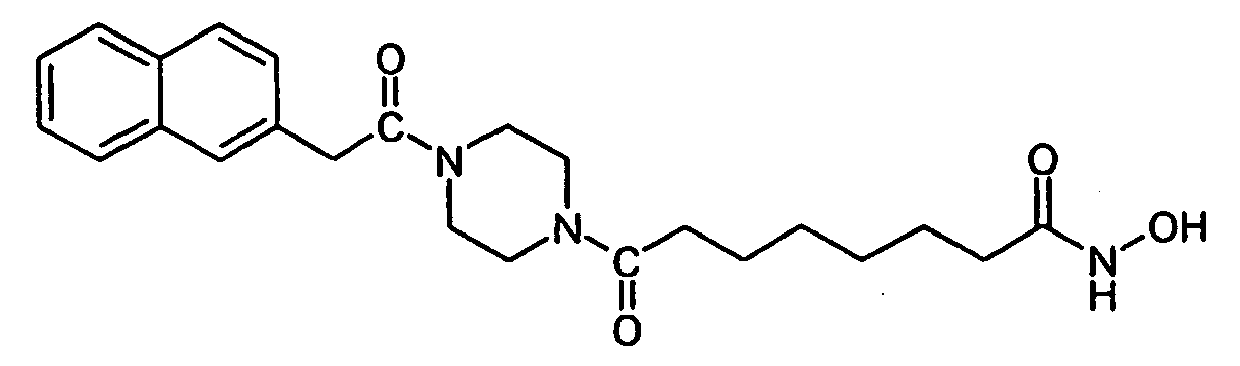
PX118902 (Ex 180) 47. 
PX118903 (Ex 181) 48. 
PX118904 (Ex 182) 49. 
PX118905 (Ex 76) 50. 
PX118906 (Ex 77) 51. 
PX118907 (Ex 78) 52. 
PX118908 (Ex 183) 53. 
PX118909 (Ex 184) 54. 
PX118910 (Ex 79) 55. 
PX118911 (Ex 80) 56. 
PX118913 (Ex 63) 57. 
PX118914 (Ex 64) 58. 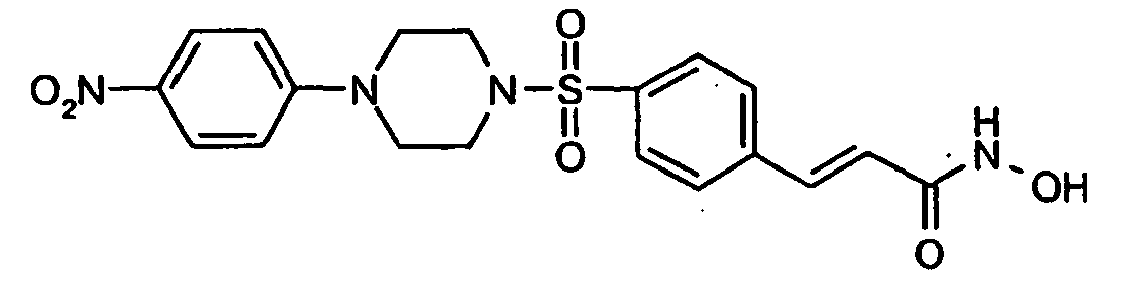
PX118918 (Ex 73) 59. 
PX118927 (Ex 155) 60. 
PX118928 (Ex 167) 61. 
PX118929 (Ex 168) 62. 
PX118930 (Ex 156) 63. 
PX118931 (Ex 157) 64. 
PX118932 (Ex 158) 65. 
PX118933 (Ex 46) 66. 
PX118934 (Ex 48) 67. 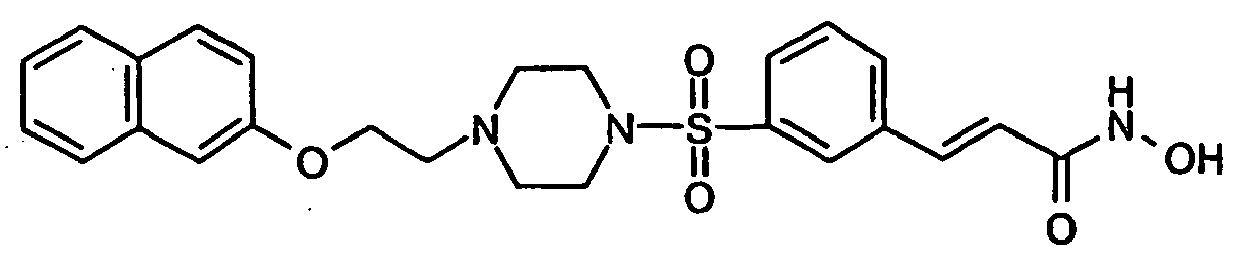
PX118935 (Ex 49) 68. 
PX118937 (Ex 70) 69. 
PX118951 (Ex 47) 70. 
PX118965 (Ex 71) 71. 
PX118967 (Ex 159) 72. 
PX118968 (Ex 169) 73. 
PX118969 (Ex 170) 74. 
PX118970 (Ex 171) 75. 
PX118971 (Ex 50) 76. 
PX118972 (Ex 51) 77. 
PX118978 (Ex 172) 78. 
PX118989 (Ex 160) 79. 
PX118990 (Ex 161) 80. 
PX118991 (Ex 162) 81. 
PX118994 (Ex 173) 82. 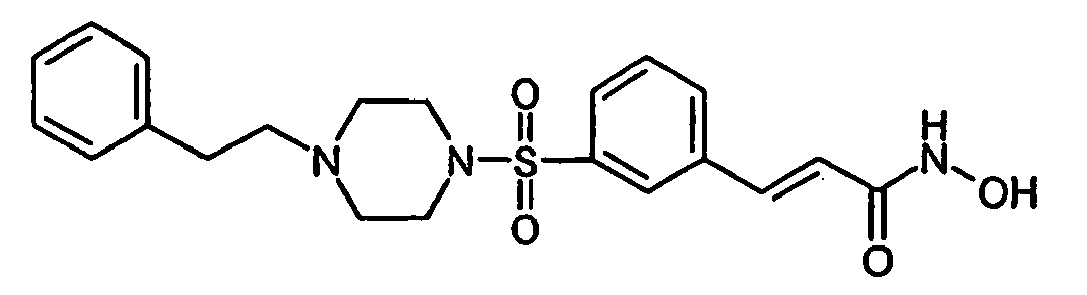
83. 
84. 
85. 
86. 
87. 
88. 
89. 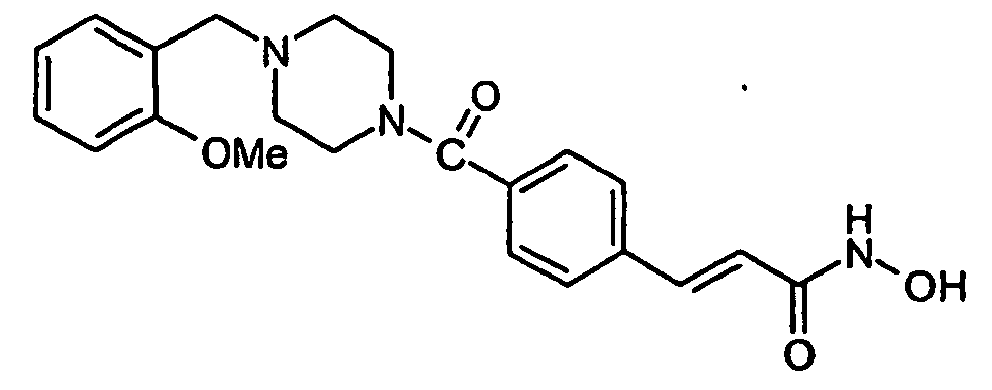
90. 
91. 
92. 
93. 
94. 
95. 
96. 
97. 
98. 
99. 
100. 
Note that, where the above examples are salts (e.g., PX118932, PX118882), other analogous salts may also be prepared. - The term "carbo," "carbyl," "hydrocarbo," and "hydrocarbyl," as used herein, pertain to compounds and/or groups which have only carbon and hydrogen atoms (but see "carbocyclic" below).
- The term "hetero," as used herein, pertains to compounds and/or groups which have at least one heteroatom, for example, multivalent heteroatoms (which are also suitable as ring heteroatoms) such as boron, silicon, nitrogen, phosphorus, oxygen, sulfur, and selenium (more commonly nitrogen, oxygen, and sulfur) and monovalent heteroatoms, such as fluorine, chlorine, bromine, and iodine.
- The term "saturated," as used herein, pertains to compounds and/or groups which do not have any carbon-carbon double bonds or carbon-carbon triple bonds.
- The term "unsaturated," as used herein, pertains to compounds and/or groups which have at least one carbon-carbon double bond or carbon-carbon triple bond.
- The term "aliphatic," as used herein, pertains to compounds and/or groups which are linear or branched, but not cyclic (also known as "acyclic" or "open-chain" groups).
- The term "ring," as used herein, pertains to a closed ring of from 3 to 10 covalently linked atoms, more preferably 3 to 8 covalently linked atoms, yet more preferably 5 to 6 covalently linked atoms. A ring may be an alicyclic ring or an aromatic ring, The term "alicyclic ring," as used herein, pertains to a ring which is not an aromatic ring.
- The term "carbocyclic ring," as used herein, pertains to a ring wherein all of the ring atoms are carbon atoms.
- The term "carboaromatic ring," as used herein, pertains to an aromatic ring wherein all of the ring atoms are carbon atoms.
- The term "heterocyclic ring," as used herein, pertains to a ring wherein at least one of the ring atoms is a multivalent ring heteroatom, for example, nitrogen, phosphorus, silicon, oxygen, or sulfur, though more commonly nitrogen, oxygen, or sulfur. Preferably, the heterocyclic ring has from 1 to 4 heteroatoms.
- The term "cyclic compound," as used herein, pertains to a compound which has at least one ring. The term "cyclyl," as used herein, pertains to a monovalent moiety obtained by removing a hydrogen atom from a ring atom of a cyclic compound.
- Where a cyclic compound has two or more rings, they may be fused (e.g., as in naphthalene), bridged (e.g., as in norbornane), spiro (e.g., as in spiro[3.3]heptane), or a combination thereof. Cyclic compounds with one ring may be referred to as "monocyclic" or "mononuclear," whereas cyclic compounds with two or more rings may be referred to as "polycyclic" or "polynuclear."
- The term "carbocyclic compound," as used herein, pertains to a cyclic compound which has only carbocyclic ring(s).
- The term "heterocyclic compound," as used herein, pertains to a cyclic compound which has at least one heterocyclic ring.
- The term "aromatic compound," as used herein, pertains to a cyclic compound which has at least one aromatic ring.
- The term "carboaromatic compound," as used herein, pertains to a cyclic compound which has only carboaromatic ring(s).
- The term "heteroaromatic compound," as used herein, pertains to a cyclic compound which has at least one heteroaromatic ring.
- The term "monodentate substituents," as used herein, pertains to substituents which have one point of covalent attachment.
- The term "monovalent monodentate substituents," as used herein, pertains to substituents which have one point of covalent attachment, via a single bond. Examples of such substituents include halo, hydroxy, and alkyl.
- The term "multivalent monodentate substituents," as used herein, pertains to substituents which have one point of covalent attachment, but through a double bond or triple bond. Examples of such substituents include oxo, imino, alkylidene, and alklidyne.
- The term "bidentate substituents," as used herein, pertains to substituents which have two points of covalent attachment, and which act as a linking group between two other moieties. Examples of such substituents include alkylene and arylene.
- The phrase "optionally substituted," as used herein, pertains to a parent group which may be unsubstituted or which may be substituted.
- Unless otherwise specified, the term "substituted," as used herein, pertains to a parent group which bears one or more substituents. The term "substituent" is used herein in the conventional sense and refers to a chemical moiety which is covalently attached to, appended to, or if appropriate, fused to, a parent group. A wide variety of substituents are well known, and methods for their formation and introduction into a variety of parent groups are also well known.
- The substituents are described in more detail below.
- Alkyl: The term "alkyl," as used herein, pertains to a monovalent moiety obtained by removing a hydrogen atom from a carbon atom of a hydrocarbon compound having from 1 to 20 carbon atoms (unless otherwise specified), which may be aliphatic or alicyclic, and which may be saturated, partially unsaturated, or fully unsaturated. Thus, the term "alkyl" includes the sub-classes alkenyl, alkynyl, cycloalkyl, etc., discussed below.
- In this context, the prefixes (e.g., C1-4, C1-7, C1-20, C2-7, C3-7, etc.) denote the number of carbon atoms, or range of number of carbon atoms. For example, the term "C1-4alkyl," as used herein, pertains to an alkyl group having from 1 to 4 carbon atoms. Examples of groups of alkyl groups include C1-4alkyl ("lower alkyl"), C1-7alkyl, and C1-20alkyl.
- Examples of (unsubstituted) saturated alkyl groups include, but are not limited to, methyl (C1), ethyl (C2), propyl (C3), butyl (C4), pentyl (C5), hexyl (C6), heptyl (C7), octyl (C8), nonyl (C9), decyl (C10), undecyl (C11), dodecyl (C12), tridecyl (C13), tetradecyl (C14), pentadecyl (C15), and eicodecyl (C20).
- Examples of (unsubstituted) saturated linear alkyl groups include, but are not limited to, methyl (C1), ethyl (C2), n-propyl (C3), n-butyl (C4), n-pentyl (amyl) (C5), n-hexyl (C6), and n-heptyl (C7).
- Examples of (unsubstituted) saturated branched alkyl groups include iso-propyl (C3), iso-butyl (C4), sec-butyl (C4), tert-butyl (C4), iso-pentyl (C5), and neo-pentyl (C5).
- Cycloalkyl: The term "cycloalkyl," as used herein, pertains to an alkyl group which is also a cyclyl group; that is, a monovalent moiety obtained by removing a hydrogen atom from an alicyclic ring atom of a cyclic hydrocarbon (carbocyclic) compound, which moiety has from 3 to 20 ring atoms (unless otherwise specified). Preferably, each ring has from 3 to 7 ring atoms.
- Examples of (unsubstituted) saturated cylcoalkyl groups include, but are not limited to, those derived from: cyclopropane (C3), cyclobutane (C4), cyclopentane (C5), cyclohexane (C6), cycloheptane (C7), norbomane (C7), norpinane (C7), norcarane (C7), adamantane (C10), and decalin (decahydronaphthalene) (C10).
- Examples of (substituted) saturated cycloalkyl groups, which are also referred to herein as "alkyl-cycloalkyl" groups, include, but are not limited to, methylcyclopropyl, dimethylcyclopropyl, methylcyclobutyl, dimethylcyclobutyl, methylcyclopentyl, dimethylcyclopentyl, methylcyclohexyl, and dimethylcyclohexyl, menthane, thujane, carane, pinane, bornane, norcarane, and camphene.
- Examples of (substituted) unsaturated cyclic alkenyl groups, which are also referred to herein as "alkyl-cycloalkenyl" groups, include, but are not limited to, methylcyclopropenyl, dimethylcyclopropenyl, methylcyclobutenyl, dimethylcyclobutenyl, methylcyclopentenyl, dimethylcyclopentenyl, methylcyclohexenyl, and dimethylcyclohexenyl.
- Examples of (substituted) cycloalkyl groups, with one or more other rings fused to the parent cycloalkyl group, include, but are not limited to, those derived from: indene (C9), indan (e.g., 2,3-dihydro-1H-indene) (C9), tetraline (1,2,3,4-tetrahydronaphthalene (C10), acenaphthene (C12), fluorene (C13), phenalene (C13), acephenanthrene (C15), aceanthrene (C16). For example, 2H-inden-2-yl is a C5cycloalkyl group with a substituent (phenyl) fused thereto.
- Alkenyl: The term "alkenyl," as used herein, pertains to an alkyl group having one or more carbon-carbon double bonds. Examples of groups of alkenyl groups include C2-4alkenyl, C2-7alkenyl, C2-20alkenyl.
- Examples of (unsubstituted) unsaturated alkenyl groups include, but are not limited to, ethenyl (vinyl, -CH=CH2), 1-propenyl (-CH=CH-CH3), 2-propenyl (allyl, -CH-CH=CH2), isopropenyl (-C(CH3)=CH2), butenyl (C4), pentenyl (C5), and hexenyl (C6).
- Examples of (unsubstituted) unsaturated cyclic alkenyl groups, which are also referred to herein as "cycloalkenyl" groups, include, but are not limited to, cyclopropenyl (C3), cyclobutenyl (C4), cyclopentenyl (C5), and cyclohexenyl (C6).
- Alkynyl: The term "alkynyl," as used herein, pertains to an alkyl group having one or more carbon-carbon triple bonds. Examples of groups of alkynyl groups include C2-4alkynyl, C2-7alkynyl, C2-20alkynyl.
- Examples of (unsubstituted) unsaturated alkynyl groups include, but are not limited to, ethynyl (ethinyl, -C=CH) and 2-propynyl (propargyl, -CH2-C≡CH).
- Alkylidene: The term "alkylidene," as used herein, pertains to a divalent monodentate moiety obtained by removing two hydrogen atoms from a carbon atom of a hydrocarbon compound having from 1 to 20 carbon atoms (unless otherwise specified), which may be aliphatic or alicyclic, or a combination thereof, and which may be saturated, partially unsaturated, or fully unsaturated. Examples of groups of alkylidene groups include C1-4alkylidene, C1-7alkylidene, C1-20alkylidene.
- Examples of alkylidene groups include, but are not limited to, methylidene (=CH2), ethylidene (=CH-CH3), vinylidene (=C=CH2), and isopropylidene (=C(CH3)2). An example of a substituted alkylidene is benzylidene (=CH-Ph).
- Alkylidyne: The term "alkylidyne," as used herein, pertains to a trivalent monodentate moiety obtained by removing three hydrogen atoms from a carbon atom of a hydrocarbon compound having from 1 to 20 carbon atoms (unless otherwise specified), which may be aliphatic or alicyclic, or a combination thereof, and which may be saturated, partially unsaturated, or fully unsaturated. Examples of groups of alkylidyne groups include C1-4alkylidyne, C1-7alkylidyne, C1-20alkylidyne.
- Examples of alkylidyne groups include, but are not limited to, methylidyne (≡CH) and ethylidyne (≡C-CH3).
- Carbocyclyl: The term "carbocyclyl," as used herein, pertains to a monovalent moiety obtained by removing a hydrogen atom from a ring atom of a carbocyclic compound, which moiety has from 3 to 20 ring atoms (unless otherwise specified). Preferably, each ring has from 3 to 7 ring atoms.
- In this context, the prefixes (e.g., C3-20, C3-7, C5-6, etc.) denote the number of ring atoms, or range of number of ring atoms. For example, the term "C5-6carbocyclyl," as used herein, pertains to a carbocyclyl group having 5 or 6 ring atoms. Examples of groups of carbocyclyl groups include C3-20carbocyclyl, C3-10carbocyclyl, C5-10carbocyclyl, C3-7carbocyclyl, and C5-7carbocyclyl.
- Examples of carbocyclic groups include, but are not limited to, those described above as cycloalkyl groups; and those described below as carboaryl groups.
- Heterocyclyl: The term "heterocyclyl," as used herein, pertains to a monovalent moiety obtained by removing a hydrogen atom from a ring atom of a heterocyclic compound, which moiety has from 3 to 20 ring atoms (unless otherwise specified), of which from 1 to 10 are ring heteroatoms. Preferably, each ring has from 3 to 7 ring atoms, of which from 1 to 4 are ring heteroatoms.
- In this context, the prefixes (e.g., C3-20, C3-7, C5-6, etc.) denote the number of ring atoms, or range of number of ring atoms, whether carbon atoms or heteroatoms. For example, the term "C5-6heterocyclyl," as used herein, pertains to a heterocyclyl group having 5 or 6 ring atoms. Examples of groups of heterocyclyl groups include C3-20heterocyclyl, C3-7heterocyclyl, C5-7heterocyclyl, and C5-6heterocyclyl.
- Examples of (non-aromatic) monocyclic heterocyclyl groups include, but are not limited to, those derived from:
- N1: aziridine (C3), azetidine (C4), pyrrolidine (tetrahydropyrrole) (C5), pyrroline (e.g., 3-pyrroline, 2,5-dihydropyrrole) (C5), 2H-pyrrole or 3H-pyrrole (isopyrrole, isoazole) (C5), piperidine (C6), dihydropyridine (C6), tetrahydropyridine (C6), azepine (C7);
- O1: oxirane (C3), oxetane (C4), oxolane (tetrahydrofuran) (C5), oxole (dihydrofuran) (C5), oxane (tetrahydropyran) (C6), dihydropyran (C6), pyran (C6), oxepin (C7);
- S1: thiirane (C3), thietane (C4), thiolane (tetrahydrothiophene) (C5), thiane (tetrahydrothiopyran) (C6), thiepane (C7);
- O2: dioxolane (C5), dioxane (C6), and dioxepane (C7);
- O3: trioxane (C6);
- N2: imidazolidine (C5), pyrazolidine (diazolidine) (C5), imidazoline (C5), pyrazoline (dihydropyrazole) (C5), piperazine (C6);
- N1O1: tetrahydrooxazole (C5), dihydrooxazole (C5), tetrahydroisoxazole (C5), dihydroisoxazole (C5), morpholine (C6), tetrahydrooxazine (C6), dihydrooxazine (C6), oxazine (C6);
- N1S1: thiazoline (C5), thiazolidine (C5), thiomorpholine (C6);
- N2O1: oxadiazine (C6);
- O1S1: oxathiole (C5) and oxathiane (thioxane) (C6); and,
- N1O1S1: oxathiazine (C6).
- Examples of substituted (non-aromatic) monocyclic heterocyclyl groups include saccharides, in cyclic form, for example, furanoses (C5), such as arabinofuranose, lyxofuranose, ribofuranose, and xylofuranse, and pyranoses (C6), such as allopyranose, altropyranose, glucopyranose, mannopyranose, gulopyranose, idopyranose, galactopyranose, and talopyranose.
- Examples of heterocyclyl groups which are also heteroaryl groups are described below with aryl groups.
- Aryl: The term "aryl," as used herein, pertains to a monovalent moiety obtained by removing a hydrogen atom from an aromatic ring atom of an aromatic compound, which moiety has from 3 to 20 ring atoms (unless otherwise specified). Preferably, each ring has from 5 to 7 ring atoms.
- In this context, the prefixes (e.g., C3-20, C5-7, C5-6, etc.) denote the number of ring atoms, or range of number of ring atoms, whether carbon atoms or heteroatoms. For example, the term "C5-6aryl," as used herein, pertains to an aryl group having 5 or 6 ring atoms. Examples of groups of aryl groups include C3-20aryl, C3-12aryl, C5-12aryl, C5-7aryl, and C5-6aryl.
- The ring atoms may be all carbon atoms, as in "carboaryl groups" (e.g., C5-20carboaryl).
- Examples of carboaryl groups include, but are not limited to, those derived from benzene (i.e., phenyl) (C6), naphthalene (C10), azulene (C10), anthracene (C14), phenanthrene (C14), naphthacene (C18), and pyrene (C16).
- Examples of aryl groups which comprise fused rings, at least one of which is an aromatic ring, include, but are not limited to, groups derived from indene (C9), isoindene (C9), and fluorene (C13).
- Alternatively, the ring atoms may include one or more heteroatoms, as in "heteroaryl groups" (e.g., C5-20heteroaryl).
- Examples of monocyclic heteroaryl groups include, but are not limited to, those derived from:
- N1: pyrrole (azole) (C5), pyridine (azine) (C6);
- O1: furan (oxole) (C5);
- S1: thiophene (thiole) (C5);
- N1O1: oxazole (C5), isoxazole (C5), isoxazine (C6);
- N2O1: oxadiazole (furazan) (C5);
- N3O1: oxatriazole (C5);
- N1S1: thiazole (C5), isothiazole (C5);
- N2: imidazole (1,3-diazole) (C5), pyrazole (1,2-diazole) (C5), pyridazine (1,2-diazine) (C6), pyrimidine (1,3-diazine) (C6) (e.g., cytosine, thymine, uracil), pyrazine (1,4-diazine) (C6);
- N3: triazole (C5), triazine (C6); and,
- N4: tetrazole (C5).
- Examples of heterocyclic groups (some of which are also heteroaryl groups) which comprise fused rings, include, but are not limited to:
- C9heterocyclic groups (with 2 fused rings) derived from benzofuran (O1), isobenzofuran (O1), indole (N1), isoindole (N1), indolizine (N1), indoline (N1), isoindoline (N1), purine (N4) (e.g., adenine, guanine), benzimidazole (N2), indazole (N2), benzoxazole (N1O1), benzisoxazole (N1O1), benzodioxole (O2), benzofurazan (N2O1), benzotriazole (N3), benzothiofuran (S1), benzothiazole (N1S1), benzothiadiazole (N2S);
- C10heterocyclic groups (with 2 fused rings) derived from chromene (O1), isochromene (O1), chroman (O1), isochroman (O1), benzodioxan (O2), quinoline (N1), isoquinoline (N1), quinolizine (N1), benzoxazine (N1O1), benzodiazine (N2), pyridopyridine (N2), quinoxaline (N2), quinazoline (N2), cinnoline (N2), phthalazine (N2), naphthyridine (N2), pteridine (N4);
- C13heterocyclic groups (with 3 fused rings) derived from carbazole (N1), dibenzofuran (O1), dibenzothiophene (S1), carboline (N2), perimidine (N2), pyridoindole (N2); and,
- C14heterocyclic groups (with 3 fused rings) derived from acridine (N1), xanthene (O1), thioxanthene (S1), oxanthrene (O2), phenoxathiin (O1S1), phenazine (N2), phenoxazine (N1O1), phenothiazine (N1S1), thianthrene (S2), phenanthridine (N1), phenanthroline (N2), phenazine (N2).
- Heterocyclic groups (including heteroaryl groups) which have a nitrogen ring atom in the form of an -NH- group may be N-substituted, that is, as -NR-. For example, pyrrole may be N-methyl substituted, to give N-methypyrrole. Examples of N-substituents include, but are not limited to C1-7alkyl, C3-20heterocyclyl, C5-20aryl, and acyl groups. Heterocyclic groups (including heteroaryl groups) which have a nitrogen ring atom in the form of an -N= group may be substituted in the form of an N-oxide, that is, as -N(→O)= (also denoted -N+(→O-)=). For example, quinoline may be substituted to give quinoline N-oxide; pyridine to give pyridine N-oxide; benzofurazan to give benzofurazan N-oxide (also known as benzofuroxan).
- Cyclic groups may additionally bear one or more oxo (=O) groups on ring carbon atoms. Monocyclic examples of such groups include, but are not limited to, those derived from:
- C5: cyclopentanone, cyclopentenone, cyclopentadienone;
- C6: cyclohexanone, cyclohexenone, cyclohexadienone;
- O1: furanone (C5), pyrone (C6);
- N1: pyrrolidone (pyrrolidinone) (C5), piperidinone (piperidone) (C6), piperidinedione (C6); N2: imidazolidone (imidazolidinone) (C5), pyrazolone (pyrazolinone) (C5), piperazinone (C6), piperazinedione (C6), pyridazinone (C6), pyrimidinone (C6) (e.g., cytosine), pyrimidinedione (C6) (e.g., thymine, uracil), barbituric acid (C6);
- N1S1: thiazolone (C5), isothiazolone (C5);
- N1O1: oxazolinone (C5).
- Polycyclic examples of such groups include, but are not limited to, those derived from:
- C9: indenedione;
- C10: tetralone, decalone;
- C14: anthrone, phenanthrone;
- N1: oxindole (C9);
- O1: benzopyrone (e.g., coumarin, isocoumarin, chromone) (C10);
- N1O1: benzoxazolinone (C9), benzoxazolinone (C10);
- N2: quinazolinedione (C10);
- N4: purinone (C9) (e.g., guanine).
- Still more examples of cyclic groups which bear one or more oxo (=O) groups on ring carbon atoms include, but are not limited to, those derived from:
- cyclic anhydrides (-C(=O)-O-C(=O)- in a ring), including but not limited to maleic anhydride (C5), succinic anhydride (C5), and glutaric anhydride (C6);
- cyclic carbonates (-O-C(=O)-O- in a ring), such as ethylene carbonate (C5) and 1,2-propylene carbonate (C5);
- imides (-C(=O)-NR-C(=O)- in a ring), including but not limited to, succinimide (C5), maleimide (C5), phthalimide, and glutarimide (C6);
- lactones (cyclic esters, -O-C(=O)- in a ring), including, but not limited to, β-propiolactone, γ-butyrolactone, δ-valerolactone (2-piperidone), and ε-caprolactone;
- lactams (cyclic amides, -NR-C(=O)- in a ring), including, but not limited to, β-propiolactam (C4), γ-butyrolactam (2-pyrrolidone) (C5), δ-valerolactam (C6), and ε-caprolactam (C7);
- cyclic carbamates (-O-C(=O)-NR- in a ring), such as 2-oxazolidone (C5);
- cyclic ureas (-NR-C(=O)-NR- in a ring), such as 2-imidazolidone (C5) and pyrimidine-2,4-dione (e.g., thymine, uracil) (C6).
- The above alkyl, alkylidene, alkylidyne, heterocyclyl, and aryl groups, whether alone or part of another substituent, may themselves optionally be substituted with one or more groups selected from themselves and the additional substituents listed below.
- Hydrogen: -H. Note that if the substituent at a particular position is hydrogen, it may be convenient to refer to the compound as being "unsubstituted" at that position.
- Halo: -F, -Cl, -Br, and -I.
- Hydroxy: -OH.
- Ether: -OR, wherein R is an ether substituent, for example, a C1-7alkyl group (also referred to as a C1-7alkoxy group, discussed below), a C3-20heterocyclyl group (also referred to as a C3-20heterocyclyloxy group); or a C5-20aryl group (also referred to as a C5-20aryloxy group), preferably a C1-7alkyl group.
- C1-7alkoxy: -OR, wherein R is a C1-7alkyl group. Examples of C1-7alkoxy groups include, but are not limited to, -OMe (methoxy), -OEt (ethoxy), -O(nPr) (n-propoxy), -O(iPr) (isopropoxy), -O(nBu) (n-butoxy), -O(sBu) (sec-butoxy), -O(iBu) (isobutoxy), and -O(tBu) (tert-butoxy).
- Acetal: -CH(OR1)(OR2), wherein R1 and R2 are independently acetal substituents, for example, a C1-7alkyl group, a C3-20heterocyclyl group, or a C5-20aryl group, preferably a C1-7alkyl group, or, in the case of a "cyclic" acetal group, R1 and R2, taken together with the two oxygen atoms to which they are attached, and the carbon atoms to which they are attached, form a heterocyclic ring having from 4 to 8 ring atoms. Examples of acetal groups include, but are not limited to, -CH(OMe)2, -CH(OEt)2, and -CH(OMe)(OEt).
- Hemiacetal: -CH(OH)(OR1), wherein R1 is a hemiacetal substituent, for example, a C1-7alkyl group, a C3-20heterocyclyl group, or a C5-20aryl group, preferably a C1-7alkyl group. Examples of hemiacetal groups include, but are not limited to, -CH(OH)(OMe) and -CH(OH)(OEt).
- Ketal: -CR(OR1)(OR2), where R1 and R2 are as defined for acetals, and R is a ketal substituent other than hydrogen, for example, a C1-7alkyl group, a C3-20heterocyclyl group, or a C5-20aryl group, preferably a C1-7alkyl group. Examples ketal groups include, but are not limited to, -C(Me)(OMe)2, -C(Me)(OEt)2, -C(Me)(OMe)(OEt), -C(Et)(OMe)2, -C(Et)(OEt)2, and -C(Et)(OMe)(OEt).
- Hemiketal: -CR(OH)(OR1), where R1 is as defined for hemiacetals, and R is a hemiketal substituent other than hydrogen, for example, a C1-7alkyl group, a C3-20heterocyclyl group, or a C5-20aryl group, preferably a C1-7alkyl group. Examples of hemiacetal groups include, but are not limited to, -C(Me)(OH)(OMe), -C(Et)(OH)(OMe), -C(Me)(OH)(OEt), and -C(Et)(OH)(OEt).
- Oxo (keto, -one): =O.
- Thione (thioketone): =S.
- Imino (imine): =NR, wherein R is an imino substituent, for example, hydrogen, C1-7alkyl group, a C3-20heterocyclyl group, or a C5-20aryl group, preferably hydrogen or a C1-7alkyl group. Examples of ester groups include, but are not limited to, =NH, =NMe, =NEt, and =NPh.
- Formyl (carbaldehyde, carboxaldehyde): -C(=O)H.
- Acyl (keto): -C(=O)R, wherein R is an acyl substituent, for example, a C1-7alkyl group (also referred to as C1-7alkylacyl or C1-7alkanoyl), a C3-20heterocyclyl group (also referred to as C3-20heterocyclylacyl), or a C5-20aryl group (also referred to as C5-20arylacyl), preferably a C1-7alkyl group. Examples of acyl groups include, but are not limited to, -C(=O)CH3 (acetyl), -C(=O)CH2CH3 (propionyl), -C(=O)C(CH3)3 (t-butyryl), and -C(=O)Ph (benzoyl, phenone).
- Acylhalide (haloformyl, halocarbonyl): -C(=O)X, wherein X is -F, -Cl, -Br, or -I, preferably -Cl, -Br, or -I.
- Carboxy (carboxylic acid): -C(=O)OH.
- Thiocarboxy (thiocarboxylic acid): -C(=S)SH.
- Thiolocarboxy (thiolocarboxylic acid): -C(=O)SH.
- Thionocarboxy (thionocarboxylic acid): -C(=S)OH.
- Imidic acid: -C(=NH)OH.
- Hydroxamic acid: -C(=NOH)OH.
- Ester (carboxylate, carboxylic acid ester, oxycarbonyl): -C(=O)OR, wherein R is an ester substituent, for example, a C1-7alkyl group, a C3-20heterocyclyl group, or a C5-20aryl group, preferably a C1-7alkyl group. Examples of ester groups include, but are not limited to, -C(=O)OCH3, -C(=O)OCH2CH3, -C(=O)OC(CH3)3, and -C(=O)OPh.
- Acyloxy (reverse ester): -OC(=O)R, wherein R is an acyloxy substituent, for example, a C1-7alkyl group, a C3-20heterocyclyl group, or a C5-20aryl group, preferably a C1-7alkyl group. Examples of acyloxy groups include, but are not limited to, -OC(=O)CH3 (acetoxy), -OC(=O)CH2CH3, -OC(=O)C(CH3)3, -OC(=O)Ph, and -OC(=O)CH2Ph.
- Oxycarboyloxy: -OC(=O)OR, wherein R is an ester substituent, for example, a C1-7alkyl group, a C3-20heterocyclyl group, or a C5-20aryl group, preferably a C1-7alkyl group. Examples of ester groups include, but are not limited to, -OC(=O)OCH3, -OC(=O)OCH2CH3, -OC(=O)OC(CH3)3, and -OC(=O)OPh.
- Amido (carbamoyl, carbamyl, aminocarbonyl, carboxamide): -C(=O)NR1R2, wherein R1 and R2 are independently amino substituents, as defined for amino groups. Examples of amido groups include, but are not limited to, -C(=O)NH2, -C(=O)NHCH3, -C(=O)N(CH3)2, -C(=O)NHCH2CH3, and -C(=O)N(CH2CH3)2, as well as amido groups in which R1 and R2, together with the nitrogen atom to which they are attached, form a heterocyclic structure as in, for example, piperidinocarbonyl, morpholinocarbonyl, thiomorpholinocarbonyl, and piperazinocarbonyl.
- Acylamido (acylamino): -NR1C(=O)R2, wherein R1 is an amide substituent, for example, hydrogen, a C1-7alkyl group, a C3-20heterocyclyl group, or a C5-20aryl group, preferably hydrogen or a C1-7alkyl group, and R2 is an acyl substituent, for example, a C1-7alkyl group, a C3-20heterocyclyl group, or a C5-20aryl group, preferably hydrogen or a C1-7alkyl group. Examples of acylamide groups include, but are not limited to, -NHC(=O)CH3, -NHC(=O)CH2CH3, and -NHC(=O)Ph. R1 and R2 may together form a cyclic structure, as in, for example, succinimidyl, maleimidyl, and phthalimidyl:

- Aminocarbonyloxy: -OC(=O)NR1R2, wherein R1 and R2 are independently amino substituents, as defined for amino groups. Examples of aminocarbonyloxy groups include, but are not limited to, -OC(=O)NH2, -OC(=O)NHMe, -OC(=O)NMe2, and -OC(=O)NEt2.
- Thioamido (thiocarbamyl): -C(=S)NR1R2, wherein R1 and R2 are independently amino substituents, as defined for amino groups. Examples of amido groups include, but are not limited to, -C(=S)NH2, -C(=S)NHCH3, -C(=S)N(CH3)2, and -C(=S)NHCH2CH3.
- Ureido: -N(R1)CONR2R3 wherein R2 and R3 are independently amino substituents, as defined for amino groups, and R1 is a ureido substituent, for example, hydrogen, a C1-7alkyl group, a C3-20heterocyclyl group, or a C5-20aryl group, preferably hydrogen or a C1-7alkyl group. Examples of ureido groups include, but are not limited to, -NHCONH2, -NHCONHMe, -NHCONHEt, -NHCONMe2, -NHCONEt2, -NMeCONH2, -NMeCONHMe, -NMeCONHEt, -NMeCONMe2, and -NMeCONEt2.
- Guanidino: -NH-C(=NH)NH2.
- Tetrazolyl: a five membered aromatic ring having four nitrogen atoms and one carbon atom,

- Amino: -NR1R2, wherein R1 and R2 are independently amino substituents, for example, hydrogen, a C1-7alkyl group (also referred to as C1-7alkylamino or di-C1-7alkylamino), a C3-20heterocyclyl group, or a C5-20aryl group, preferably H or a C1-7alkyl group, or, in the case of a "cyclic" amino group, R1 and R2, taken together with the nitrogen atom to which they are attached, form a heterocyclic ring having from 4 to 8 ring atoms. Amino groups may be primary (-NH2), secondary (-NHR1), or tertiary (-NHR1R2), and in cationic form, may be quaternary (-+NR1R2R3). Examples of amino groups include, but are not limited to, -NH2, -NHCH3, -NHC(CH3)2, -N(CH3)2, -N(CH2CH3)2, and -NHPh. Examples of cyclic amino groups include, but are not limited to, aziridino, azetidino, pyrrolidino, piperidino, piperazino, morpholino, and thiomorpholino.
- Imino: =NR, wherein R is an imino substituent, for example, for example, hydrogen, a C1-7alkyl group, a C3-20heterocyclyl group, or a C5-20aryl group, preferably H or a C1-7alkyl group. Examples of imino groups include, but are not limited to, =NH, =NMe, and =NEt.
- Amidine (amidino): -C(=NR)NR2, wherein each R is an amidine substituent, for example, hydrogen, a C1-7alkyl group, a C3-20heterocyclyl group, or a C5-20aryl group, preferably H or a C1-7alkyl group. Examples of amidine groups include, but are not limited to, -C(=NH)NH2, -C(=NH)NMe2, and -C(=NMe)NMe2.
- Nitro: -NO2.
- Cyano (nitrile, carbonitrile): -CN.
- Isocyano: -NC.
- Cyanato: -OCN.
- Isocyanato: -NCO.
- Isothiocyano (isothiocyanato): -NCS.
- Sulfhydryl (thiol, mercapto): -SH.
- Thioether (sulfide): -SR, wherein R is a thioether substituent, for example, a C1-7alkyl group (also referred to as a C1-7alkylthio group), a C3-20heterocyclyl group, or a C5-20aryl group, preferably a C1-7alkyl group. Examples of C1-7alkylthio groups include, but are not limited to, -SCH3 and -SCH2CH3.
- Disulfide: -SS-R, wherein R is a disulfide substituent, for example, a C1-7alkyl group, a C3-20heterocyclyl group, or a C5-20aryl group, preferably a C1-7alkyl group (also referred to herein as C1-7alkyl disulfide). Examples of C1-7alkyl disulfide groups include, but are not limited to, -SSCH3 and -SSCH2CH3.
- Sulfine (sulfinyl, sulfoxide): -S(=O)R, wherein R is a sulfine substituent, for example, a C1-7alkyl group, a C3-20heterocyclyl group, or a C5-20aryl group, preferably a C1-7alkyl group. Examples of sulfine groups include, but are not limited to, -S(=O)CH3 and -S(=O)CH2CH3.
- Sulfone (sulfonyl): -S(=O)2R, wherein R is a sulfone substituent, for example, a C1-7alkyl group, a C3-20heterocyclyl group, or a C5-20aryl group, preferably a C1-7alkyl group, including, for example, a fluorinated or perfluorinated C1-7alkyl group. Examples of sulfone groups include, but are not limited to, -S(=O)2CH3 (methanesulfonyl, mesyl), -S(=O)2CF3 (triflyl), -S(=O)2CH2CH3 (esyl), -S(=O)2C4F9 (nonaflyl), -S(=O)2CH2CF3 (tresyl), -S(=O)2CH2CH2NH2 (tauryl), -S(=O)2Ph (phenylsulfonyl, besyl), 4-methylphenylsulfonyl (tosyl), 4-chlorophenylsulfonyl (closyl), 4-bromophenylsulfonyl (brosyl), 4-nitrophenyl (nosyl), 2-naphthalenesulfonate (napsyl), and 5-dimethylamino-naphthalen-1-ylsulfonate (dansyl).
- Sulfinic acid (sulfino): -S(=O)OH, -SO2H.
- Sulfonic acid (sulfo): -S(=O)2OH, -SO3H.
- Sulfinate (sulfinic acid ester): -S(=O)OR; wherein R is a sulfinate substituent, for example, a C1-7alkyl group, a C3-20heterocyclyl group, or a C5-20aryl group, preferably a C1-7alkyl group. Examples of sulfinate groups include, but are not limited to, -S(=O)OCH3 (methoxysulfinyl; methyl sulfinate) and -S(=O)OCH2CH3 (ethoxysulfinyl; ethyl sulfinate).
- Sulfonate (sulfonic acid ester): -S(=O)2OR, wherein R is a sulfonate substituent, for example, a C1-7alkyl group, a C3-20heterocyclyl group, or a C5-20aryl group, preferably a C1-7alkyl group. Examples of sulfonate groups include, but are not limited to, -S(=O)2OCH3 (methoxysulfonyl; methyl sulfonate) and -S(=O)2OCH2CH3 (ethoxysulfonyl; ethyl sulfonate).
- Sulfinyloxy: -OS(=O)R, wherein R is a sulfinyloxy substituent, for example, a C1-7alkyl group, a C3-20heterocyclyl group, or a C5-20aryl group, preferably a C1-7alkyl group. Examples of sulfinyloxy groups include, but are not limited to, -OS(=O)CH3 and -OS(=O)CH2CH3.
- Sulfonyloxy: -OS(=O)2R, wherein R is a sulfonyloxy substituent, for example, a C1-7alkyl group, a C3-20heterocyclyl group, or a C5-20aryl group, preferably a C1-7alkyl group. Examples of sulfonyloxy groups include, but are not limited to, -OS(=O)2CH3 (mesylate) and -OS(=O)2CH2CH3 (esylate).
- Sulfate: -OS(=O)2OR; wherein R is a sulfate substituent, for example, a C1-7alkyl group, a C3-20heterocyclyl group, or a C5-20aryl group, preferably a C1-7alkyl group. Examples of sulfate groups include, but are not limited to, -OS(=O)2OCH3 and -SO(=O)2OCH2CH3.
- Sulfamyl (sulfamoyl; sulfinic acid amide; sulfinamide): -S(=O)NR1R2, wherein R1 and R2 are independently amino substituents, as defined for amino groups. Examples of sulfamyl groups include, but are not limited to, -S(=O)NH2, -S(=O)NH(CH3), -S(=O)N(CH3)2, -S(=O)NH(CH2CH3), -S(=O)N(CH2CH3)2, and -S(=O)NHPh.
- Sulfonamido (sulfinamoyl; sulfonic acid amide; sulfonamide): -S(=O)2NR1R2, wherein R1 and R2 are independently amino substituents, as defined for amino groups. Examples of sulfonamido groups include, but are not limited to, -S(=O)2NH2, -S(=O)2NH(CH3), -S(=O)2N(CH3)2, -S(=O)2NH(CH2CH3), -S(=O)2N(CH2CH3)2, and -S(=O)2NHPh.
- Sulfamino: -NR1S(=O)2OH, wherein R1 is an amino substituent, as defined for amino groups. Examples of sulfamino groups include, but are not limited to, -NHS(=O)2OH and -N(CH3)S(=O)2OH.
- Sulfonamino: -NR1S(=O)2R, wherein R1 is an amino substituent, as defined for amino groups, and R is a sulfonamino substituent, for example, a C1-7alkyl group, a C3-20heterocyclyl group, or a C5-20aryl group, preferably a C1-7alkyl group. Examples of sulfonamino groups include, but are not limited to, -NHS(=O)2CH3 and -N(CH3)S(=O)2C6H5.
- Sulfinamino: -NR1S(=O)R, wherein R1 is an amino substituent, as defined for amino groups, and R is a sulfinamino substituent, for example, a C1-7alkyl group, a C3-20 heterocyclyl group, or a C5-20aryl group, preferably a C1-7alkyl group. Examples of sulfinamino groups include, but are not limited to, -NHS(=O)CH3 and -N(CH3)S(=O)C6H5.
- In many cases, substituents may themselves be substituted. For example, a C1-7alkyl group may be substituted with, for example, hydroxy (also referred to as a C1-7hydroxyalkyl group), C1-7alkoxy (also referred to as a C1-7alkoxyalkyl group), amino (also referred to as a C1-7aminoalkyl group), halo (also referred to as a C1-7haloalkyl group), carboxy (also referred to as a C1-7carboxyalkyl group), and C5-20aryl (also referred to as a C5-20aryl-C1-7alkyl group).
- Similarly, a C5-20aryl group may be substituted with, for example, hydroxy (also referred to as a C5-20hydroxyaryl group), halo (also referred to as a C5-20haloaryl group), amino (also referred to as a C5-20aminoaryl group, e.g., as in aniline), C1-7alkyl (also referred to as a C1-7alkyl-C5-20aryl group, e.g., as in toluene), and C1-7alkoxy (also referred to as a C1-7alkoxy-C5-20aryl group, e.g., as in anisole).
- These and other specific examples of such substituted-substituents are described below.
- C1-7haloalkyl group: The term "C1-7haloalkyl group," as used herein, pertains to a C1-7alkyl group in which at least one hydrogen atom (e.g., 1, 2, 3) has been replaced with a halogen atom (e.g., F, Cl, Br, I). If more than one hydrogen atom has been replaced with a halogen atom, the halogen atoms may independently be the same or different. Every hydrogen atom may be replaced with a halogen atom, in which case the group may conveniently be referred to as a C1-7perhaloalkyl group." Examples of C1-7haloalkyl groups include, but are not limited to, -CF3, -CHF2, -CH2F, -CCl3, -CBr3, -CH2CH2F, -CH2CHF2, and -CH2CF3.
- C1-7haloalkoxy: -OR, wherein R is a C1-7haloalkyl group. Examples of C1-7haloalkoxy groups include, but are not limited to, -OCF3, -OCHF2, -OCH2F, -OCCl3, -OCBr3, -OCH2CH2F, -OCH2CHF2, and -OCH2CF3.
- C1-7hydroxyalkyl: The term "C1-7hydroxyalkyl group," as used herein, pertains to a C1-7alkyl group in which at least one hydrogen atom has been replaced with a hydroxy group. Examples of C1-7hydroxyalkyl groups include, but are not limited to, -CH2OH,-CH2CH2OH, and -CH(OH)CH2OH.
- C1-7carboxyalkyl: The term "C1-7carboxyalkyl group," as used herein, pertains to a C1-7alkyl group in which at least one hydrogen atom has been replaced with a carboxy group. Examples of C1-7carboxyalkyl groups include, but are not limited to, -CH2COOH and -CH2CH2COOH.
- C1-7aminoalkyl: The term "C1-7aminoalkyl group," as used herein, pertains to a C1-7alkyl group in which at least one hydrogen atom has been replaced with an amino group. Examples of C1-7aminoalkyl groups include, but are not limited to, -CH2NH2,-CH2CH2NH2, and -CH2CH2N(CH3)2.
- C1-7aminoalkylamino: The term "C1-7aminoalkylamino," as used herein, pertains to an amino group, -NR1R2, in which one of the substituents, R1 or R2, is itself a C1-7aminoalkyl group (-C1-7alkyl-NR1R2). The C1-7aminoalkylamino may be represented, for example, by the formula -NR1-C1-7alkyl-NR1R2. Examples of amino-C1-7alkylamino groups include, but are not limited to, groups of the formula -NR1(CH2)nNR1R2, where n is 1 to 6, for example, -NHCH2NH2, -NH(CH2)2NH2, -NH(CH2)3NH2, -NH(CH2)4NH2, -NH(CH2)5NH2, -NH(CH2)6NH2, -NHCH2NH(Me), -NH(CH2)2NH(Me), -NH(CH2)3NH(Me), -NH(CH2)4NH(Me), -NH(CH2)5NH(Me), -NH(CH2)6NH(Me), -NHCH2NH(Et), -NH(CH2)2NH(Et), -NH(CH2)3NH(Et), -NH(CH2)4NH(Et), -NH(CH2)5NH(Et), and -NH(CH2)6NH(Et).
- C1-7alkyl-C5-20aryl: The term "C1-7alkyl-C5-20aryl," as used herein, describes certain C5-20aryl groups which have been substituted with a C1-7alkyl group. Examples of such groups include, but are not limited to, tolyl (from toluene), xylyl (from xylene), mesityl (from mesitylene), and cumenyl (or cumyl, from cumene), and duryl (from durene).
- C1-7alkyl-C5-20aryloxy: The term "C1-7alkyl-C5-20aryloxy," as used herein, describes certain C5-20aryloxy groups which have been substituted with a C1-7alkyl group. Examples of such groups include, but are not limited to, tolyloxy, xylyloxy, mesityloxy, cumenyloxy, and duryloxy.
- C5-20aryl-C1-7alkyl: The term "C5-20aryl-C1-7alkyl," as used herein, describers certain C1-7alkyl groups which have been substituted with a C5-20aryl group. Examples of such groups include, but are not limited to, benzyl (phenylmethyl, PhCH2-), benzhydryl (Ph2CH-), trityl (triphenylmethyl, Ph3C-), phenethyl (phenylethyl, Ph-CH2CH2-), styryl (Ph-CH=CH-), cinnamyl (Ph-CH=CH-CH2-).
- C5-20aryl-C1-7alkoxy: The term "C5-20aryl-C1-7alkoxy," as used herein, describes certain C1-7alkoxy groups which have been substituted with a C5-20aryl group. Examples of such groups include, but are not limited to, benzyloxy, benzhydryloxy, trityloxy, phenethoxy, styryloxy, and cimmamyloxy.
- C5-20haloaryl: The term "C5-20haloaryl," as used herein, describes certain C5-20aryl groups which have been substituted with one or more halo groups. Examples of such groups include, but are not limited to, halophenyl (e.g., fluorophenyl, chlorophenyl, bromophenyl, or iodophenyl, whether ortho-, meta-, or para-substituted), dihalophenyl, trihalophenyl, tetrahalophenyl, and pentahalophenyl.
- The term "bidentate substituents," as used herein, pertains to substituents which have two points of covalent attachment, and which act as a linking group between two other moieties.
- In some cases (A), a bidentate substituent is covalently bound to a single atom. In some cases (B), a bidentate substituent is covalently bound to two different atoms, and so serves as a linking group therebetween.

- Within (B), in some cases (C), a bidentate substituent is covalently bound to two different atoms, which themselves are not otherwise covalently linked (directly, or via intermediate groups). In some cases (D), a bidentate substituent is covalently bound to two different atoms, which themselves are already covalently linked (directly, or via intermediate groups); in such cases, a cyclic structure results. In some cases, the bidentate group is covalently bound to vicinal atoms, that is, adjacent atoms, in the parent group.

- In some cases (A and D), the bidentage group, together with the atom(s) to which it is attached (and any intervening atoms, if present) form an additional cyclic structure. In this way, the bidentate substituent may give rise to a cyclic or polycyclic (e.g., fused, bridged, spiro) structure, which may be aromatic.
- Examples of bidentate groups include, but are not limited to, C1-7alkylene groups, C3-20heterocyclylene groups, and C5-20arylene groups, and substituted forms thereof.
- Alkylene: The term "alkylene," as used herein, pertains to a bidentate moiety obtained by removing two hydrogen atoms, either both from the same carbon atom, or one from each of two different carbon atoms, of a hydrocarbon compound having from 1 to 20 carbon atoms (unless otherwise specified), which may be aliphatic or alicyclic, and which may be saturated, partially unsaturated, or fully unsaturated. Thus, the term "alkylene" includes the sub-classes alkenylene, alkynylene, cycloalkylene, etc., discussed below.
- In this context, the prefixes (e.g., C1-4, C1-7, C1-20, C2-7, C3-7, etc.) denote the number of carbon atoms, or range of number of carbon atoms. For example, the term "C1-4alkylene," as used herein, pertains to an alkylene group having from 1 to 4 carbon atoms. Examples of groups of alkylene groups include C1-4alkylene ("lower alkylene"), C1-7alkylene, and C1-20alkylene.
- Examples of linear saturated C1-7alkylene groups include, but are not limited to, -(CH2)n- where n is an integer from 1 to 7, for example, -CH2- (ethylene), -CH2CH2- (ethylene), -CH2CH2CH2- (propylene), and -CH2CH2CH2CH2- (butylene).
- Examples of branched saturated C1-7alkylene groups include, but are not limited to, -CH(CH3)-, -CH(CH3)CH2-, -CH(CH3)CH2CH2-, -CH(CH3)CH2CH2CH2-, -CH2CH(CH3)CH2-, -CH2CH(CH3)CH2CH2-, -CH(CH2CH3)-, -CH(CH2CH3)CH2-, and -CH2CH(CH2CH3)CH2-.
- Examples of linear partially unsaturated C1-7alkylene groups include, but is not limited to, -CH=CH- (vinylene), -CH=CH-CH2-, -CH=CH-CH2-CH2-, -CH=CH-CH2CH2CH2-, -CH=CH-CH=CH-, -CH=CH-CH=CH-CH2-, -CH=CH-CH=CH-CH2-CH2-, -CH=CH-CH2-CH=CH-, and -CH=CH-CH2-CH2-CH=CH-.
- Examples of branched partially unsaturated C1-7alkylene groups include, but is not limited to, -C(CH3)=CH-, -C(CH3)=CH-CH2-, and -CH=CH-CH(CH3)-.
- Examples of alicyclic saturated C1-7alkylene groups include, but are not limited to, cyclopentylene (e.g., cyclopent-1,3-ylene), and cyclohexylene (e.g., cyclohex-1,4-ylene).
- Examples of alicyclic partially unsaturated C1-7alkylene groups include, but are not limited to, cyclopentenylene (e.g., 4-cyclopenten-1,3-ylene), cyclohexenylene (e.g., 2-cyclohexen-1,4-ylene; 3-cyclohexen-1,2-ylene; 2,5-cyclohexadien-1,4-ylene).
- Arylene: The term "arylene," as used herein, pertains to a bidentate moiety obtained by removing two hydrogen atoms, one from each of two different aromatic ring atoms of an aromatic compound, which moiety has from 3 to 20 ring atoms (unless otherwise specified). Preferably, each ring has from 5 to 7 ring atoms.
- In this context, the prefixes (e.g., C3-20, C5-7, C5-6, etc.) denote the number of ring atoms, or range of number of ring atoms, whether carbon atoms or heteroatoms. For example, the term "C5-6arylene," as used herein, pertains to an arylene group having 5 or 6 ring atoms. Examples of groups of arylene groups include C3-20arylene, C3-12arylene, C5-12arylene, C5-7arylene, and C5-6arylene.
- The ring atoms may be all carbon atoms, as in "carboarylene groups" (e.g., C5-20carboarylene).
- Alternatively, the ring atoms may include one or more heteroatoms, as in "heteroarylene groups" (e.g., C5-20heteroarylene).
- Examples of C5-20arylene groups which do not have ring heteroatoms (i.e., C5-20carboarylene groups) include, but are not limited to, those derived from the compounds discussed above in regard to carboaryl groups.
- Examples of C5-20heteroarylene groups include, but are not limited to, those derived from the compounds discussed above in regard to heteroaryl groups.
- Unless otherwise specified, included in the above are the well known ionic, salt, solvate, and protected forms of these substituents. For example, a reference to carboxylic acid (-COOH) also includes the anionic (carboxylate) form (-COO-), a salt or solvate thereof, as well as conventional protected forms. Similarly, a reference to an amino group includes the protonated form (-N+HR1R2), a salt or solvate of the amino group, for example, a hydrochloride salt, as well as conventional protected forms of an amino group. Similarly, a reference to a hydroxyl group also includes the anionic form (-O-), a salt or solvate thereof, as well as conventional protected forms.
- Certain compounds may exist in one or more particular geometric, optical, enantiomeric, diasteriomeric, epimeric, atropic, stereoisomeric, tautomeric, conformational, or anomeric forms, including but not limited to, cis- and trans-forms; E- and Z-forms; c-, t-, and r-forms; endo- and exo-forms; R-, S-, and meso-forms; D- and L-forms; d- and I-forms; (+) and (-) forms; keto-, enol-, and enolate-forms; syn- and anti-forms; synclinal- and anticlinal-forms; α- and β-forms; axial and equatorial forms; boat-, chair-, twist-, envelope-, and halfchair-forms; and combinations thereof, hereinafter collectively referred to as "isomers" (or "isomeric forms").
- Note that, except as discussed below for tautomeric forms, specifically excluded from the term "isomers," as used herein, are structural (or constitutional) isomers (i.e., isomers which differ in the connections between atoms rather than merely by the position of atoms in space). For example, a reference to a methoxy group, -OCH3, is not to be construed as a reference to its structural isomer, a hydroxymethyl group, -CH2OH. Similarly, a reference to ortho-chlorophenyl is not to be construed as a reference to its structural isomer, meta-chlorophenyl. However, a reference to a class of structures may well include structurally isomeric forms falling within that class (e.g., C1-7alkyl includes n-propyl and iso-propyl; butyl includes n-, iso-, sec-, and tert-butyl; methoxyphenyl includes ortho-, meta-, and para-methoxyphenyl).
- The above exclusion does not pertain to tautomeric forms, for example, keto-, enol-, and enolate-forms, as in, for example, the following tautomeric pairs: keto/enol (illustrated below), imine/enamine, amide/imino alcohol, amidine/amidine, nitroso/oxime, thioketone/enethiol, N-nitroso/hyroxyazo, and nitro/aci-nitro.
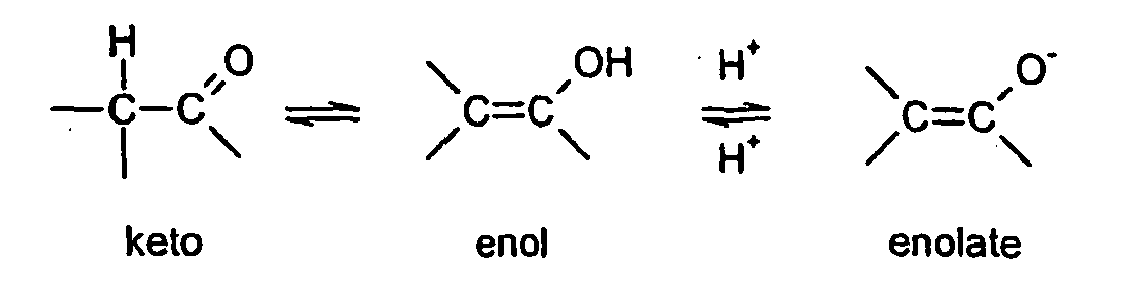
- Note that specifically included in the term "isomer" are compounds with one or more isotopic substitutions. For example, H may be in any isotopic form, including 1H, 2H (D), and 3H (T); C may be in any isotopic form, including 12C, 13C, and 14C; O may be in any isotopic form, including 16O and 18O; and the like.
- Unless otherwise specified, a reference to a particular compound includes all such isomeric forms, including (wholly or partially) racemic and other mixtures thereof. Methods for the preparation (e.g., asymmetric synthesis) and separation (e.g., fractional crystallisation and chromatographic means) of such isomeric forms are either known in the art or are readily obtained by adapting the methods taught herein, or known methods, in a known manner.
- Unless otherwise specified, a reference to a particular compound also includes ionic, salt, solvate, and protected forms of thereof, for example, as discussed below.
- It may be convenient or desirable to prepare, purify, and/or handle a corresponding salt of the active compound, for example, a pharmaceutically-acceptable salt. Examples of pharmaceutically acceptable salts are discussed in Berge et al., 1977, "Pharmaceutically Acceptable Salts," J. Pharm. Sci., Vol. 66, pp. 1-19.
- For example, if the compound is anionic, or has a functional group which may be anionic (e.g., -COOH may be -COO-), then a salt may be formed with a suitable cation. Examples of suitable inorganic cations include, but are not limited to, alkali metal ions such as Na+ and K+, alkaline earth cations such as Ca2+ and Mg2+, and other cations such as Al+3. Examples of suitable organic cations include, but are not limited to, ammonium ion (i.e., NH4 +) and substituted ammonium ions (e.g., NH3R+, NH2R2 +, NHR3 +, NR4 +). Examples of some suitable substituted ammonium ions are those derived from: ethylamine, diethylamine, dicyclohexylamine, triethylamine, butylamine, ethylenediamine, ethanolamine, diethanolamine, piperazine, benzylamine, phenylbenzylamine, choline, meglumine, and tromethamine, as well as amino acids, such as lysine and arginine. An example of a common quaternary ammonium ion is N(CH3)4 +.
- If the compound is cationic, or has a functional group which may be cationic (e.g., -NH2 may be -NH3 +), then a salt may be formed with a suitable anion. Examples of suitable inorganic anions include, but are not limited to, those derived from the following inorganic acids: hydrochloric, hydrobromic, hydroiodic, sulfuric, sulfurous, nitric, nitrous, phosphoric, and phosphorous.
- Examples of suitable organic anions include, but are not limited to, those derived from the following organic acids: 2-acetyoxybenzoic, acetic, ascorbic, aspartic, benzoic, camphorsulfonic, cinnamic, citric, edetic, ethanedisulfonic, ethanesulfonic, fumaric, glucheptonic, gluconic, glutamic, glycolic, hydroxymaleic, hydroxynaphthalene carboxylic, isethionic, lactic, lactobionic, lauric, maleic, malic, methanesulfonic, mucic, oleic, oxalic, palmitic, pamoic, pantothenic, phenylacetic, phenylsulfonic, propionic, pyruvic, salicylic, stearic, succinic, sulfanilic, tartaric, toluenesulfonic, and valeric. Examples of suitable polymeric organic anions include, but are not limited to, those derived from the following polymeric acids: tannic acid, carboxymethyl cellulose.
- It may be convenient or desirable to prepare, purify, and/or handle a corresponding solvate of the active compound. The term "solvate" is used herein in the conventional sense to refer to a complex of solute (e.g., active compound, salt of active compound) and solvent. If the solvent is water, the solvate may be conveniently referred to as a hydrate, for example, a mono-hydrate, a di-hydrate, a tri-hydrate, etc.
- It may be convenient or desirable to prepare, purify, and/or handle the active compound in a chemically protected form. The term "chemically protected form" is used herein in the conventional chemical sense and pertains to a compound in which one or more reactive functional groups are protected from undesirable chemical reactions under specified conditions (e.g., pH, temperature, radiation, solvent, and the like). In practice, well known chemical methods are employed to reversibly render unreactive a functional group, which otherwise would be reactive, under specified conditions. In a chemically protected form, one or more reactive functional groups are in the form of a protected or protecting group (also known as a masked or masking group or a blocked or blocking group). By protecting a reactive functional group, reactions involving other unprotected reactive functional groups can be performed, without affecting the protected group; the protecting group may be removed, usually in a subsequent step, without substantially affecting the remainder of the molecule. See, for example, Protective Groups in Organic Synthesis (T. Green and P. Wuts; 3rd Edition; John Wiley and Sons, 1999).
- A wide variety of such "protecting," "blocking," or "masking" methods are widely used and well known in organic synthesis. For example, a compound which has two nonequivalent reactive functional groups, both of which would be reactive under specified conditions, may be derivatized to render one of the functional groups "protected," and therefore unreactive, under the specified conditions; so protected, the compound may be used as a reactant which has effectively only one reactive functional group. After the desired reaction (involving the other functional group) is complete, the protected group may be "deprotected" to return it to its original functionality.
- For example, a hydroxy group may be protected as an ether (-OR) or an ester (-OC(=O)R), for example, as: a t-butyl ether; a benzyl, benzhydryl (diphenylmethyl), or trityl (triphenylmethyl) ether; a trimethylsilyl or t-butyldimethylsilyl ether; or an acetyl ester (-OC(=O)CH3, -OAc).
- For example, an aldehyde or ketone group may be protected as an acetal (R-CH(OR)2) or ketal (R2C(OR)2), respectively, in which the carbonyl group (>C=O) is converted to a diether (>C(OR)2), by reaction with, for example, a primary alcohol. The aldehyde or ketone group is readily regenerated by hydrolysis using a large excess of water in the presence of acid.
- For example, an amine group may be protected, for example, as an amide (-NRCO-R) or a urethane (-NRCO-OR), for example, as: a methyl amide (-NHCO-CH3); a benzyloxy amide (-NHCO-OCH2C6H5, -NH-Cbz); as a t-butoxy amide (-NHCO-OC(CH3)3, -NH-Boc); a 2-biphenyl-2-propoxy amide (-NHCO-OC(CH3)2C6H4C6H5, -NH-Bpoc), as a 9-fluorenylmethoxy amide (-NH-Fmoc), as a 6-nitroveratryloxy amide (-NH-Nvoc), as a 2-trimethylsilylethyloxy amide (-NH-Teoc), as a 2,2,2-trichloroethyloxy amide (-NH-Troc), as an allyloxy amide (-NH-Alloc), as a 2(-phenylsulphonyl)ethyloxy amide (-NH-Psec); or, in suitable cases (e.g., cyclic amines), as a nitroxide radical (>N-O•).
- For example, a carboxylic acid group may be protected as an ester for example, as: an C1-7alkyl ester (e.g., a methyl ester; a t-butyl ester); a C1-7haloalkyl ester (e.g., a C1-7trihaloalkyl ester); a triC1-7alkylsilyl-C1-7alkyl ester; or a C5-20aryl-C1-7alkyl ester (e.g., a benzyl ester; a nitrobenzyl ester); or as an amide, for example, as a methyl amide.
- For example, a thiol group may be protected as a thioether (-SR), for example, as: a benzyl thioether; an acetamidomethyl ether (-S-CH2NHC(=O)CH3).
- It may be convenient or desirable to prepare, purify, and/or handle the active compound in the form of a prodrug. The term "prodrug," as used herein, pertains to a compound which, when metabolised (e.g., in vivo), yields the desired active compound. Typically, the prodrug is inactive, or less active than the active compound, but may provide advantageous handling, administration, or metabolic properties.
- For example, some prodrugs are esters of the active compound (e.g., a physiologically acceptable metabolically labile ester). During metabolism, the ester group (-C(=O)OR) is cleaved to yield the active drug. Such esters may be formed by esterification, for example, of any of the carboxylic acid groups (-C(=O)OH) in the parent compound, with, where appropriate, prior protection of any other reactive groups present in the parent compound, followed by deprotection if required.
- Examples of such metabolically labile esters include those of the formula -C(=O)OR wherein R is:
- C1-7alkyl (e.g., -Me, -Et, -nPr, -iPr, -nBu, -sBu, -iBu, -tBu);
- C1-7aminoalkyl (e.g., aminoethyl; 2-(N,N-diethylamino)ethyl; 2-(4-morpholino)ethyl); and acyloxy-C1-7alkyl (e.g., acyloxymethyl;
- acyloxyethyl;
- pivaloyloxymethyl;
- acetoxymethyl;
- 1-acetoxyethyl;
- 1-(1-methoxy-1-methyl)ethyl-carbonxyloxyethyl;
- 1-(benzoyloxy)ethyl; isopropoxy-carbonyloxymethyl;
- 1-isopropoxy-carbonyloxyethyl; cyclohexyl-carbonyloxymethyl;
- 1-cyclohexyl-carbonyloxyethyl;
- cyclohexyloxy-carbonyloxymethyl;
- 1-cyclohexyloxy-carbonyloxyethyl;
- (4-tetrahydropyranyloxy) carbonyloxymethyl;
- 1-(4-tetrahydropyranyloxy)carbonyloxyethyl;
- (4-tetrahydropyranyl)carbonyloxymethyl; and
- 1-(4-tetrahydropyranyl)carbonyloxyethyl).
- Also, some prodrugs are activated enzymatically to yield the active compound, or a compound which, upon further chemical reaction, yields the active compound (for example, as in ADEPT, GDEPT, LIDEPT, etc.). For example, the prodrug may be a sugar derivative or other glycoside conjugate, or may be an amino acid ester derivative.
- For convenience, many chemical moieties are represented using well known abbreviations, including but not limited to, methyl (Me), ethyl (Et), n-propyl (nPr), iso-propyl (iPr), n-butyl (nBu), sec-butyl (sBu), iso-butyl (iBu), tert-butyl (tBu), n-hexyl (nHex), cyclohexyl (cHex), phenyl (Ph), biphenyl (biPh), benzyl (Bn), naphthyl (naph), methoxy (MeO), ethoxy (EtO), benzoyl (Bz), and acetyl (Ac).
- For convenience, many chemical compounds are represented using well known abbreviations, including but not limited to, methanol (MeOH), ethanol (EtOH), isopropanol (i-PrOH), methyl ethyl ketone (MEK), ether or diethyl ether (Et2O), acetic acid (AcOH), dichloromethane (methylene chloride, DCM), acetonitrile (ACN), trifluoroacetic acid (TFA), dimethylformamide (DMF), tetrahydrofuran (THF), and dimethylsulfoxide (DMSO).
- Methods for the chemical synthesis of compounds of the present invention are described herein. These methods may be modified and/or adapted in known ways in order to facilitate the synthesis of additional compounds within the scope of the present invention.
- The compounds of the present invention may be prepared, for example, by the methods described herein, or by adapting these or other well known methods in well known ways.
- In one method, a suitable chloro sulfonate (also having a protected carboxylic acid group, e.g., ester) is prepared, for example, from an aldehyde, by reaction with, e.g., H2SO4 and SO3, followed by reaction wtih, e.g., a suitable phosphate, e.g., (MeO)2P(O)R, followed by reaction with, e.g., SO2Cl2. An example of such a method is illustrated in the following scheme.

- The chloro sulfonate is then reacted with a suitable piperazine, to give the corresponding piperazino sulfonamide. An example of such a method is illustrated in the following scheme (see also Method A below).

- The protected carboxylic acid group (e.g., ester) is then converted to a hydroxamic acid, for example, by deprotection with NaOH, followed by reaction with (COCl)2, followed by reaction with NH2OH. An example of such a method is illustrated in the following scheme (see also Methods B, C, and D below).

- In another method, a suitable phenylacrylic acid is reacted with, e.g., chlorosulfonic acid (HSO3Cl) to form the corresponding para-chlorosulfonylphenyl acrylic acid, which is then reacted with piperazine to form the corresponding piperazino sulfonamide. An example of such a method is illustrated in the following scheme.

- The carboxylic acid group (e.g., ester) is then converted to a chloroacyl group, for example, by reaction with (COCl)2, and is then converted to a hydroxamic acid by reaction with, for example, NH2OH. An example of such a method is illustrated in the following scheme.

- In another method, suitable piperazine compounds are prepared by reaction of piperazine with a suitable carboxylic acid (R-COOH), for example, in the presence of hydroxybenzotriazole, to give the corresponding amide. An example of such a method is illustrated in the following scheme (see also Method E below).

- In another method, a suitably protected (e.g., t-butoxycarbonyl protected) piperazine is reacted with, for example, a haloacyl compound (e.g,. chloroacylbenzene, PhCOCl) or a suitable carboxylic acid (R-COOH), to give the corresponding amide, followed by deprotection (e.g., with HCl/MeOH and NaOH). An example of such a method is illustrated in the following scheme (see also Methods F and G, below).
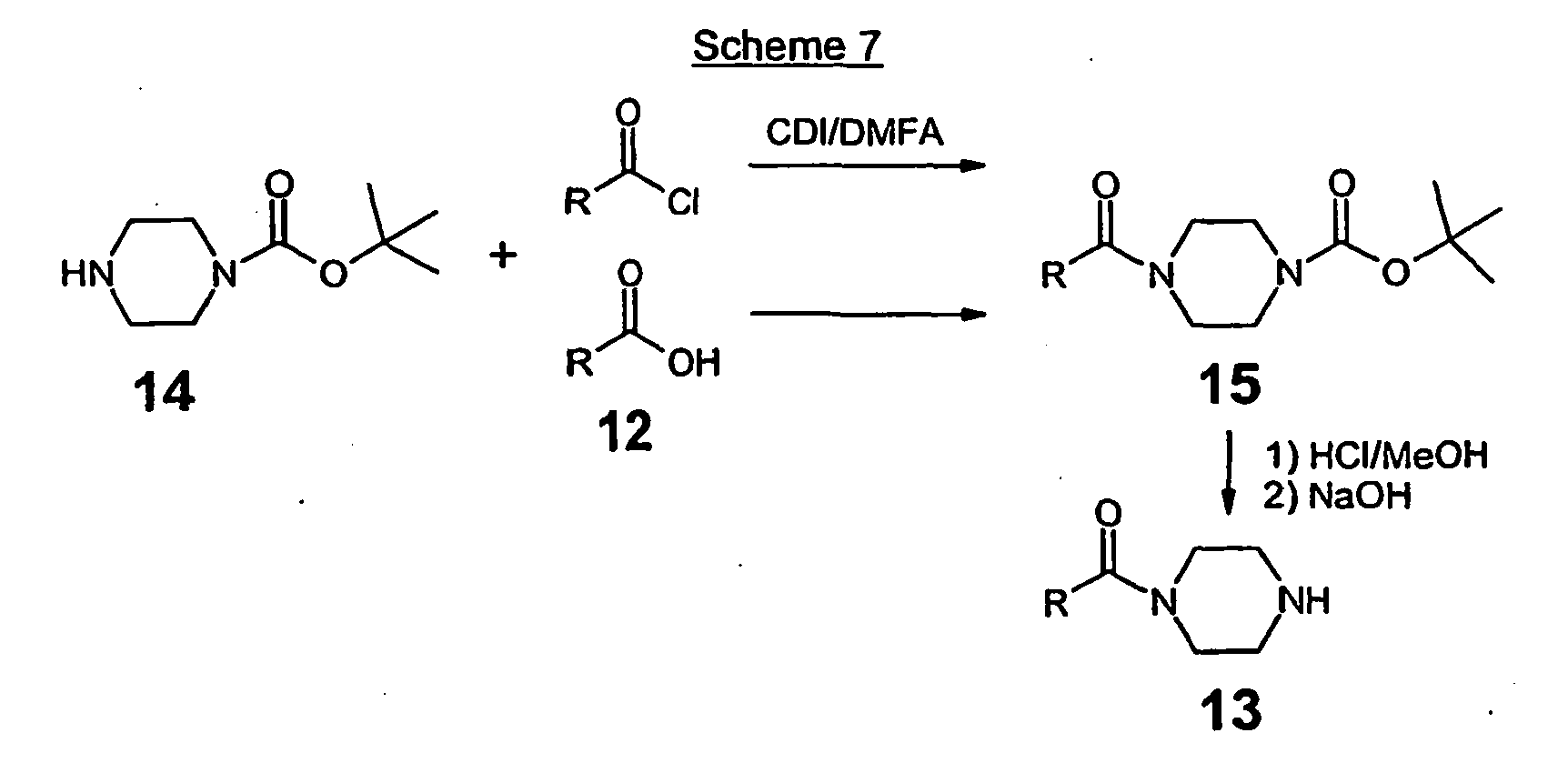
- In another method, the piperazine amide is hydrogenated, for example, by reaction with LiAlH4/THF, to give the corresponding N-substituted piperazine. An example of such a method is illustrated in the following scheme (see also Method H below).

- A number of N-substituted piperazine compounds are commercially available, and/or can be readily prepared using well known methods. Examples of such compounds include the following:
- N-phenylpiperazine (17a);
- 1-(diphenylmethyl)piperazine (17b);
- 1-(2-methoxyphenyl)piperazine hydrochloride ( 17c);
- 1-(2-chlorophenyl)piperazine (17d);
- 1-(3-chlorophenyl)piperazine (17e);
- 1-(4-methoxyphenyl)piperazine (17f);
- 1-(3-methoxyphenyl)piperazine (17g);
- 1-(4-nitrophenyl)piperazine (17h);
- 1-(3,4-dichlorophenyl)piperazine (17i);
- 1-(4-fluorophenyl)piperazine (17j);
- 1-(4-chlorophenyl)piperazine (17k);
- 1-(2-pyridinyl)piperazine (17l);
- 2-(1-piperazinyl)pyrimidine (17m); and
- 1-(3,4-dimethylphenyl)piperazine (17n).
- In another method, a suitable carboxylic acid (also having a protected carboxylic acid group) is reacted with a suitable piperazine, for example, in the presence of carbonyldiimidazole (CDI). An example of such a method is illustrated in the following scheme (see also Methods J, K, and L, below).
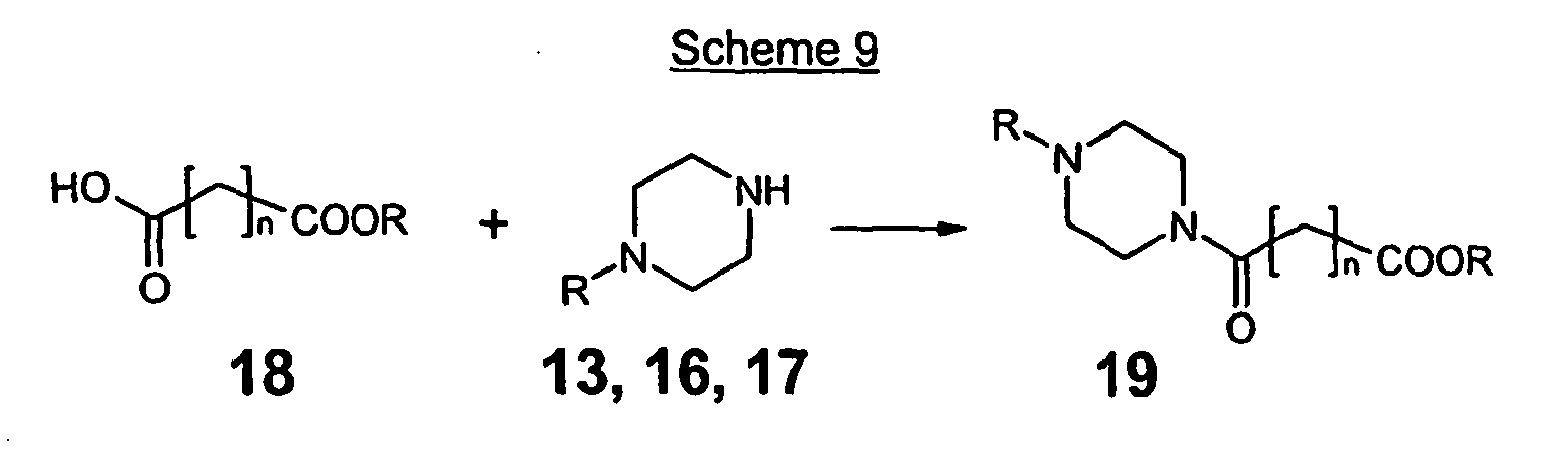
- The protected carboxylic acid group (e.g., ester) is then converted to a hydroxamic acid, for example, by reaction with NH2OH and NaOMe in methanol. An example of such a method is illustrated in the following scheme (see also Methods Q and R, below).

- In another method, a suitable carboxylic acid (also having a protected carboxylic acid group) is reacted with (COCl)2 and H2NOBn, to give the corresponding benzyloxyamide. The protected carboxylic acid group is then deprotected, for example, by reaction with NaOH, and then reacted with a suitable piperazine to give the corresponding piperazine amide. The benzyloxyamide is then converted to a carbamic acid, for example, by reaction with H2 over Pd(C). An example of such a method is illustrated in the following scheme (see also Methods M, N, P, and S, below).

- The present invention provides active compounds, specifically, active carbamic acids, as described herein.
- The term "active," as used herein, specifically includes both compounds with intrinsic activity (drugs) as well as prodrugs of such compounds, which prodrugs may themselves exhibit little or no intrinsic activity.
- The present invention also provides active compounds which inhibit HDAC activity.
- Also described herein are methods of inhibiting HDAC in a cell, comprising contacting said cell with an effective amount of an active compound. Such a method may be practised in vitro or in vivo. In one embodiment, the method is performed in vitro. In one embodiment, the method is performed in vivo. Preferably, the active compound is provided in the form of a pharmaceutically acceptable composition.
- The term "inhibiting HDAC," as used herein, includes: inhibiting HDAC activity; inhibiting the formation of HDAC complexes; and inhibiting the activity of HDAC complexes.
- One of ordinary skill in the art is readily able to determine whether or not a candidate compound inhibits HDAC activity. For example, one assay which may conveniently be used in order to assess the HDAC inhibition offered by a particular compound is described in the examples below.
- The present invention also provides active compounds which (a) regulate (e.g., inhibit) cell proliferation; (b) inhibit cell cycle progression; (c) promote apoptosis; or (d) a combination of one or more of these.
- Also described herein are methods of (a) regulating (e.g., inhibiting) cell proliferation; (b) inhibiting cell cycle progression; (c) promoting apoptosis; or (d) a combination of one or more of these, in vitro or in vivo, comprising contacting a cell with an effective amount of an active compound, as described herein.
- One of ordinary skill in the art is readily able to determine whether or not a candidate compound regulate (e.g., inhibit) cell proliferation, etc. For example, assays which may conveniently be used to assess the activity offered by a particular compound are described in the examples below.
- For example, a sample of cells (e.g., from a tumour) may be grown in vitro and an active compound brought into contact with said cells, and the effect of the compound on those cells observed. As an example of "effect," the morphological status of the cells (e.g., alive or dead, etc.) may be determined. Where the active compound is found to exert an influence on the cells, this may be used as a prognostic or diagnostic marker of the efficacy of the compound in methods of treating a patient carrying cells of the same cellular type.
- Also described herein are methods of treatment, comprising administering to a subject in need of treatment a therapeutically-effective amount of an active compound, preferably in the form of a pharmaceutical composition.
- The invention further provides active compounds for use in a method of treatment of the human or animal body by therapy, for example, in the treatment of a condition mediated by HDAC, a condition known to be treated by HDAC inhibitors (such as, e.g., trichostatin A), cancer, a proliferative condition, or other condition as described herein.
- The invention further provides the use of an active compound for the manufacture of a medicament, for example, for the treatment of a condition mediated by HDAC, a condition known to be treated by HDAC inhibitors (such as, e.g., trichostatin A), cancer, a proliferative condition, or other condition as described herein.
- The term "treatment," as used herein in the context of treating a condition, pertains generally to treatment and therapy, whether of a human or an animal (e.g., in veterinary applications), in which some desired therapeutic effect is achieved, for example, the inhibition of the progress of the condition, and includes a reduction in the rate of progress, a halt in the rate of progress, amelioration of the condition, and cure of the condition. Treatment as a prophylactic measure (i.e., prophylaxis) is also included.
- The term "therapeutically-effective amount," as used herein, pertains to that amount of an active compound, or a material, composition or dosage form comprising an active compound, which is effective for producing some desired therapeutic effect, commensurate with a reasonable benefit/risk ratio.
- The term "treatment" includes combination treatments and therapies, in which two or more treatments or therapies are combined, for example, sequentially or simultaneously. Examples of treatments and therapies include, but are not limited to, chemotherapy (the administration of active agents, including, e.g., drugs, antibodies (e.g., as in immunotherapy), prodrugs (e.g., as in photodynamic therapy, GDEPT, ADEPT, etc.); surgery; radiation therapy; and gene therapy.
- Active compounds may also be used, as described above, in combination therapies, that is, in conjunction with other agents, for example, cytotoxic agents.
- The present invention also provides active compounds which are anti-HDAC agents, and which treat a condition mediated by HDAC.
- The term "a condition mediated by HDAC," as used herein pertains to a condition in which HDAC and/or the action of HDAC is important or necessary, e.g., for the onset, progress, expression, etc. of that condition, or a condition which is known to be treated by HDAC inhibitors (such as, e.g., trichostatin A).
- Examples of such conditions include, but are not limited to, the following:
- Cancer (see, e.g., Vigushin et al., 2001).
- Psoriasis (see, e.g., lavarone et al., 1999).
- Fibroproliferative disorders (e.g., liver fibrosis) (see, e.g., Niki et al., 1999; Corneil et al., 1998).
- Smooth muscle proliferative disorder (e.g., atherosclerosis, restenosis) (see, e.g., Kimura et al., 1994).
- Neurodegenative diseases (e.g., Alzheimer's, Parkinson's, Huntington's chorea, amyotropic lateral sclerosis, spino-cerebellar degeneration) (see, e.g., Kuusisto et al., 2001).
- Inflammatory disease (e.g., osteoarthritis, rheumatoid arthritis) (see, e.g., Dangond et al., 1998; Takahashi et al., 1996).
- Diseases involving angiogenesis (e.g., cancer, rheumatoid arthritis, psoriasis, diabetic retinopathy) (see, e.g., Kim et al., 2001).
- Haematopoietic disorders (e.g., anaemia, sickle cell anaemia, thalassaeimia) (see, e.g., McCaffrey et al., 1997).
- Fungal infection (see, e.g., Bernstein et al., 2000; Tsuji et al., 1976).
- Parasitic infection (e.g., malaria, trypanosomiasis, helminthiasis, protozoal infections (see, e.g., Andrews et al., 2000).
- Bacterial infection (see, e.g., Onishi et al., 1996).
- Viral infection (see, e.g., Chang et al., 2000).
- Conditions treatable by immune modulation (e.g., multiple sclerosis, autoimmune diabetes, lupus, atopic dermatitis, allergies, asthma, allergic rhinitis, inflammatory bowel disease; and for improving grafting of transplants) (see, e.g., Dangond et al., 1998; Takahashi et al., 1996).
- One of ordinary skill in the art is readily able to determine whether or not a candidate compound treats a condition mediated by HDAC for any particular cell type. For example, assays which may conveniently be used to assess the activity offered by a particular compound are described in the examples below.
- The present invention also provides active compounds which are anticancer agents, and treat cancer.
- Also described herein are methods of treating cancer, comprising administering to a subject in need of treatment a therapeutically-effective amount of an active compound, as described herein, preferably in the form of a pharmaceutical composition.
- One of ordinary skill in the art is readily able to determine whether or not a candidate compound treats a cancerous condition for any particular cell type. For example, assays which may conveniently be used to assess the activity offered by a particular compound are described in the examples below.
- The term "anticancer agent" as used herein, pertains to a compound which treats a cancer (i.e., a compound which is useful in the treatment of a cancer). The anti-cancer effect may arise through one or more mechanisms, including but not limited to, the regulation of cell proliferation, the inhibition of cell cycle progression, the inhibition of angiogenesis (the formation of new blood vessels), the inhibition of metastasis (the spread of a tumour from its origin), the inhibition of invasion (the spread of tumour cells into neighbouring normal structures), or the promotion of apoptosis (programmed cell death). Exampes of cancers are discussed below.
- The present invention also provides active compounds which are antiproliferative agents. The term "antiproliferative agent" as used herein, pertain to a compound which treats a proliferative condition (i.e., a compound which is useful in the treatment of a proliferative condition).
- Also described herein are methods of treating a proliferative condition, comprising administering to a subject in need of treatment a therapeutically-effective amount of an active compound, as described herein, preferably in the form of a pharmaceutical composition.
- One of ordinary skill in the art is readily able to determine whether or not a candidate compound treats a proliferative condition for any particular cell type. For example, assays which may conveniently be used to assess the activity offered by a particular compound are described in the examples below.
- The terms "cell proliferation," "proliferative condition," "proliferative disorder," and "proliferative disease," are used interchangeably herein and pertain to an unwanted or uncontrolled cellular proliferation of excessive or abnormal cells which is undesired, such as, neoplastic or hyperplastic growth, whether in vitro or in vivo.
- Examples of proliferative conditions include, but are not limited to, benign, pre-malignant, and malignant cellular proliferation, including but not limited to, neoplasms and tumours (e.g., histocytoma, glioma, astrocyoma, osteoma), cancers (e.g., lung cancer, small cell lung cancer, gastrointestinal cancer, bowel cancer, colon cancer, breast carinoma, ovarian carcinoma, prostate cancer, testicular cancer, liver cancer, kidney cancer, bladder cancer, pancreas cancer, brain cancer, sarcoma, osteosarcoma, Kaposi's sarcoma, melanoma), leukemias, psoriasis, bone diseases, fibroproliferative disorders (e.g., of connective tissues), and atherosclerosis.
- Any type of cell may be treated, including but not limited to, lung, gastrointestinal (including, e.g., bowel, colon), breast (mammary), ovarian, prostate, liver (hepatic), kidney (renal), bladder, pancreas, brain, and skin.
- Active compounds may also be used as cell culture additives to inhibit HDAC, for example, in order to regulate (e.g., inhibit) cell proliferation in vitro.
- Active compounds may also be used as part of an in vitro assay, for example, in order to determine whether a candidate host is likely to benefit from treatment with the compound in question.
- Active compounds may also be used as a standard, for example, in an assay, in order to identify other active compounds, other HDAC inhibitors, other anticancer agents, other antiproliferative agents, etc.
- The compounds of the present invention may also be used in methods of improving protein production by cultured cells (see, e.g., Furukawa et al., 1998).
- The active compound or pharmaceutical composition comprising the active compound may be administered to a subject by any convenient route of administration, whether systemically/ peripherally or topically (i.e., at the site of desired action).
- Routes of administration include, but are not limited to, oral (e.g, by ingestion); buccal; sublingual; transdermal (including, e.g., by a patch, plaster, etc.); transmucosal (including, e.g., by a patch, plaster, etc.); intranasal (e.g., by nasal spray); ocular (e.g., by eyedrops); pulmonary (e.g., by inhalation or insufflation therapy using, e.g., via an aerosol, e.g., through the mouth or nose); rectal (e.g., by suppository or enema); vaginal (e.g., by pessary); parenteral, for example, by injection, including subcutaneous, intradermal, intramuscular, intravenous, intraarterial, intracardiac, intrathecal, intraspinal, intracapsular, subcapsular, intraorbital, intraperitoneal, intratracheal, subcuticular, intraarticular, subarachnoid, and intrasternal; by implant of a depot or reservoir, for example, subcutaneously or intramuscularly.
- The subject may be a prokaryote (e.g., bacteria) or a eukaryote (e.g., protoctista, fungi, plants, animals).
- The subject may be a protoctista, an alga, or a protozoan.
- The subject may be a plant, an angiosperm, a dicotyledon, a monocotyledon, a gymnosperm, a conifer, a ginkgo, a cycad, a fern, a horsetail, a clubmoss, a liverwort, or a moss.
- The subject may be an animal.
- The subject may be a chordate, an invertebrate, an echinoderm (e.g., starfish, sea urchins, brittlestars), an arthropod, an annelid (segmented worms) (e.g., earthworms, lugworms, leeches), a mollusk (cephalopods (e.g., squids, octopi), pelecypods (e.g., oysters, mussels, clams), gastropods (e.g., snails, slugs)), a nematode (round worms), a platyhelminthes (flatworms) (e.g., planarians, flukes, tapeworms), a cnidaria (e.g., jelly fish, sea anemones, corals), or a porifera (e.g., sponges).
- The subject may be an arthropod, an insect (e.g., beetles, butterflies, moths), a chilopoda (centipedes), a diplopoda (millipedes), a crustacean (e.g., shrimps, crabs, lobsters), or an arachnid (e.g., spiders, scorpions, mites).
- The subject may be a chordate, a vertebrate, a mammal, a bird, a reptile (e.g., snakes, lizards, crocodiles), an amphibian (e.g., frogs, toads), a bony fish (e.g., salmon, plaice, eel, lungfish), a cartilaginous fish (e.g., sharks, rays), or a jawless fish (e.g., lampreys, hagfish).
- The subject may be a mammal, a placental mammal, a marsupial (e.g., kangaroo, wombat), a monotreme (e.g., duckbilled platypus), a rodent (e.g., a guinea pig, a hamster, a rat, a mouse), murine (e.g., a mouse), a lagomorph (e.g., a rabbit), avian (e.g., a bird), canine (e.g., a dog), feline (e.g., a cat), equine (e.g., a horse), porcine (e.g., a pig), ovine (e.g., a sheep), bovine (e.g., a cow), a primate, simian (e.g., a monkey or ape), a monkey (e.g., marmoset, baboon), an ape (e.g., gorilla, chimpanzee, orangutang, gibbon), or a human.
- Furthermore, the subject may be any of its forms of development, for example, a spore, a seed, an egg, a larva, a pupa, or a foetus.
- While it is possible for the active compound to be used (e.g., administered) alone, it is often preferable to present it as a formulation.
- Thus, one aspect of the present invention pertains to a composition comprising a compound, as described herein, and a carrier.
- In one embodiment, the composition is a pharmaceutical composition (e.g., formulation, preparation, medicament) comprising a compound, as described herein, and a pharmaceutically acceptable carrier.
- In one embodiment, the composition is a pharmaceutical composition comprising at least one compound, as described herein, together with one or more other pharmaceutically acceptable ingredients well known to those skilled in the art, including, but not limited to, pharmaceutically acceptable carriers, diluents, excipients, adjuvants, fillers, buffers, preservatives, anti-oxidants, lubricants, stabilisers, solubilisers, surfactants (e.g., wetting agents), masking agents, colouring agents, flavouring agents, and sweetening agents.
- In one embodiment, the composition further comprises other active agents, for example, other therapeutic or prophylactic agents.
- Suitable carriers, diluents, excipients, etc. can be found in standard pharmaceutical texts. See, for example, Handbook fo Pharmaceutical Additives, 2nd Edition (eds. M. Ash and I. Ash), 2001 (Synapse Information Resources, Inc., Endicott, New York, USA), Remington's Pharmaceutical Sciences, 18th edition, Mack Publishing Company, Easton, Pa., 1990; and Handbook of Pharmaceutical Excipients, 2nd edition, 1994.
- Another aspect of the present invention pertains to methods of making a pharmaceutical composition comprising admixing at least one active compound, as defined above, together with one or more other pharmaceutically acceptable ingredients well known to those skilled in the art, e.g., carriers, diluents, excipients, etc. If formulated as discrete units (e.g., tablets, etc.), each unit contains a predetermined amount (dosage) of the active compound.
- The term "pharmaceutically acceptable" as used herein pertains to compounds, ingredients, materials, compositions, dosage forms, etc., which are, within the scope of sound medical judgment, suitable for use in contact with the tissues of the subject in question (e.g., human) without excessive toxicity, irritation, allergic response, or other problem or complication, commensurate with a reasonable benefit/risk ratio. Each carrier, diluent, excipient, etc. must also be "acceptable" in the sense of being compatible with the other ingredients of the formulation.
- The formulations may be prepared by any methods well known in the art of pharmacy. Such methods include the step of bringing into association the active compound with a carrier which constitutes one or more accessory ingredients. In general, the formulations are prepared by uniformly and intimately bringing into association the active compound with carriers (e.g., liquid carriers, finely divided solid carrier, etc.), and then shaping the product, if necessary.
- The formulation may be prepared to provide for rapid or slow release; immediate, delayed, timed, or sustained release; or a combination thereof.
- Formulations may suitably be in the form of liquids, solutions (e.g., aqueous, non-aqueous), suspensions (e.g., aqueous, non-aqueous), emulsions (e.g., oil-in-water, water-in-oil), elixirs, syrups, electuaries, mouthwashes, drops, tablets (including, e.g., coated tablets), granules, powders, losenges, pastilles, capsules (including, e.g., hard and soft gelatin capsules), cachets, pills, ampoules, boluses, suppositories, pessaries, tinctures, gels, pastes, ointments, creams, lotions, oils, foams, sprays, mists, or aerosols.
- Formulations may suitably be provided as a patch, adhesive plaster, bandage, dressing, or the like which is impregnated with one or more active compounds and optionally one or more other pharmaceutically acceptable ingredients, including, for example, penetration, permeation, and absorption enhancers. Formulations may also suitably be provided in a the form of a depot or reservoir.
- The active compound may be dissolved in, suspended in, or admixed with one or more other pharmaceutically acceptable ingredients. The active compound may be presented in a liposome or other microparticulate which is designed to target the active compound, for example, to blood components or one or more organs.
- Formulations suitable for oral administration (e.g, by ingestion) include liquids, solutions (e.g., aqueous, non-aqueous), suspensions (e.g., aqueous, non-aqueous), emulsions (e.g., oil-in-water, water-in-oil), elixirs, syrups, electuaries, tablets, granules, powders, capsules, cachets, pills, ampoules, boluses.
- Formulations suitable for buccal administration include mouthwashes, losenges, pastilles, as well as patches, adhesive plasters, depots, and reservoirs. Losenges typically comprise the active compound in a flavored basis, usually sucrose and acacia or tragacanth. Pastilles typically comprise the active compound in an inert matrix, such as gelatin and glycerin, or sucrose and acacia. Mouthwashes typically comprise the active compound in a suitable liquid carrier.
- Formulations suitable for sublingual administration include tablets, losenges, pastilles, capsules, and pills.
- Formulations suitable for oral transmucosal administration include liquids, solutions (e.g., aqueous, non-aqueous), suspensions (e.g., aqueous, non-aqueous), emulsions (e.g., oil-in-water, water-in-oil), mouthwashes, losenges, pastilles, as well as patches, adhesive plasters, depots, and reservoirs.
- Formulations suitable for non-oral transmucosal administration include liquids, solutions (e.g., aqueous, non-aqueous), suspensions (e.g., aqueous, non-aqueous), emulsions (e.g., oil-in-water, water-in-oil), suppositories, pessaries, gels, pastes, ointments, creams, lotions, oils, as well as patches, adhesive plasters, depots, and reservoirs.
- Formulations suitable for transdermal administration include gels, pastes, ointments, creams, lotions, and oils, as well as patches, adhesive plasters, bandages, dressings, depots, and reservoirs.
- Tablets may be made by conventional means, e.g., compression or molding, optionally with one or more accessory ingredients. Compressed tablets may be prepared by compressing in a suitable machine the active compound in a free-flowing form such as a powder or granules, optionally mixed with one or more binders (e.g., povidone, gelatin, acacia, sorbitol, tragacanth, hydroxypropylmethyl cellulose); fillers or diluents (e.g., lactose, microcrystalline cellulose, calcium hydrogen phosphate); lubricants (e.g., magnesium stearate, talc, silica); disintegrants (e.g., sodium starch glycolate, cross-linked povidone, cross-linked sodium carboxymethyl cellulose); surface-active or dispersing or wetting agents (e.g., sodium lauryl sulfate); preservatives (e.g., methyl p-hydroxybenzoate, propyl p-hydroxybenzoate, sorbic acid); flavours, flavour enhancing agents, and sweeteners. Molded tablets may be made by molding in a suitable machine a mixture of the powdered compound moistened with an inert liquid diluent. The tablets may optionally be coated or scored and may be formulated so as to provide slow or controlled release of the active compound therein using, for example, hydroxypropylmethyl cellulose in varying proportions to provide the desired release profile. Tablets may optionally be provided with a coating, for example, to affect release, for example an enteric coating, to provide release in parts of the gut other than the stomach.
- Ointments are typically prepared from the active compound and a paraffinic or a water-miscible ointment base.
- Creams are typically prepared from the active compound and an oil-in-water cream base. If desired, the aqueous phase of the cream base may include, for example, at least about 30% w/w of a polyhydric alcohol, i.e., an alcohol having two or more hydroxyl groups such as propylene glycol, butane-1,3-diol, mannitol, sorbitol, glycerol and polyethylene glycol and mixtures thereof. The topical formulations may desirably include a compound which enhances absorption or penetration of the active compound through the skin or other affected areas. Examples of such dermal penetration enhancers include dimethylsulfoxide and related analogues.
- Emulsions are typically prepared from the active compound and an oily phase, which may optionally comprise merely an emulsifier (otherwise known as an emulgent), or it may comprises a mixture of at least one emulsifier with a fat or an oil or with both a fat and an oil. Preferably, a hydrophilic emulsifier is included together with a lipophilic emulsifier which acts as a stabiliser. It is also preferred to include both an oil and a fat. Together, the emulsifier(s) with or without stabiliser(s) make up the so-called emulsifying wax, and the wax together with the oil and/or fat make up the so-called emulsifying ointment base which forms the oily dispersed phase of the cream formulations.
- Suitable emulgents and emulsion stabilisers include Tween 60, Span 80, cetostearyl alcohol, myristyl alcohol, glyceryl monostearate and sodium lauryl sulphate. The choice of suitable oils or fats for the formulation is based on achieving the desired cosmetic properties, since the solubility of the active compound in most oils likely to be used in pharmaceutical emulsion formulations may be very low. Thus the cream should preferably be a non-greasy, non-staining and washable product with suitable consistency to avoid leakage from tubes or other containers. Straight or branched chain, mono- or dibasic alkyl esters such as di-isoadipate, isocetyl stearate, propylene glycol diester of coconut fatty acids, isopropyl myristate, decyl oleate, isopropyl palmitate, butyl stearate, 2-ethylhexyl palmitate or a blend of branched chain esters known as Crodamol CAP may be used, the last three being preferred esters. These may be used alone or in combination depending on the properties required. Alternatively, high melting point lipids such as white soft paraffin and/or liquid paraffin or other mineral oils can be used.
- Formulations suitable for intranasal administration, where the carrier is a liquid, include, for example, nasal spray, nasal drops, or by aerosol administration by nebuliser, include aqueous or oily solutions of the active compound.
- Formulations suitable for intranasal administration, where the carrier is a solid, include, for example, those presented as a coarse powder having a particle size, for example, in the range of about 20 to about 500 microns which is administered in the manner in which snuff is taken, i.e., by rapid inhalation through the nasal passage from a container of the powder held close up to the nose.
- Formulations suitable for pulmonary administration (e.g., by inhalation or insufflation therapy) include those presented as an aerosol spray from a pressurised pack, with the use of a suitable propellant, such as dichlorodifluoromethane, trichlorofluoromethane, dichoro-tetrafluoroethane, carbon dioxide, or other suitable gases.
- Formulations suitable for ocular administration include eye drops wherein the active compound is dissolved or suspended in a suitable carrier, especially an aqueous solvent for the active compound.
- Formulations suitable for rectal administration may be presented as a suppository with a suitable base comprising, for example, natural or hardened oils, waxes, fats, semi-liquid or liquid polyols, for example, cocoa butter or a salicylate; or as a solution or suspension for treatment by enema.
- Formulations suitable for vaginal administration may be presented as pessaries, tampons, creams, gels, pastes, foams or spray formulations containing in addition to the active compound, such carriers as are known in the art to be appropriate.
- Formulations suitable for parenteral administration (e.g., by injection), include aqueous or non-aqueous, isotonic, pyrogen-free, sterile liquids (e.g., solutions, suspensions), in which the active compound is dissolved, suspended, or otherwise provided (e.g., in a liposome or other microparticulate). Such liquids may additional contain other pharmaceutically acceptable ingredients, such as anti-oxidants, buffers, preservatives, stabilisers, bacteriostats, suspending agents, thickening agents, and solutes which render the formulation isotonic with the blood (or other relevant bodily fluid) of the intended recipient. Examples of excipients include, for example, water, alcohols, polyols, glycerol, vegetable oils, and the like. Examples of suitable isotonic carriers for use in such formulations include Sodium Chloride Injection, Ringer's Solution, or Lactated Ringer's Injection. Typically, the concentration of the active compound in the liquid is from about 1 ng/ml to about 10 µg/ml, for example from about 10 µg/ml to about 1 µg/ml. The formulations may be presented in unit-dose or multi-dose sealed containers, for example, ampoules and vials, and may be stored in a freeze-dried (lyophilised) condition requiring only the addition of the sterile liquid carrier, for example water for injections, immediately prior to use. Extemporaneous injection solutions and suspensions may be prepared from sterile powders, granules, and tablets.
- It will be appreciated by one of skill in the art that appropriate dosages of the active compounds, and compositions comprising the active compounds, can vary from patient to patient. Determining the optimal dosage will generally involve the balancing of the level of therapeutic benefit against any risk or deleterious side effects. The selected dosage level will depend on a variety of factors including, but not limited to, the activity of the particular compound, the route of administration, the time of administration, the rate of excretion of the compound, the duration of the treatment, other drugs, compounds, and/or materials used in combination, the severity of the condition, and the species, sex, age, weight, condition, general health, and prior medical history of the patient. The amount of compound and route of administration will ultimately be at the discretion of the physician, veterinarian, or clinician, although generally the dosage will be selected to achieve local concentrations at the site of action which achieve the desired effect without causing substantial harmful or deleterious side-effects.
- Administration can be effected in one dose, continuously or intermittently (e.g., in divided doses at appropriate intervals) throughout the course of treatment. Methods of determining the most effective means and dosage of administration are well known to those of skill in the art and will vary with the formulation used for therapy, the purpose of the therapy, the target cell(s) being treated, and the subject being treated. Single or multiple administrations can be carried out with the dose level and pattern being selected by the treating physician, veterinarian, or clinician.
- In general, a suitable dose of the active compound is in the range of about 0.1 to about 250 mg per kilogram body weight of the subject per day. Where the active compound is a salt, an ester, an amide, a prodrug, or the like, the amount administered is calculated on the basis of the parent compound and so the actual weight to be used is increased proportionately.
- One aspect of the invention pertains to a kit comprising (a) the active ingredient, preferably provided in a suitable container and/or with suitable packaging; and (b) instructions for use, for example, written instructions on how to administer the active compound, etc.
- The written instructions may also include a list of indications for which the active ingredient is a suitable treatment.
- The following are examples are provided solely to illustrate the present invention and are not intended to limit the scope of the invention, as set out in the appended claims.
- 1H NMR spectra were recorded at ambient temperature with WH-90/DS or Mercury 200 (Varian) spectrometers. The HPLC measurements were performed on a Gilson Model 302 system equipped with a spectrophotometer. Elemental analyses were obtained with a Carlo Erba EA 1108 instrument. Melting points were measured on a "Boëtius" micro melting point apparatus and are uncorrected. Silicagel, 0.035-0.070 mm, (Acros) was employed for column chromatography. All the solvents were purified before use by routine techniques. To isolate reaction products the solvents were removed by evaporation using a vacuum rotary evaporator, the water bath temperature not exceeding 40°C.
- Various reagents were purchased from Sigma-Aldrich (The Old Brickyard, New Road, Gillingham, Dorset, UK), Acros Organics (Janssens Pharmaceuticalaan 3A, 2440 Geel, Belgium), Lancaster Synthesis Ltd. (Eastgate, White Lund, Morecambe, Lancashire, LA3 3DY, UK), and Bapeks Ltd. (Riga, Latvia).
- Oleum (5 mL) was placed in a reaction vessel and benzaldehyde (2.00 g,18.84 mmol) was slowly added not exceeding the temperature of the reaction mixture more than 30°C. The obtained solution was stirred at 40°C for 10 hours and at ambient temperature overnight. The reaction mixture was poured into ice and extracted with ethyl acetate. The aqueous phase was treated with CaCO3 until the evolution of CO2 ceased (pH-6-7), then the precipitated CaSO4 was filtered off and washed with water. The filtrate was treated with Na2CO3 until the pH of the reaction medium increased to pH 8, obtained CaCO3 was filtered off and water solution was evaporated in vacuum. The residue was washed with methanol, the washings were evaporated and the residue was dried in desiccator over P2O5 affording the title compound (2.00 g, 51%). 1H NMR (D2O), δ: 7.56-8.40 (4H, m); 10.04 (1H, s).
- Sodium salt of 3-formylbenzenesulfonic acid (1) (1.00 g, 4.80 mmol), potassium carbonate (1.32 g, 9.56 mmol), trimethyl phosphonoacetate (1.05 g, 5.77 mmol) and water (2 mL) were stirred at ambient temperature for 30 min, and the precipitated solid was filtered and washed with methanol. The filtrate was evaporated and to give the title compound as a white solid (0.70 g, 55%). 1H NMR (DMSO-d6, HMDSO), δ: 3.68 (3H, s); 6.51 (1H, d, J=16.0 Hz); 7.30-7.88 (5H, m).
- To the sodium salt of 3-(3-sulfophenyl)acrylic acid methyl ester (2) (0.670 g, 2.53 mmol) benzene (2 mL), thionyl chloride (1.508 g, 0.9 mL, 12.67 mmol) and 3 drops of dimethylformamide were added and the resultant suspension was stirred at reflux for one hour. The reaction mixture was evaporated, the residue was dissolved in benzene (3 mL), filtered and the filtrate was evaporated to give the title compound (0.640 g, 97%).
- A solution of 3-(3-chlorosulfonylphenyl) acrylic acid methyl ester (3) (0.40 g, 1.53 mmol) in dioxane (5.0 mL) was added to a mixture of appropriate piperazine (1.53 mmol) in dioxane (2.0 mL) and NaHCO3 (0.26 g, 3.06 mmol) in water (3.0 mL) (in the case of piperazine hydrochlorides the amount of NaHCO3 was increased by 1 eq), and the resultant solution was stirred at room temperature until initial compounds disappeared (1-2 hours). Water was added to the reaction mixture. In the case of a precipitate formation, it was filtered, washed with water, ether, and dried to give the corresponding methyl (E)-3-(3-{[4-substituted 1-piperazinyl]sulfonyl}phenyl)-2-propenoate (4). Otherwise, the reaction mixture was extracted with ethyl acetate, washed successively with water, brine, dried (Na2SO4), and solvent removed to give the corresponding methyl (E)-3-(3-{[4-substituted 1-piperazinyl]sulfonyl}phenyl)-2-propenoate (4).
- The title compound was obtained from 3-(3-chlorosulfonylphenyl) acrylic acid methyl ester (3) and 1-phenylpiperazine, using Method A, yield 84%. 1H NMR (DMSO-d6. HMDSO), δ: 2.94-3.39 (8H, m); 3.74 (3H, s); 6.65-7.03 (4H, m); 7.05-7.32 (2H, m); 7.60-7.92 (3H, m); 7.94-8.20 (2H, m).
- The title compound was obtained from 3-(3-chlorosulfonylphenyl) acrylic acid methyl ester (3) and 1-benzhydrylpiperazine, using Method A, yield 96%. 1H NMR (DMSO-d6, HMDSO), δ: 2.16-2.60 (4H, m); 2.78-3.07 (4H, m); 3.78 (3H, s); 4.32 (1H, s); 6.73 (1H, d, J=16.0 Hz); 7.12-8.27 ppm (15H, m).
- The title compound was obtained from 3-(3-chlorosulfonylphenyl) acrylic acid methyl ester (3) and 1-(2-methoxyphenyl)-piperazine hydrochloride, using Method A, yield 87%. 1H NMR (CDCl3, HMDSO), δ: 3.03-3.29 (8H, m); 3.78 (3H, s); 3.83 (3H, s); 6.48 (1H, d, J=16.0 Hz); 6.76-7.07 (4H, m); 7.42-7.94 (4H, m); 7.72 ppm (1H, d, J=16.0 Hz).
- The title compound was obtained from 3-(3-chlorosulfonylphenyl) acrylic acid methyl ester (3) and 1-(2-chlorophenyl)-piperazine hydrochloride, using Method A, yield 81%. 1H NMR (CDCl3, HMDSO), δ: 2.94-3.38 (8H, m); 3.85 (3H, s); 6.54 (1H, d, J=16.0 Hz); 6.87-7.43 (3H, m); 7.12 (1H, d, J=16.0 Hz); 7.42-7.94 ppm (5H, m).
- The title compound was obtained from 3-(3-chlorosulfonylphenyl) acrylic acid methyl ester (3) and 1-(3-chlorophenyl)-piperazine hydrochloride, using Method A, yield 71%. 1H NMR (CDCl3, HMDSO), δ: 2.94 -3.45 (8H, m); 3.83 (3H, s); 6.56 (1H, d, J=16.0 Hz); 6.60-6.98 (3H, m); 7.16 (1H, d, J=16.0 Hz).; 7.45-8.05 ppm (5H, m).
- The title compound was obtained from 3-(3-chlorosulfonylphenyl) acrylic acid methyl ester (3) and 1-(2-pyridyl)piperazine, using Method A, yield 82%. 1H NMR (CDCl3, HMDSO), δ: 2.94 -3.25 (4H, m); 3.43-3.72 (4H, m); 3.78 (3H, s); 6.49 (1H, d, J=16.0 Hz); 6.47-6.72 (2H, m); 7.27-7.94 (6H, m); 8.00-8.20 ppm (1H, m).
- The title compound was obtained from 3-(3-chlorosulfonylphenyl) acrylic acid methyl ester (3) and 4'-piperazinoacetophenone, using Method A, yield 90%. 1H NMR (DMSO-d6, HMDSO), δ: 2.45 (3H, s); 2.94 -3.25 (4H, m); 3.32-3.65 (4H, m, overlapped with a signal of water); 3.78 (3H, s); 6.85 (1H, d, J=16.0 Hz); 6.86-7.16 (2H, m); 7.65-7.96 (5H, m); 8.05-8.27 ppm (2H, m).
- The title compound was obtained from 3-(3-chlorosulfonylphenyl) acrylic acid methyl ester (3) and 1-(4-dimethylaminophenetyl)piperazine, using Method A, yield 91%. 1H NMR (DMSO-d6, HMDSO), δ: 2.14-2.63 (8H, m, overlapped with a signal of DMSO); 2.80 (6H, s); 2.81-3.05 (4H, m); 3.78 (3H, s); 6.63 (2H, d, J=9.4 Hz); 6.84 (1H, d, J=16.0 Hz); 7.00 (2H, d, J=9.4 Hz); 7.61-7.88 (2H, m); 7.83 (1H, d, J=16.0 Hz); 7.99-8.28 ppm (2H, m).
- The title compound was obtained from 3-(3-chlorosulfonylphenyl) acrylic acid methyl ester (3) and 1-[2-(1-naphthyloxy)ethyl]piperazine, using Method A, yield 78%. 1H NMR (DMSO-d6, HMDSO), δ: 2.36-2.77 (8H, m, overlapped with a signal of DMSO); 2.78-3.09 (4H, m); 3.72 (3H, s); 6.76 (1H, d, J=15.7 Hz); 7.20-7.53 (3H, m); 7.54-7.94 (7H, m); 7.96-8.20 ppm (2H, m).
- The title compound was obtained from 3-(3-chlorosulfonylphenyl) acrylic acid methyl ester (3) and 1-[2-(2-naphthyloxy)ethyl]piperazine, using Method A, yield 94%. 1H NMR (DMSO-d6, HMDSO), δ: 2.38 -2.65 (6H, m, overlapped with a signal of DMSO); 2.76 (2H, t, J=5.0 Hz); 2.83-3.05 (2H, m); 3.71 (3H, s); 4.11(2H, t, J=5.3 Hz); 6.76 (1H, d, J=16.0 Hz); 6.98-7.56 (4H, m); 7.60-7.92 (6H, m); 7.93-8.18 ppm (2H, m).
- The title compound was obtained from 3-(3-chlorosulfonylphenyl) acrylic acid methyl ester (3) and 1-(3,4-dichlorophenyl)-piperazine, using Method A, yield 85%. 1H NMR (DMSO-d6, HMDSO), δ: 2.76-3.12 (4H, m); 3.13-3.38 (4H, m, overlapped with a signal of water); 3.66 (3H, s); 6.76 (1H, d, J=15.9 Hz); 6.87 (1H, dd, J=2.8 and 8.4 Hz); 7.10 (1H, d, J=2.8 Hz); 7.38 (1H, d, J=8.4 Hz); 7.78(1H, d, J=15.9 Hz); 7.60-7.93 (2H, m); 7.95-8.27 ppm (2H, m).
- The title compound was obtained from 3-(3-chlorosulfonylphenyl) acrylic acid methyl ester (3) and 1-(4-chlorophenyl)-piperazine, using Method A, yield 84%. 1H NMR (DMSO-d6, HMDSO), δ: 2.76-3.34. (8H, m); 3.72 (3H, s); 6.80 (1H, d, J=15.9 Hz); 6.92 (2H, d, J=8.9 Hz); 7.23 (2H, d, J=8.9 Hz); 7.80(1H, d, J=15.9 Hz); 7.56-7.96 (2H, m); 7.98-8.25 ppm (2H, m).
- To a suspension or solution of appropriate methyl (E)-3-(3-{[4-substituted 1-piperazinyl]sulfonyl}phenyl)-2-propenoate (4a-I) (1.29 mmol) in methanol-tetrahydrofuran (2:3) mixture (5.0 mL), 1 N NaOH solution (3.87 mL, 3.87 mmol) was added and the resultant mixture was stirred at ambient temperature overnight. The reaction mixture was partitioned between ethyl acetate and water. The aqueous layer was acidified with 1 N KH2PO4 solution. In the case of a precipitate formation, it was filtered, washed with water, ether (or other suitable solvent), and dried to give the corresponding (E)-3-(3-{[4-substituted 1-piperazinyl]sulfonyl}phenyl)-2-propenoic acid (5). Otherwise, the reaction mixture was extracted with ethyl acetate, washed successively with water, brine, dried (Na2SO4), and solvent removed to give the corresponding (E)-3-(3-{[4-substituted 1-piperazinyl]sulfonyl}phenyl)-2-propenoic acid (5).
- The title compound was obtained from methyl (E)-3-(3-{[4-phenyl-1-piperazinyl]sulfonyl}phenyl)-2-propenoate (4a) as a white solid, using Method B, yield 61%. 1H NMR (DMSO-d6, HMDSO), δ: 2.87-3.65 (8H, m); 6.54-6.98 (4H, m); 7.00-7.36 (2H, m); 7.58-7.92 (3H, m); 7.94-8.23 (2H, m).
- The title compound was obtained from methyl (E)-3-(3-{[4-benzhydryl-1-piperazinyl]sulfonyl}phenyl)-2-propenoate (4b) as a white solid, using Method B, yield 70%. 1H NMR (DMSO-d6. HMDSO), δ: 2.20-2.56 (4H, m); 2.80-3.07 (4H, m); 4.27 (1H, s); 6.67 (1H, d, J=16.0 Hz); 7.05-8.16 ppm (15H, m).
- The title compound was obtained from methyl (E)-3-(3-{[4-(2-methoxyphenyl)-1-piperazinyl]sulfonyl}phenyl)-2-propenoate (4c) as a white solid, using Method B, yield 84%. 1H NMR (DMSO-d6, HMDSO), δ: 2.76-3.25 (8H, m); 3.72 (3H, s); 6.74 (1H, d, J=16.0 Hz); 6.76-7.14 (4H, m); 7.60-7.94 (2H, m); 7.76 (1H, d, J= 16.0 Hz); 7.94-8.27 ppm (2H, m).
- The title compound was obtained from methyl (E)-3-(3-{[4-(2-chlorophenyl)-1-piperazinyl]sulfonyl}phenyl)-2-propenoate (4d), using Method B, yield 83%. 1H NMR (DMSO-d6, HMDSO), δ: 2.72-3.27 (8H, m); 6.72 (1H, d, J=16.0 Hz); 6.89-7.52 (4H, m); 7.60-7.92 (2H, m); 7.74 (1H, d, J= 16.0 Hz); 7.96-8.25 ppm (2H, m).
- The title compound was obtained from methyl (E)-3-(3-{[4-(3-chlorophenyl)-1-piperazinyl]sulfonyl}phenyl)-2-propenoate (4e), using Method B, yield 89%. 1H NMR (DMSO-d6, HMDSO), δ: 2.87 -3.16 (6H, m); 3.17-3.67 (2H, m, overlapped with a signal DMSO); 6.67 (1H, d, J=16.0 Hz); 6.68-7.00 (3H, m); 7.02-7.34 (1H, m); 7.56-7.87 (2H, m); 7.72 (1H, d, J= 16.0 Hz); 7.94-8.23 ppm (2H, m).
- The title compound was obtained from methyl (E)-3-(3-{[4-(2-pyridinyl)-1-piperazinyl]sulfonyl}phenyl)-2-propenoate (4f), using Method B, yield 91%. 1H NMR (DMSO-d6, HMDSO), δ: 2.83 -3.14 (4H, m); 3.43-3.69 (4H, m); 6.52-6.89 (2H, m); 6.67 (1H, d, J=16.0 Hz); 7.36-7.83 (3H, m); 7.69 (1H, d, J= 16.0 Hz); 7.94-8.18 ppm (3H, m).
- The title compound was obtained from methyl (E)-3-(3-{[4-(4-acetylphenyl)-1-piperazinyl]sulfonyl}phenyl)-2-propenoate (4g), using Method B, yield 85%. 1H NMR (DMSO-d6, HMDSO), δ: 2.38 (3H, s); 2.89 -3.20. (4H, m); 3.21-3.67 (4H, m, overlapped with a signal of water); 6.69 (1H, d, J=16.0 Hz); 6.70-7.11 (2H, m); 7.53-7.94 (5H, m); 7.96-8.20 ppm (2H, m).
- The title compound was obtained from methyl (E)-3-[3-({4-[4-(dimethylamino)phenethyl]-1-piperazinyl}sulfonyl)phenyl]-2-propenoate (4h), using Method B, yield 80%. 1H NMR (DMSO-d6, HMDSO), δ: 2.23-2.67 (8H, m, overlapped with a signal of DMSO); 2.80 (6H, s); 2.72-3.09 (4H, m); 6.63 (2H, d, J=8.0 Hz); 6.74 (1H, d, J=16.0 Hz); 6.99 (2H, d, J=8.0 Hz); 7.51 -7.89 (3H, m); 7.90-8.32 ppm (2H, m).
- The title compound was obtained from methyl (E)-3-[3-({4-[2-(1-naphthyloxy)ethyl]-1-piperazinyl}sulfonyl)phenyl]-2-propenoate (4i), using Method B, yield 90%. 1H NMR (DMSO-d6, HMDSO), δ: 2.36-2.76 (6H, m, overlapped with a signal of DMSO); 2.78-3.07 (6H, m); 6.69 (1H, d, J= 15.7 Hz); 7.22-7.56 (3H, m); 7.58-7.92 (7H, m); 7.93-8.16 ppm (2H, m).
- The title compound was obtained from methyl (E)-3-[3-({4-[2-(2-naphthyloxy)ethyl]-1-piperazinyl}sulfonyl)phenyl]-2-propenoate (4j), using Method B, yield 84%. 1H NMR (DMSO-d6. HMDSO), δ: 2.36 -2.58 (6H, m, overlapped with a signal of DMSO); 2.76 (2H, t, J=5.0 Hz); 2.82-3.05 (2H, m); 4.11(2H, t, J=5.3 Hz); 6.67(1H, d, J= 16.0 Hz); 6.98-7.52 (4H, m); 7.53-7.87 (6H, m); 7.88-8.16 ppm (2H, m).
- The title compound was obtained from methyl (E)3-(3-{[4-(3,4-dichlorophenyl)-1-piperazinyl]sulfonyl}phenyl)-2-propenoate (4k), using Method B, yield 87%. 1H NMR (DMSO-d6, HMDSO), δ: 2.69 -3.16 (4H, m); 3.17-3.47 (4H, m); 6.69 (1H, d, J=16.0 Hz); 6.92 (1H, dd, J=2.8 and 8.4 Hz); 7.13 (1H, d, J=2.8 Hz); 7.38 (1H, d, J=8.4 Hz); 7.54 (1H, d, J=16.0 Hz); 7.58-7.92 (2H, m); 7.93-8.18 ppm (2H, m).
- The title compound was obtained from methyl (E)-3-(3-{[4-(4-chlorophenyl)-1-piperazinyl]sulfonyl}phenyl)-2-propenoate (4l), using Method B, yield 75%. 1H NMR (DMSO-d6, HMDSO), δ: 2.83-3.49 (8H, m, overlapped with a signal of water); 6.67 (1H, d, J=15.9 Hz); 6.89 (1H, d, J= 8.9 Hz); 7.18 (2H, d, J=8.9 Hz); 7.49-7.87 (2H, m); 7.69 (1H, d, J=15.9 Hz); 7.88-8.20 ppm (2H, m).
- To a suspension of appropriate (E)-3-(3-{[4-substituted 1-piperazinyl]sulfonyl}phenyl)-2-propenoic acid (5a-l) (0.78 mmol) in dichloromethane (4.0 mL) oxalyl chloride (0.21 mL, 2.37 mmol) and one drop of dimethylformamide were added. The reaction mixture was stirred at 40°C for one hour and concentrated under reduced pressure to give crude (E)-3-(3-{[4-substituted 1-piperazinyl]sulfonyl}phenyl)-2-propenoyl chloride (6).
- The title compound was obtained from (E)-3-(3-{[4-phenyl-1-piperazinyl]sulfonyl}phenyl)-2-propenoic acid (5a), using Method C, in a form of a crude product.
- The title compound was obtained from (E)-3-(3-{[4-benzhydryl-1-piperazinyl]sulfonyl}phenyl)-2-propenoic acid (5b), using Method C, in a form of a crude product.
- The title compound was obtained from (E)-3-(3-{[4-(2-methoxyphenyl)-1-piperazinyl]sulfonyl}phenyl)-2-propenoic acid (5c), using Method C, in a form of a crude product.
- The title compound was obtained from (E)-3-(3-{[4-(2-chlorophenyl)-1-piperazinyl]sulfonyl}phenyl)-2-propenoic acid (5d), using Method C, in a form of a crude product.
- The title compound was obtained from (E)-3-(3-{[4-(3-chlorophenyl)-1-piperazinyl]sulfonyl}phenyl)-2-propenoic acid (5e), using Method C, in a form of a crude product.
- The title compound was obtained from (E)-3-(3-{[4-(2-pyridinyl)-1-piperazinyl]sulfonyl}phenyl)-2-propenoic acid (5f), using Method C, in a form of a crude product.
- The title compound was obtained from (E)-3-(3-{[4-(4-acetylphenyl)-1-piperazinyl]sulfonyl}phenyl)-2-propenoic acid (5g), using Method C, in a form of a crude product.
- The title compound was obtained from (E)-3-[3-({4-[4-(dimethylamino)phenethyl]-1-piperazinyl}sulfonyl)phenyl]-2-propenoic acid (5h), using Method C, in a form of a crude product.
- The title compound was obtained from (E)-3-[3-({4-[2-(1-naphthyloxy)ethyl]-1-piperazinyl}sulfonyl)phenyl]-2-propenoic acid (5i), using Method C, in a form of a crude product.
- The title compound was obtained from (E)-3-[3-({4-[2-(2-naphthyloxy)ethyl]-1-piperazinyl}sulfonyl)phenyl]-2-propenoic acid (5j), using Method C, in a form of a crude product.
- The title compound was obtained from (E)-3-(3-{[4-(3,4-dichlorophenyl)-1-piperazinyl]sulfonyl}phenyl)-2-propenoic acid (5k), using Method C, in a form of a crude product.
- The title compound was obtained from (E)-3-(3-{[4-(4-chlorophenyl)-1-piperazinyl]sulfonyl}phenyl)-2-propenoic acid (5l), using Method C, in a form of a crude product.
- To a suspension of hydroxylamine hydrochloride (0.27 g, 3.90 mmol) in tetrahydrofuran (6.0 mL) a saturated NaHCO3 solution (6.9 mL) was added and the resultant mixture was stirred at ambient temperature for 10 minutes. To the reaction mixture an appropriate (E)-3-(3-{[4-substituted 1-piperazinyl]sulfonyl}phenyl)-2-propenoyl chloride (6a-l) (ca. 0.78 mmol) solution in tetrahydrofuran (4.0 mL) was added and the obtained mixture was stirred at ambient temperature for ca. one hour. The organic layer was separated, the water layer was supplemented with water (ca. 5 mL) and extracted with ethyl acetate. The organic extracts were combined, washed successively with water, brine, and dried (Na2SO4). The solvent was removed and the crude product was washed with an appropriate solvent (ether, methanol, ethyl acetate, acetonitrile etc.) or crystallized from ether, methanol, ethyl acetate or acetonitrile, or their mixtures to give the corresponding target (E)-N-hydroxy-3-(3-{[4-substituted 1-piperazinyl]sulfonyl}phenyl)-2-propenamide. Otherwise, the crude reaction product was chromatographed on silica gel with chloroform - methanol as eluents to give the corresponding (E)-N-hydroxy-3-(3-{[4-substituted 1-piperazinyl]sulfonyl}phenyl)-2-propenamide.
- The title compound was obtained from (E)-3-(3-{[4-phenyl-1-piperazinyl]sulfonyl}phenyl)-2-propenoyl chloride (6a) as white crystals, using Method D, yield 73% (on 5a). M.p. 201°C. 1H NMR (DMSO-d6, HMDSO), δ: 2.91-3.39 (8H, m, overlapped with a signal of water); 6.62 (1H, d, J=16.0 Hz); 6.74-6.99 (3H, m); 7.06-7.34 (2H, m); 7.57 (1H, d, J=16.0 Hz); 7.56-8.12 (4H, m); 9.11 (1H, br s); 10.79 (1H, s). HPLC analysis on Zorbax SB-C18 column: impurities 1.3% (column size 4.6x150 mm; mobile phase acetonitrile - 0.1 % H3PO4, gradient from 50:50 to 100:0; sample concentration 0.5 mg/ml; flow rate 1.5 mL/min.; detector: UV 254 nm). Anal. Calcd for C19H21N3O4S,%: C 58.90, H 5.46, N 10.84. Found,%: C 58.73, H 5.34, N 10.69.
- The title compound was obtained from (E)-3-(3-{[4-benzhydryl-1-piperazinyl]sulfonyl}phenyl)-2-propenoyl chloride (6b) as white crystals, using Method D, yield 57% (on 5b ). M.p. 156°C. 1H NMR (DMSO-d6, HMDSO), δ: 2.18-2.54 (4H, m, overlapped with a signal of DMSO); 2.75-3.11 (4H, m); 4.31 (1H, s); 6.64 (1H, d, J=16.0 Hz); 7.01-8.11 (15H, m); 9.15 (1H, br s); 10.83 (1H, s). HPLC analysis on Symmetry C18 column: impurities 7% (column size 3.9x150 mm; mobile phase acetonitrile - 0.1M phosphate buffer (pH 2.5), 50:50; sample concentration 1 mg/ml; flow rate 0.75 mL/min.; detector UV 220 nm). Anal. Calcd for C26H27N3O4S * 0.7 H2O,%: C 63.71, H 5.84, N 8.57. Found,%: C 63.81, H 5.77, N 8.34.
- The title compound was obtained from (E)-3-(3-{[4-(2-methoxyphenyl)-1-piperazinyl]sulfonyl}phenyl)-2-propenoyl chloride (6c) as white crystals, using Method D, yield 59% (on 5c ). M.p. 190°C. 1H NMR (DMSO-d6, HMDSO), δ: 2.72-3.25 (8H, m); 3.67 (3H, s); 6.65 (1H, d, J=16.0 Hz); 6.76-7.12 (4H, m); 7.61 (1H, d, J=16.0 Hz); 7.60-8.07 (4H, m); 9.09 (1H, br s); 10.78 (1H, s). HPLC analysis on Zorbax SB C18 column: impurities 2% (column size 4.6x150 mm; mobile phase acetonitrile- 0. 1 % H3PO4, 50:50 10 min, 100:0 5 min; sample concentration 1 mg/ml; flow rate 1.5 mUmin.; detector UV 254 nm). Anal. Calcd for C20H23N3O5S,%: C 57.54, H 5.55, N 10.06. Found,%: C 57.26, H 5.46, N 9.99.
- The title compound was obtained from (E)-3-(3-{[4-(2-chlorophenyl)-1-piperazinyl]sulfonyl}phenyl)-2-propenoyl chloride (6d), using Method D, yield 84% (on 5d). M.p. 183°C. 1H NMR (DMSO-d6, HMDSO), δ: 2.76-3.32 (8H, m); 6.63 (1H, d, J=16.0 Hz); 6.92-7.48 (4H, m); 7.59 (1H, d, J=16.0 Hz); 7.58-8.12 (4H, m); 9.12 (1H, br s); 10.80 (1H, s). HPLC analysis on Zorbax SB C18 column: impurities 2% (column size 4.6x150 mm; mobile phase acetonitrile- 0.1% H3PO4, 50:50 10 min, 100:0 5 min; sample concentration 0.5 mg/ml; flow rate 1.5 mL/min; detector: UV 254 nm). Anal. Calcd for C19H20ClN3O4S,%: C 54.09, H 4.78, N 9.96. Found,%: C 53.99, H 4.73, N 9.80.
- The title compound was obtained from (E)-3-(3-{[4-(3-chlorophenyl)-1-piperazinyl]sulfonyl}phenyl)-2-propenoyl chloride (6e), using Method D, yield 75% (on 5e). M.p. 201°C. 1H NMR (DMSO-d6, HMDSO), δ: 2.83-3.45 (8H, m); 6.63 (1H, d, J=16.0 Hz); 6.68-7.02 (3H, m); 7.16 (1H, t, J=7.8 Hz); 7.58 (1H, d, J=16.0 Hz); 7.60-8.07 (4H, m); 9.16 (1H, br s); 10.72 (1H, s). HPLC analysis on Symmetry C8 column: impurities 3.3% (column size 3.9x150 mm; mobile phase acetonitrile- 0.1M phosphate buffer (pH 2.5), 45:55; sample concentration 0.5 mg/ml; flow rate 1.4 mL/min; detector UV 254 nm). Anal. Calcd for C19H20ClN3O4S, containing 4% of inorganic impurities,%: C 51.93, H 4.59, N 9.56. Found,%: C 52.00, H 4.59, N 9.39.
- The title compound was obtained from (E)-3-(3-{[4-(2-pyridinyl)-1-piperazinyl]sulfonyl}phenyl)-2-propenoyl chloride (6f), using Method D, yield 63% (on 5f). M.p. 112°C. 1H NMR (DMSO-d6, HMDSO), δ: 2.78-3.18 (4H, m); 3.41-3.76 (4H, m); 6.45-6.91 (3H, m); 7.38-8.19 (7H, m); 9.13 (1H, br s); 10.78 (1H, br s). HPLC analysis on Symmetry C8 column: impurities 4% (column size 3.9x150 mm; mobile phase acetonitrile-0.1M phosphate buffer (pH 2.5), 35:65; sample concentration 0.5 mg/ml; flow rate 1.3 mL/min; detector UV 254 nm). Anal. Calcd for C18H20N4O4S * H2O, containing 1.5% of inorganic impurities,%: C 52.39, H 5.37, N 13.58. Found,%: C 52.45, H 5.23, N 13.39.
- The title compound was obtained from (E)-3-[3-({4-[4-(1-chlorovinyl)phenyl]-1-piperazinyl}sulfonyl)phenyl]-2-propenoyl chloride (6g), using Method D, yield 24% (on 5g). M.p. 203°C (dec.). TLC: single spot at Rf 0.3 (ethyl acetate-methanol, 4:1; detection - UV-254 nm). 1H NMR (DMSO-d6, HMDSO), δ:2.94-3.20 (4H, m); 3.21-3.63 (4H, m, overlapped with a signal of water); 5.38 (1H, d, J= 4.0 Hz); 5.83 (1H, d, J= 4.0 Hz); 6.63 (1H, d, J=16.0 Hz); 6.93 (2H, d, J=9,0 Hz); 7.54 (2H, d, J= 9.0 Hz); 7.60 (1H, d, J=16.0 Hz); 7.43 -8.05 (4H, m); 9.16 (1H, br s); 10.85 ppm (1H, br s). Anal. Calcd for C21H22ClN3O4S, containing 1.9% of inorganic material,%: C 55.24, H 4.86, N 9.20. Found,%: C 55.22, H 4.78, N 9.45.
- The title compound was obtained from (E)-3-[3-({4-[4-(dimethylamino)phenethyl]-1-piperazinyl)sulfonyl)phenyl]-2-propenoyl chloride (6h), using Method D, yield 17% (on 5h). M.p. 189°C. 1H NMR (DMSO-d6, HMDSO), δ: 2.36-2.57 (8H, m, overlapped with a signal of DMSO); 2.80 (6H, s); 2.83-2.94 (4H, m); 6.60 (2H, d, J=8.0 Hz); 6.61 (1H, d, J=15.7 Hz); 6.96 (2H, d, J=8.0 Hz); 7.57 (1H, d, J=15.7 Hz); 7.66-7.75 (2H, m); 7.83-7.97 (2H, m); 9.17 (1H, br s); 10.83 (1H, br s). HPLC analysis on Alltima C18 column: impurities 3% (column size 4.6x150 mm; mobile phase acetonitrile - 0.1 M phosphate buffer (pH 2.5), 15:85; sample concentration 1.0 mg/ml; flow rate 1.0 mL/ min; detector UV 220 nm). Anal. Calcd for C23H30N4O4S,%: C 60.24, H 6.59, N 12.22. Found,%: C 60.05, H 6.52, N 12.16.
- The title compound was obtained from (E)-3-[3-({4-[2-(1-naphthyloxy)ethyl]-1-piperazinyl}sulfonyl)phenyl]-2-propenoyl chloride ( 6i ), using Method D, yield 68% (on ( 5i ). M.p. 178°C. 1H NMR (DMSO-d6, HMDSO), δ: 2.41-2.68 (6H, m, overlapped with a signal of DMSO); 2.75-3.00 (6H, m); 6.61 (1H, d, J=16.0 Hz); 7.34 (1H, d, J= 8.4 Hz); 7.39-7.52 (2H, m); 7.57 (1H, d, J=16.0 Hz); 7.63-7.97 (8H, m); 9.17 (1H, br s); 10.84 ppm (1H, br s). HPLC analysis on Omnispher C18 column: impurities 2.2% (column size 4.6x150 mm; mobile phase acetonitrile - 0.2 M acetate buffer (pH 5.0), 40:60; sample concentration 0.5 mg/ml; flow rate 1.5 mL/ min; detector UV 230 nm). Anal. Calcd for C25H27N3O5S,%: C 62.35, H 5.65, N 8.73. Found,%: C 62.42, H 5.56, N 8.69.
- The title compound was obtained from (E)-3-[3-({4-[2-(2-naphthyloxy)ethyl]-1-piperazinyl}sulfonyl)phenyl]-2-propenoyl chloride ( 6j ), using Method D, yield 57% (on 5j ). M.p. 130°C. 1H NMR (DMSO-d6, HMDSO), δ: 2.54-2.68 (4H, m, overlapped with a signal of DMSO); 2.76 (2H, t, J=5.0 Hz); 2.82-3.03 (4H, m); 4.12 (2H, t, J=5.3 Hz); 6.60 (1H, d, J=16.0 Hz); 7.10 (1H, dd, J=8.9 and 2.0 Hz); 7.28 (1H, d, J=2.0 Hz); 7.31 (1H, t, J=7.9 Hz); 7.43 (1H, t, J=7.6 Hz); 7.55 (1H, d, J=16.0 Hz); 7.62-7.95 (7H, m); 9.19 (1H, br s); 10.82 ppm (1H, br s). HPLC analysis on Omnispher C18 column: impurities 3.3% (column size 4.6x150 mm; mobile phase acetonitrile - 0.2 M acetate buffer (pH 5.0), 40:60; sample concentration 0.25 mg/ml; flow rate 1.5 mL/ min; detector UV 230 nm). Anal. Calcd for C25H27N3O5S, containing 6% of inorganic impurities,%: C 58.61, H 5.31, N 8.20. Found,%: C 58.63, H 5.33, N 8.01.
- The title compound was obtained from (E)-3-(3-{[4-(3,4-dichlorophenyl)-1-piperazinyl]sulfonyl}phenyl)-2-propenoyl chloride ( 6k ), using Method D, yield 71% (on 5k ). M.p. 193°C. 1H NMR (DMSO-d6, HMDSO), δ: 2.89-3.09 (4H, m); 3.18-3.33 (4H, m, overlapped with a signal of water); 6.61 (1H, d, J=15.9 Hz); 6.89 (1H, dd, J=2.8 and 8.4 Hz); 7.11 (1H, d, J=2.8 Hz); 7.38 (1H, d, J=8.4 Hz); 7.57 (1H, d, J=15.9 Hz); 7.66-7.82 (2H, m); 7.87-8.00 (2H, m); 9.16 (1H, s); 10.82 (1H, s). HPLC analysis on Omnispher C18 column: impurities 3.3% (column size 4.6x150 mm; mobile phase acetonitrile - 0.2 M acetate buffer (pH 5.0), 50:50; sample concentration 0.5 mg/ml; flow rate 1.3 mL/ min; detector UV 254 nm). Anal. Calcd for C19H19Cl2N3O4S,%: C 50.01, H 4.20, N 9.21. Found,%: C 49.94, H 4.06, N 9.10.
- The title compound was obtained from (E)-3-(3-{[4-(4-chlorophenyl)-1-piperazinyl]sulfonyl}phenyl)-2-propenoyl chloride ( 6l ), using Method D, yield 79% (on 5l ). M.p. 215°C. 1H NMR (DMSO-d6, HMDSO), δ: 2.89-3.12 (4H, m); 3.12-3.27 (4H, m); 6.61 (1H, d, J=15.9 Hz); 6.91 (2H, d, J=8.9 Hz); 7.21 (2H, d, J=8.9 Hz); 7.57 (1H, d, J=15.9 Hz); 7.67-7.85 (2H, m); 7.86-8.05 (2H, m); 9.26 (1H, br s); 10.65 (1H, br s). HPLC analysis on Alltima C18 column: impurities <1% (column size 4.6x150 mm; mobile phase acetonitrile - 0.1 M phosphate buffer (pH 2.5), 50:50; sample concentration 0.5 mg/ml; flow rate 1.5 m/min; detector UV 254 nm). Anal. Calcd for C19H20ClN3O4S,%: C 54.09, H 4.78, N 9.96. Found,%: C 54.08, H 4.62, N 9.90.
- The title compound was obtained using methods analogous to those described above. M.p. 178°C. 1H NMR (DMSO-d6, TMS) δ: 2.60-3.49 (8 H, m, partly overlapped with a signal of water), 3.09 (2H, d, J=6.0 Hz); 6.13 (IH, dt, J= 16.0 and 6.0 Hz), 6.49 (IH, d, J= 16.0 Hz); 6.60 (1H, d, J=16.0 Hz); 7.16- 7.56 (5H, m); 7.57-8.00 (5H, m); 9.20 (IH, br s); 10.78 ppm (IH, br s). HPLC analysis on an Omnispher 5 C18 column : impurities 1.0 % (column size: 4.6x150 mm - mobile phase: acetonitrile -0.1 M phosphate buffer (pH 2.5), 25:75; sample concentration 0.16 mg/ml; flow rate: 1.3 mL/min; detector UV 254 nm). Anal.Calcd. for C22H23N3O4S, %: C 61.81, H 5.89, N 9.83. Found, % C 61.43, H 5.84, N 9.65.
- The title compound was obtained using methods analogous to those described above. M.p. 203°C. 1H NMR (DMSO-d6, HMDSO) δ: 2.96-3.12 (8H, m); 3.66 (3H, s); 6.62 (IH, d, J= 15.7 Hz); 6.79 (2H, d, J=9.4 Hz); 6.85 (2H, d, J=9.4 Hz); 7.59 (IH, d, J=15.7 Hz); 7.62-7.70 (2H, m); 7.92-8.05 (2H, m); 9.15 (IH, br s); 10.82 ppm (IH, br s). HPLC analysis on an Omnispher 5 C18 column: impurities 1.3%. (column size 4.6x150 mm; mobile phase acetonitrile -0.1 M phosphate buffer (pH 2.5), 40:60; sample concentration 0.5 mg/ml; flow rate 1.5 mL/min; detector UV 220 nm). Anal. Calcd. for C20H23N3O5S, %: C 57.54, H 5.55, N 10.06. Found, %: C 57.55, H 5.41, N 9.98.
- The title compound was obtained using methods analogous to those described above. M.p. 196°C. 1H NMR (DMSO-d6, HMDSO) δ: 2.96-3.10 (4 H, m), 3.13-3.26 (4H, m); 3.68 (3H, s); 6.34- 6.52 (3H, m); 6.61 (IH, d, J=15. 7 Hz); 7.08 (IH, t, J=7.9 Hz); 7.57 (IH, d, J=15.7 Hz); 7.64-7.80 (2H, m); 7.89-7.98 (2H, m); 9.15 (IH, br s); 10.81 ppm (IH, br s). HPLC analysis on an Alltima C18 column: impurities 3.5% (column size 4.6x150mm; mobile phase acetonitrile -0.1 M phosphate buffer (pH 2.5), 50:50; sample concentration 0.5 mg/ml; flow rate 1.4 mL/min; detector UV 220 nm). Anal. Calcd for C20H23N3O5S, containing 1.5% of inorganic impurities, %: C 56.68, H 5.47, N 9.91. Found, %: C 56.79, H 5.31, N 9.81.
- The title compound was obtained using methods analogous to those described above. M.p. 172°C. 1H NMR (DMSO-d 6, HMDSO) δ: 2.32-2.45 (4 H, m), 2.82-2.97 (4H, m); 3.34 (2H, s, overlapped with a signal of water); 5.94 (2H, s); 6.60 (IH, d, J=15. 7 Hz); 6.67 (IH, d, J=7.9 Hz); 6.76 (IH, s); 6.78 (IH, d, J=8.3 Hz); 7.56 (IH, d, J=15. 7 Hz); 7.66- 7.74 (2H, m); 7.83-7.96 (2H, m); 9.14 (IH, br s); 10.80 ppm (IH, br s). HPLC analysis on an Omnispher 5 C18 column : impurities 1.3% (column size 4.6x150 mm; mobile phase acetonitrile -0.1 M phosphate buffer (pH 2.5), 35:65; sample concentration 1.0 mg/ml; flow rate: 1.3 mL/min; detector UV 254 nm). Anal. Calcd. for C21H23N3O6S, %: C 56.62, H 5.20, N 9.43. Found, %: C 56.35, H 5.02, N 9.24.
- The title compound was obtained using methods analogous to those described above. M.p 185°C. 1H NMR (DMSO-d6, HMDSO) δ: 2.42 (4H, m), 2.91 (4H, m); 3.45 (2H, s); 6.59 (IH, d, J= 15.7 Hz); 7.15-7.31 (5H, m); 7.56 (IH, d, J=15.7 Hz); 7.62-7.76 (2H, m); 7.81-7.98 (2H, m); 9.14 (IH, br s); 10.80 ppm (IH, br s). HPLC analysis on an Omnispher 5 C18 column: impurities 2.3% (column size 4.6x150 mm; mobile phase acetonitrile-0.1 M phosphate buffer (pH 2.5), 40:60; sample concentration 0.33 mg/ml; flow rate 1.3 mL/min; detector UV 220 nm). Anal Calcd. for C20H23N3O4S, %: C 59.83, H 5.77, N 10.47. Found, %: C 59.67, H 5.62, N 10.34.
- The title compound was obtained using methods analogous to those described above. M.p. foam. 1H NMR (DMSO-d6, HMDSO) δ: 2.18-2.45 (4H, m), 2.78-3.09 (4H, m); 4.36 (IH, s); 6.58 (IH, d,J= 16.0 Hz); 6.89-7.20 (4H, m); 7.22-7.58 (5H, m); 7.60-8.05 (4H, m); 9.98 ppm (2H, br s). HPLC analysis on an Alltima C18 column: impurities 6.5% (column size 4.6x150mm; mobile phase acetonitrile - 0.1 M phosphate buffer (pH 2.5), 60:40; sample concentration 0.5 mg/ml; flow rate 1.5 mL/min; detector: UV 220 nm). Anal Calcd. for C26H25F2N3O4S, %: C 60.31, H 5.24, N 7.54. Found, %: C 60.13, H 5.17, N 7.51.
- The title compound was obtained using methods analogous to those described above. M.p. 186°C. 1H NMR (DMSO-d6, HMDSO) δ: 0.94 (3H, d, J=6.4 Hz); 2.20 (3H, s); 2.56-2.83 (IH, m, partly overlapped with a signal of water); 2.84-3.67 (5H, m); 3.80-4.16 (IH, m); 6.45-6.78 (4H, m); 6.94-7.20 (IH, m); 7.60 (IH, d, J= 16.0 Hz); 7.69-8.14 (4H, m); 9.98 (2H, br s). HPLC analysis on an Alltima C18 column: impurities 3.0% (column size 4.6x150mm; mobile phase acetonitrile - 0.1 M phosphate buffer (pH 2.5), 50:50; sample concentration 1.0 mg/ml; flow rate 1.0 mL/min; detector UV 220 nm). Anal. Calcd. for C21H25N3O4S * 0.1 EtOH, %: C 60.58, H 6.13, N 9.90. Found, %: C 60.46, H 6.05, N 9.84.
- The title compound was obtained using methods analogous to those described above. M.p. 176°C. 1H NMR (DMSO-d6, HMDSO) δ: 2.83-3.15 (8H, m); 6.63 (IH, d, J=16.0 Hz); 6.83- 7.27 (4H, m); 7.60 (IH, d, J= 16.0 Hz); 7.65- 8.05 (4H, m); 9.12 (IH, br s); 10.83 ppm (IH, br s). HPLC analysis on Ultra JBD: impurities 1.0% (column size 4.6x150 mm; mobile phase acetonitrile - 0.1 M phosphate buffer (pH 2.5), 60:40; sample concentration 1.0 mg/ml; flow rate 1.0 mL/min; detector UV 230nm). Anal Calcd. for C19H20FN3O4S, %: C 56.29, H 4.97, N 10.36. Found, %: C 56.25, H 4.89, N 10.16.
- The title compound was obtained using methods analogous to those described above. M.p. 173°C. 1H NMR (DMSO-d6, HMDSO) δ: 2.94-3.25 (8H, m); 6.63 (IH, d, J=16.0 Hz); 6.98-7.29 (3H, m); 7.39 (IH, d, J=7.6 Hz); 7.69 (IH, d, J=16.0 Hz); 7.60-8.09 (4H, m); 10.05 ppm (2H, br s). HPLC analysis on Alltima C18: impurities 5.5% (column size 4.6x150 mm; mobile phase acetonitrile - 0.1 M phosphate buffer (pH 2.5), 50:50; sample concentration 1.0 mg/ml; flow rate 1.5 mL/min; detector UV 220 nm.) Anal. Calcd. for C20H20F3N3O4S * 0.1EtOAc, %: C 52.78, H 4.52, N 9.05. Found, %: C 52.74, H 4.36, N 8.88.
- The title compound was obtained using methods analogous to those described above. M.p. 162 °C. 1H NMR (DMSO-d6, HMDSO) δ: 2.94-3.20 (4H, m); 3.45-3.69 (4H, m); 6.65 (IH, d, J=16.0 Hz); 7.02 (2H, d, J=9.0 Hz); 7.58 (IH, d, J= 16.0 Hz); 7.62-7.83 (2H, m); 7.84- 8.20 (4H, m); 10.20 (2H, br s). HPLC analysis on Omnisphere 5 C18: impurities 2.0% (column size 4.6x150mm; mobile phase acetonitrile - 0.1 M phosphate buffer (pH 2.5), 40:60; sample concentration 0.3 mg/m1; flow rate 1.5 mL/min; detector UV 220 nm). Anal. Calcd. for C19H20N4O6S containing 2.3% inorganic material, %: C 51.56, H 4.55, N 12.66. Found, %: C 51.54, H 4.50, N 12.57.
- The title compound was obtained using methods analogous to those described above. M.p. 200°C. 1H NMR (DMSO-d6, HMDSO), δ: 2.78-3.15 (4H, m); 3.63-3.94 (4H, m); 6.58 (IH, d, J=16.0 Hz); 6.63 (IH, t, J=6.4 Hz); 7.56 (IH, d, J= 16.0 Hz); 7.57-8.12 (4H, m); 8.34 (2H, d, J=6.4 Hz); 9.16 (IH, br s); 10.80 ppm (IH, br s). HPLC analysis on Alltima C18: impurities 4.8% (column size: 4.6x150 mm; mobile phase acetonitrile - 0.1 M phosphate buffer (pH 2.5), 30:70; sample concentration 1.0 mg/ml; flow rate 1.15 mL/min; detector UV 254 nm.) Anal. Calcd for C17H19N5O4S, %: C 52.43, H 4.92, N 17.98. Found, %: C 52.37, H 4.89, N 17.69.
- The title compound was obtained using methods analogous to those described above. M.p. 117°C (decomposes). 1H NMR (DMSO-d6, HMDSO), δ: 2.42-2.62 (4H, m, overlapped with a signal of DMSO); 2.70-2.87 (4H, m); 2.92 (2H, d, J=7.3 Hz); 4.18 (IH t, J= 7.3 Hz); 6.58 (IH, d, J=15.8 Hz); 7.02-7.35 (10H, m); 7.53 (IH, d, J= 15.8 Hz); 7.61-7.70 (2H, m); 7.80-7.92 (2H, m); 9.14 (IH, br s); 10.80 ppm (IH, br s). HPLC analysis on Omnisphere C18: impurities 4.5% (column size 4.6x150 mm; mobile phase acetonitrile - 0.1 M phosphate buffer (pH 2.5), 40:60; sample concentration 0.5 mg/ml; flow rate: 1.2 mL/min; detector UV 220 nm.) Anal. Calcd. for C27H29N3O4S * 0.2 M Et2O containing 1.8% of inorganic impurities, %: C 64.75, H 6.06, N 8.15. Found, %: C 64.76, H 6.07, N 8.19.
- The title compound was obtained using methods analogous to those described above. M.p. 184°C. 1H NMR (DMSO-d6, HMDSO), δ: 2.38-3.07 (12H, m, partly overlapped with a signal ofDMSO); 6.63 (IH, d, J=16.0 Hz); 7.20-7.54 (4H, m); 7.57-7.98 (8H, m); 9.16 (IH, br s); 10.78 ppm (IH, br s). HPLC analysis on Alltima C18: impurities 1.0% (column size 4.6x150mm; mobile phase acetonitrile - 0.1 M phosphate buffer (pH 2.5), 35:65; sample concentration 1.0 mg/ml; flow rate 1.2 mL/min; detector UV 220 nm). Anal. Calcd. for C25H27N3O4S, %: C 64.50, H 5.85, N 9.03. Found, %: C 64.34, H 5.74, N 9.02.
- To neat chlorosulfonic acid (26.5 mL, 0.4 mol) at 18°C temperature slowly cinnamic acid ( 7 ) (7.35 g, 0.05 mol) was added. As the reaction proceeded, hydrogen chloride gas evolved. The reaction mixture was stirred successively at 20°C for 3 hours and at 42°C for 3 hours. The dark, viscous syrup was poured into ice water, and the precipitated solid was filtered and washed with water. The title compound was obtained (6.8 g, 55%) as a white solid. 1H NMR (DMSO-d6, HMDSO), δ: 6.55 (1H, d, J=16.0 Hz); 7.58 (1H, d, J=16.0 Hz); 7.65 (4H, s); 8.15 (1H, br s).
- To a suspension of 1-(α,α,α-trifluoro-m-tolyl)piperazine hydrochloride (0.43 g, 1.62 mmol) in dioxane (5 mL) a solution of NaHCO3 (0.27 g, 3.24 mmol) in water (4 mL) and a solution of 3-(4-chlorosulfonyl-phenyl)-acrylic acid ( 8 ) (0.40 g, 1.62 mmol) were added and the resultant mixture was stirred at ambient temperature for 20 hours. The reaction mixture was poured into water (50 mL) and the pH of the medium was brought to ∼4 with 2 N HCl. The precipitated solid was filtered, washed with water, and dried in vacuum to give the title compound (0.59 g, 82%). 1H NMR (DMSO-d6, HMDSO), δ: 2.96-3.67 (8H, m, overlapped with a signal of water); 6.74 (1H, d, J=16.3 Hz); 7.01-7.57 (4H, m); 7.67 (1H, d, J=16.3 Hz); 7.82 (2H, d, J=8.4 Hz); 8.00 (2H, d, J=8.4 Hz); 12.71 (1H, br s).
- To a suspension of 1-bis(4-fluorophenyl)methyl piperazine (0.47 g, 1.62 mmol) in dioxane (5 mL) a solution of NaHCO3 (0.27 g, 3.24 mmol) in water (4 mL) and a solution of 3-(4-chlorosulfonyl-phenyl)-acrylic acid ( 8 ) (0.40 g, 1.62 mmol) were added and the resultant mixture was stirred at ambient temperature for 20 hours. The reaction mixture was poured into water (50 mL), the pH of the medium was brought to -4 with 2 N HCl, and extracted with ethyl acetate. The extract was washed successively with water, brine, and dried (Na2SO4). The solvent was removed and the crude product was crystallized from dioxane to give the title compound (0.58 g, 63%) as a white solid. 1H NMR (DMSO-d6, HMDSO), δ: 2.19-2.50 (4H, m, overlapped with a signal of DMSO); 2.80-3.12 (4H, m); 4.42 (1H, s); 6.78 (1H, d, J=16.0 Hz); 7.11 (4H, t, J=9.0 Hz); 7.41 (4H, dd, J=8.6 and 5.6 Hz); 7.72 (1H, d, J=16.0 Hz); 7.78 (2H, d, J=8.2 Hz); 8.00 (2H, d, J=8.2 Hz); 12.68 (1H, br s).
- To a suspension of (E)-3-[4-({4-[3-(trifluoromethyl)phenyl]-1-piperazinyl}sulfonyl)phenyl]-2-propenoic acid ( 9a ) (0.30 g, 0.69 mmol) in dichloromethane (7 mL) oxalyl chloride (0.2 mL, 2.4 mmol) and a drop of dimethylformamide were added. The reaction mixture was stirred at ambient temperature for 0.5 hours and at 42°C for 1 hour. The reaction mixture was evaporated and the residue was dried in vacuum to give (E)-3-[4-({4-[3-(trifluoromethyl)phenyl]-1-piperazinyl}sulfonyl)phenyl]-2-propenoyl chloride ( 10a ) (0.31 g) in a form of a crude product.
- To a solution of (E)-3-[4-({4-[bis(4-fluorophenyl)methyl]-1-piperazinyl}sulfonyl)phenyl]-2-propenoic acid ( 9b ) (0.25 g,0.5 mmol) in dichloromethane (7 mL) oxalyl chloride (0.15 mL, 1.75 mmol) and a drop of dimethylformamide were added. The reaction mixture was stirred at ambient temperature for 1 hour, then the mixture was evaporated and the residue was dried in vacuum to give (E)-3-[4-({4-[bis(4-fluorophenyl)methyl]-1-piperazinyl}sulfonyl)phenyl]-2-propenoyl chloride ( 10b ) (0.26 g) in a form of a crude product.
- To a suspension of hydroxylamine hydrochloride (0.24 g, 3.4 mmol) in tetrahydrofuran (5.0 mL) a solution of NaHCO3 (0.40 g, 4.8 mmol) in water (6 mL) was added and the resultant mixture was stirred at ambient temperature for 5 minutes. The reaction mixture was added to a suspension of (E)-3-[4-({4-[3-(trifluoromethyl)phenyl]-1-piperazinyl}sulfonyl)phenyl]-2-propenoyl chloride ( 10a ) (0.31 g) in tetrahydrofuran (5 mL) and the mixture was stirred at ambient temperature for 0.5 hours. The mixture was poured into water (25 mL), the precipitate was filtered, washed with water, ether, and dried to give the title compound (0.23 g, 73%). M.p. 178-179°C. 1H NMR (DMSO-d6, HMDSO), δ: 2.95-3.10 (4H, m); 3.23-3.40 (4H, m, overlapped with a signal of water); 6.62 (1H, d, J=15.9 Hz); 7.09 (1H, d, J=7.7 Hz); 7.16 (1H, s); 7.19 (1H, d, J=8.0 Hz); 7.40 (1H, t, J=7.7 Hz); 7.54 (1H, d, J=15.9 Hz); 7.80 (2H, d, J=8.4 Hz); 7.83 (2H, d, J=8.4 Hz); 9.35 (1H, br s); 10.72 (1H, br s). HPLC analysis on Omnispher 5 C18 column: impurities 3.5% (column size 4.6x150 mm; mobile phase acetonitrile - 0.1M acetate buffer (pH 5.0), 50:50; sample concentration 1 mg/ml; flow rate 1.3 mL/min; detector UV 254 nm). Anal. Calcd for C20H20F3N3O4S, %: C 52.74, H 4.43, N 9.23, S 7.04. Found, %: C 52.04, H 4.29, N 8.86, S 7.20.
- To a suspension of hydroxylamine hydrochloride (0.18 g, 2.5 mmol) in tetrahydrofuran (5.0 mL) a solution of NaHCO3 (0.30 g, 3.5 mmol) in water (5 mL) was added and the resultant mixture was stirred at ambient temperature for 5 minutes. The reaction mixture was added to a solution of (E)-3-[4-({4-[bis(4-fluorophenyl)methyl]-1-piperazinyl}sulfonyl)phenyl]-2-propenoyl chloride ( 10b ) (0.26 g) in tetrahydrofuran (5 mL) and the obtained mixture was stirred at ambient temperature for 0.5 hours. The mixture was poured into water (25 mL), extracted with ethyl acetate, the extract was washed with water, brine, and dried (Na2SO4). The solvent was removed and the residue was chromatographed on silica gel with chloroform - isopropanol (9:1) as eluent to give the title compound (0.087 g, 34%). M.p. 125-126°C. 1H NMR (DMSO-d6, HMDSO), δ: 2.26-2.42 (4H, m); 2.81-3.00 (4H, m); 4.39 (1H, s); 6.64 (1H, d, J=15.8 Hz); 7.07 (4H, t, J=8.6 Hz); 7.37 (4H, dd, J=8.4 and 5.6 Hz); 7.57 (1H, d, J=15.8 Hz); 7.74 (2H, d, J=8.0 Hz); 7.83 (2H, d, J=8.0 Hz); 9.19 (1H, s); 10.93 (1H, s). HPLC analysis on Alltima C18 column: impurities 2% (column size 4.6x150 mm; mobile phase acetonitrile - 0.1M phosphate buffer (pH 2.5), 70:30; sample concentration 1.0 mg/ml; flow rate 1.0 mL/min; detector: UV 215 nm). Anal. Calcd for C26H25F2N3O4S * 0.3 Et2O * 0.2 iso-PrOH * 0.1 CHCl3 (an exhaustively dried material contains all the indicated traces of solvents (PMR)), %: C 59.87, H 5.35, N 7.51, S 5.73. Found, %: C 59.85, H 5.36, N 7.29, S 5.60.
- The title compound was obtained using methods analogous to those described above. M.p. 210-211 °C. 1H NMR (DMSO-d6, HMDSO) δ: 2.30-2.45 (4H, m, overlapped with a signal of DMSO); 2.82-2.96 (4H, m); 3.36 (2H, s); 3.89-4.67 (br s, interchangeable protons); 5.95 (2H, s); 6.62 (IH, d, J=15.8 Hz); 6.68 (IH, d, J=7.8 Hz); 6.77 (IH, s); 6.79 (IH, d, J=7.8 Hz); 7.53 (2H, d, J=15.8 Hz); 7.73 (2H, d, J=8.0 Hz), 7.81 (2H, d, J=8.0 Hz). HPLC analysis on Omnispher 5 C18 : impurities 2.5% (column size 4.6x150mm; mobile phase acetonitrile - 0.1M phosphate buffer (pH 2.5), 20:80; sample concentration 0.5 mg/ml; flow rate 1.5 ml/min; detector UV 220 nm). Anal. Calcd. for C21H23N3O6S * H3PO4 * 0.25 NaH2PO4, %: C 43.98, H 4.66, N 7.33, S 5.59. Found, %: C 43.59, H 4.75, N 7.50, S 5.70.
- The title compound was obtained using methods analogous to those described above. M. p. 199-200°C. 1H NMR (DMSO-d6, HMDSO) δ: 2.97-3.09 (4H, m); 3.49-3.62 (4H, m); 6.61 (1H, d, J=15.7 Hz); 6.99 (2H, d, J=9.2 Hz); 7.52 (1H, d, J=15. 7 Hz); 7.78 (2H, d, J=9.0 Hz); 7.81 (2H, d, J=9.0 Hz); 8.02 (2H, d, J=9.2 Hz); 9.17 (1H, s); 10.91 (1H, s). HPLC analysis on Omnispher 5 C18: impurities 3.0% (column size 4.6x150mm; mobile phase acetonitrile - 0.1M phosphate buffer (pH 2.5), 40:60; sample concentration 0.25 mg/ml; flow rate 1.5 mL/min; detector UV 270 nm). Anal. Calcd. for C19H20N4O6S, %: C 52.77, H 4.66, N 12.96, S 7.41. Found, %: C 52.56, H 4.74, N 12.41, S 7.28.
- The title compound was obtained using methods analogous to those described above. M. p. 196-197°C. 1H NMR (DMSO-d6, HMDSO) δ: 3.00-3.14 (8H, m); 6.63 (IH, d, J=15.8 Hz); 6.92- 7.18 (4H, m); 7.55 (IH, d, J=15.8 Hz); 7.80 (2H, d, J=8.6 Hz); 7.84 (2H, d, J=8.6 Hz); 9.16 (IH, s); 10.92 (IH, s). HPLC analysis on Alltima C18 : impurities 3.5% (column size 4.6x150mm; mobile phase acetonitrile - 0.1M phosphate buffer (pH 2.5), 50:50; sample concentration 1.0 mg/ml; flow rate 1.0 mL/min; detector UV 254 nm.) Anal. Calcd. for C19H20FN3O4S * 0.2 EtOAc, %: C 56.21, H 5.15, N 9.93, S 7.58. Found, %: C 56.07, H 5.10, N 9.97, S 7.60.
- The title compound was obtained using methods analogous to those described above. M. p. 199-200°C. 1H NMR (DMSO-d6, HMDSO) δ: 2.95-3.06 (4H, m); 3.13-3.25 (4H, m); 3.68 (3H, s); 6.38 (IH, d, J=8.0 Hz); 6.42 (IH, s); 6.47 (IH, d, J=8.2 Hz); 6.61 (IH, d, J=16.0 Hz); 7.09 (IH, t, J=8.0 Hz); 7.54 (IH, d, J=16.0 Hz); 7.78 (2H, d, J=8.4 Hz); 7.83 (2H, d, J=8.4 Hz); 9.17 (IH, s); 10.91 (IH, br s). HPLC analysis on Omnispher 5 C18: impurities 4.5% (column size 4.6x150mm; mobile phase acetonitrile - 0.1M phosphate buffer (pH 2.5), 45:55; sample concentration 0.15 mg/ml; flow rate 1.2 mL/min; detector UV 254 nm). Anal. Calcd. for C20H23N3O5S * 0.1 EtOAc * 0.2 H20, %: C 57.00, H 5.67, N 9.77, S 7.46. Found, %: C 57.04, H 5.52, N 9.64, S 7.38.
- The title compound was obtained using methods analogous to those described above. M. p. 225-226°C. 1H NMR (DMSO-d6, HMDSO) δ: 2.89-3.13 (8H, m); 3.70 (3H, s); 6.63 (IH, d, J=15.8 Hz); 6.83-7.00 (4H, m); 7.56 (IH, d, J=15.8 Hz); 7.80 (2H, d, J=8.2 Hz); 7.85 (2H, d, J=8.2 Hz); 9.18 (IH, br s); 10.93 (IH, br s). HPLC analysis on Omnispher 5 C18: impurities 4.5%. (column size 4.6x150mm; mobile phase acetonitrile - 0.1M phosphate buffer (pH 2.5), 40:60; sample concentration 0.2 mg/ml; flow rate 1.2 mUmin; detector UV 254 nm). Anal. Calcd. for C20H23N3O5S * 0.2 EtOAc * 0.2 H2O, %: C 56.95, H 5.74, N 9.58, S 7.31. Found, %: C 56.95, H 5.66, N 9.40, S 7.54.
- The title compound was obtained using methods analogous to those described above.
- The title compound was obtained using methods analogous to those described above.
- The title compound was obtained using methods analogous to those described above.
- The title compound was obtained using methods analogous to those described above.
- Appropriate carboxylic acid (1-2 mmol) and hydroxybenztriazole (1 eq) were suspended in chloroform (2 mL/1 mmol) and a solution of 1,3-dicylcohexylcarbodiimide (DCC) (1 eq) in a minimal amount of dimethylformamide was added. The mixture was stirred for 30 minutes at room temperature to give white suspension. The mixture was transferred slowly to a pre-cooled solution of anhydrous piperazine (5 eq) in chloroform (1 mL/1 mmol). The reaction was stirred for 4 hours at room temperature, the white suspension (DCU) was filtered, and the filtrate was extracted with 2 M HCl. The HCl extracts were basified with 2 M NaOH to pH 9, extracted with ethyl acetate, and the organic extract was washed with brine, dried (Na2SO4), and evaporated under reduced pressure. The crude product was used without further purification, or was purified on silica gel (20 g) with methanol-NH4OH (ca. 95:5 to 90:10) as eluent.
- The title compound was prepared from naphthalene 2-carboxylic acid ( 12a ), using Method E, yield 94%. 1H NMR (CDCl3, HMDS), δ: 1.92(s, 1H); 2.87(t, J=5.0 Hz, 4H); 3.63(t, J=5.0 Hz, 4H); 7.43-7.74(m, 3H); 7.89-8.12(m, 4H).
- The title compound was prepared from 2-(5-methoxy-1H-indol-3-yl)acetic acid ( 12b ), using Method E, yield 75%. 1H NMR (CDCl3, HMDS), δ: 1.61(s, 1H); 2.63(t, J=5.0 Hz, 2H); 2.78(t, J=5.0 Hz, 2H); 3.45(t, J=5.0 Hz, 2H); 3.65(t, J=5.0 Hz, 2H); 3.78(s, 2H); 3.83(s, 3H); 6.78(dd, J=8.8 and 3.0 Hz, 1H); 7.06(t, J= 3.0 Hz, 2H); 7.22(d, J=8.8 Hz, 1H); 8.27(s, 1H).
- The title compound was prepared from 2-(2-naphthyloxy)acetic acid ( 2c ), using Method E, yield 97%. 1H NMR (CDCl3, HMDS), δ: 1.69(s, 1H); 2.83(t, J=5.0 Hz, 4H); 3.61(t, J=5.0 Hz, 4H); 4.81 (s, 2H); 7.12-7.58(m, 4H); 7.69-7.92(m, 3H).
- The title compound was prepared from 2-(1-naphthyloxy)acetic acid ( 2d ), using Method E, yield 82%. 1H NMR (CDCl3, HMDS), δ: 1.87(s, 1H); 2.63(t, J=5.0 Hz, 2H); 2.83(t, J=5.0 Hz, 2H); 3.45(t, J=5.0 Hz, 2H); 3.65(t, J=5.0 Hz, 2H); 3.89(s, 2H); 7.29-7.61 (m, 3H); 7.65-7.96(m, 4H).
- The title compound was prepared from 2-(1-benzothiophen-3-yl)acetic acid ( 12e ), using Method E, yield 92%. 1H NMR (CDCl3, HMDS), δ: 1.61(s, 1H); 2.67(t, J=5.0 Hz, 2H); 2.83(t, J=5.0 Hz, 2H); 3.43(t, J=5.0 Hz, 2H); 3.67(t, J=5.0 Hz, 2H); 3.81 (s, 2H); 7.21-7.54(m, 3H); 7.69-7.98(m, 2H).
- The title compound was prepared from 3-(1H-indol-3-yl)propanoic acid ( 12f ), using Method E, yield 79%. 1H NMR (CDCl3, HMDS), δ: 2.03(s, 1H); 2.54-2.89(m, 6H); 3.03-3.21(m, 2H); 3.34(t, J=5.0 Hz, 2H); 3.58(t, J=5.0 Hz, 2H); 7.00-7.45(m, 4H); 7.52-7.74(m, 1H); 8.13(bs, 1H).
- The title compound was prepared from 1H-indole-3-carboxylic acid ( 12g ), using Method E, yield 39%. 1H NMR (CDCl3, HMDS), δ: 1.67(s, 1H); 2.89(t, J=5.0 Hz, 4H); 3.69(t, J=5.0 Hz, 4H); 7.09-7.43(m, 4H); 7.63-7.87(m, 1H); 9.27(bs, 1H).
- To a solution of N-Boc-piperazine (14) (1.00 g, 5.37 mmol) in dioxane (5 mL), a solution of NaOH (0.50 g, 12.9 mmol) in water (5 mL) followed by a solution of benzoyl chloride (0.75 mL, 6.44 mmol) in dioxane (2 mL) under vigorous stirring were added. The reaction mixture was stirred at ambient temperature for 4 hours, diluted with brine (20 mL), and extracted with ethyl acetate (2 x 25 mL). The organic extract was washed successively with brine (20 mL), saturated NaHCO3 (20 mL), saturated KH2PO4 (20 mL), and dried (Na2SO4). The solvents were evaporated to give the title compound (1.400 g, 90%) which was used in the next step of the synthesis without further purification. 1H NMR (CDCl3, HMDS), δ: 1.41(s, 9H), 2.86(t, J=5.0 Hz, 4H); 3.62(t, J=5.0 Hz, 4H); 7.34(s, 5H).
- A solution of appropriate acid 12i-k (2.75 mmol) in anhydrous dimethylformamide (4.5 mL) was cooled in ice bath under argon and carbonyldiimidazole (0.490 g, 3.01 mmol) was added. The mixture was stirred for 30 minutes, then a solution of N-Boc-piperazine 14 (2.75 mmol) in dimethylformamide (3 mL) was added. The mixture was stirred at ice bath temperature for 1 hour, followed by 20 hours at room temperature, diluted with brine (20 mL), and extracted with ethyl acetate (3 x 25 mL). The organic phase was washed successively with brine (20 mL), saturated KH2PO4 (20 mL), brine (20 mL), and dried (Na2SO4). The solvent was evaporated and the crude product was used in a further step of the synthesis without additional purification, or was purified on silica gel (20 g) with ethyl acetate as eluent.
- The title compound was prepared from 4-(dimethylamino)benzoic acid (12i), using Method F, yield 61%. 1H NMR (CDCl3, HMDS), δ: 1.45(s, 9H); 2.98(s, 6H); 3.29-3.74(m, 8H); 6.69(d, J=8.8 Hz, 2H); 7.36(d, J=8.8 Hz, 2H).
- The title compound was prepared from 4-cyanobenzoic acid (12j), using Method F, yield 96%. 1H NMR (CDCl3, HMDS), δ: 1.40(s, 9H); 2.87(t, J=5.0 Hz, 4H); 3.63(t, J=5.0 Hz, 4H); 6.70(d, J=8.8 Hz, 2H); 7.12(d, J=8.8 Hz, 2H).
- The title compound was prepared from 2-[4-(dimethylamino)phenyl]acetic acid (12k), using Method F, yield 60%. 1H NMR (CDCl3, HMDS), δ: 1.43(s, 9H); 2.92(s, 6H); 3.07-3.78(m, 8H); 3.65(s, 2H); 6.72(d, J=8.8 Hz, 2H); 7.14(d, J=8.8 Hz, 2H).
- A solution of an appropriate N-Boc-piperazine derivative 15h-k (2.5 mmol) in 1 N HCl methanol (12.5 mL) (made in situ from AcCl and MeOH) was stirred for 2 hours at ambient temperature, and then the mixture was evaporated. To the residue, water (30 mL) was added, the mixture was washed with diethyl ether, and the pH of the aqueous phase was brought to 9 with 2 M NaOH. The reaction product was extracted with chloroform (3 x 25 mL), the organic extract was washed with brine (25 mL), and dried (Na2SO4). The solvent was evaporated and the crude product was used in a further step of the synthesis without additional purification, or was purified on silica gel (20 g) with methanol-NH4OH (9:1) as eluent.
- The title compound was prepared from tert-butyl 4-benzoyl-1-piperazinecarboxylate ( 15h ), using Method G, yield 87%. 1H NMR (CDCl3, HMDS), δ: 1.81(s, 1H); 2.76(t, J=5.0 Hz, 4H); 3.56(bs, 4H); 7.41 (s, 5H).
- The title compound was prepared from tert-butyl 4-[4-(dimethylamino)benzoyl]-1-piperazinecarboxylate (15i), using Method G, yield 82%. 1H NMR (CDCl3, HMDS), δ: 1.91(s, 1H); 2.87(t, J=5.0 Hz, 4H); 2.98(s, 6H); 3.63(t, J=5.0 Hz, 4H); 6.67(d, J=8.8 Hz, 2H); 7.34(d, J=8.8 Hz, 2H).
- The title compound was prepared from tert-butyl 4-(4-cyanobenzoyl)-1-piperazinecarboxylate ( 15j ), using Method G, yield 62%. 1H NMR (CDCl3, HMDS), δ: 1.92(s, 1H); 2.69-3.02(m, 4H); 3.14-3.92(m, 4H); 7.49(d, J=8.8 Hz, 2H); 7.72(d, J=8.8 Hz, 2H).
- The title compound was prepared from tert-butyl 4-{2-[4-(dimethylamino)phenyl]acetyl}-1-piperazinecarboxylate ( 15k ), using Method G, yield 80%. 1H NMR (CDCl3, HMDS), δ: 1.63(s, 1H); 2.63(t, J=5.0 Hz, 2H); 2.78(t, J=5.0 Hz, 2H); 2.92(s, 6H); 3.41(t, J=5.0 Hz, 2H); 3.58(t, J=5.0 Hz, 2H); 3.65(s, 2H); 6.99(d, J=8.8 Hz, 2H); 7.11(d, J=8.8 Hz, 2H).
- To a suspension of LiAlH4 (2.5 eq) in anhydrous tetrahydrofuran (2-3 mL/1 mmol) under argon atmosphere, a solution of appropriate N-acylpiperazine 13b,c,f,g,k (1 eq) in tetrahydrofuran (1.5 mL/1 mmol) was added, and the mixture was stirred at reflux temperature until the initial compound disappeared (3-7 hours on average). The reaction mixture was allowed to cool to room temperature and methanol, water, and 1 N NaOH were carefully added. The reaction mixture was stirred for 2 hours at room temperature and the mixture passed through a celite pad. The filtrate was evaporated and the residue was purified on silica gel (20 g) with methanol-NH4OH (9:1) as eluent to give the expected piperazine product.
- The title compound was prepared from 2-(5-methoxy-1H-indol-3-yl)-1-(1-piperazinyl)-1-ethanone (13b), using Method H, yield 38%. 1H NMR (CDCl3, HMDS), δ: 1.61(s, 1H); 2.47-2.81 (m, 6H); 2.87-3.09(m, 6H); 3.85(s, 3H); 6.85(dd, J=8.8 and 3.0 Hz, 1H); 7.05(t, J= 3.0 Hz, 2H); 7.25(d, J=8.8 Hz, 1H); 7.83(s, 1H).
- The title compound was prepared from 2-(2-naphthyloxy)-(1-piperazinyl)-1-ethanone ( 13c ), using Method H, yield 43%. 1H NMR (CDCl3, HMDS), δ: 1.48(s, 1H); 2.56(t, J=5.0 Hz, 4H); 2.85(t, J=6.0 Hz, 2H); 2.92(t, J=5.0 Hz, 4H); 4.25(t, J=6.0 Hz, 2H); 7.05-7.58(m, 4H); 7.65-7.89(m, 3H).
- The title compound was prepared from 3-(1H-indol-3-yl)-1-(1-piperazinyl)-1-propanone (13f), using Method H, yield 74%. 1H NMR (DMSO, HMDS), δ: 1.69(t, J=7.0 Hz, 1H); 1.78(t, J=7.0 Hz, 1H); 2.12-2.34(m, 6H); 2.36-2.47(1H, overlapped with DMSO signal); 2.49-2.76(m, 6H); 6.67-7.00(m, 3H); 7.05-7.45(m, 2H); 10.49(s, 1H).
- The title compound was prepared from 1H-indol-3-yl(1-piperazinyl)methanone ( 13g ), using Method H, yield 63%. 1H NMR (CDCl3, HMDS), δ: 1.81(s, 1H); 2.49(t, J=5.0 Hz, 4H); 2.89(t, J=5.0 Hz, 4H); 3.72(s, 2H); 7.05-7.52(m, 4H); 7.65-7.83(m, 1H); 8.14(bs, 1H).
- The title compound was prepared from 8-(4-{2-[4-(dimethylamino)phenyl] acetyl}-1-piperazinyl)-N-hydroxy-8-oxooctanamide ( 13k ), using Method H, yield 82%. 1H NMR (CDCl3, HMDS), δ: 1.74(s, 1H); 2.34-2.72(m, 8H); 2.89(s, 6H); 2.81-3.03(m, 4H); 6.72(d, J=8.8 Hz, 2H); 7.09(d, J=8.8 Hz, 2H).
- A solution of dicarbonic acid monoethyl (or monomethyl) ester 18a or 18b (2.73 mmol) in anhydrous tetrahydrofuran (5 mL) under argon atmosphere was cooled in an ice bath and to the solution carbonyldiimidazole (0.500 g, 3.08 mmol) was added. The mixture was stirred for 1 hour at ice bath temperature, then appropriate piperazine (2.73 mmol) was added. The reaction mixture was stirred at room temperature for 20 hours, concentrated under vacuum, and partitioned between brine (30 mL) and ethyl acetate (40 mL). The organic layer was washed successively with water (25 mL), 5% citric acid (25 mL), brine (25 mL), and dried (MgSO4). The solvent was evaporated and the residue was chromatographed on silica gel (20 g) with petroleum ether-ethyl acetate as eluent affording the corresponding reaction product.
- The title compound was obtained from suberic acid monomethyl ester ( 18b ) and N-phenylpiperazine ( 17a ) (commercially available) using Method J, yield 88%. 1H NMR (DMSO-d6, HMDSO), δ: 1.05-1.72 (m, 8H); 2.02-2.30 (m, 8H); 3.30-3.60 (m, 4H); 3.51 (s, 3H); 7.21-7.51 (m, 5H).
- The title compound was obtained from pimelic acid monoethyl ester ( 18a ) and 1-(diphenylmethyl)piperazine ( 17b ) (commercially available) using Method J, yield 80%. 1H NMR (DMSO-d6, HMDSO), δ: 1.04-1.62 (m, 9H); 2.12-2.36 (m, 8H); 3.35-3.50 (m, 4H); 4.17 (q, 2H, J=7.3 Hz); 4.31 (s, 1H); 7.02-7.59 (m, 10H).
- The title compound was obtained from pimelic acid monoethyl ester (18a) and N-phenylpiperazine (17a) (commercially available) using Method J, yield 88%. 1H NMR (DMSO-d6, HMDSO), δ: 1.12-1.62 (m, 9H); 1.97-2.35 (m, 8H); 3.27-3.59 (m, 4H); 4.17 (q, 2H, J=7.2 Hz); 7.03-7.51 (m, 5H).
- The title compound was obtained from suberic acid monomethyl ester (18b) and 1-(diphenylmethyl)piperazine (17b) (commercially available) using Method J, yield 91%. 1H NMR (DMSO-d6, HMDSO), δ: 1.02-1.67 (m, 8H); 2.09-2.38 (m, 8H); 3.33-3.51 (m, 4H); 3.56 (s, 3H); 4.29 (s, 1H); 7.09-7.56 (m, 10H).
- The title compound was obtained from suberic acid monomethyl ester (18b) and 1-(2-methoxyphenyl)piperazine hydrochloride (17c) (commercially available) (before the addition of hydrochloride (17c), triethylamine (3.0 mmol) was added to the reaction mixture), using Method J, yield 87%. 1H NMR (DMSO-d6, HMDSO), δ: 1.12-1.60 (m, 8H); 1.97-2.82 (m, 8H, overlapped with a signal of DMSO); 3.40-3.62 (m, 7H); 3.75 (s, 3H); 6.92-7.15 (m, 4H).
- To a solution of dicarbonic acid monoethyl (or monomethyl) ester 18a or 18b (2.75 mmol) in anhydrous dichloromethane (10 mL) oxalyl chloride (0.84 mL, 9.63 mmol) and a drop of dimethylformamide were added, and the resulting mixture was stirred for 30 minutes at room temperature followed by 1 hour at 40°C. The solution was carefully evaporated under reduced pressure and the residue was dried in vacuum at 40°C. The resulting chloride was dissolved in anhydrous tetrahydrofuran (3 mL) and the obtained solution to a cold suspension (ice bath) of piperazine (2.75 mmol), tetrahydrofuran (10 mL), and saturated NaHCO3 (10 mL) under vigorous stirring was added. The stirring was continued for 1 hour at ice bath temperature and 20 hours at room temperature. The mixture was diluted with brine (30 mL) and extracted with ethyl acetate (3 x 25 mL). The organic phase was washed with brine and dried (Na2SO4). The solvent was evaporated and the residue was chromatographed on silica gel (20 g) with benzene - ethyl acetate as eluent to give the corresponding reaction product.
- The title compound was obtained from suberic acid monoethyl ester ( 18c ) and 1-(2-chlorophenyl)piperazine (17d) (commercially available) using Method K, yield 80%. 1H NMR (CDCl3, HMDSO), δ: 1.13(t, J=7.0 Hz, 3H); 1.18-1.91(m, 8H); 2.29(t, J=6.0 Hz, 2H); 2.38(t, J=6.0 Hz, 2H); 3.02(t, J=5.0 Hz, 4H); 3.50-3.90(m, 4H); 4.11(q, J=7.0 Hz, 2H); 6.85-7.09(m, 2H); 7.14-7.48(m, 2H).
- The title compound was obtained from suberic acid monoethyl ester (18c) and 1-(3-chlorophenyl)piperazine (17e) (commercially available) using Method K, yield 88%. 1H NMR (CDCl3, HMDSO), δ: 1.23(t, J=7.0 Hz, 3H); 1.18-1.79(m, 8H); 2.29(t, J=6.0 Hz, 2H); 2.36(t, J=6.0 Hz, 2H); 3.14(t, J=5.0 Hz, 4H); 3.44-3.87(m, 4H); 4.11(q, J=7.0 Hz, 2H); 6.66-6.92(m, 2H); 7.05-7.37(m, 2H).
- The title compound was obtained from pimelic acid monoethyl ester (18a) and 1-(2-chlorophenyl)piperazine (17d) (commercially available) using Method K, yield 79%. 1H NMR (CDCl3, HMDSO), δ: 1.23(t, J=7.0 Hz, 3H); 1.18-1.89(m, 6H); 2.29(t, J=6.0 Hz, 2H); 2.38(t, J=6.0 Hz, 2H); 3.00(t, J=5.0 Hz, 4H); 3.49-3.89(m, 4H); 4.12(q, J=7.0 Hz, 2H); 6.85-7.09(m, 2H); 7.14-7.48(m, 2H).
- The title compound was obtained from pimelic acid monoethyl ester ( 18a ) and 1-(3-chlorophenyl)piperazine (17e) (commercially available) using Method K, yield 78%. 1H NMR (CDCl3, HMDSO), δ: 1.23(t, J=7.0 Hz, 3H); 1.18-1.89(m, 6H); 2.29(t, J=6.0 Hz, 2H); 2.36(t, J=6.0 Hz, 2H); 3.14(t, J=5.0 Hz, 4H); 3.45-3.89(m, 4H); 4.12(q, J=7.0 Hz, 2H); 6.67-6.94(m, 2H); 7.05-7.38(m, 2H).
- A solution of dicarbonic acid monomethyl (or monoethyl) ester 18a-c (2.75 mmol) in anhydrous dimethylformamide (3 mL) was cooled in ice bath under argon atmosphere and carbonyldiimidazole (490 mg, 3.01 mmol) was added. The mixture was stirred at ice bath temperature for 30 minutes and a solution of appropriate piperazine (2.75 mmol) in dimethylformamide (3 mL) was added (if the piperazine was used in a hydrochloride form triethylamine (1.0 mL) before the piperazine hydrochloride to the reaction mixture was added). The mixture was stirred at ice bath temperature for 1 hour followed by 20 hours at room temperature. Then the reaction mixture was diluted with brine (50 mL) and extracted with ethyl acetate (3 x 25 mL). The organic phase was washed with brine, dried (Na2SO4), and the solvent was evaporated. The residue was chromatographed on silica gel with appropriate eluent to give the corresponding reaction product.
- The title compound was obtained from suberic acid monoethyl ester (18c) and 2-naphthyl(1-piperazinyl)methanone (13a) using Method L, yield 79%. 1H NMR (CDCl3, HMDSO), δ: 1.16(t, J=7.0 Hz, 3H); 1.18-1.65(m, 8H); 2.25(t, J=6.0 Hz, 2H); 2.38(t, J=6.0 Hz, 2H); 3.36-3.65(m, 8H); 4.02(q, J=7.0 Hz, 2H); 7.43-7.74(m, 3H); 7.89-8.12(m, 4H).
- The title compound was obtained from suberic acid monoethyl ester (18c) and phenyl(1-piperazinyl)methanone ( 13h) using Method L, yield 89%. 1H NMR (CDCl3, HMDSO), δ: 1.28(t, J=7.0 Hz, 3H); 1.14-1.83(m, 8H); 2.16(t, J=7.0 Hz, 2H); 2.23(t, J=7.0 Hz, 2H); 3.00-3.25(m, 4H); 3.49-3.83(m, 4H); 3.98(q, J=7.0 Hz, 2H); 7.39(s, 5H).
- The title compound was obtained from suberic acid monoethyl ester (18c) and [4-(dimethylamino)phenyl](1-piperazinyl)methanone (13i) using Method L, yield 81%. 1H NMR (CDCl3, HMDSO), δ: 1.27(t, J=7.0 Hz, 3H); 1.15-1.88(m, 8H); 2.34(t, J=7.0 Hz, 2H); 2.52(t, J=6.0 Hz, 2H); 2.88(s, 6H); 3.00-3.21 (m, 4H); 3.49-3.87(m, 4H); 4.11(q, J=7.0 Hz, 2H); 7.08(d, J=8.8 Hz, 2H); 7.35(s, 5H).
- The title compound was obtained from suberic acid monoethyl ester (18c) and 1-(4-methoxyphenyl)piperazine (17f) (commercially available) using Method L, yield 76%. 1H NMR (CDCl3, HMDSO), δ: 1.16(t, J=7.0 Hz, 3H); 1.05-1.76(m, 8H); 2.22(t, J=7.0 Hz, 2H); 2.29(t, J=7.0 Hz, 2H); 2.85-3.07(m, 4H); 3.43-3.78(m, 4H); 3.72(s, 3H); 4.05(q, J=7.0 Hz, 2H); 6.83(s, 4H).
- The title compound was obtained from suberic acid monoethyl ester (18c) and 1-(3-methoxyphenyl)piperazine (17g) (commercially available) using Method L, yield 62%. 1H NMR (CDCl3, HMDSO), δ: 1.29(t, J=7.0 Hz, 3H); 1.16-1.85(m, 8H); 2.16(t, J=7.0 Hz, 2H); 2.22(t, J=7.0 Hz, 2H); 3.00-3.25(m, 4H); 3.49-3.83(m, 4H); 3.65(s, 3H); 3.98(q, J=7.0 Hz, 2H); 6.36-6.67(m, 3H); 7.05-7.23(m, 1H).
- The title compound was obtained from suberic acid monoethyl ester (18c) and 1-(4-nitrophenyl)piperazine (17h) (commercially available) using Method L, yield 67%. 1H NMR (CDCl3, HMDSO),δ: 1.23(t, J=7.0 Hz, 3H); 1.07-1.89(m, 8H); 2.29(t, J=7.0 Hz, 2H); 2.36(t, J=7.0 Hz, 2H); 3.25-3.92(m, 8H); 4.12(q, J=7.0 Hz, 2H); 6.83(d, J=8.8 Hz, 2H); 8.14(d, J=8.8 Hz, 2H).
- The title compound was obtained from suberic acid monomethyl ester (18b) and 2-(5-methoxy-1H-indol-3-yl)-1-(1-piperazinyl)-1-ethanone (13b) using Method L, yield 76%. 1H NMR (CDCl3, HMDSO), δ: 1.12-1.89(m, 8H); 2.29(t, J=7.0 Hz, 4H); 3.09-3.74(m, 8H); 3.65(s, 3H); 3.83(s, 2H); 3.85(s, 3H); 6.89(dd, J=8.8 and 3.0 Hz, 1H); 7.07(t, J=3.0 Hz, 2H); 7.16-7.35(m, 1H); 8.31 (bs, 1H).
- The title compound was obtained from suberic acid monomethyl ester (18b) and 1-[2-(2-naphthyloxy)ethyl]piperazine (16c) using Method L, yield 56%. 1H NMR (CDCl3, HMDSO), δ: 1.14-1.81 (m, 8H); 2.29(t, J=7.0 Hz, 4H); 2.43-2.69(m, 4H); 2.87(t, J=5.0 Hz, 2H); 3.32-3.74(m, 4H); 3.63(s, 3H); 4.23(t, J=5.0 Hz, 2H); 7.03-7.23(m, 2H); 7.29-7.52(m, 2H); 7.61-7.83(m, 2H).
- The title compound was obtained from suberic acid monoethyl ester (18c) and 2-(1-naphthyloxy)-1-(1-piperazinyl)-1-ethanone (13d) using Method L, yield 65%. 1H NMR (CDCl3, HMDSO), δ: 1.23(t, J=7.0 Hz, 3H); 1.18-1.85(m, 8H); 2.27(t, J=7.0 Hz, 4H); 3.10-3.81 (m, 8H); 3.92(s, 2H); 4.12(q, J=7.0 Hz, 2H); 7.32-7.59(m, 3H); 7.65-7.94(m, 4H).
- The title compound was obtained from suberic acid monomethyl ester (18b) and 5-methoxy-3-[2-(1-piperazinyl)ethyl]-1H-indole (16b) using Method L, yield 89%. 1H NMR (CDCl3, HMDSO), δ: 1.18-1.78(m, 8H); 2.34(t, J=7.0 Hz, 4H); 2.52(t, J=6.0 Hz, 4H); 2.65-2.89(m, 4H); 3.38-3.74(m, 4H); 3.67(s, 3H); 3.85(s, 3H); 6.87(dd, J=8.8 and 3.0 Hz, 1H); 7.03(t, J= 3.0 Hz, 2H); 7.25(d, J=8.8 Hz, 1H); 8.01 (s, 1H).
- The title compound was obtained from suberic acid monoethyl ester (18c) and 2-(1-benzothiophen-3-yl)-1-(1-piperazinyl)-1-ethanone (13e) using Method L, yield 83%. 1H NMR (CDCl3, HMDSO), δ: 1.23(t, J=7.0 Hz, 3H); 1.16-1.87(m, 8H); 2.29(t, J=7.0 Hz, 4H); 3.27-3.83(m, 8H); 3.94(s, 2H); 4.12(q, J=7.0 Hz, 2H); 7.18-7.52(m, 2H); 7.72-7.96(m, 2H).
- The title compound was obtained from pimelic acid monoethyl ester (18a) and 1-(3,4-dichlorophenyl)piperazine (17i) (commercially available) using Method L, yield 73%. 1H NMR (CDCl3, HMDSO), δ: 1.23(t, J=7.0 Hz, 3H); 1.14-1.87(m, 6H); 2.16-2.49(m, 4H); 2.98-3.23(m, 4H); 3.47-3.83(m, 4H); 4.09(q, J=7.0 Hz, 2H); 6.74(dd, J=8.8 and 3.0 Hz, 1H); 6.96(d, J= 3.0 Hz, 1H); 7.32(d, J=8.8 Hz, 1H).
- The title compound was obtained from pimelic acid monoethyl ester (18a) and 1-(4-fluorophenyl)piperazine (17j) (commercially available) using Method L, yield 74%. 1H NMR (CDCl3, HMDSO), δ: 1.22(t, J=7.0 Hz, 3H); 1.16-1.89(m, 6H); 2.16-2.49(m, 4H); 2.93-3.18(m, 4H); 3.49-3.87(m, 4H); 4.09(q, J=7.0 Hz, 2H); 6.77-7.14(m, 4H).
- The title compound was obtained from pimelic acid monoethyl ester (18a) and 1-(4-chlorophenyl)piperazine (17k) (commercially available) using Method L, yield 75%. 1H NMR (CDCl3, HMDSO), δ: 1.23(t, J=7.0 Hz, 3H); 1.16-1.87(m, 6H); 2.16-2.49(m, 4H); 3.00-3.21 (m, 4H); 3.49-3.87(m, 4H); 4.11(q, J=7.0 Hz, 2H); 6.85(d, J=8.8 Hz, 2H); 7.23(d, J=8.8 Hz, 2H).
- To a solution of dicarbonic acid monoethyl (or monomethyl) ester 18a-c (2.75 mmol) in anhydrous dichloromethane (10 mL) oxalyl chloride (0.84 mL, 9.63 mmol) and a drop of dimethylformamide were added, and the resulting mixture was stirred for 30 minutes at room temperature followed by 1 hour at 40°C. The solution was carefully evaporated under reduced pressure and the residue was dried in vacuum at 40°C. The resulting chloride was dissolved in anhydrous tetrahydrofuran (3 mL) and the obtained solution to a cold suspension (ice bath) of benzylhydroxylamine hydrochloride (2.75 mmol), tetrahydrofuran (10 mL), and saturated NaHCO3 (10 mL) was added under vigorous stirring. The stirring was continued for 1 hour at ice bath temperature and 20 hours at room temperature. The mixture was diluted with brine (30 mL) and extracted with ethyl acetate (3 x 25 mL). The organic phase was washed with brine and dried (Na2SO4). The solvent was evaporated and the residue was chromatographed on silica gel (20 g) with chloroform - ethyl acetate (gradient from 100:0 to 50:50) as eluent to give the corresponding reaction product (20a-c) in 80-90% yield.
- The title product was obtained from heptanedioic acid monoethyl ester, using Method M. 1H NMR (CDCl3, HMDSO), δ: 1.22(t, J=7.0 Hz, 3H); 1.07-1.88(m, 6H); 1.89-2.26(m, 2H); 2.29(t, J=7.0 Hz, 2H); 4.11(q, J=7.0 Hz, 2H); 4.88(s, 2H); 7.31 (s, 5H).
- The title product was obtained from octanedioic acid monomethyl ester, using Method M. 1H NMR (CDCl3, HMDSO), δ: 1.09-1.83(m, 8H); 1.87-2.27(m, 2H); 2.27(t, J=7.0 Hz, 2H); 3.63(s, 3H); 4.87(s, 2H); 7.29(s, 5H).
- The title product was obtained from octanedioic acid monoethyl ester, using Method M. 1H NMR (CDCl3, HMDSO), δ: 1.23(t, J=7.0 Hz, 3H); 1.09-1.83(m, 8H); 1.87-2.27(m, 2H); 2.27(t, J=7.0 Hz, 2H); 4.12(q, J=7.0 Hz, 2H); 4.87(s, 2H); 7.29(s, 5H).
- To a solution of appropriate ester 20a-c (1,5-2 mmol) in tetrahydrofuran (5 mL), a saturated aqueous solution of LiOH (5 mL) was added. The mixture was stirred for 5 hours at room temperature. The organic volatiles were evaporated under reduced pressure and the mixture was supplemented with water (20 mL). The mixture was washed with diethyl ether and aqueous phase was acidified with 2 M HCl to pH 3. The crude product was extracted with ethyl acetate (3 x 20 mL). The organic layer was washed with brine (3x10 mL) and dried (Na2SO4). The solvent was evaporated and the residue was dried in vacuum to give expected product 21a or 21b in 60-70% yield.
- The title product was obtained from ethyl 7-[(benzyloxy)amino]-7-oxoheptanoate (20a), using Method N. 1H NMR (CDCl3, HMDSO), δ: 1.07-1.88(m, 6H); 1.89-2.26(m, 2H); 2.29(t, J=7.0 Hz, 2H); 4.88(s, 2H); 7.32(s, 5H).
- The title product was obtained from methyl 8-[(benzyloxy)amino]-8-oxooctanoate (20b) or ethyl 8-[(benzyloxy)amino]-8-oxooctanoate (20c), using Method N. 1H NMR (CDCl3, HMDSO), δ: 1.09-1.81(m, 8H); 1.88-2.29(m, 2H); 2.27(t, J=7.0 Hz, 2H); 4.86(s, 2H); 7.30(s, 5H).
- A solution of dicarbonic acid N-benzyloxy monoamide 21a or 21b (1 eq) in anhydrous dimethylformamide (2 mL/mmol) was cooled in ice bath under argon atmosphere, and carbonyldiimidazole (1.1 eq.) was added. The mixture was stirred at ice bath temperature for 30 minutes and a solution of appropriate piperazine (1 eq) in dimethylformamide (2 mL/mmol) was added (if the piperazine was used in a hydrochloride form, triethylamine (3 eq) was added to the reaction mixture prior to the piperazine hydrochloride). The mixture was stirred at ice bath temperature for 1 hour followed by 20 hours at room temperature. Then the reaction mixture was diluted with brine and extracted with ethyl acetate. The organic phase was washed with brine, dried (Na2SO4), and the solvent was evaporated. The residue was chromatographed on silica gel with appropriate eluent (chloroform - ethyl acetate for less polar and ethyl acetate - methanol for more polar compounds) to give the corresponding reaction product 22a-k.
- The title compound was obtained from 8-[(benzyloxy)amino]-8-oxooctanoic acid (21b) and 4-(1-piperazinylcarbonyl)benzonitrile (13j), using Method P, yield 79%. 1H NMR (CDCl3, HMDSO), δ: 1.09-1.81(m, 8H); 1.87-2.17(m, 2H); 2.18-2.42(m, 2H); 3.32-3.69(m, 8H); 4.89(s, 2H); 7.38(s, 5H); 7.52(d, J=8.8 Hz, 2H); 7.76(d, J=8.8 Hz, 2H); 8.03(s, 1H).
- The title compound was obtained from 7-[(benzyloxy)amino]-7-oxoheptanoic acid (21a) and 1-(2-pyridinyl)piperazine (17l) (commercially available), using Method P, yield 50%. 1H NMR (CDCl3, HMDSO), δ: 1.16-1.81(m, 6H); 2.36(t, J=7.0 Hz, 2H); 3.21(q, J=6.0 Hz, 2H); 3.36-3.85(m, 8H); 4.76(bs, 1H); 5.09(s, 2H); 6.58-6.74(m, 2H); 7.34(s, 5H); 7.41-7.63(m, 1H); 8.12-8.29(m, 1H).
- The title compound was obtained from 8-[(benzyloxy)amino]-8-oxooctanoic acid (21b) and 2-[4-(dimethylamino)phenyl]-1-(1-piperazinyl)-1-ethanone (13k), using Method P, yield 68%. 1H NMR (CDCl3, HMDSO), δ: 1.05-1.81 (m, 8H); 1.85-2.32(m, 4H); 2.89(s, 6H); 3.07-3.69(m, 8H); 3.65(s, 2H); 4.87(s, 2H); 6.67(d, J=8.8 Hz, 2H); 7.07(d, J=8.8 Hz, 2H); 7.36(s, 5H); 8.00(s, 1H).
- The title compound was obtained from 8-[(benzyloxy)amino]-8-oxooctanoic acid (21b) and 2-(1-piperazinyl)pyrimidine (17m) (commercially available), using Method P, yield 64%. 1H NMR (CDCl3, HMDSO), δ: 1.14-1.81 (m, 8H); 1.96-2.25(m, 2H); 2.36(t, J=7.0 Hz, 2H); 3.43-3.94(m, 8H); 4.89(s, 2H); 6.54(t, J=5.0 Hz, 1H); 7.38(s, 5H); 7.92-8.03(m, 1H); 8.32(d, J=5.0 Hz, 2H).
- The title compound was obtained from 8-[(benzyloxy)amino]-8-oxooctanoic acid (21b) and N,N-dimethyl-3-[3-(1-piperazinyl)propyl]aniline (16k), using Method P, yield 63%. 1H NMR (CDCl3, HMDSO), δ: 1.18-1.83(m, 8H); 2.07-2.38(m, 4H); 2.43-2.76(m, 8H); 2.92(s, 6H); 3.38-3.80(m, 4H); 4.92(s, 2H); 6.71 (d, J=8.8 Hz, 2H); 7.12(d, J=8.8 Hz, 2H); 7.41 (s, 5H); 8.07-8.36(m, 1H).
- The title compound was obtained from 8-[(benzyloxy)amino]-8-oxooctanoic acid (21b) and 2-(2-naphthyloxy)-1-(1-piperazinyl)-1-ethanone (13c), using Method P, yield 66%. 1H NMR (CDCl3, HMDSO), δ: 1.14-1.76(m, 8H); 1.94-2.40(m, 4H); 3.29-3.74(m, 8H); 4.83(s, 2H); 4.88(s, 2H); 7.07-7.30(m, 3H); 7.36(s, 5H); 7.31-7.58(m, 1H); 7.65-7.92(m, 3H); 8.25(bs, 1H).
- The title compound was obtained from 7-[(benzyloxy)amino]-7-oxoheptanoic acid (21a) and 3-(1H-indol-3-yl)-1-(1-piperazinyl)-1-propanone (13f), using Method P, yield 63%. 1H NMR (CDCl3, HMDSO), δ: 1.09-1.85(m, 6H); 1.92-2.41(m, 4H); 2.58-3.00(m, 4H); 3.05-3.72(m, 8H); 4.89(s, 2H); 6.91-7.39(m, 5H); 7.38(s, 5H); 7.52-7.74(m, 1H); 8.25-8.76(m, 1H).
- The title compound was obtained from 7-[(benzyloxy)amino]-7-oxoheptanoic acid (21a) and 1H-indol-3-yl(1-piperazinyl)methanone (13g), using Method P, yield 69%. 1H NMR (CDCl3, HMDSO), δ: 1.14-1.78(m, 6H); 1.87-2.45(m, 4H); 3.34-3.78(m, 8H); 4.87(s, 2H); 7.14-7.54(m, 5H); 7.41(s, 5H); 7.58-7.83(m, 1H); 9.14-9.38(m, 1H).
- The title compound was obtained from 7-[(benzyloxy)amino]-7-oxoheptanoic acid (21a) and 3-[3-(1-piperazinyl)propyl]-1H-indole (16f), using Method P, yield 87%. 1H NMR (CDCl3, HMDSO), δ: 1.14-2.00(m, 8H); 2.12-2.56(m, 8H); 2.67-2.96(m, 4H); 3.32-3.71(m, 4H); 4.89(s, 2H); 6.92-7.36(m, 5H); 7.38(s, 5H); 7.49-7.69(m, 1H); 7.85-8.00(m, 1H).
- The title compound was obtained from 7-[(benzyloxy)amino]-7-oxoheptanoic acid (21a) and 3-(1-piperazinylmethyl)-1H-indole (16g), using Method P, yield 59%. 1H NMR (CDCl3, HMDSO), δ: 1.16-1.87(m, 6H); 2.03-2.60(m, 8H); 3.32-3.69(m, 4H); 3.72(s, 2H); 4.89(s, 2H); 7.05-7.34(m, 5H); 7.38(s, 5H); 7.60-7.85(m, 1H); 8.03-8.41(m, 1H).
- The title compound was obtained from 7-[(benzyloxy)amino]-7-oxoheptanoic acid (21a) and 1-(3,4-dimethylphenyl)piperazine (17n) (commercially available), using Method P, yield 71%. 1H NMR (CDCl3, HMDSO), δ: 1.14-1.80(m, 6H); 2.11(s, 3H) 2.16(s, 3H); 2.36-2.49(m, 4H); 3.36-3.85(m, 8H); 4.89(s, 2H); 6.70(dd, J=8.8 and 3.0 Hz, 1H); 6.86(d, J= 3.0 Hz, 1H); 7.02(d, J=8.8 Hz, 1H), 7.34(s, 5H).
- To a 1 M solution of hydroxylamine hydrochloride in methanol (5 mL, 5 mmol) a 5 M solution of sodium methylate (1 mL, 5 mmol) was added, and the precipitate was filtered off. To the filtrate, a solution of appropriate amidoester (19a-e) (2.47 mmol) in methanol (3 mL) was added and the resultant mixture was stirred at room temperature for 24 hours. The mixture was acidified with acetic acid to pH 5 and the solvent was evaporated. The residue was extracted with ethyl acetate (50 mL), the extract was washed with water, brine, and dried (MgSO4). The extract was filtrated, concentrated to ca. 5-10 mL, and allowed to crystallize. The precipitate was filtered, washed with ethyl acetate, and dried in vacuum to give the corresponding hydroxamic acid.
- The title compound was obtained from 8-oxo-8-(4-phenyl-piperazin-1-yl)-octanoic acid methyl ester (19a) by Method Q, yield 42%. M.p. 134-136°C. 1H NMR (DMSO-d6, HMDSO), δ: 1.16-1.38 (m, 4H); 1.38-1.60 (m, 4H); 1.93 (t, 2H, J=7.4 Hz); 2.33 (t, 2H, J=7.2 Hz); 3.09 (m, 4H); 3.57 (m, 4H); 6.80 (t, 1H, J=7.1 Hz); 6.94 (d, 2H, J=8.0 Hz); 7.22 (t, 2H, J=7.7 Hz); 8.66 (s, 1H); 10.33 (s, 1H). HPLC analysis on Symmetry C8 column: impurities 1.3% (column size 3.9 x 150 mm; mobile phase acetonitrile-0.1% H3PO4, 30:70; detector UV 220 nm; sample concentration 0.5 mg/ml; flow rate 1.1 mL/min). Anal. Calcd for C18H27N3O3, %: C 64.84, H 8.16, N 12.60. Found, %: C 64.71, H 8.20, N 12.52.
- The title compound was obtained from ethyl 7-(4-benzhydryl-1-piperazinyl)-7-oxoheptanoate (19b) by Method Q, yield 29%. M.p. 157-159°C. 1H NMR (DMSO-d6, HMDSO) δ: 1.08-1.32 (m, 2H); 1.35-1.60 (m, 4H); 1.82-2.02 (m, 2H); 2.03-2.40 (m, 6H); 3.23-3.60 (m, 4H overlapped with a water signal of DMSO); 4.30 (s, 1H); 7.09-7.52 (m, 10 H); 8.68 (s, 1H); 10.34 (s, 1H). HPLC analysis on Zorbax Rx-C18 column: impurities 1.5% (column size 4.6 x 150 mm; mobile phase acetonitrile-water, 80:20; detector UV 220 nm; sample concentration 1.0 mg/ml; flow rate 1.0 mL/min). Anal. Calcd for C24H31N3O3, %: C 70.39, H 7.63, N 10.26. Found, %: C 70.09, H 7.67, N 10.11.
- The title compound was obtained from ethyl 7-oxo-7-(4-phenyl-1-piperazinyl)heptanoate (19c) by Method Q, yield 27%. M.p. 107-109°C. 1H NMR (DMSO-d6, HMDSO) δ: 1.15-1.36 (m, 2H); 1.38-1.60 (m, 4H); 1.93 (t, 2H, J=7.1 Hz); 2.33 (t, 2H, J=7.3 Hz); 3.09 (m, 4H); 3.58 (m, 4H); 6.80 (t, 1H, J=7.3 Hz); 6.95 (d, 2H, J=8.2 Hz); 7.22 (t, 2H, J=7.9 Hz); 8.69 (s, 1H); 10.35 (s, 1H). HPLC analysis on Zorbax SB-C18 column: impurities 3% (column size 4.6 x 150 mm; mobile phase methanol-0.1% H3PO4, gradient from 50:50 to 90:10; detector UV 220 nm; sample concentration 0.55 mg/ml; flow rate 1.5 mL/min). Anal. Calcd for C17H25N3O3, %: C 63.93, H 7.89, N 13.16. Found, %: C 63.80, H 7.89, N 13.06.
- The title compound was obtained from methyl 8-(4-benzhydryl-1-piperazinyl)-8-oxooctanoate (19d) by Method Q, yield 32%. M.p. 126-129°C. 1H NMR (DMSO-d6, HMDSO), δ: 1.14-1.30 (m, 4H); 1.34-1.54 (m, 4H); 1.91 (t, 2H, J=7.3 Hz); 2.15-2.32 (m, 6H); 3.38-3.50 (m, 4H); 4.30 (s, 1H); 7.17-7.50 (m, 10H); 8.66 (s, 1H); 10.32 (s, 1H). HPLC analysis on Symmetry C8 column: impurities 3.3% (column size 3.9 x 150 mm; mobile phase acetonitrile - 0.1M phosphate buffer (pH 2.5), 50:50; detector UV 220 nm; sample concentration 0.5 mg/ml; flow rate 1.3 mL/min). Anal. Calcd for C25H33N3O3, %: C 70.89, H 7.85, N 9.92. Found, %: C70.81, H 7.63, N 10.11.
- The title compound was obtained from methyl 8-[4-(2-methoxyphenyl)-1-piperazinyl]-8-oxooctanoate (19e) by Method Q, yield 34%. M.p. 135-137°C. 1H NMR (DMSO-d6, HMDSO), δ: 1.18-1.38 (m, 4H); 1.38-1.60 (m, 4H); 1.93 (t, 2H, J=7.3 Hz); 2.31 (t, 2H, J=7.2 Hz); 2.82-2.98 (m, 4H); 3.50-3.62 (m, 4H); 3.78 (s, 3H); 6.84-7.02 (m, 4H); 8.66 (s, 1H); 10.33 (s, 1H). HPLC analysis on Symmetry C8 column: impurities <1.0% (column size 3.9 x 150 mm; mobile phase acetonitrile - 0.1M phosphate buffer (pH 2.5), 30:70; detector UV 220 nm; sample concentration 0.5 mg/ml; flow rate 1.1 mL/min). Anal. Calcd for C19H29N3O4, %: C 62.79, H 8.04, N 11.56. Found, %: C62.71, H 8.07, N 11.64.
- To a solution of amidoester 19f-w (1 mmol) in methanol (3-5 mL), a solution of hydroxylamine hydrochloride (0.278 g, 4 mmol) in methanol (3 mL) followed by a solution of NaOH (0.320 g, 8 mmol) in water (1 mL) were added. After stirring for 15-45 minutes at ambient temperature, the reaction mixture was diluted with brine and extracted with ethyl acetate (3 x 30 mL). The organic phase was washed with brine, evaporated under reduced pressure by adding benzene to remove traces of water several times, and dried in vacuum. The crude product was crystallized or chromatographed on silica gel to give the corresponding hydroxamic acid.
- The title compound was obtained from methyl ethyl 8-[4-(2-chlorophenyl)-1-piperazinyl]-8-oxooctanoate (19f) using Method R. The crude product was crystallized from acetonitrile, yield 65%. M.p. 131-132°C. 1H NMR (DMSO-d6, HMDSO), δ: 1.18-1.37(m, 4H); 1.40-1.60(m, 4H); 1.93(t, J=7.0 Hz, 2H); 2.33(t, J=7.3 Hz, 2H); 2.83-3.20(m, 4H); 3.53-3.66(m, 4H); 7.06(dt, J=1.6 and 7.8 Hz, 1H); 7.15(dd, J=1.4 and 8.2 Hz, 1H); 7.30(dt, J=1.4 and 8.2 Hz, 1H); 7.43(dd, J=1.6 and 7.8 Hz, 1H); 8.66(s, 1H); 10.33(s, 1H). HPLC analysis on Omnispher 5 C18 column: impurities <1% (column size 4.6 x 150 mm; mobile phase 45% acetonitrile + 55% 0.1M phosphate buffer (pH 2.5); detector UV 254 nm; sample concentration 1.0 mg/ml; flow rate 1.0 mL/min). Anal. Calcd for C18H26ClN3O3 * 0.4H2O, %: C 57.64, H 7.20, N 11.20. Found, %: C 57.72, H 7.03, N 11.24.
- The title compound was obtained from ethyl 8-[4-(3-chlorophenyl)-1-piperazinyl]-8-oxooctanoate (19g) using Method R. The crude product was crystallized from acetonitrile, yield 56%. M.p. 122-124°C. 1H NMR (DMSO-d6, HMDSO), δ: 1.19-1.38(m, 4H); 1.40-1.61(m, 4H); 1.93(t, J=7.2 Hz, 2H); 2.29(t, J=7.4 Hz, 2H); 2.80-3.20(m, 4H); 3.55-3.66(m, 4H); 6.81 (d, J=7.8 Hz, 1H); 6.87-6.99(m, 2H); 7.22(t, J=7.8 Hz, 1H); 8.65(d, J=1.4 Hz, 1H); 10.33(s, 1H). HPLC analysis on Zorbax SB C18 column: impurities ∼2.5% (column size 4.6 x 150 mm; mobile phase acetonitrile-0.1M phosphate buffer (pH 2.5), gradient from 30:70 to 100:0; detector UV 254 nm; sample concentration 1.0 mg/ml; flow rate 1.5 mUmin). Anal. Calcd for C18H26ClN3O3, %: C 58.77, H 7.12, N 11.42. Found, %: C 58.41, H 7.07, N 11.44.
- The title compound was obtained from ethyl 7-[4-(2-chlorophenyl)-1-piperazinyl]-7-oxoheptanoate (19h) using Method R. The crude product was crystallized from acetonitrile, yield 62%. M.p. 128-130°C. 1H NMR (DMSO-d6, HMDSO), δ: 1.17-1.36(m, 2H); 1.41-1.62(m, 4H); 1.94(t, J=7.0 Hz, 2H); 2.33(t, J=7.3 Hz, 2H); 2.80-3.20(m, 4H); 3.54-3.67(m, 4H); 7.06(dt, J=1.6 and 7.8 Hz, 1H); 7.15(dd, J=1.8 and 8.0 Hz, 1H); 7.30(dt, J=1.8 and 8.0 Hz, 1H); 7.43(dd, J=1.6 and 7.8 Hz, 1H); 8.67(d, J=1.8 Hz, 1H); 10.33(s, 1H). HPLC analysis on Omnispher 5 C18 column: impurities ∼1.8% (column size 4.6 x 150 mm; mobile phase 40% acetonitrile + 60% 0.1M phosphate buffer (pH 2.5); detector UV 220 nm; sample concentration 1.0 mg/ml; flow rate 1.5 mL/min). Anal. Calcd for C17H24ClN3O3, %: C 57.70, H 6.84, N 11.88. Found, %: C 57.76, H 6.87, N 11.79.
- The title compound was obtained from ethyl 7-[4-(3-chlorophenyl)-1-piperazinyl]-7-oxoheptanoate (19i) using Method R. The crude product was crystallized from acetonitrile, yield 48%. M.p. 120-122°C. 1H NMR (DMSO-d6, HMDSO), δ: 1.17-1.34(m, 2H); 1.40-1.59(m, 4H); 1.93(t, J=7.3 Hz, 2H); 2.32(t, J=7.3 Hz, 2H); 3.07-3.24(m, 4H); 3.47-3.67(m, 4H); 6.80(dd, J=1.5 and 8.0 Hz, 1H); 6.86-6.98(m, 2H); 7.22(t, J= 7.8 Hz, 1H); 8.65(d, J=1.8 Hz, 1H); 10.33(s, 1H). HPLC analysis on Zorbax SB C18 column: impurities ∼3% (column size 4.6 x 150 mm; mobile phase acetonitrile-0.1M phosphate buffer (pH 2.5), gradient from 30:70 to 100:0; detector UV 254 nm; sample concentration 0.5 mg/ml; flow rate 1.5 mL/min). Anal. Calcd for C17H24ClN3O3, %: C 57.70, H 6.84, N 11.88. Found, %: C 57.74, H 6.86, N 11.79.
- The title compound was obtained from ethyl 8-[4-(2-naphthoyl)-1-piperazinyl]-8-oxooctanoate (19j) using Method R. The crude product was crystallized from acetonitrile, yield 54%. M.p. 133.5-134.5°C. 1H NMR (DMSO-d6, HMDSO), δ: 1.20-1.60(m, 8H); 1.92(t, J=7.2 Hz, 2H); 2.20-2.40(m, 2H); 3.28-3.76(m, 8H); 7.50-7.66(m, 3H); 7.94-8.10(m, 4H); 8.66(d, J=1.6 Hz, 1H); 10.32(s, 1H). HPLC analysis on Alltima C18 column: impurities 3% (column size 4.6 x 150 mm; mobile phase 40% acetonitrile + 60% 0.1M phosphate buffer (pH 2.5); detector UV 220 nm; sample concentration 0.5 mg/ml; flow rate 1.3 mL/min). Anal. Calcd for C23H29N3O4, %: C 67.13, H 7.10, N 10.21. Found, %: C 66.90, H 7.09, N 10.23.
- The title compound was obtained from ethyl 8-(4-benzoyl-1-piperazinyl)-8-oxooctanoate (19k) using Method R. The crude product was crystallized from acetonitrile, yield 29%. M.p. 100-101°C. 1H NMR (DMSO-d6, HMDSO), δ: 1.18-1.36(m, 4H); 1.38-1.58(m, 4H); 1.92(t, J=7.4 Hz, 2H); 2.30(t, J=6.6 Hz, 2H); 3.49(m, 8H); 7.38-7.50(m, 5H); 8.66(s, 1H); 10.32(s, 1H). HPLC analysis on Alltima C18 column: impurities 2.5% (column size 4.6 x 150 mm; mobile phase 20% acetonitrile + 80% 0.1M phosphate buffer (pH 2.5); detector UV 254 nm; sample concentration 1.0 mg/ml; flow rate 1.7 mL/min). Anal. Calcd for C19H27N3O4 * 0.35 H2O, %: C 62.06, H 7.59, N 11.43. Found, %: C 62.03, H 7.50, N 11.33.
- The title compound was obtained from ethyl 8-{4-[4-(dimethylamino)benzoyl]-1-piperazinyl}-8-oxooctanoate (19l) using Method R. The crude product was crystallized from acetonitrile, yield 74%. M.p. 90-92°C. 1H NMR (DMSO-d6. HMDSO), δ: 1.18-1.30(m, 4H); 1.40-1.60(m, 4H); 1.93(t, J=7.2 Hz, 2H); 2.30(t, J=7.0 Hz, 2H); 2.95(s, 6H); 3.44-3.52(m, 8H); 6.70(d, J=8.6 Hz, 2H); 7.29(d, J=8.6 Hz, 2H); 8.64(s, 1H); 10.32(s, 1H). HPLC analysis on Zorbax SB C18 column: impurities ∼10% (column size 4.6 x 150 mm; mobile phase gradient 15 min 10% acetonitrile/90% 0.1M phosphate buffer (pH 2.5) - 100% 0.1M phosphate buffer; detector UV 254 nm; sample concentration 0.5 mg/ml; flow rate 1.0 mL/min). Anal. Calcd for C21H32N4O4 * 0.5 H2O, %: C 61.00, H 8.04, N 13.55. Found, %: C 60.98, H 7.85, N 13.37.
- The title compound was obtained from ethyl 8-[4-(4-methoxyphenyl)-1-piperazinyl]-8-oxooctanoate (19m) using Method R. The crude product was crystallized from acetonitrile, yield 48%. M.p. 149-150°C. 1H NMR (DMSO-d6, HMDSO), δ: 1.18-1.33(m, 4H); 1.39-1.58(m, 4H); 1.93(t, J=7.2 Hz, 2H); 2.32(t, J=7.4 Hz, 2H); 2.88-3.03(m, 4H); 3.52-3.61 (m, 4H); 3.68(s, 3H); 6.83(dt, J=9.6 and 2.8 Hz, 2H); 6.90(dt, J=9.6 and 2.8 Hz, 2H); 8.64(s, 1H); 10.32(s, 1H). HPLC analysis on Alltima C18 column: impurities 1.5% (column size 4.6 x 150 mm; mobile phase 25% acetonitrile + 75% 0.1M phosphate buffer (pH 2.5); detector UV 220 nm; sample concentration 0.5 mg/ml; flow rate 1.5 mL/min). Anal. Calcd for C19H29N3O4, %: C 62.79, H 8.04, N 11.56. Found, %: C 62.65, H 8.09, N 11.53.
- The title compound was obtained from ethyl 8-[4-(3-methoxyphenyl)-1-piperazinyl]-8-oxooctanoate (19n) using Method R. The crude product was crystallized from acetonitrile, yield 69%. M.p. 122-122.5°C. 1H NMR (DMSO-d6, HMDSO), δ: 1.18-1.36(m, 4H); 1.39-1.58(m, 4H);1.93(t, J=7.0 Hz, 2H); 2.32(t, J=7.6 Hz, 2H); 3.03-3.17(m, 4H); 3.50-3.63(m, 4H); 3.71 (s, 3H); 6.39(dd, J=8.0 and 2.0 Hz, 1H); 6.46(t, J=2.0 Hz, 1H); 6.52(dd, J=8.0 and 2.0 Hz, 1H); 7.12(t, J=8.0 Hz, 1H); 8.63(d, J=1.6 Hz, 1H); 10.31 (s, 1H). HPLC analysis on Alltima C18 column: impurities 1% (column size 4.6 x 150 mm; mobile phase 25% acetonitrile + 75% 0.1M phosphate buffer (pH 2.5); detector UV 220 nm; sample concentration 0.5 mg/ml; flow rate 1.5 mL/min). Anal. Calcd for C19H29N3O4, %: C 62.79, H 8.04, N 11.56. Found, %: C 62.65, H 8.06, N 11.43.
- The title compound was obtained from ethyl 8-[4-(4-nitrophenyl)-1-piperazinyl]-8-oxooctanoate (19o) using Method R. The crude product was crystallized from acetonitrile, yield 31%. M.p. 125-127°C. 1H NMR (DMSO-d6, HMDSO), δ: 1.20-1.28 (m, 4H); 1.33-1.50(m, 4H); 1.93(t, J=7.6 Hz, 2H); 2.33(t, J=7.2 Hz, 2H); 3.40-3.70(m, 8H); 7.00(d, J=9.0 Hz, 2H); 8.07(d, J=9.0 Hz, 2H); 8.67(s, 1H); 10.33(s, 1H). HPLC analysis on Alltima C18 column: impurities 2.5% (column size 4.6 x 150 mm; mobile phase 40% acetonitrile + 60% 0.1M phosphate buffer (pH 2.5); detector UV 215 nm; sample concentration 0.5 mg/ml; flow rate 1.5 mL/min). Anal. Calcd for C18H28N4O5, %: C 57.13, H 6.93, N 14.80. Found, %: C 57.06, H 6.94, N 14.72.
- The title compound was obtained from methyl 8-{4-[2-(5-methoxy-1H-indol-3-yl)acetyl]-1-piperazinyl}-8-oxooctanoate (19p) using Method R. The crude product was chromatographed on reverse phase Silasorb CL18 with methanol - 0.1 % H3PO4 as eluent. The eluate was evaporated, the residue was dissolved in ethyl acetate, the extract was washed with water, evaporated, and dried. Yield 35%. Foam. 1H NMR (DMSO-d6, HMDSO), δ: 1.13-1.32(m, 4H); 1.34-1.55(m, 4H); 1.91(t, J=7.3 Hz, 2H); 2.17-2.31 (m, 2H); 3.24-3.57(m, 8H, overlapped with a signal of water); 3.73(s, 3H); 3.75(s, 2H); 6.71 (dd, J=8.8 and 2.4 Hz, 1H); 7.05(d, J=2.4 Hz, 1H); 7.16(br s, 1H); 7.22(d, J=8.8 Hz, 1H); 8.67(s, 1H); 10.33(s, 1H); 10.75(s, 1H). HPLC analysis on Kromasil C18 column: impurities 5% (column size 4.6 x 150 mm; mobile phase 20% acetonitrile + 80% 0.2M acetate buffer (pH 5.0); detector UV 230 nm; sample concentration 1.0 mg/ml; flow rate 1.5 mL/min). Anal. Calcd for C23H32N4O5 * 0.25 H2O, containing 4% of inorganic impurities, %:.C 59.06, H 7.00, N 11.98. Found, %: C 59.01, H 7.02, N 11.97.
- The title compound was obtained from methyl 8-{4-[2-(2-naphthyloxy)ethyl]-1-piperazinyl}-8-oxooctanoate (19r) using Method R. The crude product was precipitated from diethyl ether, yield 35%. Foam. 1H NMR (DMSO-d6, HMDSO), δ: 1.16-1.31(m, 4H); 1.37-1.54(m, 4H); 1.93(t, J=7.2 Hz, 2H); 2.27(t, J=7.4 Hz, 2H); 2.41-2.55(m, 4H, overlapped with a signal of DMSO); 2.79(t, J=5.9 Hz, 2H); 3.39-3.49(m, 4H); 4.21(t, J=5.9 Hz, 2H); 7.16(dd, J=8.8 and 2.4 Hz, 1H); 7.29-7.50(m, 3H); 7.76-7.86(m, 3H); 8.67(s, 1H); 10.33(s, 1H). HPLC analysis on Alltima C18 column: impurities 1% (column size 4.6 x 150 mm; mobile phase 25% acetonitrile + 75% 0.1M phosphate buffer (pH 2.5); detector UV 220 nm; sample concentration 1.0 mg/ml; flow rate 1.3 mL/min). Anal. Calcd for C24H33N3O4 * 1.25 H2O, %: C 64.05, H 7.95, N 9.34. Found, %: C 64.17, H 7.91, N 9.28.
- The title compound was obtained from ethyl 8-{4-[2-(1-naphthyloxy)acetyl]-1-piperazinyl}-8-oxooctanoate (19s) using Method R. The crude product was precipitated from diethyl ether, yield 34%. Foam. 1H NMR (DMSO-d6, HMDSO), δ: 1.14-1.33(m, 4H); 1.37-1.56(m, 4H); 1.92(t, J=7.0 Hz, 2H); 2.21-2.36(m, 2H); 3.22-3.61(m, 8H, overlapped with a signal of H2O); 3.92(s, 2H); 7.34-7.57(m, 3H); 7.80-7.95(m, 4H); 8.66(s, 1H); 10.32(s, 1H). HPLC analysis on Alltima C18 column: impurities 1% (column size 4.6 x 150 mm; mobile phase 50% acetonitrile + 50% 0.1M phosphate buffer (pH 2.5); detector UV 220 nm; sample concentration 1.0 mg/ml; flow rate 1.0 mL/min). Anal. Calcd for C24H31N3O5, %: C 65.29, H 7.08, N 9.52. Found, %: C 65.15, H 7.45, N 9.40.
- The title compound was obtained from methyl 8-{4-[2-(5-methoxy-1H-indol-3-yl)ethyl]-1-piperazinyl}-8-oxooctanoate (19t) using Method R. The crude product (ca. 0.33 mmol) was dissolved in abs. ethanol (1.5 mL) and a solution of oxalic acid dihydrate (0.1 g, 0.79 mmol) in abs. ethanol (1 mL) was added. The reaction mixture was stirred for 2 hours at ambient temperature, the precipitate was filtered and washed with diethyl ether. The product was crystallized from ethanol and dried, yield 70%. M.p. 122-125°C. 1H NMR (DMSO-d6, HMDSO), δ: 1.17-1.35(m, 4H); 1.39-1.57(m, 4H); 1.93(t, J=7.6 Hz, 2H); 2.32(t, J=7.4 Hz, 2H); 2.93-3.17(m, 8H); 3.56-3.72(m, 4H); 3.77(s, 3H); 6.73(dd, J=8.8 and 2.2 Hz, 1H); 7.03(d, J=2.2 Hz, 1H); 7.16(d, J=2.2 Hz, 1H); 7.23(d, J=8.8 Hz, 2H); 10.35(s, 1H); 10.75(s, 1H). HPLC analysis on Zorbax SB C18 column: impurities ∼7% (column size 4.6 x 150 mm; mobile phase 15 min gradient: acetonitrile-0.1M phosphate buffer (pH 2.5); 30/70 -100/0; detector UV 220 nm; sample concentration 0.5 mg/ml; flow rate 1.5 mL/min). Anal. Calcd for C23H34N4O4 * 1.3 (COOH)2, %: C 56.15, H 6.74, N 10.23. Found, %: C 56.00, H 6.86, N 10.12.
- The title compound was obtained from ethyl 8-{4-[2-(1-benzothiophen-3-yl)acetyl]-1-piperazinyl}-8-oxooctanoate (19u) using Method R. The crude product was crystallized from acetonitrile, yield 35%. M.p. 140-141°C. 1H NMR (DMSO-d6, HMDSO), δ:1.15-1.34(m, 4H); 1.37-1.56(m, 4H); 1.92(t, J=7.3 Hz, 2H); 2.29(t, J=7.3 Hz, 2H); 3.36-3.60(m, 8H); 3.98(s, 2H); 7.34-7.44(m, 2H); 7.51 (s, 1H); 7.78-7.85(m, 1H); 7.93-8.05(m, 1H); 8.65(s, 1H); 10.32(s, 1H). HPLC analysis on Omnispher 5 C18 column: impurities 1% (column size 4.6 x 150 mm; mobile phase 50% acetonitrile + 50% 0.1M phosphate buffer (pH 2.5); detector UV 215 nm; sample concentration 0.5 mg/ml; flow rate 1.3 mL/min). Anal. Calcd for C22H29N3O4S, %: C 61.23, H 6.77, N 9.74. Found, %: C 60.76, H 6.71, N 9.82.
- The title compound was obtained from ethyl 7-[4-(3,4-dichlorophenyl)-1-piperazinyl]-7-oxoheptanoate (19y) using Method R. The crude product was crystallized from ethyl acetate - methanol (9:1), yield 43%. M.p. 125-126°C. 1H NMR (DMSO-d6, HMDSO), δ: 1.14-1.34(m, 2H); 1.38-1.59(m, 4H); 1.93(t, J=7.3 Hz, 2H); 2.32(t, J=7.0 Hz, 2H); 3.07-3.26(m, 4H); 3.48-3.63(m, 4H); 6.94(dd, J=8.8 and 2.9 Hz, 1H); 7.14(d, J=2.9 Hz, 1H); 7.40(d, J=8.8 Hz, 1H); 8.67(d, J=1.5 Hz, 1H); 10.33(s, 1H). HPLC analysis on Omnispher 5 C18 column: impurities 1% (column size 4.6 x 150 mm; mobile phase 40% acetonitrile + 60% 0.1M phosphate buffer (pH 2.5); detector UV 215 nm; sample concentration 1.0 mg/ml; flow rate 1.3 mL/min). Anal. Calcd for C17H23Cl2N3O3, %: C 52.59, H 5.97, N 10.82. Found, %: C 52.50, H 5.90, N 10.75.
- The title compound was obtained from ethyl 7-[4-(4-fluorophenyl)-1-piperazinyl]-7-oxoheptanoate (19v) using Method R. The crude product was crystallized from ethyl acetate- methanol (9:1), yield 29%. M.p. 119-120°C. 1H NMR (DMSO-d6, HMDSO), δ: 1.18-1.34(m, 2H); 1.39-1.59(m, 4H); 1.93(t, J=7.3 Hz, 2H); 2.32(t, J=7.3 Hz, 2H); 2.94-3.11 (m, 4H); 3.51-3.62(m, 4H); 6.92-7.13(m, 4H); 8.67(s, 1H); 10.33(s, 1H). HPLC analysis on Alltima C18 column: impurities 2% (column size 4.6 x 150 mm; mobile phase 35% acetonitrile + 65% 0.1M phosphate buffer (pH 2.5); detector UV 254 nm; sample concentration 1.0 mg/ml; flow rate 1.0 mUmin). Anal. Calcd for C17H24FN3O3, %: C 60.52, H 7.17, N 12.45. Found, %: C 60.42, H 7.22, N 12.32.
- The title compound was obtained from ethyl 7-[4-(4-chlorophenyl)-1-piperazinyl]-7-oxoheptanoate (19w) using Method R. The crude product was crystallized from ethyl acetate - methanol (9:1), yield 21%. M.p. 119-121°C. 1H NMR (DMSO-d6, HMDSO), δ: 1.19-1.34(m, 2H); 1.39-1.59(m, 4H); 1.93(t, J=7.3 Hz, 2H); 2.33(t, J=7.3 Hz, 2H); 3.01-3.18(m, 4H); 3.50-3.64(m, 4H); 6.95(d, J=8.8 Hz, 2H); 7.24(d, J=8.8 Hz, 2H); 8.67(s, 1H); 10.33(s, 1H). HPLC analysis on Omnispher 5 C18 column: impurities 2.2% (column size 4.6 x 150 mm; mobile phase 35% acetonitrile + 65% 0.1M phosphate buffer (pH 2.5); detector UV 215 nm; sample concentration 1.0 mg/ml; flow rate 1.3 mL/min). Anal. Calcd for C17H24ClN3O3, %: C 57.70, H 6.84, N 11.88. Found, %: C 57.75, H 6.84, N 11.80.
- To a solution of O-benzylhydroxamate 22a-k (1 mmol) in methanol (5-10 mL), 5% palladium on activated carbon catalyst (0.050 g) was added and the black suspension was vigorously stirred under hydrogen atmosphere until initial compound disappeared. The reaction mixture was filtered through a small amount of silica gel (ca. 1-2 cm thin layer), the sorbent was washed with methanol, and the filtrate was evaporated in vacuum. The crude product was crystallized or chromatographed on silica gel to give the corresponding hydroxamic acid.
- The title compound was obtained from N-(benzyloxy)-8-[4-(4-cyanobenzoyl)-1-piperazinyl]-8-oxooctanamide (22a), using Method S, yield 74%. M.p. 150-150.5°C. 1H NMR (DMSO-d6, HMDSO), δ: 1.18-1.38(m, 4H); 1.40-1.60(m, 4H); 1.92(t, J=7.0 Hz, 2H); 2.22-2.40(m, 2H); 3.20-3.70(m, overlapped with a signal of H2O); 7.61 (d, J=8.0 Hz, 2H); 7.94(d, J=8.0 Hz, 2H); 8.64(s, 1H); 10.32(s, 1H). HPLC analysis on Omnispher 5 C18 column: impurities 2% (column size 4.6 x 150 mm; mobile phase 20% acetonitrile + 80% 0.1M phosphate buffer (pH 2.5); detector UV 254 nm; sample concentration 0.5 mg/ml; flow rate 1.0 mL/min). Anal. Calcd for C20H26N4O4 * 0.5 H2O, %: C 60.74, H 6.88, N 14.17. Found, %: C 60.83, H 6.82, N 13.88.
- The title compound was obtained from N-(benzyloxy)-7-oxo-7-[4-(2-pyridinyl)-1-piperazinyl]heptanamide (22b), using Method S. The crude product (ca. 0.33 mmol) was dissolved in abs. ethanol (1.5 mL) and a solution of oxalic acid dihydrate (0.1 g, 0.79 mmol) in abs. ethanol (1 mL) was added. The reaction mixture was stirred for 2 hours at ambient temperature, the precipitate was filtered and washed with diethyl ether. The product was crystallized from ethanol and dried, yield 65%. M.p. 118-122°C. 1H NMR (DMSO-d6, HMDSO), δ: 1.20-1.40(m, 2H); 1.42-1.65(m, 4H); 2.35(t, J=7.2 Hz, 2H); 2.77(t, J=7.2 Hz, 2H); 3.37-3.63(m, 8H); 6.65(dd, J=7.2 and 5.0 Hz, 1H); 6.83(d, J= 8.2 Hz, 1H); 7.55(ddd, J=8.2, 7.2 and 1.8 Hz, 1H); 8.11 (dd, J= 5.0 and 1.8 Hz, 1H). HPLC analysis on Ultra Aqueous C18 column: impurities 2.3% (column size 4.6 x 150 mm; mobile phase 5% acetonitrile + 95% 0.1M phosphate buffer (pH 2.5); detector UV 215 nm; sample concentration 0.5 mg/mL; flow rate 1.5 mL/min). Anal. Calcd for C16H24N4O3 * 0.5 C2H2O4 * 0.5 H2O, %: C 54.53, H 7.00, N 14.96. Found, %: C 54.43, H 7.20, N 14.84.
- The title compound was obtained from N-(benzyloxy)-8-(4-{2-[4-(dimethylamino)phenyl]acetyl}-1-piperazinyl)-8-oxoocatanamide (22c), using Method S. The crude product was precipitated from diethyl ether, yield 63%. M.p. 77-79°C. 1H NMR (DMSO-d6, HMDSO), δ: 1.18-1.34(m, 4H); 1.36-1.56(m, 4H); 1.92(t, J=7.2 Hz, 2H); 2.27(t, J=7.2 Hz, 2H); 2.85(s 6H); 3.25-3.50(m, 8H, overlapped with a signal of H2O); 3.58(s, 2H); 6.66(d, J=8.2, 2H); 7.03(d, J=8.2 Hz, 2H); 8.65(s, 1H); 10.32(s, 1H). HPLC analysis on Alltima C18 column: impurities 4% (column size 4.6 x 150 mm; mobile phase 15% acetonitrile + 85% 0.1M phosphate buffer (pH 2.5); detector UV 215 nm; sample concentration 0.5 mg/ml; flow rate 1.5 mL/min). Anal. Calcd for C22H34N4O4 * 0.5H2O, %: C 61.80, H 8.25, N 13.10. Found, %: C 61.90, H 8.18, N 13.11.
- The title compound was obtained from N-(benzyloxy)-8-oxo-8-[4-(2-pyrimidinyl)-1-piperazinyl]octanamide (22d), using Method S. The crude product was crystallized from methanol, yield 37%. M.p. 132-133.5°C. 1H NMR (DMSO-d6, HMDSO), δ: 1.18-1.36(m, 4H); 1.38-1.59(m, 4H); 1.93(t, J=7.3 Hz, 2H); 2.33(t, J=7.3 Hz, 2H); 3.46-3.58(m, 4H); 3.62-3.80(m, 4H); 6.65(t, J=4.8 Hz, 1H); 8.37(d, J=4.8 Hz, 2H); 8.65(br s, 1H); 10.29(br s, 1H). HPLC analysis on Alltima C18 column: impurities 1% (column size 4.6 x 150 mm; mobile phase 20% acetonitrile + 80% 0.1M phosphate buffer (pH 2.5); detector UV 230 nm; sample concentration 0.5 mg/ml; flow rate 1.5 mL/min). Anal. Calcd for C16H25N5O3, %: C 57.30, H 7.51, N 20.88. Found, %: C 57.23, H 7.58, N 20.80.
- The title compound was obtained from N-(benzyloxy)-8-(4-{3-[3-(dimethylamino)phenyl]propyl}-1-piperazinyl)-8-oxooctanamide (22e), using Method S. The crude product was crystallized from acetonitrile, yield 45%. M.p. 103-105°C. 1H NMR (DMSO-d6, HMDSO), δ: 1.11-1.33(m, 4H); 1.35-1.54(m, 4H); 1.92(t, J=7.2 Hz, 2H); 2.26(t, J=7.4 Hz, 2H); 2.24-2.66(m, 8H, partially overlapped with a signal of DMSO); 2.83(s, 6H); 3.25-3.50(m, 4H, partially overlapped with a signal of water); 6.64(d, J=8.6 Hz, 2H); 7.00(d, J=8.6 Hz, 2H); 8.67(s, 1H); 10.33(s, 1H). HPLC analysis on Alltima C18 column: impurities 1% (column size 4.6 x 150 mm; mobile phase 8% acetonitrile + 92% 0.1M phosphate buffer (pH 2.5); detector UV 215 nm; sample concentration 1.0 mg/ml; flow rate 1.3 mL/min). Anal. Calcd for C22H36N4O3, containing 1% of inorganic impurities, %: C 64.66, H 8.88, N 13.71. Found, %: C 64.64, H 8.94, N 13.70.
- The title compound was obtained from N-(benzyloxy)-8-{4-[2-(2-naphthyloxy)acetyl]-1-piperazinyl}-8-oxooctanamide ( 22f ), using Method S. The crude product was crystallized from acetonitrile, yield 45%. M.p. 139-140.5°C. 1H NMR (DMSO-d6, HMDSO), δ: 1.17-1.35(m, 4H); 1.37-1.56(m, 4H); 1.93(t, J=7.2 Hz, 2H); 2.32(t, J=7.0 Hz, 2H); 3.39-3.60(m, 8H, overlapped with a signal of H2O); 4.97(s, 2H); 7.17-7.51 (m, 4H); 7.37-7.89(m, 3H); 8.67(s, 1H); 10.34(s, 1H). TLC: single spot at Rf 0.3 (ethyl acetate-methanol, 4:1; detection - UV-254 nm). Anal. Calcd for C24H31N3O5, containing 1% of inorganic impurities, %: C 64.64, H 7.01, N 9.42. Found, %: C 64.64, H 6.96, N 9.45.
- The title compound was obtained from N-(benzyloxy)-7-{4-[3-(1H-indol-3-yl)propanoyl]-1-piperazinyl}-7-oxoheptanamide ( 22g ), using Method S. The crude product was crystallized from methanol - ethyl acetate (1:2), yield 40%. M.p. 152.5-153.5°C. 1H NMR (DMSO-d6, HMDSO), δ: 1.13-1.33(m, 2H); 1.36-1.57(m, 4H); 1.92(t, J=7.0 Hz, 2H); 2.27(t, J=7.0 Hz, 2H); 2.67(t, J=7.3 Hz, 2H); 2.93(t, J=7.3 Hz, 2H); 3.25-3.52(m, 8H, overlapped with a signal of H2O); 6.96(t, J=7.3 Hz, 1H); 7.05(t, J=7.3 Hz, 1H); 7.14(d, J=2.0 Hz, 1H); 7.33(d, J=7.3 Hz, 1H); 7.51 (d, J=7.3 Hz, 1H); 8.67(s, 1H); 10.34(s, 1H); 10.78(s, 1H). HPLC analysis on Alltima C18column: impurities 1% (column size 4.6 x 150 mm; mobile phase 20% acetonitrile + 80% 0.1M phosphate buffer (pH 2.5); detector UV 215 nm; sample concentration 0.25 mg/ml; flow rate 1.5 mL/min). Anal. Calcd for C22H30N4O4 * 0.5 H2O * 0.1 EtOAc, %: C 62.59, H 7.42, N 12.81. Found, %: C 62.61, H 7.35, N 12.92.
- The title compound was obtained from N-(benzyloxy)-7-[4-(1H-indol-3-ylcarbonyl)-1-piperazinyl]-7-oxoheptanamide ( 22h ), using Method S. The crude product was crystallized from methanol - ethyl acetate (2:3), yield 52%. M.p. 86-88°C. 1H NMR (DMSO-d6, HMDSO), δ: 1.16-1.35(m, 2H); 1.39-1.59(m, 4H); 1.93(t, J=7.3 Hz, 2H); 2.32(t, J=7.3 Hz, 2H); 3.43-3.70(m, 8H); 7.04-7.21 (m, 2H); 7.44(dd, J=7.3 and 1.5 Hz, 1H); 7.66-7.75(m, 2H); 8.67(s, 1H); 10.34(s, 1H); 11.62(s, 1H). HPLC analysis on Omnispher 5 C18 column: impurities 2% (column size 4.6 x 150 mm; mobile phase 20% acetonitrile + 80% 0.1M phosphate buffer (pH 2.5); detector UV 215 nm; sample concentration 0.5 mg/ml; flow rate 1.3 mL/min). Anal. Calcd for C20H26N4O4 * 0.5 H2O * 0.2 CH2Cl2, containing 2% of inorganic impurities, %: C 58.18, H 6.56, N 13.30. Found, %: C 58.12, H 6.54, N 13.33.
- The title compound was obtained from N-(benzyloxy)-7-{4-[3-(1H-indol-3-yl)propyl]-1-piperazinyl}-7-oxoheptanamide ( 22i ), using Method S. The crude product was crystallized from methanol - ethyl acetate (2:3), yield 23%. M.p. 165-166°C. 1H NMR (DMSO-d6, HMDSO), δ: 1.11-1.32(m, 2H); 1.35-1.57(m, 4H); 1.79(t, J=7.3 Hz, 2H); 1.92(t, J=7.0 Hz, 2H); 2.18-2.41(m, 10H); 2.68(t, J=7.3 Hz, 2H); 3.42(br s, 4H); 6.90-7.06(m, 2H); 7.10(s, 1H); 7.31 (d, J=7.3 Hz, 1H); 7.49(d, J=7.3 Hz, 1H); 8.66(s, 1H); 10.32(s, 1H); 10.74(s, 1H). HPLC analysis on µ Bondasphere Phenyl column: impurities 2.5% (column size 4.6 x 150 mm; mobile phase 20% acetonitrile + 80% 0.1M phosphate buffer (pH 2.5); detector UV 210 nm; sample concentration 0.5 mg/ml; flow rate 1.5 mL/min). Anal. Calcd for C22H32N4O3. %: C 65.97, H 8.05, N 13.99. Found, %: C 65.85, H 8.10, N 13.97.
- The title compound was obtained from N-(benzyloxy)-7-[4-(1H-indol-3-ylmethyl)-1-piperazinyl]-7-oxoheptanamide ( 22j ), using Method S. The crude product was crystallized from methanol - ethyl acetate (2:3), yield 52%. M.p. 65-67°C. 1H NMR (DMSO-d6, HMDSO), δ: 1.10-1.30(m, 2H); 1.34-1.56(m, 4H); 1.91(t, J=7.3 Hz, 2H); 2.24(t, J=7.0 Hz, 2H); 2.23-2.50(m, 4H, overlapped with a signal of DMSO); 3.25-3.48(m, 4H, overlapped with a signal of water); 3.65(s, 2H); 6.97(t, J=7.3 Hz, 1H); 7.07(t, J=7.3 Hz, 1H); 7.23(s, 1H); 7.34(d, J=7.3 Hz, 1H); 7.63(d, J=7.3 Hz, 1H); 8.66(s, 1H); 10.32(s, 1H); 10.96(s, 1H). HPLC analysis on Omnispher C18column: impurities 2% (column size 4.6 x 150 mm; mobile phase 15% acetonitrile + 85% 0.1M phosphate buffer (pH 2.5); detector UV 210 nm; sample concentration 0.5 mg/ml; flow rate 1.0 mL/min). Anal. Calcd for C20H28N4O3 * 0.4 H2O * 0.25 EtOAc, containing 4% of inorganic material, %: C 60.49, H 7.86, N 13.44. Found, %: C 60.65, H 7.43, N 13.39.
- The title compound was obtained from N-(benzyloxy)-7-[4-(3,4-dimethylphenyl)-1-piperazinyl]-7-oxoheptanamide ( 22k ), using Method S. The crude product was crystallized from acetonitrile, yield 73%. M.p. 119.5-120.5°C. 1H NMR (DMSO-d6, HMDSO), δ: 1.18-1.34(m, 2H); 1.39-1.59(m, 4H); 1.93(t, J=7.3 Hz, 2H); 2.11(s, 3H); 2.16(s, 3H); 2.32(t, J=7.3 Hz, 2H); 2.93-3.09(m, 4H); 3.49-3.61 (m, 4H); 6.66(dd, J=8.8 and 2.2 Hz, 1H); 6.76(d, J=2.2 Hz, 1H); 6.97(d, J=8.8 Hz, 1H); 8.67(d, J=1.5 Hz 1H); 10.34(s, 1H). HPLC analysis on Alltima C18column: impurities <2% (column size 4.6 x 150 mm; mobile phase 25% acetonitrile + 75% 0.1M phosphate buffer (pH 2.5); detector UV 210 nm; sample concentration 1.0 mg/ml; flow rate 1.5 mL/min). Anal. Calcd for C19H29N3O3, %: C 65.68, H 8.41, N 12.09. Found, %: C 65.65, H 8.54, N 12.09.
- The title compound was obtained using methods analogous to those described above. M.p. 149-150.5°C. 1H NMR (DMSO-d6, HMDSO) δ: 1.19-1.37(m, 4H); 1.39-1.58(m, 4H); 1.93(t, J=7.5 Hz, 2H); 2.32(t, J=7.4 Hz, 2H); 2.88-3.04(m, 4H); 3.54-3.65(m, 4H); 6.93-7.22(m, 4H); 8.65(br s, 1H); 10.32(s, 1H). HPLC analysis on Alltima C18: -1% impurities (column size 4.6x150mm; mobile phase 35% acetonitrile + 65% 0.1M phosphate buffer (pH 2.5); detector UV 220nm; sample concentration 0.5 mg/ml; flow rate 1.5 mL/min). Anal. Calcd. for C18H26FN3O3. %: C 61.52, H 7.46, N 11.96. Found, %: C 61.45, H 7.48, N 11.88
- The title compound was obtained using methods analogous to those described above. M. p. 126-128°C. 1H NMR (DMSO-d6, HMDSO) δ: 1.16-1.37(m, 4H); 1.38.1.59(m, 4H); 1.93(t, J=7.4 Hz, 2H); 2.33(t, J=7.0 Hz, 2H); 3.14.3.39(m, 4H, overlapped with a signal of water); 3.52-3.65(m, 4H); 7.09(d, J=7.6 Hz, IH); 7.18(s, IH); 7.22(d, J=8.4 Hz, IH); 7.43(t, J=8.0 Hz, IH); 8.64(s, IH); 10.32(s, IH). HPLC analysis on Omnispher 5 C18: <1% impurities (column size 4.6 x 150 mm; mobile phase 40% acetonitrile + 60% 0.1M phosphate buffer (pH 2.5); detector UV 254 nm; sample concentration 0.5 mg/ml; flow rate 1.5 mL/min). Anal. Calcd for C19H26F3N3O3, %: C 56.85, H 6.53, N 10.47. Found, %: C 56.62, H 6.48, N 10.40.
- The title compound was obtained using methods analogous to those described above. M.p. foam. 1H NMR (DMSO-d6. HMDSO) δ: 1.16-1.35(m, 4H); 1.38-1.58(m, 4H); 1.91(t, J=7.4 Hz, 2H); 2.15-2.30(m, 6H); 3.52-3.65(m, 4H, overlapped with a signal of water); 4,39(s, 1H); 7.13(t, J=8.6 Hz, 4H); 7.44(dd, J=8.6 and 5.6 Hz, 4H); 8.65(br s, 1H); 10.31 (br s, IH). HPLC analysis on Alltima C18: ∼3.5% impurities. (column size 4.6 x 150 mm; mobile phase 70% acetonitrile + 30% 0.1M phosphate buffer (pH 2.5); detector UV 220 nm; sample concentration 1.0 mg/ml; flow rate 1.3 mL/min). Anal. Calcd for C25H31F2N3O3 * 0.25 H2O, %: C 64.71, H 6.84, N 9.06. Found, %: C 64.50, H 6.81, N 8.90.
- The title compound was obtained using methods analogous to those described above. M.p. 75- 76°C. 1H NMR (DMSO-d6, HMDSO) δ: 0.82 and 0.90(d and d, J=6.6 Hz, 3H); 1.14-1.35(m, 4H); 1.39-1.59(m, 4H); 1.93(t, J=7.2 Hz, 2H); 2.24(s, 3H); 2. 13-2.42(m, 2H); 2.80-3.53(m, 5H, partly overlapped with a signal of H2O); 3.62-4.31 (m, 2H); 6.59(d, J=7.8 Hz, 1H); 6.69(d, J=7.8 Hz, IH); 6.72(s, 1H); 7.09(t, J=7.8 Hz, 1H); 8.65(s, 1H); 10.32(s, 1H). HPLC analysis on Omnispher 5 C18: ∼1.8% impurities (column size 4.6 x 150 mm; mobile phase 30% acetonitrile + 70% 0.1M phosphate buffer (pH 2.5); detector UV 220 nm; sample concentration 1.0 mg/ml; flow rate 1.2 mL/min). Anal. Calcd. for C20H31N3O3, %: C 66.45, H 8.64, N 11.62. Found, %: C 66.43, H 8.67, N 11.52.
- The title compound was obtained using methods analogous to those described above. M.p. foam. 1H NMR (DMSO-d6, HMDSO) δ: 1.10-1.31(m, 4H); 1.34-1.56(m, 4H); 1.93(t, J=7.2 Hz, 2H); 2.18-2.35(m, 2H); 3.20-3.58(m, 8H, overlapped with a signal of H2O); 3.79(s, 2H); 6.96(t, J=7.0 Hz, 1H); 7.07(t, J=7.0 Hz, 1H); 7.21 (s, 1H); 7.34(d, J=7.8 Hz, 1H); 7.55(d, J=7.8 Hz, 1H); 8.65(s, 1H); 10.32(s, 1H); 10.93(s, 1H). HPLC analysis on Alltima C18: ∼7.5% impurities (column size 4.6 x 150 mm; mobile phase 30% acetonitrile + 70% 0.1M phosphate buffer (pH 2.5); detector UV 220 nm; sample concentration 1.0 mg/ml; flow rate 1.0 mL/min). Anal. Calcd. for C22H30N4O4 * 0.1H2O *0.1EtOAc., containing 3% of inorganic impurities, %: C 61.39, H 7.13, N 12.78. Found, %: C 61.45, H 7.08, N 12.81.
- The title compound was obtained using methods analogous to those described above. M.p. foam. 1H NMR (DMSO-d6, HMDSO) δ: 1.14-1.30(m, 4H); 1.34-1.54(m, 4H); 1.93(t, J=7.2 Hz, 2H); 2.17-2.32(m, 2H); 3.09-3.21(m, 2H); 3.30-3.58(m, 6H, overlapped with a signal of H2O); 5.55(s, 1H); 7.15-7.37(m, 10H); 8.66(s, 1H); 0.33(s, IH). HPLC analysis on Omnispher 5 C18: ∼2.2% impurities. (column size 4.6 x 150 mm; mobile phase 60% acetonitrile + 40% 0.1M phosphate buffer (pH 2.5); detector UV 220 nm; sample concentration 0.5 mg/ml; flow rate 1.2 mL/min.) Anal Calcd for C26H33N3O4 * 0.5 MeOH, %: C 68.07, H 7.54, N 8.99. Found, %: C 68.04, H 7.23, N 8.99.
- The title compound was obtained using methods analogous to those described above. M. p. foam. 1H NMR (DMSO-d6, HMDSO) δ: 1.12-1.32(m, 4H); 1.35-1.56(m, 4H); 1.92(t, J=7.4 Hz, 2H); 2.28(t, J=6.8 Hz, 2H); 3.26-3.58(m, 8H, overlapped with a signal of H2O); 3.91 (s, 2H); 7.39(dd, J=8.4 and 1.8 Hz, 1H); 7.45-7.54(m, 2H); 7.73(s, 1H); 7.79-7.92(m, 3H); 8.67(s, 1H); 10.33(s, 1H). HPLC analysis on Alltima C18: ∼5% impurities (column size 4.6 x 150 mm;mobile phase 40% acetonitrile + 60% 0.1M phosphate buffer (pH 2.5); detector UV 220 nm; sample concentration 0.5 mg/ml; flow rate 1.3 mL/min.) Anal. Calcd. for C24H31N3O4 * 0.75 H2O, %: C 65.66, H 7.46, N 9.57. Found, %: C 65.52, H 7.40, N 9.43.
- The title compound was obtained using methods analogous to those described above. M.p. 147-147.5°C. 1H NMR (DMSO-d6, HMDSO) δ: 1.18-1.35(m, 4H); 1.37-1.57(m, 4H); 1.93(t, J=7.4 Hz, 2H); 2.09(s, 3H); 2.33(t, J=7.2 Hz, 2H); 3.06-3.25(m, 4H); 3.51-3.65(m, 4H); 6.94(d, J=8.8 Hz, 2H); 7.51 (d, J=8.8 Hz, 2H); 8.65(s, 1H); 10.32(s, IH); 10.86(s, 1H). HPLC analysis on Zorbax SB 5 C18: ∼5% of acetophenone derivative (sample contains ca. 5% of the corresponding methylketone 8-[4-(4-acetylphenyl)-1-piperazinyl]-N-hydroxy-8-oxooctanamide). (column size 4.6 x 150 mm; mobile phase acetonitrile - 0.1M phosphate buffer (pH 2.5), gradient 15 min from 20:80 to 100:0; detector UV 254 nm; sample concentration 0.5 mg/ml; flow rate 1.0 mL/min.) Anal. Calcd. for C20H30N4O4 containing 5% of the acetophenone C20H29N3O4, %: C 61.63, H 7.75, N 14.20. Found, %: C 61.67, H 7.76, N 13.76.
- The title compound was obtained using methods analogous to those described above. M. p. foam. 1H NMR (DMSO-d6, HMDSO) δ: 1.14-1.32(m, 4H); 1.36-1.55(m, 4H); 1.93(t, J=7.3 Hz, 2H); 2. 19-2.45(m, 6H); 3.10(d, J=6.6 Hz, 2H); 3.27-3.51(m, 4H, overlapped with a signal of H2O); 6.29(dt, J=6.60 and 16.2 Hz, IH); 6.54(d, J=16.2 Hz, IH); 7. 15-7.48(m, 3H); 7.44(d, J=6.6 Hz, 2H); 8.67(br s, H); 10.33(s, IH). HPLC analysis on Alltima C18: ∼5% impurities (column size 4.6 x 150 mm; mobile phase 20% acetonitrile + 80% 0.1M phosphate buffer (pH 2.5); detector UV 220 nm; sample concentration 1.0 mg/ml; flow rate 1.5 mL/min.) Anal. Calcd. for C21H31N3O3 * 0.5 H2O, %: C 65.94, H 8.43, N 10.99. Found, %: C 66.05, H 8.28, N 10.94.
- The title compound was obtained using methods analogous to those described above. M. p. 118-120°C. 1H NMR (DMSO-d6, HMDSO) δ: 1.16-1.34(m, 4H); 1.36-1.56(m, 4H); 1.92(t, J=7.3 Hz, 2H); 2.27(t, J=7.6 Hz, 2H); 2.34-2.55(m, 4H, overlapped with a signal of DMSO); 2.63(t, J=8.4 Hz, 2H); 2.92(t, J=8.4 Hz, 2H); 3.28-3.52 (m, 4H, overlapped with a signal of H2O); 7.37-7 .53(m, 3H); 7. 73(s, 1H); 7.77-7 .91(m, 3H); 8.67(s, 1H); 10.33(s, IH). HPLC analysis on Omnispher 5 C18: ∼1.5% impurities (column size 4.6 x 150 mm; mobile phase 25% acetonitrile + 75% 0.1M phosphate buffer (pH 2.5); detector UV 220 nm; sample concentration 0.5 mg/ml; flow rate 1.2 mL/min.) Anal. Calcd. for C24H33N3O3, %: C 70.04, H 8.08, N 10.21. Found, %: C 69.31, H 8.11, N 10.20.
- The title compound was obtained using methods analogous to those described above. M. p. 117-118°C. 1H NMR (DMSO-d6, HMDSO) δ: 1.12-1.31(m, 4H); 1.34-1.54(m, 4H); 1.91(t, J=7.4 Hz, 2H); 2.23(t, J=7.4 Hz, 2H); 2.31-2.48(m, 4H, overlapped with a signal of DMSO); 2.94(d, J=7.6 Hz, 2H); 3.26-3.48 (m, 4H, overlapped with a signal of H2O); 4.26(t, J=7.6 Hz, 1H); 7.09-7.40(m, 10H); 8.65(s, 1H); 10.31 (s, 1H). HPLC analysis on Alltima C18: <1% impurities. (column size: 4.6 x 150 mm; mobile phase 25% acetonitrile + 75% 0.1M phosphate buffer (pH 2.5); detector UV 215 nm; sample concentration 1.0 mg/ml; flow rate 1.15 mL/min.) Anal. Calcd. for C26H35N3O3, %: C 71.37, H 8.06, N 9.60. Found, %: C 71.01, H 8.11, N 9.59.
- Candidate compounds were assessed for their ability to inhibit deacetylase activity (biochemical assays) and to inhibit cell proliferation (cell-based antiproliferation assays), as described below.
- Briefly, this assay relies on the release of radioactive acetate from a radioactively labelled histone fragment by the action of HDAC enzyme. Test compounds, which inhibit HDAC, reduce the yield of radioactive acetate. Signal (e.g., scintillation counts) measured in the presence and absence of a test compound provide an indication of that compound's ability to inhibit HDAC activity. Decreased activity indicates increased inhibition by the test compound.
- The histone fragment was an N-terminal sequence from histone H4, and it was labelled with radioactively labelled acetyl groups using tritiated acetylcoenzyme A (coA) in conjunction with an enzyme which is the histone acetyltransferase domain of the transcriptional coactivator p300. 0.33 mg of peptide H4 (the N-terminal 20 amino acids of histone H4, synthesized using conventional methods) were incubated with His6-tagged p300 histone acetyltransferase domain (amino acids 1195-1673, expressed in E. coli strain BLR(DE3)pLysS (Novagen, Cat. No. 69451-3) and 3H-acetyl coA (10 µL of 3.95 Ci/mmol; from Amersham) in a total volume of 300 µL of HAT buffer (50 mM TrisCl pH 8, 5% glycerol, 50 mM KCI, 0.1 mM ethylenediaminetetraacetic acid (EDTA), 1 mM dithiothreitol (DTT) and 1 mM 4-(2-aminoethyl)-benzenesulfonylfluoride (AEBSF)). The mixture was incubated at 30°C for 45 min after which the His-p300 was removed using nickel-trinitriloacetic acid agarose (Qiagen, Cat No. 30210). The acetylated peptide was then separated from free acetyl coA by size exclusion chromatography on Sephadex G-15 (Sigma G-15-120), using distilled H2O as the mobile phase.
- After purification of the radiolabelled histone fragment, it was incubated with a source of HDAC (e.g., an extract of HeLa cells (a rich source of HDAC), recombinantly produced HDAC1 or HDAC2) and any released acetate was extracted into an organic phase and quantitatively determined using scintillation counting. By including a test compound with the source of HDAC, that compound's ability to inhibit the HDAC was determined.
- Alternatively, the activity of the compounds as HDAC inhibitors was determined using a commercially available fluorescent assay kit: (Fluor de Lys™, BioMol Research Labs, Inc., Plymouth Meeting, USA). HeLa extract was incubated for 1 hour at 37°C in assay buffer (25 mM HEPES, 137 mM NaCl, 2.7 mM KCI, 1 mM MgCl2, pH 8.0) with 15 µM acetylated substrate in the presence of test compound (HDAC inhibitor). The extent of deacetylation was determined by the addition of 50 µL of a 1-in-500 dilution of Developer, and measurement of the fluorescence (excitation 355 nm, emission 460 nm), according to the instructions provided with the kit.
- Extensive comparative studies have shown that Primary Assay (1) and Primary Assay (2), discussed above, yield equivalent results. Primary Assay results reported herein are (a) exclusively from (1); (b) exclusively from (2); or (c) from both (1) and (2).
- The HeLa cell extract was made from HeLa cells (ATCC Ref. No. CCL-2) by freeze-thawing three times in 60 mM TrisCl pH 8.0, 450 mM NaCl, 30% glycerol. Two cell volumes of extraction buffer were used, and particulate material was centrifuged out (20800 g, 4°C, 10 min). The supernatant extract having deacetylase activity was aliquotted and frozen for storage.
- Recombinant plasmids were prepared as follows.
- Full length human HDAC1 was cloned by PCR using a λgt11 Jurkat cDNA library (Clontech-HL5012b). The amplified fragment was inserted into the EcoRl-Sall sites of pFlag-CTC vector (Sigma-E5394), in frame with the Flag tag. A second PCR was carried out in order to amplify a fragment containing the HDAC1 sequence fused to the Flag tag. The resulting fragment was subcloned into the EcoRl-Sac1 sites of the baculovirus transfer vector pAcHTL-C (Pharmingen-21466P).
- Full length mouse HDAC2 was subcloned into pAcHLT-A baculovirus transfer vector (Pharmingen-21464P) by PCR amplification of the EcoRl-Sac1 fragment from a HDAC2-pFlag-CTC construct.
- Recombinant protein expression and purification was performed as follows.
- HDAC1 and HDAC2 recombinant baculoviruses were constructed using BaculoGold Transfection Kit (Pharmingen-554740). Transfer vectors were co-transfected into SF9 insect cells (Pharmingen-21300C). Amplification of recombinant viruses was performed according to the Pharmingen Instruction Manual. SF9 cells were maintained in serum-free SF900 medium (Gibco 10902-096).
- For protein production, 2x10⁷ cells were infected with the appropriate recombinant virus for 3 days. Cells were then harvested and spun at 3,000 rpm for 5 minutes. They were then washed twice in PBS and resuspended in 2 pellet volumes of lysis buffer (25 mM HEPES pH 7.9, 0.1 mM EDTA, 400 mM KCI, 10% glycerol, 0.1 % NP-40, 1 mM AEBSF). Resuspended cells were frozen on dry ice and thawed at 37°C 3 times and centrifuged for 10 minutes at 14,000 rpm. The supernatant was collected and incubated with 300 µl of 50% Ni-NTA agarose bead slurry (Qiagen-30210). Incubation was carried out at 4°C for 1 hour on a rotating wheel. The slurry was then centrifuged at 500 g for 5 minutes. Beads were washed twice in 1 ml of wash buffer (25 mM HEPES pH7.9, 0.1 mM EDTA, 150 mM KCI, 10% glycerol, 0.1 % NP-40, 1 mM AEBSF). Protein was eluted 3 times in 300 µl elution buffer (25 mM HEPES pH 7.9, 0.1 mM EDTA, 250 mM KCl, 10% glycerol, 0.1% NP-40, 1 mM AEBSF) containing increasing concentrations of imidazole: 0.2 M, 0.5 M and 1 M. Each elution was performed for 5 minutes at room temperature. Eluted protein was kept in 50% glycerol at -70°C.
- A source of HDAC (e.g., 2 µL of crude HeLa extract, 5 µL of HDAC1 or HDAC2; in elution buffer, as above) was incubated with 3 µL of radioactively labelled peptide along with appropriate dilutions of candidate compounds (1.5 µL) in a total volume of 150 µL of buffer (20 mM Tris pH 7.4, 10% glycerol). The reaction was carried out at 37°C for one hour, after which the reaction was stopped by adding 20 µL of 1 M HCl / 0.4 M sodium acetate. Then, 750 µL of ethyl acetate was added, the samples vortexed and, after centrifugation (14000 rpm, 5 min), 600 µL from the upper phase were transferred to a vial containing 3 mL of scintillation liquid (UltimaGold, Packard, Cat. No. 6013329). Radioactivity was measured using a Tri-Carb 2100TR Liquid Scintillation Analyzer (Packard).
- Percent activity (% activity) for each test compound was calculated as:

wherein Sc denotes signal measured in the presence of enzyme and the compound being tested, S° denotes signal measured in the presence of enzyme but in the absence of the compound being tested, and B denotes the background signal measured in the absence of both enzyme and compound being tested. The IC50 corresponds to the concentration which achieves 50% activity. - IC50 data for several compounds of the present invention, as determined using this assay, are also shown in Table 1, below.
- Measurement of cell viability in the presence of increasing concentration of test compound at different time points is used to assess both cytotoxicity and the effect of the compound on cell proliferation.
- Compounds with HDAC inhibition activity, as determined using the primary assay, were subsequently evaluated using secondary cell-based assays. The following cell lines were used:
- HeLa - Human cervical adenocarcinoma cell line (ATCC ref. No. CCL-2).
- K11 - HPV E7 transformed human keratinocyte line provided by Pidder Jansen-Duerr, Institut für Biomedizinische Alternsforschung, Innsbruck, Austria.
- NHEK-Ad - Primary human adult keratinocyte line (Cambrex Corp., East Rutherford, NJ, USA).
- JURKAT - Human T-cell line (ATCC no. TIB-152).
- Cells were cultured, exposed to candidate compounds, and incubated for a time, and the number of viable cells was then assessed using the Cell Proliferation Reagent WST-1 from Boehringer Mannheim (Cat. No. 1 644 807), described below.
- Cells were plated in 96-well plates at 3-10x103 cells/well in 100 µL of culture medium. The following day, different concentrations of candidate compounds were added and the cells incubated at 37°C for 48 h. Subsequently, 10 µL/well of WST-1 reagent was added and the cells reincubated for 1 hour. After the incubation time, absorbance was measured.
- WST-1 is a tetrazolium salt which is cleaved to formazan dye by cellular enzymes. An expansion in the number of viable cells results in an increase in the overall activity of mitochondrial dehydrogenases in the sample. This augmentation in the enzyme activity leads to an increase in the amount of formazan dye formed, which directly correlates to the number of metabolically active cells in the culture. The formazan dye produced is quantified by a scanning multiwell spectrophotometer by measuring the absorbance of the dye solution at 450 nm wavelength (reference wavelength 690 nm).
- Percent activity (% activity) in reducing the number of viable cells was calculated for each test compound as:

wherein Sc denotes signal measured in the presence of the compound being tested, S° denotes signal measured in the absence of the compound being tested, and B denotes the background signal measured in blank wells containing medium only. The IC50 corresponds to the concentration which achieves 50% activity. IC50 values were calculated using the software package Prism 3.0 (GraphPad Software Inc., San Diego, CA) , setting top value at 100 and bottom value at 0. - IC50 data for several compounds of the present invention, as determined using this assay, are also shown in Table 2, below.
- Measurement of cell viability in the presence of increasing concentration of test compound at different time points is used to assess both cytotoxicity and the effect of the compound on cell proliferation.
- Female B6D2F1 hybrid mice weighing 19-23 grams were inoculated with the tumour cell line P388 (106 cells in 0.2 mL) intraperitoneally (IP). Inoculation of tumour cells was performed on a Friday and treatment with compounds at a dose of 64 µmol/kg/day started on Day 3 (Monday). The compounds were given as a single daily IP dose for five consecutive days. Compounds were dissolved in DMSO, at a concentration corresponding to 50 µL injection volume per treatment. Treatments were given at the same hour of the day (within one hour). Five mice in each group were treated with compounds, and with each series of experiments, control groups (not treated, and DMSO-treated) were included. Moribund mice were euthanised, and the day of death was recorded. Log-rank analysis of the survival data was performed using the statistical software SAS v8.1 (SAS Institute, Cary, NC, USA).
- IC50 (or percent activity) data for several compounds of the present invention, as determined using the assays described above are summarised in Table 1 and Table 2, below.
- The results of in vivo studies of mice with intraperitoneal P388 tumour for several compounds of the present invention, using the methods described above, are summarised in Table 3.
Table 1 Biochemical Assay Data Compound HDAC Inhibition
(IC50 unless otherwise specified)No. Ref. HeLa HDAC1 HDAC2 1 TSA 5 nM 15 nM 17 nM 2 SAHA 189 nM - - 3 PX117403 28% @ 500 nM - - 4 PX117404 35% @ 500 nM - - 5 PX117764 785 nM - - 6 PX117768 175 nM - - 7 PX118490 59% @ 100 nM - - 8 PX118491 47% @ 100 nM - - 9 PX118807 60% @ 100nM - - 10 PX118810 46 nM - - 11 PX118811 42 nM - - 12 PX118812 26 nM - - 13 PX118791 36 nM - - 14 PX118792 34 nM - - 15 PX118793 188 nM - - 16 PX118794 74 nM - - 17 PX118830 133 nM - - 18 PX118831 194 nM - - 19 PX118832 212 nM - - 20 PX118844 286 nM - - 21 PX118846 3.4 nM - - 22 PX118847 31 nM - - 23 PX118848 44% @100 nM - - 24 PX118849 26 nM - - 25 PX118850 70 nM - - Table 2 Cell-Based Antiproliferation Assay Data Compound Cell Proliferation Inhibition WST-1
(IC50 unless otherwise specified)No. Ref. HeLa K11 NHEK-AD Jurkat TSA 350 nM 0.38 µM 0.2 µM 42 nM Oxamflatin - 4.82 µM 3.53 µM 170 nM MS-275 - 9.16 µM 3.1 µM 365 nM SAHA - 6.82 µM 5.37 µM 750 nM 1 PX117403 - - - - 2 PX117404 - - - - 3 PX117764 29.2 µM 9.45 µM - 2.68 µM 4 PX117768 3.30 µM 8.67 µM - 1.04 µM 5 PX118490 1.00 µM 2.49 µM - 460 nM 6 PX118491 18 µM 8.24 µM - 3.21 µM Table 3 In Vivo Studies of Mice with Intraperitoneal P388 Tumour Compound Log rank statistic Wilcoxon statistic No. of mice - 6.8173 1556.0 25 DMSO 6.4056 1290.0 20 PX118490 -3.3797 -654.0 5 PX118807 -4.6177 -750.0 5 PX118871 -3.4210 -605.0 5 PX118875 -3.0949 -525.0 5 PX118882 -4.9869 -613.0 5 PX118893 -3.5651 -725.0 5 PX118905 -4.0610 -565.0 5 PX118907 -4.1247 -817.0 5 PX118910 -9.6221 -869.0 5 - The foregoing has described the principles, preferred embodiments, and modes of operation of the present invention. However, the invention should not be construed as limited to the particular embodiments discussed. Instead, the above-described embodiments should be regarded as illustrative rather than restrictive, and it should be appreciated that variations may be made in those embodiments by workers skilled in the art without departing from the scope of the present invention as set out in the appended claims.
- A number of patents and publications are cited herein in order to more fully describe and disclose the invention and the state of the art to which the invention pertains. Full citations for these references are provided herein.
- Alpegiani et al., 1999, "Preparation of succinyl piperidinamides, morpholinamides, piperazinamides, and analogs as matrix metalloprotease inhibitors," published international (PCT) patent application number
WO 99/02510, published 21 January 1999 - Andrews et al., 2000, Int. J. Parasitol., Vol. 30, No. 6, pp. 761-768.
- Bair et al., 2002, "Deacetylase Inhibitors," published international (PCT) patent application number
WO 02/22577, published 21 March 2002 - Barlaam et al., 2000, "Preparation of arylpiperazines as metalloproteinase inhibiting agents (MMP)," published international (PCT) patent application number
WO 00/12478, published 9 March 2000 - Barlaam et al., 2001, "Preparation of arylpiperazines and arylpiperidines as metalloproteinase inhibiting agents," published international (PCT) patent application number
WO 01/62751, published 30 August 2001 - Barta et al., 2000, "Synthesis and activity of selective MMP inhibitors with an aryl backbone," Bioorg. Med. Chem. Lett., Vol. 10, No. 24, pp. 2815-2817.
- Baxter et al, 2000, "Preparation of hydroxamic acid derivatives as inhibitors of matrix metalloproteinses," published international (PCT) patent application number
WO 00/69839, published 23 November 2000 - Baxter et al., 1999, "Hydroxamic and carboxylic acid derivatives having MMP and TNF inhibitory activity," published international (PCT) patent application number
WO 99/24399, published 20 May 1999 - Bedell et al., 2000, "Preparation of hydroxamic acid derivatives as matrix metalloprotease inhibitors," published international (PCT) patent application number
WO 00/69819, published 23 November 2000 - Bedell et al., 2001, "Preparation of sulfonyl aryl or heteroaryl hydroxamic acid compounds as inhibitors of matrix metalloproteinase," published international (PCT) patent application number
WO 01/85680, published 15 November 2001 - Bernhard, D. et al., 1999, "Apoptosis induced by the histone deacetylase inhibitor sodiumbutyrate in human leukemic lymphoblasts," FASEB J., Vol. 13, No. 14, pp. 1991-2001.
- Bernstein et al., 2000, Proc. Natl. Acad. Sci. USA, Vol. 97, No. 25, pp. 13708-13713.
- Billedeau et al., 2000, "Preparation of amino acid sulfonamide hydroxamates as inhibitors of procollagen C-proteinase," published international (PCT) patent application number
WO 00/37436, published 29 June 2000 - Billedeau RJ et al (2000) "Preparation of amino acid sulfonamide hydroxamates as inhibitors of procollagen C-proteinase." US patent
US6492394 . - Brehm, A., et al., 1998, "Retinoblastoma protein recruits histone deacetylase to repress transcription," Nature, 1998, Vol. 391, pp. 597-601.
- Broadhurst et al., 1993, "Preparation of oxoheterocyclyl-substituted hydroxamic acid derivatives as collagenase inhibitors," published European patent application number
EP 574 758, published 22 December 1993 - Broadhurst et al., 1995, "Hydroxamic acid derivatives with tricyclic substitution, usefulas collagenase inhibitors," published European patent application number
EP 684 240 published 29 November 1995 - Buchwald, S.L., et al., 2000a, J. Org. Chem., Vol. 65, p. 1144;
- Buchwald, S.L., et al., 2000b, J. Org. Chem., Vol. 65, p. 1158;
- Buchwald, S.L., et al., 2001, J. Org. Chem., Vol. 66, p. 3820;
- Chang et al., 2000, Nucleic Acids Res., Vol. 28, No. 20, pp. 3918-3925.
- Chong L et al (2002) "Preparation of hydroxamic acid peptide deformylase inhibitors as antibacterial agents." Published
PCT application WO0228829 - Corneil et al., 1998, published Japanese patent application, publication number
JP 10114681 A2 - Dangond et al., 1998, Biochem. Biophys. Res. Commun., Vol. 242, No. 3, pp. 648-652.
- David, G., et al., 1998, Oncogene, Vol. 16(19), pp. 2549-2556.
- Davie, J.R., 1998, "Covalent modifications of histones: expression from chromatic templates," Curr. Opin. Genet. Dev., Vol. 8, pp. 173-178.
- De Crescenzo et al., 2000, "Preparation of sulfamato hydroxamic acid metalloprotease inhibitors," published international (PCT) patent application number
WO 00/46221, published 10 August 2000 - Desai et al., 1999, Proc. AACR, Vol. 40, abstract #2396.
- Emiliani, S., et al., 1998, "Characterization of a human RPD3 ortholog, HDAC3," Proc. Natl. Acad. Sci. USA, Vol. 95, p. 2795-2800.
- Finnin et al., 1999, Nature, Vol. 401, pp. 188-193.
- Fort, Y. et al., 2001, Tetrahedron, Vol. 57, p. 7657.
- Furukawa et al., 1998,
U.S. Patent No. 5834,249 , "Process for production of protein," 10 November 1998. - Geerts et al., 1998, European patent publication no.
EP 0 827 742 A1, published 11 March 1998 . - Grozinger et al., 1999, Proc. Natl. Acad. Sci. USA, Vol. 96, pp. 4868-4873.
- Hannah et al., 2001, "Preparation of hydroxamic acid derivatives," published international (PCT) patent application number
WO 01/87870, published 22 November 2001 - Hartwig, J.F., et al., 1999, J. Org. Chem., Vol. 64, p. 5575.
- Hoshikawa, Y., et al., 1994, Exp. Cell. Res., Vol. 214(1), pp. 189-197.
- Hou et al., 2001, "Binding affinities for a series of selective inhibitors of gelatinase-A using molecular dynamics with a linear interaction energy approach," J. Phys. Chem. B, Vol. 105, No. 22, pp. 5304-5315.
- Howe, L., et al., 1999, Crit. Rev. Eukaryot. Gene Expr., Vol. 9(3-4), pp. 231-243.
- lavarone et al., 1999, Mol. Cell Biol., Vol. 19, No. 1, pp. 916-922.
- Kao et al., 2000, Genes & Dev., Vol. 14, p. 55-66.
- Kijima et al., 1993, J. Biol. Chem., Vol. 268, pp. 22429-22435.
- Kim et al., 1999, Oncogene, Vol. 18(15), pp. 2461-2470.
- Kim et al., 2001, Nature Medicine, Vol. 7, No. 4, pp. 437-443.
- Kim, M.S., et al., 2001 "Histone deacetylases induce angiogenesis by negative regulation of tumour suppressor genes," Nature Medicine, Vol 7. No. 4 pp. 43.7-443.
- Kimura et al., 1994, Biol. Pharm. Bull., Vol. 17, No. 3, pp. 399-402.
- Kitamura, K., et al., 2000, Br. J. Haematol., Vol. 108(4), pp. 696-702.
- Kouzarides, T., 1999, "Histone acetylases and deacetylases in cell proliferation," Curr. Opin. Genet. Dev., Vol. 9, No. 1, pp. 40-48.
- Kuusisto et al., 2001, Biochem. Biophys. Res. Commun., Vol. 280, No. 1, pp. 223-228.
- Kwon et al., 1998, Proc. Natl. Acad. Sci. USA, Vol. 95, pp. 3356-3361.
- Laherty, C.D., et al., 1997, Cell, Vol. 89(3), pp. 349-356.
- Lea and Tulsyan, 1995; Anticancer Res., Vol. 15, pp. 879-883.
- Lea et al., 1999, Int. J. Oncol., Vol. 2, pp. 347-352.
- Lin, R.J., et al., 1998, Nature, Vol. 391(6669), pp. 811-814.
- Martin et al., 2000, "Preparation of hydroxamic acid derivatives as proteinase inhibitors," published international (PCT) patent application number
WO 00/12477, published 9 March 2000 - McCaffrey et al., 1997, Blood, Vol. 90, No. 5, pp. 2075-2083.
- Mielnicki, L.M., et al., 1999, Exp. Cell. Res., Vol. 249(1), pp. 161-176.
- Ng, H.H. and Bird, A., 2000, Trends Biochem. Sci., Vol. 25(3), pp. 121-126.
- Niki et al., 1999, Hepatology, Vol. 29, No. 3, pp. 858-867.
- Nokajima et al., 1998, Exp. Cell Res., Vol. 241, pp. 126-133.
- Onishi et al., 1996, Science, Vol. 274, pp. 939-940.
- Owen et al., 2000, "Preparation of hydroxamic acid carboxylic acid derivatives for treating conditions associated with matrix metalloproteinase, ADAM or ADAM-TS enzymes," published international (PCT) patent application number
WO 00/56704, published 28 November 2000 - Owen et al., 2001, "Preparation of hydroxamic acid derivatives as matrix metalloprotease (MMP) inhibitors," published international (PCT) patent aplication number
WO 01/44189, published 21 June 2001 - Pazin, M.J., et al., 1997, "What's up and down with histone deacetylation and transcription?," Cell, Vol. 89, No. 3, pp. 325-328.
- Pratt et al., 2001, "Preparation of hydroxamic acid and N-formyl hydroxylamine derivatives as antibacterial agents," published international (PCT) patent application number
WO 01/10834, published 15 February 2001 - Richon et al, 1996, Proc. Natl. Acad. Sci. USA, Vol. 93, pp. 5705-5708.
- Richon et al., 1998, "A class of hybrid poler inducers of transformed cell differentiation inhibits histone deacetylases," Proc. Natl. Acad. Sci. USA, Vol. 95, pp. 3003-3007.
- Saito et al., 1999, Proc. Natl. Acad. Sci. USA, Vol. 96, pp. 4592-4597.
- Saunders, N. et al, 1999 "Histone deacetylase inhibitors as potential anti-skin cancer agents," Cancer Res., Vol. 59, No. 2 pp. 399-404.
- Sonoda, H. et al., 1996, Oncogene, Vol. 13, pp. 143-149.
- Spencer, V.A. and Davie, J.R., 1999, Gene, Vol. 240(1), pp. 1-12.
- Suzuki et al., 1999, "Synthesis and histone deactylase inhibitory activity of new benzamide derivatives," J. Med. Chem., Vol. 42, pp. 3001-3003.
- Takahashi et al., 1996, J. Antibiot. (Tokyo), Vol. 49, No. 5, pp. 453-457.
- Takahashi, I., et al, 1996, "Selective inhibition of IL-2 gene expression by trichostatin A, a potent inhibitor of mammalian histone deacetylase," J. Antibiot. (Tokyo), Vol. 49, No. 5, pp. 453-457.
- Tauton, J., et al., 1996, "A mammalian histone deacetylase related to the yeast transcriptional regulator Rpd3p," Science, Vol. 272, pp. 408-411.
- Tsuji et al., 1976, J. Antibiot. (Tokyo), Vol. 29, No. 1, pp. 1-6.
- Ueda, H., et al., 1994, J. Antibiot. (Toyo), Vol. 47(3), pp. 315-323.
- Van den Wyngaert et al., 2000, FEBS, Vol. 478, pp. 77-83.
- Vigushin et al., 2001, Clin. Cancer Res., Vol. 7, No. 4, pp. 971-976.
- Warrell et al., 1998, J. Natl. Cancer Inst., Vol. 90, pp. 1621-1625.
- Watkins, C., et al., 2002a, "Carbamic acid compounds comprising a sulfonamide linkage as HDAC inhibitors," published international (PCT) patent application number
WO 02/30879 PCT/GB01/04326) published 27 September 2002 - Watkins, C., et al., 2002b, "Carbamic acid compounds comprising an ether linkage as HDAC inhibitors," published international (PCT) patent application number
WO 02/26703 PCT/GB01/04327) published 27 September 2002 - Watkins, C., et al., 2002c, "Carbamic acid compounds comprising an amide linkage as HDAC inhibitors," published international (PCT) patent application number
WO 02/26696 PCT/GB01/04329) published 27 September 2002 - Wong, J., et al., 1998, EMBO J., Vol. 17(2), pp. 520-534.
- Yang, W.M., et al., 1996, "Transcriptional repression of YY1 is mediated by interaction with a mammalian homolog of the yeast global regulator RPD3," Proc. Natl. Acad. Sci. USA, Vol. 93, pp. 12845-12850.
- Yang, W.M., et al., 1997, "Isolation and characterization of cDNAs corresponding to an additional member of the human histone deacetylase gene family," J. Biol. Chem., Vol 272, pp. 28001-28007.
- Yoshida et al., 1995, Bioessays, Vol. 17, pp. 423-430.
- Yoshida, M. and Horinouchi, S., 1999, Ann. N. Y. Acad. Sci., Vol. 886, pp. 23-36.
- Yoshida, M., Beppu, T., 1988, "Reversible arrest of proliferation of rat 3Y1 fibroblasts in both G1 and G2 phases by trichostatin A," Exp. Cell. Res., Vol. 177, pp. 122-131.
- Yoshida, M., et al., 1990a, J. Biol. Chem., Vol. 265(28), pp. 17174-17179.
- Yoshida, M., et al., 1990b, J. Antibiot. (Tokyo), Vol. 43(9), pp. 1101-1106.
Claims (73)
- A compound selected from compounds of the following formula, and pharmaceutically acceptable salts, solvates, amides, esters, and ethers thereof:
 Cy is independently a cyclyl group;Q1 is independently a covalent bond or cyclyl leader group;the piperazin-1,4-diyl group is optionally substitutedat one or more of the 2-, 3-, 5-, and 6-positions with C1-4alkyl;J1 is independently a covalent bond or -C(=O)- ;J2 is independently -C(=O)- or -S(=O)2- ;Q2 is independently an acid leader group;wherein:Cy is independently:C3-20carbocyclyl,C3-20heterocyclyl, orC5-20aryl;and is optionally substituted;Q1 is independently:a covalent bond;C1-7alkylene; orC1-7alkylene-X-C1-7alkylene, -X-C1-7alkylene, or C1-7alkylene-X-,wherein X is -O- or -S-;and is optionally substituted;Q2 is independently:or:C4-8alkylene;and is optionally substituted;and has a backbone length of at least 4 atoms;Q2 is independently:wherein substituents on Cy, Q1, and Q2, if present, are independently selected from: (1) ester; (2) amido; (3) acyl; (4) halo; (5) hydroxy; (6) ether; (7) C1-7alkyl, including substituted C1-7alkyl; (8) C5-20aryl, including substituted C5-20aryl; (9) sulfonyl; (10) sulfonamido; (11) amino; (12) morpholino; (13) nitro; and (14) cyano;C5-20arylene;C5-20arylene-C1-7alkylene;C1-7alkylene-C5-20arylene; or,C1-7alkylene-C5-20arylene-C1-7alkylene;and is optionally substituted;and has a backbone length of at least 4 atoms;
wherein each alkyl group is a monovalent moiety obtained by removing a hydrogen atom from a carbon atom of a hydrocarbon compound, which may be aliphatic or alicyclic, and which may be saturated, partially unsaturated, or fully unsaturated; and
wherein each alkylene group is a bidentate moiety obtained by removing two hydrogen atoms, either both from the same carbon atom, or one from each of two different carbon atoms, of a hydrocarbon compound, which may be aliphatic or alicyclic, and which may be saturated, partially unsaturated, or fully unsaturated. - A compound according to claim 1, wherein the piperazin-1,4-diyl group is unsubstituted.
- A compound according to claim 1 or 2, wherein:J1 is a covalent bond and J2 is -C(=O)-; or:J1 is -C(=O)- and J2 is -C(=O)-; or:J1 is a covalent bond and J2 is -S(=O)2-.
- A compound according to claim 1 or 2, wherein:J1 is a covalent bond; and J2 is -C(=O)-.
- A compound according to claim 1 or 2, wherein:J1 is -C(=O)-; and J2 is -C(=O)-.
- A compound according to claim 1 or 2, wherein:J1 is a covalent bond; and J2 is -S(=O)2-.
- A compound according to any one of claims 1 to 6, wherein Q1 is independently:a covalent bond; ora cyclyl leader group;and is optionally substituted.
- A compound according to any one of claims 1 to 6, wherein Q1 is independently a cyclyl leader group, and is optionally substituted.
- A compound according to any one of claims 1 to 6, wherein Q1 is independently C1-7alkylene, and is optionally substituted.
- A compound according to any one of claims 1 to 6, wherein:Q1 is independently C1-7alkylene, and is optionally substituted;J1 is independently a covalent bond;J2 is independently -C(=O)-.
- A compound according to any one of claims 1 to 6, wherein:Q1 is independently C1-7alkylene, and is optionally substituted;J1 is independently -C(=O)-;J2 is independently -C(=O)-.
- A compound according to any one of claims 1 to 6, wherein:Q1 is independently C1-7alkylene, and is optionally substituted;J1 is independently a covalent bond;J2 is independently -S(=O)2-.
- A compound according to any one of claims 1 to 6, wherein:Q1 is independently C1-7alkylene, and is optionally substituted;J1 is independently -C(=O)-;J2 is independently -S(=O)2-.
- A compound according to any one of claims 1 to 13, wherein Q1 is independently C1-3alkylene, and is optionally substituted.
- A compound according to any one of claims 1 to 6, wherein Q1 is independently:C1-7alkylene-X-C1-7alkylene, -X-C1-7alkylene, or C1-7alkylene-X-;wherein X is -O- or -S-;and is optionally substituted.
- A compound according to any one of claims 1 to 6, wherein Q1 is independently :C1-3alkylene-X-C1-3alkylene, -X-C1-3alkylene, or C1-3alkylene-X-;wherein X is -O- or -S-;and is optionally substituted.
- A compound according to any one of claims 1 to 16, wherein Q1, if other than a covalent bond, is substituted.
- A compound according to claim 17, wherein substituents on Q1, if present, are independently selected from: halo, hydroxy, ether, C5-20aryl, acyl, amino, amido, acylamido, and oxo.
- A compound according to claim 17, wherein substituents on Q1, if present, are independently selected from: -F, -Cl. -Br, -I, -OH, -OMe, -OEt, -OPr, -Ph, -NH2, -CONH2, and =O.
- A compound according to any one of claims 1 to 16, wherein Q1, if other than a covalent bond, is unsubstituted.
- A compound according to any one of claims 1 to 6, wherein Q1 is independently a covalent bond.
- A compound according to any one of claims 1 to 6, wherein:Q1 is independently a covalent bond;J1 is independently a covalent bond;J2 is independently -C(=O)-.
- A compound according to any one of claims 1 to 6, wherein:Q1 is independently a covalent bond;J1 is independently -C(=O)-;J2 is independently -C(=O)-.
- A compound according to any one of claims 1 to 6, wherein:Q1 is independently a covalent bond;J1 is independently a covalent bond;J2 is independently -S(=O)2-.
- A compound according to any one of claims 1 to 6, wherein:Q1 is independently a covalent bond;J1 is independently -C(=O)-;J2 is independently -S(=O)2-.
- A compound according to any one of claims 1 to 25, wherein Q2 is independently:C4-8alkylene;and is optionally substituted;and has a backbone length of at least 4 atoms.
- A compound according to any one of claims 1 to 25, wherein Q2 is independently a saturated C4-8alkylene group.
- A compound according to any one of claims 1 to 25, wherein Q2 is independently a partially unsaturated C4-8alkylene group.
- A compound according to any one of claims 1 to 25, wherein Q2 is independently an aliphatic C4-8alkylene group
- A compound according to any one of claims 1 to 25, wherein Q2 is independently a linear C4-8alkylene group.
- A compound according to any one of claims 1 to 25, wherein Q2 is independently a saturated aliphatic C4-8alkylene group.
- A compound according to any one of claims 1 to 25, wherein Q2 is independently a saturated linear C4-8alkylene group.
- A compound according to any one of claims 1 to 25, wherein Q2 is independently a partially unsaturated aliphatic C4-8alkylene group.
- A compound according to any one of claims 1 to 25, wherein Q2 is independently a partially unsaturated linear C4-8alkylene group.
- A compound according to any one of claims 1 to 25, wherein Q2 is independently selected from:-(CH2)5-; -(CH2)6-; -(CH2)7-; -(CH2)8-;-CH(CH3)CH2CH2CH2CH2-;-CH2CH2CH2CH2CH(CH3)-;-CH2CH2CH2CH=CH-; and,-CH2CH2CH2CH2CH=CH-.
- A compound according to any one of claims 1 to 25, wherein Q2 is independently selected from:-(CH2)5-, -(CH2)6-, -(CH2)7-, and -(CH2)8-.
- A compound according to any one of claims 1 to 25, wherein Q2, is independently:C5-20arylene;C5-20arylene-C1-7alkylene;C1-7alkylene-C5-20arylene; orC1-7alkylene-C5-20arylene-C1-7alkylene;and is optionally substituted;and has a backbone length of at least 4 atoms.
- A compound according to any one of claims 1 to 25, wherein Q2, is independently:C5-20arylene;and is optionally substituted;and has a backbone length of at least 4 atoms.
- A compound according to any one of claims 1 to 25, wherein Q2, is independently:C5-20arylene-C1-7alkylene;C1-7alkylene-C5-20arylene; orC1-7alkylene-C5-20arylene-C1-7alkylene;and is optionally substituted;and has a backbone length of at least 4 atoms.
- A compound according to any one of claims 1 to 25, wherein Q2, is independently:C5-6arylene-C1-7alkylene;C1-7alkylene-C5-6arylene; or,C1-7alkylene-C5-6arylene-C1-7alkylene;and is optionally substituted;and has a backbone length of at least 4 atoms.
- A compound according to any one of claims 1 to 25, wherein Q2, is independently:phenylene-C1-7alkylene;C1-7alkylene-phenylene; or,C1-7alkylene-phenylene-C1-7alkylene;and is optionally substituted;and has a backbone length of at least 4 atoms.
- A compound according to any one of claims 1 to 25, wherein Q2, is independently selected from:methylene-phenylene;ethylene-phenylene;phenylene-methylene;phenylene-ethylene;phenylene-ethenylene;methylene-phenylene-methylene;methylene-phenylene-ethylene;methylene-phenylene-ethenylene;ethylene-phenylene-methylene;ethylene-phenylene-ethylene; andethylene-phenylene-ethenylene;and is optionally substituted;and has a backbone length of at least 4 atoms.
- A compound according to claim 41 or 42, wherein the phenylene linkage is meta or para.
- A compound according to claim 41 or 42, wherein the phenylene linkage is meta.
- A compound according to claim 41 or 42, wherein the phenylene linkage is para.
- A compound according to any one of claims 1 to 25, wherein Q2, is independently:
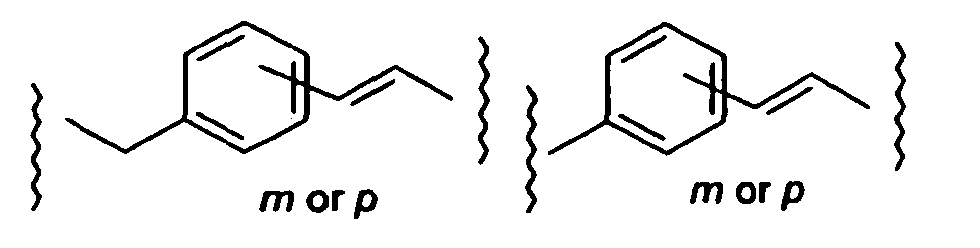
- A compound according to any one of claims 1 to 25, wherein Q2, is independently:

- A compound according to any one of claims 1 to 26 and 37 to 45, wherein Q2 is substituted.
- A compound according to claim 48, wherein substituents on Q2 are independently selected from:(1) -C(=O)OMe, -C(=O)OEt, -C(=O)O(Pr), -C(=O)O(iPr), -C(=O)O(nBu), -C(=O)O(sBu), -C(=O)O(iBu), -C(=O)O(tBu), -C(=O)O(nPe); -C(=O)OCH2CH2OH, -C(=O)OCH2CH2OMe, -C(=O)OCH2CH2OEt;(2) -(C=O)NH2, -(C=O)NMe2, -(C=O)NEt2, -(C=O)N(iPr)2, -(C=O)N(CH2CH2OH)2;(3) -(C=O)Me, -(C=O)Et, -(C=O)-cHex, -(C=O)Ph;(4) -F, -Cl, -Br, -I;(5) -OH;(6) -OMe, -OEt, -O(iPr), -O(tBu), -OPh;
-OCF3, -OCH2CF3;
-OCH2CH2OH, -OCH2CH2OMe, -OCH2CH2OEt;
-OCH2CH2NH2, -OCH2CH2NMe2, -OCH2CH2N(iPr)2;
-OPh, -OPh-Me, -OPh-OH, -OPh-OMe, O-Ph-F, -OPh-Cl, -OPh-Br, -OPh-I;(7) -Me, -Et, -nPr, -iPr, -nBu, -iBu, -sBu, -tBu, -nPe;
-CF3, -CH2CF3;
-CH2CH2OH, -CH2CH2OMe, -CH2CH2OEt;
-CH2CH2NH2, -CH2CH2NMe2, -CH2CH2N(iPr)2;
-CH2-Ph;(8) -Ph, -Ph-Me, -Ph-OH, -Ph-OMe, -Ph-F, -Ph-Cl, -Ph-Br, -Ph-I;(9) -SO2Me, -SO2Et, -SO2Ph;(10) -SO2NH2, -SO2NMe2, -SO2NEt2;(11) -NMe2, -NEt2;(12) morpholino;(13) -NO2; and(14) -CN. - A compound according to any one of claims 1 to 47, wherein Q2 is unsubstituted.
- A compound according to any one of claims 1 to 50, wherein Q2 has a backbone of at least 5 atoms.
- A compound according to any one of claims 1 to 50, wherein Q2 has a backbone of at least 6 atoms.
- A compound according to any one of claims 1 to 50, wherein Cy is independently C3-20carbocyclyl; and is optionally substituted.
- A compound according to any one of claims 1 to 50, wherein Cy is independently C3-20carbocyclyl derived from one of the following:cyclopropane, cyclobutane, cyclopentane, cyclohexane, cyclopentene, cyclohexene, norbornane, adamantane, cyclopentanone, and cyclohexanone;and is optionally substituted.
- A compound according to any one of claims 1 to 50, wherein Cy is independently C3-20heterocyclyl; and is optionally substituted.
- A compound according to any one of claims 1 to 50, wherein Cy is independently C3-20heterocyclyl derived from one of the following: piperidine, azepine, tetrahydropyran, morpholine, azetidine, piperazine, imidazoline, piperazinedione, and oxazolinone; and is optionally substituted.
- A compound according to any one of claims 1 to 50, wherein Cy is independently C5-20aryl; and is optionally substituted.
- A compound according to any one of claims 1 to 50, wherein Cy is independently C5-20carboaryl or C5-20heteroaryl; and is optionally substituted.
- A compound according to any one of claims 1 to 50, wherein Cy is independently C5-20aryl derived from one of the following: benzene, pyridine, furan, indole, pyrrole, imidazole, pyrimidine, pyrazine, pyridizine, naphthalene, quinoline, indole, benzimidazole, benzothiofuran, fluorene, acridine, and carbazole; and is optionally substituted.
- A compound according to any one of claims 1 to 50, wherein Cy is independently an optionally substituted phenyl group.
- A compound according to any one of claims 1 to 50, wherein Cy is optionally substituted with one or more substituents independently selected from:(1) -C(=O)OMe, -C(=O)OEt, -C(=O)O(Pr), -C(=O)O(iPr), -C(=O)O(nBu), -C(=O)O(sBu), -C(=O)O(iBu), -C(=O)O(tBu), -C(=O)O(nPe); -C(=O)OCH2CH2OH, -C(=O)OCH2CH2OMe, -C(=O)OCH2CH2OEt;(2) -(C=O)NH2, -(C=O)NMe2, -(C=O)NEt2, -(C=O)N(iPr)2, -(C=O)N(CH2CH2OH)2;(3) -(C=O)Me, -(C=O)Et, -(C=O)-cHex, -(C=O)Ph;(4) -F, -Cl, -Br, -I;(5) -OH;(6) -OMe, -OEt, -O(iPr), -O(tBu), -OPh;
-OCF3, -OCH2CF3;
-OCH2CH2OH, -OCH2CH2OMe, -OCH2CH2OEt;
-OCH2CH2NH2, -OCH2CH2NMe2, -OCH2CH2N(iPr)2;
-OPh, -OPh-Me, -OPh-OH, -OPh-OMe, O-Ph-F, -OPh-Cl, -OPh-Br, -OPh-I;(7) -Me, -Et, -nPr, -iPr, -nBu, -iBu, -sBu, -tBu, -nPe;
-CF3, -CH2CF3;
-CH2CH2OH, -CH2CH2OMe, -CH2CH2OEt;
-CH2CH2NH2, -CH2CH2NMe2, -CH2CH2N(iPr)2;
-CH2-Ph;(8) -Ph, -Ph-Me, -Ph-OH, -Ph-OMe, -Ph-F, -Ph-Cl, -Ph-Br, -Ph-I;(9) -SO2Me, -SO2Et, -SO2Ph;(10) -SO2NH2, -SO2NMe2, -SO2NEt2;(11) -NMe2, -NEt2;(12) morpholino;(13) -NO2; and(14) -CN. - A compound according to claim 1, selected from the following compounds, and pharmaceutically acceptable salts, solvates, amides, esters, and ethers thereof:
(1) 
PX117402 (Ex 140) (2) 
PX117403 (Ex 141) (3) 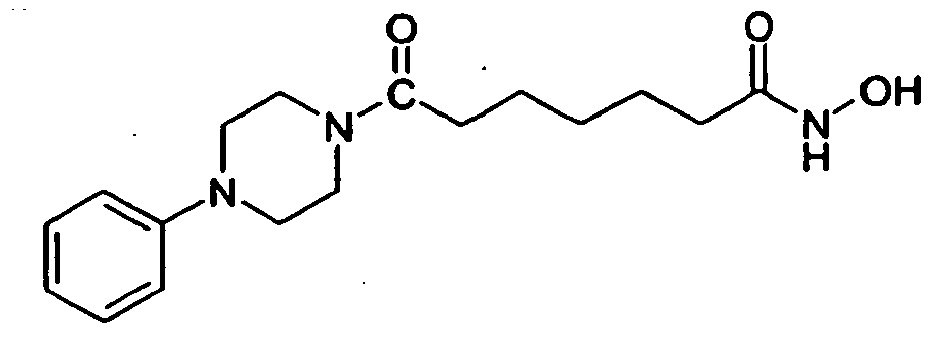
PX117404 (Ex 142) (4) 
PX117764 (Ex 143) (5) 
PX117768 (Ex 144) (6) 
PX118490 (Ex 40) (7) 
PX118491 (Ex 41) (8) 
PX118791 (Ex 145) (9) 
PX118792 (Ex 146) (10) 
PX118793 (Ex 147) (11) 
PX118794 (Ex 148) (12) 
PX118807 (Ex 45) (13) 
PX118810 (Ex 42) (14) 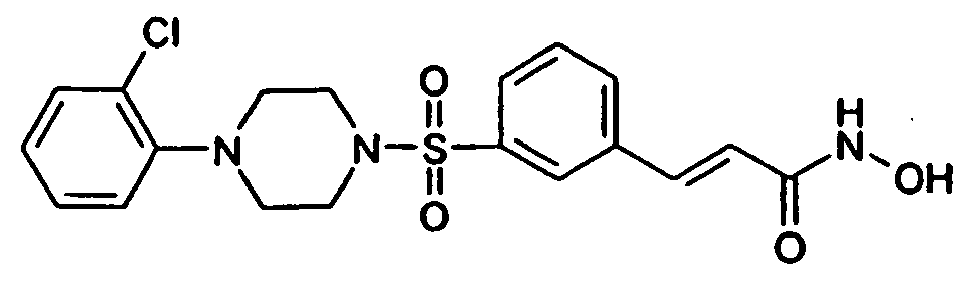
PX118811 (Ex 43) (15) 
PX118812 (Ex 44) (16) 
PX118830 (Ex 149) (17) 
PX118831 (Ex 150) (18) 
PX118832 (Ex 151) (19) 
PX118844 (Ex 163) (20) 
PX118845 (Ex 164) (21) 
PX118846 (Ex 152) (22) 
PX118847 (Ex 153) (23) 
PX118848 (Ex 165) (24) 
PX118849 (Ex 154) (25) 
PX118850 (Ex 166) (26) 
PX118859 (Ex 174) (27) 
PX118860 (Ex 175) (28) 
PX118870 (Ex 52) (29) 
PX118871 (Ex 53) (30) 
PX118872 (Ex 54) (31) 
PX118873 (Ex 55) (32) 
PX1118874 (Ex 56) (33) 
PX118875 (Ex 57) (34) 
PX118876 (Ex 58) (35) 
PX118877 (Ex 59) (36) 
PX118878 (Ex 60) (37) 
PX118882 (Ex 72) (38) 
PX118891 (Ex 74) (39) 
PX118892 (Ex 75) (40) 
PX118893 (Ex 61) (41) 
PX118894 (Ex 62) (42) 
PX118898 (Ex 176) (43) 
PX118899 (Ex 177) (44) 
PX118900 (Ex 178) (45) 
PX118901 (Ex 179) (46) 
PX118902 (Ex 180) (47) 
PX118903 (Ex 181) (48) 
PX118904 (Ex 182) (49) 
PX118905 (Ex 76) (50) 
PX118906 (Ex 77) (51) 
PX118907 (Ex 78) (52) 
PX118908 (Ex 183) (53) 
PX118909 (Ex 184) (54) 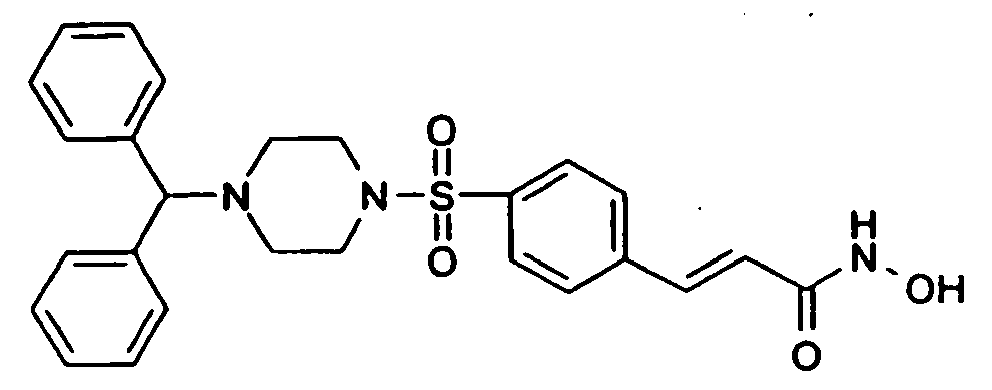
PX118910 (Ex 79) (55) 
PX118911 (Ex 80) (56) 
PX118913 (Ex 63) (57) 
PX118914 (Ex 64) (58) 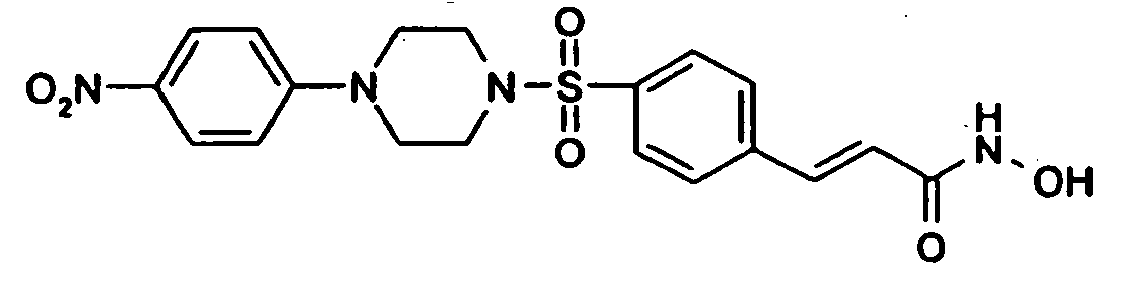
PX118918 (Ex 73) (59) 
PX118927 (Ex 155) (60) 
PX118928 (Ex 167) (61) 
PX118929 (Ex 168) (62) 
PX118930 (Ex 156) (63) 
PX118931 (Ex 157) (64) 
PX118932 (Ex 158) (65) 
PX118933 (Ex 46) (66) 
PX118934 (Ex 48) (67) 
PX118935 (Ex 49) (68) 
PX118937 (Ex 70) (69) 
PX118951 (Ex 47) (70) 
PX118965 (Ex 71) (71) 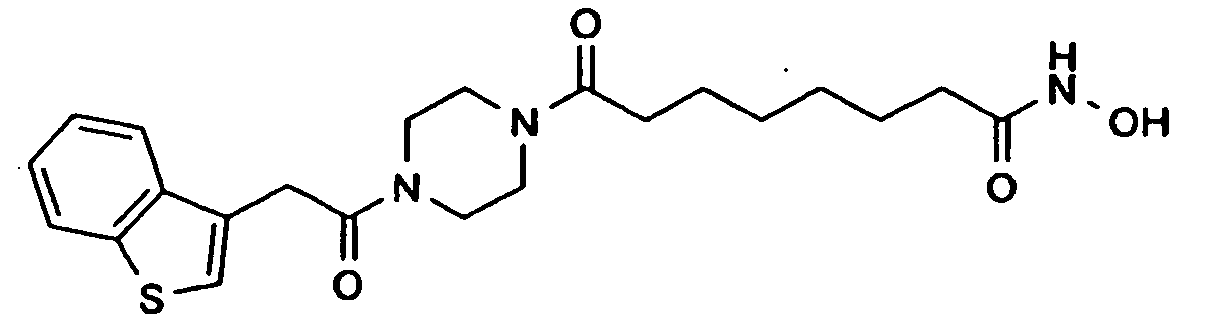
PX118967 (Ex 159) (72) 
PX118968 (Ex 169) (73) 
PX118969 (Ex 170) (74) 
PX118970 (Ex 171) (75) 
PX118971 (Ex 50) (76) 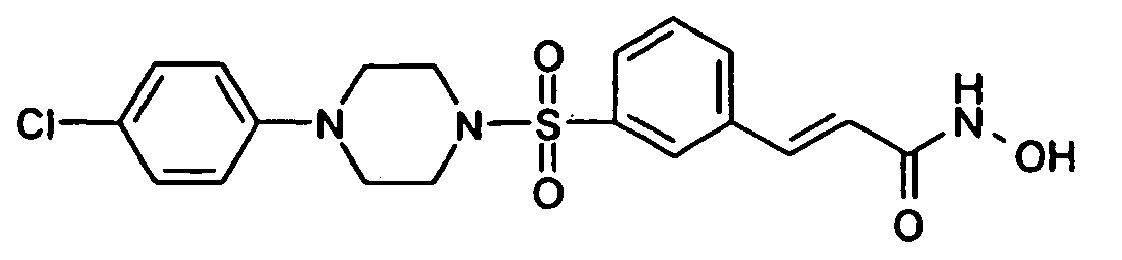
PX118972 (Ex 51) (77) 
PX118978 (Ex 172) (78) 
PX118989 (Ex 160) (79) 
PX118990 (Ex 161) (80) 
PX118991 (Ex 162) (81) 
PX118994 (Ex 173) - A composition comprising a compound according to any one of claims 1 to 62 and a pharmaceutically acceptable carrier.
- A compound according to any one of claims 1 to 62 for use in a method of treatment of the human or animal body by therapy.
- A compound according to any one of claims 1 to 62 for use in a method of treatment of a condition mediated by HDAC of the human or animal body by therapy.
- A compound according to any one of claims 1 to 62 for use in a method of treatment of a proliferative condition of the human or animal body by therapy.
- A compound according to any one of claims 1 to 62 for use in a method of treatment of cancer of the human or animal body by therapy.
- A compound according to any one of claims 1 to 62 for use in a method of treatment of psoriasis of the human or animal body by therapy.
- Use of a compound according to any one of claims 1 to 62 for the manufacture of a medicament for use in the treatment of a condition mediated by HDAC.
- Use of a compound according to any one of claims 1 to 62 for the manufacture of a medicament for use in the treatment of a proliferative condition.
- Use of a compound according to any one of claims 1 to 62 for the manufacture of a medicament for use in the treatment of cancer.
- Use of a compound according to any one of claims 1 to 62 for the manufacture of a medicament for use in the treatment of psoriasis.
- A method inhibiting HDAC in a cell in vitro comprising said cell with an effective amount of a compound according to any one of claims 1 to 62.
Applications Claiming Priority (3)
| Application Number | Priority Date | Filing Date | Title |
|---|---|---|---|
| US36933702P | 2002-04-03 | 2002-04-03 | |
| US369337P | 2002-04-03 | ||
| PCT/GB2003/001463 WO2003082288A1 (en) | 2002-04-03 | 2003-04-03 | Carbamic acid compounds comprising a piperazine linkage as hdac inhibitors |
Publications (2)
| Publication Number | Publication Date |
|---|---|
| EP1492534A1 EP1492534A1 (en) | 2005-01-05 |
| EP1492534B1 true EP1492534B1 (en) | 2008-06-25 |
Family
ID=28675576
Family Applications (1)
| Application Number | Title | Priority Date | Filing Date |
|---|---|---|---|
| EP03722719A Expired - Lifetime EP1492534B1 (en) | 2002-04-03 | 2003-04-03 | Carbamic acid compounds comprising a piperazine linkage as hdac inhibitors |
Country Status (13)
| Country | Link |
|---|---|
| US (3) | US7629343B2 (en) |
| EP (1) | EP1492534B1 (en) |
| JP (1) | JP4606027B2 (en) |
| AT (1) | ATE399012T1 (en) |
| AU (1) | AU2003229883B2 (en) |
| BR (1) | BR0308908A (en) |
| CA (1) | CA2479906C (en) |
| DE (1) | DE60321775D1 (en) |
| ES (1) | ES2309313T3 (en) |
| MX (1) | MXPA04009490A (en) |
| NO (1) | NO329942B1 (en) |
| NZ (1) | NZ536116A (en) |
| WO (1) | WO2003082288A1 (en) |
Cited By (11)
| Publication number | Priority date | Publication date | Assignee | Title |
|---|---|---|---|---|
| US7834025B2 (en) | 2006-01-19 | 2010-11-16 | Janssen Pharmaceutica N.V. | Substituted indolyl-alkyl-amino-derivatives as inhibitors of histone deacetylase |
| US7884105B2 (en) | 2005-10-27 | 2011-02-08 | Janssen Pharmaceutica, N.V. | Squaric acid derivatives as inhibitors of histone deacetylase |
| US7947830B2 (en) | 2004-07-28 | 2011-05-24 | Janssen Pharmaceutica N.V. | Substituted propenyl piperazine derivatives as novel inhibitors of histone deacetylase |
| US8071615B2 (en) | 2002-03-13 | 2011-12-06 | Janssen Pharmaceutica N.V. | Carbonylamino-derivatives as novel inhibitors of histone deacetylase |
| US8101616B2 (en) | 2006-01-19 | 2012-01-24 | Janssen Pharmaceutica N.V. | Pyridine and pyrimidine derivatives as inhibitors of histone deacetylase |
| US8114876B2 (en) | 2006-01-19 | 2012-02-14 | Janssen Pharmaceutica N.V. | Pyridine and pyrimidine derivatives as inhibitors of histone deacetylase |
| US8114999B2 (en) | 2002-03-13 | 2012-02-14 | Janssen Pharmaceutica N.V. | Aminocarbonyl-derivatives as novel inhibitors of histone deacetylase |
| US8119650B2 (en) | 2006-01-19 | 2012-02-21 | Janssen Pharmaceutica N.V. | Aminophenyl derivatives as novel inhibitors of histone deacetylase |
| US8138198B2 (en) | 2005-05-18 | 2012-03-20 | Angibaud Patrick Rene | Substituted aminopropenyl piperidine or morpholine derivatives as novel inhibitors of histone deacetylase |
| US8163733B2 (en) | 2002-03-13 | 2012-04-24 | Janssen Pharmaceutica N.V. | Sulfonylamino-derivatives as novel inhibitors of histone deacetylase |
| US8476289B2 (en) | 2008-03-27 | 2013-07-02 | Janssen Pharmaceutica Nv | Aza-bicyclohexyl substituted indolyl alkyl amino derivatives as novel inhibitors of histone deacetylace |
Families Citing this family (68)
| Publication number | Priority date | Publication date | Assignee | Title |
|---|---|---|---|---|
| US7517884B2 (en) | 1998-03-30 | 2009-04-14 | Kalypsys Inc. | Sulfonyl-substituted bicyclic compounds as modulators of PPAR |
| EA007270B1 (en) | 2002-03-13 | 2006-08-25 | Янссен Фармацевтика Н.В. | Piperazinyl-, piperadinyl- and morpholinyl-derivatives as novel inhibitors of histone deacetylase |
| BR0308908A (en) * | 2002-04-03 | 2005-01-04 | Topotarget Uk Ltd | Compound, composition, use of a compound, and methods for inhibiting hdac in a cell for the treatment of an hdac-mediated condition, a proliferative condition, cancer, and psoriasis |
| US7154002B1 (en) | 2002-10-08 | 2006-12-26 | Takeda San Diego, Inc. | Histone deacetylase inhibitors |
| US7250514B1 (en) | 2002-10-21 | 2007-07-31 | Takeda San Diego, Inc. | Histone deacetylase inhibitors |
| TW200418806A (en) * | 2003-01-13 | 2004-10-01 | Fujisawa Pharmaceutical Co | HDAC inhibitor |
| WO2004076386A2 (en) | 2003-02-25 | 2004-09-10 | Topotarget Uk Limited | Carbamic acid compounds comprising a bicyclic heteroaryl group as hdac inhibitors |
| KR20050122210A (en) | 2003-03-17 | 2005-12-28 | 다케다 샌디에고, 인코포레이티드 | Histone deacetylase inhibitors |
| CN1905881A (en) * | 2003-11-26 | 2007-01-31 | 阿托恩药品公司 | Diamine and iminodiacetic acid hydroxamic acid derivatives |
| GB0401876D0 (en) | 2004-01-28 | 2004-03-03 | Vereniging Het Nl Kanker I | New use for cancer antigen |
| WO2006017215A2 (en) * | 2004-07-12 | 2006-02-16 | Merck & Co., Inc. | Histone deacetylase inhibitors |
| PL1776358T3 (en) * | 2004-07-28 | 2009-10-30 | Janssen Pharmaceutica Nv | Substituted propenyl piperazine derivatives as novel inhibitors of histone deacetylase |
| PL1781639T3 (en) | 2004-07-28 | 2012-07-31 | Janssen Pharmaceutica Nv | Substituted indolyl alkyl amino derivatives as novel inhibitors of histone deacetylase |
| GB2417682A (en) * | 2004-08-18 | 2006-03-08 | Univ East Anglia | Histone deacetylse inhibitor for treating connective tissue disorders |
| CA2585172C (en) | 2004-10-29 | 2014-08-12 | Kalypsys, Inc. | Sulfonyl-substituted bicyclic compounds as modulators of ppar |
| JP2008524246A (en) | 2004-12-16 | 2008-07-10 | タケダ サン ディエゴ インコーポレイテッド | Histone deacetylase inhibitor |
| JPWO2006082834A1 (en) * | 2005-02-02 | 2008-06-26 | 興和株式会社 | Prophylactic / therapeutic agent for diseases caused by keratinocyte proliferation |
| ITFI20050041A1 (en) * | 2005-03-15 | 2006-09-16 | Menarini Internat Operations Luxembourg Sa | HYDROXAMMED AS INHIBITORS OF ISTONE DEACELITASIS, THEIR PREPARATION AND PHARMACEUTICAL FORMULATIONS THAT CONTAIN THEM |
| GB0509223D0 (en) | 2005-05-05 | 2005-06-15 | Chroma Therapeutics Ltd | Enzyme inhibitors |
| GB0509225D0 (en) | 2005-05-05 | 2005-06-15 | Chroma Therapeutics Ltd | Inhibitors of enzymatic activity |
| WO2006122319A2 (en) | 2005-05-11 | 2006-11-16 | Takeda San Diego, Inc. | Histone deacetylase inhibitors |
| CN102579417B (en) | 2005-05-13 | 2014-11-26 | 托波塔吉特英国有限公司 | Pharmaceutical formulations of HDAC inhibitors |
| ZA200800901B (en) | 2005-07-14 | 2010-05-26 | Takeda San Diego Inc | Histone deacetylase inhibitors |
| EP2258359A3 (en) | 2005-08-26 | 2011-04-06 | Braincells, Inc. | Neurogenesis by muscarinic receptor modulation with sabcomelin |
| JP2009506069A (en) | 2005-08-26 | 2009-02-12 | ブレインセルス,インコーポレイティド | Neurogenesis through modulation of muscarinic receptors |
| CA2623034A1 (en) * | 2005-09-27 | 2007-04-05 | Novartis Ag | Carboxyamine compounds and their use in the treatment of hdac dependent diseases |
| WO2007045962A2 (en) * | 2005-10-18 | 2007-04-26 | Orchid Research Laboratories Limited | Novel hdac inhibitors |
| US7985756B2 (en) | 2005-10-21 | 2011-07-26 | Braincells Inc. | Modulation of neurogenesis by PDE inhibition |
| US7863276B2 (en) | 2005-10-25 | 2011-01-04 | Kalypsys, Inc | Salts of modulators of PPAR and methods of treating metabolic disorders |
| WO2007053596A1 (en) | 2005-10-31 | 2007-05-10 | Braincells, Inc. | Gaba receptor mediated modulation of neurogenesis |
| EP2361619A1 (en) | 2005-11-10 | 2011-08-31 | TopoTarget UK Limited | Histone deacetylase (hdac) inhibitors (pxd-101) alone for the treatment of hematological cancer |
| WO2007070506A2 (en) | 2005-12-14 | 2007-06-21 | Amgen Inc. | Diaza heterocyclic sulfonamide derivatives and their uses |
| US7834011B2 (en) | 2006-01-19 | 2010-11-16 | Janssen Pharmaceutica N.V. | Heterocyclylalkyl derivatives as novel inhibitors of histone deacetylase |
| DK1979328T3 (en) | 2006-01-19 | 2013-03-25 | Janssen Pharmaceutica Nv | Pyridine and pyrimidine derivatives as histone deacetylase inhibitors |
| RU2008135979A (en) | 2006-02-07 | 2010-03-20 | Астеллас Фарма Инк. (Jp) | HYDROXYACRYLAMIDE COMPOUNDS |
| US20100216734A1 (en) | 2006-03-08 | 2010-08-26 | Braincells, Inc. | Modulation of neurogenesis by nootropic agents |
| WO2007134136A2 (en) | 2006-05-09 | 2007-11-22 | Braincells, Inc. | Neurogenesis by modulating angiotensin |
| WO2007134077A2 (en) | 2006-05-09 | 2007-11-22 | Braincells, Inc. | 5 ht receptor mediated neurogenesis |
| EP2068872A1 (en) | 2006-09-08 | 2009-06-17 | Braincells, Inc. | Combinations containing a 4-acylaminopyridine derivative |
| US20100184806A1 (en) | 2006-09-19 | 2010-07-22 | Braincells, Inc. | Modulation of neurogenesis by ppar agents |
| GB0619753D0 (en) | 2006-10-06 | 2006-11-15 | Chroma Therapeutics Ltd | Enzyme inhibitors |
| JP5043120B2 (en) | 2006-10-30 | 2012-10-10 | クロマ セラピューティクス リミテッド | Hydroxamates as inhibitors of histone deacetylase |
| US20080176861A1 (en) | 2007-01-23 | 2008-07-24 | Kalypsys, Inc. | Sulfonyl-substituted bicyclic compounds as ppar modulators for the treatment of non-alcoholic steatohepatitis |
| CA2700173C (en) | 2007-09-25 | 2016-10-11 | Topotarget Uk Limited | Methods of synthesis of certain hydroxamic acid compounds |
| US8293513B2 (en) * | 2007-12-14 | 2012-10-23 | Georgetown University | Histone deacetylase inhibitors |
| WO2010001366A1 (en) * | 2008-07-04 | 2010-01-07 | Institut National De La Sante Et De La Recherche Medicale (Inserm) | Piperazines derivatives as proteasome modulators |
| WO2010099217A1 (en) | 2009-02-25 | 2010-09-02 | Braincells, Inc. | Modulation of neurogenesis using d-cycloserine combinations |
| GB0903480D0 (en) | 2009-02-27 | 2009-04-08 | Chroma Therapeutics Ltd | Enzyme Inhibitors |
| US9045445B2 (en) | 2010-06-04 | 2015-06-02 | Albany Molecular Research, Inc. | Glycine transporter-1 inhibitors, methods of making them, and uses thereof |
| WO2012027495A1 (en) | 2010-08-27 | 2012-03-01 | University Of The Pacific | Piperazinylpyrimidine analogues as protein kinase inhibitors |
| WO2012087889A2 (en) * | 2010-12-20 | 2012-06-28 | The Ohio State University Research Foundation | Dna methylation inhibitors |
| CN102260225B (en) * | 2011-06-02 | 2013-08-21 | 蒋杰 | Phenylpiperazine derivatives for inhibiting tumor metastasis and tumor angiogenesis |
| WO2013066831A1 (en) * | 2011-10-31 | 2013-05-10 | Glaxosmithkline Llc | Compounds and methods |
| WO2013101600A1 (en) * | 2011-12-29 | 2013-07-04 | Pharmacyclics, Inc. | Cinnamic acid hydroxyamides as inhibitors of histone deacetylase 8 |
| KR102280614B1 (en) | 2013-03-15 | 2021-07-21 | 글로벌 블러드 테라퓨틱스, 인크. | Compounds and uses thereof for the modulation of hemoglobin |
| EP3062783B1 (en) | 2013-10-18 | 2020-08-12 | The General Hospital Corporation | Imaging histone deacetylases with a radiotracer using positron emission tomography |
| EA201992707A1 (en) | 2013-11-18 | 2020-06-30 | Глобал Блад Терапьютикс, Инк. | COMPOUNDS AND THEIR APPLICATIONS FOR HEMOGLOBIN MODULATION |
| MX2016011833A (en) * | 2014-03-12 | 2017-03-29 | Chong Kun Dang Pharmaceutical Corp | Novel compounds as histone deacetylase 6 inhibitors and pharmaceutical compositions comprising the same. |
| US10478431B2 (en) | 2014-11-26 | 2019-11-19 | The J. David Gladstone Institutes | Methods for treating a cytomegalovirus infection |
| EP3932914A1 (en) | 2015-03-13 | 2022-01-05 | Valo Health, Inc. | Alpha-cinnamide compounds and compositions as hdac8 inhibitors |
| CN108026057B (en) | 2015-05-22 | 2021-08-06 | 株式会社钟根堂 | Heterocycloalkyl derivative compounds useful as selective histone deacetylase inhibitors and pharmaceutical compositions containing the same |
| WO2018165520A1 (en) | 2017-03-10 | 2018-09-13 | Vps-3, Inc. | Metalloenzyme inhibitor compounds |
| WO2019241435A1 (en) | 2018-06-12 | 2019-12-19 | The J. David Gladstone Institutes | Compositions for herpesvirus transcriptional feedback circuit disruption and uses thereof |
| WO2020186101A1 (en) | 2019-03-12 | 2020-09-17 | The Broad Institute, Inc. | Detection means, compositions and methods for modulating synovial sarcoma cells |
| WO2021021979A2 (en) | 2019-07-30 | 2021-02-04 | Eikonizo Therapapeutics, Inc. | Hdac6 inhibitors and uses thereof |
| EP4281449A1 (en) | 2021-01-20 | 2023-11-29 | Lightox Limited | Protected hdac (histone deacetylase) inhibitors |
| WO2022187650A1 (en) * | 2021-03-04 | 2022-09-09 | The Scripps Research Institute | Heterobifunctional compositions for targeted protein degradation and methods for their use |
| EP4504190A4 (en) | 2022-04-08 | 2026-03-25 | Eikonizo Therapeutics Inc | OXADIAZOL-HDAC6 INTAKERS AND USES |
Family Cites Families (37)
| Publication number | Priority date | Publication date | Assignee | Title |
|---|---|---|---|---|
| US5318964A (en) | 1992-06-11 | 1994-06-07 | Hoffmann-La Roche Inc. | Hydroxamic derivatives and pharmaceutical compositions |
| JPH0775593A (en) * | 1993-09-08 | 1995-03-20 | Suntory Ltd | Method for producing protein |
| JPH07278086A (en) * | 1993-11-08 | 1995-10-24 | Terumo Corp | Hydroxamic acid derivative and medicinal preparation containing the same |
| GB9501737D0 (en) | 1994-04-25 | 1995-03-22 | Hoffmann La Roche | Hydroxamic acid derivatives |
| EP0827742A1 (en) | 1996-09-04 | 1998-03-11 | Vrije Universiteit Brussel | Use of histone deacetylase inhibitors for treating fribosis or cirrhosis |
| IL130802A0 (en) * | 1997-01-23 | 2001-01-28 | Hoffmann La Roche | Sulfamide-metalloprotease inhibitors |
| US7115632B1 (en) * | 1999-05-12 | 2006-10-03 | G. D. Searle & Co. | Sulfonyl aryl or heteroaryl hydroxamic acid compounds |
| WO1998038859A1 (en) | 1997-03-04 | 1998-09-11 | Monsanto Company | Sulfonyl divalent aryl or heteroaryl hydroxamic acid compounds |
| US6696449B2 (en) * | 1997-03-04 | 2004-02-24 | Pharmacia Corporation | Sulfonyl aryl hydroxamates and their use as matrix metalloprotease inhibitors |
| AU8858398A (en) | 1997-07-10 | 1999-02-08 | Pharmacia & Upjohn S.P.A. | Matrix metalloproteinase inhibitors |
| KR100609926B1 (en) | 1997-11-12 | 2006-08-04 | 다윈 디스커버리 리미티드 | Hydroxamic Acid and Carboxylic Acid Derivatives Having MPM and TNF Inhibitory Activities |
| BR9912296A (en) * | 1998-07-21 | 2001-04-17 | Warner Lambert Co | Co-administration of acat and mmp inhibitors for the treatment of atherosclerotic lesions |
| US6479502B1 (en) | 1998-08-29 | 2002-11-12 | British Biotech Pharmaceuticals | Hydroxamic acid derivatives as proteinase inhibitors |
| GB9919776D0 (en) | 1998-08-31 | 1999-10-27 | Zeneca Ltd | Compoujnds |
| HRP20010443A2 (en) | 1998-12-22 | 2002-06-30 | Hoffmann La Roche | Sulfonamide hydroxamates |
| US6492394B1 (en) * | 1998-12-22 | 2002-12-10 | Syntex (U.S.A.) Llc | Sulfonamide hydroxamates |
| AP2001002240A0 (en) | 1999-02-08 | 2001-09-30 | Searle & Co | Sufamato hydroxamic acid metalloprotease inhibitor. |
| CA2367963A1 (en) * | 1999-03-22 | 2000-09-28 | Darwin Discovery Limited | Hydroxamic and carboxylic acid derivatives |
| GB9911073D0 (en) | 1999-05-12 | 1999-07-14 | Darwin Discovery Ltd | Hydroxamic and carboxylic acid derivatives |
| EP1177173A1 (en) * | 1999-05-12 | 2002-02-06 | G.D. Searle & Co. | Hydroxamic acid derivatives as matrix metalloprotease inhibitors |
| WO2001010834A2 (en) | 1999-08-10 | 2001-02-15 | British Biotech Pharmaceuticals Limited | Antibacterial agents |
| CA2391952C (en) | 1999-11-23 | 2012-01-31 | Methylgene Inc. | Inhibitors of histone deacetylase |
| US6852752B2 (en) * | 1999-12-17 | 2005-02-08 | Vicuron Pharmaceuticals Inc. | Urea compounds, compositions and methods of use and preparation |
| AU2268401A (en) * | 1999-12-17 | 2001-06-25 | Versicor Inc | Novel succinate compounds, compositions and methods of use and preparation |
| GB9929979D0 (en) | 1999-12-17 | 2000-02-09 | Darwin Discovery Ltd | Hydroxamic acid derivatives |
| US6797820B2 (en) * | 1999-12-17 | 2004-09-28 | Vicuron Pharmaceuticals Inc. | Succinate compounds, compositions and methods of use and preparation |
| US6495677B1 (en) * | 2000-02-15 | 2002-12-17 | Kanda S. Ramasamy | Nucleoside compounds |
| JP2003524008A (en) | 2000-02-21 | 2003-08-12 | アストラゼネカ・アクチエボラーグ | Arylpiperazines and arylpiperidines and their use as metalloproteinase inhibitors |
| WO2001087870A1 (en) | 2000-05-15 | 2001-11-22 | Darwin Discovery Limited | Hydroxamic acid derivatives |
| PE20020354A1 (en) | 2000-09-01 | 2002-06-12 | Novartis Ag | HYDROXAMATE COMPOUNDS AS HISTONE-DESACETILASE (HDA) INHIBITORS |
| AU2002230385A1 (en) | 2000-09-25 | 2002-04-15 | Questcor Pharmaceuticals, Inc. | Peptide deformylase inhibitors |
| GB0023983D0 (en) | 2000-09-29 | 2000-11-15 | Prolifix Ltd | Therapeutic compounds |
| JP4975941B2 (en) | 2000-09-29 | 2012-07-11 | トポターゲット ユーケー リミテッド | (E) -N-hydroxy-3- (3-sulfamoyl-phenyl) acrylamide compound and therapeutic use thereof |
| WO2002026696A1 (en) | 2000-09-29 | 2002-04-04 | Prolifix Limited | Carbamic acid compounds comprising an amide linkage as hdac inhibitors |
| US6784173B2 (en) * | 2001-06-15 | 2004-08-31 | Hoffmann-La Roche Inc. | Aromatic dicarboxylic acid derivatives |
| US6683078B2 (en) * | 2001-07-19 | 2004-01-27 | Pharmacia Corporation | Use of sulfonyl aryl or heteroaryl hydroxamic acids and derivatives thereof as aggrecanase inhibitors |
| BR0308908A (en) * | 2002-04-03 | 2005-01-04 | Topotarget Uk Ltd | Compound, composition, use of a compound, and methods for inhibiting hdac in a cell for the treatment of an hdac-mediated condition, a proliferative condition, cancer, and psoriasis |
-
2003
- 2003-04-03 BR BR0308908-8A patent/BR0308908A/en not_active IP Right Cessation
- 2003-04-03 ES ES03722719T patent/ES2309313T3/en not_active Expired - Lifetime
- 2003-04-03 US US10/509,732 patent/US7629343B2/en not_active Expired - Fee Related
- 2003-04-03 JP JP2003579825A patent/JP4606027B2/en not_active Expired - Fee Related
- 2003-04-03 MX MXPA04009490A patent/MXPA04009490A/en active IP Right Grant
- 2003-04-03 NZ NZ536116A patent/NZ536116A/en not_active IP Right Cessation
- 2003-04-03 EP EP03722719A patent/EP1492534B1/en not_active Expired - Lifetime
- 2003-04-03 WO PCT/GB2003/001463 patent/WO2003082288A1/en not_active Ceased
- 2003-04-03 AT AT03722719T patent/ATE399012T1/en not_active IP Right Cessation
- 2003-04-03 AU AU2003229883A patent/AU2003229883B2/en not_active Ceased
- 2003-04-03 DE DE60321775T patent/DE60321775D1/en not_active Expired - Lifetime
- 2003-04-03 CA CA2479906A patent/CA2479906C/en not_active Expired - Fee Related
-
2004
- 2004-11-02 NO NO20044744A patent/NO329942B1/en not_active IP Right Cessation
-
2008
- 2008-07-01 US US12/165,686 patent/US7981895B2/en not_active Expired - Lifetime
-
2011
- 2011-07-18 US US13/184,869 patent/US20110275810A1/en not_active Abandoned
Cited By (22)
| Publication number | Priority date | Publication date | Assignee | Title |
|---|---|---|---|---|
| US8114999B2 (en) | 2002-03-13 | 2012-02-14 | Janssen Pharmaceutica N.V. | Aminocarbonyl-derivatives as novel inhibitors of histone deacetylase |
| US8343988B2 (en) | 2002-03-13 | 2013-01-01 | Janssen Pharmaceutica, N.V | Inhibitors of histone deacetylase |
| US8916554B2 (en) | 2002-03-13 | 2014-12-23 | Janssen Pharmaceutica, N.V. | Amino-derivatives as novel inhibitors of histone deacetylase |
| US8071615B2 (en) | 2002-03-13 | 2011-12-06 | Janssen Pharmaceutica N.V. | Carbonylamino-derivatives as novel inhibitors of histone deacetylase |
| US9556161B2 (en) | 2002-03-13 | 2017-01-31 | Janssen Pharmaceutica Nv | Inhibitors of histone deacetylase |
| US9533979B2 (en) | 2002-03-13 | 2017-01-03 | Janssen Pharmaceutica Nv | Amino-derivatives as novel inhibitors of histone deacetylase |
| US8268833B2 (en) | 2002-03-13 | 2012-09-18 | Janssen Pharmaceutica, N.V. | Inhibitors of histone deacetylase |
| US8455498B2 (en) | 2002-03-13 | 2013-06-04 | Janssen Pharmaceutica N.V. | Inhibitors of histone deacetylase |
| US8524711B2 (en) | 2002-03-13 | 2013-09-03 | Janssen Pharmaceutica N.V. | Amino-derivatives as novel inhibitors of histone deacetylase |
| US8163733B2 (en) | 2002-03-13 | 2012-04-24 | Janssen Pharmaceutica N.V. | Sulfonylamino-derivatives as novel inhibitors of histone deacetylase |
| US7947830B2 (en) | 2004-07-28 | 2011-05-24 | Janssen Pharmaceutica N.V. | Substituted propenyl piperazine derivatives as novel inhibitors of histone deacetylase |
| US8426416B2 (en) | 2004-07-28 | 2013-04-23 | Janssen Pharmaceutica, N.V. | Substituted propenyl piperazine derivatives as novel inhibitors of histone deacetylase |
| US8138198B2 (en) | 2005-05-18 | 2012-03-20 | Angibaud Patrick Rene | Substituted aminopropenyl piperidine or morpholine derivatives as novel inhibitors of histone deacetylase |
| US7884105B2 (en) | 2005-10-27 | 2011-02-08 | Janssen Pharmaceutica, N.V. | Squaric acid derivatives as inhibitors of histone deacetylase |
| US8163765B2 (en) | 2006-01-19 | 2012-04-24 | Janssen Pharmaceutica N.V. | Substituted indolyl-alkyl-amino-derivatives as inhibitors of histone deacetylase |
| US7834025B2 (en) | 2006-01-19 | 2010-11-16 | Janssen Pharmaceutica N.V. | Substituted indolyl-alkyl-amino-derivatives as inhibitors of histone deacetylase |
| US8664223B2 (en) | 2006-01-19 | 2014-03-04 | Janssen Pharmaceutica N.V | Pyridine and pyrimidine derivatives as inhibitors of histone deacetylase |
| US8119650B2 (en) | 2006-01-19 | 2012-02-21 | Janssen Pharmaceutica N.V. | Aminophenyl derivatives as novel inhibitors of histone deacetylase |
| US9078896B2 (en) | 2006-01-19 | 2015-07-14 | Janssen Pharmaceutica, N.V. | Pyridine and pyrimidine derivatives as inhibitors of histone deacetylase |
| US8114876B2 (en) | 2006-01-19 | 2012-02-14 | Janssen Pharmaceutica N.V. | Pyridine and pyrimidine derivatives as inhibitors of histone deacetylase |
| US8101616B2 (en) | 2006-01-19 | 2012-01-24 | Janssen Pharmaceutica N.V. | Pyridine and pyrimidine derivatives as inhibitors of histone deacetylase |
| US8476289B2 (en) | 2008-03-27 | 2013-07-02 | Janssen Pharmaceutica Nv | Aza-bicyclohexyl substituted indolyl alkyl amino derivatives as novel inhibitors of histone deacetylace |
Also Published As
| Publication number | Publication date |
|---|---|
| ATE399012T1 (en) | 2008-07-15 |
| BR0308908A (en) | 2005-01-04 |
| WO2003082288A1 (en) | 2003-10-09 |
| MXPA04009490A (en) | 2005-06-08 |
| NZ536116A (en) | 2007-01-26 |
| AU2003229883A1 (en) | 2003-10-13 |
| JP2005527556A (en) | 2005-09-15 |
| JP4606027B2 (en) | 2011-01-05 |
| US7981895B2 (en) | 2011-07-19 |
| ES2309313T3 (en) | 2008-12-16 |
| US7629343B2 (en) | 2009-12-08 |
| NO329942B1 (en) | 2011-01-24 |
| DE60321775D1 (en) | 2008-08-07 |
| EP1492534A1 (en) | 2005-01-05 |
| US20050143385A1 (en) | 2005-06-30 |
| NO20044744L (en) | 2004-11-02 |
| CA2479906C (en) | 2011-02-08 |
| US20080269237A1 (en) | 2008-10-30 |
| AU2003229883B2 (en) | 2009-06-11 |
| CA2479906A1 (en) | 2003-10-09 |
| US20110275810A1 (en) | 2011-11-10 |
Similar Documents
| Publication | Publication Date | Title |
|---|---|---|
| AU2003229883B2 (en) | Carbamic acid compounds comprising a piperazine linkage as HDAC inhibitors | |
| EP1335898B1 (en) | Carbamic acid compounds comprising an amide linkage as hdac inhibitors | |
| US7407988B2 (en) | Carbamic acid compounds comprising a sulfonamide linkage as HDAC inhibitors | |
| US6960685B2 (en) | Carbamic acid compounds comprising an ether linkage as HDAC inhibitors | |
| US7465719B2 (en) | Carbamic acid compounds comprising an ester or ketone linkage as HDAC inhibitors | |
| AU2001290131A1 (en) | Carbamic acid compounds comprising a sulfonamide linkage as HDAC inhibitors | |
| NZ535065A (en) | Carbamic acid compounds comprising a sulfonamide linkage as HDAC inhibitors | |
| CA2765409A1 (en) | Hydroxamic acid compounds comprising a sulfonamide linkage as hdac inhibitors |
Legal Events
| Date | Code | Title | Description |
|---|---|---|---|
| PUAI | Public reference made under article 153(3) epc to a published international application that has entered the european phase |
Free format text: ORIGINAL CODE: 0009012 |
|
| 17P | Request for examination filed |
Effective date: 20041028 |
|
| AK | Designated contracting states |
Kind code of ref document: A1 Designated state(s): AT BE BG CH CY CZ DE DK EE ES FI FR GB GR HU IE IT LI LU MC NL PT RO SE SI SK TR |
|
| AX | Request for extension of the european patent |
Extension state: AL LT LV MK |
|
| GRAP | Despatch of communication of intention to grant a patent |
Free format text: ORIGINAL CODE: EPIDOSNIGR1 |
|
| GRAS | Grant fee paid |
Free format text: ORIGINAL CODE: EPIDOSNIGR3 |
|
| GRAA | (expected) grant |
Free format text: ORIGINAL CODE: 0009210 |
|
| AK | Designated contracting states |
Kind code of ref document: B1 Designated state(s): AT BE BG CH CY CZ DE DK EE ES FI FR GB GR HU IE IT LI LU MC NL PT RO SE SI SK TR |
|
| REG | Reference to a national code |
Ref country code: GB Ref legal event code: FG4D |
|
| REG | Reference to a national code |
Ref country code: CH Ref legal event code: EP |
|
| REF | Corresponds to: |
Ref document number: 60321775 Country of ref document: DE Date of ref document: 20080807 Kind code of ref document: P |
|
| REG | Reference to a national code |
Ref country code: IE Ref legal event code: FG4D |
|
| PG25 | Lapsed in a contracting state [announced via postgrant information from national office to epo] |
Ref country code: SI Free format text: LAPSE BECAUSE OF FAILURE TO SUBMIT A TRANSLATION OF THE DESCRIPTION OR TO PAY THE FEE WITHIN THE PRESCRIBED TIME-LIMIT Effective date: 20080625 Ref country code: FI Free format text: LAPSE BECAUSE OF FAILURE TO SUBMIT A TRANSLATION OF THE DESCRIPTION OR TO PAY THE FEE WITHIN THE PRESCRIBED TIME-LIMIT Effective date: 20080625 |
|
| PG25 | Lapsed in a contracting state [announced via postgrant information from national office to epo] |
Ref country code: AT Free format text: LAPSE BECAUSE OF FAILURE TO SUBMIT A TRANSLATION OF THE DESCRIPTION OR TO PAY THE FEE WITHIN THE PRESCRIBED TIME-LIMIT Effective date: 20080625 Ref country code: NL Free format text: LAPSE BECAUSE OF FAILURE TO SUBMIT A TRANSLATION OF THE DESCRIPTION OR TO PAY THE FEE WITHIN THE PRESCRIBED TIME-LIMIT Effective date: 20080625 |
|
| REG | Reference to a national code |
Ref country code: ES Ref legal event code: FG2A Ref document number: 2309313 Country of ref document: ES Kind code of ref document: T3 |
|
| NLV1 | Nl: lapsed or annulled due to failure to fulfill the requirements of art. 29p and 29m of the patents act | ||
| PG25 | Lapsed in a contracting state [announced via postgrant information from national office to epo] |
Ref country code: CZ Free format text: LAPSE BECAUSE OF FAILURE TO SUBMIT A TRANSLATION OF THE DESCRIPTION OR TO PAY THE FEE WITHIN THE PRESCRIBED TIME-LIMIT Effective date: 20080625 Ref country code: PT Free format text: LAPSE BECAUSE OF FAILURE TO SUBMIT A TRANSLATION OF THE DESCRIPTION OR TO PAY THE FEE WITHIN THE PRESCRIBED TIME-LIMIT Effective date: 20081125 Ref country code: SE Free format text: LAPSE BECAUSE OF FAILURE TO SUBMIT A TRANSLATION OF THE DESCRIPTION OR TO PAY THE FEE WITHIN THE PRESCRIBED TIME-LIMIT Effective date: 20080925 |
|
| PG25 | Lapsed in a contracting state [announced via postgrant information from national office to epo] |
Ref country code: RO Free format text: LAPSE BECAUSE OF FAILURE TO SUBMIT A TRANSLATION OF THE DESCRIPTION OR TO PAY THE FEE WITHIN THE PRESCRIBED TIME-LIMIT Effective date: 20080625 Ref country code: BE Free format text: LAPSE BECAUSE OF FAILURE TO SUBMIT A TRANSLATION OF THE DESCRIPTION OR TO PAY THE FEE WITHIN THE PRESCRIBED TIME-LIMIT Effective date: 20080625 Ref country code: SK Free format text: LAPSE BECAUSE OF FAILURE TO SUBMIT A TRANSLATION OF THE DESCRIPTION OR TO PAY THE FEE WITHIN THE PRESCRIBED TIME-LIMIT Effective date: 20080625 |
|
| PG25 | Lapsed in a contracting state [announced via postgrant information from national office to epo] |
Ref country code: DK Free format text: LAPSE BECAUSE OF FAILURE TO SUBMIT A TRANSLATION OF THE DESCRIPTION OR TO PAY THE FEE WITHIN THE PRESCRIBED TIME-LIMIT Effective date: 20080625 Ref country code: EE Free format text: LAPSE BECAUSE OF FAILURE TO SUBMIT A TRANSLATION OF THE DESCRIPTION OR TO PAY THE FEE WITHIN THE PRESCRIBED TIME-LIMIT Effective date: 20080625 Ref country code: BG Free format text: LAPSE BECAUSE OF FAILURE TO SUBMIT A TRANSLATION OF THE DESCRIPTION OR TO PAY THE FEE WITHIN THE PRESCRIBED TIME-LIMIT Effective date: 20080925 |
|
| PLBE | No opposition filed within time limit |
Free format text: ORIGINAL CODE: 0009261 |
|
| STAA | Information on the status of an ep patent application or granted ep patent |
Free format text: STATUS: NO OPPOSITION FILED WITHIN TIME LIMIT |
|
| 26N | No opposition filed |
Effective date: 20090326 |
|
| REG | Reference to a national code |
Ref country code: CH Ref legal event code: PL |
|
| PG25 | Lapsed in a contracting state [announced via postgrant information from national office to epo] |
Ref country code: LI Free format text: LAPSE BECAUSE OF NON-PAYMENT OF DUE FEES Effective date: 20090430 Ref country code: CH Free format text: LAPSE BECAUSE OF NON-PAYMENT OF DUE FEES Effective date: 20090430 |
|
| REG | Reference to a national code |
Ref country code: IE Ref legal event code: MM4A |
|
| PG25 | Lapsed in a contracting state [announced via postgrant information from national office to epo] |
Ref country code: MC Free format text: LAPSE BECAUSE OF NON-PAYMENT OF DUE FEES Effective date: 20090430 Ref country code: IE Free format text: LAPSE BECAUSE OF NON-PAYMENT OF DUE FEES Effective date: 20090403 |
|
| PG25 | Lapsed in a contracting state [announced via postgrant information from national office to epo] |
Ref country code: GR Free format text: LAPSE BECAUSE OF FAILURE TO SUBMIT A TRANSLATION OF THE DESCRIPTION OR TO PAY THE FEE WITHIN THE PRESCRIBED TIME-LIMIT Effective date: 20080926 |
|
| PG25 | Lapsed in a contracting state [announced via postgrant information from national office to epo] |
Ref country code: LU Free format text: LAPSE BECAUSE OF NON-PAYMENT OF DUE FEES Effective date: 20090403 |
|
| PG25 | Lapsed in a contracting state [announced via postgrant information from national office to epo] |
Ref country code: HU Free format text: LAPSE BECAUSE OF FAILURE TO SUBMIT A TRANSLATION OF THE DESCRIPTION OR TO PAY THE FEE WITHIN THE PRESCRIBED TIME-LIMIT Effective date: 20081226 |
|
| PG25 | Lapsed in a contracting state [announced via postgrant information from national office to epo] |
Ref country code: TR Free format text: LAPSE BECAUSE OF FAILURE TO SUBMIT A TRANSLATION OF THE DESCRIPTION OR TO PAY THE FEE WITHIN THE PRESCRIBED TIME-LIMIT Effective date: 20080625 |
|
| PG25 | Lapsed in a contracting state [announced via postgrant information from national office to epo] |
Ref country code: CY Free format text: LAPSE BECAUSE OF FAILURE TO SUBMIT A TRANSLATION OF THE DESCRIPTION OR TO PAY THE FEE WITHIN THE PRESCRIBED TIME-LIMIT Effective date: 20080625 |
|
| PGFP | Annual fee paid to national office [announced via postgrant information from national office to epo] |
Ref country code: GB Payment date: 20140417 Year of fee payment: 12 |
|
| PGFP | Annual fee paid to national office [announced via postgrant information from national office to epo] |
Ref country code: FR Payment date: 20140425 Year of fee payment: 12 Ref country code: DE Payment date: 20140425 Year of fee payment: 12 Ref country code: ES Payment date: 20140409 Year of fee payment: 12 Ref country code: IT Payment date: 20140429 Year of fee payment: 12 |
|
| REG | Reference to a national code |
Ref country code: DE Ref legal event code: R119 Ref document number: 60321775 Country of ref document: DE |
|
| GBPC | Gb: european patent ceased through non-payment of renewal fee |
Effective date: 20150403 |
|
| PG25 | Lapsed in a contracting state [announced via postgrant information from national office to epo] |
Ref country code: GB Free format text: LAPSE BECAUSE OF NON-PAYMENT OF DUE FEES Effective date: 20150403 Ref country code: IT Free format text: LAPSE BECAUSE OF NON-PAYMENT OF DUE FEES Effective date: 20150403 Ref country code: DE Free format text: LAPSE BECAUSE OF NON-PAYMENT OF DUE FEES Effective date: 20151103 |
|
| REG | Reference to a national code |
Ref country code: FR Ref legal event code: ST Effective date: 20151231 |
|
| PG25 | Lapsed in a contracting state [announced via postgrant information from national office to epo] |
Ref country code: FR Free format text: LAPSE BECAUSE OF NON-PAYMENT OF DUE FEES Effective date: 20150430 |
|
| REG | Reference to a national code |
Ref country code: ES Ref legal event code: FD2A Effective date: 20160530 |
|
| PG25 | Lapsed in a contracting state [announced via postgrant information from national office to epo] |
Ref country code: ES Free format text: LAPSE BECAUSE OF NON-PAYMENT OF DUE FEES Effective date: 20150404 |