EP1492369A1 - Cellular Transmission - Google Patents
Cellular Transmission Download PDFInfo
- Publication number
- EP1492369A1 EP1492369A1 EP20040102190 EP04102190A EP1492369A1 EP 1492369 A1 EP1492369 A1 EP 1492369A1 EP 20040102190 EP20040102190 EP 20040102190 EP 04102190 A EP04102190 A EP 04102190A EP 1492369 A1 EP1492369 A1 EP 1492369A1
- Authority
- EP
- European Patent Office
- Prior art keywords
- network
- transmitters
- time
- transmitter
- transmit
- Prior art date
- Legal status (The legal status is an assumption and is not a legal conclusion. Google has not performed a legal analysis and makes no representation as to the accuracy of the status listed.)
- Withdrawn
Links
- 230000005540 biological transmission Effects 0.000 title claims abstract description 26
- 230000001413 cellular effect Effects 0.000 title claims description 12
- 238000000034 method Methods 0.000 claims description 20
- 230000000694 effects Effects 0.000 claims description 12
- 238000001228 spectrum Methods 0.000 abstract description 2
- 238000010586 diagram Methods 0.000 description 3
- 238000000926 separation method Methods 0.000 description 2
- RYGMFSIKBFXOCR-UHFFFAOYSA-N Copper Chemical compound [Cu] RYGMFSIKBFXOCR-UHFFFAOYSA-N 0.000 description 1
- 238000010276 construction Methods 0.000 description 1
- 229910052802 copper Inorganic materials 0.000 description 1
- 239000010949 copper Substances 0.000 description 1
- 238000005562 fading Methods 0.000 description 1
- 230000002452 interceptive effect Effects 0.000 description 1
- 230000003287 optical effect Effects 0.000 description 1
- 230000001360 synchronised effect Effects 0.000 description 1
Images




Classifications
-
- H—ELECTRICITY
- H04—ELECTRIC COMMUNICATION TECHNIQUE
- H04W—WIRELESS COMMUNICATION NETWORKS
- H04W16/00—Network planning, e.g. coverage or traffic planning tools; Network deployment, e.g. resource partitioning or cells structures
- H04W16/02—Resource partitioning among network components, e.g. reuse partitioning
-
- H—ELECTRICITY
- H04—ELECTRIC COMMUNICATION TECHNIQUE
- H04H—BROADCAST COMMUNICATION
- H04H20/00—Arrangements for broadcast or for distribution combined with broadcast
- H04H20/42—Arrangements for resource management
-
- H—ELECTRICITY
- H04—ELECTRIC COMMUNICATION TECHNIQUE
- H04H—BROADCAST COMMUNICATION
- H04H20/00—Arrangements for broadcast or for distribution combined with broadcast
- H04H20/44—Arrangements characterised by circuits or components specially adapted for broadcast
- H04H20/46—Arrangements characterised by circuits or components specially adapted for broadcast specially adapted for broadcast systems covered by groups H04H20/53-H04H20/95
-
- H—ELECTRICITY
- H04—ELECTRIC COMMUNICATION TECHNIQUE
- H04H—BROADCAST COMMUNICATION
- H04H20/00—Arrangements for broadcast or for distribution combined with broadcast
- H04H20/65—Arrangements characterised by transmission systems for broadcast
- H04H20/67—Common-wave systems, i.e. using separate transmitters operating on substantially the same frequency
-
- H—ELECTRICITY
- H04—ELECTRIC COMMUNICATION TECHNIQUE
- H04H—BROADCAST COMMUNICATION
- H04H20/00—Arrangements for broadcast or for distribution combined with broadcast
- H04H20/65—Arrangements characterised by transmission systems for broadcast
- H04H20/71—Wireless systems
- H04H20/72—Wireless systems of terrestrial networks
-
- H—ELECTRICITY
- H04—ELECTRIC COMMUNICATION TECHNIQUE
- H04W—WIRELESS COMMUNICATION NETWORKS
- H04W16/00—Network planning, e.g. coverage or traffic planning tools; Network deployment, e.g. resource partitioning or cells structures
- H04W16/02—Resource partitioning among network components, e.g. reuse partitioning
- H04W16/12—Fixed resource partitioning
-
- H—ELECTRICITY
- H04—ELECTRIC COMMUNICATION TECHNIQUE
- H04H—BROADCAST COMMUNICATION
- H04H20/00—Arrangements for broadcast or for distribution combined with broadcast
- H04H20/18—Arrangements for synchronising broadcast or distribution via plural systems
Definitions
- This invention relates to a network of at least two transmitters arranged to effect a cellular coverage pattern, and to a method of operating such a network.
- the invention relates also to a transmitter for operating in such a network, and to a method of operating such a transmitter.
- the invention has particular application to broadcast, but is not limited thereto.
- First and second generation mobile telephone networks used frequency based separation.
- the network is set up such that transmitters associated with adjacent cells do not transmit on the same frequencies. This works well assuming that there are sufficient frequencies, which leads to its use with narrow frequency bands.
- a number of frequencies tend to be grouped together, and that group of frequencies is repeated for use with non-adjacent cells across the network.
- the number of different groups may be between four and fifteen, with seven different groups leading to the honeycomb pattern found in many textbooks.
- Third generation mobile telephone systems use a single, wide frequency band, with separation being achieved through the use of different spreading codes.
- GSM Global System for Mobiles
- IPDC Internet Protocol Data Cast
- DVB-T Terrestrial Digital Video Broadcasting
- IPDC services In bursts utilising the whole of the channel bandwidth, rather than multiplexing them in any other way. This is known as time-slicing. Since DVB-T is a high bandwidth system-each channel may be 6, 7 or 8 MHz wide - the number of available frequencies for cellularisation is quite small. This limits the opportunities for the provision of IPDC services.
- One way of addressing this is to divide (or rasterise) a DVB-T channel into sub-bands, for example divide an 8 MHz channel into four 2 MHz channels. Cellularisation can then be performed using the sub-bands.
- a network of at least two transmitters arranged to effect a cellular coverage pattern, the transmitters associated with at least two adjacent cells being arranged to transmit signals at a particular frequency on a time-divided basis.
- this invention it becomes possible to transmit signals in plural adjacent cells using a single channel without using code division multiplexing. This can result in a significant saving in the use of the frequency spectrum without affecting the channel rasterisation.
- the invention can allow the construction of a broadcast network, such as e.g. a DVB-T network, with a cellular coverage pattern without requiring radio planning to effect a suitable reuse of channel frequencies. Instead, a small number of channels, even one channel, can be shared between all transmitters in the whole of, or part of, a network.
- a broadcast network such as e.g. a DVB-T network
- the transmitters in a group may in a simple implementation be allocated approximately equal amounts of time on which they are permitted to transmit. This is convenient since it can simplify the network, and can reduce the chances of a transmitter accidentally transmitting at an inappropriate time and thereby interfering with transmissions from another transmitter.
- the transmitters in a group could be allocated unequal amounts of time.
- a transmitter associated with a cell having a high population density might be awarded a proportion of the available time appropriate to the demand.
- the allocation may be dynamically allocated with the demand being calculated in any suitable manner, for example using subscriber distribution information obtained from a mobile telephone network or by other means.
- Each transmitter may be arranged to control the timing of transmissions on the basis of the time as determined from a common time reference.
- a common time reference may be an atomic clock or global positioning system (GPS) source, for example.
- GPS global positioning system
- a method of operating a network of at least two transmitters arranged to effect a cellular coverage pattern comprising controlling the transmitters associated with at least two adjacent cells to transmit signals at a given frequency on a time-divided basis.
- a transmitter for operating with other transmitters in a network to effect a cellular coverage pattern, the transmitter comprising a controller arranged to control transmission at a given frequency to occur only at times determined to be permissible by comparison of received signal timing allocation information to a source of reference time.
- a method of operating a transmitter with other transmitters in a network to effect a cellular coverage pattern comprising determining time periods in which transmissions are permissible by comparing received signal timing allocation information to a source of reference time, and controlling the transmitter to transmit signals at a given frequency only during said time periods.
- a part of a DVB-T broadcast network 10 comprising first to seventh transmitters 11-17.
- the second to sixth transmitters 12-17 are arranged around and at appropriate distances from the first transmitter 11 so as to produce a good geographical coverage.
- the cells associated with the transmitters 11-17 are indicated at 11a-17a, and together form a pattern, which in this simplified example is illustrated schematically as a honeycomb pattern.
- Roaming between the transmitters 11-17 are some mobile multimedia terminals MMT, which could be like the terminal described in W001/17255.
- Each of the transmitters 11 to 17 is connected to a network controller 18, which includes a content provision system 19 and a control information provision system 20.
- the network controller 18 may be connected to the transmitters in any convenient way, for example via point-to-point microwave links, copper or optical cable, satellite link or any combination thereof.
- Figure 1 is purely schematic and it will be appreciated by those skilled in the art what variations to the network topology and system connections are possible.
- transmitter 11 is shown comprising generally a content handling subsystem or Internet Protocol Encapsulator (IPE) 30, which is arranged to receive content data from the network controller 18. Downstream of the content handling subsystem 30 are a modulator 31, which modulates the data onto an appropriate transport stream, and a transmitter 32, which provides radio frequency (RF) signals including the content data for broadcast by an antenna 33.
- the transmitter 32, the modulator 31 and the content handling subsystem 30 each operate under control of a controller 34.
- a time reference subsystem 35 which may include a GPS receiver or an atomic clock (not shown), provides timing reference signals to the controller 34. The time reference subsystem 35 allows the transmitter 11 to be synchronised with the other transmitters 12-17.
- the controller 34 is provided with control information sent from the network controller 18.
- the controller can cause transmission of the content data to occur on a given channel at times identified by the network controller, and refrain from transmitting at other times.
- the controller 34 is arranged to control instances of transmission with reference to the control information and to the timing reference time signals provided by the time reference subsystem 35.
- the controller may arrange for content to be transmitted continuously on one or more other channels. However, transmission is effected on one, time-sliced, channel only when allowed by the control information.
- the control information provided by the network controller 18, and more particularly the control information provision system 20 forming part thereof, is such as to allow only one of the seven transmitters 11-17 to transmit on the time-sliced channel at any time.
- the control information can thus be considered as signal timing allocation information.
- the time-sliced channel carries IPDC service data, so can be referred to as an IPDC channel.
- the IPDC channel may be at any of the frequencies available for DVB-T broadcast, and has a bandwidth appropriate to the system. In Europe, DVB-T channels will be 8 MHz in width.
- Each item of content transmitted on the IPDC channel is intended for one or more subscribers, each of which is provided with suitable means for decoding the content data.
- Content typically is audio-visual in nature, for example the highlights of a soccer game. Items of content may be required to be broadcast on more than one occasion in respect of a geographical area, to allow for reception and decoding by MMTs which missed a first transmission, due to signal fading for example. Retransmission strategy is outside the scope of this disclosure.
- the control information provided by the network controller 18 is used by the transmitters 11-17 to effect time-slicing as illustrated in Figure 3.
- FIG. 3A which illustrates a simplified example of one embodiment of the invention
- the content transmitted might be different for the different transmitters 11-17, or it might be the same.
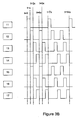
- the same time slot may be used for transmission in non-adjacent cells, as illustrated in Figure 3B, where the transmissions on the IPDC channel for the transmitters 11-17 are shown.
- the second and fifth transmitters 12 and 15 are in non-adjacent cells 12a and 15a respectively.
- the third and fifth transmitter 13 and 16, and as well as the fourth and seventh transmitters 14 and 17 form non-adjacent transmitter pairs.
- the fourth and seventh transmitters 14 and 17 stop transmitting, the first transmitter 11 again transmits on the IPDC channel, commencing a repeat of the timing sequence.
- the content transmitted might be different for the different transmitters 11-17, or it might be the same.
- none of the transmitters 11-17 transmits on the IPDC channel at the same time as another of the adjacent transmitters, so they do not interfere with each other in this respect. Accordingly, an MMT decoding the IPDC channel content transmitted by one transmitter will not experience interference of the signal from other transmitters in the group of transmitters 11-17, regardless of its geographical position.
- the transmissions may be made with a small guard time of, for example, a few milliseconds, between transmissions by successive transmitters.
- the duration of the guard time will depend on, among other things, the cell size and the accuracy of the time reference subsystems 35.
- the signal timing allocation information may take any suitable form. For example, it may comprise the absolute times of starting and stopping transmission, with reference to the time reference subsystem 35.
- the timing may alternatively be given using the duration of the burst and the interval between bursts, or as the time from the end of a burst to the beginning of the next burst.
- the interval may include in one embodiment of the invention also the guard period.
- the signal timing may also be included in the transmitted data, e.g. in a header of one or more of the transmitted packets, which can allow it to be used by the receiver for turning the receiver on and off in order to conserve power.
- the information may be mere frame or subframe number, from which starting and stopping times can be derived. Any scheme inbetween these extremes may be used instead.
- a single channel can be used in the manner described above in respect of a network having more than seven cells. This embodiment of the invention is illustrated in Figure 4.
- the transmitters 11-17 are shown together as a group 40.
- Second, third and fourth groups 41-43 have substantially similar arrangement and timing pattern as the first group 40, and are distributed around the first group in a tessellating manner.
- the cells in the second group are labelled 111a-117a and the cell in the third and fourth groups are labelled correspondingly.
- the transmitters of each group 40-43 are provided with signal timing allocation information from a common network controller 44, which allows the corresponding transmitters in different groups to transmit at the same time, thereby avoiding interference with adjacent cells.
- cells 13a, 113a, 213a and 313a transmit simultaneously, as do cells 14a, 114a, 214a and 314a, and so on.
- a downside with the above described scheme is the reduced average bit rate per cell, compared to where a different (frequency) channel is used for each cell.
- each cell has a capacity of only one seventh of the capacity that the IPDC channel would have, if transmitted continuously. This capacity is reduced further if guard times are used. In some circumstances, the capacity may not be sufficient for one or more cells in a group of adjacent cells.
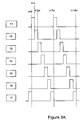
- the allocation of time may vary between transmitters in a group, as shown in Figure 5. Referring to Figure 5, timing allocation is shown for the transmitters 11-17. It can be seen that the first and third transmitters 11, 13 are provided with proportionately more of the time available, at the expense of the second and fourth transmitters 12, 14.
- the signals transmitted by a transmitter 11-17 includes data indicating the timing allocation information associated with its cell.
- the information may or may not be in the same format as that received from the network controller 18.
- an MMT can determine when to activate its receiver to receive the transmitted content, and when it can switch off its receiver to save power.
- the adjustment of the time allocation may require co-ordination by the network controller 44 of certain transmitters in other groups 41-43 to prevent interference between groups. This may be effected by controlling the time allocations of corresponding transmitters in the other groups 41-43 to take the same allocation as the first group 40. Alternatively, any other suitable scheme could be used.
- the timing allocation is adjustable dynamically, to take account of particularly high demand in one or more cells for example.
- a cell resembling a hexagon may be sectored into three cells, each resembling a kite shape. More or less than seven cells may be used in the time-slice reuse pattern, especially if cells resembling the kite shape are present. It will also be appreciated that cell boundaries may not be clear, and that there may be areas in which signals from two or three transmitters are receivable and decodable.
- the invention is applicable to other kinds of broadcasting network, such as a digital broadband broadcast network defined by the Advanced Television Systems Committee (ATSC) and the Integrated Services Digital Broadcasting (ISDB) network.
- the invention may also be used in non-broadcast networks, for example on downlink communications in mobile telephone or satellite telephone systems.
- an IPDC channel is time-sliced between the transmitters 11-17, the concept may be applied to the division of two or more channels between transmitters associated with adjacent cells.
- the first transmitter might transmit on a channel which is twice the width of channels used by the other transmitters 12-17 but overlaps therewith. The important factor is in the avoidance of transmitting signals at the same frequency at the same time.
- transmitters associated with adjacent cells are controlled not to transmit at the same frequency at the same time, it will be appreciated that one such transmitter may be allowed to transmit at a low power. If the power is sufficiently low, then it would not interfere significantly with transmissions in an adjacent cell so would not be problematic.
Landscapes
- Engineering & Computer Science (AREA)
- Signal Processing (AREA)
- Computer Networks & Wireless Communication (AREA)
- Business, Economics & Management (AREA)
- General Business, Economics & Management (AREA)
- Mobile Radio Communication Systems (AREA)
Abstract
Description
- This invention relates to a network of at least two transmitters arranged to effect a cellular coverage pattern, and to a method of operating such a network. The invention relates also to a transmitter for operating in such a network, and to a method of operating such a transmitter. The invention has particular application to broadcast, but is not limited thereto.
- In a cellular type radio network, there are a number of ways of separating the signals transmitted by the transmitter of one cell from those transmitted by the transmitter of an adjacent cell. First and second generation mobile telephone networks used frequency based separation. Here, the network is set up such that transmitters associated with adjacent cells do not transmit on the same frequencies. This works well assuming that there are sufficient frequencies, which leads to its use with narrow frequency bands. A number of frequencies tend to be grouped together, and that group of frequencies is repeated for use with non-adjacent cells across the network. The number of different groups may be between four and fifteen, with seven different groups leading to the honeycomb pattern found in many textbooks.
- Third generation mobile telephone systems use a single, wide frequency band, with separation being achieved through the use of different spreading codes.
- Within a cell of a Global System for Mobiles (GSM) network, a frequency band is shared between a number of transmitters using time division multiplexing.
- All of the above described principles are well known.
- It is proposed to provide Internet Protocol Data Cast (IPDC) services as part of digital broadcasting systems such as e.g. the Terrestrial Digital Video Broadcasting (DVB-T) system. The ability to decode data from an IPDC transmission depends on a subscription to that service. To allow reduced power consumption in mobile DVB-T receivers, it has been proposed to transmit IPDC services in bursts utilising the whole of the channel bandwidth, rather than multiplexing them in any other way. This is known as time-slicing. Since DVB-T is a high bandwidth system-each channel may be 6, 7 or 8 MHz wide - the number of available frequencies for cellularisation is quite small. This limits the opportunities for the provision of IPDC services. One way of addressing this is to divide (or rasterise) a DVB-T channel into sub-bands, for example divide an 8 MHz channel into four 2 MHz channels. Cellularisation can then be performed using the sub-bands.
- It is an aim of the invention to allow for cellularisation without requiring the division of a channel into sub-bands.
- According to a first aspect of the invention, there is provided a network of at least two transmitters arranged to effect a cellular coverage pattern, the transmitters associated with at least two adjacent cells being arranged to transmit signals at a particular frequency on a time-divided basis.
- Using this invention, it becomes possible to transmit signals in plural adjacent cells using a single channel without using code division multiplexing. This can result in a significant saving in the use of the frequency spectrum without affecting the channel rasterisation.
- The invention can allow the construction of a broadcast network, such as e.g. a DVB-T network, with a cellular coverage pattern without requiring radio planning to effect a suitable reuse of channel frequencies. Instead, a small number of channels, even one channel, can be shared between all transmitters in the whole of, or part of, a network.
- These advantages are particularly significant when the invention is applied to a group of transmitters associated with a given cell and with plural adjacent cells.
- The transmitters in a group may in a simple implementation be allocated approximately equal amounts of time on which they are permitted to transmit. This is convenient since it can simplify the network, and can reduce the chances of a transmitter accidentally transmitting at an inappropriate time and thereby interfering with transmissions from another transmitter.
- Alternatively, the transmitters in a group could be allocated unequal amounts of time. Thus, a transmitter associated with a cell having a high population density might be awarded a proportion of the available time appropriate to the demand. The allocation may be dynamically allocated with the demand being calculated in any suitable manner, for example using subscriber distribution information obtained from a mobile telephone network or by other means.
- Each transmitter may be arranged to control the timing of transmissions on the basis of the time as determined from a common time reference. Such a reference may be an atomic clock or global positioning system (GPS) source, for example. Using a common time reference reduces the possibility of a transmitter transmitting at an inappropriate time, which could result in interference.
- According to a second aspect of the invention, there is provided a method of operating a network of at least two transmitters arranged to effect a cellular coverage pattern, the method comprising controlling the transmitters associated with at least two adjacent cells to transmit signals at a given frequency on a time-divided basis.
- According to a third aspect of the invention, there is provided a transmitter for operating with other transmitters in a network to effect a cellular coverage pattern, the transmitter comprising a controller arranged to control transmission at a given frequency to occur only at times determined to be permissible by comparison of received signal timing allocation information to a source of reference time.
- According to a fourth aspect of the invention, there is also provided a method of operating a transmitter with other transmitters in a network to effect a cellular coverage pattern, the method comprising determining time periods in which transmissions are permissible by comparing received signal timing allocation information to a source of reference time, and controlling the transmitter to transmit signals at a given frequency only during said time periods.
- Embodiments of the invention will now be described, by way of example only, with reference to the accompanying drawings of which:
- Figure 1 illustrates a network according to one embodiment of the invention;
- Figure 2 shows schematically a transmitter constructed and operating according to one embodiment of the invention and forming part of the Figure 1 network;
- Figure 3A is a timing diagram by which the embodiment of Figure 1 network operates;
- Figure 3B is a timing diagram for another embodiment of the invention;
- Figure 4 shows how plural groups of transmitters may be repeated to enlarge a network according to one embodiment of the invention; and
- Figure 5 is a timing diagram showing how signal timing allocations can vary between transmitters associated with adjacent cells in one embodiment of the invention.
- Returning firstly to Figure 1 illustrating schematically one embodiment of the invention, a part of a DVB-
T broadcast network 10 is shown comprising first to seventh transmitters 11-17. The second to sixth transmitters 12-17 are arranged around and at appropriate distances from thefirst transmitter 11 so as to produce a good geographical coverage. The cells associated with the transmitters 11-17 are indicated at 11a-17a, and together form a pattern, which in this simplified example is illustrated schematically as a honeycomb pattern. Roaming between the transmitters 11-17 are some mobile multimedia terminals MMT, which could be like the terminal described in W001/17255. Each of thetransmitters 11 to 17 is connected to anetwork controller 18, which includes acontent provision system 19 and a controlinformation provision system 20. Thenetwork controller 18 may be connected to the transmitters in any convenient way, for example via point-to-point microwave links, copper or optical cable, satellite link or any combination thereof. Figure 1 is purely schematic and it will be appreciated by those skilled in the art what variations to the network topology and system connections are possible. - Each of the transmitters 11-17 are, in this example substantially similar. One of them is shown in Figure 2. Referring to Figure 2,
transmitter 11 is shown comprising generally a content handling subsystem or Internet Protocol Encapsulator (IPE) 30, which is arranged to receive content data from thenetwork controller 18. Downstream of thecontent handling subsystem 30 are amodulator 31, which modulates the data onto an appropriate transport stream, and atransmitter 32, which provides radio frequency (RF) signals including the content data for broadcast by anantenna 33. Thetransmitter 32, themodulator 31 and thecontent handling subsystem 30 each operate under control of acontroller 34. Atime reference subsystem 35, which may include a GPS receiver or an atomic clock (not shown), provides timing reference signals to thecontroller 34. Thetime reference subsystem 35 allows thetransmitter 11 to be synchronised with the other transmitters 12-17. - The
controller 34 is provided with control information sent from thenetwork controller 18. In particular, the controller can cause transmission of the content data to occur on a given channel at times identified by the network controller, and refrain from transmitting at other times. Thecontroller 34 is arranged to control instances of transmission with reference to the control information and to the timing reference time signals provided by thetime reference subsystem 35. The controller may arrange for content to be transmitted continuously on one or more other channels. However, transmission is effected on one, time-sliced, channel only when allowed by the control information. - The control information provided by the
network controller 18, and more particularly the controlinformation provision system 20 forming part thereof, is such as to allow only one of the seven transmitters 11-17 to transmit on the time-sliced channel at any time. The control information can thus be considered as signal timing allocation information. Let us consider for this example that the time-sliced channel carries IPDC service data, so can be referred to as an IPDC channel. The IPDC channel may be at any of the frequencies available for DVB-T broadcast, and has a bandwidth appropriate to the system. In Europe, DVB-T channels will be 8 MHz in width. Each item of content transmitted on the IPDC channel is intended for one or more subscribers, each of which is provided with suitable means for decoding the content data. Content typically is audio-visual in nature, for example the highlights of a soccer game. Items of content may be required to be broadcast on more than one occasion in respect of a geographical area, to allow for reception and decoding by MMTs which missed a first transmission, due to signal fading for example. Retransmission strategy is outside the scope of this disclosure. - The control information provided by the
network controller 18 is used by the transmitters 11-17 to effect time-slicing as illustrated in Figure 3. - Referring to Figure 3A, which illustrates a simplified example of one embodiment of the invention, the transmissions on the IPDC channel for the transmitters 11-17 are shown. The
first transmitter 11 is controlled to broadcast on the IPDC channel from time t=0 to time t=0+x, when transmission is ceased. Thesecond transmitter 12 is controlled to transmit from t=x to t=2x, following which thethird transmitter 13 transmits from time t=2x to time t=3x, and so on. At time t=7x, when theseventh transmitter 17 stops transmitting, thefirst transmitter 11 again transmits on the IPDC channel, commencing a repeat of the timing sequence. The content transmitted might be different for the different transmitters 11-17, or it might be the same. As a result of the co-ordinated time-slicing, none of the transmitters 11-17 transmits on the IPDC channel at the same time as another of the transmitters, so they do not interfere with each other in this respect. Accordingly, an MMT decoding the IPDC channel content transmitted by one transmitter will not experience interference of the signal from other transmitters in the group of transmitters 11-17, regardless of its geographical position. - Still in another embodiment of the invention the same time slot may be used for transmission in non-adjacent cells, as illustrated in Figure 3B, where the transmissions on the IPDC channel for the transmitters 11-17 are shown. In this example the second and
fifth transmitters non-adjacent cells fifth transmitter seventh transmitters first transmitter 11 is controlled to broadcast on the IPDC channel from time t=0 to time t=0+x, when transmission is ceased. Thesecond transmitter 12 and thefifth transmitter 15 are controlled to transmit from t=x to t=2x. As thetransmitter 12 and thetransmitter 15 are in non-adjacent cells, they both can transmit from t=x to t=2x and from t=4x to t=5x. In a similar way, the third andsixth transmitters seventh transmitters first transmitter 11 again transmits on the IPDC channel, commencing a repeat of the timing sequence. - The content transmitted might be different for the different transmitters 11-17, or it might be the same. As a result of the co-ordinated time-slicing, none of the transmitters 11-17 transmits on the IPDC channel at the same time as another of the adjacent transmitters, so they do not interfere with each other in this respect. Accordingly, an MMT decoding the IPDC channel content transmitted by one transmitter will not experience interference of the signal from other transmitters in the group of transmitters 11-17, regardless of its geographical position.
- To prevent the possibility of a small overlap in the signals transmitted by two transmitters, caused by for example propagation delay or a slight error in the
time reference subsystem 35 in one transmitter, the transmissions may be made with a small guard time of, for example, a few milliseconds, between transmissions by successive transmitters. The duration of the guard time will depend on, among other things, the cell size and the accuracy of thetime reference subsystems 35. - The signal timing allocation information may take any suitable form. For example, it may comprise the absolute times of starting and stopping transmission, with reference to the
time reference subsystem 35. The timing may alternatively be given using the duration of the burst and the interval between bursts, or as the time from the end of a burst to the beginning of the next burst. The interval may include in one embodiment of the invention also the guard period. The signal timing may also be included in the transmitted data, e.g. in a header of one or more of the transmitted packets, which can allow it to be used by the receiver for turning the receiver on and off in order to conserve power. - On the other extreme, the information may be mere frame or subframe number, from which starting and stopping times can be derived. Any scheme inbetween these extremes may be used instead.
- A single channel can be used in the manner described above in respect of a network having more than seven cells. This embodiment of the invention is illustrated in Figure 4.
- Referring to Figure 4, the transmitters 11-17 are shown together as a
group 40. Second, third and fourth groups 41-43 have substantially similar arrangement and timing pattern as thefirst group 40, and are distributed around the first group in a tessellating manner. The cells in the second group are labelled 111a-117a and the cell in the third and fourth groups are labelled correspondingly. The transmitters of each group 40-43 are provided with signal timing allocation information from acommon network controller 44, which allows the corresponding transmitters in different groups to transmit at the same time, thereby avoiding interference with adjacent cells. For example,cells cells - A downside with the above described scheme is the reduced average bit rate per cell, compared to where a different (frequency) channel is used for each cell. In the example shown, each cell has a capacity of only one seventh of the capacity that the IPDC channel would have, if transmitted continuously. This capacity is reduced further if guard times are used. In some circumstances, the capacity may not be sufficient for one or more cells in a group of adjacent cells.
- In a further embodiment, the allocation of time may vary between transmitters in a group, as shown in Figure 5. Referring to Figure 5, timing allocation is shown for the transmitters 11-17. It can be seen that the first and
third transmitters fourth transmitters - Preferably, the signals transmitted by a transmitter 11-17 includes data indicating the timing allocation information associated with its cell. The information may or may not be in the same format as that received from the
network controller 18. On decoding the information, an MMT can determine when to activate its receiver to receive the transmitted content, and when it can switch off its receiver to save power. - The adjustment of the time allocation may require co-ordination by the
network controller 44 of certain transmitters in other groups 41-43 to prevent interference between groups. This may be effected by controlling the time allocations of corresponding transmitters in the other groups 41-43 to take the same allocation as thefirst group 40. Alternatively, any other suitable scheme could be used. - Preferably, the timing allocation is adjustable dynamically, to take account of particularly high demand in one or more cells for example.
- Although the cells described above have been illustrated for simplicity to have a hexagonal shape, they may instead take any other suitable shape depending e.g. on the geographical situation. For example, a cell resembling a hexagon may be sectored into three cells, each resembling a kite shape. More or less than seven cells may be used in the time-slice reuse pattern, especially if cells resembling the kite shape are present. It will also be appreciated that cell boundaries may not be clear, and that there may be areas in which signals from two or three transmitters are receivable and decodable.
- Although the above examples relate to DVB-T broadcast networks, the invention is applicable to other kinds of broadcasting network, such as a digital broadband broadcast network defined by the Advanced Television Systems Committee (ATSC) and the Integrated Services Digital Broadcasting (ISDB) network. The invention may also be used in non-broadcast networks, for example on downlink communications in mobile telephone or satellite telephone systems.
- Also, although in the above only one channel, an IPDC channel, is time-sliced between the transmitters 11-17, the concept may be applied to the division of two or more channels between transmitters associated with adjacent cells.
- It is also not necessary that the exact same channel is time-sliced. For example, the first transmitter might transmit on a channel which is twice the width of channels used by the other transmitters 12-17 but overlaps therewith. The important factor is in the avoidance of transmitting signals at the same frequency at the same time.
- Although in the above embodiments transmitters associated with adjacent cells are controlled not to transmit at the same frequency at the same time, it will be appreciated that one such transmitter may be allowed to transmit at a low power. If the power is sufficiently low, then it would not interfere significantly with transmissions in an adjacent cell so would not be problematic.
Claims (23)
- A network of at least two transmitters arranged to effect a cellular coverage pattern, the transmitters associated with at least two adjacent cells being arranged to transmit signals at a particular frequency on a time-divided basis.
- A network as claimed in claim 1, in which each of a group of transmitters, the group comprising transmitters associated with a given cells and with plural adjacent cells, is arranged such that no two transmitters in the group transmit at the same frequency at the same time at a power level sufficient to cause significant interference in an adjacent cell.
- A network as claimed in claim 2, in which the transmitters in a group are allocated approximately equal amounts of time on which they are permitted to transmit.
- A network as claimed in claim 2, in which the transmitters in a group are allocated unequal amounts of time in which they are permitted to transmit.
- A network as claimed in claim 2 to 4, in which the network comprises plural groups arranged in a repeating pattern.
- A network as claimed in any proceeding claim, in which each transmitter is arranged to control instances of transmission on the basis of the time as determined from a common time reference.
- A network as claimed in any proceeding claim, in which each transmitter is arranged to transmit information identifying the timing of transmissions therefrom.
- A network as claimed in any proceeding claim, in which the network is a broadcast network.
- A network as claimed in claim 8, in which the signals relate to audio-visual content.
- A network as claimed in claim 8 or claim 9, in which the network is a digital video broadcasting network.
- A network as claimed in claim 10, in which at least some of the signals relate to Internet Protocol Data Cast services.
- A method of operating a network of at least two transmitters arranged to effect a cellular coverage pattern, the method comprising controlling the transmitters associated with at least two adjacent cells to transmit signals at a given frequency on a time-divided basis.
- A method as claimed in claim 12, the method comprising controlling each of a group of transmitters, the group comprising transmitters associated with a given cell and with plural adjacent cells, such that no two transmitters in the group transmit at the same frequency at the same time at a power level sufficient to cause significant interference in an adjacent cell.
- A method as claimed in claim 13, comprising allocating transmitters in a group approximately equal amounts of time on which they are permitted to transmit.
- A method as claimed in claim 13, comprising allocating the transmitters in a group unequal amounts of time on which they are permitted to transmit.
- A method as claimed in any of claims 12 to 15, comprising controlling each transmitter to effect instances of transmission on the basis of the time as determined from a common time reference.
- A method as claimed in any of claims 12 to 16, comprising controlling each transmitter to transmit information identifying the timing of transmissions therefrom.
- A method as claimed in any of claim 12 to 17, in which the network is a broadcast network.
- A method as claimed in claim 18, in which the signals relate to audio-visual content.
- A method as claimed in claim 18 or claim 19, in which the network is a digital video broadcasting network.
- A method as claimed in claim 20, in which at least some of the signals relate to Internet Protocol Data Cast services.
- A transmitter for operating with other transmitters in a network to effect a cellular coverage pattern, the transmitter comprising a controller arranged to control transmission at a given frequency to occur only at times determined to be permissible by comparison of received signal timing allocation information to a source of reference time.
- A method of operating a transmitter with other transmitters in a network to effect a cellular coverage pattern, the method comprising determining time periods in which transmissions are permissible by comparing received signal timing allocation information to a source of reference time, and controlling the transmitter to transmit signals at a given frequency only during said time periods.
Applications Claiming Priority (2)
| Application Number | Priority Date | Filing Date | Title |
|---|---|---|---|
| GB0314742A GB2403375A (en) | 2003-06-24 | 2003-06-24 | Time slicing between adjacent cells in a wireless communication network |
| GB0314742 | 2003-06-24 |
Publications (1)
| Publication Number | Publication Date |
|---|---|
| EP1492369A1 true EP1492369A1 (en) | 2004-12-29 |
Family
ID=27637261
Family Applications (1)
| Application Number | Title | Priority Date | Filing Date |
|---|---|---|---|
| EP20040102190 Withdrawn EP1492369A1 (en) | 2003-06-24 | 2004-05-18 | Cellular Transmission |
Country Status (4)
| Country | Link |
|---|---|
| US (1) | US7315532B2 (en) |
| EP (1) | EP1492369A1 (en) |
| CN (1) | CN1574949A (en) |
| GB (1) | GB2403375A (en) |
Cited By (3)
| Publication number | Priority date | Publication date | Assignee | Title |
|---|---|---|---|---|
| EP1914912A1 (en) * | 2006-10-20 | 2008-04-23 | Nederlandse Organisatie voor toegepast-natuurwetenschappelijk Onderzoek TNO | Broadcasting system for digital terrestrial broadcasting signals such as DVB-T signals |
| EP3002970A1 (en) * | 2014-09-30 | 2016-04-06 | Samsung Electro-Mechanics Co., Ltd. | Radio network system and operation method thereof |
| EP3576375A4 (en) * | 2017-09-27 | 2020-04-15 | Cloudminds (Shenzhen) Robotics Systems Co., Ltd. | METHODS AND APPARATUS FOR CONTROLLING A NETWORK DEVICE AND SENDING CONTROL INFORMATION OR DATA |
Families Citing this family (6)
| Publication number | Priority date | Publication date | Assignee | Title |
|---|---|---|---|---|
| US7907904B2 (en) * | 2005-01-24 | 2011-03-15 | Intel Corporation | Mitigating interference to nearby radio systems based on characterization of adjacent channels |
| CN101052203B (en) * | 2006-04-06 | 2011-06-08 | 华为技术有限公司 | Realizing method for multimedia broadcast multicast service |
| WO2009067841A1 (en) * | 2007-11-27 | 2009-06-04 | Zte Corporation | A downlink transmission system of borrowing frequency spectrum and channel resource of adjacent cells and a method and a terminal thereof |
| US9276685B2 (en) * | 2011-10-14 | 2016-03-01 | Qualcomm Incorporated | Distributed antenna systems and methods of wireless communications for facilitating simulcasting and de-simulcasting of downlink transmissions |
| US9312941B2 (en) | 2011-10-14 | 2016-04-12 | Qualcomm Incorporated | Base stations and methods for facilitating dynamic simulcasting and de-simulcasting in a distributed antenna system |
| US8995410B2 (en) * | 2012-05-25 | 2015-03-31 | University Of Southern California | Airsync: enabling distributed multiuser MIMO with full multiplexing gain |
Citations (2)
| Publication number | Priority date | Publication date | Assignee | Title |
|---|---|---|---|---|
| WO1997012489A1 (en) * | 1995-09-25 | 1997-04-03 | Pacific Communication Sciences, Inc. | Time sharing method and apparatus for frequency reuse in cellular communication systems |
| WO2002078371A2 (en) * | 2001-03-23 | 2002-10-03 | Qualcomm Incorporated | Time multiplexed transmission scheme for a spread spectrum communication system |
Family Cites Families (12)
| Publication number | Priority date | Publication date | Assignee | Title |
|---|---|---|---|---|
| DE3411014A1 (en) * | 1984-03-24 | 1985-09-26 | Standard Elektrik Lorenz Ag, 7000 Stuttgart | MESSAGE TRANSFER SYSTEM |
| US5233643A (en) * | 1991-10-08 | 1993-08-03 | Network Access Corporation | Method and system network for providing an area with limited bandwidth bi-direction burst personnel telecommunications |
| DE69216112T2 (en) * | 1991-11-08 | 1997-06-12 | Calling Communications Corp | RADIATION COMPENSATION METHOD FOR SATELLITE COMMUNICATION SYSTEM |
| US5227802A (en) * | 1991-12-23 | 1993-07-13 | Motorola, Inc. | Satellite system cell management |
| GB9510619D0 (en) * | 1995-05-25 | 1995-07-19 | Philips Electronics Uk Ltd | Telecommunications system |
| US6577848B1 (en) * | 1995-05-30 | 2003-06-10 | Motorola, Inc. | Dispatch system and method of assigning a shared channel to remote units |
| US6229812B1 (en) * | 1996-10-28 | 2001-05-08 | Paxonet Communications, Inc. | Scheduling techniques for data cells in a data switch |
| US6069885A (en) * | 1996-12-30 | 2000-05-30 | At&T Corp | Method and apparatus for providing high speed services using a wireless communications system |
| EP0959636A1 (en) * | 1998-05-18 | 1999-11-24 | TELEFONAKTIEBOLAGET L M ERICSSON (publ) | Multi-cell TDMA radio communication through limited subsets of time slots |
| US7603127B2 (en) * | 2001-10-12 | 2009-10-13 | Airvana, Inc. | Boosting a signal-to-interference ratio of a mobile station |
| US7239622B2 (en) * | 2002-09-19 | 2007-07-03 | Qualcomm Incorporated | Modified scheduling technique for a telecommunication system |
| US7028234B2 (en) * | 2002-09-27 | 2006-04-11 | Infineon Technologies Ag | Method of self-repairing dynamic random access memory |
-
2003
- 2003-06-24 GB GB0314742A patent/GB2403375A/en not_active Withdrawn
-
2004
- 2004-05-18 EP EP20040102190 patent/EP1492369A1/en not_active Withdrawn
- 2004-06-09 US US10/865,171 patent/US7315532B2/en not_active Expired - Lifetime
- 2004-06-24 CN CNA2004100616787A patent/CN1574949A/en active Pending
Patent Citations (3)
| Publication number | Priority date | Publication date | Assignee | Title |
|---|---|---|---|---|
| WO1997012489A1 (en) * | 1995-09-25 | 1997-04-03 | Pacific Communication Sciences, Inc. | Time sharing method and apparatus for frequency reuse in cellular communication systems |
| US6188903B1 (en) * | 1995-09-25 | 2001-02-13 | Cirrus Logic, Inc. | Method and apparatus for frequency reuse in cellular communication systems |
| WO2002078371A2 (en) * | 2001-03-23 | 2002-10-03 | Qualcomm Incorporated | Time multiplexed transmission scheme for a spread spectrum communication system |
Non-Patent Citations (2)
| Title |
|---|
| P. STIES, W. KELLERER: "Radio Broadcast Networks enable Broadband Internet Access for Mobile Users", EUNICE '99, OPEN EUROPEAN SUMMER SCHOOL ON ACCESS TO THE INTERNET IN THE NEXT CENTURY, BARCELONA, SPAIN, September 1999 (1999-09-01), XP002299067 * |
| RAUCH C ET AL: "Hybrid Mobile Interactive Services combining DVB-T and GPRS", PROCEEDINGS OF EUROPEAN PERSONAL AND MOBILE COMMUNICATIONS CONFERENCE, XX, XX, 19 February 2001 (2001-02-19), pages 1 - 8, XP002278953 * |
Cited By (4)
| Publication number | Priority date | Publication date | Assignee | Title |
|---|---|---|---|---|
| EP1914912A1 (en) * | 2006-10-20 | 2008-04-23 | Nederlandse Organisatie voor toegepast-natuurwetenschappelijk Onderzoek TNO | Broadcasting system for digital terrestrial broadcasting signals such as DVB-T signals |
| EP3002970A1 (en) * | 2014-09-30 | 2016-04-06 | Samsung Electro-Mechanics Co., Ltd. | Radio network system and operation method thereof |
| EP3576375A4 (en) * | 2017-09-27 | 2020-04-15 | Cloudminds (Shenzhen) Robotics Systems Co., Ltd. | METHODS AND APPARATUS FOR CONTROLLING A NETWORK DEVICE AND SENDING CONTROL INFORMATION OR DATA |
| US11115987B2 (en) | 2017-09-27 | 2021-09-07 | Cloudminds (Shanghai) Robotics Co., Ltd. | Method and apparatus for controlling network devices providing network services for a plurality of over-the-air areas |
Also Published As
| Publication number | Publication date |
|---|---|
| GB2403375A (en) | 2004-12-29 |
| GB0314742D0 (en) | 2003-07-30 |
| US20040264408A1 (en) | 2004-12-30 |
| US7315532B2 (en) | 2008-01-01 |
| CN1574949A (en) | 2005-02-02 |
Similar Documents
| Publication | Publication Date | Title |
|---|---|---|
| CN103329498B (en) | Apparatus and method for transmitting and receiving data streams in a wireless system | |
| CA2285965C (en) | Method and apparatus for reserving resources of one or more multiple access communication channels | |
| CN101998285B (en) | Methods and apparatus for power efficient broadcasting and communication systems | |
| KR101001180B1 (en) | Terminal | |
| JP2019514254A (en) | Method of telegram division transmission by bidirectional network | |
| US7315532B2 (en) | Time-divided transmission between adjacent cells | |
| JP2019514253A (en) | Method of telegram division transmission by bidirectional network | |
| EP1474878B1 (en) | System and method for efficient frequency use in a hybrid multi-spot satellite broadcasting system | |
| US7079505B2 (en) | Satellite communication data delivery method and slave and master stations using the method | |
| GB2445819A (en) | Method of video data broadcast in a sectorized cellular communication network | |
| US20090013365A1 (en) | Transmission Of Composite Digital Broadcast Information | |
| EP1883173A2 (en) | Method and system for sending and receiving satellite digital radio programming information for multiple channels | |
| US20120320777A1 (en) | Method for Transmitting Data in a Radio Network, a Radio Network and a Receiver | |
| CN102450080B (en) | Increased throughput in radio-frequency communications | |
| KR101403799B1 (en) | Apparatus and method of packet allocation for time division multiplexing with multiple rf channel | |
| KR20070073339A (en) | Apparatus and Method for Transmitting Power in Wireless Communication System |
Legal Events
| Date | Code | Title | Description |
|---|---|---|---|
| PUAI | Public reference made under article 153(3) epc to a published international application that has entered the european phase |
Free format text: ORIGINAL CODE: 0009012 |
|
| AK | Designated contracting states |
Kind code of ref document: A1 Designated state(s): AT BE BG CH CY CZ DE DK EE ES FI FR GB GR HU IE IT LI LU MC NL PL PT RO SE SI SK TR |
|
| AX | Request for extension of the european patent |
Extension state: AL HR LT LV MK |
|
| 17P | Request for examination filed |
Effective date: 20050210 |
|
| 17Q | First examination report despatched |
Effective date: 20050311 |
|
| AKX | Designation fees paid |
Designated state(s): DE FI FR GB NL |
|
| 17Q | First examination report despatched |
Effective date: 20050311 |
|
| STAA | Information on the status of an ep patent application or granted ep patent |
Free format text: STATUS: THE APPLICATION IS DEEMED TO BE WITHDRAWN |
|
| 18D | Application deemed to be withdrawn |
Effective date: 20070228 |