EP1492002A2 - Abhängigkeitsbasiertes Deployment von Paketen in einer Computerumgebung - Google Patents
Abhängigkeitsbasiertes Deployment von Paketen in einer Computerumgebung Download PDFInfo
- Publication number
- EP1492002A2 EP1492002A2 EP04102561A EP04102561A EP1492002A2 EP 1492002 A2 EP1492002 A2 EP 1492002A2 EP 04102561 A EP04102561 A EP 04102561A EP 04102561 A EP04102561 A EP 04102561A EP 1492002 A2 EP1492002 A2 EP 1492002A2
- Authority
- EP
- European Patent Office
- Prior art keywords
- components
- dependencies
- package
- recited
- data
- Prior art date
- Legal status (The legal status is an assumption and is not a legal conclusion. Google has not performed a legal analysis and makes no representation as to the accuracy of the status listed.)
- Withdrawn
Links
Images




Classifications
-
- G—PHYSICS
- G06—COMPUTING OR CALCULATING; COUNTING
- G06F—ELECTRIC DIGITAL DATA PROCESSING
- G06F9/00—Arrangements for program control, e.g. control units
- G06F9/06—Arrangements for program control, e.g. control units using stored programs, i.e. using an internal store of processing equipment to receive or retain programs
-
- G—PHYSICS
- G06—COMPUTING OR CALCULATING; COUNTING
- G06F—ELECTRIC DIGITAL DATA PROCESSING
- G06F8/00—Arrangements for software engineering
- G06F8/60—Software deployment
- G06F8/61—Installation
Definitions
- the invention generally relates to deployment of computing application components and, more particularly, to the deployment of packages using dependencies such that related components of the package are deployed concurrently to ensure proper operation.
- DTS Data Transformation Services
- a DTS package is an organized collection of connections, DTS tasks, DTS transformations, and workflow constraints assembled either with a DTS tool or programmatically to various cooperating computing applications or to structured storage files.
- each package contains one or more steps that are executed sequentially or in parallel when the package is run.
- the package connects to the correct data sources, copies data and database objects, transforms data, and notifies other users or processes of events.
- Packages can be edited, password protected, scheduled for execution, and retrieved by version.
- DTS is a pluggable component architecture and third parties may create components rendering it difficult to immediately ascertain which components belong to which package.
- current implementations of the DTS setup only install default components and as such it is rendered difficult to ascertain and deploy all of the items which the package depends.
- an interface operates to expose the components of a package and to determine the dependencies of the components.
- a scan is performed on the package components to identify those elements on which the components depend.
- the result of the scan is a list of dependencies for the components found in the package to be deployed.
- the exemplary interface further operates to aggregate and merge all of the components and their dependencies of a package for deployment. Once deployed, the interface is executed in the newly deployed environment to expand the package and place the components and their dependencies in the new environment. Using the dependencies determined as part of package assembly and deployment, the interface ensures that the components and components are properly situated and are operating properly.
- Figures 1 and 2 are schematic illustrations of exemplary computing environments suitable for the present invention, with Figure 2 depicting an exemplary networked computing environment;
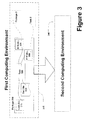
- Figure 3 is a block diagram of exemplary computing environments employing dependency based package deployment in accordance with the herein described systems and methods;
- Figure 4 is a block diagram of an exemplary data flow when performing dependency based package deployment
- Figure 5 is a flow diagram of exemplary processing performed to prepare a package for deployment.
- Figure 6 is a flow diagram of exemplary processing performed to expand a package once deployed.
- dependent packages are difficult to deploy, particularly from one machine to another, mainly because items upon which the package depends may or may not have been moved with the package.
- the herein described systems and methods provide for the deployment of dependent packages.
- package components may employ an interface that enumerates all the files the component requires to run successfully.
- a merge module is also provided which is used to merge the components and their dependencies during deployment. During deployment, the package looks in the merge module cache for the associated merge module. Using this information, a setup bundle is built that includes the merge module with components upon which the package depends into a deployment bundle, or setup file. In practice, the setup is communicated to the deployed environment so that the package may be installed in the deployed environment.
- Figure 1 illustrates an example of a suitable computing system environment 100 in which the invention may be implemented.
- the computing system environment 100 is only one example of a suitable computing environment and is not intended to suggest any limitation as to the scope of use or functionality of the invention. Neither should the computing environment 100 be interpreted as having any dependency or requirement relating to any one or combination of components illustrated in the exemplary operating environment 100.
- the invention is operational with numerous other general purpose or special purpose computing system environments or configurations.
- Examples of well known computing systems, environments, and/or configurations that may be suitable for use with the invention include, but are not limited to, personal computers, server computers, hand-held or laptop devices, multiprocessor systems, microprocessor-based systems, set top boxes, programmable consumer electronics, network PCs, minicomputers, mainframe computers, distributed computing environments that include any of the above systems or devices, and the like.
- the invention may be described in the general context of computer-executable instructions, such as program modules, being executed by a computer.
- program modules include routines, programs, objects, components, data structures, etc. that perform particular tasks or implement particular abstract data types.
- the invention may also be practiced in distributed computing environments where tasks are performed by remote processing devices that are linked through a communications network or other data transmission medium.
- program modules and other data may be located in both local and remote computer storage media including memory storage devices.
- an exemplary system for implementing the invention includes a general purpose computing device in the form of a computer 110.
- Components of computer 110 may include, but are not limited to, a processing unit 120, a system memory 130, and a system bus 121 that couples various system components including the system memory to the processing unit 120.
- the system bus 121 may be any of several types of bus structures including a memory bus or memory controller, a peripheral bus, and a local bus using any of a variety of bus architectures.
- such architectures include Industry Standard Architecture (ISA) bus, Micro Channel Architecture (MCA) bus, Enhanced ISA (EISA) bus, Video Electronics Standards Association (VESA) local bus, and Peripheral Component Interconnect (PCI) bus (also known as Mezzanine bus).
- ISA Industry Standard Architecture
- MCA Micro Channel Architecture
- EISA Enhanced ISA
- VESA Video Electronics Standards Association
- PCI Peripheral Component Interconnect
- Computer 110 typically includes a variety of computer readable media.
- Computer readable media can be any available media that can be accessed by computer 110 and includes both volatile and non-volatile media, removable and non-removable media.
- Computer readable media may comprise computer storage media and communication media.
- Computer storage media includes both volatile and non-volatile, removable and non-removable media implemented in any method or technology for storage of information such as computer readable instructions, data structures, program modules or other data.
- Computer storage media includes, but is not limited to, RAM, ROM, EEPROM, flash memory or other memory technology, CD-ROM, digital versatile disks (DVD) or other optical disk storage, magnetic cassettes, magnetic tape, magnetic disk storage or other magnetic storage devices, or any other medium which can be used to store the desired information and which can accessed by computer 110.
- Communication media typically embodies computer readable instructions, data structures, program modules or other data in a modulated data signal such as a carrier wave or other transport mechanism and includes any information delivery media.
- modulated data signal means a signal that has one or more of its characteristics set or changed in such a manner as to encode information in the signal.
- communication media includes wired media such as a wired network or direct-wired connection, and wireless media such as acoustic, RF, infrared and other wireless media. Combinations of any of the above should also be included within the scope of computer readable media.
- the system memory 130 includes computer storage media in the form of volatile and/or non-volatile memory such as ROM 131 and RAM 132.
- a basic input/output system 133 (BIOS), containing the basic routines that help to transfer information between elements within computer 110, such as during start-up, is typically stored in ROM 131.
- RAM 132 typically contains data and/or program modules that are immediately accessible to and/or presently being operated on by processing unit 120.
- Figure 1 illustrates operating system 134, application programs 135, other program modules 136, and program data 137.
- the computer 110 may also include other removable/non-removable, volatile/non-volatile computer storage media.
- Figure 1 illustrates a hard disk drive 140 that reads from or writes to non-removable, non-volatile magnetic media, a magnetic disk drive 151 that reads from or writes to a removable, non-volatile magnetic disk 152, and an optical disk drive 155 that reads from or writes to a removable, non-volatile optical disk 156, such as a CD-ROM or other optical media.
- removable/non-removable, volatile/non-volatile computer storage media that can be used in the exemplary operating environment include, but are not limited to, magnetic tape cassettes, flash memory cards, digital versatile disks, digital video tape, solid state RAM, solid state ROM, and the like.
- the hard disk drive 141 is typically connected to the system bus 121 through a non-removable memory interface such as interface 140, and magnetic disk drive 151 and optical disk drive 155 are typically connected to the system bus 121 by a removable memory interface, such as interface 150.
- hard disk drive 141 is illustrated as storing operating system 144, application programs 145, other program modules 146, and program data 147. Note that these components can either be the same as or different from operating system 134, application programs 135, other program modules 136, and program data 137. Operating system 144, application programs 145, other program modules 146, and program data 147 are given different numbers here to illustrate that, at a minimum, they are different copies.
- a user may enter commands and information into the computer 110 through input devices such as a keyboard 162 and pointing device 161, commonly referred to as a mouse, trackball or touch pad.
- Other input devices may include a microphone, joystick, game pad, satellite dish, scanner, or the like. These and other input devices are often connected to the processing unit 120 through a user input interface 160 that is coupled to the system bus, but may be connected by other interface and bus structures, such as a parallel port, game port or a universal serial bus (USB).
- a monitor 191 or other type of display device is also connected to the system bus 121 via an interface, such as a video interface 190.
- computers may also include other peripheral output devices such as speakers 197 and printer 196, which may be connected through an output peripheral interface 195.
- the computer 110 may operate in a networked environment using logical connections to one or more remote computers, such as a remote computer 180.
- the remote computer 180 may be a personal computer, a server, a router, a network PC, a peer device or other common network node, and typically includes many or all of the elements described above relative to the computer 110, although only a memory storage device 181 has been illustrated in Figure 1.
- the logical connections depicted include a local area network (LAN) 171 and a wide area network (WAN) 173, but may also include other networks.
- LAN local area network
- WAN wide area network
- Such networking environments are commonplace in offices, enterprise-wide computer networks, intranets and the Internet.
- the computer 110 When used in a LAN networking environment, the computer 110 is connected to the LAN 171 through a network interface or adapter 170. When used in a WAN networking environment, the computer 110 typically includes a modem 172 or other means for establishing communications over the WAN 173, such as the Internet.
- the modem 172 which may be internal or external, may be connected to the system bus 121 via the user input interface 160, or other appropriate mechanism.
- program modules depicted relative to the computer 110, or portions thereof may be stored in the remote memory storage device.
- Figure 1 illustrates remote application programs 185 as residing on memory device 181. It will be appreciated that the network connections shown are exemplary and other means of establishing a communications link between the computers may be used.
- FIG. 1 illustrates an exemplary network environment, with a server in communication with client computers via a network, in which the present invention may be employed.
- a number of servers 10a, 10b, etc. are interconnected via a communications network 14 (which may be a LAN, WAN, intranet, the Internet, or other computer network) with a number of client computers 20a, 20b, 20c, or computing devices, such as, mobile phone 15, land-line telephone 16, and personal digital assistant 17.
- a communications network 14 which may be a LAN, WAN, intranet, the Internet, or other computer network
- client computers 20a, 20b, 20c, or computing devices such as, mobile phone 15, land-line telephone 16, and personal digital assistant 17.
- the servers 10 can be Web servers with which the clients 20 communicate via any of a number of known protocols, such as, hypertext transfer protocol (HTTP) or wireless application protocol (WAP).
- HTTP hypertext transfer protocol
- WAP wireless application protocol
- Each client computer 20 can be equipped with browser 180a to gain access to the servers 10.
- personal digital assistant 17 can be equipped with browser 180b and mobile phone 15 can be equipped with browser 180c to display and receive various data.
- a user may interact with a computing application running on a client computing devices performing dependency based package deployment.
- the reports may be stored on server computers and communicated to cooperating users through client computing devices over communications network 14.
- the present invention can be utilized in a computer network environment having client computing devices for accessing and interacting with the network and a server computer for interacting with client computers.
- client computing devices for accessing and interacting with the network
- server computer for interacting with client computers.
- the systems and methods described herein can be implemented with a variety of network-based architectures, and thus should not be limited to the example shown. The herein described systems and methods will now be described in more detail with reference to a presently illustrative implementation.
- Dependency based package deployment provides for the description of which files a component depends on so that those files may be moved along with the package.
- components may implement an interface that enumerates all the files the component requires to run successfully.
- a merge module is used to merge the dependent files and components in a package for deployment. Specifically a merge module allows for the creation of reusable setup components. Merge modules allow for the sharing of setup code between cooperating installers.
- a merge module (.msm file) is a single package that contains files, resources, registry entries, and setup logic to install a component.
- merge modules generally cannot be installed alone, but instead are used within the context of an installer (.msi) file.
- Merge modules allow for the capturing of all of the dependencies for a particular component, insuring that the correct versions are installed.
- the merge module is powerful because, once a merge module is distributed it is not modified; instead new merge modules are created for each successive version of the component.
- installers are used to install applications and files on another computer; merge modules are used to install components that are shared by multiple applications.
- merge modules are used to install components that are shared by multiple applications.
- the main distinction between the two types is the target audience. Anything that will be used directly by the end user of the application (executable files, documents, HTML pages) should be packaged in an installer. Anything that can only be used by a developer (DLLs, controls, resources) are packaged in a merge module, which can then be packaged by the developer in an installer for distribution to the end user.
- a component that is shared by more than one application is placed in its own merge module.
- FIG. 3 is a block diagram of an exemplary concept of package deployment.
- first computing environment comprises an illustrative and exemplary package 310.
- package 310 there exists a task 325, custom file 315, flat file 320, ftp file 330, and DTS file 335.
- the package and its components are aggregated and then communicated to a second computing environment as indicated by the arrow.
- the package maintains a list of the dependencies between the task and its components. This information is communicated as part of deployment (as indicated by the arrow) such that the package may be successfully executed and operated in the second computing environment.
- task 325 may comprise an accounting task for use to calculate, track, manage, store, and communicate a company's sales. Accordingly, task 325 may be required to use historical sales information which may be found in flat file 320. In addition, task 325 may cooperate with other packages such as a data storage package using DTS.DLL 335.
- task 325 may be required to calculate sales and convert the sales for varying international currencies.
- task 325 may call upon a customized file, such as Cust.DLL 315 to perform such operations.
- task 325 may be required to communicate the sales information to a second computing environment using the file transfer protocol (ftp) (or other communications protocol).
- ftp file transfer protocol
- task 325 calls upon FTP.DLL 330 for ftp type communications.
- task 325 to perform its many functions is dependent on other files, tables, and components. Also as is seen (as represented by the dotted line boxes), the files, tables, and components for package 310 are not created for the exclusive use by task 325, but rather may be used by other components, packages, tasks, in the first computing environment. With sharing occurring, the proper identification of dependencies becomes desirable to mitigate confusion and to reduce error in package creation.
- Figure 4 shows a block diagram of dependency package deployment system 400.
- dependency package deployment system 400 comprises merge module 435.
- Merge module cooperates with stock installer 420, packages 430, configuration files 435, Merge based tables and files 410, and files 415.
- Merge based tables and files 410 and files 415 result from a scan of existing merge based tables and files performed at block 405.
- Merge module 425 cooperates with stock installer 420, packages 430, configuration files 435, Merge based tables and files 410, and files 415 to generate dependent populated package and setup executable 440, which, as is indicated by the arrow, is deployable to a second environment.
- the existing merge based tables and files are scanned to determine if the components of packages 430 have any dependencies which should be added to packages 430.
- the scan results in merge based table and files 410 and other dependency files 415.
- the list of the merge based table and files and other dependency files acts as one input to Merge module 425.
- Merge module 425 acts to aggregate all of the package components and their dependent files and tables and merge them with stock installer 420 and some configuration files 430 to generate a setup executable file 440.
- Setup executable file 440 when executed in a second environment will provide packages 330 with all of their dependent files and components.
- dependency package deployment system 400 employs MICROSOFT ® Visual Studio's merge module dependency architecture (e.g. merge modules and associated files) in creating setup file and packager list 440.
- packages 330 comprise default DTS components.
- a scan of existing MSM tables and files is performed at block 405 to determine the file and table dependencies for non-default (e.g. third party created) components of packages 330. It is appreciated that such process is a result of a process in which the package task exposes its dependencies and in which the task is able to communicate to an interface to expose such dependencies.
- the interface is the package deployment wizard which is used to assemble and deploy packages.
- the identified MSMs 410 and other files 415 are merged by Visual Studio's standard merge module with a stock MSI installer, package definitions (e.g. default package components) and configuration files 435 to create a MSI list and setup executable 440.
- Figure 5 shows the processing performed when creating and deploying a package and its dependencies. As is shown, processing begins at block 500 and proceeds to block 505 where a package task exposes to a cooperating interface its dependencies. From there processing proceeds to block 510 where the exposed dependencies are aggregated. The dependencies are then merged with default package components for deployment at block 515. The package is then deployed at block 520 and processing then terminates at block 525.
- Figure 6 shows the processing performed when the package is deployed in the deployed environment. As is shown, processing begins at block 500 and proceeds to block 505 where the communicated set up file (containing the deployed package and its dependencies) is executed. The packages found in the setup file are then expanded at block 510. Package dependencies are then deployed at block 515 and the package tasks are executed to validate proper deployment at block 520. From there processing terminates at block 525.
- the communicated set up file containing the deployed package and its dependencies
- the present invention may be implemented in a variety of computer environments (including both non-wireless and wireless computer environments), partial computing environments, and real world environments.
- the various techniques described herein may be implemented in hardware or software, or a combination of both.
- the techniques are implemented in computer programs executing on programmable computers that each include a processor, a storage medium readable by the processor (including volatile and non-volatile memory and/or storage elements), at least one input device, and at least one output device.
- Program code is applied to data entered using the input device to perform the functions described above and to generate output information.
- the output information is applied to one or more output devices.
- Each program is preferably implemented in a high level procedural or object oriented programming language to communicate with a computer system.
- the programs can be implemented in assembly or machine language, if desired.
- the language may be a compiled or interpreted language.
- Each such computer program is preferably stored on a storage medium or device (e.g., ROM or magnetic disk) that is readable by a general or special purpose programmable computer for configuring and operating the computer when the storage medium or device is read by the computer to perform the procedures described above.
- the system may also be considered to be implemented as a computer-readable storage medium, configured with a computer program, where the storage so configured causes a computer to operate in a specific and predefined manner.
Landscapes
- Engineering & Computer Science (AREA)
- Software Systems (AREA)
- Theoretical Computer Science (AREA)
- General Engineering & Computer Science (AREA)
- Physics & Mathematics (AREA)
- General Physics & Mathematics (AREA)
- Stored Programmes (AREA)
- Test And Diagnosis Of Digital Computers (AREA)
- Information Retrieval, Db Structures And Fs Structures Therefor (AREA)
Applications Claiming Priority (2)
| Application Number | Priority Date | Filing Date | Title |
|---|---|---|---|
| US10/600,178 US20040261060A1 (en) | 2003-06-20 | 2003-06-20 | Dependency based package deployment |
| US600178 | 2003-06-20 |
Publications (2)
| Publication Number | Publication Date |
|---|---|
| EP1492002A2 true EP1492002A2 (de) | 2004-12-29 |
| EP1492002A3 EP1492002A3 (de) | 2010-02-17 |
Family
ID=33418563
Family Applications (1)
| Application Number | Title | Priority Date | Filing Date |
|---|---|---|---|
| EP04102561A Withdrawn EP1492002A3 (de) | 2003-06-20 | 2004-06-07 | Abhängigkeitsbasiertes Deployment von Paketen in einer Computerumgebung |
Country Status (5)
| Country | Link |
|---|---|
| US (1) | US20040261060A1 (de) |
| EP (1) | EP1492002A3 (de) |
| JP (1) | JP2005011359A (de) |
| KR (1) | KR20040111162A (de) |
| CN (1) | CN1573692A (de) |
Cited By (2)
| Publication number | Priority date | Publication date | Assignee | Title |
|---|---|---|---|---|
| US7567984B1 (en) * | 2006-08-31 | 2009-07-28 | Symantec Operating Corporation | Operating system and application deployment based on stored user state and organizational policy |
| EP3835946A1 (de) * | 2019-12-13 | 2021-06-16 | Sap Se | Einheitliches installationsprogramm |
Families Citing this family (30)
| Publication number | Priority date | Publication date | Assignee | Title |
|---|---|---|---|---|
| US8074201B2 (en) * | 2002-07-10 | 2011-12-06 | National Instruments Corporation | Deployment and execution of a program on an embedded device |
| JP4209789B2 (ja) * | 2003-03-19 | 2009-01-14 | 株式会社リコー | ファイル作成方法、サーバ、記録媒体及びプログラム追加システム |
| US7526734B2 (en) * | 2004-04-30 | 2009-04-28 | Sap Ag | User interfaces for developing enterprise applications |
| US20060048140A1 (en) * | 2004-08-31 | 2006-03-02 | International Business Machines Corporation | Method, system and article for generating installation merge packages |
| US8140816B2 (en) * | 2005-05-12 | 2012-03-20 | International Business Machines Corporation | Utilizing partition resource requirements from workload estimation to automate partition software configuration and validation |
| US20060271924A1 (en) * | 2005-05-27 | 2006-11-30 | International Business Machines Corporation | Method and apparatus for automating updates to dependencies |
| US8639652B2 (en) * | 2005-12-14 | 2014-01-28 | SAP France S.A. | Apparatus and method for creating portable ETL jobs |
| US8341622B1 (en) | 2005-12-15 | 2012-12-25 | Crimson Corporation | Systems and methods for efficiently using network bandwidth to deploy dependencies of a software package |
| US20070294364A1 (en) * | 2006-06-15 | 2007-12-20 | International Business Machines Corporation | Management of composite software services |
| US7496893B2 (en) * | 2006-06-15 | 2009-02-24 | International Business Machines Corporation | Method for no-demand composition and teardown of service infrastructure |
| US7519711B2 (en) * | 2006-06-15 | 2009-04-14 | International Business Machines Corporation | Method for middleware assisted system integration in a federated environment |
| US7950007B2 (en) * | 2006-06-15 | 2011-05-24 | International Business Machines Corporation | Method and apparatus for policy-based change management in a service delivery environment |
| US20080104022A1 (en) | 2006-10-31 | 2008-05-01 | Bank Of America Corporation | Document indexing and delivery system |
| US8229778B2 (en) | 2006-11-16 | 2012-07-24 | International Business Machines Corporation | Constructing change plans from component interactions |
| US8266578B2 (en) * | 2007-01-10 | 2012-09-11 | Angela Bazigos | Virtual validation of software systems |
| US7860900B2 (en) * | 2008-02-25 | 2010-12-28 | Microsoft Corporation | Consistently signaling state changes |
| KR20100071483A (ko) * | 2008-12-19 | 2010-06-29 | 한국전자통신연구원 | 묶음 소프트웨어의 배포 방법 및 시스템 |
| US8930880B2 (en) * | 2010-09-29 | 2015-01-06 | Rockwell Automation Technologies, Inc. | Development of functional modules using a module bus |
| US9116707B2 (en) * | 2010-10-18 | 2015-08-25 | Oracle International Corporation | Dependency resolution in polyphasic modules |
| US8612963B2 (en) * | 2010-12-02 | 2013-12-17 | International Business Machines Corporation | Guided problem resolution in deploying an application |
| US9383985B2 (en) * | 2011-06-10 | 2016-07-05 | Unisys Corporation | Automated modification of pre-generated MSI packaged applications |
| US9052961B2 (en) * | 2012-03-02 | 2015-06-09 | Vmware, Inc. | System to generate a deployment plan for a cloud infrastructure according to logical, multi-tier application blueprint |
| US9003355B2 (en) * | 2013-02-20 | 2015-04-07 | Bank Of America Corporation | Decentralized workflow management system |
| US9323514B2 (en) * | 2013-05-30 | 2016-04-26 | Microsoft Technology Licensing, Llc | Resource package indexing |
| US9274784B2 (en) * | 2014-06-02 | 2016-03-01 | Sap Se | Automatic deployment and update of hybrid applications |
| US9519505B1 (en) | 2015-07-06 | 2016-12-13 | Bank Of America Corporation | Enhanced configuration and property management system |
| JP6904364B2 (ja) * | 2016-11-01 | 2021-07-14 | 日本電気株式会社 | システム構築支援装置、方法およびプログラム |
| CN109683945A (zh) * | 2018-12-12 | 2019-04-26 | 泰康保险集团股份有限公司 | 程序接口处理方法与系统、其计算器可读介质及电子设备 |
| US11093256B2 (en) * | 2019-09-12 | 2021-08-17 | Dell Products L.P. | System and method for dynamically installing driver dependencies |
| CN112596753A (zh) * | 2020-12-29 | 2021-04-02 | 上海瑞家信息技术有限公司 | 依赖包安装方法、装置、电子设备和计算机可读介质 |
Family Cites Families (16)
| Publication number | Priority date | Publication date | Assignee | Title |
|---|---|---|---|---|
| US6189030B1 (en) * | 1996-02-21 | 2001-02-13 | Infoseek Corporation | Method and apparatus for redirection of server external hyper-link references |
| US5721824A (en) * | 1996-04-19 | 1998-02-24 | Sun Microsystems, Inc. | Multiple-package installation with package dependencies |
| GB9623298D0 (en) * | 1996-11-08 | 1997-01-08 | Int Computers Ltd | Updating mechanism for software |
| US5950010A (en) * | 1996-11-25 | 1999-09-07 | J.D. Edwards World Source Co. | System and method for customized application package building and installation |
| GB2325063B (en) * | 1997-05-08 | 2001-11-21 | Ibm | Method of installing and configuring an application program within a computer system, and application program for facilitating the method |
| US6117187A (en) * | 1997-09-30 | 2000-09-12 | Hewlett-Packard Company | Automatic generation of a software installation package |
| US5996073A (en) * | 1997-12-18 | 1999-11-30 | Tioga Systems, Inc. | System and method for determining computer application state |
| US6381742B2 (en) * | 1998-06-19 | 2002-04-30 | Microsoft Corporation | Software package management |
| US6237144B1 (en) * | 1998-09-21 | 2001-05-22 | Microsoft Corporation | Use of relational databases for software installation |
| US6983315B1 (en) * | 2000-01-18 | 2006-01-03 | Wrq, Inc. | Applet embedded cross-platform caching |
| US7000230B1 (en) * | 2000-06-21 | 2006-02-14 | Microsoft Corporation | Network-based software extensions |
| US7150015B2 (en) * | 2000-09-01 | 2006-12-12 | Pace Charles P | Method and system for deploying an asset over a multi-tiered network |
| US20020147972A1 (en) * | 2001-01-31 | 2002-10-10 | Olmeda Hector M. | System and method for configuring an application environment on a computer platform |
| US6847970B2 (en) * | 2002-09-11 | 2005-01-25 | International Business Machines Corporation | Methods and apparatus for managing dependencies in distributed systems |
| US7069553B2 (en) * | 2003-03-03 | 2006-06-27 | Computer Associates Think, Inc. | Universal deployment tool |
| US7735057B2 (en) * | 2003-05-16 | 2010-06-08 | Symantec Corporation | Method and apparatus for packaging and streaming installation software |
-
2003
- 2003-06-20 US US10/600,178 patent/US20040261060A1/en not_active Abandoned
-
2004
- 2004-06-07 EP EP04102561A patent/EP1492002A3/de not_active Withdrawn
- 2004-06-18 KR KR1020040045487A patent/KR20040111162A/ko not_active Ceased
- 2004-06-21 JP JP2004183027A patent/JP2005011359A/ja active Pending
- 2004-06-21 CN CNA2004100628638A patent/CN1573692A/zh active Pending
Cited By (3)
| Publication number | Priority date | Publication date | Assignee | Title |
|---|---|---|---|---|
| US7567984B1 (en) * | 2006-08-31 | 2009-07-28 | Symantec Operating Corporation | Operating system and application deployment based on stored user state and organizational policy |
| EP3835946A1 (de) * | 2019-12-13 | 2021-06-16 | Sap Se | Einheitliches installationsprogramm |
| US11275571B2 (en) | 2019-12-13 | 2022-03-15 | Sap Se | Unified installer |
Also Published As
| Publication number | Publication date |
|---|---|
| CN1573692A (zh) | 2005-02-02 |
| KR20040111162A (ko) | 2004-12-31 |
| US20040261060A1 (en) | 2004-12-23 |
| JP2005011359A (ja) | 2005-01-13 |
| EP1492002A3 (de) | 2010-02-17 |
Similar Documents
| Publication | Publication Date | Title |
|---|---|---|
| US20040261060A1 (en) | Dependency based package deployment | |
| CA2446809C (en) | General and reusable components for defining net-centric application program architectures | |
| US7797403B2 (en) | Deployment of configuration information | |
| US8122106B2 (en) | Integrating design, deployment, and management phases for systems | |
| US6892382B1 (en) | Method and apparatus for implementing deployment descriptors in an enterprise environment | |
| US20020144256A1 (en) | Method of deployment for concurrent execution of multiple versions of an integration model on an integration server | |
| US7340520B1 (en) | System and method to facilitate manageable and agile deployment of services in accordance with various topologies | |
| US9916137B2 (en) | Rest service source code generation | |
| US7765501B2 (en) | Settings and constraints validation to enable design for operations | |
| US20040176968A1 (en) | Systems and methods for dynamically configuring business processes | |
| JP4496067B2 (ja) | サービス指向アーキテクチャ向けのサービス・インターフェースを自動的に生成するための方法およびシステム | |
| US6859921B2 (en) | System, method, and computer program product for creating a hierarchy of software components based on the programming constructs therein | |
| AU2002319843A1 (en) | General and reusable components for defining net-centric application program architectures | |
| KR20010042737A (ko) | 비쥬얼 데이터 통합 시스템 및 그 방법 | |
| US20030140126A1 (en) | Method of deployment for concurrent execution of multiple versions of an integration model | |
| CA2349654A1 (en) | Server configuration versioning tool | |
| US20250005530A1 (en) | Systems and methods for automated application and platform generation | |
| US7523461B2 (en) | Modification of logic in an application | |
| EP1050813A2 (de) | Verfahren und Gerät zum Implementieren von Installationsbeschreibungen in einer Geschäftsumgebung | |
| US10656922B2 (en) | Systems and methods for providing an application transformation tool | |
| US8694596B2 (en) | Systems and methods for information brokering in software management | |
| KR100459791B1 (ko) | 클라이언트―서버 환경에서의 설치과정없는응용프로그램의 실행방법 | |
| US20060010423A1 (en) | Variable namespaces and scoping for variables in an object model | |
| CA2551025C (en) | Application framework for use with net-centric program architectures | |
| US20070094637A1 (en) | System, method, and computer program product for enabling coexistence of related software |
Legal Events
| Date | Code | Title | Description |
|---|---|---|---|
| PUAI | Public reference made under article 153(3) epc to a published international application that has entered the european phase |
Free format text: ORIGINAL CODE: 0009012 |
|
| AK | Designated contracting states |
Kind code of ref document: A2 Designated state(s): AT BE BG CH CY CZ DE DK EE ES FI FR GB GR HU IE IT LI LU MC NL PL PT RO SE SI SK TR |
|
| AX | Request for extension of the european patent |
Extension state: AL HR LT LV MK |
|
| 17P | Request for examination filed |
Effective date: 20060207 |
|
| PUAL | Search report despatched |
Free format text: ORIGINAL CODE: 0009013 |
|
| AK | Designated contracting states |
Kind code of ref document: A3 Designated state(s): AT BE BG CH CY CZ DE DK EE ES FI FR GB GR HU IE IT LI LU MC NL PL PT RO SE SI SK TR |
|
| AX | Request for extension of the european patent |
Extension state: AL HR LT LV MK |
|
| AKX | Designation fees paid |
Designated state(s): AT BE BG CH CY CZ DE DK EE ES FI FR GB GR HU IE IT LI LU MC NL PL PT RO SE SI SK TR |
|
| STAA | Information on the status of an ep patent application or granted ep patent |
Free format text: STATUS: THE APPLICATION IS DEEMED TO BE WITHDRAWN |
|
| 18D | Application deemed to be withdrawn |
Effective date: 20100818 |