EP1491527A1 - Process for preparing acylsulfamoylbenzamides - Google Patents
Process for preparing acylsulfamoylbenzamides Download PDFInfo
- Publication number
- EP1491527A1 EP1491527A1 EP20030014232 EP03014232A EP1491527A1 EP 1491527 A1 EP1491527 A1 EP 1491527A1 EP 20030014232 EP20030014232 EP 20030014232 EP 03014232 A EP03014232 A EP 03014232A EP 1491527 A1 EP1491527 A1 EP 1491527A1
- Authority
- EP
- European Patent Office
- Prior art keywords
- formula
- compound
- alkyl
- hydrogen
- alkoxy
- Prior art date
- Legal status (The legal status is an assumption and is not a legal conclusion. Google has not performed a legal analysis and makes no representation as to the accuracy of the status listed.)
- Withdrawn
Links
- 238000004519 manufacturing process Methods 0.000 title 1
- 150000001875 compounds Chemical class 0.000 claims abstract description 74
- 238000000034 method Methods 0.000 claims abstract description 43
- 230000008569 process Effects 0.000 claims abstract description 34
- 238000006243 chemical reaction Methods 0.000 claims abstract description 32
- 239000012320 chlorinating reagent Substances 0.000 claims abstract description 19
- 238000002360 preparation method Methods 0.000 claims abstract description 17
- -1 -CO-aryl Chemical group 0.000 claims description 68
- 125000004169 (C1-C6) alkyl group Chemical group 0.000 claims description 43
- 229910052739 hydrogen Inorganic materials 0.000 claims description 35
- 239000001257 hydrogen Substances 0.000 claims description 35
- 125000004435 hydrogen atom Chemical group [H]* 0.000 claims description 35
- 229910052736 halogen Inorganic materials 0.000 claims description 28
- 150000002367 halogens Chemical class 0.000 claims description 26
- 125000004191 (C1-C6) alkoxy group Chemical group 0.000 claims description 20
- 125000004178 (C1-C4) alkyl group Chemical group 0.000 claims description 18
- 125000000449 nitro group Chemical group [O-][N+](*)=O 0.000 claims description 17
- 125000000171 (C1-C6) haloalkyl group Chemical group 0.000 claims description 15
- FYSNRJHAOHDILO-UHFFFAOYSA-N thionyl chloride Chemical group ClS(Cl)=O FYSNRJHAOHDILO-UHFFFAOYSA-N 0.000 claims description 14
- 125000004093 cyano group Chemical group *C#N 0.000 claims description 13
- 125000000229 (C1-C4)alkoxy group Chemical group 0.000 claims description 11
- 239000004215 Carbon black (E152) Substances 0.000 claims description 11
- 229930195733 hydrocarbon Natural products 0.000 claims description 11
- 125000001997 phenyl group Chemical group [H]C1=C([H])C([H])=C(*)C([H])=C1[H] 0.000 claims description 11
- MVPPADPHJFYWMZ-UHFFFAOYSA-N chlorobenzene Chemical compound ClC1=CC=CC=C1 MVPPADPHJFYWMZ-UHFFFAOYSA-N 0.000 claims description 10
- 125000000882 C2-C6 alkenyl group Chemical group 0.000 claims description 9
- 125000003601 C2-C6 alkynyl group Chemical group 0.000 claims description 9
- 239000002904 solvent Substances 0.000 claims description 9
- 125000005913 (C3-C6) cycloalkyl group Chemical group 0.000 claims description 8
- 150000003839 salts Chemical class 0.000 claims description 7
- 229910052801 chlorine Inorganic materials 0.000 claims description 5
- 229920006395 saturated elastomer Polymers 0.000 claims description 5
- 125000004916 (C1-C6) alkylcarbonyl group Chemical group 0.000 claims description 3
- 125000006650 (C2-C4) alkynyl group Chemical group 0.000 claims description 3
- 125000004399 C1-C4 alkenyl group Chemical group 0.000 claims description 3
- 125000004397 aminosulfonyl group Chemical group NS(=O)(=O)* 0.000 claims description 3
- UFHFLCQGNIYNRP-UHFFFAOYSA-N Hydrogen Chemical compound [H][H] UFHFLCQGNIYNRP-UHFFFAOYSA-N 0.000 claims description 2
- 125000004433 nitrogen atom Chemical group N* 0.000 claims description 2
- 150000003254 radicals Chemical class 0.000 description 22
- IJGRMHOSHXDMSA-UHFFFAOYSA-N Atomic nitrogen Chemical compound N#N IJGRMHOSHXDMSA-UHFFFAOYSA-N 0.000 description 14
- ZMANZCXQSJIPKH-UHFFFAOYSA-N Triethylamine Chemical compound CCN(CC)CC ZMANZCXQSJIPKH-UHFFFAOYSA-N 0.000 description 12
- 125000004432 carbon atom Chemical group C* 0.000 description 11
- WEVYAHXRMPXWCK-UHFFFAOYSA-N Acetonitrile Chemical compound CC#N WEVYAHXRMPXWCK-UHFFFAOYSA-N 0.000 description 9
- YXFVVABEGXRONW-UHFFFAOYSA-N Toluene Chemical compound CC1=CC=CC=C1 YXFVVABEGXRONW-UHFFFAOYSA-N 0.000 description 9
- 229910052717 sulfur Inorganic materials 0.000 description 9
- NINIDFKCEFEMDL-UHFFFAOYSA-N Sulfur Chemical compound [S] NINIDFKCEFEMDL-UHFFFAOYSA-N 0.000 description 8
- 239000002585 base Substances 0.000 description 8
- 125000000623 heterocyclic group Chemical group 0.000 description 8
- 229910052760 oxygen Inorganic materials 0.000 description 8
- 239000001301 oxygen Substances 0.000 description 8
- BWHMMNNQKKPAPP-UHFFFAOYSA-L potassium carbonate Chemical compound [K+].[K+].[O-]C([O-])=O BWHMMNNQKKPAPP-UHFFFAOYSA-L 0.000 description 8
- 239000011593 sulfur Substances 0.000 description 8
- 125000004765 (C1-C4) haloalkyl group Chemical group 0.000 description 7
- WPYMKLBDIGXBTP-UHFFFAOYSA-N Benzoic acid Natural products OC(=O)C1=CC=CC=C1 WPYMKLBDIGXBTP-UHFFFAOYSA-N 0.000 description 7
- 239000002253 acid Substances 0.000 description 7
- QVGXLLKOCUKJST-UHFFFAOYSA-N atomic oxygen Chemical compound [O] QVGXLLKOCUKJST-UHFFFAOYSA-N 0.000 description 7
- 239000000203 mixture Substances 0.000 description 7
- 229910052757 nitrogen Inorganic materials 0.000 description 7
- YMWUJEATGCHHMB-UHFFFAOYSA-N Dichloromethane Chemical compound ClCCl YMWUJEATGCHHMB-UHFFFAOYSA-N 0.000 description 6
- ZMXDDKWLCZADIW-UHFFFAOYSA-N N,N-Dimethylformamide Chemical compound CN(C)C=O ZMXDDKWLCZADIW-UHFFFAOYSA-N 0.000 description 6
- KWYUFKZDYYNOTN-UHFFFAOYSA-M Potassium hydroxide Chemical compound [OH-].[K+] KWYUFKZDYYNOTN-UHFFFAOYSA-M 0.000 description 6
- CDBYLPFSWZWCQE-UHFFFAOYSA-L Sodium Carbonate Chemical compound [Na+].[Na+].[O-]C([O-])=O CDBYLPFSWZWCQE-UHFFFAOYSA-L 0.000 description 6
- HEMHJVSKTPXQMS-UHFFFAOYSA-M Sodium hydroxide Chemical compound [OH-].[Na+] HEMHJVSKTPXQMS-UHFFFAOYSA-M 0.000 description 6
- 125000005842 heteroatom Chemical group 0.000 description 6
- 125000002924 primary amino group Chemical group [H]N([H])* 0.000 description 6
- 239000000047 product Substances 0.000 description 6
- 125000001424 substituent group Chemical group 0.000 description 6
- 125000000472 sulfonyl group Chemical group *S(*)(=O)=O 0.000 description 6
- NGNBDVOYPDDBFK-UHFFFAOYSA-N 2-[2,4-di(pentan-2-yl)phenoxy]acetyl chloride Chemical class CCCC(C)C1=CC=C(OCC(Cl)=O)C(C(C)CCC)=C1 NGNBDVOYPDDBFK-UHFFFAOYSA-N 0.000 description 5
- 125000003118 aryl group Chemical group 0.000 description 5
- 235000010233 benzoic acid Nutrition 0.000 description 5
- PASDCCFISLVPSO-UHFFFAOYSA-N benzoyl chloride Chemical class ClC(=O)C1=CC=CC=C1 PASDCCFISLVPSO-UHFFFAOYSA-N 0.000 description 5
- 239000000460 chlorine Substances 0.000 description 5
- 239000007858 starting material Substances 0.000 description 5
- GQHTUMJGOHRCHB-UHFFFAOYSA-N 2,3,4,6,7,8,9,10-octahydropyrimido[1,2-a]azepine Chemical compound C1CCCCN2CCCN=C21 GQHTUMJGOHRCHB-UHFFFAOYSA-N 0.000 description 4
- KXDAEFPNCMNJSK-UHFFFAOYSA-N Benzamide Chemical compound NC(=O)C1=CC=CC=C1 KXDAEFPNCMNJSK-UHFFFAOYSA-N 0.000 description 4
- 239000005711 Benzoic acid Substances 0.000 description 4
- IMNFDUFMRHMDMM-UHFFFAOYSA-N N-Heptane Chemical compound CCCCCCC IMNFDUFMRHMDMM-UHFFFAOYSA-N 0.000 description 4
- UIIMBOGNXHQVGW-UHFFFAOYSA-M Sodium bicarbonate Chemical compound [Na+].OC([O-])=O UIIMBOGNXHQVGW-UHFFFAOYSA-M 0.000 description 4
- WYURNTSHIVDZCO-UHFFFAOYSA-N Tetrahydrofuran Chemical compound C1CCOC1 WYURNTSHIVDZCO-UHFFFAOYSA-N 0.000 description 4
- 125000003342 alkenyl group Chemical group 0.000 description 4
- PFKFTWBEEFSNDU-UHFFFAOYSA-N carbonyldiimidazole Chemical compound C1=CN=CN1C(=O)N1C=CN=C1 PFKFTWBEEFSNDU-UHFFFAOYSA-N 0.000 description 4
- 229910000027 potassium carbonate Inorganic materials 0.000 description 4
- 235000011181 potassium carbonates Nutrition 0.000 description 4
- 125000006552 (C3-C8) cycloalkyl group Chemical group 0.000 description 3
- QTBSBXVTEAMEQO-UHFFFAOYSA-N Acetic acid Chemical compound CC(O)=O QTBSBXVTEAMEQO-UHFFFAOYSA-N 0.000 description 3
- RTZKZFJDLAIYFH-UHFFFAOYSA-N Diethyl ether Chemical compound CCOCC RTZKZFJDLAIYFH-UHFFFAOYSA-N 0.000 description 3
- VEXZGXHMUGYJMC-UHFFFAOYSA-N Hydrochloric acid Chemical compound Cl VEXZGXHMUGYJMC-UHFFFAOYSA-N 0.000 description 3
- MUBZPKHOEPUJKR-UHFFFAOYSA-N Oxalic acid Chemical compound OC(=O)C(O)=O MUBZPKHOEPUJKR-UHFFFAOYSA-N 0.000 description 3
- 125000000217 alkyl group Chemical group 0.000 description 3
- 125000000304 alkynyl group Chemical group 0.000 description 3
- 150000001412 amines Chemical class 0.000 description 3
- 150000004945 aromatic hydrocarbons Chemical class 0.000 description 3
- 230000015572 biosynthetic process Effects 0.000 description 3
- 229910052799 carbon Inorganic materials 0.000 description 3
- UCAGLBKTLXCODC-UHFFFAOYSA-N carzenide Chemical compound NS(=O)(=O)C1=CC=C(C(O)=O)C=C1 UCAGLBKTLXCODC-UHFFFAOYSA-N 0.000 description 3
- 238000001704 evaporation Methods 0.000 description 3
- 230000008020 evaporation Effects 0.000 description 3
- 239000004009 herbicide Substances 0.000 description 3
- 239000002244 precipitate Substances 0.000 description 3
- 239000011541 reaction mixture Substances 0.000 description 3
- 229910000029 sodium carbonate Inorganic materials 0.000 description 3
- 125000004400 (C1-C12) alkyl group Chemical group 0.000 description 2
- 125000004209 (C1-C8) alkyl group Chemical group 0.000 description 2
- 125000006553 (C3-C8) cycloalkenyl group Chemical group 0.000 description 2
- 125000003541 2-chlorobenzoyl group Chemical group ClC1=C(C(=O)*)C=CC=C1 0.000 description 2
- MXBLZLWZAHUKLU-UHFFFAOYSA-N 2-sulfamoylbenzamide Chemical compound NC(=O)C1=CC=CC=C1S(N)(=O)=O MXBLZLWZAHUKLU-UHFFFAOYSA-N 0.000 description 2
- BVKZGUZCCUSVTD-UHFFFAOYSA-M Bicarbonate Chemical compound OC([O-])=O BVKZGUZCCUSVTD-UHFFFAOYSA-M 0.000 description 2
- 125000004648 C2-C8 alkenyl group Chemical group 0.000 description 2
- 125000004649 C2-C8 alkynyl group Chemical group 0.000 description 2
- 0 CC(*)(/C=C/*(/C=C1)C(O)=O)/C=C1/S(N*)(=O)=O Chemical compound CC(*)(/C=C/*(/C=C1)C(O)=O)/C=C1/S(N*)(=O)=O 0.000 description 2
- OKTJSMMVPCPJKN-UHFFFAOYSA-N Carbon Chemical compound [C] OKTJSMMVPCPJKN-UHFFFAOYSA-N 0.000 description 2
- ZAMOUSCENKQFHK-UHFFFAOYSA-N Chlorine atom Chemical compound [Cl] ZAMOUSCENKQFHK-UHFFFAOYSA-N 0.000 description 2
- PXGOKWXKJXAPGV-UHFFFAOYSA-N Fluorine Chemical compound FF PXGOKWXKJXAPGV-UHFFFAOYSA-N 0.000 description 2
- SECXISVLQFMRJM-UHFFFAOYSA-N N-Methylpyrrolidone Chemical compound CN1CCCC1=O SECXISVLQFMRJM-UHFFFAOYSA-N 0.000 description 2
- JUJWROOIHBZHMG-UHFFFAOYSA-N Pyridine Chemical compound C1=CC=NC=C1 JUJWROOIHBZHMG-UHFFFAOYSA-N 0.000 description 2
- SMWDFEZZVXVKRB-UHFFFAOYSA-N Quinoline Chemical compound N1=CC=CC2=CC=CC=C21 SMWDFEZZVXVKRB-UHFFFAOYSA-N 0.000 description 2
- WQDUMFSSJAZKTM-UHFFFAOYSA-N Sodium methoxide Chemical compound [Na+].[O-]C WQDUMFSSJAZKTM-UHFFFAOYSA-N 0.000 description 2
- DTQVDTLACAAQTR-UHFFFAOYSA-N Trifluoroacetic acid Chemical compound OC(=O)C(F)(F)F DTQVDTLACAAQTR-UHFFFAOYSA-N 0.000 description 2
- 150000001338 aliphatic hydrocarbons Chemical class 0.000 description 2
- 229910052783 alkali metal Inorganic materials 0.000 description 2
- 150000001340 alkali metals Chemical class 0.000 description 2
- 229910001860 alkaline earth metal hydroxide Inorganic materials 0.000 description 2
- 125000003545 alkoxy group Chemical group 0.000 description 2
- 150000001555 benzenes Chemical class 0.000 description 2
- 239000006227 byproduct Substances 0.000 description 2
- 125000000753 cycloalkyl group Chemical group 0.000 description 2
- 125000001495 ethyl group Chemical group [H]C([H])([H])C([H])([H])* 0.000 description 2
- 239000011737 fluorine Substances 0.000 description 2
- 229910052731 fluorine Inorganic materials 0.000 description 2
- 230000008570 general process Effects 0.000 description 2
- 125000002883 imidazolyl group Chemical group 0.000 description 2
- 125000002496 methyl group Chemical group [H]C([H])([H])* 0.000 description 2
- 125000004108 n-butyl group Chemical group [H]C([H])([H])C([H])([H])C([H])([H])C([H])([H])* 0.000 description 2
- 150000002825 nitriles Chemical class 0.000 description 2
- CTSLXHKWHWQRSH-UHFFFAOYSA-N oxalyl chloride Chemical compound ClC(=O)C(Cl)=O CTSLXHKWHWQRSH-UHFFFAOYSA-N 0.000 description 2
- 239000000575 pesticide Substances 0.000 description 2
- XHXFXVLFKHQFAL-UHFFFAOYSA-N phosphoryl trichloride Chemical compound ClP(Cl)(Cl)=O XHXFXVLFKHQFAL-UHFFFAOYSA-N 0.000 description 2
- 239000011736 potassium bicarbonate Substances 0.000 description 2
- 229910000028 potassium bicarbonate Inorganic materials 0.000 description 2
- 235000015497 potassium bicarbonate Nutrition 0.000 description 2
- TYJJADVDDVDEDZ-UHFFFAOYSA-M potassium hydrogencarbonate Chemical compound [K+].OC([O-])=O TYJJADVDDVDEDZ-UHFFFAOYSA-M 0.000 description 2
- 125000004076 pyridyl group Chemical group 0.000 description 2
- 238000000926 separation method Methods 0.000 description 2
- 229910000030 sodium bicarbonate Inorganic materials 0.000 description 2
- 235000017557 sodium bicarbonate Nutrition 0.000 description 2
- YLQBMQCUIZJEEH-UHFFFAOYSA-N tetrahydrofuran Natural products C=1C=COC=1 YLQBMQCUIZJEEH-UHFFFAOYSA-N 0.000 description 2
- XLYOFNOQVPJJNP-UHFFFAOYSA-N water Substances O XLYOFNOQVPJJNP-UHFFFAOYSA-N 0.000 description 2
- 125000006700 (C1-C6) alkylthio group Chemical group 0.000 description 1
- 125000006625 (C3-C8) cycloalkyloxy group Chemical group 0.000 description 1
- GETTZEONDQJALK-UHFFFAOYSA-N (trifluoromethyl)benzene Chemical compound FC(F)(F)C1=CC=CC=C1 GETTZEONDQJALK-UHFFFAOYSA-N 0.000 description 1
- 125000001399 1,2,3-triazolyl group Chemical group N1N=NC(=C1)* 0.000 description 1
- 125000004504 1,2,4-oxadiazolyl group Chemical group 0.000 description 1
- 125000004514 1,2,4-thiadiazolyl group Chemical group 0.000 description 1
- 125000004530 1,2,4-triazinyl group Chemical group N1=NC(=NC=C1)* 0.000 description 1
- 125000001376 1,2,4-triazolyl group Chemical group N1N=C(N=C1)* 0.000 description 1
- 125000001781 1,3,4-oxadiazolyl group Chemical group 0.000 description 1
- 125000004520 1,3,4-thiadiazolyl group Chemical group 0.000 description 1
- 125000003363 1,3,5-triazinyl group Chemical group N1=C(N=CN=C1)* 0.000 description 1
- RYHBNJHYFVUHQT-UHFFFAOYSA-N 1,4-Dioxane Chemical compound C1COCCO1 RYHBNJHYFVUHQT-UHFFFAOYSA-N 0.000 description 1
- OCJBOOLMMGQPQU-UHFFFAOYSA-N 1,4-dichlorobenzene Chemical compound ClC1=CC=C(Cl)C=C1 OCJBOOLMMGQPQU-UHFFFAOYSA-N 0.000 description 1
- 125000004776 1-fluoroethyl group Chemical group [H]C([H])([H])C([H])(F)* 0.000 description 1
- 125000004206 2,2,2-trifluoroethyl group Chemical group [H]C([H])(*)C(F)(F)F 0.000 description 1
- 125000004974 2-butenyl group Chemical group C(C=CC)* 0.000 description 1
- 125000000069 2-butynyl group Chemical group [H]C([H])([H])C#CC([H])([H])* 0.000 description 1
- IKCLCGXPQILATA-UHFFFAOYSA-N 2-chlorobenzoic acid Chemical compound OC(=O)C1=CC=CC=C1Cl IKCLCGXPQILATA-UHFFFAOYSA-N 0.000 description 1
- 125000006022 2-methyl-2-propenyl group Chemical group 0.000 description 1
- 125000004493 2-methylbut-1-yl group Chemical group CC(C*)CC 0.000 description 1
- IIVWHGMLFGNMOW-UHFFFAOYSA-N 2-methylpropane Chemical compound C[C](C)C IIVWHGMLFGNMOW-UHFFFAOYSA-N 0.000 description 1
- 125000003903 2-propenyl group Chemical group [H]C([*])([H])C([H])=C([H])[H] 0.000 description 1
- 125000001494 2-propynyl group Chemical group [H]C#CC([H])([H])* 0.000 description 1
- HULDRQRKKXRXBI-UHFFFAOYSA-N 5-chloro-2-methoxybenzoic acid Chemical compound COC1=CC=C(Cl)C=C1C(O)=O HULDRQRKKXRXBI-UHFFFAOYSA-N 0.000 description 1
- ZCYVEMRRCGMTRW-UHFFFAOYSA-N 7553-56-2 Chemical compound [I] ZCYVEMRRCGMTRW-UHFFFAOYSA-N 0.000 description 1
- HBAQYPYDRFILMT-UHFFFAOYSA-N 8-[3-(1-cyclopropylpyrazol-4-yl)-1H-pyrazolo[4,3-d]pyrimidin-5-yl]-3-methyl-3,8-diazabicyclo[3.2.1]octan-2-one Chemical class C1(CC1)N1N=CC(=C1)C1=NNC2=C1N=C(N=C2)N1C2C(N(CC1CC2)C)=O HBAQYPYDRFILMT-UHFFFAOYSA-N 0.000 description 1
- QGZKDVFQNNGYKY-UHFFFAOYSA-O Ammonium Chemical compound [NH4+] QGZKDVFQNNGYKY-UHFFFAOYSA-O 0.000 description 1
- WKBOTKDWSSQWDR-UHFFFAOYSA-N Bromine atom Chemical compound [Br] WKBOTKDWSSQWDR-UHFFFAOYSA-N 0.000 description 1
- BVKZGUZCCUSVTD-UHFFFAOYSA-L Carbonate Chemical compound [O-]C([O-])=O BVKZGUZCCUSVTD-UHFFFAOYSA-L 0.000 description 1
- QOSSAOTZNIDXMA-UHFFFAOYSA-N Dicylcohexylcarbodiimide Chemical compound C1CCCCC1N=C=NC1CCCCC1 QOSSAOTZNIDXMA-UHFFFAOYSA-N 0.000 description 1
- MYMOFIZGZYHOMD-UHFFFAOYSA-N Dioxygen Chemical compound O=O MYMOFIZGZYHOMD-UHFFFAOYSA-N 0.000 description 1
- 241000196324 Embryophyta Species 0.000 description 1
- CPELXLSAUQHCOX-UHFFFAOYSA-N Hydrogen bromide Chemical compound Br CPELXLSAUQHCOX-UHFFFAOYSA-N 0.000 description 1
- FXHOOIRPVKKKFG-UHFFFAOYSA-N N,N-Dimethylacetamide Chemical compound CN(C)C(C)=O FXHOOIRPVKKKFG-UHFFFAOYSA-N 0.000 description 1
- JLTDJTHDQAWBAV-UHFFFAOYSA-N N,N-dimethylaniline Chemical compound CN(C)C1=CC=CC=C1 JLTDJTHDQAWBAV-UHFFFAOYSA-N 0.000 description 1
- GRYLNZFGIOXLOG-UHFFFAOYSA-N Nitric acid Chemical compound O[N+]([O-])=O GRYLNZFGIOXLOG-UHFFFAOYSA-N 0.000 description 1
- CTQNGGLPUBDAKN-UHFFFAOYSA-N O-Xylene Chemical class CC1=CC=CC=C1C CTQNGGLPUBDAKN-UHFFFAOYSA-N 0.000 description 1
- BWUJGSRMXDBSPJ-UHFFFAOYSA-N O=C=C1NC=CN1 Chemical compound O=C=C1NC=CN1 BWUJGSRMXDBSPJ-UHFFFAOYSA-N 0.000 description 1
- 240000007594 Oryza sativa Species 0.000 description 1
- 235000007164 Oryza sativa Nutrition 0.000 description 1
- 239000005662 Paraffin oil Substances 0.000 description 1
- YGYAWVDWMABLBF-UHFFFAOYSA-N Phosgene Chemical compound ClC(Cl)=O YGYAWVDWMABLBF-UHFFFAOYSA-N 0.000 description 1
- NBIIXXVUZAFLBC-UHFFFAOYSA-N Phosphoric acid Chemical compound OP(O)(O)=O NBIIXXVUZAFLBC-UHFFFAOYSA-N 0.000 description 1
- XUIMIQQOPSSXEZ-UHFFFAOYSA-N Silicon Chemical compound [Si] XUIMIQQOPSSXEZ-UHFFFAOYSA-N 0.000 description 1
- VMHLLURERBWHNL-UHFFFAOYSA-M Sodium acetate Chemical compound [Na+].CC([O-])=O VMHLLURERBWHNL-UHFFFAOYSA-M 0.000 description 1
- QAOWNCQODCNURD-UHFFFAOYSA-N Sulfuric acid Chemical compound OS(O)(=O)=O QAOWNCQODCNURD-UHFFFAOYSA-N 0.000 description 1
- 240000008042 Zea mays Species 0.000 description 1
- 235000016383 Zea mays subsp huehuetenangensis Nutrition 0.000 description 1
- 235000002017 Zea mays subsp mays Nutrition 0.000 description 1
- PQGAHNJECSVDEI-UHFFFAOYSA-N [CH2]CCCCC Chemical compound [CH2]CCCCC PQGAHNJECSVDEI-UHFFFAOYSA-N 0.000 description 1
- 230000002378 acidificating effect Effects 0.000 description 1
- 150000007513 acids Chemical class 0.000 description 1
- 230000010933 acylation Effects 0.000 description 1
- 238000005917 acylation reaction Methods 0.000 description 1
- 230000009418 agronomic effect Effects 0.000 description 1
- 150000001335 aliphatic alkanes Chemical class 0.000 description 1
- 229910000288 alkali metal carbonate Inorganic materials 0.000 description 1
- 150000008041 alkali metal carbonates Chemical class 0.000 description 1
- 150000008044 alkali metal hydroxides Chemical class 0.000 description 1
- 229910000272 alkali metal oxide Inorganic materials 0.000 description 1
- 150000004703 alkoxides Chemical class 0.000 description 1
- 150000001350 alkyl halides Chemical class 0.000 description 1
- 125000004414 alkyl thio group Chemical group 0.000 description 1
- 150000008064 anhydrides Chemical class 0.000 description 1
- 150000001491 aromatic compounds Chemical class 0.000 description 1
- 125000004429 atom Chemical group 0.000 description 1
- 230000009286 beneficial effect Effects 0.000 description 1
- 125000003785 benzimidazolyl group Chemical group N1=C(NC2=C1C=CC=C2)* 0.000 description 1
- 125000004604 benzisothiazolyl group Chemical group S1N=C(C2=C1C=CC=C2)* 0.000 description 1
- 125000004603 benzisoxazolyl group Chemical group O1N=C(C2=C1C=CC=C2)* 0.000 description 1
- 150000001559 benzoic acids Chemical class 0.000 description 1
- 125000005874 benzothiadiazolyl group Chemical group 0.000 description 1
- 125000001164 benzothiazolyl group Chemical group S1C(=NC2=C1C=CC=C2)* 0.000 description 1
- 125000003354 benzotriazolyl group Chemical group N1N=NC2=C1C=CC=C2* 0.000 description 1
- 125000004541 benzoxazolyl group Chemical group O1C(=NC2=C1C=CC=C2)* 0.000 description 1
- 125000003236 benzoyl group Chemical group [H]C1=C([H])C([H])=C(C([H])=C1[H])C(*)=O 0.000 description 1
- GDTBXPJZTBHREO-UHFFFAOYSA-N bromine Substances BrBr GDTBXPJZTBHREO-UHFFFAOYSA-N 0.000 description 1
- 229910052794 bromium Inorganic materials 0.000 description 1
- 125000000609 carbazolyl group Chemical group C1(=CC=CC=2C3=CC=CC=C3NC12)* 0.000 description 1
- 150000001721 carbon Chemical group 0.000 description 1
- 150000004649 carbonic acid derivatives Chemical class 0.000 description 1
- 150000001732 carboxylic acid derivatives Chemical class 0.000 description 1
- 239000003054 catalyst Substances 0.000 description 1
- 235000013339 cereals Nutrition 0.000 description 1
- 238000001311 chemical methods and process Methods 0.000 description 1
- 238000005660 chlorination reaction Methods 0.000 description 1
- 125000004218 chloromethyl group Chemical group [H]C([H])(Cl)* 0.000 description 1
- 238000013375 chromatographic separation Methods 0.000 description 1
- 239000002131 composite material Substances 0.000 description 1
- 239000007822 coupling agent Substances 0.000 description 1
- 150000004292 cyclic ethers Chemical class 0.000 description 1
- 125000000392 cycloalkenyl group Chemical group 0.000 description 1
- 125000001316 cycloalkyl alkyl group Chemical group 0.000 description 1
- 125000001995 cyclobutyl group Chemical group [H]C1([H])C([H])([H])C([H])(*)C1([H])[H] 0.000 description 1
- 125000000582 cycloheptyl group Chemical group [H]C1([H])C([H])([H])C([H])([H])C([H])([H])C([H])(*)C([H])([H])C1([H])[H] 0.000 description 1
- 125000000113 cyclohexyl group Chemical group [H]C1([H])C([H])([H])C([H])([H])C([H])(*)C([H])([H])C1([H])[H] 0.000 description 1
- NQOJWOIPQBVKKX-UHFFFAOYSA-N cyclooctane Chemical compound [CH]1CCCCCCC1 NQOJWOIPQBVKKX-UHFFFAOYSA-N 0.000 description 1
- 125000001511 cyclopentyl group Chemical group [H]C1([H])C([H])([H])C([H])([H])C([H])(*)C1([H])[H] 0.000 description 1
- 125000001559 cyclopropyl group Chemical group [H]C1([H])C([H])([H])C1([H])* 0.000 description 1
- 230000001419 dependent effect Effects 0.000 description 1
- 150000001983 dialkylethers Chemical class 0.000 description 1
- 125000004987 dibenzofuryl group Chemical group C1(=CC=CC=2OC3=C(C21)C=CC=C3)* 0.000 description 1
- 125000004988 dibenzothienyl group Chemical group C1(=CC=CC=2SC3=C(C21)C=CC=C3)* 0.000 description 1
- 229940117389 dichlorobenzene Drugs 0.000 description 1
- HPNMFZURTQLUMO-UHFFFAOYSA-N diethylamine Chemical compound CCNCC HPNMFZURTQLUMO-UHFFFAOYSA-N 0.000 description 1
- 125000001028 difluoromethyl group Chemical group [H]C(F)(F)* 0.000 description 1
- SBZXBUIDTXKZTM-UHFFFAOYSA-N diglyme Chemical compound COCCOCCOC SBZXBUIDTXKZTM-UHFFFAOYSA-N 0.000 description 1
- 238000010790 dilution Methods 0.000 description 1
- 239000012895 dilution Substances 0.000 description 1
- 150000002170 ethers Chemical class 0.000 description 1
- 125000002534 ethynyl group Chemical group [H]C#C* 0.000 description 1
- 238000001914 filtration Methods 0.000 description 1
- 125000004216 fluoromethyl group Chemical group [H]C([H])(F)* 0.000 description 1
- 125000002541 furyl group Chemical group 0.000 description 1
- 150000005108 haloalkylbenzenes Chemical class 0.000 description 1
- 150000005171 halobenzenes Chemical class 0.000 description 1
- 150000008282 halocarbons Chemical class 0.000 description 1
- 125000005843 halogen group Chemical group 0.000 description 1
- 238000010438 heat treatment Methods 0.000 description 1
- 230000002363 herbicidal effect Effects 0.000 description 1
- 125000006038 hexenyl group Chemical group 0.000 description 1
- BHEPBYXIRTUNPN-UHFFFAOYSA-N hydridophosphorus(.) (triplet) Chemical compound [PH] BHEPBYXIRTUNPN-UHFFFAOYSA-N 0.000 description 1
- 125000003453 indazolyl group Chemical group N1N=C(C2=C1C=CC=C2)* 0.000 description 1
- 125000001041 indolyl group Chemical group 0.000 description 1
- 239000012442 inert solvent Substances 0.000 description 1
- 150000007529 inorganic bases Chemical class 0.000 description 1
- 229910052500 inorganic mineral Inorganic materials 0.000 description 1
- 229910052740 iodine Inorganic materials 0.000 description 1
- 239000011630 iodine Substances 0.000 description 1
- 125000000959 isobutyl group Chemical group [H]C([H])([H])C([H])(C([H])([H])[H])C([H])([H])* 0.000 description 1
- 125000000904 isoindolyl group Chemical group C=1(NC=C2C=CC=CC12)* 0.000 description 1
- 125000001449 isopropyl group Chemical group [H]C([H])([H])C([H])(*)C([H])([H])[H] 0.000 description 1
- 125000002183 isoquinolinyl group Chemical group C1(=NC=CC2=CC=CC=C12)* 0.000 description 1
- 125000001786 isothiazolyl group Chemical group 0.000 description 1
- 125000003965 isoxazolidinyl group Chemical group 0.000 description 1
- 125000000842 isoxazolyl group Chemical group 0.000 description 1
- XGZVUEUWXADBQD-UHFFFAOYSA-L lithium carbonate Chemical compound [Li+].[Li+].[O-]C([O-])=O XGZVUEUWXADBQD-UHFFFAOYSA-L 0.000 description 1
- 229910052808 lithium carbonate Inorganic materials 0.000 description 1
- 235000009973 maize Nutrition 0.000 description 1
- 230000008018 melting Effects 0.000 description 1
- 238000002844 melting Methods 0.000 description 1
- 239000011707 mineral Substances 0.000 description 1
- 235000010755 mineral Nutrition 0.000 description 1
- 150000007522 mineralic acids Chemical class 0.000 description 1
- 125000002950 monocyclic group Chemical group 0.000 description 1
- NZMAJUHVSZBJHL-UHFFFAOYSA-N n,n-dibutylformamide Chemical compound CCCCN(C=O)CCCC NZMAJUHVSZBJHL-UHFFFAOYSA-N 0.000 description 1
- 125000004123 n-propyl group Chemical group [H]C([H])([H])C([H])([H])C([H])([H])* 0.000 description 1
- 125000001624 naphthyl group Chemical group 0.000 description 1
- 229910017604 nitric acid Inorganic materials 0.000 description 1
- 239000012454 non-polar solvent Substances 0.000 description 1
- TVMXDCGIABBOFY-UHFFFAOYSA-N octane Chemical compound CCCCCCCC TVMXDCGIABBOFY-UHFFFAOYSA-N 0.000 description 1
- 239000003921 oil Substances 0.000 description 1
- 238000005580 one pot reaction Methods 0.000 description 1
- 150000007524 organic acids Chemical class 0.000 description 1
- 235000005985 organic acids Nutrition 0.000 description 1
- 150000007530 organic bases Chemical class 0.000 description 1
- 235000006408 oxalic acid Nutrition 0.000 description 1
- 125000005968 oxazolinyl group Chemical group 0.000 description 1
- 125000002971 oxazolyl group Chemical group 0.000 description 1
- 125000004430 oxygen atom Chemical group O* 0.000 description 1
- 230000020477 pH reduction Effects 0.000 description 1
- 125000002255 pentenyl group Chemical group C(=CCCC)* 0.000 description 1
- 125000001147 pentyl group Chemical group C(CCCC)* 0.000 description 1
- UHZYTMXLRWXGPK-UHFFFAOYSA-N phosphorus pentachloride Chemical compound ClP(Cl)(Cl)(Cl)Cl UHZYTMXLRWXGPK-UHFFFAOYSA-N 0.000 description 1
- 125000004592 phthalazinyl group Chemical group C1(=NN=CC2=CC=CC=C12)* 0.000 description 1
- 125000003386 piperidinyl group Chemical group 0.000 description 1
- 239000002798 polar solvent Substances 0.000 description 1
- 235000011118 potassium hydroxide Nutrition 0.000 description 1
- 125000001436 propyl group Chemical group [H]C([*])([H])C([H])([H])C([H])([H])[H] 0.000 description 1
- 125000001042 pteridinyl group Chemical group N1=C(N=CC2=NC=CN=C12)* 0.000 description 1
- 125000000561 purinyl group Chemical group N1=C(N=C2N=CNC2=C1)* 0.000 description 1
- 125000003373 pyrazinyl group Chemical group 0.000 description 1
- 125000003226 pyrazolyl group Chemical group 0.000 description 1
- 125000002098 pyridazinyl group Chemical group 0.000 description 1
- UMJSCPRVCHMLSP-UHFFFAOYSA-N pyridine Natural products COC1=CC=CN=C1 UMJSCPRVCHMLSP-UHFFFAOYSA-N 0.000 description 1
- 125000000714 pyrimidinyl group Chemical group 0.000 description 1
- 125000000719 pyrrolidinyl group Chemical group 0.000 description 1
- 125000000168 pyrrolyl group Chemical group 0.000 description 1
- 125000002294 quinazolinyl group Chemical group N1=C(N=CC2=CC=CC=C12)* 0.000 description 1
- 125000002943 quinolinyl group Chemical group N1=C(C=CC2=CC=CC=C12)* 0.000 description 1
- 125000001567 quinoxalinyl group Chemical group N1=C(C=NC2=CC=CC=C12)* 0.000 description 1
- 230000000284 resting effect Effects 0.000 description 1
- 235000009566 rice Nutrition 0.000 description 1
- 125000006413 ring segment Chemical group 0.000 description 1
- 229930195734 saturated hydrocarbon Natural products 0.000 description 1
- 125000002914 sec-butyl group Chemical group [H]C([H])([H])C([H])([H])C([H])(*)C([H])([H])[H] 0.000 description 1
- 229910052710 silicon Inorganic materials 0.000 description 1
- 239000010703 silicon Substances 0.000 description 1
- 239000001632 sodium acetate Substances 0.000 description 1
- 235000017281 sodium acetate Nutrition 0.000 description 1
- 235000017550 sodium carbonate Nutrition 0.000 description 1
- 235000011121 sodium hydroxide Nutrition 0.000 description 1
- 230000000707 stereoselective effect Effects 0.000 description 1
- 150000003460 sulfonic acids Chemical class 0.000 description 1
- 125000004434 sulfur atom Chemical group 0.000 description 1
- 239000000725 suspension Substances 0.000 description 1
- 125000001973 tert-pentyl group Chemical group [H]C([H])([H])C([H])([H])C(*)(C([H])([H])[H])C([H])([H])[H] 0.000 description 1
- 125000003718 tetrahydrofuranyl group Chemical group 0.000 description 1
- 125000001412 tetrahydropyranyl group Chemical group 0.000 description 1
- 125000000335 thiazolyl group Chemical group 0.000 description 1
- 125000001544 thienyl group Chemical group 0.000 description 1
- 125000005270 trialkylamine group Chemical group 0.000 description 1
- IMFACGCPASFAPR-UHFFFAOYSA-N tributylamine Chemical compound CCCCN(CCCC)CCCC IMFACGCPASFAPR-UHFFFAOYSA-N 0.000 description 1
- 125000002023 trifluoromethyl group Chemical group FC(F)(F)* 0.000 description 1
- 150000005199 trimethylbenzenes Chemical class 0.000 description 1
- 244000045561 useful plants Species 0.000 description 1
- 125000000391 vinyl group Chemical group [H]C([*])=C([H])[H] 0.000 description 1
- 229920002554 vinyl polymer Polymers 0.000 description 1
- 239000002699 waste material Substances 0.000 description 1
- 150000003738 xylenes Chemical class 0.000 description 1
Classifications
-
- C—CHEMISTRY; METALLURGY
- C07—ORGANIC CHEMISTRY
- C07C—ACYCLIC OR CARBOCYCLIC COMPOUNDS
- C07C303/00—Preparation of esters or amides of sulfuric acids; Preparation of sulfonic acids or of their esters, halides, anhydrides or amides
- C07C303/36—Preparation of esters or amides of sulfuric acids; Preparation of sulfonic acids or of their esters, halides, anhydrides or amides of amides of sulfonic acids
- C07C303/40—Preparation of esters or amides of sulfuric acids; Preparation of sulfonic acids or of their esters, halides, anhydrides or amides of amides of sulfonic acids by reactions not involving the formation of sulfonamide groups
-
- C—CHEMISTRY; METALLURGY
- C07—ORGANIC CHEMISTRY
- C07C—ACYCLIC OR CARBOCYCLIC COMPOUNDS
- C07C311/00—Amides of sulfonic acids, i.e. compounds having singly-bound oxygen atoms of sulfo groups replaced by nitrogen atoms, not being part of nitro or nitroso groups
- C07C311/50—Compounds containing any of the groups, X being a hetero atom, Y being any atom
- C07C311/51—Y being a hydrogen or a carbon atom
Definitions
- This invention relates to the technical field of chemical processes for the preparation of compounds, particularly a novel process for the preparation of a wide range of acylsulfamoylbenzamides, which compounds are useful, e. g. as safeners for pesticides.
- safeners is an increasingly valuable tool for extending the practical utility of many types of pesticides, in particular herbicides, in crops of useful plants such as maize, rice, or cereals, particularly in post-emergence application.
- Patent Publication Number WO 99/16744 describes acylsulfamoylbenzamide derivatives and theiruse as safeners for the control of weeds by herbicides.
- the safened herbicide mixtures possess very desirable agronomic properties and may potentially of commercial utility.
- the first process described involves the acylation of a sulfamoylbenzamide using a benzoic acid halide, anhydride or carbonylimidazolide, or using a benzoic acid and a coupling agent such as N,N-dicyclohexylcarbodiimide.
- the second general process described in the above reference involves the reaction of an activated acylsulfamoylbenzoic acid derivative with an amine, but this method is not specifically exemplified therein.
- a disadvantage of this approach is that procedures for the preparation of the activated acylsulfamoylbenzoic acid derivative, such as the acid chloride derivative, are generally inefficient since many reaction steps are involved, leading to poor or moderate overall yields.
- the chlorinating agent used in the process is preferably selected from a sulfur or phosphorous based chlorinating agent such as thionyl chloride, phosphorus oxychloride or phosphorus pentachloride, and a carbon based chlorinating agent used for converting a carboxylic acid into the corresponding acid chloride, such as oxalyl chloride or phosgene.
- a sulfur or phosphorous based chlorinating agent such as thionyl chloride, phosphorus oxychloride or phosphorus pentachloride
- a carbon based chlorinating agent used for converting a carboxylic acid into the corresponding acid chloride such as oxalyl chloride or phosgene.
- the preferred chlorinating agent is thionyl chloride.
- the amount of chlorinating agent used has an influence on the yield of product of formula (IV) and can be optimised by way of preliminary resting depending on the solvent, the amount and type of starting material amongst other factors. In most cases the amount is between slightly below the stoichiometric amount up to an excess.
- the amount of chlorinating agent used depends upon the definition of Y in formula (III), for example when Y is OH compounds of formula (IIIa): are used as starting material. Alternatively when Y is Cl compounds of formula (IIIb): are used.
- the amount of chlorinating agent used is preferably from 1 to 2 molar equivalents per equivalent of carboxylic groups of compounds (II) and (IIIa), more preferably from 1.1 to 2 molar equivalents per equivalents of (II) and (III), most preferably from 1.2 to 1.9 molar equivalents per equivalents of (II) and (III).
- the amount of chlorinating agent used is preferably from 1 to 2 molar equivalents per equivalent of compound (II), more preferably from 1.1 to 2 molar equivalents per equivalent of (II), most preferably from 1.2 to 1.9 molar equivalents per equivalent of (II).
- reaction step a) the compound of formula (IV) can be isolated by common or customary methods, for instance preferably by partial evaporation during which it precipitates and may be filtered off.
- the unreacted excess chlorinating agent which in the case of thionyl chloride is present in the distillate, may be recycled.
- the ratio of (II):(IIIa) is preferably 1:1, but in some cases it is beneficial to add a slight excess (up to 10%) of the acid (IIIa), which has the advantage of ensuring a more complete conversion of the acid (II) in the reaction.
- This variation is preferably used if the corresponding acid chloride of formula (IIIb) remains soluble in the reaction mixture after partial evaporation, since separation from the precipitated desired product (IV) is then effected.
- a catalyst such as a N,N-dialkylacylamide, for example N,N-dimethylformamide or N,N-dibutylformamide, or a cyclic amine such as pyridine or quinoline is optionally also present in the reaction mixture.
- the reaction can be conducted in the absence or preferably presence of a stable and inert solvent, which is preferably selected from
- the most preferred solvents are chlorobenzene and toluene.
- the reaction temperature in step a) may vary within wide limits dependent on the solvent and pressure used.
- the reaction temperature is from 70°C to 140°C, preferably from 80°C to 130°C, more preferably from 80°C to 115°C.
- the reaction step a) generally proceeds in excellent yield, with typical yields of the compound of formula (IV) in excess of 90% or even 95%.
- the purity of the compound of formula (IV) is generally very high (typically at least 95%).
- the acid chloride derivative of formula (IIIb) above is formed as an intermediate in the preferred reaction where the compound of formula (IIIa) is used as starting material, and acylates the sulfamoyl moiety of the compound of formula (II) and/or its acid chloride derivative of formula (VI):
- acylsulfamoyl benzoic acid chlorides from the corresponding benzoic acids of formula (III) via separate chlorination of the compound of formula (II)
- unwanted dimeric side-products are essentially avoided in the process of the invention.
- an additional base is used in which case it may be an inorganic base such as an alkali metal hydroxide or alkoxide, for example sodium hydroxide, potassium hydroxide or sodium methoxide, or an alkali metal carbonate such as potassium carbonate, sodium carbonate or lithium carbonate, or an alkali metal bicarbonate such as sodium bicarbonate or potassium bicarbonate, or an alkali metal alkanoate such as sodium acetate, or an alkaline earth metal hydroxide, carbonate or bicarbonate, or an organic base such as a trialkylamine for example triethylamine or tributylamine, or a N-dialkylaniline such as dimethylaniline.
- an inorganic base such as an alkali metal hydroxide or alkoxide, for example sodium hydroxide, potassium hydroxide or sodium methoxide, or an alkali metal carbonate such as potassium carbonate, sodium carbonate or lithium carbonate, or an alkali metal bicarbonate such as sodium bicarbonate or potassium bi
- the preferred additional base is triethylamine, potassium carbonate or sodium carbonate.
- the amount of the additional base used is preferably 1.2:1 to 1:1.2 molar equivalent for 1 molar equivalent of the compound of formula (IV), more preferably equimolar amounts of base and compound (IV).
- the amount of amine (V) used is preferably a small excess in relation to the amount of (IV), typically about 1.05 molar equivalents of (V) for 1 molar equivalent of (IV). It is also possible to use 2 molar equivalents of the compound of formula (V) wherein one molar equivalent is utilised as the base in the reaction.
- the process step b) is typically carried out in the presence or absence of a solvent.
- solvents for example aromatic hydrocarbons such as an alkylated benzene, for example toluene, or nitriles such as cyanoalkanes for example acetonitrile, or halogenated hydrocarbons such as haloalkanes, for example dichloromethane, or halogenated aromatic compounds such as halobenzenes, for example chlorobenzene, or ethers such as dialkyl ethers, for example diethyl ether or diglyme, or cyclic ethers such as tetrahydrofuran or dioxan, or a N,N-dialkylacylamide such as N,N-dimethylformamide or N,N dimethylacetamide, or a N-alkylpyrrolidinone such as N-methylpyrrolidinone.
- aromatic hydrocarbons such as an alkylated benzene, for example toluene, or nitriles such as cyanoalkanes for example
- the reaction temperature for step b) is preferably from 0°C to 150°C, more preferably from 0°C to 60°C, most preferably from 10°C to 20°C.
- the product of formula (I) can be isolated in a simple manner, for example by dilution of the reaction mixture with water, followed by acidification with, for example a mineral acid such as hydrochloric acid, and filtration.
- the isolated yield of the compound of formula (I) is generally very high, typically in excess of 90% or even 95%.
- the product is generally obtained in high purity, typically at least 95%.
- reaction step a) is preferably followed by removal (for example by evaporation) of remaining chlorinating agent, followed in the same pot by the reaction step b).
- a process for the preparation of a compound of formula (IV) as defined above by the reaction of a compound of formula (II) as defined above, with a compound of formula (III), preferably compound (IIIa) as defined above, in the presence of a chlorinating agent as defined above (preferably thionyl chloride).
- a chlorinating agent as defined above (preferably thionyl chloride).
- halogen includes fluorine, chlorine, bromine and iodine.
- (C 1 -C 4 )-alkyl is to be understood as a straight-chain or branched hydrocarbon radical having 1, 2, 3 or 4 carbon atoms, for example the methyl, ethyl, propyl, isopropyl, 1-butyl, 2-butyl, 2-methylpropyl or tert-butyl radical.
- alkyl radicals having a greater range of carbon atoms are to be understood as straight-chain or branched saturated hydrocarbon radicals which contain a number of carbon atoms which corresponds to this range.
- (C 1 -C 6 )-alkyl thus includes the abovementioned alkyl radicals, and also, for example, the pentyl, 2-methylbutyl, 1,1-dimethylpropyl and hexyl radical.
- (C 1 -C 4 )-haloalkyl or "(C 1 -C 6 )-haloalkyl” are to be understood as an alkyl group mentioned under the term “(C 1 -C 4 )-alkyl” or “(C 1 -C 6 )-alkyl” respectively in which one or more hydrogen atoms are replaced by the corresponding number of identical or different halogen atoms, preferably chlorine or fluorine, such as the trifluoromethyl, the 1-fluoroethyl, the 2,2,2-trifluoroethyl, the chloromethyl, fluoromethyl, the difluoromethyl and the 1,1,2,2-tetrafluoroethyl group.
- alkenyl and alkynyl having a prefix stating a range of carbon atoms denote a straight-chain or branched hydrocarbon radical having a number of carbon atoms corresponding to this range, this hydrocarbon radical having at least one multiple bond which can be in any position of the unsaturated radical in question.
- (C 2 -C 6 )-alkenyl thus denotes, for example, the vinyl, allyl, 2-methyl-2-propenyl, 2-butenyl, pentenyl, 2-methylpentenyl or the hexenyl group.
- (C 2 -C 6 )-alkynyl denotes, for example, the ethinyl, propargyl, 2-methyl-2-propynyl, 2-butynyl, 2-pentynyl and the 2-hexynyl group.
- (C 3 -C 8 )-cycloalkyl denotes monocyclic alkyl radicals, such as the cyclopropyl, cyclobutyl, cyclopentyl, cyclohexyl, cycloheptyl or cyclooctyl radical and bicyclic alkyl radicals, such as the norbornyl radical.
- (C 1 -C 4 )-alkylthio or "(C 1 -C 6 )-alkylthio” respectively are an alkylthio group whose hydrocarbon radical has the meaning given under the term "(C 1 -C 4 )-alkyl” or "(C 1 -C 6 )-alkyl”.
- aryl is to be understood as an isocyclic, mono-, bi- or polycyclic aromatic radical preferably having 6 to 14, in particular 6 to 12, carbon atoms, such as phenyl, naphthyl or biphenylyl, preferably phenyl.
- heterocyclyl denotes a mono- or bicyclic radical which is fully saturated, partially or fully unsaturated and which contains one to five identical or different atoms selected from the group consisting of nitrogen, sulfur and oxygen, where, however, two oxygen atoms may not be directly adjacent and at least one carbon atom must be present in the ring, for example a thienyl, furyl, pyrrolyl, thiazolyl, oxazolyl, imidazolyl, isothiazolyl, isoxazolyl, pyrazolyl, 1,3,4-oxadiazolyl, 1,3,4-thiadiazolyl, 1,3,4-triazolyl, 1,2,4-oxadiazolyl, 1,2,4-thiadiazolyl, 1,2,4-triazolyl, 1,2,3-triazolyl, 1,2,3,4-tetrazolyl, benzo[b]thienyl, benzo[b]furyl, indolyl, benzo[c
- hydrocarbon radical is a straight-chain, branched or cyclic hydrocarbon radical which may be saturated, partially saturated, unsaturated or aromatic, for example alkyl, alkenyl, alkynyl, cycloalkyl, cycloalkenyl, cycloalkylalkyl, aryl or CH 2 aryl, preferably alkyl, alkenyl and alkynyl having up to 20 carbon atoms or cycloalkyl having 3 to 6 ring atoms or phenyl.
- radicals R 3 and/or R 5 may in each case be identical or different.
- R 1 in the formula (I) is a hydrocarbon radical
- this hydrocarbon radical has preferably up to 20 carbon atoms. If this hydrocarbon radical carries further carbon-containing substituents, the total number of all carbon atoms of this radical R 1 is preferably 2 to 30.
- the compounds of formula (I) may be present as stereoisomers. If, for example, one or more alkenyl groups are present, diastereomers may occur. If, for example, one or more asymmetric carbon atoms are present, enantiomers and diastereomers may occur.
- Stereoisomers can be obtained from the mixtures which are obtained in the preparation by customary separation methods, for example by chromatographic separation processes. It is also possible to prepare stereoisomers selectively by employing stereoselective reactions using optically active starting materials and/or auxiliaries. The process thus also relates to all stereoisomers and mixtures thereof which are embraced by the formula (I) but not specifically defined.
- Suitable bases are, for example, organic amines and also ammonium, alkali metal or alkaline earth metal hydroxides, carbonates and bicarbonates, in particular sodium hydroxide and potassium hydroxide, sodium carbonate and potassium carbonate and sodium bicarbonate and potassium bicarbonate.
- Salt formation can also occur by addition of an acid to basic groups, where a heterocyclyl group is present and represents a basic group such as imidazolyl or pyridyl.
- Acids which are suitable for this purpose are inorganic and organic acids, for example HCl, HBr, H 2 SO 4 , HNO 3 or H 3 PO 4 , or acetic acid, trifluoroacetic acid or oxalic acid, or sulfonic acids, and the process of the invention includes the formation of such salts.
- R 1 is hydrogen, (C 1 -C 12 )-alkyl, (C 2 -C 8 )-alkenyl, (C 2 -C 8 )-alkynyl, (C 3 -C 8 )-cycloalkyl, (C 3 -C 8 )-cycloalkenyl, aryl, -CH 2 -aryl or -(CH 2 ) p -heterocyclyl where heterocyclyl is a 3- to 8-membered ring having up to three identical or different hetero atoms selected from the group consisting of nitrogen, oxygen and sulfur, where the eight last-mentioned radicals are unsubstituted or substituted by one or more radicals selected from the group consisting of halogen, (C 1 -C 6 )-alkyl, (C 1 -C 6 )-haloalkyl, (C 1 -C 6 )-alkoxy, cyano and nitro.
- R 1 is hydrogen, (C 1 -C 8 )-alkyl, (C 2 -C 6 )-alkenyl, (C 2 -C 6 )-alkynyl, (C 3 -C 6 )-cycloalkyl, (C 5 -C 6 )-cycloalkenyl, phenyl or -(CH 2 ) p -heterocyclyl where heterocyclyl is a 3- to 6-membered ring having up to three hetero atoms selected from the group consisting of nitrogen, oxygen and sulfur, where the seven last-mentioned radicals are unsubstituted or substituted by one or more substituents.
- R 1 is hydrogen, (C 1 -C 6 )-alkyl, (C 2 -C 6 )-alkenyl, (C 2 -C 6 )-alkynyl, (C 1 -C 6 )-alkoxy-(C 1 -C 6 )-alkyl, (C 3 -C 6 )-cycloalkyl, (C 3 -C 6 )-cycloalkyl-(C 1 -C 6 )-alkyl, -CH 2 furyl, phenyl, -CH 2 phenyl or -CH 2 CH 2 phenyl, which last three mentioned phenyl radicals are unsubstituted or substituted by one or more halogen radicals.
- R 1 is hydrogen, (C 1 -C 6 )-alkyl, (C 2 -C 6 )-alkenyl, (C 3 -C 6 )-cycloalkyl, (C 5 -C 6 )-cycloalkenyl, phenyl or 3- to 6-membered heterocyclyl having up to three hetero atoms selected from the group consisting of nitrogen, oxygen and sulfur, where the six last-mentioned radicals are unsubstituted or substituted by one or more substituents selected from the group consisting of halogen, (C 1 -C 4 )-alkyl, (C 1 -C 4 )-haloalkyl and (C 1 -C 4 )-alkoxy.
- R 2 is hydrogen, (C 1 -C 6 )-alkyl or (C 1 -C 6 )-alkoxy where the two last-mentioned radicals are unsubstituted or substituted by one or more radicals selected from the group consisting of halogen and (C 1 -C 4 )-alkoxy.
- R 2 is hydrogen or (C 1 -C 6 )-alkyl or (C 1 -C 6 )-haloalkyl.
- R 2 is hydrogen, (C 1 -C 6 )-alkyl or (C 2 -C 6 )-alkynyl.
- R 1 and R 2 together form a -(CH 2 ) 2 -O-(CH 2 ) 2 -, -(CH 2 ) 4 - or -(CH 2 ) 5 -moiety.
- R 3 and R 5 are each independently halogen, (C 1 -C 6 )-alkyl, (C 1 -C 6 )-haloalkyl, (C 1 -C 6 )-alkoxy, S(O) q -(C 1 -C 6 )-alkyl, cyano or nitro.
- R 3 and R 5 are each independently halogen, (C 1 -C 4 )-alkyl, (C 1 -C 4 )-haloalkyl, (C 1 -C 4 )-alkoxy, S(O) q -(C 1 -C 4 )-alkyl, cyano or nitro.
- R 3 and R 5 are each independently halogen, (C 1 -C 4 )-alkyl, (C 1 -C 4 )-haloalkyl, (C 1 -C 4 )-alkoxy, cyano or nitro.
- R 3 is halogen or nitro.
- R 4 is hydrogen or (C 1 -C 6 )-alkyl. More preferably R 4 is hydrogen or (C 1 -C 4 )-alkyl. Most preferably R 4 is hydrogen.
- R 5 is halogen, (C 1 -C 6 )-alkyl, (C 1 -C 6 )-alkoxy, nitro or -CO-naphthyl, or two adjacent R 5 groups form a -O-CH 2 CH 2 - moiety.
- n is 0, 1 or 2, more preferably 0.
- m is 1 or 2, more preferably 1 or 2, in particular 1.
- Preferred compounds of formula (I) are those in which:
- Particularly preferred compounds of formula (I) are those in which:
- the present invention provides an overall process for the preparation of acylsulfamoylbenzamides which has fewer reaction steps, and gives higher yields and higher purity product.
Landscapes
- Chemical & Material Sciences (AREA)
- Organic Chemistry (AREA)
- Chemical Kinetics & Catalysis (AREA)
- Organic Low-Molecular-Weight Compounds And Preparation Thereof (AREA)
- Furan Compounds (AREA)
Abstract
The invention relates to a process for the preparation of a compound of formula (I):
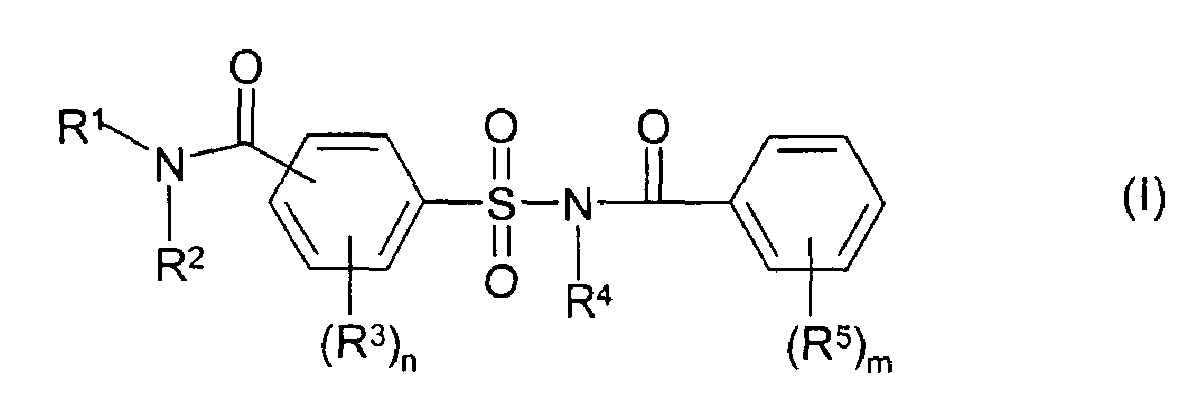
Which comprises reaction of a compound of formula (II) with a compound of the formula (III) in the presence of a chlorinating agent, followed by reaction of the resultant compound of the formula (IV) with a compound of formula (V) in the presence of a base:
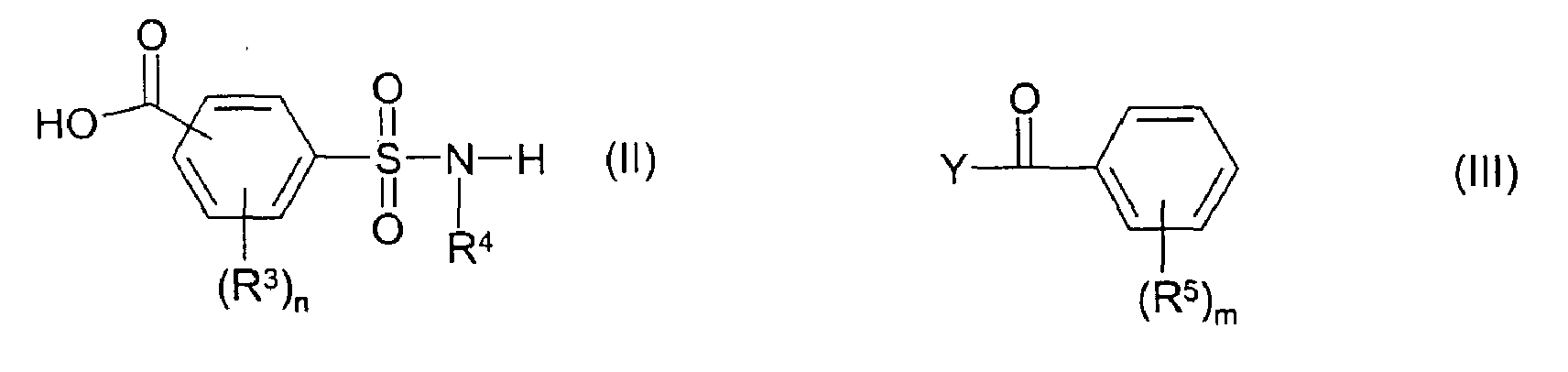

R1R2NH (V)
wherein the various symbols are as defined in claim 1.
R1R2NH (V)
wherein the various symbols are as defined in claim 1.
Description
- This invention relates to the technical field of chemical processes for the preparation of compounds, particularly a novel process for the preparation of a wide range of acylsulfamoylbenzamides, which compounds are useful, e. g. as safeners for pesticides.
- The use of safeners is an increasingly valuable tool for extending the practical utility of many types of pesticides, in particular herbicides, in crops of useful plants such as maize, rice, or cereals, particularly in post-emergence application.
- Patent Publication Number WO 99/16744 describes acylsulfamoylbenzamide derivatives and theiruse as safeners for the control of weeds by herbicides. The safened herbicide mixtures possess very desirable agronomic properties and may potentially of commercial utility.
- Various processes are described for the preparation of these compounds in the above publication, however these methods are not always very efficient and generally require many reaction steps from readily available starting materials. Consequently it is of value to develop a new process which does not suffer from these disadvantages and can therefore be useful for industrial scale operations.
- Two general processes for preparing acylsulfamoylbenzamide derivatives are described in WO 99/16744.
The first process described involves the acylation of a sulfamoylbenzamide using a benzoic acid halide, anhydride or carbonylimidazolide, or using a benzoic acid and a coupling agent such as N,N-dicyclohexylcarbodiimide. A number of specific examples of this process are described therein, which are carried out by heating a mixture of a benzoic acid with the sulfamoylbenzamide, 1,1'-carbonyldiimidazole and 1,8-diazabicyclo [5.4.0]undec-7-ene (DBU) in tetrahydrofuran. However this procedure is of limited value for large scale or industrial operations because of the moderate yields obtained, as well as the prohibitively expensive 1,1'-carbonyldiimidazole which additionally gives rise to substantial waste by-products. - The second general process described in the above reference involves the reaction of an activated acylsulfamoylbenzoic acid derivative with an amine, but this method is not specifically exemplified therein. A disadvantage of this approach is that procedures for the preparation of the activated acylsulfamoylbenzoic acid derivative, such as the acid chloride derivative, are generally inefficient since many reaction steps are involved, leading to poor or moderate overall yields.
- In order to overcome the above limitations of the known processes we have now developed a new two step process for the preparation of acylsulfamoylbenzamide compounds, which involves a reduced number of reaction steps and which is applicable to industrial scale processes.
- According to the present invention there is provided a process for the preparation of a compound of general formula (I):

- R1 is hydrogen, -(CH2)p-heterocyclyl or a hydrocarbon radical, where the two last-mentioned radicals are unsubstituted or substituted by one or more radicals selected from the group consisting of halogen, (C1-C6)-alkyl, (C1-C6)-haloalkyl, (C1-C6)-alkoxy, cyano and nitro;
- R2 is hydrogen, (C1-C6)-alkyl, (C2-C6)-alkenyl, (C2-C6)-alkynyl, (C1-C6)-alkoxy, (C2-C6)-alkenyloxy, where the five last-mentioned radicals are unsubstituted or substituted by one or more radicals selected from the group consisting of halogen, (C1-C4)-alkoxy and (C1-C4)-alkylthio; or
- R1 and R2 together with the linking nitrogen atom form a 3- to 8-membered saturated or unsaturated ring;
- R3 and R5 are each independently halogen, (C1-C6)-alkyl, (C1-C6)-haloalkyl, (C1-C6)-alkoxy, S(O)q-(C1-C6)-alkyl, (C1-C6)-alkylcarbonyl, -CO-aryl, cyano or nitro; or two adjacent R5 groups form a -O-CH2CH2- moiety;
- R4 is hydrogen, (C1-C4)-alkyl, (C2-C4)-alkenyl or (C2-C4)-alkynyl;
- n is an integer from 0 to 4;
- m is an integer from 0 to 5;
- p is 0 or 1; and
- q is 0, 1 or 2; or a salt thereof; which process comprises:
- a) the reaction of a compound of general formula (II):
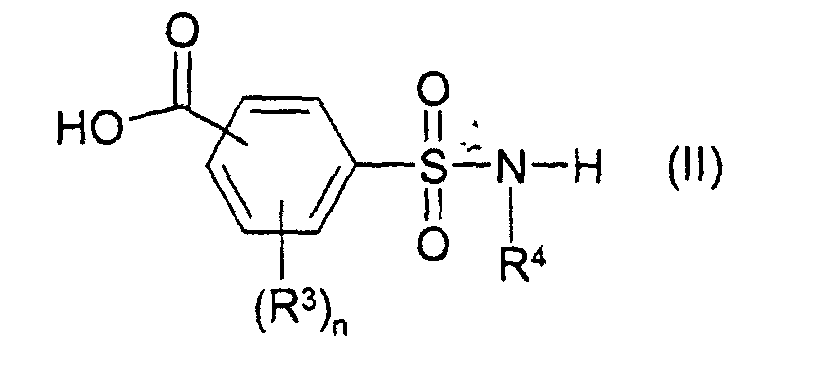


- b) the reaction of the compound of formula (IV) obtained in step a) with a compound of formula (V):
R1R2NH (V)
wherein R1 and R2 are as defined in formula (I).
- a) the reaction of a compound of general formula (II):
- The chlorinating agent used in the process is preferably selected from a sulfur or phosphorous based chlorinating agent such as thionyl chloride, phosphorus oxychloride or phosphorus pentachloride, and a carbon based chlorinating agent used for converting a carboxylic acid into the corresponding acid chloride, such as oxalyl chloride or phosgene. The preferred chlorinating agent is thionyl chloride.
- The amount of chlorinating agent used has an influence on the yield of product of formula (IV) and can be optimised by way of preliminary resting depending on the solvent, the amount and type of starting material amongst other factors. In most cases the amount is between slightly below the stoichiometric amount up to an excess.
The amount of chlorinating agent used depends upon the definition of Y in formula (III), for example when Y is OH compounds of formula (IIIa):

- When Y is OH, the amount of chlorinating agent used is preferably from 1 to 2 molar equivalents per equivalent of carboxylic groups of compounds (II) and (IIIa), more preferably from 1.1 to 2 molar equivalents per equivalents of (II) and (III), most preferably from 1.2 to 1.9 molar equivalents per equivalents of (II) and (III).
When Y is Cl, the amount of chlorinating agent used is preferably from 1 to 2 molar equivalents per equivalent of compound (II), more preferably from 1.1 to 2 molar equivalents per equivalent of (II), most preferably from 1.2 to 1.9 molar equivalents per equivalent of (II). - In reaction step a) the compound of formula (IV) can be isolated by common or customary methods, for instance preferably by partial evaporation during which it precipitates and may be filtered off.
In a further feature of the invention the unreacted excess chlorinating agent, which in the case of thionyl chloride is present in the distillate, may be recycled. - The ratio of (II):(IIIa) is preferably 1:1, but in some cases it is beneficial to add a slight excess (up to 10%) of the acid (IIIa), which has the advantage of ensuring a more complete conversion of the acid (II) in the reaction. This variation is preferably used if the corresponding acid chloride of formula (IIIb) remains soluble in the reaction mixture after partial evaporation, since separation from the precipitated desired product (IV) is then effected.
- A catalyst such as a N,N-dialkylacylamide, for example N,N-dimethylformamide or N,N-dibutylformamide, or a cyclic amine such as pyridine or quinoline is optionally also present in the reaction mixture.
The reaction can be conducted in the absence or preferably presence of a stable and inert solvent, which is preferably selected from - aliphatic or aromatic hydrocarbons such as alkanes, for example heptane, octane, or an alkylated benzene such as toluene, dimethylbenzenes (xylols) or trimethylbenzenes, or paraffin oil,
- halogenated aliphatic hydrocarbons such as dichloromethane, or halogenated aromatic hydrocarbons such as chlorobenzene or dichlorobenzene, or haloalkylbenzenes such as benzotrifluoride, and
- silicon oils.
- The most preferred solvents are chlorobenzene and toluene.
- The reaction temperature in step a) may vary within wide limits dependent on the solvent and pressure used. For example, the reaction temperature is from 70°C to 140°C, preferably from 80°C to 130°C, more preferably from 80°C to 115°C.
- The reaction step a) generally proceeds in excellent yield, with typical yields of the compound of formula (IV) in excess of 90% or even 95%. The purity of the compound of formula (IV) is generally very high (typically at least 95%).
The acid chloride derivative of formula (IIIb) above is formed as an intermediate in the preferred reaction where the compound of formula (IIIa) is used as starting material, and acylates the sulfamoyl moiety of the compound of formula (II) and/or its acid chloride derivative of formula (VI):
- The reaction of the compound of formula (IV) with the compound of formula (V) in step b) can be performed with or without an additional base. Preferably an additional base is used in which case it may be an inorganic base such as an alkali metal hydroxide or alkoxide, for example sodium hydroxide, potassium hydroxide or sodium methoxide, or an alkali metal carbonate such as potassium carbonate, sodium carbonate or lithium carbonate, or an alkali metal bicarbonate such as sodium bicarbonate or potassium bicarbonate, or an alkali metal alkanoate such as sodium acetate, or an alkaline earth metal hydroxide, carbonate or bicarbonate, or an organic base such as a trialkylamine for example triethylamine or tributylamine, or a N-dialkylaniline such as dimethylaniline.
- The preferred additional base is triethylamine, potassium carbonate or sodium carbonate.
The amount of the additional base used is preferably 1.2:1 to 1:1.2 molar equivalent for 1 molar equivalent of the compound of formula (IV), more preferably equimolar amounts of base and compound (IV).
The amount of amine (V) used is preferably a small excess in relation to the amount of (IV), typically about 1.05 molar equivalents of (V) for 1 molar equivalent of (IV).
It is also possible to use 2 molar equivalents of the compound of formula (V) wherein one molar equivalent is utilised as the base in the reaction.
The process step b) is typically carried out in the presence or absence of a solvent. When a solvent is used a wide variety of polar or non-polar solvents may be employed, as long as they do not substantially react with the compound of formula (IV). A number of solvents may be used for example
aromatic hydrocarbons such as an alkylated benzene, for example toluene, or nitriles such as cyanoalkanes for example acetonitrile, or halogenated hydrocarbons such as haloalkanes, for example dichloromethane, or halogenated aromatic compounds such as halobenzenes, for example chlorobenzene, or ethers such as dialkyl ethers, for example diethyl ether or diglyme, or cyclic ethers such as tetrahydrofuran or dioxan, or a N,N-dialkylacylamide such as N,N-dimethylformamide or N,N dimethylacetamide, or a N-alkylpyrrolidinone such as N-methylpyrrolidinone.
Nitrile solvents are preferred, most particularly acetonitrile. - The reaction temperature for step b) is preferably from 0°C to 150°C, more preferably from 0°C to 60°C, most preferably from 10°C to 20°C.
The product of formula (I) can be isolated in a simple manner, for example by dilution of the reaction mixture with water, followed by acidification with, for example a mineral acid such as hydrochloric acid, and filtration.
The isolated yield of the compound of formula (I) is generally very high, typically in excess of 90% or even 95%. The product is generally obtained in high purity, typically at least 95%. - The process of the invention, depending upon the chlorinating agent may also be carried out as a one-pot procedure. In this variation, reaction step a) is preferably followed by removal (for example by evaporation) of remaining chlorinating agent, followed in the same pot by the reaction step b).
- In a further feature of the invention there is provided a process for the preparation of a compound of formula (IV) as defined above, by the reaction of a compound of formula (II) as defined above, with a compound of formula (III), preferably compound (IIIa) as defined above, in the presence of a chlorinating agent as defined above (preferably thionyl chloride).
- In a further feature of the invention there is provided a process for the preparation of a compound of formula (IV) as defined above, by the reaction of a compound of formula (II) as defined above, with a compound of formula (IIIb) as defined above in the presence of a chlorinating agent as defined above (preferably thionyl chloride).
- In a further feature of the invention there is provided a process for the preparation of a compound of formula (I) as defined above, by the reaction of a compound of formula (IV) as defined above, with a compound of formula (V) as defined above:
- In the formula (I) and all the formulae hereinabove and hereinbelow, the terms mentioned have the meanings outlined below:
- The term "halogen" includes fluorine, chlorine, bromine and iodine.
- The term "(C1-C4)-alkyl" is to be understood as a straight-chain or branched hydrocarbon radical having 1, 2, 3 or 4 carbon atoms, for example the methyl, ethyl, propyl, isopropyl, 1-butyl, 2-butyl, 2-methylpropyl or tert-butyl radical. Correspondingly, alkyl radicals having a greater range of carbon atoms are to be understood as straight-chain or branched saturated hydrocarbon radicals which contain a number of carbon atoms which corresponds to this range. The term "(C1-C6)-alkyl" thus includes the abovementioned alkyl radicals, and also, for example, the pentyl, 2-methylbutyl, 1,1-dimethylpropyl and hexyl radical.
- "(C1-C4)-haloalkyl" or "(C1-C6)-haloalkyl" are to be understood as an alkyl group mentioned under the term "(C1-C4)-alkyl" or "(C1-C6)-alkyl" respectively in which one or more hydrogen atoms are replaced by the corresponding number of identical or different halogen atoms, preferably chlorine or fluorine, such as the trifluoromethyl, the 1-fluoroethyl, the 2,2,2-trifluoroethyl, the chloromethyl, fluoromethyl, the difluoromethyl and the 1,1,2,2-tetrafluoroethyl group.
- "(C1-C4)-alkoxy" or "(C1-C6)-alkoxy" are to be understood as an alkoxy group whose hydrocarbon radical has the meaning given under the term "(C1-C4)-alkyl" or "(C1-C6)-alkyl" respectively. Alkoxy groups embracing a larger range of carbon atoms are to be understood likewise.
- The terms "alkenyl" and "alkynyl" having a prefix stating a range of carbon atoms denote a straight-chain or branched hydrocarbon radical having a number of carbon atoms corresponding to this range, this hydrocarbon radical having at least one multiple bond which can be in any position of the unsaturated radical in question. "(C2-C6)-alkenyl" thus denotes, for example, the vinyl, allyl, 2-methyl-2-propenyl, 2-butenyl, pentenyl, 2-methylpentenyl or the hexenyl group. "(C2-C6)-alkynyl" denotes, for example, the ethinyl, propargyl, 2-methyl-2-propynyl, 2-butynyl, 2-pentynyl and the 2-hexynyl group.
- "(C3-C8)-cycloalkyl" denotes monocyclic alkyl radicals, such as the cyclopropyl, cyclobutyl, cyclopentyl, cyclohexyl, cycloheptyl or cyclooctyl radical and bicyclic alkyl radicals, such as the norbornyl radical.
- "(C3-C8)-cycloalkoxy" or "(C3-C8)-cycloalkylthio" is to be understood as one of the abovementioned (C3-C8)-cycloalkyl radicals which is attached via an oxygen or sulfur atom.
- "(C1-C4)-alkylthio" or "(C1-C6)-alkylthio" respectively are an alkylthio group whose hydrocarbon radical has the meaning given under the term "(C1-C4)-alkyl" or "(C1-C6)-alkyl".
- Other composite terms, such as (C3-C6)-cycloalkenyl are to be understood correspondingly, in accordance with the above definitions.
- The term "aryl" is to be understood as an isocyclic, mono-, bi- or polycyclic aromatic radical preferably having 6 to 14, in particular 6 to 12, carbon atoms, such as phenyl, naphthyl or biphenylyl, preferably phenyl.
- The term "heterocyclyl" denotes a mono- or bicyclic radical which is fully saturated, partially or fully unsaturated and which contains one to five identical or different atoms selected from the group consisting of nitrogen, sulfur and oxygen, where, however, two oxygen atoms may not be directly adjacent and at least one carbon atom must be present in the ring, for example a thienyl, furyl, pyrrolyl, thiazolyl, oxazolyl, imidazolyl, isothiazolyl, isoxazolyl, pyrazolyl, 1,3,4-oxadiazolyl, 1,3,4-thiadiazolyl, 1,3,4-triazolyl, 1,2,4-oxadiazolyl, 1,2,4-thiadiazolyl, 1,2,4-triazolyl, 1,2,3-triazolyl, 1,2,3,4-tetrazolyl, benzo[b]thienyl, benzo[b]furyl, indolyl, benzo[c]thienyl, benzo[c]furyl, isoindolyl, benzoxazolyl, benzothiazolyl, benzimidazolyl, benzisoxazolyl, benzisothiazolyl, benzopyrazolyl, benzothiadiazolyl, benzotriazolyl, dibenzofuryl, dibenzothienyl, carbazolyl, pyridyl, pyrazinyl, pyrimidinyl, pyridazinyl, 1,3,5-triazinyl, 1,2,4-triazinyl, 1,2,4,5-tetrazinyl, quinolinyl, isoquinolinyl, quinoxalinyl, quinazolinyl, 1,8-naphthyridinyl, 1,5-naphthyridinyl, 1,6-naphthyridinyl, 1,7-naphthyridinyl, phthalazinyl, pyridopyrimidinyl, purinyl, pteridinyl, piperidinyl, pyrrolidinyl, oxazolinyl, tetrahydrofuryl, tetrahydropyranyl, isoxazolidinyl or thiazolidinyl radical.
- A "hydrocarbon radical" is a straight-chain, branched or cyclic hydrocarbon radical which may be saturated, partially saturated, unsaturated or aromatic, for example alkyl, alkenyl, alkynyl, cycloalkyl, cycloalkenyl, cycloalkylalkyl, aryl or CH2aryl, preferably alkyl, alkenyl and alkynyl having up to 20 carbon atoms or cycloalkyl having 3 to 6 ring atoms or phenyl.
- In the cases where two or more radicals R3 and/or R5 are present, i.e. if m and/or n are greater than one, these radicals may in each case be identical or different.
- If R1 in the formula (I) is a hydrocarbon radical, this hydrocarbon radical has preferably up to 20 carbon atoms. If this hydrocarbon radical carries further carbon-containing substituents, the total number of all carbon atoms of this radical R1 is preferably 2 to 30.
- Depending on the kind and the linkage of the substituents, the compounds of formula (I) may be present as stereoisomers. If, for example, one or more alkenyl groups are present, diastereomers may occur. If, for example, one or more asymmetric carbon atoms are present, enantiomers and diastereomers may occur. Stereoisomers can be obtained from the mixtures which are obtained in the preparation by customary separation methods, for example by chromatographic separation processes. It is also possible to prepare stereoisomers selectively by employing stereoselective reactions using optically active starting materials and/or auxiliaries. The process thus also relates to all stereoisomers and mixtures thereof which are embraced by the formula (I) but not specifically defined.
- The compounds of the formula (I) can form salts. Salt formation may occur by action of a base on those compounds of the formula (I) which carry an acidic hydrogen atom, for example in the case of R4 = H. Suitable bases are, for example, organic amines and also ammonium, alkali metal or alkaline earth metal hydroxides, carbonates and bicarbonates, in particular sodium hydroxide and potassium hydroxide, sodium carbonate and potassium carbonate and sodium bicarbonate and potassium bicarbonate. Salt formation can also occur by addition of an acid to basic groups, where a heterocyclyl group is present and represents a basic group such as imidazolyl or pyridyl. Acids which are suitable for this purpose are inorganic and organic acids, for example HCl, HBr, H2SO4, HNO3 or H3PO4, or acetic acid, trifluoroacetic acid or oxalic acid, or sulfonic acids, and the process of the invention includes the formation of such salts.
- Preferably R1 is hydrogen, (C1-C12)-alkyl, (C2-C8)-alkenyl, (C2-C8)-alkynyl, (C3-C8)-cycloalkyl, (C3-C8)-cycloalkenyl, aryl, -CH2-aryl or -(CH2)p-heterocyclyl where heterocyclyl is a 3- to 8-membered ring having up to three identical or different hetero atoms selected from the group consisting of nitrogen, oxygen and sulfur, where the eight last-mentioned radicals are unsubstituted or substituted by one or more radicals selected from the group consisting of halogen, (C1-C6)-alkyl, (C1-C6)-haloalkyl, (C1-C6)-alkoxy, cyano and nitro.
Preferably also R1 is hydrogen, (C1-C8)-alkyl, (C2-C6)-alkenyl, (C2-C6)-alkynyl, (C3-C6)-cycloalkyl, (C5-C6)-cycloalkenyl, phenyl or -(CH2)p-heterocyclyl where heterocyclyl is a 3- to 6-membered ring having up to three hetero atoms selected from the group consisting of nitrogen, oxygen and sulfur, where the seven last-mentioned radicals are unsubstituted or substituted by one or more substituents. selected from the group consisting of halogen, (C1-C6)-alkyl, (C1-C6)-haloalkyl and (C1-C6)-alkoxy.
Preferably also R1 is hydrogen, (C1-C6)-alkyl, (C2-C6)-alkenyl, (C2-C6)-alkynyl, (C1-C6)-alkoxy-(C1-C6)-alkyl, (C3-C6)-cycloalkyl, (C3-C6)-cycloalkyl-(C1-C6)-alkyl, -CH2furyl, phenyl, -CH2phenyl or -CH2CH2phenyl, which last three mentioned phenyl radicals are unsubstituted or substituted by one or more halogen radicals.
Preferably also R1 is hydrogen, (C1-C6)-alkyl, (C2-C6)-alkenyl, (C3-C6)-cycloalkyl, (C5-C6)-cycloalkenyl, phenyl or 3- to 6-membered heterocyclyl having up to three hetero atoms selected from the group consisting of nitrogen, oxygen and sulfur, where the six last-mentioned radicals are unsubstituted or substituted by one or more substituents selected from the group consisting of halogen, (C1-C4)-alkyl, (C1-C4)-haloalkyl and (C1-C4)-alkoxy. - Preferably R2 is hydrogen, (C1-C6)-alkyl or (C1-C6)-alkoxy where the two last-mentioned radicals are unsubstituted or substituted by one or more radicals selected from the group consisting of halogen and (C1-C4)-alkoxy.
Preferably also R2 is hydrogen or (C1-C6)-alkyl or (C1-C6)-haloalkyl. - Preferably also R2 is hydrogen, (C1-C6)-alkyl or (C2-C6)-alkynyl.
Preferably also R1 and R2 together form a -(CH2)2-O-(CH2)2-, -(CH2)4- or -(CH2)5-moiety. - Preferably R3 and R5 are each independently halogen, (C1-C6)-alkyl, (C1-C6)-haloalkyl, (C1-C6)-alkoxy, S(O)q-(C1-C6)-alkyl, cyano or nitro.
Preferably also R3 and R5 are each independently halogen, (C1-C4)-alkyl, (C1-C4)-haloalkyl, (C1-C4)-alkoxy, S(O)q-(C1-C4)-alkyl, cyano or nitro.
Preferably also R3 and R5 are each independently halogen, (C1-C4)-alkyl, (C1-C4)-haloalkyl, (C1-C4)-alkoxy, cyano or nitro.
Preferably also R3 is halogen or nitro. - Preferably R4 is hydrogen or (C1-C6)-alkyl.
More preferably R4 is hydrogen or (C1-C4)-alkyl.
Most preferably R4 is hydrogen. - Preferably R5 is halogen, (C1-C6)-alkyl, (C1-C6)-alkoxy, nitro or -CO-naphthyl, or two adjacent R5 groups form a -O-CH2CH2- moiety.
Preferably n is 0, 1 or 2, more preferably 0.
Preferably m is 1 or 2, more preferably 1 or 2, in particular 1. - Preferred compounds of formula (I) are those in which:
- R1 is hydrogen, (C1-C12)-alkyl, (C2-C8)-alkenyl, (C2-C8)-alkynyl, (C3-C8)-cycloalkyl, (C3-C8)-cycloalkenyl, aryl, -CH2aryl or -(CH2)p-heterocyclyl where heterocyclyl is a 3-to 8-membered ring having up to three identical or different hetero atoms selected from the group consisting of nitrogen, oxygen and sulfur, where the eight last-mentioned radicals are unsubstituted or substituted by one or more radicals selected from the group consisting of halogen, (C1-C6)-alkyl, (C1-C6)-haloalkyl, (C1-C6)-alkoxy, cyano and nitro;
- R2 is hydrogen, (C1-C6)-alkyl or (C1-C6)-alkoxy where the two last-mentioned radicals are unsubstituted or substituted by one or more radicals selected from the group consisting of halogen and (C1-C4)-alkoxy;
- R3 and R5 are each independently halogen, (C1-C6)-alkyl, (C1-C6)-haloalkyl, (C1-C6)-alkoxy, S(O)q-(C1-C6)-alkyl, cyano or nitro; and
- R4 is hydrogen or (C1-C6)-alkyl.
- Further preferred compounds of formula (I) are those in which:
- R1 is hydrogen, (C1-C8)-alkyl, (C2-C6)-alkenyl, (C2-C6)-alkynyl, (C3-C6)-cycloalkyl, (C5-C6)-cycloalkenyl, phenyl or -(CH2)p-heterocyclyl where heterocyclyl is a 3- to 6-membered ring having up to three hetero atoms selected from the group consisting of nitrogen, oxygen and sulfur, where the seven last-mentioned radicals are unsubstituted or substituted by one or more substituents selected from the group consisting of halogen, (C1-C6)-alkyl, (C1-C6)-haloalkyl and (C1-C6)-alkoxy;
- R2 is hydrogen or (C1-C6)-alkyl or (C1-C6)-haloalkyl;
- R3 and R5 are each independently halogen, (C1-C4)-alkyl, (C1-C4)-haloalkyl, (C1-C4)-alkoxy, S(O)q-(C1-C4)-alkyl, cyano or nitro; and
- R4 is hydrogen or (C1-C4)-alkyl.
- Also preferred are compounds of formula (I) in which:
- R1 is hydrogen, (C1-C6)-alkyl, (C2-C6)-alkenyl, (C2-C6)-alkynyl, (C1-C6)-alkoxy-(C1-C6)-alkyl, (C3-C6)-cycloalkyl, (C3-C6)-cycloalkyl-(C1-C6)-alkyl, -CH2furyl, phenyl, -CH2phenyl or -CH2CH2phenyl, which last three mentioned phenyl radicals are unsubstituted or substituted by one or more halogen radicals;
- R2 is hydrogen, (C1-C6)-alkyl or (C2-C6)-alkynyl;
or R1 and R2 together form a -(CH2)2-O-(CH2)2-, -(CH2)4- or -(CH2)5- moiety; - R3 is halogen or nitro;
- R4 is hydrogen or (C1-C4)-alkyl;
- R5 is halogen, (C1-C6)-alkyl, (C1-C6)-alkoxy, nitro or -CO-naphthyl, or two adjacent R5 groups form a -O-CH2CH2- moiety;
- n is 0, 1 or 2; and
- m is 1 or 2.
- Further preferred compounds of formula (I) are those in which:
- R1 is hydrogen, (C1-C6)-alkyl, (C2-C6)-alkenyl, (C3-C6)-cycloalkyl, (C5-C6)-cycloalkenyl, phenyl or 3- to 6-membered heterocyclyl having up to three hetero atoms selected from the group consisting of nitrogen, oxygen and sulfur, where the six last-mentioned radicals are unsubstituted or substituted by one or more substituents selected from the group consisting of halogen, (C1-C4)-alkyl, (C1-C4)-haloalkyl and (C1-C4)-alkoxy;
- R2 is hydrogen, (C1-C6)-alkyl or (C1-C6)-haloalkyl;
- R3 and R5 are each independently halogen, (C1-C4)-alkyl, (C1-C4)-haloalkyl, (C1-C4)-alkoxy, cyano or nitro;
- R4 is hydrogen;
- n is 0, 1 or 2; and
- m is 1 or 2.
- Particularly preferred compounds of formula (I) are those in which:
- R1 is hydrogen, (C1-C6)-alkyl or (C3-C6)-cycloalkyl;
- R2 and R4 are each hydrogen;
- R5 is hydrogen or (C1-C6)-alkoxy;
- n is 0;
- m is 1;
- Also preferred are processes for the preparation of formulae (Ia), (Ib), (Ic), (IVa), (IVb) and (IVc) as shown and defined in Tables 1 to 6 below, wherein the radicals R1, R2, R3, R4, R5 and n are as defined above, and preferably the preferred meanings above.
- Compounds of formula (IV) are novel and form a further feature of the invention. Compounds of formula (II), (III), (V) and (VI) are known or may be prepared by known methods.
- Compared with the known process, the present invention provides an overall process for the preparation of acylsulfamoylbenzamides which has fewer reaction steps, and gives higher yields and higher purity product.
- The following non-limiting examples illustrate the invention.
The amounts, relative amounts, percentages or ratios refer to the weight unless another definition is specifically given. - A mixture of 4-aminosulfonylbenzoic acid (1 mol), 2-methoxy-5-chlorobenzoic acid (1 mol) and thionyl chloride (2.5 mol) in chlorobenzene (700 ml) was heated at 120°C for 7-9 hours. After the reaction was complete 200 ml of the solvent was removed in vacuo. The mixture was cooled and the precipitate filtered off and washed with heptane to give the title compound, mp. 138-140°C, yield 93 % of theory. 4-[(Benzoyl)amino]sulfonyl)benzoyl chloride was prepared in a similar manner from 4-aminosulfonylbenzoic acid and benzoic acid, mp. 180-182°C, yield 96 % of theory. 4-[(2-Chlorobenzoyl)amino]sulfonyl)benzoyl chloride was prepared in a similar manner from 4-aminosulfonylbenzoic acid and 2-chlorobenzoic acid, mp. 198-200°C, yield 95 % of theory.
- To a suspension of 4-[(2-methoxybenzoyl)amino]sulfonyl)benzoyl chloride (1 mol) and diethylamine (1 mol) in acetonitrile (1000 ml), was added triethylamine (1 mol) at 10° C. The mixture was stirred for 2 hours at 20°C and diluted with water (500ml). The white precipitate was filtered off, washed and dried to give the title compound. The yield of product obtained was 98 % of theory, and the purity 98 %.
- By employing the procedure described in Example 2 but using potassium carbonate (1 equivalent) instead of triethylamine, there was obtained the title compound in a yield of 99 % of theory.
- In the Tables 1 to 3 below are listed a number of examples of compounds of formula (I) which are prepared by the process of the invention.
The abbreviations in the tables 1 to 6 denote:Bu = n-butyl Et = ethyl Me = methyl c = cyclo Pr = n-propyl s = secondary i = iso Mp = melting point t = tertiary - If an alkyl radical is listed in the tables without any further specification, this alkyl radical is straight-chain.


- Tables 4 to 6 list some examples of compounds of formula (IV) which are prepared:

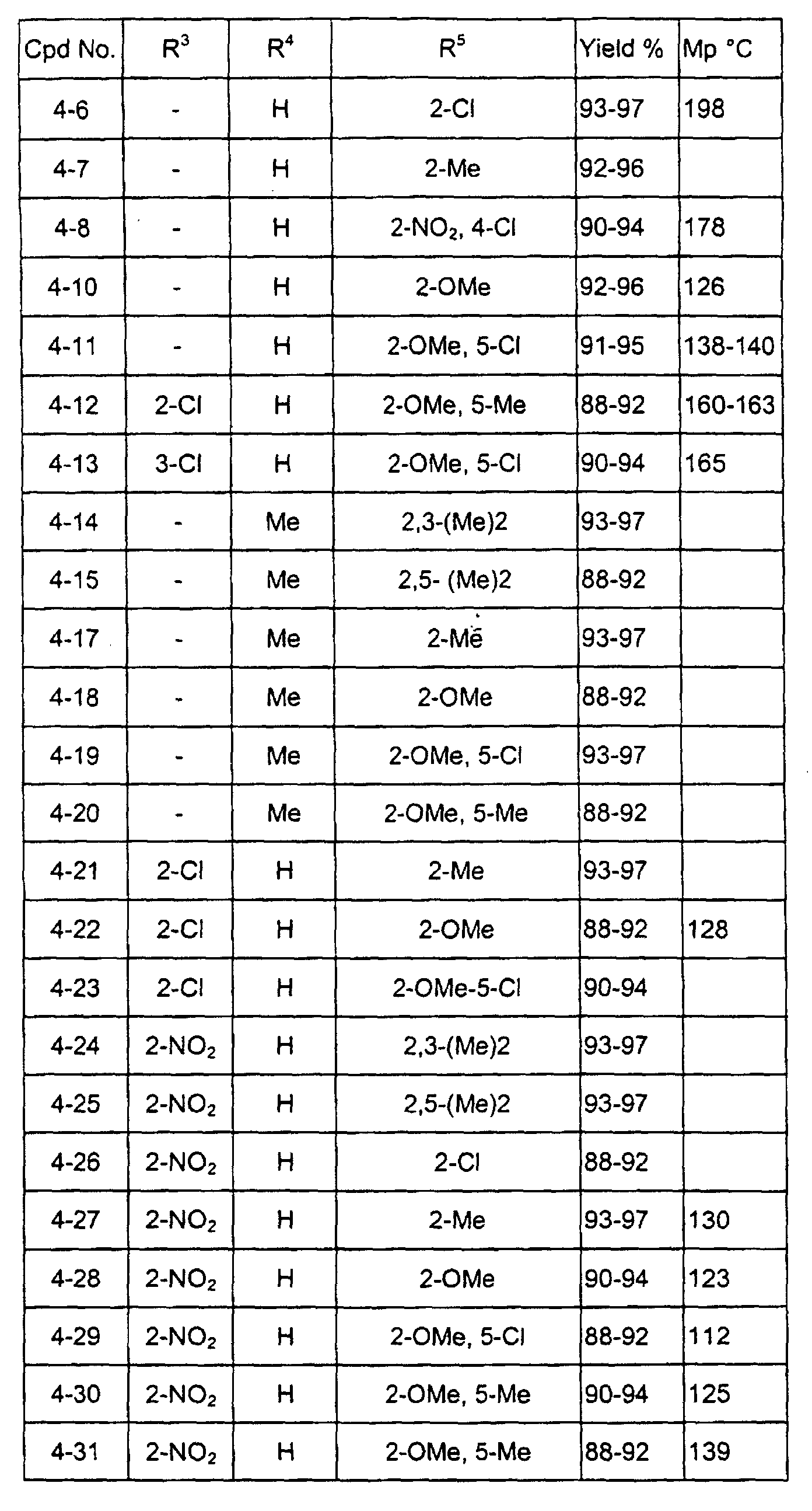


Claims (10)
- A process for the preparation of a compound of formula (I):
 R1 is hydrogen, -(CH2)p-heterocyclyl or a hydrocarbon radical, where the two last-mentioned radicals are unsubstituted or substituted by one or more radicals selected from the group consisting of halogen, (C1-C6)-alkyl, (C1-C6)-haloalkyl, (C1-C6)-alkoxy, cyano and nitro;R2 is hydrogen, (C1-C6)-alkyl, (C2-C6)-alkenyl, (C2-C6)-alkynyl, (C1-C6)-alkoxy, (C2-C6)-alkenyloxy, where the five last-mentioned radicals are unsubstituted or substituted by one or more radicals selected from the group consisting of halogen, (C1-C4)-alkoxy and (C1-C4)-alkylthio; orR1 and R2 together with the linking nitrogen atom form a 3- to 8-membered saturated or unsaturated ring;R3 and R5 are each independently halogen, (C1-C6)-alkyl, (C1-C6)-haloalkyl, (C1-C6)-alkoxy, S(O)q-(C1-C6)-alkyl, (C1-C6)-alkylcarbonyl, -CO-aryl, cyano or nitro; or two adjacent R5 groups form a -O-CH2CH2- moiety;R4 is hydrogen, (C1-C4)-alkyl, (C2-C4)-alkenyl or (C2-C4)-alkynyl;n is an integer from 0 to 4;m is an integer from 0 to 5;p is 0 or 1; andq is 0, 1 or 2; or a salt thereof;which process comprises the reaction of a compound of formula (II):
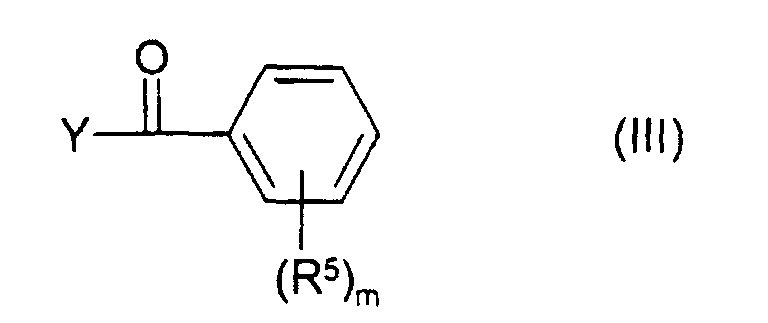

R1R2NH (V)
wherein R1 and R2 are as defined in formula (I), in the presence of a base. - A process as claimed in claim 1 wherein the chlorinating agent is thionyl chloride.
- A process as claimed in claim 1 or 2 wherein the amount of chlorinating agent used is, when Y is OH from 1 to 2 molar equivalents per equivalents of (II) and (IIIa), or when Y is Cl from 1 to 2 molar equivalents per equivalent of (II).
- A process as claimed in claim 1, 2 or 3 wherein the solvent used in the reaction of the compound of formula (II) with the compound of formula (III) is chlorobenzene.
- A process as claimed in any one of claims 1 to 4 wherein:R1 is hydrogen, (C1-C6)-alkyl or (C3-C6)-cycloalkyl;R2 and R4 are each hydrogen;R5 is hydrogen or (C1-C6)-alkoxy;n is 0;m is 1;and the sulfamoyl group is located para to the CONR1R2 moiety in the phenyl ring.
- A process as claimed in any one of claims 1 to 5 wherein a compound of formula (IIIa):

- A compound of formula (IV):

R4 is hydrogen, (C1-C4)-alkyl, (C2-C4)-alkenyl or (C2-C4)-alkynyl;
n is an integer from 0 to 4;
m is an integer from 0 to 5;
p is 0 or 1; and
q is 0, 1 or 2; or a salt thereof. - A process for the preparation of a compound of formula (IV) as defined in claim 7, which comprises reaction of a compound of formula (II):


- A process as claimed in claim 8 wherein Y is OH.
- A process for the preparation of a compound of formula (I) as defined in claim 1 by the reaction of a compound of formula (IV):

R1R2NH (V)
wherein R1, R2, R3, R4, R5, m and n are as defined in formula (I).
Priority Applications (22)
| Application Number | Priority Date | Filing Date | Title |
|---|---|---|---|
| EP20030014232 EP1491527A1 (en) | 2003-06-25 | 2003-06-25 | Process for preparing acylsulfamoylbenzamides |
| BRPI0411717-4A BRPI0411717B1 (en) | 2003-06-25 | 2004-06-11 | PROCESS FOR PREPARING ACILSULFAMOILBENZAMIDES |
| CA2530375A CA2530375C (en) | 2003-06-25 | 2004-06-11 | Process for preparing acylsulfamoylbenzamides |
| AU2004251827A AU2004251827A1 (en) | 2003-06-25 | 2004-06-11 | Process for preparing acylsulfamoylbenzamides |
| DE602004023394T DE602004023394D1 (en) | 2003-06-25 | 2004-06-11 | METHOD FOR PRODUCING ACYLSULFAMOYL BENZAMIDES |
| KR1020127017426A KR20120081252A (en) | 2003-06-25 | 2004-06-11 | Process for preparing acylsulfamoylbenzamides |
| KR1020057024831A KR101194487B1 (en) | 2003-06-25 | 2004-06-11 | Process for the preparation of acyl sulfamoyl benzamide |
| CNB2004800177504A CN100429200C (en) | 2003-06-25 | 2004-06-11 | The method for preparing acylsulfamoylbenzamide |
| PCT/EP2004/006295 WO2005000797A1 (en) | 2003-06-25 | 2004-06-11 | Process for preparing acylsulfamoylbenzamides |
| EP04739792A EP1644324B1 (en) | 2003-06-25 | 2004-06-11 | Process for preparing acylsulfamoylbenzamides |
| AT04739792T ATE444285T1 (en) | 2003-06-25 | 2004-06-11 | METHOD FOR PRODUCING ACYLSULFAMOYL BENZAMIDES |
| ES09009453.3T ES2607469T3 (en) | 2003-06-25 | 2004-06-11 | Preparation procedure of acylsulfamoylbenzamides |
| MXPA05013604 MX270813B (en) | 2003-06-25 | 2004-06-11 | Process for preparing acylsulfamoylbenzamides. |
| DK09009453.3T DK2119699T3 (en) | 2003-06-25 | 2004-06-11 | METHOD OF PREPARING ACYLSULPHAMOYL BENZAMIDES |
| EP09009453.3A EP2119699B1 (en) | 2003-06-25 | 2004-06-11 | Process for preparing acylsulfamoylbenzamides |
| JP2006515889A JP4762894B2 (en) | 2003-06-25 | 2004-06-11 | Method for producing acylsulfamoylbenzamide |
| DK04739792T DK1644324T3 (en) | 2003-06-25 | 2004-06-11 | Process for the preparation of acylsulfamoylbenzamides |
| BR122013017116-9A BR122013017116B1 (en) | 2003-06-25 | 2004-06-11 | Process for the preparation of acylsulfamoylbenzamides, as well as intermediates and their preparation process |
| US10/874,966 US7608736B2 (en) | 2003-06-25 | 2004-06-23 | Process for preparing acylsulfamoylbenzamides |
| IL172691A IL172691A (en) | 2003-06-25 | 2005-12-19 | Process and intermediates for preparing acylsulfamoylbenzamides |
| US12/557,727 US8236986B2 (en) | 2003-06-25 | 2009-09-11 | Process for preparing acylsulfamoylbenzamides |
| JP2011088185A JP5461469B2 (en) | 2003-06-25 | 2011-04-12 | Method for producing acylsulfamoylbenzamide |
Applications Claiming Priority (1)
| Application Number | Priority Date | Filing Date | Title |
|---|---|---|---|
| EP20030014232 EP1491527A1 (en) | 2003-06-25 | 2003-06-25 | Process for preparing acylsulfamoylbenzamides |
Publications (1)
| Publication Number | Publication Date |
|---|---|
| EP1491527A1 true EP1491527A1 (en) | 2004-12-29 |
Family
ID=33395861
Family Applications (3)
| Application Number | Title | Priority Date | Filing Date |
|---|---|---|---|
| EP20030014232 Withdrawn EP1491527A1 (en) | 2003-06-25 | 2003-06-25 | Process for preparing acylsulfamoylbenzamides |
| EP09009453.3A Expired - Lifetime EP2119699B1 (en) | 2003-06-25 | 2004-06-11 | Process for preparing acylsulfamoylbenzamides |
| EP04739792A Expired - Lifetime EP1644324B1 (en) | 2003-06-25 | 2004-06-11 | Process for preparing acylsulfamoylbenzamides |
Family Applications After (2)
| Application Number | Title | Priority Date | Filing Date |
|---|---|---|---|
| EP09009453.3A Expired - Lifetime EP2119699B1 (en) | 2003-06-25 | 2004-06-11 | Process for preparing acylsulfamoylbenzamides |
| EP04739792A Expired - Lifetime EP1644324B1 (en) | 2003-06-25 | 2004-06-11 | Process for preparing acylsulfamoylbenzamides |
Country Status (15)
| Country | Link |
|---|---|
| US (2) | US7608736B2 (en) |
| EP (3) | EP1491527A1 (en) |
| JP (2) | JP4762894B2 (en) |
| KR (2) | KR101194487B1 (en) |
| CN (1) | CN100429200C (en) |
| AT (1) | ATE444285T1 (en) |
| AU (1) | AU2004251827A1 (en) |
| BR (2) | BR122013017116B1 (en) |
| CA (1) | CA2530375C (en) |
| DE (1) | DE602004023394D1 (en) |
| DK (2) | DK2119699T3 (en) |
| ES (1) | ES2607469T3 (en) |
| IL (1) | IL172691A (en) |
| MX (1) | MX270813B (en) |
| WO (1) | WO2005000797A1 (en) |
Cited By (1)
| Publication number | Priority date | Publication date | Assignee | Title |
|---|---|---|---|---|
| CN105859623A (en) * | 2013-09-18 | 2016-08-17 | 郭庆春 | Preparation method and intermediates of pyrazole acyl sulfamoyl benzamide |
Families Citing this family (7)
| Publication number | Priority date | Publication date | Assignee | Title |
|---|---|---|---|---|
| DE102005031787A1 (en) * | 2005-07-07 | 2007-01-18 | Bayer Cropscience Gmbh | Crop-compatible herbicidal compositions containing herbicides safeners |
| UA90757C2 (en) | 2005-10-12 | 2010-05-25 | Басф Се | HERBICIDIC COMPOSITION, ANTI-VEGETABLE VEGETABLE METHOD, AND METHOD OF PROTECTING CULTIVATES FROM PHYTOTOXIC ACTION OF 3-PHENYLURACILE |
| CN101838227A (en) * | 2010-04-30 | 2010-09-22 | 孙德群 | Safener of benzamide herbicide |
| US9725409B2 (en) * | 2013-10-10 | 2017-08-08 | Bayer Cropscience Aktiengesellschaft | Process for preparing 4[[(benzoyl)amino]sulphonyl]benzoyl chlorides and preparation of acylsulphamoylbenzamides |
| TWI699351B (en) | 2015-04-08 | 2020-07-21 | 德商拜耳作物科學公司 | Process for preparing acylsulfamoylbenzamides |
| CN115232037B (en) * | 2022-08-12 | 2023-10-27 | 郑州手性药物研究院有限公司 | A kind of preparation method of benzoyl sulfonyl-N-substituted benzamide compound |
| CN121336812A (en) * | 2025-02-13 | 2026-01-16 | 郑州手性药物研究院有限公司 | A herbicidal composition |
Citations (2)
| Publication number | Priority date | Publication date | Assignee | Title |
|---|---|---|---|---|
| DE2721643A1 (en) * | 1977-05-13 | 1978-11-23 | Heumann Ludwig & Co Gmbh | Prepn. of N-aminoalkyl-2-alkoxy-5-sulphamoyl-benzamide derivs. - useful as pharmaceuticals |
| WO1999016744A1 (en) * | 1997-09-29 | 1999-04-08 | Aventis Cropscience Gmbh | Acylsulfamoyl benzoic acid amides, plant protection agents containing said acylsulfamoyl benzoic acid amides, and method for producing the same |
Family Cites Families (3)
| Publication number | Priority date | Publication date | Assignee | Title |
|---|---|---|---|---|
| JPS6019761A (en) * | 1983-07-15 | 1985-01-31 | Meiji Seika Kaisha Ltd | Sulfonylbenzamide derivative, its preparation and agricultural and horticultural blight controlling agent containing said derivative as active component |
| DE4410480A1 (en) * | 1994-03-25 | 1995-09-28 | Hoechst Ag | Sulfonamidocarbonylpyridine-2-carboxylic acid ester amides and their pyridine N-oxides, processes for their preparation and their use as medicaments |
| AU3577995A (en) * | 1994-10-04 | 1996-04-26 | Fujisawa Pharmaceutical Co., Ltd. | Urea derivatives and their use as acat-inhibitors |
-
2003
- 2003-06-25 EP EP20030014232 patent/EP1491527A1/en not_active Withdrawn
-
2004
- 2004-06-11 DK DK09009453.3T patent/DK2119699T3/en active
- 2004-06-11 AU AU2004251827A patent/AU2004251827A1/en not_active Abandoned
- 2004-06-11 MX MXPA05013604 patent/MX270813B/en active IP Right Grant
- 2004-06-11 ES ES09009453.3T patent/ES2607469T3/en not_active Expired - Lifetime
- 2004-06-11 KR KR1020057024831A patent/KR101194487B1/en not_active Expired - Lifetime
- 2004-06-11 EP EP09009453.3A patent/EP2119699B1/en not_active Expired - Lifetime
- 2004-06-11 KR KR1020127017426A patent/KR20120081252A/en not_active Ceased
- 2004-06-11 EP EP04739792A patent/EP1644324B1/en not_active Expired - Lifetime
- 2004-06-11 BR BR122013017116-9A patent/BR122013017116B1/en not_active IP Right Cessation
- 2004-06-11 DE DE602004023394T patent/DE602004023394D1/en not_active Expired - Lifetime
- 2004-06-11 WO PCT/EP2004/006295 patent/WO2005000797A1/en not_active Ceased
- 2004-06-11 JP JP2006515889A patent/JP4762894B2/en not_active Expired - Lifetime
- 2004-06-11 DK DK04739792T patent/DK1644324T3/en active
- 2004-06-11 CN CNB2004800177504A patent/CN100429200C/en not_active Expired - Lifetime
- 2004-06-11 AT AT04739792T patent/ATE444285T1/en not_active IP Right Cessation
- 2004-06-11 CA CA2530375A patent/CA2530375C/en not_active Expired - Lifetime
- 2004-06-11 BR BRPI0411717-4A patent/BRPI0411717B1/en not_active IP Right Cessation
- 2004-06-23 US US10/874,966 patent/US7608736B2/en active Active
-
2005
- 2005-12-19 IL IL172691A patent/IL172691A/en active IP Right Grant
-
2009
- 2009-09-11 US US12/557,727 patent/US8236986B2/en not_active Expired - Lifetime
-
2011
- 2011-04-12 JP JP2011088185A patent/JP5461469B2/en not_active Expired - Lifetime
Patent Citations (2)
| Publication number | Priority date | Publication date | Assignee | Title |
|---|---|---|---|---|
| DE2721643A1 (en) * | 1977-05-13 | 1978-11-23 | Heumann Ludwig & Co Gmbh | Prepn. of N-aminoalkyl-2-alkoxy-5-sulphamoyl-benzamide derivs. - useful as pharmaceuticals |
| WO1999016744A1 (en) * | 1997-09-29 | 1999-04-08 | Aventis Cropscience Gmbh | Acylsulfamoyl benzoic acid amides, plant protection agents containing said acylsulfamoyl benzoic acid amides, and method for producing the same |
Cited By (2)
| Publication number | Priority date | Publication date | Assignee | Title |
|---|---|---|---|---|
| CN105859623A (en) * | 2013-09-18 | 2016-08-17 | 郭庆春 | Preparation method and intermediates of pyrazole acyl sulfamoyl benzamide |
| CN105859623B (en) * | 2013-09-18 | 2018-01-16 | 河北兰升生物科技有限公司 | Pyrazole Acyl sulfonamides benzamide Preparation Method And Their Intermediate |
Also Published As
| Publication number | Publication date |
|---|---|
| CA2530375C (en) | 2012-05-29 |
| BR122013017116B1 (en) | 2015-07-21 |
| DK2119699T3 (en) | 2017-01-02 |
| JP5461469B2 (en) | 2014-04-02 |
| CN100429200C (en) | 2008-10-29 |
| CN1812962A (en) | 2006-08-02 |
| JP4762894B2 (en) | 2011-08-31 |
| US8236986B2 (en) | 2012-08-07 |
| KR101194487B1 (en) | 2012-10-24 |
| EP2119699B1 (en) | 2016-09-21 |
| IL172691A0 (en) | 2006-04-10 |
| BRPI0411717B1 (en) | 2014-01-21 |
| JP2007506653A (en) | 2007-03-22 |
| EP1644324A1 (en) | 2006-04-12 |
| WO2005000797A1 (en) | 2005-01-06 |
| JP2011178793A (en) | 2011-09-15 |
| BRPI0411717A (en) | 2006-08-08 |
| ATE444285T1 (en) | 2009-10-15 |
| MX270813B (en) | 2009-10-09 |
| KR20120081252A (en) | 2012-07-18 |
| ES2607469T3 (en) | 2017-03-31 |
| KR20060064572A (en) | 2006-06-13 |
| US20050004372A1 (en) | 2005-01-06 |
| MXPA05013604A (en) | 2006-03-09 |
| DK1644324T3 (en) | 2009-12-21 |
| CA2530375A1 (en) | 2005-01-06 |
| DE602004023394D1 (en) | 2009-11-12 |
| EP2119699A1 (en) | 2009-11-18 |
| US20100094052A1 (en) | 2010-04-15 |
| EP1644324B1 (en) | 2009-09-30 |
| AU2004251827A1 (en) | 2005-01-06 |
| IL172691A (en) | 2011-03-31 |
| US7608736B2 (en) | 2009-10-27 |
Similar Documents
| Publication | Publication Date | Title |
|---|---|---|
| JP5461469B2 (en) | Method for producing acylsulfamoylbenzamide | |
| JP5247436B2 (en) | Method for producing methylene disulfonate compound | |
| EP0639559B1 (en) | Preparation of 1,2-diacyl-2-(t-alkyl)hydrazines | |
| JP4430392B2 (en) | Method for producing 2-halogen-pyridine-carboxylic acid amide | |
| KR0142667B1 (en) | Production of thiophene-2,5-dicarboxylic acid diesters, tetrahydrothiophene-2,5-dicarboxylic acid diesters and dibenzoxazolyl-thiophenes | |
| US6531605B1 (en) | Process for the manufacture of arylsulfonyl chloride | |
| CN107530327A (en) | Process for the preparation of 2-thiophenoyl chloride | |
| KR100519420B1 (en) | Process for preparing heteroarylcarboxyamides and esters | |
| CA2545452C (en) | Ortho-substituted pentafluoride sulfanyl-benzenes, method for the production thereof and the use thereof in the form of valuable synthesis intermediate stages | |
| TW200408629A (en) | Halosulfonylbenzoyl halides, processes for their preparation and their use for preparing substituted phenylsulfonylureas | |
| WO1979000023A1 (en) | A novel process for preparation of a therapeutically active pyridine compound | |
| CN110352193A (en) | Process for the preparation of 4- [ (4, 5-dihydro-3-methoxy-4-methyl-5-oxo-1H-1, 2, 4-triazol-1-yl) carbonyl) sulfamoyl ] -5-methylthiophene-3-carboxylic acid methyl ester | |
| KR950008208B1 (en) | Method for preparing mercaptobenzoate | |
| KR20090127349A (en) | Process for preparing substituted phenylhydrazine | |
| JP4251508B2 (en) | Method for producing acid chloride compound | |
| RU2232754C2 (en) | Method for preparing derivatives of 1-phenylpyrazoline-3-carboxylic acid | |
| JP3959994B2 (en) | Method for producing 4-phthalonitrile derivative | |
| JP3545466B2 (en) | Dihydrochromancarboxylic acids and method for producing the same | |
| JPH0687820A (en) | Method of preparing n-alkylsulfonamide | |
| JPH0759557B2 (en) | Method for producing 1,3-dialkylpyrazole-4-aldehyde derivative | |
| JPH0311049A (en) | Method for producing sulfonium compounds | |
| JPS63119454A (en) | Novel alpha-chloroketone derivative and production thereof | |
| MXPA02010875A (en) | Aryloxy ester and acid compounds. | |
| KR20000052892A (en) | Method of producing naphthyridine compounds and novel intermediate products | |
| EP3523278A1 (en) | Method for the preparation of h-arg (mis) -oh |
Legal Events
| Date | Code | Title | Description |
|---|---|---|---|
| PUAI | Public reference made under article 153(3) epc to a published international application that has entered the european phase |
Free format text: ORIGINAL CODE: 0009012 |
|
| AK | Designated contracting states |
Kind code of ref document: A1 Designated state(s): AT BE BG CH CY CZ DE DK EE ES FI FR GB GR HU IE IT LI LU MC NL PT RO SE SI SK TR |
|
| AX | Request for extension of the european patent |
Extension state: AL LT LV MK |
|
| 17P | Request for examination filed |
Effective date: 20050629 |
|
| AKX | Designation fees paid |
Designated state(s): DE |
|
| RAP1 | Party data changed (applicant data changed or rights of an application transferred) |
Owner name: BAYER CROPSCIENCE AG |
|
| STAA | Information on the status of an ep patent application or granted ep patent |
Free format text: STATUS: THE APPLICATION IS DEEMED TO BE WITHDRAWN |
|
| 18D | Application deemed to be withdrawn |
Effective date: 20090102 |