EP1491514A1 - Resonantly enhanced photosensitivity - Google Patents
Resonantly enhanced photosensitivity Download PDFInfo
- Publication number
- EP1491514A1 EP1491514A1 EP20040002379 EP04002379A EP1491514A1 EP 1491514 A1 EP1491514 A1 EP 1491514A1 EP 20040002379 EP20040002379 EP 20040002379 EP 04002379 A EP04002379 A EP 04002379A EP 1491514 A1 EP1491514 A1 EP 1491514A1
- Authority
- EP
- European Patent Office
- Prior art keywords
- material according
- interaction
- light beam
- laser light
- photosensitive material
- Prior art date
- Legal status (The legal status is an assumption and is not a legal conclusion. Google has not performed a legal analysis and makes no representation as to the accuracy of the status listed.)
- Withdrawn
Links
- 206010034972 Photosensitivity reaction Diseases 0.000 title claims abstract description 42
- 230000036211 photosensitivity Effects 0.000 title claims abstract description 42
- 239000000463 material Substances 0.000 claims abstract description 129
- 238000000034 method Methods 0.000 claims abstract description 67
- 239000011521 glass Substances 0.000 claims abstract description 64
- 230000007704 transition Effects 0.000 claims abstract description 58
- 230000003993 interaction Effects 0.000 claims abstract description 42
- 230000008569 process Effects 0.000 claims abstract description 34
- 239000002019 doping agent Substances 0.000 claims abstract description 30
- 230000005283 ground state Effects 0.000 claims abstract description 28
- 230000000694 effects Effects 0.000 claims abstract description 20
- 230000002708 enhancing effect Effects 0.000 claims abstract description 16
- 229910010293 ceramic material Inorganic materials 0.000 claims abstract description 8
- 239000006112 glass ceramic composition Substances 0.000 claims abstract description 8
- 238000010521 absorption reaction Methods 0.000 claims description 35
- 229910052684 Cerium Inorganic materials 0.000 claims description 7
- 230000007547 defect Effects 0.000 claims description 6
- 239000000203 mixture Substances 0.000 claims description 6
- -1 rare earth cations Chemical class 0.000 claims description 5
- 229910052761 rare earth metal Inorganic materials 0.000 claims description 5
- 229910052691 Erbium Inorganic materials 0.000 claims description 4
- 229910052693 Europium Inorganic materials 0.000 claims description 4
- 229910052772 Samarium Inorganic materials 0.000 claims description 4
- 229910052775 Thulium Inorganic materials 0.000 claims description 4
- 229910052692 Dysprosium Inorganic materials 0.000 claims description 3
- 229910052777 Praseodymium Inorganic materials 0.000 claims description 3
- 229910052771 Terbium Inorganic materials 0.000 claims description 3
- 239000002241 glass-ceramic Substances 0.000 abstract description 9
- 230000000704 physical effect Effects 0.000 abstract description 6
- 239000000919 ceramic Substances 0.000 abstract description 4
- 230000005284 excitation Effects 0.000 description 6
- 230000008859 change Effects 0.000 description 5
- 239000007787 solid Substances 0.000 description 4
- 239000013590 bulk material Substances 0.000 description 3
- GWXLDORMOJMVQZ-UHFFFAOYSA-N cerium Chemical compound [Ce] GWXLDORMOJMVQZ-UHFFFAOYSA-N 0.000 description 3
- 239000002800 charge carrier Substances 0.000 description 3
- 238000004519 manufacturing process Methods 0.000 description 3
- 230000003287 optical effect Effects 0.000 description 3
- 238000012546 transfer Methods 0.000 description 3
- 229910052787 antimony Inorganic materials 0.000 description 2
- 229910052785 arsenic Inorganic materials 0.000 description 2
- 229910052804 chromium Inorganic materials 0.000 description 2
- 238000010893 electron trap Methods 0.000 description 2
- 229910052745 lead Inorganic materials 0.000 description 2
- 229910052759 nickel Inorganic materials 0.000 description 2
- 229910052718 tin Inorganic materials 0.000 description 2
- 229910052719 titanium Inorganic materials 0.000 description 2
- 238000001429 visible spectrum Methods 0.000 description 2
- 229910052779 Neodymium Inorganic materials 0.000 description 1
- 229910052769 Ytterbium Inorganic materials 0.000 description 1
- 230000009471 action Effects 0.000 description 1
- 230000008901 benefit Effects 0.000 description 1
- 230000005540 biological transmission Effects 0.000 description 1
- 238000004061 bleaching Methods 0.000 description 1
- 238000004891 communication Methods 0.000 description 1
- 229910052802 copper Inorganic materials 0.000 description 1
- 238000011161 development Methods 0.000 description 1
- 230000018109 developmental process Effects 0.000 description 1
- 238000002845 discoloration Methods 0.000 description 1
- 230000005611 electricity Effects 0.000 description 1
- 230000005281 excited state Effects 0.000 description 1
- 230000004907 flux Effects 0.000 description 1
- 230000005524 hole trap Effects 0.000 description 1
- 230000001939 inductive effect Effects 0.000 description 1
- 239000011810 insulating material Substances 0.000 description 1
- 239000012212 insulator Substances 0.000 description 1
- 150000002500 ions Chemical class 0.000 description 1
- 239000011159 matrix material Substances 0.000 description 1
- 230000005012 migration Effects 0.000 description 1
- 238000013508 migration Methods 0.000 description 1
- 239000006089 photosensitive glass Substances 0.000 description 1
- 238000012545 processing Methods 0.000 description 1
- 230000001902 propagating effect Effects 0.000 description 1
- 238000000926 separation method Methods 0.000 description 1
- 230000003595 spectral effect Effects 0.000 description 1
- 230000002123 temporal effect Effects 0.000 description 1
- 229910001428 transition metal ion Inorganic materials 0.000 description 1
- 229910052727 yttrium Inorganic materials 0.000 description 1
Images


Classifications
-
- C—CHEMISTRY; METALLURGY
- C03—GLASS; MINERAL OR SLAG WOOL
- C03C—CHEMICAL COMPOSITION OF GLASSES, GLAZES OR VITREOUS ENAMELS; SURFACE TREATMENT OF GLASS; SURFACE TREATMENT OF FIBRES OR FILAMENTS MADE FROM GLASS, MINERALS OR SLAGS; JOINING GLASS TO GLASS OR OTHER MATERIALS
- C03C10/00—Devitrified glass ceramics, i.e. glass ceramics having a crystalline phase dispersed in a glassy phase and constituting at least 50% by weight of the total composition
-
- C—CHEMISTRY; METALLURGY
- C03—GLASS; MINERAL OR SLAG WOOL
- C03C—CHEMICAL COMPOSITION OF GLASSES, GLAZES OR VITREOUS ENAMELS; SURFACE TREATMENT OF GLASS; SURFACE TREATMENT OF FIBRES OR FILAMENTS MADE FROM GLASS, MINERALS OR SLAGS; JOINING GLASS TO GLASS OR OTHER MATERIALS
- C03C23/00—Other surface treatment of glass not in the form of fibres or filaments
- C03C23/0005—Other surface treatment of glass not in the form of fibres or filaments by irradiation
- C03C23/0025—Other surface treatment of glass not in the form of fibres or filaments by irradiation by a laser beam
-
- C—CHEMISTRY; METALLURGY
- C03—GLASS; MINERAL OR SLAG WOOL
- C03C—CHEMICAL COMPOSITION OF GLASSES, GLAZES OR VITREOUS ENAMELS; SURFACE TREATMENT OF GLASS; SURFACE TREATMENT OF FIBRES OR FILAMENTS MADE FROM GLASS, MINERALS OR SLAGS; JOINING GLASS TO GLASS OR OTHER MATERIALS
- C03C3/00—Glass compositions
- C03C3/04—Glass compositions containing silica
- C03C3/076—Glass compositions containing silica with 40% to 90% silica, by weight
- C03C3/095—Glass compositions containing silica with 40% to 90% silica, by weight containing rare earths
-
- C—CHEMISTRY; METALLURGY
- C03—GLASS; MINERAL OR SLAG WOOL
- C03C—CHEMICAL COMPOSITION OF GLASSES, GLAZES OR VITREOUS ENAMELS; SURFACE TREATMENT OF GLASS; SURFACE TREATMENT OF FIBRES OR FILAMENTS MADE FROM GLASS, MINERALS OR SLAGS; JOINING GLASS TO GLASS OR OTHER MATERIALS
- C03C4/00—Compositions for glass with special properties
- C03C4/04—Compositions for glass with special properties for photosensitive glass
Definitions
- the invention concerns photosensitive materials in general and especially glasses, glass ceramics and ceramic materials wherein photonic processes are assisting or generating effects which cause changes of physical properties of the materials.
- Photosensitive materials are widely known and used in an increasing number of different technical and scientific fields. Very recent developments in the optical communication industry have drawn a special interest of the scientific community to the interaction of light with glass or similar materials. However, such interaction requires huge light intensities which often only could be achieved in cost consuming experimental arrangements. In addition, to reduce processing costs and to transfer these concepts to a production or mass production oriented scale and respective manufacturing lines photosensitivity of these materials is of severe interest.
- a resonant enhanced photosensitive material which comprises a trap center which is adapted to interact with light and enhances the photosensitivity of the material based on a resonant interaction process with photons.
- said interaction with light is including a resonant multiphoton process, especially a resonant multiphoton absorption process.
- Preferred trap centers comprise at least a member of the group consisting of dopants, preferably multivalent dopants, imperfections, structural artifacts, defects of bonds, lattice vacancies in ordered areas of the material, lattice defects in crystalline or quasi-crystalline areas of the material enhancing the photosensitivity of the material.
- Most preferred trap centers comprise a dopant which is a multivalent dopant enhancing the photosensitivity of the material, especially a member of the group consisting of rare earth cations, Ce, Eu, Er, Nd, Tm, Ho, Pr, Sm, Yb and mixtures thereof.
- the inventive enhancement of photosensitivity is assisted by an intraband trap center in the material which provides an electronic energetic state above the ground state which can be occupied by electrons in the course of a photonic absorption process.
- said photonic absorption is a multiphoton absorption process assisting in a transition of an electron from a ground state to an energetic intraband state and wherein a further photonic absorption assists in a transition from the electronic intraband state to the conduction band.
- Preferred photosensitive materials are glasses, glass ceramics and glass ceramic materials as well as ceramics and ceramic materials.
- a method of enhancing photosensitivity in a photosensitive material comprising introducing of dopants into said material, wherein said dopants provide real electronic states with an energy above the ground state and said energy of said real electronic states is a multiple n of the energy of individual photons in the light beam used to create the photosensitivity effect where n is an integer with n > 1.
- a most preferred method of enhancing photosensitivity uses as dopants a polyvalent species which generates within the composition of said resonant enhanced material stable electron-hole traps.
- the invention relates to photosensitive materials, i.e. materials interacting with light or in more detail interacting with photons of the light entering into the material itself.
- photosensitivity in a relative manner.
- a material is more photosensitive or has an enhanced photosensitivity if for a certain effect which is based on an interaction with light or with photons less light or photons are necessary for the same strength or amount of the effect.
- a material is less photosensitive if for said certain effect based on said interaction with light or with photons more light or more photons are necessary for the same strength or amount of the effect.
- a preferred physical effect is a change of the absorption, especially bleaching of a spectral absorption band or interval of the enhanced photosensitive material.
- a further most preferred physical effect is a change of the refractive index of the enhanced photosensitive material.
- a very important class of materials are glasses, specifically photosensitive glasses, having certain physical properties that can be influenced or altered by means of photons propagating within the glass itself.
- Glass is normally described as an insulator.
- Electrons in the glass are all confined to orbitals about various atoms in the glass, or participate in covalent bonds that make up the glass structure. These electrons are not available to conduct electricity by their motion through the glass, and are described as existing in the valence band of the glass.
- Colored glass on the other hand, has real excited states for electrons that lie at energies above the ground state that are accessible by visible photons (wavelengths greater than 390nm and less than 770nm).
- the inventors of the present invention are convinced that photosensitivity is due to interaction of conventional transparent glass with more than one photon simultaneously. In this way, the energy of several photons is combined to result in a measurable effect on glass properties.
- photosensitivity involves the absorption by electrons in the glass of more than one photon simultaneously. These excited electrons become sufficiently excited that they become delocalized from the parent atom or bond, and can take on new energy states within the glass.
- a portion of the excited electrons can return to the initial, ground energy state within the glass, but at least a portion of the excited electrons can become located in stable states with the glass.
- These new properties can, for example, include absorption bands with associated discoloration of the glass, often referred to as a "solarization” as well as a change in the refractive index.
- the refractive index change occurs because refractive index is determined by combined polarizability of all electrons within the glass, and each electron state has a different polarizability.
- the inventors of the present invention believe that there is a minimum energy required for stable electron-hole pairs to be generated. Specifically, the energy represents excitation of electrons to the effective conduction band of the glass.
- the effective conduction band can be estimated from observing the transmission curve of the glass.
- glass is opaque and absorbs all light at wavelengths shorter than a particular value, typically in the range of 380nm down to 360nm.
- the corresponding energies to be exceeded for photosensitivity to occur are 3.26 to 3.44 eV.
- the inventors of the present invention now introduce the concept of a resonant three photon transition.
- a real state for the electron at an energy equal to some integer multiple of the individual photon energy in the laser beam. If the resonant state lies at one times the individual photon energy, a visible absorption band is present in the glass at the exposure wavelength. However, if the real state lies at a multiple of the photon energy in the laser beam, the glass can remain transparent to the energy of the exposure light, but the resonant effect will still result.
- the real state exists at 3.10eV
- the glass continues to be transparent at 800nm, and in fact is transparent all the way from 800nm down to nearly 400nm.
- previously to reach the effective conduction band required a total of three photons combining in three nonresonant transitions
- now only two nonresonant transitions are required to reach the effective conduction band of the glass.
- Such a three photon interaction that includes the action of one or more real states is called a resonantly enhanced three photon transition.
- Figure 1(a) schematically shows a nonresonant four photon transition.
- Figure 1(b) schematically shows a resonantly enhanced four photon transition where the real state corresponds to a energy value above the ground state equal to the individual photon energy of the laser beam. In this case, the glass is not transparent to the excitation light beam but the resonant enhancement still exists.
- Figure 1(c) schematically shows a resonantly enhanced four photon transition where the real state is twice the energy of individual photons in the laser beam. In this case the glass is transparent to the excitation light beam and the resonant enhancement effect is realized.
- R The rate, R, for a single photon transition between two real states, denoted as ⁇ f
- ⁇ I > is given mathematically by a matrix element written as: 1) R 1P ⁇ f M op ⁇ I > 2 where M op is termed as an operator that acts on the electron in the real initial state
- the addition of a real state to create the resonant enhancement effect increases the transition rate for electrons to reach the effective conduction band a glass and enhances the photosensitivity effect.
- the resonant enhancement of photosensitivity is not limited to glasses, but can occur in any material.
- Transition metal ions Sc to Cu, Y to Ag, Hf to Au in glass introduce broad absorption bands, corresponding to broad ranges of allowed excited electron energies, are one example.
- a preferred method is through the use of rare earth cations added to the glass.
- Rare earth cations are preferred since the resultant absorption bands are sharp and well defined (corresponding to narrow ranges of allowed energies for the real excited electron states) and the glass is left completely transparent over large wavelength regions.
- the real absorption band at nominally 3.10eV (corresponding to a wavelength of 400nm) can be accomplished by doping the glass with a small amount of cerium. At the same time, the cerium leaves the glass fully transparent at the exposure wavelength of 800nm and at wavelength down to about 420nm.
- the cerium has an additional advantage that it is a polyvalent species in glass that can act as a stable trap for both electrons and holes via assuming different redox states within glass both of which have nearly identical optical absorption bands in the 400nm region.
- the invention teaches a resonant enhanced photosensitive material, which comprises adapted to interact with light and enhances the photosensitivity of the material based on a resonant interaction process with photons.
- This interaction with light is including a resonant multiphoton process as described in more detail above.
- This multiphoton process is a resonant multiphoton intraband absorption process based on energetic levels in the material as essentially introduced by the above-mentioned trap centers.
- trap centers comprise at least a member of the group consisting of dopants, preferably multivalent dopants, imperfections, structural artifacts, defects of bonds, lattice vacancies in ordered areas of the material, lattice defects in crystalline or quasi-crystalline areas of the material enhancing the photosensitivity of the material.
- this dopant is a multivalent intraband dopant enhancing the photosensitivity of the material whereby a preferred multivalent dopant comprises a member of the group consisting of rare earth cations, Ce, Eu, Tm, Ho, Nb, Pr, Sm, Er, Dy, Tb, and mixtures thereof.
- dopants provide an electronic energetic state above the ground state and below the conduction band of the photosensitive material which can be occupied by electrons in the course of a photonic absorption process which is a multiphoton absorption process assisting in a transition of an electron from a ground state to an energetic intraband state and wherein a further photonic absorption assists in a transition from the electronic intraband state to the conduction band. Consequently, the two-step absorption process involves drastically less photons for each transition step and as a consequence thereof less intense light.
- said dopants provide real electronic states with an energy above the ground state of a multiple n of the energy of individual photons in the light beam used to create the photosensitivity effect where n is an integer with n > 1.
- a first laser light beam is directed into said material providing photons interacting with trap centers in said material and said first laser light beam comprises ultra violet light with photons that assist a direct transition from the ground state to the above-described intraband state.
- said first laser light beam is directed into said material providing photons interacting with trap centers in said material by means of a multiphoton absorption and said first laser light beam comprises fs laser light pulses having an intensity which allows for two- or three-photon multiphoton absorption to transfer a charge carrier, especially an electron, from the ground state to the intraband energy state.
- a second laser light beam is directed into said material and interacts in an overlapping area within said photosensitive material within at least a portion of said first laser light beam.
- the wavelength of said first laser light beam is adapted to the energy of the transition from the energetic ground state to the energetic intraband state and the wavelength of said second laser light beam is adapted to the energy of the transition from the energetic intraband state to the conduction band.
- Said first and second laser light beams are adapted such that said first laser light beam increases the number of occupied intraband states and said second laser light beam increases the transitions from the intraband state to the conduction band.
- optimized intensities and wavelengths can be introduced providing for an maximum energetic transfer rate at a minimized "light consumption" as said intensity of said first laser light beam is related to and optimized in view of the transition rate from the energetic ground state to the energetic intraband state and said intensity of said second laser light beam is related to and optimized in view of the transition rate from the energetic intraband state to the conduction band.
- said second laser light beam typically has a wavelength and intensity which is different from a wavelength and intensity from said first laser light beam, respectively.
- a confocal arrangement can be used wherein said first and said second laser light beam are focused in parallel into said material by means of the same lens to ensure a maximum overlapping area.
- said first and said second laser light beam are focused in an oblique angle into said material if a spatial separation is of increase interest.
- said resonant enhanced material comprises glass, glass ceramic, glass ceramic material, ceramic and ceramic materials.
- the afore-mentioned terms "light” or “photons” are not restricted to the visible spectrum of electromagnetic waves. Significantly, every multiphoton process provides reduced wavelength photons having a wavelength that can be shorter than the ultraviolet part of the visible spectrum.
- the invention is not restricted solely to photonic intraband effects, i.e. to effects including or being assisted by a photonic interaction with energy levels being only available within the energetic interval between a solid state bulk material ground state and a solid state bulk material conduction band.
- conduction band is according to the invention not restricted to solid state energy levels as found in highly ordered solid state bulk material but also includes energetic levels of similar ordered areas of a solidified melt as e.g. special crystalline phases or ordered phases in glasses, glass ceramics and ceramics.
- the invention uses the term conduction band also for energetic levels of charge carriers within an insulating material which allow for a migration of these charge carriers after excitation to these energetic levels.
Landscapes
- Chemical & Material Sciences (AREA)
- Engineering & Computer Science (AREA)
- Life Sciences & Earth Sciences (AREA)
- Chemical Kinetics & Catalysis (AREA)
- General Chemical & Material Sciences (AREA)
- Geochemistry & Mineralogy (AREA)
- Materials Engineering (AREA)
- Organic Chemistry (AREA)
- Ceramic Engineering (AREA)
- Crystallography & Structural Chemistry (AREA)
- Dispersion Chemistry (AREA)
- Physics & Mathematics (AREA)
- Optics & Photonics (AREA)
- Health & Medical Sciences (AREA)
- Toxicology (AREA)
- Glass Compositions (AREA)
- Optical Modulation, Optical Deflection, Nonlinear Optics, Optical Demodulation, Optical Logic Elements (AREA)
- Lasers (AREA)
Abstract
Description
- The invention concerns photosensitive materials in general and especially glasses, glass ceramics and ceramic materials wherein photonic processes are assisting or generating effects which cause changes of physical properties of the materials.
- Photosensitive materials are widely known and used in an increasing number of different technical and scientific fields. Very recent developments in the optical communication industry have drawn a special interest of the scientific community to the interaction of light with glass or similar materials. However, such interaction requires huge light intensities which often only could be achieved in cost consuming experimental arrangements. In addition, to reduce processing costs and to transfer these concepts to a production or mass production oriented scale and respective manufacturing lines photosensitivity of these materials is of severe interest.
- It is an object of the invention to provide enhanced photosensitivity materials and, especially a method for enhancing photosensitivity in glasses, glass ceramics and ceramics.
- According to the invention a resonant enhanced photosensitive material is obtained which comprises
a trap center which is adapted to interact with light and enhances the photosensitivity of the material based on a resonant interaction process with photons. - In a preferred embodiment said interaction with light is including a resonant multiphoton process, especially a resonant multiphoton absorption process.
- Preferred trap centers comprise at least a member of the group consisting of dopants, preferably multivalent dopants, imperfections, structural artifacts, defects of bonds, lattice vacancies in ordered areas of the material, lattice defects in crystalline or quasi-crystalline areas of the material enhancing the photosensitivity of the material. Most preferred trap centers comprise a dopant which is a multivalent dopant enhancing the photosensitivity of the material, especially a member of the group consisting of rare earth cations, Ce, Eu, Er, Nd, Tm, Ho, Pr, Sm, Yb and mixtures thereof.
- Further multivalent dopants are Sb, As, Sn, Pb, Ti, Cr and Ni.
- For the sake of clarity it expressly is stated that mentioning of Ce, Eu, Tm, Ho, Nb, Pr, Sm, Er, Dy, Tb, Sb, As, Sn, Pb, Ti, Cr and Ni in the specification as well as in the claims includes also any ions of these elements.
- Preferably, the inventive enhancement of photosensitivity is assisted by an intraband trap center in the material which provides an electronic energetic state above the ground state which can be occupied by electrons in the course of a photonic absorption process.
- In the most preferred embodiment said photonic absorption is a multiphoton absorption process assisting in a transition of an electron from a ground state to an energetic intraband state and wherein a further photonic absorption assists in a transition from the electronic intraband state to the conduction band.
- Preferred photosensitive materials are glasses, glass ceramics and glass ceramic materials as well as ceramics and ceramic materials.
- According to the invention a method of enhancing photosensitivity in a photosensitive material is obtained comprising introducing of dopants into said material, wherein said dopants provide real electronic states with an energy above the ground state and said energy of said real electronic states is a multiple n of the energy of individual photons in the light beam used to create the photosensitivity effect where n is an integer with n > 1.
- A most preferred method of enhancing photosensitivity uses as dopants a polyvalent species which generates within the composition of said resonant enhanced material stable electron-hole traps.
- Reference is made in the more detailed description of the preferred and most preferred embodiments below to the appended drawings in which:
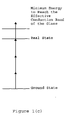
- Figure 1 schematically shows the impact of introducing a real state that offers a resonant enhancement of the multiphoton transition process;
- Figure 1(a) schematically shows a nonresonant four photon transition;
- Figure 1(b) schematically shows a resonantly enhanced four photon transition where the real state corresponds to a energy value above the ground state equal to the individual photon energy of the laser beam;
- Figure 1(c) schematically shows a resonantly enhanced four photon transition where the real state is twice the energy of individual photons in the laser beam.
- Figure 2 schematically shows a resonantly enhanced three photon transition where the real state is twice the energy of the first laser photons and the second transition is resonant to the second laser photon.
- The invention relates to photosensitive materials, i.e. materials interacting with light or in more detail interacting with photons of the light entering into the material itself.
- In the course of the below-standing detailed description of the invention a definition of photosensitivity is given defining photosensitivity in a relative manner. According to this definition a material is more photosensitive or has an enhanced photosensitivity if for a certain effect which is based on an interaction with light or with photons less light or photons are necessary for the same strength or amount of the effect. Vice versa a material is less photosensitive if for said certain effect based on said interaction with light or with photons more light or more photons are necessary for the same strength or amount of the effect.
- In the light of this before-standing definition a preferred physical effect is a change of the absorption, especially bleaching of a spectral absorption band or interval of the enhanced photosensitive material. A further most preferred physical effect is a change of the refractive index of the enhanced photosensitive material.
- Especially for the above-mentioned physical effects, a very important class of materials are glasses, specifically photosensitive glasses, having certain physical properties that can be influenced or altered by means of photons propagating within the glass itself.
- Glass is normally described as an insulator.
- Electrons in the glass are all confined to orbitals about various atoms in the glass, or participate in covalent bonds that make up the glass structure. These electrons are not available to conduct electricity by their motion through the glass, and are described as existing in the valence band of the glass.
- In conventional transparent glass, there are no excited electronic states in the glass accessible by a single visible photon induced transition.
- Colored glass, on the other hand, has real excited states for electrons that lie at energies above the ground state that are accessible by visible photons (wavelengths greater than 390nm and less than 770nm).
- Photosensitivity of conventional transparent glass to light beams in the visible to near-IR wavelengths, for example at 800nm, is thus not expected. This is because conventional glass is transparent to light at visible to near-IR wavelengths. The energy of a single photon, roughly 1.55eV for 800nm wavelength light, is not absorbed in conventional transparent glass. Nevertheless, photosensitivity of glass exposed to photons at which the glass is transparent has been reported by many researchers.
- The inventors of the present invention are convinced that photosensitivity is due to interaction of conventional transparent glass with more than one photon simultaneously. In this way, the energy of several photons is combined to result in a measurable effect on glass properties.
- In more concrete, the inventors of the present invention assume photosensitivity involves the absorption by electrons in the glass of more than one photon simultaneously. These excited electrons become sufficiently excited that they become delocalized from the parent atom or bond, and can take on new energy states within the glass.
- A portion of the excited electrons can return to the initial, ground energy state within the glass, but at least a portion of the excited electrons can become located in stable states with the glass.
- These stable states are called electron traps. For every stable electron trap, there is a corresponding stable hole trap that represents the absence of an electron from the initial ground state.
- These new stable states, or trapped electron-hole pairs, introduce to the glass new properties.
- These new properties can, for example, include absorption bands with associated discoloration of the glass, often referred to as a "solarization" as well as a change in the refractive index.
- The refractive index change occurs because refractive index is determined by combined polarizability of all electrons within the glass, and each electron state has a different polarizability.
- Altering the electronic state distribution in glass thus causes a corresponding change in the refractive index.
- The inventors of the present invention believe that there is a minimum energy required for stable electron-hole pairs to be generated. Specifically, the energy represents excitation of electrons to the effective conduction band of the glass.
- The effective conduction band can be estimated from observing the transmission curve of the glass. Typically, glass is opaque and absorbs all light at wavelengths shorter than a particular value, typically in the range of 380nm down to 360nm. The corresponding energies to be exceeded for photosensitivity to occur are 3.26 to 3.44 eV.
- In the case of 800nm light, with energy of 1.55eV, it requires the simultaneous interaction with three photons (total energy 4.65eV) to exceed the total energy of 3.26eV to 3.44eV.
- Such a three photon interaction is called a nonresonant three photon transition. It is termed as a nonresonant transition because these is no real intermediate state that lies 1.55eV or 2x1.55=3.10eV (corresponding to absorption bands at 800nm and 400nm) above the ground state of the glass for the electron to reside in prior to absorbing the next photon.
- The simultaneous nonresonant interaction of a single electron with more than one photon is a highly unlikely event. Normally, electron transitions occur only between two real electronic states separated in energy by exactly the energy of the exciting photons. However, the high photon flux made available with a pulsed laser system allows a sufficient number of these unlikely transitions to occur and there are consequently observable changes in macroscopic properties such as refractive index.
- Let us consider the Hurricane X laser from Spectra-Physics. This laser delivers more than 0.75mJ of 800nm light confined in a pulse length of only 140fsec. There are 3.0x10¹⁸ photons in a single pulse from such a laser. So, even when the probability of a three photon nonresonant transition is one in a million million (1 in 1012) events, there are still a million (106) nonresonant transitions taking place, resulting in the measurable effects. This is why photosensitivity is observed in glass that is transparent at the wavelength of the exposure laser beam.
- The inventors of the present invention now introduce the concept of a resonant three photon transition. Here, there is a real state for the electron at an energy equal to some integer multiple of the individual photon energy in the laser beam. If the resonant state lies at one times the individual photon energy, a visible absorption band is present in the glass at the exposure wavelength. However, if the real state lies at a multiple of the photon energy in the laser beam, the glass can remain transparent to the energy of the exposure light, but the resonant effect will still result.
- For example, if the real state exists at 3.10eV, there is a real state at twice the energy of the individual photons in a laser beam with a wavelength of 800nm. The glass continues to be transparent at 800nm, and in fact is transparent all the way from 800nm down to nearly 400nm. However, whereas previously to reach the effective conduction band required a total of three photons combining in three nonresonant transitions, now only two nonresonant transitions are required to reach the effective conduction band of the glass. Such a three photon interaction that includes the action of one or more real states is called a resonantly enhanced three photon transition.
- The argument presented here is not restricted to three photon events. The same principles apply in any multiphoton transition process. The impact of introducing a real state that offers a resonant enhancement of the multiphoton transition process is shown schematically in Figure 1.
- Figure 1(a) schematically shows a nonresonant four photon transition. Figure 1(b) schematically shows a resonantly enhanced four photon transition where the real state corresponds to a energy value above the ground state equal to the individual photon energy of the laser beam.
In this case, the glass is not transparent to the excitation light beam but the resonant enhancement still exists. Figure 1(c) schematically shows a resonantly enhanced four photon transition where the real state is twice the energy of individual photons in the laser beam. In this case the glass is transparent to the excitation light beam and the resonant enhancement effect is realized. - A person skilled in the art may use a so-called "two resonance" excitation process, which utilizes two laser wavelengths, where the shorter wavelength is a two photon resonance to the real intermediate state and the second longer laser wavelength is then resonant to the transition from the intermediate state to the final state. Someone skilled in the art will adjust temporal and spatial coherence/overlap of both pulses in a way, that ideal conditions for the transition are ensured (Figure 2).
- The reason for the remarkable enhancement of the multiphoton process was first derived mathematically by Maria Goeppert-Mayer in 1931 (See Ann. Phys. Vol . 9 (1931) 273). Although first derived in 1931, this process has not been applied to transitions within optical materials such as glass and has not been applied to enhance photosensitivity in glass. Lets consider here only the mathematical description of a two photon resonant enhancement.
- The rate, R, for a single photon transition between two real states, denoted as <αf| and |αI> is given mathematically by a matrix element written as:

- In a two photon nonresonant process, the analogous expression is:

- In a nonresonant two photon process, all available |αi> have energy levels, Ei, far from the excitation light source at energy E. The denominator in the expression for R2P is large, and the value for R2P is correspondingly low.
- In the case of a resonant, two photon transition, a real state exists in the glass at energy Ei close, or identical to, the photon energy E, making the denominator in the expression for the two photon transition rate, R2P, small and the corresponding two photon transition rate, R2P, to become large. Note that effectively for Ei = E, the denominator goes to zero and the transition rate R2P goes to infinity.
- The addition of a real state to create the resonant enhancement effect increases the transition rate for electrons to reach the effective conduction band a glass and enhances the photosensitivity effect. The resonant enhancement of photosensitivity is not limited to glasses, but can occur in any material.
- Introducing a real state in glass can be accomplished any number of ways.
- Transition metal ions Sc to Cu, Y to Ag, Hf to Au in glass introduce broad absorption bands, corresponding to broad ranges of allowed excited electron energies, are one example. A preferred method is through the use of rare earth cations added to the glass.
- Rare earth cations are preferred since the resultant absorption bands are sharp and well defined (corresponding to narrow ranges of allowed energies for the real excited electron states) and the glass is left completely transparent over large wavelength regions.
- In the three photon transition example above, the real absorption band at nominally 3.10eV (corresponding to a wavelength of 400nm) can be accomplished by doping the glass with a small amount of cerium. At the same time, the cerium leaves the glass fully transparent at the exposure wavelength of 800nm and at wavelength down to about 420nm.
- The cerium has an additional advantage that it is a polyvalent species in glass that can act as a stable trap for both electrons and holes via assuming different redox states within glass both of which have nearly identical optical absorption bands in the 400nm region.
- Further dopants and glasses are described in the application "Photostrukturierbarer Körper sowie Verfahren zur Bearbeitung eines Glases und/oder einer Glaskeramik",
- "Photostructurable Body as well as Method for Treatment of a Glass and/or a Glass Ceramic", filed in the name of Schott Glass, Mainz, Federal Republic of Germany, in the German Patent and Trademark Office on the same filing date as this application and which is completely incorporated here by reference.
- In more general terms the invention teaches a resonant enhanced photosensitive material, which comprises adapted to interact with light and enhances the photosensitivity of the material based on a resonant interaction process with photons. This interaction with light is including a resonant multiphoton process as described in more detail above.
- This multiphoton process is a resonant multiphoton intraband absorption process based on energetic levels in the material as essentially introduced by the above-mentioned trap centers.
- These trap centers comprise at least a member of the group consisting of dopants, preferably multivalent dopants, imperfections, structural artifacts, defects of bonds, lattice vacancies in ordered areas of the material, lattice defects in crystalline or quasi-crystalline areas of the material enhancing the photosensitivity of the material.
- According to the most preferred embodiment of the invention this dopant is a multivalent intraband dopant enhancing the photosensitivity of the material whereby a preferred multivalent dopant comprises a member of the group consisting of rare earth cations, Ce, Eu, Tm, Ho, Nb, Pr, Sm, Er, Dy, Tb, and mixtures thereof.
- These dopants provide an electronic energetic state above the ground state and below the conduction band of the photosensitive material which can be occupied by electrons in the course of a photonic absorption process which is a multiphoton absorption process assisting in a transition of an electron from a ground state to an energetic intraband state and wherein a further photonic absorption assists in a transition from the electronic intraband state to the conduction band. Consequently, the two-step absorption process involves drastically less photons for each transition step and as a consequence thereof less intense light.
- In more detail, said dopants provide real electronic states with an energy above the ground state of a multiple n of the energy of individual photons in the light beam used to create the photosensitivity effect where n is an integer with n > 1.
- For a transition from ground state to the conduction band an energy would be necessary of a multiple m of the energy of the individual photons in the light beam used to create the photosensitive effect with m being an integer and m > n. Consequently, the transition from the ground state to the electronic intraband state is much more likely than a transition from the ground state to the conduction band.
- A remaining number of p photons is necessary for the transition from the intraband state to the conduction band with p being an integer and p = m - n which transition takes place as an p-photon multiphoton absorption process.
- In a preferred embodiment of the invention a first laser light beam is directed into said material providing photons interacting with trap centers in said material and said first laser light beam comprises ultra violet light with photons that assist a direct transition from the ground state to the above-described intraband state.
- In an alternative embodiment of the invention said first laser light beam is directed into said material providing photons interacting with trap centers in said material by means of a multiphoton absorption and said first laser light beam comprises fs laser light pulses having an intensity which allows for two- or three-photon multiphoton absorption to transfer a charge carrier, especially an electron, from the ground state to the intraband energy state.
- In a most preferred embodiment a second laser light beam is directed into said material and interacts in an overlapping area within said photosensitive material within at least a portion of said first laser light beam. The wavelength of said first laser light beam is adapted to the energy of the transition from the energetic ground state to the energetic intraband state and the wavelength of said second laser light beam is adapted to the energy of the transition from the energetic intraband state to the conduction band. Said first and second laser light beams are adapted such that said first laser light beam increases the number of occupied intraband states and said second laser light beam increases the transitions from the intraband state to the conduction band. As a consequence thereof, optimized intensities and wavelengths can be introduced providing for an maximum energetic transfer rate at a minimized "light consumption" as said intensity of said first laser light beam is related to and optimized in view of the transition rate from the energetic ground state to the energetic intraband state and said intensity of said second laser light beam is related to and optimized in view of the transition rate from the energetic intraband state to the conduction band.
- To that end, said second laser light beam typically has a wavelength and intensity which is different from a wavelength and intensity from said first laser light beam, respectively.
- A confocal arrangement can be used wherein said first and said second laser light beam are focused in parallel into said material by means of the same lens to ensure a maximum overlapping area.
- Alternatively, said first and said second laser light beam are focused in an oblique angle into said material if a spatial separation is of increase interest.
- In the most preferred embodiment said resonant enhanced material comprises glass, glass ceramic, glass ceramic material, ceramic and ceramic materials.
- According to the invention, the afore-mentioned terms "light" or "photons" are not restricted to the visible spectrum of electromagnetic waves. Significantly, every multiphoton process provides reduced wavelength photons having a wavelength that can be shorter than the ultraviolet part of the visible spectrum.
- In addition, the invention is not restricted solely to photonic intraband effects, i.e. to effects including or being assisted by a photonic interaction with energy levels being only available within the energetic interval between a solid state bulk material ground state and a solid state bulk material conduction band. In a more general interpretation the term conduction band is according to the invention not restricted to solid state energy levels as found in highly ordered solid state bulk material but also includes energetic levels of similar ordered areas of a solidified melt as e.g. special crystalline phases or ordered phases in glasses, glass ceramics and ceramics.
- In an even more generalized manner, the invention uses the term conduction band also for energetic levels of charge carriers within an insulating material which allow for a migration of these charge carriers after excitation to these energetic levels.
Claims (44)
- Resonant enhanced photosensitive material which comprises
a trap center which is adapted to interact with light and enhances the photosensitivity of the material based on a resonant interaction process with photons. - Resonant enhanced photosensitive material according to claim 1 wherein said interaction with light is including a resonant multiphoton process.
- Resonant enhanced photosensitive material according to claim 2 wherein said interaction with light comprises a resonant multiphoton intraband absorption process.
- Resonant enhanced material having trap centers
in which said trap centers comprise at least a member of the group consisting of dopants, preferably multivalent dopants, imperfections, structural artifacts, defects of bonds, lattice vacancies in ordered areas of the material, lattice defects in crystalline or quasi-crystalline areas of the material enhancing the photosensitivity of the material. - Resonant enhanced material according to claim 4 in which said dopant is a multivalent intraband dopant enhancing the photosensitivity of the material.
- Resonant enhanced material according to claim 5 in which said multivalent dopant comprises a member of the group consisting of rare earth cations, Ce, Eu, Tm, Ho, Nb, Pr, Sm, Er, Dy, Tb, and mixtures thereof.
- Resonant enhanced material according to claim 6 wherein said enhancement is assisted by an intraband trap center in the material which provides an electronic energetic state above the ground state and below the conduction band which can be occupied by electrons in the course of a photonic absorption process.
- Resonant enhanced material according to claim 7 wherein said photonic absorption process is a multiphoton absorption process.
- Resonant enhanced material according to claim 7 wherein said photonic absorption is a multiphoton absorption assisting in a transition of an electron from a ground state to an energetic intraband state and wherein a further photonic absorption assists in a transition from the electronic intraband state to the conduction band.
- Resonant enhanced material according to claim 4 wherein said material comprises glass.
- Resonant enhanced material according to claim 4 wherein said material comprises a glass ceramic material.
- Resonant enhanced material according to claim 4 wherein said material comprises a ceramic material.
- Resonant enhanced material wherein said resonant enhancement of photosensitivity in said material is at least in part caused by the introduction of dopants that introduce real electronic states with energy above the ground state at a multiple n of the energy of individual photons in the light beam used to create the photosensitivity effect.
- Resonant enhanced material according to claim 13 wherein said material comprises dopants in an amount of 0.0001 to 30 weight %.
- Resonant enhanced material according to claim 13 wherein said material comprises dopants in an amount of 0.001 to 25 weight %.
- Resonant enhanced material according to claim 13 wherein said dopants comprise a polyvalent species which generates within the composition of said resonant enhanced material stable electron-hole traps.
- Resonant enhanced material according to claim 13 wherein said material comprises glass.
- Resonant enhanced material according to claim 13 wherein said material comprises a glass ceramic material.
- Resonant enhanced material according to claim 13 wherein said material comprises a ceramic material.
- Method of enhancing photosensitivity in a photosensitive material comprising
introducing of dopants into said material,
said dopants providing real electronic states with an energy above the ground state
said energy of said real electronic states being a multiple n of the energy of individual photons in the light beam used to create the photosensitivity effect where n is an integer with n > 1. - Method of enhancing photosensitivity in a photosensitive material according to claim 20 wherein said dopants comprise a polyvalent species which generates within the composition of said resonant enhanced material stable electron-hole traps.
- Method of enhancing photosensitivity in a photosensitive material according to claim 20 wherein said material comprises glass.
- Method of enhancing photosensitivity in a photosensitive material according to claim 20 wherein said material comprises a glass ceramic material.
- Method of enhancing photosensitivity in a photosensitive material according to claim 20 wherein said material comprises a ceramic material.
- Method of generating photonic interaction in a photosensitive material as defined in claim 1 comprising
directing a first laser light beam into said material,
said first laser light beam providing photons interacting with trap centers in said material,
said interaction assisting a transition from a ground state to an energetic intraband state. - Method of generating photonic interaction in a photosensitive material according claim 25 wherein said interaction comprises an absorption process.
- Method of generating photonic interaction in a photosensitive material according claim 25 wherein said interaction comprises a multiphoton absorption process.
- Method of generating photonic interaction in a photosensitive material according claim 25 wherein said first laser light beam comprises ultra violet light.
- Method of generating photonic interaction in a photosensitive material according claim 25 wherein said first laser light beam comprises fs laser light pulses.
- Method of generating photonic interaction in a photosensitive material according claim 25 wherein said first laser light beam comprises ps laser light pulses.
- Method of generating photonic interaction in a photosensitive material according claim 25, further comprising
directing a second laser light beam into said material interacting in an overlapping area within said photosensitive material within at least a portion of said first laser light beam. - Method of generating photonic interaction in a photosensitive material according claim 31 wherein said second laser light beam has a wavelength which is different from a wavelength from said first laser light beam.
- Method of generating photonic interaction in a photosensitive material according claim 31 wherein said wavelength of said first laser light beam is adapted to the energy of the transition from the energetic ground state to the energetic intraband state.
- Method of generating photonic interaction in a photosensitive material according claim 31 said wavelength of said second laser light beam is adapted to the energy of the transition from the energetic intraband state to the conduction band.
- Method of generating photonic interaction in a photosensitive material according claim 31 wherein said first and second laser light beams are adapted such that said first laser light beam increases the number of occupied intraband states and said second laser light beam increases the transitions from the intraband state to the conduction band.
- Method of generating photonic interaction in a photosensitive material according claim 31 wherein said intensity of said first laser light beam is related to the transition rate from the energetic ground state to the energetic intraband state.
- Method of generating photonic interaction in a photosensitive material according claim 31 wherein said intensity of said second laser light beam is related to the transition rate from the energetic intraband state to the conduction band.
- Method of generating photonic interaction in a photosensitive material according claim 31 wherein said first and said second laser light beam are focused in parallel into said material.
- Method of generating photonic interaction in a photosensitive material according claim 31 wherein said first and said second laser light beam are focused in an oblique angle into said material.
- Method of generating photonic interaction in a photosensitive material according claim 25 wherein an absorption of said material is changed by a multiphoton assisted absorption process.
- Method of generating photonic interaction in a photosensitive material according claim 31 wherein a refractive index of said material is changed based on a multiphoton assisted absorption process.
- Method of generating photonic interaction in a photosensitive material according claim 25 wherein said material comprises glass.
- Method of generating photonic interaction in a photosensitive material according claim 25 wherein said material comprises a glass ceramic material.
- Method of generating photonic interaction in a photosensitive material according claim 25 wherein said material comprises a ceramic material.
Applications Claiming Priority (2)
| Application Number | Priority Date | Filing Date | Title |
|---|---|---|---|
| US10/357,829 US20040259030A1 (en) | 2003-06-23 | 2003-06-23 | Resonantly enhanced photosensitivity |
| US357829 | 2003-06-23 |
Publications (1)
| Publication Number | Publication Date |
|---|---|
| EP1491514A1 true EP1491514A1 (en) | 2004-12-29 |
Family
ID=33415723
Family Applications (1)
| Application Number | Title | Priority Date | Filing Date |
|---|---|---|---|
| EP20040002379 Withdrawn EP1491514A1 (en) | 2003-06-23 | 2004-02-03 | Resonantly enhanced photosensitivity |
Country Status (2)
| Country | Link |
|---|---|
| US (2) | US20040259030A1 (en) |
| EP (1) | EP1491514A1 (en) |
Families Citing this family (2)
| Publication number | Priority date | Publication date | Assignee | Title |
|---|---|---|---|---|
| DE10304382A1 (en) * | 2003-02-03 | 2004-08-12 | Schott Glas | Photostructurable body and method for processing a glass and / or a glass ceramic |
| US20250296867A1 (en) * | 2022-06-07 | 2025-09-25 | Corning Incorporated | Methods for forming and tuning local transmittance contrast in glass-ceramic articles via laser bleaching |
Citations (2)
| Publication number | Priority date | Publication date | Assignee | Title |
|---|---|---|---|---|
| GB2210873A (en) * | 1987-09-18 | 1989-06-21 | British Telecomm | Optical devices |
| US6228787B1 (en) * | 1998-07-27 | 2001-05-08 | Eugen Pavel | Fluorescent photosensitive glasses and process for the production thereof |
Family Cites Families (13)
| Publication number | Priority date | Publication date | Assignee | Title |
|---|---|---|---|---|
| AU584563B2 (en) * | 1986-01-31 | 1989-05-25 | Ciba-Geigy Ag | Laser marking of ceramic materials, glazes, glass ceramics and glasses |
| US5526369A (en) * | 1992-10-07 | 1996-06-11 | Schott Glass Technologies, Inc. | Phosphate glass useful in high energy lasers |
| US5663972A (en) * | 1995-04-03 | 1997-09-02 | The Regents Of The University Of California | Ultrafast pulsed laser utilizing broad bandwidth laser glass |
| GB2301678B (en) * | 1995-04-28 | 1999-02-24 | Univ Southampton | Optical waveguide device |
| US5699175A (en) * | 1995-09-08 | 1997-12-16 | Quinta Corporation | Multiphoton photorefractive holographic recording media |
| US6132643A (en) * | 1998-01-06 | 2000-10-17 | Pavel; Eugen | Fluorescent photosensitive vitroceramics and process for the production thereof |
| US6573026B1 (en) * | 1999-07-29 | 2003-06-03 | Corning Incorporated | Femtosecond laser writing of glass, including borosilicate, sulfide, and lead glasses |
| US6643442B2 (en) * | 2000-03-23 | 2003-11-04 | University Of Southampton | Optical waveguides and devices including same |
| US6882782B2 (en) * | 2000-11-01 | 2005-04-19 | Schott Glas | Photonic devices for optical and optoelectronic information processing |
| AU2002243617A1 (en) * | 2001-01-17 | 2002-07-30 | Neophotonics Corporation | Optical materials with selected index-of-refraction |
| US6585913B2 (en) * | 2001-07-30 | 2003-07-01 | General Electric Company | Scintillator compositions of alkali and rare-earth tungstates |
| US6750266B2 (en) * | 2001-12-28 | 2004-06-15 | 3M Innovative Properties Company | Multiphoton photosensitization system |
| US6853659B2 (en) * | 2002-08-28 | 2005-02-08 | Schott Glass Technologies, Inc. | Laser system utilizing highly doped laser glass |
-
2003
- 2003-06-23 US US10/357,829 patent/US20040259030A1/en not_active Abandoned
-
2004
- 2004-02-03 EP EP20040002379 patent/EP1491514A1/en not_active Withdrawn
-
2007
- 2007-07-24 US US11/880,942 patent/US7740774B2/en not_active Expired - Fee Related
Patent Citations (2)
| Publication number | Priority date | Publication date | Assignee | Title |
|---|---|---|---|---|
| GB2210873A (en) * | 1987-09-18 | 1989-06-21 | British Telecomm | Optical devices |
| US6228787B1 (en) * | 1998-07-27 | 2001-05-08 | Eugen Pavel | Fluorescent photosensitive glasses and process for the production thereof |
Non-Patent Citations (4)
| Title |
|---|
| DATABASE COMPENDEX [online] ENGINEERING INFORMATION, INC., NEW YORK, NY, US; ZHU YINIAN: "Photosensitivity studies of Sm<2>/Sm<3> doped aluminosilicate fiber", XP002298360, Database accession no. EIX97113370078 * |
| NEDELEC J M: "PHOTOSENSITIVITY OF SOL-GEL DERIVED ALUMINOSILICATE PLANAR WAVEGUIDES DOPED WITH CE3+ IONS", JOURNAL OF SOL-GEL SCIENCE AND TECHNOLOGY, KLUWER ACADEMIC PUBLISHERS, DORDRECHT, NL, vol. 20, no. 3, March 2001 (2001-03-01), pages 287 - 292, XP001059944, ISSN: 0928-0707 * |
| PING XIE: "Laser-induced photochromic effect in Tb3+-doped silica fibres", ELECTRONICS LETTERS, IEE STEVENAGE, GB, vol. 30, no. 23, 10 November 1994 (1994-11-10), pages 1970 - 1971, XP006001299, ISSN: 0013-5194 * |
| PROC SPIE INT SOC OPT ENG; PROCEEDINGS OF SPIE - THE INTERNATIONAL SOCIETY FOR OPTICAL ENGINEERING 1996, vol. 2893, 1996, pages 390 - 396 * |
Also Published As
| Publication number | Publication date |
|---|---|
| US20070267605A1 (en) | 2007-11-22 |
| US20040259030A1 (en) | 2004-12-23 |
| US7740774B2 (en) | 2010-06-22 |
Similar Documents
| Publication | Publication Date | Title |
|---|---|---|
| TWI244557B (en) | Optical elements and methods of making optical elements | |
| Almeida et al. | Ultrafast third-order optical nonlinearities of heavy metal oxide glasses containing gold nanoparticles | |
| JP7429189B2 (en) | glass ceramic and glass | |
| Terashima et al. | Structure and nonlinear optical properties of lanthanide borate glasses | |
| DE69008337T2 (en) | Predominantly colorless glasses containing silver by ion exchange, manufacturing process and fiber optic component. | |
| Ehrt | UV-absorption and radiation effects in different glasses doped with iron and tin in the ppm range | |
| Marzouk et al. | Ultraviolet–visible absorption of gamma-irradiated transition metal ions doped in sodium metaphosphate glasses | |
| DE10304382A1 (en) | Photostructurable body and method for processing a glass and / or a glass ceramic | |
| DE102008007871B4 (en) | Photopatternable glass for optical devices, photostructured glass element made therefrom, and uses and methods of making the glass and glass element | |
| US8179595B2 (en) | Polarizing photorefractive glass | |
| Abdel-Baki et al. | Glasses for photonic technologies | |
| US7740774B2 (en) | Resonantly enhanced photosensitivity | |
| Glebov | Linear and nonlinear photoionization of silicate glasses | |
| Friebele | Radiation protection of fiber optic materials: Effect of cerium doping on the radiation‐induced absorption | |
| US20090190215A1 (en) | Polarizing photorefractive glass | |
| US20090190214A1 (en) | Polarizing photorefractive glass | |
| Qiu | Bi‐doped glass for photonic devices | |
| DE112004002579B4 (en) | Photorefractive glass and optical elements made of it | |
| Neethish et al. | Broad white light supercontinuum generation in Barium Zinc Borate glasses | |
| US5491117A (en) | Optical filter glasses | |
| Takahashi et al. | Defect formation in GeO 2–SiO 2 glass by poling with ArF laser excitation | |
| Tran et al. | SiO 2-SnO 2 photonic glass-ceramics | |
| Aliyu et al. | Physical and optical properties of calcium sulfate ultra-phosphate glass-doped Er2O3 | |
| Williams et al. | Spectral and spatial study of photosensitive optical fibre preforms by cathodoluminescence | |
| Jiang et al. | Laser-controlled precipitation of gold nanoparticles in silicate glasses |
Legal Events
| Date | Code | Title | Description |
|---|---|---|---|
| PUAI | Public reference made under article 153(3) epc to a published international application that has entered the european phase |
Free format text: ORIGINAL CODE: 0009012 |
|
| 17P | Request for examination filed |
Effective date: 20040302 |
|
| AK | Designated contracting states |
Kind code of ref document: A1 Designated state(s): AT BE BG CH CY CZ DE DK EE ES FI FR GB GR HU IE IT LI LU MC NL PT RO SE SI SK TR |
|
| AX | Request for extension of the european patent |
Extension state: AL LT LV MK |
|
| AKX | Designation fees paid |
Designated state(s): AT BE BG CH CY CZ DE DK EE ES FI FR GB GR HU IE IT LI LU MC NL PT RO SE SI SK TR |
|
| 17Q | First examination report despatched |
Effective date: 20071024 |
|
| STAA | Information on the status of an ep patent application or granted ep patent |
Free format text: STATUS: THE APPLICATION IS DEEMED TO BE WITHDRAWN |
|
| 18D | Application deemed to be withdrawn |
Effective date: 20100901 |