EP1491403A2 - A device for installing sets of lights on a vehicle body - Google Patents
A device for installing sets of lights on a vehicle body Download PDFInfo
- Publication number
- EP1491403A2 EP1491403A2 EP04013875A EP04013875A EP1491403A2 EP 1491403 A2 EP1491403 A2 EP 1491403A2 EP 04013875 A EP04013875 A EP 04013875A EP 04013875 A EP04013875 A EP 04013875A EP 1491403 A2 EP1491403 A2 EP 1491403A2
- Authority
- EP
- European Patent Office
- Prior art keywords
- assembly
- snap
- bracket
- fastener
- action fastener
- Prior art date
- Legal status (The legal status is an assumption and is not a legal conclusion. Google has not performed a legal analysis and makes no representation as to the accuracy of the status listed.)
- Granted
Links
Images
Classifications
-
- B—PERFORMING OPERATIONS; TRANSPORTING
- B60—VEHICLES IN GENERAL
- B60Q—ARRANGEMENT OF SIGNALLING OR LIGHTING DEVICES, THE MOUNTING OR SUPPORTING THEREOF OR CIRCUITS THEREFOR, FOR VEHICLES IN GENERAL
- B60Q1/00—Arrangement of optical signalling or lighting devices, the mounting or supporting thereof or circuits therefor
- B60Q1/26—Arrangement of optical signalling or lighting devices, the mounting or supporting thereof or circuits therefor the devices being primarily intended to indicate the vehicle, or parts thereof, or to give signals, to other traffic
- B60Q1/2619—Arrangement of optical signalling or lighting devices, the mounting or supporting thereof or circuits therefor the devices being primarily intended to indicate the vehicle, or parts thereof, or to give signals, to other traffic built in the vehicle body
- B60Q1/2649—Arrangement of optical signalling or lighting devices, the mounting or supporting thereof or circuits therefor the devices being primarily intended to indicate the vehicle, or parts thereof, or to give signals, to other traffic built in the vehicle body with provision for pre-mounting or temporary holding the device before or during final mounting
-
- B—PERFORMING OPERATIONS; TRANSPORTING
- B60—VEHICLES IN GENERAL
- B60Q—ARRANGEMENT OF SIGNALLING OR LIGHTING DEVICES, THE MOUNTING OR SUPPORTING THEREOF OR CIRCUITS THEREFOR, FOR VEHICLES IN GENERAL
- B60Q1/00—Arrangement of optical signalling or lighting devices, the mounting or supporting thereof or circuits therefor
- B60Q1/26—Arrangement of optical signalling or lighting devices, the mounting or supporting thereof or circuits therefor the devices being primarily intended to indicate the vehicle, or parts thereof, or to give signals, to other traffic
- B60Q1/2619—Arrangement of optical signalling or lighting devices, the mounting or supporting thereof or circuits therefor the devices being primarily intended to indicate the vehicle, or parts thereof, or to give signals, to other traffic built in the vehicle body
- B60Q1/2623—Details of the fastening means
- B60Q1/263—Snap-in fasteners
Definitions
- the present invention relates to a device for installing sets of lights on a vehicle body.
- assembly devices for fixing sets of lights on a vehicle body must guarantee a water-tight seal between a rim of the set of lights and the vehicle body, and comprise a bracket fixed to the set of lights, a snap-action fastener slidably coupled to the bracket, and an expansion spring set between the bracket and the snap-action fastener to pull the snap-action fastener and the bracket towards one another and, consequently, to compress the rim of the set of lights against the vehicle body.
- the set of lights is pre-assembled on the vehicle body by partially inserting the snap-action fastener inside a through hole obtained through the vehicle body, and then the set of lights is installed definitively by inserting the snap-action fastener altogether through the hole via a manual operation, during which the projecting portion of the snap-action fastener is pulled until the fastener itself snaps setting the spring in compression and exerting, at the same time, a pre-load on the rim of the set of lights against the vehicle body.
- the purpose of the present invention is to provide an assembly device for sets of lights, which will enable an economic and fast installation of a set of lights on a vehicle body.
- an assembly device for sets of lights comprising: a bracket fixed to the set of lights; a snap-action fastener slidably coupled to the bracket; and elastic means set between the bracket and the snap-action fastener to exert a force of assembly between the snap-action fastener and the bracket; the device being characterized in that it comprises pre-assembly means set between the snap-action fastener and the bracket for clamping the snap-action fastener in a pre-assembly position, in which the elastic means exert a force of pre-assembly having a value greater than the value of the force of assembly, the pre-assembly means being mechanically deactivatable upon assembly of the snap-action fastener.
- the reference number 1 designates, as a whole, an assembly device for sets of lights, which are known and are schematically designated by the reference 1a, to a vehicle body 2 of a motor vehicle (not illustrated).
- the device 1 is designed to guarantee a water-tight seal between the set of lights 1a and the vehicle body 2, and can be inserted by snap-action inside a through hole 3, which is made through the vehicle body 2 itself, and is delimited by a peripheral edge 4 of a substantially rectangular shape.
- the device 1 has a longitudinal axis A, and comprises a bracket 5 fixed to the set of lights 1a, a snap-action fastener 6 slidably coupled to the bracket 5 to slide in the direction of the axis A, and a spring 7 set between the bracket 5 and the fastener 6 to exert a force of assembly between the fastener 6 and the bracket 5 directed along the axis A, pulling the fastener 6 and the bracket 5 themselves towards one another, i.e., pressing the set of lights 1a towards and against the vehicle body 2.
- the bracket 5 comprises a parallelepipedal body 8 extending in the direction of the axis A starting from the set of lights 1a, and an undercut 9 with rectangular cross section, which is obtained through the body 8 in the proximity of a free end of the body 8 itself, and is delimited by two side walls 10a set on opposite sides of the axis A, and by a diaphragm 10 set transverse to the axis A and to the walls 10a themselves.
- the diaphragm 10 is overlaid by a projecting moulding 11 set transverse to the axis A, and is provided with two slits 12, which are set on opposite sides of the axis A itself and are set in a position underneath the moulding 11 so as to define, on the diaphragm 10 itself, a front contrast surface 13.
- the snap-action fastener 6 comprises a flattened central body 14 extending in the direction of the axis A, a partition 15 set along the axis A in an intermediate position with respect to the body 14 itself and defining a plane of symmetry for the fastener 6, and two toothed elastic fingers 16, which are set on opposite sides of the body 14, and have one respective fixed end 17 joined to the body 14 in a position corresponding to a head 18 of the body 14 and a respective free end 19 designed to oscillate elastically away from and towards the body 14 itself.
- the partition 15 has, on each side of the body 14, a portion 20, which is tapered towards the head 17, and a partially projecting portion 21, which is axially contiguous to the corresponding portion 20 and is also fixed to the other portion 21.
- Each portion 21 extends from the body 14 starting from a truncating surface 22 of the body 14 itself, in front of which it joins with the other portion 21, and is delimited outwards by a plane surface 21s, the distance of which from the other plane surface 21s is substantially equal to the height of the hole 3.
- Each finger 16 is further provided with a wedge-shaped cam 23, which is set outside between the two ends 17 and 19 and is designed to co-operate with the edge 4 both to bend the corresponding finger 16, so enabling insertion of the fastener 6 into the hole 3, and to clamp the fastener 6 itself inside the hole 3.
- Each wedge-shaped cam 23 has a respective thickness of an increasing value starting from the end 17 and identifies, on the corresponding finger 16, a disengagement tab, which coincides with the end 19 and is designed to remain on the outside of the edge 4 to enable, once pressed in the direction of the axis A, disengagement of the fastener 6 from the hole 3.
- the fastener 6 further comprises a bottom plate 24, which is fixed to the body 14 and extends from the body 14 itself along the axis A in an intermediate position between the two fingers 16 to slide on a side 25 of the body 8 and set itself so as to close partially a side of the undercut 9.
- the fastener 6 finally comprises a seat 26, which is fixed to the plate 24, and is inserted inside the undercut 9 to contain the spring 7.
- the seat 26 comprises two side walls 27, which face one another and each of which is provided with respective pairs of flexible catches 28, and an end wall 29, which is fixed and set transverse to the walls 27, and is set transverse to the axis A.
- the seat 26 is inserted in the undercut 9 with the catches 28 set up against the walls 10a and with the walls 27 set in contact with the walls 10a themselves, and is designed to slide axially in the direction of the axis A against the action of the spring 7, the opposite ends of which are consequently compressed by the wall 29 and by the diaphragm 10 to contrast any action causing movement of the fastener 6 away from the bracket 7.
- the device 1 comprises a pre-assembly mechanism 30, which is set between the fastener 6 and the bracket 7 to clamp the fastener 6 in a pre-assembly position, in which the spring 7 is compressed and exerts a pre-assembly force having a value greater than the value of the assembly force, and is designed to be deactivatable mechanically and automatically upon introduction of the fastener 6 in the hole 3.
- a pre-assembly mechanism 30 which is set between the fastener 6 and the bracket 7 to clamp the fastener 6 in a pre-assembly position, in which the spring 7 is compressed and exerts a pre-assembly force having a value greater than the value of the assembly force, and is designed to be deactivatable mechanically and automatically upon introduction of the fastener 6 in the hole 3.
- the fastener 6 is at a given pre-assembly distance and in a position relatively far away from the bracket 5, whilst, in the assembly position, the fastener 6 is not only at an assembly distance smaller than the pre-assembly distance, but is also inserted inside the hole 3 with its own cams 23 gripping against the edge 4.
- the mechanism 30 comprises two flexible spacer elements 31, which are fixed to the fastener 6 and are passively mobile between a pre-assembly position (illustrated in Figure 1), in which the elements 31 are positioned bearing upon the surface 13 of the bracket 5, and an assembly position (illustrated in Figure 2), in which the elements 31 are positioned inside the diaphragm 10 through the slits 12.
- the two elements 31 are set on opposite sides of the portion 21 of the diaphragm 15 and on an opposite side of the plate 24 with respect to the body 14, and each is defined by respective shaped rods extending parallel to the axis A and fixedly to the body 14 starting from the surface 22 of the body 14 itself.
- Each element 31 comprises a respective chamfered free end 32 and a respective double-wedge-shaped cam 33 delimited on the outside by two inclined planes 34 and 35 with opposite inclinations, which define between them a crown 36, and of which the inclined plane 34 is a deactivation plane designed to co-operate with the edge 4 of the hole 3 for deactivating the mechanism 30, whilst the inclined plane 35 is a lead-in plane, which is tapered towards the corresponding end 32 and is designed to co-operate with the moulding 11 to facilitate entry of the corresponding element 31 into the slit 12.
- each element 31 in its own pre-assembly position, is positioned with the corresponding cam 33 set projecting with respect to the surface 21s, and is substantially fitted with its own end 32 against the surface 13 of the diaphragm 10 and the moulding 11, on account of the elastic action of the spring 7, which has in its own resting position an elongation greater than the elongation that it has both in the assembly position and in the pre-assembly position.
- Transition of each element 31 into its own assembly position occurs following upon introduction of the fastener 6 into the hole 3 and interference of the surface 4 with each double-wedge-shaped cam 32. Said interference causes the progressive lowering of each element 31 towards the plate 24 and the simultaneous displacement of the corresponding end 32 along the surface 13 until the end 32 itself enters the slits 12.
- the fastener 6 will be axially blocked with its own cams 23 up against the edge 4, and the spring 7 will be able to exert its own elastic force so as to pull the fastener 6 and the bracket 5 towards one another causing the set of lights 1a to adhere perfectly to the vehicle body 2.
- the presence of the mechanism 30 enables assembly of the set of lights 1a to the vehicle body 2 to be rendered altogether automatic and particularly reliable, without, on the other hand, requiring the least manual intervention to force the spring 7 to values of compression such as to guarantee perfect adherence of the set of lights 1a on the vehicle body 2.
- the possibility of pre-loading the spring 7 with a pre-assembly force of a given value also enables a certain freedom of positioning along the axis A of the crown 36 of the cam 33 with respect to positioning of the cams 23 again along the axis A so as to ensure at all times both clamping of the fastener 6 and a tight seal between the set of lights 1a and the vehicle body 2.
Landscapes
- Engineering & Computer Science (AREA)
- Mechanical Engineering (AREA)
- Lighting Device Outwards From Vehicle And Optical Signal (AREA)
- Led Device Packages (AREA)
- Wire Bonding (AREA)
- Pressure Welding/Diffusion-Bonding (AREA)
- Insertion Pins And Rivets (AREA)
Abstract
Description
- The present invention relates to a device for installing sets of lights on a vehicle body.
- In general, assembly devices for fixing sets of lights on a vehicle body must guarantee a water-tight seal between a rim of the set of lights and the vehicle body, and comprise a bracket fixed to the set of lights, a snap-action fastener slidably coupled to the bracket, and an expansion spring set between the bracket and the snap-action fastener to pull the snap-action fastener and the bracket towards one another and, consequently, to compress the rim of the set of lights against the vehicle body.
- In general, the set of lights is pre-assembled on the vehicle body by partially inserting the snap-action fastener inside a through hole obtained through the vehicle body, and then the set of lights is installed definitively by inserting the snap-action fastener altogether through the hole via a manual operation, during which the projecting portion of the snap-action fastener is pulled until the fastener itself snaps setting the spring in compression and exerting, at the same time, a pre-load on the rim of the set of lights against the vehicle body.
- Although the assembly devices of the type described above perform their function very well, the aforementioned manual operation for setting the fastener in tension proves relatively expensive at least in terms of labour costs, as well as in terms of production times.
- The purpose of the present invention is to provide an assembly device for sets of lights, which will enable an economic and fast installation of a set of lights on a vehicle body.
- According to the present invention, an assembly device for sets of lights is provided, the device comprising: a bracket fixed to the set of lights; a snap-action fastener slidably coupled to the bracket; and elastic means set between the bracket and the snap-action fastener to exert a force of assembly between the snap-action fastener and the bracket; the device being characterized in that it comprises pre-assembly means set between the snap-action fastener and the bracket for clamping the snap-action fastener in a pre-assembly position, in which the elastic means exert a force of pre-assembly having a value greater than the value of the force of assembly, the pre-assembly means being mechanically deactivatable upon assembly of the snap-action fastener.
- The invention will now be described with reference to the annexed drawings, which illustrate a non-limiting example of embodiment thereof, and in which:
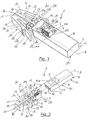
- Figure 1 is a perspective view of a preferred embodiment of the assembly device for sets of lights of the present invention in a pre-assembly operative position;
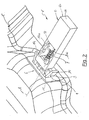
- Figure 2 is a perspective view of the device of Figure 1 in an operative assembly position; and
- Figure 3 is an exploded perspective view of the device of Figure 1.
- With reference to Figures 1 and 2, the reference number 1 designates, as a whole, an assembly device for sets of lights, which are known and are schematically designated by the reference 1a, to a vehicle body 2 of a motor vehicle (not illustrated).
- The device 1 is designed to guarantee a water-tight seal between the set of lights 1a and the vehicle body 2, and can be inserted by snap-action inside a through
hole 3, which is made through the vehicle body 2 itself, and is delimited by a peripheral edge 4 of a substantially rectangular shape. The device 1 has a longitudinal axis A, and comprises abracket 5 fixed to the set of lights 1a, a snap-action fastener 6 slidably coupled to thebracket 5 to slide in the direction of the axis A, and a spring 7 set between thebracket 5 and the fastener 6 to exert a force of assembly between the fastener 6 and thebracket 5 directed along the axis A, pulling the fastener 6 and thebracket 5 themselves towards one another, i.e., pressing the set of lights 1a towards and against the vehicle body 2. According to what is illustrated in Figure 3, thebracket 5 comprises aparallelepipedal body 8 extending in the direction of the axis A starting from the set of lights 1a, and an undercut 9 with rectangular cross section, which is obtained through thebody 8 in the proximity of a free end of thebody 8 itself, and is delimited by two side walls 10a set on opposite sides of the axis A, and by a diaphragm 10 set transverse to the axis A and to the walls 10a themselves. - The diaphragm 10 is overlaid by a projecting moulding 11 set transverse to the axis A, and is provided with two
slits 12, which are set on opposite sides of the axis A itself and are set in a position underneath themoulding 11 so as to define, on the diaphragm 10 itself, afront contrast surface 13. - The snap-action fastener 6 comprises a flattened central body 14 extending in the direction of the axis A, a
partition 15 set along the axis A in an intermediate position with respect to the body 14 itself and defining a plane of symmetry for the fastener 6, and two toothedelastic fingers 16, which are set on opposite sides of the body 14, and have one respective fixedend 17 joined to the body 14 in a position corresponding to ahead 18 of the body 14 and a respectivefree end 19 designed to oscillate elastically away from and towards the body 14 itself. - The
partition 15 has, on each side of the body 14, a portion 20, which is tapered towards thehead 17, and a partially projectingportion 21, which is axially contiguous to the corresponding portion 20 and is also fixed to theother portion 21. - Each
portion 21 extends from the body 14 starting from atruncating surface 22 of the body 14 itself, in front of which it joins with theother portion 21, and is delimited outwards by aplane surface 21s, the distance of which from theother plane surface 21s is substantially equal to the height of thehole 3. - Each
finger 16 is further provided with a wedge-shaped cam 23, which is set outside between the twoends corresponding finger 16, so enabling insertion of the fastener 6 into thehole 3, and to clamp the fastener 6 itself inside thehole 3. Each wedge-shaped cam 23 has a respective thickness of an increasing value starting from theend 17 and identifies, on thecorresponding finger 16, a disengagement tab, which coincides with theend 19 and is designed to remain on the outside of the edge 4 to enable, once pressed in the direction of the axis A, disengagement of the fastener 6 from thehole 3. - The fastener 6 further comprises a
bottom plate 24, which is fixed to the body 14 and extends from the body 14 itself along the axis A in an intermediate position between the twofingers 16 to slide on aside 25 of thebody 8 and set itself so as to close partially a side of the undercut 9. - The fastener 6 finally comprises a seat 26, which is fixed to the
plate 24, and is inserted inside the undercut 9 to contain the spring 7. - In particular, the seat 26 comprises two
side walls 27, which face one another and each of which is provided with respective pairs offlexible catches 28, and anend wall 29, which is fixed and set transverse to thewalls 27, and is set transverse to the axis A. The seat 26 is inserted in the undercut 9 with thecatches 28 set up against the walls 10a and with thewalls 27 set in contact with the walls 10a themselves, and is designed to slide axially in the direction of the axis A against the action of the spring 7, the opposite ends of which are consequently compressed by thewall 29 and by the diaphragm 10 to contrast any action causing movement of the fastener 6 away from the bracket 7. - Finally, the device 1 comprises a
pre-assembly mechanism 30, which is set between the fastener 6 and the bracket 7 to clamp the fastener 6 in a pre-assembly position, in which the spring 7 is compressed and exerts a pre-assembly force having a value greater than the value of the assembly force, and is designed to be deactivatable mechanically and automatically upon introduction of the fastener 6 in thehole 3. Furthermore, in the pre-assembly position, the fastener 6 is at a given pre-assembly distance and in a position relatively far away from thebracket 5, whilst, in the assembly position, the fastener 6 is not only at an assembly distance smaller than the pre-assembly distance, but is also inserted inside thehole 3 with itsown cams 23 gripping against the edge 4. - The
mechanism 30 comprises twoflexible spacer elements 31, which are fixed to the fastener 6 and are passively mobile between a pre-assembly position (illustrated in Figure 1), in which theelements 31 are positioned bearing upon thesurface 13 of thebracket 5, and an assembly position (illustrated in Figure 2), in which theelements 31 are positioned inside the diaphragm 10 through theslits 12. - The two
elements 31 are set on opposite sides of theportion 21 of thediaphragm 15 and on an opposite side of theplate 24 with respect to the body 14, and each is defined by respective shaped rods extending parallel to the axis A and fixedly to the body 14 starting from thesurface 22 of the body 14 itself. - Each
element 31 comprises a respective chamferedfree end 32 and a respective double-wedge-shaped cam 33 delimited on the outside by twoinclined planes 34 and 35 with opposite inclinations, which define between them acrown 36, and of which the inclined plane 34 is a deactivation plane designed to co-operate with the edge 4 of thehole 3 for deactivating themechanism 30, whilst theinclined plane 35 is a lead-in plane, which is tapered towards thecorresponding end 32 and is designed to co-operate with themoulding 11 to facilitate entry of thecorresponding element 31 into theslit 12. - In particular, in its own pre-assembly position, each
element 31 is positioned with thecorresponding cam 33 set projecting with respect to thesurface 21s, and is substantially fitted with itsown end 32 against thesurface 13 of the diaphragm 10 and themoulding 11, on account of the elastic action of the spring 7, which has in its own resting position an elongation greater than the elongation that it has both in the assembly position and in the pre-assembly position. - Transition of each
element 31 into its own assembly position occurs following upon introduction of the fastener 6 into thehole 3 and interference of the surface 4 with each double-wedge-shaped cam 32. Said interference causes the progressive lowering of eachelement 31 towards theplate 24 and the simultaneous displacement of thecorresponding end 32 along thesurface 13 until theend 32 itself enters theslits 12. - Once the
elements 31 are inserted into theslits 12, also the fastener 6 will be axially blocked with itsown cams 23 up against the edge 4, and the spring 7 will be able to exert its own elastic force so as to pull the fastener 6 and thebracket 5 towards one another causing the set of lights 1a to adhere perfectly to the vehicle body 2. - From the foregoing description, it emerges clearly that the presence of the
mechanism 30 enables assembly of the set of lights 1a to the vehicle body 2 to be rendered altogether automatic and particularly reliable, without, on the other hand, requiring the least manual intervention to force the spring 7 to values of compression such as to guarantee perfect adherence of the set of lights 1a on the vehicle body 2. - Furthermore, the possibility of pre-loading the spring 7 with a pre-assembly force of a given value also enables a certain freedom of positioning along the axis A of the
crown 36 of thecam 33 with respect to positioning of thecams 23 again along the axis A so as to ensure at all times both clamping of the fastener 6 and a tight seal between the set of lights 1a and the vehicle body 2. - It is understood that the invention is not limited to the embodiment described and illustrated herein, which is to be considered merely as an example of embodiment of the assembly device for sets of lights, it being instead possible for said device to undergo further modifications regarding shapes and arrangement of parts, and constructional and assembly details.
Claims (9)
- An assembly device (1) for sets of lights, the device (1) comprising: a bracket (5) fixed to the set of lights (1a); a snap-action fastener (6) slidably coupled to the bracket (5); and elastic means (7) set between the bracket (5) and the snap-action fastener (6) to exert a force of assembly between the snap-action fastener (6) and the bracket (5); the device (1) being characterized in that it comprises pre-assembly means (30) set between the snap-action fastener (6) and the bracket (5) for clamping the snap-action fastener (6) in a pre-assembly position, in which the elastic means (7) exert a force of pre-assembly having a value greater than the value of the force of assembly, the pre-assembly means (30) being mechanically deactivatable upon assembly of the snap-action fastener (6).
- The device according to Claim 1, characterized in that said pre-assembly means (30) comprise at least one flexible spacer element (31) fixed to the snap-action fastener (6) and passively mobile between a pre-assembly position, in which it is set bearing upon the bracket (5), and an assembly position, in which it is set in a seat (12) obtained within of the bracket (5) itself.
- The device according to Claim 2, characterized in that said flexible spacer element (31) comprises an inclined plane (34) of deactivation designed to co-operate with an internal edge (4) of a hole (3) for housing the snap-action fastener (6) for deactivating the pre-assembly means (30).
- The device according to Claim 3, characterized in that said flexible spacer element (31) comprises a lead-in inclined plane (35), which has an inclination opposite to that of the inclined plane (34) of deactivation for facilitating entry of the spacer element (31) itself into the seat (12) .
- The device according to Claim 4, characterized in that said bracket (5) comprises a front contrast wall (10), which is set transverse to a longitudinal axis (A) of the device (1) itself, and is provided with a through hole (12) defining the seat (12) for said spacer element (31).
- The device according to Claim 5, characterized in that said bracket (5) comprises a projecting moulding (1a), which extends from the front contrast wall (10) towards the snap-action fastener (6), and defines with the through hole (12) a front contrast surface (13) for said flexible spacer element (31).
- The device according to Claim 6, characterized in that said snap-action fastener (6) comprises a central body (14) extending along said longitudinal axis (A), and two toothed elastic fingers (16) joined to the central body (14), and set on opposite sides of the central body (14); the flexible spacer element (31) extending from the central body (14) parallel to the longitudinal axis (A).
- The device according to Claim 7, characterized in that said pre-assembly means (30) comprise two flexible spacer elements (31), which are fixed to the snap-action fastener (6), and extend from the central body (14) parallel to the longitudinal axis (A); the bracket (5) comprising a seat for each spacer element (31).
- The device according to Claim 8, characterized in that the snap-action fastener (6) comprises two plane surfaces (21s), which are set on opposite sides of said central body (14) and in a position intermediate between said spacer elements (31) at a distance apart from one another substantially equal to the height of said hole (3); said spacer elements (31) protruding with respect to one of said two plane surfaces (21s) in the respective pre-assembly positions.
Applications Claiming Priority (2)
| Application Number | Priority Date | Filing Date | Title |
|---|---|---|---|
| ITTO20030485 | 2003-06-26 | ||
| IT000485A ITTO20030485A1 (en) | 2003-06-26 | 2003-06-26 | ASSEMBLY DEVICE FOR OPTICAL GROUPS TO A BODYWORK |
Publications (3)
| Publication Number | Publication Date |
|---|---|
| EP1491403A2 true EP1491403A2 (en) | 2004-12-29 |
| EP1491403A3 EP1491403A3 (en) | 2006-02-08 |
| EP1491403B1 EP1491403B1 (en) | 2009-10-14 |
Family
ID=33398090
Family Applications (1)
| Application Number | Title | Priority Date | Filing Date |
|---|---|---|---|
| EP04013875A Expired - Lifetime EP1491403B1 (en) | 2003-06-26 | 2004-06-14 | A device for installing sets of lights on a vehicle body |
Country Status (5)
| Country | Link |
|---|---|
| US (1) | US20040266256A1 (en) |
| EP (1) | EP1491403B1 (en) |
| AT (1) | ATE445516T1 (en) |
| DE (1) | DE602004023562D1 (en) |
| IT (1) | ITTO20030485A1 (en) |
Families Citing this family (2)
| Publication number | Priority date | Publication date | Assignee | Title |
|---|---|---|---|---|
| US7338317B1 (en) * | 2006-10-12 | 2008-03-04 | Sumitomo Wiring Systems, Ltd. | Panel-mounted connector |
| CN114954213A (en) * | 2021-02-20 | 2022-08-30 | 标致雪铁龙汽车股份有限公司 | Component for vehicle and method of assembling the same, vehicle |
Family Cites Families (8)
| Publication number | Priority date | Publication date | Assignee | Title |
|---|---|---|---|---|
| GB1565326A (en) * | 1977-02-24 | 1980-04-16 | Idec Izumi Corp | Mounting device for compact apparatus |
| FR2541738B1 (en) * | 1983-02-28 | 1985-06-07 | Alsthom Cgee | DEVICE FOR FIXING AN OBJECT ON A WALL |
| US4872097A (en) * | 1988-12-05 | 1989-10-03 | Miller Jack V | Miniature low-voltage lighting fixture |
| US5122074A (en) * | 1990-08-09 | 1992-06-16 | Voltarc Technologies Inc. | Flourescent lamp holder mount |
| DE19511137C1 (en) * | 1995-03-27 | 1996-03-21 | Daimler Benz Ag | Component coupling element for automobile lamp |
| SI20201A (en) * | 1999-04-23 | 2000-10-31 | Saturnus Avtooprema, D.D. | Assembly for fastening an illuminating body into the chassis of a motor driven vehicle |
| DE19920703C2 (en) * | 1999-05-05 | 2001-03-22 | Fer Fahrzeugelektrik Gmbh | Arrangement for attaching a vehicle lamp |
| US6679726B1 (en) * | 2002-11-26 | 2004-01-20 | Molex Incorporated | Panel mounted electrical connector |
-
2003
- 2003-06-26 IT IT000485A patent/ITTO20030485A1/en unknown
-
2004
- 2004-06-14 DE DE602004023562T patent/DE602004023562D1/en not_active Expired - Lifetime
- 2004-06-14 AT AT04013875T patent/ATE445516T1/en not_active IP Right Cessation
- 2004-06-14 EP EP04013875A patent/EP1491403B1/en not_active Expired - Lifetime
- 2004-06-24 US US10/877,032 patent/US20040266256A1/en not_active Abandoned
Also Published As
| Publication number | Publication date |
|---|---|
| EP1491403B1 (en) | 2009-10-14 |
| EP1491403A3 (en) | 2006-02-08 |
| DE602004023562D1 (en) | 2009-11-26 |
| ATE445516T1 (en) | 2009-10-15 |
| ITTO20030485A1 (en) | 2004-12-27 |
| US20040266256A1 (en) | 2004-12-30 |
Similar Documents
| Publication | Publication Date | Title |
|---|---|---|
| EP1783005B1 (en) | Bumper fixture and bumper mounting structure | |
| US7178855B2 (en) | Integral doghouse fastener with retaining feature | |
| RU1838562C (en) | Inserted connector for hollow profile spacers for insulation of window panes | |
| US4023274A (en) | Orthodontic spring clip | |
| JP2005527752A (en) | Elastic clip type fastener and method of manufacturing the same | |
| JP4527737B2 (en) | Sensor retaining clip | |
| JP2009507711A (en) | Fixing device between wiper blade and windscreen wiper blade holder | |
| US20010052203A1 (en) | Power supply structure in sliding structure | |
| TW201600718A (en) | Drive unit | |
| US7134170B2 (en) | Plastic retaining clip for rib attachment | |
| KR101532186B1 (en) | Connector | |
| JP4994430B2 (en) | Rear garnish clip | |
| EP1491403B1 (en) | A device for installing sets of lights on a vehicle body | |
| JP3788593B2 (en) | connector | |
| KR20080076708A (en) | Solenoid Housing and Solenoid Valve | |
| US5224877A (en) | Spacer mounting structure for connector | |
| EP1715549B1 (en) | Connector coupling structure | |
| JP4659261B2 (en) | Side visor mounting structure | |
| KR200442526Y1 (en) | Connector housing | |
| JP4026718B2 (en) | Wire rod fixing method and fixing structure | |
| JPH1167353A (en) | Connector | |
| CN218651331U (en) | Curtain rail mounting code | |
| JP2002172661A (en) | Method for manufacturing side molding and mounting structure | |
| CN219107370U (en) | A frame and a photovoltaic module | |
| CN222508622U (en) | Wire harness clamp assembly structure and refrigerator having the same |
Legal Events
| Date | Code | Title | Description |
|---|---|---|---|
| PUAI | Public reference made under article 153(3) epc to a published international application that has entered the european phase |
Free format text: ORIGINAL CODE: 0009012 |
|
| AK | Designated contracting states |
Kind code of ref document: A2 Designated state(s): AT BE BG CH CY CZ DE DK EE ES FI FR GB GR HU IE IT LI LU MC NL PL PT RO SE SI SK TR |
|
| AX | Request for extension of the european patent |
Extension state: AL HR LT LV MK |
|
| PUAL | Search report despatched |
Free format text: ORIGINAL CODE: 0009013 |
|
| AK | Designated contracting states |
Kind code of ref document: A3 Designated state(s): AT BE BG CH CY CZ DE DK EE ES FI FR GB GR HU IE IT LI LU MC NL PL PT RO SE SI SK TR |
|
| AX | Request for extension of the european patent |
Extension state: AL HR LT LV MK |
|
| AKX | Designation fees paid | ||
| 17P | Request for examination filed |
Effective date: 20060923 |
|
| RBV | Designated contracting states (corrected) |
Designated state(s): AT BE BG CH CY CZ DE DK EE ES FI FR GB GR HU IE IT LI LU MC NL PL PT RO SE SI SK TR |
|
| REG | Reference to a national code |
Ref country code: DE Ref legal event code: 8566 |
|
| 17Q | First examination report despatched |
Effective date: 20070430 |
|
| GRAP | Despatch of communication of intention to grant a patent |
Free format text: ORIGINAL CODE: EPIDOSNIGR1 |
|
| GRAS | Grant fee paid |
Free format text: ORIGINAL CODE: EPIDOSNIGR3 |
|
| GRAA | (expected) grant |
Free format text: ORIGINAL CODE: 0009210 |
|
| AK | Designated contracting states |
Kind code of ref document: B1 Designated state(s): AT BE BG CH CY CZ DE DK EE ES FI FR GB GR HU IE IT LI LU MC NL PL PT RO SE SI SK TR |
|
| REG | Reference to a national code |
Ref country code: GB Ref legal event code: FG4D |
|
| REG | Reference to a national code |
Ref country code: CH Ref legal event code: EP |
|
| REG | Reference to a national code |
Ref country code: IE Ref legal event code: FG4D |
|
| REF | Corresponds to: |
Ref document number: 602004023562 Country of ref document: DE Date of ref document: 20091126 Kind code of ref document: P |
|
| NLV1 | Nl: lapsed or annulled due to failure to fulfill the requirements of art. 29p and 29m of the patents act | ||
| PG25 | Lapsed in a contracting state [announced via postgrant information from national office to epo] |
Ref country code: FI Free format text: LAPSE BECAUSE OF FAILURE TO SUBMIT A TRANSLATION OF THE DESCRIPTION OR TO PAY THE FEE WITHIN THE PRESCRIBED TIME-LIMIT Effective date: 20091014 Ref country code: ES Free format text: LAPSE BECAUSE OF FAILURE TO SUBMIT A TRANSLATION OF THE DESCRIPTION OR TO PAY THE FEE WITHIN THE PRESCRIBED TIME-LIMIT Effective date: 20100125 Ref country code: SE Free format text: LAPSE BECAUSE OF FAILURE TO SUBMIT A TRANSLATION OF THE DESCRIPTION OR TO PAY THE FEE WITHIN THE PRESCRIBED TIME-LIMIT Effective date: 20091014 Ref country code: PT Free format text: LAPSE BECAUSE OF FAILURE TO SUBMIT A TRANSLATION OF THE DESCRIPTION OR TO PAY THE FEE WITHIN THE PRESCRIBED TIME-LIMIT Effective date: 20100215 |
|
| PG25 | Lapsed in a contracting state [announced via postgrant information from national office to epo] |
Ref country code: PL Free format text: LAPSE BECAUSE OF FAILURE TO SUBMIT A TRANSLATION OF THE DESCRIPTION OR TO PAY THE FEE WITHIN THE PRESCRIBED TIME-LIMIT Effective date: 20091014 Ref country code: SI Free format text: LAPSE BECAUSE OF FAILURE TO SUBMIT A TRANSLATION OF THE DESCRIPTION OR TO PAY THE FEE WITHIN THE PRESCRIBED TIME-LIMIT Effective date: 20091014 |
|
| PG25 | Lapsed in a contracting state [announced via postgrant information from national office to epo] |
Ref country code: AT Free format text: LAPSE BECAUSE OF FAILURE TO SUBMIT A TRANSLATION OF THE DESCRIPTION OR TO PAY THE FEE WITHIN THE PRESCRIBED TIME-LIMIT Effective date: 20091014 Ref country code: BE Free format text: LAPSE BECAUSE OF FAILURE TO SUBMIT A TRANSLATION OF THE DESCRIPTION OR TO PAY THE FEE WITHIN THE PRESCRIBED TIME-LIMIT Effective date: 20091014 |
|
| PG25 | Lapsed in a contracting state [announced via postgrant information from national office to epo] |
Ref country code: BG Free format text: LAPSE BECAUSE OF FAILURE TO SUBMIT A TRANSLATION OF THE DESCRIPTION OR TO PAY THE FEE WITHIN THE PRESCRIBED TIME-LIMIT Effective date: 20100114 Ref country code: DK Free format text: LAPSE BECAUSE OF FAILURE TO SUBMIT A TRANSLATION OF THE DESCRIPTION OR TO PAY THE FEE WITHIN THE PRESCRIBED TIME-LIMIT Effective date: 20091014 Ref country code: RO Free format text: LAPSE BECAUSE OF FAILURE TO SUBMIT A TRANSLATION OF THE DESCRIPTION OR TO PAY THE FEE WITHIN THE PRESCRIBED TIME-LIMIT Effective date: 20091014 Ref country code: EE Free format text: LAPSE BECAUSE OF FAILURE TO SUBMIT A TRANSLATION OF THE DESCRIPTION OR TO PAY THE FEE WITHIN THE PRESCRIBED TIME-LIMIT Effective date: 20091014 |
|
| PLBE | No opposition filed within time limit |
Free format text: ORIGINAL CODE: 0009261 |
|
| STAA | Information on the status of an ep patent application or granted ep patent |
Free format text: STATUS: NO OPPOSITION FILED WITHIN TIME LIMIT |
|
| PG25 | Lapsed in a contracting state [announced via postgrant information from national office to epo] |
Ref country code: SK Free format text: LAPSE BECAUSE OF FAILURE TO SUBMIT A TRANSLATION OF THE DESCRIPTION OR TO PAY THE FEE WITHIN THE PRESCRIBED TIME-LIMIT Effective date: 20091014 Ref country code: CZ Free format text: LAPSE BECAUSE OF FAILURE TO SUBMIT A TRANSLATION OF THE DESCRIPTION OR TO PAY THE FEE WITHIN THE PRESCRIBED TIME-LIMIT Effective date: 20091014 |
|
| 26N | No opposition filed |
Effective date: 20100715 |
|
| PG25 | Lapsed in a contracting state [announced via postgrant information from national office to epo] |
Ref country code: GR Free format text: LAPSE BECAUSE OF FAILURE TO SUBMIT A TRANSLATION OF THE DESCRIPTION OR TO PAY THE FEE WITHIN THE PRESCRIBED TIME-LIMIT Effective date: 20100115 |
|
| PG25 | Lapsed in a contracting state [announced via postgrant information from national office to epo] |
Ref country code: MC Free format text: LAPSE BECAUSE OF NON-PAYMENT OF DUE FEES Effective date: 20100630 |
|
| REG | Reference to a national code |
Ref country code: CH Ref legal event code: PL |
|
| PG25 | Lapsed in a contracting state [announced via postgrant information from national office to epo] |
Ref country code: IT Free format text: LAPSE BECAUSE OF NON-PAYMENT OF DUE FEES Effective date: 20100614 |
|
| PG25 | Lapsed in a contracting state [announced via postgrant information from national office to epo] |
Ref country code: IE Free format text: LAPSE BECAUSE OF NON-PAYMENT OF DUE FEES Effective date: 20100614 Ref country code: LI Free format text: LAPSE BECAUSE OF NON-PAYMENT OF DUE FEES Effective date: 20100630 Ref country code: CH Free format text: LAPSE BECAUSE OF NON-PAYMENT OF DUE FEES Effective date: 20100630 |
|
| PGRI | Patent reinstated in contracting state [announced from national office to epo] |
Ref country code: IT Effective date: 20110616 |
|
| PG25 | Lapsed in a contracting state [announced via postgrant information from national office to epo] |
Ref country code: CY Free format text: LAPSE BECAUSE OF FAILURE TO SUBMIT A TRANSLATION OF THE DESCRIPTION OR TO PAY THE FEE WITHIN THE PRESCRIBED TIME-LIMIT Effective date: 20091014 |
|
| PG25 | Lapsed in a contracting state [announced via postgrant information from national office to epo] |
Ref country code: NL Free format text: LAPSE BECAUSE OF FAILURE TO SUBMIT A TRANSLATION OF THE DESCRIPTION OR TO PAY THE FEE WITHIN THE PRESCRIBED TIME-LIMIT Effective date: 20091014 Ref country code: LU Free format text: LAPSE BECAUSE OF NON-PAYMENT OF DUE FEES Effective date: 20100614 Ref country code: HU Free format text: LAPSE BECAUSE OF FAILURE TO SUBMIT A TRANSLATION OF THE DESCRIPTION OR TO PAY THE FEE WITHIN THE PRESCRIBED TIME-LIMIT Effective date: 20100415 |
|
| PG25 | Lapsed in a contracting state [announced via postgrant information from national office to epo] |
Ref country code: TR Free format text: LAPSE BECAUSE OF FAILURE TO SUBMIT A TRANSLATION OF THE DESCRIPTION OR TO PAY THE FEE WITHIN THE PRESCRIBED TIME-LIMIT Effective date: 20091014 |
|
| REG | Reference to a national code |
Ref country code: FR Ref legal event code: PLFP Year of fee payment: 13 |
|
| REG | Reference to a national code |
Ref country code: FR Ref legal event code: PLFP Year of fee payment: 14 |
|
| REG | Reference to a national code |
Ref country code: FR Ref legal event code: PLFP Year of fee payment: 15 |
|
| PGFP | Annual fee paid to national office [announced via postgrant information from national office to epo] |
Ref country code: FR Payment date: 20200512 Year of fee payment: 17 Ref country code: DE Payment date: 20200602 Year of fee payment: 17 |
|
| PGFP | Annual fee paid to national office [announced via postgrant information from national office to epo] |
Ref country code: GB Payment date: 20200603 Year of fee payment: 17 |
|
| REG | Reference to a national code |
Ref country code: DE Ref legal event code: R119 Ref document number: 602004023562 Country of ref document: DE |
|
| GBPC | Gb: european patent ceased through non-payment of renewal fee |
Effective date: 20210614 |
|
| PG25 | Lapsed in a contracting state [announced via postgrant information from national office to epo] |
Ref country code: GB Free format text: LAPSE BECAUSE OF NON-PAYMENT OF DUE FEES Effective date: 20210614 Ref country code: DE Free format text: LAPSE BECAUSE OF NON-PAYMENT OF DUE FEES Effective date: 20220101 |
|
| PG25 | Lapsed in a contracting state [announced via postgrant information from national office to epo] |
Ref country code: FR Free format text: LAPSE BECAUSE OF NON-PAYMENT OF DUE FEES Effective date: 20210630 |
|
| PG25 | Lapsed in a contracting state [announced via postgrant information from national office to epo] |
Ref country code: IT Free format text: LAPSE BECAUSE OF NON-PAYMENT OF DUE FEES Effective date: 20200614 |