EP1491388A2 - Electrically foldable seat - Google Patents
Electrically foldable seat Download PDFInfo
- Publication number
- EP1491388A2 EP1491388A2 EP04014646A EP04014646A EP1491388A2 EP 1491388 A2 EP1491388 A2 EP 1491388A2 EP 04014646 A EP04014646 A EP 04014646A EP 04014646 A EP04014646 A EP 04014646A EP 1491388 A2 EP1491388 A2 EP 1491388A2
- Authority
- EP
- European Patent Office
- Prior art keywords
- seat
- seat apparatus
- cushion
- link
- vehicle floor
- Prior art date
- Legal status (The legal status is an assumption and is not a legal conclusion. Google has not performed a legal analysis and makes no representation as to the accuracy of the status listed.)
- Withdrawn
Links
Images


Classifications
-
- B—PERFORMING OPERATIONS; TRANSPORTING
- B60—VEHICLES IN GENERAL
- B60N—SEATS SPECIALLY ADAPTED FOR VEHICLES; VEHICLE PASSENGER ACCOMMODATION NOT OTHERWISE PROVIDED FOR
- B60N2/00—Seats specially adapted for vehicles; Arrangement or mounting of seats in vehicles
- B60N2/24—Seats specially adapted for vehicles; Arrangement or mounting of seats in vehicles for particular purposes or particular vehicles
- B60N2/30—Non-dismountable or dismountable seats storable in a non-use position, e.g. foldable spare seats
- B60N2/3002—Non-dismountable or dismountable seats storable in a non-use position, e.g. foldable spare seats back-rest movements
- B60N2/3004—Non-dismountable or dismountable seats storable in a non-use position, e.g. foldable spare seats back-rest movements by rotation only
- B60N2/3009—Non-dismountable or dismountable seats storable in a non-use position, e.g. foldable spare seats back-rest movements by rotation only about transversal axis
- B60N2/3011—Non-dismountable or dismountable seats storable in a non-use position, e.g. foldable spare seats back-rest movements by rotation only about transversal axis the back-rest being hinged on the cushion, e.g. "portefeuille movement"
-
- B—PERFORMING OPERATIONS; TRANSPORTING
- B60—VEHICLES IN GENERAL
- B60N—SEATS SPECIALLY ADAPTED FOR VEHICLES; VEHICLE PASSENGER ACCOMMODATION NOT OTHERWISE PROVIDED FOR
- B60N2/00—Seats specially adapted for vehicles; Arrangement or mounting of seats in vehicles
- B60N2/02—Seats specially adapted for vehicles; Arrangement or mounting of seats in vehicles the seat or part thereof being movable, e.g. adjustable
- B60N2/0224—Non-manual adjustments, e.g. with electrical operation
- B60N2/02246—Electric motors therefor
-
- B—PERFORMING OPERATIONS; TRANSPORTING
- B60—VEHICLES IN GENERAL
- B60N—SEATS SPECIALLY ADAPTED FOR VEHICLES; VEHICLE PASSENGER ACCOMMODATION NOT OTHERWISE PROVIDED FOR
- B60N2/00—Seats specially adapted for vehicles; Arrangement or mounting of seats in vehicles
- B60N2/02—Seats specially adapted for vehicles; Arrangement or mounting of seats in vehicles the seat or part thereof being movable, e.g. adjustable
- B60N2/0224—Non-manual adjustments, e.g. with electrical operation
- B60N2/02246—Electric motors therefor
- B60N2/02258—Electric motors therefor characterised by the mounting of the electric motor for adjusting the seat
-
- B—PERFORMING OPERATIONS; TRANSPORTING
- B60—VEHICLES IN GENERAL
- B60N—SEATS SPECIALLY ADAPTED FOR VEHICLES; VEHICLE PASSENGER ACCOMMODATION NOT OTHERWISE PROVIDED FOR
- B60N2/00—Seats specially adapted for vehicles; Arrangement or mounting of seats in vehicles
- B60N2/02—Seats specially adapted for vehicles; Arrangement or mounting of seats in vehicles the seat or part thereof being movable, e.g. adjustable
- B60N2/22—Seats specially adapted for vehicles; Arrangement or mounting of seats in vehicles the seat or part thereof being movable, e.g. adjustable the back-rest being adjustable
- B60N2/2213—Gear wheel driven mechanism
-
- B—PERFORMING OPERATIONS; TRANSPORTING
- B60—VEHICLES IN GENERAL
- B60N—SEATS SPECIALLY ADAPTED FOR VEHICLES; VEHICLE PASSENGER ACCOMMODATION NOT OTHERWISE PROVIDED FOR
- B60N2/00—Seats specially adapted for vehicles; Arrangement or mounting of seats in vehicles
- B60N2/24—Seats specially adapted for vehicles; Arrangement or mounting of seats in vehicles for particular purposes or particular vehicles
- B60N2/30—Non-dismountable or dismountable seats storable in a non-use position, e.g. foldable spare seats
- B60N2/3038—Cushion movements
- B60N2/3063—Cushion movements by composed movement
- B60N2/3065—Cushion movements by composed movement in a longitudinal-vertical plane
-
- B—PERFORMING OPERATIONS; TRANSPORTING
- B60—VEHICLES IN GENERAL
- B60N—SEATS SPECIALLY ADAPTED FOR VEHICLES; VEHICLE PASSENGER ACCOMMODATION NOT OTHERWISE PROVIDED FOR
- B60N2/00—Seats specially adapted for vehicles; Arrangement or mounting of seats in vehicles
- B60N2/24—Seats specially adapted for vehicles; Arrangement or mounting of seats in vehicles for particular purposes or particular vehicles
- B60N2/30—Non-dismountable or dismountable seats storable in a non-use position, e.g. foldable spare seats
- B60N2/3072—Non-dismountable or dismountable seats storable in a non-use position, e.g. foldable spare seats on a lower level of a multi-level vehicle floor
- B60N2/3075—Non-dismountable or dismountable seats storable in a non-use position, e.g. foldable spare seats on a lower level of a multi-level vehicle floor stowed in recess
-
- B—PERFORMING OPERATIONS; TRANSPORTING
- B60—VEHICLES IN GENERAL
- B60N—SEATS SPECIALLY ADAPTED FOR VEHICLES; VEHICLE PASSENGER ACCOMMODATION NOT OTHERWISE PROVIDED FOR
- B60N2/00—Seats specially adapted for vehicles; Arrangement or mounting of seats in vehicles
- B60N2/24—Seats specially adapted for vehicles; Arrangement or mounting of seats in vehicles for particular purposes or particular vehicles
- B60N2/30—Non-dismountable or dismountable seats storable in a non-use position, e.g. foldable spare seats
- B60N2/3088—Non-dismountable or dismountable seats storable in a non-use position, e.g. foldable spare seats characterised by the mechanical link
- B60N2/309—Non-dismountable or dismountable seats storable in a non-use position, e.g. foldable spare seats characterised by the mechanical link rods
Definitions
- the current invention relates to a vehicle seat apparatus. More particularly, the invention pertains to a structure whereby the vehicle seat apparatus can be stored within a concave storage compartment provided below the surface of a vehicle floor when the vehicle seat is unused.
- the vehicle seat apparatus includes a link mechanism for supporting a cushion as a seating portion of the seat on the vehicle floor. Such link mechanism limits the seat to be a retractable folded condition so that a user may move the seat within the concave storage compartment.
- the posture of the link mechanism is not determined until the seat apparatus is installed to the vehicle. Further, the seat apparatus needs to be fixed on the vehicle floor with bolts at a predetermined position to be moved freely. In this way, the structure of the known seat apparatus is very complicated.
- a seat apparatus comprising a seat back as a backrest portion, a seat cushion as a seating portion, a link mechanism for supporting the seat cushion on a vehicle floor, and a driving source for actuating the link mechanism to position the seat cushion between a seating position and a stored position, characterized in that the link mechanism is pivotally mounted on the vehicle floor for defining a posture thereof and fixing the link mechanism to the vehicle floor.
- the link mechanism is maintained at a predetermined position by stopping the driving device at a predetermined position.
- the seat apparatus can be kept in a predetermined posture before installed on the vehicle floor.
- Such seat apparatus being the predetermined posture can be easily installed on the floor by fitting holes thereof to be screwed with bolts to a preferable installed position on the floor, which can simplify the installing operation.
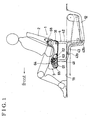
- a seat apparatus 1 according the current invention will be explained with reference to Fig. 1 through Fig.10.
- Fig. 1 through Fig.3 indicate a first embodiment according to the current invention.
- the seat apparatus 1 includes a seat back 2 and a seat cushion 3.
- cushion side frames 31 are provided to the seat cushion 3 at both right and left sides thereof in vehicle width direction as shown in Fig.2. Both cushion side frames 31 horizontally extend toward the front of the vehicle (leftward in Fig.1 and Fig.2). A front end portion of the left cushion side frames 31 is connected to a front end portion of the right cushion side frames 31 with a hollowed front connecting pipe 32.
- Each rear end portion of the cushion side frame 31 includes a projecting portion 31a extending upward, and a known angle adjustment mechanism 18 having a planetary gear mechanism 31b is attached to each projecting portion 31.
- the planetary gear mechanism provided to the right cushion side frame 31 interlocks with the planetary gear mechanism provided to the left cushion side frame 31.
- Back side frames 21 of the seat back 2 are attached to the angle adjustment mechanisms 18. Both angle adjusting mechanisms 18 are connected with an interlocking rod 24 for rotating in conjunction with each other.
- a second driving device 68 is attached to either one of the back side frames 21 for driving one angle adjustment mechanism 18.
- the second driving device 68 includes a motor and a decelerating mechanism, and such configuration is same as a first driving mechanism 61 (first driving source) as described later.
- the planetary gear mechanism of the angle adjusting mechanism 18 is actuated/rotated by a drive from the second driving device 68 (second driving source) for adjusting the angle of the seat back 2.
- the back side frames 21 provided on the right and left side of the seat back 2 in the vehicle width direction are connected with a upper connecting pipe 23 at the upper portions of the back side frames 21 for securing the strength thereof.
- the seat apparatus 1 includes link mechanisms 4 installed below the cushion side frames 31.
- the link mechanisms 4 include a paired front links 41 provided at the front of the seat apparatus 1 and a paired rear links 42 provided at the rear of the seat apparatus 1.
- one front link 41 is attached to the right cushion side frame 31, and the other front link 41 is attached to the left cushion side frame 31.
- Both front links 41 are provided at the outer side of the cushion side frames 31 in the vehicle width direction and connected each other with a rotation shaft 41a extending and penetrating through the hollowed front connecting pipe 32 provided between the front portions of the cushion side frames 31 so that the links are interlocked.
- one rear link 42 is attached to the right cushion side frame 31, and the other rear link 42 is attached to the left cushion side frame 31.
- Both rear links 42 are provided at the inner sides of the cushion side frames 31 in the vehicle width direction and connected with a rotation shaft 42a extending and penetrating through a hollowed rear connecting pipe 33 provided between the rear portions of the cushion side frames 31 so that the links are interlocked.
- the rear links 42 are rotatably supported at the cushion side frames 31 by the rotation shaft 42a penetrating through the rear connecting pipe 33.
- the rear links 42 extend approximately straight downward to be longer than the front links 41.
- Each front link 41 and each rear link 42 attached to the same cushion side frame 31 are connected with a supporting bracket 43 at the lower end of each link.
- the front link 41 is rotatably attached to the supporting bracket 43 with a rotating shaft 41b
- the rear link 42 is rotatably attached to the supporting bracket 43 with a rotating shaft 42b. In this configuration, the front link 41 and the rear link 42 are rotated at the same time even if the seat apparatus 1 is not installed on the vehicle floor 11.
- the supporting bracket 43 is molded to fit the stepped portion of the vehicle floor 11 as described later and fixed to the vehicle floor 11 with bolts (not shown) screwed into a hole 43a and a hole 43b. Such supporting bracket 43 installed in this manner can also reinforce the vehicle floor 11. Specifically, the supporting bracket 43 can reduce a deformation of the vehicle floor 11 when an excessive load transmits from the seat apparatus 1 to the vehicle floor 11 upon a collision.
- the first driving mechanism 61 is mounted to one of either right or left cushion side frame 31 at the inner side thereof in the vehicle width direction.
- the first driving mechanism 61 includes a motor 62 and a deceleration mechanism 63 for rotating a pinion 64 extending outwardly and penetrating through a hole (not shown) formed on the cushion side frame 31.
- the pinion 64 meshes with a gear 65 fixed to the rotating shaft 41a at the outer side of the cushion side frame 31 at which the first driving mechanism is attached.
- a drive from the first driving mechanism 61 transmits through the pinion 64 and the gear 65 to the front link 41, so that the front link is actuated/rotated relative to the cushion side frame 31.
- the rotation and positioning of the front link 41 relative to the cushion side frame 31 can be limited when the first driving mechanism 61 is not actuated.
- the link mechanism 4, which is pivotally mounted on the vehicle floor 11, has a so-called four link configuration, comprising the front link 41, the rear link 42, the cushion side frame 31 and the supporting bracket 43, and the link mechanisms 4 are provided at both right and left sides of the cushion side frame 31.
- the link mechanisms 4 provided both sides of the cushion side frame 31 are connected with the rotation shaft.
- the vehicle floor 11 includes a concave storage compartment 12 below the level of the vehicle floor 11 being normal height.
- the seat apparatus 1 is installed to the vehicle floor 11 as follows; the rear portion of the supporting bracket 43 at which the rear link 42 is supported by the rotation shaft 42b fits the bottom of the concave storage compartment 12, and the front portion of the supporting bracket 43 at which the front link 41 is supported by the rotation shaft 41b fits the surface of the vehicle floor 11.
- the front link 41 is rotated by the drive from the first driving mechanism 61 to be in a position shown in a chain double-dashed line in Fig.1 keeping the posture of the cushion side frame 31 approximately horizontally.
- the aforementioned first driving mechanism 61 and the second driving mechanism 68 are controlled by a control device 8 and an operation switch 9.
- the control device 8 and the operation switch 9 are wired to the first driving mechanism 61 and the second driving mechanism 68 as shown in Fig.4.
- the first driving mechanism 61 and the second driving mechanism 68 are actuated by operating the operation switch 9.
- An angle adjusting switch 9a of the operation switch 9 is operated by an occupant to adjust the angle of the seat back 2 to be seating position.
- the second driving mechanism 68 is actuated, the seat back 2 is tilted in front or rear direction, then the second driving mechanism 68 is stopped for maintaining the adjusted posture of the seat back 2.
- a storing switch 9b is moved to, for example, a "storing" side for opening the place where the seat apparatus 1 is located in seating position. Then, the first driving mechanism 61 is actuated by the controlling device 8, and the seat apparatus 1 is moved to the concave storage compartment 12 by the drive from the first driving mechanism 61, at the same time, the seat back 2 is rotated to be folded upon the seat cushion 3 upon the operation of the control device 8. In this way, the seat apparatus 1 is stored within the concave storage compartment 12 as shown in the chain double-dashed line in Fig.1. On the other hand, the storing switch 9b is moved to, for example, a "restore" side to restore the seat apparatus 1 within the concave storage compartment 12 to the original seating position.
- the seat apparatus 1 is kept in the predetermined posture because of the behavior of the link mechanism 4 while the seat apparatus 1 is moved between the seating position thereof and the stored position thereof so that the user can store the seat apparatus 1 within the concave storage compartment 12 or restore to the seating position without supporting the seat apparatus 1 manually.
- Such seat apparatus can be controlled even if the user is away from the seat apparatus 1. Further, there is no need to follow a complicated operational sequence to move the seat apparatus 1, as a result, the storing operation becomes simple and easy.
- Fig. 5 indicates a second embodiment according to the current invention.
- the seat apparatus 1 includes the seat back 2 as the backrest portion for a passenger and the seat cushion 3 as the seating portion.
- the seat back 2 being in seating position as shown in a solid line in Fig.5 is folded as shown in a chain double-dashed line and stored within the concave storage compartment 12 provided below the surface of the vehicle floor 11.
- the seat apparatus 1 includes the link mechanism 4 for supporting the seat cushion 3 to the vehicle floor 11 and the first driving device 61 for rotating the link mechanism 4.
- the first driving device 61 including the motor 62 is operated by the instruction from the operation switch 9.
- the seat apparatus 1 also includes the angle adjustment mechanism 18 for folding the seat back 2 on the seat cushion 3 and the second driving device 68 for rotating the angle adjustment mechanism 18.
- the second driving device 68 rotates the angle adjustment mechanism 18 corresponding to the rotation of the link mechanism 4 while the seat apparatus 1 is moved between the stored position thereof and the seating position thereof.
- Fig.5 indicates only one link mechanism 4 provided on one side of the seat apparatus 1 in the vehicle width direction; however, another link mechanism 4 is also provided at the other side of the seat apparatus 1.
- the first driving mechanism 61 is provided at either one of the right or left side of the seat apparatus 1 for rotating both link mechanisms 4 in conjunction with each other, at the same time, such configuration can secure the strength of the seat apparatus 1.
- the link mechanism 4 includes the front link 41and the rear link 42.
- the top end of the front link 41 is rotatably fixed to the seat cushion 3 with the rotation shaft 41a.
- the lower end of the front link 41 is rotatably fixed to a groove 11a formed on the vehicle floor 11 and being slightly lower than the vehicle flour 11 being normal height with the rotating shaft 41b.
- each front link 41 and rear link 42 are connected to the seat cushion 3 and the vehicle floor 11 with the rotation shafts, and such configuration is know as the four link mechanism.
- the seat apparatus 1 can be moved between the stored position thereof and the seating position thereof, where the seat cushion 3 is kept in horizontal.
- the gear 65 is fixed to one front link 41 for rotating integrally.
- a drive from the first driving device 61 transmits to the front link 41 through the gear 65 meshing with the pinion 64 of the first driving device 61 for rotating the front link 41 relative to the seat cushion 3 so that the link mechanism 4 can be rotated.
- a lock mechanism 5 is attached to the lower portion of the front link 41 being bended to fit to the vehicle floor 11.
- the lock mechanism 5 includes a housing 51 in which a latch 52 being rotatable relative to a shaft 52a and a pawl 53 being rotatable relative to a shaft 53a.
- the latch 52 includes a hook portion 52d being engagable with a striker 56 fixed to the groove 11a of the vehicle floor 11.
- An engaging portion 53b formed at the pawl 53 is engaged with a engaging portion 52b formed at the latch 52 as shown in Fig.6 to limit the rotation of the latch 52, as a result, the engagement between the hook portion 52d and the striker 56 is maintained so that the link mechanism 4 is fixed at the vehicle floor 11.
- the engagement between the latch 52 and the pawl 53 is maintained by a force of an extended spring 54 provided between a pin 52c mounted to a side surface of the latch 52 and a pin 53c mounted to a side surface of the pawl 53.
- a movable end 57a of an operating cable 57 is attached to the pin 53c of the pawl 53, and the other end of the operating cable 57 is attached to the housing 51.
- the seat apparatus 1 may included another driving device for folding the seat back 2, for moving the seat cushion 3 and for releasing the lock mechanism 5.
- Such driving device may be automatically operated by an operator using a control device such as a remote controller.
- a third embodiment according to the current invention is indicated in Fig.7.
- the seat apparatus 1 in the third embodiment also includes the four link mechanism comprising the front link 41, the rear link 42, the seat cushion 3 and the vehicle floor 11, however, the aforementioned lock mechanism 5 is mounted on the rear link 43 for engaging with the striker 56 fixed within the groove 11a of the vehicle floor 11.
- the link mechanism 4 according to the third embodiment includes same structure as the link mechanism 4 according to the second embodiment, wherein at least two links are connected each other to maintain the posture of the link mechanism 4 when the seat apparatus 1 is in seating position.
- FIG.8 A fourth embodiment according to the current invention is shown in Fig.8.
- the rear link 42 includes a lever portion 42c being projecting upwardly from the rotation shaft 42a, and the upper end of the lever portion 42c is rotatably connected to one end of a connecting link 44 provided between the lever portion 42c and a bracket 70.
- the other end of the connecting link 44 is connected to the bracket 70.
- the bracket 70 is rotatably supported to the rotation shaft 41a mounted on the upper end of the front link and extending vertically downward.
- the bracket 70 houses the lock mechanism 5 at the lower end thereof, and such lock mechanism 5 includes the latch 52 and the pawl 53 as mentioned above, wherein the latch 52 is engagable with the striker 56 provided on the groove 11a.
- the seat apparatus 1 according to the fourth embodiment also includes the fourth link mechanism, and the seat cushion 3 and the vehicle floor 11 are locked by the bracket 4 fixed with the lock mechanism 5. On this account, the posture of the link mechanism 4 is maintained in seating position.
- the posture of the link mechanism 4 can be maintained by locking at least two elements of the link mechanism 4 each other.
- the configuration of the link mechanism 4 is not limited to such embodiments, specifically, the lock mechanism 5 and the striker 56 may be provided between any elements of the link mechanism 4.
- the seat apparatus 1 includes the motor 62 for moving the seat apparatus 1 between the seating position and the stored position. Specifically, the motor 62 moves the seat apparatus 1 to the seating positions shown in solid lines in Fig.5, 7 and 8, where the lock mechanism 5 is surely engaged with the vehicle floor 11. Further, an elastic stopper (not shown) may be attached, for example, between the latch and the striker to prevent clattering of the seat apparatus being seating position. In such configuration, the motor 62 rotates for outputting a drive enough to push the seat apparatus 1 to the elastic stopper and secure the engaging condition of the lock mechanism at any time.
- the seat apparatus 1 includes the lock mechanism 5 to support the seat apparatus 1 at the seating position; however, another lock mechanism may be provided to the seat apparatus 1 for support the seat apparatus 1 at the stored position so that clattering of the stored seat can be prevented.
- the lock mechanism 5 includes a projecting portion 53d at the pawl 53, and a detecting sensor 81 including a switch mechanism is attached to the bracket 70 to be engaged or disengaged relative to the projecting portion 53d.
- the detecting sensor 81 outputs an electrical "on” signal when the lock mechanism 5 is engaged with the striker 56, and the detecting sensor 81 is engaged with the projecting portion 53d.
- the sensor outputs an electrical "off” signal when the lock mechanism 5 is disengaged from the striker 56, and the detecting sensor 81 is disengaged from the projecting portion 53d.
- the detecting sensor 81 directly detecting the locking condition of the lock mechanism 5 assures the engaging condition of the seat apparatus 1 more firmly.
- Such signals from the detecting sensor 81 can be used as inputs for the control device for controlling the movement of the seat apparatus 1 automatically.
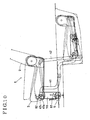
- the seat apparatus 1 according to the sixth embodiment includes the aforementioned detecting sensor 81 and another detecting sensor 82 (second detecting sensor).
- the second detecting sensor 82 is mounted on the seat cushion 3 and being engagable with a projecting portion 43c formed at the bracket 70.
- the second detecting sensor 2 outputs "on" signal when the bracket 70 moves to be at a predetermined position relative to the seat cushion 3.
- the seat apparatus 1 can be controlled to be locked more precisely by detecting the position of the seat apparatus 1 based on the "on” and “off” signal from the detecting sensor 82.
- the detecting sensor 82 can be mounted to the seat apparatus 1 being manually controlled. Specifically, with the detecting sensor 82, the seat apparatus 1 can be locked at the predetermined seating position even if the seat apparatus 1 is not rotated by the motor.
Landscapes
- Engineering & Computer Science (AREA)
- Aviation & Aerospace Engineering (AREA)
- Transportation (AREA)
- Mechanical Engineering (AREA)
- Seats For Vehicles (AREA)
Abstract
Description
- The current invention relates to a vehicle seat apparatus. More particularly, the invention pertains to a structure whereby the vehicle seat apparatus can be stored within a concave storage compartment provided below the surface of a vehicle floor when the vehicle seat is unused.
- A known art according to a seat apparatus having a structure whereby the seat apparatus can be stored within a concave storage compartment provided below a vehicle floor when the vehicle seat is unused is disclosed in Laid-open Japanese patent publication No. 11(1999)-048840. According to the known art, the vehicle seat apparatus includes a link mechanism for supporting a cushion as a seating portion of the seat on the vehicle floor. Such link mechanism limits the seat to be a retractable folded condition so that a user may move the seat within the concave storage compartment.
- In the know art, the posture of the link mechanism is not determined until the seat apparatus is installed to the vehicle. Further, the seat apparatus needs to be fixed on the vehicle floor with bolts at a predetermined position to be moved freely. In this way, the structure of the known seat apparatus is very complicated.
- According to an aspect of the present invention, a seat apparatus comprising a seat back as a backrest portion, a seat cushion as a seating portion, a link mechanism for supporting the seat cushion on a vehicle floor, and a driving source for actuating the link mechanism to position the seat cushion between a seating position and a stored position, characterized in that the link mechanism is pivotally mounted on the vehicle floor for defining a posture thereof and fixing the link mechanism to the vehicle floor.
- Furthermore, the link mechanism is maintained at a predetermined position by stopping the driving device at a predetermined position. Thus, the seat apparatus can be kept in a predetermined posture before installed on the vehicle floor. Such seat apparatus being the predetermined posture can be easily installed on the floor by fitting holes thereof to be screwed with bolts to a preferable installed position on the floor, which can simplify the installing operation.
- The foregoing and additional features and characteristics of the present invention will become more apparent from the following detailed description considered with reference to the accompanying drawing figures in which like reference numerals designate like elements.
- Fig.1 illustrates a perspective side view of the seat apparatus according to the first embodiment of the current invention;
- Fig.2 illustrates a perspective view of the seat apparatus according to the first embodiment of the current invention;
- Fig.3 illustrates an partial enlarged diagram of the Fig.3;
- Fig.4 illustrates a block diagram indicating a control device according to the current invention;
- Fig.5 illustrates a perspective side view of the seat apparatus according to the second embodiment of the current invention;
- Fig.6 illustrates a side view of a lock mechanism according to the second embodiment of the current invention;
- Fig.7 illustrates a perspective side view of the seat apparatus according to the third embodiment of the current invention;
- Fig.8 illustrates a perspective side view of the seat apparatus according to the fourth embodiment of the current invention;
- Fig.9 illustrates a perspective side view of the seat apparatus according to the fifth embodiment of the current invention, and
- Fig.10 illustrates a perspective side view of the seat apparatus according to the sixth embodiment of the current invention.
- A preferred embodiment of a
seat apparatus 1 according the current invention will be explained with reference to Fig. 1 through Fig.10. Fig. 1 through Fig.3 indicate a first embodiment according to the current invention. As shown in Fig.1, theseat apparatus 1 includes aseat back 2 and aseat cushion 3. - Furthermore,
cushion side frames 31 are provided to theseat cushion 3 at both right and left sides thereof in vehicle width direction as shown in Fig.2. Bothcushion side frames 31 horizontally extend toward the front of the vehicle (leftward in Fig.1 and Fig.2). A front end portion of the leftcushion side frames 31 is connected to a front end portion of the rightcushion side frames 31 with a hollowed front connectingpipe 32. - Each rear end portion of the
cushion side frame 31 includes a projectingportion 31a extending upward, and a knownangle adjustment mechanism 18 having aplanetary gear mechanism 31b is attached to eachprojecting portion 31. The planetary gear mechanism provided to the rightcushion side frame 31 interlocks with the planetary gear mechanism provided to the leftcushion side frame 31.Back side frames 21 of theseat back 2 are attached to theangle adjustment mechanisms 18. Bothangle adjusting mechanisms 18 are connected with an interlockingrod 24 for rotating in conjunction with each other. Asecond driving device 68 is attached to either one of theback side frames 21 for driving oneangle adjustment mechanism 18. Thesecond driving device 68 includes a motor and a decelerating mechanism, and such configuration is same as a first driving mechanism 61 (first driving source) as described later. The planetary gear mechanism of theangle adjusting mechanism 18 is actuated/rotated by a drive from the second driving device 68 (second driving source) for adjusting the angle of theseat back 2. Theback side frames 21 provided on the right and left side of theseat back 2 in the vehicle width direction are connected with a upper connectingpipe 23 at the upper portions of theback side frames 21 for securing the strength thereof. - As shown in Fig.1 and Fig.2, the
seat apparatus 1 includeslink mechanisms 4 installed below thecushion side frames 31. Thelink mechanisms 4 include a pairedfront links 41 provided at the front of theseat apparatus 1 and a pairedrear links 42 provided at the rear of theseat apparatus 1. Specifically, onefront link 41 is attached to the rightcushion side frame 31, and theother front link 41 is attached to the leftcushion side frame 31. Bothfront links 41 are provided at the outer side of thecushion side frames 31 in the vehicle width direction and connected each other with arotation shaft 41a extending and penetrating through the hollowed front connectingpipe 32 provided between the front portions of thecushion side frames 31 so that the links are interlocked. - On the other hand, one
rear link 42 is attached to the rightcushion side frame 31, and the otherrear link 42 is attached to the leftcushion side frame 31. Bothrear links 42 are provided at the inner sides of thecushion side frames 31 in the vehicle width direction and connected with arotation shaft 42a extending and penetrating through a hollowed rear connectingpipe 33 provided between the rear portions of thecushion side frames 31 so that the links are interlocked. Specifically, therear links 42 are rotatably supported at thecushion side frames 31 by therotation shaft 42a penetrating through the rear connectingpipe 33. - As shown in Fig.2, the
rear links 42 extend approximately straight downward to be longer than thefront links 41. Eachfront link 41 and eachrear link 42 attached to the samecushion side frame 31 are connected with a supportingbracket 43 at the lower end of each link. Specifically, thefront link 41 is rotatably attached to the supportingbracket 43 with a rotatingshaft 41b, and therear link 42 is rotatably attached to the supportingbracket 43 with a rotatingshaft 42b. In this configuration, thefront link 41 and therear link 42 are rotated at the same time even if theseat apparatus 1 is not installed on thevehicle floor 11. The supportingbracket 43 is molded to fit the stepped portion of thevehicle floor 11 as described later and fixed to thevehicle floor 11 with bolts (not shown) screwed into ahole 43a and ahole 43b. Such supportingbracket 43 installed in this manner can also reinforce thevehicle floor 11. Specifically, the supportingbracket 43 can reduce a deformation of thevehicle floor 11 when an excessive load transmits from theseat apparatus 1 to thevehicle floor 11 upon a collision. - As shown in Fig.2 and Fig.3, the
first driving mechanism 61 is mounted to one of either right or leftcushion side frame 31 at the inner side thereof in the vehicle width direction. Thefirst driving mechanism 61 includes amotor 62 and adeceleration mechanism 63 for rotating apinion 64 extending outwardly and penetrating through a hole (not shown) formed on thecushion side frame 31. Thepinion 64 meshes with agear 65 fixed to the rotatingshaft 41a at the outer side of thecushion side frame 31 at which the first driving mechanism is attached. In this configuration, a drive from thefirst driving mechanism 61 transmits through thepinion 64 and thegear 65 to thefront link 41, so that the front link is actuated/rotated relative to thecushion side frame 31. In addition, the rotation and positioning of thefront link 41 relative to thecushion side frame 31 can be limited when thefirst driving mechanism 61 is not actuated. - The
link mechanism 4, which is pivotally mounted on thevehicle floor 11, has a so-called four link configuration, comprising thefront link 41, therear link 42, thecushion side frame 31 and the supportingbracket 43, and thelink mechanisms 4 are provided at both right and left sides of thecushion side frame 31. Thelink mechanisms 4 provided both sides of thecushion side frame 31 are connected with the rotation shaft. As shown in Fig.1, thevehicle floor 11 includes aconcave storage compartment 12 below the level of thevehicle floor 11 being normal height. Theseat apparatus 1 is installed to thevehicle floor 11 as follows; the rear portion of the supportingbracket 43 at which therear link 42 is supported by therotation shaft 42b fits the bottom of theconcave storage compartment 12, and the front portion of the supportingbracket 43 at which thefront link 41 is supported by therotation shaft 41b fits the surface of thevehicle floor 11. Thus, thefront link 41 is rotated by the drive from thefirst driving mechanism 61 to be in a position shown in a chain double-dashed line in Fig.1 keeping the posture of thecushion side frame 31 approximately horizontally. - The aforementioned
first driving mechanism 61 and thesecond driving mechanism 68 are controlled by acontrol device 8 and anoperation switch 9. Thecontrol device 8 and theoperation switch 9 are wired to thefirst driving mechanism 61 and thesecond driving mechanism 68 as shown in Fig.4. Thus, thefirst driving mechanism 61 and thesecond driving mechanism 68 are actuated by operating theoperation switch 9. - Behavior of the
seat apparatus 1 with the aforementioned configuration will be explained as follows. An angle adjusting switch 9a of theoperation switch 9 is operated by an occupant to adjust the angle of the seat back 2 to be seating position. As thesecond driving mechanism 68 is actuated, the seat back 2 is tilted in front or rear direction, then thesecond driving mechanism 68 is stopped for maintaining the adjusted posture of the seat back 2. - To increase cargo capacity, a storing switch 9b is moved to, for example, a "storing" side for opening the place where the
seat apparatus 1 is located in seating position. Then, thefirst driving mechanism 61 is actuated by the controllingdevice 8, and theseat apparatus 1 is moved to theconcave storage compartment 12 by the drive from thefirst driving mechanism 61, at the same time, the seat back 2 is rotated to be folded upon theseat cushion 3 upon the operation of thecontrol device 8. In this way, theseat apparatus 1 is stored within theconcave storage compartment 12 as shown in the chain double-dashed line in Fig.1. On the other hand, the storing switch 9b is moved to, for example, a "restore" side to restore theseat apparatus 1 within theconcave storage compartment 12 to the original seating position. - Thus, the
seat apparatus 1 is kept in the predetermined posture because of the behavior of thelink mechanism 4 while theseat apparatus 1 is moved between the seating position thereof and the stored position thereof so that the user can store theseat apparatus 1 within theconcave storage compartment 12 or restore to the seating position without supporting theseat apparatus 1 manually. Such seat apparatus can be controlled even if the user is away from theseat apparatus 1. Further, there is no need to follow a complicated operational sequence to move theseat apparatus 1, as a result, the storing operation becomes simple and easy. - Fig. 5 indicates a second embodiment according to the current invention. The
seat apparatus 1 includes the seat back 2 as the backrest portion for a passenger and theseat cushion 3 as the seating portion. The seat back 2 being in seating position as shown in a solid line in Fig.5 is folded as shown in a chain double-dashed line and stored within theconcave storage compartment 12 provided below the surface of thevehicle floor 11. - Furthermore, the
seat apparatus 1 includes thelink mechanism 4 for supporting theseat cushion 3 to thevehicle floor 11 and thefirst driving device 61 for rotating thelink mechanism 4. Thefirst driving device 61 including themotor 62 is operated by the instruction from theoperation switch 9. In addition, theseat apparatus 1 also includes theangle adjustment mechanism 18 for folding the seat back 2 on theseat cushion 3 and thesecond driving device 68 for rotating theangle adjustment mechanism 18. Thesecond driving device 68 rotates theangle adjustment mechanism 18 corresponding to the rotation of thelink mechanism 4 while theseat apparatus 1 is moved between the stored position thereof and the seating position thereof. - Fig.5 indicates only one
link mechanism 4 provided on one side of theseat apparatus 1 in the vehicle width direction; however, anotherlink mechanism 4 is also provided at the other side of theseat apparatus 1. Thefirst driving mechanism 61 is provided at either one of the right or left side of theseat apparatus 1 for rotating bothlink mechanisms 4 in conjunction with each other, at the same time, such configuration can secure the strength of theseat apparatus 1. Thelink mechanism 4 includes the front link 41and therear link 42. The top end of thefront link 41 is rotatably fixed to theseat cushion 3 with therotation shaft 41a. The lower end of thefront link 41 is rotatably fixed to agroove 11a formed on thevehicle floor 11 and being slightly lower than thevehicle flour 11 being normal height with therotating shaft 41b. Thus, eachfront link 41 andrear link 42 are connected to theseat cushion 3 and thevehicle floor 11 with the rotation shafts, and such configuration is know as the four link mechanism. On this account, theseat apparatus 1 can be moved between the stored position thereof and the seating position thereof, where theseat cushion 3 is kept in horizontal. - The
gear 65 is fixed to onefront link 41 for rotating integrally. A drive from thefirst driving device 61 transmits to thefront link 41 through thegear 65 meshing with thepinion 64 of thefirst driving device 61 for rotating thefront link 41 relative to theseat cushion 3 so that thelink mechanism 4 can be rotated. - As shown in Fig.5 and Fig.6, a
lock mechanism 5 is attached to the lower portion of thefront link 41 being bended to fit to thevehicle floor 11. Thelock mechanism 5 includes ahousing 51 in which alatch 52 being rotatable relative to a shaft 52a and apawl 53 being rotatable relative to a shaft 53a. Thelatch 52 includes ahook portion 52d being engagable with astriker 56 fixed to thegroove 11a of thevehicle floor 11. An engagingportion 53b formed at thepawl 53 is engaged with a engagingportion 52b formed at thelatch 52 as shown in Fig.6 to limit the rotation of thelatch 52, as a result, the engagement between thehook portion 52d and thestriker 56 is maintained so that thelink mechanism 4 is fixed at thevehicle floor 11. The engagement between thelatch 52 and thepawl 53 is maintained by a force of anextended spring 54 provided between a pin 52c mounted to a side surface of thelatch 52 and apin 53c mounted to a side surface of thepawl 53. Amovable end 57a of an operatingcable 57 is attached to thepin 53c of thepawl 53, and the other end of the operatingcable 57 is attached to thehousing 51. When thepin 53c of thepawl 53 is pulled against the force of theextended spring 54 by operating a lever (not shown) provided at the other end of the operatingcable 57, thehook portion 52d is disengaged from thestriker 56. - The
seat apparatus 1 may included another driving device for folding the seat back 2, for moving theseat cushion 3 and for releasing thelock mechanism 5. Such driving device may be automatically operated by an operator using a control device such as a remote controller. - A third embodiment according to the current invention is indicated in Fig.7. The
seat apparatus 1 in the third embodiment also includes the four link mechanism comprising thefront link 41, therear link 42, theseat cushion 3 and thevehicle floor 11, however, theaforementioned lock mechanism 5 is mounted on therear link 43 for engaging with thestriker 56 fixed within thegroove 11a of thevehicle floor 11. Thus, thelink mechanism 4 according to the third embodiment includes same structure as thelink mechanism 4 according to the second embodiment, wherein at least two links are connected each other to maintain the posture of thelink mechanism 4 when theseat apparatus 1 is in seating position. - A fourth embodiment according to the current invention is shown in Fig.8. In the fourth embodiment, the
rear link 42 includes alever portion 42c being projecting upwardly from therotation shaft 42a, and the upper end of thelever portion 42c is rotatably connected to one end of a connectinglink 44 provided between thelever portion 42c and abracket 70. On the other hand, the other end of the connectinglink 44 is connected to thebracket 70. Thebracket 70 is rotatably supported to therotation shaft 41a mounted on the upper end of the front link and extending vertically downward. Thebracket 70 houses thelock mechanism 5 at the lower end thereof, andsuch lock mechanism 5 includes thelatch 52 and thepawl 53 as mentioned above, wherein thelatch 52 is engagable with thestriker 56 provided on thegroove 11a. Theseat apparatus 1 according to the fourth embodiment also includes the fourth link mechanism, and theseat cushion 3 and thevehicle floor 11 are locked by thebracket 4 fixed with thelock mechanism 5. On this account, the posture of thelink mechanism 4 is maintained in seating position. - As explained in the second, third and forth embodiments, the posture of the
link mechanism 4 can be maintained by locking at least two elements of thelink mechanism 4 each other. The configuration of thelink mechanism 4 is not limited to such embodiments, specifically, thelock mechanism 5 and thestriker 56 may be provided between any elements of thelink mechanism 4. - The
seat apparatus 1 includes themotor 62 for moving theseat apparatus 1 between the seating position and the stored position. Specifically, themotor 62 moves theseat apparatus 1 to the seating positions shown in solid lines in Fig.5, 7 and 8, where thelock mechanism 5 is surely engaged with thevehicle floor 11. Further, an elastic stopper (not shown) may be attached, for example, between the latch and the striker to prevent clattering of the seat apparatus being seating position. In such configuration, themotor 62 rotates for outputting a drive enough to push theseat apparatus 1 to the elastic stopper and secure the engaging condition of the lock mechanism at any time. - In the second and third embodiment, the
seat apparatus 1 includes thelock mechanism 5 to support theseat apparatus 1 at the seating position; however, another lock mechanism may be provided to theseat apparatus 1 for support theseat apparatus 1 at the stored position so that clattering of the stored seat can be prevented. - A fifth embodiment according to the
seat apparatus 1 according to the current invention will be explained as follows. As shown in Fig.9, thelock mechanism 5 includes a projectingportion 53d at thepawl 53, and a detectingsensor 81 including a switch mechanism is attached to thebracket 70 to be engaged or disengaged relative to the projectingportion 53d. The detectingsensor 81 outputs an electrical "on" signal when thelock mechanism 5 is engaged with thestriker 56, and the detectingsensor 81 is engaged with the projectingportion 53d. On the other hand, the sensor outputs an electrical "off" signal when thelock mechanism 5 is disengaged from thestriker 56, and the detectingsensor 81 is disengaged from the projectingportion 53d. - In this way the detecting
sensor 81 directly detecting the locking condition of thelock mechanism 5 assures the engaging condition of theseat apparatus 1 more firmly. Such signals from the detectingsensor 81 can be used as inputs for the control device for controlling the movement of theseat apparatus 1 automatically. - A sixth embodiment according to the
seat apparatus 1 of the current invention will be explained as follows. As shown in Fig. 10, theseat apparatus 1 according to the sixth embodiment includes the aforementioned detectingsensor 81 and another detecting sensor 82 (second detecting sensor). The second detectingsensor 82 is mounted on theseat cushion 3 and being engagable with a projectingportion 43c formed at thebracket 70. The second detectingsensor 2 outputs "on" signal when thebracket 70 moves to be at a predetermined position relative to theseat cushion 3. - In such configuration, the
seat apparatus 1 can be controlled to be locked more precisely by detecting the position of theseat apparatus 1 based on the "on" and "off" signal from the detectingsensor 82. - The detecting
sensor 82 can be mounted to theseat apparatus 1 being manually controlled. Specifically, with the detectingsensor 82, theseat apparatus 1 can be locked at the predetermined seating position even if theseat apparatus 1 is not rotated by the motor.
Claims (10)
- A seat apparatus (1) comprising a seat back (2) as a backrest portion, a seat cushion (3) as a seating portion, a link mechanism (4) for supporting the seat cushion on a vehicle floor, and a driving source (61) for actuating the link mechanism (4) to position the seat cushion (3) between a seating position and a stored position,
characterized in that
the link mechanism (4) is pivotally mounted on the vehicle floor for defining a posture thereof. - A seat apparatus (1) according to claim 1, wherein the seat apparatus (1) being retractable condition is stored within a concave storage compartment (12) provided below the the floor (11) level.
- A seat apparatus (1) according to claims 1 and 2, wherein the seat cushion (3) is supported by a cushion side frame (31) at one side of the seat cushion (3).
- A seat apparatus (1) according to claim 3, wherein the cushion side frames (31) includes a pair of the cushion side frames (31) provided at both sides of the seat cushion (3) and connected with a connecting pipe (32).
- A seat apparatus (1) according to claim 1, wherein an angle adjusting mechanism (18) is provided between the seat cushion (3) and the seat back (2).
- A seat apparatus (1) according to claim 5, wherein the angle adjusting mechanism (18) includes a planetary gear mechanism (31b).
- A seat apparatus (1) according to claims 5 and 6, wherein the angle adjusting mechanism (18) includes a pair of the angle adjusting mechanisms (18) provided at both sides of the seat cushion (3) and connected with a connecting rod (24) for interlocking.
- A seat apparatus (1) according to claims 5 through 7, wherein the angle adjusting mechanism (18) is actuated by a second driving source (68).
- A seat apparatus according to claim 1, wherein the link mechanism is actuated by a first driving source.
- A seat apparatus according to claim 1 further including a lock mechanism for fixing to the vehicle floor is provided on the link mechanism.
Applications Claiming Priority (4)
| Application Number | Priority Date | Filing Date | Title |
|---|---|---|---|
| JP2003179628 | 2003-06-24 | ||
| JP2003179628A JP2005014670A (en) | 2003-06-24 | 2003-06-24 | Sheet device |
| JP2003185599 | 2003-06-27 | ||
| JP2003185599A JP2005014843A (en) | 2003-06-27 | 2003-06-27 | Sheet device |
Publications (2)
| Publication Number | Publication Date |
|---|---|
| EP1491388A2 true EP1491388A2 (en) | 2004-12-29 |
| EP1491388A3 EP1491388A3 (en) | 2005-10-19 |
Family
ID=33422195
Family Applications (1)
| Application Number | Title | Priority Date | Filing Date |
|---|---|---|---|
| EP04014646A Withdrawn EP1491388A3 (en) | 2003-06-24 | 2004-06-23 | Electrically foldable seat |
Country Status (2)
| Country | Link |
|---|---|
| US (1) | US20050006920A1 (en) |
| EP (1) | EP1491388A3 (en) |
Cited By (4)
| Publication number | Priority date | Publication date | Assignee | Title |
|---|---|---|---|---|
| FR2896459A1 (en) * | 2006-01-25 | 2007-07-27 | Faurecia Sieges Automobile | Motor vehicle seat retraction system, has front connecting rod rotatably connected to seat and intermediate connecting rod, and locking system rotating latter rod with respect to guide when seat is moved towards retracted position |
| DE202007001735U1 (en) | 2007-02-07 | 2008-06-19 | Brose Fahrzeugteile Gmbh & Co. Kommanditgesellschaft, Coburg | Vehicle folding seat |
| CN103144558A (en) * | 2011-12-07 | 2013-06-12 | 现代自动车株式会社 | Storing apparatus of rear seat for multi purpose vehicle |
| EP3680126A1 (en) * | 2019-01-08 | 2020-07-15 | Toyota Boshoku Kabushiki Kaisha | Vehicle seat device |
Families Citing this family (16)
| Publication number | Priority date | Publication date | Assignee | Title |
|---|---|---|---|---|
| JP4494314B2 (en) * | 2005-08-30 | 2010-06-30 | アイシン精機株式会社 | Sheet device |
| US7600801B2 (en) * | 2006-12-20 | 2009-10-13 | Globe Motors, Inc. | Seat storage actuator |
| KR101247697B1 (en) * | 2008-12-26 | 2013-03-26 | 시로키 고교 가부시키가이샤 | Storable seat for vehicle |
| CN103380025B (en) * | 2010-11-30 | 2016-05-25 | 提爱思科技股份有限公司 | Folding seat unit for vehicles |
| US9889777B2 (en) * | 2014-01-31 | 2018-02-13 | Bombardier Recreational Products Inc. | Off-road wheeled side-by-side vehicle |
| JP6780454B2 (en) * | 2016-11-09 | 2020-11-04 | トヨタ紡織株式会社 | Back frame for vehicle seat |
| DE102017215914A1 (en) * | 2017-09-08 | 2019-03-14 | Brose Fahrzeugteile Gmbh & Co. Kg, Coburg | Vehicle seat with a swiveling seat part and a functional unit |
| DE102017215913A1 (en) | 2017-09-08 | 2019-03-14 | Brose Fahrzeugteile Gmbh & Co. Kg, Coburg | Vehicle seat with a pivotable about a single pivot axis seat part |
| CN115298058B (en) * | 2020-03-17 | 2024-09-13 | 提爱思科技股份有限公司 | Seat for vehicle |
| US11731535B2 (en) | 2020-11-09 | 2023-08-22 | Ford Global Technologies, Llc | Vehicular system capable of adjusting a passenger compartment from a child care arrangement to a second arrangement |
| US11772517B2 (en) | 2020-11-09 | 2023-10-03 | Ford Global Technologies, Llc | Vehicular system capable of adjusting a passenger compartment from a child seat arrangement to a second arrangement |
| US12257932B2 (en) | 2020-11-09 | 2025-03-25 | Ford Global Technologies, Llc | Exterior imager utilized in adjusting a passenger compartment arrangement |
| US11772519B2 (en) | 2020-11-09 | 2023-10-03 | Ford Global Technologies, Llc | Vehicular system capable of adjusting a passenger compartment from a first arrangement to a child seat arrangement |
| US11904732B2 (en) | 2020-11-09 | 2024-02-20 | Ford Global Technologies, Llc | Vehicular system capable of adjusting a passenger compartment from a first arrangement to a child care arrangement |
| US11772520B2 (en) | 2020-11-09 | 2023-10-03 | Ford Global Technologies, Llc | Remote notification and adjustment of a passenger compartment arrangement |
| US12077068B2 (en) | 2020-11-09 | 2024-09-03 | Ford Global Technologies, Llc | Authorization-based adjustment of passenger compartment arrangement |
Family Cites Families (18)
| Publication number | Priority date | Publication date | Assignee | Title |
|---|---|---|---|---|
| JP4019456B2 (en) * | 1997-07-31 | 2007-12-12 | マツダ株式会社 | Vehicle seat structure |
| US5890758A (en) * | 1997-08-19 | 1999-04-06 | Chrysler Corporation | Seat assembly for a motor vehicle retractable below the vehicle floor |
| US6234553B1 (en) * | 1998-10-02 | 2001-05-22 | Johnson Controls Technology Company | Flexible seat system |
| JP3635292B2 (en) * | 1999-08-10 | 2005-04-06 | トヨタ紡織株式会社 | Rear seat for vehicle |
| US6270141B2 (en) * | 1999-11-22 | 2001-08-07 | Visteon Global Technologies, Inc. | Power assisted seat folding mechanism |
| US6644730B2 (en) * | 2000-06-08 | 2003-11-11 | Takashimaya Nippatsu Kogyo Co., Ltd. | Storage type seat for automobile and seat storage structure |
| US6499787B2 (en) * | 2000-07-26 | 2002-12-31 | Lear Corporation | Collapsible vehicle seat assemblies |
| US6572171B1 (en) * | 2000-11-17 | 2003-06-03 | General Motors Corporation | Motor vehicle seat system |
| CA2364711C (en) * | 2000-12-11 | 2009-02-03 | Magna Seating Systems Inc. | Fold flat seat assembly |
| JP4431800B2 (en) * | 2000-12-29 | 2010-03-17 | テイ・エス テック株式会社 | Interlock device and foldable seat |
| US6676198B2 (en) * | 2001-12-07 | 2004-01-13 | Faurecia Automotive Seating Canada Limited | Mounting system and vehicle seat assembly including the same |
| KR20030074162A (en) * | 2002-03-14 | 2003-09-19 | 마쯔다 가부시키가이샤 | Vehicle seat apparatus |
| JP3706093B2 (en) * | 2002-09-04 | 2005-10-12 | 本田技研工業株式会社 | Rear structure of the vehicle |
| US6746083B2 (en) * | 2002-09-27 | 2004-06-08 | Lear Corporation | Vehicle seat assembly |
| JP2004196163A (en) * | 2002-12-19 | 2004-07-15 | Aisin Seiki Co Ltd | Seat device |
| EP1575800B1 (en) * | 2002-12-26 | 2009-08-26 | Honda Motor Co., Ltd. | Electric stowing system for vehicle seat |
| JP4269714B2 (en) * | 2003-02-25 | 2009-05-27 | アイシン精機株式会社 | Sheet device |
| EP1597108B1 (en) * | 2003-02-25 | 2007-11-28 | Intier Automotive Inc. | Power retraction system for a fold in floor seat assembly |
-
2004
- 2004-06-23 EP EP04014646A patent/EP1491388A3/en not_active Withdrawn
- 2004-06-23 US US10/873,227 patent/US20050006920A1/en not_active Abandoned
Cited By (7)
| Publication number | Priority date | Publication date | Assignee | Title |
|---|---|---|---|---|
| FR2896459A1 (en) * | 2006-01-25 | 2007-07-27 | Faurecia Sieges Automobile | Motor vehicle seat retraction system, has front connecting rod rotatably connected to seat and intermediate connecting rod, and locking system rotating latter rod with respect to guide when seat is moved towards retracted position |
| DE202007001735U1 (en) | 2007-02-07 | 2008-06-19 | Brose Fahrzeugteile Gmbh & Co. Kommanditgesellschaft, Coburg | Vehicle folding seat |
| EP1955891A2 (en) | 2007-02-07 | 2008-08-13 | Brose Fahrzeugteile GmbH & Co. Kommanditgesellschaft, Coburg | Automotive folding seat |
| CN103144558A (en) * | 2011-12-07 | 2013-06-12 | 现代自动车株式会社 | Storing apparatus of rear seat for multi purpose vehicle |
| CN103144558B (en) * | 2011-12-07 | 2016-09-28 | 现代自动车株式会社 | Storage device for the back seat of multifunctional vehicle |
| EP3680126A1 (en) * | 2019-01-08 | 2020-07-15 | Toyota Boshoku Kabushiki Kaisha | Vehicle seat device |
| US11065985B2 (en) | 2019-01-08 | 2021-07-20 | Toyota Boshoku Kabushiki Kaisha | Vehicle seat device |
Also Published As
| Publication number | Publication date |
|---|---|
| EP1491388A3 (en) | 2005-10-19 |
| US20050006920A1 (en) | 2005-01-13 |
Similar Documents
| Publication | Publication Date | Title |
|---|---|---|
| EP1491388A2 (en) | Electrically foldable seat | |
| US7063368B2 (en) | Electric vehicle seat stowing structure | |
| EP2261078B1 (en) | Erroneous operation preventing device and stowable seat for vehicle | |
| EP1944192B1 (en) | Seat | |
| JP5291373B2 (en) | Misoperation prevention device and vehicle storage seat | |
| JP5746336B2 (en) | Electromechanical push button vehicle seat actuation mechanism | |
| CN100434307C (en) | Electric storage system for vehicle seats | |
| WO2006104288A1 (en) | Seat height adjustment device for automobile | |
| US7472963B2 (en) | Recliner lever assembly for a front seat of a vehicle | |
| EP2474439A2 (en) | Vehicle seat device | |
| CN107962986B (en) | Power lift and recliner release/fold device | |
| JP4720394B2 (en) | Vehicle seat device | |
| CN101474984B (en) | Seat belt device | |
| JP4566152B2 (en) | Vehicle seat device | |
| CN1576092B (en) | Electric taking in system for seat of vehicle | |
| JP4517882B2 (en) | Vehicle seat | |
| JP2006282019A (en) | Automotive seat height adjustment device | |
| JP4517883B2 (en) | Vehicle seat | |
| JP2005014843A (en) | Sheet device | |
| JPH0633538U (en) | Reclining seat | |
| JP2006315623A (en) | Vehicle seat | |
| JP4622772B2 (en) | Vehicle seat device | |
| JP3828515B2 (en) | Electric storage structure for vehicle seat | |
| JP2000025502A (en) | Seat lifter structure | |
| JP4278496B2 (en) | Vehicle seat structure |
Legal Events
| Date | Code | Title | Description |
|---|---|---|---|
| PUAI | Public reference made under article 153(3) epc to a published international application that has entered the european phase |
Free format text: ORIGINAL CODE: 0009012 |
|
| AK | Designated contracting states |
Kind code of ref document: A2 Designated state(s): AT BE BG CH CY CZ DE DK EE ES FI FR GB GR HU IE IT LI LU MC NL PL PT RO SE SI SK TR |
|
| AX | Request for extension of the european patent |
Extension state: AL HR LT LV MK |
|
| PUAL | Search report despatched |
Free format text: ORIGINAL CODE: 0009013 |
|
| AK | Designated contracting states |
Kind code of ref document: A3 Designated state(s): AT BE BG CH CY CZ DE DK EE ES FI FR GB GR HU IE IT LI LU MC NL PL PT RO SE SI SK TR |
|
| AX | Request for extension of the european patent |
Extension state: AL HR LT LV MK |
|
| RIC1 | Information provided on ipc code assigned before grant |
Ipc: 7B 60N 2/015 B Ipc: 7B 60N 2/30 B Ipc: 7B 60N 2/22 B Ipc: 7B 60N 2/02 A |
|
| 17P | Request for examination filed |
Effective date: 20051202 |
|
| AKX | Designation fees paid |
Designated state(s): DE FR GB TR |
|
| STAA | Information on the status of an ep patent application or granted ep patent |
Free format text: STATUS: THE APPLICATION IS DEEMED TO BE WITHDRAWN |
|
| 18D | Application deemed to be withdrawn |
Effective date: 20080103 |